



By Melissa Sidelinger
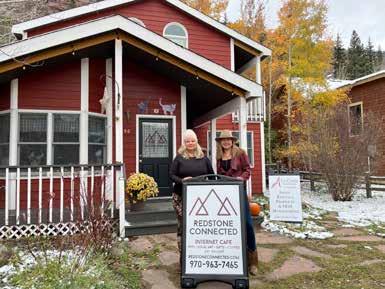
The last three years have greatly altered the way individuals work and gather. The fallout from the COVID-19 pandemic resulted in more people working remotely from home and fewer people gathering in public places to socialize. This loss of personal, one-onone interactions means fewer opportunities to connect with friends and neighbors and fewer opportunities to build community. And it is this loss of connection that Redstone Connected, the new internet café and art gallery on Redstone Boulevard, hopes to help remedy.
“I was really afraid of café culture dying with the COVID-19 pandemic,” said Laura Reagan, co-founder, and co-owner of Redstone Connected. “A coffee shop is such an asset to a community, and Redstone didn’t have one before we opened. We are trying our best to be open seven days a week in order to encourage more people to stop in and visit.”

All artist photographs have been

The goal of Redstone Connected is to offer a place for people to gather for coffee and conversation, get gifts, and enjoy art inspired by nature and Redstone. "It’s a place for neighbors to come together to talk, visit, read the newspaper, and to get a stable internet connection so they can work remotely,” Reagan added.
Redstone Connected hosted their grand opening the second weekend in October. The café and gallery shares space in the iconic ‘Cat House’ (so named for the cats painted above the front doorway, a reminder of days gone by when the building was home to a catthemed gift shop and a weaving store) at 450 Redstone Boulevard with A La Carte Real Estate and Property Management. Reagan
and her fellow Redstone Connected co-founder and co-owner Keely Doyle work as real estate agents when they are not running the internet café down the hall from their offices.
“That’s how Redstone Connected really started. We rented the building space for our real estate office, but the building is huge and there was more space than we could utilize,” Reagan continued. “I live in the back apartment of the building, Keely and I both have huge offices, and there’s an entirely separate family living on the upstairs level. But we still had more space than we needed.”

Reagan and Doyle experimented with using the extra space as a co-working space, but with minimal success. Then they decided to put a call-out to local artists in the Crystal River Valley and surrounding area and were met with a wave of support and enthusiasm. Redstone Connected currently showcases the work of local photographers, ceramicists, jewelers, candle makers, woodworkers, painters, glassblowers, and other talented artists.
Redstone Connected offers its visitors coffee, tea, hot chocolate, apple cider, bottled water, and a variety of bottled beverages at a handcrafted wooden bar made from scraps of wood collected at the historic Redstone Castle. Free Wi-Fi and a cozy, welcoming atmosphere invite all who enter the café to relax, sit down, slow down, and enjoy the art on display around them.

“The art on the walls changes the energy of the space,” Reagan said. “There’s something special and very inspiring about looking at art that brings the outdoors in, that was inspired by the river, forests, trees, and mountains. It’s very uplifting.”
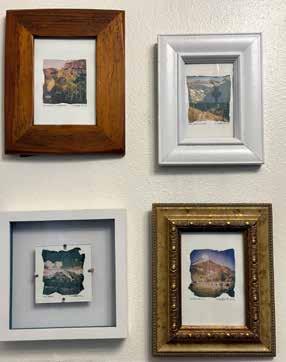



The art for sale at Redstone Connected is priced affordably for customers and offers them a variety of unique gifting ideas. And Redstone Connected works with each of its artists to create individually customized consignment plans that meet each artist’s needs and goals. “We offer consignment rates that are advantageous to our artists. We have no expectations of making millions of dollars by selling art. Instead, we want to promote art through our connection to real estate,” Reagan added.
“Our best day so far was definitely the Holiday Market put on by the Redstone Art Foundation,” Reagan continued. “We had more vendors with tables out on the front lawn to draw people in. I think community events work best when it comes to making sales."

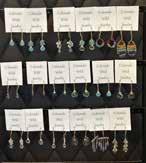

They’re also working on expanding online sales to further promote our artists and their work, you can check out their website by visiting www.redstoneconnected. com.
“Overall we’re open to experimenting with new things. Redstone Connected has evolved and is evolving. We want to welcome people and share the space we have. What does everyone in the community want to do with this space? That’s the question we’re asking,” Reagan said. “As a real estate agent, I want every space to live up to its highest potential.”
Redstone Connected is located across the street from Propaganda Pie at 450 Redstone Boulevard (look for the large red house with the two painted cats above the front door). Their phone number is (970)-963-7465 and you can also reach them at redstoneconnected@gmail.com. Follow them on Facebook, where you can keep up with their frequent and enjoyable video posts.
Redstone Connected is, in their own words, “A place to have coffee and conversation in person, reserve meeting space, quietly work, use Wi-Fi, and appreciate art inspired by the mountains and artisan handcrafts locally.” With this much to offer to both locals and visitors, Redstone Connected is well on its way to achieving its goal of rebuilding connections among neighbors, friends, strangers, patrons, and artists alike.

From David Boyd, Public Affairs Officer for the U.S. Forest Service

The White River National Forest is reminding the public about the annual winter closures at Avalanche Creek that has been in place for decades to protect wintering bighorn sheep, elk, and mule deer.
Since 1996, the White River National Forest has implemented the winter closures at Avalanche Creek, which is about four miles north of Redstone. Avalanche Creek Road (FSR 310) is closed to vehicles, human entry is prohibited north of the road, and the entire area is closed to dogs.
“The slopes north of Avalanche Creek provide excellent winter range for bighorn sheep, mule deer, and elk,” said Aspen Sopris District Ranger Phil Nyland. “The low elevation, relatively light snow-pack, terrain that facilitates quick escape, and presence of winter forage make this area critical winter range.”
Walking or skiing off-road disturbs big game resting or foraging away from the road. Repeated disturbance from people and especially dogs pushes the animals from the better habitat, adding significant stress to big game trying to make it through the difficult winter months.
“Since we first implemented the closures in 1996, both the human population in the region and winter recreation in Avalanche Creek has grown, while big game populations have declined,” Nyland said. “There are a number of factors contributing to the decline of the region’s big game herds, and disturbance in critical winter range is probably a significant reason.”
As more people are using the area, compliance with the closures has decreased, particularly involving dogs.
“We are seeing big game in this area less frequently than would be expected given its high-quality winter habitat,” Nyland said. “It’s clear to me that the presence of dogs in the closed area contributes to the lower numbers of big game, as does the amount of people.”
The closures began in November, and the human — and dog — entry closures extend until May 1st; motor vehicles are not allowed on the road until May 21st.



Dear Echo
Thanks for the story about Bill Jochems. His move from Redstone to Carbondale marks the end of an era. He deserved that and more recognition.
In about '71, four remarkable women mobilized the effort to stop the Marble Ski Area: Fogel Neal in Crystal, Marjory Orloscky in Marble, Paula Mechau in Redstone, and Mary Lilly further downvalley, all now deceased. They got Bill Jochems, JE DeVilbiss (also deceased), and me going on the adversarial effort. Bill and JE did the heavy lifting, which is how I first got to know those two terrific guys.
Ski-area developers intended to cram over 20,000 people in Marble. Stop for a moment to let that sink in, including what else would have happened to the whole valley. Redstone and Carbondale would hardly be recognizable. Four-lane 133. Condos, second homes, gas stations, retail everywhere -- most of which was avoided because of the hard work of Crystal Valley residents, which work must continue. It seems that beautiful places are often under assault.
Bill remains active. He's on Pitkin County's Healthy Rivers Board. Raise your glass to a great guy. Cheers Bill.
Michael Kinsley
Old Snowmass
& Marble Times
Mission Statement: To provide a voice for the residents of the Crystal River Valley; to bring attention to the individuals and local businesses that are the fabric of the Crystal Valley region; to contribute to the vitality of our small town life.
Editor • Gentrye Houghton
gentryeh@hotmail.com • (806) 374-0055
CONTRIBUTORS
Amber McMahill • Melissa Sidelinger
ADVERTISING SALES
Gentrye Houghton
gentryeh@hotmail.com • (806) 374-0055
DISTRIBUTION
The Crystal Valley Echo is published monthly, and is distributed throughout the Crystal Valley.
NEWSPAPER BOX LOCATIONS:
Third Street Center • Village Smithy
Carbondale Post Office • Carbondale Park & Ride
The Marble Hub • Redstone General Store
FOR SUBSCRIPTIONS
Please send $60 for print or $35 for digital editions along with address information to:
The Crystal Valley Echo 364 Redstone Blvd. Redstone, CO 81623
To The Echo,
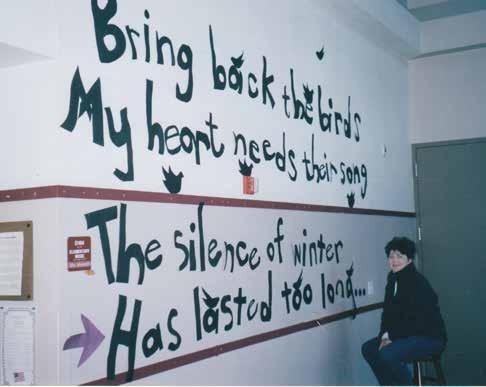
We were looking through some of our photos over the holiday weekend and thought you might like the attached that I took when we lived in Gunnison.
When Ally was teaching at the Gunnison Elementary School she often decorated a hallway, and this picture has an appropriate wish for this season.
Happy New Year to all, Larry and Ally Meredith Redstone
Last month, we began learning about the life and times of William D. Jochems, a Redstone resident who purchased his home at 654 Redstone Boulevard in 1971 and found a new residence down in Carbondale this past summer. Upon his arrival in Redstone, he almost immediately took up arms with environmentalists to protect the upper Crystal River Valley by helping strike down a massive ski development in Marble and saw the fall of the proposed condo development in Redstone. During his tenure, he represented the interests of John Osgood’s third wife and built and installed a massive “tri-therm” boiler inside his garage all while continuing his efforts to protect the Crystal River Valley.
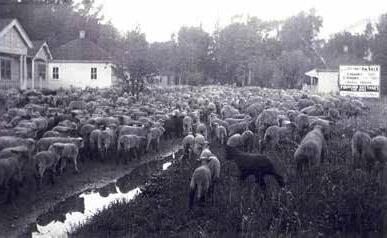
LuCiLLe osgood
Jochems first met “Mrs. MacDonald,” as he refers to Osgood’s third wife after her marriage to Huntley MacDonald, in the early 70s while trying to remedy a survey error pertaining to lots along the Boulevard from his home on the north end all the way down to about where today's headquarters of The Crystal Valley Echo is near the Redstone General Store. The survey had been done during the 30s and laid out the lots at approximately 50 feet.
“So,” he began, “if you put my house in a 50-foot lot and started going down the street and portioning 50 feet to each house, you didn’t have to go very far until a house wouldn’t fit and the lot line, under that concept, was to shave off part of the house.”
stayed in the Hotel Denver so that the two could go through all her records either in Jochems’ office or the hotel. Once the deal had been sorted, MacDonald hired him to represent her for other things.

By Gentrye Houghton
He said he got involved in the procedure to try and straighten it out, and therefore, approached Mrs. MacDonald because solving the issue involved her as a party.
Jochems explained that Colorado “has a marvelous statute” in the case of large-scale survey errors that allows one to hire a surveyor to correct everything by drawing up a plat that shows the property as it is occupied. Once he filed that survey with the district court, notice was given to all the property owners in the area stating that there’d been a petition submitted to readjust all the boundaries from the 1936 plat to the plat that had been drawn by the surveyor. Property owners were given a certain amount of time to object.
That’s where the property that now produces this publication came into the story. Jochems explained, “At that time, the property was the East Creek Wash House, or the laundry mat, and was owned by a man named O.R. White. He also owned several properties towards the north.
“Everybody agreed to the new survey except O.R. White, who was a real pain in the [behind] — and I think he died in the middle of all this, but his widow proved just as intractable. We were in court with the Whites challenging this whole scheme, but eventually, she came around; although, I’m not quite sure why perhaps Mrs. MacDonald talked with her or something.”
It took two to three years just to get the errors lined out, and, according to Jochems, with so many people involved, there was a lot of hand-holding to assure them that everything would be alright. “It cost money, it took a lot of time, and we got it done,” he said with a little chuckle.
At the time of their first meeting, Mrs. MacDonald’s address was at the Del Coranado Hotel in California, which Jochems asserted was a pretty fancy place to live. While trying to iron out the survey, she’d come to Glenwood Springs and
When asked what she was like, he replied that “she was interesting in that anytime any story was presented to her disadvantage, she would be totally baffled and would exclaim, ‘I just don’t understand, how could this be!’”
He continued to say that she was quite shrewd on the other hand, and knew full and well when things were to her advantage and she understood perfectly well what was going on. According to Jochems, she was a very interesting person to deal with, and, naturally, he had both of those experiences with her as her attorney.
MeyeR
The Meyer Boiler was one of several massive projects that took place in Jochems’ Redstone garage. During the 70s, Clement Meyer resided at what Jochems called the chapel (now the Redstone Art Gallery) as the caretaker. He wanted to build an invention he’d dreamed up, and Jochems was so intrigued that he gave him the space in his garage for construction. Two of the four boilers built stayed in Redstone, one in his house and one in the Worley House, located at 497 Redstone Blvd. Meyer called it a tri-therm boiler because it burned coal, wood, and used electricity for heat.
"He was an ingenious guy,” Jochems said. “It took two years to complete the project, and every time I’d come home from work to find these guys working until 11 o’clock at night, grinding and welding and all that creating this massive thing that went into my house.”
According to Jochems, the boiler was of such a scale that it would have easily provided enough heat for the Redstone Inn, and had three speeds while burning coal. He was able to heat his house for a long time on about six tons of coal a year, which was delivered at $40 per ton, so his total heating bill only cost him about $300 for an entire winter of extravagant heat in an Osgood era cottage that was poorly insulated.
The concept was that the coal, wood, or electricity heats hot water in the boiler and then circulated heat through pipes in the home. “The trouble was,” Jochems explained, “he couldn’t get the cost down below about $60,000 and he was doing this right in the middle of an era with oil embargoes. People were so frightened we were going to run out of energy. So, to be able to heat your home three was rather intriguing.”
The boiler required your attendance to fill the hopper with coal every other day or so, but when Jochems went out of town, he just turned on the electric element to do the job the coal was doing. But, at the time, it was very expensive to do that.
“The boiler was a success until a lady friend pointed out to me that in the course of a 12-hour period, you could run your finger across a table and see the new track of coal dust,” he said. “She persuaded me to abandon the coal boiler for a propane boiler that still used the same distribution system.”
He said it was quite the undertaking to get the massive boiler out of his home and enlisted the help of his neighbor, Scott Kleckner. While the boiler was installed in a single piece, Kleckner had to cut it apart using torches and a grinder and hauled it out in pieces.
In the end, Meyer acquired a trade and started the Meyer Boiler Company, which thrived as he was the only licensed boiler inspector in western Colorado, eastern Utah, and southern Wyoming during a time when there was an abundance of oil and gas drilling happening. And those operations couldn’t afford to shut down for anything. He said Meyer passed away just a few short years ago.
BoB CaRR, Mona Lisa, and da VinCi
In 1975, a tornado ripped down Redstone Boulevard — the only recorded tornado in the history of the Crystal River Valley — and snapped a tree at its trunk in Jochems' front yard. He then commissioned Eric Johnson to carve a woman from the ruins, but Jochems claims the carving ended up becoming a real eyesore.

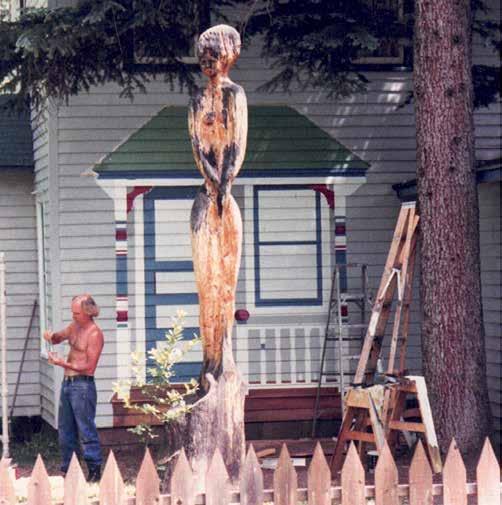
“What happened was,” he said, “we coated her with oil and all that, but she got very dark and unattractive with stains to the point that by the early 80s I wanted to cut it down. First, though, I had this blank wall and so I commissioned Bob Carr to paint on the clapboard surface.”
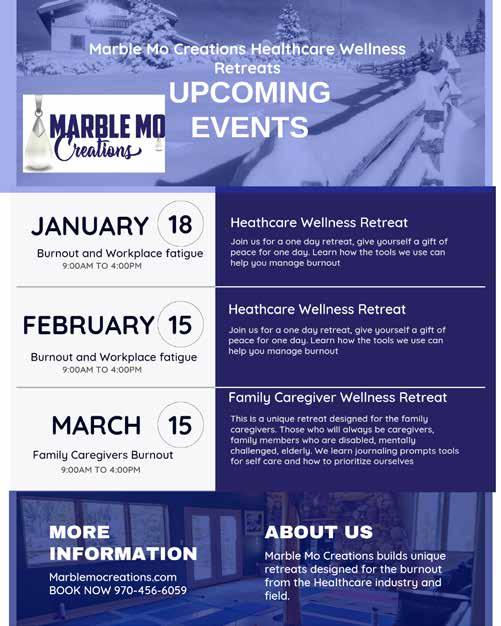
According to Jochems, Carr was “pretty darn interesting.” He described him as extremely skilled, but a classic crazy artist. Jochems said Carr was “mercurial in the extreme, and could go off the deep end in frightening ways.”
Not only is Carr responsible for the portraits you still see adorning homes along Redstone Boulevard, but he also did a series of buildings, some of which can still be found at the Redstone Art Gallery. He depicted the Durrett house (138 Redstone Blvd., right across from the Redstone Inn), the Crystal Club (which has now become Propaganda Pie), and the Church at Redstone; he would take a photograph of the building, project it, and then draw it. Jochems said it sounds like something anyone could do, but Carr’s results were near perfect in every detail.
At first, he commissioned Carr to paint a window, but after studying the scene he came back wanting to do more than a window, instead, he painted a porch that was the exact copy of one found just two doors down.
“The porch is an exact copy of the Leone house — true to all detail,” he said. “Then we got to talking, and we needed somebody to look out the window. The first candidate was Marilyn Monroe holding her skirt down as if she was standing over the heater grate — we’d talked about that, and then made the better choice.”
Carr instead pained Mona Lisa looking out the window, and the other portrait is of Leonardo da Vinci, which Jochems says he thought was a mistake, “I thought it made it too gimmicky to have the two portraits, but Carr wanted it and so I let him.”
From all the stories this author has heard about Bob Carr, Jochems probably didn’t have much of a say in exactly what he ended up painting.
“There was many a time that I would have people come walking by, who had driven into town and were now walking and looking around, who would say they’d realized the Mona Lisa was painted onto the window but had assumed everything else was real,” said Jochems. “The talent to be able to do that, on that type of surface is pretty incredible. You know, there’s a French term for that, fooling the eye," which is trompe l’oeil.
The originally painted porch and portraits lasted quite a long time because a blue spruce tree provided shade and it never received direct sunlight; Jochems estimated that it lasted 20 years or so with hardly any damage until the tree blew down and the sunlight quickly deteriorated the painting. “That’s the second tree I lost,” he lamented.
About six or seven years ago when Jochems last had the house painted, the painters covered everything except for the two portraits, which is how they appear still today.
During his time in the Crystal River Valley, Jochems has been no stranger to a plethora of non-profit environmental and historical boards, including aiding in the foundation of the Redstone Historic Preservation Commission (HPC) and serving on the board for 17 years.
As described on the Pitkin County website, the HPC board provides for the preservation and continued integrity of the historically designated area within 1,000 feet of the Redstone townsite boundary as well as other designated structures, sites, and objects. They promote the educational, cultural, economic, and general welfare of the public by preserving those qualities which relate to the history of Redstone.
It was sometime during the 80s that an issue arose that Jochems feels was the biggest, most important thing HPC ever did. Back then, Mid-Continent Resources owned both the mining operation in Coal Basin as well as the historic Ice House (119 Redstone Blvd.), including a substantial amount of property to the north up to the chapel (now the Art Gallery). Mid-Continent wanted to erect a row of townhouses, each one a replication of the Ice House and would have provided highly needed housing for the resident miners.
“Housing was always needed for the miners,” he said. “There’s no doubt about that, housing has always been needed for workers here. Always.”
Had the development been permitted, Jochems feels it would have been a real character changer for the village of Redstone, and in front of each home, he predicted, one could find a pickup truck, snowmobile, motorcycle, and a car.
He explained that the board wrote the guidelines in 1981, and took a full year just to write them, which didn’t permit anything like the proposed development. Jochems said that after the commissioners approved the guidelines, “along comes this and Mid-Continent thinking their ideas were so much better than this goofy historic preservation outfit. Just because of that, they thought they could get approval — well, they didn’t.”
Later, Mid-Continent tried to propose another development behind the coke ovens. “At the time, I think the board would have been agreeable to not assert guidelines jurisdiction over the coke ovens because when we originally drafted them we weren’t thinking of anything beyond the Boulevard so it seemed unfair to impose them behind the coke ovens,” he explained.
In the Redstone area, there are historic designations of specific properties, there’s state historic designations, as well as national designations; however, the Historic Preservation District is a creation of Pitkin County, which designated the guidelines jurisdiction as the original townsite plus an additional 1,000 feet radius, which includes the space behind the coke ovens. Therefore, Mid-Continent’s development proposals
never made it past the theoretical stage.
Once again, due to space constraints, the final installment of the life and times of Bill Jochems will continue in February. Next month, we’ll hear about the Mid-Continent years and the reclamation debacle, Jochems' short tenure as a Marble Judge, his boat-building phase, and the time Pitkin County Attorney John Ely asked Jochems to come out of retirement. Plus his reflections, memories, and concerns for the future.
See you in February!

At the Redstone Inn Redstone programs are open to all! RSVP: (970) 920-5432
JANUARY 10 & 24
• 12:00 p.m. – Lunch ($10) RSVP by noon the Friday prior – space is limited. Plated lunch will be served. There will be a gluten-free option.
• 12:45 p.m. – Program
January 10: Staying Warm this Winter Tips from Pablo Herr of Carbondale Fire. Low Income Heat Assistance Program (LEAP) information from Ligia Bonilla of Pitkin County Economic Assistance.
January 24: Music with Dan Sheridan Plus information on Pitkin County’s Low- and Middle-Income Property Tax Relief Program.
WANT TO BE KEPT IN THE LOOP? Send us your email address: (970) 920-5432 • seniors@pitkincounty.com
I think most of us can agree that the highlight of 2022 was the ability to take off our masks, get together with other people, and actually hug our loved ones. When I see photos of what is happening in China these days, with the spread of COVID infections there and the incumbent death rate, I find myself deeply grateful for the fact that we are able to live with and manage the level of the virus which is ongoing here.
While the U.S. had an appallingly high rate of infection and death over the last two years, the reality is that now we have a strong community immunity and people who are still contracting COVID are getting less severe cases. As we approach a return to near-normal social lives, it is easy to forget what life was like in 2020-2021. Schools were closed, many people worked from home, and we avoided contact with others. Those generous people who continued to work in person every day – our essential workers –helped us maintain momentum and we need to remember the sacrifices they made. Thank you to all of them.
In Pitkin County this year, we made significant progress towards bettering the lives of our 390 employees. County administrative staff conducted interviews with employees across the organization in order to hear from them about their experience in working for Pitkin County and how we can make it better.
We distributed Inflation Relief Stipends and increased and enhanced benefits, including providing benefits for domestic partners. County communications with our citizens are now more regularly accessible in Spanish, and our budget is more transparent through www. opengov.com, a platform meant to promote transparency and communicate the county’s priorities to the public. Find out more on pitkincounty.com about the work that is ongoing with Community Development, the Board of County Commissioners (BOCC), our county roads, Healthy Rivers and Streams, Open Space and Trails, wildfire mitigation, and all aspects of your county government. If you’ve never visited the site, I recommend you try it. There are incredible maps and even an osprey cam!
In 2022, the Pitkin County Solid Waste Center succeeded in diverting more waste from the landfill through repurposing, recycling, and composting than any other county in Colorado. We completed improvements to the County Courthouse, making it safer and more technologically modern. We held a glitch-free election, and our Public Health Department continues to encourage people to get vaccinated, mask up when appropriate, and stay home when sick as

COVID-19 and other respiratory illnesses affect our region.
In addition, we strive to find a solution to our aging jail and work to create a justice center that meets the needs of all those who find themselves in custody. It is our goal to offer different pathways for those who may battle addiction or mental health and those who truly need incarceration.
We have a task force developing a compilation of the attributes that we strive to incorporate, whether it be in a re-developed center at the current location or a new site somewhere else. Most importantly, we want a solution that safeguards the incarcerated, their loved ones, our jail deputies, and Pitkin County at large.
In addition, the Airport Advisory Board continues to meet regularly and develop technical advisory teams as we work towards plans for a safer airport and a new terminal.
The BOCC has been particularly committed this year to three primary areas of concern – climate change, childcare, and affordable housing. We have committed a total of $5,000,000 specifically towards affordable housing in 2023 and more than half of our funds from the American Rescue Plan Act have been designated to stipends for those who work in providing childcare to our youngest children.
Throughout the year we have wrestled with growth, house size, short-term rentals (STRs), transferable development rights, and development that may occur in inappropriate areas, such as Rural and Remote zones. In our efforts to view these decisions through the lens of climate change, we have spent countless hours discussing and researching the types of steps that might be taken, recognizing that our land use codes are probably our best tools.
We sought volunteers to work on an advisory committee to garner input from all sectors of our community. Out of the 70 applications we received from people willing to serve on this Community Growth Advisory Committee, we appointed 26 volunteers – land planners, architects, contractors, developers, ranchers, environmentalists, and others from teaching and gardening backgrounds to broadly represent the community.
These generous people have met every other week since the middle of August and engaged in discussions about how best to set up some parameters for development in this most beautiful of valleys. This coming spring, the BOCC will receive recommendations from the Community Growth Advisory Committee and face the daunting task of crafting reasonable, effective, and forward-thinking legislation.
Last fall, the BOCC met at the Church at Redstone to discuss with residents how best to manage STRs in Redstone and the Crystal Valley. We recognize this is a unique place and might need specialized regulations in order to meet the wants
and needs of those who live here. We have definitely stirred up a hornets’ nest of issues and recognize the community is not of one mind on STRs and their effects on Redstone. We are committed to working further with the people of Redstone as we explore ways to honor each sector of the community. Staff is developing an outreach process to begin in February 2023 specifically for STRs in Redstone along the Boulevard. The BOCC will be reviewing this proposal on January 24th at our Tuesday work session.
Personally, I am working to secure Wild and Scenic designation for the Crystal River by serving on the Crystal River Wild & Scenic Coalition and reaching out to municipalities and counties that are affected by the waters of the Crystal River. I delivered a presentation to the Town of Carbondale Trustees and they voted unanimously to pass a resolution in support of the Wild and Scenic designation. I also worked with Jonathon Godes, Mayor of Glenwood Springs, and he and his council also passed a resolution in support. Those were exciting steps on our journey to eventually get a bill before Congress to protect our river – the lifeblood of our Valley.
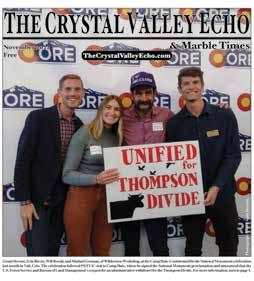
I am also working – with many of you – to protect the Thompson Divide from future oil and gas leases. The Forest Service has submitted a request to the Bureau of Land Management to protect the Thompson Divide for the next 20 years, and while Secretary of Interior Deb Haaland has said she preliminarily supports pursuing this, it also must be passed through Congress.
Almost anything that requires a vote of Congress presents major hurdles and must show proof of overwhelming popular support. Please consider contacting Wilderness Workshop to find out how you can help both of these efforts to protect and conserve the lands and waters in our county and the Crystal Valley.
It is a pleasure and an honor to serve the County, and particularly District 5. I enjoy serving on the Boards of RFTA (Roaring Fork Transportation Authority), APCHA (Aspen-Pitkin County Housing Authority), and CORE (Community Office for Resource Efficiency) as well as being a member of the Wolf Restoration Stakeholders Advisory Group. In these capacities, I have been able to work for and support affordable housing and varied approaches to increasing wildlife diversity, protecting wild lands, reducing emissions in the valley, and implementing policies that reduce the threat of climate change.
The County Commissioners appreciate the work of all our County volunteers who contribute time, intelligent problem-solving, and lots of energy to helping us preserve the quality of life we enjoy by living in one of the world’s most beautiful places. Please feel free to contact me at francie.jacober@ pitkincounty.com with any issues of interest. I love this Valley in which we live as I know each of you does also.
An account from DJ Sugar Monkey
The night was crisp and clear as I plodded my way past The Marble Hub and up the hill in the direction of the Marble Community Church's Fellowship Hall, keeping to the side of the road to avoid the worst of the ice and delighting in the satisfying crunch of each necessarily deliberate step in my cozy winter boots. At the Parcel Locker, I took a couple of minutes to stop, removed my hat, let my head drop back, and stare, mouth agape in awe at the wonders of the heavens above. How lucky we townsfolk of Marble are to live in such a mesmerizing place.
Mars took center stage in my field of vision, winking at me in all its amber splendor and I wondered if December's meeting would be a bellicose affair to end the year. With the expectation of a gauntlet tossing now firmly embedded in my overactive imagination, I arrived full of anticipation at the Church Hall.
On arrival, I was greeted by a paper sign stuck on the inside of one of the windows of the hall indicating the council was in Executive Session with the Town’s lawyer and that I should wait in the church itself. Negotiating my way down the dimly lit passage from the hall to the main body of the church, I was delighted to bump into Terry Langley, decked out in one (of what I am sure is an extensive collection) of her Christmas sweaters, this one adorned with the slogan, “You’d better not pout.”
El Tel is one of Marble’s shiniest stars, the true embodiment of community spirit, and loved by all in the town. She was enthused about the splendid Church decorations, the centerpiece of which was a magnificent tree adorned by the highly creative Becky Bone, festooned with silhouetted mountain characters and magical festive creatures. I was so entranced that I had to be shaken from my reverie by Amber McMahill who had come down to fetch us now that the Executive Session was ending and the public meeting was ready to begin.
The meeting itself was to be short (27 minutes to be exact) and sweet, the latter ensured by the provision of some of El Tel’s tasty Yuletide fudge (with nuts or plain). There really is no end to this lady’s talents. She took her seat next to Ron Leach
in front of the other council members. Present were Mayor Ryan Vinciguerra, McMahill, and Tony Petrocco bedecked in classic grey sweats and blue jeans. It was good to see his trademark chair swing back in action.
Larry Good was on speakerphone, although I learned after the event that he was, not to be outdone, sporting a dandy combination of a tan and orange checked shirt (never untucked) with a pair of charcoal gray jean slacks and lace-up ankle boots. Richard Wells, not to be ignored, sported a “Yes on 5a” bright Orange Sweatshirt and his signature Hawaii cap. We’re a stylish lot here in Marble.
Wells joyfully announced that he had got his hands on a groomer and a sled for the town. Indeed, I went down to the Mill Site Park the following Saturday and he and Jason Rusby were busy putting their new equipment through its paces. They have created a network of gently groomed trails that crisscrosses the beautiful historic area and trace the delightful bank of the Crystal River. They hope that these trails will be enjoyed by residents and visitors alike. I had a wonderful time on your trails, thanks chaps!
Against the enchanting backdrop of the Church Hall’s impressive Nativity Scene, and after what had seemed like a lengthy discussion with the Town’s lawyer, Mayor Vinciguerra proposed the motion that the Town of Marble embarks on the process of acquiring the Marble Water Company for the sum of zero dollars. The motion was greeted with unanimous support. I sensed a red twinkle of Martian light flicker across the room accompanied by the faint thud of a gauntlet on an icy road somewhere in the not-too-far-away distance.
It was announced that Amy Rusby, former Director of the Marble Charter School and highly valued member of the community, joined the Parks and Rec Committee and that McMahill would be ready to present ideas for new Marble signage early in the New Year.
Also, ringing in the changes was Terry Langley, who declared that she is to step down from her role in organizing the annual Thanksgiving Din-

The Marble Town Council meets on the 1st Thursday of each month starting at 7 p.m. in the Marble Community Church’s Fellowship Hall.
Town of Marble meetings are open to the public.
ner. This year the event was attended by 70 people, amazingly, a lower number than usual. I am sure all readers would like to join me in thanking the indefatigable El Tel for all her hard work in shepherding this popular event over the last several years and lending our support to Yvonne Ellis and Lise Leach who have agreed to take up the reins going forward.
The Town of Marble meetings occur on the first Thursday of every month, and the agenda can be found on the Town website prior to each meeting: www.townofmarble.com. Meetings begin at 7 p.m. in the Fellowship Hall of the Marble Community Church.
Wishing you a very Happy New Year.
January 5th February 2nd March 2nd
A lot of projects took center stage in our valley throughout 2022 and many of these projects revolved around environmental and land use concerns. The Crystal Valley Environmental Protection Association (CVEPA) has guarded the natural treasures of the Crystal River Valley turned 50 last year and continues to be as active as ever. Along with the environmental efforts, last year were two elections and some fairly contentious issues that pitted neighbor against neighbor. Luckily, it was all played out against a backdrop of a renewed and flourishing art and music scene that helped bring the community out and strengthen the ties that bind us all together.
MuCh ado aBout tRaiLs
Last year, the much debated "Carbondale to Crested Butte" trail system came closer to home as comment opened on the first proposed section of trail which runs from Restone to the top of McClure Pass. In January, the Aspen-Sopris Ranger District released an Environmental Assessment study on the potential impact of the seven-mile section of the trail. After receiving over 400 comments about the proposal in Feb-

ruary and early March, it is clear that there are strong feelings about the bike path.
Proponents feel that this will provide a safer and more eco-friendly path for those wishing to recreate. Opponents, however, worry about the impact on wildlife and the surrounding communities. This section is just a small portion of the larger trail and the plan has been met with some criticism for approaching the project in sections rather than as a whole. Early this year, the plan is expected to enter the "objection" phase with the forest service, allowing people to make formal objections against the plan.
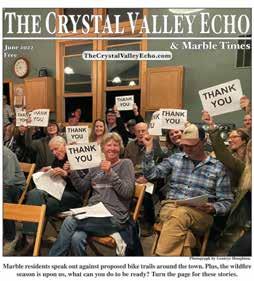
Fresh on the heels of this hotly debated trail another trail proposal, this one in the Town of Marble, saw almost as much debate and controversy. Last February, Roaring Fork Mountain Bike Association (RFMBA) was asked to work on a potential mountain bike and pedestrian trail system for Marble and surrounding areas. The work, requested by the same entity that funded the Coal Basin Mountain Bike Area, came with the offer of donated funding to complete the project. RFMBA drew up some potential ideas for trail concepts, mostly geared towards creating a trail that would be a safe alternative for school students and residents to traverse Marble apart from the main roads as well as a kid's skills park located within the town.
The project, however, was shut down before it even made it to the draft phase by concerned cit-
Mike Kennedy, Broker/Owner 970-379-3907
mikekennedy@sopris.net ColoradoHomesRanches.com

izens who circled a petition and put pressure on both RFMBA and the Town Board of Trustees to turn down the offer.
enViRonMent FoR the Win
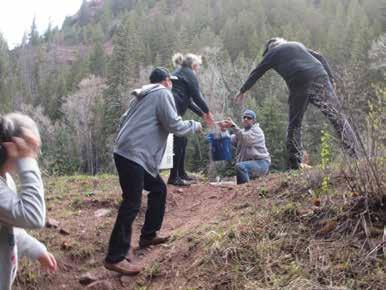
Some major headway was made in managing and protecting the valley's natural resources this past year. A last-minute heroic effort by CVEPA resulted in 55 acres of precious wetlands being protected from development and entering the public domain. The Marble Wetlands runs along the back side of Beaver Lake and the Crystal River. As the site of the old Hoffman Smelter, it was a tricky and at times nail-biting tale to get it to a new owner. The Trust for Land Restoration stepped up and took ownership of the donated property and worked during the warmer months to clean up the somewhat toxic smelter site. Once the work is complete they will be looking for a new owner to take on the important site.
Meanwhile, talks resumed after an almost six-year hiatus to seek the protection of the Crystal River under a Wild and Scenic Designation. When this issue was last approached in 2016 it was met with much resistance by several landowners along the Upper Crystal. This time around, the effort is more citizen-driven with the backing of funds from Pitkin County Healthy Rivers. The stakeholder group has recently selected a facilitator who will be working in the coming year to explore the designation and what ideas might best fit our area.
If you’re needing assistance stretching your food budget, Gunnison County Officials currently have bags of food available through the Marble Community Church.
There is no charge and no reservation needed; boxes are available for an individual or a family up to of four, and contain enough meals for approximately three days.
To arrange a pickup, please call the Marble Community Church at (970) 963-1464.
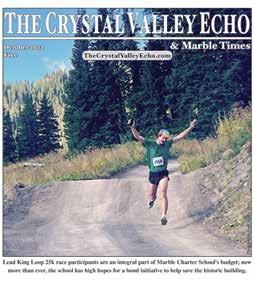
The Lead King Loop Steering Committee wrapped up several years' worth of work by making recommendations to the forest service and county regarding the use of the Lead King Loop road that winds around Beaver Lake, through the town of Crystal, and then around and back through Lead King Basin. Suggestions ranged from more enforcement to a parking permitting system. It is now in the hands of the Gunnison County Commissioners, White River Forest Service, and the Town of Marble to implement the suggestions or not.
Early in 2022, the Crystal Valley began to hear whispers of a potential Methane Capture Project proposed to clean up emissions leaking from the mining sites in Coal Basin. There were a few engagement opportunities in and around Redstone throughout the year to hear about the project, which is met with mixed feelings by the Redstone community.
Chris Caskey, a self-proclaimed “climate guy” and entrepreneur with the Delta Brick Company, leads the project's efforts. He projects that the mines emit nearly 10,000 tons of methane annually, nearly half of Pitkin County’s total annual greenhouse gas emissions. To date, the project has been backed with funding to the tune of almost $900,000 by Pitkin County, non-profits such as the Community Office for Resource Efficiency (CORE), and private companies like Atlantic Aviation.
Caskey has surmised three potential outcomes dependent upon community input and the results from the Flow Test, which he is optimistic can get off the ground this coming spring or early summer. The options are: Do nothing (Caskey’s least favorite), flare it, or, if the flow test shows high enough emission, capture it and generate electricity. Performing the Flow Test requires approval from the U.S. Forest Service, and while the project is requesting a categorical exclusion, Jennifer Schuller of the Aspen-Sopris Ranger District told the crowd during an October meeting that they are committed to a public comment period before issuing the permit.
Community members interested in the project find a consensus in the commitment to reduce greenhouse gas emissions; however, skepticism arises with concern for the projected numbers
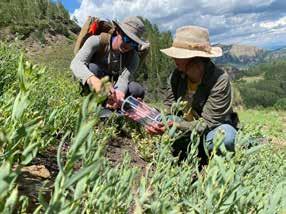
The Catena Foundation and Crystal Basin Holdings, the LLC that owns Coal Basin Ranch, have partnered with the Environmental Defense Fund and Colorado State University (CSU) to survey the abandoned coal mine methane emissions in Coal Basin. Joe von Fisher, a professor in the Department of Biology, led the study over the summer. They completed their field testing in October and we are currently awaiting the publishing of their results. Above, Colin Slunecka shows Mona Newton how to collect samples of the air that is being released from the Dutch Creek No. 1 mine.
by Gentrye Houghton.
and impact on the environment. While Caskey projects that the Coal Basin leaks around 10,000 tons of methane annually, he has also stated that at best they can probably only capture around 50% of that for a project that would continue for a minimum of 20 years. Annual global methane emissions total 570 million tons with the Coal Basin project making a potential 0.0009% reduction on the global scale. Many opponents also have concerns that the project may undo the 30 years of reclamation work done to clean up the mines that closed in the early 90s, with revegetation efforts that continue to struggle.

Those who support the project feel it may contribute to a lot of good. One woman commented during the October meeting that this “could be a model for the rest of the world and an opportunity for Redstone to rally in a time when so much is wrong.”
After more than a decade-long push, Wilderness Workshop and the community received a big win in October for limiting oil and gas leases within the Thompson Divide. U.S. Secretary of Interior Deb Harlaand pushed forward an application from the Forest Service to withdraw the 220,000 acres from future mineral leases.
Anthony Edwards of the Grand Mesa Uncompahgre and Gunnison National Forests (GMUG) told a crowd during a public meeting last month that he submitted the application as the Forest Service wants to protect the land based on comments they’d received over time. The administrative withdrawal is proposed for 20 years as defined by federal law and does not affect private property nor the 23 currently active leases, none of which are located within the White River National Forest.
Administrative mineral withdrawals require an analysis under the National Environmental Policy Act (NEPA) and the initial 90-day public comment period is still underway.
“This is the process before a process,” said Jennifer Jardine, Senior Realty Specialist for the Colorado Bureau of Land Management, encouraging the public to make comments before the environmental assessment is released. Basically, they are interested in all comments, and by exercising your voice now, you’ll also be providing contact information that insures you’ll continue to be informed as the process progresses.
Public comments will be accepted through January 16th by regular mail to: State Director, Bureau of Land Management, Colorado State Office, 2850 Youngfield Street, Lakewood, CO 80215 or by email to BLM_CO_Thompson_Divide@blm.gov.















taLe
Two elections closely affecting Marble and Gunnison County both came down to a handful of votes proving just how important it is to exercise your voice. In the case of the run for Marble Board of Trustees, which resulted in a tie — literally a single vote could have determined the election. Instead, the decision was made with the toss of a coin, with Tony Petrocco joining the board.
Two issues in the Midterm elections in November for Gunnison County will also have a great impact on the community of Marble. Ballot Issue 5A passed with a slim margin of just 125 votes. This bond issue will give the local Marble Charter School $1 million in funds to make some much-needed upgrades to the historic school building which also houses the town's museum.

6A passed more easily allowing the funds from the 4% local marketing tax on lodging to be used more freely. Before this funding was only allowed to be used for marketing. The funds average around $35,000 and are given to the Marble Crystal River Chamber annually; with the passing of 6A, this funding can now be used for infrastructure to address tourism, affordable housing, and childcare for workers.
Speaking of exercising your voice, the short-term rental debate continues to heat up even though the Pitkin County Commissioners voted an ordinance into place that took effect in September.
What proved to be an extremely contentious topic, the Board of County Commissioners (BOCC) was able to temporarily quiet the Redstone voices to pass an ordinance for unincorporated Pitkin County as a whole with a promise to explore special treatment around the village. After over a year and a half of discussions, they were finally able to put an ordinance in place with a 4-1 vote last June.
The regulation requires those interested in operating an STR to apply for a license; applicants are expected to prove rental history before May 1, 2022. The approved ordinance calls for 120 maximum rental nights annually, and a minimum 4-night contract with renters to prevent nightly turnover.
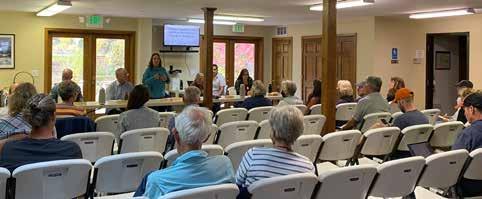
True to their word, the BOCC held a September work session at the Church at Redstone to engage with the community regarding special treatment in Redstone, and the discussion continued back in Pitkin County last month. A mixed bag of opinions was shared during the September meeting, with full-time residents advocating for stricter regulations and the business community advocating for the role STRs play in their bottom line.
District 5 Commissioner, Francie Jacober, told The Crystal Valley Echo that she was surprised there was not more of a consensus regarding the boundaries in which this special regulation should be applied. The boundaries discussed were the historical boundaries, only the Redstone Boulevard, or the greater Redstone area including several subdivisions.
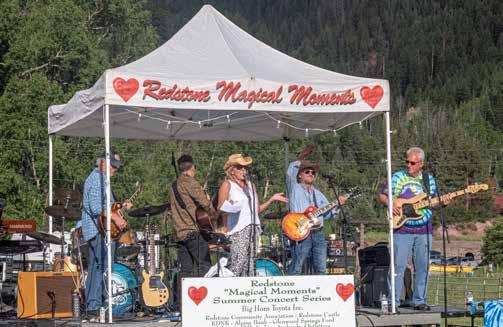

During the December work session, the BOCC discussed with the Community Development Department the language within Redstone’s Master Plan, which was last updated in the mid-90s, land use codes, and an outreach process they hope to launch early in the coming year. Anyone could participate in this outreach, but they will want some demographic information from each commenter.
The BOCC requested more information to be discussed during a future work session before launching the process and acknowledge the incredible amount of letters received from the Redstone Community which ignited the STR discussion beginning in early 2021. Ultimately, they are hopeful for an outcome from this outreach that brings about a shared vision statement for the role STRs play in the Redstone economy.
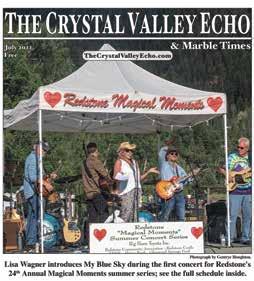
Music, Art, and Culture had an amazing year in the Upper Crystal. The Redstone Art Foundation hosted an expanded art show last year featuring local artists in both their typical tent on the front lawn of the Redstone Inn and even more vendors under the large tent on the East lawn. They also added in a Plein air event and auction, all to raise funds for the foundation's scholarship program. The Magical Moments summer concert series once more brought the community together with free concerts behind the coke ovens at the Redstone Stables.
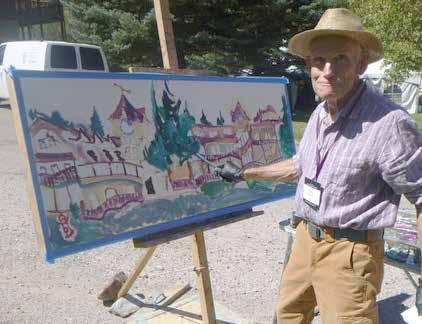
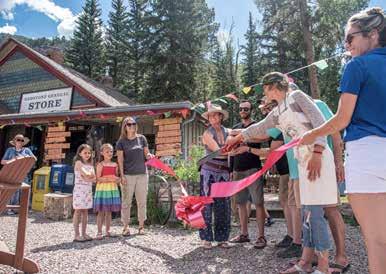
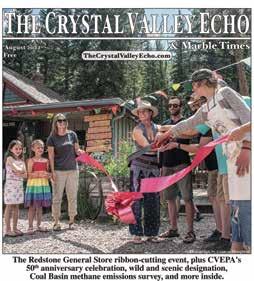
The Redstone General Store, now in its second year on Redstone Boulevard proved its commitment to building community by hosting weekly gatherings including drawing clubs, music around the fire, monthly community dinners, and more. Their community dinners continue through the winter on the last Thursday of every month; bring your eating wares and a suggested $20 donation to nourish both your belly and soul. Follow @redstonegeneralstore on Instagram to stay up to date on their latest happenings.
In Marble, the Marble Art Guild continues its work by highlighting local artists and offering free classes. Larry Good at the Beaver Lake Lodge started hosting Songwriter Nights again after a two-year hiatus due to COVID. In August, Marblefest once more took over the Mill Site Park, bringing local Colorado talent into the spotlight and keeping the people of the valley dancing well into the evening.
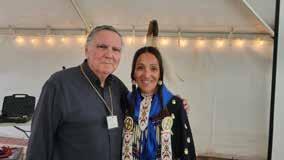
The history of the valley received a boost as well last year with the reviving of the Redstone Museum and the rejuvenation of the Redstone Historic Society. They hosted the speaker and curator of the Ute Indian Museum CJ Brafford this past summer with a group of around 100 people. The Marble Historic Museum worked with the Carbondale Historic Society to bring a bit of Marble history to the annual Carbondale Potato Days, even in the pouring rain, and the museum got some fresh new displays through the efforts of Alex Menard.
Construction began this past summer for the design update to Redstone Park, although work was delayed by about a month from the proposed start date. This was due to the permitting process and securing a contract with the con-
tractor, Peter Blake. Several changes were made to the original design plans to comply with the floodplain, building permit requirements, and ADA compliance from the parking area to the new eight-sided gazebo. Once permits were issued, work began north to south and as of October, according to Pitkin County Open Space and Trails Senior Planner Carly Klein, major improvements to the north end of the park have largely been completed.
However, near single-digit temperatures and the falling of snowflakes in November halted the project before completion. Work will resume this spring to stain and clad the trash enclosure; coordinate meter pedestal final locations with Holy Cross Energy; install handrails, an entrance sign, and trash receptacles; repair and replace sod; add mulch to the playground area; regrading, adding topsoil, and seeding the ice rink area; and completing the beam stone walls around the ice rink area.
Due to the unevenness of ground in the ice skating rink area, as well as health concerns from the rink coordinator, the construction of the ice skating rink looked like it may not have happened for the 2022-2023 winter season. However, several community members rallied during December to get the rink up and running, which is now open for skating. Currently, there is no electricity available to illuminate the rink at night, so bring your own lights, and please remember to keep the area tidy by removing all items off the ice and re-hanging your skates once your fun is done.
Cheers to a warm and bright 2023!






by Brian K. Trembath
The canary in the coal mine has long been a metaphor for early warnings, but for actual coal miners, those birds were a matter of life and death. In Colorado coal mines, however, the canary wasn't an actual canary. Most of the time, Centennial State miners relied on mice to perform the functions normally carried out by coal mine canaries.
Before we discuss the unusual relationship between mice and men in the subterranean world of the Colorado coal fields, it's worth looking at how animals became alarm systems warning miners of impending danger. The story of the canary in the coal mine starts in the late 1890s, with the work of John Scott Haldan (aka, the father of oxygen therapy).
Haldane's research showed that canaries, which can fly quite high, were extremely sensitive to pollutants and poisons in the air. This was due, in part, to their ability to take in extra air through specialized air sacs for high-altitude flight. In short, canaries take in about twice as much oxygen as other small animals, such as mice, and are the perfect specimens for detecting poison gas in coal mines, according to Smithsonian Magazine
Shortly after Haldane's discovery, canaries were deployed in mines throughout Britain to great effect. Canaries were so successful in ferreting out mine dangers that they were used well into the 1980s.
But canaries were not commonly found in the Colorado coal fields.
According to Thomas G. Andrews' tour de force of Colorado coal mining history, Killing for Coal, pack rats and house mice made their way down mine shafts following the trail of feed left behind by mine mules. Once established in the depths of the mine, a single female mouse can breed 150 babies in a single year. Those mice colonies wound up relying on miners' lunch pails for their meals.
While the thought of being trapped in the depths of a dark mine with thousands of mice might make contemporary skin crawl, the miners found great comfort in the creatures. For starters, the mice were in fact quite sensitive to changes in the mine's air, known as “damps." When the mice appeared lethargic, the miners knew trouble was afoot.
Colorado mine mice also had a quality that traditional mine canaries didn't — extremely good hearing. When the mice scattered unexpectedly, it could mean that mine timbers had snapped somewhere in the shaft, or that a roof cave-in was imminent.
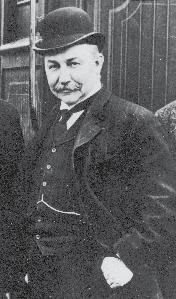
All content sponsored and provided by the Redstone Historical Society
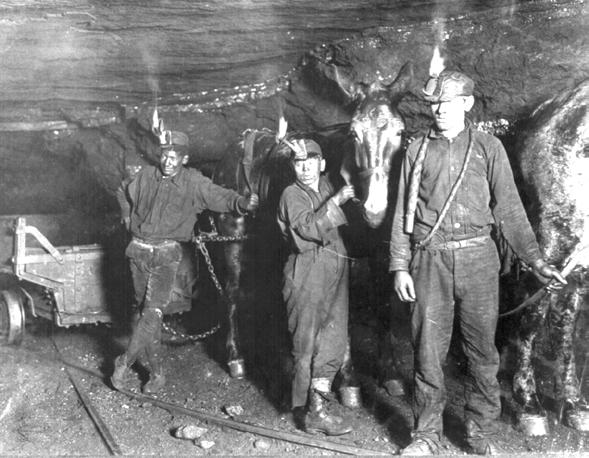
With mice and men operating in such close quarters, it's not surprising that the two species formed some tight bonds. Many a miner came to befriend mice and even took to naming and feeding them. At mealtime, the miners frequently shared their lunches with the rodent friends.
Andrews suggests that the mice may have reminded the miners of bygone days in the rural villages of their homelands. He also points out that the little mice brought a ray of light and life to the otherwise dark and extraordinarily dangerous mines.
There's no question that Colorado mice were incredibly important to Colorado miners and performed as well — or maybe even better — than coal mine canaries.
Author Brian K. Trembath is Denver Public Library's Special Collections Librarian, Western History & Genealogy. This article was reprinted from the April 29, 2020, Denver Public Library blog with the author's permission — https://history.denverlibrary.org/news/colorado-coal-miners-canary-coal-mine-was-mouse
By Elsie Mile, Sixth Grade
Two hundred fourty million people play football worldwide and occasionally someone gets a concussion. Only 300,000 people get concussions from football every year but every year there are 1 million injuries and 17,000 deaths a year from slipping on ice or snow (www.ontrial.com). Going through everyday life is very dangerous even without sports. Even though sports can be risky, sports are good for your health. Playing sports is worth the risk of injuries and concussions.
Sports also have many physical and mental benefits. In the article “Playing Teen Sports May Protect From Some Damage of Childhood Trauma” by Susie Neilson, it states “Participation in team sports as a young person can significantly reduce long term likelihood of depression and anxiety for people with childhood trauma.” Research shows that there are many physical benefits as well as mental. “Just being physically active is good for kids, and sports like soccer helps establish lifelong fitness habits” (Van der Voo). In sports, everyone is active and having fun.
Research shows that exercising and being active increases grades and thinking ability. This is because when you exercise the blood flow to the brain increases making the connection between the nerves stronger, which leads to growth in memory, creativity, problem solving and concentration. Playing sports makes your brain work better and grow more (www.rochester.edu). Some people might say that playing sports and any extra curricular activities interfere with study time which may lead to bad grades, but there are many studies that suggest the complete opposite. One study even found that the more time kids spend playing sports the better they understand school work. Compared to less active kids, students who play sports are 20% more likely to get good grades in math, science and english (crystalandcomp.com).
In the 1920’s, the football helmet was just a piece of leather. Now look at the football helmets today. In short, sports gear has improved significantly over the past 100 years and will keep changing for the better. The NFL and other sports corporations are working hard to improve sports safety. For example the NFL has made a safety improvement called the guardian cap. If you haven't heard of this, it is a padded cover that goes over the typical football helmet. This reduces the risk of concussions in football (www.nfl. com). Football coaches are being trained to teach safer tackling techniques which are less risky. Soccer coaches are also teaching athletes how to do a safe header. Players ten years and younger are not allowed to be instructed on how to head or intentionally head the ball in a competitive game. Eleven and Twelve year olds are allowed to receive instruction on heading but the training is limited to 30 minutes a week (snapsoccer.com)
Clearly, sports are good for your physical, emotional and academic health. Sports can also help you lose weight and sports encourage healthy decision making such as not drinking and not smoking. Furthermore sports have hidden health benefits such as decreasing the likelihood of osteoporosis or breast cancer later in life (www.muhealth.org). Although there are many risks to sports there are even more benefits. This is why sports are worth the risk of injury and concussion.
By Delphi Badgett, Seventh Grade
Throughout time sports have been a significant part of our society. A key part of American culture is sitting down and watching football. Whether or not they are worth it is an extremely controversial problem. A concussion is and will undoubtedly continue to be a type of traumatic brain injury that in almost all sports is a frequent problem. You should always approach things life changing in sensible ways; I strongly believe you should carefully look at the down sides and up sides of them before actually choosing if it is really worth it.
Concussions can unfortunately happen to anyone from a middle schooler to an NFL player. Casey Cochran was a collegiate football player for the University of Connecticut Athletics. Throughout his career, he had 13 concussions from mild to severe. After his last one, he instantly decided that enough was enough and still had side effects in his later life. “Some days it’s hard to wake up before noon; sometimes I don’t want to leave my house at all. In high school, I had a 3.9 GPA. Now I have trouble focusing and performing well…” Casey said, a whole year and a half later (commonlit. org). People might say football gets your grades up, but, as you can see, that is just a short-term result and once you have a common concussion all that positive influence goes away.
As a result of playing contact sports you can get other ongoing problems with your health. “Chronic traumatic encephalopathy (CTE) is a progressive brain condition that's thought to be caused by repeated blows to the head and repeated episodes of concussion. It's particularly associated with contact sports, such as boxing or American football” (nhs.uk). Surprisingly even with our advancing concern and new protocols concerning the health and safety of our athletes, CTE is still very common. Out of 202 deceased football players' brains, 177 or nearly 90% were accurately diagnosed with CTE (Resnick). It seems as though all this talk about making contact sports safer is not showing the results that peo-
ple were hoping for.
Alzhiemers is a well known disease that is incurable. It is a sickness that progressively destroys memory and other important mental functions. People diagnosed with Alzhiemers are only expected to live for 11 more years. “Compared with the general public, professional football players are twice as likely to develop early-onset Alzheimer’s, Parkinson’s disease, ALS, or dementia” (alzhiemersnewstoday.com).In one case of Alzhiemers a man named Vincenzo Pizzurro beat his wife to death. Due to his Alzhiemers, he was disoriented and did not even remember killing her. I’m not saying everyone does this but it is still horrifying; imagine knowingly putting yourself in the position of being more likely to do something as awful as this.
There are other sports with the same benefits as contact sports such as swimming. “Swimming is the safest sport to take part in. It’s easy on the joints and can be an aid in recovery after an injury…” (rentakneewalker.com). Why risk your whole life for something as petty as a sport? I do agree that sports help you because it is proven that it’s always good for you to be active. Yet there are things like track and swimming that help you in those same ways but without CTE and other life long consequences. As a matter of fact they come with lifelong benefits!
Scientists and doctors around the world have found out that CTE is directly related to concussions. In the 18 weeks of the NFL season, there are about 250 concussions each year. Also, a year is around 52 weeks, so the players only really play for 4 ½ months. They say that sport corporations are making the games safer but by how much? Even in the “improved” 2021 season there were 187 concussions, 187 people who might end up having CTE. Why is this even a question? I personally would never play contact sports, and it is my hope that other people see the common sense in this and take care of their bodies and brains.
David Parks & Laurie Farber