










By Gentrye Houghton
Pitkin County’s Board of County Commissioners (BOCC) voted last month to continue the second reading for their Short-Term Rental (STR) Ordinance on April 13.
After nearly four hours of discussion and public comments, it seems the BOCC may have found a middle ground on two main issues: Principle residence and Rural and Remote zones. Kelly McNicholas Kury finally put forth a suggestion in the form of an exception to the requirement that rental property is used as the owner’s primary residence, an exception which most of the Commissioners seemed to get behind.
While Chairwoman Patti Clapper would like to continue working out the “devil in the details,” it looks as though the following exception will appear in the updated ordinance to be discussed early this month:
• Owners of residence may apply for a license if they can show proof of ownership for 10 or more years, via a chain of title, along with a five-year rental history documented by sales tax receipts submitted to the state.
Commissioners would like to hear from Redstone residents on whether they feel this will adequately address the impacts felt by STRs.
You may submit comments by writing to the BOCC:
• Mail written comments to 530 E. Main St. Suite 302, Aspen, CO 81611
• Email letters to Francie Jacober at francie.jacober@pitkincounty.com, Steve Child at steve.child@pitkincounty.com, Kelly McNicholas Kury at kelly.mcnicholas@pitkincounty.com, Pattie Clapper at patti.clapper@pitkincounty.com, and Greg Poschman at greg.poschman@pitkincounty.com
• There is also a new comment feature available on the County’s website: PitkinCounty.com/PublicComment
The Crystal Valley Echo would also like to hear your comments, please send Letters to the Editor at gentryeh@hotmail.com



Marble Times
Mission Statement: To provide a voice for the residents of the Crystal River Valley; to bring attention to the individuals and local businesses that are the fabric of the Crystal Valley region; to contribute to the vitality of our small town life.
Editor • Gentrye Houghton gentryeh@hotmail.com • (806) 374-0055
CONTRIBUTORS
Amber McMahill • Alex Menard
ADVERTISING SALES
Heather Marine at Elephant Mountain Creative heather@elephantmountaincreative.com (970) 718-5848
The Crystal Valley Echo is published monthly, and is distributed throughout the Crystal Valley.
NEWSPAPER BOX LOCATIONS:
Carbondale (old) City Market • Village Smithy
Carbondale Post Office • Redstone Inn
Propaganda Pie • The Marble Hub FOR SUBSCRIPTIONS
Please send $50 for print or $35 for digital editions along with address information to:
The Crystal Valley Echo 364 Redstone Blvd. Redstone, CO 81623
by Gentrye Houghton
The Lead King Loop (LKL) Stakeholder group has now gathered twice and continues to build cohesion as a group, as well as an understanding of the issues surrounding recreation in the Upper Crystal River Valley.
“The public has shared their priorities through the Lead King Loop Priorities Surveys, and we’ve received nearly 200 responses,” said Melanie Armstrong, Director of the Center for Public Lands at Western Colorado University. “The Center for Public Lands will analyze the survey results to share with the stakeholder group at their next meeting April 7th - 8th.”
Outcomes of the survey will also be shared on the Center’s website, www.centerforpubliclands.org
“On March 25th, we held a virtual information session for the stakeholder group,” said Tobias Nickel, the new Associate Director of the Center for Public Lands at Western Colorado University. “At the meeting, we were joined by Ben Billingsley from the City of Moab and Sandy Hines, administrator for Hinsdale County. Our guests discussed the development of Moab’s Noise Ordinance as well as Hinsdale County's OHV Pilot Program Special Use Permit.”
He continued, “These case studies show how other communities have navigated similar challenges and the lessons they have learned along the way. We hope the discussion yesterday brought some fresh perspectives and will inform conversations at our next stakeholder meeting in April.”
During their next meeting, the group will work to identify key priority actions that can be taken in the short- and long-term to meet the identified community goals. The group will work with the local and federal governments to understand the feasibility of proposed actions, parameters of policy and funding, and the tradeoffs associated with each.
"These proposed actions will be shared with the community during the next public listening session," said Armstrong. "At that session, the group and convening entities will seek

Come meet and greet local artists at these events!
SECOND SATURDAYS
Artists featured at local businesses. MAY 14th | JUNE 11th | JULY 9th
MARBLE CITY-WIDE YARD SALE MAY 14th -15th
MARBLE GEM & MINERAL SHOW JUNE 10th - 12th
MARBLE/marble SYMPOSIUM
JULY 2nd - AUGUST 5th
MARBLE FEST
AUGUST 6th - 7th
LIVING HISTORY - WALKING HISTORY TOUR SEPTEMBER 10th
input from the public in response to the range of actions developed by the stakeholder group."
She continued to say that the Center for Public Lands remains committed to helping the community, recreation users, and land managers in the Upper Crystal River Valley find and implement actions to create a sustainable, resilient future. "We are energized by the commitment of these representatives who are giving so much time and effort to bring about consensus-based recommendations that can be supported by their range of constituents."
Stakeholders encourage anyone interested in the process to connect with their representatives to share their ideas and vision for Marble’s future. Stakeholder group members can be found on the Center’s website; or email them at centerforpubliclands@western.edu and they’ll put you in touch with your representative.
"We're also happy to answer questions from the public regarding the Center’s role in the process," commented Armstrong.
The Marble Crystal River Chamber has now received funding through the form of a grant from the Colorado Tourism Office (CTO). "With the help of the CTO, an education training program will be funded and facilitated by Melanie Armstrong,” said Amber McMahill, LKL Stakeholder Group Member.
The next public listening session is April 28th. Once the details regarding time and location are settled, that information will be available at the Center for Public Lands website, www.centerforpubliclands.org



Editorial from Chuck Downey
Mining shaped much of the development in the United States, and was certainly an integral part of the growth across the state of Colorado and more specifically, right here in the Crystal River Valley. Yet many of the sites today remain abandoned; according to the Colorado Geological Survey, as reported in The Crystal Valley Echo’s November 2021 issue, there are an estimated 23,000 abandoned mine sites on both public and private lands dispersed across the state.
Stephanie Deaton also reported in the November article that the Environmental Protection Agency (EPA) has identified abandoned mines that are considered “gassy;” fifteen of these are in Pitkin County, with a considerable amount of the County’s contribution to greenhouse gases coming from Coal Basin. Methane is a rather potent greenhouse gas that contributes to both climate change and global warming.
The gassy leaks from the Coal Basin mine have been a hot topic over the last year. How do we capture it and what can we do with it? Today, one project aims to solve this issue with supplemental funding coming from both the County and federal levels but would require reopening of several mines with numerous portal sites in Coal Basin.
Reopening many of the long-abandoned coal mines in the upper Basin has been proposed by a company headquartered in Paonia to capture and destroy the methane that has been leaking out of these mines since they were closed in 1991. According to the March 10
Aspen Times article, Chris Caskey, a Paonia-based scientist, and Community Outreach for Resource Efficiency (CORE) officials have determined that there are three courses of action — do nothing, burn off the methane, or harness it to produce electricity.
Caskey told The Aspen Times, “I’m a climate guy, so [do nothing] is not an option for me,” and that his “favored approach would be to plug the mines as much as feasible, insert a pipe into a prime portal, and transport the methane to an electric generating plant.”
The stated goal of this project is to reduce the impact of global warming using a technology that will destroy methane leaking from the abandoned mines and generate electricity to be sold to Holy Cross Energy for distribution on the local power grid.
This plan as proposed would have significant visual, human, environmental, and wildlife impacts to the recently restored Basin that are just not acceptable.
The proposed action to accomplish the methane capture and destroy emissions would be conducted in two phases. The first phase is proposed to be for study and exploration, where measurements of leaking methane would be performed to determine if the flow rate and quality of the leaking methane is adequate to support on-site methane destruction.
The following phase would be the construction of
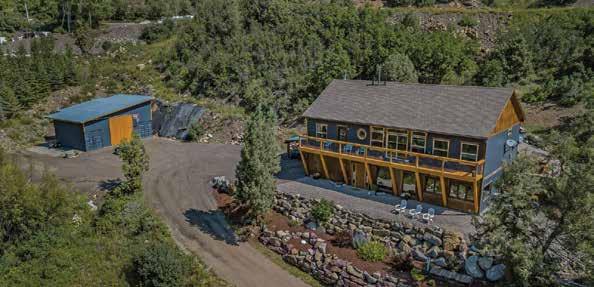
4 BD | 3 BA | 2,980 SF | $1,150,000
Enjoy pristine views, storage for all your recreational equipment and—best of all—no HOA. This home offers a spacious layout and plenty of room to entertain. A potential 5th bedroom is currently used as a home salon. There are several outdoor entertaining areas including a patio off the kitchen, hot tub for soaking after a day of skiing, and deck for taking in the views. The property offers an additional building site for a home or guest house. There is also a shop complete with pellet stove to continue your handiwork throughout the winter months. With so much potential, don’t miss the opportunity to make it yours.


the physical facilities and equipment needed to destroy the methane and generate electricity for the local power grid. This project would be implemented in the upper Coal Basin on National Forest land, above the end of the existing paved road. The visual, human, and environmental impacts on Coal Basin will be significant, essentially industrializing the Basin for decades into the future.
The history of coal mining in Coal Basin started in the very early 1900s. After nearly a century of coal mining which finally ended in the early 90s. At that time, portals and boreholes were closed, but methane continued to leak into the atmosphere. Then, a massive sixyear reconstruction project to stabilize and restore the land was undertaken and completed in 2001.
Today, the Basin stands as a wounded, yet largely restored and thriving environment and a highly popular recreational area for residents of the Crystal River and Roaring Fork Valleys as well as outside visitors. But, in the very near future, life, as we know it in Coal Basin, will change.
During the first phase, which is soon-to-start, miles of mining roads that were restored in the reclamation process of the late 90s will be reopened for direct vehicle access to several of the abandoned mine portals. Opening these roads is necessary to allow the reopening of the entrances of about 10 mine portals and perform the measurement of methane leakage flow rates and quality. Each mine portal will then be rebuilt and sealed to allow methane leakage measurements to be made.
During the second phase, two techniques to accomplish methane destruction have been proposed. One is by flaring, which is common in the oil and gas industry and allows the methane to be vented from a mine and burned. Methane is oxidized into carbon dioxide and water. The other option is with a methane-powered diesel engine driving an electrical generator.
Methane is a very close relative of natural gas which is commonly used to fuel diesel-powered busses and semitrailers. The combustion process in a diesel engine destroys the methane. This option is favored by the applicant but has the most serious environmental impacts on the Basin.
Following the end of the initial measurement/study phase, there are two possible ways to perform the actual methane destruction. The first is the open flare option which will require a row of 30-foot tall steel towers, each with enormous flames at the top, day and night, 24/7, and radiating a loud acoustic hum from the flame combustion and illuminating the night sky with an orange glow.
The second solution is the electricity generation option which would consist of a row of diesel engines driving their respective electrical generators, spread out over a large working area, all operating with an acoustic roar day and night, 24/7.
Both of these options would require the reopened mining roads to be further upgraded and remain open, as well as the addition of a large diameter pipe connecting the methane output from each mine portal to a newly constructed methane destruction center located somewhere in the Basin.
Below is a list of activities and equipment that the diesel option will require in the Basin as well as the on-site methane processing area:
• An enclosed two to three-acre methane processing area.
• Upgrades to the mining roads reopened during the first phase.
• Miles of large PVC pipe connecting methane from all mine portals and then to the methane processing area.
• Physical building(s) to house the methane processing equipment.
• Multiple methane-fueled diesel engines and electrical generators.
• Major acoustic noise from diesel engines and their associated electrical generators.
• Methane pumps and electrical generators.
• High voltage switchyard and transformers.
• Overhead electrical power delivered to each mine portal.
To evaluate the balance between environmental impacts and the benefits of addressing global warming, a measure of the magnitude of destroyed methane is needed. To do this, start with the EPA’s ranking of major US methane contributors. On this list of the Worst 10 Offenders, methane leaking from the abandoned coal mines is ranked in ninth place, contributing less than 2% to the combined national methane total.
Assume there are 100 abandoned coal mines in the US, then the average methane leakage contribution from each would be 0.02% of the national total. So, before proceeding with any construction in Coal Basin, it should first be decided if it is worth the consequence of once again industrializing Coal Basin with capture and destroy equipment that would lower the national methane load by such a minuscule percentage.
Our National Forest lands are under intense developmental pressures and we, as stewards of these lands should oppose this trend, especially when other options are available. The negative human, visual, and environmental impacts of either of the two currently proposed methane mitigation techniques far exceed the limited benefits of destroying methane.
The first phase should, therefore, be restructured to explore other ways to accomplish the same goal, but without sacrificing the local environment to accomplish it. Two community engagement opportunities were scheduled to further discuss the issue. The first took place during the end of March, but the second is hosted at Propaganda Pie on April 4th from 5:30 to 7:30 p.m. RSVP is required for this meeting, and you may do so by visiting: https://docs.google.com/forms/d/e/1FAIpQLSde0ExdvZuRnNgNyWcxcCRsp0LnJ4njvLF6iKe37pRepifIrA/viewform
From Larry Meredith
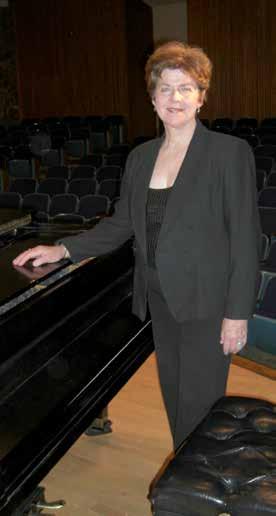
Alyce Meredith will perform Lenten music on the piano in the Carbondale Library’s meeting room from 2 to 3 p.m. on Tuesday, April 12th. The performance is free and open to the public as part of the library district’s public programming events.
“Lent is a season of soul-searching and reflection,” Meredith said. “I hope that those who attend the performance will use the time to sit quietly and reflect on their relationship with God and neighbors.”
Meredith, who now lives near Redstone, has degrees from Wichita State University and Grand Canyon University. In the Department of Music at Western Colorado University in Gunnison, she was a collaborative pianist working with music faculty, ensembles, and individual students. She is also a vocalist and taught in the Gunnison School System at all levels. She was a founder and music director of the Gunnison Opera Study and Performance group and provided piano and vocal solos for many churches in the Gunnison Valley.
Since moving to the Crystal River Valley, Meredith has sung with the Aspen Choral Society, provided music for the Renew Senior Living facility in Glenwood Springs, and is actively involved with the Marble Community Church, where she has organized a handbell choir. She has always been involved in animal welfare organizations, including C.A.R.E. (Colorado Animal Rescue) in Glenwood Springs.

In August of 1873, when explorer, wanderer, and self-taught geologist Sylvester Richardson first stumbled upon the marble deposits tucked high up in the Elk Mountains, he predicted that it would, one day, "be a direct means of employment to thousands." It was the first known discovery by white prospectors of the marble that would eventually become world-famous.
It is doubtful, however, that even "Professor" Richardson knew the true rarity and quality of the stone he had discovered or of the way it would shape the future of the area.
The quarry that was the cornerstone of the Colorado Yule Marble Company (CYMC) was given new life in 2011 when R.E.D. Graniti, a family-owned company based in Carrara, Italy, bought and expanded the Yule Quarry to 125 acres and gave it a new name – The Pride of America Mine.
usual. It created a stone that is 99.5% pure white calcite, with a grain structure that gives a smooth texture, a homogeneous look, and a luminous surface.
This caliber of marble is rare, setting the Yule Marble apart from all other American stones and making it one of the most uniform, pure white marble in the world. This led to an early demand for use in the State Capitol Building, the columns of the Lincoln Memorial, and as a single pristine block for the Tomb of the Unknown Soldier.

by Amber McMahill
The Colorado branch, Colorado Stone Quarries, has also become the most successful operation surpassing even the original CYMC of Marble's heyday as the longest operating company to quarry the Yule deposit. This success is not by happenstance; with the combination of a remote location, geologically unsound landscape, and high elevation, it takes knowledge, financial investment, and passion to turn a profit by quarrying the stone. Although technology has advanced, many of the challenges and process from the early 20th century is still pertinent in today's production.
MarBle, the stone
The story of marble began roughly 350 million years ago (mya) when this area lay at the bottom of a vast inland sea. As the eons passed, the seafloor, shells, and coral became Leadville Limestone, which, in turn, was covered with more layers of rock through time until it was buried beneath the Earth's surface.
There it might have stayed, but then, about 34 mya, something remarkable happened that set the course of a small town that would sprout millions of years later.
Most marble metamorphosizes from limestone through a regional metamorphosis as mountains and terrain shift and heave. To oversimplify a complex process, marble is typically formed low and slow through the pressure of the Earth. This is not, however, true for our local marble.
Yule Marble was transformed by magma that traveled from deep within the Earth's crust. As it reached the stone below the limestone, it pushed into it, baking the limestone into marble and forcing the layers of strata upwards into what is known as the Treasure Mountain Dome. As the magma cooled and granite emerged, over time the surface layers eroded and the dome of marble and granite was revealed.
This process of metamorphosis, called contact metamorphosis, is un-
For anyone needing help stretching their food budget, Gunnison County Officials currently have boxes of food available distributed through the Marble Community Church.
There is no charge to the recipient and no reservation is needed; boxes are available for an individual or up to a family of four and contain enough meals to last approximately three days.
Please call Pastor Jon Stovall at the church to arrange a pickup time for your box today, (970) 963-1464.
Today, this marble adorns more interior surfaces than exterior. While the pure white stone is still in demand, the dynamic veins and gradients caused by accessory minerals originally trapped in the limestone are just as highly prized. Silt trappings became gray veins, chromium caused rare veins of green, and iron oxides paint gold veins that are rare and more recently coveted.
When John Osgood gained an interest in the Yule Marble deposits, he brought a massive block of stone down on a mule-drawn sleigh and shipped it to the World's Columbian Exposition in 1893. It took first place as the finest stone exhibited. Now, over a hundred years later, the rarity and caliber of the marble are again recognized by gaining the name of Calacatta, a title given to the most premium stone with the pure white background and starkly contrasted veining.
Several veins and patterns are sold out of the Pride of America Mine, including Calacatta Lincoln® and Calacatta Gold®. These are distributed primarily as slabs and tiles and used to line the interior walls and floors of buildings worldwide.
Even after Richardson found the deposit in 1873, nothing much came of it. Marble was not what the early prospectors were after. George Yule, whom the creek and marble were eventually named after, found the marble again the following year and still failed to arouse much interest.
It wasn't until another decade later, in 1884, that the quarry was opened, and by the 1890's it had increased in demand and notoriety. The problem with marble, though, is that due to its difficulty to quarry
and transport — especially at an elevation of 9,400 feet — it was and is expensive.
PullIng MarBle froM the MountaIn, then and now
The earliest method of extracting stone from Treasure Mountain was blasting. This proved dangerous and also led to a lot of wasted marble as well as damaging the surrounding stone.
When Col. Meek returned to Marble in 1905 to start CYMC, he invested heavily in the operation. First on his agenda was to bring in channeling machines that held four drill bits in a line. These machines drilled a stretch of holes along the bottom of a chosen block.
Wedges were used along the line of holes and slowly driven until the block split free, a technique called wedge and feathering. There are even reports of water being poured into the line of holes to separate the blocks through freezing and expansion. These lines of half drill holes can still be seen in much of the older cast-off marble blocks that dot the town.
After the block had been freed, quarrymen would stand on pry bars using their weight to lift the block enough to wedge logs underneath. Chains were slipped in to allow the hook and pulley system to
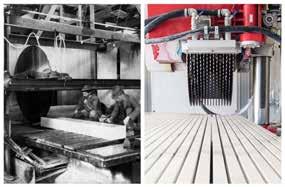
raise them. In later years, a wire saw was used to cut the marble blocks into smaller blocks that were more uniform and easier to transport.
When Colorado Stone Quarries reopened and consolidated the pit quarries, they made a much-needed investment in bringing the most modern machinery and technology to the quarry as Col. Meek had done a hundred years prior.



Wedges and blasting have now been replaced by wire and chain saws; horizontal saws, drills, and wire saws, all diamond bladed, are used to cut entire walls of marble into smaller, more workable blocks. In much the same way ice and pry bars were utilized over a hundred years ago, a metal water bag is inserted behind the blocks.
As this bag fills with water, the block is pushed free from the stone around it. Metal bars have taken the place of the wooden logs, but the centuries-old technique of roller bars is still used to ease the movement of the marble as large excavators pull the block into a soft bed of crushed marble and dust below it. During the last step of the mining process, the block is examined and trimmed using a tractor-mounted chainsaw.
In the early 1900s, one of the most notable pieces of machinery was the Lincoln Hoist, an electric-powered hoist that could lift 50 tons. This hoist could lift the marble onto the carrier cars, allowing them to
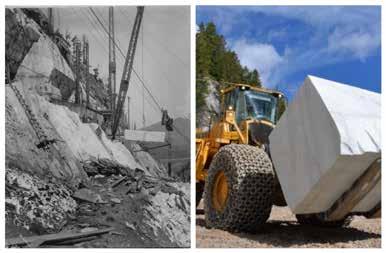
be transported down the mountain and to the Mill at its base near the confluence of Yule Creek to the Crystal River.
The hoist was torn down decades ago and loaders have taken its place. These massive machines aren't your average loader, of course. With 6.5-foot tall wheels shrouded in specially modified chains, even in the winter season, these loaders can easily lift blocks weighing, on average, 22 tons before setting them on semi-trucks to start their journey out of the mountains.
haulIng MarBle
The first loads of Marble were pulled out on sleds to Carbondale,
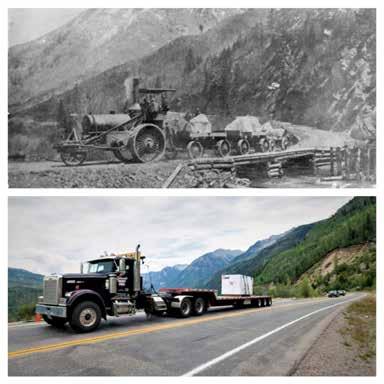
where they were placed on the Denver and the Rio Grande Railroads. In the fall of 1895, frustrated with the lack of marble produced for the State Capitol building, the Capitol managers sent Superintendent James Murdock to find out why there wasn’t any stone making it out of Marble. Soon after his arrival, the wagon road was finally completed and the first loads of marble were transported.
Soon the horse-drawn wagons were replaced by a huge steam tractor brought in from California where it had been hauling lumber. Unique in Colorado's history, the tractor was fitted with eight-foottall wheels and could carry 80 tons of stone.
By 1910, the steam tractor was replaced by an electric tram system that ran on a track. This system, however, proved to be disastrous. Due to the steep grade of the tram and the weight of the stone, runaway cars were frequent.
The squealing brakes could be heard throughout town every time one of the flat bedded tram cars made its way down the steep line. This led to several deaths as the cars would run away and often fly off the tracks.
In fact, in 1912, Col. Meek was riding one of the trams when it ran away. Legend has it that he told the other men to jump, but they didn't heed his advice and survived by riding it out until the tram dumped the load and slowed down. Col. Meek, however, did take his advice and died from injuries sustained after the jump, leading to the end of an era for Marble.
Another danger of operating a quarry at such high elevations was the frequent avalanches — a critical hazard still mitigated in today’s operation. Early methods of clearing the track were the use of rotary plows and hand shovels. By the 1930s, they had acquired a giant rotary snowplow that ran the tram tracks. Named "Black Bull," it had a snowblower type attachment on the front and would be towed to the top of the tram so, in the case of heavy snow, it could clear the track on the way down. Avalanches were frequent, and a few men lost their lives over the years being swept away by the snow slides.
Today's quarry also operates year-round. Luckily, technology and the ability to gauge avalanche danger have allowed the quarry to safely operate and keep the road open. This allows not only work to continue but also for winter recreators to travel the road in mitigated safety. A gate and avalanche hazard sign at the base of the quarry road warns those wishing to use the road of the current dangerous snow conditions. This gate also serves to temporarily block access when the avalanche hazard is too
great for even modern snow plowing activities.
Once semi-trucks are loaded with the marble blocks at the quarry, they are guided down the four-mile road with pilot cars warning uphill traffic of the oncoming heavy loads and assure no parked vehicles are blocking the road. The county road, maintained by the quarry, has been widened with multiple pulloffs and additional recreational parking. The marble is then reloaded onto trucks and hauled over McClure Pass to the finishing mill in Delta.
The idea to create a finishing mill close to the quarry was circulated from the beginning. Before Col. Meek arrived in 1905, there was talk of where a mill might be placed; Crested Butte and Gunnison were both in the running. Meek, of course, chose to build closer to home and erected a mill that was the largest in the country. In all its glory, the mill stretched
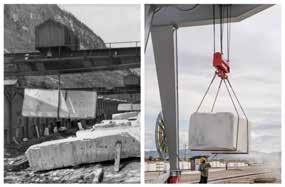
1,465-feet long and was over 117,000 square feet. Large cranes ran on tracts above the load-out area to lift unfinished marble and then load finished blocks on Crystal River and San Juan Railroad cars, with turntables nearby. These overhead tracts were supported by tall marble pillars that can still be seen today.
All stages of production took place in the mill, from trimming, turning columns, cutting tiles, polishing stone, and sculpting or carving architectural details. There was even a drafting room where the column and other commissions were designed and blueprinted.
Today, Colorado Stone Quarries' most recent achievement is completing their slabbing facility in Delta. This modern-day plant surpasses the mill built on the banks of the Crystal River, covering over 140,000 square feet. Like its predecessor, it’s also the largest marble processing facility in the United States. The site sits on 40 acres and includes hundreds of stacked marble blocks, awaiting final
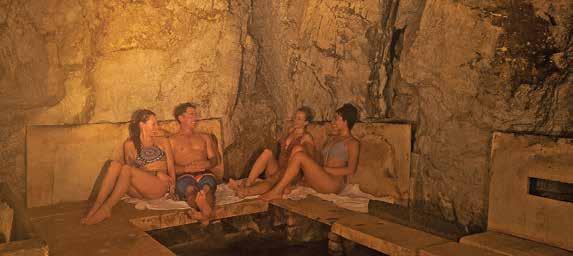
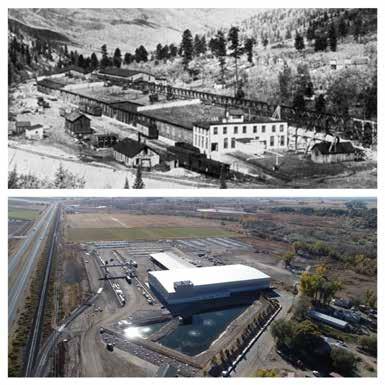
processing. Inside the warehouse, state-of-the-art machinery cuts the stone into slabs and tiles.
Although the machinery is more high-tech, the actual process of cutting and shaping the marble remains the same. Diamond-lined saws and wires cut through the stone, while a water system using recirculated water keeps the marble cool and lubricated. Of course, modern saws cut faster with more blades per machine, and a huge overhead
crane is still used to lift and manipulate the marble blocks to load them onto trains or trucks.
As with the original mill, the cost of transporting marble blocks led, in part, to the construction of the nearby plant. However, the company's quest for a low carbon footprint and increased sustainability factored heavily into the decision. This facility allows the excess marble from large projects to become smaller tiles, minimizing waste. They also have a water recycling system that allows the water used in cutting the marble to be reused repeatedly. They are also committed to using finishing products free of solvents and resins, when possible, and do not produce harmful chemicals.
Back in the Town of Marble, the quarry contributes to other finished projects — marble sculptures. Located where shop 3, the old architectural finishing shop, once stood is the MARBLE/marble Sculpting Symposium. Here, carvers from all over the world come to learn and share knowledge of this ancient and most honored use of the stone. Each year, Colorado Stone Quarries donates the blocks of the purest carving quality Yule Marble that allows new and veteran carvers a chance to create art at the base of the mountain made of marble.
MarBle, the PeoPle
Col. Meek was much beloved by the majority of Marble and was known as a generous soul and benefactor. He donated the marble for the foundation of the Catholic Church and took great interest in the local schools. The company provided entertainment, events, and helped fund the band.
The current owners have continued this tradition by
At the Redstone Inn
The Redstone programs are for residents & visitors of the Crystal Valley. RSVP: (970) 920-5432
APRIL 12 & 26
• 12:00 p.m. – Lunch ($10) RSVP by the Thursday prior – space is limited. Plated lunch will be served. There will be a gluten-free option.
• 1:00 p.m. – Program
April 12: Senior Services Input Sessions Your input is requested to help us improve our services & discover ways to better serve our community.
April 26: Kindred Spirits Songs to Celebrate Springtime
WANT
Send us your email address: (970) 920-5432 • seniors@pitkincounty.com

donating thousands in funding to the Marble Charter School, the Marble Museum, and sponsoring MarbleFest. In the summer, they use their truck to water the Town roads keeping the dust down, and in the winter, they pay to keep the quarry road open.
In addition to the stone donated each year to M/m, Colorado Stone Quarries also provides blocks for projects in town such as signage and parking. Their most recent projects include donating the stone and labor for a marble amphitheater in front of the stage in the Mill Site Park. They’re also working with the Town to preserve the old finishing mill's firewalls and columns.
When Meek first built his marble empire, he drew heavily from Italian immigrants and their stone-cutting knowledge. From the 1910 census, their names and dates of arrival can be found. Although Marble was very much a company town in that era, with two-thirds of the population working for CYMC, there were still labor strikes and, based on literature and newspaper reports of the time, much discrimination against the, mostly Italian, immigrants. When World War II broke out in Europe, many immigrants returned to their homeland.
Now, over a century later, it is an Italian family from Carrara, Italy, who owns the quarry where these early immigrants labored. The current quarry master, Stefano Mazzucchelli, is a multiple-generation marble quarryman originally from Carrara, Italy. The machines in the quarry and finishing plant are Italian technology, and the methods used draw from a knowledge base that spans generations.


From Sarah Uhl
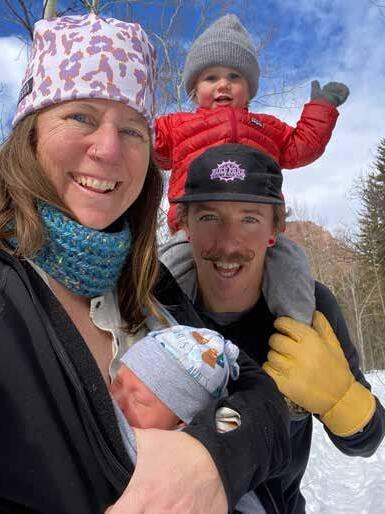
The Boulevard is finally melting out and after dinner walks to the tune of birdsong have started to work their way into our routine as a family. It’s Springtime now, despite the size of the snowbanks and ice sculptures still hanging from our roof.
Trips to town have become more regular and kick-sledding down the street has been replaced with puddle jumping, squirrel sightings, and bike rides to the hockey rink (while it lasts). Our thoughts are drifting Westward and outward now, as we pack up for our first family trip to the desert in Utah. It will feel nice to step out of our alpine nest, but I am already feeling nostalgic about our family's hibernation in Redstone.
Our son Wylie Kailash was born on Winter Solstice, December 21, 2021, at 4:30 p.m. At the peak of short days and long nights, we nooked into our Redstone cabin to watch the snow pile up as we fell in love with our newborn baby and learned the pace of being a family of four.
Life with a newborn changes your perspective on things, but so does the opportunity to adapt fully to the seasons. Our Solstice baby gave us that gift. He arrived when we were as still as the snow. I had been preparing myself to slow down throughout my pregnancy; to accept a season of hibernation for once in my busy, busy life, and to surrender to perhaps nature’s greatest gift — Motherhood.
Part of slowing down was taking time off work, and we were fortunate enough to both be disengaged at the same time. For us, time off typically means journeys far and wide, packed with adventures in foreign countries. This time, however, it offered something more; it offered time to just be. To be together as a family and find a way to move at a different pace.
Our daily “work” became chopping wood, building fires, slow roasting stews, baking bread, shoveling snow, walking to the Redstone General Store for provisions, and caring for our children. It is more than enough to fill a day and a life. We are starting to wonder what other sort of work there is?
During our hibernation, I said goodbye to my checklists and calendar
invites. I said goodbye to my aspiring, striving, achieving self and got a lot better at just being. We measured time differently, anxiously awaiting the short window that poured sunlight onto the Boulevard and lured us out of the house each day.
We merged the busy lives of two parents with multiple jobs and interests into one living organism. We shared one set of interconnected tasks instead of divvying up a multitude of flying saucers and trying not to let any of them drop. We kept our son, Hukson Oaks, home from daycare so he could fall in love with his brother, and so we would not miss a moment of his wide-eyed brilliance and perspective on the world.
Oh, the things you can learn from a two-year-old! In one day, the entire universe unveils itself. And then it starts all over again the next day like the tilt of a kaleidoscope.
When Wylie was big enough, we packed him up and brought him on our walks, bundled under layers of wool and down, to marvel at the beauty that makes up his backyard — each aspen tree a witness to what magic this sweet new soul may be here to bring to the mix.
We took turns skiing from our door, and porch laps up East Creek felt like a lifelong goal achieved. No Hut trips this year. Just life in Redstone — a worthy alternative.
As I gaze out my window at the layers of snow and
sandstone, I start to long for the buzz of the season‘s change. My curious heart wonders what our first Spring in Redstone will offer. Our family has grown closer to each other and our new community, interwoven in nature. Each season shared in our new home adds a layer to our ever-abundant hearts.
Thank you, Redstone, for holding us in such a beautiful hibernation.



The Marble Charter School, which is a public charter school under the Gunnison Watershed School District RE1J, is announcing a vacancy for the 2022-23 school year.
Duties: 3rd — 8th Grade Science Teacher and 6th — 8th Grade Math Teacher
Qualifications:
• Must have a Science and/or Math background
• Willing to lead other school activities (i.e., Physical Education, Study Hall, Recess, etc.)
• Multi-Grade classroom/teaching (i.e., 3-5 and 6-8) experience preferred
• Participate in Outdoor Education activities (i.e., camping, hiking, cross country skiing, etc.)
Compensation:
• Salary depends on education and experience
• Position is full-time time with health insurance and PERA retirement
Application Process: Submit application and applicant oath (which can be found on the Gunnison Schools website), transcripts (copies are acceptable), philosophy of education, resume, and three letters of reference to:
Karleen Anderson, Office Manager
Marble Charter School
418 W. Main Street
Marble, Colorado 81623
Email: kanderson@gunnisonschools.net
Applications will be accepted until the position is filled.
MEET OUR BOARD OF DIRECTORS
STEVE PAVLIN


NATE HELFENBEIN
KATIE LOWERY
SARA LEWIS PRESIDENT VICE PRESIDENT TREASURER SECRETARY
DAVID (DJ) JOHNSON
HEATHER MARINE
JOSH WAMBOLT
RON PHANEUF
CATHY MONTGOMERY ALTERNATE MEMBER
Redstone's Annual Easter Egg Hunt in the Park will be Saturday, April 16th this year at 10:00am sharp. No reservations are needed. Please be at the Park at 10:00am, bring your own easter baskets to hunt for eggs. Rules will be announced at 10am, the hunt is for children 10 years and younger. Once the appropriate eggs are found, hunters and their families will need to walk to the Redstone Inn and collect their prize. The Easter Bunny will be hanging around so make sure to have your cameras ready! The RCA is collecting donations at the Redstone Inn. Baskets, candy and toys are gratefully accepted. Monetary donations can also be dropped off or scan the QR code at the bottom of this page and donate online. The RCA is also asking for volunteers to help out the day of. We will need people to help hide eggs and keep children safe from the river and road. Volunteers should meet at the Park by 9:15am. For questions please email rcaredstone@gmail.com.
Please slow down while driving on the Boulevard! Children are out playing!

Redstone is an unincorporated village that relies completely on donations and volunteerism spearheaded by the Redstone Community Association (RCA) Your membership dues directly fund RCA projects and events. Thank You for your support!
Scan the QR code to be taken directly to a payment screen for easy Membership Sign up or renewal. You may also write a check and drop it off at the Redstone Inn or mail it to 303 Redstone Blvd. Redstone, Co. 81623.
Family/Individual $45
Business $150
Multi Business $230

From Larry Meredith
Way back in April of 1989 The Aspen Times advertised a 3-bedroom 3-bathroom house near the Aspen Golf Course for $695,000 and a 2-bedroom townhouse facing Aspen Mountain for $495,000.
In that same issue, The Times had a story about the Village of Redstone titled “A slower-paced style of shopping” in which it referred to the Whitman House (an antique store) as “Redstone’s information center” and said ex-Aspenites Bill House and Dave Whitman owned the shop after moving to Redstone “20 years ago.” The story also mentioned the Ice House Café, Crystal Haven Antiques, the Redstone General Store, the Nostalgia Shop, and the Townhouse Restaurant (now Propaganda Pie).
By the time Whitman and House retired in 1994 the two had become well-known and revered individuals from Aspen to Marble, who were involved in practically everything and their store was one of the most popular in the area.
Deb Strom, who now lives near Redstone, recalls that when she worked at the Hotel Jerome in Aspen, she often “trekked to Redstone just to shop at the Whitman House.” She said their merchandise was “top quality” and that they had items appealing to all. “They also had a lunch bar with patio seating on the riverside.”
All content sponsored and provided by the Redstone Historical Society.
inches of snow on the ground at Bogan Flats near Marble. Where has spring gone?” And later he wrote “spending their annual vacation with Jo Gates on Redstone Boulevard are the Jim Arronales” of Moberly, Missouri.” And still later: “attendance at Marble Community Church last Sunday was 59.”
In the meantime, Whitman and House continued to operate a very successful antique store on Redstone Boulevard at the north end of the city park – an area that now houses the home of the Franke family, who primarily reside in South Texas.
The lot just to the south of Whitman House (at the north end of the park) was owned by the parents of the author of this piece, Lawrence and Eva Meredith of Russell, Kansas, who became close friends of Whitman and House. In fact, Greg Meredith, the Meredith's grandson and the son of this author and his wife Ally, worked at Whitman House for several years and became acquainted with many of the notables of Redstone’s bygone days.
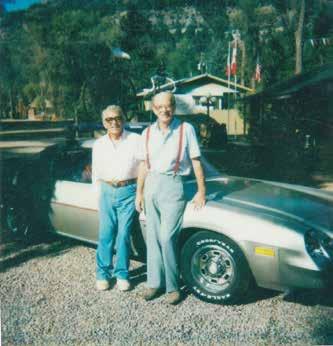
The story of the two men began in Lawrence, Kansas, in 1953 when House and Whitman out-bid several others for a house in which they discovered a box containing $19,000 in currency. Two months earlier they had opened an antique shop in Kansas City, Kansas. The house also contained many items which enhanced the Kansas City store’s inventory.
“To antique dealers such as House and Whitman the contents of the house have proved to be a virtual bonanza,” The Times story said.
The two men eventually built a beautiful home on Buttermilk Mountain with a pool that separated the main house from a guest house (which the men often used to accommodate visiting members of the Aspen Music Festival). They later moved to Redstone where they owned Whitman House Antiques.
The Glenwood Springs Sage-Reminder of June 27, 1974, reported that “both men are active in Redstone affairs and House writes the weekly column ‘Crystallizing the Crystal River’ for the [Glenwood] Post [Independent].”
The columns are revealing about the Redstone area in many ways. In one column House reported, “the Sacred Heart Chapel in Redstone will hold Mass each Sunday at ten-thirty a.m. for the remainder of the summer season.” In another, he wrote “the morning of June 8 [in 1974] campers reported two
Greg Meredith recalls, among other things, that Bill House was the most fastidious of the two and that Dave Whitman was “much less” concerned with details. He also said the two men occasionally bought a new car but refused to purchase one that had been built on a Friday, assuming because of the looming weekend, the builders would be less careful in the construction process. Meredith also recalled many other stories about the two men — too many to retell here.
A story in The Glenwood Post Independent of June 26, 1974, published a photo of the first store opened by the men and said that Saturday would mark its grand opening.
They operated the Whitman House for 20 years before retiring in 1994. During those two decades, the men served the Redstone area in many ways and became friends with most of the area residents.
Their store was just across the street from The Crystal Valley Echo’s headquarters and Nancy and John Chromy’s house, which, for 15-years from 1988 to 2003 (when they purchased it), was the home of the Three Sisters Bookstore.
Whitman and House lived in the Chromy house during the construction of their antique store across the street.
At the time, Nancy Chromy’s bookstore was the Book Bistro located next to the Redstone Trading Station antique shop, and then later in the Whitman
House Antique store from 2004 to 2008.
Many Redstone residents as well as visitors to the Village came to know Whitman and House and continue to own merchandise they purchased from Whitman House Antiques.
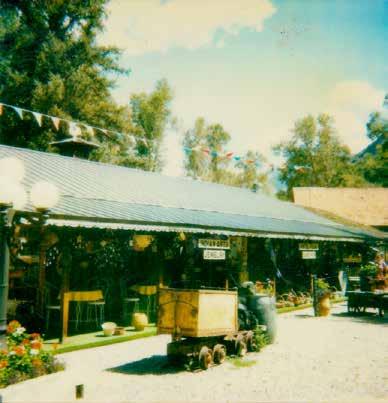
Much of the information for this article came from material given to the author by Peter Martin, a long-time Redstone resident who moved to the Front Range of Colorado not long ago. Martin, an attorney, had long been involved in Kansas politics and served as mayor of an eastern Kansas town. The photographs were provided by Greg Meredith.
Larry K. Meredith, who lives near Redstone, is the author of This Cursed Valley (a novel of historical fiction including the history of the Crystal Valley); Cast a Giant Shadow: Hollywood Movie Great Ted White and the Evolution of American Movies and TV in the 20th Century, and the memoir Real, Rural: Growing Up Rural in the 1950s.
www.History.RedstoneColorado.org HistoryRedstone@gmail.com
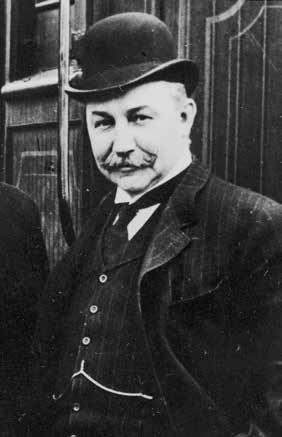
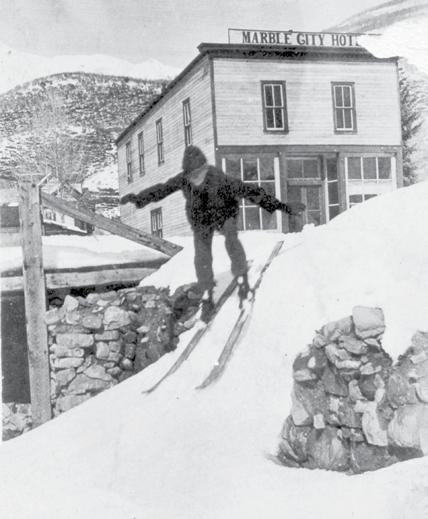
Skiing in the Crystal Valley began as a transportation necessity. In Crystal... What Really Happened, author Roger Neal describes two early skiers: Al Johnson and Ambrose Williams. Both were Crystal storekeepers and doubled as postmen, who used skis to deliver the mail.
Johnson's route took him over Schofield Pass to Crested Butte and Williams delivered to Marble. Johnson was famous for his skiing ability, which is commemorated annually in the Crested Butte race the “Al Johnson Uphill/Telemark Race,” and Williams' legendary ninefoot skis are now in the Aspen Historical Museum.
en obtained the engine from Camp Hale, the WWII training camp for the 10th Mountain Troops, located between Leadville and Minturn. The 10th Mountain men became famous after the war for their work establishing ski areas throughout the country. Marble's local 10th Mountain man, Thanos Johnson, discovered Marble while on leave and returned after the war to live.

by Alex
With the advent of skiing as recreation, lifts were created so skiers could concentrate on the fun part: going downhill. In our little valley, there were four lifts constructed, each unique and each telling a story about their locations. This history project was especially enjoyable as it involved field trips and real structures besides the usual literary research.
Author’s Note: These locations are on private land and not open to the public, except for Marble Peak which includes avalanche hazards requiring knowledge and safety equipment.
The first stop on the ski history tour is up Spring Gulch above Carbondale. The Colorado Rocky Mountain School (CRMS) was established in 1959 as a prep school with an outdoor adventure emphasis. Founders John and Anne Holden, using the model of the Putney School in Vermont, wanted to offer all the Rocky Mountain sports to students, and the alpine ski team required practice slopes.
Will Perry, a pioneer family descendant, took me on a hike to visit the ski slope that his father dedicated to CRMS. The slope is visible on the left as you drive to the Spring Gulch Nordic Area.
At the top of the slope is a shed. Inside there is still a large engine that was used to turn a large flywheel to which was attached a rope tow. Skiers would hold on to the rope and be pulled on their skis up a short, steep hill with about a 350 vertical feet climb.
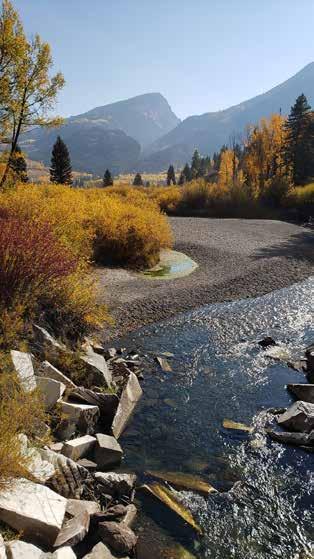
The engine was used for a rope tow at Camp Hale in the 1940s on a beginner practice slope called B Hill. After the soldier-skiers mastered the basics they graduated to more advanced slopes on top of Tennessee Pass, where Ski Cooper is today.
The next stop is Redstone, where a ski area was proposed in 1956 by promoter Frank Kistler. After selling the Hotel Colorado, Kistler and several investors concentrated on developing Redstone and bought both the Redstone Inn and Castle. He investigated the possibility of a ski development, employing local ski legend Dick Durrance as a consultant. Durrance is famous as an Olympic ski racer and photographer in addition to the design and promotion of ski areas.
Whatever advice Kistler received about Redstone skiing, he probably didn't take it. He built a lift on a
slope with only marginal snow cover. The bottom of the slope is so flat that it is necessary to push yourself with your poles just to get back to the lift, according to a local skier, Stephanie Deaton.
The Roebling T- bar operated for one season only from Christmas 1960 to March 1961. A T- bar is placed behind the skier, who leans back against the bar to be pulled up the slopes on skis. The lift is still intact and could potentially be turned on today.
Bob McCormick, a long-time Redstone resident was the gracious guide to the Redstone Ski Area and features again later in this ski history. McCormick and his wife, Debby, live in the historic Gatehouse adjacent to the lift. The Gatehouse was part of Cleveholm Manor, the estate of John Osgood, now known as the Redstone Castle.
The Gatehouse was modified to provide multiple bathrooms for skiers, so it functioned as the base lodge. The area access is as insufficient as the snowfall for a ski area, it is a gated, private road with only one lane between the river and cliffs. Widening the road for ski area development would have been a major enterprise.
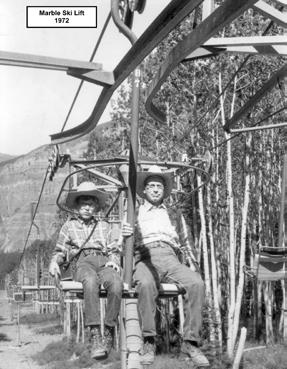
Onward up the valley, and a few years later, is the next attempted ski area in Marble. The Oberlander Corporation of Denver acquired 1,500 acres in 1964 and began ski area planning. The southwest-facing slopes did not promise snow quality or quantity. For those familiar with Aspen geography, it is like putting a ski area on Smuggler Mountain, instead of Ajax. They tried to put it on the wrong side of the valley!
Major slope instability threatened the extensively planned infrastructure, which included subdivisions, water, sewage, utilities, and road systems. The plan was to create a community of 27,000, although, most of the improvements existed only on paper, the construction of the ski area went forward. In Marble, Colorado: City of Stone, historian Duane Vandenbusche states that the ski area was just a scheme to promote real estate sales.
Although utilities were not installed to the ski area base, diesel engines powered a Riblet double chair lift, which operated on weekends and only by reservation during the 1971-72 season. During the previous season, the area was accessed by snowcat only.
A large base lodge was begun but never finished. The lift is still standing, with one tower damaged and has been run by the private owner in recent years. Lifts are regulated by the state tramway board, which precludes any future operation. It seems that having a working ski area was the goal to sell 'slope side' lots.
This year is the 50th anniversary of Crystal Valley Environmental Protection Association (CVEPA) and the reestablishment of Marble’s town government. Both became active to oppose the ski area development, along with Pitkin County Commissioners. Sadly, the Gunnison County Commissioners supported the Ski Area proposal.
Other problems plagued development: There were various real estate fraud allegations resulting in the suspension of the corporate real estate license; the Town refused to cooperate on water and sewer system connections; and the forest service refused to issue a permit to extend the operation beyond the private land onto the national forest. Instead, the Maroon-Snowmass Wilderness boundary was extended, precluding any future ski area expansion.
Large mudslides also took out access roads and ran into Beaver Lake. It was the ski area almost no one wanted, and the nail in the coffin was when the Marble Ski Area declared bankruptcy.
The next ski area and lift is a ringer. If you don't remember, a ringer is a competitor in a contest who you keep hidden until the last moment, because they are so superior that others will refuse to even participate.
What is now the Marble Quarry Road was once the path of an electric tram. After first transporting marble blocks by draft horse-drawn wagons, a steam-driven giant tractor was tried. These tractors were designed to drag huge trees in the Pacific Northwest. The final solution was seen in San Francisco, Calif., where the electric cable car technology produced the torque to climb the steep hills there. Electric tramcars were designed and installed to carry Marble blocks from the quarry to the Mill Site.
At its peak, the marble company had two types of very different workers. Quarry work was unskilled, paid less, and was usually filled by single American workers. At the Mill Site, skilled craftsmen and artists were in demand. Potential candidates were usually European imports from Italy, Germany, and Austria.
The immigrants lived in town and often brought their families with them. On steep slopes adjacent to the quarry were perched precariously the shacks of Quarry Town, home of the quarry workers.
The Quarry Road travels 3.75-miles from the Marble Mill to the quarry and climbs 1,200 vertical feet with grades as high as 17 %. The
quarry workers would ski down the road to town and then hang on to the tram to be towed back to Quarry Town. This is a documented use of a ski lift in 1910. In City of Stone, Vandenbusche claims that this is the oldest ski lift in the state!
Now, let's leave ski lifts entirely behind to explore other skiing possibilities, including ghost nordic skiing and ghost alpine touring.
Bob McCormick established and operated a nordic trail system behind the Coke Ovens in Redstone in the 1980s. He groomed trails and offered lessons and rentals. This operation predates the Spring
Gulch Trail System, as the CRMS nordic ski team would practice there and the area hosted annual sled dog races, which were lots of fun and well attended.
As the Spring Gulch Nordic Ski Area is alive and very well today, it does not qualify as a ghost ski area. Though, a few comments are in order. The terrain, scenery, and skiing quality are unsurpassed. It is one of the only areas where one can ski through oak woodlands, reaching aspens and evergreens only at the very top. The vertical range of the area challenges both uphill conditioning and downhill technique.
Marble also has a ghost-nordic area, which was called Ute Meadows. Your author assisted owners Larry and Dana Darien in the operation during the last few years of the last century. It was not large, but superb in skiing quality and scenery. There were many dedicated patrons, but the biggest attraction was that dogs were allowed. Dogs were even issued season passes with their pictures.
To continue with the ghost theme, we must now expand it to include areas that are not deceased, but rather exist in the spirit world only, with no actual physical presence. This is the case for Marble Peak, a backcountry ski area accessed by the Marble Quarry Road. Although well known and heavily used, this area has no infrastructure, unless you count the packed skin track and rescue toboggan hanging from a tree.
Hopefully, this article has given you a lift or at least entertained you with the history of ski lifts around the Crystal Valley. Stop by the Marble Museum this summer to view a pair of authentic seal climbing skins from WWII as well as a vintage ski collection.

th
th
I am a 7th grader from the Marble School. Every year, it has been a tradition for our 7-8th graders to go on a trip to a major historical site or city. This year, we voted to travel to Nashville, Tennessee. We plan to attend a Revolutionary War Museum, go on a tour of the Grand Ole Oprey, vist the Adventure Science Center and enjoy Nashville’s food, music, and culture! We usually host large community dinners to fundraise, but due to COVID-19, we have been limited in our fundraising strategies. So far, we have held a tamale fundraiser, a chili take-out, sold baked goods and pottery at First Friday, and have had an art sale in Redstone. We have raised almost 4,000 dollars out of our 10,000 dollar goal. We are asking for donations to help us get to Nashville. Any donation helps and is much appreciated. Your funds will help us with airline tickets, transportation, and museum fees. If you would be so kind as to make a donation, you can send your donation to Marble Charter School. Be sure to include in the memo that your donation is for the 7th and 8th grade trip! If you have any questions please contact our director, Gina, or teacher, Lani.
Thank you, Agemian Badgett
Marble Charter School
412 W. Main St. Marble, CO 81623
Gina Mile, Director: gmile@gunnisonschools.net Lani Houseman,7th & 8th teacher: ahouseman@gunnisonschools.net

3rd - 8th graders studied the pros and cons of Animals in Captivity. They then answered the question, should animals ever be kept captive? Elsie Mile shares her essay.
By Elsie Mile, 5th grade
You are in a Ranger four wheeler driving to see the animals of the African Savanna. Suddenly, the tour guide taps your shoulder and points, “Do you see that lion?” he asks. You look out the window and see a huge male lion run into the tall grass. You remember the year before you went to the zoo and saw another male lion that acted completely differently. It had paced back and forth, looking depressed. This was way more magical! In every country of the world, animals are being kept captive. Whether it’s in the zoo, in refuges and even in people’s backyards, wild animals are not in their wild habitat. Only sometimes is it okay to keep animals in captivity. When humans are able to save an animal species or save their lives, it is acceptable.
There are many reasons why it is acceptable to keep animals in zoos and refuges. Refuges find hurt or homeless animals and bring them back to the refuge, where they help the animal and if possible release it back into the wild. Have you ever seen a California Condor? At one point, there were only 27 left in the wild. The San Diego Zoo then took them and bred and released 200. Many scientific discoveries are made at zoos. These discoveries are usually used to protect animals.
On the other hand, animals in zoos do not live as long as they would in the wild. This may be because they are stressed out. Animals in zoos suffer mental health issues. In zoos, animals are pacing back and forth, swaying side to side, swimming in endless circles or even grooming themselves until they have no fur or feathers left. Monkeys hit and bite themselves. Killer whales go through social and health problems such as chewing on concrete, creating teeth problems. Even though zoos are creating bigger habitats for animals, at places like SeaWorld, you can never recreate the ocean.
Have you read the book The One and Only Ivan? Did you know that it is based on a real gorilla that was raised in a mall for 27 years? Once he was finally let outside, he didn’t enjoy it. He was scared of the grass and weather.
Imagine you are on a road trip with your family. Your mom swerves off the road to a gas station and there you see a tiger in a cage gnawing on a horse bone. This is the life of a real tiger named Tony in Louisiana. It is unfair to make money off of animals like Tony the Tiger. There are only an estimated 3,000 tigers in the wild, but in America there are between 5,000- 10,000 tigers being held captive!
Animals should not be kept captive under most circumstances. It is only reasonable when the animal is hurt or endangered. Sometimes zoos make dramatic saves, including one in Phoenix. The Oryx were completely extinct in the wild, but the Phoenix zoo bred and released 1,000 back into the wild. Zoos and aquariums should turn into refuges to help animals survive and where scientists can breed them and release them back into the wild.
Have you ever been to a circus? Would you like to be one of those animals? Many people believe that these animals like performing but would you like to be pulled around in an animal trailer and then have to perform for thousands of humans? Without a doubt, animals should be allowed to roam free in their natural habitats.
Monique Villalobos
The Annual Marble Gem & Mineral Show (MGMS) is back for its second year! We are thankful for all the support and Marble magic that was created by our team and our inaugural donors. Given the enthusiasm from vendors and visitors alike during our maiden event, we expect an incredible Gem market experience again this year! All of which will be nestled in the most scenic area of Colorado’s majestic mountains.
Our inaugural show last year gave us opportunities to grow and change, and this year will look and feel different in that we are doing a “Walk Thru Town” Gem Show. We think you will love it! Vendors will be open for business from 10 a.m. to 6 p.m.
BrIng Cash
Each vendor will set up at a designated spot alongside other businesses throughout the Town of Marble, and specifically at The Marble Gallery, Abstract Marble, The Marble Hub, and on the corner next to Slow Goovin' BBQ, near Thompson Park.
We are seeking funding to help our team kick off Marble’s Summer 2022 season in a most memorable and heartwarming way. Our goal is $45,000, and the donations we receive support our cultural performers who come from around the world: Their travel, local lodging, and fees.
The team is also striving to put our show to good work by supporting locals in Marble. We have so
many amazing aspects to be grateful for and MGMS wants to give, share and build experiences in Marble, Colo.
We can do that by supporting locals: The Marble Hub, the Marble Mill Site Park, Marble Museum, the Marble Crystal River Chamber, Marble Charter School, the Marble Art Guild, and the MARBLE/ marble Symposium.
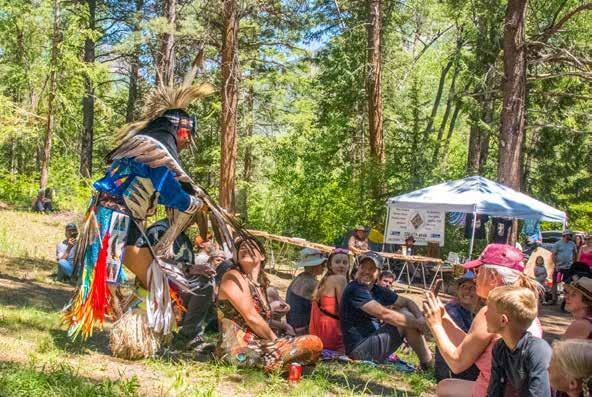
We will Celebrate the first Crystal River Cultural performances to be held in Marble, Saturday, June 11th, 2022, from 4 p.m. to 10 p.m. Bathe in the vibrations of a sound bath and then listen and watch dancers from all over the world perform in full regalia bringing cultures from Aztec and Canada to bless our grounds.
The stage is set on private property alongside the Crystal River with spectacular views of Whitehouse and Treasure Mountains and surrounds, therefore, seating is limited. Purchase your tickets and donate online at givebutter.com/marblegemmineralshow or call Monique Villalobos at (970) 456-6059 for more information.
Kicking off the performance from 4 p.m. - 5:30 p.m. is Danielle Klein, Spiritual Business Coach, bringing us the Crystal Tones Spiritual Sound Bath Experience. www.danielleklein.com
6:00 - 6:15 — Local Tribal Dancer TBA
6:30 p.m. - 7:15 p.m. — Danza Azteca. Based out of Denver Colo., GRUPO TLALOC Danza Azteca is a traditional Mexica/Azteca group embodied of Chicano/Mexicano families and students of all ages dedicated to preserving and nourishing the ancient knowledge of their ancestors. www.grupotlaloc.org
7:30 p.m. - 8:15 p.m. — Native Flute Player TBA
8:30 p.m. - 9:30 p.m. — James Jones, Cree from Edmonton, Canada, is a World Class Hoop Dancer, flute player, and drummer.

NOTICE IS HEREBY GIVEN by the Redstone Water & Sanitation District, Pitkin County, Colorado, that at the close of business on the sixty-third day before the election, there were not more candidates for director than offices to be filled, including candidates filing affidavits of intent to be write-in candidates; therefore, the election to be held on May 3rd, 2022 is hereby canceled pursuant to section 1-13.5-513(6) C.R.S.
The following candidates are hereby declared elected: Maggie McHugh, until May, 2025 for a 3-year-term Stephanie Helfenbein, until May, 2025 for a 3-year-term
Contact Person for the District: Ryan Kenney Telephone Number of the District: (970) 963-1495
Address of the District: 1091 Redstone Blvd., Redstone, CO, 81623 District Email: Ryan.e.Kenney@gmail.com