



Dear Madam Editor,
On December 15th, the Pitkin County Commissioners unanimously approved an ordinance that will require a license to rent a dwelling for a period shorter than 30 days. Further, and very significantly, licenses will be issued only to those who make the subject property their own principal residence (where they vote, pay income taxes, have their driver's license, etc). This was the first reading of the ordinance, which will not be finally adopted until the second reading on January 26.
The recent and rapid expansion of Short Term Rental Business in Redstone, much of it conducted by non-resident landlords, is a matter of concern to many of us who live here. Our sense of community and our property rights to the quiet enjoyment of our homes feel threatened by the growing number of de facto motels. The Principal Residence limitation should substantially reduce the number of short-term rentals, but those non-resident owners can still rent month to month, or year to year. Most of us prefer long-term neighbors to weekend tourists. And locals can still rent out their own houses short term.
I believe the Short Term Rental Ordinance approved Dec. 15th, will help preserve the values that we, the people who live here, cherish about our Village of Redstone.
— Bill Jochems Redstone

The Crystal River Caucus will hold their January meeting on Thursday, January 16, 2022, via Zoom. Zoom links, as well as the agenda will be sent to those who have already joined the caucus email list.
Anyone who would like to add their email address to the caucus list, please send a request to crcaucus@gmail.com
& Marble Times
Mission Statement: To provide a voice for the residents of the Crystal River Valley; to bring attention to the individuals and local businesses that are the fabric of the Crystal Valley region; to contribute to the vitality of our small town life.
Editor • Gentrye Houghton gentryeh@hotmail.com
CONTRIBUTORS
Stephanie Deaton • Amber McMahill Alex Menard • James Steindler
ADVERTISING SALES
Heather Marine at Elephant Mountain Creative heather@elephantmountaincreative.com (970) 718-5848
The Crystal Valley Echo is published monthly, and is distributed throughout the Crystal Valley.
NEWSPAPER BOX LOCATIONS:
Carbondale (old) City Market • Village Smithy Carbondale Post Office • Redstone Inn Propaganda Pie • The Marble Hub FOR SUBSCRIPTIONS
Please send $50 for print or $35 for digital editions along with address information to: The Crystal Valley Echo 364 Redstone Blvd. Redstone, CO 81623

JANUARY 11 & 25
• 12:00 p.m. – Lunch ($10) RSVP by the Thursday prior – space is limited. Plated lunch will be served. There will be a gluten-free option.
• 12:45 p.m. – Program
January 11: History’s Mysteries Christi Couch
January 25: What About My Will? Alpine Legal Services
A
Amber McMahill and Gentrye Houghton
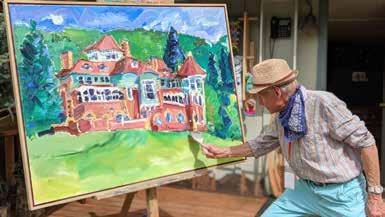
The Redstone Art Foundation is back with a vengeance after COVID and quarantine tried to take out the arts. After the success of their First Annual Redstone Holiday Market in 2020, they added a Plein Air Event, brought back the Labor Day Art Show for its 25th show, and pulled off another Holiday Market!
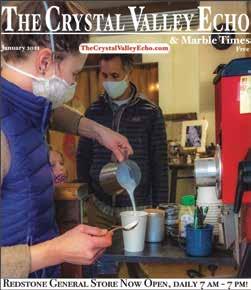
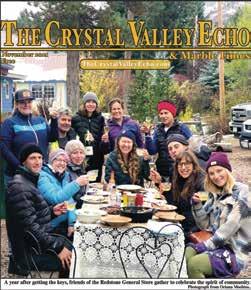
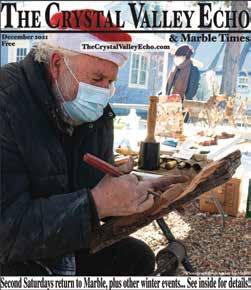
Although their soft opening was at the end of 2020, the new crew at the Redstone General Store officially opened their doors on January 1, 2021, and raised the bar on small-town stores by transforming the space into a local hangout, a local food market with fresh baked goods, and delicious breakfasts!
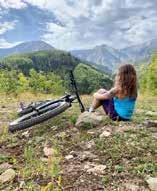

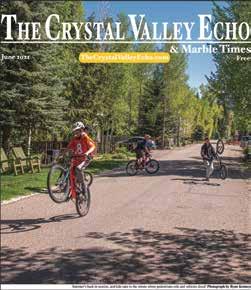
July brought a great new asset to the Redstone area with the opening of the Coal Basin Bike Park. Access to five miles of trail located on public land opened to the public in a free family-friendly park. The ranch is owned by the Catena Foundation that was begun by heirs of the Walton family estate
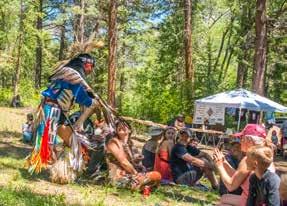
A new annual event sprang up in Marble last June with the first annual Marble Gem and Mineral Show. Around 20 vendors set up

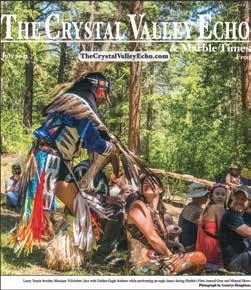
for a three-day event that included music, Native American Dancing, and more. The brainchild of Monique Villalobos of Marble Mo Creations, this now annual event will be back in 2022!
After taking a break due to COVID, Marblefest came back with new energy and music and an increased vendor presence. Focusing on Colorado-based bands and artists it brought music back to Marble with two days of shows including fan favorite Dragondeer.
The Off-Highway Vehicle (OHV) debate in Marble reached new heights this year when local Alex Menard started putting heavy pressure on the Forest Service, Town of Marble, and Gunnison County to demand action on the continuing problem. Gunnison County responded with a letter to the Forest Service threatening their portion of the road to OHVs if some solution wasn't found leading to increased efforts with the Lead King Loop Steering Committee.
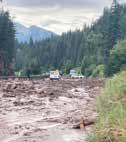
Mudslides abounded this summer affecting travel in the Upper Crystal River Valley and a far more quiet summer for the residents of Marble. An eight-foot-deep slide blocked Redstone from the rest of the world, and each other, in July!
The great debate on short-term rentals (STR) erupted during the first couple of months of 2021 when Pitkin County Board of County Commissioners (BOCC) began lining out their new Short Term Rental Code. Commissioners were overrun with feedback from Redstone residents. While the debate continued throughout the year, the BOCC saw a first reading of the Code in December. A second reading and public comment are scheduled for January 26th; interested community members are encouraged to submit their comments in advance at PitkinCounty.com/PublicComment
2021 was a good year for the parks of Marble and Redstone. The town closed on an additional 2.5 acres to add to their Mill Site Park, funded through a collaboration of the MARBLE/marble Sculpting Symposium and the Town of Marble through a Great Outdoors Colorado (GOCO) grant.
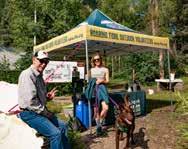
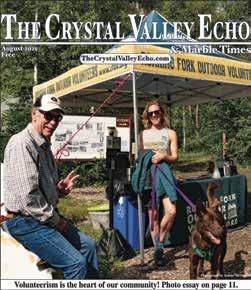
Roaring Fork Outdoor Volunteers (RFOV) made Marble the focus of their weekend Marble Extravaganza where volunteers did trail work and clean up in the park. Meanwhile, Aspen Valley Land Trust (AVLT) which are the new owners of the Marble Children's Park (Thompson Park) got a grant of their own through GOCO to fund work in that park in collaboration with the Town and school.
In Redstone, the process of redesigning the Redstone Park began with a group of residents, community surveys, and even a chance for kids and adults alike to draw their ideas for the park! Final designs were approved and they will break ground later this year.


March 28, 1963 – October 25, 2021
Robert Raymond Fullerton grew up in Ann Arbor, Michigan. He was an accomplished young athlete, and a sponsored water skier by age 13, jumping 90-feet. He grew up skiing at a local mountain in Michigan, and his family made annual trips to Snowbird, Utah, where he fell in love with powder skiing.
Fullerton also excelled at gymnastics, training with a former Olympic coach during high school, and was hopeful for a bid to the 1984 Olympics. He spent his summers in Florida competing in waterskiing tournaments.
He was appointed as a Midshipman to the US Naval Academy, Class of 1985. While training in Annapolis, Fullerton was a member of the varsity gymnastics squad. He completed US Navy Dive School in Panama City, Florida, being one of the first Midshipmen to complete this training.
Fullerton moved to Boulder, Colo., and started long-distance trail running. He spent a year riding a motorcycle around Australia, doing gigs as a bartender. Some paraglider pilots there pointed him to Verbier, Switzerland, where they needed featherweight test pilots for prototype paragliders.
He became a caretaker for a Count and Countess from Czechoslovakia who lived at the Verbier ski resort, and often flew off his cottage doorstep into the valleys below and returned by train. Fullerton combined skiing with paragliding during the winters, and only narrowly avoided losing all
his toes to frostbite during a flight off the Grand Combin (a mountain massif in the western Pennine Alps).
Returning to the US, he lived in Greeley, Colo., and coached their high school cross country team. Fullerton spent months living by himself off the Lost Coast in CA, living mostly off what he could forage, and was an early enthusiast of Burning Man. He started a successful wildcrafting business in New Mexico and was part of the Poetry Circus in Taos, New Mex. There, he worked as an assistant to the eclectic painter and sculptor Eugene Dobos.
Fullerton moved to Aspen where he did installations at the Aspen Art Museum and worked as a river photographer on the Colorado River. He moved to Ridgway, backcountry skiing in the Red Mountain Pass area, and his 2006 photography exhibit in Telluride called “Freezing Gravity” featured the Ouray Ice Climbing Competition.
He moved back to Aspen in 2008 to drive a taxi after breaking his back in a ski fall in Crested Butte. He started skiing in Marble with his ski partner, Diane, in 2009. During summers, he worked as a river photographer on the Arkansas River out of Buena Vista, Colo, and became an established digital photographer with Shutterstock and Getty.
Fullerton lived in Swiss Village for a decade and traveled extensively with his partner, including trips to Nepal, India, Kenya, the Alps, Europe, and the Big Island of Hawaii. He moved to Marble in 2019, fulfilling a longtime dream of becoming a Marble resident, and skied over
March 1947 - November 2021
Born a Topeka, Kansas, flatlander, Stanley Kent Badgett became a dedicated “Freedom of the Hills” highlander. He taught Outward Bound courses in Colorado and Oregon. Working for Bill Hanks, Badgett developed the Carbondale Recreation group, taking local kids on outdoor adventures.
Then, Badgett went underground. He taught caving for Colorado Mountain College and mined coal seven years for Snowmass Coal and Mid-Continent. He studied art at the University of Colorado and was a muralist in the valley. Later in life, he gained two hard-earned master’s degrees in Language and
200,000 vertical feet in Marble this past winter.
He battled ferociously with pancreatic cancer during the summer and fall, but with the help of his daughter Ayla and his friends, he succeeded in staying in the Crackerbox Palace with a majestic view of the Ragged Mountains until two weeks before he died.
He is survived by two daughters and a sister. Donations can be made to CAIC in his honor.

Communications from Regis University, as well as in English from Bread Loaf School of English at Middlebury College.
Badgett loved language, logic, and metaphor, publishing his personal narratives in Rock Dust and Tenuous, and poetry in Carnival of Poems. He loved ferreting out people’s stories, writing the book Digging in the Dark from intensive interviews with local miners.


Married to Dorene for 53 years, Badgett often told friends that she was “the best thing that ever happened to me.” She, in turn, “was inspired by his persistence, achievements, and faith gifted from God.” Badgett deeply loved his four children – Aimee, Andy, Alpen, and Bethany – 10 grandchildren and the delight of a redhaired great granddaughter! He loved teaching logic and writing to high school students, calling them “my children.”
Badgett was a Christian philosopher. When filling out the “Five Wishes” question, “If anyone asks how I want to be remembered,” he wrote: “He was glad to know the Gospel.” COVID killed his body; Christ raised his soul to the highest realms of love.
In lieu of flowers, donations may be sent to the scholarship fund of Liberty Classical Academy at 5033 Co Rd 335 #295, New Castle, CO 81647.
The latest in a string of processes dedicated to resolving the impacts of unregulated Off-Highway Vehicle traffic on the Lead King Loop (LKL) took its first steps on Wednesday, December 8th at the Marble Fire Station. About 50 people gathered in-person as well as joining remotely to participate in the first of two listening sessions planned by the newest kid on the block, the LKL Working Group.
The new Working Group grew out of the LKL Steering Committee, the group that was originally tasked by the Town of Marble to lay the groundwork for a recreation development plan for the Loop and has been meeting monthly since 2018.
This last June, Gunnison County wrote the White River National Forest asking to develop a partnership to “address challenges related to parking and the volume of recreators attempting to access the Lead King Loop.” (See BOCC Letter at https://cvepa.org/leadking-loop) Their discussions led them to the creation of a facilitated process that will involve a new group of stakeholders tasked with developing proposals to address the long-lived needs of the community and surrounding environment.
Dr. Melanie Armstrong, Associate Professor of the Masters of Environmental Management program at the Center for Public Lands (CPL) at Western Colorado University, will facilitate the new process which is planned to include two public listening sessions and three stakeholder workshops over the next few months. The Working Group will gather ideas from the community and use that information to develop formal consensus-based proposals. The United States Forest Service (USFS) and the County each contributed $11,500 to fund the project.
The new LKL Working Group includes a representative from the Town of Marble, the Gunnison County community, the Gunnison




County Sheriff, Colorado Parks and Wildlife, a motorized recreation user, a non-motorized recreation user, a mechanized recreation representative, a community economic development representative, and an environmental/conversation representative.
The CPL website says the purpose of the listening sessions “will inform the Lead King Loop Working Group, the Forest Service, and the County about the values the community of Marble wants to prioritize on the Lead King Loop.”
With that in mind, the first listening session focused on developing a list of priorities for the Loop based on each participant’s point of view. The various interests and perspectives of those attending the meeting resulted in an equally varied list. Folks broke up into small groups to identify single words that described their priorities. Words from the first breakout group included communication, education, enforcement, parking, environment, and safety. Brainstorming continued in two additional breakout sessions to further focus the list.
At the end of the two-hour meeting, the list included: respect, permits, freedom, commercialism, education/safety, displacement, governance, infrastructure, bathrooms, parking, and volume. The hope is that a focused list of priorities will identify the problem sufficiently for the USFS to address the current travel management plan.
One participant in one of the breakout groups pointed out that both residents and ATV users felt sufficiently overrun by the unmitigated traffic and that they were both in support of a permit system.
Another community member said these concerns had been expressed before and it was time to turn them into action items. Dr. Armstrong assured all that they will be turned into action items for the course of the five meetings.
Another participant suggested the term “protective management” as a way of summarizing the priorities.
All agreed that the loop is experiencing overuse and there is a need to limit volume.
Dr. Armstrong, assisted by students in the Masters of Environmental Management program, will communicate the results of the listening session to the stakeholders represented on the LKL Working Group who will meet early in 2022.
The exempted portion of County Road 3 is scheduled for discussion during the Gunnison Board of County Commissioners meeting on January 4th; interested residents may attend via Zoom. That link, along with the agenda packet, will be available at GunnisonCounty.org by Friday, December 31st.
The next listening session is slated for sometime



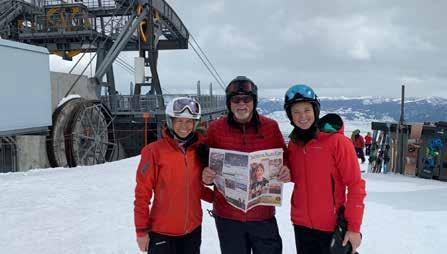
There is a long-standing tradition that quietly takes place each holiday season in the Roaring Fork and Crystal Valleys, and the Roaring Fork Audubon Society's Christmas Bird Count has been recording bird species and numbers since 1977. The single-day tally is conducted at the same time each year, serving as an environmental health check on our local ecosystems.
The Carbondale bird count took place on December 18th, with about 13 participants led by Mark Fuller. Fuller is a Roaring Fork Audubon Board Member who stood in this year for Board President Mary Harris, who was out of town; while the Aspen count took place on December 19th, led by Rebecca Weiss of the Aspen Center for Environmental Studies (ACES).
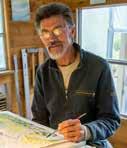
by Alex Menard
Although, the actual recording period extends for a few days before and after these dates.
The Carbondale group visited sites from the lower Crystal River Valley, including Carbondale, Glenwood Springs, and Missouri Heights, while the Aspen group covered the upper valley down to Basalt. In past years, before social distancing, attending the event was a very rewarding experience for beginner birders as they were paired with experts.
The numbers of birds overall and species diversity have decreased since the peak in 1996 when 80 species were recorded. Twenty years later in 2016, only 53 species were observed. Along with the decrease in diversity, an increase in species more adaptable to human development was observed including magpies, crows, ravens, jays, pigeons, house sparrows, and starlings. These changes can be attributed to a decline in suitable habitats.
At the Mount Sopris Fish Hatchery, fewer waterfowl in diversity and numbers were also recorded. In the pastures just up the Crystal, more hawks were observed, with fewer turkeys than in past years, but a group of around 500 geese was spotted cleaning up after the grain provided for cattle.
Bird numbers and diversity peak during spring and summer migration periods, but there are many winter residents. most of whom migrate down the valley in search of open water or snow-free land.
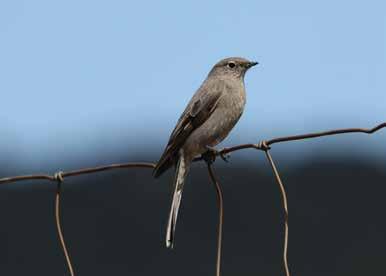
grate further north to breeding grounds during the summer months, but an increasing number nest here. Mark Fuller estimates that there are four to five eagle nesting sites in the Roaring Fork Valley from Snowmass to Glenwood. A pair of Bald Eagles have been observed at Beaver Lake in Marble with regular sitings along the Crystal River near Redstone, Avalanche Ranch, and the KOA.
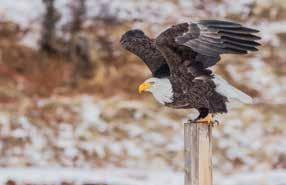
Eagles have been observed in an ongoing battle for supremacy with Osprey, which are large, majestic birds in their own right. Ospreys are summer visitors, who dive for fish as well. Eagles have been observed stealing the catch from flying Osprey and also taking over their nests.
The story of birds is a story of adaptation. Bird anatomy and behavior are a response to different environments and food sources. Varieties adapted to watery environments include waterfowl, shorebirds, waders, and fishing predators like Ospreys and Kingfishers.
Hummingbirds are designed to collect nectar from flowers while insect-eaters include those that hunt on the wing-like swifts and flycatchers and those that forage in tree bark like woodpeckers. Other birds, like jays, are adapted to eating nuts. Birds of prey are designed to feast on other birds, mammals, fish, and reptiles.
Now to reveal some secret birding hot spots. In Carbondale, the Nature Park has enough habitat variety including year-round water, cottonwood trees, hillside shrub thickets, cattail wetlands, and meadows to attract a good showing of birds. Up the Crystal, the open space between the Placita trail and Marble turnoff has conifer and aspen forests, wildflower meadows, and wetlands, where you find waterfowl, songbirds, humming-

birds, and raptors.
If your interest in birds is aroused, but you only want to purchase one book, the choice is simple. Lucky for us, Weiss and Fuller have collaborated to present a lifetime of local bird knowledge in Birds of Aspen and the Roaring Fork Valley With this volume, bird identification is easier, since only local birds are featured.
The 250 photos by Fuller alone justify the purchase, easily closing the gap between art and science. Though it is not large in format, it is still a beautiful coffee table book.
The text, written by Weiss, includes more information on each species than other books. She includes descriptions of habitat to locate birds, points out field markings to identify them, and describes calls and songs, which helps to both locate and identify birds. The narrative also presents unique features about each species.
Fuller also produced a 2022 calendar, Birds of Aspen and the Roaring Fork Valley. Both the book and calendar are available at Book Grove

in Glenwood Springs, Book Binders in Willits, Basalt Printing and Art Supply in Basalt, ACES, and Ute Mountaineer in Aspen. The Marble Hub has copies of the book for sale and is open on Saturdays throughout the winter.
Wilderness Workshop hosts two ACES winter speaker programs in Carbondale on bird topics. "Small Mountain Owls" is offered on Wednesday, January 13th and "Three Billion Birds" on Wednesday, March 9th. Registration is required at WildernessWorkShop.org/events. ACES also offers winter bird trips; for more information, visit AspenNature.org

Eagles, both Bald and Golden, command our attention. Many mi-

Last year, 2021, has not been the year we had all hoped it would be. Full of political angst, confusion about the COVID surges that just keep coming, hospitals overwhelmed by sick and dying patients, desperate news about the environment, forest fires, and mudslides close to home… a year that did not bring the relief from the vicissitudes of 2020 that we had anticipated.
So, our joys have had to come from our personal lives and closer communities. I hope that for most of you, like me, your family and our beautiful valley have brought joy and solace, and hope. I am thankful for the voters who made possible this job as County Commissioner that I love.
because of last winter’s severe COVID and accompanying shutdowns, all my experience for the first few months was in Zoom meetings. I mostly had to learn through osmosis.
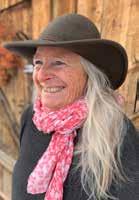
I am thankful for my family who surrounds me with warmth and inspires me with their choices. My path this year has been made easier by each of them – my children and their spouses, my nine grandchildren, my sister, and my brother-in-law. And my belief is that my fellow Commissioners are all deeply committed to their jobs and to improving the lives of all of us in Pitkin County.
I knew little about the job of a Commissioner when I took office on January 12, 2021. I knew constituents were sad to see the end of George Newman’s tenure and that I had big shoes to fill, but I had little understanding of the daily workings of my new job. And
I am, finally, becoming familiar with the scope of a Commissioner’s job, including the intricacies of our county land-use codes and the needs of our citizens. I have been serving on several boards this year, including Roaring Fork Transportation Authority (RFTA), Aspen-Pitkin County Housing Authority (APCHA), Community Office for Resource Efficiency (CORE), and the Elected Officials Transportation Committee (EOTC). I also serve on the Stakeholders’ Advisory Group for the reintroduction of wolves in Colorado.
Every meeting of every board impresses me with not only the depth of some of our problems but also with the commitment of elected officials and volunteers to find solutions to the problems we are facing.
An example of the deep and widespread community volunteerism in this valley is the Airport Advisory Committee. This is an advisory board to help the Commissioners and staff make decisions about how to improve our airport — including a new terminal, improved general aviation facilities, and a runway that can meet the demands of changing aviation. For
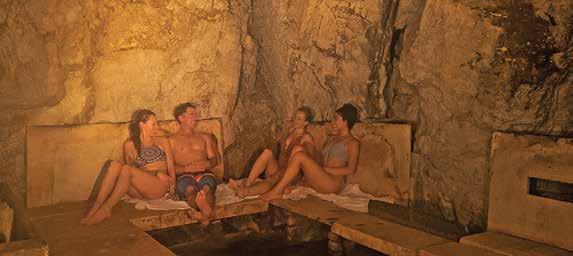
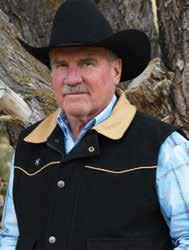

nine positions on this board, there were 74 applications! That means 74 people willing to give of their time over the next few years to help the airport meet the needs of our community — from Aspen to Redstone to Glenwood Springs.
Another example is the Board of Public Health. The volunteers on this board worked tirelessly in 2021 to address the challenges of COVID and to do their best to make decisions to make all of us safe. We have many volunteer boards in Pitkin County — a testament to the activism and the level of involvement in this very special part of Colorado. I am deeply impressed and moved by the generosity and compassion I see every day from the citizens of Pitkin County.
Let’s hope 2022 brings a measure of progress in our efforts to slow climate change, to increase social justice, to ease the pains of poverty and disenfranchisement of many of our residents, to provide adequate housing to those who need it, and to alleviate the ravages of COVID. I also have my fingers crossed for continuing snow and summer rains, as I know all of you do too.
Happy New Year. It is a pleasure and an honor to serve as your Commissioner.
The Pitkin County Commissioners hold weekly work sessions on Tuesdays and bi-monthly public hearings on Wednesdays in our BOCC meeting room at the Pitkin County Administration and Sheriff’s Building. Both meetings are televised live and repeated on locater CG12 TV. They are also streamed live and available on the County website. Agendas are posted in the Aspen/Glenwood newspapers and on-line at www.pitkincounty.com. In this column, your District 5 Commissioner, Francie Jacober, offers her take on current matters. You can reach her at francie.jacober@pitkincounty.com




by James Steindler
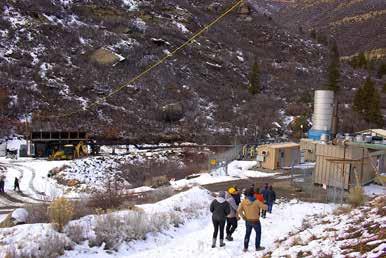
If you drive west through Somerset and look on the ridge across the river, you’ll notice a few perpetual clouds of steam emitting from the ground. That steam is methane which, due to abandoned and in-use mines, escapes the earth’s surface. According to experts, methane is significantly more harmful to the atmosphere than carbon dioxide.
“It’s not possible to seal the mines well enough to keep the gas underground,” said Christopher Caskey, the founder of Delta Brick and Climate Company. “So the minimum option is to capture and destroy it.” To do that, you pump the methane out of the ground and burn it. This combustion process creates carbon dioxide and water and is referred to as flaring or oxidizing.
Last month, Caskey guided a group of local environmental professionals through a decommissioned flaring facility west of
The next regularly scheduled municipal election for Trustees of the Town of Marble is scheduled for April 5, 2022. There are three trustee seats up for election, two 2-year terms and one 4-year term.
Nomination petitions will be available for circulation between January 4th and January 24th from the Town Clerk. Nomination petitions must be issued by the Town Clerk only. Anyone interested in running for one of the open seats can contact the Town Clerk at leach@townofmarble.com.

Somerset. It has not been used to destroy methane since 2018, and before serving as a methane flaring facility, it was part of the coal mine’s infrastructure.
An alternative to destroying methane is to create electricity from it. After touring the dormant flaring operation, Caskey showed the group an electricity-generating option. The 3MW LLC Coal Mine Methane Electricity Project is also located at an abandoned mine site outside of Somerset (above the cemetery). Three generators are put to use and an energy transformer transmits the power to power lines.
Each of the generators produces about one megawatt each and “a megawatt is one million watts,” explained Caskey. Hence the name “3MW.” The energy is purchased by Holy Cross which then sells it to Aspen Ski Co.

Many of the environmentalists along for the tour were there to gather more information to see if a similar operation would find a place in the Crystal Valley. There has been discussion in regard to capturing the methane emitting from the defunct Coal Basin mine.

According to an Aspen Daily News article in October, the “Coal Basin mine complex is releasing 1.3 million cubic feet of methane daily — the annual equivalent of 41% to 143% of the greenhouse gas emissions of all human activity in Pitkin County” — a reference from a memo Pitkin County Climate Action Manager Zachary Hendrix provided the Commissioners.
Whether or not a methane capture facility in any form, either to destroy the methane or make energy from it, in Coal Basin remains to be seen.
Stay tuned!



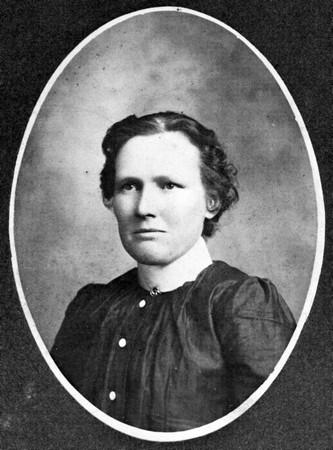
By the time Sylvia T. Smith arrived in Marble, Colo., in 1908, she was already a well-seasoned newspaper editor and political activist. At 42-years-old, she was an outspoken supporter of both the suffragette movement and labor rights, two hot topics of the era. She served as one of the first female delegates for the 1894 Republican Convention only a year after Colorado women won equal suffrage by referendum.
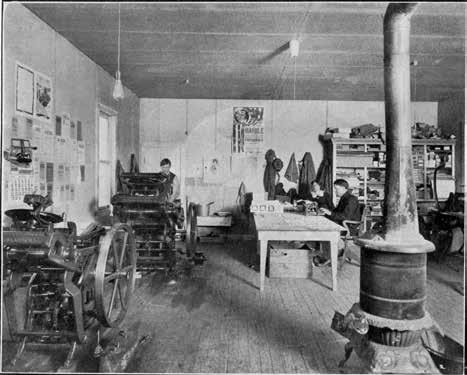
She spent the previous decade in Crested Butte, in part, as the publisher of the Crested Butte Weekly Citizen and came to Marble with her printing equipment and supplies in hand. By May of 1909, she had taken over as proprietor and editor of The Marble City Times, a weekly paper that was circulated locally and mailed back East to stockholders of the Colorado Yule Marble Company (CYMC).

From the beginning, The Booster professed to be pro CYMC and pro-business. In fact, that is where the name “booster” came from: To boost the company and town. In short, it was a company paper. The editor, Frank Frost, wrote articles touting the company's generosity and progress while making jabs at Smith. The Marble City Times jabbed right back, and nearly every edition contained at least one derogatory article towards the CYMC.
by Amber McMahill
Marble was a booming mountain town in 1909. Three years prior, Colonel Channing Meek had arrived and taken control of the CYMC. By the time Smith appeared, he had completed the 709-foot-long Marble Finishing Mill, invested in a power plant to bring electricity to the town, and donated the stone for a Catholic Church. Marble had grown from a population of less than 200 to around 800, according to the 1910 census, that same year the payroll for the CYMC had between 500 and 600 employees on average. Marble was very deeply a company town and Col. Meek was its much-loved benefactor.
Few existed in Marble who were either not on the company payroll itself or dependent on someone who was on the payroll. This included the sheriff, deputies, rival newspaper editor Frost, and the preacher. The Crystal River San Juan Railroad also held close ties with the CYMC as Meek had been instrumental in bringing the line into Marble.
Smith used her editorial pen to poke at CYMC from the start, and she’d arrived at a lucky time for criticizing the company. Shortly after landing, a labor strike broke out in July of 1909. While this one was quickly resolved, the second strike in August lasted three months and resulted in 500 laborers striking. In addition to labor conditions, Smith criticized the company on many different fronts, including the safety of the tram, lack of a hospital (despite monies collected for one), and, most damaging of all, the accusation that Col. Meek was running a stock selling scam rather than a legitimate company.
In 1910, Col. Meek began to fight back by calling a gathering of businessmen to meet and voice their opinions on Smith, encouraging each man to relate his opinion. This meeting grew into the Marble Businessman's Association and soon backed the creation of a rival newspaper, The Marble Booster.
One point of contention Smith liked to hammer on was the location of the finishing mill. Old-timers had warned from the beginning that it was built right in the path of an avalanche, and in March 1912, Smith sounded the warning about a large sheet of snow just waiting to come down. On March 20th, it did just that, smashing into the finishing mill doing considerable damage to both the mill and the company that fed so many mouths in Marble.
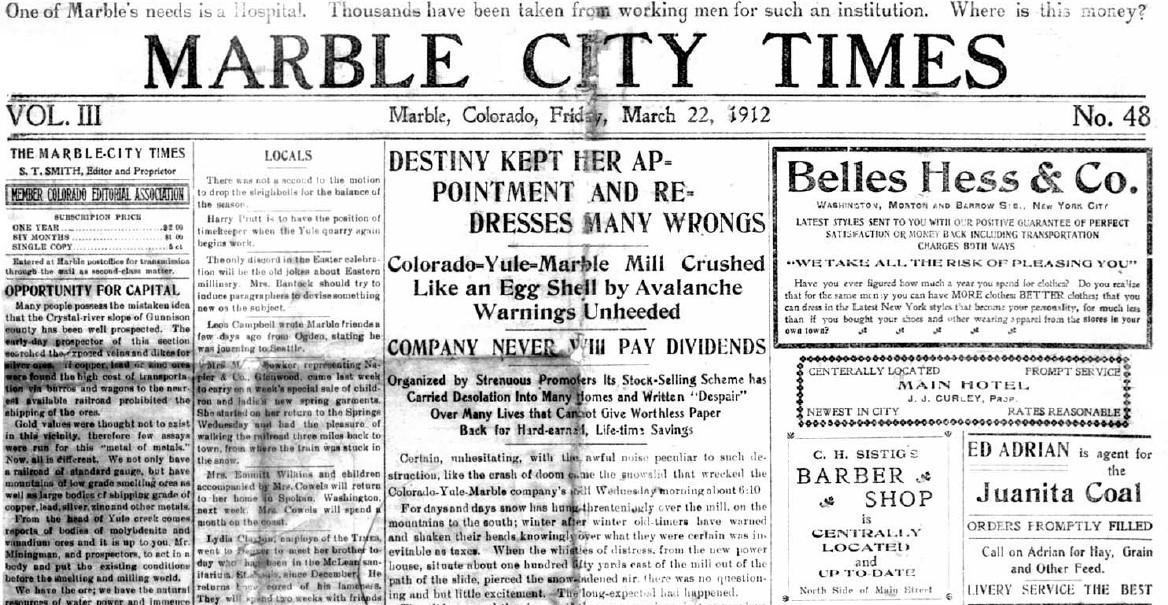
Smith's reaction, appearing in The Marble City Times on March 22, 1912, was nothing short of gloating:
Destiny kept her appointment and redresses many wrongs; Colorado Yule Marble Mill crushed like an eggshell by an avalanche; warnings unheeded; the company never will pay dividends; organized by strenuous promoters its stock selling scheme has carried desolation into many homes and written despair over many lives that cannot give worthless paperback for hard-earned, life-time savings.
The article went on to mention that the company was short on funds and reiterated her accusations that the Eastern stockholders were about to lose all their investments. For Col. Meek, this was the last straw. The next day the company controlled The Marble Booster ran an inflammatory article in retaliation the following day, stating:
This pseudo newspaper has upon many other occasions attacked the Colorado Yule company, but it was thought that the present situation would call for a square deal from even the bitterest enemy of the company. As a matter of fact, the party who prints this sheet has no reason to attack the company at any time, except for the money there is in it, but to print a spiteful, goody-goody article when misfortune came like it did Wednesday morning is just about the last straw.
There was no rebuttal from Smith this time, as the March 22nd edition of The Marble City Times proved to be the last. On Monday, March 25th, a handbill was circulated around Marble, calling all residents to a meeting at the Masonic Hall. They didn't state the purpose, only that it was vital to the town.
Frost, of The Marble Booster, kindly took notes and printed a complete account of the meeting, much to Smith's future attorney's delight. Dr. Haxby, one of the two town doctors, spoke to the heart of matters at the meeting, saying, “My position, briefly, is that this woman is hurting every one of us. Every dollar that her articles divert from the support of this great industry here means a loss of part of that dollar to me and to every other person within the sound of my voice.”
The other town doctor, Dr. Swift, according to The Marble Booster, Vol. 2 No. 3, March 30, 1912, was more direct, “I have served on several boards of health where my duty was to abate nuisances such as a bad smell, dead horses, dead dogs, etc. — things that made people sick. I say to you, though, that never in all my experience have I met with anything so offensive and so badly need-
For anyone needing help stretching their food budget, Gunnison County Officials currently have boxes of food available distributed through the Marble Community Church.
There is no charge to the recipient and no reservation is needed; boxes are available for an individual or up to a family of four and contain enough meals to last approximately three days.
Please call Pastor Jon Stovall at the church to arrange a pickup time for your box today, (970) 963-1464. Free Food Bags Available in Marble
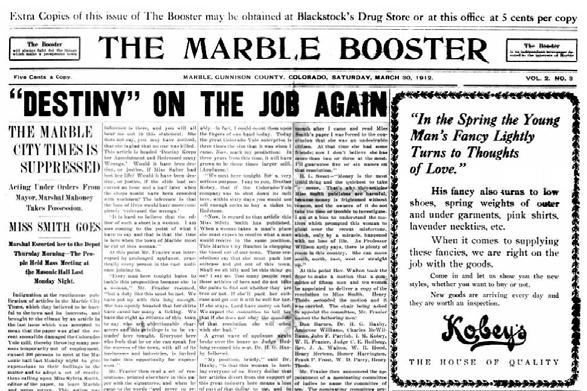
ing abatement as this newspaper, so-called.”
One recurring accusation that persisted for years was the belief that Smith was a paid agitator, insinuating that unions or rival companies had sent to bring down the CYMC. The preacher spoke against her, the school principal spoke against her, and one after one, her former townspeople and neighbors got up to call for her removal from town. In all, 232 residents signed a resolution demanding her removal from Marble.
The next day, a committee of 15 men and two women, including Frost and the CYMC Chief Clerk W. R. Frazier, delivered the resolution to Smith, or rather, they tried to. Smith would have none of it and refused to listen or accept the printed resolution, turning on her heel and going to a neighbor's house.
They enlisted the help of Town Marshal Richard Mahoney, who happened to be paid monthly by CYMC, and Special Officer John Fisher, who was a guard at the mill. The following day, as Smith began working on the next edition, they arrived at the newspaper office. Mahoney and Fisher presented Smith with an order for her arrest signed by the mayor, who was employed as a machinist at the mill. Refusing to allow her to gather any of her possessions save for a travel bag and a check, they took her to the town jail. Smith never saw her printing press, personal possessions, copies of her newspaper, or subscription lists again.
It was Frost, Smith's biggest detractor, who was tasked with dismantling her life's work and locking her possessions, including her printing press — with the typeset for that day's paper already set — and copies of her newspapers, in the basement of the Kobey's Store.
Kobey's was located on the corner of Main and Center Street, an area that became Carbonate Creek after the mudslides of the 1940s took out that section of town. The last mention of the press was in a July, 3, 1915 article appearing in The Marble Booster and written by Frost himself, stating they were still locked up there. It might never be known what happened to them.
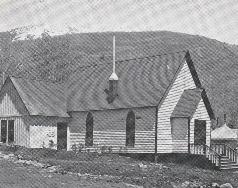
Smith spent the night in the Marble City Jail, a building that still stands today. In the courtroom accounting of her night, she mentions sleeping between the cell and the wall on a pile of clean laundry. Those familiar with the jail know what a tiny sliver of space that is.
In the jail, she met another infamous Marble woman, Mrs. J.J. Curley, hotel proprietor, and bootlegger. Mrs. Curley preferred jail time to fines and had taken up residence in the jail for several months. She shared her food and blanket with Smith, and it was her clean laundry Smith used as a bed.
The following morning at 4:35, she was put on a train to Glenwood, and it was the conductor who ended up buying her ticket out of town. After a 26hour train ride, the delay due to a snow slide near Leadville, Smith arrived in Denver and immediately hired an attorney and filed suit in Gunnison County District Court against 37 individuals, the Town of Marble, The CYMC, and The Crystal River and San Juan Railway Company.
The suit came to trial a year later, and by then, Meek had met his demise in an accident on the very tram Smith had warned was unsafe. Her attorneys used the whole article in The Marble Booster as their primary source of evidence.
taken place.
From the beginning, the CYMC kept themselves out of the resolution and actions against Smith. The company was not named in the final judgment, and in the end, the jury found 14 of the defendants guilty of malice and awarded body judgments against them for $10,345 plus court costs of around $600 (about half a million dollars by today's standards).
This amount was divided amongst all 14 defendants, including Frost, the Town judge, doctor, Mayor Frazier, and Ida B. Carey, widow, and owner of two ice cream parlors. They appealed the decision, and it went to the Colorado Supreme Court, where the decision was upheld.
The following year brought near bankruptcies, garnishing of bank accounts, and forced sale of property, but by April 1916, the judgment had been paid.
Carey nearly lost the empire she worked so hard to build, managing to save her home from the public auction at the last minute with a $100 loan. Fundraising amongst the town’s folk was typical to help defendants keep their homes and assets. It wasn't until the sheriff took possession of The Marble Booster, now the only news source in town, that Frost spoke to the company's injustice allowing the townspeople to take the fall for them.
According to The Booster's issue that hit the stands July 3, 1915, Frost wrote, “To begin at the beginning then, in a statement of the facts — the inside facts, that did not come out at the trial, for reasons that will be stated hereinafter — the defendants in this case who have had to pay this judgment or the most of it, had no more to do with driving Sylvia Smith out of Marble than they had to do with driving Adam and Eve out of the Garden of Eden.”
He went on to lay the blame entirely on Col. Meek, accusing him of dictating the order for her arrest and even using threats to get residents to sign the petition. He continued with details on how some who had refused to sign had lost their jobs and that Meek had promised the defendants the company would pay all costs.
Whether he would have kept this promise, we will never know; following Col. Meek's death, the company was now in the hands of J. Forrest Manning.
In addition, three townspeople spoke up for her: Tom Boughton, George Stogshell, and Mrs. Marshy Woods. Mrs. Woods was the wife of W.W. Woods, one of the Town’s founders who owned the other half of town that the CYMC didn't own. They had, apparently, been close friends in the short time Smith resided in Marble, despite pressure from Col. Meek to have Mrs. Woods withdraw her friendship.
The defense had little evidence to work with; the judge had ruled that all evidence to her attitude against the company did not stand as a reason for their actions. It was based on if those actions had
Little factual accounts exist of Smith's life after Marble and the lawsuit. There are rumors that she worked for The Denver Post, but they have no such records. She is said to have never returned to Marble; although, there is a claim that she did return wearing a pink dress and had a military escort.
The Marble Booster claimed she moved to a ranch in Paonia, but there is no record of her there either. The only other written post-Marble account of her that could be found was from the United Labor Bulletin, speaking of her work organizing labor unions.
There are still many questions about Sylvia Smith and her time in Marble, to which we might never find answers.
She was a woman either loved or hated. Some always believed her to be a paid agitator intent on destroying the town they worked hard to build. To others, she was censored and run out for speaking the truth against the most powerful entity in town.
Regardless, Smith and her story tell of the human element of Marble's history, where the actors are not painted in black and white but in mottled shades of errors and intentions.

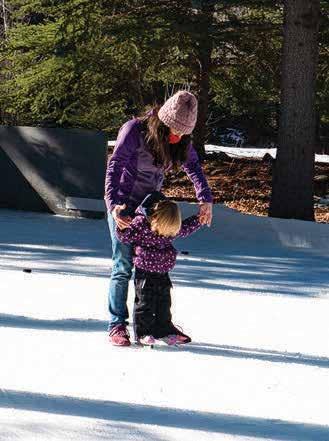
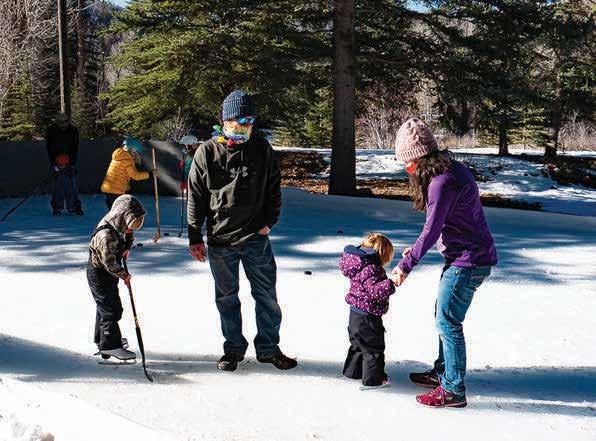
The Redstone ice rink opened for skating on Saturday, December 11 and has been quite a busy place since then. The times of operation are from 9 a.m. to 8 p.m. to respect the neighbors in the area and to allow time for maintenance of the ice surface. The rink is a self-service facility open to the public with more than 80 pairs of donated skates available for use at no charge. We only ask skaters to pair and hang them up after each use. The rink has lighting operated by a timer switch. Hockey sticks, pucks and a goal are also available for use. To maintain ice quality we ask that all such objects be removed from the ice after use because they absorb sunlight and melt down into the ice on warm, sunny days.

Please keep your dogs on leash in Redstone!
From Darrell Munsell
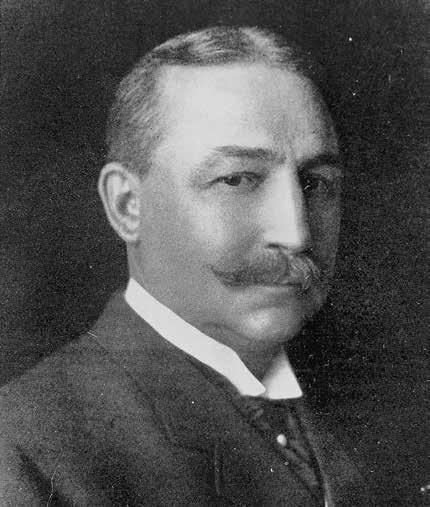
In the early 1880s, William D. Parry and G. D. Griffith were among the successful prospectors who came to the upper Crystal River Valley in search of gold and silver.
Their profitable silver claims at the southern base of Mt. Daly on Carbonate Creek and other claims attracted miners to the area and prompted the establishment of the town of Marble, which Parry platted in 1881. But it was the potential value of the marble deposits rather than silver that brought the town to life. But finding financial backing to develop these claims proved difficult.
John C. Osgood became interested in the Yule Creek marble deposits as early as 1882 when he came to the Crystal River Valley to investigate the coal resources of the area. In that year, he purchased the coal deposit claim in Coal Basin on the southern Grand Hogback a few miles west of the future site of Redstone. In the next few years, he purchased other coal lands in the valley.
But Osgood was limited in what he could do until he could secure more capital. For over a decade, his Colorado Fuel Company competed with Colonel Channing F. Meek’s Colorado Coal and Iron Company for dominance of the coal and coke trade in western Colorado. Osgood won the competition and in 1892 forced a merger on his terms between his company and Colorado Coal and Iron to form the Colorado Fuel and Iron Company (CF&I), which became the largest corporation in Colorado.
With Meek’s company vanquished, Osgood finally had the resources to execute his plans for the Crystal River Valley. Osgood’s plans included establishing both a large coal and coking enterprise at Redstone and a Yule Creek marble operation.
Osgood began his marble operations by incorporating the Yule Creek White Marble Company. He had a large block of marble cut from his quarry and shipped to Chicago for the 1893 World’s Columbian Exposition, where it won first prize as the finest marble exhibited. The publicity gained
All content sponsored and provided by the Redstone Historical Society.
from the display was well worth the $1700 cost, for sporadic orders kept the quarry in operation throughout the 1890s.
The Osgood Marble Quarry, as it came to be known, was the source for some of the interior floors, wainscoting, and stairways of the Colorado state Capitol in Denver. For lack of a rail connection, all of the quarried Yule marble had to be hauled by wagon over the newly constructed wagon road to Carbondale. The 1893 Silver Panic and the recession that followed forced Osgood to delay the construction of a railroad from Carbondale to Marble.
With better economic times in the late 1890s, CF&I resumed a massive expansion and modernization program that enabled Osgood to renew his Crystal Valley plans. He consolidated several railroad interests to form the Crystal River Railroad. “The Columbine Route,” as the railroad was fondly called, reached Redstone in 1899. With great anticipation, the people of Marble waited for the train to reach them. As the new century began, Osgood, realizing the potential fortune in marble, increased his investment in the Yule Creek White Marble Company to produce marble for the commercial market.
Experts judged Colorado Yule marble the finest in the world surpassing or equaling Italian Carrara. Osgood went into full production and extended the Crystal River Railroad to Marble.
The optimism vanished quickly. After a lengthy corporate battle, Osgood lost control of CF&I to John D. Rockefeller in 1903. Without his Redstone coal and coking enterprise, there was little incentive for him to continue his marble venture. He had made a start but failed to advance the Crystal Valley marble industry to any degree.
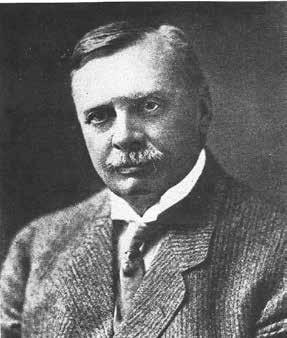
merger of his company with Osgood’s Colorado Fuel Company in 1892.
After a hiatus of a few years during which he organized several large corporations, the appeal of Yule Creek marble brought him back to Colorado in 1905. Meek arrived in Marble with the financial backing of several Eastern investors. Charles Austin Bates, president of the Bankers Trust Company of New York, was chief among them.
On April 11, he offered his land purchases to Bates and the other officers of the newly organized Colorado-Yule Marble Company for “$1 and other.” The other included the presidency of the company.
During his tenure as president, the company spent $3m for, among other things, a hydroelectric power plant, a finishing mill that was the largest and most complete in the world, and an electric tramway to connect the quarries to the mill. Meek succeeded where Osgood had failed. Arriving in Marble on 17 June 1909 aboard “The Knickerbocker Special,” the New York investors and their wives agreed with the townspeople that Marble’s destiny was fulfilled.
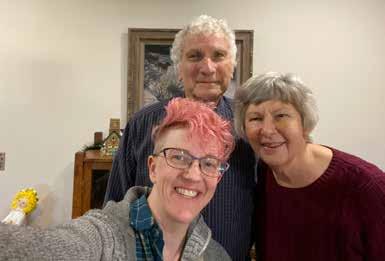
Darrell Munsell is a native of Hays, Kansas, who received BA and MA degrees in history from Fort Hays State University and a Ph.D. from The University of Kansas. He taught modern British and European history at West Texas A&M University, where he was awarded the title of Emeritus Professor. After his retirement in 1997, he and his wife, Jane, moved to the Crystal River Valley south of Carbondale. He was active in historic preservation work and a member of several regional historical societies. He is the author of five books, including: From Redstone to Ludlow: John Cleveland Osgood’s Struggle against the United Mine Workers of America, Colorado Artist Jack Roberts: Painting the West, Protecting a Valley and Saving a River: The Crystal Valley Environmental Protection Association. He and his wife recently moved back to Texas.
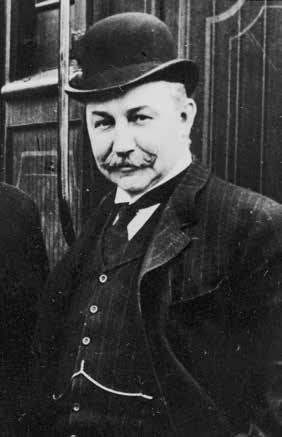
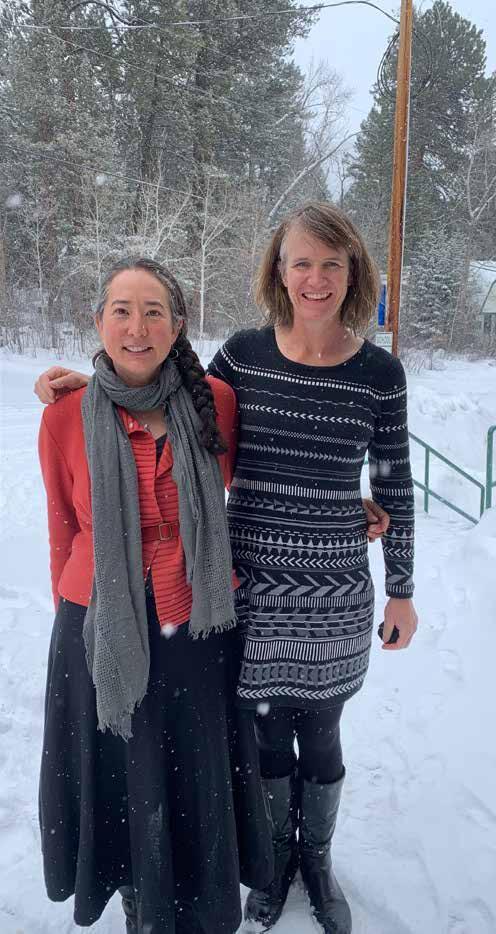
Written and researched by Maya Lopez, 8th Grade
My name is Wahoshi Wachi Winyan, it means messenger woman in Lakota. I am Apache Chiricahua and adopted in the Lakota Sioux. At powwows, I dance in a fancy shawl style. The women's fancy shawl dance has its roots in a ceremonial dance called the Butterfly Dance. The shawl is meant to symbolize the wings of the butterfly, and the fancy steps and twirls represent its style of flight.
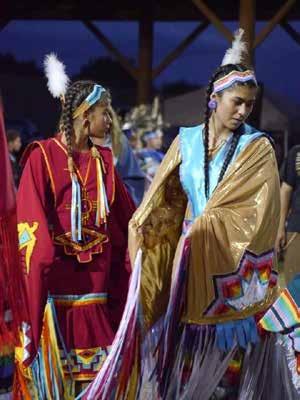
I have been dancing ever since I could walk. At age 8, I started competing. To be honest, I didn't really like dancing in competitions because I struggled making my own fancy steps like the others, until Keya Clairmont, a champion dancer told me to be myself. Ever since, I always wanted to attend Pow Wows and made up my own steps. At first it was pretty challenging to make my own steps, but now that I put more work into dancing, it's a lot easier to make these fancy steps. I was shocked when I placed first in a competition at the age of 11 at the Denver Arts Museum Powwow. In all, I have danced around 60 powwows and placed six times.
Recently I started to research about Native Americans because I wanted to know more of my history. I began by researching the Native Americans as early as 1491. Then I focused on my specific tribes, the Apache Chiricahua and the Lakota Sioux. This project has brought me closer to understanding my culture and roots.
Previously, in 1491 the Native American population was more than 60 million. Every nation or group spoke a different language and nearly all were organized around an extended family. Each tribe had a leader or chief that was usually connected with the spirits or had spiritual powers. The Native people believed that they were all part of the spiritual world that surrounded them. In the 17th century the so-called First Indian war occurred. In 1675, Plymouth Colony’s government killed three people from the Wampanoag tribe in Massachusetts causing a war that lasted for 14 months. A year after the war, a lot of the Native Americans' opposition was damaged by colonization. All together there were over 40 documented wars between Native Americans and the White settlers. During all of these wars around 55 million indigenous people were slaughtered or diseased.
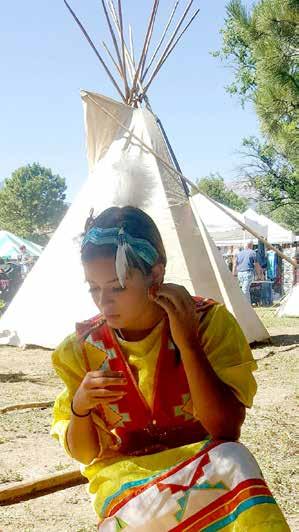
The U.S army feared the strengths of the Lakota Sioux, Apaches, Comanches, and the Cheyenne the most.
Nowadays the Native Americans live in reservations and have a tough life, carrying trauma caused by the wars in the past and racist acts towards them.
Arizona, but were forced to move and live on a reservation between Arizona, New Mexico, Texas, and Oklahoma. Like other tribes, the Apache Chiricahua hunted with bow and arrow. After they killed the animal without it suffering, the Apaches prayed and thanked the animal for giving them food. The arrowheads were made from stone that was broken off to make the point sharp. The bow strings were made from the tendons of animals. Apaches are well known for being aggressive, brave, and being powerful. They were experts at surviving in the wilderness, but not just at survival. Apaches were excellent riders, much better riders than most Spanish soldiers. Horses let them catch and kill more bison than they did before.
Horse was born with curly hair and had lighter skin than others. He was known as “Curly Hair.” After a battle with the Arapahos, he was given his fathers name Crazy Horse, while his father took the name Worm. In 1854, Crazy Horse went on a vision quest at the age of 24. While Crazy Horse fasted for 2 days, he had a vision of an unpainted man on a horse who directed him to appear a certain way. He was told to toss dust over his horse’s head before entering battle and to place a stone behind his ear and was told to never take anything for himself.
Before 1876, massive numbers of tribes got together near the Little Big Horn River in Montana to join with Sitting Bull stand against the Army. The Sioux faced non stop visits from General George Crook during a tough winter that weakened the tribe. On May 6, 1877, Crazy Horse sensed the tribes’ fight for survival. Nelson A. Miles, an American military general, attempted to make a deal with Crazy Horse, encouraging to help the Sioux and treat them fairly. When Crazy Horse sent emissaries to talk about the deal, soldiers shot and killed many of them and Crazy Horse ran off. Stress rose as the Army wanted Crazy Horse’s help in their bad blood with the Nez Perce tribe. Rumor spread that Crazy Horse promised he would not stop fighting until all the white men were killed, yet Crazy Horse did not say that. A couple of the Sioux warriors joined the Army to fight the Nez Perce warriors. Grossed out, Crazy Horse threatened to leave negotiations and was later on arrested.
One unforgettable event that still means a lot to the Native Americans is the Minnesota Massacre. In 1862, the Dakota people were forced to sign a treaty where they gave up some of their land to the government. Soon after, they didn't have enough land to sustain the needs of their people causing them to fear starvation. As a result, the Dakota people went to war and took back some of their land. This is now remembered in history as the Dakota war. Unfortunately, 3 months later the 38 Dakota plus two Sioux people were hanged as revenge for the Dakota war. Every year on December 26th we honor the 38 Dakotas plus 2 siouxs that were hung by horseback riding or running for 4 and a half days.
Geronimo was a great Apache leader and medicine man. Geronimo was best known for his bravery in resisting anyone who attempted to take out his people from their tribal land. He was born on June 16, 1829 in Mexico. His birth name was Goyahkal which means “one who yawns.” He was half Bedonkohe, a band of the Chiricahua Apache tribe, a small but strong group of about 64,869 people. In 1851, Geronimo went away on a trading trip, when Mexican soldiers led by Jose Maria Carrasco attacked his family’s camp. Geronimo’s wife, Alope, their three children and his mother were all killed. With grief, Geronimo buried his family’s belongings as stated by Apache tradition before heading into the forest, where Geronimo said he heard a voice that told him, “No gun will ever kill you. I will take the bullets from the guns and I will guide your arrows.” In March 1886, Geronimo was forced to surrender by General Gerorge Crook but managed to slip away and continued to attack other villages and take food to be able to survive. Once Geronimo turned himself in, he spent 14 years in Fort Sill, a prison camp in Oklahoma. Geronimo died of pneumonia on February 17, 1909 in Fort Sill.
The Apaches were strong although like many other tribes they had enemies. At times the Pueblos were allies. They traded goods with each other and sometimes fought side by side. Other times the Apaches and Pueblos were enemies and fought against each other. The Apaches had conflict with the Comanche, known to be a victorious and dangerous tribe following with the Pima tribe, but their main enemies were the white settlers, Spanish, Mexicans, and the Americans.
The Apache Chiricahua originated in southeast
The Sioux homeland was in what is now Wisconsin, Minnesota, South Dakota, and North Dakota. They resided near the Sacred Black Hills of South Dakota. The Sioux were known for their great courage and exceptional physical strength. They are famous for their hunting and warrior culture. The Sioux used bows and arrows, spears, war clubs, and buffalo-hide shields. The tribe had to be brave and clever to hunt bison. Sometimes a brave hunter would run the bison down with his horse and use a spear or arrow to take the bison down. This was dangerous and difficult, but could be done with skill and practice. The enemies of the Sioux were the French, Ojibway, Assinibone, and the Kiowa tribe.
Crazy Horse was an Oglala Sioux shaman and leader. Crazy Horse is best known for defeating General George Custer and was the only one that was able to defeat him and his men. He was born in 1841 in the Black Hills of South Dakota. Crazy
Coming back to camp the next day, Crazy Horse asked to speak with the military leaders, but was put in a cell instead. Noticing the betrayal, Crazy Horse struggled and was resisting arrest. A long-term friend, Little Big Man, worked for the Army as a policeman and attempted to stop Crazy Horse, who pulled a covered knife on him. Trying to block Crazy Horse from stabbing Little Big Man, a soldier stabbed Crazy Horse in his abdomen, penetrating his kidneys. Crazy Horse died later at some point on the night of September 6, 1877, at the age of 35. His body was moved to an unknown location near a creek called Wounded Knee.
TO BE CONTINUED . . .
Editor's Note: This essay has been broken into two parts due to space availability. Look for Part II in the next issue of Marble Times. NATIVE AMERICANS CONTINUED

From Rebecca Branson, photographs provided by Tracey Harris What is your definition of art? For many, that answer is something that evokes strong emotion or challenges their view of themselves and society. While the dictionary can define the word, it is the deep human connection to each other and the world around us that gives us the ability to look at something and say “That is a work of art.”
While everyone may not agree on whether a banana taped to a wall or a plastic lobster glued to a rotary telephone can be classified as art, few can look upon the works of Gentileschi, Michelangelo, or Vermeer and not instantly acknowledge them as such.
Dedication to honing a high level of technical skill is rare in our fast-paced digital society. Perhaps that is why the works of local painter Tracey Harris are so breathtaking. It is impossible to look upon her paintings and not instantly recognize them as masterpieces.

Despite now calling Marble home, small-town life didn’t always agree with Harris. Growing up in a rural Oklahoma town proved unsatisfying for the young artist. The narrow worldview presented by her small school left her feeling undereducated.
Harris’s high school art teacher provided an escape for her from other classes, which she often found excuses to cut, and from her frustrations and anxieties. She provided Harris with a space all her own to explore her budding talents.
The Kansas City Art Institute saw potential and accepted Harris into their illustration program. To support his family, Harris’s father dropped out before reaching high school, and neither her mother nor brothers had attended college. The leap to higher education and an escape from small-town Oklahoma left her thrilled with her rapidly expanding horizons, but not everything was sunshine and roses.
Her favorite thing to draw was strong female subjects in positions of power. This gained the ire of a bigoted professor that harshly criticized her subject material, sparking heated arguments between them. She moved from illustration to painting to escape him and flourished in the new discipline.
Upon graduation, Harris saw even greater possibilities across the ocean and applied to some of Europe’s most prestigious art programs. She was accepted to The Royal Academy and Goldsmiths. These schools proved to be an intellectual boot camp pushing her to develop higher skills and concepts for her work.

Her focus turned to highly conceptual installation art, using text and textures to convey conflicted feelings about relationships with family. A lifelong difficulty to connect and communicate with her father served as inspiration in a series of heartfelt and deeply emotional works.
Upon earning her master’s degree she couldn’t afford to stay in London. Art isn’t a field where one can just go out and apply for a job; she moved back to Kansas City and discovered that the highly prestigious elite schools she had attended in Europe were virtually unknown in middle America.
With most of her contacts, half a world away her options for a career were limited. An art degree usually led to a job in teaching, which she staunchly avoided due to her own rocky education. Harris paid her bills working as a cocktail waitress and caring for disabled people.
Once she got a job at an art museum but could barely scrape by on the salary. When her son was born, Harris became a single mom faced with the choice of leaving him with a babysitter or figuring out a way to make a living with her art. Without connections, breaking into the art world was nearly impossible, but she worked tirelessly to find time to paint while caring for a baby. Life outside of art and her child disappeared, and she threw all her focus into those precious priorities.
When her mother was diagnosed with cancer, they moved back to Oklahoma to care for her. It was in Tulsa that a gallery first accepted her work. She began painting two series, still lifes of well-worn books with interesting titles and beautiful women dressed in aprons accessorized with tool belts, boxing gloves, or rubber chickens.
They began to gain popularity and once one gallery showcased Harris’s work, others began to take notice and seek her out. She is now represented by galleries coast to coast with her pieces finding their way into the homes of collectors all over the world.
After her parents’ passing, her small family was ready for a big change. On little more than a whim, they chose Colorado. After several years in Denver, Harris’s career was flourishing, but life was beginning to stagnate. Attending social functions made her feel out of place amongst the corporate climbers and settled suburbanites. Her son, Max, wasn’t liking his school and the two decided it was once again time for a change.
A love of camping and hiking had taken them to the mountains many times. An online ad for a house available for rent in the valley piqued Harris’s interest. While dropping Max off for summer camp, she stopped by the town. The valley worked its magic, making her instantly fall in love, and she handed over her first rent check within hours of arriving in Marble.
A spontaneous decision to move to a community she knew nothing about led to a feeling of truly belonging. She had worried the town would be full of crazy people, and while that may be true, she fits right in.
Now, when not painting, she immerses herself in the local landscape, taking a special interest in foraging and learning about the natural bounty of our valley. As she turns her thoughts toward the future, Harris looks forward to doing larger and perhaps stranger, more personal art instead of focusing every working moment on producing paintings to pay bills. She also looks forward to spending the warmer summer months hiking with her dogs, gathering eggs from her chickens, and tending her garden.
It turns out that small-town life may suit her just fine, provided it is one as weird and wonderful as Marble.