


Dear Editor,
In response to the October Letter to the Editor, November article, Facebook feed, and to my students about the Church at Redstone declining the use of the Church for my exercise class.
I want to give the full, correct story to my relationship with the Church at Redstone.
I first started my exercise class at the Church back when Jim Jarmon was Minister in 1994. Then, Bruce Gledhill took over as minister of the church for 17-years. Over these years, I have had no problems teaching my class upstairs in the church for over a decade and more. This is a free fitness class to the women in our community of Redstone. Plus, every year at Christmas we gave the church a donation.
It was after Bruce Gledhill’s retirement that the church changed and no longer wanted me teaching there. The Elders of the Church, Mr. Phinney and Mr. Donnelly interviewed me or should I say questioned my religious beliefs and spirituality. First, they wanted me to move my class downstairs, which I did. I was treated unkindly by the Elders and also, Chris Moon phoned me at home and questioned me about my religious and spiritual beliefs.
I know Doug Self and Louis McBurney’s intentions when they built this church were to include community functions and events and to embrace everyone’s diversity.
The Church has never given me an explanation as to why they did not want our senior women’s group.
It is a sad situation to feel rejected in one’s community. I have forgiven them but needed to get the true factual information out to our community.
What is happening at the Church at Redstone?
Dear Editor,
— Lisa Wagner
& Marble Times
Mission Statement: To provide a voice for the residents of the Crystal River Valley; to bring attention to the individuals and local businesses that are the fabric of the Crystal Valley region; to contribute to the vitality of our small town life.
Editor • Gentrye Houghton gentryeh@hotmail.com
Stephanie Deaton • Amber McMahill Alex Menard • James Steindler
ADVERTISING SALES
Heather Marine at Elephant Mountain Creative heather@elephantmountaincreative.com (970) 718-5848
The Crystal Valley Echo is published monthly, and is distributed throughout the Crystal Valley.
NEWSPAPER BOX LOCATIONS:
Carbondale (old) City Market • Village Smithy Carbondale Post Office • Redstone Inn Propaganda Pie • The Marble Hub FOR SUBSCRIPTIONS
Please send $40 for print or $25 for digital editions along with address information to: The Crystal Valley Echo 364 Redstone Blvd. Redstone, CO 81623
Last month, I wrote a letter to The Crystal Valley Echo about an incident involving two angry men and a gun. I didn’t know many details at the time, and the print deadline was immediate. I’m writing to you again to tell you more.
The avid photographer hiked from near Lizard Lake to the “Old Mill” to take pictures with the use of a drone. He was near the Mill standing in the road, with his case open when he was informed curtly that he was trespassing. He didn’t react pleasantly. He insisted he was on a public road. He said, “I have been hiking this road for 18-years.” He actually has been a visitor there for so long that he knows it as “Dead Horse Mill.”
The accuser claimed ownership, and whipped out a gun. The photographer said, “Go ahead shoot me.” Meanwhile there was a young woman watching, horror on her face, the accused told me, as well as a family nearby. More angry words were exchanged, and the man wielding the gun, discharging it toward the Crystal River. He then turned and walked away while the “trespasser” photographed him with his back toward him.
Then the accused man hiked almost to Lizard Lake when he heard the discharge of a gun twice more. While he was walking the young woman and a female companion drove past him, took photos, while the one taking photos tried to look as if she was not doing so. Then they turned around and went back toward Crystal. I don’t know the name of the gun packer so I won’t include any names other than my own. The incident was reported to the Deputy Sheriff.
Back in the last century, extensive restoration was done on the “Old Mill.” It was funded by donations (and possibly other funding). Our family contributed to that effort. We have known volunteers who have done actual physical work on the mill, including standing in the Crystal River to work on the penstock, and other maintenance has been ongoing. Surely with this background, the “Mill” site viewpoint cannot suddenly be off limits to the public.
— Nan Barnard White
Dec 2 Town of Marble Board of Trustee’s regular meeting. 7 p.m. Marble Community Church’s Fellowship Hall.
Dec 4 Free hot chocolate at The Marble Hub. 8:00 a.m. - 3:30 p.m.
Redstone Art Foundation's 2nd Annual Holiday Market. From the Redstone Inn to Crystal Dreams B&B, 11 a.m. - 4 p.m., free and open to the public. More information can be found on page 6.
Dec 8 Lead King Loop Listening Session. Open to the public, Marble Fire Station at 6 p.m.
Dec 10 Snowshoe Historic Marble! Meet at The Marble Gallery at 1:30 p.m. Expect to be out for about two and a half hours; free and open to the public.
Dec 11 Christmas in Marble. Pictures with Santa ($15), create your own Christmas ornament, and tree decorating at The Marble Hub. More information on page 5.
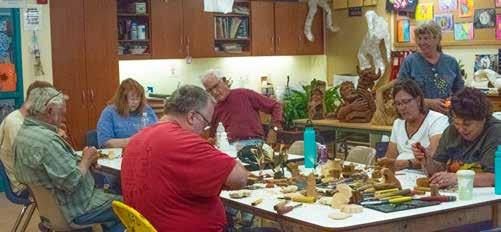
The Marble Art Guild presents Second Saturdays in Marble with Tai Chi, ski and snowshoe, wood carving class, and Songwriters Night. Free, open to the public, 10 a.m. - 10 p.m. More information found on the back cover
Dec 18 Free program at The Marble Hub, 8:00 a.m. - 3:30 p.m. Warm up cider, caroling, make your own potato stamps and wrapping paper, plus kids' sledding group (bring your own sled). For more information turn to page 5.
Dec 24 Christmas Eve service at the Marble Community Church. Call Pastor John Stovall for information, 963-1464.
Dec 24 Christmas Day.
Dec 28 Redstone Senior Days New Year's Eve Party at the Redstone Inn. See page 12 for more information, RSVP by calling (970) 920-5432.
















By Gentrye Houghton
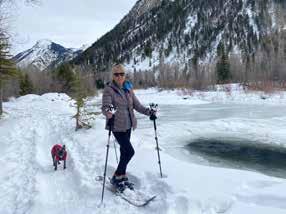
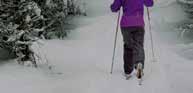
Earlier this year, Cyndi Fowler and Vickie Branson led me through the freshly groomed cross-country ski trail through the Mill Site Park to try out the HOK Hybrid Skis. While much has changed with the park since that February day, SUP Marble will continue to demo these skis through the coming winter.
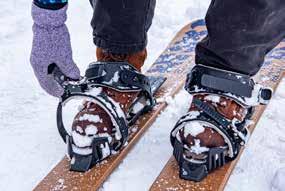
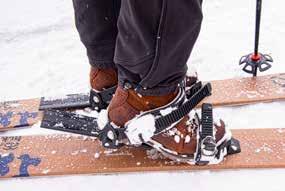
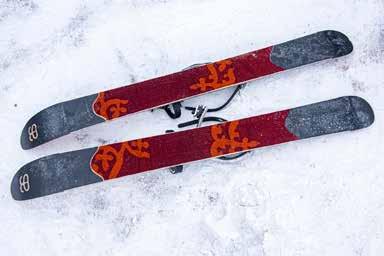
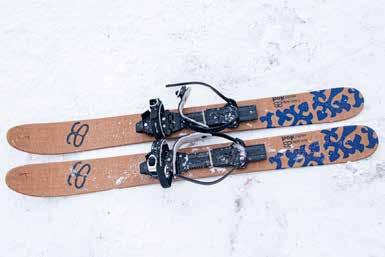
These skis are a hybrid between snowshoes and cross country skis; they’re fatter than the cross country setups, come in two lengths that are assigned to you based on weight, outfitted with permanent skins, and an easily adjustable snowboard-like binding.
Before taking me out on the trail, Cyndi explained, “You’ll want boots where you can cinch down your ankles pretty tight; I like to wear my cross country boots.”
Last month, I fitted the bindings out [in my yard due to no snow] with a pair of La Sportiva Nepal Evos as well as my trail running shoes. I felt quite secure in the Nepal Evos, but my summer trail runners didn’t feel beefy enough to handle the bindings — not to mention that I’d want something more waterproof to deal with actual snow. My recommendation is to stick with some sort of winter boot.
“For me, who was an avid downhill skier, I thought they were sort of difficult to make the transition,” said Fowler. However, Branson,
who started skiing just last year. “I tried the traditional cross country skis, but felt like I couldn’t stay up on top of those skinny things.” Branson chuckled, “but with these, I have no problems, and I just have the best time!”
The Fowlers/SUP Marble intends to offer a full fleet of skis for rental use as well as providing an opportunity for users to purchase these skis, yet there seems to be a common trend happening across America right now and there’s a kink in their supply chain. Fowler told me that they’re expecting skis to come in soon, but many of those pairs have already been purchased.
There are a couple of events this month that would be a great opportunity to demo these slicky sticks:
• December 10 — Snowshoe Historic Marble! Marble Mo (aka Monique Villalobos)

provides a guided history tour of the Town. Meet at The Marble Gallery at 1:30 p.m. and hike through the Historic Mill Site ruins. Expect to be out for about two and a half hours; this tour is free and open to the public.
• December 11 — Ski and snowshoe with Cyndi Fowler during Marble’s Second Saturdays all winter long. This is a free event for the public, starting at The Marble Hub, 10 a.m. - 12 p.m.
Rental supplies are limited, so make your reservations early! If you’re interested in demoing these skis, and we think you’ll have a ball, give Fowler a buzz at (970) 963-4855.


By Gentrye Houghton
The winter holiday season is a time of great abundance that can bring about self-reflection and gratitude, and a time to give to those who may find themselves surrounded by darkness. We’re all searching for that perfect holiday gift that’s handcrafted, unique, and supports local business, could one business be all of those things as well as giving back to sick kids?
For many of us, childhood disease is a phrase and an image of unnamed children in bed gowns. For those whose lives have been irrevocably touched by children afflicted with different diseases, the fight becomes both desperate and personal.
Not only does Nicole Farrell know a lot of really sick kids, but she also knows firsthand the intense journey families may endure. In 2017, her oldest son Colton was diagnosed with Medulloblastoma, a cancerous brain tumor often found in children, when he was 5-years-old.
"It was astonishing to me all the horrible diseases these kids have to deal with,” she remembers, "Colton has made some strong connections and still keeps in contact with quite a few of them online.”
Through the process, Farrell’s thoughts kept circling back to a past hobby shared by her and her husband of 21-years, Kevin. The two grew up together in New Jersey, where his mother was a chandler, making and selling candles in her store.
"It was something we both loved doing,” says Farrell, “and something the boys could help with and learn. A kind of tradition."
And so, Marble Candle Company was formed, and the candle-making process is one full of experimentation.
“We always have something in mind that we’re trying to recreate, whether it’s another candle or a moment in the woods,” says Farrell.
To find their scents, Farrell experiments with a blend of both essential and fragrance oils creating a ratio for the exact smell they’re looking to achieve, but each batch maybe a little bit different from the one before or after. Then, they pour a test batch, which is a few smaller candles to see if the ratio they’ve created smells the same when the candle is burned.
Backing up to the very beginning, lots and lots of tester batches were poured to try out different combinations of waxes, wicks, and jars. Today, they find themselves once again testing many of these key components as supplies across the country are limited. Not to worry, they have already had quite an inventory to get all of us eager beavers through this gift-buying season.
Not to mention, a portion of the proceeds from each candle goes to fight childhood disease, and they have adopted the phrase "A Light in the Darkness" to define their mission.
"We let Colton and his younger brother,
Torin, pick the first disease and, of course, they picked Childhood Cancer since that is what has affected their lives so much,” Farrell explains.
She continued, “My dream is to create a candle for every child we know — that we met — something that reflects them and that I know they would enjoy, and then all proceeds from their candle would go towards the fight against their disease."
You may find the Marble Candle Company regularly sold at The Marble Hub (open Saturdays 8:00 a.m. — 3:30 p.m.), Redstone Mountain Mercantile, and The Marble Gallery (summer only); however, during December, you can also find them during two holiday events in Redstone and Marble.
The Marble Candle Company has teamed up with Marble Mo Creations for their new candle with a surprise inside. You’ll find the Almond Candy Mountain candle starting at the Redstone Art Foundation's Holiday Market on December 4th in front of the Redstone Art Gallery.
You’ll have another opportunity to buy local holiday wares at Christmas in Marble on December 11th; vendors will be set up at the Marble Community Church and an array of actives happening throughout town.
A full schedule of events can be found below.















Valuable resources often resurface after years of absence. For example, after nearly half a century of closure, the Yule Marble Quarry has been resurrected and operates now at unprecedented levels. Due to global warming, we may have seen the end of coal production in Redstone for good, but the market for hard rock minerals like silver, copper, lead, and zinc could change at any time and result in the resumption of mining in the upper Crystal Valley.
by Alex Menard
This is the story of the reappearance of a much more humble, natural soil material: Clay. As the oldest ceramic material, clay was used for prehistoric pottery and clay tablets were the first writing material. Thus, we can say that clay is responsible for the first written records resulting at the beginning of the historic era.
Clay is identified by the particle size of the grains, smaller than sand or even silt. In fact, clay particles are so small that they are invisible to the naked eye. The pore spaces in clay or its associated rock, shale, can hold a micro-thin film of water. This allows wet clay to be like plastic and becomes hard and brittle when dry.
Some clays can be quite a civil engineering problem. “Swelling clays” can greatly expand and contract with the addition and subtraction of water. The locally abundant Mancos shale formation is such a problem.
To prevent damage to foundations, landscape regulations at the Ironbridge subdivision, between Glenwood and Carbondale, require no planting or irrigation within a certain distance of your house. The area next to the house is just gravel, graded to drain water away.
Nearby, Garfield County Road 109, also known as Hardwick Bridge Road or the “back road” between Carbondale to Glenwood Springs, is subject to grade changes because of the expansion and contraction of the Mancos shale. The result is a road needing frequent repair and developing wild ups and downs. The kids have named it "the bumpy road" and preferred the fast acceleration uphill and drop downhill as an alternative to the more mundane trip on Highway 82.
The Delta Brick Company used local yellow clay to produce bricks from 1905 to 1950. Yellow brick churches, banks, and other buildings are seen today along the main drag in that town. The forest service headquarters in Glenwood is also built from that brick, and there is a current proposal to mine the clay deposits on the bottom of Paonia Reservoir for the production of bricks.
Clay was also on the curriculum at the historic Marble High School, where the main goal was providing trained artists and engineers for the marble operation. Besides a heavy load of sciences and technology, students also studied the arts including design, drafting, and sculpture, often using clay.
Today, on the first day of each MARBLE/marble symposium session, Vickie Branson greets each beginning student with a lump of clay to form a maquette, which is a mock-up of their full-size marble sculpture. Working with clay is like sketching in 3D; it makes visualizing much easier.
life story of a
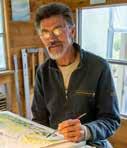
studio and works will continue next summer at the Marble Museum. According to Diane Kinney, founding director of the Carbondale Clay Center (CCC), Johnson probably used his own recipe for his custom mixed clay and wrapped the large red clay bricks in plastic.
Johnson died in 2004 and the clay sat in his studio until about a year ago, when his daughter, Thana, donated about a ton of the clay bricks to the Marble Charter School (MCS). "Clay ages well; actually improving its workability,” explains Kinney.
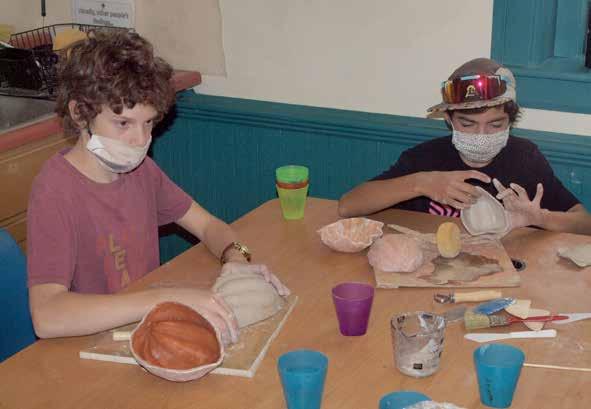
Two MCS teachers, Sydney Schachter and Gina Mile, now use Johnson's clay for a school program. The students are fabricating bowls for household use. Besides the artistic training benefit, the program is a fundraiser to send 7th and 8th graders on a trip to Nashville for a week during the end of April.
Mile inherited the current bowl production setup from Michelle Zianni, a Carbondale potter who made ceramic molds from real squash.
Zianni fired and glazed the molds, which the kids are now using. Zianni made dinnerware she sold at local farmers' markets and donated the other key piece of equipment, a large clay roller. The molds, roller, and hand clay tools are all that is needed to turn Johnson's clay into profitable bowls.
It's fun to watch the process: Pieces of the rolled clay are fitted either inside or outside the molds. Students cut them to shape with wooden clay tools, smooth them out with wet sponges, and then arrange them on a rack dry. Drying takes a few days and Mile says that it is important to "nurse your work during the drying process.”
The bowls are then fired at CCC and finished with a food-safe glaze.
While MCS is looking for a permanent location to sell their wares, students will sell their work at the Redstone Art Foundation's Holiday Market in front of the Redstone General Store on December 4th from 11 a.m. to 4 p.m.
By Ali Wofford
Tree rings can show you the life cycle of the tree and the weather in the past. To begin with, scientists can see the age of the tree, the weather in the tree's life and how it affected the tree's life. For example, light colored rings represent wood from spring or early summer and dark rings represent wood from late summer and fall. Most importantly, by studying tree rings you can find evidence of the local climate. The wide rings on a tree show you the weather was warm and wet this year, this is good for the tree. Thinner rings means it was dry and a not so good year for the tree. Just like people, trees get scars too. The tree scars are how we know the trees got hurt. There are many ways trees can get scars. For example, humans, insects, beetle attacks, lightning, bears and fires. Black marks or spots indicate scars, but blue stained fungus is left behind by bark beetles. Tree rings tell the story of the tree's life, and that is why tree rings are very important.
By Ellamae Siemons
It is very important for all the parts of the tree to stay strong and healthy or the tree will die. To begin with, the pith is very important, because the pith helps bring the nutrients up. Another important part of the tree is the heartwood. It helps keep the tree tall and strong ,so it doesn't fall. In addition, the sapwood (the xylem) helps pump water up so the tree gets plenty of water. Furthermore, the cambium helps make new cells every year so without it it couldn't grow. The inner bark (the phloem) helps push the nutrients down, so no sap leaks through the leaves. Last but not least, the outer bark helps protect the tree from any insects, diseases or animals. If you ever go on a walk and see a tree dying, you know that one of the parts is failing.
By Emily Sorensen
You can identify conifer trees around Colorado by discovering their cones and needles. To begin with, if you are walking in a forest you are bound to find pine trees and their pinecones. Pine cones are thick, big, wide and have hooks under their flaps. Pine needles have Vitamin C and clusters of 2-3 needles on each branch. However, spruce trees are impressive with spiky needles. Spruce cones are very thin, squishy, and tall. Furthermore, spruce needles are small, pokey and if you go against them they’ll bite! Fir trees are friendly and flexible. Their needles are flat and fond of you. If you shake it’s needles, they are friendly! However, fir cones are the opposite. They are pokey, and they have spiky snake tongues! Some trees are soft, like fir trees and others you stay away from, so beware!
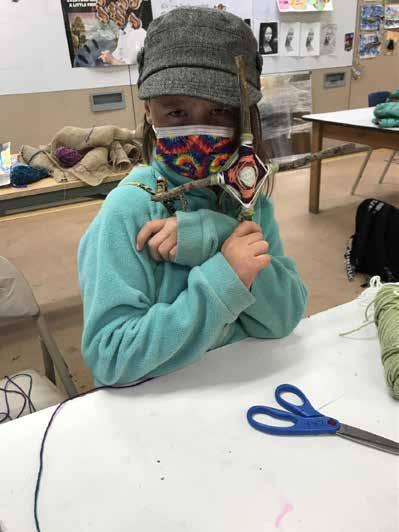
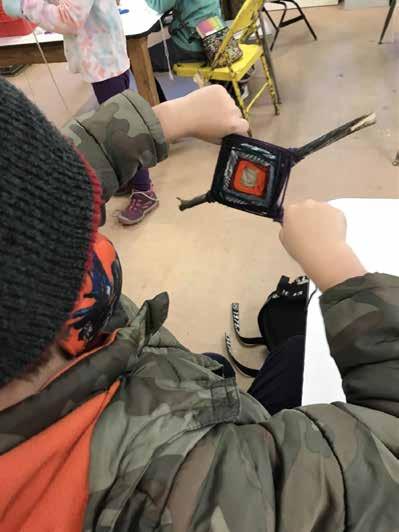
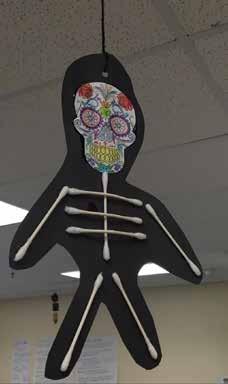
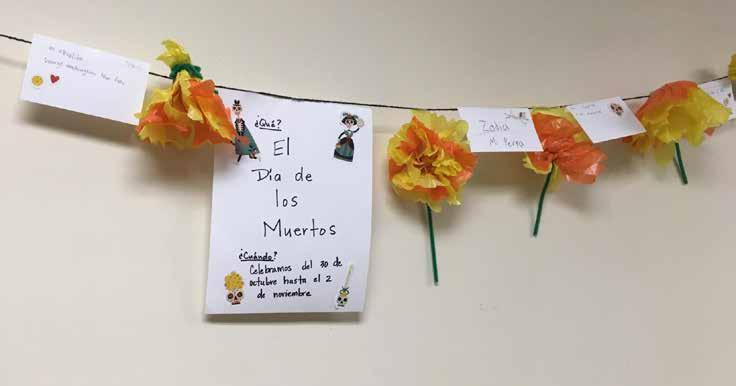
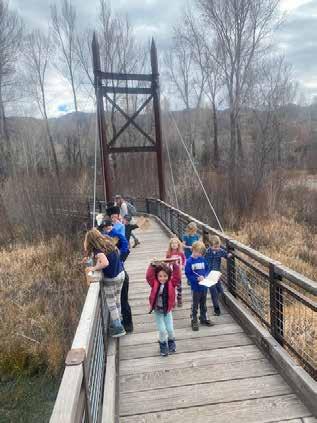
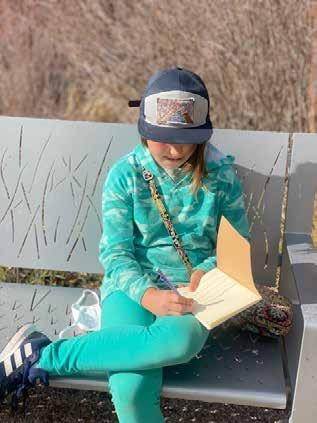
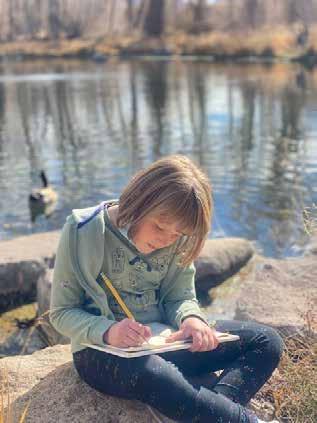
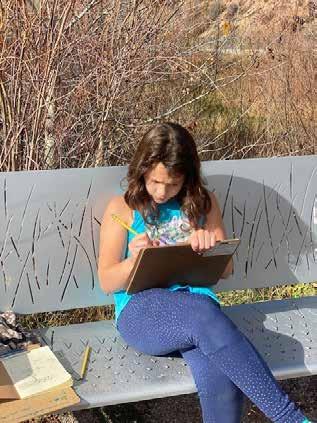
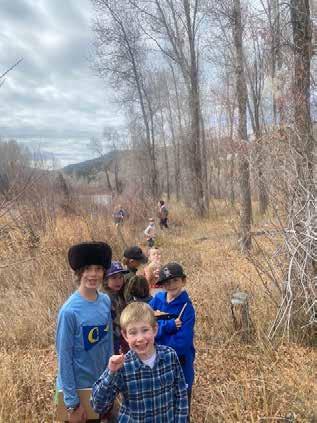
During our visit to the Roaring Fork Conservancy center, the MCS Students were able to attend a Macroinvertebrate class that focused on their life cycles while making observations from the microscopes that were set up for them to see the macroinvertebrates up close and personal. 6th,7th, and 8th grades were able to identify macroinvertebrates and study the Pollution Tolerance Index ID. There was also a “sit spot” journaling center. A sit spot is simply a favorite place in nature that you visit regularly to cultivate awareness as you expand your senses and study the natural patterns of local plants, birds, trees, animals, and more.
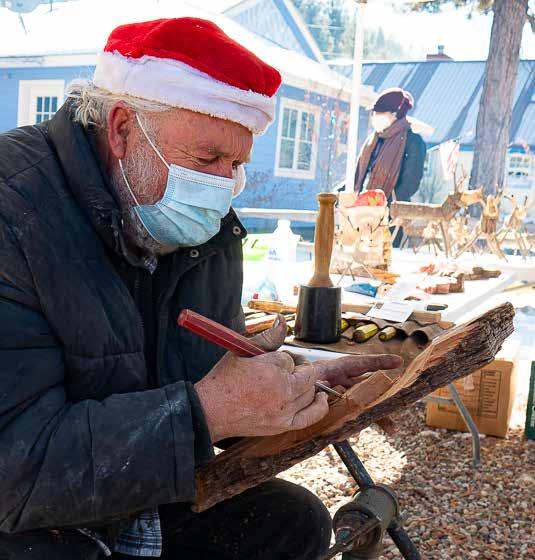
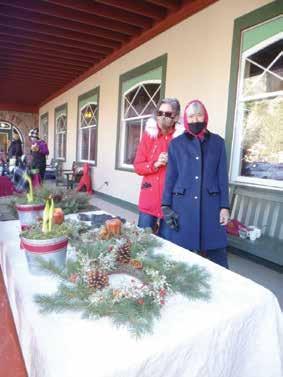
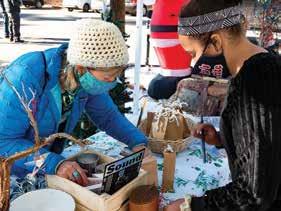
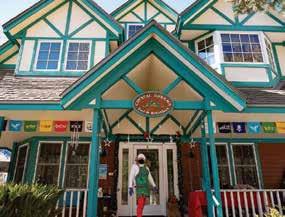
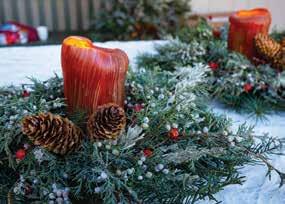
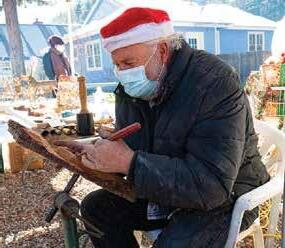
The Redstone Art Foundation once again has brought Christmas to Redstone with the 2nd Annual Redstone Holiday Market. The European style outdoor market features local artists with unique gifts and holiday decorations. Redstone Businesses along the Boulevard are host to multiple vendors from the Redstone Inn to Crystal Dreams Bed & Breakfast. Festive shoppers were tantalized with marble statues, wooden Santa carvings, fresh pine wreaths, candles, jewelry, delectable sweets, and so much more. Santa even made a special appearance at Crystal Dreams Bed & Breakfast. Redstone can hardly wait for next year!

Please keep your dogs on leash in
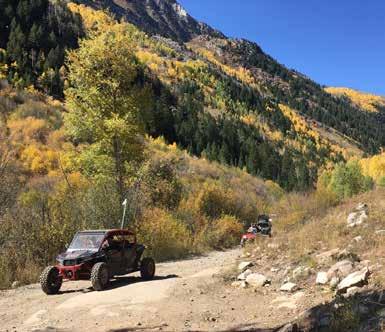
Three years ago, representatives from the US Forest Service (USFS), Gunnison County, Gunnison County Sheriff's Office, representatives of Crystal, Colorado Parks and Wildlife (CPW), and the Town of Marble met to form a coalition of stakeholders to address the increased use of the Lead King Loop (LKL). Since then, the group has grown to include more groups such as the Crystal Valley Environmental Protection Association (CVEPA), professional assistance from Western Colorado University, survived pandemic-induced zoom meetings, and continues to meet regularly.

by Amber McMahill
This past summer, the effects of their hard work and planning were visible as they started implementing ideas that had arisen in the months of planning.
The topic of enforcement is nothing new to Marble. The issues arising from the overuse of the Loop are not only from the volume but also the behavior some users display. Marble has no municipal police department, leaving the Gunnison County Sheriff's department as the primary law enforcement in the area. Through several discussions, the County and Town are working closely together to assure that town signs and regulations meet County criteria for enforcement.
This year, Sheriff John Gallowich stepped up and hired an additional deputy for this side of the County, including Somerset, Black Mesa, Kebler Pass, McClure Pass, and Marble. Throughout the summer, Deputy James Schaefer rode along with longtime Marble Deputy Scott Leon to complete his training with the County and become familiar with town residents and the area.
Upon completing his training in August, he added to the enforcement effort, allowing the department more frequent trips to Marble. It has always been the policy to come to Marble whenever possible, and now there is an increased possibility of that happening.
Leon felt that this year was better overall than last year, but was hesitant to take much credit for it as training took up most of the summer, stating, "Going forward, it is for sure going to help. We can now cover all the hot spots and will be able to come
over even more."
The need for additional enforcement in the backcountry has also become apparent. To address this, an additional USFS Forest Protection Officer was brought in to patrol the LKL area. With limited funding, the forest service could not support the staffing themselves, so the Town of Marble and Gunnison County pooled their resources to foot the bill for the additional coverage.
The County agreed to pay $7,000, and the Town of Marble provided $3,000. This effort provided at least two days a week of patrols around the Loop from May through September.
Another component of the efforts to mitigate overuse on the Loop this past summer was in a parking and education plan by the Town of Marble. Using a mixture of volunteers and paid staff, the Town placed an attendant at the Mill Site Park parking area every weekend. The attendant helped guide and inform visitors and remind them of basic etiquette, including the need to slow down in town.
Building on this program, the Town of Marble is working with Wilderness Workshop to produce brochures and informational material to help educate visitors on expectations while visiting Marble and the surrounding backcountry.
In conjunction with the education plan, the Marble Crystal River Chamber (MCRC) has been transforming Marble's image as an OHV destination and gateway to the Crystal Mill to one of Marble as a place for the quiet enjoyment of nature, the arts, and history. They recently joined the LKL Working Group members in a workshop hosted by the Colorado Tourism Office (CTO) to work towards this shift of image.
In the past several months, the Director for the Center of Public Lands, Associate Professor Dr. Melanie Armstrong, has joined the group to help facilitate the ongoing conversation and planning. One of the first steps of this process is a public listening session scheduled for 6 p.m. on December 8th at the Marble Firestation.
Going into this new phase, the group saw a slight restructuring and new effort from a team of graduate students from Western Colorado University. The team has been helping the LKL Working Group through outreach, meeting facilitation, and more.
The upcoming open meeting will include structured exercises to help people consider their values and what is most important to them regarding the Loop.
"It is amazing to see how this group initially started, very grassroots and driven by the voice of the residents. We want to build on that foundation and make sure everyone feels represented,” commented Dr. Armstrong
The Working Group will use the knowledge gained at the first listening session in a series of full-day workshops to address issues and create action plans. There will be a second listening session in February to ensure that the ideas being worked upon align with the overall vision of residents.
The Core Working Group is made up of representatives from many sectors around the area. Dr. Armstrong reiterated, ”It is essential to all of us that people feel they are represented and that they can have conversations with the representatives about what they want to see for the Lead King Loop. "We want the process to be as transparent and engaging as possible.”
Another part of the efforts to better engage residents is a web page that will soon be hosted on the Center for Public Land's website. The page will have notes, information, data, Working Group representatives’ contact information, and more.
"What we have been seeing in our rural areas,” Dr. Armstrong noted, “is that these agencies are hungry to work with local communities and have strong engagement from residents, but they often lack the resources to do it effectively. I'm excited to work on this program with so many passionate people."
The December Listening Session will take place at the Marble Firehouse on December 8th from 6 — 8 p.m. and is open to the public.
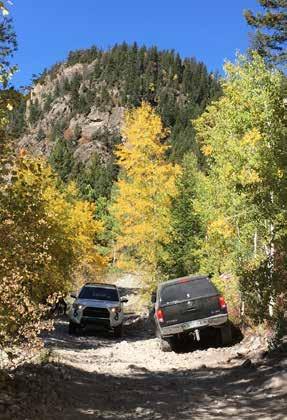
An updated town census data is now available. In 2010, the population was listed as 131 with an increase of nine residents reported for 2020. This amounts to a 2% annual growth rate, showing that Marble is not in danger from rampant development which is why the main concern is the impact of tourism.
The Colorado Tourism Office (CTO) is a division of the Economic Development Council of Colorado, and their website, www.colorado.com, states that the purpose of the office is to develop traveler spending in Colorado by providing compelling sustainable travel experiences.
by Alex Menard
On October 26th, the (CTO) held a meeting in Marble for public agency managers and local stakeholders to explore possibilities and new directions for the Town. The meeting resulted from efforts by the Marble Crystal River Chamber (MCRC) and Amber McMahill, who applied for and obtained a grant to fund the process.
The Restart Destinations Program is designed to help communities recover from the financial impacts of visitor reduction during the COVID-19 pandemic. Statewide, travel spending in 2020 was down 36%. Though specific figures for Marble are unavailable, Daniels Hill resident Terry Havens felt the impact from the busiest ATV visitation season to date.
Twenty-eight Colorado communities received the grant, which includes a pre-meeting survey plus 75-hours of post-meeting

technical assistance designed to put goals into action.
The pre-meeting survey resulted in over 60 responses, with only 20% identifying themselves as off-road motorized recreationalists. Sixty percent said that the current tourism impact is inappropriate, 80% reported that nature is the most important reason they live here, and 81% commented that the local attractions are overcrowded.
The CTO used cell phone pinging studies to determine that visitation is almost evenly divided between in-state and out-of-state residents; the Marble Museum guest book last season showed 1,750 visitors came from 43 states and three countries.
Marble and the surrounding environs have already benefited in efforts from Aspen Valley Land Trust, Roaring Fork Outdoor Volunteers, Colorado Parks and Wildlife, Pitkin County Open Space and Trails, Crystal Valley Environmental Protection Association, Wilderness Workshop, Gunnison Ranch Lands Trust, and Roaring Fork Conservancy. History Colorado (HC), our state historic society, has expressed the desire and ability to help protect and interpret our historic sites.
Gunnison County is provided funding which was directed by MCRC to keep The Marble Hub open on Saturdays year-round for visitors and locals. The Hub will be open this winter on Saturdays from 8:00 a.m. to 3:30 p.m. with programs offered through the winter season.
Melanie Armstrong of Western Colorado University reported for the Lead King Loop Steering Committee (LKLSC); after three years of meetings they are starting a new phase of studies, and the LKLSC has planned a meeting for December 8th, more information can be found on the previous page. There will be an opportunity for public input available both remotely and in person.
The CTO introduced the concept of capacity building, which is an infrastructure designed to accommodate visitors. While other locations may wish to increase capacity, Marble seems to have already reached or exceeded capacity.
Parking availability is currently the limiting factor for visitation. A few workshop participants expressed the desire to discourage visitation completely, but Marble is already a prominent destination and reasonably popular, so visitors will continue to come.
A more enlightened approach is to attract more


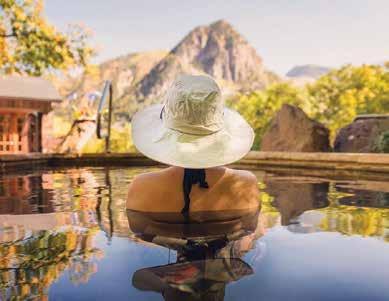

Marble's New Direction continued . . .
responsible, lower impact tourism. This is what the CTO calls sustainable or value tourism. Travel spending by tourists reduced Colorado household taxes by $478 last year according to the CTO. Marble is surrounded by public lands, so the goal is to act as stewards protecting the land and welcoming visitors and not a blanket exclusion.
One part of the workshop was an exercise in imagining Marble’s future in the year 2035. Here is where the greatest ideas appeared: Fourteen years from now Marble was envisioned as a pedestrian zone with an intercept parking lot established and vehicle charging stations. Visitors would board buses to take them to town attractions and even provide drop-offs at trailheads around the Lead King Loop.
Other ideas included promoting history, art, and music events, establishing Marble as a National Historic District, and developing a non-motorized trail system through town. These ideas would reduce Marble's carbon footprint and become a model for sustainable tourism.
One more idea emerged as a way to immediately manage the currently perceived overuse: The Town of Marble, in partnership with Gunnison County, could ban all parking within town limits and on County Road 3 for ATV and trail bike unloading. Locals would still be allowed to use their machines, but off-road visitors would effectively be excluded. Lodging visitor ATV parking and ATV rentals would be grandfathered in at their current levels.
An enforcement question was raised, and Gunnison County Sheriff, John Gallowich, stated that enforcement depends on three factors: The town would need to enact an ordinance consistent with state vehicle codes, state standardized signs would need to be installed, and the Town would need to request that the County passed a resolution to enforce the Town ordinance. He even stated that a third sheriff's deputy could be stationed here for enforcement.
The CTO presented a set of principles they use to promote sustainable tourism,
which they call “Care for Colorado.” These principles include: Leave No Trace, protecting wildlife, and being careful about fire. “Sharing the Outdoors” is one of these principles that consider the effects of one visitor's behavior on the quality of another user's experience. For example, noisy machine operators may detract from a nature watcher's experience.
Having these principles clearly stated allows the CTO to hit the ground running in any new location they engage. Planners can refer to these principles when making decisions on “Best Practices,” which are procedures shown by research and experience to produce optimal results.
The CTO will issue a final report on the meeting in the next few weeks which will include conclusions from the discussions. These conclusions will then be converted into action items, which can be pursued with the provided hours of technical assistance.
Authors note: An excellent example of a statement of principles is Pitkin County's Ecological Bill of Rights, which is found in Appendix H at www.pitkincounty.com CTO takes its principles from Leave No Trace, more information can be found on their website at www.lnt.org

From Roger Neal
All content sponsored and provided by the Redstone Historical Society.
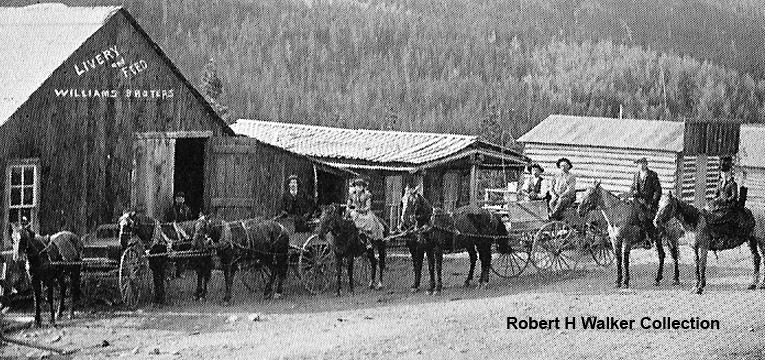
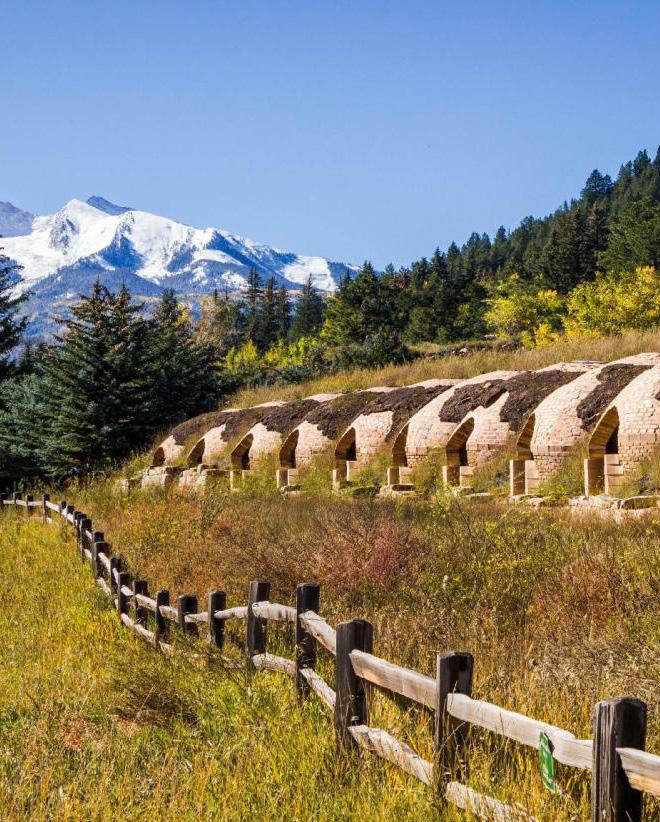
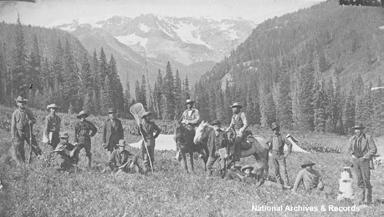
Due to the increased interest in Crystal City over the past several years, the Redstone Historical Society thought a “Vintage Valley” column on the town’s history was in order. And who better to ask to write such a column than Roger Neal, a resident of Crystal City for over 60 summers and the author of several popular books on the town including Crystal: What Really Happened. Crystal City is one of the original settlements in the Crystal Valley, its history mirrors that of other boom and bust mining towns and offers significant insight into the history of the American West. We offer special thanks to Roger Neal for providing the following column.
Fur traders invaded the Crystal Valley in the 1840s. During the 1850s, prospectors began searching for gold and other precious minerals, and in 1873, the Hayden Survey Party arrived in the Crystal Valley. This survey party named most of the mountains in and around the Crystal Valley. Most of the mountains still bear those given names, such as Treasury, Treasure, White House, Mineral Point, and Snowmass.
The Natkve Utes were forced from the Crystal Valley in 1879 and eventually moved to reservations in Utah. Prospectors began populating Gunnison, Crested Butte, Gothic, Schofield, and, finally Crystal. These prospectors discovered ore in beautiful quartz crystal formations. These quartz formations provided the town with the name of Crystal.
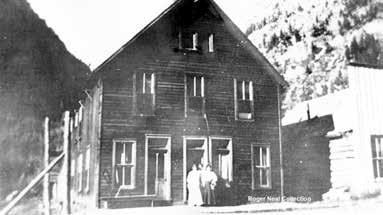
Soon the townsite of Crystal was established on approximately 157 acres, and the town was incorporated on August 24, 1881. The lots were mainly 25-feet by 100-feet. Some of the businesses and buildings included: The two-story Crystal Town Hall, Blacksmith Shop, General Store & Rooming House, Livery, Schoolhouse, Post Office, and Barber Shop. The highest recorded population of Crystal was 600 and included the boarding houses and mining camps
on the outskirts of Crystal.
One of the most famous and respected pioneers of Crystal was Albert A. Johnson, who moved from Canada to Crystal and was an experienced and graceful skier. He owned a sawmill, several mining claims, and operated the General Store.
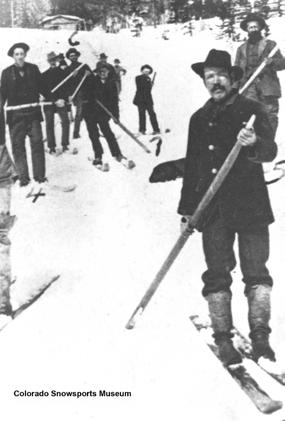
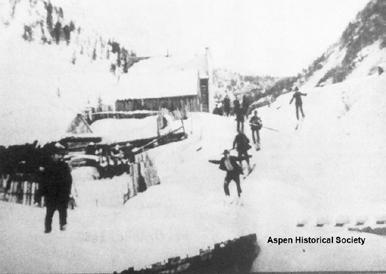
Fred, took turns delivering mail through the dangerous Crystal Canyon to reach Crested Butte. Notorious avalanches were always a danger, and skiing up a 27% grade was extremely difficult. In 1886, he organized and competed in four races in Gunnison, Crested Butte, Irwin, and Gothic.
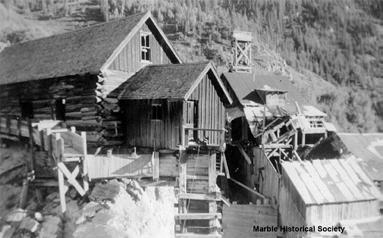
During the 1880s, the miners used star drill bits and sledgehammers to make holes for dynamite charges. In 1892, a power plant (now called the Crystal Mill) was built. This structure used water from the Crystal River to turn a turbine, which turned the wheel of a giant air compressor. The air was used to operate air drills in mines and also to operate the stamping mill, which was built to the right of the powerhouse.
The three major tunnels in the Crystal area were the Crystal Mountain Tunnel, the Bear Mountain Tunnel, and the Sheep Mountain Tunnel. None of these ventures operated with a profit. There were about 100 mines then in the Crystal Valley, and some of the more profitable mines included: The Black Queen, Lead King, Whopper, Inez, Catalpa, and Eureka.
In 1893, President Cleveland oversaw the repeal of the Sherman Act., which caused the price of silver to fall and led to the closing of the silver mines in Crystal. Although some of the lead mines lingered on, by 1920, Crystal became a ghost town.
After World War II, most of the town of Crystal was owned by the descendants of Emmett Gould (Helen Collins and Dorothy
Later, the Crystal Post Office opened in the General Store., and Johnson became the first postmaster delivering mail from Crystal to Crested Butte. Since a newspaper was in great demand, Johnson bought a printing press and became the editor of the Crystal River Current that was first published on October 2, 1886.
During the winter, Johnson and his brother,
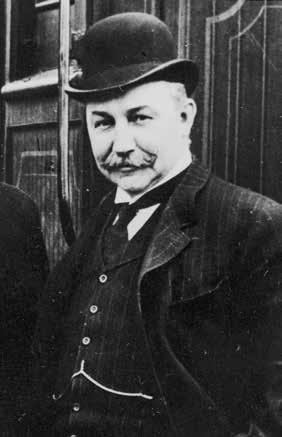
Tidwell). In 1948, Welcome Joe Neal and his family began to spend their summer vacations in Crystal and the family purchased three of the original cabins in the early 1950s. Other property owners include Robert Anderson and Richard Beamon.
The main desire of the residents in Crystal is to continue preserving the historic town and the “Old Mill” for future generations.
Food Bags Available in Marble
For anyone needing help stretching their food budget, Gunnison County Officials currently have boxes of food available distributed through the Marble Community Church.
There is no charge to the recipient and no reservation is needed; boxes are available for an individual or up to a family of four and contain enough meals to last approximately three days.
Please call Pastor Jon Stovall at the church to arrange a pickup time for your box today, (970) 963-1464.
from Nancy Barnard White
Henry Johnson took countless photos in Marble, spanning decades. He was so focused on that pursuit that living alone suited him just fine, or did he possibly have an interesting companion? Bob and Kathy Ezra, of Carbondale, are Marble history seekers who captured information that told much more of Johnson’s sojourn in Marble, and his close connections. It came about through serendipity.
Tidbits about him have been available since he arrived in Marble in its early days. Besides being the Quarry photographer, he was also Foreman for a time and was known as “Old Shaky,” but the Ezras dug deeper.
Those acquainted with his tiny habitation knew a few details. He left no one in charge of his estate upon his passing, and when it sold, there were still some of Johnson's belongings in his home that rested on blocks of marble.
There was a collection of eyeglasses, leading the new owners, Carroll Hunter and a hunting buddy, to assume he had a sideline of selling eyeglasses. There were also storage dugouts, in the yard, that led them to believe he was a collector.
Unfortunately, Hunter and his friend did not see a use for these things and they discarded them at the dump. However, they did keep a few practical or more interesting oddities, such as a clothing washer that had a hand-operated laundry “stirrer,” that looked rather like a cow udder.
A mysterious photo appeared in Oscar McCollum’s Marble: A Town Built on Dreams, Volume 1. It was a scene in Johnson’s home that looked of hospitality and celebration. The dining table was set for five, and in the corner was a classy desk. The owners of his former home were puzzled. It didn’t look like a bachelor collector’s minimal quarters, assumed because of its appearance when purchased. Now, their interest had been piqued.
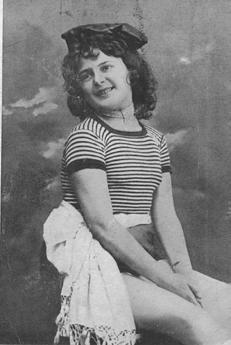
Patty Nowak was the next contributor to the sharing of Johnson’s Marble history. Nowak lived near Johnson’s former property, and she and the then owners of Johnson’s place were friends. Nowak told them that friends of hers, the Ezras, had found a box of memorabilia belonging to Gussie Sours, who had once been a resident of Johnson’s little home. This was big news to them!
The Ezras found the box in the Dinkel building, which, at the time, they were preparing to become the Crystal Theatre. In their efforts to learn more about Sours, the Ezras studied the box’s contents and dug deep into records about her parents, ancestry, siblings, and the next generation. In a sense, they adopted Sours, and Old Henry too.
Through postcards, photos, a letter from Johnson to Sours, and the Ezras' research, we have a portrayal of Sours that makes the second occupant of Johnson’s home a real person, with a fascinating personality. Stay tuned for those details to come in the next issue of The Crystal Valley Echo.
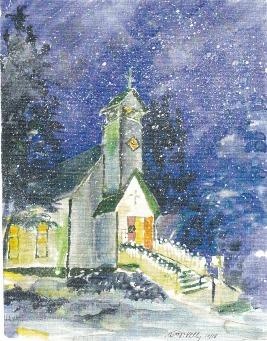
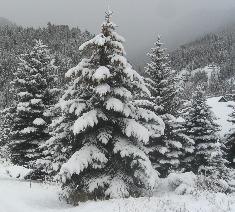
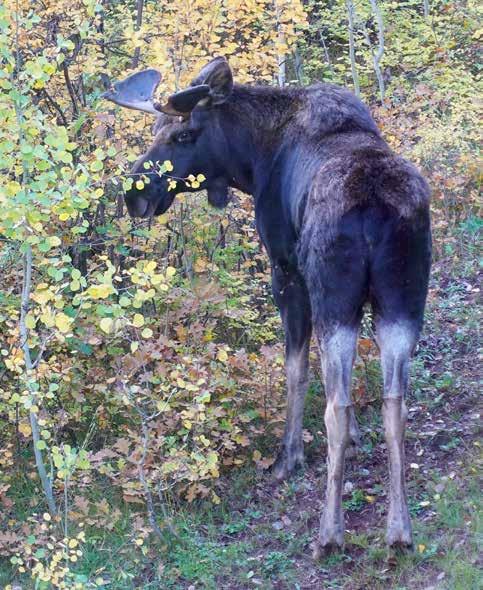

Christmas in Marble 10AM - 4PM Dec 11th @ The Hub 11AM - 4PM Dec 4th @ Redstone General Store



Tai Chi @ The Hub
Ski & Snowshoe with Cindy Fowler @ The Hub
Woodcarving Class with Rex & Vickie Branson @ Thompson Park
Songwriter's Night with Larry Good @ Beaver Lake Lodge (Starting in January 8th)
10AM - 11AM 10AM - 12PM 1PM - 4PM 6PM - 10PM