

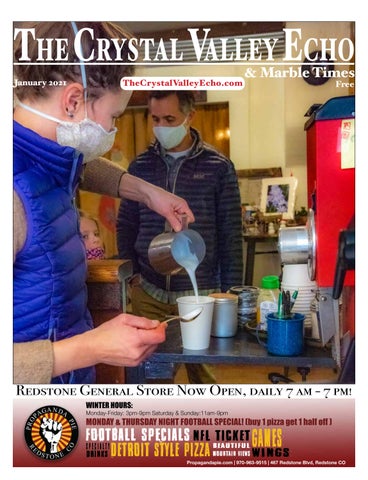

I am grateful to have had the first dose of the COVID-19 vaccine. It is safe and very effective thanks to years of research that laid the groundwork for the rapid development of these vaccines. It gives me hope to take this important step towards controlling the spread of this deadly disease. By getting the vaccine, I am helping to protect my patients, my family, and my community. I hope that everyone who has the opportunity will get the vaccine.
~ Shana Light, MSN, APN, NP-C and Crystal Valley resident
The Colorado Department of Regulatory Agencies (DORA) offers a grant program for internet service providers to encourage the development of broadband services in rural areas. The program's impact has been compared to the rural electrification program of the 1900s.
The grant provides 75% of the cost of installing the service system and requires the applicant to provide the remaining funds. DORA has recently awarded approximately $625,000 to Visionary Communications to develop fiber-optic cable service to Marble and the immediate environs.
Visionary Communications (VC) is a Wyoming-based company that has brought broadband to other small towns in Colorado including Ophir, Pagosa Springs, and Kremmling. Visionary will pay about $205,000 as their share to install fiber optic cable on Holy Cross Electric (HC) power lines from the intersection of Highway 133 and CR 3 to Marble. This will make their service available to all Holy Cross customers.
The company also has an agreement with the Town of Marble to install a wireless transmitter at the Marble Fire Station to provide the service to off-grid residents, who will need to
purchase a router to receive the signal.
Let's review some definitions related to internet service.
Bit: A unit of information transfer. Measurements are comparative so you don't need to understand what one unit is.
Speed: Rate of flow of information measured in Mbps, which is one million bits per second. One Gbps is 1,000 Mbps or one gigabit per second. One terabit (Tbps) is 10 to the 12th power bits (10,000,000,000,000).
Broadband: High-speed internet connection greater than 25 Mbps. This is fast enough to stream video.
Fiber-optic cable: Similar to electric cable but containing up to 1,000 strands of stretched silicon dioxide thinner than a human hair. Each strand is capable of transmitting terabits of information that is coded in the form of light passing through the cable, and so travels at the speed of light! There are always many extra fibers in the cable for future expansion for things like cell phone service, which is not part of the current proposal.
Marble Times
Mission Statement: To provide a voice for Crystal Valleyites; to bring attention to the individuals and local businesses that are the fabric of the Crystal Valley region; to contribute to the vitality of our small town life.
Editor • Gentrye Houghton CONTRIBUTORS
Stephanie Deaton • Alex Menard
Russ Cunningham
ADVERTISING SALES
Gentrye Houghton • 970-963-1495
GentryeH@hotmail.com DISTRIBUTION
The Crystal Valley Echo is published monthly, and is distributed throughout the Crystal Valley.
NEWSPAPER BOX LOCATIONS:
Carbondale City Market • Village Smithy
Carbondale Post Office • Redstone Inn
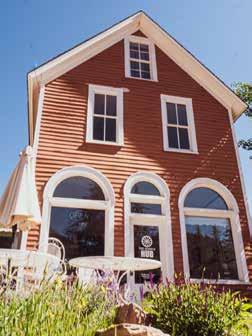
Propaganda Pie • Marble Hub
FOR SUBSCRIPTIONS
Please send $40 for print or $25 for digital editions along with address information to:
The Crystal Valley Echo 364 Redstone Blvd. Redstone, CO 81623
Menard
Data Cap: Satellite Internet providers advertise that there is no monthly cap on data. However, both satellite providers in this area will prioritize users who have not used all their data allowed by their monthly plan and slow down users who have exceeded their data cap. Fiber- optic providers have no cap at all.
Visionary will offer free installation to customers who sign up for automatic payments. Monthly fees will be less than satellite service with increased speed. Cable connected customers will receive speeds of 100 Mbps for about $80, while those receiving the wireless signal can expect to pay $70 for 25 Mbps or $100 for 40 Mbps.
The contract between DORA and VC allows two years for completion, so service will be in place by the end of 2022. Visionary will begin installation in January 2021 but possibly sooner.
The benefits of this service will go, especially, to our local public agencies. Marble Charter School will benefit from virtual learning opportunities and better connections with the school district. The Carbondale and Rural Fire Station No. 3 in Marble will improve response by faster communications, and the Town government will also benefit from a faster connection.
Local home businesses will have opportunities to provide better services to their customers, while families will enjoy better entertainment options. Even if you don't use the service it may increase your property value, and there is almost no environmental impact from this installation since it is using existing power poles.
Towards the end of October, the Town of Marble received a letter from the State Historical Fund (SHF) stating that the Marble Jailhouse Preservation Project did not receive the grant applied for. After meeting with members of SHF to review any weaknesses in the grant, it was determined that, while some flaws could be improved upon, the main reasoning behind the SHF’s decision had to do, primarily, with the impacts of the COVID-19 pandemic on the organization's revenue stream.
Michael Owen, Historical Grant Writing Specialist with SHF said, “They were looking for reasons not to fund you.” While it was disappointing to receive such news, it comes as a blessing in disguise.
The maximum amount awarded during this cycle was $50,000, what they call a mini-grant, while the Marble Jailhouse Preservation Project is estimated to cost $106,000. Had the grant been awarded this go-round, the Town would have needed to raise over 50% in matching cash donations. The project is a strong candidate for applying again and has been encouraged to do so.
The soonest opportunity will be August 1, 2021.
This upcoming grant round will be for projects not to exceed $200,000. Now, the Town will be able to reapply for the total cost of the project, significantly reducing the number of funds needing to be raised to $27,000.
Marble has pledged $5,000 and two private donations have been given in the amount of $600. Recently, Aspen Valley Land Trust, which now owns Children’s Park (formerly known as Thompson Park), received a large Great Outdoors Colorado (GOCO) grant to support various projects, including a park beautification of Children’s Park with $10,000 going towards the jailhouse.
This leaves the town with just over $10,000 needed to complete the project.
A great many thanks go out to all who took time to write a letter of support as well as those who have made donations, this project received 21 letters in total. Additionally, this project would not be made possible without the Town of Marble’s Board of Trustees, Mayor, and Administrator, thank you!
The Town has learned a lot about preservation and restoration efforts, and working on preserving the jailhouse has helped
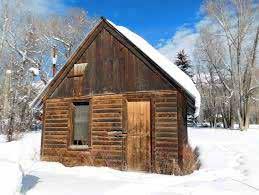
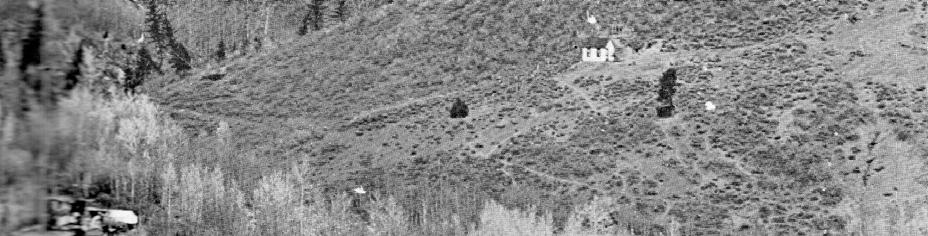
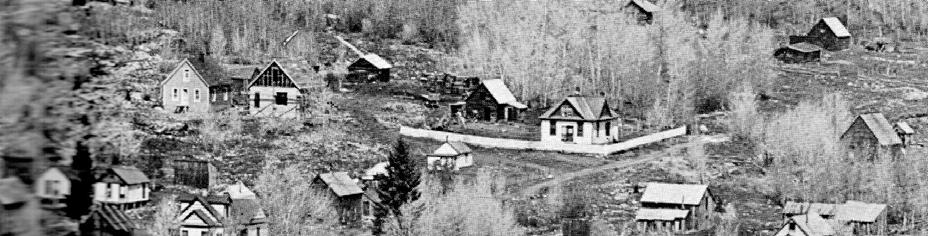
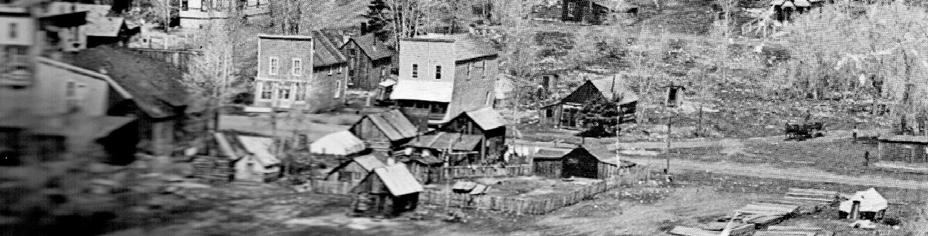
pave the way for understanding what it will require to preserve and restore the Mill Site Park.
If you would like to get involved, we will continue to collect both letters of support and financial donations. The Town will also be looking for engineers and firms that may be interested in volunteering their skills and expertise for both the Marble Jailhouse Preservation Project as well as the epic Mill Site Park Preservation Effort.
For more information or to get involved please contact Emma Bielski, Grant Manager, at EmmaBielski@gmail.com


For those venturing out this winter to snowmobile, ski, snowshoe, or for extreme sledding, it’s important to know what you’re getting into. Avalanche forecasts are often defined by the “problems” they pose. Reading an avalanche forecast helps a person make informed trip planning and route-finding decisions.

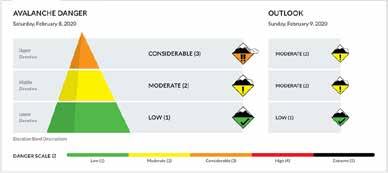
In an avalanche forecast, like those updated regularly on the Colorado Avalanche Information Center (CAIC) website, the forecast can be broken down into three parts: Generalized information, bottom line danger assessment, and a detailed forecast with data and field observations.
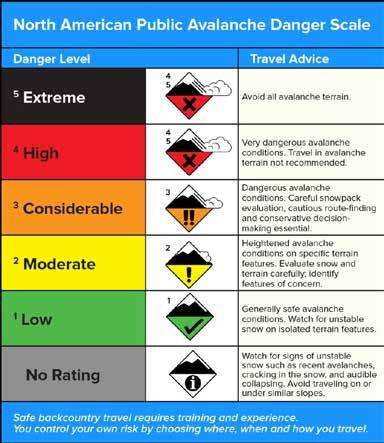
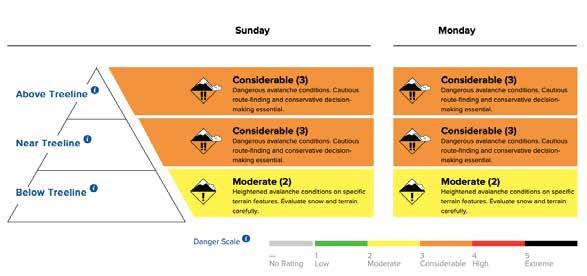
The first part gives an overall impression of an area. According to CAIC, their forecast model “relies on the North American Avalanche Danger Scale to communicate avalanche hazard.” This five-level scale conveys the potential avalanche danger to those recreating in the backcountry. The danger is a combination of the expected likelihood, size, and distribution of avalanches. It provides a basic description of avalanche conditions above, near, and below the treeline.
After a summary written by an avalanche forecaster, a more specific danger assessment follows. It consists of four main parts: Avalanche character, aspect/elevation, likelihood, and size. Below is a breakdown of what each part means when reading a forecast.
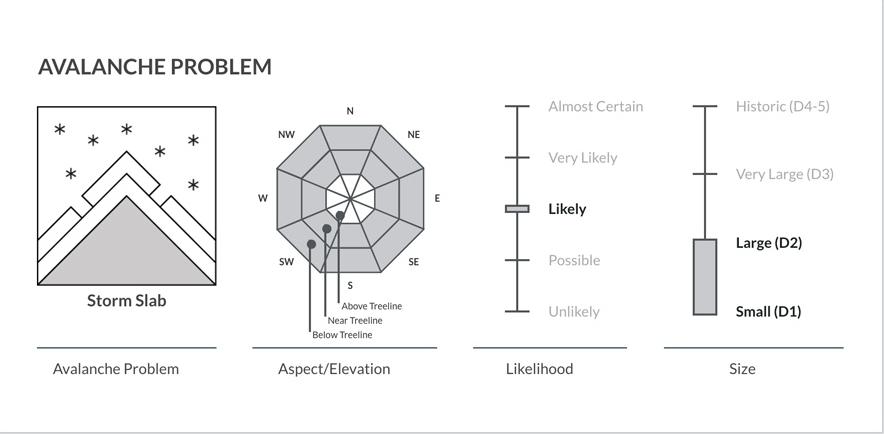
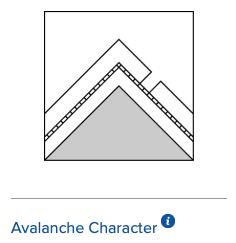
Avalanche problems – also referred to as the character or type - are categories of avalanche slides. Problems described in the forecast may not be the only activity to be aware of but knowing the characteristics of different problems helps a recreationist determine management techniques and terrain choices.
Identifying the avalanche problem(s) for the day should help guide your route. Persistent Slab problems are common in our area, meaning that we should use extra caution in the backcountry since these problems are hard to predict, even for seasoned outdoors people. However, we may also see other problems like wind slabs and storm slabs, especially after a big storm.
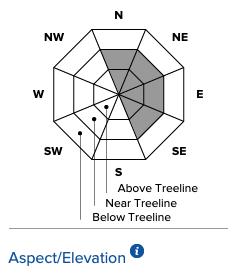
The Aspect/Elevation diagram describes where a problem will most likely occur on a slope face. The diagram is positioned like a compass, with the top facing north. It will be filled with gray where avalanche danger is most likely to occur and can be viewed similarly to a mountain on a topographic map.
The outer ring represents the lowest area or Below Treeline, the middle ring is Near Treeline, and the inner ring represents the highest elevation or Above Treeline. In the diagram above, the avalanche problem is most likely to occur near and below the treeline in all directions.
Likelihood
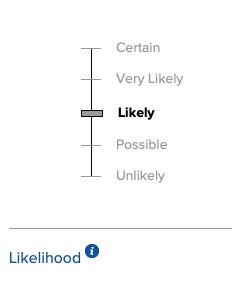
Likelihood describes the chance of triggering an avalanche in the specified terrain. It can change from day to day and in some cases, hour to hour. The rating given represents the highest likelihood of avalanche expected on that day. It is important to note that it considers both natural and human triggered avalanches.
Size
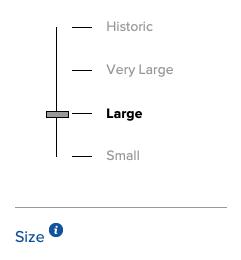
Size is based on the destructive potential of avalanches. It is measured on the D-scale and is described using terms such as Small, Large, Very Large, and Historic.
* Small avalanches (D1) are relatively harmless to people unless they are encountered on consequential terrains, like a narrow gully.
* Large avalanches (D2) are large enough to bury, injure, or kill a person.
* Very large avalanches (D3) can bury cars, destroy houses, and break trees.
* Historic avalanches (D4 and D5) can destroy railway cars, large trucks, several buildings, a small village, or forests up to 100-square acres. The twomile-long avalanche that broke on Garret Peak outside of Snowmass Ski Area in 2019 was a historic D5 event.
In a forecast, a detailed description will follow the four key components. The detailed description includes snow pit data and observations, detailed weather information, weather station data from SNOTEL data sites, avalanche observations from the field, photos, and maps.
Being able to read the avalanche forecast gives backcountry enthusiasts an informed summary of conditions in the field. Reading a forecast is a crucial step in any backcountry adventure, but it should never take the place of proper education and informed decision making.
Mother Nature doesn’t always follow the rules. Get the tools, experience, and follow those “gut feelings” when things don’t feel right. When you are out in the wilderness your safety is your top priority and your responsibility.
More information about avalanche education can be found at the CAIC website https://www.avalanche.state.co.us/.


This past October marked the tenth anniversary of the Ziegler Reservoir fossil site (ZRFS) discovery just west of Snowmass Village.
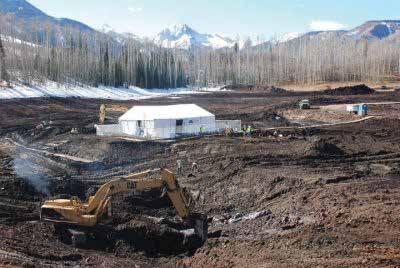
Mr. Zeigler purchased the alpine meadowland in 1958 and built an earthen dam in 1961 that formed a small lake for his livestock. The lake was purchased by the Snowmass Water and Sanitation District (SWSD) and began to excavate the underlying sediment to deepen the lake and create a larger dammed reservoir during September 2010.
moved (these sediments were deposited anywhere between 11,700 - 2,580,000 years ago). This volume of dirt would cover a football field five feet deep and would take 160 loads of a side dump trailer! Sixteen American universities located all across the country as well as four international universities were supplied with samples to do their analytical work.
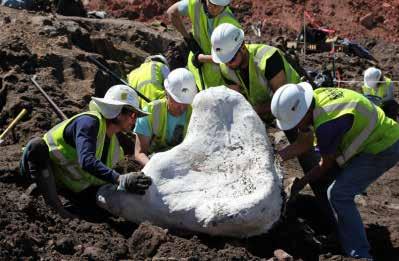
On October 14, 2010, a bulldozer unearthed a partial mammoth skeleton. The Denver Museum of Nature and Science (DMNS) was notified and began to further excavation. Soon after, more fossils were found and the scientists believed they had a major paleontological site from the Pleistocene epoch. Crews from the DMNS, United States Geological Society (USGS), and a number of academic institutions worked alongside the dozers and collected fossils.
Yet, winter snows arrived and the excavation had to be postponed until the following spring. The DMNS and the SWSD agreed to continue the excavation in May but had to be completed by early July so the SWSD could complete the construction project by the end of the fall and meet their contractual obligation.
Through the winter months, the DMNS planned a major systematic scientific excavation of the ZRFS and nicknamed it the Snowmastodon Project. The project began on May 15, 2011, and included 40 scientists from the DMNS, USGS, numerous academic institutions, and more than 250 volunteers to collect and catalog fossil and soil samples with detailed descriptions of stratigraphic position (the study of the position of rock layers) in the lake sediments and the areal position in the former lake bottom. Cores were taken and trenches were dug to expose the full stratigraphic section and correlation of the central lake bottom sedimentary units with the lake margin sedimentary units.
Over the 11-weeks of excavation during the fall of 2010, extending into the spring and early summer of 2011, approximately 10,700 cubic yards of Pleistocene lake-meadow sediments were re-
Rocky Mountain universities included Colorado University Boulder, Colorado State University in Fort Collins, the University of Wyoming in Laramie, and Colorado College in Colorado Springs. A dozen of the scientists were from the USGS at the federal center in Lakewood, Colorado.
The main objectives were:
1. Collect and identify all the fossils including bones, teeth, and tusks from large and small animals, organic material including herbaceous plants, tree branches, and fossilized logs, along with soil samples to collect aquatic and terrestrial mollusks, insects, pollen, and fossilized pinecones;
2. Determine the geologic age of sediments and fossils, and to interpret the paleoecology from this high elevation (8,875-feet) site during the last interglacial period;
3. Evaluate the effects to vertebrate and invertebrate fauna in different environments and habitats during millennial-scale (1,000’s of years) climate change.
The Snowmass Creek glacier formed during the Penultimate Glacial Period (lasting approximately 135,000-194,000 years ago) named Bull Lake glaciation. The glacier began at the foot of the Maroon Bells and advanced down valley approximately 16-miles reaching a thickness greater than 800-feet. The glacier was thick enough to overtop the ridge separating Snowmass Creek and Brush Creek valleys.
As the glacier retreated approximately 140 ka (ka=1,000 years) ago, moraines were deposited on the ridge creating a small catch basin that filled with glacial meltwater forming an alpine lake (Figure 1). A moraine is a mass of rocks and sediment carried down and deposited by a glacier.


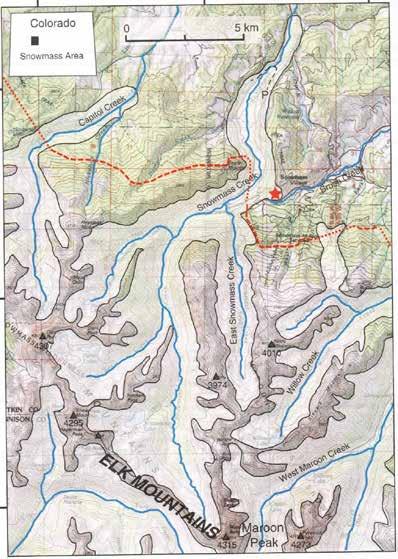
This lake filled with eolian (wind-blown) sediments and sub-aqueous slump sediments (basically just a big chunk of a bank that slides into the water) from the bounding moraines along the lake margins. The flora and fauna remains were deposited along with the sediments as the lake eventually transitioned to wet-lands then to alpine meadow due to a warming climate during the interglacial period. The sediments were deposited over 85 ka and remained undisturbed during the subsequent glacial period so the fossils were preserved through geologic time until excavated in 2010.
There are two main depositional environments represented by the lake sediments: Lake center very fine-grained, well-sorted (grains are all the same size), and silt and clay layers; the lake margin was poorly sorted sediments consisting of boulders and cobbles from the Maroon Formation which were eroded by the glacier, very finegrained sands and silts from the adjacent moraines slumping into the lake.
A geochronological framework for the ZRFS was established utilizing several age-determining methods including sub-atomic measurements:
1. Radiocarbon dating on lake organic sediments, bone collagen (tusk and tooth dentin), and mollusk (snails) shells;
2. Cosmogenic radionuclides (mineral breakdown from cosmic rays);
3. Optically stimulated luminescence (OSL) of quartz grains;
4. Uranium disequilibrium (U-Thorium, U-Argon).
The ZRFS stratigraphic column (vertical sequence of sedimentary layers) records deposition during the end of the Bull Lake glacial period and continued through the entire interglacial period (approximately spanning ± 80 ka) in a high elevation, alpine setting. We are currently living in a similar interglacial period and have been for some 20 ka!
Snowmastodon Continued . . .
or bone fragments, tusks, and teeth, and includes mastodons, mammoths, ground sloths, horses, camels, deer, bison, black bears, coyotes, and bighorn sheep. Twenty-six thousand small animal bones were recovered and include 30 different species including otters, muskrats, pesky beavers, rabbits, frogs, salamanders, lizards, fish, and birds. Invertebrate fauna includes insects (mostly beetles and midges), aqueous and terrestrial mollusks (snails), and ostracods (freshwater crustaceans).
Flora identified by pollen analysis includes sagebrush, Colorado pinyon, mountain mahogany, juniper, oaks, spruce, pine, and fir trees.
The variability of these taxa (a group of one or more populations of an organism or organisms to form a unit) in the stratigraphic column reflect changes in environmental conditions and resulting ecosystems. All the data collected allows interpreting the changes in the climate and infer temperature compared to current conditions and date the climate variability.
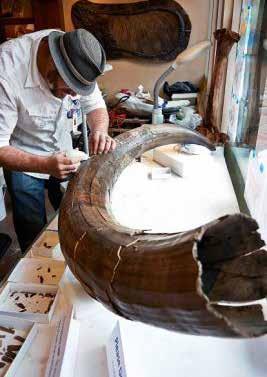
The Pleistocene lake sediments represent 85 ka during the interglacial period following the Bull Lake glacial period and before the Pinedale glacial period. The oldest sediments at ZRFS were deposited soon after the glacial retreat and represent steppe or alpine vegetation indicating cold and dry conditions. The following 38 ka was mostly characterized by montane vegetation (common at moderate elevations) and dense mixed conifer forest with temperatures similar to our current time. For the next 23 ka, the ZRFS experienced a drier and variable temperate climate. The youngest sediments represent a cooling period that was drier than what we are experiencing today.
The ZRFS is the largest and most prolific late Pleistocene fossil site in North America. The scientific investigation of the ZRFS is a remarkable body of work including 11-weeks of sample collection over two excavation seasons and integrated multiple disciplines into a coherent environmental and ecological interpretation from a high elevation alpine setting during the last interglacial period.



This column was conceived as a description and explanation of commonly observed seasonal events here in the valley. Now after only one month, I must break this rule and talk about things that almost no one ever sees.
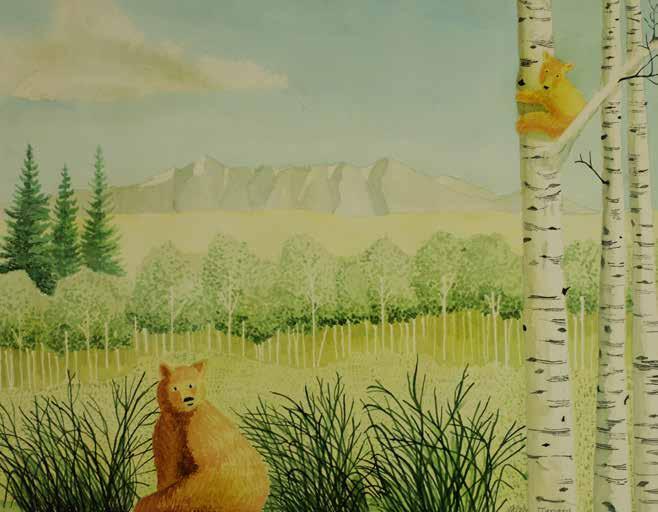
Our big buddies, the black bears (Ursus americanus) have disappeared for the winter after nearly daily appearances this fall. Black bears, whose color varies from black to brown to blond and even white in the far north, are the most numerous and widespread of the bear genus Let's check-in to see what goes on for bears in the winter.
Animal strategies to deal with the long winter period of food shortage vary widely. As mentioned last month, the Red Squirrel builds up a stash of spruce cones to fuel an active winter life. Small birds, like the chickadee and nuthatch, must forage for insects in tree bark during their waking hours to survive the cold night, though migration to lower elevations or latitudes is the plan for most birds. The marmot disappears into complete, deep hibernation in early October.
However, bears in our area have a different strategy: They enter a dormant period that is not as deep as a true hibernation, with periods of wakefulness and only a minor decline in body temperature.
Leading up to this dormant period during the fall, bears prepare for the winter by engaging in a feeding frenzy, which is technically called hyperphagia.
Putting on the pounds means a diet of about 20,000 calories per day resulting in building up a layer of fat five-inches thick.
The bear's diet is 90% plants including vegetation during the summer with berries, nuts, and seeds in the fall. Bears may also add some meat to the menu. An examination of bear scat reveals that serviceberries and chokecherries are a large part of bears' diet locally. Bears also visit the pinyon-juniper woodlands during the fall for seed and nut harvesting.
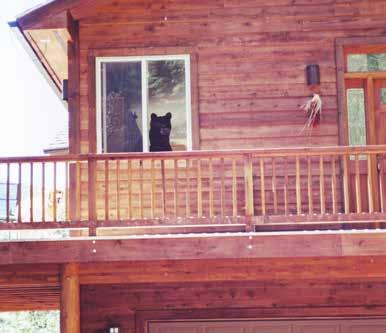
This is the time when bears make the most contact with humans and is the most dangerous time for them. A nuisance bear is one who discovers that the human environment is a potential food source, and becomes dangerous when he loses fear of humans and learns to break into dumpsters, cars, or houses.
Actually, the danger is more for the bear. A dangerous bear may be relocated and subsequently attacked by the resident bear in this new location. He may return to his original home and continue to be a problem — at which point, he could be destroyed. That's why they say, "A fed bear is a dead bear."
A recent article in the Aspen Daily News states that bears have been seen foraging in town during mid-December. Bears may postpone hibernation if food sources are available. More sugar and more processed foods are correlated with less hibernation, thus the more food available means less snoozing in their dens.
Are black bears dangerous to humans? They certainly look imposing; measuring three-feet high at
the shoulder or six-feet tall standing on their hind legs, bears can weigh from 200 to 500 pounds with big claws and can travel 30 mph for short distances. Yet, black bears are actually timid by nature.
During prehistoric times, they were prey for other predators including dire wolves, saber-toothed tigers, and grizzly bears. Their survival strategy was to run, and the black bear's claws are adapted to climb trees to escape. However, they are still wild animals, unpredictable, and have attacked and killed people. A bear standing on its hind legs is just trying to look imposing.
John Groves, our local wildlife officer, has stated that bear density is about one per square mile with a population of about 19,000 statewide, making your chances of meeting a bear pretty good. So, Mr. Manners offers these tips on etiquette when meeting a bear:
Back away. Don't run or make eye contact. Tough love means that you want to scare the bear away from people. Yell and throw stuff at the bear.
Let's examine things that attract bears, whose sense of smell is 100-times better than ours. Trash cans and dumpsters should be bear-proof, even in places like Marble where there are no legal requirements. Leave trash cans outside only on collection day. Bird feeders should be stocked during bear dormant periods, only: Mid-December through March.
Gardens and fruit trees are potential bear attractors. In Marble, century-old heirloom apple trees are stripped bare overnight with accompanying broken branches from bear climbing. Thank you to Dawn Rains for her annual tree pruning repair to these trees.
Barbecues should be cleaned after every use. Compost piles should never have meat scraps in them and should be turned often. Bears are attracted to the new car smell of vinyl and even to gasoline. Chicken coops have been known to be problematic.
Backpackers in the Maroon-Snowmass Wilderness are required to use bear canisters to store food, but toothpaste, insect repellent, and sunscreen are potential bear attractants and should also go in the canister. We live in their home and should act to protect them.
Black bears in this area create a den just slightly larger than their body size usually under a tree or brush pile. During their hibernation, which may last five to seven months, bears do not eat, drink, urinate or defecate. They do not exercise during this period and yet experience no bone density or muscle loss. A black bear's core temperature drops only slightly from normal, but respiration, blood flow to extremities, and heart rate are all greatly reduced.
Metabolic needs are met by oxidation of fat stores rather than breaking down the protein in bones and muscles. This results in no production of excess nitrogen, so there is no need for them to urinate. Urea, which is the metabolic waste nitrogen produced by the kidneys, is converted to nontoxic creatine and then back to protein. Water needs are also met as a byproduct of fat metabolism. After burning fat for
months, bears cholesterol levels are more than double human levels, yet they do not experience hardening of the arteries or heart disease.
So, black bears survive and thrive without exercise, drinking or eating, or passing waste for months which would be fatal for us. This is why scientists became interested in black bear metabolism. Science is a method, rather than a body of knowledge, so when physiologists wanted to study whether bears are poisoned by urea, which is normally removed through urination, or possibly urea is not even produced at all, a method of studying hibernating black bears became apparent.
Enter local hero, Thomas Beck, the western Colorado Department of Wildlife bear expert during the 1980s. His bear study plan was smart, audacious, courageous, and somewhat outrageous. He livetrapped bears and attached radio collars to them, allowing him to track 48 hibernating bears into their dens.
He then entered the dens, taking rectal temperatures and blood samples from the sleeping bears. Of course, he had a tranquilizer gun in case a bear awoke. This data was the beginning of the hibernating bear physiology study.
Applications of this research are widespread to human metabolism. Osteoporosis studies may learn something from how bears can survive months without moving with no resulting bone loss. Kidney malfunctions may someday benefit from the knowledge of how the bear's kidneys deal with urea.
The study of how the bear's organs survive the period of reduced function could help us learn how to increase the viability of organs used in transplants. An appetite suppressant, Leptin, is present in the bears’ blood and making them stop eating once they are fat
Free Food Bags Available in Marble
For anyone needing help stretching their food budget, Gunnison County Officials currently have boxes of food available distributed through the Marble Community Church.
There is no charge to the recipient and no reservation is needed; boxes are available for an individual or up to a family of four and contain enough meals to last approximately three days.
Please call Pastor Jon Stovall at the church to arrange a pickup time for your box today, (970) 963-1464.
enough to hibernate.
Could this work on humans? Bears produce a bile acid which has been shown to dissolve human gallstones, eliminating the need for surgery.
How about inducing bear-style hibernation in our space crew on their two-year mission to Mars? Hibernation could reduce space travelers' need for life support supplies including oxygen, water, and food at the same time protecting astronauts from bone and muscle loss.
We can see multiple values of the study of bear physiology as well as utilizing bears as the source of useful biochemicals. Let's generalize from this and state that nature is a source of useful knowledge and a storehouse of known and potential treasures: Physical, chemical, and biological. A certain amount of wilderness is essential for the preservation of the natural world's ecosystems, which contain such treasures.
The full moon in January is known by many native tribes as the Bear Moon. Natives noticed where bears made their dens in the fall and observed the birth of cubs in January. Bear life wasn't so secret to them.
Bear cubs are born while the female is still asleep, and are blind, hairless, and only weigh about eight ounces at birth. They find their way to nurse by sensing warmth. Mama bear will doze through the rest of the winter, waking briefly to shift her body to protect the cubs and facilitate nursing.
She may lose one-third of her body weight during the winter, while the cubs will grow to 15-pounds before leaving the den. While bears mate in early summer, fertilization of the egg is delayed until November. Only if the female has adequate fat stores at this time does pregnancy occur.
Some great books to explore include Winter World by Bernd Heinrich, which explains all kinds of ways that animals adapt to winter. Wild at Heart, a locally oriented field guide by Janis Huggins of Snowmass Village, has great stories about plants, animals including bears, ecology, history, and geology. Living with Bears by Linda Masterson describes ways to help keep bears safe.
These books will be available for sale at the Marble Hub and Marble Museum this summer. For further information about how to protect bears visit BearSmart.com and KeepBearsWild.com
And The Environment
By Keegan Jaeger, 6th grade

Imagine driving to a farm and once you get there you realize it's just a big factory. You ask the man, “What is this?” “It's a vegetable farm,” the man says. You ask about the process of growing. He says, “First we plant the seeds, then we spray them with pesticides, insecticides and herbicides.” You ask him if you can go into the field to see the vegetables but he says no because we sprayed pesticides. It's too dangerous to go in the field. A question pops into your mind, “Is this stuff safe and we are eating it?” Although pesticides make your vegetable grow faster and protect it from bugs and disease, but also that raises a big health question. So let's embark on a journey to learn about how pesticides harm us, why do we use pesticides, what are the benefits of pesticides.
With all the knowledge we have about pesticides, many people wonder why we still use them. In the short term, pesticides greatly assist pest control. This shows that pesticides is a substance that repels pests by the toxin that is the pesticides. (Chefs Best, “The Advantage and Disadvantage of Pesticides.” ) Furthermore, for many years the use of pesticides was largely unregulated. However, the impact of pesticides on the environment and human health has been under greater scrutiny since the publication of silent spring by Rachel Carson in 1962. (Thorpe, 2017.) The use of pesticides is very controversial because some farmers depend on it and some find it harmful to the environment. (Encyclopedia Britannica)
Based on what I have read, pesticides can be very harmful to the environment, animals, and human health. Some pesticides, if exposed to,
can lead to sickness such as the insecticide DDT. For example, DDT came into wide use in the 1940s and was later heavily restricted in the United States and elsewhere because of its adverse effects on health, environment and wildlife. Another pesticide that was highly restricted was neonicotinoides. In the early 21st century, the use of neonicotinoids was highly restricted in some countries including throughout the entire European Union because of its harm to bees. The ideal pesticide would destroy it’s target without causing any harm to humans, non-target plants, and the environment. The most commonly used pesticides come close to the ideal standard, however, they are not perfect and their use does have health, environment and wildlife effects.(Encyclopedia Britannica)
There are some alternatives to pesticides, some work well and others don’t, but there are alternative pesticides. Specifically, modern organic was developed as a response to the environmental harm caused by pesticides in conventional agriculture. The concept of organic farming was developed in the early 1900’s by Sir Albert Howard and others who believed animal manure should be turned into compost. This shows that compost is a biological based pest control which resulted in better farming. The organic food sales increased steadily from the late 20th century. Greater environmental awareness, coupled with concerns with health, impacts the use of pesticides. (Encyclopedia Britannica)
Pesticides have their ups and downs but overall I think pesticides are more harmful than useful. Every time you buy industrial vegetables it could be covered in harmful pesticides and not just harmful to you, harmful to the environment and wildlife. All those french fries you eat could be covered with pesticides too. All those amazing salads that you see at the grocery store can be covered in pesticides too. So do yourself a favor and read the labels before buying your vegetables and salads and all your plant based products, not just for you, for the environment, and wildlife too.
I firmly believe that wolves should be reintroduced to western Colorado because our ecosystem health will improve. In addition, our ecosystem is suffering because there are too many herbivores and not enough predators. For instance, the top predators currently are coyotes and mountain lions and these predators aren’t killing enough of the herbivores. Wolves are native Colorado predators. (How would you feel if you got kicked out of your home/ state?) In fact, by bringing wolves back to Colorado, we will help fish by preventing erosion from herbivores on stream banks. Also, leftover food from wolves provides food for other animals such as scavengers. In other words, bringing wolves back to Colorado will help our ecosystem. Wolves are the balance we need for our ecosystem to be healthy again.
It is my position that reintroducing wolves will even improve our health. First and foremost, wolves will make more room for trees and plants to grow by killing some deer and elk that graze on them. This in turn will mean that we will have more oxygen and less CO2 in the air we breathe. Surely with more trees and plants we will help address global warming and maybe live a little bit longer. For these reasons, Vote Yes on Proposition 114 to help improve our overall ecosystem health, global warming, climate change, and life for people.
Chris Penaloza, Grade 8
Vote no on Proposition 114! One reason why is we don’t want to mess up the natural balance by reintroducing the wolves by force. This shows that wolves should be reintroduced naturally, not by force. Some may argue that wolves should be reintroduced by force, but I think it’s unnecessary. They will find their own way into our state. Furthermore, it’s going to take lots of taxpayers’ dollars which we could put into something else. For example, we are in a pandemic. It’s going to take lots of tax dollars to rebuild the economy. In addition, when a wolf kills a cow, it’s going to take a lot of money to pay the ranchers for all the cattle the wolves kill. This means that we are not going to have enough money as a state to keep going. In conclusion, I think wolves should not be reintroduced by force.
Keegan Jaeger, Grade 6
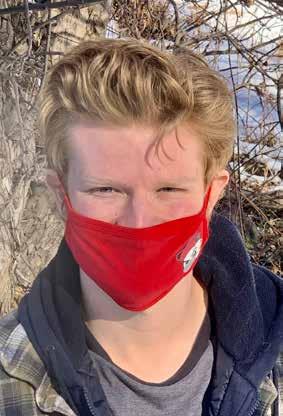
Ralph met me at the back of Marble Charter School one day in early December to talk to me about his life since MCS seven years ago. He attended MCS grades K-8th and is currently a junior in college.
Here are some of the questions I asked Ralph:
1. Do you think Marble Charter School prepared you for high school and beyond? He said that the education that he got at MCS more than prepared him for high school. It helped him with presentations and public speaking as well as the relationships he made here.
2. Where are you attending college?
Ralph attended Wake Forest University in North Carolina for the first 1½ years of college before transferring to Ohio Wesleyan University where he goes now so he can play college baseball. He plans to graduate in 2022.
3. What are you studying?
Ralph is majoring in Human and Health Kinetics with emphasis in Exercise Science and is minoring in Spanish and Latin American Studies.
4. What do you hope to do after that?
Ralph wants to work with college and professional athletes in Sports and Performance Development.
5. What are you doing now?
Ralph is attending college at Ohio Wesleyan and plans to intern at the Cape Cod Baseball League this summer for the second time.
6. How has the Pandemic affected you?
Ralph says that the cancellation of the 2020-21 college baseball season was the most disappointing for him. Taking most of his classes on-line hasn’t been fun but getting a very long winter break has been good. He has been home from college since November 20th and his break ends February 1st.
7. Do you think you will return to live in this are in the future?
Ralph says he has no short term plans to return to this area for now, as there is little to no opportunity to become a Sports Developer here in the valley.
8. Do you have any advice for students at Marble Charter School? Ralph advises all students to enjoy MCS, and don’t let it slip by too quickly.
Just like Erica Savard, Ralph Good is a candle to us in this time of crisis, who will no doubt turn out to be a great sports developer. Even in these uncertain times, people like Ralph remind of the good that remains in this world, and the potential to come back stronger than ever before.

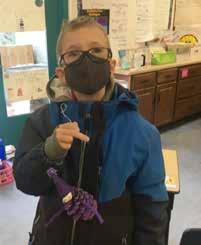
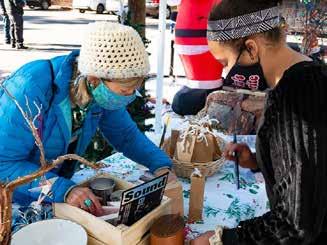
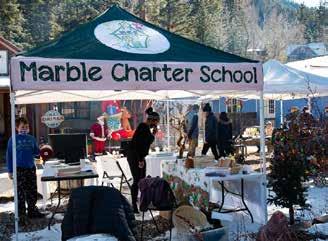
Marble Charter School spreads a little kindness and love during this challenging holiday season. Students made an ornament to decorate a tree outside of the school and designed a sign that we will post in town to brighten the sprints of those in the community and here is why...
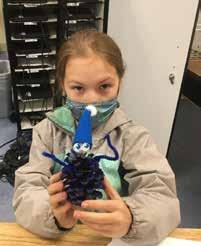

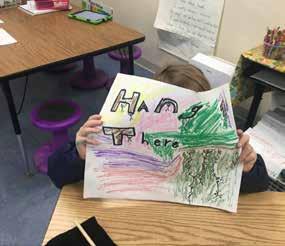

Tanner Merritt, MCS 8th
• Thank you to all the parents that volunteered to help assemble and disassemble our outdoor classrooms! We appreciate you so much! Thank you to Monique Villalobos for the pizza!
• Thank you to John Rutland for shoveling MCS walkways without fail on cold and snowy mornings!
• Kristin Wahlbrink for keeping our school clean!
• Nathan Helfenbein for helping us replace light bulbs!
• Siemon’s for donating cheese for lunch program!

Originally published by Collier's Magazine by Helen Worden

The following article appeared in the May 5, 1951 issue of Collier’s Magazine. This installment has been edited for space requirements; see the full article online at history.redstonecolorado.org/.
The Mechau children arrived at two-year intervals: After Vanni, Dorik; then Duna, and finally Mike. Singing the old songs became part of their lives. Neighbors, hearing them, would recall others. Soon Paula had a collection of 50.
Three Guggenheim Fellowships – something of a record for any artist – enabled Frank to carry on his painting and, in 1939, he was made a professor in the Fine Arts Department at Columbia University.
To their Western-bred children, the six years spent away from Colorado were sheer cumulative misery. But one day, during the 1943 Christmas holidays, Frank suggested a ride downtown on the subway. He had heard that the Almanac Singers — Woody Guthrie, Cisco Houston, Peter Seeger and Lead Belly –top ballad singers — were throwing a folk-song fest in Greenwich Village and he had bought seats in the front row. They trooped backstage to meet the singers. It was a big moment. Presently, Woody Guthrie strolled onto the platform.
“Friends,” he began, “there are four jailbirds here from Colorado who’ll do a turn themselves.”
He beckoned to the startled Mechau children. “Come on, kids. What’ll it be?”
“I Ride an Old Paint,” Vanni spoke up.
She and her sister and brothers completely disarmed the audience by the simple directness of their singing.
In 1944, Frank resigned from Columbia to devote his entire time to painting. Back the Mechaus went to Colorado. The succeeding two years Paula regards as the happiest of her life.
In 1946, the Mechaus all piled into their old car and
drove to Denver. Paula and the kids had been invited to give a concert for the wounded soldiers at Fitzsimmons Army Hospital. They were also to make some recordings. Fitzsimmons would be their first full-length concert. Paula barred make-up or costumes. The more natural and spontaneous the performance the better; it helped put the children at ease.
In Denver, the Mechau family stayed with their artist friend, Anne Downs. The day after the Fitzsimmons concert, Frank volunteered to drive his wife and the children to the studios of the Council Recording Company. As he was opening the car door he turned to speak to Paula and in that instant dropped dead at her feet. A sudden heart attack had killed him at 42.
Three weeks after the funeral, Paula and the children sang for the recording company. She says singing those ballads at that time gave her the courage and direction she needed.
Mrs. Downs invited 50 people to her home to hear the Mechaus sing. Thus, with no preliminary planning, they were finding a living as a family. The first concert bid, from the Colorado Springs Fine Arts Center, paid $100.
An enthusiastic listener requested Witch Wilder Luckily, the Mechaus knew it.
The man was Josh White, the famed ballad singer. Next day, sitting around the breakfast table reading the reviews, Paula all but wept when she saw the following story in the Colorado Springs Press.
“Some have good songs, some have fine voices., some have scholarship and imagination. The Mechaus have all of these and a unique advantage of their own besides. There are five of them – welded into one unit by a wholehearted, self-forgetting
devotion to the beautiful songs they sing. The audience can intercept, every now and then, that private glance among them of confidence and love and fun and joy in their art.”
The Mechaus really had arrived. While they were enjoying the thrill, the telephone rang. A telegram for Paula Mechau: Would like very much you and children come to Aspen any time between May 24th and June 1st to sing at fishing-week festival. If possible stay all week. Burl Ives and Richard Dyer-Bennet both coming. Need you to make it a grand success.
The Mechaus consider that week at Aspen a milestone. Richard Dyer-Bennet offered Vanni a scholarship in his troubadour school, then open at Aspen. She took it, although generally speaking, the family is opposed to professional training for ballad singers. Paula reads a little music, the children none. At first she plucked out the ballad tunes on her guitar, then taught Vanni. Now Vanni plays the accompaniments.
The Mechaus pursued their informal course at luncheons given by the Lions, Rotarians, Kiwanians, and Masons; at American Legion state meetings; at Women’s Clubs; at churches; at the 1948 UNESCO (United Nations Educational, Scientific and Cultural Organization) conference in Colorado Springs; at grange halls in rural areas; and at folklore conferences held by the Universities of Denver, Colorado, and Wyoming.
End of Part II. See Part III in next month’s Echo.
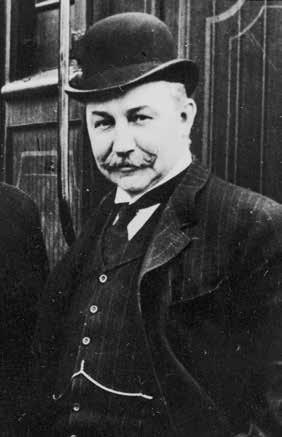
The Pitkin County Commissioners hold weekly work ses- sions on Tuesdays and bi-monthly public hearings on Wednesdays in our BOCC meeting room at the Pitkin County Administration and Sheriff’s Building. Both meet- ings are televised live and repeated on locater CG12 TV. They are also streamed live and available on the Coun- ty website. Agendas are posted in the Aspen/Glenwood newspapers and on-line at www.pitkincounty.com.
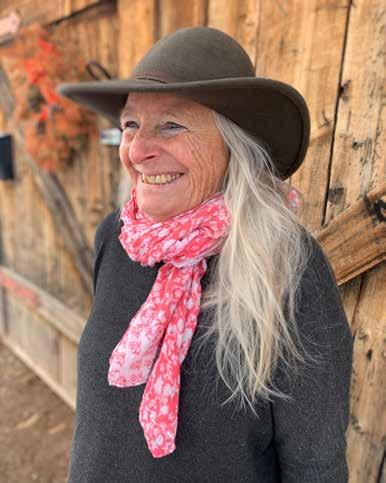

To Everyone in the Crystal River Valley — and beyond,
I am so thankful and excited to be your next Pitkin County Commissioner. I appreciate all of you who contributed to my campaign and/or voted for me. I am honored to represent the people of this beautiful valley.
It has been a strange time to run for office and it will continue to be unusual with all meetings on Zoom and very little contact with “live” people. One of the reasons I wanted to run for the job of Commissioner is that it offers the opportunity to interact with people and to listen to their concerns, joys, stories, and perspectives.
COVID clearly makes this more difficult, but I hope you all will find ways to get in touch with me so I can get to know and represent you. Beginning on January 12, you can find my direct county phone line and email at the PitkinCounty. com. Please feel free to reach out to me. I plan to attend the Caucus meetings, so you may find me there as well.
I enjoyed meeting with Redstone residents in the fall. As we sat outside by the river, socially distanced, where I heard some of the issues of concern for the Crystal River Valley.
First and foremost was the problem of short-term rentals. I believe there are 15 short-term rentals on Redstone Boulevard, and I definitely under-
stand why this situation can work to change the character and culture of Redstone and, I assure you, I intend to pursue solutions to this difficult situation.
During that meeting, I also heard concerns about protecting the Crystal River watershed. I have recently joined the Board of CVEPA (Crystal River Environmental Protection Association) and I look forward to working with them to protect our fragile environment in this valley. Fortunately, the Board of Healthy Rivers and Streams has the Wild and Scenic designation for the Crystal River high on their list of priorities, as do I.
I am awed by the size of the job I have been elected to perform, and recognize that the learning curve is steep. I hope to turn to George Newman for help and advice, as he has clearly served the Valley admirably for the last 12 years. We’ll all miss him and his work on behalf of our pristine valley and all of Pitkin County. Thank you, George.
And thanks again for allowing me to represent you at the County level. I look forward to the next four years.
Francie Jacober
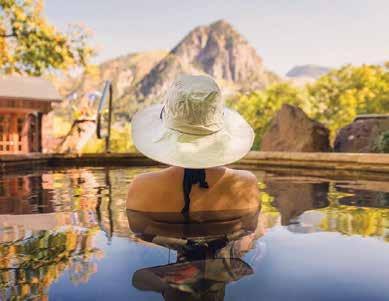



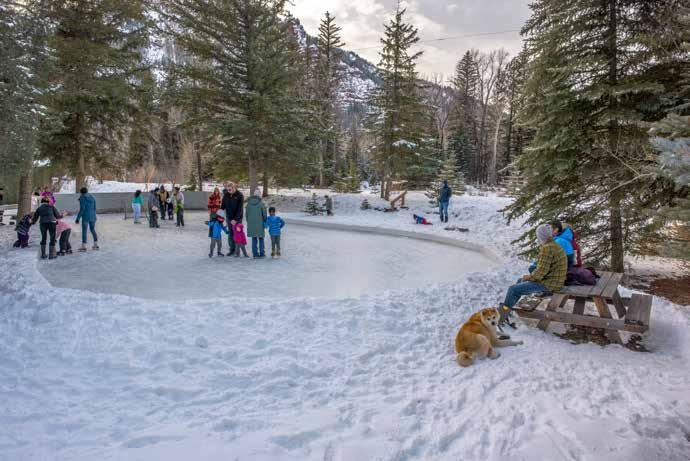
Usually by now, you would have received a letter in your mailbox informing you of our annual membership drive. Yet due to COVID, we recognize that many may not be able to contribute to RCA this year. Therefore, we're asking those who are able to consider renewing, joining, or donating.
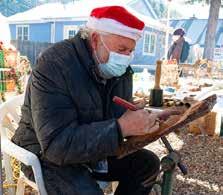
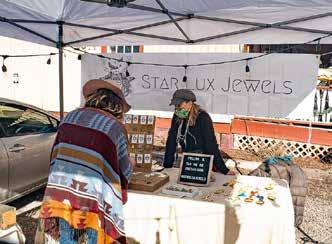
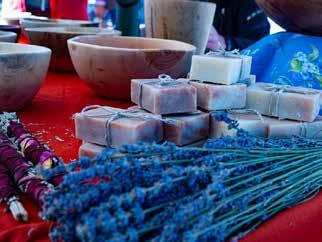
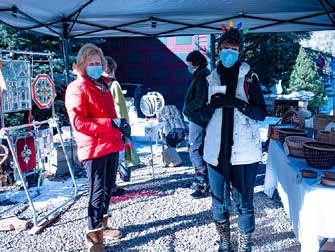
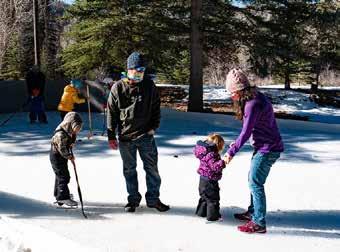
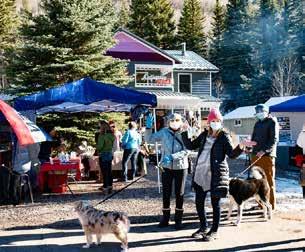
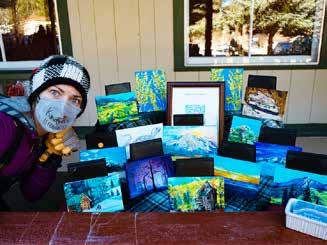
This has been a very different summer for all of us, and while we've only been able to hold less than a handful of meetings and practically no events (such as the ones photographed here), the RCA Board continues to be hard at work. While your contributions will go towards the hosting of future events, we are still using funds to manage the cleaning of the bathrooms and trash removal at Redstone Park, managing composting service for the community, and of course, we still plan to erect and maintain the skating rink during the 20-21 Winter season.
We ask that those who can to please renew your membership, we also welcome you to join RCA, or provide an additional contribution so we may continue bringing our community together as safely and cautiously as we can.
Redstone is an unincorporated village that relies completely on donations and volunteerism spearheaded by the
Community Association
Your membership dues directly fund RCA projects and events.
Thank You for your support!