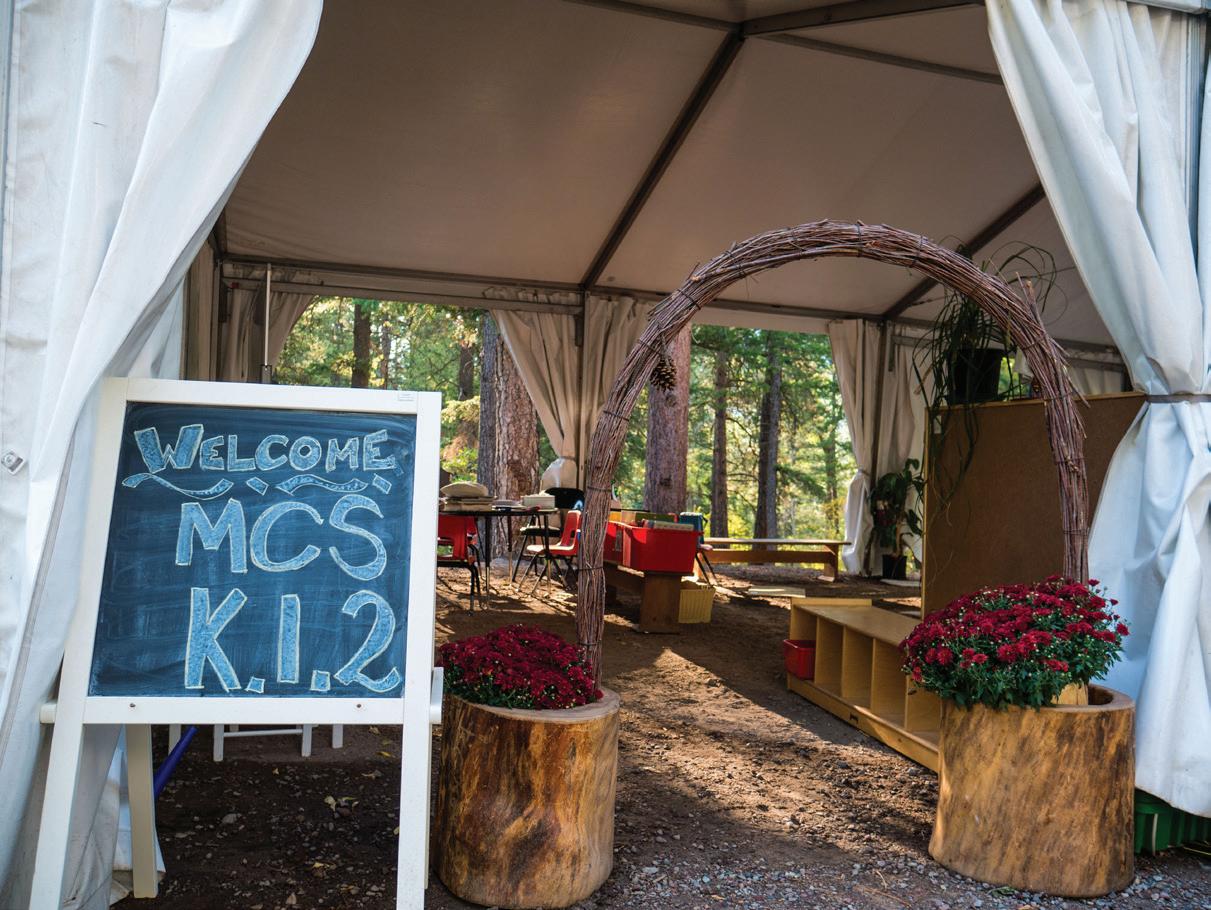
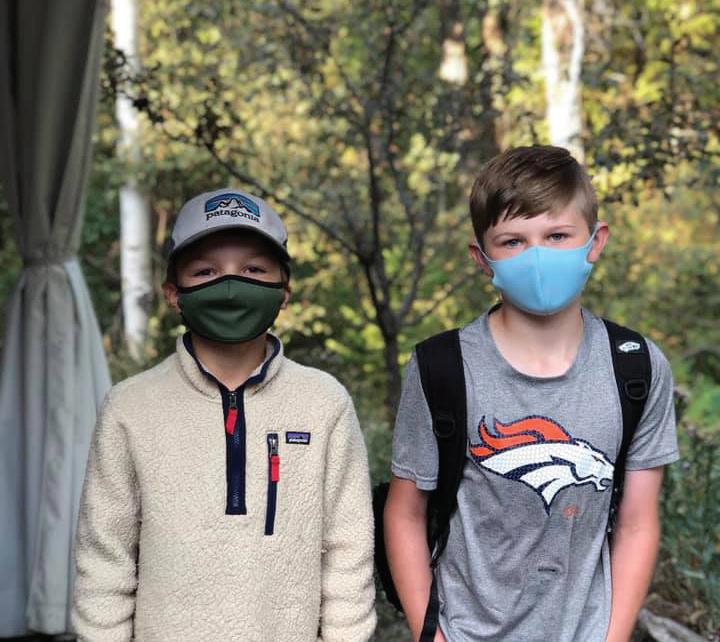
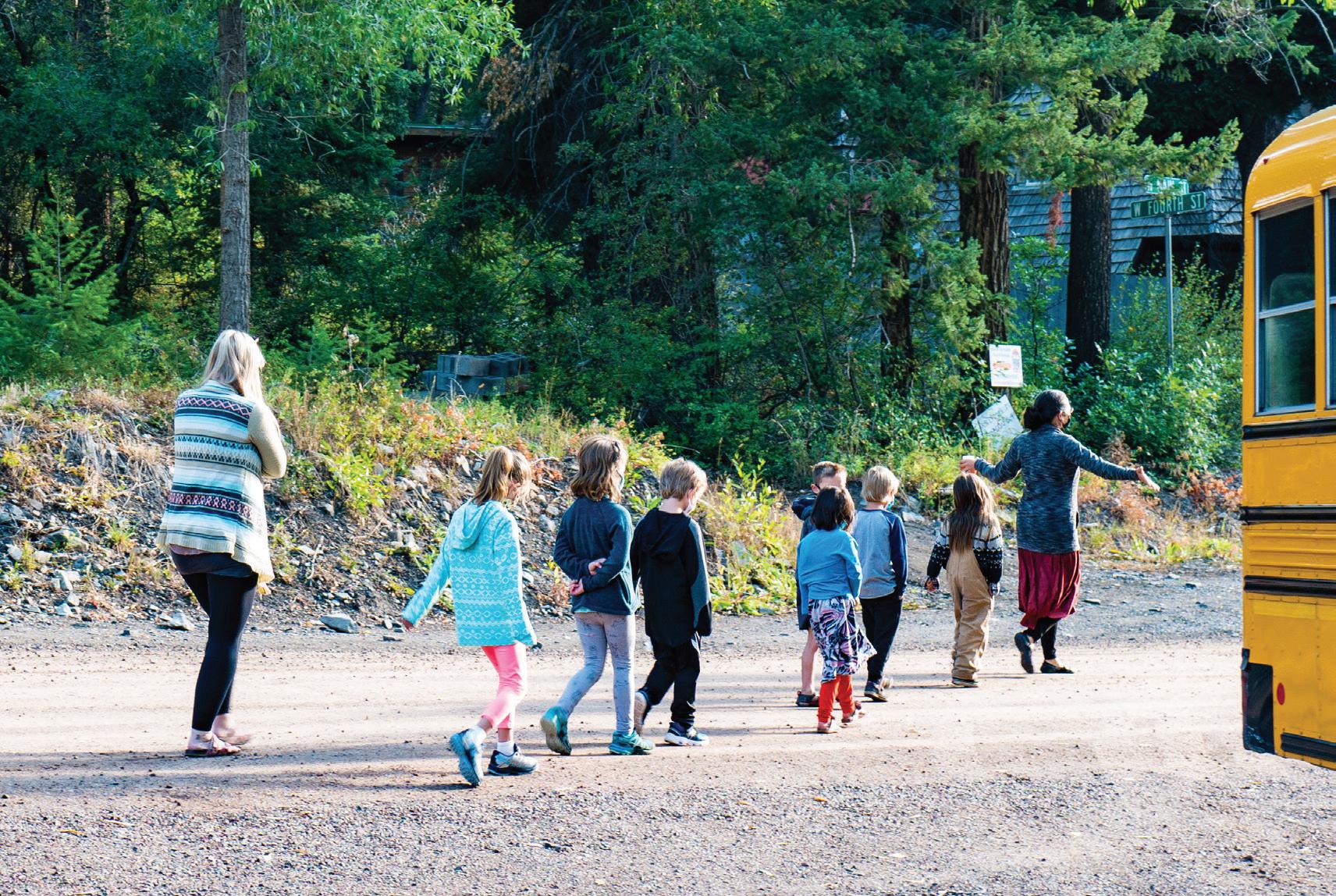
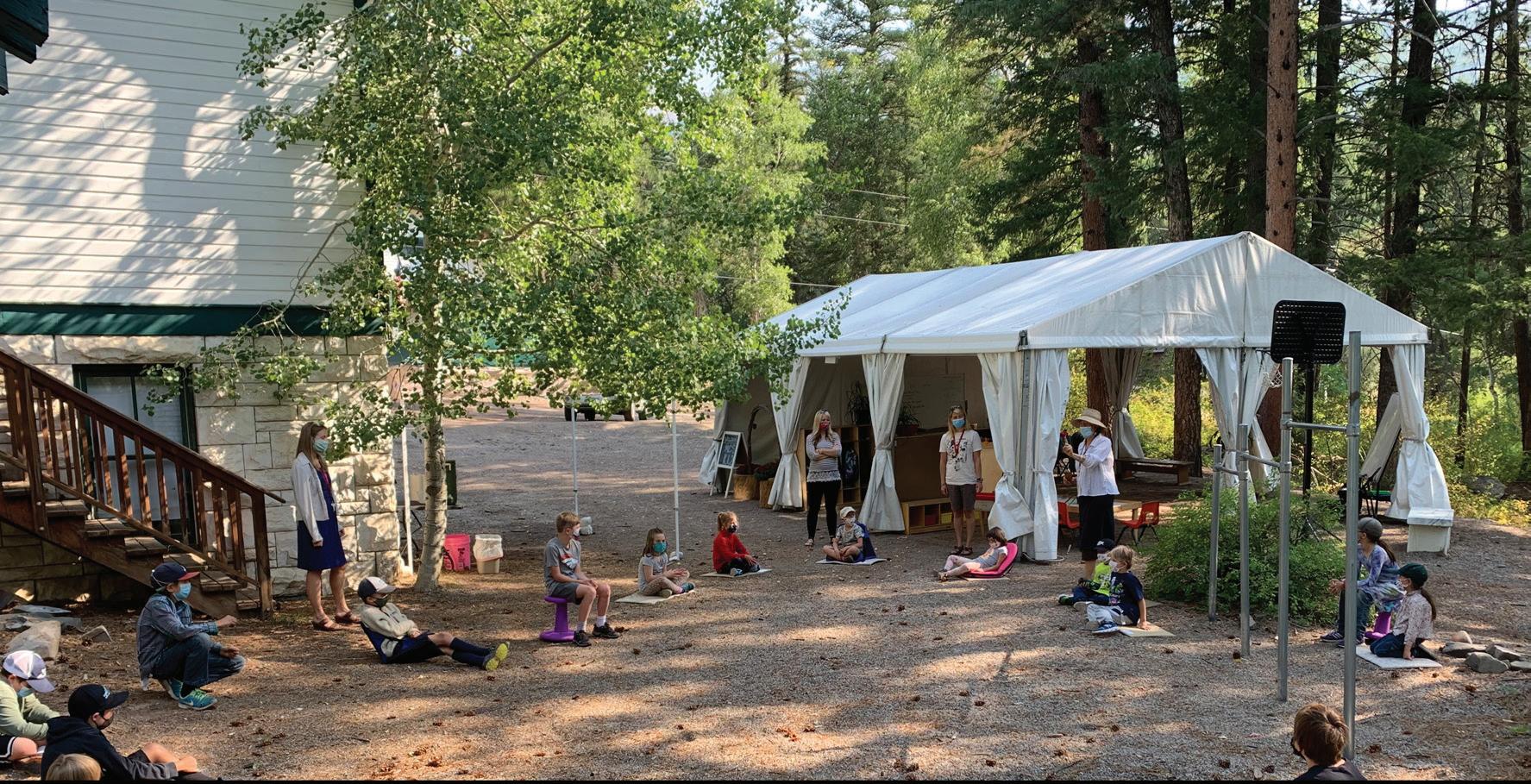
Crystal Valley kids are excited to return back to Marble Charter School.
Yet, in an attempt to navigate COVID, the school has turned to a hybrid program, a mixture of in-person and online learning.
With enrollment down, the school is reaching out for support more than ever due to extra costs creating outdoor classrooms and air purification machines needed to move everyone inside once winter returns.
Turn to page 10 for the full story.
Photo provided by Amber McMahill
RHS Honors Long-Time Residents
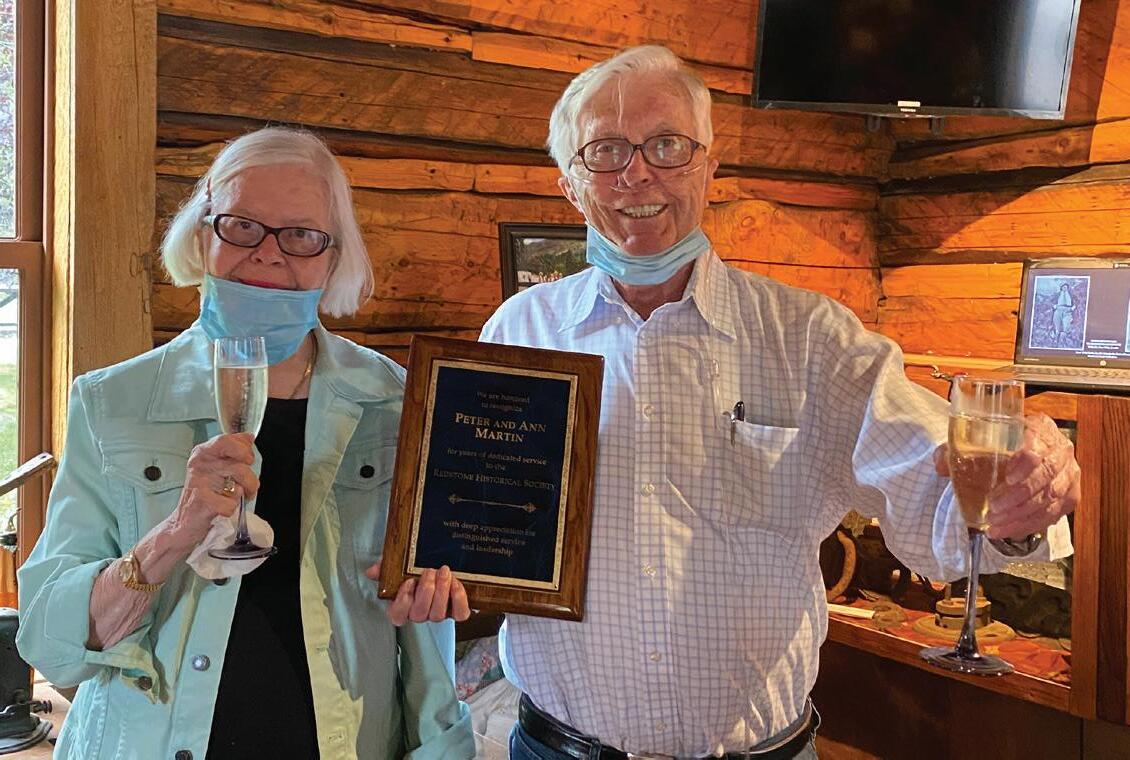
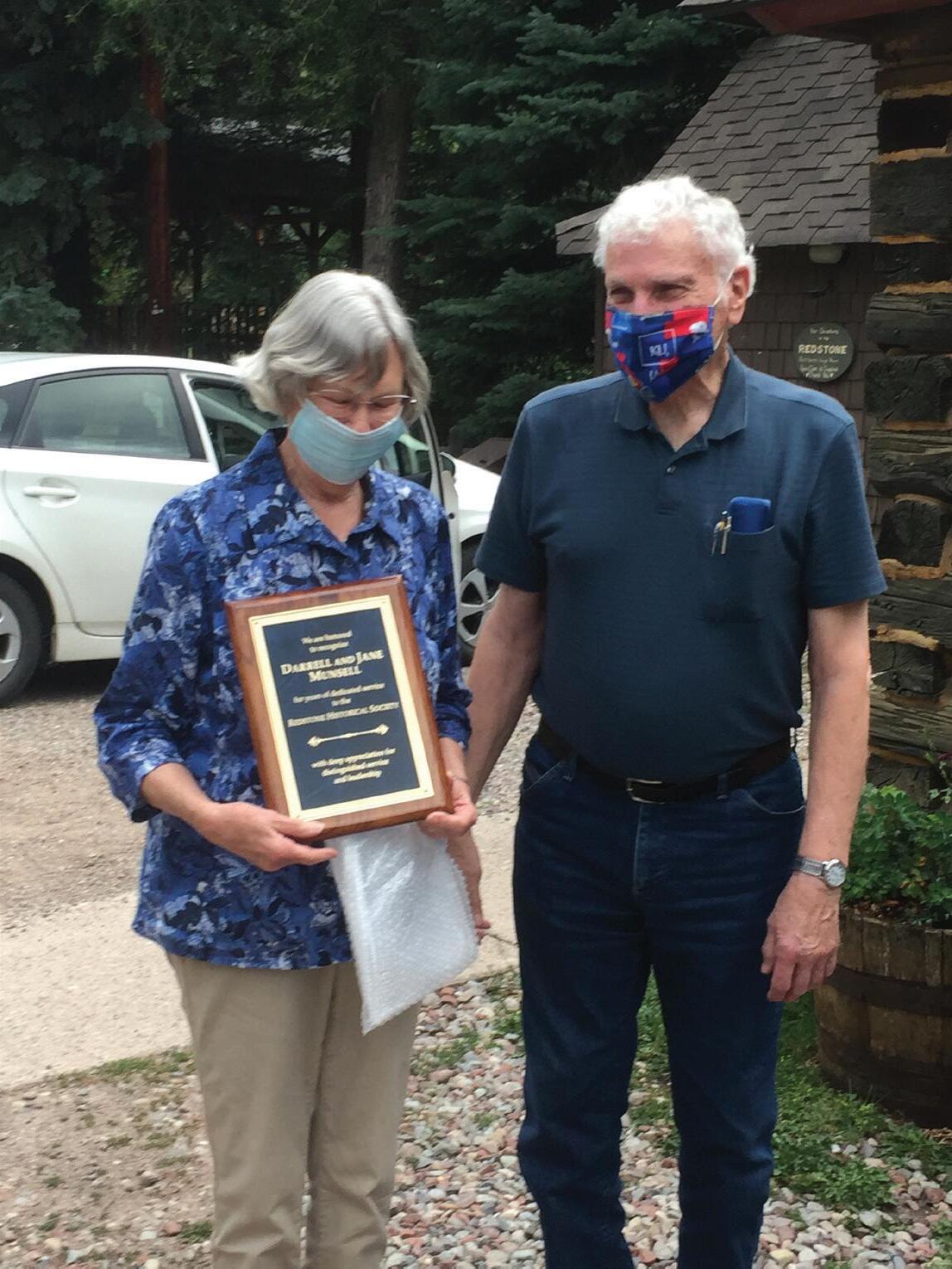
The Redstone Historical Society (RHS) is losing two long-tenured couples as they retire from their lives in Redstone and move on to their next chapters. Jane and Darrell Munsell along with Ann and Peter Martin were honored with plaques from RHS acknowledging their many years of dedication and service to RHS as well as preserving the history of Redstone.
“They're being recognized for over 30-years of dedicated volunteer service and love for our Redstone Village. It’s unmatched,” says Nancy Chromy.
Both the Munsells and Martins are relocating this year, the Munsells to a home in Canyon, Tex., and the Martins to a retire-
ment community near Fort Collins, Colo. “Both Darrell and Peter were past Presidents of RHS, and were deeply involved in saving the Redstone Castle from destruction during its IRS seizure and sale,” explains Michael Askew, RHS Vice President.
Without the Martins and Munsells involvement and persistence, the Castle would likely be no more. Askew added, “They were instrumental in the preservation of other historic properties in Redstone, including the Coke Ovens and the Redstone Museum, which was originally the lamp house at Coal Basin for the miners.”
“I was so astounded,” said Peter Martin. “[John] Chromy told us to go see the remodel at the Museum, and we walked into a group of people greeting us!”
Martin continued, “We’ve just loved living in Redstone! This was our home, and we’re terribly attached to it and everyone here is just like family. Ann and I have loved this place, and just wanted to see that we left it better than when we arrived.”
Check our website for more informationon current hoursand availability.
T HE C RYSTAL
CHO
& Marble Times
Mission Statement: To provide a voice for Crystal Valleyites; to bring attention to the individuals and local businesses that are the fabric of the Crystal Valley region; to contribute to the vitality of our small town life.
Editor • Gentrye Houghton
Publisher • Ryan Kenney CONTRIBUTORS
Charlotte Graham • Amber McMahill
Stephanie Deaton
ADVERTISING SALES
Gentrye Houghton • 970-963-1495
GentryeH@hotmail.com
DISTRIBUTION
The Crystal Valley Echo is published monthly, and is distributed throughout the Crystal Valley.
NEWSPAPER BOX LOCATIONS:
Carbondale City Market (inside) • Village Smithy
Carbondale Post Office • Redstone Inn
Propaganda Pie • Marble Hub
FOR SUBSCRIPTIONS
Please send $40 for print or $25 for digital editions along with address information to:
The Crystal Valley Echo 364 Redstone Blvd. Redstone, CO 81623
Peter and Ann Martin were honored by the Redstone Historical Society on August 29. Photo provided by Nancy Chromy.
Photograph provided by Michael Askew. Jane and Darrell Munsell were honored for their distinguished service and leadership by the Redstone Historical Society on July 23.
Letter to the Editor
Crystal River; who does and does not need a plan of augmentation
The following discussion is an attempt to clear up any confusion regarding diversions by water wells, particularly wells for in house use, and to outline the water users we at DWR are working with to develop a plan that avoids shutting down their use.
First, we do regularly shut down diversions or require replacement of diversions to satisfy the needs of senior water rights. These users expect curtailment or to provide a replacement as a part of their operations. On the Crystal River, much of the irrigated land around Carbondale has been dried up for development. In the past, these former agricultural lands did place a “call” on the Crystal in the late summer of dry years. However, by 2018 it had been some time since a “call” was honored for irrigation rights; though the Colorado Water Conservation Board has placed a call for its 1975 instream flow right, intended to protect the natural environment of the Crystal River, on a number of occasions.
Most domestic wells are issued well permits as exempt wells. Such a well is issued a well permit with the presumption that its diversions will not cause injury to senior water rights. Most residential wells are issued well permits under this statute, and as long as they operate under the conditions of the well permit they can operate no matter the shortages on the river. Some of these wells are on a 35-acre tract or larger and can serve up to three single-family dwellings, irrigate up to one acre of lawn and garden, and be used for non-commercial stock watering. Other exempt wells are limited to household use only; this occurs when a well on a tract of land was created prior to 1972 or exempted by the county from going through the subdivision process. There are many twists to this, but simply: most residential wells in the Crystal River drainage fall into these two categories and will not be shut down to meet the needs of downstream senior rights.
A much smaller group of wells is the non-exempt wells. These are deemed non-exempt because they are within the water rights priority system and are subject to curtailment. In 1981 the Colorado River was declared over appropriated, which recognized that the river could not supply all needs at all times. Operationally, the river has had shortages since the completion of the major canals in the Grand Junction area in the early part of the previous century, and many local streams have experienced shortages since the 1880s. However, it was important to formally declare the river over appropriated to clarify processes for issuing nonexempt well permits and review subdivision plans for water supply. Importantly, since 1981 new land development using groundwater for its water supply could not obtain well permits or groundwater rights without a plan for augmentation. Such a plan replaces water diversions that would otherwise be shut off with water from storage or another source to allow the continued diversion. Augmented wells make up the majority of the nonexempt wells in the Crystal, and if operating pursuant to the court decreed conditions of the plan are not subject to curtailment. However, a few of these augmentation plans have operational problems, and unless corrected are subject to curtailment.
A subset of the nonexempt wells are those drilled prior to 1981 and without a plan for augmentation. There are many scenarios involving these wells, but this group generally does
TBD Jasey Trail | Marble
$97,500 | 1.8 Acres
Nice, fairly level, 1.8-acre wooded lot with power and phone available. Year-round access, privacy, and a good mix of aspen and evergreen. Great views and close to wilderness, jeep trails and high-country fishing.
UNDER CONTRACT UNDER CONTRACT
102 Firehouse Road | Redstone
$1,250,000 | 3 Beds | 3 Baths
This home incorporates historic overtones of early Redstone yet features all of today’s modern amenities. Twin 250-yearold ponderosa pines overlook a beautiful lawn and flower gardens featured in “Colorado’s Great Gardens”.
We have buyers looking for properties. Inventory is low. Interest rates are very good. It’s a great time to sell and to purchase.
mountainproperties.com
not include any wells serving a single residential use for household use only. This subset does include some of the water diversions that we are interested in helping develop a plan to avoid curtailment.
Groundwater rights are not the only rights serving residential development that are in need of a supply that will not be turned off. There are a handful of surface rights in the Crystal River drainage junior to the senior irrigation call serving residential development and municipalities without plans to augment diversions. These surface water rights make up the majority of the water rights and the use of water that is in need of a plan of augmentation to shore up their water supply.
In 2018, the Ella Ditch placed a call for its 1885 irrigation right. This call subjected all rights junior to 1902 to curtailment. All irrigation rights junior to 1902, and part of the 1902 right were shut down. Keeping in mind the Crystal had not experienced a call senior to 1975 for some time, we met with many of the non-ag users, including the Towns of Carbondale and Marble, and several residential developments to discuss how to proceed. The result was that any water use not for indoor purposes would cease while the irrigation call was honored, water was purchased for the
remainder of 2018 to mitigate a large portion of the out-of-priority water usage, and as long as these water users continued to work toward a permanent solution, their indoor use would not be curtailed. The study proposed by the West Divide Water Conservancy District and the Colorado River Water Conservation District to analyze needs and sources of replacement, including dry up of irrigated lands, groundwater recharge, and surface storage is viewed as work toward a permanent solution.
Since 2018, we have experienced a great water year in 2019, but this year we have returned to drought conditions. The Ella Ditch water right today is very short on water but has yet to call for its 1885 right. The CWCB placed a call on August 21, 2020, for its 1975 instream flow right. As the Water Commissioner Jake DeWolfe previously reported it is reasonable to expect a call from the senior irrigation rights to become frequent in the future, and thus replacement supplies not yet developed will be needed to provide a reliable supply for a number of already developed water uses.
Alan Martellaro, PE, Division Engineer for Water Division 5
Chris Lawrence • 970.309.4605 | Jeff Bier • 970.379.0523
What's Up with Pitkin County?
George Newman
The Pitkin County Commissioners hold weekly work sessions on Tuesdays and bi-monthly public hearings on Wednesdays in our BOCC meeting room at the Pitkin County Administration and Sheriff’s Building. Both meetings are televised live and repeated on locater CG12 TV. They are also streamed live and available on the County website. Agendas are posted in the Aspen/Glenwood newspapers and on-line at www.pitkincounty. com. In this column, your District 5 Commissioner, George Newman offers his take on cur- rent matters. You can reach him at george.newman@pitkincounty.com.
Community Public Process
Well Underway
As I write this column, two important public involvement issues are wrapping up and will be moving on to the BOCC for decisions as well as an update on the White Banks Mine.
ASE Vision
Throughout 2019 and early 2020, Pitkin County led a comprehensive community engagement process to help establish a vision for the future of the Pitkin County/Aspen Airport. Five airport advisory groups, each containing a broad cross-section of community members, were established to advise the BOCC on how the airport should be modernized to accommodate our customers, staff, and air service needs. As well as reflecting on changes in the industry while also remaining true to the character and values of our community.
Four of these were “working groups,” which ultimately presented their findings in December 2019, after 15-months and over 140-hours of public meetings, to the Vision Committee, who conducted considerable additional work to formulate its final recommendations.
After holding weekly meetings in early 2020, the Vision Committee voted 20-1 to approve 71 recommendations to achieve the four vision and 10 community goals, which were presented to the BOCC on April 16. (This video may be viewed at www.asevision.com). Last month, the BOCC solicited public comments during two meetings, one met virtually and one in-person. The decision regarding the future development of the Airport now rests with the BOCC.
Growth Management Public Outreach
A separate public outreach group consisting of the development community, students, and interested citizens of Pitkin County have met weekly eight times to discuss the implications
of growth, land-use patterns, impacts of the intensity of development, and climate change.
The ultimate objective of this group is to provide community input and recommendations to inform future actions to be taken by Pitkin County on these items. A Vision Statement helped steer the conversation:
“Utilize growth management and the Land-Use Code to create an equitable, sustainable, and resilient regional quality of life and economy for the future, and to meet our climate action objectives.”
Topics discussed were transferable development rights (TDR’s), community benefits, growth management quota system (GMQS), growth/square footage, intensity and impacts, and climate change. This is a continuation of a former committee’s work last year that led to updating our building code, a new energy code for residential homes, and land-use code to address our climate action plan.
All meeting recordings and other related videos can be seen at the Growth Management Public Outreach YouTube Channel!
White Banks Mine
In the early 1990s, Robert Congdon attempted to initiate alabaster mining in the White Banks Mine, located on the northern aspect of the Avalanche Creek Valley, very close to and within sight of Highway 133. This led to lengthy litigation with Pitkin County due to concerns over traffic impacts from Highway 133, noise, and dust on nearby residents, the situation of Avalanche Creek, and impacts on critical winter range for Bighorn Sheep. Although permits were eventually issued, mining was pursued only intermittently and all activities ceased over 10-years ago.
This spring, however, Pitkin County was alerted that Wilderness Workshop had filed an opposition to a hearing that had been set to consider extending the temporary cessation status of the mine, thereby extending the life of the State permits without updating or reviewing the conditions placed on the mining activity decades earlier. This is deemed contrary to State law.
On August 4, 2020, the BOCC directed the County Attorney’s Office to file an opposition to this extension with the Colorado Division of Reclamation, Mining and Safety. We were informed later that same week by the Colorado Attorney General’s Office that consideration of the extension of the temporary cessation status would not take place and instead the Division would consider revoking the Congdon permit and right to enter the mine during its September meeting. If this action is concluded the
permit would be void.
Yet, there is the possibility a new operator may attempt to move into the unpatented mine in its own name. However, that would require going through a new permitting process, which would allow both the State and the County to review current and relevant conditions, and to enhance protection for the neighborhood residents as well as the natural environment.
Hand-crafted
Pitkin County Comissioner District 5
Open Space to Aquire Land in Redstone
On August 26, 2020, the Pitkin County Board of County Commissioners (BOCC) approved the purchase of a private inholding within the Redstone Boulder Open Space parcel; the ordinance was passed on first reading.
Through the purchase of the nineteen acres making up the Redstone Boulders parcel in 2008, along with the acquisition of the Delany River parcel consisting of an additional 21-acres in 2013, the County has committed to protecting a 2,500-foot-wide buffer connecting Forest Service lands to the Crystal River creating a separation between the Redstone Firehouse and the Redstone Historic District.
The 1.9-acre Gerbaz inholding lies entirely within the beautiful open space corridor along the Redstone Boulevard just north of the village, but outside the Historical District. Yet, the parcel’s proximity to the bulk of Boulevard residents left concerns amongst the Open Space Board that development could compromise the historic preservation success in place in Redstone. Private development of the parcel would intrude into this open area that backs directly onto the scenic OST Trail connecting the Redstone Campground with the village itself.
The OST Board had its eye on this vacant property since last fall but was not able to reach an agreement at that time. The property’s real estate listing highlighted the adjacent open space setting and immediately began attracting much interest as a residential lot.
As visitors are flocking to our valley amidst the COVID crisis, we are now in a real estate boom and values are likely rising. One potential buyer set up a pre-appointment with Community Development to begin the discussion of residential development and had a contingent offer pending. In an attempt to act quickly, the Open Space Board secured a contract at the listing price of $295,000.
“Acquiring this small but critical property extinguishes the possibility of a residential home that would have compromised and impacted not only the two Open Space parcels surrounding it but also would have impacted the popular East Creek Trail,” commented George Newman, the District 5 Pitkin County Commissioner. “It’s great that the Gerbaz family worked with Open Space to preserve this property in perpetuity.”
Currently, there is no development on the property outside of a well and fencing, which will be removed and manage the property consistent with the Redstone Parks and Open Space Management Plan, which can be found in the Document Center on www.pitkincounty.com.
According to Dale Will, Acquisitions and Special Projects Directory within OST, this acquisition was approved unanimously by the OST Board prior to the BOCC consideration in August. Public comment is scheduled for September 9, prior to the BOCC’s final decision.
Vacant Land is Selling!
Gentrye Houghton
Fire: An Incindiary Topic Up the Crystal
Fire: A word that once evoked memories of friends and family toasting s’mores, now replaced by images of flames and smoke licking the Colorado skyline. At the time of this writing, the Pine Gulch fire is now the largest recorded in Colorado history. In our back yard, the Grizzly Creek fire is displacing our neighbors, closing one of the only east-west routes through the state, and polluting our lungs.
There is record territory for burn release potential. With high temperatures and low humidity, fuel moisture (the amount of water available in plant life) is down, which means vegetation is extremely susceptible to ignition and spread.
STAGE II
Fire Restrictions
in Effect in Pitkin County
Fires are making it harder to get outdoors, which in the time of COVID is imperative for mental health. With summer temperatures at record highs and precipitation at record lows, I look out over my sun-scorched lawn up through the haze of the Crystal River Valley and wonder what the future beholds for Colorado’s Western Slope.
Proof of wildfire has been found in petrified wood and coal deposits as early as the Paleozoic Era, approximately 350 million years ago (mya). Additionally, fire is a cultural phenomenon. It was likely the first thing in nature that humans learned to manipulate. Native Americans used fire for hunting, gathering, and encouraging plant growth.
They burned the landscape in the fall and winter when nomadic tribes came together to hunt. Fire was also used to clear and maintain open areas of grassland. These plains attracted game and eased travel. Sometimes they were even used as a part of defensive warfare.
“Fire was a huge part of North American pre-colonial civilization,” says Archaeologist Brandon Berg. The use of fire by Native Americans was an important part of the development of the landscape of North America.
Are fires more devastating now than they were in the past?
It seems as though we hit historic numbers every year in terms of loss associated with fire.
Those afternoon thunderstorms that we’re all longing for are both a blessing and a curse. “They’re good because of moisture, but bad because of lightning,” said Ron Leach during a recent Marble Community Wildfire Prevention and Preparedness meeting. “Everything is so dry; any lightning will cause fire,” added Leach, but as Carbondale Fire Chief Rob Goodwin states, “We’re not trying to scare anybody, but an informed public is what we need.”
Pitkin County recently went into Stage II fire restrictions, while Governor Jared Polis also issued a statewide burn ban. Our valley encompasses three counties, each with different restrictions on top of the new state restrictions. It leads to some confusion regarding which regulation we should adhere to. According to Chief Goodwin, when in doubt, “go with the most restrictive ban.” Leach also noted that Marble will abide by Stage II restrictions put in place by Pitkin County.
Furthermore, be prepared. It’s a good idea to have a “Go Kit” ready. If you must evacuate, dress in clothes that will shield from heat, embers, and flames. Natural fabrics, like denim and wool, protect better than synthetics, regardless of the scorching temperatures outside. A sturdy pair of shoes is a must. Keep these items near your “Go Kit” during the fire season.
Also, all Crystal Valley residents, regardless of which county you reside in, are encouraged to sign up for the free PitkinAlert notification system. According to pitkinalert.com, they will be able to “quickly provide you with information about emergencies and community news, such as severe weather, road closures, missing persons, and evacuations. You may select exactly which alerts you would like to receive by
Due to increasing fire danger, the Pitkin County Sheriff has imposed STAGE II fire restrictions, aimed at preventing the start of wildfires based on human activity.
PROHIBITED UNDER A STAGE II RESTRICTIONs
FIRES, CAMPFIRES OR CHARCOAL GRILLS to include developed campgrounds and picnic areas
FIREworks of any kind
SMOKINg outside
USE OF EXPLOSIVES
WELDING OR OPERATING A TORCH WITH OPEN FLAME
OPERATING EQUIPMENT WITHOUT A WORKING SPARK ARRESTING DEVICE
Violations of these regulations is punishable by a fine of up to $5000 or imprisonment for up to 6 months or both.
QUESTIONS? VISIT WWW.PITKINEMERGENCY.COM or CALL 970.429.1800
text message, phone call, email, and/or hearing-impaired receiving devices.”
There’s no need to panic according to Chief Goodwin, who has great confidence in the Crystal River Valley fire team. The most important thing is to “be aware and make good decisions.”
How will wildfire change our landscape going forward?
In short, there is more opportunity today for larger fires. Some scientists suggest that aggressive wildfire suppression is a key factor in the size, intensity, and damage related to the small number of large wildfires. This means that by not allowing small fires to clear unwanted debris naturally, we are building up more fuels for larger fires in the future.
“Fire is a natural part of our ecosystem; but, in a climate that is not stable the question is whether the same things will grow back?” says Peter Goble, a Service Climatologist and Drought Specialist at the Colorado Climate Center.
Soils may contain dormant seeds waiting for the right conditions to grow. Some trees are adapted to regenerating new stands after a burnout. A variety of pinecones will not open and release seeds until exposed to the heat of the fire. Given these adaptations, the recovery of many plants will occur, and rapidly. However, be careful spotting new growth in the coming seasons. Dry, fire-scorched soils are prone to mudslides and rockslides.
Expansion and progress are destabilizing fire-adapted environments. Humans are a major cause of many wildfires. Besides, our properties sit next to densely forested areas, which in the event of a fire, are likely to be the first to be destroyed.
Many of our communities are limited access areas, meaning there is one way in and only one way out. Are we testing the limits of nature to live in such remote natural areas?
On the plus side, some human development has led to
Stephanie Deaton
increased firefighting ability. Roads often act as firebreaks and allow access to fight fires that once were too challenging to access. Tragedies in the past have influenced planning and building in the present.
When asked what our future holds, Goble explained that we are experiencing warmer summers in Colorado with a decrease in the duration that our landscape is covered with snow. A faster snowmelt means there is a longer window for fire season.
Also, Colorado is experiencing severe drought according to the US Drought Monitor, these conditions are directly connected to our changing climate. To avoid it, we need more water, but we can’t just do a collective rain dance. So, what can we do? “Use water wisely and respect any burn bans that are in place,” says Goble.
As Smoky the Bear used to say, “Only you can prevent forest fires.”
Fire has become an element of our lives in the Crystal River Valley. We have chosen to live here for the beauty of our surroundings. However, we understand the harshness of the environment that goes hand-in-hand with its grandeur. It’s partly that which keeps us here.
We have adapted to its severity. The current trend is to fight a fire, but fire is a recurring fact of life in our ecosystem. This is merely a part of our connection to the valley we call home, sweet home.
“Go Kit” Checklist
* Always keep a sturdy pair of shoes or boots (preferable) and a spare flashlight near your bed and handy in case of a sudden evacuation at night.
* Long sleeve shirt, long pants, (cotton or wool, bright colors are best).
* Leather work gloves
* Full coverage goggles
* Respirator (N95, available at most hardware stores)
* Map marked with at least two evacuation routes (if possible)
* Prescriptions/medications (ask your doctor for a multiday emergency supply, rotate annually)
* Water bottle
* A small supply of high-calorie food
* Spare charger for cell phone
* Extra eyeglasses or contact lenses
* An extra set of car keys, credit cards, or cash
* First aid kit (compact)
* Headlamp or Flashlight
* Battery-powered radio
* Spare batteries for flashlights, headlamp, and radio
* Copies of important documents (birth certificates, passports, etc.)
* Pet Supplies:
» Carriers for each pet
» Leashes
» Pet food and water
Items to Take If Time
Allows:
* Easily carried valuables
* Three-day supply of non-perishable food and three gallons of water per person.
* Family photos and other small, irreplaceable items
* Personal computer information on USB drives (off-site or "cloud" backup is best)
* Spare chargers for cell phones, laptops, etc.
Getting to Know You
Ron Leach
Ahhhh. Palm trees, warm sand, woodies, surfboards, and bikinis. California life was bitchin’ as we used to say during the 60s era of dreamy endless summers. No wonder Beach Boy songs hung with me after learning Ron Leach was a born and raised San Diego surfer dude.
As the girlfriend of a Santa Monica surfer around the same time, he and I reminisced of such times as “dawn patrol” from Ocean Beach to Manhattan Beach, Zuma, Rincon, and other popular surfer beaches. “Yep, that’s what we did in those days,” Ron said with a big grin.
From SoCal, Ron caught the ultimate wave in '72 that landed him in Carbondale. “I came to work in construction in Snowmass Village. They were just starting to develop condominiums. I was married at the time with two young kids. Not much time for surfing anymore.
“Carbondale, then, was a town of cowboys and coal miners. More of a coal mine culture. All its streets were dirt. Things were much different in those days,” he said.
Ron’s two children, Monica and Jason, attended Carbondale’s elementary school which is now the Third Street Center. Both graduated from Roaring Fork High School, and then went on to college. Ron said, “Carbondale was a great place to raise kids. They had a great childhood. They have gone on to have successful lives. I’m real proud of them.”
He also has four grandsons, now young men, of whom he speaks warmly, “The oldest just graduated from college, the middle two are in college, and the youngest is a sophomore in high school in Boulder.”
Ron met Lise Hornbach in the early 90s and they often came up to Marble to relax, fish, and hunt. They eventually built a home and
moved in, full-time, in 2001. “I have been married to Lise for 27-years now and she is still the love of my life.”
He tells of another memory that guided his future in this valley. “John Cerise, his father Flavin Cerise, Randy Randall, Tim Truelove and Bob Luttrell [started] Carbondale’s Fire Department, and I joined them in 1976 along with Mark and Paul Luttrell.
“Barry’s Garage once stood on what is the little park today at 4th and Main,” he continued. “Keith Barry was on the fire department at the time. He kept the town’s one fire truck there until it was moved to where KDNK Radio is now. That became the fire department, with garage bays for two fire trucks and an ambulance. The Police Department also moved into that space. The fire siren was across the street, and it would get turned on whenever there was a fire. Before beepers and radios, that’s all we had to call in the volunteer fire crew.”
school and just a real pleasure being around those kids and the staff.”
His other calling came out of an unfortunate chapter in Marble’s modern-day history. In 2012, the town’s only other office clerk was discovered to have allegedly embezzled its coffers to the tune of many thousands of dollars and subsequently, allegedly ended her own life. The Board of Trustees needed help … without delay.
Ron was the one to put out that “fire” and as Town Administrator now, he has the bookkeeping all in order. “I didn’t have any aspirations of it as a career, but I wanted to help the community.
Ron explained how the fire department, actually called Carbondale and Rural Fire Protection District (CRFPD) is a special designation, similar to a school district. “It covers 320-square miles from Marble, Redstone to the CMC/Spring Valley area. It’s a large area.”
Ron retired as Fire Chief in 2018 but is still a CRFPD volunteer in the Marble area. “I stay as active as I can.” Those of us who attended the recent wildfire information meeting that Ron hosted in Marble will remember his many years of telling us to “think like an ember!”
He said, “The firefighters and EMTs of the Carbondale Fire District are the best of the community and Rob Goodwin is the best fire chief ever! We are so lucky to have these great people protecting us here in the Carbondale, Redstone, and Marble area.”
With one long and satisfying career under his belt, it didn’t take long for two other occupations to knock on Ron’s door.
“I have the best job now that I’ve ever had in my life — as the part-time school bus driver at the Marble Charter School,” he said. “It’s a great
“Marble is a municipality of 120 people. All the problems of bigger cities are here, like Roads and Bridges. Law Enforcement. Financial and Social issues. Just on a smaller scale. Someone has to tend to all the matters that every town needs to keep up on," he explained. "With my history in with fire district and it operating as a local government, I know all the pieces and parts of local governance. It’s a good retirement job. It fits me, and I enjoy doing it.”
Ron deals with governmental interactions throughout the whole Crystal River Valley as well as with Gunnison County. Of course, the workload and responsibilities have evolved considerably in recent years, undoubtedly ramped up even more since COVID.
The community is as well-informed as possible, given that Marble is the proverbial orphan stepchild of Gunnison on “that side” of the mountain, and all its commercial and social interactions come from Pitkin, Garfield, and Eagle counties on “this side.”
As a local history buff, I can say distant governance has been a thorn in the side of Marble For. Ever. Ron is probably the best blessing this town has had being the one who can juggle it all with his calm composure and always a smile.
Charlotte Graham
UPCOMING EVENTS
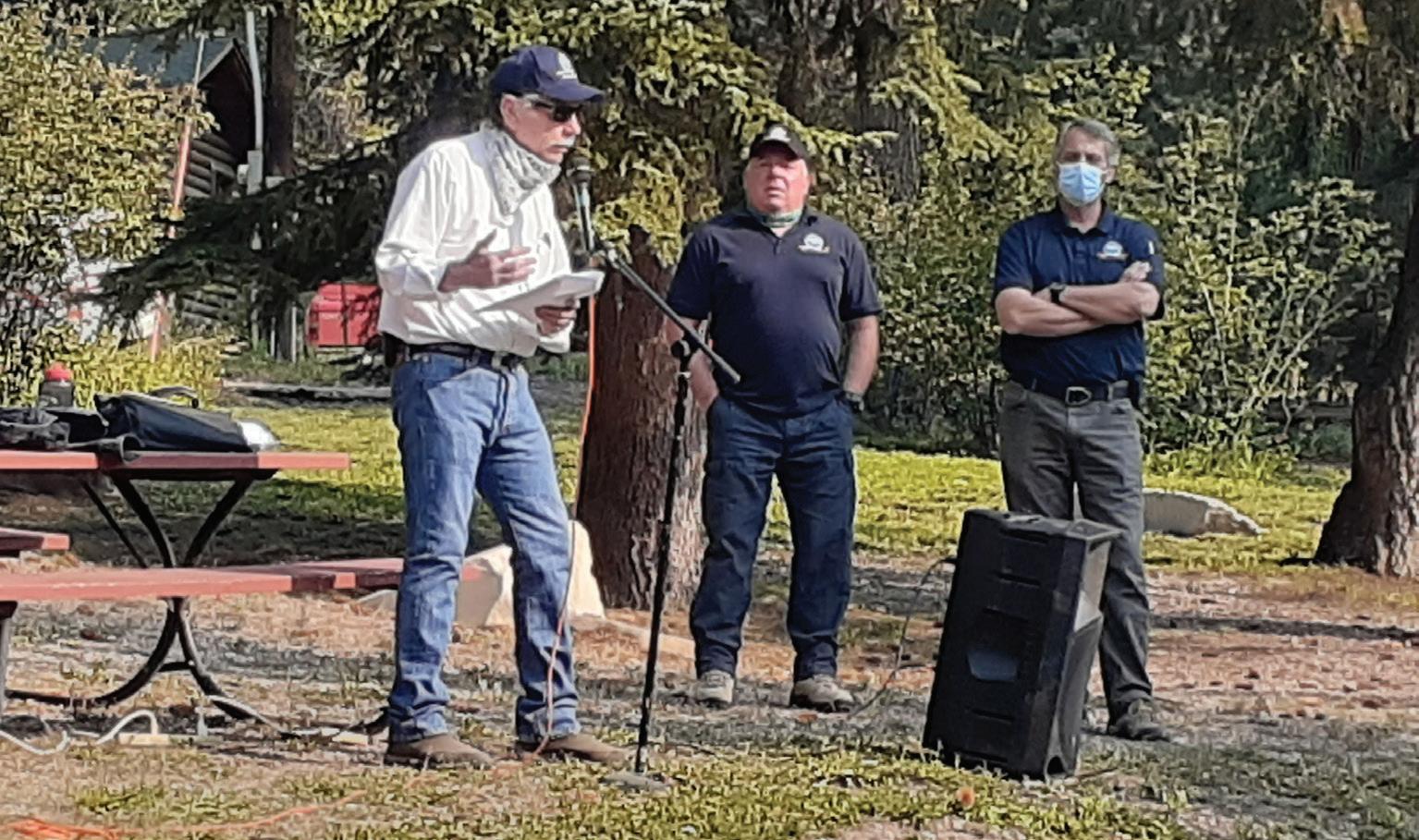
Ron Leach speaks during the Wildfire Prevention and Preparedness Meeting hosted by the Carbondale and Rural Fire Protection District on Saturday, August 22nd at the Marble Campground.
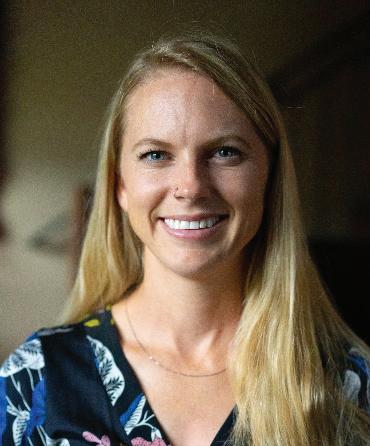
Nicole Farrell wading into the Crystal enjoying a summer afternoon near Marble, Colorado.
Marble Charter School's Hybrid Learning
Filtered morning light brushes over three white canvas tents arranged around the main building of the Marble Charter School. Nature creeps into view as a Robin hops among the oak brush while a squirrel chitters high up in one of the nearby pine trees.
On a day that already promises to be hot, the morning breeze flows easily across children's desks, gently rustling papers. Cubbies line up to form a half wall, every other cubby packed with backpacks and lunches, the spaces in between left empty. Cracking branches in the empty playground herald the passing of a deer — its antlers still covered with fuzz.
In Marble, along with every other town and city across the nation, the school looks different this year.
Building Something Beautiful
The Marble Charter School is big on growth-mindset, the philosophy that every challenge is a chance to grow. Over the years, since its inception in 1995 by a group of determined parents, it has exemplified this mindset repeatedly by rising to each challenge and thriving.
Long-time locals remember how in the early days, while the 100-year-old school building was renovated, students held class temporarily in Mariam Leone's pizza restaurant or how hot lunches were once cooked and delivered by parent volunteers.
This year is no different as COVID sweeps across the country and has sent schools nationwide scrambling for ways to teach and operate in the midst of a pandemic. The small staff of the Marble Charter School, along with a COVID task force assembled back in March, worked throughout the summer to create a plan that weaves together a myriad of subjects and learning methods while moving the school outdoors for the fall. They came up with a tiered system with different strategies for different possibilities.
The current plan, with Marble's zero infections, is a hybrid model. It incorporates in-person class two days a week, with two days of distance learning.
"We all felt it was so important for the students to have that face to face interaction with the teachers, not only for the academics but for the social-emotional aspect,” says the school's previous Director Amy Rusby, who is handing over the reins this year to long-time instructor Gina Mile.
“Doing it at the beginning of the year will allow us to better know our students and where they are at. That way, if we do end up
Gunnison County Commissioner Liz Smith will be in Marble to talk with locals on Saturday, September 26 at 3 p.m.
Location is TBA.
moving to an all distance learning phase, we have that additional bond.”
The school is a prime candidate for this plan in part due to its small size. From its start with 13 students, the school has grown to around 40 and is divided into three classes: K-2nd grade, 3rd5th grade, and 6th-8th. This year they have been divided again based on geographic location into pods or cohorts.
This division allows them to keep the classes under 10 students each. Monday and Tuesday, the first cohorts meet with their teachers in person, spending Wednesday and Thursday working from home on printed packets and online assignments. Then vise versa for the second cohort, leaving Fridays for the entire school to be sanitized.
The Charter School has always used project-based learning, taking real-world issues and topics, and designing a curriculum around incorporating a multitude of subjects. To start this year, the whole school's learning is based on sustainability and stewardship.
"Most of all, we want to instill a love of place and all that surrounds us in the children so that they will become protectors of it," explains Mile. Miles, who recently took over the academic director's role, has been with the school for two decades. "We had already intended on starting the year with [stewardship], so while coming up with a plan to re-open this year, moving the school outside fit perfectly."
The primary subjects for each class - math, language, science, and social studies - will all be covered and interwoven with art and music within the over-encompassing notion of sustainability and stewardship.
For example, the “little’s” class, ranging from kindergarten to 2nd grade, will be spending the fall exploring the forests and creeks surrounding the school and learning about all things living. Science for them will be a hands-on examination of plants and insects, the observation of animals, and what constitutes life.
Math for the upper elementary class will com-
bine more traditional learning with the practical applications of designing and engineering a community garden with all recycled material. The middle schoolers will incorporate research skills and history into new informative signage at the nearby Millsite Park. Including historical facts and environmental information, the signs will provide a practical application for their knowledge and the chance to become teachers to others.
Taking the school and their learning into the broader community is another concept the Marble Charter School holds dear. Mile explains, "We want to not only instill this love of place and the environment in the students but help them take that knowledge to others and share with their community and visitors."
Changes and Challenges
During all these changes, the school is facing drastic cuts to their budget while at the same time seeing significant increases in their expenses. The small charter school got hit with a triple blow of cuts this year.
First, Colorado announced a 15% across the board budget cut for schools, and for the Marble Charter School that equates to over $97,000. The team applied for multiple grants to supplement the COVID specific funding they received from the state.
This funding has strict guidelines and must be used only for needs as a direct result of COVID, such as personal protective gear or the tents that now house the classrooms. Even without the restrictive use, the funds haven't even equated to a third of the loss.
Then, came the dip in enrollment with a few families opting to homeschool their children full-time and others objecting to the requirement that the school children wear masks.
"I'm very conservative in my budget estimates, last year we had 48 students, and I initially worked the budget with 42. At the moment, we only have 38 students enrolled, explains Rusby, who is remaining with the school as Financial director and special education instructor.
Continued on page 12 . . .
Amber McMahill
First Week of School at MCS!
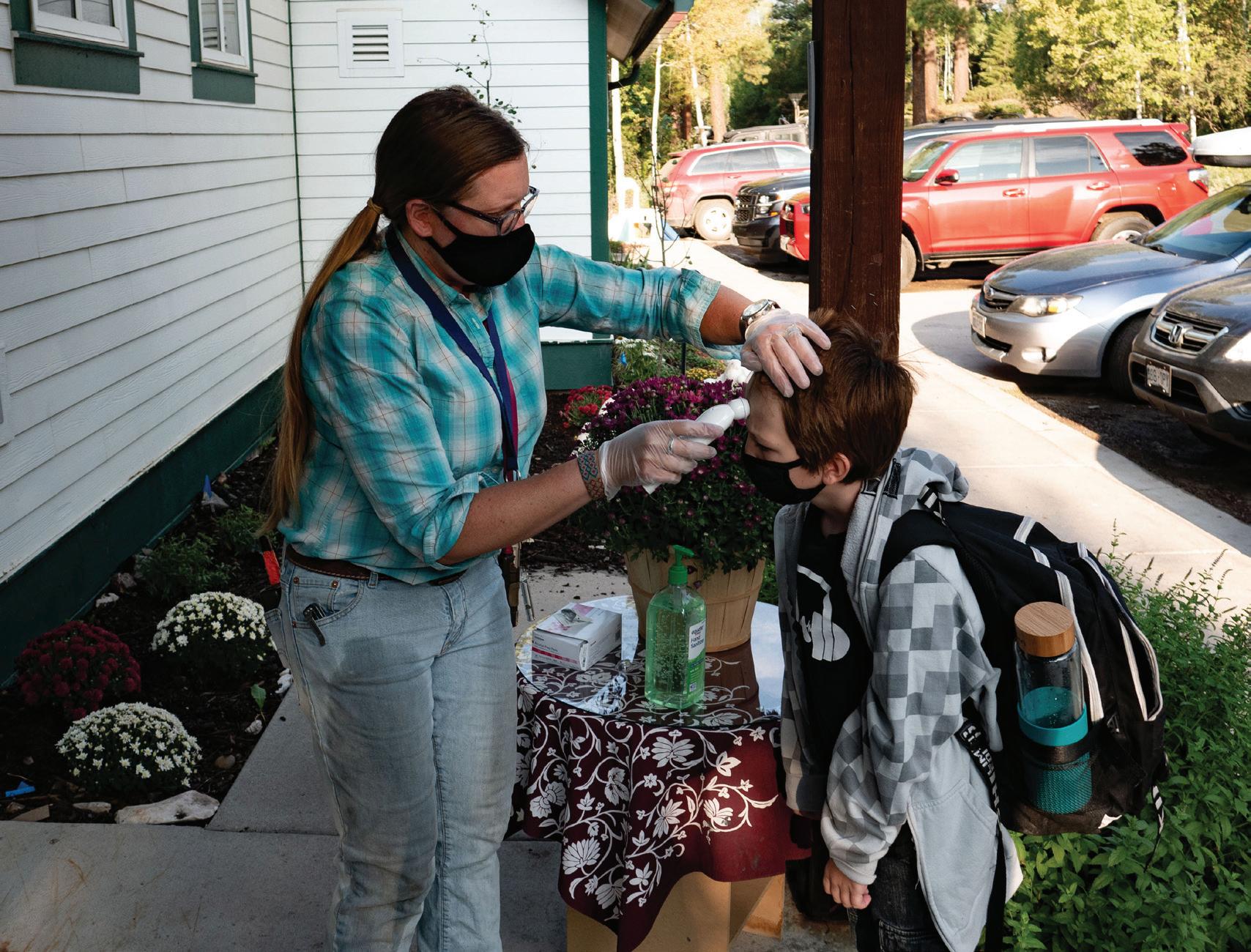
It was a fun and successful first week of school for the students attending the Marble Charter School. Kids and teachers alike adhere to COVID regulations like wearing masks and temperature checks each morning, social distancing is acheived through outdoor classrooms while the weather allows.
Photographs provided by Amber McMahill, Monique Villalobos, and Stephanie Helfenbein.
Marble Charter School
A tuition free, public charter school serving K-8th grade students in the Crystal River Valley.
Mission: Marble Charter School teaches a growth mindset in a unique and nurturing environment while exceeding state standards.
• Daily bus service to and from Carbondale Middle School
• Homemade Hot Lunch prepared with fresh, organic ingredients served daily
• Focus on Outdoor Education
• Low student to teacher ratios
Now enrolling for the 2020-2021 School Year
Please call or email for information and to schedule a tour of our school.
418 West Main Street, Marble, Colorado 81623
970-963-9550
Email: marblecharter@gunnisonschools.net
Website: marblecharter.gunnisonschools.net
September 20, 2020
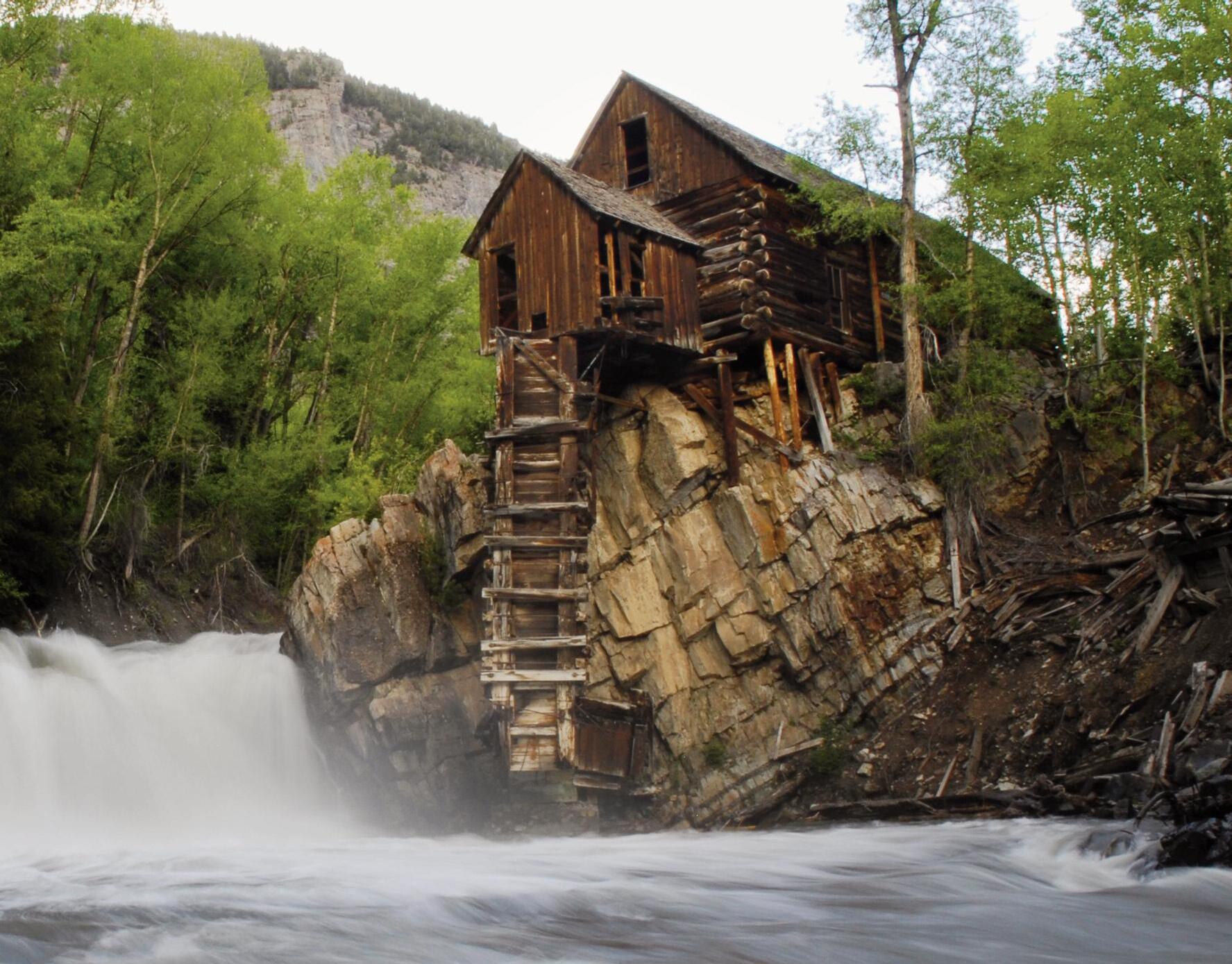
Get ready for a great day of running through the spectacular fall colors in the heart of Colorado’s Elk Mountain range. Run, walk, or hike the 25k loop around Lead King Basin, zipping past the Crystal Mill and ghost town of Crystal. Cheer the kids on as they run the 2.5k loop around Marble, or linger in Thompson Park after the race and enjoy a delicious homemade lunch including Slow Groovin’ BBQ (lunch included with race entry).
All proceeds bene t The Marble Charter School
Even the school's annual fundraiser, The Lead King Loop Charity Race looks to be slim this year with sponsors and participants alike having to tighten their belts. Now in its 18th year, the race was planned and will be executed with 100% community and volunteer force — a small army of people dedicated to helping the school.
In the past, the huge post-race potluck was a massive gathering with almost 200 runners, spectators, community members, and volunteers filling the park to eat and join in the excitement. But, as with so much else, the race will run very differently this year.
There will be donated box lunches from Slow Goovin' BBQ instead of a buffet and no gathering. On average, the race generated $18,000 hard-earned dollars for the school. This year Rusby is hoping to raise $6,000, at the very least.
This lost revenue means that in addition to the staff and teacher's already increased workload of teaching each lesson twice, creating engaging lessons for both in-person and online learning, assuring young children social distance, practicing safe hygiene and wearing masks, and sanitizing every hour; they have been exploring and exhausting every source of potential revenue.
As in the past, the small charter school is rising to the challenge. Rusby remains as passionate as ever about the school, and remarks, "We aren't just sitting and hoping funds will fall in our lap. We are actively finding ways to cut expenses, increase enrollment, and raise funds."
There is talk of a GoFund me page, and Rusby is busy writing grants and sending out letters asking for donations. Jen Cox, the Facility Director, spent her Thursday evening at a Town Council meeting begging funding from the town for machines to purify the air so the kids can move indoors as the weather turns cold. Slow Groovin' purchased two devices for the school, and the Town of Marble paid for a third.
In the outside tents surrounding the Marble Charter School, the students are oblivious to the current challenges their school faces. The teachers make sure of that.
Students have their own rapidly changing world and worries; yet, despite all the differences, some constants remain for the first day of school. Behind their masks, the kids still buzz with excitement at seeing their friends again.
Their slightly muffled voices chatter about the arrangement of their new outdoor classroom, and as class begins, they sit at their desks, dividing their attention between the teacher and the visiting deer, daydreaming about what adventures the coming year will bring.
If you are interested in enrollment, donating to the Marble Charter School, or participating in the Lead King Loop Charity Race call (970) 963-9550.
THE MARBLE TIMES
A LOOK AT LIFE AT THE MARBLE CHARTER SCHOOL
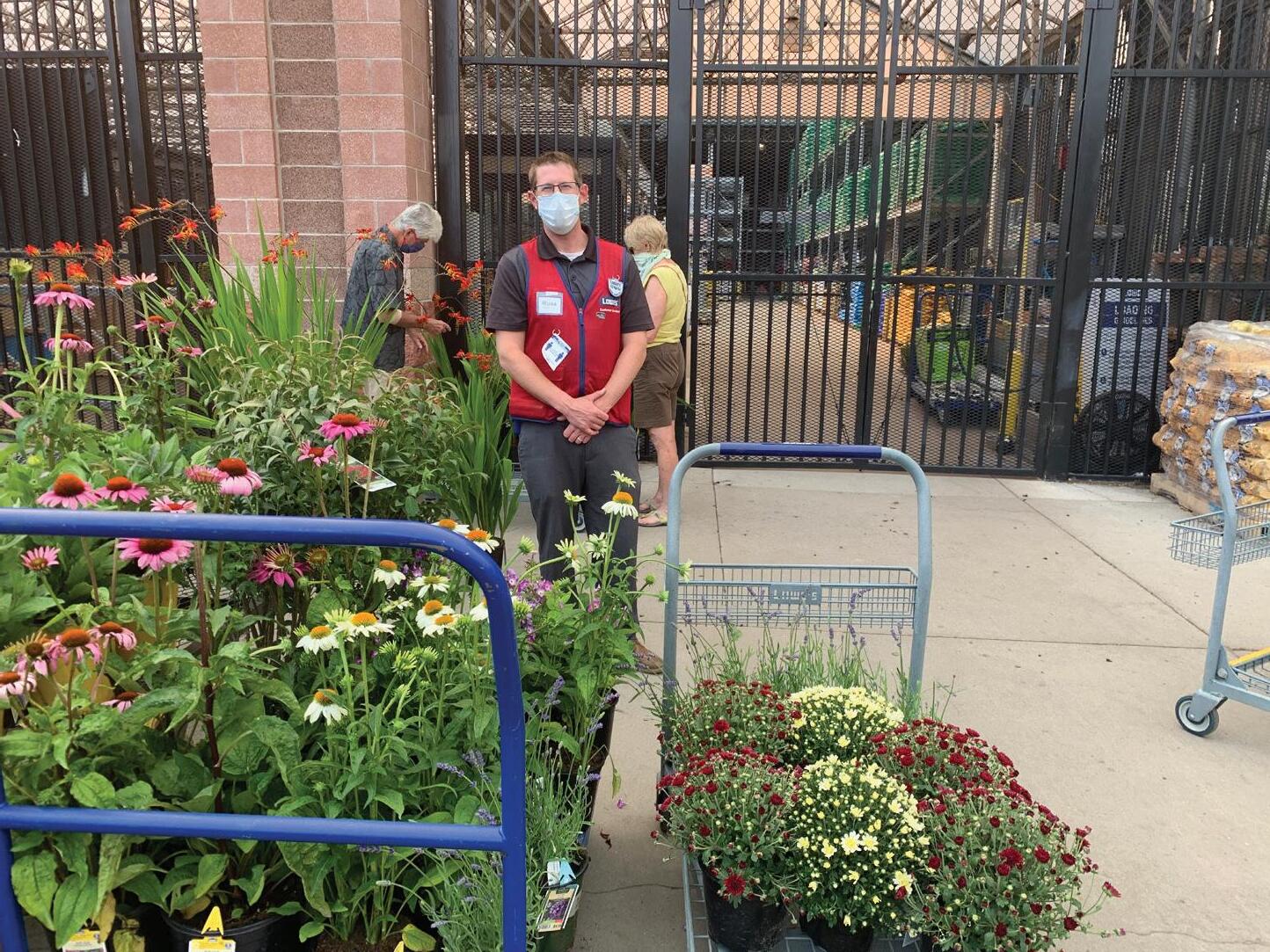
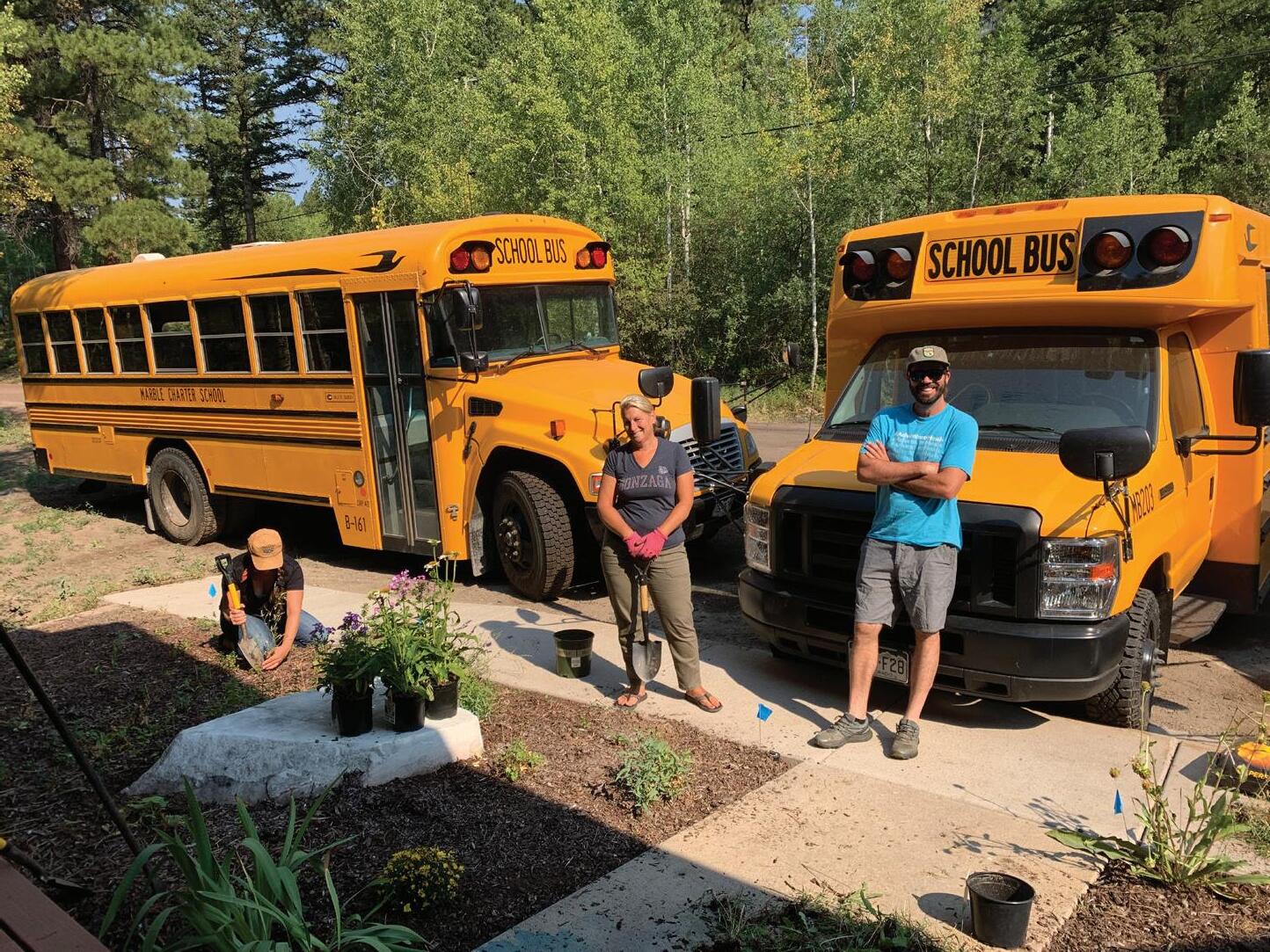
A note from Karly Anderson, MCS Office Manager: The MCS front flower bed got a makeover right before school started. Russ donated from Lowe’s and Burt (aka Brent Compton) helped with plants and fixing irrigation, along with several other volunteers such as Amber, Bas, Amy, Kelly, Charley, and Chrissy, pitched in with weeding and planting! We have wanted to take better care of that front area for so long, and we are so grateful for all the help and support from the community by volunteering their time and donationing supplies.
"We didn't choose the bus life, the bus life chose us!" says Karly Anderson.
Russ Fiske, Manager at Lowe's, donates plants and compost for the flowerbed overhaul. Amy and Burt pause for a photo while Chrissy digs away planting flowers.
Vintage Valley: REDSTONE'S KINDRED SPIRIT
by: Deb Strom
As we all know, Redstone is a unique place with a unique story. One important chapter involves Gustav Stickley, the man who handcrafted the original furniture of the Redstone Inn, Clubhouse, and Bighorn Lodge. The Inn still has one of the largest collections of his early work in the country, with over 60 pieces.
Each piece inside the Inn is personally signed with the Dutch inscription translated I do my best. This was Stickley’s promise that he would produce the highest quality furniture he could. His work represented a simple natural lifestyle fit for a new century, which directly influenced the Bauhaus movement. It’s amazing how functional and durable the remaining pieces still are today as they’ve endured 118-years of Colorado’s dry climate as well as the wear and tear from regular hotel use all those years.
City, New York. It had four floors of furniture, a whole floor dedicated to gardening, a floor housing a permanent ‘Home Builder’s Exposition,’ and the Craftsman Restaurant, which served meals from food grown at Stickley’s farm estate called Craftsman Farms.
What destiny brought Gustav Stickley’s furniture to Redstone in 1902? We will never know whether the two men met, or for that matter, how Osgood came to select the then-fledgling furniture company for what must have been a substantial order in the first year of operations. What is certain is that both enterprises embodied the spirit of Redstone.
Stickley is the best-known artisan of the American Arts and Crafts movement. His turn-of-thecentury furniture was a dramatic departure from the baroque and machine-made Victorian pieces of the late 1800s. Speaking of his bold designs, Stickley wrote:
“I want them to be beautiful — not with superficial prettiness of applied ornament, but with the inherent decorative quality which comes from good proportions, mellow finish, and harmonious decorations.”
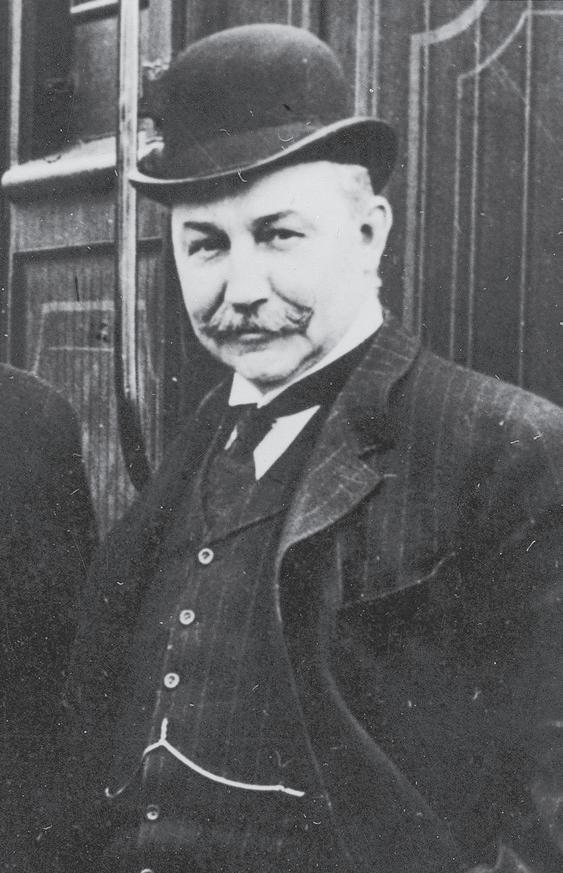
Like Redstone’s founding father, John Cleveland Osgood, Stickley was a self-made man. Born in the Midwest in 1858, he was forced to leave school after the eighth grade. Yet, at the pinnacle of his career, he commanded the seven-story Craftsman Building on Fifth Avenue in New York
While Osgood was developing “The Redstone Social Experiment” with its colorful cottages and recreation-education centers for miners, Stickley was in upstate New York committed to not only a different style of furniture but to creating a vintage business model for his company; named the “United Crafts,” the company was structured after a medieval guild, with Stickley himself as the master craftsman.
So, there was a philosophical kinship that brought this furniture from far-off New York to this remote valley. Furniture that was brought here not only for the miner’s comfort but also for their edification. It is not farfetched to think that Osgood was similarly motivated when he selected the Stickley furniture for his new utopian experiment of welfare capitalism. Redstone was more than one man’s vision; it embodied the cutting edge spirit of the era.
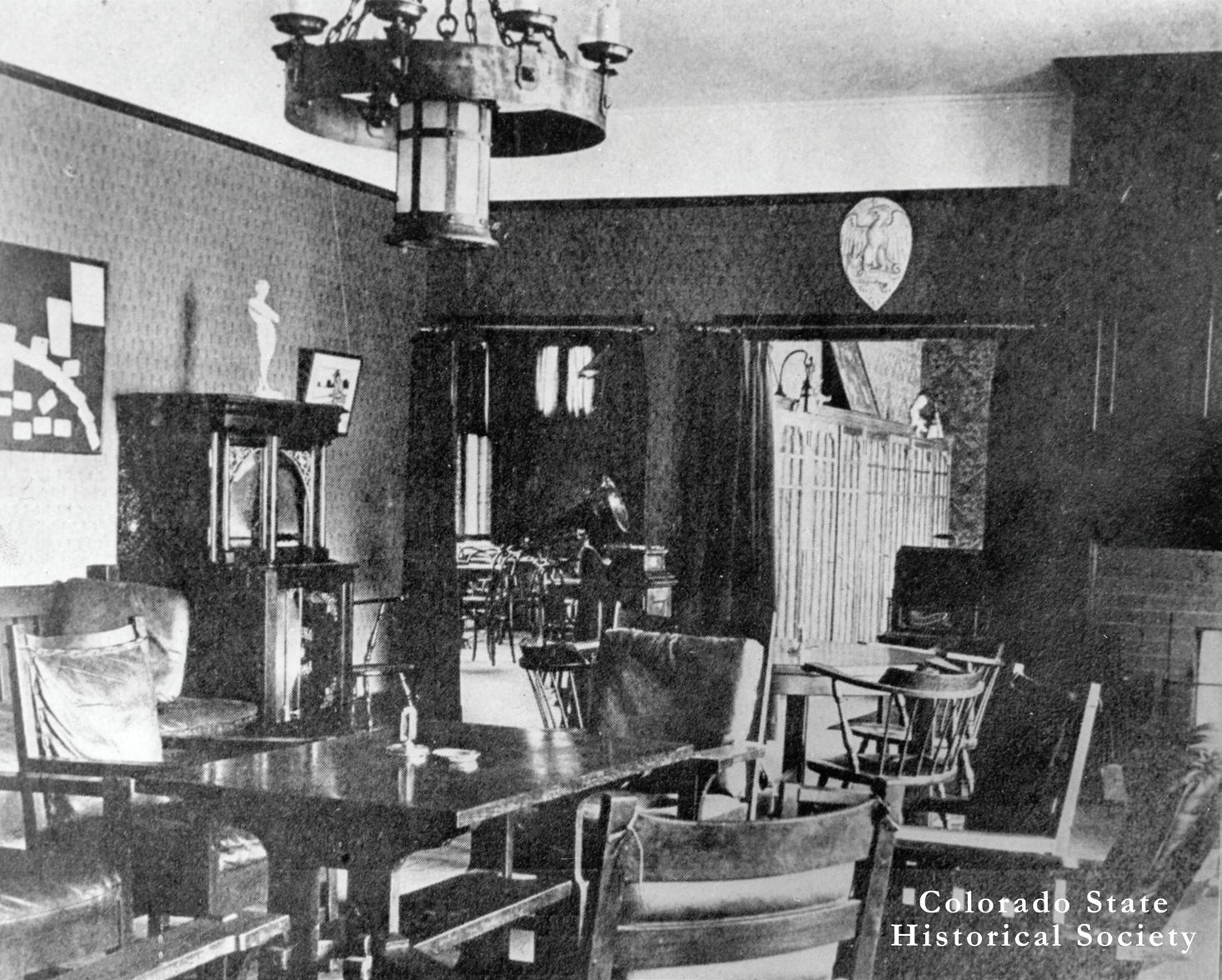
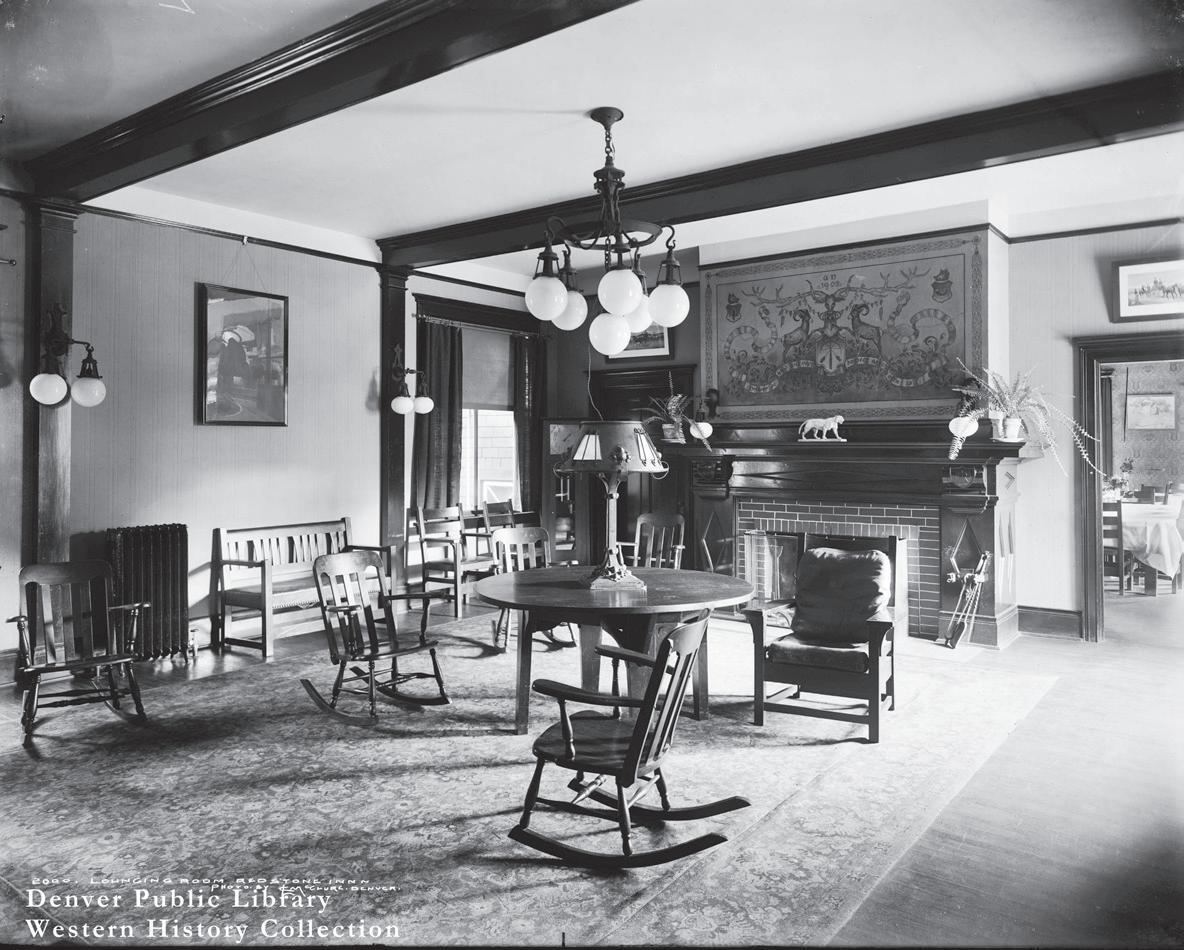
Above: Redstone Inn, 1902 - The Inn was the home for bachelor miners, the first floor included many Stickley pieces in the library (not pictured), lounge (foreground), and dining room (on the right). The second and third floor lodging rooms were each outfitted with a Stickley bed, trunk rest, and dresser.
Deb Strom was the General Manager of the Redstone Inn, 1988 - 2008, and is the current treasurer of the Redstone Historical Society.
Left: Redstone Clubhouse, 1903 - The Club's first floor featured the only bar in the village with a reading room on the left and a card room on the left. Stickley table and chairs in the foreground.
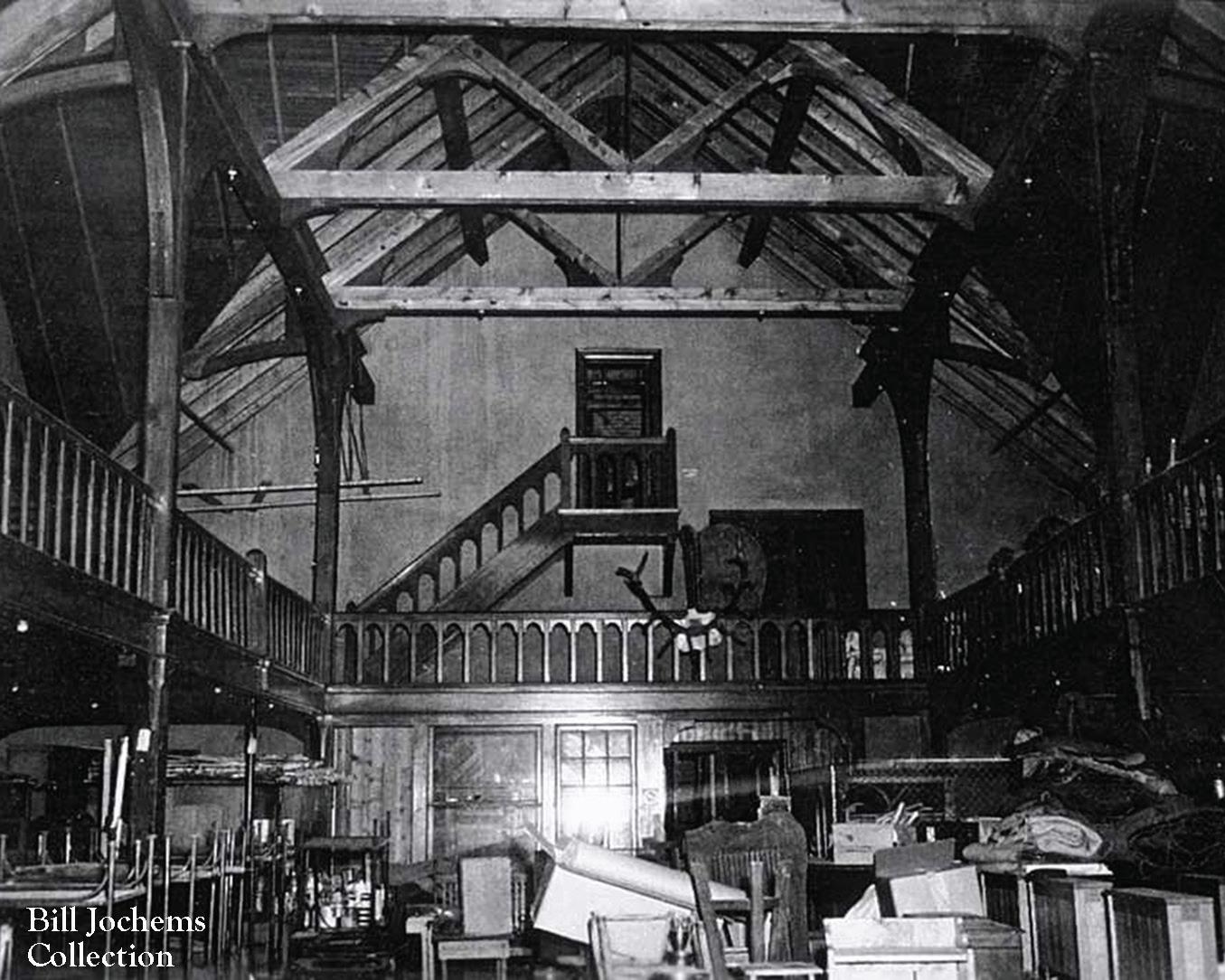
Right: Abandoned Company Store, 1940 - After the Redstone Clubhouse, Schoolhouse, Big Horn Lodge and riverside cottages were torn down to reduce Lucille Osgood's property tax liability, their contents were piled into the store. The new owners of the remaining cottages were given permission to help themselves to these goods to outfit their homes.
Redstone Community Association Bulletin
BOARD OF DIRECTORS
It's Time to Renew Your Membership
Usually, by September, you would have received a letter in your mailbox informing you of our annual membership drive. Yet due to COVID, we recognize that many may not be able to contribute to RCA this year. Therefore, we're asking those who are able to consider renewing, joining, or donating.
This has been a very different summer for all of us, and while we've only been able to hold less than a handful of meetings and practically no events (such as the ones photographed here), the RCA Board continues to be hard at work. While your contributions will go towards the hosting of future events, we are still using funds to manage the cleaning of the bathrooms and trash removal at Redstone Park, managing composting service for the community, and of course, we still plan to erect and maintain the skating rink during the 20-21 Winter season.
We ask that those who can to please renew your membership, we also welcome you to join RCA, or provide an additional contribution so we may continue bringing our community together as safely and cautiously as we can.
The RCA has created a marketing subcommittee to promote Redstone's accomodations, attractions, activities, and amenities to increase tourism revenues in Redstone. It is responsible for creating, overseeing, and revewing the tourism marketing program of the RCA. Business owners are invited to attend meetings held before the regular RCA Board meetings the first Tuesday each month at 6:00 p.m. at the Redstone Inn. If you have questions please feel free to contact DJ at DJredstone68@gmail.com
All dues received after August 31, 2020, will be applied to 2021 fiscal year.
Redstone is an unincorporated village that relies completely on donations and volunteerism spearheaded by the Redstone Community Association (RCA)
membership dues directly fund RCA projects and events.
for your support!
Sayonara to the dog days of summer! We'll see y'all in the fall...