
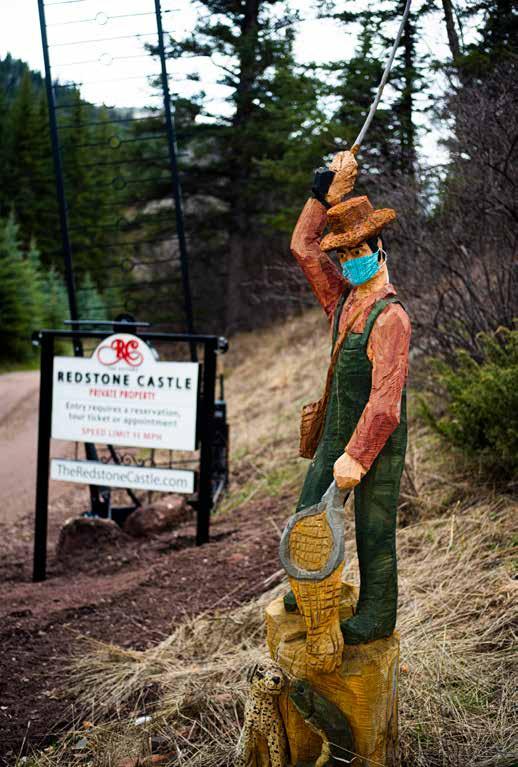

Photos by Ryan Kenney
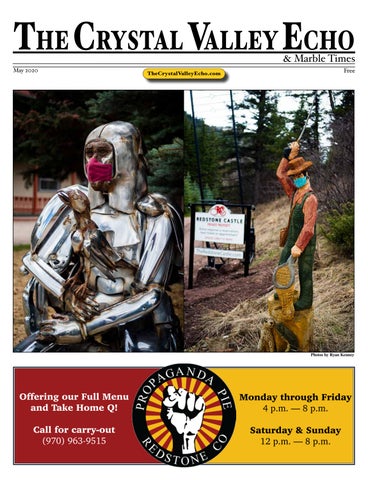
To our beloved readers,
We are thrilled to return to you this month in all our printed glory. I have repeatedly commented, as I’m sure many of you have, that this is such a strange time we are living through. While many are without work, I swell with great joy to witness the generosity and support of others unfold throughout our valley.
Many have been busy sewing scrub caps and masks for both personal and hospital use. Updates are made regularly on Facebook by a valley resident as to the available supplies at City Market. Signs of hope appear not only dotted along Highway 133 but also painted trinkets down the Redstone Boulevard. Our residents are getting quite creative with social distancing happy hours in yards, and all-in-all it seems that we are all excited to see each other’s smiling faces whenever we can.
Thank you to all of our advertisers who supported us during our brief stage of digital-only production, and thank you to all of you who continue to support The Crystal Valley Echo. Please let our advertisers know that you saw ‘em in “The Echo,” and if you’re enjoying our content consider supporting us through a subscription, print and digital options are available.
We are Crystal Valley Strong!
Gentrye HoughtonEditor
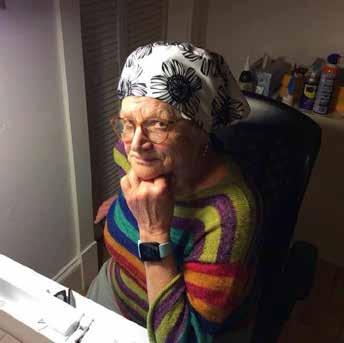
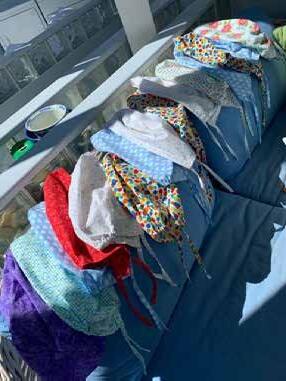
The ladies of Redstone have been busy sewing scrub caps; last month, 119 caps were made and given to Valley View Hospital all from the the nimple fingers of Jimmie Benedict, Stephanie Askew, Deb McCormmick, Mary Dorais, and April Carver.
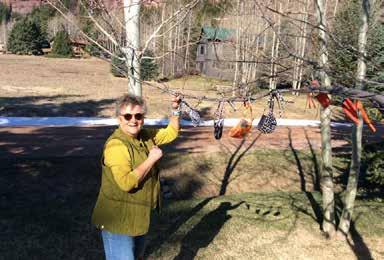
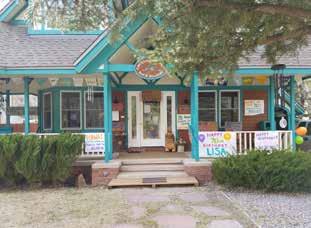
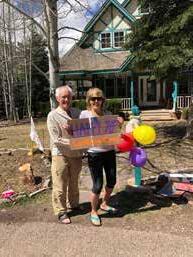
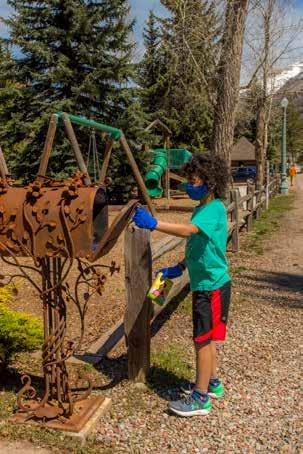
A big THANK YOU to Jimmie Benedict, who has been a star sewer for the Crystal River Valley. She also outfitted many of us with hand sewn masks, which she safely distributed by hanging on her front yard choke cherry tree (photo bottom right).




Mission Statement: To provide a voice for Crystal Valleyites; to bring attention to the individuals and local businesses that are the fabric of the Crystal Valley region; to contribute to the vitality of our small town life.
Editor • Gentrye Houghton
Publisher • Ryan Kenney
Contributors
Charlotte Graham • Dan Sohner
Amber McMahill
ADVERTISING SALES
Gentrye Houghton • 970-963-1495
GentryeH@hotmail.com
The Crystal Valley Echo is published monthly, and is distributed throughout the Crystal Valley.
NEWSPAPER BOX LOCATIONS:
Carbondale City Market (inside) • Village Smithy
Carbondale Post Office • Redstone Inn
Redstone General Store • Marble Hub
Propaganda Pie
Please send $40 for print or $25 for digital editions along with address information to: The Crystal Valley Echo 364 Redstone Blvd. Redstone, CO 81623
by Vickie Branson and Kari Duame
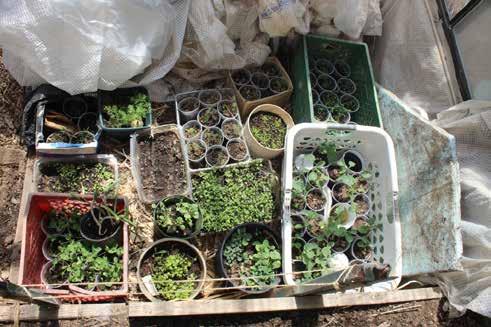
We know that spring has arrived at the top of the Crystal River Valley when a few inches of wet snow has covered the new dandelion blossoms! If you have tried to start a garden in the past and ended up losing all your baby plants to frost, you may be thinking that starting your garden now is a bad idea.
Officially, our last frost date is June 15th, but in fact, the blossoming of dandelions is a sure sign of the inevitable warmer weather ahead and the start of the busy season for gardeners.
If you’re new to starting a garden, the first thing to do is to choose your location, and there are a few things to keep in mind. How much sun does your desired location receive throughout the day? Does it have easy access to water? If you are growing things that our beautiful local wildlife will see as a free buffet, are you able to fence the area in or protect it otherwise? How big of a garden are you planning?
For the beginner and beyond, much can be grown in simple containers in a sunny location on one’s deck or in the

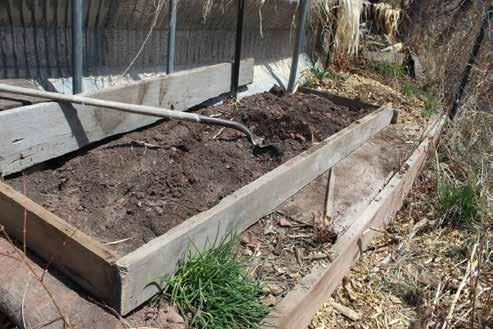
yard. A low raised bed can help with the battle against the native plants, but, for the novice gardener, can add to the frustrations of moisture control.
Planting directly into the ground requires more diligence in combating weeds, and needs a lot of preparation, but is generally a cost-effective way to get one’s hands in the dirt for your first attempt at gardening. Each option comes with its challenges and benefits. Finding the right one, or even a mix of options, for your situation can take a season or two, but don’t let that discourage you!
There are all sorts of pre-made garden soil mixes available commercially. However, having a basic understanding of drainage and moisture control is vital to the survival of your garden.
If there’s too little moisture held in the soil then your seeds won’t germinate and your plants will lose leaves, wither, or fail to produce. If your soil has too little drainage, you risk the roots decaying or not being able to absorb needed nutrients from the waterlogged soil. An overabundance of moisture is also an invitation for many fungi and pests to take up residence in your garden.
It’s worth your while to thoroughly research any commercial soil mixture before using it to see what sort of luck other gardeners have had with it. Our native soil here in the valley tends to drain a bit slow, yet the surface dries out fast.
If you are growing in the native mountain soil, you will need to mix in roughly 20% sand, 20% compost, and 20% peat moss. These amendments will help hold moisture in the soil during the heat of summer, yet allow excess rain to drain away.



Not your first rodeo? By now, you may notice plants grown in previous years that went to seed, such as kale, spinach, and some herbs, are starting to come up. Putting some simple protections in place will help prevent you from losing them to the cold.
A cold frame set over the top of the bed or planter box is an easy solution. Instructions for making various sizes and types of cold frames to suit nearly any budget can be found online. If carpentry isn't your forte you can use row cover or even cardboard to protect plants from hard frosts until warmer nights arrive.
Beets, onions, garlic, dill, sage, chives, mint, turnips, potatoes, cilantro, radishes, and carrots are all fairly frost-resistant plants as well as less attractive to the local wildlife population.
These are excellent options for planting in May, but we recommend avoiding planting beans, peppers, squash, tomatoes, or cucumbers outside. You can start them inside to transplant in about six weeks; yet, if you wait to plant the seeds directly in the ground in June, you run the risk of the fall chill coming early and they may not yield any fruit.
Some great local and heirloom seed companies are available to give you the best opportunity at growing in our micro-climate. Local seed producers will be hybridizing their genetics towards being more cold-hardy, vigorous, and adapted to our region. When gardening in a cooler and shorter season, starting with locally produced seeds will always give you the best results during the cooler weather early in the spring and late in the summer.
Happy gardening, Crystal Valleyites!
For anyone needing help stretching their food budget, Gunnison County Officials currently have boxes of food available distributed through the Marble Community Church. There is no charge to the recipient and no reservation is needed; boxes are available for an individual or up to a family of four and contain enough meals to last approximately three days.
Please call Pastor Jon Stovall at the church to arrange a pickup time for your box today, (970) 963-1464.
Just as the generations before us, the residents of the Crystal River Valley rely on the Crystal River to meet our basic needs, such as supplying our bodies with the elixir of life as well as providing growth and cultivation for food and livestock. However, the river can be a powerful mistress that not only gives but also takes that resource away.
What happens when there’s not enough water in the Crystal to support our community?
The river is directly affected by conditions that create snowpack levels and seasonal rains. It surges in the spring as the snowcapped mountains begin to melt, supplying users with the necessary water allotted through registered rights. On average, the Crystal River runoff peak happens sometime in June with levels measuring around 1,500 cubic feet per second (cfs) at the station above Avalanche Creek.

junior users access to their water rights were cut off.
However, that’s not exactly what happened. Since this was the first recorded Call on the Crystal, the State of Colorado did not follow standard protocol.
“Accesses to water was not shut off for anyone affected by the 2018 Call,” said Bill Blanton, Secretary for the Crystal View Heights Home Owners Association. “However," he continued, "they did send out notices informing us that we were out of priority and that they wanted to see efforts being taken in the way of an augmentation plan."
Is your head swimming yet? Let’s back up a little and see if we can make sense of this strange H2O terminology.
Water law in Colorado is governed by the Prior-Appropriation System. This is the main system used to manage water rights throughout the western United States where water resources are sparse.
A “Call” on the River
“A ‘Call’ on the river occurs when a senior water user is no longer receiving their appropriated amount of water at their headgate,” Kenney said. “The harmed senior user initiates a ‘Call’ to the Water Engineer who then implements a process to restore the appropriated amount of water to the user’s headgate.”
The Water Engineer will begin telling junior users, in order of least priority, that they must cease use of their water immediately, and will continue down the list until the appropriated amount of water is returned to the senior user’s headgate. The cease and desist remains in effect until there is enough excess water in the river to reinstate their usage.
During the draught of 2018, there were at least six neighborhoods, as well as the Town of Marble and Carbondale, affected as well as many other junior users who could not use their irrigation ditches.
“Our HOA already had an augmentation plan in place,” remarked Blanton, “but it was junior and not sufficient.”
Last year, however, was a banner year! With a well-above-average snowpack in 2019, the Crystal River runoff didn’t peak until nearly July 1st and measured over 3,000 cfs.
While the year before was a very different story, as many may remember the lack of snowfall that contributed to dry summer conditions. In 2018, the runoff peaked around Memorial Day at nearly 1,200 cfs.
Though the river measured only just below an average runoff, the lack of rainfall during the spring and summer months created some pretty serious drought conditions in our valley. Our Volunteer Fire Department abandoned the 2018 Fourth of July Water Fights in Redstone to answer an emergency call for the Lake Christine Fire. This was also a year that history was made on the Crystal River.
Due to exceptionally low river flows, a Call was put out in August and September as there was not enough water at the Sweet Jessup Canal diversion. Meaning that all
In this system, a water right that is legally established is given a date and an administrative number. During periods of water shortage, this administration number is then used to determine which water rights holders get to use water and which ones don’t.
“Senior water rights are those that have a higher priority administration number, in which the earlier the date of adjudication the more senior a water right becomes,” says Ryan Kenney, Manager for the Redstone Water and Sanitation District. Adjudication refers to the court proceeding in which a judge validates the water rights.
Whereas, a junior water right is one the has a lower priority administration number, meaning that in periods of a water shortage this junior user may be required to cease all use of their water supply.
Kenney also explained that this is commonly referred to as “first in time, first in right,” giving preference to those users that have been actively using the water for beneficial use for the longest time.
Under normal protools, the Division 5 Water Engineer would send cease and desist letters to any user that was not actively pursuing an augmentation plan. While having a Call on the Crystal River is rare, according to a February 2019 letter from Jake DeWolfe, District 38 Water Commissioner, “it is still reasonable to assume that this administration scenario could happen more frequently in the future.”
What is an Augmentation
“An augmentation plan is simply the process of storing water during high flow times and releasing it during low periods to offset the users' impact on the streamflow,” explained Kenney. With a properly implemented augmentation plan, junior users may continue to use their water source even if a senior user has placed a Call on the river.
Before
Any Augmentation plan requires an amount of replacement water to adequately cover depletions that would injure senior water users. The water can come from any legally available source and must identify the structures, beneficial uses, diversions, timing, and amounts of depletions to be replaced, along with how and when the replacement water will be supplied and how the augmentation plan will be operated.
“We didn’t really know what to make of it when we first received the letter, so the Town of Marble contacted DeWolfe,” said Ron Leach, Town Administrator. “As the largest user, the Town attended three or four meetings with other users to discuss a possible solution, and we were all like, 'WHAT! We have to build a pond?'”

Augmentation plans can be very expensive. Both an engineer and an attorney are needed to properly draft the augmentation plan and submit it to the appropriate water court. However, once the plan has been adjudicated and approved, it allows a junior water user to operate normally even during drought years.
“As long as we are actively working on an augmentation plan,” explains Leach, “access to water will not be shut off in the event of a future Call.”
The Colorado River Water Conservation District (CRWCD) applied for a grant to conduct a feasibility level study to develop a plan for augmentation in the Crystal River Basin. The grant application stated that “(t)his work will focus on the following: Quantify existing demands within the Crystal River drainage, evaluate the exchange potential at key locations within the basin, evaluate new storage/recharge alternatives, develop a basin-wide augmentation strategy, public outreach and education with the various Crystal River environmental groups to educate them about the ongoing augmentation issues, and evaluate various methodologies for financing and implementation of a plan for augmentation.”
This is where Zane Kessler, Director of Government Relations for the CRWCD, comes into play. “First and foremost, we want to make sure that we are doing what we can to help local communities,” Kessler explained during a phone interview. “We’re making sure that everyone has what they need as well as what they’re legally allowed to have."
“At the request of the state and by homeowners,” he continued, “the district is leading an analysis to quantify how much is needed by way of augmentation, as well as outreach meetings where we can discuss potential solutions and what solutions, if any, the community prefers. If the Crystal

River community is not happy with any of the solutions we come up with, we will walk away and let Pitkin County deal with it. The District is not a regulatory agency, and only a provider and protector of water interests.”
“The state in no way is causing any problems,” said Leach. “In fact, they are working with us and helping us.”
The grant was approved towards the end of March and was amended, before approval, specifically to state that there would be no dams on the Crystal. There is a total budget of $100,000 for the project with an estimated completion date of October 31, 2020, although it is unclear how restrictions regarding COVID-19 may change any plans surrounding this study.
“I’ve been invited to speak at the Crystal River Caucus as soon as restrictions allow us to meet,” said Kessler, “and it’s my hope that this will serve as the beginning of a long, productive conversation about augmentation needs in the Crystal River Valley.”


By now, there is nothing that can be said which should surprise the informed citizen. News of the COVID-19 outbreak circulates widely on every news channel and medium and we are constantly reminded of its ferociousness by state and local governments. The measures which are now in place seem extreme to some, lacking to others, but we can all agree that the degree to which we as a society are affected by the Social Distancing guidelines is historic.
When H1N1, also known at the time as the “Spanish Flu,” threatened to shut down major cities in 1918, Pitkin County began to take note. From March to August that year, the disease spread primarily through army camps which is how the reality of the disease first began to threaten the Crystal River Valley.

Several enlisted men from Aspen, who were stationed in Boulder, began to write home telling of deaths related to the flu and on October 14, Aspen’s schools, churches, and large gatherings all closed.
Around this time, notices began to appear in newspapers aiming to educate readers on how to stay healthy. The advice which was given should seem familiar to a reader today. The Elk Mountain Pilot ran a piece on November 28:
“These germs, as in the cases of influenza and pneumonia, are expelled into the air when the sick person coughs, sneezes, talks forcibly or carelessly expectorates. When you are near such a person protect yourself by placing your handkerchief over your mouth and nose. When you cough or sneeze, whether sick or well, protect your neighbor by covering your own mouth and nose. Avoid crowds and stay out in the air as much as possible.”
Other advertisements and articles advised one to “stop all visiting and neighborly calls. Keep your children in their own yard and away from other children. Keep warmly dressed and keep a fire in all occupied rooms” and that “Coughs and Sneezes Spread Diseases.”
Newspapers took liberties to make light of the situation, presumably. On November 19, 1918, The Elk Mountain Pilot wrote that nine inches of snow fell in Gunnison and “we hope it covered up all the Flu germs.”
Remedies became a common topic of advertisements, particularly for an elixir called Peruna. It was often touted as “the greatest disease preventing and health restoring remedy known to science,” and was often cited as a cure for the flu.
As far back as 1905, the drug had been publicly attacked as nothing more than a way to secretly drink as one reporter claimed it was nearly 28% alcohol. It was being advertised as a fraudulent cure for catarrh based on, many argued, no scientific grounds. As a result, the Pure Food and Drug Act was enacted in 1907, which was a series of consumer protection laws aimed at correcting mislabeled food and drugs with scientific data.
Catarrh, ironically, was an inflammation of the airways in someone’s lungs, so it did make some sense that it was considered a possibility as a cure for both the Spanish Flu and Pneumonia.
There were only two doctors in Aspen at the time and the rigor of living at altitude was taking its toll on citizens. The high altitude and years of mining had destroyed lungs and many of the citizens who had presumably died of the flu actually perished of Pneumonia.
In Aspen, there were more than 20 deaths directly from the Spanish Flu and one confirmed in Redstone. Pitkin County lost 7% of its population to the pandemic, compared to an average of 5% nationally. Compare that to Gunnison, which survived the pandemic without losing a single citizen to the virus.
Similar to today, Aspen went into a bit of a shutdown. A blurb in the
Aspen-Democrat Times repeats an order from the Board of Health on October 14, 1918: “Per the order of the Health Board everybody, big and little, young and old, men and women, boys and girls, must keep off the streets and remain at home or in their places of business. If necessary to come uptown, come and attend to your business and then beat it home. Don't congregate on the streets for any purpose whatsoever and don't gather in any store or parlor to emasculate the linen. Let the rag-chewing go until the Flu has flewed.”
Gunnison placed their executive order just two days later, however, took the situation far more seriously and declared a “quarantine against all the world.” Their quarantine was so strict, that motorists were asked not to stop in town and a few were even arrested for ignoring this request.
Almost every aspect of daily life was closed, but it was the collective effort of the citizens which truly made the difference, and today, the case is cited by federal officials as having an “exceptional” response to the pandemic. Even with all of this, Gunnison lifted its restrictions prematurely and roughly 100 people were infected in March of 1919.
This raises the question of how the public spent their daily lives during all of this. Did they maintain distance and stop going to picnics? Did they take to trails and open spaces for fresh air?
Was their time spent sheltered or spent looking for a way to check in on one another? Or did they,
in Gunnison’s case, finally decide that enough was enough and that the benefits of five months in quarantine in the middle of the winter weren’t enough to outweigh the burden of isolation?
Coming on the heels of the first World War, it seems reasonable to assume that the nation was tired of fighting. At the beginning of the war, 232 citizens from Pitkin County had joined the armed services and nine would not return.
Two were killed in action and the other seven died from the flu while still stationed with the Army. Silver prices would begin a decline in February of 1919, but the price of silver had been relatively consistent lending to a sense of security through all of this.
Today, the information is everywhere and the average citizen is well informed. To date, Pitkin county has experienced two deaths and Gunnison four. Both Pitkin and Gunnison Counties have made serious decisions to address and attempt to contain this pandemic and while many of the methods of prevention are very similar, our lexicon has shifted to try to make better sense of what we are experiencing.
We now have terms such as Social Distancing and methods of tracking the effects of Stay-At-Home orders, yet still, discuss miracle cures and the day when we can head back to work and to the parks with our friends, family, and community.

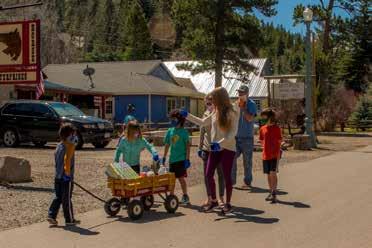
Below and right: In lue of this year's canceled Easter Egg Hunt, the Lewis, Moore, and Tamburro families gathered and distributed candy to Boulevard residents.
Gentrye Houghton President Ron Phaneuf Vice President Katie Lowery Treasurer Sara Lewis Secretary
Josh Wambolt David (DJ) Johnson Nathan Helfenbein Steve Pavlin
Alternate Member: Cathy Montgomery
Still
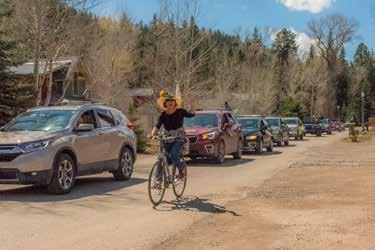
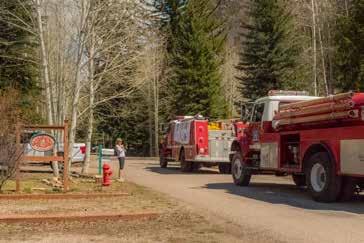
Left: Friends gathered on April 10th to celebrate Lisa Wagner's birthday!
A social distancing parade was organized including two fire trucks and a plethora of other vehicles adorned with birthday wishes.
Business Subcommittee
The RCA has created a business subcommittee to create a stage for business owners to meet and discuss what it takes to own and maintain a business in our beautiful little town. All business owners are invited to attend and provide their input on their trials and tribulations. Meetings are held before the regular RCA Board meetings the 1st Tuesday each month at 6:00 p.m. at the Redstone Inn. If you have questions please feel free to contact DJ at DJredstone68@gmail.com All RCA meetings and events are canceled until further notice.
Redstone is an unincorporated village that relies completely on donations and volunteerism spearheaded by the Redstone
Your membership dues directly fund RCA projects and events.
Thank You for your support!
“Who is that masked man?”
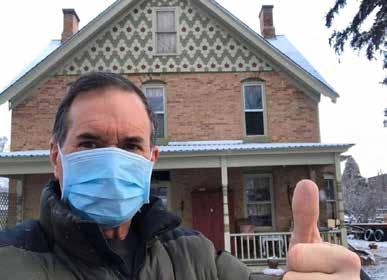
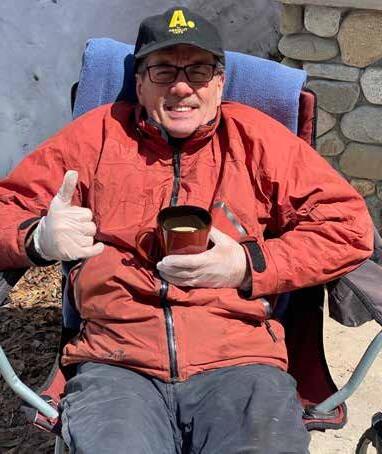
In recent weeks, our local area newspapers featured a brief story on Peter Mertz, a masked—and gloved—free-lance “visual storyteller” whose daily beat these days he calls “City Market update” on Carbondale’s Facebook page.
Peter, “Pete” to many of his friends, has posted since mid-March photos every day of different grocery departments. He includes a comprehensive, alphabetical no less, listing of the current status of market staples, with sometimes actual count of their availability (Apples: Great, Beer: Great, Diapers: Good, Flour: 10 bags, Sugar: 200 bags, Pasta: Coming back, Tofu: 4 bricks, Yeast: Low). He has refined his postings to be in and out of the store literally in mere minutes. He always signs off: Please thank your City Market employees!
Peter said, “I’ve had several careers in my life, yet I’ve been writing since 1976 as a professionally paid journalist. My first job was right out of high school as a Sports Reporter for the Montgomery County Sentinel. And I wrote for the University of Maryland.”
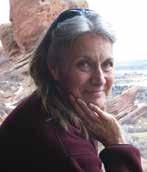
Charlotte Graham
Many in the 3,000+ FB group heap praise for his efforts that help them plan their trips. Of course, there’s an occasional drubbing which he nonchalantly shrugs off. He said, “In times when journalists are derided with impunity, perhaps my primary intention is to cast us in a more favorable, compassionate light.” Either way, Peter takes it all in stride. “I’m a pretty easy-going guy.”
He spends his time between Carbondale, where he caretakes a refurbished 1893 Victorian home, and in Marble, where he has a house he is remodeling that once belonged to celebrated local artist, Bleu Stroud.
Peter grew up in suburban Maryland, “Outside the D.C. metro area,” he explained. He went to the University of Maryland where he majored in Journalism. One of his professors was Ira Allen, UPI reporter covering the Reagan years in the White House. “He was polished, and articulate,” Peter remembers taking classes from Allen where the room was overflowing out into the hallway to hear him teach.
Peter found his way to Marble and the Crystal River/Roaring Fork Valley via his Best Man at his wedding, Evan Glasener, who owned Beaver Lake Lodge at the time. “We were both East Coasters.” After that first and exceedingly cold Marble winter, Pete moved his family to Basalt, where his four children grew up and “took off on their own paths. I’ve been very blessed with my kids. I’m really proud of them all.”
One of Peter’s more difficult assignments was covering the trial for the mass murderer of the Aurora, Colorado, theater shooting in 2012.
“It was the midnight showing of ‘The Dark Knight Rises.’ Twelve dead, 70 injured. Ten were under the age of 30. Some of them in their Batman costumes. My kids were in that age range, so it was hard.
“It was a 103-day trial. I couldn’t stop crying. Not crying per se but weeping inside for these family members who were there every day. I became close to three sets of parents. It was so moving that I’ve begun a book called Grim Wave
His sharing more details of that and other tragedies got us on to another topic. What got you into writing?
Peter brightened as he answered, “My mother authored 70 murder mystery books before she died in 2013. She had millions of dedicated followers. For whatever reason, her son covered several mass murder stories. [Like her] it just became part of what I’ve done.”
A quick peek at Wikipedia shows that Barbara Mertz did indeed write at least one or two books a year under not only her name but also under two nom de plumes, Elizabeth Peters and Barbara Michaels.
“I was raised by fiery people. My dad was in the CIA in the ’60s,” Peter said. “My mom was an outspoken political feminist when it wasn’t so popular. Her novels were always of a strong female protagonist. She had a Ph.D. in Egyptology; one series was all mysteries related to that.” With a big smile, he added, “She really inspired me to be a writer.”
What with his parents’ work and him growing up around Washington, D.C., it’s little wonder Peter would become involved in politics.
“I was a TV anchorman at a tiny NBC station for a while. Friends and I formed a group called People

Looking forward to seeing everyone soon!
Against the Klan (PAK) and infiltrated the KKK during a couple of their rallies in the late ‘80s. There were some intense moments.”
While plenty busy in his everyday life, and now, with the much-anticipated daily City Market report, Peter is also juggling writings of three book projects. One is about John Yee, a history professor in Denver during the ’50s -’60s.
“Yee was born in western China in 1921 and adopted by British missionaries. Many of his stories were about his growing up in China and becoming part of the famous Flying Tigers (a most fascinating story itself. Google it!).
Another of Pete’s writing projects has been about the atrocities unknown to most of the world today to the city and people of Chongqing, China, circa 1937-1942.
“I went last November to interview women survivors, all in their 80s now, who were physically damaged by the incessant Japanese terror bombings of their city as target practice before Pearl Harbor. Their stories were intense.
“One told of watching her parents blown away. Another about running down a street with her baby in her arms with another telling her that its head was blown off. They all were so grateful because their horrific story was finally getting told. They saw in me someone who felt their pain.
“Their whole lives had been destroyed; eating off the streets, living in garbage cans. We [today] can’t even begin to imagine the hardships some people have gone through. One woman came up to me afterward, stood about four-foot-tall and hugged me around my waist for nearly ten minutes. It was powerful.”
After these two books, Peter intends to write the story of his dad’s career in the CIA during the ‘60s and one about a relative, George Shannon, who was part of the Lewis & Clark Expedition.
Peter also writes as International Journalist for Xinhua News Agency-Colorado Bureau, having turned in 600 stories in the past eight years. Now you know a bit more about that.
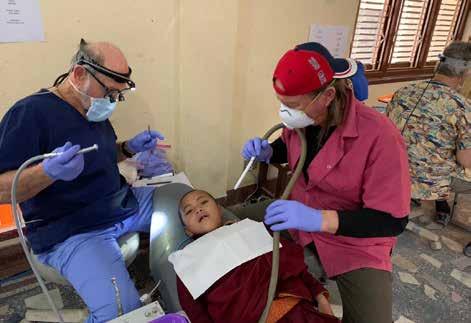
by Dana Strong
I departed for Kathmandu on March 9, 2020, to fulfill one of Susan McEvoy-Strong’s wishes for some of her ashes to be taken to Nepal, where a ceremony would be performed by the monks at Pima Tsal Monastery. In October 2018, she had done this for a very dear friend of hers.
We had always planned to go together, as volunteers with Global Dental Relief (GDR). She had written in her journals how she thought this work to be a blessing, and I now have an appreciation of her experiences.
GDR was monitoring the virus outbreak from the very beginning and throughout the entirety of our travels. While in flight, the original plans to spend the majority of the two-weeks at the Pima Tsal Monastery in Pokhara had changed. The schools had canceled a week of classes and moved final exams up, making it more difficult to access the children for the clinic.
Kathmandu was still existing under normal times and was a beehive of activity. I quickly adjusted to a different way of life, as one must. While walking down what would be a sidewalk here, was a multi-use travel lane for rapidly moving motorbikes coming at you in all directions.
The “real” streets were filled with people, vehicles large and small, interweaving in every which way with an ability to avoid what looks like guaranteed collision all the time. The people and culture, of course, are very different and was a most welcome change.
Laurie Mathews, our trip leader, worked feverishly reorganizing plans and we stayed in
Especially in today’s economic climate I want to help you keep your eye on your dream. And during this time of social distancing, I remain ready to assist you as I continue to work from home. Please give me a call if you have any questions or want to discuss the effects of the Coronavirus on our local real estate market, or just talk. Buyers and Sellers are still active and properties are still selling. So, until things get back to some level of normalcy, stay healthy, be safe and think positive thoughts. Take care and we will get through this together!


Kathmandu the first week working at a Shree Mangal DVIP School, where Susan had volunteered for many years, and a local monastery.
We were able to continue with the clinic, and I was one of eight contributing. There were two dentists, a hygienist, four general volunteers, and our trip leader. We served 363 patients through exams, cleanings, fluoride treatment, fillings, and extractions; according to GDR, this was an equivalent value of $39,110.00 US.
I served as a chairside assistant, providing suction, writing and reading charts, retrieving instruments, and preparing amalgam for fillings. It was challenging work since I had no previous experience, but according to my partner, a dentist from Colorado Springs, I performed well.
The plan was to go to Pima Tsal Monastery the second week, but unfortunately, this had to be canceled after receiving updates from the US Embassy encouraging return to the United States. Therefore it was necessary to leave Susan’s ashes with a trusted, dear friend of hers of many years. The ceremony was performed in my absence, and her remains have been placed in the mountains she so loved.
I intend to return as a volunteer with Global Dental Relief when conditions permit, and I plan to extend my stay to do some trekking, which is an option through GDR to further the experience that the country offers.
I would like to send a big thank you to John and Aedie McEvoy for their generosity in making this trip possible. May you all stay well, and strive to make each day positive, for “life is short,” as Susan told me repeatedly.






by Deb Strom
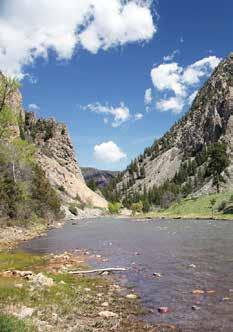
Aspen and Snowmass have long been known for the "shrines" that mysteriously pop up on the ski mountains. Less documented but more prevalent are the shrines of the Upper Crystal.
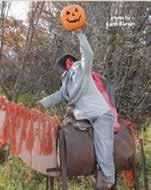
On an annual basis since 1998, The Headless Horseman magically rides down to Highway 133 at the Avalanche Ranch entrance in late September. I am guessing that it is the work of Chuck Ogilby.
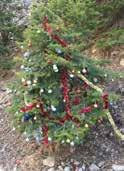
For more than 20 years, there has been the mysterious Holiday Tree that appears, grows, and at times disappears in "The Narrows" of Highway 133. Rumor is that it is the shared work of several locals.
The new Big Red Heart on Highway 133 was the inspiration for this article. Alison Hufer was touched by friends in her home state of North Dakota who put hearts in the windows of their homes as a show of solidarity fighting the COVID-19 pandemic. But, being on Highway 133, Alison wanted to go big. Her husband Michael Gandolfo agreed to indulge her fantasy and cut the big wooden heart. The husband and wife team both work for the Carbondale Rural Fire District. Michael is a paramedic & firefighter and Alison is a firefighter & EMT.

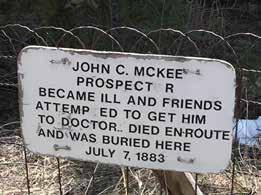
who lost their lives. The oldest memorial is the burial site of John C McKee, located on the Marble Road near Hermits Hideaway. He died en route to the doctor in 1883 and his friends buried him at this very site.
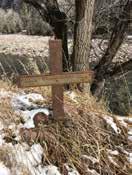
The Hand Forged Cross in memory of Christy Kistler, 1968 -1986, is located near Janeway on Highway 133. Christy was 18-years-old and one of five Paonia teens that drowned when their car lost control and tumbled into the icy Crystal River on Saturday night, April 26, 1986. This was just a month before her high school graduation.
we lost him in November. He was a sharp and focused young man, as I recall.
Still, a puzzle is the White Wooden Cross that is also located in "The Narrows." It has the hand-lettered inscription “You may be gone but will not be forgotten." This person is not forgotten; there is always a fresh floral array below the cross.
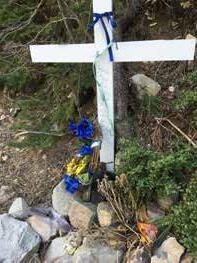
The spirit of the Crystal Valley is represented with these shrines and memorials and is a part of our living history. They represent our small-town character, values, and memories.
Allan Ingram, 35-year resident, paramedic, and retired Deputy Chief of Carbondale Fire District, is very familiar with the upper Crystal. He says that there are many more secret memorial shrines located along almost every mile of the river. Now, that's a task for another day.
If you have any additional information about any of these shrines, we'd love to hear from you! Please send an email to the Redstone Historical Society:
HistoryRedstone@gmail.com
More touching are The Memorials for people
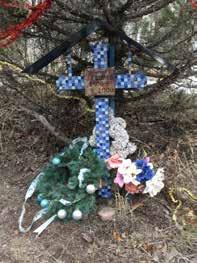
The Blue Mosaic Cross in memory of Abraham Flores, 19882008 is located in "The Narrows" of Highway 133. Abraham was 20-years-old. He died when his car spun out of control on Saturday afternoon, November 15, 2008. Known as Beto, he worked at the Redstone Inn and was a CMC student. He began working at the Inn in August and

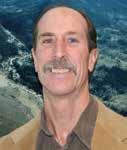
The Pitkin County Commissioners hold weekly work sessions on Tuesdays and bi-monthly public hearings on Wednesdays in our BOCC meeting room at the Pitkin County Administration and Sheriff’s Building. Both meetings are televised live and repeated on locater CG12 TV. They are also streamed live and available on the County website. Agendas are posted in the Aspen/Glenwood newspapers and on-line at www.pitkincounty.com. In this column, your District 5 Commissioner, George Newman offers his take on current matters. You can reach him at george. newman@pitkincounty.com.
As of April 23, 2020, the Pitkin County Board of Health amended its Public Health Order allowing office supply stores, bike repair shops, construction projects, and landscaping operations to re-open if they meet specific criteria in their operations. This is largely due to the success of social distancing and compliance with Public Health Orders.
Pitkin County has been successful in flattening the curve where patient demand has not exceeded Aspen Valley Hospital (AVH) and the medical community’s capacity. The Board of Health, the Incident Management Team, and AVH will be closely monitoring the situation insuring that a possible surge does not overwhelm our medical providers and hospital beds before more changes to the Public Health Order are instituted.
The goals of our Public Health strategy remain the same:
1. Slow the transmission of the virus through the general population
2. Keep the number of infected people within the capacity of our health care system
3. Protect the most vulnerable to severe illness (health care workers, seniors)
4. Mitigate the impacts of social and economic disruption
Our suppression strategy of following the Public Health Orders, including the stay-at-home order, has been successful as noted above. We are now moving towards a more traditional model for Public Health, that of the “Box It In” strategy. There are 4 essential actions of this strategy in consequential order.
• Testing — PCR testing widely (info below)
• Isolation — All infected people
• Find — all contacts that have self-isolated for 14-days
• Quarantine — self- isolate all who have tested positive for 14-days
This will allow us to better understand and contain the virus and gradually relax the Public Health Orders.
There are two types of testing we are looking at using right now:
• Polymerase Chain Reaction (PCR) testing can tell whether someone has an active infection by detecting the presence of the virus’ genetic material (RNA) on a nasal or throat swab. This is the test we will continue using right now. It will be available for anyone showing symptoms, the cost will not be a barrier. For more information, check with your primary physician or AVH Primary Care if you don’t have a primary physician.
• Serological testing, which is the other type of tests we have received, looks for the presence of antibodies produced by the immune system against the virus. It does not detect the active presence of the virus. Instead, it tests whether a person’s body has actively fought the virus via antibody development, which is believed to take 7 to 14- days from contracting the virus. However, there are concerns regarding the accuracy and specificity of the test right now (picking up other coronaviruses). We will wait for more verification of this test from the FDA.
COVID-19 physical distancing measures can be loosened when criteria are met in three main categories, including but not limited to: Epidemiology:
• Decreasing cases in the context of increasing testing (or stable testing with decreasing positivity) for at least 14-days
• Decreasing numbers and proportions of cases not linked to a source case (the goal is less than three unlinked cases per two-week
period)
• Decline in deaths for at least 14-days Health Care:
• Ability – including staffing – to double the number of patients treated in intensive care units from current cases
• Ability – including staffing – to screen large numbers of symptomatic patients safely (e.g., outdoor tents, drive-thru)
• More discharges than admissions for COVID-19
• Ensure at least baseline capacity in general health services, including through the expansion of Telemedicine for COVID-19 and usual care Public Health:
• Ability to personally interview all cases
• Ability to test 100% of symptomatic contacts and others with symptoms within 12-hours of identification of symptoms
• Designated facilities for non-hospitalized COVID-infected people who can’t be safely cared
for at home (e.g., because of space constraints, homelessness, medically vulnerable household members, or otherwise)
As these goals are met, it will allow the continuation of a phased-in approach to the re-opening of businesses over the next weeks and months.
Meanwhile, the BOCC continues to meet in a virtual setting: members of the public may not attend BOCC meetings in person until further notice. Instead, agendas published every Monday in the Aspen Daily News as well as at www.pitkincounty. com include a telephone number for public comment during the meeting.
Meetings continue to be televised on CGTV Comcast Channel 11 as well as streamed online at www.pitkincounty.com/watchwebcasts. Your best source for all updated information regarding COVID-19 as well as County resources available is www.pitkincounty.com.


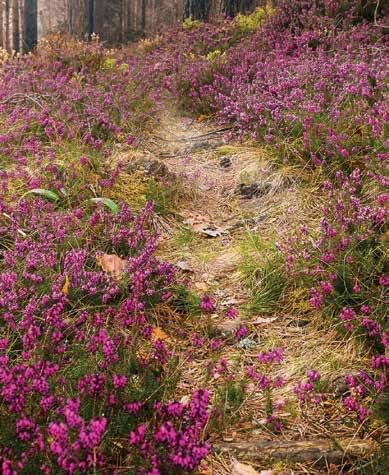
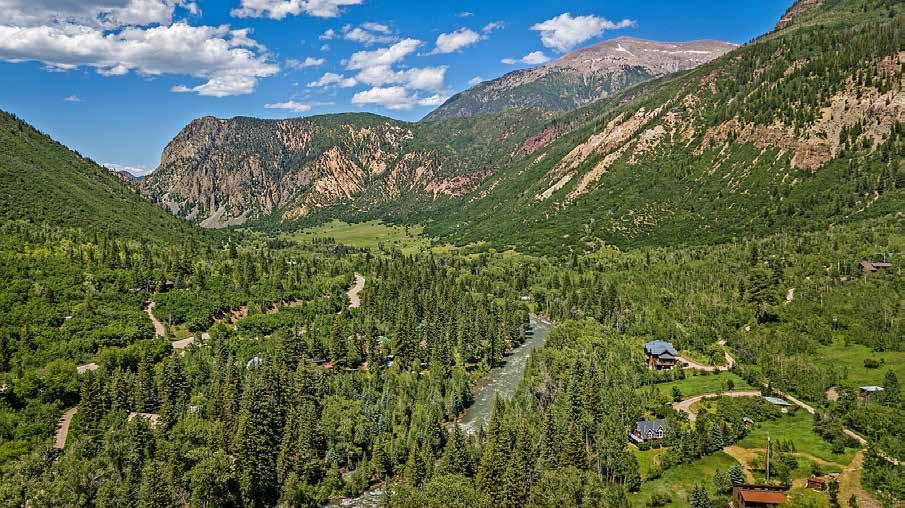
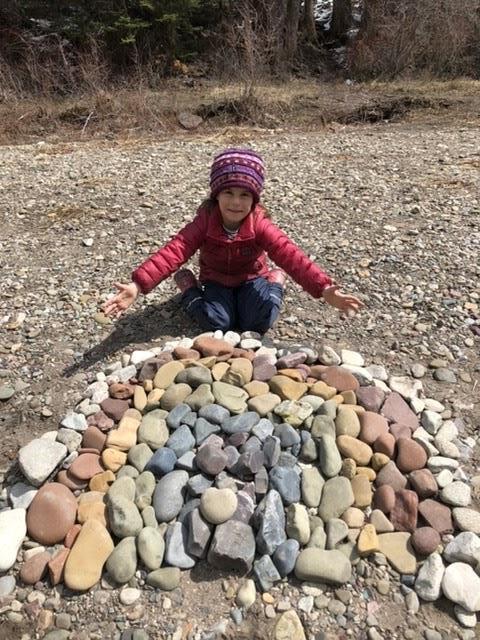
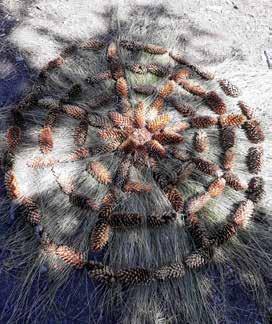
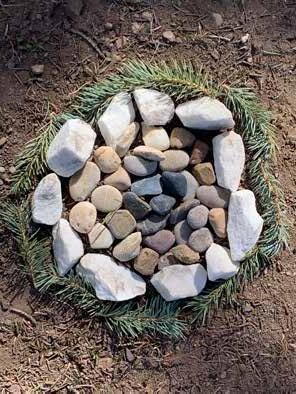
Students were asked to create their own arrangments with natural elements without disturbing nature.
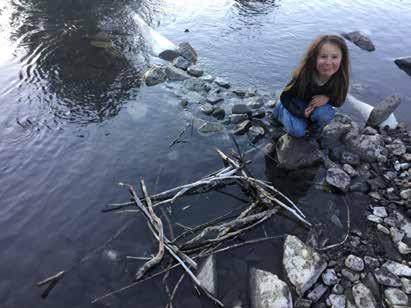
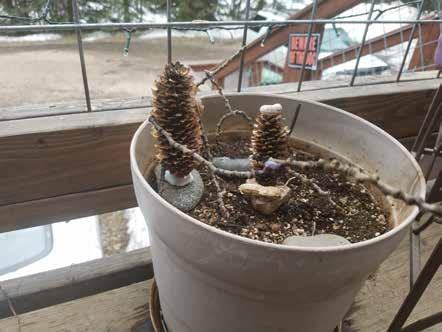
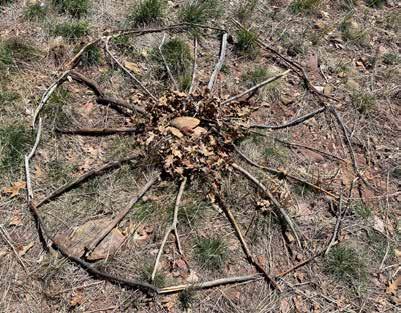
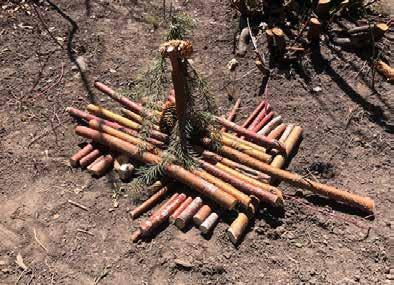
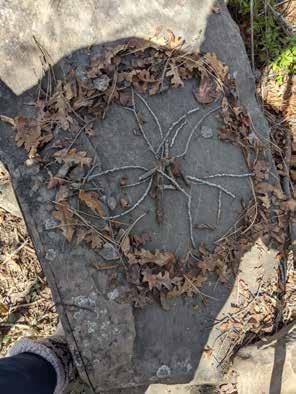
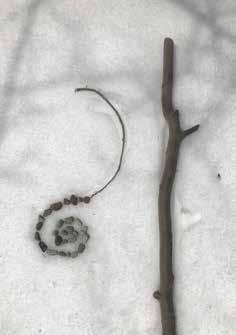
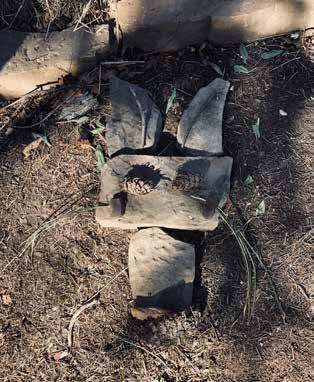
by Aniayh, Grade 8
The beginning of the book “Animal Farm” by George Orwell was about how the animals didn’t like the humans. In the middle of the book, the animals were becoming more like the humans because one of their leaders was telling them lies. At the end of the book, the animals became like the humans even though they said they wouldn’t. Irony is implying the opposite of what is expressed. This book is ironic because some of the animals said that humans are bad and that they shouldn’t be like them, but then they became exactly like the humans.
It all started with a pig named Major. Major was the oldest pig on the farm. Major was around long enough to know that the animals were being treated like slaves. One night Major called a farm meeting. In the meeting Major explained to the animals that they were being treated like slaves and that they should stand up for themselves. The smarter animals like the pigs and horses agreed with Major.
When Major died, a couple of pigs, Snowball and Napoleon, stepped up as leaders. They taught the
animals how to spell and read. The pigs came up with Seven Commandments. The first commandment was one of the most important ones: Whatever goes upon two legs is an enemy. The second one was: Whatever goes upon four legs or has wings is a friend. The third was: No animal shall wear clothes. The fourth was: No animal shall sleep in a bed. The fifth was: No animal shall drink alcohol. The sixth was: No animal shall kill any other animals. The seventh was: All animals are equal. Before the animals came up with these commandments, they all decided to get rid of their farmer, Mr. Jones, so they wouldn’t be “slaves” anymore.
When the pigs took over, they said that all the animals were equal except that the pigs were getting more food than the rest of the animals. The pigs told the other animals to pick up the apples and give them to the pigs. The pigs also said that they didn’t work because their work was planning and thinking of things for the farm and coming up with the rules. The pigs told the animals that their job was just as important as what the other animals were doing. The pigs were acting like they were better than the rest of the animals.
Later on in the book, Snowball and Napoleon called a farm meeting. In the meeting Snowball and Napoleon were arguing about a windmill. During the argument Napoleon let out a small whistle. Seconds later some mean looking dogs came running in and

Get ready for a great day of running through the spectacular fall colors in the heart of Colorado’s Elk Mountain range. Run, walk, or hike the 25k loop around Lead King Basin, zipping past the Crystal Mill and ghost town of Crystal. Cheer the kids on as they run the 2.5k loop around Marble, or linger in Thompson Park after the race and enjoy a delicious homemade lunch including Slow Groovin’ BBQ (lunch included with race entry).
All proceeds bene t The Marble Charter School
chased Snowball. As the animals were watching, they were scared of what might happen to Snowball. Luckily Snowball got away. With Snowball gone, it left Napoleon in charge.
Napoleon became more and more powerful and he became more like a human. He drank whiskey and walked on two legs even though one commandment was, “Two legs bad”. He killed other animals and told them lies. He made deals so he could get money so he could buy whiskey. Napoleon became something he said he wouldn’t be. Napoleon made the other animals act like him except without power. He told the animals a lot of false things about Snowball. Napoleon changed the commandments and changed the rules.
At the end of the book, all the animals were dressing, talking and living like humans. Napoleon changed the commandment “Whatever goes upon two legs is an enemy, and whatever has four legs or has wings is good” to “Two legs better”. The irony of the story is that although the animals didn’t like the humans and they made up all the rules where they weren’t allowed to do or act like the humans, they ended up acting like them anyway.

A tuition free, public charter school serving K-8th grade students in the Crystal River Valley.
Mission: Marble Charter School teaches a growth mindset in a unique and nurturing environment while exceeding state standards.
• Daily bus service to and from Carbondale Middle School
• Homemade Hot Lunch prepared with fresh, organic ingredients served daily
• Focus on Outdoor Education
• Low student to teacher ratios
Now enrolling for the 2020-2021 School Year
Please call or email for information and to schedule a tour of our school.
What have
students been up to since the school closure due to COVID-19 you ask?
My dad and I went on a bike ride behind City Market in Carbondale, CO. We went deep into houses and we found a path that had a staircase and at the bottom there was the Crystal River.
There were trees everywhere you looked. And in the middle of the river there was an island. On the island there was a goose nest with seven huge eggs in a nest.
The mom was giving birth to them and it was so cool, very cool.
Sam Brown, Grade 3
It was a cold day in Marble, Co. My parents were packing for a trip. We were going to Escalante Canyon, an awesome place!
My trip to Escalante Canyon was full of ranger riding and hiking. We played in the creek too. I learned how to safely shoot a bebe gun. We also had a campfire. My mom, dad, sister, brother and I all had fun on our Escalante Canyon Trip. I hope we go again!
Ellamae Siemon, Grade 3
It was a hot sunny day when my mom and I decided to take a walk, so we decided to take our dogs Stucky and Ronan along. They were super excited. Our dog Stucky even jumped, and he never does that! Then we started our way down our rocky, bumpy, dirt road.
Then we reached the highway and decided to cross it in order to get to the river. We crossed it and walked for a bit, then we reached an overgrown path that led down to the river. It was a very steep short section at the end of the path, my mom almost fell face first!
Our dogs seemed very happy to be down at the river. I stated, “Wow, it looks like the dogs really like it down here at the river.” After that I went to go sit next to my dog Stucky. He was starting to go into the water when he stepped a little bit farther and his legs went too deep for his liking so he backed out. I pet him and I felt that he was shaking, he had gotten scared that it was a bit deep. Meanwhile my dog Ronan was proudly bounding from one rock to another rock, back and forth.
Suddenly our dogs had decided they wanted to venture farther up the river, and I offered, “Hey mom, I can take Stucky’s leash.” My mom then responded “Sure, just be careful. They pull.” I took his leash and we ventured even farther, Stucky pulling me in and out of bushes and weeds.
We then realized we went too far and we couldn't turn back. So we kept going until we came across a small ledge. We sat there for a moment, thinking and then I said “Okay well I guess we have to go through these cattails”.
We then let our dogs lead the way, but then there was a small path up. We went up and to our surprise there was no way around the first layer of this barbed wire fence to
get to the Animal crossing step-ladder-thingy. The only way was under. Luckily I found a spot where there were no knots on the bottom. We snuck under and then I went over the step-ladder-thingy.
Then I convinced my mom to let me hold the leash of my stronger, younger dog Ronan. I held the leash as well as I could but then my older dog Stucky started shaking. He was too scared to go over the step-ladder-thingy so my mom had to follow him under the fence, but this time it had those knots. Luckily they didn’t hit any. From that point forward we now know not to go too far up that river again!
Auryn Test, Grade 5
The Pet Adventure
I went on my hill once with my mom and my cat. We were climbing up, up and up! Then we reached the rocky part of my hill!
My cat was having a hard time climbing up the unsteady rocks. We went one at a time until we reached the top. I had the dogs with me too.
When it was time to go home, the pets ran down the hill. I had dinner and went to bed- What an adventure for everyone!
Ayla Duame, Grade 3
Exploring on Serpentine
One day when I was bored on break from my school work and I decided to call Zaida to go mountain biking on the jump by my house. We mountain biked for an hour and then decided to go exploring by foot. We walked up Serpentine, but not on the road though. We saw this cool house that was a hunting cabin. After that we walked down the hill by the house. We went through the forest in front of the house and ended up at Slate Creek.
We followed Slate Creek which was muddy and hard to follow. We got muddy and kind of wet too. We kept walking and found and found a way back to the road. The way back was covered in bushes, but we ended up all the way back up by the Siemons, my neighbors house. Then we walked back up and we were once again back at the jump where it all began.
That was my adventure with Zaida and let me tell you you- it was pretty fun!
Tobin Vinciguerra, Grade 4
As I look down the Crystal River I see Elsie, my younger sister, throwing our raft into the river. The rope slips out of her hand and it slowly starts moving downstream.
The adventure is just beginning! I run down the river bank, which is flat at this point, after it. I walk onto some rocks that are in the river. Then look for the raft and do not see it. “Where is it?, I ask. “Up there!” Elsie answered. I am downriver and I wait for it to get closer to me. A current takes the raft further out into the river.
I can’t reach it. “Get a big stick!” My five year old sister, Fofo, shouts. My mom hands me a long stick. I go ahead of the raft and go as far into the river as I dare. I put my stick out as far as I can reach, then I wait. The raft goes just out of reach, but I manage to hold the raft for just a few seconds. It gets past the stick. I ran down the stream with Elsie following.
The current starts to get stronger and big boulders stand out of the water. The bank gets smaller and rockier and I jump from rock to rock. I stop on a rock and wait for the raft. It gets stuck on a rock a little ways out in front of me. I hold it with my stick and get it closer to me so I can get it out of the water. It slips away from the rock and starts going down the river again. Once more I start running down further and my mom says to come back. I kept running and replied “Just one more try!” My mom yells back, “No, come on!” I kept running and went out on a flat rock and waited watching the raft the whole time. When it passed I was now able to grab it and pull it out of the water.
Afterwards I went home. I realized that I used perseverance and grit and we did get our raft back. It was a good reminder to always do your best and keep trying even when things get hard!
Soren Mile, Grade 5
My sister cut my hair about two weeks ago. She cut it in the afternoon right around 1:00. We decided to set up shop in the bathroom and use scissors. I told my sister, “Just a little bit, okay?”
Then, as she was cutting, I noticed more and more hair on the ground, SO much hair on the ground! It was my hair, too!
After that we went outside and she did braids in my hair. Then she finished and we jumped on the trampoline and did some tricks. I watched some TV and went to bed. It is always fun to get your hair done and even better when my own sister can do it!
Citlaly Penaloza, Grade 6
McClure Pass Mountain Biking
It was April 13, 2020 and we, my dad and I, were driving up McClure Pass to go Mountain Biking. When we got to the trail it looked good- no mud, no snow and it stayed like that for the first switchback.
Then the snow came. The next 3 out of 7 switchbacks were full of snow. We pushed our bikes through snow for the next 30 minutes, though it felt like hours! Then the snow cleared and dad and I went down as fast as we could to make up for lost time.
We stopped to wait up for Keeva, our dog. We waited for 10 minutes calling and yelling out her name, but she never came. We decided to ride down to see if she went ahead of us to the bottom of the trail. Still no sign of her! We knew we would have to go back and ride the trail again, this time we found her. Everyone made it home!
Keegan Jaeger, Grade 5
The Marble Board of Trustees is accepting applications from interested individuals for appointment to a vacant seat on the Marble Board of Trustees. The appointment will be for a two (2) year term.
The applicant must be a United States citizen, at least 18 years of age, a resident of the Town of Marble for twelve (12) consecutive months preceding the date of appointment and a registered elector of the Town of Marble.
The deadline for applications is May 20, 2020. Interested individuals should please contact Ron Leach, Town Administrator at the following email address: leach@townofmarble.com



Automotive Repair
The Mobile Mechanic 970 963 3845 or mobilemechanicllc@gmail com
Cleaning Services
Nancy Fenton, over 20 years experience in Redstone and Marble, 970 963 1865
Clothing
New Jammies 100% organic cotton children's pajamas and baby clothing Size
3 mo-14 www newjammies com
Construction
CAP Construction, all jobs big and small, licensed and insured Charlie Parker 970 963 1502
Villalobos Construction, general contractor, licensed and insured 9701 963 7117
Design
The Flaming Goat: graphic design, illustration/portraits, copy writing, Heathen crafts and art, etc Alden (Goat) Laufeyjarson paytfgoat@gmail com
Electrician
D E C Enterprises David Adams Master Electrician, licenced and insured 970 963 9522
Excavation Work
KSLAB Construction, Kirk Blue, 970 963 1073
Peak Excavation, Hawkins Siemon, Specializing in small, residential excavation 970 963 5604
Ferrier Services
Kevin Farrell, 970 366 0542
Financial Consulting
Victor Mamlin Free



The Inn at Raspberry Ridge: breakfast items, homemade cinnamon rolls and baked goods, coffee bar, and trading post including groceries, fishing, and camping supplies 970 963 2437
The Marble Gallery and General Store groceries and essential goods 963 7117
The Marble Hub, baked goods, snacks, pour-over coffee and WiFi 970 963 7300
Slow Groovin' BBQ 970 963 4090
Handyman
Victor Mamlin, light handyman duty if anyone just needs a hand 720 998 4750
Landscaping
Verde Land Management, LLC 100% organic lawn and garden care Kid and Pet friendly fertilizer and composting! Brent Compton 970 274 7513
Payment Processing
Elevate Payment Alliance, For your local business credit card processing needs Hawkins Siemon, 888 862 4009
Plumbing and Heating
Strong Structures, Ltd Dana Strong, over 40 years experience Master Plumber, BSCE Certified Backflow tester and installer 970 379 3204
Public Notary
L H Enterprises, Ron Leach, 963-1938
Snow Removal
Kevin Cox, 970 963 5525
Brad Kline, 970 704 5309