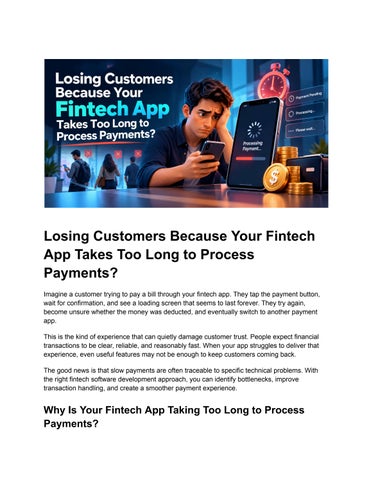
Losing Customers Because Your Fintech App Takes Too Long to Process Payments? Imagine a customer trying to pay a bill through your fintech app. They tap the payment button, wait for confirmation, and see a loading screen that seems to last forever. They try again, become unsure whether the money was deducted, and eventually switch to another payment app. This is the kind of experience that can quietly damage customer trust. People expect financial transactions to be clear, reliable, and reasonably fast. When your app struggles to deliver that experience, even useful features may not be enough to keep customers coming back. The good news is that slow payments are often traceable to specific technical problems. With the right fintech software development approach, you can identify bottlenecks, improve transaction handling, and create a smoother payment experience.
Why Is Your Fintech App Taking Too Long to Process Payments?
Payment delays rarely have just one cause. The problem could originate in your application, backend infrastructure, payment gateway, banking partner, or network connection. Here are some common reasons to investigate.
1. Poor Backend Performance When your app sends a payment request, the backend may need to authenticate the user, validate transaction details, check account balances, communicate with payment services, and record the transaction. If these operations are poorly optimized or unnecessarily dependent on one another, the entire process can slow down. An overloaded database or inefficient API can create delays even when the user interface appears responsive.
2. Payment Gateway Integration Issues Your payment gateway connects your application with payment processing services. Incorrect configurations, slow API responses, unnecessary requests, or poorly handled timeouts can affect the payment experience. Effective payment gateway integration involves more than connecting an API. Your development team should also review error handling, response times, retry rules, and transaction status updates.
3. Infrastructure That Cannot Handle Traffic Spikes Your application might perform well during normal business hours but struggle during promotional campaigns, salary days, or periods of increased transaction activity. If servers, databases, or external service connections cannot handle the workload, users may experience delays or failed payments. Scalable infrastructure helps your application respond more consistently as demand grows.
How Slow Payments Affect Customer Retention Payment speed is not just a technical concern. It directly influences how customers perceive your financial product. ● Reduced trust: Users may worry about whether their money has moved successfully. ● Abandoned transactions: Customers may leave before completing a payment. ● Repeated support requests: Unclear payment statuses lead to questions about pending or duplicate transactions. ● Lower repeat usage: Customers may prefer an alternative platform that offers a more predictable experience.
Consider a digital wallet used for everyday transfers. If users repeatedly need to check whether a transaction succeeded, the convenience of using that wallet disappears. Improving payment reliability can therefore be just as important as adding new features.
How Fintech Software Development Can Solve Payment Delays The solution begins with identifying the actual bottleneck instead of assuming that a complete app rebuild is necessary.
Optimize APIs and Backend Processing Review API response times, database queries, server logs, and dependencies between services. Remove unnecessary processing from the critical payment path and optimize database operations where appropriate. For example, nonessential activities such as sending promotional notifications should not unnecessarily delay the core payment workflow.
Improve Payment Gateway Integration Evaluate how your application communicates with payment providers. Use appropriate timeout settings, handle provider errors clearly, and implement safe retry mechanisms. Importantly, never blindly retry a payment when its outcome is unknown. Use idempotency mechanisms where supported and reconcile transaction statuses to reduce the risk of duplicate charges.
Build Scalable Payment Infrastructure Cloud infrastructure, load balancing, caching for suitable non-sensitive data, and database optimization can help applications handle changing workloads. The architecture should match your transaction patterns and operational requirements. Scaling servers alone will not resolve delays caused by a slow third-party payment provider or inefficient business logic.
Provide Clear, Real-Time Transaction Statuses Users should know whether a payment is processing, completed, failed, or pending confirmation.
If a bank or payment provider takes time to confirm a transaction, communicate that status clearly. Provide transaction references and an appropriate way to check the outcome rather than leaving customers staring at an indefinite loading screen.
What Should You Measure Before Upgrading Your App? Before investing in major development work, establish a baseline. Track these indicators: ● Payment response time: How long the application takes to receive and process relevant responses. ● End-to-end completion time: How long users wait for a confirmed outcome. ● Payment success rate: The proportion of initiated transactions that complete successfully. ● Timeout and error rates: How often requests fail or remain unresolved. ● Pending transaction volume: How many payments need further confirmation or reconciliation. ● Support ticket patterns: Whether customers frequently report delayed or uncertain payments. Break down these measurements by payment method, provider, device, and transaction stage where possible. This helps your team identify whether the problem is widespread or limited to a specific integration.
When Should You Consider Custom Fintech Software Development? If your current platform repeatedly struggles with performance, integrations, scalability, or transaction visibility, it may be time to evaluate your architecture. Custom fintech software development can help businesses build or modernize payment workflows around their operational needs. Depending on the problem, the right solution could involve improving existing code, replacing an unreliable integration, modernizing legacy infrastructure, or developing a new payment platform. At CryptoApe, businesses can explore fintech software development solutions tailored to their product requirements, integration needs, and growth plans. Explore our Fintech Software Development Services to discuss a practical approach to improving your payment experience.
Conclusion
Slow payment processing can cost your fintech business more than time. It can create uncertainty, increase support workloads, and push frustrated customers toward alternatives. Start by measuring where delays occur, reviewing payment integrations, improving backend performance, and making transaction statuses clearer. You do not always need to rebuild your entire application; targeted improvements may solve the underlying problem. Is your fintech app struggling with payment speed or reliability? Contact CryptoApe to discuss fintech software development solutions designed around your business needs and customer expectations.
Frequently Asked Questions 1. Why is my fintech app processing payments slowly? Common causes include inefficient backend operations, slow APIs, payment gateway delays, database bottlenecks, and infrastructure limitations. Monitoring each stage of a transaction helps identify the actual cause.
2. How can fintech software development improve payment processing? It can improve API performance, optimize databases, strengthen payment gateway integrations, scale infrastructure, and provide clearer transaction status updates.
3. Does a slow payment gateway always mean my app needs rebuilding? No. The issue may be isolated to the payment provider, integration configuration, or request-handling logic. Diagnose the bottleneck before deciding whether a larger rebuild is necessary.
4. How can I prevent duplicate payments when transactions time out? Use idempotency keys where supported, maintain unique transaction references, check transaction status before retrying, and reconcile uncertain outcomes with the payment provider.
5. How much does fintech software development cost? The cost depends on the application's complexity, integrations, security requirements, infrastructure, and whether you need targeted improvements or a new platform. A technical assessment helps establish a realistic scope and budget.