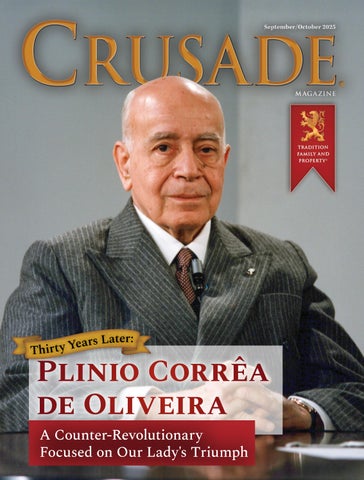
s Later: r a e Y Thirty
Plinio Corrêa de Oliveira A Counter-Revolutionary Focused on Our Lady's Triumph
only! e m i t d ite For a lim
Two impactful books — One low price! “If the Revolution is disorder, the Counter-Revolution is the restoration of order.” —Professor Plinio Corrêa de Oliveira
Plinio: A Man for Our Times by Andrea Phillips
Hardcover, 204 pages
by Plinio Corrêa de Oliveira
Softcover, 180 pages
Revolution and Counter-Revolution
I
n honor of Professor Plinio Corrêa de Oliveira, who inspired its founding, America Needs Fatima is pleased to offer special combination pricing on two of our most popular books. We hope those seeking the most effective way to combat the Revolution will welcome these books, which provide the fundamental principles needed for today’s monumental struggle.
The first is a book written by Professor Corrêa de Oliveira, Revolution and Counter-Revolution. It contains unchanging principles of wisdom that explain the disintegration of civilization in the world today. The author states that the main battleground of the struggle between anti-order (the Revolution) and order (the Counter-Revolution) is fought within civil society and the Holy Church Herself. For a limited time only, we are also offering a companion book, Plinio: A Man for Our Times, for a closer, more familial look inside Professor Corrêa de Oliveira’s life. This action-packed biography describes the authentically Catholic life of a man dedicated to countering the liberal, atheistic, secularist and egalitarian culture of the twentieth century, which spanned his lifetime. The author, Andrea F. Phillips, daughter of a close friend and supporter of Professor Corrêa de Oliveira, grew up in the glowing presence of this great man. She writes: “This book is intended to highlight aspects of Professor Corrêa de Oliveira’s unique personality in a light style, presenting. . . a series of frescoes of his exceptional life.” Written in an accessible and captivating style, Mrs. Phillips’ book will be a treasured addition to any Catholic’s library. n
“The more intense the evils of an epoch, the more exceptional are the figures Divine Providence calls to face them.”
— Cardinal Bernardino Echeverría Ruiz
For a Limited Time, Buy One, Get One FREE! To order, please call: 1-888-317-5571 Mention code: PLINIO
ONLY $12.95 ! (F O R BOTH BOOK
S)
+ S&H
Contents September/October 2025
Cover Story Thirty Years Later: Plinio Corrêa de Oliveira — A Counter-Revolutionary Focused on Our Lady’s Triumph
Professor Plinio Corrêa de Oliveira on the set of the Brazilian television channel, TV Capital, where he debated on confiscatory land reform on the program Message to the President in 1985.
16 4
America Needs Fatima Progress Report ◆ From the Desk of Robert Ritchie 15 ◆ Battlelines 16 ◆ Our Readers and Viewers Write 18 ◆ Custodian’s Corner 19 TFP In Action ◆ Unhinged Woman Arrested as TFP Protests “Drag Nuns” in California ◆ TFP’s Midwest Call to Chivalry Camp Brings Challenges and Blessings
21
Ambiences, Customs and Civilizations Saint Thérèse of Lisieux: A Warrior Saint
24
20
Everyday Americans standing up for Catholic values
19
21
The Fatima Home Visitation Program brings Our Lady into living rooms across America
These Catholic leaders of tomorrow are formed at a Call to Chivalry Camp in Indiana
24
Crusade Magazine is a publication of The American Society for the Defense of Tradition, Family and Property (TFP). Direct all requests and inquiries to: Crusade Magazine, P.O. Box 341, Hanover, PA 17331 or email to: crusade@ TFP.org. Web: www.TFP.org, Tel.: (888) 317-5571. © 2025 by The Foundation for a Christian Civilization, Inc. This publication may include images from iStockphoto™ and Dreamstime™ which are protected by copyright laws of the U.S. and elsewhere. ISSN 1096-3782 LCCN 98-641433
One hundred years after her canonization, we honor Saint Thérèse of Lisieux and beg her intercession for America
M-197 (HF2509)
Crusade Editor: Michael Gorre Associate Editor: C. Michael Drake Contributing Editors: James Bascom, Ben Broussard, Vincent Gorre, Stacie Hiserman, John Horvat II, Tonia Long, Robert Nunez, Gustavo Solimeo, Luiz Solimeo, Rex Teodosio, Renato Vasconcelos
The American TFP The American Society for the Defense of Tradition, Family and Property (TFP) is an organization of lay Catholic Americans concerned about the moral crisis shaking the remnants of Christian civilization. Its earliest origins date back to January 1971, when the first TFP members started to group around the publication Crusade for a Christian Civilization. It is a civic, cultural and nonpartisan organization which, inspired by the traditional teachings of the Supreme Magisterium of the Roman Catholic Church, works in a legal and peaceful manner in the realm of ideas to defend
and promote the principles of private ownership, family and perennial Christian values with their twofold function: individual and social. The TFP’s words and efforts have always been faithfully at the service of Christian civilization. The first TFP was founded in Brazil by the famous intellectual and Catholic leader Prof. Plinio Corrêa de Oliveira in 1960. His work inspired the formation of other autonomous TFP sister organizations across the globe, thus constituting the world’s largest anticommunist and antisocialist network of Catholic inspiration.
Thirty Years Later:
Cover Story
Plinio Corrêa de Oliveira — A Counter-Revolutionary Focused on Our Lady's Triumph By John Horvat II
A
s we observe the thirtieth anniversary of the death of Professor Plinio Corrêa de Oliveira (1908–1995)— the founder of the Brazilian Society for the Defense of Tradition, Family and Property and inspirer of all other TFPs around the world—we must pause to consider not only his past life but, above all, what makes him such a powerful force in the Counter-Revolution in our day. By focusing on the cause of this impact, we honor his memory and gain insights about continuing the fight for Christian civilization in the future.
4
C r u s a d e
Thus, our task is not to prove that his work represented a powerful force in the past. It is not to discuss the efficacy of the TFP movement as a pole of thought today. Secular authors are now writing about his work in retrospect and confirm his impact on his native Brazil and far beyond. Others show how his faith, thought and action continue to exert a strong influence through the efforts of the TFP organizations scattered across the globe. Instead, we will trace the cause of this great impact, both past and pres-
S e p t e m b e r / O c t o b e r
2 0 2 5
n
w w w . T F P . O R G
ent. We will discover what makes this impact so powerful and compelling. We can take courage in continuing his fight for Christian civilization, which is timelier than ever.
Looking for Causes Some might think his Catholic Faith or extraordinary devotion to Our Lady might explain this impact. These factors definitely played their role. Those who knew him in life and especially those who had a privileged, close relationship with him referred to
him affectionately as “Dr. Plinio.” They remember him with great longing. He had the extraordinary ability of turning an abstract cause into something personal and, therefore, powerful. However important these factors might be, Dr. Plinio certainly would choose another theme as the cause of this impact. He would prefer that we discuss this influence in reference to the ongoing fight for what remains of Christian civilization. He always defined himself and the TFP in these terms.
Focusing on the Counter-Revolutionary Thus, he would ask us to discuss this impact in the context of the fight explained in his book, Revolution and Counter-Revolution. This work views post-medieval history as a struggle between those who defend the Catholic Church and Christian civilization (the Counter-Revolution), and their mortal enemy (the Revolution). This is the prism where he would feel himself best explained. Moreover, this was how his enemies saw him: a counter-revolutionary. They did not see a great orator, writer or man of culture, although he possessed these qualities. They seldom praised or criticized these aspects. Revolutionaries do not feel threatened by them. However, what they see and attack in him, both then and now, is the counter-revolutionary. They feel deeply threatened by this characteristic in Dr. Plinio. Thus, our topic must deal with how Dr. Plinio focused on being a counter-revolutionary, as this is the source of his impact, his force de frappe. Being count-
er-revolutionary defined him; it set the tone for all other aspects of his life.
The Counter-Revolutionary Prism Dr. Plinio lived this Counter-Revolution in a very practical, personal and efficient way. It was central to his militant faith. It influenced his devotion to Our Lady. It was the prism through which we can see all those other qualities he put at the service of the Counter-Revolution—orator, writer and man of culture. This characterization as a counter-revolutionary helps explain his powerful influence in our day. His intense focus on the Revolution allowed him to form a school of thought and organize a network of action during his lifetime. The framework he left behind enabled the TFP movement to continue his fight and create great obstacles to the Revolution today. Thus, Dr. Plinio would say, “Stay focused. Just talk about this context of the Counter-Revolution. Nothing more, nothing less. Being counter-revolutionary explains everything.”
It would not be enough to fight against the Revolution. We must fight for Our Lady. His idea was that she must be victorious over her enemies. Adding Our Lady's Triumph However, he would add a qualifier to this title of counter-revolutionary. He would insist that this effort be oriented toward a goal, which was Our Lady’s triumph. It would not be enough to fight against the Revolution. We must fight for Our Lady. His idea was that she must be victorious over her enemies. More than her victory, Dr. Plinio desired her triumph, which is an overDr. Plinio personally welcomed the miraculous International Pilgrim Virgin Statue of Our Lady of Fatima at the airport during one of her many visits to São Paulo, Brazil.
C r u s a d e
whelming win. This triumph is not an imaginary desire driven by Dr. Plinio’s zealous devotion, but the accomplishment of a promise. Our Lady predicted at Fatima that her Immaculate Heart would triumph. This promise makes the Fatima message more urgent than ever. Thus, our theme of celebrating Dr. Plinio as a counter-revolutionary, laser-focused on Our Lady’s triumph, could not be timelier. It serves as a model for all counter-revolutionaries to emulate today.
A Preparation for the Fight Today We could say that everything in our postmodern world conspires to distract us from this Marian triumph. We live in a fragmented society with constant interruptions and distractions. There are so many opportunities for concessions and compromises. There are so many unprincipled and easy ways out of the duty to be faithful to God and His Laws. Dr. Plinio’s focused battle is the model we especially need today, given the intensity and unpredictability of the times. The pace of events has accelerated, and so many absurd things are suddenly affirmed as true. Above all, we are afflicted by the crisis inside Holy Mother Church. Like Dr. Plinio, we grieve at seeing what Paul VI called a process of “self-destruction” destroying the Church from within.1 Thus, Dr. Plinio’s example teaches us to focus on the Counter-Revolution as a means of resistance amid the chaos. It allows us to look to Our Lady with confidence, and be ever certain of her triumph. Analyzing Four Points of Focus There are four points that Dr. Plinio took to heart when focused on this fierce struggle between the Revolution and Counter-Revolution. These focal points are found in any war. To be effective and prevail in combat, we must find allies, identify the enemy, and utilize battle strategies and tactics. Finally, there must be a final goal that, once accomplished, will determine the victory. Dr. Plinio’s clarity of vision enabled him to assemble these four components into a strategy for the Counter-Revolution that remains valid today.
S e p t e m b e r / O c t o b e r
2 0 2 5
n
w w w . T F P . O R G
5
today more than ever, it is imperative to repeat the cry of Moses: “If any man be on the Lord’s side let him join with me” (Exod. 32:26).
Dr. Plinio stands side-by-side with counter-revolutionary allies in front of the Metropolitan Cathedral of the Assumption and of Saint Paul in São Paulo, Brazil, on the occasion of a Mass offered for the victims of communism.
A Strategy for Victory Thus, we will see how Dr. Plinio sought allies by trying to involve as many people as possible in the Counter-Revolution. We will also see how he identified and engaged the enemy in a very concrete battle. He did not fight windmills or embrace abstract causes in the clouds. He did not get distracted or bury himself in fighting yesterday’s Revolution when today’s Revolution is storming the gates of the city. Given the disparity of resources, we will examine how Dr. Plinio developed and refined methods of action to attract friends and instill respect and fear in the Church’s enemies. Finally, we will see how he was laser-focused on his final goal, Our Lady’s triumph. The first three points were the means to achieve the final goal of the triumph of Our Lady’s cause, thus forming a whole. His goal was this triumph. He was not interested in making deals, engaging in superfluous debate or daydreaming about some romantic lost cause. He 6
C r u s a d e
stayed focused on Our Lady’s triumph and worked to make it happen. That must always be our goal as well.
Seeking Allies From the beginning of his public life, Dr. Plinio sought allies for the Counter-Revolution. He immediately perceived the need to find those who would fight with him. For him, it was a matter of survival, not convenience. He did not necessarily want to lead the Counter-Revolution. If he could find someone better suited to lead this titanic struggle, he always said that he would immediately serve that person. He even traveled to Europe in the fifties to search for this leadership. The need for allies is evident. In Revolution and Counter-Revolution, Dr. Plinio affirms that the Revolution is universal, one, total and dominant.2 In other words, it is overwhelmingly powerful. The Counter-Revolution today is not proportional to the size, resources and prestige the Revolution can command. Thus,
S e p t e m b e r / O c t o b e r
2 0 2 5
n
w w w . T F P . O R G
Looking for Isolated Counter-Revolutionaries The Revolution enjoys the massive support of the liberal establishment, which can offer its followers power, status and benefits. It can apply pressure upon and isolate those who resist. The Revolutionary advantage is especially evident in the natural realm of political power and human resources. It awes people by the extent of its power. While acknowledging this often-discouraging reality, Dr. Plinio nevertheless maintained that the counter-revolutionary is more common than generally believed. The Revolution intimidates many people into hiding their true beliefs. Thus, the task of the counter-revolutionary is to seek out and support others who think they are alone, organizing them into effective actions and taking the offensive. Needing Both Natural and Supernatural Aid To counter this impression, Dr. Plinio always counted on both natural and supernatural aid to build a Counter-Revolution. He understood the importance of imploring the help of grace, Our Lady, the angels and saints to compensate for the disproportion of power. However, he understood all too well that we live in a visible world that functions in terms of the material reality of things. This spiritual dimension alone will not suffice. Dr. Plinio believed that the Counter-Revolution must have a strong physical presence. We win only by joining with others and showing up for the fight in the public square. Supernatural forces will never come to our aid if we are not on the battlefield calling for them. Finding Allies Everywhere Allies for Our Lady’s cause can be found by actively looking for them everywhere and attracting them with powerful ideas. In Revolution and Counter-Revolution, Dr. Plinio observed that the Revo-
lution is total because it encompasses all aspects of life, including culture, economy, arts, politics and religion.3 Thus, people in every possible field feel the aggressive action of the Revolution and can be convinced to fight back by joining the Counter-Revolution. Those who promote counter-revolutionary architectural styles, for example, would be natural allies. Farmers who resisted socialist land reform could find an ally in him. He sought the support of those who opposed communist tyranny, which was the cutting edge of Revolutionary action during the Cold War. He later rallied people to confront the Culture War as it threatened to destroy our society, its morals and institutions from within.
As a boy, Dr. Plinio (seen here in his First Holy Communion portrait) resolved to affirm his Catholic Faith and his counter-revolutionary ideals forcefully, earning respect even from his enemies.
Not everyone who resists will agree on everything. He rightly saw that in a lifeand-death struggle of such great magnitude, he must accept aid from anyone who could help the counter-revolutionary cause, while always exercising due prudence. This was the story of his life.
Presenting Powerful Ideas Strongly The book My Public Life is a 2015 compilation of autobiographical texts published in Brazil in which Dr. Plinio describes his lifelong counter-revolutionary public action.
Dr. Plinio found allies by having powerful counter-revolutionary ideas and presenting them strongly in public. He describes how he attracted followers by presenting powerful ideas. Thus, his recruitment of allies consisted of finding others with similar thinking, presenting these powerful ideas to them and orienting them toward Our Lady’s triumph. His strategy was centered on finding issues that could become strong rallying points. This approach ran counter to conventional wisdom, which says the way to create large movements is by compromising principles or creating a “big tent” that welcomes those who hold soft positions.
An Early Incident Confronting the Revolution Thus, in the very beginning of the book on his public life, we find an astute observation from his earliest pre-political actions. Dr. Plinio’s first effort to gather counter-revolutionaries occurred when he attended the Jesuit high school of São Luís, in São Paulo, Brazil, as a young boy. Since he was educated at home with a tutor, his entrance into this school marked the first time he found himself in a place dominated by boys heavily influenced by the revolutionary ideas of modern times. He immediately sensed that anyone with counter-revolutionary ideas like his was the victim of persecution and ridicule. He was determined that this would not happen to him. He noticed that this persecution happened when students timidly showed themselves to be “a bit” Catholic, “a bit” chaste or “a bit” monarchist. All the revolutionary boys would fall upon those who were timid in affirming their positions. This intimidation silenced many a conservative reaction. Taking the Offensive He concluded that the best way to fight against this intimidation was to adopt a contrary strategy. To silence these revolutionary boys, he resolved to strongly
C r u s a d e
affirm himself as someone who was very Catholic, very chaste and very monarchist.4 When he and those who gathered around him did this, it intimidated and silenced the revolutionaries. This affirmation did not necessarily end the war, but it managed to establish what he called “an armed truce” with the enemy, whereby they respected him and refrained from provoking him. It also won him the sympathy of those around him who were encouraged by his action, even if they did not entirely agree with him. This action changed the political environment of the whole school. Thus, Dr. Plinio found allies by having powerful counter-revolutionary ideas and presenting them strongly in public. He would constantly return to this formula throughout his entire life.
Forming International Alliances and Networks This formula extended beyond making personal contacts. Dr. Plinio used this method to form the TFPs, who, in turn, would form alliances, coalitions and networks with other organizations. In the 2021 book Moral Majorities Across the Americas: Brazil, the United States, and the Creation of the Religious Right, Professor Benjamin Cowan documents Dr. Plinio’s impressive work and his early role in forming an international network of organizations and associations that heavily influenced the conservative debate worldwide.5 In his analysis, the liberal professor of history at the University of California, San Diego, notes that Dr. Plinio had very powerful ideas that attracted people to his cause. However, he did not keep these ideas to himself; instead, he spread them everywhere. By reaching inside and outside Brazil, he internationalized these ideas, making them much more powerful and impactful. These contacts gave rise to conser-
S e p t e m b e r / O c t o b e r
2 0 2 5
n
w w w . T F P . O R G
7
vative networks that, to this cern those whose agenda day, oppose the moral evils deviated from his strong prinof our times. Dr. Cowan beciples. He did not allow those lieves these networks are very causes to divert or waste his powerful because Plinio Cortime and that of the Countrêa de Oliveira and those like er-Revolution. him had the vision to look beWherever there was an yond local or national boundadvantage for the Countaries. They cobbled together er-Revolution, there we an international network that would find Dr. Plinio. His united the most diverse groups gradual effort of finding alagainst communism, modernlies and establishing netism and secularism. Dr. Plinio works allowed him to build helped internationalize a mesa formidable Counter-Revsage favoring moral law and olution. Dr. Plinio leveraged the Church’s social teachings, its support to position himwhich the Revolution had tried self where he always wanted to keep local and fragmented. to be—where the fight was Dr. Cowan concludes that most intense. those on the left tend to disre- In 1968, Dr. Plinio paid tribute to Cardinal Josyf Slipyj, Major Archbishop of Ukraine, who suffered eighteen years in Soviet gulags for his outspoken Dealing With the gard these conservative net- Lviv, resistance to communism and criticized the Vatican’s policy of détente Right Enemies works because they strongly toward communist regimes. Another important part of reject such ideas. However, the scholar warns that the left would do XII’s New Year speeches to the Roman his focused struggle involved identifying and engaging with the enemies of well to take notice of their great appeal. nobility and patriciate.6 After the worldwide publication Christian civilization. He avoided fightHe cautions that leftists ignore these of Dr. Plinio’s message against French ing useless disputes, conspiracy theonetworks to their own peril. self-managing socialism in 1981,7 TFPs ries or abstract causes divorced from Finding Common Cause received letters from people all over the reality. He did not pursue yesterday’s Those who formed these cobbled-to- world asking about working together or revolution, seeing that he would be gether networks did not have to agree forming a TFP in their respective coun- much more effective by engaging the one hundred percent. Often, each orga- tries. These places included exotic lo- latest manifestation of the Revolution nization specialized in fighting a spe- cations in Asia, Africa and India. Dr. or directing the public’s attention to cific facet of the overall Revolution. Plinio placed a special emphasis on de- the next one. With great prudence, Dr. Plinio worked veloping these contacts, which involved Because he defined his enemies with Protestants, secular activists and Catholics, Hindus and even Muslims well, he could fight the right enemies others who were enemies of some as- who were opposed to self-managing so- at the right time. Thus, those precious pect of the Revolution. He never com- cialism and willing to fight against this and sparse resources of the Countpromised on his principles when doing aspect of the Revolution. er-Revolution could be deployed with so, nor did he cease to profess the Cathmaximum efficiency, targeting the Revolic Faith strongly and publicly. olution’s most vulnerable points. Dr. Plinio helped Thus, for example, he made common The enemies he especially looked cause with Dutch Calvinists in South Af- internationalize a message for were the Revolution’s most radirica in their fight against communism cal firebrands. He made them his conand, tragically, against the leftist Cath- favoring moral law and the stant concern. olic clergy who supported revolutionary Church’s social teachings, Looking for the Cutting Edge movements and ideas favoring Marxism. In Revolution and Counter-Revolution, In the United States, he contacted which the Revolution Dr. Plinio explains that the Revolution what was then known as the New Right, had tried to keep local is a process that relies upon its most a powerful conservative coalition comradical and dynamic elements to adprised of Catholics, Protestants and and fragmented. vance. These fast-paced radicals take Evangelicals. He even asked New Right the revolutionary principles to their exleader Morton Blackwell, an Episcopatreme consequences.8 lian, to write the foreword to the En- Picking the Right Allies Because these issues tend to lead to glish edition of his book Nobility and Besides finding allies, Dr. Plinio knew Analogous Traditional Elites, which was how to separate himself from those evil, false and ugly goals like communism, mainly his commentary on Pope Pius who were not true allies. He could dis- the Revolution often disguises these nat-
8
C r u s a d e
S e p t e m b e r / O c t o b e r
2 0 2 5
n
w w w . T F P . O R G
urally repugnant ends and strives to present itself as something attractive. Thus, the key to stopping the Revolution is to concentrate on the radical, cutting-edge issues and unmask their hideousness.9 By engaging the head of the Revolution in this manner, we can prevent it from going forward. This fight can slow down or stop the Revolution. It can disrupt the dynamism of its processes and force it to waste time searching for alternative ways to advance. Throughout his long life, Dr. Plinio fought many radical manifestations of the Revolution. He mentioned these fights in the Introduction of Revolution and Counter-Revolution, where he said that those who followed his writings would frequently find “refutations of communism, socialism, totalitarianism, liberalism, liturgicism, ‘Maritainism’ and various other ‘isms’ of the day.10 In each of these fights, Dr. Plinio and his school of Catolicismo writers denounced an extreme component of the same Revolution. The Revolution was the common denominator of all these evils.
Examples From TFP History Later, after the Brazilian TFP was founded, Dr. Plinio continued this constant fight to find and expose the Revolution’s most radical manifestations. Three major campaigns are especially noteworthy. Throughout the Cold War, Dr. Plinio engaged with the communist men-
original studies and articles to influence the counter-revolutionary fight. For example, his perception of the course of events in the United States prompted him to gather a group of TFP members who formed what he called the American Commission. Their research later resulted in a book titled Return to Order: From a Frenzied Economy to an Organic Christian Society.12 The study analyzed the frenetic intemperance Effective counter-revolutionary action of the Industrial Revolution and focuses on the Revolution’s ugly, cuttingits effects on postmodern Ameriedge issues. Left: The American TFP campaigned against the legalization of same- can society. It proposed an organic sex “marriage” in the state of New York in Christian society as an original 2011. Above: TFP caravanners protesting at and viable solution. a Planned Parenthood facility in Milwaukee, Long before computers came Wis., in July 2025. to dominate life, Dr. Plinio recogace, which became especially danger- nized the nefarious effects of this revoous when it changed its face to appear lution on society, youth and education. less violent and friendlier. Thus, Dr. He initiated studies and encouraged the Plinio was there to denounce and ex- writing of articles that discussed the pose communist maneuvers, such as advances of computers and cybernetics détente, the Vatican’s Ostpolitik, Euro- and their revolutionary implications, communism and similar subterfuges. now seen in artificial intelligence (AI). He would inspire the TFPs to fight the He was also original in his discussion deceit every step of the way. of revolutionary ambiences, arts and When a “benevolent” self-manag- music and how each of these fields could ing socialism appeared on the scene in affect tendencies in the Revolution verFrance in 1981, he initiated research, sus Counter-Revolution struggle. wrote a denunciation and spread this Finally, we might add that he was warning throughout the world. He saw not attached to the studies that he inithis new form of socialism as a model tiated and commissioned. If necessary, designed to be adopted worldwide. This he could change direction quickly. If he maneuver of the Revolution would take perceived that public opinion or circumthe world beyond communism by orga- stances had changed and the main effort nizing every aspect of human life accord- of the Revolution was now directed elseing to its radically egalitarian principles. where, he would stop the studies and Finally, he witnessed the promotion pursue something else. He had, so to of indigenous tribalism within Brazil’s speak, a shelf of unpublished books and Catholic Church in the seventies. He studies that never saw the light of day perceived that the theological writ- because of these shifts in the battle. ings of this current’s proponents proposed this “ideal primitive society” as The Third Point of Focus a post-Marxist model to destroy Chris- Dr. Plinio’s third point of focus was detian civilization. He wrote a book that veloping and refining methods of acdenounced and unmasked this ma- tion to attract allies and instill respect neuver, thus preventing it from gaining and fear in the Church’s enemies. He needed to take those powerful traction among the Catholic faithful.11 ideas that he presented strongly and Original Ideas, Books and Studies find a way to make them part of the naDr. Plinio would perceive trends, ideas tional debate. These ideas would be of and tendencies inside society that no benefit if they remained unknown. would later give rise to important and He therefore took advantage of modern
C r u s a d e
S e p t e m b e r / O c t o b e r
2 0 2 5
n
w w w . T F P . O R G
9
media techniques and platforms to amplify his voice. This willingness to adopt modern techniques is one of the things that surprises many people about Dr. Plinio and his school of action. They assume that being traditional means not using modern technology or mass media. Quite to the contrary. He held that all legitimate means must be used to further Our Lady’s cause. In this respect, he was always one step ahead of everyone. If it involved something that would hasten Our Lady’s triumph, he would be for it. For example, long before email be-
Dr. Plinio speaking to a young TFP volunteer during a public street campaign in São Paulo, Brazil.
came the norm for quick and free communication, the TFPs had already developed a rudimentary internal email system in the early eighties to facilitate better communications between the various TFPs nationally and internationally. Few conservative networks had anything like it at the time.
Our Lady Deserves the Best Means In Revolution and Counter-Revolution, Dr. Plinio said that counter-revolutionary action “deserves to have at its disposal the best means: television, radio, major press and a rational, efficient and brilliant publicity.”13 He deplored the attitude of defeatists who made no effort to utilize these means, as the children of darkness most often control and use them to advance 10
C r u s a d e
the revolutionary agenda. Indeed, he believed that the counter-revolutionary should prefer these major means. However, more modest and original ways of spreading the word, such as small meetings, newsletters or article writing, are also valid and vital means of building a Counter-Revolution.14
Big, Original and Small Means To spread the counter-revolutionary message, Dr. Plinio never hesitated to publish ads in major newspapers, even at great cost, because this was the vital means of reaching large audiences in those pre-Internet times. TFP organizations also engaged in extensive direct mail operations and the placement of billboards to alert the public to the significant issues of the day. The most famous means of disseminating the TFP message is its trademark public street campaign, featuring a cape and standard. Dr. Plinio invented the TFP red cape and standard, with the intention that its originality would remain etched in the mind of the viewer. Many years later, the person might not recall the specific issue that TFP members addressed that day, but they would remember the campaign due to its symbolic impact. One American TFP member introduced himself to a state Supreme Court justice. He told the member, “Yes, I know exactly who you are because I studied in São Paulo, Brazil, in the sixties, and you [TFP members] were constantly in the streets.” A full fifty years later, he remembered the TFP campaigns. Grand and Daring Things What characterized Dr. Plinio’s methods of action was that he liked to do grand and daring things. He was not satisfied with only small efforts. He liked to set world records and do what had never been done before. This was the case of his message against French self-managing socialism in 1981. This work was published not as the commonly seen full-page ad. Instead, it was a six-page advertisement, published in forty-six major newspapers across six languages and nineteen countries. The newspapers included The New York Times, The Washington Post, Frankfurter Allge-
S e p t e m b e r / O c t o b e r
2 0 2 5
n
w w w . T F P . O R G
meine Zeitung, Excelsior (Mexico) and the Folha de S. Paulo (Brazil). The TFPs later published a one-page summary of this message in forty-seven papers worldwide, including The Wall Street Journal and The International Herald Tribune.15 The summary was also featured in thirty-one international editions of Reader’s Digest.16 Never in modern history was such a large denunciation published as an advertisement on such a grand scale. During the 1990 campaign for Lithuania’s freedom from Soviet oppression, Dr. Plinio launched an international petition drive that resulted in 5,218,520 signatures being gathered worldwide. It was recorded in the 1993 Guinness Book of Records as the “largest petition” drive in history.17 An earlier signature drive, directed to Paul VI in 1968, against leftist infiltration in the Church had already garnered 2,038,112 signatures in Brazil, Argentina, Uruguay and Chile—a regional record at the time.18 So it was with many of Dr. Plinio’s actions. He was constantly pushing the envelope and doing things that had never been seen before to impress upon the public those powerful ideas presented strongly.
Breaking Myths Dr. Plinio also liked to break the false myths of those leftists who claimed that a Counter-Revolution could not be done in modern times. Thus, he re-
Facing page top: Out of the record 5.2 million signatures gathered by TFPs around the world in 1990 for the freedom of Lithuania from the Soviet Union, the American TFP gathered 833,575 signatures. Facing page below: The certificate issued by the Guinness Book of Records to the TFP in 1993. Left: The Brazilian TFP gathered the lion’s share of the signatures. Above center: The international TFP delegation in Red Square just after they presented the 5.2 million signatures to Soviet Premier Mikhail Gorbachev’s office. Above right: Grateful Lithuanian expats in Brazil thank Dr. Plinio for contributing to their country’s freedom.
cruited young people, whom the Revolution portrayed as despisers of tradition, and turned them into its most enthusiastic promoters. He further demonstrated the popularity of the Counter-Revolution’s ideas by inviting these youth to share them in public, which they did with great passion. In our overwhelmingly secular age, he broke the false myth that people are no longer interested in religion. On the contrary, he demonstrated how religious topics sparked intense interest among youth and the general public. He framed the debate in religious and moral terms because he found them to be the most effective means to motivate people to fight in the Counter-Revolution. Finally, Dr. Plinio broke the false myth that one must resort to revolutionary means to be successful. He never used revolutionary methods to achieve counter-revolutionary goals. He was entirely consistent with his principles and beliefs.
The Resistance Manifesto Such a balanced position was often made difficult by the need to oppose the policies of those in authority without disrespecting them and thereby undermining the social order. Dr. Plinio would never promote a revolution to
fight the Revolution. The most important example of this difficult dilemma was a 1974 document titled “The Vatican Policy of Détente With Communist Governments—Should the TFPs Stand Down? Or Should They Resist?”19 The document came to be known inside the TFPs as the “Resistance Manifesto.” It was published in its entirety in fifty-eight newspapers and publications in ten countries.20 Many other periodicals published a summary. The manifesto declared the TFPs’ state of resistance to the Vatican’s policy of détente with communist regimes. That policy’s glaring contradiction with the Church’s traditional stand on communism could only be understood keeping in mind what Paul VI described as a process of self-destruction, and when he warned that “the smoke of Satan had entered the Church.”21 The Resistance Manifesto provided a framework that would set the standard for opposing evil, even when it was found at the highest levels of the hierarchy.
Resistance Not Revolt In the face of this situation, he found a way to attack the enemies within the Church without attacking the Church Herself. He opposed highly placed prelates who promoted leftist ideas while maintaining due reverence for Church authority. The solution was not to revolt against authority. It was to take a position of respectful resistance—to express our objection of conscience whereby we declare that we cannot participate in self-destructive actions within the Church. We actively resist these subversive actions and defend the Church while maintaining utmost veneration and respect for legitimate authority. This respectful and faithful declaration of resistance is summarized in these words: “On our knees, gazing with veneration at the figure of His Holiness Paul VI, we express all our fidelity to him. “In this filial act, we say to the Pastor of Pastors: ‘Our soul is yours, our life is yours. Order us to do whatever
He [Dr. Plinio] recruited young people, whom the Revolution portrayed as despisers of tradition, and turned them into its most enthusiastic promoters. C r u s a d e
S e p t e m b e r / O c t o b e r
2 0 2 5
n
w w w . T F P . O R G
11
From a tender age (right), Dr. Plinio dedicated his whole life to fighting for Our Lady’s triumph. He received graces to persevere in his fight, especially from Our Lady of Good Counsel of Genazzano (above).
When still very young, I marveled at the ruins of Christendom, Gave them my heart, Turned my back on all I could expect, And made of that past full of blessings, My future.24
you wish. Only do not order us to do nothing in the face of the assailing Red wolf. To this, our conscience is opposed.’”22
Our Lady's Triumph The fourth and final point of focus was Dr. Plinio’s ardent and tireless efforts to work for Our Lady’s triumph. Everything else was secondary. He wanted to do much more than just serve Our Lady. He desired that she be universally served. Dr. Plinio was not a man of half-measures. He would never be satisfied with just a victory or two. He wanted Our Lady’s triumph, which differs from her victory. A triumph is by definition an overwhelming victory. The spiritual and moral triumph had to overflow to temporal society. This triumph presupposes a restoration of order, which he classified in Revolution and Counter-Revolution as “the peace of Christ in the Reign of Christ, that is, Christian civilization, austere and hierarchical, fundamentally sacral, anti-egalitarian and anti-liberal.”23 This resolution to dedicate himself to this concrete ideal of a regenerated Christian civilization motivated him throughout his life. He summarized this dedication to Our Lady’s triumph with these inspiring words: 12
C r u s a d e
The Reign of Mary Foreseen by Saints However, this concrete realization of Our Lady’s triumph cannot be born only of nostalgia for a marvelous but past Christian order, however legitimate it might be. Dr. Plinio based his position on the firmly established expectations of a restored order heralded by many saints who foresaw this great turning point in history. Above all, the great Marian Saint Louis-Marie de Montfort foretold this future order and called it the Reign of Mary, a period of great graces shaped by the faith and spirit of the Mother of God. In the twentieth century, this reign was promised by Our Lady herself at Fatima. She predicted a series of wars, tribulations and disasters, but that these would end with a great conversion and the triumph of her Immaculate Heart. Thus, the hopes for this triumph are well-founded inside the Catholic world.
S e p t e m b e r / O c t o b e r
2 0 2 5
n
w w w . T F P . O R G
Dr. Plinio Never Hid His Desire for Our Lady's Triumph For this reason, Dr. Plinio and the TFPs never hid their desire for this Marian triumph from the public. It is found in TFP books and publications from the very beginning. Dr. Plinio proclaimed this renewed Christendom in his talks and writings. It is boldly announced by the TFP standards unfurled on public streets. It is found in his brand of militant Catholicism inspired by the Crusades. Everything in his life work reflects this great ideal of a renewed Christendom informed and dominated by Our Lady’s spirit. In Revolution and Counter-Revolution, Dr. Plinio points to this new Christendom as a goal when he says: “The Counter-Revolution is the struggle to extinguish the Revolution and to build the new Christendom, resplendent with faith, humble with hierarchical spirit and spotless in purity.”25 A Tender and True Devotion to Mary Thus, this laser-like focus on Our Lady’s triumph presupposed a great and tender devotion to the Blessed Mother, which was the most vital point of Dr. Plinio’s life. His devotion was marked with special consideration for Our Lady under many titles, each with its own significance in this struggle. Our Lady of Fatima is directly linked to the chastisements and events leading up to her reign. Our Lady of Good Counsel of Genazzano, in her famous shrine near Rome, speaks to the confidence needed to weather the storms and battles to get there. Our Lady of Good Success, in Quito, Ecuador, repeats these themes while emphasizing her majesty and dominion in the coming Marian era. Dr. Plinio’s story is interwoven with the symbolism of these invocations. Thus, a strong Marian focus is found in all his actions. It could not be otherwise. For if the Revolution has so many resources at its disposal, we cannot conceive a counter-revolutionary action outside of Our Lady’s loving protections and overwhelming aid. She not only levels the playing field but also tilts it in her favor.
For this reason, Dr. Plinio instilled in TFP members and supporters an intense devotion to Our Lady. He helped arm us for battle by promoting the daily recitation of the Holy Rosary. He especially encouraged the Consecration to Our Lady as a slave of love, following the method of Saint Louis de Montfort. Everything must be done “by Mary, with Mary, in Mary and for Mary.”26 If any success is achieved, it must be attributed to her. Amid the trials of battle, he taught us to ask for yet more help, assuring us that we would never be left unaided.
When asked for advice, Dr. Plinio invariably exhorted members and supporters of the TFP to have more devotion to Our Lady and encouraged all to consecrate themselves as slaves of love to the Virgin Mary following the method of Saint Louis de Montfort.
Indeed, this tender confidence in Our Lady is what makes Dr. Plinio such a powerful force in the Counter-Revolution of our days. He taught us to trust in her promise of triumph. It serves as an anchor for our hopes amid the trials we face.
Lessons From His Life As we celebrate Professor Plinio Corrêa de Oliveira as a counter-revolutionary entirely focused on Our Lady’s triumph, we should consider his life and example as a standing invitation for us to do the same. His life contains special lessons applicable to us. The fight that he initiated continues with ever-greater intensity. Thus, our task is to follow in his footsteps by adopting the same four points of focus that he practiced so mightily. We must search for allies in this fight for a return to order, especially among those who grieve for the iniquities of this world.
Our Lady’s triumph has only become more urgent, and this gives Dr. Plinio’s legacy an immense and powerful impact. Our task is to be faithful to it and prolong its echo in history. We must avoid those who, in their zeal to destroy the chaos of the present order, embrace anarchy. We must never be sidetracked with lesser plans, mediocre positions or shameful concessions. We must be careful, for example, in dealing with what are today called cultural Christians, who appreciate only the external aspects of the Faith and reject its moral teachings. These postmodern players engage in “godless crusades” without Christian goals or morals. We must follow Dr. Plinio’s zeal in identifying the enemy, especially in its latest and most radical manifestations and reincarnations. This is all the more important in the face of the disintegration of the liberal order, in which the categories of left and right are often blurred. We must adjust our focus to target all the advances of the Revolution. In the field of the sexual revolution, for example, “trans” activists have taken their rainbow flag to new depths of revolt against the Christian order. They propose the denial of reality, nature and identity. In new fields like artificial intelligence and virtual reality, we must analyze how these technological developments influence human psychology to favor the Revolution.
teachings of Holy Mother Church. From that secure foundation and with unlimited confidence in Mary Most Holy, all things become possible. We must employ new means to accomplish our goal of having powerfully constructed and strongly expressed ideas. Thus, we should neither be stuck in the past nor embrace new and transformative developments like AI too eagerly, which contain grave dangers and should be used with due caution. However, the most important lesson is to stay focused on the final goal. That has not changed, nor can it change. Our Lady’s triumph has only become more urgent, and this gives Dr. Plinio’s legacy an immense and powerful impact. Our
Having Recourse to Holy Mother Church In cases of doubt, we should follow Dr. Plinio’s example and rely on the only solid foundation that exists. Any counter-revolutionary stand must be a principled one, reflecting the perennial
Above: The funeral procession to Consolation Cemetery in downtown São Paulo. Left: Dr. Plinio was buried wearing the TFP ceremonial habit.
C r u s a d e
S e p t e m b e r / O c t o b e r
2 0 2 5
n
w w w . T F P . O R G
13
task is to be faithful to it and prolong its echo in history.
A Battle That Is Still His We are at the end of the historical era of liberalism. Dr. Plinio combated the numerous specific errors of this liberal era, which today are reaching new extremes of absurdity as it increasingly disintegrates. This battle is still his battle. We should draw from his wisdom as we combat these errors effectively and efficiently in their final phases. His masterpiece, Revolution and Counter-Revolution, remains our battle handbook because it contains an understanding of the centuries-long revolutionary process and provides the framework for undertaking an effective Counter-Revolution. As the founder of the TFP movement and its worldwide family of souls, Dr. Plinio shares in the charisms of all founders. Founders are the cornerstones upon which movements are built. Providence provides these souls with everything needed to accomplish their missions as they unfold throughout the ages. When Notes:
1. Paul VI, “Speech to the Members of the Pontifical Lombard Seminary” (Dec. 7, 1968), https://www.vatican.va/content/paul-vi/it /speeches/1968/december/documents/hf_p -vi_spe_19681207_seminario-lombardo.html. 2. Plinio Corrêa de Oliveira, Revolution and Counter-Revolution, 3rd ed. (Spring Grove, Penn.: The American Society for the Defense of Tradition, Family and Property, 1993), 11–13. 3. Corrêa de Oliveira, Revolution and CounterRevolution, 12. 4. Enrique Loaiza, et al., eds., Minha vida pública: Compilação de relatos autobiográficos de Plinio Corrêa de Oliveira (São Paulo: Artpress, 2015), 23–24. 5. Benjamin A. Cowan, Moral Majorities Across the Americas: Brazil, the United States, and the Creation of the Religious Right (Chapel Hill, N.C.: The University of North Carolina Press, 2021). 6. Plinio Corrêa de Oliveira, Nobility and Analogous Traditional Elites in the Allocutions of Pius XII: A Theme Illuminating American Social History (Lanham, Md. and York, Penn.: Hamilton Press; American Society for the Defense of Tradition, Family and Property, 1993), xxi–xxvii. 7. Plinio Corrêa de Oliveira, “What Does SelfManaging Socialism Mean for Communism? A Barrier? Or a Bridgehead?” (Dec. 9, 1981), TFP.org, https://www.tfp.org/what-does-self -managing-socialism-mean-for-communism-a -barrier-or-a-bridgehead/. 8. Corrêa de Oliveira, Revolution and CounterRevolution, 31–32. 14
C r u s a d e
in need of aid and discernment, disciples can have recourse to their founders even long after their deaths. Thus, we, too, must have recourse to Dr. Plinio. It is impossible not to perceive that he accompanies our battles from eternity. We can count upon his assistance, as indeed we have, over these last thirty years. For those of us who knew him, we can almost hear him as he directs us in the right direction.
Being Faithful to the Lessons If we have survived for these three decades, it is because we have sought to be faithful to the lessons he has entrusted to us. Like him, we have suffered from all sorts of trials, betrayals and impossible situations. Like him, we were inspired to write timely works and launch impressive campaigns, which have had great repercussions. We have been blessed with the attraction of young people who continue to fill our TFP ranks. Indeed, his fidelity is the reason we find ourselves still in the fight for Our Lady’s cause. All of this happened be-
9. Ibid., 101–102. 10. Ibid., 1. 11. Plinio Corrêa de Oliveira, Indian Tribalism: The Communist-Missionary Ideal for Brazil in the Twenty-First Century, https://www.tfp.org /indian-tribalism-the-communist-missionary -ideal-for-brazil-in-the-twenty-first-century/. 12. John Horvat II, Return to Order: From a Frenzied Economy to an Organic Christian Society— Where We've Been, How We Got Here, and Where We Need to Go (York, Penn.: York Press, 2013). 13. Corrêa de Oliveira, Revolution and CounterRevolution, 88. 14. Ibid., 88–89. 15. Serviço de Documentação da Sociedade Brasileira de Defesa da Tradição, Familia e Propriedade, Um homem, uma obra, uma gesta: Homenagem das TFPs a Plinio Corrêa de Oliveira (São Paulo: Edições Brasil de Amanhã, 1989), 289, 292, https://www.pliniocorreadeoliveira. info/Gesta_0000Indice.htm. 16. “The Message,” Crusade July/August 2013, 11, https://www.tfp.org/magazines /crusade_mag_vol_124.pdf. 17. Peter Matthews, ed., The Guinness Book of Records: The Most Complete Collection of Astonishing Authenticated Facts and Figures From Around the World (New York: Bantam Books, 1993), 477–78, https://archive.org /details/guinnessbookofre00matt. 18. Antonio Augusto Borelli Machado, ed., Tradition, Family, Property: Half a Century of Epic
S e p t e m b e r / O c t o b e r
2 0 2 5
n
w w w . T F P . O R G
Like Dr. Plinio, we must never cease confiding in Our Lady’s promise at Fatima that her Immaculate Heart will triumph.
cause of his focus on the final goal. We too, should look to Our Lady. It is the intensity of his fight for her that gives us the certainty of her triumph and allows us to continue. It is still his fight, even now, thirty years later. n
Anticommunism, John Russell Spann and José Aloisio A. Schelini trans. (Mount Kisco, N.Y.: The Foundation for a Christian Civilization, Inc., 1981), 132, https://issuu.com/nestor87 /docs/half_century. 19. Plinio Corrêa de Oliveira, “The Vatican Policy of Détente With Communist Governments— Should the TFPs Stand Down? Or Should They Resist?” TFP.org, https://www.tfp.org/vatican -policy-detente-communist-governments-tfps -stand-resist/. 20. Serviço de Documentação, Um homem, uma obra, 259–60. 21. Paul VI, “Sermon for the Mass of the Ninth Anniversary of the Crowning of His Holiness” (June 29, 1972), https://www.vatican.va /content/paul-vi/it/homilies/1972/documents /hf_p-vi_hom_19720629.html. 22. Corrêa de Oliveira, “The Vatican Policy of Détente.” 23. Corrêa de Oliveira, Revolution and CounterRevolution, 75. 24. Borelli Machado, ed., Tradition, Family, Property, epigraph. 25. Corrêa de Oliveira, Revolution and CounterRevolution, 117. 26. St. Louis-Marie Grignion de Montfort, A Treatise on True Devotion to Mary, Frederick William Faber, trans. (Spring Grove, Penn.: The America Society for the Defense of Tradition, Family, and Property, 2013), 111.
America Needs Fatima ®
September/October 2025
PROGRESS REPORT
t Ritchie From the Desk of Rober Dear Soldier of Our Lady,
de Montfort. a problem to Saint Louis ted sen pre ily fam s lle rvi uare, where In Rennes, France, the D’O house adjoined the city sq his t tha ort ntf Mo de Louis g the rosary. Mr. D’Orvilles told Saint s distracted from prayin wa ily fam his t tha ise ch no young people made so mu of Our Lady d: lie The saint rep ks the square, put a statue oo erl ov t tha ll wa the of e “Make a niche in the façad nt of her.” fro in ary ros the y ulously. there and pra lied Mr. D’Orvilles, incred nt. “In the public square?” rep r Lady,” instructed the sai Ou of e nt of the imag fro public in the ht in rig re ary ua ros sq c the bli “In the pu family prayed his d an s lle rvi D’O . Mr , he them, invitAfter completing the nic friends even called out to me so d an by, d sse pa es rriag nd, but he held square. While praying, ca his rosary beads in his ha e hid to d pte tem s wa st, he ing them to a party. At fir prayer. could see that he was at if some grand all t tha so h his rosary hig me in crowds to pray, as ca le op Pe . ed en pp ha ng square ceased. Over time, a strange thi Soon, the disorders in the . ing en pp ha re we y on ing today in America. church cerem nnes, France, is happen Re in ed en uld solve the pp ha at wh My friend, r Immaculate Heart wo he to n tio vo de t tha a tim Our Lady revealed at Fa y. dy and pledge rit pu im d an world’s sins a rally captain for Our La me co be , ith Fa r ou to cly I invite you to testify publi e solution.” d you, and vin “di the d an r yourself to he rosary, the sign we will sen ur yo e tak t Jus . did s lle rvi friends and pray. That’s it! You can do what the D’O tober 11 with family and Oc on is the prayer. ot sp c bli pu a in then stand endment of life. The rosary am d an e nc na pe , yer pra for ly captain. At Fatima, Our Lady asked g for your pledge to be a ral itin wa e’s Sh e. nc na pe is the sfatima.org/ Standing in a public place visit https://americaneed 2, 01 4-6 58 6) (86 ll ca in, : your smartphone camera To become a rosary capta scan this QR code with or p n-u sig inpta ca lyoctober-ral In Jesus and Mary,
Robert E. Ritchie, Executive Director
C r u s a d e
S e p t e m b e r / O c t o b e r
2 0 2 5
n
w w w . T F P . O R G
15
ANF PROGRESS REPORT
Taken from ANF ’ s public ation , B attlelines
the midst of all the pride messages, and a sign of hope for a return to God. I pray many others feel the same way,” he said. In Cincinnati, Ohio, Patrick and Mary posted billboards along Interstate 71 that potentially attracted more than 5.6 million views. Their work got so much attention that the Cincinnati Enquirer wrote an article about the billboards. Michael in Bridgeport, Conn., feels the campaign is a way to turn back to God and away from sin. “These billboards are a powerful way to take action and help place Our Lord before every person who drives by,” he said. Bridgeport, Conn.
Annual Billboard Campaign Proclaims: June Belongs to the Sacred Heart For the third consecutive year, TFP-ANF friends and supporters helped place billboards in cities and towns across the country to remind everyone that June is dedicated to the Sacred Heart of Jesus. What started in central Florida has now spread nationwide with billboards appearing in Cleveland, Houston, Sacramento, San Jose and many other locations. Mark of Worcester, Mass., joined with his friends to sponsor four billboards in the area and next year they hope to post them outside Boston. “A friend told me the billboards were a refreshing sight in
Fighting to Keep Satan Away from Our Children The immoral and sinful Paranormal Cirque, a traveling circus, visits towns across the country and opens its doors to children as young as thirteen – falsely teaching them that the gravely offensive acts depicted in these shows are acceptable. However, our prayer warriors show up also, to make reparation against this evil event. And, as a result, many shows have been canceled! In Lancaster, Penn., Joseph, a rally captain, held three rallies over a weekend and saw more and more people joining him. He concluded the weekend of prayer with twenty people praying the rosary in public on a Sunday evening. Overall, Joseph said the weekend was a huge success. “Our Lady is so good. We did not have any issues with the rallies.”
Lancaster, Penn. 16
C r u s a d e
S e p t e m b e r / O c t o b e r
2 0 2 5
n
w w w . T F P . O R G
ANF PROGRESS REPORT
You can help TFP-ANF fight back by hosting a rally close to your home. Just text PROTEST to 87837 or contact Jose Ferraz toll-free at (844) 830-3570! Defeating Drag Queen Story Time Victoria, a rally captain, knows that sinful people pushing LGBTQ ideologies are no match for Our Lord! When she heard about a Drag Queen Story Time happening at Irvington Branch Library in Indianapolis, Ind., Victoria jumped into action to organize a rosary rally. Although evil protesters hissed, howled and sang foul songs when they began the rosary, Victoria and her friends were not fazed and continued with the rally. “We were praying for reparation to the Sacred Heart of Jesus and the Immaculate Heart of Mary, protection of the children and the conversion of the librarians, staff and all that entered the doors,” she said. “We felt honored to serve God and honor Our Lady on the Solemnity of the Immaculate Heart of Mary. I would highly encourage people to show up, even if they only have two people, to pray the rosary, because when we are gathered in His Name, Jesus can move hearts and mountains.” Prayer Is More Powerful than Pride: Rally Group Follows Our Lady's Example Although they were a small but mighty group of seventeen prayer warriors, Emmanuel, a rally captain, and his friends were not afraid to take on the largest pride event in the South. The group gathered outside the forty-seventh annual pride festival in Houston to make reparation against the blasphemous event open to people of all ages – including children! Emmanuel said he learned we can overcome anything if we place our faith in Our Lady. “When my friends and I were praying the rosary in public, I sensed that we were following the example of Our Lady. When Jesus was on the Cross, Our Lady didn’t hide away to avoid suffering; instead, she stayed and prayed with Him the entire time,” he said. “It felt amazing to lead the rosary rally! There is so much evil
Wilkes-Barre, Penn.
in our world, so being able to interfere with their plans, even if it’s only a little bit, means a lot to God and Our Lady,” he added.
Traveling Circus Pitches Its Tent to Promote Immorality Every time our dedicated TFP-ANF friends and supporters hear that the Paranormal Cirque is coming to their town, they spring into action to organize rosary rallies against it. Paranormal Cirque is especially blasphemous because it features men dressed as nuns simulating immoral acts. These events appear to praise so many sinful acts, including public immorality, the culture of death and the public acceptance of Satanism. They are particularly evil because they welcome and encourage children to attend the shows. In Wilkes-Barre, Penn., Walter, a rally captain, and his friends held a peaceful rally along a busy highway near a mall where the Paranormal Cirque show was taking place. They brought along a banner that read, “We are one nation under God and Satanism is not an American value.” Walter said he was happy to hold the rally. “We were honored to pray the rosary in public and ask God and Our Lady to protect our children from the rise of Satanism.” If you hear that a Paranormal Cirque is showing in your town, please host a peaceful and legal rosary rally of reparation. n Houston, Tex.
C r u s a d e
S e p t e m b e r / O c t o b e r
2 0 2 5
n
w w w . T F P . O R G
17
ANF PROGRESS REPORT
Our Readers and Viewers Write From Our Readers:
“I want to thank The American TFP and their offshoot America Needs Fatima for headlining the opposition to Satanism in America, specifically in the recent and horrific Black Mass and satanic ceremonies at the Kansas State Capitol. “When I first started to hear bits and pieces about Satanism, years back now, I almost ignored it, because Satanism in America, of all places, almost seemed too ridiculous, too outside reality to be believed. Joke was on me! It’s here and it’s real and it’s growing. Let us not forget the angels in this fight! “Great-winged and always before the Father’s Face, they set the original example with Saint Michael’s roaring cry of ‘WHO IS LIKE UNTO GOD!’” Alison G., Brewster, Mass.
“I was praying all morning feeling overwhelmed. Then, in the mail, was this amazing gift. I wish I could donate more but I barely have enough to cover my monthly expenses. Nevertheless, you will never know what receiving this rosary meant to me. God bless you! Thank you!” Anna K., Mio, Mich. “My wonderful friends, it is an honor and a privilege to support this outstanding organization, which helps so many people in their time of spiritual need. Those living in a spiritual wasteland need Our Lady. Always trust her Son, Our Lord Jesus Christ, in ALL things!” Roman O., South Gate, Calif. 18
C r u s a d e
“I am not Catholic, but would love to learn more about how to pray with this beautiful rosary. Thank you so much. Bless what you do!” Peggy B., Marysville, Mich. “I’ve seen a ton of Catholic art and statuary in my life, but I have to tell you that your photo of the statue of Our Lady of Fatima that cried in New Orleans has eyes that I’ve rarely seen—they so pierce the soul, in the most gentle and serious maternal way possible. Catholics would be in much better shape spiritually if they’d spend time in front of her, letting her eyes do their work!” Anonymous, Brunswick, Maine
‘Why is it wrong? And who has the authority to say so?’ “And that’s when I had the most important realization of my life: the solution to modern chaos isn’t just the restoration of moral values—but the restoration of moral authority. Without a foundation rooted in truth and Divine order, every attempt to ‘fix’ the world falls into relativism, confusion and ultimately despair.
From Our Viewers:
“I have to say, I first started watching your videos when I was still in early high school—over four years ago. At the time, I didn’t fully realize the impact they would have on me. “I was a lost atheist, drifting through life with no deeper sense of direction or meaning. Like so many others, I had unknowingly absorbed the values of the status quo, accepting what society presented as truth without ever questioning its foundations. But your content began to plant small seeds. Seeds of doubt—not toward faith, but toward the hollow promises of modern culture. You didn’t just critique society; you revealed its spiritual vacuum. Even though I couldn’t articulate it back then, something in me began to awaken. “I started to sense that what was missing in my life wasn’t just a set of beliefs—but a real, objective moral compass. It wasn’t until about a year ago that everything truly began to fall into place. “That’s when I seriously started putting the puzzle pieces together. I began asking deeper questions—not just ‘What is wrong with the world?’ but
S e p t e m b e r / O c t o b e r
2 0 2 5
n
w w w . T F P . O R G
“As I dove deeper, reading, praying and listening, I came to see clearly that the Catholic Church is not just a voice among many—it is the one, true, holy, orthodox and apostolic Church, founded by Christ Himself. It alone has preserved the fullness of truth, the clarity of doctrine and the authority given by God to teach, to guide and to sanctify. “And for this, I owe a profound debt of gratitude to TFP. Your boldness, clarity and commitment to timeless truth were instrumental in leading me home. You didn’t water down the Faith— you proclaimed it unapologetically, and that’s exactly what a lost soul like mine needed. “Thank you—for being a light in the fog, for standing firm in the storm and for helping me rediscover what it means to live for something greater than myself.” Daniel Vazquez, YouTube comment
ANF PROGRESS REPORT
C USTODIAN'S O R The Story of a Big Conversion N E on the Feast of Our Lady of Fatima R By Norman Fulkerson
W
hen Our Lady appeared at Fatima, she gave dire warnings of what would befall mankind if they did not amend their lives. It was so shocking that many people converted. As the world continues to decay, many reject her Fatima message. However, others are changing their lives because of those same prophecies. That is what happened with Chris after he and his wife Jacqueline hosted an America Needs Fatima home visit at their home in Melbourne, Fla., on May 6, 2025. During these visits, an America Needs Fatima custodian arrives at the host’s home with a large statue of Our Lady to give a presentation about the Fatima message. At this visit, Chris kept a distance when the program began but moved closer to the custodian when it came time for the explanation of the Five First Saturdays devotion. He looked bewildered to find out it entails confession, Holy Communion, praying the rosary and meditating on the mysteries of the Holy Rosary for fifteen minutes. “I don’t know how to do any of these things,” he blurted out. It turns out that
Chris had not practiced the Faith since childhood. Thus, he did not know how to pray the rosary, go to confession or make an examination of conscience. Needless to say, like many Catholics today, he did not know what a mortal sin is. The two of us had a very long talk about the need to confess because “all it takes is one mortal sin to send a person to Hell for all eternity.” Chris’s reaction to the instruction was truly remarkable. While many might have bristled at such direct counsel, he accepted it with a refreshing childlike docility. I decided to leave the statue of Our Lady in Chris’s home for some days until I returned the following week for another tour of visits. The day I arrived happened to be May 13, the feast of Our Lady of Fatima’s first apparition. Chris arrived a short time later and said he went to confession, which lasted an hour. After unburdening his soul of fifty years of sin, he admitted to me that he broke down and cried. Our Lady of Fatima was undoubtedly responsible for this miraculous transformation. On the first night the statue stayed in his home, Chris said he stayed
Are you wondering if a Fatima Home Visit is for you?
up until 1:00 a.m. just looking at her: “She is so beautiful!” His wife Jacqueline was shocked by the transformation and later told me with a glowing countenance, “I never imagined my husband would pray a rosary with me!” On this year’s anniversary of her first apparition in Fatima, Our Lady truly got a “big fish.” Chris’s story is a powerful reminder of the transformative power of divine grace and the enduring relevance of Our Lady of Fatima’s message in drawing souls back to God. His latelife journey from the state of sin to sincere reconciliation is a testament that it’s never too late to come home. n
I
f you would like to have a Fatima Custodian visit your home or school with a statue of Our Lady of Fatima, please contact America Needs Fatima’s scheduling department at (888) 460-7371. This is a FREE service provided by ANF to achieve its mission of winning the heart and soul of America for Our Lady.
Just scan this QR code for a video showing what will happen when Our Lady enters your home. C r u s a d e
S e p t e m b e r / O c t o b e r
2 0 2 5
n
w w w . T F P . O R G
19
TFP in Action Fighting the good fight for moral values
Unhinged Woman Arrested as TFP Protests “Drag Nuns” in California By Jon Paul Fabrizio
W
hen the American Society for the Defense of Tradition, Family and Property (TFP) learned that the Russian River Sisters were planning another Pride Month story hour at the Guerneville Regional Library in California on June 21, we immediately planned a rosary rally of reparation. As we unloaded from our vans that day, three TFP bagpipers played “Immaculate Mary” as we marched to the front of the library. Our rally spanned the entire sidewalk, showing that God’s side was in full force. It did not take long for things to escalate. As we began praying the rosary, a few people started heckling us, claiming we were not “loving.” What happened next exposed the hypocrisy behind their words.
The Arrest One woman holding a young child walked over and loudly proclaimed how much she loved the toddler. After repeating her declarations for a few minutes, she took the child into the library for the immoral story time.
What she did next was scandalous— and would cost her dearly. She reemerged from the library and began to scream incoherently—she had visibly lost her mind. Then, she began to undress herself to the point of nudity and lewdly grab herself in public. To everyone present, only demonic possession described what we saw. We immediately called 911, and the police responded quickly. They took the woman aside, and she admitted to her guilt. The officer asked if we wanted to press charges, and we immediately responded, “Yes!” She was then taken into custody and booked for indecent exposure.
The Left Falls Apart, and Catholics Rejoice After the incident, the counter-protestors’ dynamism evaporated. They sat on the sidelines, making childish remarks about our clothing. They had nothing to say on an ideological level. Conversely, the local Catholics who joined the TFP volunteers recited Hail Marys with enthusiasm and vigor. Everyone attending was happy to stand up for what is right, especially protecting the innocence of children. One local woman mentioned that Guerneville is the most pro-homosexual town in the country. She said that last year, she was happy to see our protest but too frightened to join us. However, the Holy Ghost inspired her to attend this year. She thanked the TFP Thanks to a grace from Our Lady, this TFP member, Mr. Phillip Calder, remained calm in the face of a demonic storm.
20
C r u s a d e
S e p t e m b e r / O c t o b e r
2 0 2 5
n
w w w . T F P . O R G
The iconic American TFP bagpipers lead the way into battle in Guerneville, Calif.
volunteers and said she is already looking forward to next year’s rally. Another local man brought his young son in a stroller, explaining that “it’s good to start them out young.” This father stood in stark contrast to those who brought their children to the blasphemous Drag Queen Story Hour. A few moments later, he added, “I’ve always seen your videos, but actually being here is ten times better. Especially the bagpipes! You don’t realize how intense these rallies are just from watching.”
What Can We Take Away from All This? Even though this blasphemous story time occurred, the rosary rally was a definitive victory for Our Lady. There are four reasons why. 1. We showed the “drag nuns” that they cannot scare Catholics away. 2. This campaign alerted thousands of Catholics all over the country about these blasphemous story hours. 3. The event showed that young people like our volunteers are willing to stand up for Christian civilization. 4. Someone was there to make reparation to God. Through Our Lady’s intercession, this protest was a resounding victory for God, the Catholic Church and America’s children. n
TFP in Action
TFP’s Midwest Call to Chivalry Camp Brings Challenges and Blessings By Rex Teodosio
I
t was not an ordinary boys’ camp. From the beginning, it was fraught with challenges and suffering. However, overcoming those obstacles helped fill the camp with blessings and grace. The American Society for the Defense of Tradition, Family and Property (TFP) held its nine-day Midwest Call to Chivalry Camp, which took place from June 21 to July 3 at a campground in Brazil, Ind. These camps seek to help young boys grow into Catholic gentlemen and knights. This year’s three camps were held in Pennsylvania, Louisiana and Indiana. The theme was discovering Catholic Portugal, where the boys learned about Portuguese saints and heroes, and enjoyed themed meals. The camps consist of a rich mixture of talks, devotions, games and adventures. The boys never knew what historic figure or dramatic event might appear on the schedule. One of the camp’s most memorable moments, for example, was a dramatic skit on the life of Saint Nuno Álvares Pereira, the famous Carmelite Constable of Portugal. The scene showed the saint confronting noblemen who were scandalously feasting with the enemies of Portugal. In an unforgettable moment, the saint flipped the banquet table, sending plates, platters and goblets crashing to the floor. It was a striking example of intransigence in the face of betrayal—one the boys won’t soon forget. Another major highlight was the eleventh-century-themed treasure hunt. The camp also included a campaign held after Sunday Mass on the topic of
abortion. Many boys had seen TFP Student Action videos online and wanted to learn how to defend the Faith in public, just like the video volunteers. Debate classes helped them prepare. At the center of everything was an emphasis on manly devotion, with prayers, rosary processions and even an hour-long “vigil of arms.” Our Lady was at the center of everything. The camp’s grand finale was the medieval games and banquet. This year’s games were held at the nearby medieval-themed Clayshire Castle, featuring a long wooded approach, wide lawns, a giant chessboard and a hedge maze. The banquet was held in the castle’s great hall, where a professional trumpeter played several baroque pieces for the guests. After the meal, the finals of the fencing tournament took place in the hall. A unique feature of the Call to Chivalry Camp is the micro-talks on etiquette and manners. Evan Olwell, the camp director, read from an old seminary manual that taught etiquette to future priests. Knights are called to be chivalrous, and that Top: With rosaries in hand and banners aloft, participants in the Midwest Call to Chivalry Camp commence a pilgrimage along a roadway in Indiana. Middle: Teamwork and strategy won the day for boys participating in the legendary Medieval Games. Bottom: Taking the call to chivalry to the streets, these Catholic men-in-the-making spent their Sunday afternoon defending the unborn.
C r u s a d e
S e p t e m b e r / O c t o b e r
2 0 2 5
n
w w w . T F P . O R G
21
includes having good manners and social grace. The camp came with many challenges that resulted in trials and suffering. The day before the prep crew was scheduled to arrive, a fire broke out in the kitchen. The fire extinguisher left a coating of toxic dust over the kitchen, dining room, meeting hall and game area. There was no time to clean the whole facility thoroughly. There was a last-minute scram-
ble to find alternative spaces for cooking, eating and gathering. Many boys also experienced personal hardships, such as illness or minor injuries. The way they bore these crosses was inspiring. In an age marked by softness and comfort, it was moving to see young men endure with a Catholic spirit of sacrifice. Over the nine days, the boys have countless memories of tournaments
played, challenges overcome and friendships formed. They heard the call to chivalry and answered it. The final talk reminded them that knighthood means fighting for a Catholic ideal. A hero is someone who faces adversity for a good cause. A saint is one who practices virtue to a heroic degree. Even at their young age, they too, are called to be heroes and saints. n
A Little Flower with Great Aspirations Saint Thérèse of the Child Jesus and of the Holy Face was called “the greatest saint of modern times,” in the words of Pope Saint Pius X. The charm of her “Little Way,” with all its sweetness and mercy, admirably harmonizes with the traits of a genuine warrior. “I would die in a battlefield, arms in hand,” she once stated.1 Her soul had infinite aspirations: she wanted to be a warrior, priest, apostle, doctor of the Church and martyr; she felt the courage of a crusader, of a Papal Zouave; she wanted to die on the battlefield defending the Church; she wanted to preach the Gospel to the four continents and the remotest islands. “Jesus, Jesus”—she would say—”if I were to write all my desires, I would have to borrow Thy book of life; I wanted to have achieved all these deeds for Thee . . . .”2
titled The Mission of Joan of Arc. The following year, as Pope Leo XIII declared Joan of Arc “Venerable,” and France celebrated its holy martyr and warrior, Saint Thérèse wrote the play Joan of Arc Fulfills Her Mission, which the whole religious community staged. Saint Thérèse played the role of Saint Joan of Arc. The play featured the conquest of Orléans and the coronation of King Charles VII, but above all, Saint Joan of Arc’s burning at the stake, which to Saint Thérèse meant the apex of the achievement of the heroine’s mission. Saint Thérèse signed her canticle to obtain the canonization of Saint Joan of Arc as, “A French soldier, defender of the Church and admirer of Joan of Arc.” Saint Joan, the Virgin of Orléans, and Saint Thérèse, the Virgin of Lisieux, are two models of militant Catholic combatants against the enemies of the Church and of Christian civilization. Though they led such different lives—one strictly military and the other contemplative—the two great saints nonetheless have profound affinities with each other. Saint Thérèse did not live to see Saint Joan’s canonization, and she was far from imagining that, on May 18, 1925, Pope Pius XI would present her, Saint Thérèse, to the Catholic world as “a new Joan of Arc”; and that during the Second World War, Pope Pius XII would declare her, like the Virgin of Orléans, “secondary patron of all France!”
(Continued from back cover. . . )
Thereafter, Thérèse always called Pranzini her “first son”–her course was set. She entered Carmel at age sixteen, and though she lived as a Carmelite for only nine years, she rose to the heights of sanctity through her “Little Way” of serving God and others in everyday life, and doing everything, even the smallest things, with great love and child-like trust in God’s paternal love and mercy. At the request of her sister Pauline, who glimpsed her sanctity, she penned her autobiography, The Story of a Soul.
A New Joan of Arc This warrior aspect of Saint Thérèse’s soul is dominant in her moral profile. Yet, even those who love her most tend to forget this trait. “In my childhood, I dreamed of combating in the battlefield. When I began to learn the history of France, I was enchanted with the deeds of Joan of Arc; I felt in my heart a desire and courage to imitate them.”3 Saint Thérèse gradually became increasingly aware of the profound similarities between her life and that of the Virgin of Domrémy. Thus, on January 21, 1894, the 101st anniversary of the martyrdom of the unfortunate King Louis XVI, she wrote a theater play While in the convent, Saint Thérèse portrayed the heroine of France, Saint Joan of Arc, whose deeds “enchanted” her. 22
C r u s a d e
S e p t e m b e r / O c t o b e r
2 0 2 5
n
w w w . T F P . O R G
A Crusader Soul The idea of the fight constantly fed the strong soul of the Little Flower. “I went to sleep for a few moments during prayer,” she would tell Mother Ag-
Saint Thérèse of the Child Jesus and the Holy Face holds an image displaying both of these devotions that were so integral to her spiritual formation.
nes. “I dreamt there were not enough soldiers for a war against the Prussians. You said: We need to send Sister Thérèse of the Child Jesus. I answered that I agreed, but that I would prefer to fight at a holy war. But finally I went all the same. “Oh no, I would not fear going to war. With what joy, for example, at the time of the Crusades, I would have gone to combat heretics. Yes! I would not have been afraid to be shot; I would not have feared the fire!”4 “When I think I’m dying in bed, I would want to die in an arena!”5 The same combative spirit animated her in the struggles of the spiritual life: “Sanctity! We need to conquer it at the tip of the sword . . . we need to fight!”6 Such was the mettle of this extremely active and energetic warrior soul, according to the testimonies of those who knew her: “Under a suave and gracious aspect [she] revealed at every instant, in her actions, a strong character and a manly soul; she would not be discouraged in her dedication to the interests of the Church.”7
A “Manly Soul” “This is a manly soul, a great man,” Pope Pius XI later said. Saint Thérèse of the Child Jesus thus followed the advice of the great Saint Teresa of Ávila to her daughters: “I want you not to be women in anything, but equal to strong men in everything!”8 Thus wrote Cardinal Antonio Vico about the Virgin of Lisieux: “Thérèse’s virtue imposes itself with incredible majesty: the child becomes a hero; a virgin
with her hands full of flowers causes astonishment with her manly courage.”9 A handwriting analysis of Saint Thérèse’s Act of Profession gives this admirable testimony: “An iron-clad resolution, a great will to fight, an indomitable energy are expressed here. These traits show at the same time the fright of a child and the decisiveness of a warrior.”10 In 1914, when the First World War broke out, Saint Thérèse appeared some forty times on various battlefields, at times holding a cross in her hand, at times a saber! The soldiers saw her; she spoke to them matter-of-factly, resolved their doubts, helped them overcome their temptations and calmed their fears. She protected, consoled and converted them. French soldiers would invoke her as “my little sister of the trenches,” “my war patroness,” “the shield of soldiers,” “the angel of battles” and “my dear little captain.” A soldier wrote, “In fact, that gentle Saint will be the great heroine of this war.” Another commented, “I think of her when the cannon thunders with great roar.” Countless were the artillery pieces and planes named after Sister Thérèse; whole regiments were consecrated to her. Countless relics of the saint that miraculously stopped rifle bullets like real shields, saving the lives of the soldiers who carried them, are in her convent of Lisieux, a testimony to the great prodigies of the one who, in fact, “died with arms in her hand.”11
The Final Words of Saint Thérèse Struck with tuberculosis, Thérèse suffered greatly. Knowing she was dying, she prom-
ised, “I shall spend my Heaven doing good on earth . . . I shall let fall a shower of roses.” Saint Thérèse died on September 30, 1897, after a brief ecstasy. Her last gasping words were, “My God! . . . I love Thee!” She was canonized by Pius XI in 1925, and devotion to her quickly spread throughout the world. For her doctrine of “The Little Way,” Saint Thérèse was declared Doctor of the Church by Pope John Paul II in 1997. n Notes:
1. Poésies de Sainte Thérèse de l'Enfant-Jésus, “Mes armes,” March 25, 1897, Office Central de Lisieux, 1951. 2. Manuscrits Autobiographiques, dedicated to Mother Mary of the Sacred Heart, Office Central de Lisieux, 1956, folio 4 t'. 3. Lettres de Sainte Thérèse de l'Enfant-Jésus, Letter to Father Belliere, Office Central de Lisieux, 1948. 4. Carnet Jaune, 4.8.6 in Demiers entretiens, Éditions du Centenaire, Desclée de Brouwer –Éditions du Cerf, Paris, 1971. 5. Summarium of the Process of Beatification and Canonization 1, testimony of Celine, 2753. 6. Correspondance Générale, Éditions du CerfDesclée de Brouwer, Paris, 1972, t. I (1877– 1890), Letter (no. 89) Celine, April 26, 1889; Letter to Leonie, May 20, 1894. 7. Summarium of the Process of Beatification and Canonization 1, testimony of Mother Agnes, 706, and of Mother Therese of Saint Augustine, 1072. 8. Lettres de Sainte Thérèse de l'Enfant-Jésus, as quoted by Saint Teresa of Avila in a letter to Father Rouland, November 10, 1896, Office Central de Lisieux, 1948. 9. L'Esprit de Ia Bienheureuse Thérèse de l'Enfant-Jésus d'après ses écrits et des témoins occulaires de sa vie. Office Central de Lisieux, 1924, Preface, at VIII. 10. Father François de Sainte-Marie, OCDP, Manuscrits Autobiographiques, Office Central de Lisieux, 1956, vol. II, 53. 11. Cf. Interventions de Sr. Thérèse de l'EnfantJésus pendant la guerre, Pluie de Roses, Lisieux, 1920; and Ch. Gabriel Sarraute, Un soldat français: sainte Thérèse de l'Enfant-Jésus, Imprimerie Morière, 1970.
From her deathbed, Saint Thérèse prophesied, “I shall spend my Heaven doing good on earth.” For countless Catholics, she continues to fulfill this promise to the present day. C r u s a d e
S e p t e m b e r / O c t o b e r
2 0 2 5
n
w w w . T F P . O R G
23
Saint Thérèse of Lisieux:
The saint of the “Little Way” possessed courage comparable to that of the great French warrior maid, Saint Joan of Arc, whom she portrayed in The Mission of Joan of Arc, a play she wrote and produced for her Carmelite convent in Lisieux, France.
A Warrior Saint
By Luiz Azevedo
M
arie-Françoise Thérèse Martin was born on January 2, 1873, in the town of Alençon in French Normandy. Her parents were Louis Martin, a watchmaker, and Zélie Guerin, both canonized by the Church. Called Thérèse, she was the last of nine children, five of whom survived to adulthood. Growing up in a deeply Catholic family, Thérèse’s life was filled with love, consideration and kindness. A pretty, blonde and blue-eyed girl, hers was a precocious mind and passionate, willful, sensitive nature, a nature made yet more sensitive by her mother’s death from breast cancer when Thérèse was four. After his wife’s death, M. Martin moved his family to the town of Lisieux
and rented a charming home, “Les Buissonnets,” where he raised his five daughters in bourgeois comfort. He had a special affection for Thérèse, whom he called “my little queen.” For her mothering needs, the little girl turned to her favorite sister, Pauline, who took the rearing of her “child” seriously, looking after her needs of body, mind and soul. When Pauline decided to enter Carmel in 1882, the shock made Thérèse seriously ill. As the illness progressed, and as her family prepared for the worst, the sick girl appealed to a statue of Our Lady by her bed on May 13. “Suddenly,” Thérèse writes, “Mary’s face radiated kindness and love. . .” and she was healed. To the family, the statue became “The Virgin of the Smile.”
The “Great Conversion” On Christmas Eve in 1886, at the age of fourteen, Thérèse received a great grace. In one moment, she was cured of her hypersensitivity, and went through what she calls “her conversion.” From then on, she decided to live no longer to please herself but for love. She felt her heart burn with the wish to help Jesus save souls. Hearing of a murderer, Henri Pranzini, who had been condemned to death but remained unrepentant, she set out to pray and offer small sacrifices for his conversion and trusted that God would hear her against all appearances. She was elated when she read that, though refusing a priest to the last at the scaffold, Pranzini suddenly turned and, snatching a crucifix from the attending priest’s hands, kissed it repeatedly. (Continued on page 22. . . )