Chronicles of the Cruising Club of A merica THE PLACES WE CRUISED
Voyages - Chronicles of the Cruising Club of America
Voyages
Issue 68 | 2026
Issue 68 | 2026
Commodore’s Column
T
he purposes of The Cruising Club of America as reflected in our constitution and bylaws are “to promote cruising and racing by amateurs, to encourage the development of suitable types of cruising craft, to stimulate interest in seamanship, navigation, and handling of small vessels, to gather and keep on file all information which may be of assistance to members in cruising.” This edition of Voyages touches all those bases. We are treated to stories written by frequent contributors to Voyages. RJ Rubadeau (BOS) imagines a humorous letter he’d write to his former self as a nipper in over his head in 1970; Ellen Massey (BOS) tells a tale of adventuring in British Columbia and Alaska in wintery conditions via sailboat and floatplane with fascinating descriptions and incredible photographs; and at the opposite pole, Skip Novak (GLS) retraces the steps of Shackleton’s incredible traverse of South Georgia Island. Sheila McCurdy (BOS/NBP) summarizes the 2025 Western Isles Cruise with a reflection on the CCA’s long history of cruising with our fellow adventurers on the other side of the “pond”; and Jil Westcott (BOS/NBP) recounts her recent transatlantic crossing aboard Moonshadow. From Asia, Simon Currin (WES) teases us with a new story about the wonders and challenges of cruising in the South Pacific aboard Shimshal 2; Behan Gifford (PNW) continues her narrative of her extended cruise with her family aboard their Totem, this time with an in-depth look at rare cruisers in Japan; and Chuck Hawley (SAF) describes a cruise up the Mekong River in a part of Asia once feared, reluctantly “toured,” or avoided altogether by American men of a certain generation. Steve James has penned a wonderful bio about Pete Hill, the 2025 CCA Blue Water Medal winner. New contributors U.S. Marine Corps veteran Peter Gibbons-Neff (CHE) writes of the challenges he faced in the 4,050 mile 2023 Mini-Transat solo aboard his 21-foot boat Terminal Leave, and Michael Linhares (NYS) shares the heartbreaking story of trying to save the beautiful Baltic 51 High Note after a collision rendered the rudder inoperable, and the ultimately unsuccessful attempts to get the steering to work
and save the yacht. Louis Meyer tells his tale of introducing a motorboat friend to the joys of sailing and his unyielding affection for his twice-purchased and once-abandoned Hinckley 35 Strummer (don’t forget to read Louis’ letter to the editor about his rescue of another sailor!), and Eric Grubman (ESS) shares his story of racing to Bermuda without electricity aboard his J/46 MoJo. For something completely different, Julian Delarue (BDO) reports on his baleen whale research off Newfoundland and Labrador, conducted from his 42-foot steel ketch Andromede. The new CCA Cruising Guide to Labrador, edited by James Watson, was reviewed by Ocean Cruising Club member Martin Fuller in the OCC’s Flying Fish and is republished in this edition of Voyages. Don’t miss the newest feature of Voyages, namely the letters to the editor. Final Voyages, where we get to read short biographies of our fellow CCA members who have “crossed the bar”, is a poignant testament to the club’s mission well-lived by so many wonderful sailors in pursuit of adventurous use of the sea. Thanks to the time, effort and inspiration invested by the authors and to editor Dan Biemesderfer’s careful curation, you’ll be richly rewarded by these stories. Finally, I am writing this aboard Moonstone from a refreshingly breezy Anse à L’Ane, Martinique. Elizabeth and I are making our way slowly from Antigua to St. Vincent and the Grenadines to join in the Grenadines cruise, and send our best wishes to you wherever your sailing adventures take you!
About the CCA The Cruising Club of America is among North America’s foremost resources on offshore cruising and racing and, together with the Royal Bermuda Yacht Club, co-organizer of the legendary Newport Bermuda Race. The club is comprised of more than 1,356 accomplished ocean sailors who willingly share their cruising expertise with the greater sailing community through books, articles, blogs, videos, seminars, and onboard opportunities. Ocean safety and seamanship training through publications and hands-on seminars is a critical component of the club’s national and international outreach efforts. The club has 14 stations and posts around the United States, Canada, and Bermuda, and CCA members are actively engaged with the next generation of ocean sailors as they look forward to the club’s second century of serving the offshore sailing community. For more information about the CCA, visit cruisingclub.org.
Bermuda * Boston * Buzzards Bay Post * Gulf of Maine Post * Narragansett Bay Post Bras d’Or * Chesapeake * Essex * Florida * Great Lakes New York * Pacific Northwest * San Francisco * Southern California* Western Europe
Voyages
Chronicles of the Cruising Club of America
cruising club officers Commodore – John R. Gowell Vice Commodore – A. Chace Anderson Secretary – Patricia Ann Montgomery Treasurer – Kathleen M. O’Donnell
voyages editor Voyages Editor – Daniel R. Biemesderfer voyages@cruisingclub.org
voyages committee Editor of Final Voyages – David P. Curtin (BOS) Past Issues Manager – Cindy Crofts-Wisch (BOS/BUZ) Editorial Advisors: Dale Bruce (BOS/GMP), Doug Bruce (BOS/GMP), Lynnie Bruce (BOS/GMP), John Chandler (BOS/GMP), Doug Cole (PNW), Max Fletcher (BOS/GMP), Bob Hanelt (SAF), Cameron Hinman (PNW), Amy Jordan (BOS), Charlie Peake (NYS), Krystina Scheller (BDO), Brad Willauer (BOS/GMP)
editors emeritus Alfred B. Stamford, 1962-1974; Charles H. Vilas, 1974-1988; Bob and Mindy Drew, 1988-1994; John and Nancy McKelvy, 1994-1999; John and Judy Sanford, 1999-2002; T.L. and Harriet Linskey, 2002-2010; Doug and Dale Bruce, 2010-2017; Zdenka and Jack Griswold, 2017-2021; Amelia and Robert Green, 2021-2024
design and layout Daniel R. Biemesderfer; Claire MacMaster, Barefoot Art Graphic Design; Tara Law, Tara Law Design; Hillary Steinau, Camden Design Group
proofreading Daniel R. Biemesderfer; Virginia M. Wright, Consultant; Editorial Advisors
printed by R.R. Donnelley, Chicago, Illinois
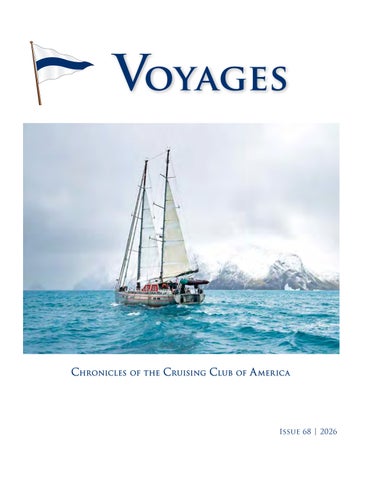
cover photo Vinson of Antartica in South Georgia Island – photo by Stephen Venables
copyright notice Copyright 2026, The Cruising Club of America, Inc. Copyright 2026, respective author(s) of each article, including any photographs, drawings, and illustrations. No part of this work may be copied, transmitted, or otherwise reproduced by any means whatsoever except by permission of the copyright holders.
4
38 46
VOYAGES 2026 4
Letters to Voyages Louis Meyer, Jami Kloet, Doug Cole, Gretchen and Dan Biemesderfer
6
Applied Cruising: Baleen Whale Surveys off Newfoundland and Labrador by Julien Delarue, Bras d’Or Station
14
A Motorboat Guy by Louis Meyer, Essex Station
20
The Shackleton Traverse Revisited by Skip Novak, Great Lakes Station
30
Racing to Bermuda without Electrons by Eric Grubman, Essex Station
38
A Bump in the Night: The 2025 Transatlantic Race by Michael Linares, New York Station
46
Miles of Isles and Smiles: Cruises with Other Clubs by Sheila McCurdy, Boston Station
52
Shimshal in the South Pacific by Simon Currin, Boston Station
60
North Coast Mosey: A Wintry Voyage Photographing the Wild Beauty of the Inside Passage by Ellen Massey, Boston Station
72 A Letter to Myself by R.J. Rubadeau, Boston, Gulf of Maine Post
80 Riverboat Travel on the Mekong
by Chuck and Susan Hawley, San Francisco Station
92
Moon Shadow Sailing West Across the Atlantic by Jil Westcott, Boston and Narragansett Bay Post
2
voyages
102 4.050 Miles Alone Across the Atlantic: Reflections on the 2023 Mini Transat and the Next Mission Ahead by Peter Gibbons-Neff Jr., Chesapeake Station
110 Six Months in Japan by Behan Gifford, Pacific Northwest Station
116 Blue Medal Awardee 2025: Pete Hill by Steve James, Florida Station
122 Book Review – The Rigging Handbook: A Comprehensive Guide to Sailboat Rigging by Herb Benavent Review by Tom Wadlow, Essex Station
123 Book Review – Zoonie Sails Home by Barbara White Review by Gretchen Dieck Biemesderfer, Essex Station
124 Book Review – The Gales of November: The Untold Story of the Edmund Fitzgerald by John U. Bacon Review by Douglas Cole, Pacific Northwest Station
127 Book Review – CCA Cruising Guide to Labrador Edited by James Grovenor Watson Review by Martin Fuller, published with permission of Flying Fish: The Journal of the Ocean Cruising Club
128 FINAL VOYAGES Salutes to departed members. Edited by David Curtin, Boston Station and Buzzards Bay Post, and Daniel Biemesderfer, Essex Station
152 GUIDELINES for Final Voyages, photos, letters and articles 153 LAST WORDS from the Editor
52
72 102
60
116 issue 68 | 2026
3
Letters to VOYAGES Rescue in the Bermuda 1-2 by Louis Meyer, Essex Station
On June 10, 2025, while racing in the Bermuda 1-2 on my Pilot 35 sloop Strummer, I was south of the Gulfstream and about 300 miles from Bermuda. In the early morning hours I received a text from the race committee that Alex Khandros’s mini 829 had been dismasted. Since I was the closest boat, I was asked to change course and pick him up. I texted back that I was on my way. Conditions were difficult. It had been blowing in the high 20s from the south for more than 24 hours and a heavy sea was running. Alex’s reported position was about 30 miles north. When I changed course, the autopilot stopped functioning. In the rough conditions, and with the wind-vane paddle coming out of the water frequently, I wasn’t able to balance the boat well enough for the vane to take control, so it was hand-steering for the next six-plus hours. Once at the reported position, all I could see was big waves and lots of white water. It would not be easy to identify a little white mini. The race committee texted that Alex had drifted about 8 miles north of his first reported postion. After another two hours, I finally picked up Alex’s AIS signal on my plotter. I doubt I could have found him without AIS. I positioned Strummer about 100 yards downwind of Alex,
Jami’s Western Isles Lament By Jami Kloet
When your best friends invite you to sail the Western Isles of Scotland … And you laugh until you cry for 2½ weeks. There are sheep everywhere. You see whales, and seals, and puffins. The dolphins show up daily. You squeeze seven adults into a tiny galley because onboard meals are actually better and more fun than fancy restaurants. You anchor outside an ancestral castle. In the rain. And it doesn’t feel real. You wear all the weather gear and still sit on deck because you don’t want to miss a single thing. You drink coffee on the deck under the sun. And rum in the rain. Sometimes in the same hour. You sail to the ends of the earth and breathe in the sea air. You marvel at the landscape. Visit remote islands in the Outer Hebrides, where purchases are made through “Honest Boxes.” You explore waterfalls and cliffs and beaches. Tiny cafes with locally foraged dishes. Oban Kerrera Tobermory Eileen Donan Castle Mallaig Talisker — Isle of Skye Lochboisdale Castlebay and Vatersay Canna Muck/Eigg/Tobermory Loch Aline Edinburgh 4
voyages
and we made radio contact. Conditions had gotten worse with the wind now a steady 30 knots and both boats rocking and rolling in the seaway. Alex launched his life raft, but it inflated upside down; he managed to right it and climb in, cut himself away from the mini and drifted towards Strummer. A person in a life raft has no control over the raft and little visibility. On the first pass, Alex bounced off Strummer and drifted towards the stern. The raft hit the wind-vane paddle and sheared it off. I made several more passes, which were unsuccessful. It required a good amount of throttle to move the boat in the heavy conditions, and it was very dicey because both the bow and stern were lifting high out of the water with the waves. I was worried Strummer might come down on top of the raft if the approach was not exactly right. Ultimately one of the approaches worked, the raft made contact with the canopy opening towards Strummer, and I was able to pass a line to Alex, which he secured to the raft. The raft was full of water, and Alex in his foul-weather gear and boots was totally waterlogged and unable to climb out of the raft. I brought the main halyard to him, he clipped it to his harness, and I winched him aboard. We were both uninjured but exhausted. We each had a glass of whiskey and slept for 12 hours. The next morning, we set sail for Bermuda.
You drink lukewarm ciders and lots of red wine, because ice isn’t really for the Scottish. Raise your hand if you want Chardonnay? You play horrible games of pool at tiny little pubs with friendly locals and swap sea stories at the bar with fellow sailors. You only forget someone at the dock once. You start to pick up a Scottish accent and call everything “wee” and refer to people as “lad” and “lassy.” You call a highland cow a “harry coo.” Tartan now goes with everything and bagpipes are part of your playlist. You understand what a “loch” is but don’t know the difference between a “straight” and a “sound.” A langoustine is not a prawn. And also not worth the effort. You create new memories with old friends by day and reminisce about the past over nightcaps. You spend 14 nights on a 44-foot sailboat with six other adults, and you could have easily done 14 more. These are your people. You experience something that you will never be able to put into words. And your heart is full. Thanks to the crew of SV Havana: Cam, Courtnay, Adrian, Daina, Trevor, and Nancy. Haste ye back, greasaibh air ais. Fair winds and following seas.
Gary’s Tugboat
By Doug Cole, Pacific Northwest Station At one time, when he was in his early 20s, PNW member Gary Nolan owned two boats. Their average length was 75½ feet. Not a bad start, you might say, but a bit unusual. Gary has owned his beloved and well-traveled Tarka, a 26-foot William Atkins Eric Jr., since 1973. What skewed the average LOA for a few years began in 1974 with an ad in the Seattle Times: “For Sale – 122’ Tugboat. Can be inspected at Lake Union Drydock. Cheap.” Gary and four buddies thought, “Hey, we could live on it. It’ll be fun!” The group’s combined skill set at the time was basically one semi-skilled diesel mechanic and four small-boat skippers with above- average carpentry skills. Built in Nanaimo in 1944 as the mine sweeper Rossland (J-358), she served for only a few years in the Royal Canadian Navy before being sold to Sea Span Tug & Barge of Vancouver, where she was converted for towing operations. There she saw years of service along the British Columbia coast as La Verne. She was 189 tons, and her original Vivian engine had been replaced with a 40-ton, 600-horsepower Washington 8-18 diesel. Engine displacement was 22,000 cubic inches. The flywheel alone weighed 9,000 pounds. Gary and friends renamed her Coquitlam in honor of her original ship classification. Being a minesweeper, the heavy fir hull planking was fastened with wooden trunnels.
Misadventures in the Gulfstream: Lessons Learned in the 2024 Newport Bermuda Race
By Gretchen and Daniel Biemesderfer, Essex Station The 2024 Newport Bermuda Race was difficult with three boats being lost and others in the fleet suffering various degrees of damage. Our boat’s story describes the latter and offers some valuable lessons. Shearwater, a Mason 43 owned by Gretchen (ESS) and Daniel Biemesderfer (ESS), was entered in the Finisterre Division in 2024 and has sailed in eight previous NBR races. Shearwater typically races with a crew of eight, including CCA members Rich Formica (ESS) and Jeff Ott (ESS) in addition to the owners. The 2024 race used a new starting line just off Castle Hill, giving spectators a close-up view of all the action at the start, however, the nice breeze we started with died, leaving the fleet drifting aimlessly. At one point, as Shearwater slowly drifted without steerage toward a competitor, its skipper yelled over, “What are your intentions?” We yelled back, “To fend off if needed!” Once the wind filled in, the first two days of the race were pleasant. On Sunday, the winds began to build, and we found ourselves in the Gulf Stream, sailing with a double-reefed main, a staysail and a No. 3 Genoa. We were pleased with the way the boat was handling the conditions, when suddenly we heard a sickening crash on deck. Both sets of lower shrouds had separated from the mast and fallen along with the retaining bolt that held them to the mast. The Nyloc nut had backed out and
Moorage in Seattle’s Lake Union was quite inexpensive, the arrangement being that the tug would act as a floating breakwater for several different marinas. The Washington diesel was 20 feet long, 10 feet high and maxed out at 300 rpm. Each cylinder was the size of a full-sized cylindrical trash can. It was started with 250 psi of compressed air, and a cold start involved “a lot of white smoke,” Gary recalled. “It would sometimes lay down a good-sized smoke screen on the lake. But when it was running, it sounded like a well-oiled sewing machine.” There was a gangway alongside the cylinders for access when manually oiling the numerous externally moving pieces. Being direct drive, it always started in gear. Transiting the Ballard locks could be quite an exercise given the 15 to 20 seconds it took to change the direction of engine rotation. Two hundred rpm would produce a comfortable 12knot cruising speed. Ship and vessel maintenance were all done in-house. Haul-outs took place on a steep beach. Bottom work and painting often requiring several tides to complete. There were numerous party cruises on nearby Lake Washington, and guests would often gather around a piano that had been installed in the main saloon. Their last and longest cruise was a two-week trip to the San Juan Islands in 1976. A highlight of their ownership was taking second place in the Seattle Retired Tugboat Race. Eventually, of course, the “fun” wore off, and the partners moved on to vessels more practical in size. was lost, with the stainless-steel bolt now bent and unusable. We dropped sail and started the engine, obviously done racing! We held an emergency meeting with the crew and quickly realized that we didn’t have the hardware to reattach the shrouds. At this point, we were roughly midway between Newport and Bermuda. Based on the current sea state, the weather predictions, and the fact that we had plenty of fuel, we agreed that continuing to Bermuda was the best option. We alerted the Bermuda Race Committee of our situation and continued on to Bermuda. Shearwater’s mast is two-part aluminum, joined by an inner sleeve and held together with welds and screws. Without the support of the lower shrouds, however, the wave action caused the mast to flex sickeningly at the joint. We learned later that most of the dozens of screws had broken, many falling to the deck. Jeff designed and set up supports for the mast using halyards, running backstays, and other lines. This system worked well and we were able to set small headsails and motorsail the 350 miles to Bermuda. Shearwater has always been stored indoors, with the rig stored separately. Although a yard’s spring commissioning may include “complete inspection of the mast and rigging,” this is difficult to achieve without fully taking the mast apart, including the nuts and bolts. Our experience has taught us that drilling a hole in each nut and inserting a cotter pin is far less expensive than rebuilding the mast. It also affords peace of mind that you may not have known you needed. issue 68 | 2026
5
APPLIED CRUISING
BALEEN WHALE SURVEYS OFF NEWFOUNDLAND AND LABRADOR by Julien Delarue, Bras d’Or station
6
voyages
Left: Approaching a blue whale to collect a biopsy. Below: Female fin whale with her calf.
issue 68 | 2026
7
2 1
7
F
6
5
OR A LONG TIME, I’VE DREAMT OF COMBINING
my passions for sailing and marine mammals. I was introduced to sailing by my parents as a child and quickly became obsessed by the whales and dolphins we would regularly see while cruising. This eventually led to a career in bioacoustics, which in my case involves using sounds produced by marine mammals to assess their presence in areas of interest, their behavior, or the potential disturbances caused by anthropogenic sound sources — a fascinating area of research, but one that can feel somewhat removed from the animals we study (hear lots, see little!). Twenty years after my early days in marine mammal research when I tracked whales from inflatable boats in the northern Gulf of Saint Lawrence, I was increasingly longing for field studies with more direct interactions with animals. And so, in 2021, five like-minded friends and I founded the nonprofit organization Whale Research Collective (WRC). Our goal: Address gaps in knowledge on (mostly) baleen whales to support the conservation of these iconic species. Our research 8
voyages
area: waters off the east coast of Canada. Our research platform: my boat, a custom 42-foot steel ketch built in Quebec in the mid-80s. The loop was closed. In August 2023 and 2024, with funding from Canada’s Department of Fisheries and Oceans (in charge of fisheries management but also marine mammal conservation), we surveyed offshore waters off southern Labrador and Newfoundland to document the occurrence of blue, fin, and sei whales (primarily). This project was motivated by the lack of basic information and recent sightings for these species, despite catch records from the most recent whaling period (roughly 1965–1972) and acoustic detections suggesting historical presence in the area. Up-to-date information is needed because parts of the research area, particularly the Flemish Pass, are also designated for substantial offshore oil and gas projects. Many cruisers describe their navigation via the islands they reached or the capes they round — landmarks mostly. Our cruise plan was defined almost entirely by bathymetric features. Channels, banks, submarine canyons, seamounts — these or
1. Andromède. 2. David holding the crossbow used to shoot the arrow collecting the biopsy sample. 3. Perched in the mizzen mast on the lookout for marine mammals. 4. Killer whales in Orphan Basin. 5. Ready to deploy our acoustic recording equipment. 6. Listening for whales. 7. Offshore meal.
saw no baleen whales, except for humpbacks right off the mouth of Saint Anthony’s harbour! However, there was hardly ever an hour without marine mammal sightings, which were dominated by white-beaked dolphins and pilot whales.
A TYPICAL DAY
3
4
their surroundings are often areas of high productivity, which attract top predators like marine mammals. The coast was “just” a place to catch a break from weather and reprovision. The primary objective was to spend as much time as possible in areas with high suspected densities of blue, fin, and sei whales, which tend to be along the edge of the continental shelf. The challenge: Find weather allowing us to sail as much as possible while providing the best observation conditions, i.e. no fog and low sea state. Hence our choice to conduct our surveys in August. In 2023, we started in Saint Anthony, close to the tip of Newfoundland’s Northern Peninsula. We quickly headed north towards the mouth of Hawke Channel, from where we followed the edge of the southern Labrador Shelf. We continued along the shelf break until the Hamilton Spur, a finger-like extension of the shelf. In this area particularly, the southward Labrador current reaches speeds of 1–2 knots, which slowed down our progress. Upon reaching the latitude of Makkovik, we turned back and crossed Hamilton Bank to reach Cartwright after nine days and about 1,000 nautical miles. Not the best start since we
We were a crew of four. We ran the boat nonstop, surveying during the day and transiting at night to cover some ground and be in a different area by morning. This meant little time between night watches to catch up from daytime activities. Anytime sea state and visibility conditions were good, one of us was up in the mizzen mast, sitting on the spreaders and scoping the horizon for signs of life — not the most comfortable seat (and there might be a proper crow’s nest in the boat’s future), but unbeatable views! In good conditions, the spouts of large whales can be seen as far as 3 nautical miles, but smaller dolphins or pilot whales are harder to see from deck level. The elevated point of view increased the width of strip of water we could effectively monitor. Three times a day, we would stop along our transects to deploy a hydrophone and listen for our target species and anything else vocalizing nearby. We were always treated to the sounds of pilot and sperm whales, whether seen or not, but only twice to faint sounds of blue or sei whales — too distant to locate them especially since our omni-directional hydrophone provided no hint as to the direction of the calling whale. Our listening stations were also the occasion to collect water samples that we pumped through a filter to capture environmental DNA (eDNA). The filters were frozen and analyzed after our return to identify the species that swam in the area within a short time of sample collection from the pool of DNA in the samples. The source of this DNA could be skin cells shed by an animal or feces when an individual defecated at the surface (this could also yield DNA from the preys). The genetic results generally agreed with our visual observations but occasionally revealed the presence of species we had not seen. For instance, we detected false killer whale DNA at four stations. This species has only been recorded a handful of times in eastern Canadian waters. Given their resemblance to pilot whales (at least as seen from the surface some distance away) and given the large number of pilot whales sighted, it is possible that we misidentified some false killer whale groups as pilot whales or simply that they transited just far enough to remain undetected. There was no shortage of action and distraction. Add a few icebergs and northern lights to keep night watches interesting, and the time flew by. issue 68 | 2026
9
Clockwise from top left: A group of northern bottlenose whales approaching Andromède. Tracks and locations of marine mammal sightings for our 2023 and 2024 cruises. Close-up on the Scotian slope and its submarine canyons.
LABRADOR TO NOVA SCOTIA — THE NOT-SODIRECT ROUTE After a short break in Cartwright to resupply and let a low-pressure system go by, followed by a quick excursion to Grady Harbour and the remnants of a Norwegian whale station on our way out, we left the coast headed for the edge of the Labrador Shelf, which we planned to follow all the way down the Flemish Pass. Back to bathymetry: The area at the edge of continental shelves — relatively shallow (usually less than 200 meters) areas adjoining the coast where the depth drops rapidly — is called the continental slope. The slope is often an area of higher cetacean species diversity. And the 1,000-meter isobath is a good place to start when looking for marine life. We followed that isobath up to the northern edge of Orphan Basin, a deep basin to the east of Newfoundland’s Grand Banks. There we found several groups of northern bottlenose whales, a species of beaked whale with large melon-like heads. This species is often inquisitive and will come inspect boats if given the chance — a habit that caused them to be decimated by whalers throughout most of their range. While crossing Orphan Basin, we saw the expected mix of deep divers, i.e. sperm and pilot whales and a few more northern bottlenose whales, but still no signs of baleen whales. We were hopeful when sailing down the Flemish Pass, which previous acoustic monitoring efforts had shown to host blue and fin whales at this time of year, but it was flat calm and we saw nothing but dolphins and pilot whales. We pushed south of the Flemish Cap, 10
voyages
surveying the steep seafloor drop-off before heading southwest towards Lily and Carson canyons, two submarine canyons on the southeastern edge of the Grand Banks also shown through acoustic monitoring to be worth a visit. There, we eventually found baleen whales, but not the right type! A decent aggregation of humpback whales was foraging in the canyon, and although it is common to see fin whales foraging in the same areas, we saw none. At this point, we started to look for alternative options. We talked with colleagues working in the Gulf of Saint Lawrence who also reported low numbers of baleen whales. The only place with reliable (and not too distant) reports of fin whales was off Saint-Pierre and Miquelon. On the way there, we stopped in Trepassey to reprovision and catch a proper night of sleep after another 10 days at sea. We arrived off Saint-Pierre by sunrise. The smell of fresh croissants floating through the morning air proved distracting, but this was not a pleasure cruise! We found the promised fin whales and proceeded to take photo IDs but got quickly distracted by other fins. Tall ones. Soon we were motoring
alongside a group of nine killer whales, including two large mature males. The interaction lasted 20 minutes, during which the animals surrounded the boat, clearly undisturbed but also not particularly interested. The weather turned, and the whales dispersed. We were left with mixed feeling and decided to carry on. In a fresh southwest breeze, we tacked our way along the south coast of Newfoundland for the afternoon, admiring the coast cut with fjords and taking mental notes to come back and enjoy this area at a more leisurely pace! We found another aggregation of humpbacks south of Saint-Pierre but none of our targets. Weather forced us ashore, and we docked in Sydney, Cape Breton, for two nights. The final leg of our trip, although largely outside of the project’s primary study area, proved more successful with baleen whales. We found a few humpback and fin whales scattered across the eastern Scotian Shelf. A closer look at the bathymetry of this area reveals a network of banks separated by deep channels. Some areas are dotted with submarine hills and valleys. These valleys and channels are often places where baleen whale preys, whether krill or small forage fish such as capelin or herring, aggregate. The highlight of this leg was our last day on transect. We had made a final push across the Scotian Shelf and ran a last transect along the slope’s 1000-meter isobath. The Scotian Slope is noteworthy due to its many submarine canyons. These steep-walled canyons form cuts in the edge of the continental shelf and tend to be areas of greater productivity
Above: After a snorkel trip on one of our few stopovers. Left: Kate downloading and backing up the daily images and data.
due to circulation and oceanographic processes that stimulate upwelling of nutrient-rich water and prey retention. Along this transect, we saw the highest diversity of odontocetes since the start of the trip. Within a few miles, we observed pilot whales and short-beaked common, offshore bottlenose, Atlantic white-sided, striped, and Risso’s dolphins. Reaching Bonnecamps Canyon, we saw a fin whale and, finally, a blue whale. The conditions were marginal but not having been able to sample any blue whales, we launched the dinghy to attempt collecting a biopsy of skin and blubber. These small samples, collected using an arrow tipped with a 5-centimeter cylinder that extracts a short core of tissue, can provide a wealth of information, including gender, female reproductive status (pregnant or not), diet, and genetic affiliation. So here we were, zooming down the swell with our 2.9-meter dinghy, catching up to a blue whale. We got the sample, the whale was also photo-IDed and filmed from above with a drone (more on that later). It was mission accomplished and time to head to Halifax, our home port.
2024: SAME GOALS, DIFFERENT ITINERARY The 2024 cruise started from Halifax. This meant we would not head as far north as in 2023, but we were hoping to push farther east to increase our chances of finding sei whales, a pelagic species known to frequent the Labrador Sea in summer. The goal was to reach Orphan Basin as fast as possible. We raced east across the Scotian Shelf in strong southwesterlies, crossed the Laurentian Channel, and moved onto the Grand Banks. In terms of bathymetry, the Grand Banks are rather flat, and it is hard to predict where whales may be. There is one notable bathymetric exception, however, where the bottom rises to reach a minimum depth of 5 meters at a location called Virgin Rocks, about 100 nautical miles from the nearest coast. Certainly not a place where one would want to be in one of the gales the Banks are known for. There we saw potential, not for whale sightings but seafood! Although the cod fishery off Newfoundland never recovered to peak levels since the 1992 moratorium, cod has returned to some degree in many places, and so we carved an hour out of our transects to drop some lines. Within 15 minutes, we had three good-size cods on deck and were back underway shortly after.
STERN-HUNG KILLER WHALES Among the 15 cetacean species sighted during both years, we were fortunate to see killer whales on three occasions. Twice in Orphan Basin, and once off Saint-Pierre and Miquelon. Although the latter encounter was exciting because of the group size, the most memorable was that in 2024. After a rather uneventful transit of the Grand Banks with sporadic dolphin and humpback whale sightings, we had finally reached Orphan Basin. We were motoring and enjoying a nice breakfast on glassy seas when we saw tall fins break the surface some distance away. We altered course to intercept theirs, and within a few minutes found ourselves in company of three killer whales, a issue 68 | 2026
11
Clockwise from top left: Short-beaked common dolphins; offshore bottlenose dolphins; aerial view of a blue whale
mother with a yearling and another adult. Most cruisers have by now heard of the interactions between killer whales and sailboats taking place around Spain and Portugal, where a few individuals from the small and endangered Iberian population have taken a liking to destroying rudders — unpleasant and costly in most cases and outright scary in others, with several boats sunk. In this encounter, the three animals moved around the boat, bow riding or flanking the vessel tightly. At one point however, they came to the stern side by side and placed their heads close to our sturdy stern-hung rudder, nearly touching it, for what seemed like a long time. It appears that they were just enjoying the prop wash and eventually moved on. Breathtaking. Overall, pleased to report that the local killer whales are friendly and well behaved. Truly Canadian! Although killer whales along Canada’s west coast are among the best studied in the world, the same cannot be said of east coast animals. We’re not even sure if they are all part of one large population or if they segregate based on dietary preferences as seen out west. The identification photographs we took are part of the answer.
ORPHAN BASIN BEAKED WHALES The next part of this leg took us across Orphan Basin. At the northern edge of the basin, we found an aggregation of northern bottlenose whales and spent a day collecting aerial imagery to support my friend and crew David Gaspard’s master’s thesis. His work involves flying drones equipped with a high-resolution camera and altimeter above the whales, ideally in calm conditions to capture undistorted images, which are later analyzed to extract various morphometric measurements. These can be used to assess the body condition of an individual — in other 12
voyages
words, how fat or skinny — and evaluated for the presence of scars caused by entanglements in fishing gear or vessel strikes. We apply the same methods to blue and fin whales, with the same objectives. Following that, the weather was conducive to push farther east, so we headed towards Orphan Knoll, a rise in the seafloor at the northeast corner of Orphan Basin, well outside the Canadian exclusive economic zone, with hardly any previous marine mammal observations. Although we were hoping for sei whales, we found more northern bottlenose whales and a few sperm whales. We followed the east side of the knoll heading south, sailed over Orphan Seamount at its southern edge and proceeded to survey the north side of the Flemish Cap. This area owes its name to the fishermen from Flanders who operated there as early as the 1600s. It is separated from the Grand Banks by a deep (about 1,000 meters) channel called the Flemish Pass. In this area, the cold Labrador Current and warm Gulf Stream mix, making for unpredictable weather. We were blessed with calm weather, the kind needed to find several groups of a rarely seen beaked whale species, the Sowerby’s beaked whale. But these offshore waters remain sparse in baleen whales, so we decided to head inshore and check out a few areas along Newfoundland’s east coast. After 14 days at sea, we stopped in Bonavista to hide from the remnants of hurricane Ernesto, reprovision, and catch a breath.
FUNK ISLAND FINS The coastal waters of Newfoundland are well known for their abundance of marine life, particularly in late spring and early summer when spawning capelins attract humpback whales
and other marine mammals. But arriving in mid-August, we had missed the show. Although we saw a fin whale, which we managed to biopsy and drone upon arriving in Bonavista, the whales had largely dispersed. We decided to head north towards Funk Island, east of the better-known Fogo Island and about 30 nautical miles from the coast, hoping the surrounding waters would still host some of our target species. We arrived there early one morning and were excited to see spouts. Many spouts! We made or way through the aggregation, assessing blows and bodies surrounding us, and found over 25 humpback whales (not on our research menu) and a single fin whale. After 1-2 hours, we decided to push farther north. It was the only glassy and sunny day in the forecast for the next few days, and we had to make the most of it. After an hour, we were rewarded when we found eight fin whales spread out in a small area. These whales were incredibly relaxed, forming groups of two to five individuals, splitting again and most importantly staying at the surface between dives for a surprisingly long time. This aspect is critical when working from a vessel with a top speed of 7 knots! Unless the whales surface close to the boat, it can take a few minutes to reach them, which leaves little or no time to position the boat at the right spot to take photo-IDs and biopsy samples before they dive. But these fin whales delivered, allowing us to get close enough for biopsies without even having to lower the dinghy. The seas became increasingly flat and the sky clear, making for high-quality aerial images. Body condition assessment using drone images is a new and non-invasive way to assess the health of individuals, and we are still working to understand what the baselines are, i.e. what is the range of observed body conditions in relation to the potential drivers of fitness (e.g. lactation or pregnancy in females or previous trauma, such as entanglements in fishing gear or ship strikes). Baleen whales use the waters off eastern Canada primarily as feeding grounds. Knowing not only that they visit these areas (via sightings) but also that they find sufficient food to sustain them (assessed using morphometric measurements) is critical for effective conservation. After this great day, we started making our way back to Halifax, continuing to record steady numbers of sightings including several fin and blue whales near submarine canyons along the eastern Scotian Shelf. Over the two years, the project recorded 420 marine mammal sightings involving at least 3,000 individuals of 17 species. We covered over 5,700 nautical miles, mostly in offshore waters that receive very little monitoring effort, and nearly 60 percent under sail, therefore burning a fraction of the fuel used by conventional research vessels. The data produced by these surveys are helping characterize the distribution and high-use areas of endangered baleen whales off eastern Canada. Since 2024, WRC has continued its research with a focus on blue and fin whales in the Scotian Shelf region (closer to home) and understanding who they are and how they use this area ahead of the anticipated development of offshore wind energy. Applied cruising at its best! More on that, perhaps, in a future Voyages edition.
ABOUT THE TRIP Crew: Katherine Gavrilchuk, David Gaspard, Bertrand Charry. For more information about WRC and links to our social media feeds including trip highlights, pictures and videos, please visit whaleresearchcollective.com.
2023
2024
Distance travelled (nmi)
2951
2781
Trip length (days)
34
28
Days at sea
26
25
Marine mammal species encountered
16
17
Number of unique sightings
248
179
Liters of diesel used
1220
1150
Tons of C02 equivalent
3.27
3.08
Hrs under power/day
10.6
9.9
ABOUT THE AUTHOR Born in France where he learnt to sail in Bretagne and along the Mediterranean coast, Julien eventually moved to the U.S. to study marine biology. While studying, he spent his summers conducting marine mammal research in the northern Gulf of Saint Lawrence, where he got introduced to baleen whales. In 2008, fresh out of graduate school, he landed a job in Halifax, Nova Scotia, as a bioacoustician, using sound to study marine mammals. Since then, he’s been living there and cruising the waters between Nova Scotia and Labrador, increasingly using his boat Andromede as a research platform for WRC.
issue 68 | 2026
13
A Motorboat Guy By Louis Meyer
“The people who volunteered didn’t seem like the right fit. French sailor Jean-Luc Van Den Heede had said the most important crew qualification was ‘ambiance,’ and I agreed fully.”
Patrick, Louis, and Steve, before departure.
Steve was a motorboat guy. He came to Stonington, Connecticut, looking for a boatwright to rebuild the companionway slides and window frames for a well-worn Grand Banks 36. No luck, though; they were all too busy and pricey. On his way through town, he passed my place, and the sound of the table saw stopped him. Mine is just a hobby woodshop with me as the amateur woodworker. Steve came in carrying a heavy 6-foot-long piece of beat-up teak and asked if I could make stuff like that. That’s how the whole thing started. We spent several weeks that summer of 2021 building the companionway hatch slides and windows, and we worked well together. Our different histories made for interesting conversations. I was 25 years older and had retired from a career in general surgery. He had retired from the military — Army Airborne, with tours in Iraq. Of course we talked about boats; we both had motorboats. He had his trawler, and I had gotten a Surfhunter 25 after losing 14
voyages
Strummer, my Pilot 35. After I got back from my transatlantic passage in 2018, a friend had made a poster of the “excellent adventure,” and Steve noticed it hanging in the shop. He said he’d never been on a sailboat, but if I ever went sailing again, he’d like to join. Funny how things work out. My family had convinced me to get a motorboat. They thought I’d pushed my luck with sailing far enough, and it was
Beautiful Grenada.
time to “be more reasonable” in my maritime adventures. The Surfhunter was a nice enough boat, about 20 years old. It had a few problems that I fixed during the two years I owned her. But it had one problem I couldn’t fix: It wasn’t a sailboat. I really wasn’t spending that much time on it, and my dissatisfaction must have shown, because my wife, Iris, finally said, “Sell it! Get yourself a sailboat.” I thought about that for maybe two minutes. And then I said, “You know, there is one for sale that I’d probably like.” And I made the phone call and bought her. Strummer, the Pilot 35 I’d bought in 1994 and lost in 2019, had been placed on the market. And just like that, she was mine again in 2022. One minor issue: She was in Grenada, and I was in Connecticut. But I flew down to Grenada and checked her out. She wasn’t too bad considering what she’d been through: the transatlantic from Stonington to the Azores, Madeira, and Gran Canaria (Voyages 2019); the near-total sinking on the start of our trip home (Voyages 2023); the salvage and repair; and the passage back across the Atlantic with the new owner.
The sails looked fine. The engine started. She floated. What more could I ask? I made arrangements with Patrick, a local boat guy, for guardianage and paint and varnish work, and headed back home planning a June return. It would have been great to have crew for the trip back, but it was a big ask — a long trip on a small boat with not much creature comfort and no guaranteed schedule. And COVID-19 was complicating everything; lots of ports were pretty much closed, so island-hopping would be difficult. The people I wanted couldn’t commit. The people who volunteered didn’t seem like the right fit. French sailor Jean-Luc Van Den Heede had said the most important crew qualification was “ambiance,” and I agreed fully. Well, Steve did say he wanted to try sailing, so I gave him a call. “I’m in,” he said. No hesitation — perfect. Never been on a sailboat — not a problem. The ambiance was good. Steve Rider, first mate. A couple of phone calls hashed out the details; we’d meet at JFK and fly to Grenada. issue 68 | 2026
15
Lady Lara.
We arrived on April 26, 2022, and headed to the boatyard at Clarke’s Court. No Strummer to be found there. Just a miscommunication with the owner. She’d been moved to Port Louis, a very upscale marina. She was the smallest boat there, dwarfed by the mega-yachts. While we had lunch, Lady Lara pulled up to the fuel dock and a tanker truck arrived to service her. When we come back for dinner, the trucks were still lined up to top her off. The fuel trucks down there are small; they only hold 1,000 gallons, so it took a lot of them to fill Lady Lara’s 50,000-gallon bunkers. It reminded us to check Strummer’s tank. It was full: 30 gallons. Patrick had been working on the teak. We arranged for a new dodger to be made and for a rigger to come check things
Patrick. Strummer moored off the Frangipani.
16
voyages
Diesel repair shop in Bequia.
out. All the standing rigging had just been replaced. I opted to have an electric winch installed to handle the main halyard and reefing lines. And lots of housekeeping. Mike, her previous owner, had kept a lot of things on the boat that I didn’t need, and I wanted to get her back to where I knew everything that was aboard and where it was stored. Mike had told me he had installed refrigeration; it turned out to be a plug-in cooler, and it took up way too much space. Patrick was happy to take it off our hands. The days went by. Steve and I were getting along great. We liked the island and the people and the food. We toured a little bit. It was all good. Steve was very protective of me since he knew I was older. And then it came out that I was 79. “Wait! 79? I thought you were 69! I wouldn’t have signed on if I knew you were 79!” Oh well, lucky for me he hadn’t known. It took two weeks to get the boat ready. A new dodger was built, the life raft was serviced, the rig was checked out, etc., etc. The marina has a good restaurant, so we took most meals there, but we toured the island a bit and traveled to marine-supply stores and markets for supplies. Steve charmed everybody we met. It was very hot in Grenada in May; we were sleeping on the boat, so no AC, but we were having a good time. COVID was a problem, and every island seemed to have different protocols, but we got tested for the departure and obtained “proper” paperwork. And at last, the work was all done. We motored out of the marina for Steve’s first sailing lesson. A perfect day: calm water, 15-knot breeze. This is a tack; this is a jibe; this is upwind; this is downwind. Steve was a quick study and right away loved a sailboat. The next day, we started the trip home. I planned to ease Steve in gradually. Twenty-knot trade wind sailing at 20-degree heel isn’t always pleasant for novices, so we’d do a short day-hop to Carriacou, a longer sail to Bequia, a couple of days to St. Thomas or Antigua, and then on to the States. On May 10, I confidently started the engine, and we motored out of Port Louis. That was the last time I’d be
confident about the engine. We hoisted sail and headed for Carriacou, about 25 miles away. It was perfect sailing; we were cracking along on a beam reach at 6½ knots in a 20-knot breeze. It looked like we’d be doing some dead-reckoning navigation. The Caribbean charts I put on the boat when I left the States were nowhere to be found, and new ones were unavailable in Grenada. My friend Paul Cambridge (NY Station) had given me a laptop loaded with Navionics, but somehow it had gone missing, and the chartplotter at the helm was failing. But Steve and I both had Navionics on our iPhones. We sailed into Tyrell Bay. Tourist season was over, but a water taxi came over and directed us to a mooring, and then we went ashore to clear customs for the morning’s departure to Bequia and have dinner at the local restaurant. A very successful first day. Then, a planned early-morning departure for Admiralty Bay in Bequia, 60 miles north. But we definitely had engine problems. Not sure what they were exactly, but it wouldn’t start. Getting to Bequia wouldn’t be a problem — there was plenty of wind — but not being able to charge batteries would make life a lot more difficult.
“And at last, the work was all done. We motored out of the marina for Steve’s first sailing lesson.”
Steve at the helm. issue 68 | 2026
17
Steve charms everyone he meets.
We sailed onto a mooring right off the Frangipani Hotel. Getting cleared through customs and health was tortuous and expensive. People were using COVID as an opportunity to pick up some cash. But Bequia was great; the island is beautiful and the people are friendly. Mike and Carol McBee (Essex Station) have spent winters there and know the locals. They arranged for us to meet Nik and Judy. Nik is a professional mariner, and he and the local diesel mechanic got the engine started. It was water-locked, which was a surprise. In the 30 years I had owned the boat, that had never happened, and Mike, who installed the new Beta 30, said he had had no engine problems. We changed out the vent at the exhaust loop to prevent a recurrence. By May 14, we were ready to leave. We chose St. Thomas as the next port of call, about 350 miles to the north. Again we were sailing well, with winds in the high teens and sizable waves, and again the engine water-locked when we went to start it. We had a very small solar panel that Mike had installed, but we didn’t have enough capacity to run the autopilot much of the time. Then it turned out that the autopilot computer had been replaced in Gran Canaria with what turned out to be too small a unit; it couldn’t handle the seas we were dealing with. Years ago, I had installed a CapHorn wind vane on Strummer. That worked fine for about 24 hours and then failed when bolts sheared at its quadrant, twisting it out of shape rendering it useless (CapHorn has since re-engineered their quadrants to fix that weakness and repaired my unit free of charge. Great 18
voyages
service from that company). It was hand-steering for the next 48 hours. I had been in touch with Paul Cambridge using my inReach device, and he signed on as our router. He texted us waypoints to Crown Bay and arranged for Captain Benji Marine Services to meet us at the harbor entrance and tow us to a berth on May 18. It was now over four weeks since we’d left the States, and the island life and days at sea had mellowed us. St. Thomas seemed unpleasantly noisy and hectic, but it was a place where we could get things fixed. Captain Benji put us in touch with Captain Benji tows us into St. Thomas.
Strummer at Port Louis.
Both Steve and I were saddened to leave, but made plans to reconnect. He was really happy that he finally got on a sailboat. In mid-July, I got the phone call that Strummer was all set. The engine was working; the fix was to move the vented loop farther inboard. On July 18, I flew down with my friend Tucker Deming. A few days to get the boat launched and ready, and on July 23 we headed out. The trip home to Stonington was pretty much uneventful. All systems seemed to be working properly. There was a good mix of weather with light and heavy winds and occasional rainstorms, and we got a nice, long boost from the Gulf Stream. On the morning of July 29, we arrived off Montauk just as the Round Long Island Race was making its turn. Lots of boats under spinnakers. Then a total fog whiteout. We headed into Stonington Harbor under power and were welcomed by Bob and Ami Green (Essex Station) on Eroica and Tom Wadlow (Essex Station) on his dinghy. It took a while, but Strummer was home again. A few weeks later, I got a call from Steve: He’d sold the Grand Banks and bought a Westsail 32. ²
mechanic Jay, who cleared the water lock from the engine and installed a larger water-lift muffler and an exhaust back-flow preventer valve. This, we were assured, would fix the problem. We also got lucky and found the right autopilot computer and had that installed. And the chartplotter had somehow improved. So we were all set and made plans to head for Port Canaveral, Florida, a distance of about 1,100 miles. Steve was way past his approved time away from home, and my son Todd had started a boatbuilding operation in Port Canaveral, so it seemed like a good place to make our landfall. The next 12 days were almost perfect: great sailing, with a few squalls to keep things interesting. Hard to believe Steve had never been on a sailboat before this trip; he was just great crew. And that was a good thing, because the engine locked up again as soon as we left St. Thomas. It was another 12 days of hand-steering. On June 2, we got towed into the Ocean Club at Port Canaveral and then hauled out and put on the hard at Cape Marine next door to Todd’s FoilCat factory. The engine had again water-locked and had completely frozen up, so no quick fix this time. Atlas Yacht Services removed it and started the repair. We left it to them. It had now been over five weeks since we left home, and it was time to get back.
ABOUT THE AUTHOR Forty years ago on a whim, Louis bought a 20-foot sailboat; he was hooked. And 30 years ago, he hooked up with Strummer, a Hinckley Pilot 35. Since then they’ve had some very excellent adventures together.
issue 68 | 2026
19
20
voyages
The
Shackleton Traverse Revisited by Skip Novak
Amundsen and Shag Rocks. Photo by Hamish Laird issue 68 | 2026
21
W
e hit the cold front square on. From light and variable in the center of the low, bottoming out at 973 mb, the wind didn’t take but an hour to ramp up for us needing three reefs in the fore mainsail and only a staysail up front. Early in the day, Windy’s depiction of what was in store for Vinson of Antarctica was clear: 40-plus knots of southerly while still two days out of Port Stanley on the return from South Georgia Island. When the blizzard set in just before nightfall, off we went on deck fully kitted up, with the crew helping me into my life jacket — a rare occasion. The sail plan preemptively put when the wind filled had been optimistic. It was not much of a struggle to arrive at storm-sail configuration — the fourth reef put in was our trysail, and the staysail deeply reefed on the furler was our de facto storm jib. Eight-meter seas were predicted, and while those were on the way up, it was clear we could not lay Stanley across the wind, but needed to put the wind and sea on the quarter. For the next 36 hours, things were on the edge, with the wind above 40 knots and often gusting to 55 and the watch, eyes glued to the radar but otherwise warm and cozy in the pilot house, a deprivation chamber of sorts against the howling storm. Snow squalls continually came and went and, luckily, icing on deck and in the rigging was minimal and checked often with our deck spotlights. I was hoping like hell the autopilot would not fail; I was pretty sure we would not be able to hand-steer in these conditions. Heaving-to was possibly on the cards, and although we had years ago tested a heave-to configuration in 30 knots,
22
voyages
turning up into this seaway would be dramatic in this 75-tonne vessel. Luckily, we rode it out sliding on top of the quartering sea doing 8 to 15 knots comfortably. This was probably the most dramatic conditions Vinson had ever experienced in her five-year history, and she proved an accolade to the designer Tony Castro and the project team. As Captain Haddock would have remarked to Tintin, had they been on board, 50 knots was “a mere draft.” Indeed, we came through unscathed. * * * This was the end of a five-week project sailing Vinson of Antarctica to the island and deploying a dads-and-kids team to do the celebrated Shackleton Traverse, following the same route as the 1916 epic journey. Our sistership Amundsen was also on the island with day-trip skiers led by the British mountaineer Stephen Venables. The starting gun was fired (actually a signal from a very weak fog horn) off Cape Pembroke, last landfall in the Falklands, and the 750-mile match race was on. I have to admit that in my previous six Shackleton Traverses, we never waited more than three days to get started. In 2011 on Pelagic Australis, we sailed directly into King Haakon Bay, landed at Cave Cove where the James Caird first came ashore, then sailed up the fjord, dropping anchor in the lee of the Vincent Islands near Peggotty Bluff. That afternoon, we made a depot above the beach, cached our pulks, skis, and camping kit, then went back on board for a meal and the last night afloat. At 0600 the following morning, we were off and skinning up the glacier to the Shackleton Gap. Easy. Looking back, too easy.
Sailing through Bird Sound.
This dream scenario was not to be, not even after a few days wait. I had been watching the weather patterns for weeks before we set sail from Stanley on August 25. Granted, this was an early-season trip — late winter, not yet early spring. On previous expeditions to South Georgia, weather patterns from late August through September seemed to be more stable than later in the spring and certainly less volatile than the windy summer months, where snow conditions are poor and the joys of skiing and pulling pulks must be foregone for the less pleasant mode of travel in boots while carrying big rucksacks. Powerful low-pressure cells were marching one after another across the island, and high pressure northeast of the Falklands also fed the system. After slipping through the majestic Bird Sound at the northwest tip of the island with Amundsen close astern — four days out of Stanley, having split the Shag Rocks in two — we decided to bail out into the first available shelter of Right Whale Bay to take stock while Amundsen carried on to Grytviken. It did not take much analysing of weather models for us to decide to follow them in the next day to avoid ferocious winds and sea state from the westerly quadrant in the offing. The place to be was alongside on the Tijuca Jetty with mooring lines well-tied to old rusty bollards and pieces of unmovable machinery from the whaling era. Not least of all, this is a tactic to avoid cabin fever, as you can step off and stroll around on shore. It was quite a sight to see these two Pelagic 77s together on this magnificent subantarctic island. Not a cruise ship nor another yacht was within a thousand miles of our position.
Amundsen and Vinson on the Tijuca Jetty, Grytviken.
Strange as it may seem, a vacuum of sorts can be created within the two arms of Cumberland Bay that strike into the central section of the island, whereby the winds jump up and over the Allardyce mountain range, leaving the Grytviken environs windless and sunny although with dramatic lenticular clouds stationed aloft along the island’s spine — a not-too-subtle warning to keep a weather eye out. Not to waste a precious moment, Jerome (yes, the Poncet himself, CCA Blue Water Medal winner) got stuck into butchering one of our four mutton carcass halves with an electric multi-tool and chucking a leg and shoulder in the oven for issue 68 | 2026
23
Top: Jerome and Lenny Laird butchering the mutton. Center: A marvelous ski down from Glacier Col. Above: Lara and kings, Salisbuty Plain.
24
voyages
slow cooking. The rest of our traverse team — Hamish Laird and daughter Lenny, Frank Macdermot and son Zu, me and daughter Lara and son Luca, Falkland Islander and Vinson veteran Steve Brown, and Kenneth Perdigon from Barcelona — were off on skis and skins, warming up with a 500-meter climb to Glacier Col. We were joined by a full contingent from Amundsen, so we had 18 people of mixed abilities spread out between the dock and Glacier Col itself! It was a glorious day — a seven-hour jaunt to limber up after the incarceration of the voyage. Before the days of accurate forecasting (at least for three days, maybe four in this region), this deception of amazingly good weather in Cumberland Bay would have instilled a sense of angst in our climbers and skiers, who’d be chomping on the bit to get out and rise up to their lofty objectives and thinking the management (me) was overly hesitant and possibly afraid to stick my nose out there along the coast. Luckily, we have a relaxed group, a combination of paternal maturity and inexperienced youth, both leaving our next move in the hands of the weather gods. “Playing it by ear” is another way to describe the methodology used often in our art of “sailing to climb.” On September 2, we pulled away off the dock, with Amundsen following. They were on the way to Larsen Harbour, the majestic deep fjord at the south end of the island. They
Left: Vinson anchored at the Vincent Island, King Haakon Bay. Above: Cave Cove, King Haakon Bay. The cave is under the icicles.
would work their way back north ski touring and visiting the wildlife sites, while we headed north on standby to begin the Shackleton Traverse. After a brief overnight at Jason Harbour, we made a nostalgic pilgrimage up the bay to the head of the Neumayer Glacier. Based from the original Pelagic in 2002, three of us had camped for four days in the middle of the dry glacier (on ice, no snow), having to call a halt in knock-down windy conditions on the way to climb the Three Brothers. Under the weight of enormous rucksacks from the abandoned whaling station Husvik, we trekked in via Gulbrandsen Lake, an ephemeral body of water held in place by a moraine and ice dam on the Neumayer. Occasionally the dam broke and the lake emptied, leaving bergy bits grounded in the dry lake bed, and then it replenished — a surreal geographical phenomenon to walk through. The Neumayer has the reputation as the fastest retreating glacier on the island. Where we camped in 2002 is now ocean 200 meters deep. The front, or snout, of the glacier is now close to reaching the shoreline below the Kohl Plateau. Antarctic terns were feeding en masse on the upwelling at the snout, and the Three Brothers (climbed solo by the Welshman Crag Jones that year) towered above us, with the summit of Admiralty Peak, climbed by Hamish in 2018, coming and going in the mist. Moving up the coast slowly but surely, we spent a day and
night at Stromness Bay with a grand ski tour around the abandoned whaling stations, then a windy landing at Salisbury Plain in the Bay of Isles for a visit to the king penguin colony. We returned to Right Whale Bay with 4 inches of snow on deck, once again blocked by more strong winds from the west, with no point in going farther. So, the routine continued. Jerome’s quick bread, Frank’s sourdough, Melissa’s cornbread, and John’s braided white loaf — it was a veritable breadmaking competition on board in amongst some very elaborate cuisine. Reading, editing photographs, repairing gear, backgammon games, and various discussions took over the expedition. Speculation, some doubt, renewed enthusiasm when the sun made a rare appearance — all very similar (excepting the digital world) to the golden era of polar exploration when the weather halted all forward progress. * * * The window finally arrived on September 13. To begin this overland journey, to my way of thinking, you need a benign forecast of three days to comfortably get stuck in and committed. Day one was just getting to the start — predawn up-anchor from Right Whale Bay, five hours to slip back through Bird Sound and around into King Haakon, and dropping the hook near Cave Cove, a tiny defile almost hidden from view on Cape Rosa, where Shackleton and his men first made landfall after leaving Elephant Island. This is where the traverse story starts for us. We spent an hour ashore inspecting the “cave,” which is nothing more than a miserable overhang with icy Swords of Damocles overhead. Shackleton and his five companions heartily ate the wandering albatross chicks off the nest to regain their strength after their epic boat journey. Today there are no nests. We were there on Vinson in 2024 conducting the once-in-ten-year wandering albatross survey for the government, and we searched high and low all over the Cape. issue 68 | 2026
25
Top: South Col camp. Above: Luca and Skip struggling up to the Razorback Ridge; Luca coming down the fixed rope below the Razorback Ridge.
We continued down the fjord that afternoon, and with pulks, food bags, skis, and the heavy gear ready, we dropped anchor behind the Vincent Islands near Peggotty Bluff and offloaded everything onto snow above the beach. A lone bull elephant seal took little notice as we intruded into his fastness. On day two, the work began. We took our personal kit bags ashore just after first light, harnessed up to our pulks and began the long ski and skin up to the Shackleton Gap, followed by a steep pull up to the Murray Snowfield. On the gap, we radioed Vinson and said goodbye to crew Tor Bovim, Melissa Du Toit, John De Wet, and Jerome — they could up-anchor 26
voyages
and head back around to the relative safety on the north side of the island. Snow conditions were mixed. The high winds we had been experiencing on the island did their work here, and instead of a flat pulling surface, the winter snow of the glacier was a patchwork of mini summits — wind-blown sastrugi, annoyingly at right angles to our direction of travel. More hauling energy required! It was a long day. By 1600, I was trailing way behind our youthful contingent, and after a steep pull up the last 100 meters (much steeper than when I was last here in 2011, or
Steve Brown coiling up on the Breakwind Gap.
maybe it was the 14 years tacked on to the equation!), we gained the south of three cols that define the Razorback Ridge where Shackleton, Worsley, and Crean made their famous desperate slide, in little visibility, off the crest of the north col into the abyss. Having previously used the center col, the south col was an experiment that worked, but just. It was a hard ice platform, just big enough for our three tents — our ice screws came in more than handy for guy anchors. The forecast was benign for day three, but this was certainly an exposed position, with 10 degrees of frost overnight. The next morning was a hard and windy start to breaking
camp. When I climbed out of our cocoon at 0600, we were in the mist — a concerning situation for the descent, but luckily it lifted by 0800, and we were met with spectacular views in both directions — down the Murray into King Haakon Bay and due east along our route across the Compass Glacier immediately below, the Crean Glacier, and finally, in the far distance, the expansive Nineteen Sixteen Snowfield. Optimism returned! And with that the shocker: I had been across that stretch four times previously, usually a bit later in the season, and it was always a clean stretch of winter snow as far as the eye could see. Now we were looking at two substantial moraines issue 68 | 2026
27
The final descent into Anchorage Bay; Stromness Bay, the ‘zed stone’ strata on the left headland.
28
voyages
descending down the Crean Glacier. The obvious conclusion was the glacier had down-wasted, melting and ablating from top down to reveal rock features, meaning not much depth of true glacial ice was left. Everyone talks about glacial recession, as it is tangible and easily measured over time. Not so, the depth of ice. You need to be on it to see it revealed by the bedrock trawled up into moraines, which signals the beginning of the end of South Georgia’s ice age. Hamish and Steve had done a recce down the descent the afternoon before, and it was steep but doable, although with a joggle on the way down. It’s an easy walk down in crampons, but a different story with pulks in tow. We had to lower off along a fixed rope, which was unwieldly for some, and we consequently lingered in the operation far too long, as seracs were threatening from above. Once safely on the Compass Glacier, we let it rip by riding the pulks in luge fashion down to the flat — the most fun of the day. It was 1230 by then, so we continued skinning on an undulating surface for another two hours, then camped alongside the second moraine, spending a relaxed afternoon as we were sort of “out of the woods” with regards the difficulties. The next day, we passed the wrecked Wessex helicopter from the 1982 Falklands War (read Roger Perkins’ Operation Paraquat: The Battle for South Georgia and Cedric Delves’ Across an Angry Sea:The SAS in the Falklands War), which had moved 450 meters down slope with the glacier since I logged the position in 2006. Sadly, we had to forego camping below the Caird Nunatak. The forecast for day four was bad, so the consensus was to carry on down the Turnback Glacier to the beach at Anchorage Bay and camp there. This is where Shackleton, Worsley, and Crean tried to descend but were met with a sheer glacial front ending in the sea. Today it is the normal descent route for various parties doing the traverse, as it is an easy downand-out — for us, nothing more than an ice tongue covered in what was left of the winter snow. Luca’s moment of truth came at the beginning of this descent near the Caird Nunatak. He was on a split snowboard — no problem on the ascents, but hard to imagine descending with a pulk. It was a Bart Simpson moment — he took off and immediately zoomed by me, sitting on this pulk looking very smug and relaxed, the snowboard edge steering his direction of travel. Yes, he must be the first to do the Shackleton Traverse on a snowboard, but as he later said, “A first of absolutely no consequence.” I was more impressed by that statement than the actual first. We camped late that afternoon on the edge of the outwash plain, behind a buttress to avoid any katabatic winds coming down the Turnback. Next day we were happily tent-bound in the pouring rain brought in from a strong northerly airstream. Lara, Luca, and I were very comfortable in our bags, all reading Jack Kerouac. Frankly, I was not adverse to a day off. Vinson was just around the corner at Husvik, a terrible temptation to reboard for some, but we held firm not wishing to break the spell of our journey, so we maintained radio silence.
Next day was dingle, as a Kiwi would say, so we skinned back up the Turnback Glacier and over the Breakwind Ridge, where Shackleton, Worsley, and Crean could see the recognizable zed stone on Busen Point, a folded strata above Stromness Bay, and where they heard the early morning whistle calling the whalers to work — and telling them that they had made it. It is an historic part of the journey, and sadly few people do it today. Fourteen years ago we had pulled pulks across it and easily skied them down, but now the vestigial glacier on the east side of the ridge is about gone and everything on the descent has steepened off. The ravine is gnarly, with rockfall threatening from above. And, with a yacht or cruise ship waiting near the beach at Anchorage Bay, well . . . that part of this historic journey is often foregone in lieu of drinks and dinner on board. The message here, without gainsaying Shackleton, Worsley, and Crean in the least, is that this famous journey is still worth doing, but it must be kept in mind the terrain bears little resemblance to what it was in 1916, let alone in 2011. When you read Shackleton’s South, keep that in mind. On September 19, we took the tourist route from Fortuna Bay to the whaling station at Stromness, the “Last Day of the Shackleton Traverse,” a description of which can be found in any cruise ship brochure touting the island. Nevertheless, it was a great day, especially when our base camp Vinson of Antarctica was waiting for our return, jogging off the beach at Stromness. The next morning we were off to Stanley to meet that cold front, which could not be avoided. No matter. This is what Vinson was built for.
ABOUT THE AUTHOR Skip Novak is one of the preeminent authorities on high-latitude sailing, having spent close to four decades running expeditions to Antarctica, the Falklands, and South Georgia. He is a veteran of five racing circumnavigations, including four Whitbread Round the World Races, and co-created the 77-foot exploration yachts, Vinson of Antarctica and Amundsen. issue 68 | 2026
29
Racing to Bermuda Without
Electrons
By Eric Grubman
I
can never get enough of school, or so my family claims.
Despite my formal education lasting through 28th grade, I still rarely pass up an online course or lecture and have spent many spare moments studying for online final exams, which lead to “official certificates” of dubious value. If you need someone who has completed coursework in the essentials of flash photography, backyard astronomy, or home coffee roasting, I am your guy. My addiction to learning ultimately collided with my love of sailing, and I began to study celestial navigation. I started with a challenging online course, which left me minimally competent at reducing a sun sight using a nautical almanac but not much else. I practiced using my newly acquired sextant on the Long Island Sound ferry, where I astounded fellow passengers (and embarrassed my family) by confirming that we were, in fact, somewhere between Bridgeport, Connecticut, and Port Jefferson, New York. I was often able to deduce our location to an accuracy of 12 nautical miles on the 15-mile journey. 30
voyages
When I learned that the Marion Bermuda Race offered a celestial navigation division, I knew that this would be my goal. I signed up for the race before I had fully considered my inability to find my position at sea within 10 miles. That might prove to be an issue navigating to the 21 square miles of Bermuda some 645 nautical miles from the start of the race. This realization led me to seek to improve my skills. I found Frank Reed, an expert who taught a weekend course in Modern Celestial Navigation in the basement of the Treworgy Planetarium at Mystic Seaport, in Mystic, Connecticut. Frank offered a modern take on celestial navigation, which required only a custom sight reduction table and a calculator. The course was fantastic, and Frank kindly provided me with a copy of the table that he had created. There was no need for a fancy sight reduction computer; all I really needed were “cosine” and “tangent” buttons, which are available on almost any $10 solar-powered calculator. Like any fully prepared mariner, I bought four of those calculators at a local office supply store. I was ready to find Bermuda.
For the race to Bermuda, I captained MoJo, a J/46 that I co-owned with my younger brother. For crew, we had three of my children and a nephew. They had all witnessed my attempts to use my sextant on family outings. Oddly, they were all supremely confident in my celestial navigation ability, which I take more as a testament to my family’s love for me than their critical appraisal skills. I was pretty sure I could do it, assuming the seas were calm and the sun was shining for the majority of the race. Oh, and nothing else went wrong. The 2023 Marion Bermuda Race began auspiciously for MoJo. Unlike previous races marked by line overwraps and the occasional torn sail, we had a clean start and spent the first few hours quickly tacking down Buzzards Bay, headed for the open Atlantic Ocean and Bermuda. The celestial navigation division allowed for GPS use from the start of the race to 20 nautical miles offshore and for the final reefstrewn 50 miles approaching Bermuda. For the rest of the race, we planned on using only my sextant, an accurate watch, compass, and the boat’s paddle-wheel knotmeter to determine the distance travelled. From there, Frank Reed’s table and my solar calculator would take me the distance. For those of you who haven’t dusted off your sextant in a while, the combination of compass heading and distance travelled allows you to derive an “assumed latitude.” When combined with measurements made of celestial bodies (sun, planets, or stars), assumed latitude yields an accurate position (both actual latitude and actual longitude). Expert celestial navigators can be accurate within a half mile of the actual location. Once again, I was hoping not to miss Bermuda entirely. Crossing the starting line, we tacked into a building southwesterly breeze and headed down Buzzards Bay. Several hours later, we rounded Cuttyhunk Island and headed out into the open Atlantic, bound for Bermuda. Most of the fleet was still in sight as the sun set on the first day. Since the race rules allowed GPS for the first 20 miles offshore, I didn’t bother with any celestial navigating at this point, planning to begin taking sights on the morning of day two. Around 8 p.m., I checked the boat’s battery status and was surprised to see it barely above 12 volts, rather than the 12.4 volts I expected at this point in the race. I ran the engine for an hour to charge the batteries and was soon busy with other concerns as we prepared for the first series of night watches. As we approached the GPS limit, we darkened our modern navigation instruments. The only electronics still visible were the standard paddle-wheel distance sensor and the VHF radio. The first night featured a gentle breeze and light clouds as we moved quickly offshore. My first celestial sight occurred at noon on the second day, when I used the sun to calculate the boat’s latitude. As I sat at the nav station to record the latitude, I checked the battery voltage out of habit. It was now at 11.9 volts which was clearly abnormal. I ran the engine again, but the battery voltage did not increase. I tried staring at the display, willing the voltage
A single reef greets sunrise.
to rise. No luck. Still, even without engine-charging support, I figured we’d have enough power to make it to Bermuda. Later that afternoon, I was surprised in the cockpit by an alarm I had not heard before. A new alarm is not a welcome adventure, especially when it occurs offshore. I quickly discovered that the alarm was coming from the VHF radio: Low Battery Voltage. Hmm. Never saw that one before. The electrical panel reported the battery voltage was now at 11.5 volts. That couldn’t be good. I started the engine and ran it for an hour. 11.48 volts. Uh oh. I tried again. No matter how long I ran the engine, the battery voltage would not rise. Not only was the battery voltage steadily falling, but it was falling fast. Without those batteries, I would not be able to keep the lights on, the food frozen, the VHF radio on, and the distance sensor running. In addition, much of the safety equipment (AIS, radar) ran in the background, draining more power. At this point, it was clear that we would not have enough electricity to run all those systems and make it to Bermuda safely. Like most cruising sailboats, MoJo has two battery banks. The house bank powers all the lights, electronics, refrigeration, and radar. The engine bank is reserved solely for engine starting. Not wanting to risk depleting the starter batteries, I immediately isolated the starter battery from the remainder of the issue 68 | 2026
31
Plotting positions on the chart. The density of fixes increased after we lost electronics.
electronics so we would be able to start the engine when the time came. I also decided to minimize the load on the house batteries so they would last as long as possible. From this point on, we only used the house batteries to power the running lights at night and cook the rapidly thawing contents of our freezer. We abandoned other electronics with the hope that we’d be able to power them on for our eventual arrival to Bermuda. I started to shut down the electrical system one component at a time. AIS/radar — off. Interior lights — off. We made a quick call to the only boat nearby with our VHF, informed them of our predicament and intentions, then powered the VHF radio off. This whole series of events transpired when we were approximately 150 nautical miles offshore, approaching the Gulf Stream. We really could live without most of the instruments, but I would need the ability to measure distance travelled. Without being able to calculate an assumed position, celestial navigation becomes significantly more challenging, and Bermuda is already a small target. I had no idea how I would be able to measure distance. I briefly considered abandoning the race, turning around, and eventually finding the East Coast of the United States. Then I remembered the taffrail log. 32
voyages
A taffrail log is a nautical distance measuring tool. When first invented, it revolutionized navigation. It was the iPhone of the 18th century. The taffrail log replaced the chip log, which consisted of a piece of wood and knotted rope thrown overboard to estimate speed. The design for my taffrail log was quite modern as taffrail logs go, patented in 1861 by Thomas Walker & Sons. The taffrail log is a simple instrument consisting of a fly, which is a small torpedo pulled behind the boat, spinning as it travels through the water. A tow line attaches the fly to the distance register, which is located on the taffrail (the rearmost rail on an old
Battery voltage at the finish: 8.97 volts.
The family crew racing south.
sailing vessel). As the fly spins, it spins the tow line, which turns a gear in the distance register. If you are wondering how one procures a taffrail log in 2025, I got mine on eBay from a nice British gentleman. As to why I have a taffrail log, I have no good answer, other than it seemed like it would be fun to have one to accompany my growing collection of sextants. The man who sold it to me assured me that it would make an excellent museum-quality display piece for my home. I must confess that after purchasing my taffrail log, I opened the original wooden case exactly once, made sure it had all the parts, and closed it back up. The odor of what I can only assume was century-old whale oil (the preferred lubricant) was a bit much for my home’s family room. Rather than rehoming this purchase to another residence, I quietly relegated it to
The taffrail log removed from the depths of the boat
the basement, where it sat among my sextants, waiting for its moment to spin. When I was loading the boat for the race, I threw the taffrail log aboard, figuring that I could experiment with it after the race had ended on the return trip to New England. I had no idea if the instrument was accurate, or if it actually worked. That moment had arrived, in an unplanned sequence of events. We exited the Gulf Stream with an approximate idea of where we were. I needed to improve my celestial navigation game significantly to execute this whole plan to be completely dependent on an untested 100-year-old distance measuring tool. I needed one accurate location (both latitude and longitude) to get us going. The easiest way to get an accurate location is to stay completely still for several hours. This allows you to get several measurements with the sextant and figure out exactly where you are. Fortunately for my navigational issues (but unfortunately for my racing ambitions), the wind completely died shortly after exiting the Gulf Stream. I lowered the fly, which dropped straight down off the transom of the boat. We were becalmed. I was able to take a noon sight, giving us our precise latitude. Two hours later, I used this latitude (we certainly hadn’t drifted more than a few miles) and took another sun sight to determine our longitude. We were back in business. However, we still needed an accurate measurement of our distance travelled between sights for accurate navigation. Now, we just needed some wind issue 68 | 2026
33
The crew at the dock in Bermuda.
34
voyages
It wasn't all sunny skies.
Ally celebrates the taffrail log in Bermuda.
Dan wears the taffrail log as a fashion accessory.
The crew keeps the boat moving. issue 68 | 2026
35
We quickly turned on GPS as we approached the island.
to get us going. Several hours later, the breeze filled in, and we again headed to Bermuda. The wizened directions that came with the taffrail log suggested that the distance register should be lubricated every 100 miles with whale oil to keep things working optimally. As luck would have it, we were completely out of whale oil. We did spot several whales in the distance on the trip, but none seemed interested in donating any spare oil. Fortunately, we found some 3:1 oil onboard, which seemed to work well enough. I’m not sure which three oils combine to make 3:1 oil, but I’d like to think that whale oil is one of the ingredients. The taffrail log worked great. It fouled with sargasso intermittently, but that was easily removed. Over the next three days, we sailed through some incredible thunderstorms, were becalmed on several more occasions, and had some beautiful sunrises, sunsets, and starry skies. Through it all, we relied on the sextant and taffrail log, having no idea whether our taffrail log was accurate. On the fifth day, my calculations suggested that we were within the 50-mile limit where race rules permitted the use of GPS. We had been using the house batteries only for the navigation lights. By this point, the batteries were down to 8.9 volts. I had no idea whether any of the instruments would operate at that voltage. We briefly turned on the GPS and confirmed that our celestial navigation position was only about 3 miles off from our actual location. This was a great result for me, and a decent one for most celestial navigators. When we were in range, we contacted Bermuda Radio using our last remaining functional handheld VHF radio. We crossed the finish line at approximately 11 p.m. on day five and briefly turned the GPS back on to help guide us 36
voyages
Beautiful sunset.
in the darkness into St. George’s Harbor. Once safely at anchor, we were contacted by Bermuda Radio. They welcomed us to Bermuda and politely informed us that we hadn’t been visible on AIS as we approached the island. They asked if we did, in fact, have AIS. I replied to the effect that we had AIS, GPS, radar, and a chart plotter, however, we only had 8.9 volts on the house batteries and were currently operating the boat with two flashlights, a headlamp, three glow sticks and a handheld radio. In the morning, we managed to start the engine and motor to Hamilton, where a kind man rebuilt our alternator. We did
not win the race, but I was proud of our navigational success. I’m still not sure exactly how accurate my taffrail log is. I’m also not sure how accurate my celestial navigation skills are. I do know that working together, my taffrail log and I are very accurate. We make a great team. Our sail home was fantastic, and uneventful. I got home and unpacked the boat, placing all the racing gear back in the basement — except for the taffrail log, which I decided to display in my home. It still smells bad, but it looks great and certainly earned its spot out of the basement. ²
ABOUT THE AUTHOR Eric Grubman (ESS) began sailing in Blue Jays on the Long Island Sound as a teenager. Every few years since then, he has traded for a larger boat. His current boat is the last one he buys — promise. Each time he gets a bigger boat, he goes on a longer trip, breaking things along the way. Some things he fixes while he’s out there, other things he learns to live without until he gets home. Like most of us, he is a study in contrasts. His boat always has the latest technology. He also owns three sextants and a taffrail log, all of which get used regularly. In 2019, he and his crew won the Beverly Family Trophy, for the first family-crewed yacht to finish the Marion Bermuda Race. In 2023, attempting to defend this title, everything on the boat broke and the trophy was lost, but a grand adventure ensued. When not on the water, Eric is a heart-rhythm cardiologist.
issue 68 | 2026
37
38
voyages
A BUMP NIGHT – in the –
THE 2025 TRANSATLANTIC RACE by Michael Linhares
issue 68 | 2026
39
Marek Mirota of Avanti inspects High Note to assess the damage from the collision.
I
was on watch with crew Anne and Angelo from 10 p.m.– 2 a.m. local time on June 30– July 1, the 13th day of the Transatlantic Race 2025. We had just finished an excellent day of sailing, having reached with our G2 spinnaker for more than 12 hours, and we were now approximately 84 miles ahead of our nearest competition, Avanti. We had rested from 6–10 p.m. and were heading on an eastward course at around 7 knots, using autohelm and sailing on a broad reach with the main and genoa while monitoring several thunderstorms to the northwest off our port side. It was a very dark night with no moon. Shortly after midnight, an abrupt collision with an underwater object on the keel shuddered the boat as we came to an abrupt stop. This was followed by a very loud metal screeching for five to 10 seconds, followed with a second collision lifting the stern of the boat. After a brief exchange of choice words with Anne, I disengaged the autohelm and quickly realized the helm wasn’t responding and we had lost steerage. We called for all hands on deck and proceeded to have the crew survey any damage down below as we had all practiced during our training and preparation for the race. No water was entering the boat. Dennis called a pan-pan over the radio, noting our location and situation, and requested assistance from Avanti, who diverted north to our position. We furled the sails and set to work on putting the emergency rudder in place. Over the next 18 hours, we worked on the boat to do everything possible to continue the race before deciding to abandon ship and transfer to the cargo ship Anemos, which was standing by after aiding assistance.
BOAT PREPARATIONS We were all excited to be sailing on High Note, a soundly built 1984 Baltic 51 cb that has a strong reputation as a capable oceangoing vessel. A sister ship, Skopbank of Finland, competed in the 1981–82 Whitbread Round the World Race. In its heyday, the High Note was a high-performance, easily handled yacht with a functional deck layout. It was a production yacht built with detailed comprehensive computer performance studies in cooperation with C&C Design. C&C’s chef designer, Rob Ball, and his team put in a lot of effort, resulting in polars and performance numbers that we were able to use as targets during the race and that assisted in sail selection. High Note had a shoal draft keel with center board. We all appreciated the solid construction and above-waterline rudder bearings. In preparation for the race, the team undertook comprehensive work on High Note to address a range of contingencies. Everyone on the crew had sailed multiple sprint (two- to fiveday) offshore races. Drawing on insights from the 2024 Newport Bermuda Race, we implemented several additional measures to mitigate risks, such as rudder failure or loss. Maintenance was carried out extensively from stern to bow to ensure all major systems were either thoroughly serviced or replaced as necessary. A new emergency rudder system was installed utilizing a
Above: Pounding the rudder post with a sledgehammer.
Below: Rudder post after several hours of pounding with a sledgehammer to attempt to release rudder.
Below right: High Note rudder post cut through with the diamond grinder.
issue 68 | 2026
41
Left: Cargo vessel Anemos and rescue craft approach High Note to take crew aboard. Above: Agathe Le Comte of Anemos adjusts sails with remote control.
hydrovane at the stern. Team members also replaced both the steering cables and the autohelm systems. All 15 winches were disassembled, inspected, lubricated, and reassembled. The engine received routine maintenance, including installation of a new alternator and the addition of a new water-heating system. Electrical systems were surveyed in full, with the installation of a new inverter to accommodate additional 110-volt systems, such as a microwave. A freshwater maker was also installed. During inspection of all through-hull fittings, a defective unit was identified in the forward head and subsequently replaced, which resulted in a launch delay extending into late April and early May. Following the completion of these maintenance tasks, the team conducted several group sails to test all sails and onboard systems prior to departing Raritan Yacht Club in Perth Amboy, 42
voyages
New Jersey, for Newport. Upon arrival in Newport and immediately before the race, the rig and autohelm system underwent final inspections, and the emergency rudder system was installed and tested at the recommendation of the manufacturer.
THE RACE We started the Transatlantic Race in Newport on June 18, a foggy day with a light south-southwesterly breeze. We proceeded through the windmill farm before turning east for the Nantucket Shoals and marine-life exclusion zones. We did need to make a strategic decision whether to go rhumb line east, head a little south for a Gulf Stream eddy, or deep south for a full Gulf Stream ride. We chose the second, as we did not think we could make up for the distance vs. speed gain from going down
the Gulf Stream (Avanti also decided to take this route). On the third day, an emergency rudder mounting bolt broke as we were reaching. We quickly hove-to, removed the rudder, and secured the frame. The fifth day brought typical conditions with the wind picking up at sunrise, and we were able to set the asymmetrical spinnaker and sail for most of the day. That evening, we crossed within a few boat lengths of Escapade II. Amazing how close we all were after five days of racing. For the next several days, we sailed the optimal course up to the southern edge of the ice-exclusion limit, then headed northeast to take a “great circle route” that was looking to favor a yacht of our design. One of the more difficult conditions we encountered was light wind with dense fog at night. This was the case on the night of June 25. As we sailed with a full main and code zero on a tight reach at approximately 1:30 a.m., two fishing boats appeared in front of us on AIS within less than a mile. The boats would not respond to our radio communications. Unable to see anything outside of the boat, we quickly furled the code zero and had Gary come on deck to navigate through the boats. We never saw or heard from them but made it through. It started to get noticeably cooler, and on June 26 we were able to turn to the north at the eastern corner of the ice limit. At this point in the race, we were leading our two closest competitors, who were immediately to leeward and stern of us. On June 27, we passed the container ship Liberty, which curiously asked what we were doing. We explained we were participating in the race and asked them to keep an eye out for our competitors behind us. June 28 provided us with some of the more difficult sailing upwind in cold 30 knots and steep waves. On June 29, we had passed the 2,000-mile mark and were looking forward to favorable conditions to the finish in Cowes. June 30 started as another wonderful day of sailing in the North Atlantic. As Anne, Angelo, and I started our watch at 4 a.m., we had a nice 15-knot breeze off our port stern quarter, allowing for setting our asymmetrical spinnaker that we would use for smooth sailing for the next 12 hours. In the late afternoon, with thunderstorms on the horizon, we doused the spinnaker for a more maneuverable configuration of main and
Fred with a fresh tuna and his warning system.
genoa and set up the next watch for the night. At this point, we calculated that we were approximately 84 miles ahead of Avanti and farther ahead of the other two boats in our class. We had a favorable weather system approaching that would allow us to extend our lead in the days ahead.
TRIAGE, PROBLEM SOLVING, AND BALANCING RISK After the collision, it was immediately apparent that our rudder was jammed in place and turned 5 degrees to starboard. We assumed that we could install the emergency rudder system and sail on to Cowes. One of our crew, Sara Burke, put on her dry suit so she could go off the stern and install the emergency rudder. We went to work executing this plan and ensuring Sarah’s safety with tethers. This process took about an hour to complete, and we were able to sail the boat under stay sail with a 50 percent reefed main. At this point, first light appeared, and we were able to see a little better as we attempted to sail on starboard tack. We were able to sail upwind with the emergency rudder. However, when we tacked the boat and started sailing eastward on port tack, the small deviation of the main rudder overpowered the emergency rudder and made the boat turn downwind. The boat perpetually wanted to jibe back onto starboard. We attempted several different sail configurations to see if we could sail the boat on port tack but were not successful. By this time, Avanti had arrived on our location. Marek from Avanti donned a wet suit and entered the water to survey the damage and help us assess the situation better. This was extremely helpful. It revealed that our keel did not have any damage, that our prop was sheared off (which explained the metallic sound we had heard), and that our rudder was bent towards the stern and pushed up into the back of the boat. After Marek finished the underwater assessment, we considered multiple options for freeing the main rudder. We decided the safest option initially was to attempt to force the main rudder to drop down an inch or two to release the pressure against the bottom barring and enable it to turn at least to neutral helm. The first challenge was to remove the rudder pin that secured the rudder to the top bearing. Removing this pin was not as easy as expected, and it took us approximately an hour to complete. After we removed the pin, the rudder did not move at all, so we proceeded with attempting to encourage the rudder to drop out of the lower bearing by pounding the top of the rudder post with a 5-pound sledgehammer. After several hours and thousands of hits, the rudder was not budging from its position. This was disappointing. We considered multiple other options for how we could free the main rudder from its locked position and either move the main rudder amidships to allow the emergency rudder to act effectively as a trim tab, or remove the main rudder completely, as the bearing housing was above the waterline. On the assumption that we could sail the boat with only the emergency rudder, we discussed different options for removing the main rudder completely. Ultimately, we issue 68 | 2026
43
Crews of Anemos and High Note arrive off of Fécamp, France.
decided that the best option would be to use our angle grinder with a diamond blade to free up the rudder by cutting through the stainless-steel rudder post, which was ½-inch thick and 5 inches in diameter. Thanks to the assistance from both Avanti and Anemos, who stopped to render assistance shortly after we began grinding the rudder post, we had enough batteries and blades to cut through the post in just under an hour’s time. However, this did not solve the problem, as the rudder was still stuck in the lower bearing and we had no ability to control the boat as it continued to want to turn to starboard. After considering additional options and balancing the risk versus safety to the crew, the captain made the decision to abandon ship and transfer to Anemos.
ANEMOS When we saw the cargo ship nearby, our captain did not want to hail Anemos initially. There is a lot of documented history of sailboats being damaged or destroyed when they come alongside commercial ships at sea. High Note had no steering and no method of propulsion, so the larger vessel would need to stay clear. But the captain called Anemos on the radio when the tool situation became an issue and the batteries were not going last long, thinking they might have cutting tools that would be useful. He asked Anemos to stay clear and proposed use of the small lifeboat to assist us. His concern proved accurate, and as High Note drifted, Anemos did not stay clear and a collision ensued. The collision resulted in damage to the rig, hull, stanchions, and the solar array on the bimini. This eventually played a large part in the decision to abandon ship. The captain was concerned that the rig was now in an unknown state and the crunch that was heard in the hull was unknown. With a neargale approaching and still 1,000 miles to sail, it seemed unwise to attempt further repairs of High Note. Anemos is one of the world's largest wind-powered cargo ships, built for the French company Trans-Oceanic Wind 44
voyages
Transport (TOWT) to reduce carbon emissions. It completed its first transatlantic voyage in late 2024. The ship uses both sails, a double mast set up with main and genoa each, and a backup diesel-electric engine. It is expected to be the first of eight vessels in a fleet designed to transport goods like wine, rum, chocolate, and coffee with a significantly lower carbon footprint. When we boarded Anemos, they were on a return trip from the Caribbean, carrying coffee beans and chocolate. A crew of 11 oversaw the ship. It was not complete luck that we were both in the same area. Captain Hadrien Busson told me that he was using a version of the AdrenaShip software that was optimized for both sailing and economics. Using the same GRIB files that we were using for the race, they ended up on a similar optimized path across the North Atlantic. Anemos provided us with spacious staterooms with hot showers and bunks and three meals a day cooked by the ship’s chef. On the second day aboard the ship, Fred, the chief electrician, caught a tuna that was served for dinner that night. Fred had fashioned an ingenious device to radio the bridge if a fish was on the line. Over the next seven days, we observed how the crew worked around the clock on maintenance, navigation, and routing of the ship across the North Atlantic and then into the English Channel. When we arrived off the Normandy coast of France, we could not enter the harbor due to high winds. We anchored and waited to be brought ashore in a TOWT RIB. The captain was very thorough and had arranged with French immigration everything necessary for us to land and clear customs in Fécamp.
WHALE OR CONTAINER? As a crew, we had multiple debates on whether we’d hit a whale or a shipping container. We had been in the exit of the Gulf Stream, maximizing our progress using eddies and other currents where both whales and submerged containers could be present. We will never know, as it was too dark to see any
object, but this is what we do know: High Note, a 35,000-pound yacht, was dramatically slowed by the object. After striking the keel, the submerged object sheared off the propeller shaft and bent the stainless-steel rudder post enough that it expanded in the lower bearing and could not move. Based on the report from Marek, there was no other paint or structural damage attributed to a metal object striking the keel or rudder.
support your fellow competitors when they are in need. Avanti, crewed by Jeremi Jablonski and Marek Mirota, demonstrated the ethos Dr. Gary Nackman (owner/ of ocean sailors. Upon hearing our pan-pan, person in charge, Raritan they immediately altered course to rendezvous Yacht Club), Dale Harman with us within four hours. Marek proceeded (RYC), Dennis Driscoll (RYC), to dawn a wet suit and enter the chilly North Sara Burke (Manhattan Atlantic to survey the damage to High Note. Yacht Club), Angelo Lovisa With this additional information, we were (RYC), Anne Popolizio (MYC), able to make important decisions about our and Michael Linhares (CCA, attempted repairs. Avanti stayed on station NYYC, SHYC) for the entire day, providing advice, support, LESSONS LEARNED tools, and reassurance, only rejoining the race when we made After each voyage, we all have ideas on what could have been the decision to transfer to Anemos. We cannot express enough done better, from the critical lifesaving lessons or other items appreciation that even 2,000 nautical miles into a race, a comthat could be added to a safety-at-sea course. While we continpetitor was nearby and graciously willing to provide aid. ued our journey to France, we discussed many different ideas, We are all profoundly grateful to the entire crew of Anemos, and some common themes kept coming up: who upon hearing our call for assistance turned around and 1. When 1,500 nautical miles from the nearest coastline, came to help. We spoke to Anemos crew member Agathe Le don’t let a ship go by that can provide help! Decide whether to Comte over the radio, and she informed Captain Busson and abandon ship based on the circumstances. In our case, we had crew of our situation. They furled the sails and returned to sufficient damage to the boat, our location was very isolated, our position, providing additional tools and support. We ultiand the forecasted weather was deteriorating and could endanmately decided to transfer to Anemos and place High Note in ger the crew and ship. tow. However, due to the rudder situation, High Note wanted 2. Know the capabilities and strengthens of the crew. to turn to starboard quarter and would not follow behind We were very fortunate to have among our crew an electrical Anemos. The tow line parted after a couple of hours. The crew engineer who is able to solve all electrical issues; a perdon knowlwelcomed us aboard for a week, providing accommodations edgeable in diesel engines; another person who is mechanically and safe delivery to Fécamp, France. inclined and able to solve problems; another who is able and willing to don a dry suit and dangle off of the stern to install an emergency rudder; and another who speaks French fluently, ABOUT THE AUTHOR which enabled effective communication. Mike Linhares grew up in the San 3. Pack critical equipment and tools for repairs (e.g. axe, Francisco Bay Area and became grinder, replicating saw, etc.). We found that our batteries were involved sailboat racing at an early sufficient for an emergency, but not for the sustained time age. In his teens, he competed needed to work on the boat. It would have been much better to as crew in San Francisco Bay have 110-volt tools. We were fortunate that the two boats that and distance races on a variety of small and large boats. During assisted us had Makita tools and the batteries were compatible. college, he sailed mostly in 4. Have engineering diagrams, design drawings, schematLasers and Finns. After moving ics for the boat. Download detailed photos of all systems to a to Mystic, Connecticut, in 1994, device on the boat. If you need to cut a portion of the hull, how he continued to pursue his passion for sailing, crewing in far do you need to cut? If you want to drop the rudder, do you Fisher’s Island Sound races and Block Island Race Weeks. After have the right tools and a good understanding of the structures meeting Michael Wiseman (NYS), Mike became a regular crew holding it in place to be successful without endangering the aboard Wiseman’s Alden 54, Legacy V. He has been watch crew and boat? captain and in charge of foredeck on Legacy V for the last four 5. Have a waterproof mobile phone, GoPro, or camera Newport Bermuda races and a Marblehead to Halifax Race, with light and extendable stick for underwater survey during among others. He and his wife, Dan, have also been aboard either day or night. We were very fortunate to have an indiLegacy V for several cruises around New England. A great vidual who was able to visualize and report damage, but this boat chef, Mike is usually responsible for provisioning and cooking. Mike plans to continue racing and hopes to complete would have been much easier if we had the required technology in more Newport Bermuda runs, the Fastnet Race, and other to record and evaluate the damage.
High Note crew for the Transatlantic Race 2025
SEAMANSHIP AND ACKNOWLEDGMENTS
offshore races. He is a member of CCA New York Station, New York Yacht Club, and Stonington Harbor Yacht Club.
One part of participating in an ocean race is the obligation to issue 68 | 2026
45
MILES OF ISLES AND SMILES: Cruises with other clubs by Sheila McCurdy MEMBERS OF THE CRUISING CLUB OF AMERICA USE ANY
excuse to set off in boats for fun and adventure. Every few years since 1969, we have joined like-minded sailors from clubs around the United Kingdom on crossed burgee cruises, where we revel in spontaneous music-making, embellished storytelling, and good food and drink. The Western Isles Cruise of 2025, featuring two weeks of exceptional sailing in the Hebrides, was just such an event and marked the first time the CCA hosted Royal Cruising Club (RCC), the Clyde Cruising Club (CCC), Royal Highlands Yacht Club (RHYC), Irish Cruising Club (ICC), and Ocean Cruising Club (OCC) in or near their home waters. The cruise was masterfully arranged by Jonathan Brewin and Rob Childs. Such cruises tend to best be handled by cat herders. Jonathan and Rob increased the level of difficulty by enlisting each club to run an event in locations that posed their
Katie Christie (CCC) sports all the burgees.
46
voyages
Commodores Jay Gowell (CCA), Martin Clarke (RHYC), Alan Markey (ICC), Fiona Jones (OCC), David Denholm (CCC), and Nick Chavasse (RCC).
issue 68 | 2026
47
The Clyde Cruising Club showed Scottish engineering prowess in the 191-boat world record sunflower raft.
own logistical complexities. Fortunately, Barbara Watson, fluent in the native dialect, was wisely put in charge of communications and the 111-page cruise book, which answered questions before participants had thought to ask them and had photographs of people and boats to augment the name tags at events. Yet the sailors of all the clubs are cut from the same cloth, and friendship bonds formed spontaneously each time we met. The RCC, I must note, played an important role in the founding of the CCA. After sailing Typhoon to Cowes, Isle of Wight, in 1920, William “Bill” Nutting spoke to Claud Worth, the vice commodore of the RCC, who explained how the 40-year-old cruising club operated, and Nutting saw his guiding light to establishing the CCA with 34 charter members two years later. By the by, one of those charter members, S.S. Pierce, had crewed for RCC member Erskine Childers in 1913, ten years after he wrote The Riddle of the Sands. The CCA set out on its first European cruise in 1969, when it accepted an invitation to join the ICC and RCC in southwest Ireland. I was on that cruise as a teenager. The cruise coincided with the celebration of the 250th anniversary of the Royal Cork Yacht Club (RCYC) and followed the first transatlantic race that the CCA organized, partnering with the RCYC. Ten years later, the ICC celebrated its 50th anniversary. Twenty-four boats skippered by CCA members participated, including 11 members’ boats that sailed across. The seas south of Ireland were so calm that over a dozen boats motored to Fastnet Rock and landed dinghies to visit the lighthouse keepers. That was a mere three weeks before the catastrophic Fastnet Race of 1979. The Sexdecennial Cruise, celebrating 60 years of the CCA in 1982, was in Maine and attracted 200 boats and 1,000 sailors, including 135 from the RCC, ICC, CCC, and RCYC. Not to be out done, the CCC hosted its 75th anniversary cruise in the Hebrides in 1985. Twenty-two CCA boats joined the total of 191 boats in a sunflower raft that set a mark recognized by the Guinness World Records. Another CCA contingent sailed 48
voyages
to the Azores in 1985 for a joint cruise with 12 boats from the OCC, then was just over 30 years into its existence. Good friendships were made that lasted for decades. Five years later, 10 CCA boats joined the ICC for a cruise in company that included the RCC, ICC, and RCYC along the southwest coast of Ireland in 1990. Legend has it that at the CCA-hosted party in Glengarriff, Garry Fischer mixed the rum punch in a garbage can and served it from watering cans. Maybe that innovation was enough to get the CCA invited back. Commodore Bob Drew started the 75th anniversary of the CCA a year early in 1996, joining an Irish cruise in company with 163 boats from the ICC, RCC, CCC, CCA and New York Yacht Club. I navigated Quadrille for Nick Brown from Bermuda on one tack — and one isobar — until the 14th day when we turned left around the Old Head of Kinsale. We were paired with an ICC buddy boat named Twiga, owned by the delightful Mungo Park and his wife, Amanda, who led us into beautiful little places along the southwest coast where we would not have dared venture on our own. Commodore Drew extended invitations to join the CCA’s 75th Anniversary Maine Cruise in 1997. Of the 100 boats that signed up for at least one event, 40 boats made the distance to Roque Island. The congregation of sailors must have sunk the boot stripes on the four principal boats for the raft party. The CCC, led by Commodore Katie Christie, hosted a wellattended (and much appreciated) Classic Malts party. In 2004, Past Commodore Bob Drew, who was also a member of the ICC, RCC and OCC, and Bart Dunbar organized the 21-boat CCA contingent to Ireland led by Commodore Truman Casner aboard his flagship Astral to help the ICC celebrate their 75th anniversary with 600 or so friends from the RCC, CCC, and OCC aboard more than 150 boats that joined at some point along the way along the southwest coast. I was honored to represent the CCA as commodore for the CCC Centenary Cruise in the Hebrides in 2010. One hundred
Three different opinions of the perfect cruising boat: an 1898 gaff “prawner,” a Sovereign 35 ketch, Twiga, and the custom 45-foot sloop, Quadrille.
and forty-four CCA members were aboard 33 boats marshaled along by Les Crane and Tanner Rose. The opening ceilidh had 800 attendees, and the sunflower raft in Loch Drumbuie topped out at 183 boats. Between the events, the fleet scattered to any number of lochs and ports, depending on the wind, current, rocks, bottom weed, and adventurousness of the crews. The beach party at Vatersay was on a beautiful, sunny, warm day that belied the latitude of nearly 57° north, reminding some of the Abacos cruise earlier in the year. A full 15 years passed before the CCA would meet up again
A Hebridean beach worthy of the Caribbean.
with our anglophone sister clubs for the Western Isles Cruise. Commodore Jay Gowell said, “I am excited we will rekindle these important cross-ocean bonds.” David Denholm, commodore of the Clyde Cruising Club warned the visitors from fairer climes that “there are two seasons in Scotland: June and winter.” While oilskins and fleeces were always within reach, the warmth of friendship and pilothouses compensated for the seasonal weather. The online resources were game changers for this cruise: Even before the opening festivities at Kerrera for meeting and greeting, the assembling fleet became well acquainted through postings on the WhatsApp Western Isles 2025 group that started in May and June with boats reporting their progress across oceans and with stops in Iceland, the Orkneys, and Azores. The thread grew to warp proportions by August as a social forum, and important notices were made on the fly. Barbara Watson administrated the site and was ready to answer any inquiry at any time. The CCA participants learned of a great asset that the local sailors already knew — Antares charts. They are digital chartlets of scores of harbors, coves, and holes with precise soundings and helpful references that make it harder for a visitor to stumble into trouble. The opening party on July 19 was hosted by the CCA and visiting sailors were seated with the local “buddy boat” crews. All issue 68 | 2026
49
The multi-talented OCC Commodore Fiona Jones wowed the party-goers at the Loch Spelve with her recipes for mussels.
Members of all six clubs, including cruise co-chair Rob Childs and his wife Mary (front left), kicked up their heels at Kerrera.
partook of a groaning board buffet of local seafood, beef, and salads and plenty of drink to wash it down. The Clyde Cruising Club has a predilection toward racing (not unlike the CCA) and so a “casual” race — but RYA- and World Sailing-compliant — was run across open water and tricky narrows. Fickle wind failed to sustain the fleet, and with the 1800 time limit and shore party looming, the majority of the fleet found their way under power to Tobermory. Others simply motored to their destination. The sunflower raft in Loch Na Droma Buidhe (pronounced Drambuie) on Monday, July 21, was a welcomed success, and boats arrived and assembled on a seven-hour schedule maintained by Tim Tafford, vice commodore of the RCC, assisted by a small navy of RIBs to handle anchors and mooring lines. The instructions were longer than the sailing instructions for the race. Fifty-two boats completed the circle. While smaller than some The talents of crews earlier achievements, the boats have were on display at the grown larger and the tonnage was art show at the cruise likely close to those bigger rafts. finale. Josie Anderson’s Much of the fleet reassembled painting of a highland in Loch Harport on the Isle of Skye cow received first prize three days later having worked up from CCA Commodore a thirst for the tour of the Talisker Jay Gowell and Barbara Distillery arranged by the ICC. Watson. 50
voyages
Some may note the irony of the Irish hosting a Scotch whiskey tasting. It was a lovely location with delicious light fare well worth the seven-mile passage up the loch. The Isle of Skye gave boats a short fetch across the Little Minch to the Outer Hebrides for the meetup on Sunday, July 27, at Vatersay, the southernmost inhabited isle, known for its spectacular white-sand beaches, often shared with shaggy highland cattle taking a dip. The RHYC hosted a delightful party at the community hall with food locally sourced and prepared by members of the community. We were instructed to bring our own cups, plates, cutlery, and drinks, and leave no trash. Following dinner, the Vatersay Boys played bagpipes and drums for us. And boys they were — the youngest was 12. The OCC “Impromptu Potluck” was scheduled for any one of three days and at one of eight possible locations. A notice finally declared July 30 at Loch Spelve, where the Mussel Farm offered up a location and facilities to cook 40 kilograms of mussels that the owners donated. In return, they asked the group to donate to the Royal National Lifeboat Institution (RNLI), the volunteer nonprofit that responds to distressed vessels around Britain and Ireland, and promotes safety at sea. The RNLI received about £700, and 100 sailors bought food to share while savoring bowls of mussels prepared by OCC Commodore Fiona Jones. As an aside: Should the reader consider joining one of these cruises for the first time, there is a time-tested technique
for meeting new people — just let it be known that you are experiencing some form of engine or system problem, the more complex the better. A stream of affable experts will volunteer to diagnose the issue and bring along specialized tools while relating voluble and valuable stories about why they know what they know. The problem may not be fixed, but you will have a new cadre of delightful friends. My husband, Dave Brown, and I were lucky enough to be sailing with Jay and Elizabeth Gowell on their boat, Moonstone, for the cruise. The engine became increasing hard to start. During the course of the cruise, we learned from professional engineers about the myriad ways electrical systems can fail, although that was not the problem. After some days, the consensus pointed to a moribund starter motor, and we did miss the OCC mussel potluck, but I was duly impressed and entertained by the depth of mechanical knowledge and seamanship advice that we were offered. There was no chance that this cruise would end with an anticlimax. The fleet reconvened at the Kerrera Marina for an evening finale featuring food and drink stations in several locations that gave generous opportunity for exchanging stories, tall or otherwise. In a pleasantly relaxed atmosphere, visitors were swept up in Scottish dancing during a spirited ceilidh. On Friday, August 1, the boats and crews disbanded, heading to all points of the compass, although the WhatsApp group stayed active for months. The boats quickly sought secure anchorages when the forecast for Monday predicted the first named storm of the season with winds of 80 miles per hour. Alan Markey, the commodore of the ICC, was happy to remind the participants that his club’s centenary is only four years away and said, “We are excited to host another grand celebration.” See you there.
ABOUT THE AUTHOR Sheila McCurdy has been a maritime writer since the 1980s and has contributed to numerous books. Recently, she edited Adventurous Use of the Sea by Tim Murphy, She has been a leader of US Sailing Association’s offshore training for 30 years. Sheila is vice chair of the Board of Trustees of Mystic Seaport Museum and a past commodore of the Cruising Club of America. Sheila holds a 100-ton license, a master of marine affairs degree from the University of Rhode Island and an A.B. from Smith College.
issue 68 | 2026
51
Aitutaki lagoon.
52
voyages
SV Shimshal reefed in order to slow down for a daylight entrance to the Minerva Reef Pass.
SHIMSHAL in the SOUTH PACIFIC by Simon Currin
issue 68 | 2026
53
A
FTER 30,000 MILES, SHIMSHAL 2,
now has a permanently installed bilge alarm. We have known all along that we should have one, but our bilges are normally dry, which is why a bilge alarm never reached the top of our to-do list. All that changed halfway between Tonga and New Zealand when I lifted the floorboards to discover a huge amount of water sloshing around in our very deep bilge. There followed some frantic, but fruitless, investigation while the bilge pumps did their bit and ejected the ocean back into the ocean. Much adrenaline was expended in the minutes it took to ascertain that we weren’t sinking and the pumps were working as they should. It turned out that a failed non-return valve and a jammed float switch had conspired with a glorious sail, heeled on a beam reach, to set up the perfect siphon. That siphon did a great job of cleaning the bilges a few hundred miles before we entered New Zealand territorial waters, where all boats’ bits have to be squeaky clean before being allowed in. During September ’25, several hundred boats had assembled in Fiji, Tonga, and New Caledonia and were preparing to make the 1,000-mile dash towards New Zealand to escape the cyclone season and seek out the boat repairs and maintenance facilities that the Kiwis offer in abundance. Amongst the mustered fleet, there was a great deal of WhatsApp chatter about the challenges of the lunge south out of the tropics. First up for nervous chatter was weather anxiety, closely followed by the barriers to entry posed by New Zealand’s legendary biosecurity rules. The weather chatter wasn’t new, as we had all been grappling with the “Dangerous Middle” for months. This is the big stretch of ocean between French Polynesia and Tonga, where the weather patterns present a greater challenge than the 4,000-mile downwind toboggan run between Panama and Tahiti. Southeasterly trade winds and a west-going current whisk all boats to the Marquesas from Galapagos without the need to touch the sails for days on end. But, west of Tahiti, things change, and a mysterious thing called the South Pacific Convergence Zone starts to exert its influence. 2025 had its share of challenges! Our little cohort of buddy-boats got pinned down in the idyllic, uninhabited atoll of Maupiha’a, with its ever-so-narrow pass and treacherous current. Having sneaked into this heavenly paradise, the weather refused to let us leave for three weeks, leaving most of us to eke out dwindling rations whilst the less squeamish and more skilled scooped up giant lobster and coconut crab to eat like kings. Every now and then, a brave boat would venture out to examine the pass, only to be forced back by 4-metre swells breaking at the entrance. Weather systems to our south were tracking farther north than normal, extinguishing the trade winds and making it really important to spot the weather windows. Great weather apps such as PredictWind take away much of the guesswork, and we decided to employ the services of an 54
voyages
SV Nimue on passage to New Zealand. Below: SV Polaire Bear on passage to Minerva Reef.
experienced South Pacific weather router to look over our shoulder and provide reassurance when needed — a great investment matched only by signing up to participate in Viki Moore’s Island Cruising Pacific Rally. Viki does a fantastic job of steering members through the pitfalls of South Pacific cruising. Most boats opted to sail the northerly route to Samoa and Tonga, but I had long dreamed of sailing with Sally to Aitutaki (in the Cook Islands), hoping to rekindle memories of my youth. I had been following the progress of the dredging of Aitutaki’s pass for more than a year and, to my delight, it could now accommodate our 7½-foot keel. Once clear of Maupiha’s exciting pass, we steered southwest and enjoyed a fantastic beam reach to Aitutaki, where we caught up with a catamaran, which
New Zealand’s Bay of Islands.
Bora Bora.
Tern at Maupihaa.
Sally.
Taou.
issue 68 | 2026
55
Anchorage in Tonga.
wanted us to tackle the pass first! As it was an Ocean Cruising Club (OCC) boat, we obliged and entered the freshly dredged harbour and managed, with some assistance, to Mediterranean moor with long stern ropes tied off to boulders. We were delighted to have reached Aitutaki after an absence of 35 years, and the next day Sally flew to a dentist in Rarotonga to attend to a tooth made sore by too much anxious gnashing! To my delight, she returned the same day with a brand-new gasoline generator to replace the diesel one that had died in French Polynesia. The passage from Aitutaki had beaten up quite a few of the boats ahead of us with big seas, thunder, and strong headwinds. We were lucky and found a perfect window for another fast sail to Niue, where we arrived at midnight on a moonless night. Our friends on S/V Nimue (also OCC) had found us a mooring with a pick-up buoy, and our chartplotter took us to within our boat hook’s reach. 56
voyages
The next morning, we hooked our dingy lifting lines onto the hoist and, within minutes, our tender was hauled out of the swells and safely parked on the concrete dock. The customs man filled out our paperwork, and we spent the next eight days exploring this amazing island. Limestone caves, crystalclear snorkelling, and an extraordinary morning swimming with humpback whales will provide lifelong memories. Every evening, the whales swam through the mooring field, filling Shimshal’s cabin with whale song as they passed. Magical. Once again, the systems to our south were exerting their malign influence, and Niue’s moorings are definitely not safe in all weather. Indeed, a month before our arrival, a westerly storm rolled in, and a Swedish boat broke its moorings and was smashed to pieces on the reef. Luckily, no lives were lost as the crew were ashore and had been unable to launch their dinghy in the surf. For the final third of the Dangerous Middle to Tonga,
our router found us another perfect window, and we had a fast passage in the close company of an Outbound 46, S/V Surface Interval. We arrived off the jagged headland of Vava’u soon after daybreak and threaded our way into the delightfully sheltered harbour of Neiafu, Tonga’s second largest town. Our time in Tonga was relaxed as we had six weeks before we expected to find a weather window for the passage southwest to New Zealand and the timing of that passage from tropics to temperate waters was critical. Traditionally the season for dodging New Zealand’s storms is October although there has been some drift in this timing over the last two decades, driven by changing weather patterns. Even our insurers had woken up to climate change and had given us an extra month before we must be out of cyclone territory. Throughout September, all of our fellow cruisers were keeping an eye on the powerful weather systems forming over Tasmania before rushing east to crash into New Zealand
with gale-force winds. Every time I pulled in a forecast on my phone, the winds around the North Island were colour-coded a menacing red as a warning to would-be navigators heading south. A few brave souls sneaked south from Fiji and managed to dodge the worst of the weather in September. But, once arrived, they sent back bad news on their WhatsApp chats, and these messages percolated around the assembling fleet of southbound migrants waiting in Tonga and Fiji. Their bad news was that New Zealand’s strict biosecurity rules were being enforced with unprecedented zeal. News (and videos) flooded in of boats being ordered to haul out (at the owner’s expense) despite their bottoms being in pristine condition. Video and photographic evidence of cleaning was being routinely rejected by bigwigs at the Maritime Protection Institute (MPI) in Auckland. There was considerable dismay amongst the southbound fleet, and most of us took to spending large chunks of our issue 68 | 2026
57
Niue caves and arches.
Tongan time under our boats with a scrubbing brush, a toothbrush for the recesses, and a paint scraper for the occasional barnacle. MPI’s fear tactics worked like a dream, and it wasn’t long before the fervent scrubbing was removing chunks of antifouling, revealing white spots of bare hull that looked, to a suspicious GoProist, like a crop of barnacles. The more we scrubbed and videoed, the more picky MPI became. I had our advanced evidence of hull-cleaning rejected because the Auckland assessor mistook two fish swimming by as a “growth on the propeller.” Another hour of scrubbing and photography followed in the cooler waters of Tongatapu, and finally we got the pre-approval we needed to point Shimshal at New Zealand confident in the knowledge that we would not be subject to yet more scrutiny. When not polishing the paint off our bottom, we had a fine time in Tonga, which in September has a fantastic climate: cooler, sunny weather, with no thunderstorms and only occasional rain. It felt like we were already heading out of the sweltering tropics. The anchorages tended to be crowded as Tonga is a major assembly point for cruisers in September. The anchoring was also often challenging with a thin veneer of sand lying on a coral bommie-strewn bottom. Most boats had their own anchoring adventures to recount. By late September, we had done another magical whale swim and drunk coffee in every café in Tonga. It was time to 58
voyages
start looking again for weather windows. Luckily for us, we were moving in parallel with S/Vs Nimue and Polaire Bear, who turned out to be ardent planners and gentle motivators. When they invited us to accompany them south to exploit dreamlike crossing conditions, how could we refuse? At first I thought their “perfect conditions” didn’t fit with my PredictWind calculations, but then John, our Kiwi weather router, corrected my schoolboy error. I had muddled my eastings with my westings when inserting Minerva Reef, as it lies at almost exactly 180oW. Having corrected that error, the wind became a comfortable reach instead of a beat to windward, and my passage plan was shortened by 200 miles! The plan was to pause at Minerva Reef long enough to let an eastbound low slip south of us. We would then leave as the wind backed from south to southeast as a huge high drifted westwards. Minerva Reef was terrific and was probably the highlight of our two Pacific seasons: a perfect circular atoll sitting on the summit of a seamount, with its reef awash at high tide. The entry pass is wide and easy and, within the atoll, there’s plenty of sand to grip the anchor, making it the perfect mid-ocean anchorage to sit out a blow. We took one more round of bottom photos in Minerva’s gin-clear water and then took an extraordinary walk on the reef with the ocean breakers crashing around our ankles. Too soon, the low passed and our window south opened.
SV Shimshal anchored in New Zealand.
Swimming with humpbacks.
Māori welcome.
A boat hoist used by fishermen on the Maupihaa.
We all darted out through the pass and steered the rhumb line towards New Zealand, relying on our boat’s speed to get us across 800 miles of ocean before the next low collided with the North Island. Shimshal was in her element with 16–20 knots of wind just forward of the beam. We went roaring southwest with boat speeds touching 10 knots and, for at least half the time, we were gloriously unaware that our bilges were quietly filling! Nimue, Polaire Bear and Shimshal all arrived on the customs dock at Opua within an hour or two of each other, having experienced the promised idyllic conditions all of the way. Slightly nervously, we all invited the Customs and Biosecurity aboard and were quickly won over by the young labrador that sniffed Shimshal’s every nook and cranny whilst sporting designer paw-ware to prevent claw scratches to the brightwork. And the officers themselves were a delight. Polite, friendly, fair, and yet thorough. We only lost an onion, a pepper, and some garlic to the biosecurity confiscation bag. As I write this, another slug of southbound yachts is riding the next window towards Opua and Marsden Cove. New Zealand is every bit as welcoming as expected, and we already have half a dozen contractors booked in to begin work during Shimshal’s anticipated pit stop in the Southern Hemisphere. The bilge alarm is already installed, and the siphon breaks are next on the list!
ABOUT THE AUTHOR Simon Currin has been cruising with his wife, Sally, since the mid-1990s, and launched their customized CR480DS cutter, Shimshal II, in Sweden in 2006. After several seasons exploring Scandinavia, they returned to the Scottish Hebrides for five years before departing their home waters in 2015. Their three summers in Greenland were written up in an earlier edition of Voyages as were their exploits in the Canadian Maritimes, New England, and Tuamotu. Since Simon retired as a physician in 2021, they cruised the Caribbean, and in November 2023 they transited the Panama Canal and arrived in New Zealand in October 2025. Simon joined the Cruising Club of America in 2020 and was the commodore of the Ocean Cruising Club between 2019 and 2024.
issue 68 | 2026
59
North Coast Mosey
A wintry voyage photographing the wild beauty of the Inside Passage
By Ellen Massey, Boston Station 60
voyages
Alexander Archipelago under the wing. issue 68 | 2026
61
Haida Gwaii west coast. Map of British Columbia and Alaska.
I
caught the sailing bug as a little kid, only about 6 years old, on a small island in British Columbia. It wasn’t long before I was daydreaming of sailing farther afield than my tiny dinghy could take me. I’m not sure why my childhood mind got fixated on the North Coast, right up by the Alaska border, and in particular the Haida Gwaii islands, a misty archipelago sticking out into the North Pacific. But 62
voyages
somehow it did. Maybe it was the chart of the British Columbia coast on the wall in my parents’ house. Or maybe it was the native Haida artist who was one of my parents’ closest friends. One of his woodblock prints hung over the fireplace in our house: a stylized raven that held your gaze with the tension in its form and lines. And whenever we visited his house, I was caught — even as a 6-yearold — by the palpable spirit of his art, all around us. There were cedar bentwood boxes, masks on the walls, drawings, carvings: all of it imbued with the history, feeling, and spirit of his culture. I remember his house having a sort of hush inside, that the art inhabiting the place required respect and even reverence from anyone who crossed the threshold. However it was, I was captivated by the islands of the North Coast. In my imagination, they were cold and swept with wind and rain, heavily forested and moss-covered, and imbued with that same hushed reverence with which I instinctively approached the art of my parents’ friend. I saw the islands
themselves as a truly wild wilderness, where bears and wolverines reigned in the steep hills and where beautifully carved Haida totem poles and the people who created them reigned along the shore. Of course the true history of the Haida First Nations people is also one of tragedy, of the near loss of their oral history, dances, societal structure, art, and customs, from colonization, disease, religious conversion, forced separation of children from their families, and all the terrible things that have sadly followed the Western explorers all over the world. In some ways, however, these tragedies make the islands and their people even more impressive: the fact that they have held onto their culture, revived it, and passed it onto their children and grandchildren is evidence of truly awe-inspiring resilience and fortitude. However shallow or deep my understanding of this region was as a child, the place captivated me, and I wanted nothing more than to sail there aboard a small boat, anchor in a lonely bay, and take in the majesty of the place. I first got the opportunity to do so about 10 years ago when I sailed north to Alaska from Washington state on my trusty cold-molded wood cutter Celeste. However, I had a faraway goal on that trip — to reach the Aleutian Islands and then head north to the Arctic Ocean — and we were moving fast and covering a lot of distance. So when a friend invited me on a slow mosey of the North Coast last year, of course I said yes. I chronicled my friend’s impressive adventures in last year’s Voyages: Leiv Poncet, the 2024 Blue Water medalist, has been to some of the world’s most remote high-latitude places. Although he covers vast distances, he also takes his time, gunkholing into
Top: Daajing Giids small boat harbor, Haida Gwaii. Above: Leiv Poncet enjoying the sun in the Haida Gwaii Narrows.
uninhabited bays and eschewing his engine. He manages this in part by sailing even outside of what most sailors consider the “season” for high-latitude sailing. And so I met up with Leiv and his steel pilothouse cutter in Daajing Giids (formerly Queen Charlotte Village) in Haida Gwaii, at the end of March, hardly the typical time of year to cruise such a northern archipelago. Then again, maybe it was ideal? Maybe the cold, wintry conditions would add to the mystical hold this region already had on me. Instead of warm sunshine glowing on ripening blackberry bushes, I could expect leaden skies, whitecapped seas, leafless alder groves, snow on the mountaintops, and wind-driven sleet. While this is fairly well the opposite of what most of us actually prefer — especially for a sailing voyage — there was no denying that the moody, harsh issue 68 | 2026
63
Clockwise from above: departing Haida Gwaii; a placid drift downwind; Haida Gwaii west coast anchorage.
weather would add to that sense of a hushed, little-known land on which a hardy group of humans had withstood the fury of North Pacific storms year after year, generation after generation. No longer a dreamy child, but now an adult with much better understanding, I wondered as I prepared for the trip how my own art — as a photographer and writer — could ever come close to distilling the essence of a place like the Haida Gwaii archipelago and the surrounding coast. The First Nations art does it perfectly to my mind: the lines, colors, and the spirit and history infusing that art, convey the place and its people in way nothing else can. My art is, of course, completely different. It’s an outsider’s perspective; I focus primarily on nature photography, and it’s realist art rather than a figurative or abstract rendition of story, spirit, and culture. So I packed my cameras with a plan to focus on my own experience, conveying what I saw through my own lens, literal and figurative. I arrived on a relatively calm day, with drifting clouds and 64
voyages
a little bit of pale sunshine; the sail from the bay next to the airport across to the town of Daajing Giids was a pleasant, if cold, waft downwind. Nothing storm-tossed; in fact, it was just the sort of hushed, calm but wild, beauty I had had in mind for so long. The village itself was still hunkered down for the winter, with only a hint of buds on the salmonberry bushes and a few bursts of forsythia and daffodils to relieve the gray-green palate of land, sea, and sky. When the sun came out, it still had that cold — even harsh — light that the winter sun does, casting sharp shadows from the treeless branches. I knew that capturing the fickle winter beauty with my camera would be a challenge. Leiv and I began our adventure with a steep hike up a mountain behind Daajing Giids, called Sleeping Beauty, as the ridgeline looks a bit like a face in profile, lying on its back looking up at the sky. The trail up was a tangle of roots, brush, moss, and mud, giving way to snow as we climbed. The last pitch was a steep face, mostly covered in snow, and then we
Sleeping Beauty summit.
were atop a knife-edge ridge coated in slippery, granular spring snow. The mountains beyond were all thick with snow, the trees still bowed under its weight. Drifting clouds came and went, one moment obscuring everything except the snow at our feet, and then clearing in bits and pieces to reveal lakes, forests, and a far-off inlet of the sea. When the sun shone down onto the cloud at just the right angle, it painted a rainbow on the mist in a wide stroke. Looking out over the misty forests, I felt that yes, I had arrived in the quiet wilderness I had envisioned as a child. The true wilderness of Haida Gwaii, however, is on the wind- and wave-swept west coast, exposed to the swell and wind of the entire North Pacific. A narrow passage, tearing with fast tidal current, cuts between the north and south islands of the archipelago and leads to the rocky lee shore of the west coast. Heading west, the currents are more favorable, meeting in the middle so that the flood takes you up, and the ebb lets you down the other side. We left Daajing Giids under just the sort of leaden skies and down-jacket weather I’d been expecting; there was little wind, and so we motored through the passage on the correct tides. Coming out into the open sea, we hoisted sail in washing-machine seas. The ocean swell was hitting the rocks and cliffs and bouncing back to create much steeper waves than the wind warranted. I felt a bit nauseated after several months away from sailing, but fortunately the bouncy conditions were
soon alleviated as we turned into a spectacular inlet on Moresby Island. Seemingly sheer cliffs dropped into the sea, forming an entrance narrow enough to prevent the swell from entering. A shallow bar runs across the inlet partway in, and we found we had to wait for the tide to rise a little more before we would be able to cross it and gain the full protection of this magnificent deserted bay. Looking around, I noticed a shelving shingle beach on the north side of the inlet. A small area of level ground lay behind the gray shore, the only flat bit of land beyond the high-tide line. It was the site of an ancient Haida village, long since gone. There may have been a few shell middens hidden deep under the thick moss, but otherwise there was no visible evidence that anyone had ever lived there. Yet, as is so often the case with places like this — my home state of Hawai`i is filled with them — you simply knew that people had indeed lived there; it had a settled tranquility to it — and also a sort of empty silence — that the surrounding wilderness did not. Going ashore, I tried to capture that sense of silent stillness — almost sadness — in a photograph. Strangely, however, I couldn’t capture it at the village site, but I could in different ways. There were all the different variations of moss — from pale-green feathers draped over tree branches to the velvety green carpet underfoot — that conveyed that sense of hush I felt everywhere. There were the immense driftwood logs washed issue 68 | 2026
65
Clockwise from top: tied up near Prince Rupert; low spring tide in Prince Rupert; pier outside Prince Rupert.
66
voyages
onto the tidal mudflats at the head of the inlet, whose fantastic shapes, coupled with the sheer faces of the cliffs, conveyed the wild grandeur of the setting. And the tiny shape of Leiv’s cutter, Peregrine, anchored before the endless forests carpeting the hills, gave a sense of the fragile toehold humans have on this harsh and yet rich and abundant coast. After a few days sheltered against the southeasterly gale blowing outside, it was time to return through the narrows between Graham and Moresby islands and head across Hecate Strait for the Prince Rupert area. We took our time in the narrows, waiting for the right tides and poking about on shore with the oystercatchers and deer. The skies had cleared, though
it was still cold, and the water in the narrows was glassy calm, reflecting the forested hills, snowy summits, and the lavender colors of the sunset. Together with the cloud wisps floating below the mountaintops, the sunset light on sea and sky made for one of the best opportunities to photograph the exquisite stillness of the Haida Gwaii wilderness. We crossed Hecate Strait at night in a short-lived southeasterly blow, so that we could sail with a following wind. It was blustery, cold, and choppy, but it was preferable to motoring into a headwind. We reached an anchorage near Prince Rupert at the height of the spring tides. Watching the water flow out and leave behind the immense structures of the piers reminded me yet again of the ruggedness of this environment, a region I hadn’t been to since sailing to Kodiak on my sloop, Celeste, in 2017. But it was a perspective that also highlighted the rich marine life in these current-filled cold seas, from oysters to salmon to the kingfishers and eagles. I again witnessed the spectacular life of the North Coast a few days later when we departed Prince Rupert for Alaska. Motoring out of a twisting channel to the north of the town, we came upon an enormous raft of thousands of black specks, covering a large stretch of water beyond one of the navigation
Clockwise from top: flock of scoters; stained glass art on Ketchikan waterfront; kingfisher on a neighboring boat’s spreaders in the Daajing Giids small boat harbor.
markers. For a brief moment, we wondered what it could be — until it took flight. The raft was a huge flock of scoter ducks, black with striking red and orange bills and red feet. They would hurry along the surface of the water to take to the sky, each one comical in its takeoff run, but together appearing like a giant cloud. From behind my camera lens, the flock rising into the air echoed the mountains behind, and the monochrome blue-gray-silver of the sky, sea, birds, and the distant land perfectly captured the raw winter day, just starting to show hints of spring. issue 68 | 2026
67
68
voyages
Opposite: Ketchikan Harbor. Above: Ketchikan street. Left: Alaskan muskeg under the wing.
issue 68 | 2026
69
Above: DeHavilland Beaver in Ketchikan. Right: flying the DeHavilland Beaver.
70
voyages
So far, I had focused my photography on the wintry wildness of the landscape, but when we came to Ketchikan, Alaska, I changed that. Ketchikan is today the fifth-largest town in Alaska, whose main industry is tourism. It’s been the port of entry for vessels entering Alaska from the south since the town’s incorporation in 1900. It has been variously a fishing and cannery town, a mining town, and a lumber town. The Tlingit people were the original inhabitants of the area, fishing the creek that now runs through town for generations. The town that has grown up since Westerners first arrived in the mid-19th century, however, is what dominates today. So rather than shooting landscapes and wildlife, capturing views of the town — especially in its pre-tourism winter garb — became my focus for my photographs. I wanted to show the working side of Ketchikan, rather than the tourist-centric waterfront promenade; I wanted to show the old trucks, potholed streets, and the salmon trollers tied up in the city boat basin. It seemed to round out my landscape shots from Haida Gwaii, showing both sides of this North Coast region. But, of course, Alaska’s magnificent scenery has a way of intervening. When I was offered the opportunity to fly a DeHavilland Beaver seaplane, of course I jumped at it. The seaplanes in Ketchikan run full-out all summer, taking cruise-ship passengers on scenic tours of the magnificent Misty Fjords, a wilderness of lakes, cliffs, fjords, waterfalls, forests, and mountain peaks. Float planes are by far the best access for this area, as they can set down on inaccessible mountain lakes and at the heads of fjords alike. This time of year, however, pilot Michelle
was engaged in wildlife-survey flights, tracking the herringspawning events: where they were occurring and when. They were very early this year, on account of sea temperatures 3 degrees (Fahrenheit) warmer than normal. For me, hitching along on a survey flight was quite a bit more interesting than taking a tour; the scientific work interested me and, of course, the flying really did. Except for the takeoffs and landings (at the time I was only rated in land planes, although that was soon to change after this flight!), I was privileged to fly this beautifully restored DeHavilland, with its roaring radial engine, on the legs to and from Ketchikan to pick up the biologists who would be conducting the survey. On the actual survey, I retired to the back while the lead biologist took the copilot’s seat. And that gave me the freedom to photograph the stunning beauty that is southeast Alaska from arguably an even better vantage than from the deck of a boat. I wondered, after taxiing back to the dock in Ketchikan, whether the next time I returned to Alaska it would be to sail or to fly.* Retiring to the boat that evening, however, and stoking the little woodstove against the nipping frost in the air, listening to the water lap along the hull, I remembered that yes, boats are pure magic. Especially in places like this. *In the end, it was to fly. I returned to Alaska less than six months later to earn my seaplane rating among the mountains and lakes of the Chugach Range. And while seaplane flying has certainly stolen my heart, I know a return to Alaska by boat is in order someday.
About the Author/Photographer Ellen Massey was awarded the 2022 Royal Cruising Club Trophy, the 2018 Young Voyager Award, and the 2015 Charles H. Vilas Literary Award. With Seth Leonard (NYS), she sailed almost 60,000 miles on rudimentary classic boats, including a global circumnavigation in her early 20s, a voyage to the Alaskan Arctic reaching the polar pack ice, and a second crossing of the Pacific to French Polynesia and thence to Hawaii. In 2023, right before the Maui wildfires, she made an upwind voyage through the Hawaiian archipelago aboard her 40-foot cold-molded sloop, Celeste, and in spring 2024 she joined Blue Water medalist Leiv Poncet for a few weeks of sailing up the Inside Passage from Haida Gwaii to Alaska. Ellen has written for sailing magazines in the U.S., U.K., and Canada for over 15 years, but has recently switched careers to aviation. She was honored to be an integral part of the airlift of critical supplies and medicine to Maui following the 2023 fires and was recently interviewed by Hawai`i Public Radio about that effort. She holds a commercial pilot certificate with ratings in both land and seaplanes.
issue 68 | 2026
71
R E T T E L A by R. J. Rubadeau
Mark Twain has spoken to me twice during the last halfcentury. My nerdy confession is that I traveled with a wellthumbed copy of The Innocents Abroad in my panniers as I bicycled solo and penniless across the United States in the spring and summer of 1969. This book was unlike my own personal magical journey through the hippiefueled boardwalk of the sixties. Twain’s classic American 19thcentury nautical travelogue was still magically relevant without the sex, drugs, or British mophead music. I pondered instead: “Travel is fatal to prejudice, bigotry,
The author steering Ondine deep in the Southern Ocean, 1973.
72
voyages
TO
MYSE
and narrow-mindedness, and many of our people need it sorely on these accounts.” It was true in 1869, and truer today more than ever. The Mississippi Bard’s least-known book helped guide my post-puberty education towards becoming a biographer of my own wandering experiences. Twain’s legacy and entertaining advice forced me to practice daily the simple act of getting myself to a fork in life’s road and taking it. My pedaling odyssey began at the iconic bridge in San Francisco, stretched for 3,000 miles, hitting a critical mass of brutal self-enlightenment on those dusty and troubled rural backroads far below the MasonDixon Line. Twain quoted his personal writing style as “learning life from experience.” Advice, separated by a century, still made a lot of sense to me during that long bike ride through a troubled, war-weary and divided country. Twain explained the simple painful process of fully earning each of life’s key lessons by declaring, “A man who carries a cat by its tail learns something he can learn in no other way.” I recently welcomed this same paddle-wheel malcontent back into my life when I came upon a notable and poetic quote given by him in response to a critic of his early works: “Then I was young and foolish, now I am old and foolisher.” The sting of the Twain gauntlet about taking notice of time passing and paying homage to what I have learned struck home. Wasn’t I every bit as “foolisher” as Twain? My own unplanned longevity claimed I was overdue to examine my unique takeaways from a lifetime drawn to offshore sailing boats and their special, spooky, magical spell, which troubles me still. My compass course in my twenties was always a half-hitch shy of being easily predictable, lucrative, or considered as a survivable life plan. Could a bit of unsolicited advice from the right source have possibly helped my evolving self make those hard-to-navigate troublesome tidal shoals any easier to read? What guided my trajectory through the world of offshore sailing? What if I could reach out to that nervous young captain on the eve of our shared first dusting with the briny deep as a fledgling, untested professional-in-charge? What would I say to ease the anxiety about the many inevitable good troubles and entertaining calamities to come? I understood fully that any advice to a fledgling young captain offered by a gray-haired stranger is seldom, if ever, welcomed. Double that surety when the younger chap has lived a charmed, scar-free, boat-bum dreamlife to date. I picked up my pen to have a go against the odds. I dared myself to write that needed wake-up-call letter. Solid advice meant to ease the crippling angst of my younger, clueless, and frightened self. 74
voyages
I CAN PICTURE YOU SQUIRMING THERE IN THE DARK
on the port-side settee berth aboard Indiscretion. You have that all-is-lost look in your eyes reserved for rabbits under the paw of a hungry wolf. Nixon is our soon-to-be-ex-president, Vietnam rages on without you, and the spanking new LeComte NE 38 is the culprit that is cratering your normal unearned selfconfidence headlong towards panic. This state-of-the-art cruiser floats gently tethered to the dock in New Rochelle, and you are shamelessly posing as her paid captain. The sleeping family, consisting of three children under the age of 9 and their adventuresome parents, huff and puff in their bunks like dolphins feeding in a quiet, down-island lagoon. Their vulnerable sounds are like clawing fingernails on a slate chalkboard. You are the guilty party this late night as the false-flag enabler of their nascent sailing plans. The boat’s inaugural passage is scheduled to depart at first light on an extended cruise to Maine, and the nasty habit of young men biting off more than they should chew has landed you knee-deep in a real pickle. I know you are seriously contemplating snatching up your duffle and sneaking away before the really bad stuff happens. The getaway plan involves heading inland with an oar on your shoulder and not stopping until a stranger asks you why you are carrying such a big club. This is a time-warping letter both from and to you. It is a life-ring meant to ease your mind and sideline your fears about some of what comes next. Spoiler alert: You do survive your maiden attempt at command without loss of life or shipboard catastrophe — a minor miracle, given that your razor-thin experience to date has been teaching young sailors to handle a Turnabout dinghy in Gloucester Harbor and racing around buoys with the yacht club’s midweek campaigners. This learning curve will suddenly spike in the next few weeks, and your long trek towards finding meaning, joy, and competence in this unique lifestyle will begin. As you learn the “ropes” of any boat in your future, remember to apologize frequently and ask those endless right questions of those you sail with. The real work on perfecting offshore skill sets will begin tomorrow morning when you leave the dock. My first and best advice to you tonight is a straightforward truism from the legendary British yachtsman Peter Pye:
Clockwise: Setting sail at 56 degrees South. Glacier in the Patagonia Canals. Cape Horn on a onein-a-million day. Snoopy (Tristan) goes to sea, 1987. Homefree at Glacier in the Straits of Magellan, 2007.
Dog Star at Roque Island 2022. Opposite: Dog Star leaving Mount Desert Island. Homefree at Roque at Sunset.
“In order to be a sailor, you have to go to sea.” You will use the embarrassing lessons over the next few months to frame the initial operational stage of your passionate pursuit of how to do it all, better. Those gut-born butterflies you are feeling right now before departing on your first cruise will never go away. Live with it. Second-guessing yourself will become a lifelong creative mental exercise and constantly irritating watchmate. You’ll learn to nearly enjoy these neurotic, silent, combative conversations. Indiscretion is bound for Newport and beyond in a few hours with your rookie crew and their green to the gills captain in charge. Let’s start on a positive note. The first thought you need to have as you coil the dock lines in the morning is that this inaugural voyage, as vexing and daunting as the future may well be, will soon begin with an ancient ritual of the great voyages and will become a magical mental talisman that is truly necessary for future success. Fold your mind around the non-negotiable reality that during the next 50-plus years of your sailing adventures, many of your voyages will often devolve into the absurdly unexpected. With the vagaries of wind, wave, weather, mechanics, and the other unnatural troublesome things beyond any control, sailors-in-charge must be able to constantly reinvent 76
voyages
creative and safe options to any originally stated destination choices on behalf of the boat and crew. You should never tempt the good humor of the gods who live in deep water offshore with promises you can’t keep. Never say that you are “sailing to” a distant port. You are predicting phantom certainties from the frail smoke of pipe dreams. In simpler words, your chances of a successful outcome of all such black or white proclamations boil down to the simple flip of a coin. The correct term on departing a port should underscore your striving to have a survivor’s mindset. Seasoned voyagers, when stating a destination in the manifest for next port-of-call, always pen “bound for ….” You have secured the initial promise of the voyage by simply casting off lines and leaving the dock. Best to start each future offshore trip with this pragmatic, no-nonsense, rock-solid beginning to a survivor’s mindset. Your playbook should always include every potential option available in the boat’s arsenal to ensure the safety of vessel and crew. Arriving someplace other than your hoped-for destination at the trip’s final log entry with both boat and crew safely floating is commonplace. All aboard healthy and the vessel secure in harbor is always considered a successful passage. Pay close attention to the strict and endless guardrails of
both boat and people management as you move towards building competence. In only three action-packed years from this first paid boat gig, you will be stunned and surprised to find yourself at the helm of the world-famous Maxi ocean racer Ondine, sailing into San Diego as her captain following a successful Rolex Sydney Hobart Yacht Race and an 8,000-mile passage across the Pacific, which included a magical stop at isolated Pitcairn Island. I don’t want to scare us both silly with testosterone-laden sea tales of those close calls you will have and luckily survive in the decades to come. Sailing is dirt simple when you can keep the pointy ends up and the water on the outside, but some wicked-good stories come visiting with the absence of one, or both, of these essentials. Most offshore sailors have a bucketful of these hard-earned experiences. You watch and learn from key teachers and pay close attention to many sharp lessons in reallife situations. The successful offshore sailor must find a way to counter every new crisis endangering their boat’s safety and survival against the worst the oceans can muster. These first terrifying inaugural lessons, full of your worst nightmares, are the foundation for forming the firsthand currency you will soon be able to cough up on cue when needed.
Always give the entire boat your full attention during every sail, imagining the endless lists of the simplest things on board that can go wrong. It’s the job. Become a born-again practicing pessimist. Keeping a creative and dependable sense of humor about this “everything-is-half-empty” affliction is highly encouraged and normally appreciated. Understanding that a sudden gear- or crew-centered disaster is just a blink away becomes a big part of constantly preparing an imaginary playing field and strategy for surviving the coming challenge. A clever trick of true leaders I admire is to also have the good sense to see the sparkling self-deprecating irony with each lesson learned within a crisis-management opportunity. Practice vocalizing that humorous slant and share often with shipmates the shameless goofy lessons learned by hard mistakes that happen regardless of the knuckles-deep mess you were fixing at the time. Fully expect the worst to happen with every stand of your watch and yearn for each calming four-hour disappointment. Treat those monotonous sea miles without terror sitting on your shoulder as a personally wrapped gift from Poseidon. Many of the most accomplished sailors in the world have been to that deadly brink of true disaster, and none will forget the hollow void of that exact moment. They rarely share in print their sobering stories of that single frantic heartbeat, when a black shroud of doom and fear shuts down working through any possible good options and all hope is finally lost. I believe this personal chaos of doom is best described as the oft deadly science of off-the-wall solutions meeting increasingly creative disasters. Luckily, some gifted voyagers have crossed beyond this life-threatening threshold, beaten the odds through chance, fate, or decisive action, and come out the other side to share some downstream wisdom. What made that critical difference? How can you prepare yourself to change the overwhelming menu of possible bad outcomes available in any future situation? Simply put, how can you get some of that special magic stuff that suddenly turns the tables at death’s door in your favor? Pay attention now. Being a survivor is seldom a random occurrence. Surviving rarely happens willy-nilly or by giving up and simply hoping for the best. The factual downstream science of survival is fascinating and full of unlikely surprises. I’ll first share a valuable slice of hard-won advice that may save your soggy butt one day. In any crisis, you immediately need to shut down that scolding voice in your head that’s endlessly listing at length all those things that you should have done for the boat before this mess happened. The “blame game” wants desperately to unleash a ton of righteous guilt on something else while denying any ownership or culpability. This voice runs like scalding toxin through your mind, diverting your attention from what critically matters. This niggling is always whiny, malicious, and knows just what will drive your righteous anxiety and personal blame-dodging to the next defenseless panic level. This unfocused useless clutter is wasted bandwidth in your issue 68 | 2026
77
head at the worst possible time. You should be busy thinking ahead of possible disaster crescendos coming next in the machine-gun chaos of a squall in a busy shipping channel on a dark night at sea. Your single survival mantra when under stress should become just three simple words: “Be Here Now!” This tight ditty lasers your attention into the present tense, and that is the beginning of any survivor’s path to save himself. By staying exclusively focused on the exploding “now” during any crew or boat-threatening event usually dictates who survives, who doesn’t, and why. Neptune is an equal-opportunity despot, whom you will soon learn to give a gender-neutral regal salute while asking for mercy each time you leave port. In the years to come, you will sail more miles and see more wild and strangely wonderful shorelines and waterfronts than you can imagine right now. Writing about what you see, personally experience, survive, and finally know for sure (at least for a while) will become your life’s work. You strive during your offshore career to become, first and foremost, an affable, able, dependable, and trustworthy shipmate. Where your fellow sailors gather to share their passion, you will often be asked to recount the very worst of those past salty experiences with the endless mischiefs of wind, wave, icebergs, hurricanes, rocks, and dangerous ports-of-call. Often, they will ask for a recount in detail of your most difficult and dangerous learning experiences on boats while doing long ocean miles. An honest answer surprisingly is that the most important challenges you need to face while voyaging will not be jousting with nature’s temper tantrums, broken boat parts, or the ethics in a down-island bar fight, but instead working creatively, aggressively, and diligently to make true shipmates and friends out of those you sail with. 78
voyages
Clockwise: Granddaughter Macy at the helm of Dog Star. A Panama hat in the tropics, 1990. Mary and the author with Dog Star in Acadia, 2025.
A boat venturing off-soundings brings out the very best and worst in everyone on board. Imagine a half dozen or more colorful, macho, multi-nurtured, gonzo, unfettered, international crew members; each prima donna expecting to have things done their own way, and all stuffed into a communal space the size of a horse stall. Add to this gathering some dangerously uncomfortable and lengthy episodes of big seas and gnarly winds. Any premier ocean race ramps the ante up for major trouble brewing aboard by adding the toxic elements of costly competition, damp clothes, lumpy egos, a 24/7 work schedule, and stomach contents constantly threatening to mutiny. When you shake these combustible ingredients like a bartender’s martini for days on end, breathing stagnant air and hearing brainless self-serving chatter, the experience will often produce potential visions of knifeslasher-style situation comedies not made for primetime family television. It is a stone-cold miracle, attesting to all sailors’ pragmatic and kindly human nature, that more boats don’t return to port a few offensive crew members short more often. Best to learn quickly that it is not what you don’t know that will get you knee-deep in trouble. It is what you know for sure that “just ain’t so.” In other words, don’t believe everything you think. The unavoidable nemesis of needing both offshore time
and raw experience to make those right choices will initially cause the biggest obstacles in finding those creative solutions to the hundreds of daily glitches in your pursuit of the perfection necessary to keep your boat and shipmates in top form. I envy you the coming literary journey as you dig for proven advice from true sailors and discover the trove of successful caretakers of that adventurous life you have only just unearthed in the public library stacks at 910.45. You long to be out there with the Hiscocks, Roths, and Pardeys, alongside Tristan Jones and Bernard Moitessier daring the fates by convincing yourself that you have the right stuff for the challenges to come. Later in your life when seasoned sailors start quoting their total offshore miles to impress the barmaid, you will remind them that Pwe, the boat cat of Miles and Beryll Smeaton, had been to Cape Horn three times and was dismasted in the Southern Ocean twice before accomplishing the task. My advice? Relax, chill out — being patient is nearly always the best caution for choosing the next berth. When the offshore opportunities come along, they will be the right ones with the right people to show you the path to becoming a true shipmate-in-charge. With only a few spectacular embarrassing errors, you will slowly learn the magical nuances of ocean racers, square-riggers, ocean cruisers, buoy racers, vintage classics, and customdesigned expedition cruising machines. Each cockle will capture your heart in a special way and teach you something important about keeping them all safe and functional. You will learn from these “fair ladies” that the true magic happens out on the water, where all the design equations meet the tempest of real life, often for the first time. Always remember in this lifelong passion that beauty counts, preparation is a lifelong curse, crews win races, and, of course, leaving exotic seaports before trouble eventually drives you away is always a sound choice. Remember to: take foolhardy chances only as a last resort, always move to the upper berth, learn that single-pot cooking is an essential nautical skill for everyone onboard, and never, ever, whistle showtunes at sea or look a wave-skimming albatross straight in the eye. Luckily, to counter all these slippery opportunities for personal and professional disaster, you will also feel that special bootstrap-to-waist tingle of universal belonging when a closehauled boat under your seaboots heels to a gust, buries her rail, and claws upwind. Along the way, boats will come and go in your life, but one very special prize will fit like a warm glove, and you will have her at the center of your compass rose for 45 years and counting. Your wish does come true. She is worth the wait. Shipmates are the tangible and most valuable product of this lifelong quest to diligently pursue the art and practice of seamanship. You will sail with, for, and against the notable icons of your day, and each personality will be a watershed piece of work. A long, arduous race with a gang of complete strangers in a high-latitude challenge will easily forge lifelong friendships. The same will be true of coastal cruising with your summer friends, watching their families grow right alongside yours, and slowly perfecting over the years the rituals of family life aboard.
Survival research recognizes that there is a lifesaving motivational correlation between those facing unexpected calamity and those who have strong emotional ties in their life. It adds to your odds that you have people to “live for” when your fitness to survive at all costs is tested in extreme situations. Friends don’t let friends give up, even if they are not present. Luckily, over the next half-century you will build a startling number of these human anchors to hold onto when things go wrong. You and I do not expect our final words before meeting Davy Jones to be, “Gee, I wish I hadn’t spent so much time sailing with those I love and respect.” Oh yeah, along that same important love subject, you know that horse-crazy fellow lifeguard attending St. Lawrence University that you’re spending magical time with? Don’t let her get away. Do whatever it takes. Your whole crazy life depends on it. Sorry to startle you tonight with the realization that you will inevitably become an opinionated old fart like all those over-the-hill, know-it-all phonies you love to distrust and mock right now. Get over it. Fate dictates that you don’t die while heroically freeing a spinnaker debacle and saving the America’s Cup from the upstart Russians scheming to move the precious silver chalice to Vladivostok. I know it is tough to take advice from someone you just met, but do us both a favor and start taking safer care of yourself, think then leap, and don’t do to excess all those things 20-year-olds do in the sixties. It is our brain cells you are wasting. On second thought, you do it exactly how “we” are going to do it. Go to sea whenever you can, keep your friends close, respect the boats, especially the pretty ones, and those special few men and women who sail them safely and well. Always keep your word while learning the wonderfully simple core lessons for a happy life, which include practicing kindness daily, seeking to be always present, constantly getting to the next big question, and always listening aggressively. We will try to sort the rest of it all out on our next watch down the bay …
ABOUT THE AUTHOR Sailor, professional captain, ocean vagabond, Cape Horn veteran, and award-winning journalist, writer, novelist, and poet, R. J. Rubadeau has been a fixture on the international yachting scene for nearly five decades. From his first ocean race in 1970, Rubadeau has shared his humorous and informative award-winning books and narratives with generations of appreciative sailors and dreamers. Bob and his wife, Mary, make their land home in Durango, Colorado, and keep Dog Star, their 94-year-old Philip Rhodes-designed wooden ketch and summer preoccupation in Rockport, Maine.
issue 68 | 2026
79
An unusually calm section of the lower river showing the wide side decks of the riverboat.
Riverboat Travel on the Mekong By Chuck and Susan Hawley
W
hen my wife Susan and I travel, the focus of our trips frequently revolves around water: chartering sailboats in lovely places, chartering canal boats in Europe, visiting island nations, and cruising with fellow CCA members on their boats. When we decided to visit Southeast Asia in 2023, we again sought a way to integrate water voyaging in our plans. One of the companies that we had run across during our internet searches was Pandaw Expeditions (pandaw.com), which seemed to meet our desire for small, unique ships operating on some very interesting waterways in Southeast and South Asia. Pandaw also emphasizes culturally sensitive travel and interaction with the local residents when possible, which is our preference.
80
voyages
THE RIVERBOATS
Patterned after Burmese riverboats from the 1880s, Pandaw’s shallow-draft ships are constructed with steel hulls and large amounts of teak in their cabins and decks. The original ships were paddle wheelers, but the new versions are powered by modern diesel engines driving propellers and drawing about 4 feet. Many of the original Burmese riverboats plying the Irrawaddy River were scuttled during World War II, so few of the original riverboats exist. A fleet of 12 newly constructed riverboats now plies the waters of Laos, Vietnam, Thailand, and India. Trips on the Mekong River offered by Pandaw Expeditions are divided into two geographic areas: the southern Mekong Delta from Saigon (Ho Chi Minh City) to Phnom Penh in Cambodia, and from Vientiane, the capital of Laos, up to the Golden Triangle where Laos, Thailand, and Myanmar (Burma) intersect. We selected a 10-day trip on this upper section due to our complete lack of knowledge about the area and our desire to spend that amount of time on the river. Passengers can select from longer passages upriver against the current and shorter downriver passages with the current. In our case, the corresponding return trip to Vientiane would have taken two days less had we selected it.
COUNTRY
POPULATION (in millions)
PER CAPITA INCOME IN $ [2025]
China
1,402.2
13,806
Myanmar (Burma)
51.3
1,097
Laos
7.6
2,027
Thailand
65.9
7,942
Cambodia
17.6
2,812
Vietnam
101.3
4,745
THE RIVER
After an initial week in South Vietnam and North Vietnam, we flew to Vientiane. We had presumed that we’d board our ship, the Sabaidee Pandaw, somewhere along the shore the following day, but we were told by our guide that we would be taking a bus, then a long boat, before we joined our ship some 100 nautical miles upriver. This was necessary due entirely to the water level of the Mekong, which would be too low to allow our ship to safely navigate the river all the way to Vientiane. This was one of our first lessons on the Mekong: The summer monsoon rains, from June to November, have an enormous impact on the river, its course, and flooding in surrounding communities. That, and the effect of multiple dams upstream, cause the river volume and appearance to vary dramatically. The maximum flow into the Mekong Delta can be as high as 39,000 and as low as 1,400 cubic meters per second. The Mekong passes next to or through six countries — China, Myanmar, Laos, Thailand, Cambodia, and Vietnam — as it works its way from its source at an elevation of 17,000 feet on the Tibetan Plateau. From our starting location in Vientiane, Thailand was immediately across the river from us (on the left as we went upstream) for the next 70 nautical miles, then we had Laos on both sides for perhaps 280 nautical miles, then back to Thailand on the left and Laos on the right for the last 15 nautical miles. (See table for relative sizes and wealth of Mekong countries.) The following morning, we joined the 21 other passengers with whom we’d be spending the next 10 days. They represented a broad range of countries, including Britain, Germany, Australia, and Scandinavia. Many had been on Pandaw cruises before, and
Center: The longboats are in the 150’ LOA range, but only 12-15’ in beam. Above: These are long-tail boats, with a single cylinder engine and propeller that extends way aft.
virtually all of them were retired. (The Pandaw Sabaidee can accommodate up to 28 passengers in eight staterooms on the lower deck and six on the upper deck). After a two-hour bus ride, we boarded a typical “long boat,” not to be confused with a long-tail boat, which has a large engine connected directly to a driveshaft that extends behind the vessel. Long boats on the Southeast Asian rivers vary dramatically but have a relatively common design of about 170 feet in length overall (LOA), with perhaps a 13-foot beam, very shallow draft, and a 300 hp turbocharged diesel engine. This resulted in a fast, efficient vessel for carrying passengers, supplies to villages, and so forth. Speed is important due to the rapid currents in many sections of the river, which appeared to be as strong as 6 knots. The long boat was issue 68 | 2026
81
Clockwise from top left: Two six-cylinder diesels powered our riverboat. The engine room was immaculate; In several areas, mountains rose up 300 m or more right from the shoreline; Our cabin was beautiful and allowed us to watch the river go by from our beds; The compact galley was orderly and served healthy meals.
equipped with a compact galley, a head, and comfortable seating for perhaps 30. Thus settled, we enjoyed a fast ride upriver at 12 knots or so for about four hours. The Sabaidee Pandaw was tied along shore at the small city of Pak Lay. The Pandaw riverboats are a stunning sight due to their characteristic oval shape, with a broad rounded bow and stern, and their extensive use of teak and other woods. Virtually everything above the gunwale is varnished wood. They have two decks plus the machinery spaces below the waterline. Our cabin was the forwardmost on the port side, with a broad exterior passage that led to a double staircase aft, which in turn led to the upper deck and dining area. Farther aft of the stairs was the galley, an immaculate space with modern appliances and “eat off the floor” standards of cleanliness. The wheelhouse was forward on the upper deck, followed by three staterooms on either side, and then an enclosed room that was used for watching videos about the places we visited, enjoying an occasional cocktail, and in very inclement weather, dining. The weather never deteriorated (heat or rain) to the point where we were forced to dine indoors, however. The last 60 feet of deck was both for dining and lounging. There were no assigned seats at meals, so we got to know all of our fellow passengers during our voyage. Meals were uniformly excellent, 82
voyages
with lots of choices from Southeast Asia and elsewhere. Our stateroom was very pleasant, with a large sliding door that revealed the sights of the river and its communities as we powered upstream. We could sit up in our beds and drink coffee in the morning without worrying about passersby — one of the advantages of having the farthest forward cabin. Our beds were arranged as two singles, but could easily be rearranged into a queen-size bed. There was a separate head compartment with a shower stall, conventional toilet, and basin. Everything was immaculate, and there was daily housekeeping to keep it that way.
UNDERWAY
As there are no harbors on our stretch of the Mekong, and very few wharfs or facilities for vessels, virtually all vessels come alongside the shoreline and drive stakes into the riverbank or tie to trees or bollards. What substituted for a wharf consisted of a diagonal road cut into the riverbank, which allowed the off-loading of people and cargo at various river levels. Much of the riverbank during our first few days consisted of jagged gray rocks with swirling water passing around them. No one in his right mind would moor there, but there were enough sandbars and banks of vegetation that we seldom had to come alongside rocks. When we did, the crew would fix a perpendicular spar
Clockwise from above: At low water, the Mekong below the dam is packed with jagged rocks; Many villages have elevated storage sheds to keep animals from raiding the food; The more affluent villages would have satellite dishes and TVs due to their connection to the grid; Walk-behind tractors are the beasts of burden in SE Asian farms. A single cylinder Yanmar lies under the tarp.
from our hull to the rocks like a rigid fender to keep us from contacting them. Our days consisted of powering upstream against the frequently brisk current, stopping to visit villages in the morning, afternoon, or both, and occasionally visiting a town or city. The villages varied from very modest, without electricity and frequently without convenient sources of water, to more affluent, with satellite dishes, electricity coming from outside of the village, a tractor or two, roofs made from galvanized steel, and walls made out of more durable materials. Our guide, who was fluent in Lao, Thai, English, and since Laos is multilingual, probably some other dialects as well, issue 68 | 2026
83
Clockwise from top: The children in the villages were interested in our translated responses to questions; Traditional Hmong outfits worn by girls in a Chomphet village near Luang Prabang; Darling kids cashing in on selling some woven purses.
84
voyages
would encourage our questions for the residents. In turn, he would translate the residents’ questions for us, including those from shy but inquisitive children: “Where are you from?” “Do you like Laos?” It was pretty basic, but earnest and positive. When I asked them what improvement to their village had been most important to them, they all agreed it was having electricity. While the less affluent villages had dusty solar panels mounted on poles, largely for inside lighting and charging mobile phones,
many of the installations appeared to be inoperative. The homes in the villages with electricity from outside had electrical meters despite their modest use. Larger villages had elementary schools on-site, while older children used long-tail boats to get to secondary schools and back. Schools were not unlike schools around the world, with blackboards covered with math problems, helpful teachers with classrooms of perhaps 30 children, and a long line for lunch at noon. We were delighted by the combination of the Thai language and Arabic numerals explaining various math problems on the blackboard. Truly multicultural. On the walls of many classrooms were posters about hygiene and how to avoid gastrointestinal problems by having good sanitation habits, as well as graphics on how to avoid spreading COVID-19. (We couldn’t help but notice that the agencies
Clockwise from top: This was the local school bus, which carried children up and down the river; Unesco-sponsored poster on how not to spread COVID-19 in a rural village; While the Thai language was not understandable, the Arabic numerals and the language of mathematics were.
distributing this public-health advice included the European Union, UNICEF, the Global Partnership for Education, and the World Health Organization. Sometimes we wonder what happens to the money that we give to large aid organizations: Does it reach the intended audience? Are the messages prominently displayed? Are the messages appropriate for the audience? While we only saw a small sample, we were delighted to see that Laos promoted these health messages in prominent places in the far reaches of their country. issue 68 | 2026
85
Above: The controversial Xayabura dam produces as much power and a nuclear power plant. Left: The locks in the dam were enormous in both length and vertical lift.
DAM!
On the third day of the voyage, we came around a bend in the river and were awed by the Xayaburi Dam, which is a joint project of the Thai and Lao governments. Built starting in 2012, the dam spans a wide portion of the river and is 2,690 feet across and 107 feet tall. It was financed by the Thai government which receives 95 percent of the power that is generated. And it produces a lot of power: about the same as a single nuclear plant or 1,285 megawatts. Like many of the dam projects on the Mekong, the Xayaburi dam has created controversy from its inception. Concerns about migrating fish, the resettlement of residents, and the loss of arable land due to the inundation caused by the 86
voyages
created lake delayed the construction of the dam between 2011 and 2012, but the Lao government pushed forward despite the “irreversible environmental impacts” predicted by the Mekong River Commission. China has built a series of seven dams on the Upper Mekong, and similar arguments apply, as the formerly rushing river has been turned into a series of lakes with virtually no current. A consistent challenge is the siltation of the lakes, as the sediment falls out of solution in the still basins. Cambodia, in particular, expressed concern about the loss of fishery productivity since the country is highly dependent on fish for the country’s protein source. According to studies, fishing productivity will be reduced by 30 to 55 percent in Thailand, Laos, Cambodia, and Vietnam. A single lock allows vessels of all sizes to transit the dam. On the day Sabaidee Pandaw (170 feet LOA) locked up, there was a long boat of approximately 130 feet LOA in the lock and room for perhaps another vessel of Sabaidee’s length. Interestingly, promotional information on the dam states that this area of the river was formerly unnavigable in the dry season for large vessels due to inadequate depth, and the creation of the dam allowed navigation year-round. Above the dam, the river is completely transformed from a rushing, rocky torrent to a placid lake. The current is negligible, and the width grows to 300 to 600 yards, with tropical vegetation right down to the water’s edge. The feeling is not unlike what you get on the lochs of Scotland’s Great Glen — long, straight passages with virtually no hazards to navigation and hillsides rising on both shores. Gone are the jagged white rocks, the swirling waters, and the requirement for expert helmsmen.
Above: Longboats run up and down the river at sunset with music and discos on the water. Left: This elegant bamboo bridge is built and rebuilt after the monsoon season in Luang Prabang.
LUANG PRABANG
Fifty nautical miles above the dam is Luang Prabang, by far the largest city we’d seen along the Mekong. The city was designated a UNESCO World Heritage Site in 1995, and it’s easily worth three to seven days on a trip to Laos. It’s obviously popular for young travelers, based on the number of hostels and inexpensive hotels we encountered, and there are also fancier hotels for more affluent tourists. It’s very walkable, and the sites are accessible on foot or, on occasion, by tuktuk. We moored to the shoreline with a couple of bow lines and a breast line and climbed a series of stairs leading to the busy street that runs along the shore. Luang Prabang is famous for a park containing the Kuang Si waterfalls, which cascade from one gorgeous aqua pool to
another. Swimming is allowed, and there are perhaps a dozen natural pools to take a dip in. The park is also the Tat Kuang Si Bear Rescue Center, which houses numerous Asiatic bears in a peaceful environment. In the city proper lies the National Museum, located with the National Palace Museum, the historical site of Laotian royalty. We enjoyed both the day market, where it seemed the entire city did their daily shopping, as well as the boisterous and bustling night market. Handcrafts, fresh fish, vegetables, spices, and a variety of things which were not entirely obvious were available throughout the several blocks of the city for several hours, morning and night. issue 68 | 2026
87
It’s impossible to take a bad picture at Kuang Si Falls in Luang Prabang; The open air “morning” market is packed with fresh foods; Buddha’s influence on the SE Asian population is difficult to comprehend for many of us; Spices, peppers, and nuts are available the day market in Luan Prabang.
In Buddhist countries, it’s common to provide food (alms) for the monks around sunrise. Locals and tourists line up on a few of the streets downtown, squatting or sitting on low stools as they wait for the monks to arrive. The food is contained in a woven basket and consists of sticky rice or chopped vegetables. Out of the darkness, the orange-robed monks appear, walking silently by and accepting, without acknowledgement, the food that is offered. Nothing is said, and it is solemn, sweet, and moving. The monks will eat the food early in the day as their only meal. 88
voyages
The Buddhas in Pak Ou cave look out on the mightly Mekong River.
PAK OU CAVES
One other famous site at Luang Prabang is located upriver, about 12 nautical miles or so from the city. Carved into a limestone hillside that rises steeply out of the left bank are the Pak Ou Caves that contain thousands of Buddha statues arranged in tiers so that hundreds are visible at a glance. Stairs climb from the water’s edge to the caves, situated perhaps 100 feet above the river. The Buddhas get a wonderful view of the Mekong and its confluence with the Nam Ou River. Luang Prabang is sufficiently far from the Xayaburi Dam that the river turns “wild” again, and the 45-nautical-mile impound of water is left behind as the riverboat continues upstream. It’s a subtle change: The shoreline starts to show signs of varying water levels, rocks become visible on the shores, and the current starts to make ripples and swirls on the surface. Unfortunately, this change signifies that another hydroelectric dam can be constructed, which creates an enormous scar on the shores of the river as its course is forced to conform to the demands of the construction project. From the vantage point of space, as shown on Google Earth, the massive disruption to the countryside is obvious as the dam, turbines, spillways, fish ladder, ship lock, and other aspects of the project take shape. It’s possible to imagine that at the end of each impoundment of water, another dam will be built, and another, each generating 1.3
gigawatts of electrical power to allow Southeast Asia to improve its standard of living at great cost to the ecosystem of the river.
FINAL DAYS
On our second to last night on the river, the captain brought Sabaidee Pandaw alongside a large sandbar on her starboard side. The sandbar was the size of several football fields and as high as 25 feet in some places. The crew created wooden “bollards” by digging a hole in sand and burying a large section of bamboo in the hole, held by additional bamboo posts that were driven into the sand. A long line was pulled across the bar and tied to a stout tree on the shore. We were secure for the evening. The crew brought out chairs from the riverboat, set them up on the sandbar, and created an impromptu cafe with a bar, bonfire, and a table of appetizers. Soft rock from the 70s played on the boom box, and the night grew darker and darker. There were no villages, no roads, no bridges, and certainly no traffic on the river to break the seclusion of our private sand restaurant — just the familiar oldies from American bands. The crew carefully revealed the real reason for this remote location: about two dozen “sky lanterns” made of thin paper and bamboo, with a small dish containing fuel to provide illumination and heat for flight. While different Asian countries have different meanings issue 68 | 2026
89
“Each person paused momentarily to reflect on the ceremony, then released the lantern as it rose up in the still air, climbing for several minutes until it went dark, hundreds of feet above us.”
It’s difficult to capture the excitement combined with serenity of the Festival of Lights. Opposite: The galley crew prepares our sandbar “club” before the Festival of Lights.
90
voyages
associated with the festivals, in Thailand the event, called Yi Peng, is a Buddhist festival to bring good luck and prosperity. In addition to good luck, the festival “is also associated with the concept of letting go of negativity and releasing worries from the past,” according to the conservation and community development organization GVI (Global Vision International). Each passenger held the bottom of a sky lantern while a crewmember lit the fire in the dish. The lantern took shape as the hot air filled the thin envelope, quickly becoming lighter than air. Each person paused momentarily to reflect on the ceremony, then released the lantern as it rose up in the still air, climbing for several minutes until it went dark, hundreds of feet above us. The shared experience was difficult to explain, but the passengers and the friendly crew of the Sabaidee Pandaw were brought together in this remote place, perhaps to contemplate our good luck for being together on a sandbar on one of the most important, yet challenged, rivers in Asia. The following day, the river again joined Thailand on our port side as we made our way to the final port of call in Chiang Khong. From there, our fellow travelers would board buses to the Golden Triangle, former center of opium production in Southeast Asia, and Chiang Mai and Chiang Rai to marvel at the gorgeous Buddhist Temples and enjoy the distinctive cuisines of northern Thailand. Our 11-day river trip had taken us to remote villages with very modest standards of living, to a UNESCO World Heritage City, and to the powerful dams that would forever change the river and the lives of the people in the area. We couldn’t imagine a better way to visit Laos, and Southeast Asia in general, than a riverboat on one of the loveliest rivers imaginable.
About the Authors Chuck Hawley has been involved in the marine industry all of his work life, serving in a variety of executive positions at West Marine. He has sailed to Hawai`i singlehanded twice and has chartered vessels in many gorgeous places around the world. Since retiring from West Marine, he’s served on numerous marine safety boards and has been asked to investigate many marine sailing incidents. He was awarded the Nathanael Herreshoff Award in 2020 for his contributions to boating safety and was inducted into the National Sailing Hall of Fame in 2025. Susan Hawley is a neonatal intensive care nurse and has volunteered for over 20 trips to the developing world to assist in pediatric surgeries to repair cleft lips and palates. Her trips have taken her to Cambodia, Thailand, Indonesia, India, South America, the Middle East, and Africa. She and Chuck have been foster parents to over 20 children in their community and have raised five lovely daughters. They live in Santa Cruz, California. issue 68 | 2026
91
Moon Shadow Sailing West Across the Atlantic “We sail in the footsteps of Captains James Cook and Jack Aubry, fictional as Jack may be. Even though they had provisions for thousands of miles, they felt compelled to pull into the Canaries after a six-day sail and then again to Cape Verde eight days later to reprovision — primarily port, wine, and a bit of water. We do the same.” — Peter Maloney By Jil Westcott
B
reaking a 15-year streak of celebrating New Year’s Eve with friends in Rhode Island, 2025 is different. We are sailing “home” — in quotes because Moon Shadow feels at least as much home as our house. Now halfway back from Turkey, with just 8,000 miles to go, we seek fellowship for our next Atlantic crossing, joining the small, 25-boat Viking Explorer’s Rally from Gran Canaria to Grenada. For crew, we welcome David Schwartz and Peter Maloney on January 3. Longtime friends from the Bristol Yacht Club, we have sailed thousands of miles offshore together. We are all eager to sail. Lots of jokes. Life is good. Each of us has skippered boats offshore for a very long time — indeed with the average age over 70 and a collective 250 years of sailing experience, we are the oldest crew in the rally. Unfortunately, there is a departure snafu. While Moon Shadow is fueled, watered, washed, and provisioned through Grenada, with all systems ready, our crew arrives sans luggage! A cab ride back to the airport one day later yields one bag. David still has no clothes. Gran Canaria is celebrating its biggest holiday of the year on January 6, Three Kings Day, so all the stores are closed. We are likely to leave a day late. 92
voyages
THE EVENING OUR FLEET DEPARTS, our fortunes turn. Fernando, cab driver and finder of our first bag, becomes our hero. At 7 p.m., despite our baggage arrival notification, the airport baggage clerk assures Fernando “the bag isn’t here” and sends him away. Fernando then finds a buddy working in the airport who persuades the clerk to let them search. Needless to say, the bag is found! We depart at 8:08 p.m. and eat dinner underway, eight to ten hours behind the rally fleet. After a half day motoring in the island’s wind shadow, we set sail in 7–8 knots from the northeast. Running with full main and Big Blue (our 155% nylon genoa), we quickly switch to the asymmetrical, which is 1½ times larger than Big Blue and adds another knot or two of boat speed. Ah …. Using the ECMWF weather, wave, and current data we download over Starlink, we run Expedition Software, which computes our optimal route plan given that we degrade our racing polars 15 percent for single-person watches. Yes! Starlink is working offshore. Hopefully it will stay that way. We do have Inmarsat running in case Starlink, considered unreliable by the Viking Rally, fails, and a Garmin InReach to send 160-character messages when all else fails and we find ourselves in the life raft.
Top: New Year’s Eve, Las Palmas, Gran Canaria. Right: Crew Peter Maloney, John Bell, Jil Westcott, David Schwartz. Below: 8 p.m., Moon Shadow awaiting luggage.
issue 68 | 2026
93
Left: Making a 3-D part for our Andersen winch. Right: Mindelo Harbor, Cape Verde.
While the fast catamarans are racing ahead, we still take our asymmetrical spinnaker down at night, replacing it with Big Blue. Today, at 10:40 a.m., our morning coffee chat session is finally called to a halt to put up the bigger sail. This is clearly a relaxed group. Mid-passage, the wind rises. After a night of sailing with main only and a hardworking autopilot due to 6–8-foot waves on the stern quarter, the wind lightens a little, and we add in the jib. It swings to windward, and we accept its decision. Wing and wing it is! We extend our jib boom tip well forward of the forestay, and it stays put all day and all night. The jib nicely counterbalances the waves, reducing autopilot load. Not all boats share the same champagne sailing sentiment. We hear reports of “35 knots,” “3-meter seas” and generally “tough conditions.” There are a number of problems. One HH50 rips their parasail in two and moans about gybing downwind “so slow.” Of course, they are third in the fleet, arriving in Cape Verde the afternoon before we do. A Hylas 52 breaks the spinnaker attachment to the mast. A catamaran breaks its steering cable and turns back to fix it in port. Another cat develops a small leak at the diesel heater exhaust vent, just above the 94
voyages
waterline. Other boats lose their autopilots and are forced to hand-steer for days. A Beneteau rips its code zero. One boat turns back for a four-day-long repair to replace their very rusty rudder bolts (missed in a six-month-old survey), inspected underway after learning of the steering cable failure. We suffer chafe on our spinnaker halyard inside the mast at the lower spreader. We discover this while changing sails from Big Blue to the Asym as we approach Cape Verde in the dying breeze. The line is stuck in the masthead turning block as the cover peels back 30 feet. Eventually we get it out of the masthead block and later fix it in Mindelo. Hmmm … why are we hearing the VHF traffic of the Canaries fishing-boat fleet hundreds of miles away? Why are there so many AIS signals at ranges of 65 to 326 miles, but none nearby? Per the rally fleet tracking site, there are several nearby rally boats. We even passed one recently. What is going on? The troposphere has lit up the sky. Ham radio enthusiast, delivery skipper, and rally participant Peter explains over WhatsApp: VHF radio is generally line-of-sight, with signal communication limited to 20–30 miles between VHF antennas. However, tropospheric propagation has intervened. Tropospheric propagation bends or scatters radio waves in the lowest 25,000 feet of atmosphere. Caused by temperature inversions where higher layers are warmer — a frequent occurrence off the western coast of Africa in January — the VHF signals partially bounce back to the earth, and then the sea bounces them back up again thereby “ducting” the VHF signals hundreds or thousands of miles. Tropospheric propagation can also scatter signals as waves cause them to bounce in various directions, thereby reducing local VHF reception.
Above left: Wing and wing. Above right: Squall line overtaking from the stern.
Peter states, “On our boat, we are losing VHF signals from boats 10–20 miles away. Signal loss also depends on the sea state. The rougher the sea, the more the signals get dispersed and the more ‘loss’ of close-by signals.” He continues, “We had heavy sub-refraction last night. Hardly saw any AIS signal less than 15 miles. Lost AIS signal to a tanker 10 miles away (visual range) while we are tracking tankers just south of Las Palmas.” AFTER A BOISTEROUS 869-MILE SAIL from the Canaries to the Cape Verde Islands, rally participants bond as veterans of a significant shared experience. There is plenty of caution, lots of repairs, additional provisioning, and some quiet expressions of anxiety. The cocktail party talk is of water makers, sails, provisioning, watch schedules, etc. There is no “what did you do before” conversation. What everyone sees in front of them has all our attention. The fleet ranges from $3 million catamarans (two HH50s) to a 35-year-old, 42-foot inherited family cruiser. The crews range from two to six. Some crew members include the original partners, some a new wife or partner (one a true celebrity chef ), plus kids, and dogs both young and old. A few boats pick up crew from the myriad of young people looking for a ride to the Caribbean. Many people are heads down “preparing,” at least until cocktail hour but often much later into the night. The rally departs one week later, all reporting our respective positions hourly to PredictWind via Starlink. This time Expedition directs us to the northern side of the course for better wind (and bigger seas). After a crew discussion, we compromise on the great circle course, limiting the seas to 4 meters. The Atlantic delivery skipper and the Viking Rally organizers agree this is the roughest Atlantic crossing they have seen.
Above: Vesper Marine AIS Screen – note NM ranges. Left: Fleet departing Mindelo.
issue 68 | 2026
95
There are interminable squalls with sudden increases in wind velocity from an apparent base wind in the mid-20s to well into the 30s, plus rain. We find 32-knot squalls to be typical with the occasional 40-plus-knot one thrown in. We may have two reefs, one reef, or no reef in the main when they hit. For Moon Shadow’s comfort, it’s all about the sea state. The 3.6- to 4-meter waves torque the stern about and strain the steering system. At the upper end, with three wave trains coming from various directions, we prefer two reefs to reduce the strain. As the stern slews left, right, then Above: Real-time left, there are loud thumps from below as internet display Charlie, our faithful autopilot, turns 30 of Moon Shadow’s degrees to regain her proper course. On track. January 23, we find ourselves sailing at Right: Tropospheric 14.2 knots with a full main and jib. We Heat Inversion. take in two reefs and, later on, we are back at 13.75 knots in a 36-knot squall. The water rushing past the wheel is almost deafening. Six-and-a-half knots seems like we’re asleep and going nowhere. At higher speeds, it is loud enough to preclude conversation between those under hard dodger and the watch person behind the wheel 8 feet away. Mid-passage, we choose to continue a northerly course due to high CAPE (atmospheric instability) predictions on the southern approach to Grenada. This seems to help. On the 24th and 25th, we have little rain and fewer squalls than the bulk of the fleet. It is truly amazing to turn on Starlink in the middle of the ocean and see the entire fleet’s positions and their WhatsApp commentary on the last 24 hours’ goings-on. Six hundred nautical miles out from Grenada, the wave trains align, the wind diminishes, the strain on the steering system reduces, and we increase the main sail from two or three reefs to one reef and then no reefs. One 32-knot squall briefly yields 15.6 knots surfing down a wave, but without torquing the steering system too badly. To Charlie’s credit, he has steered essentially the entire passage without one broach or roundup. He is a highly reliable crew member who we would ply with beer if it didn’t short out anything. Lots of boats continue to break things and a number of people are quite tired of or anxious about the conditions. A few boats are having serious problems. At least one is hand-steering and another’s autopilot is periodically overcome by the waves. Some report 40 knots and hours of sequential squalls. The message from one excellent sailor: “I’m so tired of this. Haven’t got a cockpit cushion left that’s dry. Six squalls since I began my watch. One turn in a gust overwhelmed the self-steering, took a huge wave, and drowned the last cushion in salt water. Now I’m sitting on a wet one.” Another complains of “biblical rain.” Thanks to Moon Shadow’s pilot house and more northerly 96
voyages
course, we are not as wet. Wind-driven rain can reach the forward end of the seating as a light drizzle, but only the watch person puts on a foul-weather jacket. Once or twice a crew wears foul-weather pants to avoid wet cushions. We occasionally have a boarding wave from astern. After one sends a few cups of saltwater down the companionway steps, we insert the lower hatch board for a few days and, horrors upon horrors, close my aft cabin window into the cockpit. We really don’t want water in the aft cabin! The number and severity of the squalls leads to much fleet discussion and some internet research. Bowditch’s American Practical Navigator (first published in 1802) defines a squall as a significant and short-lived increase in wind velocity, often accompanied by rain and lightning, whereas NOAA decrees that a squall must increase wind velocity by 16 knots over a short period of time. High winds precede fully developed, saturated clouds and then diminish after the squall passes. These clouds offer the strongest squall conditions. If there is enough rain, the clouds are visible on radar. We frequently see 16-knot variances between the extra-high and extra-low wind velocities. For developing clouds and thunderstorms, the wind and energy are sucked upwards, with little or no rain underneath and no radar imprint. The wind arrives as they pass. “Normally these ‘suckers’ are less violent but had a couple of them last night at 32 knots,”
Squall near sunrise.
one boat reports. Another states, “Squalls can be more numerous late in the night/early morning as the temperature gradient between the seawater and the cloud top increases. Nighttime radiative cooling from the cloud top reduces the temperature of the cloud top, hence generating a greater temperature gradient.” A third reports, “BTW water temperature went up 0.5°C in past eight hours. CAPE went from nil to 200 in a few hours. We literally see the clouds form from clear starry night to squall in 30–60 minutes.” This year, for the first time, all of the Viking fleet has Starlink, and no one loses communications mid-Atlantic. Some boats connect once or twice a day; other boats run continuously. We chat via WhatsApp and enjoy a mid-Atlantic fleet video conference. We make phone calls, research system problems on vendor websites, schedule repairs, order parts, and download emails, books, manuals, and the morning papers. One crew does the daily New York Times sudoku, keeping up his streak. One boat even designs a repair to another’s failed instrument network; it works. The fleet exchanges dozens of WhatsApp comments and photos daily. These excerpts capture more troubles than caught fish and rainbow photographs:
DAY 1 FROM MINDELO “So ... this time it’s our turn for breakages. Sometimes all it takes is a split second, the attention focused on the issue at hand and one loses awareness of the surroundings. If anyone needs a foldable spinnaker pole. I have one on offer, ready for pickup. The backup pole is set and will bring us across, I am sure. Otherwise, we will use stanchions or any other half-usable pieces of wood and metal on hand to stitch the main one back together ....” — older monohull sailing wing-on-wing “What a goat rodeo we had. Ain’t no fun when your endless furling line breaks with the code 0 flapping. Fixed that. Then a block let go when we put the first reef in our main. Fixed that. Now we are heading a bit more south before going west again.” — HH50 “We just had a near miss with Shoshin Mari Nobi. Believe a Japanese fishing vessel. They changed course and came at us, spotlights on. We had to turn on engines to maneuver out of the way. They did not respond to radio contact. Assume trying to warn us they had huge nets behind them — but it felt like they were hunting us down. Quite unnerving.” — Outremer 55 catamaran
issue 68 | 2026
97
Moonlight
DAY 2 “We just hit what we think is a dead whale floating just under the surface. We’re assuming that it lodged itself against our keel for about one minute during which we stopped forward motion. No water ingress at all so far …. Rudder and auto pilot still functioning well … and we continue on course … “At about 2 a.m., we got hit by a large wave that sent us (heeling to) port side farther than I’ve ever experienced. Even stuff that was ‘secured’ went flying. One casualty: Theo’s prized coffeemaker.” — 50-foot Amel “Who needs a spa when we can get shaken, stirred, tumbledried, kneaded all in one night on a yacht.” — older monohull “We passed an ocean buoy last night, missing it by 50 meters or so. We only saw a small red light as we passed by, often hidden by waves …. We thought If it’s 10- meters wide, we will see it, but nope.” “NOAA moors its (weather) buoys with custom-made cast-iron anchors and heavy nylon. To reach the seafloor, the nylon length may be 3 miles long.” While the big Ocean Data Acquisition System buoys are charted, there are many drifting buoys following the currents and winds. Some observation buoys even submerge and resurface every few days to upload their data via satellite and then submerge again. Some have AIS, some have lights, most of them don’t. 98
voyages
Top and center: Images from Sassy Channel. Above: Sassy Channel conversation excerpts.
“I think we should make a petition to the IMO that all these should have a light and AIS!” “Since we lost our stay-sail we are rolling badly. Other-wise alright. And the short pole slows us down. But I am positive the stricken lady will take us there.” “Oh no! Our chef quit. Seen too many fresh fishes and nice foodie videos (on Whatsapp), so new regimen onboard. Canned beans, one variety per plate.”
Crew extracting chafed spinnaker halyard from masthead. issue 68 | 2026
99
HALFWAY
Clockwise from top left: Repacking asym doused without sock; taking a noon sight; relaxing in Mindelo; repairing jib clew on foredeck.
100
voyages
“5-meter wave on our side snapped the dyneema rope that holds it down (catamaran bowsprit). All are safe. Not all are in a good mood as I asked someone to help with a rope at the mast (instead of leaning over the front of the boat and gazing at the bowsprit cleat) many times calmly, and I was ignored until I shouted at them. They’re now locking themselves in the bedroom because I swore at them. I offered to apologize for the language, but they won’t recognize that they’d ignored me.” — I wouldn’t mind arriving this evening. This crossing is against me. Never broke anything on a crossing. Now, first the pole, then the furler, then radar (fixed itself somehow?), and earlier today the self-steer (fixed it). We create a second WhatsApp channel to discuss recipes. Acknowledging the growing focus on morale, we vote to rename it the “Sassy Channel,” abbreviating “Shit Scared and Still Sailing”.
9:30 a.m.: Welcome at Port Louis Marina, Grenada.
Perspectives differ. Some boats are quite happy. One double-hander proclaims, “Now we know we can sail the Pacific” and is eager to continue. “Okay, super annoying, but yesterday I passed a threshold of human getting used to her environment and am actually enjoying this! Thank goodness … (my husband and skipper) has not reached the threshold and will save us from making this mistake again”. Her husband is immobilized from two displaced spine vertebrae diagnosed by a Canaries neurosurgeon. Some cannot sleep. Some monohulls angle of heel varies from 40 degrees to port to 40 degrees to starboard — repeatedly. Catamarans with low bridge-deck clearance get loudly slapped from belowdecks with each passing wave. The Hop Along boat name is created mid-crossing. “Hey, together we can build one boat on which everything is broken… No mainsail, no foresail, no water, no engine, no autopilot, no spinnaker pole, no bow sprit.” By the end, two whale strikes add “no propellor and a badly damaged rudder.” The final few days bless the fleet with improving sea state and reducing squall velocities. Aboard Moon Shadow, morale is excellent. We are on an adventure! We bake every other day and take breakages and consequent repair/mitigation efforts in stride. Nobody bats an eye when the failure of the water maker and concurrent leak from the freshwater system force us to resort to saltwater dishwashing, no showers, and exclusive use of the saltwater head. Crew are happy to spend the morning on the foredeck reattaching the jib clew with electric drill and dyneema line in 30 knots of breeze and 10-foot seas. Sadly, hoisting the jib under load to prevent the block from flailing breaks the furler — later juryrigged. We carefully lash and monitor our cracking gooseneck. “Jil’s second reef ” is tucked in at sunset to protect the autopilot. The single-person watch schedule — two hours at night,
three hours in daylight — and the day off for the rotating evening cook leaves us wellrested. The seas are beautiful by day and the stars glorious by night. We are sailing along the plane of the solar system so are greeted by a sequence of planets to admire above our bow. David has brought a vintage World War II sextant, and we have fun finding our position. The first day was a bit rough, 7 miles off, but the second improved to 2 miles and the third had a one-mile reading. If all seven of our independent GPS/Chart Plotter instruments, ranging from MFDs to iPhones, fail, we can still find our way. Arrival is a delight! ABOUT THE AUTHOR Jil Westcott, a retired computer scientist, began sailing as a child at summer camp, raced Sunfish in high school, and continued racing dinghies at MIT. Jil and her husband, co-skipper John Bell (BOS/NBT), have sailed many miles on a series of vessels, from Solings in Boston Harbor to their current Aerodyne 47, Moon Shadow. Jil enjoyed skippering “ladies’ cruises” from Rhode Island to Maine, which often included children. In 2017, Jil and John acquired Moon Shadow and spent the next few months doing a complete refit for the 2018 Newport Bermuda Race, where Jil skippered the boat. In 2019 they sailed Moon Shadow transatlantic and cruised seasonally in the Mediterranean over five years. In addition to being a skilled celestial navigator, certified American Sailing Association instructor, and charter captain for delivery and instruction, Jil has a 50-ton merchant mariner license.
issue 68 | 2026
101
Crossing the 2023 Mini Transat finish line off Saint-François, Guadeloupe.
102
voyages
4,050 Miles Alone Across the Atlantic Reflections on the 2023 Mini Transat and the Next Mission Ahead
By Peter Gibbons-Neff Jr.
S
ix days in, racing solo across the Atlantic Ocean on a 21-foot boat with over 2,000 nautical miles remaining to the finish. The sun is shining, and I am surfing downwind under spinnaker. Tiller in one hand, mainsheet in the other, and we are flying across the ocean in the southern trade winds. Racing against a fleet of 90 boats and hitting speeds over 16 knots — now THIS is the Mini Transat. This experience is what I spent three years preparing for in France with my boat, Terminal Leave. Suddenly, surfing down the next wave, I lose control and the boat wipes out. As I look back, my heart sinks as I see my leeward rudder being dragged behind the boat, completely detached except for one bolt connecting it to the tiller bar. My race instantly changes from competition to survival as I start asking myself the questions: What did I hit? Am I taking on water? How do I prevent more damage to the boat? What now?
issue 68 | 2026
103
T
wo years have passed since that life-changing moment. It took a long time to process what happened after the years of buildup to the race. In the moment, I was never going to give up on the race, which is why the emotional recovery could not begin until crossing the finish line in Guadeloupe and sailing Terminal Leave back home to Annapolis, Maryland. Mentally processing the solitude, my resilience, and the challenge, while also trying to figure out what is next, takes time. The long road to the starting line of the Mini Transat was its own challenge and began in the summer of 2020. I covered this previously in the 2023 Voyages (page 102). My passion for U.S. Patriot Sailing, a nonprofit organization supporting veterans, is in part what led me to the Mini Transat. As I was preparing to transition off active duty, I sought a way to give back to the team by raising awareness so other veterans could find this support network and by helping to raise donations to fund the organization. After my third season based in France, Terminal Leave was one of the most prepared boats in the fleet. With over 8,000 nautical 104
voyages
miles of sailing, most of those from solo racing, I believed in myself and the boat. I knew we were prepared to race across the Atlantic. The Mini Transat is a 4,050-nautical-mile race, solo, unassisted, and on 21-foot (6.5-meter) high-performance sailboats. No satellite communication, no chartplotters, no motors. We use basic GPS coordinates and paper charts and receive daily weather updates over the SSB radio. These wide (3-meter) hulls come with tall rigs, large asymmetric spinnakers, racing bulb keel, and two rudders — all to maximize downwind performance across the ocean. This race has been running every two years since 1977, yet few Americans have taken part. Ninety skippers cross the starting line, with well over 150 sailors competing for a coveted entry spot, all having done multiyear campaigns. Just qualifying is a race in and of itself. As I prepared to depart for leg one from France to the Canary Islands, there were 1,350 nautical miles of racing ahead of me. On September 25, 2023, we cast off our lines and were towed off the famous Vendée Globe pontoon in Les Sables d’Olonne and out through the channel. With
Mini Transat starting line off the coast of Les Sables-d’Olonne, France, in the Bay of Biscay.
spectators lining the water’s edge and cheering our entire tow out, it was incredible — an experience I certainly will never forget. The fleet knew there would be a front with strong winds and big seas to cross a few days out from the start, but we were left with the uncertainty on the timing or location. Crossing the starting line was amazing — a wonderful feeling after spending three years preparing with all the qualification hurdles and completing all of the requirements to race solo across the ocean. As we trimmed on, the boats powered up and took off — 90 skippers starting their solo journey, each with their own unique reason for racing. Soon it was just the gentle sounds of the wind and hull cutting through the water. (There is a full play-by-play of the start captured by my blog posts online and videos posted to YouTube. Check it out, as I wish I could capture it all here, but there is simply not enough room in this article.) On day four, as the Bay of Biscay and the Atlantic Ocean felt one and the same off the northwestern Spanish coast, the fleet was hit by a cold front. With wind gusts well into
the 40-knot range, the seas started growing in height as we pounded upwind. Terminal Leave passed this test with flying colors — as expected, nothing broke. This boat is built tough. Unfortunately, the same cannot be said about some of the other boats in the fleet. About 5 miles away from me, a fellow competitor broke his mast, and a few days later another Mini’s keel started to detach requiring a rescue. As a testament to the Classe Mini safety and qualification requirements, that would be the only boat lost this edition of the Mini Transat. The goal of the first leg of the race is to finish within the specified time limit. Competitors who do not complete the first leg cannot start the second leg. After 11 days and 13 hours, I crossed the finish line in Santa Cruz de La Palma in the Canary Islands. Pushing the boat hard in the trade winds, with days of downwind surfing, I managed to finish with no significant damage. That was a success in its own right. After a few weeks to rest and recover, Terminal Leave and I departed La Palma for the ultimate test: leg two, with 2,700 nautical miles of solo racing to the Caribbean island of Guadeloupe. I felt ready and prepared for this immense undertaking. issue 68 | 2026
105
Throughout the first few days, the fleet remained close as we had to head south and leave the island El Hierro to starboard. After that waypoint, the entire ocean was our racecourse. Rhumb line to Guadeloupe was not looking promising, with a large area of light winds. Terminal Leave and I continued south banking on the more consistent wind. Knowing this race would last well beyond any long-range forecast, this felt like the best option. The fleet split across all three paths, and only time would tell which routing would prove fastest. After five days of racing, I was still heading south. I am sure the tracker was tough to watch for those following, as the daily standings update was hard for me to accept too. This route would always show the boats that went south, farther behind initially, but should pay off later in the race. That evening, one of the newest protos passed by in my visual range on the opposite jibe — now, that was a positive sign. (That proto would end up crossing the finish line in third place!) In the early afternoon of day six, I was finally heading, west with the spinnaker up and flying downwind on starboard. Two reefs in the mainsail and a reef in the A3 spinnaker, surfing down waves. It was time to send it, tap into the years of preparation and training. Everything was feeling great, and I felt in control of the boat and the race. Terminal Leave, an RG650, approaching Guadeloupe.
106
voyages
Technical stopover at Mindelo, São Vicene, in Cabo Verde after rudder damage.
U
nfortunately, this is where we pick up from the beginning, with the rudder ripping off the stern. I begin to execute my immediate action drills of boat preservation, communication, and navigation. I release the mainsheet and spinnaker sheet to flatten and slow down the boat. Jump down below — dry, no water is coming in. Drop the sails. Grab the Allen key tool and recover the rudder on deck before we lose it or damage it further. Make a quick radio call to inform any boats around me of my situation — no response. I also send a preset message on the race tracker stating “presence on board, all ok” since they could see my speed drop. This informs the race organization that I am personally ok and on the boat. As the boat is bouncing around in the sea state and wind, I put up a reefed main and jibe the boat over to the port tack using the starboard rudder, the new leeward rudder, that is still in place. Now making enough way to prevent any further damage, I take a look at the chart with my position and heading. As fate would have it, I am heading directly towards Cabo Verde, a group of islands off the west coast of Africa — 270 miles on one rudder to make repairs appeared to be the better option than continuing west with more than 2,000 miles until the finish line. Over the next day and a half, I try to sail as fast as possible to Cabo Verde without breaking off the other rudder. Certainly, a delicate balance as I am still racing and making a technical stopover for repairs. As I balance my time between repairing fiberglass damage on the rudder to figuring out which port to pull into, I also contemplate where I went wrong. How did this happen? Why me? There are no immediate easy answers at this point, so I keep sailing south.
Cabo Verde is foreign to me. I have never spent any time studying these islands; I just know cruisers typically sailed there. As I read the pilot book, this is the best choice, as it is downwind. On the chart I find Porto Grande. As the name implies in Portuguese, this appears to be a large port that is the farthest northwest portion of the island chain. Seeing there is a customs check-in point and commercial shipping repair facilities, this seems like my best bet, even though I’m fully prepared to sail in and be told to head to another island. During this time, the race organization sends a message on the tracker asking what happened. As responding on the tracker is not easy and I don’t want to disqualify myself by over-communicating, I spend over 10 minutes scrolling through a ton of characters, entering a message while surfing down waves and trying not to wipe out. All I can send is “Rudder broke/ Cape Verde Repair.” Meanwhile, back in Annapolis, my partner, Jane, is working quickly to provide the support I need. She does not know the extent of the damage, if I even have any rudder left, or what port I’m going to pull into. With so many unknowns, Jane reaches out to her international network and gets a plan in motion, ranging from shipping old rudders, building new rudders, and most importantly, finding a local repair team on standby for my arrival. As I approach Porto Grande (better known as the port city of Mindelo on the island of São Vicente), I am surfing down waves, trying to call the dock master on the radio but receiving no response. Entering the channel, I pass two cruising sailboats who look just as shocked to see me as I am to see them. This is a good sign. Sailing into the mooring field, the wind subdues and sea state flattens. With still no response on the radio, I am forced to short tack up the harbor through a mooring field. Seeing the dock is full of large cruising boats, I drop an anchor close by. As I finally catch my breath for a moment, thinking through the next steps, a small dinghy motors up alongside. The older gentleman happens to be an American from North Carolina and offers me a ride to shore. Such kindness and perfectly timed help so far away from our homes. Once on the dock, I meet the marina office manager, who says he was expecting me! He apologizes for not hearing my radio calls, as they were extremely busy receiving multiple cruising boats arriving from France as part of a rally. We hop in his RIB, pick up Terminal Leave, and tow the Mini to the floating dock at the marina. A Swiss cruiser on a mooring with his phone films me as I go by and yells, “Say hi to Jane!” This is surreal — so many people are waiting for me and ready to help, and I still don’t fully know the extent of this network that has come together over the past 48 hours. Now it’s time to get to work. There is a repair team ready, with an office on the floating dock right next to the Mini. Their slogan is “If someone built it, we can repair it,” and that is
exactly the kind of support I need in the moment. The team replaces the eight bolts that hold the rudder gudgeons onto the hull. It is clearly a two-man job, one from a dinghy in the water and another in the inside of the boat — certainly not something I could have managed (without risking more damage) at sea, even if I had enough spare bolts or even an extra rudder. The repair only takes about four hours, but I have to remain in place for 12 hours per the rules with a technical stopover. When I call the race organization for permission to depart, they approve but remind me I am truly alone when I set off — no one is turning around if I am to need rescue. I understand, but this does not deter me in any way. I accept the heightened risk. As the twelfth hour approached, it is about 22:00 local time. One of the rally cruisers graciously offers to help with the tow in his small dinghy — it’s perfect. That is all I need to get back out on the racecourse. A few hours later, I’m out of the lee of the island and back in the ocean with the spinnaker up. At this point, over 600 miles separate me from the lead boats. I never let up the gas pedal, but the next few days will be the hardest part of the entire Mini Transat race. I’m experiencing the beautiful southern-trade-wind weather, spinnaker flying, hitting boat speeds of 15 knots again and doing over 200 miles a day. Yet, emotionally I am at rock bottom. I feel like a failure, so far behind the fleet. The worst part is the feeling that I’ve let down so many supporters, donors, and sponsors who had believed in me. Emotionally it feels very dark. Peter approaching the finish line in Guadeloupe after 19 days at sea.
"When I call the race organization for permission to depart, they approve but remind me I am truly alone when I set off — no one is turning around if I am to need rescue.“
issue 68 | 2026
107
“After 19 days, 6 hours, and 49 minutes, I cross the finish line of the 24th edition of the Mini Transat.“
With no one to talk to and hear other perspectives, I find myself sinking deeper into that dark space. It takes about three more days for me to finally talk myself out of this low point and to realize that I am still accomplishing my mission to raise awareness for U.S. Patriot Sailing. Now, safely completing the race is all that matters, and that was the goal from the very beginning. I haven’t failed, but rather overcome a significant and unplanned challenge. I need to be resilient and focus on my purpose, the why behind my race. Once again U.S. Patriot Sailing helps me, even when I’m thousands of miles away from my teammates. I know they’re tracking me, and I cannot give up on myself. Now on the most southern route of the entire 88-boat fleet, I have the strongest trade winds by far. Days 9-20 of this leg are all downwind sailing in steady 22-25 knots of wind, playing the major shifts and jibing maybe once or twice a day. There are a few days in the middle I can aim right for the finish waypoint and reach over 220 miles in 24 hours. I continue to push hard, sleeping no more than 40 minutes at a time (usually 20–30 minutes). As the daily rankings come in, I can hear that I’m ticking off the miles and catching up. During the day, I hand-steer as much as possible. Since I can see the waves better, I am able to really drive and play the mainsheet to surf down waves. Approaching Saint François, Guadeloupe, under spinnaker, Terminal Leave is still surfing downwind in steady 20-plus knots of wind — it is the perfect conditions. To say it is an emotional event is an understatement. A few miles from the finish line, powerboats start to appear in celebration. Jane is waving and filming from one of the RIBS. All I hear is cheering as I rip along at 12 knots. After 19 days, 6 hours, and 49 minutes, I cross the finish line of the 24th edition of the Mini Transat. Overcome by a mix of emotions, I am ready to get on land, see family, share stories with my fellow competitors, eat anything but freeze-dried food, and sleep in a real bed. Yet I am equally torn, because I am also saying goodbye to a world that I love just as much. This part of the ocean, in this specific time, all alone, is something only I fully experienced, and I already miss it. Exhausted but not yet ready to leave the wide expanse of the ocean with all of its natural beauty and fierce conditions, I know I will be back; I’m just not sure when or how. After the post-race celebrations and discovering I did not finish last, there is a whole new challenge I’m prepared to take on. Unlike most of the Minis who are shipped back to France on a cargo ship, I’m going to sail Terminal Leave 108
voyages
Thirteenth American to finish the Mini Transat, celebrating as he arrives at the dock.
from Guadeloupe back to home to Annapolis. Jane joins me for the first leg from Guadeloupe to the Bahamas as we make a little “cruise” out of it. After having to get the autopilot fixed in Saint Martin and outrunning a cold front as we raced through the Exuma islands, we dock in Palm Cay, Nassau, just in time before the wind and rain really pick up. We’ve come 925 nautical miles in six days from Saint Martin — not bad for cruising mode! By mid-December, I make it to Stuart, Florida, to haul out Terminal Leave for the winter. It’s hard to walk away from the boat, but I have to go home and complete my military reserve time with the Marine Corps. In May, I complete the final offshore delivery on the Mini from Stuart, Florida, back up to Annapolis. With 800 miles completed in just over five days, it’s a quick trip. Terminal Leave did great off Cape Hatteras when it was gusting in the mid-30 knots, temperature dropped, raining, and at night — classic! The most difficult part was the upwind sail up the entire Chesapeake Bay — not easy as a solo sailor and very different from the ocean.
New Manuard designed foiling Classe Mini 6.50 Prototype. The most advanced boat in the fleet designed to win the 2027 Mini Transat.
the water and reach speeds over 30 knots. The goal is to win the race with the most advanced design in the fleet. This is a purpose-driven campaign. I am proud to continue to race for U.S. Patriot Sailing. While the last campaign focused on raising awareness, this new mission is about expanding support to U.S. Patriot Sailing to create even more opportunities for veterans. Since the last campaign, the team has grown by over 220 percent, opened new team locations across the country, increased donor support, received more boat donations, and received corporate sponsorship. I believe we can do even more for this organization with the new campaign! Thank you to all of the members who supported the last campaign. Your difference made a tremendous impact! Follow along at pgnoceanracing.com and on social media @pgnoceanracing for more updates. Contact me at peter@pgnoceanracing.com for questions, to schedule speaking events or if you are interested in supporting. ² Jane Millman sailing with Peter off the coast of the Canary Islands in between the two legs of the Mini Transat. Jane has sailed over 2,000 miles offshore in this Mini and was critical to the success of the campaign with her shore support.
T
he two years following the 2023 Mini Transat have been filled with getting the boat home, recovering from an intense three years of preparation, volunteering with U.S. Patriot Sailing as a local skipper, providing talks at yacht clubs about this experience, racing the Mini locally, and serving in the Marine Corps in the reserves. For close to a year, I went back on active duty to attend resident Command and Staff College as a student in Quantico, Virginia, where I earned a master’s degree in military studies. Now back in the reserves, I support Marine Forces Pacific in Hawaii. This story is far from over though. My next mission is racing in the 2027 Mini Transat. Sam Manuard, a legendary French naval architect, has designed me the next iteration of a foiling Mini 6.50 prototype. The build for the new proto is underway at JPS Production in La Trinité-sur-Mer, France, with an expected completion date for spring 2026. This boat will be all carbon fiber, have a scow bow, canting keel, T foil rudders, rotating wing mast, and large foils. It is designed to lift out of ABOUT THE AUTHOR Peter Gibbons-Neff Jr is from Villanova, Pennsylvania, where he grew up sailing in Philadelphia and in the waters of Annapolis, Maryland, racing dinghies and offshore to include Newport Bermuda races with his family. As a midshipman at the U.S. Naval Academy, he competed on the varsity offshore sailing team and skippered its TP52 in the 2010 Newport Bermuda Race. After graduation in 2011, Peter served 10 years on active duty in the Marine Corps as an intelligence officer and is currently a major in the Reserves. After sailing over 15,000 nautical miles on his Mini 6.50, Terminal Leave, Peter is aiming for the 2027 Mini Transat with a new proto. Peter lives in Annapolis and is a member of the CCA Chesapeake Station.
issue 68 | 2026
109
Six Months in
Japan F
Sunrise from Yonabaru Marina, Totem’s landfall in Okinawa.
By Behan Gifford
og creeps between conifers down the hillside to where our Stevens 47, Totem, is tied to iron bollards at the town quay. The steep, thickly wooded terrain behind us plunges sharply down to the bay, interrupted at the water’s edge by a line of weathered two-story homes and a narrow strip of waterfront. These homes seem to float above the water when viewed on approach to the harbor. The lower levels open to the harbor as if to invite sailors in. We learn later that those really are boat garages in an arrangement used for hundreds of years; working gear for fishing is stored below and the families live above. It’s a way of life that’s worked to similar rhythms for centuries in this corner of Kyoto Prefecture.
110
voyages
Wooden homes near the harbor entrance to the fishing village of Ine, Kyoto prefecture.
“ Part of the appeal is that few cruisers come here, an d we p re fe r ro uti ng aw ay fro m crowd s. ” Feeling like time travelers, gazing at a fishing village that appears fundamentally unchanged for centuries, is one way that Japan has transported us in 2025. The country was on our cruising wish list for years: Our mentors, Jim and Diana Jessie, cruised here in the late 1990s. More recently, friends at home on Bainbridge Island — Rob and Sharman Hurlow — sparked the fire. Their collective stories captured our imagination; we hoped to cruise Japan ourselves someday. Part of the appeal is that few cruisers come here, and we prefer routing away from crowds. It’s also that Japan is so unique — it’s one of the most unusual places we’ve cruised among the 54 countries/territories: The coastline and landscapes are stunning, like the Salish Sea and Maine with hints of Alaska; “unique culture” is an understatement; people are so friendly (even the coast guard); and believe it or not, the cruising is affordable. After nearly 17 years of cruising, Japan still regularly teaches us something new. Landfall and formalities On June 20, we motored up the fairway to the Yonabaru marina in Okinawa. We were about five minutes early for our 10 a.m. arrival appointment. There, on the dock, the first of what would be 17 officials were already waiting, queued as if in a police lineup to process our clearance. Jamie and I have had our share of complicated international arrivals. Japan sets a new bureaucratic standard as both the most formal and most heavily staffed. Inbound vessels must arrive at their appointed time, not a few hours early, not 15 minutes late. Reader, we know you are all laughing at the absurdity of this
(our passage from Guam was 10 days), but you will also comply because cooperation is the key to everything in Japan. Once secured at Yonabaru marina, the crowd of officials proceeded to clear Totem and crew with elements of precision, manual paperwork, and formality that set the tone for cruising in Japan. We rarely work with yacht agents, but in Japan it’s been a boon to have the assistance of Konpira Yacht Services. They ensured a smooth arrival, despite the crowd of officials; we were especially concerned about the detailed requirements for importing a cat (THE cat — Panchita, our Mexican street kitty). With the on-board assistance of a bilingual representative versed in the process, we flew through rigorous formalities in less than two hours, including securing two key permits (our closed-port permit and Naikosen customs permit, essential for easy stops), plus the veterinarian’s examination of our cat and approval of her papers.
Panchita catches some shade: the GPS tracker on her collar offers peace of mind for her wandering. issue 68 | 2026
111
Coastwise cruising A couple of months later, we neared Hokkaido, the northernmost of Japan’s main islands, about 1,500 miles from our arrival port of Yonabaru. Not long after crossing the busy shipping lane that runs between Honshu and Hokkaido, Totem’s autopilot had stopped working. As Murphy would dictate, it happened in washing-machine seas at the south end of Hokkaido, where current and wind conflict. Plans to continue at sea a couple of nights immediately changed, and within an hour we had pulled into the glassy water of a well-protected small fishing harbor and tied to the quay to troubleshoot. After a year spent on trade-wind passages between tropical islands and atolls, Japan was wildly different. Coastwise cruising here is between small harbors; anchoring is uncommon (and generally not recommended). In a nation of islands with few natural harbors, there are secure berths to be found inside the heavily built concrete seawalls of fishing ports, which even the smallest coastal villages seem to boast. Occasionally, there are smaller marinas, and rarely, a more substantial marina. At 47 feet (14 meters), we feel on the upper edge of comfort for size to readily berth in a marina. We’ve missed swinging at anchor, but easy shore access is nice too. Our dinghy remained stored upside-down on the bow until only recently — we simply haven’t needed it! Most of the 39 places we’ve stopped in Japan have been alongside these fixed quays (aka concrete wall ties). Arriving in a new fishing port, we scan the sea wall for the area marked by black-and-yellow-striped beams. Intended for transient boats, they’re run by the local fishing co-op, and there’s rarely a fee — you may not even meet a representative. Harbors along our Sea of Japan route on the west side of Japan generally don’t have
much tidal swing, which makes securing Totem to these fixed walls simpler. It can still get complicated: They’re intended for robust commercial vessels, which aren’t concerned about how their topsides look! It is daunting to stare at an oyster-crusted wall with large vertical bumpers at odd intervals and large “cutouts” for water flow and work out how to be safely secured without concrete skid marks. Navigation in Japan comes with a learning curve. Typically, we have two charting systems on board (and no bespoke chartplotter: apps run on a computer and tablet). In Japan, a third
Koshima claims “world’s smallest volcano island” and offers shelter from ripping current in the strait between Honshu and Hokkaido (each visible in the distance).
112
voyages
Totem alongside a concrete seawall: most berthing in Japan has been similar, including the black bumpers, rusty bollards, and oysterladen walls.
system is needed for safe navigation. New pec smart, an app developed by the Japan Hydrographic Association, is the only source for information about port boundaries and the location of aquaculture installations. The former matters for sussing out that rare anchorage location (not allowed within port boundaries). The latter is a feature everywhere on the coast and a major hazard to navigation. Our “normal” charts do not show aquaculture, except occasionally by chance. The software is tricky to acquire and add: your device (android tablet or iPad) must be switched to the Japan store for apps, an inconvenience in other ways. The monthly fee must be paid through that store in yen. There are workarounds, but Konpira Yacht Services provided us with a copy of the software through its business license, another of the many ways the company eased cruising in Japan. Practical realities Services cruisers might expect to be straightforward in a highGDP country like Japan are not always so. Garbage disposal, for example, is surprisingly difficult. Public bins are intended for residents and may be locked. Disposal follows a strict municipal
schedule, with no flexibility for personal convenience. Waste must be separated precisely, and the categories vary by municipality (even the required bags are different for each category!). For us, this meant treating garbage management as if we were on a multi-week offshore passage, carefully storing waste because weeks might pass between disposal opportunities. It’s an unavoidable glimpse into Japan’s deeply rule-oriented systems. Other regulations follow the same pattern. Foreign-flagged boats cannot legally fish. International propane tanks cannot be refilled, forcing us to temporarily switch to Japanese cylinders. Importing a replacement autopilot control head was quoted at nearly double the off-the-shelf U.S. price. Meanwhile, the Japan Coast Guard tracks vessel movements closely on AIS, calling on the radio if they believe you may be unaware of a hazard — and visiting aboard repeatedly to review paperwork that has been in order since our arrival, always “for our safety.” If Japan presents some inconveniences, they are more than offset by Japan magic. It is probably the safest country we have cruised. Cultural experiences on shore have created indelible memories. Meals and groceries feel like a bargain. The volcanic issue 68 | 2026
113
Cruising community Encountering other cruising boats is uncommon. We’ve only shared a harbor with other cruisers twice in six months, at each end of our route — the marinas in Okinawa (Yonabaru) and Hokkaido (Otaru). Your neighbors in the concrete fishing ports will be 20- to 50-foot working fish boats. Cruisers on a particular path and seasonal timing, such as springtime run from south to north and on to the Aleutians, form a loose fleet (or rally, if joining that organized by Konpira); independent cruisers should be comfortable with a changeup from a more social cruising life. Japanese cruisers are less common, but meeting them has created some of our best memories.
landscape of more than 14,000 islands is diverse, spanning from 20°25 N (turquoise water, coral reefs, and snorkeling) to 45°33 N (an Alaska-like landscape, complete with bears, salmon, and eagles). After being introduced to the Japanese ritual of the public hot spring/sauna, I’m hooked. We’ve stumbled into food fairs and Shinto shrine festivals. Imagine an ornate, elephant-size float carried — raced, even! — on the shoulders of a dozen loincloth-clad men barging down the street, with hundreds more men in full cry. The language is a barrier, but Japanese are so nice and friendly. Dealing with garbage is a hassle, but the food and service is amazing.
The language barrier is real, but translation apps go a long way to making friends in Japan. Apres-karaoke in a small town pub and pizza night aboard Totem with new friends.
The author’s daughter Mairen takes in an historic home at a living-history museum on Hokkaido.
114
voyages
Hokkaido’s rugged coastline in golden hour.
Routes and timing Most of the relatively small number of international cruisers in Japan pass through in three months. This is based on exhausting the 90-day visa allowance while sailing from south to north in the springtime before exiting to Alaska via the Aleutian chain in June. It’s the northwest curve of a Pacific loop for a West Coast cruiser in the home stretch. Three months was not our plan. Uninterested in returning to North America at this time, we worked out a six-month itinerary (bounded by 90-day visas, which are renewable once a year). We’d arrive in Japan as the steamy summer and typhoon season began, sail north to cooler islands with lower risk from storms, then retrace the route to exit south to Southeast Asia as the season waned. In theory, anyway. I write this near the end of six months and back at the southern end of Japan, in Yonabaru, Okinawa, having gone through hoops to acquire temporary residency, which allows us to stay in Japan for the next full year. Six months was too short — we can’t wait to double that time and explore Japan more fully aboard Totem.²
ABOUT THE AUTHOR Behan Gifford is a sailor and writer who has been cruising full time since 2008. Living aboard the Stevens 47 Totem with her husband, Jamie, she has visited more than 50 countries under sail, including a circumnavigation while raising three children. Now empty-nest cruisers, Behan and Jamie offer coaching and mentoring services to help others realize their own wind-driven cruising dreams.
issue 68 | 2026
115
Blue Water Medal Awardee
Pete Hill 2025 By Steve James
P
ete Hill is a one of a rare group of sailors who are difficult for many of us to meet or even know about. To meet Pete, you would most likely be visiting a remote, modest shipyard where owners do their own work. He would be there building, modifying, or repairing his current ocean-capable, junk-rigged yacht while planning his next cruise to a distant destination. Once launched, he would be out in the blue water, shorthanded or solo and out of touch. Last spring, Henry Fuller (BOS) of Baddeck, Cape Breton, Nova Scotia, sent me a note of recommendation for the Blue Water Medal. When Henry’s note arrived on my laptop, Pete was in a New Zealand boatyard repairing China Moon after a
116
voyages
very nearly disastrous passage from Tasmania. China Moon and Pete have a storied history; more to come. Pete grew up around boats in Britain and, intent on going to sea, joined the Royal Navy. However, this was not the freedom he dreamed of. He needed a boat of his own. In 1972, at 22 years old, Pete’s adventurous sailing began. He landed a crew position on Aloha VII, a recent OSTAR veteran. This was a transatlantic delivery where Pete singlehanded the last leg to France. Two years on, he had literally stitched together, in the Wharram way of construction, the plywood/epoxy Stormalong. About this time, Pete married Annie, who also shared his sense of adventure and ability to live a simple life. Together they
“ Notoriety came with 15
years of ocean crossings and long passages to well-visited harbors en route to the high latitudes of Newfoundland, Greenland, Arctic Norway, Falkland Islands, South Georgia, South Orkneys, Gough Island, Tristan da Cunha, and South Africa. ”
got aboard the most basic boat one could imagine. Around the Atlantic they cruised: Europe, the Med, across to the West Indies, and back to England, living on minimal provisions and suffering setbacks, including dismasting twice along the way. This was part of the apprenticeship for long-distance cruising and living a minimalist lifestyle. In many ways, it set the pattern of their life’s experience. Always living aboard a boat, often in the northwest UK, Pete and Annie’s lifestyle embraced simplicity as they focused on working and constructing a larger cruising boat while staying close to the sea. Here they formulated plans for more ambitious ocean voyages, which culminated in the construction of a Jay Benford-designed plywood dory with a junk rig, known as Badger. Badger became quite a well-known boat in the Atlantic as Pete and Annie cruised aboard from 1983 until 1998. Notoriety came with 15 years of ocean crossings and long passages to wellvisited harbors en route to the high latitudes of Newfoundland, Greenland, Arctic Norway, Falkland Islands, South Georgia, South Orkneys, Gough Island, Tristan da Cunha, and South Africa. In 1996, they embarked on a cruise from Cape Town, traveling north to ice-bound Baffin Island and returning to Cape Town in 1998. They sailed more than 110,000 miles while cruising aboard their home-built, plywood vessel. Along
Stormalong, 1975. Photo Steve Spring. issue 68 | 2026
117
China Moon at Elephant Island.
the way, Pete gathered initial data for his three-part Cruising Guide to the Coast of Brazil (Royal Cruising Club Pilotage Foundation), and Annie published Voyaging on a Small Income (Tiller Publishing, 1996). A short note about the weather of the South Atlantic where Pete spent many years: This is not the North Atlantic where the continental lows with a trailing cold front flow west to east and are generally well north of sailing routes. Weather systems in the south also want to flow west to east but are impeded by the Andes Mountains standing tall along the spine of South America. These mountains disrupt the lows and the highs. Some of that weather diverts to the south around Cape Horn, but parts of it rise high, cooling at altitude then spilling over the top of the Andes as vast katabatic blasts. As this cold air descends across the pampas and out to sea, it develops its own circular personality. Lows will turn clockwise, and highs will turn counterclockwise. The high-pressure systems can look and act very much like the lows of the North Atlantic, only tighter and more vicious, unannounced, and dangerous. This is the environment where Pete was first forced to deploy and retrieve drogues, parachute anchors, and later, various versions of the Jordan Series Drogue. Sailing offshore in the South Atlantic is not without excitement, hard work, and serious risks of big wind and steep waves. Back in Cape Town, Pete, always the builder and innovator, had been wanting to build a new boat — a catamaran of his own design. The project took most of four years through the 118
voyages
turn of the century. Annie and Pete went their separate ways — he continued building his boat and she continued sailing, receiving the CCA’s Blue Water Medal in 2009. In 2003, he launched his catamaran, uniquely designed with two junk-rigged masts standing side by side in each hull. China Moon was born. China Moon proved to be a very capable boat, easily managed by a small crew. Pete sailed her, mostly singlehanded, and circumnavigated the South Atlantic again: Cape Town àTrinidad via St. Helena and northern Brazil àUruguay and Argentina à Straits of Magellan àBeagle Channel àCape Hornà Staten Island à north to Mar del Plata, deploying a parachute anchor twice during heavy seas. Then there was the solo Antarctic cruise: Argentina àSouth Shetlands àSouth Georgia àCape Town. The year 2005 found Pete and China Moon headed back to the Caribbean and the North Atlantic, eventually landing in Baltimore. Here the boat was sold but had to be delivered to Tasmania. Pete singlehanded to Brazil (4,563 nautical miles), where the new owner came aboard, and together they sailed to Tasmania (9,700 nautical miles), with a single stop in Albany, Australia. Upon his arrival in Tasmania, Pete promptly departed for the UK to participate in the original Jester Challenge — a singlehanded race from Portsmouth to Newport. With less than a month remaining before the event, he located a suitable vessel, a Kingfisher 22, and rapidly prepared Shanti for the transatlantic crossing. From June 3 to July 17, 2006, Pete completed the solo race to Newport, covering 3,620 nautical miles in 44 days, finishing second of only two finishers.
Carly and Pete, St Helena,2009.
“ Tragedy struck off Durban. When Pete came on deck after a short nap, Carly was no longer aboard. After days of searching with the help of other vessels and South African authorities, she was declared lost. ”
Shanti was sold right away. Pete completed a conversion of a Dufour27, Moonshine, to a junk-rig, then sold and delivered her to Bermuda. Pete next bought a dilapidated, wet-cored Freedom 33 that he named Pelican. He had found her in Oriental, North Carolina, but his U.S. visa expired before he could finish repairs so he sailed her to Brazil for completion. It was during a short trip to the UK that Pete met Carly du Perez. She joined him in Brazil and became an integral part of the Pelican project. Carly had never been sailing offshore and was introduced to “Pete’s cruising” with a voyage familiar to Pete. Headed for South Africa from Brazil via Tristan da Cunha and Gough Island, Carly received an intense sailing education with F7 knockdowns, seas too rough to land at the islands, and deploying/recovering the Jordan Series Drogue twice in F7 to F9 conditions that damaged the drogue. Once in South Africa, the two of them set about finishing the repairs that had been set aside since Pelican departed America. Pete and Carly completed the South Atlantic circuit, returning to Brazil to finish his cruising guide. Visa requirements
caused them to move in and out of Brazil. One research interlude included a 1,600-kilometer trip upriver to Asuncion, Paraguay. Once the guide was complete, Pete had a desire for a more perfect boat. His plan was to build a larger catamaran with his innovative twin masts and junk rig. He would build it himself, of course, in the UK. This meant another Atlantic crossing in his 33-foot Pelican. Arriving in the UK in May of 2010, Pete went to work building Oryx, a 33-foot catamaran that he designed using the ideas of several designers for the rig, the sails, the steering, the keels, etc. While Pete was building and living aboard Oryx in a shed, Carly was wisely working as nurse in Saudi Arabia. After launching Oryx in 2012, an extended shakedown cruise to Brazil revealed the need to modify the rig, the sails, and the keels to eliminate a strong weather helm. With Oryx now properly sailing and the southern Brazil cruising guide complete, they sailed again for South Africa. Once again, deploying the Jordan Series Drogue was required. This time the bridle was attached to purpose-built chain plates on the inboard side of the two hulls. The design proved very successful, and the boat behaved very well during large seas in F7 winds. After a summer in South Africa, Pete and Carly set off for Mauritius and an Indian Ocean crossing in May of 2015. Tragedy struck off Durban. When Pete came on deck after a short nap, Carly was no longer aboard. After days of searching with the help of other vessels and South African authorities, she issue 68 | 2026
119
China Moon leaving Bermuda. Photo Danny Green.
Pete’s minimalist design — simple, easy to handle, reliable, and purpose-built for long-distance junk-rig voyaging. By 2024, Pete and Linda had completed another extensive two-year circuit of the North Atlantic. Unexpectedly China Moon came up for sale in Tasmania in 2024. Pete bought her back 20 years after selling her. Following months of work to make her seaworthy again, Pete and Linda set
Oryx, sailing trials 171.
was declared lost. Eventually, after the inevitable investigations and grief, Pete moved on to Mauritius and made a winter crossing of the Indian Ocean. During 2016 and 2017, Oryx was seen in Australia, New Zealand, and around the South Pacific. It was in 2017 that Pete met Linda Crew-Gee in New Zealand, and they set off sailing together. Pete sold Oryx and began new projects. He converted Blossom, a Pearson 367, to an aero-junk rig and then sailed her from Florida to the UK, where she was sold. By 2022, Pete and Linda had built another boat in Cromwell. Kokachin was a 12.5-meter Le Forester JDP when the hull and deck were purchased. Completed, she showcased 120
voyages
Shanti at start of Jester Challenge.
More about Pete Hill Pete Hill has received numerous awards in recognition of his extraordinary seamanship and voyages. Royal Cruising Club: Irish Cruising Club Decanter (1990); Goldsmith Exploration Award (1991); Romola Cup (1993); Challenge Cup (1995); Goldsmith Exploration Award (1995); Juno’s Cup (1997 and 2003); Founder’s Cup (2004 and 2013). Ocean Cruising Club: Inaugural Jester Medal (2006). Pete is the author of Cruising Guide to the Coast of Brazil, Vol 1 & 2. (Vol. 3 coming shortly), published by the RCC Pilotage Foundation, and, with Jay Benford, Building Badger and the Benford Sailing Dory Designs, published by Tiller Publishing. Follow Pete Hill at junkrigventures.org
Kokachin 2022.
off for New Zealand. En route, the Tasmanian Sea brewed up a destructive storm for the newly refitted boat. Suffering badly, China Moon limped into New Zealand after an encounter that would have been disaster for a lesser boat with a less able crew. This is an untold, recent adventure that we hope to get to know more about when Pete and Linda join us in New York. Happily, Pete and Linda’s life at sea continues. Throughout his career, Pete Hill continually pushed the boundaries of what was possible for self-reliant sailors. His ingenuity and determination not only led to innovative boat designs but also inspired countless others to pursue their own adventures on the water. Each voyage brought new challenges, lessons, and opportunities for growth, reinforcing the values of adaptability and perseverance that defined his approach to life at sea. ² ABOUT THE AUTHOR Steve James has been a member of the CCA Awards Committee since 2012, serving as chair from 2019 until 2025 through the COVID epidemic and the club’s centennial celebrations. He was also the cruise chair of the 2015 Ionian Islands cruise. On his sequence of Thresholds, he sailed almost 100,000 miles. He and his wife, Karyn, sailed their aluminum Kanter/Paine 54 to the far north ice pack (Svalbard 80°N) and all around the Mediterranean, including Turkey and North Africa, receiving CCA’s Far Horizons Award (2012). Steve later sailed Threshold from Portugal to the Beagle Channel via the Canaries and Cabo Verdes and was awarded the Royal Cruising Club Trophy (2019). The circumnavigation of South America by way of Patagonia and eventual return to Florida was completed in 2023. He sold Threshold (III) and Threshold (IV) and purchased a 2007 Kadey-Krogen North Sea 48. Cruising of a different sort continues.
issue 68 | 2026
121
BOOK REVIEW
The Rigging Handbook: A Comprehensive Guide to Sailboat Rigging ***
by Herb Benavent sheridan house guides, 2026 Review by Tom Wadlow (Essex)
T
he goal of The Rigging Handbook “is to teach you how to become your own rigger so that you might attend to the rigging of your own sailing vessel.” Author Herb Benavent begins with the basics of rigging’s purpose and proceeds through how it works. Some quite technical chapters explain how to calculate rigging loads and required strengths. The historical portion of the book includes descriptions of how to worm, parcel, and serve steel rigging so that it will last indefinitely, along with much other information. One particularly interesting section offers practical tips on how to do things like install new halyards without removing the spar. Herb details a fascinating technique for running a new halyard in a commissioned boat when you have no old halyard in place. It involves using a bicycle chain and a strong magnet — a neat trick.Several sections include useful tables on strengths of materials, hole sizes in fittings, etc. All are potentially useful if you are making rigging changes or determining if a boat is properly rigged. While much of the book is about standing rigging, running rigging is also covered with recommendations on line type, size, and length. Herb also discusses proper rigging and use of sails, including storm sails like the trysail, which he thinks is the most important sail on a cruising boat. Herb favors synthetic standing rigging for cruising boats, where it is appropriate. He offers quite detailed explanations of how to size the rigging, calculate the lengths you need, do the splices, and install it. Attaching the synthetic rigging to an existing mast is often challenging, and Herb has lots of suggestions on how to do that. There is even a practical method for stretching out the construction shrinkage in synthetic rigging after you have spliced it by using your truck, a hill, a tree, and chalk to mark your tires.
122
voyages
He addresses synthetic line’s characteristic of lengthening as the temperature drops, which is opposite of the way wire rigging and aluminum masts behave. This can result in synthetic rigging that is dangerously slack or way too tight on boats that move between high latitudes and the tropics, because the change in the mast length and the rigging length compound each other in changing the tension. On boats with wire rigging, this is rarely a problem since the mast and rigging move synergistically though not identically. He also goes into what rig types are more sensitive to rig tension changes and would be poorer candidates for synthetic rigging if you expect to see big temperature changes. Herb is an experienced cruiser who has done ocean voyages and has practical experience with rigging in the real world. He has rerigged his own boat with synthetic rigging. Many of the readers of Voyages are experienced riggers in their own right, having owned several boats and often been deeply involved in the rigging work or done it themselves. They may differ with Herb on some of his recommendations, as I did with the section on reefing systems. Herb does not like single-line reefing systems at all, in many cases for good reason, but he fails to address the Spar Craft single line system. This system has a single line you pull to reef but has shuttle blocks in the boom. We used it for over 20 years and nearly 100,000 miles with no failures or problems. It must be set up properly on a suitable boom, but it was great on a shorthanded boat, where the crew preferred to work mostly from the cockpit sheltered by a hard dodger. While I and, I suspect, most experienced sailors may disagree occasionally with Herb, most of us can learn a lot from the book, and inexperienced sailors can learn even more. It is an interesting read and a handy reference, particularly those who might consider going to synthetic rigging.
BOOK REVIEW
Zoonie Sails Home ***
by Barbara White self publishing house, 2025 Review by Gretchen Dieck Biemesderfer, Essex Station
Z
oonie Sails Home is the second of two books by Barbara White who, with her husband Rob, completed a 6-year circumnavigation on their boat Zoonie in 2021; the first half is chronicled in A Tale of Two Yachts. Zoonie is an Oyster 406 built in 1991 and is 40’6” in length. In 2015, her owners began a circumnavigation which lasted 6 years, covered 38,252 miles, and took 420 days at sea. Zoonie Sails Home begins with in March 2017 with Zoonie moored in Whangarei, the northern-most city in New Zealand, and with Barb and Rob hiking in southern New Zealand. While away, Cyclone Debbie hits Whangarei and Zoonie starts syphoning in water and partially sinks. Friends intervene and when the Whites return, the need to start refitting the boat so that their circumnavigation can resume. The Whites are resourceful and undaunted, dealing with insurance, shipping parts into New Zealand, and taking a hands-on approach to repair and refitting. During the refit, Rob contracts a serious systemic infection from an infected cut and is hospitalized for several weeks. After recovering, Zoonie is finally relaunched in mid-August and just as the Whites are planning the next steps for their trip, Rob is found to have a damaged mitral valve from the infection which required surgery. All this occurs before page 19 out of 384. Before the trip is truly underway, the Whites spend several months travelling between New Zealand and various islands using New Zealand as their hub. After spending the winter in Fiji, they start their circumnavigation in January 2019 setting sail for Australia via several stops including Vanuatu and New Caledonia. After reaching Sidney, Zoonie begins what will become a year semi-circumnavigating Australia’s southern coast. It is now early 2020, Zoonie is in Perth, and COVID is beginning to become an issue. Forty-five days are spent on Zoonie in lockdown and COVID has a major impact on where and when Zoonie can travel. Late September sees Zoonie leaving for Reunion, 4,000 miles across the Indian Ocean, north of Madagascar. On to South Africa where, in early 2021, both Barb and Rob come down with COVID. After recovering, Barb describes rounding the Southern coast of South Africa to Cape Town and then on to the Southern Atlantic, St. Helena Island, then the Azores, and back to England by June 2021. The book is part sailing adventure and part travelog. The parts
of the book that are italicized are from Barb’s notes written in real time while later, she fills in detail in non-italicized prose. Much of the book describes trips taken inland in considerable detail, often bringing in historical, political, or other commentary on the many South Sea islands visited. Included are interesting facts recounted from writings of Captain Cook who describes impressions, experiences, and how he came to name certain terrain or waterways. Barb also writes about the friends she and Rob make along the way, particularly indigenous people from the various islands, as well as friends with whom they reconnect on certain parts of their trip. Zoonie Sails Home is not a book that can be read in one sitting. The land-based sections that describe the islands and countries visited are detailed and can be difficult to get through, although the detail is valuable for those planning to travel to those areas. Barb’s writing style is particularly descriptive which takes a while to get accustomed to. She can be extremely funny and at times draws the reader in by asking “what do you think?” Barb is clearly a comfortable and competent sailor and she and Rob are unfazed by the more harrowing experiences of their sail. They travel thousands of miles during a single passage, enjoying their routine and the varying conditions that the differing latitudes bring. Her descriptions of the changing conditions moving from the southern Atlantic to the northern Atlantic are particularly well done. Overall, the reader gets a sense of what it is like for an older couple sailing an aging sailboat, who have the maturity and experience to take long passages in their stride, and who are more than capable of problem solving on the fly. The book highlights the importance of having a network of friends and acquaintances scattered throughout the world who were generous in helping: by lending a car or home, by bringing food out to Zoonie during COVID, by giving advice on passage conditions and weather, and by joining them for “sundowners” and a good meal. It speaks to the characters of Barb and Rob White that so many people chose to engage with them or to lend a hand during the six years they spent on this adventure. issue 68 | 2026
123
BOOK REVIEW
The Gales of November: The Untold Story of the Edmund Fitzgerald ***
by John U. Bacon liveright publishing corporation, 2025 Review by Douglas Cole, Pacific Northwest Station
O
n the morning of November 9, 1975, two ore carriers departed separate loading ports at the western end of Lake Superior. The Arthur M. Anderson left from Two Harbors, Minnesota. The other vessel, the Edmund Fitzgerald, set out from Superior, Wisconsin. Both were fully loaded with taconite pellets to be delivered 650 nautical miles to steel mills farther south, via the locks at Sault Ste. Marie, Ontario. Weather at the time was unseasonably warm, almost 70 degrees, and Lake Superior was nearly flat calm. It is said that when winter arrives late in that part of the country, it arrives with a vengeance. By November 10, two fast-moving weather fronts had collided, generating hurricane-like conditions over Lake Superior. Waves had built to 30 feet and more as the two ships traversed the eastern end of the lake, and snow squalls had reduced visibility to less than a mile. “It had been the worst seas I’ve ever been in,” Captain Bernie Cooper of the Anderson recalled. The ships had been steaming within a few miles of one another, and they were in radio contact throughout the passage. At around 1600, Captain Ernest McSorley on the Fitzgerald reported the loss of both his radars and radioed that the ship was taking on water — from damaged deck vents, leaky hatches, or both. He also communicated the dire fact that the Fitz had developed a pronounced list. Relative shelter in Whitefish Bay, along the western approach to the Soo Locks, was only a few hours away, but conditions were miserable and deteriorating. Around 1900, a mate on the Anderson queried the Fitzgerald, “How are you making out with your problem?” McSorley replied, “We are holding our own.” The Anderson had been tracking the Fitzgerald on radar, but around 1910 the target disappeared. The Fitzgerald had vanished. Whatever transpired happened suddenly, as there were no radios calls immediately prior to the disappearance. A week later and using sonar, the Coast Guard confirmed that the Fitzgerald was lying 530 feet below the surface in two parts, 124
voyages
17 miles from Whitefish Bay. None of the 29 crew members survived, and none were ever recovered. Worldwide, 80 to 100 ships sink each year. Fifty years on, why does the sinking of the Edmund Fitzgerald still capture our attention? Most of us can recall specific names for only a few recent sinkings, ordinarily in connection with environmental damage that was caused. One factor keeping this particular story alive has been Gordon Lightfoot’s eloquent and haunting 1976 ballad, “The Wreck of the Edmund Fitzgerald.” In this 2025 book, author John U. Bacon has done a masterful job of relating the entire tale, first explaining the larger context and then offering a detailed reconstruction of what is known of the Fitzgerald’s final hours. Bacon begins by laying out essential background. Vast quantities of America’s iron ore lie in upper Michigan and northern Minnesota. This ore, later processed into taconite pellets, is the key ingredient for making steel. America’s steel mills are at the southern end of the Great Lakes, where ships are by far the most efficient means of transport. The author thus devotes much attention to the intricacies of Great Lake shipping and its risks and rewards. All ore carriers must transit the locks at Sault St. Marie before dropping 28 feet into Lake Huron. The Soo Locks were and are considered to be one of America’s key strategic assets, so much that during World War II, airbases were built in the vicinity to protect them. No iron ore would mean no steel production, no war matériel, no tall buildings, no cars or trucks or refrigerators. Ship development is discussed, in particular the evolution of the lake vessels seen today, which are long and skinny for their length so as to carry a maximum load while still fitting through the Soo Locks. The Edmund Fitzgerald was built in 1958 to a length of 729 feet; at the time, the Soo locks were 730 feet long. (They have since been lengthened to 1,200 feet.) For many years running, the Fitzgerald was considered the queen of
Edmund Fitzgerald on the Saint Marys River, 1975, photo by Bob Campbell courtesy University of WisconsinSuperior, Special Collections & Archives.
the Great Lakes, and she attracted the best crews. The vessel consistently set records for tonnage carried, earning handsome profits for her owners and bonuses for her crews. A typical season’s work would consist of 45 to 50 round trips, each taking roughly six days and covering 1,400 miles. A typical load of ore was around 26,000 long tons, roughly the amount needed for the manufacture of 7,000 automobiles. A frankly disturbing chapter of the book is entitled “Cheating the Plimsoll Line.” During the Fitzgerald’s career, the Coast Guard and the American Bureau of Shipping had allowed
“At around 1600, Captain Ernest McSorley on the Fitzgerald reported the loss of both his radars and radioed that the ship was taking on water — from damaged deck vents, leaky hatches, or both. He also communicated the dire fact that the Fitz had developed a pronounced list.” her load-carrying line to be raised by 39 inches, thus reducing her laden freeboard to just 11 feet. “Multiplied by 50 trips a season, that would give the company an additional 235,500 long tons of taconite a year, or 471 million pounds, the equivalent of two Nimitz-class aircraft carriers.” At the time, “One could conclude that lowering the [buoyancy] standards had no effect on safety. After all, there had been no freighters sinking [on the Great Lakes] since 1966.”
The reader learns much about just what makes Great Lakes shipping unique, both in terms of weather and wave characteristics and also in how a bulk carrier can be sagged and hogged in rapid succession. Between 1875 and 1975 alone, the Great Lakes claimed at least 6,000 ships and the lives of 30,000 sailors. Ship owners frequently pushed crews to accept larger loads, and at the end of the sailing season they often awarded bonuses for “just one more load.” The Fitzgerald tragedy sent shockwaves through the industry and had a huge impact on safety regulations. Thanks to the subsequent reforms, along with improved weather forecasting, not a single Great Lakes freighter has since been lost. Theories as to the cause of the Fitzgerald sinking, however, continue to evolve. The author interviewed many surviving family members, and he thus is able to share many details about the lives of the crew, some highly experienced and some relatively new to the ship. Captain McSorley, age 63, had been the youngest skipper on the lakes when he made captain at age 31. He was considered to be one of the best, and was known to run an efficient and happy ship. He and several others were planning to make the trip their final run prior to retirement. If you like a fine sea story backed up by solid investigative reporting, you will definitely enjoy this treatment. John U. Bacon also wrote The Great Halifax Explosion, a book that chronicles the 1917 detonation of the ammunition ship SS Mont-Blanc, which resulted in more than 2,000 deaths and caused widespread destruction in the city.
issue 68 | 2026
125
BOOK REVIEW
CCA Cruising Guide to Labrador ***
Edited by James Grovenor Watson cca nautical publishers, 2025 Review by Martin Fuller, Published with permission of ‘Flying Fish: The Journal of the Ocean Cruising Club’
I
n May 2023, Stephanie and I left Lewisporte, Newfoundland, enroute home to the UK via Labrador, Greenland, and Iceland, and the two months spent cruising north along the Labrador coast were unquestionably the highlight of our voyage. The coast offers many challenges,not least of which are ice and fog! However, the rewards are countless. We were the first yacht into St. Mary’s Harbour in southern Labrador that season, and it was here we saw our first and last yacht while cruising in Labrador. Cruising Labrador is demanding, due not least because of its remoteness and the need to be self-sufficient. It was therefore reassuring to have the CCA cruising guide to lean on when seeking a safe anchorage — to know where someone else had found a safe refuge while navigating through dense fog and growler-filled waters and dense fog. The club’s new guide, released in early 2025, has been updated using accounts from experienced sailors who have cruised these waters, although not all locations have been visited recently due to the limited number of sailors who venture along this coastline each year. Fortunately, the rocks have not moved, and the revised edition represents an excellent update with a simplified and clear layout that is essential reading for anyone considering exploring Labrador. The guide offers directions for 198 anchorages and harbours along what is a very remote and beautiful coastline with a few small and friendly communities distributed along its seaboard. While the southern section of this coast (up to Cartwright) does see visiting yachts in most years, the northern section up to Cape Chidley is seldom cruised in its entirety, thereby providing the more adventurous cruiser perfect solitude, magnificent scenery, and interesting cruising. The guide provides useful advice specific to the area for sailors going north, as well as some interesting historical and environmental background, although the emphasis is on providing clear sailing directions, accompanied by simple chartlets, for potential anchorages from Blanc-Sabon in the south to Button and Knight Island in the north. An index at the start lists all anchorages and harbours from south to north, 126
voyages
which are then divided into eight sections (A to H); an alphabetical index is at the back. A useful feature of the new edition, following immediately after the index, are the coastal maps for each section showing all the locations. This provides a very good visual guide for passage planning and orientation. Whether visiting Labrador for its own beauty or passing along its rugged coast enroute to or from Greenland or Baffin Island, the book provides excellent guidance for remote and fascinating anchorages or safe bolt holes when seeking shelter. Whilst challenging in its remoteness, the area offers those seeking and enticed by isolated anchorages the chance to cruise amidst magnificent scenery and wildlife and to be alone with nature and enjoy some wonderful cruising. Overall, the guide is a well-researched and laid-out resource and essential reading for anyone planning to visit Labrador by sea. It is highly recommended.
“Evening on Beagle Channel, Tierra del Fuego” by Daniel Biemesderfer
“Life is a journey, not a destination.” —Ralph Waldo Emerson
issue 68 | 2026
127
Final Voyages Edited by David Curtin (BOS) and Daniel Biemesderfer
Richard P. Anderson* Robert Bernheim Jon G. Bowman Peter L. Chandler Charles F. Chapin George W. Curran II* Arthur F. Draper* Robert Eichler Mark Ellis J. Roderick Fraser Zdenka S. Griswold Peter D. Haddock
Allan M. Heyward Jr. Carole Heller Terance C. Johnson William P. Kellet III Peter F. Littlefield Harvey B. Loomis Robert W. Macleod A. Gilman Middleton William M. Munroe C. Theodore Murphy William L. Palmer Jr. Robert F. Perkins
Robert Bernheim 1933–2025
R
obert “Bob” Bernheim was a skilled and accomplished mariner who skippered or crewed on many beautiful yachts, some of which he owned, during his long life of nearly 92 years. He was born and raised in San Francisco, and he plied the waters of San Francisco bay, first as a young man crewing for and learning from some of the most accomplished sailors on the Bay and then as owner and skipper winning races and teaching others. Turning from sail to power in his later years, Bob owned a number of powerboats. His last boats were a Beneteau 40 named Epilogue, a Hinckley 34 named Epilogue II, and a Hunt Harrier 25 named Sue after his late wife, Susan. Bob’s parents maintained a summer home in Marin County on Corinthian Island, on Belvedere Cove, and were
128
voyages
Robert Bernheim
members of the nearby San Francisco Yacht Club. They made sure that young Bob and his sister, Nancy, became proficient sailors. Bob became a soughtafter crew member who raced locally in San Francisco Bay and offshore in the Transpacific Yacht Race to Hawai`i and a number of races to various ports
George I. Rockwood Jr. Charle R. Smith Jr. Wallace J. Stenhouse Jr. Charles M. Stilman Jesse M. Terry Claiborne Van Zandt Jr. LeRoy A. Wilbur Jr. Peter O. Willauer William W. Wilhelm Jr. * Final Voyages essay was not available at the time of publication
in Mexico. Bob was active in the San Francisco Yacht Club, which he joined at age 16 in 1949, throughout his whole life. The University of California, Berkeley is Bob’s alma mater. He graduated from Cal with dual degrees in business and engineering and, in the 1950s, joined the U.S. Army Corps of Engineers and, remarkably, was stationed near home on San Francisco Bay — at the foot of the north tower of the Golden Gate Bridge at Point Cavallo near Sausalito. Coincidentally, one of Bob’s good friends and shipmates simultaneously joined the U.S. Coast Guard and was stationed at the Point Bonita Lighthouse, some 2.5 miles out to sea from the Golden Gate Bridge. Point Bonita is so remote, it might have been 25 miles out to sea or farther, and there was nothing for the lighthouse tenders to do on the craggy islet off the rugged Marin County coast. Knowing
this, and to tease his friend, on a nice day Bob would commandeer an Army vessel and steam out to Point Bonita to wave to his friend and perhaps toast him with a cold one. Cruising and exploring new anchorages were always a family affair for Bob. He made sure that Susan, son Brad, daughter Brenda (“BB”), stepson Walter Finch, and stepdaughter Susie Finch experienced these opportunities. Over the years, Bob and family cruised to Mexico, the Pacific Northwest including British Columbia, the east coast of Canada, and the Florida Keys. Aboard the motor sailor Rajada, which Bob kept in Antigua for 15 years, they cruised the Virgin Islands and the leeward and windward islands down to Grenada. Bob made two voyages to Cuba on Soft Touch, his Grand Alaskan 64 that he berthed in Fort Lauderdale, the first when he was 85 and when the Cuban embargo was eased. Bob said, “That was one of the highlights of my life.” When not cruising to exotic locations, Bob and his family spent most summers at St. Francis Yacht Club’s Tinsley Island in California’s San Joaquin Delta, where sons and daughters learned to swim. Bob enthusiastically embraced the sea and lived much of his life upon it. Bob Hanelt (SAF)
Jon G. Bowman 1931–2024
A
lthough he was born in the mountains of Montana, Jon Bowman was involved with boats all of his life. He started out in the Chicago area, where he was a member of the Chicago Yacht Club. He sailed his Vega 30, Tangueray, in several Mackinac races and cruised extensively on the Great Lakes and the St. Lawrence and Mississippi rivers. He moved to Seattle in the late ’60s, at which time he acquired the Blanchard Boat Company, renaming it The Boat Yard, which, over the years, has been of
Jon G. Bowman
great service to many CCA boat owners. Jon brought his valued expertise in marine electronics to the business. Jon sailed, raced and cruised up and down the west coast between Alaska and Mexico on his own yachts and on friends yachts. In 1968, he bought the Norwegian trawler Kestrel which he eventually donated to the University of Washington for its marine research program. In the early ’70s, he started building Patrician, which was a Wes Farmer design that he cruised with his family in Mexico and up the West Coast to Seattle, where they lived aboard for a period of time. Jon owned his last boat, the Dutch-built steel trawler Constant for 35 years. She is a beautifully maintained and well-known show piece in Pacific Coast waters, as he and his wife, Ann, regularly cruised the coastline as far as Alaska for as long as six to eight months a year, often in company with CCA friends. His private life was centered on two of his passions — flying and boating. He had earned his pilot’s license as a teenager but took up flying seriously after he moved to Seattle. He learned aerobatics in sailplanes and owned a wide variety of aircraft — a glider, two seaplanes, several warbirds, and three Fouga Magister jets. He became increasingly philanthropic in the fields of criminal justice, education, and health care, serving on many boards including the Saul Haas
Foundation (now InvestED), which supports schoolchildren in Washington. He chaired the Pacific Medical Center in Seattle for 10 years, was appointed to the Washington State Hospital Commission by then-Governor Dan Evans, served as a trustee for both Seattle University and Menlo College, and was on the National Advisory Board for Rocky Mountain College. His favorite cause was the Museum of Flight, where he was a founder and served on the board for over 40 years, helping it to become a museum of international prominence, offering aerospace education programs for thousands of students. He retired from the museum’s board at age 93, but still attended meetings by Zoom Jon leaves his wife, Ann; daughter Tracy Deveren Bowman (Nick Browne); son Timothy Dillon Bowman (Jane Thornton); Tim’s children, Jon and Anna, and great-granddaughter Katherine; sisters Crete Harvey and Diana Neely; and numerous nieces and nephews. Deveren Bowman (PNW) and John Kennell (PNW)
Peter L. Chandler 1951–2024
P
eter Lord Chandler, 72, of North Yarmouth and Small Point, Maine, passed away at his North Yarmouth home of complications from Parkinson’s disease on December 18, 2024. Born on December 27, 1951, to Nathan and Phyllis “Nancy” Chandler of Sterling, Massachusetts, Peter grew up at Meadowbrook Orchards, the family apple farm. Summers were always spent in Small Point, where he developed a lifelong love of boats, sailing, and the ocean. Those early years set the course for his life: a sailor at heart, happiest when on or near the water. Peter’s first boat, a flat-bottomed skiff called Mushroom, was built by his father when Peter was 6. From then on, issue 68 | 2026
129
Peter L. Chandler
he spent countless hours at the harbor in Small Point, guiding visiting boats up the branch, tinkering with engines, fittings, and rigging, and embodying the joy of “messing about in boats.” He inherited Lordship, a 1949 Starling Burgess Small Point One Design sloop from his godfather, Ned Lord (an early CCA member), and raced it for many years, cruising with his brother and sleeping under a canvas boom tent. Later, his favorite sailing companions were first his black Labrador, Celia, followed by his wife, Liza. In 1998, Peter and Liza purchased Lord George, a 1977 Vineyard Vixen 34, and for decades she carried them on family cruises, offshore voyages to Nova Scotia, and quiet evenings on the Maine coast. As soon as their daughters were old enough, Peter and Liza brought them cruising down east. Over the years, their voyaging extended to Nova Scotia and the Bras d’Or, Newfoundland, Bermuda, New Zealand, Thailand, Turkey, and the Pacific Northwest. Peter was a veteran of more than 20 Marblehead to Halifax Races and eight Newport Bermuda Races — many of them with his friend and fellow CCA member Jeff Eberle — as well as many other offshore passages, including deliveries to the Virgin Islands aboard the schooner Tabor Boy. He was elected to the Cruising Club of America in 1993, later serving as treasurer of both the 130
voyages
CCA and the Newport Bermuda Race Foundation. Peter’s calm competence on the water reassured those around him. In moments of stress or challenge, his deep knowledge and steady manner inspired confidence. Many learned offshore sailing and racing under his guidance, and they remembered his ability to teach with very few well-chosen words. He was also known for cooking hearty meals at sea, believing that “a well-fed crew is a safe crew.” As CCA member James Geil, captain of Tabor Boy, said, “he was a true shipmate” — perhaps the highest compliment Peter could imagine. Beyond sailing, Peter lived a life grounded in family, friendship, and quiet generosity. He attended Applewild and Groton schools, graduated from Bowdoin College in 1972, and went on to earn law and accounting degrees from the University of Maine and Boston University. His professional career as a respected tax advisor and mentor was distinguished, but he was always most at home in Small Point, on the water, or working on a project with Liza. He met Elizabeth “Liza” Bullock in 1982, and they married the following year. Together they built a life filled with music, community, and adventure, raising two daughters, Emily and Crary, who brought him profound pride and joy. In recent years, he delighted in sailing aboard Lord George and walking the beach with his daughters, sons-inlaw, and grandchildren. In his final years, Peter faced Parkinson’s disease with characteristic fortitude and grace. He continued to sail, to sing, and to guide those around him with wisdom and kindness. Peter leaves behind his wife of 41 years, Liza; daughters Emily (and husband Taylor Washburn) of Andover, Massachusetts, and Crary (and husband Travis Pierce) of Phoenixville, Pennsylvania; grandchildren Celia and August; brother and CCA member John Chandler (Tania) of Small Point, and sister Sarah Brooks McColloch (John)
of Portsmouth, Rhode Island; sisterin-law Kathy Chandler of Sterling, Massachusetts; as well as nieces, nephews, cousins, and countless friends to whom his door was always open. He was predeceased by his parents, Nat and Nancy Chandler of Small Point and Brunswick, ME, and his brother and fellow CCA member, David Chandler of Sterling. Above all, Peter will be remembered as a sailor — thoughtful, skilled, generous, and true — who found joy in the sea and shared it freely with those fortunate enough to sail beside him. John (BOS/GMP), Liza, Emily, and Crary Chandler
Charlie Chapin 1929–2024
I
f you knew Charlie Chapin, no words are necessary. If you didn’t know him, you missed the companionship of a Renaissance man, a raconteur and loyal friend. At 95, he embraced life with gusto and the energy of a man half his age. Charlie was born in Providence in 1929 to Robert and Helen Chapin. He grew up in Providence and attended Providence Country Day School. He graduated from The Choate School and Amherst College, where he wrestled and ran track. Charlie grew up sailing out of Barrington, Rhode Island. His parents introduced Charlie and his two brothers to the joys of cruising and ocean racing on Lord Jeff, a Casey 36 yawl that they purchased after World War II. They sailed from Rhode Island to Maine and completed numerous Newport Bermuda races and Marblehead to Halifax races on the boat. Charlie also enjoyed racing small boats, and he actively raced his Beetle Cat out of the Barrington Yacht Club, where he qualified for the nationals. While racing Beetle Cats in the nationals, he met his future first wife, Genevieve Brown.
Charlie Chapin
Charlie attended Coast Guard Officer Candidate School, and he was the commanding officer of the tug unit stationed out of Long Beach, California. Charlie remained in the Coast Guard Reserve for 15 years and retired as a lieutenant commander. Charlie returned to Rhode Island and started his business career at Kidder Peabody. After spending 11 years with Kidder, he was hired by Textron to be the assistant to the chairman. A promotion to vice president in charge of acquisitions and dispositions was followed by another promotion to group vice president. He also served as president of Security Insurance and president of Gorham Manufacturing. Living in Barrington for 79 years allowed him to be on the water frequently. He sailed in the local Sunfish fleet frostbite series and represented the Barrington Yacht Club in the Sunfish Nationals. In addition to competing in numerous local races over the years, he raced in eight Mackinac Island races, ten Bermuda Races and three Marblehead to Halifax races. In the early 1970s, Charlie purchased a Pearson 35 sloop, Vigilant. Charlie and his family enjoyed sailing Vigilant throughout New England for over two decades. The boat is still in the Chapin family, owned by Charlie’s daughter, Anne. Genevieve passed away in 1980. In 1981, Charlie married Kay Dupont.
The two of them spent the next 43 years happily enjoying life and all its adventures. When he retired in 1991, he had a 55-foot Florida Bay Coaster trawler, North Star, built, and he and Kay began their snowbirding life. They cruised extensively, including 15 roundtrips between Rhode Island and Florida on the Inland Waterway and cruising in Maine and the Bahamas. On Useppa Island, Florida, Charlie started a fleet of Marshall Sandpiper cat boats. Charlie organized the World Championships for Sandpipers at Useppa, and in recent years, racers came from all over the East Coast to enjoy the camaraderie and racing on the island. He also enjoyed hosting many CCA gatherings on Useppa. Charlie took great pleasure in the challenge of restoring old derelict boats. He was known to take his Dyer Glamour Girl 16 powerboat to Prudence Island in Narragansett Bay to recover derelict wooden boats and restore them. He was an avid artist who sculpted whales and painted sailing scenes on driftwood. He never sold his art but instead donated many of his pieces to charity auctions and generously gave items away to any who sought to have his work. Charlie enjoyed membership in the Barrington Yacht Club (73 years), New Bedford Yacht Club, New York Yacht Club, the CCA, and Useppa Island Yacht Club, and he served as commodore of the Twenty Hundred Club. He was also an artist-member of the Providence Art Club. His long and unique contributions to his sailing and business life will long be remembered. Dick Waterman (BOS/NGP)
Robert Eichler 1941–2025
B
ob Eichler was a lifelong sailor who enjoyed sailing large boats. He most recently owned Altair, the 96-foot Sparkman & Stephens-designed cutter. Bob knew every port from British
Robert Eichler
Columbia to Nova Scotia. In addition to sailing the 2016 Newport Bermuda Race, he spent two years in the Med, and he finished first in the 2017 Atlantic Rally for Cruisers with fellow CCA member Roddy Hearne as crew. Bob and Altair spent a number of years in the Caribbean sailing, winning several St. Barth’s Buckets. He enjoyed racing, but he was most fond of cruising, especially in British Columbia, which he called “Maine on steroids.” Bob went through a number of boats, beginning with a succession of Trojan powerboats, before he realized that sailing was his passion. His first sailboat was a 45-foot Columbia, then he moved to a 52-foot Irwin. Bob’s first Altair was an 80-foot Don Brooke design, which he had for 14 years, followed by the second Altair, the cutter, which he had for 18 years and called his “smartest move.” He declared he would never go bigger or smaller. Bob was born in Evanston, Illinois, and moved to Seattle to attend the University of Washington. After graduating, he worked for a time for a local bank, then began his career as an entrepreneur, opening a chain of RV dealerships, but found his greatest business success in owning and managing a number of mobile home parks. He was a longtime fixture in the east Seattle community of Hunts Point, hosting many humanitarian fundraisers from issue 68 | 2026
131
his waterfront home. Bob’s mantra was “live life to the fullest, and what’s the next adventure?” He was a licensed pilot and avid skier. He was an active member of the New York Yacht Club and a life member of the Seattle Yacht Club. He remained a generous supporter to friends, as well as arts organizations, especially those involved in theater and ballet. He also had a keen interest in the art of glassblowing. He is survived by his life partner, Greg Oram; his sisters, Cynthia Fritts and Carol Moorman; and numerous nieces and nephews. He will be greatly missed by the Northwest boating community. John Kennell (PNW)
Mark Philip Ellis 1945–2025
O
n May 11, 2025, renowned yacht designer Mark Ellis passed away suddenly at his home in Essex, Connecticut, couched peacefully in a bed with an expansive view of the Connecticut River. It was a fitting though unexpected end for a man whose identity, aesthetics, and professional life were so deeply connected to water, appreciation of beauty, sailing, and his ties with the CCA. Born the third child of Joseph Ellis and Aline C. Ellis of Watertown, New York, Mark was introduced to Lake Ontario and the Thousand Islands in his earliest months, and you could find him at his family’s Canadian island, Dumfounder, almost every summer of his 80 years. As a 12-year-old, Mark sailed for the first time on a 12-foot frostbite dinghy named Jetsam, loaned to him by a neighboring islander. Coincidentally, Jetsam had sailed on Long Island Sound and in Essex before she came to the Thousand Islands, and she was later gifted to Mark, who housed her at the Connecticut River Museum in Essex.
132
voyages
Mark Philip Ellis
Mark was a young teenager when he met his future wife, Barbara, after her grandfather asked him to crew on a dragon that was sailing in a regatta on Lake Ontario. Little did they know that they would become man and wife many years later! Mark was the consummate yachtsman. He began serious sailing at Crescent Yacht Club in Chaumont, New York, learning in their junior program, from which he would graduate to instruct. His love of boat design can be traced back to the drawings he did as a young child and continued until his passing, when the latest of his works was about to launch. He was fascinated by the history of yacht racing and, in his teens, made a visit to the famous Model Room at the New York Yacht Club, where many years later he would become a senior member of the Model Committee. While a student at Boston University, Mark worked at C. Raymond Hunt Associates and, upon graduation, with Philip Rhodes in New York. He then moved to Marblehead to work with Ted Hood. These legends shaped his appreciation for the classical looks and modern innovation that would serve Mark well throughout his career. The aesthetics of good design always played an important part in everything Mark drew. After the birth of his first child, Mark took his talents to C&C Yachts in
Canada. Working under the legendary George Cuthbertson, Mark expanded his design skills. Those abilities, along with his business degree from B.U., would lead to his opening his own firm, Mark Ellis Design, in Oakville, Ontario. At the same time, he formed a yacht brokerage firm, Harris and Ellis, which today, under his former partner, David Harris, is one of the largest yacht brokerage firms in Canada. Mark was a skilled and dedicated offshore sailor and expert navigator with several Newport Bermuda Races and SORC races under his belt. He recalled how, on his first Bermuda race, under skipper R.D. Grant, he was concerned that the rig he had designed might somehow give way under extreme wind conditions, but even after bottoming in the worst troughs, they sailed through to a good finish. During the 1970s and 1980s, Mark Ellis Design would become one of Canada’s leading yacht design houses. It started with a collaboration with George Hinterhoeller’s shop that led to building the Aurora 40 in 1975. Designed and launched in 1978, his second design, the Niagara 35, saw a production run of nearly 300 boats. That same year also saw the start of a design that would go on to be his most successful boat and the one he is most known for. Approached by Gordon Fisher to design a boat that was simple yet functional and could be easily sailed by one or two people while retaining the performance of a proper yacht, Mark came up with the Nonsuch 30, a catboat that could easily be identified by its distinctive wishbone boom, sea-kindly ways, high headroom, and enormous interiors. In all, well over 1,000 Nonsuches would grace the waters of North America, including his Mark’s own Lotus. To this day there is an active community of owners, including the International Nonsuch Association which continues to host biennial rendezvous. Nonsuches are also regular winners at Off Soundings and other regattas. Mark entered the world of
powerboats after another of his closest friends and benefactors, Fred Eaton, asked him to design a powerboat that could withstand the challenging waters of Georgian Bay. Reaching back to the classic lines of the boats of his youth, Mark came up with a Hunt-influenced deep-V-hull design that would become his next great success, the Limestone 24. Fred then asked Mark to design his personal “proper sailing yacht,” which resulted in Volunteer. Legendary for the beauty of its lines, Volunteer is now in California and has won numerous awards for its timeless aesthetic design. The Limestone 24 was a great surprise, receiving gratifying praise from Canada and the U.S. boating communities, and it was the inspiration for another transformative hull design. Deep-V hulls were notoriously hard to get to plane. Mark designed a chine flat-molded into the rear section of the hull, which enabled the boat to plane at a much lower speed of 8–12 knots. This of course created a much more stable ride and eliminated the “hunting” syndrome. This was a major innovation that many other yacht designers adapted. Next was the Holby Pilot, 18- and 21-foot outboards designed for Barrett Holby to be as perfect to see as to perform! Mark moved into a line of larger powerboats with the Abaco and Legacy series, as well as motor sailors with the Northeast series and the Bruckmann 50 developed for his friend Jim Eastland in Essex. With Mark’s breakthrough designs going to both sides of the border, his dear friend Bob Medland, commodore of Royal Canadian Yacht Club and a former CCA commodore, suggested Mark join the CCA. Gary Jobson and past CCA Commodore Sheila McCurdy were his seconders. Mark had suffered a stroke in 2001 and was partially disabled, but he continued his business in Oakville, Ontario, and he and Barbara signed up for several memorable CCA cruises, notably in Scotland’s Hebrides in 2006, the Homeric Greece Ionian Isles in 2015, and Sweden and
Norway in 2019. Barbara is a retired freelance travel writer for upscale smallship cruise lines, and she and Mark also enjoyed gratis travels on luxury cruises in French Polynesia, China, Vietnam and Thailand, Italy, Croatia and Sicily, Argentina, the Falkland Islands, and South America’s Beagle Channel to Chile. It would be due to his friendship and long business dealings with Eastland that Mark would choose to move to Essex, Connecticut. It was there he would live out the remainder of his life, enjoying the vibrant sailing community and joining Essex Yacht Club. He continued his business in Essex and had a Bruckmann Motorsailer, again named Lotus, which they sailed on the sound. When not on the water, Mark could often be found at the local haunt, the Black Seal, engaging in tall tales and friendships with old salts at the bar. Mark leaves behind his wife of 24 years, Barbara Boyd Ellis. After years of contacts and previous marriages, they were reunited and married in Gananoque Town Hall in the Thousand Islands in 2001. Mark also leaves his sister Abigail Ellis Angell; brother Joseph H. Ellis and wife, Barbara; son Joseph Ellis and wife, Deborah Kerley; daughter Anna Ellis; and two grandchildren, Zachary and Maximillion. Barbara Ellis
John Roderick Fraser 1929–2025
R
od was born in 1929, in Amherst, Nova Scotia, and grew up in Truro, with summers spent at Shortt’s Lake, where he discovered his love of sailing. He passed peacefully on November 23, surrounded by his loving family, R Gail, R Jo, and M Suzan. Rod was born into a musical family and remained dedicated to music throughout his life. He joined the Chester (Nova Scotia) Brass Band in 1959 as a clarinet player and in 1983
John Roderick Fraser
switched to bass trombone, which he mastered in short order. He served with the band for a remarkable 58 years. During his tenure, the Chester Brass Band played at the summer home of CCA member Edward Brainard for several CCA gatherings. Rod attended King’s College and Dalhousie University in Halifax, alternating summers with military service with the Canadian Officers Training Corp. He graduated with a doctor of dental surgery degree in 1956. As part of the Canadian Army Dental Corps, he was sent to serve with the Royal Canadian Navy on two aircraft carriers, HMCS Magnificent and then HMCS Bonaventure, serving with NATO in Egypt and Ireland. Rod and Gail married in 1958 and settled in Chester, where Rod opened his dental practice and Gail raised their two daughters. Chester provided the opportunity to fulfill his love of sailing, and in the offseason Rod enjoyed hockey and then later mastered skiing. All of Rod’s free time during warmer months was spent on the water and around the Chester Yacht Club (CYC). He sailed prams with a keen, competitive group. It was in the beautiful Chester C’s that he honed his big-boat skills, racing round the marks in Mahone Bay and Halifax. His first cruising boat was a C&C 29 named All Goodness. With the purchase of Hard Tack, a C&C35, issue 68 | 2026
133
Rod and Gail wandered farther afield. It was in their later years that they bought their Dehler 41 pilothouse. While in his 90s, Rod was sailing Nor’Easter, with Gail by his side, in the waters around Mahone Bay, Lunenburg, and LaHave. Despite the fiberglass boats that Rod owned, he never lost his love for sleek wooden sailboats. Rod was commodore of the Chester Yacht Club at the time of its 75th anniversary in 1976, and, together with the executive at that time, was instrumental in reinventing Chester Race Week in its current format. Rod was familiar with the many hideaways along the Nova Scotia coast and loved his numerous adventures in and around the Bras d’Or Lakes. Rod was a keen member of the CCA and served as rear commodore of the Bras D’Or Post for several years, later becoming historian and archivist for the Bras d’Or Station. He taught himself to navigate and became an outstanding navigator, using his skills in the Marblehead to Halifax Race, the Bluenose Ocean Racing Circuit (BORC), and during Block Island Race Week. Rod sailed across the Atlantic Ocean and in the Caribbean. A Bras d’Or Station shipmate wrote, “Rod was a sailor’s sailor, and I learned a tremendous amount from him talking about sailboats and sailing but also from observing him on watch. Rod NEVER sat down during our four- to six-hour watches but constantly scanned the ocean and adjusted the sails and stayed constantly ‘in tune’ with the sea conditions and the vessel. Always upbeat, always happy to be on an ocean passage, and always a great storyteller. Rod was a role model and gentleman to his core, and I will always treasure the time I spent in his company.” Another BDO shipmate wrote, “His last cruise was in 2022, a return trip from the Bras d’Or Lakes aboard Katahdin. We had a lovely time, and I can confirm that he would not sit down in the wheelhouse no matter how we urged him. I think it was on that trip 134
voyages
that he wagged his finger at me saying ‘Never sell your boat!’” Rod was an A1 gentleman, true to his profession, his community, and his family. All will miss his quiet appreciation of things that, through nature, beauty, or hard work, were “all goodness.” Gretchen McCurdy (BDO)
Zdenka Seiner Griswold 1956–2025
Z
denka Seiner Griswold died on April 27 at home in Portland, Maine, with family by her side, following a July 2024 diagnosis of endometrial cancer. She was 68. Born in Prague, Czech Republic, Zdenka grew up in Prague and Vienna. Her family moved to New York City when she was 11, and though her roots were in Prague, she called New York City home. She attended the UN International School from grade six through high school, followed by Sophia University International College in Tokyo, while her father, an international lawyer, worked in that city. She received a BA in English and American Literature from Brown University in 1978, an MPA from Baruch College/City University of New York in 1982, and a JD from Fordham University School of Law in 1992, where she was editor-in-chief of the International Law Journal. She met Jack, her life partner and husband of 35 years, while working with refugee organizations in New York, after spending the early years of her career as a refugee and immigration advocate in Washington, D.C. On finishing law school, she became a derivatives lawyer at Hughes Hubbard and Reed, a New York law firm, and later at Merrill Lynch and Lehman Brothers. In 2007 she and Jack quit their jobs and moved to Portland, Maine. From 2009 until 2016, they circumnavigated aboard Kite, their 42-foot Valiant sailboat. They explored more than 40 countries along the way, including
Zdenka Seiner Griswold
numerous islands in the South Pacific, New Zealand, Australia, Indonesia, Singapore, Malaysia, Thailand, and South Africa. Zdenka especially loved her time in Cartagena (Colombia), the San Blas islands off Panama, the Galapagos, and stunning Fatu Hiva in the Marquesas. She and Jack watched the Tamure during the Heiva Festival in Tahiti, walked the Milford Track in New Zealand, drift-dived the crystal-clear waters of Cocos Keeling and climbed Piton des Neiges on Réunion Island, the tallest mountain in the Indian Ocean. Closer to home, they sailed extensively along the Maine coast, up and down the Eastern Seaboard, throughout the Bahamas and in Bermuda, New Brunswick, Nova Scotia and Newfoundland. Their land travels included frequent visits to Prague and the Czech Republic as well as trips throughout Europe. They skied in Utah, cruised the Nile, fell in love with Spain, and hiked the Ecuadorian Andes. Beginning in her youth, Zdenka was an avid hiker and mountain climber, scaling multiple peaks, including the Matterhorn and Mont Blanc in the Alps, Mount Fuji in Japan, Triglav in Slovenia, and Mounts Whitney and Washington in the US. During high school she climbed in the Shawangunks near New Paltz, New York. While living in Japan, she was a member of the Japanese Alpine Club, mountaineering
and skiing in the Japanese Alps. At age 66, she climbed Katahdin, Maine’s highest peak solo in one day. Her skeptical husband stayed home. Zdenka was an active and valued member of both the Cruising Club of America and the Ocean Cruising Club. A member of the Boston station, Gulf of Maine post, she was editor of Voyages, the CCA club magazine, from 2017 to 2021, and served on the Boston Membership Committee and the Awards Committee. She was awarded the Vilas Literary Prize in 2014, the Circumnavigation Award in 2016, and the Commodore’s Award in 2021. At OCC, she served in many roles, including roving rear commodore, port officer, general committee member, rear commodore, and vice commodore. She received the OCC Award for valuable service and, in 2025, the Vertue Award. Zdenka lived a marvelous life. She was blessed with much good fortune, a loving family, and loyal friends from across the country and around the world. She felt extraordinarily lucky to have found her soulmate in Jack. Together they had a wondrous time, seeing, experiencing, and doing much more than they could have imagined or hoped for. She was grateful for it all. In her last months she faced her cancer with exceptional openness and courage, which even her doctors remarked upon Few things in a sailor’s life are worse than seasickness, and Zdenka would succumb on rough ocean passages. Yet no matter how terrible the conditions or how terrible she felt, she always stood her watch. And so, with her life, she always stood her watch. She was open-hearted, kind, quick-witted, adventurous, and a lifelong learner who was always generous with her time, her laughter, and her friendship. She will be deeply missed by the wide circle of family, friends, and colleagues whose lives she touched. Zdenka and Jack Griswold (BOS/GMP)
Peter D. Haddock 1939–2025
M
y Dad, Peter Dennis Haddock, was a Mainer through and through. Born and raised in the Belfast area, Peter was most happy when out on the ocean. A member of the CCA for 42 years, Peter was a consummate sailor and was most happy at the helm of a series of memorable boats, including Squally, AYA, Schedar, Roaring Bull, and Minnow — all impeccably maintained by Peter himself! He passed peacefully at his Searsport home on March 5, 2025, with me and several close friends by his side. Peter was foremost my Dad. So, as both a CCA member and Peter’s daughter, I have countless experiences and memories of sailing with him in an extraordinary variety of locations and conditions. When I was a child, nearly every weekend of the cruising season was spent exploring the Maine coast, with longer cruises taking us as far as Canada aboard the Bermuda 40 Aya. Later, aboard Schedar, the McCurdy Rhodes 56, we shared many adventures, including two Marion to Bermuda Races and the double-handed division of the Newport Bermuda Race, in which we placed in three events. For my college graduation gift, Dad proposed something only he would dream up — a nine-month voyage to Europe and back, joined by some of my friends and his. It was an adventure that pushed us both out of our comfort zones, and it remains one of the greatest experiences of my life. From landfall in Kinsale, Ireland, to windy anchorages in Scotland (with a bit of whisky along the way) to wild nights in the Irish Sea and the Bay of Biscay to long days of perfect sailing conditions, it was a journey that created unforgettable memories. Dad was always game for anything. He poured thought and care into every adventure, making sure the boat was in top condition and seeking out the wisdom of others with experience to share. He never took things too
Peter D. Haddock
seriously, and even in the most stressful situations he always knew how to calm the moment and keep us moving forward — with a laugh when it was most needed. I would never have hesitated to sail with him anywhere and at any time. I reached out to Dad’s friends, including George Marvin, who remembered how impressed his dad, Vale Marvin, was with Dad’s “exceptional navigational and seamanship skills,” as they nicely managed an unexpected predaybreak arrival at hazardous Pollock Rip Channel. This affirmed Vale’s decision to nominate Dad to the CCA, which George was honored to support. All who knew Dad appreciated his wonderful sense of humor edged by his “down east twang.” Yet Jim Harvey recalled that Dad was downright serious when he offered to make a deal with a fellow sailor who was reluctant to don a life preserver: If the sailor would wear the life jacket while out of the cockpit, Dad would turn around and look for him if he went overboard. Brad Willauer recalled Dad steaming ahead full throttle on Roaring Bull responding to a request to serve as the centerpiece of a three-boat CCA reception raft when the National Park Service declared no spirits were allowed at our Pretty Marsh site on Mount Desert Island. Brad still envisions the glorious white bow wake as Dad came to the rescue. Dad was one issue 68 | 2026
135
of a kind. He a looked out and cared for those around him. Glen Porter fondly recalled when, on a CCA cruise up the Saint John River, Dad took Glen’s elderly in-laws, Bill and Etta Deighan, aboard Roaring Bull, as room aboard their boat, Portia, was tight and Etta’s health was failing. To this day, whenever I step aboard a vessel, I still hear his voice — reminding me of the lessons he taught me, the confidence he instilled, and the joy he found in being at sea. Dad attended Tabor Academy and later graduated from Penn State with a degree in mechanical engineering. He followed that with a master’s degree in business from the University of Connecticut. He worked early on for United Aircraft and was involved in developing heat tiles that were ultimately used on the space shuttle. He returned to Maine in 1968, joined the family business, Matthew Brothers, which he eventually co-led, retiring in 1996. Following his retirement, Dad was free to be on the water and participated in cruises and events with the CCA. Dad will be deeply missed and loved by me and by all those who had fun messing around in boats with him. Jennifer Haddock (BOS/GMP)
Carole S. Heller 1940–2025
I
first met Carole at one of the legendary Barn Loft Dinners that CCA members Charlie and Heather Lalanne hosted at their home in Fairfield, Connecticut. The dinners were lively potluck events with long tables filled with fellow sailors, many of them CCA members, telling stories, and a slide presentation during dessert. Carole approached me and introduced herself, then said she heard I would be delivering a catamaran to Miami in November and she would be my navigator! Straightforward, definite, certain
136
voyages
Carole S. Heller
— it was the way Carole lived her life. I would come to find her extremely competent, with an unsurpassed passion for the sea. A New York City girl, she got the sailing bug at 12 at summer camp. After graduating from Skidmore College, she and a friend bought a Lightning and sailed all one summer out of City Island. She was always interested in tools and the way mechanical things worked. Her father joked that when she met and married Warren Heller, he was not just losing a daughter but also his best handyman. Moving to Newport where Warren was stationed in the Navy, she sailed Rhodes 19s and took sailing lessons. When Warren’s medical practice brought them to Fairfield, they bought a 27-foot Pearson Renegade. Eventually Carole knew she wanted a real bluewater boat, and they bought a Pearson 323, Sublime, which she retained her entire life. She soon sailed Sublime with friends to Bermuda, using the celestial navigation she learned from United States Power Squadrons courses. In addition to raising their two children, Robin and Eric, to be proficient sailors, Carole acquired a 100-ton U.S. Coast Guard Masters license. She served as the Penfield Power Squadron’s education officer for many years and taught celestial navigation. She was a 48-year member of the Cedar Point Yacht Club
in Westport, sailing on many friends’ boats there. She became crew helping bring boats to and from Bermuda and captained a yacht to England, acquiring more blue-water experience. Among her five transatlantic passages, she doublehanded the Atlantic Circle with Ginny Vought (CCA) aboard Ginny’s Cal 39. Ginny wrote, “On passage from San Miguel to Portugal, 300 miles offshore, we had some pretty impressive weather and lost our headstay in the early hours of the morning. We were the only two on board. Carole hit the deck and calmly and efficiently assisted me for the five hours it took us to stabilize the boat and gather the genoa back aboard and continue our 600-mile passage to Portugal.” One of Carole’s proud sailing credits was mentoring the Massachusetts Maritime Academy women’s team in the 2015 Marion Bermuda Race on their J/44 Spirit. Forty-eight hours in, the main blew out, but they decided to carry on instead of returning, using big headsails and a storm trysail. Shouldering through encounters with a cormorant in the cockpit, seasickness for seven out of nine crew, and a tropical depression, they wound up in Bermuda a well-experienced crew and not dead last, receiving cheers from the MMA men’s crew On one of the 13 deliveries, we shared bringing a Maine Cat 41 to Miami and back to Bridgeport, having received a fair-weather forecast for rounding, we were caught off Cape Hatteras in a violent squall and electrical storm. The cloud lightning and sea strikes were so constant that it felt like a silver Fourth of July fireworks finale. Occasionally it went dark for long enough to remind us it was the middle of the night. We were both mesmerized until Carole calmly suggested we might just move the life raft toward the transom, “just in case.” Carole was proud to fly the CCA (since 2007) and OCC burgees “because they represent real achievement.” Carole relished the sailing cruising
community and the freedom she found offshore. She loved the many moods of the open ocean. She once said, “As a woman, (being offshore) is the only time I can wear one hat.” Carole put out to sea and the boundless deep peacefully on February 16, 2025. Sail on, dear friend. Brechin Morgan (NYS)
Allan M. Heyward 1950–2025
T
hings always went better when Allan Heyward was aboard — not in a cavalier or heroic sort of way, but in a competent and congenial way. I was lucky enough to sail some thousands of miles with Allan, both on my family’s boat, Selkie, in three Newport Bermuda Races and on David Tunick’s Night Watch in the U.K., Ireland, and Scandinavia. Allan was not the kind of CCA member who had sailed to Ultima Thule or explored the great gray-green, greasy Limpopo River, although he could tell you great details about each one. He was the best crewmate in any position on an offshore racing or cruising boat and was excellent company around a table of friends. I met Allan when my brother Ian brought him home from boarding school for Thanksgiving when they were 16. Allan earned a place as a member of the family, and he earned it again during the 1996 Bermuda race when, after setting the spinnaker at night, Ian went over the side at the bow. Allan yelled, “Man overboard!” (which could probably be heard in Bermuda 12 miles away). I was on the helm and spun the boat into the wind to stop. In a single action, Allan moved from the mast to the leeward shroud, where he found Ian’s tether leading from the jack line over the lifeline, and with a great heave hauled Ian back aboard. Notwithstanding that I skippered the races on Selkie, Allan considered
Allan M. Heyward
me a kid sister and took it upon himself to make sure I was intellectually challenged. Along some Nordic coast, Allan extolled the merits of Icelandic sagas that he had read, maybe for the second time. Some weeks later, I received a 400-page book from Allan for my continued appreciation. Before the 2024 Bermuda race, I got an email from Allan. It started with “I thought of you while at a show of Samurai armor,” which has to be one of the great opening lines. He continued, “There is a very attractive knot used on pretty much every suit of armor — sometimes decoratively and sometimes functionally … My granddaughter tells me that the Chinese call it the Good Fortune Knot, so I figured I needed to pass it along to you for use on Selkie to speed you down the course in case you were not already putting it to use. I don’t think deleting the tassels dilutes the good fortune … and go, black boat, go.” Allan was a study in contrasts. He was a quiet, open-minded problem solver, taking hours to work through a complex boat system, yet a formidable and incisive courtroom lawyer. In his native Virginia, he was a southern gentleman who could discourse on the finer points of the Civil War while sipping bourbon and, with a twinkle in his eye, gauging the use of the term “war of northern aggression” on his
Yankee visitor. At his summer haunts in Southwest Harbor, Maine, he would smoke cigars and savor single malt whiskey while, without a trace of a Tidewater accent, deriding bumptious art with an eminent art dealer. In short Allan was a sardonic polymath with intelligence to share. He was also a fine cook at sea and ashore. Allan’s membership in the CCA began in 2008, bolstered by the racing and cruising we’d done together on Night Watch, starting in 2001 when Allan served as crew boss at the America’s Cup Jubilee in Cowes, assuring that deck crew could get things done before the afterguard finally came to the same conclusion that we had. We sailed together in Cork Week (Ireland) in 2002, in Denmark for the Svenborg Classics in 2003, the Gotland Run in Sweden in 2005, and other cruises. Allan’s wife, Lolly, was along for most of it, keeping us all amused with her honest observations and making non sequiturs that invited charmed looks from Allan. He was charmed by Lolly for the 50 years of their marriage. Allan’s home club was Fishing Bay Yacht Club in Deltaville, Virginia, where he served as commodore. His competitiveness and sportsmanship were regularly on display for the PHRF fleet. He also served as principal race officer for the North American Station of the Royal Scandinavian Yacht Clubs’ regattas in Newport on a regular basis — still advising the NAS this past summer as he was undergoing cancer treatment. Allan’s friends will rely on memories of his wise counsel and humor, echoing for years to come. Sheila McCurdy (BOS)
Terence C. Johnson 2019–2025
T
erry Johnson of Dun Laoghaire, a leading figure in many aspects of maritime life in Ireland, has passed away. He was in his early 80s. issue 68 | 2026
137
Terence C. Johnson
Terry’s family had a successful business in Ireland, which in due course he joined. Although always attentive to the business, he actively pursued his love of sport, and of sailing in particular. He was a keen rugby player in his youth, and later he continued to enjoy golf, fishing, and shooting. His true love, however, was anything to do with the water and those on it. He became an expert yachtsman while also contributing to the organization of sailing generally and to ensuring safety at sea. He had a splendid ability to mix, make friends, and retain them. Arandora was one of seven elegant 38-foot sloops, which having been designed before World War II, were by the ’60s racing as a one-design fleet in Dublin Bay. The owner, who lived in the west of Ireland, needed a crew whenever he came up to race, preferably one that might also look after the boat as well as use it in his absence. All of the crew, including Terry, were young members of the Royal Irish Yacht Club. They stayed together, both racing and cruising, for some decades. Each boat had been painted a different color. Arandora was yellow and was known across the waterfront as the “banana boat”; it was also well known as the most convivial. When the owner died, he bequeathed his boat to the crew. They carried on for a while, then jointly purchased a Nicholson 33, followed by a Nicholson 345, and finally a Sigma 38. They 138
voyages
adopted the name State o’ Chassis from a famous Irish drama, all by now thinking of themselves as fully fledged racing skippers. They also cruised widely, but not always together. Eventually the racing had to stop, and they all went their own way but remained good friends. Terry acquired a Contest 46. He sailed her down to Gibraltar, and over the following years he covered the Mediterranean to Turkey and back with old and new friends. Invited by others, he also sailed in many other parts of the world, his adventures ranging from transatlantic passages to serving as non-sailing captain of the Irish Admirals Cup team. With his outgoing nature, Terry inevitably became a member of many clubs. He was the youngest elected commodore of the Royal Irish Yacht Club, as well as a member of the Royal Thames Yacht Club, the Royal Ocean Racing Club, and the Royal Yacht Squadron. He enjoyed many cruises with the CCA and with the Irish Cruising Club, the Royal Cruising Club, and the Ocean Cruising Club. He once confessed that he might perhaps have joined too many clubs, but what could one do when so warmly invited? In 1988, Terry was invited to become a commissioner of Irish Lights, which he served until 2012, including three years as chairman. In that time, he travelled extensively, much of it on the ship, which serviced the buoys, lighthouses, and light ships around the coast. It was a time of enormous change in that vital service, in all of which he was deeply involved. In 1989, he also joined the Irish Council of the Royal National Lifeboat Institution. He became chairman there as well, remaining in that role for an amazing 10 years. The many lifeboat stations needed visits too, and sometimes he could combine the two. For three years, he was also vice president of the RNLI in England. Having cruised on his boat and he on mine, I can vouch for the intensity of his voluntary commitment to both roles.
Like us all, Terry had his reverses in life. He lost his lovely wife, Gaye, all too early, but there were two fine sons to compensate. Later, his second wife, Diana, accompanied him on many cruises and to many events. She was extremely well known in the equestrian world, as well as being a serious golfer. Although not previously a sailor, she took to the wavy ocean with great charm and forbearance, and ran a superb galley. The family, old shipmates, and competitors will all miss Terry and his ability to bring people together. We will remember also his special contribution to the safety of all who go to sea. John P Bourke (BOS)
William P. Kellett 1935–2025
W
illiam P. Kellett, a 50-year CCA member, departed on his endless cruise on March 21, 2025. Bill graduated from Lehigh University in 1957, joining Sperry Gyroscope as an engineer and becoming vice president for planning. He then moved to Kollman Manufacturing, where he was vice president and general manager. As a youngster, he spent his summers racing on his family’s yachts in Canada and Bermuda. His life changed when he began crewing for his future wife, Pam, who was a competitive Adams Cup-level skipper. They married in 1957, and Bill spent the next 25 years engaged in onedesign class racing as well as coastal and offshore racing, including five Bermuda Races and one Transatlantic Race. In 1986, Pam and Bill bought Islay, a 38-foot sloop. Like all of their cruising boats, Islay was named after an Inner Hebrides island, in this case the island that produced Bill’s favorite whiskey. They upgraded her for ocean sailing and lived aboard for several months of the year. In 1990, Bill retired to a regime of eight months ashore and four
months afloat and soon sailed Islay on a transatlantic from Connecticut, via the Azores, to Ireland and Scotland. He was awarded the John Parkinson Memorial Trophy for that voyage. Islay was kept on the Clyde River in Scotland for the next 12 years. She cruised the Inner and Outer Hebrides, Denmark, Ireland (Northern and the Republic), Faroe Islands, Finland, Germany, Sweden, the English Channel, Scilly Islands, Norway, the Orkney Islands, Helsinki, the Gota Canal, Wales, the Shetland Islands, and many places and ports along the way. In 2001 the Kellets sold Islay in Scotland, where her ocean-sailing capability and heavy-weather design and outfitting were in demand. My wife, Carol, and I recall several stories from crewing in Scotland with Bill and Pam. When passing the island of Staffa, Bill offered a visit to Fingal’s Cave, immortalized in Felix Mendelssohn’s concert overture, The Hebrides (Fingal’s Cave). Being the host that he always was, Bill launched the inflatable and stood by aboard Islay while Pam, Carol, and I explored the cave. A few days later, we sailed to Oban and joined the Clyde Cruising Club’s closing party, a bull roast, on the Island of Kerrera, which is part of the harbor of Oban. It happened that the then Royal Yacht Britannia was in the harbor, having brought the Queen Mother to dedicate a new hospital wing. While the Queen Mother and younger royals were disembarking for events ashore, the Clyde Cruising Club member yachts passed astern of the Britania, dipping their national colors and receiving an answering dip from Britannia. Seeing an opportunity, Bill joined the parade at the end and, while passing astern of of the royal yacht, executed a practiced dip of the American flag from Islay’s stern staff, which was promptly and ceremoniously answered by a dip of Britannia’s colors — a unique entry for the ships log. During Islay’s early years of cruising the North Sea, the Baltic, and the
William P. Kellett
more remote northern coastal waters of Norway, Sweden, and Denmark, Pam and Bill documented the harbors they visited, with Bill recording the navigation particulars for entering the harbors and the safe anchorages and Pam logging the available facilities and illustrating the principal harbor landmarks. They provided this information to the RCC Pilotage Foundation, which gratefully updated their publications to include the new information. Pam and Bill each became Royal Cruising Club members, with Bill being the junior member since “P” comes before “W” in the alphabet. A tradition of that club holds that when encountering another club vessel, the junior member is obliged to visit the senior member and is often rewarded with a “wee dram” for doing so. John recalls encountering an RCC vessel while anchored in Skull, Ireland. After checking the RCC “book,” Bill, as junior member, headed off to pay his respects. Upon arriving, it was determined that the senior member’s daughter and RCC boyfriend were junior to Bill. To settle the matter, Bill had everyone back to Islay for a wonderful dinner and most of a liter of fine scotch replaced that wee dram. In 2002, Bill bought Jura, a Pretorien 35 built by Wauquiesz, which Pam and Bill designed and equipped for North American cruising. She carried
the Kelletts in 2002 to the North Channel of Lake Huron and, in 2003, to Port Royal Island and Lake Superior. In 2004, the Kellets shipped Jura to Anacortes, Washington, and sailed her to Prince Rupert, British Columbia, and back. In 2005, the Kellets sailed Jura to Glacier Bay, Alaska, which turned out to be her last cruise in the Pacific Northwest. Back on the East Coast in 2006, the Kellets cruised from Noank, Connecticut, to Jura’s new home port, Roque Island, Maine, and back. From 2007 to 2012, they cruised to Mahone Bay, Nova Scotia; Northeast Harbor, Maine; Jeddor, Nova Scotia; Washademoak Lake, Saint John, New Brunswick, traversing the reversing falls in the Saint John River; and again to Northeast Harbor, Maine. This was Pam and Bill’s last cruise on her. Once firmly ashore in their home near Mystic Seaport, Bill became the voluntary depository for cataloging, storing, and loaning paper charts donated by CCA members. This was not only a valuable service to our members but also allowed Bill to cruise vicariously. When they subsequently moved to Williamsburg, Virginia, Bill’s desire to sail remained strong. He bought a 15-foot Marshall catboat named Rona that he kept in nearby Mobjack Bay. Day sailing no longer required keeping detailed logs of the day’s destinations. All that was important from then on was being aboard and sailing. John Melchner (CHE)
Peter F. Littlefield 1937–2025
P
eter Franklin Littlefield died peacefully in Mystic, Connecticut, on March 7, 2025, at the age of 87. Peter was born on May 22, 1937, in Bronxville, New York, and grew up in Darien, Connecticut. After receiving an engineering degree from Georgia Institute of Technology in issue 68 | 2026
139
licensed captain, Peter delighted in taking museum visitors for a ride on Resolute’s tender. He could often be found “whipping” lines at the Seaport’s shipyard. Peter also donated a Riverside dinghy, Little Haste, one of the last remaining originals in the water at RYC, to the Seaport along with the design plans. MSM used the plans to build a new model for its use. Peter loved being on the water, and many of his cruising stories will continue to be shared for years to come. Prescott and Will Littlefield Harvey B. Loomis
Peter F. Littlefield
1960, he completed the Naval Officers Candidates program and served as a deck officer aboard the USS Valcour, Flagship Middle East Force, and as executive officer aboard the ocean-going tug USS Koka in California. After serving in the Navy, Peter received a MBA from the Wharton School of the University of Pennsylvania. Peter was a principal with Malcolm Black Associates, marketing specialists for engineering products. On September 3, 1965, Peter married Phyllis Thornton. In 1969, they settled in Old Greenwich, Connecticut, and raised their two sons, Prescott and Will. In 1994, Peter and Phyllis resettled in Noank. Each year, when their boys were young, the family cruised on their C&C 31, Pearl, up and down the New England coast or chartered in the British Virgin Islands. In later years, Peter and Phyllis sailed their SeaSprite 23, Felicia, in Fisher’s Island Sound. Peter made many contributions a Riverside Yacht Club, including serving as treasurer and as commodore from 1985 to 1987. While a member of Ram Island Yacht Club in Noank, Peter served as a trustee and fleet captain. With the CCA, Peter served as ESS treasurer. In his spare time, Peter enjoyed carving half-hull models and name boards for friends. At Mystic Seaport Museum, Peter was a member of PILOTS Program and a docent for museum exhibits. A 140
voyages
Harvey B. Loomis 1931-2025
L
ongtime CCA member Harvey Battell Loomis died peacefully from the effects of Alzheimer’s disease at his home in Sagaponack on New York’s Long Island on March 20, 2025. He was 93. He grew up in Manhattan and attended the Buckley School and Deerfield Academy, where he played lacrosse and soccer and was president of the debating club, managing editor of the school newspaper, and president of the senior class. He graduated from Yale University in 1953 and, following Officer Candidate School, he served in the U.S. Navy for three years, including aboard the USS Coral Sea in the Mediterranean. His father, Alfred F. Loomis (Alf ), a distinguished yachtsman and firstgeneration member of the CCA, raced every important yacht race from 1923 to 1966 and covered these races as a sailing journalist. He wrote the popular column “Under the Lee of the Longboat,” for Yachting magazine and was a wellknown author and lecturer. His mother, Priscilla Lockwood Loomis, was a suffragette and a founding member of the New York Child Care Council. Harvey, the youngest of their four children, started sailing at a young age. He made his first long-distance cruise,
from Long Island’s Cold Spring Harbor to Nova Scotia’s Bras d’Or Lakes when he was 15, as crew aboard Mustang skippered by Rod Stephens. The Newport Bermuda Race was a big part of Loomis family life. Harvey and his brothers, Worth and Robert, who were also longtime CCA members, grew up racing and cruising with Alf. Harvey raced a total of 15 Bermuda races; Alf, Worth, Robert, and Harvey raced a combined total of 50 races. His sailing resume also includes three transatlantic crossings, two Rolex Fastnet Races, two Annapolis to Newport Races, two Marblehead to Halifax Ocean Races, two Nassau Cup Ocean Races, the Buenos Aires-Rio Race, the St. Petersburg-Habana Race, and numerous shorter distance races. With Long Island Sound as his home waters, he raced the Vineyard and Block Island races countless times. Harvey was a member of the CCA for 64 years, joining in 1960 at 28 years old. He was a founder member of the Ocean Cruising Club (OCC), having raced across the Atlantic from Bermuda to Plymouth, England, with OCC founder Humphrey Barton aboard the 55-foot Gulvain in 1950 at age 18. He also raced his first Bermuda Race aboard Gulvain prior to the transatlantic race. He was the OCC’s USA east rear commodore from 1978 to 1983 and in 1985 he helped organize the
OCC-CCA Azores cruise. He sailed from Stonington, Connecticut, aboard Wissahickon with Sheila McCurdy, Ian McCurdy, and John Rousmaniere. He was also a member of the Royal Ocean Racing Club (RORC) and served in the Navy and Naval Reserve from 1953 to 1962. Notable cruises include the Caribbean and Bahamas, Newfoundland, Tahiti, New Zealand, Scandinavia, and Vancouver Island, Canada. In addition to Mustang, Gulvain, and Wissahickon, he raced or cruised on a variety of yachts, many of them famous, including Stormy Weather, Circe, Caper (Irving Pratt), Barlovento II (Pierre du Pont), Puffin (Ed Greeff), Myth of Malham (John Illingworth), Bloodhound, Moonbeam (Bill Rothschild), Pageant (John Page), Toscana (Eric Swenson), and of course Hotspur (Alf Loomis). An inveterate traveler by land as well as sea, he visited most of the countries in Europe; Egypt, Kenya, and Tanganyika (now Tanzania) in Africa; Nunavit in northeast Canada; Alaska; the Far East, including Japan, Hong Kong, Vietnam, Singapore; India; Polynesia, incuding Hawaii and Tahiti; Micronesia, including Palau; Australia and New Zealand; Central America; the Galapagos Islands; and Russia. When not sailing or travelling, he worked for Time-Life Inc. in Manhattan, first in the photography department at LIFE magazine, then as a reporter and finally as a writer and editor at Time-Life Books. When the book division relocated to Alexandria, Virginia, he opted to stay in New York and become a freelance editor from his office in Times Square, producing books on music for Time-Life and nautical books for other publishers. For two decades, he sang with the Blue Hill Troupe, an amateur theater company in New York, which produced Gilbert & Sullivan operettas and Broadway musicals for charity. On moving to Sagaponack in 1980, he joined the Choral Society of the
Hamptons, both singing and producing their program notes. He was also a trustee at the Hampton Library, served on the Tree Committee for Sagaponack Village and sailed his DN iceboat, Rose of Mecox, when the pond froze. He is survived by his wife and partner of 45 years, author Linda Bird Francke; three stepchildren and 10 nieces and nephews. Al Loomis
Robert W. Macleod (1939–2025)
Robert W. Macleod
obert Wallace Macleod died July 6, 2025. Among his last words were “I’ve had a great ride.” Those sentiments reflect the optimism and joy Bob found in everything he did on land or at sea and in life itself. He easily made lifelong friends, who miss him dearly. Bob was born January,17, 1939, and raised in Dedham, Massachusetts. In his youth, he spent summers in Chapoquoit, West Falmouth, Massachusetts, where he raced Beetle Cats and became the quintessential waterman. In his early teens, he could knot, splice, and conjure a Turk’s head at whim. He graduated from Noble and Greenough School in Dedham and Trinity College in Connecticut, later pursuing graduate studies at Harvard Business School and Leeds University in England. During those years, Bob enjoyed days aboard the family’s 23-foot Makenzie Cuttyhunk bass boat, Mary W. A close friend remembers, “watching Bob nudge the Mary W inside the surf line to allow a lure to be cast into perfect backwater shoreside of a boulder, hook a fish, and then bull the boat through the front of a breaking wave before it was thrown onto the rocks — well, once you had caught your breath, checked to see if any gear had been lost, and grasped what had just happened, it was, in retrospect, a marvel!” From 1956 to 1957, when he was in his teens, Bob was rear commodore of
the Chapoquoit Yacht Club while also serving as steward. He was vice commodore from 1958 to 1960. On four consecutive Bermuda races in the early ’60s, Bob, as navigator, raced with his brothers Bill and Eldon on the family’s Concordia, Skye. On their first race in 1960, the Skye crew were likely the youngest in the fleet (the winner was Carleton Mitchell on Finisterre). In one race, they encountered a heavy storm two days out from Bermuda. “It came at night and blew at least 60 with heavy rain,” Bill recalls. “We shortened sail, hove to, and rode it out. Some boats were knocked down, and at least one sailor went overboard but was recovered.” Bob sailed often with the Concordia fleet, and his introduction to the CCA was likely due to his close friendship with members such as Jack Parkinson, owner of Winnie of Bourne, for whom Bob crewed a number of times. Bob was elected to the CCA in 1970 at the age of 31. My husband, John, and I valued Bob’s friendship for more than 60 years. He sailed with us in New England waters, north to Newfoundland, transatlantic to Scotland, to the islands of Madeira and the Canaries, to name but a few. Bob also sailed aboard Resolution to Greenland and Labrador with Bill Cook. The best description of Bob comes
R
issue 68 | 2026
141
from his lifelong friend, Nim Marsh: “The Bob Macleod I knew was a hunter, fisherman, sailor, and above all else, a quintessential waterman. From the stinging rips off Cuttyhunk to icy New England waterfowl-hunting blinds to rollicking North Atlantic trade-wind routes, I have witnessed Bob, unperturbed, meet challenging circumstances with familiar response. He’d crack a slight smile, chuckle, his shoulders would start to rise and fall, and he’d wryly mutter, ‘It’s an interesting situation.’” Bob married Barbara “Bobsie” Wilmerding in 1967, and for 58 years they made their home in Medfield, Massachusetts, where they maintained a small farm with Belted Galloway cattle, donkeys, and chickens. He worked for the Kendall Corporation for many years, and volunteered time to historic preservation, land conservation, and 4-H youth development programs. In his last few years, Bob took up cycling and especially enjoyed exploring New Zealand on his bicycle. His daily walks on the Medfield Rail Trail toward the end of his life gave him joy. His final words, “I’ve had a great ride” were heartfelt and true. Nancy W. McKelvy (PNW)
Arthur G. Middleton 1933–2025
G
il Middleton was a stalwart of the PNW Station. Always a great partner in scintillating repartee, he was a terrific storyteller who, with a gleam in his eye, drew from a vast and colorful history. He will be greatly missed. He served as rear commodore of PNW Station. In addition, he was commodore of the International Power Boat Association, the North American Cruising Association, and the Pacific Coast Yachting Association. Needless to say, he and his wife, Judy, were cruising enthusiasts. Gil was born in Seattle and grew
142
voyages
Arthur G. Middleton
up sailing. When he was 14, his family moved to Vancouver, British Columbia, where he attended Magee High School and the University of British Columbia. He graduated from medical school in 1958 and served an internship in general and plastic surgery in Toronto. His residency took him to Edmonton, Vancouver, and Chicago, where his detailed surgical sketches helped him earn a fellowship in hand surgery. He also served in the Royal Canadian Naval Reserves for 11 years and, following that, served as a lieutenant commander in the U.S. Navy Medical Corps from 1966 to 1968 serving as chief of plastic surgery at the U.S. Naval Hospital in San Diego, where he treated many face and hand injuries resulting from the Vietnam War. His career then returned him to Seattle, where he worked at Overlake Hospital and opened a private practice in plastic and reconstructive surgery until retiring in the late 1990s. His early love of sailing shifted to powerboating and kayaking when he acquired the 73-foot DeFries cruiser, Far Out. Gil and Judy were active in the Seattle Yacht Club and competed successfully in log racing for many years, winning innumerable awards in the Pacific Northwest and nationally. They enjoyed multiple trips to Alaska, and a grand three-year excursion navigating both North American
coasts through the Great Lakes and St. Lawrence Seaway and around through the Panama Canal, ending in Seattle. Gil loved music and playing the bugle or guitar and singing silly songs around the campfire or on CCA cruises. He was a talented artist and builder of extremely detailed model ships, using the surgically precise “Gil splice” for the rigging in his models. In later years, pickleball became his passion, having started playing in the 1970s, well ahead of the current craze. He was a local and national triple crown winner and pickleball legend, having recently won the national senior doubles tournament. Gil is survived by Judy, his wife of 50 years; his brother Keith (Teresa) Middleton; children Debbie (Chris) Sandvig, Michael (Cheryl) Middleton, Karen (Robert) Dale, David (Mandi) Middleton, and Sue (Dan) Cruikshank; and seven grandchildren, and five greatgrandchildren. He had a huge impact on the lives of family, friends, and patients, and we are all better off for having known him John Kennell (PNW)
William Macy Munroe Jr. 1929–2024
A
t age 94, Bill sailed his final journey surrounded by his loving family. A longtime resident of Lynnfield, Massachusetts, Bill served in the United States Navy in the post– World War II years and graduated from the Art Institute of Boston (now Lesley University’s College of Art & Design). He went on to enjoy a 70-year career as an industrial illustrator and designer, working for Chelsea Clock, Edson International, and Westerbeke Corporation. He was an avid sailor, tennis player, and a proud member of both the Cruising Club of America and the Boston Yacht Club. In 1961, Bill purchased his first sailboat, a Bermuda 40, and just a few years later, in 1965, became a member of the
William Macy Munroe Jr.
Boston Yacht Club in Marblehead. What began as a personal passion evolved into a lifetime of excellence under sail, defined by his Hinckley 48 yawl, Priscilla, named after his wife and sailing partner, which carried him through five decades of racing and cruising adventures. Bill’s trophy room became a chronicle of his sailing career, filled with silver, glass, and brass that spoke of countless miles at sea. He competed in and placed in some of the most challenging and prestigious offshore races in North America, including six Marblehead to Halifax Races, the Southern Ocean Racing Conference (SORC), the Jeffreys Ledge Race, and the Boon Island Race. His skills and determination led him to memorable victories, most notably winning the Blake Cooley Trophy in the Boston Yacht Club’s Centennial Race. In the summer of 1986, Bill chartered Priscilla to the United States Navy for $1 and served as sailing coach to a crew of midshipmen from the NROTC unit at the University of Kansas. Under his guidance, the young sailors navigated Priscilla from Melbourne, Florida, to Annapolis, Maryland, as the opening leg of their summer training cruise. From there, they entered the Annapolis to Bermuda Ocean Race, where Priscilla was first across the line and took top honors in her class, an impressive feat for the crew that also bested several entries
from the U.S. Naval Academy. After the finish in St. George’s, Bill continued with the midshipmen for the final leg home, sailing Priscilla north from Bermuda to Marblehead. The voyage captured everything he loved about the sea: precision, teamwork, and the deep satisfaction of sharing hard-won skills with the next generation of sailors. Beyond the thrill of competition, sailing was Bill’s way of bringing family and friends together. His easy humor, infectious laugh, and mastery under sail drew people to his crew; there were always sailors eager to join him on his many voyages that carried Priscilla from the turquoise waters of the Bahamas to the rugged coasts of Nova Scotia and the serene Bras d’Or Lakes. These adventures reflected not only his excellence in seamanship but also his joy in sharing the sea with those he loved. Once, while tied to the dock in Treasure Cay, Abaco Islands, Bahamas, Bill was approached by the owner of a Bermuda 40 named Pops whose alternator had failed. Bill, who’d often taken spare parts in lieu of cash as payment for his work at Westerbeke, quickly pulled an alternator from his parts collection and helped install it on the boat, owned by famed conductor Erich Kunzel. Kunzel and his wife, Brunhilde, became lifelong friends, and Bill and Priscilla became regular visitors to the Kunzels’ home on Swan’s Island, Maine during summer cruises. For Bill, sailing was never just about racing, it was about adventure, community, and family. His legacy endures not only in trophies and regatta records but in the enduring friendships and family bonds forged at sea. All his children became accomplished ocean sailors, carrying forward his love of the wind, the sea, and the satisfaction of a well-sailed passage. For those who shared a watch with him, Bill will always be remembered for his skill at the helm, his good humor, and the joy he found in every horizon. Bill Munroe
C. Theodore Murphy
C. Theodore Murphy 1936–2025
T
hirty-nine-year CCA member Ted Murphy died in March in Jupiter, Florida, where he lived with his wife, Sally. He was 89. Formerly of Portsmouth and Block Island, Rhode Island, Ted was passionate about sailing his whole life. His first solo voyage was at age 6 aboard a catboat, Oh My, on Tiana Bay in eastern Long Island, where his family summered. His blue-water experience included 12 CCA Newport Bermuda Races as well as the 1973 Chesapeaketo-Spain Transatlantic Race. He also participated in 14 Storm Trysail Block Island Race Weeks, both as a competitor and race official. He enjoyed many regattas and summer cruises with New York Yacht Club, the Corinthians, and CCA in New England, the Pacific Northwest, the Dalmatian Coast, England, the Northern Isles, and the Caribbean. He loved nothing better than being aboard his beloved Laughter, a C&C 38. Whether racing, daysailing to celebrate birthdays and family gatherings, or cruising in later life, his enthusiasm for everything nautical — logistics, recruiting crew, and most importantly, the company of fellow sailors — left all who knew him with warm memories of issue 68 | 2026
143
Ted’s love of the sea. In addition to the CCA, he was a member of the New York Yacht Club, Storm Trysail Club, and the Corinthians. Ted was born in Port Chester, New York, the eldest of seven. He earned degrees from Holy Cross and Fordham Law School and became a member of the bar in New York, New Jersey, and Rhode Island. For decades he was a civil trial attorney, handling diverse cases involving land use and development. A man of intellect and wit, he inspired many with his ability to recite poetry and historical passages. His open-mindedness, broad views, and ability to laugh, sing, and banter at any moment were magnetic traits that drew family and friends to his side. A friend, Loraine Boland, recalled that she and her husband often “sailed with him, played bridge with him, reminisced with him, but most of all laughed with him. He was one of a kind ….” Another, Grace Magill, wrote, “It was a pleasure knowing you … Thanks for letting me dive off Laughter’s stern into that 48-degree Maine water! You warned me!” Ted is survived by his second wife, Sally; four children; his first wife, Moira; five sisters; a brother; three stepchildren; and nine grandchildren. Russ Hoadley (FLA)
William L. Palmer Jr. 1934–2025
W
illiam “Bill” Palmer completed his voyage through life on July 3, 2025. His passing was peaceful, with family by his side. He stood a good watch. Bill was born on December 9, 1934, to William and Natalie Palmer, and resided in New York City. His father worked for Cunard, and the family spent summers sailing their ketch, Billy Boy, from New York to Maine. It was during those summers on the water that 144
voyages
ready for the summer season. Bill was an active member of the CCA both in the Southern California and Essex stations and participated in many cruises and events. He deeply valued the friendships and camaraderie he shared within the CCA. Bill’s love of the ocean, his sense of adventure, and his dedication to family and friends will be remembered by all who knew him. W.L. “Tad” Palmer (BOS)
William L. Palmer Jr.
he developed his lifelong passion for sailing. He attended McBurney School and went on to Bucknell University, where he graduated with a degree in economics. He served honorably in the U.S. Army, stationed in Alaska. Early in his career, he worked for Procter & Gamble and Foremost Foods. He later seized an opportunity to lead a company that eventually brought him to the role of CEO of Alex Inc., based in California. He and his wife, Della, raised three children — Betsy, Tad, and Muir in California. Over the years, they owned and loved many boats, racing and cruising extensively. His well-traveled Holland 40, Shenandoah, and her successful racing record were testaments to his dedication to offshore sailing. If he wasn’t racing in Hawaii, San Francisco, Florida, Mexico, or England, he could be found cruising the Channel Islands in California or exploring the islands of New England. After years of competitive racing, he commissioned John Williams to build his pride and joy — Puffin, a Stanley 36. For over 35 years, Puffin carried the family and friends on countless adventures, both the west and east coasts. Another of his cherished possessions was his 1937 Herreshoff 12½, Privateer. He spent many summers sailing her and took great care to ensure she was always
George I. Rockwood Jr. 1934–2025
G
eorge was an ideal sailing companion — soft-spoken and considerate, but meticulous in his attention to the fundamentals of the voyage, whether steering, trimming, or navigating. “Good enough” was not in George’s sailing vocabulary. Late in his sailing career, he sailed on a few long cruises to Newfoundland and Greenland with me on Resolution. Two of my most memorable sails with George were in Massachusetts’ Buzzards Bay, with George steering and getting more out of Resolution to windward than I had ever seen before, and on a return from Newfoundland, when one of George’s practice sights was so accurate that the calculator showed an intercept of 0.0 miles from our GPS position. George’s family had a summer home in Harwich Port, Massachusetts, where his father was a founder of the Stone Horse Yacht Club in 1933. As a boy, George spent his summers in Harwich Port, where he sailed a variety of onedesigns: Laser, O’Day Widgeon, O’Day 15, Flying Scot, and Wianno Senior no. 56. He graduated from Bowdoin College and worked for 30 years as a financial analyst at Scudder, Stevens & Clark in Boston. He and his wife, Catherine Brown, have three sons, George III, William, and Charles. He was a valued crew on Dave Steere’s Yankee Girl, including several
George I. Rockwood Jr.
SORCs in the 1960s and the Admiral’s Cup and the Fastnet Race in 1971. Although he ran the Stone Horse race committee for many years, he always preferred to be actually racing. He sailed a Mason 43 from Cape Cod to Labrador and made several voyages on Pride of Baltimore II, including a Pacific crossing to Japan. One of his last boats was the handsome 30-foot schooner Morning Light. George thought that the sheer line was not quite right and spent a good part of one winter at Pease Boat Works improving it; his meticulous work did indeed improve the sheer, but it was a fine detail that few of us would even notice. Again, “good enough” was not in George’s sailing vocabulary. Bill Cook (BOS/BUZZ)
Charles R. Smith Jr. 1926–2025
L
ongtime Cruising Club of America member, Charles “Sunny” Smith passed away on April 23, 2025, at the age of 98. He served as rear commodore of the Chesapeake Bay Station and spent his life racing on the bay and serving the sport of sailing for several organizations. He and his wife, Anne, were regular attendees at monthly CCA luncheons and participated in the CCA cruise each
fall. Notably, he had the longest tenure of any member of the Annapolis Yacht Club. He joined as an 18-year-old in 1943. In the fall of 2024, Sunny received a rousing standing ovation at the club’s annual meeting in recognition of his 80 years of service to the club. Over the years, he campaigned small keelboat yachts named Uh-Oh. He would entice crew to race with him by offering Budweiser beer after the race. When asked why the unique name for his boat, he said, “When something unexpected happens everyone says ‘uh-oh’ and that’s how we named the boat.” As a youngster, Sunny started sailing Moths out of the Spa Creek Moth Boat Club in Annapolis. “We didn’t have a lot of big boats like we have now,” he recalled in a 2009 interview. “With the Moth, we could sail at night with a flashlight.” As he got older, he raced a Hampton One-Design class. During the interview, he recalled, “The Hamptons were really the first small-boat one-design boat we had (in Annapolis). We had 35 boats racing.” He won the National Championship three times with Anne as crew. Sunny Smith enlisted in the United States Army during World War II and served in Manila, Philippines, until 1946. Following his tour of duty, he attended the University of Maryland, where he met Anne Carr. The couple married in 1952. They lived in a modern-style house they built in 1962. It was in the woods near downtown Annapolis. The home was the venue for many parties. The highlight for many young people was a visit by Santa Claus during Christmas season. Sunny was always the Santa. In addition to serving in leadership positions with the CCA and as commodore of the Annapolis Yacht Club, Sunny served as commodore of the Sailing Club of the Chesapeake and fleet captain of the Chesapeake Storm Trysail Club Station. He was a board member of the Severn Sailing Association, the Eastport Yacht Club, the Naval Academy Sailing Squadron
Charles R. Smith Jr.
and served as president of several onedesign classes. He was enthusiastic when talking about racing with his wife of 72 years: “Anne has been crewing with me since before we were married. That’s since the early 1950s. She is a great crew. If you were twitching your nose, she would know that you were twitching your nose. She kept me appraised of everything that was happening around us. She helped me win many a race.” Charles Robinson Smith Jr. was born on April 23, 1926, to the late Charles and Dorothy Smith in Annapolis, Maryland. He owned and managed a business-equipment store in Annapolis. Many sailors bought typewriters from him. He was always ready to supply the next generation of typewriter. Sunny was committed to community service. He was president of the Annapolis Jaycees, and in 1958 he was named Outstanding Young Man of the Year. Smith served on the board of directors of the Annapolis Chamber of Commerce, March of Dimes, and the Severn School. He was also a member of the Annapolis Elks and Lions Club. In 1995, he created the Charles R. Smith Jr. Skipjack Award, to be presented by the flag officers of the Annapolis Yacht Club to a member for “sailing ability and contributions to sport of sailing on the Chesapeake Bay.” Sunny was preceded in death by issue 68 | 2026
145
his parents and son, Charles Robinson Smith III. He is survived by his wife, Anne, and two daughters, Jane Smith Hall and Lisa Anne Smith McCarl. The Smiths have four grandchildren and six great children. Gary Jobson (CHE)
Wallace J. Stenhouse Jr. 1927–2025
W
allace J. Stenhouse Jr. lived a long life — February 25, 1927, to August 17, 2025 — and spent a great portion of it on the water. Over his lengthy sailing career, Wally reached the pinnacle of offshore ocean racing and cruised to countless destinations worldwide. Wally was born and raised in Oak Park, Illinois, a few miles from the Chicago shores of Lake Michigan. After graduating from high school in 1945, Wally joined the U.S. Navy in the Officers’ Training program. At the end of World War II, Wally attended Yale University. He later received his law degree from University of Chicago Law School. After seven years as an attorney, Wally segued into the corporate world, where he quickly rose to CEO of American Reserve Corporation. Wally joined Young Presidents’ Organization (YPO), a worldwide leadership community of company presidents who achieved success at an early age, and went on to become international president of the Chief Executives Organization, an invitation-only group of distinguished former YPO members. Wally joined the Chicago Yacht Club in 1944 as a junior member at age 17 and became a full member in 1957 when he turned 30. He was elected into the Cruising Club of America in 1971. At an early age, Wally was bold on the water and had a knack for gaining trust and control. Wally’s first sailing experience was learning to sail dinghies at Boy Scout camp. The very next year, 146
voyages
Wallace J. Stenhouse Jr.
he turned that minimal sailing experience into a caretaker position on a 30-footer, with free rein to use the boat. Sailing included an ambitious 60-mile round-trip offshore passage across Lake Michigan with a landlubber friend. Wally began his racing career in Star boats at the Chicago Yacht Club during high school. He did well in a very competitive fleet at the time, sailing against luminaries such as Harry Nye, who won the Olympics in the Star boat class. After several successful offshore racing seasons on the Great Lakes as crew, watch captain, and skipper, Wally and a partner purchased a brand-new Seafarer 45 and named her Aura II. Future CCA member Knight Coolidge learned of the purchase through a local yacht broker and audaciously appeared unannounced at Wally’s office, asking to be part of the racing program. This was the start of a long successful skippernavigator relationship. They won their class that next year in the ChicagoMackinaw race, followed by some very successful racing years based out of the Chicago Yacht Club. In 1968, Wally and crew decided to head out to the ocean and give the Newport Bermuda Race and the transatlantic race from Bermuda to Travemunde, Germany, a try. This was the inflection point where Wally put himself on a trajectory to become one
of the most successful ocean-racing skippers of his time. The transatlantic story started with a savvy move to head north, farther into the Gulf Stream and above the rest of the fleet, which gave them an early lead. They ran into a huge storm just after the halfway point, and in the very worst weather, the rudder blade detached from the rudder post. Wally and crew quickly fabricated an emergency rudder system consisting of a vertical rudder post on the transom made from a spare section of boom, a rudder blade fashioned from the dinette tabletop bolted on the bottom, and a reaching strut attached horizontally to the top for leverage to steer. They persevered to the finish, and when all 32 boats had crossed the line and results were calculated, Aura II was in second place overall. They would easily have won the race but for the 1,800 miles sailed without a proper rudder. Aura II came back to the States after rudder repairs, and the next year won her class in the Newport to Cork, Ireland, transatlantic race. The following season, Aura II sailed the 1970 Bermuda Race and discovered some new boats were simply going faster. By the end of the race, Wally had decided he needed to build a new boat to stay competitive. Before he left Bermuda, Wally called Olin Stephens and arranged to have the 49-foot sloop Aura designed. Aura was built over the winter at Palmer Johnson’s shipyard in Sturgeon Bay, Wisconsin, and was trucked to Annapolis for a launch in June 1971. The Annapolis to Newport Race served as a shakedown, then Aura sailed across the Atlantic to be an alternate on the American Admiral’s Cup team. The following winter, Aura competed in the Southern Ocean Racing Circuit (SORC) sailed in the waters around Florida and the Bahamas. Aura managed a secondplace finish for the entire series out of well over a hundred boats competing, and she won first place overall in the longest and most important event, the St. Petersburg to Fort Lauderdale Race.
The next season it was back to Cowes, England, for the Admirals Cup series as part of a three-boat American team, again with excellent results. The following year came another notable SORC, Bermuda Race, and a transatlantic race to Bayona, Spain. The World Ocean Racing Championship had recently been created as the ultimate offshore racing prize, scoring points from multiple ocean races around the world over a three-year period. The inaugural event was from 1972 through 1975. At this point, it was clear that Wally and Aura, along with Ted Turner and his boat, Lightnin’, were contending for top honors. To try and seal a win, both Wally and Ted entered the Middle Sea Race, a 600-plus-mile jaunt around the Mediterranean. Despite breaking a boom, Aura eked out a win over Lightnin’ and ultimately claimed the three-year WORC title. After that win, Wally made the decision to sell Aura and move on. A week after the boat was sold, he received a call from Ted Turner, asking him to be watch captain on his new boat, Tenacious. Wally was familiar with the boat, having sailed as watch captain for the original owner, Lynn Williams, in between racing his own boat during the WORC years, and had won medals in both Chicago Yacht Club Race to Mackinac and Port Huron to Mackinaw Race. For the next three years, until Ted decided to sell, they campaigned the boat together very successfully, including a class win in the Bermuda Race. Ted wasn’t aboard for that win and playfully admonished Wally for making him look unnecessary. This is where Wally’s racing career ended, but not his sailing experiences. The list of cruising destinations Wally and his family and friends visited in a wide range of craft, from small sailboats to large motor yachts, many destinations multiple times, is truly impressive and included Lake Michigan, the North Channel and Georgian Bay, a variety of Caribbean destinations, and several transits of the Panama Canal. North
Atlantic destinations included Ireland, Scotland, and Norway. Mediterranean cruising included Greece, Turkey, and the French Riviera. Pacific West Coast destinations encompassed Kodiak Island, the southwest coast of Alaska, British Columbia, Mexico, Costa Rica, and Belize. Other cruises included the Hawai’ian island of Oahu, south to French Polynesia, and Indonesia. Of special note was Wally’s involvement in CCA member Skip Novak’s Pelagic project. Pelagic was the first of four polar expedition boats built by Skip. Chuck Gates, another CCA member, was an initial partner in Pelagic and asked Wally to join his partnership interest. Chuck and Wally, with family and friends, cruised extensively together through the southwest Pacific aboard Pelagic. Destinations sailed together included New Zealand, Vanuatu, the Solomon Islands, and Papua New Guinea. And together they did push into the ice a bit, making a trip to Cape Horn and the Beagle Channel with Skip. Wally left an unmatched legacy, originating in the Great Lakes, moving on to worldwide racing success, and finishing with years of ambitious worldwide cruising. The Chicago Yacht Club recently created the Stenhouse Trophy to recognize freshwater sailors who venture far afield and achieve notable success on the water. Skip Novak was the first recipient of the trophy. Wally is survived by his wife, Elaine; and his children: Shelley Stenhouse, Scott (Coral Bourgeois) Stenhouse, and Katy Stenhouse; and his grandchildren, Miles Stenhouse, Daisygreen Stenhouse, Ruby Stenhouse, and Emily Crouth. Dear brother of the late Jean Stenhouse Robinson, Wally leaves behind a cherished extended family. Chuck Gates (GLS) and Shelley Stenhouse
Charles M. Stillman 1945–2025
C
harles Milson Stillman of Seattle, Washington, died on February 18 after a long siege with T-cell lymphoma. His children, Fred and Helen, wife Susan, and grandchildren Eleanor and Elizabeth surrounded him with love and participated in his life to the very end. Charlie grew up in Brookline, Massachusetts, attended Amherst College, and after a tour in the Army, enrolled in the University of Washington, where earned a degree in developmental psychology. To manage his dissertation research data, Charlie became intrigued with the use of computers. In 1979, he purchased a shiny new Apple II and found a new passion. As a bicycle commuter, he packed it back and forth to the university and joined Call A.P.P.L.E. the local Apple users group. Upon graduation, he took a job there. Building his computing skills became a driving interest. After earning his PhD, he studied database programming and took business classes to start his own business. Charlie’s sailing career began in Ipswich, Massachusetts, where he spent summers on the Ipswich River in various small boats. In 1970 he married Susan Jackson in Nonquitt and began crewing aboard her family’s yawl, Godwina, in local races. After moving to Seattle, he returned to Massachusetts every summer, taking part in two Marblehead to Halifax Races and cruising in Nova Scotia and Maine for decades. After several boatless years on the West Coast, he joined boat partnerships in a Cal 29 and later a C&C 38, participating in local races and cruising in Puget Sound, the San Juan Islands, and Canada. In 2002, following a transcontinental bike ride, Charlie’s spirit of adventure led him and Susan to take delivery of a larger cruising sailboat, their beloved Malo 42, Gratitude, in which they spent 22 years cruising the issue 68 | 2026
147
Jesse M. Terry 1979–2025
J
Charles M. Stillman
Salish Sea and Canada’s waters around Vancouver Island as well as down the Pacific coast to Mexico. In 2004 Charlie joined the crew of a friend’s Malo 42 crossing from Oxnard, California, to Hiva Oa in the Marquesas. One of his favorite sea stories involved the experience of an un-forecasted gale in the ITCZ, where he found himself the most experienced hand aboard, managing the helm downwind as a few waves filled the cockpit and a spaghetti squash was pummeled to pieces by a coconut in the food sling below. During these years, Charlie also worked part time as a yacht broker and became active with the local HAM radio nets and the Seattle Yacht Club radio committee. An early Sailmail user, he loved tinkering with antennas and all sorts of other electronic gear. In 2013 Charlie joined the CCA PNW. He enjoyed participation in many cruises as well as regularly attending station meetings. The CCA was a source of many new personal connections and volunteer commitments. Charlie was a governor of his station as well as a member of the Environment of the Sea Committee. He served for many years on the Bonnell Cove Foundation Board. Charlie valued the CCA as a community of sailors who really knew their stuff … like him. Susan Stillman (PNW)
148
voyages
esse Miller Terry passed away suddenly on August 1, 2025. A loving and devoted husband and father, Jesse will be remembered for his true and loyal friendships and an adventurous soul that guided all aspects of his life. Jesse’s family was his greatest source of pride. Residing in New York City, he is survived by his loving wife, Anne, and their two children, Brakeley and Corby. Jesse and his family enjoyed spending time together outdoors, by land and by sea. Originally hailing from Essex, Connecticut, Jesse attended The Frederick Gunn School, followed by the University of Pennsylvania and the NYU Stern School of Business, where he earned his MBA. At the time of his death, Jesse was serving as chief investment officer for HUBB NYC. Jesse’s father, Michael, introduced Jesse and his sister, Sarah, to sailing at an early age. Their family boat, a 1938 48-foot S&S yawl named Tomahawk, provided the early introduction to life on the water. As an adult, Jesse began his yacht ownership journey with Rosa, an Oday 27. Learning the ropes, he gained experience and confidence cruising the waters of the Northeast. His next boat, Northern Light, a wooden Aage Nielson design from the 1960s, introduced Jesse to the world of classic yachting — a passion that remained with him. He cruised and raced Northern Light for seven years, gaining offshore experience while making longer passages. He was also a regular crew member on Blackwatch, including the 2014 Newport Bermuda Race, for which the crew was awarded the Arthur B. Hanson Rescue Medal by US Sailing. It was on his next boat, his beloved 1956 Alden Ketch Abigail, that he truly found his stride in both classic yacht regattas and offshore distance races. Jesse was a regular participant in the Classic Yacht Challenge Series in the Northeast, sailing in events from Maine to Long
Jesse M. Terry
Island Sound. Additionally, he raced Abigail in the 2022 (fourth in class) and 2024 Newport Bermuda races, and the 2023 and 2025 Marblehead to Halifax Ocean races. Jesse showed that classic wooden yachts could still be competitive alongside more modern vessels in these distance races. A true competitor, Jesse was an exemplar of sportsmanship and camaraderie, pushing not only his boat and crew but also those around him to be their best. Not just a racer, Jesse cruised extensively from his home port of Noank, Connecticut. Sailing waters from Fort Lauderdale to Newfoundland, he cherished time spent on the water with his family and longtime friends. Jesse had a gift for bringing people together, sharing his love and passion for sailing, and deepening friendships and building new ones with every mile. Both on and off the water, Jesse was a leader in the sailing community. He was the chair of the CCA’s Next Watch Committee within the CCA, as well as a member of the New York Yacht Club, and he served on the board of the Classic Yacht Owners Association. I sailed with Jesse for only about a year, but in Jesse’s world that meant a Marblehead to Halifax Race and multiple classic yacht regattas across three different states. In that short time, he left an indelible mark on my life. For Jesse, life was about pursuing
the next great challenge and embracing the journey along the way. He had big dreams, bold plans, and a spirit of adventure — and he inspired everyone around him to reach further and aim higher. Sail on, Jesse. You’ve been an inspiration to so many. Fair winds. Rebecca Hurd (BOS)
Claiborne C. “Sandy” Van Zandt Jr. 1931–2025
W
e lost a dear friend and shipmate with the peaceful passing of Sandy Van Zandt on August 3, 2025. He was a truly special individual, accomplished sailor, sailmaker, boat designer, musician, skier, and metal sculptor. An outdoorsman and successful businessman, Sandy was at ease discussing a wide range of topics, including finance, natural history, sail dynamics, and politics. He was a born philosopher and mentor. Born in Wisconsin in 1931, Sandy attended the Hackley School in Tarrytown, New York. Following graduation, he worked at Woods Hole Oceanographic Institution, served in the U.S. Army in Germany, and skibummed in Aspen, Colorado. He went on to Middlebury College, graduating with a degree in physics. After his freshman year, he met Sidney. They were married in 1955, the start of a remarkable partnership. After graduation, Sandy came to Watch Hill Yacht Club to teach sailing. He started racing an International 14. A development class, this boat suited him, a born innovator, perfectly. In short order he introduced short chines on the after waterline, decreasing the time needed to get the boat planning. He also studied sail design and began making his own sails. These proved to be winners and were coveted by fellow competitors, resulting in the establishment of Van Zandt Sails in 1962. He
Claiborne C. “Sandy” Van Zandt Jr.
worked initially in a rented third-floor space above the Universal Store in Noank, Connecticut, before building a loft in Old Mystic. Van Zandt Sails thrived as Sandy’s designs won national and international championships. He was one of the first to adopt Dacron over cotton. He incorporated zippers in some sails, providing greater flexibility over a range of wind conditions, and pioneered glued seams, improving product accuracy and speeding production. Glued seams quickly became the industry standard. Sandy sold the business in 1974 and “retired,” saying there were other things to do. Clear of company responsibilities, Sandy turned his attention back to small boats while continuing to provide expert advice on sails and rigging. Many considered him to be the guru on the subject. Rod Johnstone credits Sandy with the rig and sail designs that contributed to the success of the J-24 and subsequently the J-boats enterprise. In 1978 he designed and built a 20-foot wood and epoxy cruising dinghy, Dulcimer, which he and Sidney trailered to Key Largo, Florida, sailed across the Gulf Stream, and spent the winter cruising the Bahamas. This trip was highlighted by a gunpoint encounter with drug smugglers on the way back to Florida. Sidney said, “We were lucky to get back alive.”
In 1980, incorporating many of the features of Dulcimer, Sandy produced designs for a unique 39-foot steelhulled cutter, SequeI. Sandy, Sidney, and son Douglas proceeded to build the boat in Deltaville, Virginia. She was round-bottomed, with two bilge boards, one to port the other to starboard (two centerboards, 4 feet apart). With boards down, Sequel drew 7 feet, but when retracted, the boat drew only 3 feet, allowing sailing and exploration in many backwater areas. Sequel also featured a clear 10-inch-square hull panel with lock-down cover for viewing bottom conditions and marine life. Sequel was launched in November 1982. Sandy and Sidney lived aboard for 14 years without refrigeration, sailing 95,000 miles, during which time they circumnavigated the globe, completed four Atlantic crossings, and visited 56 countries, making lasting friendships along the way and confirming “the almost universal goodness of people.” In 1996, upon return to Noank, Sandy began artistic metal working, forging and welding freestanding sculptures. He also began playing the dulcimer. He was the local port officer for the Ocean Cruising Club. Sandy and Sidney hosted many visiting members often around the chestnut kitchen table he built using antique wood salvaged from a demolished barn at Haley Farm State Park. The preservation of the latter and other open spaces became a nearfull-time career for Sidney. Sequel was sold in 2005 and replaced in 2007 by an elderly Tartan 30, Shandygaff. After trials, Sandy extensively modified the running rig for short-handed sailing. The result was a unique layout of winches and line clutches in the cockpit. He entered her in the 2015 Bermuda 1-2. After the start, he was forced to withdraw due to electrical problems. Over the next few years, Sandy and Sidney cruised Shandygaff locally. Deciding to sell the boat after Sandy turned 90, they encountered 16-yearold Cal Currier and his father, James, issue 68 | 2026
149
from Palo Alto, California, who were looking for a boat for Cal to sail solo transatlantic. This developed into a special relationship. Cal had essentially no offshore sailing experience before deciding on this adventure. Sandy introduced him to the boat, its qualities and foibles, advised and helped with some additional hardening, and spent a week sailing Fishers Island Sound. Cal took off for the Azores and ultimately Portugal from Marion, Massachusetts, in June 2022. After the 28-day crossing, Cal gratefully credited Sandy with making it all possible. The CCA awarded Cal the Young Voyager Award in 2022. Sandy and Sidney attended the award ceremony at the New York Yacht Club. Sandy Van Zandt lived a fine full life and gave new meaning to the term “renaissance man.” He is survived by his wife, Sidney, of Noank, Connecticut, and son, Douglas, of White Salmon, Washington. Frank Bohlen (ESS)
LeRoy A. Wilbur Jr. 1931–2025
L
eRoy (Bill) Wilbur, onetime pillar of the renowned Gibson Island community on the western shore of Chesapeake Bay, died peacefully of natural causes in Vero Beach, Florida, his retirement home. His wife, Suzanne, was at his side. He was 93. Bill had a lifelong love of the sea. He and his first wife, Anne (known to all as Frisky), traveled the Intercoastal Waterway to Florida many times. They took their vessels, all named Lady Anne, as far south as Venezuela and as far north as Newfoundland. Among his boats were an Alden 58-foot ketch, an Allied 39 sloop, and last, a Grand Banks 46 that took them on the Great Loop over a two-year period. He was inducted into CCA in 1989. Over a 75-year period, he served his cherished Gibson Island community in
150
voyages
wife, Suzanne; two sons, Lawrence and Scott; three grandchildren and three great grandchildren. Russ Hoadley (FLA)
William W. Wilhelm Jr. 1943–2024
B LeRoy A. Wilbur Jr.
many roles. He was twice commodore of Gibson Island Yacht Squadron, president of the Gibson Island Corporation, and twice-elected president of the Gibson Island Club. He served on the boards of historic St. Christopher By the Sea church and the Gibson Island Country School. He treasured his many friends, New Year’s Eve parties at the club, the Commodore’s Review, and memorable parties Frisky would hold at their home. Beyond his extensive yachting, he also played tennis and golf and was an avid sportsman who enjoyed skeet-shooting and waterfowl hunting. Bill was born in Baltimore and moved as a child with his family to Gibson Island in the 1940s. In 1953, he married Anne (Frisky) Rogers at St. Christopher By the Sea church. She predeceased him in 2005. He remarried in 2007 to Suzanne Nelson. As a young man, he attended Baltimore Poly Tech, followed by Johns Hopkins University in 1952, where he was active in ROTC. He was stationed with the U.S. Army at Fort Bragg for two years before being honorably discharged. Following his father’s example, he entered the world of finance, working in the New York investment firm of Stein Brothers & Boyce until 1959, when he returned to Gibson Island. Bill was a devoted husband, father, and grandfather. He is survived by his
ill was a consummate sailor and a beloved friend to all who knew him. He lived a special life that ended October 11, 2024. Bill began sailing at the Sailing Center of the St. Petersburg Yacht Club when he was 8. His parents owned a 45-foot Bermuda ketch that he and they sailed extensively. After high school, Bill joined his parents on a yearlong cruise. After he graduated from the University of Florida and law school, he set up practice and continued his love of sailing and racing boats with his wife, Susie, and three daughters. He was a member of both the St. Petersburg and Clearwater Yacht clubs. His last boat was an Out Island 41 named Mañana that he cruised extensively and even raced to Mexico several times. At one time, he and Susie took a year off and cruised the Caribbean and the Bahamas. He also crewed on two races across the Atlantic and made several long-distance sailboat deliveries. He was a 50-year CCA Award recipient in 2023, honored by then Florida Station Rear Commodore Pat Montgomery. The Florida Bar was looking for a lawyer who had a special ability to deal with people. Bill took the position and moved from Clearwater to Tallahassee, where he ran the bar’s Grievance Office. He held that position for 23 years until he retired after over 50 years of law practice. Among his many skills was performing for friends as an excellent guitar player and singer. Due to his friendly personality and a full white beard, Bill often played Santa Claus in
William W. Wilhelm Jr.
his hometown of Crawfordville, Florida. It is in this waterfront town south of Tallahassee that he lived with his wife, with Mañana next to the house. Bill was a caring and giving person who made friends wherever he went. Susie Wilhelm
Peter O. Willauer 1934–2025
P
eter Willauer had the perfect resume to start the first Outward Bound sea school in the United States. He grew up sailing and competing in small boats in some of the most beautiful places in New England — Buzzards Bay, Vineyard Haven, and Prouts Neck in the 1940s and 1950s. What a different time it was then! Willauer, as Peter was known to his many friends, competed in the junior sailing program at the Prouts Neck Yacht Club, twice winning the Mallory Cup in the early 1950s. He went on to compete in the U.S. Olympic 5.5 Meter Trials in 1956 after graduating from Princeton and Naval Reserve Officers Training Corps program. This experience landed the young Naval officer a spot at the U.S. Naval Academy in Annapolis teaching sailing to midshipmen. A few years later, as a graduate teaching associate at Phillips Andover,
Willauer met Director of Admissions Josh Miner, who had recently brought Outward Bound to the United States. Miner and the Outward Bound leadership wanted to start a sea school in the U.S. modeled after the Outward Bound school in Aberdovey, Wales. In 1963, they recruited Willauer, then a math teacher and director of admissions at Groton School, to start the sea school. This is where Willauer’s love of sailing and love of teaching dovetailed into what became the Hurricane Island Outward Bound School (HIOBS) in Rockland, Maine. A critical element of the 26-day HIOBS course was sailing in a 30-foot “pulling boat,” a sprit-rigged, ketch design that Willauer modified to accommodate a watch of 12 students and two instructors to sail, row, and sleep on board. The pulling boat was a stable, forgiving vessel on which students could “learn by doing” as they worked together to navigate in the fog and sail in all types of weather conditions during multiple-day expeditions. After 25 years at the helm of HIOBS, Willauer was recognized as a visionary educator and a pioneer in the field of outdoor education and leadership. Willauer and his wife, Betty who sadly passed away in 1999, were active sailors during their time at HIOBS, often cruising with their three sons, sailing with friends, and delivering charter boats to the Caribbean. Willauer often accepted racing yachts as donations to the school, as he knew training HIOBS staff on a variety of sailing craft made for more competent instructors, and the revenue from eventual sales helped support the Hurricane Island operation. Willauer’s first Newport Bermuda Race was in 1958 aboard U.S .Naval Academy yawl Alert with former Commodore Ross Sherbrooke and a crew of midshipmen. They won all the service awards. He was introduced to the CCA by his father-in-law, Langley W. Isom, and became a member in 1960. Willauer would go on to compete
Peter O. Willauer
in over 20 Newport Bermuda and Marion to Bermuda races with family and CCA friends. Known for his navigation skills long before GPS, Willauer was invited as navigator on notable race boats in SORC races, Marblehead to Halifax Races, and the aforementioned Bermuda Races. He loved the thrill of offshore racing in frothy blue-water conditions, pushing boats and their crews to sail fast but always with safety in mind. Sailing his last race in 2008 with his brother, former Commodore Brad Willauer, aboard his Breezing Up, Peter’s navigation skills resulted in line honors in Finisterre Division and first in class. They also won the Glenn Family Participation Prize. In his retirement, Willauer sailed extensively with his wife, Carol, on both sides of the Atlantic and the Mediterranean aboard their J/42 sloop Eight Bells. His sons, grandsons, other family members, and CCA friends joined him on many of these passages and cruises. In 2009, after HIOBS moved to a shore-based operation in Spruce Head, Maine, Willauer returned to Hurricane Island as a founding trustee of the Hurricane Island Center for Science & Leadership, which integrates science education and applied research to develop leaders prepared to address environmental issues in a rapidly issue 68 | 2026
151
changing world. Willauer was actively involved with the Hurricane Island program until his passing in November 2025.
At their September 2025 meeting, the CCA Board of Governors voted to award Willauer the Diana Russell Award, which recognizes “innovation in sailing
design, education, training, safety, and the adventurous use and enjoyment of the sea.” Willauer was a CCA member for 65 years. Charlie Willauer (BOS/GMP)
Guidelines for Final Voyages OBJECTIVE • The Objective of the Final Voyage essay is to memorialize our members’ sailing lifetimes within the annual Voyages magazine. We strive to publish these tributes in the year following a member’s passing, successfully capturing the legacies of approximately 90% of those lost. This high rate of completion reflects both the distinguished contributions of our members and the deep respect of the colleagues and friends who curate these collective memories.
LENGTH • Write-ups should be a minimum of 250 and a maximum of 700 words. Please discuss any variances on these min or max counts early with your Final Voyages contact.
ESSENTIALS • Please include the persons full formal name, including prefixes, suffixes and middle initial, the year of birth and year of death. • The Final Voyage essay should primarily honor the member’s involvement in the sea and CCA. It should describe the member’s life and achievements in sailing and such maritime adventures, his or her contributions to the sport and to the CCA. • Sailing-related anecdotes are most welcome. Inclusions of special memories from other colleagues can help broaden and fill out “the stories”. • Include BRIEF professional, military, and educational credentials, if desired. • Please do not include lengthy accounts of general life experiences or of the surviving family members. • Obituaries written for newspapers or general-interest media are usually not appropriate for Final Voyage essays, but may be posted on the CCA website. • Include the author(s) name and station(s) in the footnote at the end.
FORMAT • Type single-spaced text in a Word file and italicize yacht names and book titles. Use only one space between sentences, provide full names rather than abbreviations, and do not use prolonged capitalization. • All text should be in one font style and free of formatting (other than italics for boat names and book titles). • Photos should be sent separately from the text file. Please do not embed photos in the Word file. • Please email the Word file and photos as email attachments.
PHOTOS – In addition, see GUIDELINES FOR PHOTOS on next page. • High-resolution, 300 DPI if possible, uncropped, digital images are best, sent in JPEG format. • When possible, a photo of the person out sailing or on a boat as a part of the sailing tribute is a nice to have. • We can fix photos that are under- or over-exposed and do some color-correcting. • Out-of-focus shots are a problem, and rarely can we salvage low-resolution digital images.
DEADLINE - October 31, 2026 • Final Voyage essays received after that date will be held for the next annual issue of Voyages.
Send Final Voyages Material to David Curtin, Coordinator/Editor finalvoyages@cruisingclub.org or dcurtin626@aol.com 152
voyages
Guidelines for Photos OWNERSHIP • Photos submitted must be your own or you must obtain the photographer’s permission and provide appropriate author credit. We are happy to give credit for photos published. FORMAT • High-resolution digital images (ideally set at 300 DPI or PPI, dots or pixels per inch) are essential. • TIFF and JPEG are the best digital formats. Please do not send other types of files without asking us first. • We can fix photos that are a little under- or over-exposed; do some color-correcting; and, rarely, improve low-resolution digital photos, but we cannot salvage out-of-focus images. • If you have only prints, slides, or negatives (for historical articles or obituaries), please have good digital copies made locally, then send us copies of the digital files. IMAGE QUALITY and PHOTO SIZE • When shooting digital photos, set your camera’s “Image Quality” and “Picture Size” to “High” or “Best.” Anything less, and the photos will likely be too small to use in print. • Please DO NOT send laser, inkjet, or desktop photo-printing software printouts; photocopies; newspaper or magazine pages; or any low-resolution digital images. Photos become unusable when scanned or digitally resampled. • To be sure your photo will print clearly, check the pixels by running your mouse over the image file in your browser, or right-click on the file itself and select “Properties” to see pixel counts. The relationship between digital image pixels and maximum print size is as follows: 600 x 900 pixels = 2 x 3 inches; 1200 x 1800 pixels = 4 x 6 inches; 2400 x 3000 pixels = 8 x 10 inches. The more pixels a photo has, the better the clarity will be when printed. • Please note that some online photo storage services automatically compress photos to a smaller file size. Read the fine print before using these services. Ideally you should save your best photo files on a drive that keeps them at their full, original resolution. PHOTO EDITING • We prefer photos NOT to have been edited, cropped, or color-corrected beforehand. • If you have edited the image at all, you should save it at the highest quality. Better still, save it as a TIFF, a lossless file setting. • If you decide you must edit the shot, please go easy, particularly on saturation and contrast. What looks good on screen can often look terrible in print. PHOTO SUBMISSION • Please limit the number of photos submitted to your 10 or 12 best images per article—easy to say, hard to do. • Please include a separate CAPTION LIST as a Word file, with BRIEF information for each image (location, people’s names, and boat names). Label each caption and image with a number or title that we can tie back to your article. Captions can easily be edited and refined once the article layout and design have been prepared, and it is difficult to know which photos fit your story most effectively without having a caption list upfront. • Send photo files as email attachments, or use a reputable web-based service such as Dropbox (dropbox.com) or WeTransfer (wetransfer.com). These are currently among the best electronic methods for sending many digital photos and other files at once. • If you submit photos by email, send a message describing how many emails with attachments will follow, then forward the image files in small batches. We will confirm all images received. • If an Apple user, please be certain files are JPEGs or TIFFs that are Windows- and PC-compatible.
issue 68 | 2026
153
Guidelines for Articles LENGTH • Articles should be from 1,000 to 3,500 words. Any article in excess of 3,500 words will be returned to the author to be edited. • Letters to Voyages should be approximately 500 words. FORMAT • Word document with no embedded formatting or photos. Please send photos separately. • Type single-spaced text, italicize yacht names and book titles, and use only one space between sentences. • If you use word-processing software other than Word, please “Save As” or “Export” to convert your file into Word. • Include dates and miles covered on your trip. • Send files as email attachments, or upload via Dropbox or WeTransfer along with your photos (see Guidelines for Photos - Photo Submission for further information). STYLE GUIDE • For authors new to Voyages, we can supply a comprehensive Voyages Style Guide. It will help us immeasurably if you look at this prior to submitting your article. AUTHOR BIO and BOAT INFORMATION • Please include a short sailing-oriented biographical sketch and good digital photo of the author, the boat’s home port, and the author’s CCA station. • Please note the station for each CCA member named in your article in the following format: Name (BOS/GMP). • Include a brief description of your boat and, if possible, any other boat(s) mentioned in your article, including home port, designer, builder, model, and year launched. MAPS and CHARTS • Please include a digital image or photocopy of a map or nautical chart showing the places you visited, with your route clearly marked. DEADLINE FOR 2027 ISSUE - October 31, 2026 • Manuscripts submitted after the deadline will be held for the following year.
Send Articles and Photos to Voyages Editor - Dan Biemesderfer voyages@cruisingclub.org or: daniel.biemesderfer@yale.edu
154
voyages
Last Words from the Editor
dan biemesderfer
I
t’s with great pleasure that I offer the 68th issue of Voyages. As I finish my second year, I’m beginning to settle in as editor of the CCA’s flagship publication. I hope you have as much fun reading this issue as I did editing it. Among the feature articles in this issue, you’ll hear marine biologist Julien Delarue describe his studies of baleen whales around Labrador and Newfoundland. Julien has adapted his personal boat, Andromede, to observe and collect tissue samples of whales. Julien’s work contributes to our understanding of these iconic marine mammals. Louis Meyer gives us “A Motorboat Guy,” the third in a series of articles about his beloved Hinckley Pilot 35, Strummer. Louis sailed Strummer solo across the Atlantic in 2019 (Voyages, 2019) and suffered near-total sinking on the return home near the Canary Islands (Voyages, 2023). A new owner repaired and sailed Strummer to Grenada, where Louis bought her back. Now Louis recounts taking possession of Strummer and, with the help of a friend who had never sailed, brings her back to Connecticut. Also, in this issue’s Letters to Voyages, Louis describes his harrowing rescue (again aboard Strummer) of a fellow competitor in the 2025 Bermuda One-Two. What issue of Voyages would be complete with a story from Skip Novak? In this issue, Skip takes his two new purpose-built boats, Vinson of Antarctica and Amundsen, to South Georgia Island, where he leads a group revisiting Shackleton’s traverse. Finally, in North Coast Mosey, Ellen Massey teams up with the 2025 Blue Water medalist Leiv Poncet for a midwinter
photographic journey by boat and plane in the Pacific Northwest. These are just some of the adventures you’ll read about in this issue. As you might expect, there are a number of talented people to thank for this product. First, we have a wonderful professional team. Virginia M. (Ginny) Wright is our proofreader/editor whose turnaround time is amazing. Frequently I’ll send her the Word file of an article in the evening and by the time I’m up the next day, it’s returned with detailed editing. We also have a very talented design team consisting of Claire MacMaster (Barefoot Art Graphic Design), Hillary Steinau (Camden Design), and Tara Law (Tara Law Design). These are the artists who assemble text with the photography to get the images you see in the final publication. Claire also ensures that I stay on track. We also have a large group of volunteers who help in many ways. I have to give a special “thank you” to David Curtin, the editor of Final Voyages. David works tirelessly to collect and edit the essays about our departed members. This is really a big effort. Thanks also goes out to David Pratt for his help assembling maps for various articles. Finally, there are many (too many to name) members who share their thoughts and expertise toward the production of this issue of Voyages. Some help with book reviews, help in the selection of the Vilas award or merely give advice when asked. They’re always willing to help. Fair winds! Dan Biemesderfer
Chronicles of the Cruising Club of A merica THE PLACES WE CRUISED
Voyages - Chronicles of the Cruising Club of America
Voyages
Issue 68 | 2026
Issue 68 | 2026