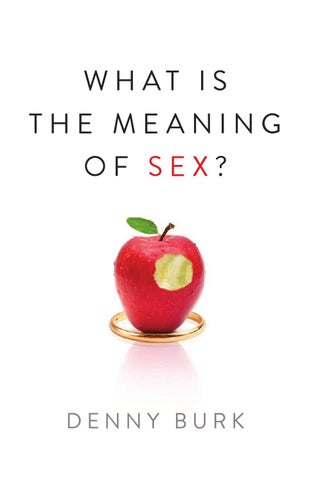
We live in a world that loves it without understanding it. This book clearly explains the truth about sex and winsomely responds to society’s evolving views on sexuality and gender. From marriage to birth control, homosexuality to singleness, What Is the Meaning of Sex? offers biblical wisdom on these tough topics and more, equipping you to engage our confused culture with a God-glorifying vision of human sexuality.
“We all are in debt to Denny Burk for his careful thinking, practical application, and biblical conviction—all of which are on full display in this important new book.”
W H AT I S T H E MEANING OF SEX?
SEX.
WHAT IS THE MEANING OF SEX?
R. ALBERT MOHLER JR., P resident, The Southern Baptist Theological Seminary
“A thoughtful, clear, and candid analysis that will be of great use in thinking through the myriad of ethical issues the church, families, and individual Christians now face.” CARL R. TRUEMAN, Paul Woolley Professor of Church History, Westminster Theological Seminary
“Burk’s prophetic witness will help equip you to embrace what seems freakish in today’s pornotopia: the joy of sex, rightly ordered toward the glory of God.”
DENNY BURK (PhD, The Southern Baptist Theological Seminary) is associate professor of biblical studies at Boyce College, the undergraduate arm of The Southern Baptist Theological Seminary. He also serves as associate pastor at Kenwood Baptist Church in Louisville, Kentucky. Burk edits The Journal for Biblical Manhood & Womanhood and speaks and writes extensively about gender and sexuality. He keeps a popular blog at DennyBurk.com.
U.S. $17.99
CHRISTIAN LIVING
BURK
RUSSELL D. MOORE, President, Ethics and Religious Liberty Commission
DENNY BURK
“Sexual confusion is one of the hallmarks of our age. Denny Burk steps into the midst of this confusion with a book that is as rich in theological insight as it is relevant to the challenge and the controversies of our day. We are in debt to Denny Burk for his careful thinking, practical application, and biblical conviction—all of which are on full display in this important new book.” R. Albert Mohler Jr., President and Joseph Emerson Brown Professor of Christian Theology, The Southern Baptist Theological Seminary “Questions are swirling about as to the nature of human sexuality. Denny Burk reminds us that the answers to our questions are found in Scripture. He demonstrates conclusively that human sexuality is designed to bring glory to God. God’s glory is the purpose and heartbeat of our lives, and that includes our life as sexual beings. Burk’s study is exegetically faithful, culturally aware, and filled with practical wisdom.” Thomas R. Schreiner, James Buchanan Harrison Professor of New Testament Interpretation, The Southern Baptist Theological Seminary “It is ironic that the most private and intimate activity that takes place in human life—sexual intercourse—has become the most pressing public political issue of our day. This makes it imperative that Christians think clearly about this matter. In this book, Dr. Burk offers a thoughtful, clear, and candid analysis of the issues. In doing so he has produced a volume which will be of great usefulness to pastors and people alike in thinking through the myriad ethical issues the church, families, and individual Christians now face.” Carl R. Trueman, Paul Woolley Professor of Church History, Westminster Theological Seminary “Denny Burk is a Christian leader who is not afraid to take on the sexual revolution with the sword of the Spirit. His prophetic witness will help equip you to embrace what seems freakish in today’s pornotopia: the joy of sex, rightly ordered toward the glory of God.” Russell D. Moore, President, Ethics and Religious Liberty Commission; author, Tempted and Tried
“This is a readable, enjoyable, practical, encouraging, wholesome, balanced, wise, refreshing, and deeply biblical approach to the ethics of human sexuality. This book is deeply needed in today’s confused society. I highly recommend it!” Wayne Grudem, Research Professor of Theology and Biblical Studies, Phoenix Seminary “Denny Burk has produced an elegant, comprehensive, and highly instructive book on human sexuality, as understood biblically, ethically, and theologically. Every pastor and seminary professor could benefit much from reading and interacting with the lucid discussions he offers, and all Christians will find here enormous help in thinking through the meaning of sexuality from a solid biblical perspective. This book will serve the church for decades to come in providing its sane and wise guidance.” Bruce A. Ware, Professor of Christian Theology, The Southern Baptist Theological Seminary “This is a welcomed addition to a subject humans can never think about or talk about enough! It is biblically and theologically faithful, but it is also quite practical. All the ‘hot button’ issues are addressed fairly and comprehensively. Pastor-theologians will especially appreciate this fine treatment of an issue the Bible clearly addresses and our culture has hopelessly confused.” Daniel L. Akin, President, Southeastern Baptist Theological Seminary “We live in a culture saturated in sexual immorality. The church can only properly address this culture when our ministry is drawn from the deep well of sound doctrine. Denny Burk draws water from this well and serves it up for Christians to drink. His book is richly biblical and profoundly relevant, and so serves as a reliable guide to the challenging questions of sexual ethics facing us today. If you want to understand these complexities and help others to do the same, then this book is for you.” Heath Lambert, Executive Director, The National Association of Nouthetic Counselors; Associate Professor of Biblical Counseling, The Southern Baptist Theological Seminary and Boyce College
“In a day of twisted thinking on marriage, gender, and sex, Dr. Burk gives us scripturally grounded, biblically solid, scholarly, practical insights into the intimate moments of life that should bring glory to God and the fulfillment of his beautiful plan.” Mac Brunson, Senior Pastor, First Baptist Church Jacksonville, Florida “Responding to the song of the Sirens, our culture steers to dash itself to death on the rocks of sexual sin. In this book, Denny Burk shows the way to the mast of biblical truth and urges us to lash ourselves to it. Read this book. Stop your ears. Turn from deadly sirens to the Lord Christ. Live.” James M. Hamilton Jr., Associate Professor of Biblical Theology, The Southern Baptist Theological Seminary; author, God’s Glory in Salvation through Judgment “Dr. Burk has made a groundbreaking contribution to the modern debate on sexuality. He presents the biblical view of sex and demolishes current attempts to misrepresent the same. His application of biblical truth to contemporary cultural issues in sexuality is crystal clear. Whether a Christian pastor or believer, this volume will be your go-to book for help in engaging the changing sexual landscape.” Jerry Vines, Pastor-Emeritus, First Baptist Church, Jacksonville, Florida; two-time President, Southern Baptist Convention “Denny Burk is one of evangelicalism’s brightest young minds, and he brings that mind to bear in What Is the Meaning of Sex? This book is a thorough, biblical, and judicious engagement of all things sexual. Burk biblically rebuts the sexual spirit of the age and equips the reader to confront the pressing cultural and ethical issues associated therewith. I wish every student in my seminary would read this.” Jason K. Allen, President, Midwestern Baptist Theological Seminary and College “Clear writing, thoughtful arguments, wise positions, courageous countercultural stand. I learned some things I didn't know and honed what I did. Denny is a skilled Bible interpreter and shrewd critic of politics and culture.” Andy Naselli, Assistant Professor of New Testament and Biblical Theology, Bethlehem College and Seminary in Minneapolis
“Denny Burk is a true sexual revolutionary—not a revolutionary defined by 1960s standards, of course, but a revolutionary against the spirit of today’s sexual zeitgeist, which is marked by sexual confusion and brokenness. Denny calls us away from an Eisenhower-era sexual Puritanism and toward a view of biblical sexual ethics—patterned after the gospel—that connects us to Jesus’s cross and resurrection. Anyone familiar with Denny’s blogging will know his seamless arguments and elegant prose, a treat this book amplifies. And as he does in his blogging, Denny tackles today’s toughest issues with biblical grit.” Andrew T. Walker, Director of Policy Studies, Ethics and Religious Liberty Commission
What Is the Meaning of Sex? Copyright © 2013 by Denny Burk Published by Crossway 1300 Crescent Street Wheaton, Illinois 60187 All rights reserved. No part of this publication may be reproduced, stored in a retrieval system, or transmitted in any form by any means, electronic, mechanical, photocopy, recording, or otherwise, without the prior permission of the publisher, except as provided for by USA copyright law. Cover design: Brandon Hill Cover image: iStock and Veer First printing 2013 Printed in the United States of America Unless otherwise indicated, Scripture quotations are from The New American Standard Bible®. Copyright © The Lockman Foundation 1960, 1962, 1963, 1968, 1971, 1972, 1973, 1975, 1977, 1995. Used by permission. Scripture quotations marked AT are the author’s translation. Scripture quotations marked ESV are from the ESV® Bible (The Holy Bible, English Standard Version®), copyright © 2001 by Crossway. 2011 Text Edition. Used by permission. All rights reserved. Scripture quotations marked HCSB have been taken from The Holman Christian Standard Bible®. Copyright © 1999, 2000, 2002, 2003 by Holman Bible Publishers. Used by permission. Scripture quotations marked KJV are from the King James Version of the Bible. Scripture quotations marked NAB are taken from the New American Bible, revised edition © 2010, 1991, 1986, 1970 Confraternity of Christian Doctrine, Washington, D.C. and are used by permission of the copyright owner. All Rights Reserved. No part of the New American Bible may be reproduced in any form without permission in writing from the copyright owner. Scripture quotations marked NET are from The NET Bible® copyright © 2003 by Biblical Studies Press, L.L.C. www.netbible.com. All rights reserved. Quoted by permission. Scripture references marked NIV are taken from The Holy Bible, New International Version®, NIV®. Copyright © 1973, 1978, 1984, 2011 by Biblica, Inc.™ Used by permission. All rights reserved worldwide. Scripture quotations marked NJB are from The New Jerusalem Bible, copyright 1985 © by Darton, Longman & Todd, Ltd. and Doubleday, a division of Random House, Inc. Used by Permission. Scripture quotations marked NKJV are from The New King James Version. Copyright © 1982, Thomas Nelson, Inc. Used by permission. Scripture quotations marked NLT are from The Holy Bible, New Living Translation, copyright © 1996, 2004. Used by permission of Tyndale House Publishers, Inc., Wheaton, Ill., 60189. All rights reserved. Scripture quotations marked NRSV are from The New Revised Standard Version. Copyright © 1989 by the Division of Christian Education of the National Council of the Churches of Christ in the U.S.A. Published by Thomas Nelson, Inc. Used by permission of the National Council of the Churches of Christ in the U.S.A. Scripture quotations marked RSV are from The Revised Standard Version. Copyright ©1946, 1952, 1971, 1973 by the Division of Christian Education of the National Council of the Churches of Christ in the U.S.A.. All emphases in Scripture quotations have been added by the author. Trade paperback ISBN: 978-1-4335-3609-0 PDF ISBN: 978-1-4335-3610-6 Mobipocket ISBN: 978-1-4335-3611-3 ePub ISBN: 978-1-4335-3612-0
Library of Congress Cataloging-in-Publication Data Burk, Denny. What is the meaning of sex? / Denny Burk. pages cm Includes bibliographical references and index. ISBN 978-1-4335-3609-0 (tp) 1. Sex—Religious aspects—Christianity. 2. Marriage— Religious aspects—Christianity. I. Title. BT708.B88235 2013 241'.664—dc23 2013019477 Crossway is a publishing ministry of Good News Publishers. VP 15
23 14
13
22
21
20
19
12
11
10
9
18 8
17 7
6
16 5
15 4
14 3
2
13 1
Contents Preface 11 Introduction 19 1 Glorify God with Your Body
43
2 Glorify God with Your Hermeneutic
61
3 Glorify God with Your Marriage
87
4 Glorify God with Your Conjugal Union
111
5 Glorify God with Your Family Planning
139
6 Glorify God with Your Gender
157
7 Glorify God with Your Sexuality
185
8 Glorify God with Your Singleness
209
Conclusion 229 Bibliography 237 General Index
253
Scripture Index
257
Preface I was ten years old when my dad first explained to me the birds and the bees. Like most kids my age, I was fairly shocked to receive the news. “That’s where babies come from? That’s where I came from? That means that you and mom . . .” I can only imagine what the look on my face must have been as the realization fell upon me like a bag of cold spaghetti. I am thankful that my dad did not laugh. Instead, we sat and talked while he answered all my questions. And I had a lot. My dad was a public high school science teacher of many years. He made a living explaining such things to naive adolescents. So I guess he was probably more prepared for such a conversation than most parents. Nevertheless, for all the technical precision, what prepared him most for our conversation was his Christianity. From the beginning, I learned from him that sex was a gift from God to be enjoyed exclusively within the covenant of marriage. It was my first lesson in sexual ethics, and it was an abiding one. My earliest and most enduring lessons about marriage came from both my mother and my father. Perhaps above all else, I learned from them that it is a covenant made before God that is not to be broken. I have been married long enough to know that difficulties and trials sometimes strain marriages in ways one would never expect. Marriage is hard because life is hard. There was a reason that the apostle Paul said that those who marry would have much trouble in this life, “and I am trying to spare you” (1 Cor. 7:28). As I have gotten older, I have come to understand the great gift my parents gave me in their loving one another for a lifetime.
12 Preface
If there were times when they felt like they were hanging on by a very thin thread, I never knew it. Divorce was not a part of their vocabulary. So I grew up in the security of that love, and I am ever grateful to them for what they have given me. They say some things are better caught than taught. I caught the permanence of marriage from my mom and my dad. In many ways, this book is a continuation of that lesson. This is a book about sex. It is also a book about marriage. But more fundamentally it is a book about the glory of God. For indeed God created the gift of sex to be enjoyed within the covenant of marriage so that he might magnify his covenant love for his people. God intends marriage and the joys of conjugal life to be a living parable about another marriage—Jesus’s union with his church (Eph. 5:32). Marriage is to be an icon of Christ’s self-sacrificial love for his bride and his bride’s humble submission to him. It is to be a living and breathing depiction of the gospel. Thus when we ask the question, “What is the meaning of sex?” we are asking a question about purpose. The short answer is this: sex exists for the glory of God. Consequently, all sexual morality must be measured by its ability to achieve that purpose. This book is an attempt to show from the Bible what the meaning of sex is and thereby how we ought to order our sexual lives under God. Having said that, it will be useful to set forth some parameters about what this book is and what it is not. First, this book is a primer. It is not intended to be a comprehensive treatment of the subject matter. The original conception of this book was that it would be a relatively short work introducing a range of topics related to the Bible and sexual ethics. On the one hand, I have included some material that is not included in other books on sexual ethics—e.g., a chapter on gender roles. On the other hand, there are topics that receive passing attention and in some cases no attention at all—e.g., bioethics and reproductive technologies. In what I have covered, I have tried to interact with some of the more important voices in the literature, but even here the treatment is not comprehensive. My hope is that there
Preface 13
is enough interaction with the sources to give the reader a basic idea of how the issues are being discussed and enough principles to guide the reader to make sound ethical judgments about the issues covered in this volume. Second, this book is biblical. It is not philosophical. By that I mean that my primary orientation is the text of Scripture, not contemporary debates about natural law or secular ethical theories. That is not to say that these other inquiries have no value. It is just to say that this is not that kind of book. I mean to cut to the chase and take readers directly to the norm that is not normed by any other norm—the Bible. So my aim has been to make explicit what the Bible teaches about the meaning of sex. From time to time, there are statistics and other anecdotes of contemporary relevance. But these are brought in so as to see more clearly how the Scripture ought to be applied in the modern day. In the main, however, my purpose is to be as biblical as possible. Throughout this book, you will find extended exegetical discussions and interpretations of Scripture. Indeed, chapter 1 is essentially a commentary on 1 Corinthians 6:12–20. The reason for this is that it appears in a section of Scripture that is dense with material on sexual ethics. In this one passage we see how the apostle Paul uses Scripture to admonish and correct a group of philandering whoremongers in the church at Corinth. His method is a model for what I hope to achieve in this book. Paul was into the application of Scripture to sexual ethics, and that is what I want to be into as well. Third, this book is for sinners. It is not for people who are perfect. Nor is it written by someone who is perfect. After viewing all the holy commands of God as they relate to our sexual lives, the soft heart is apt to carry away an abiding sense of his own failures and shortcomings. I have felt that many times throughout the writing of this book. I can only imagine the myriad experiences that readers will bring to this book and the despair they might feel in view of the Bible’s standard of sexual holiness. So let me make an appeal to you from one broken sinner to another. The same God who issued these impossible commands also sent his Son to live
14 Preface
the perfect life that we could not live, to die as our substitute, to pay for our failures, to be raised for our eternal life, and to enable us to walk with him through the power of the Spirit. You cannot earn these gifts by sexual holiness. You can only receive them by faith alone in Christ alone. Through Christ, he gives us everything we need for life and godliness. We are no longer slaves to our passions, but we are new creations enabled to walk in newness of life. Look away from yourself as you read this book and train your eyes on Jesus—the author and finisher of our faith. I have already mentioned my parents and the formative influence they bring to this work. But there are others as well who must be mentioned. I have often said that John Piper has been my mentor in absentia. For the last fifteen years, no one has been more influential over my thinking and theology. This influence was not because I knew him or because we have ever been personal friends. Nor was it because of his books. The influence has been entirely due to his preaching ministry. I first heard John Piper preach in 1995. The sermon was on a cassette tape that someone had loaned me, and it was a message about the supremacy of God in preaching. I didn’t like what I heard. After listening, I wrote Piper off as someone who needed to rely more on the sufficiency of Scripture and less on his emotions. I did not have ears to hear. But that changed in 1998. In 1998 I attended the second annual Passion conference in Austin, Texas. I didn’t come with high expectations. I had no idea that a Copernican revolution was in the offing for me spiritually. The message that the Lord used was Piper’s exposition of Romans 3:25–26. Piper’s exposition of the cross of Jesus Christ in these two verses made my heart soar in worship. I was gripped by the notion that Christ died not just for me but for God. The “basic riddle of the universe” had nothing to do with my rights but with God’s rights. It was this exposition of the cross that gave me ears to hear that God is most glorified in us when we are most satisfied in him. That theocentric perspective shaped my thinking through years of listening to Piper’s Bible-saturated messages. I cannot begin to
Preface 15
calculate how many hundreds of messages I have listened to since then. Yet over time, I began to see that God’s glory is not something that exists elusively in the untouchable ether. God aims to manifest his glory in the gritty details of life—and that includes our sexual lives, a topic to which Piper repeatedly returned. There were messages on sexual purity, a series on marriage, sermons about homosexuality and so-called gay marriage, strategies for fighting sexual sin, exhortations against abortion, teaching on biblical manhood and womanhood, and on and on. In those years, God was giving shape to a sexual ethic rooted in the ideal of covenant marriage and oriented toward the display of God’s glory. I am not exaggerating when I say that the thesis of this book has been shaped over the last fifteen years by a man I hardly know—my mentor in absentia. In more recent years, another significant influence has entered the picture in the person of R. Albert Mohler Jr. I am grateful to have benefitted from his writings over the years, but I am especially grateful for the three years of weekly interaction that I had with him when I served on his cabinet as dean of Boyce College. In those years he helped me perhaps more than anyone else to understand the interface been Christian sexual ethics and the larger debate in our culture about what makes for the common good. I have never known anyone as learned and well read as he is, nor anyone with a keen sense of where the culture is going and how Christians ought to be speaking to it. He is a man of Issachar who understands the times and what the people of God ought to do. I want to thank Russell Moore and the rest of the administration of The Southern Baptist Theological Seminary for granting me writing leave to work on this book. It was a fruitful time for this project, but it was especially fruitful for my family. We will always be grateful for that year. Thanks are also in order to friends who read and provided feedback on early drafts of this work: Mitchell Chase, Miguel Echevarria, Joe Carter, Barry Joslin, Jim Hamilton, Tom Schreiner, Andy Naselli, and my mother, Sandra Burk. All of them had a part in knocking off the rough edges. Any rough edges that remain must
16 Preface
be imputed wholly to my own misapprehensionalism and not to their fine editing skills. And now I have saved the very best for last—my wife, to whom this book is dedicated. The inscription is a tag line that I have included at the end of all the anniversary poems that I have given her over our twelve years of marriage. The annual repetition of this tag has a purpose. The poems change, we change, our bodies change, the size of our family changes, our homes change, our cities change, our close friends change. But one thing does not change between us. She is still lovelier to me than anyone could ever be. I love her now more than I ever have. She is my best friend and my most trusted counselor. I can hardly imagine life without her. I am grateful to God for giving me more than I could ever have asked for in a wife. My earnest hope and prayer is that the hours spent in study for this book on marriage would bear fruit in me to make me a better husband. It will take a lifetime to realize, and that is what I am eager to give for her. —Denny Burk January 11, 2013
What is the chief and highest end of man? Man’s chief and highest end is to glorify God, and fully to enjoy him forever. —Westminster Larger Catechism, Question 1
Introduction A few years ago I was invited to speak at a youth conference on the topic of gender confusion. At the time, I could hardly think of a more relevant theme. From television shows like Modern Family to Lady Gaga’s pop anthem “Born This Way,” our popular culture has become a reflection of the underlying confusion about what it means to live in this world as male and female. Kids today are awash in a gender-bending popular culture. So I was eager to address these students and to bring the Bible to bear upon an issue that I consider to be one of the touchstone issues of post-Christian America. So there I was in front of about one hundred junior high and high school students, and I delivered to them a message that had grown out of many hours of study and preparation. But nothing I had read before the session prepared me for the question I faced after the session. At the conclusion of my talk, a youth minister from a small church in the area approached me for advice on how to deal with a perplexing pastoral situation that he was facing in his congregation. A young girl in his youth group had recently decided that she wanted to become a boy. My usual reaction to a pastoral conundrum like this one would be to advise the young girl of what the Bible teaches about how God created us as male and female, how Christians must embrace what God made us to be, and how God has a design for her life as a female. But there was more to this young girl’s story than a spontaneous desire to change genders. There was an additional detail that would turn my usual response on its head.
20 Introduction
This particular girl had been born with a rare biological condition that made it difficult at birth to determine whether she was a girl or a boy. The condition is known as intersex, and intersexed persons are born with reproductive or sexual anatomy that does not seem to fit the typical pattern for female or male. Until relatively recently, the most common medical treatment for intersex has been for doctors to recommend a gender, to encourage the parents to embrace that gender, to reshape the genitals and reproductive organs accordingly through surgery, and to advise parents not to express any ambiguity to the child about the selected gender. The young woman in question had undergone such surgery as an infant but now as a teenager felt that she was not really a girl after all. She felt that her parents had made the wrong choice about what sex she was, and now she was in the midst of an identity crisis. She wanted to become what she felt she was born to be. She wanted to be a boy. So the youth minister asks me, “What should I say to them? How do I minister to this student and her family?” I confess that I was at a bit of a loss to answer his question—not because I didn’t know what the Bible teaches, but because I didn’t know what intersex was. As I struggled to apply Scripture to a condition I had never even heard of, it occurred to me that at the heart of this minister’s query was a question about sex—not sex narrowly conceived as sexual acts, but sex more broadly conceived as gender and sexuality. At the root of his difficulty was a desire to know how the Bible’s normative teaching about manhood and womanhood speaks to this very difficult situation.
A Collision with Reality How would you have answered this youth minister’s question? Would you have had the biblical and theological wherewithal to speak truth into this morally confounding situation? Do you know what the Bible teaches about gender? About sex? About human sexuality in general? Do you know if the Bible even addresses these
Introduction 21
issues at all? Does the existence of intersex throw into question your belief in the Bible’s teaching that God created humans in his image as male and female (Gen. 1:27)? My first conversation about intersex highlighted for me a larger issue—the need for Christians to understand what the Bible teaches and how it applies to the various ethical challenges we face. It occurred to me during that conversation that the only way to answer the question was not only to understand the problem (the child’s intersex condition and all the life complications that stemmed from it) but also to understand what the Bible actually says about human sexuality. Sadly, this latter point is one that we can no longer assume. Not only has biblical literacy declined in our day, but so also has the Bible’s cultural influence on sexual mores. Whereas there used to be a broad cultural consensus about gender norms and sexual morality, that is no longer the case in the contemporary West. As Christopher Ash has written, “Western societies are witnessing sexual relationships characterized by . . . lower levels of public commitment than before, which are proving more transient than previously, with fewer children, and in which a succession of public sexual partners is increasingly common.”1 We can no longer assume a consensus even among those who name themselves as Christians. From the progressive wing of evangelicalism to the more liberal mainlines, many “Christian” groups have accommodated themselves to the spirit of the age. The result has been a sustained assault on what the Bible teaches about gender and sexuality. This crisis of faith has undermined the faithfulness of many congregations. These churches and their leaders have given up on biblical sexual ethics and have turned elsewhere for guidance. This larger cultural pressure has influenced many Biblebelieving churches as well. Many pastors and teachers simply do not want to push back in a countercultural sort of way but are content to remain silent about the Bible’s teaching about these Ash, Marriage: Sex in the Service of God (Vancouver, British Columbia: Regent College Publishing, 2003), 43.
1 Christopher
22 Introduction
flashpoints in the larger culture war. Meanwhile, their congregations are floundering in misunderstanding and false teaching about human sexuality. Many Christians have little training in what it means to be created in the image of God as male and female. It has rightly been said that where there is a mist in the pulpit, there is a fog in the pew. In the absence of clear, biblical teaching on gender and sexuality, people tend to get folded in to the Bible-ignoring zeitgeist. Unfortunately, that is where too many evangelical Christians have drifted.
What Is the Purpose of Sex? The purpose of this book is to answer the underlying question put to me by that youth minister: What is the meaning of sex? But we cannot answer this question by coming to it in the usual way. Oftentimes when we want to explain something, we look to find out what caused it. But when it comes to ultimate meaning, we do not find answers in causes but in purposes.2 If I want to understand a hammer, it is not enough to know its cause (i.e., where the hammer came from, the factory in which it was manufactured, who designed it, etc.). To understand a hammer, I have to know for what purpose it was created. A hammer’s created purpose is to drive nails. I can know everything about where a hammer came from, who made it and designed it, the truck that shipped it to the store, etc. Yet if I do not know for what purpose it was made, I have entirely missed the point. I do not necessarily need to know anything about the hammer’s origin (what caused it) in order to have a full appreciation for its purpose. It is the hammer’s purpose that determines ultimate meaning, not the cause.3 Similarly, I might know everything there is to know about theories of human origins, about human reproduction, and about the biological and 2 John
Piper, “Why Was This Child Born Blind?,” sermon preached at Bethlehem Baptist Church, May 21, 2011, http://www.desiringgod.org/resource-library/sermons/why-was-this-child-born -blind. 3 No analogy is perfect, and I do not wish to imply that cause is unimportant. Indeed, it is often the case that the cause or genesis of a thing reveals the purpose of that thing. As we shall see, gender and sexuality are a case in point. The biblical paradigm for sex and gender is set in Genesis 1–2.
Introduction 23
genetic factors that determine human sexuality. But if I do not understand the purpose for which human sexuality was made, then I do not understand it. Nor am I prepared to give a proper ethical evaluation of its use. Of course in the Christian worldview, the purpose of human sexuality is inexorably bound up with its origin. God’s purpose for sex is revealed in the account of God’s initial creation of human beings as male and female (Genesis 1–2). That account and subsequent scriptural reflection on it suggest a very clear purpose for human sexuality. A book on sexual ethics, therefore, will stand or fall on its ability to describe that purpose as it is found in Scripture. Many books on sexual ethics—including Christian ones—founder on just this point. As Andreas Köstenberger has noted, “There is a relative dearth of conscious Christian reflection on the deeper meaning of and purpose for sex.”4 To be sure, some Christian books do describe the purpose(s) of sex, but too often they do not go far enough. They do not give an adequate account of the ultimate purpose of sex as the Bible describes it. Even though they may suggest some purposes for sex, there is a failure to distinguish ultimate ends from subordinate ends.5 What is the difference between ultimate ends and subordinate ends? Why is the distinction important? I might point to an automobile and say, “That car was made for someone to sit in.” Since there are doors on each side of the car and seats inside, no one could deny that one of the purposes of a car is for people to get inside and sit down. But it would be inadequate if we stopped there in describing the purpose of a car. The ultimate purpose of a car is to transport people and objects from one place to another. Sitting down in a car is a subordinate end. Transportation 4 Andreas J. Köstenberger and David W. Jones, God, Marriage, and Family: Rebuilding the Biblical Foundation, 2nd ed. (Wheaton, IL: Crossway, 2010), 79. 5 I am taking this distinction from Jonathan Edwards [1749], Ethical Writings (WJE Online, vol. 8), edited by Paul Ramsey, p. 405: “A subordinate end is something that an agent seeks and aims at in what he does; but yet does not seek it, or regard it at all upon its own account, but wholly on the account of a further end, or in order to some other thing which it is considered as a means of. . . . An ultimate end is that which the agent seeks in what he does for its own sake; that he has respect to, as what he loves, values and takes pleasure in on its own account, and not merely as a means of a further end.” The Yale edition of Edwards’s work is available at http://edwards.yale.edu.
24 Introduction
is the ultimate end. Sitting down in the car is one of the means by which transportation ultimately comes about. Unless we account for the ultimate end of the automobile, we have not really understood the purpose of the car. Describing subordinate ends alone is insufficient. This distinction between ultimate ends and subordinate ends is critical when thinking about sexual ethics. Sexual ethicists make a mistake when they focus attention only on subordinate ends rather than on the ultimate end. They may rightly speak of the purpose(s) of sex while giving short shrift to the ultimate purpose of sex. Dennis Hollinger’s excellent book The Meaning of Sex focuses on the ethics of physical intimacy, and he argues rightly that understanding the purpose of sex is essential to developing a biblical sexual ethic. He writes, We must probe the ends or purposes of the gift of physical intimacy. Understanding these ends or purposes enables us to capture God’s intentions from creation. But such understanding is also essential to guard against the abuses and unethical practices that tempt us in a fallen, sex-crazed world.6
Hollinger then identifies “four main purposes” for sex: consummation of marriage, procreation, love, and pleasure. He then argues that the moral legitimacy of any sexual act must be tested against the ability of that act to achieve those purposes.7 Hollinger’s argument is good so far as it goes, but should we not take it further? The four purposes that he identifies are not ultimate ends but subordinate ends. One can find support in Scripture for all four of these “purposes,” but the framework can seem a little bit arbitrary and difficult to apply if they are not properly connected to the ultimate purpose of sex.8 Hollinger does seek 6 Dennis P. Hollinger, The Meaning of Sex: Christian Ethics and the Moral Life (Grand Rapids, MI: Baker, 2009), 95. 7 Ibid. 8 To be fair to Hollinger, it is not as if Hollinger has no concern about “ultimate purposes.” Clearly he does (ibid., 89–91). In my view, however, he could strengthen his case if he could connect an ultimate purpose to his fourfold framework.
Introduction 25
to ground his four purposes in the larger narrative of Scripture,9 but what if the Scripture itself indicates a larger motif that would integrate these four purposes? The Scripture does in fact give us an all-encompassing motif, and we can hardly make any sense out of the Bible’s sexual ethic unless we account for it.10 James Hamilton has recently produced what I believe to be the best biblical and exegetical account of this all-encompassing motif. In his book God’s Glory in Salvation through Judgment: A Biblical Theology, Hamilton argues that the glory of God is the central theme of biblical theology.11 He argues that the metanarrative of Scripture can be summed up in four biblical themes: creation, fall, redemption, and restoration.12 God created the world and everything in it to be holy and good as he himself is holy and good. But Adam’s fall plunged the world and everything in it into judgment and death. God enacts a plan of redemption to rescue his people. This plan begins with the promise to crush the head of the Serpent in Genesis 3:15, and it reaches its fulfillment in the cross and resurrection of Christ. God will one day restore the world by making a new heaven and a new earth and by resurrecting his people to eternal life. Hamilton argues that “the center of biblical theology is the theme that organizes this metanarrative” and that it is “the theme out of which all others flow.”13 God manifests his glory through creation, fall, redemption, and restoration. All of these themes and every other subordinate theme that one might identify in Scripture find their unity and purpose in the glory of God. So what is that purpose of sex? If we clear away all the subordinate purposes, we find that the ultimate purpose of sex is the 9 Ibid.,
95: “The ethics of any sexual act is then tested against the ability to encompass these four ends, or at least to be in the context of these ends. The full yet mysterious meaning of sex is found in these four purposes, set in the context of the larger biblical worldview.” 10 Ash, Marriage, 105: “Purpose is also a necessary theological undergirding to the interpretation of the Bible as a whole in its teaching about sexual ethics.” 11 We might define the glory of God as all of who God is put on display. Hamilton says it this way: “The glory of God is the weight of the majestic goodness of who God is, and the resulting name, or reputation, that he gains from his revelation of himself as Creator, Sustainer, Judge, and Redeemer, perfect in justice and mercy, loving-kindness and truth.” James M. Hamilton Jr., God’s Glory in Salvation through Judgment: A Biblical Theology (Wheaton, IL: Crossway, 2010), 56. 12 Ibid. 13 Ibid.
26 Introduction
glory of God. Sex, gender, marriage, manhood, womanhood—all of it—exist ultimately for the glory of God. The glory of God as the ultimate purpose of sex is not merely a theological deduction. It is the explicit teaching of Scripture. In the next chapter I will show from 1 Corinthians 6 how Paul teaches that the glory of God is the ultimate purpose for sex. Before moving into that discussion, we need to say a word about ethical theories and subordinate purposes.
Ethical Theories and Biblical Ethics In what I have argued so far, I have made a host of assumptions about the proper way to go about establishing a normative sexual ethic. But we would do well to acknowledge that not all ethical theories share the assumptions that form the basis for this work. Certain basic questions underlie every attempt to establish a framework for ethical conduct: What makes my actions good or bad? What are the standards we should use for determining moral judgments? Where do I get these standards?14 Christians are not the only ones who have puzzled over these questions for answers. In the history of human thought, these questions have been answered differently by different people in different times and circumstances. In broad terms, there have been four main approaches to answering these questions: teleological ethics, consequentialist ethics, deontological ethics, and character/virtue ethics. Teleological Ethics Teleological ethics takes its name from the Greek term telos, which means “end” or “goal.” Teleological theories tend to share the principle that human actions should be judged in light of their end or goal.15 Natural-law theory is a prominent species16 of teleology Meaning of Sex, 23. A. Brown, “Teleology,” in New Dictionary of Christian Ethics and Pastoral Theology, ed. David J. Atkinson et al. (Downers Grove, IL: InterVarsity, 1995), 835. 16 Although there are a variety of teleological theories, they divide broadly into two groups: consequentialist ethics and natural law theory. See Scott Paeth, “Teleological Theories of Ethics,” in Dictionary of Scripture and Ethics, ed. Joel B. Green (Grand Rapids, MI: Baker, 2011), 766. For the 14 Hollinger, 15 C.
Introduction 27
that is “concerned with the natural goal or end of human action rather than with particular consequences.”17 This theory relies on the observation that God created the world and everything in it with a purpose. Actions must be evaluated on the basis of their conformity to God’s purpose for his creation. If God’s glory is the ultimate purpose for creation (as I have argued above), then God has ordered creation so that its “natural” use promotes his glory. And God’s ultimate purpose—his glory—is only realized when creatures fulfill the subordinate purposes for which they were made. Oliver O’Donovan describes a teleological approach in this way: The order of things that God has made is there. It is objective, and mankind has a place within it. Christian ethics, therefore, has an objective reference because it is concerned with man’s life in accordance with this order. . . . Thus Christian moral judgments in principle address every man.18
As will be discussed below, teleology has special relevance for sexual ethics as so much of the biblical material appears to be based on the “natural” ends of human sexuality as they were given by God in creation (e.g., Rom. 1:26–27; cf. Gen. 2:24).19 Consequentialist Ethics Consequentialist ethics bases moral judgments on the consequences that accrue from human actions.20 This way of determining ethical behavior does not see any action as inherently good or evil. The consequences of an action determine which acts are good and which acts are evil.21 Consequentialist theories define purposes of this book, I will associate teleology with natural law ethics and will keep consequentialist ethics in its own category. 17 Ibid., 767. 18 Oliver O’Donovan, Resurrection and Moral Order: An Outline for Evangelical Ethics, 2nd ed. (Grand Rapids, MI: Eerdmans, 1994), 17. 19 Ash, Marriage, 105: “The order the Creator has placed in creation is—at least in part—teleological order, order that serves a purpose. We seek therefore . . . to elucidate the purpose of the Creator in instituting marriage as a part of the good created order.” 20 Hollinger, Meaning of Sex, 24. 21 John S. Feinberg and Paul D. Feinberg, Ethics for a Brave New World, 2nd ed. (Wheaton, IL: Crossway, 2010), 34.
28 Introduction
moral good by whatever action produces the greatest amount of nonmoral good. The definition of what that nonmoral good may be differs from theory to theory. In some theories the nonmoral good is pleasure. In others it is power, knowledge, or self-realization.22 There are two primary streams of consequentialist approaches— one that focuses on producing the greatest good for oneself (ethical egoism) and another that emphasizes producing the greatest good for the greatest number of people (utilitarianism). Epicurus, Bertrand Russell, and Albert Ellis have been associated with the former, while Jeremy Bentham, John Stuart Mill, and Peter Singer have been associated with the latter.23 There are a number of items we could point to that make it difficult to reconcile consequentialist approaches with a biblical worldview. First, consequentialist approaches elevate nonmoral goods above Scripture as the standard for evaluating ethics. Second, human nature limits our ability to calculate in every case what the consequences of an action might be. Third, there is no consensus on how to define the nonmoral good. Without some external arbiter to determine the matter, consequentialist approaches might change from person to person or situation to situation. Fourth, there is no intrinsic value in any action according to the consequentialist approach. In this way, a purely consequentialist approach is simply out of step with the Bible. As Richard Hays has it, “How strikingly indifferent is the New Testament . . . to consequentialist ethical reasoning. The New Testament teaches us to approach ethical issues not by asking ‘What will happen if I do x?’ but rather by asking ‘What is the will of God?’”24 Deontological Ethics Deontological ethics says that human actions are right or wrong to the extent that they are the fulfillment of duty.25 Duty is often 22 Ibid.,
34.
Meaning of Sex, 25–29. B. Hays, The Moral Vision of the New Testament: Community, Cross, New Creation, A Contemporary Introduction to New Testament Ethics (New York: HarperOne, 1996), 455. 25 M. T. Nelson, “Deontology,” in New Dictionary of Christian Ethics, 297. 23 Hollinger, 24 Richard
Introduction 29
expressed in the form of principles or rules. Deontology takes its name from the Greek word deon, which means “that which is binding or obligatory.”26 This approach denies that the morality of an action can be measured in any way by the results of the action. Rather, a deontological approach holds that “there are inherent goods, rights, wrongs, and duties in life, regardless of what the consequences might be.”27 Immanuel Kant has given the classical formulation of the deontological approach by saying, The moral worth of an action then does not lie in the effect which is expected of it, and consequently in no principle of an action which must borrow its motive from the expected effect. . . . Of what sort can this law possibly be, the conception of which, even without regard for the effect expected from it, must determine the will, in order that the latter may without qualification be called purely and simply good? . . . I am never to act otherwise than so that I could at the same time will my maxim should become a universal law.28
Because deontologists hold that the morality of an action is known through rules or principles, this approach is sometimes called “principle ethics.”29 Deontological theories differ from one another in where they locate the basis for establishing the principles. The principle might be derived from reason, tradition, universal human experience, or divine revelation.30 Character Ethics Character ethics (a.k.a., virtue ethics) takes its name from the belief that moral actions spring from the character of the person perJefferson Davis, Evangelical Ethics: Issues Facing the Church Today, 3rd ed. (Phillipsburg, NJ: P&R, 2004), 16. See also H. G. Liddell and R. Scott, A Greek-English Lexicon, 9th ed. (Oxford, UK: Clarendon, 1996), s.v. δέον: “that which is binding, needful, right.” 27 Hollinger, Meaning of Sex, 30. 28 Immanuel Kant, The Fundamental Principles of the Metaphysics of Ethics, trans. Otto Manthey-Zorn (New York: Appleton-Century-Crofts, 1938), 16–17. Kant also argued that “duty” must be the basis of an action for it to be considered morally good. To act out of one’s self-interest ruins the morality of the action. In Kant’s words, “If now, when there is no inclination to urge him to it, he nevertheless rouses himself from this deadly indifference and performs the act without any inclination, solely out of duty, then the action for the very first time has genuine moral value” (ibid.). 29 Hollinger, Meaning of Sex, 29–30. 30 Ibid., 30. 26 John
30 Introduction
forming the action. The focus in character ethics is not to develop a long list of rules or to predict what the consequence of an action will be. Those who follow character ethics are more interested in forming moral character than moral norms. Character ethicists observe that laws and rules do very little to curb immoral behavior. Thus a focus on external standards can be an ineffective way to produce moral living.31 Rather, they argue, what is needed is the moral formation of the individual who will be making moral choices. Moral acts can only come from upright character. Stanley Hauerwas says it this way: In matters of significance even involving the “hardest choices” there was no “decision” to be made. Rather, the decision makes itself if we know who we are and what is required of us. . . . I expect many of our decisions are . . . but confirmation of what we have become without realizing it.32
Character ethicists draw from the ethical theories of Aristotle, Augustine, and Aquinas. Its newfound popularity among theologians and philosophers, however, traces back to thinkers such as Alasdair Maclntyre and Stanley Hauerwas. While there are some helpful emphases in character ethics, its aversion to rules and principles can set this approach at odds with Christian revelation. In the Bible, moral character and moral norms are not at odds. Indeed they complement each other. The Bible encourages us to have moral character as the basis for all of our moral actions (e.g., 2 Pet. 1:5–9). That is why one of Jesus’s chief critiques of the religious leaders of his day was that they were “whitewashed tombs.” On the outside they looked good, but on the inside there was only death. They performed moral actions, but they acted from hearts that were dead to the kingdom of God. 31 Robert L. Brawley, ed., Character Ethics and the New Testament: Moral Dimensions of Scripture (Louisville, KY: Westminster, 2007), vii: “Legislation is hardly alone in reflecting a side of ethics that can only be labeled ‘failure.’ The same is true for some of our other preferred approaches to ethics: role models, principles, and rationality. They all may seduce us into a false optimism that these sources of morality make us adequate for the task.” 32 Stanley Hauerwas, The Peaceable Kingdom: A Primer in Christian Ethics (Notre Dame, IN: University of Notre Dame Press, 1983), 129–30.
Introduction 31
Jesus and the authors of Scripture require inner transformation of the individual. But that transformation is effected in part by the Christian’s interface with the principles and rules of Scripture. In character ethics, however, the question of what kind of people we ought to be takes precedence over the question of what we are to do.33 To the extent that character ethics deemphasizes moral laws and rules, to that extent character ethics is out of step with Scripture.34 As an ethical theory, character ethics often falls short of telling us what we need to know about the morality of a given act.35 A sounder approach is to view character formation as the necessary condition for receiving and applying the ethical content of Scripture—which includes moral norms and rules.36 A Blended Approach In this book, I am favoring a blended approach that gives a privileged place to teleology within the framework of divine revelation. Scripture is plainly concerned with the formation of moral character as the basis for moral choices (as in character ethics). Scripture is also concerned with rules and divine commands (as in deontology). But Scripture also focuses on the glory of God as the purpose of all things (as in teleology). These three theories do not contradict one another but rather complement one another. Consider, for instance, the commands that we find scattered throughout the pages of Scripture. From the Ten Commandments in Exodus 20:1–17 to Jesus’s two love commands in Matthew 22:36–40, God’s commands are not ends in themselves. To be 33 Nikki Coffey Tousley and Brad J. Kallenberg, “Virtue Ethics,” in Dictionary of Scripture and Ethics, 814. 34 I am arguing that character ethics can be out of step with the rules and principles that derive from Scripture. David W. Haddorff notes that this is a general weakness of character ethics that can and ought to be corrected. David W. Haddorff, “Can Character Ethics Have Moral Rules and Principles? Christian Doctrine and Comprehensive Moral Theory,” Horizons 23, no. 1 (1996): 50. 35 Feinberg and Feinberg, Ethics for a Brave New World, 38: “Virtue ethics focus more on the moral character of the agent than on the moral nature of the act.” 36 John R. Frame, The Doctrine of the Christian Life (Phillipsburg, NJ: P&R, 2008). Frame argues that “ethical knowledge” is the “product of sanctification” (ibid., 350). He writes, “It is wrong to suppose that we must get all the answers to ethical questions before we engage in spiritual warfare, as if the intellect were in every respect prior to life. Rather, there may well be some ethical questions . . . that we will not be able to answer (or even fully appreciate) until we have been in spiritual combat with the forces of darkness” (ibid., 359).
32 Introduction
sure, these laws are deontological in that they expose principles for ethical conduct. But it cannot be denied that the laws also serve a larger purpose. For example, in Leviticus 10 God strikes two priests dead for breaking his law. God explains his judgment, saying, “By those who come near Me I will be treated as holy, And before all the people I will be glorified” (Lev. 10:3 AT). The breaking of the command constituted a failure to “glorify” God before his people. Clearly, the ultimate end of the command was the glory of God. But God made known how they were to glorify him by means of divine command.37 So teleology is regulated by deontology. We learn how to glorify God by doing what he commands in Scripture. In some ways, this approach resembles that of John Feinberg’s and Paul Feinberg’s in Ethics for a Brave New World. They argue for a “modified form of divine command theory”—a deontological model that relies on Scripture to determine ethical principles: Because we take our norms from Scripture and hold that Scripture is God’s revealed Word, the source of our norms is revelation, not reason. However, given our view that norms reflect God’s character and that there are inherently right and wrong acts, we also hold that by reflecting on God’s attributes and the world he made, reason can see the reasonableness of what God has prescribed. For the same reasons, we think reason on its own can reach some perception of what should and should not be done. At this point, we find some kinship with natural law theories.38
Even though the Feinbergs deem their model to be deontological, notice the place they give to reason. Scripture is the absolute norm, but reason can also deduce moral principles based upon God’s ordering of his universe. That is why they have sympathy for “natural law” theories, and that is what makes their own brand of 37 In
the case of Nadab and Abihu, they had disregarded the prohibition that God gave Moses in Exodus 30:9: “You shall not offer any strange incense on this altar, or burnt offering or meal offering; and you shall not pour out a drink offering on it.” 38 Feinberg and Feinberg, Ethics for a Brave New World, 37.
Introduction 33
deontology very friendly to the kind of teleology that I am arguing for in this book. We are not pursuing a teleological method that makes reason the judge of Scripture. We are pursuing a teleological method that is defined and guided at every turn by the ethical content of Scripture. Our method also assumes that God’s expressed purposes for his creation may help us to “connect the dots” on thorny ethical questions that may not be directly addressed in Scripture. A husband and a wife, for example, may be wondering what sexual activities they may engage in within the context of their marriage. Are there ethical limits? Certainly, the Scripture defines a number of limits: no adultery, no brutality, and no rape ( just to name a few). But what about activities that may not be explicitly mentioned in Scripture? One popular book recently attempted to give an ethical evaluation of such activities including sodomy, masturbation, role-playing, birth control, and cosmetic surgery (among other things).39 The authors based their ethical evaluation of each act upon whether the Bible has an explicit prohibition concerning that act.40 If there was no explicit prohibition, then the authors deemed the act “lawful” within marriage according to Scripture. What they never asked, however, is the teleological question: Does this act fulfill God’s purposes for the sexual union? Does this act fulfill God’s ultimate purpose for marriage and sexuality—the glory of God? This is where teleology can help us. The Scripture provides us not only with explicit ethical norms (à la “divine command” deontology) but also with the purposes for human sexuality (à la teleology). We must use the commands as well as the purposes in making ethical judgments concerning human sexuality. John Frame’s triperspectivalism is very similar to the approach that I am arguing for here. He argues that “ethical judgment in39 Mark Driscoll and Grace Driscoll, Real Marriage: The Truth about Sex, Friendship, and Life Together (Nashville, TN: Thomas Nelson, 2012), 177–203. 40 In their book Real Marriage, the Driscolls construct a taxonomy for evaluating the ethics of martial sex. The first question is: “Is it lawful? With this question we seek to ascertain whether or not something is in violation of the laws of government in the culture or the laws of God in Scripture” (ibid., 178). Because certain sexual activities are not explicitly prohibited by Scripture, they declare sodomy, masturbation, role-playing, and cosmetic surgery to be “lawful.”
34 Introduction
volves the application of a norm to a situation by a person.”41 Those three factors comprise three perspectives that must inform our approach to ethics. They also roughly coincide with the three different approaches to ethics that we have considered thus far. The situational perspective is the teleological perspective. It focuses on “God’s actions in creation and providence” and compels us to ask what is the best means to accomplish God’s purposes.42 The normative perspective is the deontological perspective in which we are chiefly concerned with what the Scripture defines as our duty or obligation.43 The existential perspective is the perspective of character ethics, and it focuses on the question, “How must I change if I am to do God’s will?”44 These three perspectives are interrelated, and all three must have a say in the ethical judgments that we make. God’s glory is the purpose, Scripture is the norm, and sanctification is the virtue.
The Purpose(s) of Sex So what is the purpose of sex? As I have already indicated, the ultimate purpose is the glory of God. But we must also understand that there are subordinate purposes as well. God’s glory is not achieved simply by contemplation of the divine attributes. God defines the means by which our sexuality will glorify him, and he spells out the matter in Scripture and in natural revelation. We must pay careful attention to both if we are to discern the subordinate purposes of our sexuality. I have already mentioned Dennis Hollinger’s important work defining four different purposes for sex, and I intend to adopt his approach in this book as the four subordinate purposes of sex. The four purposes are (1) the consummation of marriage, (2) procreation, (3) expression of love, and (4) pleasure.45 These four purposes comprise the means by which we glorify God with our sexuality. 41 Frame, 42 Ibid.
43 Ibid.,
44 Ibid.,
Doctrine of the Christian Life, 33; emphasis original.
33–34. 34. Meaning of Sex, 95.
45 Hollinger,
Introduction 35
Consummation of Marriage The first purpose of sex is the consummation of marriage. The Scripture defines marriage as the covenanted heterosexual union of one man and one woman. Marriage is initiated by public declaration of an exclusive commitment and is ratified by the one-flesh union of sex. Without sexual union, there can be no marriage. Scripture teaches us that this has been the norm ever since Adam and Eve in the garden of Eden. After God formed the woman from the man’s side and gave her to the man, the Bible says, “For this cause a man shall leave his father and his mother, and shall cleave to his wife; and they shall become one flesh” (Gen. 2:24 AT). So the first marriage began by leaving one family to start a new one and by the initiation of the one-flesh union. Sex completes the initiation of the marriage covenant, and “every sexual act after the initial consummation is an ongoing affirmation of the husband and wife’s unique union.”46 It tends toward the glory of God in that it effects a union that is designed to be an image of Christ’s marriage to his bride, the church (Eph. 5:32).47 Procreation The second purpose of sex is procreation. Since the Bible permits sexual activity only within the covenant of marriage, it is no surprise that procreation is a purpose of both the conjugal act and the institution itself.48 From the very beginning, God made his intention clear about his creative purposes for sex. At the original creation of the first man and woman, God commanded them: “Be fruitful and multiply, and fill the earth, and subdue it; and rule over the fish of the sea and over the birds of the sky and over every living thing that moves on the earth” (Gen. 1:26, 28). God makes Adam and Eve his vice-regents over the primeval world. They image forth God by “ruling over” every aspect of the world as God had given it to them. Their ability to “subdue” the earth is tied directly to their ability to 46 Ibid., 47 See
100. subsequent chapter on “Glorifying God with Your Marriage.” Marriage, 107.
48 Ash,
36 Introduction
“fill it” with their offspring. Thus the procreation of man becomes a key part in God’s intention to rule and reign over the world through his image bearers. Commenting on Genesis 1:27, Kenneth Matthews writes, “Human procreation is not intended merely as a mechanism for replication or the expression of human passion but is instrumental in experiencing covenant blessing.”49 Thus the propagation of the race is supposed to issue forth in the propagation of God’s rule on earth. It is not just Adam and Eve who received this charge. God also gives the same charge to the patriarchs, which shows that the command to procreate plays a unique role in God’s redemptive purposes for the world.50 Procreation tends toward the glory of God as it is a means by which the glory of God will cover the earth through his image-bearing vice-regents. Expression of Love The third purpose of sex is love—in particular, the ongoing expression of marital love. The apostle Paul compares the “one flesh” union of husband and wife to the relationship of Christ and his church (Eph. 5:31–32). The love between a husband and wife, therefore, is not merely a state of mind but is expressed in part through the conjugal act. Human beings are not souls trapped in a husk. They are whole persons consisting in a unity of body and soul. Spouses cannot enter into a comprehensive union51 nor can they express their love fully apart from the union of bodies. Just as sex consummates marriage, so also it serves as the ongoing affirmation of the husband and wife’s unique love for one another. Perhaps no biblical book illustrates this truth more vividly than the Song of Solomon. No less than three times, the author uses the word love ()א ֲה ָבה ַ as a figure of speech for sexual union.52 49 Kenneth A. Mathews, Genesis 1–11:26, vol. 1a, New American Commentary (Nashville, TN: Broadman, 1996), 174. 50 Hamilton, God’s Glory in Salvation through Judgment, 90. The mandate to procreate appears to the patriarchs in Gen. 8:17; 9:1, 7; 17:6; 22:17; 26:22, 24; 28:3–4; 35:11; 48:4, 16; 47:27; Ex. 1:7, 12. 51 Sherif Girgis, Robert P. George, and Ryan T. Anderson, “What Is Marriage?,” Harvard Journal of Law and Public Policy 34 (2010): 253. 52 Brian P. Gault argues that the two most likely interpretations of “rousing love” say that the phrase is either a reference to anticipated coitus or coitus in progress. He opts for the latter. In either case, “love” appears as a metonymy for sexual relations. See Brian P. Gault, “An Admoni-
Introduction 37 I adjure you, O daughters of Jerusalem, By the gazelles or by the hinds of the field, That you will not arouse or awaken my love Until she pleases. (Song 2:7) I adjure you, O daughters of Jerusalem, By the gazelles or by the hinds of the field, That you will not arouse or awaken my love Until she pleases. (Song 3:5) I want you to swear, O daughters of Jerusalem, Do not arouse or awaken my love Until she pleases. (Song 8:4)
Elsewhere the Song of Solomon speaks of the emotional love that exists between the lover and the beloved (Song 2:4; 7:7; 8:6–7). But in these three texts, it is not merely the emotion that is in view but the marital act. The sexual union is so closely associated with the emotion that the author uses the word love to refer to the deed itself. In this way, the Song teaches sex as a unique, bodily expression of love. How does the expression of love tend toward the glory of God? The apostle Paul says that this passionate union of spouses serves as a living metaphor of the loving union that Christ has with his church: “This mystery is great; but I am speaking with reference to Christ and the church” (Eph. 5:32). Pleasure The fourth purpose of sex is pleasure. Pleasure serves as a powerful inducement to achieve the other purposes of sex: consummation, procreation, and expression of love. Because sinners often pursue sex for pleasure alone—quite apart from the other ends that God has ordained—some have mistakenly concluded that pleasure itself is a carnal, ungodly concern. But this is not what the Bible tion against ‘Rousing Love’: The Meaning of the Enigmatic Refrain in Song of Songs,” Bulletin for Biblical Research 20, no. 2 (2010): 161–84. See also Brian P. Gault, “A ‘Do Not Disturb’ Sign? Reexamining the Adjuration Refrain in Song of Songs,” Journal for the Study of the Old Testament 36, no. 1 (2011): 93–104.
38 Introduction
teaches. The Scripture is clear that the pleasure of sex is a good gift from God. As Hollinger has argued, Despite the fact that Christians rightly reject hedonism, the pleasure-seeking principle, as the governing framework of their lives, there is a kind of Christian hedonism. The very fact that the Psalmist [16:11] can speak of eternal pleasures at God’s right hand shows that he is a God of pleasure.53
Indeed, biblically speaking, God is not averse to pleasure. It is true that pleasure can become an idol when it is treated as an end within itself (Prov. 21:17; 1 Tim. 5:6). But when the pleasure of sex is enjoyed in keeping with God’s comprehensive purposes, pleasure glorifies God. That is why the apostle Paul commands the Corinthians to “glorify God” with the use of the body for sex (1 Cor. 6:20). Sexual pleasure in the service of God is doxological. But where else is this taught in the Bible? Christopher Ash argues that the goodness of sexual pleasure in marriage is the assumption of all the relevant texts. He writes, Sexual desire and delight is part of the natural backdrop to all the biblical texts. It is taken for granted and alluded to as a natural part of life. It is important to be clear that this is understood and affirmed throughout Scripture, as a brief survey of examples will show.54
Consider, for instance, the delight of the bridegroom over his bride in Isaiah 62:5: “As the bridegroom rejoices over the bride, so your God will rejoice over you.” Consider also the joyful anticipation of marital pleasure in Psalm 45:11: “The King will desire your beauty.” Ecclesiastes 9:9 likewise says, “Enjoy life with the wife whom you love” (AT). Proverbs 5:18–19 commands the reader to “rejoice in the wife of your youth. As a loving hind and a graceful doe, let her breasts satisfy you at all times; be exhilarated always with her Meaning of Sex, 111. Marriage, 185.
53 Hollinger, 54 Ash,
Introduction 39
love.” Again, the Song of Solomon gives us some of the most vivid descriptions of the pleasures of marital love: Awake, O north wind, And come, wind of the south; Make my garden breathe out fragrance, Let its spices be wafted abroad. May my beloved come into his garden And eat its choice fruits! (Song 4:16)
The backdrop for all of these statements (and countless others) is the physical delight of the sexual union.55 This “taken-forgrantedness” of the delight of the marriage bed has a larger theological purpose in the Bible. As Christopher Ash has observed, “Sexual attraction, desire and delight were as well known and accepted then as now. . . . The whole metaphorical structure of the Lord’s marriage to his people would have been evacuated of meaning were this not so.”56 Taken together, these four purposes are subordinate to the ultimate end of glorifying God. The four subordinate ends are not discreet goods but are inseparably related to one another in the covenant of marriage, which itself exists for the glory of God. The morality of any given action, therefore, must be measured by its conformity to these ends.
The Way Forward The rest of this book will flesh out the thesis that the ultimate purpose of human sexuality is the glory of God and that the ultimate ethic is to glorify God with our sexuality. Chapter 1, “Glorify God with Your Body,” consists of an exposition of 1 Corinthians 6:12–20 55 Christopher Ash lists most of these texts and others in speaking about sexual pleasure in marriage (ibid., 186). 56 Ibid. See also John Murray, Principles of Conduct: Aspects of Biblical Ethics (Grand Rapids, MI: Eerdmans, 1957), 56: “Sex desire is not wrong and Jesus does not say so. To cast any aspersion on sex desire is to impugn the integrity of the Creator and of his creation. Furthermore, it is not wrong to desire to satisfy sex desire and impulse in the way God has ordained. Indeed, sex desire is one of the considerations which induce men and women to marry. The Scripture fully recognizes the propriety of that motive and commends marriage as the honourable and necessary outlet for sex impulse.”
40 Introduction
in which the central command is for believers to glorify God with their bodies. Chapter 2, “Glorify God with Your Hermeneutic,” seeks to discredit a hermeneutical approach that pits Paul against Jesus in the interpretation of Scripture. Chapter 3, “Glorify God with Your Marriage,” defines the covenant of marriage and argues that the covenanted heterosexual union of two persons is the only context in which it is possible to glorify God with sex. Chapter 4, “Glorify God with Your Conjugal Union,” explores the nature and limits of the sexual bond between married couples as well as the issue of divorce. Chapter 5, “Glorify God with Your Family Planning,” examines the moral issues at stake with modern birth control methods while focusing special attention on the Pill. Chapter 6, “Glorify God with Your Gender,” expounds a biblical view of manhood and womanhood in light of a number of contemporary challenges to it. Chapter 7, “Glorify God with Your Sexuality,” takes on the challenge of homosexuality. This chapter highlights the Bible’s consistent teaching on the moral status of same-sex relationships and argues that Christians need to learn how to minister more effectively to homosexuals. Chapter 8, “Glorify God with Your Singleness,” examines the teachings of Jesus and Paul and singles and urges sexual purity for singles. The concluding chapter summarizes some of the broad conclusions of the book and contrasts them with a secular worldview concerning sexuality. Christian faithfulness in our generation requires that we be prepared to apply the Word of God to the gritty issues of life. It demands that we be prepared to speak with clarity and conviction to ethical challenges like the one faced by the young minister at the beginning of this chapter. This book is an effort to set forth the vision of sexual wholeness that is found in the Bible. And that vision finds its coherence and impetus in the glory of God as he has revealed himself in the Scriptures. He has called us to glorify him with every aspect of our being. This book is aimed to help you understand how to do just that with respect to gender, sex, and marriage.
I believe in . . . the resurrection of the body, and the life everlasting. Amen. —The Apostles’ Creed
1
Glorify God with Your Body This is not the first book to argue that sex exists for the glory of God. Others have made the same point under the generic biblical teaching that we should do everything for the glory of God. That general command appears in texts like this one: “Whether, then, you eat or drink or whatever you do, do all to the glory of God” (1 Cor. 10:31; cf. Col. 3:17). Likewise, the apostle Peter writes about the purpose of our service to God and to one another, “Whoever speaks, is to do so as one who is speaking the utterances of God; whoever serves is to do so as one who is serving by the strength which God supplies; so that in all things God may be glorified through Jesus Christ, to whom belongs the glory and dominion forever and ever. Amen” (1 Pet. 4:11). In these texts and elsewhere, the Bible provides general instruction about the glory of God being the purpose of all things. We should not minimize the value of these texts or the deductions we make from them— namely, that glorifying God in “all things” includes our sexuality. The purpose of this chapter, however, is to take this observation a step further—that is, to explore one particular text in which the apostle Paul explicitly connects human sexuality with the glory of God—1 Corinthians 6:12–20. We will find that in this text Paul offers us a teleological model of ethical reflection that is rooted
44 W hat I s the M eaning of S ex ?
in the text of Scripture. Paul confronts an ethical aberration in Corinth, he brings the Old Testament to bear upon the problem, and then he exhorts his readers to use their bodies sexually for the glory of God.
The Meaning of Sex in 1 Corinthians 6:12–20 The human heart has an uncanny ability to rationalize the evil it perpetrates. This is especially the case with sexual sins. Think with me a moment about what rationalization is. To rationalize is to allow my mind to find reasons to excuse what my conscience knows is wrong.1 In other words, to rationalize is to commit the sin of suppressing the truth that God has revealed in order to justify the conscience (Rom. 1:18). Here is how this usually works out in our own hearts. We see something we want that we know is sin. Our desire for that particular sin becomes so intense that we begin to enumerate to ourselves the reasons that it is really not a sin after all. We convince ourselves that there is some mitigating circumstance that nullifies the clear commands of God. Have you ever heard someone defend the practice of downloading copyrighted music illegally from the Internet? Here is how the rationalization typically goes: “Rock stars are rich and evil. Since I am poor and good, it’s okay if I rip off their music from the Internet.” The Bible is unambiguous in its prohibition on stealing (Ex. 20:15; Matt. 19:18; Rom. 13:9). Yet the thief wants the music so badly that he denies his conscience grounds for calling it what the Bible calls it—stealing. He does this through rationalization. Sometimes we know a course of action is wrong, but we rationalize it as a “necessary evil” and do it anyway. Our problem is that once we assuage our conscience by calling something a necessary evil, it begins to look more and more necessary and less and less evil.2 The great danger of rationalizing your sin in this way is that have heard this aphorism attributed to Harlow Shapley, Of Stars and Men: The Human Response to an Expanding Universe (Boston: Beacon, 1958). am not sure about the origin of this little aphorism, but I have seen it attributed to Sydney J. Harris. 1 I
2 I
Glorify God with Your Body 45
if you suppress your conscience long enough, you eventually will not be able to tell good from evil. Every time you rationalize your sin, you harden your heart, you put a callus on your conscience, and you put your soul in mortal danger. This is in part why the apostle Paul appeals so urgently in 1 Corinthians 6:12–20. In this text Paul addresses some of the most gifted rationalizers that ever walked the face of the earth. And these were people that Paul himself had evangelized and won to Christ (Acts 18:1–11). Paul spent a year and a half of his itinerant ministry with the Corinthians—plenty of time to develop significant relationships with them and to provide extensive instruction in the gospel (Acts 18:11).3 Nevertheless, after Paul left, a group of men in the church decided to consort with prostitutes. When Paul finds out, he is appalled that these men would take the “members of Christ” and make them “members of a harlot” (1 Cor. 6:15 AT). This entire paragraph, therefore, is devoted to correcting these men and their rationalization for bad behavior. We are not so different from the Corinthians. We too are prone to set aside what we know to be right based on specious rationalizing. A closer look at verses 6:12–20 shows that Paul’s response to the Corinthian church addresses our rationalizations and moves us closer to understanding the ultimate meaning of sex—the glory of God. But before that, a little more background is in order.
Slogans as Corinthian Excuses for Sin Several times in this letter, Paul indicates that he has heard about slogans that the Corinthians have adopted to justify their misbehavior. Sometimes, Paul actually quotes their slogans back to them and then refutes them with gospel truth. One of the keys, therefore, to understanding Paul’s argument is the ability to distinguish Paul’s voice from the Corinthians’—to distinguish the Corinthian slogans from Paul’s exhortation. Here are two examples to illustrate the point. 3 Richard
B. Hays, First Corinthians, Interpretation (Louisville, KY: Westminster, 1997).
46 W hat I s the M eaning of S ex ?
1 Corinthians 1:12–13 Slogan: “I am of Paul,” and “I of Apollos,” and “I of Cephas,” and “I of Christ.” Paul’s Response: “Has Christ been divided? Paul was not crucified for you, was he? Or were you baptized in the name of Paul?”
1 Corinthians 7:1–2 (AT) Slogan: “It is good for a man not to touch a woman.” Paul’s Response: “But because of immoralities, let each man have his own wife, and let each woman have her own husband.”
Notice that in 1:12 and in 7:1 Paul actually quotes what the Corinthians are saying, and then he refutes their words with the truth. This pattern is exactly what we have before us in verses 6:12–20.4 In these verses Paul stages an argument between himself and the Corinthians by quoting their slogans and then refuting them. The Corinthian well has been poisoned with serious theological error, so Paul gives them the gospel as the antidote. The Corinthians need to see the emptiness of their sloganeering excuses, and Paul is going to help them to do just that. He tells them that Christian freedom has limits (6:12), that the resurrection has implications (6:13–18a), and that sex has a purpose (6:18b–20). 4 A
growing number of scholars are now identifying Corinthian slogans as a part of Paul’s words in 1 Cor. 6:12–20. Something of a consensus is forming around the idea that verses 12 and 13 contain slogans, as is evident in an array of modern translation that put quotation marks in these verses (e.g., ESV, HCSB, NAB, NET, NIV, NLT, NRSV, RSV). For a number of years, the verdict was out on the presence of a slogan in verse 18. Recently, that has begun to change. Apparently, the first to argue that 6:18 is a slogan was W. J. Conybeare and J. S. Howson, The Life and Epistles of St. Paul (Grand Rapids, MI: Eerdmans, 1949), 392. For a full summary of the history of this interpretation until the pivotal work of Jerome Murphy-O’Connor, see “Corinthian Slogans in 1 Cor 6:12–20,” Catholic Biblical Quarterly 40, no. 3 (1978): 391–96. O’Connor gave what has become the best argument for interpreting 6:18b as a Corinthian slogan. Recent translations marking a slogan in verse 18 include HCSB and NET. Recent articles and commentaries in favor of reading part of verse 18 as a slogan include Denny Burk, “Discerning Corinthian Slogans through Paul’s Use of the Diatribe in 1 Corinthians 6.12–20,” Bulletin for Biblical Research 18, no. 1 (2008): 99–121; Jay E. Smith, “The Roots of a ‘Libertine’ Slogan in 1 Corinthians 6:18,” Journal of Theological Studies 59, no. 1 (2008): 63–95; Hays, First Corinthians, 101–7; Joseph A. Fitzmyer, First Corinthians, Anchor Yale Bible 32 (New Haven, CT: Yale University Press, 2008). Contra David E. Garland, 1 Corinthians, Baker Exegetical Commentary on the New Testament (Grand Rapids, MI: Baker, 2003); Brian J. Dodd, “Paul’s Paradigmatic ‘I’ and 1 Corinthians 6.12,” Journal for the Study of the New Testament 59 (1995): 39–58.
Glorify God with Your Body 47
Christian Freedom Has Limits (1 Corinthians 6:12) The first Corinthian slogan appears in verse 12: “All things are lawful for me.” This slogan expresses the belief that Christians are not constrained to keep the Jewish law. Paul quotes the slogan twice and immediately follows it in each case with a correction. Slogan: “All things are lawful for me.” Paul: “But not all things are profitable.” Slogan: “All things are lawful for me.” Paul: “But I will not be mastered by anything.”
On the face of it, the Corinthian slogan does not have the ring of serious theological error. As an expression of Christian freedom, “All things are lawful for me” is not at all unlike the language that Paul himself has used elsewhere to speak about the Christian’s relationship to the Jewish law. Perhaps the Corinthians heard Paul say things like he said to the Romans: For sin shall not be master over you, for you are not under law but under grace. What then? Shall we sin because we are not under law but under grace? May it never be! (Rom. 6:14–15) Therefore, my brethren, you also were made to die to the Law through the body of Christ. . . . But now we have been released from the Law, having died to that by which we were bound, so that we serve in newness of the Spirit and not in oldness of the letter. (Rom. 7:4, 6)
So Paul is known to have told disciples that they were “not under law,” that they had “died to the law,” and that they had been “released from the law.” It would not have been a far leap from such statements for the Corinthians to conclude that “all things are lawful for me.” But the Corinthians used this teaching in a way that Paul never intended. They turned Paul’s law-free message into antinomianism and used it to justify their visits to prostitutes (v. 15). They turned
48 W hat I s the M eaning of S ex ?
Paul’s gospel into a license to sin. Yet this is not what Paul means when he says that Christians are no longer under law. In fact, Paul confronts this idea as a false conclusion in Romans 6:15: “Shall we sin because we are not under law but under grace? May it never be!” Paul says elsewhere that Christians are bound by “grace” (Rom. 6:14) to “serve” in the “Spirit” (Rom. 7:6). Paul’s gospel cannot be fairly construed as a license to sin, but it looks like that is exactly what the Corinthians have done. In their minds, they can go to bed with whomever they like whenever they like because “all things are lawful for me.”5 The spirit of the age has not changed much from the first century to the present day. The libertinism of these Corinthians is not unlike the license that characterizes sexual mores in the postChristian West. The sexual revolution has enabled people to cast off all restraint. Modern people are not wrestling with the Jewish law per se, but they have by and large cast off Judeo-Christian sexual norms. The prevailing idea seems to be that when it comes to sexuality, anything goes, so long as the activity is between consenting adults. There are no boundaries, no rules, just license. If it feels good, do it. Anyone who disagrees with that approach is sexually repressed and puritanical. Nevertheless, Paul refutes this “anything goes” attitude with two statements in verse 12: “Not all things are profitable. . . . I will not be mastered by anything.” With these words, Paul does not dismiss the idea of Christian freedom.6 Instead, he tweaks the Corinthian misunderstanding of freedom in order to bring it into line with the gospel. He does this by placing two limitations on freedom. notes that ε̌ξεστιν usually carries with it a legal connotation, “all things are lawful for me” (BDAG, “ἔξεστιν,” 348). However, it is difficult to tell in this context if Paul is referring specifically to the law. Fee notes the possibility that these slogans may “be closely related to the issue of idol food in chaps. 8–10. It has especially close affinities with 8:8, which also seems to reflect a Corinthian position. Whether Paul is himself bringing that argument of theirs to bear here, or whether they had used the same argument for both food and sex, cannot be known. Probably the latter.” See Gordon D. Fee, The First Epistle to the Corinthians, New International Commentary on the New Testament (Grand Rapids, MI: Eerdmans, 1987), 254. 6 As Murphy-O’Connor writes, “Paul does not deny the statement ‘All things are lawful to me’ (v. 12). He may even have said something like that himself when explaining the believer’s freedom from the multiple prohibitions of Jewish law. What he does is to attach two restrictions which bring it into line with his understanding of Christian community.” See Jerome Murphy-O’Connor, 1 Corinthians, New Testament Message 10 (Wilmington, DE: Michael Glazier, 1979), 52. 5 BDAG
Glorify God with Your Body 49
In short, Paul says that Christian freedom from the law is limited by love and lordship. Love for brothers and sisters in Christ limits Christian freedom. That limit appears in the words “not all things are profitable.” What does profitability have to do with love? The word translated “profitable” does not denote profit to oneself but profit to others— in particular, to others within the body of Christ.7 Paul therefore is saying that Christian freedom (that which is “lawful”) is limited by the obligation to build up the body of Christ. So the ethical question we have to ask ourselves is not merely, “Is this or that activity okay for me to do?” The question is, “Will this or that activity be a help or a hindrance to my brothers and sisters in Christ?” When you are contemplating the morality of any given action, you have to ask yourself not just the law question but also the love question. We must ask not only, “What would the law have me do?” but also, “What would love have me do?” Paul says elsewhere, “Owe nothing to anyone except to love one another” (Rom. 13:8). And love manifests itself in part by setting aside selfish interests that might become a hindrance to others: “Therefore let us not judge one another anymore, but rather determine this—not to put an obstacle or a stumbling block in a brother’s way” (Rom. 14:13). The lordship of Jesus Christ also limits Christian freedom because, Paul says, “I will not be mastered by anything.”8 Any good thing can be turned into a bad thing if you make an idol out of it. The case in point for this passage is the use of the body for sex. Sex is a good thing in the eyes of God. It only becomes evil when it is idolized such that self-gratification displaces the lordship of Christ. Christians have sworn allegiance to King Jesus, and Jesus will suf7 The idea of “profitability” comes from the Greek word sumphero, a word that appears two other times in this book: 10:23–24 and 12:7. In 10:23, “profitable” parallels edification and seeking the good of one’s neighbor. In 12:7, “profitable” is that which is for the “common good” of the whole body of Christ. If that is the meaning of sumphero in those other two instances, it most likely has the same meaning in 6:12. 8 ἔξεστιν and ἔξουσιάζω are etymologically connected, and it is likely that Paul uses this wordplay to make the point that one must not let one’s freedom become a means of bondage. See also BDAG, “ἔξουσιάζω,” 354; LSJ, “ἐξουσ-ία,” 4.2 [p. 599]; Werner Foerster, “ἔξεστιν, ἐξουσία, ἐξουσιάζω, κατεξουσιάζω,” in Theological Dictionary of the New Testament, vol. 2, ed. Gerhard Kittel and Geoffrey W. Bromiley, trans. Geoffrey W. Bromiley (Grand Rapids, MI: Eerdmans, 1964) 575.
50 W hat I s the M eaning of S ex ?
fer no rivals. That means that he has to be your master and that you cannot serve anyone or anything else above him. Even though Paul said that he was no longer under the Jewish law, he was no antinomian: “To those who are without law, [I became] as without law, though not being without the law of God but under the law of Christ, so that I might win those who are without law” (1 Cor. 9:21). Paul would agree that Christians have been set free from the Jewish law. But for Paul, freedom from one master meant becoming the slave of another—Jesus. The irony of gospel liberty is that it sets us free to become a slave of Jesus. That is why Paul viewed his own life as a vehicle for living Christ’s life over again. He writes: “I have been crucified with Christ; and it is no longer I who live, but Christ lives in me; and the life which I now live in the flesh I live by faith in the Son of God, who loved me, and gave Himself up for me” (Gal. 2:20). For Paul, so-called Christian freedom had limits—love for others and the lordship of Jesus Christ. But that is not all.
The Resurrection Has Implications (1 Corinthians 6:13–18a) The first half of verse 13 is another slogan: “Food is for the stomach, and the stomach is for food, but God will do away with both of them.” The Corinthian justification for immorality consisted in two arguments: (1) teleology and (2) eschatology. Their teleological justification for immorality consisted in the observation that the human body’s design reveals its purpose. This fact is no less clear with sex than it is with eating. Just as the stomach is made for food, so also sexual organs are made for sex. What could possibly be wrong with using the body according to its purpose? Paul exposes the folly of this argument with, “yet the body9 is not for agree with Gundry’s balanced assessment of the meaning of σῶμα: “We conclude that in neither the Pauline epistles, nor the literature of the NT outside those epistles, nor the LXX, nor extraBiblical ancient Greek literature does the definition ‘whole person’ find convincing support. This is not to deny that (outside Platonic tradition) emphasis falls on the unity of man’s being. But it is a unity of parts, inner and outer, rather than a monadic unity. Ancient writers do not usually treat σο͂μa in isolation. Rather, apart from its use for a corpse, σο͂μα refers to the physical body in its proper and intended union with the soul/spirit. The body and its counterpart are portrayed as united but distinct—and separable, though unnaturally and unwantedly separated. The σο͂μa may represent the whole person simply because the σο͂μα lives in union with the soul/spirit. But
9 I
Glorify God with Your Body 51
immorality,10 but for the Lord, and the Lord is for the body.” Paul does not question that the body is made for sex (a subordinate end), but he does say that the body exists for the Lord (the ultimate end). The Corinthians had fixated on the subordinate end of the body and had missed the ultimate end of God’s glory. In doing so, they misconstrued how the subordinate end must serve the ultimate end. Sex is not to be enjoyed for its own sake but for God’s sake. Enjoying sex for God’s sake means shunning every sexual union outside of the covenanted union of one man and one woman. Since the body exists “for the Lord,” its proper use must be under the lordship of Christ. Sleeping with prostitutes is not one of the Lord’s purposes for the body. The eschatological rationale for immorality consisted in the observation that physical bodies ultimately give way to death. The Corinthians contend that “God will destroy both the one and the other” (AT). By that they mean that God will ultimately “destroy” the body in death. Since every person must ultimately die and lose their body to the dust, God must not care much about physical bodies. If God does not think much of the body in the age to come, then why would he care what we do with our bodies now? From this, the Corinthians concluded that the physical body figured very little in God’s moral economy. Herein is the foundational error of the Corinthians—the moral irrelevance of the body. The Corinthians argued that because God allows the destruction of the physical body, it follows that the physical body is morally inconsequential. As Ben Witherington has observed, “Many Corinthian Christians apparently thought that salvation did not involve the body.”11 The Corinthians’ problem was that they had been swayed more by Plato than by Paul. They had imbibed the spirit of their σο͂μα does not mean ‘whole person’, because its use is designed to call attention to the physical object which is the body of the person rather than to the whole personality. Where used of whole people, σο͂μα directs attention to their bodies, not to the wholeness of their being.” See Robert H. Gundry, Sōma in Biblical Theology with Emphasis on Pauline Anthropology (Cambridge, UK: Cambridge University Press, 1976), 79–80. 10 I take πορνεία as any form of “unlawful sexual intercourse” (BDAG, “πορνεία,” 854), although it may in this instance be a specific reference to having sex with a prostitute. 11 Ben Witherington III, Conflict and Community in Corinth: A Socio-Rhetorical Commentary on 1 and 2 Corinthians (Grand Rapids, MI: Eerdmans, 1995), 164n11.
52 W hat I s the M eaning of S ex ?
age—a Hellenistic dualism that “disdained the physical world for the ‘higher’ knowledge and wisdom of spiritual existence.”12 In doing so they were losing sight of the Christian hope of resurrection. But Paul attacks this logic in verse 14 with the gospel truth that death is not the ultimate end of the believer’s body; resurrection is the ultimate end for the believer.13 To say that God destroys the body as the Corinthians had said is to miss the point of the gospel, which promises that God will not in fact destroy the body but that he will do quite the opposite: “God has both raised the Lord and will raise us up by His power” (v. 14 AT). For Paul, as surely as the Lord was raised bodily, so also shall his people be raised bodily in the age to come. The cause of both of these resurrections is God’s power.14 The Christian is not waiting for God to destroy his body. He is waiting for God to resurrect it. To misunderstand the ultimate destiny of the body is not merely an ethical aberration but an undermining of the hope of the gospel itself.15 The true telos of Christians is not death but eternal life. J. Hafemann, “Corinthians, Letters to The,” in Dictionary of Paul and His Letters, ed. Gerald F. Hawthorne, Ralph P. Martin, and Daniel G. Reid (Downers Grove, IL: InterVarsity, 1993), 174: “The Corinthians held on to that part of the Hellenistic body/soul or material/immaterial dualism which disdained the physical world for the ‘higher’ knowledge and wisdom of spiritual existence.” Paul refers to the Corinthian preoccupation with “knowledge” on several occasions throughout the letter (1:5; 8:1, 7, 10, 11; 12:8; 13:2, 8; 14:6) and names it as the source of some of the abuses of liberty that were taking place (8:1–13). This knowledge is immaterial and is more important than the temporal, physical issues of life. Therefore, the resurrection, immorality, and other such corporeal matters can be dismissed as of little importance in the Christian life (6:13; 15:12). This dualism provided the conceptual support for the Corinthians’ over-realized eschatology (Haffemann, “Corinthians,” 175). The Corinthians’ emphasis on the present reveals their failure to accept that a gap still existed between what they were and what they would become at the resurrection. Therefore, Paul chastises them, saying, “You are already filled, you have already become rich, you have become kings without us [apostles]” (4:8). They think that because they have the Spirit, they are participating in all the blessings of the eschaton. The only “not yet” of God’s blessing is the shuffling off of the mortal coil of their spiritual existence; “they regarded their present spiritual existence as an assumption of that which is to be, minus the physical body” (Fee, First Epistle to the Corinthians, 12). Thus the doctrine of the bodily resurrection of believers has no place in the Corinthian mind-set (15:12–18). What will become clear in the following section is that this dualism and over-realized eschatology find expression in the slogans that the Corinthians use to justify immoral behavior. 13 Of course ἐξγείρω and ἐξεγείρω both refer in this context to the raising up in resurrection from physical death to physical life (BDAG, “ἐγείρω,” 271; “ἐξεγείρω,” 346). 14 In this verse, δία with the genitive is a marker of instrumentality that signals the means by which bodily resurrection is effected (BDAG, “δία,” 224). Paul elsewhere identifies the “power” of God as the efficient cause of bodily resurrection (e.g., Rom. 1:4; 1 Cor. 15:43; 2 Cor. 4:7; 13:4; Phil. 3:10). 15 It is clear that the Corinthians were losing confidence in the Christian hope of resurrection, a point that Paul takes up more fully in chapter 15: “Now if Christ is preached, that He has been raised from the dead, how do some among you say that there is no resurrection of the dead?” (v. 12). 12 Scott
Glorify God with Your Body 53
Verse 15 begins with two rhetorical questions: “Do you not know that your bodies are members16 of Christ?17 Shall I therefore take the members of Christ and make them members of a prostitute? May it never be!” (AT). With this rhetorical question, Paul suggests that the believer’s physical body comprises Christ’s own members or limbs. When the believer engages his body in sexual immorality, he is involving Christ’s own body parts in the illicit act. That is why he asks, “Therefore, shall I take up the members of Christ and make them members of a prostitute?” Paul asks this hypothetical question in order to expose the real meaning of sleeping with a prostitute. Sleeping with a prostitute has the unconscionable result of involving Christ’s body in a sinful act. So Paul answers his own rhetorical question with the Greek phrase mē genoito, “may it never be!”—the strongest possible way to reject a proposition in Greek. Verse 16 begins with another rhetorical question: “Do you not know that the one who joins himself to a prostitute is one body with her?” What is the significance of the union of Christ’s members with the members of a prostitute? Paul answers that question by quoting Genesis 2:24 to show that sexual intercourse effects a union between two people: “For He says, ‘The two shall become one flesh’” (6:16b). It is unthinkable to Paul that a Christian should unite his own body, a member of Christ, to a harlot. The Christian’s union with Christ through the Spirit makes the sin all the more grave. After all, “the one who joins himself to the Lord is one spirit with Him” (6:17).18 Therefore, Paul issues the solemn command, “Flee immorality” (6:18a).19 It must not be missed that Paul grounds his sexual ethic in 16 “μέλος” is typically used to refer to the limbs or parts of the human body. However, this term is used metaphorically to refer to a part as a member of a whole. Figuratively speaking, the individual Christians are members of Christ, and together they form his body (BDAG, “μέλο,” 628). 17 Χριστοῦ is a partitive genitive. The genitive noun denotes the whole of which the head noun is a part. F. Blass and A. Debrunner, A Greek Grammar of the New Testament and Other Early Christian Literature, trans. and rev. Robert W. Funk (Chicago, University of Chicago Press, 1961), §164, 90; Daniel B. Wallace, Greek Grammar beyond the Basics: An Exegetical Syntax of the New Testament (Grand Rapids, MI: Zondervan, 1996), 84. 18 “In light of vv. 19–20, Paul probably is referring to the work of the Spirit, whereby through the ‘one Spirit’ the believer’s ‘spirit’ has been joined indissolubly with Christ. The believer is united to the Lord and thereby has become one S/spirit with him.” Fee, First Epistle to the Corinthians, 260. 19 The verb is a present imperative, which is used to commend general precepts concerning attitude and conduct; it has a durative force (Blass and Debrunner, Greek Grammar of the New Testa-
54 W hat I s the M eaning of S ex ?
Genesis 2:24. When Paul (and Jesus, for that matter) sets out new-covenant norms for gender and sexuality, he never appeals to polygamist kings such as David or Solomon or to polygamist patriarchs such as Abraham, Isaac, or Jacob. For all the importance these Old Testament figures have in the history of redemption, Jesus and Paul do not look to any of them as the paradigm for understanding marriage. Instead, Jesus and Paul look back without exception to the pre-fall monogamous union of Adam and Eve in Genesis 2 as the norm of human sexuality and marriage. “For this cause a man shall leave his father and his mother and shall cling to his wife; and they shall become one flesh” (Gen. 2:24, AT; cf. Matt. 19:5; Mark 10:7–8; 1 Cor. 6:16; Eph. 5:31).
Sex Has a Purpose In 1 Corinthians 6:18 we read, “Every sin, whatever a person may do, is outside of the body. But, the one who commits immorality sins against his own body” (AT). The King James has a similar translation: “Every sin that a man doeth is without the body; but he that committeth fornication sinneth against his own body.” The interpretation represented in these two renderings is certainly a curious one. What could Paul possibly mean by “every sin” being something that is done “outside of the body” or “without the body”? How does one sin against the body while sinning “without” the body. The first clause (sinning without the body) seems to contradict the second (sinning against the body). Commentators have attempted to alleviate the difficulty of a literal rendering by inserting the word “other” into the translation, and this interpretation is reflected in the vast majority of English translations. The ESV is a case in point: “Every other sin a person commits is outside the body, but the sexually immoral person sins against his own body.”20 Adding “other” to the translation suggests ment, §335, §336, 172). See also Buist M. Fanning, “Approaches to Verbal Aspect,” in Biblical Greek Language and Linguistics, ed. Stanley E. Porter and D. A. Carson (Sheffield, UK: JSOT Press, 1993), 55. 20 There are several major translations that insert the word “other”: ESV, NAB, NASB, NIV, NJB, NLT, RSV, TNIV.
Glorify God with Your Body 55
that sexual immorality is a special kind of transgression. Only sexual immorality constitutes a “sin against the body.” Every other sin is “apart from the body.”21 Even though this interpretation is a popular one, it is beset by one insurmountable difficulty. There is no word or phrase in the Greek text that corresponds to the word “other.” There is absolutely no exegetical justification for adding the word “other” to the translation except that commentators have difficulty explaining the meaning of the verse without it.22 We are on much firmer exegetical ground to drop “other” and to go with Paul’s own words.23 Once “other” is removed, the key to interpreting this verse is to understand that we are dealing with another Corinthian slogan. It is not Paul but the Corinthians who argue that “every sin” is committed “outside of the body.” With this slogan, the Corinthians contend that the physical body is morally insignificant and cannot be used as an instrument of sin.24 The Corinthians apparently believed that sin was “apart from the body” in the sense that 21 See,
for instance, Will Deming, who hypothesizes the ideological roots of such a position: “Paul’s contention that porneia is not like other sins may reflect the Stoic dispute over the equality of sins. . . . Paul, like some Stoics, may be arguing that all sins are not equal.” Will Deming, “The Unity of 1 Corinthians 5–6,” Journal of Biblical Literature 115 (1996): 304n55. 22 Gordon Fee attempts to defend adding “other,” saying that, “the de (‘but’) is exceptive, qualifying ‘every sin’ to mean ‘every other sin’ except the one spoken of in this clause” (Fee, First Epistle to the Corinthians, 262). Yet I have surveyed all the major grammars for information about the so-called exceptive use of dev, and I have yet to find any who speak of it. Most of the grammars simply confirm the usage outlined in BDAG: “One of the most common Gk. particles, used to connect one clause to another, either to express contrast or simple continuation” (BDAG, “δέ,” 213, italics mine). Fee may be following Robert Gundry’s “exceptive contrast” interpretation of δέ (Robert H. Gundry, Σο͂μα in Biblical Theology, 73–74). This is picked up by other writers such as Bruce Fisk, “PORNEUEIN as Body Violation: The Unique Nature of Sexual Sin in 1 Corinthians 6:18,” New Testament Studies 42, no. 4 (1996): 544. Fisk appeals to BDF §480 (1) and §306 (5) to support the interpretation that άλλος has been omitted by ellipsis and that “other” should be added (ibid., 544n8). Thus Fisk argues that the omission is a “specifically Greek” idiom and “syntactically predictable,” leaving no grounds for taking 1 Corinthians 6:18 as anything other than Paul’s words (ibid.). Whatever one thinks about the possibility of an elliptical “other” in other New Testament contexts, J. William Johnston has completely overturned the possibility of that interpretation for 1 Corinthians 6:18. Johnston’s massive study of πᾶς in the New Testament has shown that there can be no “exceptions” implied in 1 Corinthians 6:18. See J. William Johnston, The Use of PAS in the New Testament, Studies in Biblical Greek 11 (New York: Peter Lang, 2004), 148–57. Johnston writes, “To imply ‘other’ calls for a reading of πᾶς in 1 Cor 6:18b in the summative rather than implicative sense. The syntax of the present passage suggests a distributive sense with implicative scope” (ibid., 152). Or to put it in layman’s terms, in 1 Corinthians 6:18 “all” means “all without exception.” 23 If Paul intended “other” to be understood, then we are forced to agree with Richard Hays that Paul is using language imprecisely. See Richard Hays, First Corinthians, 105. 24 This reading is confirmed when we compare the phrase ἐκτοʹς τοῦ σώματος to Paul’s use of the same phrase in 2 Corinthians 12:2, where it is likely that ἐκτοʹς τοῦ σώματος is synonymous with the phrase χωριʹς τοῦ σώματος (“apart from the body”) in the following verse.
56 W hat I s the M eaning of S ex ?
the physical body is morally irrelevant in the divine reckoning of things. As Jerome Murphy-O’Connor has so aptly put it, “This is not to say that the Corinthians denied the possibility of sin. Sin was possible but only on the level of motive and intention, and they refused to concede that these could be evaluated on the basis of the actions in which they were embodied. Hence, ‘every sin which a man may commit is outside the body.’”25 Paul’s answer to this slogan is direct: “But the one who commits immorality sins against26 his own body.” In other words, the Corinthians are wrong about the moral value of the physical body. The body does matter both now and in the age to come. Verse 14 has already shown how the resurrection makes the body matter for the age to come, but verse 19 shows why the body is morally relevant in the present as well. The reason is that the body is a temple of the Holy Spirit. “Or do you not know that your body is a temple of the Holy Spirit who is in you, whom you have from God, and [do you not know] that you are not your own?” Paul argues that because the Holy Spirit resides within the temple of the believer’s body, the body matters in the present age. It has been marked out and set aside for God’s purposes through the indwelling Spirit of Christ. Thus the Christian is not his own and has relinquished all claims to ownership over his body. On what basis does Paul say that the Corinthians have renounced ownership of their bodies? On the basis of Christ’s work on the cross. Verse 20 reads, “For you were bought with a price.27 Therefore, glorify God with your body” (AT). Paul reminds the Corinthians that they do not own themselves. God owns them because he bought them at the cost of his Son. And God’s Spirit dwells in the Corinthians as a guarantee of final redemption. As Paul has argued elsewhere, the presence of the indwelling Spirit is the ground Murphy-O’Connor, 1 Corinthians, 51. can be taken one of three ways here: (1) as a marker of instrumentality, “by” or “with”; (2) as a marker of a specific point of reference, “for,” “to,” “with respect to,” “with reference to”; or (3) as referring to actions or feelings directed in someone’s direction in a friendly or hostile sense, “for,” or “against” (BDAG, “είς,” 290–91). However one takes it, the important thing to remember is that the body is indeed involved in the sin of sexual immorality, contrary to what the Corinthians held. 27 τιμή refers to the amount at which something is valued, “price, value” (BDAG, “τιμή,” 1005). 25 Jerome 26 είς
Glorify God with Your Body 57
of the believers’ hope that God will resurrect the body.28 Therefore, Paul concludes with the emphatic imperative, “Therefore,29 glorify God with your body.” In context, body is a metonymy for the use of the body for sex.30 In essence, Paul calls on the Corinthians to glorify God with their sex. For Paul, the only way to glorify God with sex is to enjoy it within the covenanted union of one man and one woman in marriage. Paul regards all other arrangements as immorality and as a dishonor to God. After Paul has dealt with all the rationalizations of the Corinthians, his entire ethical exhortation to this congregation is summed up in one phrase: “Glorify God with your body.” Yes, Paul forbids fornicating with prostitutes. Yes, Paul demolishes libertinism. Yes, Paul sets forth Genesis 2:24 as the model for sexual expression. But all of those exhortations are subordinate to the final one: “Glorify God with your body.” The ethical error of the Corinthian Christians was that they were asking the wrong question. The ultimate ethical question concerning sexuality is not, “Is it lawful?” The final question is, “What must I do to glorify God?”
The Meaning of Sex In 1 Corinthians 6:12–20 the apostle Paul offers us a model for recognizing and confronting ethical aberrations, and we will carry that model forward in the rest of this book. First, Paul identifies both the sinful deed and the theology/worldview that underlies it. Paul could have simply laid down the law. He could have written to the Corinthians and simply told them to stop fornicating with prostitutes. But Paul’s ethical concern was more expansive than 28 Rom.
8:11: “But if the Spirit of Him who raised Jesus from the dead dwells in you, He who raised Christ Jesus from the dead will also give life to your mortal bodies through His Spirit who dwells in you.” 29 δή is a marker that invites attention to what is being said. With exhortations or commands, it gives a sense of greater urgency, “now,” “then,” “therefore” (BDAG, “δή,”222). 30 See David Crystal’s definition of metonymy: “A figure of speech in which the name of an attribute of an entity is used in place of the entity itself.” See David Crystal, A Dictionary of Language, 2nd ed. (Chicago: University of Chicago Press, 2001), 216. Note also Bussmann’s description of the figure: “The replacement of an expression by a factually related term. The semantic connection is of a causal, spatial, or temporal nature and is therefore broader than synecdoche, but narrower than metaphor.” See Hadumod Bussmann, Routledge Dictionary of Language and Linguistics, trans. Gregory Trauth and Kerstin Kazzazi (London: Routledge, 1996), 305.
58 W hat I s the M eaning of S ex ?
that. He was interested not only in the deeds of the Corinthians but also in the theology that underlies those deeds. There was a worldview in play that cut against the gospel, and Paul sought to identify the deficiencies of that worldview for his readers. Second, Paul recognizes that sexual holiness involves physical bodies. Paul understood the moral consequence of the body in the overall order of God’s creation. Human beings cannot be platonically divided into soul and spirit such that the gospel relates mainly to the one and not to the other. For Paul, being human means being embodied, and God’s plan for redemption involves the whole person, not just the soul. That is why he prays elsewhere, “May the God of peace Himself sanctify you entirely; and may your spirit and soul and body be preserved complete, without blame at the coming of our Lord Jesus Christ” (1 Thess. 5:23). Sexual holiness is not merely a state of mind but also a matter of the body. God intends the body to be his temple—a place where his glory is uniquely set on display. Biblical sexual ethics, therefore, will account for human actions as they are carried out in male and female bodies. God created human beings with bodily characteristics that define them as male and female, and this fact must be figured into our calculation of God’s purpose for human sexuality. Third, Paul counters Corinthian error with teleological focus on the glory of God. The main point of 1 Corinthians 6:12–20 is summed up in the command in verse 20, “Glorify God with your body.” Paul’s ethical instruction might have been delivered in the form of commands or principles only. But Paul does more than that in this text. He points his readers to the purpose of the commands—the glory of God. Fourth, Paul’s teleology is constrained by Scripture and the gospel. We have seen that Paul was not the only one with a teleological understanding of the body. The Corinthians had a teleology as well. They observed the sexual complementarity of male and female bodies and construed from that observation that sex was the purpose of the body. They wrongly concluded that frequent
Glorify God with Your Body 59
trysts with prostitutes are a legitimate way to use the body according to its purpose. They concluded that just as food is made for stomachs, so male and female bodies are made for sex. Here we see the limitations of applying reason to natural revelation. The fallen mind does not always make the correct ethical judgments based on observation of nature alone. Certainly this was the case with the Corinthians. That is why teleology and reason are ultimately subject to the witness of Scripture. Paul does not refute the obvious sexual complementarity of male and female bodies. Rather, he quotes from Genesis 2:24 to show that promiscuity is not a part of God’s design for sex. He also argues on the basis of the gospel that the body is not for immorality but for the Lord Jesus who promises to raise and renew physical bodies. Paul does this by quoting Scripture (Gen. 2:24). He also does it by reasserting the gospel truth that just as Jesus has been raised from the dead so also will he raise up believers to blessedness (1 Cor. 6:14). So Paul’s teleology is constrained by his understanding of Scripture. Paul understands God’s purposes for the body not merely by observing nature but also by understanding the gospel and biblical revelation. In other words, Paul recognizes the authority of the Bible and the teaching of the apostles. The gospel of Jesus Christ and the written revelation of God dictated his theological reflection. I argue that the same should be true of us. The old-covenant word and the authoritative apostolic revelation are preserved for us in the pages of the Old and New Testaments. Their witness should have a decisive influence on the ethical judgments that we make. But what are we to do when the authority of that scriptural word is challenged? In the next chapter, we will take a look at one challenge that has appeared quite frequently in connection with Christian sexual ethics.
We live in a world that loves it without understanding it. This book clearly explains the truth about sex and winsomely responds to society’s evolving views on sexuality and gender. From marriage to birth control, homosexuality to singleness, What Is the Meaning of Sex? offers biblical wisdom on these tough topics and more, equipping you to engage our confused culture with a God-glorifying vision of human sexuality.
“We all are in debt to Denny Burk for his careful thinking, practical application, and biblical conviction—all of which are on full display in this important new book.”
W H AT I S T H E MEANING OF SEX?
SEX.
WHAT IS THE MEANING OF SEX?
R. ALBERT MOHLER JR., P resident, The Southern Baptist Theological Seminary
“A thoughtful, clear, and candid analysis that will be of great use in thinking through the myriad of ethical issues the church, families, and individual Christians now face.” CARL R. TRUEMAN, Paul Woolley Professor of Church History, Westminster Theological Seminary
“Burk’s prophetic witness will help equip you to embrace what seems freakish in today’s pornotopia: the joy of sex, rightly ordered toward the glory of God.”
DENNY BURK (PhD, The Southern Baptist Theological Seminary) is associate professor of biblical studies at Boyce College, the undergraduate arm of The Southern Baptist Theological Seminary. He also serves as associate pastor at Kenwood Baptist Church in Louisville, Kentucky. Burk edits The Journal for Biblical Manhood & Womanhood and speaks and writes extensively about gender and sexuality. He keeps a popular blog at DennyBurk.com. CHRISTIAN LIVING
BURK
RUSSELL D. MOORE, President, Ethics and Religious Liberty Commission
DENNY BURK