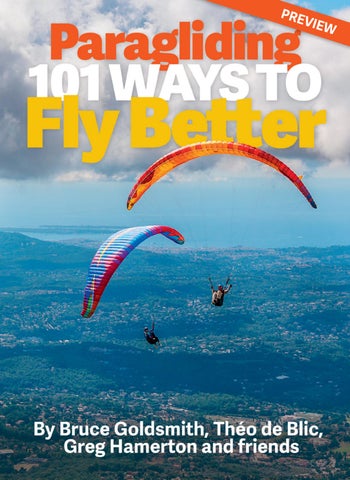
By Théo de Blic, Bruce Goldsmith, Greg Hamerton and friends
In the core, since 1988
Flying is our passion, and this book reflects that. It started life as a collection of the best learning articles published in Cross Country magazine since 1988, including Bruce Goldsmith’s Icaristics column. But it evolved, was updated, revised and added to. The original 50 Ways to Fly Better was published in 2013 – and went on to be translated into nine languages. More than a decade later it was time to completely update the original, with input from more pilots including regular Cross Country columnist Théo de Blic and well-known coach Greg Hamerton. The result is more than 300 pages dedicated to the absolute core of what we do: the essence of our sport. You will find some theory in here, but mostly you’ll find real-life practical experience, hard won by pilots who have been flying and working it out for years. Read it closely – some of what’s inside is absolute gold. See you in the air! – The Cross Country team
Cross Country was established in 1988 by Sherry Thevenot, an artist who married into the hang gliding scene and wanted to reflect the spirit of free flight through magazines. The magazine somehow just slotted right in, and it has grown ever since – it is now read by pilots around the world in both digital and print. It has always been edited and owned by pilots, and always will be. Find us on online at xcmag.com and join us on social media @xcmag.
Cross Country International Ltd
Tollgate
Beddingham
Lewes
BN8 6JZ
UK
xcmag.com
Published February 2026. Photographs and text copyright Cross Country International Ltd. All rights reserved. No part of this book may be reproduced in any form or by any means without permission in writing from the publisher, this includes scraping for AI or LLMs. This is not a teachyourself manual – please learn with a qualified instructor at an approved school. Free flight is an evolving discipline, theories adapt, equipment is superseded and advice changes: please send feedback to editor@xcmag.com.
Authors: Théo de Blic, Bruce Goldsmith, Greg Hamerton and friends
Editor: Ed Ewing
Editorial team: Tarquin Cooper, Charlie King, Hugh Miller, Bastienne Wentzel
Designer: Marcus King
Cover photo: Marcus King
Sales: Verity Sowden
Publisher: Hugh Miller
ISBN: 978-1-7393434-4-6
To have faith is to have wings “ ”
J.M. Barrie, The Little White Bird
This book is designed for qualified paraglider pilots who are keen to progress. If you have recently earned your licence to fly, congratulations! If you are already well on your way in the sport, then hello and welcome. All types of pilot will find lots to learn inside these pages.
Paragliding is an independent sport, and that means you need to learn to be responsible for yourself in the air from the start. Successes are yours to own, but then so are any mistakes. As Bruce Goldsmith, one of the lead writers in this book, is always keen to say: “The buck stops with you.” You are the pilot in charge, no one else. It’s your decisionmaking that will determine how quickly you learn, and how far you will fly.
That said, it’s good to have other pilots alongside when you go out flying, and one of the joys of our sport is the group of friends you make along the way. This book is meant to be one of those friends. It’s full of hard-earned good advice from many time-served pilots and covers everything from choosing equipment to deep insights into flying far in the mountains or flatlands. It can be read cover to cover, or you can dip into different chapters to refresh your knowledge as you progress.
It goes without saying it is not a teachyourself manual, but it does recognise that once you have left the school environment you are often left to learn independently. Taking XC courses, flying new sites, SIV, learning acro, competitions – these are all benchmarks in a pilot’s career, which help you improve bit by bit. Navigating your way through all of it is a lot of fun, but there are no shortcuts –
and don’t believe anyone who tells you there are! Becoming a good pilot takes time – and the journey to becoming one is as important as the destination.
If you have picked up this book then you are well on your way to taking that responsibility for educating yourself as much as you can. The best pilots soak up advice from all sources as they get better
and better. This book can help you do that.
The team at Cross Country have done a very good job of bringing together some of the most important lessons in paragliding. All of us here sincerely hope Paragliding: 101 Ways to Fly Better will help you keep improving and keep flying.
Ed
Ewing
(editor) and the team
Ben Abruzzo
Elite performance and fitness coach and adventure paraglider pilot
Théo de Blic
Multiple Acro World Cup champion, SIV and acro coach, Cross Country columnist
Tom Bradbury
Professional meteorologist, competition glider pilot and author (1983-2009)
Bob Drury
Pioneering Himalayan adventure pilot and editor of Cross Country from 2005-2010
Ed Ewing
Editor of Cross Country magazine, coauthor of Paragliding: The Beginner’s Guide
Kelly Farina
Alpine guide based in Austria and Italy and author of Mastering Paragliding
Bruce Goldsmith
Paragliding world champion (2007), paraglider designer and owner of BGD
Till Gottbrath
Freelance writer and photographer specialising in outdoor sports
Greg Hamerton
Paragliding instructor and coach with over 30 years of experience
Heike Hamann
Former Australian team pilot and practising psychotherapist
Brett Janaway
Founder of the SRS competition series and British paragliding team manager
Patrick Laverty
Irish hang glider pilot and altitude world record holder in powered hang gliding (5,348m)
Baptiste Lambert
Paragliding world champion (2025) and harness designer and professional test pilot
Malin Lobb
Advanced SIV and XC paragliding coach based in Annecy, France
Marcus King
Photographer and designer at Cross Country magazine
Hugh Miller
Multiple British paragliding record holder and mental health professional
Martin Morlet
French national record holder, XC guru, financial analyst in Paris
Russell Ogden
Multiple British champion, paragliding world champion (2021) and test pilot
Jay Rebbeck
Sailplane competition pilot and member of the British team
Honza Rejmanek
Red Bull X-Alps pilot and meteorologist, Cross Country columnist
Jack Sheard
Freelance journalist specialising in adventure sports
Adrian Thomas
Former British paragliding champion and a zoologist at Oxford University
Rob Whittall
Hang gliding (1989) and paragliding (1991) world champion and test pilot
Dr Matt Wilkes
Pilot and medical doctor specialising in remote medicine
Bastienne Wentzel
Pilot, paragliding coach and co-author of Paragliding: The Beginner’s Guide
Photographers
Trent Abbott
Jorge Atramiz
Tex Beck
Andy Busslinger
Kelly Farina
Michael Gebert
Fabian Gasteiger
Adi Geisegger
Bruce Goldsmith
Charlie King
Marcus King
Damien Lacaze
Jérôme Maupoint
Andrey Pronin
Ronald ten Berge
Vianney Tisseau
Chris Tong Viet
Erwin Voogt
Matt Wilkes
Xenia Winter
Bastienne Wentzel
Illustrations
Charlie King
Marcus King
By Rob Whittall
How do you find a paraglider that will help you progress safely in the sport?
Confidence is often overlooked, yet it is the most important factor in glider choice. If you feel good on a glider, you will fly better than on one that makes you anxious. If you lose confidence and get scared in a bad situation or rough air, you also lose the ability to make good calculated decisions. This is partly due to adrenaline and fear – they will cloud your judgement just when you need it most.
On the other hand, if you really enjoy your wing and feel comfortable under it, then your discomfort threshold will
PICK A GLIDER
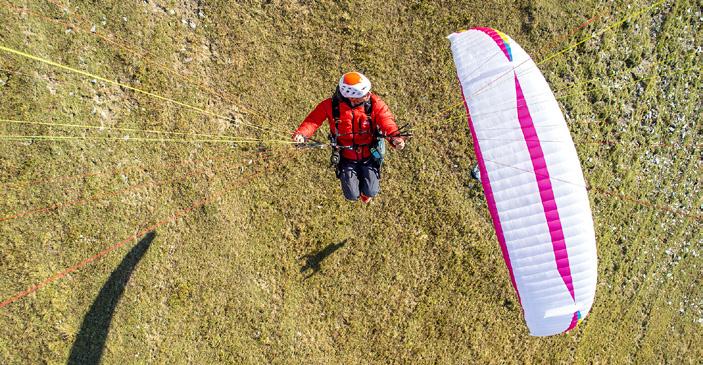
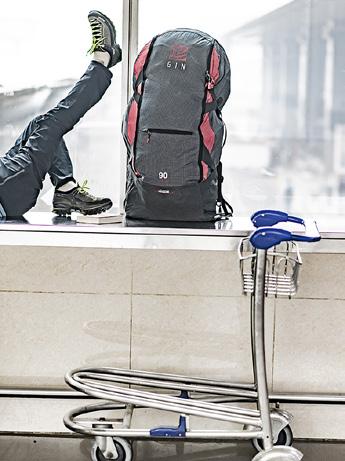
Be honest about what sort of pilot you are, and fly the one you like best. Photo: Jérôme Maupoint
be higher and you will have a better chance of making the right decisions all the time.
First, ignore style and trends, and don’t be a slave to figures either. Some people add up the results of the certification report and buy the glider with the best result (bad idea). Some pilots buy a wing because their friend has one (even worse idea). Or some are exclusively influenced by the top speed and manufacturer’s performance figures (a recipe for disaster). Finally, some even buy because the wing has a nice colour. Avoid these traps. Start by making an honest assessment of your capabilities and then go for a wing that will give you that allimportant confidence in the air.
Now is the time to be completely realistic about your capabilities. If you are a leisure pilot flying 10-50 hours a year, then the choice is easy: an EN-A or lowerend EN-B wing will have the stability and handling to keep you confident, even if you have the occasional lay-off of a month or more.
Don’t fall into the trap of dismissing these as ‘ beginner wings ’. The performance of modern wings is excellent and many long-time pilots say that they’re getting their bestever flights on them after unhappy experiences with hotter wings.
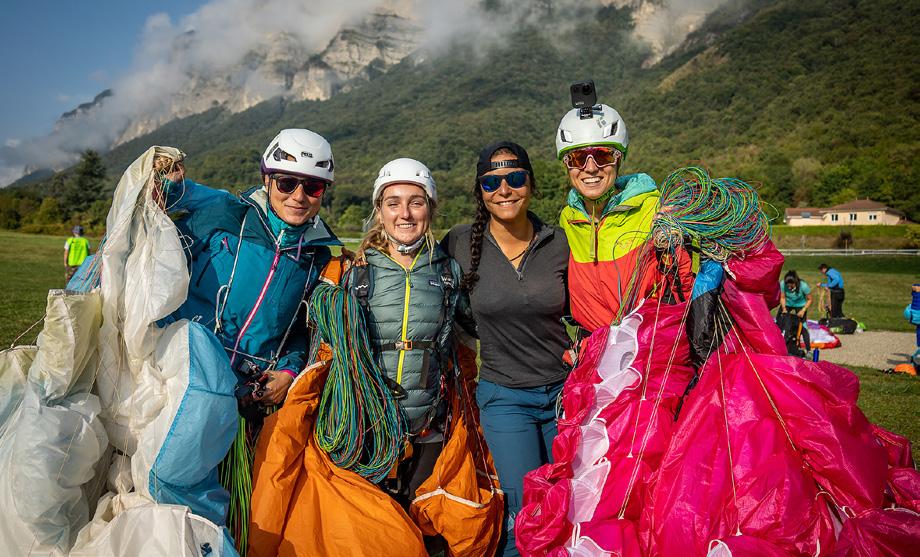
If you are lucky enough to fly most weeks and can keep current, consider stepping up. Only if you are already very confident, honestly extremely experienced, and fly all the time should you even think of any rating higher than an EN-C. This gives you the freedom to think: “So, I have decided that I am, in reality, an intermediate pilot nowadays rather than my previous image of myself being a hot cross-country and competition pilot. Thank goodness for that!” Remember, this is a flying machine you are about to purchase – your safety could depend on this decision.
Once you have narrowed down the field to four or five models, try and take a test flight on them if you can. Testivals are
great for this. Don’t necessarily buy the first wing your school or retailer tries to sell you, or the one that comes with a great deal or is on special offer. Think about how the glider feels: Did it take off well? Did it feel twitchy or was it smooth as an oil tanker? Were you confident and comfortable throughout the flight?
The one with the most yeses is the one for you. It does not matter if your friends are buying a different model at a cheaper price because at the end of the day it is you that has to fly the glider, not them. Remember, you are spending a lot of money. If the glider that really felt the best is a a bit more expensive, then you would be a fool not to buy it just because of the price. Always remember, dealers do deals!
By Théo de Blic
When do you outfly your wing? For some pilots it may be never...
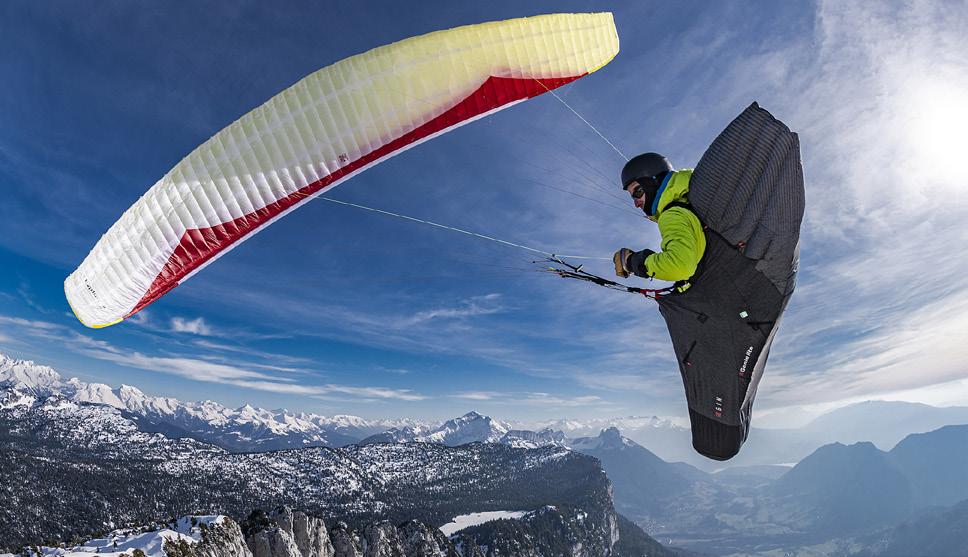
The “I want a new toy” frenzy often leads to pilots flying wings out of their comfort zone. You don’t want to be that pilot who is completely outflown by their wing, so here is some advice on why and when to change your equipment. We trust our life to gear, so when you check your equipment and if it is not in good condition, please change it. An old glider can enter deep stall easily and lines can break (particularly on old hike-and-fly or
two-line gliders). It doesn’t only happen to others. It is not an official rule, but it is a good recommendation that if your equipment is more than 10 years old then it is better to upgrade.
The crux of the matter, the soul-crushing and possibly ego-destroying question: when do you outfly your wing? For many pilots, almost never. Some pilots tend to
Have you really got the most out of the wing you have? Have you thermalled it, flown XC, done SIV on it and flown it on speedbar for lengthy periods? Try to get all the use out of it that you can before thinking about upgrading.
The most critical safety feature in paragliding is you. No amount of passive safety in a glider can shortcut training and experience. When talking to dealers, tell them about what sort of pilot you are, the experience you have and what sort of flying you want to do in the future.
There are lots of nearly-new secondhand wings, especially in the EN-B category. Look for ones with a recent service certificate, or buy through a dealer or school. You can save money and still have fun flying last year’s model.
Try not to ‘future-proof’ your wing purchase by buying for the pilot you imagine you will be in a year’s time. Buy a wing that suits you now. Buying a glider that is too hot for your level is a good way to get scared and leave the sport.
‘Learning to fly’ is more than learning to manage a glider in the air – it’s about reading the sky and landscape and making consistently good decisions. A faster, more demanding glider can actually hinder that learning process.
Dealers and manufacturers have no interest in selling you a wing that is above your level. They are there to help you assess what wing will be best for you. Make use of them. Buying a paraglider is not a regular online order.
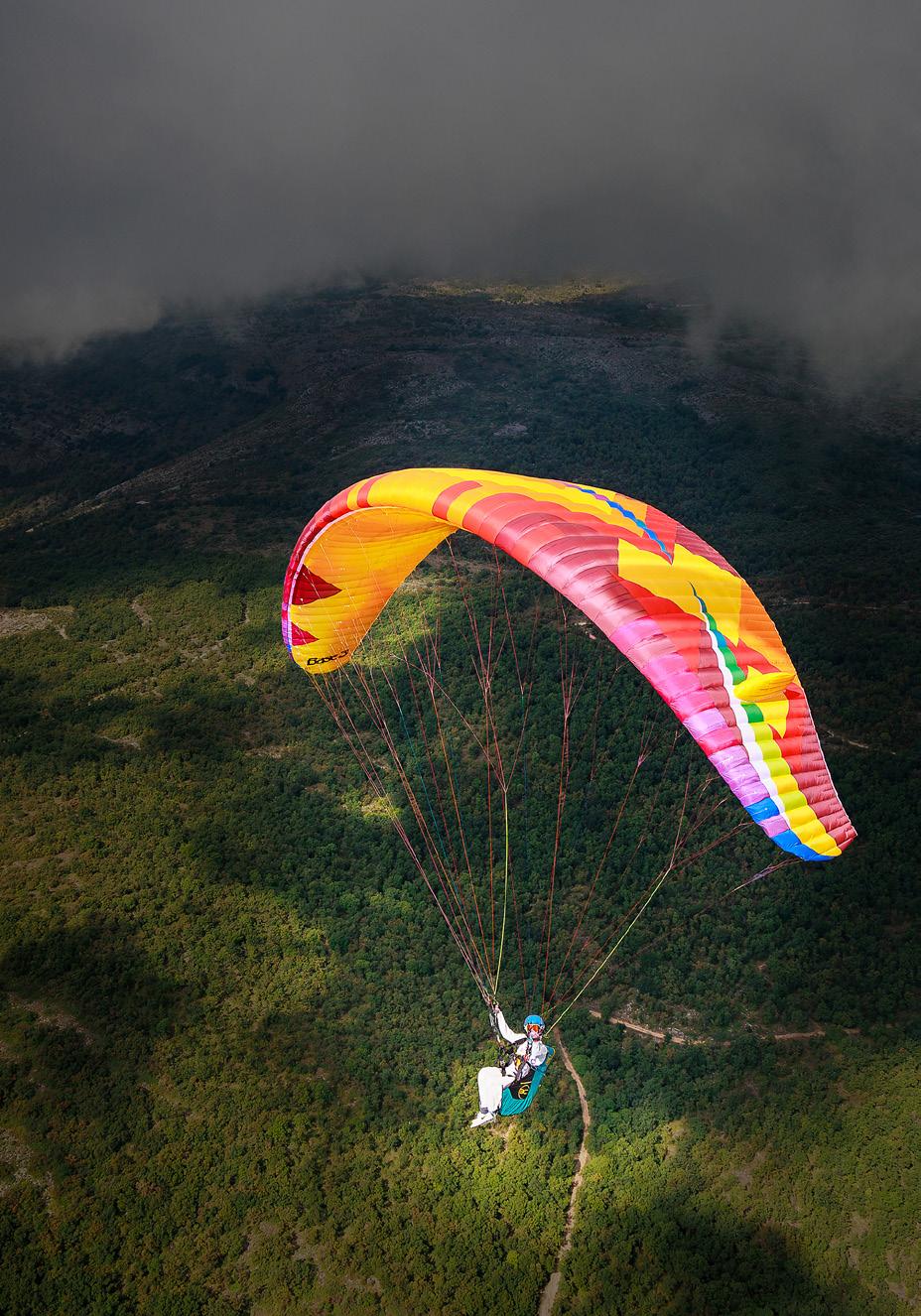
Read and understand the performance figures but try not to get hung up on them. Lots of gliders in the intermediate market have similar performance and good passive safety. It’s the pilot that makes the difference.
By Greg Hamerton
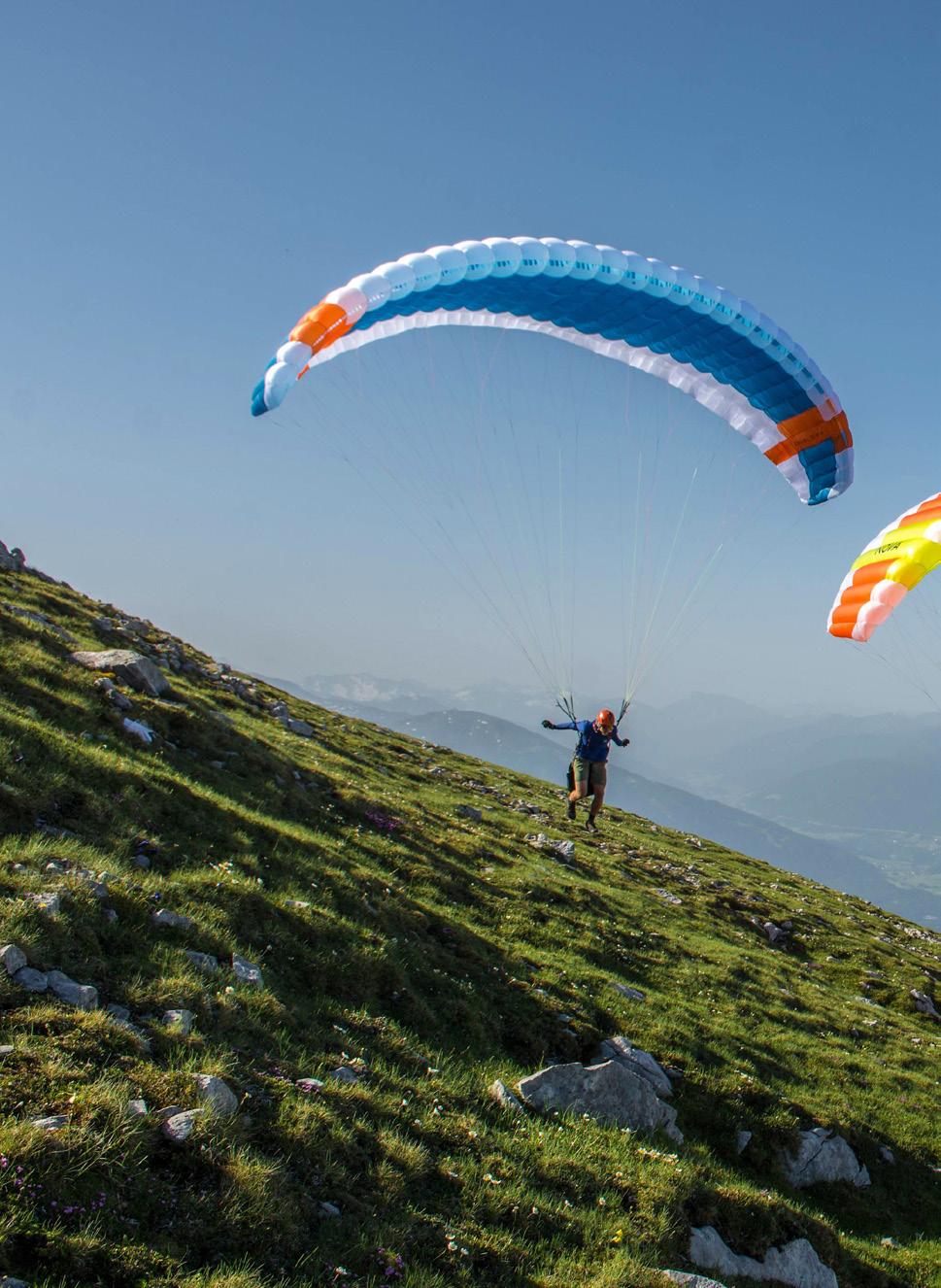
Is the wind steady? If it’s gusty and changing direction, it is likely you are in the lee of an obstacle. Find a better place to launch that is more exposed to the crosswind.
If there is strong wind, consider kiting the wing up from a flatter area so your wing is clear of the groundwash turbulence.
Once fully airborne, veer further away from the slope to get vertical separation. Fly away from any dangers associated with turbulence.
Adopt a good launch stance and get the wing balanced overhead. When you feel there’s a good moment, turn the wing just 10 degrees off the wind direction (downhill) and run to follow it.
Use minimal brake to centre the wing (instead, step uphill to centre the wing). Be very careful that you don’t let the wing roll over to the downhill side, which will pull you off the hill.
Important with a reverse launch. Set it up so your turn leads you uphill. If the wind is coming over your left shoulder (facing the wing) then have your left risers on top to turn left to follow the wing. The risers are open and you’ve got full control.
Don’t expect any ridge lift. Expect turbulence instead – wind can roll along a hillside getting lumpy. Make sure the slope is steep and free of hazards and plan to fly into clear air.
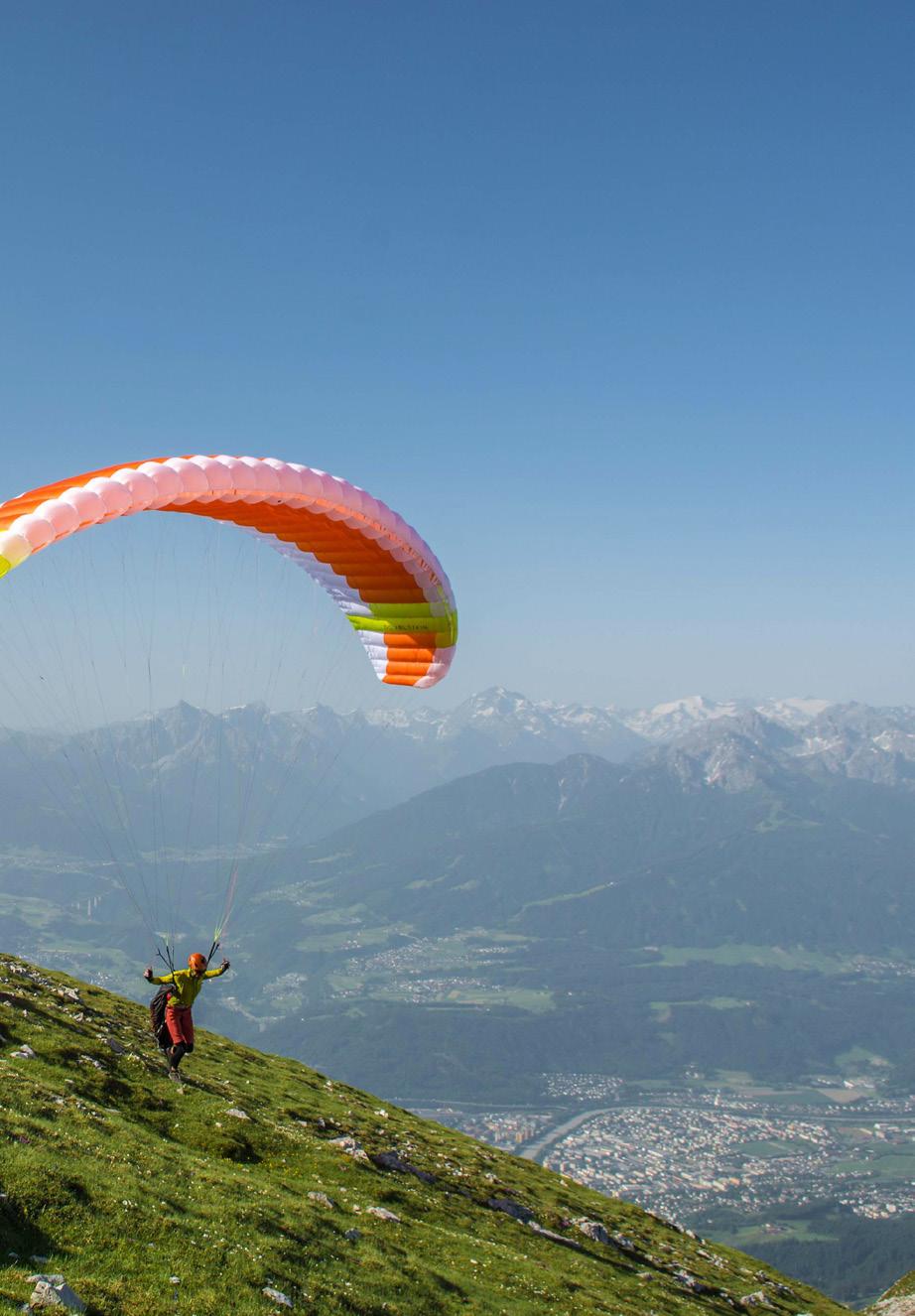
When the wind runs across the slope, your wing will try to fly down the slope because gravity pulls both the wing and the air downhill. You will naturally avoid moving under the wing to correct roll.
You don’t want to be pulled down the hill. Steer the wing uphill by braking it on the uphill side, launching the downhill tip first (it will fly uphill), or laying it out in cobra launch position with the wing already uphill of your position.
Keep the uphill tip on the hillside, let the wing pull you uphill. Walk uphill to reduce the power, as you feel the quality of wind. In this phase you can judge how turbulent and strong it is and if you want to commit.
By Théo de Blic
These exercises will have you groundhandling like a pro
Many pilots have an incredibly low level of groundhandling skill, and by low I mean dangerously low. And that’s a shame because groundhandling is not that complicated. So, if you are tired of your embarrassing take-offs, read on.
If it is not flyable, train. If it is windy take ten minutes to practise. Training is the most important thing. If you arrived at launch 15 minutes early every
time, you could use the time to perfect your groundhandling skills. If you groundhandled each time after landing you would not need to read this. I never miss a 10 or 15-minute groundhandling session when conditions allow. It’s such a good feeling to have your glider spinning with both feet safely on the ground.
Get comfortable
Twist right and left in your reverse launch; learn to inflate with your brake
Tim Bollinger uses a light-wind day in winter to work on his groundhandling skills. Photo: Jérôme Maupoint
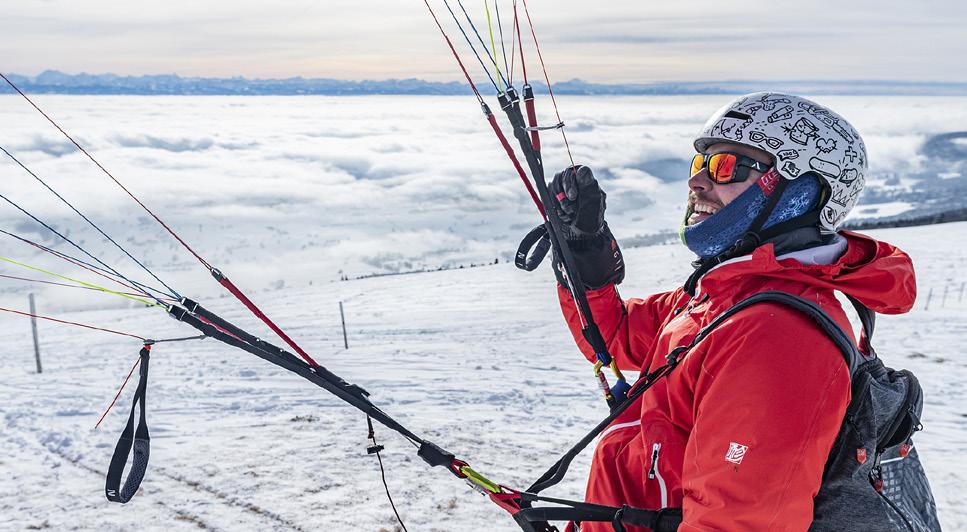
I never miss a 10 or 15-minute groundhandling session “ ”
handles in and out of your hands; holding both A-risers with one hand; and holding them one in each hand. The more comfortable you get in all situations, the more your mind will be free to focus on more important matters, particularly in strong or technical conditions. Learn in an easy situation first.
That was the advice my dad gave me when I was six. Your glider can be really powerful, particularly in strong wind. And the difference between flying and groundhandling is that when you fly you will always more or less end up below your glider (thanks to the pendulum effect). But when you groundhandle you have to go to your wing to put yourself below it. The brakes are only 30-40% of the action needed. The body does 60% of the work. Learn to always place your body at the right spot to be below your wing: and be ready to sweat and move a lot because you will need to run to always be in the right spot.
One of the most tiresome aspects of groundhandling is that your wing invariably ends up with the leading edge facing the ground and you have to get it back to its normal position. So try to bring it up by stalling. Think of it as an upside-down launch. With the wing on the ground in front of you, leading edge down, use your brakes to ‘stall’ it back up and then get into backfly, half spinning it as early as you can – it will save you a lot of time and effort! Good backfly
control always looks cool, and that’s a good thing.
Just let them go. It is so much more comfortable. You then have both hands free to grab a riser, or a brake or clap the hand of a friend (yeah, acro pilots have ego problems, on take-off we need to show off but that’s okay). All in all, groundhandling with your brakes loose, and grabbing them just when you need to is so much better. You need time to get used to this and you will get a few collapses, but once you get it this is just much nicer.
It is important on take-off to have complete control. It allows you much more freedom. So try to put your wing exactly where you want it. For example, brush your wingtip on a particular spot or keep your glider at a certain angle. You will then learn and gain feeling. As a kid my dad used to challenge me to brush camping chairs with my wingtip, a fun thing to do.
I mean when your wing is bunched, or you want to inflate just one side. Let’s say despite amazing groundhandling skills you messed up a launch and your wing is just a big mess on the ground. What better way to win back some of your lost pride than by inflating your messy wing like a boss? Also, when it’s very windy I personally always put my bunched wing in front of me and inflate it from there –it is just more comfortable.
By Bruce Goldsmith
Treated with respect, dipping in and out of cloud can be helpful – as well as fun
Almost every experienced cross-country pilot has a tale to tell: the time when they sneaked another 300m inside a cu and popped out the side in orbit; when they glided for half an hour on a compass bearing without losing a metre and flew so far they didn’t recognise where they were when they finally broke free; the time they got sucked in so deep with no instruments and came back out facing the same way they went in.
Cloud flying can be everything from a magical moment, to an absolute necessity, through to downright terrifying. In competition flying it is highly illegal, and rightly so, for both sporting and safety reasons. When free flying, though, in certain places, and at certain times, you can seriously enhance your flight with a bit of well-planned and well-executed cloud flying.
Before we even look at the ‘how to’, let’s look carefully at the ‘when to’ of cloud flying. Firstly, if you’re on a hang glider simply forget it. Due to the way a hang glider is controlled almost any attempt to fly without visual reference will result in you getting into a serious and, potentially, very dangerous, situation.
The pendular stability offered by a paraglider offers us the ability to fly without visual aid. It helps us calculate
our attitude to the horizon – if left unchecked in smooth air a paraglider pilot will swing back under their wing and, if the pilot is sitting straight, the glider will fly straight. By contrast, once you implement a turn on a hang glider it will continue to turn unless an equal turn is applied in the other direction.
In simple terms, for those who have never experienced hang gliders or threeaxis controlled aircraft, these types of
BASE IS ACE
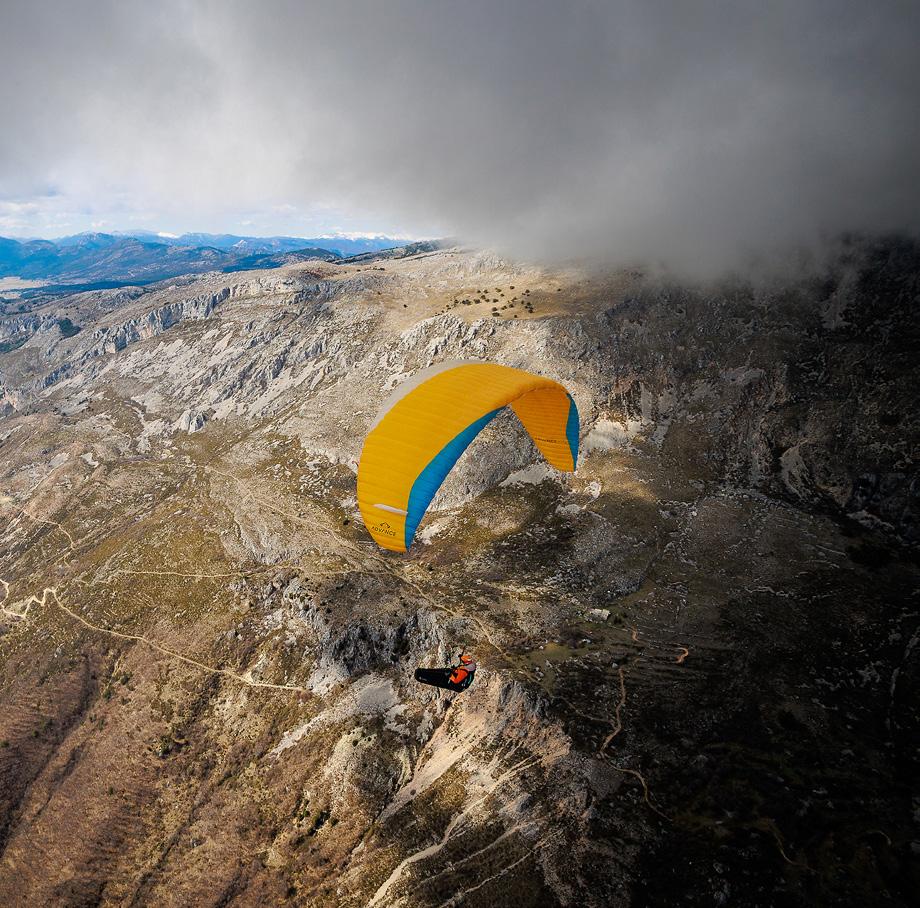
Flying at cloudbase is exciting and fun. Keep an eye on the cloud shadow on the ground below you to see how spread out the cloud is, and fly with a clear exit in mind. Photo: Marcus King aircraft are close to impossible to control in cloud without complex and heavy instruments. In fact, hang gliders have been known to get tumbled in cloud with the pilot remaining oblivious until they find themselves lying on the sail!
Assuming you are on a paraglider, and you’re comfortable handling your wing
with your eyes closed, the first thing you should do is assess the cloud you’re considering flying in, and the day in general. Check the cloud’s growth and development and satisfy yourself that there is no chance that it could become a cu-nim or even a towering cumulus that could become too strong and powerful to escape from. These kinds of judgements require you to have a sound
Thermal: 0m/s
Thermal: 0.5
Thermal: 1.0
Thermal: 1.5
Thermal: 2.0
Thermal: 2.5
Thermal: 3.0
Thermal: 3.5
Thermal: 4.0
Thermal: 4.5
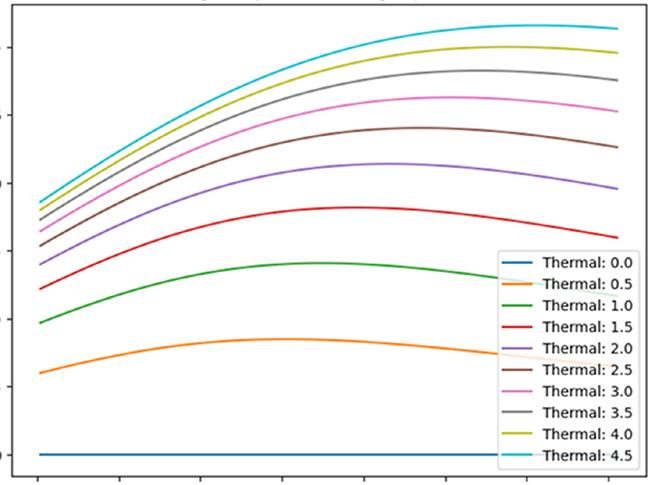
This shows your projected average speed on any given thermal strength at a particular speed. For example, given average climbs of 3m/s a pilot who flies at 40km/h on glide will average 24km/h. A pilot who flies at 45km/h when average climbs are 1.5m/s will average about 17km/h. The curve flattens off as glide speed increases, meaning there is less incremental gain in going faster. However, there is a lot to be gained by increasing your speed in the lower range. For example, even for pilots who don’t use the bar a lot, it pays to put your hands up when going on glide – there is a big gain going from 30km/h to 35km/h. Note this graph does not take into account the effect of the wind on your groundspeed.
arrive high, otherwise you will have to spend a long time climbing. “So you have to find a balance between gliding fast and gliding well.”
A rule of thumb is if the average climbs in a day are 1.5m/s then you should be gliding between thermals with one-third to half bar. Another rule of thumb is if the climbs are averaging 2.5m/s then you should fly at full speed between them. But how did these rules come about?
Baptiste explained using the graph above. It shows thermal strength (m/s) against horizontal speed. Pair the two and you
can read off your projected average speed on the left axis.
Baptiste explained: “For instance, take the pink one, which is 3m/s. This means if you decide to fly at 40km/h during your glide, then your average speed will be a little bit less than 25km/h. So: 3m/s climbs, flying at 40km/h = average speed of 24km/h.” The stronger the thermal, the higher the most effective value is. So, for a 2m/s thermal, the most effective speed is 45km/h.
“This is slower than many pilots think,” Baptiste added. “A lot of people glide too
fast. If you fly slower, you will see your average will go up.”
What you can notice on the curve is the slope. The slope is flatter the faster you go. That shows that actually, pushing extra bar all the time doesn’t make all that much difference, because the slope isn’t that steep – the incremental gain is small.
But going too slow, that will impact the average speed a lot. “Going faster than optimal will not affect your average speed,” Baptiste explained. “However, if you have to choose, it’s better to go a little bit too fast than too slow, because going too fast won’t make a lot of difference, but going too slowly will. And this is why
GOING FOR GOLD
in the end, everybody at 2-2.5m/s thermal strength flies full speed. I fly full speed at 2.5m/s.”
Flying the gaggle
Baptiste flew two-thirds of his flight on his own but was joined by others for the last leg. Flying with others does make a difference, he said, but not always in the way you might expect. “When you are in a gaggle you fly more efficiently when you are finding good lines and finding climbs. But you often fly less efficiently in terms of speedto-fly.
“Sometimes you fly slower than you want to, because you don’t want to push out. And other times you fly faster than
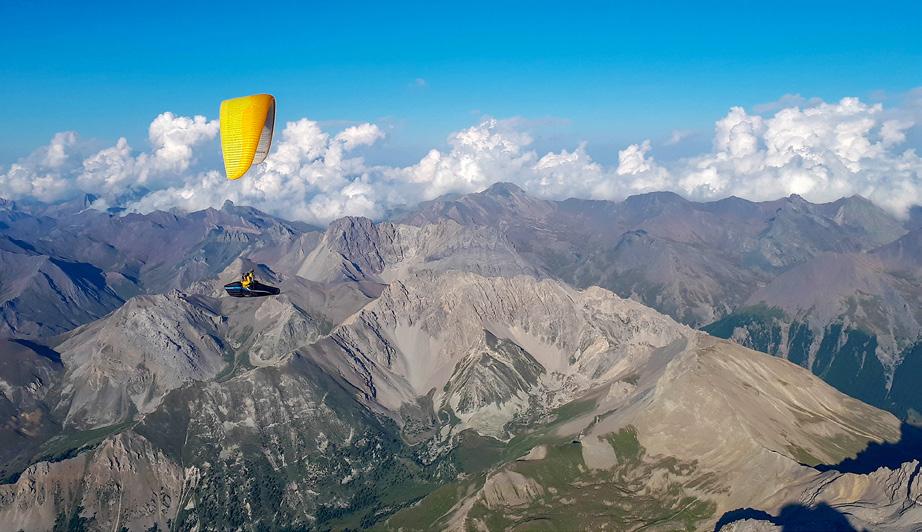
The region around Col de l’Izoard, the starting point for the 350km record triangle described by Baptiste in this chapter. Photo: Damien Lacaze
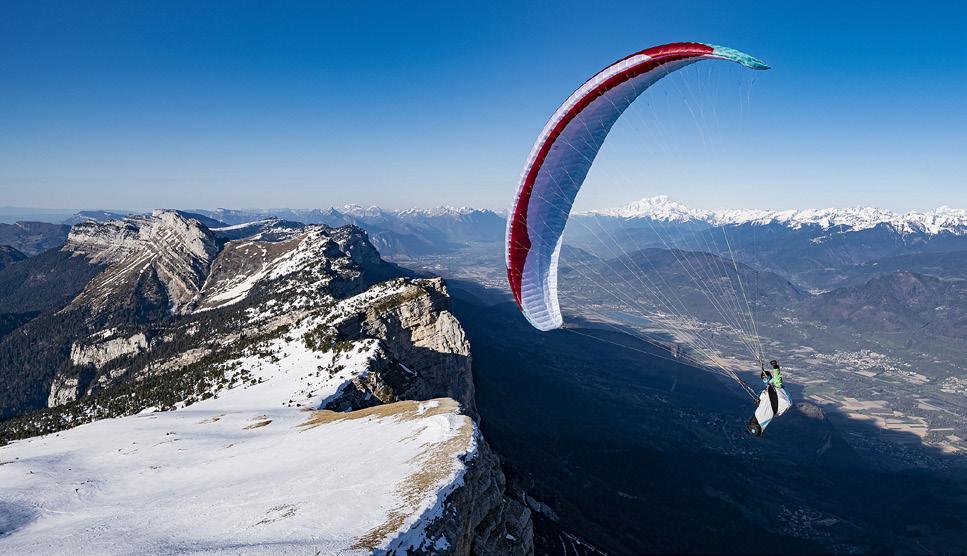
SPRING CONDITIONS
there are rocks showing through the snow then the high altitude sun will quickly warm them. With all the chilled air that the snow is producing there quickly becomes a dramatic difference in temperature between the warmth of the rocks and the frozen snow, and thermals form. With this dramatic temperature difference a remarkably small amount of rock can produce thermals from a snowy face.
One of the keys to successful flying anywhere is getting up and away from launch. Many mountain take-offs exist purely because of the convenience of access, not necessarily because they are
in the best place to get up from. However, there’s generally always a good climb reachable from launch, knowing its location is paramount to your success.
The first thing to consider is the takeoff’s aspect. When mountain flying it is important to fly on the sunny slopes, so put the landscape in your favour. It’s pointless turning up at a westerly-facing take-off at 11am. It won’t start producing lift till around 2pm. Fly the east faces in the morning, south throughout the middle of the day and west faces in the afternoon and evening.
Work out how the valley wind will interact with the take-off area. Some