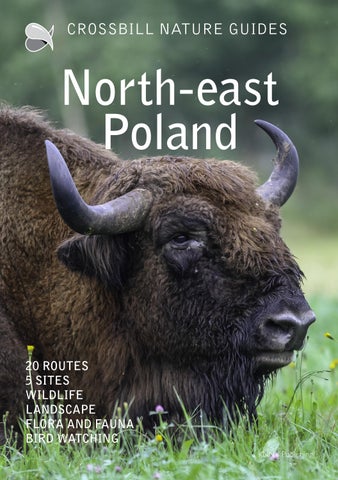
CROSSBILL NATURE GUIDES
North-east Poland
20 ROUTES 5 SITES WILDLIFE LANDSCAPE FLORA AND FAUNA BIRD WATCHING
CROSSBILL NATURE GUIDES
North-east Poland
WILDLIFE LANDSCAPE FLORA AND FAUNA ROUTES AND SITES BIRD WATCHING
Dirk Hilbers
Crossbill Guides: North-east Poland First print: 2013 Second print: october 2026 Initiative, text and research: Dirk Hilbers, Bouke ten Cate Additional research, text and information: Kim Lotterman, Albert Vliegenthart, Gino Smeulders, Lars Lachmann Editing: Niels de Haan, John Cantelo, Brian Clews, Jack Folkers, Cees Hilbers, Riet Hilbers, Kim Lotterman Illustrations: Horst Wolter Maps: Dirk Hilbers / mapy.com Type and image setting: Oscar Lourens Print: ORO grafic projectmanagement ISBN 978-94-91648-44-1 This book is made with FSC-certified paper. Instead of compensating the CO2emissions of the printing process, as we usually do when making a Crossbill Guide, we’ve chosen to invest that money in nature conservation. You can find details of the project we’re supporting on our website, under ‘Downloads’ on the Iceland guidebook page. © 2026 Crossbill Guides Foundation, Arnhem, The Netherlands All rights reserved. No part of this book may be reproduced in any form by print, photocopy, microfilm or any other means without the written permission of the Crossbill Guides Foundation. The Crossbill Guides Foundation and its authors have done their utmost to provide accurate and current information and describe only routes, trails and tracks that are safe to explore. However, things do change and readers are strongly urged to check locally for current conditions and for any changes in circumstances. Neither the Crossbill Guides Foundation nor its authors or publishers can accept responsibillity for any loss, injury or inconveniences sustained by readers as a result of the information provided in this guide. Published by Crossbill Guides in association with KNNV Publishing. SAXIFRAGA foundation
crossbillguides.org knnvpublishing.nl saxifraga.nl
CROSSBILL GUIDES FOUNDATION
This guidebook is a product of the non-profit foundation Crossbill Guides. By publishing these books we want to introduce more people to the joys of Europe’s beautiful natural heritage and to increase the understanding of the ecological values that underlie conservation efforts. Most of this heritage is protected for ecological reasons and we want to provide insight into these reasons to the public at large. By doing so we hope that more people support the ideas behind nature conservation. For more information about us and our guides you can visit our website at: crossbillguides.org
HIGHLIGHTS OF NORTH-EAST POLAND
Highlights of North-east Poland Visit the primeval forest of Białowieża, the benchmark of European nature.
1
Go birdwatching in Biebrza and Białowieża and enjoy close encounters with Aquatic Warbler, Great Snipe, Whitewinged Tern, Collared Flycatcher, White-backed Wood-pecker and all those other sought-after species.
2
Enjoy the wonderful tranquility of the traditional farmland, with its flowery meadows, the wooden houses, the families of White Storks, and the friendly people.
3
Get up at the crack of dawn to see Elk and Bison in some corner of a misty mire. Who knows, you might even be lucky and see a Wolf!
4
4
CROSSBILL GUIDES • NORTH-EAST POLAND
HIGHLIGHTS OF NORTH-EAST POLAND
Search the little forest glades, bogs and calcareous swamps of the Biebrza and Wigry for the many rare wildflowers, butterflies and dragonflies that still occur here.
5
Rent a canoe and paddle into the true wilderness of Czarna Hańcza’s endless river meanders and oxbows. Do so quietly and you may very well spot a Beaver, Otter, Elk or Crane by the river bank.
6
Go deep in the marsh of the Biebrza. Put on your wellies (or perhaps it is better to go barefoot) and wade through the wobbly peat layer to find out what the fen mires are really about.
7
Explore the culture of Northeast Poland – that crossroads of Catholic and Russian Orthodox cultures, visit an ancient wooden Tatar Mosque and enjoy the fine Jewish food in Tykocin.
8
INTRODUCTION
5
ABOUT THIS GUIDE
About this guide This guide is meant for all those who enjoy being in and learning about nature, whether you already know all about it or not. It is set up a little differently from most guides. We focus on explaining the natural and ecological features of an area rather than merely describing the site. We choose this approach because the nature of an area is more interesting, enjoyable and valuable when seen in the context of its complex relationships. The interplay of different species with each other and with their environment is astonishing. The clever tricks and gimmicks that are put to use to beat life’s challenges are as fascinating as they are countless. Take our namesake the Crossbill: at first glance it’s just a big finch with an awkward bill. But there is more to the Crossbill than meets the eye. This bill is beautifully adapted for life in coniferous forests. It is used like scissors to cut open pinecones and eat the seeds that are unobtainable for other birds. In the Scandinavian countries where Pine and Spruce take up the greater part of the forests, several Crossbill species have each managed to answer two of life’s most pressing questions: how to get food and avoid direct competition. By evolving crossed bills, each differing subtly, they have secured a monopoly of the seeds produced by cones of varying sizes. So complex is this relationship that scientists are still debating exactly how many different species of Crossbill actually exist. Now this should heighten the appreciation of what at first glance was merely a plumb red bird with a beak that doesn’t close properly. Once its interrelationships are seen, nature comes alive, wherever you are. To some, impressed by the ‘virtual’ familiarity that television has granted to the wilderness of the Amazon, the vastness of the Serengeti or the sublimity of Yellowstone, European nature may seem a puny surrogate, good merely for the casual stroll. In short, the argument seems to be that if you haven’t seen a Jaguar, Lion or Grizzly Bear, then you haven’t seen the ‘real thing’. Nonsense, of course. But where to go? And how? What is there to see? That is where this guide comes in. We describe the how, the why, the when, the where and the how come of Europe’s most beautiful areas. In clear and accessible language, we explain the nature of North-east Poland and refer extensively to routes where the area’s features can be observed best. We try to make North-east Poland come alive. We hope that we succeed.
6
CROSSBILL GUIDES • NORTH-EAST POLAND
ABOUT THIS GUIDE
How to use this guide This guidebook contains a descriptive and a practical section. The descriptive part comes first and gives you insight into the most striking and interesting natural features of the area. It provides an understanding of what you will see when you go out exploring. The descriptive part consists of a landscape section (marked with a blue bar), describing the habitats, the history and the landscape in general, and of a flora and fauna section (marked with a orange bar), which discusses the plants and animals that occur in the region. The second part contains the routes and sites (marked with a green bar). It features walks, cycle routes and car drives and are carefully selected to give you a good flavour of all the habitats, flora and fauna that North-east Poland has to offer. At the start of each route description, a number of icons give a quick overview of the characteristics of each route. These icons are explained in the margin of this page. The final part of the book provides some basic tourist information and some tips on finding plants, birds and other animals as well as information on sustainable travel. There is no need to read the book from cover to cover. Instead, each small chapter stands on its own and refers to the routes most suitable for viewing the particular features described in it. Conversely, descriptions of each route refer to the chapters that explain more in depth the most typical features that can be seen along the way. In the back of the guide we have included a list of all the mentioned plant and animal species, with their scientific names and translations into German and Dutch. Some species names have an asterix (*) following them. This indicates that there is no official English name for this species and that we have taken the liberty of coining one. We realise this will meet with some reservations by those who are familiar with scientific names. For the sake of readability however, we have decided to translate the scientific name, or, when this made no sense, we gave a name that best describes the species’ appearance or distribution. Please note that we do not want to claim these as the official names. We merely want to make the text easier to follow for those not familiar with scientific names. An overview of the area described in this book is given on the map on page 13. For your convenience we have also turned the inner side of the back flap into a map of the area indicating all the described routes. Descriptions in the explanatory text refer to these routes.
INTRODUCTION
Icons used to charactarise the routes and to show the key interest: 1 Waypoint
Car Bicycle Walk Excursion Scenery History Geology Ecology Flora Mammals Birds Reptiles / amphibians Butterflies Dragonflies Invertebrates
7
TABLE OF CONTENTS
Table of contents
8
Landscape Geographical overview Geology Hydrology Habitats Forests Lakes and rivers Sedge marshes and Willow scrub Fields and meadows – the traditional countryside Raised bogs History Nature conservation
11 12 14 17 21 23 32 37 40 44 47 55
Flora and fauna Flora Mammals Birds Reptiles and Amphibians Insects and other invertebrates
65 68 80 86 99 101
Routes and sites
111
Augustów region Route 1: Suwałki Landscape Park Route 2: Loop around Wigry lake Route 3: The suchary of Wigry Route 4: Wigry by bicycle Route 5: Augustów forest
112 114 119 124 128 132
Biebrza and Narew region Route 6: The Biebrza at Osowiec Twierdza Route 7: The west bank Route 8: The east bank Route 9: The Sedge Marshes of Barwik Route 10: The Honczarówska Dike Route 11: Hamlets in the middle of the marsh Route 12: The Red Swamp Route 13: The upper basin Route 14: Narew National Park
138 140 143 148 154 157 160 165 169 173
CROSSBILL GUIDES • NORTH-EAST POLAND
TABLE OF CONTENTS
Białowieża region Route 15: Białowieża and surroundings Route 16: Zebra-Zubra Route 17: To the Lesna by bicycle Route 18: Kosy Most Route 19: The hamlets and the forest glades Route 20: Siemianowka Reservoir
177 179 183 185 190 194 198
Additional sites in North-east Poland Site 1: Białowieża strict reserve Site 2: Dojlidy Fishponds Site 3: Puszcza Romincka Site 4: Puszcza Knyszynska Site 5: Kurianskie Bagno
203 203 203 204 204 205
Tourist information & observation tips Planning your trip Annoyances and hazards Watching mammals Birdwatching List Species list & translation Picture credits & acknowledgements
207 207 214 217 219 224 238
INTRODUCTION
9
geographical overview
Geographical overview North-east Poland roughly coincides with Podlasia, a province to the north-east of Warsaw that borders on Russia, Lithuania and Belarus. The two most famous National Parks of Poland lie within its boundaries: Białowieża (pronounce Bja-wo-viè-shah) and Biebrza (pronounce Bièbshah). Białowieża is world-famous for being the last remaining primeval forest of lowland Europe (or nearly primeval, as you will see). It is also famous for being the final place where the last European Bison lived in the wild, and, after a short period, the first area to which it was reintroduced (see box on page 82). Białowieża is a must-see forest reserve for naturalists, birdwatchers and ecologists. Gateway to Białowieża is the small loggers’ town of Hajnowka. From here, a single road enters the forest to end at the village of Białowieża, which is the hotspot for tourists to the National Park (oddly, Hajnowka has little to offer the many visitors that come for the great forest that begins right at its outskirts). A potholed dirt track connects Białowieża forest with the small villages and hamlets north of the National Park, which form an excellent alternative base to explore the forest. Biebrza is Poland’s largest National Park covering a huge area of floodplain of the Biebrza river. Within a European context, it is unique for harbouring a complete and largely intact river ecosystem over a huge length, and over its entire width from river channel through reed and willow swamps, to vast mires, groundwater fed swamps onto the dry moraines. Biebrza is Poland’s top birdwatching region. The wide Biebrza floodplain has a narrow waist, where the provincial road 65 connects the small towns of Grajewo and Monki. On the east bank of this narrowest point, in the military settlement of Osowiec Twierdza, lies the Park’s visitor’s centre (where you can buy entrance tickets to the Park). From here you can go down the Carska Droga (Tsar Road) to discover the south basin, which is the most popular part of the park. Alternatively you can explore the less visited middle and upper basin. Mid-way between Białowieża and Biebrza (about 50 km between both) lies Białystok, the province’s capital. And just west of it lies Narew National Park, covering an inland delta (see page 18 for more details) of the Narew River. Narew National Park is somewhat reminiscent of the Biebrza, which is a mere stone’s throw away. After Białowieża and the Biebrza-Narew combination, the region’s third grand natural region lies north of the city of Augustów, which in turn lies a little north of the Biebrza. Here begins the hilly and lake-dotted region of Masuria which owes its picturesque landscape to the fact that it was covered in ice during the last ice age. The huge forest of Augustów, with Wigry National Park in its outskirts is the 12
CROSSBILL GUIDES • NORTH-EAST POLAND
geographical overview
most eye-catching feature. This Puszcza (which means something like large-forest-with-primeval-character), which continues for many kilometres in Lithuania and Belarus, is much larger than its famous cousin Białowieża. Augustów forest is dominated by pine forest, which, although largely planted, is close enough to the northern taiga regions to have a northern atmosphere. North of Augustów lies the town of Suwałki, the last sizeable town before the border. To the northwest of it the Suwałki Landscape Park is, besides being very pretty and picturesque, one of Poland’s most attractive geological sites.
Russia
Lithuania Wigry: see map on page 112
3
1
Wigry NP
suwałki
augustów
2-4
ów
u st Au g st e Fo r
ełk
12
5
5
13
hrodna
NP brza Bie 11 6
Belarus
7 8-10 łomza
4 białystok
Nar
14 P ew N
Biebrza: see map on page 138
2
20 Bia łowie Forest
hajnówka
ża 1
15-19
Białowieża: see map on page 177
warsaw
brest
LANDSCAPE
Overview of North-east Poland.
13
GEOLOGY
Ice age geology Glacial lake generally deep and large lakes, created by the underside of the land ice, which scarred the land. These scars, filled up with water, became glacial lakes which are now common in the northern part of the region. Pingo ruin a small, often acidic lake (such as the suchary – see page 44), which was created when an ice lens (pingo) collapsed. In arctic conditions, ice grows in the soil, when groundwater migrates upward through cracks in the permafrost. It grows to form a small hillock, which collapses when temperatures rise or the ice breaks through the top soil. Retreating ice sheet
erosion and sedimentation creates hills
Moraine An elongated, asymmetrical hill of unsorted sediments, pushed forward by the growing ice sheet, and left at the farthest expansion of the ice. Boulder field large boulders were taken down south from Scandinavia when the land ice flowed south. They are everywhere in the ground, but locally very visible. This is in places where melt water streams were very strong and fine material eroded away, leaving the large boulders exposed.
16
Maximum extension of ice sheet
ice lake (silting up)
moraine ice river
floodplain erosion
Esker an (often kilometres) long sandy ridge, created by rivers of melt water that run in or underneath the ice sheet. Sediment silts up the waterway (like in a normal river) and after the disappearance of the ice, these sediments remain as a snake-shaped hill in the landscape. Kame large sandy hill, created in much the same way as the esker. A lake in the ice sheet silts up and, when the ice has disappeared, the sediments remain to form a hillock of sand. Post-glacial landscape hilly landscape kame (former ice lake) esker (former ice river) moraine boulder field
CROSSBILL GUIDES • NORTH-EAST POLAND
GEOLOGY
During the last ice age, the regions of the Biebrza and Białowieża had an arctic climate. Vegetation cover was sparse, conditions were dry, and strong winds swept freely across the open landscape. Vast quantities of sand, left behind by retreating glaciers and deposited by glacial meltwater rivers, were picked up and redistributed by the wind. In this way, extensive dune fields developed. Today, these inland dunes are covered by dry pine forest, juniper scrub, lichens and warm, species-rich grasslands. They occur throughout the region, with particularly beautiful examples in the Biebrza river basin.
The creation of the marshes
After the glacial periods, North-east Poland consisted of a very softly undulating landscape with a warm and humid climate, a lush vegetation and a precipitation that was much higher than the evaporation. They were ideal conditions for swamps to form, in which plant material accumulated and was converted into thick layers of peat. Isolated lakes are mostly fed by rainwater. Such nutrient-poor conditions favour the growth of raised bogs dominated by peatmosses. Since these lakes are mostly in the north, such as near Wigry, it is here that the most beautiful examples of raised bogs, known locally as Suchar (plural Suchary), are found. Further south, the water formed large sluggish rivers, like the Biebrza and the Narew. These rivers run through such wide and gently sloping valleys, that they were able to create, over the years, huge swathes of peat. The process is quite simple: the river (the Biebrza is a good example) has a single peak discharge of water, namely in spring. The river spills its water over a level floodplain, where it stagnates. Generations of marsh plants that grow in these permanently wet conditions (even in summer, the floodplain doesn’t dry out) create a thick layer of peat. These peat layers are different from the Suchary, being richer in minerals and nutrients.
Hydrology The key to much of the region’s splendour lies in the fact that most rivers here still have a pretty much intact hydrology. Both longitudinally (from source to mouth) and cross-sectionally (from riverbed to hillside), the water follows its natural course. The Biebrza is deservedly famous for this, but the Rospuda and Czarna Hańcza in the north, and large parts of the Narew and Narewka in the south are attractive for exactly the same reason.
Natural river from source to mouth
When you look at a map of the Biebrza you’ll see a sharply meandering river, winding its way through the landscape. These slow-moving rivers tend to flow around obstructions such as fallen trees. In the curve that
LANDSCAPE
17
habitats
presence of many strictly eastern and some northern species. But even with this in mind, North-east Poland, in particular the Biebrza, Narew and Białowieża National Parks, represents a benchmark in understanding intact temperate European habitats. Hence every naturalist ought to rush off to visit this magical place.
Cross-section of the habitats of North-east Poland in different stages of succession from river to ridge.
North-east Poland has a gently sloping terrain. One can make an idealised cross section of its habitats, going from wet depressions and river floodplains to dry sandy or loamy ridges, in which, locally, lakes and peatlands occur – see the illustration below. Each spot on this cross-section sports its own types of habitat. Which one prevails depends on the stage of succession the particular spot has reached. A sandy moraine may be clad in a spruce-pine forest, but could just as well sport a dry grassland with juniper bushes. A soggy stream valley may be covered by alder carr, if unused by man, but if regularly cut and mown, will be a sedge marsh. Hence the illustration below shows not one but three cross-sections – one showing forest types, one with bushes and one with various grasslands. In the ‘field’ you’ll find a mix of all these habitats.
suc c
ess io
n
w
s
River
g
Hillside woodland scrubland grassland
22
flood forest reed bed oxbow
alder carr willow scrub fen mire
oak-linden-hornbeam blackthorn scrub fields / meadows
Isolated depression mixed forest juniper scrub dry grassland
pine / spruce bog birch bog suchar
CROSSBILL GUIDES • NORTH-EAST POLAND
forests
Forests The best examples of old-growth forest are in Białowieża (routes 15, 16, 17, 18 and the strict reserve – see page 203). But fitting examples can also be seen on routes 5 and 12. Large old alder carr woods are present on routes 8, 10, 12, 16, 17, 18 and 19. Oak-linden-hornbeam forests are present on routes 4, 12, 13, 15, 16, 17, 18, 19 and the strict reserve. Mixed forest and dry coniferous forest is part of routes 3, 4, 5, 8, 17, and 18. Small patches of birch carr forest is present on routes 5, 8 and 18. The best examples of pine and spruce bog forest is found on routes 2, 3, 5, 17 and 18.
Walking over the mossy forest soil underneath a canopy of majestically tall trees, and watching the enormous trunks of fallen forest giants, it is not hard to understand that the forests of North-east Poland are something special. The large areas of undisturbed, natural forest are, together with the marshes, the most valuable and exciting habitat of the region. A large part of North-east Poland is covered in forest, and the bulk of this is part of one of the three huge forest complexes: that of Białowieża, of Knyszyn and, the largest of them all, that of Augustów. In each of them, you can walk many kilometres before you break cover from the trees. And if you do enter an open area, it is only to cross a river or a forest glade. North-east Poland is one of the more densely wooded regions of the North European Plain. More importantly however, it is the forest’s natural, unscathed state and large variety of forest habitats that account for the high biodiversity.
Main forest complexes in North-east Poland.
Russia
Old-growth forest – what makes it special?
The great quality of the forests of North-east Poland is the large amount of old-growth woodland. Oldgrowth is not simply a collection of old trees. Rather, it is a forest that has remained undisturbed for longer than the lifespan of the individual trees, creating a mosaic forest of trees of all different ages. By analogy with human society, an old forest compares with a home for the elderly, whereas old-growth is a full and flourishing society, with babies and toddlers all the way to the elderly and even the graveyard – in other words, it is much richer than single-aged stands. There are a couple of features by which you can distinguish an old-growth forest. First, there are trees of mixed, random ages. There are forest giants in the wood, certainly, but they are outnumbered by smaller trees which, in turn, are outnumbered by saplings.
LANDSCAPE
romińcka Forest
Lithuania
August ów Forest
napiwodzko-ramucka forest
B
el
ar
knyszyn forest białystok
białowieża forest
warsaw
23
us
forests
The stunning oldgrowth forests of the region are one of the prime attractions.
Another striking element is the presence of lots of dead wood. In strictly commercial forests, a tree that dies before it is harvested equals an investment gone to waste. Dead wood on the ground is cleared to facilitate wood extraction. Yet from an ecological point of view, slowly rotting wood, whether as snags, branches, fallen trunks or standing trees, is of tremendous value. The decay of wood is a reverse succession from hard and strong wood through various stages of decay, each of which is facilitated by a different set of fungi and invertebrates. In Białowieża, where the richest stands of Hey, where is the Beech? You might have noticed that the most prominent and dominant tree species of many European forests has not been mentioned in the text. Whereas the Beech is the ruling tree in many European forest types, it does not occur at all in the Białowieża forest and is, in fact, uncommon in all of eastern Poland. Beech thrives in Western Europe, more or less up to the German-Polish border. Towards the south and further east it becomes a species of mountain forests. Although superficially similar to hornbeam, the ecological role (niche) of Beech is entirely different. Hornbeam is a species of the lower canopy and has nutritious leaves that enrich the forest floor. Beech, in contrast, creates an acidic, growthinhibiting leaf litter and is an aggressive tree that can easily dominate forests elsewhere in Europe. The absence of Beech in the Białowieża forest is one of several factors that make it difficult to take Białowieża as a model for the natural vegetation of Central Europe.
24
CROSSBILL GUIDES • NORTH-EAST POLAND
forests
old-growth forest occur, there are fungi and invertebrates that, within Europe, occur only here. Dead wood also functions as a sponge. It absorbs rainwater that is available to the forest’s inhabitants in times of drought. The water also cools the forest in periods of heat – very important in these times of climate change. Furthermore, be aware that although the big trees in oldgrowth forests have impressive girths, their canopies are not as broad as you might think. This is a feature of trees that grow up amongst other trees. Their struggle for light means growing in height to reach their little place in the sun. Forest trees do not need very broad trunks because their neighbours will protect them against the wind. This is in stark contrast with old trees in parks, which need to resist the elements, but are not in competition for light. A hugely important feature of old-growth forests is their mosaic structure. When a forest giant comes down in a storm, it leaves a gap, which is sometimes enlarged because it takes down other trees in its fall. (Since many old trees suffer from disease and decay, they come down at some point, which is the reason that you are not allowed in the forest during storms). Such a gap leaves space and light for a series of young saplings to grow. Trees crash to the ground regularly in a natural forest, and this results in a patchy vegetation structure: there are spots with fairly young trees and underbrush, mixed with old trees with very few young trees at their base. The mosaic structure is one of the key reasons that old-growth forest offers shelter to so many different species of flora and fauna: it offers a home both to those species that seek out the shelter of young underbrush, and those that thrive in tall, old trees. In young, commercial forests, there is strong competition amongst the birds for nest sites. The fierce struggle is won by a few more aggressive species (Great Tit being one) which is one of the reasons for the low bird diversity in young forest. In old-growth, there are many holes, because old trees are prone to disease. Woodpeckers (mostly Black Woodpecker) drill holes in trees, and fungi and insects further enlarge them. In fact, nest holes form a special ecosystem within the forest, and there are even some invertebrate species that live exclusively in tree holes. These holes not only provide sufficient shelter for the birds and smaller mammals, but also for their predators. The Pine Marten especially does very well in the forests of North-east Poland, and you have far more than just a theoretical chance of coming across one. Nest predation is an important limitation to the bird population of the old-growth forest. To such predators, a bird is a bird and a chick is a chick – they don’t discriminate
LANDSCAPE
Pine Martens are ferocious predators that seek eggs and chicks in tree cavities.
25
FORESTS
Spruce-pine and mixed forests Occurrence Dry, sandy, nutrientpoor ridges Dominant trees Norway Spruce, Scots Pine, Silver Birch Others Trembling Aspen, Rowan, Goat Willow, Juniper Characteristic This forest type has a different flora and fauna from deciduous f orests. But be aware that not all forests dominated by spruce or pine are spruce-pine forests ecologically speaking. Commercial spruce or pine forests are often planted on soils which would have otherwise been covered by other forest types. Such plantations have mixed characteristics of both forest types. Some typical species Crossbill, Pygmy Owl, Tengmalm’s Owl, Hazel Grouse, Nutcracker, Staghorn Clubmoss, Creeping Lady’s-tresses, Heather, Mountain Parsley Routes 2, 5, 17, 18 / commercial coniferous forest: 2, 3, 4, 5, 7, 8
Spruce Bog and Pine Bog forest Occurrence Permanently wet, nutrient-poor, boggy places Dominant trees Either Norway Spruce or Scots Pine Others Downy Birch, Goat Willow Characteristic This northern forest type is quite rare in North-east Poland, where it reaches its southern limit. Here it is restricted to peat-filled shallows and especially to areas fringing bog lakes in Wigry and Augustów forest. The silence, rotting wood and half decayed snags make this an enchanting forest type. Some typical species Hazel Grouse, Capercaillie, Interrupted Clubmoss, Labrador Tea, Hare’s-tail Cottongrass. Routes 2, 3, 5, 12, 15, 17, 18
30
CROSSBILL GUIDES • NORTH-EAST POLAND
FORESTS
Oak-linden-hornbeam forest Occurrence Moderately moist, fairly nutrient-rich soils Dominant trees Pedunculate Oak, Small-leaved Linden, Hornbeam Others Norway Maple, Ash, Norway Spruce, Trembling Aspen Characteristic This is the dominant forest type in North-east Poland. In well-developed forests (e.g. the Białowieża strict reserve), trees can reach formidable heights. It is of great ecological importance. Some typical species White-backed Woodpecker, Collared Flycatcher, Red-breasted Flycatcher, Hawfinch, Isopyrum, Peach-leaved Bellflower, Mezereon, Liverleaf Routes 12, 13, 15, 16, 17, 18, 19
Alder carr wood Occurrence permanently wet, nutrient-rich catchments Dominant tree Alder Others Norway Spruce, Ash, Grey Willow, Elm Characteristic This is the most jungle-like forest type, due to the fact that trees are standing in water and that many trees have fallen down. The shallow-rooting spruce tips over relatively easily. Beaver activity (gnawing down trees and flooding the forest) creates lots of dead wood which attracts a lot of wildlife. Alder carr wood is a common forest type in North-east Poland, but has decreased in western Europe, due to drainage. Some typical species Crane, Green Sandpiper, Black Stork, Alpine Enchanter’s-nightshade, Greater Spearwort, Touch-me-not Balsam Routes 4, 7, 8, 10, 12, 16, 17, 18, 19
LANDSCAPE
31
raised bogs
Raised bogs The best examples of raised bogs are found in Wigry and Augustów, on routes 2, 4 and 5. Drier, less species-rich versions are present in Biebrza (route 8) and Białowieża (routes 17 and 18).
Raised bogs cover only a small part of the area covered in this guidebook, but they are completely different from the other habitats in the region. Raised bogs are a breath of Scandinavia – a quiet and serene world, its silence broken only by the gentle whisper of the wings of dragonflies and the melancholy call of the Cranes. The raised bog as a habitat is defined by its soil. Like the soil of fen mires, it consists of peat; a thick layer of plant material where decay is strongly inhibited by the fact that it is waterlogged – hence little to no oxygen reaches the peat and decay is halted at an early stage. The important difference that sets it apart from fen mires, however, is that where low bogs are fed by mineral-rich seepage water and/or rivers, raised bogs are fed solely by mineral-poor rainwater, which is naturally acidic. Such conditions are found in cool, permanently wet areas with an isolated hydrology, such as depressions that are fed neither by river water nor by ground water. Rainwater will flow into the depression and remain stagnant. This makes for an extremely nutrient-poor environment in which only few species can meet life’s demands. The more recent glacial history of the area north of Augustów makes for a higher density of isolated depressions in which this type of habitat is able to develop. Hence the most beautiful raised bogs are all found in the northern part of the province.
The finest raised bogs are those that fringe the nutrientpoor kettle lakes (or Suchary, in Polish)
44
CROSSBILL GUIDES • NORTH-EAST POLAND
raised bogs
The birch bog near Osowiec Twierdza, covered in Hare’stail Cotton-grass (route 8). Cranberry Fritillary occurs only in raised bogs because of its dependence on Small Cranberry as a host plant, which is exclusive to bogs.
Raised bogs come in several varieties. Some are forested; usually with birch, spruce or pine trees, whilst others are more open (the forested types are covered in the forest section of this guidebook – see page 23). The open raised bogs develop on the edges of the nutrient-poor lakes, known as suchary. Sphagnum mosses form the bulk of the vegetation. As the old Sphagnum plants die off, the next generations continue to grow on the remains of their dead ancestors, effectively creating the peat. Other bog plants grow on the poor soil and sphagnum mats, becoming part of the peat layer as they die. Interestingly, the Peat Moss and associated species do not only grow upwards. They also expand laterally as a blanket of vegetation that floats on the water – the quaking bog. It is very fragile and walking on it is dangerous, as you may break through into the water below as if it were thin ice! All these plants have adapted to this challenging environment by specialising in economising on what little resources are available in order to make ends meet. The means they have developed to survive are elaborate and often quite fascinating. Some grow extremely slowly (like the crooked pines that grow on the peat mats), or are very sparse with the few nutrients that are available (e.g. Purple Moor-grass). More sophisticated coping mechanisms are found among the members of the heath family. They have formed symbiotic relationships with mycorrhiza-fungi,
LANDSCAPE
45
FLORA AND FAUNA
The previous section of this book highlighted the vast expanses of intact natural habitat that still survive in North-east Poland. It follows that the region supports an exceptionally rich flora and fauna. Even so, many visitors are surprised by just how diverse its wildlife really is. The sheer abundance of species, many of which have become scarce elsewhere in Europe, is one of the region’s greatest attractions. Most of the plants and animals you encounter belong to Europe’s temperate biome. Visitors from temperate western Europe will recognise many familiar species, but there is an important difference. A great number of these species are now restricted in western Europe to protected nature reserves or have disappeared from large parts of their former range. In North-east Poland, by contrast, many remain widespread and locally common. The butterflies Pearl-bordered Fritillary and Small Pearl-bordered Fritillary provide a good example. Both have become conservation priorities in much of western Europe, whereas their abundance here is a hallmark of the region’s high ecological quality. Other species that have suffered dramatic declines elsewhere, such as Scarce Fritillary, Violet Copper and Large Chequered Skipper, still maintain strong populations in Podlasie. The temperate species that are absent from North-east Poland are generally those that are most sensitive to severe winter cold and therefore have a predominantly Atlantic distribution. This pattern is particularly striking among the orchids (see page 76). The delicate bee orchids (Ophrys) are entirely absent, while of the equally warmthloving Orchis species only Early-purple Orchid occurs, and even this is exceptionally rare. The long, cold winters simply lie beyond the climatic tolerance of most Atlantic species.
FLORA AND FAUNA
A Whinchat and a Bison in a single frame. A scene like this is only possible in Białowieża.
65
INTRODUCTION
Instead, the flora and fauna show a pronounced Central and East European character. Eastern Pasqueflower, Dark Whiteface, Redbreasted Flycatcher and River Warbler are among the many species whose distributions are centred further east. A smaller group reaches even deeper into Asia. The rare Pink Frog Orchid and Pallas’ Fritillary, for example, have their main distribution well beyond Poland. Among the breeding birds, Greenish Warbler, Great Spotted Eagle and Citrine Wagtail all occur close to the western edge of their natural range, although a few of them occasionally breed further west in Europe. North-east Poland is not only influenced by the east, but also by the north. The region lies on the southern fringe of the boreal zone, and many species characteristic of the taiga occur here alongside temperate species. Every major group contains northern representatives: Elk and Mountain Hare among the mammals, Chickweed Wintergreen and Interrupted Clubmoss among the plants, and Baltic Grayling and Northern Emerald among the insects. Many of these northern species have a fascinating biogeographical pattern. Rather than being confined to Scandinavia and northern Russia, they occur in two widely separated regions: the boreal forests of northern Europe and the high mountains farther south, particularly the Alps and the Carpathians. Such species are known as Arctic-alpine species. Creeping Lady’s-tresses is one botanical example, while Ruby Whiteface provides the same pattern among dragonflies. North-east Poland is one of the few places in Europe where these species descend from the mountains to occur naturally in the lowlands. The region also supports species that, in western and central Europe, are almost exclusively associated with mountain ranges, yet occupy the lowlands further east. Several butterflies and dragonflies follow this distribution pattern, reflecting the increasingly continental climate towards eastern Europe. The final ingredient in this already remarkable mixture is formed by the so-called Pontic species: plants and animals that are primarily associated with the warm, dry steppes of south-eastern Europe. Northeast Poland lies outside the true Pontic region, but a handful of these species nevertheless reach the area. Most are rare and several are declining. The colourful Roller is perhaps the best-known example, joined by species such as Booted Eagle and Short-toed Eagle. Others, including Lesser Grey Shrike, have probably disappeared as breeding birds. Although these south-eastern species form only a small component of the fauna, they add yet another biogeographical element to what is already one of Europe’s most diverse and fascinating natural regions.
66
CROSSBILL GUIDES • NORTH-EAST POLAND
INTRODUCTION
Boreal region Elk (Alces alces) Swamps and marshes
Atlantic region Beech (Fagus sylvatica) Deciduous forests
Siberian region Pink Frog Orchid Mossy coniferous forests
Boreal region
Atlantic region Siberian region Continental region
Pontic region
Continental region Dark Whiteface (Leucorrhinia albifrons) Bog lakes
FLORA AND FAUNA
Pontic region Citrine Wagtail (Motacilla citreola) Meadows
67
BIRDS
Birds The best birdwatching routes are found in Biebrza and Białowieża. Birds of oldgrowth forest are best on routes 5, 15, 16, 17, 18 and in the strict reserve of Białowieża (see page 203). The rare birdlife of the fen mires are best on routes 8, 9 and 10. Wetland birds are best observed on routes 6, 7, 8, 9, 10 and 20. The birds related to traditional agricultural land are most easily found on routes 7, 8, 15, 19 and 20. Birds of dry sand dunes are found on routes 8, 11, and 12. There are but a few birds that are particularly related to northern-type ecosystems like boreal lakes and taiga-like forest. The best routes for those birds (e.g. Goosander) are routes 2 and 5. See page 219 for a detailed account of the best sites and routes to find each species.
Great Snipes perform spectacular courting rituals that involve flutter-jumping, tail flicking and a plethora of odd sounds.
86
Three-toed and White-backed Woodpeckers, Aquatic Warbler, Great Snipe, Pygmy Owl, Citrine Wagtail, Common Rosefinch, Spotted Eagle and many other mouth-watering species draw birders to North-east Poland. Birdwatching here is indeed nothing short of spectacular. The enormous area and great quality of near-primeval habitats makes for a list of species found scarcely anywhere else in Europe (with the Baltic states and Belarus being the only rivals). The fact that the region lies on a ‘crossroads’ of climatic spheres of influence enriches the birdlife. On the one hand, alpine-boreal (‘northern’) species like Three-toed Woodpecker and Pygmy Owl, may be found. On the other hand, PonticPannonian (‘southern and south-eastern’) species like Roller and Citrine Wagtail also occur. The presence of ecologically invaluable old-growth forests like Białowieża and Puszcza Augustówska also accounts for the presence of an enormous number of species that were presumably once more
CROSSBILL GUIDES • NORTH-EAST POLAND
BIRDS
widespread in Europe but have declined drastically due to the disappearance of primeval forests. Red-breasted Flycatcher, Collared Flycatcher and White-backed Woodpecker are good examples. The Biebrza National Park holds the highest diversity of birds. The unsurpassed quality and quantity of the Park’s sedge marshes have made it one of the last major strongholds for Aquatic Warbler (see page 94) while the endangered Great Snipe still finds ample undisturbed patches of fen mire in which to lek (a communal form of display). And then there is North-east Poland’s last trump card: it’s small-scale, traditional agriculture. Here you can still find species in fair numbers that have disappeared or are declining throughout most of Europe. Ortolan Bunting, Hoopoe, Red-backed Shrike and Common Rosefinch are some examples. Specialities of North-east Poland Lesser Spotted Eagle
Frequent, though declining in Biebrza and Białowieża. Spotted Eagle Uncommon but stable, especially the forested parts of Biebrza. Black Stork Fairly common in swamps. Hazel Grouse Common in large old forests, though only easily found in early spring and autumn. Spotted Crake Common in sedge marshes. Corncrake Very common in wet meadows and sedge marsh. Crane Emblematic and common, especially in Biebrza. Great Snipe Sought-after though difficult to find in Biebrza’s sedge marshes. Ruff Spectacular spring migration and courtship in Biebrza. White-winged Tern The most common and gracious of the terns. Numbers fluctuate from year to year. Pygmy Owl Fairly common in large mixed forest (e.g. Białowieża and Knyszyn forests). White-backed Woodpecker Typical of old growth deciduous forest. Three-toed Woodpecker The hardest to find of the woodpeckers – old mixed and coniferous forest in Białowieża and Augustów. Citrine Wagtail Localised but increasing bird of Siemianowka and Biebrza. Common Rosefinch Common! Aquatic Warbler Sedge marsh specialist, very local, but common. Greenish Warbler Parkland bird of the east, in fluctuating numbers near villages. Usually uncommon. Red-breasted Flycatcher Specialist of old deciduous forest. Collared Flycatcher Specialist of old deciduous forest.
FLORA AND FAUNA
87
INSECTS AND OTHER INVERTEBRATES
The Scarce Fritillary (top) and Large Chequered Skipper (bottom) are two of Biebrza’s butterfly highlights.
Butterflies are not evenly spread over the area. The most diverse region is, without doubt, the Biebrza National Park. Its sedge marshes, wet meadows, flowery sand dunes and woodland glades offer a diversity of butterfly habitats. Yet it is Białowieża that, with 104 species, holds the formal record for the number of butterflies recorded. Biebrza is only a little behind with 103 species (this compares to only 59 found on the British isles!). This immediately reveals a difficulty in interpreting these figures. Białowieża has a long tradition of systematic wildlife investigation and during this period many of the flowery forest glades have become overgrown, causing the disappearance of many butterfly species. In contrast, butterfly surveys of such a scale in the Biebrza have only recently been conducted for the first time. The areas of the Narew, Wigry and Suwałki are even less investigated, so you may even discover some new species here yourself! Wigry is famous for harbouring some of the country’s populations of butterflies of raised bogs, including the country’s only population of Baltic Grayling (on a site not accessible to the public). Much more visible are the park’s enormous populations of White Admiral, which fly along each forest track in summer. The warm, flowery and stony slopes of Suwałki Landscape Park form a butterfly hotspot, with various fritillaries, Short-tailed and Small Blues and Swallowtails – in other words, butterflies of dry, flowery meadows. And they fly here by the hundreds!
Dragonflies
North-east Poland is, if not the very best, one of the best regions to watch dragonflies in Europe. There are approximately 60 species in the region, and many of those have a distinctly eastern European distribution and are often difficult to find elsewhere in Europe. Many dragonflies are quite picky in their choice of breeding waters. Perhaps the richest spots are oxbows and still waters in river bends, which abound in the Biebrza and Narew. Such spots often hold large numbers of both Large and Small Redeyes, Yellow-spotted Whiteface and Hairy, Green-eyed and Brown Hawkers. On patches with Water-soldier, look 104
CROSSBILL GUIDES • NORTH-EAST POLAND
INSECTS AND OTHER INVERTEBRATES
for Green Hawker – a species that is very typical of areas with this plant and which can occur in large numbers. One very attractive species of oxbows (and to a lesser extent also of peaty lakes), is the Yellowspotted Whiteface. It is an early species that can emerge by the hundreds in the course of May. Oxbows are also the sites of the sought-after Lilypad Whiteface. It has a habit of flying over the central part of lakes and oxbows rather than close to the shore, and is most easily seen from a canoe. A similar behaviour is typical of the Eurasian Baskettail, which prefers forest-fringed lakes in the the Wigry and Suwałki area. Dragonflies Lakes general Brown Hawker (Aeshna grandis), Blue Hawker (Aeshna cyanea), Blue Emperor (Anax imperator), Lesser Emperor (Anax parthenope; local), Downy Emerald (Cordulia aenea), Broad-bodied Chaser (Libellula depressa), Eurasian Baskettail (Epitheca bimaculata) Oxbows and shallow waters Large Redeye (Erythromma najas), Small Redeye (Erythromma viridulum), Small Bluetail (Ishnura pumilio), Green-eyed Hawker (Aeshna isosceles), Green Hawker (Aeshna viridis), Hairy Hawker (Brachytron pratense), White-tailed Skimmer (Orthetrum albistylum, rare), Yellow-spotted Whiteface (Leucorrhinia pectoralis), Lilypad Whiteface (Leucorrhinia caudalis), Banded Darter (Sympetrum pedemontanum) Raised Bogs and fen mires Sedgeling (Nehallenia speciosa), Moorland Hawker (Aeshna juncea;), Bog Hawker (Aeshna subarctica), Brilliant Emerald (Somatochlora metallica), Northern Emerald (Somatochlora arctica), Yellow-spotted Emerald (Somatochlora flavomaculata), Four-spotted Chaser (Libellula quadrimaculata), Small Whiteface (Leucorrhinia dubia), Ruby Whiteface (Leucorrhinia rubicunda), Yellowspotted Whiteface (Leucorrhinia pectoralis), Dark Whiteface (Leucorrhinia albifrons), Black Darter (Sympetrum danae), Yellow-winged Darter (Sympetrum flaveolum) Rivers Blue Featherleg (Platycnemis pennipes), River Clubtail (Gomphus flavipes) Green Snaketail (Ophiogomphus cecilia), Small Pincertail (Onychogomphus forcipatus), Blue Chaser (Libellula fulva), Banded Darter (Sympetrum pedemontanum)
FLORA AND FAUNA
The Yellow-spotted Whiteface is fairly common in oxbows and shallow, peaty lakes (top). The Banded Darter is an eastern specialty which occurs locally in the region. The dark wing patches make them unmistakable, even in flight (bottom).
105
BIEBRZA AND NAREW REGION
Biebrza and Narew region
!
Entry tickets are required for all the trails in the Biebrza marshes. Purchase them online or at the information centre in Osowiec Twierdza.
Biebrza National Park is the largest national park in Poland. Together with the neighbouring Narew National Park, it protects an immense expanse of near-natural river floodplain renowned above all for its exceptional birdlife. This is one of Europe's premier birdwatching destinations, with breeding Crane, Black Stork, White-tailed Eagle and Lesser Spotted Eagle, as well as specialities such as Great Snipe, Aquatic Warbler and Greater Spotted Eagle, to name just a few. The park is also one of the best places in Europe to see Elk and supports one of Poland's largest Wolf populations. Add to that a wealth of rare dragonflies, butterflies and wildflowers, and it is easy to see why Biebrza has such an outstanding reputation. 61
rajgród
13
grajewo biała piska
B ie b
12
lipsk
dąbrowa białostocka
rza suchowola
szczuczyn
670
11 6
7
8
goniądz
sokółka
mońki
8
S61 jedwabne
B ie
b rza
stawiski
9 knyszyn
10 Narew
czarna białostocka
Puszcza Knyszynka page 204 tykocin
wasilków
supraśl
łomża S8
zambrów
138
białystok
Dojlidy fishponds page 203
14 Na
choroszcz
re w
zabłudów
łapy
CROSSBILL GUIDES • NORTH-EAST POLAND
BIEBRZA AND NAREW REGION
Yet Biebrza and Narew are much more than collections of rare species. Nowhere else in Europe is there such an extensive and largely intact river floodplain. For any naturalist with an interest in European landscapes, these parks are essential destinations. The diversity of habitats is extraordinary, each occupying its own natural place within the river landscape. There are vast reedbeds (routes 6 and 14), countless secluded oxbow lakes (routes 6, 7 and 14), wet meadows (routes 7, 8, 11 and 13), extensive alder swamp forests (routes 7, 8, 10 and 12) and species-rich fen mires (routes 8, 9 and 10). Smaller areas support more specialised habitats, including calcareous spring fens (routes 10 and 13), acidic bogs (routes 8 and 12), and dry sand dunes and grasslands (routes 8, 9 and 12). These seemingly unlikely habitats explain the presence of species such as Fen Orchid and Lady's-slipper, together with butterflies including Scarce Fritillary and Clouded Apollo – species you would not normally associate with river valleys. Surprisingly, both the Biebrza and the Narew are relatively small rivers. Their floodplains, however, are immense. During the spring floods, thousands of hectares are inundated. In the southern basin of the Biebrza, the distance from the river channel to dry ground can exceed 10 km – a vast expanse of fen mire, alder swamp, abandoned river channels and reedbeds. Dry sandy ridges and forested dunes rise like islands from these marshes, providing refuges for Elk and Wolves and supporting warmth-loving plants and butterflies. Much of both river systems remains inaccessible, but an extensive network of trails and tracks allows visitors to experience all the principal habitats and to find most of their characteristic flora and fauna. An entrance permit is required for Biebrza National Park. In 2026, this costs 8 złoty (€ 1.90) per day and can be purchased at the visitor centre in Osowiec-Twierdza, as well as at forestry offices, guesthouses, shops and restaurants.
ROUTES AND SITES
The vast marshes of the Biebrza – Europe’s most intact large river valley.
139
ROUTE 8: THE EAST BANK
ROUTE 8: THE EAST BANK
65 KM, FULL DAY
Day trip connecting some of the best sites of the Biebrza Rich bird and wildlife against backdrop of beautiful, pristine landscape Habitats: River Dunes, Sedge Marshes, reedbeds, alder-carr wood, birch bog, pine forest Selected species: Aquatic Warbler, Great Snipe, Tawny Pipit, Lesser Spotted Eagle, Bee-eater, Elk, Adder, Grass Snake, Sand Pink, Small Pasqueflower, Clouded Apollo, Sedgeling, Yellow-spotted Whiteface, Banded Darter
Extensive Alder carr forest grows along much of the Tsar's Road.
This driving route follows the historic Tsar's Road (Carska Droga) through some of the Biebrza Valley's best-known landscapes. Along the way, you pass through vast alder carrs, seemingly endless fen mires – among the finest in the park – species-rich wet meadows and sandy moraines cloaked in dry pine forest. Several stops and short walks provide access to this otherwise impenetrable landscape and offer excellent opportunities to see rare birds, including Aquatic Warbler and Great Snipe, as well as mammals such as Elk.
Starting point Biebrza National Park Visitor Centre, Osowiec-Twierdza (GPS: 53.473889, 22.656472).
Take road 65 east towards Mońki and turn right at the first junction, signposted Mezenin. Here you join the Tsar's Road. After about 2 km, stop at the small viewing platform just before the road bends to the right. 148
CROSSBILL GUIDES • NORTH-EAST POLAND
ROUTE 8: THE EAST BANK
This is one of the few raised bogs in the area. Although becoming slightly overgrown, it is particularly attractive in May and June, when masses of Hare's-tail Cottongrass and Labrador Tea are in flower. Bog Bilberry is also abundant. The bog supports an excellent dragonfly fauna. Small, Ruby and Yellowspotted Whiteface are all regular, while Ruddy Darter can occur in remarkable numbers.
1
goniądz osowiec twierdza
1
rza
mońki
Bi
eb
Continue along the Tsar's Road until you reach a small car park with a shelter and information panels. Park here and follow the green--marked Olszowa Droga trail. This short walk follows part of an educational trail to the remains of Fort IV, one of the vast Russian fortifications built before the First World War to defend the western frontier of the Russian Empire, of which Poland then formed part. Blasted bunkers, overgrown trenches, defensive moats and earthen ramparts all bear witness to the fierce fighting that once took place here. Besides its historical interest, this is 7 also one of the finest botanical sites along the route. The dry pine forest and sandy clearings support Small
Ts ar road
2
budy dobarz
gugny
trzcianne
3
2
4
watchtower
5
6 9 N a re w
góra strękowa
8 zajki
64
tykocin
11
2
p
fort ruins
best for wildflowers ar d Ts roa
ROUTES AND SITES
149
10
ROUTE 8: THE EAST BANK
Pasqueflower, Broad-leaved Sermountain, Soapwort, Sand Pink, Branched St Bernard's-lily, Goldenrod, Umbellate Wintergreen, Chickweed Wintergreen, Creeping Lady'stresses and Large Orpine. The first 2 km, as far as the fort, are the richest, with many species growing close to the path. The trail has a short detour, marked with a green triangle, which leads to an old moat and a demolished bunker. Besides being an impressive historical feature, this is another excellent place for wildflowers. From here, you can return to the car or continue to complete the full circular walk. Continue south along the Tsar's Road. If you are interested in plants, keep an eye on the roadside verges, where species such as Creeping Lady's-tresses, Sand Pink, Stag's-horn Clubmoss and Small Pasqueflower regularly occur. Butterfly enthusiasts should stop at the junction with the road to Trzcianne, where patches of flowering thyme attract numerous fritillaries in summer. Immediately beyond the junction lies an extensive alder carr flooded by Beavers.
3
In spring, Elk are frequent in the forests along the Tsar's road.
Continue through beautiful alder woodland, passing the turning for the Honczarowska Embankment (route 10). About 1.5 km farther on, where the forest opens out, a watchtower stands on the right.
The Whiskered Tern is one of five species of tern that breed in the Biebrza valley.
150
CROSSBILL GUIDES • NORTH-EAST POLAND
ROUTE 8: THE EAST BANK
The flower-rich clearing around the tower is carpeted with Early Marsh-orchid and is one of the best places to look for Clouded Apollo. The stretch of Tsar's Road beyond the tower, until the forest closes in again, is also excellent for this butterfly. The tower itself is a good place to watch for Elk in the early morning and late evening.
4
The next stop is the Długa Łuka Boardwalk, about 15.5 km further on. Although only 400 metres long, it is one of the highlights of the entire national park. This is widely regarded as the world's best site for Aquatic Warbler. During the day the birds remain hidden in the sedges, but in the early morning and especially towards evening they climb onto stems to deliver their relaxed, Sedge Warbler-like song. Other characteristic birds include Common Snipe, Montagu's Harrier, Corncrake, Spotted Crake and, in some years, Short-eared Owl. The floating sedge marsh here is among the bestpreserved in the Biebrza Valley and hosts more than birds alone. Look carefully for Sedgeling, a tiny damselfly whose rarity and restricted distribution make it something of a dragonfly equivalent of the Aquatic Warbler. Yellow-spotted Whiteface often rests directly on the boardwalk. Botanists should look for Downy Willow, a northern species reaching the edge of its range here, together with Early Marsh-orchid, including the cream-coloured form ochranta. The small colony of Snake's-head Fritillary near the start of the boardwalk (flowering in April) is introduced rather than native, but appears well established.
5
Continue south. Beyond the open marshes, the road enters an immense alder carr forest. The sheer extent of this alder carr is striking. In early spring, this is one of the best places to look for Elk moving through woodland. The spring flora is equally impressive, with Wood Anemone, Yellow Anemone, Bird-in-a-bush, Liverleaf, Moschatel and Alternate-leaved Goldensaxifrage carpeting the forest floor.
Black Tern (top) Nightjar (bottom)
gielczyn
6
ROUTES AND SITES
N a re w
7
151
ROUTE 2: THE STEPPES OF BELCHITE
The Zebra-Zubra area boasts welldeveloped alder carr woods.
The flora is exceptionally rich. In spring, carpets of Isopyrum cover parts of the forest floor. Later in the season, look for Common Spotted-orchid, Touch-me-not Balsam, Greater Spearwort, Common and Alpine Enchanter's-nightshade.
The Three-toed Woodpecker is one of the rare attractions on this trail.
At the end of the boardwalk, turn left onto the forest track and pass the European Bison Breeding Centre. At the next junction, which also serves as the centre's car park, a yellow-marked trail branches southeast into forest compartment 450, signposted Białowieża 3 km.
2
This trail passes through magnificent old oak–lime–hornbeam forest, with trees every bit as impressive as those along the Żebra Żubra boardwalk. The woodland has the open, park-like character typical of mature forests of this type. This is another excellent place to look for woodpeckers, particularly Black, White-backed and Middle Spotted Woodpecker. At the road, turn left towards Białowieża. At the first track on the left, recognisable by a weathered village map, turn left again. At the T-junction, turn left once more to return to the Pogorzelce– Budy road. This section follows the edge of the wet meadows of Sastawa. The tall-herb vegetation, willow scrub and alder thickets provide habitat for Whinchat, Common Rosefinch, Thrush Nightingale, Red-backed Shrike and, less frequently, Barred Warbler. Scan the sky for Lesser Spotted Eagle and Black Stork. The meadows support Early Marsh-orchid, Marsh Helleborine, Brook Thistle and Long-leaved Speedwell. In summer, look for Lesser Marbled Fritillary, Large Copper and Sooty Copper.
3
184
CROSSBILL GUIDES • NORTH-EAST POLAND
ROUTE 17: TO THE LESNA BY BICYCLE
ROUTE 17: TO THE LESNA BY BICYCLE
FULL DAY, STRENUOUS
!
A bicycle route through all of the forest’s habitats Good opportunities to observe the forests special wildlife Habitats: Coniferous forest, mixed forest, spruce bog, alder carr wood, streams, reedbeds, hamlets, meadows Selected species: Red Helleborine, Red-breasted Flycatcher, White-backed Woodpecker, Hoopoe, Crested Newt, Adder, Poplar Admiral
Mosquitoes can be a nuisance. Don’t visit during or directly after storms (danger due to falling branches).
The Podcerkowka catchment is covered in a lush alder-carr wood.
This cycling route through the southern part of Białowieża forest offers an excellent opportunity to explore the area's remarkable variety of woodland habitats. Differences in elevation and hydrology create striking contrasts between forest types, each supporting its own characteristic plants and animals. The quiet forest roads, abundant birdlife and varied scenery make this one of the best routes for discovering the forest by bicycle.
Starting point Białowieża village
Leave Białowieża towards Hajnówka. After 1 km, turn left towards Miejsce Mocy. After a further 2.5 km, you reach the railway tracks, which is worth exploring on foot.
ROUTES AND SITES
185
0
ROUTE 17: TO THE LESNA BY BICYCLE
689
białowieża
8
1
7 6
topiło
Le s
2
4 na
5
B
a el
ru
s
3
3 km
The dry, sunlit railway embankment supports a number of warmth-loving species that are scarce elsewhere in Białowieża. Sand Lizard and Adder often bask here, while the flower-rich verges attract butterflies such as Mazarine Blue, Heath Fritillary, Chequered Skipper and, more rarely, Northern Chequered Skipper. Among the characteristic plants is Wild Gladiolus. Poplar Admiral is occasionally seen here in summer, although it may appear almost anywhere along this route.
1
Look for Heath Fritillary and other butterflies on the flowery tracksides of the narrow-gauged railway (point 1 and 8).
Continue along the forest track through welldeveloped mixed woodland. After 4.5 km, bear left at the fork. Shortly afterwards, at forest compartment 607B, turn left again (east) towards the Podcerkówka catchment (GPS: 52.646028, 23.787972). The Podcerkówka catchment contains one of the finest alder carr forests in Białowieża. At first the vegetation is dense and almost junglelike, but after about 1 km the woodland on the left becomes much more open because many of the trees have died.
2
186
CROSSBILL GUIDES • NORTH-EAST POLAND
ROUTE 17: TO THE LESNA BY BICYCLE
This dramatic change is the work of Beavers, which flooded the area by damming the outflow channel – a superb example of the profound influence these animals have on their surroundings. The abundance of standing dead wood attracts woodpeckers, including the much soughtafter White-backed Woodpecker. Because the canopy has largely disappeared, this is one of the easier places to see them. Other notable breeding birds include Green Sandpiper and Common Swift, both nesting in tree cavities. Return to the main track and continue west. Shortly afterwards, a small sign on the left marks the start of an educational trail (signposted Przewłoka). Follow this trail – Hazel Grouse may be encountered here – until it reaches a small forest clearing. Turn left and continue to a small sand pit (GPS: 52.626639, 23.723889).
!
Point 2: Although the track is open to the public, it takes you very close to the Belarusian border. Make sure you carry your passport, and skip this point during periods of heightened tension between Poland and Belarus.
At the bottom of the sand pit lies a shallow pond inhabited by Edible Frog, Common Spadefoot and Great Crested Newt. The warm sandy slopes are a favourite basking place for large Grass Snakes.
3
Return to the clearing, cross it and follow the road (black markings) as it bends right. At the junction where the black trail ends (GPS: 52.646000, 23.717056), turn left. Make a mental note of this junction, as you will return here later. After a while, the track crosses a spruce bog (GPS: 52.645944, 23.692083), where rare butterflies such as Moorland Clouded Yellow and Cranberry Fritillary have been recorded. The open bog lies a bit away from the road, and is concealed by trees.
4
Beyond the bog, the track reaches the valley of the Leśna, one of the highlights of the Białowieża Forest. This entirely natural river meanders through the forest and is difficult to access, making this one of the few good viewpoints. The scrub around the dam supports Common Rosefinch and Thrush Nightingale, while Savi's Warbler and Great Reed Warbler sing from the extensive reedbeds. The river margins are lined with sedges, where Little Crake and Spotted Crake may occasionally be seen creeping through the vegetation. Look for Hoopoe along the dam itself and remember to scan the sky for raptors and Black Stork.
5
ROUTES AND SITES
The Red-breasted Flycatcher is hard to find unless you know its call. It prefers old oak-linden-hornbeam forests.
187
ROUTE 20: SIEMIANOWKA RESERVOIR
well as large numbers of waterfowl. Gadwall, Common Teal, Garganey, Northern Shoveler and Whooper Swan are all possible, although a telescope is essential to appreciate them properly. Marsh Harriers are regularly seen, while the small ponds below the tower resonate with the continuous pjuup calls of numerous Fire-bellied Toads. Walk onto the embankment, passing the pumping station. As on the opposite side of the reservoir, the pumping station and
11 the surrounding meadows are among the best places to look for
Citrine Wagtail. Scan fence posts, wires and other exposed perches for this striking yellow bird. The ditch running parallel to the embankment on the right is a favourite hunting area for Whiskered Terns. Return to Siemianiakowszczyzna and, beyond the village, turn left towards Babia Góra. This small, traditional hamlet is surrounded by attractive, exten-
12 sively managed meadows. The track on the right, just before the first house, leads to a viewing platform south of the village, set amid beautiful meadows on the northern edge of Białowieża Forest. These meadows are regularly visited by European Bison. They are particularly easy to see in winter, when supplementary feeding takes place and large herds often gather here. If time allows, continue through the village and park east of it. From there, explore the forest track on foot.
One of the highlights of the Siemianowka Reservoir is the Citrine Wagtail, predominatley an Asian species, which first bred in Poland in the 1990s.
202
CROSSBILL GUIDES • NORTH-EAST POLAND
ADDITIONAL SITES IN NORTHEAST POLAND
Additional Sites in Northeast Poland 1 – Białowieża strict reserve
When scientists, alarmed by the massive destruction caused by World War I, visited Białowieża to determine what was left of the forest, they found that this area was in the most pristine condition of the entire forest complex and therefore warranted immediate protection. A reserve was created which today preserves the most intact patch of primeval lowland forest anywhere in Europe (see page 60).A visit to Białowieża is not complete without a tour through the strict reserve. It is without a doubt one of the best places to observe the ecological features of the old-growth forest, as well as its inhabitants, like Collared and Red-breasted Flycatchers and White-backed and Three-toed Woodpeckers. The Strict Reserve can only be visited with a certified guide, which can be booked in the small tourist office near the Palace Pond car park (see map on page 179). To make the most of your trip, make sure to book a guide who can cater to your wishes. Some guides know more about the history of the forest while others have more expertise in the field of birds, wildlife and flora. For some outstanding independent guide services, see page 214. The standard tour is a short loop of approximately 2 or 3 hours. A trip deep into the forest off the beaten track is also possible, but you will have to ask for it specifically.
2 – Dojlidy Fishponds
53.113750, 23.220778 The large reed-fringed Dojlidy fishponds are a delight for birdwatchers. Here you can find, with ease and in an accessible site, lots of waterfowl, including Red-necked, Blacknecked and Little Grebes, Great Reed Warbler, Bluethroat and Penduline Tit. The Dojlidy fishponds are just east of Białystok (see map on page 138) and make for an easy short stop on your transfer between Biebrza and Białowieża. Approaching Białystok on the 19 (coming from Białowieża), take a right after the cemetery onto Plazowa street. On Plazowa, take the first right, Dojnowska street. After 280 meter, a gravel track branches off to the right. Follow it on foot as it leads through the fishponds, looking for birds as you go along.
ROUTES AND SITES
The strict reserve – the oldest and most unscathed part of the forest – can only be visited with a certified guide.
203
ROUTE 2: THE STEPPES OF BELCHITE
206
CROSSBILL GUIDES • NORTH-EAST POLAND
TOURIST INFORMATION & OBSERVATION TIPS Travelling to North-east Poland
Most visitors to North-east Poland arrive via Warsaw. The modern S8 motorway provides a fast and straightforward connection to Białystok, the principal city and main transport hub of the region. Warsaw also has the nearest major international airport, where you can hire a car or continue your journey by train or long-distance bus. Fast international trains connect Berlin with Warsaw, from where you can continue to Białystok and other towns in the region. International and long-distance coach services also run from many European countries to Białystok, Augustów and Suwałki. From these larger towns, you can continue by regional bus, train or rental car.
Travelling in North-east Poland
Travelling by car is by far the easiest and most flexible way to explore the region. This is especially true if you want to visit the more remote nature reserves. Distances between the main destinations can be considerable and may exceed 200 km. Roads are generally in good condition, and the network continues to improve as existing roads are upgraded and new sections are constructed. Minor roads are often quiet and pleasant to drive. North-east Poland is also ideal for cycling. Whether you are planning a day trip on a hired bicycle (see page 211), or a complete cycling holiday through the region, Podlasie is an excellent choice. The terrain is mostly gentle, traffic on the minor roads is generally light, and shops, campsites, guesthouses and agri-tourism accommodation are found at regular intervals. Local people are usually helpful and friendly, and travelling slowly by bicycle is one of the best ways to appreciate the region’s quiet villages, traditional farmland and extensive forests. Bicycles can be taken on trains to Białystok and other regional stations, allowing you to begin your cycling holiday almost immediately. One word of warning: plan your itinerary so that you avoid the larger provincial roads, where traffic often travels at high speed. Travelling by public transport is possible, but requires careful planning. Only the larger towns have convenient railway connections. From these centres, buses serve many of the smaller towns and villages, but services can be infrequent. Some rural settlements are served only twice a day: once early in the morning for schoolchildren and commuters, and again in the late afternoon for the return journey. Services may be even more limited at weekends and during school holidays. Some knowledge of Polish is useful when travelling by public transport, particularly in smaller towns and villages. English is increasingly spoken by younger people and by staff working in tourism. Having place names, departure times and accommodation addresses written down can make travelling considerably easier.
TOURIST INFORMATION & OBSERVATION TIPS
207
PLANNING YOUR TRIP
When to go
Early spring (April) is the season when the first migrants return. In roughly this order, you can expect Crane, Ruff, Black Stork, Lesser Spotted Eagle, Hoopoe, Greater Spotted Eagle, Black Tern, Collared Flycatcher, Great Snipe, Whiskered Tern and White-winged Tern. March and April are also the best months for finding woodpeckers, as they are actively calling and drumming, while the absence of foliage makes them much easier to observe. Hazel Grouse and most owl species are likewise at their most conspicuous. Elk move from the moraines into the wetlands and are regularly seen along the Tsar Road in the Biebrza Valley. European Bison sometimes graze the meadows around the hamlets of Białowieża. Vast carpets of Marsh Marigold and other spring flowers create spectacular scenes, while Eastern Pasqueflower and, a little later, Small Pasqueflower are among the botanical highlights. Late spring (May to early June), when nature is at its most exuberant, is the favourite season for many naturalists. Wildflowers colour the meadows and even normally elusive birds perch in full view to proclaim their territories. On warm, sunny days, raptors and storks soar overhead, while butterflies and dragonflies rapidly become abundant. The old-growth forests turn into green cathedrals. Wherever you go, there seems to be more to see than your eyes and ears can keep up with. As the forest canopy closes, however, woodland birds become harder to spot, so familiarity with their songs and calls greatly increases your chances of finding them. Early summer (late June to mid-July) sees birds becoming quieter and restricting most of their activity to dawn and dusk. This is, however, the finest season for butterflies and dragonflies, while a new wave of wildflowers replaces the spring flora. Flowery meadows and dry grasslands teem with butterflies. Habitats where butterflies are generally less abundant, such as raised bogs, hold a number of highly specialised species that occur nowhere else. Dragonflies are at their best in this period. By August, the breeding season is largely over. A few late-flowering plants, most notably the sought-after Pink Frog Orchid (Neottianthe cucculata), come into bloom, while dragonflies reach their seasonal peak. Many birds are already preparing for their autumn migration. Late August to early October has a charm of its own. Most tourists have gone home, leaving the region peaceful once again. Autumn migration brings many birds, especially waders, to the Biebrza Valley and Siemianówka Reservoir. September and October are also the rutting season for Elk, Red Deer and Roe Deer. During this period the males become much more active and conspicuous, often calling loudly and engaging in dramatic contests with their fully grown antlers. October is also an excellent time to visit Białowieża for its remarkable fungi, before returning to your agritourism guesthouse to enjoy a traditional meal featuring locally collected mushrooms. Winter (December to February) is still often snowy and cold, making it the best season for observing some of the region’s mammals. Beavers and Otters are easiest to find during prolonged frosts, when they are forced to use the few remaining openings in the ice to enter and leave the water. Local guides usually know the best places to watch these otherwise elusive animals. European Bison also become relatively easy to observe, gathering in large herds around winter feeding stations. Snow greatly improves your chances of finding the tracks of Wolves and Lynx. 208
CROSSBILL GUIDES • NORTH-EAST POLAND
PLANNING YOUR TRIP
Accommodation
One of the great pleasures of visiting North-east Poland is staying at one of the many agritourism farms (agroturystyka): small-scale countryside guesthouses run by local families. Although standards vary, they are generally clean, quiet and comfortable, with all the basic facilities you need. Many offer guests the use of a small kitchen, while others will prepare traditional home-cooked meals on request. Staying at an agritourism farm is often much more than simply finding a place to sleep. You are, quite literally, staying on a working farm or in a family home. Some hosts speak English or German and may be foresters, farmers or nature guides themselves. An evening spent chatting over a beer or a glass of vodka often provides fascinating insights into local life that no guidebook could ever offer. There are also numerous campsites throughout the region. Many are very simple— sometimes little more than a field behind a farmhouse—while those around Wigry can become quite busy during the summer holidays and are not always as peaceful as the agritourism farms. Large, luxury hotels are relatively uncommon, except in Białowieża village. Along the Augustów–Suwałki road you will also encounter several roadside hotels catering mainly for truck drivers, which are generally less appealing as holiday accommodation. There are two straightforward ways to arrange your stay. The adventurous option is simply to arrive, follow one of the many signs marked Agroturystyka, knock on the door and ask whether a room is available. Local tourist information offices are usually very helpful and will often telephone around to find accommodation on your behalf. The alternative is to book through Agro-Natura, a Dutch–Polish organisation specialising in agritourism accommodation. Booking in advance not only guarantees you a room, but also allows you to choose places where the hosts speak English or German, prepare traditional meals on request, or have a particular interest in birds, wildlife or local history. See agronatura.nl. Although the website is in Dutch, enquiries can also be made in English, German or Polish. Accommodation in Wigry / Augustów: There is a wide choice of accommodation in Stary Folwark and Tartak. Within Augustów Forest, many guesthouses are concentrated in the villages along the Augustów Canal. Accommodation in Biebrza: Accommodation is available throughout the Biebrza Valley. An online search will quickly produce many options. Also worth consulting is Biebrza Ecotravel (biebrza.com), which offers a wide range of environmentally friendly accommodation across the region. Accommodation in Białowieża: Białowieża village offers plenty of hotels and guesthouses, but there are also excellent agritourism farms in the surrounding hamlets, including Teremiski, Budy and Narewka. These are easy to find online.
Eating local and organic food
Fresh, local food is good for both people and the landscape. It is usually healthy, often delicious and always an adventure. Just as biodiversity deserves our attention, so too does gastrodiversity—the rich variety of local food traditions that reflect a region’s history, culture and landscape.
TOURIST INFORMATION & OBSERVATION TIPS
209
OBSERVATION TIPS
18). The feeding station at Babia Góra (route 20) has traditionally attracted dozens of animals, making it one of the best places to observe them. In early spring the herds disperse into smaller groups that roam more widely. At that time, Bison are often seen in the forest clearings around Białowieża village (route 15), as well as near Pogorzelce, Teremiski and Budy (route 19), and around Olchówka, Nowe Masiewo and Stare Masiewo in the northern part of the forest. Early morning offers the best chance. Later in the year the animals spend much more time inside the forest. Small forest glades may still produce sightings, but at that season hiring a knowledgeable local guide (see page 214) greatly increases your chances. Elk For Elk, head to the Biebrza Valley, where your chances are far better than anywhere else in Poland. The Tsar Road (route 8), particularly south of the junction to Trzcianne, is the easiest place to see them. Other excellent sites are the many watchtowers overlooking the marshes (for example on routes 7, 9, 10, 11 and 12). Dusk and dawn in winter and spring (until early May) are the most productive times, although Elk can be seen throughout the year and at any time of day. During summer, scan the marshes patiently—it is often no more than a broad muzzle or a pair of floppy ears protruding above the sedges that betrays their presence. Beaver Beavers are abundant throughout the region. Their dams, lodges and gnawed trees are common sights, with particularly good examples on routes 1, 5 and 13. In summer, Beaver activity is often revealed by flooded woodland, where many trees have died after prolonged inundation. Seeing the animals themselves requires more patience. The Rudzki Channel (route 6) is probably the best site, as the Beavers there have become accustomed to the constant presence of fishermen and are noticeably less shy than elsewhere. Early morning and evening are the best times, while winter generally offers the highest chance of success. Otter Otters are fairly common but seldom seen. Winter provides the best opportunity, as, like Beavers, they depend on the remaining openings in the ice to reach the water. Joining a local guide during the winter months (see page 214) greatly improves your chances. Lynx and Wolf The first rule is to abandon any expectation of actually seeing either species. That way, you are unlikely to be disappointed. Then visit the places where they occur and enjoy everything else they have to offer, while keeping an eye open for tracks and other signs. If fortune smiles on you, you may glimpse a Wolf, or, much less likely still, a Lynx. To put the odds into perspective: many park rangers, who spend much of their working lives in the field, have seen Wolves (some every year), whereas only a small minority have ever encountered a Lynx. In Białowieża, the Kosy Most area (route 18) and the road between Narewka and Białowieża are among the best places to try around dusk or after dark. In the Biebrza Valley, both Wolves and Lynx occur in the forests of Grzędy (route 12). Several Wolf packs also inhabit the southern part of Augustów Forest, particularly around the Kuriańskie Bagno Reserve (page 205). Roe Deer, Red Deer and Wild Boar These three species occur throughout the region and can be encountered almost anywhere. Particularly reliable areas are the forest 218
CROSSBILL GUIDES • NORTH-EAST POLAND
BIRD LIST
clearings around Teremiski, Budy, Masiewo and Narewka, together with the roads between Białowieża and Narewka, and between Narewka and Masiewo. Setting out by bicycle at first light greatly improves your chances, not only for these species but for mammals in general. Scanning forest edges and river valleys at dawn and dusk is often rewarding. In the Wigry area, the meadows between Czerwony Krzyż and Bryzgiel (route 2) are another excellent place around sunrise and sunset.. Fox, Badger, Pine Marten, Raccoon Dog, Polecat an others In In our experience, these mammals are encountered far more frequently in North-east Poland than in most other parts of Europe. Simply spending time in the forests, while quietly watching the tracks and glades, will often produce sightings. Particularly good places in the Biebrza Valley are the embankments that extend into the southern marshes (routes 9 and 10) and the forest tracks through Grzędy (route 12). In Białowieża, rent a bicycle, set off at first light and quietly cycle the long, straight forest tracks. Wild mammals use these routes too, especially where they cross wet woodland or marshy ground.
BIRD LIST The species in the list below can be found in spring and summer, unless otherwise stated. The numbers between the brackets (…) refer to the routes from page 120 onwards. Swans, geese and ducks Mute Swan is common throughout the region. Whooper Swan breeds around Lake Wigry, at the Dojlidy fishponds and at a handful of other sites. The species is increasing and expanding its range (2; Dojlidy fishponds, page 203). Bewick’s Swan can be found on most wetlands during migration. Greylag Goose is a common resident of the region’s wetlands. Greater White-fronted Goose, Lesser White-fronted Goose and both Bean Goose species may occur during migration (7). Mallard, Gadwall, Teal, Garganey, Common Pochard and Tufted Duck all breed in the region and are most numerous on nutrient-rich lakes and in river valleys (2, 5, 6, 7, 14 and 20). Pintail, Shoveler and Wigeon are scarce passage migrants. Scaup is possible during migration. The only ducks truly characteristic of the larger lakes are Goldeneye and Goosander (1, 2, 3 and 5). Partridges and grouse A small population of Capercaillie survives in Augustów Forest, where a LIFE project has, at least for the time being, successfully halted the species’ decline. Black Grouse has declined considerably but still breeds locally in the Biebrza sedge marshes (route 10) and Knyszyn Forest (page 204). Hazel Grouse is widespread in mature forests with a well-developed understorey (1, 4, 5, 12, 16, 17, 18 and 19). Grey Partridge is fairly common, while Quail is a rather scarce breeding bird of fields and meadows. Divers Red-throated and Black-throated Divers occur during migration and in winter on the larger, deeper lakes (2, 20).
TOURIST INFORMATION & OBSERVATION TIPS
219
CROSSBILL GUIDES FOUNDATION The north-east corner of Poland is a natural treasure chamber, with famous areas like the Biebrza and Białowieża. The Biebrza north-east poland and its marshes form central Europe’s most pristine lowland river ecosystem. Likewise, Białowieża National Park is famous for being the last primeval lowland forest left in Europe. These areas, together with the many other natural areas nearby, form one gigantic nature-rich region, in which wild Bison, Wolves and Elks roam, and many rare birds, dragonflies, butterflies and wildflowers can be found.
• The guide that covers the wildflowers, birds and all other wildlife • Routes, where-to-watch-birds information and other observation tips • Insightful information on landscape and ecology
“Crossbill Guides – Everything you need to turn up in the right place and at the right time to find some of the best wildlife in Europe” Chris Packham – BBC Springwatch
CROSSBILLGUIDES.ORG – IF YOU WANT TO SEE MORE