![]()


1. Download the app.
2. Set your address to your Hall.
3.


International Women’s Day was around a week ago now, on March 8th. I think a decent amount about what it means to be a woman, and the majority of the time my sentiment is that I’m very happy to be one.
However, I am a special kind of woman. I’m an intimidating one. I don’t just say that to stroke my own ego – I hear it all the time. My mum’s nickname for me growing up was either Ice Queen or Primadonna, and the eventual punchline for many awkward social interactions has been “I was afraid to talk to you”, or that someone has said that I’m “scary”. When I came out of high school I eventually heard about how I was apparently a popular kid with so many friends that I came across as unapproachable. In reality, I was sitting in my car eating lunch alone throughout the whole of year 13.
I get it – you can just say I come across like a bit of a bitch. The kicker is that this misconception always seems to come from other women.
Now it’s the start of the semester, I am reminded of this fact – particularly in tutorial or workshop settings. I am not blameless. I see a lot of women that I am blown away by, and it often takes me a minute to get the guts to go and say hi. But part of being a girl’s girl is making the effort to get to know other women. I adore the conversations, the jokes, and the drive that so many wāhine possess. However, often it feels like I say too much, or too little. I make an effort to smile, and not have a ‘resting bitch face’. It can be exhausting to try and consistently appear as pleasant, praying it translates to approachable.
Paradoxically, I don’t feel like I have issues making friends. My mum always told me to interact with someone at least seven times before giving up on forming a friendship, and I live by that. I’ll always leave a paper with at least one new friend, even if it only formed mid way through the semester. Why the delay?
“I thought you didn’t like me.”
I wonder if it has to do with the situations or occupations I put myself in, or how serious I sometimes look. Maybe my smile comes across as threatening, my offers of help seem backhanded, or my expressions of interest disingenuous. But in the great words of Baby Keem’s highway 95, “I’m inspired by the women with no rivals”. I have no rivals. I like everyone, especially other women. One of the reasons why I like working for Critic is that the vast majority of our leadership team are strong, beautiful women.
I guess my plea following International Women’s Day is to get to know more “unapproachable” women, and stop the rhetoric or assumption of being “scared”, especially in academic settings where so many are brilliantly successful. Take some time to break through (it may take seven tries), and be inspired by “intimidating” women.

CO-EDITORS Hanna Varrs Gryffin Blockley
CO-DESIGNERS Ash McFarlane @ash_designs._ Stella Caulton @s.t.e.l.l.a.b.e.l.l.a
VIDEO
FEATURES
CULTURE


SENIOR
SOCIAL MEDIA MANAGER Maddy Barnes
MUSIC MEDIA INTERN Ethan Montañer
STAFF WRITERS
Dylan O'Connor, Harry Almey, Imogen Perry, Jesse Valpy, Te Awhirēinga Heperi
CONTRIBUTORS Salome Prekopa
HOROSCOPES
Otago Oracle
ILLUSTRATION
Gemma McKinney @worms.ink Jimmy Tannock
Eddie Fenton @boyorfeo
Eleanor Walker @furby_is_alive
PHOTOGRAPHER Zion Baptist
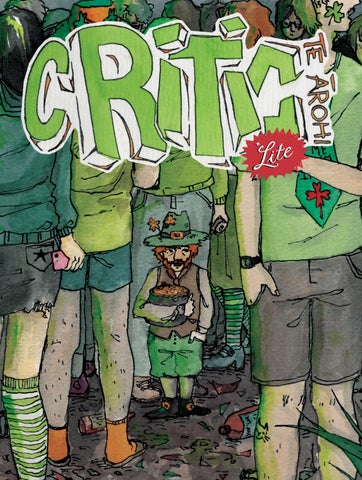
FRONT COVER Jimmy Tannock
CENTREFOLD
Eddie Fenton
ONLINE
Charlotte Williams
DISTRIBUTION Pedals Dunedin
ADVERTISING SALES sales@planetmedia.co.nz 03 479 5361
READ ONLINE critic.co.nz Issuu.com/critic_te_arohi
GET IN TOUCH critic@critic.co.nz Instagram/@criticmag Facebook/CriticTeArohi
TikTok/@criticmag 03 479 5335
P.O.Box 1436, Dunedin
Critic Te Ārohi is a member of the Aotearoa Student Press Association (ASPA).
Disclaimer: The views presented within this publication do not necessarily represent the views of the Editors or OUSA.
NZ Media Council: People with a complaint against a magazine should first complain in writing to the Editors and then, if not satisfied with the response, complain to the NZ Media Council. Complaints should be addressed to the Secretary: info@mediacouncil.org.nz. ISSUE 04 16 MARCH 2026


With shows ranging from comedy to ballet and everything in between, the Dunedin Fringe Festival is in full swing. Running from the 11th of March to the 22nd, this program is stacked with 93 shows in venues across Ōtepoti. Time to text the flat gc and do a wholesome outing for a change.
Fringe is a grassroots festival that provides the opportunity for any artist to be involved, and there are now over 300 worldwide. This is the 26th year of the Dunedin festival, and it features heavy involvement from Otago students and recent graduates.
‘Brown Sugar’, presented by Migrated Creatives, a group of uni students, is a play inspired by flatting in Dunedin. Basim, a founder of the group, and the writer and director of ‘Brown Sugar’ believes that “Dunedin Fringe is super cool because not only does it fall at such a perfect time, it’s also such a great platform for aspiring artists to experiment or showcase their craft, accommodated by the iconic Dunedin Fringe Team.”
That’s the awesome thing about Fringe festivals: anyone can register an event, there are no criteria or restrictions. The team at Fringe work hard to keep this registration process affordable and straightforward, and to keep it cheap for the audience as well, with some events only costing a koha. It feels like a rarity these days to have fun without spending way too much money, so soak it up.
As it’s an open access kaupapa rather than a curated festival, artists are responsible for their own accommodation and travel costs.
By Stella Weston News Editor // news@critic.co.nz

Fringe helps out as artists need, and take a small portion of ticket sales, but otherwise all profits go back to the artist.
Fringe Development Manager, Hannah Molloy, also mentioned that there are definitely lots of students who don’t know about all the awesome events going on, but if you see a poster for one of the many festival events, “just take a punt on it! Bring a couple of friends and you might hate it – but you might love it. Experiencing art changes lives.”
Basim believes that “the arts are super important to us as humans, whether it be on or off stage, we all need a creative outlet of some sort. [Fringe] benefits our students in the same manner, especially our artists who study something other than the arts.”
The team at Fringe added that students are sometimes portrayed wrong by the media, and seen as separate to the rest of Dunedin. Volunteer Manager Sahara Pohatu-Trow pointed out that this festival illustrates how students are “not only a part of this community, they are contributing actively to this community.” Festival Producer Vanessa Beck added that “there is so much talent within the student pool. They are so much more than burning couches on the street. Students are incredible and that’s what we’re trying to lift up at Fringe.”
According to Marketing and Communications Manager, Alice Cheung, the festival has “something for everyone to get involved with. There are so many different styles of events and you never know what you might like.” She encouraged students to have a flick through the program (also available online at https://www.dunedinfringe.nz/) and try something new!


By Hanna Varrs Co-Editor // critic@critic.co.nz

Meningitis Foundation tells students how to stay safe and what to be aware of
As many are well aware, the University recently confirmed a case of meningococcal disease within the student community. ViceChancellor Grant Robertson’s reassurances regarding the situation were beamed directly to everyone with a student.otago.ac.nz address. Meningitis is not to be messed with – it is inflammation of the membranes around your brain, usually caused by bacterial or viral infections (such as meningococcal).
“[T]he University reacted swiftly and we are working closely with the National Public Health Service”, Robertson explains. “People identified as close contacts have been contacted directly and antibiotic and vaccination protection is being offered to them.” Grant notes that student health and safety is the University’s “highest priority” and the University has “established processes to respond to situations like this.”
Given Critic Te Ārohi is a stickler for the details, we hit up Gerard Rushton, Chair of The Meningitis Foundation Aotearoa New Zealand. When asked how students can best stay safe, Gerard emphasises that the best thing is to go and get vaccinated, but to also be conscious of “sharing drinks, sharing vapes [...] to eliminate the spread of this.” He urges students to visit www.meningitis.org.nz and have a look and be aware of the signs and symptoms. If you are unsure of your vaccination status, contact your GP or Student Health.
According to the Meningitis Foundation website, someone with meningitis (meningococcal being a type of bacterial meningitis) will become very ill over one or two days, but sometimes also in a matter of hours. Cases typically start with a high fever, severe headache and stiff neck. Vomiting, drowsiness, confusion or difficulty walking often follow. The person may complain of discomfort when looking at bright lights and cold hands, feet or limb pain. In some cases a rash may appear.
“[Meningoccocal] presents like a hangover or the flu,” Gerard explains. So if you wake up feeling dusty or fluey without having even gone out last night, Gerard urges students to know that the disease can move quickly and not to “second guess” their symptoms. Meningococcal bacteria live in people’s noses and throats, and are spread by coughing, sneezing, or contact with nose and throat secretions. While the disease generally requires prolonged contact with a case to be spread, “any contact can spread it”. Gerard says that when your immune system is “run down”, it seems to create a breeding ground for the disease. “It’s just that time of year at University where everyone is socialising, burning the candle at both ends. This disease seems to find a weakness, and then take off.”
Despite the seriousness of the disease, Grant assures that the “risk remains low” for the wider student community, as the infection is generally passed on when people have close or prolonged contact with an infected person. To be clear, clozse or prolonged contact is those who sleep at least one night in the same household (not residential homes who sleep in different rooms) with someone sick with meningococcal. Close or prolonged contact is also sitting in a seat (like on a bus) adjacent to someone sick with meningococcal for more than eight hours.
Ultimately, Gerard says that if students are concerned for their wellbeing, they should err on the side of caution. “You cannot risk it,” he says. There are members of our University community who are immunocompromised as well – be safe, and stop going to lectures if you’ve got the sniffles.
If you experience fever together with headache, neck stiffness, or feel suddenly very unwell, please seek medical help immediately.
Student Health Services: 03 479 8212
Healthline (24 hours): 0800 611 116
Emergency: 111

With an eager crowd watching and the sun shining overhead, a football game kicked off on Logan Park last Sunday, March 8th. Usually, that’d be nothing out of the ordinary. But if passersby cared to look a little closer, they’d see that gangly adolescent limbs had been traded with the brains and (some) brawn of local politicians and University of Otago staff.

By Te Awhirēinga Heperi Staff Writer // news@critic.co.nz

According to a post made on the University’s Facebook, the idea for the match stemmed from a conversation between MP Scott Willis and Otago staff members Phil Kelly and Professor Hugh Campbell. What do a Green MP, a HUBS Senior Professional Practice Fellow and the Pro-Vice Chancellor of Humanities have in common? Social football, apparently. Critic Te Ārohi would have killed to be a fly on the wall for that conversation.
Team Politicians had a star studded lineup including New Zealand First’s Andy Foster, the Green Party’s Scott Willis, Teanau Tuionu and Mike Davidson and Labour’s Rachel Brooking. Additionally, the Waitaki District Council came out in full force, contributing high-performers Melanie Tavendale, Rebecca Ryan and Jeremy Holding to the fixture.
Team University was not in bad shape either. Kushla Glover, Susan Houge-MacKenzie, Graeme Marshall, Pierre Rivollet, Mel McAtamney, Chris Button, Jim Headley, Melanie Beres, Tracey Howell, Maddy Perkins-Craig, Neil Vallelly, Fraser Hunter, Mark Glover and Neil Kelly took the field. While Critic won’t list every department the team hailed from, players came far and wide from Property Services, to Sociology and Trade Services. It was a brilliant, motley, Guardians of the Galaxyeque crew.
The players were, to Critic’s pleasant surprise, rather skilled. While Otago scored the first goal of the game, the politicians weren’t far behind. The first quarter wrapped up 1-1 with a few too many heavy touches from both teams and some close misses.
Moving into the second quarter, both teams started playing it a little less safe. University with some risky passes, but the Politicians taking it a step further landing a header in their own goal. Would’ve been a stunner of a header if it had been the right way. Team University scored once again through some swift passing, and a blatant lack of defence from the Politicians, bringing the score to a neat 2-1. With friendly heckling from the Politicians, and both sides advising their less experienced teammates, the game had a great energy. Critic’s only critique (ha!) was an acute lack of orange slices at halftime, arguably removing the main highlight when playing any footy match. Shocking work.
The third quarter saw the Politicians coming back with a vengeance, and increasing the pressure. There was tension in the air as a decision from referee Philip Kelly was disputed by Team University – things were coming to a head. Speaking of heads, Critic is very concerned by the amount of wicked headers: the University’s centre back managed to land at least four, hopefully not at too much of a cost to the brain cells needed to teach students. One Otago player took a shot to the jewels, successfully stopping the ball (and himself) with this method. The Politicians’ keeper was completely locked in despite having no gear. The commitment demonstrated so far was only outdone by Otago’s defender launching himself perfectly parallel through the air for no apparent reason, or visible results.
The Politicians cracked into the final quarter with a swift goal, which was immediately discounted as offside, but they scored again in protest. Despite both teams visibly becoming tired, and a few more hits to each other’s special places, Otago took the win with a 4-3 score at full time.
So are Politicians or Professors better at football? Perhaps with just a few more minutes the Politicians would’ve taken it, but until next year, Team University reigns supreme. Critic eagerly awaits the rematch.


By Ethan Montañer

Monkey Do are a new pack of primates/alternative rock band who love the Ōtepoti music scene, and have spent the past year refining their sound at Pint Nights and flat gigs. Critic Te Ārohi caught up with Rowan (guitar, he/him), Mack (bass, he/ she), Pato (guitar, he/him) and Kam (drums, he/him) to find out what makes these monkeys tick, and to learn about their future musical missions.
Rowan, Mack and Pato met on their first day at Carrington College just last year. They instantly bonded over their love of music, and Rowan and Pato immediately started to write original songs together. “We were obsessed over this thing that I wrote [...] One of those nights I didn’t sleep and just stayed up all night writing, finishing the song. And that was like 10 days after we met,” recounts Pato. They brought their jams into the Carrington band room (located just beneath the study centre) resulting in more than a few noise complaints. “No one really liked us all year,” he laughed.
By the end of the first week of uni, they had befriended the Audio Visual Dropkicks and Caribou. Turns out they already had some connections with these bands: Mack and George (AVDK guitarist) were neighbours in Christchurch, and Pato and Ben (Caribou guitarist) were high school besties. Whether you put this down to fate or New Zealand’s habit of keeping everyone knowing everyone, Rowan believes “It was kind of meant to be.” Caribou’s drummer is also the newest Monkey Do member, and Rowan remembers “playing the first gig and seeing Kam’s happy, smiley face at the barricade.” Wholesome.


In no time at all, they excitedly agreed to play their first Pint Night after only a few weeks of being a band. And, it wasn’t a disaster! Mostly. Pato recounts that their first gig went good, “up until the last song. We’re doing ‘I Am the Walrus’ by the Beatles until a drunk couple went up on stage to make out. Uninvited.” Guess they found walrus kinda romantic? Throughout 2025 the band “speed ran our musical development,” as Mack eloquently puts it. They ended up playing Flipper Fest (shoutout Mario, local muso and founder of Flipper Fest) which the band collectively agreed was a highlight.
Monkey Do wear their love of classic and current Dunedin music on their sleeves. While they mostly play originals, they always try to throw in a cover of a Dunedin classic (I saw them do a great cover of Death and the Maiden by the Verlaines. What a tune). “We’re kind of a reflection of the bands that influence us in the scene,” says Rowan. “[Dunedin] music is some of the best music I’ve ever heard and it’s all just contained in this little student scene where everyone knows each other”. Their songwriting process is heavily informed by local bands they’ve seen live, and combined with their already varied music tastes, the Monkey Do sound materialises. Mack also notes their chemistry as musos: “I feel like we do have a lot of musical faith in each other to come up with stuff that works well together”. Monkeys together are strong.
After an eventful 2025, Monkey Do are about to get even busier in the big ‘26 with more gigs and music releases. Their debut single, ‘Pisstake’, is coming out on Tuesday the 17th of March (St Paddy’s Day). Pato describes it as “completely unrelated to any other music” they’re planning to put out, and is a unique but fun track they wrote over a year ago. The band have undoubtedly grown as musicians since then, and are now beginning to record all-new music for their first album with Sam Charlesworth, of The Beatniks. It’s shaping up to be a great year for the four-piece crew, and we can’t wait to Monkey See what Monkey Do do.
Follow Monkey Do on Instagram @monkeydo.band to keep up with their latest gigs. Their debut single ‘Pisstake’ comes out on March 17th!


One month ago – after a hop, skip, and a jump all the way from not-so-sunny Northern California, I arrived in New Zealand for the first time in my life. I’m here on a study abroad semester – which is technically slightly different than an exchange term, though I wouldn’t be able to explain the difference anyway. Back home, I go to a very small liberal arts (haha libshart) school on the American East Coast, in the world-famous state of Vermont. My college has about 2,800 students, and the town itself has fewer than 10,000 residents. So coming to a larger College (University, ig…) and a larger city was a major change of pace.
Nevertheless, the goal of my semester abroad was simple: Run the mean streets of North D.
As I pulled into the UniFlats office on the day of my arrival, I was immediately met with a flurry of questions and first impressions. Why is the weather so shit when it’s supposed to be summer? Why are there so many sheep? When do I get to meet Lorde? Just the basics, you know. After picking up my key, I began the schlep to my flat – located on none other than Castle Street. It was O-Week, apparently, so I was immediately greeted by bone-rattlingly loud music from across the street and eggs thrown by some second-years who asked what hall I was in. I’m damn near 22 years old and getting fresher accusations. You losers missed – and you missed badly. Don’t skip arm day next time.

My first afternoon in North D was just a taste of what was to come. Over the next two weeks I experienced beer showers, courtesy of the distinguished gentlemen of Death Star and my flat was robbed – which was totally not our fault (we forgot to lock the doors). My flatmates discovered the thief – a middle aged woman with bad makeup – piss drunk in the bathroom when they got home around midnight. She claimed she was just there to pee. But hours later, my flatmate found my retainer on her nightstand and we then realized she had stolen my flatmates’ makeup and a pair of my favorite sunglasses. I don’t want to know what she did with my retainer.
To the suspect in question: Count your days. You can run, but you can’t hide.
I hail from San Francisco, California, which is well known for its petty crime and rampant drug use. Despite this, SF (or as non Bay Area residents like to call it, San Fran), is a paradise compared to Castle Street. Those who grow up in SF are accustomed to having to step over a few needles here and there while walking around the Tenderloin district. Still, my training fell short in preparing me for the precarious tiptoeing required to avoid getting cut up on my flip-flop-clad walk to class. Seriously – why the bottle smashing? Were y’all not raised right? I know damn well none of the bottle boys on Castle Street are actually participating in the clean up process.
Classes have been their own beast. Before I got here, the biggest class I had ever taken had maybe 40 students – 45, max. Here, one of my lectures has 350. As a result, it’s a bit harder to make friends in classes, but the people watching is unparalleled. In several of my classes, students will have full on conversations while the lecture is going. I promise we can all hear you – including the Professor. I’ve seen one student grinding Clash Royale and others scrolling TikTok. It really made me wonder: do larger lectures remove the personal accountability of giving professors the respect they deserve? Then again, there was one kid in a class of mine back home who would watch Fortnite highlights the entire time, so maybe college students being assholes is a universal experience. I mean, seriously? Fortnite in the big 2-6?
I came to New Zealand with big plans to get a car. My first week here involved daily Facebook Marketplace browsing, in which my flatmates gave me shit for doomscrolling, but at least it wasn’t Instagram Reels. After a few unsuccessful test drives, I finally found the car of my dreams: a 2005 Honda CR-V. When I went to meet the seller, I was confronted with my first small world experience at Otago. The woman I bought the car from was none other than my economics professor. She told me she sometimes likes to read Critic Te Ārohi, so I would like to take this moment to preemptively apologize for missing her class on Friday mornings to use the same car she sold me to travel around the South Island.
Shortly after our purchase, my car co-owner and I were driving to the beach and discussing our shared love for arugula – the leafy green that the rest of the world knows as ‘rocket’. To honor this love and its blistering acceleration ability, we named the car Rocket. It took me a bit to get adjusted to driving Rocket on the left side of the road. I find myself constantly activating my windshield wipers instead of my turn signal. Sometimes, when the moon is full, the roads are empty, and I’m feeling extra patriotic, I like to take Rocket out on the asphalt and drift back on over to the right side of the road – the right side of the road.

During my time here I’ve had to contend with being an American abroad during this particularly inflamed period of geopolitics. I have friends studying overseas whose host programs have told them to just pretend to be Canadian to avoid getting pressed by strangers, so needless to say, we are not too popular around the globe right now – and for good reason. On behalf of all Americans ever, I would therefore like to sincerely apologize to the global community: our bad. I guess I’m just glad I’m not studying in a country the US is actively trying to colonize.
I’ve also noticed that many people I know from home who are studying overseas tend to spend most of their time with other exchange students, which honestly makes sense. Frankly, I would probably be a victim of this pipeline too if I wasn’t hired at Critic before my arrival. Most exchange students come to New Zealand excited to meet new people and explore a new culture, but the reality is that it often doesn’t make sense for local students to befriend exchange students, because once the semester is over, we all leave.
Then again, I have only been here four weeks and my impressions of Otago are bound to change by the time I jet set back to the US come June. Still, I hope to get to know more local students by the time I leave. Even though we Americans can often be self-centered and ignorant, I make one parting request: try to befriend an exchange student. There are even some that aren’t American – crazy, right? I promise that once we stop telling you about how much freedom we have, we do actually want to get to know locals.
With just fourteen weeks left in the Southern Hemisphere, the clock is ticking to make the most of my semester abroad. But through the troubles and triumphs, I’ve managed to have a pretty great few weeks in this new place.
From the few Kiwi phrases I’ve picked up in the past few weeks, I’d have to say that so far, the University of Otago, and my New Zealand experience as a whole, has been sweet as.
1 The mind behind Star Wars (2)
2 Wearing away
3 North Island city with a seaport
4 2013 Dreamworks movie starring Ryan Reynolds
5 American state known as the ‘Cornhusker State’
6 To forcefully remove someone from a position of power
9 Recommended equipment for skateboarding
11 Else 12 Downright terrible 14 Endearing 15 Runtime
16 Iconic horror film from the 90s
17 Song lyric: “Hey there,______”
19 Makes a loud bang!

1 Justice League member with their own upcoming HBO show (2)
7 Greg Heffley’s badass brother 8 May be found at a Mexican restaurant
9 Potential result of an MMA match (abbrv.) 10 Expensive plastic

13 Boots with wheels 18 Amphibian creature capable of regenerating limbs 20 The act of saving a life is an example of this 21 A subtle difference 22 Sold to the highest bidder


DM us a photo of your completed puzzle page to @criticmag on Instagram to win a Double Pass to the Highlanders game this Saturday!


Provided by

Monday - Friday | 12-2:30pm

Harry Evison Lounge Clubs & Socs, 84 Albany Street


7:05PM | THE ZOO


Eleanor Walker
You’re going to get ragebaited beyond belief this week. Seeing that your dealer has a 50-inch TV, while you had to sell your soul for the $50 note in your hand, will cause you to question if your degree is worth it. It’s probably not, but you have started, so may as well finish.
This week, your MasterChef dreams come to life as you go to battle with shield and sword in hand (an Insta reels recipe and the one spoon you use instead of every utensil).
You’re gonna make an S tier one pot pasta – and then never be able to recreate it. It’s ok, we all have that one magnum opus flat meal.

Your lucky charm: An unwashed pair of socks
You’re going to get really friendly with your landlord’s inbox when your flat starts to crumble around your feet. You’ll spend an hour crafting the perfect email, one where you don’t sound aggressive but are still persuasive enough to get it fixed. All to only to get a reply “Sent from my iPhone” 2 weeks later.
Your lucky charm: Some heirloom jewellery
When your friends drag you to Lake House on St Paddys, you’ll find yourself crawling to any quiet spot you can find. And no, it won’t be because you found a special someone. Bad timing, but your inner introvert will be showing their face for the first time since the semester started.
Your lucky charm: A green hair tie
You’re about to fall off a tall horse. Whether it’s a rejection from that girl at the bar, or a reality check from one of your closest friends – you’re going to get a seismic slap to your ego which will leave you a hermit. You’ll end up watching your lectures online so you don’t need to face the world for at least a week.
Your lucky charm: A pair of fluffy dice
When your life feels too tiring to keep living, remember that your mum is just one call away, and she will always find a way to rescue you. Mums are best at making all your problems seem manageable compared to hers when she was your age. Annoying friends don’t exactly square up to living without phones or having to walk 26km uphill to and from school.
On the wander to uni, there is a sound following you. No, it’s not the creaking of loose sidewalk tiles – it’s actually your knees popping and cracking like an old man. It’s potentially time to hear the seductive call of a juice cleanse and yoga at Clubs and Socs.
Your lucky charm: A pic of Mads Mikkelsen you keep in your wallet

MURDERER! When you go shopping this week and see plants on sale, remember all those who have come before. Please, for goodness’ sake, don’t get hooked by the Monstera propaganda. Maybe try a cactus or snake plant instead, because you don’t need any more green blood on your hands.
Your lucky charm: A rock you found as a kid


Your lucky charm: Your burnt asf vape
A lucky pot of gold may be coming your way! Finally –the world’s looking like you skulled some felix felicis. As you finally start making some fucking money, consider paying back some of the extensive IOUs your friend has on you from all those late night sweet treat runs.
Your lucky charm: A five leaf clover
Your dependency on ChatGPT needs to be studied. Eventually you’ll realise that you’re actually spending more hours messaging your AI than your entire roster. Please try to unplug this week and spend time actually connecting with a special person in your life.
Your lucky charm: A horseshoe
Get it all at a glance.
Timetables, grades, University updates and support services - access everything you need from one place.
aonui.otago.ac.nz