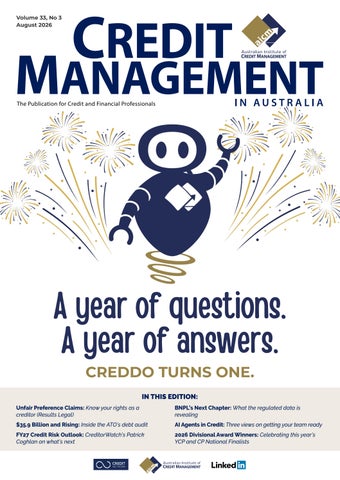
Volume 33, No 3 August 2026
IN AUSTRALIA
The Publication for Credit and Financial Professionals
CREDDO TURNS ONE. IN THIS EDITION: Unfair Preference Claims: Know your rights as a creditor (Results Legal)
BNPL’s Next Chapter: What the regulated data is revealing
$35.9 Billion and Rising: Inside the ATO’s debt audit
AI Agents in Credit: Three views on getting your team ready
FY27 Credit Risk Outlook: CreditorWatch’s Patrick Coghlan on what’s next
2026 Divisional Award Winners: Celebrating this year’s YCP and CP National Finalists
Our 2026 supporters National partners
2
CREDIT MANAGEMENT IN AUSTRALIA | August 2026
Our 2026 supporters Divisional partners
Divisional supporting sponsors
August 2026 | CREDIT MANAGEMENT IN AUSTRALIA
3
Contents Volume 33, Number 3 – August 2026
Message from the President
6
Pathways
2026 Training Calendar
8 11 12 13
Young Credit Professional of the Year
14
Credit Professional of the Year
18
Creddo usage & content opportunity analysis
8
Certified Credit Executives Recent Graduates
Creddo turns 1.
14 YCP Awards
18 CP Awards
Economic Update $35.9 billion and rising: What the ATO’s debt audit means for credit professionals
22
Nick Pilavidis FICM CCE
Navigating a more complex credit risk landscape in FY27
26
Patrick Coghlan MICM
22 Nick Pilavidis
26 Patrick Coghlan
Update from across the ditch: Business pressure persists as household arrears continue to ease
30
Monika Lacey MICM
Advertorial Faculti Lawyers
37
Risk Management
30 Monika Lacey
38 Anna Taylor
Unfair Preference Claims: Understanding your rights as a creditor
38
Anna Taylor MICM
BNPL’s next chapter and what early regulated data is revealing about the credit journey
42
Bowen Ahern
Customer Service & Technology
42 Bowen Ahern 4
48 Kevin James
Building organisational readiness for AI agents in Credit Management Kevin James
CREDIT MANAGEMENT IN AUSTRALIA | August 2026
48
Contents Navigating the future of trade payments for hospitality. The shift to unified commercial intelligence.
52
Dion Appel MICM
Beyond the AI hype: How agentic operations are transforming finance and accounting
58
52 Dion appel
58 Brian Morgan
Brian Morgan FCICM
Member Anniversaries
62
New Members
65
Marketplace
68
68
PUBLISHER Nick Pilavidis FICM CCE | Email: nick@aicm.com.au ISSN 2207-6549
DIRECTORS Julie McNamara LICM CCE – Australian President Mary Petreski FICM CCE – Victoria/Tasmania Troy Mulder FICM CCE – Western Australia/Northern Territory Rob Jackson MICM CCE – South Australia Theresa Brown FICM CCE – New South Wales Steven Staatz MICM CCE – Queensland Daniel Taylor MICM CCE – Co-opted Director CHIEF EXECUTIVE OFFICER Nick Pilavidis FICM CCE Level 3, Suite 303, 1-9 Chandos Street, St Leonards NSW 2065 PO Box 64, St Leonards NSW 1590 Tel: (02) 8317 5085, Fax: (02) 9906 5686 Email: nick@aicm.com.au
EDITOR/ADVERTISING Claire Kasses, General Manager Tel Direct: 02 9174 5727 or Mob: 0499 975 303 Email: claire@aicm.com.au EDITING and PRODUCTION Anthea Vandertouw | Ferncliff Productions Tel: 0408 290 440 | Email: ferncliff 1@bigpond.com EDITORIAL CONTRIBUTIONS SHOULD BE SENT TO: The Editor, Level 3, Suite 303, 1-9 Chandos Street, St Leonards NSW 2065 or email: aicm@aicm.com.au
JOIN US ON LINKEDIN Click Here
THE EDITOR reserves the right to alter or omit any article or advertisement submitted and requires idemnity from the advertisers and contributors against damages or liabilities that may arise from material published. CREDIT MANAGEMENT IN AUSTRALIA is published by the Australian Institute of Credit Management, Level 3, Suite 303, 1-9 Chandos Street, St Leonards NSW 2065. The views expressed in CREDIT MANAGEMENT IN AUSTRALIA are not necessarily those of Australian Institute of Credit Management, which does not expect or invite any person to act or rely on any statement, opinion or advice contained herein (whether in the form of an advertisement or editorial) and neither the Institute or any of its employees, agents or contributors shall be liable for any opinion contained herein. © The Australian Institute of Credit Management, 2026.
For advertising opportunities in Credit Management In Australia: CONTACT: Claire Kasses, General Manager. Ph: 1300 560 996 E: claire@aicm.com.au
August 2026 | CREDIT MANAGEMENT IN AUSTRALIA
5
aicm
from the president
Julie McNamara LICM CCE National President
D
ear members,
faith defence, and the documentation you need
This issue marks a small but
on hand before that letter ever arrives, a topic
meaningful anniversary: Creddo
that’s come up again and again but never had a
turns one. Nick has taken a proper
dedicated piece, until now.
look at what a year of your questions reveals in
From there we widen the lens to what’s
his Pathway column this issue, so I won’t steal
changed over the past year. Nick’s feature
his thunder here, but the headline numbers are
unpacks the ATO’s $35.9 billion debt book
worth sitting with for a moment: 1,942 questions
and what it means for how you assess risk.
asked, 272 members who used it, and a 44 per
CreditorWatch’s Patrick Coghlan sets out
cent return rate. That’s you, coming back because
his outlook for the year ahead, including
it works.
why single-director companies are proving
That anniversary shaped this whole edition.
a sharper risk signal than sole traders. And
Rather than build our themes from what we
Experian looks at what regulated Buy Now, Pay
assume you want to read, we built it from what
Later data is starting to reveal about the credit
you’re actually asking, the theme running
journey.
through this issue is The Questions Credit
You’ll also find three perspectives on a
Professionals Are Really Asking, and it shapes the
conversation every credit team is having
running order from here.
whether it’s ready to or not: bringing AI
We open with the single most anxiety-driven
agents into credit and finance operations.
question in a year of data: what to do when a
Equifax and BlackLine each take this on from
liquidator comes after a payment as an unfair
a different angle, and Opypro’s Dion Appel
preference. Anna Taylor at Results Legal walks
grounds it in a concrete case: centralising
through the running account defence, the good
trade receivables across hotel portfolios onto a
“Creddo turns one. Nick has taken a proper look at what a year of your questions reveals in his Pathway column this issue, so I won’t steal his thunder here, but the headline numbers are worth sitting with for a moment: 1,942 questions asked, 272 members who used it, and a 44 per cent return rate. That’s you, coming back because it works.” 6
CREDIT MANAGEMENT IN AUSTRALIA | August 2026
from the president
aicm
“This is also the time of year we pause to acknowledge the finalists and winners of our Divisional Awards, recognised at awards nights held around the country over recent weeks.” single AI-powered platform, cutting Days Sales Outstanding and giving finance teams one real-time source of truth instead of a portfolio of spreadsheets. Read together, the three cover the governance question, the financewide view, and what it actually looks like in one sector’s day-to-day operations. And as always, Monika Lacey brings us the latest from across the ditch, with New Zealand’s business pressures and household arrears heading in different directions. This is also the time of year we pause to acknowledge the finalists and winners of our Divisional Awards, recognised at awards nights held around the country over recent weeks. These evenings are a genuine highlight of our calendar, and a great opportunity to celebrate the members and volunteers who make this profession what it is. They’re also a chance to thank the sponsors who make the awards possible: ARMA and CreditorWatch, who support our Young Credit Professional (YCP) Awards, and Experian, who support our Credit Professional (CP) Awards. Congratulations to
that’s exactly the feedback loop Creddo was
everyone recognised this year.
built to create, and exactly what will shape the
Not every question in the data has a home in
next issue.
this issue yet. Trusts was the single most-asked
Thank you for another year of questions, and
topic all year, and recovery in practice, what to
to everyone who gave their time and expertise to
actually do once an account has gone bad, is
this issue. I hope you find something in here that
the largest question cluster of all. Both deserve
makes Monday morning a little easier.
proper, dedicated treatment, and you’ll see us come back to them.
Warm regards, Julie McNamara LICM CCE
If either is a live issue in your own practice
President
right now, I’d genuinely like to hear about it,
Australian Institute of Credit Management (AICM) August 2026 | CREDIT MANAGEMENT IN AUSTRALIA
7
aicm
pathways
Creddo usage & content opportunity analysis What members are asking AICM’s AI Knowledge Assistant — and where it points us for the magazine, webinars and conference Over its first year, Creddo handled 1,942 questions across 869 conversations from 272 distinct users. This is not novelty traffic: 44% of users came back for two or more separate conversations (37 returned five or more times, and one used it across 64 conversations), and 47% of conversations ran to multiple turns – members are using Creddo as a working tool, following up and drilling into live problems rather than asking one-off questions. The questions are overwhelmingly practical and operational: real debtor situations, security and insolvency scenarios, how to assess an unusual customer, and “help me word this email.” That is a strong, promotable story – and it is also a direct, unfiltered read on what our membership wants to learn. The same data shows clear content opportunities for the magazine, the webinar program and the 2026 conference, plus a short list of gaps worth closing.
How members are using Creddo Five usage patterns stand out, and each one is a
“I absolutely love you Creddo, you answered my question fully.” – one of many unprompted positive notes from members in the log.
promotion angle in its own right: z Live problem-solving. The most common
8
chasing a buyer, a mis-spelled guarantor
use is working through a real situation – e.g.
name – often across several follow-up
a customer in liquidation, an All-PAP creditor
questions in the one session.
CREDIT MANAGEMENT IN AUSTRALIA | August 2026
pathways
aicm “... members are using Creddo as a working tool, following up and drilling into live problems rather than asking oneoff questions.” z Plain-English “what does this mean.”
they’re enrolled in, and for the difference
Members decode terms and notices (GSA,
between roles (credit officer vs AR officer) –
strike-off, office holder, s21D notices) without
Creddo is feeding the PD funnel.
having to ask a colleague or a lawyer.
z Quick AICM lookups. Who’s on a
z Drafting assistant. A steady stream of “draft/
committee, member spotlights, what’s in
reword/refine” requests – overdue-payment
the conference program, membership and
emails, stop-supply notices, default-
CCE questions.
removal requests, customer disclaimers,
Engagement held up across the year. After a
even refining AICM’s own invitations and
launch spike (143 conversations in September
newsletter copy.
2025), usage settled into a steady rhythm of
z Self-directed learning. Members ask what course to do next, how to start a module
roughly 45–65 conversations a month, with a notable lift in March 2026. August 2026 | CREDIT MANAGEMENT IN AUSTRALIA
9
aicm
pathways What members are asking about
~6.6% of questions are consumer/
Across all 1,942 questions, the themes below
responsible-lending: hardship (including
dominate. (A question can touch more than one
joint loans and whether a business can claim
theme, so percentages don’t sum to 100 – read
hardship), income verification (tax-free vs
them as relative demand.)
taxable, CommSuper), home-loan assessment,
The single largest cluster is debt recovery, collections and enforcement (combined,
ASIC tailored-action-letter remediation, and ACL-holder queries.
roughly four in ten questions). Insolvency, PPSR, trusts and guarantees together form
What Creddo leans on to answer
a large “risk & recovery” block. And a striking
The knowledge sources Creddo retrieves
share of traffic is regulatory/“what’s changed”
most often confirm where the demand sits
– members treat Creddo as a current-awareness
– and show our existing assets are doing real
service.
work.
Theme
Share
What members actually ask
Debt recovery & litigation
24.8%
Letters of demand, statutory demands, lodging judgements, enforcement, creditor petitions
Legislation & regulation updates
19.7%
Credit card surcharges, preference-claim reform, privacy, what’s changed and when
Creditworthiness assessment
14.9%
Assessing unusual entities (strata, partnerships, ACN-only), credit limits, shareholder loans
Insolvency & liquidation
14.8%
VA/liquidation/receivership processes, creditor rights, restructuring practitioner steps
Membership, PD & courses
13.9%
CCE, YCP, qualifications, course recommendations, member benefits
Collections & overdue accounts
13.0%
Payment plans, overdue notices, double payments, stopsupply, dunning approach
Credit applications & terms of trade
10.2%
Onboarding, account setup, credit policy, extending terms, witnessing applications
Events & conference
8.4%
Program, sessions, speakers, upcoming webinars/ seminars/WINC
Credit reporting & bureau
7.7%
Interpreting credit reports, default listings, enquiries
Trusts & complex structures
7.5%
Trustee vs trust, defaulting/securing against trusts, trust insolvency
PPSR & security interests
6.8%
All-PAP, PMSI, perfection timing, discharge, registration mistakes
Consumer & responsible lending
6.6%
Hardship, income verification, ASIC action letters, homeloan assessment
Email & document drafting
6.5%
Demand emails, disclaimers, default-removal requests, refining AICM comms
“The knowledge sources Creddo retrieves most often confirm where the demand sits – and show our existing assets are doing real work.” 10
CREDIT MANAGEMENT IN AUSTRALIA | August 2026
pathways
aicm
Credit Management in Australia is one of the most-retrieved sources in the whole log. The magazine is answering member questions through Creddo – a good argument for both its value and for continuing to feed it in. Times retrieved
Most-retrieved knowledge source Respond to corporate insolvency situations
133
Assess Credit Applications (Diploma sections)
127
Credit Management in Australia (magazine)
127
Collect debts/Manage & recover bad debts
123
Develop & monitor policy and procedures
62
Legal compliance (Cert III & IV)
93
How to trade with trusts
29
Using PPSR as a tool to mitigate risk
28
Certified Credit Executives AICM would like to congratulate our new Certified Credit Executives (CCE) for August 2026: Recent CCEs
NSW
Company
Year
Nimali De Silva
NSW
Coface Australia
2026
Cheryl Fernandez
NSW
Church & Dwight (Australia) Pty Ltd
2026
Emmy Yap
NSW
Aristocrat Technologies Australia Pty Ltd
2026
Michelle Carruthers
VIC
National Collection Services
2026
Belinda Worton
VIC
Penguin Random House Australia
2026
Mark Moorhouse
QLD
Cleanaway
2026
Treacy Sheehan
NSW
Norwest Recruitment
2026
Demi Dawes
QLD
Patane Law
2026
Arian Bahmiyari
NSW
Holman Webb
2026
Mahnaz Bokan-Razi
NSW
Holman Webb
2026
Lynne Walton
QLD
Accessintell
2026
Andrew Tanna
NSW
Oak Bridge Lawyers
2026
Alicia Nagle
QLD
Vidawood
2026
Michelle Jackson
QLD
Cleanaway
2026
David Jovanov
NSW
Coface Australia
2026
August 2026 | CREDIT MANAGEMENT IN AUSTRALIA
11
aicm
pathways
AICM recent graduates AICM would like to congratulate its recent graduates:
FNS30420 Certificate III in Mercantile Agents Sarabjeet Chandi
NSW
FNS40122 Certificate IV in Credit Management Robyn Anderson
SA
Northline
Mansi Nangru
NSW
Aristocrat
Fiona Mifsud
NSW
FNS51522 Diploma of Credit Management Leah Dinh
QLD
Elders
Statement of Attainments Hayley Wood
TAS
FNSMCA413 Identify and manage individuals experiencing hardship
Aurora Energy
Jasmin Fitzgerald
TAS
FNSMCA413 Identify and manage individuals experiencing hardship
Aurora Energy
Vicki Marriot
TAS
BSBOPS504 Manage business risk
Aurora Energy
Mittchell Ehlrisch
TAS
BSBOPS504 Manage business risk FNSORG512 Develop, implement and monitor policy and procedures
Aurora Energy
Andrew Sharpe
TAS
BSBOPS504 Manage business risk FNSORG512 Develop, implement and monitor policy and procedures
Aurora Energy
Daniel Anderson
NSW
BBSOPS504 - Manage business risk
Cumberland City Council
Olivia Clayton
TAS
FNSMCA413 Identify and manage individuals experiencing hardship
Aurora Energy
Melissa Dowling
TAS
FNSMCA413 Identify and manage individuals experiencing hardship
Aurora Energy
Jessica O’Brien
TAS
FNSMCA413 Identify and manage individuals experiencing hardship
Aurora Energy
Natasha Morris
NSW
FNSCRD515 - Respond to corporate insolvency situations
Snapon
12
CREDIT MANAGEMENT IN AUSTRALIA | August 2026
pathways
aicm
2026 Training calendar CLICK HERE to see more information, costs and to register. Topic
Type
Date
Time
Understanding corporate insolvency
Workshop
3 September 2026
12:30pm - 4:30pm AEST
Collect with confidence
Toolbox
10 September
12:30pm - 4:30pm AEST
Personal property securities
Workshop
17 September 2026
12:30pm - 4:30pm AEST
Develop, implement policies and procedures for credit
Diploma course
22 + 23 September 2026
12:30pm - 4:30pm AEST
Masterclass
8 October 2026
12:30pm - 4:30pm AEDT
Develop knowledge of debt and consumer credit
Certificate III in Mercantile Agents course
27 October 2026
12:30pm - 4:30pm AEDT
Fundamentals of credit
Toolbox
5 November 2026
112:30pm - 4:30pm AEDT
Understanding personal bankruptcy
Workshop
12 November 2026
12:30pm - 4:30pm AEDT
Understanding credit risk
Toolbox
19 November 2026
12:30pm - 4:30pm AEDT
Identify and manage individuals experiencing hardship
Qualification course
24 November 2026
12:30pm - 4:30pm AEDT
Personal property securities
Workshop
8 December 2026
12:30pm - 4:30pm AEDT
How to trade with trusts
Masterclass
10 December 2026
12:30pm - 4:30pm AEDT
September 2026
October 2026 How to trade with trusts
November 2026
December 2026
August 2026 | CREDIT MANAGEMENT IN AUSTRALIA
13
Proudly Sponsored by
2026 Divisional Award Winners The Young Credit Professional of the Year Award (YCPA) is the largest and most prestigious youth credit award in Australia, providing a unique opportunity for emerging credit professionals to gain recognition – both for themselves and their employers. This award celebrates ambition, talent, and the fresh perspectives that young professionals bring to the credit industry. Whether you’re just finding your footing or already making your mark, the YCPA is your opportunity to be seen, challenged, and celebrated. By entering the program, candidates gain valuable insight into career opportunities in credit, while building connections with experienced professionals who are passionate about supporting the next generation of leaders. Congratulations to every finalist and winner named the 2026 Young Credit Professional of the Year for their division – each now heads to the AICM National Conference in Brisbane as their division’s National Finalist.
14
CREDIT MANAGEMENT IN AUSTRALIA | August 2026
2026 Young Credit Professional of the Year
Congratulations TO OUR FINALISTS & WINNERS N EW S O U T H WA LES Finalists Alana Stewart (Credit Analyst, Plenti Finance), Arian Bahmiyari MICM CCE (Solicitor, Holman Webb Lawyers), Daniella Sweid (Operations Manager, Francom Group), Joseph Safi MICM (Managing Director, GoCollect) and Oscar Bush (Senior Analyst, WLP Restructuring) all impressed with their enthusiasm, technical knowledge and engagement with the industry.
Congratulations to our 2026 NSW Young Credit Professional of the Year, Arian Bahmiyari MICM CCE. The judges praised Arian’s confident handling of complex legal and client scenarios, his clear grasp of technology’s role in the industry, and his consistent and genuine depth across every category. Arian is a clear and wellrounded winner, and will now head to Brisbane to represent NSW as a National Finalist at the upcoming conference.
Q UE E NS LA ND Finalists Brooke Todd MICM (Credit Controller, PeopleiN), Demi-Ann Dawes MICM CCE (Solicitor, Patane Lawyers), Nicola Korck MICM (Credit Analyst, Moneytech) and Taylor Johnson MICM (Credit Controller, G. James Glass & Aluminium) impressed judges with their technical knowledge, client focus and engagement with the industry’s future.
Congratulations to our 2026 QLD Young Credit Professional of the Year, Brooke Todd MICM. Brooke combines real technical depth with genuine care for her customers. Her move from sales into credit gave her a well-rounded, commercially minded approach, and she quickly turned that into results. Confident, industry-engaged and forward-thinking about AI-driven automation, Brooke is a strong advocate for the profession and an excellent ambassador to represent Queensland on the national stage.
August 2026 | CREDIT MANAGEMENT IN AUSTRALIA
15
2026 Young Credit Professional of the Year
Congratulations TO OUR FINALISTS & WINNERS SO U T H AU ST RA LI A Finalists Kathleen Power MICM (Operations Manager, Indebted), Neriah Hockings MICM (Solicitor, Lynch Meyer Lawyers) and Sam Cafasso (Risk Underwriter – Trade Credit, QBE Insurance) each impressed judges with their professionalism, technical grounding and genuine enthusiasm for the profession.
Congratulations to our 2026 SA Young Credit Professional of the Year, Kathleen Power MICM. Kathleen turns real workplace challenges into practical solutions, from streamlining reporting with AI to mentoring colleagues through tough conversations. Her natural presence and genuine enthusiasm for the profession made her a well-earned choice.
W EST E R N AU ST RA LI A Congratulations to our 2026 WA Young Credit Professional of the Year, Alexander Bailey MICM (NCI). Alexander delivered a consistently outstanding interview, marked by genuine passion and a natural, people-first approach to credit management despite his short time in the industry. He impressed with substantive, well-considered answers – from explaining how a small upfront cost saved a client significant losses, to thoughtfully discussing PPSR legislation and the responsible use of AI as a tool rather than a replacement. His communication skills stood out as a particular strength, and his polished presentation and genuine enthusiasm for continued professional development make him a truly worthy WA finalist to represent the division at the National finals in October.
16
CREDIT MANAGEMENT IN AUSTRALIA | August 2026
2026 Young Credit Professional of the Year
Congratulations TO OUR FINALISTS & WINNERS V ICTO R I A / TAS M A NI A Finalists Michaela Smith MICM (AR/Credit Controller, CMV Truck and Bus) and Saba Basti MICM (Credit Controller, Geofabrics Australia) both impressed the judges – Michaela for her dependable, relationship-first approach and great attitude, and Saba for her deep credit expertise and drive to create value and change within her organisation.
Congratulations to our 2026 VIC/TAS Young Credit Professional of the Year, Saba Basti MICM. Saba combines deep credit expertise with a genuine drive to create value and change within her organisation. A strategic thinker with the ability to elevate credit’s importance across the wider business, Saba will now represent VIC/TAS as a National Finalist at the upcoming conference. VIC/TAS is also the only division to present the Tony Mammone Award, given each year to the YCP runner-up in honour of former Victorian Councillor Tony Mammone, a champion of softskills training for those new to the profession. Congratulations to this year’s recipient, Michaela Smith MICM, on a well-earned recognition.
Proudly Sponsored by
August 2026 | CREDIT MANAGEMENT IN AUSTRALIA
17
Proudly Sponsored by
2026 Divisional Award Winners The Credit Professional of the Year Award recognises the experience, skills, professionalism, contribution, and dedication of accomplished credit professionals across Australia. More than just an accolade, this award is an opportunity to shine a light on the leaders shaping the future of the credit industry, professionals who are driving meaningful change within their teams, businesses, and the broader profession. For candidates, it’s a chance to gain well-deserved recognition, build confidence, and take a significant step forward in their career. For employers, it’s an opportunity to showcase your commitment to professional excellence and position your organisation as an employer of choice. Congratulations to every finalist and winner named the 2026 Credit Professional of the Year for their division – each now heads to the AICM National Conference in Brisbane as their division’s National Finalist.
18
CREDIT MANAGEMENT IN AUSTRALIA | August 2026
Congratulations 2026 Credit Professional of the Year
TO OUR FINALISTS & WINNERS N EW S O U T H WA LES Finalists Damien Kelly MICM (ANZ Credit Manager, Holcim (Australia) Pty Ltd), Kate Hearne MICM (National Credit Manager, CSR Limited), Nisha Chadha MICM (National Collections Manager, Heidelberg Materials Australia), Shane Fink MICM (National Credit Manager, Snap-onTools (Australia) Pty Ltd) and Somi Asghari MICM (Finance Operations Analyst, KONE) each impressed the judging panel with strong achievements and genuine passion for the profession.
Congratulations to our 2026 NSW Credit Professional of the Year, Damien Kelly MICM. The judges praised his articulate answers and calm poise, backed by a strong track record, leading a major SAP roll-out, pioneering biometric technology adoption, cutting DSO to 47 days, and streamlining online applications. Damien pairs technical expertise with genuine people leadership, is collaborative and hands-on with his team, and thoughtful about using AI to support human judgement rather than replace it. Combined with his active advocacy for the profession through AICM, Damien embodies exactly what this award is meant to celebrate.
SO U TH AU ST RA LI A Finalists Robyn Anderson MICM (Accounts Receivable Supervisor, Northline), Sandy Christopoulos MICM (Group Receivables Manager, GPC Asia Pacific, Motion Australia) and Troy Hills MICM (Business Services Manager, Total Building Systems) each impressed the judges with strong leadership and commercial acumen.
Congratulations to our 2026 SA Credit Professional of the Year, Sandy Christopoulos MICM. Sandy’s dedication to excellence, strategic leadership and positive impact on both her organisation and the broader credit community make her a truly deserving recipient of SA’s Credit Professional of the Year Award. Please join us in congratulating Sandy on this outstanding achievement.
August 2026 | CREDIT MANAGEMENT IN AUSTRALIA
19
Congratulations 2026 Credit Professional of the Year
TO OUR FINALISTS & WINNERS QU E E NS LA ND Finalists Carly Rae-Orth MICM CCE (Credit Manager Australia & NZ, Fisher & Paykel Appliances), Fiona Doherty MICM CCE (National Credit Manager, Beaumont Tiles) and Vanessa Hendey MICM (Assistant Credit Manager, Shell Energy) each demonstrated genuine passion for the profession and strong track records of driving improvement in their organisations.
Congratulations to our 2026 QLD Credit Professional of the Year, Carly Rae-Orth MICM CCE. Carly paired genuine passion with real substance, quantifying her achievements – from cutting processing times in half to driving automation without growing headcount – and consistently tying them back to business impact. The judges saw her as confident, holistic, and a true reflection of strategic, authentic leadership. Carly will represent Queensland at the AICM National Conference in Brisbane, and we have no doubt she’ll do Queensland proud.
W EST E R N AU ST RA LI A Finalists Chloe Fletcher MICM (City of Stirling) and Martin Bigg MICM (Harvest Road Group) impressed the judging panel with their strategic thinking, people leadership and genuine advocacy for the credit profession.
Congratulations to our 2026 WA Credit Professional of the Year, Chloe Fletcher. Chloe delivered a consistent and strong interview, combining measurable business impact with clear strategic vision and outstanding presentation. She pairs strategic insight with concrete outcomes, backed by a genuine passion for developing her team and advocating for the credit profession. Chloe will represent the WA Division at the upcoming National Conference.
20
CREDIT MANAGEMENT IN AUSTRALIA | August 2026
Congratulations 2026 Credit Professional of the Year
TO OUR FINALISTS & WINNERS V ICTO R I A / TAS M A NI A Finalists Angela Kouvrakis MICM (Consumer Credit Operations Manager, Vocus), Frances Aitken MICM CCE (Commercial Credit Manager, Bennetts Petroleum), Gaurav Makhija MICM (Senior Credit Risk Analyst, Australia Post), Natalie Nicolay MICM CCE (Credit Controller, Penguin Random House) and Sam Chopra MICM CCE (Debt Recovery Analyst, Viva Energy) were all recognised for their leadership, commercial acumen and lasting impact within their organisations.
Congratulations to our 2026 VIC/TAS Credit Professional of the Year, Frances Aitken MICM CCE. Frances demonstrated strong passion and articulated significant impact through leadership and team development initiatives, with a particularly compelling example in her recent project to review, redefine and strengthen Bennetts’ credit policy and guidelines. She also showcased a highly collaborative approach across multiple business functions, with several strong examples of delivering measurable, quantified outcomes. As sponsor Craig Brooks (Experian) put it: “She said she was going to make this year hers – and she sure is doing that!”
Proudly Sponsored by
August 2026 | CREDIT MANAGEMENT IN AUSTRALIA
21
Economic Update
$35.9 billion and rising: What the ATO’s debt audit means for credit professionals By Nick Pilavidis FICM CCE*
A new performance audit
owes $35.9 billion in collectable
from the Australian National
tax debt – an increase of 118 per
Audit Office (ANAO) has put
cent since 2018–19, and roughly
independent, hard numbers
two-thirds of the ATO’s entire
to something the credit
$54.2 billion collectable debt
profession has been raising for
book.
years: a large and growing pool
The ATO does not dispute
of unpaid tax debt is sitting
the scale of the problem. Its
uncollected, and it distorts
own risk assessment rates the
the market for everyone who
danger of this debt climbing
extends credit. For AICM
to unacceptable levels as “out
members, the audit is worth
of tolerance,” and it does not
reading closely – because much
expect to bring it back within
of what it found reflects the
tolerance in the near future. Yet
risks our members manage
the ANAO found the ATO has
every day.
set no specific target to reduce the volume of small business
Nick Pilavidis FICM CCE 22
A debt book out of
debt, and reports publicly only
tolerance
on a whole-of-debt measure
The audit assessed the ATO’s
that makes it impossible for
management of small business
Parliament – or creditors – to
collectable debt as only “partly
see how small business debt is
effective.” Small business now
actually tracking.
“... a large and growing pool of unpaid tax debt is sitting uncollected, and it distorts the market for everyone who extends credit.”
CREDIT MANAGEMENT IN AUSTRALIA | August 2026
“The ATO does not dispute the scale of the problem. Its own risk assessment rates the danger of this debt climbing to unacceptable levels as “out of tolerance,” and it does not expect to bring it back within tolerance in the near future.” The enforcement gap,
small business debt interactions,
models identify a daily pool of
measured
down from 1.2 per cent before
businesses warranting stronger
The finding that will resonate
the pandemic. Reminders,
action, but capacity limits and
most with members is the gap
by contrast, accounted for 5.7
un-actioned cases mean staff
between the debt owed and
million interactions, a third
manually progress “one per cent
the action taken to recover it.
of the total. The posture is
or less” of what those models
In 2024–25, firmer and stronger
overwhelmingly one of nudging
flag. A sample workload report
recovery actions – garnishees,
rather than enforcing.
from September 2025 showed
tax-debt disclosures, and pre-
A more pointed finding
almost 295,000 firmer and
legal and legal action – made
sits in an internal review cited
stronger activities queued, with
up just 0.5 per cent of the ATO’s
by the auditor: the ATO’s own
only around 3,600 released in
August 2026 | CREDIT MANAGEMENT IN AUSTRALIA
23
Economic Update
that week and some 291,000
money to prop up cash flow, and
the point where it should have
left waiting. As at October 2025,
prioritising suppliers over the tax
stopped. When it finally fails, its
only 770 ATO staff held any
office. One of the ATO’s stated
private creditors are frequently
debt-collection skill at all. The
risk drivers is its own inability
left with the loss.
enforcement gap our members
to collect debt early, which it
describe is no longer anecdotal –
acknowledges can result in
A visibility problem, too
it is documented.
insolvency.
There is a parallel question
The auditor draws the
of transparency. The ATO’s
Why this lands on private
conclusion plainly: a continued
Disclosure of Business Tax Debt
creditors
rise in debt allows some taxpayers
regime – which reports eligible
This matters because the
to gain “an unfair financial
debtors to credit bureaus
businesses that stop paying the
advantage over others.” That is
– reached roughly 25,000
ATO are often the same ones
the un-level playing field the
businesses in 2024–25. Against a
that stop paying their trade
credit profession has long warned
$35.9 billion small business debt
creditors. The ATO’s own risk
about – a business that defers
pile, that is a modest footprint.
register names the behaviours
paying the ATO, sometimes for
Under the current rules, a debt
directly: small businesses
years, can undercut competitors
is only eligible for disclosure
trading while insolvent, using
who meet their obligations,
once it exceeds $100,000, is more
withheld employee and GST
and can keep trading long past
than 90 days overdue, and the
“Earlier and broader disclosure would give credit professionals fairer warning of businesses in distress...”
business is not engaging with the ATO. Those thresholds mean a great many at-risk businesses never surface on a credit file at all. AICM’s position is that these parameters deserve a genuine rethink. Earlier and broader disclosure would give credit professionals fairer warning of businesses in distress, support better-informed lending and trading decisions, and ultimately protect the wider economy from the flow-on effects of businesses that trade well beyond their means.
Accountability and transparency The ANAO made eight recommendations, and the ATO agreed to all of them – including 24
CREDIT MANAGEMENT IN AUSTRALIA | August 2026
setting a measurable target to
far more revenue from large
our upcoming webinar, The ATO
reduce small business debt and
business than small, and that
as creditor. We will explore what
reporting publicly, on a recurring
recent relief measures respond to
her office’s oversight and current
basis, on the scale of that debt
genuine economic shocks. But as
reviews mean for creditors, how
and the effectiveness of efforts
the audit itself observes, earlier
the ATO’s debt and enforcement
to reduce it. Notably, the audit
collection pauses “normalised
practices are evolving, and what
also observed that the ATO has
into poor payment behaviours”
role credit professionals can play
not fully implemented earlier
among taxpayers – and it is
in encouraging best-practice
recommendations from the Tax
private creditors who carry much
administration – in the interests
Ombudsman on public reporting
of the cost of those choices.
of individual creditors and a fair,
of debt. Better transparency here
functioning economy alike.
is not a bureaucratic nicety – it is
A conversation worth
what allows the community, and
having
creditors, to hold the system to
These are precisely the questions
account.
AICM will put to Ruth Owen CBE,
The ATO faces real pressures, and it is fair to note it collects
the Inspector-General of Taxation and Taxation Ombudsman, in
*Nick Pilavidis FICM CCE Chief Executive Officer AICM www.aicm.com.au
August 2026 | CREDIT MANAGEMENT IN AUSTRALIA
25
Economic Update
Navigating a more complex credit risk landscape in FY27 By Patrick Coghlan MICM*
Insolvency activity stabilised
the same time, near-term risks
modestly during FY26 but a
are creating fresh challenges for
combination of higher interest
Australian businesses.
rates, elevated energy costs,
The ongoing conflict
geopolitical uncertainty
involving Iran and uncertainty
and changing business
surrounding access to the Strait
conditions suggests credit
of Hormuz have increased
managers should prepare for
concerns about higher fuel
a more challenging operating
prices, supply disruptions and
environment in FY27.
renewed inflationary pressure.
The year ahead will
Combined with persistently
demand sharper monitoring,
elevated inflation in Australia and
earlier intervention and
the United States, businesses are
more sophisticated risk
likely to face higher borrowing
management strategies. The
costs for longer.
economic backdrop remains
Patrick Coghlan MICM 26
highly complex. Long-term
Insolvencies set to rise
forces such as AI, climate
again
change, demographic shifts
While total first-time insolvencies
and geopolitical tensions are
fell slightly during FY26, the
reshaping global markets. At
report expects insolvencies to
“Long-term forces such as AI, climate change, demographic shifts and geopolitical tensions are reshaping global markets. At the same time, nearterm risks are creating fresh challenges for Australian businesses.”
CREDIT MANAGEMENT IN AUSTRALIA | August 2026
Australia – ASIC First-Time Insolvencies (Monthly, Seasonally Adjusted)
CreditorWatch, ASIC, Macrobond
“For credit managers, the message is clear: the operating environment is becoming increasingly sector-specific. Macroeconomic indicators remain important, but industry-level analysis is essential for understanding where risk is emerging and where it is likely to intensify.” begin trending higher again
environment is becoming
payment defaults. Businesses
as the cumulative impact of
increasingly sector-specific.
that accumulate multiple
interest rates and operating cost
Macro-economic indicators
payment defaults face a
pressures takes hold. Not all
remain important, but industry-
substantially higher risk of
industries are experiencing the
level analysis is essential for
insolvency than businesses with
same level of stress. Mining, retail
understanding where risk is
no defaults. Payment behaviour
trade and transport recorded
emerging and where it is likely to
remains one of the earliest
increases in insolvencies, while
intensify.
visible signs of financial distress
accommodation and food
and provides credit professionals
services experienced some
Payment defaults remain a
with an opportunity to act
improvement after several
critical early-warning signal
before problems become critical.
difficult years.
One of the report’s strongest
This reinforces the importance
For credit managers, the
findings is the continued
of ongoing customer monitoring
message is clear: the operating
predictive value of trade
rather than relying solely on
August 2026 | CREDIT MANAGEMENT IN AUSTRALIA
27
Economic Update
“Analysis of non-bank asset finance portfolios shows that single-director companies record a 90-plus day default rate of 6.99%, making them riskier than sole traders, which recorded a default rate of 4.70%.” annual reviews or historical
$100,000 have a 20-30%
New insights into asset
financial statements. In a rapidly
probability of insolvency
finance risk
changing environment, real-time
within the following 12
Perhaps the most surprising
indicators can provide a crucial
months. Industries including
finding in the report relates
advantage.
accommodation, mining,
to entity structure and default
manufacturing, wholesale
risk. Analysis of non-bank asset
ATO tax debt strongly
trade and transport all exhibit
finance portfolios shows that
linked to failure risk
heightened vulnerability when
single-director companies
The report also highlights the
significant tax debt is present.
record a 90-plus day default
growing significance of ATO
For creditors, visibility over
rate of 6.99%, making them
tax defaults as a predictor
tax liabilities is becoming an
riskier than sole traders, which
of business failure. In many
increasingly valuable component
recorded a default rate of 4.70%.
sectors, businesses carrying
of a comprehensive credit
Risk declines consistently as the
ATO tax debts exceeding
assessment framework.
number of directors increases.
CreditorWatch – Trade Payment Defaults (Monthly, Seasonally Adjusted, Feb 2020 = 100)
CreditorWatch, Macrobond
28
CREDIT MANAGEMENT IN AUSTRALIA | August 2026
Insolvency Rate Given ATO Default by Industry - 12 Months to June 2026
Data sources: ATO, CreditorWatch
Companies with five or more
improved and now performs
and credit intelligence are
directors recorded a default rate
slightly better than the portfolio
providing lenders and suppliers
of just 1.42%.
average despite representing the
with more tools to detect
largest exposure segment.
financial stress early.
The findings suggest director count may be a
Organisations that embrace
stronger indicator of risk than
The road ahead
continuous monitoring, leverage
incorporation status alone
For AICM members, FY27 is
behavioural risk indicators and
and could warrant greater
shaping up as a year in which
respond quickly to emerging
consideration in credit policy and
proactive risk management will
warning signs will be best
pricing decisions.
be more important than ever.
placed to protect cash flow and
The report also identifies
The combination of economic
minimise bad debt in the year
transport as the highest-risk
uncertainty, persistent inflation
ahead.
industry within asset finance
and rising business costs is
portfolios, overtaking hospitality.
likely to keep pressure on many
Long-haul trucking
organisations. At the same time,
businesses in particular are
advances in predictive analytics
*Patrick Coghlan MICM CEO CreditorWatch www.creditorwatch.com.au
showing elevated default rates, while Victorian road transport operators are experiencing additional challenges. By contrast, construction has
“... FY27 is shaping up as a year in which proactive risk management will be more important than ever.” August 2026 | CREDIT MANAGEMENT IN AUSTRALIA
29
Economic Update
Update from across the ditch:
Business pressure persists as household arrears continue to ease By Monika Lacey MICM*
New Zealand’s credit landscape
gained momentum in the
enters the third quarter of
March quarter and household
2026 with business conditions
repayment performance
remaining the more exposed
continuing to improve as the
side of the recovery, even as
OCR held steady.
households made genuine headway on repayments across
remained fragile through this
a shifting second quarter.
period. Credit demand softened
In April, the Reserve Bank
Monika Lacey MICM 30
However, business conditions
across much of the economy,
held the Official Cash Rate
while company liquidations
(OCR) at 2.25%. Business credit
stayed elevated, particularly in
demand was already softening at
construction, hospitality and
this point, while consumer and
retail trade. Although elevated
mortgage arrears both continued
liquidations tend to reflect credit
to trend lower.
distress from earlier periods,
May brought firmer footing
business credit defaults are now
for households, with GDP data
down suggesting businesses are
confirming the economy had
recently meeting their payment
“In April, the Reserve Bank held the Official Cash Rate (OCR) at 2.25%. Business credit demand was already softening at this point, while consumer and mortgage arrears both continued to trend lower.”
CREDIT MANAGEMENT IN AUSTRALIA | August 2026
Business Credit Demand: 2021 – 2026
Annual Company Liquidation Volumes
obligations better than they were
arrears had fallen to their lowest
company liquidations rose
previously.
level since 2021 and mortgage
further and business demand
By June, this divide had
arrears to their lowest level since
remained subdued.
become clearer. Consumer
December 2022, while annual
That divide sharpened
August 2026 | CREDIT MANAGEMENT IN AUSTRALIA
31
Economic Update
Mortgage Stress by Business Ownership
further in July. The Reserve Bank
– continue to navigate volatile
lifted the OCR to 2.50% – its first
conditions.
increase in three years – to keep
Company liquidations tell a different story. Annual liquidations rose 15% year-on-
a lid on rising inflation. That
Business demand softens
year to 3,073, with construction
concern was reinforced by the
while liquidations remain
the largest contributor at 755
June-quarter Consumer Price
elevated
firms (0.09% of the sector),
Index, which showed annual
Business credit demand fell 4.3%
hospitality liquidations up 47%
inflation climbing to 4.1%, driven
year-on-year, though it remains
(1.3% of the sector) and retail
by higher fuel, electricity, council
broadly consistent with longer-
trade up 39% (0.05% of the
rates and housing costs.
term trends.
sector).
Across the quarter, the
Hospitality and agriculture
data tells a story of genuine
continue to outperform, while
particularly exposed, with sole
improvement in household
business credit defaults are down
proprietors running multiple
credit performance meeting
13% year-on-year and the average
businesses carrying close to
a more uncertain second half
credit score for new applicants
three times the mortgage
of the year. Households are
has improved, indicating
stress of non-business owners
gradually regaining ground,
repayment performance is
– underscoring how closely
while businesses – particularly
improving among many active
household and business finances
in hospitality and construction
businesses.
remain linked.
32
CREDIT MANAGEMENT IN AUSTRALIA | August 2026
Small business owners remain
Consumer Arrears Trends
Consumer Arrears Trends by Days Past Due
Consumer arrears reach a
level since 2021. The number of
Mortgage arrears also
five-year low
consumers behind on payments
continued to improve, falling
Consumer arrears fell again in
dropped to 420,000, down 12,000
to 1.20% in June – the lowest
June to 10.65% of the credit-
on the month and almost 14%
level since December 2022.
active population – the lowest
lower than a year ago.
There are now 19,600 mortgage
August 2026 | CREDIT MANAGEMENT IN AUSTRALIA
33
Economic Update
Home Loan Arrears
accounts reported as past due, representing a 15% improvement compared with a year earlier.
Households remain cautious despite resilient mortgage demand Consumer credit demand remains subdued, down 7.3% year-on-year, as households stay cautious about taking on new debt despite improving repayment trends. Demand held up best in
Credit Card & Auto Loan Arrears
larger, purpose-driven categories – mortgage enquiries rose 10.5%, auto loans 8.0% and personal loans 4.8% – while appetite for credit cards, Buy Now Pay Later and retail energy credit fell sharply. New household lending slowed after a strong start to the year. Mortgage lending was down 5.6% year-on-year in the June quarter, while nonmortgage lending rose 10.9% on the back of secured vehicle
Consumer Credit Demand: 2021 – 2026
34
CREDIT MANAGEMENT IN AUSTRALIA | August 2026
lending. Overall, new household
New Consumer Lending (Indexed to 2019) Record levels of re-finance activity
lending was 4.5% lower than the
Financial Hardship by Product Type
same period last year.
Financial hardship continues to improve, but personal loans remain a watchpoint There are currently 13,550 accounts in financial hardship, down 6.3% year-on-year, as volumes continue to ease after peaking during the cost-of-living cycle. Credit cards now account for the largest share of hardship cases (35%), narrowly overtaking
A recovery that remains
mortgage performance and
mortgages, while personal loan
uneven
easing hardship, though inflation,
hardship remains the clearest
New Zealand’s credit data
rising rates and higher winter
pressure point – up 37% year-on-
continues to tell a story of
living costs could test that
year and now close to a quarter
gradual, uneven recovery.
progress in the months ahead.
of all cases, concentrated among
Households are benefiting
Business conditions remain
35–39 year olds.
from lower arrears, improving
more fragile – credit quality
August 2026 | CREDIT MANAGEMENT IN AUSTRALIA
35
Economic Update
is improving, but elevated
resilience will remain critical. For
borrowing will remain essential
liquidations across hospitality,
households, that means staying
as the recovery continues –
retail and construction show
on top of repayments and
improving, but not yet complete.
many firms are still adjusting to a
seeking support early.
difficult environment. As New Zealand moves through the second half of 2026,
For businesses, especially smaller operators, careful cash flow management and prudent
*Monika Lacey MICM Chief Operating Officer Centrix Credit Bureau of New Zealand www.centrix.co.nz
Table above shows 'Year-on-year' co mp arison s using 12-month rolling averages (3 months for credit demand} The Liquidation rating is the proportion of liquidations divided by the proportion of busin esses in a given sector.
36
CREDIT MANAGEMENT IN AUSTRALIA | August 2026
Faculti Lawyers:
built for the way recoveries portfolios actually run Faculti Lawyers is a new kind of law firm, purpose-built for
Around them run integrated proprietary workflows and
the way institutional recoveries and disputes portfolios
technology platforms that accelerate the work around
actually run.
each assignment (intake, triage, document production,
Evolved from and linked to the corporate pedigree of Thomsons, Faculti specialises in managing high-volume, institutional legal portfolios, which include all aspects of
reporting) so the judgement calls happen where they matter, with every step accounted for, against defined KPIs, monthly reporting and real-time portfolio visibility.
recovery, dispute resolution and enforcement services for
The model calibrates to each client’s strategy. Where
banks, non-bank lenders, corporates, statutory authorities
customer care sits above commercial recovery, Faculti
and government bodies nationally.
works alongside hardship teams and financial counsellors
A single default is a legal question. A portfolio of thousands of accounts across consumer credit, commercial lending, mortgage enforcement and statutory recovery is something else entirely: an operating framework that has to hold commercial stakes, customer sensitivity and regulatory
on resolutions that protect the relationship and the regulatory position. Where the instruction is to move quickly and firmly, the litigation capability does exactly that. Playbooks govern which assignments move without approval and which escalate for instruction.
exposure in balance when all three pull in different
Clients wanting more than a legal panel can add a
directions. Volume alone is not the challenge. The challenge
managed service across the wider ecosystem (field
is running that volume with the judgement to escalate,
agents, process serving, skip tracing, customer outreach,
resolve, litigate or hold on each assignment.
deceased estates) under one governance and reporting
What sets Faculti apart is its people and its technology.
line.
It fields one of the most experienced Principal benches
The result is delivery confidence across the full portfolio.
in the market, built across more than three decades of
Efficient progress on the assignments that should move.
recoveries and enforcement practice: most with two
Experience, restraint or escalation on the ones that
decades or more in the field, many with entire careers in
should not.
it. They take the complex assignments directly (defended proceedings, imperfect security positions, insolvency-driven recovery, reputationally sensitive accounts) and supervise outcomes across the rest. The work has been seen before, and the people who have seen it are the ones doing it.
Structured for volume. Staffed for judgement. Decades of experience where it counts. Enquiries at info@faculti.com.au
August 2026 | CREDIT MANAGEMENT IN AUSTRALIA
37
Risk Management
Unfair Preference Claims:
Understanding your rights as a creditor By Anna Taylor MICM*
One of the most common
demanding repayment of funds
questions we receive from
that were lawfully received.
clients following the insolvency
The reality is that many
of a customer is deceptively
businesses encounter an unfair
simple:
preference claim only after a
“We were owed the money, so
customer enters liquidation. By
why is the liquidator asking us
that stage, uncertainty often
to pay it back?”
exists not only about the claim itself, but also about whether any
For many creditors, receiving an unfair preference demand
Anna Taylor MICM 38
defence is available. While unfair preference
is both unexpected and
claims are a well-established
frustrating. The debt was
feature of Australia’s insolvency
genuine, goods or services were
regime, liability is far from
supplied, and considerable
automatic. Understanding
effort may have been required
how these claims arise, and the
to secure payment. It can
circumstances in which they can
therefore come as a surprise
be challenged, is critical for trade
to receive a letter months later
creditors.
“While unfair preference claims are a well-established feature of Australia’s insolvency regime, liability is far from automatic. Understanding how these claims arise, and the circumstances in which they can be challenged, is critical for trade creditors.”
CREDIT MANAGEMENT IN AUSTRALIA | August 2026
What is an unfair preference? In broad terms, an unfair preference occurs where a company makes a payment
“... an unfair preference is not established merely because a payment was received before a company entered liquidation.”
or transfer to a creditor while insolvent, and that transaction
liquidation while others receive
The Running Account
has the effect of placing the
nothing, a liquidator may seek
defence
creditor in a better position
to recover that payment for
One of the most significant
than it would have been if it
redistribution amongst the wider
defences available to trade
had instead participated in the
creditor pool.
creditors is the running
liquidation process alongside other unsecured creditors. The policy rationale is
However, an unfair preference is not established merely because a payment was received
account, or continuing business relationship, defence. Most commercial trading
straightforward. Insolvency law
before a company entered
relationships do not involve
seeks to ensure an equitable
liquidation. Liquidators must still
isolated transactions. Goods are
distribution of available assets
prove each element of the claim,
supplied, invoices are issued,
amongst creditors. If one creditor
and creditors may have access to
payments are received, and
receives payment shortly before
several important defences.
further goods are supplied over
August 2026 | CREDIT MANAGEMENT IN AUSTRALIA
39
Risk Management
an extended period. In these
In practice, many preference
same position would not have
circumstances, it may be artificial
claims require a detailed
suspected insolvency. This is
to examine individual payments
review of the account history to
often where preference disputes
in isolation.
determine whether a genuine
become highly fact-specific.
The courts will often look at
continuing business relationship
Liquidators may point to
the overall effect of the trading
existed and whether the alleged
matters such as long-standing
relationship during the relevant
preference amount has been
arrears, broken payment
period. Where payments formed
calculated correctly.
arrangements, dishonoured
part of a continuing course
payments, legal demands or
of trade intended to keep the
The Good Faith defence
collection activity as evidence
business relationship operating,
Another commonly relied
that insolvency should have been
the net effect of the transactions
upon defence is the good faith
apparent. However, experienced
may be considered rather than
defence. Broadly speaking,
credit professionals know that
each individual payment.This
a creditor may avoid liability
temporary cash flow difficulties
defence is particularly relevant
where it can demonstrate that
are not uncommon. Many
to suppliers who continued to
it received the payment in good
businesses trade through periods
provide goods or services despite
faith, had no reasonable grounds
of financial pressure, negotiate
experiencing payment delays or
for suspecting insolvency, and
payment arrangements and
increased collection activity.
that a reasonable person in the
continue operating successfully. The existence of overdue
“... a creditor may avoid liability where it can demonstrate that it received the payment in good faith, had no reasonable grounds for suspecting insolvency, and that a reasonable person in the same position would not have suspected insolvency.”
accounts does not automatically establish that a creditor should have suspected insolvency. The focus is on what the creditor knew, or reasonably ought to have known, at the time the payments were received.
The importance of documentation When defending a preference claim, contemporaneous records are often the most valuable evidence available. Credit applications, trading terms, account statements, payment histories, emails, file notes and records of conversations with customers can all become critical in assessing both liability and available defences. One of the most common
40
CREDIT MANAGEMENT IN AUSTRALIA | August 2026
challenges we encounter is a lack of documentation explaining why a creditor continued to trade with a customer or what information was available to the business at the relevant time. Clear record keeping will not prevent a preference claim from being made, but it can significantly improve a creditor’s ability to defend one.
Not every demand is correct A common misconception is that receiving a letter from a liquidator means the claim is valid and repayment is inevitable. In our experience, that is often the beginning of the analysis, not the end.
“A common misconception is that receiving a letter from a liquidator means the claim is valid and repayment is inevitable.”
Preference claims frequently involve complex factual and
should not be viewed as an
unfair preference claim is the
legal issues. Questions often
automatic liability.
perception that they are being
arise regarding insolvency,
When responding to a
penalised for successfully
the calculation of the claim,
demand, creditors should
collecting a legitimate debt. The
the existence of a continuing
consider:
law is more nuanced than that.
business relationship and the
z whether the payments
While the unfair preference
creditor’s knowledge of the
formed part of a continuing
regime seeks to promote
company’s financial position.
business relationship;
fairness between creditors, it also
Each case turns on its own facts, and assumptions should not be made simply because a demand has been issued. Creditors who seek advice early are generally better placed to assess both the strength of the claim and the availability of potential defences.
z whether a good faith defence may be available; z whether insolvency can
provides important protections for those who have acted reasonably in the ordinary course
be established during the
of business. Understanding those
relevant period;
protections, and obtaining advice
z whether the liquidator’s calculations are accurate; and z what concurrent documents
early, can make a substantial difference to the outcome of a claim.
exist to support the creditor’s position.
Practical takeaways Although unfair preference claims can be confronting, they
For many businesses, the most frustrating aspect of an
*Anna Taylor MICM Principal Results Legal www.resultslegal.com.au
August 2026 | CREDIT MANAGEMENT IN AUSTRALIA
41
Risk Management
BNPL’s next chapter and what early regulated data is revealing about the credit journey A year into Australia’s regulated BNPL environment, the conversation is moving from what the rules mean to what the data can now tell us. By Bowen Ahern*
When Australia’s Buy Now
At the time, Experian and
Pay Later (BNPL) regulations
Afterpay’s joint report The next
came into effect in June 2025,
chapter of BNPL: an evolution
the focus was understandably
in the credit market, found that
on consumer protection,
customer awareness of the
responsible lending and
incoming reforms was limited.
how BNPL would fit within
Only 18% of BNPL customers
the regulated credit system.
surveyed were aware of the new
Under the new framework,
regulations, while 55% were
BNPL providers must hold
unaware of any changes coming.
an Australian credit licence,
Bowen Ahern 42
The report also showed
conduct credit checks,
why clear communication
offer hardship support, join
matters. Some customers held
the Australian Financial
misconceptions about how BNPL
Complaints Authority if not
would be treated under the new
already a member, and comply
rules, including whether BNPL
with responsible lending
would be treated like credit cards
obligations.
by law, whether interest would
“Only 18% of BNPL customers surveyed were aware of the new regulations, while 55% were unaware of any changes coming.”
CREDIT MANAGEMENT IN AUSTRALIA | August 2026
“Under the new framework, BNPL providers must hold an Australian credit licence, conduct credit checks, offer hardship support, join the Australian Financial Complaints Authority if not already a member, and comply with responsible lending obligations.” be charged, whether spending
provides an early view. With
From regulation to visibility
limits would be reduced, or
BNPL providers now required
The value of the recent report
whether BNPL would no longer
to conduct credit checks, there
is not simply that it confirms
be available online.
is greater visibility over how
BNPL is widely used. The
consumers use BNPL and where
more useful insight for credit
has shifted. The question is less
it sits within the broader credit
professionals is that BNPL
about how regulation changes
market. The report found that
activity can now be viewed
BNPL, it’s what the regulated
BNPL enquiry volumes were
as part of a broader customer
BNPL environment can now help
significant over the past 12
journey. Experian’s analysis
credit professionals understand
months, confirming that BNPL
found BNPL appears to attract a
about consumer behaviour,
plays more of an established role
greater share of consumers who
credit demand and broader
in how Australians access credit.
are new to the credit system
borrowing patterns.
It also found that total consumer
entirely or re-engaging with
spend through BNPL surged
the credit market. Consumers
over the past 6 months.
with no recent credit activity
A year later, the conversation
Experian’s July 2026 Business Pulse Monthly report spotlight
August 2026 | CREDIT MANAGEMENT IN AUSTRALIA
43
Risk Management
accounted for 35% of BNPL enquiries, compared with 13% of credit card enquiries and 17% of personal loan enquiries. This is important because a BNPL enquiry may indicate different things depending on the customer’s wider credit profile. For some consumers, BNPL may be an entry point into credit. For others, it may represent a return to credit after a period of inactivity. For established borrowers, it may simply be another credit option used alongside existing products.
“BNPL should not be viewed as automatically positive or negative. It should be interpreted in context.”
That distinction is where the risk conversation becomes
Account openings followed
average value of approximately
more useful. BNPL should not
a similar pattern. Only 4.2%
$13,000.
be viewed as automatically
of consumers who initially
positive or negative. It should be
enquired for BNPL went on to
Prior stress indicators still
interpreted in context.
open another credit account
matter
within six months, compared
The report also found that,
The first enquiry is only part
with 7.5% for credit cards and
among credit-active consumers,
of the story
7.6% for personal loans.
BNPL enquiries were associated
Experian’s July 2026 Business
This points to a more
with a higher proportion of prior
Pulse Monthly report followed
balanced view of BNPL
stress indicators. BNPL enquiries
consumers for 6 months after
behaviour. It suggests some
included 20.3% of individuals
an enquiry and compared
consumers who begin with
with a prior delinquency or
outcomes for those whose first
BNPL do not immediately move
adverse credit event, compared
enquiry was for BNPL, a credit
into additional credit products.
with 12.7% for credit card
card or a personal loan. Among
Instead, some may remain
enquiries and 13.8% for personal
credit-inactive consumers
within the BNPL ecosystem in
loan enquiries.
who first enquired for BNPL,
the near term. For the smaller
28.9% made a subsequent
group of BNPL consumers
carefully. It doesn’t mean BNPL
credit enquiry within the
who did open another credit
activity alone is a risk label. It’s
following six months. This
account, credit cards were the
more that BNPL activity can add
was lower than the rate for
most common product, with
useful context when considered
consumers whose first enquiry
an average exposure of around
alongside other indicators, such
was for a credit card, at 34.6%,
$6,500. Personal loans were the
as existing credit commitments,
or a personal loan, at 34.5%.
next most common, with an
recent enquiries, repayment
44
CREDIT MANAGEMENT IN AUSTRALIA | August 2026
This should be interpreted
behaviour and prior adverse
What changes for
events. That context is especially
established credit users
consumer and commercial
important given last year’s joint
For consumers with existing
credit professionals because
Experian and Afterpay report
credit products at the time of
it highlights the importance
found that Afterpay customers
enquiry, Experian’s July 2026
of behavioural context over
had an average Experian credit
Business Pulse Monthly report
product labels. A BNPL enquiry
score of 743, compared with 771
found subsequent behaviour was
from a consumer that’s new
for credit card applicants and
broadly consistent regardless of
to the credit system may tell
646 for personal loan applicants
whether the first enquiry was for
a different story from a BNPL
in the analysis.
BNPL, a credit card or a personal
enquiry from someone with an
The two reports together
loan. Experian’s analysis suggests
established credit history and
reinforce an important point
that, among established credit
existing obligations. The practical
that broad assumptions about
users, BNPL functions as another
task is not to isolate BNPL from
BNPL users aren’t enough. Credit
credit option rather than a
the rest of the credit file, it’s to
professionals need to look at the
pathway shaped by distinctly
understand how BNPL fits into
whole credit picture.
different borrowing behaviour.
the sequence of credit activity.
This matters for both
August 2026 | CREDIT MANAGEMENT IN AUSTRALIA
45
Risk Management
What credit professionals
z Prior stress indicators should
the industry was focused on
could take from the data
be read in context, not treated
what BNPL regulation would
Experian’s analysis builds
as a simple risk label
mean. Today, regulated data is
on last year’s pre-regulation
z For established credit users,
beginning to show what BNPL
focused report by moving the
BNPL may behave like one
behaviour may mean within
conversation from awareness
option within a broader set of
the broader credit journey.
and misconceptions to observed
credit choices
For credit professionals, that’s
behaviour. Key takeaways for
where the most valuable
credit professionals:
As the regulated BNPL market
insight may lie, not to make
z BNPL is now part of the
continues to evolve, ongoing
assumptions about BNPL, but
regulated credit journey, not
monitoring will be important.
to use the additional visibility
separate from it
Understanding changes in
to support more informed,
z BNPL may be an entry or
consumer behaviour over time
balanced and context-led credit
re-entry point for some
will help build a clearer view
decisions.
consumers
of how BNPL influences credit
This analysis draws on
demand, lending activity and
Experian’s July 2026 Business
move quickly into other credit
competition across the broader
Pulse Monthly for Australia and
products
credit market. A year ago,
Experian’s joint report with
z BNPL users do not necessarily
Afterpay The next chapter of BNPL: an evolution in the credit market
*Bowen Ahern Analytics Consultant Experian Australia & New Zealand www.experian.com.au
“As the regulated BNPL market continues to evolve, ongoing monitoring will be important. Understanding changes in consumer behaviour over time will help build a clearer view of how BNPL influences credit demand” 46
CREDIT MANAGEMENT IN AUSTRALIA | August 2026
Disclaimer: This article is provided by Experian Australia Pty Ltd (“Experian”) as general information and it is not (and does not contain any form of) professional, legal or financial advice. Experian and its related bodies corporate make no representations, warranties or guarantees that the information (including links and the views / opinions of authors and / or contributors) contained in this article are error free, accurate or complete. You are solely responsible and liable for any decision made (or not made) by you in connection with the information contained in this article. Experian (and its related bodies corporate) exclude, to the extent permitted by law, all liability for any and all loss, cost, expense, damage or claim incurred by a party as a result of or in connection with (whether directly or indirectly) this article or any reliance on the information in this article or links contained within. Nothing in this disclaimer excludes, restricts or modifies any rights or remedies that cannot be excluded, restricted or modified under applicable law. Experian and its related entities own, or are licensed to use, the intellectual property rights in this article and its contents. Except as permitted by law, the contents of this article must not be reproduced, modified, distributed or republished without Experian’s prior written consent.
Customer Service & Technology
Building organisational readiness for AI agents in Credit Management How aligning technology, data, process, and people builds team confidence in the era of agentic decisioning. By Kevin James*
When you try to introduce autonomous AI agents
receivable, where assessing
into credit functions
customer creditworthiness
designed entirely for human
hinges on balancing speed with
participation, operational
risk mitigation, the challenge
friction points quickly add up.
isn’t the AI itself; it’s the
The primary friction stems
environment you drop it into.
from fundamental differences
Simply layering technology onto
in information processing:
yesterday’s human operating
humans work sequentially,
models exposes structural
relying on intuition and implicit
gaps rather than driving true
context, yet AI agents require
efficiency.
explicit parameters to execute high-speed, concurrent tasks.
Kevin James 48
In trade credit and accounts
Achieving genuine organisational readiness requires
“In trade credit and accounts receivable, where assessing customer creditworthiness hinges on balancing speed with risk mitigation, the challenge isn’t the AI itself; it’s the environment you drop it into.”
CREDIT MANAGEMENT IN AUSTRALIA | August 2026
“To support an agent’s ability to execute credit workflows across multiple sources, the underlying data must be cohesive, verified, and structured around its final business use case.” a strategy focused on reinvention rather than retrofitting.
At Equifax, creating a
helping our digital agents
unified data infrastructure –
operate from an enhanced and
connecting siloed exchanges
uniform baseline.
Data Readiness: Unifying
into a single virtual workspace
fragmented credit sources
– has been a gamechanger.
Process & Control:
Fragmented accounts receivable
From disconnected and multi-
Preserving governance
ledgers and disconnected trade
sourced data, we can quickly and
Deploying a single AI agent
data inherently constrain your AI.
accurately connect records, to
introduces a contained
To support an agent’s ability to
create unified views.
operational variable; deploying
execute credit workflows across
This advanced proficiency in
a fleet of agents behaves like
multiple sources, the underlying
matching and linking records
an ecosystem with internal
data must be cohesive, verified,
provides a comprehensive
dynamics and hidden
and structured around its final
view of identities, commercial
interdependencies. In credit risk
business use case.
relationships, and exposure,
management, while multi-agent
August 2026 | CREDIT MANAGEMENT IN AUSTRALIA
49
Customer Service & Technology
Technology Guardrails: How to build To protect against data leakage, unauthorised system access or unmanaged exposure, here are some core capabilities credit leaders may want to consider when establishing technology guardrails: 1. Sanitise inputs through an independent control layer: Place an agnostic security shield between your employees and the AI to automatically scrub for sensitive data leaks or malicious tricks before they ever touch an AI model. 2. Shift from manual gatekeeping to automated
“Building process readiness and team confidence requires robust controls”
rules: Swap slow human reviews for automated compliance and safety rules written into the
systems dramatically multiply
and team confidence requires
software code that
processing power, they also
robust controls:
continuously test every
introduce unique coordination
z Restrict peer-to-peer agent
agent. Continuous
risks. Because AI agents are probabilistic, individual model
communication and establish
monitoring detects model
a centralised controller guided
drift, while automated
by strict business rules.
kill switches and human
variance can compound. For
z Keep experienced credit pro-
instance, an upstream agent
fessionals in the loop for high-
assessing payment trends might
stakes credit limit decisions or
generate a statistically plausible
complex risk escalations.
but unverified inference,
z Trust is central to commercial
approvals help keep highstakes credit decisions safe. 3. Replace unmonitored shadow AI with curated access: Don’t blindly accept
which downstream agents
lending. Incorporating
every ‘default on’ vendor
ingest as deterministic ground
explainable AI to inject
feature. Give your team
truth. These minor deviations
transparency into the process
a pre-approved library of
propagate, producing cascading
helps credit managers and
enterprise-ready options
errors and potential compliance
CFOs to understand, control,
while selectively pausing
liabilities.
and validate predictive
new tools until they clear
outputs in real time.
strict security benchmarks.
Building process readiness 50
CREDIT MANAGEMENT IN AUSTRALIA | August 2026
4. Enforce rigid frameworks for
out slow, manual bottlenecks,
Discover how Equifax can help
system connections: Protect
such as repetitive data extraction
you reimagine your workflows
underlying systems by using
or routine ledger monitoring,
for maximum efficiency and
secure connection servers so
while capturing your credit
confident decision-making.
AI tools collaborate without
team’s irreplaceable wisdom
unchecked access to your
and baking it into a scalable
core infrastructure.
architecture. In practice, this creates
People Readiness: Blending
a high-performing hybrid
tech with human wisdom
operating model. AI agents
With all the enterprise activity
execute concurrent, real-time
around AI, it is easy to fall back on
risk monitoring and data linking,
legacy operating models under
while credit managers focus on
the guise of ‘human supervision’.
strategic negotiations, complex
But forcing a new AI tool into an
credit limits, and customer
old credit workflow just because
relationships. By building
it feels safe is a fast track to
dedicated agentic layers rather
falling behind.
than retrofitting legacy human
True readiness relies on your
workflows, credit leaders ensure
people. Understanding the
their teams build real confidence
human element isn’t about
and navigate the transition
preserving manual oversight for
toward high-speed, agent-
its own sake. It’s about cutting
assisted operations safely.
*Kevin James Chief Solution Officer Equifax www.equifax.com.au The information in this document is for general informational purposes only and is current as of August 2026. While Equifax Australia uses reasonable efforts to ensure the accuracy of the information, we make no warranties or representations as to its accuracy, currency, or completeness. Users should verify information independently before relying on it. This collateral may contain forward-looking statements regarding future product developments or business performance. These statements are based on current expectations and involve inherent risks and uncertainties. Actual results may differ materially from those expressed or implied. This material does not constitute legal, financial, or professional advice. The recipient should seek independent professional advice tailored to their specific business circumstances before making any decisions based on the content of this document. Copyright © 2026 Equifax Australia Information Services and Solutions Pty Ltd. All rights reserved. ABN 26 000 602 862.
“True readiness relies on your people. ... It’s about cutting out slow, manual bottlenecks, such as repetitive data extraction or routine ledger monitoring, while capturing your credit team’s irreplaceable wisdom...”
August 2026 | CREDIT MANAGEMENT IN AUSTRALIA
51
Customer Service & Technology
Navigating the future of trade payments for hospitality. The shift to unified commercial intelligence. Dion Appel MICM*, CEO of Opypro, on how technology platforms are helping the hospitality sector drive operational excellence. As hotel groups expand
created manually, customer
their property portfolios,
communications are managed
maintaining a clear, real-time
via email, and payment allocation
view of financial performance
requires accounts receivable (AR)
has become essential. Finance
teams to work across multiple
leaders require immediate
systems to download reports,
access to key metrics that
consolidate spreadsheets,
strengthen cash flow, provide
and allocate transactions to
enterprise-wide visibility,
payments, often resulting in a list
and deliver the insights for
of unidentified discrepancies.
informed, data-driven business decisions. Yet for many hotel groups,
Dion Appel MICM 52
This fragmentation compounds into one of the most labour-intensive functions within
trade accounts receivable
hotel finance. These outdated
remains a fragmented function.
processes are time-consuming,
Credit management is handled
error-prone, and inconsistent.
independently at the property
Over time, they lead to slower
level, relying heavily on
collections, higher administrative
disconnected processes and
costs, reduced team productivity,
decentralised data. Invoices are
and limited visibility into the
CREDIT MANAGEMENT IN AUSTRALIA | August 2026
“As hotel groups expand their property portfolios, maintaining a clear, real-time view of financial performance has become essential.” overall health of receivables and
streamlines workflows across the
leaders visibility and actionable
cash flow.
entire lifecycle, from transactions
insights to optimise working
and invoicing through payment
capital, accelerate cash flow,
shifts are reshaping trade
allocation and reporting,
identify risk early and support
payments for hospitality:
reducing manual effort while
strategic business decisions.
The following five technology
improving speed and accuracy.
1. Technology driving
When platforms are
2. Consolidating AR into
centralised finance
integrated with a Property
a single, AI-powered
operations
Management System (PMS),
automated workflow
Purpose-built credit
hotel groups gain real-time
Unifying property and trade
management solutions are
synchronisation of financial
account data within a single
transforming this landscape,
and operational data, creating
connected platform transforms
centralising trade accounts
one source of truth across the
accounts receivable from a
receivable across every property
organisation. This becomes
fragmented, property-based
into a single, enterprise-wide
a central hub of commercial
function into a centralised,
platform. Intelligent automation
intelligence, giving finance
intelligent operation.
August 2026 | CREDIT MANAGEMENT IN AUSTRALIA
53
Customer Service & Technology
“Unifying property and trade account data within a single connected platform transforms accounts receivable from a fragmented, property-based function into a centralised, intelligent operation.” By automating credit
integrated directly into the
payment allocation process,
management processes, speed,
application workflow. Submitted
one of the most time-intensive
visibility, and control are gained
applications are automatically
finance functions. Bank
over receivables, while creating
flagged for review and approval,
statements are imported to the
a consistent process across the
accelerating decision-making
platform daily, and AI-powered
portfolio.
that once took days. Following
technology matches payments
approval, information is
with remittances, allocating
effectively within a shared
synchronised with the PMS,
them to the corresponding
workspace where they can
keeping everything up to date.
invoices. This significantly
Teams collaborate more
manage and prioritise daily tasks
Reservation data shared from
reduces manual processing,
while maintaining a complete
the PMS enables the automatic
improves accuracy, and speeds
view through shared notes and
generation and distribution of
up cash collection. With the right
a comprehensive audit trail of
branded invoices, statements,
solution, reconciled payments
account activity.
and collection communications,
are updated to the PMS in real
creating a consistent and
time, keeping all finance systems
applications are digitised from
professional customer
balanced.
the outset, with real-time
experience.
New trade account
verification and credit checks 54
Automation transforms the
CREDIT MANAGEMENT IN AUSTRALIA | August 2026
The result is a highly efficient finance operation where
repetitive administrative tasks
management, helping
and account services on
are automated, collections are
organisations reduce both
demand. By enabling customers
accelerated, and data quality is
Days Sales Outstanding (DSO)
to manage routine enquiries
significantly enhanced.
and aged receivables. With
independently, organisations
better control over outstanding
can deliver a faster, more
3. Improving visibility,
accounts, hotel groups
responsive experience while
financial performance and
strengthen cash flow while
reducing reliance on traditional
governance
improving overall financial
communication channels like
By centralising accounts
performance.
email and phone.
receivable, hotel groups can
Through a secure customer
reduce finance costs through
4. Empowering business
portal, requests are automatically
shared service models while
customers with the
captured and converted into
freeing local property teams
convenience of self-service
workflow tasks within the
from administrative tasks.
Self-service has rapidly become
accounts receivable platform.
an expectation, offering the
Credit teams can efficiently
supported through greater
convenience of accessing real-
assign, track, and resolve
visibility and proactive debtor
time information, documents,
enquiries from a centralised
Faster collections are
“As hotel portfolios expand through new properties or acquisitions, additional properties can be onboarded quickly without increasing administrative complexity.” August 2026 | CREDIT MANAGEMENT IN AUSTRALIA
55
Customer Service & Technology
workspace, ensuring greater
or acquisitions, additional
better experiences for both
accountability, quicker response
properties can be onboarded
employees and business
times, and a consistent customer
quickly without increasing
customers.
experience.
administrative complexity.
In an industry where
Centralised governance,
operational efficiency and
access to invoices, statements,
AI-powered automation and
guest service are equally
account information, and
scalable workflows allow credit
critical, technology solutions
support services. This shift
teams to support growth while
are redefining what accounts
frees up meaningful time on
maintaining efficiency and
receivable can achieve for
both sides, creating stronger
control.
modern hotel groups.
Customers gain 24/7
and more productive business relationships.
By transforming fragmented accounts receivable processes into a fully connected digital
5. A scalable foundation
platform, technology is helping
for growth
hospitality organisations
As hotel portfolios expand
modernise finance operations,
through new properties
improve cash flow and deliver
opypro.com.au
56
CREDIT MANAGEMENT IN AUSTRALIA | August 2026
*Dion Appel MICM is CEO and Managing Director at Opypro, an all-in-one trade accounts receivable platform that automates processes and centralises trade account data, leveraging AIpowered intelligence to deliver speed, efficiency and scalable growth. opypro.com.au
Why join the AICM? Because your career deserves more. What’s in it for you? Professional Development That Keeps You Current Access specialised training, events, and education designed for real‑world credit challenges.
“Every professional development session I attend leaves me with new insights I can apply immediately, and the webinars provide a constant stream of practical and relevant information.” — Mary Petreski FICM CCE, Head of Customer Payments A Network That Opens Doors Connect with credit leaders and like‑minded professionals nationwide.
“My involvement as a junior in the industry has provided me with exposure to new experiences, high level networking, and opportunities for professional and personal growth that typically comes later on in one’s career.” — Arian Bahmiyari MICM, Solicitor
Support, Resources & Industry Insight Stay informed with member‑only resources and updates that help you work smarter.
“I have learnt valuable skills that continue to support my operational decision-making and have allowed me to contribute meaningfully to my organisation.” — Hudson Pitt MICM, General Manager Recognition That Elevates Your Career Gain credibility through awards, post‑nominals, and national visibility.
“I entered the Credit Professional Award after being nominated by a colleague in 2023. Being selected for this award was exciting and a real boost for my ego. The idea of winning or even being nominated for such an award significantly enhanced my credibility as a credit professional.” — Janice Riley MICM CCE, National Credit Manager
Unlock what’s next for you. Join the AICM today. Member Benefits Free Webinars & Special
Ask Creddo
Complimentary access valued at over $300.
Your go-to for quick answers and expert guidance on credit management.
Stay Informed
Networking
Interest Groups
Be the first to know about industry alerts and updates via our newsletter.
Join our members-only LinkedIn group to connect and share insights.
Member Pricing
Publications
Save up to 30% on AICM events, seminars, and training courses.
Subscription to Credit Management in Australia magazine.
Credit Knowledge Hub
Professional Recognition
Access articles, reports, and resources at exclusive member pricing.
Use MICM post-nominals on your email signature and LinkedIn profile.
Customer Service & Technology
Beyond the AI hype: How agentic operations are transforming finance and accounting By Brian Morgan FCICM*
With an AI agent poised to
a six-year high since 2020,
make finance and accounting
underscoring the growing
decisions faster than your
challenge credit professionals
team, what do you need
face in managing cash flow risk.
to know before trusting its
Amid a shrinking workforce,
recommendations? It’s a
teams are also expected to
question finance leaders in
shift from coordinating routine
Australia and New Zealand
transactions to providing higher-
must confront as AI moves
value activity and governance to
from simple automation to
the business.
intelligent, self-orchestrating systems that can detect, decide
AI has emerged as a genuine
and act independently.
capability shift for accounting
We’re at an inflection point
Brian Morgan FCICM 58
In this environment, agentic
and credit functions. Portfolio
for AI adoption as finance
risk monitoring, credit limit and
teams navigate a convergence
underwriting recommendations,
of pressures. CreditorWatch’s
collections prioritisation and
Business Risk Index shows
dispute triage can now be
overdue payments have reached
handled by a system that reasons
“CreditorWatch’s Business Risk Index shows overdue payments have reached a six-year high since 2020, underscoring the growing challenge credit professionals face in managing cash flow risk.”
CREDIT MANAGEMENT IN AUSTRALIA | August 2026
and executes, not just calculates. For a credit team assessing risk across a growing book in a slower-paying market, that’s not a minor efficiency gain. The more AI that finance puts
“The more AI that finance puts to work, the more trust it needs. That’s because finance doesn’t get graded on the same curve as the rest of the business.”
to work, the more trust it needs. That’s because finance doesn’t
accountability still sits with the
a governance model mature
get graded on the same curve
credit manager; a CFO won’t
enough to match it. Around 69%
as the rest of the business. An AI
accept “the AI did it” when a bad
of Australian organisations are
tool that’s 95% accurate might be
debt is written off.
using autonomous AI agents, yet
impressive in a customer service
AI capability is no longer in
only 22% have advanced agent
chatbot, but it’s a control failure
doubt; the bottleneck now is
governance models in place,
in a receivables ledger. A debtor
operational readiness. While
according to Deloitte.
balance is either right or it isn’t
plenty of finance functions
– there’s no “mostly right”. And
have already deployed AI within
process. Trusted outcomes
no matter how advanced the AI,
their processes, far fewer have
depend on trusted data, and if
Agentic AI won’t fix a broken
August 2026 | CREDIT MANAGEMENT IN AUSTRALIA
59
Customer Service & Technology
“Much of today’s finance work is still consumed by chasing information, reconciling context and coordinating actions across teams. Agents can absorb that complexity, combining accounting knowledge with AI reasoning...” your credit-to-cash cycle already
calls ‘Agentic Financial
information, reconciling context
runs on manual overrides and
Operations’ – is a model in which
and coordinating actions across
institutional knowledge, an agent
the Office of the CFO puts AI to
teams. Agents can absorb
won’t resolve those weaknesses –
work, governs it at every step,
that complexity, combining
it’ll just execute them faster,
and guarantees its integrity
accounting knowledge with AI
with less visibility into why.
across the work of finance.
reasoning to move issues forward
Furthermore, probabilistic AI in
The goal isn’t to automate
and make the function more
finance’s deterministic world
judgement; it’s to automate the
focused. But trust in that model
introduces liability, and not all AI
search for exceptions. For a credit
depends on two core principles:
is created equal. It’s why many
team, it means agents surface
z Humans in the loop: Every
leaders are beginning to think
the customer whose payment
exception routes to a person
less about AI as a collection of
pattern just changed, before
before it clears. The agent
tools and more as an operating
it shows up as a cash problem
proposes; the controller
model.
three weeks later.
decides; the trail is immutable.
The next stage of finance transformation – what BlackLine
60
Much of today’s finance work is still consumed by chasing
CREDIT MANAGEMENT IN AUSTRALIA | August 2026
z Glass box, not black box: Every action is traceable, every
decision defensible, every step
It’s to create the conditions for
It’s aligning with a glass box
inside governed controls.
AI to operate safely within the
AI solution and mapping your
Long-term value from agentic
processes, systems and controls
credit-to-cash cycle to identify
operations won’t come from
you already trust. That means
where agents can recommend,
rapid deployment, but from
standardising the foundations
where they can act within
disciplined adoption: starting
agents reason against – unified
guardrails, and where human
with lower-risk processes,
data, consistent processes, clear
judgement can be focused on
proving recommendations are
controls and governed workflows
the decisions that will define the
reliable, then scaling autonomy
– while keeping human
evolution of credit management.
with clear accountability and
judgement firmly at the centre of
intervention points.
accountability.
Finance’s goal shouldn’t be to rebuild the function around AI.
The next step for credit teams isn’t just deploying another tool.
*Brian Morgan FCICM Vice-President, Strategy – Invoice to Cash BlackLine www.blackline.com
“The next step for credit teams isn’t just deploying another tool. It’s aligning with a glass box AI solution and mapping your credit-to-cash cycle to identify where agents can recommend, where they can act within guardrails, and where human judgement can be focused on the decisions...”
August 2026 | CREDIT MANAGEMENT IN AUSTRALIA
61
DIVISION REPORT
member anniversaries We recognise those members who achieved membership anniversaries between May, June and July 2026. Congratulations to these members on achieving such important milestones. Name
Designation
State
Company
Years of Service
Amanda
Best
MICM
NSW
Lockton
5
Brent
Sims
MICM
NSW
Boost Collections
5
Christopher
Norman
MICM
NSW
SMEG Australia Pty Ltd
5
Damien
Kelly
MICM
NSW
Holcim Australia Pty Ltd
5
Daniela
Fraumeni
MICM
NSW
Master Builders Association NSW
5
Gaurav
Gupta
MICM
NSW
Experian
5
Ivelina
Paneva
MICM
NSW
Aon
5
James
Hunt
MICM
NSW
Aristocrat Technologies Australia Pty Ltd
5
Jason
Rebeiro
MICM
NSW
Optus
5
John-Claude
Pimentel
MICM
NSW
Metcash
5
Joseph
Safi
MICM
NSW
Go Collect
5
Kala
Avinash
MICM
NSW
Allianz
5
Mel
Grech
MICM
NSW
Aon
5
Michael
Cheng
MICM
NSW
Holcim Australia Pty Ltd
5
Narissa
Sitthirat
MICM
NSW
Optus
5
Sami
Goundar
MICM
NSW
Holcim Australia Pty Ltd
5
Deborah
Neill
MICM
QLD
All Year Pest Solutions
5
Derek
Caske
MICM
QLD
Metcash
5
Gini
Juric
MICM
QLD
Metcash
5
Girlee
Castillo
MICM
QLD
Jordanna
Robertson
MICM
QLD
Karen
McLaughlin-Flemming
MICM
QLD
Mark
Abercrombie
MICM
QLD
QRIDA
5
Matthew
Spann
MICM
QLD
NCI (Brokers) Pty Ltd
5
Priscilla
Krikhoff
MICM
QLD
QRIDA
5
Suzanne
Dassen
MICM
QLD
Lockton
5
Tamra
Langdon
MICM
QLD
Holcim Australia Pty Ltd
5
Sonia
Battersby
MICM
SA
Eagers Automotive
5
Andrew
Tangman
MICM
VIC/TAS
Boost Collections
5
Christina
Mircevska
MICM
VIC/TAS
Tyremax Pty Ltd
5
Frances
Aitken
MICM CCE
VIC/TAS
Bennetts Petroleum Supplies Pty Ltd
5
Gareth
Nicholls
MICM
VIC/TAS
Lockton
5
62
CREDIT MANAGEMENT IN AUSTRALIA | August 2026
5 Heritage Bank
5 5
member anniversaries Designation
State
Company
Years of Service
Peter
Stefanatos
MICM
VIC/TAS
Ventora Group Pty Ltd
5
Shaun
Matthews
MICM
VIC/TAS
Cor Cordis
5
Yew Han (Eugene)
Lim
MICM CCE
VIC/TAS
Viva Energy Australia Pty Ltd
5
Dermot
Horkan
MICM
WA/NT
Tradelink
5
Jeremy
Nipps
MICM
WA/NT
Cor Cordis
5
Mark
Gibson
MICM
WA/NT
Cor Cordis
5
Theodore
Dana
MICM CCE
WA/NT
Chamber of Commerce and Industry WA
5
Alex
Clark
MICM
NSW
Aravanis
10
Archana
Venkatesh
MICM CCE
NSW
Lindt & Sprungli (Australia) Pty Ltd
10
Archana
Chawla
MICM
NSW
NCI (Brokers) Pty Ltd
10
David
Jovanov
MICM
NSW
Coface
10
Jackson
Heenan
MICM
NSW
NCI (Brokers) Pty Ltd
10
John
Fairgray
MICM
NSW
BBW Lawyers
10
Kire
Markovski
MICM
NSW
Australian Temporary Fencing Pty Ltd
10
Louise
Thomas
MICM
NSW
Northumberland Handyman Supplies Pty Ltd
10
Neil
Shilbury
MICM
NSW
Mynted Group
10
Paul
Lysaght
MICM
NSW
Meridian Lawyers
10
Suyaty
Tandi
MICM
NSW
QBE
10
Tanya
Vermeij
MICM
NSW
DHL Express
10
Terri-Ann
Whiting
MICM
NSW
Americold Logistics
10
Theresa
McLean
MICM
NSW
DHL Express
10
Valerie
McMahon
MICM
NSW
Americold Logistics
10
Arash
Najafi
MICM
QLD
Wisetech Global
10
Maureen
Greaves
MICM CCE
QLD
Harrington Bobcat & Excavation
10
Sarah
Batzloff
MICM
QLD
DHL Express
10
Talitha
Bere
MICM
QLD
Shell Energy
10
Beau
Mead
MICM
SA
CCC Financial Solutions Group
10
Nancy
Duong
MICM
SA
CCC Financial Solutions Group
10
Nick
Christpoulos
MICM
SA
10
Anthony
Lee
MICM
VIC/TAS
10
Joyce
Gin
MICM
VIC/TAS
Viva Energy Australia Pty Ltd
10
Martina
Vucak
MICM CCE
VIC/TAS
Kingspan Insulation Pty Ltd
10
Melissa
Yong
MICM
VIC/TAS
Viva Energy Australia Pty Ltd
10
Surinder
Chopra
MICM CCE
VIC/TAS
Viva Energy Australia Pty Ltd
10
Vicki
Plessas
MICM
VIC/TAS
Adbri
10
August 2026 | CREDIT MANAGEMENT IN AUSTRALIA
63
DIVISION REPORT
Name
DIVISION REPORT
member anniversaries Name
Designation
State
Company
Years of Service
Colin
Wagstaff
MICM
WA/NT
Marsh
10
Craig
Willard
MICM
NSW
Baiada
15
Fiona
Reynolds
MICM CCE
NSW
Polczynski Robinson
15
Kim
Moreland
MICM
NSW
Coates Hire
15
Navnita
Reddy
MICM
NSW
Coates Hire
15
Robert
Fitzgerald
MICM
NSW
Metal Manufactures Pty Ltd
15
Carly
Rae-Orth
MICM CCE
QLD
Fisher & Paykel
15
Antonio
Di Fiore
MICM
SA
Maree
Kairl
MICM CCE
SA
Bart
van Riel
MICM
Daniel
Sutherland
Katrina
15 NCI (Brokers) Pty Ltd
15
VIC/TAS
DuluxGroup
15
MICM CCE
VIC/TAS
Northern Petroleum Equipment Services
15
Bromley
MICM CCE
VIC/TAS
Spicers Australia Pty Ltd
15
Melanie
September-Jones
MICM
VIC/TAS
Spicers Australia Pty Ltd
15
Peter
Millidonis
MICM
VIC/TAS
Cummins South Pacific Pty Ltd
15
Sherif
Hussein
FICM CCE
VIC/TAS
Wayne
Dean
MICM
VIC/TAS
Phillips Ormonde Fitzpatrick
15
Trevor
Greenhill
MICM
WA/NT
Cloud Payment Group
15
Arthur
Tchetchenian
MICM CCE
NSW
TAFE NSW
20
Julie
Payne
MICM
NSW
Catholic Schools Office Wagga Wagga Diocese
20
Linda
McGee
MICM
SA
Pernod Ricard Winemakers Pty Ltd
20
Carolyn
Dyson
MICM
VIC/TAS
Fresh State Ltd
20
Jacquelina
Thompson
MICM
VIC/TAS
Katie
Gorman
MICM
NSW
Tasco Inland Australia Pty Ltd
25
Linda
Croft
MICM
WA/NT
SRG GLOBAL
25
Richard
Keates
MICM
QLD
Bradnam’s Windows & Doors
30
Stephen
Duncan
MICM
SA
Duncan Powell
30
Carole
McTavish
LICM CCE
VIC/TAS
Australia Post
30
Nunzio
Settinelli
MICM CCE
VIC/TAS
Metal Manufactures Pty Ltd
30
Lou
Caldararo
LICM CCE
VIC/TAS
Rothwell Lawyers Pty Ltd
35
Rosanna
Taylor
MICM
VIC/TAS
Bunnings Group Limited
35
Justin
Denholm
MICM
SA
Stratco
40
Michael
Devine
LICM
NSW
Retired
50
Chester
Mollineaux
FICM
VIC/TAS
Retired
55
64
CREDIT MANAGEMENT IN AUSTRALIA | August 2026
15
20
new members
DIVISION REPORT
The Institute welcomes the following credit professionals who were recently admitted to membership between May, June and July 2026. New South Wales
Robert Bucci
Stoneink
Alec Settineri
ARMA Group
Sarah Cross
Snap-on Tools (Australia) Pty Ltd
Anastasia Borodich
Veolia
Sherin Lal
Moneytech
Andrew Hanson
Stoneink
Shyrill Aranas
Holcim
Anita Lu
Heidelberg Materials Australia Pty Ltd
Stanley Marisa
365 Mechanix
Ann Ghosh
Asset Rental Group
Tanjila Mahbub
Vinidex
Annie Byrnes
Southern Steel Group
Trey Williams
Blackbird Capital
Athena Rojo
Veolia
Zane Sherry
Asset Rental Group
Ayesha Connaughton
Grant Thornton
Belinda Scibilla
Fluidra Group Australia
Caroline Elmenshawy
Snap-on Tools (Australia) Pty Ltd
Overseas
Christine Joy Digap
Talent International
Alexandre Neto
Megaport Australia Pty Ltd
Danijela Bosevski
Veolia
Alyson Fox
Megaport Australia Pty Ltd
Eileen Ngoc Ling Truong
Omnicom Media Group
Anas Nabi
Merchant Finance Pte Limited
Em-Renke Schutte
Ecolab Pty Ltd
Ankur Gupta
Megaport Australia Pty Ltd
Erol Gani
Debtmerc Pty Ltd
Ashley Mayn
DebtManagers
Fabiana Delissague
Vinidex
Ashna Narayan
Merchant Finance Pte Limited
Gregory Brown
Medhealth
Beverly Soliva
IOR Pty Ltd
Ines Nikolic
Lexar Lawyers
Carolina Rocha
Megaport Australia Pty Ltd
Jacquie Sackett
Holman Webb Lawyers
Charissa Caoile
IOR Pty Ltd
Jeremy Luey
Moneytech
Chayenne Eve Saley
IOR Pty Ltd
Jessica Santos
Ecolab Pty Ltd
Danielle Curel
DebtManagers
Jigna Bhoi
Veolia
Ellaine Gay Binbinon
IOR Pty Ltd
Joanne Froio
Forestry Corporation
Ellen Villaruz
IOR Pty Ltd
Jyothi Nagaraj
Veolia
Jemmazelle Cotiyam
IOR Pty Ltd
Kellie Sandher
CreditorWatch
Leonore Naivaluwaqa
Merchant Finance Pte Limited
Kristen Anthony
Stoneink
Lezaan Taylor
AB Equipment Ltd
Lahiru Athuraliyage
Coates Hire
Malcolm Phillipps
DebtManagers
Liane Curry
Snap-on Tools (Australia) Pty Ltd
Megan Hare
Findex
Lotomau Maifala
Moneytech
Miriam Anne Penoliar
IOR Pty Ltd
Maria Eldaghl
Omnicom Media Group
Om Singh
Merchant Finance Pte Limited
Martin Campbell
REPO BUSTERS PTY LTD
Rizwan Hussain
Merchant Finance Pte Limited
Michelle Sy
Transurban Limited
Sheri Hawes
Megaport Australia Pty Ltd
Mohan David
Fletcher Building
Morgan Loudon
Blackbird Capital
Natalie Ledlin
Hitch
Queensland
Nichalos Radosevic
Stoneink
Alexandra Thompson
Moneytech
Ravneet Kaur Lubana
CSR Limited
Andy Cusworth
Blackbird Capital
Renee McLaren
DebtManagers
Anshika Maheshwari
Reliance Worldwide
August 2026 | CREDIT MANAGEMENT IN AUSTRALIA
65
DIVISION REPORT
new members Ben Blacker
Blackbird Capital
Thomas Edgecombe
Vincents
Ben Callender
Blackbird Capital
Tom Huxley
Vincents
Brianna Hyde
Alspec
Tova Jilek
DebtManagers
Darren Harwood
Blackbird Capital
Tulasa Dulal
IOR Pty Ltd
David Varker
Vincents
Wayne Bryant
Desleigh Blackley
IOR Pty Ltd
Yukontorn Sawyer
Cement Australia
Dhanya Ashokraj
Reliance Worldwide
Zaninah Buang
The University of Queensland
Dylan Locaputo-Panagis
Blackbird Capital
Elizabeth Ripi
Reliance Worldwide
Ella Purcival
Beaumont Tiles
South Australia
Graeme White
Atradius Collections Pty Ltd
Alecia Matthews-Tucker
AusHealth
Ilona Sipowicz-Lysiak
Pacific Fuel Solutions
Fred Jabbar
Vinidex
Janice Ponce
Megaport Australia Pty Ltd
Jay Gandhi
Rodgers Reidy
Janine Coppeller
J Nine Recruitment
Lucy Bastin-Flemming
AusHealth
Jessica Yip
Ettason Po Hoi Pty Ltd
Margaret Doddridge
AusHealth
Joanna Frith
Bradnams Windows and Doors Pty Ltd
Maria D’Onofrio
AusHealth
Jodi Blanch
Fee Synergy
Michela Hanna
AusHealth
Joshua WIlkinson
Blackbird Capital
Neil Fennell
Oracle Insolvency Services
Kaitlin Simpson
IOR Pty Ltd
Nicola Cameron
AusHealth
Karen Elliott
Connector-Tech ALS Pty Ltd
Nicole Kitchin
Australian Vintage Ltd
Karolina Obradovic
National Collection Services
Paul Zenkteler
Oracle Insolvency Services
Liam Moon
Blackbird Capital
Ramneet Kaur Anand
AusHealth
Lisa Collins
National Collection Services
Richa Ramesh
AusHealth
Marika Drube
Neumann Steel
Simran Panda
Oracle Insolvency Services
Meagan Edwards
Action Aluminium
Sindy Jahn
Hill Smith Family Estate
Mei-Ha Edwards
Findex
Sophie Elliott-Mitchell
Lynch Meyer Lawyers
Melissa Casey
IOR Pty Ltd
Teri Ward
Toro
Melissa Whitmore
Reliance Worldwide
Tharushi De Fonseka
AusHealth
Miles Blok
BDE Group
Tiest Samuel
Oracle Insolvency Services
Nadine Askew
Reliance Worldwide
Pavani Dumbala
IOR Pty Ltd
Preet Verma
IOR Pty Ltd
Victoria/Tasmania
Quinn-Tina Schmidt
Metcash
Anita Pareek
Bunge Operations Pty Ltd
Rachael Brooks-Donald
Megaport Australia Pty Ltd
Anthony Stein
Defence Bank
Robert Moulden
Blackbird Capital
Brian Do
JBS Australia Pty Ltd
Roland Doroja
Pacific Fuel Solutions
Brian Greves
New Balance
Rosalie Wojtowicz
Cleanaway
Briar Chisholm
DebtManagers
Rosemay Chee
Pacific Fuel Solutions
Cody Brougham
Defence Bank
Samson Skinner
NCI (Brokers) Pty Ltd
Daisy Lin
Bizcap
Shannon Ryan
Vincents
Damian Kefford
Blackbird Capital
Shiwangni Narayan
Stramit
Damon Earp
CreditorWatch
Stephen Elkington
Earlypay Ltd
Danielle Goodwin
Aurora Energy
Tania Kaisa
Cleanaway
Dianne Micallef
Pacific Fuel Solutions
66
CREDIT MANAGEMENT IN AUSTRALIA | August 2026
new members Fuchs Lubricants
Saba Basti
Geofabrics Australasia Pty Ltd
Freni Luya
Haymes Paint
Sahra Floratos
CollectAU
Hiruni Dassanayake
WEX
Sheela Pappachen
Bob & Pete’s + Calendar Cheese
Jade Rivera
PSC Trade Credit Risk
Shweta Arora
Australia Post
Jane Go
Pacific Fuel Solutions
Siobhon Soltys-Klein
ConnectEast
Jay Bower
Metcash
Julija Hanzic
Woolworths Group Limited
Stephanie Barrett
Tyremax
Kellie Chapman
National Collection Services
Stephen Pisani
Toyota Finance Australia
Lay Lee
WEX
Tamara Brooks
Asahi Beverages
Leah Pantelidis
ARMA Group
Teresa Ilic
Southern Steel Group
Louisa McKee
PSC Trade Credit Risk
Tracy Dixon
Pacific Fuel Solutions
Mark Savyell
CollectAU
Vicky Powell
Findex
Martin Leitch
Tasmanian Collection Service
Yousuf Bhatti
Australia Post
Max Matlock
CreditProtect
Nicky Hodgson
Mainland Dairy - Lactalis
Olivia Lowe
PSC Trade Credit Risk
Paul Skerry
Toyota Finance Australia
Alexander Bailey
NCI (Brokers) Pty Ltd
Pulkit Datta
Australia Post
Clint Joseph
BRI Ferrier
Rhiannon Thredgold
Sensiba Australia
Joshua Mahony
NCI (Brokers) Pty Ltd
Richard Bivens
Rothwell Lawyers Pty Ltd
Jyoti Limbu
Auxilium Partners
Rochelle Chugg
Pacific Fuel Solutions
Nadeesha Palihakkara
Auxilium Partners
Ross Casey
PSC Trade Credit Risk
Stephanie Spirkoska
Eagers Automotive Limited
DIVISION REPORT
Faith Grech
Western Australia
August 2026 | CREDIT MANAGEMENT IN AUSTRALIA
67
AICM Marketplace
Directory of services
For information, options and pricing please contact Claire Kasses on +61 2 9174 5727 or E: claire@aicm.com.au COLLECTIONS AICM Divisional Partner
AMPAC Debt Recovery Level 5, 35 Clarence Street, Sydney NSW 2000 Tel: 1300 426 722 Email: info@4ampac.com.au Web: www.4ampac.com.au AMPAC Debt Recovery is a specialist debt collection practice supporting organisations around Australia and in over 180 countries worldwide. With decades of experience and global reach, AMPAC is a trusted partner to some of Australia’s highest profile private and public sector organisations. Call or email us to next time you are reviewing your debt recovery needs.
Divisional Supporting Sponsor
COLLECTION SYSTEMS
COLLECTIONS AICM Divisional Partner
365 Collect Email: stanley@365mechanix.com 365 Collect is an intelligent arrears and collections management platform built by 365 Mechanix on the Microsoft ecosystem. We help credit and collections teams modernise the way they manage arrears and recovery, with automation and AI doing the heavy lifting across the full collections lifecycle. We improve loan book performance from early arrears through to recoveries, with measurable impact on cure rates, roll rates, and cost to collect. Trusted by businesses across Australia and New Zealand, 365 Collect exists because too many credit teams are still stuck with disconnected systems and manual processes. We're here to fix that.
AICM National Partner
Credisense Neill Borg, Enterprise Director Tel: 0401 066 624 Email: neill.borg@credisense.io Web: https://credisense.co.nz/ Credisense revolutionises the way businesses acquire new customers. One-size does not fit all. Our platform provides personalised, omnichannel, and unified customer experiences that embody your brand. Orchestrate and analyse thousands of data points and services that automate any process or decision. All from the cloud. All with no coding.
Divisional Supporting Sponsor
AICM Divisional Partner Boost Collections Tel: 1800 446 901 Email: jamesvp@boostcollections.com.au Web: www.boostcollections.com.au/ Boost Collections is a debt collection firm committed to delivering professional, costeffective recovery services across Australia and New Zealand. As part of the Commercial Credit Services Group, established in 2001, Boost Collections brings over two decades of experience to the industry. We combine the systems and scale of a large agency with the personal attention of a boutique firm. Our approach involves a balanced and fair collection strategy – ensuring high-performance results while maintaining positive customer relationships.
Divisional Supporting Sponsor
Coface National Collection Services Tel: 1300 888 758 Email: info@ncsgroup.com.au Web: https://ncsgroup.com.au/ National Collection Services are a boutique Debt Collection Agency that sees ourselves as an ‘extension’ of your internal credit department. We will work with you to form a partnership, with our focus being placed on the associated levels of engagement, support, communication and goals of your organisation.
Divisional Supporting Sponsor
Tel: +61 431 312 064 Email: Michelle.Carruthers@coface.com Web: https://www.coface.com.au/ Coface provides global trade credit insurance, business information, debt collection, and risk management solutions. Operating in 100+ countries and 200 markets, they help businesses assess customer risk, protect cash flow, and recover debts locally and internationally. With deep global expertise and local insight, Coface enables confident trading, reduced losses, and sustainable growth in complex markets.
Divisional Supporting Sponsor
CCSG Tel: (02) 8568 6539 Web: www.ccsgroup.com.au Credit Collection Services Group (CCSG) is a leading full-service debt collection agency. We specialise in debt collection, litigation, commercial default listings, portfolio ledger management, and financial hardship management. At CCSG, we understand your challenges, have proven expertise, and protect your interests through robust compliance and best business practices. Our experienced team is dedicated to engaging with people effectively, delivering results that improve cash flow and financial stability for our clients. Partner with CCSG for professional, efficient, and ethical debt collection solutions tailored to your needs.
68
DebtManagers Tasmanian Collection Service Tel: 03 6213 5555 Email: connect@tascol.com.au Web: www.tascol.com.au/ With over 140 years’ experience, branches in Hobart, Launceston and Burnie and a database on the Tasmanian population that is second to none, there is no one better placed to handle your Tasmanian debts. Why not consider outsourcing to a local expert, you’ll be glad you did.
CREDIT MANAGEMENT IN AUSTRALIA | August 2026
Andrew Worrell Business Development Manager Email: andrew.worrell@debtmanagers.com.au Web: https://debtmanagers.com.au/ Tel: +61 0430 342 019 DebtManagers believe in creating a fairer financial world where businesses and customers thrive. We specialise in buying bad debt from businesses and rehabilitating those owing money out of debt with tailor-made, sustainable, and fairer repayment plans to help them get back on their feet. It’s more socially responsible and it works.
AICM MARKETPLACE
AICM Marketplace Directory of services
For information, options and pricing please contact Claire Kasses on +61 2 9174 5727 or E: claire@aicm.com.au COLLECTION SYSTEMS
INFORMATION
INFORMATION AICM National Partner
AICM Divisional Partner
Experian Tel: 1300 783 684 Web: www.experian.com.au
InDebted Michael Chatfield Managing Director – Australia Tel: 0434134034 Email: Michael.chatfield@indebted.co Web: www.indebted.co InDebted is the global leader in human-centered debt resolution. Forward-thinking organisations choose InDebted’s AI-powered collections and decisioning solutions to move beyond outdated methods, deliver better consumer experiences, and improve overall financial wellbeing. Operating in seven countries and growing, InDebted is on a mission to change the world of consumer debt for good. Discover more at www.indebted.co.
Building Industry Credit Bureau Tel: 07 3852 1342, 1800 931 222 Email: bicb@bicb.com.au Web: https://bicb.com.au If your business supplies the building industry, we have industry-specific data that will raise your credit management decision-making effectiveness and perhaps prevent/minimise loss. We know you like to do your job well. Let us help you do it even better. For more info, call today.
AICM National Partner
Experian is a global data and technology company, powering opportunities for people and businesses around the world. We help to redefine lending practices, uncover and prevent fraud, simplify healthcare, deliver digital marketing solutions, and gain deeper insights into the automotive market, all using our unique combination of data, analytics and software. We also assist millions of people to realise their financial goals and help them to save time and money. We operate across a range of markets, from financial services to healthcare, automotive, agrifinance, insurance, and many more industry segments. We invest in talented people and new advanced technologies to unlock the power of data and to innovate.
INSOLVENCY Divisional Supporting Sponsor
AICM Divisional Partner
CreditorWatch Opypro Email: partner@opypro.com.au Web: www.opypro.com.au Opypro is a single cloud-based platform that fully automates the end-to-end B2B credit management process. Multiple systems can be replaced by Opypro streamlining onboarding, providing real time access to business buyer account information and increasing payment success with consolidated invoicing, automated Dunning cycles and payment reconciliation. Contact us to see how Opypro can drive efficiencies across your trade accounts receivable process.
GPO Box 276 Sydney NSW 2001 Tel: 1300 501 312 Web: www.creditorwatch.com.au CreditorWatch is a leading commercial credit reporting bureau used by over 50,000 businesses across Australia. CreditorWatch offers a variety of products including customer monitoring/alerts, credit reporting, an indepth trade program and online credit applications to assist with customer onboarding and decisioning. Contact us today for more information or to organise a FREE DEMO of any of products.
AICM National Partner
AICM Marketplace We’re proud of the AICM and we want to let all credit professionals know those businesses that support the AICM. Thank you to these companies for their continued support and please consider them first when you’re looking for assistance in your business. We’ll also include these sponsors on our website so you can be sure to find them easily. For more information contact:
Claire Kasses
Direct: +61 2 9174 5727 Email: claire@aicm.com.au Tel: 1300 560 996
Insolvency Intelligence for Credit Managers Tel: 1300 265 753 Email: intelligence@jirschsutherland.com.au Web: www.jirschsutherland.com.au/ insolvencyintelligence/ Insolvency Intelligence: a specialist provider of insolvency and turnaround advice and services for credit managers. Backed by national firm Jirsch Sutherland, our friendly team is just a phone call or email away, providing members with practical, strategic advice about corporate and personal insolvency. Free initial consultation; networking opportunities; training and presentations; knowledge database access. Contact us now to find out how we could assist you.
AICM Divisional Partner
Equifax
SV Partners
Tel: 13 83 32 Web: www.equifax.com.au Equifax is a global information solutions company, providing data and insights that help organisations and individuals make more informed decisions. As a leading provider of credit information and analysis in Australia and New Zealand, Equifax serves key markets in risk management, marketing services and HR solutions. Drawing from trusted sources to compile and process data, Equifax helps its customers see things and make connections that others can’t.
AICM MARKETPLACE
Level 8, 68 St George’s Terrace, Perth WA 6000 GPO Box 2527, Perth WA 6001 Tel: 08 6277 0026 Fax: 07 3229 7285 Email: perth@svp.com.au Web: https://svpartners.com.au/ SV Partners is a specialist accounting and advisory firm with 17 offices across Australia. Our expert accountants have the skills and experience to provide tailored insolvency, turnaround and advisory services. We partner with professionals and their clients, providing expert advice with a human touch.
August 2026 | CREDIT MANAGEMENT IN AUSTRALIA
69
AICM Marketplace
Directory of services
For information, options and pricing please contact Claire Kasses on +61 2 9174 5727 or E: claire@aicm.com.au INSOLVENCY AICM Divisional Partner
LEGAL
LEGAL AICM National Partner
AICM Divisional Partner
Vincents Level 34 Santos Place, 32 Turbot Street Brisbane QLD 4000 Tel: 1300 VINCENTS, (07) 3228 4000 Web: www.vincents.com.au Vincents is a solutions-focused professional services firm with over 35 years of experience. Its Restructuring & Recovery team consists of experts in all aspects of insolvency, restructuring, and recovery. They are dedicated to supporting you or your clients during critical decision-making moments, acting as financial counsellors, and offering advice and solutions for a wide range of financial distress situations. Regardless of the size or complexity of the matter, their team collaborates closely with you, your stakeholders, and advisors – including lawyers, accountants, financiers, and creditors – to achieve the best possible outcome.
INSURANCE
Turks
Results Legal Level 4, 183 North Quay Brisbane QLD 4000 Tel: 1300 757 534 Web: www.resultslegal.com.au Results Legal is a national firm with a focus on promoting and protecting the rights of trade creditors. Our clients are some of Australia’s largest trade credit companies who rely on our assistance for legal recovery, dispute resolution, preference claim defence and PPSA rights. Results Legal are the obvious first choice for companies seeking a national solution to resolve commercial disputes and pursue swift, successful and cost effective legal recovery action.
AICM Divisional Partner
Divisional Supporting Sponsor
Tel: 02 8257 5700 Email: marketinggroup@turkslegal.com.au Web: www.turkslegal.com.au Turks is a specialist commercial law firm with 33 Partners and over 160 staff across our Sydney, Melbourne and Brisbane offices. We are proud to look after the interests of trade creditor suppliers and financial institutions in: l Portfolio debt recovery using our marketleading, real-time client interface, ‘TurksFocus’ l Resolution of complex debt disputes l PPSA recovery l Defence of unfair preference claims l Supply documentation and guarantees.
RECRUITMENT Divisional Supporting Sponsor
Nova Legal Lockton Suzanne Dassen, Client Manager Tel: +61 499 018 852 Email: suzanne.dassen@lockton.com Web: https://global.lockton.com/au/en Lockton is a family-owned global insurance broker and risk advisor. Founded in 1966 by Jack Lockton, our company was built on one simple idea: to provide the best service in the insurance industry. With a 97% client retention rate and over $890m in premiums placed locally, our clients trust us to help them outperform the market and build resilience. Our award-winning culture enables us to attract top industry and product specialists who consistently deliver extraordinary results.
Level 2, 50 Kings Park Road West Perth 6005 Tel: 08 9466 3177 Web: www.novalegal.com.au
Byron Thomas Recruitment
Nova Legal can assist with the recovery of problem debtors (large and small). Founding director Raffaele Di Renzo acts for creditors, debtors, directors, credit managers and insolvency practitioners in relation to solvency issues and dispute resolution.
AICM Divisional Partner
Tel: 02 8677 3020 Email: info@byronthomas.com.au Web: www.byronthomas.com.au/ As Sydney’s leading Executive Accounting and Finance recruitment service, we offer access to our exclusive relationships, networks and database of over 80,000 Accounting and Finance Candidates. We are a privately-owned Australian company that have been operating for over 10 years. We work with a variety of public, private, family owned and private equity-backed companies.
Divisional Supporting Sponsor
Divisional Supporting Sponsor Rothwell Lawyers
Holman Webb Lawyers Tel: 02 9390 8000 Email: christopher.hadley@holmanwebb.com.au Web: www.holmanwebb.com.au/ Holman Webb is a commercial and insurance law firm with over 60 years’ experience and the scale to provide a top-tier level of legal services. We deliver unique insights and bring relevant, real world experience to you from our offices in Sydney, Melbourne, Brisbane and Adelaide.
70
Tel: (03) 9329 3500 Email: admin@rothlaw.com.au Web: www.rothlaw.com.au
Norwest Recruitment
At Rothwell Lawyers, we are a commercial team of solicitors and other legal support staff that are experts within our field. We pride ourselves on our ability to provide sound legal advice to individuals and businesses of all sizes, from sole directors and shareholder companies and large national corporations. Whether it is basic debt recovery, commercial law and litigation, insolvency advice to agreements and contracts, the team at Rothwell Lawyers can help you today.
Work shapes our careers, confidence and future. At Norwest Recruitment, we recognise every career journey is unique. By understanding your goals and strengths, we connect you with opportunities that help you grow. With genuine care, local expertise and strong professional standards, we support individuals and partner with Western Sydney organisations to deliver great talent and positive outcomes for our community.
CREDIT MANAGEMENT IN AUSTRALIA | August 2026
Email: recruit@norwestrecruitment.com.au Web: https://www.norwestrecruitment.com.au/
AICM MARKETPLACE
AICM Marketplace Directory of services
For information, options and pricing please contact Claire Kasses on +61 2 9174 5727 or E: claire@aicm.com.au TRADE CREDIT INSURANCE
TECHNOLOGY
National Supporting Sponsor
AICM Divisional Partner
Access Intell Pty Ltd PO Box 1551, Kenmore, QLD 4069 Tel: 1300 831 331 Email: admin@accessintell.com Web: https://www.accessintell.com/
National Credit Insurance Brokers
Access Intell is a fast-growing fintech with a suite of B2B credit management solutions. Our platform transforms diverse data from global sources into instantly understandable insights. The customisable products create a streamlined process from online trade applications and PPSR through to ongoing risk monitoring. Fast implementation gets you onboard within 24 hours for standard setup. Backed by responsive service and flexible pricing, Access Intell is trusted by organisations across diverse industries. Visit our website to book a demo.
Tel: 1800 882 820 (freecall) Email: info@nci.com.au Web: www.nci.com.au National Credit Insurance Brokers (NCI) has established itself as the premier trade credit insurance broker in Australia, New Zealand, Singapore and Malaysia. Trade credit insurance is a highly specialised area of insurance and with its 35 years of experience, NCI has developed an unmatched depth of expertise in arranging the right protection at the best price for your particular trading needs.
AICM Marketplace We’re proud of the AICM and we want to let all credit professionals know those businesses that support the AICM. Thank you to these companies for their continued support and please consider them first when you’re looking for assistance in your business. We’ll also include these sponsors on our website so you can be sure to find them easily. For more information contact:
Claire Kasses
Direct: +61 2 9174 5727 Email: claire@aicm.com.au Tel: 1300 560 996
AICM in-house training is a flexible and affordable solution that allows your team to learn and develop new skills together. You can choose the location, format and content to suit your specific needs and goals – whether in your workplace, online, or at a venue of your choice. In-house training is the smart choice for any organisation that wants to invest in its most valuable asset: its people.
Why choose in-house training? Saves time and money
No travel expenses, accommodation fees or lost working hours. Discounts are available for larger groups and longer sessions.
Customised to your team
Choose from existing programs or work with our expert trainers to tailor the content to the specific challenges and opportunities your team faces.
Team building and collaboration
Your team will learn together, share ideas and solve problems as a group – strengthening relationships while building skills.
Peer learning and feedback
Team members benefit from each other’s knowledge and experience, giving and receiving constructive feedback in a supportive environment.
Immediate practical impact
Your team gains valuable insights and best practices they can apply straight away to achieve better results.
Get in touch Ready to find out more? CLICK HERE to complete the enquiry form and a member of the AICM education team will be in touch.
AICM MARKETPLACE
August 2026 | CREDIT MANAGEMENT IN AUSTRALIA
71
The Publication for Credit and Financial Professionals
IN AUSTRALIA
Level 3, Suite 303 1-9 Chandos Street St Leonards NSW 2065 PO Box 64 St Leonards NSW 1590 Tel: 1300 560 996 Fax: (02) 9906 5686 www.aicm.com.au