


IN THIS EDITION:
l Separating Signal from Noise
How to read insolvency indicators accurately in a volatile environment, cutting through the noise when construction, hospitality, and retail pressures are elevated.
l Document Fraud at Speed
Managing verification risk without slowing down your decisioning, practical frameworks for fraud detection under time pressure.
l Debt Sale Reimagined
Why leading practitioners are reframing debt sale as a rehabilitation pathway, not a last resort.
l Data as a Stabiliser
Which data sources, tools, and decision frameworks are giving credit professionals the most traction in volatile conditions.
l The Credit Profession at Its Best Expert contributions from Equifax, Experian, CreditorWatch, Fortiro, DebtManagers, Opypro, and Centrix.

Divisional partners







Divisional supporting sponsors














DIRECTORS
Julie McNamara LICM CCE – Australian President
Mary Petreski FICM CCE – Victoria/Tasmania
Troy Mulder FICM CCE – Western Australia/Northern Territory
Rob Jackson MICM CCE – South Australia
Theresa Brown FICM CCE – New South Wales
Steven Staatz MICM CCE – Queensland
Daniel Taylor MICM CCE – Co-opted Director
CHIEF EXECUTIVE OFFICER
Nick Pilavidis FICM CCE
Level 3, Suite 303, 1-9 Chandos Street, St Leonards NSW 2065
PO Box 64, St Leonards NSW 1590
Tel: (02) 8317 5085, Fax: (02) 9906 5686
Email: nick@aicm.com.au
PUBLISHER

Nick Pilavidis FICM CCE | Email: nick@aicm.com.au
EDITOR/ADVERTISING
Claire Kasses, General Manager Tel Direct: 02 9174 5727 or Mob: 0499 975 303 Email: claire@aicm.com.au
EDITING and PRODUCTION
Anthea Vandertouw | Ferncliff Productions Tel: 0408 290 440 | Email: ferncliff 1@bigpond.com
EDITORIAL CONTRIBUTIONS SHOULD BE SENT TO: The Editor, Level 3, Suite 303, 1-9 Chandos Street, St Leonards NSW 2065 or email: aicm@aicm.com.au
THE EDITOR reserves the right to alter or omit any article or advertisement submitted and requires idemnity from the advertisers and contributors against damages or liabilities that may arise from material published. CREDIT MANAGEMENT IN AUSTRALIA is published by the Australian Institute of Credit Management, Level 3, Suite 303, 1-9 Chandos Street, St Leonards NSW 2065. The views expressed in CREDIT MANAGEMENT IN AUSTRALIA are not necessarily those of Australian Institute of Credit Management, which does not expect or invite any person to act or rely on any statement, opinion or advice contained herein (whether in the form of an advertisement or editorial) and neither the Institute or any of its employees, agents or contributors shall be liable for any opinion contained herein. © The Australian Institute of Credit Management, 2026.
Dear Members,
There is a phrase that has stayed with me since we published the results of AICM’s most recent member sentiment survey: “pessimistic about the environment, but confident in their own house.”
I have been in credit long enough to know that duality is not a contradiction. It is wisdom.
The conditions we are navigating in 2026 are genuinely challenging. A global oil crisis is cascading through supply chains and cost structures. Insolvency appointments remain elevated across construction, hospitality, and retail. Rate relief, which many had hoped would arrive early in the year, now looks remote through most of 2026. And yet, when we asked our members how they felt about managing through what lies ahead, the answer was clear: capable, prepared, and focused.
That is what “holding the line” looks like in practice. Not the absence of pressure, but the discipline and clarity to lead through it.
“Our community does not lead well because conditions are easy. It leads well because it has built the foundations to hold when conditions are not.”

LICM CCE National President
This edition of Credit Management in Australia showcases the depth of expertise and thinking that exists across our profession right now.
We have contributions from Equifax, Experian, Fortiro, DebtManagers, Opypro, and Centrix, each bringing a different lens to the same fundamental challenge: how do we make sound decisions, protect our organisations, and serve our customers well when the pressure is relentless and the signals are mixed?
From separating insolvency signal from noise, to managing document fraud risk at speed, to rethinking debt sale as a rehabilitation pathway rather than a last resort, the thinking in these pages is practical, grounded, and timely. I encourage you to read each piece carefully. There is something here for every credit professional, regardless of sector or career stage.
A word on our Cross-Tasman colleagues I want to acknowledge our New Zealand members and the team at Centrix for their contribution this edition. The challenges facing Aotearoa’s credit landscape, elevated liquidations, uneven household recovery, and ongoing global cost pressures, are not so different from our own. The cross-Tasman perspective reminds us that the credit profession, at its core, faces the
“The conditions we are navigating in 2026 are genuinely challenging. A global oil crisis is cascading through supply chains and cost structures. Insolvency appointments remain elevated across construction, hospitality, and retail. ... And yet, when we asked our members how they felt about managing through what lies ahead, the answer was clear: capable, prepared, and focused.”
same human and economic realities regardless of which side of the Tasman we sit on. Our connections across the region make us stronger.
Events, community and professional development
I am delighted to share that AICM’s 2026 calendar continues to build momentum. Our Divisional Conferences, WINC webinars and luncheons, Special Interest Groups, golf days, and awards evenings are not simply events – they are the connective tissue of our community. In a year where isolation and fatigue are genuine risks for credit teams under sustained pressure, these moments of connection matter more than ever.
The Credit Knowledge Hub continues to be one of our most valued member resources.
The practical training modules, case studies, and insights it provides are equipping credit professionals at every level to respond to conditions just like those we are facing today. If you or your team have not explored the latest content, I encourage you to do so.
The 2026 AICM National Conference (14–16 October) in Brisbane, is shaping up to be one of the most significant gatherings our profession has seen in recent years. In a year defined by
complexity and compounding pressure, the opportunity to come together, share hard-won perspective, and think collectively about the future of credit leadership is not one to miss. I hope to see as many of you as possible in Brisbane.
Please check your divisional calendars and lock in key dates early. Whether it is a WINC event, a local conference, a webinar, or the National Conference itself, the return on that investment in your professional community will be felt throughout the year.
I want to close by saying simply: thank you. Thank you for the professionalism, resilience, and purpose you bring to this work every day. In an environment that is testing organisations, teams, and individuals, the credit profession is doing something remarkable. It is holding the line. Our community does not lead well because conditions are easy. It leads well because it has built the foundations to hold when conditions are not. That is something to be proud of.
Wishing you strength, clarity, and good decisions in the months ahead.
Julie McNamara LICM CCE President, Australian Institute of Credit Management
In credit management, technical knowledge isn’t a nice-to-have, it’s the foundation of sound decisionmaking. Whether you’re assessing a new customer, managing an at-risk account, or navigating a complex insolvency situation, the depth of your knowledge directly shapes the quality of your judgement. That’s exactly why the AICM Credit Knowledge Hub exists: to give credit professionals access to practical, industryrelevant learning. on demand, at their own pace.
And the Hub just got bigger.
Statements takes the next step, focusing on the financial data needed to meet business taxation requirements and to construct an accurate balance sheet. Understanding where the numbers come from is just as important as knowing how to read them.
Four new courses are now live on the CKH, spanning two key areas of credit practice: accounting fundamentals and small business restructuring.

The new Accounting Basics series comprises three courses designed to give credit professionals a solid grounding in financial statements, how they’re prepared, what they contain, and what they reveal about a business’s financial health.
introduces the core principles of accounting and walks through the preparation of two essential documents: the balance sheet and the income statement (profit and loss). For anyone who has ever felt uncertain reading a set of financials, this is the place to start.
Ratios brings it all together. Financial ratios, calculated from the balance sheet and income statement, are one of the most powerful tools in a credit professional’s kit. This course explores how ratios are derived, what they indicate about company policy and performance, and why ratio analysis is central to any rigorous creditworthiness assessment.
Taken together, these three courses offer a cohesive pathway through the fundamentals of accounting as they apply to credit practice. Whether you’re early in your career or looking to consolidate knowledge you’ve accumulated over time, the series delivers structured, practical learning you can apply immediately.

The second new addition to the CKH is a standalone course on Small Business Restructuring, timely, practical, and essential for anyone working with SME customers. When a company’s directors believe insolvency is likely, small business restructuring offers a formal pathway to reorganise the business and avoid liquidation. For creditors,

“The CKH offers a growing library of courses purposebuilt for the credit industry, accessible wherever and whenever suits you.”
understanding this process is critical: it affects your rights, your exposure, and the decisions you may need to make quickly.
This course follows the restructuring process from beginning to end, covering director decision-making, creditor involvement, and voting on a proposed repayment plan. It also addresses the practical realities that creditors often grapple with: the impact of PPS registrations, what happens at meetings of creditors, the outcomes of the voting process, and the considerations that arise when a business continues trading during restructuring.
With small business insolvency remaining a live issue across the Australian economy,
this course equips credit professionals with the knowledge to respond confidently and strategically when a customer enters restructuring.
All CKH content, including these four new courses, is available exclusively to Credit Knowledge Hub subscribers. If you’re already subscribed, simply log in and add these courses to your learning path.
If you haven’t yet explored the Hub, now is a great time. The CKH offers a growing library of courses purpose-built for the credit industry, accessible wherever and whenever suits you. Subscription gives you full access to the entire library, not just individual courses.
To learn more about the Credit Knowledge Hub and how to subscribe, visit aicm.com.au/credit-knowledge-hub or contact the AICM team at aicm@aicm.com.au or 1300 560 996.
The Credit Knowledge Hub is AICM’s dedicated online learning platform, designed to support the professional development of credit practitioners across Australia.
AICM would like to congratulate its recent graduates:
FNS40122 Certificate IV in Credit Management
Minh Tam Phan South Australia
Leah Wood

AICM would like to congratulate our new Certified Credit Executives (CCE):



By Stuart Musgrave*
Despite the current heightened global volatility, history suggests a degree of resilience in the Australian credit market that defies the most pessimistic forecasts.

Stuart Musgrave
Economic conditions appear to be developing a similar trend to the 2022-23 postCovid period – a time when the market faced a sharp 4.0% cash rate rise and inflation hitting 7.9%. Yet, during that period credit demand remained relatively benign rather than collapsing under the pressure. By drawing parallels between these two environments, Equifax observes that Australia’s consumer credit market may well be more durable than is often reported.
Lessons from the 2022-23 period
Following the pandemic, the economy entered a phase of significant volatility that tested the limits of household finances. While there was widespread alarm regarding a potential ‘mortgage cliff’, Equifax data revealed that the impact on arrears occurred with a notable lag and was far less catastrophic than many predicted. During that period, credit card demand remained steady, and personal loans showed almost no change in delinquency rates.
“Following the pandemic, the economy entered a phase of significant volatility that tested the limits of household finances.”

“Economic conditions appear to be developing a similar trend to the 2022-23 post-Covid period – a time when the market faced a sharp 4.0% cash rate rise and inflation hitting 7.9%.”
While today’s fuel prices and supply constraints may create similar macroeconomic pressures, the steady-state of Q1 2026 data suggests a comparable level of fortitude to this 2022-23 period.
How Australians are borrowing more carefully
The Equifax Consumer Market Pulse Q1 2026 shows secured credit demand grew by 4.9% year-on-year (YoY), led by a 7.5% increase in mortgage applications. For credit professionals, the nature of this growth is telling: it is driven
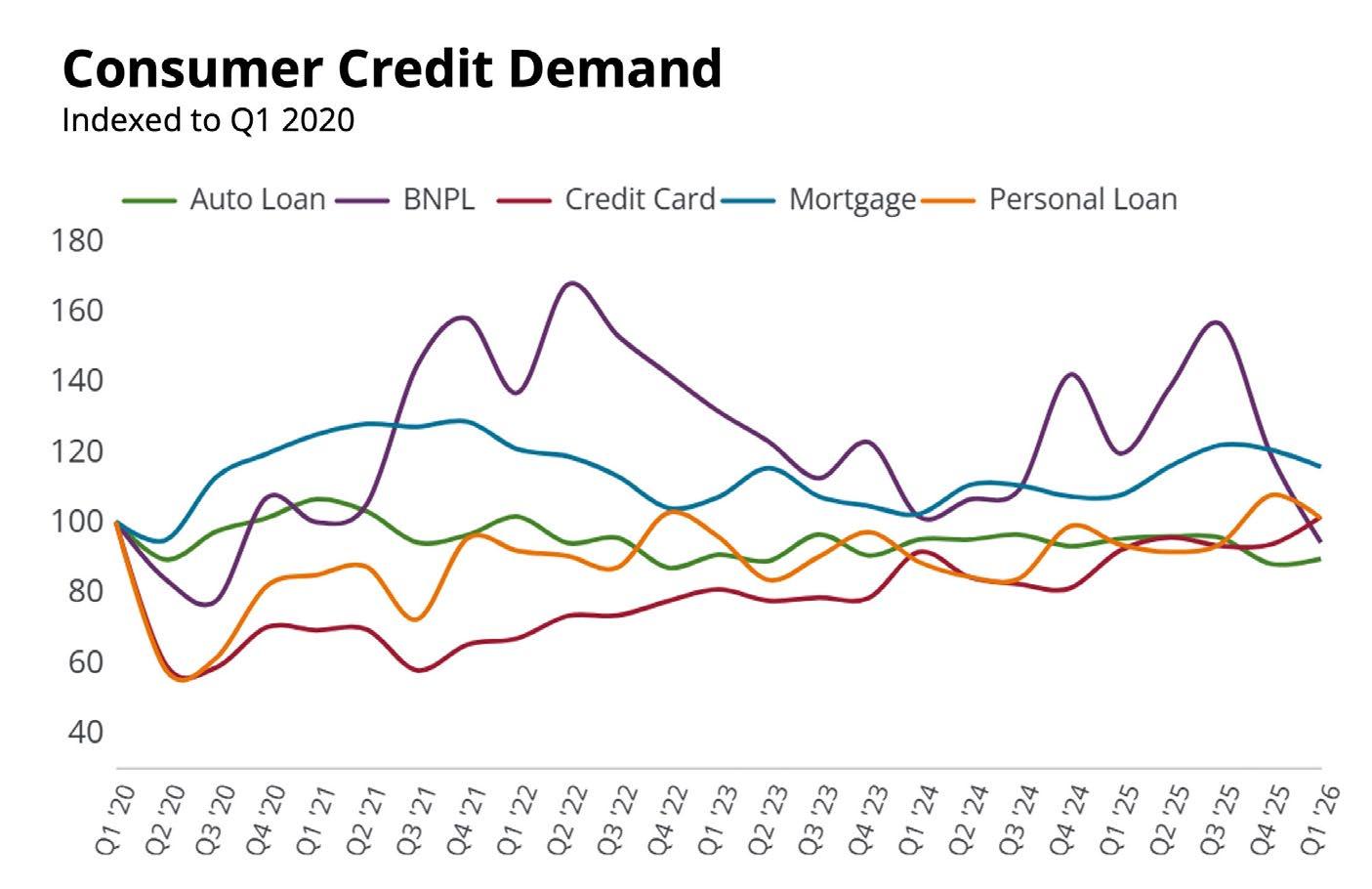
primarily by upgrades and a strong influx of First Home Buyers leveraging the expanded 5% deposit scheme.
Consumers appear to be adopting a conservative posture, prioritising risk management and the search for better deals
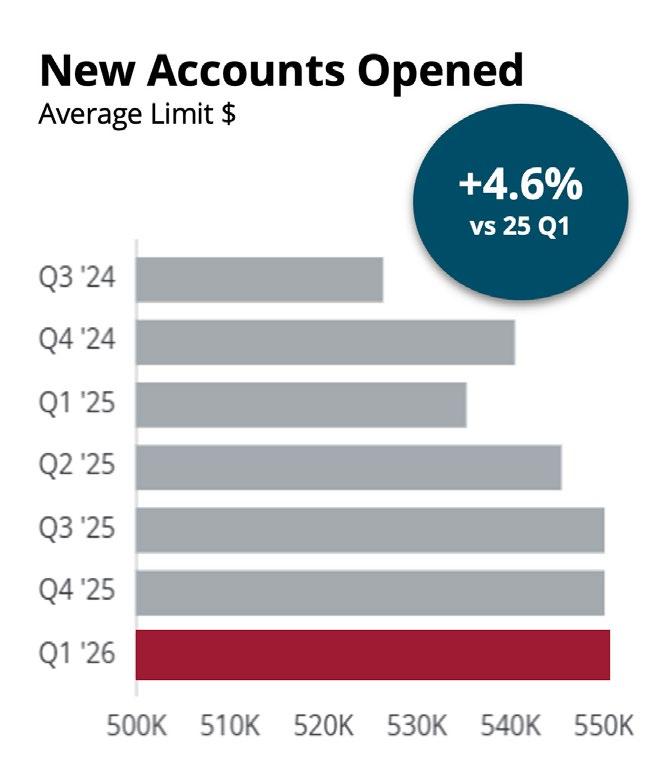
over aggressive new investment. While the total number of mortgage accounts decreased slightly by -0.3%, the average limit of newly opened mortgages rose by 4.6% to over $550,000, indicating that portfolio expansion is being driven by higher-value balances.
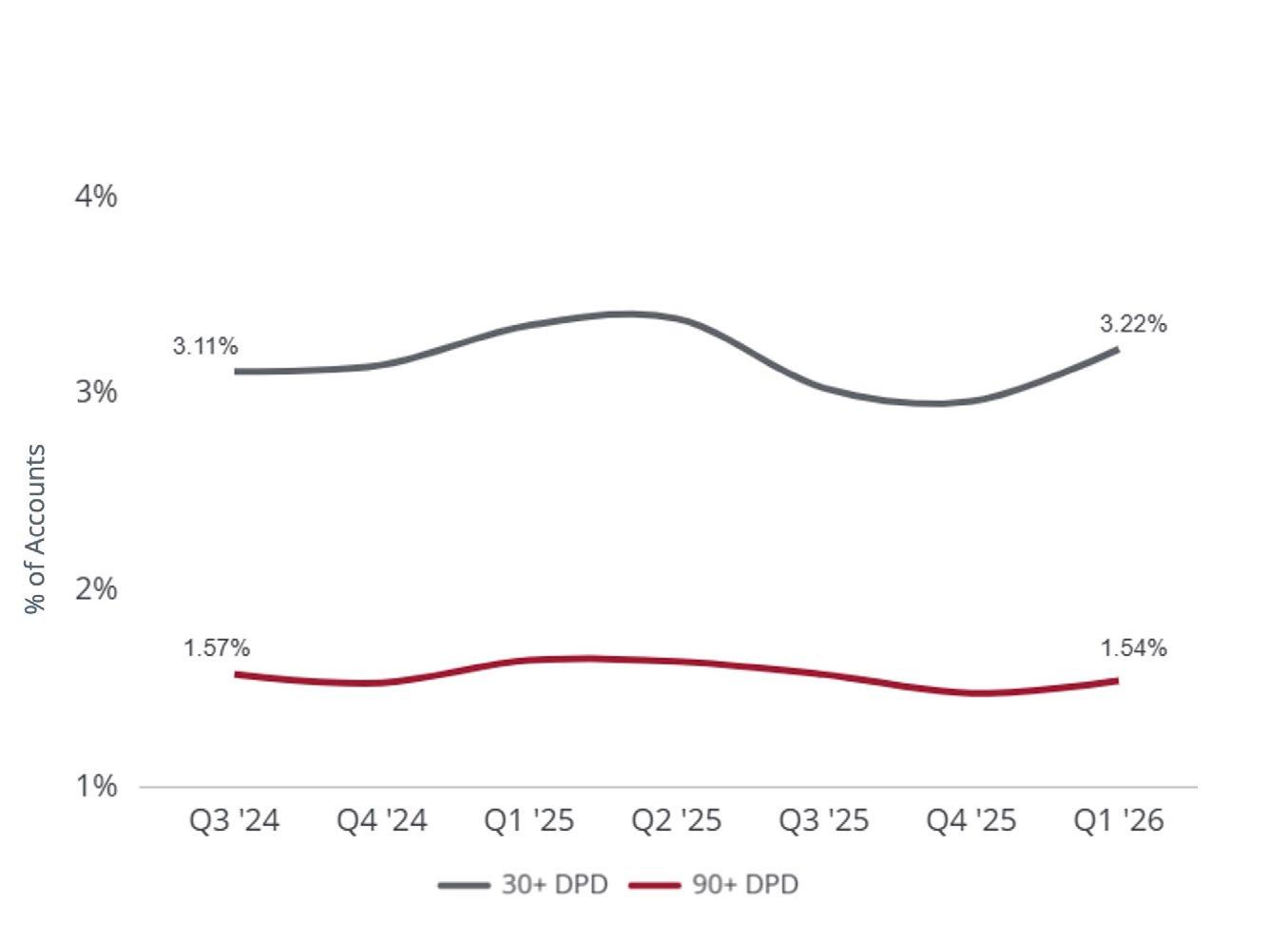
A nuanced trend has emerged in late-stage arrears, where headline rates remain stable or are improving, even as the financial value of those arrears shifts. In the mortgage sector, 90+ days past due (DPD) accounts saw a 3 basis point reduction, with the total limits in late arrears falling by 2.2% compared to Q1 2025.
However, a divergence is visible in the unsecured space. Personal loan arrears volume improved by 14 basis points, yet the financial value of these late arrears rose by 3.1%, suggesting that stress is increasingly
– personal loan accounts in arrears as % of portfolio
Delinquency rate
– credit card accounts in arrears as % of portfolio
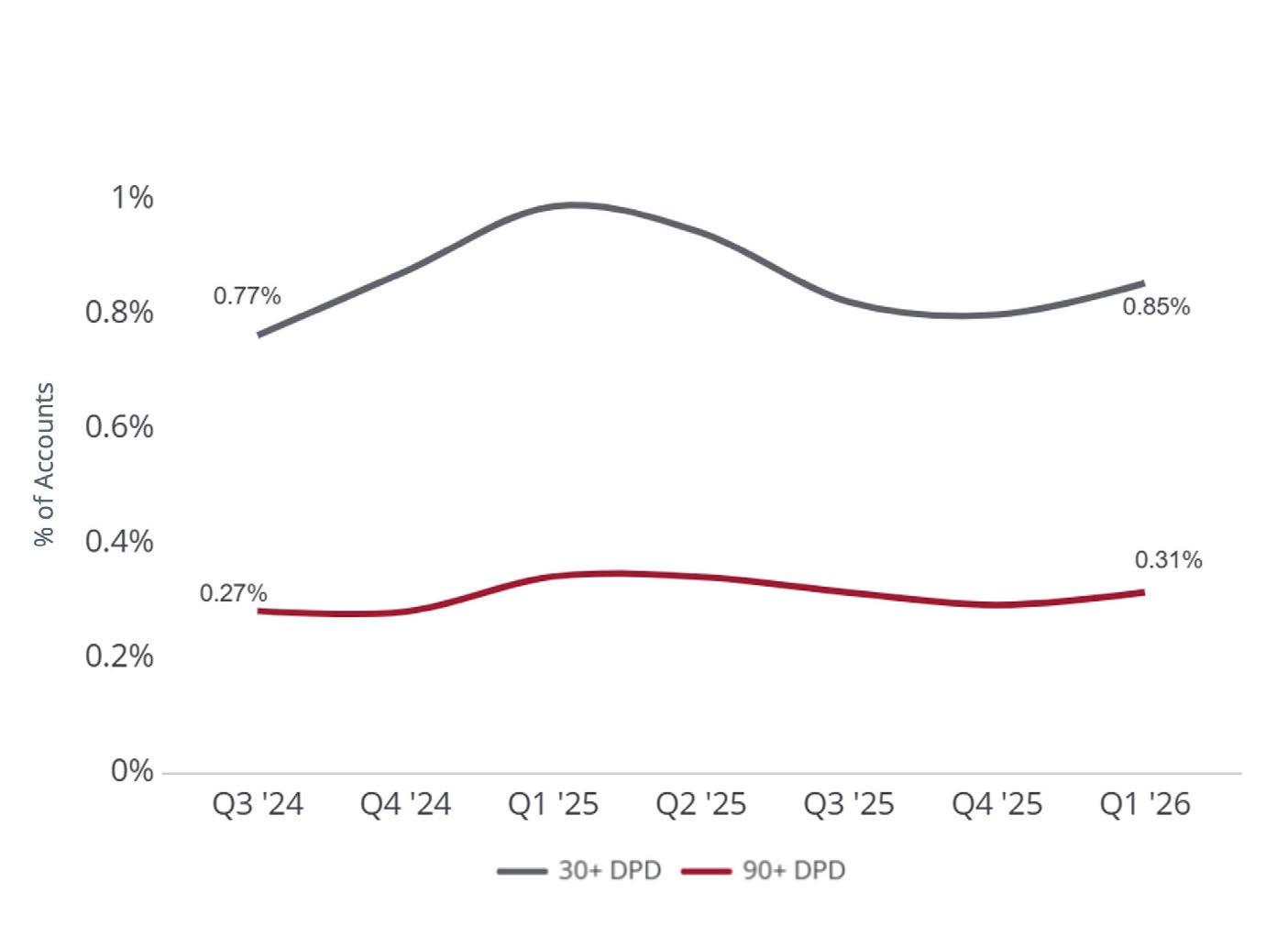
concentrated among larger balances. Similarly, credit card arrears showed improvement, particularly with a -10% reduction in delinquency among the 18-25 age demographic, contributing to a nearly 3% YoY decrease in the total financial value of card arrears.
Unsecured credit demand remains robust, particularly in the credit card and personal loan sectors.
l Credit Cards: This sector marked its fourth consecutive quarter of double-digit growth, up 10.4% YoY. This
is primarily driven by churn, as consumers actively seek better rewards or deals to offset cost-of-living pressures. Interestingly, new accounts opened actually fell by -3.7%, showing that high demand does not always translate to new portfolio growth.
l Personal Loans: Demand grew 7.9% YoY, a trend partly attributed to traditional Buy Now Pay Later (BNPL) providers expanding their offerings into the unsecured personal loan space.
While the broader outlook remains resilient, this stability depends heavily on the labour market. Should unemployment begin to rise from its current low levels, the impact on consumer and commercial credit could become more pronounced.
Certain sectors, particularly those that are diesel intensive, such as transport, mining, agriculture and construction, are likely to be impacted by supply constraints in the near term. The construction industry continues to face pressure from fixed-price contracts and rising input costs for the likes of diesel and plastic piping, which can trap builders between escalating expenses and stagnant revenue, leading to insolvency.
In this changing environment,
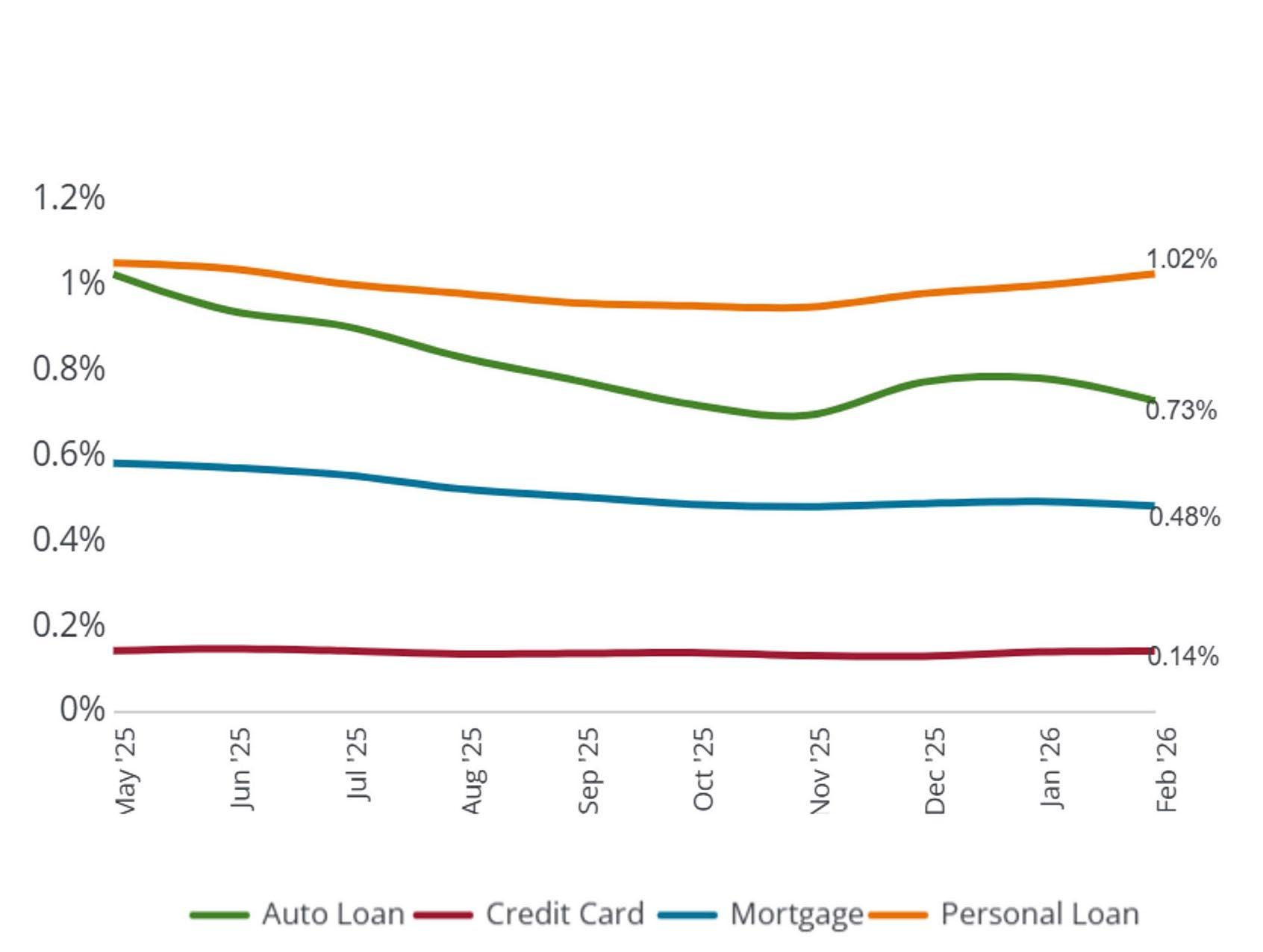
– accounts in hardship as % of portfolio
“Certain sectors, particularly those that are diesel intensive, such as transport, mining, agriculture and construction, are likely to be impacted by supply constraints in the near term.”
verification of financial health remains essential. Overall financial hardship accounts only increased marginally in Q1 2026, with non-mortgage hardship accounts rising by 2.9% and mortgage accounts by over 0.4% compared to the prior quarter. Geographically, Victoria has recorded the highest mortgage hardship rate at 0.70%, indicating localised areas of elevated stress.
The takeaway is one of cautious optimism. Focusing on highquality data intelligence and
dynamic risk indicators will help credit professionals quickly and confidently assess risk and cash flow. Monitoring relationships with businesses in at-risk sectors is a cornerstone of an effective credit risk management framework at times such as this.
Contact Equifax: https://www. equifax.com.au/contact
*Stuart Musgrave Head of Advisory Equifax www.equifax.com.au
Source of data: Equifax Consumer Market Pulse Q1 2026
How do credit professionals distinguish temporary cash flow stress from structural credit deterioration?
By Barrett Hasseldine MICM*

Business conditions across the Australian economy are becoming increasingly uneven. While some businesses remain resilient, others are facing weaker demand, rising costs and tighter cash flow. This widening gap is making credit risk more complex, and harder to assess.
Experian’s April 2026
Commercial Risk Barometer, a report analysing Australian business stability, high-risk sectors and emerging credit stress trends, points to a market
that looks steadier on the surface than it does underneath. During the six months prior to March 2026, the overall risk of business failure improved by just 0.7%, well below the 2.4% improvement recorded a year earlier. However, that modest improvement is now being offset by renewed global volatility, with ongoing geopolitical tensions continuing to add uncertainty to energy markets and supply chains. Pressure has also intensified across agriculture, transport, construction, manufacturing and
“During the six months prior to March 2026, the overall risk of business failure improved by just 0.7%, well below the 2.4% improvement recorded a year earlier.”

wholesale trade, a sign that strain is moving deeper into the real economy.
For credit professionals, this creates a practical challenge as it is no longer enough to identify that a customer is under financial strain. The real task is determining whether the pressure is short-term and manageable, or an early indicator of deeper and more sustained business decline.
Beneath the surface
Headline results do not always reflect what is happening across the wider market. While the overall risk of business failure improved, the underlying data
“The real task is determining whether the pressure is short-term and manageable, or an early indicator of deeper and more sustained business decline.”
points toward growing pressure across several core sectors of the economy.
Agriculture, freight, construction, manufacturing and wholesale trade were already facing weaker trading conditions and higher costs before the recent geopolitical tensions added further pressure to fuel, transport and operating costs. In sectors operating within tight
margins, those costs can quickly flow through to cash flow and payment performance.
A similar pattern is emerging in consumer behaviour. As households continue to absorb higher living costs and cut discretionary spending, the impact is increasingly flowing through to the commercial sector, with global uncertainty adding a further layer of
pressure as it becomes more entrenched in the economy.
In this environment, relying on headline numbers alone provides an incomplete view, as they tend to reflect what has already happened and often miss industry-specific pressures. A more useful approach is to track shifts in sector performance, payment behaviour, customer demand and day-to-day operations, alongside consumer spending and credit trends, as well as broader economic developments, to better understand what’s coming next.
Pressure is now moving beyond the usual high-risk sectors and into industries that underpin day-to-day economic activity, which may signal that broader stress is already taking hold.
This shift is already visible in recent data. Wholesale trade recorded a 25% rise in businesses assessed at severe risk of failure, followed by agriculture at 22%, construction at 21%, transport at 13% and manufacturing at 12%.
These industries sit at the

centre of the real economy. They move goods, supply materials, support food production, and enable housing activity. Financial strain in these sectors rarely remains contained and often flows quickly into other parts of the economy. This should prompt businesses to reassess portfolio exposure. Pressure is no longer concentrated in traditionally highrisk sectors; it is spreading into core industries that many portfolios depend on.
“Pressure is now moving beyond the usual high-risk sectors and into industries that underpin day-to-day economic activity, which may signal that broader stress is already taking hold.”
Payment behaviour is a critical warning sign
Payment behaviour is often one of the earliest and most reliable indicators of emerging credit stress. Before insolvency becomes visible, many businesses begin delaying payments, request payment extensions and/or stretch supplier terms to protect cash flow.
That shift is already visible in sectors such as agriculture, freight and construction, where businesses are also dealing with slowing demand, higher operating costs, and supplyside pressures including climate conditions, labour constraints and productivity challenges. Experian’s latest
Commercial Risk Barometer data shows payment times worsening across these sectors, with agriculture recording the sharpest deterioration, followed by construction, manufacturing, transport and wholesale trade.
These shifts should not be treated as isolated or temporary. In many cases, what initially appears to be short-term liquidity pressure can escalate quickly into a more entrenched credit issue if underlying trading conditions do not improve.
How credit professionals may consider responding
In conditions like these, relying on any single indicator is unlikely to be enough. Headline insolvency data, an isolated late payment or a single difficult quarter rarely tells the full story, particularly as insolvency figures often tend to reflect problems that are already well established, rather than signaling them early or acting as a leading indicator.
Stronger decisions come from combining multiple signals, including payment behaviour, sector conditions, trading activity, business size, legal actions and exposure to higher fuel, freight or input costs, as well as supply levels. Assessing these factors together gives a clearer view of whether a customer is facing shortterm pressure or potentially
“When warning signs emerge, early action matters. Reviewing business activity, working capital requirements, operating overdrafts and finance arrangements, along with revising terms, boosting monitoring or engaging with customers earlier can help address issues before financial stress escalates.”
entering a more serious period of financial decline.
Practical assessment is equally important. Identifying whether the delay is unusual or part of a broader trend, whether a customer’s sector is weakening, whether payments are stabilising or continuing to slow, whether demand is holding up, and whether there are signs of repeated requests for flexibility can provide a much clearer view of risk.
When warning signs emerge, early action matters. Reviewing business activity, working capital requirements, operating overdrafts and finance arrangements, along with revising terms, boosting monitoring or engaging with customers earlier can help address issues before financial stress escalates.
Many sectors are already under pressure, and conditions may weaken further through mid-2026. Organisations best placed to manage risk in this
environment will be those that focus on deeper insight. Combining stronger data analytics, with earlier intervention and sound credit governance, may assist organisations to make more confident decisions, manage risk exposure to loss and protect customer relationships in an increasingly uncertain and changing market.
*Barrett Hasseldine MICM Head of Data Science Experian Australia & New Zealand www.experian.com.au
Disclaimer: This article is provided by Experian Australia Pty Ltd and Experian New Zealand Operations Limited (“Experian”) as general information and it is not (and does not contain any form of) professional, legal or financial advice. Experian and its related bodies corporate make no representations, warranties or guarantees that the information (including links and the views/opinions of authors and/ or contributors) contained in this article are error free, accurate or complete. You are solely responsible and liable for any decision made (or not made) by you in connection with the information contained in this article. Experian and its related bodies corporate exclude all liability for any and all loss cost, expense, damage or claim incurred by a party as a result of or in connection with (whether directly or indirectly) this article or any reliance on the information in this article or links contained within. Experian owns or has appropriate licences for all intellectual property rights in the information and this article must not be edited, copied, updated or republished (whether in whole or in part) in any way without Experian’s prior written consent.
What began as a small team chasing unpaid invoices became a new way to forecast financial risk
By Michael Pollack MICM*

Michael Pollack MICM
Fifteen years ago, CreditorWatch was founded as a result of Australian small business operators encountering the same frustrating reality: you could do everything right, deliver the job on time, issue the invoice and still have no real insight into whether you’d get paid. Credit risk was something you only truly understood after it went wrong.
For Patrick Coghlan – a CreditorWatch Co-Founder and CEO since 2018 – that wasn’t just an inconvenience. This was money that business owners needed to pay their rent, mortgage, school fees. It was money out of their pockets that they could do nothing about.
“What we realised was that small and medium businesses just had to accept bad debts,” he recalls. “Because there was
nothing that was available for them to access… to avoid it, or at least to minimise it.”
That founding ‘aha’ moment was remarkably simple. The earliest insight for CreditorWatch’s founders wasn’t theoretical – it came from watching the same payment behaviour repeat across businesses in the publishing industry.
“Companies would advertise [in our publications], then they wouldn’t pay their bills… then we would see them advertising in a competitor’s magazine or website,” Patrick says. “You’d speak to that publisher and they’d say, ‘Yeah, they never paid their bills’ – and it was as simple as, there’s got to be a better way.”
Rather than accept that as ‘just the cost of doing business’, the founders recognised a gap in the market and decided to do

“...product ideas often came directly from customer conversations, embedding a culture of speed, responsiveness and practical problem-solving that still defines CreditorWatch today.”
something about it. Australian businesses needed simple, affordable tools to ensure they got paid by their customers. And so, CreditorWatch was born – established in Australia, by Australian businesspeople, to serve Australian businesses.
Co-Founder and inaugural CTO, Dale Hurley, who was with CreditorWatch from 2010 to 2018, saw the same problem from a technology and cost perspective. At the time, a one-off static credit report could cost more than $100, which was too much for an SME if they were wanting to assess risk on a $5,000 job for example.
The reports were also designed for experienced credit risk analysts making them almost undecipherable for non-credit professionals.
Today, more than 10,000 Australian businesses, from sole traders through to Big 4 banks, use CreditorWatch to take control of their credit risk management – a scale that reflects both the persistence of the problem and the strength of the solution. It’s been quite a journey – beginning with three employees, CreditorWatch now has more than 250 staff.
In 2025 alone:
l CreditorWatch customers ran 1,125,894 credit reports
l Lodged 33,922 payment defaults
l Monitored 3,161,360 trading partners for important changes
l Received 1,539,544 risk alerts For customers, that scale translates directly into confidence. As Gavin Gilbert, Managing Director at Slabmaster, puts it: “Once you’ve used CreditorWatch, you can’t live without it. The data is deep, the insights are accurate, and it gives us confidence in every credit decision.”
When Charles Kinsella, now Head of Corporate, Expansion and Retention, joined CreditorWatch in 2012, the company was operating out of its first North Sydney office with a tiny team and a big idea.
“There was only six of us,” Charles recalls. “It was my first real job – I didn’t even know what a credit report was. But I really liked the founders, and there was this exciting, tightknit atmosphere.”
In those early years, everyone wore multiple hats.
“I was sales, support, customer service, admin, marketing – you name it, we did it,” he says. “You’d talk to a customer, then try to get something built for them on the same day!”
From a technology perspective, Dale says those early constraints were important drivers of innovation. With no legacy systems and limited resources, the team focused on automation, cloud infrastructure and real-time data publishing –dramatically reducing costs and removing manual processing that slowed incumbents down.
“We really used our constraints as strengths,” Dale says. “We didn’t have massive teams or budgets, so we had to be laser-focused on automating everything and delivering value very, very quickly.”
The closeness to customers shaped CreditorWatch’s earliest innovations – and it remains a defining part of how the company approaches product development. Patrick describes it as a product culture that was customer-led from day one: “We’d spend a huge amount of time with the industry, understanding what they wished the offering looked like. That customer product feedback was just so valuable, and is what really drove the innovation.”
Dale agrees, noting that product ideas often came directly from customer conversations, embedding a culture of speed, responsiveness and practical problem-solving that still defines CreditorWatch today.
“[Onboarding tool] ApplyEasy didn’t exist when I started,” Charles says. “It came directly from customer feedback. We’d
“The closeness to customers shaped CreditorWatch’s earliest innovations –and it remains a defining part of how the company approaches product development.”
talk to customers, then go back to our dev team of one person [CreditorWatch now has more than 100 people in the engineering team] and say, ‘Can you build this? Because the market needs it.’”
From the outset, CreditorWatch knew it couldn’t out-muscle the established multinational bureaus on raw data volume.
Instead, pioneered monitoring and changing how credit information was consumed.
“At the time, customers were still using PDFs or paperbased reports. Monitoring was incredibly expensive and not accessible to most businesses,” Charles says. “We made it affordable for everyone, and that changed everything.”
Patrick frames that shift as the moment CreditorWatch started reshaping the category – moving from point-in-time checking to always-on insight: “It’s all well and good doing a credit check, which is a point in time check. But what happens tomorrow, next month, next year? That’s really the valuable bit going forward.”
Over time, that approach created a powerful network effect. Today, CreditorWatch customers have placed 23.4 million monitoring watches on businesses, generating realtime behavioural signals that strengthen the entire ecosystem

“Today, more than 10,000 Australian businesses, from sole traders through to Big 4 banks, use CreditorWatch to take control of their credit risk management...”
and improve risk visibility for everyone in it.
And while the early competitive edge was product and service, the long-term edge has become something harder to replicate: uniquely broad, uniquely local data that reflects how Australian businesses actually pay each other – not just what shows up late in the cycle.
Patrick explains that data on small businesses is key to identifying risk early: “Data just from the top end of town, from the banks, is quite late in the
piece… By the time a debtor has stopped paying a bank or a telco, they’ve already stopped paying every other business… We knew the importance of having what we would call a 360-degree view… how small pays small, big pays small… across construction, hospitality, manufacturing.”
For partners embedding CreditorWatch directly into their workflows, that depth and reliability is critical. As Richard Winkett, Co-Founder of CitoPlus, explains: “If the data isn’t available, our brokers can’t
do a deal. Reliability and stability of CreditorWatch’s APIs are absolutely key. Beyond that, the alignment in mindset and their SME-focused data made them the right partner for us.”
When Matt Jackson, now Chief Revenue Officer, joined in 2012, CreditorWatch was still finding its feet commercially.
“They were just trying to help customers get paid in the really early days,” Matt says. “Then it
quickly evolved to making credit reporting affordable for everyone.”
Trust was hard-won.
“Brand name was a big challenge. People trusted the incumbents, and we were the new people, but usability proved decisive. CreditorWatch was easy to use – I knew from day one it was going to be successful.”
Both Matt and Charles point to culture as a constant through growth.
“There was no ‘that’s not my job’ mentality,” Charles says. “We were all in it together. And that still exists 15 years later with 250plus staff.” “Culture is the reason I started at CreditorWatch and the reason I’m still here,” Matt adds.
Patrick agrees, and credits deliberate hiring, plus an employee-led ‘all in’ mindset that has scaled with growth in the business: “We were up front that that’s how the business worked… The more employees you’ve got thinking that way, the next set of employees come on and they go, ‘Oh, okay, this is how it works. We all pitch in everywhere. We all want to win.’”
From outside the organisation, Nick Pilavidis, CEO of the
“
Australian Institute of Credit Management (AICM), has watched CreditorWatch’s rise first-hand both as an early customer and then in his role at the AICM.
“I remember the first conference where CreditorWatch was exhibiting – the new innovator startup on the block,” Nick says. “To see it evolve into a real industry leader has been exciting.”
Nick highlights CreditorWatch’s responsiveness and credibility.
“They’re consultative, not one-size-fits-all. And they’ve been very present in regulatory change, supporting the profession as the industry evolves.” CreditorWatch has been involved with the AICM for over 10 years now, sponsoring events including the Young Credit Professional of the year which fosters the next generation of credit talent in Australia.
As CreditorWatch matured, so did its data, enabling a transformative shift in 2018 from backward-looking reporting to a predictive risk intelligence model.
As CreditorWatch matured, so did its data, enabling a transformative shift in 2018 from backward-looking reporting to a predictive risk intelligence model.”
“When I first joined, we didn’t even have a credit score,” Charles says. “We were upfront about what we had. Now, we’ve got years of data that’s contributed to the most predictive credit score in the market. It takes time to build a market-leading data set.”
That evolution was vital for adoption for larger businesses such as financial institutions and insurers.
“The move to a mature, predictive RiskScore was a watershed moment,” says Stirling Streeter, Enterprise Account Director, who joined CreditorWatch in 2018. “It put us on the map with enterprise customers.”
From a technology perspective, Arun Baghel, Senior Engineering Manager, who joined in 2017, agrees. “You can’t just spin up this kind of data. It accumulates over years, and that’s a real advantage.”
Patrick puts it even more bluntly: the real value isn’t just ‘more data’ – it’s different data, built through network effects across industries and business sizes. “We didn’t appreciate the significance of the network effects we were creating… Having the same amount of data, but from a cross section of all types of businesses… that’s what’s powered not only the growth of the data, but the insights that come out of it.”
“Enterprise-ready datasets, automation and digital workflows helped CreditorWatch move from challenger to core infrastructure, while retaining its original focus on practicality and accessibility. ”
And in the last few years, those compounding effects have started to show up decisively in competitive comparisons. “When our data is put head-to-head… there’s clear differentiation and clear superiority in our data, and as a result the largest companies in Australia are moving to CreditorWatch and trusting our data for their decisions,” Patrick says. “Companies are actually testing that data… and reporting back to us to say that the data is truly different and significantly more predictive.”
As CreditorWatch matured, so did the organisations relying on it.
“Getting MSAs signed by a number of major banks has been a huge milestone,” Matt says. “It shows the data is trusted at the highest level.”
Enterprise-ready datasets, automation and digital workflows helped CreditorWatch move from challenger to core infrastructure, while retaining its original focus on practicality
and accessibility. This shift also reflects CreditorWatch’s strategic narrative today: moving the market from seeing credit risk as a one-off ‘check’ to understanding it as always-on, predictive risk intelligence, powered by real-time payment behaviour and early-warning signals.
Fifteen years in, and still disrupting Today, CreditorWatch employs more than 250 people, supports businesses of all sizes and provides risk intelligence to major financial institutions and ASX-listed companies. Yet, as Charles notes, the founding mindset hasn’t changed.
“We competed through technology, innovation and customer experience,” he says. “And that’s still true today – even as we invest heavily in AI and automation.”
Patrick emphasises that the investment is deliberate, and substantial. “We’ve got customer advisory councils, regular feedback sessions with our customers, and we’ll spend
about $18 million on innovation in FY27,” he says. “What you see today will be very different to what you see and use in 12 months.”
Looking ahead, Patrick believes the next era of bestpractice credit management will be defined by visibility and accessibility – not just inside a single platform, but wherever customers make decisions.
“CreditorWatch data will be able to exist anywhere… within ERPs… or within the LLMs that our customers use… regardless of what a customer is using CreditorWatch data will be available,” he says, describing a platform-agnostic, AI-enabled vision where risk intelligence can be pulled into workflows.
Fifteen years on the same vision remains as CreditorWatch empowers 10,000+ Australian businesses to trade confidently with their customers. But they are doing so with deeper data, smarter technology and a clearer view of what’s coming next.
Note: While ASIC corporate records show CreditorWatch was founded in late 2010, we truly launched the business in early 2011 which is the founding date we have always celebrated.
*
Michael Pollack MICM Head of Media & Communications CreditorWatch
E: michael.pollack@creditorwatch.com.au www.creditorwatch.com.au
By Syavie Ghamry MICM*
In an increasingly challenging credit environment, debt sale should be viewed as more than a financial tool. Done well, it can help businesses manage writtenoff accounts while giving customers a clearer pathway to resolution, rehabilitation and re-engagement.

Many organisations view debt sale as a last resort: a way to deliver a capital uplift on writtenoff accounts once internal collections and contingent recovery have run their course. By then, accounts are often aged, customer engagement has declined, and recovery
expectations are low. While the capital uplift remains an important factor, viewing debt sale solely in this way limits its potential as a more holistic solution for businesses and customers.
The traditional approach: Recover first, sell later
The typical lifecycle for overdue accounts is well established:
1. Complete internal collections processes.
2. Refer accounts to contingent collection agencies.
3. Continue prolonged recovery efforts.
4. Consider debt sale once
“Many organisations view debt sale as a last resort: a way to deliver a capital uplift on written-off accounts once internal collections and contingent recovery have run their course.”
other pathways have been exhausted.
This model is designed to maximise recoveries, but it often places less emphasis on what happens to customers over time. When debt remains unresolved for extended periods, customers may disengage, making resolution less likely and delaying their re-entry into the financial system. This can compound financial stress and, in some cases, affect wellbeing, family stability, employment, and broader participation in everyday life. 86% of people feel embarrassed to admit they are struggling with debt and 85% said debt stress is something they experienced at some point in life1

“With dedicated resources and significant investments in process, training, and expertise, a specialist debt purchaser can offer customers a range of solutions designed to help rehabilitate them back into the economy”
For businesses, the challenge is clear: how do you re-engage people who have withdrawn from the process and help them resolve their obligations? This is complex work, and many businesses are not set up with the specialist resources, systems or expertise required to do it well.
This is where debt sale
can provide a solution. When receivables are transferred to a debt purchaser specialising in late-stage collections, the objective shifts from shortterm recovery to long-term resolution.
With dedicated resources and significant investments in process, training, and expertise, a specialist debt purchaser can offer customers a range of solutions designed to help
rehabilitate them back into the economy, including:
l Proven engagement strategies designed to reconnect with disengaged customers;
l A generous and structured approach to hardship;
l Bespoke and sustainable repayment plans aligned to customers’ current circumstances; and/or
l A patient collections model resulting in a long-term solutions.
These approaches can create a clearer pathway for customers to resolve their obligations and reintegrate them into the financial system.
At DebtManagers, this is our core philosophy. Every day, our team works with customers who are experiencing the practical and wellbeing impacts of overdue debt. Doing this effectively means understanding each customer’s situation and creating repayment plans tailored to their circumstances.
It also means being patient and engaging across multiple channels. Email and phone outreach are not always enough, particularly where those channels have already failed to get a resolution, much less create engagement. For some customers, face-to-face contact is the best way to understand wellbeing issues, build trust,
and create the foundation for a genuine partnership built on empathy and understanding that supports rehabilitation.
This approach works, with a significant number of customers we work with getting back on their feet using our method, delivering material improvements to their wellbeing and outcomes.
Arrears management is often viewed through the narrow lens of recovery percentages and financial returns. But each
account represents a customer, and an opportunity for that customer to move forward.
Reframing debt sale as part of a rehabilitation pathway (rather than simply a recovery mechanism) creates a more balanced approach, one that helps businesses manage their balance sheets while enabling customers to re-engage with the financial system and improve their lives.
There is also a clear brand benefit for businesses that take this approach. In an environment where customer conduct is highly scrutinised, what happens at the hard
“Debt sale is not just about converting receivables into cash. At its best, it can also be about converting unresolved situations into resolved ones for both businesses and customers...”
edge of the customer lifecycle matters. Ensuring this part of the journey is managed with fairness, empathy and care helps protect the brand, supports regulatory expectations, and demonstrates the business is living its values, even when customers are in difficult circumstances.
Debt sale is more than just a balance sheet fix Debt sale is not just about converting receivables into cash. At its best, it can also be
about converting unresolved situations into resolved ones for both businesses and customers, resulting in long term benefits as the customer reintegrates into the financial system.
As the credit industry continues to evolve during this turbulent economic environment, there is an opportunity to think more broadly about customer outcomes.
Not just what is recovered, but what is restored.
*Syavie Ghamry MICM Client Manager DebtManagers
E: syavie.ghamry@debtmanagers.com.au
FOOTNOTES:
1 Independent research conducted by Talbot Mills Research (March 2026)
At DebtManagers, we’re on a mission to create a fairer financial world that gives everyone the chance to feel financial certainty and confidence. Founded on principles of fairness, trust, and respect, we never charge fees or excessive interest but instead create easy, sustainable repayment plans that help people climb out of debt and become valued customers again. All while delivering better value and financial outcomes for companies and giving back to the communities we work in.
For debt sale enquiries contact: syavie. ghamry@debtmanagers.com.au

By Sean Quagliani*
Speed to decision has become a defining feature of modern lending. Customers expect it, competitors are built around it, and internal cost pressures demand it. Faster approvals are no longer a differentiator. They are the baseline.
But there is a trade-off sitting just beneath the surface.

Sean Quagliani
Recent media headlines have brought document fraud into sharp focus. With AI enabling easy ways to edit or create fake documents, it is emerging as one of the defining risks of modern lending, sitting directly at the intersection of customer experience, automation and credit quality.
The faster a lender moves, the more it depends on the integrity of the information provided at the point of application. That creates a tension between
growth and control that is becoming harder to ignore.
There are three clear forces that are driving speed:
First, growth. Lenders are under pressure to acquire and convert customers quickly.
Second, customer expectation. Borrowers now expect near-instant responses. Waiting days for a decision risks losing customers and revenue.
Third, efficiency. Automation and straight-through processing are becoming central to
“The faster a lender moves, the more it depends on the integrity of the information provided at the point of application.”

“Affordability assessments that rely on income verification, employment validation and financial position all need to move faster. Ensuring that supporting documents are authentic becomes a critical step in that process.”
maintaining margins. Digital lenders are setting the pace here.
All three push in the same direction. Faster, simpler, more automated decisions.
The challenge is that speed changes how risk enters the system. Automation, while essential, also opens the door to fraud if controls are not keeping pace.
Affordability assessments that rely on income verification, employment validation and financial position all need to move faster. Ensuring that supporting documents are
authentic becomes a critical step in that process.
Payslips, bank statements, tax records and other supporting evidence form the foundation of decision-making. If those documents are manipulated, the decision itself is compromised. What is increasingly clear is that document fraud is not a fringe issue. It is persistent, and in many cases under-detected. Fortiro data shows 6 to 7 per cent of income documents exhibit high-risk characteristics, with about half of those confirmed as fraud.
At the same time, the nature of fraud is evolving. We are now
seeing a blend of shallowfakes and deepfakes in document fraud.
l Shallowfakes are existing documents that have been edited, such as altering information or reusing templates. These have existed for years but are becoming more refined.
l Deepfakes are synthetic documents, images or videos produced by generative AI. This combination is raising the bar for detection – it is now far more difficult to identify fraudulent documents using traditional methods. The net effect is clear: faster editing/
creation combined with more sophisticated fraud techniques, create greater opportunity for fraud risk to enter undetected.
For credit managers, this is not just a fraud issue. It is a decision quality issue. If a document is inaccurate, everything built on top of it is also at risk. Serviceability calculations, affordability assessments and credit grading can all be impacted.
In that sense, document integrity sits right at the front line of both credit risk and compliance.
This tension is already being recognised inside lending teams. There is a clear desire to move faster, but also a growing awareness that automation without the right controls can create new vulnerabilities. The challenge is not whether to accelerate, but how to do so without opening the door to exploitation.
Plenti is one of Australia’s fastest growing non-bank lenders specialising in car, personal, and renewable-energy loans. Today, they use the Fortiro product suite integrated into their loan engine. They have seen a significant reduction in application processing time, enhanced fraud detection, and seamless redaction of sensitive information from tax returns,

“If a document is inaccurate, everything built on top of it is also at risk. Serviceability calculations, affordability assessments and credit grading can all be impacted. ”
allowing them to grow rapidly while managing risk.
The answer is not to slow down the process. It is to strengthen the controls around the evidence that drives the decision.
That means moving toward a layered approach. Identity needs to be verified. Documents need to be authenticated, not just collected. Data points need to be cross-checked. And all of this needs to happen within the workflow, not outside it.
Critically, these controls need to operate in an automated fashion and in real time, supporting faster decisions, not delaying them.
The lenders that succeed in today’s market will not be
the ones who slow the process down. They will be the ones who strengthen trust in the inputs that drive their decisions and embed risk controls directly into automated affordability assessments. In a market defined by speed, the real advantage lies in making fast decisions that can stand up to scrutiny.
*Sean Quagliani CEO and Co-Founder Fortiro E: sean.quagliani@fortiro.com
About Sean Sean is a Co-founder and CEO of Fortiro, an Australian technology company that automates financial document reviews and fraud detection. Fortiro’s customers form a powerful network of lenders, insurers, and payment processors, including 3 of the big 4 Australian banks. Sean is passionate about fraud prevention and has a background in technology, fraud, and cybersecurity.


Professional Development That Keeps You Current
Access specialised training, events, and education designed for real-world credit challenges.
“Every professional development session I attend leaves me with new insights I can apply immediately, and the webinars provide a constant stream of practical and relevant information.”
— Mary Petreski FICM CCE, Head of Customer Payments
A Network That Opens Doors
Connect with credit leaders and like-minded professionals nationwide.
“My involvement as a junior in the industry has provided me with exposure to new experiences, high level networking, and opportunities for professional and personal growth that typically comes later on in one’s career.”
— Arian Bahmiyari MICM, Solicitor
Support, Resources & Industry Insight
Stay informed with member-only resources and updates that help you work smarter.
“I have learnt valuable skills that continue to support my operational decision-making and have allowed me to contribute meaningfully to my organisation.”
— Hudson Pitt MICM, General Manager
Recognition That Elevates Your Career
Gain credibility through awards, post-nominals, and national visibility.
“I entered the Credit Professional Award after being nominated by a colleague in 2023. Being selected for this award was exciting and a real boost for my ego. The idea of winning or even being nominated for such an award significantly enhanced my credibility as a credit professional.”
— Janice Riley MICM CCE, National Credit Manager
Unlock what’s next for you. Join the AICM today.
Free Webinars & Special Interest Groups
Complimentary access valued at over $300.
Stay Informed
Be the first to know about industry alerts and updates via our newsletter.
Member Pricing
Save up to 30% on AICM events, seminars, and training courses.
Credit Knowledge Hub
Access articles, reports, and resources at exclusive member pricing.
Ask Creddo
Your go-to for quick answers and expert guidance on credit management.
Networking
Join our members-only LinkedIn group to connect and share insights.
Publications
Subscription to Credit Management in Australia magazine.
Professional Recognition
Use MICM post-nominals on your email signature and LinkedIn profile.

By Dion Appel MICM*
Welcome to a new operating model for credit teams, where AI-driven automation is reshaping how organisations reconcile payments, manage cash flow, and strengthen customer collections. Built for modern credit and accounts receivable (AR) teams, this is a structural shift in how financial operations are executed.

Dion
The true impact of manual reconciliation
Payment reconciliation across trade receivables has remained one of the most resource-intensive and fragmented processes. Credit and AR teams are routinely required to manually
cross-reference bank statements, invoices, and remittance advice across disparate systems. The result is a workflow that is not only slow and labour-intensive but also highly susceptible to error and inconsistency.
This operational friction has wider consequences than inefficiency alone. It obscures real-time cash position visibility, delays collections, and places strain on customer relationships through reactive engagement. Over time, these inefficiencies contribute directly to increased Days Sales Outstanding (DSO) and weakened working capital performance.
As organisations scale, these
“AI is fundamentally changing the reconciliation paradigm by replacing fragmented, manual workflows with continuous, intelligent automation.”

“Rather than relying on human-led matching across disconnected datasets, AI-powered systems receive payment data in real time, analyse transactional patterns, and automatically reconcile receipts against invoices and remittance information within a single environment.”
challenges compound. Monthend reconciliation backlogs become routine, financial visibility becomes increasingly retrospective, and skilled finance professionals are diverted away from strategic work toward repetitive administrative tasks.
AI automation as a new operating layer
AI is fundamentally changing the reconciliation paradigm by replacing fragmented, manual workflows with continuous, intelligent automation.
Rather than relying on
human-led matching across disconnected datasets, AI-powered systems receive payment data in real time, analyse transactional patterns, and automatically reconcile receipts against invoices and remittance information within a single environment.
This shift from periodic batch processing to continuous reconciliation eliminates end-ofmonth bottlenecks and delivers always-on visibility into cash flow and receivables performance.
The impact is immediate and measurable:
l Faster reconciliation cycles
l Higher matching accuracy
l Consistent, standardised processing
l Significant reduction in manual effort
More importantly, finance teams regain capacity, shifting focus to higher-value priorities such as credit strategy, customer engagement, and collections optimisation.
AI-powered reconciliation in practice
At the core of AI-driven reconciliation is a centralised
data platform that consolidates all payment and receivables information into a single source of truth.
Key inputs include:
Real-time, read-only bank feeds capture critical transaction attributes, including date, reference, payment type, and amount, providing immediate visibility into incoming cash movements.
Invoices are received directly into the platform via integration or structured upload, enabling seamless alignment with existing ERP and billing systems without disruptive infrastructure changes.
Remittance data is captured, standardised, and contextualised within the same environment, ensuring completeness of payment information.
Once centralised, AI models intelligently match payments to invoices using multi-variable logic and historical behavioural patterns. Anomalies are automatically flagged, ensuring no transaction is overlooked.
The outcome is near realtime reconciliation accuracy with full traceability across every transaction.

“Modern AI-enabled AR platforms extend beyond matching logic to actively optimise the end-to-end receivables lifecycle.”
The most significant shift AI enables is improved collection performance by addressing issues before they escalate.
Modern AI-enabled AR platforms extend beyond matching logic to actively optimise the end-to-end receivables lifecycle.
Transaction data can be transformed into structured, branded invoices that are generated and distributed automatically based on predefined rules, reducing manual effort and ensuring consistency in customer communication.
Automated reminder cycles can be configured to proactively engage customers ahead of due dates and systematically escalate overdue accounts.
This improves collection rates while maintaining a consistent, auditable communication trail.
Together, these capabilities shift collections from a reactive function to a predictive, automated process, reducing late payments and improving cash conversion.
The adoption of AI in payment reconciliation redefines control within finance operations.
By consolidating receivables data into a single, real-time
environment, organisations gain a continuously updated view of financial performance across customers, invoices, and payment status. This enables faster, more confident decisionmaking and strengthens working capital management.
In practice, finance leaders move from reconciling historical data to actively managing forward-looking cash flow.
The future of AR is autonomous
As businesses face increasing pressure to improve efficiency,
reduce DSO, and scale without proportional increases in headcount, manual reconciliation models are no longer sustainable.
AI-powered reconciliation provides a clear path forward: a finance function that is faster, more accurate, and fundamentally more strategic. Businesses can shift from reactive payment chasing to proactive cash management, accelerating the credit-to-cash cycle.
For organisations modernising their credit and AR operations,
this is not simply a technology upgrade. It is a shift toward an autonomous financial operating model, where accuracy, visibility, and collections performance are continuously optimised in real time.
opypro.com.au
*Dion Appel MICM is CEO and Managing Director at Opypro, a cloud-based credit management platform that streamlines and automates trade account receivables processes and centralises real-time data. AI automation delivers speed, accuracy and consistency across onboarding, invoicing and payment reconciliation functions in a single solution. www.opypro.com.au


By Monika Lacey MICM*

Monika Lacey MICM
Aotearoa New Zealand’s credit landscape entered the second quarter of 2026 with mixed and increasingly divergent signals. While lending volumes continue to hold above last year’s levels, underlying confidence has softened, and stress continues to be evident in some parts of the business sector.
Our credit data points to an economy that is stabilising unevenly. Business credit demand is down 3.8% year on year, reflecting continued caution across much of the services economy.
Elevated input costs, fragile margins and slowing discretionary demand are weighing on borrowing appetite, particularly outside essential or exportexposed sectors.
Hospitality remains a clear outlier. Credit enquiries in the sector are up 26% over the past 12 months, despite persistently high liquidation rates.
This suggests that many operators are continuing to rely on external credit to manage cashflow pressures rather than fund expansion.
Agriculture, by contrast,
“Elevated input costs, fragile margins and slowing discretionary demand are weighing on borrowing appetite, particularly outside essential or exportexposed sectors.”
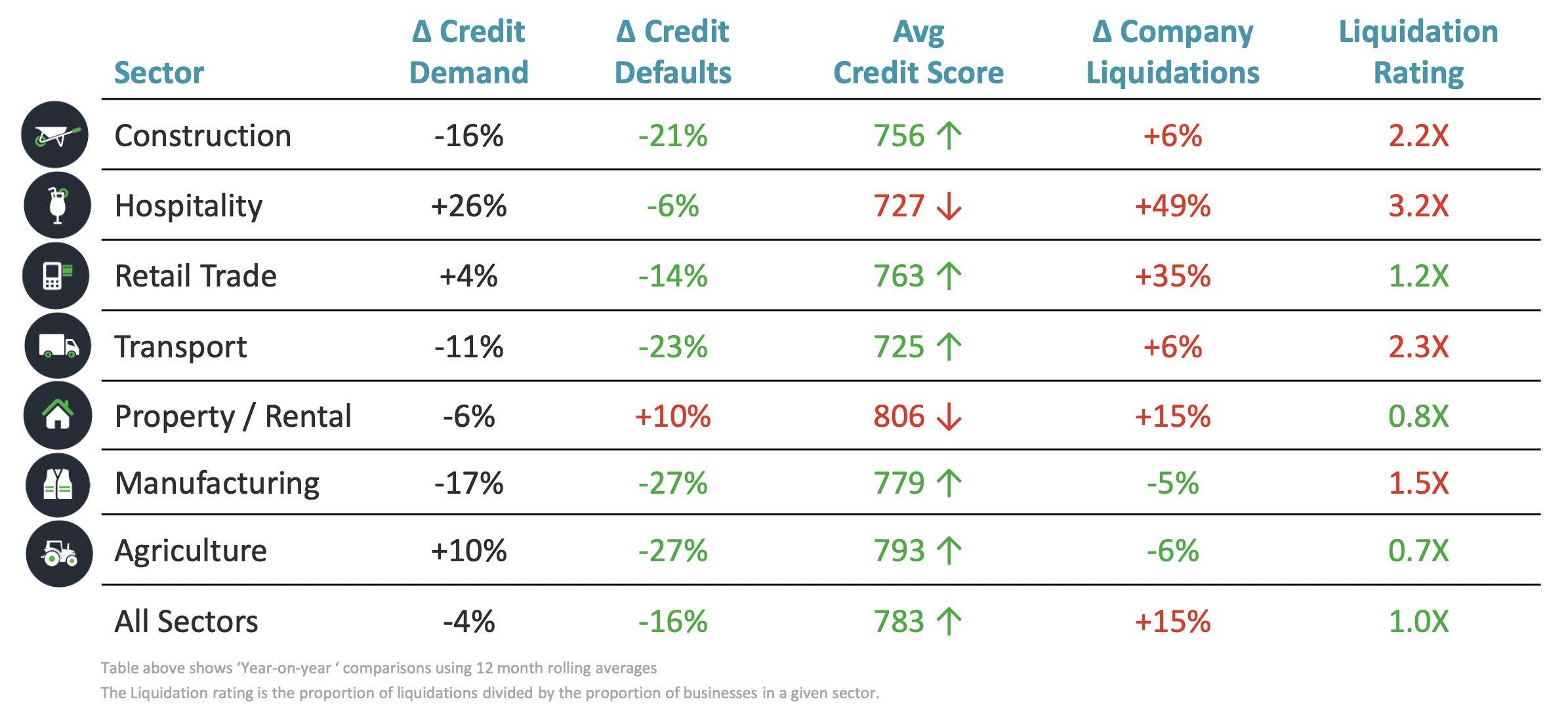
continues to show relative resilience, with credit demand up 10% year on year alongside improving financial health indicators.
Encouragingly, the average
credit score for new business applications has risen to 747, up six points on last year, while new business registrations are up 10% on a rolling 12month basis.
This points to selective strength among new and bettercapitalised firms, even as conditions remain challenging for established operators with weaker balance sheets.
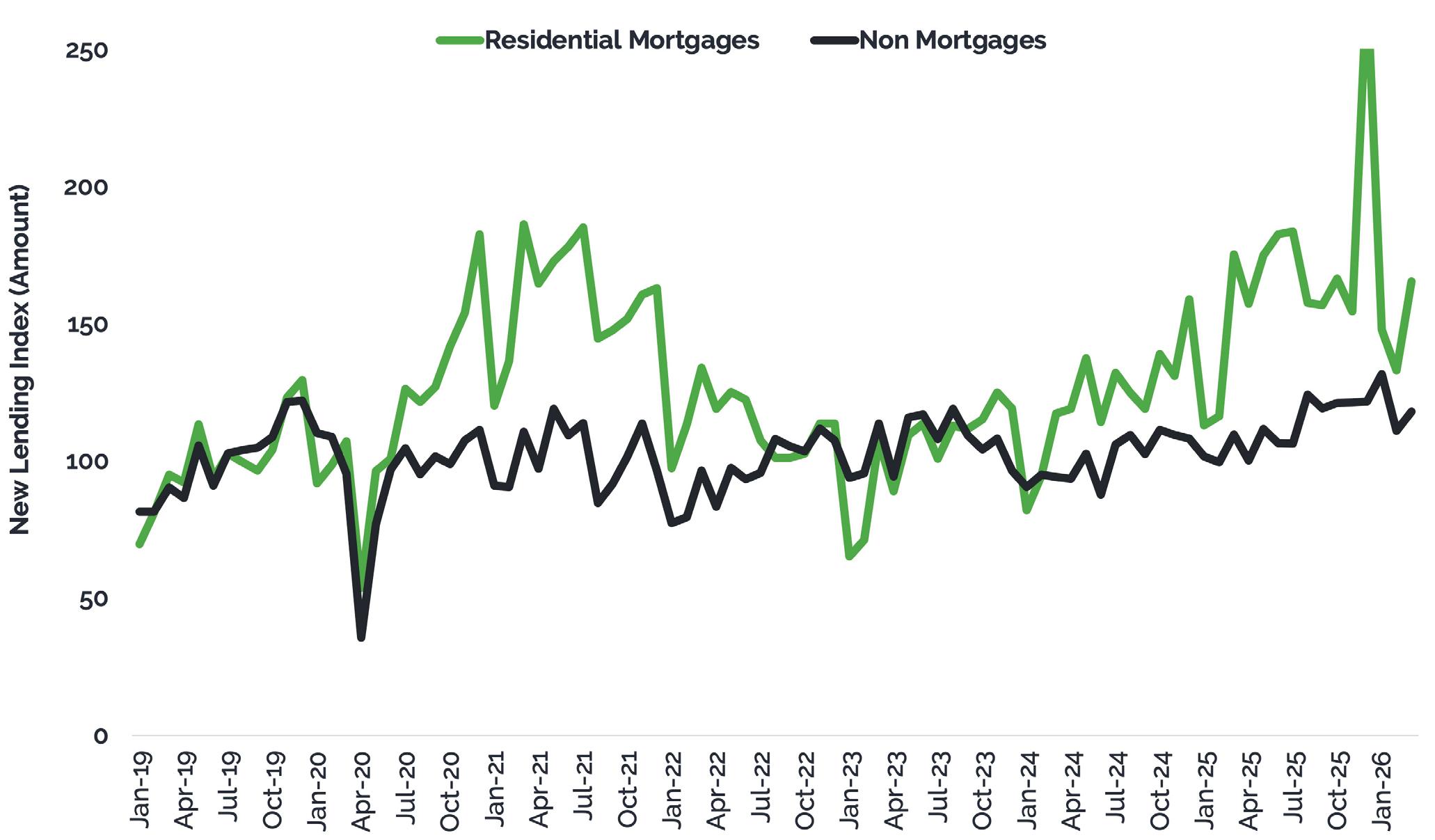
New Consumer Lending (Indexed to 2019)
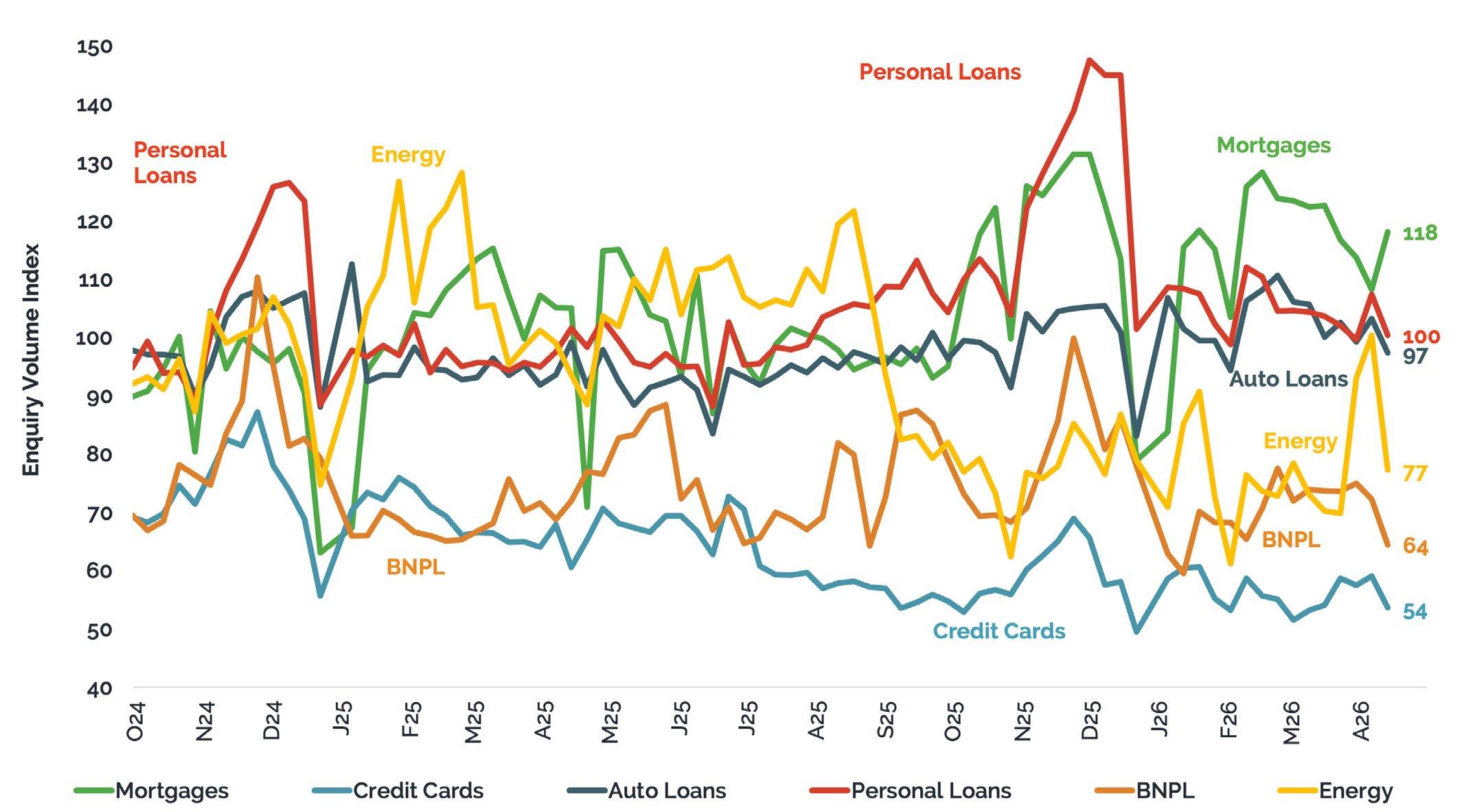
Credit Demand by Product Type
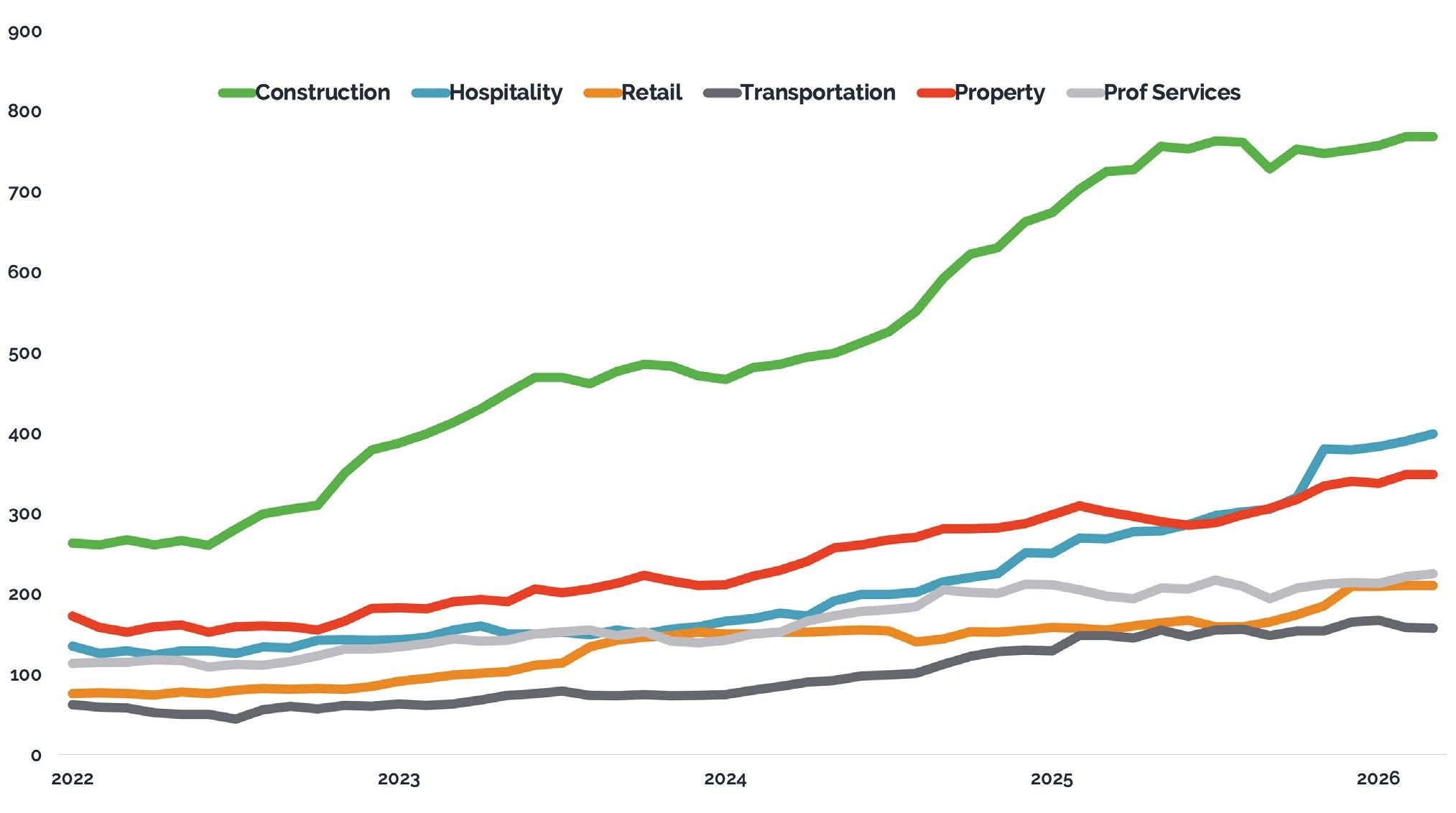
However, company failures remain elevated. On a rolling annual basis, liquidations have climbed to 3,023, up 15% year on year, making this the highest level of business failure since the mid2010s – although this is very much a lag indicator.
Construction remains the single largest contributor, with 768 firms entering liquidation over the past year, accounting for around 0.9% of all registered construction companies. Hospitality follows closely, with 399 liquidations, up 49% compared with the previous year.
Inland Revenue enforcement activity continues to be a significant driver of insolvency volumes and remains an important lens through which current business stress should be interpreted.
There are, however, signs of stabilisation beneath the headline figures. Liquidation trends have improved across six of the nineteen monitored sectors, including agriculture, manufacturing and
wholesale trade, while business credit defaults are down 16% year on year.
Agriculture continues to lead on most measures, with defaults down 27%, liquidations down 6%, and an average credit score nearing 800, underscoring its relative strength despite broader economic uncertainty. These business sector dynamics are unfolding against a more cautious macroeconomic backdrop. The Reserve Bank has held the Official Cash Rate at 2.25%, while highlighting that recent geopolitical developments have materially shifted the outlook for inflation and growth. Higher fuel and transport costs are expected to add renewed pressure to operating expenses, with the full impact yet to flow through into company financials.
Household lending improves, but stress remains uneven
On the consumer side of the economy, lending activity has continued to recover, even as confidence moderates. Total new household lending remains 11.1% higher than a year ago, supported by a 10.7% lift in mortgage lending and a stronger 15.6% increase in nonmortgage lending.
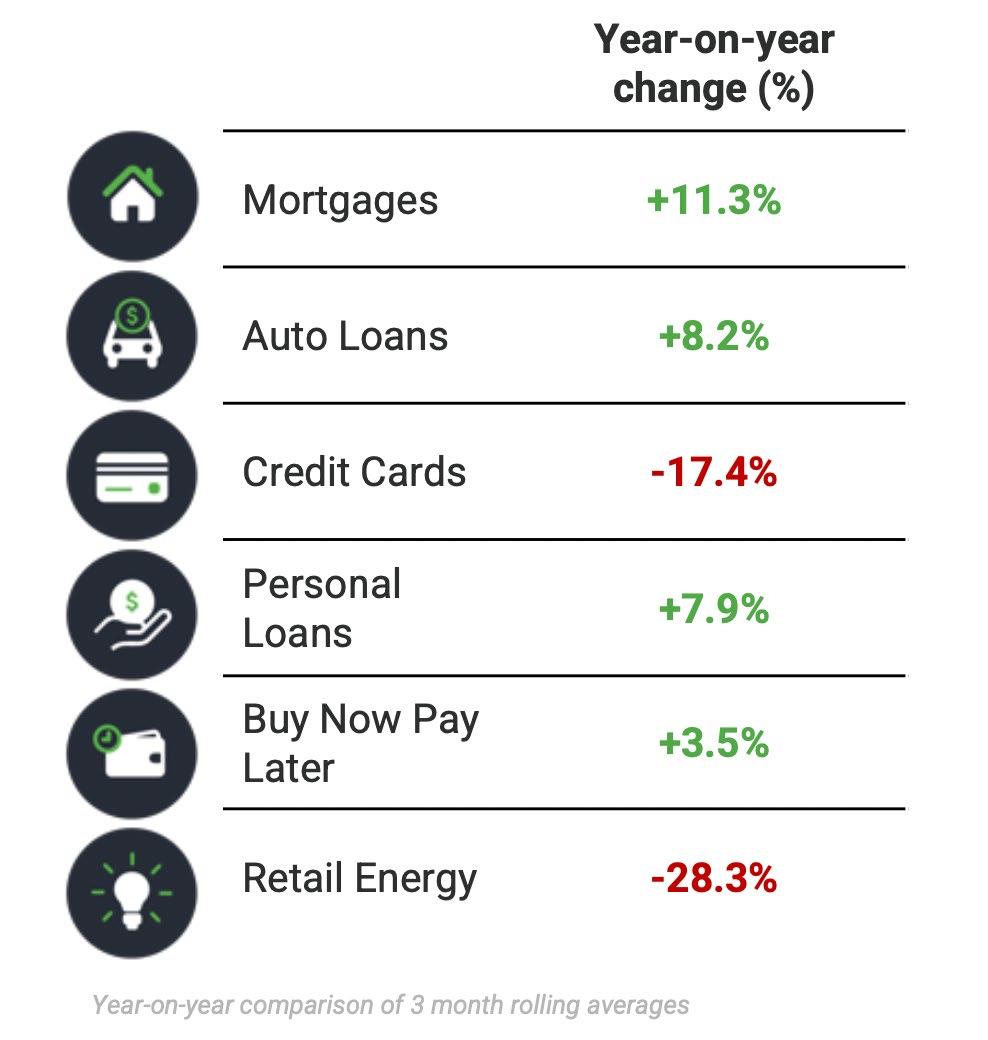
Mortgage enquiry volumes remain resilient, up 11.3% year on year, reflecting refinancing
activity and a busier summer property market.
Personal loan and auto loan demand has also strengthened, indicating that households continue to rely on credit for essential spending and vehicle replacement.
In contrast, credit card enquiries are down sharply, highlighting ongoing caution around discretionary spending.
Repayment performance across much of the household sector continues to improve.
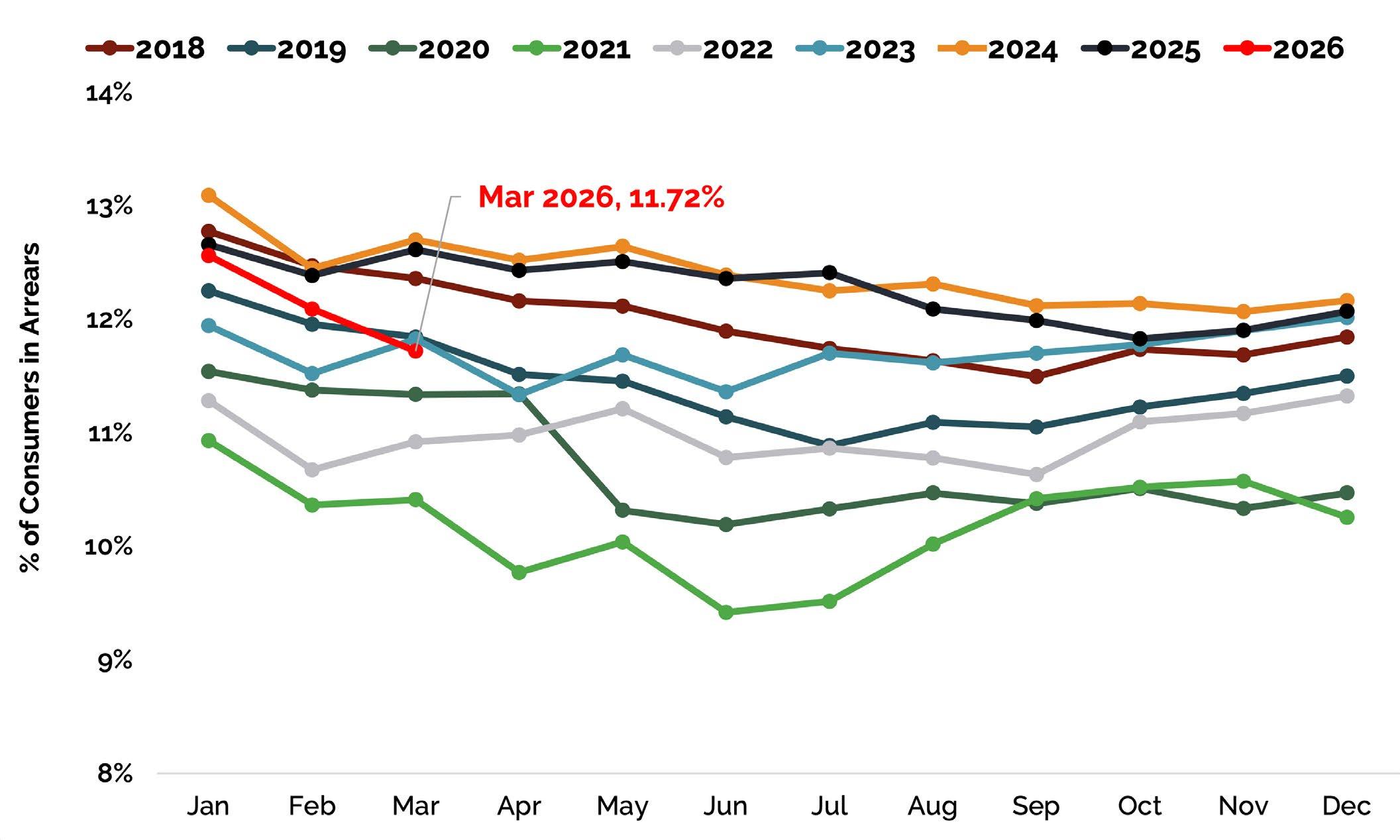
Consumer arrears fell again in March to 11.72% of the creditactive population, the lowest level since September 2023 and more than 7% lower than a year earlier.
The total number of consumers behind on
“Higher fuel and transport costs are expected to add renewed pressure to operating expenses, with the full impact yet to flow through into company financials.”
payments declined to 459,000, suggesting that a growing share of households are now in a more resilient position than through much of 2024 and early 2025.
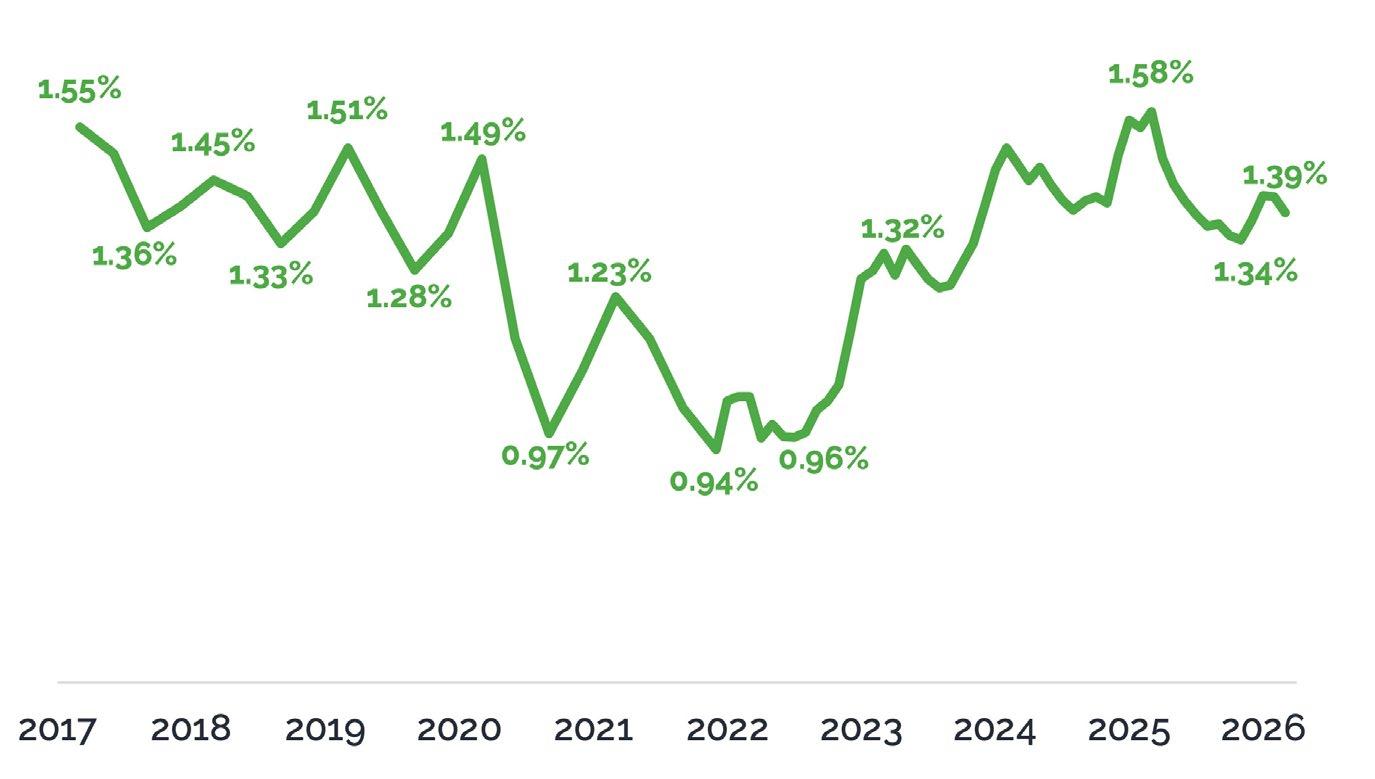
Mortgage arrears have also eased further, falling to 1.39% of accounts past due and improving 12% year on year. This reflects refinancing activity and borrowers locking in lower repayments while rates remain favourable.
Despite these improvements, pressure has not disappeared.

There are still 95,000 consumers more than 90 days past due, and stress remains concentrated in unsecured lending.
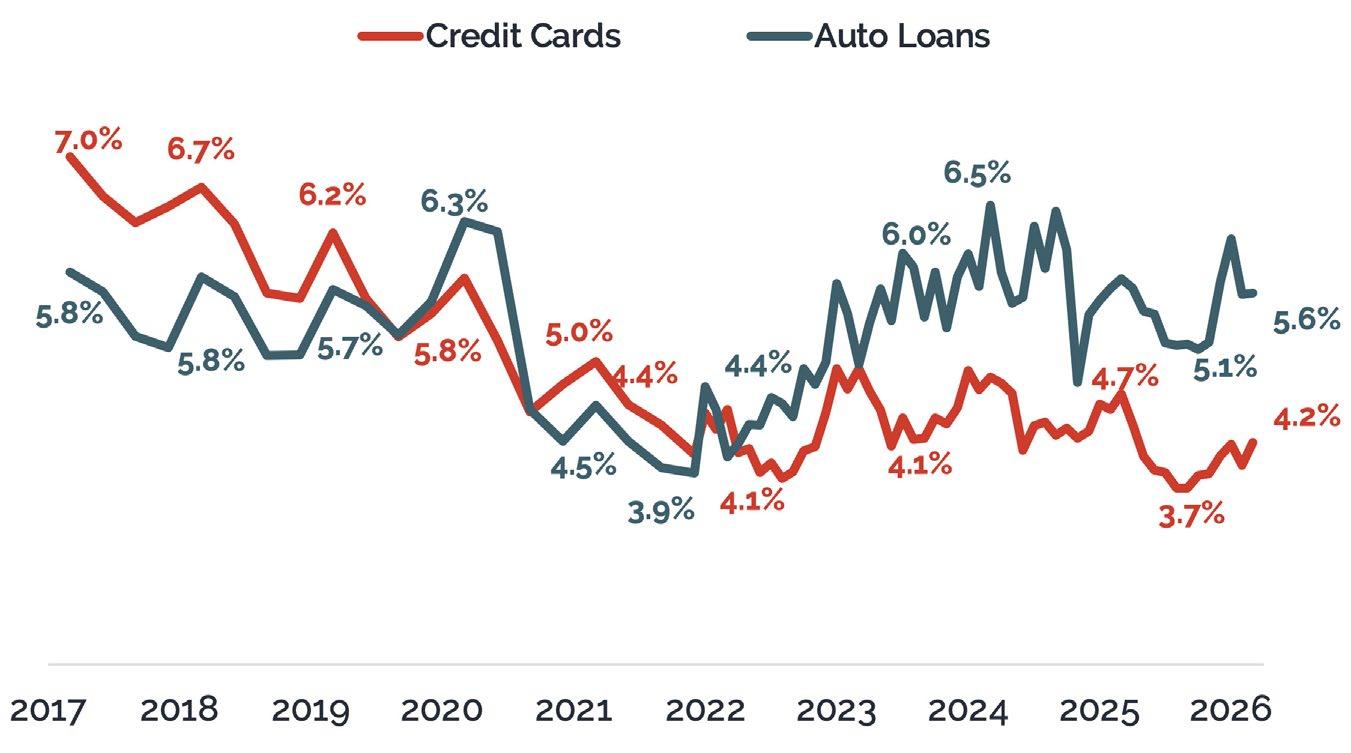
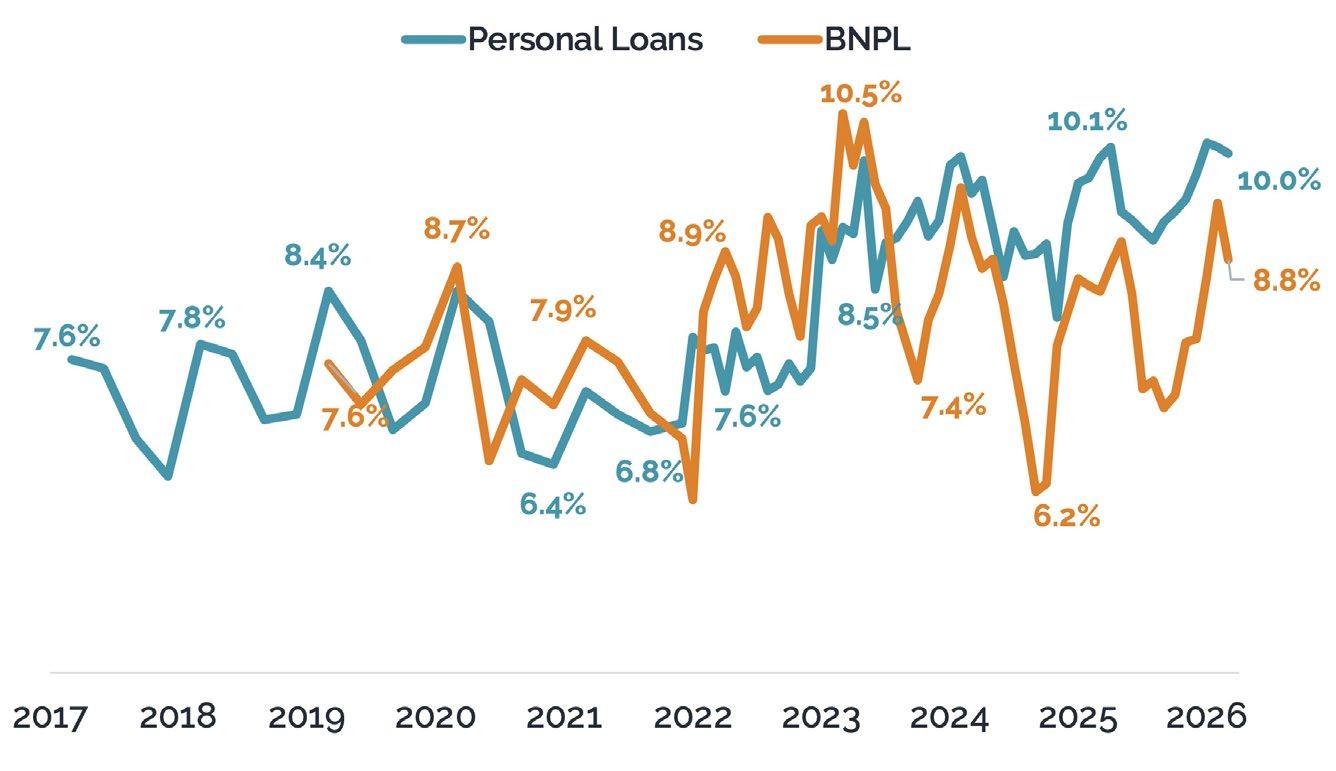
Personal loan arrears remain elevated at around 10%, while Buy Now Pay Later arrears, although improving, continue to signal ongoing shortterm cashflow pressure for some households.
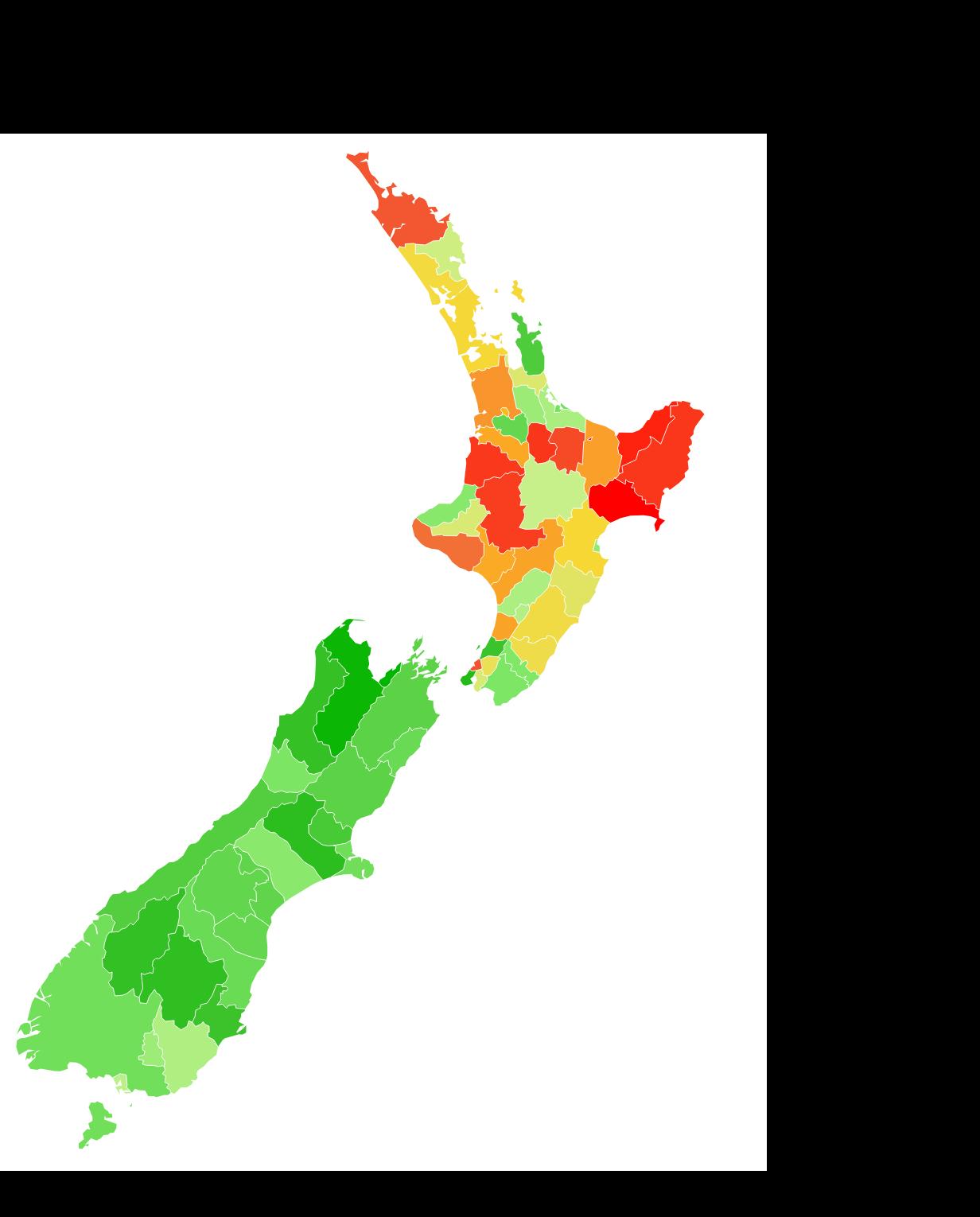
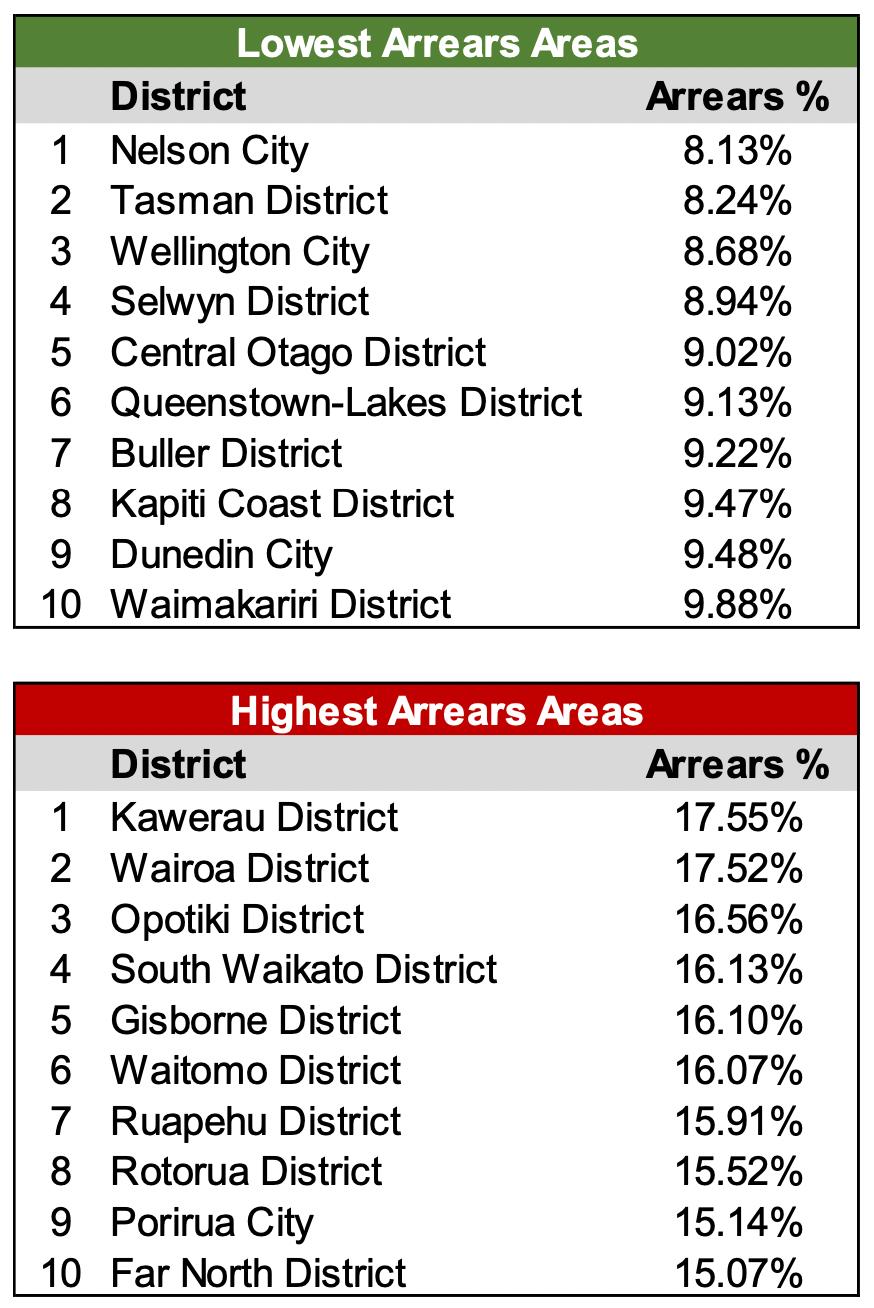
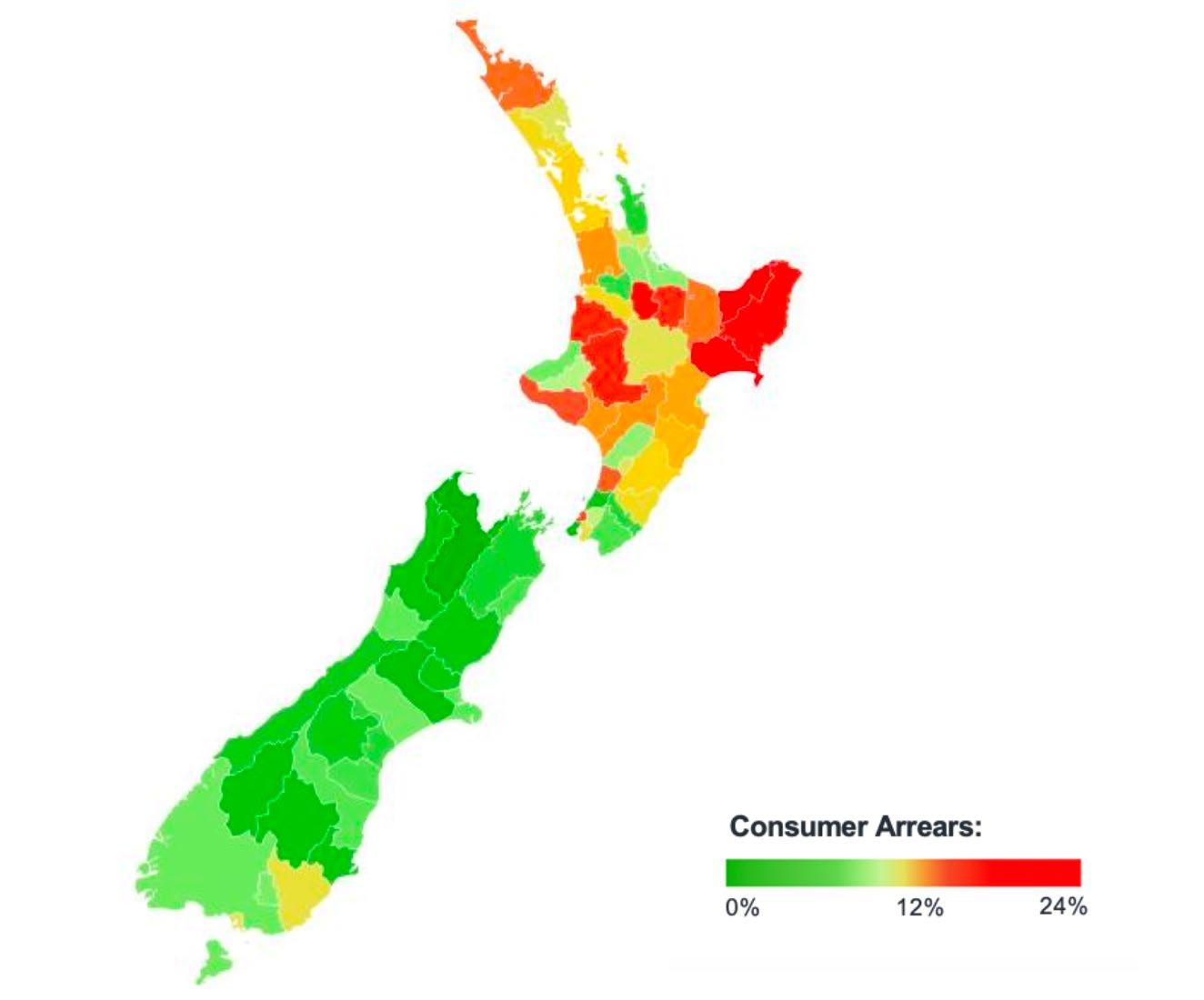
Consumer stress continues to diverge by region. Much of the South Island records materially lower arrears rates than the North Island, underscoring that

headline national improvements conceal persistent vulnerability tied to local income dynamics, industry exposure and economic structure.
An uneven recovery
Taken together, the latest credit data suggests New Zealand’s recovery is continuing, but unevenly and with clear fault lines between sectors and
regions. Lending volumes are holding up, arrears are tracking lower for many households, and pockets of business resilience are emerging. At the same time, elevated liquidation levels, softer confidence and rising global cost pressures underscore the fragility that remains across large parts of the economy.
As the year unfolds, disciplined credit management
and early engagement will be critical as businesses and lenders look to the upcoming Budget and election for policy relief in a recovery still exposed to external shocks.
*Monika Lacey MICM Chief Operating Officer
Centrix Credit Bureau of New Zealand www.centrix.co.nz

We recognise those members who achieved membership anniversaries between February, March and April 2026. Congratulations to these members on achieving such important milestones.


The Institute welcomes the following credit professionals who were recently admitted to membership between February, March and April 2026.
Aimee Weng The Bond & Credit Co.
Andre Porter CreditProtect
Bert Ruiz CreditProtect
Cassie Nicole Arca
Colin Porter CreditProtect
Dana Sarich Credit Collections Services Group
Daniel Blair Moneytech
Elaine Agustin Vinidex Pty Ltd
Elias Danos Penske Australia Pty Ltd
Emily Collins Turks
Emma Sherley Hyundai Motor Company Australia
Graham Moore CreditProtect
Jaimin Bhatt Americold Logistics
Jeff Thomasse Tradelink
Jeffrey Victoriano Remondis Australia
Lachlan Wilson Turks
Leigh-Anne Thorpe Cleanway Group Pty Ltd (Evoro)
Lena Pham Moneytech
Lindy Milne CreditProtect
Luke Jokovic Moneytech
Lyn Kim Moneytech
Michael Wallace Aon
Natasha Lewis Arca
Nicola Fyfe Moneytech
Norman Yan Whispa Operations Pty Ltd
Oliver Barber CreditProtect
Rebecca Brown CreditProtect
Rekha Borean Moneytech
Roxanne Lusanta Remondis Australia
Sandra Yeh The Bond & Credit Co
Shailendra Singh
Shaun Jamshidi Remondis Australia
Shoba Rajeswaran Moneytech
Sophia Clune Arca
Sophie Brotherton Lockton
Sushant Yadav
Tessa Hills TurksLegal
Wendy Barker Arca
William Leong Moneytech
Brittany Zimitat Ergon Energy Retail
Christopher Adolphe Agility Law Group
Ciara Foley Results Legal
Debbie Clayton Finance One
Erin Davis NCI (Brokers) Pty Ltd
Grace Fleming CreditorWatch
Hugh Roberts Moneytech
Jacqui Dawson Nestle Australia
Jade Wellington The University of Queensland
Jake Williams Moneytech
Lisa Young Moneytech Finance
Lyn Shih Hua Lin The University of Queensland
Mevika Nakhalath Ergon Energy Retail
Michele Jordaan Finance One
Michelle Prendergast CNW Pty Ltd
Mirella Prasad Defence Bank
Nathan McKay Gallagher
Nicola Korck Moneytech
Paul Moloney Moneytech Finance
Peter Stephenson Arca
Ricky Dobrin Finance One
Rosalie Millar Goondiwindi Regional Council
Steven Truong Stoddart Group
Taylor Lemura Moneytech
Teresa Brown Building Institute Credit Bureau
Zayd Kathrada QRIDA
South Australia
David Barrett BDO Australia
Greg Jones Bridgestone Australia Limited
Holly Buckley Stratco
Joseph Demura
Karen McArdle Stratco
Nikki Reynolds NCI (Brokers) Pty Ltd
Samuel Musembi Alsco Uniforms
Sherill Wood MCPA Group of Companies
Adam Sam DebtManagers
Adrian Hones BMW Australia Finance
Aidan Ferguson Moneytech
Ajla Lovrecic CreditProtect
Allison Lee Lawrence & Hanson Group Pty Ltd
Amanda Zieba ARB Corporation Ltd
Andrew Soos
Lawrence & Hanson Group Pty Ltd
Andrew Paton BMW Australia Finance
Andrew Cidoni Rothwell Lawyers Pty Ltd
Belinda Walker Bega
Bernadette Grillo Bega
Bernard Yasin Satiadi Moneytech Finance Pty Ltd
Bobby Kong
Brendan Rafferty Bega
Cassandra Davies ConnectEast Pty Ltd
Cassi Jacobs Asahi Group Beverages
Chelsea Dearing TaylorMade Golf Australia Pty Ltd
Christopher Schubert Defence Bank
Danielle Fahey CreditProtect
Derek Wang Defence Bank
Dharamjot Khalsa Thrivest Pty Ltd
Ebonny Myers Arca
Emma Hazell Aurora Energy
Gemma Byrne Rothwell Lawyers Pty Ltd
Georgia Day The Bond & Credit Co.
Gerardus Prabowo Moneytech
Gopi Awasthi Defence Bank
Grant Howells Moneytech
Hannah Daly CreditProtect
Isha Sharma Bega
Jake LaBrooy
Jen Colombo Bega
Joan Rollerson Bega
John Cronin Lawrence & Hanson Group Pty Ltd
John Kalokathis Adidas
Joshua Mathews Rothwell Lawyers
Kenneth Pinto
Kiran Kaur BMW Australia Finance
Kristine Leyson
Lachlan Singleton Daimler Truck Financial Services
Australia P/L
Leah Hepworth Kearley Lewis Pty Ltd
Lisa Dauparas
BMW Financial Services
Lizeth Espinel Moneytech
Lorraine Miller Bega
Matthew Petering Ball and Doggett
Melanie Howard Bega
Melanie Wong Moneytech
Melissa Smart Urbis Pty Ltd
Michael Tricarico Reece
Michelle Watson Moneytech
Nikolas Miltiadou Moneytech
Nithiyah Sivanandy Bega
Parminder Ratan Singh Thrivest Pty Ltd
Paul Antonio Bizcap
Peter Ayton Moneytech
Raechel Mauafu Autalaga Bega
Randy Nguyen Moneytech
Ravi Sam Wesco Anixter
Rebecca Dooley Bega
Ronald So Defence Bank
Samantha Wood Bega
Sav Jain CollectXpert Pty Ltd
Shane Dobney Moneytech
Siddharth Sathe Morris Finance
Socheata Ouch Bizcap
Sonja Stefanidis Bega
Stephanie Pinder Morris Finance
Tersia van Rooyen Arca
Tommy Nguyen Defence Bank
Tony Tarquinio Tradelink
Amit Kolkur Kolkur’s Bhagyashri Investments
Candice Sharp Lumen Christi College
Clarke Lawrence Kaplan Business School
David Green SGS Australia
Debbie Stewart Stratco
Grace Bui Indigenous Business Australia
Joanne Reilly Realty Assist
Jo-Anne Western CTI Logistics Pty Ltd
Lindy Wagner Volvo Group Australia
Mackenzie Flood RAC Finance
Minette Pajewski Volvo Group Australia
Rachel Moon Gallagher
Rose Pigg
Bridgestone New Zealand
Syavie Ghamry DebtManagers

and

AMPAC Debt Recovery
Level 5, 35 Clarence Street, Sydney NSW 2000
Tel: 1300 426 722
Email: info@4ampac.com.au
Web: www.4ampac.com.au
AMPAC Debt Recovery is a specialist debt collection practice supporting organisations around Australia and in over 180 countries worldwide. With decades of experience and global reach, AMPAC is a trusted partner to some of Australia’s highest profile private and public sector organisations. Call or email us to next time you are reviewing your debt recovery needs.
Divisional Supporting Sponsor

Boost Collections
Tel: 1800 446 901
Email: jamesvp@boostcollections.com.au
Web: www.boostcollections.com.au/
Boost Collections is a debt collection firm committed to delivering professional, costeffective recovery services across Australia and New Zealand. As part of the Commercial Credit Services Group, established in 2001, Boost Collections brings over two decades of experience to the industry. We combine the systems and scale of a large agency with the personal attention of a boutique firm. Our approach involves a balanced and fair collection strategy – ensuring high-performance results while maintaining positive customer relationships.
Divisional Supporting Sponsor

CCSG
Tel: (02) 8568 6539
Web: www.ccsgroup.com.au
Credit Collection Services Group (CCSG) is a leading full-service debt collection agency. We specialise in debt collection, litigation, commercial default listings, portfolio ledger management, and financial hardship management. At CCSG, we understand your challenges, have proven expertise, and protect your interests through robust compliance and best business practices. Our experienced team is dedicated to engaging with people effectively, delivering results that improve cash flow and financial stability for our clients. Partner with CCSG for professional, efficient, and ethical debt collection solutions tailored to your needs.
365 Collect
Email: stanley@365mechanix.com
365 Collect is an intelligent arrears and collections management platform built by 365 Mechanix on the Microsoft ecosystem. We help credit and collections teams modernise the way they manage arrears and recovery, with automation and AI doing the heavy lifting across the full collections lifecycle.
We improve loan book performance from early arrears through to recoveries, with measurable impact on cure rates, roll rates, and cost to collect. Trusted by businesses across Australia and New Zealand, 365 Collect exists because too many credit teams are still stuck with disconnected systems and manual processes. We're here to fix that.

National Collection Services
Tel: 1300 888 758
Email: info@natcollection.com.au
Web: https://natcollection.com.au/
National Collection Services are a boutique Debt Collection Agency that sees ourselves as an ‘extension’ of your internal credit department. We will work with you to form a partnership, with our focus being placed on the associated levels of engagement, support, communication and goals of your organisation.
Divisional Supporting Sponsor

Tasmanian Collection Service
Tel: 03 6213 5555
Email: connect@tascol.com.au
Web: www.tascol.com.au/
With over 140 years’ experience, branches in Hobart, Launceston and Burnie and a database on the Tasmanian population that is second to none, there is no one better placed to handle your Tasmanian debts. Why not consider outsourcing to a local expert, you’ll be glad you did.
Credisense
Neill Borg, Enterprise Director
Tel: 0401 066 624
Email: neill.borg@credisense.io
Web: https://credisense.co.nz/
Credisense revolutionises the way businesses acquire new customers. One-size does not fit all. Our platform provides personalised, omnichannel, and unified customer experiences that embody your brand. Orchestrate and analyse thousands of data points and services that automate any process or decision. All from the cloud. All with no coding.
Divisional Supporting Sponsor
Andrew Worrell
Business Development Manager
Email: andrew.worrell@debtmanagers.com.au
Web: https://debtmanagers.com.au/ Tel: +61 0430 342 019
DebtManagers believe in creating a fairer financial world where businesses and customers thrive. We specialise in buying bad debt from businesses and rehabilitating those owing money out of debt with tailor-made, sustainable, and fairer repayment plans to help them get back on their feet. It’s more socially responsible and it works.
AICM Divisional Partner
InDebted
Michael Chatfield
Managing Director – Australia
Tel: 0434134034
Email: Michael.chatfield@indebted.co
Web: www.indebted.co
InDebted is the global leader in human-centered debt resolution. Forward-thinking organisations choose InDebted’s AI-powered collections and decisioning solutions to move beyond outdated methods, deliver better consumer experiences, and improve overall financial wellbeing. Operating in seven countries and growing, InDebted is on a mission to change the world of consumer debt for good. Discover more at www.indebted.co

Divisional Supporting Sponsor

Tel: 1800 123 613
Web: www.onguard.com
Onguard’s Credit management solution will help you hit your collection targets – each and every month.
By working smarter and providing better visibility, Onguard will help you reduce your DSOs. Why not give your staff a friendly solution that will make their life so much easier.
Contact us to show you how Onguard has made life a whole lot easier for our customers.

Email: partner@opypro.com.au
Web: www.opypro.com.au
Opypro is a single cloud-based platform that fully automates the end-to-end B2B credit management process. Multiple systems can be replaced by Opypro streamlining onboarding, providing real time access to business buyer account information and increasing payment success with consolidated invoicing, automated Dunning cycles and payment reconciliation. Contact us to see how Opypro can drive efficiencies across your trade accounts receivable process.

Building Industry Credit Bureau
Tel: 07 3852 1342, 1800 931 222
Email: bicb@bicb.com.au
Web: https://bicb.com.au
If your business supplies the building industry, we have industry-specific data that will raise your credit management decision-making effectiveness and perhaps prevent/minimise loss. We know you like to do your job well. Let us help you do it even better. For more info, call today.
Tel: 1300 783 684
Web: www.experian.com.au
Experian is a global data and technology company, powering opportunities for people and businesses around the world. We help to redefine lending practices, uncover and prevent fraud, simplify healthcare, deliver digital marketing solutions, and gain deeper insights into the automotive market, all using our unique combination of data, analytics and software. We also assist millions of people to realise their financial goals and help them to save time and money. We operate across a range of markets, from financial services to healthcare, automotive, agrifinance, insurance, and many more industry segments. We invest in talented people and new advanced technologies to unlock the power of data and to innovate.
Divisional Supporting Sponsor INSOLVENCY
GPO Box 276
Sydney NSW 2001
Tel: 1300 501 312
Web: www.creditorwatch.com.au
CreditorWatch is a leading commercial credit reporting bureau used by over 50,000 businesses across Australia. CreditorWatch offers a variety of products including customer monitoring/alerts, credit reporting, an indepth trade program and online credit applications to assist with customer onboarding and decisioning. Contact us today for more information or to organise a FREE DEMO of any of products.
We’re proud of the AICM and we want to let all credit professionals know those businesses that support the AICM. Thank you to these companies for their continued support and please consider them first when you’re looking for assistance in your business. We’ll also include these sponsors on our website so you can be sure to find them easily.
For more information contact: Claire Kasses
Direct: +61 2 9174 5727
Email: claire@aicm.com.au
Tel: 1300 560 996
Equifax
Tel: 13 83 32
Web: www.equifax.com.au
Equifax is a global information solutions company, providing data and insights that help organisations and individuals make more informed decisions. As a leading provider of credit information and analysis in Australia and New Zealand, Equifax serves key markets in risk management, marketing services and HR solutions.
Drawing from trusted sources to compile and process data, Equifax helps its customers see things and make connections that others can’t.

Tel: 1300 265 753
Email: intelligence@jirschsutherland.com.au
Web: www.jirschsutherland.com.au/ insolvencyintelligence/
Insolvency Intelligence: a specialist provider of insolvency and turnaround advice and services for credit managers. Backed by national firm Jirsch Sutherland, our friendly team is just a phone call or email away, providing members with practical, strategic advice about corporate and personal insolvency. Free initial consultation; networking opportunities; training and presentations; knowledge database access. Contact us now to find out how we could assist you.
SV Partners
Level 8, 68 St George’s Terrace, Perth WA 6000 GPO Box 2527, Perth WA 6001
Tel: 08 6277 0026
Fax: 07 3229 7285
Email: perth@svp.com.au
Web: https://svpartners.com.au/
SV Partners is a specialist accounting and advisory firm with 17 offices across Australia. Our expert accountants have the skills and experience to provide tailored insolvency, turnaround and advisory services. We partner with professionals and their clients, providing expert advice with a human touch.
For information, options and pricing please contact Claire Kasses on +61 2 9174 5727 or E: claire@aicm.com.au
AICM Divisional Partner

Vincents
Level 34 Santos Place, 32 Turbot Street
Brisbane QLD 4000
Tel: 1300 VINCENTS, (07) 3228 4000
Web: www.vincents.com.au
Vincents is a solutions-focused professional services firm with over 35 years of experience. Its Restructuring & Recovery team consists of experts in all aspects of insolvency, restructuring, and recovery. They are dedicated to supporting you or your clients during critical decision-making moments, acting as financial counsellors, and offering advice and solutions for a wide range of financial distress situations. Regardless of the size or complexity of the matter, their team collaborates closely with you, your stakeholders, and advisors – including lawyers, accountants, financiers, and creditors – to achieve the best possible outcome.
Divisional Supporting Sponsor INSURANCE

Lockton
Suzanne Dassen, Client Manager
Tel: +61 499 018 852
Email: suzanne.dassen@lockton.com
Web: https://global.lockton.com/au/en
Lockton is a family-owned global insurance broker and risk advisor. Founded in 1966 by Jack Lockton, our company was built on one simple idea: to provide the best service in the insurance industry. With a 97% client retention rate and over $890m in premiums placed locally, our clients trust us to help them outperform the market and build resilience. Our award-winning culture enables us to attract top industry and product specialists who consistently deliver extraordinary results.
Divisional Supporting Sponsor

Holman Webb Lawyers
Tel: 02 9390 8000
Email: christopher.hadley@holmanwebb.com.au
Web: www.holmanwebb.com.au/
Holman Webb is a commercial and insurance law firm with over 60 years’ experience and the scale to provide a top-tier level of legal services. We deliver unique insights and bring relevant, real world experience to you from our offices in Sydney, Melbourne, Brisbane and Adelaide.

Results Legal
Level 4, 183 North Quay
Brisbane QLD 4000
Tel: 1300 757 534
Web: www.resultslegal.com.au
Results Legal is a national firm with a focus on promoting and protecting the rights of trade creditors. Our clients are some of Australia’s largest trade credit companies who rely on our assistance for legal recovery, dispute resolution, preference claim defence and PPSA rights. Results Legal are the obvious first choice for companies seeking a national solution to resolve commercial disputes and pursue swift, successful and cost effective legal recovery action.
Level 2, 50 Kings Park Road
West Perth 6005
Tel: 08 9466 3177
Web: www.novalegal.com.au
Nova Legal can assist with the recovery of problem debtors (large and small). Founding director Raffaele Di Renzo acts for creditors, debtors, directors, credit managers and insolvency practitioners in relation to solvency issues and dispute resolution.

Rothwell Lawyers
Tel: (03) 9329 3500
Email: admin@rothlaw.com.au
Web: www.rothlaw.com.au
At Rothwell Lawyers, we are a commercial team of solicitors and other legal support staff that are experts within our field. We pride ourselves on our ability to provide sound legal advice to individuals and businesses of all sizes, from sole directors and shareholder companies and large national corporations. Whether it is basic debt recovery, commercial law and litigation, insolvency advice to agreements and contracts, the team at Rothwell Lawyers can help you today.
Turks
AICM National Partner
Tel: 02 8257 5700
Email: marketinggroup@turkslegal.com.au
Web: www.turkslegal.com.au
Turks is a specialist commercial law firm with 33 Partners and over 160 staff across our Sydney, Melbourne and Brisbane offices. We are proud to look after the interests of trade creditor suppliers and financial institutions in:
l Portfolio debt recovery using our marketleading, real-time client interface, ‘TurksFocus’
l Resolution of complex debt disputes
l PPSA recovery
l Defence of unfair preference claims
l Supply documentation and guarantees.
Divisional Supporting Sponsor
Byron Thomas Recruitment
Tel: 02 8677 3020
Email: info@byronthomas.com.au
Web: www.byronthomas.com.au/
As Sydney’s leading Executive Accounting and Finance recruitment service, we offer access to our exclusive relationships, networks and database of over 80,000 Accounting and Finance Candidates. We are a privately-owned Australian company that have been operating for over 10 years. We work with a variety of public, private, family owned and private equity-backed companies.

Access Intell Pty Ltd
PO Box 1551, Kenmore, QLD 4069
Tel: 1300 831 331
Email: admin@accessintell.com
Web: https://www.accessintell.com/
Access Intell is a fast-growing fintech with a suite of B2B credit management solutions. Our platform transforms diverse data from global sources into instantly understandable insights. The customisable products create a streamlined process from online trade applications and PPSR through to ongoing risk monitoring. Fast implementation gets you onboard within 24 hours for standard setup. Backed by responsive service and flexible pricing, Access Intell is trusted by organisations across diverse industries. Visit our website to book a demo.
For information, options and pricing please contact Claire Kasses on +61 2 9174 5727 or E: claire@aicm.com.au
FIS Global
Tel: +61438049227
Email: baden.quinane@fisglobal.com
Web: https://www.fisglobal.com/
FIS is a financial technology company providing solutions to financial institutions, corporations, and developers. Our Automated Finance portfolio provides a comprehensive suite of receivables, payables and revenue optimization tools that modernize the office of the CFO, helping turn finance from a cost center into a growth partner. We create financial technology solutions that remove friction, create revenue opportunities, and give clients the confidence and capabilities to grow their business. FIS is a member of the Fortune 500® and the Standard & Poor’s 500® Index. To learn more, visit FISglobal.com. Follow FIS on LinkedIn, Facebook and X.
National Credit Insurance Brokers
Tel: 1800 882 820 (freecall)
Email: info@nci.com.au
Web: www.nci.com.au
National Credit Insurance Brokers (NCI) has established itself as the premier trade credit insurance broker in Australia, New Zealand, Singapore and Malaysia. Trade credit insurance is a highly specialised area of insurance and with its 35 years of experience, NCI has developed an unmatched depth of expertise in arranging the right protection at the best price for your particular trading needs.

We’re proud of the AICM and we want to let all credit professionals know those businesses that support the AICM. Thank you to these companies for their continued support and please consider them first when you’re looking for assistance in your business. We’ll also include these sponsors on our website so you can be sure to find them easily.
For more information contact: Claire Kasses Direct: +61 2 9174 5727
Email: claire@aicm.com.au Tel: 1300 560 996