

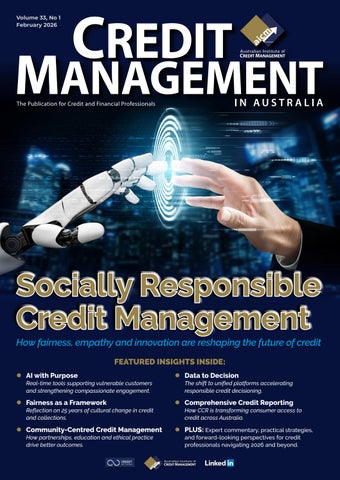
How fairness, empathy and innovation are reshaping the future of credit
FEATURED INSIGHTS INSIDE:
l AI with Purpose
Real‑time tools supporting vulnerable customers and strengthening compassionate engagement.
l Fairness as a Framework
Reflection on 25 years of cultural change in credit and collections.
l Community‑Centred Credit Management
How partnerships, education and ethical practice drive better outcomes.

l Data to Decision
The shift to unified platforms accelerating responsible credit decisioning.
l Comprehensive Credit Reporting
How CCR is transforming consumer access to credit across Australia.
l PLUS: Expert commentary, practical strategies, and forward‑looking perspectives for credit professionals navigating 2026 and beyond.
Divisional partners








Divisional supporting sponsors














Daniel Taylor MICM CCE
Scaling compassion:
Norman Yan


For advertising opportunities in Credit Management In Australia: CONTACT: Claire Kasses, General Manager. Ph: 1300 560 996 E: claire@aicm.com.au
DIRECTORS
ISSN 2207-6549
Julie McNamara LICM CCE – Australian President
Mary Petreski FICM CCE – Victoria/Tasmania
Troy Mulder FICM CCE – Western Australia/Northern Territory
Rob Jackson MICM CCE – South Australia
Theresa Brown FICM CCE – New South Wales
Steven Staatz MICM CCE – Queensland
Daniel Taylor MICM CCE – Co opted Director
CHIEF EXECUTIVE OFFICER
Nick Pilavidis FICM CCE Level 3, Suite 303, 1-9 Chandos Street, St Leonards NSW 2065 PO Box 64, St Leonards NSW 1590 Tel: (02) 8317 5085, Fax: (02) 9906 5686 Email: nick@aicm.com.au
PUBLISHER
Nick Pilavidis FICM CCE | Email: nick@aicm.com.au
CONTRIBUTING EDITORS
NSW – Gary Poslinsky MICM
Qld – Emma Purcival MICM CCE
SA – Maria Scacchitti MICM CCE WA/NT – Jeremy Coote MICM CCE Vic/Tas – Alex Hawtin MICM
EDITOR/ADVERTISING
Claire Kasses, General Manager Tel Direct: 02 9174 5727 or Mob: 0499 975 303
Email: claire@aicm.com.au
EDITING and PRODUCTION
Anthea Vandertouw | Ferncliff Productions Tel: 0408 290 440 | Email: ferncliff1@bigpond.com
THE EDITOR reserves the right to alter or omit any article or advertisement submitted and requires idemnity from the advertisers and contributors against damages or liabilities that may arise from material published. CREDIT MANAGEMENT IN AUSTRALIA is published by the Australian Institute of Credit Management, Level 3, Suite 303, 1-9 Chandos Street, St Leonards NSW 2065. The views expressed in CREDIT MANAGEMENT IN AUSTRALIA are not necessarily those of Australian Institute of Credit Management, which does not expect or invite any person to act or rely on any statement, opinion or advice contained herein (whether in the form of an advertisement or editorial) and neither the Institute or any of its employees, agents or contributors shall be liable for any opinion contained herein. © The Australian Institute of Credit Management, 2026.
EDITORIAL CONTRIBUTIONS SHOULD BE SENT TO: The Editor, Level 3, Suite 303, 1-9 Chandos Street, St Leonards NSW 2065 or email: aicm@aicm.com.au
As we step into 2026, I want to extend my warmest wishes to all our members. I hope the year ahead brings you success, fulfilment, and fresh opportunities to grow both personally and professionally. The credit profession continues to evolve at pace, and I am proud of the resilience, adaptability, and leadership our community demonstrates every day.
This first edition of Credit Management in Australia sets the tone for the year with a theme that could not be more timely: Socially Responsible Credit Management. Across every sector, credit teams are navigating the delicate balance between commercial performance and compassionate engagement. The expectations placed on our profession have never been higher, and neither has our capacity to lead with integrity.
In this edition, we explore how credit professionals can balance commercial objectives with empathy, ensuring that profitability and responsible customer support go hand in hand. We look at ethical practices in collections, risk assessment, and customer engagement; the growing importance of sustainability and social
Julie McNamara LICM CCE National President

responsibility; and the innovative approaches that are strengthening trust, fairness, and longterm relationships across the credit landscape.
Our councils and committees have been hard at work over the break, and I’m delighted to share that we have an exceptional lineup of events planned for the year ahead. From the newly expanded Divisional Conferences, to WINC webinars and luncheons, Special Interest Groups, national webinars, golf days, trivia nights, awards evenings, and so much more, 2026 promises to be one of our most dynamic years yet. These events are designed not only to inform and upskill, but to strengthen the connections that make our community so vibrant. I encourage you to get involved, share your experiences, and

“... the 2026 National Conference will be held in Brisbane from 14–16 October 2026. With a program focused on the future of credit, leadership, and responsible practice, it promises to be a standout event and a highlight of the year.”
make the most of the opportunities available across every division.
The Credit Knowledge Hub (CKH) continues to go from strength to strength, now serving as an essential training resource for hundreds of members and their teams. Its practical tools, learning modules, and realworld insights are helping credit professionals at every stage of their career build capability and confidence. If you haven’t explored the latest updates, I strongly encourage you to do so.
Finally, please mark your calendars: the 2026 National Conference will be held in Brisbane from 14–16 October 2026. With a program focused on the future of credit, leadership, and responsible
practice, it promises to be a standout event and a highlight of the year.
Check out your division calendars to save dates for all divisional events such as WINC 2026 together with all social events. The year will fly by once again, so I know if you are like me, you will need to mark out your calendars early to ensure you don’t miss out!
Thank you for your continued commitment to excellence and professionalism. I look forward to working alongside you throughout 2026 as we champion a credit industry that is commercially strong, socially responsible, and built on integrity.
Wishing you a successful year ahead.
Julie McNamara LICM CCE National President

Are you looking for a way to boost your team’s performance and productivity?
AICM in-house training is a flexible and affordable solution that allows your team to learn and develop new skills together. You can choose the location, format and content to suit your specific needs and goals. Whether you want to train your team in your workplace, online, or at a venue of your choice, we can make it happen.
In-house training has many benefits for both employers and employees.
l It saves you time and money
You don’t have to worry about travel expenses, accommodation fees, or lost working hours.
You can also get discounts for larger groups and longer sessions.
l It is customised to your team
You can choose from a list of existing programs or work with our expert trainers to tailor the content to address the challenges and opportunities that your team faces.
l It enhances team building and collaboration
Your team will learn together, share ideas, and solve problems as a group.
l It fosters peer learning and feedback
Your team will benefit from the knowledge and experience of each other. They will also be able to give and receive constructive feedback in a supportive environment.
l It equips your team with new skills and knowledge
Your team will gain valuable insights and best practices that they can apply immediately to their work to achieve better results.
AICM in-house training is the smart choice for any organisation that wants to invest in its most valuable asset: its people.
Get ahead with the Credit Knowledge Hub – the best online credit knowledge and training platform.
Access to unlimited AICM Content:
Explore 100+ resources, updated regularly.
Pathway to CCE Designation:
Work towards obtaining a qualification in credit management and obtaining your CCE.
Compliance and best practice tools: Ensure your processes are current and aligned with industry standards.
A cost-effective way to boost your credit expertise: Whether you’re joining as an individual or part of a team. With tailored resources for every experience level, from beginners to seasoned professionals, there’s something here for everyone.
AICM would like to congratulate its recent graduates:
FNS51522 Diploma of Credit Management
Kimberley Sideris TAS Aurora Energy
Cheryl Fernandez NSW Church & Dwight (Australia) Pty Ltd
Emily Cole TAS Aurora Energy
FNS40122 Certificate IV in Credit Management
Emmy Yap NSW Aristocrat
Olivia Carnes TAS Aurora Energy
Clara Martin TAS Aurora Energy
Hamish Jones TAS Aurora Energy
Aaron Murphy TAS Aurora Energy
Brianna Green TAS Aurora Energy
Belinda Scibilia NSW Fluidra Australia
Krysty Lamb QLD Stratco PTY LTD




Three powerful workshops. One transformative experience.
Join credit professionals from across the industry for a unique opportunity to learn, refresh, and connect. This bundle covers the essentials of Personal Insolvency, Corporate Insolvency, and Personal Property Securities (PPS) designed to elevate your understanding and sharpen your skills.

Workshop 1: Understanding Personal Bankruptcy
Friday 6th March 2026 | 12:30 – 4:30 PM AEDT
Gain clarity on the fundamentals of personal insolvency. Learn the language of bankruptcy, how to read documentation, complete proofs of debt, and engage with trustees effectively.
Workshop 2: Understanding Corporate Insolvency
Friday 13th March 2026 | 12:30 – 4:30 PM AEDT
Recognise the signs of corporate distress and learn best practices for interacting with insolvency practitioners. Understand notifications, internal processes, and key indicators.
Workshop 3: Personal Property Securities (PPS)
Friday 20th March 2026 | 12:30 – 4:30 PM AEDT
Master the PPSA and PPSR. Learn how to register, perfect, and release securities, and understand the legal implications for leases, hires, and credit agreements.
Who Should Attend?
Credit team members ready to level up
Experienced professionals seeking a refresher
Anyone involved in credit, leasing, or lending
Certificate of Completion awarded after all three workshops. Earn 12 CPD Points.
Cost:
Member: $855 inc GST
Non-Member: $1,005 inc GST

Patrick Coghlan MICM*, CEO of CreditorWatch, shares why embracing AI, predictive analytics and automation is critical for credit managers, CFOs and risk leaders in 2026.
Credit risk management has always been about judgement. In 2026, that judgement is increasingly being shaped by predictive data insights, automation and artificial intelligence.

Australian finance leaders are operating in an environment where risk is less visible, change is faster and tolerance for error is shrinking. The old model of periodic reviews, static reports and manual workflows cannot keep pace with modern commercial reality. The organisations that will outperform over the next decade are those that embed
intelligent, responsible AI into the heart of their credit decision-making.
This is not a future concept. It is already happening.
CreditorWatch data shows that 41.5% of Australian businesses implemented AI in the past year, up from 34.8% the year before, with adoption highest among larger enterprises but accelerating quickly across the mid-market.
More importantly, almost 95% of those businesses report positive outcomes. The message is clear: AI is no longer experimental. It is becoming mission-critical.
“The organisations that will outperform over the next decade are those that embed intelligent, responsible AI into the heart of their credit decision-making.”

“By analysing patterns in payment behaviour, defaults, court actions and broader economic signals, predictive models can surface risk months earlier than traditional approaches.”
The most profound shift underway is the move from reactive credit risk management to early intervention. Traditionally, warning signs emerged only once payments were missed or financials deteriorated. By then, options were limited.
AI changes that equation. By analysing patterns in payment
behaviour, defaults, court actions and broader economic signals, predictive models can surface risk months earlier than traditional approaches. Our own data consistently shows that subtle changes in payment timeliness often precede more serious distress well before a formal insolvency event occurs.
For credit managers and CFOs, this means the focus in 2026 must be on continuous
monitoring, not periodic assessment. Real-time alerts and predictive indicators give businesses time to engage customers earlier, adjust exposure and protect cash flow while relationships are still salvageable.
One of the less discussed benefits of AI is its ability to close
the capability gap between large organisations and smaller teams. Large enterprises have historically enjoyed access to specialist analysts, bespoke models and deeper data resources that SMEs have not.
AI is changing that balance. Natural language models can now synthesise complex credit data into clear, plain-English risk summaries and recommended actions in seconds. At CreditorWatch, we see these tools effectively providing an on-demand credit analyst, enabling less-experienced staff to make more confident, consistent decisions.
This democratisation of insight is critical in a market where credit talent is scarce and teams are under pressure to do more with less.
There is understandable concern that automation and AI will replace human judgement. In practice, the opposite is true when implemented correctly.
The most advanced credit teams in 2026 are automating routine processes - data collection, report generation,
“Natural language models can now synthesise complex credit data into clear, plain-English risk summaries and recommended actions in seconds.”
limit reviews and exception flagging - so their people can focus on strategy, negotiation and complex decisionmaking. Automation improves consistency, reduces error and strengthens governance, but final accountability remains firmly with humans.
From a board and regulatory perspective, this matters. Automated workflows create clearer audit trails, enforce policy discipline and support defensible decision-making at scale.
As AI becomes embedded in credit processes, expectations around governance, transparency and accountability are rising. Finance leaders must be confident they can explain how risk assessments are generated and demonstrate appropriate oversight.
This means moving beyond ‘black box’ solutions. Responsible
“As AI becomes embedded in credit processes, expectations around governance, transparency and accountability are rising.”
AI augments existing risk models rather than replacing them, uses high-quality and secure data, and keeps humans in control of critical decisions. Data sovereignty, privacy and model explainability are now table stakes, not optional extras.
In our own product development, AI is used to enhance insight, not override judgement, ensuring credit decisions remain aligned with commercial reality and regulatory expectations.
Despite rapid adoption, a digital divide remains. While around 69% of large organisations now use AI, only a third of smaller businesses have done so, often due to concerns about cost, complexity and expertise.
The opportunity for 2026 is to remove those barriers. AI tools must be intuitive, embedded within existing workflows and deliver clear, measurable value from day one. When implemented well, they do not require data science teams or major transformation projects. They simply make better credit management accessible to more businesses.

“The next generation of credit risk management is proactive, data-driven and human-centred. In 2026, leadership in this space will not be defined by who adopts AI first, but by who adopts it responsibly, strategically and at scale.”
For credit managers, CFOs, risk managers and financial controllers, best practice in 2026 is defined by five principles:
l Continuous, real-time monitoring rather than periodic reviews
l Predictive insight that surfaces risk early, not after damage is done
l Intelligent automation that improves efficiency and consistency
l Enterprise-wide visibility of credit risk for executives and boards
l Responsible AI governance that enhances judgement and accountability
Organisations that adopt this framework are not just reducing risk; they are strengthening resilience and creating competitive advantage.
The road ahead
AI will not remove uncertainty from the Australian economy, but it will change how well businesses can navigate it. The combination of real-time data, predictive analytics and automation gives finance leaders something they have rarely had before: time to
act.The next generation of credit risk management is proactive, data-driven and human-centred. In 2026, leadership in this space will not be defined by who adopts AI first, but by who adopts it responsibly, strategically and at scale.
Those who do will be better positioned to protect cash flow, support sustainable growth and lead with confidence in an increasingly complex risk environment.
*Patrick Coghlan MICM CEO CreditorWatch
www.creditorwatch.com.au
By Miral Sarvaiya MICM CCE*

For credit managers and collections specialists, statute barred debt is one of the most important concepts in commercial credit risk and debt recovery governance. It defines a legally enforceable boundary – when the statutory limitation period expires and a creditor’s right to litigate is lost. Understanding how this works in different jurisdictions, and what actions preserve or extinguish enforcement rights, is essential for effective portfolio control and compliant recovery practice.
1. What is a Statute Barred debt?
A statute barred debt refers to a debt for which the legal period to commence enforcement through the courts has expired under state limitation legislation. Once this period has passed without appropriate action by the creditor, a debtor can raise
limitation as a complete defence in court, preventing legal enforcement of the claim.
Importantly:
l The debt does not necessarily disappear – it simply becomes unenforceable via court action.
l A creditor may still request payment but cannot threaten or pursue legal enforcement where limitation has expired.
2. How Limitation periods work in debt recovery
Limitation laws are statutory frameworks established by each state and territory to limit the time within which civil claims can be litigated. In the context of debt recovery:
l The limitation period typically begins when a cause of action accrues – most often when payment becomes due and remains unpaid.
l In many states, including NSW, VIC and WA, the standard limitation period for

most simple contract debts is six years.
The rationale for limitation periods is fairness: evidence deteriorates over time, debtor circumstances change, and undue prolongation of recovery rights can create unjust outcomes.
3. Jurisdictional nuances: NSW, VIC and WA
l Most commercial debts are subject to a six-year limitation period.
l If a creditor has not commenced legal proceedings within six years of accrual (e.g., last payment, written acknowledgement or when payment was due), the debt may become statute-barred.
Victoria (VIC)
l Simple contracts also carry a six-year limitation period.
l However, where there is a court judgment or the debt is secured (e.g., via mortgage), the extension period for legal enforcement can be up to 15 years under the Limitation of Actions Act.
While the six-year period for simple contract claims is common, other elements differ across jurisdictions:
“Limitation laws are statutory frameworks established by each state and territory to limit the time within which civil claims can be litigated.” “A statute barred debt refers to a debt for which the legal period to commence enforcement through the courts has expired under state limitation legislation.”
l If judgment has already been obtained, enforcement rights generally extend for a longer period – typically up to 12 years.
l This extended timeframe highlights why obtaining judgment early in recovery strategies can materially preserve enforcement opportunities.
Western Australia (WA)
l The limitation period for most unsecured debts is generally six years.
l WA’s debt collector laws also specifically prevent a creditor from enforcing a debt through court action after the limitation period has expired.
Practical implication: Even with consistent six-year periods for many debts, the enforcement timeframe and rules regarding judgment debts differ significantly. Credit professionals must apply the correct statutory regime based on the debtor’s location and the contract’s governing law.
4. Managing the limitation clock – what resets it?
Certain events can interrupt or restart the limitation period, extending a creditor’s enforcement window:
l Part-payments: A genuine payment toward the debt may reset the limitation clock, starting a fresh six-year period from the date of the payment.
l Written acknowledgement: A written, signed acknowledgement of the debt by the debtor can also reset the limitation period.
Note: Commercial communication about a debt that does not amount to a clear, signed acknowledgement (e.g., routine customer service
emails or reminders) may not qualify; careful drafting and legal verification are essential to ensure that the acknowledgment is effective.
5. What Creditors can – and cannot – do once a debt is statute barred
Once limitation has expired: Creditors can:
l Continue to request voluntary payment.
l Maintain records of outstanding balances.
l Offer settlement arrangements or negotiate terms with the debtor. Creditors cannot:
l Initiate new court action to enforce the debt.
l Misrepresent legal enforceability or threaten litigation that cannot be lawfully pursued.
l Engage in conduct that could contravene consumer protection laws (e.g., threats, misleading statements). Misleading or deceptive conduct can be penalised under provisions of the Australian Consumer Law and related state legislation, particularly where a collector represents that court action is available when it is not.
“Credit professionals must apply the correct statutory regime based on the debtor’s location and the contract’s governing law.”
6. Preventing statute barred status: best practice
Effective limitation management is a function of disciplined credit governance:
1. Monitor age analysis:
Establish systems that flag emerging limitation risks well in advance of expiry.
2. Escalate early:
If recovery prospects diminish, consider strategic legal escalation (e.g., application for judgment) before the limitation period lapses.
3. Document acknowledgements:
Ensure any negotiations or partial payments are formally documented and signed where limitation considerations are significant.
4. Contractual risk mitigation:
Draft Terms of Trade and credit agreements clearly identifying governing law and jurisdiction to reduce uncertainty in crossborder or inter-state matters. Prompt action and meticulous documentation secure enforcement rights and prevent otherwise avoidable statute barring.
“Statute barred risk is rarely a single legal failure — it is usually a breakdown in credit governance, documentation and escalation strategy.”
A Risk Snapshot for Credit Professionals
Statute barred debt creates unique compliance, governance and reputational risks. The following warning signs commonly appear in portfolios approaching or exceeding limitation periods – and should trigger immediate review.
1. ⏳ No Limitation Date Tracking
If your CRM or ledger does not flag accounts approaching six years, enforcement rights may expire unnoticed. Limitation laws vary by state and form a complete defence if action is taken too late.
2. ⚖ Threatening Legal Action on Old Debts
Suggesting litigation where limitation has expired is a major compliance risk and may be considered misleading or deceptive conduct.
3. �� Ageing Accounts Without Escalation Strategy
Accounts sitting at 4–5 years with no legal review indicate governance gaps – a common precursor to statute barring.
4. ✍ Poor Documentation of Acknowledgements
Part-payments or written acknowledgements can reset limitation periods – but only if clearly recorded and legally valid. Missing documentation weakens enforceability.
5. �� Communication That Implies Enforceability
Letters or scripts that suggest court action is available when it is not may breach consumer protection laws.
6. �� Outsourced Collection Without Compliance Oversight
Creditors remain responsible for conduct carried out by agents. Lack of auditing or training is a key industry risk flagged in regulatory guidance.
7. �� Missing Original Contract or Ledger Evidence
As debts age, missing documentation significantly increases dispute risk and reduces recovery leverage.
8. �� High-Frequency Contact on Ageing Debts
Excessive contact may cross into harassment or coercion – conduct prohibited under Australian consumer protection laws.
9. �� Confusion Around Judgments vs. Limitation Periods
Many organisations fail to distinguish between:
l Pre-judgment limitation periods
l Longer enforcement periods once judgment is obtained
This misunderstanding can lead to premature write-offs or unlawful action.
10. �� Lack of Staff Training on Limitation Law
Frontline collectors unaware of statute barred rules create the highest risk of non-compliant conduct – particularly in scripts and negotiations.
The Rights and limitations after statute barred
When a debt becomes statute barred, a creditor retains commercial rights to request payment but is legally barred from compelling payment via the courts. Debtors may lawfully utilise limitation as a defence if a claim is brought after expiry.
This creates a shift in strategy: from legal enforcement to commercial negotiation. Careful conduct avoids contravening regulatory standards and preserves business reputation.
8. Conclusion
For credit professionals, statute barred debt is not merely a theoretical construct – it is a practical risk and governance issue with direct impact on recovery strategy, compliance and financial outcomes. Recognising when limitation periods run, how to manage them proactively, and what conduct is permissible once they have expired is essential to effective and compliant credit management.
With evolving regulatory expectations and litigation risk, disciplined limitation oversight must be embedded within credit policies and operational workflows.
*Miral Sarvaiya – MBA, MICM, CCE
Key
Account Director
AMPAC Debt Recovery Pty Ltd
Level 5, 35 Clarence Street
Sydney NSW 2000
“Statute barred debt is not just a legal deadline –it is a governance issue. Organisations that embed limitation management into their credit lifecycle reduce regulatory risk, preserve enforcement rights and improve long-term recovery outcomes.”
Managing Statute Barred Debt – A Practical Compliance
Guide for Credit Professionals
This checklist outlines the primary legal, operational and reputational risks associated with ageing receivables and statute barred debt within Australian credit management environments.
1. Limitation Period Governance Risks
No centralised tracking of limitation dates
Failure to monitor ageing accounts can result in enforcement rights expiring unintentionally. Limitation periods are set under state law and vary depending on debt type and jurisdiction.
Lack of escalation triggers before expiry
Credit teams should implement workflow triggers at 4–5 years to assess legal strategy before the limitation deadline.
Unclear governing law in contracts
Cross-border or interstate accounts without defined jurisdiction clauses increase legal ambiguity.
2. Legal Enforcement Risks
Commencing proceedings after limitation expiry
A debtor may raise limitation as a complete defence if court action is filed too late.
Incorrect assumptions about judgment debts
Many organisations fail to distinguish between pre-judgment limitation periods and longer enforcement periods once judgment is obtained.
Failure to document acknowledgements or part payments
Payments or written acknowledgements can reset limitation
timelines – but only if properly recorded and compliant with legal standards.
3. Regulatory and Compliance Risks
Misleading representations about enforceability
ACCC and ASIC guidelines prohibit misleading or deceptive conduct, including implying legal action where it is no longer available.
Threatening litigation on statute barred debt
Regulators have highlighted this as a high-risk practice that may constitute unconscionable or deceptive conduct.
Inadequate staff training on limitation laws
Frontline collectors unaware of limitation expiry may unintentionally breach consumer protection laws.
4. Communication and Conduct Risks
Over-contacting ageing accounts
Excessive or aggressive communication may breach prohibitions against harassment or coercion under consumer protection law.
Poorly worded correspondence
Letters that suggest enforceability without qualification expose organisations to regulatory scrutiny.
Lack of vulnerability and hardship assessment
Older debts often involve financially distressed or vulnerable consumers – requiring heightened sensitivity.
5. Portfolio Management Risks
Allowing debts to age without strategy
Recovery probability decreases as evidence weakens, debtor engagement declines and litigation windows close.
Incomplete documentation
Missing contracts, statements or payment histories significantly weaken enforceability as debts age.
Delayed outsourcing or legal review
Waiting until late-stage ageing reduces available recovery pathways.
6. Commercial and Reputational Risks
Treating statute barred debts as “write-offs only”
While unenforceable legally, statute barred debts may still have commercial value — but must be managed ethically.
Brand and industry perception risk
Non-compliant collection activity can damage relationships with regulators, industry bodies and clients.
Failure to audit external agents
Creditors may remain responsible for conduct carried out by third-party collectors acting on their behalf.
7. Best Practice Risk Controls
Credit professionals should consider embedding the following governance measures:
l Automated limitation date tracking within CRM or ERP systems
l Annual portfolio reviews focused on ageing risk
l Pre-limitation legal strategy checkpoints
l Standardised compliant communication templates
l Training aligned with ACCC/ASIC Debt Collection Guidelines
l Independent compliance auditing of external recovery partners
Exploring the intricate journey of transforming raw data into actionable insight, focusing on credit risk and fraud management.
By Mathew Demetriou*

In today’s financial landscape, the ability to make fast, accurate credit and fraud decisions is no longer just a competitive advantage – it’s a necessity. Every decision shapes customer trust, impacts profitability, and determines how well an organisation can respond to change. Yet for many, the journey from raw data to a production-ready decision remains slow and fragmented.
Experian’s research shows that nearly two-thirds of businesses believe it takes too long to develop and deploy credit
risk models. In some cases, the process can stretch beyond a year. In an environment where economic conditions shift rapidly, regulatory expectations tighten, and fraud threats evolve daily, such delays carry significant risk. Organisations that can’t adapt quickly risk falling behind.
The challenge lies in complexity. Credit risk management is often a web of disconnected processes: data preparation in one system, model development in another, and decisioning in yet another, with data stored across multiple
“... research shows that nearly two-thirds of businesses believe it takes too long to develop and deploy credit risk models. In some cases, the process can stretch beyond a year.”

“A growing trend is the adoption of unified, cloud-based platforms designed to connect data integration, analytics, model operations, and decisioning in a single governed environment.”
on-premises servers. Each handoff introduces delays, re-work, and operational risk. Manual steps – such as re-coding models for production or running regression tests – consume valuable time and resources, which is no longer sustainable. The pressure to accelerate is mounting. With 36% of organisations still taking a year or more to deploy models, and 48% updating them more frequently than ever, the case for change
is compelling. At the same time, customer expectations for instant decisions are rising, and regulators are demanding greater transparency and control. The ability to compress analytical cycles is becoming a defining capability for the next three to five years.
Forward-thinking organisations are addressing this challenge by reimagining the entire journey from data to decision. A growing trend is the
adoption of unified, cloud-based platforms designed to connect data integration, analytics, model operations, and decisioning in a single governed environment. This approach eliminates silos, accelerates time to market, and facilitates compliance, without compromising agility.
What does this look like in practice? It begins with seamless access to data. As the volume and variety of data sources grow, organisations
need the ability to connect and integrate information quickly and securely. This is particularly important as 55% of businesses now prioritise alternative data sources to enhance credit and fraud decisions. A unified cloud platform provides this capability, enabling teams to work with structured and unstructured data in a controlled environment. From there, an analytical workspace – or sandbox – allows
teams to prepare, cleanse, and analyse data collaboratively. This is critical when you consider that data scientists spend 40–60% of their time on data preparation alone. A unified environment reduces that burden, freeing up time for innovation. It also supports multiple tools and coding languages, enabling data scientists and analysts to experiment with different modelling techniques while
maintaining governance and security. Once models are validated, they can move directly into production without the need for re-coding or manual intervention. Automated workflows handle regression testing, documentation, and compliance checks, reducing delays and minimising risk.
Decisioning is also evolving. Modern platforms now include intuitive, no-code interfaces that
“Decisioning is also evolving. Modern platforms now include intuitive, no-code interfaces that allow business users to design and adjust decision strategies without relying on specialist developers.”

allow business users to design and adjust decision strategies without relying on specialist developers. This democratisation of decisioning accelerates innovation while maintaining control through embedded governance.
Underpinning all of this is the cloud. Cloud infrastructure provides the scalability, resilience, and interoperability required to connect diverse datasets, tools, and processes. It enables organisations to respond quickly to market changes, incorporate new data sources, and deploy advanced analytics at scale –all within a secure, compliant framework. It’s no surprise that 69% of businesses now view SaaS and cloud as critical to their future strategy.
The benefits of a unified
“Operational risk decreases as manual handoffs and redundant processes are eliminated.”
approach are clear: model development and deployment cycles shrink from months to weeks, sometimes days. Collaboration improves as risk, analytics, compliance, and product teams work within a shared environment. Operational risk decreases as manual handoffs and redundant processes are eliminated. Most importantly, organisations gain the agility to adapt to changing conditions – whether that means responding to new regulations, addressing emerging fraud patterns, or meeting evolving customer expectations.

For a deeper dive into this topic, explore Experian’s latest report: From Data to Decision – Discussions on a Unified Platform It examines the building blocks of a connected approach and how greater integration can streamline processes, strengthen governance, and turn model deployment into a competitive edge.
*Mathew Demetriou Managing Director Software Solution A/NZ
Experian Contact Us | Experian Australia

By Elsa Markula*

When it comes to lending decisions, better data leads to better outcomes. That’s the simple principle behind Australia’s move to comprehensive credit reporting (CCR), and it’s delivering clear benefits for both lenders and consumers.
For too long, credit reports only told one side of the story. They focused on negative events, missed payments, defaults, bankruptcy, with no visibility of what credit the borrower had, or how they managed their credit the rest of the time. This incomplete picture made it harder for Australians to access
fair and affordable credit, even when they had a long history of making their repayments.
With CCR, lenders now have access to positive credit behaviour, such as repayment history, credit limits and account openings, to assess risk more accurately and reward good financial habits. It’s a shift that’s helping consumers get access to credit sooner, while helping lenders offer and manage their loans in a responsible way.
Since the introduction of CCR, the consumer credit landscape
“For too long, credit reports only told one side of the story. They focused on negative events, missed payments, defaults, bankruptcy, with no visibility of what credit the borrower had...”

“With CCR, lenders now have access to positive credit behaviour, such as repayment history, credit limits and account openings, to assess risk more accurately and reward good financial habits.”
has evolved. Lenders can now assess applicants more holistically, considering patterns of responsible behaviour instead of relying solely on punitive data.
This is particularly important for people with limited or recovering credit histories. Under CCR, a strong recent track record, such as consistently paying bills on time, can offset older credit issues and show that someone
is managing their finances well. In effect, the system allows consumers to demonstrate improvement and financial resilience.
Positive data also gives lenders clearer visibility over their existing customer base. When early signs of repayment stress appear, lenders can intervene sooner, offering tailored support before a customer falls into default. This proactive approach
reduces harm, supports better outcomes for borrowers and improves credit management overall.
A recent report on the CCR system, with figures and insights from Australia’s major banks and lenders, has revealed a significant shift now that positive data is included.
In one example, a lender found they could have safely approved 90% of previously
rejected applications without increasing risk.
That’s a huge opportunity, especially for first-home buyers. Another lender cut their average loan approval time in half – from nearly five days to just under two – thanks in part to better, faster access to credit data.
The results speak for themselves:
l Lenders using CCR reported increased approvals and lower default rates.
l One smaller lender doubled their application numbers and reduced losses by 25%.
l Application times across the board are faster, and application processes are easier.
These are tangible,
measurable improvements. They mean faster decisions, more competitive products and fairer access to credit for millions of Australians.
Despite these benefits, many Australians remain unaware of how credit reporting works, or how much control they have over their credit health.
One common misconception is that a single missed bill will ruin your chances of getting a loan. The CCR system allows lenders to see the broader picture, including how you’ve been managing repayments across multiple accounts.
That means consumers can
take active steps to improve their creditworthiness, often without needing to wait years for negative marks to disappear. Simple habits, such as paying on time, reducing credit limits, and keeping track of your accounts, can all contribute to a stronger credit profile.
Empowering consumers with this knowledge is a priority. Through our consumer education initiative, CreditSmart, Arca is helping Australians understand their credit reports, their rights, and the steps they can take to improve their financial outcomes. CreditSmart resources are widely used by Arca Members to support customers experiencing financial stress, providing clear, consistent education materials that reduce the need for lenders to develop content individually.
“...many Australians remain unaware of how credit reporting works, or how much control they have over their credit health.”
At its best, comprehensive credit reporting enables smarter, faster and fairer decisions, not just for lenders, but for consumers. It allows Australians to better demonstrate their creditworthiness, access finance sooner and recover from hardship without being unfairly penalised. Comprehensive data allows lenders to simplify processes and reduce default rates, saving time and money.
As an industry, we have a
responsibility to ensure this system continues to evolve in a way that empowers people, not excludes them. When data is used to support inclusion, transparency and responsible lending, we don’t just improve credit outcomes. We build trust.
And in a time of financial pressure for many Australians, that trust is more important than ever.
*Elsa Markula CEO Arca
E: info@arca.asn.au
www.arca.asn.au
“At its best, comprehensive credit reporting enables smarter, faster and fairer decisions, not just for lenders, but for consumers.”

Turks is a leading commercial law firm with teams in Sydney, Melbourne, Brisbane and Newcastle.
Our specialist trade credit team delivers an unrivalled value proposition to large corporates and SMEs selling goods on credit terms.

We work closely with our clients to achieve realistic commercial outcomes paying due regard to the fact that the implementation of legal processes must always be viewed in the context of a much wider business strategy.
www.turkslegal.com.au






By Monika Lacey MICM*

Aotearoa New Zealand’s economy was showing early signs of recovery in the September 2025 quarter, with GDP growing 1.1% after earlier declines.
Despite this, economic conditions were still soft, though. Retail spending slowed in December after hitting a high point in November, while Treasury noted high interest rates continued to suppress consumer spending and business investment heading into late 2025.
Forecasts for 2026 point to weak nearterm growth, with GDP expected to rise only ~0.9% for the year to March 2026,
before strengthening later as interestrate cuts take effect.
In January, Stats NZ reported the Consumer Price Index rose 0.6% over the three months to December, lifting Aotearoa New Zealand’s annual inflation rate to 3.1%.
Confidence indicators remained cautious but were starting to improve, with early signs of rising retail activity and expectations that falling mortgage rates would support households through 2026.
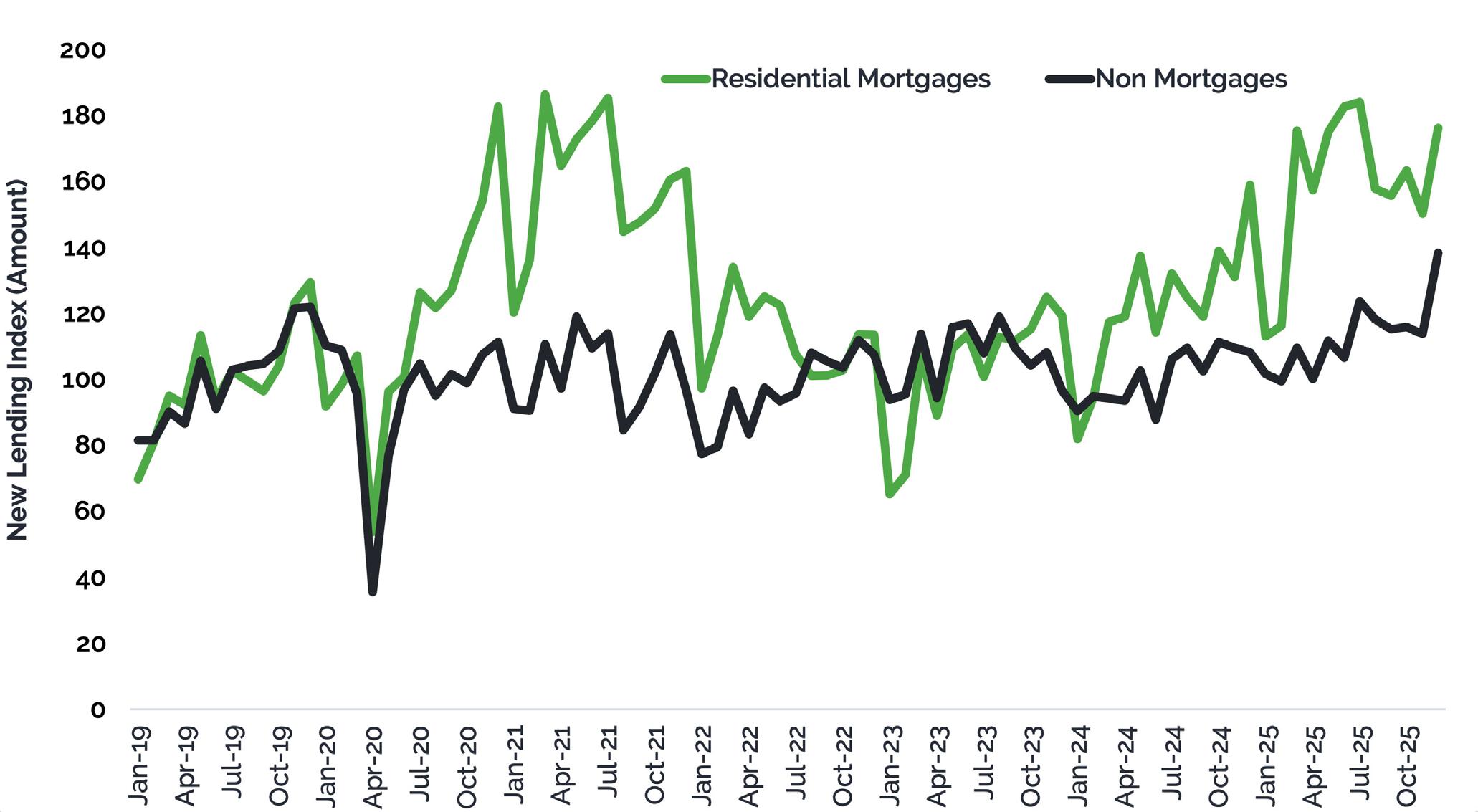
We saw this activity reflected in new lending figures in the December quarter.
Mortgage lending increased 14.3% year-on-year, supported
“In January, Stats NZ reported the Consumer Price Index rose 0.6% over the three months to December, lifting Aotearoa New Zealand’s annual inflation rate to 3.1%”
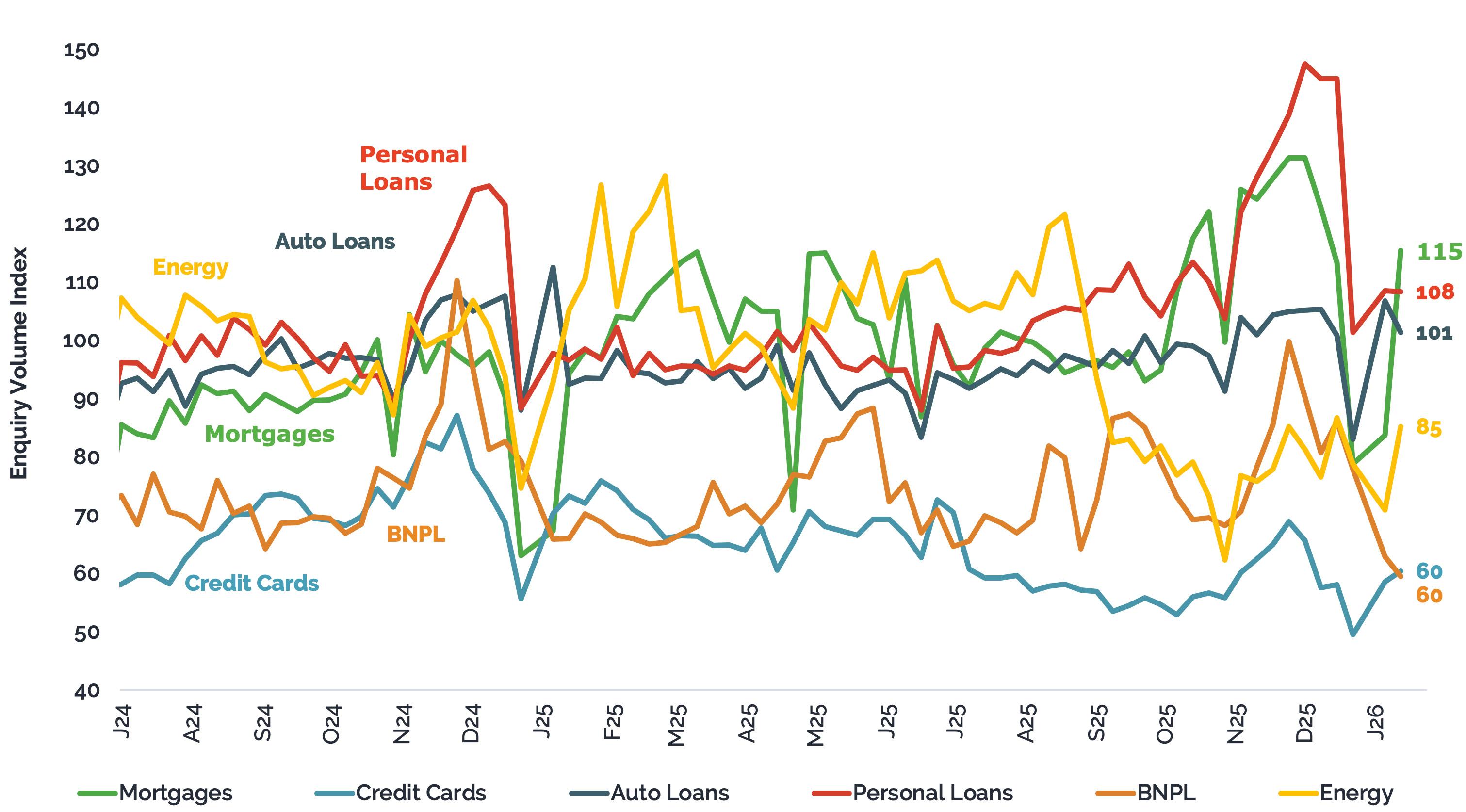
Consumer Credit Demand: 2020 – 2025
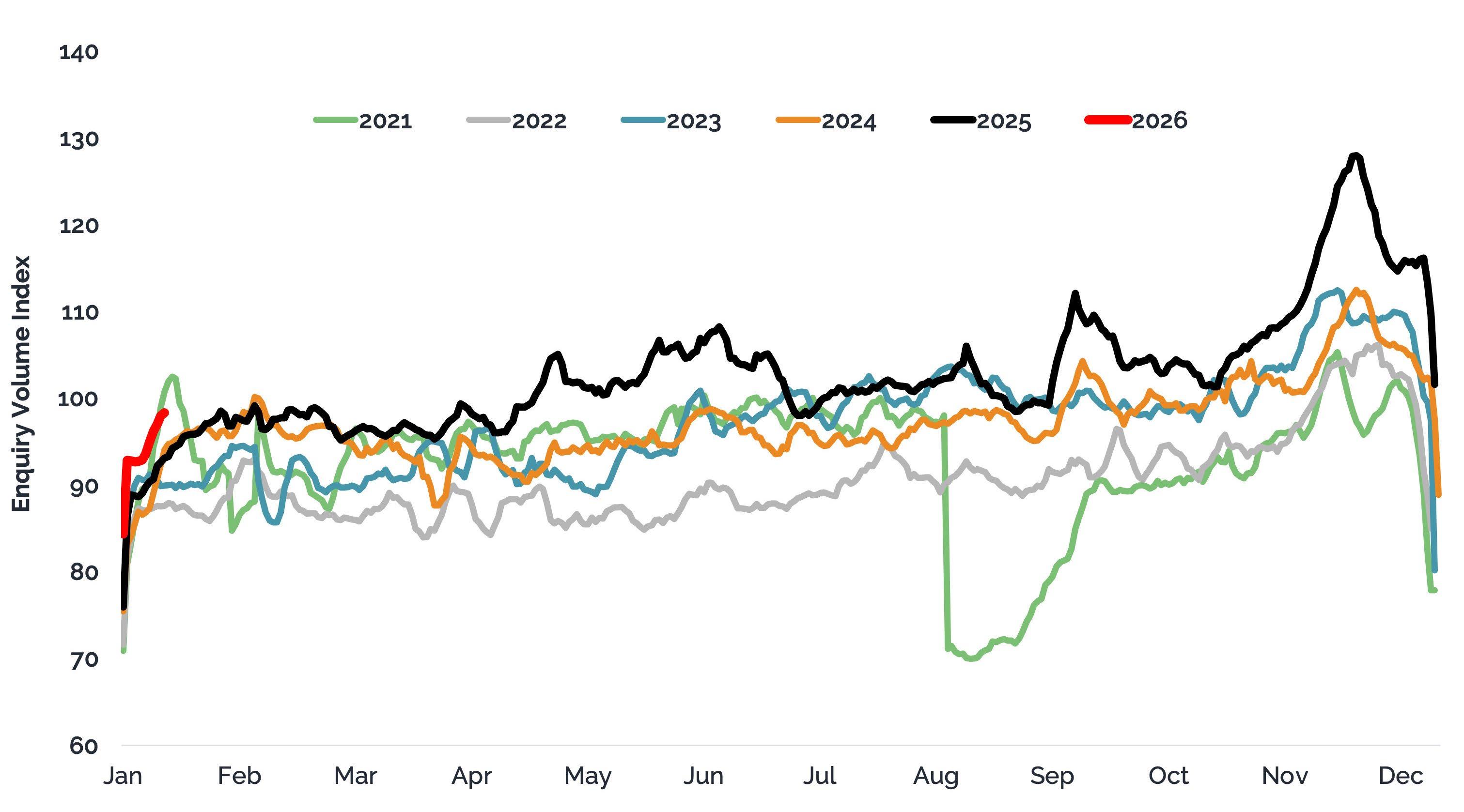
by heightened summer market activity and a lift in refinancing as borrowers responded to lower interest rates following recent OCR cuts.
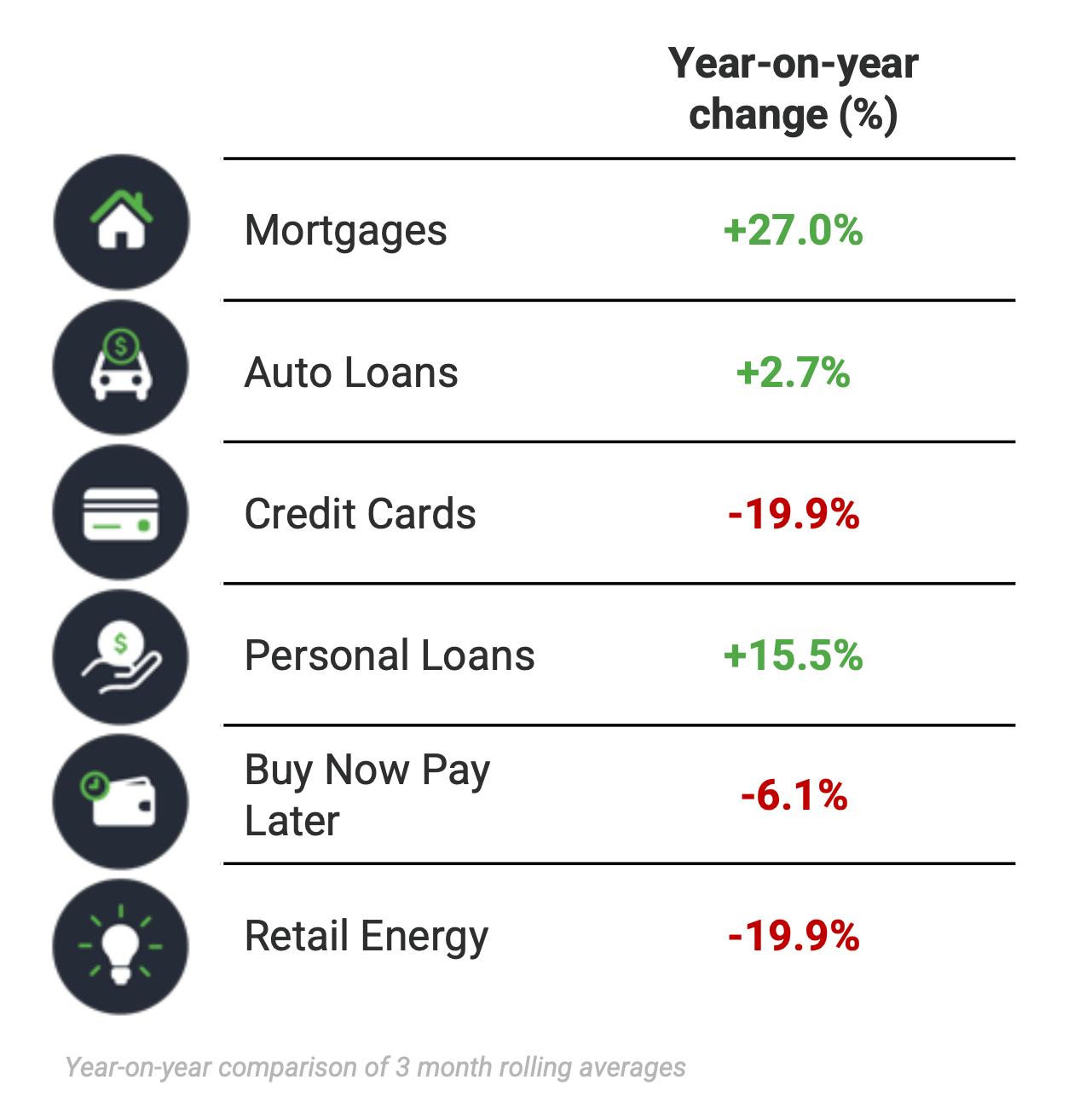
Non-mortgage lending grew 12.0%, driven largely by continued strength in unsecured personal loans and vehicle finance. Altogether, total new household
lending expanded 14.1% compared with the same period a year earlier.
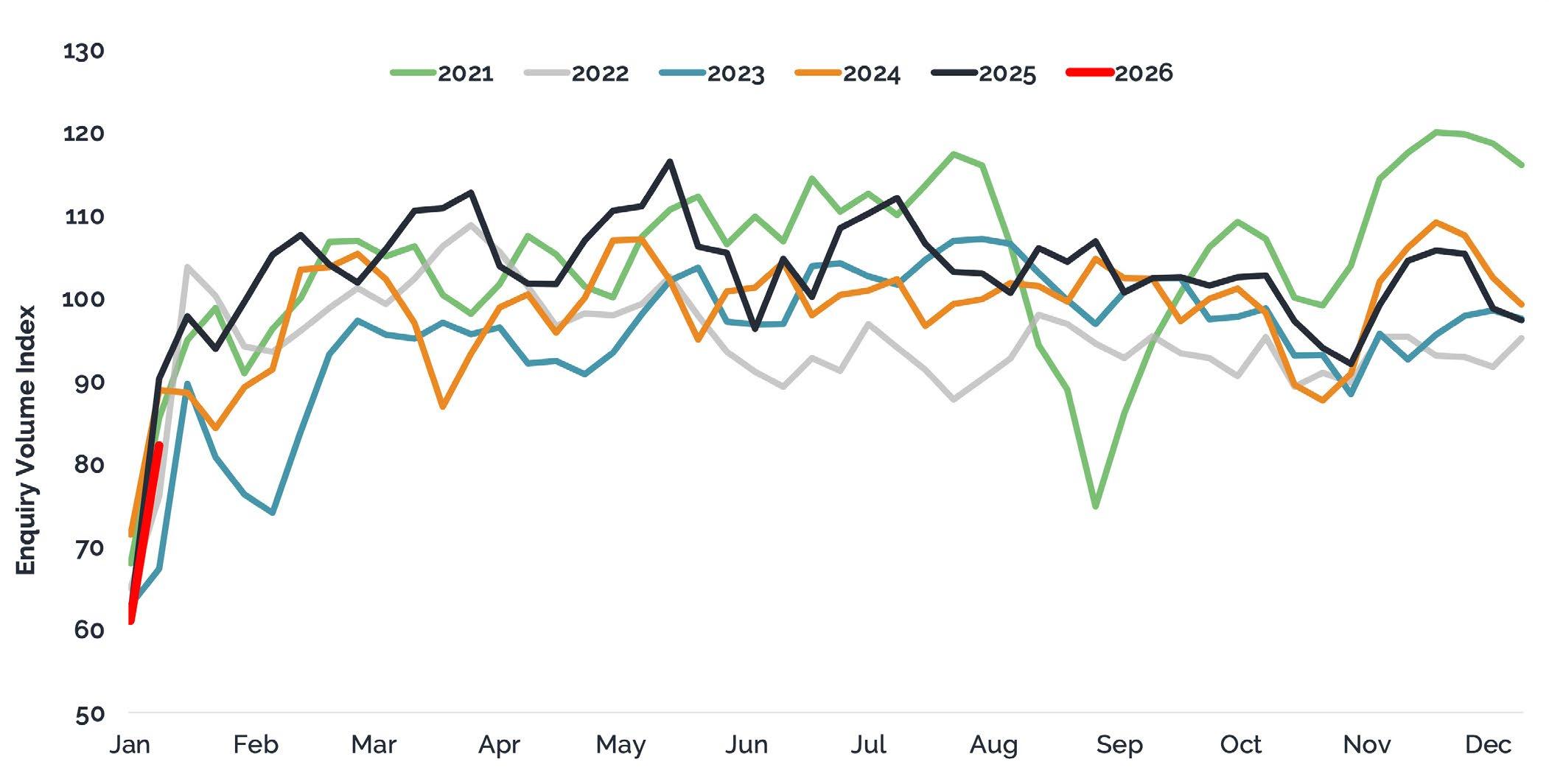
This confidence was also reflected in consumer credit
“Arrears trends were mixed heading into the new year across both products and regional trends.”
demand, which started 2026 strongly (up 9.4% yearon-year in January), buoyed by elevated borrowing over the holiday period.
Mortgage applications and personal loan inquiries were particularly robust, suggesting growing confidence in the housing market as the new year began.
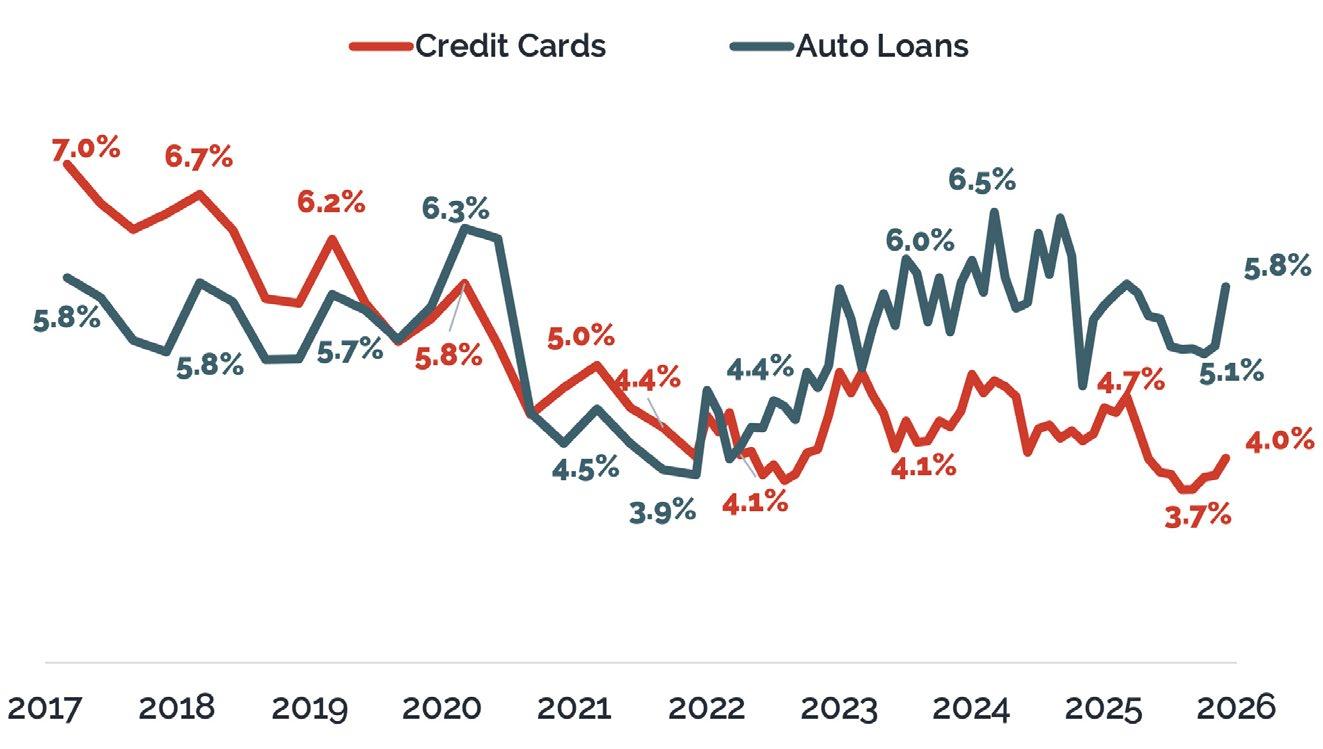
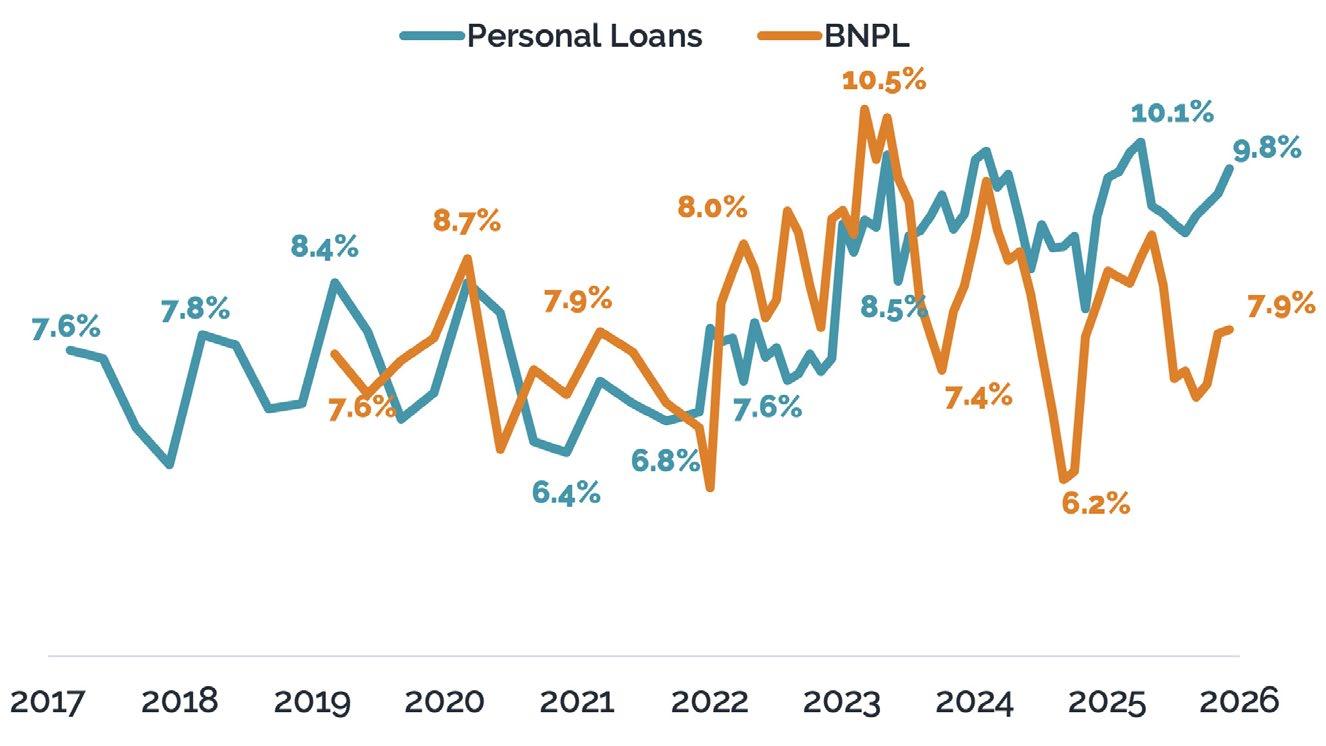
Arrears trends were mixed heading into the new year across both products and regional trends.
In December, consumer arrears saw a modest seasonal uptick, with 12.07% of creditactive consumers behind on payments – slightly higher than November’s 11.90%, but still 0.8% lower than a year earlier.
The number of consumers in arrears rose to 471,000, while those 90+ days past due reached 87,000, reflecting typical summer cashflow pressures and some lag from last year’s economic conditions.
Overall, arrears remain broadly consistent with 2023 levels despite short-term seasonal tightening.
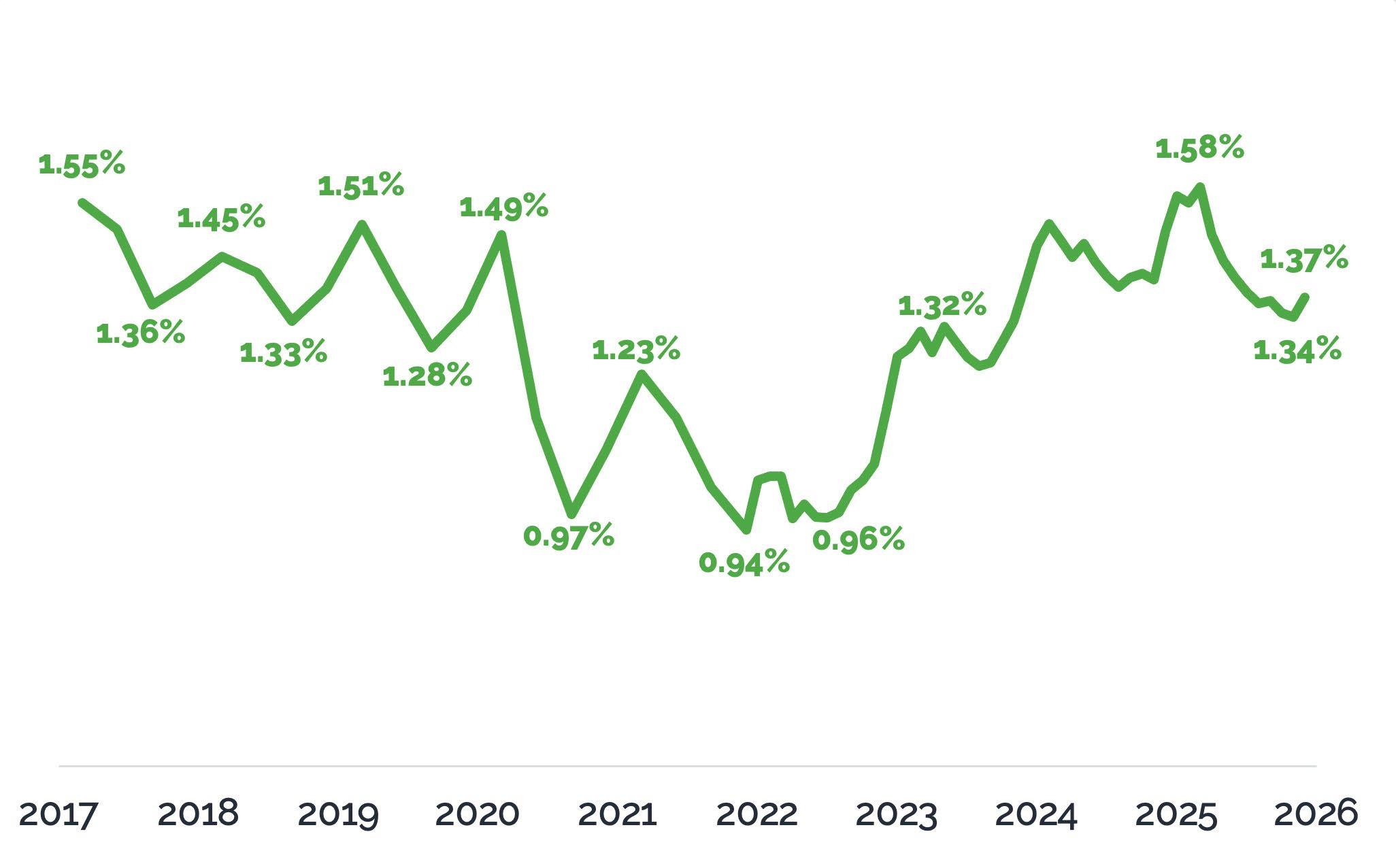
Mortgage arrears held relatively steady, edging up to 1.37% in December, in line with seasonal
patterns, and remain 8% lower year-on-year, with 21,800 accounts past due.
Credit card arrears also increased slightly to 4.0% - their highest level since May – yet are still 6% below last year. Vehicle loan arrears, however, rose to 5.8%, now 6% higher year-on-year, signalling mounting repayment pressure for some households.
Personal loan arrears climbed to 9.8%, up 6% on the year, and Buy Now Pay Later arrears increased to 7.9%, though they remain 4% lower than a year ago.
Meanwhile, utilities showed improvement: retail energy arrears fell to 4.7% due to lower summer power bills, and telco arrears declined for the fifth consecutive month, dropping to 8.7% in December.
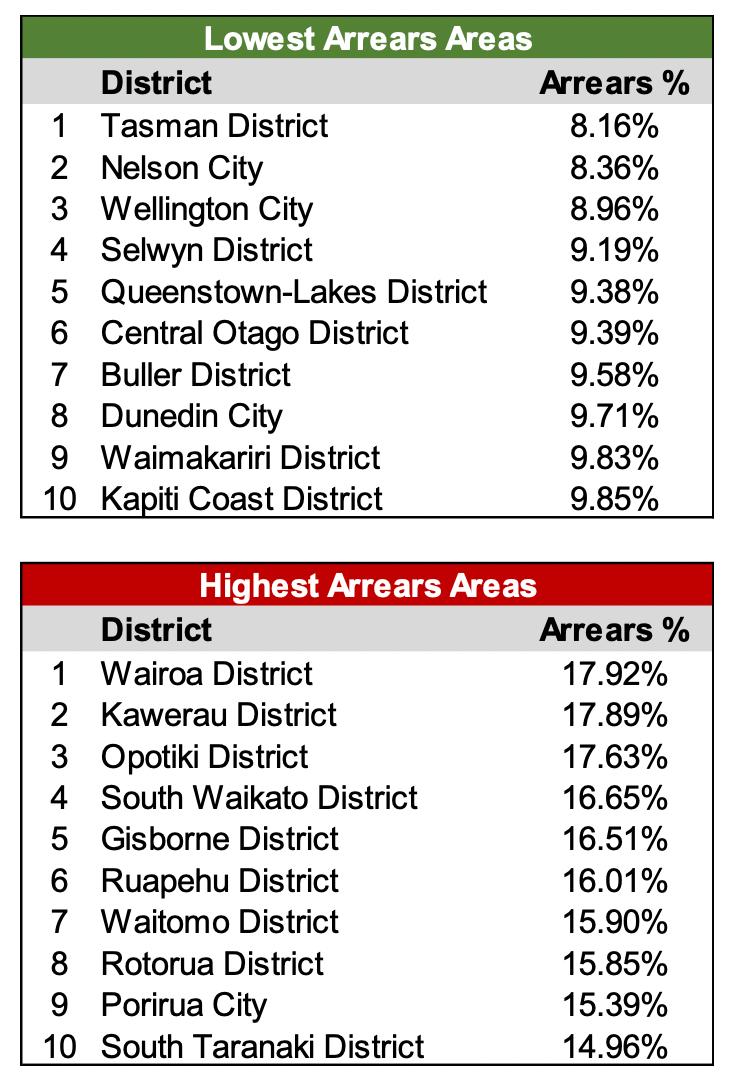
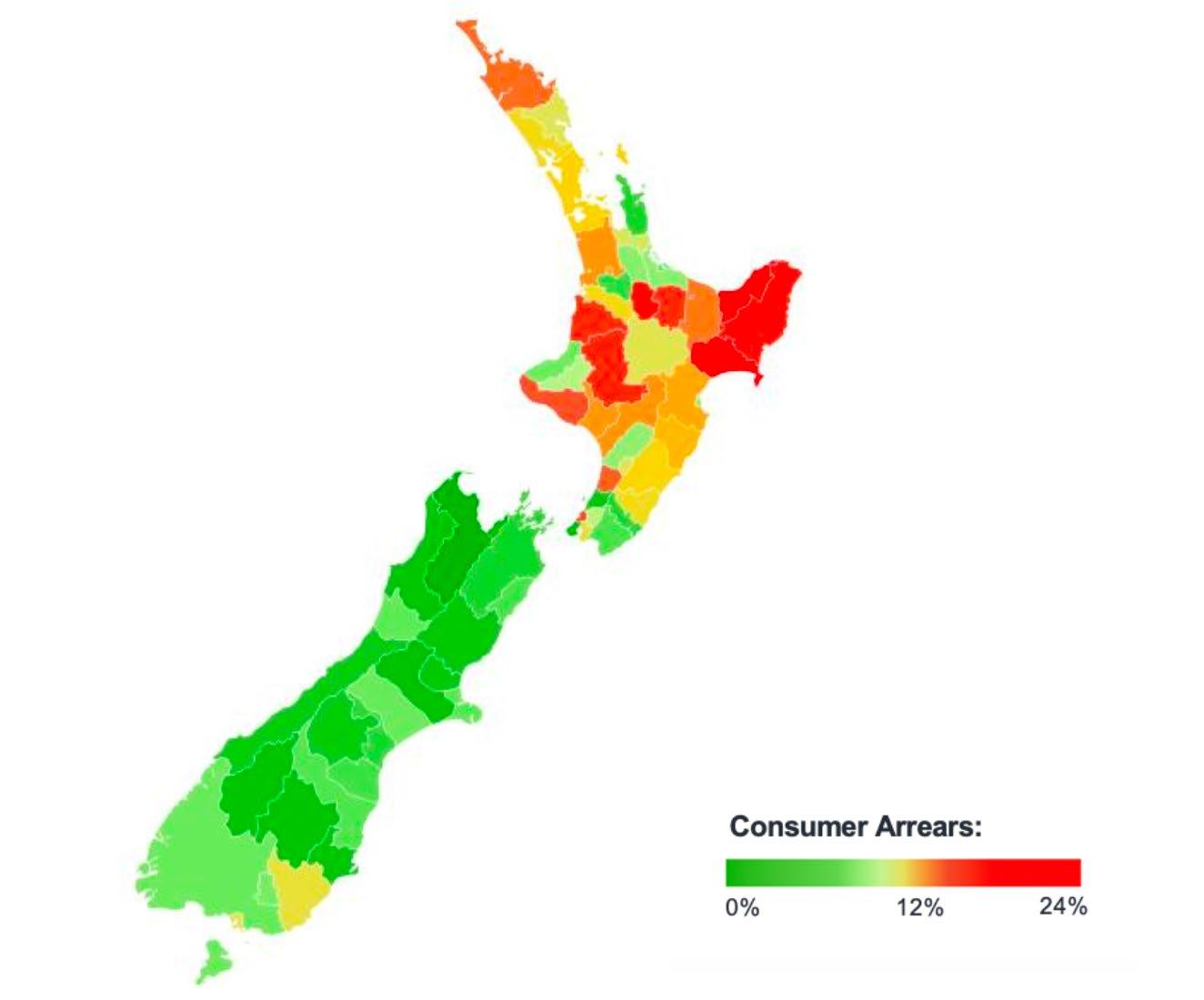
A clear divergence is emerging between arrears levels in the North and South Islands, with the South Island generally showing lower arrears rates and the North Island carrying the highest concentrations of overdue borrowers.
Many of the lowest arrears districts – such as Tasman, Nelson, Selwyn, QueenstownLakes, Central Otago, Buller, Dunedin, and Waimakariri – are South Island regions, all sitting under or around the 10% arrears mark.
In contrast, the highestarrears areas are dominated by North
Island districts including Wairoa, Kawerau, Ōpōtiki, South Waikato, Gisborne, Ruapehu, and Rotorua, where arrears range from roughly 15% to nearly 18%.
This gap suggests stronger financial stability and repayment capacity across much of the South Island, while parts of the North Island – particularly lower income or more
economically volatile districts – are experiencing more acute household financial pressure heading into 2026.
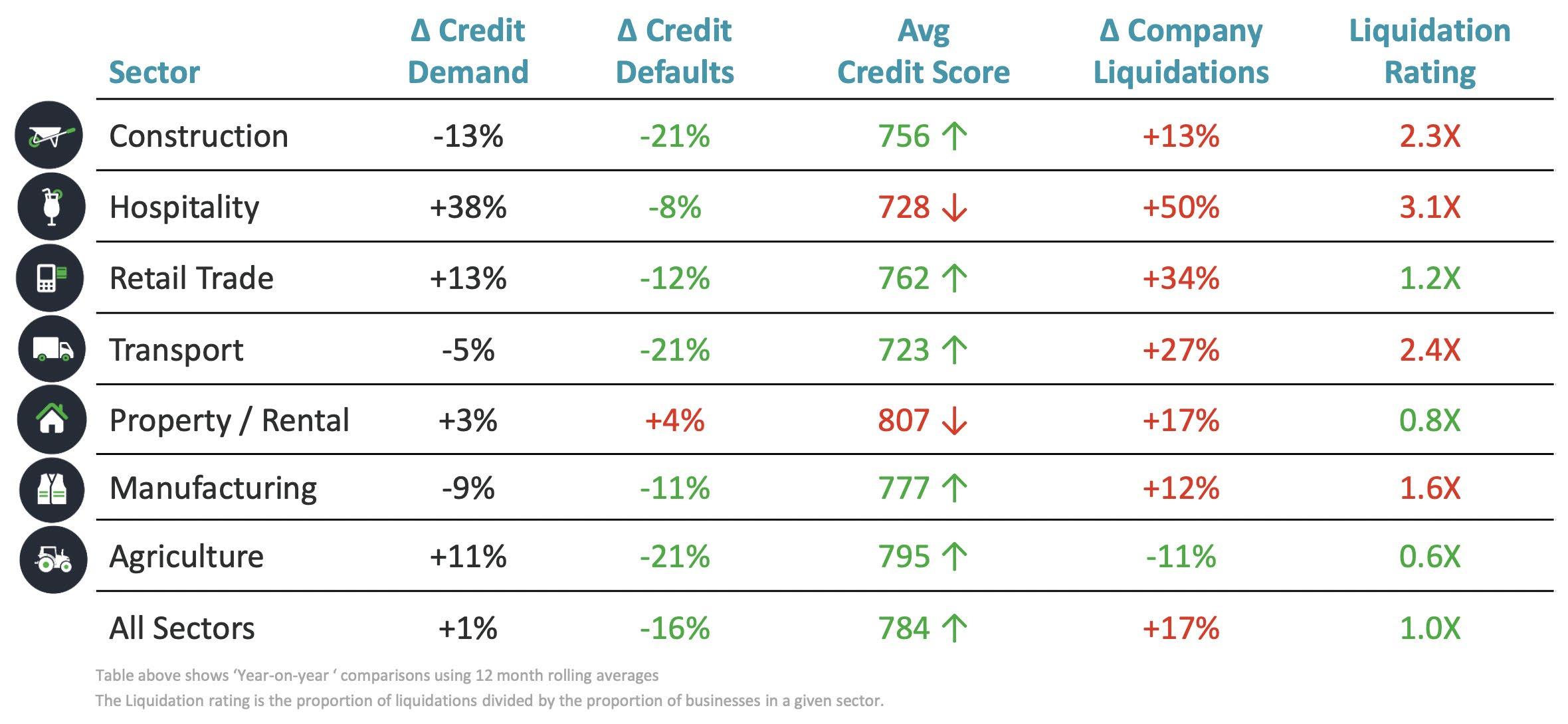
Business credit demand edged up 0.7% year-on-year, driven largely by strong sector specific gains.
Hospitality recorded a sharp 38% rise in credit demand amid improving trading conditions, while education and training
(+17%) and retail trade (+13%) also posted solid increases.
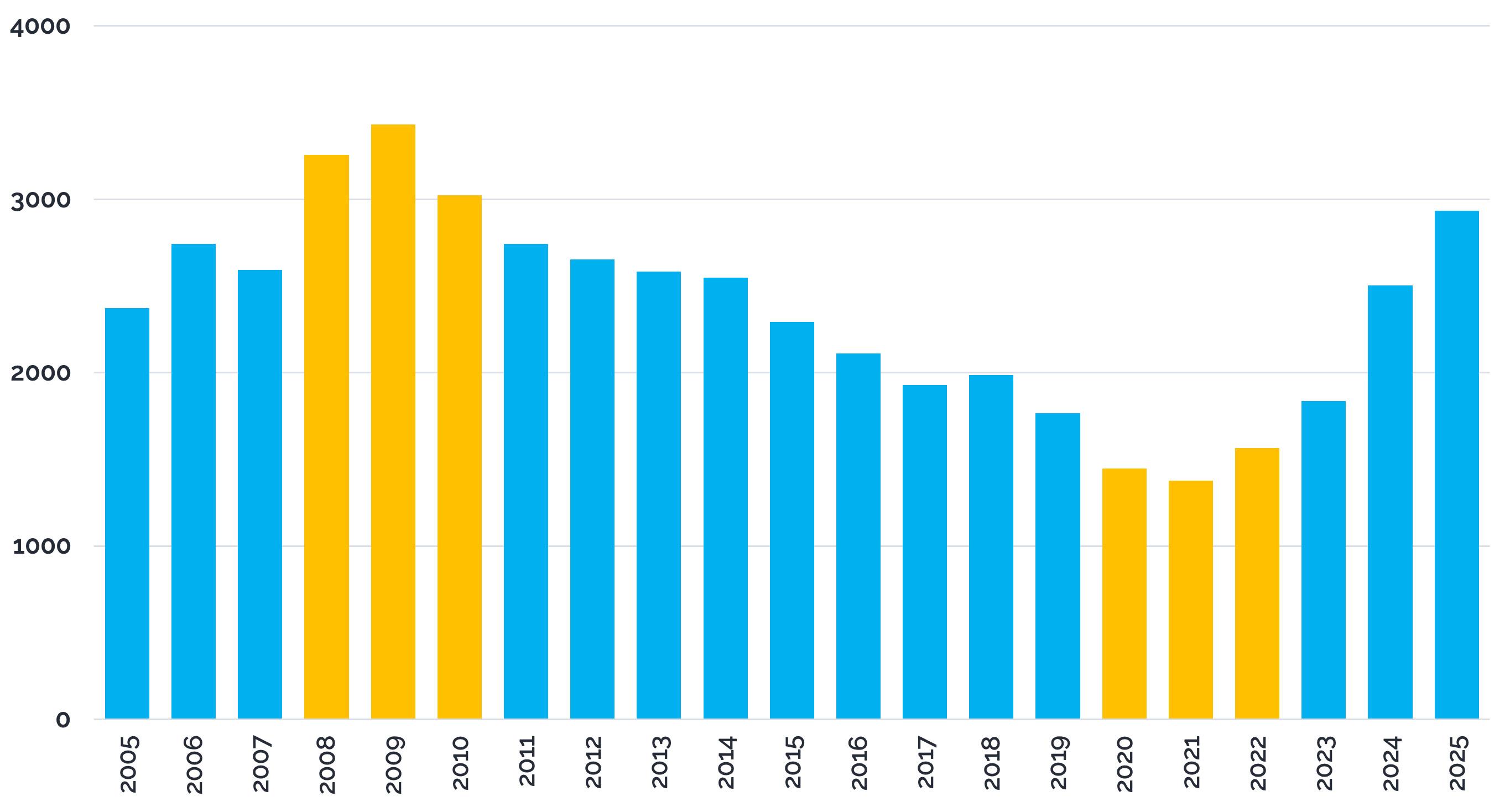
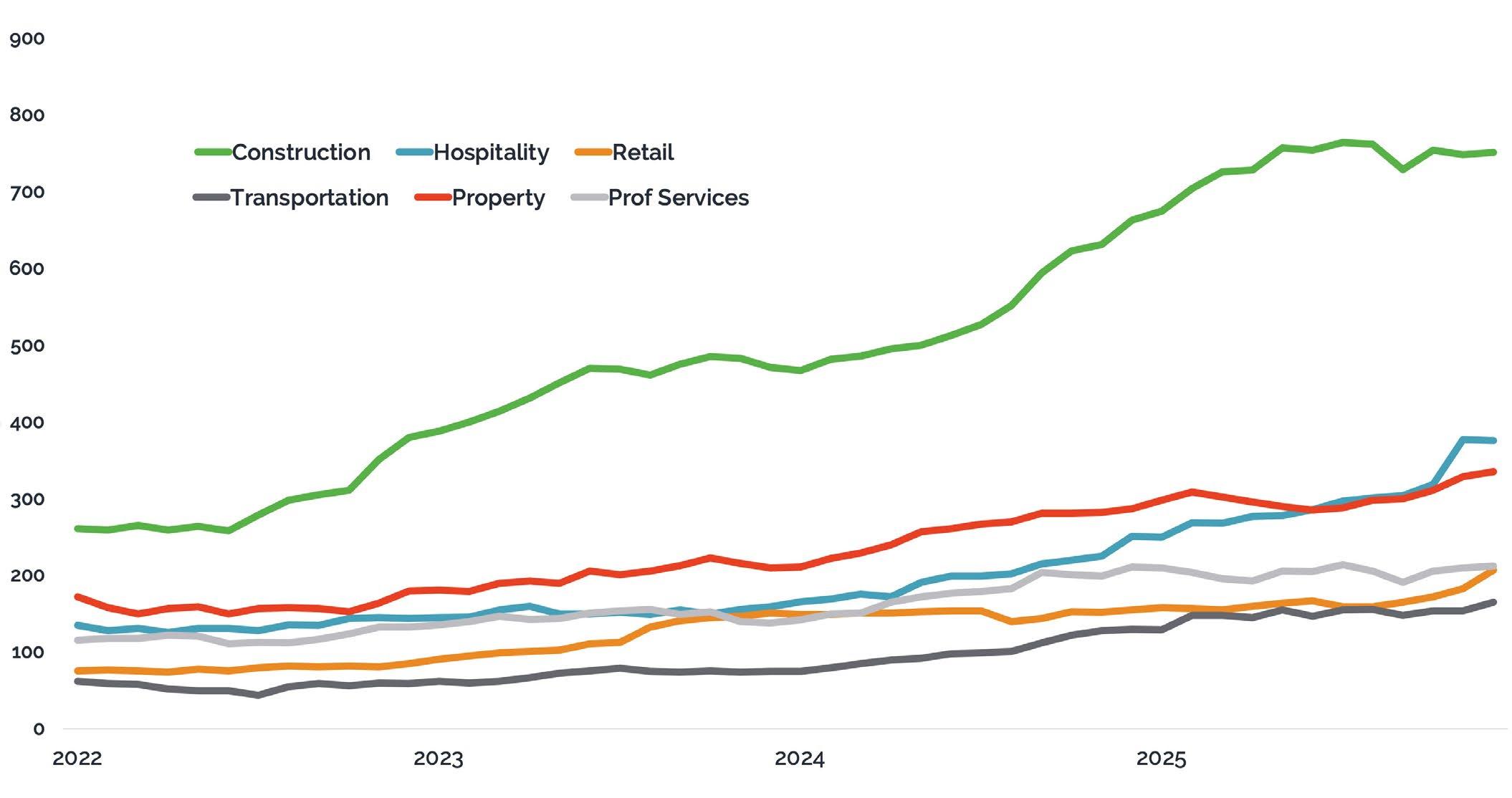
Demand across most other industries remained subdued. Despite this modest uplift in credit appetite, company failures climbed to their highest level since 2010, with liquidations surging in hospitality (+50%), retail trade (+34%), and transport (+27%), highlighting sustained financial strain.
Construction, which saw 751 firms liquidated in 2025 (+13% year-on-year), remained the largest contributor to total failures, followed by hospitality with 376 liquidations (+50%).
Looking more closely at the data, 69% of liquidation
applications in 2025 were initiated by Inland Revenue (IR). In addition, IR has stepped-up efforts to report significant tax arrears to provide the market with more reliable indicators of financial stress. https:// www.ird.govt.nz/updates/
news-folder/2025/changes-tosharing-information-aboutunpaid-tax
Still, early signs of stabilisation are emerging, with liquidation pressures easing in six of nineteen sectors, and agriculture standing out as the strongest
New Zealand Company Liquidation 2005 - 2026
“Looking more closely at the data, 69% of liquidation applications in 2025 were initiated by Inland Revenue (IR). In addition, IR has stepped-up efforts to report significant tax arrears to provide the market with more reliable indicators of financial stress.”
performer, recording an 11% decline in failures alongside improving financial health.
After a challenging few years, Kiwi households and businesses alike are holding out for a shift in economic tides.
New lending activity indicates a returning confidence, but it remains to be seen how interest rates will impact borrowing in 2026.
The primary industries continue to perform well despite global uncertainty, while locally
construction and hospitality continue to struggle.
All eyes will be on our political parties this year as we enter an election year, where the economy will be a key focus.
The recently announced Budget Day for 2026 will also be highly anticipated to understand where the current Government’s spending focus is, and whether this will provide support for struggling households and businesses.
We can hope for continued recovery and an easing of financial pressure. In the
An end-to-end customer onboarding platform that adapts to your unique processes, not the other way around.
No code configuration
Automate any process SenseAI enabled
Infinitely customisable forms and portals
Thousands of integrated data points
Neill Borg Country
Manager
AU +61 401 066 624 neill.borg@credisense.io credisense.co.nz
meantime, it’s important Kiwi’s stay on top of their repayments to protect their credit scores.
For households, this means seeking support early where needed to meet obligations. For businesses – especially SMEs –it means tightening cashflow management and staying agile in response to shifting consumer behaviour as the economy continues to stabilise.
*Monika Lacey MICM Chief Operating Officer
Centrix Credit Bureau of New Zealand www.centrix.co.nz



By Hannah Cook MICM*

Hannah
Credit management has evolved from mechanical account chasing to a strategic, human-centred discipline. Organisations that embed community engagement into their credit strategies not only enhance customer outcomes, they strengthen business performance.
Behind every overdue bill is a person, often facing financial stress or vulnerability. Leading organisations are shifting towards empathy-driven practices. When businesses actively listen and connect with
individuals’ realities, repayment becomes a shared goal, not a confrontation.
Empathy doesn’t mean compromise. Honest dialogue fosters early disclosure of difficulty, enabling flexible repayment plans that reduce default risk. This proactive approach boosts recovery rates and curtails costly legal escalations. Moreover, ethical practices reinforce stakeholder trust and position businesses ahead of regulatory expectations.
Recoveriescorp exemplifies best practice by blending
“When businesses actively listen and connect with individuals’ realities, repayment becomes a shared goal, not a confrontation.”

“Early-intervention initiatives equip individuals, advocates, and staff with tools to manage finances effectively.”
community engagement with ethical recovery strategies:
Financial literacy & education
Early-intervention initiatives equip individuals, advocates, and staff with tools to manage finances effectively.
Non-profit partnerships
l Thriving Communities Australia – Co-designing inclusive financial solutions.
l ICAN Learn – Scholarships for Indigenous Australians, cultural competence training & RAP consultancy.
l DV Safe Phone – Donating repurposed mobiles to domestic violence survivors.
l The Salvation Army –Financial counselling and staff volunteering.
l Ability Options – Trauma informed practice training.
l Respect & Protect – Zerotolerance clauses on financial abuse in client contracts.
l South East Community Links – Attending “Bring Your Bills” events that assist hundreds with debt relief.
l Fitted for Work – Empowering
women & gender-diverse individuals through employment readiness.
Reconciliation action plan
Strengthening cultural safety and diversity through a Reflect RAP.
Leadership in practice
Recoveriescorp empowers its Principal Community Advocate to champion these initiatives, creating space for new ideas and listening. This work has given staff renewed purpose and pride to work in the sector.
Rather than replacing human judgment, AI enhances it, identifying early signs of financial stress, predicting hardship risk and surfacing tailored support options before customers reach crisis point.
This allows organisations to intervene earlier with empathyled solutions, not enforcement. AI-driven insights also help reduce bias by prompting consistent, data-informed decisions, while freeing frontline teams to focus on highvalue human interactions where compassion and cultural sensitivity matter most.
Importantly, responsible use of AI must go hand-in-hand with
transparency, strong governance and human oversight. When deployed thoughtfully, AI becomes a powerful enabler of fairness, accessibility and better outcomes for customers and businesses alike, supporting a more inclusive, communitycentred credit ecosystem.
Community engagement delivers measurable benefits:
1. Enhanced Recovery Metrics – Empathetic approaches improve repayment performance.
2. Risk Mitigation – Reduces reputational risk and legal escalation.
3. Regulatory Advantage –
“Rather than replacing human judgment, AI enhances it, identifying early signs of financial stress, predicting hardship risk and surfacing tailored support options ...”
Supports compliance with evolving standards.
4. Employee Engagement – Purpose-driven training fosters respectful customer interactions.
Simple Initiatives to get started
1. Turn Up – Engage with Financial Counselling Australia and attend conferences to build relationships and insights.
2. Volunteering Matters –Coordinate programs that align with your business values.
3. In-Person Interactions –“Bring Your Bills” days offer invaluable customer insights.
4. Networking – Build connections across corporate, government, and community sectors.
5. Cultural Change – Start the journey; internal change takes time but pays off.
6. Hire Wisely – Credit managers set the tone for reputation and outcomes.
7. Engage Business Partners –Include them in your cultural strategy.
8. Business Customers – They must be part of your hardship strategy and offering to minimise bad debts.
As economic headwinds persist, resilience in credit
management will be defined by humanity. Engagement through partnerships, education and vulnerability-informed practice strengthens both individuals and organisations. Recoveriescorp’s model proves financial inclusion and ethical collections are mutually reinforcing. By prioritising trust and community, credit managers can transform debt recovery into shared value: restored financial health, stronger community ties, and sustainable business outcomes.
Contact: Readers of this AICM edition are welcome to reach out for a one-on-one discussion. I’m happy to help with your strategy and connecting you with some great people. Email hannah_ cook@recoveriescorp.com.au to schedule a time.
*Hannah Cook MICM Principal Community Advocate
Recoveriescorp
T: 0417 545 766
E: hannah_cook@recoveriescorp.com.au
Level 4, 333 Collins Street, Melbourne VIC 3000 www.recoveriescorp.com.au
“Engagement through partnerships, education and vulnerabilityinformed practice strengthens both individuals and organisations.”

By Daniel Taylor MICM CCE*

Twenty-five years ago, when I first stepped into the world of debt recovery, the industry looked and behaved very differently.
The prevailing culture was adversarial, processdriven (without thought of consequence) and more often than not, combative. Customers (or as they were then routinely labelled, “debtors”) were engaged with a mindset that resolving an account was a winlose proposition. Success was measured by volume, speed and pressure and how many people you could bankrupt or how many companies you could wind up.
It was an era in which I once half-jokingly said, “He who screams loudest gets paid first.”
And like most jokes, it carried an uncomfortable degree of truth. The louder, firmer, and more unrelenting the approach, the more likely the customer was to capitulate. That was the accepted norm. It was what clients expected, what regulators overlooked, and what many practitioners genuinely believed was necessary.
Today, that worldview belongs in a museum.
Over the years, societal expectations, regulatory scrutiny, client priorities, and our own industry’s self-reflection have pushed us in a profoundly different and far healthier direction. The journey from combative debt collection to socially responsible credit
“Success was measured by volume, speed and pressure and how many people you could bankrupt or how many companies you could wind up.”

management has been neither linear nor accidental. It has demanded introspection, innovation, and a willingness to evolve.
And the lesson we’ve collectively learned is simple but powerful:
“He who engages fairly gets the positive response.”
Fairness is no longer a nice-tohave sentiment. It is measurable, reportable, and essential to sustainable outcomes. But, as we move into 2026 and beyond, fairness is also becoming more complex.
What feels fair to a vulnerable customer may differ from what feels fair to a credit
“Fairness is no longer a nice-to-have sentiment. It is measurable, reportable, and essential to sustainable outcomes.”
manager, which may again differ from what feels fair to a regulator or the community at large. The challenge for our sector is not just acting fairly, but constantly re-evaluating the definition of fairness as expectations shift.
Today, fairness means:
l Transparency of process
l Proportionate action
l Early, empathetic engagement
l Accessible communication channels
l Recognition of vulnerability
l Pathways to sustainable resolutions
Fairness is not just ethical it is efficient. The data consistently shows that customers who feel heard and respected resolve debt faster and more sustainably. Engagement drives outcomes. Humanity drives engagement.
The phrase “social responsibility” can sound abstract, but in our industry it is refreshingly practical.

“The modern credit professional must be part technologist, part risk manager, part behavioural economist, and part social scientist.”
It means designing credit and recovery frameworks that acknowledge the lived reality of the people we serve. It means balancing commercial imperatives with empathy. It means recognising that the purpose of credit is to create opportunity, not hardship and the purpose of recovery is to restore balance, not inflict harm.
In practice, socially responsible credit management includes:
l Using behavioural insights to shape respectful conversation
l Offering flexible digital and human channels
l Ensuring hardship pathways are genuine, accessible and stigma-free
l Training staff not just in
compliance, but in emotional intelligence
l Monitoring outcomes beyond dollars recovered
Across the last decade, digital transformation has become a foundational pillar of our evolution. AI-driven analytics, voice-AI, omnichannel communication, and customercentric platforms are enabling precision and personalisation that would have been unthinkable early in my career.
But the risk and the responsibility lie in how we use this technology.
Socially responsible credit management requires that digital tools strengthen fairness, not dilute it. AI cannot be allowed to create new inequities or
harden old biases. Automation should support better conversations, not replace the human capacity for empathy and judgement.
Used appropriately, technology provides:
l Earlier detection of hardship
l Smarter segmentation
l More tailored communication
l Safer governance and auditability
l Reduced friction for customers seeking help
Technology amplifies fairness when it is implemented with intention.
Perhaps the most confronting reality for all of us in the profession is that fairness is not static.
Community expectations
evolve. Regulatory frameworks tighten. Lived experiences shift. What was acceptable in 2020 may be questionable today and unacceptable in 2027.
Our challenge is not only to meet the standard, it is to anticipate it.
The modern credit professional must be part technologist, part risk manager, part behavioural economist, and part social scientist. We must move in step with societal change, not behind it.
After 25 years in this industry, I am proud of how far we’ve
come. Proud that we have shed outdated approaches. Proud that we now view customers as partners in resolution, not opponents in conflict. Proud that fairness and social responsibility are no longer aspirational, they are operational.
Our profession has matured, and with that maturity comes greater purpose.
Credit is the engine that keeps households and businesses moving. Recovery is the mechanism that keeps that engine sustainable. By anchoring our work in fairness,
respect and responsibility, we not only achieve better outcomes, we strengthen the trust on which the entire credit ecosystem relies.
The next chapter of socially responsible credit management is ours to shape. And the industry we build today will define the expectations of tomorrow.
*Daniel Taylor MICM CCE CEO
CCSG Group of Companies
Board Member – Australian Institute of Credit Management www.ccsgroup.com.au
opypro.com.au
By Norman Yan*
Picture this. It’s 3pm on a Thursday. Your best agent – the one you’d trust with any call –picks up a routine collections call. Thirty seconds in, the customer quietly mentions their partner controls the finances. It’s a domestic violence disclosure. But your agent is four hours into a gruelling shift. They’re mentally sorting through the last difficult call. The cue passes. No flag. No escalation. No safety referral. Nobody failed here. The system did.

The cognitive load problem
We talk a lot about empathy in collections. Train it. Measure it. Reward it. But here’s what most of us don’t say out loud:
empathy is a finite resource. And we’re asking agents to deploy it perfectly, hundreds of times a day, across calls that range from routine payment plans to disclosures of abuse, addiction, and suicidal ideation.
The science backs this up. Cognitive load research shows that when humans are fatigued, stressed, or multitasking, the first thing to deteriorate is their ability to detect ‘soft’ signals –tone shifts, hesitation, coded language. These are exactly the cues that indicate a customer is in hardship or danger. The irony is brutal: the agents who care the most burn out the fastest, and the customers who need the most help are the hardest to identify.
“...empathy is a finite resource. And we’re asking agents to deploy it perfectly, hundreds of times a day, across calls that range from routine payment plans to disclosures of abuse, addiction, and suicidal ideation.”

What the data actually shows
We processed thousands of live calls with real-time AI monitoring. The findings were sobering.
Manual quality assurance typically reviews around 1–2% of calls. That’s not a safety net – it’s a lottery. Whether a vulnerable customer gets the right treatment depends almost entirely on which agent answers and what kind of day they’re having. In the calls we analysed, we found that a meaningful percentage of hardship disclosures – including references to family violence and financial abuse – were either missed or inadequately
“Cognitive load research shows that when humans are fatigued, stressed, or multitasking, the first thing to deteriorate is their ability to detect ‘soft’ signals –tone shifts, hesitation, coded language.”
responded to during the live conversation. These weren’t bad agents. They were good people operating without support, in a system designed around postcall detection rather than live prevention.
From detection to prevention
The shift the industry needs isn’t more training manuals or tighter scripts. It’s moving from random sampling to 100% coverage. Real-
time AI makes this possible –not by replacing agents, but by standing alongside them.
Think of it like a co-pilot. The technology listens to every call, identifies hardship cues as they happen, and surfaces the right guidance to the agent in the moment – not in a coaching session three weeks later. If a customer mentions financial abuse, the system flags it live and prompts the agent with an
appropriate response pathway. If a disclosure is missed, it’s caught immediately – not left buried in a recording that nobody reviews.
This isn’t about compliance for compliance’s sake. It’s about building a systemic safety net that works regardless of which agent picks up the phone, what time of day it is, or how many tough calls they’ve already handled.
What this means for credit leaders
1. Audit your current QA coverage honestly. If you’re reviewing 1–2% of calls, ask
yourself: what’s happening in the other 98%?
2. Stop treating empathy as a training outcome and start treating it as a systems design problem. Your agents want to do the right thing – give them tools that make consistency possible.
3. Explore real-time AI as a complement to your existing compliance framework. The technology exists today, and it’s already live in Australian contact centres.
The collections industry is full of people who genuinely want to
help customers through difficult moments. The question isn’t whether our people care enough. It’s whether our systems care enough to support them. Scaling compassion isn’t a slogan. It’s an engineering problem – and it’s one we can solve.
*Norman
Yan
CEO & Co-Founder Whispa www.whispa.net
Norman Yan is the CEO & Co-Founder of Whispa, an AI-powered compliance platform currently live with Australian debt collection agencies and ASX-listed lenders. Previously the AI Lead for Business Banking at Westpac, Norman helps the industry bridge the gap between regulatory obligation and genuine customer care.
“The shift the industry needs isn’t more training manuals or tighter scripts. It’s moving from random sampling to 100% coverage. Real-time AI makes this possible – not by replacing agents, but by standing alongside them.”


Because your career deserves more.

Professional Development That Keeps You Current
Access specialised training, events, and education designed for real-world credit challenges.
“Every professional development session I attend leaves me with new insights I can apply immediately, and the webinars provide a constant stream of practical and relevant information.”
— Mary Petreski FICM CCE, Head of Customer Payments
A Network That Opens Doors
Connect with credit leaders and like-minded professionals nationwide.
“My involvement as a junior in the industry has provided me with exposure to new experiences, high level networking, and opportunities for professional and personal growth that typically comes later on in one’s career.”
— Arian Bahmiyari MICM, Solicitor
Support, Resources & Industry Insight
Stay informed with member-only resources and updates that help you work smarter.
“I have learnt valuable skills that continue to support my operational decision-making and have allowed me to contribute meaningfully to my organisation.”
— Hudson Pitt MICM, General Manager
Recognition That Elevates Your Career
Gain credibility through awards, post-nominals, and national visibility.
“I entered the Credit Professional Award after being nominated by a colleague in 2023. Being selected for this award was exciting and a real boost for my ego. The idea of winning or even being nominated for such an award significantly enhanced my credibility as a credit professional.”
— Janice Riley MICM CCE, National Credit Manager
Unlock what’s next for you. Join the AICM today.
Free Webinars & Special Interest Groups
Complimentary access valued at over $300.
Stay Informed
Be the first to know about industry alerts and updates via our newsletter.
Member Pricing
Save up to 30% on AICM events, seminars, and training courses.
Credit Knowledge Hub
Access articles, reports, and resources at exclusive member pricing.
Ask Creddo
Your go-to for quick answers and expert guidance on credit management.
Networking
Join our members-only LinkedIn group to connect and share insights.
Publications
Subscription to Credit Management in Australia magazine.
Professional Recognition
Use MICM post-nominals on your email signature and LinkedIn profile.

We recognise those members who achieved membership anniversaries between November, December 2025 and January 2026. Congratulations to these members on achieving such important milestones.
The Institute welcomes the following credit professionals who were recently admitted to membership between November, December 2025 andJanuary 2026.
New South Wales
Alison Page FeeSynergy
Amanda Marangon Vinidex
Andrea Osorio Brickworks Pty Ltd
Anita House Vinidex
Cameron Sami Rentokil Initial Pty Ltd
Chris Fuller The Mutual Bank
Cigdem Zabinoglu Rentokil Initial Pty Ltd
David Ciarleglio Metro Finance
Denise Spears Intelligence Monitoring Group
Donna Zhang Ampol
Donna Carthey Clarus Adventure Group
Dylan Aoun Rentokil Initial Pty Ltd
Egita Purina Metro Finance
Ekaterina Sokolova Rentokil Initial Pty Ltd
Ekta Masrani Intelligence Monitoring Group
Elise Cafe The Mutual Bank
Ergun Aslaner Metro Finance
Frank Reading Jr CHG-MERIDIAN Australia Pty Limited
Gayle Ilagan Rentokil Initial Pty Ltd
Julia Thorn Metro Finance
Ka Mun Cynthia Li Boral Construction Materials Group Ltd
Kelly Reilly Questas Corporate
Kelly-Anne Smith The Mutual Bank
Kerry Sinai Jaybro Group
KK Neelamraju Cashflo AI
Komala Kaneshwaran Rentokil Initial Pty Ltd
Kylee Cowin Rentokil Initial Pty Ltd
Llachlan McDonald FTI Group
Luke Dowd Rentokil Initial Pty Ltd
Ma’ave Gavet LG Electronics
Maria Alicia Monis Rentokil Initial Pty Ltd
Milanka Manojlovic Vinidex
Nusrat Meghla Rentokil Initial Pty Ltd
Priscilla Stephenson
Quynh Trang Tran Rentokil Initial Pty Ltd
Rachael de Leon Rentokil Initial Pty Ltd
Rachael Paine Electrolux Home Products Pty Ltd
Roshni Kumari
Sisilawati Ningrum Whiting Holdings Pty Ltd
Sudiksha Prasad Whiting Holdings Pty Ltd
Tanya Rielly Austral Bricks
Xuan Nhi Nguyen Rentokil Initial Pty Ltd
Yvette Taylor Vittoria Food and Beverage
Adam Deane Ampol
Adriana Marcela Diaz Guerrero Shell Energy
Akenese Iose Stramit
Alia Hamid Rodgers Reidy
Amanda Webster Fisher & Paykel
Andrew McNicol The University of Queensland
Benjamin Bush G.James
Brandyn Kalolo Cleanaway Pty Ltd
Dale Elmer Fisher & Paykel
Dalton Gismondi Cleanaway
Demi-Ann Dawes Patane Lawyers
Gail Molloy Freedom Fuels Pty Ltd
Gale Petersen Volvo Group Australia
Heather Harris Lantrak Pty Ltd
Janet Harmon Fisher & Paykel
Jaylin Amituanai Fisher & Paykel
Jessica Wilson Fisher & Paykel
Josh Waites Global Business Auctioneers & Valuers P/L
Kate Molkentin Results Legal
Katrina Tantucz Stramit
Kirstie Hart Fletcher Building
Lauren Lietz BGW Group
Lauren Byrnes Global Business Auctioneers & Valuers P/L
Leigh Webb Optimum Recoveries
Linda Jessen Fisher & Paykel
Louise Roebeck Fisher & Paykel
Makayla Golding Cleanaway Pty Ltd
Mele Pua Beaumont Tiles
Monique Tierney Results Legal
Osovale Kirisitina Jarvis KPMG
Patrina Tumutumu
Peter Tracey Cleanaway Pty Ltd
Piari Anderson Indigenous Business Australia
Renee Klenner DentiCare Payment Solutions
Samantha Felgendrejeris G.James
Sherin Ali Brismark
Silvia Kalamas Fisher & Paykel
Tamanu Gibia Indigenous Business Australia
Terry Kirkham Global Valuers
Ying Ping Lee Beaumont Tiles
Sandra Gillespie Fisher & Paykel
Sandy Christpoulos GPC
Victoria/Tasmania
Alice Wang Hugo Boss Australia Pty Ltd
Alyssa Mercuri Rothwell Lawyers
Amber Corner NCI (Brokers) Pty Ltd
Amelia Daou Rothwell Lawyers
Amy Philipsz Bluescope
Anek Thongnium Tyremax Pty Ltd
Anna Tou ConnectEast Pty Ltd
Anthony Bonham Bapcor
Arthur Golikidis ConnectEast Pty Ltd
Bill Sekulovski Lawrence & Hanson Group Pty Ltd
Brooke Alexander ConnectEast Pty Ltd
Chloe Hodgson Bennetts Petroleum Supplies Pty Ltd
Claire Bain Woolworths
Constance van Kollenburg ConnectEast Pty Ltd
Dean Ieraci Lawrence & Hanson Group Pty Ltd
George Dib CreditProtect
Jacqui Larsen Bapcor
Jason Lo Metro Finance
Jim Karakyriakos SLF Lawyers
Joshua Liddle Lawrence & Hanson Group Pty Ltd
Katie Beckham ConnectEast Pty Ltd
Kevin Kirkpatrick Wilson & Bradley
Luke Kenyon RealtyAssist
Mona Tam ConnectEast Pty Ltd
Mubassira Islam Woolworths Group
Naomi Gibson ConnectEast Pty Ltd
Nevin Selvan Kabirdas Rothwell Lawyers
Rebecca Brien Asahi Group Beverages
Sene Collins-Tasi ConnectEast Pty Ltd
Shamita Singh Lawrence & Hanson Group Pty Ltd
Simon Young Associated Retailers Limited
Sophie-Lee Siaoloa Silk Contract Logistics
Sophy Yankovski Saputo Dairy Australia
Viraj Senevirathna ConnectEast Pty Ltd
Yana Barot SLF Lawyers
Yogita Contractor Visy Glass
Esther Choi Capricorn Society Limited
Frederick Gilkes RealtyAssist Australia
James Carveth Bunnings Group Limited
Kieran Harrison RealtyAssist
Kitana Clark Realty Assist
Patrick Walsh Bunnings Group Limited
Sue Connors IBA
Tamim Afrooz RealtyAssist
Erik Lepaste IPF Digital
Jessica Tiningkon
Kristjan Jasinski IPF Digital




For information, options and pricing please contact Claire Kasses on +61 2

AMPAC Debt Recovery
Level 5, 35 Clarence Street, Sydney NSW 2000
Tel: 1300 426 722
Email: info@4ampac.com.au
Web: www.4ampac.com.au
AMPAC Debt Recovery is a specialist debt collection practice supporting organisations around Australia and in over 180 countries worldwide. With decades of experience and global reach, AMPAC is a trusted partner to some of Australia’s highest profile private and public sector organisations. Call or email us to next time you are reviewing your debt recovery needs.
Divisional Supporting Sponsor

Boost Collections
Tel: 1800 446 901
Email: jamesvp@boostcollections.com.au
Web: https://www.boostcollections.com.au/
Boost Collections is a debt collection firm committed to delivering professional, costeffective recovery services across Australia and New Zealand. As part of the Commercial Credit Services Group, established in 2001, Boost Collections brings over two decades of experience to the industry. We combine the systems and scale of a large agency with the personal attention of a boutique firm. Our approach involves a balanced and fair collection strategy – ensuring high-performance results while maintaining positive customer relationships.
Divisional Supporting Sponsor

CCSG
Tel: (02) 8568 6539
Web: www.ccsgroup.com.au
Credit Collection Services Group (CCSG) is a leading full-service debt collection agency. We specialise in debt collection, litigation, commercial default listings, portfolio ledger management, and financial hardship management. At CCSG, we understand your challenges, have proven expertise, and protect your interests through robust compliance and best business practices. Our experienced team is dedicated to engaging with people effectively, delivering results that improve cash flow and financial stability for our clients. Partner with CCSG for professional, efficient, and ethical debt collection solutions tailored to your needs.
Email: inbox@humanistiqs.com.au
Web: https://humanistiqs.com.au/
At Humanistiqs, we specialise in unlocking human potential through tailored solutions in Advisory, Outsourced HR, Recruitment (Permanent & Temporary), Strategic Planning, Training, Facilitated Workshops and Compliance. Our proven approach – Strategy + Structure x People = Performance – empowers businesses to align their people and strategy for exceptional results. From practical HR support and compliance to leadership coaching and workforce development, we partner with clients to create sustainable, high-performing teams. Let us help you transform ambition into action, driving success with human-focused strategies that deliver measurable outcomes.

National Collection Services
Tel: 1300 888 758
Email: info@natcollection.com.au
Web: https://natcollection.com.au/
National Collection Services are a boutique Debt Collection Agency that sees ourselves as an ‘extension’ of your internal credit department. We will work with you to form a partnership, with our focus being placed on the associated levels of engagement, support, communication and goals of your organisation.
Divisional Supporting Sponsor

Tasmanian Collection Service
Tel: 03 6213 5555
Email: connect@tascol.com.au
Web: https://www.tascol.com.au/
With over 140 years’ experience, branches in Hobart, Launceston and Burnie and a database on the Tasmanian population that is second to none, there is no one better placed to handle your Tasmanian debts. Why not consider outsourcing to a local expert, you’ll be glad you did.
Neill Borg, Enterprise Director
Tel: 0401 066 624
Email: neill.borg@credisense.io
Web: https://credisense.co.nz/
Credisense revolutionises the way businesses acquire new customers. One-size does not fit all. Our platform provides personalised, omnichannel, and unified customer experiences that embody your brand. Orchestrate and analyse thousands of data points and services that automate any process or decision. All from the cloud. All with no coding.
AICM Divisional Partner
Michael Chatfield
Managing Director – Australia
Tel: 0434134034
Email: Michael.chatfield@indebted.co
Web: www.indebted.co
InDebted is the global leader in human-centered debt resolution. Forward-thinking organisations choose InDebted’s AI-powered collections and decisioning solutions to move beyond outdated methods, deliver better consumer experiences, and improve overall financial wellbeing. Operating in seven countries and growing, InDebted is on a mission to change the world of consumer debt for good. Discover more at www.indebted.co
AICM Divisional Partner

Opypro
Email: partner@opypro.com.au
Web: www.opypro.com.au
Opypro is a single cloud-based platform that fully automates the end-to-end B2B credit management process. Multiple systems can be replaced by Opypro streamlining onboarding, providing real time access to business buyer account information and increasing payment success with consolidated invoicing, automated Dunning cycles and payment reconciliation. Contact us to see how Opypro can drive efficiencies across your trade accounts receivable process.

For information, options and pricing please contact Claire Kasses on +61 2 9174 5727 or E: claire@aicm.com.au
Lane Communications
Tel: 08 8179 9900
Web: www.laneprint.com.au
Lane are widely regarded as one of the largest and most technologically advanced print production and distribution companies in Australia. We are an industry leader in digital and offset print, point of sale signs, complex embellishments and print finishing, storage, kitting and mailing. With innovation at our core, our services extend beyond transactional mail and promotional print production to include SMS, bulk email communications, and electronic billing solutions. Lane are your partner in print and multi-channel communications.
GPO Box 276
Sydney NSW 2001
Tel: 1300 501 312
Web: www.creditorwatch.com.au
CreditorWatch is a leading commercial credit reporting bureau used by over 50,000 businesses across Australia. CreditorWatch offers a variety of products including customer monitoring/alerts, credit reporting, an indepth trade program and online credit applications to assist with customer onboarding and decisioning. Contact us today for more information or to organise a FREE DEMO of any of products.
Tel: 13 83 32
Web: www.equifax.com.au
Building Industry Credit Bureau
Tel: 07 3852 1342, 1800 931 222
Email: bicb@bicb.com.au
Web: https://bicb.com.au
If your business supplies the building industry, we have industry-specific data that will raise your credit management decision-making effectiveness and perhaps prevent/minimise loss. We know you like to do your job well. Let us help you do it even better. For more info, call today. Divisional Supporting Sponsor
We’re proud of the AICM and we want to let all credit professionals know those businesses that support the AICM. Thank you to these companies for their continued support and please consider them first when you’re looking for assistance in your business. We’ll also include these sponsors on our website so you can be sure to find them easily.
For more information contact:
Claire Kasses
Direct: +61 2 9174 5727
Email: claire@aicm.com.au
Tel: 1300 560 996

Equifax is a global information solutions company, providing data and insights that help organisations and individuals make more informed decisions. As a leading provider of credit information and analysis in Australia and New Zealand, Equifax serves key markets in risk management, marketing services and HR solutions.
Drawing from trusted sources to compile and process data, Equifax helps its customers see things and make connections that others can’t.

Insolvency Intelligence for Credit Managers
Tel: 1300 265 753
Email: intelligence@jirschsutherland.com.au
Web: www.jirschsutherland.com.au/ insolvencyintelligence/
Insolvency Intelligence: a specialist provider of insolvency and turnaround advice and services for credit managers. Backed by national firm Jirsch Sutherland, our friendly team is just a phone call or email away, providing members with practical, strategic advice about corporate and personal insolvency. Free initial consultation; networking opportunities; training and presentations; knowledge database access. Contact us now to find out how we could assist you.
Tel: 1300 783 684
Web: www.experian.com.au
Experian is a global data and technology company, powering opportunities for people and businesses around the world. We help to redefine lending practices, uncover and prevent fraud, simplify healthcare, deliver digital marketing solutions, and gain deeper insights into the automotive market, all using our unique combination of data, analytics and software. We also assist millions of people to realise their financial goals and help them to save time and money. We operate across a range of markets, from financial services to healthcare, automotive, agrifinance, insurance, and many more industry segments. We invest in talented people and new advanced technologies to unlock the power of data and to innovate.
SV Partners
Level 8, 68 St George’s Terrace, Perth WA 6000 GPO Box 2527, Perth WA 6001
Tel: 08 6277 0026
Fax: 07 3229 7285
Email: perth@svp.com.au
Web: https://svpartners.com.au/
SV Partners is a specialist accounting and advisory firm with 17 offices across Australia. Our expert accountants have the skills and experience to provide tailored insolvency, turnaround and advisory services. We partner with professionals and their clients, providing expert advice with a human touch.
AICM Divisional Partner

Vincents
Level 34 Santos Place, 32 Turbot Street
Brisbane QLD 4000
Tel: 1300 VINCENTS, (07) 3228 4000
Web: www.vincents.com.au
Vincents is a solutions-focused professional services firm with over 35 years of experience. Its Restructuring & Recovery team consists of experts in all aspects of insolvency, restructuring, and recovery. They are dedicated to supporting you or your clients during critical decision-making moments, acting as financial counsellors, and offering advice and solutions for a wide range of financial distress situations. Regardless of the size or complexity of the matter, their team collaborates closely with you, your stakeholders, and advisors – including lawyers, accountants, financiers, and creditors – to achieve the best possible outcome.
For information, options and pricing please contact Claire Kasses on +61 2 9174 5727 or E: claire@aicm.com.au
Divisional Supporting Sponsor

Lockton
Suzanne Dassen, Client Manager
Tel: +61 499 018 852
Email: suzanne.dassen@lockton.com
Web: https://global.lockton.com/au/en
Lockton is a family-owned global insurance broker and risk advisor. Founded in 1966 by Jack Lockton, our company was built on one simple idea: to provide the best service in the insurance industry. With a 97% client retention rate and over $890m in premiums placed locally, our clients trust us to help them outperform the market and build resilience. Our award-winning culture enables us to attract top industry and product specialists who consistently deliver extraordinary results.

Agility Law
Contact: Levi Smouha, Managing Partner
Tel: 0423 982 333
Email: levi.smouha@agilitylaw.com.au
Contact: Janel Pearce, Senior Paralegal
Tel: 07 3521 8519
Email: janel.pearce@agilitylaw.com.au
Web: www.agilitylaw.com.au
Agility Law Group, based in Brisbane, specialises in debt recovery, litigation, insolvency, commercial, and property law. We handle both high-volume and complex, high-value disputes across all state and federal courts. Our expertise includes insurance and finance recovery actions. We provide strategic, practical solutions tailored to our clients’ objectives nationwide.

Results Legal
Level 4, 183 North Quay
Brisbane QLD 4000
Tel: 1300 757 534
Web: www.resultslegal.com.au
Results Legal is a national firm with a focus on promoting and protecting the rights of trade creditors. Our clients are some of Australia’s largest trade credit companies who rely on our assistance for legal recovery, dispute resolution, preference claim defence and PPSA rights. Results Legal are the obvious first choice for companies seeking a national solution to resolve commercial disputes and pursue swift, successful and cost effective legal recovery action.
Turks
Nova Legal
Level 2, 50 Kings Park Road
West Perth 6005
Tel: 08 9466 3177
Web: www.novalegal.com.au
Nova Legal can assist with the recovery of problem debtors (large and small). Founding director Raffaele Di Renzo acts for creditors, debtors, directors, credit managers and insolvency practitioners in relation to solvency issues and dispute resolution.


Holman Webb Lawyers
Tel: 02 9390 8000
Email: christopher.hadley@holmanwebb.com.au
Web: www.holmanwebb.com.au/
Holman Webb is a commercial and insurance law firm with over 60 years’ experience and the scale to provide a top-tier level of legal services. We deliver unique insights and bring relevant, real world experience to you from our offices in Sydney, Melbourne, Brisbane and Adelaide.
Rothwell Lawyers
Tel: (03) 9329 3500
Email: admin@rothlaw.com.au
Web: www.rothlaw.com.au
At Rothwell Lawyers, we are a commercial team of solicitors and other legal support staff that are experts within our field. We pride ourselves on our ability to provide sound legal advice to individuals and businesses of all sizes, from sole directors and shareholder companies and large national corporations. Whether it is basic debt recovery, commercial law and litigation, insolvency advice to agreements and contracts, the team at Rothwell Lawyers can help you today.
Tel: 02 8257 5700
Email: marketinggroup@turkslegal.com.au
Web: www.turkslegal.com.au
Turks is a specialist commercial law firm with
33 Partners and over 160 staff across our Sydney, Melbourne and Brisbane offices. We are proud to look after the interests of trade creditor suppliers and financial institutions in:
l Portfolio debt recovery using our marketleading, real-time client interface, ‘TurksFocus’
l Resolution of complex debt disputes
l PPSA recovery
Divisional Supporting Sponsor AICM
l Defence of unfair preference claims
l Supply documentation and guarantees.
Divisional Supporting Sponsor
Byron Thomas Recruitment
Tel: 02 8677 3020
Email: info@byronthomas.com.au
Web: www.byronthomas.com.au/
As Sydney’s leading Executive Accounting and Finance recruitment service, we offer access to our exclusive relationships, networks and database of over 80,000 Accounting and Finance Candidates. We are a privately-owned Australian company that have been operating for over 10 years. We work with a variety of public, private, family owned and private equity-backed companies.

Access Intell Pty Ltd
PO Box 1551, Kenmore, QLD 4069
Tel: 1300 831 331
Email: admin@accessintell.com
Web: https://www.accessintell.com/
Access Intell is a fast-growing fintech with a suite of B2B credit management solutions. Our platform transforms diverse data from global sources into instantly understandable insights. The customisable products create a streamlined process from online trade applications and PPSR through to ongoing risk monitoring. Fast implementation gets you onboard within 24 hours for standard setup. Backed by responsive service and flexible pricing, Access Intell is trusted by organisations across diverse industries. Visit our website to book a demo.
FIS Global
Tel: +61438049227
Email: baden.quinane@fisglobal.com
Web: https://www.fisglobal.com/
FIS is a financial technology company providing solutions to financial institutions, corporations, and developers. Our Automated Finance portfolio provides a comprehensive suite of receivables, payables and revenue optimization tools that modernize the office of the CFO, helping turn finance from a cost center into a growth partner. We create financial technology solutions that remove friction, create revenue opportunities, and give clients the confidence and capabilities to grow their business. FIS is a member of the Fortune 500® and the Standard & Poor’s 500® Index. To learn more, visit FISglobal.com. Follow FIS on LinkedIn, Facebook and X.
National Credit Insurance Brokers
Tel: 1800 882 820 (freecall)
Email: info@nci.com.au
Web: www.nci.com.au
National Credit Insurance Brokers (NCI) has established itself as the premier trade credit insurance broker in Australia, New Zealand, Singapore and Malaysia. Trade credit insurance is a highly specialised area of insurance and with its 35 years of experience, NCI has developed an unmatched depth of expertise in arranging the right protection at the best price for your particular trading needs.
Slattery
Email: gtanner@slatteryauctions.com.au
Web: www.slatteryassetadvisory.com www.slatteryauctions.com
Slattery Valuations is Australia’s leading asset valuation team, trusted for accurate and efficient valuations nationwide and internationally. Our expertise spans finance, accounting, insolvency, insurance, mining, government, aviation, and marine sectors. We deliver discreet, evidence-backed valuations tailored to your needs and carried out under international valuation standards.