Your guide successforin
In this edition:
l Choosing the right tools for a successful year


l Celebrating the talent of AICM members: Congratulations to our Award recipients
l 2022 National Conference highlights
2023 The Publication for Credit and Financial Professionals IN AUSTRALIA Volume 30, No 1 January 2023
Our 2023 supporters
National partners
Divisional partners
Divisional supporting sponsors





CREDIT MANAGEMENT SOFTWARE 2 CREDIT MANAGEMENT IN AUSTRALIA | January 2023









January 2023 | CREDIT MANAGEMENT IN AUSTRALIA 3
14 Contents Message from the President 6 Pathways Supercharge your credit career 8 Recent graduates 10 Training calendar 11 Credit Management Avoid the late-payment drama and get paid faster 12 By Matt McFedries Risk Management How credit managers can help build organisational 14 resilience in 2023 By Maha Awada How can a tiny price increase safeguard your business 18 from a big cost? By Kirk Cheesman MICM How to de-risk your supply chain and optimise the 20 credit-to-cash process By Adrian Floate Economic Update Update from across the ditch: How Kiwi business fared 24 By Monika Lacey Legal Australia’s unfair contract terms regime changes 27 significantly By Prue Greenfield MICM and Eliza-Jayne Sinclair Customer Engagement & Technology Seven steps to a pain-free tech implementation 32 By Alexandra Cain The age of ‘Digital Self-Serve’ enables trade credit 36 sales channels By Miriana Lowrie The evolution of embedded intelligence in collections 42 By Davinder Oberoi Volume 30, Number 1 – January 2023
Maha Awada
Matt McFedries
12 24
32
Monika Lacey
Alexandria Cain
18
20
Kirk Cheesman
Adrian Floate
36 42 59
Miriana Lowrie Davinder Oberoi
DIRECTORS
Julie McNamara MICM CCE – Australian President
Lou Caldararo LICM CCE – Victoria/Tasmania & Australian VP
Rowan McClarty MICM CCE – Western Australia/ Northern Territory
Gail Crowder MICM – South Australia
Peter Morgan MICM CCE – New South Wales

Debbie Leo MICM – Consumer
Steven Staatz MICM CCE – Queensland
CHIEF EXECUTIVE OFFICER

Nick Pilavidis FICM CCE
Level 3, Suite 303, 1-9 Chandos Street, St Leonards NSW 2065
PO Box 64, St Leonards NSW 1590
Tel: (02) 8317 5085, Fax: (02) 9906 5686
Email: nick@aicm.com.au
PUBLISHER
Nick Pilavidis FICM CCE | Email: nick@aicm.com.au
CONTRIBUTING EDITORS
NSW – Gary Poslinsky MICM
Qld – Emma Purcival MICM


SA – Clare Venema MICM CCE
WA/NT – Jeremy Coote MICM
Vic/Tas – Alex Hawtin
EDITOR/ADVERTISING
Claire Kasses, General Manager
Tel Direct: 02 9174 5727 or Mob: 0499 975 303
Email: claire@aicm.com.au
EDITING and PRODUCTION
Anthea Vandertouw | Ferncliff Productions
Tel: 0408 290 440 | Email: ferncliff1@bigpond.com
THE EDITOR reserves the right to alter or omit any article or advertisement submitted and requires idemnity from the advertisers and contributors against damages or liabilities that may arise from material published. CREDIT MANAGEMENT IN AUSTRALIA is published by the Australian Institute of Credit Management, Level 3, Suite 303, 1-9 Chandos Street, St Leonards NSW 2065. The views expressed in CREDIT MANAGEMENT IN AUSTRALIA are not necessarily those of Australian Institute of Credit Management, which does not expect or invite any person to act or rely on any statement, opinion or advice contained herein (whether in the form of an advertisement or editorial) and neither the Institute or any of its employees, agents or contributors shall be liable for any opinion contained herein. © The Australian Institute of Credit Management, 2023.
JOIN
US ON LINKEDIN
Click Here
EDITORIAL CONTRIBUTIONS SHOULD BE SENT TO:
The Editor, Level 3, Suite 303, 1-9 Chandos Street, St Leonards NSW 2065 or email: aicm@aicm.com.au
4 CREDIT MANAGEMENT IN AUSTRALIA | January 2023 ISSN 2207-6549 Rethinking receivables – How to use 44 AI technology to retain talent, secure revenue & realise your digital potential By Eric Maisonhaute Trends shaping the future of finance 52 By Rick Kilambi How labour market shortages are affecting 54 Australian organisations By Brooke Lawrence 2022 National Conference 59 CCE Lunch 60 Credit Team of the Year 61 Young Credit Professional of the Year 62 AICM High Achievers & President’s Trophy 63 President’s Dinner 64 Sponsors & Exhibitors 66 Faces in the crowd 68 2022 Pinnacle Awards 70 Victoria/Tasmania 71 Queensland 74 New South Wales 77 South Australia 79 Member Anniversaries 82 Brooke Lawrence 54 Eric Maisonhaute 44 70 Rick Kilambi 52 Contents




January 2023 | CREDIT MANAGEMENT IN AUSTRALIA 5 For advertising opportunities in Credit Management In Australia Contact: Claire Kasses, General Manager Ph: 1300 560 996 E: claire@aicm.com.au
SA: Rose Wadey, Kirsty Wright MICM, Monika Vucenovic MICM and Gail Crowder MICM (Credit Solutions).
NSW: Anita Lu MICM, Erin Willcocks MICM, Nisha Chadha MICM, Maria Grigoriadis MICM, Christalla Lardis MICM.
89 96 84
Qld: QLD Council – still on a high from the win at the 2022 QLD Pinnacle Awards.
101
Vic/Tas: Maddi Basson MICM at AICM 2022 National Conference.
93 Contents Division Reports Queensland 84 South Australia 89 Western Australia/Northern Territory 93 New South Wales 96 Victoria/Tasmania 101 New members 106 Marketplace 108 Volume 30, Number 1 – January 2023
WA/NT: Malcolm Field MICM (SV Partners) and Rowan McClarty MICM CCE (WA Director).
from the president
Welcome to the first edition of the AICM’s Credit Management Magazine for 2023
On behalf of our distinguished board of directors, I would like to thank all our members, colleagues, sponsors, partners and our AICM office for their support during 2022.
Happy New Year! I hope you had an enjoyable Christmas and a well-earned holiday after a very testing 2022.
Hopefully most of us are slowly finding some normality whilst we balance our office time and the new normal of working from home.
The expectation for an increase in debt defaults and insolvency certainly came to fruition and testing the best of us as it became a reality in 2022.
As we enter 2023, we are experiencing yet another wave of COVID which is testing our levels of resilience as it affects not only our families but our businesses, staff, and the Australian economy as a whole.
2022 was a year of many significant accomplishments within the AICM as we all worked our way through the recovery post lock downs and restrictions, and all sought to work toward the new normal.
Julie McNamara MICM CCE National President
Face to face events were back on in the most part with our Economic Breakfasts, Risk Seminars, WINC, YCP and Pinnacle Awards all well supported and enjoyed across the country. Our first face to face national conference held in Brisbane in 2022 was a great success and for so many of us, catching up with old friends and “AICM family” was the one of the many highlights of the event together with the quality of our sessions, speakers, and a wonderful venue. Our AICM head office certainly excelled with the preparation and quality of the event including the President’s Dinner which has become our gala event of the year.
It was fantastic to finish the year by celebrating our profession at the Pinnacle Awards.
Thank you to our National and Divisional Partners for their support. Congratulations to all our award winners for 2022:
l Our state finalists and National YCP Winner, Clare Venema from South Australia
l Credit Team of the Year, Wyndham Destinations
l CCE Dux, Maureen Greaves
l Student of the year, David Macintosh

6 CREDIT MANAGEMENT IN AUSTRALIA | January 2023 aicm
“We look forward to growing bigger and better every year and value your all-important feedback which has given much food for thought as we work on new ideas to grow and improve our annual awards and conference to new heights.”
l The President’s Trophy winners, Queensland for a third consecutive year.
We look forward to growing bigger and better every year and value your allimportant feedback which has given much food for thought as we work on new ideas to grow and improve our annual awards and conference to new heights.
In 2023 AICM will continue to:
l Build on the capabilities of the new website
l Complete our current strategic plan
l Design and implement our next strategic plan
l Continue our focus on supporting you and advancing the profession
l Seek to achieve legislative changes addressing your key issues including unfair preference claims and access to information to enable fully informed credit decisions
Also, in 2023 AICM expects the role of the credit professional will receive increased focus as the economy continues to face challenges:
l We will support you through access to training, best practice, and updates as well as connection with fellow credit professionals.
l We will promote the value of your role to business and the broader economy.
With our ever-changing economy testing us all, rising interest rates over the past 8 months to 3.1%, the lowest
unemployment rate of 3.4% testing our recruitment skills and ability to hold on to our valued staff members within budget is never ending.
The value in retention of staff with support, membership, training and qualifications through AICM being always first and front in our minds.
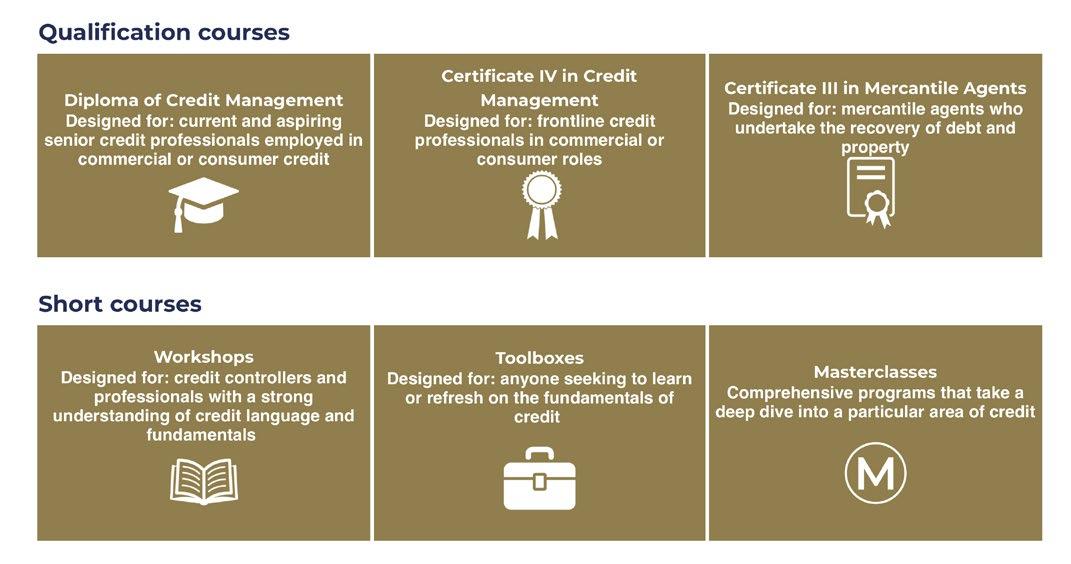
AICM provides a range of qualifications and short courses for beginners who are keen to advance in their careers, right through to more senior position holders wishing to refresh their knowledge, or test their skill with the coveted CCE, Certified Credit Executive status.
The new AICM member portal makes it very easy to check your points and start planning how you can achieve 100 points to qualify to sit the exam and achieve your Certified Credit Executive status.
There are many ways to earn your points whilst at the same time keeping up to date with changes in legislation, from the many seminars, workshops, certifications such as Cert IV and Diploma in Credit Management through to the free webinars which are frequently and readily available.
With our new website up and running, we also have new features such as the “Job Board” which is available at a fraction of the cost of other platforms and reaching the perfect audience whether you are wishing to advertise or to find your perfect role.
January 2023 | CREDIT MANAGEMENT IN AUSTRALIA 7 aicm from
the president
Julie McNamara MICM CCE National President
“We will support you through access to training, best practice, and updates as well as connection with fellow credit professionals. We will promote the value of your role to business and the broader economy.
”
Supercharge your credit career
What is nationally recognised training?
Nationally recognised training is any programme of training leading to vocational qualifications and credentials that are recognised across Australia. Nationally recognised training courses are listed on training.gov.au.
The term accredited training is used to differentiate a course within the Vocational Education and Training (VET) framework. It is also referred to as Nationally Recognised Training. In this context accredited training generally leads to a nationally recognised qualification or unit of competency which can only be issued by a Registered Training Organisation (RTO) like AICM.
Your education and training are so important when it comes to establishing your career. Thanks to registered training organisations (RTOs), TAFEs, and universities, we’re spoiled with options when it comes to education. But how do you tell which ones are the best for you? Just because an organisation has a great
reputation, it doesn’t mean the course is always up to scratch.
A great way to check the quality of the training or course you choose is to see if it’s part of the Australian Qualification Framework (AQF). The AQF is responsible for the national system of qualifications in Australia. This system covers higher education, vocational education, training, and schools.
The AQF is managed by the Australian Government Department of Education, Skills, and Employment. The AQF regularly convenes with ministers of education in each state to advise them on any AQF policy matters that need review.
If you’re looking for a nationally recognised qualification, make sure it’s AQF certified. This seal of approval by the AQF means that your course meets all the strict criteria laid out by the Government for RTOs and educational institutions across the country.
Decisions, decisions, decisions….
When deciding which study option is best for you, it can be easy to get overwhelmed. Should you go to University, TAFE or a provider like AICM? Everyone seems to have a different opinion on what the RIGHT answer is, but let’s look at some of the benefits for you and your career by studying within the vocational education training framework.
Certificates and Diplomas can be excellent ways to further your education and development – but how can you decide which qualification will best suit you? And what is the difference between them all? Many factors should be considered in your decision. These following key points may be of assistance in determining your decision.
pathways 8 CREDIT MANAGEMENT IN AUSTRALIA | January 2023 aicm
“Your education and training are so important when it comes to establishing your career. Thanks to registered training organisations (RTOs), TAFEs, and universities, we’re spoiled with options when it comes to education.”
Obtaining a qualification is advantageous for many reasons, including:
l Updating your skill level: With constantly changing fields, information, and technology, it can be beneficial to your career to make sure your skills are up-to-date

l Credibility: Seeking a qualification will demonstrate your determination and hard work, making you a more credible employee
l Aptitude: A qualification can provide you with the skills and knowledge you will need when working in the credit industry.
If you are keen to move up in your credit career, studying an extra qualification can open up new opportunities. But how do you work out which course to invest in? Which qualification is the one that will really help you get ahead?
1. Get advice
First, speak to your manager and people in your credit professional network about the career pathways that are open to you. Then, get advice on qualifications from people in the know. Anyone who is already working in a similar role is a great source for real-world insights. They can tell you which courses are highly regarded, and which ones truly teach you the skills for the job.
can, get in touch with employers or recruiters and ask them which qualification will make you stand out from the crowd.
These conversations are the perfect excuse to reach out and introduce yourself to people who work in the area you have your sights set on.
2. Size up the career outcomes
As you compare courses, look carefully for information on the career each one prepares you for. Does the course equip you for an entrylevel position, or something more senior?
In some professions, you need a specific qualification to be eligible for industry accreditation. For each course, check: The specified career outcomes
l The course units (they can give you an indication of the depth of skills and knowledge you will gain)
The best inside information can often come from the people who hire for these roles. If you
l The roles that real graduates of the course are typically working in.
pathways January 2023 | CREDIT MANAGEMENT IN AUSTRALIA 9 aicm
“If you are keen to move up in your credit career, studying an extra qualification can open up new opportunities.”
TIP: Find out about the job market and where the current skill shortages are. Training for a role that is in demand can mean better job prospects and more opportunities to progress your career.
3. Make sure it works for you
You need to be sure you will really absorb what is taught in your course so you can draw on the knowledge in interviews and apply the skills in the workplace. Set yourself up for success by studying a course that suits the way you want to learn and fits in with your lifestyle. For instance, if you don’t want to cut back on your work hours, a self-paced online course that you can schedule around work may be the best fit. Whichever course you choose, the one that’s
delivered in a way that works for you will give you the best chance to get ahead in your credit career.
The decision is now up to you
The good news is that deciding to invest in your career/future is never a bad decision. If you are ready to study with AICM and obtain a nationally recognised qualification, contact us for further information aicm@aicm.com.au we are here to help.
AICM offers training courses which change according to the needs of the credit industry and with its high level of flexibility enables it to provide practical programs that will provide you with valuable knowledge and skills no matter at what stage you are with your career.
AICM recent graduates
AICM would like to congratulate its recent graduates:
FNS30420 – Certificate III in Mercantile Agents

Tyler Drayton New South Wales
Kellie Treleaven South Australia
FNS40120 – Certificate IV in Credit Management
Amanda Barba New South Wales
CCSG Collect
All Metal (Australia)
Anne Le Prou Queensland Wilmar Trading (Australia)
FNS51520 – Diploma of Credit Management
Rebecca Lee Victoria McCain Foods
Zahid Khan Victoria Momentum Energy
Statement of Attainments
Renee Appleby NSW FNSINC311 – Work together in the financial services industry CCCG Group
Monisha Dhall NSW FNSCRD502 Manage factoring and invoice discounting arrangements

Joel Clarke VIC FNSCRD502 Manage factoring and invoice discounting arrangements
Karen Tiller SA FNSINC311 – Work together in the financial services industry
Waddle Servicing Pty Ltd
Waddle Servicing Pty Ltd
Gramac Solutions
pathways 10 CREDIT MANAGEMENT IN AUSTRALIA | January 2023 aicm
Classroom training calendar

pathways January 2023 | CREDIT MANAGEMENT IN AUSTRALIA 11 aicm
Date Type Topic/event name 7 February Identify and manage individuals experiencing hardship Core unit – Cert III 9 February Fundamentals of credit Toolbox 14 + 15 February Develop, implement and monitor policy and procedures Core unit – Diploma 16 February Understanding personal bankruptcy Workshop 21 February Utilise the legal process to recover outstanding debts Core unit – Cert IV 22 February How to trade with trusts Masterclass 23 February Understanding corporate Insolvency Workshop 7 March Collect debts Core unit – Cert III 9 March Collect with confidence Toolbox 14 + 15 March Manage people performance Elective unit – Diploma 20, 27 March + 17 April Credit toolbox bundle Bundle set 16 March Personal property securities Workshop 21 March Establish and maintain appropriate security Core unit – Cert IV 23 March Understanding financial hardship Workshop 18 + 19 April Legal compliance Core unit – Cert IV & Diploma
Avoid the latepayment drama and get paid faster
By Matt McFedries*
Month-end is often a muchmaligned time. Chasing down unpaid invoices and late payments takes time, can be unpleasant and can lead to frustration for both you and your customer.
And unpaid invoices become a bigger problem at this time of year. CreditorWatch’s data shows that Australian businesses, on average, experience a 20% drop in cash flow over January and February.
Whether you have an automated collections process or not, how you manage the key steps in the process can make all the difference in getting paid fast and the customer experience you deliver. To make your monthend run as smoothly as possible, there are five key areas you can address ahead of time to ensure you collect the cash owed to you faster and with a lot less drama.
Improving customer onboarding

Often businesses can be so eager to close a sale and get paid that they don’t take the time to onboard their new client properly. Having a clear process
and checks for onboarding new customers means you’ll only be onboarding those you’re confident will become good, paying customers. With a proper onboarding process, you can set expectations for the payment process, have clear payment terms, highlight available payment methods and, importantly, communicate late payment fees.
This is the time that using automated onboarding tools to streamline new customer credit applications is beneficial. The key action here – don’t supply any services until you and your customer are on the same page about payment expectations and you’re confident they’re in a strong position to pay.
Have a tight invoicing process
Once you’re happy your new customer is a good one and you’ve supplied the goods or services, it’s time to invoice. Before sending out an invoice, there are a few details you can check off to help avoid overdue payment. Often non-payment occurs because of minor details
Credit Management 12 CREDIT MANAGEMENT IN AUSTRALIA | January 2023
Matt McFedries
or disputes, rather than an inability to pay, which is what is often assumed. Prior to invoicing your customer make sure you run through the following:
l Do they require a PO number to be included on the invoice?
l Do you have the correct email address to send the invoice to?
l Are there any credits to be applied to the invoice?
l Has the customer raised any disputes?
l Does the due date align with the agreed payment terms?
If you’ve checked off these points, get that invoice sent out for payment.
Build a payment reminders workflow
Month-end shouldn’t be ad hoc. Having a tight payment reminders workflow, starting with a pre-due date reminder can make a significant difference to your cash flow and how quickly you get paid. If you have a workflow but don’t have a predue date reminder, add one in and see the difference it makes to the number of early payments you receive.
If you don’t have one already, lock in a follow up workflow that keeps both you and your customers on track. As a basic starting point, we recommend one reminder email ahead of payment being due, then three further reminder emails once the invoice is past due. If you still have received payment by this stage, then it’s likely time to escalate the issue.
If you have the tools, then
creating different workflows for different customer segments can also help you get paid faster. Creating different workflows recognises that some customers deliver you more value so might need to be treated slightly differently, some might have different payment terms, and some might be serial late payers so might need a more intensive reminders workflow.
Make that reminder phone call
This can make a significant difference to how quickly you get paid. A short, friendly reminder phone call can provide insight into why an invoice hasn’t been paid. Often, it’s not due to a lack of funds. This is how you can quickly identify issues with goods or services supplied, misalignment of payment terms, incorrect contact details or simply that the invoice was overlooked.
Picking up the phone and chasing invoice payment can be hard. For even the most confident person, before you dial that number it’s best to know what points you’re going to focus on and what you want from the call. Ideally you want confirmation of when full payment will be made. If that’s not possible, know ahead of time what you’ll accept in terms of part-payment or a payment plan.
Check over the customer history so you’re clear on all relevant details of the overdue invoice. It’s also good to know whether that customer is a frequent late payer, or whether this is an unusual payment pattern for them.
And remember, you’re not doing anything wrong. It’s good business practice to be on top of late payments.
Automate repetitive manual tasks
Automating your collections process is the best way to get paid faster, reduce the risk of human error and get time back to focus on high-value work. Whether you’re a team of one or twenty, accounts receivable automation is quick, easy and cost-effective. It also has the benefit of chasing all invoices, not just the high value ones. Automation is a step up from your standard accounting software such as Xero or MYOB. With an automated tool you’ll eliminate reliance on manually manipulated spreadsheets, your visibility over accounts receivable issues will increase and data can be accessed by simply viewing your accounts receivable dashboard.
*Matt McFedries Head of Product CreditorWatch Collect
T:
+64 21 804 555 (NZ)
E:
matt.mcfedries@creditorwatch.com.au
January 2023 | CREDIT MANAGEMENT IN AUSTRALIA 13
“Often businesses can be so eager to close a sale and get paid that they don’t take the time to onboard their new client properly.
”
How credit managers can help build organisational resilience in 2023
By Maha Awada*
From higher inflation to ongoing global supply chain constraints, compounding economic pressures are just one area of risk which credit managers and finance teams must face head-on in 2023.
With a looming global recession, the most resilient organisations will be those with teams coming together to openly discuss risks with clear accountability.
Finance teams are responsible for the financial health of any business, so credit managers have a role to play but must step up to the challenge.
Credit managers can’t manage risk alone. To lead through an increasingly challenging trade environment, a culture of risk management must exist right through
an organisation, but credit managers need to understand their role and take decisive action to protect a company’s balance sheet and manage the everthreatening volatility.
The evolving role of a credit manager

Results from Lockton’s CFO Strategic Risk Report (including 50 CFOs and senior finance leaders in Australia) revealed finance teams are becoming more responsible for the current approaches, and sentiments, to strategic risk management.
Perception of risk is constantly shifting. In 2022, 66% of CFOs changed their approach to risk management from Q1 to Q3 due to the ‘velocity of risk’ and its impact on business. Velocity of risk is a new layer
Risk Management 14 CREDIT MANAGEMENT IN AUSTRALIA | January 2023
Maha
Awada
“Finance teams are responsible for the financial health of any business, so credit managers have a role to play but must step up to the challenge.”
of risk management based on the speed at which a potential risk impacts a business and materialises.
So what risks do credit managers need to watch out for? Unsurprisingly, economic and supply chain risks are just two risks which ranked in the top five risks of most concern last year.
Although high-performing credit teams have been on the front-line safeguarding their
company against these risks, confidence has declined. Input cost risk preparedness declined by 16%. Confidence in managing economic and supply chain risks also declined.
How are the most successful credit management teams responding to these risks?
To adjust to the changed risk exposure, successful credit managers are taking a more
holistic and dynamic approach to better understand the effect risks have on each other and assessing the speed at which any cumulative influence might disrupt or threaten their business.
In this article, Lockton shares our recommended areas of focus based on how high-performing credit management peers are responding to supply chain, insolvency, interest rate and economic risks.

January 2023 | CREDIT MANAGEMENT IN AUSTRALIA 15
“Credit managers can’t manage risk alone. To lead through an increasingly challenging trade environment, a culture of risk management must exist right through an organisation, but credit managers need to understand their role and take decisive action”
Supply chain risks and response

1. Review business continuity procedures (BCP) Develop/update Business Continuity Plans to ensure they address the wider issues experienced over the last 36 months.
2. Expand supplier network and re-connect with suppliers Is there an increasing risk of customer/supplier default? Review supply chain networks and develop strong relationships with multiple suppliers/ customers.
3. Risk monitoring Establish process and procedures for the ongoing risk monitoring of suppliers and customers.
4. Trade Credit Insurance Trade Credit Insurance protects businesses by quickly reimbursing up to 90% of any domestic or export insured debt following insolvency or default, this may include pre-shipment credit risk for goods on delivery. It also provides monitoring and financial information about customers, knowledge of marketplaces, and debt collection services.
Success story:
l A Lockton Trade Credit Insurance client provides plastic containers with custom labels to their customers.
l While the policy covers invoices for goods sold, our client had to incur expenses prior to the sale of goods to produce custom named labels. Lockton negotiated 90 days pre-shipment cover for bespoke goods with the insurer.
l Subsequently, one of our client’s customers became insolvent 60 days prior to invoice. At this stage, thousands of containers with custom labels had been produced and expenses already spent.
l As the labels were at that point worthless, the client was able to claim this loss under the policy. The plastic itself, however, was able to be used for another customer
Risk Management 16 CREDIT MANAGEMENT IN AUSTRALIA | January 2023
“Trade Credit Insurance protects businesses by quickly reimbursing up to 90% of any domestic or export insured debt following insolvency or default, this may include pre-shipment credit risk for goods on delivery.”
and treated as salvage which reduced the claim value. The labels themselves accounted for approximately 20% of the total invoice value. Without the insurance this would have had to be written off as a bad debt.
Insolvency risks and
response
1. Credit risk management framework
Businesses extending credit terms should have a documented process to identify, monitor, and manage their accounts receivable exposure. This can be as sophisticated as the business requires.
2. Credit check customers
Credit checks should be conducted on all new customers and at least annually for all existing customers.
3. Debt collection
Take immediate action on overdue invoices and document correspondence. For timepoor businesses, it may be best to engage an external debt collector to ensure maximum recovery.
4. Personal property securities register
Where applicable, businesses should register their security interest on the National PPSR.
The registration protects interest in the goods or assets should the customer become insolvent or default.
Interest rates risks and response:
1. Better cash flow management
Seek to understand the nature of clients the business transacts with, and how increases in interest can impact their ability to pay on time.
2. Supply chain management
It is crucial for businesses to maintain appropriate stock levels to reduce inventory and unnecessary overhead costs. An efficient supply chain will support a stronger cash flow and improve risk mitigation.
3. Prepare for financial scrutiny
It is important to be prepared for greater financial scrutiny from financiers, credit insurers, suppliers, and other stakeholders.
Economic risks and response:
1. Prepare for an economic downturn
Prepare for the possibility of an economic downturn and its credit implications. If the economy slows, concerns about liquidity and credit will return and the number of companies entering administration will likely grow.
2. Review your credit risk management
Review your credit risk management (CRM) procedures and consider the viability of transferring risk to the insurance market to reduce the risks associated with customer nonpayment or default.
3. Outsource your collections
Regular reviews of your accounts receivable and collections process is critical in successfully recovering overdue invoices. Outsourcing is an affordable and effective option for time poor businesses.
Where to from here?
Credit managers will continue to face a disruptive, complex, and dynamic landscape. Rather than wait and react as risk events unfold, getting on the front foot is crucial. By taking action, credit managers can improve the resilience of a business and position themselves strongly in unpredictable, uncertain times.
The full Lockton CFO Strategic Risk Report is available for download now
*Maha Awada Trade Credit Expert, Lockton Companies
Australia
T: +61 466 559 904
E: Maha.Awada@lockton.com
Lockton is the world’s largest privately owned insurance broker and risk advisor with a specialist trade credit insurance practice.
January 2023 | CREDIT MANAGEMENT IN AUSTRALIA 17
“Prepare for the possibility of an economic downturn and its credit implications. If the economy slows, concerns about liquidity and credit will return and the number of companies entering administration will likely grow.”
How can a tiny price increase safeguard your business from a big cost?
By Kirk Cheesman MICM*
Everyone has seen the raft of price increases of late and, as everyday consumers, we just have to simply wear those costs.
We’ve all heard reasons such as Covid, international shipping, bad weather, Russia/Ukraine war, oil prices, inflation, rising interest rates, weak Aussie dollar – and so the list goes on.
Let’s focus on several examples regarding building costs in Australia…

Timber – up 20.6%
Steel – up 42.1%
Plumbing – up 11.5%
Tiles & Bricks – up 12.6%
Glass – up 14.0%
Insulation – up 14.0%
Paint – up 9.8%
Labour….!
These increases are where we are experiencing the ‘pain points’ in the building and construction industry, hence why we are seeing many large building companies collapse. They cannot fulfil their fixed price building contracts and subsequently they become insolvent.
Risk Management 18 CREDIT MANAGEMENT IN AUSTRALIA | January 2023
Kirk Cheesman MICM AugustSeptemberOctoberNovemberDecember July June May April March JanuaryFebruary Value Number Value Number 18M 16M 14M 12M 10M 8M 6M 4M 2M 0 100 89 78 67 56 44 33 22 11 0 NCI Claims – Number and Value (01-01-22 – 31-12-22)
Speaking to many Australian businesses, we understand that adding a small increase wouldn’t necessarily mean that they lose a client. But, how could a tiny price increase safeguard a business from bad debt?

The cost of Trade Credit Insurance is typically between 0.05% – 0.5% (depending on risk profile, risk share, scale and bad debt history). Heading into 2023, trade credit insurance is a must-have tool in protecting any business if one of its largest clients goes bust owing them money.
So, what do you get for this tiny cost? Along with a raft of benefits, trade credit insurance means that your business can:
1. Trade securely with new and existing clients
2. Take on new contracts that you otherwise might have rejected
3. Help improve and bolster credit management procedures
4. Give you a competitive advantage in the marketplace
5. Ensure you have the latest information on your customers
NCI claims have been at alltime lows since the Government introduced Covid relief measures, however this year we have seen the number of incoming claims steadily increase. December 2022
numbers are 152% greater than we recorded in January 2022.
Economic indicators are pointing towards an increase in insolvency numbers in 2023, and certainly our claim numbers throughout 2022 support that view.
Any business turning over more than $1.5m in sales that sells B2B and raises invoices for their products or services, should consider trade credit insurance for protection against nonpayment.
*Kirk Cheesman MICM Group Managing Director National Credit Insurance (Brokers) Pty Ltd E: kirk.cheesman@nci.com.au T: 1300 654 500 www.nci.com.au
January 2023 | CREDIT MANAGEMENT IN AUSTRALIA 19
“
Heading into 2023, trade credit insurance is a must-have tool in protecting any business if one of its largest clients goes bust owing them money.”
How to de-risk your supply chain and optimise the creditto-cash process
By Adrian Floate*
Many companies benefited from a decade of low-interest rates and the fiscal policy measures put in place to minimise the impacts of COVID-19. However, these measures eventually had to taper. Throughout 2022 the Reserve Bank of Australia (RBA) raised interest rates by 300 basis points, finishing with a 25-basis point hike to 3.10 per cent at the December meeting. Not only are businesses now dealing with the financial impacts of rising interest rates, but supply chain disruptions and persistent inflation indicate that difficult trading conditions may be ahead.
According to KPMG’s recent CEO survey, 86 per cent of executives think there will be a recession in the next year. With all the macroeconomic factors
that make up this environment, financial decision-makers must equip themselves with the tools they need to minimise supplychain risk, effectively manage credit, and strengthen cash flow. Importantly, these tools shouldn’t complicate your business. They should provide the foundations to make stronger commercial decisions and outpace competitors in the next economic cycle.
Start by addressing invoicing problems to improve credit control processes
According to Xero, 48 per cent of invoices issued by SMEs in 2021 were paid late These late payments result in cash flow pressure, increase the risk of negative cash flow and can adversely impact a

Risk Management 20 CREDIT MANAGEMENT IN AUSTRALIA | January 2023
Adrian Floate
“
... supply chain disruptions and persistent inflation indicate that difficult trading conditions may be ahead.”
company’s balance sheet. To address late payments, finance and accounting teams need strong systems which should improve a company’s credit management. They should also address the root causes of late payments – invoicing mistakes, ineffective risk management and disconnected payment processes – to accelerate the credit-to-cash process.
Incorrect or unclear invoicing
information, such as issue dates, due dates, payment terms, and payment methods, can make it more difficult for customers to pay on time. When a customer receives an invoice, there shouldn’t be any guesswork. They should be able to click a link to view the invoice, choose payment options, manage their payment times, and quickly batch-pay invoices. Similarly, sending invoices with little or
no itemisation can also cause confusion. Setting up product and service categories in your accounting system ensures all invoices are correctly itemised, so the customer knows exactly what they’re paying for, how to pay and when payment is due. Timing is another important factor when sending invoices and following up late payments. If you wait too long to send an invoice, key information such

January 2023 | CREDIT MANAGEMENT IN AUSTRALIA 21
“
With all the macroeconomic factors that make up this environment, financial decision-makers must equip themselves with the tools they need to minimise supply-chain risk, effectively manage credit, and strengthen cash flow.”
as discounts, line items, and other specifics can be forgotten. These delays and ambiguities create extra work for your staff and your customers when clarifications are required. Similarly, sending invoices via post or email is difficult to track. With 89 per cent of invoices in Australia still paper-based or PDF, your company can get paid faster by using connected delivery methods such as e-invoicing, coupled with a Pay by Link feature, which allows customers to conveniently view and pay invoices through a secure link, wherever they are.
No matter what challenges you face with invoicing and chasing late payments, making the payment process as efficient as possible with automated digital tools will boost cash flow across the supply chain and streamline credit management. Importantly, these tools and features provide the data that credit management professionals need to assess credit risk in real-time. This results in more timely decisionmaking so that adjustments can be made before unsustainable levels of ageing and bad debt accumulate.
Automated digital tools can strengthen credit management
According to McKinsey, up to 46 per cent of current organisational tasks in Australia could be automated by 2030 And for those businesses that opt to automate their payment processes, it will boost cash flow while cutting up to 20 hours a week of invoicing and payments administration. Before jumping into the process of automating single tasks, companies should identify automated options that will transform end-to-end processes.

By integrating digital tools that resolve various financial and accounting challenges, from inefficient credit management processes to limited payment options, companies can ensure they maximise their return on investment (ROI) from their chosen solution. In finance, this ROI is centred around shifting financial risk and solutions that provide a single source of data between all parties involved in a transaction.
With a solution in place, for example, an e-invoice could be generated and sent directly to a customer’s accounting and ERP system so that payment can be made, associated accounting and reporting tasks completed at both ends, and credit risk data updated in realtime.
It’s about making all roles across a company’s finance and accounting functions work together seamlessly and more efficiently, which not only delivers operational and
Risk Management 22 CREDIT MANAGEMENT IN AUSTRALIA | January 2023
“
No matter what challenges you face with invoicing and chasing late payments, making the payment process as efficient as possible with automated digital tools will boost cash flow across the supply chain and streamline credit management.”
strategic benefits internally, but benefits suppliers and vendors too.
Seamless data integration gives all parties in a transaction everything they need to pay on time and complete the associated tasks efficiently. As a result, credit management professionals gain more time for strategic work as administrative burdens are lifted through automation and smart features that make it easier for businesses to pay on time. Further, having the tools to trade without over-extending credit reduces risk without compromising a customer’s ability to buy what they need. In short, automated digital tools make credit management easier and more efficient. When these tools are coupled with external financing facilities, transaction risks shift to a third party.
Decoupling payments and lending strengthen cash flow
One of the key benefits of automated digital payment tools is the capacity to offer customers a range of credit and payment options without increasing credit risk. In these cases, a third party (most likely the company which is delivering your chosen automated digital tools) sits in the middle of the transaction, offering flexible trade terms via a variety of on-demand financing solutions that benefit both buyer and seller. The seller can transact with more customers who may not have previously met the company’s credit risk criteria, and its cash flow is boosted through
the wide range of available payment options. Similarly, buyers are able to space out their payments more, meaning they have the ability to place larger orders and better manage their cash flow.
Using a solution that decouples payments and lending shifts risk to the thirdparty provider, which builds confidence and trust without impacting your balance sheet. Not only does this strengthen cash flow but having an automated platform to manage the risk of each transaction empowers credit professionals to focus on higher-value tasks. Companies that gain the bandwidth to focus on strategic initiatives rather than simply surviving turbulent times often perform better in the long term as they are well-positioned to outpace their competitors throughout the recovery and next economic cycle.
Weather current and future cash flow risks with one connected platform
With supply chain disruptions and inflation persisting and the likelihood of a recession
growing, taking steps to gain control over your cash flow will be critical in preparing for and weathering the year ahead. Automated digital tools that shift the risk in each transaction to a third party provide the systems and processes that credit management professionals need to efficiently and effectively manage credit risk. With these tools, it becomes easier for buyers and suppliers to trade, more time is available for highvalue work, and real-time data drives stronger commercial decision-making and proactive credit management.
“Time in the market beats timing the market” is a common phrase for those investing in markets, and the same is true when companies invest in automated digital tools. The longer these tools are implemented in a company, the more powerful the benefits become – operationally, strategically and financially.
*Adrian
Managing Director Spenda E: adrian.floate@spenda.co www.spenda.co
January 2023 | CREDIT MANAGEMENT IN AUSTRALIA 23
Floate
“Companies that gain the bandwidth to focus on strategic initiatives rather than simply surviving turbulent times often perform better in the long term as they are well-positioned to outpace their competitors throughout the recovery and next economic cycle.”
Update from across the ditch: How Kiwi business fared
By Monika Lacey MICM*
For many New Zealanders, 2022 has been a rollercoaster. With consistent increases to the Official Cash Rate, deployed to help combat record high inflation and climbing interest rates, many felt the impact on their wallets and livelihoods. (NZ OCR increased 400bps since October 2021 – the most aggressive tightening by the RBNZ since 1999)

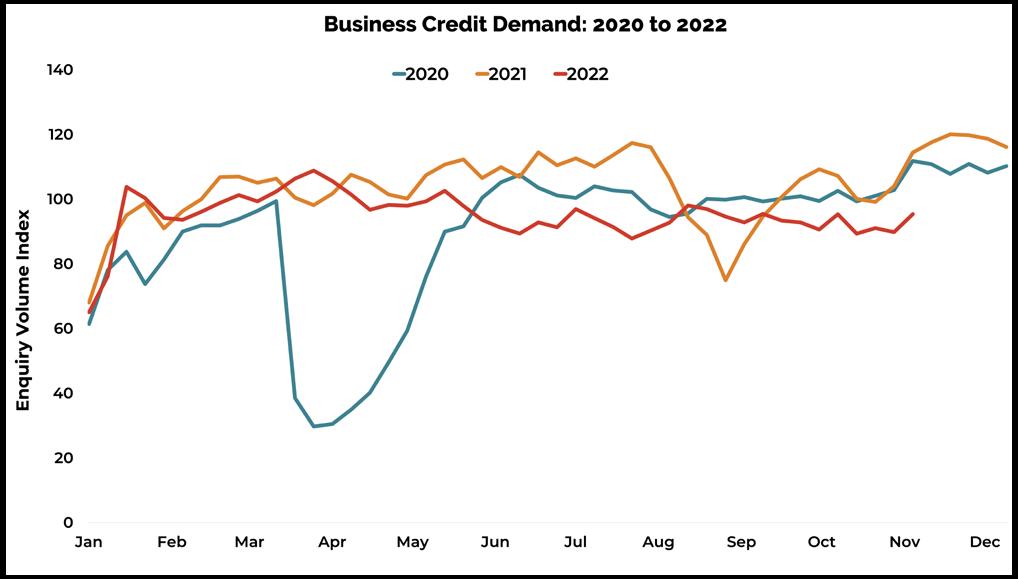
Understandably, cracks began to emerge for consumer and business confidence, resulting in credit demand contracting and arrears rising.
For local businesses, they’ve had to grapple with a downturn in consumer confidence and spending while simultaneously trying to stay afloat.
The flow on effects of the COVID-19 pandemic and
Economic Update 24 CREDIT MANAGEMENT IN AUSTRALIA | January 2023
Monika Lacey MICM
subsequent lockdowns as well as broader global issues like the war in Ukraine has seen surging inflation and supply chain issues.
Due to these circumstances, business credit demand is materially down across the country compared to 2021, with several sectors including retail trade, property and healthcare particularly affected.
Additionally, the average business credit score for new applications is down to 756 in October 2022, as we observe a shift in profile towards a slightly higher credit risk.
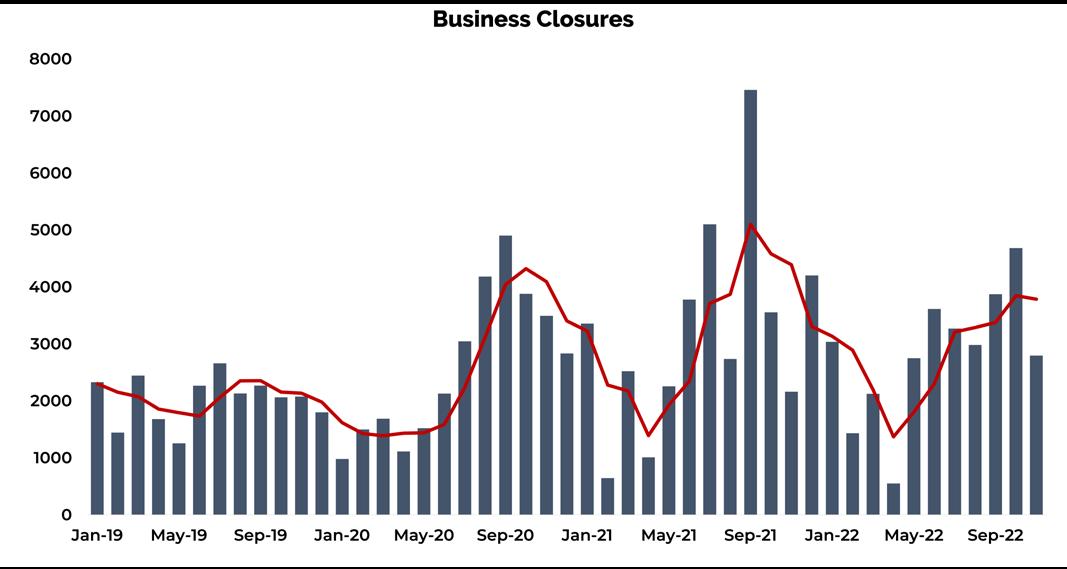
Overall company closures rose 5%, compared to a year ago, mirroring the fall in new company registrations while business credit defaults were up 4% year-on-year in November 2022.
The construction industry is one sector in particular significantly impacted by these circumstances.
Throughout the year, local construction companies faced material shortages, rising costs and the downturn in the housing market, which placed significant pressure on the sector.
In 2022, 25% of all company
liquidations were from the construction sector and we’ve seen company credit defaults begin to rise, reaching the highest default rates since the final quarter of 2019.
Additionally, New Zealand’s retail sector is feeling the heat, with credit defaults increasing 5% month-on-month in November 2022.
With consumers keeping a closer eye on discretionary spending, many business owners will likely be concerned about the upcoming quiet period of January/February.
With the majority of the country taking a well-deserved break over the summer, lots of businesses will be banking on spending in the lead up to Christmas to provide a buffer for the quieter early months of the year.
On the flip side, the tourism and hospitality sector have
January 2023 | CREDIT MANAGEMENT IN AUSTRALIA 25
“
Throughout the year, local construction companies faced material shortages, rising costs and the downturn in the housing market, which placed significant pressure on the sector.”
bounced back following significant downturn during the last two years due to travel restrictions introduced to combat the spread of COVID-19.
Looking towards 2023, there’s a degree of uncertainty. At the end of 2021, we saw predictions of tough economic
times ahead – predictions that well and truly came home to roost.
With more increases to the Official Cash Rate by the Reserve Bank anticipated early next year, the spectre of further interest rate jumps hangs over many Kiwi households.
With recession on the horizon, only time will tell how consumers – and businesses – react to the economic climate.

 *Monika Lacey MICM Chief Operating Officer Centrix Credit Bureau of New Zealand www.centrix.co.nz
Economic Update 26 CREDIT MANAGEMENT IN AUSTRALIA | January 2023
Sector Credit Demand Credit Defaults Avg Credit Score Construction +7% +4% 767 Hospitality +2% -3% 749 Retail Trade -17% +5% 778 Tourism +5% -6% 746 Property/Rental -5% -5% 823
Australia’s unfair contract terms regime changes significantly
By Prue Greenfield MICM and Eliza-Jayne Sinclair*
We have heard a lot about changes to unfair contract terms in the last couple of years.
The ‘unfair contract terms’ laws (as set out in the Australian Consumer Law (ACL) establish a regime whereby a term in a consumer or small business contract will be void if the term is unfair and the contract is a standard form contract.
Australia’s Unfair Contract Terms regime (UCT) has now been significantly expanded in respect of ‘small businesses’. The changes were passed by Parliament on 28 October 2022 and will come into effect on 9 November 2023.
The changes are monumental in terms of the penalties and scope of what is considered an “unfair” term. This will have significant impacts on many businesses – both in terms of the time it will take to review and amend contracts but also the consequences for not doing so.
What is a standard form contract?
A standard form contract is a contract which has been prepared by one party (Proposer) to an agreement and is presented to the other party (Other Party) on a “take it or leave it” basis with that party having limited or little opportunity to negotiate or alter the terms.
To determine whether a contract is a standard form contract, a court will consider all relevant matters including:
l Does the Proposer have all or most of the bargaining power?
l Did the Proposer prepare the contract, prior to any discussion relating to the particular transaction?
l Was the Other Party required to either accept or reject the terms, in their proposed form?
l Was the Other Party given an opportunity to negotiate the terms?
l Do the terms of the contract
take into account the specific circumstances of the parties and the transaction?
What is an unfair term?
For a term to be “unfair” it must:
l cause a significant imbalance in the parties’ rights and obligations;
l not be reasonably necessary to protect the legitimate interests of the party advantaged by the term; and
l cause a financial or other detriment (such as delay) to a small business if it were relied on.
In deciding whether a term is unfair, a court will consider how transparent the term is, as well as the overall rights and obligations of each party under the contract.
A term will be transparent if it is:
l in plain language;
l legible;
l presented clearly; and
l readily available to any part affected by the term
January 2023 | CREDIT MANAGEMENT IN AUSTRALIA 27 Legal
The following types of provisions in small business loan contracts are likely to be unfair:
l entire agreement’ clauses;
l broad indemnification clauses that do not exclude losses and liabilities arising from the fraud, negligence or wilful misconduct of the lender or its officers, employees, contractors, agents or receivers;
l material adverse change default clauses and broad cross-default clauses;
l non-monetary defaults that do not provide a reasonable remedy period or adopt a materiality threshold; and
l broad unilateral variation clauses, including those that do not provide sufficient prior notice of the variations (particularly where the customer does not have a right to terminate without penalty).
Who does it apply to?
Presently under the ACL, the UCT Regime applies to a small business where:
l at least one party to the contract employs fewer than 20 persons; and
l the upfront price payable under the contract does not
From (Old Penalty)
Corporations the greater of:
l $10 million
exceed $300,000, or $1 million if the contract is for more than 12 months.
This will now be expanded to:
l at least one party to the contract employs fewer than 100 persons; and
l the small business has an annual turnover of less than $10,000,000
In the case of a consumer contract, the UCT Regime applies to contracts for sale or supply to an individual whose interest is predominantly for personal, domestic or household use/ consumption.
What has changed?
The key changes brought in by the amendments to the Competition and Consumer Act 2010 (Cth) (CCA) are:
l wider scope of application – the UCT laws apply to significantly more businesses and transactions;
l wider scope of consequences resulting from a breach –
l 3 x the obtained benefit from the contravention; or
l 10% of Australian turnover during the breach period.
Individuals:
l $500,000
the Courts have been given significantly more broad and far-reaching powers; and
l higher penalties – a five-fold increase
Unfair contract terms: Consequences of breach
From 9 November 2023 UCTs will be illegal as opposed to just unenforceable, so now is the time to review your contracts as they will take a while to review and amend. Importantly, many of these additional penalties can be sought at any time within 6 years from the date the contract term was declared to be an UCT.
Similar conceptual amendments have also been made to the Australian Securities and Investments Commission Act 2001 (ASIC Act) regarding UCTs in contracts for financial products, although the penalty regime is different.
Many of these orders will
To (New Penalty)
Corporations the greater of:
l $50 million
l 3 x the “reasonably attributable” benefit obtained from the conduct; or
l 30% of adjusted turnover during the breach turnover period (including that of related bodies in corporate group).
Individuals:
l $2.5 million
Legal 28 CREDIT MANAGEMENT IN AUSTRALIA | January 2023
“
In the case of a consumer contract, the UCT Regime applies to contracts for sale or supply to an individual whose interest is predominantly for personal, domestic or household use/consumption.”
also bind a person affected by the order, even if that person was NOT a party to the original proceedings (eg, a subsequent purchaser of the business).
Why the change?
The ongoing emphasis on consumer and small-business protection. The ACCC has commented that the purpose of the change to the UCT regime is to improve small business and consumer confidence when entering into or renewing standard form contracts in the future, and that they will not be taken advantage of.

The change is important to protect consumers and small businesses where there may be an imbalance in bargaining power.
Recent decisions on unfair terms
Australian Competition and Consumer Commission v Fujifilm Business Innovation
Australia Pty Ltd [2022] FCA
928
On 12 August 2022, the Federal Court declared that a number of provisions of the standard small business software/services and rental/lease contracts of Fujifilm (previously Fuji Xerox) are “unfair contract terms” under the unfair contract terms legislation. The court declared the following types of terms to be unfair:
l Automatic renewal terms – these were terms where neither party has given notice to end the contract within the specified period prior to term expiry, resulting in holding
over periods terminable on 90 days’ notice.
l Disproportionate termination terms – this included those that allowed Fujifilm to terminate for any breach by the customer (even if a remedy period is provided), where the customer does not have a reciprocal termination right.
l Termination payment terms – this pertained to terms that required the customer to pay an early termination payout determined by Fujifilm, based on arrears, the future rental charges for the balance of the term (discounted by a discount rate), and break costs.
l Liability limitation terms – this included those that allowed
January 2023 | CREDIT MANAGEMENT IN AUSTRALIA 29
Fujifilm to limit its losses to those permitted under the Australian Consumer Law.
l Non-reciprocal obligation terms – these terms included assignment provisions that prohibit the customer from assigning its rights without Fujifilm’s consent but allowed Fujifilm to assign its rights without the customer’s consent.
l End of contract period terms – this pertained to terms applying to finance leases, where title to the equipment does not transfer to the customer after it pays the residual value for the equipment following term expiry.
l Unilateral variation terms – these terms would allow Fujifilm to vary service and other charges unilaterally, even if notice is given to the customer.
l Extraneous documents terms – this included those under which the customer is required to comply with other documents not set out in the contract and which can be amended without notice to the customer.
l Irrevocable offer terms –these terms included those that bind the customer to an irrevocable offer for an indefinite time, in circumstances under where Fujifilm are under no
corresponding obligation to accept the offer within a particular time.
l Unfair payment terms – this would allow Fujifilm to invoice the customer for software licence fees irrespective of delivery by Fujifilm.
The Court’s orders included (among other things) for Fujifilm to send letters to affected customers notifying them of the terms found to be unfair under their contracts, in the form set out in the Court’s Order. The form of the letter includes for the words “without any deduction or set off” to be deleted from the specified clauses under those contracts.
Lobux Pty Ltd v Willshaun Pty Ltd (2022) FCA 204
On 11 March 2022, the Federal Court declared that a number of clauses in the agreement entered into between the parties were “unfair contract terms” under the unfair contract terms legislation and are void. There were a number of terms that were considered but in particular whether the agreement provided an “overabundance of security”.
It was found that clause 12, being a charging clause which gave Lobux an unregistered mortgage and entitlement to lodge a caveat over property owned by the customer, was an unfair term. The issue was
with the wording “any land, realty or other assets capable of being charged” and the clause also charged all rights, title and interests in all of the customer’s assets which are” capable of being charged” either “now or in the future”. The clause did not specify a particular property and also gave Lobux a charge over property that the customer may acquire in the future The clause was found to be excessive and was not reasonably necessary in order to protect Lobux’s legitimate interests.
Review your contracts
Given the significant impact of these decisions and the expansion of the unfair contracts regime with the definition of what constitutes a “small business” and the introduction of the penalty regime, we recommend that businesses that supply goods, services or finance to small business customers (or that are small business suppliers themselves) review their standard form contracts to make sure that they comply with the UCT laws.
*Prue Greenfield MICM Principal Lawyer – Litigation and Dispute Resolution Macpherson Kelley
*Eliza-Jayne Sinclair Lawyer – Trade and Commercial Macpherson Kelley
Legal 30 CREDIT MANAGEMENT IN AUSTRALIA | January 2023
“...we recommend that businesses that supply goods, services or finance to small business customers (or that are small business suppliers themselves) review their standard form contracts to make sure that they comply with the UCT laws. ”
AUTOMATED COLLECTIONS MANAGEMENT DOES THE HEAVY LIFTING TO SIMPLIFY AR CHALLENGES
Traditional industry procedures do not work in the 21st century
Based in Sydney, Whale Logistics is an international freight forwarding company that provides supply chain services for importers and exporters worldwide. Freight forwarding companies have clung to paper-based processes much longer than other industries. In 2018, Whale Logistics decided to fully embrace digitalisation and use artificial intelligence (AI) to not only improve its customer experience but the backend processes as well. An organisation that is heavily dependent on cashflow control, overcoming challenges such as inefficient paper-based processes, lack of visibility over Accounts Receivable (AR) processes and performance, and poor workload management became a high-priority for the business.
SOLUTION
Collections management becomes the focal point for optimisation
The company set out to find an automation solution that would yield visibility with strong reporting features to assist in understanding and reducing business costs while also accommodating rapid growth. Esker’s Collections Management was the perfect fit to remove friction caused by the manual AR. With Esker’s guidance and professionalism, Whale Logistics managed a seamless transition to automating its collections management. The removal of manual, paper-based tasks has brought clarity and calm to the workday. The AR Officer can now see exactly how many collection calls need to be made every day and is able to work through that list quickly and efficiently due to the prioritised call list based on predefined rules and AI-driven customer risk analysis. Esker’s customer portal makes all pertinent information available 24/7 to Whale Logistics customers. What’s more, improved communications has reduced both response times and payment friction.
RESULTS
Esker’s Collections Management solution outperforms Whale Logistics’ expectations
§ Collection Effectiveness Index (CEI) and Days Sales Outstanding (DSO) improved by 30%
§ Overdue ratio reduced by 35%
§ Customer issues resolved within 24 hours

§ Over 90% accuracy in collections forecast
§ 100% customer satisfaction
The Esker dashboards provide an executive summary with vital information for all stakeholders to understand our AR performance as well as workflows.”
Elaine Huang
Financial Controller, Whale Logistics Esker’s solution provides our staff with a sense of achievement; they are also now able to connect with customers on a human scale rather than just discussing tasks.”
Elaine Huang Financial Controller, Whale Logistics
Seven steps to a pain-free tech implementation
Credit departments around Australia are implementing new digital tools to streamline their work. Here are some tips for taking the stress out of this process.
By Alexandra Cain*
Implementing new automation technologies can deliver credit managers and the businesses for which they work many benefits. But it’s essential to properly manage these projects to take the pain out of them. Here are some steps to walk through to make sure your next tech project is a success.
credit manager Rowan McClarty MICM CCE recommends spelling out to senior management the problems in the company the investment will solve.

Step
1: Establish
the business case
When it comes to establishing a business case to implement automation in credit, Fleetcare

These include addressing inefficiencies in the credit area and across the business, reducing lengthy turnaround times for credit application assessments and eliminating human errors and credit decisions made outside policy. New tech should also improve the customer experience.
“Have a thorough understanding of these issues and document them. By doing that, you can highlight the return on investment automation will achieve by addressing these deficiencies,” McClarty says.
In the business case, outline
software solutions that will solve your clearly-articulated problems and the pros and cons of different technologies. “That way, management can see straight away how any deficiencies in the business will be addressed and the benefits of each system you’re considering,” says McClarty.
Also be mindful of the impact any potential solutions will have on other areas of the company. “Document these points and ensure any changes in your area will not be detrimental to
Customer Engagement & Technology 32 CREDIT MANAGEMENT IN AUSTRALIA | January 2023
Rowan McClarty MICM CCE
Alexandra Cain
“
In the business case, outline software solutions that will solve your clearlyarticulated problems and the pros and cons of different technologies.”
other departments. Engage stakeholders in areas where there might be obstacles to see how you can overcome them and document those in the business case,” he says.
The business case should recommend one of the solutions you have put forward and detail how it will be implemented. So outline why you think it’s the best solution to solve your issues and why it’s a good fit for the organisation.
Step 2: Set clear goals
Whale Logistics started exploring new technology and automation
options in 2018. This culminated in the implementation of three new software solutions in its accounts receivable site. These are a credit application automation system, a credit card payment portal and a collection management system.

Financial controller Elaine Huang says from the outset, it was important to establish clear goals for the project. These were efficiency, visibility and scalability.

“We wanted to be ready for future growth and ensure we could maintain knowledge within the organisation, despite
any staff turnover or any other disruption. We also wanted to increase productivity by removing manual work and
January 2023 | CREDIT MANAGEMENT IN AUSTRALIA 33
Elaine Huang
“Implementing new automation technologies can deliver credit managers and the businesses for which they work many benefits. But it’s essential to properly manage these projects to take the pain out of them.”
supporting management to make data-driven decisions,” she says.

For Maria Schandl MICM CCE, national credit manager for Stramit, system fit, speed of the roll out, ability to report with functional dashboards, ability to link complex relationships of customers including parent/child across various company entities, automating low value tasks and having a live feed back to the ERP in a timely manner are priorities in her projects.
“We also wanted to add fields to the customer master including our ability to determine risk based on our trade history, insurance and limits. This helps guide our collections and establish forward cash projections with a reduced amount of guesswork. The cost of amendments and whether they would add to the scope and increase our implementation period, as well as supplier relationships and the ability to extract data, were also priorities. Also be aware of your risks in a project. Sometimes the risk is
your ability to give the project the time it needs,” she says.
Step 3: Appreciate what you’re working with
The planning stage should include a thorough review of existing credit processes. This helps to understand the current situation and form a clear picture of what the company wants the system to look like in the future. Schandl says part of this is to reassess tasks.
“Decide whether the project is designed to completely remove a task through full automation, thus achieving a headcount reduction. Alternatively, you may want the ability to give time back to the team to focus on valueadded tasks such as customer engagement, reconciliation of accounts and annual reviews. If your team is currently AR-focused and will be moving to becoming more of a credit management function, include this in your business case as one of the project outcomes,” she recommends.
Step 4: Seek advice from stake-holders
It’s worth employing formal change management to bring clients and staff along your automation journey.
Huang recommends engaging clients early on to let them know what’s changing and why. “We teamed up with our
account managers and handpicked one or two clients to take part in testing,” she says.
Once you have engaged clients, it’s important to take on board their feedback. For instance, Whale Logistics’ clients said they wanted the ability to view statements in different currencies. The vendor was happy to build this into the implementation.
Also involve your staff. “Ask them to volunteer to be on the project team because you need people to test the new system until they break it. It should be an exciting time for them to be engaged and be part of the solution. So, listen to their suggestions on what is and is not working and how to improve the system,” says Schandl.
Step 5: Identify and address pain points
In any tech implementation, it’s important to play to your strengths and outsource or delegate tasks for which the business does not already have expertise. For instance, Whale Logistics recognised early on tech project management was not a core strength.
“So we leveraged our vendors’ skills as they have extensive project management capability. We relied on them to guide us through the project to make sure we met relevant milestones,” says Huang.
Customer Engagement & Technology 34 CREDIT MANAGEMENT IN AUSTRALIA | January 2023
Maria Schandl MICM CCE
“Also be aware of your risks in a project. Sometimes the risk is your ability to give the project the time it needs.”
Step 6: Make sure the system integrates with existing software

This can be tricky if existing systems don’t have open API capabilities, says Huang.
“We needed to work very closely with the vendors to redesign processes. Before this, spend time planning and reviewing the statement of work. Also allow a lot of time for testing. These things combined meant we were able to find our way around the project,” she explains.
Step 7: Evaluate your efforts
There’s no point embarking on a tech project if you’re not going to measure its benefits. This starts with setting clear goals and clearly articulating return-oninvestment (ROI) and pay-back periods.
“Use detailed financial modelling to outline a number of different scenarios with a range of assumptions to give you the ability to compare results 12 or 18 months down the track with ROI expectations,” says Huang.
It’s also important to
measure non-financial benefits such as customer and employee satisfaction when doing an evaluation. Any tech implementation is complex and detail-driven. What’s important is to take your time, involve your stakeholders and align the project to strategic goals. That’s the best way to set the implementation up for success and deliver a credit management system that’s the envy of your peers.
*Alexandra Cain E: Ali@alexandracain.com alexandracain.com
January 2023 | CREDIT MANAGEMENT IN AUSTRALIA 35
“We needed to work very closely with the vendors to redesign processes. Before this, spend time planning and reviewing the statement of work. Also allow a lot of time for testing.”
The age of ‘Digital Self-Serve’ enables trade credit sales channels
 By Miriana Lowrie MICM*
Your customer’s decisions –what products to buy, services to use or providers to engage with – are heavily influenced by the ratio of pleasure versus pain in their user experience.
As technology advances, companies have increasingly turned to multichannel strategies to reach potential customers, who can also be credit borrowers.
But, in trying to reach as many customers as possible, how focussed have we been on the customer’s experience in doing so? Customer pain, customer pleasure, or a mix of both (depending on which sales channels they choose to engage)?
Open for credit
Suppose you have already been successful in your holistic omnichannel approach (which combines a variety of lending channels into a seamless customer-centric journey). In that case, the next evolution in your strategy is customer convenience.
It has got to be ridiculously easy for customers to do business with you, wherever they are and whenever they want to purchase.
We want to optimise convenience and reduce friction wherever possible.
Omnichannel credit management
What is omnichannel?
Omnichannel provides a seamless, continuous customer experience across any device or location from which a customer wishes to engage. As a result, its not just about one engagement at one point-in-time but about every experience your customer has with your brand at every single touchpoint across all your channels.
Omnichannel is no longer an aspiration but a key requirement to remain competitive as a credit provider. Companies can strengthen their foothold and gain new business opportunities (without delay) by creating continuity between any device or location where customers choose to engage.
Customer Engagement & Technology 36 CREDIT MANAGEMENT IN AUSTRALIA | January 2023
Miriana Lowrie MICM
Are you a multichannel lender or an omnichannel lender?
Multichannels use multiple outlets to communicate and work with customers.
You probably have a Sales Team who nurtures sales through their activity, which would be quite different from the Website Team, who are tasked with website traffic, retention and conversions.
Each team focuses on their channel. However, what may not be considered thoroughly with this approach is the customer.
On the other hand, in the case of omnichannel those different channels are linked together.
Multichannel puts channels at the core of the strategy, while
omnichannel puts the customer at the centre, where customer experience is effortless and seamless.
For example, while they may start a credit application with one channel (say, online) they can easily move across to another channel (say, in-store) without having to repeat themselves each time.
According to Salesforce 76% of customers expect consistent interactions across departments and 54% say it generally feels like sales, service, and

marketing teams don’t share information.
That’s not holistic; therefore, it’s not omnichannel.
A multichannel experience can be like talking to multiple people at a company – each with their own style, personality and understanding of the task.
Meanwhile, an omnichannel approach is more akin to dealing with one highly-capable individual who effortlessly handles all your needs making it super convenient and easy for you!
January 2023 | CREDIT MANAGEMENT IN AUSTRALIA 37
“Omnichannel is no longer an aspiration but a key requirement to remain competitive as a credit provider.”
76%
of customers expect consistent interactions across departments.
Ultimately, omnichannel strategies aim to deliver a consistently great customer experience no matter how your customer may engage. Businesses can use automation to quickly provide a holistic customer journey and quality engagement with their consumers across all channels.

Four sales channels

– all open for business
Let’s explore four sales channels that are perfect for business-to-
54%
business lenders to maximise opportunities for convenient credit:
Channel 1 – Field Sales Reps
Field Sales Reps help you reach potential customers more efficiently by bringing your products to their doorstep. That’s old hat.
What’s new is the Sales Rep can offer credit there and then, the Customer is approved for credit there and then and the credit derived from this
say it generally feels like sales, service, and marketing teams don’t share information.
transaction is tracked and attributed to the Sales Rep.
ASK YOURSELF:
Do you have a way to monitor credit approvals from your Sales Rep channels so you can attribute the sale to them?
Channel 2 – Website, Mobile Friendly Digital Application
Everyone has a smartphone. And everyone comes to your business with a consumer-ready
Customer Engagement & Technology 38 CREDIT MANAGEMENT IN AUSTRALIA | January 2023
According to Salesforce
...
mindset. An online form is not enough.
Naturally, customers have increased their digital interactions with brands exponentially over the last few years. First, we all entered distancing and restrictions, so digital was all we had. Then, we got used to it. Now, we have come to expect it: digital first, service fast.
Your customer shouldn’t have to wait while the page loads. Or have to enter a mobile-nasty form while trying to zoom to get the cursor into an undersized field. Or be instructed to download a PDF, only to upload it again. A mobile friendly digital application allows borrowers to quickly fill out a digital application while they bop on to another Taylor Swift song.
ASK YOURSELF:
To what extent is your credit application digitised, or is it just a paper form that has been popped online?
Channel 3 – On Location, In-store or at Point of Sale
If you are paying a sum for that bricks and mortar store, it’s worth ensuring that you are set up and fully equipped for trade credit lending. And not only from the BNPL tech mob, but also from your business as a credit provider to those businesses that buy from you. This increases efficiency and reduces turnaround time drastically, making it easier for lenders to acquire potential customers quickly.
Each trade credit prospect approval is tracked at the store level so you can see from where all your credit sales are coming.
ASK YOURSELF:
Do you have an easy way for customers who are in your stores to easily apply for and gain access to trade credit?
Channel 4 – Call Centres
Call centres are another important channel for acquiring new credit customers. Be it inbound or outbound.
And while you may think this is only for the Baby Boomers, Gen X’ers and Gen Y’s, the data is showing a growth in Gen Z’s using call centres.
Why? Well, they are more likely than any other generation to utilise click-to-call buttons on their smartphones after searching for a business online or on maps. Plus, while they may be interacting with your chatbot or social feed online, they are also dialling you.
By having a trained team on-hand to turn prospects into approved borrowers, lenders can open an entirely new channel for credit approvals.
ASK YOURSELF:
Do you have a group of call-centre operators
who can guide credit applications over the phone?
Think: Holistic Customer Journey
Engaging potential customers is the focus of multichannel lending, while omnichannel builds on that to also consider a holistic customer experience across all channels. Multichannel seeks to spread awareness through a wide array of channels while omnichannel focuses on fostering consistency and reliability for already- engaged individuals.
Both strategies are essential in delivering an optimal borrower experience today.
By creating unified communication channels with borrowers through tailored experiences, the customer has a far superior experience and the supplier maximises opportunities to lend.
The same customer that may talk to a Sales Representative one day and be applying for credit from your website the next. How does this experience feel?
Is it jarring where the customer needs to join the dots, or is it seamless where information and process is unified across all customer journeys regardless of channel? With more channels of
January 2023 | CREDIT MANAGEMENT IN AUSTRALIA 39
“
A mobile friendly digital application allows borrowers to quickly fill out a digital application while they bop on to another Taylor Swift song.”
engagement being provided to customers, they can choose how they want their needs met in whichever method suits them best.
Omnichannel lending puts the customer at its core, shifting focus away from individual channels and towards creating a unified experience.
ASK YOURSELF: When considering all your channels, what NPS score are you attaining for your credit approval process?
The goal is to remove any boundaries arising when customers switch from one channel to another; ultimately creating an issue-free journey for them along their borrowing and purchase path. By doing so, businesses can ensure they
offer convenient access points no matter how audiences engage with them.
With a well-rounded approach like this, businesses can increase their reach while providing seamless experiences for every interaction in all channels.
You can’t improve it if you don’t measure it. Let’s talk about customer satisfaction and the Net Promoter Score® (NPS).
NPS is a metric used in customer experience programs. NPS scores are measured with a single-question survey and reported with a number from the range -100 to +100, a higher score is desirable. It measures customer perception based on one simple question:
How likely is it that you would recommend [Insert Organisation/Product/ Service] to a friend or colleague?
Respondents give a rating between 0 (not at all likely) and 10 (extremely likely) and, depending on their response, customers fall into one of 3 categories: Promoters, Passives or Detractors.
ASK YOURSELF: How are you measuring the satisfaction of your customers as it relates to onboarding with your business? And what are you doing with those ‘detractor’ and ‘passive’ scores?

Convenience as a strategic play
Your goal should be to provide access to credit in an easily accessible way that meets customer expectations quickly with minimal effort required. Don’t we all expect prompt service, information that’s easy to access, plenty of self-service options, and fast technology that continuously works? Yes!
Reducing friction along their journey will help achieve this (and using automation will de-risk it for you).
But, ultimately, if buyers have too many obstacles during their credit borrowing or purchasing process then revenue expansion will be impacted by frustrated customers who move on elsewhere for simpler solutions.
As customer expectations evolve, businesses must be flexible. And as customer NPS data flows in, businesses must adapt for customers to have the best experiences possible.
Digital makes self-service easy. Automation makes it sing. Realising the full promise of omnichannel demands an outside-in approach that’s hyperfocused on customers and agile enough to adjust to change rapidly.
And yet enterprises too often look to hard code the solution. This won’t work.
Yes, omnichannel requires distributed endpoints. And yes, those then need to connect back to the main system, be it for customer relationship management (CRM) or data analysis.
Customer Engagement & Technology 40 CREDIT MANAGEMENT IN AUSTRALIA | January 2023
But hard-coding the solution will cost a fortune, take time to implement and will probably need to change on the day you finally hit ‘go-live’!
Hello, my little
API friend
APIs are essential tools that allow different programs and services to work together seamlessly. And API connectivity does it for you.
API-led connectivity represents one of the most potent tools available; it provides businesses with stages along their journey toward omnichannel, allowing access to valuable data that increases your competitive advantage and customer satisfaction.
It brings together all those endpoints of people, processes and systems. With its oneto-many and many-to-one structure, API-led connectivity allows lightweight connections
between systems that can be added and changed frequently.
ASK YOURSELF: Are you using APIs to power-up your primary tech-stack?
Get future-ready today using API’s
Power up your existing techstack, with ease. You can use your existing tech stack, whatever it may be, and add a layer of intelligent digital functionality to open your sales channels simply by using APIs.
In the case of 1Centre, our omnichannel solution can easily integrate with API friendly systems to provide you with future-ready omnichannel smarts.
According to Salesforce 69% of customers want businesses to offer new ways to get access to products and services.

As customer needs shift, so must your business. By understanding their changing requirements, you can identify pain points that need elimination and be proactive about improving their journey with you – this holistic approach will benefit all involved!

Look at how you can make life easier for them while optimising operational efficiency for yourselves too.
*Miriana Lowrie MICM CEO 1Centre www.1centre.com
January 2023 | CREDIT MANAGEMENT IN AUSTRALIA 41
of customers want businesses to offer new ways of getting access (to products & services).
69%
According to Salesforce ...
The evolution of embedded intelligence in collections
By Davinder Oberoi*
There have been many fundamental changes in Collections over the past decade and these advances have provided Collection professionals with more data than ever before. In fact, the volume of data has increased by more than 50 times in the last decade. It now includes first-party data, third-party data, and a wide range of customer behaviour data in general.
With an increased ability to develop and access unique algorithms and analytics, the sector can utilise this rich pool of information to increase personalisation, sharpen competitive edges, and deliver a service which puts the customers’ needs at the heart.
Embedded intelligence is where we use this data to drive outcomes, and it is fast becoming a core part of all default management strategies. It has evolved from logicpowered decisioning to Machine Learning (ML) boosted decisions, and most recently to insightsbased decisioning derived from Artificial Intelligence (AI). In the collections industry, embedded intelligence has the power to offer organisations a clear insight into their customers’ needs by using the vast pool of data at their disposal. Proper use of this technology can enable a more personalised and streamlined service to customers, vital to gain a competitive advantage in today’s marketplace.
To properly understand the details on how this can
be uniquely beneficial to the collections industry, we must delve a little deeper into what embedded intelligence is and where it is headed, as well as how it uses data sets and its interaction with customer expectations.
What is the future of Embedded Intelligence?
Today, every default management solution relies on some form of logic-powered decisioning, with business rules and predictive modelling tools being used to manually build score models that drive outcomes. This traditional approach has become inefficient as customer data has exploded and manual analytical processes are unable to keep up. Furthermore, models become outdated quickly in an ever-changing ecosystem with increasingly stringent regulatory requirements. As such, the next phase of evolution will see AI and ML at the heart of their strategy as they offer greater agility and fewer restrictions.
At CGI, we anticipate there will be a continued move toward AI

Customer Engagement & Technology 42 CREDIT MANAGEMENT IN AUSTRALIA | January 2023
Davinder Oberoi
and ML to undertake insightsbased decisioning, specifically focusing on:
l Utilising ML-based models to predict customer behaviour and enable data driven decisions
l Enabling conversational AI to automate agent conversations for common scenarios
l Leveraging unsupervised AI to capture key metrics and mine the mountain of data to identify relevant patterns
l Undertaking dynamic decisioning by allowing AI to access historical data to optimise decision trees, automatically. Exploiting the potential of AI and ML, as in the examples above, will influence business metrics in a way not previously possible. This will give employees time back to focus on more pressing customer needs, while providing an immediate and accurate service to customers many of whom are demanding greater self-service capabilities.
The use of data sets
As we know, logic-based decisioning is rules-based, monolithic, and acts on limited data. As such, it is far less efficient than ML insight-boosted decisions and requires ongoing manual adjustments. As things stand implementing changes in response to evolving business demands can take months or even years. A luxury most collections organisations simply do not have.
AI and ML on the other hand are both highly agile and have the capabilities to shorten change cycles to a matter of weeks. They
do this by analysing data patterns and then proactively acting on them. As decisions are made, both AI and ML models learn and adjust automatically to drive desired outcomes.
ML enables us to better understand customer behaviour and develop persona-based collection strategies, which could help in identifying customers who are more likely to pay. One other example where ML is in use is in tackling the plummeting contact rates due to mobile phones allowing users to identify and ignore calls. Machine Learning can help identify what is the optimal communication strategy for each customer. It’s the perfect tool to find meaningful and actionable insights to create non-linear strategies for success – in this case determining the best channel and the best time to reach out to a particular customer. For one of our clients, by implementing a ML model trained on 4 months of data, they were able to improve their rightparty contact success rate from 1% to 80%.
Evolving customer expectations
Unsurprisingly, the industry finds itself needing to evolve and adapt to match the ever-shifting expectations of its customers. With the rapid increase and development of technology, the consumer mindset expects an
on-demand and efficient service. Often this expectation is for high quality self-service. They want their needs to be anticipated and met smoothly with precise professionalism.
AI and ML can help to build an optimum communication channel strategy, providing a hyper-personalised customer journey. Tools like conversational AI can be leveraged with virtual agents to provide support via human-like voice and chat conversations. Furthermore, its ability to make autonomous decisions can have an incredibly positive impact on your performance optimisation.
ML need not require a large investment in upgrading or deploying a new platform. What is needed is data, a viable and clear goal, and a team that understands the domain.
Ultimately, embedded intelligence helps you know your customers better and enables you to provide an experience that is personalised, seamless, and real-time. As the future unfolds, AI and ML are best suited to meet these growing needs and to support the shifting landscape of the industry. All the while maintaining customer privacy, reducing operational costs and driving business agility.
January 2023 | CREDIT MANAGEMENT IN AUSTRALIA 43
*Davinder Oberoi Director Banking and Financial Services CGI www.cgi.com/au
“Embedded intelligence is where we use this data to drive outcomes, and it is fast becoming a core part of all default management strategies.”
Rethinking receivables How to use AI technology to retain talent, secure revenue & realise your digital potential
By Eric Maisonhaute MICM*
About this article
Rethinking Receivables: How to use AI technology to retain talent, secure revenue & realise your digital potential examines the most significant obstacles (both internally and externally) preventing today’s finance leaders and Accounts Receivable (AR) teams from maximising their impact on the invoice-to-cash (I2C) process and organisation. The white paper further explores some of the most effective strategies and technologies for accelerating cash collection and revenue recognition.
Key takeaways
l In response to current disruptions and future uncertainties, finance leaders have a valuable opportunity to reimagine AR as a strategic, proactive department rather than a reactive, back-office cost centre.
l To achieve this type of transformation, it is necessary to leverage technology that empowers this mindset shift without disrupting team cohesion, compliance or the overall customer experience.
l Automation solutions powered by AI are ideal for modern finance challenges thanks to their ability to streamline every step of the I2C process, provide data-driven insights and support smarter growth.

Introduction
Process inefficiencies. Delayed payments. Customer frictions. For many finance leaders and AR departments, certain pain points are simply an unavoidable cost of doing business –until COVID-19, that is. The pandemic not only exacerbated
Customer Engagement & Technology 44 CREDIT MANAGEMENT IN AUSTRALIA | January 2023
Eric Maisonhaute MICM
the effects of these seemingly “normal” challenges, it also exposed just how incompatible they are with the ability to maintain a healthy cashflow and resilient business model. Now, years removed from the acute phase of the pandemic yet still far from stability, finance leaders have a valuable opportunity to make the kind of proactive and transformative changes that will enable their business to withstand even the fiercest future disruptions.
Technology as a driver of change
To support smarter growth strategies, finance leaders must aim to optimise the I2C processes that impact company cashflow, operating capital and customer relationships. Doing so requires the use of digital solutions (often powered by AI technology) designed to:

l Empower AR teams by transitioning from reactive to proactive customer service
l Inform financial decisions with real-time analytics and advanced reporting
l Connect siloed processes and enhance interdepartment collaboration
l Deliver greater value to the whole business vs. being simply a back-office function
Mindset is everything
Technology, leadership, and talent level all matter when pursuing financial transformation. However, the true linchpin for success is mindset. Finance leaders and AR departments cannot truly build a more sustainable future for their companies without making the shift from a functional, administrative mindset to a strategic one.
Current financial challenges
Ironically, many of the mounting pressures that have spurred the need to rethink receivables are the very things prohibiting the necessary digital investments to address them. While some pandemic-related challenges proved to be shortterm aberrations, most have lingered like smoke from a still-smoldering fire — clouding the plans, priorities and perspectives of today’s finance leaders. These include:
External Increasing inflation
Over 40% of CFOs cite inflation as their company’s biggest external risk2. Why? Not only does it broadly increase business costs, its duration and trajectory can be opaque – making it harder to project and strategise long-term finance decisions.
January 2023 | CREDIT MANAGEMENT IN AUSTRALIA 45
78% According to 2022 Gartner research, “Seventy-eight percent of CFOs plan to maintain or increase enterprise-wide digital investments in the next two years1.”
Supply chain issues
Despite being nearly three years postpandemic, many finance leaders still find themselves wading through murky supply chain waters. Internal contingency measures help, but even the best in the business can’t control the uncontrollable.
Geopolitical concerns
The Russia–Ukraine war. Talks of a looming global recession. Climate change. Even the most blueskied optimist would admit that the future looks a little worse for wear. For finance leaders, it’s all more fuel added to the fires of uncertainty.
Internal Talent retention
The peak of The Great Resignation may be in the rearview but make no mistake: Things like unfulfilling, repetitive tasks are still forcing finance talent out the door. This not only interferes with AR continuity, but also a company’s ability to stay competitive.
Digitalisation & innovation
Isn’t the proliferation of technology a good thing for finance leaders? Ultimately, yes, but the burden of maintaining digital literacy and effective change management in an era of extended disruption can seem, at best, overwhelming and, at worst, impossible.
Increase in bad debt
The fallout from the pandemic resulted in bad debt increasing by 26%3. While the current landscape is not as dire, concerns among finance leaders are still elevated due to the maintained prevalence of delinquent customers on top of all future “unknowns.”
Building a smarter, stronger digital foundation
Many AR teams were already on a path to digital transformation prior to the pandemic. But it begs the question: Were these investments really built for the current (and future) landscape? Furthermore, if initiatives were made in the immediate aftermath of COVID, did the strategy go beyond short-term survival? What are the alternatives?
Automation’s lasting impact
The challenges may be enduring and vast, but by controlling what can be controlled (e.g., automating manual steps within the I2C process), finance leaders and AR departments can make significant headway in removing the obstacles that prevent timely cash collection and revenue securement.
This is precisely what today’s automation solutions provide: A way to optimise AR productivity, efficiency and visibility while helping to build a stronger and smarter digital

Customer Engagement & Technology 46 CREDIT MANAGEMENT IN AUSTRALIA | January 2023
business foundation capable of withstanding any unexpected disaster.
Firms that rely on manual AR processes vs. automation take 67% more time to follow up on overdue payments4.
AI: the great enabler
67%
Despite the ubiquitous use of AI in our daily lives, many companies have barely scratched the surface in terms of leveraging the full potential of AI. In fact, a recent study found that companies identified as “AI Achievers” (i.e., those who heavily prioritise and champion AI investments) enjoy a 50% greater revenue growth on average5
Therein lies another significant advantage: Leading automation solutions are often powered by AI technology. For AR teams, this means having a highly reliable and highly intelligent digital assistant helping to carry out all sorts of strategic functions, such as:
Data extraction
From extracting and routing remittances to optimising data recognition claims originating from debits, AI data capture and verification capabilities improve process efficiency while facilitating collaboration.
Predictive analysis
AI solutions also make intelligent suggestions (e.g., which collection calls to prioritise, where payments without remittances should be allocated, etc.) –freeing up time for your team and cashflow for your business.
Financial oversight
AI capabilities such as payment behaviour analysis provide collections teams with better visibility into payment predictions and deeper insights that aid in risk assessment and strategy adjustments.
Yeah but … is AR automation right for my company?
As proven and powerful as AI technology is, no one thing can solve every issue plaguing today’s AR teams. But one surefire way of reducing risk and quelling the fears of failure is seeking a solution
that not only uses the latest in AI and automation capabilities, but also promotes adaptability to your unique way of doing business.
LOOK FOR SOLUTIONS THAT:
Play nice with ERPs:
Added complexity is the last thing finance leaders need when incorporating new applications alongside existing ones. The most effective automation solutions integrate with any ERP system via APIs and/or flat files – even in diverse multiERP environments.
Ensure global compliance
For businesses operating in a decentralised model or internationally, it’s especially important to find a solution that supports multiple languages, sites and currencies, as well as regulatory e-invoicing compliance and global payment coverage.
Aren’t one-size-fits-all
Whether you want to automate the entire I2C process or one element at a time, the solution should offer the flexibility to do so on your own terms. The same applies to processes outside of AR – the more robust the capabilities, the easier digital expansion becomes.
I2C processes
l Credit management
l Invoice delivery
l Payment
l Claims & deductions
l Cash application
l Collections management
Other business processes
l Supplier management
l Procurement
l Accounts payable
l Order management
l Customer inquiry management ...
l … and much more
Rethinking receivables: 4 areas of I2C to prioritise
The I2C process includes all the activities performed by users or systems from the moment an invoice is created until the moment customer payment is reconciled. Translation: There’s a lot involved. But thanks to AIdriven solutions, receivables teams can get themselves out of the “dark ages” of Excel spreadsheets, manual verifications, limited visibility and human error. Most importantly, it affords key stakeholders the opportunity to adopt a more
January 2023 | CREDIT MANAGEMENT IN AUSTRALIA 47
modern mindset that aligns with AR’s robust business impact. This includes the ability to:
1. Rethink processes
Is your DSO longer than the industry average? Are partial payments a normal occurrence? Do your team members lack engagement and/or struggle to stay on top of late-payment reminders? These are all tell-tale signs that your AR processes are not operating at a high level, leaving your company vulnerable to cashflow issues in the future. It’s no wonder that one-third of AR leaders say their team manages too many manual processes at a time6
The beauty of digital solutions is their ability to address many of the process bottlenecks contributing to inefficiency – but it goes far beyond speed and accuracy. Filling in manual I2C gaps enables a collective reimagining of how the AR team spends its time, how cash is collected, and how the whole department delivers value to the organisation.
Instead of ...
l Employees spending time on repetitive, low-value tasks (e.g., evaluating customer credit criteria, matching payments, claim resolution, etc.)
l Talent looking for more fulfilling work elsewhere
l AR remaining a backoffice afterthought with an imperceptible impact on revenue and growth
2. Rethink collaboration
Automation enables ...
l Employees to focus on activities that truly impact business growth (e.g., customer relationship building, optimising cashflow, etc.)
l Higher employee satisfaction and retention rates
l AR to deliver transformational value to the organisation via optimised revenue and cashflow
A football team can have the best players, smartest coaches, and most cutting-edge equipment and
facilities, but without good communication, the performance on the field will inevitably suffer. Similarly, collaboration within AR and across other departments (e.g., sales, IT, customer service, etc.) is one of the most overlooked yet all-important factors in minimising cashflow risk and maximising the value to the business.
Facilitating a transparent, cross-functional line of communication requires ease of information sharing so that all stakeholders have access to the right data at the right time and the Best Possible Decision can be made at every stage of the I2C process. Failure to do so can breed distrust and resentment between teams and departments and, even worse, potentially result in significant financial losses.
Automation fits the bill in terms of a smart, simple AR solution for improving communication and helping finance become a true business partner for sales and the organisation. Below are just a sample of some of the areas of AR where digital, collab-friendly capabilities play an impactful role.
Collaborate anytime, anywhere Many automation solutions enable out-of-office sales reps to easily request credit checks via their mobile device – helping secure revenue and support the business.
Easily start and save conversations
Users can also start a conversation with co-workers to get input, share suggestions, etc., while ensuring it is all 100% traceable for future audit purposes.
Support multi-solution scenarios
Examples include creating a deduction for investigation directly from the cash app process or triggering a priority collection call when an order is blocked for overdue payment.
Customer Engagement & Technology 48 CREDIT MANAGEMENT IN AUSTRALIA | January 2023
“One significant change since implementing Esker’s solution is that the Banking Team is under much less pressure to complete payment allocations each day. They have more time to focus on their other duties and learn new tasks because Esker is saving us hours every day. They enjoy using Esker and the benefits it has provided.”
– PAMELA ROCHESTER, OPERATIONAL TEAM LEADER, LAMINEX
3. Rethink analytics
Data and analytics have long been a part of AR teams and processes – particularly for CFOs. But with finance leaders rapidly pivoting from transactional number crunchers to more strategic value-drivers and insight-providers, there is an increased demand for more advanced data-driven business planning and forecasting tools. Case in point: A recent study surveying CFOs found that 82% of respondents indicated that “advanced data analytics technologies and tools” were a top priority7. Once again, AR automation solutions fit the mould in terms of helping finance leaders and their teams reimagine the role data plays in their organisation – utilising AI and other cognitive capabilities to marry the day-to-day (making informed, data-driven decisions) with the long-term (anticipating risk and forecasting via predictions).
Performance monitoring
No major metric goes unnoticed thanks to custom dashboards to track:

l DSO
l BPDSO
l CEI
l Disputes
l Root-cause analysis
l Team goals
l Collections forecast by 30-60 days
Customer insights
Dig into data that provides direct insight into customer activities and patterns:
l Business history
l Payer performances
l Credit risk management
January 2023 | CREDIT MANAGEMENT IN AUSTRALIA 49
“We’ve certainly utilised the Esker solution more than we ever thought we would. It certainly goes well beyond a credit management tool and gives our branches a lot more information to effectively run their branches and support other branches as well. Esker has united our disjointed branches – giving stakeholders the visibility into all vital information.”
– DAVID BAKER, ACCOUNTS RECEIVABLE SUPERVISOR, FREO GROUP
time,
Predictive analytics
Get a more accurate AR roadmap thanks to forward-looking analytics such as:
l Payment predictions
l Collections forecast
4. Rethink customer experience
The role of customer experience (CX) doesn’t necessarily have to be tied to finance and AR teams within the organisation but make no mistake: Their impact on building loyalty among existing customers and differentiating the company from competitors is undeniable.

Let customers pay you in their preferred method
Fewer obstacles equals happier customers. Digital solutions give customers the choice of using cards or direct debit payment options, while also offering early payment discounts and auto-pay.
But that doesn’t mean AR departments have been furnaces of ambition when it comes to putting CX front and centre in their priorities. While many have automated areas of their processes which does ultimately benefit customers, they often fail to address some of the core pains that today’s customers want alleviated. Perhaps predictably, this is where AI-driven automation comes into the equation. Digital solutions enable finance leaders and their teams to think holistically about receivables – improving CX at every stage while reducing DSO and increasing retention rates in the process. For example, with AR automation, you can:
Put transparency and data accessibility on a pedestal Automation solutions are synced with convenient online portal where customers easily track invoices, make payments, view account statements and more – preventing contentious disputes.
Become a company that’s easy to do business with
Whether it’s faster customer onboarding via digital credit applications or timely payment allocation, AR automation makes doing business together a far more enjoyable experience.
Customer Engagement & Technology 50 CREDIT MANAGEMENT IN AUSTRALIA | January 2023
“Esker’s Collections Management solution accurately forecasts 90% of the
helping me to work that into cashflow modelling.”
– ELAINE HUANG, FINANCIAL CONTROLLER, WHALE LOGISTICS (AUSTRALIA) PTY LTD
Impact on stakeholders
All of this rethinking is not merely a mental exercise. The end result is tangible benefits that span across
WITHIN FINANCE DEPARTMENT
Chief Financial Officer
For CFOs, there’s a lot to love in AR automation. Not only does it help retain top talent and simplify cash forecasting, it facilitates the one thing on top of every CFO’s priority list: securing revenue to support new growth and investments.
AR Managers/Leaders
Digital finance solutions empower AR leaders to be true partners to their business by optimising virtually every area of AR that impacts cash collection (e.g., process efficiency, team motivation, collaboration, analytics, etc.).
AR team members
By eliminating low-value tasks from the equation, AR team members can be more strategic in their efforts to collect cash and maintain customer relationships – benefiting the business but also their job satisfaction.
Conclusion
The digital transformation of AR is nothing new. It was going on prior to the pandemic and will continue for years to come. But one thing is for sure: This isn’t a time to dip your toes into the pool. The world is rapidly changing and when the next major “sink or swim” disruption occurs, the future of many companies will depend on just how efficiently AR can secure revenue, just how content and collaborative your team of talent is, and just how satisfied your current crop of customers are with their experience.
With AR automation, companies don’t get a magic bullet or a cure-all or even a guarantee. What they do get is a proven, pragmatic and foundation-strong solution, powered by the latest in AI technology, that’s built to speed up collections, empower employees, improve customer experience
finance and outside of the business and have a direct impact on real people, teams and even global causes.
OUTSIDE OF THE BUSINES
Customers
Rocky customer relationships get a whole lot smoother when automation is involved thanks to its promotion of immediate and accurate payment allocation, easy access to data, and transparent terms and conditions from the start.
Suppliers
Cash coming in affects cash going out. That’s why optimising the AR process makes life a whole lot easier on your customers’ AP teams as well. With cashflow secured on the AR side, suppliers are ensured faster payment.
Planet
When it comes to environmental sustainability, every bit counts. Automating the AR process equates to using less paper for invoicing, dunning letters and account statements while also supporting WFH models (i.e., reducing travel requirements).
and, ultimately, nurture business growth in the harshest of conditions.
And remember: If you can change your mind, you can change your future.
*Eric Maisonhaute MICM Director – Accounts Receivable Solutions, Esker Australia
T: 02 8596 5126, M: 0479 089 668
E: eric.maisonhaute@esker.com.au, www.esker.com.au
SOURCES
The following sources were used in this article:
1) Gartner, Inc. press release. May 25, 2022.
Pty Ltd
2) CNBC CFO Council Q2 Survey, June 9, 2022. Rosenbaum, Eric.
3) Gartner, Inc. Press release. July 7, 2021.
4) B2B Payments Innovation Readiness Playbook, December 2020. A PYMNTS and American Express collaboration. ‘
5) The art of AI maturity: Advancing from practice to performance. 2022. Accenture.
6) Transforming B2B Markets with Innovative Accounts Receivable Solutions: A Benchmarking Study. 2020. WBR Insights and Esker.
7) Gartner, Inc. press release. November 12, 2020.
January 2023 | CREDIT MANAGEMENT IN AUSTRALIA 51
“With 24/7 access to their invoices, account statements, credit and messages, Esker’s portal gives our customers the autonomy and convenience they expect while saving the Customer Support team’s time. Customers can now log into their account and get access to all pertinent information themselves.”
– CAMERON IRONS, DIRECTOR OF FINANCE, AS COLOUR
Trends shaping the future of finance
By Rick Kilambi*
As finance processes continue to be the lever that runs various business functions, CFOs hold a huge responsibility to ensure their teams drive strategic tangible change under their leadership. They are expected to take the reins and perform multifaceted roles where along with number crunching and managing budgets, they have to implement new transformation initiatives to improve operational efficiency and decision-making.
However, the changing economic scenario has pushed enterprises to rethink their ways of working. From adopting new operating models, technological software, and employee training, CFOs need to align all their efforts to create an agile finance function to achieve maximum productivity.
At the recent Gartner’s 2022 CFO and Finance Executive Conference 1000+ financial leaders and executives from
around the world came together to talk about various trends that will impact the future of finance by 2030. As you read through this article, I have identified a couple of trends that I believe will play an exponential role in changing the face of finance.

The future of finance is autonomous
With seismic shifts in technology, finance units will also undergo transformational changes. One such change driver would be autonomous finance. Autonomous finance can be defined as the ability to run dayto-day finance functions with minimal human intervention. It is driven by technologies such as the cloud, robotic process automation (RPA), advanced analytics, natural language processing (NLP), and AI. Nearly two-thirds of the CFOs Gartner surveyed on this topic picture autonomous finance to be a reality within six years.
Customer Engagement & Technology 52 CREDIT MANAGEMENT IN AUSTRALIA | January 2023
Rick Kilambi
“
From adopting new operating models, technological software, and employee training, CFOs need to align all their efforts to create an agile finance function to achieve maximum productivity.”
Despite witnessing hurdles in strategising, implementing, and adopting autonomous finance, CFOs with long-sightedness have already started laying the stepping stone to ensure their teams can get comfortable with utilising the best of AI & ML to boost their everyday tasks. Autonomous finance will enable financial professionals to have a competitive advantage and enhance employee productivity and customer experience. It utilises a combination of RPA and AI to help financial leaders take smarter decisions with improved financial accuracy and automate mundane financial tasks.
Building an AI-forward finance organisation
It is imperative that leaders understand that the fight between humans vs machines is over with new-age technologies.
I say so since organisations need to combine human effort with best-in-class tools to reap maximum results. Organisations that combine human skills and machines create scalable finance functions that can handle complex problems, and empower business leaders to make better and faster decisions. Post the pandemic, enterprises understand the gap and need for AI and require it more than ever to solve both older and newer challenges. Gartner lists down a detailed framework that organisations can follow to ensure faster adoption of AI.
AI is a game-changer for the finance function, starting from upskilling employees,
encouraging a data-driven approach to problemsolving, using technological tools to make decisions, and improving workflows for smooth functioning. It is important for CFOs to take steps to bring AI into their domain to mould finance professionals to play a larger role in contributing to business processes and business functioning.
Value creation as a CFO
With CFOs adorning multiple hats today, it becomes important that they increase their expertise and deploy tools and resources to ensure they bring more value to the company. Experts at the Gartner conference suggest three top capabilities – infrastructure, reporting and analytics, and insight generation which leaders need to build on. Given the manual ways of working, it is critical that CFOs relook at their operating models to automate processes and break silos of working. There is a dire need to incorporate analytics to derive insights and create easy-access dashboards for easy access and complete visibility. With an increasing focus on digital transformation, adopting appropriate tools for
financial teams to optimise resources, uncover new revenue opportunities, and improve cash flow. CFOs need to play a pivotal role in driving techdriven change to build customer advocacy, thought-through workflows and take impactful business decisions.
Towards an impactful future
With the world of finance expected to witness dynamic changes, finance leaders and professionals need to tighten their seatbelts for a much more competitive landscape. The combination of the right training, technology, and operating model needs to be intertwined in the right proportion to ensure businesses continue to stay on top. With the above-mentioned financial services technology trends at the core of systems, businesses should well be able to enhance their consumer intelligence capability and consistently monitor important financial metrics to ensure strategic decision making.
*Rick Kilambi Manager, Solution Engineering HighRadius E: rick.kilambi@highradius.com www.highradius.com
January 2023 | CREDIT MANAGEMENT IN AUSTRALIA 53
“Organisations that combine human skills and machines create scalable finance functions that can handle complex problems, and empower business leaders to make better and faster decisions.”
How labour market shortages are affecting Australian organisations
By Brooke Lawrence MICM*
We’re currently in the midst of the tightest labour market that most working Australians have experienced. With unemployment at its lowest rate in nearly 50 years, employers across all sectors are struggling to find, hire and retain quality staff.

Following two years of unprecedented disruption, resourcing is the most significant challenge most organisations face. The National Skills Commission’s Recruitment Experiences and Outlook Survey found that 58% of employers were recruiting in October 2022 (up 13% compared with 2021), with the recruitment difficulty rate (the proportion of employers who are actively recruiting but having trouble finding staff) increasing by 16% to 70%.
What does the tight labour market mean for employers?
In this challenging operating environment, organisations are finding:
l Their recruitment efforts are resulting in employees who are less skilled, yet cost more, which means fewer resources for their budget.
l Retaining quality employees is increasingly difficult, even with expensive staff retention programs.
l Employers are spending more than ever on training and upskilling workers due to the shallow hiring pool and high employee turnover.
l A lack of experienced employees with strong skill sets is negatively impacting customer service delivery.
Customer Engagement & Technology 54 CREDIT MANAGEMENT IN AUSTRALIA | January 2023
Brooke Lawrence MICM
“Following two years of unprecedented disruption, resourcing is the most significant challenge most organisations face.”
These factors combined put significant pressure on leaders facing serious skill and resourcing gaps. On top of this, the way customers interact with the companies they deal with has shifted significantly in the last couple of years.
Against this evolving landscape, some common themes and trends are evident:
1 Self-service and Automation options are everywhere
Customers – particularly debtors – prefer to self-serve using digital channels including
web chat, two-way SMS, and self-service portals. The use of historically popular customer service channels like letters and even telephone calls has decreased significantly in recent times.
From an organisational perspective, self-service and automation offer compelling

cost savings and efficiency gains – but only if they’re executed correctly. A broken omnichannel service experience will still usually result in a frustrated phone call from a dissatisfied customer.
Another outcome of the shift to self-service and automation is that the customer calls that
January 2023 | CREDIT MANAGEMENT IN AUSTRALIA 55
“Employers are spending more than ever on training and upskilling workers due to the shallow hiring pool and high employee turnover.”
companies receive are generally more complex. In today’s recoveries space, hardship cases extend far beyond financial hardship to include issues like domestic violence and self-harm. These calls must be managed by highly skilled resources with the experience and training to handle complex conversations with confidence.
2 Organisations are changing their approach to offshoring
The pandemic caused many Australian companies to move their voice channels back onshore to mitigate risk. With contact centres in countries like India and the Philippines unable to guarantee internet coverage to support staff to work from home during lockdowns, an Australian-based workforce suddenly became more attractive.
Today, companies recognise that the cost savings associated with an offshore workforce don’t necessarily outweigh the benefits of keeping contact centres onshore, however, labour shortages are forcing them to focus on staffing their core functions and critical tasks in-house while identifying non-
core roles that can be effectively offshored.
Organisations are exploring offshoring options like management of digital communication channels including web chat, twoway SMS and email, while largely keeping voice services in Australia. The offshoring countries of choice are also changing post-pandemic, with countries less affected by COVID-19 such as Fiji, who are able to provide a workforce with longer tenures and full time work in an office environment.
3 It’s increasingly challenging to attract and retain quality staff
The average annual turnover for Australian contact centres is 45%, with the average tenure between 18 months and 3 years. Just 18% of contact centres have an average tenure of more than 3 years. Against this backdrop, organisations across all sectors are investing in comprehensive staff
retention programs to attract and keep quality staff.
Building a workforce of skilled employees that stick around goes beyond retention, with low unemployment and a shallow hiring pool meaning that businesses must invest in the right training to ensure that new hires with plenty of career options make it through the onboarding process. Workers with weak skillsets and a shorter attention span means that lengthy training programs must be reimagined. The focus is on short, sharp training that sets them up for success in a specific, focused function rather than lengthy, cross-functional programs.
Beyond this, in-demand workers are seeking flexible working conditions including the ability to work from home, an engaging workplace culture, a comprehensive Employee Value Program (EVP) and an environment that encourages them to bring their whole selves to work.
Customer Engagement & Technology 56 CREDIT MANAGEMENT IN AUSTRALIA | January 2023
“Today, companies recognise that the cost savings associated with an offshore workforce don’t necessarily outweigh the benefits of keeping contact centres onshore, however, labour shortages are forcing them to focus on staffing their core functions and critical tasks in-house while identifying noncore roles that can be effectively offshored.”
“The pandemic caused many Australian companies to move their voice channels back onshore to mitigate risk.”
4 Outsourcing non-core functions
Outsourcing of non-core functions, through an insource model, has become increasing popular for organisations in today’s tight labour market. An insourced workforce removes the responsibilities of recruitment, training,

retention and ongoing people management and lets businesses respond to changing organisational and customer needs with agility. Insourcing solutions allow businesses to scale up and down with speed and confidence using an independently managed workforce of skilled specialist
staff trained to achieve your business objectives.
Insourcing is essentially a labour hire solution that sees an external team integrated into an organisation’s existing workforce to perform a specific function.
The insourcing company provides skilled resources
January 2023 | CREDIT MANAGEMENT IN AUSTRALIA 57
“Building a workforce of skilled employees that stick around goes beyond retention, with low unemployment and a shallow hiring pool meaning that businesses must invest in the right training to ensure that new hires with plenty of career options make it through the onboarding process.”
trained in that area –usually customer service and administration – who work seamlessly within your business, using your systems.
What are some of the benefits of insourcing?
1 Skilled resources using your systems and processes
Compared with outsourced models, insourcing gives you complete oversight over the processes and procedures used to perform a specific function, which is particularly important for companies that operate within strict regulatory environments.
An insourced workforce includes experienced team leaders and quality assurance staff who manage resources trained in the required function (whether customer service, administration or collections) and your organisation’s unique ways of working. An insourced team comprises of subject matter experts with the skillset to have tough customer conversations where required to ensure your performance criteria are met.
2 The flexibility to increase and decrease your workforce rapidly
Insourcing provides organisations with greater
agility and flexibility by allowing them to scale up and down quickly and as needed. Whether it’s a planned peak period or there’s an unexpected change in your operating environment (e.g. interest rate changes, natural disasters, cyber-attacks, etc.), an insourcing partner will empower your business to respond quickly and effectively if you need to ramp up or down.
3 A tailored solution for your business
When you outsource, you’ll often receive the same standard service as other organisations in your sector. With insourcing, there’s no one-size-fits-all approach – the insourcing company will work with you to build a tailored resourcing solution that reflects your business’s specific challenges, skill gaps and timelines.
4 No more recruitment, people management and retention headaches
Insourcing removes the challenge of finding, onboarding, training and retaining quality workers. Your insourcing provider will take care of everything peoplerelated and ensure you have the staff you need to resource your insourced function. If your insourced workers leave their organisation, your provider will quickly replace them with trained replacements to ensure your business function remains unimpacted. (Insourcing companies work incredibly hard to retain quality staff, so their turnover is generally much lower than the industry average).
*
M: 0426 229 780
E brooke_lawrence@recoveriescorp.com.au www.recoveriescorp.com.au
Customer Engagement & Technology 58 CREDIT MANAGEMENT IN AUSTRALIA | January 2023
Brooke Lawrence MICM Group Manager – Client Services Recoveriescorp
“Compared with outsourced models, insourcing gives you complete oversight over the processes and procedures used to perform a specific function, which is particularly important for companies that operate within strict regulatory environments.”
“When you outsource, you’ll often receive the same standard service as other organisations in your sector. With insourcing, there’s no one-size-fits-all approach – the insourcing company will work with you to build a tailored resourcing solution...”
2022 National Conference
What a fantastic 2022 Conference!
After two years of Virtual National Conferences, we were proud to return to our face-to-face Conference at the Sofitel Brisbane Central from Wednesday 19 – Friday 21 October 2022. Appropriately we gathered under the theme of “Reconnecting the credit profession”.
Our Conference is a fixture in the national calendar and provides a great opportunity for attendees to update their credit knowledge and learn the latest in credit advancements and new legislation. It was also the perfect opportunity to catch up and network with fellow credit professionals.
We thank our Premium Sponsor, Equifax who have supported our conference for over a decade. Thank you to all delegates who attended the conference and the exhibitors who supported us.
On Wednesday morning prior to the Conference, we held the leadership forum presented by Linda Murray. Linda’s session focused on how attendees can perform at their peak, providing practical tools for credit managers to take back to their team.
The Conference commenced following the CCE Lunch, proudly sponsored by Atradius. At the lunch, certificates were presented to our new and recertifying Certified Credit Executives and the 2022 CCE Dux was awarded.
Across the Conference, our program featured a wide range of subjects on credit, insolvency, and technological developments. These days also included concurrent sessions offering significant scope of subjects for delegates to choose from.

The 2022 National Conference also saw us farewell National President Trevor Goodwin LICM CCE and the appointment of AICM’s first female National President, Julie McNamara MICM CCE. In the coming pages we cover the numerous award presentations covered in the three days including the announcements of:
l The 2022 Credit Team of Year sponsored by Equifax
l The 2022 Young Credit Professional of the Year Award sponsored by ARMA a Credit Clear company and CreditorWatch
l The 2022 Student Award of the Year and
l The 2022 President’s Trophy for the best performing Division.
A Conference as large and successful as ours would not be possible without the support of our sponsors and exhibitors, all of whom are actively engaged in our industry providing services and products to assist credit professionals perform their roles.
Thank you to everyone who attended, we hope you enjoy the following pages that celebrate all things AICM!
January 2023 | CREDIT MANAGEMENT IN AUSTRALIA 59 Events
CCE Lunch
As part of the benefit and to recognising the importance of our Certified Credit Executives, each Conference we hold a premium lunch. The Certified Credit Executive (CCE) program is an award recognising current knowledge and best practice in the credit industry.



The CCE Luncheon features a keynote speaker, recognition of new and re-certifying CCE’s, as well as the CCE Dux awarded to the year’s highest scoring new CCE.
Congratulations to the 2022 CCE Dux Maureen Greaves MICM CCE.
This year our keynote speaker was Australian Restructuring Insolvency & Turnaround Association (ARITA) CEO, John Winter who updated the attendees on the current insolvency landscape, the economy and that CCE’s could take back to their organisation.

60 CREDIT MANAGEMENT IN AUSTRALIA | January 2023 2022 National Conference
2022 CCE Dux Maureen Greaves (Harrington Bobcat & Excavation), is presented her certificate from Rupa Jagannathan MICM of Atradius (CCE Lunch Sponsor) and CCE Director Lou Caldararo MICM CCE (IMCD).
John Winter (ARITA).
Mervyn Mahony LICM CCE (Megaport), Grant Morris LICM CCE (Southern Steel Group), Eric Milne LICM CCE (Master Builders Association), Toni Sawyer LICM CCE (AICM) and Lou Caldararo MICM CCE (IMCD).
Dave Hunt MICM CCE (FUJIFILM), James Neate LICM CCE (Lynch Meyer Lawyers), Kaden Davies MICM CCE (Samuel Smith & Son), Joe Losinno MICM CCE (Nutrien Ag Solutions), Lou Caldararo MICM CCE (IMCD), Fabian Sommariva MICM CCE (Allegis Group) and Andrew Smith MICM CCE (ARMA a Credit Clear company).
Credit Team of the Year
The National Credit Team of the Year Award (CTOY) is an opportunity for credit teams to be distinguished for the great work, results, culture and learning they do daily.
Since 2008 the Credit Team of Year Award has recognised the outstanding culture, skills and achievements of Australia’s leading credit teams.
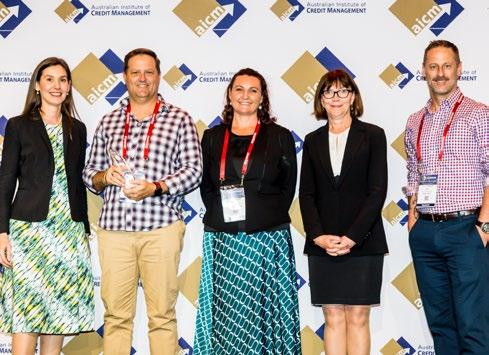
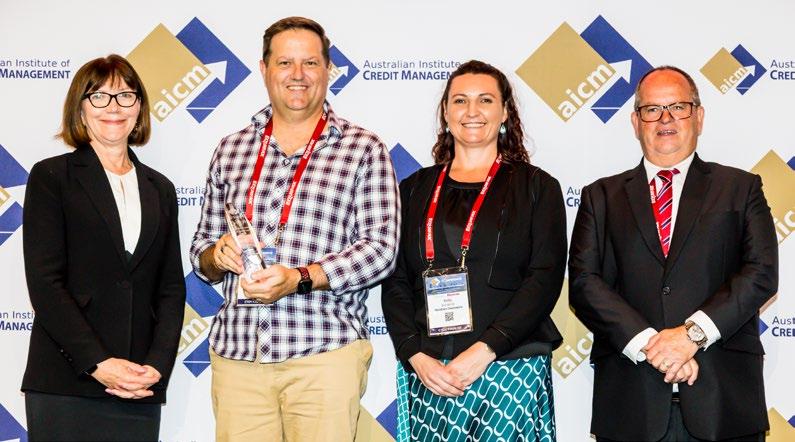
The 2022 Credit Team of the Year was announced on Wednesday 19 October after the Conference welcome.
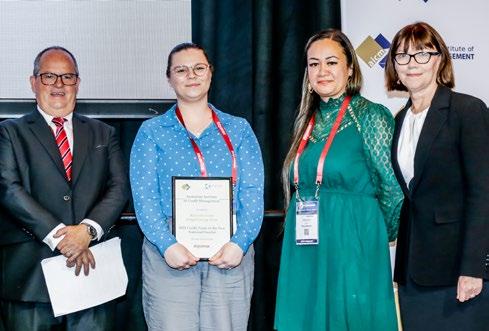
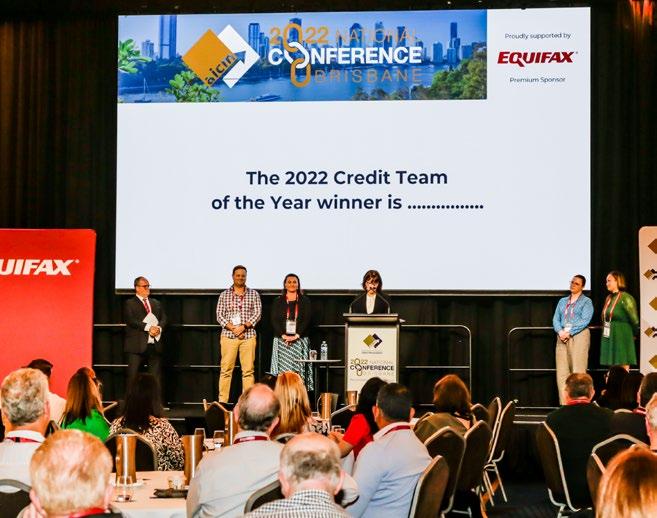
We congratulate 2022 Credit Team of the Year Wyndham Destinations.
Debbie Leo MICM (Equifax) with 2022 winning team represented by Paul Taylor MICM, Kelly Bull MICM (Wyndham Destinations) and Trevor Goodwin LICM CCE (immediate past National President).
January 2023 | CREDIT MANAGEMENT IN AUSTRALIA 61 2022 National Conference
Debbie Leo MICM of Equifax announcing the 2022 CTOY winner.
2022 runners up Recoveriescorp – Origin Energy Team represented by Rebecca Wilson and Deborah Cecil.
2022 judges and winning team Louise Nixon MICM (Turks) Paul Taylor MICM, Kelly Bull MICM (Wyndham Destinations), Debbie Leo MICM (Equifax) and Rhys Buzza MICM CCE (Reece Pty Ltd).
Young Credit Professional of the Year
The Young Credit Professional of the Year Award (YCPA) program is the largest and most prestigious youth credit award program in Australia and provides an opportunity for young credit professionals to gain recognition both for themselves and their employer.
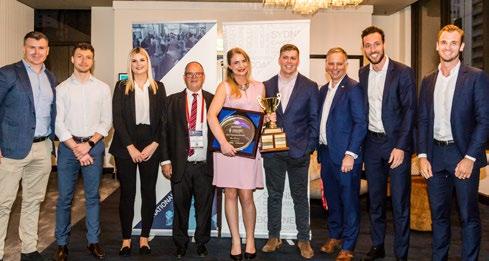



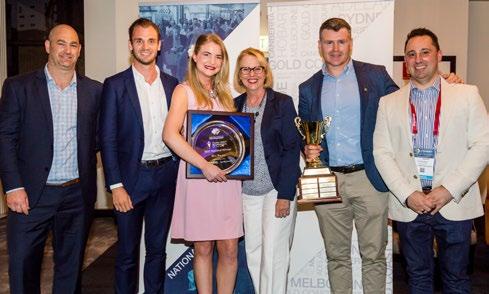
Now in its 25th year, this award seeks to identify the accomplishments of young credit professionals around the country and demonstrates AICM’s commitment to recognising their exemplary professionalism.
The national YCPA winner was announced at the Welcome Reception on Wednesday 19 October.
Congratulations to the 2022 Young Credit
62 CREDIT MANAGEMENT IN AUSTRALIA | January 2023
2022 YCPA judges, sponsors and winner – George Wolf MICM, Matt Jackson MICM (CreditorWatch), Clare Venema MICM CCE (People’s Choice Credit Union), Julie McNamara MICM CCE (National President), Andrew Smith MICM CCE and Christopher Hayes MICM (ARMA a Credit Clear company).
2022 YCPA finalists Lachlan Poulus MICM – QLD (PRA Australia), Maddison Basso MICM – VIC/TAS (Moula), Clare Venema MICM CCE – SA (People’s Choice Credit Union) and James Mason – NSW (Wisr).
Professional of the Year – Clare Venema MICM CCE.
2022 National YCPA winner – Clare Venema MICM CCE (People’s Choice Credit Union).
Team SA supporting the YCPA winner – Trevor Goodwin LICM CCE (NCI), Cameron Henderson MICM (Oakbridge Lawyers), Gail Crowder MICM (Credit Solutions), Clare Venema MICM CCE (People’s Choice Credit Union), Briana Harris MICM (Oakbridge Lawyers), Rob Jackson MICM (Beaumont Tiles) and Adrian Stewart MICM CCE (Australian Clutch Services).
2022 National Conference
Andrew Smith MICM CCE (ARMA a Credit Clear company), Lachlan Poulus MICM (PRA Australia), Maddison Basso MICM (Moula), Trevor Goodwin LICM CCE (immediate past National President), Clare Venema MICM CCE (People’s Choice Credit Union), James Mason (Wisr), Nick Pilavidis FICM CCE (AICM), Patrick Coghlan MICM and Matt Jackson MICM (CreditorWatch).
AICM is proud of the education it undertakes, and this support of fellow credit professionals was a central tenant in forming the organisation.
Each year, we present awards for the three qualifications plus an overall Student of the Year at the President’s Dinner.
Congratulations to the 2022 High Achievers: l Certificate III Mercantile Agents – Anthony Millington – WA
l Certificate IV in Credit Management – David MacIntosh MICM – WA
l Diploma of Credit Management – Mitchell
Steven MICM – QLD
AICM High Achievers President’s Trophy
Congratulations to the 2022 Student of the Year – David MacIntosh MICM – WA.
Unfortunately, the 2022 high achievers were not able to attend the President’s Dinner, but were each presented with their certificates and trophy at their divisions End of Year Sundowner and Pinnacle Awards functions.
This important award recognises the work of our volunteer division councils which is vital to how we meet our promise to members.
Each year the President’s Trophy is awarded to best performing division based on several
performance indicators including membership, financials, CCE, council activity and participation rate.
Congratulations to the 2022 President’s Trophy winner – Queensland, who took out the award for the third consecutive year.
QLD council accepting 2022 President’s Trophy – Mervyn Mahony LICM CCE (Megaport), Steven Staatz MICM CCE (Vincents), Fiona Doherty MICM CCE (Big River Group), Emma Purcival MICM (Vinidex), Julie McNamara MICM CCE (Boom Logistics), Stacey Woodward MICM (Covetrus), Carly Rae-Orth MICM CCE (Fisher & Paykel), Michelle Kirkby MICM (Shell Energy Australia), Madision Ryan MICM (Dynamic Supplies) and Melissa Kirk MICM (National Collection Services).

January 2023 | CREDIT MANAGEMENT IN AUSTRALIA 63
2022 National Conference
President’s Dinner
Ahighlight of the Conference is our President’s Dinner, proudly sponsored by illion.

The 2022 dinner theme was ‘a touch of tropical’ and fitting to our sunny Queensland destination. We were welcomed by Julie McNamara MICM CCE for her first official duty as National President, with tributes of thanks








provided to Trevor Goodwin LICM CCE for his last four years of service as President. Attendees were left is stiches from international comedian Lindsay Webb and danced the night away thanks to the Titanix band.
We thank the President’s Dinner sponsor illion for their continued support of the evening and the AICM.

2022 National Conference











January 2023 | CREDIT MANAGEMENT IN AUSTRALIA 65 2022 National Conference Click here to view more photos
Sponsors & Exhibitors
Our 2022 exhibition was one of the largest in AICM’s history and was represented by a number of organisation who continue to provide insights on the latest credit products, technology and services.





Thank you to our valued sponsors and exhibitors we really appreciate you support!
l Equifax – Premium sponsor
l illion – President’s Dinner sponsor
l Atradius – CCE Lunch sponsor

l Results Legal – VIP Room sponsor
l Gliderpay – WiFI sponsor
l 1Centre
l Access Intel
l AMPAC Debt Recovery
l AON
l ARMA a Credit Clear company
l Australian Financial Security Authority
l BlackLine
l Cosyn Software
l CreditorWatch
l CreditSoft Solutions
l Esker Australia Pty Ltd
l Finstro
l HighRadius Corporation
l Jirsch Sutherland
l National Collection Services
l OfficeTorque
l Recoveriescorp
l TaleFin
l Vincents
2022 National Conference










January 2023 | CREDIT MANAGEMENT IN AUSTRALIA 67 2022 National Conference
Faces in the crowd

















68 CREDIT MANAGEMENT IN AUSTRALIA | January 2023
2022 National Conference Click here to view more photos
Faces in the crowd







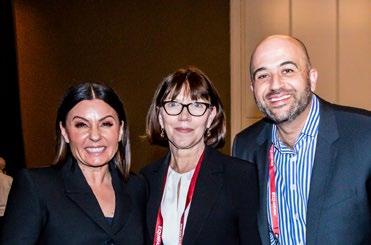


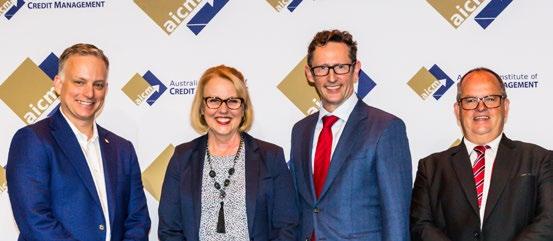








January 2023 |
2022 National Conference
The Pinnacle Awards align with AICM’s purpose to connect and recognise credit professionals.
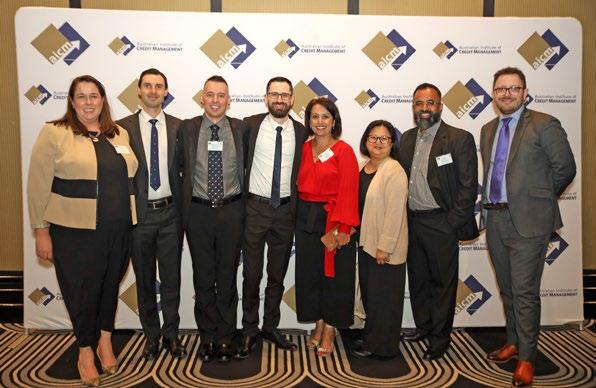
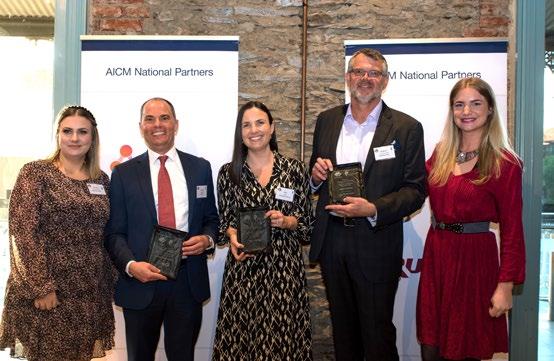

The Awards recognise leading performers in our industry throughout the year, at all levels and sectors of the industry through a process of nomination and selection of finalists.
Each division then gathers at a special end of year function to celebrate all nominees and announce the winners of each award category.
The 2022 awards night were a fabulous chance for our community to gather, network and celebrate those who have gone above and beyond for their team in 2022. We had a fantastic number of entrants nationally with 63 finalists and 423 attendees across the country.


On the following pages we bring you the winners across the events.


70 CREDIT MANAGEMENT IN AUSTRALIA | January 2023 Events
NSW and VIC/TAS 2022 Premium Sponsor
QLD 2022 Premium Sponsor
Trusted Insights. Responsible
Decisions.
South Australia
2022
Queensland
New South Wales
Victoria/Tasmania
The VIC 2022 Pinnacle Awards Night was held on Thursday 24 November at the Jasper Hotel. Congratulations to the 2022 winners:

Credit Manager of the Year
Sponsored by CreditorWatch
Joseph Bonvino MICM
Credit Manager,

Nutrien
Ag Solutions
The judges noted that Joseph was a very impressive candidate with a sound knowledge of analytics.
Joseph has a keen eye for new technology and engaging with like-minded experts. He has leveraged his natural skills to integrate credit risk protocols into his business to reduce human intervention albeit with no increase in risk profile. Across 2022 Joseph implemented a number of projects to his organisation including a sales dashboard, a credit assessment platform for customer limit requirements and creation and delivery of limit right-sizing program to automate revised limits for customers with exceptional account conduct.
Joseph challenges himself and the business in a positive manner. He encourages all stakeholders to continuously review the existing work practices for the betterment of the business performance.
Credit Supervisor of the Year
Sponsored by Robert Half
Katrina Bromley MICM CCE Credit Supervisor at Spicers Australia Pty Ltd
Katrina demonstrated a solid understanding of credit management principles in a changing world where data is king. Working smarter and arming staff with as much knowledge as possible is the sign of a professional Credit Supervisor.
Katrina’s employer commented that across 2022 she has continued to grow professionally and has led her team to another year of exceptional performance.
Katrina’s major projects in 2022 include transitioning the automated payment reminder system onto a new platform, digitalising all historical credit records, standardising trading terms, data wash of all current trade accounts and developing a sound consignment stock at customer policy to mitigate risks. The result of these projects enabled the team to become more efficient and reduce mundane activities so they can focus on managing risk. Under Katrina’s leadership, the credit team has improved their KPIs every year over the past few years – reduction of average DSO by 4.5 days and reduction of debt past due by 7.5%.
2022 Pinnacle Awards January 2023 | CREDIT MANAGEMENT IN AUSTRALIA 71
Joseph Bonvino MICM and Borna Boltuzic of CreditorWatch.
Katrina Bromley MICM CCE and Stephen Langhammer of Robert Half.
Victoria/Tasmania
Senior Credit Officer of the Year
Sponsored by IODM

Sandra Kohlman MICM Credit Officer at Dulux Group
The judges commented that Sandra was an extremely impressive candidate who has progressed through dedication and hard work.
Sandra’s employer commented that she continues to exceed the expectations of her manager and the company’s expectation.
Sandra has demonstrated great talents in technical applications and showcased her ability to find simple solutions to challenging situations. She recently took on an international export portfolio for the Dulux Group and identified this as a commercial risk to the business and sought to rectify it.
Sandra has been customer focused, innovative, compassionate, and never lost sight of our objectives. She has not been afraid to adjust her approach when necessary and has brought everyone along with her on a journey.
Legal Representative of the Year Sponsored by NCI (Brokers) Pty Ltd
Tracey Rothwell MICM Lawyer, Rothwell Lawyers Pty Ltd
Tracey has a wealth of knowledge and experience, but more importantly, is always focused on the best commercial outcome for the business she is representing. Her clients have the utmost confidence that their company is represented by the best in the business, and this is evident when analysing the success rate of her legal representation.
Networking and industry knowledge obtained by being part of these groups is essential in keeping up to date with current economic trends, changes to legislation and best practice. Tracey has been an active member of AICM, WRIV, National Credit Group and Trade Bureau Australia.

Tracey’s philosophy is about empowerment and shared knowledge, she deserves the recognition for her hard work and business ethics. Her generosity in supporting key players in the credit industry is testament to her dedication to shared knowledge.

2022 Pinnacle Awards 72 CREDIT MANAGEMENT IN AUSTRALIA | January 2023
Sandra Kohlman MICM and Alex Wilkinson of IODM.
Tracey Rothwell MICM and Simon Chown of NCI.
Victoria/Tasmania
External Collections Agent of the Year
Sponsored by Mason Black + Mendelsons Lawyers
Dale Hannan MICM CCE Managing Director, NCS Group
The judges commented that Dale is a passionate, clever, and dedicated collection agent.
His client commented that over the last 10 years they have witnessed his business grow, which is demonstrated by his passion for the industry and desire to develop his team.
Dale is honest in all dealings, this added to his personable approach is a winning combination which should be admired within the industry.
Dale is a very successful debt collector and is very deserving of this award.
Consultant/Solution Provider of the Year

Nikki Dennis MICM Sales and Marketing Specialist, Sales CRED.
Nikki demonstrated outstanding commitment to customers and the industry. It is clear she is a very experienced and dedicated credit provider who is innovative and passionate.
Nikki’s client commented that over the past 5 years working together she has introduced various solutions for our business based on her strong understanding of the collection’s workflow and genuine desire for great customer experience.
Nikki is a brilliant consultant who really understands business challenges and is focused on delivering the best outcomes. Her strength is her ability to overcome challenging situations and excellent stakeholder management.
Nikki has a vast knowledge of the credit industry and ability to form genuine client relationships together with her great work ethics and friendly approach makes her an ideal business partner.
2022 Pinnacle Awards January 2023 | CREDIT MANAGEMENT IN AUSTRALIA 73
Dale Hannan MICM CCE and Matthew Boglis of Mason Black + Mendelsons Lawyers.
Nikki Dennis MICM and Nick Pilavidis FICM CCE of AICM.
Queensland
The QLD 2022 Pinnacle Awards Night was held on Friday 18 November at The Westin Hotel. Congratulations to the 2022 winners:


Credit Manager of the Year
Sponsored by CreditorWatch
Mary Owens MICM CCE AR Manager, Cement Australia
The judges noted that Mary has a great work ethic and demonstrated this through her commitment and care for her staff. She showed great leadership through the support and training she provides to develop her team. Mary takes pride in ensuring staff are engaged and managed on both a professional and personal basis.
Mary has had an outstanding 28 year credit career across an array of industries, and in 2022 Mary brought that wealth of experience to Cement Australia.
Since commencing at Cement Australia, Mary has demonstrated strong technical skills and has impressed management with her exceptional management and interpersonal skills. The outcome of these exceptional skills has been the transformation of the wider credit team into a high performing, highly motivated team that is on a path of continuous improvement.
Mary is exceptional at not only building a credit team, but making people want to keep working for her. Her ability to mentor, lead and develop people is simply outstanding.
Credit Supervisor of the Year Sponsored
by Optimum Recoveries

Paul Taylor MICM Supervisor, Training & Development, Wyndham Destinations
The judges commented that Paul’s responses showed the necessary emotional intelligence and awareness required to effectively lead and develop high performing teams. Paul provided considered answers and demonstrated the great initiatives he had led within his organisation. He showed fantastic innovation and has developed an excellent on boarding processes to incorporate many different members of the team.
Paul has built a solid infrastructure through a combination of collaboration and results-based team building. Paul showed he is conscious of the impact of staff retention on the business, through progression planning and career development he has improve staff career satisfaction and retention. One judge commented ‘Reading about the career pathway program Paul has created has made me want to be part of his team, Paul is very deserving of pinnacle recognition’.
2022 Pinnacle
74 CREDIT MANAGEMENT IN AUSTRALIA | January 2023
Awards
Mary Owens MICM CCE + George Wolf MICM of CreditorWatch.
Paul Taylor MICM and Angela McDonald MICM of Optimum Recoveries.
Senior Credit Officer of the Year
Sponsored by Agility Law Group

Mel Singh MICM Credit Officer, Tradelink
Mel is an exceptional Credit Officer and is a very worthy recipient of this award.

Mel is held in very high regard by her peers and other employees across all functions within Tradelink and she often receives positive feedback on her performance.
Mel is an integral and senior member within the credit team at Tradelink, she offers support and guidance to other team members and is most welcoming to new staff. Her positive attitude is infectious, and she contributes to making coming to work enjoyable and a great place to work.
Not only does Mel deliver great results, but she will also go out of her way to encourage others and is willing to help whenever and wherever required. She has taken on additional duties to support her colleagues to ensure they succeed as well.

Legal Representative of the Year Sponsored
by
NCI (Brokers) Pty Ltd
Samantha Goddard MICM Managing Director, STG Legal Pty Ltd
Samantha is an exceptional solicitor in the Debt Recovery and Commercial Litigation space. Throughout her career, she has demonstrated excellence in commercial litigation disputes and insolvency matters.
Samantha truly helps clients understand the extent of their legal rights and lays out clear expectations before commencing and during formal legal actions. She clearly communicates her advice around a solid foundations of credit applications, terms and conditions and the clauses that would hold them in good stead to secure them.
Samantha is a fundamental member of her team and supports over 300+ clients with practical and useful advice. She goes above and beyond to understand her client, their industry, and the fine details of each individual case with her strong attention to detail and analytical skills. Samantha is thorough, industrious, determined, tenacious and commercially savvy. She is passionate about achieving exceptional outcomes in an efficient and cost-effective manner.
2022 Pinnacle Awards January 2023 | CREDIT MANAGEMENT IN AUSTRALIA 75
Queensland
Mel Singh MICM and Levi Smouha MICM of Agility Law Group.Malcolm Poslinksy MICM CCE with his award.
Samantha Goddard MICM.
Queensland
External Collections Agent of the Year
Sponsored by Cor Cordis

Melissa Kirk MICM Partner, National Collection Service
The judges commented that Melissa is very dedicated to understanding the rapid changes within the credit industry and engages herself within the AICM and other Institutes to make sure she is up to date with what is happening around her.
Melissa provided solid examples of her great leadership, self-development and the training she provides to her team to ensure they are set for success.

A client of Melissa’s commented that they have been fortunate enough to have Melissa as their Account Specialist for the past three years while partnering with NCS. Melissa consistently provides an informed, balanced and methodical approach to the files she has managed.
Her client remarked that they greatly benefited from Melissa’s extensive knowledge of the debt and legal recovery process and as a result, she has achieved many successful outcomes for the business.
Melissa has the innate capacity to assess, and risk manage the most complex matters as our business often requires. Melissa’s diligent and tireless efforts to assist her clients and colleagues has no doubt contributed towards the attributes and values that are sought out for the nominees of this year’s award.
Consultant/Solution Provider of the Year

Sponsored by Robert Walters

Jericho Ramos Projects Coordinator, Wyndham Destination
In Jericho’s role as Project Coordinator for the Consumer Finance team, he is responsible for ensuring that multiple projects are completed within expected timeframes and budgets. These projects often include working with international teams and vendors, meaning late nights or early morning meetings to discuss project details. Jericho never fails to be prompt, positive and passionate on these calls and ensures all stakeholders are kept updated during projects.
Jericho has shown amazing growth in the past year, gaining skills in additional areas, and taking on additional training in his own time to improve himself. His continued dedication to learning, improving and implementation is admirable. Jericho has received two internal awards for his teamwork and dedication, and his direct manager has received several positive feedback comments, mentions or thanks for Jericho and his hard work, dedication, and commitment to customer service.
2022 Pinnacle Awards 76 CREDIT MANAGEMENT IN AUSTRALIA | January 2023
Melissa Kirk MICM and Josephine Decuyper MICM of Cor Cordis.
Paul Taylor MICM accepting the Consultant/Solution Provider of the Year award on behalf of Jericho Ramos and Hamish Winterbourn of Robert Walters).
New South Wales
The NSW 2022 Pinnacle Awards Night was held on Thursday 24 November at Doltone House Hyde Park. Congratulations to the 2022 winners:
Credit Manager of the Year


Sponsored by CreditorWatch
Maria Grigoriadis MICM National Credit Manager, Hanson Construction
After being appointed National Credit Manager in late 2021, Maria embarked on a journey of optimisation within the credit function that involved streamlining processes and creating efficiencies. The judges were particularly moved by her comprehensive responses and impressive statistics that helped them to better appreciate the impact of Maria’s efforts and successes in implementing important changes over the past year.
Maria’s employer commented that she has been a critical subject matter expert in credit matters and has been valuable to making the centralisation of credit function successful, some of the tasks Maria has been involved in: Managing onboarding, training and recruitment of credit specialists to join her expanding team; Managing risks/credit assessments; Developing standard operating models and structure of the new team; Mentoring and guiding 21 staff in receivables and collections; Implementing controls and procedures for the new team; Working with key stakeholders across the business to ensure a smooth transition and Working with key stakeholder to clear up long outstanding debt from other states/regions and master data standardisation issues before centralisation.
Legal Representative of the Year
Sponsored by NCI (Brokers) Pty Ltd
Andrew Tanna MICM Special Counsel, Holman Webb Lawyers Collection Services
Andrew is a driven and committed legal professional with an interest in innovation and understanding his client’s processes and needs. The judges were impressed by Andrew’s practical and legal knowledge and how he illustrated this through specific examples of achieving success for his clients during the challenging COVID-19 period.
Andrew’s client commented that he has a strong ability to draw reasonable and logical assumptions from limited information. He is admired for his great research, analytical, leadership, persuasive, and communication skills including public speaking. Andrew has won a large majority of cases and is extremely thorough. He is persistent and has outshined in every legal matter they have had to date against opposition, administrators, liquidators, and bankruptcy trustees. Andrew remains calm in crisis, is very personable and easily gains the trust of clients and others alike.
2022 Pinnacle Awards January 2023 | CREDIT MANAGEMENT IN AUSTRALIA 77
Maria Grigoriadis MICM and Danny O’Neill of CreditorWatch.
Andrew Tanna MICM and Samuel Turtle of NCI (Brokers) Pty Ltd.
New South Wales
External Agent of the Year
Sponsored by Esker
Joseph Safi MICM
Key Account Manager, ARMA
Having worked with ARMA for nearly 4 years, in April 2021 Joseph stepped up to the role of Key account manager in April 2021.
In the 2022 calendar year Joseph has ensured efficient recovery and returns for his clients, including using a unique workflow where escalation path is crafted to the circumstances of the debt, including history of the debtor, existence of a charging clause or guarantees and whether a genuine dispute exists.
He actively participates in webinars, podcasts and is an avid student of all credit related matters.
He demonstrated to the judges:
l Excellence in reporting and communication with clients
l Knowledge and implementation of ACCC Guidelines
l That he attends AICM networking and events regularly
l He supports peers in the credit industry
l He is a well deserving recipient of this award.
Consultant/Solution Provider of the Year
Sponsored by Colin Biggers & Paisley Lawyers

Barbara Cestaro MICM Client Manager, AON
Barbara is a highly experienced and passionate credit professional who engages with clients to provide meaningful advice and helps to educate them on a variety of topics including credit insurance and risk.
The judges were impressed by the level of detail in her responses and her positive attitude towards her role, her passion for helping her clients as well as her contributions to the AICM and broader credit community.
One of Barbara’s clients commented they appreciate the high level of customer service received from Barbara and the team. They value the professional service received in the areas of claim management, legal collection, preference claims management, credit limit management and the general advice on the interpretation of their policies. In a tough credit environment, Barbara’s support had made their role in managing their business risk a lot easier.

2022 Pinnacle Awards 78 CREDIT MANAGEMENT IN AUSTRALIA | January 2023
Joseph Safi MICM with Eric Maisonhaute MICM of Esker.
Barbara Cestaro MICM and Todd Neal of Colin Biggers & Paisley Lawyers.
South Australia
The SA 2022 Pinnacle Awards Night was held on Thursday 17 November at The Cathedral Hotel. Congratulations to the 2022 winners:


Credit Manager of the Year
Sponsored by CreditorWatch
Rob
Jackson MICM National Credit Manager, Beaumont Tiles
The judges agreed that Rob has a great understanding of credit management. Rob understands the importance of ongoing team training, which can have a huge impact on the business and customer service. He is goal orientated and aware of broader industry challenges that could impact business.
Since joining Beaumont Tiles in March 2020, Rob has worked through the pandemic lockdowns, largely isolated from the Accounts Receivable team based in Brisbane. Despite the challenges of the last year, Rob and his team have protected the company from significant loss and help to improve cash flow, delivering low debtor days on a consistent basis. Rob has used his experience to mentor and educate the Accounts Receivable team on credit matters and help develop a successful team culture. On a technical level, he has improved his organisations PPSA compliance, reduced departmental costs and improved debt recovery results.
Legal Representative of the Year
Sponsored
by
NCI (Brokers) Pty Ltd
Steven Hagivassilis Principal, HGV Legal
Steven specialises in the fields of commercial dispute resolution and litigation, debt recovery and enforcement and insolvency. He is focused on timely, cost effective and commercial results and combines his knowledge, experience and enthusiasm to explore and achieve the best possible outcomes for his clients.
The judges commented that Steven provided detailed responses to all questions and offered recent and relevant examples of outcomes achieved. He clearly explained his processes and the approaches used to achieve outcomes, including how he engaged and manages the customer relationship throughout. Steven is both flexible and disciplined in his approach to evaluating and considering each matter as required. Steven’s colleague noted they are truly luck to work with Steven. He enthusiastically shares his knowledge and insight into the industry, encourages analytical and creative problem-solving and continually demonstrates what a lawyer can achieve when they focus on effective and commercial resolutions for their clients.
2022 Pinnacle Awards January 2023 | CREDIT MANAGEMENT IN AUSTRALIA 79
Rob Jackson MICM and Clare Venema MICM CCE –SA Vice President.
Steven Hagivassilis and Jeff George of NCI (Brokers) Pty Ltd.
Consultant/Solution Provider of the Year
Mel Carter MICM Senior Credit Services Consultant, NCI (Brokers) Pty Ltd
The judges commented that Mel is clearly focussed on achieving great outcomes for clients and is very capable of working with multiple third parties to ensure this takes place.

Mel’s employer described as approachable, friendly, and as someone who knows her job responsibilities extremely well. She is professional in every aspect, reliable and there to support and provide guidance whenever needed.
Mel is prompt with her responses and clear with directions on next steps and options.
During COVID particularly she was able to assist with managing payment plans, claim updates and navigating unusual circumstances in the new credit environment.
South Australia EDUCATION FOUNDATION


ABOUT THE FOUNDATION
In late 2018, the Board of Directors of the Australian Institute of Credit Management (AICM) proudly approved the establishment of the AICM Education Foundation.
The AICM Education Foundation has been established to provide financial assistance to credit professionals and students striving to continue their education. Funds are gathered from generous donations from the AICM and Credit Community, as well as fundraising activities and events of the AICM and it’s supporters throughout the year including but not limited to the annual AICM Conference.
The Education Foundation will also bolster the vision of the AICM to be the primary learning, knowledge and information source for credit professionals and support the AICM’s objective of providing opportunities for growth throughout their careers.
For more information on the foundation, make contributions or interest in supporting the Management Committee contact the AICM National office (aicm@aicm.com.au, 1300 560 996 or click here).
2022 Pinnacle Awards 80 CREDIT MANAGEMENT IN AUSTRALIA | January 2023
Mel Carter MICM and Briana Harris MICM.

Consider an AICM Qualification cour se Key credit issues such as personal FNS40120 & corporate insolvency, developing credit policies & compliance. If you aspire to achieve greater heights in your credit career or want to get the best from your credit staf f, then a qualification course can help you achieve your targets Of fered nation wide, you can study in your own time (24/7), with suppor t available If you have industr y experience or prior education, you may be eligible for Recognition of Prior Learning (RPL) credits to fast-track your qualification. If you’re an employer, you may qualif y for a training grant Talk to AICM today to discover your course options Issues relating to credit applications & securitisation, compliance, managing bad & doubt ful debt & customer ser vice A ll aspects of enforcing payment obligations & obligations of mercantile agent & debt collection activities. Diploma of Credit Management Cer tificate IV in Credit Management Cer tificate III in Mercantile Agents Unlock the potential in your career staf f credit credit Take the first step to a better career & talk to AICM today Call 1300 560 996 or vist aicm.com.au FNS30420 FNS51520
We recognise those members who achieved membership anniversaries between October and December 2022. Congratulations to these members on achieving such important milestones.
DIVISION REPORT member
82 CREDIT MANAGEMENT IN AUSTRALIA | January 2023
anniversaries
Name Designation State Company Years of service Stephen Barratt LICM SA Retired 50 years Peter Brewer LICM SA T.B. Soldiers Aid Society 40 years Gordon Morrison MICM VIC/TAS 35 years Ravindra Naidoo MICM NSW Quad Services Pty Ltd 30 years Michael Paynter MICM QLD 30 years Shirley Wells MICM CCE VIC/TAS 30 years Rafat Bishay MICM NSW 25 years Natalie Denschel MICM QLD The Bradnam Group 25 years Fabian Sommariva MICM CCE NSW Allegis Group 25 years Rodolfo Duque MICM NSW LEDA 20 years Phoebe Tan MICM CCE VIC/TAS Rust-Oleum Corporation 20 years Karl Hill MICM QLD Results Legal 15 years Neeraja Alla MICM VIC/TAS Australia Post 10 years David Bean MICM VIC/TAS Visy Recycling 10 years Harish Bhudia MICM WA/NT Brownes Dairy 10 years Norma Boutros MICM NSW BSA Limited 10 years Rebecca Fahey MICM VIC/TAS SLF Lawyers 10 years Gabriella Forte MICM CCE VIC/TAS Australia Post 10 years Edward Griffith MICM CCE SA TurnAbout 10 years Nicholas Harrak MICM VIC/TAS Recoveries Corporation Pty Ltd 10 years Brooke Lawrence MICM VIC/TAS Recoveriescorp Pty Ltd 10 years Tecia Mandoukos MICM NSW Coates Hire 10 years Rowan McClarty MICM CCE WA/NT Fleetcare 10 years Michael Pearse MICM NSW Jenesis Consulting 10 years Jan Reeves MICM NSW GET PAID! 10 years Kym Russell MICM VIC/TAS PPG Industries Australia Pty Ltd 10 years Vicenta Venezuela MICM VIC/TAS Visy Recycling 10 years Mark Wenn MICM VIC/TAS Mills Oakley Lawyers 10 years Syed Fahd Ali MICM VIC/TAS Transurban Limited 5 years Rouruina Arama MICM QLD Boom Logistics 5 years Kathleen Badolato MICM NSW Sydney Catholic Schools 5 years Danielle Bajzak MICM NSW AHG 5 years
DIVISION REPORT member anniversaries January 2023 | CREDIT MANAGEMENT IN AUSTRALIA 83 Name Designation State Company Years of service Karen Clarkson MICM CCE QLD Civilmart Rocla 5 years Georgette Daoud MICM VIC/TAS Transurban Limited 5 years Gehan Dedigama MICM VIC/TAS BP Australia Pty Ltd 5 years Maria Del Duca MICM NSW Sydney Catholic Schools 5 years Melissa Doyle MICM VIC/TAS Simplot Australia Pty Ltd 5 years Kerrie Ellis MICM VIC/TAS SBD 5 years Malcolm Field MICM WA/NT SV Partners 5 years Nicole Flynn MICM VIC/TAS Simplot Australia Pty Ltd 5 years Jasmine Geurens MICM VIC/TAS EFM Logistics 5 years Janelle Green MICM NSW Simplot Australia Pty Ltd 5 years Monique Hardy MICM NSW InfoTrack 5 years Christine Higgins MICM NSW Scotts Refrigerated Logistics 5 years Rupinder Hosking MICM NSW Aristocrat Technologies Australia Pty Ltd 5 years Jitesh Kantilal MICM VIC/TAS Transurban Limited 5 years Alysar Khallouf MICM VIC/TAS Transurban Limited 5 years Anastasia Khayrets MICM VIC/TAS 5 years Patricia Landuyt-Breedveld MICM NSW Fisher Cartwright Berriman Lawyers 5 years Anthony Lane MICM NSW Beacon Advisory 5 years Zak MacDougall MICM VIC/TAS Transurban Limited 5 years Shreya Maharjan MICM VIC/TAS Transurban Limited 5 years Eileen Milton MICM NSW Sydney Catholic Schools 5 years Lisa Morrissey MICM NSW Turks 5 years Mansi Nangru MICM NSW Aristocrat Technologies Australia Pty Ltd 5 years Tara Nicholls MICM NSW Mason Black + Mendelsons Lawyers 5 years Vivienne Pearson MICM SA Hallett Business Services 5 years Brandon Quach MICM NSW 5 years Judith Riley MICM CCE QLD Toll Group 5 years Jesusita Roach MICM NSW Aristocrat Technologies Australia Pty Ltd 5 years Amon Shehata MICM NSW San Miguel Yamamura Australasia 5 years Kerry Smith MICM NSW 5 years Benjamin Strajn MICM NSW Jaybro 5 years Stephen Teale MICM VIC/TAS Turks 5 years Emmy Yap MICM NSW Aristocrat Technologies Australia Pty Ltd 5 years Snezana Zappia MICM NSW AHG 5 years
queensland
President’s report
Just like that, it’s December and we’re about to say goodbye 2022 and hello 2023! Since my last report, we had our first face-to-face National Conference since 2019 and I could’ve easily spent three whole days just talking and catching up with everyone. It felt so good to be back and it was even better being held in our home state. For those that didn’t have the opportunity to attend, it was a wonderful three days (exhausting, but wonderful!) The speakers were engaging and the topics were inspiring and relevant. Big thank you to Nick and the team at National Office who put together this amazing event.
Arguably the biggest event on the credit calendar is the President’s Dinner which is held on the second night of the conference. For those that weren’t in attendance, you missed a fabulous evening and I want to congratulate our very own Julie McNamara on being elected the AICM National President. Julie is one of the most driven and hardworking ambassadors for the AICM and I’m even more excited for the institute’s future with Julie leading the charge. Shout out to Trevor who has done a phenomenal job during some of the most trying times over the last few years!
I also want to acknowledge Lachlan Poulus from PRA Group. Lachlan was this year’s QLD Young Credit Professional winner, who presented to a panel of judges for the YCP national title in October at the National Conference. Unfortunately, he did not take home the title, the feedback was that he did an amazing job and was up against

some strong competition. Well done Lachlan and congratulations to this year’s National YCP from SA Clare Venema.
I want to do one more shout out, to one of the best teams I’ve ever worked with. For the third year in a row, the amazing QLD council were awarded the President’s Trophy as the best-performing state for the work they’ve done this year for the members of the AICM in Queensland.
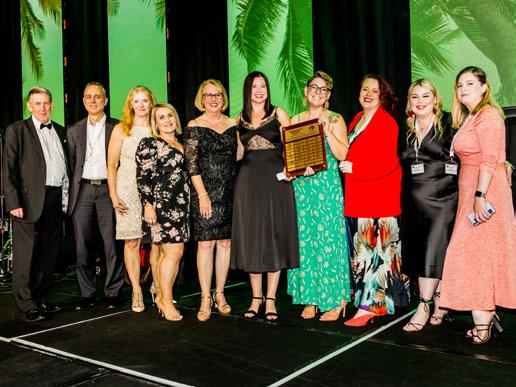
Every person on the council is an AICM member and they volunteer their professional and personal time to contribute to the running of AICM events each year and this trophy recognises that effort. I personally love giving up my Wednesday nights once a month to talk all things credit and they keep me wanting to come back year after year. So from me, thank you for all that you do and I cannot wait for 2023.

DIVISION REPORT 84 CREDIT MANAGEMENT IN AUSTRALIA | January 2023
QLD Council – accepting the trophy at the AICM 2022 National Conference President’s Dinner.
Andrew Smith MICM CCE (ARMA) and Lachlan Poulus MICM (2022 QLD YCP).
QLD Council – still on a high from the win at the 2022 QLD Pinnacle Awards.
The last event of the year was the Pinnacle Awards. This year it was held at The Westin with over 100 people in attendance. It was a fabulous evening celebrating the credit professionals in our lives. Congratulations again to all our finalists and winners, you deserve to be recognised and celebrated for all that you do for your teams and the businesses you work with.
I can’t wait to see you all at our events next year, so keep an eye out in your inbox for the registration emails for our Economic Breakfast, Social Events and Risk Seminar. Have a happy new year!
– Stacey Woodward MICM AICM QLD President , Credit Manager – Covetrus
President’s Trophy
The QLD team were awarded the President’s Trophy for 2022. Making it three years in a row that the Trophy has remained in QLD. The trophy is awarded each year to the division that most advances the AICM’s objectives.
As councillors, we devote a lot of our personal and professional time to making sure that we can hold quality events for our members. We meet up for monthly meetings and communicate throughout the month as required. It’s amazing to be a part of a team that is so enthusiastic about the industry, with such a diverse group of members there is always a wealth of information available.
It was fantastic to be able to host events face to face in 2022 and catch up with all of our members and we are looking forward to being able to continue that into 2023 with quality events for all members.
A big thank you to all our councillors from 20212022; Stacey Woodward MICM, Merv Mahony LICM CCE, Steven Staatz MICM CCE, Fiona Doherty MICM CCE, Zandalee McKenzie MICM, Emma Percival MIMC, Carly Rae-Orth MICM CCE, Julie McNamara MICM CCE, Michelle Kirkby MICM, Melissa Kirk MICM, Madison Ryan MICM and Ashleigh Mason MICM CCE.
AICM 2022 High Acheiver Award –
Mitchell Steven
Mitchell Steven has been awarded the AICM 2022 High Achiever Award for his completion of the AICM’s Diploma of Credit Management. Mitchell met all the selected criteria with a high level of understanding, completing the 12 units of study in an amazing time frame of 6 months. He demonstrated a great level of commitment to his professional development and there is no doubt that Mitchell will be instrumental in driving the future of his organisation. Congratulations Mitchell on this well deserved award.
2022 Pinnacle Awards Night
What an end to the year with a night of celebration for those at the top of our profession. The evening was held in the Ballroom of the Westin Hotel with 100 people in attendance. Such a beautiful venue in Brisbane to host one of the most prestigious AICM events of the year.

The evening was hosted by our President Stacey Woodward MICM and Madison Ryan MICM a past YCP in QLD. They were both exceptional and are a credit to the QLD council. The amount of talent

DIVISION REPORT January 2023 | CREDIT MANAGEMENT IN AUSTRALIA 85
queensland
Stacey Woodward MICM (QLD President) and Madison Ryan MICM (Past YCP).
Stacey Feaver MICM (Silver Chef), Mary Owens MICM CCE (Cement Australia) and Fiona Doherty MICM CCE (Big River Group).
queensland
in QLD is shown by the number of nominations that were received in every category. The Pinnacles are a great success because of the support of our members, supporting their professional peers and appreciating each other’s achievements.



All our nominees in every category were very deserving, the judges were faced with a very difficult task of choosing only one winner in each category. We also thank the Sponsors across all categories and the time and effort that went into presenting the awards.
Congratulations to the 2022 finalists
Consultant/Solutions Provider of the Year
Sponsored by Robert Walters
Finalists:
l Jericho Ramos – Projects Coordinator, Wyndham Destination
l Shahin Hussain – Director, H & H Advisory
External Collections Officer of the Year
Sponsored by Cor Cordis
Finalists:
l Dale Hannan MICM CCE – Managing Director, National Collection Services
l Melissa Kirk MICM – Partner, National Collection Services
l Melissa Rafferty MICM – Manager, Cashflow Collections, Optimum Recoveries
Legal Representative of the Year
Sponsored by NCI Finalists:
l Levi Smouha MICM – Managing Director, Agility Law Group
l Samantha Goddard MICM – Managing Director, STG Legal Pty Ltd
l Zandalee McKenzie MICM – Associate Enyo Lawyers
Senior Credit Officer of the Year:
Sponsored by Agility Law Group
Finalists:
l Elizabeth Morris FICM CCE – Credit Officer, Endeavour Foundation
l Mel Singh MICM – Credit Officer, Tradelink
l Ryan Archer MICM – Senior Credit Analyst, Powershop Australia
l Sarah Merritt – Senior Credit Officer, Wyndham Destinations
l Susan Withers MICM – Senior Credit Analyst, Shell Energy Australia
l Tiffany Engler MICM – Senior Credit Officer, Beaumont Tiles
DIVISION REPORT 86 CREDIT MANAGEMENT IN AUSTRALIA | January 2023
Edward Sklavos (Credit Clear), Melisa Kirk MICM (National Collections Services), Madison Ryan MICM (Dynamic Supplies), Ashleigh Mason MICM CCE (Shell Energy).
Shahin Hussain (H&H Advisory), Jo Fitch (Tradelink).
Kathleen Goranson MICM, Susan Withers MICM (Shell Energy Australia), Ryan Archer MICM (Powershop Australia), Ashleigh Mason MICM CCE and Talitha Bere MICM (Shell Energy Australia).
Credit Supervisor of the Year
Sponsored by Optimum Recoveries
Finalists:
l Cherese Aitken MICM – Supervisor, Wyndham Destinations


l Paul Taylor MICM – Supervisor, Training & Development, Wyndham Destinations

Credit Manager of the Year
Sponsored by CreditorWatch
Finalists:
l Fiona Doherty MICM CCE – Credit Manager, Big River Group
l Kelly Bull MICM – Contact Centre Manager, Wyndham Destinations

l Mary Owens MICM CCE – AR Manager, Cement Australia
l Stacey Feaver MICM – Collections Business Leader, Silver Chef
Interview
Dale Hannan MICM CCE
Previous YCP
What is your position and the company that you work for?
I’m the Managing Director of National Collection Services – we are a mid-sized debt recovery business that has staff all around Australia. I’m also an Aries.
How long have you been a member of the AICM?
I am proud to say that I have been a member of AICM for 16 years! (I must have been 12 when I joined).
What is your biggest professional accomplishment to date?
Hmmm – good question. I like to think that one of my biggest professional accomplishments would
DIVISION REPORT January 2023 | CREDIT MANAGEMENT IN AUSTRALIA 87
Melissa Kirk MICM, Meghan Derbyshire MICM, Annette Fabian MICM, Taleah Moriarty MICM, Chanese Scholey, Stewart Wilkinson MICM, Dale Hannan MICM CCE and Bree Bate (National Collection Services).
Mel Singh MICM (Tradelink), Tiffany Engler MICM (Beaumont Tiles), Susan Withers (Shell Energy Australia), Ryan Archer MICM (Powershop Australia), Susan Merrit MICM (Wyndham Destinations), and Elizabeth Morris FICM CCE (Endeavour Foundation).
QLD award finalists, winners and sponsors.
queensland
have to be winning State Young Credit Professional Awards representing Queensland in 2008 & 2011. I have also really enjoyed mentoring staff to become YCPA winners themselves.
You have had great success with YCP, taking out the title twice. How did you find the overall experience and how has this been beneficial to your career? Getting involved and participating in the YCP awards was one of the best professional experiences I’ve had. The hardest thing was pushing myself to step up and get out of my comfort zone. Involving myself in the process significantly improved my self-confidence. It also taught me that we are surrounded by peers that are ready to help members achieve what may seem unachievable. AICM is a fantastic organisation that really is there to help enhance and improve us all. Without the AICM, I know I wouldn’t know what I know today.
What’s the best advice you can give to other young professionals in the industry?
First off, understand that in life you get out what you put in. AICM is a not-for-profit organisation, run by members, for members so there is a lot of passion within the AICM. Absolutely get to know your industry peers. AICM events are amazing for this. The more people you know, the more resources you have at your fingertips.
What has been your biggest professional challenge to date?
Being able to grow a business at such a young age. Being trusted by clients to work with their assets (bad debt) is something that I’ve never taken lightly and understand it is a great responsibility, as recovered debt goes straight back to the clients’ bottom line. The AICM is such a wonderful organisation that has helped me grow, learn, and be recognised as a trusted supplier to our industry.
What tools from the AICM have helped you on your career path?


NETWORKING! Meeting peers that support you; and that you can support is invaluable. Reading the online magazine articles and certainly attending the annual conference are some of the best basic but invaluable tools to set up for career progression.
What are your favourite things to do outside of your profession?
My little puppy “Chewie” is my best mate and I love to take him to the dog park on weekends. He comes to the office every day and is one of the team. In fact, he has been promoted at NCS twice now! From “CMO – Chief Morale Officer” to “HOB – Head of Barketing”! I also really like wine.

DIVISION REPORT 88 CREDIT MANAGEMENT IN AUSTRALIA | January 2023
The Australian Institute of Credit Management welcomes our Partners for 2023 Our National, Divisional and Professional Partners support and work with the AICM to promote the Institute’s activities, represent the Credit Industry and develop the careers of all Credit Professionals. As these organisations support your Institute and your Industry please consider them when you require assistance. Divisional Partners Official Division Supporting Sponsors National Partners
queensland
President’s report
Well, what a year 2022 was!
With things starting to return to normal 2022 saw an increased number of events and it was wonderful to have more opportunities to network with people in the credit industry.
The SA Council is working hard to make 2023 an even better year with more professional development events and opportunities to catch up!
2022 saw the return of an in person National Conference which was a huge success. The Conference was the perfect opportunity to catch up with credit professionals from different states and hear from each of the exhibitors and presenters. Attending the Conference in person was definitely something we have all missed!
The SA Council is also very proud of our Vice President Clare Venema taking home the National Young Credit Professional of the Year Award. Clare is a valued member of the Council, and we appreciate all her contributions throughout the year. We could not do it without her, and this award was very deserved!
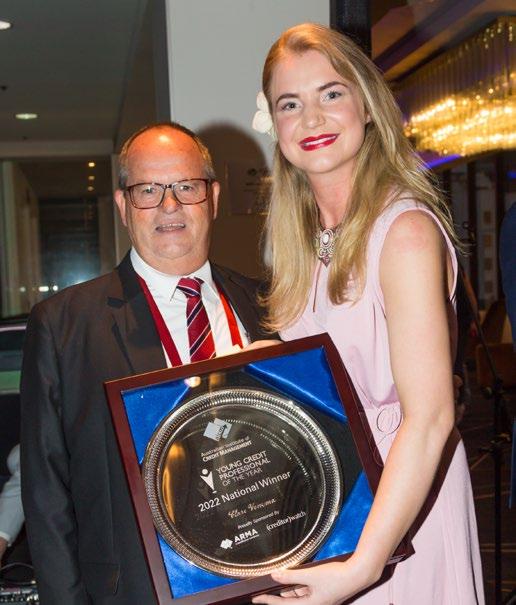
After the Conference, we held the Pinnacle awards on the 17 November 2022 at The Cathedral Hotel. It was a wonderful evening, and the SA Council takes this opportunity to congratulate the well-deserved winners.
While 2022 was filled with many positives, we were all extremely saddened by the passing of Eric Milne. Eric touched the lives of so many and will be dearly missed by all who have the honour of knowing him. The South Australian Council offer our deepest condolences to his wife, Sharon and family.
We look forward to bringing you a bigger and better 2023 and hope to see you all at the first Professional Development event in the new year!
– Briana Harris MICM SA Division President
2022 SA Pinnacle Awards
On Thursday 17 November 2022, the SA Division was so pleased to join each other at the Cathedral Hotel in North Adelaide to celebrate the 2022 Pinnacle Awards winners and finalists. The event
was MC’d by Division President Briana Harris, and SA Vice President Clare Venema.
The event kicked off with the Consultant of the Year award, with finalists including Adrian Belperio from Adcreda Accounting, Kirsty Wright MICM from Credit Solutions, Mel Carter MICM from NCI, Monika Vucenovic MICM from Credit Solutions, and Rabitor Mirkovic MICM from NCI.
Mel Carter MICM from NCI took home the award for the evening, with the judges commenting that Mel is clearly focused on achieving great
DIVISION REPORT January 2023 | CREDIT MANAGEMENT IN AUSTRALIA 89
south australia
Trevor Goodwin LICM CCE and Clare Venema MICM CCE.
Rose Wadey, Kirsty Wright MICM, Monika Vucenovic MICM and Gail Crowder MICM (Credit Solutions).
outcomes for clients and is very capable of working with multiple third parties to ensure this takes place. Further, the judges commented that Mel demonstrated that during COVID particularly she was able to assist with managing payment plans, claim updates and navigating unusual circumstances in the new credit environment.
The second award for the evening was Legal Representative of the Year, which was presented by Jeff George from NCI. The finalists for this award were Diandra Ciacciarelli from HWL Ebsworth Lawyers, Melanie Bird from Roach Corporate Law, and Steven Hagivassilis from HGV Legal.
Steven Hagivassilis was this year’s winner, with the judges commenting that Steven provided detailed responses to all questions and offered recent and relevant examples of outcomes achieved. Further, Steven clearly explained his
processes and the approaches used to achieve outcomes, including how he engages and manages the customer relationship throughout.
The final award for the evening was Credit Manager of the Year, with the finalists including Rob Jackson MICM from Beaumont Tiles and Shivaan Christensen from SA Water.
Rob Jackson MICM was the winner for this category, with the judges noting that Rob has a great understanding of credit management and recognises and engages in a process to make improvements. The judges further commented that Rob showed that he understands the importance of ongoing team training and is goal-orientated and aware of broader industry challenges that could impact business.
The SA Council would like to give a huge thank you to the award sponsors NCI and CreditorWatch, as well as the attendees who made the event such a wonderful occasion to celebrate the division’s champions.

Spotlight on SA Pinnacles finalists and winner:
Finalist – Legal Representative of the Year
Diandra Ciacciarelli
Associate at HWL Ebsworth Lawyers
The SA Division is extremely proud to have had Diandra as a finalist for the Legal Representative of the Year award for the 2022 Pinnacle Awards.


DIVISION REPORT 90 CREDIT MANAGEMENT IN AUSTRALIA | January 2023
south australia
Briana Harris MICM (SA President), Steven Hagivassilis (HGV Legal), Mel Carter MICM (NCI), Rob Jackson MICM (Beaumont Tiles) and Clare Venema (SA Vice President).
Janelle Scott (Scott Lawyers), Eddie Bastiani MICM (Oakbridge Lawyers) and Melanie Bird (Roach Corporate Law).
Cameron Henderson MICM, Rob Jackson, Briana Harris, Neil Fennell MICM, Trevor Goodwin LICM CCE, Gail Crowder MICM, Alice Carter MICM CCE and James Neate LICM CCE at the National Conference.
The highlights of Diandra’s career so far have been assisting with the firm’s credit matters, such as preparing for the examination of a director of a company in liquidation, drafting the application and supporting material to reinstate and wind up a deregistered company, and considering the overall strategy for the most effective recovery. Diandra’s also proud of the relationships she is developing with the firm’s credit clients. Together with the HWL Ebsworth team, it is her aim over the next year to work with these clients to conduct CPD sessions with them on the various enforcement options in SA.
From a personal perspective, Diandra’s biggest professional accomplishment is working with a team that is supportive, collaborative and has provided her with opportunities to grow and develop as a practitioner. Diandra is incredibly proud to work alongside Kate Brandon and Delano Leen at HWL Ebsworth Lawyers and have them as her mentors as she navigates her career path.
As an emerging credit professional herself, Diandra’s biggest tip is to stay curious by asking questions, seeking feedback from seniors, and genuinely engaging with the matters you are working on, to understand the bigger picture of what the client’s commercial goals, expectations and legal requirements are.
Diandra’s biggest professional challenge to date working in the credit profession, particularly with unsecured creditors, has been that there are matters where the recovery will either reach a stalemate or will not be cost-effective to pursue.
Diandra’s favourite things to do outside the
profession range from hiking and kayaking to cooking and sewing. Last year, Diandra completed the Overland Track in Tasmania (a 5-day trek through Cradle Mountain and Lake St Clair National Park) during the middle of winter. This was by far the most physically and mentally challenging adventure she’s completed but certainly the most memorable. Diandra hopes to hike throughout New Zealand over the next few years.
Diandra is an absolute superstar, and the SA Division is so excited to see what the future has in store for her.
Finalist – Consultant of the Year Monika Vucenovic Credit Solutions

The SA division is extremely proud of Monika Vucenovic mICM, who was a finalist for the Consultant of the Year award at this year’s Pinnacles.

Monika has been a member of the AICM since 2015 and has found that being a member has given her the pleasure of networking with other members and has found benefit in the workshops and seminars provided over the years. Monika has implemented quite a few things she’s learned through the AICM into her professional career and day-to-day life.
Monika’s biggest professional accomplishment to date as a team leader for the Local Government branch of Credit Solutions has been to help implement processes and systems to
DIVISION REPORT January 2023 | CREDIT MANAGEMENT IN AUSTRALIA 91
south australia
Kate Brandon, Diandra Ciacciarelli, Delano Leen and Penny Field (HWL Ebsworth Lawyers).
Anya Luc MICM, Maria Scacchitti MICM, Quentin Yip MICM, Romeo Iuliano MICM and Daniel Mackintosh MICM (NCI).
accommodate a growing portfolio of clients in the Local Government sector. This has resulted in Credit Solutions dealing with 90% of South Australia’s Councils and expanding into Victoria.
Monika’s biggest professional challenge to date has been navigating the two-year period of uncertainty that came about with COVID, which included deploying and managing her team to work remotely.
As a shining star as a finalist for Consultant of the Year, Monika advises emerging credit professionals to embrace changes and to treat challenges with a positive can-do attitude. Further, if presented with the opportunity to learn something new, regardless of what it is, take it!
In her spare time, Monika enjoys dancing, hiking, cooking, and travelling. The SA Division couldn’t be prouder to have such a well-rounded and passionate finalist for this year’s Consultant of the Year.
Winner – Legal Representative of the Year
Steven Hagivassilis
Principal, HGV Legal
The SA Division would like to give a huge congratulations to Steven for the massive accomplishment of winning the award of Legal Representative of the Year at this year’s Pinnacles Awards.
Steven has been practising law for almost 20 years, and in May 2020 Steven decided to start his law firm HGV Legal. HGV Legal has grown exponentially since then, predominantly through word-of-mouth and personal recommendation and now has a substantial number of clients across a variety of industries.

Steven’s advice for emerging credit professionals is to get the details right, understand how what you are doing fits within your or your client’s business and always keep commercial outcomes in mind. Further, Steven advises you to try to maintain a good relationship with the people you are dealing with, including debtors you are pursuing or respondents in litigation, as it’s easier to achieve a good commercial outcome to an issue when you have a workable relationship with someone.
Steven’s biggest professional challenge to date is trying to find enough hours in the day to work as a lawyer to his standard, run a law firm, be a good
mentor to his exceptional junior staff, be on-call for clients and be ready to assist when issues may arise, as well as being the best husband and father he can be.
In his spare time, Steven enjoys spending time with his family, and often plays a range of backyard sports whenever he can.
The judges commented that Steven enthusiastically shares his knowledge and insight into the industry, encourages analytical and creative problem-solving and continually demonstrates what a lawyer can achieve when they focus on effective and commercial resolutions for their clients.
The SA Division couldn’t be prouder to have Steven as their winner of Legal Representative of the Year for 2022.
DIVISION REPORT 92 CREDIT MANAGEMENT IN AUSTRALIA | January 2023
The Australian Institute of Credit Management welcomes our Partners for 2023 National Partners Official Division Supporting Sponsors Divisional Partners Our National, Divisional and Professional Partners support and work with the AICM to promote the Institute’s activities, represent the Credit Industry and develop the careers of all Credit Professionals. As these organisations support your Institute and your Industry please consider them when you require assistance.
south australia
western australia | northern territory
President’s report
It’s been almost 2 months since Christmas decorations started appearing in shopping centres and supermarkets, which means that its almost about time to farewell 2022, the year that was and by the time our members are reading this, we would have welcomed in the year 3 PC (post covid)!
Since my last report, the National Conference has come and gone, and what a great event it was! A huge word of congratulations and sincere thanks to the National Office team, and our Board of Directors who worked so very hard to put this event on, with sunny Brisbane welcoming us with open arms and credit friends, colleagues, and partners finally able to step away from Microsoft Teams, suit and frock up and reconnect once again.
The WA Council extends its heartfelt thanks to outgoing National President, Trevor Goodwin for his leadership and learned guidance over the last 4 years, and warmly welcomes and congratulates
new National President, Julie McNamara who will bring a huge amount of knowledge and experience into the role – fantastic to see our first female President take the reins at the conference, exciting things are ahead!
We closed the year out here in the West, with our EOY Sundowner, held in the heart of the Perth CBD at the George Hotel.

A great turnout for the evening, we were able to celebrate several membership milestones,

DIVISION REPORT January 2023 | CREDIT MANAGEMENT IN AUSTRALIA 93
Elny Martin, Mariana Pereira (SV Partners), Lakiesha Bardsley, Sarah Bracegirdle MICM (NCI Brokers Pty Ltd), Naina Pereira (SV Partners).
Malcolm Field MICM (SV Partners) and Rowan McClarty MICM CCE (WA Director).
western australia | northern territory
including a very impressive 40 years of membership for Robert Jacobs of Auxilium Partners! It was also my privilege to present Anthony Millington with the 2022 AICM Student High Achiever Award and David MacIntosh with the 2022 AICM Student of the Year Award! Well done gents and well done to all our milestone recipients, who were able to celebrate together with our Western Australian networks.
Finally, as I sign off for 2022, I must express, on behalf of our members, heartfelt thanks to the Western Australian Council of Raffaele Di Renzo, Rowan McClarty, Cheri Bowater, Kevin Allen and Jeremy Coote (and Vaibhav Gupta who stepped down mid-year) for their commitment, passion and support of our credit industry – their input, thought leadership and dedication to their trade are invaluable.
And finally, to our AICM WA Members, thank you for your continued support throughout the year, and we look forward to sharing some exciting news and events with you in 2023. Please stay safe, enjoy the holiday season with your family and friends and take a moment or two to switch off, step back and remind yourself that “Life moves pretty fast. If you don’t stop and look around once in a while, you might miss it”
– Troy Mulder MICM CCE WA President
WA End of Year Sundowner
On Thursday the 8 of December, the AICM invited its members to gather at the back of The George in their London Room Courtyard.The area was cosy and there were a good couple of dozen members to meet with and shoot the breeze.
The bar staff were accommodating with

DIVISION REPORT 94 CREDIT MANAGEMENT IN AUSTRALIA | January 2023
Rowan McClarty MICM CCE (WA Director) and Stella Hulm MICM CCE (Credit Clear).
Raffaele Di Renzo MICM CCE (Nova Legal), Kristy Shrigley (Service Finance Corporation), Jeremy Coote MICM (BCG Australia) and Nirav Shah (SV Partners).
western australia | northern territory
prudent suggestions as to what beverages would be likely to suit our tastes and the hot food was welcomed when it started circulating, not long after the event started. The friendly waitstaff ensured that everyone was fed, with the food not finishing until the patrons were well sated.
At the most suitable time, our President, Troy Mulder, gathered the attendees to one end of the courtyard to welcome everyone, recognise membership milestones and present awards.
The membership milestones were achieved by Malcolm Field of SV Partners for 5 years, Harish Bhudia of Brownes Dairy and Rowan McClarty of Fleetcare, both for 10 years and Robert Jacobs of Auxiliom Partners P/L who has been with the AICM for 40 years!
Stella Hulm of Credit Clear / Credit Solutions was recognised for re-certification as a Certified Credit Executive (CCE), having achieved the required hours of professional development over 3 years and maintaining the accreditation.
Anthony Millington won the 2022 AICM Student High Achiever Award, completing a Cert III for Mercantile Agents. Anthony finished all 12 units of the course in a record time of 5 months!
David MacIntosh won the 2022 Student of the Year Award, completing a Cert IV in Credit Management. This was the AICM’s national award which is an incredibly impressive feat.
The Australian Institute of Credit Management welcomes our Partners for 2023
National Partners
Divisional Partners
Official Division Supporting Sponsors
Our National, Divisional and Professional Partners support and work with the AICM to promote the Institute’s activities, represent the Credit Industry and develop the careers of all Credit Professionals. As these organisations support your Institute and your Industry please consider them when you require assistance.

DIVISION REPORT January 2023 | CREDIT MANAGEMENT IN AUSTRALIA 95
David MacIntosh MICM (2022 Student of the Year) and Rowan McClarty MICM CCE (WA Director).
Brenda McGee (Credit Solutions) and Troy Mulder MICM (WA President).
new south wales
President’s report
I know that we say that every year seems to pass by faster than the last, but there is no truer example than 2022. We have had an incredible few months here in NSW with a busy calendar that included the National Conference – what a pleasure it was to see everyone after two years of virtual conferences. It was also a fantastic opportunity to celebrate our NSW YCP finalist James Mason and get to know the other finalists from around the country. Congratulations to the winner Clare Venema MICM CCE from South Australia.
The 2022 NSW Pinnacle Awards were a great success, thanks to Sam Pearlman for MCing the event and to the sponsors for making it possible. It was a great chance to get to know the Pinnacle Award finalists and

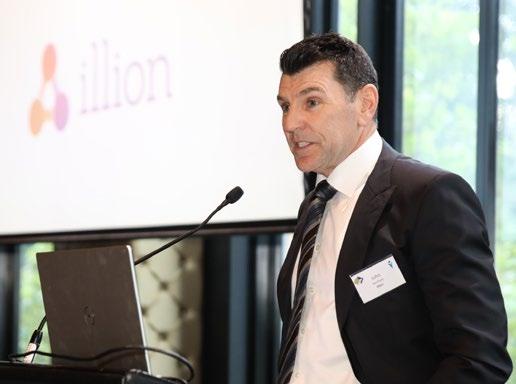

winners and celebrate their success. We also raised an impressive amount of money for the AICM Education Foundation through the very entertaining raffle. Particular credit goes to a certain individual who purchased the lion’s share of the tickets and took home at least a couple of the prizes. The Foundation does very important work, so thanks again to those who donated prizes and purchased raffle tickets.
We don’t know for sure what 2023 will bring but there is no doubt it will be a brilliant year and another important part of the journey we are all on. We will soon be hosting another round of CCE examinations so if you don’t already have your accreditation, I encourage you to participate because it is a very valuable experience.
I hope you all had a great break over the holiday
DIVISION REPORT 96 CREDIT MANAGEMENT IN AUSTRALIA | January 2023
NSW Finalists – Left to right = Natalie Ledlin MICM, Colin Shepherd MICM, Andrew Tanna MICM, Analia Baez MICM, Leila Vanner MICM CCE, Joseph Safi MICM, Barbara Cestaro MICM, Lucy Tindal MICM, Ben Strajn MICM, Maria Grigoriadis MICM and Cynthia Thomas MICM.
James Smith MICM CCE (NSW President) and Dale Hannan MICM CCE (NCS).
John Banfield MICM (illion).
new south wales
period and I look forward to seeing you in the new year at the Economic Breakfast which will be the first event on our calendar.
– James Smith NSW President
NSW 2022 Pinnacle Awards

24 November 2022
The 2022 NSW Pinnacle Awards was one of our biggest ever. The Awards recognise the leading performers in our industry throughout the year and are an opportunity to gather, celebrate and recognise their exceptional achievements. The night was a perfect combination of fun and formalities. We had 150 guests across 55 businesses and for many, it was their first time at an AICM event. Hosted by our NSW Council President, James Smith and MC Sam Pearlman there was a great atmosphere.
John Banfield MICM – CEO, illion, our naming sponsor for the event welcomed guests once we were underway. Our award sponsors were CreditorWatch, NCI, Esker and Colin Biggers & Paisley were thanked.
Congratulations to our 2022 Pinnacle Awards finalists:
l Abdul Homouda – Credit Manager, Wisr
l Alex Maizy – Senior Manager Credit Risk, Wisr
l Analia Baez MICM – National Credit Manager, Vinidex
l Andrew Tanna MICM – Special Counsel, Holman Webb Lawyers
l Barbara Cestaro MICM – Client Manager, Aon
l Ben Strajn MICM – Credit Manager, Jaybro Group Pty Ltd
l Charlie Aydin MICM – Head of Credit, Findex
l Colin Shepherd MICM – Credit Manager, Coates
l Cynthia Thomas MICM – Managing Director, Auscare Collect Pty Ltd
l Joseph Safi MICM – Key Account Manager, ARMA
l Leila Vanner MICM CCE – Manager, NSW Corporate Credit Services
l Lucy Tindal MICM – Senior Associate, Turks
l Maria Grigoriadis MICM – National Credit Manager, Hanson Construction Materials Pty Ltd

l Natalie Ledlin MICM – Director, Ledlin Lawyers
After the awards, we held a raffle with prizes donated by illion, ARMA, Byron Thomas Recruitment, Colin Biggers & Paisley, EDX, Fujifilm, NSW Swifts and the AICM.
All proceeds were donated to the AICM Education Foundation which provides financial assistance to credit professionals and students striving to continue their education.
It was a great night at Doltone House and we are all looking forward to next year.
DIVISION
January 2023 | CREDIT MANAGEMENT IN AUSTRALIA 97
REPORT
Left to right: Peter Moore MICM CCE (Jirsch Sutherland), Johnny Grujovski (Bodycare Workplace Solutions), Holly Jackson MICM, Terry Ledlin MICM (Ledlin Lawyers), Jane Ledlin, Carolyn Docherty (Jirsch Sutherland), Joanne Keating (Rodgers Reidy), Natalie Ledlin MICM (Ledlin Lawyers), Jason Polese (Clarence Chambers) and John Field FICM CCE (Reworq Consultin).
Left to right: Anita Lu MICM, Erin Willcocks MICM, Nisha Chadha MICM, Maria Grigoriadis MICM, Christalla Lardis MICM (All Hanson Construction Materials).
new south wales
AICM Members in spotlight
Adam Clarke MICM
National Credit Manager at Boral
Adam Clarke is well known to many at the AICM, having been awarded back-to-back NSW Credit Manager of The Year in 2013 & 2014. Since then, he has continued to strengthen his business acumen by working closely with CFOs and other senior finance colleagues. His career has been in the credit industry from day 1. Starting as a Claims Investigator whilst studying accounting, he stepped up to be a Credit Controller and has held a number of roles with increasing responsibility and complexity since. Adam joined Boral in 2017 and was promoted to National Credit Manager.

What do you like about your current role?
I enjoy the increased responsibility of managing the entire credit function for Boral. My role covers all aspects of credit from assessing credit applications, onboarding customers, banking, allocations and the collections process up until legal recovery. Being a single point of contact for so many people is great because I have full accountability and can deliver a consistent service and approach to dealing with customers.
What is your biggest challenge in the workplace?
Automation of the collections process has been a big focus for me. The key to process improvement is identifying the critical enablers to be able to deliver good outcomes and benefits. Getting the DSO into good shape is hard work and keeping it there is even harder. It’s a constant challenge, especially when you have to deal with the impacts of COVID, inflation, floods, fires, interest rate rises and other curveballs.
How do you celebrate good results?
You’re only as good as yesterday! We like to take time to appreciate the hard work and good results we achieve, but it’s important not to get complacent. We are fortunate to have a culturally diverse team so international food day was a great hit, everyone loved it. If you understand what different team members need to be happy and
work with them on being able to achieve this, you will get good productivity in return.
What advice can you give to emerging credit professionals?
Things don’t happen overnight. You need to be patient in the process, including yourself. If you want to move your career forward, continue to learn and develop yourself in every way that you can. Don’t wait for a mentor to do it for you. Take control and be self-motivated to grow. Keep up to date with the latest in technologies and expand your networks.
What has the AICM membership done for you?
The AICM is more than just something to put on your CV. It’s real-world networking that enables you to share ideas with like-minded (or different) people. It gives you access to important information, job opportunities and more. I was a member of the NSW Council for a few years and it was good to contribute my ideas to the organisation. Winning NSW Credit Manager of The Year was a fantastic accolade as well.
What are your interests outside of work?
Early on in my career, I took a break and spent 4 months travelling in the US. There is something about US sports, like basketball that I just love. I stay active by going to the gym and playing basketball and tennis (and hopefully avoid injury) and enjoy hiking as well. I also love to travel when I can and enjoy theme parks!
Stefanie Ross MICM CCE Accounts Receivable at ASSA ABLOY
Stefanie was unanimously voted in to join the NSW AICM council at our 9 August AGM. She has been actively involved with AICM for several years including YCP and other events so it was time to get to properly know Stef and share her story. She is an incredibly bubbly and enthusiastic Credit Professional so it was a pleasure to interview her.

What has been your career journey so far?
I didn’t start out in credit…like so many of us. I wanted to work with food after school and began
DIVISION REPORT 98 CREDIT MANAGEMENT IN AUSTRALIA | January 2023
as an apprentice chef in an Italian restaurant. I soon realised the hospitality industry wasn’t right for me so left and started working in an admin role followed by a Credit Officer role. Later, I joined Jaybro and then it clicked and I really focussed on credit. I had a fantastic mentor, did some business courses and took on a ledger. I’ve had a few other roles between Jaybro and my current role at ASSA ABLOY which has given me great experiences across different sectors in the industry. My current role has allowed me to grow and take on increased responsibilities, so I hope to be here for quite some time to make a difference.
What advice do you have for other young credit starters?
Firstly, as a general rule, “don’t be scared, you don’t know if you don’t try it”. Secondly, find a mentor. I was really lucky to come across John at Jaybro – I also believe you pick your manager, not the job – the role, that will come easy if you get along. He is the one that got me excited about credit and working with him I started to love it. He also got me involved in the AICM which has been great and he encouraged me to complete the Credit Management course at AICM and later on complete my CCE. You can get lucky or unlucky on ledgers with different requirements to fix and clean – which is a great learning curve to develop your skills. Difficult customers and roles come with the job, we sometimes get caught up but need to remember we are trying to first help the business and help the customer through the overdue. The debtors can get angry but we need to remember we are the messenger and they aren’t angry with us but with the situation – Plus if you’re lucky like me a thick skin helps. Last but more importantly, is working with people you like as you are there most of your day – You are replaceable at work, not at home – so enjoy where you are.
What involvement have you had with the AICM since you joined?
In 2018 I joined on the advice of my mentor, so that was initially just to learn more about credit. I worked at it, completed my Credit Management certificate and became a CCE after passing the intense 3-hour exam and written paper. I’m proud of my achievement to get the recognition it brings. The AICM has given me a lot of confidence to give
things a go. It’s a good forum to learn, I regularly review the magazines and use the available resources and attend events. Now joining the NSW Council is a way for me to pay it forward. It’s nice to be part of something bigger.
What do you do outside of work?
I believe in experiences over objects. Weekends are busy going on adventures. Whether it’s a mystery tour, picnic, cocktail classes or any other way to get out. My hubby and I recently did the bridge climb just to do something different.
Trent Eather MICM
Client Manager – Equifax
Trent Eather, all round good guy

– is a familiar face to many of us. Never short of words, I managed to sit down and chat about his journey in credit.
What has been your career journey?
I started out early in my career selling TVs and electronics on the floor at Harvey Norman. This was straight after school as I knew I enjoyed sales and people. Working hard to sharpen my skills in a customer-facing sales environment led to more senior roles in field sales and account management within Pioneer Electronics. Then at Panasonic, I worked in business-to-business sales. This allowed me to broaden my skill set across sales, service and product.
My first introduction to the world of credit was when I joined American Express whilst I was completing my Diploma in Business Management. Working with CFOs as our clients, I learnt the impact that credit had on their businesses. For example, the value they placed on extra days afforded in payment terms was significant, and the impact of upfront cash payments when AMEX took on the risk of payment and default was huge. It was of real value to them to eliminate risk and reduce DSO›s. Plus, customers loved being rewarded with the American Express rewards points for early settlement.
Four years ago, a previous leader thought my credit knowledge would be a great addition to the Equifax team. He got me to apply and the rest is history. It’s been a busy, innovative and fast-paced world since then.
DIVISION REPORT January 2023 | CREDIT MANAGEMENT IN AUSTRALIA 99 new south wales
new south wales
What has been your biggest professional challenge to date?
It’s keeping up to date with the ever-changing credit environment. There is a plethora of different services around to meet every business need. Understanding your client’s needs through communication and open collaboration is key to knowing what services will suit them to assist and help their business achieve their goals or challenges throughout the year.
What involvement have you had with the AICM?
I joined four years ago when I started at Equifax. They are a big supporter of the AICM and it’s been a great asset to my learning and engagement across many industries within credit. When I’m at work, I’m dealing with clients and my network on a professional level but at the AICM it’s more personal. Knowing there is life outside of business is fun and I like to socialise with the team and the AICM members. The AICM is a family, it’s a forum where I’ve had some of my best learnings through the experiences shared by others that have been within credit for quite some time. Its people are on the front line understanding the market and collaborating within the membership. This is a forum that helps me know what customers are facing on a day-to-day basis.
What advice can you give to emerging credit professionals?
Listen and learn from peers. All knowledge is valuable. Take every piece and digest it and apply it to your learning journey. Take advantage of the AICM courses that have been presented in an everevolving industry. Engage with peers to understand the gaps in what services they need compared to what they are receiving when making credit decisions. Best of all, look around you and see how you can learn through the journeys of others.
What are your favourite things to do outside of your profession?
My three boys are all heavily involved in sports and I enjoy this time with them. I’ve been manager and coach at the Hills Bulls Rugby League and Oztag teams where the boys have played over the last 10 years. Like the AICM and my employment at Equifax, my career is built on a team environment and I enjoy teamwork and see this applied early on
in life as in the case with my sons through sporting events. Sports are great – I love the camaraderie.
Thanks to Stefanie, Trent and Adam for allowing me to interview them. It’s always inspiring to hear about the people who are our members.
– Gary Poslinsky MICM, NSW Council
The Australian Institute of Credit Management welcomes our Partners for 2023
National Partners
Divisional Partners
Official Division Supporting Sponsors
Our National, Divisional and Professional Partners support and work with the AICM to promote the Institute’s activities, represent the Credit Industry and develop the careers of all Credit Professionals. As these organisations support your Institute and your Industry please consider them when you require assistance.
DIVISION REPORT 100 CREDIT MANAGEMENT IN AUSTRALIA | January 2023
CREDIT MANAGEMENT SOFTWARE
President’s report
What an amazing year to be living in Victoria and Tasmania! In my opinion, 2022 has been the year of changing jobs, interest rates, flexible working, resilience and strong leadership. The conference summed up the year for me as it felt like a huge family gathering of over 425 people within our industry, catching up as we have not seen each other for years.
A heartfelt thank you to my council members. I’m so proud to be among their expertise, enthusiasm and ongoing commitment to bringing
victoria | tasmania
new ideas and relevant topics to our members throughout the year.
We finished the year on a high, showcasing the high calibre of credit professionals we have in VIC/TAS at the Pinnacle Awards Night. I’d like to congratulate our 2022 winners again and thank our sponsors for the night.

I’d also like to congratulate Maddi Basso for being our 2022 YCP winner for VIC/TAS and we are very lucky to have her on the council to bring in ideas from the younger credit professionals’ perspective.

DIVISION REPORT January 2023 | CREDIT MANAGEMENT IN AUSTRALIA 101
2022 VICTAS Pinnacle Award finalists.
2022 VIC TAS Pinnacle Award winners Nikki Dennis MICM (Sales CRED), Tracey Rothwell MICM (Rothwell Lawyers), Sandra Kohlman MICM (Dulux Group) Joseph Bonvino MICM (Nutrien Ag Solutions), Katrina Bromley MICM CCE (Spicers Australia Pty Ltd) and Dale Hannan MICM CCE (National Collection Services).
victoria | tasmania
We also had two fantastic, sell-out WINC events, raising over $8000 for our charity Dress for Success, in both Tasmania and Victoria. Our Risk Seminars and credit updates have always been a popular events and this year didn’t disappoint. Lou and Jeff, also excelled in making the golf day another event not to be missed this year.
In addition to these events VIC/TAS saw the strongest membership growth across the country and we had 12 new CCE’s completed their exams.
Overall, we have so many achievements to celebrate as a division this year and I’m looking forward to sharing more knowledge, ideas and creating more opportunities to collaborate next year.
2022 VIC/TAS Pinnacle Awards
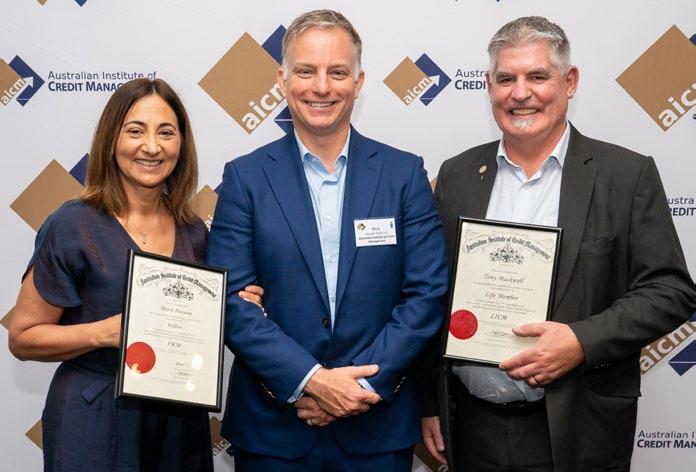
The Pinnacle Awards were once again a fantastic end to the year. A special thanks to our premium sponsor illion for making this such a great event!
Congratulations to all finalists:
l Alex Liu MICM – Credit Analyst, WEX Australia
l Allan Kawalsky MICM – Partner, Turks
l Amanda Rothwell-Hiscock MICM – Paralegal, Rothwell Lawyers Pty Ltd
l Belinda Worton MICM – Credit Manager ANZ, Penguin Random House Australia Pty Ltd
l Dale Hannan MICM CCE – Managing Director, National Collection Services
l Debbie Ryan MICM CCE – Credit Manager, Wurth Australia Pty Ltd
l Enes Tat MICM – Director, TAT Solutions
l Fiona Klenner – National Credit Manager, Hafele Australia Pty Ltd
DIVISION REPORT 102 CREDIT MANAGEMENT IN AUSTRALIA | January 2023
Sherif Hussien FICM CCE, Nick Pilavidis FICM CCE and Tony Mackwell at the 2022 VIC TAS Pinnacle Awards.
Tony Mackwell LICM (Victorian Managed Insurance Authority), Mary Karvelis MICM (DuluxGroup), Terrance Nyadongo MICM (TaleFin), Candy Cuesta MICM (DuluxGroup), Brayden McGregor (SLF Lawyers).
l Joseph Bonvino MICM – Credit Manager, Nutrien Ag Solutions
l Katrina Bromley MICM CCE – Credit Supervisor, Spicers Australia Pty Ltd
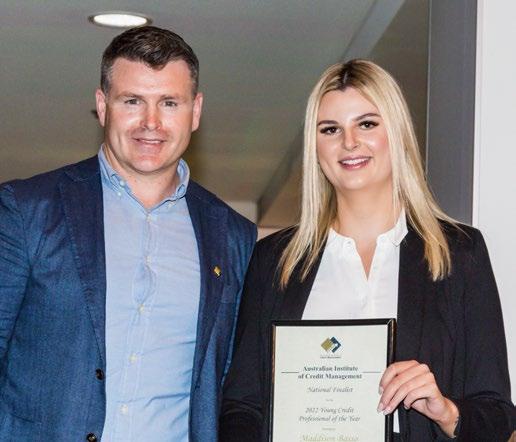
l Mary Petreski MICM CCE – Group Manager –Credit, Bega Group
l Melissa Tapper – Service Manager – Victoria, NCI (Brokers) Pty Ltd
l Nikki Dennis MICM – Managing Director, Sales CRED
l Rebecca Fahey MICM – Managing Partner, SLF Lawyers
l Rebecca Ford MICM – Commercial Collections
victoria | tasmania
Team Leader, CollectAU
l Rodney Lamb MICM – Capital Lead, Orora Group
l Sandra Kohlman MICM – Senior Credit Officer, DuluxGroup
l Stephen Langhammer – Director, Robert Half
l Tracey Rothwell MICM – Principal/Director, Rothwell Lawyers Pty Ltd

Upcoming Events – 2023
l VIC /TAS Annual Golf Day – Friday 17 February
l VIC Economic Breakfast – Tuesday 21 February
– Michelle Carruthers MICM President VIC/TAS

DIVISION
January 2023 | CREDIT MANAGEMENT IN AUSTRALIA 103
REPORT
Maddi Basson MICM at AICM 2022 National Conference.
VIC/TAS Council at the National Conference.
Michelle Carruthers MICM (VIC/TAS President) and Dale Hannan MICM CCE (National Collection Services).
victoria | tasmania
New Fellow Member
Sherif Hussien
We’d like to congratulate Sherif Hussein who has been nominated by the council and approved by the board to be our newest FICM. We had the magical opportunity to surprise Sherif at the Pinnacle Awards with her certificate. Sherif has been a past president, on many sub committees and she has been an overall ambassador for the AICM and the credit industry as whole.
New Life Member
Tony
Mackwell
Congratulations Tony for being promoted to life member. Tony has contributed enormously across the last 25 years. He has been a board member, a president and has helped shape our CCE program and our young credit professional program. He is incredibly passionate about credit and still to this day assists and mentors our young credit professionals. We are forever grateful for all of his contributions.
Member in spotlight
Belinda Worton MICM
Credit
Manager
Australia & New Zealand, Penguin Random
House
Belinda has been in the credit industry for over 15 years across many different industries. We asked Belinda a few questions to get to know her better:


How did you get into credit?
I actually studied Music at Uni and have my Bachelor of Music. When I finished studying,
I wasn’t really interested in teaching or performing, so I ended off starting out in a few reception roles. I ended up in a position at Telstra, they were creating a corporate B2B credit team.
I enjoyed being a part of building the team and setting up the processes and that was really my first foray into the industry. I found Telstra was a good introduction to the industry, being a large corporation. It helped me understand the ins and outs of corporate life, managing relationships and politics and the like.

What has your career path been like?
Since Telstra I’ve moved around a lot, I’ve worked at many different insurance companies and lots of different industries, which I think is the beauty of credit. It has a presence in every industry and every large company has a credit department. I was the Credit manager at Aggreko for a couple of years and before that I was at BMW Finance in the collections team. I found it interesting dealing with consumers and repossession agents, every day there was something different.
After that I arrived at Aggreko in 2010 where I was promoted to credit manager of a small team. That was my first step into management, and it really allowed me to learn a lot about being in a leadership position.
The learning didn’t stop when I got my role at Penguin. My predecessor at Penguin had been in the position for 18 years and I had to work diligently to build my own reputation within the business. I think something I’ve learnt that it is the value in asking for advice. I called my predecessor at Penguin for advice when I took on the role, which ended up being really valuable. That really extends to what I do today within the industry, I often reach out to my network for advice. I think my network is one of my strongest assets.
What do you get out of the AICM?
The number one thing I get from the AICM is the networking opportunities. I’m always meeting amazing new people at the AICM events and training, and over the years it helped me build an extensive and valuable network. I always know there will be someone in the network at the AICM that will have the knowledge or the skills I’m looking for and will be willing to help me.
DIVISION REPORT 104 CREDIT MANAGEMENT IN AUSTRALIA | January 2023
The events are also fantastic, attending the women in credit event is one of the highlights of my career. I find it really valuable; I always meet so many great new people, and it’s a great opportunity to catch up with people in my network that I haven’t seen in many years.
I’ve also found many of the training programs informative, I attended the training session just before Covid about policy writing because it was relevant to my role at Penguin. Being in a room surrounded by credit professionals from different industries and hearing how they deal with the challenges they faced, gave me a lot of valuable insight and I really learnt a lot.
The webinars during Covid were also really valuable, they gave me confidence and really helped with navigating the uncertainties during Covid.
What was your experience during Covid?
At the start with all the uncertainty about the future and the severity of the virus, I found it really quite challenging. We at Penguin ended up working from home, which was a new experience and had its own challenges, but the whole time there were so many uncertainties about how the business would operate and about the security of everyone’s jobs.
Once we adapted our internal processes to dealing with covid and working from home, then we were able to focus on supporting customers. There were a lot of complexities with validating orders with our customers, checking whether the stores were still operating, and navigating cash flow issues amongst our customers.
We offered our customers a lot of support, obviously our goal was to keep the business going while still getting paid and I think we managed that very well.
What do you do outside of work?
I play netball twice a week, I love playing. It’s very social and fun, I’ve made a lot of friends through it. I love sports, I watch a lot of community sports and love watching my nieces and nephews play basketball. I’ve also been to watch a lot of AFLW games which I’ve really enjoyed as well, I really enjoy that even though they are at a professional level, it still feels like a community game. I’m a bit of a sports fanatic! I also enjoy going out
for breakfast and enjoy watching Netflix in my downtime.
What advice would give to someone trying to get into credit management?

I think it’s important to partner yourself with a strong leader and mentor. It’s important to have someone support you through your leadership journey, they can be really valuable. Surrounding yourself with people that support you and believe in you will certainly really help your development.
Membership anniversaries
l Tara Nicholls – 5 years

l Brooke Lawrence – 10 years
l Rebecca Fahey – 10 years
DIVISION REPORT January 2023 | CREDIT MANAGEMENT IN AUSTRALIA 105 victoria | tasmania The Australian Institute of Credit Management welcomes our Partners for 2023
Partners
Partners
Division Supporting Sponsors Our National, Divisional and Professional Partners support and work with the AICM to promote the Institute’s activities, represent the Credit Industry and develop the careers of all Credit Professionals. As these organisations support your Institute and your Industry please consider them when you require assistance.
National
Divisional
Official
new members
The Institute welcomes the following credit professionals who were recently admitted to membership between October and December.
New South Wales
Monica Abuodha Probe Group
Darryle Adams FPND Pty Ltd t/as Carbiz Accident Replacement Vehicles
Jacob Alex Jaybro
Maris Azzi TPG Telecom
Patricia Blake Fujitsu General Australia
Adam Clarke Equifax
Steve Culpeper
Will Daly Thomson Reuters
Quan Do Brickwords Building Products Pty Ltd
Nermine Elkassas Americold
Ijlal Gocer Southern Steel Group
Johnny Lalic Fujitsu General Australia
Lisa Lawrence Brickworks
Deline Manuel Jaybro Group Pty Ltd
Vishal Pai TradieSpec
Suny Sidhoo Finstro
Cameron Smith Jaybro Group
Arnie Stanton Finstro
Mel Suleyman Fujitsu General Australia
Ben Williams Equifax
Peter Xu Turks
Ruby Zwaan Austral Bricks
Queensland
Dean Atcheson Charter Mercantile
Alex Caruana Risk & Security Management
Damian Crowley Choice Mercantile Pty Ltd
Jack Elmendorp Charter Mercantile Pty Ltd
Ugwumsinachi Ezema Americold Logistics
Stacey Feaver SilverChef
Kim Foots Sealed Performance Batteries Pty Ltd
Craig Francis Revive Financial
Marguerite Freney Paramount Liquor
Kathleen Goranson Shell Energy
Brooke Hildrew Thomas Marsh & Co. Pty Ltd
Shari Hoy Heritage Bank Ltd
Nathan King QRIDA
Ryan Lloyd Ergon Energy Retail
Travis Nice Australian Liquor Marketers (Metcash)
Louise Orchard Ipec PTY LTD
Stacey Skene Ergon Energy
Natalie Taylor Silverchef AU
Narelle Wade Iplex Pipelines Australia
South Australia
Mel Carter NCI
Janita Shaw McMahon Services Australia Pty Ltd
Ron Skurnik National Credit Management Limited
Victoria/Tasmania
Samantha Adair
Adrian Anderson Probe Group
Lisa Anstee WEX Australia Pty Ltd
Jamie Barnett BankVic
Melvin Bartholomeusz Bunzl Australia
Elena Bernery Bunzl Australia
Jennifer Bowden Bunzl Australia
Kenneth Burr JHK Legal Pty Ltd
Robert Cartledge Team Global Express
Melisa Caulcutt Bunzl
Desmond Chan WEX
Peter Christo AON
Naomi Cooke Bizcap
Martin Cooper WEX Australia
Lara Dorfan Wex
Dov Esakoff Bizcap
Robyn Fisher Dindas Australia Pty Ltd
Wendy Geok Kee Fong Wex Australia
Lynden Freeman Bunzl
Narelle Harris IMCD Australia Pty Ltd
Adrian Hearne Fuchs
Melanie Heitman Bunzl Outsourcing
Gina Hughan Dahlsens Building Centres Pty Ltd
Camille Hymer Jarosite Consulting
Sophie Inwood QR Lawyers
Moshe Joseph Bizcap
Menachem Joseph Bizcap
Aksh Kathuria Bizcap
Sarah Kumetaitis Bunzl
andres leal Team Global Express
Yaling Li
Yang Kin Lim Cummins South Pacific Pty Ltd
Daniel Linsket Bizcap
Xiaoqian Liu WEX Australia
DIVISION REPORT 106 CREDIT MANAGEMENT IN AUSTRALIA | January 2023
Yi Liu Bizcap
Harika Mamidi HighRadius
Ozair Naim Cummins INC
Jason O’Brien WEX Australia
Goe Pafumi Bluescope
Tamar Peretz Bizcap Au Pty Ltd
Joanne Pollard Henry Haymes Pty Ltd – Haymes Paint
Jyoti Prince WEX
Pat Prokopis Bluescope
Ritesh Puran Bunzl Australasia Pty Ltd
Connie Puteri Team Global Express
Nazife Redif Bunzl
Ashlee Rhind DuluxGroup
Rochelle Richmond Wex
Debbie Ryles Cummins South Pacific
Kylie Saunders WorkTrybe
Michaela Smith Fuchs Lubricants
Valerie Stagg Bunzl
Mick Stahel Nutrien Ag Solutions
Donna Steley Best Bar P/L
Rachel Stocker Probe Asia Pacific
Adam Szental Bizcap
Wallis Tong WEX
Bridgit Turnbull Bizcap
Craig Van De Weerd Team Global Express
Dessana Wijeyekooon Bizcap
Glenn Williams Bunzl Australia
Andrew Worrell Slater and Gordon
Xiaoxian Wu Bizcap
Western Australia
Grant Bungey CSBP Fertilisers
David Cecchi Realty Assist Australia Ltd
Laura Harris Realty Assist Australia Ltd
Nicola Prickett Summit Rural (WA) Pty Ltd

Danielle Rosman Cummins South Pacific
Nathan Scott Realty Assist Australia Ltd
Ciara Upton Realty Assist Australia Ltd
Overseas
Binyamin Leibowitz Bizcap
new members
Five reasons to become an AICM Member!
1 Industry news and insights
Members continue to be informed of the latest news in credit, regulatory changes and receive insights to best practice from leaders in the industry.
2 Complimentary registration to our webinar series
Members receive complimentary registration to our webinar series valued at over $300! The value from this member benefit alone covers the majority of your membership fee.
3 Discounts for all AICM activities
Receive a member discount for all AICM events and training courses. The more engaged you are with us, the more you’ll save and have your membership to thank for it.
4 Access to resources
Being a member will provide access to resources that will assist in navigating the ever-changing business economic and regulatory environment. This includes articles, reports, webinars and our quarterly magazine.
5 Be part of our professional community
Last but not least, join our growing professional credit community which has reached over 2800 members for the first time in the last 17 years! Interact with fellow credit professionals to build relationships and tap into credit management insights.
BONUS: More value for teams!
Do you manage or work within a team? AICM offer a group membership for organisations to enrol multiple employees as members at discounted rate.
To find out more about AICM Membership go to
www.aicm.com.au
DIVISION REPORT January 2023 | CREDIT MANAGEMENT IN AUSTRALIA 107
AICM Marketplace
Directory of services
For information, options and pricing please contact Claire Kasses on +61 2 9174 5727 or E: claire@aicm.com.au
COLLECTIONS
AICM Divisional Partner
AMPAC Debt Recovery
Level 5, 35 Clarence Street, Sydney NSW 2000
Tel: 1300 426 722
Email: info@4ampac.com.au
Web: www.4ampac.com.au
AMPAC Debt Recovery is a specialist debt collection practice supporting organisations around Australia and in over 180 countries worldwide. With decades of experience and global reach, AMPAC is a trusted partner to some of Australia’s highest profile private and public sector organisations. Call or email us to next time you are reviewing your debt recovery needs.
AICM Divisional Partner
CMA Collect
Tel: 07 3108 2840
Email: wbj@cmacollect.com
Web: www.cmacollect.com
Collections:
l Online commission free Mercantile demands
l Easy online referral option
l Full integrated
l Access to QCAT claims up to $25,000.00 (Fully funded T&C’s apply)
Credit Documents:
l Digital Credit Application via the CMA webpage
l Approval confirmation and DocSign authorisation
l Personal deed of guarantee from
l Data stored in the CMA webpage in a historical format
COLLECTION SYSTEMS
AICM Divisional Partner
Esker Australia Pty Ltd
Suite 1502, Level 15, 227 Elizabeth Street, Sydney NSW 2000
Tel: 02 8596 5126
Email: info@esker.com.au
Web: www.esker.com.au
Cash is the heartbeat of your business, so give your AR department the tools they deserve!
Esker’s AR solutions help companies reduce cost for invoice delivery, accelerate cash collection process and automate the reconciliation of payments. Contact us to easily achieve your cash collection goals, tackle root causes of payment delays and reduce collection disputes while improving customer relationships.
COLLECTION SYSTEMS
AICM Divisional Partner
OnGuard
Tel: 1800 123 613
Web: www.onguard.com
OnGuard’s Credit management solution will help you hit your collection targets – each and every month.
By working smarter and providing better visibility, OnGuard will help you reduce your DSOs. Why not give your staff a friendly solution that will make their life so much easier. Contact us to show you how OnGuard has made life a whole lot easier for our customers.
CONSULTANCY
AICM Divisional Partner
Credit Solutions
Unit 1/245 Fullarton Road, Eastwood SA 5063
Tel: 08 8418 1450
Email: gcrowder@creditsolutions.net.au
Web: www.creditsolutions.net.au
Credit Solutions, a division of the Credit Clear Group. A debt collection partner you can trust. Working with some of the country’s leading providers of information management and data intelligence solutions. Since 1965 Credit Solutions has set the benchmark for providing quality collection and recovery services to South Australian businesses and government.
DISTRIBUTION & PRINTING
INFORMATION
AICM Divisional Partner
Access Intel
2059 Moggill Road, Kenmore, QLD 4069
Tel: 1300 831 331
Email: team@accessintel.com.au
Web: www.accessintel.com.au
Access Intel provides instantly consumable risk insights to businesses that extend credit. Our advanced technology platforms offer professional digital trade applications, powerful multi bureau decisioning, easy one click PPSR and transparent creditworthiness monitoring for all customers. End to end credit management. Single sign on. Clear competitive monthly subscription. No establishment fee.
AICM National Partner
CreditorWatch
GPO Box 276
Sydney NSW 2001
Tel: 1300 501 312
Web: www.creditorwatch.com.au
CreditorWatch is a leading commercial credit reporting bureau used by over 50,000 businesses across Australia. CreditorWatch offers a variety of products including customer monitoring/alerts, credit reporting, an indepth trade program and online credit applications to assist with customer onboarding and decisioning. Contact us today for more information or to organise a FREE DEMO of any of products.
AICM National Partner
Lane Communications

Tel: 08 8179 9900
Web: www.laneprint.com.au
Lane are widely regarded as one of the largest and most technologically advanced print production and distribution companies in Australia. We are an industry leader in digital and offset print, point of sale signs, complex embellishments and print finishing, storage, kitting and mailing. With innovation at our core, our services extend beyond transactional mail and promotional print production to include SMS, bulk email communications, and electronic billing solutions. Lane are your partner in print and multi-channel communications.
Equifax
Tel: 13 83 32
Web: www.equifax.com.au
Equifax is a global information solutions company, providing data and insights that help organisations and individuals make more informed decisions. As a leading provider of credit information and analysis in Australia and New Zealand, Equifax serves key markets in risk management, marketing services and HR solutions.
Drawing from trusted sources to compile and process data, Equifax helps its customers see things and make connections that others can’t.
AICM MARKETPLACE
108 CREDIT MANAGEMENT IN AUSTRALIA | January 2023
AICM Divisional Partner
CREDIT MANAGEMENT SOFTWARE
Directory of services
For information, options and pricing please contact Claire Kasses on +61 2 9174 5727 or E: claire@aicm.com.au
INFORMATION
AICM National Partner
INSOLVENCY INSOLVENCY

AICM Divisional Partner
Insolvency Intelligence
Tel: 1300 265 753
illion

Tel: 13 23 33
Web: www.illion.com.au
Renowned for our expertise in credit risk management, we pride ourselves in providing market leading products and services which securely store and analyse the unique data of millions of individuals and commercial entities. While we specialise in credit risk assessment and decisioning software solutions, we also provide a full suite of products that span the entire credit lifecycle. This includes lead generation and sales prospecting tools and receivables optimisation solutions.
TaleFin
Tel: 1300 284 193
Email: info@talefin.com
Web: www.talefin.com

www.linkedin.com/company/talefin
TaleFin is Australia’s fully comprehensive credit reporting agency.
We can help you to identify the reasons to say ‘yes’ to your customers, increasing your conversion rate, while helping you to reduce your arrears rate.
TaleFin – Fit for the 21st century, we’re the home of fair credit reporting.
INSOLVENCY
AICM Divisional Partner
BRI Ferrier
Unit 3, 99-101 Francis Street
Northbridge WA 6003
Tel: 08 6316 2600 Fax: 08 9227 8008
Email: info@brifwa.com.au
Web: www.briferrier.com.au

BRI Ferrier is a national affiliation of insolvency accounting firms with offices across Australia as well as the United Kingdom and New Zealand. BRI Ferrier prides itself on being experts in business recovery, insolvency, forensic accounting, and advisory. All BRI Ferrier offices offer extensive experience across several industries, laying the foundation of our outside the box reputation. At BRI Ferrier, we focus on providing transparent solutions to financial challenges to help financially distressed businesses and individuals recover, change, and renew.
Web: www.jirschsutherland.com.au/ insolvencyintelligence/
Email: intelligence@jirschsutherland.com.au
Insolvency Intelligence: a specialist provider of insolvency and turnaround advice and services for credit managers. Backed by national firm Jirsch Sutherland, our friendly team is just a phone call or email away, providing members with practical, strategic advice about corporate and personal insolvency. Free initial consultation; networking opportunities; training and presentations; knowledge database access. Contact us now to find out how we could assist you.
AICM Divisional Partner
SV Partners
Level 8, 68 St George’s Terrace, Perth WA 6000
GPO Box 2527, Perth WA 6001
Tel: 08 6277 0026
Fax: 07 3229 7285
Email: perth@svp.com.au
SV Partners is a specialist accounting and advisory firm with 17 offices across Australia. Our expert accountants have the skills and experience to provide tailored insolvency, turnaround and advisory services. We partner with professionals and their clients, providing expert advice with a human touch.
Vincents
Level 34 Santos Place, 32 Turbot Street
Brisbane QLD 4000
Tel: 1300 VINCENTS (07) 3228 4000
Web: www.vincents.com.au
Vincents is a firm of highly specialised experts delivering comprehensive insights into complex situations, enabling our clients to take control of decisions and get the best possible results. We cater for every business need where numbers are involved, including Insolvency & Reconstruction, Corporate Insolvency, Turnaround & Restructuring Solutions, Solvency & Investigative Reports, Informal Arrangements and Personal Insolvency.
LEGAL
AICM Divisional Partner
Nova Legal Level 2, 50 Kings Park Road West Perth 6005
Tel: 08 9466 3177
Web: www.novalegal.com.au
Nova Legal can assist with the recovery of problem debtors (large and small). Founding director Raffaele Di Renzo acts for creditors, debtors, directors, credit managers and insolvency practitioners in relation to solvency issues and dispute resolution.

AICM Marketplace
We’re proud of the AICM and we want to let all credit professionals know those businesses that support the AICM. Thank you to these companies for their continued support and please consider them first when you’re looking for assistance in your business. We’ll also include these sponsors on our website so you can be sure to find them easily.
For more information contact:
Claire Kasses
Direct: +61 2 9174 5727
Email: claire@aicm.com.au
Tel: 1300 560 996
AICM
MARKETPLACE
January 2023 | CREDIT MANAGEMENT IN AUSTRALIA 109
AICM Marketplace
AICM Marketplace
Directory of services
For information, options and pricing please contact Claire Kasses on +61 2 9174 5727 or E: claire@aicm.com.au
LEGAL LEGAL
AICM Divisional Partner
Results Legal
Level 4, 183 North Quay
Brisbane QLD 4000
Tel: 1300 757 534
Web: www.resultslegal.com.au
Results Legal is a national firm with a focus on promoting and protecting the rights of trade creditors. Our clients are some of Australia’s largest trade credit companies who rely on our assistance for legal recovery, dispute resolution, preference claim defence and PPSA rights. Results Legal are the obvious first choice for companies seeking a national solution to resolve commercial disputes and pursue swift, successful and cost effective legal recovery action.
AICM National Partner
Turks
Tel: 02 8257 5700
Web: www.turkslegal.com.au
Contact: Daniel Turk
Turks is a specialist commercial law firm with 33 Partners and over 160 staff across our Sydney, Melbourne and Brisbane offices. We are proud to look after the interests of trade creditor suppliers and financial institutions in:
l Portfolio debt recovery using our marketleading, real-time client interface, ‘TurksFocus’
l Resolution of complex debt disputes
l PPSA recovery
l Defence of unfair preference claims
l Supply documentation and guarantees.
TRADE CREDIT INSURANCE National Supporting Sponsor
National Credit Insurance Brokers
Tel: 1800 882 820 (freecall)
Email: info@nci.com.au
Web: www.nci.com.au
National Credit Insurance Brokers (NCI) has established itself as the premier trade credit insurance broker in Australia, New Zealand, Singapore and Malaysia. Trade credit insurance is a highly specialised area of insurance and with its 35 years of experience, NCI has developed an unmatched depth of expertise in arranging the right protection at the best price for your particular trading needs.
Log in to your member profile and view our new modules
CREDIT NETWORK FORUM
The go-to digital forum for credit professionals is back! In between AICM networking events, the Credit Network Forum is the only place where you can get responses from peers with a real-world understanding of issues in all facets of credit management.
JOB BOARD
AICM is proud to offer the credit industry a platform to recruit credit professionals and assist all stakeholders with their careers. Visit the job board to view the latest roles and submit a job advertisement today.
SUPPLIER DIRECTORY
The directory is an efficient way to find suppliers in a range of service categories who support the AICM through National Partnership, Divisional Partnership or Supporting Sponsorship, meaning they are committed supporters of the AICM and the Credit Profession.
AICM MARKETPLACE
110 CREDIT MANAGEMENT IN AUSTRALIA | January 2023
The Publication for Credit and Financial Professionals IN AUSTRALIA Level 3, Suite 303 1-9 Chandos Street St Leonards NSW 2065 PO Box 64 St Leonards NSW 1590 Tel: 1300 560 996 Fax: (02) 9906 5686 www.aicm.com.au
