LOOK BACK
FOCUS: Manufacturing makes a push into recruitment of diverse workers. PAGE 10
The struggle to rebuild Cleveland’s schools PAGE 23
CRAINSCLEVELAND.COM I DECEMBER 14, 2020
SMALL BUSINESS
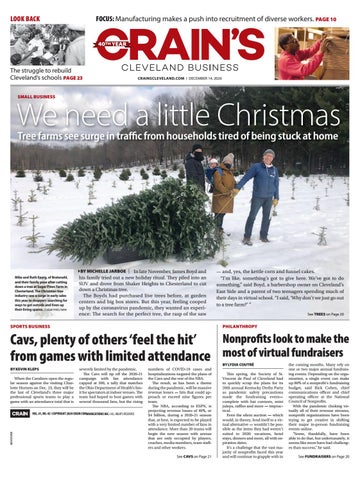
We need a little Christmas Tree farms see surge in traffic from households tired of being stuck at home
BY MICHELLE JARBOE | In late November, James Boyd and Mike and Ruth Eppig, of Bratenahl, and their family pose after cutting down a tree at Sugar Pines Farm in Chesterland. The Christmas tree industry saw a surge in early sales this year to shoppers searching for ways to get outside and liven up their living spaces. | SUGAR PINES FARM
his family tried out a new holiday ritual. They piled into an SUV and drove from Shaker Heights to Chesterland to cut down a Christmas tree. The Boyds had purchased live trees before, at garden centers and big box stores. But this year, feeling cooped up by the coronavirus pandemic, they wanted an experience: The search for the perfect tree, the rasp of the saw
SPORTS BUSINESS
— and, yes, the kettle corn and funnel cakes. “I’m like, something’s got to give here. We’ve got to do something,” said Boyd, a barbershop owner on Cleveland’s East Side and a parent of two teenagers spending much of their days in virtual school. “I said, ‘Why don’t we just go out to a tree farm?’ ” See TREES on Page 20
PHILANTHROPY
Nonprofits look to make the Cavs, plenty of others ‘feel the hit’ from games with limited attendance most of virtual fundraisers BY KEVIN KLEPS
When the Cavaliers open the regular season against the visiting Charlotte Hornets on Dec. 23, they will be the last of Cleveland’s three major professional sports teams to play a game with an attendance total that is
BY LYDIA COUTRÉ
severely limited by the pandemic. The Cavs will tip off the 2020-21 campaign with fan attendance capped at 300, a tally that matches the Ohio Department of Health’s limit for spectators at indoor venues. The team had hoped to host games with several thousand fans, but the rising
NEWSPAPER
VOL. 41, NO. 45 l COPYRIGHT 2020 CRAIN COMMUNICATIONS INC. l ALL RIGHTS RESERVED
numbers of COVID-19 cases and hospitalizations negated the plans of the Cavs and the rest of the NBA. The result, as has been a theme during the pandemic, will be massive revenue losses — hits that could approach or exceed nine figures per team. The NBA, according to ESPN, is projecting revenue losses of 40%, or $4 billion, during a 2020-21 season that, at best, is expected to be played with a very limited number of fans in attendance. More than 20 teams will begin the new season with arenas that are only occupied by players, coaches, media members, team staffers and other workers. See CAVS on Page 21
P001_CL_20201214.indd 1
This spring, the Society of St. Vincent de Paul of Cleveland had to quickly scrap the plans for its 20th annual Kentucky Derby Party as pandemic safety precautions made the fundraising event— complete with hat contests, mint juleps, raffles and more — impractical. Even the silent auction — which would, in theory, lend itself to a virtual alternative — wouldn’t be possible as the items they had weren’t suited to 2020: vacations, hotel stays, dinners and more, all with expiration dates. It’s a challenge that the vast majority of nonprofits faced this year and will continue to grapple with in
the coming months. Many rely on one or two major annual fundraising events. Depending on the organization, a single event can make up 80% of a nonprofit’s fundraising budget, said Rick Cohen, chief communications officer and chief operating officer at the National Council of Nonprofits. With the pandemic choking virtually all of their revenue streams, nonprofit organizations have been trying to get creative in shifting their major in-person fundraising events online. “Some, thankfully, have been able to do that, but unfortunately, it seems like more have had challenges than success,” he said. See FUNDRAISERS on Page 20
12/11/2020 3:31:12 PM
MEDIA
Ad spending for 2021’s first quarter still not set for many Pandemic is stalling the budgeting process, but marketers are seeing signs of optimism BY JAY MILLER
Many of the Northeast Ohio media and marketing firms that rely on the flow of local advertising dollars to support their businesses took a hit in 2020, but marketers are seeing signs of optimism, though it’s taking longer for advertisers to set even their first-quarter 2021 budgets. Maybe, some say, it’s the new normal. “Budgets are usually locked in in October — November at the absolute latest,” said Brittany Trafis, executive vice president of client services at Fathom, a Cleveland digital marketing firm, on Wednesday, Dec. 9. “There’s still a majority of our clients that are still working through, locking in, what those budgets look like for next year.” Nationally, local advertising revenue is expected to grow by 2.5% in 2021, according to the U.S. Local Advertising Forecast recently published by BIA Advisory Services, a Chantilly, Va., media research firm. The report estimates spending in local media will reach $137.5 billion in 2021, up from $134.1 billion in 2020, though the firm does not expect local advertising to reach 2019, pre-COVID, levels until 2022. Trafis said some clients, in health care and financial services, for example, are setting aggressive budgets because they see opportunities for customer growth. Others, though, are staying at 2019 levels because they’re unsure of what the business impact of the pandemic may be in the next few months. “Health care has been very optimistic,” she said. “They have a great need to educate the community, not only about COVID, but the safety of
The cancellation of the Cleveland Auto Show, which had been set for March, is another blow to the ad-spending market for 2021. The event typically generates big spending in print, broadcast and digital media from auto dealers and manufacturers. | GREATER CLEVELAND AUTOMOBILE DEALERS’ ASSOCIATION
“SOME OF OUR DESTINATION CLIENTS THINK THERE WILL PROBABLY BE A QUICK (RETURN OF BUSINESS), JUST LIKE THERE WAS THIS PAST SUMMER, BUT THEN IT WILL PROBABLY SLOW DOWN AGAIN.”
get back into ad spending. “I think that dining is not going to have a huge snapback,” he said. “Some of our destination clients — Jason Therrien, president of thunder::tech think there will probably be a visiting doctors and emergency quick (return of business), just like there was this past summer, but then it rooms.” Jason Therrien, president of thun- will probably slow down again. We’ll der::tech, a Cleveland marketing have a surge of folks that want to get firm, said that while he sees some op- out of the house and spend some montimism in the hardest hit industries ey, but it won’t be back to normal this — which he said, include hospitality, summer.” Therrien said some of his e-comtourism, conferences and events — the scars left by the pandemic are merce clients worry that their busideep, and businesses will be slow to nesses could be affected by the coro-
navirus vaccine distribution, because it could tie up their supply lines — UPS, FedEx and others — and cause slowdowns, another factor that could affect an advertising rebound. Ed Stevens, chairman and CEO of Stevens Strategic Communications Inc., a Westlake marketing firm, said clients are telling him that budgets for the first quarter are down slightly, though not substantially. But given the way the coronavirus has hit some and not others, he’s hesitant to be too optimistic. “You know, we were coming out of furloughs from some of the clients, but people are hanging in there,” he said. “Every now and then, they get a wave of COVID that shuts someone down a bit, but it’s nothing serious. They keep rolling. They keep producing stuff.” One segment that is especially up in the air for advertising in the first quarter is the auto industry. That’s because of the cancellation of the Cleveland Auto Show in March. The show, one of the largest in the country, has been a regular spring event since 1903, in recent years at the I-X Center. The event generated spending in print, broadcast and digital media from auto dealers and manufacturers. “There’s not as much spend being placed at this point,” said Lou Vitantonio, president of the Greater Cleveland Auto Dealers’ Association. “I don’t know that there would be a swell of advertising put around something that doesn’t exist.” Vitantonio said, though, that vehicle sales continue to be strong and “if we’re still able to produce and sell vehicles, we do need the advertising.”
Of course, the auto show is only one of dozens of consumer and trade events where show promoters and exhibitors spend ad dollars to attract audiences both for sales at the show and for lead generation. Marketplace Events — a Solon firm that puts on consumer and trade shows across the country, including the Great Big Home and Garden Show, which will next be held in March at the Huntington Convention Center of Cleveland — is still trying to figure out what 2021 will look like for its business. “We are in a state of suspended animation,” said Tom Baugh, the firm’s CEO. “ We may internally talk about how much we’d like to spend, but in terms of budgeting and committing we’re at a complete standstill.” More broadly, beyond his own business, Baugh thinks that consumers will be eager to get back to normalcy. “I would say Americans overall are not necessarily that patient,” he said. “And I think there’s going to be this desire for people and businesses to get back to normal as quickly as they can.” Jay Miller: jmiller@crain.com, (216) 771-5362, @millerjh
Correction
An article in the Dec. 7 edition of Crain’s Cleveland Business should have stated that the former FirstEnergy Corp. subsidiary FirstEnergy Solutions owned the company’s deregulated power plants prior to its bankruptcy and that FirstEnergy no longer owns any deregulated power plants. FirstEnergy Corp. continues to own two regulated coal-fired plants in West Virginia.
Wishing you the best for the Holiday Season!
The next decision you make could be
To Observe the Holiday Season and Show Our Gratitude to the Community,
life altering.
TMA Northern Ohio Chapter Is Pleased To Support
Akron-Canton Regional Foodbank Toledo Northwestern Ohio Foodbank Greater Cleveland Foodbank & Mahoning Valley Second Harvest Foodbank
The Turnaround Management Association (TMA) is the most professionally diverse organization in the corporate restructuring, renewal, and corporate health space.
A special thanks to our 2020 Sponsors Platinum Sponsors
Here for you. Here for life. www.ncafinancial.com Silver Sponsors
6095 Parkland Blvd., Suite 210 Mayfield Hts., Ohio 44124 (440) 473-1115 Securities offered through Royal Alliance Associates, Inc. (RAA), Member FINRA/SIPC. RAA is separately owned and other entities and/or marketing names, products or services referenced here are independent of RAA. RAA does not provide tax or legal advice. Investment advisory services off ered through NCA Financial Planners. F: 440-473-0186
2 | CRAIN’S CLEVELAND BUSINESS | DECEMBER 14, 2020
P002_CL_20201214.indd 2
12/11/2020 12:49:37 PM
GOVERNMENT
Business leaders will push for place-based immigration in 2021 Group hopes to educate Ohio lawmakers on the ways reform could help workforce, economy BY KIM PALMER
As Ohio’s 134th General Assembly and the 117th Congress prepare to convene new legislative sessions in January, business leaders have joined forces to urge legislators to retool the country’s immigration policy with an eye on filling population and workforce gaps. Sensible immigration reforms, specifically place-based visas, are one of the priorities for the newly formed Ohio Business for Immigration Solutions (OBIS), a coalition of more than 20 Ohio businesses, trade associations, chambers of commerce and economic development groups. Madison Whalen, the state organizer of OBIS, said the group plans to educate lawmakers on how reforming immigration could help the state’s workforce and economy. “After having some introductory conversations, we learned that there was a real desire by a lot of business groups in the state to come together to focus on immigration reform policies,” said Whalen, who is a partner and government relations attorney at the law firm CHW Advisors. “In Ohio, we have over a half a million immigrants, who pay $5.7 billion in taxes that represents $14 billion spending power, which has a huge impact on Ohio, on our workforce and in our economy.” Place-based immigration — the
Cimperman
Whalen
push for more immigration targeted to specific regional areas as a means to replace declining population while growing the workforce — is one of the main focuses for OBIS and other organizations in Northeast Ohio. Groups, including the Greater Cleveland Partnership, are calling for a specific Great Lakes place-based visa program, which would allow foreign-born workers and entrepreneurs to migrate to former industrial regions experiencing consistent population decline, a weakened local economy and a need for workers with specialized skill sets. “Immigration reform has been a key issue of ours from an advocacy standpoint,” said Marty McGann, executive vice president of advocacy and strategy at the Greater Cleveland Partnership (GCP). “For several years, we have advocated for various reforms, but have landed, in recent years, on a placebased visa program because of the exceptional challenge within our com-
munity related to population decline.” These proposed visa programs would be contingent upon holders maintaining employment or starting a McGann business in specific areas of the country, rather than relying strictly on employer sponsorship like the H-1B visa program. Those visas are in high demand by the holders and, generally, large companies looking for skilled talent. In 2020, the government received 201,011 applications for the temporary employment-based visa. It’s awarded to 85,000 annually, chosen by lottery from a pool of applicants with certain educational and professional attributes. Of the more than 580,000 H-1B visa holders in the country, Ohio has 13,522. The biggest concentration of H-IB visa holders can be found in New York City (about 70,000); San Jose, Calif. (42,000); San Francisco (39,000); and Chicago (31,000), according to data from the U.S. Citizenship and Immigration Services. The current restrictive quota system — coupled with the federal government’s attempt to restrict legal immigration, especially the H-1B visa — makes effective immigration un-
workable for small and midsize businesses that need talent, McGann said. “We know more immigration aligns with some of the technology-based economic development that we have been trying to do in our community, and the question regarding how we get a skilled workforce to advance some of those areas,” McGann said. “It really ties in with a lot of our local strategies.” Joe Cimperman, president of Global Cleveland, an organization that connects immigrants to economic, social and educational opportunities in the region, said restrictive immigration policies represent one of the “biggest threats to the region’s economic revival.” “The H-1B is probably the greatest gift to economic development in Northeast Ohio, but in 2016, we saw visa application acceptance rates at over 93%. Going through the exact same process for visas for the exact same job last year, we saw acceptance rates at 22%,” Cimperman said. Beyond the H-1B visas, Cleveland can benefit from a higher influx of immigrants who can migrate on one of the 49 different visas available, including refugees, another form of immigration that has been curtailed recently, Cimperman said. “Last year, we had 364 refugees come here. In 2016, we had 1,400,” he said. These visa holders, often with high
levels of education, also are an integral part of building the region’s entrepreneurial class, Cimperman said. As of 2018, there were 126,873 immigrant residents in the Cleveland metro area, according to a 2018 study by the New American Economy, a bipartisan research organization that advocates for smart federal, state and local immigration policies. Those immigrants, who make up 6.2% of the population, include nearly 6,800 the organization classified as entrepreneurs. “We have a saying at Global Cleveland that to immigrate is an entrepreneurial act,” Cimperman said. Specific policy language for placebased immigration is still in the works, McGann said. The goal is to produce bipartisan legislation to increase the amount and type of immigration permitted based on a region’s need. The need is even more important for the region’s post-pandemic economic recovery. “Immigration has always been a challenge from a policy standpoint, but I think it’s incumbent upon us to take another run to ensure that this is about the economic benefit to our community and about advancing our region, and that immigrants serve a compelling role in helping accomplish that,” McGann said. Kim Palmer: kpalmer@crain.com, (216) 771-5384, @kimfouroffive
NOMINATIONS
OPEN
Crain's Cleveland Business is searching for organizations in Northeast Ohio that lead by example and hold themselves and others accountable on diversity and inclusion initiatives. They actively attempt to cultivate a culture of inclusion.
DEADLINE TO NOMINATE:: Monday, Jan. 4, 2021
NOMINATE TODAY:
CrainsCleveland.com/nominate
DECEMBER 14, 2020 | CRAIN’S CLEVELAND BUSINESS | 3
P003_CL_20201214.indd 3
12/11/2020 12:56:10 PM
EDUCATION
DON’T LET THIS YEAR ICE
Colleges and universities navigate limited amounts of COVID-19 aid
YOUR COMMERCIAL REAL ESTATE INVESTMENTS CALL YOUR LOCAL CREDIT UNION TODAY!
STILL STRONG, STILL LENDING COMMERCIAL REAL ESTATE INTEREST RATES AT ALL TIME LOWS Loans up to $15 Million • No Prepayment Penalties As Little as 10% Down
Your Business Lending Partner SM CONTACT JONATHAN A. MOKRI TODAY! 440.526.8700 • jmokri@cbscuso.com www.cbscuso.com
34,749 SF Industrial Bldg. on 6.5 Acres 8333 Boyle Pkwy., Twinsburg Township, OH 44087 Hiram College received about $1 million in federal HEER funds in the spring. | HIRAM COLLEGE
Ohio schools have found a lot of needs, uses for CARES Act funds BY AMY MORONA
PROPERTY OVERVIEW • 34,749 SF Available on 6.5 Acres • 32,189 SF Warehouse; 2,560 SF Office • Outside Storage up to 3 Acres • Adjacent to Norfolk Southern Rail Line • Access to I-480, I-271 & I-80 (OH Turnpike) • Lease Rate: $5.75/SF, NNN Joseph J. Martanovic 216.8661.5434
www.hannacre.com
JosephMartanovic@HannaCRE.com
Michael J. Occhionero 216.861.5291 MichaelOcchionero@HannaCRE.com
Store it locally, ship it anywhere
Flexible warehousing that won’t break the bank. » Up to 200,000 square feet of available space » Affordable shipping services » Contract and on-demand options PartnerShip.com/Warehouse | 800-599-2902
When colleges got billions of federal dollars back in the early days of the coronavirus pandemic, many leaders hoped it was just the beginning. But institutions have received only that first round of money so far, leaving some Ohio schools to stretch parts of those grants out as the virus and its impact rages on. “We knew that this was going to get a lot worse before it got better, and we also didn’t know whether there would be additional money coming from the government,” said Dr. Forrest Faison, senior vice president for research and innovation and chief health care strategy officer at Cleveland State University who’s also leading the university’s pandemic response efforts. “So it was important for us to be judicious to buy the things that we needed to make the campus safe and take care of our students, but at the same time, protect as much as we could for the spring semester.” Ohio’s campuses were awarded roughly $417 million via the Higher Education Emergency Relief fund portion of the CARES Act. According to the most recent estimates, they’ve collectively spent about $300 million of it as of late September. This funding, including Hiram College’s $1.08 million, was distributed in the spring. Officials there called it an all-hands-on-deck situation as administrators worked collaboratively on preparations for a unique fall semester. “Every time we’d solve one problem, we’d find two or three others that we just hadn’t thought about,” said Liz Okuma, senior vice president and dean of students at the Hiram campus. Parts of Hiram’s funds slated to go toward institutional expenses went to things like dorm renovations to offer single-room housing, upgrading technology to support the increased reliance on digital learning, and increasing cleaning and sanitization methods. Campuses across the state focused on similar priorities with the money. Youngstown State University reported
paying about $90,000 on personal protective equipment and $127,000 to secure additional laptops. Kent State University noted spending more than $9.6 million in reimbursements for things like tuition and room and board, along with other fee refunds. Lorain County Community College used about $275,000 as bridge payments to help part-time employees who had to turn to unemployment af-
“EVERY TIME WE’D SOLVE ONE PROBLEM, WE’D FIND TWO OR THREE OTHERS THAT WE JUST HADN’T THOUGHT ABOUT.” — Liz Okuma, senior vice president and dean of students at Hiram College
ter the campus shut down. Institutions have about a year from the initial issue date to spend the funds. This funding pool included a specific allocation intended just to be used for emergency grants to quickly help students dealing with COVID-related disruptions. Lots of attention in the spring focused on that front, but federal officials then created confusing and shifting rules about who could get the help. Cuyahoga Community College learned it would be eligible in April, according to Angela Johnson, vice president of enrollment management. It took the campus about three to four weeks to develop a distribution process amid the changing guidance. They weren’t alone. By May, only 28% of the nearly 600 administrators surveyed by the National Association of Student Financial Aid Administrators actually had distributed any cash to students. The portion that hadn’t reported they were waiting on more guidance from the Department of Education or that they were still creating their own award policies. “As the changes were happening, we did not have the money,” Johnson said. “So in a lot of ways, we did have some opportunity to make these adjustments.”
Once made, campus leaders worked to get information about the available funding out to students and created a process where eligible students could apply for the grants, eventually streamlining things so that those approved applicants would receive funds in about three to five days. The average amount the campus distributed clocked in at $1,247. That offered some help, Johnson said, adding that it would also supplement existing financial aid awards. But for those facing economic hits leveled by the virus like a job or home loss, that amount isn’t exactly a lifeline. “I think more broadly, students have higher needs,” she said. “I don’t know what could have been enough for them. They had some financial needs and situations that certainly more money could be helpful.” The campus helped students secure more help, including through its foundation. Institutions also received separate, additional state allocations of CARES Act funding, and some others took out PPP loans. But the costs to keep colleges and universities afloat are staggering. In a December letter to congressional leaders calling for more aid, the American Council on Education reiterated an ask for at least an additional $120 billion to help with new expenses and lost revenue. Lynn Pasquerella’s Association of American Colleges and Universities was one of many higher education groups that endorsed that note. The organization’s president said the first round of support just wasn’t enough for her members. “There are so many needs that individuals are facing, not only in the higher education sector, but in health care, in K-12, other aspects of our society,” she said “So we understand that need to allocate scarce resources. Yet higher education traditionally serves as a catalyst for economic and social mobility, and at this moment in time, that seems more important than ever.” Amy Morona: amy.morona@crain. com, (216) 771-5229, @AmyMorona
4 | CRAIN’S CLEVELAND BUSINESS | DECEMBER 14, 2020
P004_CL_20201214.indd 4
12/11/2020 1:36:03 PM
FINANCE
Stakeholders are hopeful marijuana banking will improve The industry, fraught with uncertainty, is optimistic that incoming administration could be a ‘game-changer’ BBY JEREMY NOBILE
For Standard Wellness, a vertically integrated marijuana business in Northeast Ohio and budding multistate cultivator, reform of marijuana-related financial regulations could mean reduced fees on banking accounts, access to federal tax deductions available in other industries and better access to credit. Such benefits afforded to other businesses could have catalytic impacts on the young company and others like it in the marijuana sector. Standard Wellness would benefit from a business loan in particular, said CEO Jared Maloof, noting how Small Business Administration funding and stimulus efforts like the Paycheck Protection Program are not available to a federally illicit industry. Marijuana-favorable banking regulations would also benefit banks and credit unions that want a piece of the industry. It’s why banking trade groups push for legislation like the SAFE Banking Act, which is designed to protect firms providing banking services in states where marijuana is legal in some form. That, coupled with descheduling, could truly open up banking services to the benefit of finance and marijuana industries alike. Until then, mere access to a bank account to deposits funds and manage payroll will carry high fees, and credit likely will remain unavailable. Stakeholders are hopeful the climate for marijuana banking could improve in the coming years under an incoming administration that has signaled openness to federal legalization. And if Democrats retake the Senate in runoff elections, the odds of marijuana-friendly laws passing through Congress greatly improves. It’s unlikely a Republican-controlled Senate looks favorably toward marijuana. Absent of passage of something like the SAFE Banking Act, the industry will continue to be held back compared to other businesses not subject to a quasi-legal regulatory environment, and banks won’t get to participate in the industry’s financial upside. “The current disjoint between state and federal law makes no sense on a federal level, be it from a crime reduction perspective, a business perspective or an economic perspective,” said James Thurston, a spokesman with the Ohio Bankers League. He said that disconnect is among the myriad factors keeping many conservative Ohio banks and credit unions on the sidelines of a state-approved marijuana industry. “Banks of all sizes are concerned about reputational risk associated with serving cannabis-related businesses,” echoed Aaron Stetter, vice president of policy and political operations for the Independent Community Bankers of America. “And there’s concern with the potential regulatory backlash. With your field of examiners, what is acceptable today may not be acceptable tomorrow.” While many businesses languish during this economic downturn, marijuana has been in generally high demand. In Ohio’s burgeoning industry, medical marijuana retail sales have picked up amid the pandemic in part due to telemed visits for patients getting or renewing cards, the option for curbside pickups, and a new way of calculating a
“WITH THIS NEW ADMINISTRATION, IF MARIJUANA BECOMES LEGALIZED ON A FEDERAL LEVEL, IT’S A GAME-CHANGER. EVERY BANK POSSIBLE WOULD LOOK TO BANK THESE CUSTOMERS.” ——James Gasior, Cortland Bank president and CEO
medical customer’s purchasable allotment of marijuana over a given period of time. With public sentiments regarding cannabis only continuing to improve, the industry has increasing potential to grow. Some estimates project the U.S. marijuana industry to top $30 billion in value by 2025. Many banks and credit unions want a piece of that, especially when their margins are under pressure amid a depressed economy and rock-bottom interest rates. At Cortland Bank, a community bank with less than $1 billion in assets, marijuana businesses could be a low-cost source of deposits and, in theory, a new piece of the loan portfolio. The company has opted to steer away from cannabis for now but with passage of marijuana-related reforms, that perspective might change. “With this new administration, if marijuana becomes legalized on a federal level, it’s a game-changer,” said Cortland president and CEO James Gasior. “Every bank possible would look to bank these customers.” Among marijuana companies in Ohio that are banked, there’s an expectation to not talk about it publicly because of the repercussions that might bring. The secrecy speaks to how much they want to protect their banking relationships and the surrounding sensitivities. There are some firms providing basic treasury services. They include Wright-Patt Credit Union in Dayton and Atomic Credit Union in Southeast Ohio. There were 677 known marijuana banking institutions in the country as of September, according to FinCEN. There seem to be but a few in the Buckeye State. Those providing accounts charge a premium due to the increased scrutiny and monitoring those accounts require due to connections to a federally illicit industry. And credit is simply not on the table. “When you have a business that’s growing, you have incredible profits, and the bank holding your checking account won’t lend you money, that really is frustrating,” said Kevin Patrick Murphy, an attorney with Walter | Haverfield and an adviser to Standard Wellness. In the company’s experience, Maloof said financing is mostly available only through private lenders,
like family offices, hedge funds and real estate investment trusts. And it tends to come at exorbitant costs, making it a lucrative investment for
early investors but exceedingly expensive for potential borrowers. Maloof described a private loan offered with an annual interest rate of 13%, roughly double that of a more traditional bank business loan. But that’s just the coupon. With other costs added in — like payment-in-kind interest, original issue discount and monitoring fees — the final interest rate is more like 20% to 23%. And there would be no tax deduction available on that, of course. “So that is all really, really frustrating,” Maloof said. “There is a lot of predatory financing out there. We pay a lot of fees (for banking services), there’s the onerous tax code, and none of these fees are deductible. But by far, the access to capital is the number one thing we hope for.” That one offer was exceptionally expensive. On average, the private loans come out more in the 10% to 15% interest range. If banks were better enabled to participate, the rates would be much better. Fees on accounts would seem-
ingly come down as well. In the case of one Ohio credit union, there’s a $1,500 to $2,000 fee for a marijuana business to apply for an account. Then there’s the regular monthly fee of another $1,000 to $1,500 and other incremental fees associated with different services, like picking up cash in armored cars. And then there’s the safety issue of many dispensaries still dealing largely in cash. Card transactions would be of less issue if marijuana was no longer classified as a Schedule 1 drug. A lack of access to credit and exorbitant costs on basic bank accounts will remain the norm until reforms are passed. But the odds of that have never seemed greater than they do under the coming Joe Biden administration. “Until cannabis is legalized and de-scheduled from the Controlled Substances Act, it has a heightened level of oversight and scrutiny no bank can get around,” Stetter said. Jeremy Nobile: jnobile@crain.com, (216) 771-5362, @JeremyNobile
December 14, 2020 | CRAIN’S CLEVELAND BUSINESS | 5
P005_CL_20201214.indd 5
12/11/2020 1:34:37 PM
HEALTH CARE
Multi Radiance Medical seeks approval for laser technology Solon company is applying for FDA authorization to help treat critically ill COVID-19 patients BY LYDIA COUTRÉ
Following a clinical trial to evaluate a COVID-19 application of its laser therapy, Multi Radiance Medical, a Solon-based medical device company, is preparing to apply for emergency use authorization with the U.S. Food and Drug Administration (FDA). The triple-blind, placebo-controlled clinical trial evaluated the use of the company’s super pulsed laser therapy technology to improve respiratory function in critically ill COVID-19 patients who have been placed on ventilators. Patients on ventilators often suffer a weakened diaphragm, said Douglas Johnson, senior vice president of clinical and scientific affairs for Multi Radiance Medical. “When these patients are intubated, they end up having a weakened diaphragm,” he said. “So by the time they get to day five or day six, their diaphragm is atrophying. It’s getting smaller; it’s loosing muscle mass. And the problem with that is that when they try to take them off it, the muscle that causes them and allows them to breathe is now weak. So these people come off and they stay in respiratory distress and they have to have supplemental oxygen.” The clinical trial examined how
Multi Radiance technology utilizes super-luminous and laser diodes to deliver light energy to diseased or injured tissue. | CONTRIBUTED PHOTO
Johnson
the laser therapy can preserve and improve the thickness of the diaphragm in ventilated COVID-19 patients. Results show that the company’s therapy decreased invasive intubation time/need overall by 18%, and decreased mechanical ventilation time/need by 23% overall, according to a news release. In the United States, Multi Radi-
ance Medical’s technology has largely been used for pain management, but it has been approved for different applications in other countries. Knowing the company’s previous peer-reviewed research in various applications (such as stroke and sports performance), researchers approached Multi Radiance Medical about this COVID-19 trial.
Kanarsky
Even before the pandemic, the company was exploring the use of its technology in pulmonary applications, including publishing a study of its effectiveness in chronic obstructive pulmonary disease (COPD). “This could potentially open entirely new markets and significant opportunities for our company,” said Max Kanarsky, president and CEO of Multi Radiance Medical. The company has been growing in recent years, he said, noting double-digit growth in revenues last year and its considerations of further international expansion. “We are investing in clinical research and therefore creating new applications and new markets for ourselves,” Kanarsky said. “And that’s what we’ve been doing over the last seven years or so. We have over 50 clinical studies done, so it’s quite a bit of work, a lot of effort, a lot of investment going into validating our
technology and also demonstrating efficacy in new applications and new conditions as well, which go beyond musculoskeletal conditions.” The technology uses light therapy to treat patients at the cellular level, and help cells recover from damage sustained from a variety of issues. “So the reason it can have such a strong impact is that it’s a cellular type of therapy, where it’s not really just a target or an organ-specific type of thing,” Johnson said. “It really focuses on helping the cell to recover from whether it’s inflammation or an infection or damage.” Multi Radiance Medical says the trial is the first of its kind to evaluate a non-pharmaceutical medical device with “virtually no side effects” that could benefit patient health outcomes, according to the release. “We know that the vaccines are coming, but it’s not doing anything for the patients that are going to have severe cases,” Johnson said. “We can actually reduce the amount of time they need the vent and the time that they’re in the hospital. This is going to help reduce a lot of the health care burden that we’re seeing. Let’s take some of that pressure off our health care workers right now.” Lydia Coutré: lcoutre@crain.com, (216) 771-5479, @LydiaCoutre
Crain’s Cleveland Business will honor eight individuals in their 80s or older who are still working tirelessly to advance Northeast Ohio and its residents. Do you know someone 80 or older who has seemingly tossed the word “retirement” from his or her vocabulary and continues to make an impact in Northeast Ohio’s business, civic and philanthropic circles?
NOMINATION DEADLINE: Jan. 18 | Issue Date: April 19
NOMINATE TODAY: CrainsCleveland.com/nominate 6 | CRAIN’S CLEVELAND BUSINESS | DECEMBER 14, 2020
P006_CL_20201214.indd 6
12/11/2020 2:28:40 PM
MANUFACTURING
Tendon Manufacturing keeps growing, buys building next door Metal fabricator is ‘using every square inch’ of 50,000-square-foot space in Warrensville Heights BY RACHEL ABBEY MCCAFFERTY
Tendon Manufacturing Inc. has been growing steadily in recent years, but 2020 has been a particularly strong year for the metal fabricator. The company serves a diverse mix of customers, but it’s those in the medical space that have been driving growth during the COVID-19 pandemic. As sales have ramped up, so has production. And all that growth means it’s time for Tendon to grow in another way, too. Its current building at 20805 Aurora Road in Warrensville Heights is a little less than 50,000 square feet. “If you walk through here, we’re using every square inch of this building,” said sales manager Michael Gordon Jr. So Tendon is buying the building next door. That building, at 20905 Aurora Road, is about 44,000 square feet. Gordon said Tendon will move its machining and assembly operations into that building, taking up about 15,000 to 20,000 square feet next year. Some of the building will remain occupied by the current tenants at this time. And with the additional space, Tendon will add another paint line to its operations. Gordon declined to share the terms of the purchase, saying that the deal was expected to close in Decem-
Jimbo Ventura powder-coats an air purification unit at Tendon Manufacturing in Warrensville Heights. | CONTRIBUTED PHOTO
ber. The company expects to begin moving into the new building in January. Tendon will be making some electrical upgrades, but Gordon said the building didn’t need any large structural renovations. Tendon also rents a small location nearby for welding operations. Warrensville Heights Mayor Brad Sellers said Tendon has always been
a “civic-minded” company and a good member of the community. He was pleased to see it expanding and doing so in the city. “There’s no question about it,” he said. “We’re always trying to grow our base here. That opportunity popped up and we talked about it. It felt like it was a great opportunity for them and us.” Prior to this purchase, Tendon had
already invested in newer, more compact machines and expanded all three of its shifts, making use of each and every machine. More equipment — and more space for that equipment — is a necessity. Tendon got its start as a machine shop in the late ’80s, but the company has put a stronger focus on sheet metal over the years, Gordon said. The company sometimes just supplies components for its customers, but can also provide electrical assembly. Its customer base is made up of a diverse mix of industries, from retail to lighting to defense to medical. The latter market has been particularly important this year during the COVID-19 pandemic. Some of Tendon’s customers had been making UV disinfectant equipment, and they saw demand increase exponentially. And one of the company’s customers makes an air purification product that has been doing particularly well. Gordon said that from 2016, when Tendon began making the units, to the start of 2020, the company had made about 400 of them. Today, Gordon said he’s shipping about 150 of those units every day. The company has hired to support that growth, this year adding about 20 new full-time employees and another 13 temporary workers, Gordon said, noting that Tendon is likely to hire on
the temp workers full-time, too. In total, Tendon has about 100 full-time, part-time and temporary employees. Tendon is seeing a lot of pandemic-related product growth this year, but it’s been growing steadily over time, too. For the past five years, it’s grown about 20% each year, Gordon said. This year, the company is on pace to increase sales by about 40% year over year. He declined to share annual revenue. Gordon said the company has been entering new markets in recent years, particularly as the next generation — Gordon and his brother, Adam — have entered the family business. His father, Michael Gordon Sr., is president, CEO and one of the founders. The company has been intentionally keeping the sectors it serves diverse, too, with none making up more than 20% of its business. “We’re so diverse that it’s been nice, especially in a year like now where normal business is down but because of our medical presence, we’re way up,” Gordon said. The company has more than tripled in size in the past five years, Gordon said, and that continued growth is the focus for the future. Rachel Abbey McCafferty: (216) 771-5379, rmccafferty@crain.com
INDUSTRY ACHIEVERS ADVANCING THEIR CAREERS Recognize them in Crain’s
For listing opportunities, contact Debora Stein at dstein@crain.com or submit directly to
CRAINSCLEVELAND.COM/PEOPLEMOVES
DECEMBER 14, 2020 | CRAIN’S CLEVELAND BUSINESS | 7
P007_CL_20201214.indd 7
12/11/2020 2:29:54 PM
PERSONAL VIEW
Housing crisis looms large over Cleveland
RICH WILLIAMS FOR CRAIN’S CLEVELAND BUSINESS
BBY DR. TOBY COSGROVE
EDITORIAL
Cabinet work U.S.
Rep. Marcia Fudge is heading to President-elect Joe Biden’s cabinet, not in the job she necessarily wanted, but in one where she nonetheless can make a significant policy difference for the country — and for Cleveland. The Biden team made official last Thursday, Dec. 10, the news that leaked a couple days prior: that Fudge will be nominated to head the U.S. Department of Housing and Urban Development, the $50 billion housing agency. The agriculture secretary job Fudge wanted — and arguably would have been a better fit for — instead went to Tom Vilsack, the former Iowa governor who headed the U.S. Department of Agriculture in the Obama administration. Assuming she’s confirmed, Fudge will be the second Black woman in history to lead HUD. A cabinet seat of any variety is a high honor, one that Fudge earned as a smart, effective member of Congress for more than a decade. We do, though, share some of the disappointment voiced last week that Fudge didn’t get the USDA position. Politico noted, for instance, that A CABINET SEAT OF ANY while her supporters are “confident she’ll do a fantasVARIETY IS A HIGH tic job leading HUD, they bewilderment at HONOR, ONE THAT FUDGE expressed the decision, given Fudge’s EARNED AS A SMART, extensive anti-hunger and ag policy work in Congress EFFECTIVE MEMBER OF made her particularly CONGRESS FOR MORE well-suited to lead USDA.” The American Prospect, THAN A DECADE. meanwhile, saw her as a potentially transformative agriculture secretary, writing, “Fudge was intending to rethink the notion of how Black voices can be heard on policy. She set her sights on USDA, an agency whose primary function in terms of dollar amounts is actually to distribute Supplemental Nutrition Assistance Program (SNAP) benefits.” (Fudge has been on the Agriculture Committee since entering Congress in 2008, and now chairs the Nutrition Subcommittee, the key oversight entity for SNAP distribution.) This seems like an early missed opportunity for a Biden ad-
ministration that’s leaning on familiarity rather than innovation. Nonetheless, Fudge, whose background includes serving as mayor of Warrensville Heights, knows her way around both policy and politics, which will come in handy at HUD. The department will play a key role in the Biden administration’s response to the COVID-19 pandemic, which, as Politico noted, “has caused millions of people to fall behind on rent and mortgage payments” and “face eviction and massive backrent bills.” The new administration is expected to push for Congress to pass a relief package dedicating billions of dollars to rent relief, and Fudge, as HUD’s leader, will be critical in that process and in seeking additional funding to address homelessness. There’s reason for optimism on that front. For instance, John Corlett, president of the Center for Community Solutions, a nonpartisan think tank focused on solutions to health, social and economic issues, wrote on Twitter that the organization worked with Fudge and her staff to “address the epidemic of hunger that has mushroomed during COVID-19” and before that “to block harmful regulations” proposed by the Trump administration “that would have worsened hunger in Greater Cleveland and the U.S.” There’s obviously no shortage of tasks for Fudge at HUD. But to put a little more on the plate, we do like a suggestion outlined by Jason Segedy, director of planning and urban development for the city of Akron and the inaugural Legacy Cities Fellow at the Economic Innovation Group, in an EIG blog post. He noted that HUD’s Community Development Block Grant (CDBG) “has been an important tool used by cities for decades to provide decent housing, expand economic opportunities and combat neighborhood decline,” but it’s “restricted to serving neighborhoods at 80% area median income or below.” He then argued that HUD “should create a new program, specifically geared toward legacy cities, that would help middle-class neighborhoods that are just beyond the upper end of the CDBG income restrictions.” This would be a big help to Cleveland and Akron. There’s plenty of room for Fudge to get creative at HUD. We congratulate her on the nomination and look forward to seeing where she takes the department.
Executive Editor: Elizabeth McIntyre (emcintyre@crain.com) Managing Editor: Scott Suttell (ssuttell@crain.com) Contact Crain’s: 216-522-1383 Read Crain’s online: crainscleveland.com
The COVID-19 pandemic continues to upend our world and make it crystal clear just how fragile our health, social and economic prosperity are. It’s undeniable that complicated, deeply rooted inequities exist in our nation as people of color suffer disproportionately from this virus and its many ripple effects. The result is a looming housing crisis upon an already existing poverty crisis within Cosgrove, our city. executive advisor Housing instability is one ripple effect and former CEO — most notably due to evictions. This is and president of a threat our city and our nation must Cleveland Clinic, work quickly to solve. COVID-19 has serves as caused thousands of Clevelanders to distinguished lose their jobs through no fault of their chair of the own. As a result of those job losses, fam- United Way ilies and individuals affected who are of Greater unable to secure work often face evic- Cleveland’s tion, with Black and brown communi- Impact Institute, ties disproportionately impacted. a think tank with Nearly 9,000 evictions were filed in an action plan Cleveland in 2016, according to a study committed to by Case Western Reserve University. identifying and About 80% of those households were led addressing the by women of color, and 60% had at least root causes of one child in the home. Evictions are poverty. traumatic experiences that destabilize families and their opportunities for prosperity — often for generations to come. Consider this: ``Working renters who experience an eviction are up to 20% more likely to lose their jobs. (Social Problems, Housing and Employment Insecurity among the Working Poor, 2016) ``Once an eviction is on a credit report, finding EVICTIONS ARE TRAUMATIC healthy housing is significantly harder to do. These EXPERIENCES THAT renters then end up in DESTABILIZE FAMILIES AND more resource-scarce neighborhoods and tend THEIR OPPORTUNITIES FOR to rate their health lower PROSPERITY — OFTEN FOR than those individuals livGENERATIONS TO COME. ing in higher-income neighborhoods. (U.S. Office of Disease Prevention and Health Promotion) ``Resource-scarce neighborhoods tend to be less conveniently located to job hubs, leading to absenteeism and poor performance in the workplace — two of the top factors that lead directly to job loss. (Social Problems, Housing and Employment Insecurity among the Working Poor, 2016) `Children ` who move more frequently tend to miss more school, have lower third-grade reading scores and are up to 30% more likely to drop out of school. (Fordham Institute, 2011) We know these milestones set young people up for future success, and without them, poverty persists for generations. The domino effects of eviction require a coordinated response now more than ever as we prepare for an eviction tsunami in our city from the economic consequence of the ongoing COVID-19 pandemic. According to global, independent data analysis firm Stout Risius Ross, as of November 2020, there are 76,000 Cuyahoga County renters at risk for eviction, and we could see five times the number of evictions in 2021 compared to 2016. With such dramatic scale, innovation and partnership become even more essential.
Write us: Crain’s welcomes responses from readers. Letters should be as brief as possible and may be edited. Send letters to Crain’s Cleveland Business, 700 West St. Clair Ave., Suite 310, Cleveland, OH 44113, or by emailing ClevEdit@crain.com. Please include your complete name and city from which you are writing, and a telephone number for fact-checking purposes.
See COSGROVE on Page 15
Sound off: Send a Personal View for the opinion page to emcintyre@crain.com. Please include a telephone number for verification purposes.
8 | CRAIN’S CLEVELAND BUSINESS | December 14, 2020
P008_CL_20201214.indd 8
12/11/2020 1:50:31 PM
OPINION
PERSONAL VIEW
Inclusion is good economics BY BETHIA BURKE
A recent opinion piece in Crain’s Cleveland Business by local economist James Trutko took aim at the Cleveland Innovation Project, suggesting the vision that the Fund for Our Economic Future and its partners support is misguided. While I disagree with many criticisms leveled by Trutko, I welcome his public scrutiny. It provides an opportunity to sharpen the project’s thinking and hold it to account. However, Trutko raised one issue I cannot ignore. He asserted, “sustained economic growth is … inherently unequal” and further asserted the project (and presumably the region at large) “should give more attention to creating a bigger economic pie and be less concerned with how the pie is split.” He goes on to argue for the mythical trickle-down approach in which regional success will ultimately accrue to women and minorities, diminishing the vast difference in economic outcomes that exist today. An inclusive economy — one where access to opportunity is not defined by race or place — is far from being an “unrealistic social objective.” Our region’s economic competitiveness cannot be decoupled from our ability to achieve inclusive economic growth. A series of analyses conducted by and on behalf of the Fund over the past 15 years supports this claim. As early as 2006, soon after the Fund’s formation, we engaged the W.E. Upjohn Institute for Employment Research to analyze factors associated with economic growth. The resulting ”Dashboard of Economic Indicators” looked at scores of variables across more than 100 metropolitan areas over a decade. The data showed a clear and positive correlation between both racial inclusion and income equality and a metro’s ability to grow jobs, income, output and productivity. Following this, the 2007 update of the dashboard conducted by Cleveland State University’s Maxine Goodman Levin College of Urban Affairs found racial inclusion and economic equality to be the only factors associated with all four measures of growth. The results remained consistent in subsequent iterations. Analysis in 2013 by Emily Garr Pacetti, then at the Fund
To sell or not to sell? Don’t make permanent
decisions based on and now vice president and comtemporary circumstance. munity affairs officer at the Federal Reserve Bank of Cleveland, demonContact one of our strated that while inclusion was asspecialists today! sociated with growth, growth alone Let us work for you does not guarantee either racially or and your #CRE portfolio economically inclusive outcomes. so you can make an Many of the metros with high employment growth rates also had the informed decision. highest rates of poverty, crime and Burke is other social ills. Garr Pacetti looked president of the more exhaustively at the relationFund for Our ship again in 2014, summarizing reEconomic search across the nation and globe. Future. The conclusion: “High and rising Analysis + Market Knowledge = Creative Solutions inequality combined with stagnant www.naipvc.com mobility is a recipe for inefficiency, making it harder for well-qualified individuals at any income level to move up” and “inequality likely affects the extent to which economic growth can be sustained over time.” More recently, the Fund collaborated with leaders in Stark and Summit counties as they developed Strengthening Stark and Elevate Greater Akron, respectively. Both efforts analyzed local data and concluded that economic prosperity can only be achieved and sustained through racial and economic incluTurning Assets Into Cash For 16 Years ! sion. Analysis in Akron, for instance, suggests that the lack of inclusion has resulted in nearly 200 fewer startups. These local examples are corroborated by national studies and the work of peer cities. “Growth, prosLet’s explore your options. perity and inclusion are complementary, not competing, goals for Call me today! meaningful economic development,” writes Brookings Metropolitan Policy Program director Amy Liu in “Remaking Economic DevelopRandy L. Compton ment.” Other cities with enviable growth rates, such as Minneapolis, Indianapolis and Orlando, have embedAuctioneer/Realtor ded inclusion into their metrics of success. The Indy 330-704-5702 Chamber, for instance, differentiates business development incentives according to job quality, emphasizing rcompton@kikocompany.com its objective to “build a ladder, raise the floor.”
AN INCLUSIVE ECONOMY — ONE WHERE ACCESS TO OPPORTUNITY IS NOT DEFINED BY RACE OR PLACE — IS FAR FROM BEING AN “UNREALISTIC SOCIAL OBJECTIVE.” OUR REGION’S ECONOMIC COMPETITIVENESS CANNOT BE DECOUPLED FROM OUR ABILITY TO ACHIEVE INCLUSIVE ECONOMIC GROWTH.
Your Expert Advisor
See BURKE on Page 15
LETTER TO THE EDITOR
Will local government use leverage from state? lence in the 21st century is only achievable through public/private joint ventures. Otherwise, the only thing that is affordable and achievable is mediocrity. Sen. Kirk Schuring’s vision and persistence and the overwhelming vote of the Ohio House and Senate have established, for the first time anywhere in the United States, a road map for excellence SEN. KIRK SCHURING’S VISION AND PERSISTENCE AND and transformation, including the tools required for implementation, THE OVERWHELMING VOTE OF THE OHIO HOUSE AND for the entire state of Ohio. The question now is whether local SENATE HAVE ESTABLISHED, FOR THE FIRST TIME government — cities and counties ANYWHERE IN THE UNITED STATES, A ROAD MAP FOR — will exploit the enormous leverage that state leadership has just EXCELLENCE AND TRANSFORMATION, INCLUDING THE handed to them, by investing suffiTOOLS REQUIRED FOR IMPLEMENTATION, FOR THE ciently, using all of the means at their disposal, to build public ENTIRE STATE OF OHIO. wealth, to grow their economies, to update their neighborhoods and educational systems, and well-being for itself the same way as people do. Senate Bill 39, doggedly championed by state Sen. Kirk and to establish a culture of transformation, excellence Schuring of Canton, is the bold new recognition and as- and innovation, in anticipation of the opportunities that sertion of the Ohio House and Senate that the 21st centu- will define the greatness of the 21st century. Bob Stark ry has ushered in a new era of public sector “wealth President and CEO building,” through investment, rather than relying upon Stark Enterprises taxation. This perspective also acknowledges that excelThe key to Senate Bill 39’s successful implementation will be an enlightened public sector that is highly motivated to invest in its future, and regards the private sector as the perfect partner to invest with, rather than a self-interested party that has its hand out for a subsidy. The public sector must invest in order to create wealth
216 831 3310 | Cleveland 330 535 2661 | Akron 330 239 0176 | Medina
SALT • SALT • SALT
Water Softener • Industrial • Food • Ice Melt • Sea Salt
Call For Pricing!! Minimum Delivery: 1 Pallet
MEDINA, OH
1-800-547-1538 Salt Distributors Since 1966 www.saltdistributormedinaoh.com DECEMBER 14, 2020 | CRAIN’S CLEVELAND BUSINESS | 9
P009_CL_20201214.indd 9
Grimm Winter mix 2x4.33.indd 1
12/10/2020 4:05:04 PM 9/22/2020 1:14:55 PM
Q&A WITH SUE LACY President of ConxusNEO talks about the pandemic’s impact on job training.
WORKFORCE DEVELOPMENT
“WE ARE LOOKING TO BUILD SOCIAL CAPITAL WITH AFRICAN AMERICANS, RATHER THAN JUST FUNDING A DEGREE.” — Adam Snyder, managing director for the manufacturing sector partnership of Cuyahoga County’s Workforce Connect initiative
CIENPIES VIA ISTOCK
REACHING FOR BETTER DIVERSITY
PAGE 12
Scholarship, reentry program forge manufacturing’s push into recruitment of Black workers BY JUDY STRINGER | Area manufacturers are rolling out
a new scholarship program aimed at steering more Black people into manufacturing careers. “The emphasis is on the word ‘program,’” said Adam Snyder, managing director for the manufacturing sector partnership of Cuyahoga County’s Workforce Connect initiative. Snyder works for MAGNET (the Manufacturing Advocacy & Growth Network), a nonprofit consulting group that is co-intermediating the manufacturing talent collaborative alongside Greater Cleveland Partnership.
Elsons International, a Cleveland maker of corrugated boxes and packaging, is among the companies that are actively working to expand diversity hiring in the manufacturing sector. | CONTRIBUTED PHOTO
He said the scholarship will be offered to Black engineering students or Black manufacturing workers looking to advance with an engineering degree. Along with the financial support that typically comes from a scholarship, awardees will get access to workbased learning opportunities, internships, mentorships and other engagement activities with participating manufacturers. “We are looking to build social capital with African Americans, rather than just funding a degree,” said Snyder, who expects applica-
tions to be available in the spring for an inaugural class in the 20212022 school year. The scholarship program is the first product of the 22-month-old manufacturing sector partnership’s dive into diversity. Snyder said the partnership’s leadership team — comprised of 12 local manufacturing executives — identified a need to strengthen minority recruiting and retainment efforts early on, based partly on statistics that suggest that talent pool is underutilized. See DIVERSITY on Page 14
10 | CRAIN’S CLEVELAND BUSINESS | DECEMBER 14, 2020
P010_CL_20201214.indd 10
12/10/2020 3:52:19 PM
EXPECT MORE.
An intern from the Ohio Export Internship Program helped DRR USA navigate the complex export rules for its new electric ATV. | DRR USA
Growing Ohio’s exports and local workforces State program matches interns to companies that want to expand their global footprint BY AMY MORONA
According to University of Akron student Nikki Winkel, not all college internships are created equal. “I know a lot of people just sit at a desk and cold-call all day, which is just not something that I would find interesting or enriching at all,” she said. “And I know a lot of people that sit on their phone and play games all day. There is a wide variety of internships out there, and I am very lucky with the one that I got.” The senior is referring to her time as an export compliance intern at DRR USA. The Brunswick company manufactures all-terrain vehicles. Winkel and the company were matched via the Ohio Export Internship Program, a statewide program
ment estimates about half of participating students have seen their positions extended since the program started in 2012, and many positions have eventually turned into full-time work. Students arrive at their summer internships after completing specific, export-related coursework in the spring offered at four participating partner universities in Ohio, including Cleveland State and Youngstown State. Both students and companies complete an interview process before then being matched. The state subsidizes half of intern’s wages at each company, up to $3,600, for a total of 40 hours per week for 12 weeks. “It’s a tremendous pipeline of proven talent at the end of the day,” Mihalik said. ”It’s very difficult to find talent, and programs like this that
“WHEN YOU RUN INTO TOUGH ECONOMIC TIMES LIKE A PANDEMIC, IT’S REALLY AN OPPORTUNITY TO LOOK FOR NEW MARKETS.”
GET MORE.
You’re a small business. We’d like to help change that previous statement. Resolving legal issues. Serving as a trusted advisor. Helping you focus on growth. Efficiently. Expertly. Completely. 216-696-1422.
McCARTHY LEBIT CRYSTAL LIFFMAN McCarthyLebit.com/crains
MEET YOUR TARGET AUDIENCE WITHOUT EVER LEAVING THE OFFICE. FOR MORE INFORMATION: astoessel@crain.com
Start Your Legal Career Now
— Lydia Mihalik, director, Ohio Development Services Agency
that links up small to midsize companies looking to grow their export business with students who have an interest in the field. Ohio was estimated to be the ninth-largest exporting state in 2019. But merchandise exports clocked in at a value of $53.2 billion last year, down 2.1% from 2018, according to a report from the Ohio Development Services Agency. The department’s director, Lydia Mihalik, said the current climate could offer a good time for companies to grow in that area. “When you run into tough economic times like a pandemic, it’s really an opportunity to look for new markets,” she said. Mihalik underscored that this internship program can be a way to help expand both Ohio’s global footprint and its workforce in the state. The depart-
keenly match those skill sets and that drive with companies that actually need it. I think it’s very important to the overall workforce development picture for the state of Ohio.” More than 200 companies from various industries have participated in the program since then, producing a range of products like machinery and equipment, food and beverage products, and medical devices and imaging. Businesses in the consulting, logistics and software sectors have participated, too. Before student Winkel arrived, DRR had been figuring out how to export its new electric ATV. It was a process that called for navigating a plethora of rules and regulations that can differ from country to country. See INTERNSHIP on Page 13
Paralegals are a vital part of the legal industry and any legal team. The paralegal’s expanding role has created increased opportunities for individuals with paralegal education and training.
The Tri-C® Paralegal Studies program can help you begin a new career as a paralegal professional. Our affordable, ABA-approved program is taught by experienced attorneys and offers flexible course schedules with day, evening and online classes available. Start now!
tri-c.edu/paralegalcr 216-987-5113 19-1291
DECEMBER 14, 2020 | CRAIN’S CLEVELAND BUSINESS | 11
P011_CL_20201214.indd 11
12/10/2020 3:53:40 PM
Your future. Our focus. Let your goals be your guide Ruggiero Wealth Management UBS Financial Services Inc. 600 Superior Avenue East 27th Floor Cleveland, OH 44114 216-736-8317
Modesto “Moe” Ruggiero Managing Director– Wealth Management Senior Portfolio Manager Wealth Advisor modesto.ruggiero@ubs.com
ubs.com/team/ruggiero
As a firm providing wealth management services to clients, UBS Financial Services Inc. offers investment advisory services in its capacity as an SEC-registered investment adviser and brokerage services in its capacity as an SEC-registered broker-dealer. Investment advisory services and brokerage services are separate and distinct, differ in material ways and are governed by different laws and separate arrangements. It is important that clients understand the ways in which we conduct business, that they carefully read the agreements and disclosures that we provide to them about the products or services we offer. For more information, please review the PDF document at ubs.com/relationshipsummary. © UBS 2020. All rights reserved. UBS Financial Services Inc. is a subsidiary of UBS AG. Member FINRA/SIPC. CJ-UBS-2031105874_4 Exp.: 10/31/2021
FOCUS | WORKFORCE DEVELOPMENT | Q&A
Sue Lacy President of ConxusNEO talks about pandemic’s impact on job training The pandemic has had an impact on just about every aspect of business, including workforce development. Crain’s wanted to gain some insight on how this year has been for those dedicated to workforce development. We recently chatted with Sue Lacy, president of ConxusNEO, Summit County’s workforce development agency, which works to match local training initiatives with the needs of area employers. The conversation has been edited for length and clarity. — Sue Walton Have you seen a drop in workforce initiatives this year because of the pandemic? I’m guessing initiatives have changed gears quite a bit. Initially, we were faced with thousands of layoffs, and the emphasis was on connecting people to unemployment benefits, making sure that they could access that opportunity as quickly as possible. And then when we began to come out of those initial layoffs, after stay-at-home orders were relaxed, workforce training slowed down due to no in-person classes, limited class sizes and uneven access to the internet to take advantage of online learning, where it was available. Initially, we were working with partners to increase access to the internet and to computers for that reason. Unfortunately, people who lost their jobs quickly were the ones who were least prepared to use anything beyond their phones to access information and opportunities. So, this great program, PCs for People, became very active here in Summit County to help. What about on the demand side? Instead of continuing with many of the worker training and upskilling that was underway, some companies have had to suspend those programs to focus on safety measures, keeping the doors open to retain their workforce. Though, initiatives to help those affected by job loss find new employment have remained pretty strong. Although, again, many of those efforts have had to transition to virtual platforms and strategies. Just supporting individuals to be able to take advantage of those opportunities continues to be a challenge, and making sure that everyone has equal access. The tragedy of it is that those populations that have been disproportionately impacted by COVID are the ones that are least likely to have access to these resources.
Get more with Ancora. With proprietary investment strategies, wealth planning and retirement plan solutions - we help you get more out of life. 216-825-4000 / www.ancora.net
What kind of innovative initiatives have you seen as a result of the pandemic? A fair number of manufacturing companies pivoted to begin making PPE for health care workers and other essential occupations. So we did a lot of work in partnership with the Ohio Manufacturing Association and MAGNET to get that information to manufacturers we work with, so that they could access the technical assistance and resources necessary to repurpose what they were doing. Training for existing employees was required. New hires needed skill sets for newly created positions. Companies had to figure out how to change the
“A FAIR NUMBER OF MANUFACTURING COMPANIES PIVOTED TO BEGIN MAKING PPE FOR HEALTH CARE WORKERS AND OTHER ESSENTIAL OCCUPATIONS. SO WE DID A LOT OF WORK IN PARTNERSHIP WITH THE OHIO MANUFACTURING ASSOCIATION AND MAGNET TO GET THAT INFORMATION TO MANUFACTURERS WE WORK WITH, SO THAT THEY COULD ACCESS THE TECHNICAL ASSISTANCE AND RESOURCES NECESSARY TO REPURPOSE WHAT THEY WERE DOING.” way they worked. For example, one company previously had the tire industry as its main customer, and now they’re making barriers for restaurants and schools, and making labels for Purell. They’re finding new markets that are keeping their business alive and well. And they’ve been able to hire people who have been displaced, like retail workers. In addition to manufacturing, are you seeing other fields with changes in workforce demands? One area that we’ve seen new levels of collaboration is within the health care industry. We’re fortunate to have three major health systems here in Akron. And increasingly they are playing extremely well in the sandbox together for obvious reasons. But in terms of innovating solutions for their workforce, maybe three or four months ago, the top leaders within each of the health systems met to anticipate some of the challenges they might face with their workforce as schools shifted schedules. We were really pleased to see HR leaders begin to share best practices to innovate solutions together. We introduced them to the Early Childhood Resource Center so that they could have a resource to be creative in terms of how they might support their workforce to deal with childcare challenges.
What’s ConxusNEO’s outlook to get through the next months, or even year, under circumstances presented by the pandemic? One thing we need to do as a community is to more broadly share information about where the jobs and career opportunities are, and how people can either connect to those opportunities because they can transfer skills, or where they can connect to training or degree programs to pursue their interests. One of the challenges that we need to address is that most jobs happen because of a networking situation. About 75% of all the jobs that people get, they get because they know somebody or they’re connected to somebody. And because most of our leadership are not people of color, most of that networking produces the same results. One encouraging effort is called RAISE Good Jobs for Greater Akron, which we coordinate. The idea is that you take the company, the education and training partners, and wraparound services directly into the neighborhoods that need it most. So they can build relationships directly with companies. And you create an opportunity for folks to be exposed to high-demand industries where we anticipate good growth. What else? We’re seeing the beginning of a trend toward apprenticeship and other workbased learning opportunities. We’ve been convening a group of CIOs, who are reflecting on what our priorities should be around workforce, given the impact of the pandemic. For instance, we know that we will need higher level IT skills in our community. And we know our colleges and universities weren’t generating the level of talent we needed prior to the pandemic. So there’s now a conversation about what might we do to create IT apprenticeships, because part of the challenges has always been the demands of the industry evolve at such a rapid rate that it’s difficult for colleges to keep pace with that. You recently held your Align workforce solutions event virtually. What were some of the biggest takeaways from that? No. 1, the willingness of a company to be flexible around workforce issues will pay off when it comes to solving workforce challenges. No. 2, creativity and innovation are more important than ever to remain competitive, and that’s going to require the same when it comes to workforce development. Third, new kinds of partnerships are essential. And the last thing is being authentic, bold and candid in the way we approach diversity and inclusion initiatives in the workplace really matters. Is there anything else you’d like to touch on? I do know that in 2021, I need to be inspired by a higher purpose in this work. We do need to come together and inspire ourselves and our community. In the same kinds of ways that the New Deal, or what we had to do during World War II to come together as a community, and do the right thing. That has to be what 2021 is all about. We now know what we’re dealing with (with the pandemic). Now, we have to move forward in some intentional ways. I feel like we’re in a good position to take our work to another level of community.
12 | CRAIN’S CLEVELAND BUSINESS | DECEMBER 14, 2020
P012_013_CL_20201214.indd 12
12/10/2020 3:55:55 PM
Te re
Ov
BY K
Th sequ wav cou ticu vice saw othe “A of sh in th er d were Mar Mar Dur rese near duri Th cent mal” profi deve “offe port Mar Nor year but i Th ing a turn hote cord used base and and food ping driv “C been sign Dur A have for b beh in th In tail t & fo high (60,4 said and chan
IN
From
“O thro need ca, C said C dau “bas the road rele tribu “W and this that didn Tho in th
get n ted
nity
n s
y d ur ost e ed
nd ods
. ks tries
nd orko
he e,
es nt
uch ges
kat ys
s
y han ’s mes w nd d
he to
f
me e 1 re
’re to
Team NEO report: Region’s job postings reflect pandemic-related needs Overall openings dropped only slightly from same period in 2019 BY KIM PALMER
The coronavirus outbreak and subsequent business shutdowns caused waves of unemployment across the country and in Northeast Ohio, particularly in the hospitality and service industries. But as some sectors saw dramatic employment declines, others are experiencing demands. “Although there may have been sort of short-term changes in job postings in the labor market, based on consumer demand, total job posting numbers were about the same this year from March to October as they were during March to October of 2019,” said Jacob Duritsky, vice president of strategy and research at Team NEO. “There were nearly 311,000 job openings posted during that time period (in 2020).” Those numbers come from the recent report “Navigating the New Normal” from Team NEO, the region’s nonprofit job growth and economic development organization. The report “offers a snapshot of employment opportunities over the 8-month period of March 1-October 31, 2020,” when Northeast Ohio saw fewer job postings year-over-year as the pandemic surged, but in fact there was only a 5% variance. The move toward working and eating at home meant a significant downturn in employment at restaurants, hotels and entertainment venues, according to the Team NEO report, which used data from Moody’s Analytics based on April annualized national and local projections to employment and gross domestic product. However food delivery services and online shopping boosted job postings for truck drivers, warehouse and retail workers. “Commercial truck drivers have been in demand for a while, but this is significantly higher than previously,” Duritsky said. As the leisure and hospitality sectors have seen shifts — some devastating for business — changes in consumer behavior have created notable changes in the labor market, Duritsky said. In the short term, job postings in retail trade (39,982) and accommodation & food services (23,133) were relatively high, coming in just after health care (60,493). Many of those jobs, Duritsky said, are associated with the distinct and possibly temporary consumer changes seen during the pandemic.
INTERNSHIP
From Page 11
“Our issue is how do we get through all the information that we need to be able to export into Jamaica, Costa Rica, Mexico and Canada,” said president Louis DeCuzzi. Canada proved to be especially daunting. He said the company was “basically beating our heads against the wall” in an attempt to make inroads. But thanks in part to Winkel’s relevant classes, she was able to contribute quickly. “When I was looking at paperwork and it was like, ‘Find the HTS code for this thing,’’ I just knew how to do that,” the intern said. “That was nice. I didn’t have to go back and learn that. Those were all things I learned at YSU in that coursework.”
Job postings by industry sector
Between March 1and October 31, COVID-related jobs in health care were in the highest demand in Northeast Ohio. Here are the top five categories of the period. Healthcare and social assistance
60,493
Retail trade
39,982
Accommodation and food services
23,133
Manufacturing
20,935
Finance and Insurance
O U R P EO P L E MAKE US
premier.
Because our employees live in and deeply understand the communities they serve, they’re empowered to make decisions at the local level–finding unique solutions for the people they know best.
16,609 0
10,000
20,000
SOURCE: TEAM NEO
30,000
40,000
50,000
60,000
CRAIN’S CLEVELAND BUSINESS GRAPHIC
“That would be your Amazon-related workers. People who are packaging and shipping things to consumers,” he said. “And we see a demand for retail salespeople coming from those essential businesses related to the big box stores.” Looking at what he calls “unique job postings” during the pandemic, the report shows that the demand for talent is still strong among the health care, manufacturing and IT sectors. Despite what are most likely some temporary COVID-related shifts, health care and social assistance topped the region’s industry job postings with some 60,500 openings. Registered nursing continues to hold one of the top spots, accounting for 11,366 job opportunities — up from at 10,678 in 2019, per the report. The Cleveland Clinic and University Hospitals Health System collectively posted 12,724 openings from March to October, reflecting increased demand due to the pandemic. “We live in a kind of health care mecca — where we have several large institutions and also smaller institutions — that provides a wide breadth of jobs in terms of numbers and provides quite a few opportunities,” said Sue Krejci, executive director of Workforce Connect’s health care sector partnership. The health care sector partnership, which is part of triumvirate that includes IT and manufacturing, is an organization tasked with addressing talent shortages and helping job seekers in the region build careers in the industry with the help of employer input. The launch of the health care group, which began work in August, has been timely, Krejci said, as the focus is on increasing pathways to
employment at the region’s hospital facilities, including the Cleveland Clinic, University Hospitals, MetroHealth and others. “Launching in the midst of a pandemic one would think probably is the worst time, but it turns out when you really look at the numbers, there is a real need in terms of health care hiring,” she said. According to the Team NEO report, about 40% of all in-demand jobs in the region still require at least a high school diploma. But many of the in-demand careers in the health care field require just a few weeks or months of vocational training (for example, a phlebotomist) or less (environmental service worker), Krejci said. In the health care industry, Krejci pointed out, there are lots of onramps and off-ramps, and one of the main goals of the partnership is to increase awareness of health care jobs with “relatively short runways.” “With the partnership, we are also trying to figure out ways to put some of these nontraditional health care careers in front of people sooner to get them on the radar,” she said. The group learned to be nimble and offered virtual sessions that highlight some traditional and nontraditional health care career paths to 72 Cleveland Metropolitan School District seniors in collaboration the Student Workforce Advancement Group program. “If nothing else, this pandemic has shone a light on how these hospital systems need to be fully staffed and functioning at their highest level to take care of us all,” she said
Winkel poured more than 100 hours into DRR’s push into Canada, doing things like synthesizing information to find out what was needed, researching, and communicating with government agencies. She built relationships, too, even connecting with one transportation official so much they recommended books for her to read. “In a small business like ours, somebody like her is invaluable because she’s actually doing the meetings, she’s making the emails, she’s doing the calls,” DeCuzzi said. “She took all that off my plate.” DRR already decided to independently extend Winkel’s internship, which was remote due to the pandemic, into the fall semester. She now wants to continue to work in a related area after she graduates this May, before eventually heading to law school. And DeCuzzi stressed that it’s not
just a one-sided partnership. He said that small business environments give young people more chances for hands-on experiences. Seventeen small companies in Northeast Ohio participated this year. “It’s OK to learn. It’s OK to fail. It’s OK to grow,” he said. “That’s what we want to give to the interns because it’s a give and take. They have to really enjoy what they’re doing with us and get something out of it, because our internship should be a resume builder.” He advocated for other businesses signing up, too. Applications for 2021 must be submitted by Feb. 1, and companies are encouraged to apply early. Find out more information by visiting the Ohio Development Services Agency’s website.
Don Hayes
Market President 216.436.5814
YourPremierBank.com Member FDIC
STAY IN THE KNOW with Crain’s email newsletters Subscribe FOR FREE : CrainsCleveland.com/enewsletters
Kim Palmer: kpalmer@crain.com, (216) 771-5384, @kimfouroffive
Amy Morona: amy.morona@crain. com, (216) 771-5229, @AmyMorona DECEMBER 14, 2020 | CRAIN’S CLEVELAND BUSINESS | 13
P012_013_CL_20201214.indd 13
12/10/2020 3:56:36 PM
FOCUS | WORKFORCE DEVELOPMENT
DIVERSITY
From Page 10
A 2018 diversity assessment by GCP found African Americans comprised just 14.8% of the manufacturing workforce in Cuyahoga County, while they are 28.2% of total workforce in the Northeast Ohio. Minority representation regionally lags even further in high-level positions. Only 9% of senior staff and 12% of board members at manufacturing companies are people of color. And although Cuyahoga County manufacturers employ Black individuals at a higher rate than manufactures nationally, there is a bigger gap locally between Black representation in manufacturing versus overall employment. African Americans make up 10.4% of manufacturing workers in the U.S., only slightly less than the 13% of the total U.S. labor force that is Black. Even early in the partnership’s leadership meetings, however, it was not all about tapping into the Black workforce simply as a means to fill manufacturing jobs. Snyder said discussion around equity and inclusion was “a common thread in the sector partnership for that first year.” The dozen executives in the Manufacturing Leadership Team (MLT) had their own organizations complete GCP’s diversity assessment as a benchmark for how well they were doing compared to other local businesses. Yet, the equity conversation be-
came noticeably “more explicit,” Snyder said, after the May 2020 death of George Floyd at the hands of Minneapolis police officers and the widespread protests against police brutality and systemic racism that followed. Members of the leadership team, which is predominately white, began to ask how they could learn more and do more in their own organizations. “One of our MLT members was actually brave enough to say, ‘I need help. I don’t know if I could identify systemic racism in my workplace,’” said Shana Marbury, GCP’s lead for the sector partnership. The co-intermediaries recognized that as “a great opportunity” to take the leadership team through the Racial Equity Institute’s half-day Groundwater training program, “which certainly defines systemic racism and helps people understand its historical roots and how its manifests itself in present day society,” said Marbury, who is general counsel and senior vice president for talent at GCP. “Our employers, from the very beginning, were cognizant of the fact that the workforce needs to be diverse,” she added, “but this really became a much more focused and intentional effort, and became much more about internal workplace culture wrapped around diversity, equity and inclusion (DEI).” The scholarship’s focus on engineering degrees can be traced in part to that broader racial equity perspective. Sure, it’s “wonderful,” Marbury
said, to connect people with jobs at any level, but the partnership identified engineering as a pathway to senior management and even ownership within manufacturing companies. Snyder said the DEI discussions “had a pretty dramatic effect on the MLT’s other work streams as well,” – most notably a committee tasked with creating a manufacturing employment on-ramp for former inmates.
ing Association, a metals industry trade association, and the nonprofit Towards Employment, Snyder said. By the time the program launched its first cohort of 12 reentry trainees earlier this year, 10 companies had signed on to participate. The second class — which just wrapped up its final week of the four-week training — involves 20 former inmates and 15 manufacturing employers. “There is a lot of excitement and momentum both in terms of recruit-
“ONE OF OUR MLT MEMBERS WAS ACTUALLY BRAVE ENOUGH TO SAY, ‘I NEED HELP. I DON’T KNOW IF I COULD IDENTIFY SYSTEMIC RACISM IN MY WORKPLACE.” — Shana Marbury, general counsel and senior vice president for talent, Greater Cleveland Partnership
“In the context of trying to target job seekers of color, the reentry segment is overpopulated with African Americans,” he said. “So what we saw was an intentional selection of that process as another area where the team could be very purposeful ” with regards to employment as an equity driver. Initially four to six MLT representatives helped design the “ACCESS to Manufacturing Careers” program in collaboration Precision Metalform-
ment of more employers and more job seekers,” he said. Synder said the diversity assessment results also highlighted “little adjustments” the manufacturers could make in their own recruitment practices, such as posting available jobs on sites frequented by people of color and/or connecting with local Black influencers. MLT member Andrew Jackson, CEO and owner of corrugated packaging maker Elsons International,
GREAT PLACE TO WORK?
BRAG ABOUT IT.
sees the ACCESS program as a giant leap forward in the management of reentry hires. He’s employed ex-offenders “for years” but admits the process is “time consuming” as reentry agencies reach out about availability and placements independently. “It’s just a lot to digest when you have multiple sources coming at you,” Jackson said. “With the MLT’s new effort, those organizations work in a more coordinated fashion, which makes life a lot easier.” In addition, he said, the participants receive training in a number of manufacturing job-readiness skills, like print reading, quality systems, safety and shop math — “all the things you as an employer traditionally had to worry about.” “So the employees are ready to go when you get them,” he said. Jackson, who is one of two Black members on the MLT, also is eager to see how the scholarship will support the manufacturers’ diversity efforts, particularly when it comes to diversifying management and beyond. That’s a longer game, he said, but if it’s successful, will be well worth the wait. “Sometimes it’s hard being the only one,” he said. “You want more people of color in the room so you won’t always have to be the one they look to and say “What do minorities think?’ That’s a tough situation.” Contact Judy Stringer: clbfreelancer@crain.com
BEST
EMPLOYERS IN OHIO 2021
The Best Employers in Ohio awards program recognizes and honors top employers who show a dedication to their employees’ growth
and quality of life. Selected companies will be featured in a Crain’s Content Studio-Cleveland special feature published in June 2021.
Reasons to participate: 1) Company Pride: Securing a spot on the list can improve employee morale and retention. 2) Public Relations: Selected companies can use the distinction to enhance recruiting efforts and improve reputations. 3) The BCG Insights Report Package: Participating companies will receive the results of an employee survey, which identifies company strengths and weaknesses according to employees.
DEADLINE: JAN. 29, 2021 REGISTER TODAY: www.BestEmployersOH.com
PROUDLY PRESENTED BY:
14 | CRAIN’S CLEVELAND BUSINESS | DECEMBER 14, 2020
P014_CL_20201214.indd 14
12/10/2020 3:57:49 PM
OPINION
PERSONAL VIEW
Please stop saying ‘Northeast Ohio’ BBY MARK ZANNONI
The “Northeast Ohio” moniker is destroying Cleveland’s brand and identity outside the region and, as such, severely impacting our ability to achieve economic development and population growth. Please stop saying “Northeast Ohio” unless Zannoni is referring to the geography board president of The Center for that encompasses CleveCleveland, a land, Akron, Canton and nonprofit Youngstown. focused on “Cleveland” or “Greater economic and Cleveland” is the region, population which includes Cuyahoga growth of the and the six outer counties city of Cleveland of Lorain, Medina Sumand region. mit, Portage, Geauga and Lake. Imagine if people in Chicago started using “Northeast Illinois” when referring to their city and region. That would sound quite silly, but that is exactly what we are doing here. The “Northeast Ohio” craze can be traced to various origins: ``The desire for “regionalism,” and the pursuit of this vision by name only without any substance; ``The intention to eliminate the word “Cleveland” and avoid its allusions to bankruptcy, the flames on the Cuyahoga or in Mayor Ralph Perk’s hair, the mooning of someone by the president of the Board of Education out a car window on I-271, and other embarrassing, but serious, events like losing 57% of the population between 1950 and 2010; ``The feelings of people within the seven counties who no longer see themselves as part of “Cleveland,” but since most of their capital, customers, members or employees are from Greater Cleveland instead say “Northeast Ohio”; and, ``The good intentions of people who think saying “Northeast Ohio” will actually help Cleveland without realizing it is doing the opposite. There is an urgent need to use “Cleveland” instead of “Northeast Ohio.” As a market and global center, Cleveland — and the region — has been steadily weakening. And the weaker the city, the more difficult it will be to prosper and grow as our competitors are gaining in strength — particularly as we just regained
BURKE
From Page 9
Growth does not trickle down; it bubbles up from the sum of an economy’s assets. Included residents provide the labor and ideas that supply the economy, and when financially successful, they create the demand and provide the capital that enables continued success. On the flip side, when large portions of a region’s population are disconnected from jobs, the entire economy suffers, as businesses cannot find workers and people can’t earn a living wage. Looking ahead, the region faces a meaningful chance for an economic reset, following the pandemic-induced setback. There is no single, universal measure of economic vibrancy. Society must decide for itself what is success. In The Two Tomorrows, the
OHIO IS OFTEN ASSOCIATED BY PEOPLE OUTSIDE THE STATE AS A PLACE OF FARMS; CLEVELAND IS A MAJOR AMERICAN CITY. SO DROPPING “CLEVELAND” FOR AN INAPPROPRIATE TERM CENTERED ON “OHIO” IS NOT ONLY GEOGRAPHICALLY INACCURATE, BUT UNDERMINES THE VERY ESSENCE AND SOUL OF THE CITY.
DAVID KORDALSKI/CRAIN’S CLEVELAND BUSINESS
our title of “poorest city in America” with a 31% poverty rate. The population of the seven-county Cleveland region has actually decreased by 8% since its 1970 peak, when we had surpassed 3 million people, while the U.S. as whole has grown 62%. This means the city’s relative importance in the U.S. has been steadily diminishing, and with it, our global influence; our ability to land new jobs and companies in the region; the necessary appeal to attract new talent; the allure for greater investment in new educational, retail and entertainment options; and even our ability to land at least one daily flight to mainland Europe by a major non-low-cost airline, which is essential for the city to compete. As social media and the internet in general quickly allow users worldwide to gather infor-
Fund put forth a vision for the region: a continuously regenerating economy that creates good jobs and rising incomes for everyone. Such a vision is neither fantasy nor a call for social service — it is an attainable goal predicated on sound data, practical experience and a holistic approach to people and businesses. The same report suggests a blueprint for how to get there. On one point of Trutko’s I quite agree: Reform across all systems — education, criminal justice, health care and so on — is needed to address and undo centuries of racial exclusion. But economic development doesn’t get a pass. The Cleveland Innovation Project must — and can — deliver on its stated objective to strengthen technology-led growth and prosperity for all residents of Greater Cleveland. That’s good economics, and it’s a future of which I’m excited to be a part.
mation about a place, the more people use “Northeast Ohio,” then the greater name recognition will be for “Ohio” and at Cleveland’s expense. When it comes time to invest in a place, the well-oiled Columbus marketing machine that propagates that Columbus is the largest city in Ohio may benefit instead, even though markets and economies are not restricted to municipal boundaries unless you’re a city-state like Singapore. The seven-county Cleveland region is the largest metropolitan economy in the state and has 30% more residents than metro Columbus. But Cleveland’s growth potential is giving way to our little sister Columbus — and by our own doing. Cities, not abstract regions, are what capture the imagination and drive culture, creativity, innovation and economies. Sure, “Northeast
COSGROVE
From Page 8
In 2019, Cleveland City Council passed legislation making an attorney in eviction cases a right for low-income families renting in Cleveland. This led to the creation of Right to Counsel — Cleveland (RTC), a partnership led by United Way of Greater Cleveland with the Legal Aid Society of Cleveland and CHN Housing Partners. The program provides free legal representation and rental assistance to those eligible under the legislation. This work within United Way’s Impact Institute identifies innovative solutions and empowers our partners to implement them. I commend the city of Cleveland and Cleveland City Council for their important roles in this work. In 2020, not only did they declare racism a public health crisis but also
Ohio” is not obscure to those in Cleveland, but it is to those outside of it. And in terms of real geographic place names, we are trading “Cleveland” for “Ohio.” But the terms bring to mind opposing concepts. Cleveland is an innovative and progressive place. Ohio is far less so. Cleveland had America’s first big-city African American mayor. In the 53 years since Carl Stokes assumed office, Ohio has elected only white men as governors. Cleveland voted for Kennedy and Biden, while Ohio went for Nixon and Trump. (And in the most recent election, Ohio was redder than Texas.) Ohio is often associated by people outside the state as a place of farms; Cleveland is a major American city. So dropping “Cleveland” for an inappropriate term centered on “Ohio” is not only geographically inaccurate, but undermines the very essence and soul of the city. Imagine (once again) if someone said, “You want to open a plant in Germany? Come to Southwest Hessen!” Meanwhile another person says, “Come to Berlin!” Berlin may win out here as it is an established and well-known city while “Southwest Hessen” may be instantly dismissed or forgotten as the listener wants to be in a familiar city with an established workforce. But “Southwest Hessen” is where Frankfurt is located. Why wouldn’t Frankfurt say Frankfurt? They do. And likewise, we too should use the name of our city, as that is the place that is globally known, not a state name preceded by a modifier. Moreover, it is significantly more common outside the U.S. for individuals to refer to U.S. places as cities, not states. Some businesses with locations that are only in Cuyahoga County say “Northeast Ohio” as they try to capture customers from neighboring counties and think they must say “NEO” to do so. The solution is simple: use “Greater Cleveland” if afraid to say “Cleveland.” Rather than chase market share in a shrinking pool, growing the full region by not killing the brand will result in a larger market for all and greater revenues at the end of the day. “Northeast Ohio” is not a synonym for “Cleveland” or “Greater Cleveland.” If you do not mean the geography spanning Cleveland to Akron/Canton to Youngstown, please stop saying “Northeast Ohio,” as its usage is weakening one of the greatest cities in the world, adversely affecting economic development and job growth, fueling the growth of Columbus and other competitor cities, and severely hurting our national and global standing and identity.
allocated $11.3 million in CARES funding for rental assistance. Our partners in the public sector recognize the importance of helping our renters — and thereby our landlords — stay current with their rent. While a single, major investment does help, it will not turn the tide of the situation alone. Others must also join this effort. According to CHN Housing Partners, Cuyahoga County residents who inquired about rental assistance have lost a combined $128 million in income this year. Rental assistance is expected to be exhausted by the holiday season, nearly the same time the Centers for Disease Control and Prevention’s eviction moratorium will expire. At that point, RTC will be inundated with eligible clients seeking assistance to remain in their homes. Without the support of RTC, families’ risk of eviction increases, as does their risk of becoming homeless during the cold winter months.
The acute crisis we’re facing does not have to become a chronic condition for thousands of Clevelanders. Nonprofits, foundations and government agencies alike are banding together and holding one another accountable as we work toward a common goal — to find solutions that improve the future for all Clevelanders. We’re unraveling and rebuilding systems, policies and programs that were intentionally designed to target and exclude specific groups of people from collective prosperity. There has never been a more critical time for action, nor has the need for additional resources and funding been greater. This is a time that requires ongoing leadership, collaboration and common agendas. We welcome the involvement and support of every business leader, legislator and community-minded citizen who wants to join us in this fight. It’s a fight we can and will win — together.
December 14, 2020 | CRAIN’S CLEVELAND BUSINESS | 15
P015_CL_20201214.indd 15
12/10/2020 4:31:00 PM
W1
SPONSORED CONTENT
‘EVERY CRISIS BRINGS OPPORTUNITIES’ Despite COVID, success stories, new ways of thinking are on the horizon
Org
TMW
Safe
Hyla
BY VINCE GUERRIERI
Exp
For many, March 12 was a turning point in the novel coronavirus pandemic. That day, Major League Baseball announced that Opening Day would be pushed back. (The NBA season had been suspended earlier that week.) Ohio Gov. Mike DeWine closed all K-12 schools. Students at Case Western Reserve University were on spring break, set to return the following Monday, March 16. But the university announced classes would restart March 18, entirely virtual. “We didn’t miss a beat,” says Thomas King, chairman of the accountancy department at CWRU’s Weatherhead School of Management. “We figured it out. Faculty, staff, students came together and figured out how to make it work. “And that shows how resilient society can be. People will respond to challenges. Don’t underestimate what can be done. Organizations can adapt very quickly.” Due to COVID-19, many events have been canceled, postponed or scaled back, including what would have been the 33rd annual Weatherhead 100 awards in December, a gala to recognize success stories in Northeast Ohio business. Honorees run the gamut, from new companies that are growing through market disruption to more mature companies, including some of the heavy hitters in Northeast Ohio. “It is a bonding opportunity for companies,” says Manoj Malhotra, dean of the Weatherhead School of Management, of the gala. “It’s a joyful event." But the college made the decision in July to cancel – a move that seems wiser by the day as the pandemic continues to spread throughout the state and country. “We know many organizations are struggling, and a lot are in survival mode,” says Malhotra. “We don’t enjoy the idea of canceling, but we felt it was appropriate. We still want to learn about businesses that are success stories. But how do we best move forward?”
Mob
SS&
A TIME TO RE-THINK The COVID-19 pandemic has led to a re-evaluation of many things, from how the school’s work is conducted to managing
Jarr
Res
Northeast Ohio's FASTEST GROWING COMPANIES Manoj Malhotra
Thomas King
its business practices. And the Weatherhead 100 program is no exception. One of the great lessons of the pandemic is how much can be done remotely, King says, and the advantages that can bring to a region like Northeast Ohio, which has world-class health care and research facilities and a relatively low cost of living. "In a virtual world, one may contribute from anywhere," he says. "I think we can attract talent to Northeast Ohio who can support organizations around the world from right here." “Every crisis brings opportunities,” Malhotra says. “I’m also optimistic and believe organizations will find ways to thrive. “Success stories will emerge, and maybe some of them will be because people are thinking differently because of COVID-19. We have to always stay open to new ideas and new ways of thinking.” Since the pandemic has left no facet of life untouched, Malhotra says the awards themselves will have to be re-evaluated. A year from now, what will be considered a success story? “The future of Weatherhead 100 must recognize these changes,” Malhotra says. “We must look at how to position Weatherhead 100 and consider how this all affects Northeast Ohio companies.” Malhotra would love to be able to say for certain that the gala will return next year, but no timeline has been set as yet. Work continues on a potential vaccine, and if there’s one thing he’s learned with the Weatherhead 100, it’s that businesses can and will find ways to succeed. “Optimism is important, and there’s reason to be optimistic,” he says.
SITE (Pag
Fou
With the Weatherhead 100 program on hold for the year due to COVID-19, it’s a good time to reflect on the concepts of perseverance and resilience.
Seq
And what better way to do that than to revisit some of the overall program’s repeat winners.
Gro
Each year, the program honors companies in three categories:
Hea
WEATHERHEAD 100: The 100 fastest growing companies in Northeast Ohio are based on revenue from the previous five years. Companies on the list must have had sales of at least $100,000 in the first year of the qualifying period, plus a minimum of 16 full-time employees and more than $1 million in sales in the last year of the qualifying period.
Ros
Fair
Hum
Eme
Fam
Swif
NM
Cou
UPSTART: These companies have met all Weatherhead 100 qualifications, but employed 15 or fewer employees and/or had less than $5 million in net sales in the last year of the qualifying period.
Park
CENTURION: These companies have met all Weatherhead 100 qualifications and had net sales of $100 million or more in the last year of the qualifying period.
US E
On the following pages are the stories of some of the program’s multiple-year winners, as well as a list of some of the companies that have made the most appearances in the program, which include Weatherhead 100, Centurion and Upstart companies.
Gro
Lake
Trad
Tala
Gar
Nor
HI T
Clev
Prof
SITE Centers drives growth with a focus on convenience
C
By JUDY STRINGER
By B
SITE Centers Corp. is in the home stretch of its six-year, $38 million revival of West Bay Plaza, a 148,000-square-foot retail center perched on the north end of Westlake’s popular Crocker Park lifestyle complex. Company leaders anticipate the project will be wrapped up in the next 18 months, according to CFO Conor Fennerty. West Bay Plaza is one of SITE Centers' nearly 150 shopping center properties. “What we care about is a mix of uses for our customers regardless of the format, and that goal requires us to constantly be investing in our properties and evolving them to meet the needs of our submarkets,” Fennerty explained. SITE Centers is pretty comfortable with the process of evolution. The Beachwood-based company has spent the last three years strategically refining its portfolio with a discernible quality-over-quantity approach. The transition included shedding some properties, Fennerty said, yet the company’s overall enterprise value has not suffered. “We have selected some smaller properties where we had the opportunity to sell those assets and reinvested that capital in properties that we want to own for the long term,” he said. “So, we are focusing on investing in assets with sustainable growth.” West Bay, for instance, was once the
A Prod conc whil meta $350 milli conn “W cust who part $6,3 in th have P serv tooli Prod winn by st whil work O Tala men part colla supp them We s in m C corn get t
CRAIN’SCONTENTSTUDIO CLEVELAND
CRAIN’SCONTENTSTUDIO CLEVELAND
Conor Fennerty
SITE Centers Corp.
Nicole Dautovic
home of an underperforming Kmart, said senior leasing director Nicole Dautovic, but today it houses more than a dozen active retail tenants with final development of the project in the last stages of design and execution. ‘WHERE WE SEE CONSUMERS FLOCKING’ Dautovic said anchor tenants Homesense and Fresh Thyme Farmers Market chose West Bay Plaza largely because of its prime location. In fact, she added, Homesense, a newer home décor discount brand owned by T.J.Maxx, picked West Bay as its first store in the Midwest. “This is a true example of taking a well-positioned legacy property and developing a marketing strategy that both acknowledges and leverages the value of the physical real estate to attract first-to-market retailers focused on convenience and essential services,” Dautovic said.
Beachwood
Homesense, a newer home décor discount brand owned by T.J.Maxx, picked West Bay as its first store in the Midwest. (CONTRIBUTED PHOTO) “Across the country, whether we are talking about Portland, Oregon; Denver, Colorado; or Boston, Massachusetts, the types of investments we are making are almost identical to West Bay,” Fennerty added. “We are constantly tapping the expertise of our leasing, construction and development teams to modernize and adapt site plans not only at West Bay Plaza, but also across the portfolio nationally, so we can position them – yes, to attract best-in-class tenants, now – but also for the long term.” Fennerty credits the firm’s aggressive portfolio makeover as one factor driving revenue gains over the last several years. A
rich legacy in shopping center investments, which dates to the company’s 1965 founding, and access to capital as a publicly traded real estate investment trust, he said, also have supported that growth. Fennerty believes consumer trends toward value and convenience are a winning combination for SITE Centers’ holdings. Its shopping centers are located in the wealthiest submarkets on major thoroughfares with individual tenants – many of them discount brands – “at the curb,” he said, capable of offering drive-through or curbside pickup options. “When you take a step back, what we offer is discount and convenience and that is where we see consumers flocking.”
“When you take a step back, what we offer is discount and convenience and that is where we see consumers flocking.”
This advertising-supported section is produced by Crain’s Content Studio — Cleveland, the marketing storytelling arm of Crain’s Cleveland Business. Crain’s Cleveland Business is not involved in creating Crain’s Content Studio — Cleveland content.
f
d
.
e
rp.
we
d e
e
ess.
SPONSORED CONTENT
Number Most times recent year winner winner Organization
Organization
TMW Systems Inc. 19 2012
Number Most times recent year Organization winner winner
InfoCision Management Corp.
Safeguard Properties Management LLC
18
2014
Flight Options LLC
Hyland, creator of OnBase
18
W2
Number Most times recent year winner winner
9
2003
1-888-OhioComp 8 2012
9
2004
2012 Lazorpoint 8
2016
Olympic Steel Inc. 9 2009
Town Money Saver Inc.
8
2013
2007 Experient 16
2009 WRG Services Inc. 9
Katherine’s Collection at Silver Lake Inc.
8
2014
SS&G Inc. 16 2014
Cambridge Home Health Care
9
2011
National Interstate Insurance Company
8
2014
MobilityWorks 16 2019
Shearer’s Foods Inc.
9
2012
Signature Health Inc.
8
2015
Jarrett Logistics Systems Inc.
Priority Group Inc. 9 2013
Sheet Metal Products Co. Inc.
8
2016
Reserves Network 14 2013
15
2019
The Adcom Group
9
2014
Shankman & Associates Inc.
8
2016
SITE Centers Corp. (formerly Developers Diversified Realty) (Page W1) 13 2010
Dealer Tire LLC
9
2014
Griffith Holdings Inc.
8
2016
Paragon Consulting Inc.
9
2016
WhiteSpace Creative 8 2016
Foundation Software Inc.
13
2019
South Shore Marine
9
2016
MUM Industries Inc.
Sequoia Financial Group LLC
13
2019
Corporate United Inc.
9
2016
2017 Skoda Minotti 8
Roscoe Medical Inc.
12
2013
Patton Painting Incorporated
9
2017
OEC 8 2019
Group Transportation Services Inc. (GTS)
12
2013
MediQuant Inc. (Page W3)
9
2019
ThenDesign Architecture Ltd.
8
2019
Fairmount Santrol 12 2015
Alliance Solutions Group
9
2018
Planned Financial Services
8
2019
Health Design Plus
AQUA DOC Lake & Pond Management
9
2018
Request A Test 8 2018
2014 Human Arc 11
2018 K2M Design 9
2019 ASMGi 8
Emergency Medicine Physicians Ltd.
11
2015
Testoil 9 2018
Infinium Wall Systems
8
2019
Family Heritage Life Insurance
11
8
2019
11
2005
8
2016
2015
AcroMed Corporation 8 1996
Blackburn OEM Wheel Solutions
Swift Filters Inc. 11 2015
Palmieri Enterprise 8 1997
WTWH Media 8 2019
NMS Inc. 11 2016
ColorMatrix Corporation 8 1999
Payroll4Construction.com 8 2019
County Fire Protection
11
2016
2000 Progressive Insurance 8
2018 Perspectus Architecture 8
Park Place Technologies
11
2019
Environmental Conditioning Services
8
2004
Accellis Technology Group Inc.
8
2019
Group Management Services Inc.
11
2018
WorkPlace Media Inc.
8
2004
MFS Supply LLC (Page W4) 8
2019
Lake City Plating LLC
11
2018
Arras Group 8 2004
Imaginit Technologies 7 1995
US Endoscopy 10 2012
SummaCare Inc. 8 2005
Best Cuts Inc. 7 1995
Tradex International Inc.
10
2013
2005 CORSA Performance 8
1997 Ranpak Corp. 7
Talan Products Inc. (Page W2)
10
2017
Orbital Research Inc.
8
2006
TLS Corp. 7 1998
Garland Industries Inc.
10
2019
Shamrock Companies Inc.
8
2006
R&R International Group Inc.
Northeast Factory Direct
10
2019
Flaming River Industries Inc.
8
2007
STERIS Corporation 7 1999
HI TecMetal Group
9
1997
Brulant Inc. 8 2008
Christian & Timbers
7
2001
Cleveland Construction Inc.
9
1999
Power Direct 8 2008
Amsdell Companies/U-Store-It Inc.
7
2002
2001 Proforma 9
2011 Netnowledge Inc. 8
2002 Ahola Corporation 7
7
1999
Collaboration, partnerships are key to Talan Products’ growth BY BARRY GOODRICH After 34 years in business, Talan Products Inc. continues to take the concept of partnering to new levels. And while the Cleveland-based full-service metal stamping company has grown from $350,000 in sales its first year to nearly $50 million in 2020, the firm maintains a connection to its origins. “We still have four of our original five customers,” says Talan CEO Steve Peplin, who founded the company with two partners and an original investment of $6,300. “There have been a lot of changes in the industry over the years, but we haven’t lost customers.” Providing innovative product and service solutions as a manufacturer of tooling and engineered parts, Talan Products — a 10-time Weatherhead 100 winner — has become an industry leader by stressing the concept of partnering while building a skilled and loyal workforce. One of the main contributing factors to Talan’s growth has been its partnership mentality. “We were partnering before partnering was cool,” says Peplin. “We collaborate closely with our customers, suppliers and employees — when any of them have a problem, we have a problem. We started the company with that concept in mind and it’s definitely paid off.” Customer collaboration has been a cornerstone of Talan’s success. “We like to get together with customers when they’re
Training and workplace safety are a focus at Talan. (CONTRIBUTED PHOTO) first building a part,” says solution sales specialist Woodie Anderson. “We have a lot of people with experience in the industry and that early involvement gives us an edge. “Eighty percent of the cost that goes into a part is established by the time the design is done,” says Anderson. “If we can get in earlier, we can help a customer save some money.” ‘THERE IS NO ONE SECRET TO GROWTH’ Peplin, a lifelong entrepreneur, has had the foresight to identify trends well
before they impact markets. “We’ve always targeted high-growth, disruptive segments of a market,” he says. “Thirty years ago, single-ply roofing made up 8% of the market … now it’s 80%. Ten years ago, we first looked at LED lighting, which has gone from $0 to $100 billion. And we’ve been in solar for the past 10 years.” Talan’s emphasis on training has been equally important to its growth with the firm investing what Peplin terms “three times the dollars and four times the hours” above industry standards.
Workplace safety also is emphasized, resulting in a recent run of over 1,000 days without a lost time injury. “Developing internally is always on our radar and our training capabilities have helped us grow tremendously,” says Peplin. “We have a good culture here with a local, diverse workforce. I like to say we’re a cool company. If we find someone who has good mechanical aptitude and the right attitude, we can make them into a career employee.” Talan’s location at the former TRW plant in the city’s Nottingham neighborhood has proven to be a perfect fit, allowing for expansion without the headaches and costs of relocation. “Cleveland was full of underutilized properties 15 years ago and we were fortunate to find this space,” says Peplin. “Having a cost-effective location is important for us.” The partnership philosophy continues to produce a win-win outcome for Talan’s customers. “It’s cool that we’ve had an opportunity to grow along with them,” says Anderson. “This company has been built on long-term relationships.” “There is no one secret to growth,” says Peplin. “It’s 1,000 little things.”
Talan Products Inc. Cleveland
“We collaborate closely with our customers, suppliers and employees – when any of them have a problem, we have a problem.” Talan CEO Steve Peplin
W3
SPONSORED CONTENT
Number Most times recent year winner winner Organization
Organization
Datavantage Corporation 7 2003
Number Most times recent year Organization winner winner
Aurum Wealth Management Group LLC
7
2019
Number Most times recent year winner winner
Applied Laser Technologies, Inc.
6
2004
M
CEC Consultants Inc.
7
2004
2019 Grants Plus 7
2005 CSC Group 6
BY
John Robert’s Hair Studio & Spa
7
2004
US Freight LLC 7 2019
Tenable Protective Services Inc.
7
2004
2019 Echo Health Inc. 7
Advanced Dermatology & Cosmetic 2005 Surgery Center 6
Premium Metals Inc.
7
2005
INSIGHT2PROFIT 7 2019
Edgepark Surgical Inc.
6
2005
Hummer Whole Health Management
7
2006
Ardleigh Minerals Incorporated
Mortgage Information Services Inc.
6
2006
Cleveland Medical Devices Inc.
7
2006
Razorleaf Corp. 7 2018
NRP Group LLC 6 2009
Utility Relay Company LTD
7
2007
O’Reilly Equipment 7 2018
e2b teknologies Inc.
6
2012
B al sp wall gy p emb has ny’s “H bric of st Wea sees bigg G grad as it swim pan Sup reno cabi plum was disa “W from wor Nov star fact M sale mas Lyso kits fulfi tran quic It
7
2008 Window Pro Ltd. 7
Direct Recruiters Inc.
2018
E-Merging Technologies Group Inc.
6
2013
Marous Brothers Construction Inc.
Amotec Inc. 7 2019
Fidelity Voice and Data
6
2013
LeafFilter North Inc.
Ohio Technical College Inc.
6
2013
7
2011
EmployeeScreenIQ 7 2011
7
2018
7
2019
Interlift Enterprises
7
2012
1993 Hose Master Inc. 6
2014 Microplex Inc. 6
Wolters Kluwer Health- Lexicomp
7
2012
Northcoast Business Systems Inc.
6
1993
Vocon 6 2014
2012 Weed Pro Ltd. 7
McHale USConnect Inc.
6
1994
Mutual Shareholder Services LLC.
PartsSource Inc. 7 2012
Dreher Business Products
6
1994
AtNetPlus Inc. 6 2015
JCF Marketing Inc.
AAR 6 1995
Fathom 6 2015
7
2013
6
2014
2013 Briteskies LLC 7
Conceptual Systems Corporation
6
1995
Marsh, Berry & Company Inc.
6
2017
DCT Telecom Group Inc.
7
2013
North Coast Energy Inc.
6
1995
Mazzella Holding Companies
6
2019
Ohio Realty Advisors LLC
7
2013
W.P. Hickman Systems Inc.
6
1995
Risk International Holdings Inc.
6
2019
Joining Metals Inc.
7
2015
Main Street Muffins
6
1996
TLC Products (J.T.B. Direct Marketing Inc.)
6
2019
EverStaff International 7 2015
JB Dollar Stretcher Magazine
6
1997
ON Partners 6 2019
2016 ControlSoft Inc. 7
PhoneTel Technologies Inc.
6
1998
2019 SecureData 365 6
BackTrack Inc. 7 2016
Elsons International 6 2000
Compass Self Storage
6
2019
2016
Libra Industries Inc.
6
2001
Keene Building Products
6
2019
Jakprints Inc. 7 2016
Cross Current Solutions
6
2001
Bellwether Enterprise 6 2019
EnviroScience Inc. 7 2016
AdvizeX Technologies L.L.C.
6
2001
Laudan Properties 6 2018
7
Cynergies Solutions Group
2017
2002 OM Group Inc. 6
Daniel’s Amish Collection
42CONNECT Inc. 7 2019
7
Dise & Company 6 2002
Panel Master LLC 6 2018
2019 Bialosky Cleveland 7
Edge Seal Technologies Inc.
6
2004
2019 SpaceBound Inc. 6
CrossCountry Mortgage Inc. (Page W4)
Visible Solutions Inc.
6
2004
Safety Controls Technology
Acorn Technology Corporation
7
2019
6
6
2018
2019
Demand for health data archiving keeps MediQuant on track BY JUDY STRINGER Over the last decade or so, MediQuant has been in the envious position of having the right solution at the right time. As hospitals and medical networks upgraded their health information systems – typically after a merger or when consolidating facilities’ IT infrastructures – administrators faced the question of what to do with the massive amounts of data on legacy applications. Maintaining the old health information system as a data repository is expensive and “frankly overkill,” said MediQuant chairman and founder Tony Paparella, as much of the system’s Tony Paparella functionality is gratuitous. Yet, abandoning the data is out of the question, not only because of regulatory and internal compliance requirements but also due to the vital role historic patient data can play in delivering business and medical insights. MediQuant, founded in 1999, helps hospital and health systems disband costly legacy technologies by creating an easily accessible health data archive. “In the past, hospitals could end up with dozens of different clinical and administrative applications among various departments,” Paparella explained. “We bring all that data – left in a multitude of systems – together in a secured archive and make it easy for users to view it from a single dashboard.”
CRAIN’SCONTENTSTUDIO CLEVELAND
BY
Vigorous health care M&A activity fueled much of the Brecksville company’s growth pre-pandemic, according to chief growth officer Dave Lamar. Revenue for the nine-time Weatherhead 100 Winner jumped nearly 40% in 2019, after doubling in each of the two previous years. In 2017 and 2018, the staff grew by 26% and 44% respectively. COVID-RESISTANT And, COVID has not curbed MediQuant’s momentum. Lamar said that as health care organizations sidelined many “hands-on” capital projects – those that require on-site interactions – due to the virus, they shifted resources to remote work like MediQuant’s. “We are positioned as an organization to execute remotely, and most of the work that we do for our customers – if not every piece of it – can be done without contact,” he said. “That provides our health care clients with peace of mind. They don’t have to worry about protocols involved with on-site visits, and they can continue to move their HIS projects forward.” In addition, the sudden surge in remote care reinforced the need for health networks to provide cloud-based access to data, including archives that drive continuity of care, said Jim Jacobs, MediQuant CEO. “The pandemic is also creating an economic squeeze for clients who tell us the cost of maintaining old systems has become untenable as revenues are buffeted by fewer elective treatments,” Jacobs said. The MediQuant executives expect 2020 to deliver another “robust” year of growth.
C
MediQuant Brecksville
The MediQuant staff — pictured here in 2011 — continues to grow, with the current headcount totaling nearly 175. (CONTRIBUTED PHOTO)
To date, it has added 62 new positions, including four new hires in November. The headcount stands at 172. Even beyond the current COVID-19-associated adjustments, the firm’s leaders anticipate health care organizations will continue to seek smooth transitions away from legacy IT systems. And, as a leading health care data archiving company, they said, MediQuant will continue to be well positioned to absorb much of that business.
“The distance between our experience and the next closest competitor is probably on the order of thousands of projects,” said Lamar. “In addition, we have built user interfaces or modules to accurately archive data in every possible application of those legacy HIS suites, while most other firms slice off a piece here or there. “So, it’s the experience and the IP that we have developed that really separates us from the pack.”
“We are positioned as an organization to execute remotely, and most of the work that we do for our customers – if not every piece of it – can be done without contact.” Dave Lamar
This advertising-supported section is produced by Crain’s Content Studio — Cleveland, the marketing storytelling arm of Crain’s Cleveland Business. Crain’s Cleveland Business is not involved in creating Crain’s Content Studio — Cleveland content.
In whe Cro bran Col spen onIt com Brec “ to a Jenn com (the com we’r inte thro staff C mor Bald Cro grow emp Janu beca touc “R com that gott A and can – an C and the train
ost t year ner
SPONSORED CONTENT
W4
004
MFS Supply pivots to meet critical COVID needs
005
BY BARRY GOODRICH
005
005
006
009
012
013
013
013
014
014
014
015
015
017
019
019
019
019
019
019
019
019
018
018
018
019
019
k
an n
d ork or rs y can out
ess.
Brandon Guzman makes motivational speaker Anthony Robbins look like a wallflower. The 36-year-old, high-energy president and CEO of MFS Supply embodies an entrepreneurial spirit that has sustained the Solon-based company’s growth since its inception in 2007. “He’s a gas pedal,” says Kate Haubrich, director of marketing and chief of staff for MFS, an eight-time Weatherhead 100 winner. “Brandon sees opportunity in everything. He’s the biggest driver behind all our growth.” Guzman, an Ohio University graduate who started with the company as its first salesman, faced a sink-orswim moment when the COVID-19 pandemic exploded in early 2020. MFS Supply, a national distributor of renovation materials including cabinetry, appliances, lighting, plumbing fixtures and HVAC, suddenly was faced with a market that was disappearing. “We were accustomed to importing from all over the world, so in our world, we felt COVID impacting us last November,” says Guzman. “Then we started to see supply chains and factories being shut down in January.” MFS pivoted quickly, shifting to the sales of PPE and safety gear, including masks, gloves, sanitizers, Clorox and Lysol, as well as industry-specific safety kits. With vendors, warehouses and fulfillment teams already in place, the transition was able to take place quickly, if not without a massive effort. It was all hands on deck as MFS
Brandon Guzman, president and CEO, MFS Supply (CONTRIBUTED PHOTO) shifted to fulfill the needs of an emerging market. “We were hyper-focused on how to run a functioning business with no semblance of normalcy,” says Guzman. “After we sent 80% of our staff home it was like a ghost town here. I was filling orders and our salesmen were here on weekends shipping them. Whatever it took to get to the next day.” MFS was able to leverage its e-commerce to fill orders for existing customers. The firm then created a team to put together bids for business-
es, municipalities and school districts. By April and May, MFS Supply was busier than ever. The firm had shown its true entrepreneurial colors while fulfilling a vital need for its customers. “It helped us find out how quickly we could move when we had to,” says Haubrich. “People across all of our departments volunteered their time. The biggest risks were the up-front costs. It was a big investment just to get the products. It could have totally not panned out for us.” Guzman calls the experience “a
wartime story” that exhibited the versatility of the company. “It’s easy to be a peacetime president … you learn the DNA of the business during wartime,” he says. “We’ve always stayed nimble from an idea standpoint and we can make quick pivots if things don’t work. We don’t like to marinate over things for months and months.” With distribution centers in New Jersey, Florida and Texas, MFS Supply has expanded its national footprint, particularly with its successful cabinetry business. Most importantly, the expansion has allowed the firm to meet and exceed its shipping needs. “Shipping was always our bane,” says Guzman. “The question was, how do we get products to our customers quicker? The best way to add value is through service. When you listen, the customers give you your answer.” With employees empowered to contribute in a hierarchy-free environment, MFS Supply has been able to fulfill Guzman’s core values of “being relentless, customer-centric and solution-driven.” “We’ve always thought that way,” says Haubrich. “In 2020, we proved it.”
MFS Supply Solon
“We’ve always stayed nimble from an idea standpoint and we can make quick pivots if things don’t work.” Brandon Guzman
CrossCountry keeps small-company feel amid exponential growth BY VINCE GUERRIERI In the days before COVID-19, wherever you might have worked for CrossCountry Mortgage – which has branches in 41 states and the District of Columbia – there’s a good chance you spent at least a week in training, possibly on-site in the Cleveland area. It’s not just a matter of pride for the company, currently headquartered in Brecksville. It’s a matter of culture. “We follow our onboarding platform to a T,” says chief operating officer Jennifer Stracensky, who started with the company in 2012 as its fifth underwriter (there are now more than 300 with the company). “We do it virtually now, but we’re still making sure that managers interact with everyone who comes through the door. We’ve always tried to staff ahead.” CEO Ron Leonhardt entered the mortgage business after his days at Baldwin Wallace, and he started CrossCountry in 2004. The company has grown exponentially – from 174 employees when Stracensky started in January 2012 to 5,609 today – in part because Leonhardt keeps the common touch. “Ron still knows everyone at the company,” Stracensky says. “We’ve kept that small-company feel even though it’s gotten bigger.” Along the way, Leonhardt, Stracensky and other executives have learned what can be taught and what can’t be taught – and train accordingly. Currently, underwriters, processors and loan officers who are familiar with the industry may get a week’s worth of training on corporate culture. The
company started a new program earlier this year, soliciting referrals and recruiting on college campuses for potential workers who might not just be new to CrossCountry, but to the mortgage industry in general. “We’re looking for people with drive and enthusiasm,” Stracensky says. “We’re going to take people from knowing nothing about mortgages to having a mortgage career.” CLEARING THE PATH TO JOB GROWTH Junior loan processor Matt Ramach is now in his fourth week of work with the company after three weeks of corporate training, which he believes has helped him hit the ground running. “I’ve been given a solid overview of the mortgage process and have a pretty good handle on what’s required at each step,” Ramach says. “The first week was all terminology and the instructor kept it fun to help us stay motivated. The second and third weeks were all about applying the knowledge we gained. The test at the end was challenging but not impossible, because during the training, the key pieces of information we needed to pass were continually reinforced.” The training teaches people about the variety of career paths in the industry, with the idea of avoiding the stalls and pitfalls that can come with normal advancement avenues. At CrossCountry, employees can become underwriters in two years, a marked change within the industry, Stracensky says. “Without the kind of training we offer, it can be five to 10 years before processors who want to become
CrossCountry Mortgage Brecksville
CrossCountry Mortgage has branches in 41 states and the District of Columbia. (CONTRIBUTED PHOTO)
underwriters are able to achieve their goal,” she notes. The company’s on the verge of outgrowing its current home in Brecksville, and is scouting around for a new home, potentially still in Brecksville, but Leonhardt is part of an investment group that bought a parcel of land on Cleveland’s near East Side. The Cleveland City Council is considering an incentive package to induce a move there. “Wherever we eventually decide to establish our headquarters, a key element will be an on-site training facility,” Leonhardt says. “Our future plans involve hosting the next generation of mortgage
professionals and training them to succeed in a variety of operational roles ranging from loan originators to processors to underwriters.” The pandemic might have changed the company’s training procedures, but it hasn’t affected its work. Stracensky noted that most of the operations staff was comfortable working remotely prior to this year – and the low interest rates during the pandemic, combined with many people realizing the limitations of their current homes, has led to an active real estate market. “We’re honestly doing more loans now than we ever have before,” Stracensky says.
“Without the kind of training we offer, it can be five to 10 years before processors who want to become underwriters are able to achieve their goal,” Jennifer Stracensky, chief operating officer
FUNDRAISERS
From Page 1
Fortunately, the Society of St. Vincent de Paul — a human services and welfare organization supporting basic needs with hunger centers rent/ utility assistance and more — was able to find success in its virtual Derby online gift appeal, “Race for Relief,” actually bringing in 45% more than last year. Anelize Nader, CEO of the Society of St. Vincent de Paul in the Diocese of Cleveland, said there were several factors working in favor of the nonprofit. A matching gift encouraged people to donate, and many were in the position to do so after receiving stimulus checks, tax returns and unemployment. Plus, the May event came early enough in the pandemic that people weren’t as burned out on video calls and virtual events, which is a major concern as it plans the 2021 event. Because Great Lakes Brewing Co. gives the society the space, parking and food, the nonprofit wasn’t left holding the bag for cancellation fees or nonrefundable catering or venue rental costs, Nader said. Some nonprofits were on the hook for tens of thousands of dollars for space they couldn’t use, Cohen said. The United Way of Greater Cleveland had planned to have its young leaders fundraiser at the new Topgolf facility but had to postpone it. Aaron Petersal, vice president of resource development for United Way, said the facility offered a credit for the deposit the nonprofit had paid so it can hold the event later. Petersal said he has heard from a lot of nonprofits that have been able to work with catering companies and venues to push forward commitments for when they can have an event in-person again. Cleveland Sight Center, a vision rehab agency, was able to hold an in-person golf outing in July by staggering tee times and practicing social distancing, but it had to forgo the parts of the event pre- and post-golf that allowed for networking and teaching about the nonprofit’s mission, said Steven Frohwerk, director of marketing, communications and special events for the center. Fundraising events are a huge component of the center’s budget. In addition to raising money, the events help raise awareness, he said, “which you know, down the road will lead to stronger partnerships, more engagements and, hopefully, better fundraising down the line.” Later in the summer, the center held its annual walk remotely and added in a scavenger hunt component, asking participants to look for things in their neighborhood that they didn’t need their sense of sight to find: a prickly plant or fragrant flower. The walk garnered more gifts and more fundraising teams this year than it had in the event’s history. While golfing and walking lend themselves more naturally to a distanced event, the center had to get a bit more creative in replacing its annual fundraising gala and dinner. It ultimately hosted a virtual BONDfire, in which a vision rehabilitation therapist on Zoom guided participants through making s’mores blindfolded. “I think the biggest takeaway is that interaction is key,” Frohwerk said. “In a virtual world, in a world where we’re always on our computers and that’s the way we’re currently meeting, how can you make it interactive for all participants?” Cohen said nonprofits that were
Virtual pay (QR codes, Apple Pay, Google Pay) at the in-person kettle locations is now available, but Major Thomas Applin, divisional secretary for the Salvation Army of Greater Cleveland, says it’s going to take time for that option to catch on. | CONTRIBUTED
Petersal
Nader
able to raise more funds than previous years have primarily been those with missions in the news due to increased demand. For instance, heightened coverage of food insecurity. “We found that the food banks have had more success in their online events than some other organizations, which kind of points to it being less about the tactics and more about just how much a particular mission is resonating right now,” he said. Organizations with fundraising budgets heavily reliant on events also tend to be those whose missions may not be the most pressing issue for donors this year, such as arts or animal welfare organizations, Cohen said. “A lot of what we’re hearing and seeing right now — and this is just as the eviction moratorium is running out, unemployment benefits are running out, and all of these things that are running out — there are a lot of nonprofits worried about making it through the winter,” he said. Although the Society of St. Vincent de Paul was able to achieve its overall fundraising goal for its fiscal year ending Sept. 30 with a 5% increase in total donations, the need for its services is far outpacing donation levels. A PPP loan and significant increase in foundation support has helped as well. Nader is now focused on end-of-year giving, which historically comprises 25% of the society’s annual budget. She wonders how much donors will be able to support the nonprofit and others this month and in the future, given economic realities. “December is a big time for every nonprofit organization,” she said. “We do need the support because we don’t know what’s coming in the near future.” December is a major month for the Salvation Army of Greater Cleveland. Though its red kettle campaign isn’t a
one-day event like a gala or walk, the lion’s share of its support comes in during the holiday season. In recent years, it’s faced challenges in its yearend fundraising, including online buying options decreasing retail foot traffic and fewer people carrying cash. It’s offered a virtual kettle for a few years, and last year added virtual pay options (QR codes, Apple Pay, Google Pay) at the in-person kettle locations. But it’s going to take some time for people to embrace that option, said Major Thomas Applin, divisional secretary for the Salvation Army of Greater Cleveland. This year, the organization is on pace to bring in just 50% of its $650,000 red kettle goal. Once in-person events are safe again and the world reaches its next normal, there is likely to be a mix of in-person, virtual and hybrid fundraising events. United Way’s Petersal said organizations are using this time to engage more directly with their donors. Virtual events seem to be a lot more meaningful and educational, albeit less social — an aspect everyone is missing this year, he said. Virtual events could potentially reach a broader audience because they don’t require people to secure childcare, travel across town, find parking, etc. People can attend functions back to back remotely if they’re interested. And if a formal attire charity gala isn’t appealing to some, they could engage virtually in a more casual way. Tuning in remotely could mean distractions at home and less engagement. Or, for an event like a silent auction, people might be more closely monitoring their bids if they’re sitting alone rather than mingling. These and other factors would all help determine the net impact of adding virtual or hybrid events in the future. “Instead of one main event where you’re putting all your eggs in one basket ... could we do a few smaller, high-impact events that are going to yield the same amount of fundraising dollars or maybe even more?” said Frohwerk of Cleveland Sight Center. Lydia Coutré: lcoutre@crain.com, (216) 771-5479, @LydiaCoutre
TREES
From Page 1
Consumers across the country apparently had the same idea. Christmas tree growers are seeing swift sales this season, as shoppers look to brighten the end of a bleak year. Sugar Pines Farm, where the Boyds bought their tree, ran through its supply of spruces, firs and pines in a record eight days. Wreaths, roping and other décor also flew out of the barn. “Thanksgiving weekend was like no other Thanksgiving weekend we’ve seen before, in terms of numbers of people,” said Jane Neubauer, who owns the Geauga County tree farm with her husband, Fritz. “That’s what everybody is reporting around here.” Last year, U.S. households purchased 26.2 million live Christmas trees, at a median price of $76.87, according to the National Christmas Tree Association, a trade group based in Colorado. In July, an industry survey found that more people were considering a real tree this year amid stayat-home advisories and scrapped travel plans. Two weeks before Christmas, though, it’s too early to put firm numbers on sales. “We’re definitely hearing a lot of stories about real strong demand,” said Doug Hundley, a spokesman for the National Christmas Tree Association. “We’re still trying to figure out if it’s total demand or if it’s just front-loaded demand. … I wish I could tell you that we had really good data that could help us know, accurately, what’s going on. But we don’t.” Since March, the pandemic and lockdowns have spurred all sorts of buying binges, from toilet paper to bicycles to home appliances. Though millions of Americans have lost their jobs, many households are sitting on more cash, with fewer places to spend it. Housebound consumers are paying more attention to their living spaces — and searching for ways to break up the monotony.
Angela Rodenhauser and her husband, Peter, had been content with their artificial tree for years. But in early December, they headed to Wintergreen Tree Farm in Mantua, in Portage County, at the urging of their 11- and 12-yearold daughters. They chopped down a spruce that now towers, an unexpected 12 feet tall, in their Aurora home. “So many of our traditions have gone by the wayside this year, and we’re not able to do them because of COVID,” Rodenhauser said. “We were trying to find new traditions.” Families like the Rodenhausers are a boon to growers and sellers of live trees, which have lost ground to artificial competitors over the past few decades. But farmers are limited in their ability to seize the moment. It takes seven to 10 years to grow a Christmas tree, so farms have to carefully manage their crop. They can’t quickly offer up new supply to meet a spike in demand. Sugar Pines sold about 3,000 of its own trees, plus 1,000 or so trucked in from other farms. The remaining 25,000 trees on the property aren’t ready to be harvested. “We literally don’t have any more trees in our barn or trees in our field, unless we start cutting into next year,” Neubauer said. So the early flood of shoppers — and professional photographers, who use the farm as a backdrop for family pictures — won’t make much difference to her bottom line. Sugar Pines did save money on some things this year, such as make-your-own s’more supplies, which the farm skipped for safety reasons. But the Neubauers incurred new expenses, including hand sanitizer, masks, paper towels, disinfecting spray and signs. The pandemic also pushed growers to embrace new techniques, forcing change in an oldschool industry that spans 15,000 or so family farms, including more than 700 in Ohio, based on the most recent data collected by
20 | CRAIN’S CLEVELAND BUSINESS | December 14, 2020
P020_021_CL_20201214.indd 20
12/11/2020 4:00:09 PM
A fam Pine farm custo and quic
the ture G whi prop them cep time earl mai that deli C sold day “I wha but Chr —d he s tain cam S line side heig by driv farm and talk “T to t serv Mar of t tion keti indu T use Kee earl pain ther “T is w Chr said ano shif
Mic crai @m
her tent ars. eadm in the earped ers, heir
have and ause aid. adi-
sers lers lost tors But ility
s to rms heir up de-
0 of so The the har-
any s in ting . pers graackon’t bot-
ney h as ies, afeuers udper and
hed echold000 ding d on d by
CAVS
From Page 1
A family cuts down a tree at Sugar Pines Farm in Chesterland. Local tree farmers said they were flooded with customers on Thanksgiving weekend, and some growers and retailers quickly sold out. | SUGAR PINES FARM
the U.S. Department of Agriculture. Greig Christmas Tree Farm, which grows trees on a 300-acre property in Ashtabula and sells them in Willoughby Hills, accepted credit cards for the first time. The farm also made an early marketing push, through mailings and social media posts that emphasized preorder and delivery options. Co-owner Jeff Greig said he sold out of trees by Dec. 5, a few days earlier than in 2019. “It’s really hard to predict what happens from year to year, but I definitely think that we — Christmas tree farms in general — did a lot to win over people,” he said. “I expect that we’ll retain a lot of those people that came up for the first time.” Sugar Pines debuted an online order form, offered barnside pickup and responded to heightened requests for delivery by renting a truck and paying drivers. Retailers, who draw on farms across the United States and Canada, also have been talking up delivery services. “This was a really good chance to take a hard look at how we service our customers,” said Marsha Gray, executive director of the Christmas Tree Promotion Board, a research and marketing program funded by the industry. The promotion board, which uses the tagline “It’s Christmas. Keep it Real,” is celebrating the early run on trees while taking pains to assure shoppers that there’s no shortage. “The message for consumers is we’re not running out of Christmas trees this year,” Gray said. “You just may need to go to another location. It’s a matter of shifting where you shop.” Michelle Jarboe: michelle.jarboe@ crain.com, (216) 771-5437, @mjarboe
The Cavs’ 300 cap on attendance includes family members and associates of players and coaches. That leaves just a couple hundred or so spots for corporate partners and Wine & Gold United members (the team’s year-round club for season-ticket holders). The limit includes suites, the capacity of which is still being determined, the team said. There won’t be fans in courtside seats, per NBA guidelines. Chris Hartweg, the CEO and publisher of Team Marketing Report, estimates that NBA teams generate an average of $2.7 million in revenues on game day. The Chicago-based sports business intelligence firm’s calculations include revenues that usually don’t go to the team (parking, for example) and income that is shared (such as with food and beverage vendors). But the majority of the income, a large chunk of it from tickets, is realized by the teams. And almost all of it could be wiped out during another pandemic-impacted season. “You’re talking a massive amount of money,” Hartweg said. Using pricing and attendance levels from the 2019-20 season, the TMR CEO estimates that Cavs home games produce almost $2.4 million in revenues. The five home games the Cavs lost when the 2019-20 season was suspended in March, plus the five home dates that are being cut via the NBA’s 72-game schedule this season, produce an estimated loss of nearly $23.7 million in revenues for the team, Aramark (its concessionaire) and parking lot operators. If the Cavs play all 36 home games with 300 in attendance, TMR projects that the club would salvage about 1.7% of its game-day revenues. The $1.44 million total is about $95.7 million below the projections for a typical season. “You feel the hit every single month. There’s no doubt,” said Nic Barlage, the Cavs’ president of business operations. “We’re a 365-daysa-year venue, and to have nine or 10 months of that kind of go away, there’s no doubt there are some financial ramifications to it.”
Impact goes beyond seats At the midway point of 2019, Rocket Mortgage FieldHouse was ranked 27th in Pollstar’s list of the world’s busiest arenas. In the nine-plus months of the pandemic, the Cavs have hosted more than 100 events, but the gatherings have been scaled down considerably and don’t include the usual array of concerts and bigtime performing acts. In mid-November, the team laid off about 5% of its business staffers. The move occurred a month after Philadelphia-based Aramark filed a notice with the Ohio Department of Jobs and Family Services that said it was laying off or terminating the positions of 361 workers who staff the FieldHouse for games, concerts and events. If the Cavs play out the season in a mostly empty arena, it would mark more than a full year of games at Cleveland’s three major sports venues — the FieldHouse, FirstEnergy Stadium and Progressive Field — that were contested in front of zero (the Indians) or a very limited number of fans (the Browns and Cavs). The huge hits are felt by the owners and passed on to the players. In the Cavs’ case, chairman Dan Gilbert, thanks to the success of his Rocket
The Cavs held a voter registration event at Rocket Mortgage FieldHouse on Sept. 21. The team has had held more than 100 small gatherings at the arena during the pandemic, and it will open the regular season with an attendance limit of 300.
The Cavs’ regular-season opener at Rocket Mortage FieldHouse on Dec. 23 will be the team’s first game in more than nine months. | PHOTOGRAPHS BY MEGAN JELINGER/AFP VIA GETTY IMAGES
from TV deals the NBA has with Disney and Turner Sports (a combined $2.6 billion a year), as well as contracts the teams have with regional sports networks. The Cavs’ deal with Fox Sports Ohio, which expires after the 2020-21 season, is worth $35 million to $38 million annually. “What’s curious to me, and that’s going back to the core of all this, you can say TV dollars, they’re a blessing and they’re going to save us,” Hartweg said. “But it goes back to the live experience. The fan engagement level, how important that is, actually going to the game — TV doesn’t replace that.” Teams are well aware of that and are trying to be as creative as possible to engage with fans and the community. The Cavs — in addition to an events list that has included youth basketball and hockey clinics, and yoga on the Gateway Plaza — have hosted blood and food drives, plus a voter registration event. “We’ve really tried to diversify just to ultimately provide a platform for the community to be able to come together in a safe and socially distanced manner through all of this,” Barlage said.
Companies, is one of the two richest sons with little or no fans during a owners in North American sports. pandemic comes down to simple The impact also is considerable for economics. downtown businesses, the employ“If they run the season and make ees who staff them and the workers at more than the added (variable) costs of running the season, then there’s a the arena, ballpark and stadium. C R A I N ’ S C L E V E L A N D B U S I N E S S | S E P T E M B E R 3 - 9 , 2 018 | PA G E 17 Aramark and the Cavs will begin little left over to defray fixed costs,” the season with a vastly reduced Fort wrote in an email. Kevin Kleps: kkleps@crain.com, The biggest revenue stream stems (216) 771-5256, @KevinKleps game-day staff because of the attendance limit, a team source said. Hartweg also wonders about the fans who occupy Loudville, the bleachers at Progressive Field, the Advertising Section upper level of FirstEnergy Stadium and other moderately priced seats. “They might be furloughed, laid off or not getting an end-of-year bonus or a raise,” the TMR publisher and CEO said. “How are they going to bounce right back and buy season tickets?” Could the pandemic, he asked, “further widen the gulf” between the To place your listing in Crain’s Cleveland Classifieds, regular fans and the corporations who often fill the suites and lowcontact Suzanne Janik at 313-446-0455 er-level seats? Barlage, the Cavs’ president of or email sjanik@crain.com business operations, said the club’s fans and partners “have been incredible through this whole thing.” BUSINESS OPPORTUNITY BUSINESS OPPORTUNITY The group, he added, is anxious to “get back into the FieldHouse.” For the time being, though, very Selling Your Business? few fans will get that opportunity. Free Market Analysis Rodney Fort, a sports manageNo Upfront Fees ment professor and member of the 25 Years of Experience Center for Sport and Policy at the www.empirebusinesses.com University of Michigan School of Ki440-461-2202 nesiology, said the push to play sea-
CLASSIFIEDS
December 14, 2020 | CRAIN’S CLEVELAND BUSINESS | 21
P020_021_CL_20201214.indd 21
12/11/2020 4:00:23 PM
AKRON SMALL BUSINESS
NelDerm’s pivot helps capitalize young company
Bandage maker is able to cut short its fundraising effort after success with PPE production BBY DAN SHINGLER
On the morning of Thursday, Dec. 10, Kevin Nelson got into a truck loaded with face shields that his company, Akron-based NelDerm, had made to sell. Instead, he was going to give them away. With demand for the shields down from what it was at the start of the pandemic, Nelson figured giving them away was better than them ending up unused in a landfill. So, he made the drive and gave the shields, 100,000 of them, to the Cleveland Clinic Foundation. And he couldn’t be happier about it. “We’ve sold 2 million face shields due to COVID. At our peak, we were making 40,000 a day,” Nelson said. It was all gravy, right down to the warm feeling inside. You see, face shields aren’t NelDerm’s main business. The company doesn’t even normally make shields, face masks or other personal protective equipment. NelDerm is in the business of developing and manufacturing special bandages for wound closure that can be removed from skin without causing pain or irritation. The bandage products go to nursing homes and other health care providers. But his business hit a roadblock when COVID-19 struck in March. Because of pubic health restrictions, his salespeople couldn’t get into the places where they normally sold NelDerm’s bandages. And a lot of customers were too occupied with the pandemic to even think about bandages at the time. So Nelson, a 25-year-old entrepreneur who came up the bandage idea when a relative had issues with traditional bandages, pivoted. He did it to help, he said, but he unexpectedly gave his company a huge boost in the process. NelDerm, which hired manufacturers to make the shields, priced them at $2.52 each, well below the $5
NelDerm founder Kevin Nelson pulls a pallet with 10,000 face shields that were part of a huge donation to the Cleveland Clinic Foundation. | BOUNCE INNOVATION HUB
to $10 per shield that most other companies were charging. “We wanted to cut through the noise,” Nelson said. Customers, who sometimes couldn’t get shields at all elsewhere, bought them up. His first buyer ordered 10,000 shields right off the bat.
Nelson’s company ended up selling more than $4 million worth of shields. Even at his discounted price, the effort produced enough profit to capitalize his young company for at least the next year and a half, he said. He even cut short a fundraising effort he was in the midst of when
PEOPLE ON THE MOVE
shield sales took off. He had been working to raise $750,000 from equity investors, but stopped even though he’d only raised about $100,000. “Why take on more dilutive money?” he said of his reasoning. Now, and without having to sell all that equity, he said he’s got more capital than he hoped to raise. “As a result of those sales, we’ve now been able to prolong the life of the business and now we have capital to apply to our wound dressing and scaling up that commercialization,” Nelson said. “I’ve been able to hire people.” Going into the pandemic, Nelson was basically a one-man shop, with a lot of help from Bounce Innovation Hub, the incubator where the company is located, and advisers, he said. He hired seven people to help with the shield sales, but they were temporary employees. But with the new capital, he’s recently been able to hire a fulltime head of marketing and someone to run clinical research, he said. And sales of his bandages have gotten easier to make, too, he said. NelDerm found a slew of new customers for its bandages after selling shields for reasonable prices when people needed them. Sometimes he even gave the shields away to health care practitioners who desperately needed them. “It’s expanded our distribution network nationwide. … People say, ‘We love your face shields. We’d like to look at your wound dressings as well,’ ” Nelson said. He has sold shields to all sorts of end users. The biggest customers have been dentists, he said, but other buyers include nursing homes, hospitals, meat-packing plants and correctional facilities. NelDerm already was a company with promise, but now it’s becoming a star at Bounce. The company’s efforts and successful capitalization is “some of the best company news we’ve had in recent months, and certainly since the pandemic started.
This donation just puts them over the top,” said Jeanine Black, Bounce’s chief marketing officer. Some might ask: Why stop making shields now? After all, NelDerm has a successful product, and face shields aren’t going to fall out of use. They may even have a larger market than before the pandemic, with concern about contagion still amplified in people’s minds. “You have to be conscious about not getting over your skis and scaling down production in time,” Nelson said. “We pivoted to PPE with face shields, and now we’ve pivoted back.” In other words, he said, he wants to focus on his core business again rather than compete against others who are more entrenched in the face shield business. “We still sell a couple thousand every week. But rather than drag that out, we said, ‘Why don’t we just get these to the front lines where people need them and need them now. … I don’t want these to go to a landfill. That would be a worst case,” he said. After dropping off the 100,000 shields in Cleveland, Nelson estimated he still has about 50,000 left. He said NelDerm will probably sell some and give the rest away to health care organizations. But if things don’t go as well as hoped with vaccines and continued PPE production, Nelson said his company will rejoin the fray rather than watch medical professionals go without the protection they need. “We have enough raw materials we could make probably another 75,000 in a couple of weeks if we needed to,” he said That would likely come as no surprise to those who know Nelson, like Black. “Kevin is a great guy, doing fantastic things,” Black said. Dan Shingler: dshingler@crain.com, (216) 771-5290, @DanShingler
Advertising Section To place your listing, visit www.crainscleveland.com/people-on-the-move or, for more information, contact Debora Stein at 917.226.5470 / dstein@crain.com
AUTOMOTIVE
ENGINEERING / CONSULTING
LAW
NONPROFITS
NONPROFITS
Transtar Industries
OHM Advisors Community advancement firm OHM Advisors announces new regional responsibilities for vice president David Krock, PE. Dave will continue to oversee operations for OHM’s Ohio offices – and will now assume operational oversight for Tennessee, Kentucky and Indiana markets. A respected industry leader, he brings 25+ years of engineering expertise to public and private clients with a focus on infrastructure, economic development, and funding. Dave is a member of ACEC Ohio’s Board of Trustees.
United Way of Greater Cleveland
Alzheimer’s Association
Transtar Holding Company, the leading distributor of automotive aftermarket parts and solutions, today announced Executive Vice President and Chief Financial Officer Joseph Levanduski’s role will expand to include Chief Operating Officer. Levanduski, who will still hold the EVP and CFO titles, joined Transtar in July 2017 and has been instrumental in developing and executing the company’s growth strategy.
Bonezzi Switzer Polito & Hupp Co. L.P.A. BSPH congratulates Jacob B. Margolis on passing the Ohio Bar and joining BSPH as an Associate. Jacob graduated from Cleveland-Marshall College of Law in May 2020. Prior to joining BSPH, Jacob was a law clerk with Bonezzi Switzer Polito & Hupp and an extern for the Cuyahoga County Public Defender’s Office. He was part of the ClevelandMarshall Mock Trial Team and Secretary for Legal Fraternity Phi Alpha Delta. He will practice in the areas of Medical Malpractice and Nursing Home Defense.
Maryam Kiefer joins United Way of Greater Cleveland as Director of Public Policy, bringing nearly a decade of experience leading advocacy work, including promoting and proposing legislation, regulatory reforms and budgetary recommendations at the local, state, and federal levels. Maryam earned a bachelor’s degree in Political Science and Middle East Studies from Fordham University and a master’s degree in Social Work from Hunter College.
The national Alzheimer’s Association, based in Chicago, IL, announced that Brian J. Richardson, Chief Transformation Officer of Covia Corporation, based in Independence, OH, will serve as Chair of its Board of Directors. Richardson will now lead the 29-member, all-volunteer governing board in steering the strategic direction of the Association as it carries out its mission to lead the way to end Alzheimer’s and all other dementia.
22 | CRAIN’S CLEVELAND BUSINESS | December 14, 2020
P022_CL_20201214.indd 22
12/11/2020 2:41:15 PM
CRAIN’S CLEVELAND LOOK BACK | CLEVELAND METROPOLITAN SCHOOL DISTRICT
City schools starting to show signs of success
crainscleveland.com
The Cleveland Metropolitan School District has been in a state of transition for decades. The fall of 1979 brought the start of busing, as the district transported students to schools across the city and tried to desegregate its buildings. That policy, which some say contributed to white flight in the city, lasted until 1998. But challenges remained for the Cleveland schools. The district avoided a state takeover in 2012, instead creating what’s called the Cleveland Plan, a broad approach to academic improvement in the district. The district has been building on this plan ever since, adding more and more supports for students of all ages. — Rachel Abbey McCafferty
``THE HISTORY The U.S. Supreme Court ruled that racially segregated schools were unconstitutional in the ’50s, but that divide didn’t go away overnight. It took intentional work. In districts like Cleveland, part of that work came from a controversial court case — Reed v. Rhodes — that alleged that the district had intentionally segregated its schools. In 1976, a judge agreed with the residents who had brought forth the lawsuit. The district identified groups of students to bus across the city, aiming to create schools that were more racially integrated. Racism was the root of some controversy, but the necessity of a plan that took many students from their neighborhood schools and gave them long commutes was also questioned. In 1998, a judge ruled that the Cleveland schools had done its best to eliminate past discrimination and allowed busing to end. But the district’s challenges were far from over. Academic performance and test scores in the Cleveland schools were low. In 2012, the district met the criteria for being put under state control. But it was able to avoid the state taking over by creating and implementing its own improvement plan called Cleveland’s Plan for Transforming Schools. Alongside the plan came a 15-mill levy to support its work, which voters approved in 2012. The plan focused on growing high-performing district and charter schools in the city and closing those that were failing, as well as transferring more autonomy to the schools themselves. And the plan took a broad look at education, with goals of improving the preschool system and the supports for post-secondary options in addition to strengthening the K-12 schools.
``IN THEIR OWN WORDS
“There should have been much more education prior to moving kids from east to west. The city was so segregated itself. We didn’t go past the West Side Market. So, for us, here’s a young kid who was moving in a school bus, you’ve got people with picket signs cursing and screaming. As a young student, that’s traumatizing.” ——Toni Tell, a student who had been part of the district’s busing program, told The Plain Dealer Cleveland started citywide busing to desegregate its schools in 1979. | THE CLEVELAND PRESS COLLECTION
``WHY IT MATTERS TODAY Some measures of academic success have been growing in recent years. Most notably, in 2019, the district reached a four-year graduation rate of 80.1%, its highest ever. That’s a growth of almost 28 percentage points in 10 years. The Cleveland Plan is still in place today. And this past November, voters renewed the 15-mill levy that supports the plan and passed a 5-mill increase despite a dark money campaign against it. Even at an 88% collection rate, the 15-mill levy had provided about 12% of the district’s operating budget and, had it failed to pass, would have led to drastic cuts and school closures. The renewed budget ensures that funding for the district for the next decade. And with the increase, if the district reached a 100% collection
rate, the Cleveland schools could bring in up to $98.1 million. In 2019, the Cleveland schools became part of the Say Yes to Education network. The program provides support services like mentors and legal clinics, as well as scholarships for post-secondary education. To launch Say Yes Cleveland, the city raised almost $90 million toward the scholarship fund, well above the required 60% it needed. The fund means that Cleveland Metropolitan School District or partnering charter high school students will be eligible to receive scholarships for the next 25 years. The district also in recent years has been strengthening its industry partnerships and growing its career pathways supports, like apprenticeship programs, for students who aren’t planning to attend college after graduation.
“We believe that the waiver ensures that our local plan, the Cleveland Plan, gets the chance to work, and we believe that the four-year levy commitment promised to us by the voters ensures that we will be accountable to return with those results at the end of the four years.” ——CMSD CEO Eric S. Gordon, to The Plain Dealer, when the district avoided state takeover
The Flats East Bank project on downtown Cleveland’s riverfront is one of only a handful of existing developments in Ohio to take advantage of a narrow window for doubling the potential duration of a key tax incentive. | MICHELLE JARBOE/CRAIN’S
BY THE NUMBERS: Oswald Cos., the Cleveland-based and employee-owned insurance and employee benefits firm, agreed to merge with Baltimore-based insurance adviso-
ry RCM&D, creating a business ranking among the 30 largest brokerage firms in the U.S. with annual revenue of $140.7 million. Both businesses will retain their own
Stan Bullard, senior reporter, Real estate/ construction. (216) 771-5228 or sbullard@crain.com Lydia Coutré, Health care/nonprofits. (216) 771-5479 or lcoutre@crain.com Michelle Jarboe, Enterprise reporter. (216) 771-5437 or michelle.jarboe@crain.com Amy Morona, Higher education. (216) 771-5229 or amy.morona@crain.com Rachel Abbey McCafferty, Manufacturing, K-12 education/ technology. (216) 771-5379 or rmccafferty@crain.com Jay Miller, Government. (216) 771-5362 or jmiller@crain.com Jeremy Nobile, Finance/legal/beer/cannabis. (216) 771-5255 or jnobile@crain.com Kim Palmer, Government. (216) 771-5384 or kpalmer@crain.com Dan Shingler, Energy/steel/auto/Akron. (216) 771-5290 or dshingler@crain.com
GET MASTHEAD FROM LIBRARY
ADVERTISING
Local sales manager Megan Norman, (216) 771-5182 or mnorman@crain.com Events manager Erin Bechler, (216) 771-5388 or ebechler@crain.com Integrated marketing manager Michelle Sustar, (216) 771-5371 or msustar@crain.com Managing editor custom/special projects Amy Ann Stoessel (216) 771-5155 or astoessel@crain.com Senior account executive John Petty Account executives Laura Kulber Mintz, Loren Breen, Mara Broderick People on the Move manager Debora Stein, (917) 226-5470, dstein@crain.com Pre-press and digital production Craig L. Mackey Office coordinator Karen Friedman Media services manager Nicole Spell Billing YahNica Crawford Credit Thomas Hanovich Customer service and subscriptions: (877) 824-9373 or customerservice@crainscleveland.com Reprints: Laura Picariello (732) 723-0569 or lpicariello@crain.com
“This is not a sprint. This is a marathon.” ——Alex Johnson, president of Cuyahoga Community College, said of the progress of the Cleveland Plan
offices in the Mid-Atlantic and Midwest.
brands and leadership in their respective markets. That includes Robert Klonk, chairman and CEO of Oswald. The combined firm will have 650 employee-owners in 12
REPORTERS
CUSTOMER SERVICE
THE WEEK THIS GOES TO 60: Cleveland City Council on Wednesday, Dec. 9, agreed to double the duration of a key tax incentive for the Flats East Bank project — in an about-face that came after a council committee put the unusual proposal on hold. In a 14-2 vote, members opted to add 30 years to an existing, 30-year tax-increment financing arrangement on the 23-acre waterfront development. The decision lays the groundwork for developer Scott Wolstein to refinance the project and catch up on millions of dollars in debt payments to the city and other public and civic lenders.
Publisher Mike Schoenbrun (216) 771-5174 or mike.schoenbrun@crain.com Executive editor Elizabeth McIntyre (216) 771-5358 or emcintyre@crain.com Group publisher Mary Kramer (313) 446-0399 or mkramer@crain.com Managing editor Scott Suttell (216) 771-5227 or ssuttell@crain.com Assistant managing editor Sue Walton (330) 802-4615 or swalton@crain.com Creative director David Kordalski (216) 771-5169 or dkordalski@crain.com Web editor Damon Sims (216) 771-5279 or dasims@crain.com Assistant editor Kevin Kleps (216) 771-5256 or kkleps@crain.com Senior data editor Chuck Soder (216) 771-5374 or csoder@crain.com Editorial researcher William Lucey (216) 771-5243 or wlucey@crain.com Cartoonist Rich Williams
NEW MEMBER: Mercy Medical Center in Canton will become a full member of Cleveland Clinic, per an agreement the Clinic reached with the Sisters of Charity Health System. The deal has been in the works for more than a year, but the pandemic slowed the due diligence process, which began when the two systems signed a letter of intent last fall. The agreement is expected to be finalized Feb. 1. Mercy Medical Center will maintain its Catholic identity through sponsorship by the Sisters of Charity of St. Augustine. Services at the 476-bed hospital will continue uninterrupted through the regulatory approval process.
Crain’s Cleveland Business is published by Crain Communications Inc. Chairman Keith E. Crain Vice chairman Mary Kay Crain CEO KC Crain Senior executive VP Chris Crain Secretary Lexie Crain Armstrong Chief Financial Officer Robert Recchia G.D. Crain Jr. Founder (1885-1973) Mrs. G.D. Crain Jr. Chairman (1911-1996) Editorial & Business Offices 700 W. St. Clair Ave., Suite 310, Cleveland, OH 44113-1230 (216) 522-1383 Volume 41, Number 45 Crain’s Cleveland Business (ISSN 0197-2375) is published weekly, except for the first issue in January, July and September, the last issue in May and the fourth issue in November, at 700 West St. Clair Ave., Suite 310, Cleveland, OH 44113-1230. Copyright © 2020 by Crain Communications Inc. Periodicals postage paid at Cleveland, OH, and at additional mailing offices. Price per copy: $2.00. Postmaster: Send address changes to Crain’s Cleveland Business, Circulation Department, 1155 Gratiot Avenue, Detroit, MI 48207-2912. 1 (877) 824-9373. Subscriptions: In Ohio: 1 year - $64, 2 year - $110. Outside Ohio: 1 year - $110, 2 year - $195. Single copy, $2.00. Allow 4 weeks for change of address. For subscription information and delivery concerns send correspondence to Audience Development Department, Crain’s Cleveland Business, 1155 Gratiot Avenue, Detroit, MI, 48207-9911, or email to customerservice@crainscleveland.com, or call (877) 824-9373 (in the U.S. and Canada) or (313) 446-0450 (all other locations), or fax (313) 446-6777.
December 14, 2020 | CRAIN’S CLEVELAND BUSINESS | 23
P023_CL_20201214.indd 23
12/11/2020 2:25:38 PM
Moving forward as a community The pandemic and humanitarian crisis has brought us together with intensified passion and resilience. At Bank of America, we remain focused on supporting the well-being of our teammates, providing the essential financial services our clients need and helping local communities across the country move forward. Here in Ohio, we’ve donated masks to local partners to distribute to those most at risk. We’ve provided lending to local small businesses through the Paycheck Protection Program (PPP) to help strengthen our local economy. And we continue to partner with local nonprofits and organizations that are working to advance racial equality and economic opportunity in the communities we serve. We’re grateful for our employees, who have worked tirelessly to support our clients. And we are especially grateful to the healthcare and essential workers who have helped Ohio recover. My teammates and I remain fully committed to the work to come in 2021 and beyond.
Jeneen Marziani Ohio Market President
Working together Grateful for our partners in Ohio who gave our community support when it needed it most. 108,000 PPE masks donated 445 PPP small business client loans totaling $108 million Bank of America employees
To learn more, please visit bankofamerica.com/community
Bank of America, N.A. Member FDIC. Equal Credit Opportunity Lender. © 2020 Bank of America Corporation. All rights reserved.