SOURCE LUNCH Get to know vision architect, aka president, of the marketing firm Sonnhalter, Matt Sonnhalter.
THE LIST: The Cleveland Clinic tops our list of Northeast Ohio hospitals. PAGE 27
PAGE 30
CRAINSCLEVELAND.COM I DECEMBER 2, 2019
REAL ESTATE
Midwest Development picks up pace Group’s Circle Square project nears ‘finish line,’ and other big moves are in works BY STAN BULLARD
In the basement of a three-story building on Murray Hill Road in Cleveland’s Little Italy neighborhood, you’ll find the home base of a real estate group that’s starting to shape Cleveland’s future. In contrast to the brick street outside and brick building above, the basement is outfitted as a contemporary office. It’s the quirky home of Midwest Development Partners, a partnership that is beginning to make an outsize mark on Northeast Ohio real estate. The office suite is near the largest of those undertakings, Circle Square, a multimillion-dollar plan to transform most of the block between Euclid and Chester avenues, Stokes Boulevard and East 105th Street with multiple 23-story, mixed-use buildings. It’s considered an effort to rekindle activity on a site once seen as the city’s second downtown. Steve Rubin, a principal and the public face of Midwest, said in an interview at the firm’s office that Circle Square is “nearing the finish line.” However, he might as accurately have said it was nearing the starting line, with construction of the first part of a real estate development in the making since 2015. Circle Square is just one of three major undertakings by Midwest, but the Murray Hill office says a lot about the firm. The building is close to Midwest’s University Circle endeavors, and it’s in a comfortable setting near Little Italy’s restaurants and coffee shops. Most of all, the office is a sign of a group with such high-profile backgrounds and connections that it has no need to impress and puts its money into its investments.
DEVELOPMENT
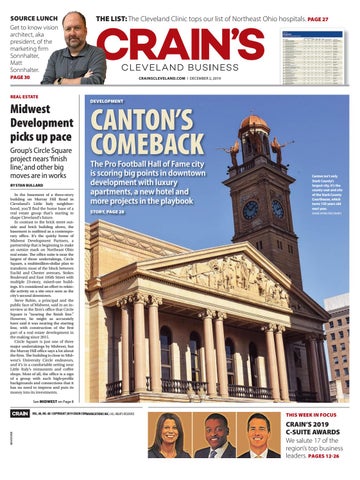
CANTON’S COMEBACK
The Pro Football Hall of Fame city is scoring big points in downtown development with luxury apartments, a new hotel and more projects in the playbook STORY, PAGE 28
Canton isn’t only Stark County’s largest city, it’s the county seat and site of the Stark County Courthouse, which turns 150 years old next year. SHANE WYNN FOR CRAIN’S
See MIDWEST on Page 8
NEWSPAPER
VOL. 40, NO. 48 l COPYRIGHT 2019 CRAIN COMMUNICATIONS INC. l ALL RIGHTS RESERVED
P001_CL_20191202.indd 1
THIS WEEK IN FOCUS
CRAIN’S 2019 C-SUITE AWARDS We salute 17 of the region’s top business leaders. PAGES 12-26
11/27/2019 1:57:53 PM
TECHNOLOGY
Four-day Blockland conference will bring 1,500 guests
Convention center again will host festivities that will focus on emerging technologies, cybersecurity and more BY JAY MILLER
The next step in pushing Cleveland to the front of the pack in the emerging blockchain technology begins Dec. 8, with the second annual Blockland Solutions Conference at the Huntington Convention Center of Cleveland. Organizers expect 1,500 executives, tech specialists, students and investors, about the same as last year’s attendance, to hear about how various industries will be affected by this emerging technology.
Blockchain is a digital technology that, because of built-in security, allows digital information to be widely and safely distributed. It underpins digital currencies like Bitcoin and, advocates contend, can be used to track how assets move through a supply chain, from producer to dealers to buyers, more securely than other technologies. Attendees and others will also be waiting to hear the latest about City Block, the revamping of The Avenue at Tower City being planned by Blockland originator Bernie Moreno.
Through his backing of the conference and City Block, Moreno — whose Bernie Moreno Cos. have largely moved out of the auto business and into blockchain investing — is working to make good on his aspiration to make Cleveland a hotbed for new technologies. An announcement is expected on Tuesday, Dec. 3. In July, Moreno’s company and Bedrock Detroit LLC, the Dan Gilbert company that owns The Avenue at Tower City on Public Square, announced they were pursuing a plan to jointly create City Block
as a home for emerging businesses. The plan is for a $110 million, 350,000-square-foot “entrepreneurial center” that will include corporate office space, coworking areas, cafes and a public plaza. This year’s conference also marks the merger with Business TECH, which had been an annual, one-day October conference for chief information officers and other IT professionals sponsored by OHTec, the technology arm of the Greater Cleveland Partnership, and MCPc Inc., a Cleveland data protection company.
Guiding your business at every turn.
We know the road to success is rarely a straight path, so you need business attorneys with the knowledge and experience to help you navigate the inevitable twists and turns. For more than 110 years, the attorneys at Ulmer have traveled this road side-by-side with their clients, always focused on moving forward. Let our team of experts steer you in the right direction and help you achieve your goals.
®
Our business begins with you.®
As a result, this year’s Blockland Solutions Conference will include a daylong focus on cybersecurity on Wednesday, Dec. 11. A software developers workshop focusing on blockchain technology will begin on Sunday, Dec. 8. “Sunday is about learning, so that adults, students, whomever, can come and learn about the practical applications of the technology,” Moreno said. “And then Monday and Tuesday is primarily, but not exclusively — underline that 10 times — on blockchain. ... We want (people) to think about the first two days as being about innovation and disruptive technologies of the future.” Then, Wednesday is what would have been the MCPc/OHTec conference. “We’re calling it ‘Security Solutions’ because it’s hyperfocused on cybersecurity, which is something that touches everybody,” Moreno said. The corporate rate for the full conference is $1,295, but various discounts are available for government and nonprofit representatives, startups and students. Early bird discounts are available as are single-day admissions. A discounted single-day ticket for $195 was still available on Tuesday, Nov. 26, and the Blockland Solutions website advertises early bird discounts available until Dec. 2. The keynote speaker for Monday’s session is Jeremy Gutsche, author of the book “Exploiting Chaos: 150 Ways to Spark Innovation During Times of Change” and founder of the trendhunter.com website, which tracks data trends across technology to fashion. “He’ll talk about all the stuff coming in the next decade and how do you deal with all this change,” Moreno said. “It’s a little overwhelming.” Other keynote speakers include Thomas Kurian, CEO of Google Cloud, the computing and data storage arm of Google; Don Tapscott, co-founder and executive chairman of the Blockchain Research Institute, a think tank that helps its members navigate blockchain technology; and Nick Szabo, CEO of Global Financial Access Inc. and an early developer of cryptocurrency technology. In all, more than 150 speakers will share their experiences about how they have applied blockchain technology to their operations and explore its future possibilities. Topics will include developing blockchain-based video games, regulating cryptocurrency and other blockchain applications, blockchain-based payment processing and the need to attract talent from different backgrounds to ensure that technology creates the best outcomes. After morning keynote addresses, workshops will focus on various tracks from speakers on commerce, finance, government and the law, health care and manufacturing, as well as from the nonprofit and education world. Lead sponsors of the event are KeyBank and MCPc. The conference lined up an additional 16 event, workshop, and food and beverage sponsors. A sponsorship guide posted in August listed sponsorship costs ranging from $3,000 to $175,000. Jay Miller: jmiller@crain.com, (216) 771-5362, @millerjh
2 | CRAIN’S CLEVELAND BUSINESS | DECEMBER 2, 2019
P002_CL_20191202.indd 2
11/27/2019 11:04:09 AM
DEVELOPMENT
How Northeast Ohio became Northeast Ohio
Cities have a ‘natural competitiveness,’ but collaboration is needed to best utilize resources BBY RACHEL ABBEY MCCAFFERTY
Northeast Ohio is made up of dozens of distinct, small communities, suburbs and rural locales spilling out from multiple metropolitan areas. Last week, we took a look at how this configuration developed and how the structural racism built into it has persisted to today. This week, we look beyond the divisions and into the regional approach that many economic development leaders say Northeast Ohio needs to adopt to succeed. Read on for a look at how and why the region’s cities and suburbs might work more closely together in the future.
Getting over the competition hurdle There’s a “natural competitiveness” among cities and regions, but there’s still opportunity for those cities and regions to better collaborate, said Steve Millard, president and CEO of the Greater Akron Chamber. Collaboration allows the region to maximize its resources when seeking support from the state or from foundations, Millard said. A region’s size makes a difference when apply-
ing for that kind of funding. The approach applies to economic development initiatives, too. A company might be located in just one city, but the benefits can spread beyond that city’s borders — or even beyond the borders of the county. A significant number of Summit County’s residents leave the county for work every day, Millard pointed out. Still, he added, it can have real implications when a company moves a few cities over, even if it stays in the same county. Summit County has some arrangements in place between its cities that allow them to share revenues for a period of time if that happens. “So it gives the new city a delayed benefit, and it gives the city that is losing the company more time to react to those losses and try to retool,” Millard said. In the Cleveland area, Greater Cleveland Partnership president and CEO Joe Roman said he thinks non-poaching agreements have helped communities see that the benefits of moving from one municipality to another within the region aren’t as “tremendous” as they might think. If a move is close, employees aren’t likely to relocate. But the sheer number of Greater Cleveland suburbs — he counts
Catch up on this series This is the second of a two-part series on the development of Northeast Ohio. Last week, Crain’s spoke to historians about how the region’s city-suburb divides came to be. Read it at: crainscleveland. com/rachel-mccafferty-blog
“I THINK THE RELATIONSHIP BETWEEN CLEVELAND AND ITS SUBURBS IS EVOLVING, BUT STILL LARGELY TRANSACTIONAL. I DON’T THINK IT’S STRATEGIC.” ——Joe Roman, Greater Cleveland Partnership president and CEO
more than 50 in Cuyahoga County alone — makes it tough for the region to be strategic, Roman said. “I think the relationship between Cleveland and its suburbs is evolving, but still largely transactional,” Roman said. “I don’t think it’s strategic.” But he added that he thinks suburban leaders realize that a stagnant population means something has to change. Getting people on the same page — whether they’re the ones trying something new or just learning about what others are doing — is a good thing, he said. No one is immune to changes in population, and that can bring people together to form a more strategic approach. In addition to collaboration between cities and suburbs, Roman said he'd also like to see stronger partnerships between Cuyahoga County and its adjacent counties. That’s especially salient for issues like use of the lakefront, which spans multiple counties. Right now, he said, there’s no mechanism that would allow those counties to easily combine tax dollars to take on a lakefront initiative. “And those kinds of exploratory opportunities might be worth some doubling down from all of us,” Roman said.
Taking a different perspective
Millard said people from outside the region see Northeast Ohio’s assets differently than those who grew up here. Outside observers don’t tend to see the boundaries and borders between the cities and the suburbs, instead viewing the region as a whole. “I think, as a region, we have to be better at talking about the broad portfolio of assets,” said Millard. That’s certainly been true for James Dignan, president and CEO of the Youngstown/Warren Regional Chamber. Dignan’s contract has not been renewed for 2020, and the chamber declined to comment further on personnel matters. The state tends to have “silos of excellence,” he said, and each of the cities has its own identity. That goes for the smaller municipalities, too, and it’s led to a lot of duplicative services in terms of education, public safety and more. But the Mahoning Valley no longer has the population to support that approach. “Just the overhead and the cost of doing business the way we’ve done it in the past is not a path for a successful future,” Dignan said, adding that he thinks the region needs to find ways to better work together. See CITIES on Page 29
December 2, 2019 | CRAIN’S CLEVELAND BUSINESS | 3
P003_CL_20191202.indd 3
11/27/2019 11:26:57 AM
GOVERNMENT
Akron streamlines city departments into new Office of Integrated Development
BE COOL. COOL!
Goal is to make operations more responsive to residents’ needs
CALL YOUR LOCAL CREDIT UNION!
BY DAN SHINGLER
Historic low interest rates, Lock in a low rate today! • Commercial Real Estate Loans up to $10 Million • No Prepayment Penalties • As Little as 10% Down
Contact Jonathan A. Mokri 440.526.8700 jmokri@cbscuso.com www.cbscuso.com
Your Business Lending Partner SM
Historic Barn Loft Headquarters Located on 7 AC of Pristine Geauga County Land 16533 Chillicothe Road, Chagrin Falls, OH 44023
PRICE REDUCED! $1,295,000 - CALL TO LEARN MORE!
David C. Wagner www.hannacre.com
216.839.2002
DavidWagner@HannaCRE.com
THE GRASS IS GREENER ON OUR SIDE. Are you growing your career with a firm that supports you? We’re searching for accounting professionals with public accounting experience to join our team. Come see why we’re different. Explore our open positions and grow your career: applegrowth.com/careers
James Hardy now officially has his work cut out for him. Hardy, chief of staff to Akron Mayor Dan Horrigan, was named deputy mayor in charge of the city’s new Office of Integrated Development (OID) in July. Now he’s got an actual office to run, with goals to achieve. The city said it will announce on Monday, Dec. 2, that it has combined the functions of planning and urban development, economic opportunity, public life, development, administrative support and development engineering under Hardy in the new OID, along with goals for the office. Many of those functions, such as planning, engineering and development, previously ran as their own departments but will now function as city divisions, Hardy said. Annie McFadden will succeed Hardy as the mayor’s chief of staff. McFadden has served as deputy chief of staff since 2016. With the OID, the city is seeking to streamline its operations and make them more responsive to its residents’ needs. The city modeled its new office after similar efforts it studied in other communities in order to find the best practices it could adopt for Akron. “We looked at Detroit, Lansing (Mich.), Louisville (Ky.) and Minneapolis, but if I had to point to one it would be Detroit,â€? Hardy said. “It’s bigger than Akron, but in terms of their everyday issues, whether it’s vacant housing or economic inequities along racial lines in particular or it’s legacy government that hasn’t changed in a long time ‌ there are a lot of similarities with Akron, just at a bigger scale.â€? Like Akron, Detroit has had to contend with a shrinking population. As a result, it has fewer staff members to take care of a city that, geographically at least, is the same size as always. In Akron, much of the city’s administrative structure had not been changed in years, decades or even longer. The city’s last comprehensive plan was done in 1919, Hardy noted.
The new changes are designed to eliminate redundancies and seek efficiencies. Hardy pointed out that Akron’s economic development department shrank from Hardy 21 employees before the 2008 recession to only six when the city announced formation of the OID in February. The planning department had dozens of employees in the 1980s and ’90s, but only about 17 today. Functions need to be combined for things to get done, he said. “For instance, Lock 3 and downtown were separate from recreation and parks, but classified the same. ‌ Now that they’re unified, a lot of issues go away and we can start to program people to work at Lock 3 or at a community center event from the same staff. There doesn’t need to be this specialization anymore — and there can’t be,â€? Hardy said. The moves are also meant to make life easier for businesses, which will be able to deal with fewer people to accomplish what they need to with divisions such as engineering or planning, Hardy said. “There is no (developer’s) plan that only touches zoning and not engineering, or that touches the building department and doesn’t touch zoning. ‌ Now that we’re making a more customer-friendly environment, I think we’ll have better success,â€? he said. But the city also is determined to use its new structure to prioritize the desires of its residents above those of businesses or anyone else, with a focus on making Akron’s neighborhoods safer, more livable and hopefully more populated. “We’re going to look as much at how a project looks and is designed, and whether it’s fair and equitable, as much as we look at how much we can do for the business,â€? Hardy said. Hardy and Horrigan said they hope the new structure will help the city cap-
italize on an abatement being offered for residential development by making it easier for such projects to be approved. The OID has a broad swath of new goals, from furthering downtown development to addressing racial income inequities and getting minorities more involved in city leadership. “I think, obviously, implementing the downtown redevelopment plan is alive and well,â€? Hardy said. “When you look at downtown, we are cooking with gas in terms of making a destination out of our downtown. Other things, like expanding economic opportunity in the city, are going to take more time.â€? The city also should be better able to work with Summit County and the Greater Akron Chamber on the three entities’ Elevate Greater Akron initiative. That project aims to grow the local economy and drive economic opportunity by promoting inclusion, workforce development, middle- market business growth and development downtown and at other Akron job hubs. Summit County executive Ilene Shapiro said she supports the city’s moves with the new office. “We at the county also adjusted some time ago and there were some modifications at the chamber. With some modifications at the city, now I think it will be very beneficial to our community as a whole,â€? Shapiro said. “You have to have the teams working together. Not only from the county to the city to the chamber ‌ but inside each organization as well.â€? Hardy said the city’s reorganization plan got little pushback and that every employee at affected functions, “from secretaries to department heads,â€? was involved in the effort. Going forward, Akron likely will have to address its zoning and create a new comprehensive plan, he added. But those efforts will likely take at least five years and “many, many meetingsâ€? to complete, and Hardy said he doesn’t anticipate beginning such efforts until 2023. Dan Shingler: dshingler@crain.com, (216) 771-5290, @DanShingler
)ΝΝΝΝΝ5ĎƒÎťÎťĎƒ %'1 9QTNF 5[PGTI[
Paid parental leave Remote work supported Free gym membership Student loan assistance program Flexible hours Free meals during busy season Professional career coaching Tuition assistance Free coffee every day
ΝΝΝΝΝΝΝΝΝΝΝΝΝΝ ΝΝΝΝΝΝΝΝΝΝΝΝΝΝΝΝΝΝΝ ΝΝΝΝΝΝΝΝΝΝΝΝΝ "EACHWOOD OFFERS AN EXTENSIVE NETWORK AND GREAT AMENITIES WITHOUT THE HASSLES OF A BIG CITY v
Apple Growth Partners @applegrowthpartners AppleGrowthPartners @apple_growth
AWARD-WINNING ACCOUNTANTS AND BUSINESS ADVISORS
APPLEGROWTH.COM
ĎƒÎťÎťÎťÎťÎťĎƒÎťÎťÎťÎťÎťÎť5ΝΝ*ÎťÎťĎƒÎťÎť\ÎťĎƒĎƒĎƒĎƒĎƒĎƒĎƒĎƒĎƒĎƒĎƒĎƒĎƒĎƒĎƒĎƒĎƒĎƒĎƒĎƒĎƒĎƒĎƒĎƒĎƒĎƒĎƒĎƒĎƒĎƒĎƒĎƒĎƒĎƒĎƒĎƒĎƒĎƒĎƒĎƒĎƒĎƒĎƒĎƒĎƒĎƒĎƒĎƒĎƒĎƒĎƒĎƒĎƒĎƒĎƒĎƒĎƒĎƒĎƒĎƒĎƒĎƒĎƒĎƒĎƒĎƒĎƒĎƒ
4 | CRAIN’S CLEVELAND BUSINESS | DECEMBER 2, 2019
P004_CL_20191202.indd 4
11/27/2019 11:53:32 AM
I know your labor and employment
matters can’t wait for a
“slow no.” As former in-house counsel for a Fortune 50 enterprise, I’ve been a consumer of legal services. I know what it’s like to wait (too long) for answers, only to hear “no, you can’t” or “no, it won’t work.” My clients deserve better, and I make sure they get it. Sound advice and timely responsiveness to all their labor and employment matters. The laws and regulations are complex. Missteps make headline news. Immigration concerns make a tight talent market even tighter. I use my native Spanish-speaking skills and hands-on litigation experience to advocate for my clients. Guiding them to avoid problems before they can surface. Finding—or creating—the right path for their business. One that leads to “yes.” I’m MARGARITA KRNCEVIC. I’m on your team.
MY BENESCH MY TEAM
> Of Counsel, Labor & Employment Practice Group > (216) 363-6285 | mkrncevic@beneschlaw.com
www.beneschlaw.com
SPONSORED CONTENT
December 2, 2019
aSk ThE PROfESSiONal
a family legacy with family involvement
f
Insights from a financial services industry leader
who establish a common goal or amilies often have project they all can work on carry significant concerns that partnership into the long-term when it comes to the wealth planning as well. Philanthropic activities are a great example. If transfer of wealth to future possible, it is highly encouraged that generations. Communicating even small children be allowed to effectively with the next participate in the family philanthropic vision. This will further foster generation about wealth communication and connection to the and financial matters can family values at a young age. be challenging. Children have grown up with access What types of business to much more information practices can help build fueled by technology, family connections? Effective business practices increased diversity and global certainly can be implemented connectedness. Because of successfully within families’ wealth this, traditional education curricula may not resonate with transition plans. To foster improved them, points out Ron Ambrogio, president of BNY Mellon relationships between generations, Wealth Management’s Ohio Region. As a result, they may fail consider creating a formal family mentoring program. A mentoring to appreciate the responsibility that comes with the wealth. program has the potential to be one “It’s important to involve the children and grandchildren of the most invaluable and enjoyed exercises within a family. in their family’s financial education at an early age,” he It benefits the first generation by said. “They will be more prepared as young adults to make providing them a forum in which sound financial decisions, and they will appreciate wanting they can pass on the knowledge they’ve gained over the course of to protect and preserve their family’s wealth legacy.” their life, keeping them engaged Ambrogio has more than 35 years in the wealth with the younger generations and management industry, and has considerable experience in strengthening these relationships. The helping families develop a wealth preservation plan that second and third generation learn valuable information about their benefits the next generation— and beyond. He shares with family history and how the wealth Crain’s Content Studio — Cleveland his thoughts on how was earned, preserving knowledge his firm helps families achieve those goals. that may have been lost with the first
What are some initial first steps to help the next generation prepare for the transfer of wealth? Starting with an annual or semiannual meeting with a focus on communication between family members and an outside facilitator is a crucial first step. Personality tests can be used in the first meeting to establish a baseline for how each family member best communicates and makes decisions. Topics for discussion should include a family history, so everyone can understand how the wealth was generated. Speaking about family history often leads to a deeper conversation around family values and how those values are implemented in a generational wealth plan. This can include family members’ views on religion, philanthropy, formal education and how to preserve the family legacy. Next, families should identify each family member’s level of financial
knowledge and skill, and determine how to fill in any gaps that might be present. A family should build a team of trusted advisors over time, with each family member forming an independent relationship with the advisors, learning critical skills at a pace that makes sense for them. Balancing a checkbook, managing cash flow, understanding investment statements, what trust documents are intended to accomplish and working with a prenuptial agreement all are examples of situations in which an advisor can educate the family on how to navigate successfully.
in addition to family meetings, what other key best practices may a family want to adopt? Working together on initiatives or activities outside of work can bring families closer together. It has been our experience that the families
generation. The younger generation gains confidence around their abilities through coaching and feedback and is able to expand their social network. The mentorship program also can provide the mentee with a clear sense of direction regarding the role they can play within the larger family structure. In an effective mentoring program, a facilitator equips the participants with a fully realized plan, including step-by-step instructions, regular checkpoints and suggested activities to help the participants connect with one another.
Transitioning to the next generation often can be very difficult and emotional for the first generation. are there any ways to increase the success of the transfer for both the first and the second generation? A family leadership council can make important decisions more easily
“
A family should build a team of trusted advisors over time, with each family member forming an independent relationship with the advisors, learning critical skills at a pace that makes sense for them.” — Ron ambrogio, president, BNY Mellon Wealth Management’s Ohio Region
because it relies on a clear process and has identified who the strategic family members are. This council should incorporate members from each generation, if appropriate, to ensure a well-balanced perspective. Family advisors also can be engaged for specific expertise or may be featured as a guest speaker. Attorneys, accountants, investment managers are easy professionals to include, but also consider pulling in representatives or executive directors from various
nonprofits or members from other wealthy families to share insight and best practices. Seasoned advisors recognize that each family member has his or her own distinct educational needs, learning styles, interests and technical abilities. Make sure you involve an experienced wealth management professional to help ensure your wishes and insights are passed on along with your wealth, to perpetuate your family legacy for subsequent generations.
Creating a legacy is hard. Leaving one, even harder.
Ronald S Ambrogio | ron.ambrogio@bnymellon.com 216-593-2001 | @BNYMellonWealth bnymellonwealth.com
Source: 2018 Client Satisfaction Survey. BNY Mellon Wealth Management conducts business through various operating subsidiaries of The Bank of New York Mellon Corporation. ©2019 The Bank of New York Mellon Corporation. All rights reserved.
This advertising-supported section is produced by Crain’s Content Studio-Cleveland, the marketing storytelling arm of Crain’s Cleveland Business. The Crain’s Cleveland Business newsroom is not involved in creating Crain’s Content Studio-Cleveland content.
Crains_Ask the professional-12-2-19.indd P006_CL_20191202.indd 6 1
11/26/2019 11/26/191:41:51 11:03 PM AM
LIST ANALYSIS
Larger hospitals growing faster than smaller ones Patient revenue rises 5.3% for hospitals on list
Reducing Real Property Tax Assessments Throughout Ohio And Across The United States
BY CHUCK SODER
Once again, local hospitals posted a sizable increase in patient revenue and once again, most of the increase went to larger hospitals. The 53 hospitals on the full digital version of the list generated nearly $19 billion in net patient revenue in 2018, up 5.3% over 2017. Larger hospitals did better than smaller hospitals in multiple respects. First, their percentage was higher: The top 20 hospitals on the list saw net patient revenue rise 5.7% in 2018 — and that extra 0.4 percentage point equates to about $64 million. By contrast, hospitals outside the top 20 saw an increase of 3.3%. Plus, the two largest hospitals on the list, the main campuses of the Cleveland Clinic and University Hospitals, both posted increases exceeding 6%. And two hospitals in the top 20, Aultman Hospital in Canton and Summa Health’s Barberton campus, both saw increases exceeding 25% — beating all other hospitals on the list by a long shot. Larger hospitals also grew more consistently. The only hospital in the top 20 that saw a decline was Summa’s main campus (-2.2%). On the other hand, eight of the other 21 hospitals on the full digital list saw declines (excluding two hospitals for which we don’t have data for both 2018 and 2019). Of course, that means the other 13 smaller hospitals did see growth,
Sleggs, Danzinger & Gill, Co., LPA
Find the list on Page 27
which is an improvement from last year: That same group of hospitals — minus two new facilities — saw net patient revenue drop by 1.9% in 2018. The growth disparity has been going on for several years, judging by data hospitals have submitted for the list over the past decade, which is available to Crain’s Data Members in Excel format (for a few smaller hospitals, we use Medicare Cost Report data from the American Hospital Directory). Net patient revenue figures for larger hospitals rise year after year for almost every hospital, while smaller facilities (many of which are owned by larger institutions) show much less consistency over the years. However, revenue growth hasn’t always translated into employment growth. Employment increased by less than 2.2% from 2018 to 2019, judging by the 45 hospitals for whom we have consistent data for both 2018 and 2019, with large hospitals once again outpacing smaller facilities.
When you hire Sleggs, Danzinger & Gill, you work directly with Sleggs, Danzinger and Gill. Each client is directly represented at all levels by a principal of the firm with a combined 75 years of experience. No pyramid, no associates, no on-the-job training. Our clients deserve the very best representation, so we structured our firm to allow each client, throughout the entire process, to work directly with Messrs. SLEGGS, DANZINGER and/or GILL. Our philosophy is to work cooperatively with school district and County officials to ensure that our clients pay the lowest possible real property tax obligations. If a fair resolution requires litigation, SLEGGS, DANZINGER & GILL have the depth of trial and appellate experience to handle the most complex valuation issues. Whether the valuation relates to large industrial plants, apartments, shopping centers, warehouses, office buildings, vacant land or any other type of commercial property, the faces above will ensure that you receive the best counsel, legal advice and litigation expertise.
Local Financial Planning Firm. National Recognition.
Todd W. Sleggs, Esq.
Robert K. Danzinger, Esq.
Steven R. Gill, Esq.
tsleggs@sdglegal.net
rdanzinger@sdglegal.net
sgill@sdglegal.net
Forbes’ Top 250 Wealth Advisors Barron’s Top 100 Independent Financial Advisors Inaugural Barron’s Hall of Fame Advisors
(216) 771-8990 sdglegal.net
Visit ncafinancial.com toVisit schedule your initial meeting ncafinancial.com 9
to schedule your initial meeting
6095 Parkland Blvd., Suite 210, Mayfield Hts., Ohio 44124 (440) 473-1115 Securities offered through Royal Alliance Associates, Inc. (RAA), Member FINRA/SIPC. RAA is separately owned and otherentities and/or marketing names, products or services referenced here are independent of RAA. RAA does not provide tax or legal advice. Investment advisory services offered through NCA Financial Planners. For additional information visit www.ncafinancial.com/awards
Member Firm
Sleggs, Danzinger & Gill 820 West Superior Ave. Seventh Floor Cleveland, OH 44113 DECEMBER 2, 2019 | CRAIN’S CLEVELAND BUSINESS | 7
P007_CL_20191202.indd 7
11/27/2019 1:36:23 PM
LABEL
MIDWEST
From Page 1
Midwest combines principals from two of Northeast Ohio’s highprofile business and real estate families. One is Ellie Weiss, a member of the family that founded American Greetings Corp. and that has long been a key investor with generations of local real estate developers. The other principal is Zac Ponsky, a scion of the Goldberg family that led the former AmTrust Bank and its namesake Ohio Savings Bank, now part of New York Community Bank of Westbury, N.Y. Rubin, best known in Northeast Ohio as the former chief operating officer of Stark Enterprises Inc. of Cleveland, has more than 30 years of real estate development experience. He
and Weiss both worked for developer Bob Stark as he launched Crocker Park, the mixed-use project in Westlake that’s home to the headquarters of American Greetings as well as a mix of apartments, for-sale housing, offices, shops and restaurants. Midwest’s newest venture to surface is just across Crocker Road from Crocker Park. It consists of 15 acres owned by a Weiss family affiliate that the family acquired during construction of the American Greetings headquarters in case it needed more land for the company. Rubin said the land is not needed for the business, so the Weiss family is having Midwest develop it. The plan calls for construction of a 60,000-square-foot, single-story office building, and two buildings for retail use of about 14,000 square feet each, as well as locations for free-standing,
build-to-suit office buildings. Rubin said Midwest plans to submit designs for the project in early 2020 and aims to start construction later in the year. However, the heavy lifting for the project in terms of planning occurred over the summer, when Midwest won Westlake City Council approval to change the zoning of the acreage from exclusive office use to planned-unit development. The plan represents a substantial give-and-take with the city and the residents of single-family homes immediately east of the site. Westlake councilman Kenneth Brady, whose ward includes the area, said the exclusive office zoning could have allowed Midwest to erect a six-story office building. Midwest “wanted a little flexibility to put shops and restaurants on the site,” Brady said. “He was flexible.
Residents did not want office buildings next to their homes. Rubin met with them in their homes and at multiple meetings at City Hall. In the end, I was surprised he was able to get it down to a one-story project. It also serves as a transition between taller existing buildings further north on Crocker and low-rise buildings, some residential, to the south.” For his part, Rubin said simply, “We had neighbors we had to respect.” The office building will be Ushaped around the site’s perimeter and will resemble existing single-story office buildings nearby. He said he sees the retail as restaurants and neighborhood-service businesses where customers make quick stops. “It won’t compete with Crocker Park, which of course is near and dear to our hearts,” Rubin said.
DOUBLE THE SPEED. DOUBLE THE PRODUCTIVITY. Spectrum Business Internet
NEW
2X Faster Internet Speed
TOP PERFORMING INTERNET PROVIDER
delivering faster, more reliable download speed. 2018 FCC Broadband Report°
Over 99.9% Network Reliability§ Get enough bandwidth for you, your employees and your customers.
Call 855-752-1854 | Visit Business.Spectrum.com Internet speed may not be avail. in all areas. Actual speeds may vary. Speed based on download speed on wired connection. Wireless Internet speeds may vary. °Based on Eighth Measuring Broadband America Fixed Broadband report completed by the FCC, https://www.fcc.gov/reports-research/reports/measuring-broadband-america/measuring-fixed-broadband-eighth-report. §99.9% network reliability based on average HFC Availability, January 2019 - May 2019. Services subject to all applicable service terms & conditions, which are subject to change. Services not avail. in all areas. Restrictions apply. Call for details. © 2019 Charter Communications, Inc.
Back in University Circle, Midwest last summer won city approvals to launch the first of several demolitions early next year on the Circle Square site. It will raze the former Beal’s Automotive, a one-story building at 10541 Euclid, as well as the former home of the city’s Third District Police Station at the corner of Chester and Stokes, which was replaced by a new station at 4501 Chester. The exact timing of the first building on the block, fronting on Euclid, depends on Cleveland Public Library’s completion of designs for the new MLK Jr. branch, which will replace the existing building that Midwest will use for a future development site. Midwest last June won conceptual approval from the city for what’s called Library Lofts, featuring nine floors of rental apartments above the proposed new library. Rubin said the plan calls for much of the block to have low-level parking garages with at least two more mixeduse buildings rising to a height of 250 feet (about 23 stories) above ground level. Midwest will consider joint ventures for the additional buildings, and has at least one prospect he declined to identify that might construct one of the buildings. The firstfloor space will be devoted to retail. “Our goal is to have it as mixed-use as possible and still look like a city block,” he said. In October, Midwest marked a milestone at its first completed project as a group, a partnership with developers Peter Rubin (no relation to Steve Rubin) and contractor Tony Panzica that build Centric, a 270suite apartment building with firstfloor retail space. The Cleveland office of Berkadia, a mortgage banking concern, announced it put in place $68 million of permanent refinancing of construction loans through Freddie Mac. Steve Rubin declined to say what interest rate the refinancing scored, other than acknowledging it was a “good rate” in this era of low interest rates. The refi was put in place as the apartment reached 95% leasing and most of its commercial space was leased. Midwest is not the only party satisfied with Centric. Chris Ronayne, president of University Circle Inc., said Centric had surpassed his expectations for transforming one of UCI’s parking lots to more active use. “It has a public park providing access to the circle from Little Italy, added to our infrastructure by completing construction of Circle Drive to Euclid from Mayfield and added businesses such as a fitness center and daycare that are real enhancements for the area,” Ronayne said. Because of Centric, Ronayne said he is excited about Circle Square as Midwest’s next project at the circle. It will incorporate a UCI-owned parcel in the process of being transferred to Midwest that will provide Library Lofts its Euclid Avenue address and a new home for the “treasured” MLK library. “This stands to re-energize a corner that fell to a number of parking lots and secondary uses over the years that was once a popular commercial district,” Ronayne noted. “It’s a multiphase project that will take years to complete. It also may, as a stretch goal, redo the spaghetti of streets there.” Rubin summed up all the years of planning that he, Ponsky and Weiss have put into Circle Square in a single understatement: “We just want to get it right.” Stan Bullard: sbullard@crain.com, (216) 771-5228, @CrainRltywriter
8 | CRAIN’S CLEVELAND BUSINESS | December 2, 2019
P008_CL_20191202.indd 8
11/27/2019 1:58:27 PM
FINANCE
Buy local, invest local, benefit local
Two NEO entrepreneurs believe a regionally focused attitude should play a greater role in purchasing decisions BBY JAY MILLER
The growth of programs that favor purchasing fruits, vegetables and meats produced by close-to-home farmers rather than large, national purveyors — by community-supported agriculture buying programs and restaurants that adopt “farm-to-table” menu items — is a response to a belief by consumers that local food tastes better, lasts longer at home and may even have some health benefits. Even beyond food, the region is also home to a number of businesses that focus on locally sourced products. A Piece of Cleveland, for example makes furniture, shelving and paneling out of wood reclaimed from old buildings. Other businesses sell the work of local artisans. Consumers of these locally sourced items may also understand they are helping entrepreneurs, who may be their neighbors, to gain a foothold in a vast, international economy. But a couple of local entrepreneurs say they believe that kind of buy-local attitude should play a greater role in the purchasing, and even investing, decisions of businesses in the region. They claim that supporting local businesses, especially young ones, is an important investment in the economic vitality of the region and the success of all local businesses. One of the two is Charlie Lougheed, a
Goodman
Lougheed
serial entrepreneur who is currently developing a company, Axuall, that wants to digitally streamline the cumbersome process businesses face for proving the identity and verifying the credentials of potential employees or professionals with whom they work. Lougheed said he believes that buying locally, not just by consumers but by the business sector, is as important as more traditional forms of business development, such as supporting workforce training programs, or even becoming an investor through an angel or venture capital fund. “Especially in the B-to-B (businessto-business) space, buy local, buy from the innovative companies that are building things in your own backyard,” he advised. “It always drives me nuts when I hear, ‘Well, we’ve got to put it out to bid.’ I’m like, OK, I understand that, but I’m the only vendor who’s local and these other vendors, you know, they’re not 10 times better than me, they’re probably not twice as good as me.” Kevin Goodman, managing direc-
tor and partner of BlueBridge Networks, a cloud computing services firm, said he also believes buying from nearby firms strengthens the local economy. He pointed to studies showing that spending with local firms keeps three times as many dollars recirculating in the local economy. The American Independent Business Alliance (AMIBA), a nonprofit that supports and promotes local entrepreneurship, looked at more than a dozen independent studies of spending in various local communities. It found that, on average, 48% of each purchase at local independent businesses was recirculated locally, compared to less than 14% of purchases at chain stores. Goodman said he practices what he preaches, from the smallest purchases to some of the major equipment bought for his firm’s data centers. “Where I get my gift baskets is a local company called Wine Spot in Cleveland Heights,” he noted. “One of the reasons I do my gift baskets there is because they procure products that are predominantly from Cleveland or the state of Ohio. And even the equipment in our data center is predominantly from Eaton.” Eaton Corp. — which was founded in Cleveland and, while now officially domiciled in Ireland, maintains its operational headquarters in Beachwood — supplies BlueBridge’s data center with the hardware for its power
distribution network and the software that manages power usage. In turn, Eaton makes an effort to buy locally. “Local suppliers have an advantage in terms of lower transportation costs due to their proximity to the Eaton site, as well as providing the ability to carry less inventory in many cases, as the transit times are significantly reduced between the supplier and Eaton’s location,” said communication manager Katy Brasser in an email. “These are key factors in the total cost of ownership calculation.” She wrote that the power management company purchases nearly $475 million annually from more than 1,000 Ohio suppliers. The company has 284 locations in 42 countries, including about a dozen in Northeast Ohio. Michael Shuman, an economist and author who focuses on local economics, agreed that there is “unambiguous evidence that (local purchasing) does benefit the community it takes place in. The locally owned entity is going to generate two to four times the economic development income — that is jobs, income and taxes.” Shuman, whose most recent book is “Local Dollars, Local Sense: How to Move Your Money from Wall Street to Main Street and Achieve Real Prosperity,” argues that businesses and their owners and executives should move beyond a local purchasing strategy to being more local in their invest-
ment strategies. He said it’s his hope that local purchasing will lead to a broader rethinking of economic development policy around local investing and entrepreneurship. “Local purchasing is just a small part of the equation for shifting (a regional) economy in a positive direction,” he said. “By having a consumer-driven local purchasing policy, that educates people in a way that opens them up to local investment activity.” Shuman added that people, not just businesses or business owners, could shift some of their retirement investments from global stocks and bonds to local companies, local projects and other grassroots investment options. Shuman pointed to the Economic & Community Development Institute, which operates in Cleveland and Columbus and seeks investment and philanthropic support to make microloans to young businesses. Lougheed said young firms in particular need the support of the businesses in their community, which are usually their first customers. “Those early-stage customers, I want them to be investors, too,” he said. “If a startup, instead of going out and raising $20 million on the coast, can raise $4 million or $5 million locally and then supplement that with revenue from local customers, that’s revenue that’s feeding the (young) business, that’s creating local jobs.”
December 2, 2019 | CRAIN’S CLEVELAND BUSINESS | 9
FROM THE EDITOR
RICH WILLIAMS FOR CRAIN’S CLEVELAND BUSINESS
Does more time off make sense?
EDITORIAL
Shopping around T
he holiday season between Thanksgiving and Christmas is a particularly nostalgic time for many people, bringing up warm memories of home, visits to relatives, favorite foods, or finding the perfect gift for a loved one. Our experiences of most of those pleasures haven’t changed much over the years. But finding that gift? Now that’s a completely different story. A package of stories in last week’s issue of Crain’s Cleveland Business examined the extent to which changes in technology, consumer behavior and other factors have turned traditional retail into a challenged industry. As senior reporter Stan Bullard wrote, we’re living in something of a retail apocalypse. For instance, Coresight Research of New York City found that U.S. retailers as of mid-November had announced 9,052 store closures — more than in all of last year. And 2020 figures to be worse; the consultancy forecasts 12,000 closings. In our own back yard, a Crain’s analysis of CoStar online data found retail vacancy at the end of September was 17%, up from 13% a year earlier. U.S. RETAILERS AS OF There are fewer tradiMID-NOVEMBER HAD tional stores, and some of the ones that exist are less ANNOUNCED 9,052 busy than they used to be. STORE CLOSURES — Consumers, though, enjoy a world of nearly infinite MORE THAN IN ALL OF choices, thanks to the rise LAST YEAR. AND 2020 of giant online retailers as Amazon and thouFIGURES TO BE WORSE. such sands of smaller ones that make it pretty easy to track down the gift you’ve been wanting to buy for a special person — while maybe throwing in a little something for yourself, too. Factor in fast (and often free) delivery, and the ease of shopping via the click of the button without venturing into the snow, and it’s no surprise that retail increasingly is a digital game. Disruption has a way of bringing out the best in enterprising business owners and operators. Smaller retailers understand that they have to set themselves apart by offering shoppers superior service and a
unique experience, as the locally based Arhaus furniture chain did at its flagship store in Lyndhurst’s Legacy Village, where the rooftop serves as a patio to showcase outdoor products. JB Dunn, one of three owners of J3 Clothing Co. in Moreland Hills, told us the owners recently added specialty shops within the store for three suppliers. Then there’s someone like Chad Kertesz, a real estate developer who last year rented stores at a property he owns at 2929 Detroit Ave. in the Hingetown neighborhood to the Avalon Express clothing resale shop and the canine-focused Three Dog Bakery. It’s “not an established retail location,” Kertesz told us, but the stores “are doing well” by offering good products and a fun time shopping in a lively neighborhood. It’s not easy, but there is a way forward for creative local retailers. Potentially problematic, though, is that this year’s holiday season looks like it could be on the modest side. The Ohio Council of Retail Merchants’ research affiliate, Focus on Ohio’s Future, and the University of Cincinnati Economics Center recently issued a forecast that projects Ohioans’ holiday retail spending this year at $25.3 billion, up only slightly (by 0.8%) from 2018. The state’s three largest metro areas — Columbus, Cleveland, and Cincinnati — are expected to account for more than half (53.9%) of estimated holiday retail sales, but all were projected to experience declines in retail sales compared with 2018. And the forecast noted that once again, “online retailers ... are expected to increase their share of the holiday retail market.” Meanwhile, The Conference Board last week reported that U.S. consumer confidence fell slightly in November. It was the fourth consecutive drop, though confidence is still at a fairly high level. In this compressed holiday shopping season, give some thought to where you make your purchases. Local retailers contribute to economically vibrant, and more interesting, cities and towns. Support them where possible. Also, remember that it costs $0 to be nice to retail workers and servers, who are working extra hard this time of year. And tip generously.
Publisher and Editor: Elizabeth McIntyre (emcintyre@crain.com) Managing Editor: Scott Suttell (ssuttell@crain.com) Contact Crain’s: 216-522-1383 Read Crain’s online: crainscleveland.com 10 | CRAIN’S CLEVELAND BUSINESS | DECEMBER 2, 2019
A co-worker once told me there were two types of jobs in this world: Those that require a shower before you go to work and those where you shower after you get home from work. Increasingly, this country has the kind that doesn’t get you dirty. But whether we punch a factory clock or log in to a computer in an office, would we benefit Elizabeth from more time off? I started thinking about that after McINTYRE news of Microsoft Japan’s experiment with a four-day workweek went viral last month. As part of its “Work-Life Choice Challenge Summer 2019,” Microsoft allowed employees in its Japan office to take off five consecutive Fridays in August and enjoy threeday weekends with their regular salary intact. It is not surprising that an employee survey after the trial showed 90% of workers endorsed the shorter workweek. Electricity and other office costs, such as printing, were also reduced. What was surprising, though, was Microsoft saw a productivity boost of nearly 40% during the experiment. The traditional 40-hour workweek has remained pretty much the same since it became U.S. law in 1940. (Henry Ford in 1926 was among the first to implement the 40-hour, five-day workweek — for jobs that required post-work showers — and found that productivity in Ford Motor Co. plants actually increased with the reduced hours.) Work, though, has evolved since then. No longer are the majority of us standing on manufacturing lines or harvesting crops. The U.S. has shifted from a goods-producing economy to a services-based one. That doesn’t mean we’re WHAT IS CLEAR IS producing less stuff. Over the past three decades, U.S. man- TODAY’S WORKERS, ufacturers have increased out- ESPECIALLY IN put by 80% while reducing workforce by 17%, due to au- YOUNGER tomation and offshoring. GENERATIONS, ARE Instead, the services sector, which includes everything DEMANDING MORE from professional business FLEXIBILITY IN THEIR services to education and health care, now makes up SCHEDULES TO roughly 80% of GDP. And ACHIEVE A BETTER there’s no sign of that changing, with knowledge workers WORK-LIFE BALANCE. more common today than manufacturing ones. Technology has made it possible that almost half of adult employees work outside the workplace at least once a month, according to the Pew Research Center. So, why are we still attached to a 40-hour workweek that was created decades ago for an economy that has massively shifted? Changing from the five-day work schedule might be a bridge too far for most employers, but what is clear is today’s workers, especially in younger generations, are demanding more flexibility in their schedules to achieve a better worklife balance. And it’s no wonder, as employees are tethered to their smartphones and laptops seemingly around the clock. While technological advances make us work more efficiently and smartly, it also means that time away from the office no longer means time away from work. I’m interested in hearing your thoughts on the traditional workweek in today’s work climate. Has your company adopted shorter or more flexible work hours? Do you wish it would? Do you allow employees to telecommute? And if you are an employee who works from home, is it better or worse to have work always at your fingertips regardless of the time of day? Please share your thoughts with me at emcintyre@crain.com.
Write us: Crain’s welcomes responses from readers. Letters should be as brief as possible and may be edited. Send letters to Crain’s Cleveland Business, 700 West St. Clair Ave., Suite 310, Cleveland, OH 44113, or by emailing ClevEdit@crain.com. Please include your complete name and city from which you are writing, and a telephone number for fact-checking purposes.
Sound off: Send a Personal View for the opinion page to emcintyre@crain.com. Please include a telephone number for verification purposes.
OPINION
PERSONAL VIEW
Help students SAIL with programs that provide the support they need BY MARISA VERNON WHITE, ALISON MUSSER, ANNA FOGEL AND JOSH BREEDEN
Allyssa Earl always wanted to go to college, but she didn’t have transportation and needed to work to support her younger siblings, Aveon, Marrissa and Olivia. Shortly after graduating from Lorain High School in 2014, Earl found Lorain County Community College’s (LCCC) Lorain Learning Center in the downtown core, near where the Black River meets Lake Erie. It was the perfect solution: The campus was a short walk from her house and her work, a local grocery store. Earl enrolled part time and started classes, but soon realized earning her degree was going to take far longer than she expected. However, her dream of finding higher education success snapped back into view when she met Cynthia Arredondo, an academic adviser at the LCCC main campus in Elyria. During an in-class presentation, Arredondo told Earl about a program called Students Accelerating in Learning (SAIL), which helps low-income, first-time college students overcome barriers to educational attainment and graduate. SAIL sparked something in Earl. “I was super-eager to apply and sat through the rest of the class waiting,” she said. Earl was accepted into SAIL and adjusted her schedule and commitments to enroll full time, one of the program’s requirements. Using the wraparound supports available through SAIL, Earl overcame her financial challenges, worked hard and graduated. She also found hope — hope that she could achieve her goals no matter the roadblocks in front of her. Earl graduated from LCCC’s University Partnership in May 2019 with a bachelor’s degree in psychology and
also facilitate budgetary stability for the college. SAIL is one of the most compelling examples. Investing in a new program, LCCC launched SAIL in spring 2015. The program was closely modeled after the Accelerated Study in Associate Programs (ASAP) at the City University of New York (CUNY), and was piloted in Ohio with the support of CUNY and the program’s evaluator, MDRC. Full-time, Pell-eligible students at LCCC were invited to apply to and take advantage of its suite of wraparound services. These supports include hightouch academic and career advisement, priority course registration, gap tuition assistance, textbook vouchers and monthly stipends for transportation expenses. Research from MDRC found that 19% of the students in SAIL’s second cohort graduated within two years, while just 8% of the community college’s enrollees with access to conventional services graduated in the same span.
Expanding on proven success
A number of program features contributed to the increase in graduation rates. SAIL brings a holistic approach to student support, not only addressing academic variables but also ancillary factors that influence student success. LCCC’s institutional commitment to improving the student experience was also key to program success. School leadership was dedicated to ensuring that all enrollees, specifically those living at or below the poverty line and therefore prone to leaving school without their degrees, had the resources they needed to graduate on time. It was no surprise, then, when LCCC sought to scale SAIL in 2017. The institution considered Ohio’s State Share of Instruction (SSI), which appropriates state funding to community colleges based on various ABOUT 50% OF AMERICAN COMMUNITY COLLEGE STUDENTS student success metrics, HAVE TROUBLE FINDING RELIABLE HOUSING, WHILE ANOTHER as a potential source of increased revenue. SSI puts ONE-THIRD CONSISTENTLY GO HUNGRY. FOR A GOOD NUMBER OF students’ success front and center, and aligns POTENTIAL DEGREE HOLDERS, ESPECIALLY THOSE FROM LOWtheir academic achieveINCOME FAMILIES, THESE CHALLENGES ARE INSURMOUNTABLE. ment to state spending. However, LCCC was unnow works at the LCCC campus food pantry, where she sure how scaling SAIL would impact future SSI revenue. helps students with backgrounds like her own find hope So, the community college reached out to external and acts as a role model for her brother and two sisters. partners for assistance, including Social Finance. Social She embodies SAIL’s impact, demonstrating how Finance dug into SAIL’s programmatic data, ASAP’s imlow-income students can, with targeted support, find pact, and the SSI formulas and their context to conduct a academic and career success and inspire family, friends cost-benefit analysis. They estimated that expanding and others to go after their dreams. SAIL would generate significant revenue for LCCC given Unfortunately, millions nationwide need programs the overlap between SSI metrics and the student outlike SAIL. About 50% of American community college comes that SAIL would likely affect. Social Finance also students have trouble finding reliable housing, while an- suggested that LCCC leverage a braided funding model, other one-third consistently go hungry. For a good num- which entailed cultivating multiple funding channels. ber of potential degree holders, especially those from In the end, this work supported LCCC’s decision to low-income families, these challenges are insurmount- scale SAIL through its operating budget and commit to able. It’s no wonder then that more than 70% of Pell Grant growing the initiative 15% annually with the intention of recipients who attend two-year institutions never com- serving 1,000 students every academic year. plete their degree programs, departing viable paths to Although the institution will certainly encounter barlong-term economic mobility in hopes of getting full- riers along the way — the high per-pupil costs associattime jobs to improve their immediate situations. ed with initiatives such as SAIL and their exclusive focus While there’s no panacea for this complex problem, on full-time students can make the program challengone important step could be to make it easier for com- ing to scale — its work in supporting students is critical munity college students to find the short-term stability in helping all students succeed. they need to succeed in school. With so many American community college students Wraparound support services accomplish this by al- struggling to meet their basic needs, institutions like LCCC lowing aspiring graduates struggling with food or hous- are compelled to take action and use all of the tools at their ing insecurity to access the non-academic assistance disposal, including outcomes-based funding, to develop they need to complete their education on time and set holistic wraparound support services and ensure students themselves up for career success. Research on existing like Allyssa Earl have all they need to succeed. wraparound support programs supports this conclusion. Yet, American community college students say White is vice president of enrollment management and such initiatives are few and far between, likely a result of student services at Lorain County Community College, severe underfunding. and Musser is the school’s director of strategic However, multiple community colleges have cultivat- community engagement and initiatives. Fogel is director ed effective wraparound support programs that not only of advisory services at Social Finance, where Breeden is help low-income students navigate life and learning but a staff writer.
www.firestonecountryclub.com
New decade, new Partner
Now’s the time to switch to Apple Growth Partners for your business. Accountants + Business Advisors applegrowth.com/switch
FOR SALE RENOVATED MEDICAL BUILDING
10551 W. PLEASANT VALLEY RD. PARMA, OH 44130 SALE PRICE: $650,000
3,523 SF
New premium grade insulated roof Gorgeous facade; all new windows and doors
Fully renovated exterior, ready for your build-out
Great corner visibility; signalized intersection Over 37,000 cars daily; over 20,000 residents
SVN SUMMIT COMMERCIAL REAL ESTATE GROUP, LLC CONTACT
Nichole Booker, PhD Associate Advisor 330.475.5500 nichole.booker@svn.com
3009 Smith Road, Suite 25 Akron, OH 44333 (234) 231-0200
DECEMBER 2, 2019 | CRAIN’S CLEVELAND BUSINESS | 11
P011_CL_20191202.indd 11
SVN Ad-Liverpool-12-2.indd 1
11/26/2019 3:58:46 PM 11/21/19 8:36 AM
Crain’s 2019 C-Suite Awards Again this year, Crain’s Cleveland Business recognizes Northeast Ohio’s top executives in a program that celebrates the entire C-suite. After all, business today requires a unified effort, from marketing and operations all the way up to the CEO. It takes the entire leadership team rowing together to succeed. This year’s class was selected by a panel of Crain’s editors. In
choosing the winners, we looked at not only their contributions to their particular enterprises, but also their commitment to the Northeast Ohio community as a whole. Winners will be honored at a ceremony on Thursday, Dec. 5, at The Westin Cleveland Downtown. Tickets can be purchased online at www.CrainsCleveland.com/C-Suite.
``CO
``CO
CHAMPIONS
Sari Feldman
line type ies serv “W mod nee tom lead with teni nee mun Jour L ing and mor a ve
Retired executive director, Cuyahoga County Public Library system
I
f you’re a person who likes to read and lives in or around Cuyahoga County — presumably, that’s a lot of you who are reading this right now — there’s a good chance that Sari Feldman had at least some impact on how you see the region, and the world. Feldman retired in August after 16 years as executive director of the Cuyahoga County Public Library, a system with 27 branches serving 47 communities. She was succeeded by Tracy Strobel, deputy director of the system since 2005. Conventional wisdom, for a
time at least, held that public libraries were destined for declining relevance in the digital age. But, as Feldman noted in an interview with Library Journal before she left the Cuyahoga County library’s top job, libraries across the country have figured out ways to use technology, as well as programs that engage with the public, to sustain their role as vital community resources and trusted sources of information. The Cuyahoga County system has grown to host more than 100 author events each year, and it built
up the Aspire adult education program to offer services such as English as a second language and adult basic literacy. Cuyahoga County in 2014 became the first library system in Ohio to make a digital self-publishing platform available to its cardholders free of charge. Two years later, the system opened “Innovation Centers” at three branches — Garfield Heights, Parma-Snow and Mayfield — that provide software, emerging technologies and production equipment to library users. Those might not be head-
Randell McShepard
cess tion skill eral com choo the c the who nific ad p mun who ty ch teres from entit tion com
Vice president of public affairs and chief talent officer, RPM International Inc.
R
andell McShepard in July 2018 added chief talent officer to his title at Medina-based RPM International Inc., a maker of products including specialty coatings, sealants and building materials. The role, on top of the vice president of public affairs title he had held for a decade, was created “to spearhead senior leadership development opportunities at RPM,” the company said, including “managing and evaluating leadership development, succession planning and executive training” in collaboration with chairman and CEO
Frank C. Sullivan. In a statement, Sullivan said leadership development “is a driving force behind RPM’s success” and that McShepard “has been instrumental in establishing and leading these opportunities” for the company. What McShepard does for RPM is something he has started a conversation about doing throughout Northeast Ohio with respect to developing more black leaders. McShepard in June wrote a report for PolicyBridge called “Missing in Action: An analysis of black leadership and the chal-
lenges that impede success and impact.” (He’s the co-founder and chairman of PolicyBridge, a public policy think tank serving Northeast Ohio that produces research on minority communities and underserved populations.) Over 16 pages, McShepard documents missed opportunities and structural impediments that have held back the development of black leaders in Cleveland and other cities. It’s quite direct. There’s this, for instance: “Although African Americans in business and industry have reached impressive levels of suc-
Bernie Moreno
squa wou and If al reno A con at t Cen of p as K Clou sion Exch Tap ecut chai
Founder of Blockland Cleveland and chairman of Ownum
I
f you think of Bernie Moreno primarily as a luxury auto dealer, you’re a little out of date. But it’s hard to blame you. Moreno moves fast — just as he’d like to accelerate the growth of economic development in Northeast Ohio. Moreno earlier this year sold seven of his dealerships as he has pivoted to tech ventures. Go to the website of his Bernie Moreno Cos. and you’ll still find two traditional dealerships, but most of his interests now are in tech companies
under the umbrella of Ownum, a startup that Moreno describes as being “on a mission to identify, support and commercialize the most promising applications of blockchain technology.” In February, for instance, Moreno launched CHAMPtitles, which uses blockchain to create secure, digital vehicle titles. With CHAMPtitles, digital titles can be transferred instantly, and vehicle owners can be notified of safety recalls as soon as one is issued. Another Ownum company is Vital
Chain, which digitizes birth on death certificates. Moreno last year spearheaded the launch of Blockland Cleveland, which is something of a campaign and community cause to make Cleveland a major player, or perhaps the centerpiece, of blockchain technology nationwide and to make the city more dynamic in its approach to entrepreneurship and innovation. The Blockland effort has produced plans for what’s called CityBlock, a proposed $110 million remaking of 350,000
12 | CRAIN’S CLEVELAND BUSINESS | December 2, 2019
P012_013_CL_20191202.indd 12
11/26/2019 2:47:01 PM
COO: Chris Salata PAGE 14
COO: Uday Yadav PAGE 16
COO: Kevin von Keyserling PAGE 14 CIO: Brenda Kirk PAGE 19
CEO: Lourenco Goncalves PAGE 20 CEO: Tricia Griffith PAGE 21
CEO: Mark Masuoka PAGE 22
CFO: Bill Myers PAGE 24
CMO: Bridget Barrett PAGE 26
CEO: Eric Gordon PAGE 20
CEO: Gina Vernaci PAGE 22
CFO: John Sideras PAGE 24
CMO: Tracy Marek PAGE 26
CEO: Kevin Martin PAGE 22
CRAIN’S CLEVELAND BUSINESS ILLUSTRATIONS
CRAIN’S C-SUITE AWARDS
line-grabbers, but they’re the types of core services that libraries have emphasized to improve service to residents. “We are always in a growth mode in libraries, and I think we need to remember to put our customers first — that really great leaders should be less enamored with their own ideas, and be listening and be reflective on the needs and interests of their communities,” Feldman told Library Journal. Libraries, she added, “are paying attention to the core values and creating identities that are more local, or translating that into a very local program.” See FELDMAN on Page 23
cess, aspirations for leadership positions that allow them to put their skill and acumen to work in the general community are not exactly commonplace. Not everyone chooses to exert their influence for the civic good, and, even if most did, the number of African Americans who reach those levels are not significant enough to counter the myriad problems facing urban core communities. Unlike elected officials who align seamlessly for community challenges and political party interests, business leaders often come from disparate vantage points and entities and therefore are rarely positioned to rally together to address community problems.” See MCSHEPARD on Page 23
square feet of Tower City that would create spaces for the public and workspaces for entrepreneurs. If all goes as planned, work on the renovation would begin next year. A second Blockland Solutions conference is slated for Dec. 9-11 at the Huntington Convention Center of Cleveland, with a lineup of presenters that includes Thomas Kurian, the CEO of Google Cloud; Hester M. Peirce, commissioner of the U.S. Securities and Exchange Commission; and Don Tapscott, the co-founder and executive chairman of the blockchain Research Institute. See MORENO on Page 16 DECEMBER 2, 2019 | CRAIN’S CLEVELAND BUSINESS | 13
P012_013_CL_20191202.indd 13
11/26/2019 2:59:00 PM
FOCUS: CRAIN’S C-SUITE AWARDS | COO
Chris Salata
Chief operating officer, Industrial Commercial Properties
I
ndustrial Commercial Properties (ICP) is enjoying an impressive year, with COO Chris Salata overseeing the newest assets to an already robust portfolio. In January, Salata helped lead the Solon-based property owner in finalizing acquisition of 6680 Parkland Solon LLC, a 82,000-square-foot building across the street from ICP headquarters. ICP paid $3.5 million for the unused property, which offers office space and an attached warehouse that could be leased to industrial tenants. The building joined two additional properties ICP affiliates own on Parkland Boulevard, including the company’s own home base. Salata, who previously spearheaded nationwide development as senior vice president of
hotbed for engineering and tech companies and increasing our holdings there is indicative of our confidence in the market and YFAI as our tenant.” Salata — a graduate of the University of Notre Dame and Case Western Reserve University School of Law — also aided ICP in becoming the new owner of an empty Dillard’s building at Midway Mall. That marked the company’s second acquisition in Elyria following purchase of a Sears building at the mall last spring. Alongside multiple property acquisitions and numerous professional awards, Salata is a member of NAIOP Commercial Real Estate Development Association, the Ohio State Bar Association and the advisory board for First American Title Insurance Co. — Douglas J. Guth
development at DDR Corp., is currently involved in all of ICP’s investments, acquisitions, corporate alliances and expansion activity. As 2019 continued, the one-time Crain’s Cleveland Business “40 Under 40” recipient orchestrated purchase of two properties from Adient, an automotive seat manufacturer with locations in Bryan, Ohio, and Holland, Mich. Totaling approximately 470,000 square feet, both assets are leased to Yanfeng Automotive Interiors, a Shanghai-based global supplier of interior automotive equipment with an annual turnover of $8.8 billion as of fiscal year 2017. “We are excited to enter the Bryan, Ohio, market and continue to add to our Holland, Mich., portfolio,” Salata said in a June press release. “Holland is a
Kevin von Keyserling
Co-founder and chief strategy officer, Keyfactor
I
s a member of the leadership team at Keyfactor, an Independence cybersecurity business, Kevin von Keyserling authored what he calls the Ten Principles of Leadership. One crucial tenet is creating an environment for individuals to achieve their full potential. Based on Keyfactor’s ongoing expansion, the company co-founder’s words carry a good deal of weight. As chief strategy officer, von Keyserling is responsible for business operations, product management, sales and marketing and platform enablement. In January, he secured $77 million in growth funding in a round led by Insight Venture Partners, a New York private equity and venture capital firm.
Von Keyserling turned part of that funding into acquisition of Redtrust, a Spain-based digital solutions company providing centralized certificate and digital signature management. Company officials said the deal positions Keyfactor to accelerate its growth across Europe. “This gives us a beachhead immediately in the European market. Prior to that, we were solely a North American-based organization,” CEO Jordan Rackie told Crain’s Cleveland Business in July. In the last year, von Keyserling also guided efforts in adding more than 50 jobs across Keyfactor’s development, customer success, and sales and marketing teams. On the technology side, he oversaw release of new product up-
dates, as well as growth of a security roadmap encompassing the health care ecosystem in light of advances of Internet of Things devices in medicine. Von Keyserling brings nearly 20 years’ experience in business development, operations, strategic planning and international business. Prior to joining Keyfactor, he served as vice president of sales at Relera Corp., an internet data center provider. Von Keyserling started his career at Kinko’s, where he rose to sales director for the southwestern and mid-Atlantic U.S. When not guiding Keyfactor in its expansion or technology endeavors, he spends time with wife, Aimee, and sons John and Ryan. — Douglas J. Guth
Corporate Training and Performance Solutions
OUR FAVORITE ANSWER TO LOAN REQUESTS IS
YES
When it comes to commercial loans, Geauga Savings Bank is your no-hassle YES bank. We pride ourselves on providing local loan decisions from experienced bankers who can develop creative solutions to loan requests. Get the service you deserve with your business banking needs.
Corporate College® provides professional training and development customized for your organization.
Talk to us today and get your business moving ahead! Dell Duncan, EVP, 216-464-5180, Dduncan@geaugasavings.com Chris McManis, AVP Commercial Banker, 440-321-2010, Cmcmanis@geaugasavingsbank.com
ORGANIZATIONAL DEVELOPMENT
Rick Ritley, Sr. Commercial Banker, 216-645-8386, Rritley@geaugasavings.com
TRAINING SOLUTIONS • Business Communication • Change Management • Customer/Patient Experience
• Management/Leadership • Professional Services and Consulting
Jim Kleinfelter, President, 440-564-9441 x112, Jkleinfelter@geaugasavings.com
• Sales • Supervisor Development • Teambuilding
24755 Chagrin Blvd., Ste. 100 • Beachwood, OH 10800 Kinsman Rd. • Newbury, OH
corporatecollege.com
www.geaugasavings.com
216-987-0234
BizLoans@GeaugaSavings.com 17-0035
14 | CRAIN’S CLEVELAND BUSINESS | DECEMBER 2, 2019
P014_CL_20191202.indd 14
11/26/2019 2:59:56 PM
A FIRM FITfor me Early in my career I left Buckingham because I thought I needed a
“big” firm platform to advance my career. When I reflect now on the two years I spent away from this firm, the saying, “you don’t know what you’ve got until it’s gone,” comes to mind. I returned to Buckingham more than nine years ago for the people, and because it just feels like family here. It has been without compromise, as I still feel challenged with sophisticated work and like I’m a part of something bigger, particularly with respect to the amazing clients I am fortunate enough to serve. -Jon Stefanik, Buckingham attorney
out what it’s like To learn more ab gham, visit to work at Buckin /careers www.bdblaw.com
2019 BDB FIRM FIT stefanik Crains.indd 1
5/15/2019 10:55:24 AM
FOCUS: CRAIN’S C-SUITE AWARDS | COO
Uday Yadav President and chief operating officer, electrical sector, Eaton
Cheers to you, Randell! With much excitement, RPM International Inc. congratulates Randell McShepard for being a finalist for the Crainʼs Cleveland Business C-Suite Champion Award!
A
lthough Uday Yadav has been bringing megavolts of leadership energy to power management giant Eaton for 20 years, he said his real strength derives from the people around him. “No matter where I’ve been with the company or whatever I’ve accomplished, it’s been about having great teams,” said Yadav, named president and COO of Eaton’s electrical sector in June. “That’s the hallmark of why we’ve been able to be effective.” In his new role, Yadav is responsible for the company’s global electrical business, with a side order of corporate responsibility for Eaton’s Europe, Middle East and Africa regions. A U.K. native, Yadav most recently headed Eaton’s industrial sector, while also overseeing its Asia-Pacific, Central and South American operations. “Uday is a talented leader that sets high standards for himself and
his team,” Eaton chairman and CEO Craig Arnold said in a press release upon Yadav’s promotion. “His solid track record of delivering results and diverse global experiences make him well-suited to lead our electrical team into the future.” Over his career, Yadav has worked in numerous sectors for an organization aiming to bring efficient solutions to customers expecting reliable, safe and sustainable energy. Yadav helped launch Eaton’s eMobility initiative, addressing increasing demand for high-voltage electrified vehicle technologies. The company plans to invest more than $500 million over the next five years to develop new products and technologies within this market, harnessing its own vast knowledge of vehicle electrification. Forward-thinking product creation demonstrates an understanding of a changing world, noted Ya-
dav, push era o “W tive
Moreno, who was born in Bogota, Colombia, moved to the United States at age 5 and arrived in Cleveland in 2005, in recent years has taken on a high-profile role in community institutions. Most recently, Cuyahoga County Council in October confirmed Moreno’s appointment to the board of trustees of the MetroHealth Sys-
tem Mar H Clev Fou mun Des serv Clev rece
RPM International Inc., based in Medina, Ohio, owns subsidiaries that are world leaders in specialty coatings, sealants, building materials and related services. www.RPMinc.com
MORENO
From Page 12
YOUR STORY. YOUR STAGE.
SPONSOR AN EVENT TODAY: Megan Lemke • mlemke@crain.com
The conference features about 100 speakers in industry tracks including technology, government, health care, finance, manufacturing, education and nonprofits. Last year’s event drew about 1,700 people.
CONF1D3NC3 Here, it’s about more than just numbers. At Ciuni & Panichi, we take a personal approach to accounting and auditing. One that’s built on understanding and trust. When you work with us, you can feel confident that you’ll get the highest level of attention. Most importantly, you’ll get expert guidance to help you achieve your definition of success.
216.831.7171 cp-advisors.com
Where Relationships Count.
16 | CRAIN’S CLEVELAND BUSINESS | December 2, 2019
P016_017_CL_20191202.indd 16
11/26/2019 3:12:15 PM
+
CEO ease olid and make rical
ogoited evehas om-
unty med oard Sys-
Jeff Vargo, President of RLC Star Services
Partnership & commitment = success! dav, who’s proud to play a key part in pushing Eaton into an exciting new era of renewable energy. “What drives me is having a positive impact on the people around
tem. He will serve as a trustee until March 2025. His other boards including the Cleveland Clinic, the Cleveland Foundation, the Cuyahoga Community College Foundation and Destination Cleveland. He has served as chair of the board of Cleveland State University and was recently appointed by Ohio Lt. Gov.
++ + +
3
o n u of e
me and a positive impact on the world,” he said. “I’m very fortunate to have had the opportunities I’ve had at a company like Eaton.” — Douglas J. Guth
S&T Bank is commited to helping your business succeed. Contact us for your business banking solution needs. We’re here to help.
Michael Kasmer, Business Banker 6133 Rockside Road, Suite 103 • Independence 216.503.2166 • stbank.com • MEMBER FDIC
++
creandYa-
traditional fees that are incurred through other lending options.
+ +
rked aniolurelirgy. MoeasctriThe han ears echhare of
S&T Bank’s unique asset purchase options enabled us to acquire RLC Star Services, LLC without the
John Husted to serve on the board of InnovateOhio, a new initiative dedicated to helping government leverage technology to better serve residents while also, as the state puts it, bringing “opportunity for growth to parts of the state that have fallen behind both in our urban centers and our rural communities.” — Scott Suttell
+ + + ++ +
STAY IN THE KNOW with Crain’s email newsletters
Subscribe FOR FREE by visiting CrainsCleveland.com/enewsletters
+
STRENGTHEN YOUR UNIQUE STRATEGY Changes in tax laws are just one of the many challenges you face as a business owner. Whether it’s research and development, facility expansion, or the acquisition of another company, we can develop a strategy that will maximize your investment and preserve cash.
HELPING EMPLOYERS MANAGE THEIR WORKFORCE FROM HIRE TO RETIRE. »
Our cloud-based HR solutions adapt alongside your growing company, so you can focus on running your business. Plus, you’ve got a dedicated team in your corner, whenever you need us.
Business Advisors and Certified Public Accountants
maloneynovotny.com
» AHOLA.COM » (800) 727-2849
DECEMBER 2, 2019 | CRAIN’S CLEVELAND BUSINESS | 17
P016_017_CL_20191202.indd 17
11/26/2019 3:12:49 PM
CONGRATULATIONS LOURENCO GONCALVES FOR BEING NAMED A 2019 C-SUITE HONOREE The Cleveland-Cliffs team is proud to have our
We commend Lourenco for his passion and
Chairman, President and CEO honored as a top
dedication to his employees and the local
executive in Northeast Ohio. With more than 35
communities where we operate. He is a leader that
years of experience in the metals and mining
fosters exceptional relationships with the United
industries in the United States and abroad,
Steelworkers as well as being a strong advocate for
Lourenco is a demonstrated and visionary leader.
the iron and steel industry.
Under his leadership since 2014, Cleveland-Cliffs has been transformed. He conducted a remarkable
The recognition is well deserved.
turnaround and today, he is leading Cleveland-Cliffs into a new era. Growth plans are underway for the Company to be the sole producer of customized hot briquetted iron (HBI) units to the steel industry. In 2020, Cleveland-Cliffs will open its first HBI operation in Toledo, Ohio, which is an industry first in the Great Lakes region.
clevelandcliffs.com
CLF
FOCUS: CRAIN’S C-SUITE AWARDS | CIO
Brenda Kirk
Chief information officer, technology and operations, KeyBank
B
renda Kirk knows plenty about new busi- disruptive tech offers numerous advantages ness technologies and the strategies sur- compared to traditional banking. “Blockchain is one of a host of emerging rounding them, a baseline knowledge garnered during a stretch in numerous leadership roles technologies that will reshape our landscape,” Kirk said in an email. “We (at Key) continuousat Westlake’s Hyland Software. In 2019, Kirk brought her considerable tal- ly leverage emerging technology, practices and ents to KeyBank as the company’s commercial principles to advance the products and services bank and enterprise payments we provide to our cusCIO. In this role, she is responsi“I AM A BORN-AND-RAISED tomers.” Over her career, Kirk ble for setting Key’s technology has streamlined nuoperations, ensuring customers CLEVELANDER PROUD OF enjoy a consistent understandmerous new products and business initiaing of innovative bank systems THIS REGION AND IT’S tives. At Hyland, she and services. LIMITLESS FUTURE.” modernized the softManaging customer experiences is a crucial approach for an organization ware developer’s flagship platform and inteactive in the fintech space. Earlier this year, Key grated 13 acquired companies. Additionally, reconfigured its network of 1,400 ATMs, adding she led critical Hyland strategies such as global operational support, advanced transactions cloud management and product services. As and more accessible features when withdraw- vice president of sales at Hyland, Kirk grew ing cash. Key also rolled out “contactless” cred- company sales by more than 300%, according it and debit cards that allow customers to pay to Key. “I believe that this region is capable of amazby tapping their cards at in-store locations. Kirk brings familiarity with blockchain tech- ing things — a region that can move beyond nology, currently sitting on the governance renovations and truly transcend norms to overteam and co-chairing the talent development come obstacles,” Kirk said. “I am a born-andnode for the Blockland movement, which aims raised Clevelander proud of this region and it’s to build a local economy based on the software limitless future. Working alongside leaders who behind cryptocurrenices like Bitcoin. Block- share these values and desires is priceless.” — chain supporters, including Kirk, believe the Douglas J. Guth
December 2, 2019 | CRAIN’S CLEVELAND BUSINESS | 19
P019_CL_20191202.indd 19
11/26/2019 3:13:47 PM
FOCUS: CRAIN’S C-SUITE AWARDS | CEO
Lourenco Goncalves
Eric S. Gordon
Chairman, president and CEO, Cleveland-Cliffs Inc.
U
nder the leadership of chairman, president and CEO Lourenco Goncalves, iron ore mining giant Cleveland-Cliffs Inc. this fall completed a major step on its path to opening a $700 million hot briquetted iron (HBI) operation in Toledo. The company announced Oct. 1 that it completed erection of a 457-foot furnace reactor tower for the HBI project. The tower was finished in 296 days, involving 11 separate lifts using a Liebherr LR-13000 crawler crane. Goncalves said at the time the project was “completed with an industry-best environmental and safety record with 1.7 million man hours.” He added the project is “ahead of schedule, with a commercial production start date in the first half of 2020.” Cliffs in April 2018 announced plans to build the plant for the production of HBI in Toledo. About 130 people will work at the plant upon its startup. The Toledo plant will produce 1.6 million metric tons per year of customized HBI. Cliffs’ domestically produced HBI will supply a Great Lakes market that the company estimates at 3 million metric tons. October was a big month for Cliffs, which on top of its regular quarterly cash dividend on the company’s common shares of 6 cents per share paid a special cash dividend of 4 cents per share, for a total dividend distribution of 10 cents per share.
Cliffs’ profile in the community also rose this year. In August, the company made a threeyear, $1.5 million gift to Breakthrough Schools. The company is Breakthrough Schools’ largest corporate donor, said John Zitzner, president of Friends of Breakthrough Schools. (The relationship between the iron ore company and the schools dates back to 2000.) When Cliffs announced the gift, Goncalves said Breakthrough Schools “is ac-
CEO, Cleveland Metropolitan School District
complishing exactly what our leaders at Cliffs believe in: education of our city’s children, who will ultimately be the future leaders in this great city. We could not think of a better nonprofit to support. They are actually making a difference.” If you’ve been in the renovated Rocket Mortgage FieldHouse, you’ve probably noticed that one of the three main entry points to the arena is the Cleveland-Cliffs Entrance. (The others are named after SherwinWilliams Co. and Discount Drug Mart, two other stalwarts of the Northeast Ohio corporate community.) Sponsorship of the entrance marks the first partnership between the Cleveland Cavaliers, who are celebrating their 50th season, and Cliffs, whose origins in Cleveland date back to 1847. When the sponsorship was announced May 29, Goncalves said the collaboration with the Cavs “focuses on the future and reaffirms our commitment to adding to the vitality of Cleveland for years to come.” — Scott Suttell
E
ric S. Gordon knows there’s still a lot of work to do at the Cleveland Metropolitan School District. Gordon acknowledges it when he speaks to organizations, or when the district’s state of Ohio report cards come out, or in any other situation where he’s talking about the 39,000student district he has led as CEO since June 2011. (Earlier this year, the district’s board approved a contract extension for Gordon through the 2022-23 school year.) This year, though, marked one of the most significant developments since Gordon became CEO, as Cleveland in January officially was named a Say Yes to Education community. It was the culmination of an extraordinary amount of work within CMSD and by its community supporters, who see participation in the Say Yes network as a key to expanding opportunities for students in the district — and to ensure they have the support (financial and personal) to earn a postsecondary degree. Communities and cohorts in the Say Yes program provide students with comprehensive wraparound support services and scholarships toward postsecondary education. The national Say Yes to Education organization, which is based in New York, provides support and some initial funding, but the programs are locally run. The scholarship component, which gets the most attention, is significant. To qualify for a Say Yes scholarship, CMSD students have to meet basic eligibility requirements and complete steps that include finishing the Free Application for Federal Student Aid (FAFSA) form and being accepted to a school. As of mid-September, almost 800 class of 2019 graduates had completed all the steps for a Say Yes scholarship. In his Sept. 26 State of the Schools address, Gordon high-
L AU RI DAU N OY
Perfect Plan Identifier since 2010
At Cox Business, we know a lot is riding on your success. That’s why we don’t just have Sales Reps, we have Perfect Plan Identifiers. We’ll help you choose voice solutions you can manage from any device, in or out of the office. It’s all backed by 24/7 business-class support from dedicated specialists who know business. Switch today.
You deserve more. And you can expect more from us.
SWITCH TODAY.
64
$
99
50 Mbps Internet
mo
for 12 months
*
One Line Standard Voice Unlimited Nationwide Calling
Call (877) 903–7884 or visit coxbusiness.com Ask how you can get a
$200 Cox Business VISA® Prepaid Card with a 2 or 3 Year Agreement.†
FLEXIBLE VOICE SOLUTIONS
SUPPORT
FAST, RELIABLE INTERNET
*Offer ends 12/31/19. Available to new commercial data and voice subscribers (excluding govt agencies and schools) in Cleveland Cox service areas. $64.99/mo includes VoiceManagerSM Essential with unltd nationwide long distance and Cox Business InternetSM 50 for 12 months. Prices exclude equipment, installation, construction, inside wiring, taxes, surcharges and other fees, unless indicated. Offer is nontransferable to a new service address. “No annual contract” means no specific term period requirement and no early termination fees. All Cox services are provided subject to end-user service agreements (including mandatory arbitration provisions) and other policies, which may be found at www.cox.com/aboutus/policies.html. Uninterrupted or error-free Internet service, or the speed of your service, is not guaranteed. Actual speeds vary. Rates and bandwidth options vary and are subject to change. DOCSIS 3.0 modem may be req’d, unless indicated. See www.cox.com/internetdisclosures for complete Cox Internet Disclosures. Unlimited plan is limited to direct-dialed domestic calls and is not available for use with non-switched-circuit calling, auto-dialers, call center applications and certain switching applications. Phone modem provided by Cox, requires electricity, and has battery backup. Access to E911 may not be available during extended power outage or if modem is moved or inoperable. Telephone services are provided by an affiliated Cox entity. Services are not available in all areas. Discounts can’t be combined or added with other promotions nor applied to any other Cox account. †Visa prepaid card offer requires a 2 or 3 yr. contract and is available with qualifying new services ordered and activated between 9/1/19 and 12/31/19. An early termination fee may apply if 2 or 3 yr. contract is cancelled. Must mention “reward promo” when placing order. Account must remain active, be in good standing, and retain all services for a min. of 30 days after install. Online redemption req’d by 1/31/20 and must follow instructions rec’d after service activation. Limit one card per customer, total not to exceed $200. Allow 15 days after redemption for delivery. Card is issued by MetaBank®, Member FDIC, pursuant to a license from Visa U.S.A. Inc. No cash access or recurring payments. Can be used everywhere Visa debit cards are accepted. Card valid for up to 6 months; unused funds will forfeit after the valid thru date.Card terms and conditions apply. Other restrictions apply. © 2019 Cox Communications Inc. All rights reserved.
20 | CRAIN’S CLEVELAND BUSINESS | DECEMBER 2, 2019
P020_023_CL_20191202.indd 20
11/26/2019 3:20:29 PM
ligh leng O card H it cl adv upw hars yet a inst K-3 stan A sign som
Tricia Griffith
President and CEO, Progressive Corp.
B
the
ons, t, or 000rlier sion
deJanunint of who andsure rn a
vide ices nad in but
tenhip, ents icaept2019 olar-
igh-
lighted gains made by the district while also noting the challenges that remain to keep momentum going. One measure of improvement: CMSD saw its state report card rise to an overall mark of “D” from an “F.” He was quick to note during the address, “I want to make it clear that we are not celebrating that we earned a D.” The advancement, though, “tells us is that we continue to move upward and there is a lot more yet to achieve. Even our harshest critics must acknowledge that while we have not yet arrived, we are certainly on our way.” The report card, for instance, highlighted measures such as improvements in K-3 literacy and the four-year graduation rate, which now stands at 78.2%. As big as 2019 was for CMSD, 2020 figures to be just as significant, as the district implements a plan to consolidate some schools as district enrollment declines. — Scott Suttell
aker Mayfield and Flo are the prominent public faces of Mayfield Villagebased insurance giant Progressive Corp., but in the corporate world and on the operations side of a complex business, CEO Tricia Griffith is equally well-known. Glassdoor, the website where current and former employees anonymously review companies and their management, this summer ranked the 100 best CEOs in America, and Griffith was one of them. Griffith, CEO of Progressive since July 2016, was No. 61 on the list, with a 93% approval ranking in employee reviews. The Glassdoor ranking was based on about 2,400 employee reviews. The most common praise for the company and its leadership: “Great work environment and great people” (mentioned in 181 reviews) and “great benefits, and room to grow” (mentioned in 177 reviews). The “room to grow” part is important at Progressive, which in January announced it expected to hire more than 10,000 people in 2019 to support a growth pace that has pushed revenues up 50% in the last three years, to $30 billion in 2018. Progressive has about 35,000 employees nationwide, including more than 10,000 in Northeast Ohio. By total market capitalization — the total dollar market value of a company’s shares outstanding — Progressive for the second year in a row was No. 1 in the Crain’s Cleve-
land Business list of the largest public companies in Northeast Ohio. Progressive’s market cap as of April 30, 2019, had risen 30% in the previous 12 months to more than $45 billion. (It was, in part, the growth recorded during much of that period that led Fortune magazine to name Griffith its 2018 Businessperson of the Year. She was the first woman to receive that honor.) In October, a Wall Street Journal ranking of companies in the S&P 500 index, and corporate sectors more broadly,
based on how diverse and inclusive they are, found that when it comes to workplace diversity issues, no company is more progressive than Progressive. The ranking was based on 10 metrics, including the representation of women, age and ethnic diversity, and whether the company has diversity programs in place. Companies were graded on a 100point scale, and Progressive was at the top, with 85 points. No. 2 was banking giant JPMorgan Chase, with a score of 80. The industry average among sectors of S&P 500 companies was much lower: 44.2. Progressive also recently opened what it calls Level 20, a growth incubator in a small office in downtown Cleveland’s Warehouse District — a long way from the company’s sprawling campus in the eastern suburbs. The goal, as the company put it when announcing the launch of Level 20, is to “concentrate on future business initiatives that we can invest in to accelerate our growth in the future.” — Scott Suttell
DECEMBER 2, 2019 | CRAIN’S CLEVELAND BUSINESS | 21
P020_023_CL_20191202.indd 21
11/26/2019 3:21:08 PM
FOCUS: CRAIN’S C-SUITE AWARDS | CEO
Kevin Martin
President and CEO, ideastream
K
evin Martin heads an organization, ideastream, that’s been in a very collaborative mood in 2019. The public media nonprofit earlier this year received a $70,000 grant from the George Gund Foundation to study the feasibility of creating a radio/digital news collaborative that includes the anchor public radio stations in Cleveland, Columbus and Cincinnati. That would allow ideastream “to help lead an emerging national trend among public media organizations to share and coordinate resources to expand their mission of fact-based, contextual and balanced reporting,” the foundation said. Martin, who joined ideastream in 2017, sees the collaborative as a key step in introducing products and services for a rapidly changing media landscape — particularly for local
media, where demand for information is strong but business model challenges have hollowed out many traditional sources of information. He said planning for the venture is going well, and that a meeting with all stakeholders in the project is set for December. “I view the smaller stations as being really critical in making this work,” Martin said. The goal is to get the collaborative running in early 2020, an election year, when reliable information is at even more of a premium. In October, ideastream and three other public media stations in the Great Lakes region launched an initiative aimed at bolstering training, staff diversity and job opportunities, and at sharing best practices about operations. It’s called the Public Media Workforce Collaborative and in addition
to i WN Pub Pitts sup age digi stati
Mark Masuoka
The John S. Knight director and CEO, Akron Art Museum
N MEET YOUR TARGET AUDIENCE WITHOUT EVER LEAVING THE OFFICE. MORE INFORMATION: Megan Lemke • mlemke@crain.com
BRANDING • COMMUNICATIONS • DESIGN • STRATEGY • INTERACTIVE
celebrating 15 YEARS
Founded in 2004 by CEO Christine Lobas, Studiothink delivers expert marketing, branding, and PR services to hundreds of clients throughout Cleveland and beyond.
L E T U S T E L L Y O U R S T O R Y.
216.574.9533 • STUDIOTHINK.NET • PUBLIC RELATIONS • SOCIAL MEDIA • REPUTATION MANAGEMENT
ortheast Ohio rightly has a reputation as a region rich in cultural amenities. A major contributor to those riches is the Akron Art Museum, led since 2013 by Mark Masuoka, its John S. Knight director and CEO. The museum has been on an artistic roll this year, hosting acclaimed exhibits including “Nick Cave: Feat,” which ran from February through June, and the current “Open World: Video Games & Contemporary Art.” Both are visually dazzling. “Open World,” which is on view through Feb. 2, and then travels to museums in New Hampshire and California, has drawn enthusiastic crowds eager to explore the ways artists are influenced by video game culture. Taking the connection with the
public further, the museum on Dec. 7 will host “Open World Arcade,” a daylong arcade of indie video games “judged by a panel of museum staff and video game professionals based on novelty, professional polish, aesthetics, quality of game experience and ‘wow’ factor.” The museum has emerged as a key player in a citywide process for Akron to evaluate its arts, cultural and environmental resources, along with the desires of city residents, to formulate a plan to attract arts and culture to the Rubber City. In May, the museum announced it had raised $17 million during the three-year “silent” phase of its $20 million Vision 2020 capital campaign, including major gifts for the Bud & Susie Rogers Garden, which opened in 2016. Masuoka aims to
Gina Vernaci President and CEO, Playhouse Square
G
ina Vernaci took over the lead role at Playhouse Square Foundation July 1, when longtime CEO Art J. Falco bowed out after 28 years leading the nonprofit performing arts center. Transitions in large organizations aren’t always easy, but Playhouse Square had its act together in shifting leadership to Vernaci, who prior to taking the top job had been the organization’s highly regarded president and chief operating officer. That experience is valuable at an organization that’s busier than ever, as Playhouse Square stages over 1,000 performances each year, and has a full- and part-time staff of 425. Vernaci’s roots in Cleveland and Playhouse Square run deep. She began as an intern in 1984, under the leadership of then-president Larry Wilker, and eventually assumed responsibility for pro-
gramming, where, according to her Playhouse Square bio, she streamlined operations and instituted a department of education. Promotions followed to positions that included vice president of theatricals, senior vice president of operations and then executive producer. Vernaci has expanded the KeyBank Broadway Series from eight to 24 performances for each engagement and has grown the seasonticketholder base for the series to an eye-popping 45,000 — the largest in the nation. Vernaci is road vice chair of the Broadway League; past president and a member of the Investment Committee for the Independent Presenters Network; and founder and past president of The Independent Presenters Concert Network. She’s also a Tony Awards voter. During the first month of her ten-
22 | CRAIN’S CLEVELAND BUSINESS | DECEMBER 2, 2019
P020_023_CL_20191202.indd 22
rais whi ann go t Lea the Th dep chie
11/26/2019 3:51:16 PM
ure ann nou raise nors half and tion the Squ
to ideastream, its participants are WNED | WBFO in Buffalo, Detroit Public TV in Detroit and WQED in Pittsburgh. All four are membersupported public media that manage multiple television stations and digital media. Leaders of the four stations said the collaborative “will
be focused on joint training and development opportunities as well as shared job postings.” In March, 90.3 WCPN ideastream, the NPR news and public affairs radio station, extended its live broadcasts of The City Club of Cleveland’s City Club Forum to one hour from 30 minutes. Martin noted that the longer broadcasts provide “the opportunity to address significant national and regional concerns more indepth with diverse audiences across Northeast Ohio.” Dan Moulthrop, CEO of The City Club, said the partnership with ideastream was “vital to bringing new ideas, high-profile speakers and conversations of consequence to everyone in the Northeast Ohio community.” — Scott Suttell
raise another $8 million by 2022, which will be the museum’s 100th anniversary. Some of the funds will go toward the Center for Creative Learning, a permanent home for the museum’s education activities. The museum in October added deputy director duties to the role of chief experience officer Seema Rao,
who joined the institution in May. Rao’s nearly 20 years of museum experience include 17 at the Cleveland Museum of Art. Masuoka said, “In working with Seema, we quickly found we had the opportunity to step back and visualize a path for the museum as a 21st-century institution. We are planning the integration our brand, our approach to engaging members of our community with contemporary art in meaningful, relevant ways, and our way of sharing the excellent scholarship of our staff members with the world. Not only do we have the vision for this holistic approach that is focused on the visitor’s experience, we have the expertise and the will to actually achieve it.” — Scott Suttell
ure as CEO, Playhouse Square, at its annual Center Stage Benefit, announced that the campaign had raised $110 million from 2,590 donors. The organization said “nearly half” of the donors were individuals and that “foundations and corporations also contributed generously.” At the start of the campaign, Playhouse Square said, its endowment was $16
million. The endowment in July stood at $27.4 million. Playhouse Square in August also received a $1 million gift from the Haslam 3 Foundation, funded by Cleveland Browns owners Dee and Jimmy Haslam, to support the Disney Musicals in Schools program in Northeast Ohio. Introduced in 2015, the program has planted sustainable musical theater programs at 16 schools in Cuyahoga and Lorain counties. The gift will enable Playhouse Square to continue adding four schools to the program annually, which resonates for Vernaci, given her interest in education within the organization. “It is such a joy to witness the transformative power of live theater firsthand as these young students shine onstage,” she said when the gift was announced. — Scott Suttell
maodel many n. ture ting ct is aller l in
oralecmam. hree the iniing, uniices
orktion
Dec. e,” a deo usefesfesy of tor.” as a s for ural ces, resiract City. nced the $20 amthe hich s to
her amd a mot incals, ons
Keyht to agesono an st in
the dent ment dent nder penork.
ten-
FELDMAN
From Page 12
Feldman's tenure was marked by the passage of two key ballot issues, in 2004 and 2008, and she oversaw a $110 million capital improvement program — the largest in the system's history — resulting in 10 building renovations and 10 replacement building projects that were funded without additional expense to taxpayers.
MCSHEPARD
From Page 12
McShepard offered some recommendations, which included fostering relationships among a broader mix of leaders; designing “new outlets that allow minority leaders to be heard;” incorporating community leadership into high school and college curricula; and supporting civic and community training programs aimed at minority communities. He noted in the report that “creating the environment for individuals to step forward for leadership roles and as-
Throughout her leadership at the Cuyahoga County Public Library, Feldman took on big roles at prominent library professional organizations, such as the Public Library Association, which she led from 2009 to 2010, and the American Library Association, which she served as president in 2015 and 2016. She remains a powerful voice in library circles. Media outlets including NPR and Vice, for instance, recently turned to her for perspective on a move by Macmillan Publishers,
one of the country's five major publishing houses, which on Nov. 1 began drastically restricting the sales of its e-books to libraries. "We believe that access, the freedom to read, is so fundamental to America's public libraries," Feldman told NPR. She told Vice that libraries "need to take an aggressive stand on the issue of digital content, fight for the right to equitable access and push back against the current pricing model" by big publishers. — Scott Suttell
signments won’t be easy and will require the elimination of some old practices, which might make some in the community uncomfortable.” And he told a City Club audience in August, “When sparse numbers of African-Americans are bringing their business perspective into civic leadership decisions, the result is that the plight of African-Americans is not appropriately factored into critical economic development decisions, which hampers opportunities for black communities and the entire city as a whole,” he said. McShepard for years has been doing the hard work associated with building up the community. He cur-
rently serves on several boards in Northeast Ohio, including Baldwin Wallace University (he’s an alum) and the Cleveland School of Science and Medicine. He co-founded PolicyBridge as well as the Rid-All Green Partnership, an urban farm in Cleveland’s Kinsman neighborhood that farm-raises tilapia fish, grows organic vegetables and produces compost soil. He also was recognized as “Black Professional of the Year” by the Black Professionals Association in 2011 and received the 2017 “Humanitarian Award” from the Diversity Center of Northeast Ohio. — Scott Suttell
5 Year Loan/7 Year Amortization Commercial Finance $25,000,000 TRANSPORTATION COMPANY
Revolving Line of Credit & Term Loan Asset Based Lending $5,250,000 MACHINING MANUFACTURER & MATERIAL HANDLING EQUIPMENT COMPANY
LOC/Term (5/5)/EOL C&I $6,000,000 AUTOMOTIVE PLASTIC INJECTION MOLDING COMPANY
LOC/Term/CREM C&I $3,330,000 PRODUCE SUPPLIER
We’ve got the right formula for commercial banking. No matter the industry, Chemical Bank offers creative solutions and enthusiastic team members that add value to your business. Visit ChemicalBank.com or contact Jamie Lynch, Northeast Ohio Regional President, at 216.706.3709 for more information.
Member FDIC
December 2, 2019 | CRAIN’S CLEVELAND BUSINESS | 23
P020_023_CL_20191202.indd 23
11/26/2019 3:51:39 PM
FOCUS: CRAIN’S C-SUITE AWARDS | CFO
Bill Myers Executive vice president and chief financial officer, TravelCenters of America
T
ravelCenters of America (Nasdaq: TA) is the nation’s largest publicly traded full-service travel network, operating travel centers in 43 states and Canada and another dozen standalone restaurants. A busy 2019 was led by executive vice president and CFO William Myers, who orchestrated various partnerships, franchise agreements and business changes throughout the organization.
In October, the Westlake-based truck-stop operator announced a team-up with IHOP Restaurants to open nearly 100 restaurants over the next five years at branded locations nationwide. The transaction pairing recognizable names in food service and interstate travel marks the single largest IHOP development deal in the brand’s 61-year history, according to a TravelCenters press release.
John Sideras Senior vice president and chief financial officer, Case Western Reserve University
I
t’s been more than a decade since Case Western Reserve University named John Sideras its chief financial officer and senior vice president. Over the course of his long career, Sideras is credited with helping strengthen financial management and accountability across the university. Working with president Barbara Snyder and other administrators in late 2008 and into 2009, Sideras brought CWRU back from several
years of deep cuts, eliminating a $19.9 million deficit two years earlier than expected. The university’s operating budget during Sideras’ first year enjoyed a $1.3 million surplus, achieved via cost-cutting, private fundraising and an increase in research dollars. “I am grateful for this opportunity to be part of an institution that is so critical to this region’s future,” Sideras said in a statement at the time.
Earlier this year, TravelCenters agreed to purchase 20 travel centers from its principal landlord — Hospitality Properties Trust out of Newton, Mass. — for $308.2 million. As a result, the company said its aggregate minimum annual rent due to Hospitality Properties “is to be reduced by $43.1 million.” The move also boosted the number of travel facilities the company owns outright from 32 to 52. TravelCenters dropped the “LLC” from its name in converting to a corporation organized in Maryland. The corporate structure conversion came at the same time Myers and fellow company directors approved a oneto-five reverse stock split. Upon an-
nouncement, the split was expected to reduce the number of shares issued and outstanding to about 8.1 million from the current 40.4 million. Andy Rebholz, TravelCenters’ managing director and CEO, said the conversion to a corporation and reverse stock split “were made primarily to encourage ownership by a broader group of investors that may share our belief in TA’s business plan and growth programs.” To date in 2019, TravelCenters has signed franchise deals for 10 travel centers and six standalone eateries, launched one standalone truck-service facility and agreed to purchase a new travel center. — Douglas J. Guth
“We have made substantial progress together, and I look forward to even greater collective accomplishment in the future.” Sideras and his colleagues made more financial headway early on, as credit rating agency Standard & Poor’s revised the institution’s longterm credit outlook from “negative” to “stable.” Ten years later, CWRU’s credit rating has been upgraded to “positive,” reflected in continued net tuition revenue growth and university health and science programs continuing to drive student demand at both the undergraduate and graduate levels. Additionally, CWRU’s surplus increased throughout 2013, and
since then has ranged from $7.1 million to $10.1 million, according to figures from the university. On the capital project front, Sideras led financial management for the Tinkham Veale University Center, Sears think[box], phase one of the Maltz Performing Arts Center expansion and construction of the Stephanie Tubbs Jones Residence Hall. Prior to joining CWRU, Sideras worked as a finance executive for all three major Cleveland hospital systems — MetroHealth, University Hospitals and the Cleveland Clinic. He also maintains an active CPA license in the state of Ohio. — Douglas J. Guth
Congratulations to Gina Vernaci and her fellow C-Suite Award recipients. You light up this city!
24 | CRAIN’S CLEVELAND BUSINESS | DECEMBER 2, 2019
P024_CL_20191202.indd 24
11/26/2019 3:43:38 PM
GREAT PLACE TO WORK?
BRAG ABOUT IT.
BEST
EMPLOYERS IN OHIO 2020
Is your company a great place to work? We want to know! The Best Employers in Ohio awards program recognizes and honors the state’s top employers who show a dedication to their employees’ growth and quality of life. Don’t miss out – this is your opportunity to join the ranks of Ohio’s most outstanding companies!
List making companies will be highlighted in a special publication that will be published by Crain’s Cleveland Business in June 2020.
DEADLINE: JAN. 31 | REGISTER TODAY: BESTEMPLOYERSOH.COM PROUDLY PRESENTED BY:
FOCUS: CRAIN’S C-SUITE AWARDS | CMO
Bridget Barrett Director of customer experience, Great Lakes Brewing Co.
G
reat Lakes Brewing Co. marked its 30th anniversary in 2018, a landmark celebrating amazing beer and good times. How is GLBC topping itself now that the anniversary has passed? Just ask Bridget Barrett, who continues to lead the craft brewer’s retail experience as it begins its next 30 years serving an enthusiastic clientele. “When I tell somebody I work at
Great Lakes, they think I have the coolest job in the world,” said Barrett, who took the GLBC position in 2015, after a long career at Starbucks. “There’s lots of great brands out there, but when someone wants to talk about coming to visit you, or the first time they had your beer, that’s pretty special.” Premier customer service is Barrett’s main ambition, whether some-
Tracy Marek Senior vice president, chief marketing officer, Cleveland Cavaliers/Rocket Mortgage FieldHouse
T
racy Marek has more than 20 years of marketing experience in the professional sports and entertainment industry, a well of knowledge she tapped during Quicken Loans Arena’s much-anticipated makeover into Rocket Mortgage FieldHouse. As a core member of the organization’s leadership team, Marek spearheaded the arena’s rebranding, along with a reconfigured wayfinding signage system and an extensive art pro-
gram found throughout the facility. The Lakewood resident also directed design elements for new public spaces created by the transformation project, showcasing the facility’s connectivity with Cleveland, she said. “It was important that the spirit and personality of Cleveland was mirrored through the rebranding and redesign of the entire building,” Marek said in an email. “Clevelanders should be able to see themselves
one’s visiting the GLBC “campus” directly, or buying the brand at a grocery store or bar. This year, the company began distributing its award-winning concoctions in Maryland, offering its year-round family of beers in both package and draft. Closer to home, GLBC streamlined its menu with new food and drink options. While visitors can enjoy the usual pairing of pretzel chicken and Dortmunder Lager, new choices include braised short ribs and boilermakers. “We’ve put a laser focus on what you can get on draft, plus specialty cocktails with a beer base,” Barrett said. “After our 30th anniversary, we asked how
we can keep things people love while bringing a new generation of Great Lakes beer drinkers into the fold.” 2019 also brought a renewed emphasis on GLBC’s hometown roots. The company is now the official craft beer of the Cleveland Indians, growing a partnership that already saw GLBC beers provided throughout the ballpark, not to mention a new beer garden next to the Tribe’s team shop. As a new decade approaches, Barrett expects more milestones from a brewery already on the lips of tastemakers citywide. “Not everyone gets to work on a brand where people feel so invested,” she said. — Douglas J. Guth
reflected in the architecture, style, photography, art, furniture, history and overall vibe of the venue.” Marek joined the Cavaliers in 2003, growing into a position that includes promotion of the Cleveland Monsters hockey team as well as the Canton Charge, an NBA G-League affiliate operated by the Cavaliers. She also has a key role in managing merchandising for all Cavaliers properties, a particularly exciting prospect with the franchise embarking on its 50th season this year. When reminiscing on her tenure with the organization, Marek expressed special fondness for the 2016 championship run that ended the city’s long title drought. While happy to have expe-
rienced the ultimate sports high, the former Crain’s Cleveland Business “Women of Note” recipient said her work has provided hundreds of smaller moments equally as satisfying. “Each era of Cavaliers basketball has been very special and I’m proud of the growth of our entire organization over the years,” she said. “We have prioritized the fan experience each and every day, and have embraced the opportunity to be proud representatives of Cleveland at every turn. It’s been extremely inspiring to share in the storytelling of the people and players who created the foundation for this franchise. I feel so lucky to be a part of the celebration.” — Douglas J. Guth
OUR MOST POPULAR LIST
JUST GOT AN UPGRADE. Crain’s Privately Held Companies list now features 261% more executives in the Excel® download than 2018! Make sure you have access to the names and titles not published in print when you become a Data Member today.
BONUS:
Get this list and every other list we publish in a single download when you get the Excel® version of The 2020 Book of Lists!*
LEARN MORE: CrainsCleveland.com/DataMember
The Book of Lists will publish Dec. 23
*
26 | CRAIN’S CLEVELAND BUSINESS | December 2, 2019
P026_CL_20191202.indd 26
11/27/2019 11:02:02 AM
THE LIST
Hospitals
Ranked by 2018 net patient revenue NET PATIENT REVENUE (MILLIONS) HOSPITAL
2018
2017
% CHANGE
FTE STAFF 9-1-2019
STAFFED BEDS
YEAR FOUNDED
1
Cleveland Clinic — Main Campus 9500 Euclid Ave., Cleveland 44195 216-444-2200/clevelandclinic.org
$5,164.4
$4,858.7
6.29
31,704
1,294
2
University Hospitals Cleveland Medical Center 11100 Euclid Ave., Cleveland 44106 216-844-1000/uhhospitals.org
$2,544.8
$2,383.8
6.75
17,091
3
VA Northeast Ohio Healthcare System 10701 East Blvd., Cleveland 44106 216-791-3800/cleveland.va.gov
$1,113.0 (1)
$1,074.5 (1)
3.59
4
The MetroHealth System (2) 2500 MetroHealth Drive, Cleveland 44109 216-778-7800/metrohealth.org
$1,022.4
$963.8
5
Akron Children's Hospital — Akron and Boardman Campuses One Perkins Square, Akron 44308 330-543-1000/akronchildrens.org
$813.6
6
Summa Health System — Akron and St. Thomas Campuses 141 N. Forge St., Akron 44304 330-375-3000/summahealth.org
7
RANK
PARENT ORGANIZATION
TOP EXECUTIVE
1921
Cleveland Clinic Health System
Tomislav "Tom" Mihaljevic president, CEO
916
1866
University Hospitals
Daniel I. Simon president
4,867
674
1946
Department of Veterans Affairs
Jill K. Dietrich director, CEO
6.08
7,095
445
1837
The MetroHealth System
Akram Boutros president, CEO
$774.2
5.09
5,253
467
1890
Children's Hospital Medical Center of Akron
Grace Wakulchik president, CEO
$646.4
$661.1
-2.23
3,474
559
1892
Summa Health System
Cliff Deveny president, CEO
Cleveland Clinic Akron General Hospital One Akron General Ave., Akron 44307 330-344-6000/akrongeneral.org
$609.8
$590.4
3.28
4,466
524
1914
Cleveland Clinic Health System
Brian Harte president
8
Aultman Hospital 2600 Sixth St. S.W., Canton 44710 330-452-9911/aultman.org
$511.2
$407.5
25.46
3,150
516
1892
Aultman Health Foundation
Christopher E. Remark CEO
9
Fairview Hospital 18101 Lorain Ave., Cleveland 44111 216-476-7000/fairviewhospital.org
$482.0
$474.6
1.56
2,355
509
1892
Cleveland Clinic Health System
Neil P. Smith president
10
Hillcrest Hospital 6780 Mayfield Road, Mayfield Heights 44124 440-312-4500/hillcresthospital.org
$467.1
$445.7
4.8
2,203
490
1968
Cleveland Clinic Health System
Richard D. Parker president
11
Mercy Health — St. Elizabeth Youngstown Hospital 1044 Belmont Ave., Youngstown 44501 330-746-7211/mercy.com/youngstown
$371.4
$367.6
1.04
2,000
369
1911
Bon Secours Mercy Health
John Luellen market president
12
Southwest General 18697 Bagley Road, Middleburg Heights 44130 440-816-8000/swgeneral.com
$370.9
$355.8
4.25
1,914
287
1920
Southwest General, partnering with University Hospitals
William A. Young Jr. president, CEO
13
Mercy Medical Center 1320 Mercy Drive N.W., Canton 44708 330-489-1000/cantonmercy.org
$330.1
$305.8
7.96
2,228
280
1908
Sisters of Charity Health System
Thomas J. Strauss interim CEO
14
Firelands Regional Medical Center 1111 Hayes Ave., Sandusky 44870 419-557-7400/firelands.com
$280.8
$260.4
7.83
1,984
234
1876
Firelands Regional Health System
Jeremy Normington-Slay president, CEO
15
University Hospitals Ahuja Medical Center 3999 Richmond Road, Beachwood 44122 216-593-5500/UHAhuja.org
$222.2
$212.9
4.37
926
138
2010
University Hospitals
Alan J. Papa president
16
University Hospitals Elyria Medical Center 630 E. River St., Elyria 44035 440-329-7500/UHElyria.org
$221.6
$221.4
0.09
1,127
234
1908
University Hospitals
Kristi M. Sink president
17
Mercy Health – Lorain Hospital 3700 Kolbe Road, Lorain 44053 440-960-4000/mercy.com
$203.9
$203.0
0.43
1,038
278
1892
Bon Secours Mercy Health
Edwin M. Oley market president
18
Mercy Health — St. Elizabeth Boardman Hospital 8401 Market St., Boardman 44512 330-729-2929/mercy.com/youngstown
$197.7
$193.9
2
842
217
2007
Bon Secours Mercy Health
Eugenia "Genie" Aubel president
19
Summa Health System — Barberton Campus 155 Fifth St. N.E., Barberton 44203 330-615-3000/summahealth.org
$196.1
$156.6
25.28
674
150
1915
Summa Health System
Michael Hughes president
20
West Medical Center 36000 Euclid Ave., Willoughby 44094 440-953-9600/lakehealth.org
$191.7
$185.3
3.47
2,143 (3)
267
1961
Lake Health
Cynthia Moore-Hardy president, CEO
21
TriPoint Medical Center 7590 Auburn Road, Concord Township 44077 440-375-8100/lakehealth.org
$189.0
$182.6
3.47
2,143 (3)
135
2009
Lake Health
Cynthia Moore-Hardy president, CEO
22
University Hospitals Parma Medical Center 7007 Powers Blvd., Parma 44129 440-743-3000/UHParma.org
$175.1
$179.9
-2.65
976
277
1961
University Hospitals
Brian S. Monter president
23
University Hospitals Geauga Medical Center 13207 Ravenna Road, Chardon 44024 440-285-6000/UHGeauga.org
$171.9
$150.8
14
756
158
1952
University Hospitals
Donald P. DeCarlo president
24
Mercy Health — St. Joseph Warren Hospital 667 Eastland Ave. S.W., Warren 44484 330-841-4000/mercy.com/youngstown
$163.2
$170.1
-4.06
791
131
1924
Bon Secours Mercy Health
Kathy Cook president
25
University Hospitals St. John Medical Center 29000 Center Ridge Road, Westlake 44145 440-835-8000/UHStJohn.org
$158.2
$157.9
0.16
821
176
1981
University Hospitals
Robert G. David president
26
St. Vincent Charity Medical Center 2351 E. 22nd St., Cleveland 44115 216-861-6200/stvincentcharity.com
$144.9
$146.7
-1.22
937
190
1865
Sisters of Charity Health System
Janice G. Murphy president, CEO
RESEARCHED BY CHUCK SODER: CSODER@CRAIN.COM
Get all 53 hospitals and more executives in Excel format. Become a Data Member: CrainsCleveland.com/data
Revenue and employment figures often include outpatient clinics and other offsite locations affiliated with the hospital. Information is from the hospitals unless footnoted. Send feedback to Chuck Soder: csoder@crain.com (1) Total operating budget for all locations in Northeast Ohio; includes flat annual per patient payments (2) Includes all MetroHealth hospitals (3) Includes all Lake Health employees December 2, 2019 | CRAIN’S CLEVELAND BUSINESS | 27
P027_CL_20191202.indd 27
11/27/2019 12:41:46 PM
AKRON DEVELOPMENT
CANTON IS ON THE RISE
New residential and hotel projects, a bustling Arts District and a burgeoning Innovation District all are helping to breathe life into downtown || BY DAN SHINGLER
Downtown Canton isn’t quite bustling, but there’s a definite air of optimism, with people moving into new luxury apartments, a major new hotel and events center slated for next year, and potentially more residential development to follow in the years ahead. It’s an overnight success that’s been two decades in the making. “Downtown Canton prior to 2000, frankly, was just a humbling place. The public infrastructure was horrible and people just didn’t come down to this area,” said Mike Gill, vice president of economic development for the Canton Regional Chamber of Commerce and president of the Downtown Canton Land Bank. Since then, however, Gill said he’s been tracking a wave of investment in the city’s core. “From the year 2000 until this year, we are now at $189 million of (primarily private) investment in our downtown. … For a city our size, I think that’s very significant, and it’s led us into new directions with a new atmosphere. Now it’s, ‘People are investing in downtown Canton and I want to be part of that,’ ” Gill said. Much of the new money has gone toward residential development that Gill and others hope will continue and help repopulate the city center. The near-term success of recent projects and others about to be unveiled may determine the city’s future. “It’s all about downtown housing,” developer Steve Coon said. “It’s not restaurants or office space. It’s people living downtown. That’s what brings downtowns back. … After that, the offices and the restaurants will come, but first it’s all about people living downtown.” Perhaps more than anyone else, Coon has been bringing people to live in downtown Canton in recent years by building new residences. “He goes in, he sees the potential and he just does it,” said Dan Spring, president of NAI Spring real estate in Canton. “He doesn’t care what other people tell him. He says, ‘I’m going to turn this building into high-end apartments.’ Then he does it — and fills it up.” The native of nearby Louisville, along with his 160 employees at Coon Restoration there, has renovated a string of downtown Canton buildings that now house new residents and businesses.
New places to live Coon said he’s been buying and renovating buildings in downtown Canton since 1998. “It all started when I did the Northmark Building, where Carpe Diem Coffee Shop is. … Then, I just started buying buildings downtown. People joked, ‘You’re buying buildings downtown and everybody’s leaving. You keep buying buildings that should be torn down.’ Now, 20 years later, I look like the smartest guy in the room,” Coon said with a chuckle.
With renovation projects such as Cleveland’s Terminal Tower, the residential conversion of the former Cleveland Athletic Club and historic preservations in many other places under his belt, Coon isn’t shy about taking on major projects. He is a major contractor on Akron’s Bowery Project. He also has partners who are willing to consider new investment opportunities, he said, including Canton developer Bob Timken and Akron entrepreneur and developer Randy Theken. Coon’s two recent residential projects are his most talked about efforts: the conversion of the Bliss and Onesto buildings — major office and hotel buildings, respectively — into luxury apartments. They sit next to each other on Second Street Northwest, in the heart of downtown’s Innovation District, which is aimed at fostering tech startups. Both buildings were in need of a lot of love, especially the Onesto, which had been vacant and neglected for years. “It took me about five years to get the asbestos out of there,” Coon recalled. But he did it, and the Onesto Lofts opened in 2015, along with an events center. Bliss Lofts opened in 2017. The buildings share a parking deck that fits more than 400 cars. Coon spent $32 million converting the buildings into 50 apartments apiece, he said, and today they’re listed at rents ranging from $1,100 to $2,100 per unit. Don’t bother inquiring, though: Nothing’s available. Coon said only a few units are left, too, at Phase I of the Hercules Engine plant conversion on Market Avenue South, which opened in May 2018 as Hercules Apartments with 90 luxury units. Rents for the swankiest units there top $3,500 a month. Coon also participated as a part-
Part life, bloc
PHOTO
to g wee ting Y tour Barb Tou part bus man pros the tow “I thin basi quit land sexy the the star wer Abb
Many credit Louisville developer Steve Coon with spearheading new residential development in downtown Canton.
ner and contractor in the Hercules project, led by Bob Timken’s Cormony Development. Phase I takes up 4 acres of a hulking, 26-acre old industrial site that Coon said will take four more phases to build out. The three projects prove to Coon there is strong demand for housing downtown. “All the (residential) buildings downtown are full. … The Onesto started it, and that’s full with a waiting list to get in,” he said. “Bliss tower right next to it is full, and Hercules is within one or two units of being full. … Now, people are calling and saying, ‘What else have you got?’ ”
Building a neighborhood The more people who come downtown, the better it gets, say residents and small business owners like Cathy Wyatt, owner of the Carpe Diem Coffee Shop. “When we first moved in, we were like the first ones to come into a renovated building. It was definitely unknown territory,” Wyatt said. “Now,
Art ma
With its ornate lobby, Onesto Lofts opened in 2015 after extenseive renovations to the building. Its 50 units are full and there’s a waiting list to get in.
businesses are coming back. It used to be everyone wanted to be out by Belden Village. Now, the tide has turned and everyone wants to be downtown.” There’s now a restaurant next door, Angry Avocado, and the new Kendall & Blue Boutique dress shop around
the corner, Wyatt said. She likes the new arrivals because they increase foot traffic for her business, and because she and her husband are downtown residents, living in the nearby Bliss Lofts. Wyatt said she’s become a city gal. “I pride myself in that I only have
28 | CRAIN’S CLEVELAND BUSINESS | December 2, 2019
P028_P029_CL_20191202.indd 28
11/27/2019 11:25:30 AM
L ton spu “Th rolli man insid start that town caus of th Th cou cate ed Tha atio Tho terin tion dow
the
the ease beare the he’s
have
CRAIN’S CLEVELAND BUSINESS
|
S E P T E M B E R 3 - 9 , 2 018
|
PA G E 17
CITIES
From Page 3
“The Arts in Stark really got the ball rolling,” Innovation District community manager Linda Hale said.
Parts of downtown have come back to life, like this spot on Market Avenue a block from the Centennial Plaza project. PHOTOGRAPHS BY SHANE WYNN FOR CRAIN’S
to get into my car about twice a week. In fact, we’re thinking of getting rid of one car,” she noted. You can even take walking food tours of downtown Canton, said Barb Abbott, owner of Canton Food Tours. She’s done tours in various parts of town since she began her business 12 years ago, but now many companies hire her to show prospective employees and clients the city. And she sticks to downtown. “In eight years, I’ve tried a lot of things, but right now I’m back to the basics: downtown Canton. … It’s not quite (East) Fourth Street in Cleveland yet, but we’re making it fun and sexy to come downtown,” she said of the new eateries popping up and the energy they create. “When I started doing this, some people were like, ‘Don’t go downtown,’ ” Abbott recalled.
Arts, sciences and manufacturing Like Cleveland and Akron, Canton credits the arts for helping to spur its downtown’s revival. “The Arts in Stark really got the ball rolling,” said Linda Hale, community manager for the Innovation District, inside the Canton Arts District. “They started building out space and saw that we could do some engagement in town. I always give them credit, because without them we’d have none of this other stuff.” The Arts in Stark nonprofit is countywide in its efforts, but it’s located and has the most concentrated impact in downtown Canton. That’s where it has spurred the creation of the Arts District that Mayor Thomas Bernabei credits with fostering roughly 30 studios, installations, galleries and related shops downtown.
Meanwhile, the city launched its 12-block, downtown Innovation District in February. The district offers new businesses free wireless internet set up by Canton’s Agile Networks and works with partners such as JumpStart Inc. to help companies grow. The district also includes a small, 3,000-square-foot incubator and works with companies to find affordable space in its part of downtown, Hale said. When Crain’s visited her, she was working with the software firm Three30 Group to find new space as it graduated from the incubator in November. “That’s fine, though. That’s what’s supposed to happen: They leave the nest,” Hale said. For manufacturers, there’s also help available from the Canton Regional Chamber of Commerce, which pushed to get the district formed, and Magnet, the manufacturing advocacy and consulting agency based in Cleveland. Chamber president and CEO Dennis Saunier said his organization has teamed up with Magnet to open an Innovation Center showroom at the chamber’s headquarters in the Innovation District. The center shows off local manufacturing technology in big window displays. Now that there are visitors and residents to see such displays, the chamber hopes to convince some of them to consider jobs in local industry. “We’re trying to have young adults look at careers in manufacturing, and it’s a good way to get the message out as to what manufacturing really means today in terms of science and innovation,” Saunier said.
Big next acts On top of what’s already been built, a couple of big developments are slated to open next year that downtown backers say will juice up activity. Those are the development of Centennial Plaza in the Innovation District and the redevelopment of the McKinley Grand Hotel at 320 Market Ave. South. They not only represent more than $30 million in new investment, but are a vital new connection between downtown and the $900 million development of the Johnson Controls Hall of Fame Village near
the Pro Football Hall of Fame to the north. The Hall of Fame Village purchased the hotel in October for $3.8 million and has said it will spend more than $21 million renovating the property and then use it for its guests. The Hall of Fame is taking on the management of Centennial Plaza, the former site of Market Square Park, which had largely fallen into disuse. The hall promises to turn the site, which the city is developing for an expected cost of just under $13 million, into a prime event space downtown, and then use it for its own events and to book others. Bernabei is promising the new plaza will be downtown’s “Central Park,” with it and the new hotel expected to increase foot traffic. The hotel and plaza need to be finished before Canton and the Hall of Fame host the NFL’s 100th anniversary celebrations in September 2020, officials said. “We’re going to have a lot more visitors downtown, beginning next year,” Gill predicted.
Long-term optimism If those visitors materialize and current developments continue to do well, downtown Canton may see still more projects, especially apartments and other residential development, which the city now abates in an effort to increase its housing stock and population. “There are plenty of opportunities with available buildings. It all depends on demand,” said John Dodovich, Canton’s chief building official and a local architect. Coon, who said he will bid for upcoming work on the Hall of Fame Village’s downtown hotel project, said he has eight to 10 properties he’s been holding that he may soon develop. But if you ask most people, including Coon, what is likely the next big project, they’ll point to the Renkert Building. Ten stories tall and with a narrow front, the Renkert stands across the street from and facing the new plaza, which essentially will be the building’s new front yard. The Renkert is flanked by parking lots, and no other tall buildings obstruct its views of the plaza and much of the rest of downtown. The Downtown Canton Land Bank purchased the building at the end of 2017, and Gill has high hopes for it. “When we’re talking about the development of Centennial Plaza, that certainly puts the Renkert Building into play,” he said. “We hope to hear something very soon in terms of some development prospects there. If that whole block gets redone, it’s really going to be a game-changer for downtown.” Coon predicted the Hercules project also will take on another phase of its development and that more apartments may be carved out of other downtown buildings in the next year or two. “I think Canton’s probably got an opportunity for three or four hundred more residences downtown,” said Coon. “And I think myself and others will fill that void over the next three to five years.” Dan Shingler: dshingler@crain.com, (216) 771-5290, @DanShingler
He doesn’t see annexation of suburbs or townships as part of the region’s path forward. Instead, there needs to be collaboration. He’d like the community to begin thinking more holistically about the broader region when looking to make improvements in areas like transit and education. One example of this type of collaborative work has been in the region’s relatively new Opportunity Zones, which span a variety of municipalities and includes urban and rural areas. “It’s about building that sense of community and that sense of place in our community as this broader region, not just the football team that we root for on Friday night,” Dignan said. For a long time, there’s been an usversus-them mentality between the city of Youngstown and the surrounding municipalities and townships, said Youngstown mayor Jamael Tito Brown. He’s trying to change that. Brown doesn’t see a lot of collaborative economic development work happening yet, but he would like to see more. “Resources are drying up, and we’re looking for the same dollar that our outlying suburbs are looking for,” Brown said. “We can go together and figure out if there’s jobs to gain.” The city of Youngstown wants to be seen as a partner for the region, finding areas of commonality between it and its surrounding suburbs, Brown added. Recently, the municipalities have been focused on the corridors
“RESOURCES ARE DRYING UP, AND WE’RE LOOKING FOR THE SAME DOLLAR THAT OUR OUTLYING SUBURBS ARE LOOKING FOR.” ——Jamael Tito Brown, Youngstown mayor
they share, such as Market Street, looking for areas that need improvement and joining in on a single request for funding instead of many. That’s an approach the state appreciates, Brown said, but it’s also a chance to show the townships that Youngstown isn’t trying to take over their communities. It just wants to work together where it makes sense. That’s the balance Northeast Ohio has to strike: maintaining the region’s many different identities while also finding ways to work together. It’s a lofty challenge, but a critical one. And it could shape the next phase of the region’s development. Rachel Abbey McCafferty: (216) 771-5379, rmccafferty@crain.com
Advertising Section
CLASSIFIEDS To place your listing in Crain’s Cleveland Classifieds, contact Suzanne Janik at 313-446-0455 or email sjanik@crain.com BUSINESS FOR SALE
BUSINESS FOR SALE
Beautiful Full Service Health Club For Sale Excellent Opportunity
Wanted to acquire or merge Mfg company, CNC shop, Gen Machine Shop, Stamping Plant. Must be a going plant & established. Conf Agreement For Sale - CNC shop in Aerospace 440-382-8694 sales@stysinc.com
Call 313-407-2244
BUSINESS FOR SALE
LIST YOUR RETAIL SPACE HERE!
JUST ARRIVED ARRIVED JUST
75 18 18 in in scrubber scrubberswalk-behind walk-behind 75 Electric/Battery Charger Charger Electric/Battery Make:Taski Year 2017 Make:Taski Year 2017 Low Hours - Like New New -$2,700 - $2,700 Low Hours-Like 440-382-8694 sales@stysinc.com
440-382-8694 sales@stysinc.com REAL ESTATE
361.38 acres with stream, pond, lake, 2,160 sq ft clubhouse 2 cabins, 60 x 36 two-story barn, about 300 acres are woods. ALL FOR $1,245,000. Siracki Realty Ltd realtor@sirackirealty.com 440-632-1904 December 2, 2019 | CRAIN’S CLEVELAND BUSINESS | 29
P028_P029_CL_20191202.indd 29
11/27/2019 11:25:47 AM
SOURCE LUNCH
Matt Sonnhalter The companies the architecture firm Sonnhalter serves help keep the world running. Sonnhalter calls itself a business-to-tradesman marketer, working with businesses across the country that sell to people working in the trades. And those people are “integral” to day-to-day life, said vision architect Matt Sonnhalter. The Cleveland firm was started by Sonnhalter’s father in the 1970s, but Sonnhalter started his career in California, where he attended college. When he decided to move back from the West Coast and join the family business, there was one must-have: He wanted to live in downtown Cleveland. “I wanted to make that conscious effort, because I knew what they were trying to do,” Sonnhalter said. This conversation has been edited for clarity and length. — Rachel Abbey McCafferty ``What has the transformation looked like in the 16 years you’ve been back? That is an active time for Cleveland. Back in the day, there was one area of town: The Flats. Then, that kind of imploded and it moved up to the Warehouse District. And then they built East 4th and stuff like that. And now I finally feel like the Cleveland downtown, Ohio City, Tremont — there’s different pockets where there wasn’t. When you go to bigger cities, they have those pockets of stuff. So living downtown was one thing, but the other thing that I had in the back of my mind was also the location of the agency, our marketing firm. We’re downtown now, but historically, we had always been out in Berea. We moved downtown in February of 2015. Living downtown, I want Cleveland to succeed. I want to do whatever small part I can to be supporting it, so that was part of my decision to move the agency location. ``Let’s take a step back. When you came back and joined the family business, what was your first step? What were some of the things you wanted to accomplish? Part of the reason why I didn’t even really consider joining the family business right away when I graduated is I wanted to experience other places. No one has the magic formula for here’s how an agency or a marketing firm should be run. There’s always that analogy as far as the shoemaker’s kids. So whatever business you’re in, you’re always so busy helping your clients and your product and service or whatever,
that a lot of times, it’s like, “Hey, let’s look in the mirror and let’s look at ourselves.” I want to say it was probably back in around 2007, we really wanted to look at Sonnhalter and our brand and how we position ourselves to the marketplace. What’s our niche and what makes us different from everyone else that’s out there? With our legal name, Ohio Industrial Advertising, we always had our roots in that. I just don’t think we did a very good job of “This is what we do. This is what we’ve been doing for the past four decades.” So that’s where our current branding — “Not afraid to get our hands dirty” — is a dual purpose for not only how we like to work with our clients but also talks a lot to the type of businesses that they’re in: the tradespeople that are working with their hands and make a living by doing that.
crainscleveland.com
LUNCH SPOT Good Company 1200 W. 76th St., Cleveland 216-331-0318 The meal One had the chickpea Bonzo Boi with water; the other had the beef Good Boi with iced tea. Both got coleslaw.
THE SONNHALTER FILE Habitat for Humanity supporter The firm runs an annual tool drive.
The vibe Good Company’s old-school diner feel reflects its sandwich and sides-based menu. But its vegan, vegetarian and gluten-free options offer a modern twist.
Destination for guests The West Side Market is a stop.
The bill $25.38, plus tip
What’s a vision architect? At Sonnhalter? The president.
Publisher/editor Elizabeth McIntyre (216) 771-5358 or emcintyre@crain.com Group publisher Mary Kramer (313) 446-0399 or mkramer@crain.com Managing editor Scott Suttell (216) 771-5227 or ssuttell@crain.com Sections editor Michael von Glahn (216) 771-5359 or mvonglahn@crain.com Creative director David Kordalski (216) 771-5169 or dkordalski@crain.com Web editor Damon Sims (216) 771-5279 or dasims@crain.com Associate editor/Akron Sue Walton (330) 802-4615 or swalton@crain.com Assistant editor Kevin Kleps (216) 771-5256 or kkleps@crain.com Senior data editor Chuck Soder (216) 771-5374 or csoder@crain.com Editorial researcher William Lucey (216) 771-5243 or wlucey@crain.com Cartoonist Rich Williams REPORTERS
know the associations. We know the key buying groups. Usually, in our industry, there’s been a lag, historically five to seven years, as far as the different marketing techniques and solutions. Obviously, the digitalization of stuff and technology, that has definitely compressed.
And I’ve heard about it ever since I’ve came back 16-plus years ago: the skills gap. ``How does the skills gap play into the work you’re doing? The clients we work with are trying to target those professional tradespeople. So it impacts them from the standpoint of, if there’s less workers out there for them to do projects and stuff like that, then they’re more receptive to products and solutions that save them time, save them labor. For us, knowing the pain points for these professional tradespeople, then how can we tie that into the clients and things that we’re trying to help market with those key messaging points? ``How have campaigns and the industry changed with the internet? It’s the proliferation of choices and different marketing tactics available. I always tell clients that we talk to, there is no silver bullet. I don’t have a cookiecutter plan that I can just take off the shelf and, this is your budget, this is package A, here’s marketing package B and marketing package C. I think any good marketing plan and program that we do for our clients is going to have a mix of different marketing vehicles and tactics. And that can be anything from good old-fashioned websites to e-blasts and e-newsletters, and then you start folding in the social media stuff, which has been interesting. Consumer-facing, B2C, you think of it as more a natural fit. Well, plumbers and electricians and construction workers, they’re people, too. It’s not like they’re not on Instagram. So they’re utilizing that.
``What are some of the unique approaches when you’re doing marketing for this industry? I think what separates us from other firms out there is just our unique focus on this niche. And it’s that industry knowledge and experience that we’ve built up over the 40-plus years. There’s just certain things that we learn and know. When clients in our B2T arena come to us, they don’t have to spend time ramping us up. We know the industry. We
THE WEEK NAME GAME: FirstEnergy Solutions Corp. will become Energy Harbor and keep its headquarters in Akron once it emerges from bankruptcy protection. At the end of proceedings, the power generation company will separate from its parent, FirstEnergy Corp. The newly minted Energy Harbor will employ 2,800 people. The company plans to release details about the location of the downtown Akron headquarters in the coming weeks. About 150 workers will be in Akron. FES in October said it expected to conclude its restructuring by the end of the year after U.S. Bankruptcy Court Judge Alan Koschik confirmed a reorganization plan.
FirstEnergy Solutions, which owns the Perry Nuclear Power Plant in Lake County, will become Energy Harbor once it emerges from bankruptcy protection. | CONTRIBUTED PHOTO
LOOKING AT OPTIONS: Ferro Corp. of Mayfield Heights, a maker of specialty coatings, is exploring strategic options, including a sale, Bloomberg re-
ported. No final decision has been made, and Ferro could opt to remain independent. Ferro is exploring a sale amid heavy consolidation among
chemical companies with coatings operations, as tepid growth and volatile commodity prices spur industry players to pair up.
WHAT’S IN STORE?: The empty Kmart store at 12501 Rockside Road in Garfield Heights has gained a new owner and may gain a new use after an affiliate of Industrial Commercial Properties of Solon acquired it for $1.4 million. Chris Semarjian, ICP’s owner, said he was attracted to the property by its proximity to the I-480 corridor and a design that lends itself to assembly and warehouse space if the building is not continued as retail space. The one-time Big Kmart has 85,600 square feet of selling space and sits on 9 acres. Although ICP is best known for buying and redeveloping former industrial buildings for multiple-tenant use, it may put in new retailers if they are in the market for the location.
Stan Bullard, senior reporter, Real estate/ construction. (216) 771-5228 or sbullard@crain.com Jay Miller, Government. (216) 771-5362 or jmiller@crain.com Rachel Abbey McCafferty, Manufacturing/energy/ education. (216) 771-5379 or rmccafferty@crain.com Jeremy Nobile, Finance/legal/beer/cannabis. (216) 771-5255 or jnobile@crain.com Kim Palmer, Government. (216) 771-5384 or kpalmer@crain.com Dan Shingler, Energy/steel/auto/Akron. (216) 771-5290 or dshingler@crain.com Lydia Coutré, Health care/nonprofits. (216) 771-5479 or lcoutre@crain.com ADVERTISING
Local sales manager Megan Lempke, (216) 771-5182 or mlemke@crain.com Events manager Erin Bechler, (216) 771-5388 or ebechler@crain.com Integrated marketing manager Michelle Sustar, (216) 771-5371 or msustar@crain.com Managing editor custom/special projects Amy Ann Stoessel (216) 771-5155 or astoessel@crain.com Associate publisher/Director of advertising sales Lisa Rudy Senior account executives John Petty, Scott Carlson Account executives Laura Kulber Mintz, Loren Breen People on the Move manager Debora Stein, (917) 226-5470, dstein@crain.com Pre-press and digital production Craig L. Mackey Office coordinator Karen Friedman Media services manager Nicole Spell Billing YahNica Crawford Credit Thomas Hanovich CUSTOMER SERVICE
Customer service and subscriptions: (877) 824-9373 or customerservice@crainscleveland.com Reprints: Laura Picariello (732) 723-0569 or lpicariello@crain.com
Crain’s Cleveland Business is published by Crain Communications Inc. Chairman Keith E. Crain Vice chairman Mary Kay Crain President KC Crain Senior executive VP Chris Crain Secretary Lexie Crain Armstrong Chief Financial Officer Robert Recchia G.D. Crain Jr., Founder (1885-1973) Mrs. G.D. Crain Jr., Chairman (1911-1996) Editorial & Business Offices 700 W. St. Clair Ave., Suite 310, Cleveland, OH 44113-1230 (216) 522-1383 Volume 40, Number 48 Crain’s Cleveland Business (ISSN 0197-2375) is published weekly, except for the last week of December, at 700 West St. Clair Ave., Suite 310, Cleveland, OH 44113-1230. Copyright © 2019 by Crain Communications Inc. Periodicals postage paid at Cleveland, OH, and at additional mailing offices. Price per copy: $2.00. Postmaster: Send address changes to Crain’s Cleveland Business, Circulation Department, 1155 Gratiot Avenue, Detroit, MI 48207-2912. 1 (877) 824-9373. Subscriptions: In Ohio: 1 year - $64, 2 year - $110. Outside Ohio: 1 year - $110, 2 year - $195. Single copy, $2.00. Allow 4 weeks for change of address. For subscription information and delivery concerns send correspondence to Audience Development Department, Crain’s Cleveland Business, 1155 Gratiot Avenue, Detroit, MI, 48207-9911, or email to customerservice@crainscleveland.com, or call (877) 824-9373 (in the U.S. and Canada) or (313) 446-0450 (all other locations), or fax (313) 446-6777.
30 | CRAIN’S CLEVELAND BUSINESS | December 2, 2019
P030_CL_20191202.indd 30
11/27/2019 11:05:55 AM
A cable outage ouldn't be the end of your work day. AT&T Internet for Business has 99.9% reliability, unlike second-rate cable internet. It operates on AT&T’s integrated network and features Internet Backup. So even if you lose power, you won’t lose internet.
S:13.5"
Act now
to enjoy a $100 AT&T Visa® Reward Card* with fast, 1GB service. Go to att.com/BizInternet2, call 855-366-6255 or visit a local store to take advantage of this offer today.
Read the Terms of Service at: www.att.com/internet-terms. Acceptance of Terms of Service is required. Geographic and service restrictions apply to AT&T Internet services. Go to https://www.att.com/smallbusiness/explore/internet.html to check qualification. Internet speed claim(s) represent maximum downstream and/or upstream speed capabilities. Actual speeds may vary and are not guaranteed. Many factors can affect actual speeds, including site traffic, content provider server capacity, internal network management factors, device capabilities and use of other services. Prices and offers subject to change without notice. Term commitments, Early Termination Fees, credit restrictions and other terms, conditions, and limitations may apply. Advertised services not available in all areas. Offer, terms, and restrictions subject to change and may be modified or terminated at any time without notice. AT&T Internet Promotion - $100 AT&T Visa® Reward Card* offer available through 12/31/2019. Offer available to new AT&T Internet for Business and AT&T Business Fiber subscribers or customers migrating from FastAccess® Business DSL or AT&T High Speed Internet Business Edition to AT&T Internet for Business or AT&T Business Fiber. Offer not eligible for renewals or speed upgrades. Offer is not available to local, state, or federal government entities, e-rate eligible entities or Rural Health Care (RHC) entities. Customer must have active service in good standing for a minimum of 60 consecutive calendar days and must remain active at time of redemption to qualify for $100 AT&T Visa® Reward Card* (“Reward Card”). A maximum of one Reward Card may be issued per account (i.e. phone number to which AT&T Internet line(s) is/are billed). Qualified subscribers must complete the online redemption process at the AT&T Business Reward Center at https://rewardcenter.att.com/Smallbusiness/default.aspx by the date provided in the redemption letter to obtain Reward Card. *Reward Card: Will be sent letter with redemption requirements. Redemption required w/in 60 days from reward notification mail date. Reward Card delivered within 3-4 weeks after redemption to customers who maintain qualifying service(s) from installation date and through reward fulfillment. Card expires at month-end 6 months after issuance. For Cardholder Agreement, go to rewardcenter.att.com. The AT&T Visa Reward Card is issued by The Bancorp Bank pursuant to a license from Visa U.S.A. Inc. and can be used everywhere Visa debit cards are accepted in the United States, US Virgin Islands, and Puerto Rico. Not available for withdrawal of cash. The Bancorp Bank; Member FDIC. Visa U.S.A. Inc. is not affiliated with AT&T or this offer. AT&T is not responsible for lost, late, mutilated, misdirected or postage-due mail. Void where prohibited, taxed or restricted. May not be combined with other offers, discounts or promotions. Offer, terms, and restrictions subject to change, and may be modified or terminated at any time without notice. Credit restrictions and other conditions and limitations apply.
Chance of partly... sunny, cloudy, rainy, windy. At least you’ve got predictability with Thompson Hine.
In our survey of in-house counsel and executives at 176 companies, 45 percent said their law firms do not provide regular updates on their spending against budgets, nor do they report their progress against plans. Results are cloudy at best. Thompson Hine is different. Our SmartPaTH® model of process efficiency gives clients a transparent view into our strategic planning, staffing, and budgeting, so they can forecast outcomes confidently. And that’s an advantage as clear as day!
®
A Smarter Way to Work – predictable, efficient and aligned with client goals.
Download our research study on what corporate counsel expect and need from their law firms at ThompsonHine.com/ ClosingTheInnovationGap