VOL. 39, NO. 43
OCTOBER 22 - 28, 2018
Source Lunch
Innovation
Brenda Kirk, executive vice president, chief product and strategy officer, Hyland Software Inc. Page 27
Could Cleveland’s next big thing be a small power grid? Page 7
CLEVELAND BUSINESS
The List Private and parochial high schools Page 22
SPORTS BUSINESS
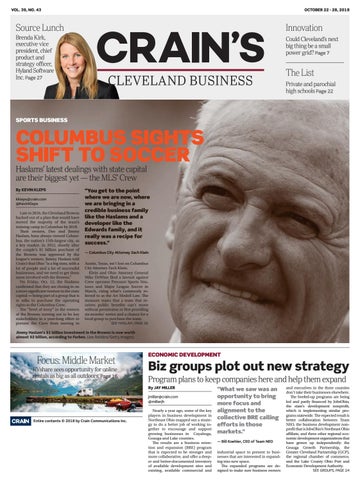
COLUMBUS SIGHTS SHIFT TO SOCCER Haslams’ latest dealings with state capital are their biggest yet — the MLS’ Crew By KEVIN KLEPS kkleps@crain.com @KevinKleps
Late in 2016, the Cleveland Browns backed out of a plan that would have moved the majority of the team’s training camp to Columbus by 2018. Their owners, Dee and Jimmy Haslam, have always viewed Columbus, the nation’s 15th-largest city, as a key market. In 2012, shortly after the couple’s $1 billion purchase of the Browns was approved by the league’s owners, Jimmy Haslam told Crain’s that Ohio “is a big state, with a lot of people and a lot of successful businesses, and we need to get them more involved with the Browns.” On Friday, Oct. 12, the Haslams confirmed that they are closing in on a more significant venture in the state capital — being part of a group that is in talks to purchase the operating rights to the Columbus Crew. The “level of irony” in the owners of the Browns turning out to be key stakeholders in a year-long effort to prevent the Crew from moving to
“You get to the point where we are now, where we are bringing in a credible business family like the Haslams and a developer like the Edwards family, and it really was a recipe for success.” — Columbus City Attorney Zach Klein
Austin, Texas, isn’t lost on Columbus City Attorney Zach Klein. Klein and Ohio Attorney General Mike DeWine filed a lawsuit against Crew operator Precourt Sports Ventures and Major League Soccer in March, citing what’s commonly referred to as the Art Modell Law. The measure states that a team that receives public benefits can’t move without permission or first providing six months’ notice and a chance for a local group to purchase the team. SEE HASLAM, PAGE 26
Jimmy Haslam’s $1 billion investment in the Browns is now worth almost $2 billion, according to Forbes. (Joe Robbins/Getty Images)
Focus: Middle Market
RVshare sees opportunity for online rentals as big as all outdoors. Page 16
ECONOMIC DEVELOPMENT
Biz groups plot out new strategy Program plans to keep companies here and help them expand By JAY MILLER jmiller@crain.com @millerjh
Entire contents © 2018 by Crain Communications Inc.
P001_CL_20181022.indd 1
Nearly a year ago, some of the key players in business development in Northeast Ohio mapped out a strategy to do a better job of working together to encourage and support growing businesses in Cuyahoga, Geauga and Lake counties. The results are a business retention and expansion (BRE) program that is expected to be stronger and more collaborative, and offer a deeper and better-documented inventory of available development sites and existing, available commercial and
“What we saw was an opportunity to bring more focus and alignment to the collective BRE calling efforts in those markets.” — Bill Koehler, CEO of Team NEO
industrial space to present to businesses that are interested in expanding into new space. The expanded programs are designed to make sure business owners
and executives in the three counties don’t take their businesses elsewhere. The beefed-up programs are being led and partly financed by JobsOhio, the state’s development nonprofit, which is implementing similar programs statewide. The expected result is better collaboration between Team NEO, the business development nonprofit that is JobsOhio’s Northeast Ohio affiliate, and three other regional economic development organizations that have grown up independently: the Geauga Growth Partnership, the Greater Cleveland Partnership (GCP), the regional chamber of commerce, and the Lake County Ohio Port and Economic Development Authority. SEE GROUPS, PAGE 24
10/19/18 4:02 PM
Complex commercial
litigation is a long game. I’m ready to go the distance, while always searching for a favorable resolution. Clients call me when the stakes are high and the outcome is murky. It’s my job to lead them through. To immerse myself in their business. Analyze the issues, set the strategy, build the case, and take it as far as it needs to go. Whether to hold fast and go to trial; settle now or later; or aim for a win on appeal. The playbook changes every time. And so does the right call. Knowing which call to make? That’s a skill built case by case, and honed over two decades of experience. Trial tested, and judgment affirmed. I’m GREG PHILLIPS. I’m on your team.
MY BENESCH MY TEAM
> Vice Chair, Litigation Practice Group; Chair, Business Litigation Practice Group > Concentrates on complex business and commercial litigation, including class actions, for a broad range of public and private companies and individuals. > Has argued successfully before the Ohio Supreme Court and the U.S. Court of Appeals for the Sixth Circuit, while litigating cases around the country. > Repeatedly named a Best Lawyer in America®, a Benchmark Litigation future star, and an Ohio Super Lawyer. > Deeply experienced in legal and business ethics and regularly counsels other attorneys on risk and professional responsibility matters. > 216.363.4472 | gphillips@beneschlaw.com
www.beneschlaw.com
Full Page Template.indd 2
10/17/18 1:07 PM
CRAIN’S CLEVELAND BUSINESS
|
O C T O B E R 2 2 - 2 8 , 2 018
PA G E 3
|
Hartland rebrands as Clearstead Advisors By JEREMY NOBILE jnobile@crain.com @JeremyNobile
A prominent Cleveland-based money manager is changing its name and reworking the brand in a move to reflect how its grown and evolved since its founding nearly 30 years ago. It’s simply the right time to refresh the firm’s identity and capitalize on some opportunities to gain market share, said David Fulton, president and CEO of what now is known as Clearstead Advisors LLC — formerly Hartland & Co. “What we’re really trying to do is to communicate the scope of our firm,” Fulton said. There’s good reason behind the timing for that. Much like how the accounting sector is feeling an increasingly friendly environment conducive for work today — driven by a number of factors including a buildup of wealth, generational transfers of that wealth from aging baby boomers and a shifting landscape for rules and regulations (think new tax codes, for instance) — thoughtful money managers are looking to publicize themselves, lest they miss chances to attract new clients. But Clearstead has been building up to this point regardless of those factors. Hartland was established in 1989 by namesake founder Thomas Hartland. Fulton then took over as CEO in 2014 — when he set the goal to double revenues by 2018 — as Hartland became chairman of the board. A lot has changed since those early days, when the firm was purely an independent financial consultant and benefits advisory. It eventually began managing its own accounts as it added a private-client end of the business for high-net-worth individuals. One of its fastest-growing business lines today involves its outsourced chief investment officer services (a segment now branded as Prism). The firm now advises on more than $20 billion for clients in 36 states (plus some international accounts) with assets under management of about $4 billion, according to its latest public filing. A pivotal moment for the its current identity came in 2017 as the firm recapitalized and took a minority investment from Rosemont Investment Partners, a Pennsylvania-based private equity firm that specializes in asset managers. Rosemont has a 32% stake in the business. Other terms of that deal have not been disclosed. But the capital from Rosemont upped then-Hartland’s employee owners from 13 to 28. “And what that really does is give people a vested interest in the success of the enterprise,” Fulton said. It also helped with the succession planning in the transition from Hartland’s founder, added an expert from Rosemont to its board and provided a stash of capital for other acquisitions. The firm’s last M&A deals were both in 2015. The firm bought Plimsoll Mark Capital early that year, giving it a new presence in Portland, Maine, and brought on about $300 million in assets. Four people work there today. It followed that with the purchase of Lancaster Pollard Investment Advisory Group’s book of business later that year, adding about $1 billion more in assets, but no Columbus of-
P003_CL_20181022.indd 3
fice. The third office in the firm’s footprint is run by a single individual in New York. Fulton declined to disclose revenues, but he said the firm is on track Fulton to hit its target of doubling revenues by the end of this year from 2014. So where does it go from here? That’s where the Rosemont investment and new brand campaign comes into play. The firm recently hired a marketing firm, HussGroup, which helped think through the name change to Clearstead — which Fulton said is a
conjunction meant to convey clarity and steadfastness, the “attributes that we feel describe the way we serve our clients.” A motivation of the marketing campaign is to convey that the firm is still heavily involved with its legacy business on the institutional front working with groups like endowments and foundations, but that it also has honed its discretionary offerings. “And that is important because more and more of our new business is discretionary,” Fulton said. “More of the requests for proposals we are receiving are about discretionary management. And that’s a big shift. We’ve always done it in one way or another, but we’ve honed that and (we think) made it a first-rate offer-
ing. It’s something we’ve worked on a lot this year.” In terms of overall trends in his industry, he said there’s also been an evolution in the demand for integrated management — that is, integrating investments with things like taxes, financial and estate plans in a coordinated fashion. “That demand is definitely out there,” Fulton said. Fulton indicated that some acquisition opportunities are in the pipeline. It’s worth noting its marketing firm is based in Pennsylvania, and Fulton said one of the markets on his mind to grow into is Pittsburgh. He’s also looking at Columbus and “maybe” Michigan. “We’ve seen some (opportunities), but nothing we’re acting on yet,” he said.
Besides the right cultural fit all professional service firms want, the size sweet spot for Clearstead would be firms with assets in the range of $500 million to $2 billion. The right targets would also add some key talent to the business, Fulton said. The firm reports increasing staff by 34% in the past three years. It’s just shy of 80 people today, but will have that many on staff by yearend. The firm is also embarking on what it’s calling “ClearPoint Roundtables” that are just like they sound and focus on industry topics. Its first session was about the outsourced CIO services. Those sessions and marketing are all new territory for the firm and speak to the opportunity it sees in the market.
FIFTH THIRD CAPITAL MARKETS
WHERE EXPERIENCE AND INNOVATION INTERSECT. Bob Marcus EVP, Head of Capital Markets at Fifth Third Bank
Bob and the Capital Markets experts at Fifth Third Commercial Bank provide critical market analysis, strategic guidance and capital-raising solutions to generate better results for your business. ®
This is banking a Fifth Third better. 53.com/Experience
Notices & Disclosures Fifth Third Capital Markets is the marketing name under which Fifth Third Bank and its subsidiary, Fifth Third Securities, Inc., provide certain securities and investment banking products and services. Fifth Third Capital Markets offers investment banking++, debt capital markets+, bond capital markets++, equity capital markets++, financial risk management+, and fixed income sales and trading++. Fifth Third Bank provides access to investments and investment services through various subsidiaries, including Fifth Third Securities. Fifth Third Securities is the trade name used by Fifth Third Securities, Inc., member FINRA/SIPC, a registered broker-dealer and registered investment advisor registered with the U.S. Securities and Exchange Commission (SEC). Registration does not imply a certain level of skill or training. Securities and investments offered through Fifth Third Securities, Inc.: Are Not FDIC Insured Offer No Bank Guarantee Are Not Insured By Any Federal Government Agency
May Lose Value Are Not A Deposit
+ Services and activities offered through Fifth Third Bank ++ Services and activities offered through Fifth Third Securities, Inc.
Member FDIC
10/19/18 12:53 PM
PA G E 4
|
O C T O B E R 2 2 - 2 8 , 2 018 |
CRAIN’S CLEVELAND BUSINESS
WE DON’T PLAY
GAMES WITH YOUR MONEY Support your local credit union. • Commercial Real Estate Loans up to $10 million • No Prepayment Penalties • As Little as 10% Down
Contact Jonathan A. Mokri 440.526.8700 jmokri@cbscuso.com www.cbscuso.com Your Business Lending Partner SM
If you bought your racking somewhere else, you probably paid too much.
NEW CUSTOMERS RECEIVE
5% OFF FIRST PURCHASE! (Contact for details)
Global exchange programs can be key learning tool By RACHEL ABBEY McCAFFERTY
Gee, saying serving as a guest or as a host helped them see their work in new ways and helped them create rmccafferty@crain.com cross-cultural networks. @ramccafferty Sharie Renee, founder of Cosmic Traveling to Israel with the Jewish Bobbins in Cleveland, has spent reFederation of Cleveland helped Ni- cent weeks serving as a host to a felcole McGee see her work in a new low in the Young Leaders of the light. Americas Initiative. McGee is the co-founder of UpcyThe Young Leaders of the Americas cle Parts Shop, which she described Initiative is sponsored by the U.S. Deas a “creative reuse” shop incubated partment of State and coordinated by under the St. Clair Superior Develop- the Meridian International Center. The ment Corp. The shop encourages organization overseeing it locally is the people to give new life to products Cleveland Council on World Affairs. “I wanted to get the Cleveland like scrap leather or leftover yarn that Council on World Affairs involved bewould normally be discarded. While visiting Beit Shean as part of cause I think that we have a really rich a professional exchange program with tapestry of business resources and lothe federation, McGee had the chance cal entrepreneurs who are looking for to run some workshops. She quickly opportunities to network and to menrealized she had to hand over some tor and to expand the horizons of their control, and that was OK — the pro- businesses beyond Cleveland,” said cesses she often used to run events in Katie Ferman, senior program officer Cleveland were just that: processes. for international visitor programs. In the Cleveland area, more than They weren’t “the magic,” she said. “You can see things that you would 20 companies or organizations as never see about your own work,” Mc- varied as Cleveland Clinic InnovaGee said. “And, of course there’s dif- tions and Greenhouse Tavern have ferences, but the common ground of served as hosts for the Young Leaders building community — it was so af- of the Americas fellows in 2017 and firming to see, wow, this is about hu- 2018. The fellows are entrepreneurs man to human. And we get so stuck and business leaders in a variety of on the differences that we all have, but fields from selected countries in Latwe’re all humans, and that’s a pretty in America or the Caribbean, and substantial thing to have in common.” hosts have the opportunity to apply The Jewish Federation of Cleve- for reverse transfers. Renee hosted a Guatemalan entreland is just one of the organizations in the region actively organizing cul- preneur who works with indigenous tural exchange programs for profes- artisans, a mission that reminded Resionals. Participants in these types of nee of her work with indigenous artiprograms in Mexico years ago.1 Her work reported insights like Mc- 1 sans OH_2018-19_ad_Crains.qxp_Layout 10/11/18 11:07 AM Page
“resonated” with Renee. “Meeting her, I sometimes feel like I’m talking to my younger self,” Renee said. Cosmic Bobbins is a small screen-printing, embroidery and sewing company with a focus on doing social good. Renee had the Young Leaders of the Americas fellow get involved in all aspects of Cosmic Bobbins’ work, from producing a large order of bags to helping with the training it runs, teaching people in the community how to sew. And she’s hoping the two can find ways to collaborate in the future. Ferman said she refers to the fellows as entrepreneurs in residence — they’re experienced and there are opportunities for an exchange of best practices between hosts and fellows. And they’re encouraged to have projects to work on in the weeks of the program, so there’s a direct benefit to the host company, Ferman said. This year, the fellows arrived in the United States in the middle of September, and they’ll head home on Wednesday, Oct. 24. These types of cultural exchange programs have been around for years, but in 2018, with the White House’s strong stance on tightened borders, it’s a contentious political
The brie Tem
env rent F part inte You tiati so m pers of abro A trips long or n abo vice Jo Glob thos fede lead prog rior Beit took alwa leve
SINCE 1961
(216) 229 - 9300 www.cbfindustries.com
est . 1896
GREAT PRODUCTS, GREAT PEOPLE, GREAT PRICES!
Where passions are discovered. See how we inspire each girl to fulfill her promise and to better the world every day. Our Open House offers the opportunity to learn about our nationally-recognized Center for Research on Girls, as well as our rigorous academic programming grounded in the themes of civic engagement, global studies, entrepreneurship and STEAM (science, technology, engineering, arts, mathematics).
fitness CLEVELAND’S PREMIER
FITNESS CENTER
Her discovery starts here. 24/7 ACCESS FREE PARKING
FIRST MONTH
FREE vedasfitness.com Located on the 3rd Floor of the Marriott at Key Tower 216.298.5115
P004_005_CL_20181022.indd 4
Girls K-Grade 12 and Coed Pre-Primary LaurelSchool.org 216.464.0946
with mention of this ad
Dream. Dare. Do.
LYMAN CAMPUS One Lyman Circle, Shaker Heights, Ohio
BUTLER CAMPUS 7420 Fairmount Road, Russell Township, Ohio
Laurel’s All-School Open House Saturday, October 27, 9:00-11:00 am • RSVP at LaurelSchool.org/OpenHouse
10/19/18 3:19 PM
8
CRAIN’S CLEVELAND BUSINESS
|
O C T O B E R 2 2 - 2 8 , 2 018
PA G E 5
|
Reducing Real Property Tax Assessments Throughout Ohio And Across The United States Sleggs, Danzinger & Gill, Co., LPA
like Re-
mall sewg soeadlved ork, gs to achw to find
ows — opbest ows. projprothe year, ates ey’ll . nge for hite ned tical
The 2017 Thomas and Joann Adler Israel Mission participants enjoy a brief rest on the rooftops of the Old City of Jerusalem overlooking the Temple Mount and the al-Aqsa Mosque. (Contributed photo)
environment in which they’re currently being practiced. Ferman said she’s seen “broad bipartisan support” for professional international exchanges like the Young Leaders of the Americas initiative. And she thinks that’s because so many people in government have personally experienced the benefits of cultural exchanges, like study abroad opportunities. As for the Jewish Federation, its trips aren’t political. The group has a long history of taking people, Jewish or not, to Israel so they can learn more about the country, said Amy Kaplan, vice president of external affairs. Joe Cimperman, president of Global Cleveland, has been one of those participants, both as part of the federation’s Adler mission for civic leaders and its professional exchange program between the St. Clair-Superior neighborhood in Cleveland and Beit Shean in Israel in which McGee took part. Exchanges like this have always happened on a community level, he said, and that work will out-
last current ideologies. “It’s even more important to do it now, with a national government that demonizes the other,” Cimperman said. Cimperman called his first trip to Israel “life-changing,” and noted that it was Beit Shean that really spoke to him. It reminded him of Cleveland and inspired him. Kaplan said the exchange works because Beit Shean and Cleveland have a lot in common. Beit Shean faces some economic challenges. It’s a community full of immigrants, working to meld those cultures, and it struggles with brain drain. Cimperman was inspired by an economic development zone that spans Jordan and Israel that Beit Shean is part of. The community is creating something “prosperous” in an area that had been filled with conflict, Cimperman said. He saw lessons for Cleveland, a city of contradictions (see the high illiteracy rate contrasted with world-class hospitals). SEE ISRAEL, PAGE 8
BANNER DISPLAYS THAT GET RESULTS!
When you hire Sleggs, Danzinger & Gill, you work directly with Sleggs, Danzinger and Gill. Each client is directly represented at all levels by a principal of the firm with a combined 75 years of experience. No pyramid, no associates, no on-the-job training. Our clients deserve the very best representation, so we structured our firm to allow each client, throughout the entire process, to work directly with Messrs. SLEGGS, DANZINGER and/or GILL. Our philosophy is to work cooperatively with school district and County officials to ensure that our clients pay the lowest possible real property tax obligations. If a fair resolution requires litigation, SLEGGS, DANZINGER & GILL have the depth of trial and appellate experience to handle the most complex valuation issues. Whether the valuation relates to large industrial plants, apartments, shopping centers, warehouses, office buildings, vacant land or any other type of commercial property, the faces above will ensure that you receive the best counsel, legal advice and litigation expertise. Todd W. Sleggs, Esq.
Robert K. Danzinger, Esq.
Steven R. Gill, Esq.
tsleggs@sdglegal.net
rdanzinger@sdglegal.net
sgill@sdglegal.net
Leave the competition behind with custom banner displays from Post Up Stand. Attract more attention, build strong relationships and increase sales with our high-quality portable displays. All orders are ready for local pickup or shipping in 48 hours after proof approval.
(216) 771-8990 sdglegal.net
Visit our showroom at 14300 N. Industrial Avenue in Maple Heights or online at postupstand.com to see our complete line of trade show and marketing displays.
800.935.3534
P004_005_CL_20181022.indd 5
Order by November 30, 2018 and use promo code CC18 to receive15% off your next order!
Member Firm
Sleggs, Danzinger & Gill 820 West Superior Ave. Seventh Floor Cleveland, OH 44113
10/19/18 3:18 PM
PA G E 6
|
O C T O B E R 2 2 - 2 8 , 2 018 |
CRAIN’S CLEVELAND BUSINESS
71,300 SF Industrial Building 6880 Lake Abram Drive, Middleburg Heights, OH
Apple Growth’s expansion efforts begin to bear fruit
Firm is combining two local offices into bigger Beachwood spot By JEREMY NOBILE jnobile@crain.com @JeremyNobile
PROPERTY OVERVIEW • 71,300 SF Freestanding building • 70,300 SF Warehouse area/1,000 SF Office area • 4.14 acres • 18’ Clear height • 4 Docks - one with levelator/1 drive-in door • Masonry construction • Power: 400AMP/120 480V/3-Phase • Fully sprinklered www.hannacre.com
Kevin J. Kuczynski 216.861.5684 KevinKuczynski@HannaCRE.com
William J. Miele 216.861.7200 WilliamMiele@HannaCRE.com
fi“Ifififiufifififidfifififififififififififi fififitfiHfifififiNfifififiHigfifiSfifififififi�
DONNAfiHANZLICKfiDEYEfi Outside Board Director of BRS Outdoor Sports Holdings, LLC Vice President & Global CFO of Daisy Manufacturing Company Holy Name High School Class of 1976
Celebrating over 100 years of tradition
Mind | body | spirit fifififififififififififififi RfifidfiDfifififi’fififififififififififififififififififififififififififififififi
Apple Growth Partners is tweaking its presence in the Cleveland region as it plots out an ongoing expansion both here and across its Northeast Ohio footprint. The Akron-based accounting firm has been running two Cleveland-area offices since acquiring KPFF LLC in Beachwood in a deal that finalized in early 2017. It also had been working out of an Independence location since combining staff in Westlake and Mayfield Village there in 2010. Apple Growth has had some level of presence in Cleveland for about two decades. With its most recent deal with KPFF well in the rearview mirror and eager for more market share in the Cleveland area itself, the firm will be combining those current offices in Beachwood and Independence into one new Beachwood location on Nov. 1 at 25550 Chagrin Blvd, Suite 401. There’ll be about 35 staffers combined at the 75-year-old firm’s new location, which has about 10,000 square feet of space and should accommodate a max of about 50 people, said Cleveland managing partner Randy Misch. The move had been in the works since the deal with KPFF, said Apple Growth chairman Charles Mullen, noting “we didn’t want to be a firm of a bunch of tiny littler offices.� The new space will also include updated technology and popular amenities for modern professional services firms today, like a number of collaboration rooms. The plans in Cleveland follow the firm opening a de novo office in North Canton earlier this year in a move that was encouraged by staff. As Apple Growth plots its growth in Cleveland, Mullen said he’s still interested in other small acquisition opportunities that could be a proper fit, although he said there’s not any-
“We are still hungry and on the hunt to do a tuck-in or a merger in the Northeast Ohio area, and we would love to do one in downtown Cleveland.� — Charles Mullen, Apple Growth Partners chairman
thing immediately in the pipeline besides some names he has in mind. A presence in the city itself is high on the wish list. “We are still hungry and on the hunt to do a tuck-in or a merger in the Northeast Ohio area,� he said, “and we would love to do one in downtown Cleveland.� The firm has been refining services lately — it launched a niche practice in forensic accounting this year, for example — and says it sees as many opportunities for growth in Cleveland, where an acquisition brought it to the market about 20 years ago. Not surprisingly, it also has amped up its marketing efforts. The firm recently hired a director of practice growth, it’s doing more with social media, and it has expanded its marketing budget. For instance, Apple Growth now has ads running at the Akron-Canton Airport and Cleveland Hopkins International Airport. The refined presence in Beachwood also is part of its overall
brand-awareness strategy that comes at a time when the market is increasingly in need of accounting services. The buildup of American wealth, evolving regulatory landscape and new tax codes are all creating a sector that’s become more friendly to the industry, as CBIZ Inc. CEO Jerry Grisko recently described it. That means more demand for work, which means more opportunity to gain market share. CBIZ recently spoke with Crain’s about the factors such as those that are driving its own marketing push today, which is highlighted by a national ad campaign complete with TV spots on major channels like CNN and Fox. It’s always advertised, but never to the extent of its current efforts. “Even though we’ve been there for 20 years, we still have a long way to go as far as growing our practice there,� Mullen said, noting the ad spends in Cleveland itself have increased about 60% this year. “We are putting a lot more thought and intention behind our marketing plan.� Mullen said Apple Growth is on track to hit firmwide growth goals for 2018 that were laid out a couple years back. Those plans projected the firm to be about 115 people strong and with revenues of at least $18.5 million by the end of the year. He said he expects to hit that revenue target, though staff may be closer to 110. The privately owned firm reported combined revenues of about $14 million when it combined with KPFF in early 2017. While AGP will slowly grow that headcount, as evidenced by the room it’s making at what will be its new, combined Beachwood office, the firm hitting financial goals with a bit fewer people than it anticipated having speaks to the employee workload. Mullen said AGP is making “significant� investments in tech and software to support marketing and staff management alike. “We’ve got to be able to schedule projects accordingly,� he said. “We don’t want to burn out staff.�
)ΝΝΝΝΝ5ĎƒÎťÎťĎƒ %'1 9QTNF 5[PGTI[ Contact Mike Bizjak Project Development, Sales & Management
216-392-8946 mbizjak@cicognasign.com
ΝΝΝΝΝΝΝΝΝΝΝΝΝΝ ΝΝΝΝΝΝΝΝΝΝΝΝΝΝΝΝΝΝΝ ΝΝΝΝΝΝΝΝΝΝΝΝΝ "EACHWOOD OFFERS AN EXTENSIVE NETWORK AND GREAT AMENITIES WITHOUT THE HASSLES OF A BIG CITY v
ĎƒÎťÎťÎťÎťÎťĎƒÎťÎťÎťÎťÎťÎť5ΝΝ*ÎťÎťĎƒÎťÎť\ÎťĎƒĎƒĎƒĎƒĎƒĎƒĎƒĎƒĎƒĎƒĎƒĎƒĎƒĎƒĎƒĎƒĎƒĎƒĎƒĎƒĎƒĎƒĎƒĎƒĎƒĎƒĎƒĎƒĎƒĎƒĎƒĎƒĎƒĎƒĎƒĎƒĎƒĎƒĎƒĎƒĎƒĎƒĎƒĎƒĎƒĎƒĎƒĎƒĎƒĎƒĎƒĎƒĎƒĎƒĎƒĎƒĎƒĎƒĎƒĎƒĎƒĎƒĎƒĎƒĎƒĎƒĎƒĎƒ
P006_CL_20181022.indd 6
10/19/18 12:50 PM
CRAIN’S CLEVELAND BUSINESS
|
O C T O B E R 2 2 - 2 8 , 2 018
|
PA G E 7
Next big thing could be a tiny power grid By DAN SHINGLER dshingler@crain.com @Dan Shingler
When a couple hundred or so energy wizards and wonks gather this week at NASA Glenn Research Center’s EnergyTech 2018 conference, they’re going to hear about something that could have a huge impact on the ground in Cleveland. It would cost more than $100 million. But it would also be self-funding, and it’s piquing the interest of city and county officials who are beginning to study its potentially huge economic impact. “We’re all interested and intrigued. It’s cleaner, more reliable power that could help us with economic development,” said Mike Foley, director of the Department of Sustainability for Cuyahoga County and one of a cadre of local leaders considering the project, which came out of research at Cleveland State University and work at Case Western Reserve University with funding from the Cleveland Foundation. It’s a microgrid. Sexy, huh? It is if you’re running a data center, hospital, insurance company, accounting firm or any number of other businesses that rely heavily on keeping computers and equipment running all the time, with no interruptions, ever. “If the typical grid now is up 99.5% (of the time), a microgrid is going to be 99.999999% up … basically, without any interruptions,” said Andrew
“We’re ready for it. It’s definitely feasible on our end.” — Alexandra Schwertner, Rockwell industry sales engineer
Thomas, executive in residence at Cleveland State’s Levin College of Urban Affairs. He fostered much of CSU’s recent research on microgrids and will be presenting the latest findings at NASA’s event, which runs Oct. 22-25 at the I-X Center. A microgrid would be unaffected by things like the big blackout of August 2003 that shut out the lights in much of Northeast Ohio (and beyond) for a couple of days, and longer than that for many of the more than 50 million other people affected. It would also be insulated from any other problem that would affect electricity delivery, in the local region or a much larger footprint, and would even be immune from the internet-enabled hacking that keeps a lot of network security executives up at night. That’s because it would be an island, Thomas said — a separate electricity distribution system, built in existing underground infrastructure, that would not be connected to the internet. It would be able to take power off the larger grid and to deliver it from Cleveland Public Power
generators and local battery storage as well. Perhaps most importantly, it would be able to switch from one source to the other seamlessly, without interruption or voltage drops, in the event of a problem on the larger outside grid, like a giant uninterruptable power supply. It would barely be a “micro” grid by most standards. Such grids are usually found dedicated to a single facility, such as a hospital — or, in the case of NASA, on the International Space Station. CSU researchers propose building one that would serve a 2- to 3-square-mile area, roughly bound by I-90 and the Cuyahoga River. The scope of it results in the big price tag, Thomas said. But he said the research shows that corporate customers will pay a premium for ultra-reliable power that would enable financing of the project, and even will pull up stakes and move to get it. As for the technology, that abounds locally. NASA’s not featuring the technology for no reason and has been working on microgrids for decades. It would love for more of the technology it has developed to manage and control microgrids in space to be picked up by commercial companies and employed on Earth, said Ray Beach, a principal investigator at NASA Glenn. “Collaborating microgrids, that is the future,” Beach said. Then there’s Rockwell Automation. “We’re ready for it. It’s definitely feasible on our end,” said Rockwell industry sales engineer Alexandra
Schwertner, another evangelist for the Cleveland project. Rockwell has a number of reasons to support the project. For one thing, its Energy Solutions business is located in Mayfield Heights and helps Rockwell work on microgrids and other energy technology projects around the world, Schwertner said. On top of that, the company’s plant in Twinsburg makes the circuit board and other hardware used to control and manage microgrids. Rockwell would love to be able to showcase some of its technology at a successful local microgrid like the one proposed for Cleveland, Schwertner added. But if it all still sounds like pie underground, it is, at least for the moment. Everyone involved with the proposal said it’s only now emerging from its feasibility studies, and is a long way from actual planning, permitting, financing and construction. But proponents insist it will work and that demand for such a grid is not going away, according to experts such as John Juhasz, a former NASA engineer and now CEO of Strongsville-based Telepath Systems. The nonprofit collaborates with NASA and others on engineering work and the annual EnergyTech conference. He says the feasibility studies he’s seen on the project look great, and the threats to the nation’s electricity grids from the internet, powerful storms and other factors are only increasing, even though the grid has improved since the 2003 blackout. “But it is still inherently the same architecture. It’s still a big centralized
grid,” Juhasz said. The studies done have been comprehensive. The research was the capstone to a year’s work by 13 graduate students and others at CSU, said professor Jim Kastelic, who managed the work. He said students came at the project from varied backgrounds and areas of expertise, including financial and economic development, the drivers behind building the microgrid. “It’s all about economic development. That’s very critical here,” Kastelic said. That research included a survey of companies across the country in industries students determined needed reliable power the most, which turned out to be big data users like insurance, health care, financial and professional service firms, Thomas said. About 160 companies responded to a survey asking about microgrids, and 25% of them said they’d consider moving or establishing operations in Cleveland, if one were available and could provide power for 14 cents per kilowatt hour. That’s on the high end of what Thomas figures the grid’s power would cost users, who would sign up for different tiers of service, some isolated from the larger grid 100% of the time, others only when problems arose. “These are companies that need that extra reliable power because the cost to them when the power goes down is so high,” Thomas said, adding that the microgrid could deliver up to 48 megawatts of power for 13 cents to 14 cents per kilowatt hour.
Learn more at OEConnection.com/Beth
P007_CL_20181022.indd 7
10/19/18 2:53 PM
PA G E 8
|
O C T O B E R 2 2 - 2 8 , 2 018 |
CRAIN’S CLEVELAND BUSINESS
Feds set big move to North Point complex By STAN BULLARD sbullard@crain.com @CrainRltywriter
The push for ever-smaller office suites that bedevils office building owners has spread to the federal government. That’s the takeaway from a new General Services Administration lease for 45,455 square feet of space at North Point Tower, 1001 Lakeside Ave. in downtown Cleveland. A Chicago-based GSA spokeswoman confirmed in an email that
ISRAEL
CONTINUED FROM PAGE 4
Beyond inspiration and ideas, some work being done in Youngstown could serve as a concrete example of what these kind of trips can lead to. Barb Ewing, CEO of the Youngstown Business Incubator, participated in a Youngstown Area Jewish Federation trip to Israel about two years ago with the goal of identifying potential additive manufacturing partners. The incubator has been growing its networks and support services in additive manufacturing in recent years since the city welcomed America
the federal government’s purchasing agency has leased the new space for 10 years from Hertz Cleveland North Point LLC, the company that Los Angeles-based Hertz uses to hold the property on the northeast corner of East Ninth Street and Lakeside. The new space, leased for the U.S. Department of Health and Human Services offices in Cleveland, will be 36% less than that operation currently occupies, the email stated, and will save about $1 million in rent annually. However, as is usually the case in the Northeast Ohio office market,
one landlord’s gain is another’s loss. In this case, the HHS Cleveland office will be exiting 200 Public Square, one of the city’s three trophy skyscrapers. Tom Fox, a senior vice president at JLL Inc., the real estate firm that represents North Point’s owner, said Hertz and JLL had gone through a two-year process to land the lease. He said he assumed any of the downtown office buildings meeting federal space standards with adequate space likely sought the plum tenant. GSA will occupy all of North Point Tower’s seventh floor and part of its
“The idea of taking innovation, bringing it into the Midwest, to create new businesses that lead to more jobs and sustainability and tax revenue and you name it.”
ing startups get off the ground. “It became very clear very quickly that we had a compelling story to tell,” Ewing said. The Youngstown Business Incubator is now one of the partners working with F2 Capital, a seed stage venture capital fund in Israel. Startups in Israel often look to the East and West coasts of the United States for investment, overlooking the middle of the country, said managing partner Barak Rabinowitz. But the middle of the country isn’t as “saturated” with pitches and can give these companies more attention, he said. The partnership goes back to what Rabinowitz, a Northeast Ohio native,
— Barak Rabinowitz, Youngstown Business Incubator managing partner
Makes, the national institute focused on additive manufacturing. And the incubator has a long history of help-
THANK YOU FOR MAKING METROHEALTH GALA2018 A SUCCESS WITH NEARLY $1.2 MILLION RAISED PRESENTING SPONSORS
ninth floor. The space is being renovated now for HHS and will consist of multiple cubicles, Fox said. News of the GSA lease filtered through the Northeast Ohio real estate brokerage community in the days after a new owner acquired 200 Public Square earlier this month. A company called Q& I IX 200 Public Square owned by an affiliate of DRA Advisors, a New York-based operator of private equity investment funds, and Cleveland-based real estate developer Scott Wolstein now control 200 Public Square. Harbor Group International, a
Norfolk, Va.-based real estate investment firm, sold the property Oct. 9, according to Cuyahoga County online property records. Neither Colliers International nor Wolstein returned calls about the GSA exit. Fox said the North Point lease allows GSA to put HHS in two suites while it currently operates in more than two suites in 200 Public Square. Counting the GSA lease, the North Point complex, which includes a seven-floor building and the 20-story tower, is 88% occupied, Fox said.
Joe Cimperman, left, and Jamar Doyle, right, are shown with Lior Balavie, the director of the Young Adult Center in Beit Shean. (Contributed photo)
was raised with. His mother had been involved with efforts to bring Israeli technology to the region to stimulate the local economy. “The idea of taking innovation, bringing it into the Midwest, to create new businesses that lead to more jobs and sustainability and tax revenue and you name it,” Rabinowitz said. The goal of the partnership is to get
at least one of F2 Capital’s companies to Youngstown to engage with customers every six months. And in its first year, it’s succeeded, Rabinowitz said. Now, the Youngstown Business Incubator is hoping to serve as a “launchpad” for Israeli startups looking to work in the United States, especially those with industrial applications, Ewing said.
SALT • SALT • SALT GOLD SPONSORS
Water Softener • Industrial • Food Ice Melt • Sea Salt
Call For Pricing!! Minimum Delivery: 1 Pallet SILVER SPONSOR HKM
GALA AFTERDARK PRESENTING SPONSOR THE CONSTRUCTION COMPANIES FOR THE METROHEALTH TRANSFORMATION
AUCTION SPONSOR DESIGN COMPANIES FOR THE METROHEALTH CAMPUS TRANSFORMATION LED BY
ENTERTAINMENT SPONSOR
VALET/DEPARTURE LOUNGE SPONSOR
VISITING NURSE ASSOCIATION OF OHIO
FIFTH THIRD BANK MEDINA, OH
And to all of our valued sponsors, guests and supporters.
1-800-547-1538 Salt Distributors Since 1966 www.saltdistributormedinaoh.com
P008_CL_20181022.indd 8
10/19/18 3:16 PM
ARE YOU ONE OF THE BEST EMPLOYERS IN OHIO? List making companies will be highlighted in a special publication that will be published by Crain’s Cleveland Business in May 2019.
Is your company a great place to work? We want to
know! The Best Employers in Ohio awards program recognizes and honors the state’s top employers who show a dedication to their employees’ growth and quality of life. Don’t miss out – this is your opportunity to join the ranks of Ohio’s most outstanding companies!
9
PROUDLY PRESENTED BY:
Deadline: NOV. 30
REGISTER TODAY: BESTEMPLOYERSOH.COM
Full Page Template.indd 3
10/18/18 2:04 PM
PA G E 10
|
O C T O B E R 2 2 - 2 8 , 2 018 |
CRAIN’S CLEVELAND BUSINESS
Opinion Personal View
Proven workforce development model a good fit By ARMOND BUDISH and DEBORAH VESY
Editorial
Six more years This one is easy: U.S. Sen. Sherrod Brown deserves to be re-elected to a third term, and he has our endorsement. The Cleveland Democrat has been a workhorse for Ohio, a staunch fighter for the state’s residents, and, although he’s among the most liberal members of the Senate, an effective partner with Sen. Rob Portman, R-Cincinnati, on issues including opioid addiction, Great Lakes protection and pension reform. He also serves as a valuable, vocal counterweight to President Donald Trump and Republicans on health care and other issues, though he’s willing to work with the president at other times, most prominently on trade matters. We’re more supportive of free trade measures, by a considerable degree, than Brown. And yet we admire the way he has stuck to his principles and advocated on behalf of Ohio companies when, for example, they have been threatened by steel dumping by other countries, or currency manipulation, most prominently by China. We consider Brown an advocate for Ohio businesses, even if we might take a lighter touch than his on regulatory and tax issues. The personal and professional qualities of the candidate matter. Brown takes the job seriously and has earned key roles in the Senate over the years, currently as the ranking Democratic member on the Committee on Banking, Housing, and Urban Affairs, and co-chair of the new Joint Multiemployer Pension Solvency Committee. Brown has proposed, via the Butch Lewis Act, a program that would provide a low–interest, 30–year loan to troubled pension systems with no cuts to benefits. The Congressional Budget Office has said the bill would cost taxpayers $34 billion between 2019 and 2028, considerably below initial estimated costs and a solid investment in protecting the longterm futures of workers. He’s also on the Senate Committee on Agriculture, Nutrition and Forestry and is part of the farm bill conference committee — positions that, to those of us in Cleveland, aren’t top of mind when we consider Brown’s work in Washington, but are valuable in a state where agriculture is a critical economic driver.
Just as in 2016, when we endorsed Portman’s re-election, we find Brown to be a far superior candidate to his opponent in his grasp of policy, one who has the respect of smart people in the Senate on both sides of the aisle. Brown, 65, is almost the definition of a known commodity. He has been a state representative, Ohio’s secretary of state, a member of the U.S. House of RepresentaBrown tives and, since 2007, the U.S. Senate. Brown has remained a popular figure statewide, even as Ohio has trended in a Republican direction. That’s due, in no small part, to his stance on tariffs and trade deals, which have resonated with some voters who might not otherwise support the Democrat. “I will get a number of Trump voters because I fought for the things that Trump campaigned on, long before he did,” said Brown, who has long opposed the North American Free Trade Agreement and other trade deals, in a Bloomberg profile last week. “My position on trade is the mainstream position for the country.” Brown’s opponent, U.S. Rep. Jim Renacci, 59, of Wadsworth, has never found his footing in the race or offered a strong rationale for his candidacy. He originally intended to run for governor but took up the Senate race when the presumed GOP frontrunner for that nomination, Josh Mandel, dropped out for personal reasons. Renacci has had trouble raising money, which in turn has made it difficult to amplify his message to voters. And whatever message he has tried to convey has either been empty parroting of Trump-style rhetoric (on building a border wall, or even more tax cuts) or unfounded personal allegations about his opponent from long ago. Brown’s work in the Senate has been exemplary. He is the clear choice to advance the interests of Ohio.
Publisher and Editor: Elizabeth McIntyre (emcintyre@crain.com)
CLEVELAND BUSINESS
CLEVELAND BUSINESS P010_CL_20181022.indd 10
Managing Editor:
Scott Suttell (ssuttell@crain.com)
Contact Crain’s
216-522-1383
Read Crain’s online: crainscleveland.com
It is the most frustrating economic problem in our region, and it’s been a problem for as long as most of us can remember. On the one side, we have hundreds of employers with well-paying jobs that go unfilled because job seekers lack the necessary credentials. On the other side is a large population of residents who want to work and support themselves and their families but who don’t have the right skills, credentials and experience to get out of the low-paying-job rut and onto a career pathway that will yield family sustaining wages. This skills gap is holding back our region’s ability to grow and thrive and leaving too many people in or on the edge of poverty with dim prospects for the future. It’s a critical factor in our ability to attract new businesses and keep existing businesses investing here. Addressing it effectively creates an important opportunity to accelerate economic growth in Greater Cleveland. Yes, we have several robust nonprofits and government programs focused on workforce development, but employers tell us the efforts are not organized in a way that enables them to collectively talk about their needs or provide them with a reliable pipeline of skilled, qualified and ready to work talent. It’s hit or miss. Yes, a growing number of students are graduating with certificates, degrees and job-readiness credentials, but they are insufficient in number to meet employer demand, don’t quite have the skills that employers need or don’t have clear and actionable pathways to true careers. They also struggle to navigate through the multiple, but often disconnected, available programs. And yes, there are a number of organizations funding workforce training, but they are not coordinated, with each going their own way. A report commissioned by the Cuyahoga County Workforce Funders Group noted that the most in-demand sectors in our area are manufacturing, health care and information technology (IT). There is tremendous opportunity to connect people to good-paying jobs in these significant industries, and it will require a systemic effort. That is why Cuyahoga County Council unanimously approved spending up to $1 million from the county’s Economic Development Fund and Deaconess Foundation committed $450,000 to support Workforce Connect, an important building block in Cuyahoga County’s workforce development system. This program will bring organizations together to help employers in manufacturing, health care and IT find the skilled talent they need through business-led intermediaries. The Cuyahoga County Workforce Funders Group is a public-private partnership that has committed $2.5 million for Workforce Connect. This group includes the city of Cleveland, Cleveland Foundation, Deaconess Foundation, Fund for Our Economic Future, Greater Cleveland Partnership, The George Gund Foundation, Cleveland/Cuyahoga County Workforce Development Board, Team NEO and United Way of Greater Cleveland. Workforce Connect will be an important building block in the region’s workforce development ecosystem. It’s a new approach that will build on elements that are already in place, like the Workforce Development Board, and realign the system to make it more efficient and effective for potential workers and employers, which is fundamental to sustainable change. As the first step, Workforce Connect will develop business-led sector partnerships by building the capacity of intermediary organizations in manufacturing, health care and IT. The research clearly identified these three sectors as having the greatest potential to drive the long-term growth of our region. Other industries that warrant attention could be added later. SEE WORKFORCE, PAGE 11
Write us: Crain’s welcomes responses from readers. Letters should be as brief as possible and may be edited. Send letters to Crain’s Cleveland Business, 700 West St. Clair Ave., Suite 310, Cleveland, OH 44113, or by emailing ClevEdit@crain.com. Please include your complete name and city from which you are writing, and a telephone number for fact-checking purposes. Sound off: Send a Personal View for the opinion page to emcintyre@crain.com. Please include a telephone number for verification purposes.
10/18/18 4:05 PM
CRAIN’S CLEVELAND BUSINESS
|
O C T O B E R 2 2 - 2 8 , 2 018
|
PA G E 11
OPEN TO THE COMMUNITY
THE CLE STATE REC
Gym, Wellness Center & Sports Facility All Under 1 Roo ! Memberships Starting at just $30/month & No Contracts Our members enjoy incredible value for their dollar: • 110,000 sq. ft. state-of-the-art facility • 50+ FREE fitness classes offered each week • 125+ pieces of cardio & free weight equipment • Internationally-acclaimed programs like F45, Pink Gloves Boxing, Les Mills Bodypump & more
Personal View
Small business employees deserve retirement security By ROB SCOTT
More than 58 million Americans work for small businesses across the country. From manufacturing plants and family owned farms to restaurants and private practices, the American worker drives the economic prosperity of local communities and the nation. Despite the fact that 48% of the private workforce in the U.S. is employed by a small business, there is a considerable disparity in the availability of benefits as compared to large employers. Currently, only about half of private-sector workers in places with fewer than a hundred employees have access to workplace retirement plans. According to a 2017 survey conducted by the Pew Charitable Trusts, the primary reason small business owners said they could not offer retirement benefits was the prohibitive expense in setting up and administering such a plan. President Donald Trump’s Aug. 31 executive order targets this barrier for small businesses, with a call to action to allow small employers to band together to offer 401(k)type plans for their workers. This multiple-employer plan (MEP) would enable small businesses to pool their resources and benefit from economies of scale to increase retirement security for American workers. Traveling throughout the Great Lakes area as the U.S. Small Business Administration’s regional administrator, I’ve seen the number of small business owners
WORKFORCE CONTINUED FROM PAGE 10
The intermediary organizations will serve as the critical nexus for workforce development and talent access in each of the industries. They will be the leaders in supporting systemic change. A request for letters of intent already has already been broadly distributed, with an RFP to follow later in October. The intent is to have the manufacturing intermediary in place in January, the health care intermediary by the end of the second quarter and IT later in 2019. We are moving fast. Workforce Connect is a new approach in our county, but it is not an unproven concept. It is based on successful models implemented in other major U.S. metro areas — including Chicago, Boston and Cincinnati — that were identified in the research and vetted in the planning process. Even though this collaborative effort has been years in the making, it is very responsive to the tough conversations our community has been having about the urgent need to spur economic growth. Workforce Connect isn’t a silver bullet. We won’t see results overnight and there will be course corrections along the way. But we believe the initiative will be effective in addressing the serious talent gap holding us back. The result will be more businesses at the table working together to collectively determine workforce needs, more funders coordinating efforts and more county residents getting training, overcoming barriers and starting careers in manufacturing, health care and IT. When employers have access to skilled talent, they are more likely to stay and invest in Cuyahoga County and create more jobs. A larger pool of skilled talent will help attract outside employers to the region. When more residents have steady jobs and family sustaining wages, they have more disposable income and are better able to invest in their communities. All of this leads to a stronger economy, and that benefits everyone. The time is right for all of Cuyahoga County to get behind this transformational program. Budish is the Cuyahoga County executive. Vesy is president and CEO of the Deaconess Foundation and chair of the Cuyahoga County Workforce Funders Group.
P011_CL_20181022.indd 11
who want to provide a retirement package to their employees and believe MEPs will create a path to do so. Increasing access to workplace retirement savings plans allows small businesses to attract and retain workers. In the current economic environment, small businesses are eager to hire. According to the National Federation of Independent Business, “2018 has produced 45-year record high measures of job openings, hiring plans, actual job creation, compensation increases (actual and planned), profit growth and inventory investment” for small businesses. By offering competitive benefits packages, small businesses will be able to go after top talent. With the nation’s unemployment rate dropping to 3.7% and job openings at record highs, small businesses need to be able to compete in tighter labor market conditions to find suitable employees. With greater accessibility to retirement plans, American workers will have the tools at hand to invest in their future through long-term financial planning. More employees will have confidence they will be able to maintain the standard of living they are used to and deal with unplanned obstacles that may force them into early retirement. All Americans deserve that peace of mind, regardless of the size of their employer.
A CSU Rec membership is more than just gym access – it’s an investment in your wellness.
NEW MEMBER SPECIAL! Mention this ad & SAVE 50% on 3 months of memberships when paid in full! Stop in for a tour! Call 216-802-3200 or visit CSUREC.COM to learn more.
Scott is the Great Lakes regional administrator for the U.S. Small Business Administration.
Letter to the Editor DeWine is a better choice for governor I just read your Oct. 15 editorial endorsement of Richard Cordray over Mike DeWine for governor. I could not disagree more with your analysis or your conclusion. You are correct that DeWine is a moderate Republican, with practical, common sense approaches to Ohio’s problems and issues. However, Cordray is NOT a moderate Democrat. His history of “milking” companies for monies on trumped-up charges and using those funds for progressive causes is well known. His penchant for adding costly regulations to businesses under the guise of protecting the “little guy” is very clear. And despite your claim that Cordray will work across the aisle as a pragmatist, that is not his history in Ohio or Washington, D.C. — not by a long shot. While I understand the media’s desire to have a check on the Republican controlled Ohio Legislature, a Cordray administration will grind a needed business focus to a halt. Either business taxes and regulations will go up, or legislation will grind to a standstill in Columbus. The concept of an effective CSI program will be at risk. Legal shakedowns of business, and legal entanglements, will become common. And Ohio will take a major step backward as a business friendly environment, while outside businesses become less attracted to Ohio than our more business-friendly neighboring states. As for health care, pre-existing conditions and some form of Medicaid expansion can take place without the disastrous Affordable Care Act, and without bankrupting the state. As a business owner with 110 employees, I can attest to the terrible problems of the ACA on manufacturing companies such as mine. DeWine would have a much clearer and accurate picture of what needs to happen than Cordray. And your editorial seems to ignore the significant, positive efforts with DNA rape kits and the opioid crisis taken on by DeWine. His approaches and leadership has been an inspiration to other states in the nation. I would encourage your publication to rethink who would be the better governor of Ohio. It is Mike DeWine. Michael Canty, President and CEO, Alloy Bellows & Precision Welding Inc. Highland Heights
Crains-4x4-v1.indd 5
8/6/18 3:42 PM
10/18/18 2:13 PM
PA G E 12
|
O C T O B E R 2 2 - 2 8 , 2 018 |
CRAIN’S CLEVELAND BUSINESS
Topnotch adds soccer to agency profile By KEVIN KLEPS kkleps@crain.com @KevinKleps
Topnotch Management, a Cleveland-based talent agency, has added a third sport — soccer — to its portfolio. And the company’s golf business is about to get a lot more entertaining. Topnotch recently announced that it had acquired MLC Sport, a Minneapolis-based firm that represents more than two dozen soccer players — many of whom compete in Major League Soccer and the United Soccer League. MLC, which has been renamed Topnotch Soccer, was founded by Matt Cairns in 2015. Its addition to the Topnotch umbrella means the
company now represents more than 50 golf, tennis and soccer pros. The 26-year-old Cairns, a native of the United Kingdom, has a client list that includes Richie Ryan and Nazmi Albadawi of FC Cincinnati, Jack Barmby of the Portland Timbers, Brent Kallman of Minnesota United FC and Brett Levis of Vancouver Whitecaps FC. Cairns will continue to run the business from Minnesota, Topnotch founder Sam Duvall said. Duvall — a prominent tennis agent who started Topnotch after leaving Lagardère Sports in October 2015 — believes the acquisition can also provide a boost to his company’s tourism business. In 2016, Duvall formed a 50-50 partnership with Vermont-based Grand Slam Tennis Tours, which
“I’m not that familiar with soccer, but we have a couple guys on our team that love it and understand it. We thought it was a good opportunity.” — Sam Duvall, Topnotch founder
brings thousands of clients to prestigious tennis tournaments each year. A golf tourism biz — Topnotch Golf Tours — was added two years later. “It would be different than the tennis and golf side,” said Duvall, who represents such tennis notables as John Isner, Caroline Garcia, Elena
Vesnina, Steve Johnson and Gates Mills native Lauren Davis. “Maybe we’d be bringing in fans from an MLS team to an away game, and have some components we could package in.” The initial ideas include such features as dinner with a player and sightseeing. Plenty more will be discussed when Cairns comes to Cleveland soon for a brainstorming session. Duvall got to know Cairns via the latter’s brother, Chris, a former Facebook employee who had helped Topnotch with verification requests for its athletes. The entrepreneurs met in person for the first time at the U.S. Open in late August, and a deal was struck within weeks. “I’m not that familiar with soccer, but we have a couple guys on our team that love it and understand it,”
#
1 in
Ohio FINANCIAL PL ANNERS
Now named by InvestmentNews
2018 Best Places to Work for Financial Advisors - #1 in Ohio “Customers will never love a company until the employees love it first.” -
SIMON
SINEK
Also recently honored
1
of only
12
Advisors nationwide listed for 10 consecutive years by Barron’s Top 100 Independent Advisors.
www.ncafinancial.com 6095 Parkland Blvd., Suite 210, Cleveland, OH 44124 | 440-473-1115 Securities offered through Royal Alliance Associates, Inc., Member FINRA/SIPC. Investment advisory services and Fixed and Traditional Insurance Services offered through NCA Financial Planners, a registered investment advisor not affiliated with Royal Alliance Associates Inc. Royal Alliance does not offer tax or accounting services. For additional information, visit www.ncafinancial.com/awards
Untitled-1 1 P012_CL_20181022.indd 12
Duvall said. “We thought it was a good opportunity.” Duvall thinks Topnotch, via its corporate relationships, can help Cairns introduce his players to brands in their respective markets. “That’s something we’re very familiar with,” Duvall said. “It’s the only way we make money in the tennis space.” Soccer agents, unlike their counterparts in tennis and golf, get a cut of their clients’ on-field earnings. Though the endorsement potential for Cairns’ clients isn’t on par with the likes of Isner, Garcia and Vesnina, the soccer agency “isn’t being built from scratch,” Topnotch director of golf Michael McKenna said. Topnotch did just that when it hired McKenna to guide its golf agency in March 2017. About 19 months later, the firm is representing nine golfers, including 23-year-old Cole Miller, a member of PGA Tour Canada who qualified for the U.S. Open last summer. Topnotch’s golf and tennis games added a brick-and-mortar component when Topnotch Golf & Racquet opened on Larchmere Boulevard in Cleveland last spring. Duvall and McKenna are readying for a bigger step in 2019, via an indoor training center that soon will open in Beachwood. The 5,400-square-foot space is at 23800 Commerce Park — a single-story, multi-tenant warehouse that is situated off Chagrin Boulevard. The center will have four TrackMan simulators, at which golfers can fine-tune their games — all the while virtually playing some of the world’s most famous golf courses — and an indoor putting green. Duvall is hoping the facility will open its doors to customers by Jan. 1 “at the latest.” Duvall and McKenna are partnering with Drew Pierson, the director of golf at Shaker Heights Country Club, on the project. They will hire a general manager to oversee the day-to-day operations of the facility, plus an instructor who will be available for lessons. (Pierson, McKenna said, is keeping his job in Shaker Heights. The pro is an investor and consultant on the project.) Ideally, “instructors from all over can use the space during the winter months to give lessons,” McKenna said. He compared it to a barber renting out a chair at a barbershop for a day. In this case, area pros would pay Topnotch “a discounted fee” to bring a client and use one of the simulators for an hour or two, McKenna said. Duvall, who hopes that the majority of his visits to the facility are “when I’m working on my golf game,” said the model is much different than Topgolf, which will open its first Northeast Ohio location in Independence in 2019. “We’ll have a qualified instructor, and you can take a lesson during the five or six months you can’t play outside in Cleveland,” said Duvall, who moved to Northeast Ohio with his wife, Kathryn, a Shaker Heights native, in 2016. And while Duvall and McKenna view Topnotch Golf as a place for instruction during the region’s often-unrelenting winter and spring months, they’re mindful of the segment of the industry that just wants to unwind and hit some balls. “It will also be a fun place to play with your buddies (on the simulators),” McKenna said. “We want to get the best of both worlds.” Considering how Topnotch is building its three agencies — with sports, travel and brick-and-mortar components — that seems to be part of the company’s motto.
8/8/18 12:39 PM 10/18/18 2:14 PM
SPONSORED CONTENT
October 22, 2018
ASK THE PROFESSIONAL
The essential role of Cleveland Play House
ne hundred years ago, a cultural renaissance endowed Cleveland with some of its most iconic institutions, including the Cleveland Museum of Art, the Cleveland Orchestra, the Cleveland Museum of Natural History and the Cleveland Music Settlement. Up until then, vaudeville, burlesque shows and light entertainment headlined the city’s theater lineup. However, the founders of the newly minted Cleveland Play House wanted to convey shows of substance and relevance, or “Art in Democracy,” a motto associated with their goal of serving the needs of the community. More than a century later, Cleveland Play House remains deeply committed to its mission of community service, primarily through its entertaining, thought-provoking and socially pertinent theater; education outreach; and economic impact. “The way we serve the community is multi-faceted,” said Kevin Moore, managing director of Cleveland Play House, recipient of the 2015 Regional Theatre Tony Award. With annual attendance and student participation of 100,000-plus, Cleveland Play House generates an estimated $20 million annual impact on Cleveland’s economy, which reverberates throughout the area’s hospitality and retail sectors. “The story of how we serve, and our impact on the community, is important,” Moore said. Crain Content Studio — Cleveland asks Moore to elaborate on Cleveland Play House’s value, both on and off stage.
Each year, the Cleveland Play House provides more than 500 performances, education programs and engagement events. Why is community engagement essential?
Theater and community engagement are really one and the same. Theater is all about gathering people together to share a story. Sometimes that story is lighthearted and comical, sometimes heart-wrenching, sometimes intellectually challenging and sometimes all of those things and more. But theater is always a shared experience between artists telling a story and an audience that engages their minds, emotions and hearts in the experience. The same is true of theater education, where teaching artists connect with students who have gathered in classrooms here in Playhouse Square and throughout the community. Our mission is to inspire, stimulate and entertain diverse audiences across Northeast Ohio. Engaging with the community is who we are today, just as it has been for the past 103 years, and just as the art form has done for millennia.
What goes into planning each season of theater?
As managing director, I focus on resource development, finance and administration. Laura Kepley, our artistic director, oversees all programming. She leads the selection of the plays for each season; hires the directors, designers and actors;
and oversees the production team. Laura’s charge is to tell stories of deep relevance for our community, and to tell each of them in productions that are immediate, imaginative and entertaining. Under her leadership, we have tackled a wide variety of subject matter, some topical such as our current production of the Pulitzer Prize-winning “Sweat,” but also raucous comedies like our upcoming “Sherwood: The Adventures of Robin Hood.” We announce each new season in the spring to run the following September through May. Several hundred plays will be considered on the way to each six-play subscription season, a herculean effort that ensures each play is just right for the community we serve.
Talk about some of the ways in which the Cleveland Play House reaches young people?
We have 10 education programs, including programs at Playhouse Square such as our Student Matinees, Apprentice Program and CPH Theatre Academy, and school-based programs like Compassionate Arts Remaking Education and KeyBank Classroom Matinees. CARE will expand to 10 Cleveland schools this year, where our teaching artists utilize CPH curriculum to foster social emotional learning. Social emotional skills are desperately lacking among our young people, yet are essential to becoming productive members of society. We also serve as lead agency in
with lighting, sound, costumes, props, scenery and special effects. This year, we have added “Made For Cleveland” (panel discussions with community leaders) and “Made In Cleveland” (talkbacks with artists and artisans) for select productions. The business community can become involved through our Corporate Leadership Council, which is focused on raising CPH’s awareness in the business community. The council hosts a semi-annual community leaders breakfast to highlight particular aspects of our work and its impact. The next breakfast, “Investing in Leaders for Today and Tomorrow,” is set for Nov. 8 and will feature CPH’s Apprentice Program, Artistic Directing Fellowship for Women and our membership group for young professionals. CPH Young Professionals group YP-CPH offers unique networking opportunities with both our staff and business partners, ticket offers and the ability to connect with those on stage and off throughout the year. Businesses can also sponsor CPH plays and programs or special events.
What is on the horizon for Cleveland Play House?
These are exciting times at Cleveland Play House, with great work on our stages and in our education programs. We just received word of our second major grant from the U.S. Department of Education for CARE, which will enable CPH to research the role theater education can play in mitigating the effects of childhood trauma, while expanding the program to include 2,500 more children. We are working on a new strategic plan, which will ensure that our high-quality artistic and education programs are accessible and welcoming to Northeast Ohioans from all backgrounds and walks of life, and that CPH is built in an operationally and financially sustainable manner. And yes, that means increasing our endowment to an appropriate level for the size and scope of the institution. Our goal is to create “great theater for every generation for generations to come,” knowing that our community will be a better place for everyone as a result.
five K-8 schools through the Cleveland Metropolitan School District/United Way Wraparound Initiative. We serve nearly 40,000 people in total each year.
Why are arts and culture so important to economic health?
A community with a vibrant arts and culture sector is a community that is a great place to live, work and play. The sector creates jobs that would not be here in our absence, while the skills that we teach our young people (creativity, communication, critical thinking and collaboration) are exactly the same as the so-called soft skills that businesses need in their workforce. The variety and quality of the cultural experiences in Northeast Ohio is breathtaking, a source of tremendous civic pride and a major selling point for people and businesses looking to relocate here.
What are some of the engagement opportunities offered by CPH?
InsideCPH is a suite of free engagement programs that provide insight into the stories that we tell, why we have chosen to tell them and how we go about creating a CPH production. InsideCPH programs include pre-show conversations and behind-the-scenes interactive seminars with artists. For select plays we offer “tech nights,” where the public is invited into the theater just as the actors come together
Pictured L to R: Nancy Lemenager, Xavier Cano, Nehassaiu deGannes, Robert Ellis / Photo by Roger Mastroianni
O
Insights from the regional theater’s managing director
“Passionate and necessary... a masterful depiction of the forces that divide and conquer.” TIME OUT NEW YORK
OCT 13 – NOV 4 | OUTCALT THEATRE written by LYNN NOTTAGE | directed by LAURA KEPLEY
TICKETS ON SALE NOW!
216.241.6000 | clevelandplayhouse.com
This advertising-supported section is produced by Crain Content Studio-Cleveland, the marketing storytelling arm of Crain’s Cleveland Business. The Crain’s Cleveland Business newsroom is not involved in creating Crain Content Studio-Cleveland content.
P013_CL_20181022.indd 13
10/18/18 9:57 AM
PA G E 14
|
O C T O B E R 2 2 - 2 8 , 2 018 |
CRAIN’S CLEVELAND BUSINESS
CHALLENGES OF BEING A FEMALE CHEF | A CRAIN’S SERIES
Lucky’s Café owner strives to create encouraging workplace By JOE CREA clbfreelancer@crain.com
“Tough broad” is a reputation Heather Haviland happily carries. “I believe I’m a really kind, caring person who’ll have your back,” she said, both matter-of-factly yet with a hint of wistfulness in her tone. “It’s just that I hate this idea that if you’re a strong woman, you’re just a ball buster. Restaurant kitchens are tough places. I’m strong, but I truly believe in creating an atmosphere that’s encouraging and supportive.” In striving for that kind of work environment, the chef-owner of Lucky’s Café in Cleveland’s Tremont area has cemented a place of prominence on the local map. Her snug little space, set up on two levels with a mishmosh of seating, is tucked away at 777 Starkweather Ave. in Cleveland. Like its maestro, it exudes a charmingly eccentric vibe. The rooms’ walls are hung with often-daring art by local artists. Here and there, posters and fliers share thoughts or announce upcoming events And patrons flock to the place. Lucky’s is busy throughout the day,
About this series: Joe Crea looks at the challenges that female chefs and restaurant owners face in a male-dominated industry, and he profiles some of the area’s top women restaurateurs.
“We use great ingredients and put in great intentions — and the outcome proves what you do.” — Heather Haviland, chef and owner of Lucky’s Café
and it’s packed during prime time. They come in for seemingly overflowing portions of hearty chow — all of it using local ingredients and entirely made from scratch. Order one of Lucky’s legendary Reuben sandwiches, and you’ll bite through homemade rye, house-cured sauerkraut, corned beef brined right in the back room and dressing blended in the kitchen.
Critics have shown plenty of love. “Lucky’s Café has won Scene’s best of brunch award so many times, we can’t keep count,” proclaimed Scene magazine in a feature on woman-owned chefs earlier this year. Cleveland.com has praised Haviland for her “bold, uncompromising dining.” That’s earned Haviland a warm share of the national spotlight. Food Network’s Guy Fieri has repeatedly featured Lucky’s on “Diners, DriveIns and Dives.” At 50, Haviland has been cooking since she was a kid. Her mother, Mary Lou, ran Haviland Catering, and Haviland grew up in the kitchen. “She cooked out of the home, crazy-elaborate things, and all I knew was that I NEVER wanted to have anything to do with cooking,” Haviland said, bursting into a robust laugh. By age 16, though, she found herself cooking to help her large, struggling family, and then earn enough for tuition. She decided she wasn’t a “student” in the conventional sense, but instead took to a rambling lifestyle. Her adventuresome youth included working with B:10.25” various community groups and volunteering with Amigos T:10.25”
de Las Americas to teach and build in Latin America. She later worked as a wild-fermentation baker in Seattle and did a stint as a coal-forge blacksmith in upstate New York.
“I’ve forever been in love with pounding metal,” she said, smiling. “But cooking for people brings people together,” Haviland said. “At first it seemed like the enemy, but in
S:10.25”
T:7”
At CIBC, our handshake is the first step to a one-of-a-kind partnership. With an experienced commercial banking team and 150 years of putting clients first, we deliver on your financial goals by developing a business partnership that’s built for you. Member FDIC. The CIBC Logo is a registered trademark of CIBC, used under license. ©2018 CIBC Bank USA. Products and services offered by CIBC Bank USA.
P014_015_CL_20181022.indd 14
cibc.com/US
10/18/18 2:52 PM
B:7”
S:7”
Our distribution clients get a banking partnership that takes them places.
the E to h secu to a H brig atio of th ing ing A cal” doe “W dec diffe relie box faith the fere “I a b brow one vate “We grea prov both sult bett R spot doe kind who desc at th A renn “E area the wom to th sex. with “S pan you ling an i som tude so leag
CRAIN’S CLEVELAND BUSINESS
|
O C T O B E R 2 2 - 2 8 , 2 018
|
PA G E 15
MANUFACTURING IS:
A lasting, well-paying career
with g. ings “At ut in
T:7”
B:7”
S:7”
the end, it’s what I love to do.” Eventually, family drew her back to her hometown — and the relative security of work in a field she’d grown to appreciate. Haviland’s artistry seems to shine brightest through her culinary creations. She lights up when she speaks of the sensory satisfaction of marrying good, raw ingredients and drawing grins from an appreciative guest. Ask her why the emphasis on “local” and “homemade,” and Haviland doesn’t miss a beat. “When I came back to town and decided to open, after working in different kitchens where they maybe relied too much on too much out of boxes and cans … well, I had great faith in Clevelanders and that, given the opportunity, they’d taste the difference. “I’ve learned that there’s just such a big difference between hash browns that come out of a bag and ones made from real potatoes cultivated on a nearby farm,” she said. “We use great ingredients and put in great intentions — and the outcome proves what you do. When you have both, the outcome is bound to be results that people will recognize as better.” Running a breakfast-and-lunch spot, Haviland has found that she doesn’t necessarily earn the same kind of respect as a restaurateur whose reputation is built on what she describes as “big, expensive proteins at the center of the plate.” Attracting good employees is a perennial challenge. “Everyone in the industry in this area is facing it,” Haviland said. “But the one thing I expect from men and women alike is that what they bring to this table isn’t connected to their sex. It’s to do their job, and to do that with respect. “Still, I’ll get that, ‘Oh, you make pancakes’ kind of smirk from some young male chefs,” she said, chuckling. “I know they’re looking at jobs as an investment in their résumé. But sometimes it can feel like that (attitude) is because you’re a woman and so ‘you can’t compete in the big leagues’ — or the style of food we do is
P014_015_CL_20181022.indd 15
Heather Haviland is the chef and owner of Lucky’s Café In Tremont. “People have no problem telling you what they think you’re doing wrong — and it’s probably easier for them to say that to a woman,” she says. (Hannah Kiraly)
somehow less valid than an 8 o’clock dining place with a liquor license, where a steak is $40 and everything is covered with some kind of foam. “But what we do is a craft. What we do is really humble, and every aspect must be just right. You can’t mask it with splashy presentation. If any one step is wrong, the entire dish is wrong.” Blockades, stumbling blocks and failure rates are legendary in the industry. Add to them the peculiar slights and challenges often slung at female restaurateurs, Haviland added, and the prospects for success can seem insurmountable But for anyone starting a restaurant today, she said, they’re pretty much equally tough for a woman or a man. “You have to be thick-skinned. If a person — any person — is starting a business, you have to know what you want,” she said. “You have to have a mission statement. You have to have an idea of what (you’re) setting out to do. It took me months to write mine, and when I started out I must have referred to it weekly. I still look at it sometimes.” Though she has her own take on how open female operators are to criticism, in many ways she sees them as universal hurdles in today’s restaurant-going society. Ones faced by women and men alike, she added. “People have no problem telling you what they think you’re doing wrong — and it’s probably easier for them to say that to a woman,” she said. “And with social media, it takes no guts to criticize. So people will have their opinion about what you do, and it can hurt sometimes, but you have to be able to let that be. And when you walk down the sidewalk at the end of the day, if you feel proud about what you did and worked as hard as you could, well, in my book you’re doing OK.”
Q-Lab Corporation’s focus on efficiency translates to loyal customers and higher wages automation, robotics, 3D printing, and Internet of Things When Doug Grossman took over running Q-Lab — is going to be a must for every manufacturer, big and Corporation for his father in 1985, the company had 20 small. “We make more in Northeast Ohio than we did employees. Today, the Westlake-headquartered firm — even 25 years ago — and we do it with far fewer people,” which manufactures scientific chambers that simulate the explains MAGNET CEO and president Ethan Karp. damaging effects of sunlight, rain and corrosion, so that The shrinking labor pool facing manufacturers is due chemists and engineers can decide what materials to use both to an abundance of workers reaching retirement for products — has about 250 employees who serve 5,000 age and a shortage of employees customers in 60 countries. with the ability to use cutting-edge Grossman attributes Q-Lab’s manufacturing technology. Yet growth and success first and “This is a great today’s manufacturing employees foremost to treating customers time for manuare incentivized to learn new skills fairly. “We never upsell,” he says. facturing. This is and technologies. “There are fewer “We never try to sell the customer workers and increasing amounts of the most expensive product we’ve the career to get GDP being generated, so companies got; we always try to sell them the into today for a are able to pay employees much product that’s right for them.” But at higher wages,” O’Donnell says. Such all levels, the organization strives for lifetime of growth is good news for the industry as a innovation, particularly with an eye and excitement.” whole, he enthuses: “This is a great toward becoming more efficient. time for manufacturing. This is the That’s evident in changes Q-Lab’s — MAGNET vice president of career to get into today for a lifetime made to its order desk in recent operations Mike O’Donnell of growth and excitement.” years. “Some of (these changes Q-Lab is proof of how embracinvolve) automation, but a lot of ing innovation works. In fact, Grossman them are just changing the process and how things are says his company pays higher wages than other handled, so that we can process our customers’ orders companies in their industry space. “Everybody at faster and more accurately,” Grossman says. “Those Q-Lab knows that if the company’s processes are more incremental improvements and innovations are really efficient, we’re better able to compete,” he explains. what drives the profits of the company.” “In all of our departments, I can see we get more done Incremental changes that lead, over time, to major with less effort now than we did three years ago, five improvements in manufacturers are often implemented years ago, 10 years ago.” through programs of continuous improvement that folMAGNET can help manufacturers think through the low the concept of lean manufacturing, where employROI of automation, robotics, refreshing lean programs that ees are empowered to find those ways to make their are not as effective today as they once were (or starting workplace more efficient every day. “Many, if not most, new lean programs), and many other efficiency-driving manufacturers deploy lean as a tool, but there is always room to improve or reignite stagnant lean programs,” says innovations. MAGNET’s Power Assessment is one way we support manufacturers with an immediate impact. Learn MAGNET vice president of operations Mike O’Donnell. more about MAGNET’s Power Assessment at http://www. In the coming years, being more productive while exmanufacturingsuccess.org/power-assessment-career, or call erting less effort — which is the ideal of lean manufacturLinda Barita at (216) 391-7766. ing as well as the application of new technologies such as
This advertising-supported feature is produced by Crain Content StudioCleveland, the marketing storytelling arm of Crain’s Cleveland Business. The Crain’s Cleveland Business newsroom is not involved in creating Crain Content Studio-Cleveland content.
10/18/18 2:51 PM
PA G E 16
|
O C T O B E R 2 2 - 2 8 , 2 018 |
CRAIN’S CLEVELAND BUSINESS
Focus MIDDLE MARKET
KNOWING WHERE THEY’RE GOING
iSto
RVshare keeps rolling into an underdeveloped marketplace By DOUGLAS GUTH clbfreelancer@crain.com
Akron-based RVshare, a startup that offers RV rentals via a peer-to-peer online platform, opened an office in Austin, Texas, earlier this year, tapping into the region’s talent-rich tech community to build out its team there. While company officials expect Austin to be a point of future growth, their commitment to Northeast Ohio remains unwavering, they said. “It’s not an either/or between Austin and Akron,” said CEO Jon Gray, who joined RVshare in January following a 12-year stint with vacation rental giant HomeAway, also headquartered in Austin. “The culture of our team in Akron works really well in the RV business because they’ve grown up with people who have RVs. And we’re four hours from Elkhart, Ind., which is the center of the RV manufacturing universe. There’s lots of exposure to this category here.” RVshare has 55 employees at its Akron headquarters, with another 10 spread among Austin, Florida and the San Francisco Bay Area. Thanks to a $50 million investment from Austin’s Tritium Partners secured in February, the company is busy rounding out its management team at both offices. Taher Hassonjee, previously a venture capitalist with JumpStart, joined the Akron team as director of business development, while former HomeAway and Expedia executive Morgan Larkin was named vice presi-
P016_017_CL_20181022.indd 16
dent of business operations at the Austin location. The company launched its Texas office in January, and plans to have 10 employees on site by year’s end. RVshare is harnessing Tritium’s investment not only for top-tier talent, but to focus on marketing and improvement of the user experience as well. “It’s a matter of scaling up — 2016 and 2017 were big growth years for us,” Gray said. “We’ve been bringing in a senior management team with the ability to build marketplaces that scale. A lot of the investment is going into scaling the business.”
Getting the word out RVshare, founded in 2013 by Joel Clark, Mark Jenney and Pat Couch, offers an AirBnB-like platform for RV rentals, connecting consumers to 60,000 motorhome owners nationwide. Vacationers and weekend warriors heading to a tailgate or favorite national park select from a broad inventory that includes travel trailers and luxury motorhomes. As a connector, RVshare provides insurance and other background services, taking 15% to 25% for each rental, depending on how many vehicles an owner posts to the platform. Reshaping the way people think about RVs continues to be a companywide focus, with investment dollars used for online display advertising and social media content development. Offline channels such as trade shows and brand marketing are also in the mix, highlighting RVs as a sec-
ond source of income for owners and a unique vacation option for consumers. About 15 million RVs of all types are navigating U.S. highways throughout the year. Individual vehicles, however, are used an average of two weeks annually, making RV sharing a viable side business for savvy owners, Gray said. Vacationers can click through the site’s RV choices free of charge, logging in with Facebook or a separate RVshare account to book each individually vetted vehicle. While the most common customer is the nuclear family looking to rent a motorhome on a holiday weekend, RVshare also serves retirees and young adventurers. “It’s a category of travel that’s on a bucket list for folks,” Gray said. “Our selection and the ability to do it affordably is what gets people in the door. For people going to a national park or tailgate, RVs are the absolutely perfect way to do it, and most people haven’t tried it.”
“It’s a matter of scaling up — 2016 and 2017 were big growth years for us. We’ve been bringing in a senior management team with the ability to build marketplaces that scale.” — Jon Gray, RVshare CEO
From the fringe to the mainstream Tritium Partners’ investment is a validation of RVshare as a multi-million dollar marketplace business and industry disruptor, said managing partner Phil Siegel, whose firm familiarized itself with vacation rentals through a prior investment with HomeAway, acquired for $3.9 billion by Expedia in 2015. HomeAway, where Gray acted as chief revenue officer, among other roles, took vacation home
10/18/18 3:00 PM
rent tran with “W plac ply a said like they C leng app ing c “P aske driv Tha prec align B side ing is a nati and mar mak “W can to g
y es
|
O C T O B E R 2 2 - 2 8 , 2 018
|
PA G E 17
Let our Commercial Bankers help tailor a solution to reach your unique business needs. John Solich, Vice President, Commercial Banker 348 Center Street, Chardon, Ohio 44024
440.632.8142 (DL) 440.286.1222
JSolich@middlefieldbank.com
The Middlefield Banking Company middlefieldbank.bank • 888.801.1666 Serving Northeast Ohio
LEARN ARN MORE TODAY ABOUT HOW CRAIN’S CAN HELP YOU AND YOUR CONTENT MARKETING PROGRAM. Contact Amy Stoessel at 216.771.5155 or astoessel@crain.com.
H F
iStock photograph via GettyImages
rentals from a fringe category to the mainstream, a transition that RVshare is currently replicating within the recreational vehicle space, Siegel said. “We look for specific things in internet marketplaces that drive success, like a good source of supply and the ability to transact directly from a site,” he said. “RVshare met all of those tests. They looked like the early days of HomeAway, so we thought they would be a good analogue to that experience.” Cornering an undeveloped market has its challenges, Gray noted. A certain amount of mythbusting applies to company marketing, particularly in making consumers more comfortable piloting an RV. “People say, will I crash this huge vehicle?” Gray asked. “We offer safety tips and they’ll do a test drive with the owner before they leave with the RV. That’s why we have security deposits. (Renters) appreciate owners for sharing their RV. The incentive alignment is strong there.” Before 2018, RVshare had grown without outside investment, expanding to Canada by partnering with rental platform RVezy. Tritium’s funding is a boost for a company eager to further scale up nationally, if not globally. Ireland, New Zealand and Australia are small but active motorhome markets, a connection RVshare could potentially make down its well-traveled road. “We’re small compared to what this opportunity can be in the U.S.,” Gray said. “Right now, we want to get the domestic market correct before rolling into other markets. When people think about taking a family vacation, we want them to be considering us along with taking a cruise or getting a hotel room.”
Bringing Lean/ Lean Six Sigma to Education Exceptional Results
18-0719
nd th
CRAIN’S CLEVELAND BUSINESS
corporatecollege.com 216-987-2800
18-0719 CC - Crains FY19 6x6 Lean for Education Ad.indd 1 P016_017_CL_20181022.indd 17
• Identify Process Improvement Opportunities for Education • Identify and Eliminate Waste • Gain Industry Recognized Credentials • Improve Education Service Delivery • Establish Continuous Improvement
8/28/18 2:04 PM 10/18/18 2:59 PM
PA G E 18
|
O C T O B E R 2 2 - 2 8 , 2 018 |
CRAIN’S CLEVELAND BUSINESS
MIDDLE MARKET
Smucker, other food companies boot legacy brands in pursuit of millennial cash BLOOMBERG
Not a big fan of the Pillsbury Doughboy’s bouncy paunch? You’re not alone, and Big Food is taking note. As consumers increasingly lean toward fruits, vegetables, grains and meats unsullied by preservatives and sweeteners, food makers including J.M. Smucker Co., General Mills Inc. and Conagra Brands Inc. are looking to reshape portfolios to shed slow- or nogrowth units. Instead, they’re looking to refocus on foods that can boost revenue in a world where millennials — with roughly $4 trillion in spending power — and Gen Z buyers rule. In July, Orrville-based Smucker said it was selling its U.S. baking unit, including Pillsbury, to Brynwood Partners to focus on innovation in segments such as coffee, peanut butter and snacks, many of which can be marketed as healthful. Other companies are working on similar moves, analysts say. “A lot of consumers see big, giant companies as providers of highly processed and preserved foods,” said Pinar Hosafci, a food industry analyst for market researcher Euromonitor International Plc in London. “Divestitures have to do with the fact that Big Food really wants to change their image.” Many large food sellers built up product portfolios over the last 25
Orville-based J.M. Smucker Co. sold its baking unit, which includes the Pillsbury Doughboy brand, to Brynwood Partners for $375 million. (Ramin Talaie/ Bloomberg)
years, either by developing their own processed foods or by acquiring brands, according to Brian Callaci, a managing director for the New Yorkbased investment bank Moelis & Co. While some remain profitable, sales have slowed as food consumption patterns have changed, he said. General Mills, which also uses the
Pillsbury brand for frozen biscuits and refrigerated cookie dough, has said it wants to divest 5% of its portfolio to pursue growth elsewhere, including in cereals and yogurt with less sugar. Meanwhile, an emerging wave of relatively new leaders at companies including Mondelez International
Inc. and Hershey Co. have been aggressively targeting a younger demographic that has shown little loyalty to long established brands. Mondelez CEO Dirk Van de Put, who took the helm in November 2017, has led a “comprehensive review” of the company’s markets and business, which has included con-
CLOSING THE GAP!
necting with consumers. The company is trying to figure out how to fuel new growth by providing the right snacks to on-the-go consumers working longer hours.
Evaluating portfolios “In order to fund future acquisitions, we will continue to evaluate our portfolio, so we are deploying capital in the most effective way possible,” he said. “This means we may divest certain non-core assets.” For chocolate maker Hershey, the trends have meant selling off a potato chips product and buying a brand called Smart Puffs, among other items, from B&G Foods Inc. Smart Puffs advertises itself as a gluten, preservative and trans fat-free snack, baked using Wisconsin cheese and U.S. corn. “Snacking goodness without the guilt,” is how it’s described online. Hershey has said it will operate within the company’s “better-foryou” hub in Austin, Texas, which has been focused on driving growth in the warehouse snacking aisle with Skinny Pop and Oatmega. The bet among analysts is that other industry stalwarts are also looking to refigure portfolios to keep up with the times. SEE LEGACY, PAGE 20
TITLE SPONSOR
Come learn and share best practices for developing the right skills for tomorrow and building a 21st century manufacturing workforce KEYNOTE SPEAKER: Dr. Albert Green, CEO, Kent Displays, makers of Boogie Board INTERACTIVE SESSION: SOLUTIONS FOR THE SKILLS SHORTAGE
PANEL DISCUSSION: STATE OF MANUFACTURING
TUESDAY | NOV. 13 Corporate College East
TECHNOLOGY PARTNER
SUPPORTING SPONSOR
Catch a glimpse of our speakers and register today at Crainscleveland.com/CrainsMFG PRODUCED BY
Questions? Contact CLEvents@crain.com or 216-771-5424.
P018_CL_20181022.indd 18
10/18/18 2:53 PM
ntinue at watch the story co agined m BDBLAW.COM/rei
2018 BDB CLIENT EXP Crains.indd 1 Full Page Template.indd 1
5/25/2018 9:24:30 AM 10/15/18 3:41 PM
PA G E 2 0
|
O C T O B E R 2 2 - 2 8 , 2 018 |
CRAIN’S CLEVELAND BUSINESS
America’s Largest Exterior Remodeler
HOUSE OF WINDOWS AS LOW AS $
70/MO
NEW!
REMODELED AKRON SHOWROOM NOW OPEN!
888-932-4137
Call for a FREE in-home estimate!
•
5350 Transportation Blvd., Garfield Hts. • 2424 Gilchrist Road, Akron W i nd o w Wo rl d .c o m
This Window World® Franchise is independently owned and operated by Window World® Cleveland, DBA Window World® Mich-Ohio under license from Window World, Inc. Exceptional Quality
Made in USA
MIDDLE MARKET
Tax Tips: Peter A. DeMarco
Be wary of biz losses used to offset personal income Business owners who use business losses to offset personal tax liability soon may find themselves answering new questions from the Internal Revenue Service about whether their tax positions are justified. The IRS indicated recently it is planning to ramp up enforcement activity for shareholders in S corporations who show business losses on their personal tax returns to reduce their personal income, which reduces their overall tax bill. The IRS is concerned some of those individuals may not have adequate basis in those businesses, which means they may not be eligible to claim the level of losses they are claiming. The concept of basis has different
RUB ELBOWS CRAIN’S
FORTY UNDER 40 CO-PRESENTING SPONSOR
TECHNOLOGY PARTNER
WITH
NORTHEAST OHIO’S NEXT GENERATION OF LEADERS NOV. 19, 2018
5:30 -- 8:30 PM
LA SALLE THEATRE 823 E. 185th St., Cleveland
LEARN MORE ABOUT THE CLASS AND THE NETWORKING EVENT WHEN YOU VISIT
www.crainscleveland.com/40u40
#Crains40
EVENT/REGISTRATION QUESTIONS: clevents@crain.com SPONSORSHIP OPPORTUNITIES: Lisa Rudy • lrudy@crain.com
P020_CL_20181022.indd 20
DeMarco is a senior tax adviser at the accounting and consulting firm of Meaden & Moore.
meanings in the context of tax law. In this particular situation, basis refers to a shareholder’s ownership interest in a particular business organized as an S corporation. Shareholders build or acquire basis in an S corporation by investing in it. The more they invest in a given entity, the more basis they have. S corporations are “pass-through” entities, meaning income passes through the corporate structure directly to individual shareholders. As such, losses pass directly to shareholders as well. That means shareholders can use losses in an S corporation to offset their personal income, thus reducing their tax liability. However, there’s an important caveat here. They can offset losses only to the extent they have basis in the entity. Consider a simple example. Assume a single shareholder establishes a new S corporation by investing $10,000 to be used as its starting capital. Assume that same S corporation experiences a loss of $15,000 in its first year of operation. The $15,000 loss passes directly to the shareholder to be reported on that individual’s tax return. However, that shareholder will be able to use only $10,000 of that loss to offset personal income because that is the full extent of the shareholder’s basis in the entity. A recent Tax Court case illustrates why the IRS may have concerns that some taxpayers may be claiming losses on their personal tax returns exceeding their shareholder basis. The case involves a Florida couple in
LEGACY
CONTINUED FROM PAGE 18
Conagra Brands agreed to buy Pinnacle Foods Inc. in June, seeking to bolster its footprint in the freezer-aisle with brands such as Birds Eye, and the Gardein line of vegetarian products. Even millennials, known for their foodie tastes, are embracing frozen meals, which are convenient and less expensive than takeout. The pressure on packaged-food makers to get more efficient has intensified in the aftermath of Whole Foods Market Inc.’s sale last year to Amazon.com Inc. Frozen food is relatively resistant to Amazon’s push to get shoppers to buy online because they’re tricky to deliver. In a September interview, Conagra CEO Sean Connolly said future divestitures could include part of the Pinnacle Foods portfolio. Among those products is a baking segment that includes Duncan Hines cake mixes, which Pinnacle said in its August earnings call has come under pressure. The challenge is to find willing buyers that will pay up. To do so can mean selling assets for relatively low gain. In Smucker’s case, the baking business
the real estate business that lost a great deal of money in the latter 2000s due to the economic downturn and financial crisis. The couple owned and operated a real estate development entity, which formed special-purpose entities for each of its development projects. Those projects were typically financed through bank loans, often secured by assets within the entity, by the couple’s corporate entity, or by various shareholders and spouses. Such a labyrinth of investment and debt is not necessarily uncommon, especially in real estate. As losses mounted during the market downturn that devastated many in real estate during that time, the couple essentially began showing increasingly larger losses in its personal tax filings from about 2008 to 2010. As the IRS sought to sort out the filings, it raised questions about the level of shareholder basis and the extent to which losses could be used to offset personal income. The taxpayers in the case asserted they had adequate shareholder basis to justify claiming increasingly mounting losses because in various ways they provided personal security for bank loans to the business entities. The U.S. Tax Court denied that position, saying securing the loans personally is not the same as personally investing in the entities. The taxpayers appealed that verdict to a district court, and that court sided with the IRS as well. The IRS reasoned and the courts agreed that basis had to be established through direct personal investment, not securing bank loans, in order to use business losses to offset personal income. Basis with respect to shareholder tax liability is a complicated area worthy of review in light of recent events, especially for business owners who have relied on business losses in their personal tax positions. was sold for $375 million, just barely above the unit’s annual revenue. Smucker “received serious interest from several potential buyers for the U.S. baking business and are confident we received fair-market value for it,” Tina Floyd, senior vice president and general manager of consumer foods, said in an emailed statement. Part of the issue is that food manufacturers that might be potential buyers are searching for ways to reduce their own costs, increase distribution efficiency and open up international markets as they face pricing pressure from the likes of Amazon.com Inc. and Walmart Inc. Who’s left? Private equity firms that have the focus and financing to undertake a turnaround. Smucker believes the baking business will have “a better opportunity to thrive” under Brynwood Partners because the private equity firm intends to focus on the baking category and given its history of buying and growing consumer brands, Floyd said. “Several private equity firms that focus on carveouts believe that with a renewed focus and capital and a new lens on these businesses they can get them growing or at least harvest them for cash,” Callaci said.
10/18/18 2:56 PM
CRAIN’S CLEVELAND BUSINESS
|
O C T O B E R 2 2 - 2 8 , 2 018
|
PA G E 21
MIDDLE MARKET
Adviser: Sarah J. Moore
Transgender rights should be a part of every workplace Chances are you might have interacted with a transgender employee in someone else’s workplace. These interactions provide an opportunity to rise to a basic human challenge — to accept another for who he/she is or to reject the person for not being whom he/she “should” be. It’s that simple. Despite this, transgender workplace rights remain a hot topic. While legislative bodies and courts continue to parse through these issues, one fact remains: The transgender individual is a person who has a right to work, to earn a living and to provide for himself/herself and for his/her loved ones. We do not have laws that entitle people to hold a job only when they meet specific expectations created by majority segments of our population. We do have people in our society who, unfortunately, promote disconnecting from others who are different than they are as appropriate and something toward which all should strive. And, so, the fight is framed.
One fact remains: The transgender individual is a person who has a right to work, to earn a living and to provide for himself/herself and for his/her loved ones. On both sides, people are set on preserving their values on the larger societal stage. Caught in the crosshairs are transgender people trying to be honest by living their truth.
Transgender workplace rights With the Price Waterhouse v. Hopkins decision in 1989, the U.S. Supreme Court recognized that Title VII protected a person from being treated differently by her employer on the basis of not meeting certain sex stereotypes. In that case, an employer did not promote a female accountant to partner because she was not aligned with her employer’s idea of how a woman should look and act. In 2012, the Equal Employment Opportunity Commission decided that transgender workplace discrimination violates Title VII of the Civil Rights Act of 1964. Numerous federal appellate courts have also squarely recognized Title VII protection for transgender people. Various states expressly ban discrimination based on gender identity.
Ohio lacks workplace protections Currently, Ohio has no state-level protections for transgender workers. In 2009, the Ohio Fairness Act (OFA) was first introduced by State Rep. Nickie Antonio (D-Lakewood) to prohibit employers from discriminating against workers based on sex-
P021_CL_20181022.indd 21
Moore is a partner in the Cleveland office of Fisher Phillips.
ual orientation and gender identity. On March 28, 2017, Rep. Antonio reintroduced the OFA as H.B. 160. Before the House Committee, Antonio testified, “All Ohioans, including those from the LGBT community, should have the chance to get ahead and be full and complete citizens with the protections and promise of liberty and the right to take care of their families. They should not have to fear that they will be … fired from their job based upon whom they love. The basic fairness protections offered with this bill signal that Ohio wants to be competitive and move forward into the future.” The OFA remains stalled in committee. Meanwhile, recent H.B. 658 legislates parents may withhold consent for gender dysphoria treatment or activities for their child. This bill also requires government agencies (including schools) to notify parents when a child under their supervision exhibits gender dysphoria symptoms, defined as “the condition of feeling one’s emotional and psychological identity as male or female to be opposite to one’s biological sex.” H.B. 658 remains in committee.
Transgender suicide rates Earlier this year, the American Academy of Pediatrics released its study of “Profiles of Student Life: Attitudes and Behaviors.” This study concluded transgender males reported the highest rate of suicide attempts, with 51% of transgender males making at least one suicide attempt. The study relied on data from 120,000 adolescents ages 11 to 19, from 2012 to 2015. This study informs the importance of moving toward laws that support ensuring transgender people are safe in our society and have a seat at the earning table. Laws are a way to provide hope to people who are powerless over how other people react to and treat them. Absent hope, we disconnect and become outsiders to the groups that life deals to us — our families, our friends, our workplaces.
Final thoughts We all share in the responsibility of making a better tomorrow for everyone, including transgender people in the workplace. While we wait for our laws in Ohio to catch up to other states, we can begin with the following simple step: Stare a little less, smile a little more and say hello to the next transgender person we see in a workplace.
CUSTOM PUBLISHING SECTION
CORPORATE GROWTH AND M&A Don’t miss the chance to be part of this special section detailing the latest trends in the market, produced by Crain Content Studio – Cleveland in partnership with the Association for Corporate Growth, Cleveland chapter.
To book an ad and submit an article, contact Lisa Rudy at lrudy@crain.com
IN PARTNERSHIP WITH:
ISSUE DATE: JAN. 21
AD CLOSE: NOV. 16
MATERIALS DUE: NOV. 30 PRODUCED BY:
10/19/18 12:42 PM
PA G E 2 2
|
O C T O B E R 2 2 - 2 8 , 2 018 |
CRAIN’S CLEVELAND BUSINESS
THE LIST
Private and Parochial High Schools Ranked by fall 2018 enrollment
THIS YEAR
SCHOOL
FALL 2018 ENROLLMENT
AVERAGE TUITION BEFORE AID/ AFTER AID
TYPE/ ROOM & BOARD
YEAR STUDENT/ # FACULTY/ % GRADS FOUNDED/ ENDOWMENT 4-YEAR FACULTY % ADV. RELIGIOUS? COLLEGE (MILLIONS) DEGREE RATIO
HEAD OF SCHOOL
1
Saint Ignatius High School, Cleveland (216) 651-0222/ignatius.edu
1,524
$16,600 $12,609
Boys day school
13:1
120 90%
99%
1886 $72.4
Y/Catholic
The Rev. Raymond P. Guiao, president
2
Walsh Jesuit High School, Cuyahoga Falls (330) 929-4205/walshjesuit.org
1,012
$12,725 $10,750
Co-ed day school
12:1
77 67%
99%
1964 $17.0
Y/Catholic
Karl Ertle, president
3
St. Edward High School, Lakewood (216) 221-3776/sehs.net
941
$16,150 $12,100
Boys day school
12:1
78 85%
93%
1949 NA
Y/Catholic
James Kubacki, president
4
Archbishop Hoban High School, Akron (330) 773-6658/hoban.org
837
$10,975 $8,400
Co-ed day school
13:1
66 75%
97%
1953 $11.7
Y/Catholic
Todd R. Sweda, president
5
Padua Franciscan High School, Parma (440) 845-2444/paduafranciscan.com
800
$11,670 $7,500
Co-ed day school
11:1
71 66%
90%
1961 $3.5
Y/Catholic
Father Allan DaCorte, president
6
Saint Joseph Academy, Cleveland (216) 251-6788/sja1890.org
725
$14,400 $11,600
Girls day school
12:1
65 71%
86%
1890 NA
Y/Catholic
Mary Ann Corrigan-Davis, president
7
Notre Dame-Cathedral Latin School, Chardon (440) 286-6226/ndcl.org
704
$12,795 $9,575
Co-ed day school
13:1
68 60%
99%
1988 NA
Y/Catholic
Michael J. Bates, president Joseph A Waler, principal
8
Lake Catholic High School, Mentor (440) 578-1020/lakecatholic.org
685
$10,700 NA
Co-ed day school
14:1
49 67%
99%
1970 NA
Y/Catholic
Mark Crowley, president
9
Magnificat High School, Rocky River (440) 331-1572/magnificaths.org
680
$15,300 $10,829
Girls day school
11:1
82 72%
100%
1955 NA
Y/Catholic
Moira Clark, president
10
St. Vincent-St. Mary High School, Akron (330) 253-9113/stvm.com
622
$10,750 $8,100
Co-ed day school
12:1
50 67%
97%
1896 NA
Y/Catholic
Tom Carone, president
11
Holy Name High School, Parma Heights (440) 886-0300/holynamehs.com
607
$10,250 $7,953
Co-ed day school
15:1
38 22%
98%
1914 NA
Y/Catholic
Shelbrey L. Blanc, principal Terrence J. Kenneally, president
Cuyahoga Valley Christian Academy (1),
587
$10,350 (2) NA
Co-ed day school
12:1
54 87%
99%
1968 NA
Y/Nondenominational Christian
Jason Spodnik, president
Falls 12 Cuyahoga (330) 929-0575/cvcaroyals.org THE LIST
Private and Parochial High Schools
SOUND SOLUTIONS FOR PRIVATE & PAROCHIAL SCHOOLS
Ranked by fall 2018 enrollment
TYPE/ ROOM & BOARD
YEAR STUDENT/ # FACULTY/ % GRADS FOUNDED/ ENDOWMENT 4-YEAR FACULTY % ADV. RELIGIOUS? COLLEGE (MILLIONS) DEGREE RATIO
$8,700 NA
Co-ed day school
11:1
52 48%
86%
1969 NA
Y/Catholic
Leo P. Hyland, president Sister Allison Marie Gusdanovic, principal
510
$29,250 $11,800
Co-ed day school
8:1
64 81%
100%
1915 $63.0
N
D. Scott Looney, head of school
Lutheran West High School, Rocky River (440) 333-1660/lutheranwest.com
465
$10,750 NA
Co-ed day school
13:1
35 76%
96%
1948 NA
Y/Lutheran
Martin J. Uhle, superintendent Michael Waugh, principal
Villa Angela-St. Joseph High School, Cleveland (216) 481-8414/vasj.com
465
$9,300 $7,800
Co-ed day school
12:1
39 62%
98%
1990 $3.2
Y/Catholic
Bill Cervenik, president
Gilmour Academy, Gates Mills (440) 473-8050/gilmour.org
444
$27,033 $15,370
Boarding/day school $15,750
9:1
46 78%
99%
1946 NA
Y/Catholic
Kathleen C. Kenny, head of school
18
University School, Hunting Valley (216) 831-2200/us.edu
425
$32,570 $16,000
Boys day school
6:1
68 87%
100%
1890 $86.1
N
Patrick T. Gallagher, head of school
19
Saint Martin de Porres, Cleveland (216) 881-1689/saintmartincleveland.org
400
$16,500 $400
Co-ed day school
14:1
28 55%
55%
2003 $0.4
Y/Catholic
Charles "Chaz" Napoli, president
Western Reserve Academy, Hudson (330) 650-4400/wra.net
400
$38,250 $26,775
Boarding/day school $20,250
7:1
52 90%
100%
1826 $116.0
N
Christopher D. Burner, head of school
21
Elyria Catholic High School, Elyria (440) 365-1821/elyriacatholic.com
399
$8,450 NA
Co-ed day school
13:1
30 65%
94%
1948 $3.4
Y/Catholic
Amy Butler, president
22
Hathaway Brown School, Shaker Heights (216) 932-4214/hb.edu
383
$30,972 $16,571
Girls day school
8:1
45 87%
100%
1876 $59.5
N
Fran Bisselle, head of school
23
Trinity High School, Garfield Heights (216) 581-1644/ths.org
361
$12,000 $9,700
Co-ed day school
1:12
29 53%
71%
1973 NA
Y/Catholic
Sister Shawn Lee, president
24
Benedictine High School, Cleveland (216) 421-2080/cbhs.edu
351
$11,400 $8,200
Boys day school
10:1
35 66%
99%
1927 $2.9
Y/Catholic
Frank Bossu, president
25
Hebrew Academy of Cleveland, Cleveland Heights (216) 321-5838/hac1.org
331
$12,000 $7,000
Co-ed day school
1:15
50 75%
75%
1943 NA
Y/Jewish
Rabbi Simcha Dessler, educational director
26
Central Catholic High School, Canton (330) 478-2131/cchsweb.com
325
$8,750 $5,800
Co-ed day school
11:1
29 62%
97%
1905 NA
Y/Catholic
Dan Gravo, president
26
Lutheran High School East, Cleveland Heights (216) 382-6100/lutheraneast.org
325
$9,834 NA
Co-ed day school
11:1
30 25%
85%
1948 NA
Y/Lutheran
Chris Steinmann, principal
28
Beaumont School, Cleveland Heights (216) 321-2954/beaumontschool.org
315
$14,950 $11,450
Girls day school
9:1
40 74%
100%
1850 $12.8
Y/Catholic
Wendy A. Hoke, president
29
Laurel School, Shaker Heights (216) 464-1441/laurelschool.org
269
$29,474 $13,392
Girls day school
7:1
39 60%
100%
1896 $52.7
N
Ann V. Klotz, head of school
30
St. Paul High School, Norwalk (419) 668-3005/NorwalkCatholicSchool.org
206
$4,215 NA
Co-ed day school
10:1
21 35%
90%
1923 NA
Y/Catholic
Dennis J. Doughty, president
THIS YEAR
SCHOOL
13
Cleveland Central Catholic High School, Cleveland (216) 441-4700/centralcatholichs.org
550
14
Hawken School, Gates Mills (440) 423-4446/hawken.edu
15 15 17
19
FALL 2018 ENROLLMENT
AVERAGE TUITION BEFORE AID/ AFTER AID
Michael Mullee + maloneynovotny.com + 216.363.0100 HEAD OF SCHOOL
RESEARCHED BY CHUCK SODER (CSODER@CRAIN.COM)
Want the full Excel version of this list — and every Crain's list? Become a Data Member: CrainsCleveland.com/data The digital list includes 40 schools, basic school contact information and names of additional school officials. Information is supplied by the schools. Send feedback to Chuck Soder: csoder@crain.com. (1) Data excludes CVCA middle school students. (2) Applies to grades 9 and 10; tuition rises to $10,750 for grades 11 and 12.
P022_CL_20181022.indd 22
10/19/18 2:48 PM
CRAIN’S CLEVELAND BUSINESS
|
O C T O B E R 2 2 - 2 8 , 2 018
|
PA G E 2 3
ANALYSIS
List: Private school tuition falls average of 38% after aid
FOR LEASE/ RETAIL
1928 PORTAGE TRAIL Cuyahoga Falls, OH 44221
1,400 SF n Anchored by Smoothie King n Nearly 20,000 cars passing daily n
The impact of financial aid on tuition
By CHUCK SODER csoder@crain.com @ChuckSoder
Thinking about sending your kid to private school but scared by the sticker price? Know that the actual price is probably going to be a lot lower. Nearly 38% lower, if you average out data submitted by the schools on our Private and Parochial High Schools list. This year we asked the 40 schools on the full digital list to provide us not only with standard tuition figures but also with the average amount that families actually pay, after financial aid. For the 32 schools that provided both pieces of information, the average tuition — the sticker price — was $16,769. But it was just $10,432 after financial aid was factored in, a decrease of nearly 38%. Of course, those are averages. You’re going to pay more or less depending on the school. And even if you’re looking at tuition figures for a particular school on the list, remember: The numbers are still averages. We asked for average tuition before financial aid (which in some cases will be the same for every student) and after financial aid. Not every student gets the same financial
We asked the schools on our Largest Private and Parochial Schools list to provide average annual tuition numbers — before financial aid (sticker price) and after financial aid. Of the 40 schools on the full digital list, 32 provided us with both figures. If you average those averages, you get …
n
Located in the newly developed Portage Crossing District in Cuyahoga Falls, Ohio!
AVERAGE ANNUAL TUITION Before financial aid: $16,769.34
After financial aid:
$10,432.58
That’s an average discount of 38%
aid package, and some will have to pay full freight. Now that those disclaimers are out of the way, the tuition figures on the list do highlight some big differences between the schools. For instance, the tuition sticker price is north of $20,000 for all nine nonreligious schools on the list. But those schools — four of which list prices north of $30,000 — tend to give out lots of financial aid: For the seven nonreligious schools that gave us figures for average tuition after financial aid, the average decrease was a whopping 47%. For instance, the largest of those schools, Hawken School in Gates Mills (No. 14 on the list), lists its tuition as $29,250, but after financial aid the average student pays $11,800. Those schools previously have been on our Private High Schools list. This year we combined that list with our Parochial High Schools list and added additional information about
the schools’ religious affiliations. Some of the religious schools give out sizable financial aid packages as well. The most striking example is St. Martin de Porres in Cleveland. It lists its tuition as $16,500, but the average student pays just $400.
Enrollment decline When we published this data last year, we noted that the schools on the Parochial High Schools list — especially the Catholic schools — had been experiencing a slow but steady decline in enrollment. That trend appears to be continuing, though the pace is still slow: The 24 Catholic schools that submitted data both this year and last year saw a combined enrollment decrease of nearly 0.7%. The nonreligious schools on the list saw a similar percentage decrease this year. But six of the seven non-Catholic religious schools on the list saw enrollment increases.
SVN SUMMIT COMMERCIAL REAL ESTATE GROUP, LLC CONTACT
Nichole Booker, Ph.D. Associate Advisor 330-475-5500 Nichole.Booker@svn.com
3009 Smith Rd Suite 25 Akron, OH 44333 (234) 231-0200
The University of Akron is about CONNECTIONS to a COMMUNITY, to the CITY and in the WORLD. It’s about making an IMPACT and becoming THE NEXT BIG THING.
THAT’S WHAT MAKES US.
@uakron
P023_CL_20181022.indd 23
@uakron
uakron.edu
10/19/18 2:55 PM
PA G E 2 4
|
O C T O B E R 2 2 - 2 8 , 2 018 |
CRAIN’S CLEVELAND BUSINESS
AKRON
Race tire operation drives Goodyear pride Deal with NASCAR elevates brand and technology
racing, it’s a very fast-paced, competitive environment,” Stucker said. “It truly is an ideal proving ground for a lot of different technologies.” Gearheads know that building tires for NASCAR racing is a very specific endeavor. Right-side and leftside tires, each with different characteristics, are produced each week. And mechanical engineers let the racetrack — its length, banking and load capacity — dictate the construction and type of material used to make the tire, Stucker said. Road courses are treated completely differently from speedways. Goodyear engineers and technicians are constantly looking for the right mix of compound that provides the best traction with minimal heat.
By DON DETORE ddetore@crain.com
The first thing you sense while you tour the Goodyear Innovation Center Manufacturing facility in Akron is the enormous amount of pride, workmanship and know-how that goes into each of the 4,000-plus racing tires that are produced during peak weeks of the NASCAR season. Each of the nearly 400 employees, most members of United Steelworkers Local No. 2, seems to take ownership of his or her part of the process, be it engineering the compound, constructing the rubber plies, stamping the tire, inspecting the final product or delivering it. The point is perhaps illustrated best by these two facts: Every racing tire is stamped with the name of the technician who hand-built it; and employees chart winners of each weekend’s races on a huge board just outside the factory — those who built the winning tires secure bragging rights. As the sole tire provider for the NASCAR circuit, Goodyear said the sponsorship helps promote its brand worldwide. According to the tiremaker, its brand is tops in awareness with consumers: When purchasing tires, the company said, consumers think Goodyear first. The company says a big part of that success is its sponsorship of NASCAR, which puts on 90-plus races each year. “The term ‘endemic’ is used often,” said Todd Macsuga, Goodyear general manager of brand marketing. “We’re obviously endemic. We’re what touches the track, what makes the thing go. It’s a challenge. It’s fun. It’s almost a weekly test, or a weekly evaluation of our performance and what the guys do in the factory. … A lot of thinking, a lot of work, a lot of passion goes into those tires, literally.” That passion was rewarded recently. Goodyear’s Akron plant was one of four manufacturing facilities to earn a 2018 Excellence Award from the Association for Manufacturing Excellence,
GROUPS
CONTINUED FROM PAGE 1
“What we saw was an opportunity to bring more focus and alignment to the collective BRE calling efforts in those markets,” said Bill Koehler, CEO of Team NEO. “It’s about identifying complementary capabilities and getting leverage out of the system, which is something we worked on as well when we were three separate organizations coexisting. But we weren’t bringing it together in a way that highlighted the comprehensive capabilities of our organizations.” One important piece of the new strategy is an expanded outreach, with visits to companies that are growing and might be considering expansion. “We felt we weren’t talking to enough companies or we weren’t talking to enough companies about the things we could bring to bear,”
P024_CL_20181022.indd 24
Track’s only game
The Stewart Haas Racing crew changes tires on Aric Almirola’s Ford Fusion during a recent NASCAR race. (Contributed photo)
which recognizes plants that have demonstrated excellence in manufacturing and business while acknowledging continuous improvement, best practices, creativity and innovation. The factory, located in a former commercial-scale tire plant built in 1916, also makes tires exclusively for the National Hot Rod Association’s top three classes. And last year, Goodyear and NASCAR announced a deal that continues Goodyear’s sponsorship through 2022, extending a relationship that started in 1954. The deal covers the Monster Energy Cup Series, Xfiniti Series and Camping World Truck Series championships. Goodyear has been NASCAR’s exclusive race tire supplier since 1997. “It’s our brand out there. It’s our tire out there every week, and we can have a significant impact on the results of the races, whether it is competitive or not a competitive race,” said Greg Stucker, director of Good-
year’s race tire sales and marketing. “We’re a serious part of the competition. We take that very seriously.” That seriousness was on display recently when Goodyear invited several media members to a tour of the race tire factory near the firm’s Akron headquarters. Plenty of steps go into the production that unfolds in the 845,000-square-foot factory. The process begins with a mix of raw materials, dozens of ingredients blended together for a unique compound that chemical engineers determine is optimal for each event’s racetrack. The components of the tire then are put together, such as the bead, sidewall, body plies, belts, overlay and tread. Goodyear technicians build the tires meticulously, applying layers of individual nylon plies and rubber from a machine by hand as the tire takes shape. A laser inspects each ply to ensure it has been assembled correctly.
Next, the tech embeds a label with his or her name, forever attaching his or her workmanship to the final product — and ultimately, the tire’s performance. A radio-frequency identification (RFID) chip that can be read by a handheld scanner at the track also is installed on the sidewall. The RFID allows the Goodyear team to track the tire’s performance. “You kind of think about technology in two different fashions: Tire technologies, and it’s those things beyond tires,” Stucker said. “Our RFID is a critical piece of that. It’s a conduit of information.” Once the tire is constructed, the product goes through the curing process. Then the tire is trimmed, inspected by hand, and the yellow “Goodyear Eagle” lettering is applied. Once at the track, Goodyear said each team uses between nine and 14 sets of tires per race weekend, depending on course track and length. “If you consider the demands of
Koehler said. Chambers of commerce and other business development organizations long have known that making personal calls on business owners or plant Koehler managers is one of the best ways to learn about a company’s plans or what needs to be done to improve a company’s comfort at its existing location. The calls also are an opportunity to let companies considering growth know about financing opportunities — loans or grants — available from JobsOhio or the other organizations and about public tax incentives that might be available to a growing business. So, a key goal of this staffing expansion will be making more of those calls. “BRE was an investment that continues to make sense, and it made
sense to put more resources into it,” said Debra Janik, GCP’s senior vice president of business and physical development. “It was driven around the fact that retention and expansion is 85% of our growth in the region, so this was an investment that continues to make sense and made sense to put more resources into.” GCP has grown the staff of its business and physical development department, which helps businesses find sites and the financing for expansion, from five at the end of 2017 to 13 people. At Team NEO, that means adding two people, bringing its staff up to 25. Janik said that while her smaller staff in 2017 made 375 outreach calls to area businesses, it could make 725 calls as the staff grew from four to 12 in 2018. For 2019, Jankik's goal is to meet with owners or top executives of 1,000 businesses, and to do that for the next five years. Because this is a JobsOhio-led and
-financed program, the majority of calls will be made to businesses that operate in the sectors that JobsOhio considers will be the drivers of Ohio’s economy of the future: advanced manufacturing, aerospace and aviation, automotive, biohealth, energy and chemicals, financial services, food and agribusiness, information technology, and logistics and distribution. “We care about all businesses, but our focus is on our targeted industry sectors,” said Kristi Clouse, JobsOhio’s executive director of operations. “The majority of those companies (called) are in the industry sectors JobsOhio focuses on — by far the vast majority.” At Team NEO, two staff members have been added, Koehler said. One of those new staffers will be working to develop a better inventory of the 5,000 properties available for development, purchase or lease in the region. Koehler said Team NEO has undertaken the task with new staff to better evaluate sites, perhaps even
Stucker said being the sole tire provider of NASCAR provides a unique challenge for Goodyear. “Everybody is always trying to take it to the next level, trying to push the envelope to get faster than the other guy,” he said. “We’re a little more conservative than you would be if you were in competition with another tire company. You don’t push the envelope as much as you would if you were competing against Pirelli or Michelin or Firestone. We have to make sure we have a package that is suitable to the whole field. “It also has to have enough market that those guys can push it. We are trying to stay in tune with them, staying on top with what they’re doing, what the sanctioning body is doing from the rules perspective, making sure all that works together to create a good package, make sure nobody goes too far beyond the boundaries of what we are creating.” Again, he said, it all comes down to its factory workers, who build the tires 24 hours a day, five days a week. “What makes us different than others?” Stucker asked. “One thing is our people, a lot of people who are proud of what they do. It is a very hands-on process. There are certain things you can automate, certain things you can’t. “We do this because we love it.” This story originally ran in Tire Business, a sister publication of Crain’s Cleveland Business. rate them with a letter grade. “Our ‘A’ inventory would be our largest sites, sites we know the most about, that we can sell right now,” he said. “ ‘B’ sights may need a little cleanup or utilities, but you know what it will cost so you can sell that very aggressively. The ‘Cs’ and ‘Ds’ would be everything else, that require a longer process” to make usable. When the strategy was unveiled last year, JobsOhio executives said a significant part of this expansion of business development effort would be financed by JobsOhio. Asked recently, Clouse declined to say how much additional money will be invested in the expanded programs. JobsOhio already supports Team NEO financially. In 2017, JobsOhio contributed $2.48 million to Team NEO’s $5.7 million budget, according to tax forms the nonprofits filed with the IRS. JobsOhio’s financial support comes from its ownership of the state-run liquor business.
10/19/18 4:04 PM
CRAIN’S CLEVELAND BUSINESS
S ECPTTOEBM O EB R E2R2 3- -2 9 8 , 2 018
|
PA G E 2 5
AKRON
Stark hopes district will connect to new jobs By JUDY STRINGER clbfreelancer@crain.com
It would be erroneous to declare Stark County officials and business leaders were blindsided by a 2017 report that suggested much work needed to be done to reverse the county’s troubling socioeconomic course. But it is fair to say the Strengthening Stark study, commissioned by the Stark Community Foundation, was a wakeup call. “It’s like your house, if you have a small leak over 40 years, and you don’t realize the extent of the leak,” said Ray Hexamer, CEO of the Stark Economic Development Board. “It definitely drove awareness in the community that we have to change the way we are operating.” Ray Leach, CEO of Cleveland-based JumpStart Inc., an economic development nonprofit, goes one step further. If it wasn’t for the report — which found that Stark’s population (i.e. workforce) is getting significantly smaller, older and poorer — Leach said the county would not be on the cusp of launching “one of Northeast Ohio’s most compelling
N'S CLEVELAND BUSINESS
IED
μ
JULY 30, 2018
μ
economic development projects.” Earlier this month, JumpStart announced it would provide $151,000, including $99,000 from Ohio’s Third Frontier network, to supplement local funding of $115,000 to get the planned Canton Innovation District officially off the ground. In addition to funding, JumpStart will open an office in the 12-block district, which will include at least one startup incubator, and hire a community manager to organize programming and assistance for business owners. “Without that context that Strengthening Stark provided, what are the odds the mayor (Thomas Bernabei), (Stark Community Foundation president and CEO) Mark Samolczyk and Ray Hexamer would have approached JumpStart about this kind of collaboration? I would say zero,” Leach explained. “This is a perfect development for us, because we can’t force anybody to do anything at the local level. We can just motivate, partner and collaborate.” While JumpStart’s direct involvement is the latest development, public and private leaders in Stark County have been quietly planting the seeds for the innovation district — the first
216-771-5276 / email CLBClassified@crain.com
AllBUSINESS Ads Pre-Paid: Check or Credit Card
OR DETAILS: 641 7897
SERVICES
FLYNN CLASSIFIEDS ENVIRONMENTAL UST REMOVALS - REMEDIATION DUE DILIGENCE INVESTIGATIONS
to acquire an est’d. ne shop CNC de10,000 sq. ft. bldg. can be purchased nfidental Agreement t.
Linquist said that although much of the outside conversation about the city’s innovation project has centered around technology startups and businesses, the focus internally has always been a more broad-based strategy. Companies of all makes and models need reliable, high-speed internet access, and what Canton aspires to do is “dissolve the chicken-or-the-egg dilemma,” not attempt to become the next Silicon Valley, he said. “The problem here in downtown Canton is that you had these old buildings and old infrastructure that nobody really wanted to invest the money in because there was not that activity,” he said. “The real goal is to create a strong ecosystem by incentivizing developers and companies to invest here, which will, in turn, drive additional traffic to bars, restaurant and nightlife and fill up the different apartments.” Cutter, who co-founded the nonprofit StartUp Stark with Linquist and opened Phoenix Enterprise Solutions in the district, can point to one positive sign that the strategy has legs. One of his newest developers left Nashville to join the Canton company. “I think we are going to see a whole lot more of that,” Cutter said.
Classifieds Contact Kate Rozek at
R SALE
FT., ALL POWER, RKING, OCK & DRIVE IN.
“Our belief — and we have seen this work in other areas, although not to this extent — is that when you bring high-speed connectivity to businesses, they move to those areas,” Quillen said. “They also increase workforces and bring more companies with them.” Agile is in the final phases of firing up the district’s fiber-optic connections, according to Quillen, and will manage the broadband network under a contract with Canton City Council. The company also is finishing construction of its private technology incubator in a historic building along Court Avenue NW, where Quillen said JumpStart will locate and direct much of the programming. The Hall of Fame City Technology Incubator could be “rocking and rolling” as early as December, he said. “I think the other thing that needs to happen, and we are getting really close, is an investment fund specifically focused on companies who want to move to Canton or start up operations here inside the district so they have access to great space that is affordable, along with the connectivity and opportunities to access capital to grow their businesses,” Quillen said.
To place your listing in Crain’s Cleveland
Copy Deadline: Wednesdays @ 2:00pm
R SALE OR LEASE
of its kind in Ohio — for some time. That includes Canton entrepreneurs Zach Linquist and Chris Cutter, who began brainstorming ways to make the city more startup friendly “a few years ago,” Linquist said. In his research, Linquist came across a 2014 Brookings Institution report about innovation districts and passed it along to state Rep. Kirk Schuring. Schuring, who was already working on a bill involving tax abatements for historic building rehabilitation, was able to integrate the innovation district model into House Bill 233, which Gov. John Kasich signed in May 2016. The law, Schuring said, requires 100-gigabyte internet connectivity in innovation districts and allows private sector organizations to hook up to OARnet, a high-speed connection previously reserved for academic institutions. “There is nothing faster,” Schuring said, “and it lends itself to a high-tech business accelerator incubator, and that is the centerpiece of Canton’s innovation district. And that’s why JumpStart and Ray Leach and others have decided to invest in the project.” Agile Networks founder and CEO Kyle Quillen’s company, at 213 Market Ave. N, sits in the heart of the district.
PAGE 17
2:00 p.m. redit Card
STYS (7897) stysinc.com
|
(800) 690-9409
BUSINESS SERVICES BUSINESSES FOR SALE
THINKING OF SELLING? FREE MARKET ANALYSIS Mike@empirebusinesses.com www.empirebusinesses.com 440-461-2202
BUSINESS SERVICES Named 2017 Cleveland
“Power Broker”
-CoStar
COMMERCIAL REAL ESTATE
OFFICE SPACE Storefront Office Space Tremont Neighborhood 1100 sq.ft. at the historical Tremont Place Lofts, 2372 West 7th. Street, Cleveland, Ohio 44113 Please call for information: 216-274-0866
LIST YOUR AD HERE P025_CL_20181022.indd 25
www.davisonandcompany.com 216.861.0600
FLYNN ENVIRONMENTAL UST REMOVALS - REMEDIATION DUE DILIGENCE INVESTIGATIONS
(800) 690-9409
FOR SALE GEN. MACHINE SHOP CLOSING! TRAK LTM CNC VERT. WELL TOOLED UNDER POWER HYSTER FORKLIFT 5,000 CAP. CUSHION 47K CALL: 216-641-7897 HOURS: 9:00 - 1:00
10/17/18 12:43 4:13 PM 10/19/18
|
O C T O B E R 2 2 - 2 8 , 2 018 |
CRAIN’S CLEVELAND BUSINESS
HASLAM
CONTINUED FROM PAGE 1
Klein compares the Crew saga, which started when venture capitalist Anthony Precourt announced his Austin intentions last October, to a dinner party in which the guests — in this case, MLS, Precourt and Columbus officials — “had chilly relationships” with one another. “Maybe everyone had a couple glasses of wine and people opened up with each other,” said Klein, who until this year had been the president of Columbus City Council. “Then you get to the point where we are now, where we are bringing in a credible business family like the Haslams and a developer like the Edwards family, and it really was a recipe for success.” A spokesperson for Columbus Mayor Andrew J. Ginther told Crain’s that, while the city is “excited about this development, there are many details to work out.” MLS and the Columbus Partnership — a nonprofit, membership-based group of more than 65 CEOs from Central Ohio that has been working to help the Crew stay put — declined comment, aside from the statement the groups released on Oct. 12. The Columbus Partnership is headed by Alex Fischer, a Tennessee native who is friends with Jimmy Haslam. The Haslams’ involvement in the efforts — which, to meet MLS’ satisfaction, must include a plan to construct a new stadium and practice facility that would replace 19-yearold Mapfre Stadium — could mean talks to move the majority of Browns training camp to Columbus would restart. In December 2016, the Browns, late in what was the first of the two worst seasons in franchise history, confirmed a Columbus Dispatch report that they were working with officials from Columbus and Franklin County on plans for a $17 million
As fan frustration has mounted, the Columbus Crew are last in MLS in attendance this season. (Icon Sportswire via Getty Images)
recreation center that would serve as their camp home. The Browns withdrew from the potential development — in which they would have invested $5 million, plus seven figures in annual operational expenses — a few weeks later. The team drew respective crowds of 49,734 and 42,310 for scrimmages at Ohio Stadium in 2015 and ’16. Linda Logan, the executive director of the Greater Columbus Sports Commission, told Crain’s in 2016 that the Browns’ talks with Columbus about a possible training-camp home dated back to Randy Lerner’s ownership of the team. With many details still to be worked out on a potential Crew deal, however, Logan said on Oct. 17 that there have been no recent conversations on the topic. And even if the Browns decide to keep their training camp in Berea, the Haslams being part of the Crew’s investment team could open up the possibility of more soccer matches being held at FirstEnergy Stadium. The home of the Browns — which, like Mapfre Stadium, opened in 1999 — will host a Gold Cup doubleheader next June. The appearance by the U.S. Men’s National Team will be the fifth
“One of our big pitches was not just the Crew being saved. We didn’t want an owner who was from across the country.” — Tobias Roediger, Save The Crew spokesman
at FirstEnergy Stadium by a national men’s or women’s squad since 2013.
‘Too good to be true’ The push to save the Crew, though, goes well beyond an exhibition stop or a summer camp schedule. The grassroots movement, which grew a national following, began when a small group of friends gathered to try and figure out a way to prevent Precourt from moving a club that was an MLS original and, under prior ownership, built the first soccer-specific stadium in the U.S. Save the Crew now has 15 to 20 members
Advertising Section
PEOPLE ON THE MOVE To place your listing, visit www.crainscleveland.com/people-on-the-move or for more information, please call Debora Stein at (917) 226-5470 / email dstein@crain.com.
Cincinnati and Nashville recently agreed to pay $150 million expansion fees — and become league shareholders. In 2017, Forbes estimated that the average MLS club was worth $223 million, though the website projected that 11 of the league’s 20 teams operated at a loss in 2016. (The league has 23 teams in 2018, and plans to get to 28 by 2022.) The Crew, who haven’t ranked in the top half of MLS in average attendance since 2004, were projected to be worth $130 million, with $26 million in revenues and a $5 million operating loss, by Forbes in 2017. This season, as fan frustration with ownership has mounted, the team’s attendance has fallen to a league-low 12,120. After Precourt made his initial announcement about Austin in October 2017, MLS commissioner Don Garber said the Crew were “near the bottom of the league in all business metrics.” Once a stadium deal is finalized (a plot west of Nationwide Arena in the Arena District is an MLS favorite, The Columbus Dispatch reported), that would be the new operator’s biggest challenge. Roediger and his crew have been trying to help there, too. A Save the Crew ticket push passed 10,000 pledges in August. Granted, the average pledge is only for a few tickets, but it’s another example of the power of a coordinated effort that appears to have changed the course of a franchise. “I think this can be done elsewhere,” said Klein, the Columbus City Attorney. “You can have fans rally together in a bipartisan way.” Klein isn’t sure when a deal will be announced, but he believes the groups are close to an agreement. Count Roediger among those who are anxiously awaiting another announcement. “It almost seems too good to be true, like a fairytale ending right now,” he said.
MBA
WEATHERHEAD SCHOOL OF MANAGEMENT
weatherhead.case.edu
FINANCIAL SERVICES
LAW
LAW
Amherst Partners
Kohrman Jackson & Krantz
Benesch
Amherst Partners is pleased to announce that Bruce Goldstein has joined the firm as a Managing Director in the Restructuring Advisory practice. With more than 35 years of experience across a range of industries, he has previously served as Interim CEO, COO, and Chief Restructuring Officer for numerous companies as well as a private equity Chief Operating Officer and Chief Financial Officer. Prior to joining Amherst, Mr. Goldstein was a Managing Director at MorrisAnderson & Associates in Chicago.
KJK is proud to welcome Kaitlin Corkran as a Partner in our Corporate and Banking & Finance Practice Groups. Kaitlin serves financial institutions and borrowers in a variety of commercial finance transactions, including real estate loans, asset-based loans and more. She also helps real estate developers access project financing and tax credits from federal, state and local sources. Kaitlin holds a law degree from Washington University and a bachelor’s degree from John Carroll University.
Kristen-Elise DePizzo has joined Benesch as an associate in the firm’s Litigation Practice Group and concentrates her practice on complex commercial litigation. Prior to joining Benesch, Kristen-Elise was an associate at Paul, Weiss in New York, where she gained jury trial experience and assisted clients in resolving securities, breach of contract, reinsurance, and employment disputes.
P026_CL_20181022.indd 26
in its core organization, Columbus ad agency owner Tobias Roediger said, and about half of the group didn’t know each other when the odyssey started. Finding out that the Haslams were among the potential investors was “a fairly big surprise,” said Roediger, who, like many others, is encouraged that the group is being headed by a Northeast Ohio family with a strong business and financial backing, and a Columbus family with long ties to the Crew and an even longer line of major development deals. Pete Edwards Jr., an orthopedic surgeon, has been the Crew’s team physician since the club’s 1996 start. The Edwards Companies, his family’s real estate and construction business, has more than 70 affiliate offices in 30-plus states. (Its Edwards Communities built the $30 million Brighton Chase Apartments in Rocky River in 2014 and The Province, student housing at Kent State University, in 2012.) “Since the names have come out, we’ve done our due diligence,” Roediger said. “We’ve heard nothing but glowing things. One of our big pitches was not just the Crew being saved. We didn’t want an owner who was from across the country (Precourt is a San Francisco native). We wanted an owner in Columbus.” The deal, if it’s finalized, as expected, would have that, plus the backing of the Haslams. That would put a second stadium project on the owners’ radar, since the Browns are studying the possibility of a major development that could result in the renovation or replacement of FirstEnergy Stadium. It would also bring an ownership structure that is much different than the models used by the four major U.S.-based sports leagues. The MLS employs a single-entity structure in which the teams are owned by the league, which pays the players. The team operators pay an investment fee to MLS — owners in
NEW GIG?
Preserve your career change for years to come.
Plaques • Crystal Keepsakes Frames • Other Promotional Items C O N TAC T
PA G E 2 6
Laura Picariello Reprints Sales Manager lpicariello@crain.com (732) 723-0569
10/19/18 4:06 PM
CRAIN’S CLEVELAND BUSINESS
|
O C T O B E R 2 2 - 2 8 , 2 018
|
PA G E 2 7
SOURCE LUNCH
Brenda Kirk Executive vice president, chief product and strategy officer, Hyland Software Inc. Brenda Kirk has spent the past 18 years climbing the corporate ladder at Hyland Software. Of course, it was more of a small business when she joined the company in 2000. At the time, it had about 120 employees. Now it has more than 3,400. And her role has grown substantially as well. Today, she oversees a long list of teams at Hyland, but she summed up her role in seven words: “Where are we headed with the product?” The product itself has changed a lot over the years, too, and now she’s overseeing yet another big change: Hyland years ago described its flagship product, OnBase, as document management software. When Hyland and the rest of the industry developed tools to manage files that didn’t resemble traditional documents, they started using the phrase “enterprise content management system.” But now they’re going with “content services platform.” Why? These kinds of products now can be used to sign documents, send messages and do all sorts of stuff. Luckily, Kirk has experience adapting to change quickly. And finding opportunities in the process. — Chuck Soder
Five things Recommended book “The 5 Second Rule,” by Mel Robbins
Healthy hobbies She’s a runner and a “yogi.”
Favorite movie None. She’s more of a reader.
OK, how about magazines then? Wired and Bloomberg Businessweek
Why she likes Aladdin’s The fresh food and the environment.
Lunch spot Aladdin’s Eatery 151 Crocker Park Blvd., Westlake 440-617-9005
The meal Chicken lentil chili with cheddar, hummus and pitas, and a Diet Coke; V-nine soup
The vibe A family owned chain serves Lebanese food — think falafel, hummus and shish kabobs. The Crocker Park location was hopping at lunch time.
The bill $22.52, plus tip
Hyland has grown a lot since you started, and your role has grown, too. You’ve got so much going on. Is there a certain discipline you have to apply to stay focused? For me personally, “why” has been the greatest catalyst of my career. I have an insatiable curiosity. I love to learn anything new, anything interesting, anything complicated. Those are my energy sources. That is very helpful when you’re trying to wrap your arms around this giant tree. I think that really helps us to choose. We make our choices based on really understanding where the opportunity lies. Our customers will help us shape where we prioritize our investments. For us as an organization, the No. 1 thing we have to focus on as leaders is building people. We can identify all the new markets in the world, we can focus on cool stuff to build, but if we’re not intensely focused on building talent, we’re going to fall short. It’s not really about me wrapping my arms around the tree. It’s about me watering the tree. You worked at a real estate investment trust called Equity Residential before joining Hyland. How did you end up making that jump? The catalyst for it had little to do with my career and everything to do with my life, which was staying in Cleveland. ... Equity did not have a long-term path for Cleveland as a market. I had lots of opportunity, but it would’ve required me to leave. You have family here. Was that the main reason you stayed? The main reason I stayed was my
mom. I’m the youngest of three girls born to two deaf parents. I was 10 when we lost my dad and I got my first job. My sisters moved on from Cleveland when I was in high school. And for the past 25 years, I’ve been my mom’s primary caretaker. She has some pretty special needs. Like most things, when it’s your life you don’t feel like it’s strange, although we did grow up really fast. I got married when I was 20 and had my first child when I was 22. It’s been pretty fast ever since. Do you feel like being thrust into a challenging situation early is why you are where you are today? We were surrounded by some pretty kind people who helped us along the way. I was fortunate to have people who stepped in to serve as mentors in my life. Those are the people I would credit, whether we call it a big break, inspiration or guidance. It was the guy who owned the pizza shop. It was the mentor who brought me to Equity. You’ve been on the MetroHealth Foundation board for 10 years. What’s kept you working with MetroHealth for so long? I’m still there because of the MetroHealth mission. This idea that we can change the trajectory of lives by providing this real community benefit, and really shifting from health care to wellness. And probably more importantly, the people. Dr. Al Connors or Dr. Tom Collins or Dr. (Akram) Boutros. What they have bottled up in courage and inspiration and love for this community, you can’t help but want to help
them. Similarly, I am involved in a lot of other things. Blockland (an initiative designed to help Northeast Ohio become a leader in using blockchain transaction verification technology) is one of them. Really? I didn’t know you were involved with Blockland. I’m co-chairing the talent development node for Blockland, and I think it represents a similar opportunity for our region because we have this groundswell of community leaders who are willing to contribute time, talent, technology, people to this effort, saying, “We can be the generators of talent. We can be the generators of these applications leveraging blockchain.” Because it is an emerging technology, it presents that unique opportunity. You could take blockchain out of it completely and we’d have that same opportunity just by developing technical talent in our region. I’ve been kind of worried that the Blockland initiative is putting our eggs in one basket, but you’re suggesting that these eggs are very transferable. Totally transferable. Think about how quickly technology changes. You name it, it’s going to change. Blockchain will change, too. The next technology will come. Can we be ready for that? Can we make Cleveland the most attractive environment for entrepreneurial startups, for the creation of new applications and new organizations that are technology centric? Can we do that? Yes we can. I’m a little passionate about this — sorry!
CLEVELAND BUSINESS 700 W. St. Clair Ave., Suite 310 Cleveland, OH 44113-1230 Phone: (216) 522-1383 www.crainscleveland.com Twitter: @CrainsCleveland Publisher/editor Elizabeth McIntyre Group publisher Mary Kramer Managing editor Scott Suttell Creative director David Kordalski Web editor Damon Sims Associate editor/Akron Sue Walton Assistant editor Kevin Kleps Senior reporter Stan Bullard, Real estate/construction Reporters Jay Miller, Government Dan Shingler, Energy/steel/auto/Akron Rachel McCafferty, Manufacturing/energy/ education Jeremy Nobile, Finance Lydia Coutré, Health care/nonprofits Senior data editor Chuck Soder Cartoonist Rich Williams Events manager Ashley Ramsey Marketing coordinator Megan Lemke Integrated marketing manager Michelle Sustar Managing editor custom/special projects Amy Ann Stoessel Director of advertising sales Lisa Rudy Advertising sales manager Steve Copley Senior account executive Dawn Donegan Account executive Laura Kulber Mintz Office coordinator Denise Donaldson Pre-press and digital production Craig L. Mackey Media services manager Nicole Spell Billing Peter Iseppi Credit Rod Warmsby Crain’s Cleveland Business is published by Crain Communications Inc.
Chairman Keith E. Crain Vice chairman Mary Kay Crain President KC Crain Senior executive VP Chris Crain Secretary Lexie Crain Armstrong CFO Robert Recchia G.D. Crain Jr., Founder (1885-1973) Mrs. G.D. Crain Jr., Chairman (1911-1996) Reprints: Laura Picariello, 732-723-0569 or lpicariello@crain.com Customer service and subscriptions: 877-824-9373 Volume 39, Number 43 Crain’s Cleveland Business (ISSN 0197-2375) is published weekly, except for the last week of December, at 700 West St. Clair Ave., Suite 310, Cleveland, OH 44113-1230. Copyright © 2018 by Crain Communications Inc. Periodicals postage paid at Cleveland, OH, and at additional mailing offices. Price per copy: $2.00. Postmaster: Send address changes to Crain’s Cleveland Business, Circulation Department, 1155 Gratiot Avenue, Detroit, MI 48207-2912. 1-877824-9373. Subscriptions: In Ohio: 1 year - $64, 2 year - $110. Outside Ohio: 1 year - $110, 2 year - $195. Single copy, $2.00. Allow 4 weeks for change of address. For subscription information and delivery concerns send correspondence to Audience Development Department, Crain’s Cleveland Business, 1155 Gratiot Avenue, Detroit, MI, 48207-9911, or email to customerservice@crainscleveland.com, or call 877-824-9373 (in the U.S. and Canada) or (313) 4460450 (all other locations), or fax 313-446-6777.
THE WEEK Location is everything
More downtown dealing
Airing it out
Ford Motor Co. listed for sale with CBRE Group its long-closed aluminum casting plant and land where its former foundry stood in Brook Park. The property is at 18300 Snow Road, immediately south of Ford’s remaining engine plant at 17601 Brook Park Road. The former foundry was demolished in 2011 after almost 50 years of operations. The aluminum plant has been idle since 2000. All told, the listing consists of 1.7 million square feet of manufacturing and a 120,000-square-foot building that dates from 1952 and was subsequently expanded and renovated. The site totals 195 acres. Cuyahoga County property tax records indicate it has a market value of about $4.8 million.
Following a formula rarely executed successfully in downtown Cleveland, Skokie Ill.-based American Landmark Properties bought, remodeled, boosted occupancy and sold the 1111 Superior office building in the Nine Twelve District. The building’s new owner is Baruch Superior LLC, an affiliate of Zamir Equities of New York City, which on Oct. 10 assumed a longterm lease that controls the building from an affiliate of American Landmark called 1111 Superior, according to Cuyahoga County land records. Control of the building, which is named after its street address, hinges on a lease because it was constructed on a site leased from the Catholic Diocese of Cleveland that adjoins church offices and St. John Cathedral.
WOW Air is ending flights from Cleveland Hopkins International Airport and two other Midwestern cities. The airline, one of two Iceland-based operators flying from Hopkins, said Oct. 16 that it will end service at Hopkins as well as Cincinnati/Northern Kentucky International Airport and St. Louis Lambert International Airport. Final flights at Cleveland and Cincinnati will be at the end of October; the St. Louis service will end in January. “Unfortunately, the routes did not achieve the profit targets set,” WOW said. The announcement is a turnaround from September, when WOW said it would return to service at Hopkins next spring after the Oct. 26 end of seasonal service.
P027_CL_20181022.indd 27
The former Ford aluminum casting plant (at bottom) and land north of it that was the home of the foundry for 50 years have been put up for sale by the automaker. (Contributed photo)
10/19/18 2:51 PM
Battered, tattered, beat-up, dog-eared, ripped, clipped, folded, frayed, devoured, digested, tagged, taped,
TREASURED
In offices and meetings throughout Northeast Ohio, the Crain’s Book of Lists is used and referred to again. And again. And again. So the cover may not hold up, but an ad inside the Crain’s 2019 Book of Lists puts you in the right place and the best position, all year long. This indispensable resource is scoured thoroughly and repeatedly by thousands of Northeast Ohio’s movers and shakers.
CRAIN’S 2019 BOOK OF LISTS Delivers Dec. 24 | Ad close Nov. 29
For more information or to reserve space, contact Lisa Rudy at lrudy@crain.com
Full Page Template.indd 4
10/18/18 2:05 PM