Akron: Arts groups still struggling. PAGE 20
Automotive: F-Series means NEO jobs. PAGE 3
CRAINSCLEVELAND.COM I OCTOBER 19, 2020
SPORTS BUSINESS
FOOTBALL, BUT AT A PRICE
At about $25,000 a week, COVID-19 testing is an expensive, taxing process for MAC teams
``BY KEVIN KLEPS | Soon, the Mid-American Conference will start its football season on a Wednesday night. Midweek MACtion, a staple of the Cleveland-based conference, will be a welcome return to normal. But the path to kickoff, like almost everything else in 2020, has been anything but typical. In early August, the MAC postponed its fall sports seasons, with the hope of playing in the spring. Almost seven weeks later, the MAC, like the Big Ten and Pac-12 before it, reversed course and said it would play an abbreviated football season that will begin on Nov. 4.
Initially, the MAC was only looking at polymerase chain reaction (PCR) testing for COVID-19. Getting timely results, because the tests are processed in a lab, was a major sticking point for a conference whose 12 members are located in five states, commissioner Jon Steinbrecher said. But as antigen tests, which can produce results in 15 minutes, became more available and affordable, the MAC began to rethink its decision. By the time the Big Ten and Pac12 announced they would begin their respective football seasons on Oct. 24 and Nov. 7, the MAC — the first conference in the Football Bowl Subdivision to say it wasn’t going to play in the fall — was deep into planning its return. But having the other nine FBS conferences al-
ready competing or planning to play didn’t hurt. “Certainly as you start to see others come back, I guess it reinforces your thought process,” Steinbrecher said. In addition to the MAC’s medical advisers becoming more confident that there could be a safe return to football, a key was a deal the league struck with Quest Diagnostics to perform and supply the thousands of COVID-19 tests that will be necessary the next two months. Schools can select their own testing provider, as the University of Akron did in picking Quidel Corp., though the vast majority of the MAC went with Quest for a testing program that started on Oct. 5. See MAC on Page 22
D
D
D
D
Di
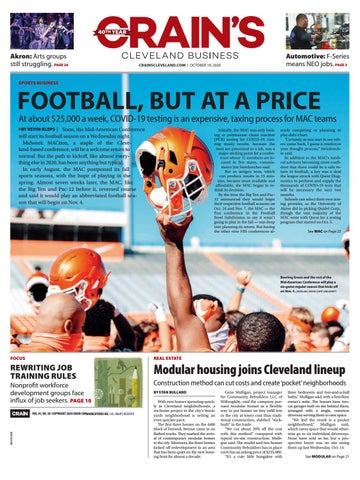
Caption h Bowling Green and the rest of the Mid-American Conference will play a six-game regular season that kicks off on Nov. 4. | BOWLING GREEN STATE UNIVERSITY
FOCUS
REAL ESTATE
REWRITING JOB TRAINING RULES
Nonprofit workforce development groups face influx of job seekers. PAGE 10
NEWSPAPER
VOL. 41, NO. 38 l COPYRIGHT 2020 CRAIN COMMUNICATIONS INC. l ALL RIGHTS RESERVED
P001_CL_20201019.indd 1
Modular housing joins Cleveland lineup
Construction method can cut costs and create ‘pocket’ neighborhoods BBY STAN BULLARD
With new homes sprouting quickly in Cleveland neighborhoods, a six-home project in the city’s Stockyards neighborhood is setting an even quicker pace. The first three houses on the 4400 block of Fenwick Avenue came in on flatbed trucks. They marked the arrival of contemporary modular homes to the city. Moreover, the three homes kicked off redevelopment in an area that has been quiet on the new housing front for almost a decade.
Gene Mulligan, project manager for Community Rebuilders LLC of Willoughby, said the company pursued modular homes as a flexible way to put homes on tiny infill lots in the city at lower cost than traditional construction, dubbed “stickbuilt” in the trade. “We cut about 20% off the cost with this method” compared with typical on-site construction, Mulligan said. The model and two homes Community Rebuilders has in place each has an asking price of $235,000. “It’s a cute little bungalow with
three bedrooms and two-and-a-half baths,” Mulligan said, with a first-floor owner’s suite. The houses have twocar garages built on site behind them, arranged with a single, common driveway serving them to save space. “We feel the result is a pocket neighborhood,” Mulligan said, which saves space that would otherwise go to six individual driveways. None have sold so far, but a prospective buyer was on site sizing them up last Wednesday, Oct. 14. See MODULAR on Page 21
10/16/2020 2:46:35 PM
BBY NAME
Fifth Third Means Business™ From equipment purchase to plant expansion, we know your business requires unique solutions to meet the specific moments you’re navigating. That’s why, at Fifth Third Bank, we have a team of local experts who understand your business. Whatever your business goals are, we’re here to help you succeed. Let’s build, together.
Fifth Third Means Business™
53.com/CommercialBank
Fifth Third Bank, National Association. Member FDIC.
MANUFACTURING
F-Series helps Ford build up regional presence, study finds
Report: Automaker supports about 3,000 direct local jobs, plus another 12,000 related NEO jobs BBY RACHEL ABBEY MCCAFFERTY
Ford Motor Co.’s headquarters may be in Dearborn, Mich., but Northeast Ohio plays a significant role in the automaker’s business. For instance, about 36% of engines for the company’s F-150 are made in the Cleveland area, said Mike Felix, director of manufacturing in Ford’s North American engine operations. Broaden that out to all of Ohio, and it’s almost 75%. Felix, who has been with Ford for 32 years, started his career at the company’s Brook Park engine plant in 1988. As things have changed, they’ve also stayed the same. “When I started in Cleveland back in the late ’80s, we were producing engines for F-Series trucks,” Felix said. “And there’s not a piece of equipment left in the plant from when I started, but we’re still producing engines for the F-Series trucks.” The F-150 and the F-Series are critically important to Ford. A recent report from the Boston Consulting Group took a look at the F-Series and the company’s business overall. In 2019, Ford assembled at least twice as many full-size pickup trucks in the United States as any of its competitors, the report stated. And there are about 16.6 million vehicles in the F-Series on the road today, which the report says makes it the most popular vehicle out there.
Northeast Ohio plays a significant role in Ford’s F-Series production. | CONTRIBUTED
Overall, for each direct Ford F-series employee, 13 to 14 jobs are supported in the United States. That adds up to a total of about 500,000 jobs supported just by the F-series, the report stated. Overall, Ford supports about 1 million direct and indirect American jobs. Of interest here is the impact Ford has on jobs and local economies. The local numbers don’t differentiate between employees working on the F-Series and other models. In Ohio, Ford has about 7,000 direct
employees, plus another approximately 7,700 dealership employees, the study found. An additional 57,000 people are employed in the Ford manufacturing supply chain or in the community in the state, along with a little more than 6,000 people in the dealership supply chain or community. In the Cleveland area in particular, about 3,000 people are employed by Ford. Another 12,000 supply chain or community jobs are created in the region because of the automaker. In total, about $1.4 billion is added to
the local economy by Ford, the report says. Team NEO always has considered automotive to be a driving industry in the region, both for its direct impact and indirect impact on supply chains and supporting industries, said Jacob Duritsky, vice president for strategy and research at Team NEO. Still, its footprint has shrunk over time. In 2001, the motor vehicle sector employed about 48,000 people in Northeast Ohio, Duritsky said. By 2019, that was closer to 24,000 people. But that’s just the direct impact. The industry still has a multiplier effect of nearly two locally, which means that for every direct motor vehicle job in the region, at least one other job in the supply chain or the community was also created. And that’s where the real strength is for Northeast Ohio. Of transportation-related jobs in the region, most are in motor vehicle parts manufacturing. Even when you include industries such as aerospace and rail, the motor vehicle supply chain makes up more than 60% of jobs in transportation locally, according to a Team NEO analysis of North American Industry Classification System data. Team NEO also found that Ford was the largest company in the transportation space in the region in terms of employees. In Northeast Ohio, Ford has the
Brook Park engine plant and the Ohio Assembly Plant in Avon Lake. About 40% of the products coming out of the Ohio Assembly Plant are part of the F-Series, Felix said. The plant also works on commercial vehicles, such as the E-Series van. Ford has closed Northeast Ohio facilities, such as the stamping plant in Walton Hills, over the years, but it also has invested in the remaining locations. For example, in recent years, Ford put about $200 million into the Cleveland Engine Plant in Brook Park to retool it to make the EcoBoost engine. The company invested another $200 million in the Ohio Assembly plant to make Super Duty chassis cabs, which are part of the F-Series. The Ohio Assembly plant also saw significant investment from Ford to retool that plant to make medium-duty trucks in the F-Series. Ford has a long history in Ohio, and it’s committed to its plants in the state, Felix said. The company has had success in the region, and there’s a skilled workforce here. “They’ve been able to adapt and adjust to the new technology that comes along, and we see no reason why we wouldn’t just continue to build where we have a heritage and a history,” Felix said. Rachel Abbey McCafferty: (216) 771-5379, rmccafferty@crain.com
MODERN DOWNTOWN LIVING Schedule your tour today! Now Leasing Studio, 1, 2 & 3 Bedroom Apartments
(844) 345-2469 TheMayCleveland.com
October 19, 2020 | CRAIN’S CLEVELAND BUSINESS | 3
P003_CL_20201019.indd 3
10/16/2020 1:12:22 PM
FINANCE
REA
Q&A | Mike Adelman
IM n
Ohio Banker’s League president and CEO on state of the industry, election Change and uncertainty are foes of the financial services industry, and 2020 has featured plenty of both. Bolstered by business-friendly tax codes and deregulation, two of the most profitable years ever for the U.S. banking sector occurred during President Donald Trump’s inaugural term. While banks came into this year in very good positions, an economy-wrecking pandemic coupled with a divisive election cycle is worrying some banks about the future. Here’s what Ohio Banker’s League president and CEO Mike Adelman, who’s been with the trade group since 2003 and led it for the past seven years, has to say about where the banking industry stands today and how it’s thinking about what the next several months may hold. (This conversation has been edited for length and clarity.)— Jeremy Nobile
BE COOL, GO LOCAL! PARTNERED WITH YOUR LOCAL CREDIT UNIONS COMMERCIAL REAL ESTATE INTEREST RATES AT ALL TIME LOWS. Loans up to $15 Million • No Prepayment Penalties As Little as 10% Down CONTACT Jonathan A. Mokri 440.526.8700 • jmokri@cbscuso.com www.cbscuso.com Your Business Lending Partner sm
PERFECT FOR 1031 EXCHANGE - 25,000 SF INDUSTRIAL BUILDING ON 3 ACRES - CURRENTLY FULLY LEASED 2300 Edison Boulevard, Twinsburg, OH 44087
How would you describe bank health in general at this point several months into the pandemic? Do you sense much worry about loans going bad? I think banks overall are doing well. That said, if you have a significant employer in your town, the banks are feeling that. If employees aren’t back to work or have reduced hours, those people might be challenged in making their mortgage payments, and other financial obligations are impeded. That is certainly an area of concern.
CALL JOESPH MARTANOVIC FOR MORE DETAILS TODAY!
Joseph J. Martanovic 216.861.5434
WWW.HANNACRE.COM
The country hasn’t felt an economic downturn of this magnitude since the Great Recession. How does this point in time compare and contrast with a decade ago? I see very few similarities, and that’s good. This is not a financial crisis. And that’s why it’s so important for the stimulus money to continue to pour through so that this doesn’t turn into a financial crisis, let alone one with a long tail. Sitting here in October, it’s anybody’s guess what the next 12 to 18 months holds. But I do feel like the recovery will be fairly swift once there’s a vaccine for distribution. One key difference is, looking at the banking industry, it was in a very strong financial position coming into 2020. Banks had one of their better years financially in 2019. And there was a lot of economic activity across the state, lots of mortgage activity. So banks were in a strong position and had good capital. Industrywide, we were in a better place than we were in 2009, 2010, 2011. Uncertainty would be one comparison. But there are so many things different this go-around.
JosephMartanovic@HannaCRE.com
However, the last check-in that I was a part of with our members was encouraging. There was talk nationally of mortgage forbearances being on average about 8% of the portfolio. For Ohio banks, that was more like 3%. And with that 3%, come July, about half of those became current. So Ohioans overall were doing pretty well in terms of being on top of their financial obligations. But a lot of that was probably due to stimulus funds, right? We realize a big part of that is the stimulus money, the additional unemployment funds that came through the federal government. So there is still just that uncertainty of can that trend line of unemployment and people having the resources they need continue to go in the right direction. Has the pandemic had much impact on consumer banking behaviors? One sort of silver lining here has been the increased use of mobile banking and alternative means of serving customers that have seen an uptick in a lot of ways that I think absent the pandemic would’ve probably taken several years to play out. Like think of older generations taking a picture of a check or putting a check into an ATM machine without a deposit slip. I think there is a Rubicon some of our older customers crossed during the pandemic. The Paycheck Protection Program was obviously a major wrinkle for banks this year. For all the good that came of it, its implementation was still a bit of a mess. Could that have been managed better?
Ch fro
BY S
I’d say, looking back, it has gone pretty well. The goal was to as quickly as possible get money from the U.S. Treasury into the hands of small businesses, and we were chosen as the vehicle to do that. In the moment, though, oh my gosh, was it problematic. There was so much confusion. We heard things one day that were walked back the next day. There are folks who have said we were flying the plane while it was still being built. I operate with high sense of urgency, so I get what it was they were attempting to do. But I believe the rules, if they were better fleshed out at the start, that would have given a greater degree of certainty in the program. Maybe holding off one week early on would’ve been beneficial. Also, don’t release the guidance on Friday nights. Fair enough if circumstances dictate that you have to do that once, but that shouldn’t be routine. When you’re looking to create a sense of team and partnership with an industry and at 10 or 11 p.m. on Friday night each week you’re releasing guidance, all that’s going to do at the end is build up some unnecessary kinds of resentment. And then there’s the practical issue of banks trying to implement the guidance over the weekend. See ADELMAN on Page 18
SALT • SALT • SALT
Water Softener • Industrial • Food • Ice Melt • Sea Salt
Call For Pricing!! Minimum Delivery: 1 Pallet
“CEFA, just like
Beachwood,
wants to help you succeed.”
MEDINA, OH
1-800-547-1538 Salt Distributors Since 1966 www.saltdistributormedinaoh.com
Mayor Martin S. Horwitz •Mayor@BeachwoodOhio.com •216.292.1901
WWW.BEACHWOODOHIO.COM
4 | CRAIN’S CLEVELAND BUSINESS | OCTOBER 19, 2020
P004_005_CL_20201019.indd 4 Grimm Winter mix 2x4.33.indd 1
9/22/2020 1:14:55 PM
10/16/2020 1:08:39 PM
O new whe at o mos Van disc Th cialt inte for t day, win Th Neth cate justbuil the in W Lak serv men verg Equ real tere IM larg pare squ the leas Th hea ful i com tanc “W easi Van Th mas mov offic H the e “I in th
on
y
t, atic. ard k ve t
y, so ing
gree
d’ve
iday
m
at’s me d ks er
e 18
M
REAL ESTATE
IMCD poised for future with new Westlake headquarters Chemicals company makes the move from Lakewood despite the pandemic BY STAN BULLARD
Opening a headquarters office in a new building amid the pandemic when just 20% of the staff may work at once is an idea that might make most executives cringe, but Thomas Van Valkenburgh said he is proud to discuss it. The president of IMCD US, a specialty chemicals company, said in an interview that the firm’s new office is for the future as much as it is for today, especially to help the company win and retain talent. The U.S. unit of the Rotterdam, Netherlands-based IMCD N.V. relocated recently to Convergence, a just-completed multitenant office building on the northwest corner of the I-90 interchange at Crocker Road in Westlake. The formerly downtown Lakewood-based U.S. operation served as the anchor for the development of the 50,000-square-foot Convergence building by an affiliate of Equity Trust Co., the financial and real estate services firm headquartered next door. IMCD’s new workplace is 78% larger with 32,000 square feet, compared to its former office of 18,000 square feet, and it's scaled to allow the company to grow in place for at least 10 years. The open office design of the new headquarters turned out to be helpful in the pandemic, as it allowed the company to easily meet social distancing requirements. “We are able to spread out here easier than in the former location,” Van Valkenburgh said. The new space also adds spots for masking up and adds directions for movement that are part of pandemic office protocols. However, the executive emphasized the endgame for the new location. “It was created to enable employees in their quest to drive excellence as we
serve both our principals and customer partners,” Van Valkenburgh said. “This is not just a new office space, but a modern work environment carefully designed to Van Valkenburgh inspire collaboration, galvanize partnerships and encourage entrepreneurship.” Moreover, IMCD’s business strategy is one where those human features play a particularly big role. “We don’t manufacture anything,” Van Valkenburgh said. “We partner with our manufacturers. We are big on expanding the marketplace to create value. We’re very much an asset-light business, a creator and innovator with other companies. We actively work with the (research and development) office of our customers to create these assets.” Total employment at IMCD US is 370, located at sites across the United States that include five laboratory locations that specialize in things such as personal care products, and oil and gas. The company’s biggest markets are in coatings and construction, plastics and other advanced materials, pharmaceuticals and personal care. The new Westlake office also has plentiful huddle rooms, or small meeting rooms, as well as a space that can accommodate as many as 40 people for training purposes. “It’s like night and day,” in terms of daylight and openness compared to the company’s former office, and has heightened technology. “We have microphones in the ceilings so we can talk anywhere on a conference call,” Van Valkenburgh said. See IMCD on Page 18
Sleggs, Danzinger & Gill, Co., LPA
Reducing Real Property Tax Assessments Throughout Ohio And Across The United States
When you hire Sleggs, Danzinger & Gill, you work directly with Sleggs, Danzinger and Gill. Each client is directly represented at all levels by a Partner of the firm with a combined 90 years of experience. No pyramid, no associates, no on-the-job training. Our clients deserve the very best representation, so we structured our firm to allow each client, throughout the entire process, to work directly with Todd Sleggs, Robert Danzinger and Steve Gill. Our philosophy is to work cooperatively with school district and county officials to ensure that our clients pay the lowest possible real property tax obligations. If a fair resolution requires litigation, Sleggs, Danzinger & Gill have the depth of trial and appellate experience to handle the most complex valuation issues. Whether the valuation relates to large industrial plants, apartments, shopping centers, warehouses, office buildings, hotels or any other type of commercial property, the attorneys at Sleggs, Danzinger & Gill will ensure that you receive the best counsel, legal advice and litigation expertise. Most importantly, Sleggs, Danzinger & Gill wishes everyone continued health as we navigate through the Covid-19 pandemic.
Store it locally, ship it anywhere
Todd W. Sleggs, Esq tsleggs@sdglegal.net
Robert K. Danzinger, Esq rdanzinger@sdglegal.net
Steven R. Gill, Esq sgill@sdglegal.net
(216) 771-8990 www.sdglegal.net
Flexible warehousing that won’t break the bank. » Up to 200,000 square feet of available space » Affordable shipping services » Contract and on-demand options
Sleggs, Danzinger & Gill
820 West Superior Avenue, Seventh Floor Cleveland, Ohio 44113
PartnerShip.com/Warehouse | 800-599-2902 OCTOBER 19, 2020 | CRAIN’S CLEVELAND BUSINESS | 5
P004_005_CL_20201019.indd 5
10/16/2020 1:52:50 PM
REAL ESTATE
Akron office park once valued in millions sells for $975K BBY STAN BULLARD
George T. Simon, a one-time restaurateur turned attorney, usually gets passing mentions as one of several investors in Northeast Ohio real estate deals and is regarded as a maverick in the commercial property business. However, his push into the Akron real estate market with the purchase of the five-building Cedarwood Valley Office Park is different. Through 1725 Merriman LLC, the address of one of the structures, the group paid $975,000 cash, according to Summit County land records, for the troubled, high-vacancy office park. Simon, in phone interviews, said the other investors are members of his family, and he serves as managing partner. “I’d call it a one-man band, but it’s really a five-piece band,” Simon said, referring to his brothers Michael and Joseph, sister Geraldine and daughters and sons. Simon’s family members run Simon’s full-service restaurant in Brecksville and LA Pete’s, a diner in Independence. His daughter Stephanie Bartos is in state records as the agent for the limited liability corporation. His son George, an architect, will do design work for the remake. Simon said the plans call for installing a model suite in the complex “to show prospects what we will do to the space and what it can look like.” Within days after closing on the property Oct. 1, the Simons had a landscaping
Cedarwood Valley Office Park, valued at more than $6 million in 2017, sold for $975,000. | COSTAR
crew on the site, which was overgrown and was hard to see from the road. “We just broke a saw. I’m looking for a blade,” Simon said in the first of two interviews and three texts about the venture. One of the landscape crew members had broken the blade. Simon said he was going through several hardware stores to find the right size of saw blade. He said he didn’t mind hunting a new blade as he preferred to have the crew member remain at work “pulling weeds.” Many investors would shy from buying a turnaround office project amid the recession and pandemic. However, Simon said at just about $11 a square foot to buy the property, “Where can
you find an office building for that? How much do I have to think about it?” Simon said he was impressed by the amount of homebuilding and other activity nearby. He said he believes people who live nearby who get tired of working from home or need an office nearby will take space there. He pooh-poohed worries about the future of office space during a time in which workers have the shown the ability to be productive from home. “We have two small tenants in 90,000 square feet of space," he said. "There are millions of square feet of office space out there. They should be the ones who are worried, not me.” Simon said he retained the lender’s agents, Lorin Schultz and Brian Hurtuk of Colliers International, to represent the property. “Their hands were tied by the seller who had a ‘wait and see’ attitude.’ They seem to know where they can find prospects,” Simon said. Simon said he was attracted by the initial $300,000 minimum price when the property was auctioned by Ten-X Commercial and Avison Young. Jonathan Elson, a vice president in Avison Young’s Cleveland office, said multiple bidders sought the property although he would not say how many. Elson also declined to identify the winning bidder directly. Cedarwood Valley Office Park was built in the 1980s by an affiliate of CeT:10.25" darwood Development of Akron. The seller was collecting on a securitized
mortgage loan, MSCI 20071Q14 Merriman Road, whose trustees had foreclosed on the property in the U.S. District Court of Northern Ohio. The lender got control of the property through a public sale in 2019 to collect on a $6 million loan it had provided in 2017, Summit County records state. Such a distressed venture, or buying when others shy from putting big bucks at risk, is not new to Simon. In 2009, he led a group of investors in the $2.6 million purchase of the four-story Gold Building on Rockside Woods Boulevard from Dalad Group of Independence. The property sold for well below the $4 million asking price because of the Great Recession and the difficulty of getting financing for properties. Simon maintains an office in the structure and manages it through an affiliate, which will also manage Cedarwood. Simon also bought and sold to an affiliate of Industrial Commercial Properties of Solon, for undisclosed amounts, the defaulted loan on the former City View shopping center in Garfield Heights. The 550,000-squarefoot property on 60 acres became distressed after Walmart and other stores closed due to environmental issues on the former dump site. “People would be surprised what I am involved in,” Simon said when asked about his holdings. He went to law school in the 1990s, apparently in middle age (he declined to state his age), after already earning a reputa-
Stan Bullard: sbullard@crain.com, (216) 771-5228, @CrainRltywriter
T:7"
One size doesn’t fit we. we
tion as an investor in properties on and near the Rockside Road office market in the southern suburbs. Today, Simon is of counsel with the McCarthy Lebit, Crystal & Liffman Co. law firm of Cleveland. Its website describes him as an entrepreneur who handles real estate transactions and financing, including debt-related transactions. Although he shuns the spotlight, Simon is known by many in real estate circles, particularly because of his Rockside Road-area ventures over decades. Spencer Pisczak, president of Premier Development Partners of Cleveland, said, “Of course I know him. People in real estate know him. I’ve been in a few deals with him over the years.” Running the Rockside-area restaurant his family continues to operate was important, he said, to Simon’s real estate investment and advisory career. “(Simon) developed many of his business relationships through the restaurant,” Pisczak said. “He’s very social and likable.” And, despite serving as the magistrate for mayor’s courts in Maple Heights and Brooklyn Heights and growing real estate influence, Simon still likes to try to keep a low profile. Proof of that is his refusal to provide a portrait for Crain’s even though he’s pictured on McCarthy Lebit’s website and Lawyers.com.
Custom commercial banking solutions to strengthen Cleveland businesses and communities. Combine your business passion with our expertise and financial might, and you and TCF become one we. Together, creating new ways forward instead of repackaging old ideas. That’s what’s in it for we. •
Commercial Real Estate Financing
•
Sponsor Financing
•
Capital Markets
•
Middle Market Lending
•
Asset-Based Lending
•
Treasury Management
See what we can do together. Visit tcfbank.com/crainscleveland
©2020 TCF National Bank. Member FDIC. Equal Opportunity Lender.
6 | CRAIN’S CLEVELAND BUSINESS | October 19, 2020
P006_CL_20201019.indd 6
109695_TCFO-031_Commbank_Cleveland_10.25x7.indd
Prepared by: Southfield, MI • 248.354.9700
10/16/2020 11:13:36 AM
None
FINANCE
Alternative lender Encore Funding debuts, will target middle market Business is latest venture of Advance Partners founder Joel Adelman BY JEREMY NOBILE
Amid an economy-wracking health crisis, banks of all sizes have been tightening lending standards while increasing interest rates, collateralization requirements and covenants on various loans, according to the Federal Reserve. Premiums charged on riskier loans, which include those made to small businesses in sectors like hospitality, also are on the rise. It’s a much different lending landscape compared to a year ago, when the economy was humming and banks were enjoying record earnings and lending more freely. And it’s those factors that largely inspire the launch of Encore Funding, a private alternative lending business and the latest venture of Cleveland’s Joel Adelman. Charged with building up Encore is vice president and Adelman confidant Matthew Williams. Encore is a business that Adelman once envisioned developing as one of several investment verticals within AdCap Management, a family office in Pepper Pike opened in 2018 a few years after Adelman sold Advance Partners — then a provider of financing and services like payroll management and tax prep to small staffing firms — to Paychex Inc. for $296 million. With a focus on clients underserved by banks, Adelman eventually determined alternative lending should be its own business. But with banks taking in new clients and offering cheap money, that wasn’t so much a priority in the past couple years.
“I would say there was a time when I thought we would be doing several types of bridge lending,” Adelman said. “But now with Matt aboard and us structuring EnAdelman core, it really feels like we can make a concerted effort into underserved middle-market businesses that are just unable to attract capital.” In mind for Encore are companies with less than $10 million in earnings before interest, taxes, depreciation and amortization (EBITDA), a size many traditional regional banks tend to be less interested in, since smaller loans mean smaller yields for the lender. Smaller loans also tend to come from higher-risk businesses, like restaurants, that banks shy away from all the more in an unpredictable economy. This could leave some needy borrowers in a lurch, especially with uncertainty swirling around the future of additional government stimulus. As an alternative lender, Encore is designed to be flexible with terms and creative with collateral in the deals it considers versus traditional banks. That, of course, comes with higher interest rates for the borrower, which could be in the range of 12% to 20%. But Encore, which officially launched in September, isn’t looking for any equity stake in its clients. “An upside for (borrowers) is there is no upside for us beyond our rate,”
Williams said. Encore is operating independently from AdCap but works in concert with it, possibly being an investment area for members of the family office seeking potentially market-beating returns in alternative investments. Encore currently is backed by at least $100 million in capital. And Adelman said there is no need to draw outside investor partners right now, though that could change in the coming years. As Encore gets going, potential lending opportunities could be with smaller to midsize businesses in just about any industry. Clients could be momand-pop restaurants, manufacturers needing a new piece of equipment, small law firms bridging financial gaps or those seeking structured settlement loans or litigation financing. “We will probably find a niche we get very, very good at and probably focus on,” Williams said. “We will kind of figure out where we want to play and what fits us.” He said the firm seems a few weeks out from cutting its first deal. With a need for capital intensifying during a tumultuousness economy and tighter lending standards dictating the current landscape, Williams anticipates growing the business quickly. He’s projecting accruing 20 million in dollars outstanding by this time next year. “We’re looking to grow into a very, very large private lender, and a competitor in the space,” he said. Jeremy Nobile: jnobile@crain.com, (216) 771-5362, @JeremyNobile
Local Financial Planning Firm. National Recognition. Forbes’ Top 250 Wealth Advisors Barron’s Top 100 Independent Financial Advisors Inaugural Barron’s Hall of Fame Advisors
Visit ncafinancial.com toVisit schedule your initial meeting ncafinancial.com 9
to schedule your initial meeting
6095 Parkland Blvd., Suite 210, Mayfield Hts., Ohio 44124 (440) 473-1115 Securities offered through Royal Alliance Associates, Inc. (RAA), Member FINRA/SIPC. RAA is separately owned and otherentities and/or marketing names, products or services referenced here are independent of RAA. RAA does not provide tax or legal advice. Investment advisory services offered through NCA Financial Planners. For additional information visit www.ncafinancial.com/awards
MEET YOUR TARGET AUDIENCE WITHOUT EVER LEAVING THE OFFICE. FOR MORE INFORMATION: astoessel@crain.com
FREE WEBCAST
OCT. 28 | 10 A.M. CARE DELIVERY DURING COVID AND BEYOND PANELISTS: Dr. Vivek Bhalla, Chief Medical Officer Summa Health Medical Group David Chmielewski, Chief, Community Outpatient Service VA Northeast Ohio Healthcare System Kathryn E. Hickner, Partner Brennan Manna and Diamond
“We chose First Federal Lakewood because of the people.” At First Federal Lakewood, you’re choosing much more than a bank. You’re choosing an organization made up of people who are committed to reinvesting in our community and helping it thrive - just like you. We’re here to help you meet today’s goals and invest in tomorrow.
Steven Shook, MD, Cleveland Clinic MODERATOR: Lydia Coutré, Health care/Nonprofit reporter Crain's Cleveland Business
Visit FFL.net/thrive to learn how we can help your business thrive.
REGISTER TODAY: CrainsCleveland.com/webcasts Questions • clbwebcasts@crain.com | Sponsorship opportunities • mike.schoenbrun@crain.com OCTOBER 19, 2020 | CRAIN’S CLEVELAND BUSINESS | 7
P007_CL_20201019.indd 7
10/16/2020 11:54:01 AM
FROM THE EDITOR
RICH WILLIAMS FOR CRAIN’S CLEVELAND BUSINESS
A sweet, but sad, ending for Sokolowski’s
EDITORIAL
Clock’s ticking I
t’s not easy to keep track of scandals in 2020. They come so fast and all seem to run together. But surely no one could forget the big one from Ohio this summer — the July arrest of then-House Speaker Larry Householder, who was charged with orchestrating a bribery scheme to pass House Bill 6, a sweeping energy bill that included a bailout of the state’s nuclear plants. And yet, with the current legislative session ending in December, there has been little progress in repealing HB 6, which lawmakers in both parties said they would do. Republicans and Democrats each introduced bills to repeal the tainted HB 6, and Bob Cupp, the new House speaker, did the right thing by forming a committee to look at the intricacies of repealing and replacing the legislation. Still, as Cleveland.com noted, the committee “has wrapped up hearings on the repeal bills until after Election Day,” leaving little time to act on HB 6 before lawmakers adjourn for the year. The big problem: “There’s no consensus among GOP lawmakers on what, if anything, to replace HB 6 with.” There’s certainly a baby-with-the-bathwater eleTHERE HAS BEEN LITTLE ment at play here. The nuPROGRESS IN REPEALING clear bailout portion of the HB 6, WHICH LAWMAKERS legislation got the most attention, but HB 6 also inIN BOTH PARTIES SAID cluded measures related to issues including renewable THEY WOULD DO. energy standards and subsidies for some coal and solar plants. It’s reasonable to consider the unintended consequences that a repeal could have on the state’s energy industry. One alternative could come from Rep. Mark Romanchuk, a Republican from Mansfield and a member of the study committee, who has introduced a compromise measure, House Bill 772. Cleveland.com noted his bill, among other things, “would repeal the nuclear, solar and coal subsidies included in HB 6” but would preserve other parts of the legislation, including the scrapping of green-energy standards. Not ideal, perhaps, but HB 6 has to go, fast. Allowing this bill to stand sends an unmistakable signal that corruption is
tolerated, at least when crafting an alternative to the result of the corruption is hard. We shouldn’t lose sight of how serious a breach of ethical conduct this represents. The Wall Street Journal reported last week that federal prosecutors have subpoenaed Energy Harbor Corp., “asking executives to turn over documents and communications as part of an investigation into whether anyone associated with the company understood that payments made by it were part of an alleged pay-to-play arrangement, rather than a legal lobbying effort.” Energy Harbor and its former parent company, Akron-based FirstEnergy Corp., “paid millions of dollars to an entity” that Householder allegedly used to fund support for the $1.5 billion bailout. FirstEnergy, which previously disclosed it had been subpoenaed, “faces similar questions as Energy Harbor on what it knew about the money paid,” the Journal said. The Legislature loses credibility by the day as it lets HB 6 stand.
Back in the red H
ere we go again. Cuyahoga, Summit, Portage and Mahoning counties last Thursday, Oct. 15, returned to red level 3 — signaling “very high exposure and spread” — in the state’s public health advisory system for the coronavirus. Statewide, 29 of Ohio’s 88 counties have returned to the red zone, and those counties are home to twothirds of the state’s population. Gov. Mike DeWine says about 85% of Ohioans, or about 10 million of us, now live in a county with a high risk of coronavirus community transmission. More than seven months into the pandemic hitting hard in this country, we have made little progress in putting this virus behind us. Americans seemingly can’t take the pandemic seriously enough to beat it. So let’s try this again: Wear masks, everywhere. Maintain social distance, always. Avoid large gatherings. Limit your trips out. (But support local businesses with takeout and delivery services.) Stay home when you feel sick. Of course we’re all tired of this. But there’s no choice. Normal life, and a better economy, does not return while there’s elevated spread of COVID-19 in our communities. Do better.
Executive Editor: Elizabeth McIntyre (emcintyre@crain.com) Managing Editor: Scott Suttell (ssuttell@crain.com) Contact Crain’s: 216-522-1383 Read Crain’s online: crainscleveland.com
Ohio passed a horrific milestone number last week — more than 5,000 state residents had lost their lives to the coronavirus. That’s more Ohioans than died in the Korean (1,777) and Vietnam (2,997) wars combined. It’s a heartbreaking number by any measurement, which is only com- Elizabeth pounded when considering the nearly McINTYRE 180,000 Ohio residents who have been diagnosed with the virus. The ripple effects of this pandemic continue to spread beyond those who have died or been infected. Workers losing their jobs. Struggles with virtual learning. An increase in mental health issues. Businesses closing. And not just businesses closing. Iconic, full-Cleveland businesses closing. Last week we learned Cleveland’s legendary Sokolowski’s University Inn was put up for sale for $2.7 million, a decision forced by the coronavirus pandemic. The third-generation Eastern European eatery, which sat on the edge of the industrial valley on Cleveland’s South Side (aka, Tremont) for almost 100 years, could soon join nearly 100,000 other restaurants that have ceased operations — permanently — because of COVID-19, according to a National Restaurant Association survey in September. I wasn’t born and raised SOKOLOWSKI’S in Cleveland, but I’ve spent my adult life here, and en- WAS THE GO-TO joyed many meals at PLACE TO TAKE OUR Sokolowski’s. I can’t tell you the countless birthdays my OUT-OF-TOWN family celebrated there — GUESTS, WHO WOULD and even my son’s graduation party. (In the movie LEAVE SMILING “The Graduate,” the advice WITH THEIR BELLIES to Benjamin, Dustin Hoffman’s character, was “Just GROANING FROM one word: plastics.” At my A TRIP DOWN A son’s graduation, it was “Just CULINARY MEMORY one word: pierogi.”) Sokolowski’s was the go-to LANE. place to take our out-of-town guests, who would leave smiling with their bellies groaning from a trip down a culinary memory lane. “Now THAT’S Cleveland,” we’d say. As good as the food was — the pierogi, chicken paprikash and stuffed cabbage (my favorite) — it was the kindness that siblings Bernie, Mary and Mike Sokolowski and their loved ones showed to restaurant regulars like my family that left an indelible mark. No matter how busy the cafeteria-style line was — and on Fridays and Saturday nights, it would often stretch out the door — there was always a moment to say hello, inquire how the family was doing and share a laugh. Those of us devoted to Sokolowski’s would wear comfy shoes — and clothes — for an often hour-long wait (with refreshments from the bar) in line for our favorite comfort food. My fondest memory was the joy Sokolowski’s gave my father on one of his final days in 2018. After a rough morning at Fairview Hospital, my dad’s vital signs began to improve by mid-afternoon. The end was near and we all sensed it.
Write us: Crain’s welcomes responses from readers. Letters should be as brief as possible and may be edited. Send letters to Crain’s Cleveland Business, 700 West St. Clair Ave., Suite 310, Cleveland, OH 44113, or by emailing ClevEdit@crain.com. Please include your complete name and city from which you are writing, and a telephone number for fact-checking purposes.
See MCINTYRE on Page 21
Sound off: Send a Personal View for the opinion page to emcintyre@crain.com. Please include a telephone number for verification purposes.
8 | CRAIN’S CLEVELAND BUSINESS | October 19, 2020
P008_CL_20201019.indd 8
10/16/2020 4:02:55 PM
OPINION
Just Leased
80,000 SF
Bill Sadataki represented the Landlord in an 80,000 SF lease of industrial space at 3111 Gilchrist Road, Akron, OH
PERSONAL VIEW
An appeal for Cleveland’s public schools BY ANGIE SCHMITT
I am a CMSD mom. Going on my second year. A little over a year ago, I enrolled my son at the closest school to my house that was accepting students like him (middle-income, English speaker) for preschool. I didn’t shop around for the “best” school. I just enrolled him at the neighborhood public school. Now he’s five weeks into kindergarten. The school I enrolled him in didn’t have a great reputation with my friends. Mostly everyone I knew wasn’t even considering it. But I have been absolutely blown away by the quality of education my son has received. His preschool class had three of the most wonderful teachers in history. The student to teacher-ratio was almost scandalously low. The students got to start in a brand new building, thoughtfully designed so that the preschool and kindergarten kids have their own wings and playgrounds. He came to CMSD preschool from a high-quality private preschool, which we also loved. But the way he immediately progressed with his learning when he started at Waverly Elementary really surprised me. Now, he’s attending online kindergarten. This is not the way I wanted my son to start school, obviously. And I was skeptical it would even be worthwhile. But, again, I have been very impressed. His teacher is truly a genius. She has 35 years of experience and is incredibly dedicated. Gave me her phone number and told me to text her anytime. And I did, during a late-evening meltdown when the tech issues of online school got to me. But she walked us through it. He’s been learning and participating. He even enjoys it. She is so skilled, she can keep them on track even from afar, from a screen. I think there’s a little bit of a stereotype, a little bit unfair, that Cleveland Metropolitan School District schools are bad, that there is something wrong with the students or
teachers. I don’t know where that comes from, but I have my guesses. And I should acknowledge I come to this from a very privileged place, and my experience isn’t necessarily universal. Plus, we are still relatively new to the district. But I do want to share, at this pivotal time, how positive it has been for our family. That’s the basis of my appeal for Schmitt is a Issue 68, the levy the district has prowriter and posed. Cleveland, and the region in urban planner general, doesn’t always do a good job who lives in taking care of its people. Our childDetroit hood poverty rate is, a recent analysis Shoreway. found, the highest in the nation among large cities. The school system is the key institution on the front lines of addressing that problem. It provides meals daily. But it goes beyond that. Almost a quarter of the students at CMSD have “individualized education programs” for those who have learning challenges. CMSD offers services for students who are English language learners. CMSD offers special care to students who are dealing with homelessness or behavioral problems. CMSD even brings dentists to the school to provide care. There really is an amazing range of services the district provides. There are a lot of alternatives to CMSD schools in my neighborhood. Charter schools. Private schools. And lots of them are great, too. Some are diverse as well. But none is accepting all students, no matter their challenges, the way CMSD does. There are lots of good generic reasons to support any school levy. And I agree with all of those. But here’s an additional reason to support CMSD: Support them because they do a great job. I really believe that.
Bill Sadataki, Executive VP 216 455 0930 bsadataki@naipvc.com www.naipvc.com
Contact one of our agents today for all your Real Estate needs.
3 Office locations in NE Ohio
216 831 3310 | 330 535 2661 | 330 239 0176
Providing a private travel experience that exceeds expectations
LETTER TO THE EDITOR
Master planning needed for Merriman Valley We are concerned about the city of Akron’s proposed plan to develop the 45-acre plot of land on Theiss Road. It appears the cities of Cuyahoga Falls and Akron are rushing to develop as much of the open land in the Merriman Valley as possible in advance of a pending public master planning process. During 2018-2019, Cuyahoga Falls approved the development of 227 units in the Merriman Valley. Akron is now accepting proposals for an additional 65 to 110 units on Theiss Road. In addition, it is rumored that the former Riverwood Golf Course Pine Valley Sports is planned for development pending approval of required rezoning. Using the recently approved developments as a gauge, a developer of the Pine Valley parcels could seek upward of 200 units. The total number of units developed prior to a master planning process could reach 600 while potentially adding 1,200 vehicles to the Merriman Valley roads. The citizens of Cuyahoga Falls voiced significant opposition to the Sourek Trail (2018) and Sycamore Golf Course (2019) developments, citing concerns over public safety, school capacity/funding and the environment. The city of Cuyahoga Falls decided that a public master planning process would provide a democratic pathway for the creation of cohesive land use and regulations to guide development in the Merriman Valley. The plan and budget were approved by Cuyahoga Falls City Council on Dec. 9, 2019. Cuyahoga Falls is currently seeking a consulting group to facilitate the process through a request for proposal. Submissions are due by Oct. 30, 2020, and the planning process is anticipated to start in early 2021. We hope that our government leaders can halt development decisions until the public master planning process has been completed. The future of the Merriman Valley should be determined with a high level of citizen involvement, and the tax benefits of the developments should be carefully balanced with the potential adverse impact to the approximately $87 million in annual economic activity already generated by the Cuyahoga Valley National Park. If you have an interest in any or all of the following issues, we encourage you to attend Akron City Council meetings to show your support for halting further devel-
opment in the Merriman Valley until a public master planning process has been completed: Slowing the rush to develop: Akron has owned the Theiss property for 20-plus years, there is no threat of lawsuits from private developers/owners, and the current pandemic and political/election distractions prevent the public from fully participating in the planning process. Reviewing unnecessary tax abatements: The Akron development abatement has been applied largely in neighborhoods that were already stable/desirable (e.g. the Merriman Valley and Highland Square) per Abbey Marshall’s Devil Strip article of Aug. 27. The Theiss property is in a highly desirable area where the tax abatement is unnecessary and would divert funding from the Woodridge schools, Summit MetroParks and other entities funded by property taxation. The Cascade Valley LLC development proposal estimates that the average homebuyer would save around $90,000 over 15 years in reduced taxes. Full consideration of conservation proposal: The Western Reserve Land Conservancy submitted a sixth proposal to buy and preserve the land per Doug Livingston’s Beacon Journal article of Sept. 18. Careful planning of valuable greenspace: The pandemic has resulted in a significant increase in outdoor recreation and park utilization. The Cuyahoga Valley National Park and the Cuyahoga River are unique assets that should be considered as the foundation for the master planning of the Merriman Valley. Andrew and Kristine Holland, Cuyahoga Falls Bill and Jessica Shaheen, Cuyahoga Falls Anne Galehouse, Cuyahoga Falls Brett Safran, Cuyahoga Falls Dan and Nancy McMahon, Cuyahoga Falls Dallas and Nancy Aleman, Akron Gina Burk, Cuyahoga Falls Jeff and Vicki Lee, Cuyahoga Falls Michael and Tammy Lyman, Akron Scott McCarty, Akron Stephan and Tina Kremer, Cuyahoga Falls Matthew Zabransky, Cuyahoga Falls Cyndi Hazen Ott, Akron
HOW TO FLY WITH SKY QUEST: » On-Demand Charter » Jet Card Memberships » Aircraft Ownership Opportunities
FlySkyQuest.com 216-362-9904 Charter@FlySkyQuest.com
HISTORICAL CHARM. NATURAL BEAUTY.
HISTORICAL CHARM. Extraordinary Living NATURAL BEAUTY.
Extraordinary Living Outperform your dreams.
The hidden gem of South Carolina: Golf, tennis, boating, home!
(843) 838-3838
Learn more at Dataw.com OCTOBER 19, 2020 | CRAIN’S CLEVELAND BUSINESS | 9
P009_CL_20201019.indd 9
10/15/2020 3:08:21 PM
WELCOME ABOARD The pandemic has created challenges for companies onboarding new workers.
WORKFORCE DEVELOPMENT
PAGE 12
REWRITING JOB TRAINING ``BY LYDIA COUTRÉ | Nonprofits that offer workforce development program-
ming have had to make rapid adjustments this year to train and support a growing number of job seekers who are coming to them with a broader range of backgrounds and experiences. Efforts to slow the spread of COVID-19 and offer safer learning environments forced training opportunities online, which has highlighted the digital divide and sent programs scrambling to find funds to build inventories of computers and hotspots to lend to job seekers. The loss of physical spaces for information sessions or career fairs has made connecting with some job seekers a bit more difficult, especially if they aren’t active on social media or other platforms that organizations have been using to share resources. 10 | CRAIN’S CLEVELAND BUSINESS | October 19, 2020
“That physical space kind of provided a place for folks to go if they didn’t have that connectivity, where they can return to,” said Mike Glavin, senior director of talent solutions at Greater Cleveland Partnership. “And without that, there’s just more opportunities for folks to kind of fall through the cracks, which is really sad.” More than 817,000 Ohioans are receiving employment benefits since the outbreak of the pandemic, and workforce development nonprofits are hearing from more job
seekers. And many organizations report serving clients with a range of backgrounds and work histories. While past recessions have been more industry-specific or narrow in their impact, relatively speaking, the pandemic and its economic fallout have been “unfortunately, equal opportunity,” said Jacob Duritsky, vice president of strategy and research at Team NEO, the region’s nonprofit economic development organization. See JOB TRAINING on Page 14
DANIEL ZAKROCZEMSKI FOR CRAIN’S CLEVELAND BUSINESS
Nonprofit workforce development groups face an influx of job seekers with varied backgrounds who are falling through pandemic-induced cracks
FOCUS | WORKFORCE DEVELOPMENT | ADVISER
Are your performance improvement initiatives properly focused? BY THERESE LONGO
When market conditions are challenging, it is important to maximize the performance of your workforce. Luckily, human performance experts have learned a lot about the behaviors and contributing factors that affect performance. And their findings can help you avoid spending significant resources on workforce development initiatives that may not ultimately fix problems. You just need to learn to think differently about performance improvement.
Performance Thinking Performance Thinking, a methodology crafted by Dr. Carl Binder, lays out a scientifically sound way to improve human performance. It draws from the findings of behavioral psychology experts and is a great place to start when seeking a better way to enhance workforce performance. Performance Thinking is about making the connection between team members’ workplace behaviors and the business results they influence. It helps you think through what business results are valuable and what work outputs affect those results. Then it helps you analyze how employee behaviors affect their outputs and what factors influence those behaviors. Finally, it helps you adjust behavioral influences to create value for the business. Performance Thinking encourages us to focus on improving and measuring employees’ ability to accomplish, not just learn. It emphasizes equipping the employee to produce high-quality outputs by addressing factors that prevent them from doing so. Performance Thinking helps you avoid investing heavily in development initiatives that don’t drive lasting value because they focus on solving the wrong problem (e.g., enhancing knowledge through training) rather than finding out what is limiting accomplishment and addressing that.
‘Six Boxes’ Performance Thinking introduces a framework called the Six Boxes Model for organizing behavioral influences affecting workplace behavior. Certified Performance Thinking practitioners work through these boxes to help clients find opportunities to better equip team members to create valuable, high-quality work outputs. The model identifies the right behavioral influences to adjust to achieve desired goals. Here is an example of how the model could be used to determine what behavioral influences are at play and what interventions should be pursued to improve an employee’s performance: 1. Expectations and feedback: Are expectations of the employee clear to them, and are they receiving well-articulated feedback on whether they are meeting expectations? 2. Tools and resources: Does the employee have the reference materials, process documents, templates or other tools necessary to do their job effectively?
3. Consequences and incentives: Are there consequences for performance deficits or incentives for strong performance in place to motivate the employee to exhibit Therese Longo is desired behaviors? vice president of 4. Skills and operations for knowledge: Does Hudson’s Radcom Services, the employee have the appropriate which develops skillset and knowltraining, edge to do their job technical and effectively? process 5. Selection documentation. and assignment: Is the employee in the right role, and do they have the capacity to perform their job well? 6. Motivation and preferences: Does the employee have a positive attitude about their work, and are they motivated?
Northeast Ohio’s Premier Real Estate Developer Design Build | Redevelopment | Tenant Finish | Leasing | Construction Management | Acquisitions
PREMIER
Development Partners
Proven Process Proven Relationships Premier Difference
( 2 1 6 ) 3 4 1 - 1 2 0 0 | premierdevelop.com
STAY IN THE KNOW with Crain’s email newsletters
Subscribe FOR FREE by visiting CrainsCleveland.com/enewsletters
Application To apply Performance Thinking, start by determining your desired business results, accomplishments needed to reach them, standards for what “good” looks like, and what behaviors are needed to reach those standards. Delve then into the behavior influences that affect your team members’ ability to perform well. We applied the Six Boxes method with the Radcom operations team to improve our process for providing instructional design services. We focused on enhancing the quality and consistency of instructional designers’ outputs (specifically the “design document” that serve as a blueprint for learning programs), reducing the amount of time project managers spend getting consultants up to speed, and more proactively dealing with recurring issues. We identified opportunities for behavioral influence improvement across nearly all of the six areas. For example, in the expectations and feedback box, we recognized an opportunity to create a guidebook laying out tasks, behaviors, criteria and checklists as a roadmap for design document development. We also saw the value in developing an “exemplar library” that provides examples of projects that meet our quality standards. Based on our findings from working through other boxes, we are working on creating an incentives-based compensation system, setting up a program for coaching, adding more touchpoints throughout projects and training our team to use new tools. We plan to create guidelines for all our instructional designers’ accomplishments, and we are finding the interventions we develop to improve our instructional design process can positively impact the rest of our business. Performance Thinking offers you a framework to not only productively deal with ongoing performance challenges, but boost the success (and happiness) of your team members and customers.
EVER WONDER WHERE THE PEOPLE WITH ALL THE ANSWERS, GET ALL THE ANSWERS?
Ask MARCUM
marcumllp.com OCTOBER 19, 2020 | CRAIN’S CLEVELAND BUSINESS | 11
P011_CL_20201019.indd 11
10/15/2020 11:48:51 AM
Planning. Protection. Peace of Mind. For all life’s legal matters.
At Solomon, Steiner & Peck, Ltd., we focus on helping individuals, families and business owners address and resolve their estate planning, elder law and business law concerns. Our law firm’s narrow focus enables us to craft sophisticated solutions to some of the most complex legal problems.
Visit ssandplaw.com/events to view our past webinars.
Trusted Legal Advice since 1993.
FOCUS | WORKFORCE DEVELOPMENT
How do you welcome new employees in a pandemic? Businesses adjust onboarding, introduction to company culture in era of distancing BY DOUGLAS J. GUTH
Michael L. Solomon Esq., LLM
Laurie G. Steiner Esq.
Probate & Trust
Estate Planning
Elder Law CE
L E B R AT I N
G
Jennifer E. Peck Esq.
Todd W. Bartimole Esq.
Business Law
216-765-0123 SSandPlaw.com
Looking for warehouse space? Need logistics help? Candor Logistics is a true 3rd party logistics company offering: Premium Warehouse Space ● Local Cartage, brokerage & supply chain fulfillment ● Pick & Pack, expedite & de-vanning services ●
Onboarding for businesses is preferably an in-person affair, where training, team lunches and other face-to-face interactions help welcome new employees into an organization. Companies are now asking themselves how to onboard at a distance — whether physical or digital — in the middle of a pandemic. Northeast Ohio businesses are adjusting their onboarding process to adapt for the times. FMD Architects in Fairlawn has a 12-person staff that, in pre-pandemic days, came together through kickball and parking lot cornhole battles. Principal Melanie Friedman said employee orientation at her close-knit, family-friendly firm is as much about culture-setting as it is immersing folks in the daily work flow. “We try and make sure everyone is having fun and enjoying their work,” said Friedman, whose company has design expertise in education, hospitality, animal care and more. “People need to blow off steam in a stressful industry. It’s easier to let it go when you have good friendships built, rather than just a surface working relationship.” Friedman’s staff recently returned
to the office after months of remote work. Among FMD’s new employees is a veteran commercial interior designer and a graduate intern fresh from the Ohio State University’s architectural school. FMD conducted Zoom meetings with the designer while bringing her in for distanced one-on-one meets. As the graduate intern had never before worked in an office, staffers kept in communication virtually until the firm reopened. Happy hours and “Jeopardy” games over Zoom further established a crucial rapport with both hires, Friedman said. “For us, (onboarding) helps bring that person into the culture where they don’t feel like an outsider,” she said. “When you have as close a group as we do, things can feel cliquey to people just coming in.”
Smoothing out bumps Onboarding generally starts during recruitment and continues into a job’s first year, ideally assuring successful immersion into a company. KeyBank’s strategic onboarding process — similar to many major corporations — is integrated into formal hiring activities such as paperwork, scheduling and training. Surveys are
Now offering kitting services
Certified to handle any product regardless of size, field of industry or scope.
EXPECT MORE.
Call now to discuss your warehousing and logistics needs! 216.378.7100
●
Bedford Hts, OH
●
www.candorlogistics.com
Candor Logistics Ad-4-8.indd 1
conducted to gauge program effectiveness and implement any needed improvements. Dawn Roberts, head of enterprise talent acquisition at Key, describes the company’s workaday culture as “relationship-oriented and highly collaborative,” making effective employee onboarding all the more vital. “It’s very much an environment where people are working together on teams, delivering services and solutions of the bank to clients,” Rob-
8/28/20 11:44 AM
GET MORE. Distinguished representation for discerning clients. If you’re not getting the results you expect from your law firm, give us a call. Big firm expertise, with small firm responsiveness. 216-696-1422
McCARTHY LEBIT CRYSTAL LIFFMAN McCarthyLebit.com/crains
12 | CRAIN’S CLEVELAND BUSINESS | OCTOBER 19, 2020
P012_013_CL_20201019.indd 12
10/15/2020 11:55:05 AM
As p calle John
erts the also bus solu K prim ban Hiri boo
ffecded
rise ibes e as ghly emital. ment ther and Rob-
through daily video conferences and town halls. Continuing an open-door policy that Roberts said is a Key mainstay, employees are encouraged to contact managers directly. If anything, engaging in Zoom calls interrupted by the occasional wayward child or pet helps bring staff closer together. “People want opportunities for drive-by conversations and water cooler chats,” she said. “That can be difficult to replicate in a virtual environment. But at home we’re learning about people in ways that we normally wouldn’t have a chance to.”
Creating best practices
As part of its efforts to keep employees connected to one another and the company, Willory in Bath Township hosted a virtual event called “empower people” in June. Top row, from left, are Bridgette Klein, Katherine Edgar and Bob Haas. Middle row, from left, are John Bernatovicz, Christine Peters and Holly Hall. Bottom row, from left, are Jamie Myers, Lisa (Dean) Mamula and Karen Pupo.
erts said. “We don’t just want to be the primary bank for clients — we’re also bringing people across lines of business and departments to create solutions.” Key’s 3,500 to 4,500 annual hires primarily work on the front lines as bankers and relationship managers. Hiring remained steady in 2020, boosted by a digital onboarding por-
tal the company has been developing since 2018. The portal gives new staff access to technology and systems alongside a detailed introduction to life at Key. Onboarding amid the coronavirus pandemic has its bumps, particularly around remote-working readiness, Roberts said. “We assumed hires would have the
O U R P EO P L E MAKE US
premier.
Because our employees live in and deeply understand the communities they serve, they’re empowered to make decisions at the local level–finding unique solutions for the people they know best. Don Hayes
Market President 216.436.5814
same level of experience with Zoom, Webex and chat functionality but realized we needed to offer foundational training to create the same experience as before,” Roberts said. Remote work has grown at Key for the past several years, even as that population remains in the minority. Off-site workers during COVID are out of sight, but remain top of mind
——Melanie Friedman, FMD Architects
on what the business does and what industry they’re in? Are you making constant reach-outs to them just to see how they’re doing? The mistake being made is not having a process.” Anecdotally, employees know within a week to a month whether an organization is a correct fit, Bernatovicz said. For companies, effectively onboarded individuals are more productive and engaged, firm in the knowledge of how they impact their employer. “You never get a second chance to make a first impression — it’s why people stay or go,” Bernatovicz said. “When we get back to normal life, we may have more people working from home. There will be many more flexible work arrangements made with employees.” Contact Douglas J. Guth: clbfreelancer@crain.com
What Makes Us Different? Values, missions and goals on a page are optimistic, but a living, breathing workplace culture is where words take action. A positive firm culture is a part of our everyday behavior. Just ask our loyal Business Family, our clients and communities we serve. Are you an entrepreneurial lawyer looking for a new platform for greater success? Contact Mary E. Miles at memiles@bmdllc.com. AKRON CANTON CLEVELAND COLUMBUS
YourPremierBank.com/hello
Bath Township-based consulting practice Willory supports clients on HR, staffing and payroll matters. Considering Willory already operates remotely, its onboarding procedures haven’t drastically changed, save completing I-9 employment verification forms virtually. However, Willory’s brick-andmortar clients are asking how they can best onboard newcomers in these unusual times. President John Bernatovicz suggests executives document any gaps in their in-person onboarding before flexing to virtual. Via digital platforms such as Zoom or Microsoft Teams, new recruits can shadow a staff member throughout a workday. Sitting “side-by-side” onscreen, candidates may receive training and feedback on core job responsibilities. Additional interaction, including team-based coaching and online happy hours, keep workers from feeling isolated, a situation that companies are still hammering out. “Some businesses haven’t established a process that ensures a hire is onboarded from a paperwork standpoint, then integrated into the culture,” Bernatovicz said. “Are they educated
“PEOPLE NEED TO BLOW OFF STEAM IN A STRESSFUL INDUSTRY. IT’S EASIER TO LET IT GO WHEN YOU HAVE GOOD FRIENDSHIPS BUILT, RATHER THAN JUST A SURFACE WORKING RELATIONSHIP.”
BONITA SPRINGS JACKSONVILLE ORLANDO PHOENIX/SCOTTSDALE
bmdllc.com
Member FDIC October 19, 2020 | CRAIN’S CLEVELAND BUSINESS | 13
P012_013_CL_20201019.indd 13
10/15/2020 11:56:00 AM
FOCUS | WORKFORCE DEVELOPMENT
JOB TRAINING
From Page 10
“Across the talent spectrum, you’re seeing everything from restaurant workers up through CFOs who have lost their positions due to closures,” he said. “So it doesn’t quite fit in the box.” The Urban League of Greater Cleveland (ULGC) has been seeing new growth in certain populations of job seekers, including college students who are attending classes remotely and qualified, highly degreed workers who were recently laid off. “This very highly skilled and highly educated group of individuals was something that the Urban League was known for serving for years,” said Marsha Mockabee, ULGC president and
CEO. “I mean for many years, the Urban League was the place that many African Americans, when they graduated from college, this is the first place they came to find a job. So that concept is not new, but we hadn’t had that group of job seekers that we focused on for a number of years.” ULGC — along with Goodwill Industries of Greater Cleveland and East Central Ohio and Ohio Means Jobs | Cleveland-Cuyahoga County — is part of Ohio to Work, a recently announced program that aims to provide career counseling, training and placement assistance for those unemployed throughout the state. JobsOhio, a private economic development agency for the state, is spearheading the program first in Cuyahoga County, with plans to expand statewide.
Beaty
Dorn
The goal is to build on existing work and fill gaps to serve more people, said Cedric Gaddis, regional talent manager for Team NEO, a sponsor for Ohio to Work. The program will offer virtual career fairs, the first of which includes at least 30 Cleveland employers with immediate job openings in health care, manufacturing and IT.
Gaddis
Lamb
Employers, too, are adjusting their approaches to recruitment. Gaddis said he’s finding a lot of employers are more open to working with re-entry workforce development programs that help previously incarcerated people find jobs. Many in the manufacturing sector, which didn’t have the same layoffs as many other industries, are trying to
come up with creative ways to scale up an incoming workforce, Glavin said. He has heard anecdotally from employers that are reaching across industries to recruit from areas harder hit in the pandemic, such as hospitality. The Centers for Families and Children and its El Barrio workforce development centers have seen a growth in the clients it typically serves — low-income clients with employment barriers — but also is seeing job seekers who may be unemployed for the first time, said Carole Beaty, the centers’ chief of programs for family and work. She said they’re seeing individuals who have good, consistent job histories but often in entry-level positions, the competition for which is incredibly tough right now.
Balancing act
THE POWER OF
TRASH. A
t first glance, the expansive greenspace in Brooklyn, Ohio looked like a lush piece of land ripe for development. But beneath it sat thousands of tons of rotting trash. It was a capped landfill, and the city didn’t know what to do with it.
Regulations prohibited development, and some of the waste materials below meant it couldn’t be used as a park. The options were limited. But Katie Gallagher, Brooklyn’s mayor, worked with Cuyahoga County to turn the otherwise unproductive landfill site into a solar farm, producing an estimated 5 million kilowatthours of electricity per year.
“AN INTERNSHIP DURING MY TIME AT JOHN CARROLL TAUGHT ME ABOUT BROWNFIELDS. AND THAT BECAME EXTREMELY RELEVANT TO THE WORK WE DID ON THE LANDFILL. NOW, IT’S A REVENUE SOURCE FOR US, AND AN OPPORTUNITY TO HAVE GREEN INFRASTRUCTURE WITHIN THE COMMUNITY,” Gallagher said.
ad CLEVELAND Katie FINAL.indd 1 14 |Crain's CRAIN’S BUSINESS | October 19, 2020
P014_015_CL_20201019.indd 14
Katie Gallagher, a first-generation college student, graduated from John Carroll in 2003 with a degree in political science and business management.
“IT WAS AT JCU WHERE I DEVELOPED THAT LOVE OF LEARNING AND SERVICE,” Gallagher said.
Now, elected to a second term, Gallagher has even bigger plans for the city. And if she can turn trash into energy, who knows what she’ll do next.
Find her story and others at jcu.edu/humanimpact
Shortly after graduation she earned a master’s and law degree—and took her passion for service into her work as a city council member and later, the mayor of Brooklyn.
BRAVE YOUR QUEST
Organizations must balance their goals to help people start down career paths with job seekers’ urgent needs for paychecks, especially during higher unemployment. “We encourage the career pathway and those entry-level positions that provide an opportunity, but also recognize some individuals may choose a ‘right now job’ that they need,” Beaty said. “If they do take a ‘right now job,’ then maybe they still want to consider learning in one of our other programs, which is why the technology helps.” Towards Employment, an employment services nonprofit, is trying to steer people to the jobs that exist today, said executive director Jill Rizika. “If people come in and their experience has all been in restaurant, then we may think about what would be transferable skills so that we can connect you to opportunities that exist today,” she said. Rizika said Towards Employment is trying to continue to listen to its employer partners and continue to be flexible and responsive. The organization plans to launch a sort of alternative staffing agency as a flexible mechanism to help connect people to temporary or part-time work while supporting them with other services so that when they’re stabilized, the organization can help them navigate their next step toward a career. Youth Opportunities Unlimited (Y.O.U.), a nonprofit workforce development organization, offers a summer jobs program that connects 2,500 to 3,000 young people to jobs each summer. This year, it was able to place about 820 young people, which Craig Dorn, Y.O.U. president and CEO, views through a “glass half full” lens. What continues to be a challenge is finding new young people to enroll and building relationships remotely. Y.O.U.’s usual types of recruitment approaches (going into neighborhoods, connecting in rec or community centers) are rendered useless right now, which makes finding new clients difficult. He sees this as a bigger challenge than connecting them with jobs. “But once they’re found, they’re getting a really excellent experience,” he said. “It’s not challenging to even find placements for them because it’s kind of a weird economy. … The unemployment’s really high, but some places like Amazon and drug stores and grocery stores are in desperate need of people.” Dorn worries about young people he can’t reach during the pandemic, which has underscored the digital di-
9/8/20 3:05 PM
10/15/2020 2:27:13 PM
vide get can they “Y befo like O offe gram iora eng said pres Ohi of in F ston bud It h mor con whi
OhioGuidestone’s construction students in the YouthBuild program create a bathroom floor system recently at the organization’s training facility in Cleveland. OhioGuidestone is offering a mix of in-person and virtual workforce training during the pandemic.
cale avin rom ross ardspi-
Childen a cally with o is unCarpro-
CONTRIBUTED
uals stoons, edi-
heir cagent ially
way that recoose ed,” ight want our the
loyg to t tozika. xpeant, ould we ities
vide. Y.O.U. and others are working to get clients needed equipment but cannot offer such support to those they aren’t reaching. “Young adults were hard to find before COVID,” Dorn said. “So it’s not like it got easier.” OhioGuidestone, a nonprofit that offers workforce development programming in addition to its behavioral health care services, has found engagement is better than expected, said Kiersten Watkins, assistant vice president of program operations for OhioGuidestone, which offers a mix of in-person and virtual experiences. For its virtual training, OhioGuidestone worked with a funder to add a budget for initially 30 Chromebooks. It has since secured hotspots and more Chromebooks and has plans to continue growing its inventory, which is currently all in use.
Benefits of virtual Despite the digital divide and ongoing challenges organizations face in getting people needed technology, the move to virtual has offered some benefits. Some organizations, like ULGC, have been able to serve more individuals than in-person formats could. Being able to join trainings remotely means less worrying about two common barriers: transportation and child care. Though balancing watching a child and taking a class is no easy task, it’s now an option. Virtual interaction also helps level the playing field for some job seekers, said Laura Lamb, chief operating officer for Vocational Guidance Services (VGS), a vocational rehabilitation nonprofit focused on serving people with disabilities or other barriers to employment. A high unemployment rate
fOR 45,200 SF zoned InduSTrIAl SALE
makes competition even harder for VGS clients in some cases, Lamb said. 1000 Home Ave, Akron oH 44310 “On a good day, it’s challenging for individuals with disabilities. Given the PRICE pandemic, it’s even harder,” she said. n 4 Acres of land “There are more people applying for REDUCTION with an additional opportunities, more people applying 4.8 acres of for jobs, more people seeking employadjacent land ment. The labor force is flooded.” available At the same time, the large need n 3 Phase for front-line, entry-level workers, power (1200 such as those at grocery stores and Amps/480 Volts) retailers, has “opened an opportunity n Two 12 x 12 drive for our individuals to get their foot in in doors the door” while many are nervous to work in a pandemic, Lamb said. n Ceiling height: Organizations are continually 15’ clear learning best practices for virtual pron Fully air gramming, which is likely to continue conditioned in some form after the pandemic. OhioGuidestone has assigned two inSVn SummIT CommerCIAl reAl eSTATe GrouP, llC structors to each cohort: one for inTom Fox, SIOR struction and one to help students Senior Associate Advisor navigate technology without inter330.730.1047 rupting teaching. tom.fox@svn.com Dorn said he “absolutely” sees a role Graydon Fox 3009 Smith Road, Suite 25 for virtual education well into the fuAssociate Advisor Akron, OH 44333 | 234.231.0200 330.703.5283 ture. The Centers for Families and Chilgraydon.fox@svn.com dren already had been in the process of developing remote workshops, and the pandemic accelerated its timeline of implementing the technology. Towards Employment is looking for ways IT’S ALL IN THE DELIVERY! to evolve toward a hybrid model by the end of the year and is considering 10-19-SVN Ad-aFoxes.indd 1 new staff position that would offer tech support to participants. Lamb said VGS is also in the process of planning for the future and examining how else virtual platforms can be used to provide new areas of programming and training. “If anything, 2020 has taught us to be grateful but also be nimble,” Lamb said. “I have not seen anything like Since www.bonniespeed.com this in my years here, and I really 1959 hope to never see it again.”
216-696-6033
Lydia Coutré: lcoutre@crain.com, (216) 771-5479, @LydiaCoutre
ment o its e to rgaf alible ople hile ices the gate
ited des a ects jobs le to hich and full”
nge nroll tely. ment bormuless new bighem
y’re nce,” ven e it’s unome ores rate
SAME DAY! Cleveland’s #1 Same Day Delivery Company! BUSINESS & RESIDENTIAL
Its time to review your records and file your annual report of unclaimed funds for 2020! Reports can be filed electronically or mailed to the Ohio Business Gateway
Not holding any unclaimed funds? We encourage all NONE reports to be filed through Ohio Business Gateway
Due Date Non-Life Insurance: Nov. 1, 2020
If you have concerns about meeting the deadline, you may request an automatic extension by visiting https://apps2.com.ohio.gov/unfd/extension/ For more information, visit: com.ohio.gov/unfd
@UnclaimedOhio
ople mic, l diOCTOBER 19, 2020 | CRAIN’S CLEVELAND BUSINESS | 15
10/15/20 3:05 PM
SPONSORED CONTENT
S1 2020 S1 October May 18, 19, 2020
THOUGHT LEADER FORUM
MANUFACTURING INNOVATION DRIVES MANUFACTURING Smart factories. The Internet of Things. Artificial intelligence. Augmented reality. Advances in technology are changing the landscape of the manufacturing sector. To maintain its competitiveness in a global economy, experts say the Northeast Ohio manufacturing sector will need to both embrace and integrate innovation into all aspects of operations, from process to production.
BY THE NUMBERS
ENGINE FOR ECONOMIC GROWTH
Northeast Ohio is the 15th-largest market in the U.S., and represents about 40% of Ohio’s economy. Manufacturing accounts for 20% of Northeast Ohio’s GDP, at $42.6 billion. According to Moody’s Economy.com data provided by Team NEO, Northeast Ohio’s manufacturing Gross Regional Product is projected to surge from $4 million in 2018 to $49 billion by 2025.
An innovative mindset is a harbinger for future regional growth of manufacturing — an industry that accounts for half of Northeast Ohio’s total economy. This acknowledgement to transform into a regional hub of advanced manufacturing permeates throughout the local industry, according to a 2020 Northeast Ohio Manufacturing Survey Report issued by MAGNET, the Manufacturing Advocacy & Growth Network. Among highlights, the report found that 94% of companies in Northeast Ohio reported they were actively innovating, and 50% reported they had launched new products within the previous year that incorporated new technologies such as the Big Data, Connected Machines and the Internet of Things.
IOT A VITAL COG SIZE MATTERS Small and medium-sized manufacturing companies represent about 90% of job growth for high-paying jobs in Ohio. They are a critical aspect of economic vibrancy and demonstrate a local employment multiplier effect. Each manufacturing job that is created or retained elicits three to five new supporting jobs.
In fact, the Internet of Things’ application in the factory setting foretells of significant opportunity for growth in the regional manufacturing sector. Based on projections utilizing McKinsey Global Institute Data and Accenture estimates, Team NEO predicts that IoT could have an economic impact of between $4 billion to $13 billion in Northeast Ohio by 2025. This smart technology application has the potential to fuel regional economic growth beyond the current projection of $49 billion, to as much as $62 billion by 2025.
SOURCES: Crain’s Content Studio research, MAGNET, Ohio Development Services Agency, Team NEO
Compiled by Kathy Ames Carr, Crain’s Content Studio-Cleveland
Q&A
Manufacturers need to broaden their innovation efforts JODY RICHARDS President Process Technology jrichards@process-technology.com 440-974-1300, ext. 1020
Jody Richards is president of Process Technology based in Willoughby. Prior to joining Process Technology, her background was in operations and IT, including working as a consultant to the U.S. Navy in Japan. Ernst & Young LLP recently named her an Entrepreneur of The Year 2020 East Central Award winner.
By JUDY STRINGER Crain’s Content Studio-Cleveland
Q: How are you innovating the manufacturing of the company’s product portfolio?
With her passion for technology, Jody Richards transformed Process Technology from a regional player serving the automotive and aerospace markets into one of the world’s leading suppliers of semiconductor manufacturing products critical to the production of microprocessors and memory chips. Richards recently shared some insights into how she uses innovation to drive the Willoughby company’s growth.
A: All customers generally want something yesterday. In order to be ahead of the game – and able to meet those demands even before they surface – we continuously monitor trends in the semiconductor industry and follow what is happening relative to technology and our customer needs, and we innovate on our own. We are doing those Skunk Works projects and prepping, so that when the customer comes to us we are able to create a new product in a short period of time.
Q: What are the pitfalls or potential roadblocks to innovation in the manufacturing space? A: Failure to have a great vision and to really see a path to get there, I think, is one of the biggest challenges that small and midsized manufacturers face when it comes to innovation. It’s often tied to fear, where company leaders and managers get locked into what they are doing and they are afraid to fail, afraid to try something new. But, another issue is not considering the opportunities of innovation broadly. When we talk about innovation, it’s not just product innovation. It’s ‘how do we reinvent ourselves?’ We are big on continuous improvement and focusing on how we can do things, especially more tasked-oriented duties, in a smarter way across all of our departments. Q: What is an example of that? A: Right now, we are implementing a new HRIS, or human resources information system, that will digitally store team member records and make them available online to managers, eliminating their need to ask for information from our talent team. The vendor tells us that we will be able to eliminate one member from
the HR team as a result. Now, that’s not what we want to do. We want to free up that person to better things, things that are higher caliber, to promote the company and to grow. This is really the theme for every single team. Q: How do you personally develop and cultivate an innovation mindset for yourself as a company leader? A: I read a lot. I travel a lot, well obviously not now, but normally. I visit customers. I go to trade shows, even events that are outside our industry, to look for new opportunities but also to not always be in the same space. When you put yourself among a diverse set of stimuli – people speaking a different language, operating in a different business climate, etc. – those environments make you think in different ways. We also had a new headquarters designed with a more futuristic aesthetic, including lots of bright, open spaces that really lend themselves to letting your mind go in different ways. That also helps us promote and cultivate innovative thinking.
This advertising-supported section/feature is produced by Crain’s Content Studio-Cleveland, the marketing storytelling arm of Crain’s Cleveland Business. The Crain’s Cleveland Business newsroom is not involved in creating Crain’s Content Studio content.
P016_017_CL_20201019.indd 16
10/14/2020 12:47:36 PM
SPONSORED CONTENT
October 19, 2020 S2
SPONSORED CONTENT
THOUGHT LEADER FORUM
MANUFACTURING THE CASE FOR A MANUFACTURING ECOSYSTEM The complexities of globalization and consumer demands underscore the business case for the proliferation of manufacturing ecosystems. Now and in the coming years, manufacturers that choose to operate independently and through traditional ways of working will increasingly find themselves on the fringes of the sector. Organizations that embrace collaboration and an ecosystem-driven environment will forge ahead. To remain competitive, more manufacturers will need to consider merging into ecosystems composed of complementary industry players working together toward shared goals of sustainability and growth in Industry 4.0.
A SMART MOVE
THE BLUEPRINT OF A SMART FACTORY
Deloitte and the Manufacturers Alliance for Productivity and Innovation (MAPI)’s joint study aimed to determine the value of smart factory initiatives to justify this level of investment.
Industry 4.0 transforms how factories operate. A connected plant maximizes high-quality goods within tighter production timeframes, which addresses customer demand for product choice while minimizing operational and inventory waste. The interconnection of sensors, data and analytics are foundational to smart factories and the revolution.
Among its results, the survey found: • Every manufacturer can realize business value from smart factory initiatives; • Smart factory investments generally accelerate business value creation, with between 10% to 12% gains in areas such as manufacturing output and labor productivity; • There is a direct link between smart factory investments and business value generated; • Any financial and operational risks are typically outweighed by the benefits of smart factory investments; • Being connected with an ecosystem of manufacturers can lead to outperforming other organizations through smart factory initiatives.
THE PATH TO ACCELERATION
WHAT IS INDUSTRY 4.0?
How do manufacturers, whether those currently employing innovation practices or yet to invest in smart factories, proceed with managing production through digital technologies? The Deloitte and MAPI joint study identified some of the following tips for growth realization: embrace experimentation, follow the example of early adopters; assemble a cross-functional team, and be sure that employees remain at the center of your investment initiatives; regularly monitor production output and productivity; make targeted investments; focus on areas of opportunity; take advantage of digital capabilities and monitor operations through virtual factories; embrace AI; and connect with other ecosystems.
Industry 4.0 is referred to as the Fourth Industrial Revolution, which embraces advanced manufacturing techniques with the Internet of Things to create interconnected manufacturing systems that analyze and interpret voluminous streams of data to drive further intelligent activity in the physical world, from shop-floor processes to the digitization of the supply chain and logistics services.
Compiled by Kathy Ames Carr, Crain’s Content Studio-Cleveland
SOURCES: 2019 Deloitte and MAPI Smart Factory Study; Deloitte Insights; World Economic Forum
Smart manufacturing: Ecosystems help accelerate adoption PAUL WELLENER Vice chairman, U.S. Industrial Products and Construction sector Deloitte Pwellener@deloitte.com 216-830-6609 Wellener leads Deloitte’s US Manufacturing practice. Companies the practice supports range from heavy equipment to aerospace and defense, industrial products, and construction. As the leader, Wellener connects the dots for Deloitte in this fast growing industry. He is responsible for driving key sector initiatives to help companies adapt in an environment of rapid change and uncertainty – globalization, exponential technologies, the skills gap, and the evolution of the Smart Factory. In the 2019 Deloitte and MAPI Smart Factory study, connecting to an industry ecosystem was largely a hallmark of the Trailblazers, a cohort of manufacturers identified last year that were making great strides by adopting Industry 4.0 approaches to solve for specific factory use cases. The findings sparked our interest in further examining the dynamics of how manufacturers are reaching outside their organization to strategically collaborate with others to advance their smart manufacturing journey. Our research confirms that Trailblazers are using ecosystems to accelerate their smart
manufacturing initiatives. But what exactly is an “ecosystem” in smart manufacturing terms? Essentially, an ecosystem is when different entities come together in meaningful ways to solve shared challenges and meet shared objectives. Effective ecosystems enable a cumulative “network effect” for participants and create value greater than the sum of the parts. Underlying successful ecosystems, collaborating and co-evolving is generally a must for the foundation of partnerships. For smart manufacturing, Industry 4.0 and advanced technologies continue to evolve and propagate,
and it would be extremely difficult for an organization to do it all themselves. An important finding of the research is that forming ecosystems for smart manufacturing is not the same as having existing relationships with technology vendors. While many manufacturers may have a number of connections with external parties to assist with initiatives, the ecosystem approach requires deliberate coordination and actual teaming among various parties. This multi-point coordination and collaboration around shared business objectives for the manufacturer is what differentiates an ecosystem from just a group of vendors providing solutions. Our study also sought to determine if ecosystems for smart manufacturing make good business sense, other than just accelerating initiatives. The results appear encouraging. An analysis of Fortune 500 manufacturers identified that companies with more than 15 strategic alliances registered twice the revenue growth compared with companies with fewer than 15 alliances. These high-growth manufacturers used the word “ecosystem” in their annual reports more than three times when compared to their peers.
than their surveyed peers, who haven’t engaged in ecosystems. Important areas of differentiation include: increasing the pace of new product introduction; expanding innovation capacity in the company; reducing operational costs through greater efficiencies; and accelerating overall digital maturity. In some cases, the benefits of those surveyed are double those of peers, demonstrating that ecosystems clearly deliver results. The ecosystem approach can work, but it’s not easy to adopt. It typically requires a deliberate cadence involving executive commitment to smart manufacturing, an organizing strategy, scouting for new innovations, intentional partner selection, and ongoing cultivation of the relationships. You can read more about pathways to realizing value of an ecosystem as part of the full study, available Oct. 21 at https://www2.deloitte. com/us/en/insights/industry/ manufacturing/accelerating-smartmanufacturing.html.
Finally, the executive survey we conducted as part of the study revealed those manufacturers currently leveraging an ecosystem approach for smart manufacturing are seeing greater benefits
This advertising-supported section/feature is produced by Crain’s Content Studio-Cleveland, the marketing storytelling arm of Crain’s Cleveland Business. The Crain’s Cleveland Business newsroom is not involved in creating Crain’s Content Studio content.
P016_017_CL_20201019.indd 17
10/14/2020 12:47:56 PM
IMCD
From Page 5
The electronic sign-in system even alerts staffers by email when their visitor checks in, he said. The office includes a shuffleboard, added to the mix at the staff ’s request. Although the contemporary office is designed to help the company attract and retain talent in the future, part of its past was important to Megan Fischietto, IMCD’s North American general counsel, when she interviewed to join the company two years ago.
ADELMAN
From Page 4
What’s the pulse today on some kind of additional PPP or other stimulus activity of some kind? I think there is a possibility for that, especially if you look at the hospitality industry and how hard they have been hit throughout the pandemic. Those are businesses that have not been in a place to recover quickly, if at all at this point. So I’m hopeful the eventual next stimulus package could have some additional PPP funding that could go to prior recipients. I’m confident there’s going to be some kind of stimulus package. The question is how generous it is. I’m hopeful all sides can get together before the election, just recognizing how critically needed it is for a lot of Americans. But I certainly expect them to do something in the lame duck period, if not sooner.
“What sold me on the company was the people,” Fischietto said. “There are many people here who have been employed with the company 20 or 25 years.” Those long-term employees were part of the former M.F. Cachat Co., which IMCD N.V. acquired in 2015 to enter the U.S. market. Fischietto was also involved in the company’s two-year search for a new location. That search included locations throughout Northeast Ohio, but IMCD said it landed in Westlake because of its ease of access for employees and the airport. When pressed, Van Valkenburgh acknowledged the
headquarters might have been moved elsewhere, but the company chose to stay in Northeast Ohio. It also has four other offices around the nation and 20 warehouses, in addition to its lab locations. IMCD N.V., which had 2019 sales of $3.2 billion, does not break out sales for its U.S. operations. Van Valkenburgh declined to specify how much the multinational corporation spent on its new Westlake headquarters, saying simply, “It was significant.”
What either worries or excites bankers about the presidential election? One of the biggest concerns is change. Change means investing in systems or re-educating employees or customers, and so change is hard and brings risk. In an election year — even without a pandemic — there’s that built-in uncertainty of what that does to markets, the stock market, interest rates. That creates instability.
that homeowners — maybe they lost their job, maybe that’s temporary — why can’t the bank just cut them some slack? But it’s not always that easy. In the earliest days of the pandemic, regulatory agencies issued guidance that set a clear path on how the banks could be flexible with their customers and give them forbearances. That was very welcomed. In terms of the regulatory outlook going forward, we need to make sure regulators don’t have short memories and forget the crucible that lenders were in back in March through June and say, “Why are your earnings bad? Why is it you have a number of loans not performing in your portfolio right now?” They have to remember what was going on six months ago and how banks did their best to accommodate their customers and still do everything in a safe and sound manner.
Is it fair to say bankers would prefer another Trump presidency because they’ve grown used to the current regulatory landscape? The regulatory outlook is a big thing here. Recently I moderated a Penn State University meeting with FDIC chairman Jelena McWilliams, and I applauded her and leadership of all the banking regulators and the accommodating nature they have taken throughout the pandemic. Some people might think
Stan Bullard: sbullard@crain.com, (216) 771-5228, @CrainRltywriter
Jeremy Nobile: jnobile@crain.com, (216) 771-5362, @JeremyNobile
DATA SCOOP
EY bolsters growth figures from Accounting Firms list BY CHUCK SODER
Companies on our Accounting Firms list appear to have endured 2020 reasonably well so far — especially the company at the top. Ernst & Young has been steadily adding CPAs and other employees in Northeast Ohio in recent years, but it really picked up the pace this year. EY employed 385 local CPAs as of Sept. 1, up 35, or 10%, from the previous year. And that’s on top of significant past growth, as the firm employed 26.2% more CPAs on that date than it did three years earlier. EY, one of the world’s four largest accounting firms, has added other types of employees even faster. It employed 1,631 full-time, local staffers as of Sept. 1, up 12.7% since last year and up 22.6% over the past two years. Via email, Cleveland office managing partner Monte Repasky described what’s driving the increase: “We’ve had steady growth across audit and tax accounting for the CPA increase, but we’ve also had growth in our consulting business offerings contributing to headcount increases.” Granted, most firms on the list have been adding CPAs in recent years, led by EY and Cleveland-based Cohen & Co. at No. 2. This year, the 35 firms on the full
digital list grew their combined CPA total by 2.2%, or 0.6% if you remove EY. Combined local employment grew 2.5%, excluding two firms that didn’t submit consistent data for both years, but that increase flips to a 1.8% drop if you remove EY. BDO’s local operations, which have been shrinking for several years, contributed to that decline. The firm saw its local CPA total fall to 65 from 88 last year, a 26.1% drop, and it posted a 14.5% decline in local full-time staff. However, BDO Ohio managing partner Robert Littman told Crain’s in September that the company’s plan is “to add, fingers crossed, another 30 people over the next three years.” A few firms did tell Crain’s that they’ve been hurt by the coronavirus pandemic — but the pain hasn’t been too bad, judging by the 16 responses we got to this question. To what degree has the pandemic impacted this business’s financial performance? From seven choices, nine firms selected “Little/no change.” Five picked “slight negative impact,” and the other two picked “Slight positive impact” and “Moderate positive impact.” Chuck Soder: csoder@crain.com, (216) 771-5374, @ChuckSoder
RETHINK reconnect REIMAGINE
With flexible Internet, Voice and WiFi packages tailored to meet your new needs, you’ll have the solutions you need to get back to business.
GET 25 MBPS INTERNET AND IP CENTREX SELECT FOR
59
$
/mo*
for 6 months, wifi equip. add’l
• NO ANNUAL CONTRACT • FREE SELF-INSTALL • 30-DAY MONEY-BACK GUARANTEE
Paperless billing and auto-payment enrollment required
Call (877) 903-7884 or visit coxbusiness.com to switch today *Offer ends 12/31/20. Available to new commercial data subscribers (excluding gov’t agencies and schools) in Cox service areas. $59/mo includes Cox Business InternetSM 25 and IPC Select for months 1-6 and free self-install; $10 step-up in month 7. Rates subject to change after month 7 or if you cancel Auto Pay or Paperless Bill. Offer requires Auto Pay and Paperless Bill. Price excludes equipment, professional installation, construction, inside wiring, taxes, surcharges and other fees, unless indicated. Offer is nontransferable to a new service address. “No annual contract” means no specific term period requirement and no early termination fees. All Cox services are provided subject to Cox Business General Terms (including mandatory arbitration provisions), Acceptable Use Policy (including Cox’s right to terminate service for abuse of network), and other policies, which may be found at www.cox.com/aboutus/policies.html. CB Internet: Uninterrupted or error-free Internet service, or the speed of your service, is not guaranteed. Actual speeds vary. Rates and bandwidth options vary and are subject to change. DOCSIS 3.0 or higher modem may be required, unless indicated. See www.cox.com/internetdisclosures for complete Cox Internet Disclosures. Voice: 15-seat maximum. IPC Select is limited to direct-dialed domestic calls and is not available for use with non-switched-circuit calling. Desktop app included; physical handsets may be purchased separately from Cox. Access to E911 may not be available during equipment or extended power outage. Telephone services are provided by an affiliated Cox entity. Services are not available in all areas. Discounts can’t be combined or added with other promotions nor applied to any other Cox account. 30-day satisfaction guarantee limited to refund of standard installation/activation fees and the first month’s recurring service and equipment fees (and equipment purchase fees if purchased from Cox) for the newly subscribed services only. Excludes all other costs and charges. Refund must be claimed within 30 days of service activation. Other restrictions apply. © 2020 Cox Communications Inc. All rights reserved. NPA107426-0012
18 | CRAIN’S CLEVELAND BUSINESS | OCTOBER 19, 2020
P018_CL_20201019.indd 18
10/16/2020 1:11:30 PM
CRAIN'S LIST | ACCOUNTING FIRMS Ranked by number of CPAs in Northeast Ohio as of Sept. 1, 2020 LOCAL CPAS
FULL-TIME LOCAL STAFF 9-1-2020
LOCAL PERSONNEL ENGAGED IN 2019 AUDITREVENUE TAX CONSULTING OTHER (MILLIONS) 1 ACCOUNTING
COMPANY MAIN LOCAL OFFICE
9/1/ 2020
9/1/ 2019
% CHANGE
1
ERNST & YOUNG LLP 950 Main Ave., Cleveland 44113 216-861-5000/ey.com
385
350
10.0%
1,631
$15,000 2
509
172
185
765
Monte Repasky, Cleveland office managing partner Whitt Butler, Akron office managing partner
2
COHEN & CO. 1350 Euclid Ave., Suite 800, Cleveland 44115 216-579-1040/cohencpa.com
173
161
7.5%
305
$115.56 2
110
103
27
65
Randall S. Myeroff, president, CEO
3
PWC LLP 200 Public Square, 18th floor, Cleveland 44114 216-875-3000/pwc.com
168 3
165
1.8%
—
$17,400 2
—
—
—
—
Gregg Muresan, Cleveland office managing partner
4
DELOITTE LLP AND ITS SUBSIDIARIES 127 Public Square, Suite 3300, Cleveland 44114 216-589-1300/deloitte.com
110
105
4.8%
448
$23,157 4
165
88
175
20
Paul Wellener, Northeast Ohio managing principal
5
KPMG LLP 1375 E. 9th St., Suite 2600, Cleveland 44114 216-696-9100/home.kpmg/us
95
95
0.0%
185
$10,000
55
20
90
20
James Mylen, Cleveland managing partner
6
RSM US LLP 1001 Lakeside Ave. E., Suite 200, Cleveland 44114 216-523-1900/rsmus.com
76
75
1.3%
171
$2,706.31
59
25
52
35
David Andrews, Ohio market leader
7
MEADEN & MOORE 1375 E. 9th St., Suite 1800, Cleveland 44114 216-241-3272/meadenmoore.com
74
73
1.4%
148
—
56
42
25
25
James P. Carulas, CEO
8
MARCUM LLP 6685 Beta Drive, Mayfield Village 44143 440-459-5700/marcumllp.com
71
69
2.9%
215
$62.16 5
33
43
51
0
Dani B. Gisondo, office managing partner
9
MALONEY + NOVOTNY LLC 1111 Superior Ave., Suite 700, Cleveland 44114 216-363-0100/maloneynovotny.com
71
71
0.0%
135
$21.94 6
72
36
12
15
Jon Ruple, managing shareholder
10
CLIFTONLARSONALLEN LLP (CLA) 4505 Stephen Circle N.W., Suite 200, Canton 44718 330-497-2000/claconnect.com
68
73
-6.8%
92
$1,100
34
35
11
12
Dane Mayle, managing principal
11
BDO 1422 Euclid Ave., Suite 1500, Cleveland 44115 440-248-8787/bdo.com
65
88
-26.1%
153
$1,640
50
66
17
24
Robert M. Littman, Ohio managing partner Dave McClain, Tax Office managing partner Teri Schaffer, Assurance Office managing partner
12
BOBER, MARKEY, FEDOROVICH & CO. 3421 Ridgewood Road, Suite 300, Akron 44333 330-762-9785/bmfcpa.com
58
55
5.5%
100
$20.04 6
38
35
9
18
Richard C. Fedorovich, CEO, managing partner
13
REA & ASSOCIATES 6300 Rockside Road, Suite 100, Independence 44131 216-573-2330/reacpa.com
56
49
14.3%
106
$51.96
21
47
10
19
Rick T. Lash, regional president, Northeast Ohio
14
THE SIEGFRIED GROUP LLP 950 Main Ave., Suite 610, Cleveland 44113 216-912-1342/siegfriedgroup.com
53
54
-1.9%
61
$276.03
0
0
53
0
Brian D. Seidner, managing director, Lake Erie Markets - Cleveland, Columbus, Pittsburgh, Toledo, Detroit
15
PEASE & ASSOCIATES LLC 1422 Euclid Ave., Suite 400, Cleveland 44115 216-348-9600/peasecpa.com
49
48
2.1%
100
$16.36 6
28
49
4
19
Kuno S. Bell, managing partner
16
HW&CO. 23240 Chagrin Blvd., Suite 700, Beachwood 44122 216-831-1200/hwco.com
49
43
14.0%
92
$19.67
31
26
18
10
Brandon Miller, CEO
17
GRANT THORNTON LLP 1375 E. 9th St., Suite 1500, Cleveland 44114 216-771-1400/grantthornton.com
48
50
-4.0%
102
$1,900
34
35
24
9
Thomas P. Freeman, office managing partner
18
APPLE GROWTH PARTNERS 1540 W. Market St., Akron 44313 330-867-7350/applegrowth.com
48
45
6.7%
93
$18.28
18
38
6
33
Charles Mullen, chairman
19
PLANTE MORAN PLLC 1111 Superior Ave., Suite 1250, Cleveland 44114 216-523-1010/plantemoran.com
45
41
9.8%
70
$747.68
34
21
9
6
Daniel P. Hursh, office managing partner
20
BARNES WENDLING CPAS INC. 1350 Euclid Ave., Suite 1400, Cleveland 44115 216-566-9000/barneswendling.com
38
38
0.0%
73
$13.17 6
25
29
5
14
Jeffrey D. Neuman, president, director
21
SIKICH LLP 274 White Pond Drive, Akron 44320 330-864-6661/sikich.com
33
33
0.0%
95
$167.45
17
20
40
25
David A. Brockman, partner-in-charge, Akron
22
CIUNI & PANICHI INC. 25201 Chagrin Blvd., Suite 200, Beachwood 44122 216-831-7171/cp-advisors.com
33
32
3.1%
56
—
32
13
7
4
Brian D. Marita, president
23
CORRIGAN KRAUSE 2055 Crocker Road, Suite 300, Westlake 44145 440-471-0800/corrigankrause.com
31
36
-13.9%
58
$10.25
19
22
8
3
Thomas L. Harrison, president, CEO
24
CBIZ INC. 6050 Oak Tree Blvd. S., Suite 500, Independence 44131 216-447-9000/cbiz.com
30
36
-16.7%
310
$948.42
14
24
110
162
Jerome P. Grisko Jr., president, CEO
25
FOUR-FIFTEEN GROUP 4300 Munson St. N.W., Canton 44718 330-492-0094/415group.com
28
28
0.0%
67
$10.58
15
27
19
6
Richard L. Craig, managing partner
26
HOBE & LUCAS CPAS INC. 4807 Rockside Road, Suite 510, Independence 44131 216-524-8900/hobe.com
28
27
3.7%
38
—
20
11
6
1
Louis V. Loparo, managing shareholder
RANK
TOP LOCAL EXECUTIVE
Researched by Chuck Soder: csoder@crain.com | Information is from the companies unless footnoted. Firms with the same number of local CPAs are then ranked by local full-time employees. Employee numbers by service line in some cases
do not add up to the number in the full-time local staff column. NOTES: 1. Revenue in most cases excludes revenue from separately owned firms that share the same brand name. 2. From Accounting Today 3. Crain's estimate 4. From Deloitte.com 5. Represents revenue from Marcum's local operations 6. From Inside Public Accounting October 19, 2020 | CRAIN’S CLEVELAND BUSINESS | 19
P019_CL_20201019.indd 19
10/16/2020 1:09:58 PM
AKRON ARTS AND CULTURE
New grant relief helps, but Summit County arts groups still struggling
“I’M ACTUALLY NOT WORRIED ABOUT US BEING CLOSED AT THE MOMENT. THE HARD PART IS GOING TO COME WHEN IT’S TIME TO REOPEN, BECAUSE THAT’S EXPENSIVE.” ——Melanie Pepe, Weathervane Playhouse chief executive and artistic director
CARES funding going to nonprofits, businesses as revenue remains stagnant for self-employed artists, venues BBY JUDY STRINGER
When it comes to nonprofit arts leaders, Danielle Dieterich knows she has been luckier than most. The Cuyahoga Valley Art Center (CVAC) executive director was able to partially reopen her Cuyahoga Falls visual arts studio in July, after forfeiting the spring class season due to the coronavirus shutdown. CVAC currently operates at about 65% capacity with nine people per class, rather than pre-COVID classes of 14. Dieterich also is acutely aware, however, that the clock is ticking on just how long it can survive under these conditions. “Usually in a session, we bring in about $30,000. Now, max I can bring in is $19,000,” she said. That’s why Dieterich — like many of her local peers in the arts — is excited Summit County recently set aside $1.5 million of its federal CARES (Coronavirus Aid, Relief, and Economic Security) Act dollars to support nonprofit arts in Greater Akron. Such funding “could be the difference between us opening in January or not,” she said. Summit County Council at-large
member Elizabeth Walters said the county received a total of $94 million in CARES money to dole out to local organizations in need. While it previously had given some of the federal funds to area charities that provide direct support (food, clothing, utility assistance, etc.) to residents, she said council only recently “felt comfortable,” per U.S. Treasury discussions, to cast a wider nonprofit net. In its latest distribution, council has earmarked $5 million to support nonprofits generally, with an additional $1.5 million targeted at arts nonprofits specifically. Organizations can apply for up to $50,000, and as much as half of the funds granted may be used for to general operating expenses, retroactive to March 1. The grants, which will be distributed by Akron Community Foundation, are a welcome lifeline to philanthropic art and cultural institutions in the county, according to Nicole Mullet, executive director of ArtsNow, a nonprofit advocacy organization based in Akron. Some, like CVAC and the Akron Art Museum, are “fighting to make it work” at limited capacities, Mullet
said. Many others have not been able to open at all. Performing arts venues have been hit particularly hard, she said, being among the first places to close at the dawn of economic shutdown and likely to be some of the “last places people will feel comfortable returning en masse.” Alanna Romansky, co-artistic director of the None Too Fragile Theatre, which took over the former Old Coach House Theater in Akron’s Merriman Valley in 2018, said the company was one week away from opening its second show of 2020 when the shutdown went into effect. It has not been able to resume production because less than a dozen people could attend under Gov. Mike DeWine’s current 15% capacity limit for indoor, seated events. “That does not provide us with a financial model that is sustainable,” Romansky said. “So we are in limbo, but we still have rent, utilities, insurance, all that overhead to pay out, while we are not making any income.” None Too Fragile’s more established neighbor Weathervane Playhouse is feeling a pinch as well. Melanie Pepe, chief executive and artistic director, said Weathervane has been able to
Akron’s Weathervane Playhouse has been dark since March but has been able to lean on donor support during the pandemic. | CONTRIBUTED
lean on donor support while it, too, waits for a loosening on seating limits that make it impossible to resume plays. All but two of her 12-person staff has been furloughed since March. “I’m actually not worried about us being closed at the moment. The hard part is going to come when it’s time to reopen, because that’s expensive,” she said. Pepe said even if the governor’s capacity restriction is lifted before year’s end, Weathervane may not reopen until next summer given the “lead” time it will take to ensure stage equipment is still operational, re-en-
gage volunteer workers, and cast and produce a show. At that point, she said, the nonprofit will have sustained losses north of $800,000.
For-profit help In addition to the nonprofit arts grants, Mullet said for-profit artists and entrepreneurs also are eligible for CARES dollars as part of the county’s third round of small business COVID relief funding. The Greater Akron Chamber of Commerce distributes the small business grants. According to its
web in th M up i and the imp and clud indi or a that roun mon can N Live her
REAL ESTATE
Akron’s industrial parks are booming City, which is ‘ecstatic’ about its five industrial parks, is running out of land to sell as available space is drying up BBY DAN SHINGLER
Akron’s five industrial parks are running out of space, thanks to major construction projects planned by developers and expansions undertaken by existing tenants. That includes plans for a half-million square feet of space to be built on spec by developer Stu Lichter’s Industrial Realty Group and another 100,000 square feet planned by Medina’s Pleasant Valley Corp. “We’re ecstatic with our industrial parks,” said Brad Beckert, manager of business retention and expansion for the city’s Office of Integrated Development. Beckert’s problem soon might be finding space for new buyers. He said three of the city’s five industrial parks are either sold out or nearly entirely locked up.
Firestone Business Park Firestone Business Park, which is set up for manufacturing, warehousing and distribution, has sold out its 14 acres on Cole Avenue at South Main Street, Beckert said. Summit County is building a 60,000-square-foot building there to consolidate its sanitary sewer operations, county executive assistant Bryan Herschel said. That will cost about $9.7 million to
build and will house about 70 employees when North Canton’s Knoch Corp. finishes building it sometime next year, he said. “Within the last month, they started doing the site-prep work so they can get the foundation in before the ground gets too hard this winter,” Herschel said. In that same park, Pleasant Valley is finishing up a 115,000-square-foot building that it is constructing on spec, but for which it already has three letters of interest, said Pleasant Valley co-owner Gino Faciana. Faciana said that when city officials showed him the property in 2018, he knew immediately he wanted to build there, because industrial space was already in short supply. “I never had to second guess it. I just told my real estate team to buy the land and let’s build the building,” Faciana said. Beckert said the city thinks the spec building eventually will support 300 jobs, and Faciana said those workers will, hopefully, support some restaurant and retail space he hopes to add to the site. Faciana has already expanded plans for the initial building by more than 40% from the 80,000 square feet he told the city he’d build — and the interest in that building has convinced him to build another. “We own millions of square feet
Lichter
Faciana
around Northeast Ohio, and that building is the hottest thing we have by far,” Faciana said. He said he’s exercising an option to buy an additional 5 acres in the park, on top of the 10 acres Pleasant Valley already owns there, to build a second 100,000-square-foot industrial building, also on spec with no tenant signing in advance. “That’s it, basically, for Firestone,” Beckert said when asked what else was available in the park.
South Munroe There are even bigger things planned for Akron’s South Munroe Industrial Park on the city’s east side. IRG has purchased 25 acres of the park’s 52 acres and has plans for more, Beckert said. The city is getting another pleasant surprise there, too. While Beckert said IRG initially committed to building one 80,000- to 100,000-square-
Construction is underway on Pleasant Valley Corp.’s first building in Akron’s Firestone Business Park. | PLEASANT VALLEY CORP.
foot building on the site, Lichter said he’s already determined that won’t be nearly enough. “That’s a building we drew out when we responded to the RFP, and it was about 80,000 square feet. But now we’re looking at between 150,000 and 250,000 square feet,” Lichter said. IRG has yet to put a price on that building, which likely will be determined by the build-out needs of future tenants. But Lichter said such high-ceiling buildings, designed for manufacturing and possibly lastmile distribution for manufacturers, represent a large investment. “One building of 250,000 feet could be $15 (million) to $20 million. It’s a significant investment,” he said. Like Faciana, Lichter said interest in his building, which won’t be under construction until sometime next year, has already been high enough to convince him to build another. Lichter said IRG has decided to buy another
25 acres in the park, where he said he’s planning another building, also about 250,000 square feet in size. “We’ve traditionally been a repurpose-existing-building company rather than a build-a-new-building company, but we’re focused on meeting needs … and the existing (industrial) building inventory has basically disappeared,” Lichter said. Assuming IRG moves ahead as planned, that would be it for the Munroe Road park as well, Beckert said. It too would be sold out, with IRG owning the whole thing.
Turkeyfoot, Ascot and Massillon Road Akron’s North Turkeyfoot Industrial Park in the Akron-Coventry Township Joint Economic Development District is also nearly all spoken for, Beckert said. That’s thanks in part to expansions there by the Gardner Pie Co. and
20 | CRAIN’S CLEVELAND BUSINESS | October 19, 2020
P020_021_CL_20201019.indd 20
10/16/2020 2:41:06 PM
Hick whic wan an a pan “I righ Gar acre B “I ing wan Th the al p wor Th dus and men Spri abo said the Bec buy and said ers t F cot mor nea has “W have have incr
Wh
A from don Nor
MODULAR
From Page 1
an
and she sus-
arts tists ible ounness
r of mall its
he’s bout
purany ding on ting has id. d as the kert with
trial ship trict kert panand
website, $7.8 million was dispensed in the first two rounds. Mullet said the chamber opened up its COVID grants to contractors and self-employed “gig workers” in the second round “to make a bigger impact on the creative economy and arts and culture,” which includes a lot of solo artists as well as individuals who run small studios or art-related businesses. It will do that again in the $5 million third round. And those who received money during the earlier rounds can reapply, according to Mullet. Norma Heard, who owns the 2 Live Music record store in Akron with her husband, said the $5,000 COVID
relief grant it received in the second round has helped “keep the lights on” as customers slowly start streaming back. The Vernon Odom Boulevard business reopened in late May after being closed for two months. “It’s slow, I think, because a lot of people made the assumption that we went out of business,” Heard said. “We still have people coming in and saying, ‘I thought you were closed.’ ” She was able “to catch up on utility bills” with the grant but is still negotiating with the mortgage company on forbearance terms that will not require her to make a huge lump sum payment. Mullet and Dieterich stressed the importance of efforts to support self-employed artists, such as musicians who have been unable to earn money through live performances and visual artists who lost sales with the cancellation of art festivals and events. “We couldn’t do Hudson Art on the Green, the Akron Arts Expo or any of those outdoor shows, and that is where a lot of these (visual) artists make the majority of their money,” Dieterich said. Mullet said with no sign of relief from the state and with Ohio’s arts and entertainment industry suffering from the highest unemployment rate in the state, she is “incredibly grateful” for the county’s backing. “It is further evidence that in Summit County, we are a community that values the arts.” Contact Judy Stringer: clbfreelancer@crain.com
The idea is that between the in-factory construction and sites close to, but not in, the Ohio City or Detroit-Shoreway housing hot spots, Community Rebuilders can provide new homes in the first-time buyer’s price range. The cost is about $80,000 less than nearby properties, Mulligan said. Fenwick is immediately south of the railroad tracks and I-90 on the south side of the part of Ohio City that has gained the name “SoLo” for south of Lorain, the past decade. Allie Carr, a real estate broker who Gene Mulligan, project manager for Community Rebuilders, stands in front of the first heads a team based at Berkshire Ha- three modular homes the firm has installed on Cleveland’s West Side. | STAN BULLARD/CRAIN’S thaway Home Services Professional Realty’s office in Detroit-Shoreway the modular housing because it pro- ries in the United States and Canada. that represents the Fenwick project, vides a way to introduce more affordAlthough Mulligan touts modular’s said she believes the Fenwick neigh- able housing to the city that does not benefits, the factory-produced homes borhood today is where the busy require low-income housing tax credits. are hotly debated within the home SoLo neighborhood was almost a deMoreover, he said, he has been building business because of the popsurprised there has not been more ularity of traditional stick building. cade ago. However, rising costs and a labor Ricardo Leon, executive director of housing built in what he described as the Metro West Community Devel- a “quiet neighborhood.” shortage have pushed national buildMulligan, who has 40 years of con- ers to incorporate prefabricated eleopment Corp. that serves the area, said the Fenwick project “is certainly struction experience, noted the project ments to new homes. In one sign of the movement, Atlannot top of the market” but is a wel- is not as simple as taking a new house C R A I N ’ S C L E V E L A N D B U S I N E S S | S E P T E M B E R 3 - 9 , 2 018 | PA G E 2 2 come development in an area where off a truck. The homes require tradi- ta-based PulteGroup, a national buildexisting century homes sell for tional foundations and have base- er, in January bought Innovative Con$35,000 to $40,000. ments, and they followed traditional struction Group of Jacksonville, Fla., “It’s a secluded, stable neighbor- city planning reviews. The homes have which provides manufactured wood hood,” Leon said of the area just east of federal Energy Star ratings and qualify panels and trusses to home builders. “When drywall was introduced, Menlo Park Academy, a charter school for the city’s 15-year property tax people said it wouldn’t go,” Mulligan visible from I-90 in the renovated for- abatement program, Mulligan said. The models that Community Re- said. “You had to have plaster and mer Joseph & Feiss Co. factory. “We believe it’s the first modular builders sells are produced by Skyline lath (wood strips). Modular housing project in Cleveland, but have no way Champion Corp., a publicly traded is the same type of evolution.” to say for sure,” he said. company headquartered in Troy, Kerry McCormack, Ward 3 Cleveland Mich. Skyline has been in home build- Stan Bullard: sbullard@crain.com, Councilman, said he is excited about ing for 70 years and operates 38 facto- (216) 771-5228, @CrainRltywriter
MCINTYRE
From Page 8
Hickory Harvest Foods, both of which have recently told the city they want to exercise options to purchase an additional 5 acres apiece to expand in the 51-acre park. “I’ve got one parcel left there, right across Logan Parkway from Gardner, and it’s about 4 and a half acres,” Beckert said. But that, too, might be gone soon. “I’ve got a couple of breweries looking to go into production that may want to go in there,” Beckert said. There is some land available in the city’s other two, largest industrial parks, which Beckert is now working to fill. The 98-acre Massillon Road Industrial Park, south of Route 224 and in a joint economic development district the city shares with Springfield Township, still has about 35 acres left to sell, Beckert said. The price, like that for land in the other parks, is $25,000 an acre, Beckert said. That’s assuming the buyer has plans to develop the land and create jobs. However, the city said it won’t sell to speculative buyers that just hope to resell the land. Finally, the city’s largest park, Ascot Industrial Park, encompasses more than 200 acres on State Road near the Cuyahoga Falls border. It has just a little bit of land left. “We’re almost sold out there. We have a couple of parcels and may have 10 acres left in 3- and 4-acre increments,” Beckert said.
What’s going on? All of the parks are benefiting from something many outsiders don’t realize about Akron and Northeast Ohio, say Beckert, Faci-
ana, Lichter and others: The region has a severe shortage of industrial space just as companies are beginning to regain interest in manufacturing here. “There’s a shortage of that space — there’s no product like that available now,” Faciana said of the inventory for usable industrial space. Herschel said the situation is countywide, at least. “Not only are we seeing it with the city of Akron’s industrial parks, but generally with industrial sites and industrial land right now,” he said. “It’s like trying to find a needle in a haystack.” Now Lichter and Beckert say they’re seeing renewed interest in the area from companies looking to onshore operations from overseas or move from parts of the U.S. that have historically lured jobs away from Northeast Ohio. “We get requests almost weekly to look at property, especially for manufacturing,” Beckert said. “A lot of companies are coming in and want to expand their manufacturing or start manufacturing in Ohio — and they come in from the West and they come in from the South.” While the region used to be flush with more industrial space than it could sell or lease as companies moved elsewhere, the tables have now turned, according to Lichter. “For most of my business career it was, ‘Who needs more buildings in Northeast Ohio?’ … That’s no longer the case, which is good,” he said. Dan Shingler: dshingler@crain. com, (216) 771-5290, @DanShingler
By dinnertime, he was surprisingly hungry and had a hankering for, of all things, kielbasa. My husband Mike and I looked at each other and knew exactly where we needed to go: Sokolowski’s. The line that Saturday night snaked through the warren of the restaurant’s rooms, past the bar and beyond the fireplace and out into the parking lot, as usual. Our time with Dad was limited and we knew it. So we headed directly to the register, asked to speak to Bernie, and explained Dad’s request. Within minutes, we were weighed down with two groaning boxes of kielbasa, pierogi, cabbages and sauerkraut. It felt like Christmas morning when we arrived in Dad’s hospital room, which was brimming with family, as we bore our Eastern European feast. Dad was delighted as he savored every bite. Mom was by his side, herself suffering from dementia, as my sister fed her. I will always remember her happiness, and the grin on Dad’s face as he ate his last meal from Sokolowski’s. Many Clevelanders like my family felt that connection to Sokolowski’s, handed down from generation to generation, just like the restaurant itself. It was because Sokolowski’s was family. It was Cleveland. And it felt that way from the moment you walked in. It has been closed since early on in the pandemic. And the family has decided that now is the time to take their well-earned retirement. Still, there are business matters to tend to and, if the place doesn’t sell for the proper price, they’ve said there is the slightest of chances they’ll be back in the kitchen. And while some hold out hope
that another plate of pierogi and a bowl of the most amazing mushroom soup will somehow once again make it onto a tray headed for the vaunted piano room, I am at peace with reality. My father worked hard all his life and deserved his respite, made even
sweeter by a simple Sokolowski’s meal made with love. And the Sokolowski family, too, has worked hard and deserve their retirement, made sweeter by a legion of Clevelanders whose hearts, not just their bellies, were made full by a family whose mission was to feed both.
Advertising Section
CLASSIFIEDS To place your listing in Crain’s Cleveland Classifieds, contact Suzanne Janik at 313-446-0455 or email sjanik@crain.com BUSINESS OPPORTUNITY
AUCTIONS
Professional Women’s Sport Franchise For Sale www.empirebusinesses.com 440-461-2202 BUSINESS OPPORTUNITY
LIST YOUR REAL ESTATE
AD TODAY Crain’s Cleveland Classifieds October 19, 2020 | CRAIN’S CLEVELAND BUSINESS | 21
P020_021_CL_20201019.indd 21
10/16/2020 2:41:40 PM
MAC
From Page 1
Testing, testing ... MAC football players, coaches, trainers and on-field staffers are given four antigen tests per week. Each must be tested the day before a game. Anyone who tests positive receives a PCR test. By then, quarantining and contact tracing start, as schools try to prevent outbreaks that have brought a plethora of disruptions to college and NFL teams. When an athlete or staffer returns after a second positive test depends on the severity of the symptoms and the result of any medical exams, which can include cardiac screenings, said Brian Jones, the University of Toledo’s associate athletic director for sports medicine. “The tricky part is navigating the contact tracing just as much as it is identifying the illness at this point,” Jones said. Having a third party administer tests for 120 to 130 football players and employees is “a blessing” for a sports medicine department that is already understaffed, said Jones, who started at Toledo in 1997. At Akron, students in the School of Nursing are helping to administer the antigen tests and conduct the daily COVID-19 symptom and temperature checks. “Our sports medicine staff did a great job of finding a system where we could test on a regular basis,” said George Van Horne, Akron’s senior associate athletics director, of a testing process that started when athletes returned to campus in the summer. Prior to the MAC and Quest coming to an agreement, Bowling Green State University had been doing PCR tests through a local provider. The results, director of athletics Bob Moosbrugger said, would arrive in two to seven days.
“OUR SPORTS MEDICINE STAFF DID A GREAT JOB OF FINDING A SYSTEM WHERE WE COULD TEST ON A REGULAR BASIS.” — George Van Horne, Akron’s senior associate athletics director
Head coach Tom Arth and the Akron Zips will play Western Michigan in their season opener at Infocision Stadium. | UNIVERSITY OF AKRON
Costly proposition The antigen tests cost $51 each, Ball State associate director of athletic communications Brad Caudill told Crain’s. Jones said Toledo’s football program, with 120-plus participants being tested four times per week, undergoes at least 500 COVID-19 tests in a given week. At $51 a pop, that’s $25,500 per week for at least 10 weeks of testing — a period that encompasses the preseason and the MAC’s six-game regular season. For clubs that play in the MAC championship game and/or compete in a bowl game, the season could extend through much or all of December. Moosbrugger is estimating that the antigen tests will cost Bowling Green about $300,000. Other schools are projecting that the testing won’t be
that expensive, but there’s no question the cost will be in the hundreds of thousands. The MAC negotiated what Steinbrecher believes is “a favorable price” for the antigen testing and, according to sources, is covering the initial cost. But the financial hit ultimately will be passed on to the universities. In a letter to faculty and staff after the MAC’s presidents voted to play football in the fall, Kent State University president Todd Diacon said the cost of the testing will come from the institutions’ share of the MAC’s College Football Playoff and ESPN broadcast revenues. The ESPN deal pays the MAC about $10 million a year. “I would continue to emphasize that we made the decision based on health and welfare issues, not on revenue issues,” Steinbrecher said.
PEOPLE ON THE MOVE
And while it helps that the MAC will continue to receive distributions from ESPN and the College Football Playoff, the pandemic-shortened season has cut off several crucial revenue streams. The conference’s games won’t have fans, aside from a limited number of family members, and the abundance of conference-only schedules has meant seven-figure hits for schools that received lucrative fees for playing a Power 5 team on the road. Kent State, for instance, was expecting to receive $5 million for playing a brutal three-game slate at Penn State, Kentucky and Alabama. Such losses are all the more significant for athletic departments that already are too reliant on school funding. And the pandemic has
brought even more pain, as enrollment at many institutions has gone down and government funding has been slashed. Kent State was forced to cut 20% from its athletic budget. Akron, which eliminated three sports programs in May, hacked its sports spending by $4.4 million. Bowling Green reduced its athletic budget by $1.5 million. “No question it’s challenging,” said Moosbrugger, Bowling Green’s AD. “I’m a believer that we have to stay positive. We are still providing a service and opportunity for our 425 student-athletes.” Schools say they have taken increased steps to make sure the athletes are engaged and upbeat during a time in which so much has been uncertain. Bowling Green has a life coach who, according to Moosbrugger, advises student-athletes on dealing with adversity. Akron has worked with a pair of sports psychologists for years, Van Horne said. The athletic departments stress the importance of the athletes remaining in their respective bubbles and staying away from larger groups. They hope a return to competition, with the testing programs in place, will be good for everyone involved. “They’ve worked their whole lives to have the opportunity to play in Division I, and when it’s taken away, whether that’s through an injury or pandemic, that can really impact someone’s mental health,” Van Horne said. Jones, Toledo’s associate AD for sports medicine, said the athletes have responded well to all of the protocols that are in place. “My question is how are they going to be the first week of December, when they’re now on their 47th test?” he said. Kevin Kleps: kkleps@crain.com, (216) 771-5256, @KevinKleps
Advertising Section
To place your listing, visit www.crainscleveland.com/people-on-the-move or, for more information, contact Debora Stein at (917) 226-5470 / dstein@crain.com
CONSTRUCTION
LAW
LAW
MANUFACTURING
PROFESSIONAL SERVICES
Boak & Sons, Inc.
Ulmer & Berne LLP
Ulmer & Berne LLP
Diskin Enterprises, LLC
Boak & Sons welcomes Robin Bishop to Marketing and Business Development in the Commercial Roofing/Architectural Sheet Metal Division. Robin has over 10 years in the commercial roofing industry and has developed distinguished relationships in her career. Her roofing knowledge and genuine care for quality service have led her to the top of the industry, and Robin knew that Boak & Sons was the perfect place for her to grow professionally and personally. Boak & Sons is thrilled to welcome her!
Brian E. Turung joins Ulmer as Partner in the Intellectual Property & Technology Practice Group where he focuses his practice on patent and trademark prosecution and enforcement. He has more than 30 years of experience advising a broad range of clients on IP ownership, prosecution, licensing, protection strategies, and dispute resolution. He has successfully obtained worldwide IP protection for clients in numerous highly technical fields and offers in-depth counsel on a wide range of technologies.
Rita Kline joins Ulmer as Counsel in the Intellectual Property & Technology Practice Group where she concentrates her practice in the areas of trademarks and copyrights. She has 20 years of experience advising cutting-edge organizations, including large international corporations, mid-market companies, and tech startups. She provides counsel on a variety of complex trademark and copyright issues and serves as counsel of record on numerous trademark-related adversarial proceedings at the USPTO.
Diskin Enterprises, LLC, announces the promotion of Jean Nocera to the position of Vice President, Controller of the Garrettsville, Ohio holding company currently parent to: DCA Construction Products, LLC; Four Seasons Industries, LLC; Modern Retail Solutions, LLC; and IMMS Precision Tool & Die. Since joining Diskin Enterprises in 2012, she has overseen upgrades to systems and procedures for all the companies in the group. Her responsibilities have included finances, accounting and acquisitions.
Robert P. Smith Mortuary Services, Inc.
WHAT’S YOUR COMPANY’S NEXT MOVE?
Robert P. Smith Mortuary Services, Inc./ National Mortuary Shipping and Cremation (NMS) announces the completed buy out of the company from Diane Krieg Smith to business partner, Angie Berwald. Angie has been with the company for over 33 years and has been key in the company’s reputation and growth. Angie joined NMS soon after it was founded in 1981 and has played an integral role in building relationships with NMS representatives and clients across the globe. Angie has served on numerous committees and boards and is well known throughout the funeral industry.
Create your own headlines with Companies on the Move
22 | CRAIN’S CLEVELAND BUSINESS | OCTOBER 19, 2020
P022_CL_20201019.indd 22
10/16/2020 3:00:58 PM
CRAIN’S CLEVELAND LOOK BACK | GROCERY WARS
Slow growth wrests control of local grocers
crainscleveland.com
Publisher Mike Schoenbrun (216) 771-5174 or mike.schoenbrun@crain.com Executive editor Elizabeth McIntyre (216) 771-5358 or emcintyre@crain.com Group publisher Mary Kramer (313) 446-0399 or mkramer@crain.com Managing editor Scott Suttell (216) 771-5227 or ssuttell@crain.com Assistant managing editor Sue Walton (330) 802-4615 or swalton@crain.com Creative director David Kordalski (216) 771-5169 or dkordalski@crain.com Web editor Damon Sims (216) 771-5279 or dasims@crain.com Assistant editor Kevin Kleps (216) 771-5256 or kkleps@crain.com Senior data editor Chuck Soder (216) 771-5374 or csoder@crain.com Editorial researcher William Lucey (216) 771-5243 or wlucey@crain.com Cartoonist Rich Williams
The transformation of the Northeast Ohio grocery business over the last 40 years has been dramatic. It began the era as a handful of home-grown supermarkets — successors to family butcher shops, creameries, and fruit and vegetable peddlers — fighting for shoppers’ dollars in a market that wasn’t seeing population growth. Now, the local food business is dominated by corporate behemoths. Giant Eagle Inc. of Pittsburgh is the biggest player in the market, and others have sought to carve out their share, resulting in a grocery business that has been sliced and diced into segments. While the result is more variety, the consequence is higher-than-average food prices in the region. — Jay Miller
``THE HISTORY Local control over the business was already unraveling in 1980. The market was overstored, which led to periodic price wars among Fisher Foods (whose stores operated as Fazio’s), First National Supermarkets (Pick-nPay and, later, Finast stores) and Stop and Shop. The fierceness of the competition drove several strong, national competitors out of the local market. Grocers such as A&P and Kroger could choose to put their resources into markets where margins were fatter. But then, the price wars receded. It turned out the three local chains were prosecuted for a price-fixing scheme in 1982 that had pushed the area’s food prices to more than 5% above the national average. The settlement of the case cost the local companies dearly. The grocers had to pay shoppers back with $20 million of scrip, or $20 to each of 1 million Northeast Ohio households, that could be redeemed over time for groceries at any store, not just the offending chains. Had the region been growing, they might have recovered. However, without a growing population, retail sales lagged the rest of the nation. Food sales in Greater Cleveland actually declined by 2% between 1982 and 1987, according to a 1990 Case Western Reserve University report. Fisher Foods closed 10 stores in 1983 before selling out in 1987 to a new company, Riser Foods Inc., that was formed by American Seaway Foods Inc., a wholesale grocer, and the Rini-Rego chain of stores that had been part of the Stop-n-Shop co-operative. In 1988, First National sold an 80% interest (later 100%) to a Dutch retailer. In 1996, Koninklijke Ahold N.V. would close its Finast store headquarters and merge it with its Tops division, eventually changing the store names to Tops. In 1997, Giant Eagle paid $403 million for Riser Foods and its 36 Rini-Rego Stop-N-Shop supermarkets, later buying the independent Reider’s and Russo’s Stop-N-Shop stores.
Pick-n-Pay stores, like this one in the Coventry Village commercial district of Cleveland Heights, and Fazio’s, below, were among the dominant local grocery players in Greater Cleveland through the 1980s. CLEVELAND MEMORY PROJECT/MICHAEL SCHWARTZ LIBRARY, CLEVELAND STATE UNIVERSITY
REPORTERS
Stan Bullard, senior reporter, Real estate/ construction. (216) 771-5228 or sbullard@crain.com Lydia Coutré, Health care/nonprofits. (216) 771-5479 or lcoutre@crain.com Michelle Jarboe, Enterprise reporter. (216) 771-5437 or michelle.jarboe@crain.com Amy Morona, Higher education. (216) 771-5229 or amy.morona@crain.com Rachel Abbey McCafferty, Manufacturing, K-12 education/ technology. (216) 771-5379 or rmccafferty@crain.com Jay Miller, Government. (216) 771-5362 or jmiller@crain.com Jeremy Nobile, Finance/legal/beer/cannabis. (216) 771-5255 or jnobile@crain.com Kim Palmer, Government. (216) 771-5384 or kpalmer@crain.com Dan Shingler, Energy/steel/auto/Akron. (216) 771-5290 or dshingler@crain.com
GET MASTHEAD FROM LIBRARY
``IN THEIR OWN WORDS “There is no place in the country where there is more rivalry. It’s unbelievable rivalry.”
ADVERTISING
Local sales manager Megan Norman, (216) 771-5182 or mnorman@crain.com Events manager Erin Bechler, (216) 771-5388 or ebechler@crain.com Integrated marketing manager Michelle Sustar, (216) 771-5371 or msustar@crain.com Managing editor custom/special projects Amy Ann Stoessel (216) 771-5155 or astoessel@crain.com Associate publisher Lisa Rudy Senior account executive John Petty Account executives Laura Kulber Mintz, Loren Breen, Mara Broderick People on the Move manager Debora Stein, (917) 226-5470, dstein@crain.com Pre-press and digital production Craig L. Mackey Office coordinator Karen Friedman Media services manager Nicole Spell Billing YahNica Crawford Credit Thomas Hanovich
——Julie Kravitz, chairman of Pick-n-Pay Supermarkets Inc., in 1977
``WHY IT MATTERS TODAY Today, Giant Eagle dominates the market. A 2009 survey for Progressive Grocery (the latest available) found the Pittsburgh-based supermarket chain held a 35.8% share of the Northeast Ohio grocery market. No. 2 was Walmart Inc. with 19.4% of the market. No local chain — not Akron’s Fred W. Albrecht Grocery Co.’s Acme stores (4.9%), Heinen’s (3.5%), Marc’s discount drug store chain (3.2%) nor Dave’s Markets (2.7%) — had significant shares of the grocery market. Along with the large national chains,
smaller, more specialized firms have taken slices of the market that might otherwise go to the local grocers. Whole Foods, Costco, Trader Joe’s and Aldi’s attract grocery shoppers looking for something different, either low prices or high-end products. So, while the big chains employ thousands of local people, the profits go back to Pittsburgh, Bentonville, Ark., or elsewhere. And, according to a 2013-2014 study of local consumer prices, the portion of a Cleveland household’s budget spent on food, at 13.7%, was higher than the 12.8% U.S. average.
“It’s an intensely competitive market with little population growth to support new entrants.” ——James Wiggins, food industry securities analyst with Cleveland’s McDonald & Co. Securities Inc., in 1991
“The loss of local control was kind of the inevitable result of consolidation. Change required too much capital to stay independent.”
CUSTOMER SERVICE
Customer service and subscriptions: (877) 824-9373 or customerservice@crainscleveland.com Reprints: Laura Picariello (732) 723-0569 or lpicariello@crain.com
——Richard Bogomolny, CEO of First National Supermarkets from 1975 to 1992 , to Crain’s in 2000
THE WEEK ATTRACTED TO MIDTOWN: The Manufacturing Advocacy and Growth Network expects to buy the former Margaret Ireland school in Midtown for its future home in a $10 million redevelopment project. Through a sale-leaseback deal with the Cleveland Metropolitan School District, MAGNET aims to create a highly visible, high-tech center for manufacturing at East 63rd Street and Chester Avenue. The school board is set to vote on the proposal Oct. 27. The sale could close by the end of the year, positioning MAGNET for a move in 2022. GAME ON: Two big-time NCAA championship events — March Madness and Division I wrestling — are headed back to Cleveland. Cleveland was selected as a host site for the NCAA men's Division I basketball tourna-
to Rocket Mortgage FieldHouse in 2026. Those and six other NCAA events here through 2026 are expected to generate more than $27 million for the Northeast Ohio economy.
A rendering shows the former Margaret Ireland school, at East 63rd Street and Chester Avenue, reimagined as MAGNET’s headquarters and workforce and innovation hub. | BIALOSKY CLEVELAND
ment for the sixth time. Rocket Mortgage FieldHouse, along with the Mid-American Conference and Greater Cleveland Sports Commis-
sion, will host six first- and second-round games in the 2025 D-I hoops tournament. The Division I Wrestling Championships will come
A BRIGHTER FUTURE: The much-awaited plan from the Cleveland Innovation Project, unveiled Oct. 14 at the Greater Cleveland Partnership annual meeting, focuses on investing in technology and talent in three sectors — smart manufacturing, health innovation and water technologies — to reach aggressive economic development and inclusion goals by 2030. Development in the three sectors will be enhanced by four initiatives, which include expanding education and training programs, and ensuring that every Greater Cleveland resident has access to in-home, high-quality broadband.
Crain’s Cleveland Business is published by Crain Communications Inc. Chairman Keith E. Crain Vice chairman Mary Kay Crain President KC Crain Senior executive VP Chris Crain Secretary Lexie Crain Armstrong Chief Financial Officer Robert Recchia G.D. Crain Jr., Founder (1885-1973) Mrs. G.D. Crain Jr., Chairman (1911-1996) Editorial & Business Offices 700 W. St. Clair Ave., Suite 310, Cleveland, OH 44113-1230 (216) 522-1383 Volume 41, Number 38 Crain’s Cleveland Business (ISSN 0197-2375) is published weekly, except for the first issue in January, July and September, the last issue in May and the fourth issue in November, at 700 West St. Clair Ave., Suite 310, Cleveland, OH 44113-1230. Copyright © 2020 by Crain Communications Inc. Periodicals postage paid at Cleveland, OH, and at additional mailing offices. Price per copy: $2.00. Postmaster: Send address changes to Crain’s Cleveland Business, Circulation Department, 1155 Gratiot Avenue, Detroit, MI 48207-2912. 1 (877) 824-9373. Subscriptions: In Ohio: 1 year - $64, 2 year - $110. Outside Ohio: 1 year - $110, 2 year - $195. Single copy, $2.00. Allow 4 weeks for change of address. For subscription information and delivery concerns send correspondence to Audience Development Department, Crain’s Cleveland Business, 1155 Gratiot Avenue, Detroit, MI, 48207-9911, or email to customerservice@crainscleveland.com, or call (877) 824-9373 (in the U.S. and Canada) or (313) 446-0450 (all other locations), or fax (313) 446-6777.
October 19, 2020 | CRAIN’S CLEVELAND BUSINESS | 23
P023_CL_20201019.indd 23
10/16/2020 11:55:36 AM
AT T E N T I O N
N O R T H E A S T
O H I O
B U S I N E S S
L E A D E R S
2021 2021
BOOK
OF OF LISTS LISTS The Theultimate ultimateguide guidetotothe thecompanies companies and andleaders leadersshaping shapingNortheast NortheastOhio Ohio
Fountain Fountain of of Eternal Eternal Life, Life, Veterans’ Veterans’ Memorial Memorial Plaza, Plaza, Cleveland Cleveland ALEX ALEX FARMER FARMER FORFOR CRAIN’S CRAIN’S CLEVELAND CLEVELAND BUSINESS. BUSINESS. INSTAGRAM: INSTAGRAM: @ALEXFARMERPHOTO @ALEXFARMERPHOTO
%DAY_OF_WEEK_DATE% %DAY_OF_WEEK_DATE% | CRAIN’S | CRAIN’S CLEVELAND CLEVELAND BUSINESS BUSINESS | 1| 1
THE BOOK OF LISTS IS BY YOUR SIDE Crain’s Book of Lists will accommodate readers and advertisers in this digital-first world, with an easily accessible, virtual edition. Contact us today to learn how an advertisement in this highly valuable resource will guarantee you’re with your clients wherever they go, 365 days a year. ■ VIRTUAL
EDITION AND DIGITAL DOWNLOADS AVAILABLE
■
MORE THAN 21K COPIES DISTRIBUTED
■
96% OF READERS REFERENCE THE BOOK OF LISTS YEAR ROUND
PUBLISHES DEC. 28 | SECURE AD SPACE BY NOV. 26 CONTACT MIKE SCHOENBRUN AT MIKE.SCHOENBRUN@CRAIN.COM
Data provided by Qualtrics Book of Lists survey and 2019 audit.