VOL. 40, NO. 30
JULY 29 - AUGUST 4, 2019
Akron
Source Lunch Andy Rayburn, CEO of Buckeye Relief
CLEVELAND BUSINESS
The 17,000-square-foot Seiberling mansion goes up for sale. Page 16
Page 19
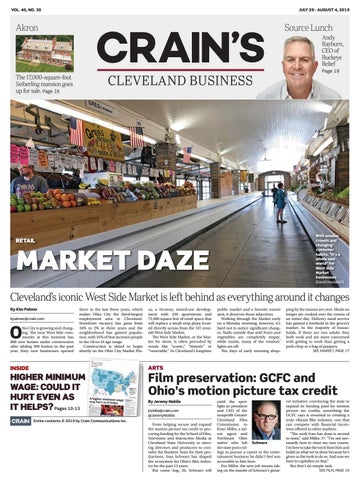
With smaller crowds and changing consumer habits, “it’s a whole new world” for West Side Market businesses. (David Kordalski)
RETAIL
MARKET DAZE
Cleveland’s iconic West Side Market is left behind as everything around it changes By Kim Palmer kpalmer@crain.com
O
hio City is growing and changing. The near West Side community at this moment has 800 new homes under construction after adding 500 homes in the past year. Sixty new businesses opened
there in the last three years, which makes Ohio City the third-largest employment area in Cleveland. Storefront vacancy has gone from 34% to 2% in three years and the neighborhood has gained population, with 16% of that increase people in the 18-to-34 age range. Construction is slated to begin shortly on the Ohio City Market Pla-
za, a 10-story, mixed-use development with 250 apartments and 75,000 square feet of retail space that will replace a small strip plaza located directly across from the 107-yearold West Side Market. The West Side Market, or the Market for short, is often preceded by words like “iconic,” “historic” or “venerable.” As Cleveland’s longtime
public market and a favorite tourist spot, it deserves those adjectives. Walking through the Market early on a Monday morning, however, it’s hard not to notice significant changes. Stalls outside that sold fruits and vegetables are completely empty, while inside, many of the vendors’ lights are off. The days of early morning shop-
ping by the masses are over. Meals no longer are cooked over the course of an entire day. Delivery meal service has gained a foothold in the grocery market. In the majority of households, if there are two adults they both work and are more concerned with getting to work than getting a pork chop or a bag of peppers. SEE MARKET, PAGE 17
ARTS
INSIDE
HIGHER MINIMUM WAGE: COULD IT HURT EVEN AS IT HELPS? Pages 10-13 Entire contents © 2019 by Crain Communications Inc.
P001_CL_20190729.indd 1
Film preservation: GCFC and Ohio’s motion picture tax credit
By Jeremy Nobile jnobile@crain.com @JeremyNobile
From helping secure and expand the motion picture tax credit to procuring funding for the School of Film, Television and Interactive Media at Cleveland State University to steering directors and producers to consider the Buckeye State for their productions, Ivan Schwarz has shaped the ecosystem for Ohio’s film industry for the past 13 years. But come Aug. 26, Schwarz will
yield the spotlight as president and CEO of the nonprofit Greater Cleveland Film Commission to Evan Miller, a talent agent and Northeast Ohio native who left Schwarz the state post-college to pursue a career in the entertainment business he didn’t feel was accessible to him here. For Miller, the new job means taking on the mantle of Schwarz’s great-
est initiative: convincing the state to expand its funding pool for motion picture tax credits, something the GCFC says is essential to creating a truly vibrant film industry, one that can compete with financial incentives offered in other markets. “The work Ivan has done is second to none,” said Miller, 37. “I’m not necessarily here to chart my own course. I’m here to take the torch from him and build on what we’ve done because he’s given us the tools to do so. And now we have to capitalize on that.” But that’s no simple task. SEE FILM, PAGE 18
7/26/19 3:45 PM
CONTENT
SPONSORED BY
NEWS AND TRENDS FROM NORTHEAST OHIO’S TECHNOLOGY SECTOR
TECH MATTERS A SOLUTIONS PROVIDER The power of the product owner
UP CLOSE WITH A PRODUCT OWNER
L
ike many product owners today, Stephany Love matured into the role as it increasingly became a more important part of software development. She joined OEC in 2006, working part time on marketing and human resources projects as needed. By the time Love left Northeast Ohio for her husband’s military job in 2010, she had already migrated into OEC’s mechanical product team. When the Love family returned in 2012, the company hired Love full time. Today, she is an associate product manager in the mechanical business unit. Love summarizes the key aspects of her role at OEC. Responsibilities are tied to relationships. We have a close collaborative relationship with our development team, she says. “We define the requirements, prioritize work for the team, drive the sprint goals ... and always try to be that bridge between our development side and our business side.”
N
ot so long ago, companies followed a more classical approach to software design, in which developers spent months defining a large set of specifications that later would be used to build the product. The problem, said health care technology industry veteran Ray Desrochers, was “often you had a situation where, by the time you got to the build stage, the specifications were out of date. So, in many cases, it took longer to update and maintain the specifications than it actually took to build the software.” Over the last two decades, software makers have embraced a more iterative methodology, called agile, which divides product development into bite-sized chunks. This approach enables project teams to vet specifications during the build process and make necessary changes on the fly. “The idea is that if you are going to fail, you fail fast, and that is a much better approach,” said Desrochers, president and chief operating officer of Cleveland-based OnShift Inc., a provider of hiring, scheduling and employee engagement software used in the health care industry. This fresh approach has necessitated several new technology positions, including that of product owner. While the exact responsibilities of a product owner can vary among organizations, the basic assignment
CALENDAR OF
EVENTS A PRODUCT OF
P002_CL_20190729.indd 2019 Tech Matters-7-29.indd 2 1
is to serve as a liaison between the business people who have set the product vision and the developers and engineers who will build it. “They have to have a foot in each pond, so to speak,” Desrochers said. “They have to understand what is going on in the market, in the industry and have enough understanding of the technology that they can translate those business needs into actionable technical deliverables.” Craig Munyon, product manager at Software Answers Inc., said strong communication skills are one of the most critical attributes of an effective product owner, but other soft skills like organization and attention to details are important as well. “(Product owners) have to make sure they are keeping that backlog for the team up to date, so the team is always working on the next thing that has to be delivered to the customer,” he said. Product owners must also have the ability to put themselves in the shoes of a user, said Charlotte Chang, a local organizational design coach. Unlike the product manager, who is more centered on the overall development goals, the product owner’s tactical responsibilities include determining what features users want and how they will interact with the software, so that the deliverables achieve the desired results. “Essentially, we are trying to mitigate risk and, of course, hopefully create delightful experiences for the people using it,” Chang said.
A cross-section of hard and soft skills is required. “The ability to communicate, organize and collaborate, as well as having that vision for the product,” are among those skills that drive success in her position. “The vision is very important when it comes to being effective at those softer skills, like communication and collaboration,” Love says. Each day is different. “We do have daily meetings with the team, and there may be oneon-one follow-up conversations as necessary,” she says. “A lot of your day is being available for the team. The solo work involves updating and continuing to build the work in your backlogs as you monitor the workflow.” The product owner is a bridge builder. “Every software organization has a business side, which sets the vision for the things that make you the money, and a technical side, which makes the things that make you the money,” Love says. “Our role is to bring those two pieces together. It is just as important to help people on the business side understand the technology applications and limitations, as it is to help the technical side understand why they are building this feature or function.”
AUGUST 8
AUGUST 13
AUGUST 28
FLASHSTARTS’ DEMO DAY: 5 p.m. to 8 p.m., StartMart, 50 Public Sq., Cleveland. Flashstarts’ Demo Day represents the culmination of its accelerator and labs programs. Networking and demos will follow pitch presentations, and local entrepreneurs, investors, and regional leaders are invited to attend. flashstarts.com/events/
THE CHANGING FACE OF SEO FOR B2B TECHNOLOGY WEBSITES: 7:30 a.m. to 9 a.m., Inedo, 56 Front St, Berea. Today’s tech marketers need to be savvy when it comes to how to stay atop of Google’s ever-changing algorithms. An SEO expert will discuss the must-have tools and tactics for modern SEO resources. resources.kiwicreative.net/techconnect
FREE COWORKING DAY: All day, beginning at 8 a.m., Bounce Innovation Hub, 526 S. Main St., Akron. Bring your task list, schedule a meeting, or just simply show up and get to know the local tech community. Free coworking days are offered every fourth Wednesday. bouncehub.org/events/
This advertising-supported feature is produced by Crain’s Content Studio-Cleveland, the marketing storytelling arm of Crain’s Cleveland Business. The Crain’s Cleveland Business newsroom is not involved in creating Crain’s Content-Studio content.
7/26/2019 7/25/199:55:13 12:08 AM PM
CRAIN’S CLEVELAND BUSINESS
|
J U LY 2 9 - A U G U S T 4 , 2 019
|
PA G E 3
Robotic mowing market soon ‘will blow up’ By Jeremy Nobile
Logan Fahey poses with some robotic mowers that are used for demonstrations at Landmark Lawn and Garden Supply in Strongsville. (Jeremy Nobile)
jnobile@crain.com @JeremyNobile
A Cleveland entrepreneur may have just set up Northeast Ohio to be the country’s leading hub for robotic mowing. Think of iRobot Roomba’s, except larger and built for cutting grass. The technology is already poised for wide adoption here, said Logan Fahey, the 25-year-old founder and managing partner for Strongsville investment firm and holding company Fahey Group. It’s why his firm in early July bought Dallas-based Robin Autopilot, a U.S. franchising platform for robotic mowers. “Right now, the plan is to invest heavily in that market because we think it’s going to be huge and will blow up in the next couple years,” Fahey said. Robin, a small but unique operation with six employees, is moving to Northeast Ohio. It will be integrated under an umbrella that also operates local landscaping store brand Landmark Lawn and Garden Supply, which Fahey Group has been running for about the last eight months. (A deal finalizing the transition of ownership closes at the end of this month.) The acquisition includes Robin subsidiary Coralview Technologies, which finances the machines, which can cost $1,500 to $3,000 each, depending on the model. Fahey said robotic mowing already is catching on in Europe, where data indicate one in seven mowers is now automated. “Robin is working to be a market leader in this space," he said. "And when the market flips here like it did in the U.K., which could be between
one to three years, based on our analysis, we want to be the ones positioned to take over. If we get to one in seven mowers being robotic, well, there’s not even enough of us right now to handle that demand.” Robin essentially is a subscription service. It operates 15 franchises in 12 states and has about 1,000 total customers. The Fahey Group has acquired the franchises for Cleveland — its largest market, with 200 mowing subscriptions sold, all on Cleveland’s West Side — and Tampa, Fla. There are only a couple brands of machines on the market today. Robin partners with Valley City-based MTD Products Inc., a manufacturer
of outdoor power equipment and an original investor in Robin that makes Robomow machines. Another brand is Husqvarna’s Automower. Robin sells the robotic mowing service, charging $19 to $29 per week. The company owns, services and installs the machines, which stay at a person’s house. The installation involves programming the mower for borders and when to function. It’s completely autonomous otherwise, cruising in and out of a recharging docking station on its own. The homeowner never needs to touch it. Fahey may have been destined to fall into such a business. As a teenager, he started a land-
scaping business that began with him pushing a mower door to door. With a knack for selling, he sold what amounted to subscriptions for lawn care, growing the operation up to three-and-a-half crews by the end of high school. He sold that business, called Lennox Grounds Management, when he graduated from St. Edward High School in 2012. Fahey dropped out of college to work in the nonprofit space, creating a landscaping company for TrueNorth Community Services that's still in operation. He later joined a family office, then returned to nonprofits to build up Bloom Bakery for Towards Employment.
“Nonprofits are needed and do great work, but they’re not very entrepreneurial,” Fahey said. “You might have someone who wants to grow and have a lot of impact, but they’re often tied down.” Fahey ran for a Ward 3 City Council seat, but lost. He calls that one of the most miserable points in his career and said he doesn’t miss his dip into the political world. He followed that up with the 2017 creation of Fahey Group, a consulting firm that led to his working on several different local businesses, mostly HR recruiting platforms. He connected with a former partner at Bloom to establish Edge Bakery, a St. Petersburg, Fla., business set to launch this fall that also employs formerly incarcerated people. The idea is to recreate what was done with Bloom and scale it up with a more for-profit angle. During this period he also began to work with Lawn and Garden Supply. Four investors support Fahey at his firm, which now holds stakes in six companies comprising about 25 employees. While there are a handful of different companies in the portfolio, Fahey’s main focus is the robotic mowing industry, which it’s positioning itself in through Robin and the landscaping store. The convenience and environmentally friendly designs, he expects, will soon resonate with people, who probably aren’t going to buy the mowers outright themselves because the technology is new, expensive and not inherently user-friendly to set up. “We are over 1,000 robotic mowers now as a national group. We’re certainly the largest buyer of robotic mowers in the U.S., and that will increase heavily next year,” Fahey said. “We’ve laid a lot of groundwork and I expect a really heavy season next year.”
CHN Housing Partners is adding another project
Nonprofit is starting a subsidiary that it hopes will result in creation of home mortgages in next three years By Jay Miller jmiller@crain.com @millerjh
After a busy early July absorbing the work of the Neighborhood Housing Services of Greater Cleveland and breaking in a new executive director, 36-year-old CHN Housing Partners is looking forward to taking on a new role as a maker of home mortgages. In the next few months, the nonprofit will create a subsidiary, CHN Housing Capital, and seek certification as a Community Development Financial Institution (CDFI), a federal designation that will give it access to an array of financial resources, perhaps including federal community development lending capital. “Our goal in three years — 2020 to 2022 — is to be making about $11.5 million in residential mortgages, with an average loan of about $50,000,” said Kevin Nowak, who became executive director July 1. “Our focus will be on mortgages to individuals who are left out of the market today.” Nowak joined CHN in 2016 from KeyBank, where he was an investment manager with Key Community Development Corp. Before that, he practiced law at Thompson Hine LLP. Because of their overhead, banks have a hard time making residential mortgage loans for under $50,000, which makes finding a mortgage for a modestly priced home in Cleveland
P003_CL_20190729.indd 3
“Our goal in three years — 2020 to 2022 — is to be making about $11.5 million in residential mortgages, with an average loan of about $50,000. Our focus will be on mortgages to individuals who are left out of the market today.” — Kevin Nowak, CHN Housing Partners executive director
and some of the inner-ring suburbs difficult. The Dodd-Frank Act banking reform also makes it harder for banks to lend to people who have had credit issues in the past but may be working to rebuild their credit scores. “For (CHN) to expand the products and services they offer to the community is a smart thing,” said Mark McDermott, vice president and Ohio market leader for Enterprise Community Partners Inc., a national nonprofit that supports community development and affordable housing. “They’ve proven also that they are good at customer service.” CHN runs an array of housing development and housing support pro-
grams, ranging from helping people with utility bills to developing affordable housing to putting people on the pathway to home ownership through its lease-purchase program. With its merger with Neighborhood Housing Services of Greater Cleveland (NHS), which was completed July 1, CHN now offers homebuyer education, down payment assistance, home improvement help and credit counseling at NHS’ office on Broadway in the Slavic Village neighborhood. Neither CHN nor NHS made mortgages, however. Nowak said he hopes CHN Capital will be originating home mortgages by next spring. Before then, however, he plans to be
able to offer mortgages to participants in CHN’s long-standing lease-purchase program. CHN is considered the pioneer in using Low Income Housing Tax Credits, the key federal program that subsidizes the development of single-family and multifamily affordable rental housing. For its investors to get the full benefit of the tax credit, a developer like CHN must maintain the property as affordable housing for 15 years. To that end, CHN created a program that offers single-family-home renters the opportunity to own the home after 15 years. If they stay for 15 years, and more than 85% do, they can own the home with a modest mortgage, typically about $20,000, now from an outside lender. Offering the lease-purchase program since the late 1980s, CHN has converted more than 1,300 renters to homeowners. Assistant director Kate Monter Durban said that 98% of its lease-purchasers are still in their homes, paying their mortgages after five years. With the new subsidiary, CHN will be able to take on what has been a stable mortgage portfolio. By joining the ranks of federally certified lenders, CHN will be able to attract working capital from philanthropies but also from banks, whose investments in an affordable-housing lender help the banks with their obligation under the Community Reinvestment Act to meet the credit
needs in their communities. The application will be submitted later this year, and Nowak said he hopes to be lending by the middle of 2020. The federal Department of the Treasury has certified more than 1,000 CDFIs. Some are banks and credit unions, as well as nonbank lenders, and they make small business, commercial and residential real estate loans in economically disadvantaged communities. James Carras, a lecturer teaching community and economic development courses at the John F. Kennedy School of Government at Harvard University, described the CDFI designation at the “Good Housekeeping Seal of Approval” of affordable housing lending. He said banks and others that invest in affordable housing lenders want their nonprofit lending partners to have the CDFI certification. The Department of the Treasury also has a pool of money it annually allocates to CDFI lenders. “I think this make a lot of sense,” said McDermott. “There is no other CDFI that serves the area that does this kind of lower-value mortgage lending.” McDermott added that CHN’s lending plan fits well with Cleveland Mayor Frank Jackson’s Neighborhood Transformation Initiative, a $65 million plan to rebuild several Cleveland neighborhoods: BuckeyeWoodhill, Clark-Metro, the East 79th Street Corridor and Glenville.
7/26/19 2:15 PM
PA G E 4
|
J U LY 2 9 - A U G U S T 4 , 2 019 |
CRAIN’S CLEVELAND BUSINESS
FATHER TIME HAS TURNED BACK THE RATES TO 2017! Purchase or Refinance Your Commercial Real Estate Now and Lock in a Low, Fixed Rate.
Redwood is putting down roots with new building buy By Stan Bullard sbullard@crain.com @CrainRltywriter
CALL YOUR LOCAL CREDIT UNION TODAY! • Commercial Real Estate Loans up to $10 Million • No Prepayment Penalties • As Little as 10% Down
Your Business Lending Partner
SM
Contact Jonathan A. Mokri 440.526.8700 • jmokri@cbscuso.com www.cbscuso.com
REAL ESTATE AUCTION
AUG 15
YOUNGSTOWN, OHIO - INDUSTRIAL, OFFICE & DEVELOPMENT OPPORTUNITY
TO BE SOLD BY ORDER OF US BANKRUPTCY COURT CASE #16-40675 #1 - 2100 Poland Ave., Youngstown, OH 44502 215,000 SF manufacturing/warehouse bldg. with high ceilings, crane runways & heavy power. 25,000 SF state-ofthe-art office building. Located on 46+ AC. PUBLISHED RESERVE PRICE $2,445,000 #2 - 1290 Poland Ave., Youngstown, OH 44502 525,000 SF manufacturing/warehousing facility on ±60 AC. It has cranes throughout ranging from 10-50 tons. It has rail service in the area & is located within a Foreign Trade Zone. PUBLISHED RESERVE PRICE: $1,000,000 #3 - 2039 Poland Ave., Youngstown, OH 44502 3,800 SF building in excellent condition situated on 6.75 acres with 4 AC fenced. Three-phase power & 3 drivein doors. PUBLISHED RESERVE PRICE: $75,000 #4 - 2057 Poland Ave., Youngstown, OH 44502 This property offers 115 acres of land. It is rail served and could be utilized for outside container storage, potential scrap operation or development. PUBLISHED RESERVE PRICE: $325,000 #5 - 2100 Poland Ave., Youngstown, OH 44502 (scrapyard) 20,000+ SF of storage and maintenance buildings on 9 acres. It has rail service in the area. PUBLISHED RESERVE PRICE: $100,000
ON-SITE INSPECTIONS: Thursdays Aug 1 & 8, 10:00 AM to 12:00 PM HANNA COMMERCIAL IN COOPERATION WITH CBRE • MICHAEL BERLAND, AARE, OH AUCTIONEER CHARTWELLAUCTIONS.COM
FOR ADDITIONAL INFORMATION, B RO CH U R E & TE R MS , C ALL:
216.861.7200
Redwood Living Inc., the fast-growing, Independence-based developer and manager of single-family-style apartment communities, has bought a new home of its own for its corporate headquarters. Through Redwood Corporate One LLC, the company on July 16 paid $2.9 million to acquire a 50,000square-foot building at 7007 E. Pleasant Valley Road in Independence, according to Cuyahoga County land records. The building was shed by Roseland, N.J.-based ADP, a provider of payroll services and human capital management solutions. The new building is just 2/10ths of a mile from Redwood’s current leased property at 7510 E. Pleasant Valley. However, Redwood CEO David Conwill said in a phone interview last Thursday, July 25, that he sees it as a case of the company putting down roots. “Our vision is to reinvent the apartment home by creating Redwood neighborhoods throughout suburban America,” Conwill said. “We create living spaces where our residents can truly feel at home, long- or short-term, within welcoming neighborhood settings. This purchase means our employees, visitors, vendors and the entire Northeast Ohio community can feel the sense of comfort that we’re here to stay.” Conwill said the company needed additional space to house current headquarters operations and give it room to grow its headquarters staff as it expands its portfolio by developing new properties. “With close to 100 neighborhoods across Ohio, Iowa, North Carolina, Michigan, Indiana and South Carolina, we needed more room to grow internally, to support upcoming company initiatives and exceed our goals, benefiting all of our stakeholders,” he said. Conwill added the company
THINK FIRESTONE COUNTRY CLUB.
Firestone Country Club is an exclusive, prestigious private club that welcomes Members and guests alike to host events in our famed clubhouse. BOOK YOUR SPECIAL EVENT TODAY. 330.644.8441 | firestonecountryclub.com © ClubCorp USA, Inc. All rights reserved. 44574 0419 BB
P004_CL_20190729.indd 4
plans to enter additional states, but declined to identify them at this time. Redwood currently houses its headquarters staff, from management and accounting to land development, in three buildings near its present corporate office. The company occupies about 20,000 square feet, so 50,000 square feet of space will give it plenty of room to expand now and in the future. Conwill declined to say how many staffers it has in Independence or total employment for the company, which has on-site staff at its locations for leasing and management services. “We’ll have a more people-centric setup,” Conwill said, with amenities such as additional conference rooms and a café. “This is all about investing in our employees and the future of Redwood. We’re actively hiring and growing.” Work includes “some updating” of the building, but Conwill declined to disclose the projected budget. The structure dates from 1979, was expanded in 1989 and sits on a 7-acre parcel, according to a flyer circulated by CBRE as it marketed the structure. Conwill said the company also liked the building because its Independence location is at a “crossroads” due to its proximity to I-480 and I-77.
“That makes for a 20-minute drive,” he noted, for most of the firm’s head-office staffers. Ralph McGreevy, executive vice president of the Northern Ohio Apartment Association trade group, said in a July 25 phone interview that he’s been in meetings at Redwood. “Redwood has been a very patient company,” McGreevy said. “The cramped condition they were in needed remedy. Good for them to find one location where they will all be under one roof.” Redwood’s portfolio includes more than 10,000 units. The company is privately held and does not disclose revenues. It was founded in 1991 by Steve Kimmelman, who last January assumed the title of chairman and named Conwill, who has been at the company for 15 years, its CEO. While many apartment owners have a variety of buildings of various sizes, Redwood focuses on building onefloor, two-bedroom units that can pass for single-family homes or attached ranch-style townhouses. It expanded rapidly after the housing collapse, as it often was able to buy single-family subdivisions from banks or land developers while the single-family newhome market was stalled.
U.S. office tower prepped for $54 million renovation By Stan Bullard
FOR PRESTIGE AND ELEGANCE,
Apartment owner and developer Redwood Living Inc. has acquired the former ADP building in Independence as a new headquarters. (Stan Bullard)
sbullard@crain.com @CrainRltywriter
The U.S. General Services Administration is beginning to design the renovation of six floors of the downtown Cleveland Anthony Celebrezze Building, a project expected to cost about $54 million, according to federal procurement documents. GSA awarded contracts in early July to design the improvements, which should be completed by 2025, subject to additional funding for construction of the proposed project. The work will encompass about 174,000 square feet of the 1.3 millionsquare-foot building, according to Catherine Langel, a spokeswoman for GSA Region V based in Chicago. The project, she wrote in an email Thursday, July 25, consists of modernizing office spaces, heating, cooling, electrical, and fire protection systems as well as abatement of asbestos-containing materials. MGA Partners, a Philadelphia architectural firm, was selected for architectural/engineering design services and
Jacobs Technology Inc. of Tullahoma, Tenn., was selected as construction manager and adviser for the project. MGA Partners will provide architectural services for the project in a 50% joint venture with Los Angeles-based AECOM, a global infrastructure firm. AECOM, which has a substantial building and places practice in Cleveland, will provide engineering and environmental services for the project. AECOM’s office in AECOM Center, 1300 East Ninth St., overlooks the Celebrezze building. The preparatory work may cost from $3 million to $5 million, according to the GSA. A posting for bidding for the project on FedBizOpps.Gov provides some additional color on the project. The description indicates the work may let the Veterans Benefits Administration consolidate on fewer floors and allow the relocation of tenants to perhaps free an additional floor for bringing into the structure federal offices currently located in leased space downtown. Constructed in 1967, the building is named for the late Anthony J. Celebrezze, a Cleveland mayor who served as secretary of the former U.S. Department of Housing, Education
and Welfare in the Johnson and Kennedy administrations, as well as a judge on the U.S. Court of Appeals for the Sixth Circuit. GSA said it plans to undertake the renovation work at the tower as part of its commitment to maintaining the operations of historic buildings in the federal service for an additional 50 to 100 years. This work follows a $120 million project that surrounded the building with a new glass exterior that was finished in 2016. That project was part of a program of federal spending to aid the ailing economy during the Great Recession in 2008. The structure was located so that it became part of Cleveland’s traditional government building district launched in the early 20th century, but it also served as an anchor for the city’s Erieview Plan, a 1960s-era urban renewal plan to raze low-rise commercial and residential buildings in the East Ninth Street area. The project led to multiple office towers along East Ninth Street, as well as a plethora of downtown parking lots that remain undisturbed by new development through today.
7/26/19 1:51 PM
CL_071519_FP Template.indd 1
7/8/19 11:15 AM
PA G E 6
|
J U LY 2 9 - A U G U S T 4 , 2 019
|
CRAIN’S CLEVELAND BUSINESS
A straight shooter among sports agents Beachwood-based Neil Cornrich ‘just tells the truth,’ even if it’s not what his clients want to hear By Kevin Kleps
versity of Oklahoma coach Bob Stoops, Youngstown State University coach Bo Pelini and new University of Akron coach Tom Arth. Cornrich’s coaching practice is strong, but the player side of the business is larger for a simple reason: There are more of them. That practice added T.J. Hockenson, a tight end from Iowa who was selected eighth overall by the Lions in April. The move is straight out of Cornrich’s playbook — one that has proven to be quite successful in the 36 years since he became a certified player agent. Hockenson played for Ferentz, and he was referred to Cornrich by Dallas Clark, a former Iowa standout who was a first-round pick by the Indianapolis Colts in 2003. Clark, a first-team All-Pro selection in 2009, was the NFL’s highest-paid tight end for much of his career. “My approach has always been fiduciary,” Cornrich said. “People hire
kkleps@crain.com @KevinKleps
Leaving the Cleveland Browns as a free agent after the 2012 season was very difficult for Phil Dawson. The kicker, as beloved as anyone from his position group could be in an NFL city, had spent his first 14 seasons with the Browns. Dawson remains the second-leading scorer in the 70-season history of the franchise. If Dawson was looking for a pickme-up at the time, he wouldn’t have reached out to his agent, Beachwood-based Neil Cornrich. “If I needed to make a phone call to be encouraged and feel better, I wasn’t going to call Neil, in all honesty,” Dawson said. “But if I needed to make a phone call to understand the facts and how this works and what it’s going to mean, he’s the one I’m gonna call.” Dawson, who has made $3 million or more in every season but one since 2011, is a free agent again at age 44. After 21 NFL seasons, his future is uncertain. By now, the 11th-leading scorer in NFL history knows all too well how cruel the business side of the league can be. That wasn’t the case early in his career, though, and Dawson said knowledgeable straight shooters like Cornrich can be valuable for players who are trying to maximize their earning potential during careers that are often short-lived. “What separates Neil is he just tells the truth,” Dawson said. “He reps general managers, coaches and players. He has a comprehensive understanding of all sides of a negotiation. His insight, his counsel, just the way he communicates how things are gonna go, what the other side will come at you with — all of that is spot on. “You might not always enjoy that,” the 2012 Pro Bowl selection added, “and some agents might try to polish that up. But Neil just tells you how it is, and it’s your job as an athlete to make a decision.”
Best of the best Cornrich, because he’s represented powerful figures from all sides of the negotiating table (from players to assistant coaches to head coaches and general managers), has one of the most diverse client sets in the league. He has repped Bill Belichick throughout the coach’s historic run with the New England Patriots. He also represents several Patriots players, including running back Rex Burkhead, who is entering the second season of a three-year, $9.75 million deal. Last March, one of Cornrich’s star clients, defensive end Trey Flowers, left the Patriots to sign a five-year, $90 million deal with the Detroit Lions, who are coached by Matt Patricia, a Belichick protégé. Flowers’ deal includes $56 million in guarantees, and the $90 million total is the fourthbest among all players at his position. By letting Flowers walk, the Patriots — in a move that’s become a Belichick staple — likely will get a thirdround compensatory draft pick next spring. “It’s his model,” Cornrich said of the coach he first met in the 1990s, when the agent was representing former Browns players Tom Tupa, Bob Dahl and Craig Powell, and Belichick
P006_CL_20190729.indd 6
“My approach has always been fiduciary. People hire me to do what’s best for them, not what’s best for me.” — Neil Cornrich
me to do what’s best for them, not what’s best for me. And if you do that long term, you’ll have an opportunity to avoid some of the difficult situations that can arise in this industry. Good people refer other good people.”
‘Very humbling’ business
Defensive end Trey Flowers — shown with agent Neil Cornrich after the New England Patriots’ Super Bowl win over the Atlanta Falcons in 2017 — signed a five-year, $90 million deal with the Detroit Lions in March. (Contributed)
Notable Cornrich clients Coaches
Players
Former players
JJBill
JJTrey
JJRobert
JJMike
JJT.J.
JJDallas
Belichick Vrabel JJKirk Ferentz JJBob Stoops JJBret Bielema JJBo Pelini JJTom Arth
Flowers Hockenson JJBrandon Scherff JJRiley Reiff JJMarshal Yanda JJPhil Dawson JJRex Burkhead
Smith Clark JJKirk Lowdermilk JJNate Clements JJDana Stubblefield JJAaron Kampman JJAndy Katzenmoyer
was working for Art Modell prior to the Browns’ move to Baltimore. “I had a profound respect for him from the first time I met him,” Cornrich said of Belichick. “I knew about him. Then, when I met him, it became clear that he was so special.” Cornrich has since been on the field for all six of the Patriots’ Super Bowl victories — along with their three championship-game losses — under Belichick. Cornrich has negotiated book deals and contracts, and has become close friends with the 67-year-old who, in the agent’s opinion, is “indisputably the greatest coach of all time, regardless of sport.”
Quality references
Neil Cornrich, Bill Belichick’s longtime agent, said he knew the coach was “so special” soon after meeting Belichick during the coach’s time with the Browns. (Mike Powell/Getty Images)
A 2013 Sports Illustrated story, which ranked Cornrich among the 15 most influential agents in sports, called the Beachwood High School graduate “arguably the leading agent of football coaches, both professional and collegiate.” That group includes Tennessee Titans head coach Mike Vrabel, whom Cornrich repped during his playing days with the Patriots and Pittsburgh Steelers, along with University of Iowa coach Kirk Ferentz, former Uni-
Cornrich’s third-floor office in the One Chagrin Highlands building would be a haven for memorabilia collectors. Signed pictures and jerseys adorn the walls, and the longtime agent has a story for each. Off the top of his head, he recites Flowers’ grade-point average at the University of Arkansas’ Sam M. Walton College of Business. He’ll tell you the names of all of his clients’ parents, as well as Riley Reiff’s record as a three-time state champion wrestler in high school. (Reiff, a Minnesota Vikings offensive lineman, signed a fiveyear, $58.75 million contract in 2017.) And he’ll gladly tell you about his own parents — the late Rita, a former teacher, and Sidney, a 90-year-old who went to college at 15 and finished law school at 21. “My parents were really self-made people who did exceptionally well and instilled in me the values of resilience, commitment and passion,” Cornrich said. “I always tried to do something a little bit different and better. I’m not saying I did, but that was the goal.” The business he’s chosen, described by so many agents as brutal, is “very humbling,” Cornrich said. Cornrich has been approached “often” about selling his practice, but he’s always resisted because he loves what he does — and those for and with whom he works. With Flowers and Hockenson, the agent has already had a really good 2019. But Cornrich knows as well as anyone that can change in a hurry. “We don’t pitch what we’ve done for other people,” he said. “Every day is a new day, and every day you need to earn it. Last season is last season.”
7/26/19 12:20 PM
CRAIN’S CLEVELAND BUSINESS
|
J U LY 2 9 - A U G U S T 4 , 2 019
|
PA G E 7
Hyland tees up a new approach to branding Partnership with golfer Xander Schauffele is Westlake company’s first venture into sports sponsorships By Kevin Kleps
Xander Schauffele file
kkleps@crain.com @KevinKleps
Age: 25
Ed McQuiston said Hyland Software Inc. works with half of the companies in the Fortune 100 and has partnerships with every top-20 hospital in the U.S. News & World Report rankings. What the Westlake content services provider doesn’t have is a brand recognition that’s on par with some of its most successful peers. “I refer to it often as the best story that no one knows about,” said McQuiston, Hyland’s executive vice president and chief commercial officer. “We get some exposure in Cleveland, given our roots. But outside of that, and outside of the trade organizations and the space that we’re in, we’re just not a household name.” Part of the reason for that, McQuiston said, is many customers don’t realize they’re using Hyland’s software, because it’s integrated with the workers’ content platform. To increase its profile, Hyland is venturing into sports sponsorships — a route that’s a first for the company but a familiar one for tech firms. Hyland’s initial sports sponsorship is with Xander Schauffele, who, like the company, isn’t a huge name but is well-established in his field. The 25-year-old golfer finished one shot behind Tiger Woods in the most recent Masters, and he’s fourth in the FedEx Cup standings. In 2017, Schauffele had one of the best seasons ever for a PGA Tour rookie, finishing third in the FedEx Cup points race, capturing the Tour Championship (a first for a rookie) and tying for fifth in the U.S. Open. “All the experts say he is going to be the next big thing,” McQuiston said. That approach is a smart one, said Eric Smallwood, president of Apex Marketing Group Inc., a St. Clair, Mich.-based sports sponsorship and analytics firm. For starters, a deal with Schauffele isn’t nearly as costly as one with the likes of Tiger Woods or Rory McIlroy, Smallwood said. And if Schauffele continues his ascension, and adds a major championship or two to his résumé, the potential reward would far outweigh any risks. “It provides some potential for some high-profile exposure,” Smallwood said.
2018-19 season: Is tied for fourth in the FedEx Cup standings and is fifth with earnings of $5,411,096 through the British Open. ... Has two wins and four top-three finishes in 17 events. ... Tied for second in the Masters, one shot behind Tiger Woods, and tied for third in the U.S. Open.
‘Global’ reach Hyland’s partnership with Schauffele began with the July 18-21 British Open, a time in which the biggest headlines the La Jolla, Calif. native made stemmed from having a nonconforming driver. Schauffele finished in a tie for 41st in Northern Ireland, but his recent work in major championships suggests that’s a minor blip in a promising career. Beginning with his topfive finish in the 2017 U.S. Open, the former San Diego State University standout has five top-seven showings and four top-five finishes in his last nine majors. Schauffele announced the partnership — which Hyland said is for three years — on social media. The company’s logo is now displayed on the front of the golfer’s bag, and Hyland said Schauffele will be featured “in a forthcoming advertising campaign.” McQuiston said the company is
P007_CL_20190729.indd 7
Turned pro: 2015
Career highlights: Was third in the 2017 FedEx Cup standings — the best finish ever for a rookie (topping Jordan Spieth by four places). ... Had two wins and four top-10 finishes, including tying for fifth in the U.S. Open, in his rookie season. Schauffele was also 12th on the PGA Tour money list at $4,312,674. ... Tied for second in the British Open and tied for sixth in the U.S. Open in 2018. ... He was 15th in the FedEx Cup standings and 18th on the money list ($4,047,538) in his second season.
The 2019 British Open, which was held July 18-21 at Royal Portrush Golf Club in Northern Ireland, was the first in which Hyland’s logo was displayed on Xander Schauffele’s bag. (Contributed photo)
still evaluating whether those spots will include TV and radio. What’s certain is social media will play a significant role, and Schauffele will represent Hyland during meetand-greet events at some PGA tournaments. The golfer will also appear at Hyland-sponsored events away from the Tour, McQuiston said. Hyland is also partnering with Schauffele’s father, Stefan, a native of Germany who doubles as his son’s manager and swing coach, for hospitality engagements throughout the golf season. “We’ll look to leverage this as a means to broaden our brand in areas that we might not otherwise reach,” McQuiston said. An example of that is the Presidents Cup — a biennial competition between the U.S. and an international team. The 2019 Presidents Cup will be held at the Royal Melbourne Golf Club in Australia in December. “One of the reasons we like this is
the global exposure,” McQuiston said. “As Hyland has grown our presence in Europe, Asia and Latin America, there are lots of opportunities for us in terms of global advertising.”
A quality ‘fit’ Hyland has 3,400 employees, about 1,800 of whom are based in Northeast Ohio. A 2018 report by Moody’s noted that the company’s revenue was expected to reach $700 million last year. Hyland, which expanded via the acquisitions of Perceptive Software and OneContent in 2017 and ’18, was 18th on Crain’s 2018 list of the largest privately held companies in Northeast Ohio. At the time, Crain’s reported that the company’s revenue increased 28%, or $120 million, to $550 million in 2017. The company has also been a staple in Fortune magazine’s list of the 100 best companies to work for, but the honors, combined with its business
successes, still haven’t brought Hyland to “household name” status. As Hyland searched for ways to make its brand more recognizable, it found that its target audience — C-suite executives — comprised quite a few sports fans. The company’s research also showed that golf “kind of rises to the top” among the execs’ favorite sports, McQuiston said. Golf, because of its parity, can be “a gamble” when it comes to sponsorships, said Smallwood, the Apex
Marketing Group president. But if a company chooses the right athlete and comes up with smart ways to activate the partnership, the benefits can be considerable, he added. McQuiston admitted that early in Hyland’s data-centric approach to its first sports sponsorship, he knew Schauffele’s name, but wasn’t up to speed on his accomplishments. That’s changed quite a bit in the months since, and it doesn’t hurt that the golfer’s first name can be used in plenty of advertising wordplays. “Today, he is an underdog vs. big names, but he brings this X-factor to his game that allows him to compete at a high level,” McQuiston said. “We like that fit.”
FOR SALE: INDUSTRIAL/LAND 5058 SOUTH PROSPECT ROAD ROOTSTOWN, OH 44272 9.55
Acres
1,395 SF Cape Home-Offices
4,040
SF Warehouse with 2 overhead doors
Within
1.25 miles of Interstate 76 and Ohio Route 44 ramp
SVN SUMMIT COMMERCIAL REAL ESTATE GROUP, LLC CONTACT
Aaron Davis Associate Advisor 330.221.7297 Aaron.Davis@svn.com
3009 Smith Road, Suite 25 Akron, OH 44333 (234) 231-0200
7/25/19 3:09 PM
PA G E 8
|
J U LY 2 9 - A U G U S T 4 , 2 019 |
CRAIN’S CLEVELAND BUSINESS
Opinion Personal View
Downtown lakefront park would bring economic benefits By Timothy R. Barber
Editorial
State of things It took longer than it should have, but Ohio finally has its first budget under Gov. Mike DeWine, and the result is a two-year, $69 billion spending plan that’s ... not bad. Legislators missed the original deadline for the first time since 2009 and needed an extra 17 days to get their work done, which is not a great look for the leadership capabilities of Republicans, who control the House, Senate and the governor’s office. In the end, though, the budget passed with a fair amount of bipartisan support, by margins of 75-17 in the House and 29-1 in the Senate. Budgets are compromise documents, and this one has a bit for everyone. With revenues exceeding expectations, lawmakers were able to eliminate taxes on Ohioans’ first $21,500 of income and implement a 4% tax cut for income above that. The $40 million tax-credit program for the motion picture industry was retained. The state raised the age to buy cigarettes and other tobacco products to 21 from 18, and it created a new tax on vaping products. The budget also spends $172 million over two years for DeWine’s “H2Ohio” fund to protect Lake Erie and other state waterways from pollution, a figure that was less than what the governor wanted but is a welcome first step. There’s also money for new “wrap-around” support services in education and other areas. The Public Children Services Association of Ohio praised the budget as as “the single biggest investment in child and family services ever made by the state.” It’s not a perfect document and the process was flawed, but Ohio is fortunate to find itself in an era of budget sanity. The Legislature did far less well, though, in passing House Bill 6, the nuclear and coal subsidies bill that DeWine signed into law on July 23. HB 6 carves out $150 million a year to keep the reactors owned by FirstEnergy Solutions running, while simultaneously reducing support for wind, solar and energy efficiency. FirstEnergy’s Davis-Besse and Perry nuclear plants will be supported through a fee added to customer bills beginning in 2021. That
fee is offset by a reduction in Ohio’s clean-energy goals, as utilities will need to get 8.5% of their power from renewables, rather than the current 12.5% target. FirstEnergy praised the legislation as “a monumental step in helping to avoid the premature closure” of the plants, and why wouldn’t the company say that? It was a huge bailout. As Bloomberg Opinion put it in an analysis, the bill “will socialize corporate losses and pollution while stymieing incentives for new projects and energy businesses.” There already are efforts underway to launch a statewide referendum to overturn the bill, by a group called Ohioans Against Corporate Bailouts, which has support from environmental and business groups. Other groups might join in. It’s likely we have not heard the last in the contentious debate on a measure that puts Ohio on the wrong path for a sustainable energy future.
Our advantage
Ohio long has had a reputation as being a good place for logistics operations. If you could have a nickel for every time you heard, “Half the U.S. population is within an eight-hour drive” of Cleveland, or Columbus, or Cincinnati ... The state’s geographic advantage is paying off now in attracting the attention of a corporate giant, Amazon, which last week announced it will build two more fulfillment centers in the state, in Akron and near Toledo, bringing an additional 2,500 jobs. Amazon already expects to have about 9,000 employees in Ohio by year end; in 2015, it had fewer than 50, according to Axios. The Akron site will be the third repurposing of a dead retail property in Northeast Ohio into a busy product-shipping hub. (See more in a story on Page 13.) There’s no shortage of dead/dying malls and shopping centers in the state. We’re pleased that state and local officials are working with Amazon to bring them back to life in a new retail era. Keep it coming.
Publisher and Editor: Elizabeth McIntyre (emcintyre@crain.com)
CLEVELAND BUSINESS
CLEVELAND BUSINESS P008_CL_20190729.indd 8
Managing Editor:
Scott Suttell (ssuttell@crain.com)
Contact Crain’s:
216-522-1383
Read Crain’s online: crainscleveland.com
Cleveland has the opportunity to develop valuable property near the lakefront. We must decide carefully, as we will greatly affect the long-term health and prosperity of our city. It seems we are presented with an obvious course of action: We should maximize tax revenue for the city by simply allowing a developer to cut the land up into generic luxury housing. Property along a lakefront is universally desirable and valuable, so of course this Barber would lead to a small increase in revenue for the city. But things are not so simple. We must consider the implications of our decision over time. The tax revenue that can be collected from such properties must be weighed against the baked-in cost of those properties to the taxpayers. It is not possible to simply slap down a couple of buildings and in a few months’ time see folks show up to start providing tax revenue. These properties must be incorporated into the city’s current infrastructure. But even this is not a one-time cost, as there must be consistent maintenance of power lines, water lines, etc. Therefore, the city may end up receiving more tax dollars than today, but in doing so it will massively burden the residents of Cleveland with future costs. As time goes on, more rust and wear and tear will cause the infrastructure to deteriorate. Water pipes, streets and power lines will need to be repaired. These maintenance costs will only become more and more expensive with time. The value of the lakefront property will dip after its initial inflated price inevitably falls to market rate. While a developer may come in to discuss the magnificent possibilities of luxury homes on the lakefront, this individual will not be responsible for future maintenance fees. Those will fall on the backs of local residents who receive little or no benefit from the development. All we will be left with is a burden for the city, and a burden for every individual taxpayer. The good news is the best decision is the simplest and cheapest of all. Simply put, we should not develop the land at all. Dare to dream big: Imagine a 500-acre natural area along Lake Erie. A large pedestrian greenway connecting downtown with the park. Imagine wetlands, forests and prairie habitats restoring the ecological health of our portion of Lake Erie. Imagine hiking trails, bike paths and playing fields allowing the public to meet, exercise and enjoy the wonders of the natural world. To evaluate this choice, however, we need to understand the economic value of nature itself. Natural areas are a dynamic system of animals and plants interacting with the physical environment to form a functional unit. These units give rise to many economic benefits, known as ecosystem services. These services have a monetary value, which are enjoyed by people in the city and surrounding areas for many generations to come. Ecosystem services are enjoyed by humans directly through use and consumption of natural resources, indirectly through the support and production of enjoyed goods and services, and through nonconsumptive means including existence and aesthetic values. Ecosystem services are underappreciated when weighed against choices that contain traditional market prices. Direct benefits may include recreation, such as bird watching, trails for walking and biking, playing volleyball, softball and soccer, and fishing. SEE BARBER, PAGE 9
Write us: Crain’s welcomes responses from readers. Letters should be as brief as possible and may be edited. Send letters to Crain’s Cleveland Business, 700 West St. Clair Ave., Suite 310, Cleveland, OH 44113, or by emailing ClevEdit@crain.com. Please include your complete name and city from which you are writing, and a telephone number for fact-checking purposes. Sound off: Send a Personal View for the opinion page to emcintyre@crain.com. Please include a telephone number for verification purposes.
7/25/19 4:13 PM
CRAIN’S CLEVELAND BUSINESS
|
J U LY 2 9 - A U G U S T 4 , 2 019
|
PA G E 9
7.5 A c r es of La nd zoned for offi c e or r etai l
BARBER
CONTINUED FROM PAGE 8
The natural environment also provides many indirect benefits, such as spiritual well-being provided by natural habitats, water and air purification, noise abatement, erosion control and climate regulation (e.g., avoidance of the heat island effect of developed urban areas). Some of these services are local and others provide benefits over a much larger geographic scale. Regardless of the type or spatial scale of these services, they provide clear benefits to humans and therefore have monetary value to the residents of downtown Cleveland and surrounding areas. The monetary value of ecosystem services range from $2,500 to $10,000 per acre per year, depending on the type and quality of the natural area. These benefits would be accrued in perpetuity, resulting in millions of dollars of services for each generation. These values must be considered when making future land-use decisions. The direct human use value of a lakefront park can be estimated by multiplying the projected visitors to the park by the recreational use value, typically ranging from $15 to $25 per person per visit. A few hundred thousand visitors each year will add several more millions of dollars per year in economic benefits to Cleveland. The active use of nature trails will provide health benefits to frequent users. These health benefits are expected to result in reduced health care costs associated with better cardiovascular health, weight control and even better mental health. The numerous bike and walking
trails offer an opportunity for active recreation that is valued by the public and provide direct benefits to the residents with improved fitness and conditioning. The Cleveland Metroparks estimated a benefit of $5 million per year from reduced medical costs, but ignored the benefits associated with higher worker productivity and less loss work time due to illness. The city of Cleveland and its residents will receive a greater benefit if our lakefront remains undeveloped. More people will be interested in moving to Cleveland if it has a large, accessible park. Other developed areas will become more valuable. Excess surface parking lots can be turned into more productive uses. This green transformation can be accomplished with much less initial capital and will provide a greater benefit to the residents of the city. Building a large park along the lakefront in downtown will provide tangible economic benefits by improving land, air and water quality; improving health outcomes of the downtown residents; enhancing property values; reducing maintenance costs and city services compared to developed infrastructure; and provide direct monetary benefits from ecotourism and nature-based activities. We should follow the lead of other Rust Belt cities, like Chicago, Cincinnati and Pittsburgh. Dream big and green, Cleveland: A large park along the Lake Erie shoreline will improve the livability of the city and provide a guaranteed return on investment.
Loc a ted on SW Cor ner of M emphi s A ve. a t Ti edeman Roa d Conveni entl y l oc a ted between I -71 a nd I 480 Loc a ted near by offi c es for : M edi c a l M utua l I nogen Rhi noSystems TRG Real i ty HMI D evel opment I nc enti ves A va i l abl e
C it y of B r ookly n O f f ice of E conom ic D e ve lop m e nt 2 16 - 6 3 5 - 4 2 8 9 a u d r is @ b r ookly nohio. g ov
Barber, a resident of downtown Cleveland, is an environmental scientist with more than 25 years of experience in ecological risk assessment and restoration of aquatic habitats.
JOIN US
Letter to the Editor
Award-winning Accounting and Business Advisory Firm in Northeast Ohio In our firm, employees come first. We believe empowering our workforce results in the best client service in the game. We also offer paid parental leave, flexible hours, personal career coaching, and student loan consolidation programs. Oh, and free coffee! That is why we’re one of the Top Work Places in CLE.
@applegrowthpartners
AppleGrowthPartners
@apple_growth
SERVING NORTHEAST OHIO’S PRIVATELY-HELD BUSINESSES
APPLEGROWTH.COM
Hyperloop rendering
Make different hyperloop connections A July 8 “Personal View” by Grace Gallucci, CEO of the Northeast Ohio Areawide Coordinating Agency, updating the progress on transportation systems for Northeast Ohio was important, encouraging and positive. Among other topics, it included progress on a study of hyperloop connection between Cleveland and Chicago. We commend the positive thinking behind these plans. Undoubtedly, these hyperloop plans are likely to be expensive, but such fast transportation plans will also have many benefits, including economic benefits associated with faster trade and travel with Chicago. Further, such benefits can be realized by extending the new hyperloop transportation system to Buffalo, Toronto and points further east. However, we would like to recommend an alternative, ultrafast hyperloop transportation system that is likely to have greater benefits for Cleveland and this region. If such an ultrafast travel system can reduce travel time between population centers to commuting time, it will effectively increase the size of our economic region, increasing our region’s economic growth rate. As noted in an Axios study summarized in Crain’s and confirmed this month in a McKinsey report, larger cities are growing much faster and are projected to continue growing faster while cities like Cleveland are expected to continue languishing. These facts are backed by sound theory about cities which notes that a metro area’s growth rate is more than proportional
P009_CL_20190729.indd 9
to its size. Larger cities bring together economies of scale and scope to every sector of the economy, especially R&D-dependent sectors like health care and others. Thus, we do suggest that the best focus of ultra-highspeed travel systems like hyperloop is between the closer-in neighboring cities such as Cleveland, Columbus and Pittsburgh. These cities are all fewer than 150 miles apart and at hyperloop speeds, even if reduced to simplify engineering and safety requirements, would still allow fewer than 20- to 30-minute commuting times between each of these city pairs. Such intercity travel times will knit such cities effectively into one metro area, greatly boosting our region’s economic growth rate and bringing other social and cultural benefits. The higher growth rate should result in higher tax collections and help pay for the travel system. We note that NOACA’s work is critical to this region and we applaud that effort. We modestly suggest, however, that the true value of an ultra-high-speed commuting travel system would be far greater than a link to Chicago. Ultrahigh-speed commuting systems should not duplicate air-travel services. The major benefits of such systems are best realized by completely changing economic linkages with our uniquely close neighbor cities, creating the single megacity of the Midwest equaling or surpassing Chicago or any U.S. metro in scale and impact. This is a better alternative and should be given serious consideration. Raj Aggarwal and Jerry Bohinc
7/25/19 1:51 PM
PA G E 10
|
J U LY 2 9 - A U G U S T 4 , 2 019 |
CRAIN’S CLEVELAND BUSINESS
Focus MINIMUM WAGE
Washington $12.00 Montana $8.50 Oregon $11.25
North Dakota Minnesota $9.86
Idaho
Wyoming
Nevada $8.25
Vermont $10.78
South Dakota $9.10
Nebraska $9.00
New Hampshire
Colorado $11.10
Michigan $9.45 Iowa
Pennsylvania
Arizona $11.00
New Mexico $7.50
Indiana
Illinois $8.25 Kansas
New York $11.10
Wisconsin
Utah
California $11.00
Missouri $8.60
Ohio $8.55 West Virginia $8.75
Massachusetts $12.00 Rhode Island $10.50 Connecticut $10.10 New Jersey $10.00 Delaware $8.75 Maryland $10.10
Virginia
Washington, DC $14.00
Kentucky North Carolina
Tennessee
Oklahoma
South Carolina
Arkansas $9.25 Mississippi
How the states stack up
Georgia Alabama
Texas
Greater than the federal minimum wage
Louisiana
Alaska $9.89
Maine $11.00
Florida $8.46
Equal to the federal minimum wage of $7.25 No minimum wage required
Hawaii $10.10 Source: U.S. Department of Labor Crain’s Cleveland Business graphic
© Here / Maps4News
A higher minimum wage may hurt as it helps By Kim Palmer
Ohio and West Virginia have above-federal-wage minimums.
Pennsylvania and Kentucky remain at the federal minimum.
Seattle, San Francisco, New York and California have already passed legislation with incremental increases leading to $15 an hour.
T
P010_011_CL_20190729.indd 10
The federal minimum wage was last raised in 2009.
kpalmer@crain.com
here has been an increasing call, on the federal, state and local levels, for significant hikes to the minimum wage. Some state legislatures have staved off these pushes toward an across-the-board $15 minimum wage by passing smaller, incremental increases and prohibiting local policies. Amid a tightening labor market nationally and with Seattle and some other large cites rolling out $15 and higher wage increases, will — or should — Cleveland and other Ohio cities follow suit? In 2006, Ohio passed a ballot initiative raising the state minimum wage from $5.15 to $6.85. It is now $8.55 per the Ohio Minimum Wage Increase Amendment’s requirement for annual increases to keep up with inflation. Making barely a $1 more than the federal minimum still means that Ohio minimum-wage workers need and qualify for food assistance, according to Hannah Halbert, project director at Policy Matters Ohio. In fact, a head of household in the state would need to earn $15.73 an hour to afford a “modest” two-bedroom apartment, she said.
Minimum wage at a glance
Detroit’s minimum wage rose 20 cents in 2019, from $9.25 to $9.45 per hour, after a proposal for a $10 minimum wage was blocked by the state legislature.
Kansas City voted to raise its minimum wage to $10, adding incremental increases to $15 by 2022. Subsequently, the Missouri legislature barred cities from setting their own minimum wages.
New Jersey's legislature voted to increase the state's rate from $10 to $15 by 2024.
Maryland and Illinois have passed laws to increase wages over several years to at least $15 per hour.
Delaware’s attempt to increase the minimum wage from $8.75 an hour to $15 failed to pass, but supporters are making another attempt.
U.S. Speaker of the House Rep. Nancy Pelosi (D-CA) holds up 7-year-old Kassidy Durham of Durham, N.C., during a news conference prior to a vote on the Raise the Wage Act July 18, 2019, at the U.S. Capitol in Washington, D.C. The legislation would raise the federal minimum wage from $7.25 to $15 by 2025. (Alex Wong/Getty Images)
Michigan will increase its minimum wage from 2019 through 2030 annually only if the unemployment rate in the preceding year does not exceed 8.5%.
7/25/19 12:46 PM
“Th now with add But 2007 In wou Ohi wou mor incr E ple a beca caus “M prov rat T serv dismum the tion Ta econ wag pay ficia lowune wor E rais atel Tasc
hire
tts
.10
0
es
eral
CRAIN’S CLEVELAND BUSINESS
|
J U LY 2 9 - A U G U S T 4 , 2 019
|
PA G E 11
MINIMUM WAGE
“The Ohio minimum wage is worth 28% less now than it was in 1968,” Halbert said. “Even with a recovery that has been slow, Ohio has added all the jobs back it lost in the recession. But we had more people in poverty in 2017 than 2007.” Increasing the minimum wage to $15 by 2025 would raise the pay for more than 1.8 million Ohio workers. Two out of five women in Ohio would see a higher wage and the families of more than 700,000 children would see income increases, Halbert said. Economists argue that the issue is not as simple as raising wages for the lowest-paid workers because the ripple effect of additional payroll causes businesses to react negatively. “Minimum wage is a very blunt tool to improve the condition of the of workers,” said Murat Tasci, senior researcher at the Federal Reserve Bank of Cleveland. “Evidence points to dis-employment effects, meaning that a minimum-wage increase reduces employment for the groups of workers in the intended population.” Tasci noted there is a huge debate among economists about the results of such a hike in wages. Some studies show that a substantial pay increase reduces job creation and that artificially raising the incomes for one group of low-wage workers increases the risk of more unemployment for other groups of low-wage workers. Evidence suggests that the negative effects of raising the minimum wage fall disproportionately on lower-skilled workers, according to Tasci. Either employees have their hours re-
In 2017, Cleveland mayor Frank Jackson moved to increase the wages of city employees after a ballot initiative to raise the citywide minimum wage to $15 failed to gain support. (Win McNamee/Getty Images)
duced or companies cut back other planned pay increases or additional hiring. All eyes are on Seattle’s recent move to a minimum wage of $15.59.
“Seattle is basically a case study,” Tasci said. According to him, early studies indicate the wage hike has not caused companies to flee Seattle for surrounding areas with a lower mini-
mum wage, a result some experts anticipated. There is still concern that companies will adjust to the higher costs in ways that may harm some of the more vulnerable workers. “There is a disproportionate effect if you are a skilled worker,” Tasci said. “Unskilled workers are disproportionately affected.” Even as a federal wage hike languishes in a divided U.S. Congress, leaders at the city level are filling in the gaps. In 2017, Mayor Frank Jackson and the city of Cleveland moved to increase the wages of public employees after a failed attempt at a $15 mandatory ballot initiative by grass-roots and union groups. City employees are now paid $15 per hour, with more than 500 workers affected by the policy change. “There is a lot of energy and interest about citywide wage laws,” Halbert said. “This is a mechanism to restore the wage floor.” Cleveland’s approach to a hyperlocal minimum wage might trickle down to other industries in the city, Tasci said, but he stressed that with the country’s current low inflation the most efficient way to increase wages is a strong labor market. “A robust market is the best solution,” he said. As economists debate the merits and pitfalls of minimum-wage increases, pressure from multiple sources to raise wages for the lowest-paid workers continues. “Low wages are political, not economic problems,” Halbert said. “Ohio workers created record wealth last year, just as they’ve done every year since 2010.”
.25
bor
GLOBAL MANAGEMENT CENTER SPEAKER SERIES
phic
sed
er-
he
PRESENTED BY
5 an
in a
es uri r
ase .
ANNE P. NOONAN
PRESIDENT & CEO OMNOVA SOLUTIONS
to east
TUESDAY, SEPTEMBER 10 6 P.M. • KENT STATE HOTEL AND CONFERENCE CENTER
The event is free and open to the public, but registration is required at: http://bit.ly/anne-noonan
5
ge the r
P010_011_CL_20190729.indd 11
7/25/19 12:46 PM
PA G E 12
|
J U LY 2 9 - A U G U S T 4 , 2 019 |
CRAIN’S CLEVELAND BUSINESS
MINIMUM WAGE
Can restaurants handle a $15 minimum wage? State-by-state minimum wage for tipped employees
By Kim Palmer kpalmer@crain.com
Alabama:
For the first time in more than a decade, the U.S. House of Representatives passed an increase in the federal minimum wage. The Raise the Wage Act, passed in mid-July, would more than double the current federal minimum wage of $7.25 to $15, adding annual increases until 2024. The bill also eliminates a separate minimum wage for tipped employees, known as a tip credit. Currently, 17 states and Puerto Rico enforce the federal minimum of $2.13 an hour for employees who receive at least $30 a month in tips. By law, if a tipped employee’s direct wages plus tips do not equal the minimum $7.25 an hour, his or her employer is required pay the difference — although experts question how often that actually happens. Ohio’s minimum wage is above the federal minimum at $8.55, with a tipped wage of $4.30 an hour. Making up 10% of Ohio’s employment, the restaurant industry is projected to grow by 9.1% in the next decade, according the Ohio Restaurant Association (ORA), an organization that serves the state’s restaurant, food service and hospitality industry. A mandatory $15 wage would harm the growing industry because it is “artificially raising the starting wage,” according to Tod Bowen, ORA managing director of member growth and government affairs. “We support people making more money, but we believe that the market is already doing that,” Bowen said, adding that very few restaurants are paying $8.55 for tipped employees now. He cited a recent report from the Congressio-
Alaska:
$2.13
Nebraska:
$2.13
No tip credit
Nevada: No tip credit
$8.00
New Hampshire:$3.26
Arkansas:
$2.63
New Jersey:
$2.63
California:
No tip credit
New Mexico:
$2.13
Colorado:
$8.08
New York:
No tip credit
Arizona:
Connecticut:
$8.23
North Carolina: $2.13
Delaware:
$2.23
North Dakota:
$4.86
Florida:
$5.44
Ohio:
$4.30
Georgia:
$2.13
Oklahoma:
$2.13
Hawaii:
$9.35
Oregon: No tip credit
Idaho:
$3.35
Pennsylvania:
$2.83
Illinois:
$4.95
Puerto Rico:
$2.13
Indiana:
$2.13
Rhode Island:
$3.89
Iowa:
$4.35
South Carolina: $2.13
Kansas:
$2.13
South Dakota: $4.55
“Two weeks of payroll is more than double my rent each month,” said Chris Armington, owner of The Tavern Company pub. “If that increases by 200%, it would potentially put me out of business.” (Tim Harrison for Crain’s)
Kentucky:
$2.13
Tennessee:
$2.13
Louisiana:
$2.13
Texas:
$2.13
Maine:
$5.50
Utah:
$2.13
about half of whom receive the tipped wage or a little bit more. With an estimated 15 million employees nationwide, and 585,000 in Ohio, the restaurant industry is the second-largest employer in the country. Bowen said he believes restaurants would hire fewer workers and cut hours if wages went up so quickly. Some would even be forced to close their doors.
Maryland:
$3.63
Vermont:
$5.39
nal Budget Office which found that a mandatory $15 minimum wage could force companies dealing with increased costs to eliminate as many as 3.7 million jobs across the country. “My biggest expense is payroll. It exceeds my rent. Two weeks of payroll is more than double my rent each month,” said Chris Armington, owner of The Tavern Company pub in Cleveland Heights. “If that increases by 200%, it would potentially put me out of business.” Armington has more than 30 employees,
Massachusetts: $3.75
Virginia:
$2.13
Michigan:
$3.59
Washington:
Minnesota:
No tip credit
No tip credit
Mississippi:
$2.13
Missouri:
$4.30
West Virginia:
Montana:
No tip credit
Wisconsin:
$2.33
Wyoming:
$2.13
SEE TIPS, PAGE 13
Washington, D.C.: $3.89 $2.62
You’ve worked hard and done what it takes to make your business a success. Now it’s time to see if you’ll land atop the 100 fastest growing companies in the region! QUALIFICATIONS
DEADLINE IS APPROACHING!
• 12-month period of net sales from 2014–2018 • 2014 net sales must be at least $100,000 • Headquartered in Ashland, Ashtabula, Cuyahoga, Erie, Geauga, Huron, Lake, Lorain, Mahoning, Medina, Portage, Richland, Stark, Summit, Trumbull, or Wayne County • Company must not have been a franchise or a subsidiary of another company between 2014-2018 • Must be a for-profit organization NOMINATION FORM NOW OPEN Nominate your firm or another organization that has shown strong growth over the past five years. Prior winners are eligible and encouraged to reapply.
The honor you’ve earned. The recognition you deserve.
To be considered for the 2019 Weatherhead 100 Award, go to weatherhead.case.edu/weatherhead100/apply. Application closes Friday, August 9. More information, visit www.weatherhead100.org. Questions? Interested in sponsorship opportunities? Contact Shanette Buford-Brazzell 216-368-6323 or weatherhead100@case.edu.
Presented by
Publishing Partner
Hosted by
P012_CL_20190729.indd 12
7/25/19 3:14 PM
CRAIN’S CLEVELAND BUSINESS
|
J U LY 2 9 - A U G U S T 4 , 2 019
|
PA G E 13
MINIMUM WAGE
Amazon fulfillment centers make an impact North Randall and Euclid already see a boost to their tax base and surrounding businesses By Douglas J. Guth clbfreelancer@crain.com
TIPS
CONTINUED FROM PAGE 12
“Fifteen dollars is not the same state by state. There are vastly different economic realities in different cities, states and regions,” he noted. According to him, minimum-wage decisions are better left to the states, and wages are going up in Ohio. Bowen pointed to the tight labor market and competition within the industry as among the factors raising starting and median wages in the industry. American restaurant workers are also pushing back on the elimination of the tipped employee wage because, as Bowen noted, they do very well from tipping. “Servers across the board — in every state, city (where) there has been a proposal to eliminate the tip credit — have come out in droves against that,” Bowen said. Tipped workers, he added, understand that if the tip credit goes away it could very well lead to an end to tipping as a norm. “It works. Tipping is what my servers want,” Armington said, adding that
P013_CL_20190729.indd 13
Amazon’s imposing North Randall fulfillment center stands on the site of the demolished Randall Park Mall. The giant e-tailer employs about 2,000 people at the facility. (Douglas J. Guth for Crain’s)
we can’t be developed any further.” Tarlok Singh, owner of a small Indian and Pakistani grocery on Warrensville Center Road across from the facility, watched the downward spiral of Randall Park Mall before it shuttered for good in 2009. Although his specialty store hasn’t experienced a major uptick in business, he’s glad to see more activity in the area. “The mall was a big, empty, broken place,” said Singh. “The area looked bad before; now, it’s looking much better.”
A fair wage?
ing the hourly rate would have to be $16.14 per hour to meet the standard for most American families. Amazon calls itself a “leader on pay” and said it’s lobbying to raise the federal minimum wage. For context, wages nationwide rose for the third month in a row in June, averaging $27.21 per hour, according to a
“Income tax revenue, commercial investment and housing prices are all increasing — and Amazon’s new distribution facility is not even operating at full capacity yet.”
In 2017, Amazon increased its minimum hourly rate for all workers to $15 an hour, matching overall minimum-wage figures the U.S. House of Representatives asked for in legislation it passed on July 18. But critics, including New York Rep. Alexandria Ocasio-Cortez, say this wage does not meet the threshold of a “livable wage,” backed by calculations from MIT stat-
— Euclid Mayor Kirsten Holzheimer Gail
“There are months my managers and chefs get paid more than me.”
would “cripple” his operation. “This business has super-thin margins. There are months my managers and chefs get paid more than me,” he said. Restaurant owners also are concerned that artificially raising the wage above what the market is demanding would mean hiring fewer staff and not filling all positions. Customer service would be affected and, again, their businesses would suffer and some might end up closing. The $15 wage bill faces an uphill battle in the Republican-led Senate, even after receiving three Republican votes in the House, but pressure to raise the minimum wage to $15 is increasing on both the state and local level. With slim margins and restaurants particularly vulnerable to price fluctuations, the industry remains vigilant about any rollback of the tip credit. “The National (Restaurant) Association has been leading the charge, getting the word out on what the Raise the Wage Act could mean for small businesses across the board, but particularly to restaurants,” Bowen said. “More restaurants open than any other industry, but more restaurants close in any given year,” he added.
— Chris Armington, The Tavern Company pub owner
he has to go to the bank twice a week to ensure he has enough cash on hand to pay out his tipped employees at the end of the night. “Cash is king.” Restaurant owners want to retain the tipping model because it attracts quality employees. Servers appreciate that hard work pays direct dividends, and that a restaurant career offers fewer barriers to entry and the ability to advance quickly. “I don’t think that my servers and bartenders are complaining, and that’s the bottom line,” Armington said. Bowen pushed back on the idea that a consistently higher minimum wage provides more disposable income for people to use on entertainment and dining out in restaurants. The flip side of an increased wage is an increase in costs. Armington worries that a jump from a $4-plus tipped wage to $15 an hour
upskilling training to move employees into roles across its corporate offices, tech hubs and fulfillment centers. Workers have utilized the program to launch careers outside of Amazon as well, pursuing degrees in game design, IT, nursing and other industries. Euclid’s Amazon distribution hub is not slated to open until end of this
report from Paychex/HIS Markit Small Business Employment Watch. At Amazon, compensation is added to a benefits packages that includes comprehensive health coverage and a 401(k) with a 50% match, Amazon operations PR specialist Andre Woodson said in an email. Amazon also provides
summer, but city leaders said the forthcoming facility is already having an economic impact due to anticipation alone. “Income tax revenue, commercial investment and housing prices are all increasing — and Amazon’s new distribution facility is not even operat-
LAND FOR SALE: Beacon West, Westlake
Ideal Industrial Multi-Tenant Building » Industrial Zoning with Many Allowable Conditional Uses » Prestigious High Visible Gateway Location » Can Accommodate up to 100,000 SF Building » $430,000 » $65,250/Acre Property Features Priced to Sell Last Two Available Parcels ● Quick access to I-90 and Crocker Park ● Enterprise Zone ● Major Business and Retail Area ● Stormwater Pond Installed ● Build to Suit Available ● ●
Lot 14-C1 6.596 Acre Parcel
VIKING PARKWAY
Development of formerly blighted mall property into massive Amazon “fulfillment centers” has integrated Northeast Ohio into the e-commerce giant’s global distribution infrastructure. Area public officials are pleased to be part of a shifting retail landscape they said is bringing jobs and economic stability to their residents. Amazon opened a distribution hub in North Randall last October, employing about 3,500 people during the holiday season before notching down to the approximately 2,000 jobs promised during construction. Workers in the sprawling, multilevel building — formerly the site of Randall Park Mall — sort and pack goods for shipment to Amazon.com customers. North Randall Mayor David Smith was part of the development process that changed the site’s zoning from retail to commercial and light industrial. North Randall’s struggles during its mall’s years-long decline necessitated providing the community with a different type of service, Smith said. “We did not want to see another retail location in the area,” he explained. “We wanted something that would be a benefit for everyone.” For a small village that suffered from the closure of a critical resource, the e-tailer’s fulfillment hub has paid immediate dividends: North Randall’s tax base has increased almost 80% since October, with taxable assets rising 43% month-to-month over that period. Fast-food restaurants surrounding the site are seeing increased business, while a new Taco Bell location is going up on Northfield Road at the edge of the former mall property. There are also talks about new restaurants and stores near an ALDI grocery store on Northfield and at the site of a demolished hotel at the corner of Northfield and Emery roads. “There’s nothing new as of yet, but we have to realize that we’re only a year in,” Smith said. “The impact (of Amazon) will be continuous. We’d like to see development to the point where
ing at full capacity yet,” Euclid Mayor Kirsten Holzheimer Gail said in a statement to Crain’s. “This looks like just the beginning.” While development of the former 125-plus-acre Euclid Square Mall property continues, Amazon has leased roughly 80,000 square feet at the Bluestone Business Park for use as a complementary operations facility. Once completed, the main facility will cover 850,000 square feet and supply Euclid with 1,000 full-time jobs, said city planning and development director Jonathan Holody. “We’re committed in helping Amazon promote those hiring opportunities,” Holody said. “It’s a double win when a company comes into Euclid and employs local residents.” Holody said the Seattle-based company is bringing the town competitive wages with good benefits. Though he wouldn’t release projections of the facility’s economic impact, he said he expects independently owned fueling stations and other small businesses to receive an immediate boost. “(The distribution center) is keeping Euclid at the forefront of people’s minds and demonstrates that we’re a great place to do business,” Holody said. “You have to remember there was no activity happening at the mall before Amazon came, so we’re very excited.” Amazon is far from done when it comes to regional development. On Monday, July 22, the company announced official plans for a 700,000-square-foot fulfillment center at Akron’s Rolling Acres Mall site. Along with a distribution warehouse set for Toledo announced the same day, the new centers will be the seventh and eighth shipping hubs to operate in the state. It’s still unknown how Northeast Ohio will ultimately respond to the e-commerce behemoth’s presence, but Mayor Smith of North Randall, for one, is thinking big. “My expectations are 100% development (around the center),” Smith said. “When we were down and out, I said we were the sleeping giant. We’re proud to be one of the hubs that Amazon has decided to locate in.”
CONTACT US Charles Marshall or Terry Noonan 330-659-2040 3457 Granger Road, Akron, OH 44333
VISIT OUR NEW PROPERTY WEBSITE www.beaconmarshallproperties.com
7/25/19 12:48 PM
PA G E 14
|
J U LY 2 9 - A U G U S T 4 , 2 019 |
CRAIN’S CLEVELAND BUSINESS
THE WEEK
Amazon, Clinic announce projects; business sales and new leaders cap a busy week See how they grow E-commerce and cloud giant Amazon.com Inc. announced a plan that had been rumored for the better part of a year: that it will build a fulfillment center in Akron at the site of the former Rolling Acres Mall. Amazon also said it will build a fulfillment center in Rossford, near Toledo. The centers will create a total of 2,500 jobs. Each facility will be more than 700,000 square feet and will ship to customers small items such as books, electronics and toys, Amazon said. “Ohio has been a great place to do business, serve customers and create jobs,” said Alicia Boler Davis, Amazon’s vice president of global customer fulfillment. Davis noted that the company at present has more than 8,500 employees — she referred to them as “Amazonians” — in the state. In 2015, there were fewer than 50.
Clinic keeps busy The Cleveland Clinic plans to build a new Neurological Institute building and expand the Cole Eye Institute on its main campus to accommodate the expansion of patient care, research and education needs. The new facility for the Neurological Institute is a proposed 400,000square-foot building on Euclid Avenue just east of East 96th Street. It will centralize all outpatient neurological care on the main campus, bringing together services currently delivered in eight locations. The expansion of the Cole Eye Institute, which has grown significantly over the last 10 years, includes adding more than 100,000 square feet to the existing building to accommodate growing patient eye care and research needs. Meanwhile, with a $23 million gift from the Jack, Joseph and Morton Mandel Foundation, the Clinic is creating a program that aims to develop future leaders in health care and expand its focus on global leadership and learning. The gift will accelerate leadership courses at the Jack, Joseph and Morton Mandel Global Leadership and Learning Institute. It also creates the Jack, Joseph and Morton Mandel Global Leadership and Learning Pathway, a training initiative within the Mandel Institute that will support top-performing Cleveland Clinic caregivers, cultivating them for executive leadership roles throughout the organization.
The expansion of the Cole Eye Institute, which has grown significantly over the last 10 years, includes adding more than 100,000 square feet to the existing building. (Cleveland Clinic rendering)
were $363 million. The transaction is expected to close by the end of 2019.
New era
Amazon had fewer than 50 employees in Ohio in 2015. The current total is up to 8,500, and 2,500 more jobs will be created by the addition of fulfillment centers in Akron and Rossford. (Bloomberg)
A private equity firm from Chicago agreed to sell Park Place Technologies, a Mayfield Heights-based data center maintenance company, to a Boston PE firm. Chicago’s GTCR said it plans to sell its stake in Park Place to Charlesbank Capital Partners of Boston. Terms of the deal were not disclosed. The transaction is expected to close in the third quarter and to provide Park Place “additional access to capital for growth.” GTCR bought Park Place in December 2015 from WestView Capital Partners of Boston, which had been the majority shareholder of the Mayfield Heights company since 2012. A Park Place spokeswoman said the GTCR stake was “approximately 50%.”
P014_CL_20190729.indd 14
The Centers for Families and Children and Circle Health Services (the former Free Clinic of Greater Cleveland) are in the market for a new president and CEO. Newman The Cleveland nonprofit organizations, which operate jointly, announced that president and CEO Elizabeth Newman will leave at the end of September to join the leadership team of business services firm CBIZ Inc. The nonprofits said they will conduct a national search for a candidate to succeed Newman, who joined The Centers in 2012 and became president and CEO in 2015. The Centers affiliated with Circle Health Services in 2017.
Taking charge Dr. John Langell was named Northeast Ohio Medical University’s seventh president, effective Oct. 1. He will succeed Jay Gershen, who is retiring at the end of September. Langell, who will join NEOMED from the University of Utah, has more than 20 years of experience in higher education and has served in senior leadership positions in academic health care, industry, nonprofit organizations and the federal government.
Power players Power management giant Eaton Corp. agreed to buy the Souriau-Sunbank Connection Technologies business of Cleveland-based TransDigm Group Inc. for $920 million. Souriau-Sunbank, headquartered in Versailles, France, and founded more than a century ago, makes electrical interconnect products for harsh environments for customers in the aerospace, defense, industrial, energy and transport industries. It has about 3,200 workers and manufacturing operations in France, the Dominican Republic, India, Morocco, Mexico and the United States. For the 12-month period ending June 30, Souriau-Sunbank’s sales
On the move
Peak performance
Peak Resorts Inc. — which includes three Northeast Ohio ski areas, along with West Dover, Vt.-based Mount Snow (pictured) and 13 other properties — agreed to be bought for $264 million. (Contributed photo)
Peak Resorts Inc., the Wildwood, Mo., owner of four Ohio ski areas in a portfolio of 17, agreed to be bought by Vail Resorts Inc. of Bloomfield, Colo., for about $264 million. The deal is subject to regulatory review and approval by Peak shareholders. Peak’s properties include Mad River Mountain in Zanesfield as well as Chesterland’s Alpine Valley and Peninsula’s Boston Mills and Brandywine. The combination will give Vail its first ski areas in Ohio, as well as other parts of the Midwest and Northeast, and double its holdings.
7/25/19 1:58 PM
Growth by Design
CONTENT SPONSORED BY
Missed a month? Catch up on this series at CrainsCleveland.com/TeamNEO
Next month: How a research powerhouse informs local conversations, influences solutions and impacts regional growth
Why competing as a region matters THE NATION’S 15TH-LARGEST MARKET IS A POWERFUL ECONOMIC STORY By ANNIE ZALESKI
COMPETING AS A SINGLE REGION PROVIDES THE OPPORTUNITY TO BE GLOBALLY COMPETITIVE
CRAIN’S CONTENT STUDIO-CLEVELAND
Earlier this year, local economic development stakeholders and members of the business community worked together on a confidential business attraction deal with an East Coast-based IT support center looking to expand to another city. The project could create a healthy number of tech jobs. When the prospective company initially started looking at the assets in the five-county Greater Cleveland area, the talent pipeline didn’t seem big enough for the intended project. However, once a group of regional CIOs came together with other economic development entities to promote the strengths of the entire 18-county Northeast Ohio region — a larger pool of technical talent; a diverse array of companies spanning multiple industries; and a vast higher education network — the tide turned. The company moved the region from No. 30 to the top 5 on its list of potential locations. “You look at the collective region, and there’s a lot of assets available to companies who are exploring the opportunity to expand their businesses,” says KeyBank chief information officer Amy Brady.
THE WHOLE IS BETTER THAN THE SUM OF ITS PARTS
Northeast Ohio represents the 15th-largest market Lake in the U.S. LORAIN Erie
Ashtabula
CLEVELAND Geauga
Cuyahoga
Lorain
Huron
Trumbull Medina
Summit
Portage YOUNGSTOWN Mahoning
AKRON Ashland
Wayne
Richland
STRENGTH IN NUMBERS
CANTON Stark
Columbiana
NEO NEO share of state 18 counties .................................................. 20.5% $238 billion economy ............................ 36.4% 1.94 million workers .................................35.8% 5 metropolitan areas ............................... 45.5% 4.27 million people .................................. 36.6% Employment
Gross Product
National Rank
Cleveland/ Medina
988,166
$104.4B
31
Akron/ Portage
314,739
$ 29.6B
78
Youngstown
215,890
$ 18.0B
98
Canton
162,702
$ 14.0B
133
MSAs
Tuscarawas
When competing for new business, banding together as a larger region gives Northeast Ohio a competitive advantage. “Our combined assets and resources in our 18 counties are more attractive to site selectors, businesses and talent than any one of our cities alone,” says Team NEO CEO Bill Koehler. “Northeast Ohio’s interdependent supply chains in manufacturing, IT and health care, as well as our talent pools, possess critical mass that are of great value — and are often better marketed together — to the business community.” The proof of this strength is in the numbers. Northeast Ohio boasts a $238 billion economy, which represents 36.4% of Ohio’s overall gross regional product, and is the 15th-largest MSA in the U.S. by employment. From a geographic perspective, the region’s location is also a plus, with about 50% of the U.S. population located within a 500-mile drive of Northeast Ohio, says Tim Timken, chairman, CEO and president of TimkenSteel Corp. “That’s critical,” he says. “(The region is) supported by excellent logistics and infrastructure. That’s drawn a wealth of industries traditionally to a region.” Timken also adds that the region’s business-friendly legislative policies and the scope of its educational options also are aiding growth and momentum. “We’re telling companies that this is a good place to stay, but we’re also attracting new industries, in bioscience and advanced materials,” he says. Of course, all of this regional success is built on a sturdy foundation of local organizations that have built local assets. The trick, Timken says, is how these things are combined. “Having vibrant, growing communities creates environments for enterprises to thrive at the local level,” he says. “But it’s critical that we act together to stitch the individual communities into a region. That creates a longer-term, sustainable competitive advantage for people who live and work in those communities.” The idea that local success helps aid regional growth also
SOURCE: Economic Modeling Specialists International 2019
resonates with Joe DiRocco, regional president, Northeastern Ohio, at Fifth Third Bank. “When we look at the businesses that are here, where we can find ways for them to reinvest into our community — (such as) create new jobs, (or) make sure that as they put in new facilities, new production lines, that they’re putting them here — it is a huge benefit to our region holistically,” he says. “We just can’t separate all of it out. If we can make Northeast Ohio successful, the rising tide’s going to lift all ships.”
AN IMPORTANT JOB A regional organization such as Team NEO plays a critical role in aligning the local network of economic development partners with these local assets and leveraging their strengths in complementary ways. Team NEO’s large-scale research on regional economic trends quantifiably supports its efforts to bolster Northeast Ohio’s economic edge. “These insights inform local conversations, influence solutions and impact regional competitiveness and growth,” Koehler says. “Team NEO’s role is to see the big picture — to support, align and amplify the economic development work happening locally towards a shared goal: creating jobs and building prosperity for everyone in our communities.” Since 2011, Team NEO has also been the JobsOhio Network Partner for the region, helping companies generate more than $1 billion in new payroll, create more than 22,000 jobs and spur nearly $5 billion in capital investment. For JobsOhio president and chief investment officer J.P. Nauseef, having on-the-ground regional partners such as Team NEO is crucial to his organization’s state-level work. “Over 80% of the deals that we do at JobsOhio originated with a regional or local partner,” he says. “(They) end up
playing a critical and essential role in the state’s economic development operation.” Of course, a region’s success also has much to do with the people working within these projects. In terms of the nascent business attraction deal, KeyBank’s Brady found that getting buy-in from other CIOs made the difference in creating a region-wide strategy that resonated with their prospective partner. “I put out a call to a dozen different CIOs and said, ‘Would you come to a dinner with this prospect to help demonstrate what we have here in Cleveland?’ Within a month, we had that dinner on the calendar and follow-up conversations were happening so that this prospect could get to know our region better,” she says. “As a group of CIOs across different industries in Northeast Ohio, we all feel very strongly that the more we can help build the tech workforce for Northeast Ohio, we all benefit.”
THE VIBRANT ECONOMY Collectively, we have much more to buy and sell when we think regionally. In Northeast Ohio, companies that take a regional approach to labor and supply chains possess an economic advantage. Firms have a larger pool from which to source talent; in fact, more than 40% of residents work in a different county than they live. Businesses that source products and supplies from other companies throughout the region also have a logistical edge over competitors.
This advertising-supported feature is produced by Crain’s Content Studio-Cleveland, the marketing storytelling arm of Crain’s Cleveland Business. The Crain’s Cleveland Business newsroom is not involved in creating Crain’s Content Studio content.
P015_CL_20190729.indd 0719_TeamNeo_advertorial.indd 15 1
7/26/2019 7/25/19 10:29:23 12:36AM PM
PA G E 16
|
J U LY 2 9 - A U G U S T 4 , 2 019 |
CRAIN’S CLEVELAND BUSINESS
AKRON
Seiberling’s Tri-Acres hits the market 17,000-square-foot home is the third big mansion from Akron’s industrial heyday for sale this year By Dan Shingler dshingler@crain.com @DanShingler
If you’re looking for a big home in Akron, there may have never been a better time to find the mansion of your dreams, as another historical behemoth has hit the market. Not a McMansion, either. This, like the others, is the real deal — one of Akron’s giant residential monuments built, with European craftsmen, using exotic materials from around the world. The latest to enter the fray is no less than the former home of one of the founding families of the rubber industry that put Akron on the map: the former Seiberling family mansion known as Tri-Acres. It was built in 1913 by Charles Willard Seiberling, better known as “C.W.” and the brother of Frank Seiberling — the two partnered to form Goodyear Tire and Rubber Co. in 1898. While Frank Seiberling’s 64,000- square-foot Stan Hywet Hall was unrivaled in Akron, where it is now a museum and tourist attraction, TriAcres was built as the runner-up and is no slouch. “In all my years in real estate, I never thought I’d have a property like this,” says Catherine Haller, a real estate agent at Berkshire Hathaway HomeServices working to sell the property. The home is 17,000 square feet of historic craftsmanship, with three stories above ground, a lower level beneath, 37 rooms, 12 fireplaces, and floors made of Brazilian walnut that has long been unavailable. It lost some of its original landscaping and carriage houses, but much of that has since been replaced, including the koi pond, says current owner and Akron asset manager Robert Warther, who’s been running his Warther Private Wealth firm from the house. Although the home is most closely linked with the Seiberling family, they weren’t the only famous wealthy residents to own it, and they didn’t stay that long. The house was sold in 1923 to Michael O’Neil, founder of Akron’s O’Neil’s department stores and co-founder, with his son William, of General Tire and Rubber. The O’Neils ultimately donated the house to the Maryknoll Franciscan monks in 1937, and then in 1953 it was sold to the Unity Church. Warther bought it in 1988. By then, the building had fallen victim to a lack of maintenance and poor modifications. It was in such bad shape that Warther said he bought it to keep it from being torn down. “All my friends thought I was totally whacked,” Warther said of his purchasing the building at the age of 35. “I’d restored a few buildings before this — this was my fourth project. I had turned it down three years earlier. I was shown it and I said, ‘This is a nightmare,’ ” he recalled. “Then, I woke up one morning and sat up in bed and said to my wife, ‘I better look into that building down there. Something’s going to happen to it and it won’t be good.’ She said, ‘You should.’ ” He called and was told the house had been sold, although the real estate agent indicated there might be a problem with the building he was re-
P016_CL_20190729.indd 16
Tri-Acres is shown from above West Market Street in Akron. (Berkshire Hathaway HomeServices photographs)
Tri-Acres at a glance Location: 1075 W. Market St., Akron Built: 1914, by C.W. Seiberling Style: Georgian Revival Size: Three acres and 17,000 square feet of interior space Price: $1.7 million Current owner: Robert Warther
The floors and woodwork inside Tri-Acres were all brought back to near original condition, thanks to Robert Warther’s restoration of the property.
luctant to divulge. “Finally, I said, ‘Do they have to tear it down?’ He said, ‘Yes, at the owner’s expense.’ ” That was all Warther needed to hear and he started borrowing money to purchase the mansion. Then the real work started. First, there was the
landscaping: Warther needed to undo decades of misuse as parking lots to restore some of the grounds’ former glory. “We brought 600 tons of topsoil in to landscape it,” he said, adding that it now bears some resemblance to its former self, including a rebuilt koi
Finding someone to replicate some of Tri-Acres’ details was difficult, but Warther said he was able to hire Amish craftsmen to pull it off.
pond in the back. As for the interior, that was a whole other challenge. The floors needed repair, but getting Brazilian walnut to fix them was out of the question by the 1980s, so Warther had to source Honduran mahogany to match the old wood as closely as he could. The craftsmen who did the woodwork, plaster, ceilings and other details of the home were long gone, along with their skills, Warther said, so he recruited Amish woodworkers and carpenters to come in and figure out how to replicate the old work. To make new trim for the interior, Warther had to track down blade patterns used in the original woodwork and have new pieces custom made. In the end, Warther has no doubt he’ll lose money on the property, which has an asking price of $1.7 million. That’s fine by him, he said, because he’s gotten his money’s worth in terms of enjoyment, living in and working at the home for the last 30 years. “It’s something I worked on a lot very strongly for about 10 years and I put more than a million dollars into the building (renovations alone),” said Warther. “There’s no way I’ll get out of it what I put in it. But I’m not sorry. I’ve never had any remorse. I always say, ‘I never had a bad day in the mansion, because the mansion gives back.’ I’m just a steward of it.” As for selling it, Haller noted it could be used for either a residential
property, professional offices for a law firm or another financial services company — or both, as Warther and his wife, Fleur, have used it. A residential real estate agent, Haller has some hope that the house will again become a home. “The second story is a residential area and the first floor is for business, but I look at the property and automatically think, ‘Great house!’ ” Haller said, noting that Warther went to great lengths to maintain the property’s integrity as well as update it for modern living. There’s some competition, though: This marks the third old mansion to hit the market in Akron this year. The 14,000-square-foot mansion built by Harvey Firestone in 1926 on Twin Oaks Road is for sale for $6.95 million. Meanwhile, also on West Market, the 13,000-square-foot Barder House is for sale. It was built in 1919 by industrialist boilermaker Byron Barder and is on the market for $1.3 million. It’s rare to see so many notable and important homes on the market at once, says Leianne Neff Heppner, president of the Summit County Historical Society. “They really are historical structures,” she said. “They’re great evidence of Akron’s past — and future, in all honestly. Because these houses were all built at a time when these industries were building, and you looked at someone’s home as a sign of their success. … For the future, it just makes you wonder who’s going to buy them and what they’ll do.” Like Warther, Neff Heppner said she hopes that whoever buys the property will serve as not only an investor, but as another steward for an important piece of Akron’s history. “Too often, people feel that new is better, and that’s not necessarily the case when it comes to architecture. The craftsmanship of that era was just outstanding,” she said.
7/26/19 1:50 PM
CRAIN’S CLEVELAND BUSINESS
|
J U LY 2 9 - A U G U S T 4 , 2 019
|
PA G E 17
MARKET
CONTINUED FROM PAGE 1
“Times have changed, and with this younger generation, you have both people working. It’s a whole new world,” observed Greg Schuck, owner of Greg’s Produce and Basketeria. “I would love to see the older generations bring their kids here,” Schuck added. “We are in an era right now where our old customers, their kids grew up and went to college and they are out of the house. Now, they are empty-nesters and they only come once in a blue moon. They don’t make it a weekly thing anymore.” In addition to losing a loyal customer base, vendors at the Market are having trouble growing a new base from the younger generations. Some successful owners have regulars that come in weekly or more, and of course there is always foot traffic, but a consistent complaint is that the Market is not marketing itself toward the growing young professionals moving into the area. “I want working professionals. They may not cook every night of the week, but they still cook. We need to market and advertise it as a place to get dinner,” said Tom McIntyre, co-owner of Kate’s Fish. “Nobody markets the Market. I market Kate’s Fish. I do everything I can to market my company, but nobody markets the West Side Market.” The question is why the Market is struggling while Ohio City, and the West 25th Street and Lorain Avenue area in particular, is experiencing such impressive growth. Sam McNulty is quick to credit the Market for drawing customers to his nearby businesses — Nano Brew, Bar Cento and Market Garden — but said he also believes growth in the area should position the Market to build on and with the neighborhood. “The Market is a big traffic generator to our neighborhood and vice versa,” McNulty said. “I think as the wider neighborhood goes, so does the Market. It is a symbiotic relationship.” However, with a near peak vendor vacancy in the Market’s produce section, owners are searching for reasons their business has dropped off. Some in part blame nine months of parking lot construction that killed momentum and left customers confused. “The parking lot construction was 100% a problem,” said Nina Coleman, the new owner of Meister Foods. “And then all people talked about is pay, pay, pay. But you get 90 minutes free — it is not that bad. We thought people would get over it, but they have not come back.” By contrast, McNulty said the parking has worked out well. “Anywhere else, you would not expect to be able to drive up to the public market,” he said. The situation has for the most settled down, in part because the construction drove out commuters and nearby residents who were using the Market lot as a free long-term parking. However, new problems crop up and old ones persist, such as stall vacancies. McIntyre claimed there is at least 35% vacancy in the produce wings. “Competition and a 30% rent increase over three years has priced several vendors out of the equation,” he said. “For 10 feet of space outside, it is like $600, and all you are selling is bananas.” Tenants complaining about the landlord is a familiar story, but in this case the landlord is the city of Cleveland. The Market is one of the largest and oldest publicly owned markets still in existence. Relations between City Hall and the tenants’ association have been contentious at times, but recently a fragile
P017_CL_20190729.indd 17
The West Side Market has anchored Ohio City for more than a century and is still a reason many visit the neighborhood. (Photographs by David Kordalski)
Non-traditional shops like Crepes de Luxe and City Roast Coffee and Tea have added to the Market’s appeal with younger patrons, a core of clients that vendors say they need to cultivate for future growth.
détente seems to have settled in. “The city does what they can, but they have a budget and they throw as much money at this building to keep it up,” McIntyre said. “But there are some major infrastructure issues and things that need to get updated and a ton of things to get done.” The concern is that the city doesn’t have the capital to invest in the necessary repairs and renovations. In addition, the Market is just one of up to 180 properties for which the public works department is responsible. A handful of vocal owners agree that the Market needs a better plan. A recent movement proposed transferring the Market’s management away from the city and bringing in a nonprofit to run things. But plans for new Market management have a history of being proposed and defeated. According to Don Whitaker, owner of DW Whitaker Meats, tenant board president and a 38-year veteran of the Market, there have been at least
two other attempts to revamp the management structure, one in 1988 and another in 1996. “That is the question: Can they (the city) take us to the future? We have some struggles right now,” he said. “There’s so much competition and the building is old and needs help. I understand that the city does not want to give it to somebody and get it back worse.” There has been no official response from the city about the status of the nonprofit proposal, but many Market vendors said they heard the plan did not make it past Mayor Frank Jackson. So they’re devising other ideas that could be implemented without a total management overhaul. Members of the Market’s board of tenants have suggested the city take over the cost of security and pest control, which would free up about $75,000 (an $80-a-month fee for each stand) for the owners to put toward marketing and advertising.
“We have no marketing whatsoever. We have to remind people who we are,” Whitaker said. Also at issue is the mandatory oneyear lease for all vendors. The idea has been floated of offering a shorter, month-to-month lease to allow seasonal vendors to set up temporary stands and create a farmers market within the Market, focused on local and hyperlocal products. The one-year lease is also problematic for startup businesses, because it unintentionally makes it difficult, if not impossible, to secure traditional commercial funding, as the short lease is too risky for lenders. Businesses trying to get a foothold in the Market complain that the process of applying for and receiving a spot is slow and unnecessarily bureaucratic — if you can even get in. At least two entrepreneurs have proposed transforming the sparsely occupied southern wing into an arcade-style shopping and eating ven-
ue or a butchery and local produce shop, but both were turned away. “I could not understand why they would not be in there. We would welcome them,” Whitaker said. Perhaps the biggest and most controversial Market issue is its business hours. The Market is open on weekdays from 7 a.m. to 4 p.m. Saturday hours are 7 a.m.-6 p.m., and on Sundays, a recent addition, the Market is open from 10 a.m.-4 p.m. With the exception of the new Sunday hours, the early open and close times are how the Market has done business for as long as most people can remember. While Sundays are busy, Whitaker explained that the Market has a lot of “fat hours,” so the tenants board suggested cutting the early hours. City management balked at the idea. “I have sale data to back up it is not busy at 7 a.m.,” Whitaker said. The Market’s 88 (of a possible 120) tenants do not all agree on what needs to change in order to move into the future, but most of them concur that “something” does need to change. “We want to customers to come back to us. ‘Come back to us’ is our slogan, but we do not want them to come back to us in the state we are right now,” Coleman said. “The vendors need hope,” said Whitaker. “I want to hand this down to my kids. I’m trying to preserve what we had.” Many of the Market vendors are quick to say business is good, and that that’s because the Market is a good place to do business. “If it was not for this building there would be no Kate’s Fish,” McIntyre said. “Kate’s Fish started in this building, was nurtured in this building, was protected in this building from failing because there is always traffic. This is a great incubator for a small business. It is a great incubator if you want to make it so. I don’t know any other way.”
7/26/19 3:46 PM
PA G E 18
|
J U LY 2 9 - A U G U S T 4 , 2 019 |
CRAIN’S CLEVELAND BUSINESS
C E S CR RA A III N N ’’’ S S C CL L EV VE EL LA AN ND D B BU U S III N NE ES SS S C R A N S C LE V E L A N D B US N E S S
|| |
S SE EP PT TE EM MB BE ER R 3 3 --- 9 9 ,,, 2 2 018 018 S E P T E M B E R 3 9 2 018
|| |
PA PA G GE E 17 17 PA G E 17
FILM
Then, Schwarz told Miller he was planning to resign and directed him to send in a résumé if interested in CONTINUED FROM PAGE 1 To eds, the position To place place your your listing listing in in Crain’s Crain’s Cleveland Cleveland Classifi Classifi eds,— and he was. He liked the idea of being in a position that “We wanted to raise (the tax credits) contact at or sjanik@crain.com contact Suzanne Suzanne Janik Janikfrom at 313-446-0455 313-446-0455 or email email could support economic vitality both $40 million to $100 million. But Isjanik@crain.com To place your listing, visit www.crainscleveland.com/people-on-the-move or for more didn’t know we’d be fighting for our in the state and Cleveland itself. information, please call Debora Stein at (917) 226-5470 or email dstein@crain.com. “I was doing well in my current situlives at the time,” Schwarz said, referring to how the program was eliminat- ation, but I want to do good, too,” Miller ed in May as the state budget passed said. “This was a once-in-a-lifetime opthrough the Ohio House of Represen- portunity to take what I’ve learned ACCOUNTING ACCOUNTING ACCOUNTING tatives. “We ended up spending all our these past 15 years to a city that I love. efforts fighting just to save the tax cred- It’s an opportunity to help the city and continue to bring it forward.” it versus increasing it.” Pease & Associates, CPAs Pease & Associates, CPAs Pease & Associates, CPAs Schwarz is leaving his post to focus Miller’s priority will be securing on LIKE Entertainment, a production that increase. Kuno Bell, CPA, J.D., Pease & Associates, Pease & Associates, he launched with his wife, Katia, is appointed to CPAs is pleased to CPAs is pleased to which is developing a television seA desire to do good Managing Partner of announce Lindsay announce Claire ries based on Tara Dairman’s midPease & Associates, Arcuri, CPA to Stanislawski, CPA to After graduating from Ohio State dle-grade series “All Four Stars.” CPAs. Kuno will be Manager, Audit Supervisor, CFO “This is as good a time as any,” University, where he studied marketing, Miller took up law school, think- Schwarz said. “I have one career left instrumental in the Department. Services. ing it would help him become a in me. I feel like I’ve done what I can Firm’s growth and sports agent. But craving change, and do here. And sometimes, you just got success. He demonstrates key uninspired by law, he dropped out to try something new.” areas of expertise and Is that production something he’d after a year. Although a self-deexperience in the manufacturing, ACCOUNTING ACCOUNTING scribed sports nut, he said his pas- commit to shooting in Cleveland? real estate, and nursing home “That depends on the incentive sion was always for television. practice areas and is responsible He took a job in the mailroom at and if there’s any money left,” for developing the Firm’s Pease & Associates, CPAs Pease & Associates, CPAs Abrams Artists Agency in Los Angeles, Schwarz said. healthcare niche. Kuno received working a variety of night jobs until he Pease & Associates, Pease & Associates, his B.A. in Accounting from was made a full-time assistant. He sur- Tale of the tax credit CPAs is pleased to CPAs is pleased to vived the writers’ strike of 2007-2008, Cleveland State University and announce Ron announce Lauren then left to work at another firm for a few The point of the GCFC is to proJ.D. from Case Western Reserve Misconish, CPA to Burzanko, CPA to years as a full-fledged talent agent until mote economic vitality by encouragUniversity School of Law where Senior Manager, Audit being hired back by Abrams, which he ing media productions in the state. Senior Accountant, he graduated cum laude. will be leaving for the GCFC position. Schwarz, who came to the GCFC Department. CFO Services. A grad of Orange High School, and from Hollywood in 2006, championed with family here, Miller followed the first motion picture tax credit — creCleveland developments in the film ated in 2009 at $10 million — to lure proscene and connected with Schwarz ductions here. The program offers up to ACCOUNTING by email after learning about the tax 30% rebates for cast and crew wages ACCOUNTING credit years ago to see if there’s any and some other in-state spending. ACCOUNTING way he could be involved. The two Since 2009, the credit has been exPease & Associates, CPAs stayed in touch and sometimes panded at different points, hitting Pease & Associates, CPAs worked together. Schwarz flipped $40 million in 2016. Pease & Associates, Pease & Associates, CPAs Pease & Associates, Miller some actors over the years. SEE CREDIT, PAGE 19 CPAs is pleased to CPAs is pleased to David Pease, M.B.A., announce Ryan announce Amelia has been appointed to Praschan, CPA to Ylisaari, CPA to Advertising Section COO of Pease & Advertising Advertising Section Section Senior Manager, Audit Supervisor, Tax Associates, CPAs. Department. Department. David’s role will
Advertising Section
Advertising Section Advertising Advertising Section Section
PEOPLE ON THE MOVE CLASSIFIEDS
ACCOUNTING
Pease & Associates, CPAs Pease & Associates, CPAs is pleased to announce Dan McGoun, CPA to Senior Manager, Audit Department.
CLASSIFIEDS CLASSIFIEDS
ACCOUNTING
ACCOUNTING
Pease & Associates, CPAs
Pease & Associates, CPAs
Pease & Associates, CPAs is pleased to announce Ryan Wirtz, CPA to Senior Accountant, Audit Department.
Pease & Associates, CPAs is pleased to announce Sherri Blackwelder, CPA to Senior Manager, Tax Department.
NEW HIRE? PROMOTION? BOARD APPOINTMENT?
Pease & Associates, CPAs Pease & Associates, CPAs is pleased to announce Joe Rokas, CPA to Senior Manager, Audit Department.
P018_019_CL_20190729.indd 1718 P017_CL_20190729indd.indd P017_CL_20190729indd.indd P017_CL_20190729indd.indd 17 17
contact contact Suzanne Suzanne Janik Janik at at 313-446-0455 313-446-0455
BUSINESS FOR SALE BUSINESS BUSINESS FOR FOR SALE SALE
MISCELLANEOUS MISCELLANEOUS MISCELLANEOUS
Commercial Commercial Insulation Insulation Commercial Insulation Company for for Sale Sale Company Company for Sale Very Profitable
LOOKING TO SLOW DOWN LOOKING TO DOWN LOOKING TO SLOW SLOW DOWN AND TRANSITION OUT OF AND TRANSITION OUT AND TRANSITION OUT OF OF YOUR BUSINESS? YOUR BUSINESS? YOUR BUSINESS? NE Ohio native looking to own NE Ohio Ohio native native looking looking to to own own and and NE and grow grow businesses businesses from from $5mm $5mm to to grow businesses from $5mm to $25mm in sales! $25mm in in sales! sales! $25mm Contact: fleurdelismgt@gmail.com Contact: Contact: fleurdelismgt@gmail.com fleurdelismgt@gmail.com
Very Profitable Profitable Very Sales Sales $ $ 837,985 837,985 Sales $ 837,985 mike@empirebusinesses.com mike@empirebusinesses.com mike@empirebusinesses.com www.empirebusinesses.com www.empirebusinesses.com www.empirebusinesses.com 440-461-2202 440-461-2202 440-461-2202
ANNOUNCE YOUR
BIG NEWS
Crain’s People on the Move showcases industry achievers and their companies to the business community. For more information, contact Debora Stein at dstein@crain.com • or submit directly to CrainsCleveland.com/people-on-the-move Ask about our new 6x and 13x bulk commitments. Advertising Section
PEOPLE ON THE MOVE
If yo bus doin
Inte
Day team
Som wat
“Vee
Any
Dea
Lu
El P 355 440
The
Chic onio
A la quin expe than cho item
The
$17
C
CON
B stan ince serv One dep “T we’r allo here mill B port Ohi a bu tax grou cut oted prog was It
Hotel Redevelopment Redevelopment Opportunity Opportunity Hotel 3614 3614 Euclid Avenue, Cleveland, Ohio 3614 Euclid Euclid Avenue, Avenue, Cleveland, Cleveland, Ohio Ohio enue clid Av Eucl Avenue Euclid id Avenue Eu
SOLD D
SITE SITE SITE Aprox.
Aprox. E nue Aprox. t Ave eE spec venu Pro nue E ect Ave rosp Pro spect A P
Eric M. Silver, Silver, Receiver and and The Ag Ag Real Estate Estate Group, Inc. Inc. Eric Eric M. M. Silver, Receiver Receiver and The The Ag Real Real Estate Group, Group, Inc. are pleased pleased to to announce announce the the sale sale of of the the 181 181 Key Key University University Hotel. Hotel. are are pleased to announce the sale of the 181 Key University Hotel. SPECIAL SPECIAL THANKS THANKS TO: TO: SPECIAL THANKS TO:
Bruce E. Cweiber, Esquire 216.696.7542 Bruce E. Esquire 216.696.7542 BruceNational E. Cweiber, Cweiber, EsquireService 216.696.7542 s Commercial National Commercial Service National Commercial Servicess
Th
The
or email email sjanik@crain.com sjanik@crain.com or
REAL REAL ESTATE ESTATE REAL ESTATE
IN CRAIN’S!
ACCOUNTING
To To place place your your listing listing in in Crain’s Crain’s Cleveland Cleveland Classifi Classifieds, eds,
eet eet eet Str hhStr hStr 36t t t36t t36t Eas Eas Eas
include overseeing daily operations of the Firm including IT, Marketing, HR, and Finance. David will continue in his role as the Managing Director of Pease Acquisition Advisors, a buy-side M&A advisory practice. David has a B.A. in Finance from Kent State University and an M.B.A. from Baldwin Wallace University.
in t Wi doi
Nathaniel R. Sinn 216.615.7321 Nathaniel Sinn Nathaniel R. R.Doolittle Sinn 216.615.7321 216.615.7321 Buckingham, & Burroughs Buckingham, Doolittle Buckingham, Doolittle & & Burroughs Burroughs
7/26/19 2:19 1:53PM PM 7/24/19 7/24/19 7/24/19 2:19 2:19 PM PM
CRAIN’S CLEVELAND BUSINESS
17 17 17
ocus tion atia, semid-
ny,” left can got
he’d ? tive eft,”
prorage. CFC ned creproup to ages
Andy Rayburn Like many entrepreneurs in the marijuana business, Andy Rayburn got involved because he believes in the plant’s medicinal value. While running Big Game Capital, a small investment firm, a close friend and business partner of his fought a battle with cancer he eventually lost. However, he raved to Rayburn about the relief marijuana provided him. A few years later, Rayburn was inspired to leave Big Game Capital behind in order to launch Buckeye Relief — a Level I marijuana cultivation and processing facility in Eastlake — in order to play a role in providing medical marijuana to patients who might benefit from it. Buckeye Relief became the first large cultivator in the state to harvest marijuana and stock dispensary shelves, establishing it as one of the market’s earliest players. With the overall industry slow to shape up, Crain’s sat down with Rayburn to get a sense of how the business is doing today and his outlook for the market. — Jeremy Nobile
The Rayburn file If you weren’t in the marijuana business, what might you be doing? Playing golf Interesting facts? Owned the Daytona Cubs minor league baseball team from 2001-15. Something you’re currently watching? “The Blacklist” and “Veep”
Any favorite activities? Going to Dead and Co. shows
E 19
19 2:19 PM 19 19 2:19 2:19 PM PM
|
PA G E 19
CLEVELAND BUSINESS
CEO, Buckeye Relief
n exting
s, s,
J U LY 2 9 - A U G U S T 4 , 2 019
SOURCE LUNCH
was him d in ked that both
situiller opned ove. and
|
Lunch spot El Palenque 35520 Vine St., Willoughby 440-946-1911
The meal Chicken fajitas for one, cheese and onion enchiladas for the other.
The vibe A large and bright space with the quintessential Mexican flair you’d expect. The menu is more expansive than our less-than-adventurous choices might let on and includes items like lobster fajita quesadillas.
The bill $17.74, plus tip
CREDIT
CONTINUED FROM PAGE 18
But that money runs out almost instantly as more productions look for incentives than the money can ever serve, particularly at its current level. One large movie could potentially deplete the entire pool. “To create a robust industry where we’re not running out of money and allowing anyone who wants to shoot here, we need to raise that to $100 million,” Schwarz said. But as the Associated Press has reported, as the House looked to lower Ohioans’ taxes overall when creating a budget this year, it targeted “special tax plans” that benefit only specific groups. The tax credit program was cut in May. The GCFC’s strategy pivoted at that point from expanding the program to simply preserving what was previously there. It worked. And while that’s mean-
P018_019_CL_20190729.indd 19
How about a quick update on Buckeye Relief itself. You recently launched your processing lab, right? That’s right. We planted our first crop on July 31, 2018, and harvested in early December. We’ve now harvested 10 times, and each time we get a little better with higher-quality plants from a taste, smell and terpene content standpoint and a THC/CBD content standpoint. A few weeks back, we got certified to extract and process. It’s been going very well. We already have some processed products hitting the shelves, like vape oils. We also have our kitchen ready to go. We will lead with the Wana Sour Gummies line; six types of those will be in the market in a couple weeks. And then we will introduce Buckeye Relief-branded milk and dark chocolates. How many people work for you today? We’ve staffed up now to 45 people, and we’ll be adding more in the second half. We will be somewhere around 50-55 people by the end of the year. It’s pretty widely known at this point that the medical marijuana program has rolled out much slower than expected for a number of reasons. Patient counts are still pretty low and sales are muted with few dispensaries open. How has business looked from your point of view? We had a strong first quarter, primarily because we were one of the first cultivators out and also because we were cultivating right away at full capacity. So that put us in position in January and February and even March to get a big market share. Now, there’s about 10 cultivators with product on
ingful, it doesn’t build on anything. That’s what frustrates Schwarz, who says the state needs to “get out of its own way.” Expanding the tax credit and extending its sunset clause — which requires the credits to be reapproved every two years — to something like four or five years would seemingly draw more productions here while creating more confidence that that money will stick around. That’s crucial to long-term productions. Together, Schwarz said those two changes would signal to Hollywood that Ohio is even more hospitable to the film industry. That’s what will lure more long-term productions — such as a TV series rather than a movie — and could encourage production companies to build physical studios here, creating greater economic impact and building up the industry. Yet, Schwarz said the day news
the market and around a couple dozen dispensaries operating. There’s too much product for too few dispensaries. So the second quarter was substantially lower than the first quarter from a sales and shipping standpoint after everyone stocked up. How do you see things going the rest of the year? Until the number of dispensaries gets to 30 or 40, it’s going to be lower flower sales. I think the third-quarter sales, from a flower standpoint, will be similar to the second. We should get to those dispensary numbers in the fourth quarter, and sales will be more robust. Volumes are going to be a lot higher for flower. Do you expect to see a boost from processed product sales? We are planning to introduce a lot of processed products in July and August, and that’s going to be a big boost to our situation. We expect a lot of sales, especially initial stocking sales, on everything we’re putting out there. But there’s still the question of how many new dispensaries come online and how fast and how strong the demand will be from the patient base for things like the gummies and chocolates, live resins and lotions. But we have relationships with almost every dispensary in the state. So we’ll see a spike as we ship orders out. We’ve already arranged pre-orders with most of them. Do you think there’s pent-up demand from the patient base for processed items? Yes. But most importantly, it will provide additional alternative edible products to those who are really hungry for them. Get it?
broke that the House had eliminated the tax credit in its budget proposal, several productions looking at Ohio pulled out. Meanwhile, an estimated $30 million to $40 million project to develop a Hollywood-inspired production studio in Bedford — dubbed Dakar Studios — apparently stalled after the same news spread. Mark Schildhouse, an attorney representing Arline Gant, a producer with Dakota P. Productions who’s spearheading the Dakar project, said that since the credit was preserved, talks surrounding the project have fired back up. Those discussions include buying a former U.S Bank building and dozens of surrounding acres for the studio’s campus. If the tax credit evaporated, the deal would have as well. “We held our collective breaths for a month or so to see what would happen,” Schildhouse said. “The recent approval of the tax credit has incen-
I get your dad joke. Hopefully Crain’s readers like dad jokes. There are about 48,000 registered patients, but only about half have bought anything yet. That may be due to the low dispensary count. Do you think the situation with patient or dispensary counts is worth fretting over at this point? A lot does depend on the patient count. The patient numbers are good, but those buying, that’s a low percentage. We anticipate, however, in broad terms, 70,00090,000 cards by the end of the year. If usage gets up to 70% of that, then we’re going to have a robust medical market going into 2020. We see a total market in Ohio somewhere in the neighborhood of 200,000 patients. Are those projections figures you folks at Buckeye Relief came up with yourselves? Yes, based on comparable state numbers and the people we network with nationally. The percentage of patients in states where marijuana is medically legal is usually between 1%-3% of the population. That puts us around 200,000 patients. All this in mind, what’s your profitability situation looking like? We did experience a sales drop in Q2, but we expect an increase in Q3 and Q4. When you mention income, we have not experienced that yet. But we do expect to see some profitable months in the second half. We’re going to expect something around a break-even year.
tivized both the seller and us to move ahead.” Those negotiations remain ongoing.
A ‘foundational’ industry Like Schwarz, Miller suggested that critics of the tax credit don’t appreciate how the program works. He said there’s a sense that the money associated with it is often conflated as something that further lines the pockets of movie producers. Part of his job will be to change that perspective. “I know there’s a lot of perception that these people are billionaires: Why would we give them rebates? The rich get richer is at least the outward perception. But the truth is, this is how you have to compete at this point in the market,” Miller said. By contrast, New Mexico Gov. Michelle Lynn Lujan Grisham has described the film industry as foundational to diversifying that state’s
700 W. St. Clair Ave., Suite 310 Cleveland, OH 44113-1230 Phone: (216) 522-1383 www.crainscleveland.com Twitter: @CrainsCleveland Publisher/editor Elizabeth McIntyre Group publisher Mary Kramer Managing editor Scott Suttell Sections editor Michael von Glahn Creative director David Kordalski Web editor Damon Sims Associate editor/Akron Sue Walton Assistant editor Kevin Kleps Senior reporter Stan Bullard, Real estate/construction Reporters Jay Miller, Government Rachel McCafferty, Manufacturing/ energy/education Jeremy Nobile, Finance Kim Palmer, Government Dan Shingler, Energy/steel/auto/Akron Lydia Coutré, Health care/nonprofits Senior data editor Chuck Soder Cartoonist Rich Williams Local sales manager Megan Lemke Events manager Erin Bechler Integrated marketing manager Michelle Sustar Managing editor custom/special projects Amy Ann Stoessel Associate publisher/Director of advertising sales Lisa Rudy Senior account executives Dawn Donegan, John Petty Account executives Laura Kulber Mintz, Loren Breen People on the Move manager Debora Stein Office coordinator Denise Donaldson Pre-press and digital production Craig L. Mackey Media services manager Nicole Spell Billing YahNica Crawford Credit Thomas Hanovich Crain’s Cleveland Business is published by Crain Communications Inc.
Chairman Keith E. Crain Vice chairman Mary Kay Crain President KC Crain Senior executive VP Chris Crain Secretary Lexie Crain Armstrong CFO Robert Recchia G.D. Crain Jr., Founder (1885-1973) Mrs. G.D. Crain Jr., Chairman (1911-1996) Reprints: Laura Picariello, 732-723-0569 or lpicariello@crain.com Customer service and subscriptions: 877-824-9373 Volume 40, Number 30 Crain’s Cleveland Business (ISSN 0197-2375) is published weekly, except for the last week of December, at 700 West St. Clair Ave., Suite 310, Cleveland, OH 44113-1230. Copyright © 2019 by Crain Communications Inc. Periodicals postage paid at Cleveland, OH, and at additional mailing offices. Price per copy: $2.00. Postmaster: Send address changes to Crain’s Cleveland Business, Circulation Department, 1155 Gratiot Avenue, Detroit, MI 48207-2912. 1-877-824-9373. Subscriptions: In Ohio: 1 year - $64, 2 year - $110. Outside Ohio: 1 year - $110, 2 year - $195. Single copy, $2.00. Allow 4 weeks for change of address. For subscription information and delivery concerns send correspondence to Audience Development Department, Crain’s Cleveland Business, 1155 Gratiot Avenue, Detroit, MI, 48207-9911, or email to customerservice@crainscleveland.com, or call 877824-9373 (in the U.S. and Canada) or (313) 446-0450 (all other locations), or fax 313-446-6777.
economy. New Mexico, which landed the series “Breaking Bad” after creating its own tax credit, earlier this year expanded those rebates from $50 million to $110 million in addition to creating a one-time provision of up to $225 million to address a backlog on unpaid incentives. “Bring your production here, keep it here, put New Mexicans to work,” Grisham said, according to the AP. Ohio needs to adopt a similar position, Miller said. “Content creators are not beholden to Cleveland. They’re going to be most interested in whoever gives them the most bang for their buck,” he said. “People see the tax credit and think a producer is running away with $40 million of our money. But that’s just not the way it is. We need to get people to realize this money is not coming at all unless these producers are coming in and shooting. So do you want 75% of those taxes? Or 100% of nothing?”
7/26/19 1:52 PM
! R E T EGIS
OR T E NC
A H C LAST
2019
Join Crain’s Cleveland Business as they recognize Northeast Ohio’s human resources professionals and honor the individuals and teams who are making an impact. This year’s event also will feature interactive roundtable discussions designed to spark conversation about best HR practices and the employee experience. Some examples of topics that will be covered: ■ Innovative strategies for talent retention ■ Best practices for creating an inviting culture ■ HR’s most important job functions ■ … and more!
TUESDAY
AUG. 6
HILTON CLEVELAND, DOWNTOWN
REGISTER TODAY: CrainsCleveland.com/Crains-Events FOR SPONSORSHIP INFORMATION, contact Megan Lemke at mlemke@crain.com
TITLE SPONSOR:
CL_072919_FP Template.indd 1
CO-PRESENTING SPONSOR
DON’T MISS THIS CHANCE to network, celebrate and learn with NEO’s leading HR execs!
SUPPORTING SPONSORS
TECHNOLOGY SPONSOR
7/24/19 11:54 AM