LOOK BACK: Relationship was key to the success of Voinovich/Forbes years. PAGE 23
PANDEMIC PERSEVERANCE COVID-19 challenges slowed but didn’t stop CarloMoni’s Monica Slayton. PAGE 4
CRAINSCLEVELAND.COM I JUNE 22, 2020
TECHNOLOGY
FINANCE
Tenants happy with University Circle location
Pandemic adds urgency to digital banking
BioEnterprise space has been beneficial to firms
DEVELOPMENT
BY MICHELLE JARBOE
See BANKING on Page 22
Studio West The Phantasy Entertainment Complex will be the centerpiece Lakof e Avthe e multi-building Studio West project. 20 Clifton
Hird Ave
Lakewood
1384 Hird Ave.
Blvd
Cleveland
Future Fieldhouse at Studio West
2 Detroit Ave 1 11802 Detroit Ave.
W 117th St
3 11600 Detroit Ave. Retail/apartments
W 116th St
Newman Ave
Coutant Ave
Phantasy Entertainment Complex
Hopkins Ave
NEWSPAPER
See PHANTASY on Page 22
sparked this concept in my head because we had lost Bounce, which was really the only remaining
Fry Ave
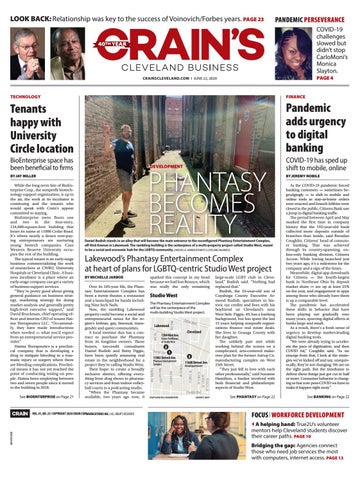
Over its 105-year life, the Phantasy Entertainment Complex has been a movie theater, a restaurant and a launchpad for bands including Nine Inch Nails. Now, the rambling Lakewood property could become a social and entrepreneurial nexus for the region’s lesbian, gay, bisexual, transgender and queer communities. A local investor duo has a contract to purchase the Phantasy from its longtime owners. Those buyers, tax-credit consultants Daniel Budish and Betsy Figgie, have been quietly amassing real estate in the neighborhood for a project they’re calling Studio West. Their hope: to create a broadly inclusive district, offering everything from drag shows to pharmacy services and from indoor volleyball courts to a podcasting studio. “When the Phantasy became available, two years ago now, it
VOL. 41, NO. 23 l COPYRIGHT 2020 CRAIN COMMUNICATIONS INC. l ALL RIGHTS RESERVED
P001_CL_20200622.indd 1
CRAIN’S MAP
Lakewood’s Phantasy Entertainment Complex at heart of plans for LGBTQ-centric Studio West project
Winchester Ave
See BIOENTERPRISE on Page 21
large-scale LGBT club in Cleveland,” Budish said. “Nothing had replaced that.” Budish, the 33-year-old son of Cuyahoga County Executive Armond Budish, specializes in historic tax credits and lives with his boyfriend on Cleveland’s near West Side. Figgie, 49, has a banking background, but has spent the last 15 years helping nonprofit organizations finance real estate deals. She lives in Geauga County with her daughter. The unlikely pair met while working behind the scenes on a complicated, arts-centered makeover plan for the former Astrup Co. manufacturing complex on West 25th Street. “They just fell in love with each other professionally,” said Suzanne Hamilton, a banker involved with both financial and philanthropic aspects of Studio West.
As the COVID-19 pandemic forced banking customers — sometimes begrudgingly — to shift to mobile and online tools as stay-at-home orders were enacted and branch lobbies were closed to the public, Citizens Bank saw a jump in digital banking traffic. The period between April and May marked the first time in company history that the 192-year-old bank collected more deposits outside of branches than inside, said Brendan Coughlin, Citizens’ head of consumer banking. That was achieved through its country-spanning, online-only banking division, Citizens Access. While having launched just two years ago, it’s a milestone for the company and a sign of the times. Meanwhile, digital app downloads for Citizens — the fourth-largest bank in Northeast Ohio by deposit market share — are up at least 25% on the year, and engagement in apps among those who already have them is up a comparable level. The pandemic has accelerated these shifts in behavior that have been playing out gradually over many years, spurring digital efforts at banks large and small. As a result, there’s a fresh sense of urgency to develop market-leading digital banking tools. “We were already trying to accelerate the pace of digitization, and then COVID hit,” Coughlin said. “As we emerge from that, I look at the strategies we’ve kicked off and say, unequivocally, they’re not changing. We are on the right path. But the timeframe to deliver these things just got cut in half or more. Consumer behavior is changing so fast now post-COVID we have to make it happen right away.”
Daniel Budish stands in an alley that will become the main entrance to the reconfigured Phantasy Entertainment Complex, off Hird Avenue in Lakewood. The rambling building is the centerpiece of a multi-property project called Studio West, meant to be a social and economic hub for the LGBTQ community. | MICHELLE JARBOE/CRAIN’S CLEVELAND BUSINESS
Beach Ave
While the long-term fate of BioEnterprise Corp., the nonprofit biotechnology support organization, is up in the air, the work at its incubator is continuing and the tenants who would speak with Crain’s appear committed to staying. BioEnterprise owns floors one and two in the four-story, 134,000-square-foot building that bears its name at 11000 Cedar Road. It’s where nearly a dozen rent-paying entrepreneurs are nurturing young biotech companies. Case Western Reserve University occupies the rest of the building. The typical tenant is an early-stage business commercializing the work of researchers at CWRU, University Hospitals or Cleveland Clinic. A business incubator is a place where an early-stage company can get a variety of business support services. “They’re pretty good about giving general guidance on business strategy, marketing strategy for doing market analysis and generally pretty high-level executive support,” said David Bruckman, chief operating officer and interim CEO of tenant Haima Therapeutics LLC. “Occasionally, they have made introductions when needed — what you’d expect from an entrepreneurial service provider.” Haima Therapeutics is a preclinical company that is developing a drug to mitigate bleeding in a traumatic injury or surgery where there are bleeding complications. Preclinical means it has not yet reached the point of conducting testing on people. Haima been employing between two and seven people since it moved to the building in 2018.
Franklin Blvd MAPS4NEWS.COM/©HERE MAPS4NEWS.COM/©HERE
BY JEREMY NOBILE
W 114th St W 113th Pl W 112th St
PHANTASY BECOMES REALITY
BY JAY MILLER
COVID-19 has sped up shift to mobile, online
FOCUS | WORKFORCE DEVELOPMENT A helping hand: True2U’s volunteer mentors help Cleveland students discover their career paths. PAGE 10 Bridging the gap: Agencies connect those who need job services the most with computers, internet access. PAGE 13
6/19/2020 3:35:31 PM
HEALTH CARE
After pandemic-induced delays, health care deals should speed up BY LYDIA COUTRÉ
CORPORATE LITIGATION SERVICES Apple Growth Partners provides experienced, unbiased economic damage and business valuation services for the corporate litigation process.
Apple Growth Partners @applegrowthpartners AppleGrowthPartners @apple_growth
Contact us today to support your case: applegrowth.com SERVING NORTHEAST OHIO’S PRIVATELY-HELD BUSINESSES
216.674.3800
Ca u l e y Fe r ra r i o f D e t ro i t 7 0 7 0 O rc h a rd L a k e R d. �e � t � l o o m � e l d� � � 4 8 3 2 2 Te l e p h o n e : 2 4 8 . 5 3 8 . 9 6 0 0 w w w. Ca u l e y Fe r ra r i . co m
Class A Office Space for Lease
Park Center Plaza I, II, III 6050 - 6100 - 6150 Oak Tree Blvd Independence, OH
Available Suites from 1,300 to 29,000 SF
COMMERCIAL REAL ESTATE SERVICES LEE CLEVELAND
Abram Schwarz, SIOR | 216.282.2210 | www.leecleveland.com
COVID-19, which rapidly put health care transactions on hold, has exacerbated the conditions for organizations — especially smaller ones — that were seeking a partner due to financial distress or risk. At the same time, the financial fallout of losing revenues from nonessential surgeries and procedures has left larger systems rethinking plans to grow through acquisitions, mergers and other partnerships. “They just don’t necessarily have the financial confidence to move forward,” said Matthew Albers, partner at Vorys, Sater, Seymour and Pease LLP and a member of the health care group with a focus on health care mergers and acquisitions activity. Northeast Ohio saw this play out clearly as Mich.-based Beaumont Health walked away from its plan to bring Summa Health into its system when the two were just days away from finalizing an arrangement both had spent the previous year working on. Throughout that process, Dr. Cliff Deveny, Summa president and CEO, emphasized that the system wasn’t looking for a partner out of desperation. Rather, it hoped to find opportunities for a partner to invest in the system and help it grow, a point he reiterated in late May after the deal fell apart. Though many unknowns remain — especially with the risk of another surge in COVID-19 cases — some predict transactions will return more quickly for smaller organizations that expedite existing plans to secure a partner or begin looking more seriously for one in the hopes of adding economies of scale and a bit of a financial buffer. For-profit entities are also expected to pick up transactions again more quickly. “Now that we’ve lived through the pandemic, how are health systems going to change some of their growth strategies, including partnerships, merger and acquisitions and also capital investments?” wondered Allan Baumgarten, a Minnesota-based health care consultant who studies the Ohio and Michigan markets, among others. He’s working on securing a grant to support his research into answering these questions and expects the range of reactions from health care organizations to be broad. Kate Hickner, partner at Brennan, Manna & Diamond working with the firm’s national health care practice, works in the for-profit health care space primarily with entrepreneurs, private equity and physicians. “For-profit companies tend to be willing to take on more risk and be more nimble than nonprofits, but even in my space during March, things stopped fairly abruptly,” said Hickner, whose work spans the country. Things dramatically picked up for Hickner in the second half of May, al though her workload still hasn’t returned to pre-COVID levels. She’s opened new matters and has been asked to revisit some that were put on hold due to the pandemic. Her current work involves the acquisition of home health agencies, the sale of a medical device company, a pharmaceutical joint venture and the negotiation of physician employment arrangements.
In speaking with health care attorneys from across the U.S., Hickner said she hears from many that they expect deals will pick up eventually, even in the tax-exempt space. “I anticipate that more and more physicians will want the stability of a system and be able to take advantage of economies of scale and have more negotiating leverage and the security of being an employee as opposed to an owner,” she said. “I bet we see more and more desire to sell after this is over.” Albers, who typically works on larger transactions representing large nonprofit health systems and academic medical centers, said that after a wait-and-see approach, discussions have started up again. “I don’t see energy behind consummating a lot of it yet, because the financial impact among systems has been very large,” he said. Institutions will be examining their cash reserves and seeing how well and how quickly they can ramp up outpatient procedures and bring back furloughed staff. “All of those factors have to be put in the mix for determining if and when those kinds of broader, very long forward-looking strategic activities and
“ALL OF THOSE FACTORS HAVE TO BE PUT IN THE MIX FOR DETERMINING IF AND WHEN THOSE KINDS OF BROADER, VERY LONG FORWARD-LOOKING STRATEGIC ACTIVITIES AND TRANSACTIONS WILL OCCUR.” — Matthew Albers, partner at Vorys, Sater, Seymour and Pease LLP
transactions will occur,” Albers said. He added he expects to see some more risk-tolerant market players, such as those in the private equity world, be more aggressive. Nonprofits will perhaps view the preservation of assets to reinvest in their mission and purpose as more important than the expansion or acquisition of an additional footprint, he said. The few organizations that are in a position to be buyers — though there aren’t many — may be able to get additional assets and negotiate lower prices than they otherwise would have, Albers said. It’s a buyer’s market. “To the extent that there are buyers, this is a good time to be one — like it is pretty much in every space,” he said. “If you want to buy a house right now, it’s a great time to buy a house.” One limiting factor could be lender hesitancy to provide access to large pools of capital, given the uncertainty about when health care revenues, reimbursement streams and volumes will return to pre-pandemic levels, he added. With debt financing of transactions potentially more difficult to come by, most larger transactions may have to be on a broader cash basis. “It’s kind of an odd time to figure out whether the long-term payoff is going to be there the way we assume it would,” he said. Now more than ever, health care organizations of various sizes are taking a step back and examining their options. An arrangement or a partnership that a practice may have explored but not focused on previously
may be a more attractive option going forward, said Tom Campanella, director of the health care MBA program at Baldwin Wallace University. “I don’t care if it’s private equity, if it’s venture capital, if it’s the nonprofits side, for-profit entities — all of them are having financial challenges,” he noted. Campanella said he’s optimistic that this upheaval will be beneficial in the long run. COVID-19 could push the health care industry to a better model when it comes to creative partnerships to potentially cut costs and improve the health status of Americans, he said. Deveny said in late May that he was “disappointed” to see Beaumont walk away from the partnership after all of their work to plan integration and gain regulatory approvals. The total amount Summa spent through the process on external partners and the time and effort of hundreds of employees — from SummaCare, shared service, IT and more — totals “in the millions,” he said. Beaumont put the partnership process on hold in late April as the hospitals focused on COVID-19. Since then, it evaluated the partnership and decided it wasn’t the right decision. “This decision was only about whether Summa was the right fit for Beaumont during these extraordinary times,” Beaumont spokesman Mark Geary wrote in an emailed statement. Summa will spend the next three to six months focused on reopening and growth plans — the system is expanding urgent cares, building a new ambulatory center and has a new behavioral health pavilion, he said. After that, Summa’s board will examine where things stand and whether another partner search is the right option. Deveny said, though, that all of the partners and organizations Summa previously interviewed are not the same as they were before the pandemic. As Summa looks at potential partners, it needs to “look outside of the box,” Campanella said. For instance, establishing strategic relationships with a third-party outpatient provider or considering for-profit entities are two options as they evaluate partners from a short-term and longterm perspective, he said. Baumgarten said that even before the pandemic, he was beginning to see health systems look for ways to grow through strategic partnerships rather than adding to operational costs. The pandemic could accelerate that. Just days before officials announced COVID-19 cases in Ohio, Lake Health announced it was exploring the option of a strategic partnership in response to the rapid changes the health care industry was already facing due to consumerism and technology advances. “Lake Health was always going to be careful and deliberate in exploring any potential partnership, and that hasn’t changed with COVID-19,” Lake Health spokesman Dino DiSanto wrote in an emailed statement. For Albers, the uncertainty is the biggest takeaway from this time. “No one really knows how long and in what way the health care industry is going to recover from this and then what the refractory period on that will be,” he said. Lydia Coutré: lcoutre@crain.com, (216) 771-5479, @LydiaCoutre
2 | CRAIN’S CLEVELAND BUSINESS | JUNE 22, 2020
P002_CL_20200622.indd 2
6/19/2020 12:21:07 PM
REAL ESTATE
Suburban office owner sets leasing push for eight buildings BBY STAN BULLARD
The six-story Metropolitan Plaza in Highland Hills and three-story Landerbrook Corporate Center I in Mayfield Heights come to mind as newer buildings in the east suburbs, but the calendar shows that’s not so. The first is from 2000, the second 1997. However, Shelbourne Global Solutions of Brooklyn, N.Y., is about to undertake major improvements to both structures and upgrades to six other buildings it bought in the East Side suburbs in 2015. The New York company also installed a new, four-person leasing team from CBRE’s Cleveland office to lead the charge for filling them up. Shelbourne, which bought the properties for a total of more than $60 million, hopes to seize on a twoor three-year window before more new multitenant office buildings could be constructed in the market — if the post-COVID-19 era permits them — to boost the occupancy of the portfolio. The window opens after new office buildings at Van Aken District and Pinecrest, in Shaker Heights and Orange Village, respectively, had largely leased up since opening their doors more than three years ago. Sandy Monaghan, Shelbourne executive vice president, said the perfor-
Shelbourne Global’s revitalization drive The Brooklyn, N.Y.-based real estate investor has named CBRE to lease eight of its buildings in the east suburbs of Cleveland. The landlord also plans to update elements of the properties. They are: Metropolitan Office Plaza, 22901 Millcreek Blvd., Highland Hills Landerbrook Corporate Center I, 5900 Landerbrook Drive, Mayfield Heights Chagrin Plaza East, 23611 Chagrin Blvd., Beachwood Chagrin Plaza, 23711 Chagrin Blvd., Beachwood A series of video display screens will be installed in the Metropolitan Office Plaza’s three-story atrium as part of a planned update. | CONTRIBUTED RENDERING
mance of the new buildings shows tenants have an appetite for newer space and are willing to pay more for it. “We’re also hoping that suburban offices may gain after COVID-19 because properties such as these are near prime residential areas where people may want to work from home a few days and in the office a few days,” Monaghan said, “or companies want to have a large central office and a network of smaller ones in different areas.” Updates at Metropolitan, originally constructed as a bank headquarters that also offered rental offices, include adding a “technology screen” or bank of TVs to enliven its three-sto-
Chagrin Plaza West, 23811 Chagrin Blvd., Beachwood One Corporate Exhange, 25825 Science Park Drive, Beachwood One Chagrin Highlands, 2000 Auburn Drive, Beachwood Two Chagrin Highlands, 3000 Auburn Drive, Beachwood
ry atrium; addition of softer, contemporary floor coverings; and furniture for staffers to work outside the office. At Landerbrook I, an empty office suite on the first floor has been gutted, according to Andrew Coleman, a CBRE first vice president who is part of the brokerage team that recently snagged the Shelbourne assignment. Such a demolition is expensive. It also limits prospective tenants to those who want to invest in totally new offices rather than seek a discounted lease on existing office
space. The lobby at Landerbrook I will also be updated with contemporary finishes. “We’ve taken out the old private offices,” Coleman said. “Now you can see the window lines and get a better idea what the space can provide.” Hallways are also getting updates to carpeting and wall coverings to give the structure a fresher feel, and similar steps including new lighting systems are afoot in the properties. Metropolitan and Landerbrook I are in line for the bigger investments
because they stand to have, or already have, large vacancies. At Metropolitan, a full-floor suite leased by Nationwide Mutual Insurance Co. of Columbus will go back to the landlord because the insurer’s lease will expire and it has already vacated it. That is more than 30,000 square feet, and Landerbrook I has more than 18,000 square feet of empty space. The two spaces also account for more than half of the available spec in Shelbourne’s portfolio here, which is 83% leased. That 17% vacancy rate is higher than the 13% vacancy rate in the east suburbs, according to Newmark Knight Frank’s most recent office survey. CBRE recently launched its campaign to lease the space by emailing flyers about the buildings that said, “Let us reintroduce you.” Coleman said the marketing effort will include photos of the properties taken by drones and CBRE will use its own proprietary design software to help prospective tenants envision their space. Stan Bullard: sbullard@crain.com, (216) 771-5228, @CrainRltywriter
Correction
``A June 15 profile of 20 in Their 20s honoree Ogechukwu “Oge” Anoliefo, an associate at Jones Lang LaSalle, misspelled his last name. It also misstated a word in a quotation that changed the meaning of the comment. The corrected quote reads as follows: “Cleveland is one of the most segregated cities in this country and, naturally with that, some people will not have the same opportunities immediately available to them. Even intraracially, the experiences of the Black community are wide and vast. The privilege and access that I have been afforded during my life is not commonplace for people who look like me.”
Community First Since 1935 We are proud to support the banking needs of Northeast Ohio businesses. Our commitment to our community defines who we are, and who we will always be.
“Tom Young and the professionals at First Federal Lakewood overcame the odds to get B&B Wrecking B&B Excavating, Inc. through the [PPP] application process. . . . It’s great to be working with a bank that understands our needs and the urgency of the situation.” - Nikolaus Flippi, B&B Wrecking
Let our team help yours thrive. Contact Kurt Kappa at (216) 529-2998 or kkappa@ffl.net
June 22, 2020 | CRAIN’S CLEVELAND BUSINESS | 3
P003_CL_20200622.indd 3
6/19/2020 12:24:38 PM
COPING WITH COVID-19 | SMALL BUSINESS PANDEMIC PERSEVERANCE
Salon and hair care product line suffered during Ohio’s shutdown “I DON’T FEEL AS A SMALLBUSINESS OWNER THAT WE WERE CONSIDERED FIRST.”
BY RACHEL ABBEY MCCAFFERTY
YOUR LOCAL CREDIT UNION
RUNS LIKE CLOCKWORK FOR YOUR COMMERCIAL REAL ESTATE INVESTMENTS STILL STRONG. STILL LENDING COMMERCIAL REAL ESTATE INTEREST RATES AT ALL TIME LOWS. Loans up to $10 Million • No Prepayment Penalties As Little as 10% Down Contact Jonathan A. Mokri 440.526.8700 • jmokri@cbscuso.com www.cbscuso.com Your Business Lending Partner SM
ENHANCE YOUR ASSET’S VALUE
BROKERAGE CORPORATE SERVICES AUCTIONS PROPERTY MANAGEMENT APPRAISAL AND CONSULTING RESEARCH 216.861.7200 | HANNACRE.COM
Commercial Roofing Experts
INSTALLED BETTER TO LAST LONGER
PVC Roofing • TPO Roofing Metal Roofing • Roof Repairs Replacements
About four years ago, Monica Slayton launched her own hair care products line. She’s worked hard to make her career goals a reality over the years. In 2010, Slayton bought the building in Akron where her salon, Monicarlos Hair Creations, resides. Then came the launch of CarloMoni Hair Care Products, the culmination of a longtime dream. “I just wanted to have something that was mine, something I could leave to my daughter,” Slayton said. She added she’d like to transition from being a stylist to working on the hair care products line full-time. But the pandemic has complicated that plan. Slayton said COVID-19 gave her a “new appreciation” for her business, because it was taken away so suddenly. She’s been running her own salon for more than 20 years, and the government-mandated shutdown was the first time she’s been away from work for more than a week at a time. “It went from I was doing decent to nothing,” she said. And her hair care product sales dried up, too. Prior to the pandemic, she was selling the products in her salon and online, and she was attending trade shows to promote the line. Ultimately, she’d like to get the products onto the shelves of big-box retailers such as Sephora and Ulta Beauty. But her salon was where she still sold much of the line, so that closure hurt the company, and online sales slowed dramatically during the stay-at-home order. Hair care, at a time when everyone is stuck in their homes, apparently wasn’t top of mind for customers. Small businesses like hers are the backbone of a community, and Slayton said she would have liked to see more financial support from the government during the shutdown. The support wasn’t in place prior to the pandemic, but she said she
— Monica Slayton, owner of the Monicarlos Hair Creations salon and founder and owner of CarloMoni Hair Care Products
would hope it would be if something like this happens again. “I don’t feel as a small-business owner that we were considered first,” Slayton said. Business has started to pick up as salons and other businesses have been allowed to reopen, but Slayton said it’s slow going. She opened a week after salons were allowed, using that additional time to prepare her shop. “It was a lot of work,” she said. Right now, Slayton is only seeing a few clients a day. She’s one of three stylists at her salon, and she lets everyone serve just one client at a time. In the past, she might have been working on three clients at once with the help of an assistant, shampooing one client’s hair while another’s was setting. That’s not the only new safety measure in place. She also has removed her waiting area and installed a sanitizing station at the door, as well as plastic dividers in the salon. She’s taking the usual in-between-customer cleaning up a level, sanitizing everything a customer touches after they leave, and she requires masks. Plus, she’s using more disposable, single-use products like shampoo capes. It’s more
expensive, she said, but she wants to keep her clients, her stylists — which include her daughter — and herself safe. “Basically, I’m just trusting that everything is going to be OK and trying to just be open-minded about what’s next,” Slayton said. Ultimately, Slayton hopes that she’ll see more support for her hair care products to make up for the lessened revenue coming in from clients. And she still has her eyes on the future. Through CarloMoni, Slayton sells a hair freshener she developed with the help of a local chemist. Clients who wear braids or extensions shouldn’t use shampoo every day, but may want a way to eliminate food or smoke scents in between. “I knew what I wanted it to do, and I think we went through about 12 prototypes before it was right,” she said. Slayton also sells hair and beard oils through CarloMoni, and is in the process of testing additional products such as shampoo, conditioner and growth serum to add to the line. Rachel Abbey McCafferty: (216) 7715379, rmccafferty@crain.com
“CEFA, just like
Beachwood,
wants to help you succeed.”
FULLY INSURED & BONDED
dcaroofing.com • (330) 988-2379
Mayor Martin S. Horwitz •Mayor@BeachwoodOhio.com •216.292.1901
WWW.BEACHWOODOHIO.COM
4 | CRAIN’S CLEVELAND BUSINESS | JUNE 22, 2020
P004_CL_20200622.indd 4
6/19/2020 12:26:50 PM
We’re here for your small business. Because you’re here for all of us.
EXCLUSIVE OFFER FOR NEW CUSTOMERS
1 MONTH OF SERVICE FREE^ NO CONTRACTS OFFER EXPIRES 08/31/20
200 Mbps Internet
Reliable Phone
Business TV
It’s more important than ever to have a provider you can count on. That’s why we’re supporting small businesses with the best solutions at the best value. Plus, we’re now offering one month of service FREE.^
The Best Service & the Best Value for Your Business
Call 1-866-446-0311
Or visit Business.Spectrum.com ^Offer expires 8/31/20; subject to change. Must not have subscribed to applicable services w/ in the last 30 days & have no outstanding obligation to Charter. Free mo. offer will be applied as a credit by the 2nd mo. statement. Standard installation, taxes, fees, equipment, and broadcast surcharge included. Excludes usage charges & Spectrum Mobile. Internet speed may not be avail. in all areas. Actual speeds may vary. Speed based on download speed on wired connection. Wireless Internet speeds may vary. Standard pricing applies after promo. period and may include taxes, fees and equipment charges. Services subject to all applicable service terms & conditions, which are subject to change. Services & promo. offers not avail. in all areas. Restrictions apply. Call for details. © 2020 Charter Communications, Inc.
GOVERNMENT
County council pushes for more diverse split of $30M project BY KIM PALMER
The two issues dominating the national dialogue — COVID-19 safety and racial equity — collided at a Cuyahoga County Council meeting on June 3 when the county’s Department of Public Works proposed $30 million in spending for pandemic-related building modifications and council members pushed back on the lack of minority-owned businesses selected to fulfill that contract. Public works director Mike Devers stressed the need to move quickly on the use of federal Coronavirus Aid, Relief and Economic Security (CARES) Act dollars as the county is poised to resume in-person services halted by Ohio Department of Health orders. Devers said he’s concerned that if the $215 million distributed to Cuyahoga County is not spent by the end of 2020, which is a requirement of the federal government, or if the increased demand for these services and supplies makes it harder to secure contracts, general funds will have to be used to make the COVID-19 modifications. “About eight weeks ago, I approached the county executive and said that we need to be looking at this in the long term and address the buildings so that they are safe for those working in the building and the general public,” Devers said. Some buildings require extensive HVAC system upgrades in order to provide cleaner, less recirculated air, while all county-run buildings need
lesser modifications such as installation of automated doors, faucets, light switches and Plexiglas barriers. Public works was given the go-ahead, a request for proposal (RFP) was issued, proposals were reviewed and scored (more about that later) and six contractors, including one minority business enterprise (MBE), were selected to be on call to perform up to $5 million worth of work on a rotating basis. “We had 19 responses to the RFP, which is somewhat unheard of in any project that I have worked on in the last 10 years for the county,” Devers said. Among the six firms selected are such familiar names as Turner Construction Co., Whiting-Turner Contracting Co., Geis Construction Inc., Gilbane Building Co. and Albert M. Higley Co. When the project came before the Public Works Procurement & Contracting Committee, Councilwoman Shontel Brown, not a member of that committee, was less focused on how the $30 million was being spent and more on who was getting paid and how those decisions are made. “We are in the midst of having discussions about racism as a public health crisis,” she said. “It seemed like the perfect opportunity to address the issue by putting our money where our mouth is.” Brown’s concerns, set against the backdrop of protests in response to the death of George Floyd at the hands of police in Minneapolis and a growing list of proclamations declaring racism a public health crisis, afford the county a
prime opportunity to make real changes that go “beyond conversations,” she said. “This particular contract did not require any bidding, but they were careful to go through a scoring mechanism, but that still leans more favorably to the larger companies because of the systemic and institutional advantages they have over black-owned
“IT SEEMED LIKE THE PERFECT OPPORTUNITY TO ADDRESS THE ISSUE BY PUTTING OUR MONEY WHERE OUR MOUTH IS.” — Shontel Brown, Cuyahoga County councilwoman
companies,” Brown said. The reality, she added, is that wihen it comes to government contracts, project size can be an impediment to contracting smaller businesses since previous governmental experience weighs heavily in the scoring process. Cuyahoga County uses a scoring system that prioritizes vendor and staff qualifications (60 points) more than the geographic location of the firm (five points). A 2016 report from the U.S. Department of Commerce’s Minority Business Development Agency shows that substantial disparities exist between minority and nonminority firms despite federal mandates that 23% of project dollars go to small businesses and 5% be awarded to MBEs specifically. The MBE designation, created in 1972 by the National Minority Supplier Development Council, was designed to
mitigate systemic racial barriers faced by minority business owners by certifying MBEs be at least 51% minority owned, operated and controlled. Another barrier for MBEs is access to capital, which affects their ability to put up bonds and insurance, which for the county project was estimated to be $5 million per company. Brown said she thinks that even focusing on “local firms” rather than large global companies with “experience” might be enough to move the needle toward minority owners. “I like to see the scoring mechanism be more favorable to companies based in Cuyahoga County. With that large net, we could catch more black-owned businesses,” she said. “Introducing a binary component when scoring of ‘Yes, they are qualified’ or ‘No, they are not’ instead of weighting the experience so heavily could level the playing field.” Norm Edwards, president of the American Center for Economic Equality and Black Contractors Association, said he believes the main problem is a reliance on having multibillion-dollar companies, like Turner and Gilbane, fulfill the 30% minority mandate by subcontracting rather than by awarding smaller contracts directly to MBEs. Although work on elevators or HVAC systems is mainly done by a handful of specialty companies, Edwards noted, the bulk of the work the county needs consisted of putting up barriers or installing doors and walls, affixing distancing decals and so on. That work could easily accomplished
by local MBE contractors, he added. “In order for these smaller MBEs to grow you have to give them an opportunity to get this work,” Edwards said. “It is time for a reality check, and it is time for diversity and inclusion.” Brown’s comments were supported by other council members, including Yvonne Conwell, who signaled she would not vote the issue out of committee without substantial changes. That prompted the public works department to re-evaluate the contract. On June 8, Devers presented a modified contract for $15 million of the CARES funds, with a second round of $15 million pending following more inclusion and diversity conversations. The pool of companies eligible for work on the project expanded from six to eight, including two certified MBE prime contractors, up from one. Also, the split is $1.87 million, so firms are required to have a bond of $500,000, not $5 million, and prime contractors must pay prevailing wages and comply with a 30% diversity goal. “Those councilpeople took a stand and they questioned and made a change,” Edwards said. He pointed out that there are many more county-funded projects, such as the Justice Center and new police headquarters, waiting in the wings, and he wants to see more MBEs on the front lines. “This set a precedent about what council can agree to do,” he said. Kim Palmer: kpalmer@crain.com, (216) 771-5384, @kimfouroffive
PREMIUM BEACHWOOD OFFICE SPACE AVAILABLE Maximum Visibility and Recognition Enterprise Place 3401 Enterprise Parkway | Beachwood, OH 44122 Maximize your business potential with an office at Enterprise Place, the most recognizable Class A office building in Beachwood. Strategically located at the intersection of I-271 and Chagrin Blvd. with prime visibility, Enterprise Place is ideal for both established and growing businesses.
CALL TODAY! 216.910.9317
• Building signage for anchor tenant with visibility from I-271 (average traffic count of 125,000 cars per day) • Contiguous space available from 6,700rsf to 20,171rsf • 10 private, 900 square foot rooftop terraces for tenant use • Three (3) new high-speed electric passenger elevators • Full 5th floor available • 24-hour keycard access • Conference room with WiFi • Ample free surface parking • Heated indoor parking • Full-time on-site maintenance staff • Walkability to shopping and dining • Café and outdoor picnic areas • Owner-managed Dennis Bush Vice President, Director of Commercial Real Estate GoldbergCompanies.com | 216.831.6100
dbush@goldbergcompanies.com
6 | CRAIN’S CLEVELAND BUSINESS | JUNE 22, 2020
P006_CL_20200622.indd 6
6/19/2020 12:29:08 PM
SPORTS BUSINESS
The Chones kids have also made their mark in hoops
Former Cavs center’s daughters have extensive NBA experience and one of his sons is a G League coach BY KEVIN KLEPS
Jim Chones remembers sitting in his car, stationed in the driveway of his former Pepper Pike residence, and listening to music. There, the former Cleveland Cavaliers center would watch his daughter Kaayla, a budding basketball star, battle his triplet sons, Kameron, Kendall and Kyle, in hoops. “My dad was out there refereeing so we wouldn’t kill each other, but a lot of stuff he was letting go,” said Kaayla, who went on to be a standout at North Carolina State University and was the 15th overall selection in the 2004 WNBA draft. Kendall Chones, now an assistant coach for the Canton Charge of the NBA G League, said the triplets “didn’t see a lot of victories” against their older sister. “Kaayla was probably around 6-2 or 6-3 in eighth grade,” said Kendall, who, like Kaayla, went on to have a successful professional career overseas. “Physically, it was no match. She would beat us handily.” Kareeda Chones Aguam, the oldest of the five Chones siblings, missed most of those battles because she was playing basketball at Marquette University, her father’s alma mater. Chones Aguam, at 43 the “mother hen” of the group, might have been the most unlikely of the group to play NCAA Division I basketball because she didn’t start playing the sport until she was in high school. Volleyball was her first love, but she took up hoops once her dad convinced her she could land a scholarship. Within an eight-year span, all five
triplets, then in middle school, to practice against Kaayla’s high school teams. “My wife ingrained in them the discipline that whatever you do, do it well,” Chones said.
‘We’re just in it’
From left are Kameron Chones, Kareeda Chones Aguam, Kyle, Elores, Jim, Kaayla and Kendall Chones. | CONTRIBUTED PHOTO
“DAD WOULD ALWAYS SAY, ‘YOU HAVE TO WORK TO GET TO WHERE WE ARE NOW, AND YOU GOTTA CONTINUE THAT. IT’S NOT JUST GOING TO BE GIVEN TO YOU GUYS,’ ” CHONES AGUAM SAID. “SO WE ALWAYS TOOK THAT TO HEART: NEVER TO TAKE ANYTHING FOR GRANTED.” — Kareeda Chones Aguam
Chones kids became D-I signees. Kaayla, now 39, went to N.C. State after sharing Ms. Basketball honors in 1999, her last year at Eastlake North High School. Kendall and Kyle earned scholarships at Colgate University, and Kameron played for a year at Brown University. The 36year-old triplets were standouts at Orange High School in Pepper Pike. Jim Chones, an analyst on the Cavs’ radio broadcasts, has been told that six Division I athletes from the same family, a tally that includes his excellent career at Marquette, is a record. He said the credit goes to his wife, Elores, who used to drive the
After graduating from Marquette in 1998, Chones Aguam was hired by the Milwaukee Bucks as the club’s senior director of corporate partnership activations. In addition to following in her dad’s college footsteps, Chones Aguam has displayed broadcasting chops, formerly serving as a TV and radio analyst, as well as hosting a coach’s show, for Marquette women’s basketball. She also does voiceover work. But it’s been the NBA where she’s made her mark. In 2015, the Bucks promoted her to vice president of business strategy and activation. Chones Aguam said her parents would always stress that nothing would come easy and their last name guaranteed them nothing. “Dad would always say, ‘You have to work to get to where we are now, and you gotta continue that. It’s not just going to be given to you guys,’ ” Chones Aguam said. “So we always took that to heart: never to take anything for granted.” Kaayla, who played three seasons in the WNBA and another eight years for international teams in five countries, always remembered that advice. When her playing career ended, she was also NBA bound, via a job as the Minnesota Timberwolves’ direc-
tor of player programs. Chones spent six years assisting players with personal, professional and social development before falling victim to an organizational shakeup after the Timberwolves in 2019 named a new top basketball executive for the fifth time in six years. Her time out of basketball was brief, however. In April, Chones was named the sports marketing manager for Puma Basketball. Among her duties will be working with the three WNBA players Puma represents. “With my dad having played and all his friends and teammates, yeah, we’re just in it. This whole idea of working in sports, it’s almost like, we should be,” the youngest of the Chones girls said.
They’ve ‘worked for this’ Following a productive career at Colgate, Kendall Chones’ basketball life took him to Germany, Israel and Finland. His nine-year pro career only came to halt because he thought it was finally time to return home. The chance to be the youth basketball development manager for the Cavs, with whom his dad had the best years of his NBA career, was too good to pass up. Last October, Chones, who had done some coaching in Germany, became an assistant for the Charge. It’s the initial step in what he hopes will one day lead to the head seat on an NBA bench. See CHONES on Page 23
WEBCAST SERIES
COMMERCIAL REAL ESTATE
the best in local banking has a
OUTLOOK
Join Crain’s Cleveland Business to learn about the coronavirus pandemic’s impact on commercial real estate in Northeast Ohio.
FREE LIVE WEBCAST
Aug. 4 | 10 A.M.
new name. Together, we formed Premier Bank. You’ll enjoy more products, enhanced services — and the same great banking relationships.
yourpremierbank.com
Register Today: CrainsCleveland.com/Webcasts 1-877-367-8178
Interested in sponsoring this webcast? Contact Scott Carlson at scott.carlson@crain.com. JUNE 22, 2020 | CRAIN’S CLEVELAND BUSINESS | 7
P007_CL_20200622.indd 7
6/19/2020 1:43:51 PM
PERSONAL VIEW
Prosperity for all: Honoring the legacy of Juneteenth
RICH WILLIAMS FOR CRAIN’S CLEVELAND BUSINESS
BBY JADE D. DAVIS
EDITORIAL
Fair’s fair T
he U.S. Supreme Court last week delivered a strong message for equality in ruling that federal civil rights law prohibits employers from discriminating against gay and transgender workers. Now it’s time — well past time, actually — for Ohio to do its part by passing the Ohio Fairness Act, which would provide important state-level workplace protections for LGBTQ citizens as well as protections in housing and public accommodations. First and foremost, the Supreme Court’s decision represents a victory for decency in its acknowledgment that LGBTQ workers should have equal treatment under the law with respect to their lives in the workplace. As an economic matter, it goes a long way toward unlocking the full potential of all members of the workforce, as it means LGBTQ workers can move more freely between companies, or within them, with less fear of being fired. Eliminating forms of discrimination makes it more likely people can flourish at their job, or find a better one, and over time that should lead to a healthier economy. Ohio can do more to make itself an equitable and attractive place for LGBTQ citizens to live and work. The Ohio OHIO CAN DO MORE Fairness Act has been deTO MAKE ITSELF AN bated in various forms for years. It currently exists as EQUITABLE AND Senate Bill 11, sponsored by ATTRACTIVE PLACE FOR Sen. Nickie Antonio, a Democrat who LGBTQ CITIZENS TO LIVE Lakewood is the state’s only openly AND WORK. gay lawmaker, and House Bill 369, co-sponsored by another Lakewood Democrat, Rep. Michael Skindell. Antonio last week told Cleveland.com that her bill would allow gay and transgender people to file complaints through the Ohio Civil Rights Commission when they’ve experienced discrimination, providing faster resolution than lawsuits. Skindell noted the federal Civil Rights Act applies only to workplaces with 15 or more employees, and since Ohio civil rights law covers employers with five or more workers, state-level action could curb discrimination in smaller workplaces. The bills’ extension of protections to public accom-
modations and housing is critical, too, since if you’re secure from discrimination at work but not in your housing situation, the productivity benefits of a just society aren’t fully possible. Business groups long have supported the Ohio Fairness Act. They recognize that as the state’s economy modernizes, the ability to recruit and retain talent is critical — and Ohio has fallen short in that regard. Movement to creating true equality in the workplace will help. The economy one day will be back to normal, and Ohio should make sure it’s prepared to allow everyone’s talent to be used to the fullest extent.
New era J
oe Roman, the only person to hold the title of president and CEO of the Greater Cleveland Partnership since the economic development advocate was formed in 2004 from the merger of a half-dozen organizations, is moving on from the job, with a retirement set for April 2021. Northeast Ohio’s economy is far from perfect, but by the standard of whether you’re leaving the place in better condition than you found it, Roman’s run at GCP has been a success, with the region in far stronger structural shape now — pandemic-driven setbacks aside — than it was 16 years ago. The top job at GCP is a position of great influence in regional economic policy, certainly. It’s also a strong symbol that sends a message about what kind of a place Northeast Ohio wants to be. Directors of GCP plan to conduct a nationwide search for a replacement, and we encourage them to place a high value on diversity, for the good of the organization and to set an example for future leadership. Another Northeast Ohio leader who started his position in 2004 — Brad Whitehead of the Fund for Our Economic Future — last November announced he would step down as head of the funder alliance and in doing so noted, “We are falling short of our potential as a region in part because we are not allowing sufficient space for generational leadership. We will benefit from fresh perspectives, fresh ideas, fresh culture.” GCP should keep that in mind as it looks to the future.
Publisher and Editor: Elizabeth McIntyre (emcintyre@crain.com) Managing Editor: Scott Suttell (ssuttell@crain.com) Contact Crain’s: 216-522-1383 Read Crain’s online: crainscleveland.com
The diversity of our people — in culture, industry and interests — is what makes our city, the Great Lakes region and, moreover, our country truly great. Our mission at the Port of Cleveland is to spur job creation and economic vitality in Cuyahoga County, building a prosperous future. With that in mind, the Port celebrates Juneteenth (June 19) not as a political statement, but rather as a Davis is vice sincere celebration of freedom and the president of subsequent journey of the African external affairs American community. for the For those unfamiliar with June- Clevelandteenth, it honors the date when slaves Cuyahoga in Texas were informed of both their County Port freedom and the end of the Civil War. Authority (Port Slaves in Confederate states of rebel- of Cleveland). lion originally were freed by the Emancipation Proclamation, which took effect Jan. 1, 1863. But it was not until Union Gen. Gordon Granger read Field Order No. 3 in Galveston, Texas, on June 19, 1865 that the last slave communities in rebellion states were informed of their newfound freedom. Thus, Juneteenth became Freedom Day within African American communities throughout America. In 2020, as our nation reckons with the ongoing burdens that systemic racism FOR THOSE has placed on Black people in UNFAMILIAR WITH America, celebrating Juneteenth and what it stands for JUNETEENTH, IT is more important than ever. HONORS THE DATE My perspectives on this issue were shaped as I was WHEN SLAVES IN TEXAS raised in a working-class Afri- WERE INFORMED OF can American family in CleveBOTH THEIR FREEDOM land’s Buckeye neighborhood. My parents were incredible AND THE END OF THE role models and sacrificed so CIVIL WAR. our family could have a better life. They were steadfast supporters of my education and pushed for me to achieve. But they also were open, frank and honest about how racism, and its historical weight, would be a constant presence and challenge in my life. As a husband and father now raising my own family, and as someone who has achieved education, titles and success that my ancestors were denied, despite my success, I sadly find that those same lessons my parents taught me 30 years ago are ones that I must still pass on to my own children today. But the recent swell of public engagement on systemic racism and its effects gives me hope for a better future. I am also fortunate to work for an institution that is focused on the prosperity for all within Northeast Ohio. The Port of Cleveland is at the forefront of Cleveland’s economic well-being through its work in maritime, trade, logistics, public finance and environmental efforts. But as a major institution in a racially majority-minority city, the Port’s board of directors and leadership team have a clearly stated, long-standing focus on addressing the results of systemic racism deeply rooted in socioeconomic disparities, education inequalities, public health disparities and structural career barriers. Simply put, the Port believes that our entire community’s well-being must be at the forefront of our decision-making for us to achieve our mission. See JUNETEENTH on Page 21
Write us: Crain’s welcomes responses from readers. Letters should be as brief as possible and may be edited. Send letters to Crain’s Cleveland Business, 700 West St. Clair Ave., Suite 310, Cleveland, OH 44113, or by emailing ClevEdit@crain.com. Please include your complete name and city from which you are writing, and a telephone number for fact-checking purposes.
Sound off: Send a Personal View for the opinion page to emcintyre@crain.com. Please include a telephone number for verification purposes.
8 | CRAIN’S CLEVELAND BUSINESS | June 22, 2020
P008_CL_20200622.indd 8
6/19/2020 2:14:34 PM
OPINION
PERSONAL VIEW
Manufacturing executives must act now to accelerate recruiting efforts BY MELISSA KOSKI CARNEY
It is likely that no one knows better than manufacturing executives that there were 509,000 open manufacturing jobs in the United States as reported in May 2019. Two months later, the National Association of Manufacturers and Manufacturing Institute created and signed a “Pledge to America’s Workers” whereby manufacturing leaders committed to provide training opportunities to 1,186,000 manufacturing workers over the next five years to address the industry’s skills gap crisis. And just a few months later, in Ohio alone, manufacturing jobs increased by 1,100 from November to December 2019. The lack of a future workforce was a common topic keeping executives up at night. The world cannot wait five years to train workers to address a skills gap. Yes, there is a greater health economic crisis today to address compared to the manufacturing skills gap crisis that was a predominant concern just a few months ago. And Ohio manufacturers are reinventing themselves to help fight this crisis. Although executives’ attention is elsewhere, they must not lose sight of long-term workforce needs. Recovery will happen, but the pace will be influenced by the available workforce — skilled or not — to move the economy forward. There is no greater opportunity than today — right now — for owners, chief executives, presidents and other executives to encourage their organizations to think differently about how it engages its workforce of tomorrow. Unemployment is at its highest levels since the Great Depression, which means there is a massive pool of candidates. Are these individuals ready to start tomorrow? No. Are they traditionally skilled? No. Might they be interested in a new career in an “essential” industry after enduring these trying times? Yes. Are minds open to learning new skills? Recent data from Google/YouTube seem to indicate the answer is yes.
Searching for new skills
educating and nurturing interest from potential candidates. For example, the organization can leverage a similar acquisition strategy (and technologies and tactics) for potential employees as it does with potential customers by considering these steps: 1. SEGMENT AND PERSONALIZE: Understand the potential employee journey just as there is a customer journey. A typical B2B purchase takes anywhere from 12 to 24 months to complete. A career change may be just as long — if not longer. Executives should endorse a robust segmentation strategy to allow for personalized communications accordingly. Just because someone visited the careers section of your website does not mean they are ready for an interview. The workgroup can set up mechanisms for potential candidates to progressively profile themselves so the business can engage with them appropriately based on their preferences.
Throughout Northeast Ohio
www.naipvc.com Akron 330.535.2661 Cleveland 216.831.3310 Medina 330.239.0176
Carney is vice president and Cleveland managing director for Fahlgren Mortine.
Providing a private travel experience that exceeds expectations.
2. LEVERAGE MARKETING AUTOMATION TECHNOLOGY: Chances are high that your marketing team is using or has considered deployment of a marketing automation tool. Maximize this investment by combining the effort with recruiting and applying the logic to candidate attraction and education. Use the technology to nurture interest, track engagement, participate at the right time in the right way (as defined by the candidate), and learn and optimize.
THERE IS NO GREATER OPPORTUNITY THAN TODAY — RIGHT NOW — FOR OWNERS, CHIEF EXECUTIVES, PRESIDENTS AND OTHER EXECUTIVES TO ENCOURAGE THEIR ORGANIZATIONS TO THINK DIFFERENTLY ABOUT HOW IT ENGAGES ITS WORKFORCE OF TOMORROW.
Ashley Wiers, video marketing contributor at Google, notes in an article, “… with daily commutes, social gatherings, and sporting events on hold, people are devoting their time at home to personal projects and skill development. For many, these pursuits are brand new. We’ve seen global watch time of how-to videos containing ‘for beginners’ or ‘step by step’ in the title increase more than 65% year over year.” The same article reveals that Google searches for online courses grew by more than 70% globally between the last week of March and the first week of April. So, what actions can be taken? The nonprofit Manufacturing Skill Standards Council (MSSC) on June 1 released a certified production technician 4.0 certification. It touts the ability to train and earn certifications from home. Industry associations can accelerate awareness and recruitment efforts with the creation of content and templates. They can take the lead on a statewide/regional/national campaign to provide increased understanding of opportunities in the segment, and in doing so enhance the likelihood of conversion from recruitment initiatives that individual companies may deploy. Equipped with these resources and wind in the proverbial sail, manufacturing executives can encourage increased collaboration among human resources, recruiting, marketing and communications teams. Although typically operating in their own workstreams, these departments and individuals can collectively deliver a sophisticated approach to attracting, informing,
Commercial Real Estate Construction Services Property Management Facility Management
3. TARGET STRATEGICALLY: Just as everyone isn’t a potential customer, neither is everyone a potential employee. Consider focusing investment to specific geographic areas through geofencing paid search and mobile ad campaigns. And deploying a retargeting campaign to those who already visited your website (and therefore showed interest) can keep your company top of mind.
HOW TO FLY WITH SKY QUEST: » On-Demand Charter » Jet Card Memberships » Aircraft Ownership Opportunities
F ly Sk y Q u est. c o m 21 6 - 36 2- 9 9 0 4 Char ter@FlySkyQuest.com
4. GO VIRTUAL: Potential customers aren’t traveling to trade shows. Potential employees aren’t going to career fairs. One approach may be the creation of a virtual career fair available on demand. Utilize existing materials from the traditional in-person experience to populate the online experience. Integrate live chat and gamification where it makes sense for your business. In doing so, you’re creating an experience reflecting an organization with an eye on innovation. 5. CREATE VIDEO CONTENT: The previously shared Google data offers insight that videos with certain titles are performing well. Although the topics may be for more personal interests, there is no reason why manufacturers could not be creating similar video content. Intersect the interest in developing new skills. Capture interest in relatable ways and then nurture mindset to introduce the benefits of a manufacturing career. Executives should actively participate in these videos. These are just a handful of considerations that require the support (if not a mandate) from business leaders to address the workforce challenge. This crisis will still be an issue well past COVID-19. As with any company initiative, a recruitment initiative must be authentic to the organization and its unique value proposition. And it must start now. There is truly no time like the present to secure the future workforce and position your company for recovery and growth.
HISTORICAL CHARM. NATURAL BEAUTY.
HISTORICAL CHARM. Extraordinary Living NATURAL BEAUTY.
Extraordinary Living Outperform your dreams.
Beaufort, South Carolina’s hidden gem: Golf, tennis, boating, home!
(843) 838-3838
Hilton Head Monthly:
“TOP 25 GOLF COMMUNITY”
Learn more at Dataw.com JUNE 22, 2020 | CRAIN’S CLEVELAND BUSINESS | 9
P009_CL_20200622.indd 9
6/18/2020 4:39:10 PM
BRIDGING THE GAP Those who need job services the most often lack computers or internet access PAGE 13
WORKFORCE DEVELOPMENT
PHOTOGRAPHS BY MCKINLEY WILEY/CMSD
RAISING A HELPING HAND
At a True2U event, recording artist and inspirational speaker Dee-1 encourages students at CMSD’s East Professional Center to make the most of their high school experience and stay true to themselves.
True2U’s volunteer mentors explore Cleveland students’ strengths, opportunities, while helping them discover their career path BY PARIS WOLFE
When Angelina Calderon, 16, of Cleveland, was in eighth grade at Clark Elementary School, she was part of the Cleveland Metropolitan School District (CMSD) True2U volunteer mentoring program, a collaboration involving the district and the Neighborhood Leadership Institute, Cleveland Foundation, Greater Cleveland Partnership and the Greater Cleveland Faith-based Initiative Group. One Thursday every month for seven months, she joined a group of peers to learn more from professional mentors about choosing a career path.
In the CMSD, students can start on their career paths as early as ninth grade, when they choose one of the district’s 30-plus specialized high schools. At Cleveland School of the Arts, for example, students experience the arts in their daily curriculum. John Marshall School of Engineering puts a science and engineering focus into the classroom. Angelina, like most eighth-graders, was unsure what she wanted to do when she grew up. True2U helped her explore her interests and strengths, then consider her high school and career options. Students attend the 2019 True2U Summer Leadership Academy at Cleveland State.
See TRUE2U on Page 14
10 | CRAIN’S CLEVELAND BUSINESS | JUNE 22, 2020
P010_CL_20200622.indd 10
6/18/2020 4:41:51 PM
Sometimes we have to do more. This time, a lot more. Sometimes the urgency of a better future compels you to act. We are in such a moment, when a global pandemic, a cry for racial justice and a feeling of hopelessness challenge each community. In the face of this, Bank of America has committed to investing $1 billion over the next four years to build on our long-standing work to drive economic opportunity and equality in communities of color. It will power small businesses, help connect workers to new skills and job opportunities, improve medical response capacity and access to health care, and support affordable housing. This bolsters our recent commitment of an additional $100 million to support nonprofit partners and $250 million to support Community Development Financial and Minority Depository Institutions, addressing impacts from the coronavirus that disproportionately affect black and brown communities. My teammates and I here in Ohio commit to the important work that lies before all of us. We share the sense of urgency gripping the nation, and we welcome the promise of achieving great things together.
Jeneen Marziani Ohio Market President
To learn more, please visit bankofamerica.com/community.
Bank of America, N.A. Member FDIC. © 2020 Bank of America Corporation. All rights reserved.
JUST WHAT THE DOCTOR ORDERED Routine dental, medical care just as important as it was before COVID-19
Doctors, dentists, nurses and other health care workers typically wear N95 masks, which are designed to protect the wearer as well as limit potential spread of the disease. Valiathan says workers at his practice also typically wear caps, medical gowns and shoe coverings as well. To help alleviate the burden of buying personal protective equipment (PPE), Delta Dental of Ohio provided $1,000 in credit toward dental products and services like PPE for every licensed dentist in the state. The credit is redeemable through a national dental supply distributor. Dr. Keith Armitage says cloth masks worn by patients also help reduce risk. “The whole concept of masking is that even if it’s not a high-grade medical mask, it still cuts down dramatically on transmission,” says Armitage, medical director of the Roe Green Center for Travel Medicine & Global Health at University Hospitals in Cleveland. “In a setting where everyone is masked, the risk goes way down.”
“There’s a heightened level of anxiety across the board, and it’s understandable... Our role in those circumstances is to try to do the best we can from a safety standpoint and reassure people.”
DIFFERENT KINDS OF VISITS
Valiathan says patients who come for appointments no longer sign in at the front desk, instead texting their arrival from the parking lot. New guidelines also limit who comes into the office. If the patient is older than 10, they come in by themselves. If they’re younger, they come in with just one parent.
Patients’ temperatures are taken as soon as they enter, everyone wears masks, rooms are regularly sanitized and anyone with COVID-19 is immediately isolated.
By VINCE GUERRIERI Crain’s Content Studio-Cleveland
One consequence of the limitations on personal contact is that fewer patients are seen, meaning it may take longer to get an appointment. Valiathan estimates his patient volume is around half what it was prior to the pandemic.
DON’T FORGET YOUR FLU SHOT
The COVID-19 pandemic doesn’t appear to be going anywhere anytime soon, but in the meantime, it’s important for people to continue regular preventive health measures, from checkups to routine procedures that were put on hold as doctors and hospitals built up capacity to deal with potential coronavirus patients.
As a result, many doctors are turning to telemedicine. Valiathan says situations that previously were handled with an in-person appointment are now addressed over teleconference, or sometimes people will send a photo as a virtual triage. Armitage says it could possibly change the face of medicine.
But the white coat syndrome that doctors sometime see may now be exacerbated by concern over the virus.
“Virtual visits meet the needs of patients in a lot of settings,” Armitage says. “There are some people, particularly elderly patients, who are more comfortable with virtual visits, and it may become a more permanent part of medical practice.”
“There’s a heightened level of anxiety across the board, and it’s understandable,” says Dr. Manish Valiathan, an orthodontist who is a professor and assistant dean at Case Western Reserve University. “Our role in those circumstances is to try to do the best we can from a safety standpoint and reassure people.” A visit to Valiathan’s practice in Macedonia now starts with a pre-screening a day or two before the appointment, for which patients are asked to brush their teeth and use the restroom before arriving for the appointment. They also are asked if they show any symptoms of the virus, like a cough, sore throat or muscle pains. Of course, many people with the virus – at least 25% and possibly as high as 75% – have no symptoms. That’s why many doctors’ offices are requiring masks to be worn by patients and staff.
But in some instances, there still is no substitute for an in-person visit – and that includes emergency room visits. Dr. Charles Emerman, chairman of emergency medicine at MetroHealth Medical Center in Cleveland, said ER visits dropped about 50% in mid-March, as the virus started to spread, but have now picked up to about 75% to 80% of pre-COVID volume. Emerman says safety procedures in place now reflect guidelines by the Ohio Department of Health and the U.S. Centers for Disease Control and Prevention, many of which are comparable to the playbook put in place in 2009 in response to H1N1, the swine flu. H1N1 has some of the same symptoms and effects as COVID-19, and some of the same preventive measures are in place.
“People are probably safer coming to the emergency room than they are going to the grocery store,” he says. Valiathan says that with all the new information that keeps being learned about COVID-19, it’s difficult to predict what might come next. “The guidelines change so quickly that I don’t think it’s fair to talk about what things might look like in the fall or even a few weeks from now,” he says. But Emerman says there is one important thing everyone can do this fall. “It is going to be critically important for people to get their flu shots this year,” he says. “We don’t want people coming in with acute respiratory problems in November and December and have to figure out if it’s influenza or COVID.” Delta Dental of Michigan, Ohio and Indiana, and its affiliates in Arkansas, Kentucky, New Mexico, North Carolina and Tennessee collectively are among the largest dental plan administrators in the nation. In 2019, the enterprise paid out nearly $4 billion for dental care for more than 14 million members. For more Whole Health Matters, go to www.CrainsCleveland.com/DeltaDental Content Sponsored by Delta Dental of Ohio
This advertising-supported section/feature is produced by Crain Content Studio-Cleveland, the marketing storytelling arm of Crain’s Cleveland Business. The Crain’s Cleveland Business newsroom is not involved in creating Crain Content Studio content.
DELTA_DENTAL_6_22.indd 12
6/18/2020 1:46:56 PM
FOCUS | WORKFORCE DEVELOPMENT
Bridging the gap for low-income job seekers
Those who need job services the most don’t have computers or internet access BY BOB SANDRICK
Like many businesses, the agencies and nonprofits that provide workforce development programs in Greater Cleveland have had to switch from in-person to online services due to the COVID-19 pandemic. Even job fairs are now happening virtually. The problem is that low-income workers, disadvantaged students, the jobless and the homeless — the very people who need employment services and job training the most — can’t afford computers or internet accounts. Workforce development programs are looking for, and already finding, ways to bridge that gap. For example, OhioMeansJobs Cleveland-Cuyahoga County, the local branch of the state career counseling agency, is distributing free computers to clients who qualify, thanks to a donation from a Minnesota-based nonprofit called PCs for People, and West Side Catholic Center scheduled phone sessions with clients during the height of the pandemic. Meanwhile, Urban League of Greater Cleveland is partnering with a new group, the Greater Cleveland Digital Equity Coalition, which was assembled by the Cleveland Foundation. The group, which is just starting to meet, aims to identify ways to improve internet access in the coronavirus era. “I don’t ever see us going back to the way we were doing business before,” said Marsha Mockabee, president and CEO of Urban League of Greater Cleveland. “To address the needs of our community, we need to operate in digital platforms. “Our community is going to have to adapt and make sure people have what they need to participate in the way business is going to occur,” she added.
PCs for People OhioMeansJobs Cleveland-Cuyahoga County serves both job candidates and employers to bring the two together. It helps job seekers with ré-
sumés, teaches them interview skills and shows them how to use computers. The agency offers financial help for those seeking training. Frank Brickner, interim CEO of OhioMeansJobs Cleveland-Cuyahoga County, said the agency temporarily closed its building on Carnegie Avenue in Cleveland due to COVID-19. It’s now communicating with clients by telephone and through Zoom conference calls and on-demand videos available on its website. More than 1,000 people registered for an online job fair June 15-19 on the OhioMeansJobs Cleveland-Cuyahoga County website. Clicking on company names allowed job seekers to learn more about the businesses, submit résumés and chat with company representatives. “It’s not perfect,” Brickner said. “Nothing beats one-on-one. But this is a way around it.” About two years ago, PCs for People reached out to OhioMeansJobs and donated about 200 personal computers for needy clients. When COVID-19 hit, PCs for People donated another 1,000 computers to OhioMeansJobs, thanks to funding from the Jack, Joseph and Morton Mandel Foundation and Cuyahoga County. Computer recipients will also receive three months of free Wi-Fi. “That was significant,” Brickner said. “It won’t solve everything, but it will help get PCs into the hands of people who need them the most.”
“On average, our people come from poverty and don’t have the ability for a Zoom call,” Litten pointed out, “so we had to resort to a lot of phone calls.” Now that the center’s back in business, staffers and clients are required to social distance and wear face masks. Looking ahead, the center plans to set up clients in separate rooms, each with a computer, so they can continue their workforce training even as the pandemic persists. Litten said he hopes to find funding to make it happen. “We will adhere to our mission statement to help all in need to the path of self-sufficiency,” he said. “As long as we can afford it, we’ll do it. The work has to be done.” FIZKES/ISTOCK
“I DON’T EVER SEE US GOING BACK TO THE WAY WE WERE DOING BUSINESS BEFORE. TO ADDRESS THE NEEDS OF OUR COMMUNITY, WE NEED TO OPERATE IN DIGITAL PLATFORMS.” — Marsha Mockabee, president and CEO of Urban League of Greater Cleveland
“THAT WAS SIGNIFICANT. IT WON’T SOLVE EVERYTHING, BUT IT WILL HELP GET PCS INTO THE HANDS OF PEOPLE WHO NEED THEM THE MOST.”
Back in business West Side Catholic Center is a homeless shelter on Lorain Avenue in Cleveland that also assists those who haven’t worked for a while — and those who’ve never worked — to ready themselves for employment. It shows clients how to write résumés, interview for jobs and manage their finances. The center owns Ohio City Pizzeria, where some of its employment program graduates work. John Litten, executive director of West Side Catholic Center, said the
Looking for warehouse space? Need logistics help?
— Frank Brickner, interim CEO of OhioMeansJobs Cleveland-Cuyahoga County, on receiving a donation of PCs and free internet access for clients.
“WE WILL ADHERE TO OUR MISSION STATEMENT TO HELP ALL IN NEED TO THE PATH OF SELF-SUFFICIENCY. AS LONG AS WE CAN AFFORD IT, WE’LL DO IT. THE WORK HAS TO BE DONE.” — John Litten, executive director of West Side Catholic Center
center stopped hosting classroom employment programs in April due to COVID-19, but was able to reopen
at the end of May. While the center was closed, it provided no virtual options for job seekers.
A virtual future On its website, Urban League of Greater Cleveland, on Prospect Avenue in Cleveland, says it has provided employment and training services to nearly 4,500 people over the past five years. It teaches soft skills like communication and how to be a good employee. Urban League also works with businesses to match them with job candidates through services such as job fairs. Due to the pandemic, Urban League transitioned completely to the virtual world, and Mockabee said the organization as a result has more clients than ever before. It’s still calculating the numbers. However, Mockabee did acknowledge that reaching people who don’t have access to computers and the internet presents a challenge. In addition to working with the newly formed Greater Cleveland Digital Equity Coalition, Mockabee said she backs thought leaders who want to make the internet a utility, like electricity and natural gas, with access to an electronic device costing as low as $10 a month. “Philosophically, it’s moving the notion of the internet from a luxury to a necessity,” she said. Contact Bob Sandrick: clbfreelancer@crain.com
Cleveland’s Premier Real Estate Developer Design Build | Redevelopment | Tenant Finish | Leasing | Construction Management | Acquisitions
Candor Logistics is a true 3rd party logistics company offering:
PREMIER
Development Partners
Premium Warehouse Space ● Local Cartage, brokerage & supply chain fulfillment ● Pick & Pack, expedite & de-vanning services ●
Certified to handle any product regardless of size, field of industry or scope.
Call now to discuss your warehousing and logistics needs! 216.378.7100
●
Bedford Hts, OH
●
Proven Process Proven Relationships Premier Difference
( 2 1 6 ) 3 4 1 - 1 2 0 0 | premierdevelop.com
www.candorlogistics.com
JUNE 22, 2020 | CRAIN’S CLEVELAND BUSINESS | 13
P013_CL_20200622.indd 13 Candor Logistics Ad-4-8 copy.indd 1
4/20/20 11:03 AM
6/18/2020 2:14:46 PM
FOCUS | WORKFORCE DEVELOPMENT | ADVISER
Tri-C mobile unit brings customized training to job sites and schools BY JIM MALZ AND ALICIA BOOKER
As Northeast Ohio manufacturers work to regain momentum following COVID-19 disruptions, access to skills training is critical. It's essential that companies employ individuals who can thrive in an increasingly complex and technology driven workplace as the regional economy awakens. Meeting this need is an emphasis for Cuyahoga Community College. The manufacturing sector is reaching an inflection point, with business models and technology changing rapidly. Adjusting to this reality is crucial to stay competitive in the global marketplace. That’s why Citizens Bank provided major funding for Tri-C’s 53-foot mobile training unit. The classroom-on-wheels brings customized training from the college’s Manufacturing Technology Center of Excellence directly to companies and schools in Cuyahoga County and surrounding counties. The mobile unit reflects the bank’s commitment to making sure that everyone has an opportunity to reach their potential. The retrofitted truck trailer is equipped with classroom space and a lab environment featuring state-ofthe-art technology. The mobile unit can be tailored to accommodate a variety of classes in automation/robotics, hydraulics, programmable logic controller, electrical or a host of industrial applications. Each session inside the unit helps workers stay current on industry ad-
Malz is Midwest Region executive and Ohio president at Citizens Bank and Alicia Booker is vice president of manufacturing at Tri-C.
THE BEAUTY OF THE MOBILE UNIT IS THAT IT MEETS PEOPLE WHERE THEY ARE, SAVING EMPLOYEES TIME IN A BUSINESS CLIMATE WHERE EVERY MINUTE COUNTS. vances without leaving their worksite. The beauty of the mobile unit is that it meets people where they are, saving employees time in a business climate where every minute counts. The impact is immediate, too: Employees leave the training sessions and can put the lessons to use after a short walk back to their normal workstation. The unit’s packed schedule reflects its effectiveness. Companies large and small — including Oatey, Arconic, Mold-Rite Plastics and Ford — booked the mobile unit nearly every week of the year in 2019 and the first months of 2020.
After being idled this spring as Ohio and the nation worked to slow the spread of COVID-19, the mobile unit is again ready to roll. Requests for it this summer will continue to put wear on the tires as it serves the region. A key focus of the mobile unit also is on tomorrow — specifically, on the next generation of workers who will carry forward Cleveland’s tradition of manufacturing. With that in mind, the unit will continue visiting local high schools when classes resume after summer to introduce students to manufacturing career opportunities. Hands-on activities in the unit’s lab help broaden the understanding of today’s manufacturing sector, where high-skilled, well-paying jobs reflect the high-tech nature of the work. The false perception of manufacturing as a dirty and dangerous line of work often shapes public opinion. The mobile unit seeks to change that through its school visits and stops at community events and trade fairs. For Citizens Bank, the investment in Tri-C’s mobile training unit was an investment in our region’s economy. It’s a perfect partnership to enhance and strengthen the manufacturing sector, which remains a driving force in the state’s economy and a key employer. We are proud to be a part of this joint project and excited about the potential ripple effect the training unit will have on individuals and the manufacturing industry in our region.
Get Certified in Just Four Weeks!
True2U one-on-one mentoring sessions explore students’ interest and goals, as well as high school options. | MCKINLEY WILEY/CMSD
TRUE2U
From Page 10
“I learned that choosing a certain career path may be difficult at times,” she said. After going through True2U’s program, Angelina, now an 11th-grader, aspires to be a lawyer or a nurse. “I’ve always wanted to be a lawyer to help people and everyone says I’m good at arguing. I want to be a nurse because it’s another way of helping people,” she explained. Angelina is one of 10,000 kids who have been through the 5-year-old program that works with volunteers from throughout Northeast Ohio to help students better understand themselves and the opportunities available to them. “The program’s ultimate goal is to help young people learn more about themselves and identify what they envision for their futures,” said True2U program director Molly Feghali. “In order to make well-informed decisions, they need to have a good understanding of who they are and what the possibilities are. ”Using the program curriculum, mentors help students think about their strengths and interests, about career clusters, and assist them in aligning those interests and pathways with high school options,” she added. “Students learn about multiple intelligences and personal values and how they can apply that knowledge of themselves to be successful as they move into high school.” This curriculum is facilitated by teams of two to three mentors working with groups of 12 to 15 students. During seven in-school sessions, mentors and students spend time
getting to knowone another by doing the following: examining their strengths; exploring their interests and careers pathways; talking about making good decisions; checking out students’ high school options; reflecting on and embracing their core values; and building personal brands based on their values. In the spring, program staff organize daylong field trips to give students behind-the-scenes tours of local workplaces. This provides them a chance to see people in careers available to them in the Northeast Ohio economy. College campus tours are also part of the experience. Sherelle Tucker, an administrator in community relations at Cleveland Clinic, has been one of those mentors for the past two years. She and a colleague present to students at Bolton Elementary. “We talk a lot about values and where they come from. We talk about their interests,” she said. “This allows the students to have introspective reflection and take what they learned about themselves to identify what they want to be in life.” A product of CMSD herself, Tucker said she values being a mentor. “I feel that I had a lot of support and care and concern when I was in CMSD. I want to give back.” Over the past five years, more than 1,000 volunteers have been True2U mentors, many returning for more than a single year. Contact Paris Wolfe: clbfreelancer@crain.com
SALT • SALT • SALT Water Softener • Industrial • Food Ice Melt • Sea Salt
OnBase® Certified System Administrators (OCSA) are in high demand. OnBase Training at Tri-C® can open up new career opportunities for you.
Call For Pricing!!
Program features include: • Immersive, hands-on experience • Completion in four weeks • Convenient evening classes
• Taught by Hyland Software training professionals • OCSA certification upon completion
Start Your Training Today! tri-c.edu/onbasecr or 216-987-4770
Minimum Delivery: 1 Pallet
MEDINA, OH
19-0253
1-800-547-1538 Salt Distributors Since 1966 www.saltdistributormedinaoh.com
14 | CRAIN’S CLEVELAND BUSINESS | JUNE 22, 2020
P014_CL_20200622.indd 14
6/18/2020 4:46:16 PM
Make sure your back-to-work plan works.
Download your copy at UHhospitals.org/Restart.
Š2020 University Hospitals
University Hospitals Healthy Restart Playbook was developed by coronavirus experts—with resources, strategies and simplified guidelines to help workplaces make decisions to reopen safely.
THE LIST
Highest-Paid Female Executives Ranked by 2019 total compensation
TOTAL COMPENSATION BONUS
STOCK AWARDS
OPTION AWARDS
NON-EQUITY INCENTIVE PLAN
PENSION VALUE CHANGE
$888,461
—
$9,000,104
—
$4,047,253
6.6%
$1,200,000
—
$5,741,984
$637,998
$7,883,312 $1,185,566
564.9%
$300,000
—
$1,603,542
Leila L. Vespoli/FirstEnergy Corp. former executive VP of corporate strategy and regulatory affairs and chief legal officer (May 2016 - April 2019)
$7,022,512 $4,123,650
70.3%
$185,629
—
5
Catherine A. Suever/Parker Hannifin Corp. executive VP of finance and administration, CFO (April 2017 - present)
$6,908,385 $5,496,632
25.7%
$750,800
6
Amy G. Brady/KeyCorp chief information officer, executive VP (March 2012 - present)
$3,001,244 $2,804,374
7.0%
7
Kathleen P. Leneghan/Invacare Corp. senior VP, CFO (February 2018 - present)
$2,425,157 $1,186,560
8
Meredith S. Weil/TFS Financial Corp. COO (September 2018 - present)
9
EXECUTIVE TENURE IN LISTED POSITION
2019 2018
% CHANGE
SALARY
1
S. Tricia Griffith/Progressive Corp. president, CEO (July 2016 - present)
$14,041,272 $14,172,925
-0.9%
2
Beth E. Mooney/KeyCorp former chairman, CEO (May 2011 - May 2020)
$9,663,988 $9,064,470
3
Jenniffer D. Deckard/Covia Holdings Corp. former president, CEO (May 2013 - May 2019)
4
COMPANY NET INCOME OTHER
2019 (MILLIONS)
% CHANGE
—
$105,454
$3,970.3
—
$2,000,000
$4,880
$79,126
$1,717.0
-7.98%
—
—
—
$5,979,770
($1,290.1)
—
$1,958,835
—
$191,737
$2,941,983
$1,744,328
$912.0
-32.34%
$0
$1,396,550
$804,902
$1,123,604
$2,732,897
$99,632
$1,512.4
42.57%
$688,462
—
$1,259,984
$139,998
$880,000
—
$32,800
$1,717.0
-7.98%
104.4%
$407,640
—
$1,694,091
—
$304,711
—
$18,715
($53.3)
—
$1,714,145 $1,547,591
10.8%
$549,618
$0
$391,608
—
$580,121
$102,308
$90,490
$80.2
-6.05%
Jeannette L. Knudsen/The J.M. Smucker Co. chief legal and compliance officer, secretary (November 2019 - present (1))
$1,692,993 $1,539,656
10.0%
$497,692
$41,250
$800,000
—
$308,750
$4,301
$41,000
$514.4
-61.57%
10
Jennifer I. Ansberry/Lincoln Electric Holdings Inc. executive VP, general counsel, secretary (April 2017 - present)
$1,501,192 $1,503,477
-0.2%
$411,730
—
$355,882
$177,656
$375,602
$67,829
$112,493
$293.1
2.11%
11
Cathy W. Zbanek/TFS Financial Corp. vice president; chief marketing and human resources officer of Third Federal Savings and Loan (January 2013 - present)
$1,462,974 $1,352,566
8.2%
$464,123
$0
$391,608
—
$489,881
$46,913
$70,449
$80.2
-6.05%
12
Kelley S. Semmelroth/Cedar Fair LP executive VP, chief marketing officer (February 2012 - present)
$1,348,765 $1,223,035
10.3%
$374,900
—
$502,534
—
$452,092
—
$19,239
$172.4
36.09%
13
Lisa K. Kunkle/PolyOne Corp. senior VP, general counsel, secretary (August 2007 - present)
$1,219,932 $1,114,673
9.4%
$425,000
$100,000
$193,971
$193,679
$268,095
—
$39,187
$588.6
268.34%
14
Andrean R. Horton/Myers Industries Inc. executive VP, chief legal officer and secretary (October 2018 - present (2))
$1,072,240 $186,285
475.6%
$450,000
$0
$362,491
$75,007
$62,550
—
$122,192
$24.3
—
RANK
RESEARCHED BY CHUCK SODER: CSODER@CRAIN.COM
Get the Excel version of this list — and every Crain's list. Become a Data Member: CrainsCleveland.com/data
Source: S&P Global Market Intelligence (spglobal.com/marketintelligence) and Crain's research. This list includes public company executives whose 2019 compensation was reported in public filings. Net income is income attributable to ordinary shareholders. Pension value change column also includes nonqualified deferred compensation. Send feedback to Chuck Soder: csoder@crain.com. (1) Knudsen previously served as senior VP, general counsel and secretary. (2) Horton served as interim president and CEO from October 2019 to April 2020.
Announcing Crain’s New Podcast: SMALL BUS NESS
LIFELINE CRAIN’S PODCAST TO NAVIGATE THE COVID CRISIS
Hosted by award winning
EVERY THURSDAY, Small Business Lifeline
investigative journalist
highlights a specific topic to assist the small businesses
Christine Haughney Dare-Bryan,
community with timely expert advice and updates. Each
Crain’s new podcast focuses on
episode features in-depth interviews with top policy
helping small businesses
makers and business owners to give listeners concrete
navigate the COVID-19 crisis
answers to the questions that are keeping them up at
and rebuild for the future.
night when it comes to surviving a pandemic.
LISTEN TO THE PODCAST: CrainsCleveland.com/lifeline 16 | CRAIN’S CLEVELAND BUSINESS | JUNE 22, 2020
P016_CL_20200622.indd 16
6/18/2020 4:37:17 PM
THE LIST
Highest-Paid Non-CEOs Ranked by 2019 total compensation
TOTAL COMPENSATION
COMPANY NET INCOME
EXECUTIVE TENURE IN LISTED POSITION
2019 2018
% CHANGE
SALARY
BONUS
STOCK AWARDS
OPTION AWARDS
NONEQUITY PENSION INCENTIVE VALUE PLAN CHANGE
1
W. Nicholas Howley/TransDigm Group Inc. executive chairman (April 2018 - present)
$60,642,908 (1) $13,128,597
361.9%
$7,000
$0
—
$13,577,620
—
—
$47,058,288
$889.8
—
2
Robert S. Henderson/TransDigm Group Inc. vice chairman (January 2017 - present)
$24,426,788 (1) $4,264,317
472.8%
$10,000
$0
—
$15,229,768
—
—
$9,187,020
$889.8
—
3
Bernt G. Iversen II/TransDigm Group Inc. executive VP of M&A and business development (May 2012 - present)
$18,301,600 (1) $3,648,200
401.7%
$475,000
$2,440
—
$8,572,000
$457,560
—
$8,794,600
$889.8
—
4
Michael J. Lisman/TransDigm Group Inc. CFO (July 2018 - present)
$14,316,773 (1) $1,215,103
1,078.2%
$467,500
$22,104
—
$12,411,600
$477,896
—
$937,673
$889.8
—
5
Lee C. Banks/Parker Hannifin Corp. president, COO (February 2015 - present)
$11,774,942 $8,948,793
31.6%
$1,000,000
$0
$4,828,211
$1,341,382
$1,738,634
$2,632,389
$234,326
$1,512.4
—
6
Richard H. Fearon/Eaton vice chairman, chief financial and planning officer (April 2002 - present)
$7,511,238 $5,711,318
31.5%
$984,635
—
$2,760,634
$833,536
$930,480
$1,961,581
$40,372
$2,211.0
—
7
Darren R. Wells/Goodyear Tire & Rubber Co. executive VP, CFO (September 2018 - present; October 2008-December 2013)
$7,395,580 $2,240,913
230.0%
$800,000
—
$4,402,314
—
$1,884,700
$204,581
$103,985
($311.0)
—
8
James F. Pearson/FirstEnergy Corp. former executive VP, finance (February 2018 - April 2019)
$7,258,952 $3,895,599
86.3%
$161,471
—
$2,138,277
—
$176,596
$3,200,025
$1,582,583
$912.0
-32.34%
9
Leila L. Vespoli/FirstEnergy Corp. former executive VP of corporate strategy and regulatory affairs and chief legal officer (May 2016 - April 2019)
$7,022,512 $4,123,650
70.3%
$185,629
—
$1,958,835
—
$191,737
$2,941,983
$1,744,328
$912.0
-32.34%
10
Catherine A. Suever/Parker Hannifin Corp. executive VP of finance and administration, CFO (April 2017 - present)
$6,908,385 $5,496,632
25.7%
$750,800
$0
$1,396,550
$804,902
$1,123,604
$2,732,897
$99,632
$1,512.4
—
11
Edward F. Crawford/Park-Ohio Holdings Corp. former president (May 2018 - June 2019)
$6,371,777 $6,184,723
3.0%
$344,231
$0
$0
$0
$0
$0
$6,027,546
$38.6
-27.99%
12
Steven E. Strah/FirstEnergy Corp. president (May 2020 - present (2))
$6,034,128 $3,495,512
72.6%
$643,599
—
$1,545,570
—
$626,590
$3,189,722
$28,647
$912.0
-32.34%
13
Stephen R. McClellan/Goodyear Tire & Rubber Co. president, Americas (January 2016 - present)
$5,814,804 $2,163,222
168.8%
$750,000
—
$1,305,607
—
$2,195,057
$1,516,536
$47,604
($311.0)
—
14
Uday Yadav/Eaton president and COO, Electrical Sector (July 2019 - present (3))
$5,814,761 $4,061,120
43.2%
$719,448
—
$1,748,252
$528,000
$675,895
$2,118,872
$24,294
$2,211.0
—
15
Christopher M. Gorman/KeyCorp chairman, president, CEO (May 2020 - present (4))
$4,983,907 $5,060,383
-1.5%
$776,923
—
$2,519,987
$279,999
$1,360,000
$27,398
$19,600
$1,717.0
—
16
Ronald A. Rice/RPM International Inc. former president, COO (2008 - July 2018)
$4,601,426 $1,690,810
172.1%
$76,042
$0
$0
$0
$0
$0
$4,525,384
$266.6
-21.08%
17
John P. Sauerland/Progressive Corp. vice president, CFO (April 2015 - present)
$4,568,450 $7,134,820
-36.0%
$622,115
—
$2,187,622
—
$1,746,713
—
$12,000
$3,970.3
—
18
David B. Sewell/Sherwin-Williams Co. president, COO (March 2019 - present (5))
$4,440,785 $3,036,302
46.3%
$726,491
$0
$1,488,123
$1,094,740
$956,000
$0
$175,431
$1,541.3
—
19
Donald R. Kimble Jr./KeyCorp CFO, chief administrative officer (June 2013 - present)
$4,309,691 $3,473,931
24.1%
$776,923
—
$2,119,971
$179,997
$1,200,000
—
$32,800
$1,717.0
—
20
Christopher A. Coughlin/The Timken Co. executive VP, group president (2014 - present)
$4,190,523 $2,629,679
59.4%
$548,175
—
$911,640
$390,385
$509,203
$1,664,000
$167,120
$362.1
19.58%
21
Allen J. Mistysyn/Sherwin-Williams Co. senior VP of finance, CFO (January 2017 - present)
$4,175,412 $3,366,874
24.0%
$739,303
$0
$1,423,422
$1,047,143
$793,000
$0
$172,544
$1,541.3
—
22
Philip D. Fracassa/The Timken Co. executive VP, CFO (February 2014 - present)
$4,077,118 $2,647,758
54.0%
$558,775
—
$778,515
$333,624
$519,049
$1,699,000
$188,155
$362.1
19.58%
23
Robert W. Malone/Parker Hannifin Corp. VP; president, Filtration Group (December 2014 - present)
$4,071,826 $2,893,256
40.7%
$605,000
$0
$1,621,259
$357,653
$703,600
—
$784,314
$1,512.4
—
24
Shahriar Matin/ViewRay Inc. COO (July 2018 - present)
$3,983,707 $11,293,531
-64.7%
$425,000
$47,813
$2,550,000
$762,500
$191,250
—
$7,144
($120.2)
—
25
Brian S. Brickhouse/Eaton president, Americas Region and Electrical Sector (August 2019 - present (6))
$3,931,269 —
—
$576,146
—
$920,788
$278,080
$518,546
$1,327,346
$310,363
$2,211.0
—
26
Andrew J. "Randy" Paine III/KeyCorp executive VP; president, Key Institutional Bank (January 2019 - present (7))
$3,910,744 $3,969,893
-1.5%
$576,923
—
$1,799,975
$199,998
$1,280,000
$21,048
$32,800
$1,717.0
—
27
Jennifer A. Parmentier/Parker Hannifin Corp. vice president; president, Motion Systems Group (January 2019 - present (8))
$3,771,588 —
—
$551,458
$0
$1,793,819
$243,086
$642,674
—
$540,551
$1,512.4
—
28
Christopher R. Delaney/Goodyear Tire & Rubber Co. president - Europe, Middle East and Africa (September 2017 - present)
$3,756,360 $1,717,745
118.7%
$750,000
—
$1,305,607
—
$1,381,348
$290,995
$28,410
($311.0)
—
29
Clifford T. Smith/Cleveland-Cliffs Inc. executive VP, COO (January 2019 - present (9))
$3,714,724 $2,392,343
55.3%
$511,000
—
$1,352,622
—
$1,392,921
$419,300
$38,881
$292.8
—
30
Peter J. Ippolito/Sherwin-Williams Co. president, The Americas Group (February 2018 - present)
$3,618,039 $2,743,505
31.9%
$621,562
$0
$1,164,618
$809,156
$866,000
$0
$156,703
$1,541.3
—
31
Aaron M. Erter/Sherwin-Williams Co. president, Performance Coatings Group (March 2019 - present (10))
$3,617,257 $3,128,410
15.6%
$596,404
$228,800
$1,035,216
$713,961
$678,000
$0
$364,876
$1,541.3
—
32
Mark R. Belgya/The J.M. Smucker Co. vice chair (May 2019 - present (11))
$3,461,738 $2,743,159
26.2%
$621,154
$50,000
$1,406,250
—
$534,375
$816,054
$33,905
$514.4
-61.57%
RANK
OTHER
2019 % CHANGE (MILLIONS) FROM 2018
RESEARCHED BY CHUCK SODER: CSODER@CRAIN.COM
Get more than 100 executives and more data in Excel format. Become a Data Member: CrainsCleveland.com/data
Source: S&P Global Market Intelligence (spglobal.com/marketintelligence) and Crain's research. This list includes public company executives whose 2019 compensation was reported in public filings. Net income is income attributable to ordinary shareholders. Pension value change column also includes nonqualified deferred compensation. Send feedback to Chuck Soder: csoder@crain.com. (1) TransDigm's top executives (excluding the CEO and executive chairman) typically receive stock option awards every other year, which can cause large changes in their compensation. In 2019 the company also awarded large dividend equivalent payments, which appear in the "Other" column. TransDigm makes those payments to optionholders whenever it declares a dividend. (2) Strah served as senior VP and CFO from March 2018 to May 2020. (3) Yadav previously served as president and COO of Eaton's Industrial Sector. (4) Gorman was named president and COO in September 2019, and before that he served as president of banking. (5) Sewell previously served as president of Sherwin-Williams' Performance Coatings Group. (6) Brickhouse previously served as president of Eaton’s Electrical Systems and Services Group. (7) Paine previously served as co-head of Key Corporate Bank. (8) Parmentier previously served as vice president and as president of Parker's Engineered Materials Group. (9) Smith previously served as executive VP of business development. (10) Erter previously served as president of the Consumer Brands Group. (11) Belgya served as both CFO and vice chair until May 2019; he plans to retire in September 2020. June 22, 2020 | CRAIN’S CLEVELAND BUSINESS | 17
P017_CL_20200622.indd 17
6/19/2020 12:52:48 PM
Join us!
Join Crain’s award-winning journalists and local experts as we examine the various long-term effects created by COVID-19 on the real estate and health care sectors through our free editorial webcasts.
HEALTH CARE SERIES
HOW TO PROTECT EMPLOYEES’ HEALTH AS WORKERS RETURN WEDNESDAY, JULY 15
From social distancing to office cleaning to sick leave policies and beyond, employers need to implement new measures to keep their employees, customers and facilities safe.
BEHAVIORAL HEALTH AND COVID-19 WEDNESDAY, SEPTEMBER 16
COVID-19 has simultaneously negatively affected many people's mental health and caused new roadblocks for them to access that care.
TELEHEALTH
WEDNESDAY, OCTOBER 21
What is the long-term sustainability of the adjustments that made telehealth technology’s widespread use possible?
HEALTH CARE AFTER COVID-19 TUESDAY, NOVEMBER 3
In many ways, the pandemic has the potential to upend the future of how health care is delivered and paid for.
COMMERCIAL REAL ESTATE OUTLOOK TUESDAY, AUGUST 4
Threats and opportunities exist for real estate services companies and owners alike. Join us to learn about the pandemic’s impact on commercial real estate in Northeast Ohio.
RESIDENTIAL REAL ESTATE OUTLOOK TUESDAY, NOVEMBER 10
We will explore how residential real estate professionals have reacted to the crisis, what future opportunities may be ahead, and how COVID-19 may change how we think about and develop residential real estate.
Register Today: CrainsCleveland.com/webcasts Interested in sponsoring a webcast? Contact Scott Carlson today at scott.carlson@crain.
SPONSORED CONTENT
May June 18, 22, 2020 2020S2
SPONSORED CONTENT
THOUGHT LEADER FORUM
REAL ESTATE BUILDING A REAL ESTATE INVESTMENT STRATEGY
The coronavirus pandemic has created some challenges and opportunities for established and aspiring real estate investors. While lenders have tightened their criteria for home buying and other real estate investments amid the economic volatility, historically low mortgage rates present an attractive investment environment for qualifying borrowers looking to acquire new assets, improve existing properties or otherwise expand their real estate portfolio. Some considerations that can help shape your real investment strategy in the forthcoming months:
APPRECIATING REAL ESTATE AS AN INVESTMENT Property appreciation yields a higher property value. The more a property is worth, the more money an investor can make upon the sale. Location, development and improvements drive the increase of a property’s value. Inflation also can impact property appreciation over time.
INVESTMENT OPTIONS
FOR GREEN INVESTORS
Real estate investors can buy a property by paying a portion of its total cost up front, and paying the remaining balance over time. Aspiring investors also can make money by becoming landlords and charging rent, or purchasing undervalued real estate, fixing it up and flipping it for a profit. Real-estate investment trusts (REITs) and real estate investment groups also afford investors a portal for lucrative returns.
New to real estate investing? There are a few key tips to keep in mind, before browsing turns to buying, according to the National Real Estate Investors Association. First and foremost, treat real estate investment as a business and not a hobby. Learn about the business, and stay informed of the latest trends and profitable strategies. Be persistent, and make sure you have a qualified team of real estate investment professionals to guide you through a successful transaction. A property’s value is not the only bottom line to consider. Keep in mind that real estate is ultimately about people. Sellers are keen to work with strategic, yet accommodating buyers.
Compiled by Kathy Ames Carr, Crain’s Content Studio-Cleveland.
FEMALE POWER Single, female buyers are emerging as a driving force in real estate, according to the National Association of Realtors. In 2019, single women accounted for 11% of homes purchased. Further, 7% of first-time home buyers and 18% of repeat home buyers were single women, while 7% of first-time home buyers and 8% of repeat buyers were single men. The report notes that single women may view homeownership as a sound financial investment, which helps them leverage financial wealth disparities compared to their male counterparts as a result of gender pay gaps.
LOCATION, LOCATION, LOCATION The National Association of Realtors recently released a list of the top 100 most attractive markets for millennial homebuyers during the pandemic. The list was compiled based on housing affordability, the share of millennials in each market, job market conditions during the pandemic and inventory accessibility. Seven metropolitan markets in Ohio are identified in the list, including Akron, Cleveland-Elyria and Youngstown-Warren.
Sources: Investopedia, National Association of Realtors, 2019 Profile of Home Buyers and Sellers, National Real Estate Investors Association, Bankrate
Three lesser-known real estate funding options GEORGE SULLIVAN Equity Trust Company 888-382-4727 CEO@trustetc.com George Sullivan is the CEO of Equity Trust Company, a financial services company that enables individual investors and financial professionals to diversify investment portfolios using alternative asset classes. If you’ve ever missed out on a potential real estate investment because of lack of funding or a competitive seller’s market, there may be ways to put yourself in a better position next time an opportunity arises.
to fund your investment. Your account must pay any investment expenses – such as utilities, insurance or renovation costs, and any profits flow back into your account, per IRS rules.
Increasing your access to real estate capital may be more obtainable than you realize. Here are three creative funding sources that may already be within reach:
The ability to tap retirement funds allows investors to make cash offers. Depending on the account, returns are tax-deferred or tax-free. Also, the investment is not subject to capital gains taxes.
YOUR RETIREMENT ACCOUNT Many investors don’t know they already have investment capital. A retirement account can be used for a range of investments if it’s what is known as a self-directed retirement account. Self-directed IRAs and other accounts can only be opened through custodians equipped to manage them. Most any retirement account can be transferred or rolled over to a self-directed account. From there, you direct the custodian
BORROWING FROM OTHER PEOPLE’S RETIREMENT ACCOUNTS Perhaps you’ve borrowed from other investors for past real estate purchases. Did you know you could borrow from their retirement accounts? Investors can act as private lenders and create notes from their self-directed account. This is an attractive option for investors who need cash and have a time-sensitive
opportunity, or for those who would otherwise be subject to high rates at a bank. On the flip side, maybe you have the capital but want to remain a hands-off investor. You could lend to another real estate investor, receiving tax-deferred or tax-free interest in your account. PARTNERING If you don’t have enough in your account to complete a deal or don’t want to tie up that much of your savings, it’s possible to partner your IRA with other sources. The possibilities are nearly endless. Some clients partner multiple IRAs they own. Others partner their IRAs with their children’s education savings accounts to boost the accounts’ growth potential. Yet others co-invest their IRA with their LLC, another investor’s LLC or other non-IRA sources. OTHER THINGS TO KNOW ABOUT SELF-DIRECTED INVESTING The IRS provides guidelines for using your IRA to fund investments. These are the two main rules to know:
children); a fiduciary (in the case of selfdirected IRAs, this includes yourself); the IRA service provider; or an entity (such as a corporation or LLC) owned 50% or more by a fiduciary or service provider. • Prohibited transactions: A transaction with anyone named above as the counterparty. Transactions should remain at “arm’s length.” You should not benefit personally from your investment; the IRA is to benefit your retirement. Of course, discuss any strategy with a tax or financial professional. If this strategy is a fit, there’s tremendous potential: more than $11 trillion is sitting in IRAs (according to the Investment Company Institute report, December 2019), ready to be deployed. Equity Trust Company is a directed custodian and does not provide tax, legal or investment advice. Any information communicated by Equity Trust is for educational purposes only, and should not be construed as tax, legal or investment advice. Whenever making an investment decision, please consult with your tax attorney or financial professional.
• Disqualified individuals: The counterparty in your transaction may not be anyone up or down your family tree (parents, grandparents,
This advertising-supported section/feature is produced by Crain’s Content Studio-Cleveland, the marketing storytelling arm of Crain’s Cleveland Business. The Crain’s Cleveland Business newsroom is not involved in creating Crain’s Content Studio content.
P019_CL_20200622.indd 19
6/18/2020 2:07:58 PM
AKRON TRAVEL
Business is booming for RVshare as states reopen
With travelers wanting their own space, company sees its rental pace triple from a year ago BBY DAN SHINGLER
Americans are back on the road, and apparently many of them are driving or towing recreational vehicles. Akron-based RVshare, a company that uses its online platform to link owners of recreational vehicles with those who want to rent them, says its business is going up dramatically in states that have reopened amid the COVID-19 pandemic. “We’re running at about three times what we were last year at this time,” said RVshare CEO Jon Gray. At the moment, one of Gray’s challenges is finding more RVs to rent, he said, though the numbers of those willing to rent also have been on the rise, just not as quickly as the demand for rentals has shot up since about mid-May. The year started out well, and RVshare was continuing to grow as it had in 2019, Gray said. The company does not disclose its revenue, but has been growing by triple digits since 2015, he said. Then, the bottom fell out. “We were having a great year through February. The middle of March hits and all the bookings dried up,” Gray said. “We had a couple of very worrisome weeks.” He even remembers the day the flood of cancellations came: March 12, a day after the U.S. announced plans to contain the virus, prompting much of the nationwide shutdown. “On March 12, there were no more bookings essentially,” said Gray. “Not only that, there were thousands of cancellations from people not planning to take their trips anymore.” RVshare pivoted, he said. Instead of finding vacationers to rent vehicles, the company started to provide RVs to doctors working in hospitals
Akron’s RVshare runs an online platform that links RV owners with those who want to rent the vehicles. | CONTRIBUTED
who wanted to social distance from their families by living in their driveways. Places like power plants, which needed to remain constantly staffed, also used RVs to Gray provide workers living at the plants a place to stay. By the end of April, however, some states were starting to reopen, especially in the South. Gray said that every time another state reopened throughout May, he saw demand for RV rentals quickly spike. Now, RVshare’s business is triple what it was a year ago and up 16 times what it was in April, he noted. But the nature of travel has
changed. For instance, RVshare usually rented a lot of its members’ vehicles for use at big events, like concerts and festivals. That business has yet to come back, Gray said. A lot of customers used to fly from one state to another, then rent an RV to travel and stay in while on vacation. Now, nearly all of the company’s rentals are for in-state users who stay close to home, with apparently little appetite to return to air travel. “What we’re seeing this year is a lot more drive-to trips instead of fly-to. They’re basically getting the RV near where they live and staying close to home. … Control over your trip is just at a new premium this year,” he said. That’s likely playing into RVshare’s favor, Gray reasoned, as RVs afford the ability to both travel and maintain social distance.
“With an RV, if you go to a campground and it’s too crowded, you can just go to another campground. … Things like that, that have been part of the RV experience for many years, are getting pushed into the spotlight,” Gray said. Plus, if you’re in an RV, you don’t have to rely on hotels and eateries being open; you’ve got a bed and kitchen. How long the rental boom continues may depend on whether states remain open and whether the pandemic eases or worsens. Gray said he can tell from his revenue where the shutdowns have hit his business and the economy the hardest and where they’ve been lifted. “We’re disproportionately strong this year in Florida and Texas, and we’re disproportionately weak in places like Oregon and Washington,” Gray said.
His company’s experience might be a sign that Americans are building up a good deal of pent-up demand when it comes to travel. While it may take longer for Americans to begin flying again in numbers that mimic previous years, or want to stay in hotels, it appears camping with RVs is enjoying an early rebound. Yogi Bear’s Jellystone Park CampResorts, which includes more than 80 campgrounds around the U.S. and rents RVs on its own, as well as hosting RVshare renters, said it’s seeing a similar rebound in states that have reopened. “Jellystone Park locations across the country have seen big spikes in reservations as stay-at-home orders are lifted,” said Brad Ritter, a spokesman with Ritter Communications in Columbus who represents the campgrounds. “Phones often start ringing the moment states announce restrictions on camping are ending. Many campgrounds are sold out for Father’s Day weekend, and reservations for the rest of the summer are filling up quickly.” Gray said he hopes the surge in business portends more growth to come. His best customers have always been repeat renters, so getting new customers now is a good thing for his future business. So far, he still has enough vehicles to rent, but he’s looking for more. “Our first test was Memorial Day, and we did fine. We still had (available RVs) in all our major markets. Our next test will be the Fourth of July,” Gray said. “We are definitely full steam ahead and trying to get more RVs online. … We don’t think this is temporary.” Dan Shingler: dshingler@crain.com, (216) 771-5290, @DanShingler
ENERGY
Powerhome Solar finds spark to grow between Akron and Cleveland BBY DAN SHINGLER
Northeast Ohio isn’t known for an abundance of sunny days, but thanks in part to Ohio’s relatively high energy prices, there are apparently enough rays to heat up the solar energy business. Powerhome Solar said it’s been going like gangbusters installing photovoltaic panels on area homes since it opened an office in Valley View in early 2018. The facility has quickly grown to employ 80 people and is looking for more, company officials said. “It’s been a great office for us,” said Jayson Waller, CEO and co-founder of the North Carolina-based company. The entire company has grown rapidly since Waller helped start it in 2015, he said. Powerhome finished that first year with 35 employees and about $4 million in sales, while today it has a payroll of 1,200 employees and expects sales to top $250 million, Waller said. And Ohio has hardly been a small portion of its success. “Ohio is our second-largest market … behind Michigan,” Waller said,
adding that both markets have seen more solar sales than North Carolina, which ranks third among the 10 states in which PowerHome opWaller erates. In addition to the Valley View office, PowerHome has an office in Columbus, with more than 100 employees, that is growing rapidly, he added. Clearly, the huge number of left-leaning environmentalists that make up the majority of residents in the Buckeye State accounts for the sales, right? Waller knows as well as any Ohioan that that’s not the case. In fact, he said, most of his company’s customers in Ohio are rural and tend to be Republican. It’s not that they’re not pro-environment, but Waller said other factors have pushed them to put solar panels on their roofs and in their yards. Federal tax credits have driven up sales across the U.S., though the credits are slated to go away after
2022 and already are being decreased, Waller noted. However, Ohio and Michigan show stronger sales than other places for a different reason, he said. “Those are great states for solar power because the cost of (traditional electric) power is so high,” Waller explained. “People think that you have to have sun and that’s all you need, and that’s a big part of it. But the cost of power is an important component.” He reasons that’s why Michigan is his top state for sales — with its electricity costing homeowners about 16 cents per kilowatt hour. Ohio is in second place because costs here are typically between 13 cents and 14 cents per kilowatt hour. That compares with only 10 cents in North Carolina, Waller noted. Almost all of Powerhome’s sales in Ohio are for residential projects. One customer is Eric Trio, a music teacher at St. Clairsville Elementary School in Richland County who put eight solar panels on his home in 2018 and then added four more in 2019. Trio said the savings he saw on his electric bills made him want to expand his system
while federal tax credits are still in effect. All told, he said he’s got about $16,000 invested in the system. “It was definitely a great energysaver for us, especially when we get to the summer and are running the AC and a pool pump,” Trio said. Last summer, Trio said his average electricity costs were about $160 a month — down about $100 from what he paid before having solar power. He also sells power back to the electricity grid when he can’t use it. Trio said he’s hoping that this summer, the first with the four new panels he installed last year, will show even greater savings as the amount of his power from solar increases from about 50% of the electricity he uses to more than 60%. In the meantime, some of his neighbors have been visiting to see his solar panels and are thinking of installations themselves. That’s something Waller said often happens and results in more sales for his company. Meanwhile, Powerhome is proving to be a source of new jobs and careers for its workers, including Jeremiah Trajkovski, project manager for
the Valley View location. Before taking that job, Trajkovski was a crew leader for Powerhome in Michigan. Prior to that, he was a squad leader in the Marine Corps who served in Afghanistan and managed to get all 13 of his squad members home safely. Asked if he’s afraid of heights — which Waller said is the biggest limiting factor to working on rooftops to install solar panels — Trajkovski just laughed. “Not at all” he said. “I rappelled down from choppers, was a skydiver, all of that. … This is nothing.” It also pays significantly more than the Marine Corps, he added. But Trajkovski also is in charge of a larger group of people and looking to recruit more. “I have three crews right now. They’re six-man crews. I also have three service techs, so I have 21 employees working for me … and we’re definitely still hiring,” Trajkovski said, noting that he’s currently trying to put together a fourth crew of installers to keep up with demand. Dan Shingler: dshingler@crain.com, (216) 771-5290, @DanShingler
20 | CRAIN’S CLEVELAND BUSINESS | June 22, 2020
P020_CL_20200622.indd 20
6/19/2020 1:47:36 PM
CRAIN’S CLEVELAND BUSINESS
|
JUNETEENTH
S E P T E M B E R 3 - 9 , 2 018
|
PA G E 21
BIOENTERPRISE
From Page 8
From Page 1
In solidarity, advancement and support of directly improving the quality of life for all Northeast Ohio residents, and not leaving people behind who have long been on the margins, the Port of Cleveland put action behind words, embarking on various initiatives outlined in our strategic plan developed in 2017 that continue to address inequities:
Bruckman said BioEnterprise made available to him an expensive database that helped him to evaluate his business strategy. He said he looked at comparable lab space at Lorain County Community College and the Midtown Tech Hive, a coworking space on Euclid Avenue between downtown and University Circle. But 11000 Cedar made more sense. “We really needed to be next to Case Western Reserve University, where we could get easy access to the academic lab space and the resources that they offer,” he said. “Being close to Cleveland Clinic was sort of useful, but mainly it was just being across the street from Case.” BioEnterprise took over the space in 2002 from Enterprise Development Inc., an early tech entrepreneurial support nonprofit. It is maintained to provide embryonic bioscience businesses with low-cost facilities that include laboratory space designed for working with chemicals and other hazardous materials, and equipment that would normally not be available to startup companies. Until now, BioEnterprise has offered coaching, common services, networking opportunities and, in some cases, assisted with financing. That helps fulfill BioEnterprise’s mission of boosting the regional economy and creating jobs by attracting entrepreneurs who want to commercialize bioscience research. How many of those services will be available going forward, though, is unclear. Earlier this month, BioEnterprise board chair Dr. Pamela Davis, the dean of the School of Medicine at CWRU, announced that all but four of the organization’s 20 employees, including president Aram Nerpouni, had been laid off, in large part because of a loss of public economic development funding. The remaining staffers will focus on maintaining the incubator and providing training, Davis said. For David Kaplan, chief scientific officer of CellPrint Technology LLC and professor emeritus in the CWRU School of Medicine, the 11000 Cedar space has been ideal. “I think the value of BioEnterprise is that they’re offering a pretty nice space, pretty close in and (it gives
CREATED EQUITABLE OPPORTUNITY IN ENTERPRISE. We initiated aggressive minority and female enterprise procurement goals for Port-affiliated projects and operations, creating new opportunities to nurture and support growth for economically and socially diverse businesses. PROMOTED RESIDENTS’ PROSPERITY. We mandated prevailing wage to encourage equitable pay, ensuring that all workers on Port-related projects are paid fairly for their work. DIRECTLY SUPPORTED CAREER PIPELINES. We invest in education initiatives that directly prepare Cleveland Metropolitan School District students for college or careers through the Davis Aerospace & Maritime High School, encouraging a diverse future workforce of scientists, engineers, pilots, technicians and labor. ADDRESSED PUBLIC HEALTH ISSUES. We have fought vigorously to protect Lake Erie drinking water from legacy contaminants that threaten public health and whose effects are felt more greatly in impoverished and minority communities. As vice president of external affairs at the Port, I’m proud of our organization’s intentional efforts to invest in equitable practices. However, the Port’s leadership acknowledges that there is still much more work to do. The current conversation may be uncomfortable for some, but we can’t let our comfort distract us from the real issue. People are dying — physically, financially and spiritually — because the status quo has simply not resulted in fully addressing the issues at hand. Therefore, the Port of Cleveland will continue to take actions to move our community forward. This month and going forward, let us all reflect on the Juneteenth holiday and then continue the critical public dialogue and actions now happening to move our country toward true equity for all.
Advertising Section
CLASSIFIEDS To place your listing in Crain’s Cleveland Classifieds, contact Suzanne Janik at 313-446-0455 or email sjanik@crain.com BUSINESS OPPORTUNITY
POSITION AVAILABLE
Industrial Media Change Out, Water Blasting & Vacuum Company For Sale
Manager Supply Chain Excellence (Nestlé USA, Inc. – Solon, OH) Dvlp & deploy techncl solutns for procurmnt ops & bus. anlytcs. Collect info from local procurmnt teams on bus. needs to address w/solutns that imprv operational profrmnce. Travel approx 20% wrk’g time. F/T. Resumes: K. Weiss, Nestlé USA, Inc., 1812 N Moore St, Arlington, VA 22209. JobID: 4454885.
Sales $2.0M
mike@empirebusinesses.com
empirebusinesses.com 440-461-2202
BioEnterprise Corp. tenants say the University Circle location keeps them close to resources at Case Western Reserve University and the Cleveland Clinic. | BIOENTERPRISE CORP.
us) the opportunity to interact with institutions that have a national and international presence, meaning Case Western Reserve University, University Hospitals and Cleveland Clinic,” he said. “When I have a project, I rarely have to go beyond these institutions to either talk to somebody or establish collaboration.” CellPrint is developing a technology that improves how drug developers assess the effectiveness of their products. One tenant, who leads a medical device firm that has lab space in the building but declined to speak for attribution, said his firm, like Haima and CellPrint, wants to continue in the lab space, although he doesn’t understand what’s going on right now. “It’s somewhat of a community there,” he said. “We’ve had good experience with the folks there.” At the same time, though, he was disappointed that BioEnterprise couldn’t connect him with sources of
state funding and was critical, too, of the role Ohio has played in biotechnology development. “We would appreciate that the state take a more active role,” he said.
“WE REALLY NEEDED TO BE NEXT TO CASE WESTERN RESERVE UNIVERSITY, WHERE WE COULD GET EASY ACCESS TO THE ACADEMIC LAB SPACE AND THE RESOURCES THAT THEY OFFER.” — David Bruckman, chief operating officer and interim CEO of BioEnterprise tenant Haima Therapeutics LLC
The state of Ohio’s Third Frontier program had been funding biomedical entrepreneurial efforts through its Biomedical Cluster and Biomedi-
UH
HEALTHY RESTART PLAYBOOK
n o i t c A In
RETURNING SAFELY TO THE WORKPLACE IN A PANDEMIC Learn how University Hospitals leveraged its expertise in infection control to offer resources that help businesses advance their recoveries. Hear from two of the region’s leading organizations – the Cleveland Browns and KeyBank – as they
cal Research Commercialization programs, among others. Those programs ended by 2014. The Entrepreneurial Service Providers (ESP) program is the Third Frontier’s largest program, having awarded $230.5 million since 2012. It had been a key funder for BioEnterprise until this year. The ESP program provides funding to organizations like BioEnterprise to mentor entrepreneurs, give them access to investors, provide legal and accounting services, help them develop their intellectual property and marketing and sales strategies and recruit talent, in addition to providing workspace. Earlier his year, JumpStart Inc., another nonprofit business accelerator that the state designated to evaluate programs and allocate ESP dollars for Northeast Ohio, terminated BioEnterprise’s funding from the program. In an emailed statement, JumpStart said, “BioEnterprise was not included in the newest threeyear ESP grant agreement due to an ongoing investigation.” That refers to an investigation by the Cuyahoga County prosecutor’s office into how BioEnterprise spent public money while it was managing space at the Global Center for Health Innovation. Until last November, BioEnterprise was working to fill the nearly vacant Global Center with tenants. At that time, it moved 20 staff members there back to its University Circle headquarters. What BioEnterprises’s board of directors will do next is unclear. “The board is now meeting monthly to set a new course for BioEnterprise,” Davis said in a phone interview. “We feel it’s important to catalyze and assist in the development of biotech in Cleveland. We think it’s a great opportunity.” Jay Miller: jmiller@crain.com, (216) 771-5362, @millerjh
FREE LIVE WEBCAST
10 AM | July 14 T H E PA N E L : Brian Fishel
executive vice president, chief human resources officer, KeyBank
David Jenkins
executive vice president, chief operating officer, Cleveland Browns
David Sylvan,
president, UH Ventures
Dr. Joan Zoltanski
community reactivation director; leader, UH Healthy Restart
discuss their experiences with re-opening post-COVID-19 shutdown. PRESENTED BY:
REGISTER TODAY: CrainsCleveland.com/webcasts
PRODUCED BY:
JUNE 22, 2020 | CRAIN’S CLEVELAND BUSINESS | 21
P021_CL_20200622.indd 21
6/19/2020 2:23:39 PM
PHANTASY
The third piece of the project is a nearby retail and apartment building at 11600 Detroit Ave. in Cleveland. Budish and Figgie acquired the property in May, according to public records that don’t show a price. The building, fully occupied by tenants including My Friends Restaurant, will provide short-term cash for other pieces of the project, Figgie said. As renters move out, the eight upstairs apartments might become homes for elderly LGBTQ renters; LGBTQ youth who need support and housing; students at nearby North Coast College; and international drag artists performing and teaching at Studio West. Figgie envisions working with the LGBT Community Center of Greater Cleveland and other organizations to provide services, education and a pipeline to employment within a safe, supportive several-block area,
in addition to serving up drinks, recreation and entertainment. “Daniel and I are going to be owners, developers, stewards of this project for the next 30 years,” she said. “So it’s not like we’re trying to acquire, renovate and flip. We want to own it so that we can control the af-
fordability and who has access to the residents and the tenants and the different venues that are part of this neighborhood.” Construction on the Fieldhouse could start in the fall and wrap up by late summer of 2021. Some of the en-
tertainment venues, such at the existing Chamber and Symposium, and retail spaces at the Phantasy could reopen later this year, but large-scale renovations aren’t likely to start until mid-2021. Budish and Figgie secured a traditional mortgage for the apartment-and-retail building by working with Hamilton, senior vice president of commercial real estate at Eriebank. Funding the Phantasy and Fieldhouse projects will be more complicated. Cleveland Development Advisors, a nonprofit lending arm of the Greater Cleveland Partnership, provided a $1.2 million loan to assist with the Phantasy purchase. Budish said he and Figgie are working to get the property listed on the National Register of Historic Places, which would enable them to seek federal and state historic tax credits for the renovations. They also plan to pursue federal and state New Markets Tax Credits — Figgie’s area of expertise — for the entire project at Detroit and Hird. Since 2017, when Bounce shut its doors in Cleveland’s Ohio City, there has been a gap in the nightlife scene for performers and fans, said Lady J, a drag queen and drag history Ph.D. who has signed on as Studio West’s director of programming, education and outreach. Lady J, a nonbinary trans woman whose given name is Jeremiah Davenport, had been bemoaning the lack of business savvy in the drag community. “I literally kept saying, ‘If we just had one or two people who had a little bit of money and could actually deal with business … this town could have an amazing bar,’ ” she recalled. Then, Budish and Figgie came along. With their backing, Lady J imagines opening up the Phantasy to performers, pageants and drag styles of all stripes. She’s also hoping to work with North Coast College, the former Virginia Marti College of Art and Design, to create a drag curriculum spanning everything from history to voguing to basic financial skills. “We’re trying to form a very inclusive and representative hiring committee right now for this whole overarching thing,” Lady J said of Studio West. “Especially getting Black faces behind the bars. There are just too
Small Business Administration’s E-Tran portal for Paycheck Protection Program loans, a process that took just 11 days; tweaking jobs for branch employees to fit the financial centers model for branches, with some staffers moving to virtual locations; and enhancing its Coughlin existing mobile app. There’s no specific timeline for when digital efforts will be completely realized at Citizens. That’s an ever-shifting goal. “But if we thought this was a threeto-five-year effort before, it’s more in the one-to-two-year range now,” Coughlin said.
couple of years and digital uptake further accelerated when social distancing and stay-at-home orders began,” said Andi Garten, Cleveland market leader for U.S. Bank’s consumer and business banking unit. KeyBank reported that digital transactions between March and April jumped 60%, a “shocking” spike despite the expected increase amid the outbreak, said Jamie Warder, KeyCorp’s head of digital banking. The increase came in everything from mobile/remote deposit capture and digital applications for PPP loans to money transfers between accounts and digital ordering of new bank cards. Adoption of those services by consumers jumped to a rate Warder said he wouldn’t have expected to see for four or five years. “I think there will be some clients who prefer to go back to more analog ways of doing banking,” he said. “And there will be clients who, once they’ve tried it, will not be going back (to branches). “We’ve been on a mission for the last five years to say everything a customer has to do, we want to get to a point where they can do everything
from home,” Warder added. Even First Federal Savings, a community bank in Newark, has enjoyed a surge in mobile app use in recent months, said Paul Thompson, bank president and chairman of the Ohio Bankers League. It’s a strong indicator that smaller, community-oriented banks that tend to serve an older clientele need to think about digital options more today than they have in the past. For those firms, that may mean pressuring vendors offering those platforms to provide enhanced products on top of investing in them. “If you fall behind on tech investments, you are at a severe disadvantage today,” Thompson said. “The number of folks we signed up for online and mobile banking recently has been alarming. It’s an opportunity for us to get people signed up and educated on how to do it. My guess is we are not going to see those people in the branch much anymore.” There is a greater sense of urgency today to accelerate digital transformation strategies, according to The World Retail Banking Report 2020 from global research and advisory firms Capgemini and Efma. The report’s survey of banking customers found that 57% of them prefer internet banking in a post-COVID
From Page 1
Now, Figgie and Budish have laid claim to close to 85,000 square feet of buildings on either side of the Cleveland-Lakewood border. And they’re scouting for additional property. Their purchase of the Phantasy, for an undisclosed price, is scheduled to close in early July. The centerpiece of Studio West, the 54,000-square-foot complex will remain an eclectic collection of entertainment venues — six in all, interconnected, after renovations. A narrow alley off Hird Avenue will become the main entrance to the property. Four retail bays, tailored to LGBTQ-owned or -friendly businesses including a coworking space, will line the alley. They’ll have secondary entrances in restored storefronts along Detroit Avenue. During a recent tour of the building, 87-year-old Diane De Frasia chronicled the 50-plus years that her family has owned the property, which includes a 1,200-seat theater, warren-like basements and a replica of an 18th-century merchant ship on the second floor. Her husband, John, died in 2011, and she and her daughters have been marketing the hard-to-manage property off and on since 2015. Two previous sale deals, to a health care company and a music club owner, fell through. “Over the years, there’s been a ton of interest. You had developers looking at it who were going to tear it down,” said Rachele Glynias, the Howard Hanna Real Estate Services agent who had the listing. For De Frasia, demolition was a hard sell. Restoring the building as a drag mecca, conversely, “sounds wonderful,” she said. Just behind the Phantasy, a long-vacant industrial complex at 1384 Hird Ave. is slated to become a sports bar and athletic complex called the Fieldhouse at Studio West. Public records show that Figgie and Budish paid $480,000 for the interconnected buildings in February. Their plans include a rooftop patio, a mural-lined courtyard and indoor playing courts designed with the growing Stonewall Sports community in mind.
BANKING
From Page 1
COVID-19 hasn’t gone away, of course. But Coughlin’s thinking shows how he is working through a major catalyst to the banking business in a world already being reshaped by the pandemic. Citizens laid out tech-focused plans years ago, committing millions in investment toward those efforts that work simultaneously with a reimagining — and, ultimately, a shrinking — of the physical branch network. The bank’s branch footprint has dwindled by 14% in the past four years while existing branches are increasingly molded to act more as financial advisory centers than transaction hubs. This dichotomy between digital and physical banking and the strategies surrounding it, with an increased focus on the former, could add up to about $300 million in costs for the company over a few years. Additional digital advances could make that evolution happen even faster, resulting in customer gains while shaving expenses. Citizens is doing more tech development in-house. Its efforts include developing its own portal into the
The Phantasy Entertainment Complex is a piece of Cleveland-area music history. The 1915 building, which spans more than 54,000 square feet, was a launching pad for Nine Inch Nails and other bands. | MICHELLE JARBOE/CRAIN’S CLEVELAND BUSINESS
A rendering shows plans for the Fieldhouse at Studio West, a conversion of a long-empty industrial property into a sports bar and athletic complex. The building sits just behind the Phantasy Entertainment Complex, on Lakewood’s Hird Avenue. | GROUNDSWELL DESIGN GROUP
Time to modernize Citizens is just one of many firms that’s seen a surge in use of digital tools amid the pandemic. U.S. Bank reported in April a 17% year-over-year increase in total digital transactions, which now account for 76% of all the bank’s transactions. There’s a 40% year-over-year decrease in branch transactions and a 33% increase in digital. “Consumer preference has been shifting toward digital over the last
“DANIEL AND I ARE GOING TO BE OWNERS, DEVELOPERS, STEWARDS OF THIS PROJECT FOR THE NEXT 30 YEARS.” ——Betsy Figgie, co-buyer of the Phantasy Entertainment Complex
many people being looked over because they are not white.” Phyllis Harris, executive director of the LGBT Community Center, said she views Figgie and Budish as potential collaborators with the 50-year-old nonprofit. She said there’s ample room for more organizations and business ventures focused on the region’s LGBTQ community — particularly if new venues employ, serve and uplift a diverse group of people, not just white, gay men. “There are no bars that I can go to, as a Black lesbian in Cleveland, that I’m going to see a whole bunch of people like me,” Harris said. “It is a wise investment that I would want to see the success of Studio West … and work with the project leads on racial inclusion.” Spurred in part by discussions with Figgie and Budish, the center and the local LGBTQ chamber of commerce, Plexus, aim to gather data over the next year about the community’s demographics and needs. That research, including information about where LGTBQ residents live and work, could shape investments in services — and other real estate projects. The Cleveland Foundation is considering funding that research, said Nelson Beckford, the foundation’s program director for neighborhood revitalization and community engagement. In keeping with their goal of making Studio West sustainable, and something bigger than bricks and mortar, Figgie and Budish recently formed the West 117 Foundation. The nonprofit will support LGBTQ causes and provide rent subsidies for businesses, residents and artists in the neighborhood. Its board includes attorney Ilah Adkins; artist Lauren Tatum; Eriebank’s Hamilton; and, in a nonvoting capacity, Lakewood City Council president Dan O’Malley. “That’s the beauty of this foundation, is to bring this together and plant those seeds and have the resources to get it done,” said Hamilton, who sat on the board of the national Human Rights Campaign for a dozen years. “I couldn’t write a check to get this all done.”
world, 55% would prefer mobile apps for banking and 21% would prefer chatbots and automated voice help when interacting with banks. Meanwhile, 30% of respondents said they would consider shifting banking service to a FinTech company because of unsatisfactory experiences with their current, traditional bank. “Agility and preparedness are essential,” the report stated. ”Digital is the future — it boosts business-as-usual profits and will help firms remain afloat during uncertainty.” Banks like Citizens are clearly buying into those kinds of sentiments, which not only appeal to customers, but will likely translate to cost savings over time, something all the more important to investors in a margin-squeezing, prolonged low-interest-rate environment. “The wind in our sails is significant. And we can feel the winds blowing very hard,” Coughlin said. “When customers vote with their feet, or in this case with their fingers, they say they want to do business in a different way. And the fastest and strongest (in achieving that) will be the winners. It’s time to modernize.”
Michelle Jarboe: michelle.jarboe@ crain.com, (216) 771-5437, @mjarboe
Jeremy Nobile: jnobile@crain.com, (216) 771-5362, @JeremyNobile
22 | CRAIN’S CLEVELAND BUSINESS | June 22, 2020
P022_CL_20200622.indd 22
6/19/2020 3:28:59 PM
CRAIN’S CLEVELAND LOOK BACK | VOINOVICH AND FORBES
Voinovich, Forbes led Cleveland’s rebound For 10 years, from 1979 to 1989, a mismatched pair of politicians brought Cleveland back from its default and set a course for rebuilding the city’s downtown and its neighborhoods. George Voinovich, a Collinwood native and the city’s Republican mayor, and George Forbes, a transplant from Memphis who led the Democratic council — one was white, the other Black — somehow found a way to cross racial and political party lines to work together. Their collaboration convinced the business community to join with them to revive the city after a decade of decline, including the tumultuous two-year mayoral term of Dennis Kucinich. While no city council president has wielded as much power as Forbes, and the city has not healed its racial divide, the spirit of cooperation forged by Voinovich and Forbes persists to this day . — Jay Miller
``THE HISTORY
``IN THEIR OWN WORDS
The city of Cleveland’s population fell from 750,903 in the 1970 census to 573,822 in 1980, a loss of 23.9%. It also lost thousands of jobs and tax revenue. Shrinking city revenue under Mayor Ralph Perk, who served from 1971-77, led to a decline in city services and an increase in the city’s debt that Dennis Kucinich, who replaced Perk in 1977, inherited. The burden of that debt led to a business community campaign to sell the city-owned Municipal Light business to reduce the indebtedness. When Kucinich refused to sell the power business, bondholders, with a push from city business leaders who had grown weary of Kucinich’s brand of populism, pushed the city into default. The local business community, now fully engaged in the city’s affairs, convinced Voinovich, then the state’s lieutenant governor, to challenge Kucinich in 1979. Voinovich handily defeated the incumbent, inheriting a divided city in decline and in debt. When he left Columbus, his boss, Gov. James Rhodes, gave him words of warning, Voinovich told Crain’s in 1990. “He said, ‘If you can get those people together in Cleveland, you are a miracle worker. They’re so divided. It’s hard to even give them (state development) money,’ ” Voinovich recalled. Fortunately, at City Hall, Voinovich found a city council president who had served through the terms of Perk and Kucinich and was ready for a return to normalcy. “Almost everyone recognized the confrontational aspects of City Hall had stopped cooperation between the mayor and council,” Forbes told Crain’s. “The people, the institutions were demoralized.”
“He was the most powerful council president we’ve ever had. They were all Democrats in city council. I figured out that if we didn’t become partners, we wouldn’t get anything done.”
CHONES
From Page 7
“That is the ultimate goal: Take it to the highest level that it can go,” he said. On Cavs game nights, Kameron Chones, a video engineer and camera operator, joins his dad and Kendall at Rocket Mortgage FieldHouse. Kameron does work for QTV, the in-house production team for the Cavs and Cleveland Monsters. Kyle is the lone member of the triplets who doesn’t reside in Northeast Ohio. He’s the camp operations director for the Salvation Army in Richardsville, Va. The five siblings communicate constantly. Kendall, who has a passion for
——George Voinovich, in a joint interview with George Forbes, Cleveland magazine, November 2012
In separate interviews in 2013 and 2014 with TeachingCleveland Digital, Voinovich and Forbes tried to explain how they worked together to advance the city. “We built a trustful relationship,” Voinovich said. | TEACHINGCLEVELAND
``WHY IT MATTERS TODAY Forbes said the pair of them would visit the Wall Street financial institutions, whose support they needed to get the city out of default, to convince them city leaders were working together to restore the city’s finances. In separate interviews in 2013 and 2014 with TeachingCleveland Digital, a local history website, the two tried to explain their relationship. Following the tumultuous Kucinich years, Voinovich saw that to get anything done, he had to heal the breach with city council. “I decided I had to work with George, so I talked to him about some of the things we needed to do,” he said. “We built a trustful relationship.” That close working rapport led some people to believe that it was Forbes, not Voinovich, who was leading the city. While no city council president since has exercised as
player development, said he used to model his game after Kaayla. Kyle was the sharpshooter who could play the point and guard the opposing team’s forwards. Kameron, according to Kendall, was a “super athlete” who could defend at a high level and stretch the floor. And Chones Aguam took up the game late, but wound up at the university at which her dad starred and said she “loved every moment of it.” “All of us in these positions, we all feel like we’re in the right position and the right space where we’re supposed to be,” Kaayla said. “But it wasn’t just because of the name and who we are. We all have worked for this.” Their parents wouldn’t have it any other way. Jim Chones, who has spent more
much power, Forbes has knocked down that idea. “It was embarrassing to me and I remember one day I went over to see him about it,” Forbes said. “His response was, ‘Don’t worry about it, You passed the legislation.’ And that was his attitude about it: Pass the legislation, let’s make the city work.” It’s difficult to argue that the Voinovich-Forbes collaboration lifted up all the city’s residents: Poverty and racial tensions have not abated. But without the pair working together, the city would have struggled to climb out of its financial hole. Before Voinovich left office, the city had recovered from default to earn an investment-grade A- rating from Moody’s. Without that, we wouldn’t have seen the revitalization of downtown in the 1980s, including the winning of the Rock & Roll Hall of Fame in 1986 and the redevelopment of the Terminal Tower into Tower City Center.
“Here was a guy I had not had a close relationship with — and I was suspect of him! — and we had a 10-year period of racial peace and racial harmony.” ——George Forbes, in a joint interview with George Voinovich, Cleveland magazine, November 2012
“Forbes was at the eye of the storm and the heart of the recovery. Without a George Forbes for a George Voinovich, I don’t know how successful we would have been.” ——William Bryant, president of the Greater Cleveland Growth Association, in 1990
“It was major because of the history of animosity between the council and the mayor and the business community. Unless George Forbes had done that, all that followed would not have been possible.” ——Richard Pogue, former managing partner of the Jones Day law firm
than two decades as a Cavs radio or TV analyst, wanted his kids’ lives to be as normal as possible. He said he kept his trophies and awards packed in boxes, wary of his daughters and sons feeling pressure to follow their father’s All-American path. Still, the Chones kids made their way to basketball, and the 70-yearold former center can’t keep his pride under wraps. “When my kids wanted to play and they were struggling and having problems, I would say, ‘You’re a Chones. You can do anything. Don’t you ever forget that,’ ” he said. “And that’s been their biggest legacy, I think. It’s that they can do anything.” Jim and Elores Chones | CONTRIBUTED PHOTO
Kevin Kleps: kkleps@crain.com, (216) 771-5256, @KevinKleps
crainscleveland.com
Publisher/editor Elizabeth McIntyre (216) 771-5358 or emcintyre@crain.com Group publisher Mary Kramer (313) 446-0399 or mkramer@crain.com Managing editor Scott Suttell (216) 771-5227 or ssuttell@crain.com Sections editor Michael von Glahn (216) 771-5359 or mvonglahn@crain.com Creative director David Kordalski (216) 771-5169 or dkordalski@crain.com Web editor Damon Sims (216) 771-5279 or dasims@crain.com Associate editor/Akron Sue Walton (330) 802-4615 or swalton@crain.com Assistant editor Kevin Kleps (216) 771-5256 or kkleps@crain.com Senior data editor Chuck Soder (216) 771-5374 or csoder@crain.com Editorial researcher William Lucey (216) 771-5243 or wlucey@crain.com Cartoonist Rich Williams REPORTERS
Stan Bullard, senior reporter, Real estate/ construction. (216) 771-5228 or sbullard@crain.com Lydia Coutré, Health care/nonprofits. (216) 771-5479 or lcoutre@crain.com Michelle Jarboe, Enterprise reporter. (216) 771-5437 or michelle.jarboe@crain.com Rachel Abbey McCafferty, Manufacturing/energy/ education. (216) 771-5379 or rmccafferty@crain.com Jay Miller, Government. (216) 771-5362 or jmiller@crain.com Jeremy Nobile, Finance/legal/beer/cannabis. (216) 771-5255 or jnobile@crain.com Kim Palmer, Government. (216) 771-5384 or kpalmer@crain.com Dan Shingler, Energy/steel/auto/Akron. (216) 771-5290 or dshingler@crain.com ADVERTISING
Local sales manager Megan Norman, (216) 771-5182 or mnorman@crain.com Events manager Erin Bechler, (216) 771-5388 or ebechler@crain.com Integrated marketing manager Michelle Sustar, (216) 771-5371 or msustar@crain.com Managing editor custom/special projects Amy Ann Stoessel (216) 771-5155 or astoessel@crain.com Associate publisher Lisa Rudy Director of advertising sales Scott Carlson Senior account executive John Petty Account executives Laura Kulber Mintz, Loren Breen People on the Move manager Debora Stein, (917) 226-5470, dstein@crain.com Pre-press and digital production Craig L. Mackey Office coordinator Karen Friedman Media services manager Nicole Spell Billing YahNica Crawford Credit Thomas Hanovich CUSTOMER SERVICE
Customer service and subscriptions: (877) 824-9373 or customerservice@crainscleveland.com Reprints: Laura Picariello (732) 723-0569 or lpicariello@crain.com
Crain’s Cleveland Business is published by Crain Communications Inc. Chairman Keith E. Crain Vice chairman Mary Kay Crain President KC Crain Senior executive VP Chris Crain Secretary Lexie Crain Armstrong Chief Financial Officer Robert Recchia G.D. Crain Jr., Founder (1885-1973) Mrs. G.D. Crain Jr., Chairman (1911-1996) Editorial & Business Offices 700 W. St. Clair Ave., Suite 310, Cleveland, OH 44113-1230 (216) 522-1383 Volume 41, Number 23 Crain’s Cleveland Business (ISSN 0197-2375) is published weekly, except for the first issue in January, July and September, the last issue in May and the fourth issue in November, at 700 West St. Clair Ave., Suite 310, Cleveland, OH 44113-1230. Copyright © 2020 by Crain Communications Inc. Periodicals postage paid at Cleveland, OH, and at additional mailing offices. Price per copy: $2.00. Postmaster: Send address changes to Crain’s Cleveland Business, Circulation Department, 1155 Gratiot Avenue, Detroit, MI 48207-2912. 1 (877) 824-9373. Subscriptions: In Ohio: 1 year - $64, 2 year - $110. Outside Ohio: 1 year - $110, 2 year - $195. Single copy, $2.00. Allow 4 weeks for change of address. For subscription information and delivery concerns send correspondence to Audience Development Department, Crain’s Cleveland Business, 1155 Gratiot Avenue, Detroit, MI, 48207-9911, or email to customerservice@crainscleveland.com, or call (877) 824-9373 (in the U.S. and Canada) or (313) 446-0450 (all other locations), or fax (313) 446-6777.
June 22, 2020 | CRAIN’S CLEVELAND BUSINESS | 23
P023_CL_20200622.indd 23
6/19/2020 2:30:50 PM
CRAIN’S
THOUGHT LEADER FORUM Tap into the power of virtual influence. Showcase your industry expertise from the
AUGUST 17 // Future of work
comfort of your home office in this new paid feature from Crain’s Content Studio – Cleveland. Use this opportunity to speak to the Northeast Ohio community about current events, trends and hot issues affecting the region alongside similarly themed content. This is a fully integrated forum, encompassing print, digital and e-newsletter components.
SEPTEMBER 21 // Family law OCTOBER 19 // Manufacturing NOVEMBER 16 // Impact investing DECEMBER 21 //Economic outlook Close date 4 weeks prior to publication date; materials must be received 2 weeks prior to publication.
See a topic you’re interested in influencing? Contact Amy Ann Stoessel at astoessel@crain.com for more information on this custom advertising opportunity.