EACH WEEK DON’T MISS OUT ON CRAIN’S SPECIAL REPORT!
BROUGHT TO YOU BY:
WEEKLY FOCUS: HEALTH CARE, Page 10 VOL. 40, NO. 22
JUNE 3 - 9, 2019
Source Lunch
Jim Doyle, principal, Hemingway Development Page 23
Akron
CLEVELAND BUSINESS
Medina company’s roots extend to $500 deposit in 1976. Page 21
SPORTS BUSINESS
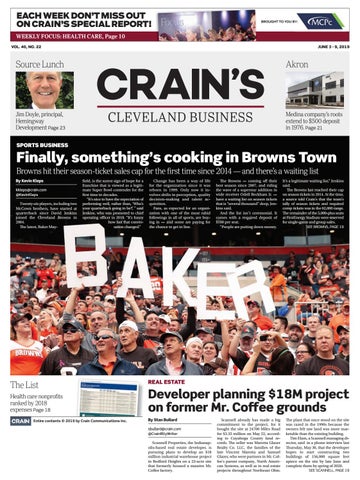
Finally, something’s cooking in Browns Town Browns hit their season-ticket sales cap for the first time since 2014 — and there’s a waiting list By Kevin Kleps kkleps@crain.com @KevinKleps
Twenty-six players, including two McCown brothers, have started at quarterback since David Jenkins joined the Cleveland Browns in 2004. The latest, Baker May-
field, is the surest sign of hope for a franchise that is viewed as a legitimate Super Bowl contender for the first time in decades. “It’s nice to have the expectation of performing well, rather than, ‘Who’s your quarterback going to be?’, ” said Jenkins, who was promoted to chief operating officer in 2018. “It’s funny how fast that conversation changed.”
The List Health care nonprofits ranked by 2018 expenses Page 18 Entire contents © 2019 by Crain Communications Inc.
Change has been a way of life for the organization since it was reborn in 1999. Only now it involves shifts in perception, quality decision-making and talent acquisition. Fans, as expected for an organization with one of the most rabid followings in all of sports, are buying in — and some are paying for the chance to get in line.
It’s a legitimate waiting list,” Jenkins said. The Browns last reached their cap on season tickets in 2014. At the time, a source told Crain’s that the team’s tally of season tickets and required comp tickets was in the 62,000 range. The remainder of the 5,000-plus seats at FirstEnergy Stadium were reserved for single-game and group sales. SEE BROWNS, PAGE 19
REAL ESTATE
Developer planning $18M project on former Mr. Coffee grounds By Stan Bullard sbullard@crain.com @CrainRltyWriter
Scannell Properties, the Indianapolis-based real estate developer, is pursuing plans to develop an $18 million industrial warehouse project in Bedford Heights on a 22-acre site that formerly housed a massive Mr. Coffee factory.
P001_CL_20190603.indd 1
The Browns — coming off their best season since 2007, and riding the wave of a superstar addition in wide receiver Odell Beckham Jr. — have a waiting list on season tickets that is “several thousand” deep, Jenkins said. And the list isn’t ceremonial. It comes with a required deposit of $100 per seat. “People are putting down money.
Scannell already has made a big commitment to the project, for it bought the site at 24700 Miles Road for $3.35 million on May 22, according to Cuyahoga County land records. The seller was Marotta Glazer Realty Co. LLC, the families of the late Vincent Marotta and Samuel Glazer, who were partners in Mr. Coffee’s parent company, North American Systems, as well as in real estate projects throughout Northeast Ohio.
The plant that once stood on the site was razed in the 1990s because the owners felt raw land was more marketable than the existing building. Tim Elam, a Scannell managing director, said in a phone interview last Thursday, May 30, that the developer hopes to start constructing two buildings of 156,000 square feet apiece on the site by late June and complete them by spring of 2020. SEE SCANNELL, PAGE 19
5/31/19 1:42 PM
PA G E 2
|
J U N E 3 - 9 , 2 019 |
CRAIN’S CLEVELAND BUSINESS
Ohio health insurance costs top U.S. median How Ohio health insurance costs compare to U.S. average 2016-2017 annual household spending by nonelderly people with employer-sponsored insurance Ohio Median premium contributions
By Lydia Coutré lcoutre@crain.com @LydiaCoutre U.S.
$2,520
$2,200
11.3%
11.6%
$1,000
$800
Percent of individuals with high out-of-pocket costs relative to income
7.3%
6.8%
Median combined premium contributions and out-of-pocket costs
$4,200
$3,700
2.3%
2.7%
Percent of individuals with high premium contributions relative to income Median out-of-pocket costs
Percent of individuals with high premium contributions and high out-of-pocket costs relative to income Source: Commonwealth Fund
®
The burden of high health insurance premiums and high out-ofpocket costs is worse in Ohio than in many other states, and worse than the national average, according to a new study. One in 10 nonelderly Ohioans with employer-sponsored health insurance has high premium contributions relative to their income, according to the report from the Commonwealth Fund, a nonprofit private foundation supporting independent health care research. For 2016-2017, the median annual household spending on these premi-
Collins
Krieg
um contributions in the state was $2,520, putting Ohio in the upper third of states with high costs and above the national median of $2,200. Annual household spending on out-of-pocket costs for this population is $1,000, which again places the state in the top third and above the national median of $800. “Middle America is being devas-
tated by these costs,” said Eric Krieg, president of Fairlawn-based Risk International Benefits Advisors. Nationally, an estimated 23.6 million Americans with employer coverage spend a large share of their income on premiums or out-of-pocket costs — or, for 4.1 million Americans, both. In Ohio, the average annual household spending by nonelderly people with employer-sponsored insurance on premium contributions and out-ofpocket costs combined is $4,200, compared to the national median of $3,700. Carriers, providers and vendors in the health care and insurance industry all face the same problem of navigating costs while coming up with an option that’s feasible for the American public, said John Fasola, executive vice president and director of group benefits for Oswald Cos., a Cleveland-based insurance brokerage. “Costs are being driven up, and we just collectively don’t have a handle on it, and this article proves very vividly that the effect on the American public is palpable,” he said of the Commonwealth Fund report. Although people who buy plans through the individual market are most likely to be underinsured, those with employer health plans are experiencing the greatest growth in underinsured rates, according to the Commonwealth Fund’s research. “So it’s a red flag that suggests that people are being increasingly burdened by higher deductibles and higher cost sharing,” said Sara Collins, a vice president at the Commonwealth Fund. The main driver of the premium and out-of-pocket growth is the cost of health care itself. Plus, incomes haven’t kept pace with the rate of growth in those costs, Collins said. To temper the growth, employers share more of their cost with employees in the form of more and higher deductibles. “But it always goes back to the rate of growth in health care costs,” she said. This push to shift costs to employees has been a “slow drip” since the recession and is progressively becoming the standard mode of operation for employers, Krieg said. “And in turn, what happens, the unfortunate thing is that the insurance and benefits industry is doing just fine financially, and the employers are taking the hit, as well as the employees and their family members,” he said. Collins said she doesn’t believe we’re seeing a “crisis” in the employer-based system — employers have continued to offer relatively comprehensive coverage — but the trends are pointing in that direction, particularly among folks making middle incomes. The growing affordability issue in employer-based coverage raises two primary concerns, Collins said. One, people may opt to not take up coverage if it competes with other living necessities. And two, survey data show that people with higher out-ofpocket costs and deductibles are more likely to say they skipped getting needed health care because of those costs. An “increasing number of people may be making decisions that are against the best interests of their health,” she said. Employers feel that they don’t have a lot of options, said Krieg. They’ve tried various things over the years to mitigate costs, from wellness programs to consumer-driven health plans, but these have “not been terribly effective,” he added. SEE HEALTH, PAGE 6
P002_CL_20190603.indd 2
5/31/19 3:20 PM
CRAIN’S CLEVELAND BUSINESS
|
J U N E 3 - 9 , 2 019
|
PA G E 3
Key raises the bar for community investment By Jeremy Nobile jnobile@crain.com @JeremyNobile
Cleveland’s largest hometown bank may be setting the new standard for community investments among the country’s large financial institutions. In spring 2016, as KeyBank was working through the legal and regulatory formalities of its acquisition of Western New York-based First Niagara Bank, the company committed to an auspicious national community benefits plan that was seemingly unheard of in the industry at the time. Key’s plan called for $16.5 billion of investments to be made over five years in low- or moderate-income (LMI) neighborhoods in its footprint — with a keen eye on the areas surrounding Buffalo, where First Niagara was headquartered, but others as well — that would be made through some philanthropic donations but mostly loans for affordable housing, small businesses and mortgages in underserved areas. Included in that plan is $175 million of philanthropic donations to be made through the KeyBank Foundation, double what the foundation did in prior years. “We are investing all over the county in LMI communities, but we intentionally wanted to make sure folks here and in the First Niagara markets didn’t feel that there was any slippage in the way we were responding to and supporting those markets,” said Don Graves, Key’s head of corporate responsibility and community
P003_CL_20190603.indd 3
relations. “We were raising the bar on ourselves in our commitments.” That overall commitment may be the single largest of its kind made by a U.S. bank following an acquisition. But it was also the largest promise made by a bank as a percentage of its collective asset base, according to the nonprofit National Community Reinvestment Coalition. With projected pro forma assets of $135 billion at the time of Key and First Niagara’s combination, Key was making a commitment equivalent to more than 12% of its total assets. According to Key, the company is delivering on those promises so far. It’s made more than $7.1 billion in investments toward that $16.5 billion goal, putting it 38% of ahead of schedule in terms of capital provided to date.
Raising the bar Beyond the practical impact those investments are expected to have in areas like Western New York or Northeast Ohio — $423.4 million has been invested in this market so far, according to Key — the company seems to have set a new bar for similar community investments that go above and beyond a firm’s legally mandated Community Reinvestment Act (CRA) goals, something at which Key has already excelled with its industry-rare nine consecutive years of earning the CRA’s highest rating of “outstanding.” “I think if KeyBank had not done this, we would not see a wave of banks reaching these agreements with us and other associations with acquisitions,” said NCRC CEO Jesse Van Tol.
KeyBank's community benefits plan highlights JJMore
than $228 million invested in community development projects. JJMore
than $70 million originated in small business loans to businesses that are part of low- to moderate-income (LMI) communities. JJ$93
million in mortgage lending to LMI communities. JJMore
than $31.6 million in philanthropic investments in Northeast Ohio neighborhoods.
Regulators scrutinize the impact on affected communities as they vet bank acquisitions for approval by examining various factors, including where each institution is (or isn’t) lending properly or how a condensed branch network could reduce access to banking services in LMI areas particularly. Community stakeholders and nonprofits get their say as well. That’s where the NCRC, a coalition of locally based nonprofits that champions fairness in banking, housing and business, comes in. The M&A process creates opportunity for the NCRC and other groups to engage banks and push them to support communities by promising not just investments but a sizable amount. If an acquiring bank has a poor enough CRA track record, it might be precluded from doing a deal at all. Those that need to improve may be required to make a certain number of investment commitments going forward as conditions for regulatory approval. When banks have a good record, such
high commitments may not necessarily be required — as was the case with Key. But that didn’t stop activists from speaking up. At least three community meetings were held in Buffalo regarding the local impact of losing the brand of First Niagara (which had a “satisfactory” CRA rating). As talks played out, Van Tol said Key was uniquely open to making a particularly pricey commitment with its $16.5 billion, five-year plan. “There were big concerns in New York from constituents where they were buying the headquarters. We often talk about how one plus one could equal less than two in something like this, and argue that as two banks combine and grow, they have the capacity to do more, not less,” Van Tol said. “KeyBank, to their credit, instantly recognized the value of doing this. It didn’t take a lot of convincing to get them to do it.” That isn’t always the case. But it could become a more common scenario as Key helped move the bar higher. That ultimately means communities should benefit as banks may feel more pressure to put their money where their mouths are following a deal. For comparison, consider the pending acquisition by Michiganbased Chemical Bank of Minnesota’s TCF Bank. That deal, announced in January and still being worked through, would establish a combined bank holding company with $45 billion in assets. “So far, those banks have more or less refused to meet and even discuss such an idea (of a community benefits plan),” Van Tol said. “They won’t
meet with us.” The deal is facing quite a bit of opposition already. “And I think those are not institutions that are going to experience a lot of goodwill with the community organizations,” he added. “And I think that, in the same way KeyBank and others consider these things to be win-wins, it’s going to be a negative for TCF and Chemical because they have basically said they don’t care.” So, engaging the NCRC isn’t necessarily a given. But those who do it are making bigger commitments when the deals are said and done. Locally, that seemed to play out with Huntington Bank’s 2016 acquisition of Akron’s FirstMerit bank. That combination was announced in January 2016, just several months after the KeyBank and First Niagara deal was reported. A few months later, Huntington said it would commit $16.1 billion toward a community benefits plan of its own. That amounts to 16% of the $100 billion pro forma asset base the bank was projecting in the wake of the combination. It’s impossible to say whether Key’s plan truly shaped Huntington’s. Van Tol doesn’t necessarily think Huntington was copying Key. It’s possible the Columbus-based bank would’ve made the same promise and Key just beat it to the punch since it was a few months ahead with its own merger. “But I’ll put it this way: Both institutions doing that in short order really sent a message to the banking community that this was kind of the new normal and that these kinds of things, while not required, are very helpful,” he said.
5/31/19 2:11 PM
PA G E 4
|
J U N E 3 - 9 , 2 019 |
CRAIN’S CLEVELAND BUSINESS
DON’T GO WITH THE BIG LENDER & EMPTY PROMISES CALL YOUR LOCAL CREDIT UNION Your Business Lending Partner SM • Commercial Estate Loans up to $10 Million • No Prepayment Penalties • As Little as 10% Down
Contact Jonathan A. Mokri 440.526.8700 jmokri@cbscuso.com www.cbscuso.com
Looking for warehouse space? Need logistics help? Candor Logistics is a true 3rd party logistics company offering: Premium Warehouse Space ● Local Cartage, brokerage & supply chain fulfillment ● Pick & Pack, expedite & de-vanning services ●
Certified to handle any product regardless of size, field of industry or scope.
Call now to discuss your warehousing and logistics needs! 216.378.7100
●
Bedford, OH
●
www.candorlogistics.com
ENHANCE YOUR ASSET’S VALUE
Candor Logistics Ad-4-8.indd 1
BROKERAGE CORPORATE SERVICES AUCTIONS PROPERTY MANAGEMENT APPRAISAL AND CONSULTING RESEARCH 216.861.7200 | HANNACRE.COM
Tax credit bills are facing uncertain future in statehouse By Jay Miller jmiller@crain.com @millerjh
While supporters of the 10-yearold film tax credit that brings television and movie production companies to shoot in Ohio have descended on the statehouse in Columbus this spring to voice their opposition to the credit’s demise, several other business development incentives are moving quietly through the General Assembly. Which ones pass — either as standalone bills or as part of Gov. Mike DeWine’s $150.4 billion, twoyear operating budget — is anyone’s guess at this point. The dust likely won’t settle until the Legislature passes a spending plan, which it must hand over for the governor’s approval by June 30. One incentive, in SB 7, would offer a state tax credit that would piggyback on the federal Opportunity Zone tax-saving program. Another, SB 39, would encourage insurance companies to invest in so-called “megaprojects” by giving them a credit against taxes on premiums for investments in major mixed-use developments. A third, SB 95, would extend the term of the existing Job Creation Tax Credit to 30 years from 15. Tax credits have become attractive because they don’t require a grant or loan of state money. Instead, they create capital for projects, since a developer usually sells the tax credit to help with financing. The new governor’s two-year budget, HB 166, proposes a 13.3% increase over Gov. John Kasich’s last budget, which DeWine justifies with a healthy economic forecast. The increases are focused on education, children services, drug addiction treatment and cleaning up Lake Erie. The DeWine budget also includes retaining the $40 million in annual tax credits for movie and television production. Speaker Larry Householder, from rural central Ohio, is less optimistic than DeWine about the ability of the state economy to grow enough to support increased spending and, in any event, he favors an income tax reduction over any increases in
spending or tax incentives. He led the decision to cut the film credit from HB 166 before passing it along to the Senate on May 9. The Senate already had taken up a film tax credit separately in SB 37, passing it unanimously on May 8. But since it’s unlikely to get DeWine favorable treatment in the House, the film credit’s supporters turned out May 23 for a Senate Finance Committee hearing on the budget bill to ensure that the Senate version of HB 166 retains the credit. Ivan Schwarz, president and CEO of the Greater Cleveland Film Commission, told the committee that a study by the Motion Picture Association of America (MPAA) found that the program has had an economic impact of nearly $700 million since its inception in 2009, and that for every dollar of taxes foregone, $2.01 has come back to Ohio’s economy, and that 35,500 people are directly and indirectly employed by the motion picture and television industries in Ohio. He added that the average salary in the media industry in Ohio is more than $60,000 a year. Leyna Haller of Cleveland, who has worked in the art department on movies shot in the state, said she believes retaining the credit will help build her career. She also told the committee that department heads who come to the state with film companies have praised the workers they’ve hired here. “I’ve been working on films in Ohio for long enough to see the positive impact the incentive has had,” she told the committee. “I myself have been able to work my way up through the ranks in my department. I’ve also been able to pay off debt and buy a car.” The turnout was smaller at committee hearings on the other business incentives legislation, although, as with the motion picture credit, the testimony was largely favorable, since the recipients of tax incentives gather like bees swarming around a queen. But passage of any of these new incentives designed to attract new businesses and encourage existing businesses to expand would add to the $718.7 million in taxes lost through a variety of credits over the
past two years. These include credits for creating new jobs and retaining existing jobs through investments in business expansion and tax credits for historic-structure rehabilitation. “Loopholes make the tax system more complex, less transparent and less equitable — all hallmarks of an unsound tax policy,” Greg R. Lawson, a research fellow at the conservative Buckeye Institute, told the state Tax Expenditure Review Committee last year. “By contrast, lower, fairer income taxes and consumption taxes will improve Ohio’s tax climate without creating unfair economic advantages for some at the expense of others.” SB 8, introduced by state Sen. Kirk Schuring of Canton, offers a credit on state income taxes for investments in Ohio Opportunity Zones, the federally designated, economically distressed areas that are eligible for a newly enacted federal tax savings. It would authorize a tax credit equal to 10% of a taxpayer’s investment in an Ohio Opportunity Zone fund. The Ohio add-on to the federal Opportunity Zone tax deferral can be an attractive incentive, said Cheryl Ganim, state and local practice leader for Barnes Dennig & Co., a Cincinnati accounting firm. That’s because much of the federal tax incentive is on capital gains deferred to the out years of an investment, while the Ohio incentive can be taken early in the investment. “If I was going to pick between Over-the-Rhine (a Cincinnati neighborhood) and Covington, Ky., maybe (the Ohio incentive) would help make the deal doable,” she said in a telephone interview. “If the Ohio credit can make the deal doable, it can sway your location decisions.” The legislation passed the Senate in early April and was then included by the House in HB 166. SB 39 would allow insurance companies a tax credit of as much as 10% of a qualified project’s development costs against their tax on insurance premiums for investments in what the legislation calls “transformational mixed-use developments,” or TMUDs. SEE TAX CREDIT, PAGE 6
3/28/19 9:34 AM
σσλσ4σλ24σ7σλ6σλσσ8σλσλλσσσσσσσσλσσσ4σ55
λλXλTN[λσUTλλN σλPλTλ λ2TλUKλλPV .GG 5KNUD[ %QORQWPFKPI 2JCTOCE[
λλλλλλλλλλλλλλλλλλλλλλ λλλλλλλλλλλλλλλλλλλλλ λλλλλλλλλλλλλλλλλλλλλλ λλλλλλλλλλλλλλλλλλλλλλλλ λλλλλλλλλλλλλλλλλλλλλλλλλν σλλλλλσλλλλλλ5λλ*λλσλλ\λσσσσσσσσσσσσσσσσσσσσσσσσσσσσσσσσσσσσσσσσσσσσσσσσσσσσσσσσσσσσσσσσσσσσ
P004_CL_20190603.indd 4
5/31/19 3:21 PM
Complex commercial
litigation is a long game. I’m ready to go the distance, while always searching for a favorable resolution. Clients call me when the stakes are high and the outcome is murky. It’s my job to lead them through. To immerse myself in their business. Analyze the issues, set the strategy, build the case, and take it as far as it needs to go. Whether to hold fast and go to trial; settle now or later; or aim for a win on appeal. The playbook changes every time. And so does the right call. Knowing which call to make? That’s a skill built case by case, and honed over two decades of experience. Trial tested, and judgment affirmed. I’m GREG PHILLIPS. I’m on your team.
MY BENESCH MY TEAM
> Vice Chair, Litigation Practice Group; Chair, Business Litigation Practice Group > Concentrates on complex business and commercial litigation, including class actions, for a broad range of public and private companies and individuals. > Has argued successfully before the Ohio Supreme Court and the U.S. Court of Appeals for the Sixth Circuit, while litigating cases around the country. > Repeatedly named a Best Lawyer in America®, a Benchmark Litigation future star, and an Ohio Super Lawyer. > Deeply experienced in legal and business ethics and regularly counsels other attorneys on risk and professional responsibility matters. > 216.363.4472 | gphillips@beneschlaw.com
www.beneschlaw.com
CL_060319_FP Template.indd 2
5/28/19 3:11 PM
PA G E 6
|
J U N E 3 - 9 , 2 019 |
CRAIN’S CLEVELAND BUSINESS
HEALTH
CONTINUED FROM PAGE 2
“The employers are afraid to do anything radical,” Krieg said. “They’ve been conditioned to think if they do anything that’s too radical that they’ll have a mass exodus of employees and they won’t be able to recruit anybody. So they’re in a classic Catch-22: They don’t like the results that are happening, but they’re risk-averse to do anything dramatically different.” The effective solution is going to exist outside of traditional health insurance companies, major brokers and big pharmacy benefit managers, Krieg said. “The big elephant in the room is that the benefits industry talks a lot about what they’re doing and how they’re trying to control these costs,” he said. “The bottom line: It’s not happening, it’s not working. But the financial equation works really well for them, so they haven’t suffered a bit. People in the
TAX CREDIT CONTINUED FROM PAGE 4
Growth by Design
Northeast Ohio’s economic development engine at work
Attend the July 17 event from 8 a.m. to 10:30 a.m. at Corporate College East for an overview of the 2019 update of the Aligning Opportunities report (an in-depth look at the supply-and-demand imbalance of our region’s workforce), and learn about solutions that are being implemented to keep our region competitive.
The legislation duplicates the unsuccessful HB 469 from the last session. That bill, Schuring told Crain’s last year when he was then in the Ohio House, grew out of a conversation he had with Cleveland developer Robert Stark of Stark Enterprises, who was then, as now, working to finance and develop nuCLEus, a mixed-use project proposed in Cleveland’s Gateway district. In testimony April 2 before the Senate Finance Committee, Stark took credit for authoring the bill and said the bill’s passage would work at “attracting and keeping the best and the brightest.” At a finance committee session on May 21, Frank Sinito, principal and CEO of The Millennia Group of Cos. in Cleveland, argued that SB 39 was
Team NEO
IN PARTNERSHIP WITH
tiveness of employer plans, Congress could also make a refundable tax credit available to people with employer coverage whose out-of-pocket spending for health care exceeds a certain percent of their income, according to the report. “So there’s some consumer-focused policy options, and more research could be done on how to design those and what the effects might be,” Collins said. “But the other major issue that those kinds of policy options wouldn’t address is the overall driver of health care costs.” Growing evidence shows that the primary driver of per-capita costs in private insurance is the prices paid to providers, according to the report. “So I think we need to focus on that issue if we want to address the overall rate of growth in health care costs,” Collins said. “We need more information about rates that are negotiated confidentially, and we need to think hard about what the policy options might be to address those.”
“an essential element” for his plan to redevelop the former Union Trust Co. bank building at East Ninth Street and Euclid Avenue, which he plans to call The Centennial. The $420 million project would include retail and office space as well as 300 housing units. Sinito Sinito told the committee that while construction costs in Cleveland are as high as those in cities such as New York or Chicago, Cleveland can’t command the higher level of rents charged in those cities. “Enactment of the TMUD credit would help us to close a critical gap in our capital stack and would enable our project — and potentially other transformational mixed-use development and redevelopment projects like The Centennial — to actually move forward and to become reality,” he said. “Without the TMUD, these
extremely complex mixeduse megaprojects are virtually impossible to adequately finance and thus simply will not get done.” The finance committee has yet to report the bill out of committee. SB 95, which was reported out of the Senate Ways and Means Committee May 23, would extend the maximum term of the state’s Job Creation Tax Credit to 30 years from 15 years for developments that make a $100 million investment in Ohio and create at least $10 million a year in payroll. All tax credit requests are reviewed by the Ohio Tax Credit Authority before approval. Proponents said the bill would make Ohio more attractive to investors, especially among neighboring states that are pursuing similar initiatives.
NOMINATIONS NOW OPEN
FEATURING KEYNOTE SPEAKER JIM TRESSEL, PRESIDENT, YOUNGSTOWN STATE UNIVERSITY
PREPARED BY
supply chain of health and benefits are doing extremely well.” The industry needs a “major league disruptor,” he added. “We’re going down a path of destruction that ultimately is unsustainable,” Fasola said. There needs to be greater education, he said, of patients, providers, doctors, pharmacies, government, insurance companies — everyone in the health care ecosystem — to get people on the same page and start working toward a solution. The Commonwealth Fund report lays out a few policy suggestions to potentially begin addressing that. For instance, requiring plans to expand and standardize which services are exempt from the deductible. Congress could raise the percentage of medical costs that employers must cover, on average, and subject employers who don’t meet this standard to a penalty and enrollees may be eligible for tax credits to buy marketplace coverage. To improve the financial protec-
Delta Dental
Visit aligningopportunities.teamneo.org for updates about the event and release of 2019 report
YOUR STORY. YOUR STAGE.
TeamNeo_1-6V_6-3-19.indd 1
P006_CL_20190603.indd 6
Bring your story to life through Crain Content Studio custom events. Our events team will work with you to execute a seamless experience that will highlight your brand expertise to your ideal audience.
FOR MORE INFORMATION CONTACT lrudy@crain.com
5/28/19
Crain’s Cleveland Business will name the 2019 Notable Women in Nonprofits in a special report on August 12. In that report, we’ll recognize NEO’s female leaders who 11:45 AM have made an impact in the nonprofit sector. DEADLINE: Monday, June 24
CrainsCleveland.com/Nominations
5/31/19 3:22 PM
CRAIN’S HR GUIDEBOOK Don’t miss out on sharing your expertise as part of the exclusive HR ISSUE of Crain’s Cleveland Business. This special edition will include the 2019 Crain’s Excellence in HR Awards finalists and the 2019 HR Guidebook, an accompanying custom publishing piece, produced by Crain’s Content Studio-Cleveland. Northeast Ohio business leaders and HR experts will have the opportunity to share their best practices or knowledge of trends in topic areas covered by the 2019 Best Companies Group Best Employers in Ohio Survey.
ISSUE DATE: August 5 | AD CLOSE: June 7
MORE INFORMATION: Lisa Rudy • LRudy@crain.com
CL_060319_FP Template.indd 3
5/30/19 8:24 AM
PA G E 8
|
J U N E 3 - 9 , 2 019 |
CRAIN’S CLEVELAND BUSINESS
Opinion From the Editor
Advice for 2019 grads inspired by ‘Game of Thrones’
Editorial
Opportunity zone “Every success we have in bringing marginalized workers back in is a win for the GDP growth.” That statement came from Jeff Korzenik, chief investment strategist at Fifth Third Bank, who was a panelist during a May 7 event in Cleveland, “Poverty and Workforce Development: Challenges Facing the Country and Northeast Ohio.” (The event was sponsored by Fifth Third and Crain’s Content Studio.) Korzenik’s comment, and the entire event, underscored some important truths about the red-hot economy: It needs more workers to continue its expansion, and some of those workers are going to come from the ranks of people contending with poverty, addiction and other challenges, or who have been incarcerated. The Bureau of Labor Statistics in May reported that the number of job openings nationwide surged by 346,000 positions to 7.5 million at the end of March. The pace of hiring was little changed, pointing to a worker shortage that could hinder future employment growth, and the job openings rate rose to 4.7% from 4.5% in February. There now are 1.2 million more open jobs than there are unemployed Americans. As problems go, we’ll take these. But it does require that employers think seriously about their responsibilities in an era in which workers are hard to find and some need more assistance to reach their full potential. For instance, “It helps to have supervisors who understand the challenges of poverty,” Korzenik said, noting that, for some workers, a $300 car repair might be a serious impediment to being able to get to their job. It’s far better, he said, to find solutions to help the worker — a temporary carpool, maybe even a micro-loan — than to lose a potentially productive employee. Issues of poverty are even more complicated for workers seeking to rebuild their lives following addiction or incarceration. To their credit, many companies in the private sector — from giants such as McDonald’s and Delta Air Lines to small companies including Cleveland’s much-lauded Edwins Lead-
ership & Restaurant Institute — have launched hiring initiatives specifically targeted to recovering addicts or former inmates. Old stereotypes are breaking down. CNBC last fall reported that only 14% of human resources managers won’t consider hiring ex-offenders, according to a report commissioned by the Society of Human Resources Management and funded by the Charles Koch Institute. More than 80% of executives said in that report that ex-offender hires have been at least as successful as their average hire. Frank Sinito, CEO of real estate concern The Millennia Cos., also is chairman of the board at the nonprofit True Freedom Ministries, which provides services (transitional housing, transportation and life coaching among them) aimed at helping to break the cycle of incarceration, addiction and homelessness. He said during the May 7 event that as many as 10,000 people per week are released from prisons. Nonprofits like True Freedom, plus government and workforce agencies, are prepared and eager to help employers be part of making possible a productive path forward for many of those individuals. “The challenges are vast, and so should the opportunities be,” Sinito said. That’s the key word: opportunity. Not a handout. Just a chance. Kiersten Watkins, assistant vice president of program administration for OhioGuidstone and another member of the May 7 panel, encouraged attendees to “look at these individuals as an opportunity, rather than a disadvantaged population. They want to be given a chance. ... They want to move away from the stigma of having a criminal background and all the challenges that come with that.” Crystal Bryant, director of the Cuyahoga County Office of Reentry, said the people her office works with “may be missing pieces of soft skills,” but those can be addressed, and the clients are “intelligent, diligent and resilient” and “ready and willing to work.” Northeast Ohio needs to take advantage of valuable human capital. Is your company ready and willing to help?
Publisher and Editor: Elizabeth McIntyre (emcintyre@crain.com)
CLEVELAND BUSINESS
CLEVELAND BUSINESS P008_CL_20190603.indd 8
Managing Editor:
Scott Suttell (ssuttell@crain.com)
Contact Crain’s:
216-522-1383
Read Crain’s online: crainscleveland.com
I’ve hit that age when I am sometimes asked to do things I never thought I’d do — like deliver a commencement address. On May 17, I had the honor and pleasure of addressing the class of 2019 of Ursuline College at the Wolstein Center. Sister Christine De Vinne, president of the college, pointed out in her commencement remarks the unique attributes that made up this year’s class of graduates from the women-focused college in Pepper Pike. The 350 graduates came from places near — throughout Northeast Ohio — and far — Canada, Latvia, Zimbabwe, Kenya and Romania. A third were the first in their family to graduate college. Four were veterans or current members of the military. As De Vinne noted, the college’s “senior senior” graduated with a degree in art therElizabeth McIntyre apy at age 70, and the oldest graduate student received her master’s in theological and pastoral studies at age 75. Two graduates were sisters who earned their masters of science in nursing together, and another student was the fifth sibling in a row to graduate from Ursuline. Finally, one graduate “has a whole city to call her family,” as De Vinne said of Annette Blackwell, the first African-American and first woman mayor of Maple Heights in its 100-year history. She graduated from Ursuline College with a public relations major. That is an incredible audience. My goal was to try in some small way to share some inspiration, to honor their hard work and to get off the stage so they could collect their diplomas and take life’s next step. Here’s a condensed version of what I shared with them: Thank you for that beautiful introduction, and to Sister Christine, the Ursuline College board of trustees, the faculty, staff and administration. And just as importantly to you, for opening your hearts. What an incredible honor to be asked to address the class of 2019 of Ursuline College. I hold the Ursuline tradition near and dear to my heart because my mom graduated from Ursuline High School in Youngstown in 1955. You join a rich history of graduates from this esteemed institution and you should be incredibly proud of your accomplishments and this school’s devotion to servant leadership. Congratulations! I wish you could see what I’m seeing right now. The eager faces. The proud generations. And yes, some antsy youngsters who will, in the blink of an eye, be the ones standing in your shoes. Take it from me … I can’t believe 30 years ago this spring, I wore a mortarboard like the one capping your heads today. In May 1989, I, along with my Bowling Green State University classmates, stood in a pouring rain that eventually turned to snow and listened to actor and BGSU alum Bernie Casey — seriously? You don’t remember him from “Revenge of the Nerds”? — deliver our commencement address. Now, I’m not going to lie, I don’t remember a word Bernie Casey said that day. And I’m not naive enough to think you will remember anything I say today, or even who I am. My only hope is that two words I say will bounce around your heart and head for a short while — even for the next few minutes. Today, you stand on the edge of your future. Your training has led to this point. You’ve asked questions. You’ve learned from your professors, parents and peers. Your mentors and, yes, your mentees. You’ve observed and worked hard. You’ve challenged yourself in ways you never thought possible. You’ve tried to slay your insecurities whenever they threatened you. Sometimes you’ve succeeded, sometimes you failed. SEE McINTYRE, PAGE 9
Write us: Crain’s welcomes responses from readers. Letters should be as brief as possible and may be edited. Send letters to Crain’s Cleveland Business, 700 West St. Clair Ave., Suite 310, Cleveland, OH 44113, or by emailing ClevEdit@crain.com. Please include your complete name and city from which you are writing, and a telephone number for fact-checking purposes. Sound off: Send a Personal View for the opinion page to emcintyre@crain.com. Please include a telephone number for verification purposes.
5/30/19 4:02 PM
CRAIN’S CLEVELAND BUSINESS
|
J U N E 3 - 9 , 2 019
|
PA G E 9
LAND FOR SALE: Beacon West, Westlake
Prestigious Westlake Location! » Industrial Zoning with Many Allowable Conditional Uses » Prestigious High Visible Gateway Location » Can Accommodate up to 100,000 SF Building » $450,000 » $62,327/Acre Property Features ● Priced to Sell ● Last Two Available I can tell you for a fact I am not the smartest person Parcels in the Wolstein Center at this very moment. Humility leads to learning because it allows you to CONTINUED FROM PAGE 8 ● Quick access to I-90 Lot 2R ask for help when you need it. And nothing helps with and Crocker Park 7.226 Acre Going forward, as you graduate from Ursuline Col- humility more than listening more than you talk. I’ve ● Enterprise Zone Parcel lege, there’s a key phrase I want you to remember: Not learned absolutely nothing when I’m talking. If my ● Major Business and mouth is going, I’m not learning a thing. Lin Manuel today. Retail Area Those, I hope, are the two words you take from your Miranda said it even better in “Hamilton”: “Talk less, ● Stormwater Pond commencement ceremony from Ursuline College. smile more.” Installed So I guess that’s a double whammy for me. I’m not Pretty simple, but quite profound. And easy to rememVIKING PARKWAY ● Build to Suit Available close to the smartest person in this room and I am ber. Not today. For those watch “Game of Thrones,” or have read learning nothing because I’m doing all the talking! I CONTACT US George R.R. Martin’s series of books on which the promise, I’ll be done soon, and then I can’t wait to Charles Marshall or Terry Noonan hear from you smart people about your dreams and HBO series is based, you recognize that phrase. passions and what you will create to make our world Not today. 330-659-2040 For those who aren’t familiar with the show and better. 3457 Granger Road, Akron, OH 44333 What you create should always begin with identifybooks, let me introduce you to Arya Stark. VISIT OUR NEW PROPERTY WEBSITE We first met Arya as an 11-year-old tomboy in Season ing what your customers or your loved ones need. Alwww.beaconmarshallproperties.com One of “Game of Thrones.” She’d rather wield a sword ways put the focus on your audience, whether in your and fight alongside her father and brothers than be- professional or personal life. Your job is to figure out come a “proper” noblewoman. She’s far more skilled in the solution — and you can’t do that without being a good listener. archery than needlework. “I’m not Everyone loves compliments, a lady, I never have been, that’s not What you create but criticism and constructive me,” she says in Season Eight. Arya feedback are actually a lot better has a very low tolerance for liars should always begin Beacon Marshall Ad 3-4-Lot 2R.indd 1 WELLNESS WALK than flattery. Develop a thick skin. and for injustice. with identifying what Don’t take these learning opporHer dad sees her potential and engages a master swordsman to your customers or tunities so personally. Not today. begin Arya’s training. That master fear and uncertainty grip CLEVELAND METROPARKS ZOO your loved ones need. youWhen swordsman teaches her these — and they will — ask yourself words of wisdom: “What do you Always put the focus what’s the worst thing that can hapSCAN TO REGISTER Run or walk to celebrate recovery, remember the lives lost, and say to the god of death? Not today.” pen. Very rarely are things as bad as support Recovery Resources: Helping people triumph over on your audience, mental illness, alcoholism, drug, and other addictions Those words echo throughout the you think they will be. This is not show as Arya becomes a fierce fight- whether in your the end of the world. Not today. Remember always that perfect er, especially during the final season is the enemy of good. I’ve seen a of “Game of Thrones.” For those who professional or lot of people burn themselves out, haven’t watched the show or read personal life. Your job and not accomplish much, bethe books, I won’t spoil it. is to figure out the Not today. cause of perfectionism. Arya, though, serves as an ex- solution — and you Be flexible. If you can’t accept change, you will be run over. Our ample we can all live by, whether world is constantly evolving. Enyou know the source material or can’t do that without not. Whenever you are facing what being a good listener. trenchment in your thinking and scares you most in your life and attitudes will hold you back. Not tocareer, the absolute worst thing that can happen, re- day. That means doing what scares you. Get out of your comfort zones, today, because it’s the best way to grow. member those words: Not today. There will be many times throughout your life when Not today will you fail to prepare. Be prepared alyou will question yourself. I challenge you to stop lis- ways. The minutes of preparation will lessen your WIZATHON.COM/RUNFORRECOVERY hours of anxiety. tening to that voice in your head. Not today. Be kind and forgiving. Live life with compassion for When the obstacles seem so high, you may wonder if you’re good enough. Can you rise to the occasion? both yourself and others. You never know what someCan you get through the week, the day or even the next one is going through. Not today will you fail to be hu�*AS OF 5/29/19 few minutes? Because yes, those moments happen to man, which is what your Ursuline College education all of us. Don’t let anyone tell you they don’t because has taught you. To empathize with those less fortunate everybody doubts themselves from time to time. than you. Who look and act differently than you. Who Not today will you doubt your own abilities. Not to- might not think like you. Who might be struggling with mental illness. Not today. day will you wake up not giving your best. Always remember to say thank you. And to treat the Accept that you will fail … a lot. It’s OK to fail. What’s janitor with as much respect as the CEO. not OK is not learning from your failures. Not today will you bury your face in your phone. Not today. We are your our furniture partner. Everyone has a budget & wishlist. Remember that career paths rarely go in straight Chin up! Look at the marvels in the world around you We have the creative answers to get you both. lines. They twist and turn for many reasons. You’ll start and live in real time instead of screen time. Office.Restaurant. Residential. Work. Play. Live. Finally, not today will you forget to tell those close to in one career and may end up in another. And another. Trust for Public Land, welcome home. you that you love them. Every day is a gift. Last year And another. And that, too, is OK. Remember that good employers are always looking this month, I lost both my mother and father. They to hire someone with a curious mind and solid charac- would have relished this moment as much as I do. Pater. They can teach skills specific to their business. rental pride doesn’t end at your college commenceWhat they can’t teach is curiosity — the desire to know ment ceremony. I hope you are relishing this moment, too, and takwhy and how. There will be days when you aren’t challenging yourself, not being curious enough. Don’t suc- ing pride in yourselves as you culminate your formal education for now and commence your future. As cumb to lazy, uninspired thinking. Not today. much as I miss my parents — their presence and wisGod gave you a brain for a reason, and you invested dom — there has not been a moment where I’ve in its development at this fine institution for a reason. looked back with regret. Because there wasn’t a moUse it every single day. ment of love unspoken, from when I took my first Surround yourself with good, smart, kind people, breath until they took their last, and I was privileged to like you. Who you surround yourself with, whether it’s be at their sides. Nothing can replace the simple act of people at the office or outside of work, speaks volumes “being there.” Be there for those you love, today, toabout you. Character and values matter in all aspects morrow and always, in ways small and large. of life. If you hang with the office gossips and incurious So be like Arya, and let your arrows fly straight. people, that’s the perception people will have of you. Not today will you fail to make full use of your So ... not today. God-given gifts and your education from Ursuline GDOT DESIGN . A DIVISION OF GEIS COMPANIES You can make the right choices. Choose to be hum- College. Not today will you fail to live life fearlessly, 330.528.3500 . gdot@geisco.net ble. Choose to be confident but not conceited about without doubt and with a curious mind, and with love office at the 9 . 2017 east 9th street suite 200 . cleveland ohio 44115 GDOT DESIGN your strengths, and aware of your limitations. And and kindness in your heart. Not today. headquarters . 10020 aurora-hudson road . streetsboro ohio 44241 an exclusive TEKNION dealer Photo by Harry Dempsey - Autohaus Image Your future starts — today. choose NOT to be afraid of NOT being the smartest Congratulations. person in the room. Not today.
McINTYRE
5K& ONE MILE
2/26/19 11:13 AM
AUGUST 17, 2019
[
[
THANK YOU TO OUR SPONSORS*
welcome home.
P009_CL_20190603.indd 9
5/30/19 4:05 PM
PA G E 10
|
J U N E 3 - 9 , 2 019 |
CRAIN’S CLEVELAND BUSINESS
Focus
HEALTH CARE
RIDING HIGH IN THE BOUTIQUE FITNESS BOOM
A CycleBar class tests their mettle on the pedals. (Contributed photo)
CycleBar is expanding its group cycling approach around the country, including in NEO By Mark Oprea clbfreelancer@crain.com
T
he class always starts with a beat — sometimes it’s Ellie Goulding, other times it’s Depeche Mode. The stage lights in the room go up, then down. The 50 riders pedal fast, based on metabolic rates, or slow down to catch their breath. If you’re doing something “wrong,” the CycleStar at the front of the class will be sure to guide you. It’s their job. “In the end, it’s all up to you,” explained Joe Purton, owner of the Beachwood location of CycleBar, a fitness company that specializes in music-heavy group cycling. “You control the resistance. You control how fast you’re pedaling. But still, you’re coming here in the end to work out.” Ready to hit his three-and-a-half-year anniversary as owner of the sixth CycleBar established in the U.S., Purton is part of trend toward boutique fitness, one that’s especially growing in Northeast Ohio. In April 2016, he was among a handful of CycleBar franchisees that opened up in prime spots across the country. Today, there are more than 200 locations nationwide, including ones in Hudson and at Crocker Park in Westlake. Bought out in 2017 by Xponential Fitness — a national fitness corporation that also owns
P010_CL_20190603.indd 10
Joe Purton’s Beachwood CycleBar facility was only the chain’s sixth when it opened, but there are now more than 200 locations nationwide. (Mark Oprea for Crain’s)
seven other companies, including StretchLab and Club Pilates — CycleBar was just a part of Xponential’s $150 million revenue that year, which saw Xponential open up 180 new locations in a 12-month period. The boom reflects a stark shift in consumer tastes in the brick-and-mortar fitness sector. A 2017 study by the International Health, Racquet and Sportsclub Association found that, starting in 2012, membership at traditional gyms grew by only 5%, while at boutique gyms it shot up by a whopping 70%. “It wasn’t a total proven commodity when I did it, and a risk financially,” Purton recalled. “Looking back now, I’m like, ‘Oh my God. I have a lot of guts to do what I did.’ And look what happened.” Entering the fitness industry was a 180 for Purton after a decades-long career as a certified public accountant. An affable man with dyedblond hair and Versace shoes, he opened up the first Northeast Ohio CycleBar with $750,000 of his own money for the build-out and the CycleTheater, a 50-bike room that includes about $70,000 in DJ gear. Apart from the actual 45-minute workout — with time slots from 5:15 a.m. to 9:30 at night — throw in a yoga studio, Sunday mimosas and a water filtration system and CycleBar sheds any comparison to the gym down the street. SEE CYCLEBAR, PAGE 12
5/30/19 11:35 AM
For a fully-integrated, post-acute healthcare system at your service... refer to us.
Ohman Family Living is here for today’s value-based healthcare leaders. Entrust your patients to our clinically driven culture of care, purpose built to ensure referring hospitals and ACOs improve their metrics and meet their business and patient care objectives.
O H M A N FA M I LY
L I V I N G
Discover Ohman Family Living at Holly, Briar, Blossom and At Home. www.OhmanFamilyLiving.com
13878-2 HILL_B2B Ad_10.875x10.5_FINAL.indd 1 CL_060319_FP Template.indd 1
5/20/19 11:49 2:44 PM 5/28/19 AM
PA G E 12
|
J U N E 3 - 9 , 2 019 |
CRAIN’S CLEVELAND BUSINESS
HEALTH CARE
+ + +
Our commitment to service leads to your financial success.
Business Advisors and Certified Public Accountants
maloneynovotny.com
P012_013_CL_20190603.indd 12
CYCLEBAR CONTINUED FROM PAGE 10
Yet, CycleBar’s fresh fruit amenities hardly explain its rapid growth: Purton noted a 68% increase in membership just since December. For one, all CycleStars — the music-savvy leaders in front — must endure a rigorously vetted six-monthlong selection process, from recording audition tapes to send to corporate scouts in Irvine, Calif., to a month-long boot camp and testing period, where potential CycleStars are critiqued through a 17-song Spotify playlist. “You either got it or you don’t,” Purton said. Chelsea Foster, a 26-year-old fitness junkie who switched from an HR career to be a CycleStar at Beachwood, said that a talented instructor isn’t just preferred by clients, but absolutely necessary for their mental health. She added that the personalized approach, coupled with what she called a “churchlike” feeling, makes for a supremely rewarding fitness experience. “When you have powerful lighting, with that song, and an instructor in a badass tone, saying, ‘Let’s go, people!’, it’s gonna be different.” she said. “It makes you feel a certain way. I like to describe it like a big, gigantic hug. It just feels good.” The path to a healthy heart, as with many boutiques, comes at a price that not everyone can afford. Running memberships at CycleStar average $149 per month, about $110 for a package of eight classes (that’s nearly
a whole year of dues for Planet Fitness members). It’s why Purton opened up his shop in Beachwood, where the average annual income is $77,000. Owners like John Wood, in Hud-
son, dismiss any comparison to bigbox fitness companies, saying that people in the right demographic “will pay for a quality workout if they can afford it.” For Wood, who became a
5/30/19 11:37 AM
Abo of b why in u (Mar
bigthat will can me a
CRAIN’S CLEVELAND BUSINESS
|
J U N E 3 - 9 , 2 019
|
PA G E 13
HEALTH CARE
Above: Personalized messages on their lockers await new CycleBar members on their first visit.
Above: The higher cost of boutique gym memberships is why Joe Purton chose to locate in upscale Beachwood. (Mark Oprea for Crain’s)
franchisee after a divorce and career change, Hudson was a ripe testing ground for the fitness chain. His numbers back up his claim: Wood’s member count has more than dou-
bled since last June, from 180 to 311 this May. “I think as long as the experience is unique, it will last,” he said. “I mean, somebody will really have to have some balls to open up another indoor cycling studio by us, is all I’m saying.”
Both Wood and Purton speculate that boutique fitness is popping because of its grounding in a sense of community: Everyone in a class is beating their fitness goals together, as one. Wood said he’s seen next-door neighbors in Hudson meet each other for the first time “right on the bike next to them.” It’s the reason Jim Levine, a 51-year-old in the electronics recycling business, chose to grab a Cycle-
Bar membership after decades immersed in crossfit and triathlon training. To the Northeast Ohio native, the trend toward communal fitness signifies a much-needed shift away from the staid, in-home workouts of yesteryear, routines to which he’ll probably never return. “(CycleBar is) like 10 cups of coffee for me,” he says. “No matter how hard I want to push myself, it doesn’t come close to something like that.”
DRIVE DECISIONS WITH DATA
BE IN DEMAND WITH A MASTER OF SCIENCE IN BUSINESS ANALYTICS NOW OFFERED ONLINE AND ON CAMPUS
APPLY BY JULY 15 • WWW.KENT.EDU/BUSINESS/MSBA
P012_013_CL_20190603.indd 13
5/30/19 11:37 AM
PA G E 14
|
J U N E 3 - 9 , 2 019 |
CRAIN’S CLEVELAND BUSINESS
RETAIL/OFFICE SPACE FOR LEASE STOW HUDSON TOWNE CENTER 1604 Norton Road, Stow, OH 44224 17,750 SF Located
in high retail intersection of Darrow Rd and Norton Rd
Grocery
anchored (Giant Eagle) Average
household income $100,000 SVN SUMMIT COMMERCIAL REAL ESTATE GROUP, LLC CONTACT
Ben Christopher Associate Advisor ben.christopher@svn.com 330.631.7285 Nichole Booker, PhD Associate Advisor nichole.booker@svn.com 330.475.5500
3009 Smith Road, Suite 25 Akron, OH 44333 (234) 231-0200
HEALTH CARE
Adviser: Connon Thompson
Making the most of health care market Northeast Ohio has long been a hotbed for health care, with the sector employing more of Cuyahoga County than any other industry. The region has also been an active participant in the robust market for health care practice transitions. According to Definitive Health, there were more than 1,600 mergers and acquisitions, affiliations or partnerships announced in 2018, and many Ohio practices contributed to these numbers. As one generation of practice owners approaches retirement and the next moves toward ownership, there is ample opportunity for Ohio’s health care professionals. Being a health care provider is challenging enough, but many practitioners are also small business owners. Med school may prepare you to practice, but it won’t teach you how to grow and manage a small business.
Prepare for ownership
FOR PRESTIGE AND ELEGANCE, SVN Ad-Stow Hudson Towne Center6-3.indd 1
THINK FIRESTONE COUNTRY CLUB.
Clearly defined goals are critical to making any investment. When it comes to practice ownership, your goals will 5/24/19 help10:50 you AM to determine the right ownership path: acquiring, starting or buying into a practice. Each comes with its own challenges and benefits, so assessing your risk appetite and management style is a good starting point: Acquisitions allow you to purchase a known entity with an existing client base, but you’re also purchasing existing cash flow, equipment and systems, which may not match your vision. Starting a practice allows you to fully customize your business: new staff, equipment, location, etc. However, you are also starting from square one when it comes to cash flow and patients. A partner buy-in allows you to take
an ownership stake in a known entity while sharing ownership responsibilities. If you go this route, you’ll want to clearly define your role, your out clause and opportunities for increasing your ownership stake. Regardless of which path you pursue, remain flexible with your ownership plans and do your due diligence to understand the prospects (e.g., how many active patients does an existing practice have or how many active patients would a new practice need to acquire to be viable?). Liquidity is key and you need to balance between saving capital and paying down debt. Cash-flow projections and analyses, benefits and incentives analyses, and cost and duration of licensure are among the many variables to consider in addition to the financing options available.
reduce their hours or hold off on making investments as they move toward an exit. This can have a detrimental impact on revenues and the practice’s overall value. Revenues, investments in the business and location are three of the primary drivers of value: Understand your revenue and profitability trends: Are revenues increasing and has the practice enjoyed robust growth, or has the net income of the practice fallen in recent years? Evaluate investments (or areas for improvement) in equipment and systems, the office space and staff. Assess the growth enablers or inhibitors tied to the existing location: community demographics, visibility and accessibility of the practice. Additionally, if the office is leased, the terms of the existing lease and ability to transition and extend the life of the lease may factor prominently into a buyer’s interest in the business. Locations owned by the transitioning practitioner can be sold as part of the deal or handled separately. Valuation is only one of many considerations in transition planning, underscoring the importance of having a team of advisers with expertise in banking, investment strategies, tax implications and legal matters, particularly those involving sensitive patient records.
Maximize your return
Plan in advance
Transitions don’t happen overnight. Practice owners should commit to advanced planning — supported by a team of advisers — in order to maximize the return while ensuring continuity of patient care. Determining the value of your practice and the optimal selling price is one of the most critical steps in the process. Many doctors are inclined to
In health care, more so than some other industries, it’s easy to see why planning for the future falls off the radar. Between seeing patients, keeping up with advances in the field and regulatory changes, as well as day-to-day practice management, it’s hard to think two to five years ahead. But not doing so can be detrimental to the growth and financial health of the practice.
Thompson is vice president, business banking health care business development officer at Citizens Bank.
Firestone Country Club is an exclusive, prestigious private club that welcomes Members and guests alike to host events in our famed clubhouse. BOOK YOUR SPECIAL EVENT TODAY. 330.644.8441 | firestonecountryclub.com © ClubCorp USA, Inc. All rights reserved. 44574 0419 BB
7.5 Acres of Land ZONED FOR OFFICE/RETAIL
SW Corner of Memphis Ave. at Tiedeman Road, Brooklyn, OH
FOR SALE Development Incentives Available
Contact City of Brooklyn, OH Office of Economic Development
216.635.4289 audris@brooklynohio.gov P014_CL_20190603.indd 14
PREP AND PAROCHIAL SCHOOLS
This editorial feature is a yearly snapshot of activity taking place in the region’s robust private school landscape. This education-focused issue will also feature the 2019 Notable Women in Education. Use this advertising opportunity to showcase your educational institution.
ISSUE DATE: June 17 AD CLOSE: June 6 More information: Lisa Rudy LRudy@crain.com
5/30/19 12:25 PM
CRAIN’S CLEVELAND BUSINESS
|
J U N E 3 - 9 , 2 019
|
PA G E 15
HEALTH CARE
Senior care chain targets post-acute market By Judy Stringer clbfreelancer@crain.com
Not so long ago, the Ohman family, which owns and operates a trio of nursing facilities in Geauga County, considered its regional footprint a bit of a shortcoming. The three locations — Holly Hill in Newbury Township, Briar Hill in Middlefield and Blossom Hill in Huntsburg — often competed with one another for rehab and longterm care referrals from the major health systems in the area. With the approaching tide of value-based medicine and population health, however, that shortcoming is fast becoming Ohman Family Living’s biggest asset, said Joshua Wallace, vice president of growth strategies for the company. “We operate in a market that we know very well because we've been established here since 1965,” said Wallace, who is part of Ohman’s third-generation leadership. The company has relationships with local physicians and clinicians, he said, many of whom come on-site to treat patients. It is leveraging long-standing ties with area health systems to strengthen its connections to acutecare settings (i.e., hospitals). It also recently launched a collaborative partnership with another family-owned business, Physicians Ambulance, aimed at mitigating unnecessary hospital readmissions. All that — coupled with expansions underway at two of its campuses — means Ohman is uniquely positioned to emerge as a regional leader in post-acute care, just as practitioners and insurers look for better ways to rehabilitate patients outside of costly hospital stays. “One of the fundamental reasons why post-acute care is considered to be an answer to the crisis of spiraling health care costs is that it can produce similar and sometimes even better outcomes in a lower-cost setting,” Wallace said. “We think we can create a new category in the health care marketplace by becoming one of the first post-acute health care systems, and that is precisely because we have a strong regional presence.” Ohman Family Living co-president George Ohman Jr. said his father and mother opened the family’s first senior residence in a ranch-style home in Middlefield, where they operated for a little over a year before, in 1967, buying the Newbury property where Holly Hill sits today. Along with partner Don Gray, George Sr. added longterm care residences in Middlefield and Huntsburg to the portfolio. While all three properties were “tiny nursing homes” in the beginning, George Jr. said new construction and renovations over the years helped broaden the business into more skilled levels of care. The company now offers rehab or post-acute care as well as long-term care, assisted and independent living and home health care within its communities. Expansions currently underway at Holly Hill and Briar Hill will augment many of those services, he noted, with a distinct focus on that postacute segment: shorter-term care for patients recently discharged from the hospital. Holly Hill, for example, is slated to open a rehab pavilion this fall that will feature 24 private postacute care rooms. Briar Hill will follow with a 24-bed rehab pavilion of its own, also with private rooms.
P015_CL_20190603.indd 15
When complete, George Jr. said, Ohman will have 264 skilled nursing beds among its three campuses, making it the largest provider of post-acute care in Geauga County. It will also have 100 assisted living beds, which in some cases will be used by recovering patients who don’t qualify for skilled nursing under Medicare guidelines but aren’t well enough or strong enough to go home, according to Kurt Ingersoll, vice president of operations and another third-generation leader. “The patients are getting rehabilitative services and they are getting it more frequently than they would at home,” Ingersoll said. “We are looking at using our spaces in the most creative
and effective ways possible to treat people in the lowest-cost setting that is appropriate to meet their needs and achieve the highest level of function.” Andy Ohman, George Jr.’s brother and company co-president, said quality post-acute care is one of the most critical needs today. Elderly patients are being moved out of hospitals sooner to cut down health care costs, but too many aren't ready to go home. Even the federal Centers for Medicare & Medicaid Services is rethinking discharge protocols given the large number of older patients who end up back in the ER — and are often ultimately readmitted — within a month. “When they come to a facility like
ours, they can get rehab five, six, seven days a week, and they are resting without worrying about meals and other daily needs. They can focus on getting ready to go home,” he said. “Getting home is still the goal.” Along with adding beds for the post-acute population, the Ohman executives said closer relationships between senior care facilities and health care providers are key to cutting down readmissions. Ingersoll pointed to the Physicians Ambulance collaboration as a good example. He operates the company’s home health division, where caregivers that go into elderly patients’ homes are trained to watch for signs of deteriorating health.
The clinicians can call Physicians Ambulance to transport relapsing patients to one of Ohman’s properties before serious declines land them back in the hospital. Technology is another important part of the solution. The company is exploring remote monitoring and telehealth products and applications to allow physicians and nurses to remotely identify signs that trigger post-acute intervention. “We are trying to imagine and prepare for a world where patients are not relying solely on the acute-care hospital but on downstream partners as well,” Ingersoll said. “We believe that is what is coming.”
The Official Health Insurer of Everything You Love
®
Insuring lifelong dreamers
Protecting and caring for your employees is a full-time job. We know, because it’s ours too. To learn more about our employer health plans, visit MedMutual.com/Everything.
5/30/19 11:39 AM
PA G E 16
|
J U N E 3 - 9 , 2 019 |
CRAIN’S CLEVELAND BUSINESS
HEALTH CARE
Protect your company against a measles outbreak By Douglas J. Guth clbfreelancer@crain.com
U.S. measles cases have surged this year, with 880 individual occurrences of the disease confirmed in 24 states as of mid-May, according to the Centers for Disease Control and Prevention. While Northeast Ohio hasn’t yet been touched by the outbreak, four of the five states that border Ohio have reported cases. Area health and legal officials are fielding questions about how companies can protect themselves and their employees from the illness. Meredith Shoop, an attorney with Littler in Cleveland, said measles is less of a concern here than in New
York, California and other states where outbreaks are ongoing. (The CDC defines an outbreak as three or more cases centralized in a specific place or among a group of Shoop people.) Shoop is most frequently asked if vaccinations can be required to protect workers against measles, mumps and rubella (MMR), or at least whether employees must provide proof of immunity from the highly contagious disease. In most cases, the answer is “maybe.” According to Shoop, the issue hinges
on your industry as well as the prevalence of regional measles hotspots. Offices and manufacturers — even those with open-air environments where people are working together in close quarters — are generally prohibited by the Americans with Disabilities Act from requiring vaccination or proof of immunity. Exceptions may be made for employers in heavily affected areas like the Brooklyn neighborhood of Williamsburg, which was under a public health emergency due to an outbreak among its Orthodox Jewish population. “In offices or in manufacturing, you don’t have regular contact with at-risk populations,” Shoop said. “That could all change if things go much further
with the outbreak. My clients in those areas have an eye on the issue.”
‘High-risk’ health care Mandatory vaccinations are more common for health care providers, schools, nursing homes and similar settings where employees are in contact with populations at risk of health complications when exposed to infectious diseases. However, those employers must find accommodations for workers who object to vaccinations, whether due to religious reasons or a disability that has weakened their immune systems. Although there is no national law mandating specific vaccinations, the
CDC considers health care personnel as “high-risk” unless born before 1957 — when they’re presumed to have been exposed to measles and therefore immune — or having laboratory evidence of immunity. For health care employees not falling under those categories, the CDC recommends two new doses of MMR vaccine, with each dose separated by at least 28 days. The Cleveland Clinic’s 66,000 caregivers must be immunized against all major communicable diseases upon joining the hospital system, said Paul Terpeluk, medical director of employee health. While the new measles outbreak hasn’t changed the Clinic’s hiring procedure, the system is discussing its MMR immunization polices for vendors and additional nonemployee visitors. “Immunization is a very important component of health care regardless of who you are,” Terpeluk said. During outbreaks, area health departments may provide recommendations to protect their neighborhoods. In February, the Ohio Department of Health contacted the city-run Cleveland Department of Public Health about the potential measles risk among the local Orthodox Jewish community. The state health department also works closely with the CDC, disseminating measles-related info at the county and city level, said J.C. Benton, assistant communications director at ODH.
Reconsider travel programs
At Porter Wright, we’re driven to create clientfocused strategies. Our clients’ greatest challenges motivate us to reach new limits, align the right resources and deliver inspired outcomes.
P016_CL_20190603.indd 16
Currently, the CDC has no recommendations for measles vaccination campaigns in unaffected areas. As a city department, the CDPH has jurisdiction in Greater Cleveland for local organizations asking about measles immunizations. The Cuyahoga County Board of Health is holding discussions with state and city agencies about what measures to enact should measles cases crop up locally, and offers an information line (216-2012077) and email address (ccbhnurse@ ccbh.net) for concerned residents. “We haven’t gotten companies thinking about this globally,” said Andrew Heffron, a supervisor at the county health board’s immunization clinic. “The message we want to drive home is for people to know how many (vaccine) doses they’ve had.” Observers note that the measles outbreak may provide an opportunity for companies to examine their travel health programs, as most cases in the U.S. result from international travel to countries where large outbreaks are occurring. Most global corporations are likely taking the issue seriously, considering previous high-profile health scares such as SARS and the Ebola virus. (Several large Northeast Ohio corporations declined comment for this story.) “For companies that travel, they just have to look at the news over the last five or six years for stories about borderline epidemics,” said Terpeluk. “There’s lots of awareness out there on the fact that travel has certain risks associated with it.” Attorney Shoop said that if measles does land in Northeast Ohio, it’s up to employers be as forthcoming about the situation as possible. “Talk about the exposure and the actual science related to the outbreak,” she said. “Companies should be reaching out to CDC and local health agencies, depending on their industry. When companies come to us, that’s our recommendation.”
5/30/19 11:40 AM
CRAIN’S CLEVELAND BUSINESS
|
J U N E 3 - 9 , 2 019
|
PA G E 17
HEALTH CARE
MCCP model could save millions on senior care By Lydia Coutré lcoutre@crain.com @LydiaCoutre
Getting funding and federal support for a pilot program to test ways to save money and increase quality in health care can take time — a lot of time. So Richard Schwalberg, chief operating officer at Menorah Park, decided to launch his own pilot. “We don’t have time to mess around with this in this country is my concern,” he said. “And I didn’t have time to wait for any organization to approve and change and mix up for a year or two and waste time, just being honest, and be dependent on the money. Why don’t we focus on the people, on the human being, and get the best nursing homes together, senior care communities together with the resident populations and get it done?” So he did. He brought together six organizations across four states to test his theory that coordinating care for seniors could save money and improve outcomes. Preliminary results of the Medicaid Care Coordination Program, which enrolled 53 patients, indicate that re-hospitalization rates decreased by 5% and falls, pressure sores, emergency room visits and patient monthly drug costs decreased to below national averages. Schwalberg said extrapolating these results nationally could offer potential savings of $750 million. He’s submitted proposals for fund-
P017_CL_20190603.indd 17
ing to be able to expand this pilot to 50 nursing homes across the country and is currently awaiting the response. If approved for funding to expand the pilot, Schwalberg, as principal investigator, would team up with the University of Maryland, which would analyze the data. “When you run one of the largest nonprofit senior care communities in the nation that has a lot of clients, a lot of residents who live here in the nursing home on Medicaid, you look at how we’re doing care,” Schwalberg said. “When you are seeing issues in terms of fragmented and duplicative care and services, and you also see issues of no standardized care paths or best practices for nursing home patients, it leads you to think — at least me as a health care administrator for many years and always thinking out of the box — to think, ‘OK, how do we do better?’ ”
Breaking down silos At Menorah Park and other facilities, a patient may be seen by several different providers in the same day: a nurse practitioner from a hospital, another from a managed care provider and then the nursing home’s medical staff. The current systems, Schwalberg said, are “fragmented and duplicative.” “Depending on where a resident lived, in what building or what community, what type of Medicaid they had, whether it was traditional or managed or a MyCare product, different pieces and players would take
Schwalberg
Rosa
part in directing care,” explained Rachele Rosa, executive director at Jennings, which participated in the pilot. “But there was no standardized best practice out there on how to make sure we were delivering high-quality services and touching on some really specific quality measures that the Centers for Medicare and Medicaid (Services) look at in determining quality communities and really great outcomes for our seniors.” When Schwalberg learned that other care providers were seeing the same “siloed” system, he said it was like a lightbulb turning on, and he came up with a centralized, provider-driven model. Facilities in Ohio, Pennsylvania, New York and California participated in the pilot at no cost. In Northeast Ohio, Menorah Park, Jennings and Montefiore implemented the model. “We always want to participate in things where we can show how management’s focus on the care of our residents will improve the care, and how we, as being closer to our patients than outside agencies, can do a better job,” said Mark Weiss, vice
president, administrator and chief financial officer at Montefiore. The pilot identified 10 quality and cost metrics, which were measured on a weekly, monthly and quarterly basis. Once a month, all pilot participants would get together on a conference call to discuss their results, address trends and share what they’d learned with one another. At each organization, staff implemented standardized weekly patient reviews in which they’d follow a onepage tool with questions such as: Has this patient fallen in the past week? What safety interventions were in place? What could have caused her fall? Previously, Rosa said, staff ended up taking direction from all the different players who were providing care to the senior residents. In the pilot, staff instead sat down with everyone to talk about what’s best for that senior in a more collaborative way. “There’s nothing out there nationally or in Ohio or any other state that I’m aware of that says what best practices (are) to help manage all of those seniors that are on Medicaid,” Rosa said. “CMS does currently look at quality measures, and they currently are looking at things, but no one’s telling you how best to do that and/or how best to contain the cost.”
Provider-driven A provider-driven pilot is “definitely unique,” Weiss said. “The point is that we are the closest to the residents; we are the closest to
the situation,” he said. “And not necessarily is it beneficial to bring in some outsiders who do not understand the systems of the organization, are not as familiar with the patients, might not have that continuity of care.” A group of elder-care professionals who participated in the pilot traveled to Washington, D.C., to present the preliminary results to congressional representatives. Schwalberg said they are excited about the project. “They’re hungry for change; they’re hungry for quality improvement and coordination care; they’re hungry for savings to Medicare, Medicaid,” he said. “So they said, ‘Rich, let’s get it done.’ ” Having the pilot come from the provider level makes it more “realistic,” Rosa said. Providers know their challenges, their areas that need improvement. “We live it and breathe it and are constantly trying to work around it and the requirements and all the different players that come in and out of our communities to always put the resident first,” she said. “And what we find when CMS or someone else is trying to drive what our quality should look like or what parameters we should be following, they don’t necessarily know the how-to. They can’t really tell us best practice into meeting both their goals and the residents themselves, their goals. They do blanket kind of approaches, which absolutely makes sense to some degree. But in others, it’s challenging. They don’t know our day-to-day operation. We need a seat at the table.”
5/30/19 11:43 AM
PA G E 18
|
J U N E 3 - 9 , 2 019 |
CRAIN’S CLEVELAND BUSINESS
THE LIST
Health Care Nonprofits Ranked by 2018 expenses
ORGANIZATION
EXPENSES 2018 (MILLIONS)
(1)
REVENUE 2018 (MILLIONS) (1)
INCOME FROM PRIVATE SUPPORT
INCOME FOR 2018 FUND PROGRAM BALANCE SERVICES (THOUSANDS) PURPOSE
1
Christian Healthcare Ministries Inc., Barberton (800) 791-6225/chministries.org
$413,744.1
$444.7
100.0%
91.0%
$149,910.0
To glorify God, show Christian love and experience God's presence as Christians share each others' medical bills
Howard S. Russell, president, CEO
2
Hospice of the Western Reserve Inc., Cleveland (800) 707-8922/hospicewr.org
$96,654.0
$96.9
4.4%
92.9%
$69,126.2
Hospice, palliative care and bereavement support services
William E. Finn, president, CEO
3
Menorah Park, Beachwood (216) 831-6500/MenorahPark.org
$79,483.1
$78.0
99.8%
93.1%
$26,163.0
To provide health care on both a residential and outpatient basis
Jim Newbrough, CEO
4
The Centers for Families and Children & Circle Health Services, Cleveland (216) 432-7200/thecentersohio.org
$67,238.9
$62.6
16.0%
95.0%
$40,914.5
To improve lives through integrated health care, early learning and workforce services
Elizabeth Newman, president, CEO
5
Western Reserve Area Agency on Aging, Cleveland (216) 621-0303/areaagingsolutions.org
$66,925.0
$67.9
26.0%
91.0%
$5,169.3
To provide choices for people to live independently
E. Douglas Beach, CEO
6
Signature Health , Willoughby (440) 953-9999/signaturehealthinc.com
$64,200.6
$67.8
0.1%
87.0%
$10,967.4
To end health disparities in our community
Jonathan Lee, president, CEO
7
Coleman Professional Services, Kent (330) 673-1347/colemanservices.org
$52,181.7
$51.9
4.6%
96.4%
$14,791.3
Behavioral health, addiction, rehabilitation, employment and residential programs for Ohioans
Nelson W. Burns, president, CEO
8
Judson Services Inc., Cleveland (216) 791-2004/judsonsmartliving.org
$47,762.5
$46.3
90.0%
88.0%
$19,092.2
A not-for-profit senior living organization serving Northern Ohio
Kendra J. Urdzik, president, CEO
9
Montefiore, Beachwood (216) 360-9080/montefiorecare.org
$42,188.5
$40.9
33.0%
89.0%
$27,921.5
To provide health care and wellness services to aging seniors
Seth Vilensky, president, CEO
10
The Village Network, Wooster (800) 638-3232/thevillagenetwork.org
$40,629.6
$42.4
NA
NA
$20,958.4
Work in partnerships empowering youth and families to build brighter futures
Richard Graziano, president, CEO
11
Lifebanc, Warrensville Heights (216) 752-5433/lifebanc.org
$36,183.0
$36.8
0.8%
99.1%
$25,425.2
To save lives through organ, eye and tissue donation
Gordon Bowen, CEO
$34,959.6
$38.0
55.0%
88.0%
NA
Offers a spectrum of services and choices for aging well
Richard M. Boyson Jr., president, CEO
THIS YEAR
Jennings, Olmsted Township 12 Eliza (216) 226-5000/elizajennings.org THE LIST
Health Care Nonprofits
TOP LOCAL EXECUTIVE
SOUND SOLUTIONS FOR NOT-FOR-PROFITS
Ranked by 2018 expenses
ORGANIZATION
EXPENSES 2018 (MILLIONS)
(1)
REVENUE 2018 (MILLIONS) (1)
INCOME FROM PRIVATE SUPPORT
INCOME FOR 2018 FUND PROGRAM BALANCE SERVICES (THOUSANDS) PURPOSE
13
Koinonia Homes Inc., Independence (216) 588-8777/koinoniahomes.org
$28,000.0 (2)
$29.2
3.0%
87.0%
$2,548.9
To provide residential and day support, along with career services to individuals with developmental disabilities
Diane Beastrom, president, CEO
14
Jewish Family Service Association of Cleveland, Beachwood (216) 292-3999/jfsa-cleveland.org
$27,796.4
$29.3
48.0%
85.0%
$29,317.1
To help families find solutions to face life's challenges with confidence
Susan Bichsel, president, CEO
15
FrontLine Service, Cleveland (216) 623-6555/frontlineservice.org
$27,590.7
$27.5
8.4%
92.2%
$1,905.6
Reaching out to end homelessness, prevent suicide and overcome trauma
Susan Neth, executive director
16
Jennings, Garfield Heights (216) 581-2900/jenningscenter.org
$26,933.0
$27.8
58.6%
94.0%
$16,613.7
A nonprofit Catholic-based continuum of care provider serving seniors
Allison Q. Salopeck, president, CEO
17
Altenheim Senior Living, Strongsville (440) 238-3361/altenheim.com
$22,168.6
$22.5
40.0%
90.0%
$23,056.5
A nonprofit life plan community offering senior services and programs
Paul Psota, CEO
18
Community Support Services, Akron (330) 996-9141/cssbh.org
$18,930.9
$18.6
1.0%
84.0%
$84.5
Supporting Summit County persons with severe and persistent mental illness.
Robert Stokes, president, CEO
19
Benjamin Rose Institute on Aging, Cleveland (216) 791-8000/benrose.org
$17,571.0
$14.1
24.0%
71.0%
$124,148.2
To advance support for older adults and caregivers
Orion H. Bell, president, CEO
20
Neighborhood Family Practice, Cleveland (216) 281-0872/nfpmedcenter.org
$16,679.9
$17.0
6.8%
61.5%
$6,358.0
To provide health care to all regardless of ability to pay
Jean Polster, president, CEO
21
Eliza Bryant Village, Cleveland (216) 361-6141/elizabryant.org
$15,462.0
$15.9
6.3%
83.7%
$14,333.0
Health care, skilled nursing, adult daycare, transportation, rehabilitation and housing
Danny R. Williams, president, CEO
22
The Nord Center, Lorain (440) 233-7232/nordcenter.org
$14,652.4
$14.1
96.0%
91.0%
($416.8)
Engaging people in our community to achieve mental and emotional health
Eric L. Morse, executive director
23
Crossroads/Beacon Health, Mentor (440) 255-1700/crossroads-lake.org
$14,505.3
$13.1
32.4%
65.3%
$11,133.0
Nonprofit mental and behavioral health organization serving children and families of all ages
Mike Matoney, CEO
24
AxessPointe Community Health Centers Inc., Akron (888) 975-9188/axesspointe.org
$14,020.0
$14.0
0.2%
76.5%
$6,573.4
To provide a quality, affordable and compassionate health home to every patient, every time
Christopher Richardson, CEO
25
Portage Path Behavioral Health, Akron (330) 253-3100/portagepath.org
$11,556.6
$11.3
10.5%
96.0%
$617.9
Comprehensive behavioral health care
Tracy Davis Yaeger, president
26
UCP of Greater Cleveland, Cleveland (216) 791-8363/ucpcleveland.org
$10,923.0
$11.1
28.0%
88.0%
$9,278.5
Pediatric therapies, community employment and community integration
Patricia S. Otter, president, CEO
27
Cleveland Sight Center, Cleveland (216) 791-8118/clevelandsightcenter.org
$10,764.7
$11.5
65.0%
83.0%
$96,369.2
Services for people who are blind or have low vision
Larry Benders, president, CEO
28
MedWish International, Cleveland (216) 692-1685/medwish.org
$9,810.1
$11.6
100.0%
96.0%
$1,825.5
Provides donated medical supplies to those who administer care to suffering people in under-served areas
Carolina Masri, executive director
29
Community Assessment & Treatment Services Inc., Cleveland (216) 441-0200/communityassessment.org
$7,746.6
$8.7
1.5%
92.4%
$8,141.6
To provide holistic mental health and substance abuse treatment
Roxanne Wallace, executive director
30
Ravenwood Health, Chardon (440) 285-3568/ravenwoodhealth.org
$7,331.8
$7.5
0.3%
81.2%
$1,229.2
Empower individuals and families through mental health and addiction services
Vicki Clark, president, CEO
31
Cleveland Hearing & Speech Center, Cleveland (216) 231-8787/chsc.org
$5,500.0
$4.3
18.0%
50.0%
$17,500.0
A provider of hearing, speech-language and deaf services, education and advocacy
Jennell C. Vick, executive director
32
Asian Services in Action Inc., Cleveland (216) 881-0330/asiaohio.org
$5,389.9
$5.5
48.0%
86.0%
$4,995.9
To offer culturally and linguistically complete health care for immigrant and refugee communities
Elaine Tso, CEO
THIS YEAR
Pam Lebold + maloneynovotny.com + 216.363.0100 TOP LOCAL EXECUTIVE
RESEARCHED BY CHUCK SODER (CSODER@CRAIN.COM)
Get 41 nonprofits and more executives names in Excel format. Become a Data Member: CrainsCleveland.com/data
The list includes 501(c)3 nonprofits offering health care-related services, excluding hospitals. Some nonprofits also offer other services. Information is from the nonprofits. Send feedback to Chuck Soder: csoder@crain.com. (1) Financial figures in some cases are preliminary; many companies have yet to finalize their 2018 Form 990. (2) This is a projection for 2018 expenses Koinonia submitted in fall 2018 for the 2018 Crain's Nonprofits list.
P018_CL_20190603.indd 18
5/30/19 2:49 PM
CRAIN’S CLEVELAND BUSINESS
BROWNS
Odell, it helps you connect with a corner of the fan base that you haven’t been able to reach in the past.”
At the time, the impetus for the sales surge was another Heisman Trophy-winning quarterback: Johnny Manziel. That experiment, like so many before it, was doomed from the start, though, and by the time the 2016 season rolled around, Manziel was gone and the Browns’ seasonticket base was about 55,000. What followed were the two worst seasons in franchise history: a 1-31 stretch that sparked another front-office shakeup. In 2017, the average announced attendance of 62,403 for seven games at FES was the Browns’ lowest norm since 1984. “It’s pretty incredible to reach the cap in just 14 months (after an 0-16 season),” Jenkins said. That timeline coincides with the Browns’ March acquisition of Beckham, a 26-year-old with three Pro Bowl selections and the largest social-media following of any player in the NFL. The Browns were on pace to reach their season-ticket cap prior to the trade with the New York Giants, but the deal, Jenkins said, “accelerated everything, and we got some energy from that.” The team’s executive vice president and chief operating officer said the trade hit home, too, as his two sons, Tony and Sonny, were every bit as pumped about the move as their father. “My own kids, they love the Browns, but they love other players,” Jenkins said. “And when you get a player like
‘A long time’ coming
CONTINUED FROM PAGE 1
At least half the NFL is believed to have a season-ticket waiting list, and it’s not as if the Browns, who posted an average attendance of more than 72,000 each year from 1999 to 2008, have ever struggled for attention in Northeast Ohio. But the team, even with the capacity at FirstEnergy Stadium reduced to 67,431 in 2014 (via the first phase of a two-year renovation of the facility), hasn’t sold out 13 of its 31 home games since 2015. Twelve of the 13 non-sellouts occurred in the second half of the respective home schedules, as frustrations mounted and the announced game-day crowds were much higher than the actual attendance. The tide began to turn in 2018, when the Browns posted six sellouts and the on-field product, following another shakeup — this time from head coach Hue Jackson to the play-calling of Freddie Kitchens — was vastly improved in the final seven contests. The actual attendance for the home finale against the Cincinnati Bengals on Dec. 23 topped 60,000, more than doubling the crowd count for the final game at FES in 2017. This season, which the Browns will enter as favorites to win their first division title in 30 years, the team likely
will sell out each of its eight regular-season contests. (The Browns, as is custom, have held back some seats for single-game sales in the summer.) General manager John Dorsey, who has orchestrated the turnaround with a flurry of smart moves, has told anyone who will listen that the team hasn’t done anything yet. “Don’t believe the hype,” Dorsey told the crowd who was celebrating Cleveland landing the 2021 NFL draft during a gathering at Public Square on May 23. After the event, JW Johnson, an executive vice president and the sonin-law of owners Dee and Jimmy Haslam, expressed similar sentiments. “Now that we’re finally winning and building something, it’s a great problem to have to be sold out,” Johnson said. “But we still have to perform and we still have to do our job on the business side. We can’t take any days off. The same thing goes for the players.” Johnson, who moved with his family from Tennessee to Northeast Ohio last year, said the team’s fans are “incredible” and were supportive “even during the lean years.” Jenkins, easily the Browns’ most tenured executive, has witnessed plenty of those. He, too, is cautiously optimistic that the organization is finally on the right track. “More than anything, we want this community to have a winner and a brand that they’re really proud of,” Jenkins said. “It’s been a long time.”
|
J U N E 3 - 9 , 2 019
|
PA G E 19
Ranked #1 in Northeast Ohio Place your TRUST in a nationally recognized, locally-based, multigenerational team with 30+ years of experience. 1 of 10 firms in the nation named to Barron’s All Star List for 12 consecutive years Best-In-State Wealth Advisors and Top 250 Wealth Advisors since inception Best Places to Work For Financial Advisors since inception
Visit our website to schedule www.ncafinancial.com 6095 Parkland Blvd., Suite 210, Mayfield Hts., Ohio 44124 (440) 473-1115
SCANNELL CONTINUED FROM PAGE 1
The industrial buildings with 20foot-tall ceilings will be somewhat smaller than others Scannell has put in the region, but that’s due to the size of the parcel and the way the buildings had to be designed. “That also gives us the option of dividing the properties up for smaller tenants, perhaps as small as 30,000 square feet, if we don’t find a tenant for an entire building,” Elam said, although he expects most tenants may be 50,000 to 80,000 square feet in size. Scannell, which plans to begin construction on a speculative basis rather than wait for tenant commitments, is able to move quickly because it already has shared its plans with the city of Bedford Heights and secured an incentive package. Mayor Fletcher Berger said in a phone interview on May 30, “I think it’s a wonderful deal. The property has been sitting idle for 30 years. The only thing we don’t have is the identity of the businesses that will be there.” In part because the property has been unused since the former Mr. Coffee complex was razed so long ago, Berger said the city’s incentives are predicated on Scannell building both structures at the same time. “The best way to get the buildings occupied is to have them both go up at the same time,” he said. “That gives the owner incentive to lease space rather than sitting on empty space as the bills come in.” For Scannell’s part, Elam said the company also benefits from building the structures one after the other rather than waiting for one to fill up before starting the next one. Construction costs can be more competitive because contractors will be pursuing a larger project, don’t have to ready the site for construction crews twice and even the steel erector can benefit by keeping its cranes on the site. “They can just move the crane to the next building when they are finished with the first,” Elam said.
P019_CL_20190603.indd 19
STAY IN THE KNOW Untitled-58 1
with Crain’s email newsletters
5/8/19 12:21 PM
Subscribe FOR FREE : CrainsCleveland.com/enewsletters Scannell Properties plans to construct two buildings similar to this on the former Mr. Coffee property in Bedford Heights. (Contributed rendering)
Scannell has long coveted the site, he added, because of its central location and highway access. “We’re excited because you usually have to go further out to get this kind of site, and we love the freeway access,” Elam said, noting the site is close to both I-480 and I-271. Terry Coyne, a Newmark Knight Frank vice chairman who represented Scannell in the transaction, will be the agent for the developer of the new buildings, which may cost about $5.50 a square foot to lease. Coyne said he feels the site is a no-brainer thanks to its central location. Although Howard Hanna’s Mac Biggar and Tony Visconsi had represented Marotta Glazer in the transaction, Coyne also tried to sell it several times over the years. “I’ve always believed in this site,” Coyne said. “It has great highway access, and it’s land where there is none.” However, the site is not without its challenges. Jeff Kahn, an executive vice president with the NAI Pleasant Valley Corp. real estate brokerage, said that segment of the southeast market has not had speculative development for years because prevailing rents haven’t supported new construction costs. “I’m not saying they will not find tenants who will pay for new construction,” Kahn said. “I am saying it will be a test for the market.” Incentives Scannell is receiving from the city of Bedford Heights and others also will help the developer bring the project in at more affordable rents than otherwise. The suburb will provide a 30-year tax increment financing package that
will allow the developer to use half of the future property tax proceeds from the project to construct infrastructure such as the road serving the development. JobsOhio, the state’s privatized economic development concern, also approved a $500,000 grant for the project. The sale also sheds the last piece of land owned jointly by the Marotta and Glazer families, said Charlie Marotta, managing partner of Marotta Glazer. He added that the sale brings to fruition a process incorporating several steps to ready the site for development. The site was subdivided into four parcels with two fronting Miles and two on the rear of the property. Scannell bought the two interior properties. Marotta Glazer also sold 4 acres on Miles to Findlay, Ohio-based Speedway LLC for a gas station/convenience store and has a deal with another group for the other 8 acres fronting on Miles. Marotta said he could not identify the prospective buyer of the second parcel. The road that will reach Scannell’s properties on the interior will also create the corners of both Miles Road users. Before North American Systems was sold to Health-O-Meter Products Inc. in 1994, it had employed about 1,500 people in Northeast Ohio, according to “The Encyclopedia of Cleveland History.” When the site was originally cleared in the 1990s, the expectation was that the land would go to big-box retail, as a Lowe’s store had gone in next door. Mayor Berger likes the mixed-use approach better. “I never liked the idea of retail on all that land,” the mayor said.
Introducing
With 2.0% APY, you don’t have to be a genius to see it’s better.
Switch now. Earn more. #SMARTMOVE. OPEN YOUR ACCOUNT TODAY.
(800) 472-6250 www.geaugasavings.com 24755 Chagrin Blvd., Ste. 100 • Beachwood 10800 Kinsman Rd. • Newbury
$50.00 minimum deposit is required for opening the Smart Money Checking Account. Annual Percentage Yield (APY) accurate as of 5/22/19. APY may change at any time. A minimum balance of at least $1,000 must be maintained and a minimum direct deposit of $250.00 each month to receive APY. Other fees such as NSF, overdraft fees, etc. may apply. Fees may reduce earnings. Consumer accounts only. Contact banker for details.
5/31/19 1:39 PM
DELTA DENTAL AIMS TO PREVENT OPIOID ABUSE
By KATHY AMES CARR
CRAIN’S CONTENT STUDIO
There have been some signs of success: The number of opioid prescriptions nationally has dropped from its peak in 2012 — when providers were writing more than 80 prescriptions per 100 patients, according to the CDC. However, a recent analysis of claims data of 1,000 insured dental patients, published by the American Dental Association, shows that dentists actually have written more prescriptions for opioids since 2010, and that they are the most likely medical professionals to prescribe opioids to 11- to 18-year-olds. One of the community partners that has been a leader in working toward the prevention of opioid abuse is Delta Dental, the nation’s leading provider of dental benefits. Crain’s Content Studio-Cleveland recently asked Dr. Jeffery Johnston, vice president and chief science officer for Delta Dental of Michigan, Ohio, and Indiana, to elaborate on opioid abuse and the ways in which partnerships can help address the issue. What are some of the main signs and symptoms that could indicate opioid abuse?
The statistics are staggering. Each day more than 130 people die in the U.S. after overdosing on opioids, according to the National Institute on Drug Abuse, a component of the National Institutes of Health. Opioids — which can include addictive prescription painkillers such as oxycodone, codeine, morphine and others — are not only taking a human toll, but they are having an economic impact, as well. Indeed, the Centers for Disease Control and Prevention has estimated that the “economic burden” resulting from the abuse of prescription opioids is $78.5 billion a year. In response to the epidemic’s overall impact, collaborations between the dental, medical, law enforcement and education communities — locally and nationally — have been forming in an effort to turn the tide on the epidemic.
This advertising-supported feature is produced by Crain’s Content Studio-Cleveland, the marketing storytelling arm of Crain’s Cleveland Business. The Crain’s Cleveland Business newsroom is not involved in creating Crain’s Content Studio content.
0619_DDental.indd 1 P020_CL_20190603.indd 20
Symptoms of opioid abuse can include nausea, constipation, depression, poor coordination and decision making, weight loss, mood swings, lowered motivation and abandonment of responsibility, frequent nose bleeds and euphoria. Signs of opioid abuse include constricted pupils, disorientation, slow or shallow breathing rate and slurred speech. Why is collaboration between the dental, medical, law enforcement and education communities critical to tackling the prevention of opioid abuse? All industry sectors have a hand in advancing opioid addiction prevention, treatment and recovery. We are already taking ownership in solving this crisis. We are actively empowering our providers to prescribe non-narcotic pain relievers when necessary and are educating patients so they understand the risk and complications of certain prescribed medications. As a result, we’ve found that many providers have reevaluated their prescription techniques, and patients are discussing alternative pain management needed after a dental procedure.
In 2018, there were 440 opioidrelated deaths in Cuyahoga County, compared to 556 in 2017 Ohio in 2017 had the secondhighest rate of drug overdose deaths involving opioids in the U.S. In the Midwest, opioid overdoses increased 70% from July 2016 to September 2017 Overall, opioid prescription rates between 2006 and 2016 dropped by double-digits in all 18 Northeast Ohio counties SOURCES: National Institute on Drug Abuse, Cuyahoga County Office of the Executive, Federal Reserve Bank of Cleveland
How can the business community help facilitate the prevention of opioid abuse? Sixty-five percent of companies are financially impacted by opioid misuse, according to The Hartford’s “Opioids in the Workplace” survey. The opioid crisis is leading to a smaller workforce, decreased productivity on the job and high health care costs. To solve these issues affecting our workforce, business leaders must be part of the solution by educating their workforce about the problem, helping employees seek addiction treatment and encouraging proper disposal of outdated prescription drugs. For more on preventing opioid abuse, go to www.deltadentaloh.com/opioids.
ABOUT DELTA DENTAL Delta Dental of Michigan, Ohio, and Indiana, and its affiliates in Arkansas, Kentucky, New Mexico, North Carolina, and Tennessee collectively are among the largest dental plan administrators in the nation. In 2018, the enterprise paid out $4 billion for dental care for 14 million members.
Content sponsored by Delta Dental of Ohio
Candid conversations like these can be the first step to minimizing and eventually fixing this crisis that affects all walks of life.
5/31/19 9:50 9:34 AM
C R A I NC’ SR A C ILNE’V I NBEU S S I N|E SSSE P T| E M ER 018 S ECLLAENVDE LBAUNSD J UBN E 3 - 9 , 2 019
|
PA G E 21
AKRON
Tracing its roots to a $500 investment Pleasant Valley goes from simple start to big player in construction, management By Beth Thomas Hertz clbfreelancer@crain.com
Family-owned Pleasant Valley Corp. of Medina traces its roots back to 1976, when co-CEOs Barbara and Gino Faciana invested $500 to start an electrical contracting company. Today, Pleasant Valley is a commercial construction, property management and facility management company that owns real estate across the region and manages 55,000 locations throughout the United States and Canada. The January acquisition of real estate firms NAI Daus of Beachwood and NAI Cummins of Akron led to the formation of NAI Pleasant Valley and helped Pleasant Valley solidify its growth plans, which include completing $25 million in new construction by the end of 2020. The company grew quickly from its humble founding, taking on multimillion-dollar contracts all over Northeast Ohio within its first three years. The Facianas went from employing one electrician to having about 100 a decade later. They opened their first office on Pleasant Valley Road in Independence in 1980, taking the road’s name. In 1983, they bought their first industrial building on Pleasant Valley Road, a property they still own, to house the growing business. A year later, they added general contracting to their offerings. Over the late 1980s, that business gradually surpassed the electrical company in revenue — until 1991. “In 1991, we had the economic turndown in the city and people weren’t paying their bills. Interest rates were really high, so we kind of slowed both companies down,” said Gino Faciana. After about a year and a half, business started to pick up again and Pleasant Valley became more of a regional company, Faciana said. Around 1994, he connected with the owner of a big-box pet store chain that had two locations. The owner was looking for someone to handle leasing, construction and related issues as he expanded. Pleasant Valley went on to build 29 stores for the company, a move that helped propel the Medina business into a new realm by 1996. “That’s when we started to make our march to be more of a national company,” Faciana said. Pleasant Valley spent the next decade building and remodeling stores and completing facility energy projects until the economy dropped into recession in 2008. Businesses again were hesitant to start new projects. By this time, all four children and three of their spouses had joined the business, and the family sat down to strategize how to regain some of the revenue they had lost. They agreed that even if businesses didn’t have the money to build, most still would want to take care of what they had. That’s how Pleasant Valley got into facility management. The first year, the new arm of the business got about 1,000 work orders. By 2009, Pleasant Valley had
P021_CL_20190603.indd 21
made up almost all of the capital dollars it had lost. Business grew so much that the company hired software developers to create its own system, PVC Connect, a proprietary, customizable, web-based customer relations management platform. A team of 10 software developers works on the platform that clients use to enter work orders. Pleasant Valley has more than 25,000 vendors nationwide that handle requests at the 660 million square feet of property for which the company provides facility management services. “We do signs, we do floor care, we do plumbing, electrical, HVAC, fire sprinkler, phones, roofs, Dumpsters, snow plowing and more,” Faciana said. PVC Connect also services Pleasant Valley’s construction management side, which includes about 300 projects a year, most in the $250,000 to $20 million range. PVC Connect services the real estate and the property management units as well. “It integrates all of our divisions,” he said. In fact, he called the technology the cornerstone of the company’s success, helping it deliver on its motto of quality communication and workmanship. Today, facility management accounts for about 50% of the company’s revenue stream, with construction at about 30% and real estate and property management at about 10% each. The Facianas noted that every sector is growing, but the acquisition of the two NAI businesses is expected to help the real estate segment’s growth in particular. “We bought the two to help grow our real estate portfolio and network with other developers,” Gino Faciana said. “We felt with our format of property construction management and facility management that the NAI Global brand brought us more opportunities to grow our real estate and the ability to bring other customers from the other parts of the United States,” working with NAI’s 300 offices across the country. “The sales of both NAI Daus and NAI Cummins to Pleasant Valley Corp. positions NAI Pleasant Valley to be the dominant player in corporate real estate services in the 10county area, including but not limited to the Cleveland, Akron and Medina markets,” said Jeffrey Kahn, former principal of NAI Daus and now executive vice president of NAI Pleasant Valley, in a written statement provided by the Facianas. Pleasant Valley’s national and international client base provides the infrastructure for offering professional real estate services in northern Ohio, he continued. “The credentials for first-class customer service already exist,” Kahn said. The Facianas have been approached by people interested in buying their company, but said selling is not in their plans right now. With their children and their spouses largely running the business today, the co-CEO parents are enjoying a role that they describe as being “the quarterbacks.”
Pleasant Valley Corp. is a family affair with co-CEOs Barbara and Gino Faciana at the helm and all four of their children, plus three of the kids’ spouses, working with the business. Pictured, from left at front, are Andrea Ricciuti and Nicole Matt, vice presidents, administration; Barbara Faciana; and Stacy Tramonte, vice president, real estate. From left, at back, are Michael Ricciuti, president, facilities; Anthony Matt, vice president, facilities; Gino Faciana; Tony Faciana, vice president, construction; and Joseph Tramonte, president, construction. Not pictured is Anna Faciana, administration. (Contributed photo)
They noted that the family has taken an intentional approach to getting the second generation involved, including working with counselors and creating a family board of directors. Pleasant Valley is also busy with more than $25 million of new real estate development projects set for completion by the end of 2020. These include a project in Akron’s Firestone Park, where the company is putting up a 117,000-square-foot industrial building. It’s also continuing to develop and grow West Akron’s White Pond Crossing, an office park at I-77 and White Pond Drive that currently has six buildings totaling 67,900 square feet. The nearby White Pond Corporate Park already has three buildings totaling 31,944 square feet, with expansion plans underway that include a 70,000-square-foot building set to be done next year. The company also continues to grow Akron-Medina Corporate Park on Route 18, which houses its headquarters, with about 75,000 new square footage planned to keep up with demand. Barbara and Gino Faciana both stressed that they have a deep commitment to the employees who have helped them achieve their success. The company has about 180 employees in its corporate office and another 30 in the two NAI offices. Only five people directly report to them, with one being the human resources manager, because they want to be closely in touch with employee issues. “You can’t be successful by yourself,” Gino observed. “It’s the people you surround yourself with, and our employees are the key to us.”
Advertising Section
CLASSIFIEDS To place your listing in Crain’s Cleveland Classifieds, contact Suzanne Janik at 313-446-0455 or email sjanik@crain.com BUSINESS FOR SALE
MISCELLANEOUS
Profitable Business For Sale Retiring after 35 years
Cleveland Browns Premier Lower Level Suite Available 2-4 game packages Contact 216-202-5980 for more information
2 Acre Recycling Facility SW Cleveland Location 2,900 Sq. Ft. Bldg & Whs 5 Million Avg. Annual Sales Serious Inquires Only Email clbboxreply@crain.com Reference 1010 in subject line BUSINESS FOR SALE
Commercial Trucking Company for Sale
Sales $3,111,187 mike@empirebusinesses.com www.empirebusinesses.com 440-461-2202
BUSINESS FOR SALE Owner Retiring Est. Business Tool & Die - Stamper Owner will stay on Conf. Agreement must be signed Stys Inc - 216-641-7897 Business Brokers
MISCELLANEOUS LOOKING TO SLOW DOWN AND TRANSITION OUT OF YOUR BUSINESS?
NE Ohio native looking to own and grow businesses from $5mm to $25mm in sales!
Contact: fleurdelismgt@gmail.com
LIST YOUR RETAIL SPACE HERE!
REAL ESTATE AUCTION
ABSOLUTE REAL ESTATE AUCTION Prime Commercial & Residential 26730 Royalton Rd, Columbia Station, OH
Thursday, June 20th 6PM OPEN HOUSE: Tuesday, June 4th 5-6PM ~ 12.6 +/- Acres ~ Offered in 6 Parcels ~ GREAT INVESTMENT OPPORTUNITY! Additional Information at www.RES.bid! Nick DeFelice, Auctioneer 330-464-1302 Seth Andrews, Broker
2:58 PM 5/31/19 3:31
PA G E 2 2
|
J U N E 3 - 9 , 2 019 |
CRAIN’S CLEVELAND BUSINESS
Advertising Section
PEOPLE ON THE MOVE
To place your listing, visit www.crainscleveland.com/people-on-the-move or for more information, please call Debora Stein at (917) 226-5470 or email dstein@crain.com. ARCHITECTURE
BANKING
LEGAL
LEGAL
LEGAL
Hasenstab Architects, Inc.
Fifth Third Private Bank
Taft Stettinius & Hollister LLP
Taft Stettinius & Hollister LLP
Taft Stettinius & Hollister LLP
Hasenstab Architects is pleased to announce the recent hire of Nathan Cebula, RA, NCARB. Cebula brings more than eight years of experience in architecture, including planning, design and coordination for a wide variety of healthcare projects for local and national clients. He is trained in Lean and Six Sigma principles and is also a member of the Cogence Alliance Emerging Leaders program.
Fifth Third Private Bank has named Lisa Kerr as Vice President, Wealth Management Advisor. Lisa is responsible for facilitating a broad array of wealth management services, including asset management, trust planning, lending and depository products for Fifth Third wealth and asset management clients in Northeast Ohio. She brings more than 27 years of financial services experience to Fifth Third Private Bank.
Kyle M. Asher has joined Taft as an attorney in the Commercial Litigation group. He focuses his practice on complex litigation and issues involving government policy. He litigates disputes concerning consumer class actions, state and federal election law, Lanham Act claims and constitutional law. He previously served as a law clerk to the Honorable Robert Holmes Bell at the U.S. District Court for the Western District of Michigan. His J.D., magna cum laude, is from Michigan State University.
JoZeff W. Gebolys has joined Taft as an attorney in the Commercial Litigation group. His practice covers construction litigation, insurance recovery, contract disputes, employment matters and appeals. Prior to joining Taft, he was an associate with a business law firm in Northeast Ohio and a law clerk for the City of Akron Law Department. He earned a bachelor’s degree, magna cum laude, from The Ohio State University and his J.D. from The Ohio State University Moritz College of Law.
Mary Kate Moller has joined Taft as an attorney in the Domestic Relations group. She represents clients in divorce, dissolution of marriage, custody matters and premarital agreements. Her experience includes establishing and enforcing support, tracing property claims, litigating business valuation issues, dividing stock compensation plans and negotiating and litigating complex custody disputes. She earned her J.D., cum laude, from The Ohio State University Moritz College of Law.
BANKING
First National Bank Chris Grobelny has been promoted to Senior Vice President, Investment Real Estate Banker at First National Bank. He is responsible for providing real estate financing, including construction and redevelopment loans to clients throughout Cleveland and Northeast Ohio. Grobelny works with partners in Treasury Management, Workplace Banking and Wealth Management to customize integrated product solutions to meet each client’s financial goals.
HUMAN RESOURCES NONPROFITS
ERC ERC, the human resource organization that provides training, consulting, research, and HR support services, is pleased to announce that Susan Pyles has rejoined the company as Director, Consulting & Member Services. Susan brings more than 20 years of awardwinning achievements in talent management and assessment, performance management, employee experience, and HR analytics. Most recently, she was Director, Global Talent Management & HR Business Partner at MTD Products. Visit www.yourERC.com.
BANKING LAW
First National Bank Michael Cheravitch joins First National Bank (FNB) as Regional Banking Executive and is responsible for the overall development and oversight of FNB’s consumer banking and small business strategy for the Company’s Northeastern Ohio and Northwestern Pennsylvania markets. He will focus on the delivery of consumer products and services, including FNB’s unique Clicks-to-Bricks program, which integrates the in-branch, online and mobile banking experience for enhanced customer convenience.
Frantz Ward LLP Kaitlyn Arthurs joins Frantz Ward LLP as Partner in Family Law. Katie takes a “big picture” approach when managing a variety of complex cases. She is proficient in both litigation and alternate dispute resolution and works efficiently to find creative solutions to all family law matters. Katie is recognized on the Ohio Super Lawyers Rising Stars list. She received her B.A., cum laude, from John Carroll University and her J.D., cum laude, from Case Western Reserve University School of Law.
The Foundry Community Rowing and Sailing Center David A. Doll has been elected chairman of the Foundry Community Rowing and Sailing Center board. He assumes the role as the youthoriented organization increases its involvement in the region’s push to use the river and lake for recreation, education and economic development. The effort includes housing a CMSD high school in the Foundry’s facility on the river, where students take classes, learn rowing, and in the afternoons work at MCPc in paid, entrylevel tech jobs. Doll has led the boards of the American Red Cross, The Centers for Families and Children, and Gordon Square Arts District. He is SVP of Doll Wealth Management, a Morgan Stanley team serving families and corporate clients, with two offices in Cleveland and one in LA.
PUT A SPRING IN YOUR STAFF’S STEP Announce new hires, promotions and board appointments in Crain’s People on the Move to ensure you have happy employees and are helping your bottom line. Placement guaranteed in print, online and our e-newsletter. Ask about our new 6x and 13x bulk commitments.
Advertising Section
ASK ABOUT OUR PEOPLE ON THE MOVE FRAMES &
PEOPLE ON THE MOVE For more information, contact Debora Stein at dstein@crain.com CrainsCleveland.com/People-On-The-Move
PLAQUES P022_CL_20190603.indd 22
5/29/19 9:44 AM
e of
CRAIN’S CLEVELAND BUSINESS
|
J U N E 3 - 9 , 2 019
|
PA G E 2 3
SOURCE LUNCH
Jim Doyle Principal, Hemingway Development, Cleveland With two high-profile characters such as contractor-developers Fred and Greg Geis as partners, it’s inevitable that Jim Doyle is the low-profile principal of Hemingway Development. However, he is well-known where it counts most: commercial real estate and lender circles. That’s because he spent more than 30 years in the mortgage banking business here. Where the Geis brothers bring design and construction skills and services (through Geis Cos.) to Hemingway, Doyle brings financial skills and lending relationships honed over decades running mortgage banking concerns. In 2009, Jim Doyle got a chance to pursue a new dream. “I had done mortgage banking for 30 years and ran a company with 100 people. After we sold the company, I was ready for something new.” That was pursuing development full-time. The Geis brothers and Doyle teamed up and decided to focus on Cleveland projects to aid the city’s redevelopment. The results so far: 2 million square feet of property and $500 million in projects, from The 9 skyscraper remake and MidTown Tech Park to apartments and office buildings. — Stan Bullard
The Doyle file Where did you grow up? Cleveland Heights
Hobbies “I love golf. My wife Patti and I play together.”
If you could have dinner with anyone, who would it be? “I would love to have a meal with my parents, Mary and Bill (both deceased), at a place like this and show them all the ways things have changed in Cleveland.”
Lunch spot Bar Louie 1352 West Sixth St., Cleveland 216-452-5522
The meal One had the wedge salad, the other the BBQ ranch salad with grilled chicken. The two split a (huge) slice of chocolate cake.
The vibe An eclectic group of business-lunch and casually dressed patrons with a great view of the Warehouse District.
The bill $51.14, including tip
Why did you get interested in real estate? I majored in finance at Xavier University and was in the University of Cincinnati’s real estate program because Xavier didn’t have one. My father was in the real estate business. To tell it like it is, it’s a great way to build wealth. Real estate is an appreciating asset. As the loan amortizes, there is less risk to it. Why did you and your partners in Hemingway decide to focus on projects in the city of Cleveland? We had spent our careers working in the suburbs, sometimes at the expense of Cleveland. There was also less risk in the suburbs. We do some work there. But we felt some of the nonprofits working in Cleveland were getting their sea legs and the city was going in the right direction. We felt the city needed a real estate developer to be involved to really get the job growth we need. Look at the tenants in our buildings: If the buildings weren’t there, they would be in the suburbs, or they would have been forced to move out of town when they were sold or received equity investments. This kept about 800 jobs here, many of them produced by our great health care institutions. I think the city and Northeast Ohio are really in a growth mode. If we don’t have good jobs here, once our kids find good jobs out of town, they’re gone. The city of Cleveland is embarking on a review of its tax abatement policies. How do you feel about that? I doubt the spigot will turn off without abatement. But we’ve got
to continue to develop and attract jobs. The policy probably needs to be looked at on the residential side. The thing that concerns me the most is whether people who buy homes with tax abatement will be able to afford them after the (15 years) of abatement runs out. Incentives are important in the city. We’ve probably been one of the three biggest beneficiaries of the federal New Market Tax Credits program in town. Also, most of the companies we deal with are concerned about remaking their offices so they can grow or continue to attract talent. How much of the action around town is thanks to the low-interest-rate environment? If rates were higher, I don’t think it would bring things to a screeching halt. It would probably push up rents. The market always adapts. However, I don’t see current rates going away anytime soon. Treasury rates have fallen recently and there is no immediate pressure on rates. You can buy 10-year debt at 4% to 4.5%, depending on the type of property and other variables. There would have to be a 1% to 1.5% increase in rates before it has any impact on commercial lending. Interest rates will also stay low because next year is a presidential election year. That has always been the case. We have a runway that will take us through this year and most of 2020 before we see rates rise. Has Hemingway considered doing any retail projects? We focus on what we know. That’s office and industrial. We moved into
apartments after doing The 9, which has a substantial residential component. What does Cleveland need to do to continue to grow? I think the city as a whole needs new blood. We need some new ideas from new people. There is a lot of speculation that technology, especially artificial intelligence, may change the real estate business, especially on the mortgage lending end. What do you think technological change will do to the lending and real estate biz? Mortgage banking will continue to survive. The lenders will need someone who knows the community to underwrite the projects. They need mortgage bankers who know the location, the market, the feel of a project and ability to kick a piece of real estate. That’s the only way you can take a loan to a national lender and say it’s a good location (that) will lease and has a strong sponsor (or developer). What advice would you give someone interested in pursuing a career in commercial real estate? It’s one of the last grand areas of entrepreneurship, where you have the ability to run and gun. It’s difficult to break into. The easiest way is to understand the value of the real estate and financial models. Once you have your arms around that, you’re ready to go. If you could be a superhero, which one would you like to be? Superman. That’s really the way to take on the world’s problems.
CLEVELAND BUSINESS 700 W. St. Clair Ave., Suite 310 Cleveland, OH 44113-1230 Phone: (216) 522-1383 www.crainscleveland.com Twitter: @CrainsCleveland Publisher/editor Elizabeth McIntyre Group publisher Mary Kramer Managing editor Scott Suttell Sections editor Michael von Glahn Creative director David Kordalski Web editor Damon Sims Associate editor/Akron Sue Walton Assistant editor Kevin Kleps Senior reporter Stan Bullard, Real estate/construction Reporters Jay Miller, Government Dan Shingler, Energy/steel/auto/Akron Rachel McCafferty, Manufacturing/ energy/education Jeremy Nobile, Finance Lydia Coutré, Health care/nonprofits Senior data editor Chuck Soder Cartoonist Rich Williams Sales and Events coordinator Megan Lemke Integrated marketing manager Michelle Sustar Managing editor custom/special projects Amy Ann Stoessel Associate publisher/Director of advertising sales Lisa Rudy Senior account executives Dawn Donegan, John Petty Account executives Laura Kulber Mintz, Loren Breen People on the Move manager Debora Stein Office coordinator Denise Donaldson Pre-press and digital production Craig L. Mackey Media services manager Nicole Spell Billing YahNica Crawford Credit Thomas Hanovich Crain’s Cleveland Business is published by Crain Communications Inc.
Chairman Keith E. Crain Vice chairman Mary Kay Crain President KC Crain Senior executive VP Chris Crain Secretary Lexie Crain Armstrong CFO Robert Recchia G.D. Crain Jr., Founder (1885-1973) Mrs. G.D. Crain Jr., Chairman (1911-1996) Reprints: Laura Picariello, 732-723-0569 or lpicariello@crain.com Customer service and subscriptions: 877-824-9373 Volume 40, Number 22 Crain’s Cleveland Business (ISSN 0197-2375) is published weekly, except for the last week of December, at 700 West St. Clair Ave., Suite 310, Cleveland, OH 44113-1230. Copyright © 2019 by Crain Communications Inc. Periodicals postage paid at Cleveland, OH, and at additional mailing offices. Price per copy: $2.00. Postmaster: Send address changes to Crain’s Cleveland Business, Circulation Department, 1155 Gratiot Avenue, Detroit, MI 48207-2912. 1-877-824-9373. Subscriptions: In Ohio: 1 year - $64, 2 year - $110. Outside Ohio: 1 year - $110, 2 year - $195. Single copy, $2.00. Allow 4 weeks for change of address. For subscription information and delivery concerns send correspondence to Audience Development Department, Crain’s Cleveland Business, 1155 Gratiot Avenue, Detroit, MI, 48207-9911, or email to customerservice@crainscleveland.com, or call 877824-9373 (in the U.S. and Canada) or (313) 446-0450 (all other locations), or fax 313-446-6777.
THE WEEK Speedy recovery
Lots of green
Quicken Loans vice chairman Bill Emerson on May 29 said Dan Gilbert’s family of companies was running smoothly while the online mortgage mogul and Cavaliers owner recovers from a stroke he suffered on May 26. “There’s two things I know about Dan: One is he is one tough human being — and he will come back as fast and as strong as anybody can in this particular situation,” Emerson said at the Mackinac Policy Conference in Michigan, where he subbed for Gilbert. He said Gilbert has built “an incredible team” of CEOs who run Quicken Loans, the Cavs, StockX and dozens of other businesses. Gilbert suffered a stroke that required “a catheter-based procedure,” Quicken Loans CEO Jay Farner said on May 27.
The National Park Service reported that 2.1 million people visited the Cuyahoga Valley National Park in 2018, spending $36.8 million in communities near the park. That spending helped support 541 area jobs and had a cumulative economic impact of $53.3 million, according to the report.
P023_CL_20190603.indd 23
Power play
Quicken Loans Inc. vice chairman Bill Emerson says Dan Gilbert, above, has left his family of companies well-prepared to weather his absence as he recovers from a stroke. (Jeff Kowalsky/Bloomberg)
The Ohio House of Representatives approved a measure that would subsidize the state’s struggling coal and nuclear plants. The measure, which now goes to the Ohio Senate, requires electric customers to subsidize aging coal and nuclear power plants. Last year, Akron-based FirstEnergy Solutions asked the Department of Energy to issue an emergency order to keep cer-
tain plants operating. The new measure would slap new fees on electric bills for a “Clean Air Program” and steer most of the revenue to FirstEnergy Solutions’ Davis-Besse and Perry nuclear plants. A separate monthly fee would be authorized through 2030 to support two coal plants operated by the Ohio Valley Electric Corp.
Family time Cleveland private equity firm CapitalWorks bought Mentor manufacturer Libra Industries in partnership with CEO Rod Howell, his family and Libra’s leadership team. The 127-employee company provides engineered printed circuit board assemblies, electromechanical assemblies and electronic control solutions. The Howell family has run the Libra business since its inception in 1980.
5/31/19 11:43 AM
WOMEN
PRESENTING SPONSOR
OT E N F O 2019
NOW ANNOUNCING THE 2019 WOMEN OF NOTE! FRANÇOISE ADAN
MARSHA DOBRZYNSKI
CHRISTINE AMER MAYER
KA-PI HOH
LORI MCCLUNG
VERONICA ISABEL DAHLBERG
JILL RIZIKA
LISA KRISTOSIK
ILENE SHAPIRO
CYNTHIA LEITSON
president, A.E.S Management
medical director, University Hospitals of Cleveland; UH Connor Integrative Health Network
executive director, Center for Arts-Inspired Learning
GINA BEREDO
organizational change management director, Lubrizol
executive vice president, general counsel and secretary, Nordson Corp.
ELLEN BURTS-COOPER senior managing partner and chief improvement officer, Improve Consulting
TOI COMER
vice president and executive director, City Year Cleveland
founder and executive director, HOLA Ohio
president, Visiting Nurse Association of Ohio
vice president, capital, construction and facilities, Cuyahoga Community College
president, GAR Foundation
CEO and co-founder, Advocacy and Communications Solutions
executive director, Towards Employment
Summit County executive
VANESSA L. WHITING
KRISTEN LUKAS
director of conservation and sciences, Cleveland Metroparks
Cleveland Foundation Women of Note Legacy Award Winner MARGOT JAMES COPELAND, chair and CEO, KeyBank Foundation; executive vice president of corporate philanthropy and civic engagement for KeyBank
Wednesday | July 17 | PUBLIC AUDITORIUM FOR TICKETS AND INFORMATION visit www.crainscleveland.com/crains-events CO-PRESENTING SPONSOR
EVENT/REGISTRATION QUESTIONS: Email • clevents@crain.com SPONSORSHIP OPPORTUNITIES: Lisa Rudy • lrudy@crain.com
CL_060319_FP Template.indd 4
5/31/19 12:58 PM