Look Back: Lordstown’s ripple effect PAGE 23
Students get passing marks in duress. PAGE 10
CRAINSCLEVELAND.COM I June 1, 2020
GOVERNMENT
Business immunity bill gaining steam Measure would protect groups from lawsuits BBY KIM PALMER
WINE
BARRELS OF POTENTIAL
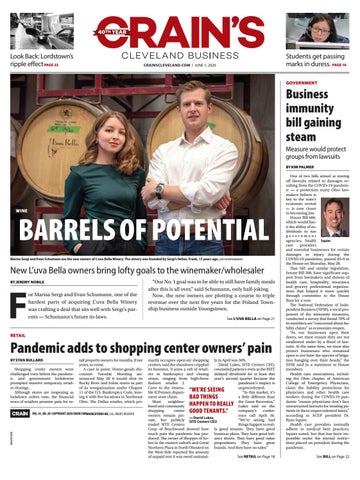
Marisa Sergi and Evan Schumann are the new owners of L’uva Bella Winery. The winery was founded by Sergi’s father, Frank, 15 years ago. | EIF ENTERTAINMENT
New L’uva Bella owners bring lofty goals to the winemaker/wholesaler BBY JEREMY NOBILE
F
or Marisa Sergi and Evan Schumann, one of the hardest parts of acquiring L’uva Bella Winery was crafting a deal that sits well with Sergi’s parents — Schumann’s future in-laws.
“Our No. 1 goal was to be able to still have family meals after this is all over,” said Schumann, only half-joking. Now, the new owners are plotting a course to triple revenue over the next five years for the Poland Township business outside Youngstown. See L’UVA BELLA on Page 21
RETAIL
Pandemic adds to shopping center owners’ pain BBY STAN BULLARD
Shopping center owners were challenged even before the pandemic and government lockdowns prompted massive temporary retailer closings. Although stores are reopening as lockdown orders ease, the financial woes of retailers promise pain for re-
tail property owners for months, if not years, to come. A case in point: Home-goods discounter Tuesday Morning announced May 28 it would shut its Rocky River and Solon stores as part of its reorganization under Chapter 11 of the U.S. Bankruptcy Code, leaving it with five locations in Northeast Ohio. The Dallas retailer, which pri-
NEWSPAPER
VOL. 41, NO. 20 l COPYRIGHT 2020 CRAIN COMMUNICATIONS INC. l ALL RIGHTS RESERVED
P001_CL_20200601.indd 1
marily occupies open-air shopping ly in April was 50%. David Lukes, SITE Centers CEO, centers, said the shutdown crippled its business. It joins a raft of retail- counseled patience even as the REIT ers in bankruptcy and closing delayed dividends for at least this stores, ranging from high-brow year’s second quarter because the pandemic’s impact is fashion retailer J. unprecedented. Crew to the venera“WE’RE SEEING “In this market, it’s ble JCPenney departa little different than ment store chain. BAD THINGS the Great Recession,” Most neighborhood and community HAPPEN TO REALLY Lukes said on the company’s confershopping center GOOD TENANTS.” owners remain prience call April 30. ——David Lukes, “We’re seeing bad vate, but publicly SITE Centers CEO things happen to realtraded SITE Centers Corp. of Beachwood showed how ly good tenants. They have good much pain the pandemic has pro- business plans. They have good balduced: The owner of Shoppes of So- ance sheets. They have good value lon in the eastern suburb and Great propositions. They have great Northern Plaza in North Olmsted on brands. And they have no sales.” the West Side reported the amount of unpaid rent it was owed nationalSee RETAIL on Page 18
One of two bills aimed at staving off lawsuits related to damages resulting from the COVID-19 pandemic — a protection many Ohio lawmakers believe is key to the state’s economic revival — is now closer to becoming law. House Bill 606, which would limit the ability of individuals to sue government agencies, health Squier care providers and essential businesses for certain damages or injury during the COVID-19 pandemic, passed 83-9 in the House on Thursday, May 28. That bill and similar legislation, Senate Bill 308, have significant support from lawmakers and dozens of health care, hospitality, insurance and grocery professional organizations that helped it move quickly through committee to the House floor for a vote. The National Federation of Independent Business (NFIB), a vocal proponent of the immunity measures, conducted a survey that found 70% of its members are “concerned about liability claims” as economies reopen. “As our businesses open their doors, we must ensure they are not swallowed under by a flood of lawsuits. At the same time, we must also protect businesses who remained open to not have the specter of litigation hanging over their heads,” the NFIB said in a statement to House members. Health care associations, including the Ohio chapter of American College of Emergency Physicians, claim the liability protections for physicians and other health care workers during the COVID-19 pandemic “ensure physicians don’t face unwarranted lawsuits for treating patients in these unprecedented times,” according to ACEP president Dr. Ryan Squier. Health care providers normally adhere to medical best practices, Squier noted, but that has been impossible under the myriad restrictions placed on providers during the pandemic. See BILL on Page 22
5/29/2020 3:31:27 PM
YOU KNOW WHAT IT TAKES TO RUN A BUSINESS.
And we’re here to help make it happen. Whether you’re a company of one or a large scale operation, running a business is no small task. It takes passion, drive and dedication. As your business evolves, we’re here to offer experienced guidance and dedicated support to help you. 53.com/CommercialBank
Fifth Third Means Business
Fifth Third Bank, National Association. Member FDIC.
REAL ESTATE
University Square shopping center clears hurdle for apartment makeover Investor group has $30 million project planned for initial phase BY MICHELLE JARBOE
University Square, a largely vacant East Side shopping center, is lurching toward new life after seven years of default and five years under lender control. A residential makeover plan floated by local developers Brad Kowit and Gregg Levy took a large stride Wednesday evening, May 27. During a special meeting held, due to the pandemic, on the Zoom videoconferencing app, University Heights City Council voted to move forward on a development agreement between the suburb and the would-be owners of the property. An investor group led by Kowit and Levy expects to buy the center, with the exceptions of the retailer-owned Target and Macy’s stores, by late summer. Court filings list a $3.5 million purchase price for the nearly 300,000-square-foot core of the multilevel property, which wraps around a garage that can hold more than 2,000 cars at Cedar and Warrensville Center roads. The developers plan to transform empty stores along Cedar into 203 apartments through selective demolition and construction. That $30 million project would be the first phase of a broader repositioning of one of the region’s most prominent retail failures. A former grocery store and an empty JoAnn Fabrics store are earmarked for phase two. “It’s been a little bit over a year that we’ve been involved,” said Kowit, a partner with Kowit & Co. Real Estate Group in Mayfield Heights. “And a lot of moving pieces, so it has taken quite a bit of time. But I think we’re rounding third and heading home.” The developers, whose past projects include an apartment conversion of the Lakewood Center North office building on the West Side, formally inked a deal in January to buy University Square from bondholders who have held the property since 2015. The bondholders are owed more than $47 million in principal and interest on debt that was issued in 2001 to finance the parking garage project. If the redevelopment deal proceeds, those investors stand to collect only $8 million, according to municipal bond documents. University Heights and the trustee for the bondholders have spent years unwinding a complicated financial structure that drove away dozens of potential buyers and developers. By the time the bondholders took possession of the center, it was hemorrhaging cash and in foreclosure, following a rash of store closures, a series of ownership changes and a run of lackluster management. A tax increment financing deal, which redirected new property tax revenues from the project to debt payment, required those payments to remain static even if the value of the shopping center plunged. Those obligations came in the form of special assessments, which became a lien on the property — and a barrier to redevelopment — as tenants fled and income from rents dried up.
Ca u l e y Fe r ra r i o f D e t ro i t 7 0 7 0 O rc h a rd L a k e R d. �e � t � l o o m � e l d� � � 4 8 3 2 2 Te l e p h o n e : 2 4 8 . 5 3 8 . 9 6 0 0 w w w. Ca u l e y Fe r ra r i . co m
A rendering shows the reimagined Cedar Road side of the University Square shopping center, where empty storefronts between Target and Macy’s could become a six-floor, E-shaped apartment building. | DIMIT ARCHITECTS
The city and UMB Bank, the trustee, have worked together to release those liens. On paper at the Cuyahoga County Fiscal Office, the assessments looked like unpaid property taxes, but the vast majority of the backlog actually was missed payments on the debt. Delinquent taxes, city service assessments, interest and fees were a small part of the bill. University Heights and the Cleveland Heights-University Heights School District recently approved the framework of a deal to replace the existing tax increment financing arrangement with a new agreement. Everyone with a financial stake in the project is taking a hit, with the
“IT’S BEEN A LITTLE BIT OVER A YEAR THAT WE’VE BEEN INVOLVED. AND A LOT OF MOVING PIECES, SO IT HAS TAKEN QUITE A BIT OF TIME. BUT I THINK WE’RE ROUNDING THIRD AND HEADING HOME.” — Brad Kowit, a partner with Kowit & Company Real Estate Group
goal of receiving some money as part of the resolution and redevelopment process. “University Square has been, for a long time, a distressed or even lost asset,” Mayor Michael Dylan Brennan said. “It’s on a prime piece of real estate in the heart of our city. It’s been distressed for so long that many of us look past it. … To return it to a useful and productive use is going to be just a tremendous boon to this community.” The deal isn’t complete yet, though. Target and Macy’s still need to sign off on the residential conversion and agree on terms of their relationship with Kowit and Levy, revising an agreement that dates back two decades to the original University Square developer, Starwood Wasserman. Public filings show that the final steps of the process would involve passing the real estate through the Cuyahoga Land Bank, to wipe out delinquent property taxes, and working with the Cleveland-Cuyahoga Coun-
SALT • SALT • SALT
ty Port Authority to issue new bonds tied to the project. The sale of the new bonds would generate the majority of the anticipated payment to the existing investors, who haven’t received any money in years. The port, which issued the original bonds, is in talks about a new issuance. The agency also has discussed taking ownership of the University Square parking garage, which would then be tax-exempt. The port’s board Minimum of directors hasn’t formally approved a deal, however. Delivery: The land bank, a quasi-govern1 Pallet mental corporation, focuses on residential real estate but is willing to briefly take title to troubled commercial properties if there’s a developer on hand. “The land bank is still willing to assist however we can in the transaction,” said Douglas Sawyer, the nonMEDINA, OH profit organization’s assistant general counsel. “But until there’s an agree1-800-547-1538 ment with parties external to us, Salt Distributors Since 1966 we’re standing at the ready.” Kowit expressed optimism about www.saltdistributormedinaoh.com the deal, adding that he anticipates ample demand for new apartments in University Heights. Plans drawn up by Dimit Architects show that Class A Office Corporate Plaza I, II three high-ceilinged retail floors 6450 - 6480 Rockside Woods Blvd would become six levels of studios Space for Lease and one- and two-bedroom units. S. Independence, OH The developers would raze part of the garage to create outdoor space. Monthly rents for the apartments are likely to start at $1,450, Kowit said. “It’s sort of in between Beachwood and University Circle, so I think we’ll capture a lot of those groups,” he added. “I think we’ll have medical students. We’ll have doctors. We’ll have professionals. We’ll have people, I think, of all ages … Grimm because springit’s mix 05-04-20.indd 1 4/28/2020 part of a mixed-use area. Our market study tells us that there’s a significant void here that we’re going to fill.”
Water Softener • Industrial • Food Ice Melt • Sea Salt
Call For Pricing!!
Michelle Jarboe: michelle.jarboe@ crain.com, (216) 771-5437, @mjarboe
Available Suites from 1,667 to 24,148 SF
Correction A May 18, Page 1 article about the planned commissioning of the new USS Cleveland misstated the amount the USS Cleveland Legacy Foundation is raising for the project. The amount is $4 million to $5 million.
COMMERCIAL REAL ESTATE SERVICES LEE CLEVELAND
Abram Schwarz, SIOR | 216.282.2210 | www.leecleveland.com JUNE 1, 2020 | CRAIN’S CLEVELAND BUSINESS | 3
P003_CL_20200601.indd 3
5/29/2020 1:47:17 PM
1:25:01 PM
COPING WITH COVID-19 | MANUFACTURING PANDEMIC PERSEVERANCE
A BEACON
OF LENDING FOR YOUR COMMERCIAL REAL ESTATE INVESTMENTS IN THESE UNPRECEDENTED TIMES:
YOUR LOCAL CREDIT UNION • Loans up to $10 Million • No Prepayment Penalties • As Little as 10% Down
Your Business Lending Partner SM Contact Jonathan A. Mokri 440.526.8700 jmokri@cbscuso.com www.cbscuso.com
ONE OF THE MOST BEAUTIFUL OFFICE SETTINGS IN NORTHEAST OHIO 4020 KINROSS LAKES PKWY., RICHFIELD, OH 44286
PROPERTY OVERVIEW
18,000 SF Class A office space available. Situated on magnificently landscaped 8 acres. • Suites ranging from 4,400 to 8,500 SF • Outstanding on-site amenities • Centrally located and seconds from I-77 and I-271 • Move-in ready VIRTUAL TOURS AVAILABLE
Julie Sabroff, CCIM www.hannacre.com
216.839.2029
JulieSabroff@HannaCRE.com
VMS leverages manufacturing skill, client base to avert downturn BY JUDY STRINGER
It’s becoming an all-too-familiar COVID-19 replay. Coming off several years of strong growth, a business barrels into 2020 — often posting record first-quarter numbers — only to suddenly be derailed by the coronavirus pandemic. In the case of Twinsburg’s VMS (Visual Marking Systems), that derailment came primarily via the company’s booming vehicle wrap division. The 58-year-old organization manufactures decals, labels and other types of product signage for a wide range of companies, including original equipment makers like Lincoln Electric, retailers like Petitti Garden Centers and transit systems like Greater Cleveland RTA. Over the past decade or so, however, vehicle graphics and promotional products have emerged as VMS’ growth engine. When many businesses closed in March, those orders stopped, including any new requisitions from Enterprise, whose expansive fleet of rental trucks and airport shuttles is logoed by VMS. “We typically wrap over 20,000 (Enterprise vehicles) a year,” said CEO Dolf Kahle. “As of April, we are only doing repair work for them.” Kahle, who bought the company with his father, Hermann, in 1982 and currently runs it with his son, Eric, said that before COVID, he had expected to clear $17 million this year, up from $16 million in 2019. In March, the company had booked its largest number of orders — “not shipments, but the new orders,” he stressed — besting its previous onemonth record by 20%. “And then the proverbial shit hit the fan,” according to Dolf Kahle. “Now, we think we might do $13 million or $14 million based on what happens for the rest of the year.” VMS has stayed open during the pandemic. Among its customer base are medical equipment makers responsible for manufacturing hospital beds, respirators, ventilators and a few other products that
VMS CEO Dolf Kahle (seated) and his son Eric, the company’s chief operating officer, are steering the Twinsburg company through the COVID-19 pandemic. | CONTRIBUTED
“WE TYPICALLY WRAP OVER 20,000 (ENTERPRISE VEHICLES) A YEAR. AS OF APRIL, WE ARE ONLY DOING REPAIR WORK FOR THEM.” — Dolf Kahle, VMS CEO
exploded in demand as medical systems and first responders raced to secure resources ahead of an anticipated wave of coronavirus cases. Minneapolis-based Stryker Corp. alone needed decals, labels and nameplates for 100,000 new hospital beds, including 10,000 headed to New York City, according to Dolf Kahle. In all, the company collected 94 letters from clients who are considered essential businesses and cite VMS as a critical supplier. He credited orders from OEM clients — which make up 65% of VMS’ business — and the company’s conservative inventory management strategy for keeping VMS afloat during the
pandemic’s early days. There have been no layoffs among its 130 employees, Dolf Kahle said, although in early May VMS went to a 32-hour workweek, reducing pay across the board to reflect the curtailment. The company also recently received a grant from the federal Paycheck Protection Program, which will cover about two-and-a-half months of salary, he said.
Pandemic promo VMS’ nascent Badlime Promo and Apparel division has emerged as another secret weapon in the fight against a major pandemic downturn, according to Eric Kahle, who is vice president of operations. VMS bought Badlime, which specializes in custom-printed items, in 2018 and grew it to a $1 million division, primarily by partnering with established promotional product brokers. The partners included brokers who sold customized shirts, hats, cups and pens to VMS’ customers. See VMS on Page 21
Providing a private travel experience that exceeds expectations
“Success has a way of following success.
HOW TO FLY WITH SKY QUEST: » On-Demand Charter » Jet Card Memberships » Aircraft Ownership Opportunities
FlySkyQuest.com 216-362-9904 Charter@FlySkyQuest.com
University Hospitals Ahuja Medical Center is a good �t in Beachwood, which offers superior municipal services and a city government that is accessible and supportive.”
Mayor Martin S. Horwitz •Mayor@BeachwoodOhio.com •216.292.1901
WWW.BEACHWOODOHIO.COM
4 | CRAIN’S CLEVELAND BUSINESS | JUNE 1, 2020
P004_CL_20200601.indd 4
5/29/2020 2:18:19 PM
MY BENESCH “Benesch isn’t just a good law firm. Working with them may be the best vendor relationship of my professional career.” PATRICK GEDDES CEO and Chief Tax Economist Aperio Group
MY TEAM Featured team (left to right) ALLAN GOLDNER JESSICA N. ANGNEY COREY R. SPARKS LEAH BEITNER RYAN J. WILLIAMS RYAN M. KRISBY MICHAEL D. STOVSKY KATHY SENDER*
*Paralegal
Aperio is in the business of providing sophisticated investment services to highly demanding and discerning clients. So when it came time to select a law firm to help with Aperio’s own transactional needs, Patrick and his team came with strong opinions of what great service entails, and high expectations for the attorneys charged with providing it. Benesch not only delivered the extensive legal and logistical experience to execute Aperio’s complex M&A deals and manage the associated tax implications, but also brought the client-focused mindset and personal attention that helped turn high-stress situations into high-satisfaction results. Why settle for anything less for your business? To learn more about our relationship with Aperio Group, visit beneschlaw.com/myteam.
www.beneschlaw.com
© 2020 Benesch Friedlander Coplan & Aronoff LLP
AperioGroup4c_10.875x14.5Ad.indd 1
4/1/20 11:06 AM
SPORTS BUSINESS
T S A C B E W E E FR
RANSOMWARE: What businesses need to know to stay safe Who’s behind the attacks? What should businesses watch for? What can you do if your business is hit? How can a business protect itself? What types of business are most vulnerable?
NOON –1 P.M. | JUNE 25 FEATURED SPEAKERS:
David Kennedy
Co-founder and chief technology officer, Binary Defense National cybersecurity speaker
IN PARTNERSHIP WITH:
PRESENTED BY:
Randy Pargman
Senior director of threat hunting and counterintelligence, Binary Defense 15-year FBI veteran
PRODUCED BY:
REGISTER TODAY:CrainsCleveland.com/Webcasts
STAY IN THE KNOW with Crain’s email newsletters
Subscribe FOR FREE by visiting CrainsCleveland.com/enewsletters
Crain’s Business
Crain’s Business
New partner at Bunker Hill sparks big improvements Medina course undergoes extensive renovations BY KEVIN KLEPS
As a boy, Arnold Ingraham would bet the players at Bunker Hill Golf Course that he could hit the closest shot to the pin. “I made a little bit of money that way,” recalled Ingraham, who took over management of the Medina golf course from his mother, Berneta, in 1980. Bunker Hill has undergone many improvements in the four decades since, and quite a few more are being done this year. Since Jan. 1, ownership has committed to making $450,000 to $600,000 in improvements, boosted by a cash infusion from Steve Ross. Ross, whose father, Boyd, founded Medina-based RICO Equipment in 1984, started the year as a “silent” partner. But he became much more involved once the COVID-19 pandemic hit and so much of the country shut down. “It gave me an opportunity to see things and how they were doing them at a slower pace,” Ross said. Ross, with the help of general manager Chad Gibson, decided the best course of action was to upgrade as much as possible, so Bunker Hill could “really hit the ground running, as opposed to playing catch-up” once some of the pandemic-related restrictions lifted. Bunker Hill’s bar and grill is being remodeled as a banquet area. There will also be a new walk-in freezer, new carpeting in the clubhouse, new concrete paths for golf carts, a renovated gazebo and landscaping improvements that have totaled almost $100,000 in the last two years. The 16th hole, which had been, in the words of Ross, “straight downhill,” was also remodeled. That one was a bit personal for Ross, who said he broke his collarbone a decade ago when a cart being driven by his brother flipped over as it tried to navigate the hole.
“We fixed it, and it looks fantastic,” Ross said of No. 16. Ross described his deal with the husband and wife team of Arnold and Cheri Ingraham as an even partnership. The Ingrahams, who are in their late 70s, have stepped back on the operations side. Those duties are being handled by Ross and Gibson, who became Bunker Hill’s GM in 2017 and has been involved in the industry for more than three decades. The golf course was purchased by Arnold Ingraham’s parents in 1939. Arnold’s father, Roger, died in a plane crash in 1943, leaving Berneta to run the golf course and raise her family. Cheri Ingraham still plays in Bunker Hill’s women’s league, which was started 93 years ago, when Medina County’s oldest golf course opened. Berneta Ingraham played in the league, too. The Ingrahams said they knew it was time to find a partner, and they believe Ross, who has long been a big fan of Bunker Hill, is a good fit. “We’re retirement age, and it’s a big, huge job to run the golf course,” Cheri Ingraham said. “And what happens after we’re gone?”
‘Not getting rich’
Bunk exte
Th for R ing quit “L rich “You one W Gib
Ross said he heard about the partnership opportunity from mutual associates, and getting involved at Bunker Hill was “a no-brainer. “I had the opportunity of meeting Arnold quite a few years ago, and I was always impressed with what they did and how they did it,” Ross added. The Ingrahams take great pride that many staffers have been involved at the golf course for decades. Scott Brickley has been the golf course’s superintendent for 25 years, and mechanic Kenny Bargar has been an employee for four-plus decades. “Most employees work with us until they can’t work anymore,” Arnold Ingraham said. “We’re like a big family here.”
Crain’s Business
The tools you need now to navigate the crisis With small businesses needing to adjust during these uncertain times, Crain’s Business Toolbox offers critical information and resources to help businesses not only survive, but thrive.
CrainsCleveland.com/crains-business-toolbox
LAND FOR SALE: Beacon West, Westlake
Prestigious Westlake Location! » Industrial Zoning with Many Allowable Conditional Uses » Prestigious High Visible Gateway Location » Can Accommodate up to 100,000 SF Building » $550,000 » $76,389/Acre
Property Features Priced to Sell Last Two Available Parcels ● Quick access to I-90 and Crocker Park ● Enterprise Zone ● Major Business Area ● Stormwater Pond Installed ● Build to Suit Available ● ●
Lot 2R 7.226 Acre Parcel
VIKING PARKWAY
CONTACT US Charles Marshall or Terry Noonan 330-659-2040 3457 Granger Road, Akron, OH 44333
VISIT OUR WEBSITE www.beaconmarshall.com 6 | CRAIN’S CLEVELAND BUSINESS | JUNE 1, 2020
P006_P007_CL_20200601.indd 6
Beacon Marshall Ad 3-4-Lot 2R-9-2.indd 1
5/29/2020 2:21:27 PM 10/7/19 12:47 PM
ll
ns
tic,”
the nold parte in k on are son, M in e ines. d by 939. ane run ly. Bunwas dina ned. the
w it hey a big
’s a rse,” hap-
Arnold Ingraham took over management of Bunker Hill Golf Course in 1980. His wife, Cheri, is known as the golf course’s historian.
Bunker Hill, which opened in 1927, is the oldest golf course in Medina County. The course and facilities are going through an extensive round of improvements in 2020. | CONTRIBUTED PHOTOS
That was another intriguing aspect for Ross, who said he had been looking for a partnership opportunity for quite a while. “Let’s face it: You’re not getting rich working at a golf course,” he said. “You’re also not getting rich owning one, which I’m finding out.” What Bunker Hill can do, Ross and Gibson believe, is make the best of a
difficult situation that they and every other business have faced during the COVID-19 crisis. Gibson said Bunker Hill had “a great year” in 2019, but got “crushed” during the pandemic, which shut down league play and events, and resulted in the course playing at about 50% capacity on “sold-out” days. Now, though, some restrictions
have been lifted. Indoor dining and 300-person gatherings are permitted. It also helps that two golfers can share a cart without a divider, which reduces the gaps between tee times. League play began on May 26 and, ideally, will run the first four nights of each week, with outings filling the weekends. Events that were put on
hold in April, May and June are being put back on the schedule for the second half of the year, and Gibson is known for his innovative and organization-friendly methods for fundraisers and other community gatherings. “There’s light at the end of the tunnel, and it’s coming fast,” he said. The Bunker Hill GM said customers are given cards similar to those that frequent store patrons keep on their keychains. That way, Bunker Hill’s staffers learn their customers’ names, which are printed on their cart tickets, and the regulars are then eligible for rewards. “I really like it where people know your name and greet you by your first name, rather than just by a number,” Gibson said.
Getting more kids involved, an industrywide problem, is still an issue at Bunker Hill. Arnold Ingraham also lamented the decline in business outings since the 2008 economic downturn. But the sport, Ingraham said, “has a lot of things” in its favor. “You can play your whole life, from the time you’re 8 to 88,” he said. And it just so happens that Arnold and Cheri have more time to play. The couple lives on the property of their favorite course, one that has been in the family for 81 years. “It’s always been our little piece of heaven,” Cheri Ingraham said. Kevin Kleps: kkleps@crain.com, (216) 771-5256, @KevinKleps
partl asBun-
ting nd I hey ded. that d at cott s sumeem-
PREMIUM BEACHWOOD OFFICE SPACE AVAILABLE Maximum Visibility and Recognition
unnold am-
Enterprise Place 3401 Enterprise Parkway | Beachwood, OH 44122 Maximize your business potential with an office at Enterprise Place, the most recognizable Class A office building in Beachwood. Strategically located at the intersection of I-271 and Chagrin Blvd. with prime visibility, Enterprise Place is ideal for both established and growing businesses.
n! CALL TODAY! 216.910.9317
n
• Building signage for anchor tenant with visibility from I-271 (average traffic count of 125,000 cars per day) • Contiguous space available from 6,700rsf to 20,171rsf • 10 private, 900 square foot rooftop terraces for tenant use • Three (3) new high-speed electric passenger elevators • Full 5th floor available • 24-hour keycard access • Conference room with WiFi • Ample free surface parking • Heated indoor parking • Full-time on-site maintenance staff • Walkability to shopping and dining • Café and outdoor picnic areas • Owner-managed Dennis Bush Vice President, Director of Commercial Real Estate GoldbergCompanies.com | 216.831.6100
dbush@goldbergcompanies.com
JUNE 1, 2020 | CRAIN’S CLEVELAND BUSINESS | 7
P006_P007_CL_20200601.indd 7 10/7/19 12:47 PM
5/29/2020 2:22:09 PM
PERSONAL VIEW
Stronger, together in downtown Cleveland
RICH WILLIAMS FOR CRAIN’S CLEVELAND BUSINESS
BBY JOE MARINUCCI
EDITORIAL
Power failure Sometimes a win doesn’t feel like a win. That’s the case in a May 21 ruling by the Ohio Power Siting Board concerning the future of Icebreaker, the Great Lakes’ first wind energy project. The ruling technically was a victory for Icebreaker and its developer, the nonprofit Lake Erie Energy Development Corp. (LEEDCo.), since the board allowed the project to move forward. But there was a last-minute catch included in the board’s permitting conditions: Icebreaker’s turbines can’t operate at night from March 1 to Nov. 1, to limit the risk to birds and bats. (That overnight stoppage is called “feathering.”) The six-turbine, 20.7-megawatt demonstration project already was a challenge, from an economic perspective, and the restriction “could be fatal to the viability” of the entire effort, said Dave Karpinski, president of LEEDCo. If that’s the case, he said, “Ohio will be left behind,” yet again, when it comes to more aggressive pursuit of alternative energy sources. This could have — and should have — been avoided. As Energy News reported, the power siting board’s staff “first suggested nightly shutdowns for most of the REGARDLESS OF HOW year in 2018, despite LEEDYOU FEEL ABOUT WIND Co having reached an agreement with environENERGY, THE PROCESS mental groups for monitorHERE WAS BADLY ing and safeguards to protect bats and birds. ... After FLAWED. months of negotiations between LEEDCo. and staff at the OPSB and Ohio Department of Natural Resources, the developer reached a compromise with regulatory staff last May that dropped the requirement.” And suddenly, it’s back, to the detriment of an effort that landed a $40 million grant from the U.S. Department of Energy and involves partners including the city of Cleveland, the Port of Cleveland and the Cleveland Foundation, and government bodies in outlying counties. LEEDCo. is weighing an appeal to the board, and potentially to the Ohio Supreme Court. The state, meanwhile, notes that LEEDCo. and its project partner, Fred Olsen Renewables, could begin operating at night in the eight-month period if
they conduct radar studies and provide the power siting board with a bird and bat impact mitigation plan, including a collision monitoring plan. But as Energy News pointed out, there’s “no guarantee of a favorable outcome even if monitoring data did not show significant impacts to bats or birds.” Regardless of how you feel about wind energy or this project in particular — as Karpinski points out, there’s a lot of “pseudoscience around this issue” aimed at discrediting it — the process here was badly flawed. There’s no way the Icebreaker project should have gone this far down the road, with all the energy expended on the development side and by regulatory bodies, to have what amounts to a significant financial poison pill reinserted so late in the process. Any developer looking at a potential renewable energy venture in Ohio has to think twice about the wisdom of doing so. The message, once again, is that Ohio is not welcoming to renewable projects — a baffling position in a state that has much to gain on the manufacturing side if wind turbines take hold in the Midwest as they are doing now on the East Coast.
Feeling at home A new future is emerging for an important part of Cleveland’s industrial past. GE Lighting, which has been here for nearly 130 years but no longer fits within the larger GE universe that’s shifting away from consumer products, reached a deal last week to be sold to Savant Systems, a home control and automation company from Massachusetts. Savant wants to leverage GE Lighting’s technology and manufacturing expertise to become a powerhouse in smart-home products — a category poised for growth as we spend more time at home. The sale includes a long-term licensing deal for the GE Lighting brand, which Savant is betting will broaden the reach of both companies. The 700-plus GE Lighting employees, including about 200 at Nela Park in East Cleveland, will keep their jobs and become Savant’s when the deal closes, likely this summer. There was no future for GE Lighting as part of GE. We hope it’s much brighter as part of Savant.
Publisher and Editor: Elizabeth McIntyre (emcintyre@crain.com) Managing Editor: Scott Suttell (ssuttell@crain.com) Contact Crain’s: 216-522-1383 Read Crain’s online: crainscleveland.com
We began 2020 with tremendous energy in downtown Cleveland. The Sherwin-Williams headquarters announcement, major events on the horizon like the Rock & Roll Hall of Fame induction ceremony, NCAA men’s basketball tournament, and beloved celebrations like St. Patrick’s Day and the Indians’ home opener. For the last few months, downtown Cleveland streets have been quieter Marinucci is the than we have seen in a long time. Now, as CEO and we reopen the economy, the question is president of the how quickly will we “return to normal”? Downtown Navigating new guidelines and policies Cleveland to keep people safe may be challenging Alliance. but is not insurmountable. Working together over the last 15 years, we transformed downtown Cleveland. I strongly believe we can — and will — do it again. The momentum our shared vision created helped build a vibrant downtown that attracts residents, investments and entrepreneurs. It is strong enough to weather the impacts of COVID-19. During this crisis, construction in downtown continues with eight projects underway, including six residential buildings that will add more than 1,100 apartments to the neighborhood, helping us achieve the milestone of 20,000 downtown residents. These projects represent our community’s resilence and reflect the fact that urban centers have NAVIGATING NEW historically overcome crises. GUIDELINES AND Just as the economic effects of the 1918 flu epidemic and oth- POLICIES TO KEEP er pandemics have come and PEOPLE SAFE MAY BE gone, those invested in the future of downtown are using CHALLENGING BUT IS this opportunity to reimagine NOT INSURMOUNTABLE. the downtown experience, make people feel safe and still create social connections. As we continue to invest in public/private partnerships, the Downtown Cleveland Alliance and our partners remain committed to innovating and advocating for place-based strategies that will improve the pedestrian experience downtown. During this crisis, our ambassadors stayed on the job, helping to ensure a clean and safe environment, and continued to be a visible presence. Their work provides peace of mind for those living and working here. As restaurants and offices reopen, our ambassadors are more critical than ever to the success of downtown neighborhoods. Our Business Development Center has prioritized helping small businesses access relief packages, while advocating for greater resources. We’ve engaged office tenants, property owners and financial institutions in planning for reopening and building for the future. We’ve connected our stakeholders with insights from the International Downtown Association and International Economic Development Council. Through our weekly “Downtown Now” virtual webinars, our survey of downtown residents and stakeholders, and our social media platforms, we know people want to come back downtown and experience all it has to offer. While downtown may feel very different today, I am confident we will reignite the energy we experienced over the last 15 years. Working with our partners, we will continue to grow a neighborhood that attracts residents, innovators and disruptors, and the investment we need to compete in the global market. I know that a vibrant downtown — one that includes residents, entertainment, green space, job opportunities and retail — will be at the center of our region’s success.
Write us: Crain’s welcomes responses from readers. Letters should be as brief as possible and may be edited. Send letters to Crain’s Cleveland Business, 700 West St. Clair Ave., Suite 310, Cleveland, OH 44113, or by emailing ClevEdit@crain.com. Please include your complete name and city from which you are writing, and a telephone number for fact-checking purposes.
Sound off: Send a Personal View for the opinion page to emcintyre@crain.com. Please include a telephone number for verification purposes.
8 | CRAIN’S CLEVELAND BUSINESS | June 1, 2020
P008_CL_20200601.indd 8
5/29/2020 1:56:12 PM
OPINION
PERSONAL VIEW
SO LD
The coming crisis of entrepreneurship doubt that the economic consequences of the pandemic fell heavily on the poor, vulnerable and working Just a few months ago in Crain’s March 15 issue, I was people. However, leaders should uncelebrating the fact that Cuyahoga County seemed to derstand that many entrepreneurs have broken out of a decadelong period of economic and small business owners suffered stagnation that followed the 2008 recession. Cuyahoga significant and irretrievable losses County was experiencing annual job growth of more during the pandemic, too. If the goal than 8,000, a rate not seen since 1998, and unemployis to get the most people hired as ment had decreased to the lowest level since 2002. quickly as possible, local governIn a few short weeks, COVID-19 and the economic lock- Trutko is an ments should avoid all measures that down wiped out these gains. From February to April, unem- economist and ployment in Cuyahoga County tripled from about 30,000 to market research make it more difficult or expensive to hire workers and to refrain from makalmost 100,000, employment decreased by around 100,000, professional. ing comments that disparage busiand 30,000 or more people dropped out of the workforce. The lifelong ness owners. Ultimately, it’s simply a The impact of the virus and lockdown on local em- Cuyahoga ployers is harder to gauge because there is less current County resident practical fact in a high-risk environment: Most people will not start the data available. Heading into the shutdown, the total lives in Rocky businesses that will eventually hire number of establishments in Cuyahoga County had River. workers if they feel government will grown to more than 36,000, the highest level in a dedevalue their sacrifices and redistribcade. After suffering a severe loss of more than 3,400 businesses from 2001 to 2014, Cuyahoga County was ute any potential rewards to the workers. Second, political and community leaders should realize enjoying a modest five-year growth of about 175 establishments per year, which suggested starts were exceed- that the pandemic has irretrievably destroyed a portion of ing closures by 0.5% per year. It’s worth noting that small society’s wealth. That wealth is lost, not hidden somewhere changes in business openings and closings drive in a cave or bank account. The lockdown damaged the fichange. In an average year, about 3,500, or 10%, of busi- nancial capacity of all levels of government, so any help nesses fail and a similar number, about 10%, of new from the state or federal government is likely to be minibusinesses take their place. Thus, a 1% change in the mal. Businesses have lost customers’ revenue and individuals have lost income so local tax revenues will be weak start or stop rate represents about 350 businesses. Based on anecdotal data and media reports, it’s real- and voters will have little appetite for tax increases. Now is istic to expect a significant negative shift in this delicate a good time to demand better performance from existing balance as more marginal businesses call it quits and employees, trimming of nonessential functions, less regufewer entrepreneurs launch new businesses in this un- lation, more innovation and an overall focus on the more certain environment. If, for example, 3% more business- efficient delivery of public services. It’s hardly fair or reasonable to expect business owners es fail and 3% fewer businesses are launched this year, Cuyahoga County would have nearly 1,700 fewer busi- and workers to struggle in a difficult environment and pay nesses the next year and over 30,000 fewer available taxes without asking government to change and give maxjobs. It’s not too early to ask Cuyahoga County political imum value for the money spent. Demanding more from and community leaders to develop a plan to deal with a government would have a huge impact on the poor and severe unemployment problem intensified by a dearth most vulnerable in society. About 40% of the Cuyahoga County government budget, for exof entrepreneurial ventures. ample, is spent on health and human To date, national, state and local LOCAL LEADERS SHOULD services. To ensure accountability approaches have focused on lending and better services to the poor, county businesses money to cover payroll BEGIN BY VIEWING THE government should develop meanand other expenses and giving work- PROBLEM THROUGH THE ingful metrics that measure the quaners money to maintain aggregate tity and quality of public services for consumer spending. Government LENS OF A TYPICAL SMALL the most vulnerable and needy memlending and giveaways are stopgap BUSINESS OWNER. bers. Society asked health workers solutions that buy time and minimize suffering, but a comprehensive approach is needed and first responders to deal with the pandemic, scientists to create a climate that restores entrepreneurial vitality to develop treatments and a vaccine, business owners to shut down and workers to lose income. It is not unreasonand economic opportunity in Cuyahoga County. Local leaders should begin by viewing the problem able to ask local government to figure out how to do better through the lens of a typical small business owner. For for about the same amount of money. Third, political and community leaders should adjust many small businesses, the startup after the lockdown will require organizing and mobilizing new financial, la- their vision of the community’s future to include many combor and material resources in the face of uncertain cus- monplace values and traditions. The pandemic has shown tomer demand and greater risk. The best thing local gov- the weaknesses of the urban expert’s vision of a high-densiernment can do to help private sector businesses adjust ty, environmentally sustainable city with much zoning reguto these new circumstances is to create a secure, orderly lation and dependence on public transit. There is value in a and predictable environment and to avoid a massive, ex- diversity of homes and living styles, spread out over a modpensive and disruptive burst of new initiatives aimed at erate landscape tied together by private transportation. In a “true emergency,” it turns out that many aspects of solving unemployment or other difficult social problems. Stability, predictability and clear communication of a lifestyle that are taken for granted are really important, steady, dependable approach will do much to reassure such as the mundane and ordinary jobs that maintain our existing small business owners as well as those who lifestyle. A pandemic that disrupts normal life brings home the importance of a trusted circle of family and friends, might be considering launching a new business venture. Leaders need to adopt a small business perspective, es- schools and libraries, social and religious activities, and pecially when it comes to how small businesses view leisure and recreational activities that are part of normal workers, because restoring entrepreneurial growth is an daily life. But new technologies and adaptations, many of essential precondition to reducing unemployment. The which are enjoyable as well as convenient, will linger on average small business person does not set up a business and might seed new business ideas and ventures. The goal should be a healthy, prosperous and safe city simply to hire workers. Instead, the number and kinds of workers a small business needs are determined by the with well-functioning and efficient services at a reasonable market — what customers want, need and are willing to cost. Our resiliency depends on having measurable objecpay for, along with the technology available to meet cus- tives; rational, rigorous cost-benefit analysis to make the tomer needs. Coming out of this pandemic, handling em- best use of scarce resources; and transparency about the ployees will be more challenging for small businesses use of those resources. And an entrepreneurial mindset — since work processes may change a lot. For example, em- whether is it about starting a new business, maintaining an ployees likely will be making more demands for safety and existing business or thinking about how to get more from every tax dollar as an entrepreneurial government emworking from home, regardless of what employers want. In this uncertain environment, leaders should realize ployee — will be key to returning our cities and states to that this is not the time for an equity drive. There’s no prosperity.
JU ST
BY JAMES M. TRUTKO
Jeffrey Calig & David Hexter represented both Buyer and Seller in a 31,237 SF sale transaction in Streetsboro, OH. Congratulations to Natural Essentials, Inc. on the purchase of their fourth building to accommodate their rapid growth. Jeffrey Calig, CCIM www.naipvc.com
jcalig@naipvc.com
David Hexter, SIOR dhexter@naipvc.com
HISTORICAL CHARM. NATURAL BEAUTY.
HISTORICAL CHARM. Extraordinary Living NATURAL BEAUTY.
Extraordinary Living Outperform your dreams.
The hidden gem of South Carolina: Golf, tennis, boating, home!
(843) 838-3838
Learn more at Dataw.com
CORPORATE LITIGATION SERVICES Apple Growth Partners provides experienced, unbiased economic damage and business valuation services for the corporate litigation process. Contact us today to support your case: applegrowth.com SERVING NORTHEAST OHIO’S PRIVATELY-HELD BUSINESSES
Apple Growth Partners @applegrowthpartners AppleGrowthPartners @apple_growth
216.674.3800
JUNE 1, 2020 | CRAIN’S CLEVELAND BUSINESS | 9
P009_CL_20200601.indd 9
5/28/2020 3:17:11 PM
ADVISER Be aware of the mental health needs of employees returning amid COVID-19
HEALTH CARE
PAGE 12
PASSING THE PANDEMIC TEST Medical and nursing students emerge from a very different education experience
Medical students Jacky Wang, left, and Joy Li staff the COVID-19 Hotline call center at the University Hospitals Command Center in Highland Hills. The photograph was taken on March 18, before universal masking and physical distancing were required at UH. | CONTRIBUTED
BBY LYDIA COUTRÉ
In mid-March, nursing and medical students’ clinical experiences with direct patient care were quickly put on hold, leaving schools scrambling to find new ways to continue to train medical professionals. They got creative, expanding virtual options for classroom learning and finding other, safer experiences for students, including helping to answer COVID-19 hotline calls or consulting with patients via video or phone call. “The decision to remove medical students from the hospital was a difficult and painful one,” said Steven Ricanati, interim vice dean of medical education and associate dean for student affairs at the Case Western Reserve University School of Medicine. But university and hospital leaders agree that pausing these experiences was the right call for everyone’s safety. The schools wanted to ensure there were appropriate patients for their students to work with, safety guidelines in place and a sufficient supply of personal protective equipment so students could learn without depleting hospitals’ PPE resources or their faculty’s attention, Ricanati said. Now that the economy is reopening, the anticipated dramatic surge didn’t happen and all have had time to put appropriate safety measures in place, many nursing and medical students will return to clinical sites Monday, June 1.
Schools and hospitals collaborated closely to make that happen. The ongoing responsive and proactive adjustments they’ve made together have become a “dance” of ensuring everyone’s needs are met, said Diana Morris, interim academic dean at the school of nursing at CWRU and the Florence Cellar Associate Professor of Gerontological Nursing. Dr. Debra Leizman, director of medical student education at University Hospitals and the clerkship director of internal medicine, said courses front-loaded the basic classroom-based learning so that by the time students get back to clinical experiences, they can be fully immersed in that.
Ursuline College used virtual simulation technology, including these patient cases, to train students remotely. | CONTRIBUTED
Sharpnack
Isaacson
She also heard from a number of students who knew they couldn’t go into the hospital but wanted to be able to help. Leizman helped set up a program through which more
than 100 students volunteered thousands of hours to answer calls to the COVID-19 hotline. Though it took a couple of weeks to figure out how to meet students’ educational needs, Cleveland Clinic Lerner College of Medicine was able to successfully pivot to involve students in virtual clinics and virtual hospital rotations as telemedicine use skyrocketed, said executive dean Dr. Bud Isaacson. As students return to clinical sites, some parts of their clinical experiences will look different going forward. Many schools and hospitals
aren’t allowing students to work with patients who have or are suspected to have COVID-19, which meant some rearranging of where they would typically do their rotations. Hospitals are also trying to limit the number of people entering a patient’s room, whereas previously a large team of trainees could come in. “Currently, we are saying, ‘You know, let’s just limit to the bare bones the number of people that need to go into a room,’ ” Ricanati said. “So that has changed how much education and supervision can happen.” Schools are finding that the quick educational solutions they implemented can be carried into the post-pandemic normal. Patricia Sharpnack, dean of Ursuline College’s Breen School of Nursing, said students were thrilled with some of the technology quickly brought on. She expects much will be retained and used in different ways in the future to supplement teaching. Schools had to work with their accrediting bodies and state boards to modify what activities were allowed that would still meet required learning objectives. In May, universities were able to graduate classes of nursing and medical students in their final year. Now, they’re exploring what needs to be adjusted to ensure that students can still graduate on time next year, which many are confident will happen. See STUDENTS on Page 15
10 | CRAIN’S CLEVELAND BUSINESS | June 1, 2020
P010_CL_20200601.indd 10
5/28/2020 5:27:43 PM
Leslie R., Bank of America Consumer Bank Team
Sharing our appreciation My teammates and I in Ohio are deeply grateful to those working on the front lines to fight a global health crisis — the health care providers, first responders and essential service workers. This includes many across Bank of America who are working around the clock in financial and service centers to provide guidance and support to our clients. We’re committed to our teammates’ safety and well-being, providing new and enhanced benefits, including free access to virtual health care and emotional wellness programs, support for child and adult care, and meals for those in the office. Our extensive workplace health and safety measures adhere to the latest CDC guidelines. Eligible teammates are paid based on their regular schedules, even if hours are reduced. We also increased our minimum hourly wage to $20, one year ahead of schedule, and have committed to no layoffs in 2020. We are here to help. Please stay safe and well.
Jeneen Marziani Ohio Market President
For more information, please visit bankofamerica.com/helpfulresources.
Bank of America, N.A. Member FDIC. © 2020 Bank of America Corporation. All rights reserved.
FOCUS | HEALTH CARE | ADVISER
Planning. Protection. Assessing the mental health of Peace of Mind. For all life’s legal matters. We work with parents and family members who care about the future life and well-being of a special needs child. At Solomon, Steiner & Peck, Ltd., we listen to you concerns, thoroughly explain the legal issues involved, outline your options, and find practical solutions that meet your unique situation. How can we help you? Laurie Steiner, Esq.
Laurie Steiner, Esq., a partner at Solomon, Steiner & Peck, Ltd., is a Certified Elder Law Attorney by the National Elder Law Foundation and practices in the areas of Elder Law, Special Needs Planning, Estate and Trust Planning and Administration.
Estate Planning
Probate & Trust
Elder Law CE
L E B R AT I N
Business Law
216-765-0123
G
SSandPlaw.com
Cleveland Based Aircraft Brokerage Firm Providing:
Aircraft Sales Aircraft Acquisition Services ASA Aircraft Appraisals Aircraft Bank Audits/Lease Returns
Whether buying or selling your aircraft, price is just one consideration. You should also expect a streamlined process with no surprises. Rely on Axiom Aviation’s decades of transactions to achieve best results.
CONTACT: Andy Toy / Mike Herchick 216-261-8934 • www.AxiomAv.com
your workforce amid COVID-19 BY DAVID FINGERHUT
There's no doubt that COVID-19 has taken a serious toll on Americans, not just physically, but mentally and emotionally, as well. The longer the pandemic lasts, the more damage that is likely to be done to people's mental health. Employees are overwhelmed with health concerns and restrictions. They are overexposed to news reports that keep touting the negative aspects of the virus and the economy's plunge into recession. They are isolated from friends and family. They are out of their normal routines and feel they lack of control over their own lives. And now, they are returning to the workplace. With most companies reopening to some extent, many employees will be shifting from working at home to coming back to the plant or office. Unfortunately, they will return with a lot more baggage than when they left, scarred by the stress, anxiety and depression that has become commonplace in the age of COVID-19. Employers need to be aware of this reality and remain watchful for the various warning signs that an employee may be struggling and need additional support. Stress looks very different on different people. Some cope easily, while others feel overwhelmed quickly. Still others appear to be doing well, but are actually struggling in silence. One of the best investments an employer can make is in training for HR and frontline supervisors, so that they are knowledgeable about the signs that someone needs help. This is true even for employees who continue to work remotely, as they are even more likely to slip under the radar by remaining isolated and out of sight. Few people will come forward on their own, instead suffering in silence. So it becomes the responsibility of managers and senior leadership to keep watch and
that employees maintain be ready to tactfully interconsistent sleep and wake vene. times, as well as time Some of the more comcarved out for regular mon ways that stress, demeals and leisure activipression and anxiety can ties. Predictability and manifest themselves inconsistency help to relieve clude: excessive sadness stress and maintain circaor anger, difficulty sleepdian rhythms. ing, trouble concentrating, lack of focus or atten- Fingerhut is Move regularly. With tion to details, feelings of director of recent lockdown meaburnout, withdrawal from mental health sures, many people havco-workers, and sub- services for en't ventured far from stance abuse. Many of Paladina home and instead are these issues are not easily Health, a leading very sedentary observed, so therefore re- provider of lifestyles. This is bad for quire a closer eye to iden- direct primary tify potential problems. care with clinics physical as well as mental health. Encourage emSigns of burnout or stress throughout ployees to get up and may present in more con- Northeast Ohio. move, even for short tentious or detached inbursts of time (10 minutes terpersonal interactions, decreased work productivity or or so). An even better therapeutic work quality, erratic behavior or alternative is to get outside. Sunobserved changes such as in- light exposure, even on a cloudy creased tobacco use, sleepiness or day, does wonders for overall mood and outlook. weight loss or gain. Developing an atmosphere that's receptive to mental health wellness Limit media exposure. Too much and supportive of employees who time spent watching the latest do seek mental health services is an COVID-19 death tolls or financial enormous step that an HR depart- downturns is bad for mental health. ments can take to encourage men- Social media may be particularly tal wellness throughout their orga- challenging to mental wellness. nization. HR departments are not Consider identifying a few reputamental health experts, so they ble resources for scientific and shouldn't feel burdened to function medical information and limit the as if they are. Rather, it will be criti- amount of time scrolling social mecal to identify and reach out to area dia or blindly surfing the net. health care providers with experience in employee health and Leverage online resources. well-being that can collaborate to There are a vast array of apps these identify appropriate intervention days that effectively help with medprotocols for specific situations. If itation, mindfulness, cognitive bethe company contracts for third- havior therapy and sleep manageparty employee assistance program ment. Some of the best include (EAP) services, make sure that em- HeadSpace, Noom, Calm, Mindfulployees are encouraged to access ness Coach, iBreathe, 10% Happier and Shine. those. Ensuring that employees are Tips that can be offered to those employees still working remotely healthy both physically and mentally is a much bigger job in today's include: world. However, by being watchful Maintain a routine. Despite the and proactive, it's possible to create blurred lines between personal and and maintain a mentally healthier work time these days, it's important workforce.
Cleveland’s Premier Real Estate Developer Design Build | Redevelopment | Tenant Finish | Leasing | Construction Management | Acquisitions
RUN FOR RECOVERY IS GOING VIRTUAL ONE MILE WELLNESS WALK
KIDS’ FUN RUN
[
[
5K
PREMIER
Development Partners
We may be racing apart this year, but it’s important to come together to celebrate recovery, support family and friends who have lost loved ones, and stop the stigma surrounding addiction and mental health.
100 FOR $100 RAFFLE
ENTER FOR A CHANCE TO WIN A PELOTON BIKE LEARN MORE AND REGISTER AT:
WIZATHON.COM/RUNFORRECOVERY THANK YOU TO OUR SPONSORS*
Proven Process Proven Relationships Premier Difference �*AS OF 5/15/20
( 2 1 6 ) 3 4 1 - 1 2 0 0 | premierdevelop.com
12 | CRAIN’S CLEVELAND BUSINESS | JUNE 1, 2020
P012_CL_20200601.indd 12
5/28/2020 12:40:44 PM
‘Imperfect’ EHR system is a work in progress Electronic health records cut paperwork, but still evolving BY DOUGLAS J. GUTH
Jeffrey Sunshine, a radiology chair at University Hospitals and the system’s chief medical information officer, has been with UH since the days when electronic health records utilized simple order entry. Back then — around 1990 in Sunshine’s case — physicians simply sent prescriptions and lab results to a computer in place of a paper fax. How times have changed: Modern EHRs are integrated into every level of patient care, representing years of innovation and improvement to pull providers out from under mountains of paperwork. “You used to see the history of a patient in someone’s folder, locked away in a shelf,” said Sunshine. “The No. 1 thing we do now is communicate everything we know about the patient, wherever the patient is.” That’s not to say the current medical record system is perfect — far from it. Digitized documentation can be cumbersome to navigate, resulting in many small frustrations that Sunshine calls “death by a thousand paper cuts.” Industry observers said that while a real-time, patient-centered record of health is an indispensable resource, the evolution of the larger system is not yet complete.
Necessary but imperfect EHRs are not just a substitute for paper recordkeeping, experts say. Mandated by the 2009 Health Information Technology for Economic and Clinical Health Act, the system allows instant access of patient records as well as information transmission across departments and even across hospitals. According to EHR supporters, faster access streamlines provider workflow and increases the quality of care for patients. At UH and hospital systems nationwide, the shift to online is designed to reduce unnecessary testing, cut down on medical errors and give patients a more active role in managing their care. Yet critics say
just cutting and pasting information, which is a bad habit where mistakes can be made.”
‘Seeds of promise’
Sunshine
Weathers
patient data are not always readily available, leading to new errors when information isn’t shared across health networks as intended. Problems arise when patients move among hospitals, particularly if those facilities don’t have the same EHR vendor, noted Sunshine. While physicians are still able to share records, information is often summarized rather than arriving in a complete format. Specific data can be retrieved via a state health information exchange, or HIE, but it’s an extra step in the knowledge-gathering process. Doctors also have the Ohio Automated Rx Reporting System (OARRS) to track the dispensing of controlled prescription drugs, representing another crucial data point that can be accessed with an extra click. “If someone has an opioid prescription outside of an inpatient setting, you have to check (OARRS),” said Sunshine. “It would be great to see every drug a patient is getting everywhere, no matter what. We can see their medications, but it’s imperfect.” Tracy Porter, an assistant professor at Cleveland State University and co-author of a 2016 study on EHRs, said physician workload is an additional impediment to system implementation. Some EHRs are awkward to operate, offering multiple dropdown menus that may be irrelevant for a specified patient. Though some menus ask for redundant information — a patient’s birthdate, for example — others list numerous medication options that need careful filtering. “Many EHRs force doctors to go through all these checks and balances,” Porter said. “Some doctors are
“Botched Operation,” a 2019 investigation published by KHN and Fortune, reported thousands of deaths, injuries and near misses linked to EHRs. Reducing medical errors requires improving a system’s interface and applying new resources to enhance efficiencies, said Erica Mobley, vice president of administration at The Leapfrog Group, a patient-safety watchdog based in Washington, D.C. How and when doctors see alerts is one area that needs addressing, observed Mobley. EHRs are constantly pinging caregivers with alerts, to the point that clinicians ignore the messages. To solve this issue, some facilities are joining their computerized prescriber order entry (CPOE) systems with EHRs, cross-referencing new drug orders with a patient’s medication record and flagging any potential interactions. But in a Leapfrogled simulation of how well CPOE systems identify serious prescribing errors, 30% of participating hospitals received a failing mark. As far as a seamless swap of electronic information between providers or health networks, Mobley said new interoperability rules from the Department of Health And Human Services take aim at tech companies limiting the sharing of information from medical files. The new rules should give health care systems and
COVID-19 patients can be monitored remotely through EHR via Cleveland Clinic’s MyChart tool. | CONTRIBUTED
patients alike improved record access, even as some EHR companies still oppose the exchange. “We see seeds of promise,” Mobley said in an email. “On a more granular level, we are seeing hospitals doing a significantly better job of integrating their data systems.” CSU’s Porter said physicians are finding workarounds to make EHR technology work for them. A doctor with whom Porter spoke for the 2016 study put a laptop on a mobile cart so she could take notes while facing the
FOCUS | HEALTH CARE
patient. More communication between providers and IT specialists would further improve EHR processes and the product as a whole. “IT people have committees for this, but I don’t think they talk to doctors enough,” said Porter. “Users of systems should be deeply embedded in every facet of the decision-making process.” Allison Weathers, an enterprise associate chief medical information officer at Cleveland Clinic, said the hospital has been using Epic Systems Corp. EHR software for almost 20 years, beginning with computerized order entries. Clinical documentation is now used for telehealth visits, complete with intuitive visualization tools to make complex data sets user-friendly. As a neurologist at the Clinic, Weathers studies a list of patients every morning via a mobile app. Although these data are incredibly powerful, there is a risk of overload when administrative tasks required by EHRs are pushed onto providers. Meanwhile, it’s becoming easier for patients to get a complete copy of their records, thanks to online “MyChart” systems only needing a code for access. Some physicians view the larger EHR system as a burden, but Weathers might point these colleagues to the bad old days of digging through file folders for a single record. “I remember spending four hours trying to track down an MRI on film,” she said. “Now, I’m totally prepared for the day in a really easy way without having to pull paper charts.” Contact Douglas J. Guth: clbfreelancer@crain.com
Corporate Training
ICONIC IMG BUILDING
1360 East 9th Street, Cleveland, OH 44114
PROPERTY FEATURES » Office Spaces Available from 2,000 - 60,000 SF! » Superb Location with Great Views and Parking Facilities Nearby
Virtual Classroom Training Now Available
» Excellent Amenities Cafe Sausalito and Building Exclusive Gym & Training Facilities » Join the Great Tenant Mix at 1360 East 9th Street
• Interactive • Small group learning • Delivered direct/virtually to your employees
NEW DEALS FOR SUMMER 2020 OCCUPANCY David C. Wagner
William P. Nice, Jr., AARE, SIOR
DavidWagner@HannaCRE.com
BillNice@HannaCRE.com
216.839.2002
216.839.2010
www.corporatecollege.com
20-0475
FOR LEASING OPPORTUNITIES, CONTACT:
JUNE 1, 2020 | CRAIN’S CLEVELAND BUSINESS | 13
P013_CL_20200601.indd 13
5/28/2020 12:42:55 PM
FOCUS | HEALTH CARE
Space race Nexis Wellness looks to draw more providers to its leased medical offices in Beachwood BBY LYDIA COUTRÉ
Nexis Wellness, which leases medical office spaces to independent practitioners by the hour, is working to support its current members through the pandemic while exploring ways it can expand its member base to support health care providers who may be looking for new, more flexible places to practice. Nexis offers fully furnished private offices in Beachwood that health and wellness professionals can book by the hour through a monthly contract. “The plans that we offer are already incredibly flexible, and we’re continuing to offer those,” said Scott Zimmerman, founder and CEO of Nexis. “We will be rolling out a shortterm offer to let folks who are impacted by COVID get up and running as soon as possible and as cost-effectively as possible.” The option made sense for Alana Lopez, a parent coach and licensed psychologist who, before COVID-19, had been thinking about looking for a new office to accommodate her growing practice. The pandemic actually gave her the time to more seriously search for a space to better fit her and her clients’ needs once they begin to
Lopez
Winston
return to in-person appointments. Nexis offered the best solution. Lopez estimated that renting space from Nexis just for the hours she needs rather than traditional office space will save her $200 a month on rent. That doesn’t take into account utilities and office supplies that are included in her Nexis membership. “For practitioners and for myself, I think every dollar counts, and you know, it’s money that you can reinvest,” Lopez noted. “I just think, at this time, it’s been tough for everybody. And having some extra money to do things with and to have for whatever, it really, I think, is always helpful, especially during crisis times like this.” Some of the factors that have historically brought providers to Nexis, including the flexible membership plans,
become all the more appealing during economic uncertainty, Zimmerman said. “When the economy is good, Nexis offers providers the opportunity to expand Zimmerman their footprint and/or give private practice a try,” he said. “When the economy is bad or times are tough or uncertain, like they are right now, this is a really good way for folks to have space on a short-term basis that’s cost-effective, safe and secure with minimal exposure or risk.” In response to the pandemic, Zimmerman allowed providers to temporarily suspend their memberships. While it was a big help to members, it did result in a 70% reduction in monthly revenue for Nexis. “It was a short-term hit to our bottom line, but I think from a long-term perspective, it’s the right thing to do,” he said. “I’m hoping that our members will stick with us and tell their friends about us, and help us grow in the future.” Despite this loss of revenue, Zimmerman moved forward with a
Nexis offers fully furnished private offices that health and wellness professionals can book by the hour on a monthly contract. | CONTRIBUTED
planned expansion at the company's Beachwood location, which will grow capacity by 40% with contiguous office space. Before COVID-19, Nexis was at capacity four or five days a week for at least several hours a day. The expansion can accommodate additional providers, especially during peak hours. Of course, demand is lower right now, with only a few of Nexis' roughly 50 members using the space in the past several weeks, but Zimmerman has stayed in communication with members and is hearing that they’ll start back up in the next one to three months. He also expects to see demand for behavioral health care increase and, subsequently, the demand for space to offer those services.
A separate plan he had to open a second location on the West Side remains on hold as Zimmerman waits to see what usage looks like going forward. “We want to be providers to support providers in the community as they return to work and get operational,” Zimmerman said. “But we’re going to be a little bit prudent and wait to see what it actually looks like.” He sees the current environment as a time to test his business model and see how Nexis is able to support providers and their needs. Because the West Side expansion was able to be put off, Zimmerman said it gives him an opportunity to take his time and design a space that adheres to the most recent guidelines and responds to what providers need and want.
CRAIN’S THOUGHT LEADER FORUM EMPLOYEE BENEFITS INNOVATIONS Tap into the power of virtual influence. Showcase your industry expertise from the comfort of your home office in this new paid feature from Crain’s Content Studio – Cleveland. Use this opportunity to speak to the Northeast Ohio community about current events, trends and hot issues affecting employee benefits in the region alongside similarly themed content. This is a fully-integrated forum, encompassing print, digital and e-newsletter components.
WHAT WE WANT TO KNOW ABOUT:
Leadership development descriptions/evaluations ■ Job training/continued education ■ Flexible work options ■ Retirement plans ■ Health benefits ■ Health and wellness programs ■
■ Job
And More…
WHO WE WANT TO HEAR FROM:
Human resources leaders Labor attorneys ■ Insurance brokers and providers ■ Employee wellness organizations ■ Higher education/workforce development experts ■ Payroll companies ■ Staffing firms ■
■
Contact Amy Ann Stoessel at astoessel@crain.com for more information and pricing for this custom advertising opportunity.
CLOSE DATE: June 19 | ISSUE DATE: July 20 14 | CRAIN’S CLEVELAND BUSINESS | June 1, 2020
P014_015_CL_20200601.indd 14
5/28/2020 5:29:49 PM
D sion rent He’s have duri vate get s If mor he “ glin save with “I I wo "I ju wou seek refe unti
Lydi (216
an
en a e rewaits oing
supy as erae’re and ike.” nt as and prothe o be him and the onds
FOCUS | HEALTH CARE
STUDENTS
From Page 10
Doug Winston, a licensed professional clinical counselor, has been renting from Nexis since last year. He’s one of the few providers who have continued using the office during the pandemic, mostly as a private space for teletherapy calls and to get some work done. If he had been in his previous, more traditional lease, Winston said he “probably would have been struggling a little bit.” He estimated he saves roughly $300-$350 a month with Nexis. “If it wasn’t for this option, I mean, I wouldn’t be losing money," he said. "I just wouldn’t be as profitable and would definitely be more actively seeking and trying to get additional referrals right now instead of waiting until things kind of settled down.” Lydia Coutré: lcoutre@crain.com, (216) 771-5479, @LydiaCoutre
For instance, NEOMED is supplementing the completion of direct patient care for students slated to graduate in 2021 by creating a schedule that will allow them to finish their core clinical rotations next January, explained Dr. Elisabeth H. Young, NEOMED’s dean for the College of Medicine and vice president for health affairs. But there may be delayed graduations. Some students pursuing a Master’s of Nursing at CWRU will graduate later than expected, despite efforts to find ways to make up clinical times so they can get into the workforce, Morris said. “We know that some of them are not going to graduate on time because we just aren’t going to be able to fit in all the hours that are required,” Morris said. Returning students to in-person training and keeping them on track for graduation is critical not just for the students but for the needs in the health care sector now and in the future, especially given projected and current shortages across the country for primary care providers, nurses and others. The past three months have been a crash course for students and educators in adaptation to extraordinary circumstances. Young, of NEOMED, has spoken with colleagues across the country, all of whom are committed to graduating their classes.
“COVID isn’t going to keep that from happening,” she said. “And we’re not going to graduate a class that isn’t prepared to be part of the workforce. We are going to graduate a class that is well prepared, maybe better prepared for a world that’s changed. And so I think what COVID has done is it has tested our ability to be innovative, creative and not stuck in a box.” Ricanati said the pandemic has been an “unbelievable schooling on the social determinants of health, disparities and equity.” As start dates near for new classes of first-year nursing and medical students this summer and fall, schools are thinking carefully about how much learning will still be done virtually and what that means for students’ ability to establish relationships with their professors and build community among their peers, both of which are critical. If there is a surge of COVID-19 cases in the fall, Young said she wants NEOMED medical students to be a valuable asset to hospitals. In March, pulling students out of the clinical setting was the best option as everyone faced so many unknowns while they implemented rapid changes to prepare for an anticipated surge. “I want them to be part of the solution, so in event of a surge, these hospitals will say, ‘We need these students, and they can help us,’ rather than ‘We need to remove the students,’ ” Young said. Lydia Coutré: lcoutre@crain.com, (216) 771-5479, @LydiaCoutre
Local Financial Planning Firm. National Recognition. Forbes’ Top 250 Wealth Advisors Barron’s Top 100 Independent Financial Advisors Inaugural Barron’s Hall of Fame Advisors
Visit ncafinancial.com toVisit schedule your initial meeting ncafinancial.com 9
to schedule your initial meeting
6095 Parkland Blvd., Suite 210, Mayfield Hts., Ohio 44124 (440) 473-1115 Securities offered through Royal Alliance Associates, Inc. (RAA), Member FINRA/SIPC. RAA is separately owned and otherentities and/or marketing names, products or services referenced here are independent of RAA. RAA does not provide tax or legal advice. Investment advisory services offered through NCA Financial Planners. For additional information visit www.ncafinancial.com/awards
Announcing Crain’s New Podcast: SMALL BUS NESS
LIFELINE CRAIN’S PODCAST TO NAVIGATE THE COVID CRISIS
Hosted by award winning
EVERY THURSDAY, Small Business Lifeline
investigative journalist
highlights a specific topic to assist the small businesses
Christine Haughney Dare-Bryan,
community with timely expert advice and updates. Each
Crain’s new podcast focuses on
episode features in-depth interviews with top policy
helping small businesses
makers and business owners to give listeners concrete
navigate the COVID-19 crisis
answers to the questions that are keeping them up at
and rebuild for the future.
night when it comes to surviving a pandemic.
LISTEN TO THE PODCAST: CrainsCleveland.com/lifeline
JUNE 1, 2020 | CRAIN’S CLEVELAND BUSINESS | 15
P014_015_CL_20200601.indd 15
5/28/2020 5:30:20 PM
THE LIST
Health Care Nonprofits Ranked by 2019 expenses RANK
ORGANIZATION
EXPENSES 2019 (MILLIONS)
REVENUE 2019 (MILLIONS)
2019 FUND BALANCE (THOUSANDS)
PURPOSE OF ORGANIZATION
TOP LOCAL EXECUTIVE(S)
1
Christian Healthcare Ministries Inc. 800-791-6225/chministries.org
$530.4
$510.0
$131,783.13
To glorify God, show Christian love and experience God's presence as Christians share each others' medical bills
J. Craig Brown II, president, CEO
2
Menorah Park 216-831-6500/menorahpark.org
$83.6
$79.6
$22,112.57
To provide health care on both a residential and community service basis
Jim Newbrough, CEO
3
Hospice of the Western Reserve Inc. 800-707-8922/hospicewr.org
$76.8
$75.1
$71,750.8
Provider of hospice, palliative care, caregiver support and bereavement services
William E. Finn, president, CEO
4
Signature Health Inc. 440-578-8200/shinc.org
$74.6
$78.8
$15,515.14
To end health disparities in our community
Jonathan Lee, CEO
5
Western Reserve Area Agency on Aging 216-621-0303/areaagingsolutions.org
$68.7
$69.1
$5,690.44
To provide choices for people to live independently
E. Douglas Beach, CEO
6
Coleman Professional Services 330-673-1347/colemanservices.org
$58.0
$57.9
$14,780.8
Behavioral health, crisis, addiction recovery, employment and residential services across Ohio
Nelson W. Burns, president, CEO
7
Judson Services Inc. 216-791-2004/judsonsmartliving.org
$48.3
$47.4
$17,581.05
A not-for-profit senior living organization serving Northern Ohio
Kendra J. Urdzik, president, CEO
8
The Centers for Families and Children & Circle Health Services 216-432-7200/thecentersohio.org
$45.4
$44.0
$39,558.49
To provide life-changing and innovative health, work and family services
Eric L. Morse, president, CEO
9
The Village Network 800-638-3232/thevillagenetwork.org
$42.9
$43.7
$22,383.02
Work in partnerships empowering youth and families to build brighter futures
Richard Graziano, president, CEO
10
Montefiore 216-360-9080/montefiorecare.org
$42.7
—
—
To provide health care and wellness services to aging seniors
Seth Vilensky, president, CEO
11
Lifebanc 216-752-5433/lifebanc.org
$40.2
$42.8
$29,752.16
To save lives through organ, eye and tissue donation
Gordon Bowen, CEO
12
Eliza Jennings 216-226-5000/elizajennings.org
$34.1
$37.8
—
To offer a spectrum of services and choices for aging well
Richard M. Boyson Jr., president, CEO
13
Koinonia Homes Inc. 216-588-8777/koinoniahomes.org
$32.7
$34.3
—
To provide residential services and day programming for adults with developmental disabilities
Diane Beastrom, president, CEO
14
Jennings 216-581-2900/jenningscenter.org
$29.6
$30.1
$17,170.62
To provide residences, services and compassionate care to adults over 55
Allison Q. Salopeck, president, CEO
15
Jewish Family Service Association of Cleveland 216-292-3999/jfsa-cleveland.org
$27.9
$29.1
$25,383.93
To help individuals and families face life's challenges with confidence
Susan Bichsel, president, CEO
16
FrontLine Service 216-623-6555/frontlineservice.org
$27.0
$30.0
$4,946.6
To provide solutions that resolve mental health crises and end homelessness
Susan Neth, executive director
17
Altenheim Senior Living 440-238-3361/altenheim.com
$24.6
$26.8
$27,720
A nonprofit life plan community offering senior services and programs
Paul Psota, CEO
18
Laurel Lake Retirement Community 330-650-0681/laurellake.org
$24.2
$25.2
$18,142.32
To help adults lead lives filled with meaning, purpose, growth and service
David A. Oster, CEO
19
Community Support Services 330-996-9141/cssbh.org
$22.3
$20.1
$2,278.78
Supporting people in Summit County with severe and persistent mental illness
Robert Stokes, president, CEO
20
Neighborhood Family Practice 216-281-8945/nfpmedcenter.org
$18.2
—
—
To provide health care to all regardless of ability to pay
Jean Polster, president, CEO
21
The Nord Center 440-233-7232/nordcenter.org
$17.7
$20.9
($558.47)
To provide comprehensive behavioral health care to residents of Lorain County
Don Schiffbauer, CEO
22
AxessPointe Community Health Centers 888-975-9188/axesspointe.org
$15.8
$16.9
$7,906.51
To provide quality, affordable health care to all
Christopher Richardson, CEO
23
Benjamin Rose Institute on Aging 216-791-8000/benrose.org
$15.6
$13.6
$143,345.41
To advance support for older adults and caregivers
Orion H. Bell, president, CEO
24
Eliza Bryant Village 216-361-6141/elizabryant.org
$14.8
$14.5
$13,220
A community providing care for seniors through nursing, outreach, housing
Danny R. Williams, president, CEO
25
Crossroads Health 440-255-1700/crossroadshealth.org
$14.2
$14.4
$11,918.23
To provide integrated services for recovery and mental health
Mike Matoney, CEO
26
UCP of Greater Cleveland 216-791-8363/ucpcleveland.org
$11.9
$11.8
$9,175.77
To provide pediatric therapies, employment and integration for individuals with disabilities
Patricia S. Otter, president, CEO
27
MedWish International 216-692-1685/medwish.org
$11.7
$11.5
$5,592.11
To provide donated medical surplus to those in need locally and globally
Carolina Masri, executive director
28
Cleveland Sight Center 216-791-8118/clevelandsightcenter.org
$10.4
$10.4
$109,408
Serving people who are blind or visually impaired
Larry Benders, president, CEO
29
Community Assessment & Treatment Services Inc. 216-441-0200/communityassessment.org
$9.0
$11.9
$11,055.3
To provide holistic mental health and substance abuse treatment
Roxanne Wallace, executive director
30
Ravenwood Health 440-285-3568/ravenwoodhealth.org
$7.9
$8.3
$1,625.6
To empower individuals and families through mental health and addiction services
Vicki Clark, president, CEO
31
Asian Services in Action Inc. 216-881-0330/asiaohio.org
$5.9
$5.9
$1,496.08
To offer culturally and linguistically complete health and human services for immigrant and refugee communities
Elaine Tso, CEO
32
Portage Path Behavioral Health 330-253-3100/portagepath.org
$5.9 (1)
$5.9 (1)
$922.65
Comprehensive behavioral health care
Tracy Davis Yaeger, president
33
Cleveland Hearing & Speech Center 216-231-8787/chsc.org
$5.8
$6.8
$26,254.2
To serve people with communication needs and increase awareness about hearing, speech and deaf issues
Jennell C. Vick, executive director
34
Stella Maris Inc. 216-781-0550/stellamariscleveland.com
$5.3
—
—
To provide chemical dependency treatment services
Daniel Lettenberger-Klein, executive director
35
Preterm 216-991-4000/preterm.org
$4.1
$4.1
$3,043.47
To provide safe, respectful, and accessible abortion and sexual health care
Chrisse France, executive director
36
Society for Investigative Dermatology 216-579-9300/sidnet.org
$3.9
$4.2
$7,531.05
To educate about skin disease through advocacy and scholarly exchange
Rebecca Minnillo, chief development and program officer Jim Rumsey, COO
37
Northern Ohio Recovery Association 216-391-6672/norainc.org
$3.2
$2.8
$2,400
Community-based substance abuse prevention and peer recovery support organization
Anita Bradley, founder, CEO
RESEARCHED BY CHUCK SODER: CSODER@CRAIN.COM
Get 41 nonprofits and more executives names in Excel format. Become a Data Member: CrainsCleveland.com/data The list includes 501(c)3 nonprofits offering health care-related services, excluding hospitals. Some nonprofits also offer other services. Information is from the nonprofits. Send feedback to Chuck Soder: csoder@crain.com. (1) Portage Path in 2019 moved its fiscal year end from Dec. 31 to June 30. Thus, this Form 990 figure includes only the first six months of calendar 2019. 16 | CRAIN’S CLEVELAND BUSINESS | June 1, 2020
P016_CL_20200601.indd 16
5/28/2020 3:24:28 PM
Join us!
Join Crain’s award-winning journalists and local experts as we examine the various long-term effects created by COVID-19 on the real estate and health care sectors through our free editorial webcasts.
HEALTH CARE SERIES
HOW TO PROTECT EMPLOYEES’ HEALTH AS WORKERS RETURN WEDNESDAY, JULY 15
From social distancing to office cleaning to sick leave policies and beyond, employers need to implement new measures to keep their employees, customers and facilities safe.
BEHAVIORAL HEALTH AND COVID-19 WEDNESDAY, SEPTEMBER 16
COVID-19 has simultaneously negatively affected many people's mental health and caused new roadblocks for them to access that care.
TELEHEALTH
WEDNESDAY, OCTOBER 21
What is the long-term sustainability of the adjustments that made telehealth technology’s widespread use possible?
HEALTH CARE AFTER COVID-19 TUESDAY, NOVEMBER 3
In many ways, the pandemic has the potential to upend the future of how health care is delivered and paid for.
COMMERCIAL REAL ESTATE OUTLOOK TUESDAY, AUGUST 4
Threats and opportunities exist for real estate services companies and owners alike. Join us to learn about the pandemic’s impact on commercial real estate in Northeast Ohio.
RESIDENTIAL REAL ESTATE OUTLOOK TUESDAY, NOVEMBER 10
We will explore how residential real estate professionals have reacted to the crisis, what future opportunities may be ahead, and how COVID-19 may change how we think about and develop residential real estate.
Register Today: CrainsCleveland.com/webcasts Interested in sponsoring a webcast? Contact Scott Carlson today at scott.carlson@crain.
LIST ANALYSIS
Health care nonprofits add services to fight COVID-19 BY CHUCK SODER
Find the Health Care Nonprofits list on Page 16
The organizations on our Health Care Nonprofits list are in a tough spot. They have to survive the coronavirus pandemic while fighting the problems it has caused — be they medical or societal. Many of them have expanded the services they offer while working to protect their employees, clients and finances, judging by a survey Crain’s conducted while gathering data for the list, which is ranked by 2019 expenses and excludes hospitals. Take MedWish International, No. 27 on the list. It normally collects surplus medical supplies and distributes them to remote locations around the world. But the pandemic drove MedWish to ramp up its Local & Domestic Giving Program, which has delivered masks, gloves, ventilators and other items in short supply to a long list of local health care providers. It has ramped up collection of those products as well. At the same time, MedWish has been forced to cancel several fundraisers. A few organizations that serve the elderly — a demographic at higher risk of dying from COVID-19 — are delivering more meals and helping them with shopping and other tasks. For instance, the Benjamin Rose Institute of Aging, No. 23 on the list, said
Become a Data Member: CrainsCleveland.com/data
its meal delivery program “has nearly doubled in size. We have also added delivery of groceries and personal care items to our consumers as needed.” Most nonprofits that answered our coronavirus questions mentioned that they’ve added telehealth services. The Nord Center, which provides behavioral and mental health services, even started a virtual support group for essential workers in Lorain County. It’s at No. 21 on the list. Still, many nonprofits face challenges simply delivering normal services. For instance, FrontLine Service is offering both remote and in-person behavioral and mental health services. But it’s still hard to reach some of its clients, many of whom are homeless. “We know that over 200 of our clients do not have phone access,” FrontLine said in its survey response. “We continue to look for creative solutions to provide access to those individuals who will become isolated ... if they become disconnected from their support systems.” Chuck Soder: csoder@crain.com, (216) 771-5374, @ChuckSoder
RETAIL
From Page 1
Long-term, Lukes said he believes private equity sees value in many of the troubled retailers, but rent collections are so low the company was covering its overhead expenses in April. However, SITE Centers’ complex balance sheet means it receives funds from sales of shopping centers and drew on a $500 million credit line, things small local operators can only dream about. Rustom Khouri, CEO of Westlake-based Carnegie Management & Development Co., said in a phone interview that he doesn’t believe the 50% range is out of line with what smaller shopping center operators in Northeast Ohio are experiencing. In Carnegie’s shopping center portfolio of 7 million square feet, it’s about 30%. The firm has been working out terms with tenants, he said, “But everyone we have made a deal with is planning on staying, extending their lease and will repay the unpaid rent over six to 12 months.” Khouri does not expect a shakeout among locally owned properties, but said over-leveraged landlords will face challenges. Mitchell Schneider, president of First Interstate Properties, which owns Legacy Village, where his firm is headquartered, as well as Avon Commons in Avon, said smaller regional concerns such as his can be proactive to work directly with their tenants because their rent rosters are smaller.
“We feel we’re in pretty good shape now,” Schneider said. “Northeast Ohio was over-retailed before the pandemic hit. But even with online gaining, instead of 80% of retail sales being in bricks-and-mortar, it will be 70% of sales. There may be some empty buildings in the market, but dominant shopping centers will not only survive but thrive. Strong retailers will want to be where the action is.” However, the pain can’t be minimized as the pandemic hits the wallets of consumers and retail property owners alike. CoStar, the online real estate data and listings provider, said in a May 27 webinar that it expects vacancy to rise to 6% this year from the current 4.5% in Northeast Ohio as retailers shed 1.5 million square feet of selling space. That’s prompting some landlords to accept lower rents to retain tenants or consummate leases with new companies. “Rents in Cleveland (retail properties) are expected to fall 9% by the end of the year,” CoStar wrote. “Given the risk to the retail sector and the uncertainty surrounding the pandemic and length of stay-athome orders, the baseline scenario looks optimistic at this point. Declines in demand and rent could be more pronounced. CoStar’s severe downside scenario shows negative demand (from tenant closings and downsizings) totaling 4.7 million square feet through mid-2022 and rents falling 18%.” Veronica Miniello, a CoStar research analyst, said, “The main
trend reversal is that experiential retail will suffer.” That means restaurants, she said, will no longer be the primary driver of food demand. CoStar also foresees a move to smaller store formats. Khouri is more sanguine about prospects, depending on which retailers you consider. Apparel and sporting goods retailers are subject to online growth, but he is more positive about some food purveyors. “We’re doing leases with new retailers for us such as Jersey Mike’s (sub shops) and Little Caesars that have good models,” Khouri said. “You can also backfill with services such as dentists and eye doctors. You can’t get your eyes checked online.” Schneider said he believes the “click and collect” trend will aid many retailers, with more becoming omnichannel operations using their stores as pickup points. He added retail is best viewed in the long term. “Take an arc-of-history perspective over 50 years,” Schneider said, back to when Uncle Bill’s and Zayre had multiple locations here and Golden Gate Plaza in Mayfield Heights boasted a roller rink. All three are long gone. “These things are constantly in a state of flux. That’s the business,” Schneider said. “The key is to come up with the right location, the right mix and the right scale. Whatever the current vibe is, you have to see to it that’s where you are at.” Stan Bullard: sbullard@crain.com, (216) 771-5228, @CrainRltywriter
NOMINATIONS
NOW OPEN
Each year, Crain's Cleveland Business gathers 40 of the community's best and brightest who have made a mark before their 40th birthday. To be considered, honorees must reside in Northeast Ohio and be 39 or younger as of Sept. 14, 2020. The 2020 class will be profiled that day in an issue of Crain’s Cleveland Business and honored at a November awards reception.
DEADLINE TO NOMINATE: June 12 | NOMINATE TODAY: CrainsCleveland.com/nominate 18 | CRAIN’S CLEVELAND BUSINESS | JUNE 1, 2020
P018_CL_20200601.indd 18
5/29/2020 2:59:40 PM
Every year, Crain’s Cleveland Business salutes a group of inspiring women whose dedication and achievements enrich Northeast Ohio, its institutions and its people. This year, join us virtually as we celebrate and learn from the extraordinary female business leaders in the 2020 class of Women of Note!
Now Announcing
AMY BACKUS
Director of athletics & chair, department of physical education, Case Western Reserve University
MARIANNE CORRAO
THE 2020 WOMEN OF NOTE!
DR. SANDRA HONG
NANCY MENDEZ
DR. REBECCA KORWIN
RENEE SINGLETON
Staff physician, Cleveland Clinic
Co-founder & executive vice president, Nexus Engineering Group LLC
Executive vice president, science & innovation, State Industrial Products
ROMONA DAVIS
SUSANNA KREY
Vice president & senior SBA business development officer, Huntington National Bank
DURIYA DHINOJWALA
Partner, Brennan, Manna & Diamond
JACQUIE GILLON
Community engagement specialist & diversity coordinator, Western Reserve Land Conservancy
President, Sisters of Charity Foundation of Cleveland
GRACE MCCOMSEY
Vice president, research/ associate chief scientific officer, University Hospitals; chief of the division of infectious diseases, UH Rainbow Babies & Children’s Hospital
Vice president of community impact, United Way of Greater Cleveland President & CEO, Singleton & Partners
NATOYA WALKER-MINOR Chief of public affairs, City of Cleveland
KRISTIN WARZOCHA
President & CEO, Great Cleveland Food Bank
DEB YANDALA
CEO, Conservancy for Cuyahoga Valley National Park
REBECCA MCMAHON
CEO, Cleveland Metropolitan Bar Association/Foundation
Keynote Speaker: CONNIE SCHULTZ,
Pulitzer Prize-winning columnist and author of “The Daughters of Erietown”
Register Today:
CrainsCleveland.com/crains-events
Gold Sponsors: EVENT QUESTIONS • clevents@crain.com | SPONSORSHIP OPPORTUNITIES • scott.carlson@crain.com
AKRON THE ARTS ECONOMY
Museum’s importance extends beyond art, as Akron counts on it to drive, support development
THE ART OF THE REBOUND
Architecturally, the Akron Art Museum is one of the city’s most noteworthy buildings. | SHANE WYNN FOR AKRONSTOCK
BBY DAN SHINGLER
T
here’s more riding on how the Akron Art Museum comes out of its current crisis than the fate of the museum itself. Akron has made arts and culture the centerpiece of its plan to rebuild and repopulate its downtown, and the museum is arguably its greatest artistic asset and an engine that helps keep the arts running in town. So city officials, downtown backers and developers are watching anxiously, hoping the museum will turn its operations and its reputation around. “A is for Akron, A is for Art … that message needs to be resounding,” said developer Tony Troppe. “We’re all about the visual and performing arts in this town, and (the museum) is part of that nucleus. It represents the progressive and forward-looking nature of a community that appreciates the arts. So it’s vital!” For those in a COVID-19 lockdown too tight to let in any news, the museum is in crisis. It and former executive director Mark Masuoka have been at the center of a controversy in recent weeks, after an April 30 ArtNews report disclosed allegations by former employees of racism, sexism and bullying. The media outlet reported that an anonymous 2019 letter to the museum’s board outlined “unethical actions” by Masuoka and other members of museum management. According to ArtNews, the letter claimed management “created and promoted a pervasive culture of race and gender discrimination and bullying that have resulted in a dysfunc-
tional work environment and severely unhealthy turnover rate.” That came as, and perhaps because, the museum faced financial challenges related to the COVID-19 crisis, which has closed its doors through June 30 and squeezed its finances. On March 30, the museum an-
Residents crowd the atrium of the Akron Art Museum during Akron Art Prize 2014.
nounced it faced a shortfall of $329,000 in earned income and estimated its total financial impact from the crisis would be $933,000. It also said it was cutting the pay of some workers and instituting furloughs for 27 of its 35 full-time staff members. Many of those affected employees penned the 2019 letter and claim they’ve been laid off in retaliation. As tumult over the museum’s management and practices boiled, Masuoka resigned on May 19. Since then, local residents from Mayor Dan Horrigan on down have clamored for action at the museum. Horrigan has called for the museum to embrace diversity and inclusion as it reorganizes under interim executive director Jon Fiume, while more militant voices have called for the replacement of the museum’s board of directors. But it’s not the importance of the museum that’s been in question. “The Akron Art Museum is an important institution to this community, one that plays a critical role in the invigoration of the arts and contributes to the overall revival of Greater Akron,” Horrigan said in a May 19 statement, the day Masuoka resigned. Akron has touted the arts as a driver of downtown development, attracting residents to existing projects and supporting big new efforts like the $42 million mixed-use Bowery Project opening up on Main Street and the $30 million conversion of the Law Building across the street. In 2019, Akron instituted a citywide project, backed by $200,000 in grants, to evaluate its arts, cultural and environmental resources, along
with the related desires of city residents, to formulate a plan to attract more arts and culture to town. “We know that a dynamic arts and culture scene isn’t just a nice-to-have community asset. It’s a strong economic driver, a necessary asset to educating our youth for the jobs of tomorrow and a core of healthy
”WE KNOW THAT A DYNAMIC ARTS AND CULTURE SCENE ISN’T JUST A NICE-TO-HAVE COMMUNITY ASSET. IT’S A STRONG ECONOMIC DRIVER, A NECESSARY ASSET TO EDUCATING OUR YOUTH FOR THE JOBS OF TOMORROW AND A CORE OF HEALTHY COMMUNITIES.” ——Nicole Mullet, executive director of the nonprofit group ArtsNow
communities,” said Nicole Mullet, executive director of the nonprofit group ArtsNow. More than any other developer, Troppe is all in when it comes to investing in Akron’s real estate and relying on a vibrant arts community and art museum to drive his success. His “Blue Zone” of developments along East Market Street between High and Main streets is about a block away from the museum itself, including his new BLU-Tique hotel that opened at the end of last year,
the mixed-use Everett Building and a slew of other buildings and establishments for which he is the landlord. He just purchased another, too — even closer to the museum. Troppe said in a recent interview that he’s just taken possession of a 22,000-squarefoot building at 105 E. Market St. that is now the home of Akron Pregnancy Services, which Troppe said will move to another of his buildings nearby on Buchtel Avenue. He bought the building, less than a block from the art museum, to put in lofts for artists on the second floor, with studios, a gallery and possibly a restaurant on the first floor. Needless to say, he wants the art museum to remain healthy and vibrant. “We build an idea around the end user,” Troppe said. “We’re trying to serve artists with residences in direct proximity to the art museum.” Other developers are pulling for the museum as well, including Joel Testa. He said in email correspondence that his Northside Marketplace retail development, about three blocks from the museum, counts several local artists among its tenants. “I think the Akron Art Museum is certainly an important part of downtown development. Having had my wedding at the museum, it certainly holds a special place in my heart, but it also provides that beacon of art and culture that is critical for a wellrounded city,” Testa said. As for the museum, while it certainly faces a huge challenge, it also still has substantial support in the community, said Fiume, its interim chief. “We have a lot of work ahead of us, both internally and externally,” Fiume said. “I don’t minimize that, but more and more I sense there’s a momentum of support that’s building.” He said that, so far, no major donors have pulled their support from the museum, and that he’s been in contact with them and other community and civic leaders about the future of the institution. One of those supporters is Rick Rogers, whose family have been big donors to the museum and gave more than $2 million for the museum to open its Bud and Susie Rogers Garden in 2016. Rogers was also one who called for Masuoka to go, and said he’s still very concerned about the museum’s future. “It would be a shame if we let that gem fail, and I’m really concerned that’s where it’s headed,” Rogers said. “They’ve got some colossal challenges in front of them right now to get that organization back on track. It’s going to require a strong board and strength from whoever they pick as a (permanent) director.” However, he and others remain hopeful the board and community will rally to preserve and even strengthen the museum. “It’s an iconic structure with an equally iconic collection of modern art that I’m confident will continue to contribute to downtown and beyond,” said Gregg Mervis, CEO of the Akron/Summit Convention & Visitors Bureau. Dan Shingler: dshingler@crain.com, (216) 771-5290, @DanShingler
20 | CRAIN’S CLEVELAND BUSINESS | June 1, 2020
P020_CL_20200601.indd 20
5/29/2020 2:05:52 PM
L’UVA BELLA
conversation: ‘Why don’t we buy your company?’ We saw enormous opportunity and said this was the right fit” Sergi is now chief operating officer, where she’s focusing on research and development and marketing, with Schumann acting as president and CEO. They collectively own the business through Squard Holdings.
From Page 1
Beyond comprising three business units — a division for selling bulk wine and juice, a commercial private label operation and the actual retail winery and bistro — negotiations began earlier this year, before the economic effects of the pandemic set in that have stymied M&A in general. With all those factors in play, structuring the deal was complicated. Valued at a bit less than $5 million, Schumann said, the deal closed in six months, but not without some hiccups along the way. The Tremont couple did benefit from rock-bottom interest rates in the current environment and procured a U.S. Small Business Administration loan for the deal through First Commonwealth Bank, all of which was coupled with their own savings. Sergi and Schumann will get married later this fall — they opted to buy a business before rings — and are now the second owners of the production winery and restaurant founded by Sergi’s father, Frank, 15 years ago. For Frank, the initial deal was a continuation of his Italian family’s winemaking tradition. He ran the business with his wife, Ruth. Ruth said that while she and Frank were prepping for retirement, they figured it was still a ways off. Frank is less excited about retirement than she is. Ruth recalled how the first several years of L’uva Bella were challenging, as it took a while to become stable and profitable. It’s only in the last few years that they’ve been able to enjoy the fruits of their labor, she said. “It was time to exit while things were going well, we could sell under our terms and (allow) for the younger generation to take over while we were still able to help,” Ruth said. “We are blessed that one of our children was interested in the family business. We now are placing our faith in them to do their best.”
Grape expectations The L’uva Bella deal is a culmination of what the couple in their mid20s has been working toward over the last several years. Sergi is the founder of RedHead Wines, a brand sold at various retailers, including Walmart and Giant Eagle, in Ohio, West Virginia and Pennsylvania. RedHead will be expanding with control of L’uva Bella along with its wholesale business. “We’re going to button up the retail side and lock down some of the relationships I currently have, build more
‘Failure is not an option’
Ownership says L’uva Bella is the largest production winery in Ohio. | PHOTOS BY EIF ENTERTAINMENT
of a rapport and add more SKUs down the line for brands they already have on their shelves,” Sergi said. L’uva Bella’s California-style wines are made with fruit mostly procured out west or occasionally from New York or Pennsylvania. It doesn’t have its own vineyard or use Ohio fruit. As the business grows, Sergi said they may “look at diversifying the list” of grape providers, though. “We try to source the best quality year over year,” she said. Schumann, who comes from a line of Cleveland entrepreneurs — his family owns I. Schumann & Co. of Bedford — is the founder of Zitek Corp. (with which he’s no longer involved) and Cleveland’s Matrix Growth Ventures, a management consulting firm for middle market companies. Sergi became interested in the family business and Schumann was in the market for a Northeast Ohio company to buy. While it wasn’t necessarily planned that Sergi would take the reins at the family business, it was only natural to consider taking over L’uva Bella. Promising trends in the wine business sweetened the deal. The estimated $26 billion wine industry, according to research firm IBISWorld, has grown steadily at an annual rate of 3.6% since 2015. Wine sales also popped amid the pandemic with an increase in online purchases during stay-at-home orders. As of the back end of March, off-premises wine sales were growing 66%, while online
L’uva Bella has been making a half-million gallons of wine and juice annually. The winery completed a $1 million expansion last summer.
“IT WAS TIME TO EXIT WHILE THINGS WERE GOING WELL, WE COULD SELL UNDER OUR TERMS AND (ALLOW) FOR THE YOUNGER GENERATION TO TAKE OVER WHILE WE WERE STILL ABLE TO HELP.” ——Ruth Sergi
sales surged some 225%, according to a presentation sponsored by the Wine Market Council. “Our wholesale wine distribution
VMS
From Page 4
Workers at VMS in Twinsburg attach decals to a business customer’s vehicle. | CONTRIBUTED
“The larger companies that we serve already had promotional product partners, just like we are their partners in decals and labels or whatever,” he said, “so it was easier to partner with those (distributors) than to try to get them to switch over.” What VMS brought to the table, Eric Kahle said, was the ability to service high-volume orders and at least one high-value product — vehicle wraps — resellers had not typically sold. “We would say to them, ‘Hey, you are selling our apparel, but you also have all the information and materials you need to sell a $3,000 vehicle wrap,’ and in that way they can grow their business alongside the prod-
business definitely skyrocketed because of the pandemic,” Sergi said. “Lots of grocery stores are stocking up on wine and people have been as well so they don’t have to go to the stores as often. We saw sales figures comparable to the Christmas season in April.” While figures at that level are almost certainly not sustainable, positive trends in consumer preferences point to ongoing slow and steady growth. “I wasn’t really into buying a winery, as I just have more of an industrial and commercial background. We were looking at a management company at one time,” Schumann said. “But one day it casually came up in
ucts that we have,” he said. That strategy proved golden when VMS was ready to launch a line of safety and promotional products related to COVID-19. Eric Kahle said that as the virus spread across Asia and Europe, VMS analyzed how to leverage its manufacturing capabilities and Badlime partnerships to make and market floor stickers, window clings, banners and A-frame signs that organizations needed to communicate safety protocols to staff and customers, as well as safety products such as face masks, face shields and clear plastic barriers. By the time the U.S. was under siege, the COVID product pamphlets were already in the inboxes of OEM clients and VMS’ family of promotional product resellers. “We are trying to do what we can
Schumann bills L’uva Bella as the largest production winery in Ohio, which may be true based on its capacity for producing three to four million bottles annually with one shift. With that level of production, Schumann wants to make a bigger push into the private label business, while also expanding sales of L’uva Bella’s retail brands. It’s been making about a half-million gallons of wine and juice annually (one gallon of finished wine yields five bottles). The winery recently hit this new size with a $1 million expansion completed last summer. The company employed about 30 people before the pandemic hit. It temporarily scaled that back some with the closure of its bistro, which has since reopened. There are plans to hire some additional workers moving forward. “Our goal is to become the largest wine producer of high-quality California and native varietal brands on the East Coast while elevating our company’s culture and innovation and vision,” Sergi said. The company’s own brands include Purple Rain and, of course, RedHead varieties. Ruth Sergi recalled how she and Frank were once penniless as they’d invested everything in L’uva Bella. Despite tough times, they believed that “failure was not an option because that would mean we lost everything.” “I believe (Marisa and Evan) have the ‘failure is not an option’ mindset as well,” Ruth said. “This will be a challenge for them, and it still will not be easy. I hope they can learn from our mistakes and have a smoother road. My joy will be to see that they succeed and are happy at the same time.” The young couple’s lives as life and business partners are really just beginning. Running a business together may be the greatest test of their relationship. “We’re getting through the more challenging things first,” Schumann said. “After all this, the marriage will be a breeze.” Jeremy Nobile: jnobile@crain.com, (216) 771-5362, @JeremyNobile
do to not be reactive but be proactive,” he said, “and I think we have done a really good job so far.” The owners said they think VMS will rebound quickly once more businesses get back to their “normal.” For example, pent-up demand for travel — when people feel safe enough to do so, Eric Kahle said — will re-energize Enterprise’s car rental cash flow and allow it to resume investing in new box trucks and shuttle vans. “With ongoing need for pieces of hospital and safety equipment, (the market) is not going to drop out from underneath us,” he said, “but when business does come back in a more substantial way, we expect to see the same demand for our products that we had in the past.” Contact Judy Stringer: clbfreelancer@crain.com June 1, 2020 | CRAIN’S CLEVELAND BUSINESS | 21
P021_CL_20200601.indd 21
5/29/2020 2:39:10 PM
CRAIN’S CLEVELAND BUSINESS
BILL
From Page 1
“The type of changes that are occurring, sometimes on a day-to-day basis, and issues with the availability of testing supplies, the availability of personal protection equipment and even the availability of follow-up care for patients has been disruptive,” Squier said. The bill also proposes to shield health care workers from professional discipline if they are unable to treat a patient or perform an elective procedure due to a COVID-19 public health order. Those protections will be in place until the end of the year, which Squier said is necessary in the event Ohio
experiences a resurgence of cases. “No one has a crystal ball and knows what it will be like in six months,” he said. “We want to make sure that our communities are protected as much as possible.” Cleveland attorney Subodh Chandra is concerned about the potential consequences of both the House and Senate bills. “Reasonable liability protection” is acceptable, Chandra said, but the Ohio legislation goes too far, leaving some communities already disproportionately hurt by the pandemic without any recourse. “We have seen, in long-term health care facilities, that there have been reckless practices that have resulted in huge viral spread,” Chandra said. The proposed protections by state
legislators, he added, end up shielding those caring for the most vulnerable from all liability. “These bills leave Ohioans who are elderly, disabled, minorities and people with lower incomes — who have been at higher risk for the coronavirus — with no means of accountability,” he said. Chandra pointed out that the Senate bill goes further than the House bill, extending protection to business employers who would be able to fire employees for simply reporting unsafe conditions, something that violates federal health and safety regulations. “The lawsuit ban applies whether businesses follow the recommended safety guidelines or not,” Chandra said. “You can understand that we
Advertising Section
PEOPLE ON THE MOVE
To place your listing, visit www.crainscleveland.com/people-on-the-move or, for more information, contact Debora Stein at (917) 226-5470 \ dstein@crain.com HEALTH CARE
LAW
LAW
The MetroHealth Foundation
Winter Trimacco Co., LPA
Ulmer & Berne LLP
Mark Jones has joined the Board of Directors of The MetroHealth Foundation, which raises philanthropic Jones support for The MetroHealth System. Mark has served as regional president of The Illuminating Company since 2019. He joined FirstEnergy Corp. in 1999 as an industrial account executive with Cleveland Electric Illuminating. Jacke Wiedemer also has joined the Board of Directors of The MetroHealth Foundation. Until several years ago, she Wiedemer worked for Horton Incorporated in sales and led corporate training and managed independent product representatives. Today, she is a full-time mother and is involved in her community.
Richard Alkire has joined Winter Trimacco as Of Counsel. He brings 40 years of practice focused on complex civil litigation, Alkire legal ethics, and professional responsibility, including extensive experience in disciplinary and ethics cases representing attorneys and judges. Mr. Alkire served on the Ohio Supreme Court Board of Commissioners on Grievances and Discipline, including as Chairman from 2001-2003. Dean Nieding has joined Winter Trimacco as Of Counsel and focuses his practice on complex civil litigation, Nieding legal ethics, and professional responsibility. Mr. Nieding earned his Juris Doctorate from the Cleveland-Marshall College of Law in 1983. He serves as a member of the Cleveland Academy of Trial Lawyers, and as Trustee, 2002-2004.
David A. Landman joins Ulmer as Partner in the Business Litigation Practice Group and divides his time between the firm’s Cleveland and New York offices. David has significant experience representing clients in complex commercial litigation and class action matters, as well as private equity, real estate, and financial services clients in various transactions and acquisitions. He received his undergraduate degree from Binghamton University and his law degree from Fordham University School of Law.
LAW
Taft Stettinius & Hollister LLP Kelsey Hughes-Blaum has joined Taft as a litigation attorney. She focuses her practice on complex commercial disputes, including business torts, contract disputes, class actions, financial services litigation, collection actions, and bankruptcy and restructuring matters. Kelsey was formerly with a Philadelphia law firm. She earned her J.D. from Villanova University School of Law and her undergrad, magna cum laude, from Bloomsburg University of Pennsylvania.
LAW
Seeley, Savidge, Ebert & Gourash Co., LPA SSEG is happy to announce Clare Moran, Esq. has joined our firm. Clare brings a wealth of knowledge and experience to our Commercial Litigation, Tort Defense and Product Liability and Criminal Defense practice groups. Clare earned her BS from from John Carroll University and her J.D. from Cleveland-Marshall College of Law.
LAW
MJB Immigration-Martin Jolic and Bratton LLC Sharon & Kálnoki LLC is a full-service immigration law practice headquartered in Independence, Ohio. The firm is proud to announce that nationally recognized immigration litigator, Scott E. Bratton, is joining the new firm as a partner to bring a depth of court experience to their platform. The newly named firm, MJB Immigration - Martin, Jolic and Bratton LLC, will continue to provide clients with exceptional representation in all aspects of United States immigration law.
|
can have a reasonable discussion whether there ought to be some liability protection for businesses following the recommended safety guidelines, but this applies even if they are not.” The legislation is too broad, he said, adding the law could force employees to choose between keeping their job or keeping safe and leaves customers without recourse if they are harmed by a company’s action during the state of emergency. When HB 606 was introduced by Geauga County Rep. Diane Grendell in April, it proposed blanket legal immunity for all conduct, including “reckless, wanton and willful” behavior. The “temporary immunity” had no end date, instead being tied to the duration of Ohio’s state of emergency, something that concerned Robert Wagoner, president of the Ohio Association for Justice (OAJ). The organization, which advocates for the right to trial by a jury, is leery of any legislation granting sweeping immunity, although Wagoner acknowledged the unprecedented situation the pandemic has created. “OAJ is not ignorant to the world we live in and we are not burying our heads in the sand and pretending that we are not living in a world with a global pandemic and there aren’t very serious concerns from business trying to reopen and get back on their feet,” Wagoner said. Knowing that a majority of Ohio legislators were highly motivated to pass some type of pandemic-related immunity bill, Wagoner made sure
S E P T E M B E R 3 - 9 , 2 018
|
PA G E 21
OAJ had a seat at the table when discussions took place. “If it is narrowly tailored and focused on the problem, there is at least some logic to what they are doing. If it starts getting expansive, that is unacceptable,” said Wagoner. Recent amendments to HB 606 removed protections for gross negligence and intentional misconduct and classified behavioral health providers to bring them under the immunity protection along with pharmacists, massage therapists, home health agencies and hospice care providers as health care professionals. “The House bill made enormous improvements,” Wagoner said. “It narrows the scope, particularly in the business section, and the bill will sunset at the end of the year.” If it passes both chambers and is signed by Gov. Mike DeWine, HB 606 (or SB 308) would go into effect immediately due to an emergency clause, and could be joined by similar federal legislation. Senate Majority Leader Mitch McConnell has signaled he would tie some type of business immunity legislation to any additional stimulus funding. However, such a measure would most likely have a hard time getting through the Democratic-controlled House of Representatives. “We have a global pandemic and there is so much uncertainty (that) we have to provide some certainty,” Wagoner said. Kim Palmer: kpalmer@crain.com, (216) 771-5384, @kimfouroffive
Advertising Section
CLASSIFIEDS To place your listing in Crain’s Cleveland Classifieds, contact Suzanne Janik at 313-446-0455 or email sjanik@crain.com BUSINESS OPPORTUNITY
SPACE AVAILABLE
Commercial / Residential Carpet Company For Sale Very Profitable
Sales $988,692 Asking $350,000 mike@empirebusinesses.com
empirebusinesses.com 440-461-2202
REAL ESTATE
For Lease - Avon,Ohio
5,000 sq. ft Warehouse/Office Freestanding bldg, Wooded Lot 5 min to I-90, 480 Ohio Turnpike Great Location Call 440-933-9548 for info
Free Rent
Recently remodeled office space avail 400–6,500 sq ft Parma Heights, Ohio Contact 440-840-7360 for more info
LIST YOUR RETAIL SPACE HERE!
POSITION AVAILABLE
Projects & Operations Manager - Feghali Brothers LLC
Required full time Projects & Operations Manager for Feghali Brothers LLC, construction & engineering company, in greater Cleveland area • Minimum 5 years’ experience in construction, BMS & home automation • BS in Mechanical/Civil engineering or equivalent • MS in industrial engineering preferred • PMP certified • Fluent in English & Arabic • GCC Experience (UAE) required • 50% travel time to other states and GCC countries (UAE) Interested candidate email CV & cover letter to: zfeghali@feghalibrothers.com Note: Due to the current situation, interviews would be conducted via skype/zoom/phone.
22 | CRAIN’S CLEVELAND BUSINESS | June 1, 2020
P022_CL_20200601.indd 22
5/29/2020 3:33:47 PM
CRAIN’S CLEVELAND LOOK BACK | AUTO PLANT CLOSURES
Lordstown GM shutdown latest in a long line By the time General Motors shut down its plant in Lordstown early in 2019, fewer than 2,000 employees were left. The automaker had been scaling back shifts at the plant in recent years, and the ripple effect on suppliers had already begun. Northeast Ohio had been here before, as plant closures in the steel and auto industries led to big layoffs and economic disruption. This time around, there are some signs of hope as the region tries to use the shutdown as a springboard into new auto technologies: electric vehicles. — Rachel Abbey McCafferty
``THE HISTORY When the Lordstown General Motors plant shut down in 2019, it was just the most recent of many auto plant scalebacks and closures to shake the region. In the early days of the automotive industry, Cleveland was the epicenter of manufacturing. This was before Henry Ford’s assembly line approach, when cars were a luxury product crafted one at a time. Even after the industry moved to Detroit, Northeast Ohio remained an important place to produce car parts and assemble finished products. The industry has been far from stable, though, and the past decade has seen plenty of plant closures. Chrysler’s Twinsburg stamping plant shuttered in 2010. The Ford plant in Walton Hills closed in 2014, and the automaker’s Brook Park facility has shrunk over the years, notably when its engine block casting plant was shut down in 2010. The casting plant had opened in the ’50s, but as Ford started using more aluminum, the demand for cast-iron engines declined. GM’s facility in Lordstown was built in the 1960s. Before the plant officially closed, the automaker had been scaling back shifts, from three to two to one, and issuing layoffs. That put a squeeze on the local supply chain long before the plant shut for good. In late 2018, GM announced that the Lordstown plant would no longer be making the Chevrolet Cruze, and that it would not receive a new product. The last Cruze rolled off the line in March 2019. The official decision to completely close the plant came later in the year, when the automaker and the union ratified a new contract, but the writing had already been on the wall. GM’s big Lordstown production operation was done.
``IN THEIR OWN WORDS “The human consequence of this, it’s not only job loss and income loss, it’s loss of pride.” ——John J. Grabowski, a professor at Case Western Reserve University and senior vice president for research and publications at the Western Reserve Historical Society, on the closure of the Lordstown GM plant
REPORTERS
Robert H. Gathman (left) and E.M. Estes of GM shake hands over the first car off the assembly line in Lordstown in 1966. | THE CLEVELAND MEMORY PROJECT
Vehicles are shown in production at the Lordstown GM plant in the 1970s. | HERMAN SEID/ THE CLEVELAND MEMORY PROJECT
``WHY IT MATTERS TODAY Automakers in the region directly employ far fewer people than they did in their heyday, but the auto industry is still an important one for Northeast Ohio. Many manufacturers in the region serve as a stop on the supply chain, making parts big and small for all kinds of vehicles. These contract manufacturers have learned over the years that diversification is key, and few solely serve the auto industry these days. Companies have had to adapt as automakers have shifted the materials they use to make vehicles lighter and more fuel-efficient, and they’ll have to continue to do so as the industry moves toward electric vehicles. If the past is any indication, they’ll be up for the challenge. While their footprints have shrunk, the Big Three automakers all still have a presence in the state. Locally, Ford has invested in its Brook Park and Avon Lake plants in recent years, bringing production from overseas and retooling the plants. As for GM, the company is still a part of Lordstown — just on a smaller scale. The automaker is currently building a battery plant in the city in partnership with LG Chem. The companies are investing $2.3 billion in the new facility, which they estimate could create more than 1,100 new jobs. In terms of the old GM plant in Lordstown, the company sold the 6.2-million-square-foot facility to a venture that plans to make electric trucks and SUVs. Lordstown Motors Corp. intends to unveil its first electric pickup truck this summer, and it wants to add to its fleet in the future, hiring thousands.
“We took raw materials, we took scrap iron and sand, and made it into something. We’re losing that. It’s a sad thing.” ——Danny Wade, plant worker and committeeman for UAW Local 1250, to The Plain Dealer about the closing of the Ford casting plant in Brook Park
“With this investment, Ohio and its highly capable workforce will play a key role in our journey toward a world with zero emissions.” —— GM chairman and CEO Mary Barra, on the company building a new battery plant in Lordstown
“We didn’t buy a mass-volume plant like this and not plan to fill it up. This is a gem of a building built for volume manufacturing.” ——Lordstown Motors CEO Steve Burns to the Detroit Free Press
THE WEEK SEEING THE LIGHT: A famed part of Cleveland business history is about to enter a new era, as Boston-based Savant Systems agreed to buy GE Lighting. Financial terms weren’t disclosed, but The Wall Street Journal reported the transaction values GE Lighting “at around $250 million.” GE Lighting will remain headquartered at Nela Park in East Cleveland, its home of nearly 130 years. The company’s 700-plus employees will transfer to Savant upon completion of the transaction, which is set for mid-2020. DARE TO DREAM: Dream Hotel Group plans to plant its flag in Cleveland’s Midtown neighborhood, where a 19-story building could rise just east of the historic Masonic Temple on Euclid Avenue. The New York-based
crainscleveland.com
Publisher/editor Elizabeth McIntyre (216) 771-5358 or emcintyre@crain.com Group publisher Mary Kramer (313) 446-0399 or mkramer@crain.com Managing editor Scott Suttell (216) 771-5227 or ssuttell@crain.com Sections editor Michael von Glahn (216) 771-5359 or mvonglahn@crain.com Creative director David Kordalski (216) 771-5169 or dkordalski@crain.com Web editor Damon Sims (216) 771-5279 or dasims@crain.com Associate editor/Akron Sue Walton (330) 802-4615 or swalton@crain.com Assistant editor Kevin Kleps (216) 771-5256 or kkleps@crain.com Senior data editor Chuck Soder (216) 771-5374 or csoder@crain.com Editorial researcher William Lucey (216) 771-5243 or wlucey@crain.com Cartoonist Rich Williams
tage building. Construction could start early next year. The hotel is scheduled to open in 2022.
Nela Park is the longtime home of GE Lighting, which is being sold to Massachusetts company Savant Systems Inc. | CRAIN’S FILE PHOTO
hospitality brand signed a deal with developer Beaty Capital Group, which bought the temple from the Scottish Rite Masons in 2017 and
has worked to restore it. Beaty expects to build a 207-room Dream hotel, with a 400-car garage, on a parking lot adjacent to the 1921-vin-
VIADUCT WORK: Developers aim to build a 22- to 25-story apartment tower on the Flats’ West Bank, where a recent zoning change allowing for taller buildings is prompting heightened real estate investment and speculation. The slim tower, with just over 180 apartments atop six floors of parking, would rise on a small, sloping site on the north side of the Superior Viaduct. Preliminary architectural drawings show a structure that could stretch 237 feet above the remnants of the old bridge, across from the Stonebridge Towers condominiums. Local developer Wayne Jatsek described the plans as “very, very conceptual.”
Stan Bullard, senior reporter, Real estate/ construction. (216) 771-5228 or sbullard@crain.com Lydia Coutré, Health care/nonprofits. (216) 771-5479 or lcoutre@crain.com Michelle Jarboe, Enterprise reporter. (216) 771-5437 or michelle.jarboe@crain.com Rachel Abbey McCafferty, Manufacturing/energy/ education. (216) 771-5379 or rmccafferty@crain.com Jay Miller, Government. (216) 771-5362 or jmiller@crain.com Jeremy Nobile, Finance/legal/beer/cannabis. (216) 771-5255 or jnobile@crain.com Kim Palmer, Government. (216) 771-5384 or kpalmer@crain.com Dan Shingler, Energy/steel/auto/Akron. (216) 771-5290 or dshingler@crain.com ADVERTISING
Local sales manager Megan Norman, (216) 771-5182 or mnorman@crain.com Events manager Erin Bechler, (216) 771-5388 or ebechler@crain.com Integrated marketing manager Michelle Sustar, (216) 771-5371 or msustar@crain.com Managing editor custom/special projects Amy Ann Stoessel (216) 771-5155 or astoessel@crain.com Associate publisher Lisa Rudy Director of advertising sales Scott Carlson Senior account executive John Petty Account executives Laura Kulber Mintz, Loren Breen People on the Move manager Debora Stein, (917) 226-5470, dstein@crain.com Pre-press and digital production Craig L. Mackey Office coordinator Karen Friedman Media services manager Nicole Spell Billing YahNica Crawford Credit Thomas Hanovich CUSTOMER SERVICE
Customer service and subscriptions: (877) 824-9373 or customerservice@crainscleveland.com Reprints: Laura Picariello (732) 723-0569 or lpicariello@crain.com
Crain’s Cleveland Business is published by Crain Communications Inc. Chairman Keith E. Crain Vice chairman Mary Kay Crain President KC Crain Senior executive VP Chris Crain Secretary Lexie Crain Armstrong Chief Financial Officer Robert Recchia G.D. Crain Jr., Founder (1885-1973) Mrs. G.D. Crain Jr., Chairman (1911-1996) Editorial & Business Offices 700 W. St. Clair Ave., Suite 310, Cleveland, OH 44113-1230 (216) 522-1383 Volume 41, Number 20 Crain’s Cleveland Business (ISSN 0197-2375) is published weekly, except for the first issue in January, July and September, the last issue in May and the fourth issue in November, at 700 West St. Clair Ave., Suite 310, Cleveland, OH 44113-1230. Copyright © 2020 by Crain Communications Inc. Periodicals postage paid at Cleveland, OH, and at additional mailing offices. Price per copy: $2.00. Postmaster: Send address changes to Crain’s Cleveland Business, Circulation Department, 1155 Gratiot Avenue, Detroit, MI 48207-2912. 1 (877) 824-9373. Subscriptions: In Ohio: 1 year - $64, 2 year - $110. Outside Ohio: 1 year - $110, 2 year - $195. Single copy, $2.00. Allow 4 weeks for change of address. For subscription information and delivery concerns send correspondence to Audience Development Department, Crain’s Cleveland Business, 1155 Gratiot Avenue, Detroit, MI, 48207-9911, or email to customerservice@crainscleveland.com, or call (877) 824-9373 (in the U.S. and Canada) or (313) 446-0450 (all other locations), or fax (313) 446-6777.
June 1, 2020 | CRAIN’S CLEVELAND BUSINESS | 23
P023_CL_20200601.indd 23
5/29/2020 2:09:14 PM
NOMINATIONS
NOW OPEN!
Crain’s Cleveland Business will name the 2020 Notable LGBTQ Executives in a special section on Aug. 24. This feature is a celebration of LGBTQ business professionals who have had an impact on Northeast Ohio in major ways. It will honor their professional, civic and philanthropic achievements, while also highlighting their focus on LGBTQ equality, including business and economic inclusion.
NOMINATION DEADLINE:
JUNE 5
NOMINATE TODAY: CrainsCleveland.com/Nominate