VOL. 40, NO. 21
MAY 27 - JUNE 2, 2019
Source Lunch
Akron Century-old mansion can be yours for $1.3 million. Page 21
Akram Boutros, President and CEO, MetroHealth Page 23
CLEVELAND BUSINESS
The List NEO’s largest public companies Page 16
EDUCATION
Winds of change are sweeping campuses Sustainability means green, fiscally and environmentally By Rachel Abbey McCafferty | rmccafferty@crain.com | @ramccafferty
P
lanting trees. Replacing light bulbs. Composting food waste. There are sustainability efforts, big and small, underway at schools across the region. Being environmentally friendly has potential perks for colleges and universities beyond the altruistic. For one, using less energy or sending less trash to landfills comes with measurable cost savings. For another, it’s a way to differentiate an institution in a competitive marketplace. Students arrive on Case Western Reserve University’s campus with the expectation that the university is working toward sustainability, said Stephanie Corbett, director of energy and sustainability. “The students that we have coming now, they’re very literate about climate change,” Corbett said. “Their whole academic careers have forced them to see the reality of the science.” Case Western Reserve is one of the region’s schools with a visible commitment to sustainability, with a wind turbine and solar arrays on its campus and a university farm that supplies food to dining services and to local restaurants. But the sustainability efforts go far deeper. SEE CAMPUS, PAGE 22
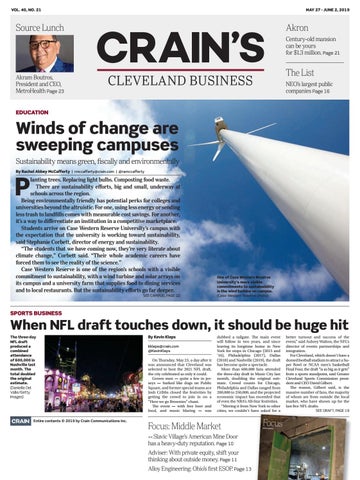
One of Case Western Reserve University’s more visible commitments to sustainability is the wind turbine on campus. (Case Western Reserve photo)
SPORTS BUSINESS
When NFL draft touches down, it should be huge hit The three-day NFL draft produced a combined attendance of 600,000 in Nashville last month. The total doubled the original estimate. (Danielle Del Valle/Getty Images)
Entire contents © 2019 by Crain Communications Inc.
By Kevin Kleps kkleps@crain.com @KevinKleps
On Thursday, May 23, a day after it was announced that Cleveland was selected to host the 2021 NFL draft, the city celebrated as only it could. Grown men — quite a few in jerseys — barked like dogs on Public Square, and former special teams ace Josh Cribbs closed the festivities by getting the crowd to join in on a “Here we go Brownies” chant. The event — with free beer and food, and music blaring — was
dubbed a tailgate. The main event will follow in two years, and since leaving its longtime home in New York for stops in Chicago (2015 and ’16), Philadelphia (2017), Dallas (2018) and Nashville (2019), the draft has become quite a spectacle. More than 600,000 fans attended the three-day draft in Music City last month, doubling the original estimate. Crowd counts for Chicago, Philadelphia and Dallas ranged from 200,000 to 250,000, and the projected economic impact has exceeded that of even the NBA’s All-Star festivities. “Moving it from New York to other cities, we couldn’t have asked for a
better turnout and success of the event,” said Aubrey Walton, the NFL’s director of events partnerships and integration. For Cleveland, which doesn’t have a domed football stadium to attract a Super Bowl or NCAA men’s basketball Final Four, the draft “is as big as it gets” from a sports standpoint, said Greater Cleveland Sports Commission president and CEO David Gilbert. The reason, Gilbert said, is the massive number of fans, the majority of whom are from outside the local market, who have shown up for the last five NFL drafts. SEE DRAFT, PAGE 19
Focus: Middle Market << Slavic
Village’s American Mine Door has a heavy-duty reputation. Page 10
Adviser: With private equity, shift your thinking about outside money. Page 11 Alloy Engineering: Ohio’s first ESOP. Page 13 P001_CL_20190527.indd 1
5/24/19 1:42 PM
CONTENT
SPONSORED BY
NEWS AND TRENDS FROM NORTHEAST OHIO’S TECHNOLOGY SECTOR
TECH MATTERS GEAR UP FOR SUMMER TECH CAMPS
L
ast summer, Noah Fine participated in a high school tech camp at Case Western Reserve University, where he learned how to program and create a rock-paper-scissors computer game. After that positive learning experience, Fine — now a sophomore at Albert Einstein Academy in Westlake — said he again plans to enroll in a tech camp this summer. “It was really great,” Fine said. “I am planning to major in computer engineering and minor in software development, and I find the camps a very helpful way to help me achieve my career goals.” Summer break is nearing, which means students throughout the region will be gearing up for some free-wheeling fun, sun and — for many — a week of experiential learning in IT. A collaboration between Northeast Ohio employers, industry groups, sponsors and workforce development organizations has resulted in the creation of a series of tech camps — most of them free — that will be offered this summer to elementary, middle and high school students. For high school students, six programs will be held at various colleges and universities throughout the region; the series will be facilitated by TECH CORPS, a Columbus-based organization that provides kindergarten through 12th-grade students access to technology resources, and RITE, a local IT workforce alliance. The camps offer students the chance to make new connections with peers and regional tech professionals, and plant the seeds for a potential foray into a high-demand career. “Our collaborations with higher education institutions and employers enable us to provide a valuable experiential program to students,” said Courtney DeOreo, executive director of RITE. This year’s high school camps will focus on either cybersecurity, programming or blockchain, the latter of which is being piloted in Northeast Ohio for the first time, said Lisa Chambers, national executive director at TECH CORPS. “Our board is made up of a number of CIOs, and they help us identify what the pain points and job needs are in tech, which helps inform our curriculum,” Chambers said. “In the blockchain camp, students will learn how bitcoin works, develop blockchain decentralized apps and implement applications that attempt to solve real-world problems.” Dale Schroeder, senior manager for global IT learning at Eaton, an annual RITE and TECH CORPS high school camp sponsor, said the camps are an important bridge between education and IT field exposure. He and fellow Eaton staff volunteers will be involved in the cybersecurity camp at Kent State University. “We really enjoy getting to participate with the students in the kick-off of the event, then attending the final project presentations at the end of the week,” Schroeder said. “Our sponsorship aligns with our philosophy, which is to support the communities we live
S
EVENTS A PRODUCT OF
2019 P002_CL_20190527.indd Tech Matters-5-27.indd2 1
and work in, and to help prepare the next generation of IT workers with the skills and competencies needed to maintain a vibrant and growing community.” Since the TECH CORPS and RITE partnership commenced in 2015, more than 800 high school students from 66 area high schools have participated in the camps. The participation rates of AfricanAmerican and Latino students increased from 17% in 2017 to 35% in 2018. The goal is to continue to increase gender and racial diversity in terms of participation, Chambers said. TECH CORPS also conducts techie camps that serve thirdthrough fifth-graders, as well as sixth- through eighth-graders. “We are committed to recruiting a diverse group of students and filling the front end of the talent pipeline with the younger students,” Chambers said. “Our data shows that black and brown students who haven’t had enough IT exposure by fourth grade are less likely to enroll in a high school tech camp and move away from IT as a career education path altogether. We want to make sure we continue to make the IT field accessible to a large and diverse group of students.”
GET WITH THE PROGRAM The following RITE and TECH CORPS high school camps offered are: June 3-7: Blockchain, Lakeland Community College June 3-7: Cybersecurity, University of Akron June 24-28: Programming, Lorain County Community College July 8-12: Programming, Cuyahoga Community College Eastern Campus July 15-19: Programming, Baldwin Wallace University July 29-Aug. 2: Cybersecurity, Kent State University
Registration continues up until the day before camp commences, or until registration is full. Each camp accommodates up to 20 students. For more information, visit ohiorite.com For more information on the TECH CORPS elementary and middle school techie camps, visit techcorps.org.
RITE/TECH CORPS SPONSOR SPOTLIGHT
ponsoring a student tech camp is more than just a way to attach a company’s logo to a meaningful pursuit. Sponsorships demonstrate an employer’s commitment to help expose local elementary, middle and high school students to high-demand, high-paying jobs, says Amy French, executive vice president of human resources at
CALENDAR OF
PHOTO PROVIDED
TECH CORPS and RITE each year partner to offer high school tech camps throughout the summer, including this programming camp at Cleveland State University. The weeklong tech camps focus on programming, cybersecurity and blockchain. They begin in early June and continue until early August.
Richfield-based OEC, which provides software to automotive and heavy duty truck dealerships that facilitates the sale of original equipment parts. OEC is among a handful of large companies and organizations continuing their commitment to support these summer deep dives into various aspects of IT. Here’s a spotlight on their commitment:
NUMBER OF YEARS AS A TECH CAMP SPONSOR: 5 THIS YEAR’S SPONSORED CAMP: The programming camp, which is July 15-19 at Baldwin Wallace University. SPONSORSHIP BENEFITS: “We, as employers,
need to invest in growing the talent pipeline in Northeast Ohio. There are many ways to support these efforts, including the tech camps. Our region has a great need for software engineers, and these are well-paying jobs. It’s important to raise awareness about these opportunities when a student is young,” French said.
JUNE 11-12
JUNE 19
JUNE 20-JUNE 21
APS3T: TEACH TECH TRANSFORM: Firestone CLC, 470 Castle Blvd., Akron. Educators from throughout Ohio are invited to this two-day conference, sponsored by Akron Public Schools, on educational technologies and how schools can learn, create and share best practices about future-ready concepts. Registration ends June 6. tinyurl.com/y6jw9wx7
STARTUP SCALEUP: 7:30 a.m. to 5 p.m., Aloft Cleveland Downtown, 1111 W. 10th St., Cleveland. Northeast Ohio’s largest single entrepreneurial event returns. Join more than 1,500 entrepreneurs, investors, community leaders and others for a day of learning, networking and celebrating entrepreneurs. startupscaleup.org
EMPOWERING LOCAL LEADERSHIP CONFERENCE: Greater Cleveland Partnership members are invited to help representatives from GCP, as well as state and local government officials, to discuss how local governments can leverage federal resources in their communities. gcpartnership.com/Events/June-2019/ Empowering-Local-Leadership-Conference
This advertising-supported feature is produced by Crain’s Content Studio-Cleveland, the marketing storytelling arm of Crain’s Cleveland Business. The Crain’s Cleveland Business newsroom is not involved in creating Crain’s Content Studio content.
5/21/19 5/22/19 4:16 9:42PM AM
PA G E 4
|
M AY 2 7 - J U N E 2 , 2 019 |
CRAIN’S CLEVELAND BUSINESS
Tremont project may break new ground near Towpath By Stan Bullard sbullard@crain.com @CrainRltywriter
Providing a private travel experience that exceeds expectations
HOW TO FLY WITH SKY QUEST: » On-Demand Charter » Jet Card Memberships » Aircraft Ownership Opportunities
FlySkyQuest.com 216-362-9904 Charter@FlySkyQuest.com
At a site on Literary Road in Tremont near West Third Street at the edge of the industrial valley, J-Roc Developers of Cleveland is pursuing a proposal to develop a 130-unit apartment project dubbed Electric Gardens. The site is also notable because it adjoins the almost-completed leg of the Towpath Trail to Literary, the hike-and-bike trail following 80 acres of the old Ohio & Erie Canal path as far south as Zoar. The next link will formally begin next month to connect the trail, two decades in the making, with the Canal Basin area of Cleveland’s Flats near the Cuyahoga River. The proposal received conceptual approval from the Near West Design Review Committee and, on May 5, the Cleveland City Planning Commission, but still has far to go. That’s because the developers are pursuing design approvals while still needing to win a rezoning for the site from industrial to mixed-use. Aaron Taylor, J-Roc development director, said in a Thursday, May 24, phone interview that the site offers an opportunity to benefit from the popular Towpath and still be near the heart of Tremont’s commercial district. Typical of the group that developed for-sale townhouse units in the starkly dark Tremont Black in Tremont and brilliant white Cyan Park in the Detroit-Shoreway neighborhood, Electric Gardens also has a break-themold design. It’s best compared to a row of book spines on a shelf, or a line of reeds next to a drainage ditch. Taylor said the idea is for the vertical lines of the structure to resemble those of plants. The electric name is to play on the idea of energy, among other factors. The proposal could
PROPERTY OVERVIEW - SPACE AVAILABLE 3RD QUARTER 2019 • Phase I, 260,000 SF • Loading docks & drive-ins to suit divisible by 20,000 SF • Sprinkler: ESFR • Land Area: ±159 Acres • Zoning: M1 & M2 • Clear Height: 32’ minimum • Floor Slab: 6” minimum • Column Spacing: 50’x50’ • Rail access
www.hannacre.com
P004_CL_20190527.indd 4
CALL FOR MORE INFORMATION!
Hiedi Winston 440.752.2617 hiediwinston@hannacre.com
serve as a bit of a buffer to the nearby industrial Flats, he said, and benefit from views of both the industrial area and downtown. It’s also on the edge of single-family homes to the north and west. “This is no run-of-the-mill site,” Taylor said. When the group acquired the 2-acre parcel from CSX Corp. in August 2018, it was actually transferred from the name of the old Baltimore & Ohio Railroad. CSX and its predecessors had owned the site since the 1850s. J-Roc and its investors, through Electric Gardens LLC, spent three years convincing the railroad to part with the ground as CSX had not had it up for sale. “We found the site and approached them,” Taylor said. “I’m originally from Portland, Ore., and these kinds of urban development sites are few and far between there. It’s very exciting to work on this.” The four-story building would sit between homes to the west and the Towpath. Tim Donovan, executive director of the Canalway Partners nonprofit, which has worked with multiple partners to develop the trail, said the proposed building would not harm the original vision for the trail to provide a rim of green between city neighborhoods and the industrial Flats. He said his group worked extensively with J-Roc to clarify the property lines be-
tween what was part of the Towpath right-of-way and what was purchased from the railroad. Donovan said the Towpath’s route was designed to encourage redevelopment nearby. He noted new homes constructed over the last decade on part of University Road were built with garage entrances behind them so the installation of the Towpath could replace car traffic on the street. Cory Riordan, executive director of Tremont West Development Corp., said in a Friday, May 24, interview that J-Roc has worked with the Central Tremont Block Club since January to fine-tune its plans. “It’s gone from a block on a parcel to this in a very collaborative process,” Riordan said. The block club has not yet signed off on the project’s rezoning. However, he said the site needed to be rezoned from its historic use, so the two happened to coincide. The local development corporation wants to see the parcel rezoned from industrial to avoid the chance an asphalt plant or other heavy industrial use winds up there. “We’re seeing the first apartment development in a generation,” Riordan said. “This is what happens when you have zoning from another time. Everything is controversial in Tremont, but we rely on conversation and compromise to get there.”
Paychex consolidating suburban offices in move to Highland Hills By Stan Bullard
± 1,000,000 SF of new state-of-the-art manufacturing/distribution industrial space
J-Roc Developers of Cleveland hopes to develop Electric Gardens, a 130-unit apartment building, in Tremont. (Contributed rendering)
sbullard@crain.com @CrainRltywriter
Paychex Inc., the Rochester, N.Y.based payroll and benefits services provider, will become the first tenant to turn on the lights at an empty fourfloor Highland Hills office building that Time Equities Inc. of New York City is rejuvenating. Paychex has agreed to lease 50,000 square feet in the building at 23000 Millcreek Blvd. that TEI bought last year as PNC Bank shed the structure after consolidating its suburban offices and moving staffers to the city of Cleveland. Paychex will consolidate offices from Beachwood and Hudson in the Highland Hills building. David Gates, senior manager of area service for Paychex, said in an email, “Since Paychex completed its acquisition of Advance Partners in 2015, we’ve been looking for the right location to accommodate both of our growing teams. We’re looking forward to the opportunity to bring all of our local employees together under one roof. Highland Hills is a great community for us to do so.” Paychex added 130 staffers in Beachwood when it acquired Advance, which
had been in operation since 1998. For building owner TEI, the lease commitment means it will have a tenant occupying space in the 140,000-square-foot building as it finishes updating the 1997-vintage structure from single-tenant to multiple-tenant use with a new lounge, conference area and cafeteria. Jonathan Dulberg, TEI director of acquisitions, said in a May 22 phone interview that Paychex was one of the prospective tenants the company hoped to land as it paid $7.5 million for the empty building. “This validates our initial investment on the theory that we can attract high-quality tenants to a nicely renovated building who do not want to pay top dollar in the market,” Dulberg said. Paychex will occupy part of the first floor and all the second floor in the structure. Robert Leibold, a vice president in CBRE’s Cleveland office, said in a news release on the lease, “Even though there was a large supply of new space added to the market over the last two years, the new space is absorbing and leasing at record pace. The acquisition of this large block of Class A space and the quick absorption of a new 50,000-square-foot tenant demonstrates the strength of
the Chagrin Corridor office market.” Due to the structure’s large size — it’s almost twice the size of the typical suburban Cleveland office structure — it still has two full floors of empty space to fill. The asking rate at the building is in the low $20-a-square-foot range, although neither side would disclose the actual rent Paychex will pay. Publicly traded Paychex provides management solutions for payroll, benefits, human resources and insurance services through a combination of personal service and an online mobile software platform. TEI entered the Cleveland office market in 2015 when it acquired a portfolio of six office buildings in Independence and Seven Hills that are part of the Rockside Road or south office market. With the purchase of the Millcreek building, it became one of the few landlords with holdings in two separate suburban Cleveland markets. Time Equities has been in operation since 1966 and has a portfolio that includes 30 million square feet of industrial, office and retail properties and more than 4,000 apartment suites. In addition to Leibold, TEI was represented by CBRE agents Steve Ross and Douglas Leary. Paychex was represented by Mike Maroon of The Acclaim Group of Cranford, N.J.
5/24/19 2:13 PM
MY BENESCH “I work with many well-known, global mega-firms, but with Benesch I get better responsiveness and better creative ideas for a far better value.” MELISSA ZUJKOWSKI Vice President, Litigation & Disputes Flex
MY TEAM Featured team (left to right) YELENA BOXER JOSEPH A. CASTRODALE WARREN T. McCLURG NICHOLAS J. SECCO GREGORY T. FROHMAN ANDREW G. FIORELLA ANDREW J. JARZYNA TREVOR G. COVEY KRISTEN-ELISE F. DEPIZZO ROBERT E. HAFFKE BRIAN N. RAMM
Flex brings “Sketch to Scale” capabilities to many of the world’s best-known companies, designing, manufacturing and distributing a variety of brand-name electronics and consumer goods on a contract or outsourcing basis. To help keep its complex global supply chain from getting bogged down with legal issues, Flex relies on Benesch. We work with Melissa and her team to stay ahead of all types of commercial disputes and litigation—from IP matters to contracts to M&A deals and more. To learn more about our relationship with Flex, visit beneschlaw.com/myteam
SARAH M. HESSE GREGORY J. PHILLIPS
www.beneschlaw.com
© 2019 Benesch Friedlander Coplan & Aronoff LLP
Flextronics4c_10.875x14.5Ad.indd 1 CL_052719_FP Template.indd 3
5/15/19 2:36 PM 5/22/19 1:15 PM
PA G E 6
|
M AY 2 7 - J U N E 2 , 2 019 |
CRAIN’S CLEVELAND BUSINESS
Schools sparring over Chagrin Highlands tax funds By Jay Miller jmiller@crain.com @millerjh
In 1988, George Voinovich was mayor and the city of Cleveland saw an opportunity to make some money off a vast tract of land it had assembled in Warrensville Township in the early days of the 20th century for a workhouse and a tuberculosis hospital. A master lease agreement with what then was Figgie International Inc., a corporation looking for new headquarters and a tract of land it could develop, would be a way to help the city dig out of a financial hole and create new tax revenue, not just for Cleveland, but for the suburbs and the school districts that over the century had been carved out of the township.
But the Beachwood City School District isn’t happy with the way things have turned out. Earlier this month, it appealed a common pleas court decision that it believes is costing the school district at least $5 million in tax revenue from what has become the Chagrin Highlands development. “This is a tax grab by the Beachwood school district,” said Christian Williams, an attorney for the Warrensville Heights City School District, the target of the lawsuit. The Warrensville district is benefiting from property taxes on Chagrin Highlands land that is in the city of Beachwood. Attorneys for the Beachwood district did not respond to emails from Crain’s. Figgie, the instigator of the deal in 1988, never built its headquarters. Today, Chagrin Highlands is home to
®
P006_CL_20190527.indd 6
headquarters for Eaton Corp. and Omnova Solutions Inc., University Hospitals, two multitenant office buildings, a shopping center and a Marriott Corp. hotel, all generating property taxes to the various communities and school districts. But it took the better part of a decade, until 1997 under Cleveland Mayor Michael White, before an agreement was reached on how the taxes would be shared. It took a series of agreements to decide how those taxes would be shared among Beachwood, Cleveland, Orange and Highland Hills (what was left of Warrensville Township became a village) and the Beachwood and Warrensville Heights school districts and development could begin. “The Chagrin Highlands document, which is in our building depart-
ment, is 12 inches thick and there was a lot of wrangling when this happened” in 1997, said Beachwood Mayor Martin Horowitz in a telephone interview. “So everybody got a little bit out of this, including Cleveland.” Horwitz was a member of the school board during the time the Chagrin Highlands deal was negotiated. The first step in the deal was for Beachwood to annex 405 acres of the 600 acres owned by the city of Cleveland from Warrensville Township, which as a township could not create and collect an income tax. While Beachwood annexed the land, the 405 acres would remain in the Warrensville Heights school district. “Why this deal is so complicated is because it was a deal (by the city Cleveland) with a developer over land that
was in jurisdictions other than its own,” said Steven Strnisha, who served in the White administration in several capacities. “So, there was an allocation of who would get what taxes.” The master plan for Chagrin Highlands did not include residential development, so there was never any question about the Beachwood school district needing tax revenue to pay to educate kids living in homes in Chagrin Highlands. But school districts capture the lion’s share of property taxes, so tax revenue from the commercial properties in Chagrin Highlands is valuable. Like nearly all school districts, budgets have been tightening as state dollars to schools have withered and the value of retail properties such as Beachwood Place are weakening, while at the same time residents have been reluctant to vote for tax increases. As a result, Beachwood officials started examining finances in 2017 and made two moves. Before the end of the year, the school board decided to ask voters for more money. In the spring of 2018, it put a tax issue on the ballot that was narrowly defeated by voters — the first time Beachwood voters ever turned down a request from the schools for money. That same year, however, it filed a lawsuit against the Warrensville Heights district, seeking nearly $2 million, a share of the school portion of property taxes collected from property in the city of Beachwood by the Warrensville Heights district over the previous two years. In its lawsuit the Beachwood district cited one of the Chagrin Highland agreements from 1997. It outlined how, while the land that became a part of the city of Beachwood would remain in the Warrensville Heights school district, future tax revenues from commercial properties would be shared between the two school districts once the market value of the Chagrin Highlands property exceeded $22.3 million. That first happened, the Beachwood district argued, in the 2014 tax year. That lawsuit was withdrawn but refiled in 2018. In February, Cuyahoga County Common Pleas Court Judge Nancy Margaret Russo dismissed the 2018 lawsuit. She found that the agreement on sharing property taxes was never properly completed in 1997, even though both school boards passed resolutions agreeing that the Warrensville Heights district would get 70% of the tax revenue and the Beachwood district 30%. “(T)he parties were without the capacity to contract over the transfer of tax dollars, purported by of the plaintiff (Beachwood) to be over $5 million, without approval of the State Board of Education,” her decision stated. In its appeal, the Beachwood district disputes that state school board approval was needed to complete the agreement. Williams, the attorney for the Warrensville Heights district, said state board of education approval is “crucial” to any agreement to change transfer tax revenue between districts, and that the main reason to make a transfer is when students who live in a community would be going to school in a different community. But because there is no residential development in Chagrin Highlands, that’s not an issue in this dispute. The Beachwood district had an average of 1,520 students enrolled in 2018 and revenues of $43.4 million. The Warrensville Heights district has an average of about 1,700 students and revenues of $49.6 million. The state board of education gives Beachwood an A; it gives Warrensville Heights a D.
5/24/19 1:59 PM
CRAIN’S CLEVELAND BUSINESS
|
M AY 2 7 - J U N E 2 , 2 019
|
PA G E 7
Hospital investments healthy, despite dips By Lydia Coutré lcoutre@crain.com @LydiaCoutre
Cleveland Clinic and University Hospitals, both of which saw investment losses in 2018, say they have already recouped those losses in the first quarter of this year, thanks to an upturn in the stock market. The Clinic reported a $191 million loss on its investment return in 2018, down $1.09 billion from the year prior. And UH last year saw a loss on investment of $32.8 million, a $158.8 million drop from 2017. That translates to a 2.4% loss on the Clinic’s portfolio and a little more than a 2% loss for UH’s. Hospitals don’t rely on investment returns for their general operations, said J.B. Silvers, a health care finance professor at Case Western Reserve University. “What you have to think of is a hospital is a combination of an investment fund plus a hospital,” he said. “They’re two different entities in the same package.” Investment incomes, he said, give health systems the opportunity to do other things, such as expansion or new ventures. Many health systems with fiscal years ending in December saw losses for 2018, said Lisa Martin, senior vice president on Moody’s nonprofit health care team. “So it was very common for us to see investment losses, and then in the first quarter of this year, a lot of that was regained, the markets were back up,” Martin said. According to analysis by Modern Healthcare, 12 of the country’s largest not-for-profit health systems (including the Clinic) ended last year with $3.7 billion in collective investment losses. “We never want to see market losses, but if you’re going to participate in the market, you have to expect that there’s going to be down periods,” said Steve Glass, the Clinic’s chief financial officer. The markets behaved “quite nicely” through the first three quarters of
Bond
Glass
“We never want to see market losses, but if you’re going to participate in the market, you have to expect that there’s going to be down periods.” — Steve Glass, Cleveland Clinic’s chief financial officer
2018, said Bradley Bond, vice president of treasury at UH. “Then, I think the Federal Reserve Bank got a little aggressive with raising rates on the short end, and the market became a little bit afraid of that,” he said. “I think that was not necessarily trade tensions at the time. It was more driven by what the market perceived to be an aggressive Fed and interest rates going up. So as a result of that, a lot of volatility came in the market.” As a bond rating agency, Moody’s doesn’t advise issuers on how they should invest their money. In its methodology, it adjusts the investment income to represent a longterm rate of return. “However, we also look at the actual balance, the investment balance or the wealth of the health system,” Martin explained. “And to the extent that that investment balance has declined because of market losses, we would clearly look at that. But again, also understanding that it can come up and down, and that’s exactly what’s happened in the last six months.”
Bond said UH is geared to be able versus somebody else who might managing its balance sheet, UH was to withstand these kinds of losses. have had a more aggressive, highly able to capture all of its loss back in “We’re not happy about them,” he equity-focused portfolio.” the early part of the year, because the said, “but we don’t get overly conBond said UH’s “conservative” in- markets “snapped back incredibly,” cerned about those losses because vestment portfolio helped it weather Bond said. we’re managing our balance sheet ap- the volatility in the market. “And in the first quarter we had propriately. What that allows us to do, “Our largest investments are in the some positive momentum on Chiby managing our balance sheet ap- bread-and-butter equity markets, nese trade talks, which has recently propriately, is to stay invested. So we debt — so stocks, bonds, cash. We also reversed completely, but until the didn’t have to run into panic mode have not an insignificant piece invest- end of the first quarter, that was posiand sell our investments at the end of ed in what we call alternative assets, tive momentum,” he added. the year when everything was down. which would be hedge funds, private Glass noted, of course, that the year We were able to stay invested, and by equity, private debt structures, things is not over. Much still could change. staying invested, we enjoyed the huge of that nature. I would characterize it “When the market goes down, which runup in the first quarter of ’19.” it did in the fall, they’re gonna get hit,” as a very diversified asset allocation.” Glass, too, said the Clinic didn’t By staying invested and properly Silvers said. “It’s just part of the game.” change its investment allocation as a result of the downturn, but may make adjustments where it sees buying opporLAND FOR SALE: Beacon West, Westlake tunities or investment markets shifting. The Clinic doesn’t use its investment portfolio to subsidize operations, but rather to support the organization in strategic growth and Industrial Zoning with Many Allowable Conditional Uses development. Prestigious High Visible Gateway Location Can Accommodate Investment returns have nothing to up to 100,000 SF Building $450,000 $62,327/Acre do with how UH is operating, Bond said. “It just has everything to do with Property Features the market risk that we’re associated ● Priced to Sell with, which we have to be to be in● Last Two Available vested in the market,” he said. Parcels Martin said Moody’s tracks what hospitals and health systems invest ● Quick access to I-90 Lot 2R in as part of its analysis. and Crocker Park 7.226 Acre “There’s a very large range — ev● Enterprise Zone Parcel erything from some hospitals will in● Major Business and vest only in cash and fixed-incomeRetail Area type securities, and then all the way ● Stormwater Pond to some invest in private equity and Installed hedge funds,” she said. VIKING PARKWAY ● Build to Suit Available Glass said the Clinic’s investment portfolio is invested in equities, fixed CONTACT US income and alternative assets, an alCharles Marshall or Terry Noonan location that hasn’t changed dramatically in the past five to 10 years. 330-659-2040 “The public equities were down 3457 Granger Road, Akron, OH 44333 10%, 12% during 2018, so anybody VISIT OUR NEW PROPERTY WEBSITE who was invested in that marketwww.beaconmarshallproperties.com place likely lost money if they were invested in there,” Glass said. “Fixed incomes were relatively flat from a benchmark perspective, and alternatives were mixed but largely down as well. … Having a diversified portfolio actually protected us quite a bit from Beacon Marshall Ad 3-4-Lot 2R.indd 1 the downturn in the marketplaces
Prestigious Westlake Location! » »
ANALYSIS
Progressive solidifies hold on top spot of Public Companies list By Chuck Soder csoder@crain.com @ChuckSoder
For the second year in a row, Progressive Corp. took the top spot on our Largest Public Companies in Northeast Ohio list. The insurance company strengthened its grip on the top spot this year: Its total market capitalization — the total dollar market value of a company’s shares outstanding — increased 30% in the 12-month period ending April 30. That’s a notable achievement, given that Progressive hadn’t been in the top spot between 2011 and 2017. Its net income jumped to nearly $2.62 billion in 2018, up 64% from 2017. Sherwin-Williams Corp., which nearly took the No. 1 spot last year, remains at No. 2. The paintmaker’s total market cap increased 22.6% during the 12-month period. But TransDigm Group’s 52.5% market cap increase was the largest
P007_CL_20190527.indd 7
Largest Public Companies list: To see the largest public companies in Northeast Ohio, turn to Page16
percentage gain posted by any company in the top 40 on the full digital list. The aerospace components maker’s stock price has climbed another 32% year-to-date as of May 24. And that factors in a drop that took place after the Pentagon issued a report saying that TransDigm charged the government $4,361 for a half-inch pin — a report that led a Pentagon official to publicly accuse TransDigm of “gouging our taxpayers.” There are 60 companies on the full digital list. When you add up the
market capitalization of the entire list, the group posted a 12.1% market cap increase, narrowly beating out the S&P 500 (up 11.2%) and the Russell 3000 (up 9.4%). Of course, not every company did so well. Covia Holdings saw its market cap fall 80.3% over that 12-month stretch. It also lost $275 million in 2018. The Independence-based minerals and materials supplier ousted CEO Jenniffer Deckard on May 6; its board decided to “pursue a different direction with our leadership,” according to a May 6 regulatory filing. Chairman Richard A. Navarre is serving as interim CEO. Two notable public companies — Forest City and A. Schulman — were acquired in 2018 and disappeared from the list. However, Babcock & Wilcox became eligible when it moved its headquarters from Charlotte, N.C., to Barberton in 2018. The power generation equipment provider lost nearly $380 million in 2018. Thus, it debuted at No. 47, alongside some of the smaller companies on the list.
»
»
»
2/26/19 11:13 AM
Congratulations to Arhaus Furniture on the grand opening of your beautiful Legacy Village Flagship Store. We are proud to have been your partner on this project.
PROVEN PARTNERSHIPS | premierdevelop.com |(216) 341-1200 | 5301 Grant Ave. Cleveland, Ohio 44125 |
5/24/19 2:23 PM
PA G E 8
|
M AY 2 7 - J U N E 2 , 2 019 |
CRAIN’S CLEVELAND BUSINESS
Opinion Personal View
You want to see entrepreneurship? Open your eyes By Thomas Sudow
Editorial
Working on it A change in the governor’s office, and an upcoming change in the leadership of JobsOhio, has given the economic development nonprofit a chance for a fresh start. Consider it an opportunity seized, as there are signs that JobsOhio is making progress toward becoming a more effective player in helping to grow the state’s economy. The nonprofit this month took a step long sought by many observers: It released the salaries of its leaders. JobsOhio was created in 2011 by then-Gov. John Kasich to essentially replace the state’s economic development department. There’s no reason it should have taken so long to executive this basic level of transparency. But we now know that outgoing president and chief investment officer John Minor was making more than $620,000, and incoming president and chief investment officer J.P. Nauseef has a 2019 base salary of $350,000. In releasing the data on 17 top execs, JobsOhio said it was “committed to continuing a spirit of openness.” We trust it’s ready to meet that standard for a Legislature that has, rightly, indicated it wants greater oversight of the nonprofit. It’s fair to ask if we’re getting enough bang for the substantial buck that’s being paid to operate JobsOhio. The state’s economy is doing well. JobsOhio reported in March that it helped Ohio companies and those new to the state create 27,100 jobs in 2018, up 19% from 2017. Those added jobs translate into $1.3 billion in new payroll. JobsOhio said it worked with 266 companies that made a total of $9.6 billion in capital investments — a single-year record. Ohio’s unemployment rate in April was 4.3%, down from 4.4% in March. But job creation was anemic: just 1,400 for April, after adding 6,300 jobs the prior month. Nationally, the economy added 459,000 jobs in that two-month span, and the April jobless rate was 3.6%. In that context, Ohio isn’t keeping up. It’s a B/B+ performer in a class of A students. Gov. Mike DeWine, meanwhile, seems interested in putting Northeast Ohio more directly on JobsOhio’s radar. According to a Crain’s analysis of JobsOhio data, Northeast
Ohio won only 20.7% of the $149 million in financial incentives provided by JobsOhio in 2018 to drive business growth. It also attracted only 29.5% of the capital investment made by businesses coming into the state or expanding existing operations, according to JobsOhio’s annual report. These figures are quite low, considering the size of Northeast Ohio’s economy. As DeWine told those gathered at the May 2 annual meeting of Team NEO, JobsOhio’s partner in the 18-county region, “You know that 40% of the economy of the state comes from Northeast Ohio. So how Northeast Ohio goes, so goes Ohio.” We certainly bear some of the responsibility for sluggish economic growth here, but a stronger focus from JobsOhio on Northeast Ohio would be a welcome development.
Play on
If you’re a fan of sports, or simply of spectacle, the next few years in Cleveland will be pretty special. With last week’s announcement that Cleveland will host the 2021 NFL draft, the city now has five big sports events on the horizon: the 2019 MLB All-Star Game, the first two rounds of the 2020 NCAA Men’s Basketball Tournament, the draft, the 2022 NBA All-Star Game and the 2024 NCAA Women’s Final Four. You’ll see lots of economic impact estimates for the events, though it’s notoriously difficult to nail that down precisely. Here’s one number that’s concrete: $14.5 million, which is how much the Greater Cleveland Sports Commission projects it will cost to host four of the events, excluding the NCAA men’s tournament. CEO David Gilbert said last week that a fundraising initiative called “Velocity,” which aims to raise $5.5 million, is “well past the halfway point.” He wants to reach the goal by the baseball All-Star Game on July 9. We encourage corporate Cleveland to react with speed and crash through “Velocity’s” $5.5 million number to reduce the reliance on public dollars.
Publisher and Editor: Elizabeth McIntyre (emcintyre@crain.com)
CLEVELAND BUSINESS
CLEVELAND BUSINESS P008_CL_20190527.indd 8
Managing Editor:
Scott Suttell (ssuttell@crain.com)
Contact Crain’s:
216-522-1383
Read Crain’s online: crainscleveland.com
Here we go again. In the May 20 issue of Crain’s Cleveland Business, the Personal View op-ed “Changing the entrepreneurial climate in metro Cleveland” by James M. Trutko once again has us beating ourselves up and saying, “We are not good enough as a region.” Get over it! In 1954, Darrell Huff published his book “How to Lie with Statistics.” The book, an introduction to statistics, shows how the interpretation of statistics can be used to create incorrect conclusions. To paraphrase U.S. Supreme Court Justice Potter Stewart, in his notable 1964 opinion about obscenity in Jacobellis v. Sudow Ohio, I shall not today attempt further to define entrepreneurship, but I know it Do not when I see it. just look So perhaps the statistics do not tell the full story. I know what I see today, and I see at significant entrepreneurship activity. statistics. Northeast Ohio is known for its history as a place for entrepreneurship. Major compa- Open your nies grew in this region: Goodyear, Fire- eyes and stone, TRW, Eaton, American Greetings, Parker Hannifin, Baker Motor Vehicle Co., you, too, Hyland Software, Progressive Insurance, will know Lincoln Electric, Morgan Adhesives, Steris, Davey Tree Expert, Morgenthaler Ventures, it when Stouffer’s, Cleveland Clinic, Ernst & Young, you see Jones Day, Squire Sanders & Dempsey, Avery Dennison, J.M. Smucker Co., Forest it. City, Olympic Steel, and on we could go. Yes, even in the hospitality world people like Zack Bruell, Michael Symon and Harlan Diamond have blazed a path. And in the philanthropic world, United Way of Greater Cleveland and the Jewish Federation of Cleveland were very early adopters of federated fundraising and led the revolution in that area. The Cleveland Orchestra, the Cleveland Museum of Art, the Rock & Roll Hall of Fame and the many other cultural institutions were built on an entrepreneurial spirit and have been funded by industrialists who were and are entrepreneurs. That rich history is helping to energize the next generation of entrepreneurs. I invite you to attend a pitch night where local college students are pitching their ideas. As director of the Burton D. Morgan Center for Entrepreneurial Studies at Ashland University, I see it every day and in talking with my colleagues at other universities. They see it every day, too. From 2007 until today, students and alumni from Ashland have started more than 70 businesses. Multiply that by the more than a dozen or so colleges and universities in the region, and you see real business growth in this region. It is happening every day. Do not just look at statistics. Open your eyes and you, too, will know it when you see it. Go to JumpStart Inc. and look at the number of companies that the nonprofit economic development organization is supporting. Cleveland Clinic has launched 88 bioscience companies in the past 18 years. Incubators and accelerators have sprouted up throughout the region. Is our region perfect? No. We have work we need to do and should continue to do, but I know it when I see it, and entrepreneurship is alive and well in Northeast Ohio. SEE SUDOW, PAGE 9
Write us: Crain’s welcomes responses from readers. Letters should be as brief as possible and may be edited. Send letters to Crain’s Cleveland Business, 700 West St. Clair Ave., Suite 310, Cleveland, OH 44113, or by emailing ClevEdit@crain.com. Please include your complete name and city from which you are writing, and a telephone number for fact-checking purposes. Sound off: Send a Personal View for the opinion page to emcintyre@crain.com. Please include a telephone number for verification purposes.
5/24/19 11:52 AM
CRAIN’S CLEVELAND BUSINESS
|
M AY 2 7 - J U N E 2 , 2 019
|
PA G E 9
FOR PRESTIGE AND ELEGANCE,
THINK FIRESTONE COUNTRY CLUB. SUDOW
Israeli accent at a coffee shop near Case Western Reserve University and struck up a casual conversation. That led to Selman providing important clinical guidCONTINUED FROM PAGE 8 ance for a young company called Surgical Theater, a We understand that part of entrepreneurship is virtual and augmented reality surgical visualization failure, but it also is about picking yourself up and platform. Ten years later, Surgical Theater’s technologoing on to the next idea. There are a lot of examples gy is used by surgeons and hospitals around the of that in this region. world — from a company foundI guess I could look at the num- “I guess I could look ed and grown here in Northeast Ohio. bers and rub my hands together and say the region is failing. I pre- at the numbers and I, too, can look at the statistics, or even better: I know it when I fer to look into the eyes of the see it, and every day new entre20-year-old with that great idea rub my hands preneurs and new ventures are and help him or her build it out. together and say starting here in Northeast Ohio — Do not take my word for it. Attend a pitch night or visit an event of the region is failing. from our rich entrepreneurial histhe Entrepreneurship Education tory until today. You all know it, Consortium, the regional Ash- I prefer to look into because you see it. land University organization to the eyes of the promote entrepreneurship. Or, Sudow is the director of the even today, you could just listen 20-year-old with Burton D. Morgan Center for in to a conversation at your local Entrepreneurial Studies at coffee shop, just like Dr. Warren that great idea and Ashland University and has been Selman, the chairman of neuro- help him or her involved in the startup scene in Northeast Ohio for the past 20 logical surgery at University Hosyears. pitals. The surgeon overheard an build it out.”
SUSAN STONE Partner + 216.736.7220 scs@kjk.com
KRISTINA SUPLER Partner + 216.736.7217 kws@kjk.com
Firestone Country Club is an exclusive, prestigious private club that welcomes Members and guests alike to host events in our famed clubhouse. BOOK YOUR SPECIAL EVENT TODAY. 330.644.8441 | firestonecountryclub.com © ClubCorp USA, Inc. All rights reserved. 44574 0419 BB
The former Club at Key Center is now
The Downtown Cleveland Fitness Community No Commitments, No Fees 24 Hour Access, Free Parking Group Classes, Personal Training Discounted Services at Trilogy Spa Salon
Live | Look | Feel Better. trilogycle.com
COMPASSION. EXPERIENCE. RESULTS. MEET KJK’S AUTISM & MENTAL HEALTH ADVOCACY TEAM We’re full-time moms and attorneys with an intimate understanding of the challenges families with children on the autism spectrum may face throughout their lives. Our team is uniquely positioned to address legal issues that can start as early as preschool and confront students well into adulthood. Working with education consultants and therapists, our group can secure special education needs and related services. We also defend students and provide guidance through Title IX and criminal proceedings, collaborate in criminal cases to develop mitigation and sentencing presentations, and work with parents to obtain needed waivers for services. Learn more about how we can help at StudentDefense.KJK.com.
Cleveland + Columbus + KJK.com
P009_CL_20190527.indd 9
5/23/19 4:06 PM
PA G E 10
|
M AY 2 7 - J U N E 2 , 2 019 |
CRAIN’S CLEVELAND BUSINESS
Focus
Ad
S a
MIDDLE MARKET
Originally a manufacturer of ventilation doors for U.S. coal mines, AMD now serves a host of industries in Central and South America, Africa, Asia and Europe. (Contributed image)
A HEAVY-DUTY REPUTATION Slavic Village’s century-old American Mine Door serves industries worldwide By Douglas J. Guth clbfreelancer@crain.com
American Mine Door is a global OEM in a niche market, an unusual position that nonetheless has served the century-old company well, said vice president of business development Pete Hallahan. Incorporated in 1906 as a manufacturer of mechanically operated ventilation doors for underground mines, the Cleveland-based concern's products have evolved from simple wooden doors to contraptions built with a complex interface of pneumatic air cylinders and hydraulic systems. Along with custom doors produced at its
P010_011_CL_20190527.indd 10
100,000-square-foot facility in Slavic Village, AMD builds machines designed to clean the tracks that transport material to and from a mine. The business has also expanded into cable vulcanizer production, while its fabrication division works with steel mills, the building trades and other industries. As the coal industry waned, owner Daniel Zenisek spread into gold, silver, copper, potash and other minerals. Far from its roots working in coal-rich West Virginia and Pennsylvania, AMD has grown worldwide, mostly into Central and South America, but angling into Asia, Africa and Europe as well. “As coal flattened, Dan knew we had to diversify,” said Hallahan, who joined AMD in 2014,
“As coal flattened, Dan knew we had to diversify. Any good business is going to think, ‘Hey, where else can my product be better served?’ ” — Pete Hallahan, American Mine Door vice president of business development
after a career in industrial gearing and steel. “Any good business is going to think, ‘Hey, where else can my product be better served?’ ” Harnessing its 100 years of industry experience, the manufacturer currently has three projects in Mexico and another three in Chile. AMD’s ventilation doors are fabricated entirely in Cleveland, although it does have global distributor connections in the areas where it operates. “We’ve built relationships with engineering firms all over the world, because the industry has become so niche and complex as we interface with technology,” Hallahan said. “Mines are outsourcing their ventilation technology to engineering firms.” SEE AMD, PAGE 15
5/22/19 2:04 PM
Is Th duri who ly’s b dow grow he mon prov expa So abo “I cho shou W outs ey i outs fam W abo side take stitu con purs ing of th a ge &C as t histo equ It own to how mon thei beyo vidi capi infu pare expe ence outs avoi busi they to a con tute So pari whi Th bett cacy is ne “B from own kno time dire gies tran prov tion F own surf ners deci subt tion to ca cut, To fund
1. F ners
N
teel. Hey, ?’ ” periprojMD’s in ibues. ring stry nterines y to
E 15
CRAIN’S CLEVELAND BUSINESS
|
M AY 2 7 - J U N E 2 , 2 019
|
PA G E 11
MIDDLE MARKET
Adviser: Dr. Stacy Feiner
Shift your thinking about outside money Is private equity the answer? Feiner is a This question surfaced yet again business during a conversation with an owner psychologist who had been at the helm of his famiand founder of ly’s business since his parents passed it Feiner down to him. Considering future Enterprises. growth — and the future, in general — he wondered if bringing in outside money was a solution. Surely, it would provide an infusion of cash, capital for expansion and perhaps some security. the expectations you have for each So why did he feel so insecure other, and how differences of opinion will reach a common ground, so the about the “opportunity”? “I just want to understand the psy- goals can be achieved. chology of this,” he insisted. “How 2. Establish a growth strategy in adshould I really be thinking about it?” What he meant was: What does vance of picking investors. Deteroutside capital do beyond bring mon- mine things such as whether to iney into a business? And what would vest in infrastructure, expand into outside money really mean for his new regions, bring products to market or complete a succession plan. family business? While business owners ruminate about both the risks of taking on out- 3. “Commit the time to develop a side money and the risks if they don’t shared vision with your investors,” take on outside money, financial in- advised Dr. Kathy Overbeke, owner stitutions and investment firms exude of GPS: Generation Planning Strateconfidence. And the intensity of the gies, who further noted that “ownerpursuit by these firms is only increas- ship teams that operate with a shared ing as they prepare to take advantage vision increase employee engageof the $13 trillion leaving the hands of ment and productivity, enabling the a generation of owners. In fact, a Bain company to recover the costs of the & Co. private equity report cited 2018 acquisition premiums.” A major mindset shift will prepare as the strongest five-year stretch in owners to engage history for private in the deal proequity deals. “It’s time for owners cess strategically. It’s time for The four tips that owners to get up to get up to speed follow will put to speed about about how outside business owners how outside in a strong posimoney can affect money can affect their company their company beyond tion to reap the rewards of taking beyond just proon outside monviding additional providing additional ey and the invescapital or a cash capital or a cash tors that come infusion. Prewith it. pared owners can infusion.” expect to influence the nonfinancial impact that Think long-term. Shift from seeoutside money brings. They also can ing outside money as a solution to a avoid the feeling of regret that 75% of short-term problem, and instead view business owners report a year after outside money as an instrument for they sell their companies (according accomplishing a long-term strategy. to a 2018 State of Readiness report conducted by the Exit Planning Insti- Think strategy before money. tute). If you think outside money is the anSo how can we correct for this dis- swer, begin by evaluating an array of parity where owners are unhappy options for growth (or exit) from a diswhile investors are going strong? interested adviser, then decide if you The solution is that owners need need to pursue a money source to better information and stronger advo- achieve those goals. cacy from trusted advisers. Foresight Think is necessary for success. stakeholders before “By conceptualizing the process shareholders. Shift from structurfrom beginning to end in advance, ing a deal to extract the highest reowners are able to navigate the un- turns for shareholders, and instead known and influence outcomes real- develop a plan for using outside capitime,” said Dustin Lopez, managing tal to generate the highest returns for director of Transition Growth Strate- stakeholders. gies. “Ultimately, the quality of the transaction, on multiple levels, im- Think faces, not dollar signs. proves by replacing faulty assump- Look behind the money and think tions with new and better thinking.” “who” rather than “how much?” Make For example, it’s important for sure the money comes with reasonable owners to be aware that conflict often partners who bring expertise, emosurfaces when the newly formed part- tional intelligence and the ability to nership team digs into operations and value the intangibles that have made decisions need to be made — when your business special and profitable. subtle biases and preconceived noStewarding a legacy is not a nice-totions, such as an owner’s inclination have, it’s the new standard. Focus on to care and an investor’s inclination to growing a healthy and profitable comcut, can collide and cause mistrust. pany, and make sure the decision to To avoid pitfalls, start with three bring in outside investors is about what fundamentals: really matters after the deal is done. Start with a clear strategy for partner1. Focus on the quality of the part- ing with outside investors who share nership being formed and consider your goals and vision for the future.
P010_011_CL_20190527.indd 11
Partnership & success. When we at Citymark Capital required short term bridge financing for our real estate investment fund, we turned to Paul Kelly and S&T Bank. Daniel Walsh, Chief Executive Officer of Citymark Capital
We are ready to partner with you and your business! Contact Paul Kelly for the highest level of customer service and commercial banking solutions.
Paul Kelly, Commercial Banker 491 North Cleveland-Massillon Road • Akron 330.664.2920 • stbank.com
MEET YOUR TARGET AUDIENCE WITHOUT EVER LEAVING THE OFFICE. MORE INFORMATION: Lisa Rudy • lrudy@crain.com
2018 NAIOP
INDUSTRIAL BROKER OF THE YEAR Kevin M. Kelly Principal Kevin Kelly of Cushman & Wakefield I CRESCO Real Estate experienced a benchmark year in 2018. Over 65% of his transactions in 2018 came from repeat clients; a true testament to the value he has provided to his customers for 32 years.
5/23/19 3:19 PM
SCA - Crains Ad FULL rev2.pdf
C
M
Y
CM
MY
CY
CMY
K
1
5/21/19
12:54 PM
YOUR TRUSTED MIDDLE MARKET ADVISOR ON SELL-SIDE, BUY-SIDE CAPITAL RAISE AND DEBT PLACEMENT INCLUDING ADVISEMENT ON ACG’S 2018 DEAL OF THE YEAR
A B O U T S I G N E T. Signet Capital Advisors, LLC provides sophisticated investment banking services to select owners of middle market companies throughout the U.S. SCA services include SELL-SIDE ADVISORY (selling all or part of your business); BUY-SIDE ADVISORY (helping shareholders grow their company through acquisition); and, CAPITAL RAISING (equity, junior capital and debt). T O L E A R N M O R E , P L E A S E C O N TA C T MICHAEL PAPARELLA Managing Director, SCA
BRIAN MCMILLEN Vice President, SCA
at 216-658-2595 or
at 216-658-2592 or
mpaparella@signetcapadvisors.com
bmcmillen@signetcapadvisors.com
CL_052719_FP Template.indd 2
200 Public Square Suite 3270 Cleveland, Ohio 44114
216-658-2590 signetcapadvisors.c om
5/21/19 4:46 PM
CRAIN’S CLEVELAND BUSINESS
|
M AY 2 7 - J U N E 2 , 2 019
|
PA G E 13
MIDDLE MARKET
Ohio’s first ESOP was just the beginning By Allison Carey clbfreelancer@crain.com
Alloy Engineering, founded in 1943 in a Rocky River home, fabricates alloy parts for high-temperature and corrosive-resistant industrial applications. It also boasts Ohio’s first Employee Stock Ownership Plan, or ESOP, established in 1974. The plan is recognized as the first for an Ohio company by the Ohio Employee Ownership Center (OEOC). At 45 years old, it’s also the longest-running ESOP in the state. “Today, the company is 100% owned by 100% of eligible employees,” said Lee Watson, Alloy’s president and CEO. “Every employee is eligible to be in the plan after one year of service; they’re vested fully after three years of employment.” Rather than resting on its laurels, the 75-year-old company, with annual revenue between $25 million and $30 million, is taking old-school values and an old-school work ethic to new heights by further concentrating on the well-being of its almost 100 employees. Watson said the company’s purpose is to provide exceptional customer service as well as long-term financial security for its employee-owners. “That’s a major shift from where the company was,” he said. “There’s more of a concern today to make sure the ESOP is working. We have competitive wages, job security, a 401(k) giving employees a second retirement plan, excellent health benefits and we share profits monthly, annually and longterm. We have an open-book management style and share financials with the employees. “We are a company in transition and we value our employees’ feedback,” added Watson. “Today, we have an EO Council — it used to be called the Culture Committee — and we have quarterly surveys that invite everyone to bring up any concerns. After five quarterly surveys, we’ve listened and have implemented many changes, including on topics of compensation and scheduling.” He explained that the ESOP works as a retirement or pension plan. “We’re governed by ERISA regulations (The Employee Retirement Income Security Act of 1974) just like every other retirement plan,” he said. “A percent of payroll goes into the ESOP Trust every year and that’s how the benefit accumulates. They invest it in company stock and go through an annual evaluation because we are privately owned. The shares in the trust appreciate.” Watson said the owners are known as beneficial owners, because they don’t really own any of the stock as the stocks are held inside of a trust and the trust has a trustee: GreatBanc Trust Co. in Illinois. Watson, who took over as president and CEO a year ago, has spent 45 years in the business, starting at 16 sweeping floors in a neighbor’s shop. He came to Alloy almost four and a half years ago and took over for former CEO Lou Petonovich, who retired last year after 40 years with the company. Shannon Kobus, Alloy’s marketing specialist, has spent the last two years emphasizing the power of the ESOP to the employee-owners. “There are so many jobs out there that don’t offer good benefits like this,” she noted. Kobus led them
P013_CL_20190527.indd 13
Alloy Engineering creates large alloy pieces like this vessel. (Alloy Engineering photo)
(Allison Carey photo)
“Today, the company is 100% owned by 100% of eligible employees. Every employee is eligible to be in the plan after one year of service; they’re vested fully after three years of employment.”
A worker grinds on a large elbow at Alloy Manufacturing. (Alloy Engineering photo)
companies. “So, it’s not all that common. They didn’t exist until the ’70s. They were a tax incentive for the government to transfer ownership to the employees — we get some favorable tax benefits.” Kobus said she believes other companies may be taking a turn toward ESOPs. “They’re gaining popularity as family-owned businesses aim to make sure their employees are set up for success. Companies may be working harder to do better for their employees.” “It’s hard to recruit and retain employees,” added Watson. “Companies have to do better for them. We are a traditional manufacturing company: We cut, bend and weld metal. But we’re putting more emphasis on valuing our employees and promoting employee engagement. The future looks great. We’ve made some key hires and are focused on being more customer- and employee-centric,” he said. Watson has initiated a little engagement plan of his own using blue, white and green marbles and a glass jar. “I was reminded many times after I started here that people want to see me out in the shop more often. I love my time in the shop, but my job keeps me on the phone and in meetings. Weeks could go by between visits,” he admitted. “So now, every morning, I place a blue marble and a white marble on my desk. At the end of each day, if I have not had a significant conversation with someone in the shop, I put a white marble in the jar. If I have, I put in a blue marble. Green marbles represent visits to either of our two remote locations.” The third-full jar represents 2019 and so far things are looking rather blue ... but in the best way.
— Lee Watson, Alloy’s president and CEO
through the certification process with Certified EO. “They (Certified EO) publish great statistics,” said Watson. “For example, employees of employee-owned companies generally make about 35% more on an annualized basis than their counterparts in non-employee-owned companies and, more importantly, they retire with two to three times the net worth as their peers in non-employee-owned companies. They have incentives to stay for a career.”
All the marbles Alloy Engineering was founded by Paul Menough. The company moved to its current location on Thacker Street in Berea in 1957, and today has two satellite locations: a manufacturing facility in Wellington and controlling interest in a machine shop in Carrollton, Ohio. The ESOP was started by Menough’s son-in-law, who wanted to leave a legacy to the employees. “It’s also lucrative for the owners, as they can sell the company to the employees for whatever they want,” said Watson. He pointed out that only 0.3% of companies in the U.S. are 100% ESOP
5/22/19 12:26 PM
PA G E 14
|
M AY 2 7 - J U N E 2 , 2 019 |
CRAIN’S CLEVELAND BUSINESS
MIDDLE MARKET
Tax Tips: Carl Grassi
Better recordkeeping prepares you for state tax audits Many business owners are taking advantage of technology and other economic trends that make it more and more possible to have a national or even global reach. The opportunities are truly unprecedented — but so are some of the challenges. As your company expands into new markets, your business systems need to step up to meet ever greater demands for compliance and recordkeeping. This is certainly true in the area of state taxation. We've seen Ohio and other states step up their efforts to tax the business activities of
Grassi is chairman of McDonald Hopkins LLC.
in-state and out-of-state companies. A recent decision by an Ohio Court of Appeals illustrates how Ohio is having some success in broadly applying the commercial
activity tax (CAT). The Ohio Supreme Court may still hear the case on appeal, so we will keep our eyes on the final outcome, but it's a reminder that Ohio and other states are scrutinizing the business activities of out-of-state companies. The best defense against an erroneous or unfair assessment starts with good records, because these cases often turn on the fine details and documentation of transactions. The recent case involved Ohio’s CAT, but the lesson applies to sales taxes or the business taxes assessed by other states on the right
to do business there. Most business owners are by now familiar with the Ohio CAT, which has been around since 2005. The CAT is a tax on gross receipts measured on sales. It's sourced to the destination of the sale item or to the location where the benefit of the service is received. The CAT replaced the old Ohio franchise tax, marking a shift from a net income tax that took into account expenses. The destination sourcing under the CAT also differs from the franchise tax method because the latter took into account the location of a
firm’s property and employees. We've seen states expanding their reach in the sales and use tax arena, too, following the landmark U.S. Supreme Court decision in South Dakota v. Wayfair last June. Historically, states taxed sales at the destination of the sale item, but they had a notoriously difficult time collecting sales or use tax from individual consumers who purchased items from an online retailer. Following Wayfair, states are now free to impose use tax collection duties on online retailers with only an economic, or virtual, presence in their state. Significantly, the Ohio General Assembly is currently considering an “economic nexus” proposal as part of its biennial budget process.
Long reach of the CAT
Truly better from the start.
TruAssure’s flexible plan options – all backed by a strong network – ensure that employees get the most out of their dental plan. And, our commitment to hassle-free administration makes sure employers remain truly happy, too.
TALK TO YOUR BROKER ABOUT TRUASSURE DENTAL COVERAGE TODAY .
TRUASSURE.COM
P014_015_CL_20190527.indd 14
Records are important to managing the CAT and business taxes assessed by other states. In the recent case mentioned above, the Ohio Board of Tax Appeals (BTA) upheld a CAT assessment against a Georgia wholesaler, Greenscapes Home and Garden Products Inc. Greenscapes had no physical locations, agents, representatives or employees in Ohio. The company sold its home and garden products to national retailers that would hire transportation companies to pick up and take title to the products in Georgia for shipment to the retailers’ Ohio distribution centers. From there, the goods would be shipped to retail locations. Significantly, Greenscapes knew its customers would ship the products to Ohio because the bills of lading showed Ohio addresses. In upholding the tax, the BTA reasoned that Greenscapes could not overcome the tax commissioner’s presumption that the Ohio addresses on the bills of lading were the final destination of the products the wholesaler sold to national retailers. Ohio law measures CAT liability by the gross receipts generated at the location where property is ultimately received after all transportation has been completed. The BTA noted that Greenscapes didn't produce records showing which, if any, products were ultimately delivered outside of Ohio. Had Greenscapes produced records showing that products were shipped from Ohio distribution centers to non-Ohio retail locations, the CAT liability might have been alleviated. More complete business records could have saved the company money. The Greenscapes case isn't over yet. An Ohio Court of Appeals addressed constitutional concerns and ruled that Ohio has a sufficient connection to Greenscapes to impose the CAT even though its customers take title to goods outside Ohio. The Ohio Supreme Court is currently deciding whether to accept an appeal. Could more complete business records have saved Greenscapes a potential trip to the Ohio Supreme Court? Maybe, but those records might have reduced the CAT liability. As your business expands, be sure to keep on top of the recordkeeping that can save you time and money.
5/22/19 12:28 PM
A re Dem
A
CON
No
M wor fans ply delv Hall doo sure fic a wind ing lowand com mod traffi P ages Eco high duty doo com the A dire the Safe new ous has busi “O clos day,
CRAIN’S CLEVELAND BUSINESS
|
M AY 2 7 - J U N E 2 , 2 019
|
PA G E 15
MIDDLE MARKET
T
s MONEY DOESN’T GROW ON TREES, BUT IT SURE GROWS HERE.
ding tax mark in une. s at but ime insed
As high as
over aderns ient imcusside rt is ac-
ness es a eme ords bilibe ordand
2.02% APY
*
A great way to earn more while you save! The higher your balance, the higher your interest rate. Plus enjoy: • Free Online Banking • Free Telephone Banking • 24 million surcharge-free ATMs
s o t o
OPEN YOUR ACCOUNT TODAY.
nagascent Ohio held rgia and apes nts, in ome l rertaake for disthe etail
apes wing ultihio. rewere tion ocahave lete ved
a e a o t s y k s f
Money Market Account
now tion only nce the ntly xus” ud-
new rods of . In reanot er’s esse fithe tailbilid at ultirta-
B s
o h p ( s w c a b c
24755 Chagrin Blvd., Suite 100, Beachwood • 216-464-1066 10800 Kinsman Rd., Newbury • 440-564-9441 www.geaugasavings.com *$1,000 to $2,499.99 1.00% APY, $2,500 to $24,999.99 1.00% APY, $25,000 to $99,999.99 1.50% APY, $100,000 and greater 2.02% APY. Rates are tiered based on account balance. The minimum balance to open the account is $50.00. Maintain a minimum daily balance of $2,500 to avoid a $8 fee. Rates are subject to change. Fees may reduce earnings.
GSB_Crains_April2019Ad_4x6.indd 1
5/3/19 1:10 PM
Innovative Legal Counsel for Today’s Business Client A reputation for safety and sturdiness has put AMD doors in place around the world, including this mine in the Democratic Republic of the Congo. (Contributed image)
AMD
CONTINUED FROM PAGE 10
Not a hard sell Mining ventilation control doors work in concert with industrial exhaust fans to provide miners a constant supply of fresh air, a necessity as mines delve deeper into the earth’s surface, Hallahan said. AMD sells two main door designs: its towering high-pressure doors are built for high truck traffic and are able to withstand the strong winds pumped underground by mining operations. Meanwhile, a new low-pressure design is smaller in size and more economically priced. The company also carries an “EcoVent” model for smaller operations or lightly trafficked areas within a mine. Price points for AMD’s door packages range from under $10,000 for EcoVent to $50,000 for its 20-foot-tall, high-pressure model. Made of heavyduty steel frames and panels, the doors are controlled by industrial computers, opening and closing like the automatic door at a grocery store. AMD’s door wings open in opposite directions, equalizing air pressure so the doors won’t slam open or shut. Safety considerations aren’t entirely new to what historically is a dangerous industry, but protecting workers has long been a mainstay of the AMD business model, Hallahan said. “Our doors are cycling open and closed a certain number of times a day,” he said. “We have one of the
P014_015_CL_20190527.indd 15
“There’s a base of mining customers who know who we are and trust us. We stay in touch with folks we’ve built up relationships with over the years. It’s no hard sell — it’s more about being a good listener and offering up solutions.” — Pete Hallahan, AMD vice president of business development
most robust door systems in the world, and the safest. That’s the reputation we’ve developed for 100 years.” Though AMD’s high-pressure doors have been used around the globe for decades, that hasn’t stopped Zenisek — who co-owns the company alongside his wife, Kim — from employing a business model of continuous improvement. AMD designs are patented in the U.S. and
South Africa, with company officials going to trade shows to find new customers or get input from those they already have. “You’ve got to anticipate what your customers’ needs are, but the mines (themselves) are not early adapters,” Hallahan said. “The larger international organizations may own six to 10 mines, and they’re always looking for efficiencies, so you’ve got to pay attention to them.” During installation, AMD will send a supervisor to a mining site, also using videoconferencing technology to teach mine employees about their new door’s safety components and control systems. In offering a specialty product that lasts decades, AMD has been able to eschew a traditional marketing approach. “There’s a base of mining customers who know who we are and trust us,” Hallahan said. “We stay in touch with folks we’ve built up relationships with over the years. It’s no hard sell — it’s more about being a good listener and offering up solutions.” Mining is the bedrock for numerous world economies, a trend AMD leadership expects to balloon further as earthwork and mining operations become the basis for all manner of technologies. “Think about electric cars, or the rare materials in cellphones that have to be mined,” Hallahan said. “That’s the cool part of this: We’re in an industry supporting these world economies, and that demand will only go up as technology increases.”
PRACTICE AREAS Real Estate Hotel & Hospitality Business & Corporate Banking & Finance General Counsel
J.D. | M.B.A.
www.helonlaw.com
n w c a Th b o e t
f h i o t w c O f a
t c t fi
www.helonlaw.com
216.978.7463
STAY IN THE
KNOW with Crain’s email newsletters
Subscribe FOR FREE by visiting CrainsCleveland.com/enewsletters
5/22/19 12:28 PM
r t p t s t o u w r
f t e t G s p p
L
i s c B C w G h r O
PA G E 16
|
M AY 2 7 - J U N E 2 , 2 019 |
CRAIN’S CLEVELAND BUSINESS
THE LIST
Largest Public Companies in Northeast Ohio Ranked by market value as of April 30, 2019
MARKET VALUE (MILLIONS) THIS LAST COMPANY/TICKER SYMBOL YEAR YEAR HEADQUARTERS
NET INCOME (MILLIONS)
% 4-30-2019 4-30-2018 CHANGE FY 2018
FY 2017
% CHANGE
RETURN ON EQUITY (1) TYPE OF BUSINESS
TOP EXECUTIVE
1
1
Progressive Corp./PGR 6300 Wilson Mills Road, Mayfield Village 44143 (440) 461-5000/progressive.com
$45,639.6
$35,112.9
30.0%
$2,615.3
$1,592.2
64.26%
25.17%
Insurance company
S. Tricia Griffith, president, CEO
2
2
Sherwin-Williams Co./SHW 101 W. Prospect Ave., Cleveland 44115 (216) 566-2000/sherwin.com
$41,930.9
$34,214.7
22.6%
$1,108.7
$1,772.3
-37.44%
30.05%
Manufacturer of paint, coatings and related products
John G. Morikis, chairman, CEO
3
3
Eaton/ETN 1000 Eaton Blvd., Beachwood 44122 (440) 523-5000/eaton.com
$35,134.2
$32,870.9
6.9%
$2,145.0
$2,985.0
-28.14%
12.84%
Manufacturer of electrical, hydraulic, aerospace, truck and automotive products
Craig Arnold, chairman, CEO
4
6
TransDigm Group Inc./TDG 1301 E. 9th St., Suite 3000, Cleveland 44114 (216) 706-2960/transdigm.com
$25,523.9
$16,732.6
52.5%
$957.1
$596.9
60.34%
NM
Designer and producer of highly engineered aircraft components
Kevin M. Stein, president, CEO
5
4
Parker Hannifin Corp./PH 6035 Parkland Blvd., Mayfield Heights 44124 (216) 896-3000/parker.com
$23,425.5
$21,902.5
7.0%
$1,060.8
$983.4
7.87%
19.07%
Provider of fluid power systems and electromechanical controls
Thomas L. Williams, chairman, CEO
6
7
FirstEnergy Corp./FE 76 S. Main St., Akron 44308 (800) 736-3402/firstenergycorp.com
$22,336.5
$16,405.7
36.2%
$1,348.0
($1,724.0)
NM
19.03%
Electric utility holding company
Charles E. Jones Jr., president, CEO
7
5
KeyCorp/KEY 127 Public Square, Cleveland 44114 (216) 689-6300/key.com
$17,781.4
$21,213.6
-16.2%
$1,866.0
$1,296.0
43.98%
12.14%
Bank holding company
Beth E. Mooney, chairman, CEO
8
8
The J.M. Smucker Co./SJM One Strawberry Lane, Orrville 44667 (330) 682-3000/jmsmucker.com
$13,948.7
$12,959.4
7.6%
$1,338.6
$592.3
126%
18.16%
Manufacturer of branded food products
Mark T. Smucker, president, CEO
9
9
Steris/STE 5960 Heisley Road, Mentor 44060 (440) 354-2600/steris.com
$11,079.3
$8,019.8
38.1%
$290.9
$110.0
164.55%
9.68%
Provider of sterilization and procedural products/services to the health care industry
Walter M. Rosebrough Jr., president, CEO
10 10
Nordson Corp./NDSN 28601 Clemens Road, Westlake 44145 (440) 892-1580/nordson.com
$8,366.6
$7,455.3
12.2%
$377.4
$295.8
27.58%
28.96%
Manufacturer of systems used to dispense, apply and control adhesives, coatings and other fluids
Michael F. Hilton, president, CEO
11 11
RPM International Inc./RPM 2628 Pearl Road, Medina 44258 (330) 273-5090/rpminc.com
$7,949.7
$6,459.1
23.1%
$337.8
$181.8
85.77%
22.09%
Provider of specialty coatings, sealants and building materials
Frank C. Sullivan, chairman, CEO
12 13
Lincoln Electric Holdings Inc./LECO 22801 St. Clair Ave., Euclid 44117 (216) 481-8100/lincolnelectric.com
$5,480.5
$5,437.8
0.8%
$287.1
$247.5
15.98%
31.54%
Manufacturer of arc welding products
Christopher L. Mapes, chairman, president, CEO
13 16
TFS Financial Corp./TFSL 7007 Broadway Ave., Cleveland 44105 (800) 844-7333/thirdfederal.com
$4,582.1
$4,109.0
11.5%
$85.4
$88.9
-3.9%
4.95%
Bank holding company
Marc A. Stefanski, chairman, president, CEO
14 12
Goodyear Tire & Rubber Co./GT 200 Innovation Way, Akron 44316 (330) 796-2121/goodyear.com
$4,465.8
$6,022.1
-25.8%
$693.0
$346.0
100.29%
14.27%
Tire manufacturer
Richard J. Kramer, chairman, president, CEO
15 19
The Timken Co./TKR 4500 Mount Pleasant St. N.W., North Canton 44720 (234) 262-3000/timken.com
$3,649.5
$3,333.8
9.5%
$302.8
$203.4
48.87%
19.60%
Manufacturer of engineered bearings and mechanical power transmission products
Richard G. Kyle, president, CEO
16 15
GrafTech International Ltd./EAF 982 Keynote Circle, Brooklyn Heights 44131 (216) 676-2000/graftech.com
$3,326.7
$4,829.6
-31.1%
$854.2
$8.0
10,600.48%
NM
Manufacturer of graphite electrodes and cathodes
David J. Rintoul, president, CEO
17 17
Cedar Fair LP/FUN One Cedar Point Drive, Sandusky 44870 (419) 627-2233/cedarfair.com
$3,054.0
$3,821.6
-20.1%
$126.7
$215.5
-41.22%
219.57%
Operator of amusement and water parks
Richard A. Zimmerman, president, CEO
18 22
Cleveland-Cliffs Inc./CLF 200 Public Square, Suite 3300, Cleveland 44114 (216) 694-5700/clevelandcliffs.com
$2,825.6
$2,209.2
27.9%
$1,128.1
$367.0
207.38%
NM
Iron ore mining company
Lourenco Goncalves, chairman, president, CEO
19 20
SITE Centers Corp. (formerly DDR Corp.)/SITC 3300 Enterprise Parkway, Beachwood 44122 (216) 755-5500/sitecenters.com
$2,377.8
$2,659.2 (2)
-10.6%
$114.4
($241.7) (2)
NM
4.67%
Real estate investment trust
David R. Lukes, president, CEO
20 21
Applied Industrial Technologies Inc./AIT 1 Applied Plaza, Cleveland 44115 (216) 426-4000/applied.com
$2,313.3
$2,474.6
-6.5%
$141.6
$133.9
5.76%
18.15%
Distributor and provider of industrial parts and service
Neil A. Schrimsher, president, CEO
21 18
PolyOne Corp./POL 33587 Walker Road, Avon Lake 44012 (440) 930-1000/polyone.com
$2,150.8
$3,346.8
-35.7%
$159.8
($57.7)
NM
28.21%
Provider of specialized polymer materials and services
Robert M. Patterson, chairman, president, CEO
22 23
Ferro Corp./FOE 6060 Parkland Blvd., Mayfield Heights 44124 (216) 875-5600/ferro.com
$1,468.8
$1,857.5
-20.9%
$80.1
$57.1
40.38%
21.80%
Manufacturer of specialty performance materials
Peter T. Thomas, chairman, president, CEO
23 28
Materion Corp./MTRN 6070 Parkland Blvd., Mayfield Heights 44124 (216) 486-4200/materion.com
$1,179.0
$1,024.7
15.1%
$20.8
$11.5
82.05%
3.97%
High-performance engineered materials supplier
Jugal K. Vijayvargiya, president, CEO
24 30
Victory Capital Holdings Inc./VCTR 4900 Tiedeman Road, 4th Floor, Brooklyn 44114 (216) 898-2400/vcm.com
$1,113.0
$751.5
48.1%
$63.7
$25.8
146.67%
18.55%
Investment management firm
David C. Brown, chairman, CEO
25 26
Hyster-Yale Materials Handling Inc./HY 5875 Landerbrook Drive, Suite 300, Mayfield Heights 44124 (440) 449-9600/hyster-yale.com
$1,109.3
$1,178.2
-5.8%
$34.7
$48.6
-28.6%
6.06%
Manufacturer of lift trucks, provider of aftermarket parts
Alfred M. Rankin Jr., chairman, president, CEO
26 29
CBIZ Inc./CBZ 6050 Oak Tree Blvd. S., Suite 500, Independence 44131 (216) 447-9000/cbiz.com
$1,047.9
$1,022.8
2.5%
$61.6
$50.4
22.22%
10.95%
Financial, benefits and insurance services provider
Jerome P. Grisko Jr., president, CEO
RESEARCHED BY CHUCK SODER (CSODER@CRAIN.COM)
Get the full list with 60 companies in Excel format. Become a Data Member: CrainsCleveland.com/data
Source: S&P Global Market Intelligence (Marketintelligence.spglobal.com) and Crain's research. Net income is income attributable to ordinary shareholders. NM=Not meaningful. Send feedback to Chuck Soder: csoder@crain.com.
(1) Return on equity is designed to show how efficiently a company is producing profits. The figures were calculated using this formula: 2018 earnings from continuing operations / ((2018 total equity + 2017 total equity)/ 2) (2)
These figures predate SITE Centers' spinoff of 48 shopping centers into a separate public company called Retail Value Inc.
P016_CL_20190527.indd 16
5/23/19 3:14 PM
Imagine new possibilities. And bring them to life. Your future starts at KPMG Ignition.
How will you envision your next opportunity? At KPMG Ignition, we interpret the signals of change and help you see new potential from disruption. Move from inspiration to impact as we help you develop new ideas, ground them in trusted data, enable them with a practical action plan, and make them real. Enhance your path to transformation, visit KPMG.com/innovation
Anticipate tomorrow. Deliver today.
©2018 KPMG LLP, a Delaware limited liability partnership and the U.S. member firm of the KPMG network of independent member firms affiliated with KPMG International Cooperative (“KPMG International”), a Swiss entity. Some of the services or offerings provided by KPMG LLP are not permissible for its audit clients or affiliates or related entities. 181104
CL_052719_FP Template.indd 1 181104AD Ignition-Alt-CrainsCleveland vF4.indd 1
5/20/19 10:59 2:54 PM 12/7/18 AM
Growth by Design
CONTENT SPONSORED BY
Missed a month? Catch up on this series at CrainsCleveland.com/TeamNEO
Next month: The business imperative for growing talent
Making the case for Northeast Ohio BUSINESS ATTRACTION, PROMOTION TAKES ON MANY FORMS IN TODAY’S ECONOMY By ANNIE ZALESKI
CRAIN’S CONTENT STUDIO-CLEVELAND
When Cleveland hosts the Major League Baseball All-Star Game this summer for the first time in over two decades, the league’s best players aren’t the only out-of-town visitors the region plans to welcome. For those in the economic development field, the days around the game also are a chance to bring site selection consultants to Northeast Ohio, using the game as a hook — not to chow down on peanuts and Cracker Jack, but to do an in-person deep dive into the assets that make the region a desirable place to play ball. Site selection consultants serve an important role in business development. They are the liaisons between regions interested in boosting their economic fortunes via attraction and expansion, and firms looking to make some sort of physical operational move. However, site selection consultants are just one group with which organizations such as Team NEO work to promote a region’s assets. As economic development itself has become more sophisticated, the organization has responded by being proactive, casting a wide net geographically and highlighting the value of peer-to-peer relationships to business attraction.
MAKING AN IMPRESSION Site selection consultants are called in by companies looking to move headquarters, open a new or additional location, consolidate operations or analyze their existing suite of buildings. These consultants depend on economic development stakeholders like Team NEO to help inform their work, since on-the-ground knowledge possessed by these entities is immensely valuable. Team NEO, in turn, also frequently teams up with partners such as JobsOhio to give a broader perspective on why a particular site might be attractive. “We have really strong relationships with the economic development agencies at the state level, the regional level, the local level,” says Michelle Comerford, project director and industrial and supply chain practice leader at Biggins Lacy Shapiro & Co. “A big part of our business is networking and knowing those groups. There’s a lot of data at our fingertips, but there’s a lot more that we really rely on our economic development partners to help solve for.” What’s challenging for regions promoting themselves to site selection consultants is that companies looking at sites have different items on their wish lists. For example, some prioritize the talent pool and pipeline. “Let’s say it’s a heavy industrial company and they need a bunch of welders,” said Jay Foran, Team NEO’s senior vice president of industry and innovation. “They would need to find out where the hotspots are in the country where there’s a high population of certified welders.” Other factors that might be important include the health and location of a supply chain; workforce development resources; the kind and number of universities and educational institutions; and how friendly the business environment is in terms of taxes and policies.
A WORLD VIEW International businesses wanting to open U.S.-based subsidiaries also can be a vital addition to a region’s overall economic strategy, since they often bring higher wages, diverse perspectives on innovation and technology, and a much different work environment. Team NEO has found that 50% of all attraction opportunities in Northeast Ohio since 2016 are from companies with international owners. But, international business attraction has its own unique challenges.
20%
Historic share of job-creating investment projects in tradeable industries coming from attraction (companies investing in Ohio for the first time)
1
DIALOGUE WITH INDUSTRY PEERS consistently ranks No. 1 as the leading source of information influencing executive perceptions of business climate
50%
Portion of attraction opportunities since 2016 that have been from foreign-owned companies
#
Data sources: Team NEO pipeline; Development Counselors International survey of corporate executives
THE VIBRANT ECONOMY As companies throughout the globe decide where and why to make investments, there is no single factor driving that decision. Companies instead make investment decisions based on numerous factors: a region’s existing industry strengths, tax climate, logistics, workforce or proximity to the supply chain, to name a few. In defining economic vibrancy, it’s important to be as broadly appealing in as many ways possible when competing for investment opportunities. There is no silver bullet when it comes to being a globally competitive environment for business investment.
“International companies are looking for something different,” says Mindy McLaughlin, Team NEO’s senior director of international business development, who frequently travels overseas to have face-to-face meetings with businesses looking to enter the U.S. market. “What’s different depends on how mature the company is, if they’ve ever done something in the U.S. before, and how mature their market is.” Naturally, promoting a region to international businesses requires “a little bit of a softer approach,” she adds, due to cultural, economic and societal differences. “It’s more nuanced. What international companies need is a person who can understand what their vulnerabilities are, what their insecurities are, and can address those fears through, one, information, and, two, giving them that perspective from a company similar to theirs who already has gone through it. How do we make a company feel comfortable, both professionally and personally?” Team NEO’s two emerging technology clusters, which focus on smart manufacturing and additive manufacturing, also are resonating with international companies. These clusters can make entering the North American market for the first time easier (and feel less risky), since they represent a built-in community of likeminded business entities. McLaughlin adds that the presence locally of so-called “multipliers”— a term that encompasses professional services firms, including law firms, banks and accounting firms with global business dealings and international language skills — is crucial. “That does help a company really feel more comfortable about coming to Northeast
Ohio,” she says. “They have somebody to relate to who can understand what their home market is like.”
PEER-TO-PEER PROMOTION According to a Development Counselors International survey of corporate executives, “dialogue with industry peers” is the No. 1 thing that influences how executives perceive a region’s business environment. Indeed, Foran estimates that 20% to 25% of Team NEO’s opportunities come from multipliers within the business community. “Referrals and word of mouth is still one of the most powerful contributors to where people expand or where they locate,” Foran says. “Some of the best lead generators for us are members of our own business community, because they have relationships with companies outside the region, and they are strong advocates for Northeast Ohio.” “People within the community are the ones that are engaging in business development with other business professionals around the country and the world, and they are attuned to when a company is looking to expand or invest in this part of the country,” he said. For example, the London-based talent acquisition and management solutions company Alexander Mann Solutions placed its U.S. headquarters in downtown Cleveland in 2012 after a Northeast Ohio business leader convinced the company to add a trip to the region while they were in the U.S. visiting other sites. When Alexander Mann reached Cleveland, the connection introduced the company to JobsOhio and Team NEO, which quickly worked up a plan. “They were so impressed by the teamwork that was on display in the area that they, shortly thereafter, made the decision that Cleveland was going to be a better location for them than where they had somewhat already settled on,” Foran says. “It was personal intervention.”
BUSINESS ATTRACTION TODAY Of course, business attraction is a relatively small part of the region’s economic growth and development strategy; historically, Team NEO statistics show that roughly 20% of firms can be classified as companies investing in Ohio for the first time. “It used to be what a community was marketing or putting out there was their site inventory,” says Eric Stavriotis, a senior vice president at commercial real estate services and investment firm CBRE, who works in the site selection field. “Today, the leading economic development organizations are talking about the whole complement of location factors that are critical for a company to be successful and competitive.” And, contrary to perception, Biggins Lacy Shapiro’s Comerford stresses that incentives generally aren’t the sole driver of site selection decisions today. “At the end of the day, a whole lot of incentives aren’t going to make a bad location good,” she said. “It’s really important that a company evaluate its location options against what they need and lead with that.” Ultimately, there are many reasons why companies choose one potential location over another. After all, business attraction — and regional promotion — isn’t a one-size-fits-all endeavor. “Every company has different needs or desires for their operations that require that personal touch,” says Comerford. “And so I don’t think we’re anywhere near being able to click a button and spit out the answer on a site selection question. There’s the science side to the decision, and there’s the art side that’s hard to replicate.”
This advertising-supported feature is produced by Crain’s Content Studio-Cleveland, the marketing storytelling arm of Crain’s Cleveland Business. The Crain’s Cleveland Business newsroom is not involved in creating Crain’s Content Studio content.
P018_CL_20190527.indd 0519_TeamNeo_advertorial.indd 18 1
5/22/19 5/22/19 10:20 3:57 PM AM
CRAIN’S CLEVELAND BUSINESS
|
DRAFT
CONTINUED FROM PAGE 1
Nashville originally estimated the draft would bring in 100,000 visitors per day, and the city was prepared for as many as 150,000. The final tally averaged 200,000plus per day, and the TV broadcasts — which showed a packed Lower Broadway — were, in the words of Gilbert, “one big commercial for the NFL and for Nashville.” Butch Spyridon, the president and CEO of the Nashville Convention & Visitors Corp., said by not charging fans to attend its draft festivities, the NFL has found “a magic recipe.” “The free part, you can’t say that enough,” Spyridon said. “You’re gonna involve the city. You’re going to do something pretty big. The payoff is the eyeballs, the visitor spend and the world-class free event for the local community.”
Survey says: Success
A jam-packed Lower Broadway was the site for the NFL draft’s main stage in Nashville. (Frederick Breedon/Getty)
NFL draft impact: By the numbers A look at the growth of the projected impact of the NFL draft since the three-day event was moved from New York to Chicago in 2015:
On the same day it was revealed that Cleveland and Kansas City would host the 2021 and ’23 drafts, the league Nashville, 2019: 600,00 attendance, and the Nashville Convention & Visi- $223.9 million projected impact, tors Corp. said the 2019 draft pro- $132.8 million direct spending duced $132.8 million in direct spend- Dallas, 2018: 200,000 attendance, ing and had a projected economic $125.2 million projected impact, impact of $223.9 million. Those esti- $74 million direct spending mates were $98.7 million and $58.8 million ahead of the respective pro- Philadelphia, 2017: 250,000 attendance, $94.9 million projected jections for the 2018 draft in Dallas. Such figures are often disputed by impact, $56.1 million direct spending economists, who say they vastly over- Chicago, 2015: 225,000 attendance, estimate the impact of a big event. $81.6 million projected impact, $43.9 Brad Mills, an assistant professor in million direct spending the Department of Tourism, Recreation and Sport Management at the Note: Chicago also hosted the 2016 draft. University of Florida, said the numbers in many cases don’t add up, and said he considers economic impact a the stats don’t take into account what “more nebulous” projection. “The direct spend is a more defihe calls “the avoidance effect” — those who stay away because of the nite number,” he said. large crowds. And in the case of Nashville, he Spyridon, the Nashville Convention said he believes figure 03-07John S Grimm.qxp 2/23/2016 10:43 AM the Page 1 is conser& Visitors Corp. president and CEO, vative.
SALT • SALT • SALT • Water Softener • Industrial • Food • Ice Melt • Sea Salt
Call For Pricing!! Minimum Delivery:1Pallet
The city conducted 1,500 surveys during the April 25-27 draft. The results showed that 54% of the visitors were from out of town, the average stay was 2.8 days and the average party size was 3.2 people. The draft helped to set an April record and was the third-best overall month for Nashville-area hotels. “It would be an understatement to say we were pleasantly surprised with how it proceeded,” Spyridon said. And in what could be a sign of what’s to come for Cleveland in 2021, the Nashville surveys said Ohio produced the fourth-largest visitor count of any state.
‘Do Cleveland’ There is, of course, a cost to bringing in the NFL’s offseason showcase. The 2017 draft in Philadelphia was estimated to cost $25 million, with the league reportedly picking up 80%, or $20 million, of the tab. Spyridon estimated that the price tag for the 2019 draft was about $20 million. Of that tally, Nashville was on the hook for $3 million to $4 million, he said, and $2.2 million of the tally
was raised from the private sector. Brian McCarthy, the NFL’s vice president of communications, told Crain’s that the league doesn’t disclose the amount it pays to put on the draft, and Gilbert said the NFL is similarly tight-lipped with the host cities. “We don’t know what the league spends,” the sports commission president and CEO said. “We know what they ask of the community, and we put together a budget on what we believe that will cost in cash and in kind, and that’s what we’re going to raise.” The total for the NFL draft represents the largest chunk of the $14.5 million that the sports commission is projecting it will cost Cleveland to host four major events in the span of five years. The group includes the 2019 MLB All-Star Game, the 2022 NBA All-Star Game and the 2024 NCAA Women’s Final Four. The sports commission is hoping a fundraising initiative, called “Velocity,” will account for $5.5 million of the total. Gilbert said the drive is “well past the halfway point,” and he’s optimistic the goal can be reached prior to the MLB All-Star Game, which will be played July 9 at Progressive Field.
M AY 2 7 - J U N E 2 , 2 019
|
PA G E 19
“People think the city foots the bill,” Gilbert said. “The amount that the community puts in, compared to what the NFL spends, it’s a tiny, tiny fraction. If it’s about ROI (return on investment), it’s great ROI.” It’s estimated the four events could have an impact of $285 million to $315 million. And while the numbers can be disputed, two key elements — the outof-town visitors and publicity they bring (Nashville issued more than 2,000 media credentials) — are undeniable. Asked if he had any advice for Northeast Ohio, Spyridon said, “What we learned in Dallas and Philly, and what we heard from the NFL, was: ‘Do you.’ Find your strongest assets. Play to your strengths. Don’t copy Nashville and Vegas (the 2020 draft host). Do Cleveland.” Cleveland has thus far been coy about its plans, saying only that FirstEnergy Stadium, the Rock & Roll Hall of Fame and the lakefront will play huge roles, and that such downtown locations as the Huntington Convention of Cleveland and Public Square will be involved. But the city has almost two years to plan — not counting the years of work that were put into landing the draft — for an event that once was referred to as Cleveland’s Super Bowl (prior to the Browns having actual Super Bowl hopes), and Gilbert and his group are quite accustomed to multitasking. As the draft tailgate was being held, about three-quarters of the sports commission’s staff was at Spire Institute for the NCAA Division III Outdoor Track and Field Championships. “I can tell you that we’re not going to plan another event during the draft,” Gilbert said at the tailgate. The draft, even by NFL standards, is a beast, and soon it will be a highlight on what the sports commission president and CEO called an “incredible” big-event résumé for Cleveland. “What we have to do is work with the NFL to absolutely knock it out of the park and ensure that those people have a fantastic experience,” Gilbert said.
Serving Cleveland C Kids for 50 5 years More than New Outfits –
New Out looks sc4k.org
s
/shoe m o .c d n a el ainsclev r c @ n io cial Sect e p S r u o See
1-800-547-1538 Salt Distributors Since 1966
P019_CL_20190527.indd 19
PRODUCED BY:
5/24/19 1:52 PM
NOMINATIONS NOW OPEN!
2019
Do you know an up-and-coming professional paving the way for future generations in Northeast Ohio? For nearly 30 years, Crain's Cleveland Business has gathered 40 of the community's best and brightest who have made a mark before their 40th birthday. To be considered, honorees must reside in Northeast Ohio and be 39 or younger as of Nov. 18, 2019. The 2019 class will be profiled that day in an issue of Crain’s Cleveland Business and honored at the November awards reception.
NOMINATION DEADLINE: July 22 Crainscleveland.com/nominate
Event Questions: Email • clevents@crain.com | Sponsorship Opportunities: Lisa Rudy • lrudy@crain.com
CL_052719_FP Template.indd 4
5/23/19 1:43 PM
CCRRAAI INN’ ’SS CCLLEEVVEELLAANNDD BBUUSSI INNEESSSS | | SMEAY P T E2M 7 B- EJRU 3 N E- 9 2 , 2 018 019 | PA G E 21
AKRON
For sale: 13,000 square feet of Akron history After serving as a commercial building for decades, the century-old Barder House is on the market By Dan Shingler dshingler@crain.com @DanShingler
You can buy a decent chunk of Akron history for $1.3 million right now, and it comes with a mansion any Gatsby, great or small, would be proud to call home. Up for sale is the old Barder House at 1041 West Market St. It’s not a McMansion, but the real deal: a 100year-old, 13,000-square-foot “Adam-esque, Georgian-inspired” home from what was Akron’s gilded age in the early 1900s, as described by Robert Habel, a principal of Braun & Steidl Architects. The firm purchased the house in 1986 and renovated it in 1987. Company principals wanted a prestigious space near downtown Akron with some architectural importance. But after Braun & Steidl was acquired by Prime AE in 2018, it moved into Prime’s offices on White Pond Drive, so the Barder House is up for sale, Habel said. The firm had 25 employees at the time of the acquisition. The unique space likely will be a good fit for another business, experts say, but it also could be a show-stopping home for the right buyer. The house was built in 1919 by Byron Barder, one of the city’s wealthy industrialists at the time. “He was in the boiler industry and made his fortune supporting the burgeoning rubber industry,” Habel said. The Barder House is on West Market and not East Market for a reason, he added: “The prevailing wind blew from west to east, and they wanted the fresh air.” No belching-smokestack air for the Barder family. And it’s a good thing because, like many wealthy Americans of their day, the Barders preferred to sleep outside. In an era of tuberculosis, one could not be too careful, so bedrooms in the home have sleeping porches for slumbering in fresh, cool night air. Braun & Steidl left most of the house’s interior configuration as it was, with dens and small rooms used as offices. A third-floor ballroom was divided into workspaces. The home includes at least five bedrooms, though many are suites of multiple rooms. Room after room is filled with oak and walnut paneling, and ceilings that are 10 feet high and covered with ornate molded plaster trimmed with fancy woodwork. During renovations, Braun & Steidl had to locate a trim-maker with the same knives used to carve the home’s original woodwork. The firm finally found one in the old Falls Lumber in town, Habel recalled. What the building lacks, compared to modern luxury homes, are contemporary bathrooms or a kitchen. It has those rooms, but anyone looking at the property for residential use likely would want to update the old bathroom fixtures. And the kitchen is just an empty room, save for an old Kelvinator icebox. “It’s not a modern home by today’s standards. It was designed as a home with service,” Habel said. In
P021_CL_20190527.indd 21
The Barder House on West Market Street was built in 1919, and Braun & Steidl Architects had called it home since 1987. Now, the century-old mansion is on the market, and real estate officials say it could be a distinctive landing spot for another business or serve as a residential home. (Photos by Shane Wynn for Crain’s)
“My brother says he remembers going to a few parties here,” Habel said, noting that they were less than “Animal House” in reputation, thankfully for the home. When Braun & Steidl purchased it, the home was covered with vines and the property largely overgrown. “You really couldn’t even see the house from Market Street,” said Habel. Today, it would be hard to miss. But what happens to it tomorrow is anyone’s guess. Jim Pickard of Pickard Commercial Group is listing the property for sale at $1.3 million, or for lease at
$17.50 per square foot. “It’s a very unique home,” Pickard said, adding that while it likely will continue to be used for offices, it would not take too much to convert it back to residential use. Jerry Fiume, managing partner of SVN Summit Commercial Real Estate Group in Akron, said such old mansions need the right buyer, but they can make very impressive headquarters for the right professional services firm. “It’s got to be a specific user,” Fiume said. “The layouts of those mansions don’t easily allow multitenant use … so it’s got to be a law firm, an architectural firm or accounting firm, something specific that wants a certain atmosphere. But they are definitely good buildings.” Fans of the city’s architectural history mostly just want it to remain in place and be well-kept. “The fact that it’s preserving a part of our heritage is great,” said Jason Segedy, Akron’s director of planning and urban development. “All of those homes that lined Market Street — a lot of them have been torn down over the years — but they’re very cool things to have.” Segedy was unsure if the property would need a zoning change should any buyer want to convert it to residential use, but he said that’s something the city might support. “For something like that, I think there would be a lot of options,” he said. “If it were to go back to a private residence, the city’s tax abatement program could potentially save someone some money if they renovate it. … Alternatively, I think it’s served the community really well to be an office in a historic home, and we would love to see another tenant come in and use it like that, too.”
Advertising Section
The Barder House features six fireplaces and woodwork that made the office space unique.
Rooms are filled with oak and walnut paneling, and ceilings that are 10 feet high and covered with ornate molded plaster trimmed with fancy woodwork.
other words, the owner of this home and his family weren’t supposed to be in the kitchen; the maids and cooks did that. There is a man cave from days
gone by, though. “This was where you’d come to drink, smoke and shoot,” Habel said, showing off one of the home’s six fireplaces in the room and then removing a wall panel to unveil a shooting range. After all, what does an industrialist want to do after a cigar and a few whiskeys but shoot his guns? A pockmarked wall at the other end of a narrow corridor attests to at least one evening when the armor must have given way. The interior is wrapped in a package that looks as if it could have been built by Thomas Jefferson: a huge facade anchored by classical pillars that extend to the top of the third floor. The house didn’t always look this good, though. After the Barder family sold it, another family took over, their patriarch died and the house fell into some disrepair, Habel said. In the 1970s, it was a boarding house, often filled with university students.
CLASSIFIEDS To place your listing in Crain’s Cleveland Classifieds, contact Suzanne Janik at 313-446-0455 or email sjanik@crain.com BUSINESS FOR SALE
BUSINESS FOR SALE
Profitable Business For Sale Retiring after 35 years
Commercial Trucking Company for Sale
2 Acre Recycling Facility SW Cleveland Location 2,900 Sq. Ft. Bldg & Whs 5 Million Avg. Annual Sales Serious Inquires Only Email clbboxreply@crain.com Reference 1010 in subject line
Sales $3,111,187 mike@empirebusinesses.com www.empirebusinesses.com 440-461-2202
LIST YOUR RETAIL SPACE HERE!
MISCELLANEOUS LOOKING TO SLOW DOWN AND TRANSITION OUT OF YOUR BUSINESS? NE Ohio native looking to own and grow businesses from $5mm to $25mm in sales! Contact: fleurdelismgt@gmail.com
5/22/19 5/24/19 11:36 1:02 AM PM
PA G E 2 2
|
M AY 2 7 - J U N E 2 , 2 019 |
CRAIN’S CLEVELAND BUSINESS
CAMPUS
Youngstown State University has a number of sustainability initiatives, from a composting program to efforts to plant more trees on campus. (Contributed photo)
CONTINUED FROM PAGE 1
Advertising Section
PEOPLE ON THE MOVE
To place your listing, visit www.crainscleveland.com/people-on-the-move or for more information, please call Debora Stein at (917) 226-5470 or email dstein@crain.com. CONSTRUCTION
HOSPITALITY & TOURISM
NONPROFITS
Furukawa Rock Drill USA, Inc.
International Exposition (I-X) Center
Child and Family Advocates of Cuyahoga County
The I-X Center is pleased to announce Matt Moos as the Director of Corporate Partnerships. Moos will be responsible for establishing strategic partnerships by developing and selling comprehensive sponsorship packages to drive revenue for the building and all I-X owned and operated signature events. Prior to this role, Moos served as Senior VP of Corporate Development for the Lake Erie Crushers where he consistently exceeded annual sales goals and developed key relationships with clients.
Tricia L. Kuivinen, MA, MNO has been selected as the new Executive Director of Child and Family Advocates of Cuyahoga County, a Northeast Ohio nonprofit that approaches child welfare and advocacy in a unique way by supporting Guardian ad Litem (GAL) and Court Appointed Special Advocate (CASA) volunteers who are assigned to advocate for the best interests of abused and neglected children in the juvenile justice system. To volunteer as a child advocate or to learn more, visit cfadvocates. org.
LEGAL
PROFESSIONAL SERVICES
Brennan Manna & Diamond
Parker Revenue Growth Strategies
Furukawa Rock Drill USA (FRD.USA), a leading manufacturer of rock drills, hydraulic breakers and various other attachments for Sato compact utility loaders, skid steers, mini excavators, backhoes and excavators, announces the appointment of Manabu “Michael” Crane Sato as president. Sato’s appointment follows the retirement of Jeff Crane, who served FRD.USA for more than 45 years in a variety of capacities, the latest as president. Crane will remain a senior advisor to FRD for the foreseeable future, reporting directly to Sato. Please visit the FRD USA website for more information: https://frdusa. com/.
ENGINEERING & CONSULTING
THP Limited Inc. Brad Saalfeld, P.E. has been promoted to the board of directors at THP. Saalfeld joined THP in 1999 and was promoted to a principal in 2007. He specializes in new structure design and the renovation of existing structures for the firm’s higher education clients. Brad’s recent projects include the award-winning University of Cincinnati Nipper Stadium West Pavilion, numerous residence hall renovations at Miami University and the renovation of the University of Cincinnati’s Fifth Third Arena.
P022_CL_20190527.indd 22
Chelsea Niggel joins BMD as an associate in the firm’s Akron Office, where she focuses on healthcare law, business and corporate matters, and intellectual property. She offers practical and clinical knowledge to her health care clients having 12 years of experience in the medical and healthcare field including patient care as a paramedic for three years, as well as insurance prior authorizations and utilization review for a large primary care office for over 11 years.
Parker Revenue Growth Strategies will provide professional management services to small and medium sized businesses who need to transform their companies. Parker has also developed and executed business plans that led to private equity multi-million dollar capital raises and bank lines of credit to grow revenue, profits and create value. The Turnaround Management Association granted William H. Parker the Certified Turnaround Professional (CTP) designation based on his expertise and background.
ANNOUNCE CAREER MILESTONES WITH
CRAIN’S PEOPLE ON THE MOVE
For example, CWRU has a Student Sustainability Ambassador program to help raise awareness of specific sustainability goals at the university. The 16 students in the program, who are intentionally selected from different majors, spend a year working in teams to raise the profile of goals like residential hall energy usage, sustainable transportation and food, Corbett said. She has seen an increase in the number of students applying to become sustainability ambassadors, as well as the number of students reaching out to her office for help finding sustainability research or internships. Sustainability is also a differentiator for Baldwin Wallace University. The school has taken big steps toward sustainability by establishing a green dorm and installing a wind turbine, as well as smaller ones, like setting up water-bottle filling stations. And since 2008, it’s had a sustainability major, the state’s first undergraduate option for that field. The major has four possible tracks across different disciplines, from business to quantitative science. Sarah Myer, a senior sustainability major in the humanities and social sciences track, said the university’s dedication to sustainability was a “crucial factor” in her decision to attend Baldwin Wallace. She wanted to make sure the school of her choice aligned with her beliefs. “Especially because, as a student, you do give the university a large sum of money,” Myer said. “You want to make sure that you are supporting a quality organization.” Myer added that she thinks sustainability is going to grow as a field, and she wanted to be prepared for her future. Institutions are large businesses themselves, said Franklin Lebo, assistant professor of sustainability at Baldwin Wallace, but they’re also educating students who will go off to work in companies and organizations of all sizes. The cost savings are significant, and there have been a number of sustainability students who have gotten jobs by “promising the employers to save them more than the cost of their salary,” Lebo said. In addition to serving students’ interests, Jennifer McMillin, director of sustainability at Cleveland State University, said she believes universities have an “obligation” as educators and centers of research to use their campuses as classrooms. It shows students how to operate an institution sustainably and apply that to their future careers. Cleveland State has been increasing its waste-diversion rate through composting and recycling — both easily recycled products, like plastic bottles and cardboard, and those more difficult to recycle, such as batteries or ink cartridges. And it’s made a difference. Take, for instance, Fenn Tower, one of the university’s residence halls. The dorm had lacked recycling bins. After it received them, waste pickups at Fenn Tower were cut in half, McMillin said. At Youngstown State University, the waste management strategy got started in 1999, after a waste audit of the state’s public universities and colleges ranked YSU at the bottom, said Dan Kuzma, manager of recycling. Today, the university has made an effort to plant more trees on campus and to install solar panels and wind turbines. It has a successful composting program — the first for an Ohio university — and its approach to waste focuses on reducing, reusing and recycling. The university’s reduction and reuse initia-
Cleveland State University has a substantial recycling program. (Jennifer McMillin)
tives include encouraging departments to pass down used office equipment or furniture instead of disposing of it. Reducing waste or reusing products means reducing the amount it costs to transport trash, Kuzma said. And Northeast Ohio has a lot of options for recycling items at no cost. In 2000, the university had a recycling recovery rate of 18%, meaning 18% of its waste had been diverted toward recycling. In recent years, that rate has reached 68%. Institutions have to provide “visible systems” for recycling and other sustainability efforts in order for them to be successful, McMillin said. A lot of her career has been focused on sustainability in higher education, finding ways to make operational decisions accessible to the public. If people feel an organization cares, they may be more likely to listen when it asks them to turn off the lights as part of an energy-saving effort, she noted. “It’s all related,” McMillin said. McMillin has taken a “multipronged” approach to communicating the university’s sustainability efforts: relabeling recycling bins, making physical and digital posters and creating magnets that will be distributed this summer. Operational efforts, such as finding ways to reduce the energy usage in Case Western Reserve’s research buildings, aren’t always the most exciting to the public, Corbett said. The community is usually looking for ways they can get involved in sustainability, like transportation choices or recycling. Balancing those efforts takes work and communication. At the University of Mount Union, the school established a dedicated source of funding for sustainability-related initiatives. And some of its projects have come at the suggestion of the university community. So far, the Green Revolving Fund, launched in 2016, has been used toward projects such as retrofitting the fume hoods in the university’s science building, updating much of its outdoor and indoor lighting to LEDs and adding motion sensors to corridors and offices, said project manager Jim Rhodes. The money for the fund has come from the board of trustees and a demand response program, where the university lowers its energy consumption during times of peak grid usage in exchange for a financial reward, Rhodes said. Any savings realized by the project go back into the fund account. Projects supported through the Green Revolving Fund have a return on investment of five years or fewer. The fund has turned sustainability initiatives into an internal investment strategy, said Jamie Greiner, Mount Union sustainability and campus outreach manager. They used to be looked at as a cost from the campus budget. Now, there’s an upfront cost, but the university knows it will recoup and reinvest the savings through the fund.
5/24/19 1:44 PM
CRAIN’S CLEVELAND BUSINESS
|
M AY 2 7 - J U N E 2 , 2 019
|
PA G E 2 3
SOURCE LUNCH
Akram Boutros
CLEVELAND BUSINESS
President and CEO, MetroHealth Before arriving in Cleveland six years ago, Dr. Akram Boutros spent his life in New York City after arriving from Egypt at age 12 with his parents and two brothers. He went to medical school there, at SUNY Downstate Medical Center College of Medicine in Brooklyn, then moved quickly up the ranks, from being a chief resident to becoming a chief medical officer. He has now embraced Cleveland, engaging in a variety of civic affairs. He’s on the board of Cleveland Ballet, the Cuyahoga Community College Foundation, the Greater Cleveland Food Bank and United Way of Cleveland, and is a member of the governing body of Blockland Cleveland, the effort to boost the region’s high-tech profile. He led MetroHealth in opening small hospitals in Cleveland Heights and Parma to treat patients with uncomplicated surgical or medical needs. He also took quick advantage of a change in state law that previously limited MetroHealth to serving only Cuyahoga County, opening two health centers in Medina County. Oh, and he’s led the planning for a $1 billion transformation of MetroHealth’s campus that embraces the West Side of Cleveland around the hospital. — Jay Miller
The Boutros file Favorite hobby Sketching
Role model His wife, Suzanne Aral-Boutros
Upcoming vacation A family reunion at Niagara-on-the-Lake
Book he’s reading Rereading “Leadership and SelfDeception,” by the Arbinger Institution
Lunch spot Il Venetian 100 St. Clair Ave., Cleveland 216-241-4800
The meal One had pasta with clam sauce, the other a Venetian burger, with water.
The vibe In the Cleveland Marriott Downtown in Key Center, Il Venetian is unmistakably Italian, from the menu to the Venetian glass chandeliers. As a regular, Boutros was greeted by name.
The bill $49.04, with tip
Why have you taken such an active interest in the community since coming to Cleveland? I think it’s the intersection of both of my work and what MetroHealth has been doing. MetroHealth hasn’t been just dealing with medical care for 182 years. It’s always had a component of addressing the underlying obstacles for people. You know, MetroHealth sits on the site of the Brooklyn Township poor farm. So one of the things that we did for tuberculosis patients was we made sure they went outside and exercised and breathed fresh air and the like. Other patients actually got to work on the farm. And now we understand the research behind it and believe that nonmedical care issues account for an 80% share of health outcomes. The other reason is that I moved here permanently. It took me 40 years to leave New York, and I left Egypt not voluntarily, because of my dad. Right? So this is my first voluntary move. Both my wife and three daughters moved here, so this is my community now. John Kennedy said, “Ask not what your country can do for you — ask what you can do for your country.” I’m approaching this the same way. I ask not what Cleveland can do for me — I ask what I can do for Cleveland. And I think I have an unusual approach that is different from a Midwestern executive approach. How is your approach different? I’m certainly more aggressive and I’m more outspoken. I can be challenging at many times and politeness at any cost is not a part of my formula.
This region has University Hospitals and Cleveland Clinic. You’ve called them superb institutions and they have dominated health care in the region. Now, you’re building a new campus and you’re expanding beyond Cuyahoga County. With those medical giants expanding, why did you not stay at home? If you don’t grow in health care, you die. We don’t have a choice between thrive or survive. We have a choice between thrive or diminish. So I can either continue to fill gaps or I can go out of my element. We could have competed with the Clinic or UH and gone into open-heart programs, transplant stuff, things that are lucrative. I haven’t done that. Our M.O. has been to find where there has been a lack of attention — whether it’s schools, jails, primary care, emergency services. Make it about what the patients’ needs are, deliver the services better than anyone else and people will select us. A lot of that stuff, we’ve been able to take care of in Cuyahoga County. But there are a lot of counties that have significantly worse health care, and we’ll get at this stuff. We can do it. We can deliver low-cost health care and improve their outcomes. So back to the civic things you’re involved in: Why? In all of the things I’ve been involved in, I’ve made sure that the concept of inclusive prosperity was a cornerstone of what we were doing. If you solve for inclusive prosperity, you get both economic development and you get inclusion and diversity and you get things like lower violence rates, lower homelessness.
How did you go from being a physician, an internist, to being an administrator? One day, I had this discussion with my mentor. I said, “John, I do good research, I think I’m a good teacher, I always get nominated for teaching awards, but I never win.” And I’m the guy who used to count the votes and I knew how badly I lost: I wasn’t even close. So I asked him, “What’s going on?” He said, “You are a terrible teacher.” I said, “What are you talking about?” He said, “You have to forgive students. In order to learn, they have to know they’ll be forgiven. The only reason you’re nominated is because you have experience and knowledge of physical diagnosis. You’ll never be as good a teacher as you are a businessman, and I’ve got plenty of good teachers — I don’t have anybody in my organization who’s a good businessman.” So I went home, had a discussion with my wife, and the next day, I began recruiting my replacement for academic programs, and I haven’t gone back. If you ask most physicians what gives them the greatest sense of satisfaction, it’s seeing the immediate impact of their work. It’s what happens if you’re a surgeon. And second is that the patient knows exactly who did it, right? It’s you and not anybody else. Neither one of those was essential for me to feel gratification. I also found that when I make changes in policy, it helps patients, not just my patients. I went to medical school to help people. Now I can help more people than I could have as a practicing physician. And in the process I learned to be a good teacher.
700 W. St. Clair Ave., Suite 310 Cleveland, OH 44113-1230 Phone: (216) 522-1383 www.crainscleveland.com Twitter: @CrainsCleveland Publisher/editor Elizabeth McIntyre Group publisher Mary Kramer Managing editor Scott Suttell Sections editor Michael von Glahn Creative director David Kordalski Web editor Damon Sims Associate editor/Akron Sue Walton Assistant editor Kevin Kleps Senior reporter Stan Bullard, Real estate/construction Reporters Jay Miller, Government Dan Shingler, Energy/steel/auto/Akron Rachel McCafferty, Manufacturing/ energy/education Jeremy Nobile, Finance Lydia Coutré, Health care/nonprofits Senior data editor Chuck Soder Cartoonist Rich Williams Sales and Events coordinator Megan Lemke Integrated marketing manager Michelle Sustar Managing editor custom/special projects Amy Ann Stoessel Associate publisher/Director of advertising sales Lisa Rudy Senior account executives Dawn Donegan, John Petty Account executives Laura Kulber Mintz, Loren Breen People on the Move manager Debora Stein Office coordinator Denise Donaldson Pre-press and digital production Craig L. Mackey Media services manager Nicole Spell Billing YahNica Crawford Credit Thomas Hanovich Crain’s Cleveland Business is published by Crain Communications Inc.
Chairman Keith E. Crain Vice chairman Mary Kay Crain President KC Crain Senior executive VP Chris Crain Secretary Lexie Crain Armstrong CFO Robert Recchia G.D. Crain Jr., Founder (1885-1973) Mrs. G.D. Crain Jr., Chairman (1911-1996) Reprints: Laura Picariello, 732-723-0569 or lpicariello@crain.com Customer service and subscriptions: 877-824-9373 Volume 40, Number 21 Crain’s Cleveland Business (ISSN 0197-2375) is published weekly, except for the last week of December, at 700 West St. Clair Ave., Suite 310, Cleveland, OH 44113-1230. Copyright © 2019 by Crain Communications Inc. Periodicals postage paid at Cleveland, OH, and at additional mailing offices. Price per copy: $2.00. Postmaster: Send address changes to Crain’s Cleveland Business, Circulation Department, 1155 Gratiot Avenue, Detroit, MI 48207-2912. 1-877-824-9373. Subscriptions: In Ohio: 1 year - $64, 2 year - $110. Outside Ohio: 1 year - $110, 2 year - $195. Single copy, $2.00. Allow 4 weeks for change of address. For subscription information and delivery concerns send correspondence to Audience Development Department, Crain’s Cleveland Business, 1155 Gratiot Avenue, Detroit, MI, 48207-9911, or email to customerservice@crainscleveland.com, or call 877824-9373 (in the U.S. and Canada) or (313) 446-0450 (all other locations), or fax 313-446-6777.
THE WEEK In the money
received a major financial boost to help achieve that goal. The company closed an $8 million seed-financing round led by Refinery Ventures of Cincinnati. Folio said it will use the funds “to further drive partner engagements, beta customer acquisition, product development and general corporate growth.” The company was founded in 2012 as a spinoff from the Case Western Reserve University Center for Layered Polymeric Systems.
Ohio employers are poised to receive a $1.5 billion rebate as the result of strong investment returns for the Ohio Bureau of Workers’ Compensation. BWC said it earned $1.3 billion in net investment income in 2018, a net return of 5.1% on assets of $26.9 billion. The rebate proposal will receive a final vote at the BWC’s June 28 meeting. If approved, checks will be issued to employers in September. Of the $1.5 billion slated to be rebated, $114 million would go to local governments, and $50 million would go to public schools.
Barreling toward $1 billion
Data driven Folio Photonics, a Solon company that’s developing optical storage technology to improve the archiving of data,
P023_CL_20190527.indd 23
The impact of craft breweries on Ohio’s economy continues to grow. Breweries added $967 million to the state in 2018, an increase of 39% from 2015. (Tim Harrison for Crain’s)
Ohio’s craft breweries had an economic impact on the state of $967 million in 2018, a 39% increase from 2015, according to a new study by the Ohio Craft Brewers Association. The study shows a strong uptick in jobs, wages and tax collections. There
were 135 craft breweries in Ohio at the time of the 2015 study that produced an estimated 1.2 million barrels of beer annually. The OCBA counts approximately 300 craft breweries operating today, with production around 1.4 million barrels.
Welcome to the neighborhood Top of Mind Networks, a Vinings, Ga., software firm serving the mortgage lending and real estate industries, opened a software hub in downtown Cleveland’s Warehouse District. The firm said it added the physical office in Cleveland to complement its remote software development teams. The company said it has added six jobs in the last six months and plans to add another six to nine positions in the next six months.
5/24/19 11:54 AM
A FIRM FITfor me Early in my career I left Buckingham because I thought I needed a
“big” firm platform to advance my career. When I reflect now on the two years I spent away from this firm, the saying, “you don’t know what you’ve got until it’s gone,” comes to mind. I returned to Buckingham more than nine years ago for the people, and because it just feels like family here. It has been without compromise, as I still feel challenged with sophisticated work and like I’m a part of something bigger, particularly with respect to the amazing clients I am fortunate enough to serve. -Jon Stefanik, Buckingham attorney
out what it’s like To learn more ab gham, visit to work at Buckin /careers www.bdblaw.com
2019 BDB FIRM FIT stefanik Crains.indd 1 CL_052719_FP Template.indd 1
5/15/2019 10:55:24 AM 5/20/19 2:41 PM