LOOK BACK | REAL ESTATE There are important lessons in the rich history of regional development failures, especially in downtown Cleveland. PAGE 23
CRAINSCLEVELAND.COM I May 18, 2020
COPING WITH COVID-19
PREPARING FOR REOPENING DAY Craft brewers weigh pros and cons of relaunching patios, taprooms BBY JEREMY NOBILE
The last two months have been devastating for craft brewers forced to close dining and taprooms in response to the coronavirus pandemic. The jury is out on how helpful reopening in some fashion in the coming days will be for these small businesses, whose cash flow has been reduced to a trickle in recent weeks. Ohio Gov. Mike DeWine said bars and restaurants could open outdoor seating May 15, and indoor seating will be permitted May 21 — providing businesses follow guidelines laid out by the state that will be cumbersome and expensive. Some are choosing to open, but others aren’t and won’t yet declare when they will. Most breweries have pivoted to alternative sales methods during the shutdown, such as online ordering for pickup and delivery options. Many moved kegged beer into bottles and cans to push product into grocery stores as on-premises sales tanked. According to Nielsen, for a nearly two-month period in March and April, in-store alcohol sales were up 21% from the like period last year, while online sales have more than doubled. Booze has become the fastest-growing e-commerce segment among consumer packaged goods. Despite those spikes, revenue for independent craft breweries that
“I DON’T THINK ANYONE EXPECTS TAPROOM CUSTOMERS TO RETURN TO PRE-PANDEMIC LEVELS RIGHT AWAY.” ——Justin Hemminger, spokesman for the Ohio Craft Brewers Association
earn a living off taprooms is just a fraction of what those businesses were used to making. Everyone is losing money. Ohio came into this year on track for nearly 400 craft breweries between those in operation and in planning. While it’s unclear how many breweries may not make it through this pandemic-induced economic downturn, reopening now is a play that could help struggling businesses, though not everyone intends to open their patios and taprooms yet. See BREWERIES on Page 19
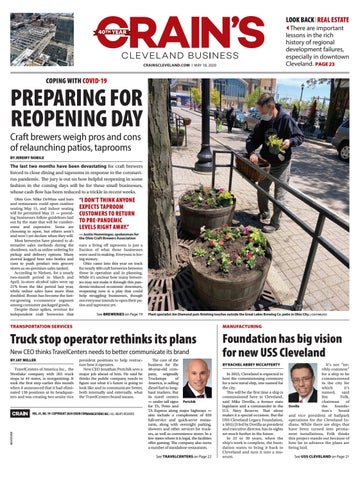
Plant specialist Jim Diamond puts finishing touches outside the Great Lakes Brewing Co. patio in Ohio City. | CONTRIBUTED
TRANSPORTATION SERVICES
MANUFACTURING
Truck stop operator rethinks its plans
Foundation has big vision for new USS Cleveland
New CEO thinks TravelCenters needs to better communicate its brand BBY JAY MILLER
TravelCenters of America Inc., the Westlake company with 265 truck stops in 44 states, is reorganizing. It took the first step earlier this month when it announced that it had eliminated 130 positions at its headquarters and was creating two senior vice
president positions to help restructure how it operates. New CEO Jonathan Pertchik sees a major job ahead of him. He said he thinks the public company needs to figure out what it’s future is going to look like and to communicate better, both internally and externally, what the TravelCenters brand means.
NEWSPAPER
VOL. 41, NO. 19 l COPYRIGHT 2020 CRAIN COMMUNICATIONS INC. l ALL RIGHTS RESERVED
The core of the business for the 48-year-old company, originally Truckstops of America, is selling diesel fuel to longhaul truckers. But its travel centers — under tall signs Pertchik for TA, Petro and TA Express along major highways — also include a complement of 650 full-service and quick-serve restaurants, along with overnight parking, showers and other services for truckers, as well as convenience stores. In a few states where it is legal, the facilities offer gaming. The company also owns a number of standalone restaurants. See TRAVELCENTERS on Page 22
BBY RACHEL ABBEY MCCAFFERTY
In 2023, Cleveland is expected to host the commissioning ceremony for a new naval ship, one named for the city. This will be the first time a ship is commissioned here in Cleveland, said Mike Dovilla, a former state legislator and a commander in the U.S. Navy Reserve. That alone makes it a special occasion. But the USS Cleveland Legacy Foundation, a 501(c)3 led by Dovilla as president and executive director, has its sights set much further in the future. In 25 or 30 years, when the ship’s work is complete, the foundation wants to bring it back to Cleveland and turn it into a museum.
It’s not “terribly common” for a ship to be commissioned in the city for which it’s named, said Jim Folk, chairman of the foundaDovilla tion’s board and vice president of ballpark operations for the Cleveland Indians. While there are ships that have been turned into permanent installations, Folk thinks this project stands out because of how far in advance the plans are being laid. See USS CLEVELAND on Page 21
LAND FOR SALE: Beacon West, Westlake
Ideal Multi-Tenant/Office Building
POLITICS
Campaigning during COVID-19
Property Features
Priced to Sell ● One of Two Available Parcels Left ● Quick access to I-90 and Crocker Park ● Enterprise Zone ● Major Business and Retail Area ● Stormwater Pond Installed ● Build to Suit Available ●
VIKING PARKWAY
Lot 14-C1 6.596 Acre Parcel
CONTACT US Charles Marshall or Terry Noonan 330-659-2040 3457 Granger Road, Akron, OH 44333
VISIT OUR WEBSITE www.beaconmarshall.com
Beacon Marshall-3-11-Lot 14-C1 Viking Parkway-9-2.indd 1
CORPORATE LITIGATION SERVICES Apple Growth Partners provides experienced, unbiased economic damage and business valuation services for the corporate litigation process. Contact us today to support your case: applegrowth.com SERVING NORTHEAST OHIO’S PRIVATELY-HELD BUSINESSES
Apple Growth Partners @applegrowthpartners AppleGrowthPartners @apple_growth
216.674.3800
Since 1959
SAME DAY
Courier, Route, Box Truck, Tractor Trailer Services WE ARE OPEN!
As an essential business during COVID-19, we are focused on meeting your delivery needs including no contact delivery.
216-696-6033 • www.bonniespeed.com
This Memorial Day, there will be no parades, which means no chance for political candidates to hand out fliers and shake hands with potential voters. Yet another casualty of the COVID-19 pandemic. “The ability to campaign on a very personal level, like Memorial Day parades, is not going to happen and it is going to make it much more difficult for candidates to meet people and get their message out,” said Rob Zimmerman, chair of the public law practice group at the Benesch law firm. Campaigns will have to be more creative and efficient in order to capture the momentum that in-person events, like parades, rallies and large fundraisers, have traditionally provided. Postponement of Ohio’s March primary election by more than a month forced campaigns to scramble to push vital messaging into April. “A lot of these campaigns had to continue the fundraising because they had little or no money left. These are tight and to be able to af10/7/19 12:57 budgets PM ford those later mailings, they most likely had to do some additional fundraising,” said Zimmerman, who has run for Shaker Heights City Council. In November, Ohio will mostly likely see either an an entirely vote-bymail election or a hybrid of absentee ballots and limited in-person voting. Ohio Secretary of State Frank La Rose has encouraged state lawmakers to pass legislation to allow online absentee-ballot requests and permit voting at any polling location. He also has requested federal funds to cover postage costs and equipment upgrades. With no end in sight to social distancing, campaigns must grapple with fundraising during an emerging recession and without the benefit of traditional in-person events. “Think about what campaigns are going to look like,” Zimmerman said. “The ability to interact with live voters is really important because local candidates generally can’t run big multimedia campaigns and television commercials, but they can go to a local ward club and meet 35 to 40 voters, which is critical.” Under the present conditions, Zimmerman said it will be extremely difficult for candidates to get their message out. “What do you do to break through and create a message and draw comparisons?” he asked. “Individual endorsements will have increased importance, because having someone you know endorse one candidate over another will have more weight this year, when you can’t meet that candidate in person.” Traditional campaigning can include months of door-to-door canvassing, an effective means of increasing name recognition and motivating people to vote, hopefully for your candidate. That will not be an option this election cycle. “Your field and outreach program will be virtual or online,” said Jeff Rusnak, president and CEO of R Strategy Group, a Cleveland-based political consulting firm. “The cost for people who normally do the canvassing will be gone because those programs are going to be nonexistent.” The cost savings that campaigns realize by not hiring canvassers or printing fliers and yard signs — or, in
BLOOMBERG
» Industrial Zoning with Many Allowable Conditional Uses Candidates forced to rethink fundraising, communication strategies » Can Accommodate 2 or 3 Stories » $530,000 » $80,352/Acre BY KIM PALMER
the case of statewide and national campaigns, setting up multiple field offices — can be used to offset a likely increase is advertising expenses. “Fundraising is being done online and direct-mail, which was on a downward trend,” Rusnak said. “Expect to see an uptick in digital ads and, as people are stuck at home, television advertising will play a major part of the campaign.” TV ads are expensive but have the broadest coverage in a large market like Cleveland, he said, adding that those broadcast ad costs are uncertain now, six months out from November, because prices will depend on Ohio’s swing-state status. A high level of demand from national campaigns will drive up costs, Rusnak said, but Ohio’s perceived status should be known by around August. About half of a campaign’s budget is typically spent on yard signs, print-
“WHAT DO YOU DO TO BREAK THROUGH AND CREATE A MESSAGE AND DRAW COMPARISONS?” — Rob Zimmerman, chair of the public law practice group at the Benesch law firm
ed handouts and other advertising that’s not going to work in the COVID-19 environment. Nick Martin, co-founder of Data Genomix, a technology firm specializing in political advertising and targeting analytics, pointed out that state stay-athome orders have amplified communication through social media. “Campaigns need to move to where voters are spending their time,” he said. The new normal that the COVID-19 outbreak has forced upon candidates means even the slowest of technology adapters have to look to social media and digital advertising this election cycle. “Early on, it was not clear that digital was as effective as traditional means,” Martin said. “Slowly and surely, it has become more effective and dramatically more cost-effective than other forms of communication.” Genomix’s software, topplr, can micro-target voter files and match them with their social media platforms so that campaigns can communicate specific messages to specific voters. “Where traditional communication can reach everyone in a certain ZIP code, now we have the ability to target down to a single precinct,” Martin said. Four years ago, even though mi-
cro-targeting was available, it was a pricey tool that many campaigns couldn’t afford, he said. Today, those targeting reports are affordable for even small, downballot candidates. Ryan Listening to voters is just as important as communicating to them, which gives incumbent candidates a big advantage in the upcoming election. U.S. Rep. Tim Ryan, D-Niles, puts a lot of stake in meeting voters where they live, something that won’t be as easy now as chatting with people at a high school football game, which he normally would do often. “Nothing is better than walking into a room, whether it is a rally with 700 people, a chamber of commerce breakfast or a church service. Even if you don’t give a speech, they know that you are there and it is vital,” said Ryan, who is up for re-election in November. Ryan quickly shifted those interactions from in-person to online, where he can cover more ground. As a sitting congressman, he has been able to meet virtually with fourth-graders in Niles, students at the University of Akron and Youngstown State University president Jim Tressel — all without any travel time. “All day long, I’m on the phone. All day long, I’m doing traditional media like radio and television,” Ryan said. While the pandemic has disrupted campaigning in myriad ways, Corry Bliss, re-election campaign general consultant for U.S. Rep. David Joyce, R-Bainbridge Township, said the path ahead is clear. “Right now, for any incumbent, the single most important thing to do is to be empathetic and be in the community, helping your constituents,” Bliss said. From the onset of the state’s coronavirus outbreak, Joyce began holding tele-town halls and morphed his website into a virtual government help center. Bliss noted the focus in not on politics or campaigning. “(Joyce) is a workhorse, not a showhorse, and he has rolled up his sleeves and is working,” he said. Bliss acknowledged that when the time comes, the campaign will have to communicate differently with voters. “If your constituents do not see you engaged in the community, there will be a political price to pay,” he said. Kim Palmer: kpalmer@crain.com, (216) 771-5384, @kimfouroffive
2 | CRAIN’S CLEVELAND BUSINESS | MAY 18, 2020
P002_CL_20200518.indd 2
5/15/2020 2:35:55 PM
HEALTH CARE
UH operated at a net loss of $34.3 million in 2019
Lawsuits from crisis at fertility critic, excess claims account for $93M hit to operating budget BBY LYDIA COUTRÉ
Lingering effects from a high-profile 2018 crisis at University Hospitals’ fertility clinic — along with rising expenses and reduced inpatient activity — contributed to a significant operating loss for the system in 2019. According to a recently posted investor report, UH reported a net operating loss of $34.3 million on nearly $4.3 billion in total revenues last year. In March 2018, an unexpected temperature fluctuation at UH’s fertility clinic rendered thousands of eggs and embryos unviable. As a result, UH faced a flurry of lawsuits seeking compensatory and punitive damages. To date, more than 95% of the filed claims have been settled. These settlements meant the system exceeded its available insurance for the policy period, leaving UH to pay $93 million out of its operating budget. Because that was a fairly unique, nonrecurring line item, UH CFO Mike Szubski said that from a normal operating basis that factors out this expense, the system actually generated roughly $60 million in operating income last year. But even that is less than half of the more than $133 million the system saw in 2018. “We do our standard operating performance around that $60 million
Campanella
Szubski
number, and although that’s not a performance that we’re satisfied with, that’s what we’re focused in on,” he said. “The unique item, it is what it is, so to speak, and we’ve moved principally on from that event.” The $93 million loss in excess insurance was not exclusively settlements for the fertility clinic event, but included other cases in the insurance policy as well. However, the fertility clinic incident accounted for a “significant portion,” Szubski said. In the 17 years that he’s been with UH, insurance has always covered the system’s exposure, he noted. In fact, he can recall only other one time in which claims hit the reinsurance, with most having been managed through the system’s deductible. UH saw some declines in its inpatient activity, which is intentional in some ways, Szubski said. UH has worked to reduce the level of readmissions and keep people healthy,
but in the fee-for-service payment model, the system would have been paid for those readmissions. The system also saw a growth in observation-status cases, which pay less than a normal inpatient admission. “You have to flex to those volumes. I think, from time to time. We did have some challenges flexing to some lower volumes,” the CFO said. “So we’ve seen that shifting and are doing our best to manage that.” For the first time last year, the system’s overall outpatient net revenue overtook its inpatient net revenue, reflecting an ongoing industry shift toward keeping people healthy outside of the hospital and treating patients close to home. While UH Cleveland Medical Center still has more inpatient net revenue, the community hospitals see the opposite, tipping those scales for a systemwide average of a near 50/50 split, with outpatient revenue slightly higher. “I think you have to adapt to that and make sure that your cost structure is reasonably designed to provide that care in the most efficient way possible,” Szubski said. “And you have to do that on both fronts, on both inpatient and outpatient. But as we see more business shifting from in to out, that does put some pressure on the inpatient model and the design. And you have to make sure that
you’re structured appropriately and staffed appropriately, and you have created as efficient structures as you possibly can.” Looking at University Hospitals’ expenses, Szubski acknowledged that perhaps the system didn’t flex on its variable cost structure as well as it could have. “We reacted very aggressively as we built the ’20 budget,” he said. “We really took a hard look at not only our variable labor pool but our fixed overhead, and we made some reductions as part of that budget process. It was really in open positions, not really affecting anybody, but we lowered the expectations around investment in some of our corporate departments and really trimmed back as we walked into the ’20 budget.” Through January and February, Szubski said, the system was right on track with this budget. Then, the pandemic hit, plunging UH and other health care systems nationwide into financial uncertainty. “I doubt there’s a health care system or hospital in the country that isn’t facing major financial challenges as a result of the pandemic,” he said. Given that, re-engineering business and care models to be more cost-effective and value-based is going to be much more of a priority
than ever before, said Tom Campanella, director of the health care MBA program at Baldwin Wallace University. “Health care is financed by Medicare, Medicaid or employers basically, as well as consumers, but especially the big three,” Campanella said. “And all of them have been devastated by COVID. … The bottom line is they need to come up with a better care and business model to be able to recognize that they’re going to have less resources available to them.” Szubski said that as things stand in mid-May, he’s fairly pleased with the recovery activity. Patients are rescheduling and the system is getting back on track. Of course, there’s no question that everyone will take somewhat of a hit in 2020 without additional federal funding. The system’s strong first two months of 2020 were indicative of leadership and management adhering very closely to the budget, Szubski stressed. “So there’s no reason for me to believe that we won’t continue down that path,” he added. “I still remain very confident in this organization that we will recover. And we’ll come out of it better.” Lydia Coutré: lcoutre@crain.com, (216) 771-5228, @LydiaCoutre
We’re here to help you keep going.
Adjusting to a new way of working isn’t easy, but we’re here to help you keep business moving. With tools for working together, even when you’re apart, and dedicated 24/7 support, we’ll help make this new way of working work better for you. To learn more about our resources for making it work, visit coxbusiness.com/working or call (877) 903-7884. Not all services are available everywhere. Learn more at coxbusiness.com. © 2020 Cox Communications, Inc. All rights reserved.
May 18, 2020 | CRAIN’S CLEVELAND BUSINESS | 3
P003_CL_20200518.indd 3
5/15/2020 2:09:47 PM
SALUTING OUR HEROES
OF YESTERDAY AND TODAY CBS AND OUR CREDIT UNIONS ARE GRATEFUL FOR ALL OUR SERVICE MEN AND WOMEN, MEMORIAL DAY AND EVERYDAY
COPING WITH COVID-19 | SMALL BUSINESS PANDEMIC PERSEVERANCE
COVID-19 has dog training business owner on the move BY STAN BULLARD
Call Your Local Credit Union Today! • Commercial Real Estate Loans up to $10 Million • No Prepayment Penalties • As Little as 10% Down
Your Business Lending Partner SM Contact Jonathan A. Mokri 440.526.8700 jmokri@cbscuso.com www.cbscuso.com
Former Auto Dealership/Turn Key Facility 11 Broadway Ave., Bedford, Ohio 44146
PROPERTY OVERVIEW
• 19,129 SF total area • Located on 3.08 acres • Paved Parking lot for 200 plus vehicles • Turn key facility with auto showroom, auto lifts for 14 service bays, car wash, waiting area, and furniture • Potential development site • Located on Bedford Auto Mile
www.hannacre.com
David Stover, SIOR 216.839.2012 DavidStover@hannacre.com
When Mike Homan saw what was brewing with the COVID-19 pandemic, the owner of the Sit Means Sit Dog Training Cleveland-West Side franchise knew what he had to do. The registered nurse and former U.S. Army medic signed up to attend classes to reactivate his nursing license. “It was primarily because I knew they would need the help,” Homan said. Going to work for a Lorain County nursing home he declined to identify ended up helping him sustain his 5-year-old business, but it also led to his becoming infected with COVID-19 as he cared for three patients with the virulent illness. “COVID-19 affects everyone differently,” he said. “I had a fever come on suddenly and the chills for 48 hours. When the fever started, I called my boss and got checked. I had it.” Homan said the cough was annoying but not debilitating for him, although weakness associated with the disease was. “Every muscle in my body hurt,” said Homan, who added that he counts himself lucky. He didn’t have to be hospitalized. His children left food and supplies on his porch for him, his dog and three cats. After he was over the disease and cleared to return to work — he had regular calls from the Lorain County Health Department throughout — he went back to the nursing home. That was helpful in his other battle: keeping the business afloat. Homan took himself off the franchise’s payroll. He had to let one trainer go. His office manager, Leslie Richards, volunteered her time, including scheduling the calls and Zoom meetings that Homan had to conduct to continue running the business. After the shutdown order went into effect, Homan said, “Everything dried up. The phone stopped. We shut down our Google AdWords. We were getting no (worthwhile) clicks. What we were getting click-wise was costing us more than what we were getting from it.”
“SINCE THE SHUTDOWN BEGAN, WE’RE DOING ONE QUARTER OF THE BUSINESS. WE’VE BEEN STEADY, BUT IT’S A STEADY LOSS.”
Mike Homan, owner of Sit Means Sit Dog Training Cleveland-West Side franchise, has experienced COVID-19 personally and as the owner of a small business. | CONTRIBUTED
His business model also had to be revised to adapt to conditions. Group training classes were canceled. “In this context, those are a recipe for disaster,” Homan said. The doors of the company’s Amherst office and training center at 1425 Cooper Foster Road were locked. Consultations were limited to phone calls rather than in person. Homan limited the business to what are called board-and-trains, a canine version of boot camp with kennel services at the next-door Amherst Animal Hospital and day training sessions. Services were reduced to working with one dog at a time. The company offered a 10% discount to front-line health care workers to help them out as they put in extra hours — and to drum up some business. “Since the shutdown began, we’re doing one quarter of the business,” Homan noted. “We’ve been steady, but it’s a steady loss.” He declined to provide specific revenue figures. Before the pandemic pounced, Homan’s franchise was averaging six
dogs for board-and-trains and four for day trains. Now, it restricts training to no more than two of each type. “We believe you have to train the dog in front of you,” Homan said. “Not every dog has the same personality or needs.” He added he’s waiting for clarified state guidance on when the business can fully reopen. Homan is in no rush because he hopes to avoid opening and then having to close again if there is a resurgence of the disease after the government allows businesses to resume operations. The future will require more fine-tuning for the firm, Homan said. He credits five years he spent working for Progressive Corp. of Mayfield Heights with teaching him not to fear change. “I believe change is a good thing,” Homan said of his pandemic experiences. “This was just a situation you could not have anticipated. I feel absolutely blessed.” Stan Bullard: sbullard@crain.com, (216) 771-5228, @CrainRltywriter
Lorem Ipsum
Ca u l e y Fe r ra r i o f D e t ro i t 7 0 7 0 O rc h a rd L a k e R d. �e � t � l o o m � e l d� � � 4 8 3 2 2 Te l e p h o n e : 2 4 8 . 5 3 8 . 9 6 0 0 w w w. Ca u l e y Fe r ra r i . co m
CRESTMONT AUTOMOTIVE
Mayor Martin S. Horwitz •Mayor@BeachwoodOhio.com •216.292.1901
WWW.BEACHWOODOHIO.COM
4 | CRAIN’S CLEVELAND BUSINESS | MAY 18, 2020
P004_CL_20200518.indd 4
5/15/2020 2:12:10 PM
REAL ESTATE
Eye surgery practice scopes out new HQ
Retina Associates purchases Beachwood building for $1.5 million BY STAN BULLARD
Retina Associates of Cleveland Inc. settled into an office suite 20 years ago as a solo operation at the highprofile Enterprise Place building in Beachwood. However, it plans to move to a building it has bought nearby to make a home of its own. Through Harvard Investments LLC, the group practice of 11 partner ophthalmic surgeons with a total of 220 employees in 20 locations bought the building at 24075 Commerce Park. The company paid $1.5 million in late April, according to Cuyahoga County land records. Dr. David Miller, managing partner of Retina Associates, said the leased space had served the company well, but its current suite had grown “a little tight,” so it bought the 19,000-squarefoot building to expand from its current 12,000 square feet. The Beachwood office serves patients and serves as the administrative center for billing and other headquarters functions of the practice. The building, formerly owned by the Jewish Federation of Cleveland,
“IT’S LARGER, BUT WE WILL BE ABLE TO DESIGN IT SO THAT IT FEELS SMALLER AND MORE CONVENIENT FOR OUR PATIENTS.” — Dr. David Miller, managing partner of Retina Associates
matched what the group wanted. “It’s larger, but we will be able to design it so that it feels smaller and more convenient for our patients,” Miller said. Primarily, that’s because it will have a grade-level direct entrance from its own parking lot instead of a third-floor suite in a multitenant structure. The administrative staff and rooms fulfilling the practice’s participation in federal patient drug trials for treating eye diseases will occupy the building’s second floor, a step planned to take advantage of the property but also to accommodate patient needs. Retina Associates expects to spend more than $3 million outfitting the Commerce Park building as its new home, between making interior and exterior cosmetic improvements and investing in infrastructure for equip-
ment to serve its patients. The surgical practice, launched by Dr. Lawrence Singerman, its chairman, focused on organic growth for several years. Miller said it acquired a practice in Akron and another in Canton last year, which took its total number of physicians to 15. Miller said the company looked at several locations to build its own structure but found the sites were not the right size or zoned appropriately. It got so close to buying one undisclosed site on Harvard Road that it already formed the Harvard Investments LLC it used to buy the Commerce Park building. Russell Rogers, a senior vice president and principal at the Cleveland office of Colliers International, served as the company’s broker in a search for building sites or a building that would fit its needs. Rogers said he believes the transaction is proof that real estate activity continues to proceed despite lockdowns associated with the COVID-19 pandemic. Stan Bullard: sbullard@crain.com, (216) 771-5228, @CrainRltywriter
Local Financial Planning Firm. National Recognition. Forbes’ Top 250 Wealth Advisors Barron’s Top 100 Independent Financial Advisors Inaugural Barron’s Hall of Fame Advisors
Visit ncafinancial.com toVisit schedule your initial meeting ncafinancial.com 9
to schedule your initial meeting
6095 Parkland Blvd., Suite 210, Mayfield Hts., Ohio 44124 (440) 473-1115 Securities offered through Royal Alliance Associates, Inc. (RAA), Member FINRA/SIPC. RAA is separately owned and otherentities and/or marketing names, products or services referenced here are independent of RAA. RAA does not provide tax or legal advice. Investment advisory services offered through NCA Financial Planners. For additional information visit www.ncafinancial.com/awards
MEET YOUR TARGET AUDIENCE WITHOUT EVER LEAVING THE OFFICE. FOR MORE INFORMATION: scott.carlson@crain.com
Meet the team who can help your business thrive.
Chad Schreibman
David Schreibman
We’ve Reopened!
SHOP in-store SHOP alsonjewelers.com SHOP virtually - call 216-464-6767 EMAIL info@alsonjewelers.com LIVE CHAT with us on our website
Tim Phillips
Kurt Kappa
Mitch Duale
Scott Gnau
Alix Kaufmann
Matt Lay
Kurt Lutz
Karen Mullen
Marty Rodriguez
Tom Young
Anthony Yannucci
Our Commercial Banking team is ready to help your business succeed – with the right commercial banking and lending products, plus the expertise to guide you every step of the way.
Visit FFL.net/commercial to learn more!
MAY 18, 2020 | CRAIN’S CLEVELAND BUSINESS | 5
P005_CL_20200518.indd 5
5/15/2020 2:14:49 PM
Class A Office Space for Lease
Park Center Plaza I, II, III 6050 - 6100 - 6150 Oak Tree Blvd Independence, OH
SPORTS BUSINESS
Golf course operators make it work du Food and beverage sales are way down, but facilities say demand to play is strong BY KEVIN KLEPS
Available Suites from 1,300 to 29,000 SF
COMMERCIAL REAL ESTATE SERVICES LEE CLEVELAND
Abram Schwarz, SIOR | 216.282.2210 | www.leecleveland.com
Looking for warehouse space? Need logistics help? Candor Logistics is a true 3rd party logistics company offering: Premium Warehouse Space ● Local Cartage, brokerage & supply chain fulfillment ● Pick & Pack, expedite & de-vanning services ●
Certified to handle any product regardless of size, field of industry or scope.
Call now to discuss your warehousing and logistics needs! 216.378.7100
●
Bedford Hts, OH
●
www.candorlogistics.com
Candor Logistics Ad-4-8 copy.indd 1
Golf courses, aside from some initial confusion after the Ohio Department of Health issued a stay-at-home order on March 22, have largely remained open during the COVID-19 pandemic. With so many other industries shut down, golf operators in Northeast Ohio say demand has spiked, as people looking for an escape and safe alternatives have chosen to hit the links. “I saw a sign the other day that said golf is social distancing,” said David Hoyt, the general manager at Briardale Greens Golf Course in Euclid. Like almost everyone else, operators have taken a hit — mostly due to food and beverage revenues being way down and cart rentals decreasing because many counties allow only one person per vehicle unless the golfers share a residence. Some facilities have made due with an increase in rounds and cuts in operational expenses. Golf courses with 18-hole layouts generally have about 70 carts. Joe Salemi, who owns Boulder Creek Golf Club in Streetsboro, has 103, which includes old carts he kept around after purchasing a fleet of new Club Cars last year. “That saved us,” Salemi said, because the course has been so busy on nice days that it could have sold out “two or three times, easily.” On a recent hectic day, Pine Hills Golf Club in Hinckley rented 10 carts, bringing its total to 76. Since a quartet often requires four carts, that meant the course was able to book a little more than half of its typical sold-out day, as golfers teed off in 15-minute intervals, head professional David Kinnell said. Once a round is finished, the carts have to be scrubbed and disinfected before they’re ready for another turn. “It really limits the amount of tee times that we can have, because we’ll run out of carts,” said Jimmy Hanlin, a SportsTime Ohio and Fox Sports personality who has stakes in Little Mountain Country Club in Painesville and StoneWater Golf Club in Highland Heights.
months is much more reliant on golf, and now, as some dining restrictions are being eased, courses can make up for some of their previous losses. “With stuff opening a little bit, I think that helps,” Hanlin said. Ordinarily, Bunker Hill Golf Course in Medina would be hosting five to eight outings a week, plus nightly league play and its share of showers, banquets, weddings and fundraisers, general manager Chad Gibson said. Now, on busy days, the course is operating at about 50% capacity because of the one-person-per-cart directive. “We are getting crushed this year,” Gibson said. Instead of chalking it up as a lost cause, though, Bunker Hill has renovated its bar and gazebo, purchased a new walk-in freezer, added a new cart path and carpeting in the clubhouse, and spent an additional $50,000 on landscaping. “We want to make sure when we come out of this pandemic that Bunker Hill is on top and looked at as a leader in the industry,” Gibson said.
A much-needed ‘escape’ Another Medina County golf course GM, Valleaire’s Cole, said the guidelines being set by county health departments mean the rules tend to be different for her than at nearby courses in Cuyahoga County. Valleaire has spread its tee times out because of the cart and social dis-
“ ‘FILLED UP’ HAS A NEW MEANING.” — Cindy Cole, Valleaire Golf Club GM
4/20/20 11:03 AM
‘Out the door — gone’
James A. Dingus, Jr. – C.P.A. founder and philanthropist April 29, 1920 – March 30, 2020
We celebrate your life and legacy. DINGUS AND DAGA, INC.
Still, rounds played are up “significantly” at Little Mountain and StoneWater, Hanlin said. That’s also been the case at Briardale Greens. At Valleaire Golf Club in Hinckley, golf revenue is up 12%. Valleaire GM Cindy Cole attributed the spike to an increase in younger players, who, unlike senior players, pay full rates. But banquet rentals, and food and beverage revenues associated with that, “are out the door — gone,” Cole said. The same goes for such seasonal income as indoor simulators, she added. Big drops in food and beverage revenue are more common at private clubs like StoneWater, which has an in-house restaurant (the Rustic Grill) and offers catering and event-planning options. At public facilities like Little Mountain, the revenue in the early spring
Golfers at most courses can’t touch the flagstick because of the COVID-19 pandemic. At Valleaire Golf Club in Hinckley, the cups are upside-down to prevent the ball from going too far into the hole. | CONTRIBUTED
tancing guidelines, and the cart supply is exhausted by 11:30 a.m. on busy days. “ ‘Filled up’ has a new meaning,” said Cole, who added that Valleaire now sells out “with less money.” Some golf courses have installed plastic dividers to allow more than one rider per cart, and the practice is expected to become more common
Roun
in the months ahead, several operators told Crain’s. Pine Hills, also in Medina County, has lost out on league play and tournaments because of restrictions on parties of 10 or more. Eighteen-hole rounds are up, Kinnell, the head pro, said, but that’s been overshadowed by losses in other areas. “It sucks that counties can’t be on the same page,” Kinnell said. There are silver linings, however, during what Cole described as “a roller coaster ride” of extra work (as courses go all out to make their facilities as safe and clean as possible), increased guidelines and limited lines of business. “It’s been more work with more staff, but at the end of the day, if we get a nice day, people want to play golf,” Hanlin said. Pine Hills’ Kinnell said a pair of golfers showed up on a snow-covered day in April, hoping to get a round in. “They said, ‘It’s gonna be 50 (degrees) today,’ ” Kinnell said. “I said, ‘Yes, when the snow melts at 2 or 3 (p.m.), you might be able to get out.’ This was 9:30 in the morning.” An added desire to play during a period in which stir-crazy has taken on new meaning is a common theme from Northeast Ohio golf operators. “Golfers appreciate that they have an avenue to escape all this for three or four hours,” said Salemi, the Boulder Creek owner. Another perk: The single-rider carts and spread-out tee times have sped up the pace of play, which has been among the top reasons cited for golf’s decline in the last decade-plus. “Hell, if every golf course can cut 30 minutes to an hour off their times, that’s a big deal,” Salemi said. But, the Boulder Creek operator added, “there’s no free lunch.” Courses are spending more on supplies and, in some cases, labor. (Hanlin said Little Mountain has doubled its seasonal hires.) The industry, though, is adapting, with more customers paying in advance to avoid in-person transactions and some realizing the benefits of walking, said Nick Bednar, the vice president of operations at Reston,
6 | CRAIN’S CLEVELAND BUSINESS | MAY 18, 2020
P006_007_CL_20200518.indd 6 2020 Dingus Ad.indd 1
4/9/20 10:08 AM
5/15/2020 2:21:10 PM
Va.man Bria tree tow
ork during pandemic ‘roller coaster’
Avon, Ohio 44011
33.22 AC
17.5 AC
PROPERTY OVERVIEW
• Two parcels (33.22 acres and 17.5 acres) • Current Zoning: Multifamily & General Industrial • Frontage: +/-735 feet on Chester Road • In close proximity to Lake Erie • Excellent highway access to I-90 • Located about 5 mins from two highway exists (SR83 & SR611) • Exemplary School District in the State of Ohio • Less than 30 mins driving from Cleveland Hopkins International Airport • Offered for Sale at: $1,750,000 or $34,503/Acre
Cheng-Han Yu 216.861.5490
www.hannacre.com
Rounds played at Briardale Greens Golf Course in Euclid increased in March and April, general manager David Hoyt said. | CONTRIBUTED
era-
nty, ouron hole pro, wed
50.72 AC Development Opportunity in Avon
Va.-based Billy Casper Golf, which manages 150 golf courses, including Briardale Greens in Euclid and Raintree Golf and Event Center in Uniontown.
“Golf will continue to be in high demand as people understand it’s a safe activity,” Bednar said. “There’s no doubt we’re not functioning on all cylinders. But we’re
getting a little closer to normal every week.”
Cheng-HanYu@hannacre.com
STAY IN THE KNOW with Crain’s email newsletters Subscribe FOR FREE : CrainsCleveland.com/enewsletters
Kevin Kleps: kkleps@crain.com, (216) 771-5256, @KevinKleps
e on
ever, roll(as acilble), ited
NOMINATIONS NOW OPEN!
more f we play
r of covet a
(deaid, or 3 out.’
ng a ken eme rs. have hree oul-
Northeast Ohio’s HR professionals have been front and center in managing company and organizational responses to the COVID-19 pandemic. And, of course, that’s on top of the full course of employeerelated efforts already in progress. This year’s Excellence in HR Awards are designed to honor and highlight the full scope of work done by NEO’s HR professionals, from companies large and small, and from all sectors, including the nonprofit realm.
ider have has d for plus. cut mes,
NOMINATION CATEGORIES:
Overall Excellence • Rising Star • “Accidental” HR Leader • Employee Advocacy
ator
WINNERS will be highlighted in our Aug. 3 issue of Crain’s Cleveland Business.
on bor. has
ing, adsacefits vice ton,
NOMINATION DEADLINE: June 5 | CrainsCleveland.com/Nominate MAY 18, 2020 | CRAIN’S CLEVELAND BUSINESS | 7
P006_007_CL_20200518.indd 7
5/15/2020 2:24:10 PM
FROM THE EDITOR
RICH WILLIAMS FOR CRAIN’S CLEVELAND BUSINESS
Controlling costs during uncertainty
EDITORIAL
Keep it up R
etailers are back. So are hair salons, restaurants’ patios and, soon, their dining rooms. On the way: childcare providers, gyms, horse racing, Bureau of Motor Vehicles offices and more. By the end of May, most of the elements of normal life will be open again in Ohio, albeit with plenty of safety measures in place, and with uncertainty about consumers’ willingness (and ability) to venture out to spend again. Even though reopening is here, this isn’t the time to get complacent, either in how we behave or in changes that businesses make or governments pursue to help get people back to work and to mitigate the financial damage of the pandemic. Ohio hasn’t been a major flashpoint for anger so far, unlike Michigan, and it’s still important to continue to distance as much as possible. And please, let’s stop with the ridiculous war over masks. The economy cannot rebound until people feel safe. That point was underscored in a videoconference speech last week by Cleveland Fed chief Loretta Mester, who said the economy could return to growth in the second half if the relaxation of stay-at-home restrictions is done “in a ... responsible EVEN THOUGH way, respecting guidelines REOPENING IS HERE, on social distancing, maskand hygiene.” THIS ISN’T THE TIME TO wearing Some infections are spread GET COMPLACENT, by people who don’t show symptoms and don’t know EITHER IN HOW WE they’re ill. Masks help reBEHAVE OR IN CHANGES duce the inadvertent of the virus. Wearing THAT BUSINESSES MAKE spread a mask is one way to help end the lockdown faster. It’s OR GOVERNMENTS a small price to pay for that. PURSUE. Similarly, as you venture back out to retailers, restaurants, salons and elsewhere, be empathetic. New policies and procedures are hard. Everyone — business owners, employees, customers — feels stress. Recognize it will take a while to get back into the swing of things. Keep minor complaints to yourself. And above all, tip well.
On that last point, there were a couple studies last week that underscore how vulnerable service workers — people often deemed “essential” by government — are during the pandemic, financially speaking. The Federal Reserve last week reported that 39% of employed people in households making less than $40,000 lost their job or were furloughed in March, before things got really bad. That compared with 19% of people in households making between $40,000 and $100,000, and 13% of people in households with an income above $100,000. A study from Business.org found that essential employees earn an average of $32,474 per year, or about 18.4% less than the average salary for all occupations. The gap was larger in Ohio, where essential workers have an average salary of $30,264, about 21.5% less than the $38,560 average for all workers. Those figures build on Policy Matters Ohio research released May 1 that found “six of Ohio’s 10 most common occupations paid so little that the median or typical worker supporting a family of three could not cover the cost of food without federal food assistance.” Meanwhile, a Census Bureau survey found that about 75% of U.S. small businesses have sought federal aid through the Paycheck Protection Program, which offers forgivable loans to cover roughly two months of payroll and some overhead costs. But as The Wall Street Journal pointed out, “About 31% of respondents said they expect it will take more than six months for their business to return to normal levels of operations.” Roughly 28% said it would take four to six months. Just 25% of businesses expect it will take two to three months to return to normal. Jobless claims released last week show that 36.5 million Americans have filed for unemployment since March 20. That represents 22% of the total U.S. employment level of April 2019. We offer these numbers as context to underscore the reality that the federal government, which has stepped in so far to keep the economy afloat, cannot let up. Democrats are pushing a $3 trillion stimulus package, which doesn’t seem likely to get Republican support. But another round of stimulus will be needed to help workers and small businesses get through what looks to be a rough summer, even with reopening.
Publisher and Editor: Elizabeth McIntyre (emcintyre@crain.com) Managing Editor: Scott Suttell (ssuttell@crain.com) Contact Crain’s: 216-522-1383 Read Crain’s online: crainscleveland.com
As we move to reopen the economy, business leaders continue to assess and adjust to the economic impact wrought by the coronavirus pandemic. Many have adapted their business models as they work to stabilize revenue and control costs while facing so much uncertainty. A recent PwC survey of finance executives shows 80% of organizations expect to Elizabeth continue cost containment in the near term. McINTYRE Like you, we at Crain’s Cleveland Business are continually monitoring our finances and reforecasting budgets as necessary as we acknowledge we don’t know how long the downturn will last. One way we can control some of our production costs now is to print fewer editions, a strategy we used during the Great Recession in 2008 and 2009. We’re not talking about a drastic reduction. For now, we have decided to offer readers combined issues for four weeks that fall around holidays. This week’s issue will cover the week of May 18, but also the week of May 25, which contains Memorial Day. We will still report the same amount and quality of content we normally would next week, but we will not produce a print edition the week of May 25. You’ll be able to find that coverage on CrainsCleveland.com and via our newsletters. Likewise, we will combine print editions for the following weeks: June 29 and July 6 (publishes June 29); Aug. 31 and Sept. 7 (publishes Aug. 31); and Nov. 16 and 23 (publishes Nov. 16). I hope you’ll take the opportunity to check out CrainsCleveland.com for up-to-the-minute business news every day, but especially during those weeks where our print editions are combined. If you’re not already a subscriber, you can check out the subscription options at CrainsCleveland.com/subscribe. And you are welcome to sign up for our free newsletters, delivered directly to your inbox. Just go to CrainsCleveland.com/ newsletters and choose one or all of the 16 newsletters we offer. Information is key as the economy reopens and we’ll be there to bring it to you in print, online and in your inbox.
LETTER TO THE EDITOR
The work of direct support professionals is overlooked I have been following the Crain’s COVID-19 coverage and want to share the story of invisible but essential workers who are caring for our neighbors with intellectual and developmental disabilities during this crisis. Direct support professionals, or DSPs, work 24/7, often in people’s homes where they cannot practice social distancing. They support people who need help with basic hygiene, health and nutrition, connecting with loved ones, taking medications and more — all despite having as hard a time as hospitals (or harder) securing PPE. Yet Medicaid-funded disability service providers are at risk of closing permanently because they lack funding to cover overtime and hazard pay for DSPs, which are essential during this pandemic. The federal government has overlooked these services entirely, along with the vulnerable people they support, in distributing congressionally appropriated CARES Act funding. Without DSPs, people with disabilities — especially the medically vulnerable — risk being institutionalized or forced into already-overwhelmed hospitals unnecessarily. The good news is that U.S. Sen. Rob Portman can make a difference by holding the U.S. Department of Health and Human Services accountable in distributing federal resources to Medicaid programs. People with disabilities in Ohio and the DSPs on which they rely desperately need your support. Karen Knavel Chief Executive Officer, New Avenues to Independence Inc.
Write us: Crain’s welcomes responses from readers. Letters should be as brief as possible and may be edited. Send letters to Crain’s Cleveland Business, 700 West St. Clair Ave., Suite 310, Cleveland, OH 44113, or by emailing ClevEdit@crain.com. Please include your complete name and city from which you are writing, and a telephone number for fact-checking purposes.
Sound off: Send a Personal View for the opinion page to emcintyre@crain.com. Please include a telephone number for verification purposes.
8 | CRAIN’S CLEVELAND BUSINESS | May 18, 2020
P008_CL_20200518.indd 8
5/15/2020 2:37:53 PM
OPINION
PERSONAL VIEW
Reshore businesses now in order to prepare for the next crisis BY HENRY CIALONE
As COVID-19 ravages the United States and Ohio, the tremendous impact on our physical health and well-being has quickly become clear. But the impact on our economy, supply chain and labor workforce will be debated for years to come. If we want to weather this storm and future pandemics, it’s time for a “Manhattan Project” type of effort that pulls together government and industry leaders in support of reshoring business and retraining American workers in advanced manufacturing. The COVID-19 crisis has opened our eyes to the disappointing realization that the United States is overdependent on countries like India and China for the items vital to our survival including medical supplies. We are facing tremendous, immediate consequences for decisions made years or even decades ago to offshore production of ventilators, masks, smartphones and sophisticated industrial equipment. These policy choices were made with the assumption that an efficient free market would rapidly fill gaps between supply and demand. In peaceful times this thinking would be correct, but we are now in a “wartime” setting against an invisible enemy. During war, markets become hugely inefficient and cease responding rationally to economic signals. Instead, decisions are understandably made on the basis of national self-interest and we see daily news reports of countries arguing over vital supplies. There is a way out of this dependence. First, policymakers at all levels of government and
620
million SF Facilities Managed
Property Management Services • • • • •
Facility Management Construction Management Maintenance & Operations Lease Administration Full Service Property Accounting
• • • • •
Financial Reporting Preventative Maintenance Re-Occurring Services HVAC Solutions Receivership/REO Management
meet the need and invest in them by developing the intellectual, physical and human capital to get the job done. Second, we need to understand that a reshoring plan will require a tremendous financial investment. Part of the trillions of dollars being spent in government stimulus proConnect with us | www.naipvc.com grams needs to be directed toward Cialone is the manufacturing. CEO of EWI, a One portion of the funding should ColumbusOffices in Medina 330.239.0176 | Cleveland 216.831.3310 | Akron 330.535.2661 be used to retrain workers. In order based www.naipvc.com to compete and prosper, companies organization must make effective use of emerging dedicated to technologies like additive manufacdeveloping, turing, advanced metal stamping testing and with servo technology, and adimplementing vanced nondestructive inspection advanced — innovations that drive productivimanufacturing ty, quality and flexibility. For many, technologies for this will require re-educating their industry. existing workforce. This will not be cheap. Additional funding should be used to directly incentivize small and midsize businesses to come back to Ohio. This could include changes to the tax code or direct tax credits for businesses creating mission-critical items in the United States. Lastly, we need a major effort to encourage mega corporations to return to the United States. A few years ago, Apple announced a $1 billion investment in strengthening its United States supply chain to enable reshoring of some of its production. That was a great idea, but considering the size of our national manufacturing industry, it barely Outperform your dreams. moved the needle. To convince The hidden gem of South Carolina: these companies to invest again in “OUTSTANDING Golf, tennis, boating, home! TENNIS FACILITY” our country will require a combination of public and political pressure, as well as tax changes and sound manufacturing policy. The path to reshoring won’t be easy. There will be bumps along the way and self-interested groups that (843) 838-3838 Learn more at Dataw.com will actively oppose the effort, but this needs to happen. Encouraging businesses and government to take action right now will prepare our state and nation for future crises like COVID-19, rebuild our economy and save American workers.
HISTORICAL CHARM. NATURAL BEAUTY.
WE ARE FACING TREMENDOUS, IMMEDIATE CONSEQUENCES FOR DECISIONS MADE YEARS OR EVEN DECADES AGO TO OFFSHORE PRODUCTION OF VENTILATORS, MASKS, SMARTPHONES AND SOPHISTICATED INDUSTRIAL EQUIPMENT. businesses need to recognize that we have a problem, agree it’s time for a solution and build a plan. We are already seeing public pressure to make more of the items we need here in Ohio, and this retreat from globalization will only continue to expand. Without a unified and strong commitment from government and business leaders, this effort cannot succeed. Ohio should take a leading position in defining a critical reshoring plan, then identify the companies that can
7
million SF Properties Managed
HISTORICAL CHARM. Extraordinary Living NATURAL BEAUTY.
Extraordinary Living
LETTER TO THE EDITOR
Prioritize young adults in post-pandemic recovery In her April 18 column, “Recovery is an opportunity for a more inclusive economy,” Jill Rizika, the executive director of Towards Employment, a Generation Work partner, outlined a strategy for ensuring that our post-pandemic economy works better for everyone. She highlighted the need to embrace the alignment of systems, the investments in human capital, and the scaling of proven practices to generate a more fair and equitable future for workers in our region. Generation Work is an initiative of the Annie E. Casey Foundation that launched in 2016 to improve education, employment and earnings outcomes for young adults. As partners in the Generation Work collaborative, we know firsthand the importance of the strategies Ms. Rizika and others have highlighted — and we see the consequences for young people if they are not connected to work or school during this critical time in their lives. In 2018, Generation Work partner Youth Opportunities Unlimited worked with The Center for Community Solutions to better understand the lives of the nearly 21,000 young adults in Cuyahoga County who are disconnected from both the educational system and the labor force. The resulting research found that these
young people were at risk for poorer economic, health and social outcomes over the course of their lives than their peers who had been connected to these systems. It also found that disengagement disproportionately impacts young men and people of color. Given what we know about the negative outcomes experienced by young people disconnected from work and school, it will be vitally important to prioritize young adults — specifically young adults of color — in post-pandemic recovery efforts. Recovery must include specific strategies and resources to support young people or we risk not only their future, but our own. Generation Work Provider Collaborative Craig Dorn, president and CEO, Youth Opportunities Unlimited Eric Morse, president and CEO, The Centers for Families & Children and Circle Health Services Mary Kay Bitterman, executive director, technology academies, Cuyahoga Community College Richard R. Frank, president and CEO, OhioGuidestone Robin Smalley, director of program services, Towards Employment MAY 18, 2020 | CRAIN’S CLEVELAND BUSINESS | 9
P009_CL_20200518.indd 9
5/14/2020 3:58:12 PM
SMALL BUSINESS
NUTHAWUT SOMSUK
COUNTING DOWN OUT OF CRISIS SCORE volunteers help companies prep for reopening BY DOUGLAS J. GUTH
Carlos Cherubin, local chair of the Service Corps of Retired Executives (SCORE) small-business mentoring organization, likens the slowly reopening coronavirus economy to a challenging puzzle. “It’s like you’ve got 80% of the puzzle done, then someone scrambles your pieces everywhere,” he said. “You can remember what it looks like, but it’s hard to get back where you used to be.” For small businesses faced with virus-related restrictions and skittish consumers, the economic outlook is particularly confounding. Owners who began March concerned about stimulus packages and loan opportunities are now scrambling to stay open, said Cherubin. Survival hinges on a host of factors, including the industry in which a given business resides and how quickly it can adapt to new safety guidelines. SCORE, which provides volunteer experts to small businesses for free mentoring sessions, is fielding questions from restaurants, mom-and-pop shops and more, all revolv-
“THE UNCERTAINTY IS WHAT REALLY PUTS THESE BUSINESSES IN A PREDICAMENT, BECAUSE THEY DON’T KNOW WHEN THEY CAN GO BACK TO NORMAL” — Carlos Cherubin, local chair of the Service Corps of Retired Executives (SCORE)
ing around the same worries. While Cherubin sees success among technology-based companies that continue to operate remotely, restaurants and other patron-facing enterprises tell a different story, one punctuated by a customer base unsure if they’re ready to return. “The uncertainty is what really puts these businesses in a predicament, because they don’t know when they can go back to normal,” Cherubin said. “Now that guidelines are relaxing, there’s questions about what they should do to open.” SCORE is helping entrepreneurs devise their pandemic business plans, and coming across some peculiar circumstances into the bargain. Companies with wages hovering around $15 an hour, for example, find employees staying home because they now make more from unemployment benefits than they would on the job. SCORE advises businesses to tell workers to return and delay unemployment compensation in order to make more on the back end per new federal Paycheck Protection Program (PPP) loan parameters.
10 | CRAIN’S CLEVELAND BUSINESS | MAY 18, 2020
P010_P011_CL_20200518.indd 10
5/14/2020 2:54:45 PM
n o e o
‘LET’S DO IT’
Don’t wait. Make your business-interruption claim as soon as possible
Youngstown manufacturer Canfield Industries pivots to make ventilator components
PAGE 12
PAGE 13
“It’s an individual decision for employees,” noted Cherubin. “Someone in this type of job may have a spouse bringing in other income and are OK delaying getting back to work. Other people are strapped for cash and this extra unemployment money becomes valuable for them at this time.”
A tough road ahead Unlike large corporations, small firms may not have the resources or technology to afford personal protective equipment for their employees. Alongside doling out masks and gloves, some restaurants may also be asked to buy disposable menus and utensils. Meanwhile, many small factories will have to tweak their assembly lines or production processes to meet new social-distancing protocols. For Ohio’s manufacturers, relevant materials may be in short supply, resulting in potential reopening delays. Companies dependent on imports must find alternative supply sources or adapt an existing product until the supply chain clears. “If someone is producing a gardening chemical, you can modify the formula without tampering with the product,” said Cherubin. “Or you can talk to customers about the issue and see if there’s a compromise. Individuals owning businesses for a long time are already agile, but they still may be looking for someone to bounce ideas off of. That’s what we do.” Entities that won’t make enough money to cover the costs of meeting reopening guidelines should consider staying shut until the state offers more flexibility, Cherubin added. SCORE recommends businesses immediately call customers, suppliers, lenders and bankers to share their unique challenges. Cherubin said he expects restaurants to struggle with luring back individuals fearful of gathering in public, even with restrictions. “Gyms will face that problem, too,
A Cleveland-area SCORE mentor and a business owner review recommendations for the client’s operations. | CONTRIBUTED
“THE POPULATION HAS BEEN SCARRED SIGNIFICANTLY. IT WILL TAKE TIME FOR PEOPLE TO COME BACK AND BE COMFORTABLE.” — Carlos Cherubin
even if they communicate their guidelines,” he said. “The population has been scarred significantly. It will take time for people to come back and be comfortable.” Some procedures implemented during the coronavirus may remain once the pandemic recedes, Cherubin predicted. COVID-19 has placed flexible work arrangements — especially telework — in the spotlight. Employers offering flexible hours and remote-work measures will likely continue to do so, as organizations better understand how crucial tele-
Aircraft Sales Aircraft Acquisition Services ASA Aircraft Appraisals Aircraft Bank Audits/Lease Returns
Whether buying or selling your aircraft, price is just one consideration. You should also expect a streamlined process with no surprises. Rely on Axiom Aviation’s decades of transactions to achieve best results.
CONTACT: Andy Toy / Mike Herchick 216-261-8934 • www.AxiomAv.com
Contact Douglas J. Guth: clbfreelancer@crain.com
Corporate Training
Cleveland Based Aircraft Brokerage Firm Providing:
c g g t t r -
commuting can be to their day-today and how productivity isn’t harmed by moving from the typical 9-to-5 routine. “Businesses are experimenting with alternative strategies, with many finding these strategies working pretty well and making the company more resilient,” Cherubin said. “Using technology is better when you’re commuting an hour each way. Lots of dynamics from this disaster will pay off down the road.” Changes are afoot for SCORE itself as it continues to help companies navigate the regulatory maze presented by the crisis. The group has developed a six-person financial “SWAT team” charged solely with keeping abreast of changes to the Coronavirus Aid, Relief and Economic Security (CARES) Act. SCORE is also recruiting minority and women experts to better meet the needs of its seven-county business community. Fifteen would-be volunteers have submitted applications since March, with half that number on board currently. Most candidates are still working — unlike the retired executives SCORE usually brings on — demonstrating the all-hands-ondeck mentality required in dire times. “Many of our customers are people of color. We need more volunteers to counsel these folks,” Cherubin said. “They’re willing to help their fellow citizens, and we appreciate it.”
Virtual Classroom Training Now Available
• Interactive • Small group learning • Delivered direct/virtually to your employees
www.corporatecollege.com
20-0475
s s -
ADVISER
MAY 18, 2020 | CRAIN’S CLEVELAND BUSINESS | 11
P010_P011_CL_20200518.indd 11
5/14/2020 2:55:08 PM
FOCUS | SMALL BUSINESS | ADVISER
Make your business-interruption claim as soon as possible BY CHRISTIAN R. PATNO
SALT • SALT • SALT Water Softener • Industrial • Food Ice Melt • Sea Salt
Call For Pricing!! Minimum Delivery: 1 Pallet
MEDINA, OH
1-800-547-1538 Salt Distributors Since 1966 www.saltdistributormedinaoh.com
Planning. Protection. Peace of Mind.
Ohio businesses have experienced devastating COVID-19 financial losses from the COVID-19 pandemic, requiring them to focus on operational, staffing and supply-line issues. Some have been forced to close temporarily — others permanently. Some businesses will be damaged for months or even years into the future. What many businesses likely have in common is an insurance policy that provides business-interruption and expense coverage. So why have many businesses not yet made a proper business damage claim with their insurance carrier? The reasons vary, but often are based upon a perception or information that is incomplete or even invalid. First, insurance policies are contracts and the proverbial devil is in the written details. Policies are specifically drafted and written in a way to create economic profit for the insurance company. In the United States, insurance is a trillion-dollar industry. During 2018, the insurance industry had $1.7 trillion in cash and invested assets. That same year, net profit for the property-and-casualty sector was $60 billion. Policy details have been very profitable. If language is clear, courts enforce the contract. Policies set forth what conditions must be met, what financial limits exist and what exclusions apply. When COVID-19 first struck, insurance companies rushed to the media, politicians and insureds with messaging that a) there was no coverage for this risk since there was no physical damage to the insured’s property to trigger coverage and b) specific virus exclusions voided claims. They wrote letters to newspapers and legislators and created news stories in the media in a clear attempt to cloak themselves from anticipated claims. When businesses contacted their agents to discuss coverage for losses, they were also often told there was no coverage. This intentional dissuasion caused many businesses to believe there are no valid business-loss in-
Cleveland’s Premier Real Estate Developer Design Build | Redevelopment | Tenant Finish | Leasing | Construction Management | Acquisitions
Major Tax Law Changes Regarding your IRA/401k Accounts that Impact your Estate Plan Grimm spring mix 05-04-20.indd 1
US JOIN A FOR AR WEBIN
also fail to realize that even though the surance claims denial might appear reasonable, it due to COVID-19. may not be deemed so in a later deterWhat the inmination by a court of law. surance industry Businesses also have been advised failed to convey there is no evidence of “direct physiare three very imcal property damage” or “direct physportant things. ical loss of property” under the policy First, in almost requirements. Many denials are every policy, an based upon this language, but it is an immediate and Patno is a evolving area of major dispute betimely official principal tween businesses and their insurclaim to the insur- attorney at ance company is Cleveland-based ance companies. However, Ohio has required. Some McCarthy, Lebit, case law under which contaminants on or within a property that cause policies are also Crystal & loss of its physical use create cover“claims made” as Liffman. age for a business-loss claim. opposed to Although many lawsuits have been “claims occurred” and require a claim to be made during recently filed across the country, the typical policy period dates, which there currently exists no national or are often only one year. So, if a claims- local case law applying policy lanmade policy is expiring soon, a claim guage to COVID-19 business losses. What should a prudent business do must be made immediately. Second, the claim should be sub- at this time? First, immediately obtain your complete inmitted for all covsurance policy and erage for damage, WHAT MANY BUSINESSES LIKELY determine what loss and expense HAVE IN COMMON IS AN time limits exist available under INSURANCE POLICY THAT and comply with the policy and PROVIDES BUSINESSthem. Second, denot be narrowly termine what conlimited to a spe- INTERRUPTION AND EXPENSE tractual statute of cific policy provi- COVERAGE. SO WHY HAVE MANY limitation exists in sion. BUSINESSES NOT YET MADE A Third, and pos- PROPER BUSINESS DAMAGE CLAIM the policy under which a lawsuit sibly most imporWITH THEIR INSURANCE CARRIER? must be filed in tantly, if the coverage terms or exclusion terms relied court. Third, determine what past, upon in the insurer's written denial present and future damages exist and of a claim are not clearly defined in the causes of each damage. Fourth, dethe policy and are subject to more termine what coverages potentially apthan one reasonable interpretation, ply under the policy, the limits for each in Ohio the interpretation that favors coverage and the requirements for the damaged business prevails. each. Finally, determine what excluWhether a virus is considered “pollu- sions within the policy may apply. This is a very complex task, which tion,” whether it occurred “suddenly and accidentally,” and whether it will often require the skill and involvecaused “direct physical loss of or ment of an attorney or insurance prodamage to property” are examples of fessional experienced in reading insurlanguage that is open to interpreta- ance policies and assessing coverage. Although a valid claim may not tion and scrutiny. Many insured businesses incor- clearly exist for a business, as case rectly believe they have plenty of time law and legislation involving COVIDbefore they need to make a claim. 19 damage claims progress, that They are unaware that they may be business is likely better off making a failing to comply with timely notice claim now in order to preserve its and claims-made requirements. They currently undetermined rights.
PREMIER
Development Partners
May 23, 2020 2:00 p.m.
4/28/2020 1:25:01 PM
Call 216-765-0123 to RSVP or email
ddipenti@ssandplaw.com with name, phone and email address.
Michael L. Solomon Esq., LLM
Estate Planning
Probate & Trust
Elder Law CE
L E B R AT I N
G
Business Law
216-765-0123 SSandPlaw.com
Proven Process Proven Relationships Premier Difference
( 2 1 6 ) 3 4 1 - 1 2 0 0 | premierdevelop.com
12 | CRAIN’S CLEVELAND BUSINESS | MAY 18, 2020
P012_CL_20200518.indd 12
5/14/2020 2:56:31 PM
15 mm FOCUS | SMALL BUSINESS .59 inches
‘Let’s do it:’ Canfield Industries pivots to ventilator components
NAMED 42ND BEST CITY IN U.S.
Youngstown manufacturer puts itself on ‘wartime’ footing
Minimum Size NORTH CANTON
Minimum Size with Endorsement In a print application.
BY DOUGLAS J. GUTH
Since its founding in 1977, Youngstown manufacturer Canfield Industries has taken a proactive approach to filling needs related to the fluid power, electronics and plastics markets. While pivoting products to fight the novel coronavirus pandemic hasn’t been easy, the transition is a natural fit for a company used to smartly powering through industry challenges. “ ‘Let’s do it’ is the attitude,” said Canfield national sales manager Jim Kollar. “We’re aggressive and not afraid to invest, and always looking for new technology.” Canfield, headquartered in a 40,000-square-foot manufacturing and office facility, comprises three primary divisions: Canfield Connector, Spartan Scientific and Gator Polymers. These entities are on a “wartime” footing now, providing parts for ventilators and dialysis machines used on the front lines of the battle against COVID-19. Canfield Connector, which normally makes sensors, machine controls and products for the Internet of Things, is now supplying components for mobile ventilators needed quickly during the ongoing pandemic. The connector division works in concert with Spartan, which is providing solenoid valves for the effort. Canfield Industries’ parts are currently being built into a pumpless ventilator prototype developed by researchers at Johns Hopkins. The ventilator runs for 24 hours on a single 12-volt battery, operating on pressurized air available either in hospitals or from gas sources in the field. As the device has fewer moving parts than a traditional ventilator, it can be manufactured at a pace that could ideally meet a surge in infections. “This isn’t a $20,000 hospital machine,” noted Kollar. “We’re making $300 mobile units shipped to the military. The finished ventilators can be married with masks and plugged into a wall.” Outside of a hospital setting, the devices are able to distribute pressurized oxygen to patients from a liquid oxygen tank. Once the ventilators are tested and approved, Canfield Industries hopes to aid their production to the tune of 1,000 a week. The company’s Gator Polymer division has a role to play as well, providing injection molding for valves placed into the machines. Most of Kollar’s workday is spent on ventilator part production, a boon to a general distribution business that’s down 50% over the last month. In working with its fluid power distribution partners, the company is also helping to speed production of dialysis machines treating acute kidney injury from COVID-19. “Our general market is hurting, but we’re able to stay close to where we need to be by making ventilators and other coronavirus-related products,” Kollar said. “We’re not down anywhere near what fluid power distribution is seeing.”
7 .3
OHIO
In a print application.
Tertiary Logo
Canfield Industries’ valves are being used in a pumpless ventilator prototype developed by Johns Hopkins researchers. | CONTRIBUTED
7.62 mm .3 inches
Crisis response Though the pandemic-related shutdown hasn’t dealt Canfield Industries severe harm, Kollar said the
square foot facility that is becoming a mixeduse industrial, commercial and live / work complex. With abundant parks and recreation and a progressive city government, the city recently was ranked one of America’s best places to live. Visit www.NorthCantonOhio.gov to see why North Canton means business – for you!
YOUR STORY. YOUR STAGE. Minimum Size
Minimum Size with Endorsement In a print application.
SPONSOR AN EVENT TODAY • Learn More: scott.carlson@crain.com
In a print application.
Spartan Scientific’s valves are also part of Canfield’s COVID-19 response. | CONTRIBUTED
company is still coping with the same supply-line issues as everyone else. No longer are China or Italy the go-tos for circuit boards and other key components, resulting in Kollar blanket orders with domestic partners. “There are ventilator parts we haven’t inventoried yet,” said marketing coordinator Pat Byce. “It’s a balancing act not to bury the company’s finances.” As an essential business, Canfield Industries is meeting industry safety regulations set forth by the Centers for Disease Control and Prevention. Work cells are spread 6 feet apart, with mask-wearing employees wiping down tools before and after use. Meanwhile, shift times are staggered to avoid crowding on the manufacturing floor. While the coronavirus has pushed Canfield Industries into some unique product applications, in past years it has supplied parts for kidney dialysis and other medical technologies to Steris and Minneapolis-based Cantel, formerly Medivators. Today, the company’s Spartan division is working with Air Inc. — a Massachusetts distributor of pneumatic systems and automation
North Canton is a perfect home for growing businesses. Among the safest in the country, the city is close to I-77 and Akron-Canton Regional Airport. The workforce is trained and experienced; there’s a strong work ethic and brainpower. North Canton is home to Walsh University and the historical Hoover District, a 1.4 million
components —on a project that would utilize Spartan solenoid valves in the mass production of ventilators. Air Inc. sales manager Scott Ryan said the effort adds a new facet to a relationship that’s been in place for more than 20 years. “They’re terrific in getting valves in our hands so our customers can start working with them,” said Ryan. “Distributors that can get samples into customers’ hands first have a leg-up on the competition, especially when a product meets or exceeds expectation.” Considering Canfield Industries’ established technical know-how, the company’s smooth pivot during the crisis comes as no surprise, Ryan added. “There’s going to be a huge demand for ventilators for the foreseeable future worldwide,” he said. “(Canfield Industries) is a good group of guys we’re eager to work with.” As the manufacturing marketplace continues to respond to COVID-19, Kollar said his company’s nimble trio of divisions are ready to seek out new products tested to the highest quality standards. “We can take our three companies and make them unique to that application,” he said. “One part number gets you the entire thing.” Contact Douglas J. Guth: clbfreelancer@crain.com
As your business grows, we’re here to help.
Get personalized financing solutions and our full attention. It’s your personal mission to ensure that your company succeeds. We take the same approach to customizing your business financing. It’s our mission to provide you with the nimble, individualized financing you need. Your company succeeds - mission accomplished.
Call your local lender today.
Don Hayes, Market President 216.436.5814 | DHayes@homesavings.com HomeSavings.com
MEMBER FDIC
MAY 18, 2020 | CRAIN’S CLEVELAND BUSINESS | 13
P013_CL_20200518.indd 13
5/14/2020 2:58:11 PM
4 .1
CRAIN’S
THOUGHT LEADER FORUM Tap into the power of virtual influence. Showcase your industry expertise from the
JULY 20 // Employee benefits innovations
comfort of your home office in this new paid feature from Crain’s Content Studio – Cleveland. Use this opportunity to speak to the Northeast Ohio community about current events, trends and hot issues affecting the region alongside similarly themed content.
AUGUST 17 // Future of work SEPTEMBER 21 // Family law OCTOBER 19 // Manufacturing NOVEMBER 16 // Impact investing
This is a fully integrated forum, encompassing print, digital and e-newsletter components.
DECEMBER 21 //Economic outlook Close date 4 weeks prior to publication date; materials must be received 2 weeks prior to publication.
See a topic you’re interested in influencing? Contact Amy Ann Stoessel at astoessel@crain.com for more information on this custom advertising opportunity.
SPONSORED CONTENT
May May18, 18,2020 2020 S1 S2
SPONSORED CONTENT
THOUGHT LEADER FORUM
REDEFINING RETIREMENT THE PRIVATE MARKET AND YOUR RETIREMENT ACCOUNT
Market volatility is and always will be an investment landscape reality. The current uncertain economic climate underscores the need for investors to ensure their portfolio is diversified with a mix of private investments, such as real estate and private equity, along with public market vehicles such as stocks, bonds and mutual funds. What does a diversified portfolio look like? “There is no simple or single answer that is right for everyone. Whether your stock portfolio includes six securities, 20 securities or more is a decision you have to make in consultation with your investment professional or based on your own research and judgment,” notes FINRA, a nonprofit government organization that oversees U.S. broker dealers.
CASH FLOW VEHICLES Creating a low-risk income stream is a priority for many aging adults. Low-risk investment vehicles include immediate fixed annuities, systematic withdrawal plans from an investment account, bonds, dividendpaying stocks, a home equity loan, real estate investment trusts and savings accounts.
SELF-FUND YOUR BUSINESS Self-funding enables investors to leverage their own financial resources to support their business. Self-funding can include capital infusions from family and friends, or utilizing your own savings accounts or 401(k). Fees and penalties may apply, so check with the plan administrator or your financial adviser first.
A look at some recent indicators:
MARKET INERTIA
GOLDEN PROPOSITION Until 1971, U.S. currency was backed by gold. The value of gold has increased about 9.2% this year, compared with the Standard & Poor’s 500 stock index, which has dropped 17.12%. Gold, in fact, has outperformed U.S. stocks over the past 15 years.
Since the end of World War II, the stock market has typically dipped about 5% after geopolitical events. The average market recovery rate is 47 days, although bear markets are much longer, lasting on average 14 ½ months. It takes about two years to recover from declines after a bear market.
Compiled by Kathy Ames Carr, Crain’s Content Studio-Cleveland.
DIVERSIFICATION MATTERS Bonds and mutual funds help buoy the turbulent waters during uncertain times. If you have 40% of your money in a bank CD and 60% in the S&P 500, your portfolio would show a 9.6% decline in value. If you had a portfolio comprised of 60% stocks and 40% bonds, your portfolio value would be down 6.5%.
Sources: AARP, Investopedia, Financial Advisor, McKinsey & Co., U.S. Small Business Administration
Alternative assets and private markets GEORGE SULLIVAN Equity Trust Company 888-382-4727 CEO@trustetc.com George Sullivan is the CEO of Equity Trust Company, a financial services company that enables individual investors and financial professionals to diversify investment portfolios using alternative asset classes. Many investors don’t realize they can build their retirement with alternative investments using their IRA. In today’s economy, diversifying is an increasingly wise choice: A sound investment strategy includes both public and private investments to optimize return on investment (ROI) and minimize the impact of market volatility. As recently as January, despite the stock market at all-time highs, investors were still confidently investing in traditional investments. Then, beginning in February, market turmoil resulting from the encroaching pandemic and the subsequent crash in oil prices illustrated why investors should consider alternative assets and private-market exposure. As in other periods of volatility, many anxious investors seek alternatives to the public markets. Precious metals such as gold
and silver are flourishing because many see the asset class as a safe haven. AS PRIVATE INVESTMENTS COOL OFF, OPPORTUNITIES GROW Before COVID-19 changed our lives, real estate pricing -- like most assets -- hit an all-time high. That momentum has changed. How deeply real estate will be affected remains unknown; housing generally lags public markets. Historically, real estate has offered a hedge during that lag. Fix-and-flip investors may be impacted, while longerterm buy-and-hold investors seem prepared to weather the storm. Like real estate, private equity hit recordhigh valuations before the pandemic, pricing some investors out. As pricing cools off, more investors are finding opportunities. Our data suggests investors are already making moves. While many clients are repositioning their traditional assets, we’re
seeing substantial flow into real estate and private equity. ARE SELF-DIRECTED IRAS THE SOLUTION? While these unusual circumstances may lead investors to alternatives, our clients balance their portfolios with alternatives during prosperous times as well. Investors seek private equity and real estate opportunities because they have historically produced the highest returns. Real estate and metals also can hedge against inflation. In any market, our clients aim to safeguard their retirement by actively investing their retirement accounts -- known as self-directed IRAs -- in a range of alternative assets, including precious metals, real estate and private equity. They want to detach from the fluctuations of the public market and increase control over their investments. RELIEF FOR SMALL BUSINESSES Many clients infuse capital from their retirement accounts into struggling small businesses. This could take the form of a private loan, revolving line of credit or private shares of a company. Recently a client named Brent shared that he purchased a 19% ownership stake in a failing business. Watching the business improve meant more to him than his 61% annual ROI. “This investment was like buying a
This advertising-supported section/feature is produced by Crain’s Content Studio-Cleveland, the marketing storytelling arm of Crain’s Cleveland Business. The Crain’s Cleveland Business newsroom is not involved in creating Crain’s Content Studio content.
winning lottery ticket, and not just financially,” Brent said. “The (other) investor turned this struggling self-storage business around almost instantly. He took it from 40% to over 90% occupied in just five months.” Especially during this crisis, businesses in our neighborhoods may need capital. Investors looking for diversification may be the ones to answer the call. Of course, every investor should consult their financial professionals regarding what’s best for them. Although traditional markets undoubtedly play a significant role in most portfolios, it makes sense to explore alternatives -- now and when our economy recovers. Equity Trust Company is a directed custodian and does not provide tax, legal or investment advice. Any information communicated by Equity Trust is for educational purposes only, and should not be construed as tax, legal or investment advice. Whenever making an investment decision, please consult with your tax attorney or financial professional.
SPONSORED CONTENT
S2 S1 May May 18, 18, 2020 2020
THOUGHT LEADER FORUM SPONSORED CONTENT
REDEFINING RETIREMENT RETIREMENT AT A GLANCE
Non-retired Americans say they plan to retire at age 66, according to a 2018 Gallup poll. This age has remained constant over the last couple of years, although it is higher than the previous decade. During the 1990s, the average retirement age was 60. For many individuals, retirement signals endings and new beginnings. However, not all U.S. workers are entirely prepared to set sail into their postwork life. A brief look at the current retirement landscape and some simple planning considerations:
DO THE MATH Calculate your income at age 70, a recommended retirement age. This income should include a Social Security retirement benefit, pension (if applicable), and the allowable (and required) minimum distributions from your 401(k) and traditional IRA accounts. If your income falls short of your monthly expenses, you will need to supplement your income with additional savings.
SAVINGS BREAKDOWN
NEEDS VS. WANTS
A 2020 survey conducted by EBRI found that most American workers have not saved enough for retirement. Among the total value of their savings and investments, excluding the value of their primary home:
Many new retirees begin with the 4% withdrawal strategy from their retirement accounts, but eventually tap into more of their savings, draining their investment balances too quickly. One way to help manage cash flow is to divide your retirement-income strategy into two buckets: needs (monthly expenses) and wants (travel, entertainment, etc.).
• • • • •
35%: less than $25,000 6%: $25,000–$49,999 12%: 50,000–$99,999 17%: $100,000–$249,999 30%: $250,000 or more
CONFIDENCE LEVELS At the onset of 2020, 27% of American workers felt very confident about the ability to maintain financial security during retirement years. Workers who say debt is a problem are less confident, while those who have a retirement plan are more confident. These numbers held steady during a follow-up survey in late March, in response to the COVID-19 pandemic.
PLAN ACCORDINGLY Retiring before the age of 65 requires a significantly greater nest egg.“Catch-up” contributions to retirement accounts can help those ages 50 and older to increase the value of their nest egg. Meanwhile, postponing your Social Security draw until age 70 increases your monthly benefit by 32%.
SOURCES: AARP, Employee Benefit Research Institute’s 2020 Retirement Confidence Survey, Investopedia, Statista, Gallup
BOB CASARONA
ELIZABETH SCHEIDERER
NCA Financial Planners 440-473-1115, ext. 242 bcasarona@ncafinancial.com
NCA Financial Planners 440-473-1115, ext. 202 escheiderer@ncafinancial.com
Bob Casarona, CFP®, is a financial adviser and the internship director for NCA Financial Planners.
Elizabeth Scheiderer, CFP®, is a senior financial adviser for NCA Financial Planners.
When establishing your foundation, include assumptions like inflation, longevity and tax rates. Consider using online resources or working with a certified financial planner to help you.
Here are four of the most common mistakes to avoid:
MISTAKE 2: BUDGET IGNORANCE How much do you want to spend in retirement? This may seem like a fairly straightforward question, but it is one that takes careful consideration prior to retiring. Start practicing five years before retirement and revisit each year.
MISTAKE 1: FAILING TO SET THE FOUNDATION Many of us struggle with balancing fear and greed -- allowing emotions to drive investment and retirement decisions. Your financial plan is the groundwork you must refer to when your emotions swing with media headlines. A solid foundation will provide you with your desired investment allocation and the ability to test “what-if” scenarios. What if I retire early? What if we get a vacation home? What if I save in my Roth 401(k) vs. traditional 401(k)?
For example, your plan allows for spending of $7,000 per month but when you practice, you realize you actually want to spend $8,500 each month. This practice runway allows you to evaluate what retirement spending feels like and make changes (including deciding to work longer) if necessary. You can’t just wing it!
In 2018, two-thirds of U.S. retirees relied on Social Security as their main form of income. About 21% of retirees were dependent on a 401(k), 403(b) or an IRA account as their main income stream, followed by savings and investments, company-funded pension plans or an inheritance.
Compiled by Kathy Ames Carr, Crain’s Content Studio-Cleveland
4 retirement mistakes to avoid
Retirement is so much more than an office farewell party and a final paycheck. There are actions you must consider during your career to help avoid common retirement missteps when the time comes.
MAIN SOURCES OF INCOME
If you are considering a second home, don’t forget to include the carrying costs and travel expenses in your spending plan. It is rarely the cost of the initial purchase that gets you in trouble. More often, it is the carrying cost of the asset that ruins your plan. Another mistake is omitting health care costs, especially if retiring before Medicare eligibility. MISTAKE 3: NEGLECTING YOUR EMERGENCY FUND Set yourself up for success by having six months of your monthly spending in a liquid emergency fund. Retirees cannot control the sequence of market returns. Liquidity outside of your retirement portfolio provides another option during volatile times.
paid-off house needs a new furnace that first week of retirement? MISTAKE 4: RETIRING FROM SOMETHING, NOT TO SOMETHING You are burned out and want to do something different from what you’ve been doing. The problem? Your career and life after retirement requires purposeful contemplation. If you retire blindly, you risk your emotional well-being and are more likely to encounter interpersonal conflicts in relationships. What will bring you purpose? Do your kids want you visiting that often? What does your new social circle look like? Finally, and importantly, do these ideas of retirement mesh with your partner’s? Always retire to something, not from something. NCA Financial Planners has helped clients retire for over 35 years. NCA Financial Planners, 6095 Parkland Blvd., Suite 210 Mayfield Heights, OH 44124, 440-473-1115; 440-473-0186 (fax); www.ncafinancial.com Securities offered through Royal Alliance Associates, Inc. (RAA), Member FINRA/SIPC. RAA is separately owned and other entities and/or marketing names, products or services referenced here are independent of RAA. RAA does not provide tax or legal advice. Investment advisory services offered through NCA Financial Planners.
Many pre-retirees focus on paying off their mortgage before they retire, but neglect to build up their emergency fund. What if the
This advertising-supported section/feature is produced by Crain’s Content Studio-Cleveland, the marketing storytelling arm of Crain’s Cleveland Business. The Crain’s Cleveland Business newsroom is not involved in creating Crain’s Content Studio content.
P015_P017_CL_20200518.indd 16
5/14/2020 11:24:02 AM
SPONSORED CONTENT
May 18, 2020
S3
SPONSORED CONTENT
THOUGHT LEADER FORUM
REDEFINING RETIREMENT SEEING GREEN
Sustainable, responsible and impact investing (SRI) in the U.S. continues to expand at a healthy pace, as an increasing share of investors considers the impact their investments have on environmental, social and corporate governance practices. The US SIF Foundation, a nonprofit hub for the SRI sector, began measuring U.S. SRI assets in 1995. Asset value has increased 18-fold since then, from $639 billion to $12 trillion, at a compound annual growth rate of 13.6%.
GLOBAL PERSPECTIVE The concentration of carbon dioxide has surged more than 50% in the last couple hundred years, from 280 parts per million in 1750 to 415 parts per million in 2019. If efforts to curb emissions remain insufficient, average global temperatures will rise more than 2 degrees Celsius above pre-industrial levels. More than 80% of global fossil fuel reserves must remain in the ground to stay within the 2 degree Celsius target.
ENERGETIC INVESTORS
UPWARD GROWTH The value of SRI assets under professional management in the U.S. increased 38% between 2016 and 2018.
WHAT IS GREEN INVESTING? Otherwise known as Socially Responsible Investing (SRI), green investing is a strategy that helps ensure your money is fulfilling your financial goals while making a positive impact on people and the planet.
SOURCES: Green America, US SIF Foundation’s Forum for Sustainable and Responsible Investing, NASA’s Global Climate Change website
So, where do you begin? Practitioners of sustainable investing include individual investors who invest into mutual funds that specialize in seeking companies that employ sound labor and environmental practices; credit unions and development banks that serve low- and middle-income communities; hospitals and medical schools that do not invest in tobacco companies; foundations that support community development loan funds or other high-social impact activities; venture capitalists; and property funds that support residential or commercial high-energy efficiency funds.
FOSSIL FUEL RESTRICTIONS In the beginning of 2018, institutional asset owners had adopted fossil fuel restriction or divestment policies that applied to $680 billion in assets, compared with $144 billion in 2016.
Compiled by Kathy Ames Carr, Crain’s Content Studio-Cleveland.
Carbon neutral can be a long-term investment opportunity ALEX CHAPMAN Ridge Creek Global Inc. 440-572-5733 chapman@ridgecreekglobal.com Alex Chapman is co-chief investment officer of Ridge Creek Global Inc. He developed a carbon neutral investment strategy for the firm, focusing on a diversified portfolio of equities. His carbon neutral strategy is enhanced with his specialty in the energy sector. When planning for retirement, the investment strategy should be structured considering the long-term time horizon. The world and industry landscapes are likely to look substantially different when you enter your retirement years. Identifying and investing in growing industries today will raise the quality of your retirement years. Carbon neutral energy assets, historically a niche offering, have grown to be an important component of the economy. In a world run on fossil fuels, carbon neutral energy, such as wind and solar, has blossomed and become a critical component in electrical
grids around the globe in the past few years. Now, as increasing numbers of governments target carbon neutral mandates, significant amounts of funds, both public and private, have surged into carbon neutral industries. The investment opportunities in the space are exciting. DEMOGRAPHICS IS DESTINY: In a 2017 Pew Study, 50% of those over age 65 thought there should be more focus on alternative energy. That number rose to 72% for people ages 30-39 and 75% for those ages 18-29. The strong support among younger generations suggests that carbon neutral energy is likely to become a long-term trend.
SECULAR SHIFTS IN THE ENERGY INDUSTRY AND TECHNOLOGICAL BREAKTHROUGHS: Over the past decade, incredible technological breakthroughs along with low interest rates have allowed the levelized cost of energy of solar and wind power to drop 88% and 70%, respectively, since 2009. As a result, carbon neutral energy -- such as solar and wind -- can compete against fossil fuels for an ever-larger share of the energy base. In 2019, carbon neutral energy investments globally were $282 billion, which was 72% of new power generation, according to the International Renewable Energy Agency. STRONG SUPPORT FROM BOTH PUBLIC AND PRIVATE SECTORS: Certain countries such as France and the UK and states such as California have mandates to be carbon neutral within the next 30 years. Countries aren’t the only ones supporting a carbon neutral energy structure. A number of large companies such as Apple, Google and Microsoft publicize the fact that they run on carbon neutral energy and are investors in carbon neutral energy technology as well. STRONG GROWTH POTENTIAL AND CONVINCING PERFORMANCE: The
This advertising-supported section/feature is produced by Crain’s Content Studio-Cleveland, the marketing storytelling arm of Crain’s Cleveland Business. The Crain’s Cleveland Business newsroom is not involved in creating Crain’s Content Studio content.
S&P Global Clean Energy Index returned 11.3% annualized over the past three years ending April 30, 2020, compared with the S&P 500 annualized return of 9% over the same period. By contrast, the S&P Energy Select Index, which is heavily weighted toward carbon-based energy, declined at an annualized rate of 13.5% over the same period. Imagine what the world will look like in five, 10, 20, 30 years when retirement day arrives. What an amazing world we could be living in with vehicles running on electric battery and fuel cell technology; and buildings, industries and home heating powered by wind and solar. The growth of carbon neutral energy will be a key part of the world’s energy transition. It could be time to consult an expert and for you to think about investing in carbon neutral energy.
AKRON ARTS AND ENTERTAINMENT
Losses mount as arts venues await guidelines on reopening With doors shuttered, places like the Civic and Jilly’s Music Room wonder what future will bring BBY SUE WALTON
As Ohio begins its slow restart after the COVID-19 pandemic upended the economy, the local arts sector still can’t see light at the end of the tunnel and is hoping for answers as to what will come next. Akron’s performance spaces and museums closed in March when Gov. Mike DeWine issued restrictions on nonessential businesses and mass gatherings. But as retail, restaurants and other businesses slowly reopen under guidelines laid out by the state, artists and arts organizations — particularly performance venues and theaters — have yet to receive word on when and how their operations can resume as many face mounting losses in revenue. “Our financial ecosystem in Summit County in the arts was never super robust. It was always fragile. But this has shown how fragile it is,” said Nicole Mullet, executive director of ArtsNow, a nonprofit advocacy organization in the county. That fragile ecosystem includes scores of gig performers and workers who often live paycheck to paycheck, she noted. “It’s hard to put our minds around that these gig folks, the last paycheck they received might have been in early March,” she said. While the ecosystem is fragile, it’s also one of significant economic impact, according to data compiled by Megan Van Voorhis, president and CEO of Arts Cleveland. Van Voorhis culls numbers from the Creative Vitality Suite, which accesses large data sets related to labor and economic activity in the arts and culture sector. In 2018 (the most recent data available), Summit County establishments involved in producing or promoting live performances and sites that offer exhibits to the public tallied $111 million in sales and employed just over 3,000 workers. Those figures include for-profit and nonprofit organizations, historical sites, workers involved in promotion, agents, dance companies and independent artists, among others. But the pandemic has hit hard. Giv-
The Akron Civic Theatre is among the regional venues that have been shuttered by the COVID-19 pandemic. Executive director Howard Parr says he’s eager to receive guidelines from the state on how and when to reopen safely. | FILE PHOTO
Mullet
Parr
en the data, the average loss in sales during the shutdown is $2.1 million per week in Summit County. Among artists, with annual earnings of $23 million, the loss is about $442,300 per week, according to the data. Among the spots feeling the pinch is the iconic Akron Civic Theatre. Executive director Howard Parr said events have been canceled through June and he anticipates the Civic could be closed through September. The Civic is projecting it will lose $400,000 in net revenue through the end of 2020, or just under 50% of anticipated annual net revenue from events, he said. That’s based on a projection of no events through the end of the year. Though Parr hopes for an opening by September, he said he had to consider the worst-case scenario when looking at revenue loss. The Civic has furloughed about
two-thirds of its employees, leaving a core staff of about six, he said. Still, Parr is confident that events will eventually go on and that the Civic will find a viable financial model, even at a reduced capacity. “We will figure it out,” he said. “We will do events in the building within the parameters that we’re given. Now, the reality is if we have to do 25% capacity or 50% capacity … that’s going to affect the level of events we’re able to put in the building because of financial reasons.” As a nonprofit, the Civic brings in donations and grants as part of its revenue stream. Parr said there hasn’t been a drop in support, which is helping it weather the crisis. He added he feels fortunate the Civic already had raised $8.3 million toward its $8.5 million renovation project that he still expects to be completed by early October. He also feels fortunate to have received a $200,000 federal Paycheck Protection Program loan. Though aid for the arts sector helps a great deal, he said, it’s not a “panacea.” “Obviously, we’re supportive of whatever federal or statewide assistance might become available, but we can’t forget about being interested in trying to work with the governmental
entities to create guidelines of how we can operate our business,” he said. Parr said he didn’t want to undervalue what aid programs are providing, but policies on how to open safely are more important for the long term. Another Akron mainstay, Nightlight Cinema, has been losing $12,000 per month in ticket and concession sales, according to artistic director Brittany Dobish. The nonprofit arthouse cinema, which received a $22,100 PPP loan, has been able to make up the losses each month through donations, said board president Matthew Wachter. The moviehouse has maintained its staff of five and has turned to a virtual cinema program, with patrons paying a fee to screen films online. Nightlight, too, is laying the groundwork and checking guidelines from the Centers for Disease Control and Prevention as it awaits more terms from the state, Dobish and Wachter said. It’s not just the large organizations that are feeling the pain. Some of the smallest and those working with underserved populations might have the longest road back to live performances. Wendy Duke is co-founder the Center for Applied Drama and Autism (CADA), which provides theater-based
opportunities and workshops for people on the autism spectrum. “I don’t see us going back into the real world until there is a vaccine,” Duke said. CADA, a recipient of a Knight Arts Challenge Akron grant, was supposed to present a play at its Hawkins Avenue theater in August. A live performance won’t happen now, Duke said, and CADA has chosen to let its lease expire at its space. But CADA is in good shape financially, she added, and is transitioning outstanding grant money from the Ohio Arts Council and the Knight Foundation that had been earmarked for production to operations. CADA, which has kept its small staff working, also got a small PPP loan, she said. Duke is excited about how CADA has transitioned online, where members meet for classes and rehearse for works that will be performed virtually. “We’re going keep creating content,” she said. While nonprofit groups can turn to grants and donors, places like Jilly’s Music Room don’t have a secondary revenue stream from donations. Owner Jill Bacon Madden closed the venue, which features nightly music acts and a full-service kitchen, even before the state’s shutdown order. “I have an adult crowd. The average age is about 40, and they were already feeling uneasy about going out,” she explained. She said she’s lost more than $100,000 since closing. Her 20 workers are on furlough. Though Bacon Madden did receive a PPP loan, she said that unless the requirements change, she’ll likely return it. “It’s too restrictive for this industry,” she said, citing the program’s requirement to use the money within eight weeks, among other things. Bacon Madden, who said she’s in a better position than most because she owns her building and it’s paid off, intends to wait it out. She could open with restaurants on May 21, but said folks come to her no-cover place for the acts and running at a lower capacity won’t meet expenses. See VENUES on Page 22
MANUFACTURING
Goldsmith & Eggleton completing renovation of polymer lab BBY MIKE MCNULTY
Goldsmith & Eggleton Inc. is nearing completion of a major renovation project of its polymer laboratory that includes the addition of new machinery and equipment. The manufacturer of reprocessed elastomers and rubber masterbatches for the rubber industry, owned by Ravago Holdings America, began planning for the renovation two years ago as part of a long-term modernization initiative at the company’s complex in Wadsworth, according to Rob Eggleton, business manager for elastomers at Channel Prime Alliance (CPA), another Ravago company. “We couldn’t modernize the plant without creating a much more efficient laboratory,” he said, adding that
the renovation will be completed in stages, with the laboratory upgrade as the first phase. Financial details of the renovation and the additions were not disclosed. Work on G&E’s laboratory was launched in 2019 and included upgraded equipment, such as an RPA Elite machine and three MV1 Mooney viscosity machines, Eggleton said. A rubber process analyzer is used to obtain key data on rubber and polymer molecular properties, explained Gina Undicelli, quality manager at G&E and a chemical engineer. She also oversees the lab’s operations. “The RPA also can act as a moving die rheometer to test for cure properties,” she said. “This piece of equipment is cutting-edge for us and essential for what we do.”
Undicelli said the new MV1 machines are used to conduct Mooney and stress relaxation tests. In addition, a new ash oven has been installed and the company’s laboratory mill is being renovated. The physical remodeling of the lab is nearly complete, she said. Another part of the project is the modernization of all information systems, infrastructure and data collection. Because of that, the laboratory will be virtually paperless, Undicelli said. Test results and reports will go directly from equipment to a database, and written forms will be eliminated. After work on the lab is complete, the next phase will be a plant upgrade, she said. Plans for that were not disclosed. According to Eggleton, the lab ren-
ovation will create greater efficiencies and streamline the operation. “The lab is broken into two components, one for reprocessed elastomers and the other rubber masterbatches,” he said. “Both sides are being renovated.” The new equipment within the laboratory “will allow us to measure and report test data and quality reports in a more efficient manner,” according to Eggleton. Data entry and retrieval will be simplified, which in turn will simplify many of the tasks the lab technicians perform on a daily basis. Overall, the G&E manufacturing complex spans 300,000 square feet. The plant has a workforce of about 55 and operates 24/7, Eggleton said. The company’s production facility is shaped like a squared-off horse-
shoe and sits on 27 acres in Wadsworth. One arm of the shoe is the rubber reprocessing facility, the other is the black masterbatch plant. G&E is operated by Orlando, Fla.based Ravago Manufacturing Americas, the North American arm of the Ravago Group, headquartered in Belgium. Ravago purchased G&E in 2012. “I’m a bit of a hybrid employee,” Eggleton said. Although he’s technically a Channel Prime Alliance employee, he also is the main interface between Ravago Manufacturing and G&E. CPA is the exclusive distributor of the elastomers and masterbatches produced at the Wadsworth facility. McNulty writes for Rubber & Plastics News, a sister publication of Crain’s Cleveland Business.
18 | CRAIN’S CLEVELAND BUSINESS | May 18, 2020
P018_CL_20200518.indd 18
5/15/2020 2:46:06 PM
BREWERIES
From Page 1
“Revenues are way down across the board, even though many breweries report that customers have enthusiastically embraced carryout, delivery and direct-shipping options over the past two months,” said Justin Hemminger, spokesman for the Ohio Craft Brewers Association. “I don’t think anyone expects taproom customers to return to pre-pandemic levels right away, but taproom sales are a crucial part of the business plan for the vast majority of breweries. Any increase in on-premises sales will help in the short term, while still maintaining togo options for customers who don’t feel comfortable having a beer in the taproom just yet.” Here’s a look at how some breweries have been affected so far.
“WE’RE STILL CRANKING AWAY IN THE BREWERY. OUR RETAIL STORE HAS BEEN OPEN FOR BEER SALES, AND WE’RE JUST PLUGGING ALONG UNTIL WE FEEL THE COAST IS CLEAR AND WE CAN SAFELY REOPEN.” ——Sam McNulty, co-owner of Market Garden Brewery
Great Lakes Brewing Co. Great Lakes Brewing Co. on April 1 laid off 116 employees, more than half its workforce. While its delivery and to-go options have been popular, Allison Pryce, general manager of brewpub operations, said total sales in April were still probably 10% of what they were for the like month last year. The brewery/restaurant typically would serve about 600 people on a spring Saturday. Being closed on holidays like St. Patrick’s Day and Dyngus Day was especially devastating. The downturn comes as the 32-year-old brewery has been investing heavily in the business. It had just unveiled new renovations and a revamp of its menu in February. New CEO Mark King has been promoting product innovation, which raises costs. And in the coming months the brewery will install a long-needed canning line at a Strongsville warehouse, where recently purchased tanker trucks will ship beer for packaging. King said the brewery will open its patio and beer garden (with the fireplace and retractable roof) on May 15, which comes out to about 84 seats. There’ll be a different style of service than in the past. Recently installed beer-hall-style communal seating in the beer garden has been replaced with regular tables spaced 6 feet apart. Counter service, where customers place an order in the beer garden and their food and drink are brought to them, will be used in lieu of table service with a waiter or waitress. The menu is pared down for now, from 40 options to about 14. As far as reopening indoors on May 21, that’s a call that will be made after seeing how the reopening outdoors plays out. “We really want to see the need from the public before we make any promises or plans as far as how we continue to evolve the operation,” King said. Pryce added, “We are really sort of baby-stepping our way back, limiting the number of staff on campus and making sure we’re being as safe as possible.” In hindsight, 2020 feels like an inopportune time for making investments, King said, but he added they should pay off in the long run. “We were investing in these new brands, all this innovation, and then all of a sudden this virus hits,” King said. “It was a big investment and it’s all a little tough to swallow. But at the end of the day, it makes us feel confident in our strategy, because when we come out of this thing, we will have a lot of things to sell — new
Market Garden Brewery’s production facility in Ohio City. | CONTRIBUTED
Seventh Son Brewing Co.
The flagship brewhouse of Royal Docks Brewing Co. in Canton will use a tent over the patio in hopes guests will come even if it’s raining. | CONTRIBUTED
brands, new packaging — and we’re leaning heavily into the heaviest category in craft beer (IPAs).”
Market Garden Brewery Sam McNulty — co-owner of a mini Ohio City craft beer empire comprising Market Garden Brewery, McNulty’s Bier Markt, Bar Cento, Speakeasy and Nano Brew Cleveland — laid off about 80% of his 200 employees amid the pandemic. Retail sales have “skyrocketed” in recent weeks, he said, but that only offsets a fraction of the lost revenue. Despite that, he said, there are no plans yet to reopen indoor or outdoor seating. “We’re still cranking away in the brewery,” McNulty said. “Our retail store has been open for beer sales, and we’re just plugging along until we feel the coast is clear and we can safely reopen.” It’s a conservative move for McNulty and his business partners, whom he describes as risk-takers. He recalled, for example, how skeptics told him 17 years ago that his vision for opening multiple craft-beer businesses along the same strip on West 25th Street would never work because they’d only cannibalize one another. So why not stay on brand and take the bold move of joining the ranks of bar/restaurants opening sooner rather than later? “If we can’t, without a doubt, know that we can operate without hurting the health and safety of employees
and customers — and I’m talking mental and physical health — then we won’t do it,” McNulty said. “There are just too many unknowns. For once, we are going to kind of hit the pause button when others are racing to get open. We’re going to see how this all unfurls.” McNulty added he worries that the drinking and dining experience for guests may be subpar with all the protective guidelines that are expected to be put in place. Moreover, while revenue is way down, buffered slightly by carryout and off-premises sales, McNulty acknowledged that the costs and risks versus the possible upside of additional sales don’t make the proposition of reopening that appealing for now. He said he also wants to avoid a “roller coaster” ride of reopening only to possibly close again, and then reopen once again, all of which brings its own level of expense and hassle. His perspective could change, though, if space for traffic along West 25th is reduced to allow additional outdoor seating, something that’s been done in other cities and that his Ward 3 councilman, Kerry McCormack, supports. “Without question, that would speed up our reopening because we could fit that many more people by spilling out into the street,” McNulty said. “It gets us closer to the Holy Grail of a break-even point. Right now, with limited capacity indoors and out, and physical distancing, it’s going to be hard to justify the cost of reopening and staffing back up.”
Collin Castore, co-owner of Seventh Son Brewing Co. in Columbus and its sister brewery, Antiques on High, represented craft breweries on an advisory panel for Gov. DeWine that shaped the mandatory and suggested guidelines for reopening bars and restaurants safely. After at one time considering reopening soon, Castore has instead opted to keep the businesses closed for the time being — outside of delivery and pickup of beer. Castore said he isn’t comfortable hurriedly rolling out a plan to serve the public, outdoors or in. “We’re not going to reopen with the first wave,” he said, “but at some point we will reopen, relatively soon. We are assessing on a daily basis.” The business laid off two-thirds of its 60 employees during the shutdown, which sapped about twothirds of company revenue that came from taprooms. On the advisory panel, Castore cochaired a physical-spaces subcommittee that reviewed social distancing and floor plan details tied to
“WE’RE NOT GOING TO REOPEN WITH THE FIRST WAVE, BUT AT SOME POINT WE WILL REOPEN, RELATIVELY SOON. WE ARE ASSESSING ON A DAILY BASIS.” ——Collin Castore, co-owner of Seventh Son Brewing Co. in Columbus
reopening. He indicated that other establishments shouldn’t read too much into his decision to say closed. “We worked super-hard to give everyone the ability to open up,” he said, “but that doesn’t mean you have to open up. I’ve said I think people should find their comfort level, and if you’re not ready, then do what is right for yourself and your staff.” He said a silver lining of the pandemic is that it may make craft fans more accustomed to thinking of breweries themselves as viable carryout options. “We want to support our grocery-chain partners, too,” Castore said. “But if it goes to the store, there’s the store markup and a distributor markup. So it’s just much less (money for the brewery).”
Royal Docks Brewing Co. Royal Docks Brewing Co. in Canton got its online ordering platform for food and beer rolled out just one day after being required to shut down because of the pandemic. That, coupled with a markdown of six- and four-packs, led to strong to-go sales. But that revenue only goes so far. In recent weeks, the carryout activity has died down. Royal Docks laid off 62 of its 72 employees but has since hired some folks back, thanks to a federal Paycheck Protection Program loan. It plans to reopen the patio at its flagship brewhouse, but losses have been steep. The brewery destroyed “quite a bit” of beer, founder John Bikis said, including some “heavy-hitter brands” like Backyard Crusher, because only so much could be packaged at once. A surplus built up without restaurants, stadiums and events buying kegs. About 200 barrels worth of Backyard Crusher alone went down the drain — none of which is covered by insurance. It’s upsetting for Bikis, whose business was named one of the fastest-growing breweries in the country in 2018. Since then, Royal Docks has expanded into its Brewhouse + Cannery adjacent to its flagship facility — which features a large event space that Bikis estimated has lost at least $200,000 so far in canceled parties for weddings and graduations — and opened a satellite bar/restaurant at the Akron-Canton Airport. The grand opening of its latest facility, the Foeder House + Kitchen, developed as part of the downtown Akron Bowery redevelopment project, is being pushed back to early June at the soonest. Royal Docks’ flagship brewhouse has sizable outdoor seating, and Bikis procured a tent in hopes guests will come even if it’s raining. More important are the myriad safety precautions being put in place, of course. Bikis remains anxious about how reopening could go. “We’re trying to open and do so in a meaningful, safe way with the uncertainty of not knowing who’s going to come out, how many people we will be able to host and whether it’ll be enough to pay bills and the staff that’ll be there,” he said. “We’ve made it to this point, but what worries me is the uncertainty and the unknowns of how customers are going to react.” A couple days before opening on May 15, Bikis said there was still a lot to sort out, particularly with optional guidelines. He feels plastic barriers won’t do much good and is forgoing those inside. But a contactless menu and ordering system that works with smartphones has been developed. Customer behavior is something that concerns him. “What if someone is shaking hands, or hugging, or moves a chair placed in one location to another because they want to be closer to someone? It’s difficult for business owners and staff because there’s a fine line of telling people how to behave,” he said. “It’s a dilemma.” Bikis said Royal Docks has been making about 35%-40% of what it normally would in recent months. He’ll feel fortunate to make half as much this month as he did in May 2019. As with others, May 15 is a litmus test for how reopening indoors May 21 could work and a gauge for whether it could be financially worthwhile. “At the end of the day,” Bikis said, “we have the green light to be open, and we’re in a business of being open, so we’re going to open. And that means taking all the necessary precautions to be safe for everyone.” Jeremy Nobile: jnobile@crain.com, (216) 771-5362, @JeremyNobile May 18, 2020 | CRAIN’S CLEVELAND BUSINESS | 19
P019_CL_20200518.indd 19
5/15/2020 3:04:52 PM
THE LIST
Family-Owned Businesses
Ranked by full-time equivalent employees in Northeast Ohio as of March 1, 2020
COMPANY
LOCAL FTE STAFF 3-1-2020/ % CHANGE FROM 2019
1
Minute Men Cos., Cleveland 216-426-9675/minutemenhr.com
2
FIRST-GENERATION OWNER
YEAR FOUNDED TYPE OF ORGANIZATION
TOP LOCAL EXECUTIVE(S)
39,205 (1) 5.3%
Sam Lucarelli
1967
Staffing and employment services firm
Jay Lucarelli, CEO
GOJO Industries Inc., Akron 330-255-6000/gojo.com
2,500 0%
Goldien and Jerry Lippman
1946
Manufacturer of skin care products
Carey Jaros, president, CEO Marcella Kanfer Rolnick, executive chair
3
Ganley Auto Group, Brecksville 440-584-8202/ganleyauto.com
1,876 2.5%
Thomas D. Ganley
1968
Auto dealer
Kenneth G. Ganley, president, CEO
4
InfoCision, Akron 330-668-1400/infocision.com
1,200 -29.4%
Gary Taylor
1982
Telemarketing/direct marketing firm
Craig Taylor, CEO Karen Taylor, board chair
5
Sprenger Health Care Systems, Lorain 440-989-5200/sprengerhealthcare.com
1,180 -3.3%
Grace Sprenger
1959
Senior housing and care continuum services provider
Nicole Sprenger, CEO Michael Sprenger, COO
6
Covelli Enterprises Inc., Warren 330-856-3176/covelli.com
1,000 0%
Albert Covelli
1978
Franchisee of bakery-cafe fast casual restaurants
Sam Covelli, CEO
6
Spitzer Management Inc., Elyria 440-323-4671/spitzer.com
1,000 —
George G. Spitzer
1904
Automotive retail, real estate development, golf course and marina management
Alan Spitzer, chairman, CEO
8
Dave's Supermarkets, Bedford Heights 216-763-3200/davesmarkets.com
819 0%
Alex Saltzman
1935
Supermarket operator
Daniel Saltzman, president
9
Great Lakes Cheese, Hiram 440-834-2500/greatlakescheese.com
715 -4.7%
Hans Epprecht
1958
Packager and manufacturer of natural and processed cheese
Dan Zagzebski, president, CEO
10
Sandridge Food Corp., Medina 330-725-2348/sandridge.com
680 0.6%
Vincent R. Sandridge
1960
Manufacturer of refrigerated entrees, salads, soups and side dishes
Mark D. Sandridge, chairman, CEO
11
The Reserves Network Inc., Fairview Park 866-876-2020/trnstaffing.com
678 (1) -19.5%
Don Stallard
1984
Staffing services firm
Neil Stallard, CEO
12
Vitamix, Olmsted Township 800-848-2649/vitamix.com
624 -6.6%
William G. “Papa” Barnard
1921
Manufacturer of blending equipment for home and commercial use
Jodi L. Berg, president, CEO
13
Ohio CAT, Broadview Heights 440-526-6200/ohiocat.com
605 4.3%
Thomas H. Taylor Sr.
1945
Service, sales and rental for Caterpillar equipment and engines
Kenneth E. Taylor, president
14
Janitorial Services Inc. (JSI), Cuyahoga Heights 216-341-8601/jsijanitorial.com
550 8.1%
Ronald Martinez Sr.
1969
Janitorial services company
Ronald Martinez Jr., president
15
East Manufacturing Corp., Randolph 330-325-9921/eastmfg.com
525 -8.7%
Howard Booher
1968
Manufacturer of aluminum semi-highway trailers, truck bodies and parts
Gary Brown, senior vice president, operations
RANK
YOUR BUSINESS IS OUR BUSINESS Contact Jon Ruple + jruple@maloneynovotny.com + 216.363.0100
16
Car Parts Warehouse, Brook Park 216-676-9304/carpartswarehouse.net
450 -9.1%
Tonino and Carmelina Di Fiore
1975
Automotive parts distributor
Tony G. Di Fiore, owner
17
Ron Marhofer Auto Family, Stow 330-688-6644/marhofer.com
411 —
John Marhofer
1919
Auto dealer
Ron Marhofer, chairman, CEO
18
Valley Truck Centers, Valley View 216-524-2400/valleytruckcenters.net
402 —
Brian E O'Donnell
1964
Dealership management group
Brian E. O'Donnell, president, CEO
19
Orlando Baking Co., Cleveland 216-361-1872/orlandobaking.com
400 0%
Guistino Orlando
1872
Baker serving breads and rolls
John Anthony Orlando, president, CEO
20
Famous Enterprises Inc., Akron 330-762-9621/famous-supply.com
399 0%
Hyman Blaushild
1933
Distributor of HVAC, plumbing, industrial/PVF and building products
Marc Blaushild, president, CEO
21
Equity Trust, Westlake 888-382-4727/trustetc.com
392 9.8%
Richard Desich Sr.
1975
IRA custodian of alternative assets
George Sullivan, CEO
22
The K&D Group, Willoughby 440-946-3600/kandd.com
385 9.7%
Douglas E. Price III, Karen M. Paganini
1984
Owner and manager 11,000 apartments throughout Northeast Ohio
Karen M. Paganini, president, COO Douglas E. Price III, CEO
23
King Nut Cos., Solon 440-248-8484/kingnut.com
370 -2.1%
Michael Kanan
1927
Snack nut and food manufacturer
Martin Kanan, president, CEO
24
Sirna & Sons Produce, Ravenna 330-298-2222/sirnaandsonsproduce.com
338 0%
Gaetano Sirna
1979
Food distributor
Tom Sirna, president Vince Sirna, vice president
25
The Cafaro Co., Niles 330-747-2661/cafarocompany.com
300 0%
William M. Cafaro
1949
Real estate development and shopping mall management firm
William A. Cafaro Anthony M. Cafaro Jr., co-presidents
26
Foundation Software/ Payroll4Construction.com, Strongsville 800-246-0800/foundationsoft.com
290 3.9%
Fred J. Ode
1985
Software development and payroll services provider for the construction industry
Fred J. Ode, founder, chairman, CEO Mike C. Ode, president
27
New Horizons Baking Co., Norwalk 419-663-6432/newhorizonsbaking.com
275 -0.7%
Tilmon F. Brown
1967
Commercial bakers
Tilmon "Tim" F. Brown, CEO Trina J. Bediako, president
28
Ohman Family Living, Newbury 440-338-8220/ohmanfamilyliving.com
269 7.6%
George H. Ohman Sr.
1965
Post-acute health care system
Anderson C. Ohman Sr. George H. Ohman Jr., co-presidents
29
Jergens Inc., Cleveland 216-706-6800/jergensinc.com
262 4.8%
Christy Schron
1942
Manufacturer/distributor of industrial tooling components and assembly tools
Jack H. Schron Jr., president
30
Donley's Inc., Cleveland 216-524-6800/donleyinc.com
247 17.6%
Terry Donley
1941
Construction manager, concrete contractor and restoration services provider
Malcolm M. Donley, president, CEO
31
Malco Products Inc., Barberton 330-753-0361/malcopro.com
246 2.5%
Murray Glauberman
1953
Automotive appearance and consumer chemical specialty products
Seth Glauberman, president
32
Majestic Steel USA Inc., Pepper Pike 800-321-5590/majesticsteel.com
244 0.4%
Dennis H. Leebow
1979
Steel service center; distributor of prime flat rolled steel
Todd M. Leebow, president, CEO
33
Jarrett Cos., Orrville 330-682-0099/gojarrett.com
207 6.2%
W. Michael and Diane Jarrett
1999
Transportation management firm serving manufacturers, wholesalers and distributors
W. Michael Jarrett, president, CEO
RESEARCHED BY CHUCK SODER: CSODER@CRAIN.COM
Get all 84 firms in Excel format and more executive names. Become a Data Member: CrainsCleveland.com/data Information is supplied by the companies. Send feedback to Chuck Soder: csoder@crain.com. (1) This is a staffing firm; the vast majority of these employees work on behalf of other companies. 20 | CRAIN’S CLEVELAND BUSINESS | May 18, 2020
P020_CL_20200518.indd 20
5/15/2020 2:07:04 PM
LIST ANALYSIS
Manufacturers dominate family-owned businesses BY BY CHUCK SODER
When you hear the phrase “mom-and-pop shop,” do you picture a retail store — or a shop floor? The second image is much more representative of the companies on our Family-Owned Businesses list. By far, manufacturing is the most common industry on the full digital version of the list, which includes 84 companies. Starting with this list, Crain’s will be categorizing companies on most of our lists into specific industries, allowing Crain’s Data Members to more easily sift through companies in the full Excel versions of our lists. The “Manufacturing” category includes 24 companies, or 28.6% of the companies on the full list. That excludes six food manufacturers that fall into the “Food and Beverage” category. The second most common category was “Wholesale and Distribution” with 11 companies, followed by “Business Services” with nine. Granted, this isn’t a random sample of all family businesses in Northeast Ohio. Although the full list includes companies with just a handful of employees, we specifically seek out large and midsize family-owned businesses.
The largest manufacturer on the list is at No. 2, and lately it’s been making headlines — and a lot of hand sanitizer. GOJO Industries, the Akron company best known as the maker of Purell, had about 2,500 local employees as of March 1. Of course, since that date, demand for hand sanitizer and other cleaning products has skyrocketed due to the coronavirus pandemic. GOJO started ramping up production shortly after becoming aware of the outbreak in December, and on April 30 the company told Crain’s that it was planning to lease additional warehouse space near Navarre in Stark County. Combined employment on the list dropped by 1.8% since March 2019 if you exclude staffing firms, which employ people who work on behalf of other companies (one of them, Minute Men Cos., at No. 1 on the list, has so many employees that its 5.3% increase would be enough to erase the drop). That decrease would almost certainly have been bigger — possibly a lot bigger — had we collected data later, given the massive number of layoffs triggered by the coronavirus and measures taken to fight it. Chuck Soder: csoder@crain.com, (216) 771-5374, @ChuckSoder
USS CLEVELAND
This iteration of the USS Cleveland, the fourth vessel commissioned under that name, will be a littoral combat ship, designed to get close to shore. | CONTRIBUTED
From Page 1
“To be at this point, I think we are somewhat unique in that, before the steel has been stacked and the keel has been laid, we’re already making good progress toward having a solid plan in place,” Folk said. Building a new naval ship takes time. The name for the new vessel was announced in October 2018. Construction is expected to begin in Wisconsin this spring, and the next “major milestone,” keel-laying, will take place about a year later, Dovilla said. That should be in spring 2021. In spring or summer 2022, the ship will be christened. And delivery and commissioning likely won’t take place until sometime in 2023. This will be the fourth USS Cleveland. Previous USS Clevelands have been in service since the early 1900s, with the third ship playing a role in the Vietnam War, Operation Desert Shield and Operation Desert Storm. The new USS Cleveland will be a littoral combat ship, a smaller vessel that can get close to shore, Dovilla said. The ship’s port will be in Florida. Typically, a committee puts together a week of events around the ship’s commissioning, when it’s brought into active service. And while that will take place, Cleveland’s committee has a much larger vision. Between the commissioning and the hoped-for museum, the foundation plans to support the crew of the USS Cleveland. Dovilla said that could take a lot of different forms: sending them a bag of Cleveland-related trinkets when they join the ship,
providing them with a Thanksgiving dinner, or finding ways to honor their promotions or retirements. And decades in the future, when the ship’s service is done, the group would like to bring it back to Cleveland to establish a museum. Cleveland isn’t a force concentration area, but it has ties to the Navy. Folk pointed to the region’s large population of veterans, as well as its connection to former Indian Bob Feller. Feller had put his pitching career on hold to enlist and serve in the Navy during World War II. The goal would be for a museum to include information on the history of the newest USS Cleveland, as well as that of the other ships sharing its name. Dovilla said the foundation is looking at having it moored near the Great Lakes Science Center. These big plans means the foundation is looking to raise about $45 million, Dovilla said. About half will be used for the commissioning events, with the rest put in an endowment for the planned support of the ship’s crew and the museum. The foundation began reaching out to corporate partners and nonprofit organizations to start the silent phase of the campaign late last year. Dovilla said the group had already
secured about $1 million in pledges. As the foundation connects with corporate partners, companies have had the chance to get involved beyond just writing a check. Take welding products maker Lincoln Electric Co., for example. President, chairman and CEO Chris Mapes said the Euclid-based company has pledged $250,000 to the foundation, as the company appreciated the idea of a continued relationship between the Northeast Ohio community and the ship’s crew. “That’s an important value proposition for us,” Mapes said. “It wasn’t just supporting the Navy or supporting the industry.” But it’s also finding ways to engage employees. Lincoln Electric has long had a relationship with the Navy and the other armed services through welding training, and the company is using its involvement in the project to remind employees of what their work helps create through visits and videos, Mapes said. People in Northeast Ohio are making welding equipment that will be used in the ship’s construction. Rachel Abbey McCafferty: (216) 771-5379, rmccafferty@crain.com
NOMINATIONS NOW OPEN!
Crain’s Cleveland Business will name the 2020 Notable LGBTQ Executives in a special section on Aug. 24. This feature is a celebration of LGBTQ business professionals who have had an impact on Cleveland in major ways. It will honor their professional, civic and philanthropic achievements, while also highlighting their focus on LGBTQ equality, including business and economic inclusion. NOMINATION DEADLINE:
JUNE 5
NOMINATE TODAY: CrainsCleveland.com/Nominate MAY 18, 2020 | CRAIN’S CLEVELAND BUSINESS | 21
TRAVELCENTERS
CRAIN’S CLEVELAND BUSINESS
|
Sfast-food E P T E M B Erestaurants R 3 - 9 , 2 018 PA G E 19 are |franchised.
|
S E P T E M B E R 3 - 9 , 2 018
|
TravelCenters of America has a mix of ownership models. Of its 265 travel centers, 43 are run by franchisees. | CONTRIBUTED
ed a near-term disadvantage.” He said he believes the size of TA centers, which are larger than its key competitors, can be an advantage. TA competes in an industry that includes 1,700 major travel centers — the membership of NATSO, formerly the National Association of Truck Stop Operators — and thousands of independent operators. The largest chain is Pilot Flying J Travel Centers, which has 750 travel centers and is partly owned by the family of Cleveland Browns owner Jimmy Haslam. Love’s Travel Stops & Country Stores follows with about 500 travel plazas. TA is No. 3 in the industry. Pertchik, surprised to see that the company hadn’t set a broader vision of what it aspired to be, set in motion the process to re-evaluate what it is and where it’s going. “One of the bodies of work we’re probably about halfway through right now is really redefining, recast-
ing, recreating our mission, vision and value statements — you know, an introspective look,” he told Crain’s. “Once we kind of have self-reflected and just defined with words who we are at our core, then you kind of turn that lens outward and say, ‘OK, how do we want to express ourselves to the world?’ ” Gary Hall, an Oregon truck stop industry consultant, also sees a need to revamp the business. “The TA business model is a little old,” he said. “(It) went off under the last CEO and bought a bunch of restaurants and we all know restaurants are very difficult to make money in. And also, how do they get their costs down on these bigger properties?” But he does see the company having one key advantage: TA centers,typically 20 acres, are larger those of its major competitors, which are usually 10 to 12 acres. Other operators can have a shortage of parking spaces —
PEOPLE ON THE MOVE
To place your listing, visit www.crainscleveland.com/people-on-the-move or, for more information, please call Debora Stein at (917) 226-5470 or email dstein@crain.com. BANKING
INSURANCE
PROFESSIONAL SERVICES
Civista Bank
Oswald Companies
Neil T. Young has joined Civista Bank as a Vice President, Commercial Lending. He is based out of the Civista office located at 3723 Park East Drive, Beachwood, Ohio. Young brings over 20 years of career experience in banking, commercial real estate development and construction to the Civista commercial lending team. Young will support area businesses with a variety of financial solutions to help clients achieve their short and long term goals. He currently resides in Solon, Ohio.
We are pleased to announce the appointment of Steffan Moody to Global Accounts Director, Group Benefits Division. Moody, a Vice President of Oswald, joined the firm in 2007 and has served as Market Leader for Central Ohio since 2015. Here he has been responsible for designing and executing all client growth strategies, while also managing operations and personnel. Prior to his promotion to Market Leader, he was a Senior Client Executive with Oswald’s Global Accounts Practice.
Reliable Snow Plowing Specialists
P022_CL_20200518.indd 22
S E P T E M B E R 3 - 9 , 2 018
——Jonathan Pertchik, TravelCenters of America CEO
Advertising Section
22 | CRAIN’S CLEVELAND BUSINESS | May 18, 2020
|
“ONE OF THE BODIES OF CRAIN ’ S WORK C L E V E L WE’RE AND BUSINESS PROBABLY ABOUT THROUGH C RHALFWAY AIN’S CLEVE LAND BUSINESS RIGHT NOW IS REALLY REDEFINING, RECASTING, RECREATING OUR MISSION, VISION AND VALUE STATEMENTS — YOU KNOW, AN INTROSPECTIVE LOOK.”
From Page 1
The reorganization comes five months into Pertchik’s tenure. He joined the company last December, replacing Andrew Rebholz, who held the top job for two years before retiring after more than 20 years with TA. Pertchik came to TA from the job of CEO of Intown Suites, an extended-stay hotel chain. 2019 was a rebound year for TA. After losing $120.4 million in 2018, the company earned $33.5 million in 2019. But revenue wasn’t growing: It was $6.2 billion in 2018 and $6.1 billion in 2019. In a telephone interview, Pertchik said the job cuts were the first step, an effort to reduce selling, general and administrative costs, which have grown faster than sales in the last seven years. Longer term, the company is re-evaluating the businesses that operate at its travel plazas — it owns some, while others, usually the fastfood restaurants, are franchise operations. It also needs to determine what a move to trucks running on hydrogen fuel cells might mean for its business, where fuel represents 69% of revenue. The coronavirus may slow down this transformation, though. In addition to furloughing 2,900 field and 122 corporate employees — as well as the 130 permanent layoffs — Pertchik said his capital spending plans will be stretched out. He admitted not having a lot of answers yet, but in a February conference call with analysts, Pertchik ticked off some of the tasks ahead of him. “TA today has some significant challenges, including expense growth that has outsized revenue growth, no centralized procurement function, aging full-service restaurant concepts, inconsistent retail and merchandising experiences, and a lack of singular mission, vision and values,” he said. “Also, our hallmark truck service businesses underperformed lately, and our competitors have been adding dots to the map at a rate that has creat-
CRAIN’S CLEVELAND BUSINESS
Norm Detrick Jr. will be joining Reliable Snow Plowing Specialists as a Director of Human Resources. NJ’s initial focus will be on leading Snow Fighter University, then transitioning into multiple leadership roles as part of Norm Detrick Sr.’s multiyear succession plan for the 33 yr. young family business. NJ is a proud 2020 graduate of Walsh University with a degree in Business Management.
truckers often need to reserve spaces for overnight stops in advance — but TA, because of the size of its plazas, has them. The company boasts nearly 50,000 parking spaces, which in many cases can be reserved in advance at prices ranging from $15 to $20 a night. The industry leaders all grew the same way, by continuously acquiring groups of truck stops that, like them, started small. TA began as a six-plaza group in 1972 in North Lima. It was then bought by trucking company Ryder Systems Inc. By 1983, it was a 34-unit business that was sold to Standard Oil Co. (Ohio). Sohio, and its successor, BP America, grew the business, but company ownership passed into private equity and real estate investment trust hands before going public in 2007. Like its competitors, TA has a mix of ownership models. Of its 265 travel centers, 43 are run by franchisees. In addition, many of the sit-down and
VENUES
PA G E 19
Also, many of the properties underPA G E 19 neath its service plazas are| owned by SaE real PTEM BER 3 - 9 , 2 018 trust, | PA G ETA. 19 estate investment not TA also owns and operates 16 Quaker Steak & Lube restaurants. Some are freestanding — including at Cleveland Hopkins International Airport, FirstEnergy Stadium and RocketMortgage FieldHouse — and two are in travel centers. It also has 26 franchised Quaker Steaks at travel centers. In October, TA announced that it was entering into a franchise agreement with IHOP Restaurants to open 94 of the pancake house restaurants in TA centers over the next five years. Pertchik said he believes truckers and the traveling public prefer restaurants under nationally recognized brands like IHOP and Quaker Steak & Lube, rather than the company’s own Country Pride and Iron Skillet marquees. The way TA and its competitors formed and the company’s role as both franchisee and franchisor has made it hard for the businesses to operate efficiently. That’s made the top of the corporate pyramid more of a management company than an operations company, said Tom Stanford, the principal of the CAP Cos., a truck-stop industry consultant in Roseville, Calif. “This industry isn’t made up like Denny’s or McDonald’s, where everything is exactly the same in every location,” he noted. “The travel centers and truck stops, they all bought somebody else along the way. It’s patched together.” Stanford gives TA credit for having a strong, though labor-intensive, service operation. “TA/Petro is heavy on the garage and service operation,” he said. “That is harder than selling diesel and operating a convenience store.” However, he added, if it executes well, the company can better grow its profit in its nonfuel businesses since fuel profit margins are slim. “They’re smarter to look at margins (in nonfuel areas),” he said. Jay Miller: jmiller@crain.com, (216) 771-5362, @millerjh She and other arts leaders in the region, such as Van Voorhis, are working on how to help the sector bounce back. But like Parr and others, Mullet is eager for guidance on exactly how arts venues can reopen. “They were the first to close. They will be the last to reopen. They will be the last to have people enter en masse and feel comfortable. That could easily take us into 2021. We don’t know yet,” she said. “But what we do know is if we want them to stick around, there has to be a reopening strategy for the arts. And it can’t be an afterthought.”
From Page 18
“Every bill … is paid on the back of a $3 beer or a $7 cocktail,” she said. As for Mullet of ArtsNow, she continues to steer arts community members toward resources and encourages them, even sole proprietors, to apply for PPP loans, unemployment that’s now available through the federal CARES Act and other aid. Sadly, she’s also learning to navigate a whole system of social programs so she can Advertising Section offer people in the sector information Sue Walton: swalton@crain.com; Advertising(330) Section 802-4615, @CrainsAkron about things like housing support.
CLASSIFIEDS CLASSIFIEDS CLASSIFIEDS CLASSIFIEDS Advertising Section Advertising Section
To place your listing in Crain’s Cleveland Classifieds, To placecontact your listing in Crain’s Classifieds, Suzanne Janik atCleveland 313-446-0455 To placecontact youror listing Crain’s Classifieds, Suzanne Janik atCleveland 313-446-0455 emailinsjanik@crain.com To place your listing in Crain’s Cleveland Classifieds, contact Janik at 313-446-0455 orSuzanne email sjanik@crain.com contact Suzanne Janik at 313-446-0455 or email sjanik@crain.com BUSINESS OPPORTUNITY or email sjanik@crain.com BUSINESS OPPORTUNITY
Announce YOUR BIG NEWS in Crain’s!
|
We Want to Wish You & Your Family Health and Safety BUSINESS OPPORTUNITY We Want to Wish You Time & Your During This Difficult BUSINESS OPPORTUNITY Family Health and Safety mike@empirebusinesses.com We WantThis to Wish You Time & Your During Difficult www.empirebusinesses.com mike@empirebusinesses.com Family Health and Safety 440-461-2202 We Want to Wish You & Your www.empirebusinesses.com During This Difficult Time Family Health and Safety 440-461-2202 mike@empirebusinesses.com During This Difficult Time www.empirebusinesses.com mike@empirebusinesses.com 440-461-2202 www.empirebusinesses.com 440-461-2202
LIST YOUR LIST YOUR RETAIL SPACE LIST YOUR RETAIL SPACE HERE! LIST YOUR RETAIL SPACE HERE! RETAIL SPACE HERE! HERE!
5/15/2020 3:23:41 PM
CRAIN’S CLEVELAND LOOK BACK | UNBUILT PROJECTS
Cleveland: Where big realty ideas go to die Northeast Ohio, especially downtown Cleveland, has a rich history of failed real estate projects. They were ideas that may have died quickly without getting off the drawing boards of architects. Or after the project was announced, or even after a gold-shovel-studded ceremonial groundbreaking. That history dates back decades, including some projects launched in the 1950s, such as the downtown subway or the Erieview master plan that yielded a handful of skyscrapers and apartments but failed in its goal to transform East Ninth Street near Lake Erie. The malady even spawned one of the city’s national jokes: “What’s the favorite game of Cleveland landlords? Monopoly.” — Stan Bullard
``THE HISTORY
``IN THEIR OWN WORDS
Downtown Cleveland would be as different as New York or Pittsburgh if all the realty projects proposed but never built had become a reality. Just imagine what the city would be like with an office-retail project on Public Square or if a Hilton convention center hotel had gone up in the middle of the downtown Mall. Both were ideas from the 1950s that City Council or voters, respectively, killed. Some of the biggest disappointments date from the late 1980s and 1990s as the tail end of a national office-building boom reached Cleveland. Progressive Corp. of Mayfield Village proposed a 1-million-square-foot tower and ancillary retail services in 1987 for a site over the railroad tracks and Cleveland Shoreway near East Ninth Street. Insiders say the idea died because it would have required closing Burke Lakefront Airport to make a go of it, but others blame the early 1990s economic downturn. Progressive built a huge complex instead at its existing headquarters site. The other big notion was the 60-story Ameritrust Center office-hotel building on the west side of Public Square. A recession after the first Persian Gulf war and the loss of its bank anchor meant the city had an empty edge to the square that may only now be filled, 30 years later, by Sherwin-Williams Co. Two monumental nonstarters came from the former Forest City Enterprises Inc. In one case, its longrange plans for Tower City called for developing land (later sold for the Cleveland casino) on the south side of Huron Road as sites for multiple office buildings. It also bought a large part of the Scranton Road Peninsula and planned a 3,500-suite residential development there. Four big plans for lakefront projects near East Ninth Street also came to naught, as did an ambitious plan for a domed stadium where Rocket Mortgage FieldHouse and Progressive Field eventually went.
“Ameritrust Center was the kind of project that changes cities. It included a Hyatt Regency Hotel — not just a Hyatt. It would have been a (60-story) trophy tower. I feel (the late) Richard Jacobs and the two Georges (Mayor Voinovich and council president George Forbes) were played by Ameritrust Corp. Its condition was such it should not have been planning a headquarters when a sale was possible. (That happened when it was bought by Society Corp., now KeyCorp.) Jacobs wrote millions of dollars in checks for that project. What did he wind up with? A parking lot on Public Square. There were no other companies large enough to take Ameritrust’s place.”
Cars fill the parking lot that had once been proposed as a 60-story Ameritrust Center office-hotel building on the west side of Public Square. Sherwin-Williams is now considering it as the site of its headquarters. | DAVID KORDALSKI/CRAIN’S CLEVELAND BUSINESS
``WHY IT MATTERS TODAY There are important lessons the history of failures teaches. Andis Udris, who was Cleveland economic development director in the Voinovich administration when projects such as Tower City Center and Key Center were launched with millions in aid from the former U.S. urban development action grant program, went on to serve in similar roles in Kansas City, Mo.; Fort Wayne, Ind.; and Brooklyn. Udris argues every city has its quota of failed proposals. However, he pointed to what thosee failures teach, which is simply that all the parties involved in a deal have to be dedicated to working together to achieve results, whether they’re the developer, the tenant or the city providing needed financial aid or controls. If any of the three go a cropper, failure becomes likely.
Joe Marinucci, president of Downtown Cleveland Alliance and a former city and state economic development officer, noted that elements of failed deals can clear the way for future projects. His case in point: a $5.5 million UDAG originally awarded to fund conversion of the National Terminals, 1215 W. 10th St., to apartments (in a different deal) was redirected to other deals after it stalled. Funds from that grant helped Landmark Management launch its first downtown apartment at the former City Mission, now Grand Arcade Condominiums (425 St. Clair Ave.), the 925 Lakeside apartments and offices in a long-empty warehouse at that address, and Apartments at Nautica (2249 Elm St.). So every deal needs to be eyed warily, to see if it might be realistic or a placeholder for something else entirely.
——Thomas DeNomme, operations director, Richard and David Jacobs Group, 1984-95
“Mayor Voinovich went to groundbreaking ceremonies all the time his first year in office. By the second year, nothing happened. He was embarrassed. After that, he told me, ‘I only want to go to ribbon-cuttings.’ That set the tone for more reality before things went public.” ——Andis Udris, Cleveland economic development director, 1981-89
THE WEEK OPEN UP: The state added momentum to its reopening, with most retailers allowed to open on May 12 and restaurants being given the go-ahead for patio dining on May 15, followed by indoor dining May 21. There are lots of restrictions, though, and a big question remains: Are consumers ready to go back? See editorial, Page 8. SHUTTING DOWN: Serial entrepreneur Charles Stack is closing his StartMart co-working operation and vacating 35,000 square feet of space at Terminal Tower. StartMart was launched as an adjunct to Flashstarts Inc., a micro-venture capital firm and nurturer of startups. In December, Stack shifted Flashstarts to a consulting firm. He’s giving up the Terminal Tower office because the lease was expiring and his space needs had shrunk.
elimination of staff positions and decreases in scholarship and operating expenses, will save the university about $4.4 million. The cuts are part of what Akron described as its “overall redesign to emerge from the COVID-19 pandemic in a way that financially stabilizes the institution.”
The University of Akron is eliminating its men’s cross country, men’s golf and women’s tennis programs. | UNIVERSITY OF AKRON
GAME OVER: The University of Akron eliminated three sports programs — men’s cross country, men’s golf and
women’s tennis — as part of a big cut to its athletic budget. The moves, coupled with salary reductions, the
A LITTLE HELP: Ohioans unemployed due to the COVID-19 outbreak but who have not traditionally qualified for unemployment benefits can now apply under a new federal program. Pandemic Unemployment Assistance, designed to cover additional categories of workers, including self-employed individuals, 1099 tax filers and part-time workers, provides up to 39 weeks of benefits as part of the Coronavirus Aid, Relief and Economic Security (CARES) Act.
crainscleveland.com
Publisher/editor Elizabeth McIntyre (216) 771-5358 or emcintyre@crain.com Group publisher Mary Kramer (313) 446-0399 or mkramer@crain.com Managing editor Scott Suttell (216) 771-5227 or ssuttell@crain.com Sections editor Michael von Glahn (216) 771-5359 or mvonglahn@crain.com Creative director David Kordalski (216) 771-5169 or dkordalski@crain.com Web editor Damon Sims (216) 771-5279 or dasims@crain.com Associate editor/Akron Sue Walton (330) 802-4615 or swalton@crain.com Assistant editor Kevin Kleps (216) 771-5256 or kkleps@crain.com Senior data editor Chuck Soder (216) 771-5374 or csoder@crain.com Editorial researcher William Lucey (216) 771-5243 or wlucey@crain.com Cartoonist Rich Williams REPORTERS
Stan Bullard, senior reporter, Real estate/ construction. (216) 771-5228 or sbullard@crain.com Jay Miller, Government. (216) 771-5362 or jmiller@crain.com Rachel Abbey McCafferty, Manufacturing/energy/ education. (216) 771-5379 or rmccafferty@crain.com Jeremy Nobile, Finance/legal/beer/cannabis. (216) 771-5255 or jnobile@crain.com Kim Palmer, Government. (216) 771-5384 or kpalmer@crain.com Dan Shingler, Energy/steel/auto/Akron. (216) 771-5290 or dshingler@crain.com Lydia Coutré, Health care/nonprofits. (216) 771-5479 or lcoutre@crain.com ADVERTISING
Local sales manager Megan Norman, (216) 771-5182 or mnorman@crain.com Events manager Erin Bechler, (216) 771-5388 or ebechler@crain.com Integrated marketing manager Michelle Sustar, (216) 771-5371 or msustar@crain.com Managing editor custom/special projects Amy Ann Stoessel (216) 771-5155 or astoessel@crain.com Associate publisher Lisa Rudy Director of advertising sales Scott Carlson Senior account executive John Petty Account executives Laura Kulber Mintz, Loren Breen People on the Move manager Debora Stein, (917) 226-5470, dstein@crain.com Pre-press and digital production Craig L. Mackey Office coordinator Karen Friedman Media services manager Nicole Spell Billing YahNica Crawford Credit Thomas Hanovich CUSTOMER SERVICE
Customer service and subscriptions: (877) 824-9373 or customerservice@crainscleveland.com Reprints: Laura Picariello (732) 723-0569 or lpicariello@crain.com
Crain’s Cleveland Business is published by Crain Communications Inc. Chairman Keith E. Crain Vice chairman Mary Kay Crain President KC Crain Senior executive VP Chris Crain Secretary Lexie Crain Armstrong Chief Financial Officer Robert Recchia G.D. Crain Jr., Founder (1885-1973) Mrs. G.D. Crain Jr., Chairman (1911-1996) Editorial & Business Offices 700 W. St. Clair Ave., Suite 310, Cleveland, OH 44113-1230 (216) 522-1383 Volume 41, Number 19 Crain’s Cleveland Business (ISSN 0197-2375) is published weekly, except for the first issue in January, July and September, the last issue in May and the fourth issue in November, at 700 West St. Clair Ave., Suite 310, Cleveland, OH 44113-1230. Copyright © 2020 by Crain Communications Inc. Periodicals postage paid at Cleveland, OH, and at additional mailing offices. Price per copy: $2.00. Postmaster: Send address changes to Crain’s Cleveland Business, Circulation Department, 1155 Gratiot Avenue, Detroit, MI 48207-2912. 1 (877) 824-9373. Subscriptions: In Ohio: 1 year - $64, 2 year - $110. Outside Ohio: 1 year - $110, 2 year - $195. Single copy, $2.00. Allow 4 weeks for change of address. For subscription information and delivery concerns send correspondence to Audience Development Department, Crain’s Cleveland Business, 1155 Gratiot Avenue, Detroit, MI, 48207-9911, or email to customerservice@crainscleveland.com, or call (877) 824-9373 (in the U.S. and Canada) or (313) 446-0450 (all other locations), or fax (313) 446-6777.
May 18, 2020 | CRAIN’S CLEVELAND BUSINESS | 23
We're looking for the best, the brightest and
We want strong individuals, driven for success, with a collaborative mindset and the desire to be the best in the business.
We’ll never settle for good enough. And neither should you.
ham, out joining Bucking To learn more ab /careers or contact visit bdblaw.com atti@bdblaw.com Caytie Matti at cm
AKRON | CLEVELAND | CANTON
bdblaw.com May 18 ad.indd 1
5/7/2020 2:21:40 PM