FOCUS | FINANCE Cleveland-based MAI Capital Management’s growth strategy includes cultivating a ripe M&A environment. PAGE 8
CRAINSCLEVELAND.COM I MAY 4, 2020
EDUCATION
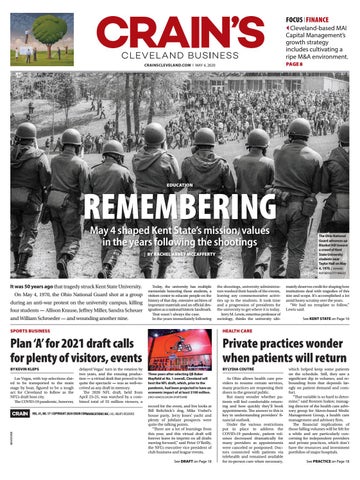
REMEMBERING May 4 shaped Kent State’s mission, values in the years following the shootings | BY RACHEL ABBEY MCCAFFERTY
The Ohio National Guard advances up Blanket Hill toward a crowd of Kent State University students near Taylor Hall on May 4, 1970. | HOWARD RUFFNER/GETTY IMAGES
It was 50 years ago that tragedy struck Kent State University. On May 4, 1970, the Ohio National Guard shot at a group during an anti-war protest on the university campus, killing four students — Allison Krause, Jeffrey Miller, Sandra Scheuer and William Schroeder — and wounding another nine.
Today, the university has multiple memorials honoring those students, a visitors center to educate people on the history of that day, extensive archives of important materials and an official designation as a national historic landmark. That wasn’t always the case. In the years immediately following
the shootings, university administrators washed their hands of the events, leaving any commemorative activities up to the students. It took time and a progression of presidents for the university to get where it is today. Jerry M. Lewis, emeritus professor of sociology, thinks the university ulti-
mately deserves credit for shaping how institutions deal with tragedies of this size and scope. It’s accomplished a lot amid heavy scrutiny over the years. “We had no template to follow,” Lewis said. See KENT STATE on Page 16
SPORTS BUSINESS
HEALTH CARE
Plan ‘A’ for 2021 draft calls for plenty of visitors, events
Private practices wonder when patients will return
BY KEVIN KLEPS
Las Vegas, with top selections slated to be transported to the main stage by boat, figured to be a tough act for Cleveland to follow as the NFL’s draft host city. The COVID-19 pandemic, however,
delayed Vegas’ turn in the rotation by two years, and the ensuing production — a virtual draft that proved to be quite the spectacle — was as well-received as any draft in memory. The 2020 NFL draft, held from April 23-25, was watched by a combined total of 55 million viewers, a
NEWSPAPER
VOL. 41, NO. 17 l COPYRIGHT 2020 CRAIN COMMUNICATIONS INC. l ALL RIGHTS RESERVED
BY LYDIA COUTRÉ Three years after selecting QB Baker Mayfield at No. 1 overall, Cleveland will host the NFL draft, which, prior to the pandemic, had been projected to have an economic impact of at least $100 million. | RICH GRAESSLE/ICON SPORTSWIRE
record for the event, and live looks at Bill Belichick’s dog, Mike Vrabel’s house party, Jerry Jones’ yacht and plenty of jubilant prospects were quite the talking points. “There are a lot of learnings from this year, and this virtual draft will forever leave its imprint on all drafts moving forward,” said Peter O’Reilly, the NFL’s executive vice president of club business and league events. See DRAFT on Page 18
P001_CL_20200504.indd 1
As Ohio allows health care providers to resume certain services, many practices are reopening their doors to the general public. But many wonder whether patients will feel comfortable returning and how quickly they’ll book appointments. The answer to this is key in understanding providers' financial outlook. Under the various restrictions put in place to address the COVID-19 pandemic, patient volumes decreased dramatically for many providers as appointments were canceled or postponed. Doctors connected with patients via telehealth and remained available for in-person care when necessary,
which helped keep some patients on the schedule. Still, they saw a significant dip in volumes, and rebounding from that depends laregly on patient demand and comfort. “That variable is so hard to determine,” said Ronnen Isakov, managing director of the health care advisory group for Akron-based Medic Management Group, a health care management and advisory firm. The financial implications of those falling volumes will be felt for a while and are particularly concerning for independent providers and private practices, which don’t have the resources and investment portfolios of major hospitals. See PRACTICE on Page 18
5/1/2020 1:48:54 PM
REAL ESTATE
Major apartment portfolio sells BY STAN BULLARD
HISTORICAL CHARM. NATURAL BEAUTY.
HISTORICAL CHARM. Extraordinary Living NATURAL BEAUTY.
Extraordinary Living Outperform your dreams.
The hidden gem of South Carolina: Golf, tennis, boating, home!
(843) 838-3838
Learn more at Dataw.com
Since 1959
SAME DAY
Courier, Route, Box Truck, Tractor Trailer Services WE ARE OPEN!
As an essential business during COVID-19, we are focused on meeting your delivery needs including no contact delivery.
216-696-6033 • www.bonniespeed.com LAND FOR SALE: Beacon West, Westlake
Prestigious Westlake Location! » Industrial Zoning with Many Allowable Conditional Uses » Prestigious High Visible Gateway Location » Can Accommodate up to 100,000 SF Building » $550,000 » $76,389/Acre
Property Features Priced to Sell Last Two Available Parcels ● Quick access to I-90 and Crocker Park ● Enterprise Zone ● Major Business Area ● Stormwater Pond Installed ● Build to Suit Available ● ●
Lot 2R 7.226 Acre Parcel
VIKING PARKWAY
CONTACT US Charles Marshall or Terry Noonan 330-659-2040 3457 Granger Road, Akron, OH 44333
VISIT OUR WEBSITE www.beaconmarshall.com
Northeast Ohio gained a new, large apartment owner as affiliates of The Solomon Organization, a Summit, N.J., multifamily landlord, acquired five complexes from the Fairfield Residential unit of Toronto-based Brookfield Asset Management. Property records do not show sale prices, but on April 2 and 3, ownership of a total of 1,203 suites in Cuyahoga, Lake, Medina, Portage and Summit counties changed hands. Perunit prices circulating among real estate insiders indicate it was a nearly $150 million transaction. The properties date from 1989 to 1999. All were developed by the former Associated Estates Realty Corp. of Richmond Heights, which Brookfield acquired for $2.8 billion in 2015. The properties include Mallard’s Crossing in Medina, The Residence at Barrington in Aurora, The Village at Avon in Avon, The Village of Western Reserve in Streetsboro and Westchester Townhomes in Westlake. The group formed the newest local properties held by Associated Estates, which traced its lineage to the late Carl Milstein, who developed thousands of apartments as well as hotels and office buildings in Northeast Ohio. Jeff Friedman, Milstein’s son-in-law, as CEO took the apartment company public as a real estate investment trust. Under his leadership, it grew to 56 properties with about 15,000 units at the time the buyout was completed. Solomon Organization is a 40-year-old, privately held multifamily ownership concern that controls
The Village at Avon Apartments is one of five complexes just acquired by The Solomon Organization, a Summit, N.J.-based apartment owner and manager. | COSTAR
50 rental communities in nine states. It already owned properties in the Columbus and Cincinnati areas. Ralph McGreevy, executive vice president of the Northeast Ohio Apartment Association, said Solomon’s acquisitions represent a significant share of the region’s newer apartment properties. He added that Solomon retained the former Fairfield personnel at the properties, which he regards as a good sign because the prior owner was known for professional operations. Brookfield sold its controlling stake in Fairfield in May 2019 to longtime partner the California State Teachers Retirement System. The Northeast Ohio properties may have been sold for a number of reasons, but the region is generally little favored by large institutional owners because it has slight population growth and, although rents have climbed to striking levels in the region, it lags oth-
er, larger metropolitan areas or various portfolio management strategies. Until the spate of apartment construction from 2011 to now — bred by low interest rates in the period following the Great Recession — the properties were among the newer multifamily offerings in Northeast Ohio. Historically, before the mid-2000s, the region had seen a slow pace of apartment growth rate since the 1970s, mostly due to lack of population growth. The AEC properties and their kin essentially followed population movement to new suburban areas as homebuilders moved on to land-rich areas from older ones. A spokesman for Solomon declined comment on the acquisition. Fairfield did not respond to two phone calls and an email about the disposition by Friday morning, May 1. Stan Bullard: sbullard@crain.com, (216) 771-5228, @CrainRltywriter
Technology aids realty agents amid COVID-19 Virtual staging and tours have produced deals without in-person visits BY STAN BULLARD
The rise of social distancing to combat the spread of COVID-19 has fostered wider use of technology in Northeast Ohio’s residential real estate brokerage business. Widespread use of virtual tours of homes for sale has been joined by livestreamed open houses and other digital technologies that some brokerages see as key to sales growth despite the pandemic slowing what had been a fast-moving, house-hungry property market. “A livestreamed open house is like a watch party you have online among friends in their homes,” said Ryan Young, CEO of the Young Team, which has offices in Pepper Pike and Rocky River. At the EZ Referral Network, a brokerage team based in Westlake, co-owners Greg Erlanger and Mike Zinicola said the statewide stay-athome order prompted them to redeploy digital assets they’d created for the luxury market to the entire market. “It’s more than following safety protocols,” Zinicola said. “People want the virtual experience as a precaution. When the state reopens more businesses, people will still have concerns about safety.” Virtual staging — where furnishings are dropped into a home’s video — allows customers to get a better idea of what their furniture might look like in an empty house. That and similar techniques have helped give rise to partial and even total home
transactions without a physical tour. Erlanger said that since the sheltering in place began six weeks ago, the EZ team in Northeast Ohio has had virtual technology play a role in half of the 90 sales it has made, including some that were totally virtual. Erlanger is not a fan of simply using a smartphone to launch a virtual open house, saying he prefers to use higher-quality video cameras. “You’re asking someone to write a check for one of the most expensive purchases of their life,” he noted. “You don’t want to ask them to do that based on shaky imagery.” EZ’s embrace of media is so strong that it formed EZ Media as a separate company to put its drone photography, 3D videography, virtual tours and open houses in a single concern, with a team of eight supplying the company’s requirements. “We’ve watched virtual technology go from the exception to the requirement overnight,” Erlanger said. EZ Media also provides video production services for other small businesses, such as plumbing suppliers and restaurants. The EZ network said its virtual technology allows its team of about 70 here to produce results that surpass those of the market. In the Young team’s case, the 20-person company includes a fulltime digital strategist to coordinate social messaging and target prospective buyers and sellers geographically using their distinct Internet Service Provider numbers. Young also buys about $30,000 in
radio advertising on multiple stations monthly. He said the old-school technology prompted him to expand his Cleveland practice to Akron and, eventually, Canton, because those cities are in the same radio market. He noted the firm can see a boost in interest online after an ad airs that it uses to direct its marketing efforts. A reflection of how widespread streaming open houses online may become appeared April 17, when Realtor.com announced it was adding a button to its website to accommodate open houses that are livestreamed. Carl DeMusz, CEO of Yes-MLS, the multiple listing provider for northern Ohio, said Realtor.com originally started to develop the ability to livestream open houses because the market was so hot that 25 people were showing up at once for an open house. Development of the product was accelerated because of the rise of the pandemic. The system is most readily apparent on Ohioopenhouse.com, a website the Yes-MLS operates that focuses on open houses. Individual listings point out the times and days of livestreamed open houses. “However, virtual showings do not replace reality,” DeMusz said. “It will get you from point A to point B. It is getting traction in the market. However, the problem is when there is really great video and then there’s something that was missed. It is found when the buyer comes with the home inspector for a physical inspection. That can kill the deal.”
2 | CRAIN’S CLEVELAND BUSINESS | MAY 4, 2020
P002_CL_20200504.indd 2 Beacon Marshall Ad 3-4-Lot 2R-9-2.indd 1
10/7/19 12:47 PM
5/1/2020 1:16:20 PM
MARKETING
MEDIA
Thrivable Plain Dealer likely to become Sunday-only soon Insights will Owner Advance Publications continues shifting focus to ‘digital space’ track COVID-19 experiences BY JAY MILLER
Research tool brings faster survey results BY JAY MILLER
The operator of a local medical information website is branching out into a new startup that is building a web-based, medical market research business. It will include a free companion research tool that will focus on tracking people’s experiences during the course of the COVID-19 pandemic. David Edelman, who has since 2005 run Diabetes Daily, is creating Thrivable Insights, a platform for what he calls rapid response marketing for pharmaceutical and medical device companies. It will conduct surveys, focus groups and even telephone interviews. The new business was a response to a question from an advertising client who was looking for market research software and asked Edelman, “Why can’t I just text people and get answers? Why is this so hard?” Edelman looked for an existing product but came up empty. “We were shocked that the whole process of doing market research was manual, slow, archaic,” he said on a Zoom interview. “And we thought, ‘Well someone’s probably fixed this. Let’s go get some software.’ We went out and looked: There is no software that automates all this.” It turns out that the hospital and health care industries have been slow to keep pace with changes in market research. A 2018 report by Modern Healthcare, a sister publication of Crain’s Cleveland Business, said that, historically, consumer research has not been highly regarded by hospital administrators. Then came the pandemic, and Edelman and his partner and wife, Carrie Gladstone, started thinking about how what they were working on could help the situation. Alongside Thrivable Insights, which is in beta testing, the young firm is building a COVID-19 site, Study Covid, that will use the Thrivable Insights platform to provide research to hospitals and others in the medical professions on the impact of the coronavirus. “So we started bouncing it off of a couple of people and realized that if we could allow decisions to be informed by what people are experiencing, feeling, doing — their behaviors, their actions — we can try to make a difference here,” Gladstone said. “So why not just roll it out and figure out how we can recruit a panel of people who are affected by COVID-19, whether they have it or a family member has it? I mean, a lot of people are going to end up having it or know somebody who does. So let’s just see what this could become.” Sanjay Gandhi, a physician in The MetroHealth System and its medical director for hospital strategy, business development and innovations who has joined the Study Covid advisory board, said that most of the research he sees is focused on patients in hospitals.
The daily newspaper, including Cleveland’s Plain Dealer, isn’t long for this world, something acknowledged even by the editor and president of the Advance Publications unit that operates the PD. Some media watchers estimate that within five years ink on paper will be Sunday-only in nearly all cities. “I wouldn’t disagree that the near future could become Sunday-only,” said Chris Quinn, editor and president of AdvanceOhio, the unit of New York-based Advance Publications Inc. that operates the Plain Dealer, in a telephone interview on April 29. “I think the path was clear years ago. Print is on the wane. The digital space is the future.” By digital space, Quinn means cleveland.com, the website created as an adjunct to the Plain Dealer in 1996. Originally focused on entertainment and culture, it has expanded into news and overtaken the Plain Dealer, as Advance Publications in 2013 adopted a “digital-first” philosophy and created the Northeast Ohio Media Group, now called AdvanceOhio. That meant building up cleveland.com’s news staff, which is nonunion, and cutting people from the Plain Dealer, where reporters were represented by the News Guild, a part of the Communications Workers of America. Advance has long taken a paternalistic, but nonunion, approach to its operations. The job losses at the PD in recent months, including the loss of 22 editors and reporters in March and another 10 departures in April, raised concerns about how the loss of reporting could affect the community. In the days before web news, the Plain Dealer had a newsroom of more than 340 reporters and editors. The layoffs reduced the unionized news staff to just four members, while Quinn said the nonunion cleveland.com staff of editors and reporters now numbers 61. Staff reductions are only the latest hits to the PD as newspapers industrywide, and their companion websites, have taken a beating from a
decline in advertising revenue at the hands of Google, Facebook, Craigslist and other online sites. To counter that, news organizations have struggled to mine new revenue from their audiences. Many erected what are called paywalls, restricting access to some or all content to paid subscribers only. AdvanceOhio has not yet erected a paywall, but Quinn said that may change. “It’s something we keep analyzing,” he said, adding that while Advance has until now shunned paywalls, several Advance brands are now testing the concept. “The strategy when I was there was that paywalls don’t work because people will find a way around them and there are too many alternatives to get that or similar information,” said Thom Fladung, managing editor of the Plain Dealer from 2011-15. Industry analysts say major national newspapers such as The New York Times, The Wall Street Journal and The Washington Post could survive in print, but that’s far less likely for regional newspapers and smaller local papers. “I think Sunday-only in print is coming for the industry,” said Rick Edmonds, a media business analyst at the Poynter Institute for Media Studies in St. Petersburg, Fla. Edmonds said that for a typical newspaper, about half of its advertising is on Sunday. Many in the industry expected Sunday-only to come in three to five years. However, the pandemic shutdown may speed up that time table, said Ken Doctor, president of Newsonomics, a Santa Cruz, Calif., consultancy that analyzes the news media. “I think it’s going to happen over the next, well, six months to two to three years,” said Doctor. “The wild card here is the severity of the COVID-19 shutdown and its impact on advertising.” As a private, family-owned company, Advance Publications doesn’t disclose financial information, so Doctor said it’s unclear how the economic condition of the Cleveland operation compares with the rest of the industry. Industrywide, print ad-
vertising, once 80% of all revenue, has declined sharply. Print ads have not been replaced by digital advertising on cleveland.com — or on newspaper sites elsewhere — as even local advertisers have been won over by the precision targeting of the dominant websites. In 2005, the industry brought in $49.3 billion in ad revenue, according to the Pew Research Center, but print ad revenue dropped to $14.3 billion by 2018. The PD’s print circulation, once about 400,000 daily and 550,000 on Sundays, has fallen just as dramatically. According to a statement published in the newspaper in September, Sunday paid circulation was 139,243 and the average number of copies sold daily in the previous 12 months was just 70,053. That figure mixes Sunday circulation with three days of weekly home-delivered circulation and three days — Monday, Tuesday and Thursday — when the paper is available only in stores and on newsstands. The PD dropped seven-day home delivery in 2013. Paid print circulation has been replaced by free online readership. AdvanceOhio claims its website had more local unique weekly visitors — 968,577 — than any other Cleveland-area website in a 2018 survey by Comscore, a firm that provides marketing data and analytics to advertising agencies and other media enterprises. It also cites a 2018 study by survey firm Nielsen Scarborough that reported 384,751 people read the print edition daily. Quinn said he hopes some print advertising will return when the pandemic recedes, but, like most news executives, he’s more focused on generating digital revenue from website visitors.
In April, AdvanceOhio took a tentative step into seeking payment for news when advertising nosedived amid the pandemic. Quinn posted a call for voluntary subscriptions at $10 a month, as other Advance operations were doing. “The digital subscription was born of the necessity of the lost revenue,” he said. “We really appreciated the people that did it and they’re continuing to do it and we’ll keep pursuing it. That may become the paywall: You know, you get so much content a month and then you have to (pay for) it.” AdvanceOhio is also pursuing other ways to generate revenue. “When we started (digital-first) back in 2013 ... there was still a belief that digital advertising was going to be a significant part of the revenue stream, but the realization came that we need to have many revenue streams,” Quinn said. A service called Subtext (though its webpage still bears the earlier, working name of Project Text) allows the company’s content providers to connect with subscribers directly via text. AdvanceOhio offers subscribers, for $3.99 a month, a steady stream of texts, mostly on sports and politics. It also offers a free coronavirus Subtext, alongside one written by Quinn. “When I first heard that idea, I thought, ‘OK, I’ll try anything because we experiment,’ but I didn’t see how it was going to work, and it has turned out to be phenomenal,” Quinn said. “We’re not talking thousands and thousands of subscribers, but it’s hundreds and hundreds of subscribers and we’re constantly talking about ways to grow it.” Jay Miller: jmiller@crain.com, (216) 771-5362, @millerjh
Earn 0.85% interest rate (0.45% APY)* on
a Money Market Account With a minimum deposit of $10,000, earn a promotional interest rate of 0.85% for the first 180 days (0.45% APY) by opening a new personal or business money market.
Get more with Ancora. With proprietary investment strategies, wealth planning and retirement plan solutions - we help you get more out of life. 216-825-4000 / www.ancora.net
Open an account today at FFL.net/OpenMMA * The promotional Annual Percentage Yield for balances $0.00-$9,999.99=0.05% $10,000.00$24,999.99=0.45%, $25,000.00-$99,999.99=0.53%, $100,000.0 + = 0.63% is accurate as of 04/09/2020. Minimum balance to open is $10,000. Deposit limited to $1,000,000 per household. A minimum average daily balance of $10,000 is required to earn the promotional APY and avoid a $10 monthly service fee. The promotional APY is locked for 180 days. After 180 days, the variable interest rate is subject to change and the new interest rate will be based on the account balance and the interest rate tier being offered on the Select Money Market Account. The Select Money Market account tiered interest rates in effect as of 04/09/2020 are as follows: .01- $24,999.99 the APY is 0.05%; $25,000-$99,999.99 the APY is 0.20%; $100,000 or more the APY is 0.40%. If the account is closed before the 365 days, a $50 fee may be assessed. No more than a total of 6 preauthorized, telephone, ACH, check, POS or Internet transactions may be made from this account per month. Fees could reduce earnings on this account. The promotional APY is valid only for new money not currently on deposit with First Federal Lakewood. Other restrictions may apply. Promotional offer subject to change without notice. Contact a branch representative for full details.
See RESEARCH on Page 14 MAY 4, 2020 | CRAIN’S CLEVELAND BUSINESS | 3
COPING WITH COVID-19 | AGRIBUSINESS PANDEMIC PERSEVERANCE
Huron farm business reinvesting in food safety and new markets BY JAY MILLER
YOUR LOCAL CREDIT UNION SUPPORTS YOUR COMMUNITY DURING THESE UNPRECEDENTED TIMES Contact Your Local Credit Union Loans up to $10 Million • No Prepayment Penalties As Little as 10% Down
Your Business Lending Partner SM Contact Jonathan A. Mokri 440.526.8700 • jmokri@cbscuso.com www.cbscuso.com
LIVE BROADCAST REAL ESTATE
AUCTION
MAY 28
COMMERCIAL, RETAIL & FLEX OPPORTUNITIES
3778 MARTIN 4761 SR 193, LUTHER KING DR., KINGSVILLE, OH 44048 CLEVELAND, OH 44105 OFFERED SUBJECT OFFERED ABSOLUTE, TO A RESERVE PRICE WITHOUT RESERVE OF ONLY $160,000! & REGARDLESS OF PRICE! 21,000 SF bldg. with 7,000 SF retail/ 3,968 SF retail/ 15,000 SF warehouse, commercial on 13 commercial building 6,000 SF office & acres with huge on 0.15 acres. showroom on 3.32 acres. parking lot. Terrific Excellent opportunity Clean, well-maintained opportunity for a property just off I-90 & 64 for a variety of variety of possible possible uses. uses and development. miles East of Cleveland. 11400 KINSMAN ROAD, NEWBURY, OH 44065 BIDDING TO COMMENCE AT ONLY $95,000!
ALL PROPERTIES INTERACTIVE OFF-SITE DUE DILIGENCE SEMINARS TUESDAYS, MAY 12, 19 & 26 AT 11:00 AM BID ONLINE IN REAL TIME. GO TO CHARTWELLAUCTIONS.COM TO REGISTER AND RECEIVE MORE INFORMATION.
CHARTWELLAUCTIONS.COM
FOR ADDITIONAL INFORMATION, BROCHUR E & TE R MS, C ALL:
216.861.7200
HANNA COMMERCIAL • CHARTWELL AUCTIONS • MICHAEL BERLAND, AARE, OH AUCTIONEER
Every business is learning to pivot on safety and e-commerce as the COVID-19 pandemic continues its infectious course. The Chef’s Garden, a 300-acre farm in Huron, had the good fortune to be pivoting months before the virus hit. A farm-to-table supplier of produce to high-end restaurants across the country, Chef’s Garden was working to expand into a new market and to redouble the health and safety protections for its roughly 175 employees several months before COVID-19 hit. Those moves make even more sense now, said co-owner and CEO Bob Jones Jr., in an April 22 telephone interview, even though the health and safety plans will require a significant capital investment at a time when business is off 85%. “The first week of March was a really good week and then, and then all of a sudden, the bottom fell out of it and the restaurants closed,” said Jones. “On a farm, you just can’t shut it down. It doesn’t matter whether it’s vegetables or dairy cows, you have to continue to farm.” But just before COVID-19 took away its customers, Chef’s Garden had begun testing an ionized air purification system for its 11,000square-foot packing facility. The system, which of course is not proven to prevent the spread of the coronavirus, does promise to reduce the spread of many viruses and other contaminants to employees — while it also cleanses and extends the shelf life of the farm’s produce. “This company (Extreme Microbial Technologies, or EMT) came to us about six months ago,” Jones said. “It was introduced to us as something that we might consider for enhancing our food safety practices here on the farm. When this event (the coronavirus outbreak) happened, we reached back out to the company and we went ahead and installed this equipment based on its ability to very effectively control bacteria, viruses, dust (and oth-
“TRUST ME, WE HAD SOME VERY INTERESTING CONVERSATIONS IN OUR GROUP WHEN WE SAID, ‘YOU KNOW, WE’VE JUST LOST 85% OF OUR REVENUE.’ ” — Bob Jones Jr., co-owner and CEO of The Chef’s Garden
Co-owner Lee Jones is shown at The Chef’s Garden’s farm in Huron. | CONTRIBUTED
er) particulate matter in the air.” Though it was a significant investment, Jones said the company, which he runs with his father, Bob Sr., and brother Lee, believed the outlay was important. “Trust me, we had some very interesting conversations in our group when we said, ‘You know, we’ve just lost 85% of our revenue,’ ” Jones recalled. “Now I’m suggesting that we make this large capital investment. We talked about it and we said, ‘You know, part of our core beliefs are do the right thing because it’s the right thing to do.’ ” The Jones family, like most farm families in Ohio, farmed corn and soybeans. Then, a hailstorm in 1983 plunged them into bankruptcy and cost them their 1,000-acre farm. However, they restarted on leased land, selling produce at farmers markets. That evolved into today’s 300-acre farm, bypassing wholesalers and supermarket chains and selling directly to end users — the
definition of farm-to-table. The business also operates on a philosophy of sustainable farming. Its produce is not considered organic under U.S. Department of Agriculture guidelines. Instead, The Chef’s Garden uses what are called sustainable agricultural practices. Like organic farms, the Huron farm avoids manmade fertilizers and pesticides. But it plants a mix of crops in relatively small plots as a form of pest control and to build soil fertility. It also keeps most of its acreage planted in cover crops, such as clover, which builds soil health, replenishes soil nutrients and contributes to food safety. “This particular technology (from EMT) allowed us to be able to take what we were doing and go to the next level,” Jones said. “We feel very strongly that this technology will be a best practice very, very soon. And we’re just trying to get ahead of that.” See CHEF’S GARDEN on Page 19
“The perfect location for our Apple Growth Partners Cleveland office turned out to be in Beachwood.” Ca u l e y Fe r ra r i o f D e t ro i t 7 0 7 0 O rc h a rd L a k e R d. �e � t � l o o m � e l d� � � 4 8 3 2 2 Te l e p h o n e : 2 4 8 . 5 3 8 . 9 6 0 0 w w w. Ca u l e y Fe r ra r i . co m
Mayor Martin S. Horwitz •Mayor@BeachwoodOhio.com •216.292.1901
WWW.BEACHWOODOHIO.COM
4 | CRAIN’S CLEVELAND BUSINESS | MAY 4, 2020
P004_CL_20200504.indd 4
5/1/2020 9:57:15 AM
Serving businesses for more than 160 years. Since we first opened our doors in 1858, we’ve put our clients and their businesses at the center of Andeverything we’re here to wehelp do. make it happen.
And that’s never going to change.
We’re here to answer your questions. For the most up-to-date information, speak to your relationship manager, or visit us at 53.com.
Our business continuity plans and preparations ensure that critical functions will continue in the event of any disruption, with policies, people and processes aligned to provide continuous service. Fifth Third Bank has a long-standing history of developing and testing comprehensive plans to effectively manage through emergencies. We are well prepared to continue delivering the best-in-class service levels you are accustomed to receiving from Fifth Third. In moments like these, we are proud to be your trusted partner. Our experts are continually focused on maintaining the safety, security and success of your business today and in the future. For more information on how we can help with COVID-19-related disruptions to your business, visit 53.com. Fifth Third means business.
© 2020 Fifth Third Bank, National Association. Member FDIC. Images courtesy of the Fifth Third Bank Museum Archives and Cincinnati Museum Center.
PERSONAL VIEW
Practice impactful philanthropy during pandemic
RICH WILLIAMS FOR CRAIN’S CLEVELAND BUSINESS
BBY JOHN ARROWSMITH
EDITORIAL
New realities W
elcome back. Well, not all of you. Probably not even most of you. But as Monday, May 4, rolls around, many construction, manufacturing/distribution and general office operations that weren’t running during these weeks of the pandemic have the state’s go-ahead to reopen. Nonessential retail and consumer services will join the reopening effort on May 12. Certain medical procedures that had been paused started back up on May 1. It’s critical that we take this slowly and get it right. A dip back into a disease surge would be disastrous as a public health and economic matter. This is one of those cases where a cliché — we’re all in it together — is perfectly apt. Government leaders must continue to communicate clearly and effectively. Companies have to be proactive in making sure the workplace is safe and socially distanced. And workers have to comply with new rules and accept a few inconveniences. Many companies already are sending the right signals. Ford, for instance, says workers must complete online health self-certifications before work every day. It’s also implementing no-touch temperature scans upon arrival and requiring face masks for A DIP BACK INTO A everyone entering a Ford faDISEASE SURGE WOULD cility. At Macy’s, employees will be required to wear BE DISASTROUS AS A masks, and those who proPUBLIC HEALTH AND cess inventory, returns and manage fitting rooms also ECONOMIC MATTER. will wear gloves. Other employers are scheduling more times between production shifts to reduce contact among employees. They’re also making sure hand sanitizer is readily available and keeping some common areas, such as cafeterias and small meeting rooms, closed because they don’t allow for social distancing. These are right and necessary steps. Some of them, no doubt, will take extra time and effort, but there are new realities in every workplace. It has been a while since a lot of you worked in a group setting. Some people won’t like the new rules, especially when it comes to the contentious issue of mask-wearing. But if this is going to work, we all have to be smart, be patient and work together.
Understand your funds’ impact
Voting right A
couple thoughts on the world of voting: ``Ohio finally held its primary last week, mostly by mail, and it went ... pretty well, considering the circumstances. Nothing about the last-minute move from March 17 to April 28 was ideal, from the confusion it created for some voters to the complications and time crunch it led to for mail-in ballot applications. Turnout was down substantially from 2016, though that was a year when both Democrats and Republicans had contested presidential primaries. By last week, that was the case for neither party. But in the end, as Ohio Secretary of State Frank LaRose told Cleveland.com, “The big picture is, in the midst of a crisis, we ran a fair and honest election where as long as you took the effort to get your request in, … you could vote without jeopardizing your health.” If this was a dry run for an allmail election in November, we hope the state learns from it and takes steps that include mailing ballots (with postage-paid envelopes) to every voter, extending the early voting period and creating multiple ballot dropboxes in every county. ``It’s inconceivable to us that Congress still has not enacted remote voting. Several members of both the House and Senate have introduced measures to do this. Sen. Rob Portman, R-Cincinnati, has co-sponsored a proposal with Sen. Richard Durbin, D-Ill., to assign the Senate’s technology adviser to set up a remote voting system. Their measure would give the majority and minority leaders joint authority to allow secure remote voting during a crisis. It would be allowed for up to 30 days, and the Senate would have to vote to renew remote voting every 30 days. That’s eminently sensible. Safe technology exists, with end-to-end encrypted and blockchain-based voting systems. And yet leaders in both the House and Senate have dragged their feet on alternatives to in-person voting. They must move forward. The country’s legislative branches can’t be crippled if the pandemic takes a turn for the worse and our leaders are not able to gather in a shared space.
Publisher and Editor: Elizabeth McIntyre (emcintyre@crain.com) Managing Editor: Scott Suttell (ssuttell@crain.com) Contact Crain’s: 216-522-1383 Read Crain’s online: crainscleveland.com
The COVID-19 pandemic has caused a global crisis of a magnitude few have experienced before. Across Ohio, we’ve seen our medical, educational and economic systems tested as they reach, and surpass, their maximum capacities. The role of philanthropy has never been more important, and local donors, both experienced and new, are looking for ways to give quickly and effectively. As a managing As this pandemic continues to unfold, director for J.P. it presents critical questions for donors: Morgan Private How can you contribute and connect Bank, Arrowsmith with those doing the most good? Are serves as head of there aspects of the crisis you haven’t investments for considered but perhaps should? Ohio. For those in the position to be philanthropic during this time, considerations like this can help donors understand the whole ecosystem of resources needed across our region today and after the immediate triage period.
Ask key questions like, “What is the organization funding and how it will use resources? Does it have capacity to take funds? Is it an established organization with the AS THIS PANDEMIC existing infrastructure to deploy resources on the ground CONTINUES TO quickly?” UNFOLD, IT PRESENTS Donors may be drawn to national organizations or to CRITICAL QUESTIONS local charities. Both have critiFOR DONORS: HOW cal roles serving those in need. Given the urgent and unique CAN YOU CONTRIBUTE needs around crisis response, nonprofits and essential ser- AND CONNECT WITH vices need the support and THOSE DOING THE space to focus on service deMOST GOOD? livery.
Recognize crisis-related needs evolve Funding immediate needs is critical — for example, the organizations serving the most vulnerable communities such as homeless shelters, children’s services and elder support. Local hospitals and clinics are experiencing a range of urgent needs. Some may need help with emergency equipment acquisition, staff support or contingency planning. Consider the needs of local food banks around kitchen continuity, delivery and meal distribution. In partnership with many U.S. local school districts, many systems are now serving children at home who rely on school meals. Economic hardship, unemployment and the shelter-in place measures mandated in many locations are taking a toll on mental health and on support resources for those affected. Partnering for long-term recovery efforts might include support of diagnostic, vaccine and treatment research and development, as well as opportunities to fund accelerator projects for therapeutics and facilities. Nonprofit sustainability and general operating resources will also be key to maintain for the long term. See ARROWSMITH on Page 7
Write us: Crain’s welcomes responses from readers. Letters should be as brief as possible and may be edited. Send letters to Crain’s Cleveland Business, 700 West St. Clair Ave., Suite 310, Cleveland, OH 44113, or by emailing ClevEdit@crain.com. Please include your complete name and city from which you are writing, and a telephone number for fact-checking purposes.
Sound off: Send a Personal View for the opinion page to emcintyre@crain.com. Please include a telephone number for verification purposes.
6 | CRAIN’S CLEVELAND BUSINESS | May 4, 2020
P006_CL_20200504.indd 6
5/1/2020 1:20:07 PM
OPINION
WaterTower Plaza
Office Space for Lease
25200 Chagrin Blvd Beachwood, OH
PERSONAL VIEW
Legal and labor challenges to reopening the economy BY SHAWN RILEY AND MIRIAM ROSEN
tail establishments, restaurants and bars, we are likely to see reduced occupancy limits and mandatory disDashing the hopes of many, the process of reopening tancing. And workplace practices likely will soon inthe American economy will not be as simple as the flip clude subjecting employees, particularly those dealing of a light switch. As many state officials and business with the public, to mandatory, regular health screenings leaders have suggested, it will be a slow process — per- and testing — raising potential privacy and discrimination concerns. Important issues to haps painfully slow. A more apt consider include how to perform analogy might be the turning of a screenings and what kinds of redimmer switch, gradually moving cords to keep. from dark to increased light. Increased concern for employee Fortunately, with governors safety will also include reductions of, throughout the country considering and restrictions on, business travel. what coordinated regional economWhile the new agreement on a $25 ic restarts will look like and the fedbillion bailout was designed to help eral government contemplating the U.S. preserve the vital role airtimetables based on the hope that lines play in the economy, travel for social distancing will continue to Riley is president of McDonald business will be limited to trips that slow the spread of the coronavirus, Hopkins, a business advisory and the time has come for businesses to advocacy law firm headquartered in are considered truly critical. Recruiting new talent in every inbegin planning for how to reopen, Cleveland. Rosen serves on the dustry will change as job-site safety and how to do it safely. executive committee and board of As Ohio Gov. Mike DeWine said in directors at McDonald Hopkins and moves up the list of important factors for prospective employees searching his April 14 press conference, “Every as chair of the firm’s Labor and for jobs. According to a recent CNN business out there chomping at the Employment Practice Group. poll, 60% of Americans are not combit to reopen, every university, every fortable returning to their current college, every superintendent needs jobs if social distancing were lifted to be thinking, ‘How am I going to next month. reopen? What am I going to do every Along with simply being sensitive single day to keep our employees, to employee apprehensions, busiour customers, our teachers and our nesses will find it necessary to deal students (safe)?’ ” with complicated employment isDeWine admitted the most diffisues born out of this crisis. cult fact for him to accept is that “unWhat regulations will OSHA imtil there is a vaccine, this monster … pose to increase safety in the workis going to be lurking around us.” place? Will flexible workplace poliSuccessful planning by business cies need to be put into place, such owners and operators for reopening as offering more opportunity to work will need to include recognizing, from home as more personnel prove and coming to grips with, another themselves capable of performing reality: Their ongoing operations will jobs remotely? Will job descriptions be very different from what they need to be modified? What different once were. To continue the analogy, types of personal protective equipeven as the dimmer switch is turnment will be required in different ing, the room will not reach maxiwork environments, and what PPE mum light for some time and will will companies need and be able to look very different than it did before provide? What can businesses do if the onset of the virus. employees choose not to return to Accepting the new reality means work or if they decide to walk off the every business must consider radijob? How will the National Labor Recal new models for the workplace. In all likelihood, offices will reopen in phases with social lations Act influence the new employment issues rising distancing continuing. For example, many organiza- from this crisis? While schools remain closed, how will tions will decide (or be required) to bring back their businesses handle childcare issues? Of course, before the economy fully reopens, federal, workforces in shifts. At our law firm, we are already planning for a return that will see one third to one half of state and local governments need to solve overarching our attorneys and staff in the office while the balance questions of how to provide robust testing nationwide continue to work remotely, perhaps alternating those while guarding against a COVID-19 resurgence until a vaccine exists. As those plans are in the works, businessgroups daily or weekly. In addition, it is likely many of us will be wearing es should use this opportunity to make their own prepamasks when businesses reopen. It is also probable that rations and adapt to the realization that the workforce Plexiglas partitions between workstations and in office will be forever changed by this crisis. dining areas and cafeterias will become the norm. At re-
SUCCESSFUL PLANNING BY BUSINESS OWNERS AND OPERATORS FOR REOPENING WILL NEED TO INCLUDE RECOGNIZING, AND COMING TO GRIPS WITH, ANOTHER REALITY: THEIR ONGOING OPERATIONS WILL BE VERY DIFFERENT FROM WHAT THEY ONCE WERE.
ARROWSMITH
From Page 6
In addition to helping nonprofits and essential services deploy aid and resources, charitable donations can help these organizations continue to operate and be employers themselves. Prior to the current crisis, a study by Johns Hopkins University reported that the sector employed the third-largest workforce in the country, behind retail trade and manufacturing. As the economy begins to open and mitigation efforts are eased — whenever that may come — overall job assistance and support will be critical. Identifying organizations that provide workforce development training or
additional skills assessments may help workers to re-engage in the job market.
Understand identity of local community Similar to coverage of disaster scenarios, news reports and social media may not fully represent the actual experience of a specific region. More importantly, they cannot capture the experience of individualized physical and/or social communities, and needs can vary from community to community. As you consider getting involved to support organizations affected by and responding to the COVID-19 pandemic, assess how they are functioning, what they need and how their needs might evolve.
Available Suites from 1,965 - 10,150 SF
COMMERCIAL REAL ESTATE SERVICES LEE CLEVELAND
Connor Krouse | 216.282.0125 | www.leecleveland.com
Providing a private travel experience that exceeds expectations
FlySkyQuest.com
HOW TO FLY WITH SKY QUEST: » On-Demand Charter » Jet Card Memberships » Aircraft Ownership Opportunities
216-362-9904 Charter@FlySkyQuest.com
Looking for warehouse space? Need logistics help? Candor Logistics is a true 3rd party logistics company offering: Premium Warehouse Space ● Local Cartage, brokerage & supply chain fulfillment ● Pick & Pack, expedite & de-vanning services ●
Certified to handle any product regardless of size, field of industry or scope.
Call now to discuss your warehousing and logistics needs! 216.378.7100
●
Bedford Hts, OH
●
www.candorlogistics.com
MAY 4, 2020 | CRAIN’S CLEVELAND BUSINESS | 7
P007_CL_20200504.indd 7
Candor Logistics Ad-4-8 copy.indd 1
4/30/2020 2:50:40 PM 4/20/20 11:03 AM
FINANCE
CULTIVATING GROWTH
Rick an a
MATT ZUMBO/THE IMAGE BANK
B fall cate own sori and they part sess the ope to ex Th ven “W and vise men
MAI Capital pushes past $7 billion with more acquisitions in store BY JUDY STRINGER
Managing partner Rick Buoncore is not shy about his investment advisory’s aggressive acquisition strategy, or the “remarkable’” growth fueled by its dealmaking. Over the last two-and-a-half years, MAI Capital Management has purchased six fellow registered investment advisers (RIAs). In addition, the Cleveland firm formed a Raleigh, N.C.-based RIA joint venture, Curi Capital, to blend wealth management and planning services into a 13,000-physician malpractice business formerly known as Medical Mutual of North Carolina. Between July 2017 and the end of 2019 — when MAI closed its latest acquisition, the $640 million business of New York City-based J.M. Hartwell — the company’s total assets under management mushroomed 70%, from $4.5 billion to $7.2 billion. Revenues in that same time period climbed 87%, according to Buoncore, and EBITDA (earnings before interest, taxes, depreciation and amortization) soared 161%.
“WE WANT TO FIND THAT SWEET SPOT WHERE WE ARE BIG ENOUGH TO GET THE ECONOMIES OF SCALE AND BENEFITS OF ALL THAT, BUT SMALL ENOUGH TO FEEL LIKE A BOUTIQUE TO THE END CLIENT.” — Rick Buoncore, managing partner, MAI Capital Management
Meanwhile, MAI added 57 employees to a total of 148 people in eight locations across three states, 111 of whom work out of its East Ninth Street headquarters. The MAI managing partner is a bit more restrained when it comes to forecasting how far the buying spree could extend. In a telephone interview on April 24, Buoncore said the company was “two weeks away” from closing a seventh deal, with several more prospects in the pipeline. Still, both he and John Copeland, managing partner at Wealth Partners Capital Group, a Palm Beach, Fla.-based holding company that bought 40% of MAI in 2017, effectively to bankroll its RIA consolidation, stopped short of providing specific growth goals. “We’ve tried to get away from a dollar target and move toward a more philosophical target,” Copeland explained. “Instead of saying, ‘Hey, let’s be at $10 billion in one year
or $12 billion in two years,’ we are saying. ‘Let’s grow at a pace that makes sure every client — both new ones and the current clients — have a consistently great experience and let’s try to add geographies or capabilities where we feel it will really enhance what MAI does or who it is.’ ” Fortunately, Buoncore said, finding enhancement opportunities is far from difficult in today’s target-rich RIA space. Pressure to reduce fees, the expense of scaling investment businesses and aging among many small — often solo — practitioners has created a ripe M&A environment. A November report from Cerulli Associates pegged the total addressable market for RIA acquisitions at a whopping $2.4 trillion in assets under management over the next five to 10 years. At the time of the report, consolidators like MAI managed a total of about $308 billion.
8 | CRAIN’S CLEVELAND BUSINESS | MAY 4, 2020
P008_009_CL_20200504.indd 8
4/30/2020 2:31:54 PM
olest magnimin expliat inciet expelit
ADVISER Reg BI deadline looms for broker-dealers despite COVID-19 PAGE 10
Buying | Building | Managing
We Are Your Team Nationwide State GC Licensing Commercial | Medical | Retail Construction Services
Rick Buoncore, right, managing partner of MAI Capital Management, has employed an aggressive acquisition strategy to grow the firm. | PAUL SOBOTA PHOTOGRAPHY
MATT ZUMBO/THE IMAGE BANK
Buoncore said half of MAI’s deals fall into the “succession planning” category in which older business owners sought to transfer their advisories to MAI as a way to maintain and preserve service to clients so they could retire. It also has found partners, he said, in firms that possess unique assets and recognize the value of leveraging MAI’s deep operational infrastructure as a way to expand without adding overhead. The July 2019 Curi Capital joint venture is a good example of that. “We provide the infrastructure and the backbone and they hire advisers to go out and deliver (investment) services to those 13,000 doc-
tors they already provide malpractice to,” Buoncore explained. One month earlier, MAI completed the purchase of MTX Wealth Management in Reston, Va. That deal, he said, will allow it “to roll out a new sports and entertainment division in the coming weeks.” Professional athletes comprise 75% of MTX’s book of business, and although about a quarter of MAI’s clients were sports figures — some of whom had been with the firm for 50 years — the local company had done little to advertise that expertise in the past. “What we will be able to show is
that we have close to $2 billion in that client group and about 50 years of dealing with them, very successfully since about half those clients are very successfully retired,” Buoncore said. The acquisition of Cincinnati-based John D. Dovich and Associates, meanwhile, brought to MAI’s growing family a line of insurance products, which was not part of its offering prior to that July 2019 transaction. Whatever the market fit, each one of MAI’s deals is good news for Cleveland, according to Buoncore. The firm has added 27 employees downtown over the last two-and-ahalf years, many of whom offer support to MAI’s acquired franchise location. The larger Cleveland presence also translates into a bigger community impact at some of the company’s favorite charities, such as the Bishop Cosgrove Center and the Alliance for the Great Lakes. No matter how many acquisitions MAI completes, Buoncore suggested success ultimately will hinge on its ability to maintain a client-centric approach throughout that growth. “The key is being very careful about how we grow and ensuring that we don’t overuse our resources,” Buoncore said. “We want to find that sweet spot where we are big enough to get the economies of scale and benefits of all that, but small enough to feel like a boutique to the end client.” Contact Judy Stringer: clbfreelancer@crain.com
Full-Circle Services for Building Owners Real Estate Development | Design Build | New Construction Open Facility Remodels | Renovations | Tenant Improvements
1093 Medina Road, Medina, OH 330.239.0176 www.pleasantvalleycorporation.com
CORPORATE LITIGATION SERVICES Apple Growth Partners provides experienced, unbiased economic damage and business valuation services for the corporate litigation process.
WHAT’S YOUR NEXT MOVE?
Contact us today to support your case: applegrowth.com SERVING NORTHEAST OHIO’S PRIVATELY-HELD BUSINESSES
Apple Growth Partners @applegrowthpartners AppleGrowthPartners @apple_growth
216.674.3800
If you or someone you know is in need of managing their mental health and/or treatment for addiction
e t w a d -
Create your own business headlines with Companies on the Move
s g g — e
Showcase your latest milestones, awards, community outreach and more in Crain’s print and online editions
i n e f I -
CrainsCleveland.com/CompanyMoves
WE ARE
OPEN Old Brooklyn 4269 Pearl Road
Lakewood 14805 Detroit Ave. #200
Walk-in assessments available at Recovery Resources Old Brooklyn location: Monday - Friday | 8:00 a.m. - 2:30 p.m. Business hours 8:00 a.m. - 5:00 p.m. www.recres.org | 216.431.4131 MAY 4, 2020 | CRAIN’S CLEVELAND BUSINESS | 9
P008_009_CL_20200504.indd 9
4/30/2020 2:32:07 PM
FOCUS | FINANCE | ADVISER
Reg BI deadline looms for broker-dealers despite COVID-19 BBY JOSEPH S. SIMMS
Last year, the Securities and Exchanged Commission announced its adoption of Regulation Best Interest (Reg BI) and the Client Relationship Summary (CRS) Form. The deadline for implementation is June 30, and the SEC recently announced that it would not be extending the effective date despite the worldwide impact of COVID-19. Moreover, the SEC’s Office of Compliance Inspections and Examinations (OCIE) and the Financial Industry Regulatory Authority (FINRA) have alerted broker-dealers that they will move forward with their previously announced plans to begin compliance examinations immediately after the effective date. As background, Reg BI establishes a standard of conduct for brokerdealers that includes a general obligation to act in the best interest of the customer at the time the recommendation is made, without placing the broker-dealer’s interests ahead of the customer. In relation to the general “best-interest” obligation, Reg BI does not explicitly define the term, but rather requires broker-dealers to comply with four specific areas: 1. Disclosure 2. Care 3. Conflict of interest 4. Compliance Whether a broker-dealer has satisfied its best-interest obligation is
fact-specific and depends on how the four specific components of Reg BI are satisfied. According to the Risk Alerts issued by OCIE, the initial regula- Simms is a tory examina- shareholder tions will focus with Reminger on “whether Co. LPA’s firms have estab- Cleveland office. lished policies and procedures reasonably designed to achieve compliance with Regulation Best Interest,” and will evaluate whether “reasonable progress” has been made in implementing appropriate policies and procedures. The regulators will be looking for reasonable efforts and have stated that complete compliance won’t be expected immediately. In this regard, the initial examinations will focus on the four pillars of Reg BI as follows: A. DISCLOSURE OBLIGATION: assessing whether and to what extent firms have disclosed (i) the capacity in which recommendations are made, (ii) what fees and costs apply to the transactions, holdings and accounts, and (iii) material limitations on the recommendations being made.
WHETHER A BROKER-DEALER HAS SATISFIED ITS BESTINTEREST OBLIGATION IS FACT-SPECIFIC AND DEPENDS ON HOW THE FOUR SPECIFIC COMPONENTS OF REG BI ARE SATISFIED.
``Documentation of fees, charges and compensation methods ``Description of available account types ``Disclosures of material limitations on accounts or services ``List of proprietary products ``List of third parties or affiliates ``New account forms and suitability profiles ``Marketing materials ``Training materials ``Surveillance and monitoring reports ``Firm policies and procedures
B. CARE OBLIGATION: assessing the level of due diligence undertaken before recommending a particular security or investment strategy.
As to Form CRS, the Risk Alerts similarly provide that “initial examinations will focus on assessing whether firms have made a goodfaith effort…” and identify several focus areas that OCIE will emphasize:
C. CONFLICT-OF-INTEREST OBLIGATION: evaluating the creation, maintenance and enforcement of policies and procedures to address firm-level and representative-level conflicts of interest. D. COMPLIANCE OBLIGATION: evaluating the creation, maintenance and enforcement of written policies and procedures targeted at overall Reg BI compliance. The Risk Alerts also provide a sample list of documents each broker-dealer is expected to maintain, including (without limitation) the following:
A. DELIVERY AND FILING: ensuring that relationship summary is filed with SEC and posted on the firm website by June 30; evaluating process for delivery to clients; and whether policies and procedures address delivery process and dates. B. CONTENT: whether the relationship summary contains true and accurate information as well as all required information. C.
FORMATTING:
assessment
of
whether contents are displayed according to instructions, including whether it is written in “plain English.” D. UPDATES: a nalysis of policies and procedures to ensure that the relationship summary is updated within 30 days after information becomes inaccurate and distributed to clients within 60 days, as well as whether updates are appropriately highlighted and earmarked for the reader. E. RECORDKEEPING: assessment of how delivery of relationship summary is recorded and document procedures relating to this process. In conclusion, while SEC and FINRA have stated they are fully staffed and prepared to commence with exams specific to Reg-BI and Form CRS immediately following the June 30 compliance deadline, the tone of the announcements reflects SEC chairman Jay Clayton’s prior statements that the regulators recognize the challenges imposed by the COVID-19 pandemic and that examiners will be focusing on whether firms have made goodfaith efforts to implement Reg BI and will be providing firms with opportunities to work with them to address compliance and other related matters.
There’s no better time to be first. At First Commonwealth Bank,® we understand that many of today’s businesses are facing uncertain times. That’s why we believe there’s no more important time for having the right financial partner behind you. A partner with the resources and experience to help take care of your business. One that’s an SBA-preferred lender who can see what others may not and do what others cannot to help your business today and into the future. If you’d like to find out more about our approach to business banking and how it can help your business keep doing business, there’s no better time to visit us at fcbanking.com/business.
Member FDIC
216.416.0580
10 | CRAIN’S CLEVELAND BUSINESS | May 4, 2020
P010_CL_20200504.indd 10
4/30/2020 2:33:56 PM
We're looking for the best, the brightest and
We want strong individuals, driven for success, with a collaborative mindset and the desire to be the best in the business.
We’ll never settle for good enough. And neither should you.
To learn more visit bdblaw.com/careers
AKRON | CLEVELAND | CANTON
bdblaw.com May 4 ad.indd 1
4/23/2020 2:55:47 PM
SALT • SALT • SALT Water Softener • Industrial • Food Ice Melt • Sea Salt
Call For Pricing!!
Claims adjuster says companies deserve cov Nature of virus makes proving ‘direct physical loss or damage’ difficult BY DOUGLAS J. GUTH
Cleveland-based public insurance claims adjuster Alex N. Sill Co. has been advising enterprises on property loss since 1928, guiding owners through fires, tornadoes and other perils. The novel coronavirus represents an unparalleled challenge, one that has businesses scrutinizing their policies for protections as insurers worry about the virus’s potentially destructive impact on their industry. While most property insurance MEDINA, OH policies include business-interruption coverage, the abstract nature of 1-800-547-1538 COVID-19 will make it difficult for Salt Distributors Since 1966 companies to prove the “direct physical loss or damage” required to trigwww.saltdistributormedinaoh.com ger coverage, noted Sill president Michael Perlmuter. “Insurance companies will say that even though you shut down and even though you suffered economic damage, the coronavirus is not covered because it didn’t cause physical loss or damage,” said Perlmuter, who was named Sill's president in 2012. Perlmuter added he does not agree with the insurer assessment of business-interruption loss. In the absence of a specific exclusion, any virus-related economic cost should be recovered for commercial policyholders, he said. The battle over reimbursement is evolving alongside the coronavirus threat. 4/28/2020 1:25:01 Six PM states, including Ohio, have proposed bills requiring insurers pay out for certain claims connected to COVID-19. Ohio’s House Bill 589 would cover some business-interruption claims for compaSave time & manage cash flow with nies with 100 or fewer full-time inTreasury Management from Home Savings. state employees, defined as those who work a normal week of 25 or Get real-time access to account information, automatic more hours. payments, wire transfers, ACH originations, custom reporting, The American Property Casualty single sign-on for multiple entities with user defined controls Insurance Association is pushing and much more. Our professional bankers are dedicated to back, arguing that COVID-19 costs understanding your business and innovating your day. aren’t covered under current policies. This is true for commercial Call Jennifer Bidlingmyer & her property plans containing language Treasury Management team today! that excludes coverage for any virus, 330.310.1739 | HomeSavings.com bacteria “or other micro-organism
Minimum Delivery: 1 Pallet
Innovation that works for you.
Grimm spring mix 05-04-20.indd 1
FOCUS | FINANCE
that induces or is capable of inducing physical distress, illness or disease.” Lacking such narrow exclusionary language, Perlmuter said, most commercial poliPerlmuter cies provide broad “all-risk” coverage for any type of physical loss or damage. Sill, with 15 offices nationwide, is receiving dozens of queries daily from businesses asking if they’re protected. Multiple clients have already made claims, with insurance companies denying requests outright or issuing reservation-of-rights letters notifying the insured that coverage may not apply. “We are in the response business, because we can’t go out and pre-market,” Perlmuter said. “Now, we have people reaching out asking us if we can help them.”
In need of federal assistance Nearly 100% of claims Sill handles are clear-cut — after all, no one can deny the existence of a fire or hurricane. However, the meaning of “physical loss” as it applies to COVID-19 is harder to parse. Perlmuter said states issuing emergency stay-at-home orders signifies a tangible peril akin to a tornado or similar disaster. Ohio’s order states that “it may be possible that individuals can get COVID-19 by touching a surface or object that has the virus on it and then touching their own mouths, nose or eyes.” Additional language from Ohio’s declaration states: “Previously studied human coronaviruses (including SARS, which is very closely related to COVID-19) can survive on paper, wood, glass or plastic up to 4-5 days.” Considering these words from an insurance perspective, Perlmuter said COVID-19 physically exists and is not just an abstract concept. “I’ll ask companies if they have
people who have contracted the coronavirus,” he said. “It would be difficult for insurance companies to refute business interruption if employees don’t have social interaction outside of the business. The presumption can be made they got (the virus) at work.” Perlmuter is advising clients to file claims regardless of policy language, as it’s possible the federal government will waive any exclusions in a future court settlement. Businesses denied by insurers are now seeking redress through legal avenues, a situation the Sill president expects to play out for years to come. Certain industries — particularly in the area of hospitality — may be irreparably damaged without court intervention, observed Perlmuter. Restaurants currently have limited operations as states fight to reduce the spread of coronavirus, fueling record jobless claims and leading small businesses to urge governmental action. “The federal government is going to have to create a superfund back-
Cleveland’s Premier Real Estate Developer Design Build | Redevelopment | Tenant Finish | Leasing | Construction Management | Acquisitions
PREMIER
MEMBER FDIC
MEET YOUR TARGET AUDIENCE WITHOUT EVER LEAVING THE OFFICE.
Development Partners
Gain sales leads. Showcase your expertise. Learn more about how you can become a webinar sponsor.
Proven Process Proven Relationships Premier Difference FOR MORE INFORMATION: scott.carlson@crain.com
( 2 1 6 ) 3 4 1 - 1 2 0 0 | premierdevelop.com
12 | CRAIN’S CLEVELAND BUSINESS | MAY 4, 2020
P012_P013_CL_20200504.indd 12
4/30/2020 2:37:38 PM
stop Perl claim the cent With
rve coverage amid pandemic shutdowns
the d be s to emtion pre(the
file age, ernin a sses king situs to
ly in repntertauited e the cord usin. oing ack-
s
“IT WOULD BE DIFFICULT FOR INSURANCE COMPANIES TO REFUTE BUSINESS INTERRUPTION IF EMPLOYEES DON’T HAVE SOCIAL INTERACTION OUTSIDE OF THE BUSINESS. THE PRESUMPTION CAN BE MADE THEY GOT (THE VIRUS) AT WORK.”
Planning. Protection. Peace of Mind. For all life’s legal matters. Estate planning is something we all can do to prepare for the future and protect our assets. At Solomon, Steiner & Peck, Ltd., we listen to you concerns, thoroughly explain the legal issues involved, outline your options and find practical solutions that meet your unique situation. How can we help you? Jennifer E. Peck, Esq. Our estate planning department is led by Attorney Jennifer E. Peck, a certified specialist in estate planning, trust and probate law and partner since 2000.
NUTHAWUT SOMSUK/ISTOCK
— Michael Perlmuter, Alex N. Sill Co. president
stopping insurance companies,” said Perlmuter. “Insureds would file a claim, then the company that settles the claim gets reimbursed for a percentage of what they settled for. Without this, we’ll see too many busi-
nesses close across America and never reopen.” The insurance industry is lobbying for a fund, pointing to massive class-action losses from businesses desperate to ensure coverage. In mid-
April, Perlmuter sent an email to Sen. Sherrod Brown (D-OH), advocating for federal assistance and attaching a white paper he wrote on the subject: “Coronavirus Is a Business Interruption Loss Trigger Event.” Perlmuter said he expects Sill will be flooded with COVID-19 claims in the weeks and months ahead. As national shutdowns begin to lift, the damage from the virus will become even more evident. “The coronavirus is so pervasive across the country, it’s impossible to state it’s not a physical presence everywhere,” he noted. “We don’t want horrible events to harm people, but if they do, we are here to help.”
Estate Planning
Probate & Trust
Elder Law CE
L E B R AT I N
G
Business Law
216-765-0123 SSandPlaw.com
STAY IN THE KNOW with Crain’s email newsletters Subscribe FOR FREE : CrainsCleveland.com/enewsletters
Contact Douglas J. Guth: clbfreelancer@crain.com
BE AN INDUSTRY INSIDER. Crain’s is recruiting thought leaders across industries to participate in an exclusive online advisory panel. Through this panel, you will share thoughts on the coverage you read in print and online as well as current events, business trends, attitudes towards brands and more. As a thank-you for your participation you will be eligible for select opportunities and perks including complimentary event tickets, discounts, cash rewards/gifts and more!
Sign up to be part of Crain’s Research Panel for a chance to win a $100 gift card. Winner will be selected among new sign ups across Crain City Book publications.
Become an industry insider today at CrainsCleveland.com/researchpanel
MAY 4, 2020 | CRAIN’S CLEVELAND BUSINESS | 13
RESEARCH
From Page 3
Local Financial Planning Firm. National Recognition. Forbes’ Top 250 Wealth Advisors Barron’s Top 100 Independent Financial Advisors Inaugural Barron’s Hall of Fame Advisors
Visit ncafinancial.com toVisit schedule your initial meeting ncafinancial.com 9
to schedule your initial meeting
6095 Parkland Blvd., Suite 210, Mayfield Hts., Ohio 44124 (440) 473-1115 Securities offered through Royal Alliance Associates, Inc. (RAA), Member FINRA/SIPC. RAA is separately owned and otherentities and/or marketing names, products or services referenced here are independent of RAA. RAA does not provide tax or legal advice. Investment advisory services offered through NCA Financial Planners. For additional information visit www.ncafinancial.com/awards
“Basically, (the research is) looking at what treatment works, what doesn’t work, what procedures we’re testing, what are the outcomes, those kinds of things,” he said. “I think what (Thrivable Insights is) trying to do, which I think is a little bit of a nice angle, is the community perspective.” Gladstone said Study Covid research can ask people things like how they are approaching social distancing, how their behavior is changing and what news they trust about the pandemic. “We can go out and collect that data with very, very short turnaround times, which is important with something that’s changing on a day-to-day basis,” she said. The work also attracted Baiju Shah, senior fellow for innovation at the Cleveland Foundation and a former executive in several bioscience businesses and nonprofits. He has also joined the Study Covid advisory board because he saw an opportunity to provide information to health policymakers. “What they’re doing, even apart from the COVID-19 study, sounds very interesting,” he said. “I got involved because I saw an opportunity to leverage a research tool that is a different type of research. We’re just trying to understand how patients and caregivers in the home environment are managing COVID-19. What David and Carrie have been able to build up would be very useful to helping us with better guidance on COVID-19.” The new firm is starting with a da-
tabase that now numbers more than 25,000 diabetics. “We’ve started with diabetes,” Edelman said. “We’re going to be expanding to other health care verticals (as well as) COVID-19.” A client will be able to select a target group from the database — Edelman used people with Type 1 diabetes who use an insulin pump as an example — and then send them a
“IF YOU HAVE A QUESTION YOU WANT TO ASK, YOU CAN HAVE RESULTS COMING IN IN LIKE AN HOUR VERSUS THE OLD WORLD, WHERE THAT WOULD HAVE TAKEN, IF YOU’RE FAST, WEEKS.” ——David Edelman, creator of Thrivable Insights
survey asking about what patients use and how they use it. “You could ask one question, you could ask a hundred questions and we automatically distribute it, make sure the information is up to date, get the data and present it back to the customer,” Edelman said. “So, if you have a question you want to ask, you can have results coming in in like an hour versus the old world, where that would have taken, if you’re fast, weeks.” Survey respondents are paid for their time. The pay is anywhere from $3 for a brief survey that takes two or three minutes to fill out to $50 or $60
for a 45-minute survey, though the company expects the COVID-19 surveys to be handled on an unpaid, voluntary basis. Edelman started Diabetes Daily while he was working for the family plumbing supply business. The site offers information and support for people with the disease, which weakens the body’s ability to process glucose. He added that while the website started as a hobby, it has now grown to 4 million unique visitors per year. The business now employs the equivalent of 12 full-time people, most working remotely, including seven full-time web developers in Germany and Ukraine. Edelman and several others work in an office in Bedford Heights, the home of the Edelman family business. On its website, Medtronic plc, a leading medical technology firm, describes Diabetes Daily as “a leading online support network that helps people affected by diabetes live a better life.” Medtronics’ product lineup includes insulin pumps and other equipment for diabetics. Edelman has been able to fund the business through family and friends, including Brad Owen, founder and CEO of NeverBounce, a firm founded in Cleveland in 2014 that performs email verification. Edelman declined to say how much has been invested so far, but said the business is on track to break even soon, though he said he may seek “a small round” of funding over the summer. Jay Miller: jmiller@crain.com, (216) 771-5362, @millerjh
POWERING SMALL BUSINESSES SINCE 1901 Serving Northeast and Central Ohio
We understand that local businesses are vital to our communities. Recently we helped more than 500 businesses secure loans from the SBA’s Payroll Protection Program. Matt Bellin was instrumental in getting Ainsley Oil Company on the PPP application list and providing us with the necessary information in a timely manner. Thanks to Matt and MB, we were approved and able to keep ALL of our employees on our payroll. — Alice Ainsley | Ainsley Oil Co. MB’s loan team is great. Jack Gregorin and Buzz Parkin provided fast, accurate answers during our PPP loan process — including emails and phone calls over the weekend. We received our funds, and our business did not miss a beat. — Mary Ann Miano | Proforma NEO Greg Yurco and the employees at MB are personable, fast, efficient, and very detail oriented. Our loan processing was cost effective and even better — fair. They are clearly a bank for a company of our size and needs. — Andreas Foerster | Starr Manufacturing, Inc. Matt reached out to us as soon as the PPP loan program was announced. Given the quick actions by Matt and MB, we were able to continue to provide outstanding services to our residents during this stressful time for the nursing home industry. — Steven Horger | Community Skilled Health Care Center
Let our experienced Commercial Bankers help your business today!
middlefieldbank.bank
888.801.1666
14 MB | CRAIN’S CLEVELAND BUSINESS | May 4, 2020 x 7.indd 1 Ad_PPP Testimonials_Crains Cleveland-10.25
P014_CL_20200504.indd 14
4/28/20 8:32 AM
4/30/2020 2:48:36 PM
THE LIST
Private Equity and Venture Capital Firms PREFERRED INVESTMENT SIZE (THOUSANDS)
CAPITAL UNDER MGMT GEOGRAPHIC (MILLIONS) PREFERENCES
Akron Fusion Ventures, Akron 330-475-1692/akronfusion.com
$250—$750
$5.0
Northeast Ohio, Silicon Valley
Align Capital Partners, Shaker Heights 216-505-6463/aligncp.com
$15,000—$50,000
$326.0
Blue Point Capital Partners, Cleveland 216-535-4700/bluepointcapital.com
$25,000—$150,000
Canal Holdings LLC, Twinsburg 330-425-1225/canalcapital.com
2019 DEALS NE OHIO
OUT OF AREA PORTFOLIO COMPANIES
Manufacturing, life sciences/health care, CPG, advanced materials
3
1
Wastebits, Medasync, BioFlight VR, Splash Financial
Bill Manby Jr.; Vicki Tifft, founders
U.S., Canada
Business services, manufacturing, distribution, technology
0
2
E Source, Marco Rubber, Protegis Fire & Safety, Pleatco Filtration
Chris Jones; Steve Dyke, managing partners
NA
U.S., Canada
Manufacturing, business services, consumer or value-added distribution
1
9
Next Level, Consolidated Precision Products, AWP, Italian Rose
Chip Chaikin; John LeMay; Sean Ward, partners
$2,000—$7,000
$75.0
Ohio, eastern half of U.S.
Services (business/health care), manufacturing, distribution
0
0
Vacuum Systems, American Heritage, Lanter Distributing, Micorp Custom
Kevin Coyne, founder, CEO
CapitalWorks LLC, Cleveland 216-781-3233/capitalworks.net
$10,000—$25,000
$200.0
East of the Rocky Mountains
Industrial - manufacturing, business services, distribution
2
0
Libra Industries, Ripley Tools, ESSCO, Paradigm Windows
Richard Hollington III, managing director, CEO
Cleveland International Fund Ltd., Cleveland Heights 216-245-0606/clevelandinternationalfund.com
$10,000—$20,000
$165.5
Ohio, western Pennsylvania, Northern Kentucky
Real estate (commercial, health care, hospitality)
2
0
University Hospitals phase II, Flats phase III, Uptown phase II and One University Circle
Stephen Strnisha, CEO
Comeback Capital, Shaker Heights comeback.vc
$100
NA
Midwest
Software and software-enabled devices
1
12
Path Robotics, FloatMe, Exit7C, Civic Ragle
Scott Shane, managing director
Coventry League Capital Partners, Cortland 415-570-2057/coventryleague.com
$500—$1,500
NA
U.S., Canada
Tech-enabled, manufacturing, food/ beverage, consumer products
0
1
Not disclosed
Joseph Kane, principal
Cyprium Investment Partners LLC, Cleveland 216-453-4500/cyprium.com
$10,000—$40,000
$905.0
U.S., Canada
Manufacturing, service, distribution, food and beverage
0
5
Scene75, Uniloy, Backyard Products, Weaber Inc.
John Sinnenberg; Cindy Babitt; Beth Haas; Dan Kessler, partners
Drummond Road Capital, Beachwood 216-910-1702
$25—$250
$23.0
United States
Software - analytics, SaaS, B2B, finance; fund-of-funds
1
18
Scout, Astronomer, Refinery Fund, Comeback Capital Fund
Morris Wheeler, founder, president
Edgewater Capital Partners, Independence 216-292-3838/edgewatercapital.com
$10,000—$30,000
NA
United States
Engineered components, specialty chemicals, life sciences, performance materials
0
2
Pure Wafer, Danchem, Haematologic Technologies, Chemquest
Christopher Childres; Ryan Meany, managing partners
Evolution Capital Partners LLC, Cleveland 216-593-0402/evolutioncapitalpartners.com
$3,000—$8,000
NA
U.S., Ohio
Small businesses; business services, niche manufacturing
0
0
Empire Dental Arts, Cap City Dental, Federos, Renascent
Jeffrey Kadlic, founding partner
JumpStart Inc., Cleveland 216-363-3400/jumpstartinc.org
$250—$500
$67.0
Ohio
Information technology, health care IT, medical devices
6
3
EmployStream, Checkpoint Surgical, Complion, Aware
Raymond Leach, CEO
JWI Capital LLC, Twinsburg 440-823-5109/jwicapital.com
$1,000—$5,000
NA
Great Lakes region
B2B, process and manufacturing sectors
0
1
WH Smith Co., Louver Shop, EnviroScience, Allegheny Performance Plastics
Marc Walinsky, managing director
Kirtland Capital Partners, Beachwood 216-593-0100/kirtlandcapital.com
$1,000—$10,000
$75.0
U.S., Canada
Manufacturing, business services, food and beverage
1
3
Authentico Foods, EnviroScience
Thomas Littman, CEO
Linsalata Capital Partners, Mayfield Heights 440-684-1400/linsalatacapital.com
$20,000—$35,000
$200.0
North America
Industrial, business services, consumer products, health care
0
0
Happy Floors, Home Helpers
Frank Linsalata, chairman; Stephen Perry; Eric Bacon, co-presidents
MavenHill Capital, Chagrin Falls 646-598-6740/mavenhillcapital.com
$10,000—$70,000
NA
North America
Consumer, business services and industrial
0
1
Hollywood Beauty, Universal Screen Arts, Gasser & Sons, Connecticut Coining
Rhodes McKee; Jay Studdard, managing partners
Max-Ventures LLC, Pepper Pike 440-729-1345/None
$3,000—$10,000
NA
United States
Retail, consumer products, service providers to retail, online concepts
1
3
NA
Michael Feuer, CEO, senior managing director
MCM Capital Partners, Beachwood 216-514-1840/mcmcapital.com
$5,000—$8,000
$125.0
North America
Manufacturers of highly engineered components; value-added distributors
1
1
Torsion Group Corp., Performance Plastics, Andover Corp., EB Industries
Mark Mansour, senior managing partner
Mutual Capital Partners, Westlake 216-527-7383/mutualcapitalpartners.com
$1,000—$6,500
$74.9
U.S. except NYC/ Silicon Valley north
Technology, health care
0
1
Checkpoint Surgical, 7Signal, Vox Mobile, RevLocal
Bill Trainor; Wayne Wallace, general partners
North Coast Ventures - Acceleration Fund, Cleveland 216-262-0478/northcoastangelfund.com
$500—$1,000
$30.0
Ohio (open to other U.S. investments)
B2B SaaS
2
3
Remesh, OnShift, Proformex, EmployStream
Todd Federman, managing director
North Coast Ventures - Seed Fund, Cleveland 216-262-0478/northcoast.vc
$250
$30.0
Ohio (open to other U.S. investments)
B2B SaaS
3
2
Remesh, OnShift, Proformex, EmployStream
Clay Rankin; Todd Federman, managing directors
Peppertree Capital Management, Chagrin Falls 440-528-0333/peppertreecapital.com
$5,000—$250,000
$2,000.0
Americas and Europe
Communication infrastructure
0
8
TowerCo, Octagon Towers, Omega Wireless
F. Howard Mandel; Ryan Lepene, co-presidents
Plug and Play Cleveland, Cleveland 216-233-7407/plugandplaytechcenter.com
$100
NA
Global
Tech
3
190 (1)
TPA Stream, Remesh, Mediview, MedPilot
Jennifer Thomas, managing director
PNC Erieview Capital, Cleveland 216-222-2491/pncerieview.com
$5,000—$40,000
$1,000.0
United States
None
1
7
Full list on web site
Edward Pentecost, managing director, president
Primus Capital Partners, Woodmere 440-684-7300/primuscapital.com
$25,000—$50,000
$1,016.8
U.S., Canada
Tech-enabled services, software, health care
0
3
SkillSurvey, Payspan, EnableComp, Trilliant Health
Phillip Molner II, managing partner
Resilience Capital Partners, Beachwood 216-292-0200/resiliencecapital.com
$5,000—$15,000
$550.0
Eastern half of U.S. and Canada
Special situations, divestitures, industrial, aerospace, industrial tech
1
2
FlexJet, Innovatus, TPS, MIQ
Bassem Mansour; Steven Rosen, co-CEOs
The Riverside Co., Cleveland 216-344-1040/riversidecompany.com
$1,000—$400,000
$10,000.0
N. America, Europe, Australasia region
Generalists with seven formal industry specializations
0
55
Area Wide Protective, ARCOS, Modern Hire
Stewart Kohl; Bela Szigethy, co-CEOs
ScaleCo LLC, Cleveland 216-288-5647/scaleco.com
$3,000—$12,000
$90.0
Driving distance from Cleveland
Training, business services and valueadded distribution
1
7
Budco Financial, Cap City Dental, NexTech Operations, Cascade Training
Brendan Anderson, founder, CEO
Signet LLC, Akron 330-762-9102/signetllc.com
$5,000—$50,000
$400.0
Midwest, Southeast, global
Commercial real estate, new technologies, manufacturing
1
4
Creative Polymer Solutions, Integrated Wellness Partners, Signet Real Estate, Blue Grass Chemical
Anthony Manna, chairman
Squire Ridge Company LLC, Beachwood 216-839-5123/squireridgecompany.com
$2,500—$3,000
$15.0
Midwest, Southeast, Southwest, Northeast
Home decor, environmental/lab services, plastics
2
1
Louver Shop, EnviroScience, Allegheny Performance Plastics, Dutchland Plastics
Steven Ross, president
Valley Growth Ventures, Youngstown 708-557-2113/valleygrowthventures.com
$250
NA
Mahoning Valley, NE Ohio, Ohio
Software, energy, materials, health care, additive manufacturing
0
1
MedaSync, S4 Medical, MedPilot, DatAnchor
Ernie Knight, managing director
Watervale Equity Partners, Beachwood 216-233-8855/watervalepartners.com
$5,000—$25,000
NA
North America
Manufacturers/distributors of engineered industrial/consumer products
1
0
EMX Industries, Duke Manufacturing
Mike Faremouth; Jim Guddy; Eric Bacon, managing directors
Weinberg Capital Group, Independence 216-503-8307/weinbergcap.com
$15,000—$25,000
$50.0
Midwest, Southeast, Northeast, Southwest
Manufacturing, business services, value-add distribution, consumer
0
3
Hoodmart, Channel Products, Convenience Valet, The Sill Cos.
Ronald Weinberg Jr., managing director, principal
Zapis Capital Group LLC, Westlake 440-871-1300/zapiscapital.com
$100—$500
NA
NE Ohio, Midwest, East Coast
Tech, SaaS, Media, elder care, marketing
2
0
GenomOncology, Groupmatics, Futuri Media, NPL Home Medical
Lee Zapis, president; Rich Bongorno, CFO
COMPANY
INDUSTRY PREFERENCES
TOP EXECUTIVE
RESEARCHED BY CHUCK SODER: CSODER@CRAIN.COM Information is supplied by the companies. Deal numbers exclude follow-on investments in existing portfolio companies. (1) The vast majority of these investments were led by other Plug and Play offices. May 4, 2020 | CRAIN’S CLEVELAND BUSINESS | 15
P015_CL_20200504.indd 15
5/1/2020 10:02:45 AM
KENT STATE
From Page 1
Lewis was a young faculty member at the time of the shootings, serving as a faculty marshal. As a former member of the Army, he immediately recognized the guard was shooting real bullets and dove for cover. “And that was it. I became one of the scholars of May 4,” Lewis said. One of the things Lewis thinks the university and the faculty did right early on was make sure students could finish the quarter in the weeks following the shootings. “And I think that was very important in the survival story of Kent State, financially and other ways,” he said. The shooting took place in the middle of the quarter. With no internet to rely on, faculty used letters and phones. That work allowed students to finish their studies, but it also provided them with a contact point at the university, Lewis said. University leadership was concerned about finances in the wake of May 4, Lewis remembers. He recalled an off-campus faculty meeting, less than a week after the shootings, where the provost quickly brought up the president’s concerns that there would be budget problems. He acknowledged that administrators have to worry about finances, but said he didn’t feel it was the right thing to say to a faculty that was “hurting.” He remembers hiring stopping in his department for about a decade, but otherwise, Lewis didn’t see a direct financial impact to the university as a faculty member. And he didn’t see a dramatic drop in enrollment right
away. The shooting had taken place after many students had decided where to attend college in the fall, and students opted not to change their plans. Mindy Farmer, director of the May 4 Visitors Center, didn’t have numbers for the years before the shooting, but said Kent State saw enrollment drop by small numbers in the years following it. In the fall of 1970, enrollment was 21,370, she said. By the fall of 1971, it was 20,794. The university didn’t reach those 1970 enrollment figures again until 1987, Farmer said. Over the years, the university struggled with how to officially commemorate May 4. The events were student-led for decades, said Chris W. Post, associate professor of geography. And the memorial, which was dedicated in 1990, had some university support, but not as much as had been anticipated. The groundbreaking and dedication were both protested. “A lot of folks, especially the students and the people who were there on May 4, the survivors and witnesses, felt that the university still just wasn’t doing enough. They hadn’t invested enough both figuratively and literally in that commemorative process and in that particular memorial,” Post said. Post studies human, or cultural, landscapes, or how people affect the geography of a place. He also served as a consultant for what would become the May 4 Visitors Center and as part of the advisory committee for the 50th anniversary commemoration. Tragedies take time to understand and commemorate, in general. And, he said, Kent State also had the contentious relationship between the university and the students who had been involved in the protests and the
just as shaky relationship between the university and the city to navigate. Prior to the shooting, there was already a “strong fracture” between Kent State and the city of Kent, said Jennifer Mapes, associate professor of geography. Mapes’ area of expertise is small towns. Universities and the towns in which they reside have a “symbiotic” relationship, she said, even if they don’t always recognize that. Manufacturing jobs, which didn’t usually require higher education, had started to decline at the same time that student populations had risen in light of the Vietnam War. And with that student
OVER THE YEARS, THE UNIVERSITY STRUGGLED WITH HOW TO OFFICIALLY COMMEMORATE MAY 4. population came protests. Resentment had built up, and the shootings exacerbated the existing political divides. Fifty years later, that fissure hasn’t completely healed, Mapes said. There are still people who think the student protesters should have been able to predict the conflict, and those who resent the new development downtown, as they view it as an extension of the university into the city. But the development itself is a sign of the two working more closely together, and it took steady work to repair the relationship before that could happen. Mapes, Post and Farmer all point to the work done by former president Carol Cartwright as a turning point in
many respects. Cartwright served as the university’s president for 15 years. In that time, she started regularly meeting with city officials, bridging that gap, and she oversaw the establishment of the parking lot memorials for the students killed on May 4. Cartwright joined the university shortly after the dedication of the first May 4 memorial in 1990 under president Michael Schwartz. She arrived in March 1991; that May, at Lewis’ encouragement, she participated in the silent march and the candlelight vigil honoring the anniversary of the shootings. The participation of a president in the events was “noteworthy,” she said, and she’s grateful to Lewis for suggesting it. “It was the right way to get started on a new era,” Cartwright said. In the mid-’90s, the university, like many others, was grappling with its financial future in the face of declining state support and increasing tuition rates. The university decided to survey faculty, administrators and staff as it looked to the future. As part of that, it uncovered a “deep, deep angst about May 4,” Cartwright said. What made that particularly notable was that the university hadn’t asked about the shootings; community members took to the survey’s margins and to the backs of the sheets of paper to express their concerns. “The consultant said they’d never seen anything like it, that people just poured out their emotions,” Cartwright said. “The bottom line message was, the university has been ambivalent. The university needs to step forward and really own this, or they need to say, it’s over, and put it in the past.” It was clear to Cartwright that the university couldn’t forget this part of
its past; it was time to make it part of its academic mission. The university began an academic symposium series on the 30th anniversary of the shootings, with the first focusing on the tension between freedom of speech and order in democratic societies. In the years since Cartwright left, efforts to memorialize the shootings have continued under presidents Lester Lefton, Beverly Warren and Todd Diacon. The university planned a year of events in honor of the 50th anniversary; May 1 through 4 were supposed to be the culmination of that. The COVID-19 pandemic forced the university to cancel those in-person events, but it instead arranged for a series of virtual programs to commemorate the anniversary. It was Kent State’s status as an educational institution that helped it to eventually embrace the shooting as part of its legacy, said Rod Flauhaus, project manager for the 50th commemoration of May 4. Flauhaus was a student in the 1980s and a member of the May 4th Task Force. Kent State has taken some of the lessons it learned because of the shootings, he said, like embracing differences of opinion, and allowed them to shape its core values. A personal memory is becoming a historical event and a learning opportunity. Kent State was forever changed 50 years ago this month. It took time, but the university has now embraced its place in history, making the events and the lessons of May 4 part of its identity and its mission. Rachel Abbey McCafferty: (216) 771-5379, rmccafferty@crain.com
Congratulations to our 2020 Premier Advisors Ashtabula
Daniel Huffman – Managing Director, Investments James Mayer – Managing Director, Investments
Chagrin Falls
Matthew Gillen – Senior Vice President, Investments Kery Hutner – Managing Director, Investments
Cleveland
Seth Barnes – Managing Director, Investments Adam Bechler – Senior Vice President, Investments Eric Nilson – Managing Director, Investments Michael Rabe – Managing Director, Investments Clinton Rickett – Senior Vice President, Investments Vincent Ruma – Managing Director, Investments
New Philadelphia
Joshua Fisher – Managing Director, Investments
Pepper Pike
Frederick Balzarini – Senior Vice President, Investments Thomas Erb – Vice President, Investment Officer George Flanders – Senior Vice President, Investments Brad Harte – Senior Vice President, Investments Jeffrey Izsak – First Vice President, Investments Wellborn Jack – Managing Director, Investments Stephen Koren – First Vice President, Investments Jack Polcar – Managing Director, Investments Stephen D. Putinski – Senior Vice President, Investments Hank Spain – Senior Vice President, Investments T. Rodney Twells – Managing Director, Investments Arthur Weisman – Managing Director, Investments
Hudson
James Barsella – Managing Director, Investments Joseph Cariello – Senior Vice President, Investments Stephen Hasbrouck – Managing Director, Investments Douglas Krapf – Managing Director, Investments Matthew Shannon – Managing Director, Investments Joseph Zawistowski – Senior Vice President, Investments
Westlake
William Bolas – Senior Vice President, Investments Michael Bornhorst – First Vice President, Investments Barry Clemens – Managing Director, Investments Glenn Darrah – Senior Vice President, Investments Michael Duffy – Managing Director, Investments Justin Fitchko – Managing Director, Investments Joseph Hudak – Vice President, Investments Rick Ickes – Vice President, Investments Bryan Kissling – Managing Director, Investments Teodore Krawec – Managing Director, Investments Jacob Krecic – Managing Director, Investments John Lee – Managing Director, Investments Cynthia McHugh – Senior Vice President, Investments Sean O’Reilly – Managing Director, Investments Michael Sejka – Senior Vice President, Investments
Wells Fargo Advisors has designated these advisors as a member of the firm’s Premier Advisors Program, a distinction that is held by a select group of Financial Advisors within Wells Fargo Advisors as measured by three or more of the following; length of service with the firm, completion of educational components, business production, and professionalism. At Wells Fargo Advisors, we recognize the importance of excellent service and trusted investment advice. Contact Ohio Market Manager Michael Quin at 216–574–7388 to learn more about our focus on helping clients achieve their investment goals.
Investment and Insurance Products:
NOT FDIC Insured
NO Bank Guarantee
MAY Lose Value
Wells Fargo Advisors is a trade name used by Wells Fargo Clearing Services, LLC, Member SIPC, a registered broker–dealer and non–bank affiliate of Wells Fargo & Company. © 2019 Wells Fargo Clearing Services, LLC. All rights reserved. CAR-0420-02690 IHA-6738116 16 | CRAIN’S CLEVELAND BUSINESS | May 4, 2020
P016_CL_20200504.indd 16
5/1/2020 2:07:07 PM
CRAIN’S CLEVELAND BUSINESS
|
S E P T E M B E R 3 - 9 , 2 018
|
PA G E 17
AKRON MANUFACTURING
Maker of storage tank liners looks to expand in Stark County Now spread out across several sites, Weston & Associates wants to consolidate under one roof BBY DAN SHINGLER
Company president Andrew Feucht has big plans for Weston & Associates LLC, the national storage tank company he formed with his father, Ronald Feucht, in 2017. But those plans don’t include moving the company out of Stark County. To stay there and operate effectively, though, Andrew Feucht said he needs to reconfigure the company over the next couple of years, so he’s looking for land to build on, preferably near Weston’s current headquarters in Navarre. “It’s kind of where are roots are and where our employees are,” Feucht said. “But we’re spread all over, and Navarre’s not that big. … We’re pretty much outgrowing it.” The company only has 11 direct full-time employees, but that belies the size of its sprawling operations. Weston works around the nation and world building tank-liner systems for dry and liquid storage. One of its chief products is a tough vinyl lining system that can be installed in all shapes and sizes of tanks to protect and isolate their contents, whether it’s crude oil, potable water or something else. Weston works through about 120 sales reps across the country, Feucht said, along with even more contrac-
tors it has certified to work with and install its systems. “There are about 150 (contractors) out there working on any given day” at various sites, Feucht Feucht said. A bit fewer at the moment, he added, because of some restrictions in parts of the U.S. from coronavirus. The company, according to a filing with JobsOhio provided by Weston, had revenue of $16.8 million in 2019. It told the state agency it plans to spend $1.8 million to build a new facility, which the company told the state would help it add about 25 new employees over the next three years. In Stark County, Weston currently occupies a 3,000-square-foot building it owns in Navarre to house its offices. The company also has a 10,000-square-foot prototyping facility nearby that it uses for product development, and it uses about 50,000 square feet of a 500,000-square-foot manufacturing plant, formerly a Shearer’s Foods plant in Massillon, which Weston will soon vacate. Feucht said he was recently told by his landlord that Akron-based GOJO Inc. plans to take over the entire
500,000 square feet to expand its production. GOJO announced last week it’s looking at facilities near Navarre in Stark County, but didn’t specify exactly where. Feucht said Weston plans to soon do some of its production work in a 17,500-square-foot plant that it recently leased, also in Massillon. He said he’s also signed a letter of intent to lease another 150,000 square feet in that same building, on Oberlin Avenue SW, to house a $250,000 vinyl fabrication machine Weston just purchased for large jobs. However, Feucht ultimately wants to consolidate all of these operations into a single site. To do that, the company needs about 5 acres on which to build, and it’s now looking for just such a site, Feucht said. “We’re working with Stark County and their development board and teams to build an all-in-one, state-ofthe-art facility,” he said. The company has looked at several sites, but so far has not found what it wants for the price it wants to pay. “One site we looked at was $50,000 an acre,” Feucht said. But the company has some time to look, he added, and is hoping for a better deal. It may find one, said Dan Spring, president of NAI Spring in Canton, who has worked with Feucht on pre-
vious real estate deals and hopes to help Weston with its search. Prices of $50,000 an acre, or even higher, are common in Stark County when it comes to industrial parks and other sites with built-out infrastructure and other amenities, Spring said. Other land that was likely under a farmer’s plow not long ago can be had for less, he added, but it often won’t have the roads and utilities that industrial users often need. “By the time you put utilities in, roads and streets and everything else, the developer has $25,000 (per acre) or so in it,” Spring said, adding that while he expects industrial land to be less affected by the current economic downturn than land zoned for retail or office space, there’s still an impact. “I’m not seeing much demand for anything at the moment. But industrial and distribution space was always the toughest to find and probably still will be,” Spring said. The current drop in demand means Weston might be looking at an opportune time, especially if it’s a patient buyer. “No question, it’s a good time to be looking,” Spring said. As for Weston itself, so far, the coronavirus crisis is presenting both challenges and opportunities. Feucht said it’s difficult to get contractors
onsite to do installations in some parts of the country. At the same time, he’s seeing a strong increase in demand among oil and gas clients, many of which are trying to expand their crude oil storage capacity in light the recent crash in oil prices. In the meantime, Feucht is expanding into entirely new realms and putting Weston’s vinyl production capacities to work while there’s a temporary lull due to COVID-19. Feucht said he’s formed a new subsidiary called Specialty Products by Weston that’s making sneeze protectors for retailers. The protectors are transparent vinyl separators that go between a cashier and customers. Weston is making the guards initially for Goodwill stores in Northeast Ohio, Feucht said, but hopes to expand that business to other Goodwill stores and to retailers. “I don’t know how many (Goodwill stores) we’ll get to do. There was talk of 11,000, but we’ll see,” Feucht said. “That’s completely different than our day-to-day business, but we shifted gears. … Every gas station, every teller at a bank, retail stores — anywhere there’s a hand-to-hand transaction — this can help keep the customer and employees safe.” Dan Shingler: dshingler@crain.com, (216) 771-5290, @DanShingler
HEALTH CARE
Akron entrepreneur’s African company hopes to help with vaccine trials BBY DAN SHINGLER
Akron entrepreneur Victoria Tifft hopes one of her companies can help with the COVID-19 crisis by conducting clinical vaccine trials in Africa. Tifft, a partner in Akron’s Fusion Ventures Fund, has a long history in clinical trials and disease research. Prior to 2018, she spent 26 years as CEO of Clinical Research Management in Medina, which worked on Ebola research in Africa. She’s also a co-founder and co-owner of ACE Research, a clinical trials company in Kenya, where she also serves as strategic adviser. ACE — which doesn’t make vaccines, only tests them — is vying to perform clinical trials for new coronavirus vaccines in Africa, said Tifft and ACE’s chief medical officer, Dr. Amos Ndhere, also a co-owner of the company. The two said ACE is well positioned to do the trials in sub-Saharan Africa, where the company already established a network of clinicians and racked up experience with other diseases. “There are a lot of clinical developments in the areas of infectious diseases in Africa … malaria, HIV and TB and most recently in these public health emergencies like Ebola. We’ve done quite a bit of work with Ebola,” Ndhere said. Africa is becoming a hot spot for clinical trials, Ndhere added, because the continent is affected by many infectious diseases and health workers have built good reputations
with local communities, which participate in trials because they realize the benefit to their people as well as the world. “Africa is currently hosting Tifft about 10,000 clinical trials. In 2014, there were only 4,000,” Ndhere said. Some of the trials are quite large, he said, adding that ACE is currently in the midst of recruiting 150,000 participants for a non-coronavirus vaccine and has so far recruited 50,000. Such work has an immediate impact in Africa, especially for diseases still confined to the continent, but it also holds benefits for all of mankind, Tifft said. “Ebola is a great example of that,” she said. “It’s something that could spread and be a public health threat elsewhere. The world is very interconnected and becoming smaller, and a problem in one small region of the world can quickly become a global public health threat.” In Africa, Ndhere said, ACE plans to leverage the networks and systems it’s built to combat Ebola in the fight against COVID-19. “We’ve identified a group of sites and investigators that would be interested in participating in COVID research. We have transferred a lot of the readiness we developed for Ebola to be used for COVID,” he said. ACE had been planning to expand
into the U.S., but COVID-19 has put that on hold for now because of the amount of work the company thinks it will generate in Africa. “We found ourselves immediately in conversations with customers around the world once it became apparent this was a global pandemic. … That’s kind of consumed us for the past couple of months,” Tifft said. It’s still too soon for ACE to begin work on COVID-19, she added, as vaccines for the disease are not yet ready for large-scale clinical trials like those ACE conducts in Africa. “We are closely looking at the products in the pipeline for vaccine development. For sure, we are hopeful, and we think a vaccine will be developed that will have efficacy and adequate safety. I think the question is an issue of timelines,” she said. Others think she’s likely right in thinking that a vaccine will come. While the virus that causes COVID-19 is a novel virus, coronaviruses are not, said Dr. Hazel Barton, a biology professor at the University of Akron who specializes in immunology and microbiology. Barton said she thinks that in a worst-case scenario, COVID-19 will require a constantly evolving vaccine, similar to the vaccine for the flu. But coronaviruses are fairly well understood, she said, so a vaccine should be within reach. “There’s no reason to think we can’t come up with a vaccine for the coronavirus,” Barton said. That opinion is largely shared by Dr. Robert Salata, chairman of the
Department of Medicine at Case Western Reserve University as well as physician-in-chief and an infectious disease expert at University Hospitals in Cleveland. He’s also been heavily involved in clinical trials in Africa and has worked with ACE on Ebola there. Salata said work like that done on Ebola and large clinical trials for HIV drugs have helped make Africa a top location for clinical trials. “The sophistication of the research
in Africa has really accelerated,” Salata said, “and they have as much to learn from us as we do from them.” He said ACE is likely well placed to work on COVID-19 in Africa if and when a vaccine is ready for largescale trials. He’s also hopeful that will happen soon. “I’m cautiously optimistic, yes, but that remains to be seen,” Salata said. Dan Shingler: dshingler@crain.com, (216) 771-5290, @DanShingler
Advertising Section
CLASSIFIEDS To place your listing in Crain’s Cleveland Classifieds, contact Suzanne Janik at 313-446-0455 or email sjanik@crain.com BUSINESS OPPORTUNITY
We Want to Wish You & Your Family Health and Safety During This Difficult Time mike@empirebusinesses.com www.empirebusinesses.com 440-461-2202
LIST YOUR RETAIL SPACE HERE! May 4, 2020 | CRAIN’S CLEVELAND BUSINESS | 17
P017_CL_20200504.indd 17
5/1/2020 1:23:05 PM
PRACTICE
From Page 1
Compounding these financial stresses is the fact that providers wait weeks or months to be reimbursed for services, so revenue levels they’ve seen in the past few weeks may actually be from services provided before COVID-19. Revenue decreases resulting from the pandemic will be seen in the coming weeks and months. “My suffering is going to be most acute (in) May, June, July,” said Dr. Reuben Gobezie, director of the Cleveland Shoulder Institute. Unfortunately, he’ll see those lower revenues at a time when increased patient demand necessitates he bring back the six staff members he furloughed (roughly 50% of those he directly employs). He worries that business won’t return to normal by the time his 12-week furlough period is up, at which point he’ll be forced to make some hard decisions. With Paycheck Protection Program loans and other subsidies, practices have seen some relief, Isakov said. But many have concerns about whether that is sufficient and what happens at the end of the PPP loans if patient volumes still lag. Providers across the region are weighing these and other concerns as they figure out how to ramp up services again. Many are implementing more frequent and thorough cleaning, requiring patients to wear masks, screening everyone who enters their facilities, limiting people in the waiting room, providing plenty of hand sanitizer and more. Other approaches include using a separate entrance for patients exhibiting COVID-19 symptoms or establishing different hours for healthy and sick patients to help limit any spread of the virus or other infections.
Isakov
Paley
While some practices expect a slow return to historic volumes, others have already seen promising growth, depending on their field. As the pandemic reached Ohio and restrictions were put in place, volumes at Network Radiology, an independent diagnostic imaging center in Lyndhurst, dropped by about a third before the business temporarily closed its doors, said Dr. Michael Paley, president and medical director. It opened again two weeks ago. After seeing about half of its normal volume in the first week, levels were pretty much back to normal by the second. Paley credited that to pentup demand and a strong network of referring practices. After postponing appointments for a bit, Community Health Care — a multispecialty practice with 15 locations in Stark, Summit, Medina and Wayne counties — has been keeping appointments as scheduled for the past couple of weeks. One day early last week, Dr. Brady Steineck, CEO of Community Health Care, saw 30 patients in the office, which is close to a normal day for him. Still, the practice will feel those weeks when it saw far fewer patients. The precipitous drop in revenue — due to lower patient volumes and the inability to do as many ancillary services like in-house labs, EKGs or X-rays — will affect the business’ bottom line in May and June. As an independent practice unable to rely on a large hospital or
organization to help weather the pandemic, Steineck said he is cutting costs where he can. “It’s been challenging,” he said. “We don’t have that safety umbrella, so it forces us to be as nimble and as complete in our care and how we run our business as we can.” Beyond not having the deeper financial resources of large organizations, smaller practices often don’t have teams of experts to forecast finances, interpret new rapidly announced regulations, handle significant human resources issues with staffing fluctuations, address legal concerns and more. Isakov said practices have faced a “significant strain” in just trying to keep everything going and still understand the evolving requirements on a day-to-day basis. He sees a lot of entrepreneurship among private practices, many of which want to stay independent. But given the financial and operational uncertainty they face, there is significant concern about what happens if a second wave hits down the road. “Will independent practices want to go through this again?” he asked. Dr. Robert A. Kent — president and CEO of Unity Health Network, a multispecialty, independent physician network in the greater Portage, Medina and Summit county region — said he has heard from a handful of smaller groups facing significant financial challenges that are looking for partners or other solutions. Unity Health Network is exploring ways to help support these groups by facilitating infrastructure or potentially bringing them under its umbrella, said Kent, who also is president and CEO of Western Reserve Hospital and president of Premiere Medical Resources, a physician management services organization. Lydia Coutré: lcoutre@crain.com, (216) 771-5228, @LydiaCoutre
Crain’s Business
Crain’s Business
Crain’s Business
The tools you need now to navigate the crisis With small businesses needing to adjust during these uncertain times, Crain’s Business Toolbox offers critical information and resources to help businesses not only survive, but thrive.
CrainsCleveland.com/crains-business-toolbox
DRAFT
From Page 1
Moving forward, we should continue to see more at-home shots of draft prospects, which the NFL realized it can do more efficiently by not having camera operators all over the country during a pandemic, O’Reilly said. But by the time the draft touches down in Cleveland on April 29, 2021, the “strong hope” is the world will have returned to some semblance of normal, the NFL EVP added. The “A scenario,” O’Reilly said, is the draft for which the NFL had become known pre-pandemic, one with fans packing streets and city landmarks serving as a showcase for events and glitzy TV shots. And unlike the current regular seasons in the NHL, NBA and Major League Baseball, the NFL, the Browns and Cleveland officials have the luxury of time. “It’s something that hangs over everything,” David Gilbert, the president and CEO of the Greater Cleveland Sports Commission and Destination Cleveland, said of the COVID-19 crisis. “There’s no denying that, but I think the only thing we can do, quite frankly, is to keep planning with the original plan until we know differently.”
Location, location, location When the sports commission and Destination Cleveland announced on April 28 that the 2021 draft would be held from April 29-May 1, the organizations said “iconic locations around FirstEnergy Stadium and the Rock & Roll Hall of Fame” would be the focal points. The homes for the main stage and the NFL Draft Experience, a fan festival that has proven to be popular since the league began to rotate the host sites in 2015, likely won’t be revealed for quite a while. O’Reilly noted how the league released detailed renderings of its plans for Vegas in January, only to have to put together all the moving parts of a virtual draft in the span of a little more than a month. The lakefront will play a major role, and the presence of the Rock & Roll Hall of Fame “will bring some music” into the production, O’Reilly said. “This is a free event, and it allows people to come down and experience both the fan experience as well as get an up-close look at the draft and the selections themselves,” the NFL executive vice president added. “So it’ll be important for us to create a close proximity and perimeter there where fans could come down and experience it all within a close walking distance, and the beauty of that area is it allows us to do that.” The Huntington Convention Center of Cleveland and the surrounding malls were used as the site of Play Ball Park when the MLB All-Star festivities were held in the city last July. Baseball’s fan festival, though, traditionally is more of an indoor experience, and the NFL’s is not. “Our job, as part of the bid, is to make sure that the NFL had a very broad palette of options available to them,” Gilbert said. “The good thing for them, and I think it’s one of the reasons they like Cleveland, is we have a lot of options for them to do the things that they would like to. There’s still plenty of time to make final choices.” Those decisions can, and likely will, change as the draft gets closer, the head of the sports commission and Destination Cleveland said. When Gilbert and other Cleve-
land representatives attended the 2019 draft in Nashville, officials in Tennessee’s capital city told them certain elements “changed up until the final months.”
‘Too early to tell’ A more significant variable is the impact of the draft, since it’s impossible to know what the status of large gatherings will be, and how reluctant fans might be to attend them, in a year. When Cleveland landed the draft in May 2019, it was projected that the event could have an economic impact of $100 million to $125 million. At the time, Gilbert told Crain’s the NFL showcase was “as big as it gets” from a sports standpoint, since the lack of a domed stadium means Cleveland can’t host a Super Bowl or NCAA men’s basketball Final Four. Nashville drew 600,000 for the three-day draft in 2019, which tripled the 2018 tally for Arlington, Texas. The NFL and the Nashville Convention & Visitors Corp. estimated that the 2019 festivities produced an economic impact of $223.9 million and $132.8 million in direct spending. Such figures often are said to be vastly inflated by economists, but Butch Spyridon, the head of Nashville’s tourism organization, told Crain’s in 2019 that he thought the spending estimate was conservative. Surveys on site showed that 54% of the visitors were from out of town, and the average stay was 2.8 days. With Cleveland now on the clock, Gilbert says it’s “way, way too early to tell” how the pandemic could affect the next event on Northeast Ohio’s stellar big-event résumé. The MLB All-Star Game, the draft, the 2022 NBA All-Star Game and the 2024 NCAA Women’s Final Four are expected to cost Northeast Ohio a combined $15.5 million to host. About $6 million of that is being raised from local corporations and foundations, via a Velocity initiative that was launched early in 2019. The NFL draft accounts for the largest chunk of the $15.5 million in costs, but what the region is on the hook for pales in comparison to what the league pays, along with the benefits of hosting such an event, Gilbert and other proponents have said. The 2017 NFL draft in Philadelphia was estimated to cost about $25 million to host, with the league reportedly picking up about 80% of the tab. Spyridon told Crain’s the price tag for Nashville was about $20 million, and the NFL paid a similar share of the costs. “The vast majority” of the costs are “league investments in building out the draft,” O’Reilly said. The NFL executive wouldn’t give an exact estimate for Cleveland, but he said the price tag is in the ballpark of the estimated costs for Philadelphia and Nashville. A certainty, assuming the draft will go on as planned, is that Browns fans will treat the event as a Super Bowl of sorts. “As big as it will be from a travel and tourism standpoint, and a great way to continue to change an enhanced national narrative for Cleveland, the excitement is equally there because this is such a crazy Browns town,” Gilbert said. “This is the kind of event that, because it is a large, days-long, free festival, that Clevelanders can play a huge part, and they’re going to have an incredible time.” Kevin Kleps: kkleps@crain.com, (216) 771-5256, @KevinKleps
18 | CRAIN’S CLEVELAND BUSINESS | MAY 4, 2020
P018_CL_20200504.indd 18
5/1/2020 2:02:34 PM
CRAIN’S CLEVELAND LOOK BACK | COMPLETION OF I-480
I–480 final span is legacy of suburban growth Interstate 480, which began construction in the postwar 1960s, was conceived as a means to efficiently move workers in and out of what was then a growing downtown Cleveland. By the time the entire span was completed in 1987, Cleveland had lost 127,457 residents as county suburbs grew by 631,042, and the suburban share of the county’s population jumped from 28% in 1940 to 62% in 1970. The final leg, a 2.5-mile segment linking the east and west ends of I-480, cost $115 million, equivalent to more than $250 million today. Since then, the eight-lane “outer belt south,” which goes around rather than through downtown Cleveland, is known as much for traffic congestion during rush hour as it is for speeding tickets during off-hours. — Kim Palmer
``THE HISTORY The initial segment of I-480, completed in 1966, was a consequence of the Federal-Aid Highway Act of 1956, which allowed states and counties to design highways while the federal government paid 90% of the cost. The segment moved traffic from the southern suburbs of Bedford to Streetsboro. The span from Maple Heights west to Brooklyn Heights was completed in 1978, followed by the middle section between I-80 and I-71 in 1983, and the final span in 1987. Cuyahoga County Engineer Albert Porter, who served for 29 years, was a consistent champion of the highway under any circumstance. A man famous for wanting to demolish the Guardians of Transportation pillars on the Lorain-Carnegie bridge in order to add extra lanes, he bullied residents in cities like Garfield Heights, who opposed having I-480 bisect their community and cause the destruction of 470 homes. Porter met his match in 1970, when Gov. James Rhodes scrapped plans for a freeway through Shaker Heights, after vehement protest. The interstate system never refocused traffic toward downtown or encouraged businesses to remain in the city. In 1998, Gov. George Voinovich renamed I-480 John Glenn Highway in honor of former U.S. senator and NASA astronaut John Glenn.
``IN THEIR OWN WORDS
crainscleveland.com
Publisher/editor Elizabeth McIntyre (216) 771-5358 or emcintyre@crain.com Group publisher Mary Kramer (313) 446-0399 or mkramer@crain.com Managing editor Scott Suttell (216) 771-5227 or ssuttell@crain.com Sections editor Michael von Glahn (216) 771-5359 or mvonglahn@crain.com Creative director David Kordalski (216) 771-5169 or dkordalski@crain.com Web editor Damon Sims (216) 771-5279 or dasims@crain.com Associate editor/Akron Sue Walton (330) 802-4615 or swalton@crain.com Assistant editor Kevin Kleps (216) 771-5256 or kkleps@crain.com Senior data editor Chuck Soder (216) 771-5374 or csoder@crain.com Editorial researcher William Lucey (216) 771-5243 or wlucey@crain.com Cartoonist Rich Williams REPORTERS
A 1973 aerial view overlooks the Cuyahoga River during the construction of the I-480 Valley View bridge. The 4,100-foot-long span opened in 1977. | BILL NEHEZ, THE CLEVELAND PRESS/MICHAEL SCHWARTZ LIBRARY, CLEVELAND STATE UNIVERSITY
``WHY IT MATTERS TODAY Today, more than 180,000 automobiles drive over the Valley View bridge daily, making it the most traveled bridge in the state. The nearly 42 miles of the interstate is, for urban planners critical of the 1950s obsession with automobiles and suburbs, an example of highway construction that in the first 20 years after the Federal-Aid Highway Act displaced nearly half a million families — most of them low income in minority urban centers. The outmigration and increase in traffic have continued to require highway expansion.
CHEF’S GARDEN
From Page 4
At the same time, Chef’s Garden was testing a new market segment: selling directly to consumers. It was starting to market 12-pound boxes of herbs and specialty vegetables, including beets, carrots, potatoes, radishes and a variety of greens and microgreens, and shipping them around the country at $89 a box. “We pivoted to home delivery because we had product; we really didn’t have a choice,” Jones said. He explained that only about onethird of the land, currently 125 acres, is planted in salable crops. But planting and maintaining the soil must go on, even without anyone to sell the produce to. Selling for home delivery brings in some income and keeps most of the staff working.
To get the home delivery business up to speed, Chef’s Garden turned to the restaurant chefs who were now at home. The farm sent boxes to the chefs and said to use the vegetables at home. “And if you wouldn’t mind, take a couple of pictures and put it out on your Instagram, put it out on your social media, your Facebook, and let people know that it’s now available, direct to consumer,” the company wrote to the chefs. It’s beginning to work. Jones noted The Chef’s Garden is now shipping about 1,000 boxes a week to customers across the country. The farm sells a variety of boxes, with names such as Immunity Booster, Optimal Health Mix and Detoxification Mix. The exact contents of each box change seasonally, depending on what’s ready for harvest. “The team at The Chef’s Garden is to be commended for their ingenuity and
The Valley View bridge, a 4,100-foot structure that opened in 1977, is in the midst of a multiyear, $227 million infrastructure upgrade that will create a total of 12 lanes — six in each direction. But the project has been marred by missed deadlines and morning commuting issues when contractors fail to complete overnight construction work in time for morning rush hour. As the state’s infrastructure faces expensive and time-consuming repairs, urban planners have questioned the need for sprawling lanes of highway in light of a renewed interest in cities, public transit and the relatively new concept of widespread remote working.
ability to act quickly to serve a new consumer segment that is interested in their high-quality produce,” said Jason Therrien, president of thunder::tech, The Chef’s Garden’s marketing firm. “Once resorts and restaurants started scaling back and then closing, their business took an immediate hit. Within a couple of days, our e-commerce teams worked overtime to get them up and running and ready for home delivery.” Robert DeMaria, founder of The Drugless Doctors, a chiropractic and nutrition-based practice with offices in Westlake and Naples, Fla., became a fan of the produce at restaurants and has helped create the various home delivery boxes. “They have the best spinach I have ever eaten,” he said. “The Chef’s Garden is the Rolls-Royce of food.” Though one poster on The Chef’s Garden Facebook page grumbled that, “I think the prices are absolute-
“That system of freeways, one of the best in the nation, encouraged people to move from Cleveland and even from older inner suburbs. Former rural communities that became popular new suburban communities. The system of freeways encouraged employers to locate in the outer suburbs.” ——Norman Krumholz, Cleveland planning director, 1969-1979
ly outrageous and they don’t even say if their produce is organic,” other recent posters praised the products they had purchased. “I ordered the Immune Booster box and it came with the freshest greens, carrots, beets, microgreens, onions, sweet potatoes, fresh garlic and more.” With no certainty about when restaurants across the country will reopen to diners, Jones sees the home delivery business as something of a lifesaver. “We’re doing the very best that we can,” he said. “We’re losing money, but we’re trying to at least sell enough product to keep things going,” he said. “Our hope is that when the restaurants do come back up online, we’ll sell to the restaurants and we will continue to sell the home delivery.” Jay Miller: jmiller@crain.com, (216) 771-5362, @millerjh
Stan Bullard, senior reporter, Real estate/ construction. (216) 771-5228 or sbullard@crain.com Jay Miller, Government. (216) 771-5362 or jmiller@crain.com Rachel Abbey McCafferty, Manufacturing/energy/ education. (216) 771-5379 or rmccafferty@crain.com Jeremy Nobile, Finance/legal/beer/cannabis. (216) 771-5255 or jnobile@crain.com Kim Palmer, Government. (216) 771-5384 or kpalmer@crain.com Dan Shingler, Energy/steel/auto/Akron. (216) 771-5290 or dshingler@crain.com Lydia Coutré, Health care/nonprofits. (216) 771-5479 or lcoutre@crain.com ADVERTISING
Local sales manager Megan Norman, (216) 771-5182 or mnorman@crain.com Events manager Erin Bechler, (216) 771-5388 or ebechler@crain.com Integrated marketing manager Michelle Sustar, (216) 771-5371 or msustar@crain.com Managing editor custom/special projects Amy Ann Stoessel (216) 771-5155 or astoessel@crain.com Associate publisher Lisa Rudy Director of advertising sales Scott Carlson Senior account executive John Petty Account executives Laura Kulber Mintz, Loren Breen People on the Move manager Debora Stein, (917) 226-5470, dstein@crain.com Pre-press and digital production Craig L. Mackey Office coordinator Karen Friedman Media services manager Nicole Spell Billing YahNica Crawford Credit Thomas Hanovich CUSTOMER SERVICE
Customer service and subscriptions: (877) 824-9373 or customerservice@crainscleveland.com Reprints: Laura Picariello (732) 723-0569 or lpicariello@crain.com
Crain’s Cleveland Business is published by Crain Communications Inc. Chairman Keith E. Crain Vice chairman Mary Kay Crain President KC Crain Senior executive VP Chris Crain Secretary Lexie Crain Armstrong Chief Financial Officer Robert Recchia G.D. Crain Jr., Founder (1885-1973) Mrs. G.D. Crain Jr., Chairman (1911-1996) Editorial & Business Offices 700 W. St. Clair Ave., Suite 310, Cleveland, OH 44113-1230 (216) 522-1383 Volume 41, Number 17 Crain’s Cleveland Business (ISSN 0197-2375) is published weekly, except for the first issue in January, July and September, the last issue in May and the fourth issue in November, at 700 West St. Clair Ave., Suite 310, Cleveland, OH 44113-1230. Copyright © 2020 by Crain Communications Inc. Periodicals postage paid at Cleveland, OH, and at additional mailing offices. Price per copy: $2.00. Postmaster: Send address changes to Crain’s Cleveland Business, Circulation Department, 1155 Gratiot Avenue, Detroit, MI 48207-2912. 1 (877) 824-9373. Subscriptions: In Ohio: 1 year - $64, 2 year - $110. Outside Ohio: 1 year - $110, 2 year - $195. Single copy, $2.00. Allow 4 weeks for change of address. For subscription information and delivery concerns send correspondence to Audience Development Department, Crain’s Cleveland Business, 1155 Gratiot Avenue, Detroit, MI, 48207-9911, or email to customerservice@crainscleveland.com, or call (877) 824-9373 (in the U.S. and Canada) or (313) 446-0450 (all other locations), or fax (313) 446-6777.
May 4, 2020 | CRAIN’S CLEVELAND BUSINESS | 19
P019_CL_20200504.indd 19
5/1/2020 10:00:28 AM
NOMINATIONS
NOW OPEN!
Crain’s Cleveland Business will name the 2020 Notable LGBTQ Executives in a special section on Aug. 24. This feature is a celebration of LGBTQ business professionals who have had an impact on Northeast Ohio in major ways. It will honor their professional, civic and philanthropic achievements, while also highlighting their focus on LGBTQ equality, including business and economic inclusion.
NOMINATION DEADLINE:
JUNE 5
NOMINATE TODAY: CrainsCleveland.com/Nominate