EACH WEEK DON’T MISS OUT ON CRAIN’S SPECIAL REPORT!
BROUGHT TO YOU BY:
WEEKLY FOCUS: HIGHER EDUCATION, Page 10 VOL. 40, NO. 5
FEBRUARY 4 - 10, 2019
Real estate
Deal could be on way for iconic Westinghouse building. Page 3
Source Lunch
CLEVELAND BUSINESS
Buckeye Community Bank president and COO Ben Norton Page 19
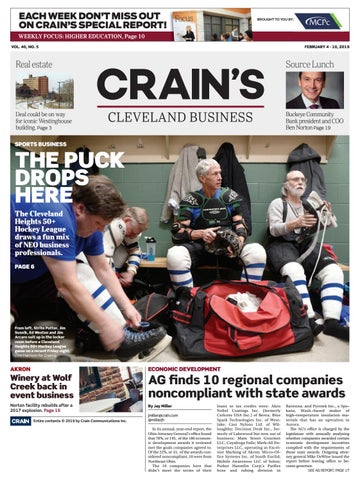
SPORTS BUSINESS
THE PUCK DROPS HERE The Cleveland Heights 50+ Hockey League draws a fun mix of NEO business professionals. PAGE 6
From left, Strite Potter, Jim Susnik, Ed Weston and Jim Arcaro suit up in the locker room before a Cleveland Heights 50+ Hockey League game on a recent Friday night. (Tim Harrison for Crain’s)
AKRON
ECONOMIC DEVELOPMENT
Norton facility rebuilds after a 2017 explosion. Page 16
By Jay Miller
Winery at Wolf Creek back in event business Entire contents © 2019 by Crain Communications Inc.
AG finds 10 regional companies noncompliant with state awards
jmiller@crain.com @millerjh
In its annual, year-end report, the Ohio Attorney General’s office found that 78%, or 145, of the 186 economic development awards it reviewed met the goals companies agreed to. Of the 22%, or 41, of the awards considered noncompliant, 10 were from Northeast Ohio. The 10 companies here that didn’t meet the terms of their
P001_CL_20190204.indd 1
loans or tax credits were: Akzo Nobel Coatings Inc. (formerly Ceilcote USA Inc.) of Berea; Blue Spark Technologies Inc. of Westlake; Cast Nylons Ltd. of Willoughby; Decision Desk Inc., formerly of Lakewood but now out of business; Main Street Gourmet LLC, Cuyahoga Falls; Mark-All Enterprises LLC, operating as Excelsior Marking of Akron; Micro-Office Systems Inc. of South Euclid; Mobile Awareness LLC of Solon; Parker Hannifin Corp.’s Parflex hose and tubing division in
Ravenna; and Pyrotek Inc., a Spokane, Wash.-based maker of high-temperature insulation materials that has an operation in Aurora. The AG’s office is charged by the legislature with annually analyzing whether companies awarded certain economic development incentives complied with the requirements of those state awards. Outgoing attorney general Mike DeWine issued the report before leaving office to become governor. SEE AG REPORT, PAGE 17
2/1/19 12:30 PM
PofitefifiWfiightfiififipfioudfitofiannouncefithatfi Chicago-bafiedfiButlefifiRubinfiSaltafiellifi&fi BoydfiLLPfihafififiefigedfiintofiPofitefifiWfiightfi Mofifiififi&fiAfithufifiLLP,fiexpandingfioufifififififififi fieachfitofieightfilocationfifiacfiofififitheficountfiy.fi
CL_020419_FP Template.indd 1
1/29/19 3:11 PM
CRAIN’S CLEVELAND BUSINESS
|
F E B R U A RY 4 - 10 , 2 019
|
PA G E 3
Prime West Shoreway property is in play By Stan Bullard
“It’s a beautiful building with a lot of history that is considered a gateway to our neighborhood. ... I’m sure a project there will do quite well.”
sbullard@crain.com @CrainRltywriter
A joint venture by two high-profile Cleveland real estate development concerns may be closing in on a prize that has eluded multiple buyers over the years: the eight-story Westinghouse building overlooking the West Shoreway, and an adjoining one-story structure. The 19th-century building towers over the Shoreway to such an extent that the curve it occupies is referred to in radio traffic reports as “The Westinghouse curve.” The West Shoreway now is dubbed Edgewater Parkway after its $100 million remake as a traffic-calmed boulevard to boost accessibility and appearance of the Edgewater Beach area. Sustainability Associates, the developer of the Fairmount Creamery and Wagner Awning adaptive reuse as housing projects in Tremont, has filed a disclosure notice with the city of Cleveland about buying the property. The notice is signed by Naomi Sabel, one of the group’s partners. Partnering with Sustainability, according to two sources who asked not to be identified, is Midwest Development Partners, a Little Italy-based firm best known as the developer, with several partners, of Centric, a just completed 272-suite apartment complex with first-floor retail space on Circle Drive in University Circle. The West Shoreway property, largely empty, includes both the multistory Westinghouse building
P003_CL_20190204.indd 3
— Jeff Ramsey, Detroit Shoreway Community Development Organization executive director
With its Westinghouse name proudly displayed at its top, the West Side landmark and the adjoining low-rise industrial building at its left has been prized by real estate developers for adaptive reuse as housing or as an apartment site for years. A new big-league joint venture is said to be closing in on the property. (Stan Bullard)
and an adjoining low-rise building that houses a going concern, Paramount Stamping and Welding. The property is owned by a trust formed by Peter Kole, who operated Paramount in the property for years. In addition to proximity to Edgewater Beach, lake and downtown views, the Westinghouse complex is ground zero in terms of lakefront development. It is next to NRP Group’s The Edison apartment complex, which opened two years ago, and is near the Breakwater Townhouses and Cyan Park, new residential townhouse projects scoring sales in the $500,000 range. It also is connected
by the lakefront bike path and Father Caruso Drive to Edgewater and the Battery Park townhouse and condo complex at West 75th Street. Jeff Ramsey, executive director of the Detroit Shoreway Community Development Organization that serves the area, said more than two dozen disparate real estate groups have sized up the property over the years. “It’s a beautiful building with a lot of history that is considered a gateway to our neighborhood,” Ramsey said in a phone interview last Thursday, Jan. 31. “It’s a fantastic site with views of downtown and the lake. I’m sure a project there will do quite
well.” However, Ramsey said he had no information on the property’s current status. The complex is listed for sale with Bob Garber, a principal of the Independence-based Cushman & Wakefield | Cresco brokerage, who declined comment on the sale. His listing for the property on the Loopnet property website does not state if the property is under contract. Garber said he would also ask Kole not to return calls to Crain’s Cleveland Business. Two calls to Kole were not returned. Josh Rosen, the spokesman for Sustainability Associates, declined
comment when asked about the Westinghouse property. Steve Rubin, a partner at Midwest Development, declined comment on the reported joint venture’s bid to buy the Westinghouse complex. However, the two have partnered in the past. Rubin said last December that Midwest was an investor in the Mueller Electric Building, an apartment that Sustainability opened last year in the St. Clair-Superior Neighborhood. Almost as striking as the opportunity Westinghouse might present is the $6 million asking price for the 363,000-square-foot property, which Cushman & Wakefield Cresco notes sits on about 3 acres. Perhaps justified by its key location in a resurgent city neighborhood, the ask is far more than the $1.2 million market value that Cuyahoga County assigns the complex for property tax purposes. A high price for such a property also adds to complications for a developer undertaking such a project because it will require millions to transform it into something usable. The complex takes its Westinghouse name from decades as a location that Westinghouse used, beginning in 1898, to first make brass and aluminum castings and later lights for airport and industrial uses until the 1960s, according to “The Encyclopedia of Cleveland History.” Kole, a graduate of the former West Technical High School who is a member of that West Side school’s Hall of Fame, has owned the complex since 1985. It’s now held through Paramount-Breakwater Properties LLC.
2/1/19 12:00 PM
PA G E 4
|
F E B R U A RY 4 - 10 , 2 019 |
CRAIN’S CLEVELAND BUSINESS
GO WITH THE BRIGHTEST LENDER: YOUR LOCAL CREDIT UNION Local money for local borrowers. • Commercial Real Estate Loans up to $10 Million • No Prepayment Penalties • As Little as 10% Down
Contact Jonathan A. Mokri 440.526.8700 jmokri@cbscuso.com www.cbscuso.com Your Business Lending Partner SM
fi“Ifififiufifififidfifififififififififififi fififitfiHfifififiNfifififiHigfifiSfifififififi”
The Lake Shore Bank building on the corner of East 55th Street and St. Clair Avenue, part of the larger Hub 55 renovation, is one of the properties that’s now the subject of a foreclosure proceeding. (Tim Harrison for Crain’s)
Hub 55 properties at center of foreclosure proceeding By Stan Bullard sbullard@crain.com @CrainRltyWriter
Properties that form Hub 55, the much-publicized drive to add food and spirits through the Goldhorn Brewery and other operations on East 55th Street just south of St. Clair Avenue in the St. Clair-Superior neighborhood, are the subject of a foreclosure proceeding. Marietta-based Peoples Bank filed Jan. 4 in Cuyahoga County Common Pleas Court to foreclose on multiple properties associated with construction contractor-turned-urban pioneer Rick Semersky’s VIP Restoration Inc.
GEORGEfiPALKO President/CEO The Great Lakes Construction Company Holy Name High School Class of 1983
Celebrating over 100 years of tradition
Mind | body | spirit fifififififififififififififi
By Stan Bullard sbullard@crain.com @CrainRltyWriter
Tony Delguyd Managing Director - Corporate Servcices Hanna Commercial Real Estate Tony has worked in commercial real estate for more than 30 years, with 25 of them spent in the corporate area. He is responsible for boosting the operational efficiencies, business development, transaction management and portfolio optimization for Hanna Commercial’s Fortune 1000 and Middle Market clients.
Tony has earned many industry awards including: + CoreNet Real Estate Executive of the Year in 2003 + 2014 NAIOP Industrial Transaction of the Year award - East Coast Distribution Center, a $34 million lease transaction + Midwest CRE Hall of Fame 2018
Congratulations Tony, we appreciate everything you do for Hanna Commercial! www.hannacre.com
P004_CL_20190204.indd 4
Tony Delguyd 216.861.5842 AnthonyDelguyd@HannaCRE.com
hailed, clearly is not giving up the fight. Court records show that Standard Properties, another limited liability corporation led by Semersky, tried to buy the notes from Peoples. However, Standard failed to meet payment provisions for the note purchase last Dec. 18. Although the principal amount shows as $1.5 million, court documents indicate a much smaller figure may be required to right Hub 55’s ship. Court records indicate about $500,000 is the remaining balance on the debt. Problems in the construction business may have triggered cash-flow issues that now threaten Semersky’s grip on the Hub 55 properties. SEE HUB55, PAGE 17
Advance Ohio puts newspaper building up for sale — again
RfifidfiGfififigfi’fififififififififififififififififififififififififififififififi
TONY DELGUYD - Midwest CRE Hall of Fame Winner 2018
A total of eight cases, one for each property constituting the Goldhorn Brewery, the landmark former Sterle’s Country House and others at Hub 55, were assigned to Judge Deena Calabrese. Peoples filed the suits to enforce a judgment it received Sept. 28, 2018, in county court for a $1.5 million demand note it provided to VIP, Semersky’s well-known masonry rehabilitation construction firm, that was guaranteed by the properties. VIP had not filed an answer to the proceeding by Thursday, Jan. 31. However, Semersky, known as a suburban construction contractor trying to make inroads in the scrappy neighborhood from which his family
The second drive by Advance Ohio to shed its downtown Cleveland campus at 1801 Superior Ave. is underway. The Cleveland office of international brokerage JLL Inc. has a listing to sell the four-floor building main structure at 1801 Superior, as well as its associated parking garage and surrounding property. The move comes five months after a city-vetted plan to install a new central police headquarters fell through, even though City Council had approved the purchase and the city issued a $60 million note to fund the project. Robert Roe, a JLL managing director working on the assignment, said he is excited about the opportunity to market the complex because it will make such a good home for a company downtown. Its centerpiece is the ship-shaped former home of Advance’s Plain Dealer newspaper. The building dates from 2000. Roe said he expects the property to attract substantial corporate interest because of its amenities, including a 170-seat conference center and a parking-rich site. The complex has a total of 450 parking spaces, 179 of
them in a garage. The property also might attract real estate developers, and insiders say it is already attracting multiple suitors. There is no stated asking price for the site, but Advance is said to be looking to obtain about $20 million for the complex. That $20 million price is the same as the current market value of the property for property tax purposes in Cuyahoga County. Roe said Cleveland.com, the local online operation of Advance Ohio, might lease space to remain in the building. Four other tenants also rent space that Advance has marketed as it downsized operations, which included moving the newsroom of the printed newspaper to Skyline Office Tower at 230 W. Huron Road, and later to its printing plant on Tiedeman Road in Brooklyn. Such a move might sweeten the deal for the buyer, as it could provide a source of revenue while the property is being retrofitted for additional multitenant use. A transaction also might provide millions for the publishing concern as the newspaper business goes through draconian changes as online marketing undercuts ad sales and crimps paid circulation. Mark Lammon, executive director of the Campus District local development corporation, said stakeholders in the neighborhood were disappoint-
ed when the police headquarters deal fell through. He said he is encouraged by additional efforts to sell, and to more fully use, the property. “I think it could work either as a signature headquarters building or a multitenant property,” Lammon said. “We feel we have gotten momentum from the GBX headquarters and the recent sale of the Chilcote Co. complex.” An investor group last month bought the block-long property that has long been, and for now continues to be, the firm’s home. Meanwhile, Cleveland continues to search for a new home for its top cops. Russell Rogers, a principal at Colliers International’s Cleveland office, said he’s continuing to develop options for the police headquarters and that the city may undertake a new space-planning study for the headquarters. Colliers was retained to field options for a new home for the police HQ after the city sold its Justice Center holdings next to the Cuyahoga County Justice Center to the county.
Correction JJA Jan. 28, Page 8 editorial on the “Lead Safe Cleveland Coalition” gave the incorrect last name for Ayonna Blue Donald, the city of Cleveland’s director of building and housing.
2/1/19 12:32 PM
NOMINATION PROGRAMS OPEN FOR CRAIN’S 2019
EIGHT OVER
80
Crain’s Cleveland Business will honor eight individuals in their 80s who are still working tirelessly to advance Northeast Ohio and its residents. Do you know an 80-something who has seemingly tossed the word “retirement” from his or her vocabulary and continues to make an impact in Northeast Ohio’s business, civic and philanthropic circles?
NOMINATION DEADLINE: March 4 | ISSUE DATE: April 29
Crain’s Cleveland Business will single out 20 up-and-coming professionals who haven’t turned 30 yet. While their names might not be top of mind and they likely haven’t made their first million yet, there’s no denying these young professionals are making a mark on Northeast Ohio. Do you know a 20-something we should know about?
NOMINATION DEADLINE: MARCH 11 | ISSUE DATE: JUNE 24
Visit CrainsCleveland.com/Nominations to nominate
CL_020419_FP Template.indd 3
1/31/19 11:21 AM
PA G E 6
|
F E B R U A RY 4 - 10 , 2 019
|
CRAIN’S CLEVELAND BUSINESS
Hockey league is hit with 50-and-over crowd By Kevin Kleps
competed in the 50-and-up league since its start and also plays in a women’s league in Cleveland Heights. She’s one of the physicians who are divided among the clubs, but she hasn’t had to play that role very often. “For the most part, there’s not much you can do on the ice for people, unless it’s an emergency,” said Bigg, whose husband, Dr. Steven Houser, is a surgeon at MetroHealth. Bigg said she ruptured a disc in her back 10 years ago, but that wasn’t a hockey-related ailment. She did, however, break a finger when it was struck by a puck, and she believes a lingering foot injury she had a “long while ago” was from the sport. The Cleveland Heights league isn’t physical, though, and the fun far outweighs any bumps and bruises, Bigg said. “Part of the fun of sports is interacting with people who, outside of the sport, you would never interact with,” she said. “That’s why sports is so much fun.”
kkleps@crain.com @KevinKleps
Each of the four teams in the Cleveland Heights 50+ Hockey League has at least one physician on its roster. “That’s by design,” said Ed Weston, a retired Navy captain who serves as the league’s treasurer and is one of its four team captains. Thankfully, there haven’t been any serious injuries since the league — which doesn’t allow checking — started in 2013-14. “I would not use this league and competitive in the same sentence,” said Dr. John Wood, an orthopedic surgeon who has played in the 50-and-up league since its inception. What it is, according to those involved, is a fun mix of older professionals who love the game and camaraderie, and don’t mind playing late on a Friday night. The league, which plays its games at the Cleveland Heights Community Center, has an age group that makes it unique in Northeast Ohio hockey circles. There are plenty of adult leagues in the area, but the majority are 18 and over, and there doesn’t seem to be a league with a setup similar to the one that’s run by Weston and a pair of his friends. The 2018-19 season started with four weeks of open scrimmages in September. The puck dropped on the 21-game regular season in mid-October, and the league’s championship game is slated for April 6. That night, the two finalists will be playing for the Warshawsky Cup — a nod to founder Bob Warshawsky, who no longer competes in the league. “We nicknamed it the Jerry Jug, as in geriatric,” said John Sullivan, a Beachwood attorney who serves as the league’s commissioner.
The captain Weston, a 66-year-old who is the director of growth programs at Manufacturing Works, didn’t play hockey at all as a kid. He said such a background is typical for the Cleveland Heights 50-and-over league. The circuit is open to intermediate and novice skaters, who are split among the four 13-skater teams. “It’s a long season. It’s kind of grueling,” Weston said. “That’s why we have the extra skaters.” The majority of the players return each year. Any open spots are filled via draft — after each club gets a look at the new skaters during the preseason workouts. Weston said when he looks around the locker rooms on Friday night, he sees doctors, lawyers, professors, cybersecurity professionals, entrepreneurs, nurses, accountants, pharmacists and even a former Army officer who led tanks into battle in Iraq. “We all have day jobs. We remember that, OK?” Weston said. “There’s no money on these games.”
The surgeon
Karen Lingas of the Blues moves the puck through an opponent’s legs during a Cleveland Heights 50+ Hockey League game on a recent Friday night. (Photos by Tim Harrison for Crain’s)
hockey — “more off than on” — as a kid, then didn’t pick up the game again until he was 50. At 57, he shattered his ankle in a nonleague contest, but that didn’t
“It sounds terribly cliché, but it’s true: We love the game.”
“I would not use this league and competitive in the same sentence.”
— John Sullivan
— Dr. John Wood
stop him from getting back on the ice. “It sounds terribly cliché, but it’s true: We love the game,” Sullivan said. The league doesn’t take itself too seriously, he said, though the playoffs — for which all four of the teams qualify — can “get a little chippy.”
The entrepreneur The Cleveland Heights 50-and-up league doesn’t want any ringers, but David Wright’s hockey background is much more extensive than most. The 57-year-old — who founded
Orthopedic surgeon John Wood laces up his skates in the locker room of the Cleveland Heights Community Center.
Undercar Express, a Cleveland-based caliper business, with his brother, Robert, and Paul Schuck in 1997 — said he’s been playing the sport for 50 years. Wright, one of the team captains, is in charge of scheduling the goalies, who are rotated among the four clubs. That’s because of the importance of the position, and the difference in skill levels between those
The attorney As the league’s commissioner, the 60-year-old Sullivan works with the Cleveland Heights Community Center to arrange ice time for the group’s Friday night schedule. Games typically start between 8:30 and 10 p.m., but some, depending on the rink’s availability, don’t begin until 11. The attorney, a founding member of Sullivan & Sullivan, Ltd., played
P006_CL_20190204.indd 6
Wood has two attributes that would seem to be perfectly suited for a 50-and-over hockey league. He’s from Canada, and he’s an orthopedic surgeon. But 50-and-up is nothing to someone whose uncle plays in an 80-andover league in Ottawa. “They keep an AED (an automated external defibrillator) on the bench. If someone falls over, they
who mind the net. Wright, who played at Purdue University, sounds like a giddy college kid when he’s discussing his affinity for the league. “I look forward to it. It’s an outlet,” he said. “It’s a really good group of people. I love my team.” Everyone in the league wants to win, Wright said, but you wouldn’t know it from the manner in which they interact off the ice. Plus, there’s an added benefit of playing in a league composed mostly of 50- and 60-somethings. “In the locker room, we’re old guys. We talk about the furnace isn’t working or I’m redoing the bathroom,” Wright said. “Someone will say, ‘Oh, call so and so from the blue team.’ You’re getting referrals all the time. It’s our own Angie’s List.”
The doctor
From left, team captains John Sullivan and Ed Weston greet each other after a recent game. “There’s no money on these games,” says Weston.
There are at least eight women who compete in the league. One is Dr. Margaret Bigg, a Cleveland Clinic hospitalist who didn’t start playing hockey until she was in her 30s — when her two sons, Joey and Teddy, took up the sport. Bigg, who was already a decent skater when she began playing hockey, has
stop the game and make sure he’s OK,” Wood said. The doctor, who works for the Louis Stokes Cleveland VA Medical Center, said he can only give “generic curbside advice” to participants in the Cleveland Heights league. But he was forced to use a defibrillator when a player went into cardiac arrest during an adult league game in Shaker Heights. “That had a happy ending to it. He turned out fine,” said Wood, who was aided that day by another physician who was competing in the league. The 50-and-over league, Wood said, has a better “vibe” than most of the circuits in which he’s competed. The exercise helps, too. “There is a disparity of skills in this league, as there is in every league,” said the 56-year-old. “But I’ve been places where I felt like a pylon. You might have high school players who just take off with the puck. In this league, the really good players kind of tone it down and pass to the other players and keep everyone involved.” Afterward, the groups often meet for a beer or two. It’s Friday night, after all. The league would like to expand to six teams at some point, Sullivan said. But first, there’s a league championship to win — and health to maintain. “We have a joke when someone is ready to go on the ice,” Weston said. “Enjoy the shift. The next one could be your last.”
1/31/19 4:29 PM
What would you like the power to do? Listening to how people answer this question is how we learn what matters most to them, so we can help them achieve their goals. At Bank of America we are here to serve. We had one of our best years ever in 2018: strong recognition for customer service in every category, the highest levels of customer satisfaction and record financial results that allow us to keep investing in how we serve. That translates to a great team delivering the best capabilities for our clients and our communities. We can only be successful when our customers, clients, communities and employees share in that success. We are proud to be recognized for the work we do for you.
World’s Best Bank 2018
Investing in Women initiative
Highest ranked Financial Services Company
Ohio is home for me and my team. We know this community and we are here to serve your needs and help you achieve your goals. That’s why we’re always asking:
What would you like the power to do? Let me know at: jeneen.marziani@bankofamerica.com Jeneen Marziani Ohio Market President As always, protect your personal data. For assistance with a personal financial issue, please visit your nearest financial center. From FORTUNE®, September 2018 © 2018 Time Inc. Used under license. FORTUNE® is a registered trademark of Time Inc. and is used under license. FORTUNE and Time Inc. are not affiliated with, and do not endorse products or services of, Bank of America. © 2019 Bank of America Corporation. | Member FDIC | ARSFHQPS | TAD-12-18-0260
CL_020419_FP Template.indd 2
1/29/19 3:27 PM
PA G E 8
|
F E B R U A RY 4 - 10 , 2 019 |
CRAIN’S CLEVELAND BUSINESS
Opinion From the Editor
Leaders are made, not born
Editorial
End game The 35-day federal government shutdown was both a pointless game of political chicken and an unnecessary wallop to the economy. The nonpartisan Congressional Budget Office released an analysis last week that found the shutdown cost the economy $11 billion, reflecting lost output from federal workers, delayed government spending and reduced demand. (And it didn’t incorporate indirect effects, such as reduced access to loans or delays in securing permits.) Of the $11 billion, the CBO estimated, about $3 billion in economic activity was permanently lost. Our political parties will always have disputes about budget priorities. That’s a normal part of the democratic process, even in an era when there’s very little that’s normal about our politics. But there’s no reason, as these disputes rage, to shoot ourselves in the foot by shutting down the government, disrupting vital services to citizens and curtailing some business operations. There has to be a better way to do this. One option that we like comes from Sen. Rob Portman, R-Cincinnati, whose End Government Shutdowns Act is building support in the Senate. (Portman says he has secured 24 co-sponsors.) It’s not a new idea; Portman has introduced a version of the legislation in every Congress since he was elected to the Senate in 2010. But as this longest-ever shutdown shows, our budget battles are getting worse, and the need has become more urgent to protect government workers and the economy from the fallout. The bill, as Portman explained in a letter to The Wall Street Journal, “would continue funding from the previous year when appropriation bills aren’t completed in time, or at the expiration of any continuing resolution that expires. After the first 120 days, funding would be reduced by 1%, and by 1% again every 90 days thereafter, until Congress does its job and completes the appropriations process.” He argued in a CNN op-ed that cuts are necessary “to provide lawmakers the incentive to make the important budget choices that Congress must make to avoid having perpetual continuing resolutions.” A Senate Democrat, Mark Warner of Virginia, has introduced
a similar bill that has the added twist of withholding congressional and White House operations money if Congress fails to pass new funding bills — ensuring that lawmakers and their staffs share the pain if the government shuts down. Count us as fans of these approaches and supporters of acting quickly to avoid a repeat of the failed process we just endured. This shutdown was so damaging, in terms of its economic impact and the level of confidence people have in their government, that we need dramatic action to make sure the next dispute over budget priorities — be it a wall or whatever the next great political cause becomes — doesn’t make the country weaker.
Right path
There was a rare bit of encouraging news for transit in Northeast Ohio last week when the Greater Cleveland Partnership announced it’s commissioning an independent financial and economic forecast of the Greater Cleveland Regional Transit Authority aimed at exploring ways for the agency to bolster its financial condition and, ultimately, improve the level of service to customers. This isn’t the only such study — the agency itself is undertaking reviews of its fare structure and service design — but the regional chamber of commerce’s effort is a welcome indication that its leaders view the state of RTA as a critical economic development issue. GCP noted that RTA is facing “funding challenges” because the agency’s main source of revenue — a 1% sales tax — is insufficient to maintain an adequate level of service, and that “changing demographics” in Cleveland and the suburbs require exploring how RTA’s service model “evolve to respond to the needs of current riders, future riders and major employers.” That’s a good start in framing the discussion. We encourage GCP and others to take a broad approach to solutions — and make sure to bring many voices, including those of RTA users, into the process.
Publisher and Editor: Elizabeth McIntyre (emcintyre@crain.com)
CLEVELAND BUSINESS P008_CL_20190204.indd 8
Managing Editor:
Scott Suttell (ssuttell@crain.com)
Contact Crain’s:
216-522-1383
Read Crain’s online: crainscleveland.com
Leadership has been a hot topic in Northeast Ohio the past year or so, especially as it relates to economic development. As Crain’s reporter Jay Miller wrote early last summer, during conversations with business and civic representatives, often someone will ask, “Where is the next generation of Greater Cleveland leaders?” Leaders aren’t just born. Sure, we’ve all heard the myth of the natural leader; someone with the preternatural ability to win the hearts and minds of others. But the ability to lead, it turns out, doesn’t come by happenstance or lucky genetics. Leaders must be developed. The day after Frank Jackson was elected to his fourth-term as Cleveland’s mayor in 2017, he was asked about possible successors. “There are people out there and they will do a good job,” he said, but then added Elizabeth that he doesn’t see it as his responsibility to McIntyre groom his replacement. Sorry, mayor, but I beg to differ. Those currently in leadership positions have an obligation, a duty, to provide the next generation with the necessary skills, guidance and experiences to one day take the reins. That begins by hiring the best talent we can, and then recognizing that it takes time and attention to help these high-potential men and women to develop the necessary skills to become leaders in our businesses, teams, organizations and government agencies. We are fortunate in Northeast Ohio to have leadership development and civic education programs such as Cleveland Bridge Builders and Leadership Cleveland to help emerging and established leaders learn about themselves and their community. I participated in Leadership Cleveland in 2006 and gained knowledge that made me a better leader and more informed citizen. The beauty of these programs is their ability to connect people across diverse sectors. The relationships I formed with my 60 classmates, some of whom I might never have known without being in Leadership Cleveland, are as valuable to me today as they were 13 years ago. I led a department back then, not an organization. The experiences were an invaluable part of my growth. I learned about how others work, about forming relationships, about what is important to the region and what challenges it faces. President John F. Kennedy once said, “Leadership and learning are indispensable to each other.” My experience in Leadership Cleveland drove that home for me. The question now is: Who are our future leaders? The whole idea of these organizations is to groom those with potential. And as we talk about the need for diversity in the leadership ranks of business, what better way than to nominate a large and diverse group of future leaders for this kind of training and networking. This is where you come in. Do you have a rising star? A young supervisor with big potential? Consider nominating them (there is a cost involved, but consider it an investment) for the next class of Cleveland Bridge Builders or Leadership Cleveland. Nominations are open all of February for future and current leaders in for-profit and nonprofit business and government. The Cleveland Leadership Center, which encompasses these two programs, says women are usually underrepresented in its applicant pools, as are minorities. This would be a great time to fix that while investing in a more diverse future for Cleveland. An added benefit is the interconnectedness these organizations foster. Those lifelong connections that are still so valuable to me. Leaders are made, not born. And who knows, perhaps someone from the next class will one day be the mayor of Cleveland.
Write us: Crain’s welcomes responses from readers. Letters should be as brief as possible and may be edited. Send letters to Crain’s Cleveland Business, 700 West St. Clair Ave., Suite 310, Cleveland, OH 44113, or by emailing ClevEdit@crain.com. Please include your complete name and city from which you are writing, and a telephone number for fact-checking purposes. Sound off: Send a Personal View for the opinion page to emcintyre@crain.com. Please include a telephone number for verification purposes.
1/31/19 4:06 PM
CRAIN’S CLEVELAND BUSINESS
|
F E B R U A RY 4 - 10 , 2 019
|
PA G E 9
Personal View
It sure feels like Groundhog Day in Cuyahoga County government By James M. Trutko
For a while over the last few years, Cuyahoga County residents could feel better with successful sports teams, the Republican National Convention, downtown housing projects and positive national press, and could sense that county government was making some progress. Over the past year, however, it’s hard to avoid the conclusion that we’re seeing the recurrence of county corruption, incompetent county leadership and poor county governance. Let’s run over some of recent lowlights. About this time last year, Cuyahoga County executive Armond Budish’s chief of staff, Sharon Sobol Jordan, resigned shortly after it was revealed that Budish had approved an unusual work arrangement that allowed her to complete an out-of-town master’s degree while theoretically working full-time for the county. Over the past year, an investigation into county corruption has focused on county IT contracts and resulted in three county employees being indicted. Two of the county’s highest-ranking administrators — chief of staff Earl Leiken and county law director Bob Triozzi — have resigned in the past two months. All of these are bad signs, although not indicative of a former county commissioner Jimmy Dimora-like level of corruption. Meanwhile, conditions at the county jail are terrible. Eight inmates have died in the past year and a report by the U.S. Marshals Service characterized conditions there as “inhumane.” Budish blames the “command structure,” as though he was not at the top of the chain of command. His primary interventions appear to be causing a critical county medical supervisor to be terminated, asking the MetroHealth System to clean up the medical mess and hiring a consultant. County council was elected to oversee county governance and budgets, but has been missing in action. This fall, the chief accomplishment of county council was passing antidiscrimination protections for the LGBTQ community. Evidently, real oversight over more than 7,000 employees and a $1.7 billion budget is too much to ask. Why does Cuyahoga County have such abysmal political leadership? At the core, there is little political accountability. There is virtually no penalty for failure, as almost no officials lose office for incompetence or lack of real positive results. In the 2018 elections, the county executive was opposed by an underfunded, last-minute candidate; most of the council candidates were unopposed; and virtually all the judges were re-elected. Political offices are regarded as either stepping stones to other political offices or career appointments for Democratic politicians. Because there is little accountability at the top, public-sector bureaucrats (like the officials in the IT department or at the jail) are generally free to run their departments without real pressure for performance as long as they don’t embarrass top officeholders.
A decade ago, Cuyahoga County voters made a major change in the county charter and hoped that it would lead to better government. There’s no doubt that it ended a period of absolutely terrible, flagrantly corrupt government, but the changes were insufficient to restore competent and effective governance. If Cuyahoga County residents want better results from county government, it will be necessary to increase the competitiveness of elections, force periodic changes of leadership and re-establish public control over the county budget, so neither political offices nor public funding of bureaucracies can be taken for granted. This will mean three significant changes to the county charter. First, the county should have nonpartisan primary elections, with the top two finalists moving to the general election. Every officeholder should face an opponent on election day. By reducing partisan endorsements and identifications, the personal credentials and ideas of candidates will become more important. Second, the county should have term limits on all county offices. The county executive and county council seats should be limited to eight years (two terms) and county judgeships should be limited to 12 years (three terms). Term limits will ensure a regular turnover of leadership and encourage new people to seek office. It will also encourage existing officeholders to act more urgently and boldly because they will not be able to look on their offices as a lifetime sinecure. Third, after the county budget is recommended by the county executive and voted on by county council, the annual county budget should be voted on and approved by the public. The most important thing county government does is use our money to provide public services and infrastructure. In short, the government budget is where the government rubber meets the government road. Recently, the total Cuyahoga County budget was over $3,000 per household, enough to gain the attention of many otherwise indifferent voters. A public approval process for the budget will benefit the public by focusing attention on the size of government, the composition and priorities of public spending, the output of county government departments and the efficiency of government services. Public approval will also mean that candidates will have to explain the budget during election campaigns, corruption will be harder to hide and Cuyahoga County voters will ultimately have political responsibility for budgets. Without a meaningful change in the structure of county government, it’s likely that Cuyahoga County residents will continue to face poor county governance and future Groundhog Days.
Connected Gourmet & Baskets by Maury Teaming up in Cleveland to bring you a Basket or a Box of fabulous gourmet treats for the holidays! This year celebrate Cleveland’s culturally diverse & fancy food scene.
We’re a liile bit fancy!
Eat, Drink and be Grateful Find us at: connectedgourmet.com basketsbymaury.com Call Maura: 216-406-7267
Trutko is a local economist and market research professional. He is a lifelong county resident and lives in Rocky River.
Web Talk Powering blockchain Everyone is excited by the potential of blockchain technology, but I almost never hear anyone discuss the massive energy commitment that must be devoted to using it for things like cryptocurrency. By some estimates, current electricity demands are roughly equivalent to the total usage of Ireland, and that will only increase as blockchain applications grow. That doesn't sound like a very good proposition
P009_CL_20190204.indd 9
for a society that is trying to position itself as energy-efficient and sustainable. — Todd Courtney
More Progressive Field updates? Hard to believe the ballpark is 25 years old. I wish they would have done two levels of suites, not three, so seats in the upper deck would not be so high. They definitely need to fix that mess in the right-field upper deck. — skiwest
1/31/19 3:08 PM
PA G E 10
|
F E B R U A RY 4 - 10 , 2 019 |
CRAIN’S CLEVELAND BUSINESS
Focus
HIGHER EDUCATION
THE NEW ‘OLD COLLEGE TRY’
College Now Greater Cleveland has expanded its mission from individual students to take in the region’s economy and its workforce. (Photos by Kevin Kopanski/College Now)
College Now Greater Cleveland says yes to economic development By Rachel Abbey McCafferty rmccafferty@crain.com @ramccafferty
Less than a decade ago, Cleveland Scholarship Programs had about 45 employees and a budget of approximately $4 million. Today, the organization is known as College Now Greater Cleveland, its budget has more than tripled, to about $13 million, and its staff has quadrupled to about 180. It offers more programs and services in more places than it did in the past, and the support it offers local students will continue to grow as the organization is a significant partner in Cleveland’s Say Yes to Education initiative. CEO Lee Friedman said Cleveland Scholarship Programs, founded in the ’60s, used to operate a bit “under the radar.” When she joined the organization in 2010, she saw an opportunity to take it to the next level. Rather than just a way to help individual students, she viewed the program as an economic development initiative. Friedman had previously led such organizations as the Downtown Cleveland Partnership, which became the Downtown Cleveland Alliance, and the Cleveland Leadership Center, which she helped found as a merger of different groups. At the leadership center, she often heard executives from a variety of indus-
P010_CL_20190204.indd 10
College Now Greater Cleveland’s mentoring program has boosted on-time graduation.
tries say they didn’t have the workforce they needed. Friedman said she was often brought in as a “change-management leader” at the organizations she ran, and Cleveland Scholarship Programs was no different. The program changed up its board, bringing on business leaders, and began putting a stronger focus on tracking data on how its work affected individual students and the regional economy.
“Everything we do is tracked,” Friedman said. “Everything is measured.” In the winter of 2011, Cleveland Scholarship Programs was rebranded to College Now Greater Cleveland to better reflect its mission. The organization offers services to students in areas outside of Cleveland (today, it’s in five counties) and those services include far more than just scholarship dollars. Chief Operating Officer Alenka
Winslett, who has been with College Now since 2001, has seen a lot of these changes firsthand. It was more of a “best-kept secret,” when she joined. As part of the rebranding and reinvention effort, College Now looked at its services to see where it could do better and do more, she said. Part of that was the 2011 introduction of a mentoring program designed to help students complete college rath-
er than just getting them there. The organization had done some retention work with students in the past, Winslett said, but there wasn’t a coordinated program. Friedman “We knew students needed more than what we were giving them,” she said. The typical College Now scholar is a Pell-eligible student with at least a 2.5 GPA and at least an 18 on the ACT. Before the introduction of the mentoring program, around 60% of those students were graduating on time, Friedman said. That means within six years for a four-year school and within three years for a two-year school. Since the mentoring program began, on-time graduation rates have improved by almost 20%, she noted. Friedman pointed out that it’s unknown how students who don’t fit into that profile will perform. College Now will be leading the mentoring program for Cleveland’s Say Yes to Education program. Under that program, all students, regardless of GPA and test scores, will be eligible for scholarships and mentors. With or without those, Friedman knows the mentoring program helps students by helping them network. SEE COLLEGE NOW, PAGE 12
1/31/19 3:09 PM
PA G E 12
|
F E B R U A RY 4 - 10 , 2 019 |
CRAIN’S CLEVELAND BUSINESS
HIGHER EDUCATION
7.5 Acres of Land ZONED FOR OFFICE/RETAIL
SW Corner of Memphis Ave. at Tiedeman Road, Brooklyn, OH
FOR SALE Development Incentives Available
Contact City of Brooklyn, OH Office of Economic Development
216.635.4289 audris@brooklynohio.gov
SALT • SALT • SALT Water Softener • Industrial • Food Ice Melt • Sea Salt
Call For Pricing!! Minimum Delivery: 1 Pallet
O N
COLLEGE NOW CONTINUED FROM PAGE 10
Another reason for College Now's growth has been the strategic partnerships it’s fostered, Winslett said. There are only so many dollars available in the community, she added, and part of College Now’s work is to find ways to increase services with the resources it has. Winslett pointed to the group’s work with AmeriCorps, which allowed it to expand its reach and provide advisers every day in the Cleveland Metropolitan School District. College Now would not have had the resources for that otherwise, she said. In recent years, College Now has also sought more federal grants, and has expanded its services into more school districts. It’s also grown its programming outside of schools, said chief program officer Michele Scott Taylor, offering supports like summer programs between high school and college. But College Now offers services to more than just high school students and recent high school graduates. The organization also has a program designed for adults 19 and older who want to earn or finish a degree, and it can help people restructure their federal college loans. And it’s rolling out a program to help people find credentials in in-demand jobs. College Now had offered services for adults for decades, but “on a shoestring,” said Julie Szeltner, director of adult programs. That started to change about three years ago, when funders began to realize that helping high school students alone wouldn’t address the region's workforce needs in the region. Today, five employees work on the adult services side full-time, up from just one previously. The main challenge has been connecting with the adults that need College Now’s ser-
By M
clbf
College Now Greater Cleveland is a significant partner in the city’s Say Yes to Education initiative. (Kevin Kopanski/College Now)
“Everything we do is tracked. Everything is measured.” — Lee Friedman, College Now Greater Cleveland CEO
vices, Szeltner said. The marketing budget is small. “In all honesty, word of mouth is probably our best method, but that only goes so far,” Szeltner said. But College Now has been trying some more proactive approaches, too. For example, it began working with Cleveland State University. In the 2017-18 school year, the university shared its data on students who had stopped attending before receiving a degree, and College Now reached out to those students in phone calls and emails, Szeltner said. If the student was interested, College Now worked with him or her to resolve whatever barriers stood in their path. For example, College Now could help students pay back balances to Cleveland State using a zero-in-
terest loan offered by one of its community partners. “We’re almost, like, triaging student by student,” Szeltner said. Since that partnership began, of the approximately 4,000 College Now contacted, about 250 students have re-enrolled. Szeltner compared that to Cleveland State’s prior approach, which was a postcard campaign that she said had a much lower re-enrollment rate. Szeltner said she thinks one of the reasons College Now's approach is effective is because the contact comes from a third party, not Cleveland State. Former students may be less inclined to answer a call from the university if they have a back balance, she noted. College Now currently has similar pilot programs with other higher education institutions, and the organization is part of a statewide effort to do similar work on a larger scale. In addition to its work with higher ed institutions, Szeltner said College Now would like to work with employers to identify employees who could use their services.
THE OPIOID EPIDEMIC IS OUR COMMUNITY’S CRISIS
MEDINA, OH
1-800-547-1538 Salt Distributors Since 1966 www.saltdistributormedinaoh.com
THIS IS OUR RESPONSE: FIRST: We’ve reconfigured our existing buildings to create urgently needed, interim space in our VOL. 39, NO. 16
April 16-22, 2018
Sponsored Content
Acquisition helps keep Ramco on growth track VOL. 39, NO. 16
Sponsored Content
April 16-22, 2018
Acquisition helps keep Ramco on growth track
VOL. 39, NO. 32
gan to focus more on engineering By DAN SHINGLER and less on producing common, low-priced parts like simple nuts. dshingler@crain.com “That’s a race to the bottom,” @DanShingler Melick said of the highly commodHudson-based Ramco Specialties itized realm of simple nuts and bolts, where foreign and domestic suppliis on an automotive roll. VOL. 39, NO. 16 April 16-22, 2018 Sponsored Content After building and moving into a ers most often compete primarily on 185,000-square-foot headquarters and price and the cheapest part wins. The company has found itsfocus OEM more on engineering gan to main plant a little over two years ago, By DAN SHINGLER and less their on big producing common, the company has increased its size automaker customers,and with Ramlow-priced parts like simple nuts. with the acquisition of Michigan-based suppliers, willing to work dshingler@crain.com co’s engineers earlier in“That’s their own a race to the bottom,” Copa Tool earlier this month. @DanShingler allows Melick saidthe of the highly commodGrowth in Ramco’s automotive design processes. That to offer fastening systems itized realm of simple nuts and bolts, business, by far its largest Hudson-based end market, company Ramco Specialties can be integrated intoforeign other and domestic suppliwhere is fueling it all, Jeff Melick, Ramco’s di- thatroll. is on an automotive which can themost entire au- compete primarily on often rector of sales and marketing, Aftersaid. building parts, and moving intomake a ers manufacturing process the cheapest part wins. “This year, we’re up185,000-square-foot about 15%,” tomotive headquarters and price and Specialties’ 185,000-square-foot headquarters and main plant has andyears moreago, efficient. Plus, they Ramco The company has found its focus OEM more on engineering gan to Melick said, adding that theplant compamain a littlefaster over two of warehouse room, too. (Dan Shingler for Crain’s) DAN SHINGLER notBydepend wholly on price customers, to plentyand automaker and their less big on producing common, ny has been experiencing a similar hasdoincreased the company its size sales, Melick said.suppliers, willing to work with Ramlow-priced parts like simple nuts. growth rate since about 2008, when gain with the acquisition of Michigan-based dshingler@crain.com growing faster overall must be working, because while earlier co’s engineers in“That’s their than own a race todomestic the bottom,If ” the state’s automotive compait began focusing onCopa more Toolengiearlier thisItmonth. @DanShingler growth rates onlycommoddo nies as a whole can fare that well, it some other companiesdesign are alsoprocesses. find- production That allows theof Melick said the can highly neered products than a simple Growthnut. in Ramco’s automotive would be a good thing for Ohio, in two ways: They are either a bolts, growth inmarket, automotive, the induscompany to offersofastening systems itized realm of simple nutson and Copa Tool is a significant pickup business, by far itsing largest end Hudson-based Ramco Specialties which still has a huge automotive small where number of hotand products or asupplias is a whole has onroll. a downthat can be integrated into foreign other domestic for Ramco. Its $14 million in annual is fueling it all, Jefftry Melick, Ramco’s di-been on an automotive according to the Ohio number of products where a industry, trend, said Edward “Ned” Hill, parts, which can make the entireoften aumost compete primarily on sales will be added torector Ramco’s an-andward of sales marketing, Aftersaid. building and moving intolarger a ers few are picking upcheapest marketpart share. a well-known Ohio economist and tomotive manufacturing process price and the wins. Manufacturers’ Association. nual revenues of about $100 million. “This year, we’re up185,000-square-foot about 15%,” headquarters and Specialties’ 185,000-square-foot headquarters a huge partand main plant has Seeing that the overall Ramco tide bouncprofessor public administration faster and years moreago, efficient. Plus, they The company has is found its OEM“Auto supply remains Copa’s 40 employees bring Ramco’s Melick said, adding that theofcompamain plant a little over two warehouse room, too. (Dan Shingler for Crain’s) enormous manufacturing ing around dead to low plenty … theyof either and city regional atits size doplanning not depend wholly on price automaker customers, and their of bigOhio’s headcount to about ny 175 haspeople, been experiencing a similar the and company has increased sector. State data has shown increasgood boatwilling or have a RamOhio State University’s John gain sales, Melickhave said.asuppliers, toattached work with Melick said. growth rate sincethe about 2008, when with the acquisition of Michigan-based ingoverall investment among all decent boat towhile a goodearlier motor.” Glenn College ofearlier Public Affairs. growing domestic If transporthe state’s automotive compaIt month. must be working, because co’s engineers infaster theirthan own The acquisition brings things that it began focusing onCopa more engiTool this tation Ramco is not at allows least Asked whether Ramco or any sinproduction growth rates equipment can only do manufacturers, nies as a whole can fare that well, it some other companies are also find-unique, design processes. That the might be more important than just than neered products a simple nut.in Growth Ramco’s automotive and are jobeither growth been steady amongcompany Northeast supplicompany’s recent growth in aube a good thing for Ohio, soauto in two ways: They on ahas would ing growth inmarket, automotive, the industo Ohio offer fastening systems sales, too, such as increased CopamanuTool is agle significant pickup business, by far its largest end transportation equipment ers. Some report they are also other tomotive is annual due to Jeff a rising or has still has a huge automotive small number ofamong hot products or a which try as atide, whole onothers acan downthat be integrated into facturing capacity. While forRamco Ramco.traIts $14 million in is fueling it all, Melick, Ramco’s di-been manufacturers, employwell. just to a well-run boat, Hill hadtrend, a ready according to the Ohio number products wherepresently a industry, ward said Edward “Ned” Hill,canlarger parts, which make the entireofauditionally has focused sales on thewill female be added Ramco’s an- and rector of sales marketing, said.doing ing 125,000 OMA Association. Adler, president of Cuyahoga “It’smillion. the boat.” Manufacturers’ few are picking up over market share. Ohioans,” a well-known OhioBill economist and tomotive manufacturing process end of fasteners — nuts and related of answer: nual revenues about $100 “This year, we’re up about 15%,” Ramco Specialties’ 185,000-square-foot headquarters spokesman Augsburger Heights-based Products, Overall, domestic auto production “Autosaid. supply remains a huge partand main plant has that the overall tide is Ryan bouncprofessor public administration faster andStripmatic more Seeing efficient. Plus, they threaded assemblies Copa’s — Copa has 40 employees bring Ramco’s Melick said, adding that theofcompaplenty of warehouse room, for Crain’s) For… itsthey part, Ramco expects itstoo. re-(Dan Shingler also sells heavily thearound automohas been in apeople, slump, Hill said. He and notof Ohio’s enormous manufacturing dead to low either and city regional planning atintoing do not depend wholly on price high-volume screw machines headcountthat to about 175 ny has been experiencing a similar growth to continue and isState worktive industry, supplying a range data from Federal Reserve data has shown increashave a goodof boatcent or have attached a sector. the Ohio State University’s John gain sales, Melick said. can produce bolts and othersaid. small ed thatgrowth Melick ratethe since about 2008, when ing hard to earn its place supplying parts. He, too, said Bank of Louisthat shows thaton U.S. auto- engiing overall investment among all decent boat towhile a good motor.” growing faster than domestic If transporthe state’s automotive compaGlenn College ofsmall, Public tubular Affairs. It must be working, because cur precision parts Ramco does curThe not acquisition brings things it St. began focusing more parts for up-and-coming vehicles, business is any good as of late. makers went from about tation equipment Ramco is not unique, at least nies as a whole can fare that well, it production growth rates can only do manufacturers, Asked whether Ramco or sinsome other companies are also findrently make, Melick said. might be more important than just making neered products than a simple nut. Melick said. Copa’s and on has “Stripmatic is at 15% over ourindus350,000 automobiles month be-pickup and are job either growth been steady among Northeast Ohioso auto supplibe a good thing for Ohio, in two ways: presence They a would company’s recent growth in auing growth inleast automotive, the And it never hurts tosales, havetoo, a pres presmanu such as increased manuCopa Tool is per agle significant added connections and around first-quarter and last year’s tween 2013 and tra2016 totomotive now making transportation equipment ers.been Some reportsmall they are also in still has a huge automotive number ofamong hot products or a which is to a rising or has try as tide, aforecast whole onothers a downence in the metropolitan Detroit tra facturing capacity. While Ramco for Ramco. Its $14 million in due annual Detroit should only of help, since where it presently sales,” Adler “The short-term abouton 250,000 units month. manufacturers, employdoing well. according to the Ohio larger number products a industry, just atowell-run Hill hadtrend, a said. ready ward said Edward “Ned” Hill, area, where Copa is based, alongside ditionally has focused thewill female sales be per added Ramco’sboat, anputs few Ramco toshare.Ohioans,” backlog through June looks prettypresident other words, company isthe boat.” over 125,000 OMA Association. Billeconomist Adler, of Cuyahoga Manufacturers’ are physically pickinging upcloser market “It’smillion. a well-known Ohio and domestic automakers end and of many of —In fasteners nuts andrevenues related ifofaanswer: nual about $100 many Seeing of itsProducts, big customers, hetide added. solid as well.” growing, they40 must be doing somespokesman Augsburger Heights-based Stripmatic “Autosaid. supply remains a huge part that the overall isRyan bouncOverall, domestic auto production professor of public administration their suppliers that arethreaded all potential assemblies — Copa has Copa’s employees bring Ramco’s “Ouring product development who said hisregional products most thingmachines right. For … its engipart, either Ramco expects itsenormous realso sells heavily at into the automoof Ohio’s manufacturing they around dead low has been in apeople, slump,Adler, Hilland said. He notcity and planning Ramco customers, he noted. high-volume screw thatto about headcount 175 neers have area very excited to able to theirState waytive into pickups, supplying a supplier is from a typically growth to continue and isState workindustry, range ofboatcent data has shown increasa good orbe have attached a sector. ed that data the Federal Reserve thefind Ohio University’s John Ramco hopes to bring bear itsbolts “How cantoproduce andMelick other small performs said. offer He, domestically SUVs and heavy commercial function of not which itofisSt.things suping hard to earn its place tubular too,boat saidto amanufactured ing supplying investment among all transpordecent good motor.” Bank Louis that shows that U.S. autoGlenn College ofsmall, Publictrucks, Affairs. parts. cus chief strength to Copa’sprecision existing cuscurvehicles parts Ramco does curThe acquisition brings engineered assemblies and compothinks new taxabout laws and a reduction plying and how those important vehicles went sell,” for up-and-coming vehicles, business is good as of late. equipment manufacturers, Ramco is notparts unique, at least tation makers making Asked whether Ramco or any sintomer base, Melickrently said.make, That Melick said. might be more thanfrom just nents quickly toour our Tier 1 automoof regulations are having a big posi-in Hill to said intoo, email corresponMelick said.suppliCopa’s presence “Stripmatic is at leastamong 15% over and job and growth has been steady Northeast Ohio auto 350,000 automobiles per beglemonth company’s recent growth auAf hurts strength is engineering, And he said. Afit never have a an pres pressales, such as increased manutive Melickadded said. connections tive impact sales. dence.facturing “An Detroit auto supplier that is 2016 and around forecast and year’s transportation equipment ers.last Some others report they are also inamong tween 2013 and totomotive now on making is duefirst-quarter to a rising tide, or customers,” be metropolitan ter the Great Recession, Ramco beence in the capacity. While Ramco traDetroit should only help, since it sales,” short-term manufacturers, presently employdoing well. about 250,000 units per just month. a well-run boat, HillAdler had asaid. ready“The area, where Copa is based, alongside ditionally has focused on the female puts Ramco physically to prettypresident ing closer over 125,000 Ohioans,” OMA Bill Adler, of Cuyahoga other company “It’sisthe backlog boat.” through June looks domestic automakers end and of many of fasteners —Innuts andwords, relatedif aanswer: Reprinted with permission from the Crain’s Cleveland Business. © 2018 CrainsomeCommunications Inc. All Rights reserved. many of itsProducts, big customers, he added. solidauto as well.” spokesman Ryan Augsburger said. Heights-based Stripmatic growing, must doing Overall, domestic production their suppliers that arethreaded all potential assemblies — they Copa has be Further duplication without permission is prohibited. Visit www.crainscleveland.com. #CC117 “Ourthe product development Adler, whoHe said his products For itsengipart, Ramco expects its realso sellsmost heavily into automothingmachines right. Hill said. notRamco customers, he noted. high-volume screw that has been in a slump, neers areavery excited to begrowth able to findReserve their waytive into industry, pickups, supplying to continue and is work workrange of cent a supplier is from a typically ed that data the Federal Ramco hopes to bring bear its bolts“How cantoproduce and other small performs offer He, domestically SUVs and commercial ing hard to earn its place supplying small, trucks, tubular parts. too, said manufactured function of which vehicles supBankitofisSt. Louis shows that heavy U.S. autocus chief strength to Copa’sprecision existing cusparts Ramco does not curand compothinksmaking new taxabout laws and a reduction for up-and-coming vehicles, business is goodengineered as of late. assembliesparts plying and how those vehicles sell,” from makers went tomer base, Melick rently said.make, ThatMelick said. nents to our our Tier 1 automoof regulations arebehaving“Stripmatic a big posi- is at Melick said. Copa’s presence and leastquickly 15% over Hill to said in aan email350,000 corresponautomobiles per month Af hurts strength is engineering, he said. AfAnd it never have prestive customers,” Melickadded said. connections in and around tive impact sales. first-quarter forecast and last year’s dence. “An Detroit auto supplier is 2016 tween that 2013 and to nowon making be metropolitan ter the Great Recession, Ramco beence in the sales,” Adler said. “The short-term Detroit should only help, since it area, where Copa is based, alongside about 250,000 units per month. In other words, if a company is backlog through June looks pretty puts Ramco physically closer to domestic automakers and many of Reprinted with permission from the Crain’s Cleveland Business. © 2018 Crain Communications Inc. All Rights reserved. many of its big customers, he added. their suppliers that are all potential growing, they must be doing some- solid as well.” Further duplication without permission is prohibited. Visit www.crainscleveland.com. #CC117 “Our product development engiAdler, who said his products most thing right. Ramco customers, he noted. “How a supplier performs is a typically find their way into pickups, neers are very excited to be able to Ramco hopes to bring to bear its chief strength to Copa’s existing cus- function of which vehicles it is sup- SUVs and heavy commercial trucks, offer domestically manufactured tomer base, Melick said. That plying and how those vehicles sell,” thinks new tax laws and a reduction engineered assemblies and compoHill said in an email correspon- of regulations are having a big posi- nents quickly to our Tier 1 automoAf strength is engineering, he said. Aftive customers,” Melick said. ter the Great Recession, Ramco be- dence. “An auto supplier that is tive impact on sales.
Acquisition helps keep Ramco on growth track
AUGUST 6 - 12, 2018
CRAIN’S 2018
ARCHER AWARDS
HR TEAM OF THE YEAR (PUBLIC) WINNER
People Analytics, KeyBank Aware that would-be and current employees must take priority, KeyBank has simplified its recruiting process and utilized data to reduce worker turnover. Key’s information-driven efforts were led by Amanda Cruz, digital recruiting and analytics consultant, and initiative development manager Jeannie Fanning, the nomination stated. By taking a collaborative approach backed by detailed research, Key’s HR organization cut attrition in the company’s contact center by half over the previous year, reduced the number of pages in its applications by 40%, and estimate that candidates will spend 20% to 50% less time in completing an application. According to the nomination, the team is also nearing completion of a candidate-centric Key career site redesign, providing additional trans-
parency around the information sought by applicants and eliminateliminat ing corporate speak and complex navigation. Meanwhile, a comprehensive approach to “human capital” decision-making is at the core of Key’s People Analytics Community of Practice, a group of HR professionals who meet biweekly to discuss best practices in driving data-based HR decisions. “The predictive modeling approach is being adopted by other groups, from redefining onboarding for new hires, to streamlining the per training modules that impact performance, to prioritizing workload for compensation reviews,” the ex nomination stated. “Candidate experience work will result in more quality candidates in our recruiters’ pipelines and improve our employ-
Cruz
Fanning
er brand, conveying to candidates that Key is fast, efficient and tech savvy.” In performing this undertaking, Key’s HR division helps meet longterm company priorities in developing a talented workforce, catalyzing employee engagement, and improving organizational effectiveness, the nomination said. — Douglas J. Guth
PROMOTE. Why not?
Reprinted with permission from the Crain’s Cleveland Business. © 2018 Crain Communications Inc. All Rights reserved. Further duplication without permission is prohibited. Visit www.crainscleveland.com. #CC117
detox program.
NEXT: We’re raising $5 million to expand our treatment and recovery campus to serve 2,000 more people every year. A State of Ohio capital appropriation was the catalyst for the fundraising campaign now underway.
Reprinted with permission from the Crain’s Cleveland Business. © 2018 Crain Communications Inc. All Rights reserved. Further duplication without permission is prohibited. Visit www.crainscleveland.com. #CC142
Laura Picariello, Reprints Sales Manager Phone: (732) 723-0569 • Fax (888) 299-2205 Email: lpicariello@crain.com
P012_013_CL_20190204.indd 12
JOIN US IN THE RESPONSE:
StellaMarisCampaign.org
70 YEARS OF REBUILDING LIVES THROUGH ADDICTION TREATMENT AND RECOVERY
1/31/19 3:11 PM
Sh born phy land to sc his b en y teac mea prob “G scho toug also was drag Th Gov com cup beca ter’s it wa term asyn ing, “O he s up a hap W stat 2018 en-m uary Rec ing tanc on t prog Clev
ay
om-
stu-
, of Now have that ach, that roll-
the h is tact evey be the bal-
milar edanirt to
gher lege loyould
CRAIN’S CLEVELAND BUSINESS
|
F E B R U A RY 4 - 10 , 2 019
|
PA G E 13
HIGHER EDUCATION
Online WGU Ohio bolsters Northeast Ohio’s workforce By Mark Oprea clbfreelancer@crain.com
Shortly after his second child was born, Patrick Martin, a 30-year-old physics and chemistry teacher at Highland High in Akron, decided to go back to school himself. He’d graduated with his bachelor’s from Bowling Green seven years before and was deep into his teaching career, but knew a master’s meant better job security, a raise. The problem was how to find the time. “Going to a brick-and-mortar school would have been kind of tough,” said Martin, whose wife is also a teacher. “Just logistically, that was one of the reasons we were both dragging our feet.” Then, he stumbled across Western Governors University, an online-only, competency-centric school for preoccupied adults in their 30s, and quickly became intrigued by its two-year master’s in earth science program. After all, it was cheap: $7,000 for two six-month terms. Add on full accreditation and asynchronous, at-one’s-leisure learning, and Martin was sold. “One of the highest perks for me,” he said, “is that I don’t have to show up anywhere Tuesday at 6 p.m. Life happens, right?” WGU landed in Ohio — the eighth state in which it operates — in June 2018 and fully established a seven-member advisory board this January. Behind the motto “Accredited. Recognized. Respected,” WGU is rising in the state’s affordable distance-learning market, especially on the strength of its nursing and IT programs, where enrollment in Cleveland specifically has increased
more than 65% since June. In an age of bankrupt for-profit schools such as ITT Technical Institute and “degree mills” churning out online certificates, WGU Watts appears to be prospering from its legitimacy, and has produced more than 3,000 graduates in Ohio in less than a year so far. Forbes went so far to call it “the best-kept secret in online colleges” in 2017. But it’s a secret no more. “It’s really about growth and economic potential for our students,” said Rebecca Watts, the recently elected chancellor of WGU Ohio. “If you think about the in-demand jobs of the future, they’ll all require at least some postsecondary credentials.” Coming from a long career in fouryear universities — Watts was most recently the chief of staff at Ohio University — she said she believes WGU’s extensive offerings can help fill gaps in Ohio’s workforce. As an example, she cites the common hospital pursuit of Magnet status leading to demand for lower-cost, high-quality nursing education. “I will tell you that every hospital in the state of Ohio is wanting to achieve this status,” Watts said. Along with convenience, WGU’s biggest selling point is its cost, a flat $7,000 per year for all degrees. Six-month terms, with course loads from four to 10 classes, vary based on the student’s preference and pace. WGU claims a bachelor’s in science education, leading to teaching licensure, could be
completed in two years for $14,080. According to CollegeCalc, the average cost for a similar degree at a state school would be at least twice as much. Even with WGU’s wide accreditations and flexibility, distance learning is still a matter of value, especially since ITT Tech went bankrupt due to “questionable practices” in 2016 (unlike ITT, WGU is a nonprofit). “We’re not a fit for everyone,” Watts admitted. “We’re not for the 18-year-old who wants to go to the football game.” But highlighting WGU’s competency-based approach, Watts said that freshness in knowledge plays a key role in its value, She added that she’s recently spoken with reps from University Hospitals to ensure employers funding their workers’ tuition are getting the best bang for their buck. “We’re meeting with HR folks, asking, ‘What do you need?’,” she said. “And for employers that have already completed a degree with us, ‘Did they get the skills they needed? If not, let’s sit down and talk.’ And we’re doing this every week.” Martin, just completing his first two courses since early January, said he’s pleased overall with the WGU Ohio experience. He was awarded a $2,500 scholarship last month, so loans won’t be a burden, and he’s already prepping class planners with his new knowledge in astronomy. “I was a little skeptical at first,” he said about signing up. “I’m saying that you have to learn to be self-motivated — and definitely balanced, you know? I mean, our little girl was sick last week. So, obviously I’m not choosing homework over her.” He’s aiming to get his WGU degree before the next calendar year.
If the 2018 tax changes have you feeling like this
“I have worked with Nesco Resource for many years. They always ask the right questions and supply us with good candidates that they have screened to meet our expectations. They work hard to find the right people for the job, quickly.” — Randy Godden Production Manager, AMETEK, Inc.
With some of the highest customer satisfaction ratings in our industry Nesco Resource isn’t just another choice in staffing...it’s the smart choice.
Nesco Resource: Smart recruiting. nescoresource.com Nesco Resource is a wholly owned subsidiary of Nesco Inc., a privately held diversified holding company focused on sectors including manufacturing, human resource services, and real estate.
Innovative Legal Counsel for Today’s Business Client PRACTICE AREAS Real Estate Hotel & Hospitality Business & Corporate Banking & Finance General Counsel
J.D. | M.B.A.
www.helonlaw.com
www.helonlaw.com
216.978.7463
Let’s Talk...
Conversations That Change Everything www.hwco.com
P012_013_CL_20190204.indd 13
SM
216-831-1200
1/31/19 3:12 PM
PA G E 14
|
F E B R U A RY 4 - 10 , 2 019 |
CRAIN’S CLEVELAND BUSINESS
HIGHER EDUCATION
University of Akron’s new plan reorders priorities
Get ahead of the curve.
By Rachel Abbey McCafferty rmccafferty@crain.com @ramccafferty
Build superior management expertise and approach problems from all angles at Weatherhead School of Management. Enroll in a Weatherhead degree or certificate program and experience: • Faculty who have pioneered concepts in Appreciative Inquiry, Emotional Intelligence, Intentional Change Theory and Manage by Designing. • Coursework that matches industry needs — we prepare graduates for success by working with industry experts to ensure our curriculum meets marketplace demands. • A true global footprint, with options for international study and a diverse team cohort throughout your program.
weatherhead.case.edu. Full-time MBA | Part-time MBA | Executive MBA | Specialty Masters | Doctorate Programs | Executive Education
Brag.
Did your company have a stellar year? An ad in Crain’s is the best way to boast to the Cleveland business community. BOOK YOUR AD TODAY TO RUN IN OUR BEST ISSUES. Contact Lisa Rudy • lrudy@crain.com
PREMIER REAL ESTATE
AUCTION
FEB 20
CORPORATE SELLER ORDERS IMMEDIATE SALE! 1,200,000+ SF OF INDUSTRIAL WAREHOUSE SPACE ON 184 ACRES
MIN BID ONLY $2/SF!
With its new three-year plan, the University of Akron is trying to “refocus people’s attention on the things that matter most,” said Rex Ramsier, executive vice president, chief administrative officer. It’s not that the areas of focus, such as student success, are new, but they serve as a reminder of what’s important to the university. The plan will drive the next budgeting process for UA, which is expected to begin in February. The action plan process started — and wrapped up — during the fall semester. The action plan, and the plans to use it to drive the budget process, marks a “substantive change” from how the university has operated in the past, said Ramsier, who’s also the senior vice president and provost. Budgeting and strategic planning weren’t closely tied together before, and that’s an area in which the university needed to improve, he said. The plan also allows for accountability by giving the university something to measure its progress against, Ramsier added. “With our finances being the way they have been, this is very timely,” he said. “I mean, we really need to knuckle down, you know, and stay the course. So that’s what we intend to do.” The university has faced a lot of
challenges in recent years: changes in leadership, most notably in the president’s office; falling enrollment; budget deficits. It has tried to tackle some of those issues, starting with the academic program review that was completed last summer. That review took a comprehensive look at the degrees and degree tracks offered. Some programs were selected to be phased out, but others, such as polymer science, were highlighted as areas of strength in which the university should invest. That meant hiring additional faculty in some programs. This action plan starts to give structure to some of the goals described in the academic program review: investing in distinctive programs and using resources more efficiently. Ramsier said this also outlines a near-term plan for the university for potential presidential candidates. Then, once a new president is selected, it could lay the foundation for a more in-depth strategic planning process. The four main priorities in the action plan are broad: Support student success Emphasize academic distinctiveness Increase revenue Improve efficiency It’s based on similar plans created by the university’s colleges, offices and other departments. Ramsier said he hopes the collaborative approach leads to buy-in from the campus community. The plan itself acknowledges how difficult change can be, but says it’s
Goo and the scie
“im beca the E on chan elor othe som mor R nen “clu dist univ
Are you an individual with $10 million or more seeking advice? Advice and insight across generations Today, backed by the expansive global resources of UBS and its 150-year tradition of serving some of the world’s wealthiest families, our team has never been better positioned to serve our affluent clients and their families. From complex multigenerational planning to wealth preservation strategies and transfer, we are your source of financial stewardship and advice. Cleveland Wealth Management Team
1590 Warren Ave., Niles, OH 44446 (60 mi. from Cleveland, 47 mi. from Akron & 13 mi. from Youngstown)
OFFERED WITH A PUBLISHED RESERVE PRICE OF ONLY $2,450,000! Incredible opportunity for a variety of possible uses. 7 industrial warehouse facilities totaling 1,223,125 SF. Buildings range from 120,000 SF to 200,000 SF each. 16’-18’ clear heights with 12-30 drive-in doors each. Active rail service by Norfolk Southern Railway with 5 rail spurs. Entirely fenced compound. 12” water line, fire hydrants & water reservoir on site. Building #5 (200,000 SF) is leased for 10 more years with over $115,000 in Net Annual Income. Go to Chartwellauctions.com to view aerial drone video.
ON-SITE INSPECTIONS:
WEDNESDAYS, 10:00 AM - 12:00 PM, FEBRUARY 6 & 13
TO INCLUDE YOUR PROPERTY IN ONE OF OUR UPCOMING AUCTIONS, PLEASE CALL MIKE BERLAND FOR ADDITIONAL INFORMATION, BROCHURE & TERMS, CALL:
216.861.7200 CHARTWELLAUCTIONS.COM
HANNA COMMERCIAL • CHARTWELL AUCTIONS, MICHAEL BERLAND, AARE, OH AUCTIONEER
P014_015_CL_20190204.indd 14
William G. Murphy, CIMA® Senior Vice President– Wealth Management Private Wealth Advisor
Owen C. McBride, CFP®, CLU Senior Vice President– Wealth Management Private Wealth Advisor
Chad Arthur Hartup, CFP®, CRPC®, CLU Senior Wealth Strategy Associate
UBS Financial Services Inc. 600 Superior Ave East, 27th Fl Cleveland, OH 44114 216-736-2807
ubs.com/team/cwmt Certified Financial Planner Board of Standards, Inc. owns the certification marks CFP® and Certified finanCial Planner™ in the U.S. CIMA® is a registered certification mark of the Investment Management Consultants Association® in the United States of America and worldwide. Chartered Retirement Planning CounselorSM and CRPC® are registered service marks of the College for Financial Planning®. As a firm providing wealth management services to clients, we offer both investment advisory and brokerage services. These services are separate and distinct, differ in material ways and are governed by different laws and separate contracts. For more information on the distinctions between our brokerage and investment advisory services, please speak with your Financial Advisor or visit our website at ubs.com/workingwithus. ©UBS 2017. All rights reserved. UBS Financial Services Inc. is a subsidiary of UBS AG. Member FINRA/SIPC. CJ-UBS-1195171386
1/31/19 3:23 PM
Sp
CRAIN’S CLEVELAND BUSINESS
s
nges the ent; ckle with that
sive acks cted h as d as verring ms. rucd in vestsing
es a y for ates. ector a ning ac-
ness
d by and he eads nity. how s it’s
and ment ide. the nts, and For ces, hus. mber
Goodyear Polymer Center, home to the Department of Polymer Science and the Institute of Polymer Science, also houses quirky classes like the Polymer Science of Cooking, designed to stimulate interest in science. (AkronStock)
“imperative” the university adapt, because what had been successful in the past isn’t anymore. Endorsed by the Board of Trustees on Dec. 5, the plan includes such changes as offering in-demand bachelor’s degrees at Wayne College and other satellite locations, moving some courses online and placing more students in the residence halls. Research is an important component, and there are plans to start new “clusters” of research activity. Having distinctive areas of expertise helps a university attract state, federal and
corporate funds, as well as donations to endow professorships, Ramsier said. It also attracts high-quality faculty and students. “The real key is the research drives what we do, and that’s an attraction to multiple audiences, including the best students who want to work on some of those cool projects,” Ramsier said. The University of Akron doesn’t have a lot of paid grant writers on staff, so it falls to faculty to seek out and apply for grants. That’s an expectation as UA works to hire additional faculty in those research-focused ar-
eas, Ramsier said. While the university’s financial challenges in recent years are well documented, trying to increase funding for research isn’t a budgetary decision — not directly, at least. “It isn’t as much about finances as it is about distinctiveness,” Ramsier said, adding that indirect impact may be more important. For example, quirky classes in areas of focus like the Polymer Science of Cooking can get students interested in science, which could help the local economy. And, ultimately, raising the profile of the university draws in more high-quality students. UA has to market the ways in which it stands out, Ramsier said. It can’t try to be everything to everyone. The plan also sets priorities for fundraising, noting that the goal is to obtain gifts for costs such as scholarships, endowed professorships and facilities that currently fall under the general fund. The major area of focus for fundraising is scholarships that students can use right now, said Kim Cole, vice president of development and executive director of the University of Akron Foundation. In 2016, the foundation had a goal of raising $20 million for those kinds of immediately available scholarships. The emphasis is on what the students need, not what the university needs to build its endowment, she said. It costs a minimum of $25,000 to establish an endowment in someone’s name, creating that legacy gift. “On the other side, if we’re asking you to give that same $25,000, but we’re telling you that we see students that need this help now and we’d like to get it into their tuition needs right away, we have many donors that say yes to that,” Cole said. Though the $20 million goal was met this past fall, the focus on immediate funding for students continues, she said.
|
F E B R U A RY 4 - 10 , 2 019
|
PA G E 15
FABRIC DISPLAYS THAT GET RESULTS!
Leave the competition behind with these striking Modular Tension Fabric Displays from Post Up Stand. Attract more attention, build strong relationships and increase sales with our high-quality portable displays. All orders are ready for local pickup or shipping in 48 hours after proof approval. Visit our showroom at 14300 N. Industrial Avenue in Maple Heights or online at postupstand.com to see our complete line of trade show and marketing displays.
800.935.3534
Order by February 28, 2019 and use promo code CC18 to receive 15% off your next order!
LEARN MORE TODAY ABOUT HOW CRAIN’S CAN HELP YOU AND YOUR CONTENT MARKETING PROGRAM. Contact Amy Stoessel at 216.771.5155 or astoessel@crain.com.
2019 Business Executive of the Year Carl J. Grassi Chairman, McDonald Hopkins Join your friends and colleagues to honor Business Executive, Carl J. Grassi and the Distinguished Marketing and Sales Recipients of 2019 at SME Cleveland’s 58th Annual DMSA Banquet. February 28, 2019 Executive Caterers of Landerhaven Cocktail hour begins at 5:30PM
PRESENTING SPONSOR:
SPONSORED BY:
Sponsorships for the 2019 DMSA are available. For more information or to register go to SMECleveland.com or call 216-767-5951.
P014_015_CL_20190204.indd 15
1/31/19 3:22 PM
PA G E 16
|
F E B R U A RY 4 - 10 , 2 019
|
CRAIN’S CLEVELAND BUSINESS
AKRON
Wolf Creek winery getting back in event biz By Beth Thomas Hertz clbfreelancer@crain.com
Almost two years after an explosion damaged a large section of it, the Winery at Wolf Creek in Norton is about to debut a rebuilt and improved event space. The late May 2017 explosion destroyed the distillery area, along with the former Great Room event space, offices and winemaking equipment. Andy Troutman, who has co-owned the winery with his wife, Deanna, since 2002, was the only person on the premises at the time. Fortunately, he had stepped away from the building minutes before and was uninjured in the resulting fire, to which 10 local fire companies responded. The winery’s inventory was largely left intact, and the undamaged, public tasting room was able to reopen a week later. While the explosion destroyed the distillery where spirits are produced, it didn’t markedly hamper wine production capabilities, and Wolf Creek has been able to keep up with the demand, the owners said. The winery currently produces 7,000 cases of wine per year, and after the renovation, it will be able to put out 12,000 cases annually. It sells its products on site and at retail outlets throughout Northeast Ohio and in Columbus, the owners said. Though production was mostly intact, the explosion still took its toll on the winery. Event space rental represents about 30% of total revenue, Deanna Troutman said, and private events that had been booked for that summer were canceled or moved to a large tent as an alternative. And no new events were scheduled. The losses were magnified by the fact that private events bring new people to the facility, many of whom
After a 2017 explosion damaged its facilities, the Winery at Wolf Creek in Norton has a new Great Room space, which will put it back in the private event business. (Shane Wynn for Crain’s)
become returning customers and make wine purchases to take home, she said. Two summers of that lost exposure have been a challenge, she said, though the company did not have to drop employment. The Troutmans, who declined to disclose the businesses’ annual revenue, said they were able to weather the drop in income by mindfully watching expenses and drawing more customers to the tasting room and special events, such as weekly live music and an annual goat derby race. Planning for the new Great Room
began almost immediately after the explosion. “We wanted to get back to where we were as soon as possible,” she said. Early work included removing the old foundation and clearing the land of trees and rocks. Construction began in August 2018 on the new building, designed by Poulos + Schmid Design Group of Sandusky. The Troutmans are thrilled about the upgrades that the new facility brings to their business. The space will be able to hold 80 people, up from 50. The previous room was at a lower elevation than the nearby tasting room, but the new iteration is on
the same plane, making it more accessible and offering a better view of the vineyards and Barberton Reservoir at the bottom of the winery’s rolling hillside. The new space features floor-toceiling windows, a gas-burning fireplace and a large bar that will serve liquor and beer in addition to wine. A small balcony provides some outdoor seating. Wood staves from wine barrel décor round out the look. While the winery isn’t licensed to sell prepared food, customers will be able to hire a caterer and use a prep kitchen in the new space. The area includes 3,000 square feet on the
main level, with another 3,000 in the cellar, where spirits will be produced. Tours of the lower level will be available on request during events. “We cannot wait to have this done,” Deanna Troutman said. “We are so excited to have been able to put our own stamp on this space.” She said the project will cost about $1.3 million, with insurance covering part of the project but Wolf Creek adding more to really upgrade the space. Jennifer Vereb, the winery’s hospitality manager, said they also will market the event space to businesses. “It is a great place for meetings and conferences during the day because it’s a separate space that offers a quiet option to get off-site,” she said. Wolf Creek officials said they expect the Great Room to be open by March, although final details, such as landscaping and exterior painting, won’t be complete until warmer weather arrives. The owners are hosting a series of open house events this month to invite people to see the new space and are finalizing details on the updated rental agreement they will be using. “Since the new space is so different from what we had before, we need to approach our contract differently,” Deanna Troutman explained. The Troutmans also own Troutman Vineyards in Wooster, which they described as more of a boutique-style location. “It’s a former chicken house, and it is a bit rustic,” she said, adding that it is a popular stop for people who are en route to Mohican State Park in Loudonville. Wolf Creek employs about 10 full-time-equivalent workers in the summer months, many of whom have worked there for many years, and is currently looking to hire more to help staff upcoming Great Room events.
VMI Americas is riding boost in tire production By Bruce Meyer bmeyer@crain.com
It doesn’t seem that long ago that the outlook for tire manufacturing in the United States and North America was not bright. No tire factories to speak of were constructed in the U.S. in more than 15 years, and closings and consolidation had become the norm. Imports were taking up a growing share of the U.S. tire market. But Arie Kroeze, president of VMI Americas Inc., the Stow-based subsidiary of global tire production machinery maker VMI Group, in 2007 forecast that things were about to change. And they did. Kroeze has been with VMI for more than 30 years and working in the U.S. since 1995. “Since I’ve been here, all I had seen were plant closures,” he said. “All the people who were over here closed plants and opened up overseas. And all of the sudden what we see is modernization of plants going on, but there also have been new plants coming in.” That obviously has shifted somewhat with the tariffs scare in Asia, mainly for China. “All of the sudden, you see a shift of our business significantly from Asia to North America. And there’s also
P016_CL_20190204.indd 16
From left, Mike Slone, area sales manager of tire and rubber machinery for VMI Americas; Arie Kroeze, president of VMI Americas; and Roy te Boome, project manager for VMI Holland B.V., are shown at September’s International Tire Exhibition & Conference in Akron. (Bruce Meyer)
European companies coming here or expanding,” he said. For the tire machinery maker, that meant it had to change its organization. With the parent being a global company, not all of VMI sales for North America are done from this region. But once the machinery is in place, service and support are critical, Kroeze said. “That’s why VMI Americas has been growing,” he said. “Since the crisis, we have doubled our size in
VMI Americas.” At the worst of the recession, staffing for the Stow-based subsidiary bottomed out at 11 but now exceeds 20. Kroeze said the company needs to double that number again. At the top of his recruiting list are service and commission engineers to help install and maintain machines. “With all the machines coming here, installing them is one thing,” he said. “Now, we have to maintain them and focus on service.”
Roy te Boome, project manager for VMI Holland B.V., said training also is crucial. The initial training is only to operate the machines, but with the advanced technology VMI offers with its VMI Maxx and other lines, the teaching has to go further. Kroeze said with service support such an integral part of the industry these days, it now is part of the beginning of sales negotiations, rather an afterthought, as it was in the past. Kroeze said the overall business forecast for VMI remains strong, and the machinery maker is concentrating on a continual upgrade in technology, a strategy that is crucial for VMI’s success. He said what customers are looking for continues to evolve, and that rolling resistance will become even more important as electric vehicles keep growing. “We have to be ready for what the new trends are in the market,” he said. Customers also are looking for more flexible machines with increased automation, te Boome said. With smaller lot sizes, that means tire makers are looking for equipment with quicker changeovers. “Ten years ago, a tire machine could run 24 hours a day making the same tire,” said Mike Slone, area sales manager of tire and rubber machinery for VMI Americas. “Now you can see six to eight changeovers in a day. The quicker we can change over, the
more productivity is coming out of the machine.” Slone has been in the tire industry since 1973, witnessing the revolutionary change from bias to radial tire technology. But after that, upgrades were more evolutionary in nature, he said, until VMI’s Maxx machine made increased automation in tire production viable. “Everybody had the idea of eyesoff, hands-off tire building,” Slone said. “But nobody really pulled it off successfully with machines like this until the Maxx machine. It was a revolutionary step, and a lot of that was because technology had changed that much, but it also was because we have great engineers and we left them alone to develop it.” The parent company, VMI Group, employs about 1,500 globally, with the engineering group having a staff of more than 350, 140 of those in research and development, according to te Boome. “We work on the latest technology with some core suppliers,” he said. “To be ahead of the competition — and things that are new cannot be copied — that’s why engineering is so important. On average, we still spend 8% to 10% of sales in R&D, so that shows we take R&D very seriously.” Meyer is editor of Rubber & Plastics News, a sister publication of Crain’s Cleveland Business.
1/31/19 3:15 PM
CRAIN’S CLEVELAND BUSINESS
HUB 55
CONTINUED FROM PAGE 4
VIP Restoration’s former office is now occupied by City Architecture, the prominent firm whose prior location was sold last year to become the home of the A.M. Higley Co. construction firm. VIP has also been the subject of several federal suits, some settled and some dismissed, for unpaid pension and vacation-pay contributions. The firm also endured a big hit, according to public records, as Wixom, Mich.-based Glass and Mirror Craft LLC, an architectural glass provider, secured a judgment in Cuyahoga County Court on Aug. 22, 2017, to enforce an arbitration award for $157,421 against VIP Restoration sister company VIP Glazing Inc. in a disputed bill stemming from construction of the Kent State University School of Architecture. Glass and Mirror Craft attempted unsuccessfully to secure funds from Peoples Bank to satisfy the judgment. The case remains open, according to court records. For his part, Semersky declined to discuss the foreclosure filing or the status of VIP Restoration when contacted by phone on Tuesday, Jan. 29. Cleveland attorney Kim Crane, who represented VIP on several issues, also declined comment. Another property venture led by Semersky on the east side of East 55th Street at St. Clair appears to have ground to a stop. Through Wilson Ave Group, Semersky owns the Victorian-era Lake Shore Bank and Trust Co. that incorporated a former St. Clair Branch of Cleveland Public Library, which won Ohio State Historic Preservation Grants in 2015. Multiple windows have been removed from the old brick building, and most were covered by plywood during a visit Tuesday, Jan. 29, with no construction activity visible. The
AG REPORT CONTINUED FROM PAGE 1
Micro-Office Systems in 2015 won a $500,000 Innovation Ohio loan to develop what the Ohio Development Services Agency (DSA), whose divisions administer the loan and tax credit programs, described as a “patient communication gateway software platform.” The seven-year loan would have an interest rate of 1% for the first year and 7% for the remainder of the loan term. The company pledged to create 20 jobs by the end of seven years, but because no jobs had been created in the early years, DSA increased the interest rate by 3% on Oct. 1, 2018. Norman Efroymson, Micro-Office Systems CEO, said in a phone interview that the software development didn’t go as planned. “We did anticipate growth, but software development is different from buying a piece of equipment,” he said. “In our case, there were many obstacles once we got started with the loan. Finding good programmers was very challenging.” But he added that the company has paid off the loan. “We still hope to benefit Ohio — it’s just going to take longer than we anticipated,” he said. Parker Hannifin won its tax credit in 2012 through Ohio’s Third Frontier program, which promotes innovation, and in 2014 opened the Donald E. Washkewicz Polymer Innovation Center at the Ravenna headquarters of its Parflex hose and tubing division. Washkewicz was then-CEO of
F E B R U A RY 4 - 10 , 2 019
|
PA G E 17
Courtney Bonning, the proprietor of Tremont-based online baking provider Bon Kitchen, said she was impressed by the volume of customers at Goldhorn on a recent visit and understands that operations as an event venue are strong at Hub 55 and the C R A I N ’ S C L E V E L A N D B U S I N E S S | S E P T E M B E R 3 - 9 , 2 018 | PA G E 4 0 former Sterle’s restaurant. Bonning served as a consultant for Semersky on the former Cafe 55, a fast-casual food concept in part of Hub 55 that ran from 2015 until last year. Sterle’s was shut and became an event location in 2017. Bonning said she was unaware of, and surprised by, reports of money problems for Semersky. “He’s a really nice guy,” she said. To place your listing in Crain’s Cleveland Classifieds “He’s easy to talk to. He created a destination location at Hub 55.” Contact Kate Rozek at 216-771-5276 / email CLBClassified@crain.com Until Cafe 55 and Goldhorn came Copy Deadline: Wednesdays @ 2:00pm -- All Ads Pre-Paid:onCheck or Credit Card the scene, Bonning said, the area around Hub 55 was a “food desert,” with only two local restaurants and mostly served by fast-food operators. “It’s 12 blocks to locations by the Cleveland Clinic or around Asia town,” she said, although more food venues have surfaced in the last few years. Goldhorn Brewery opened at 1361 East 55th Street in July 2016. Prior to its arrival, and that of Cafe 55, the She indicated she feels Hub 55’s area was a “food desert,” Bon Kitchen owner Courtney Bonning said. (Tim Harrison for Crain’s) ventures were making inroads. “I know that over the Christmas “(Semersky) created season they were super busy,” Bona destination location ning said. “I saw the people there. He was a pioneer. The last few years, (Seat Hub 55.” mersky) had sold some of his businesses and I thought it would help — Courtney Bonning, him to be more focused.” proprietor of Bon Kitchen Although Hub 55 and Semersky proposed $1.7 million renovation made an undeniable imprint on the and adapted reuse of the landmark neighborhood, Marcia Nolan, acting had received a $250,000 tax credit al- executive director of the St. Clair-Sulocation in the hotly competitive pro- perior Community Development gram. In 2015, the venture seemed a Corp., said her focus has been on slam dunk, as VIP Restoration has housing and she could not speak to completed exterior work on multiple Semersky’s operations. She referred historic preservation projects around Crain’s to Cleveland Councilman Antown over the last 20 years. thony Hairston because she knew Despite the behind-the-scenes fis- him to be familiar with Hub 55. Howcal pratfalls, Hub 55’s various proper- ever, the Ward 10 representative did ties appear to remain going con- not return three calls or an email Under the Hub 55 umbrella, Rick Semersky closed the landmark Sterle’s cerns. about the operation. Country House as a restaurant and reopened it as an event center.
CLASSIFIEDS
the Mayfield Heights-based Parker Hannifin. The company committed to creating 29 jobs, but according to the AG report has created only two. As a result, the five-year tax credit was reduced to three years ending Jan. 1, 2018. In an email, Aidan Gormley, Parker Hannifin’s director of global communications and branding, said a significant downturn in the markets for oil and gas and other natural resources hit the Parflex division hard. “These market changes have limited our ability to reach the original target levels of employment, although we are still net positive from a total employment perspective at Parflex compared with 2012,” Gormley’s email said. “We were grateful for the tax incentive established by the state through Third Frontier.” The company continues to employ more than 300 people in Ravenna. This year’s results are only slightly off the 78.3% success rate the AG’s office reported in 2017, but down from the 84.8% success rate in projects reviewed in 2016. The office reviewed loans and tax credits that closed out in 2017 and considers them compliant if they met 90% of the commitments set at the time of the award. The primary yardstick used to measure compliance with the terms of the loans and tax credits is whether or not the company created the number of jobs it committed to. The tax incentives used to attract and retain growing businesses are controversial. A 2018 study by the Metropolitan Policy Program of the Brookings Institution, a Washington,
D.C., think tank, cited academic studies that “remain skeptical about the effectiveness of incentives, arguing that incentives do not influence business decisions to nearly the extent policymakers claim, nor are they properly targeted to businesses and industries that can offer the greatest economic and social benefit.” However, taking note of Amazon’s 2017 search for a second headquarters site, which triggered 238 offers of
CLASSIFIEDS
CLASSIFIEDS
P017_CL_20190204.indd 17
|
financial assistance from communi- nies can tap. The report does not covties across the country, the study not- er loans or grants from JobsOhio, the ed that states and communities feel nonprofit that uses the profits from compelled to offer incentives because the state of Ohio’s liquor business to of “the intense pressure that econom- attract business development to the ic development officials in U.S. cities state. It also does not cover city and and states are under toAdvertising deliver eco- Section county nomic opportunity in the face of widTo place your listing, contact Kate Rozek atloans and tax breaks. Ohio law requires cities and counties to ening socioeconomic disparities.” 313-446-0485 or email krozek@crain.com The loans and tax credits moni- create tax incentive review councils www.clevelandbusiness.com/classifieds tored by the Ohio AG’s office are only to monitor compliance with tax a portion of the incentives compa- breaks.
REAL ESTATE CLASSIFIEDS INDUSTRIAL PROPERTY For Sale or Lease 150,000 SF Industrial
BUSINESS FOR SALE
To place your listing in Crain’s Cleveland Classifieds
Commercial Glass Company For Sale Very Profitable Sales $583,536 mike@empirebusinesses.com www.empirebusinesses.com 440-461-2202
Contact Kate Rozek: 216-771-5276 or
8820 East Avenue,Mentor, OH 44060 Sale Price: $5,250,000
• • • • • •
150,000 +/- SF on 7.8 acres 14’-22’ Clear Heights Multiple Loading Docks and Drive-in Doors Large Parking Area Rail Access City of Mentor Incentives Available
RICK OSBORNE JR. O: 440.299.5190 C: 216.219.0290 rickosbornejr@kw.com OH #2010001710
LIST YOUR AD HERE Contact Kate Rozek at 216-771-5276
email CLBClassified@crain.com Copy Deadline: Wednesdays @ 2:00pm All Ads Pre-Paid: Check or Credit Card
Advertising Section
To place your listing, visit crainsnewyork.com/execmoves
2/1/19 12:33 PM
PA G E 18
|
F E B R U A RY 4 - 10 , 2 019 |
CRAIN’S CLEVELAND BUSINESS
Advertising Section
PEOPLE ON THE MOVE
To place your listing, visit www.crainscleveland.com/people-on-the-move or for more information, please call Debora Stein at (917) 226-5470 or email dstein@crain.com. ACCOUNTING
HEALTH CARE
LEGAL
LEGAL
NONPROFIT
Meaden & Moore
Contract Guardian, Inc.
Hahn Loeser & Parks LLP
Taft Stettinius & Hollister LLP
Playhouse Square
Meaden & Moore is pleased
Contract Guardian, Inc., a
Hahn Loeser is proud to
Mark F. Fazio has joined the
Playhouse Square has
to announce the election of
leader in healthcare contract
announce Christopher St.
Cleveland office of Taft as a
promoted Patty Gaul to
Carlin Culbertson to Vice
management is pleased to
Marie has been promoted to
partner in the Mergers and
Executive Vice President &
President. Mr. Culbertson
announce the promotion of
partner. St. Marie, a member
Acquisitions and Private
General Counsel, overseeing
serves in the Assurance
Matt Paterini to Vice
of the firm’s Litigation Group,
Equity groups. Mark has
the organization’s finance,
Services Group and has over
President. Matt will be
focuses his practice on
significant experience
human resources, legal and
14 years of experience
responsible for day-to-day
business litigation and
representing public and
real estate functions. She
advising clients in a variety of industries.
operations including administration,
complex commercial disputes and
private companies on a wide array of
managed finances for many projects that
Mr. Culbertson is actively involved in a
operations, sales, marketing and P&L.
construction law. He counsels clients
matters, including mergers, acquisitions
have changed the face of Playhouse
number of the Firm’s initiatives and plays
Matt joined UCG Technologies, the
through breach of contract, business tort
and divestitures, business formation and
Square including renovation of several
a key role in the growth and success of
parent company of Contract Guardian, in
and negligence claims, insurance
growth strategies, and private debt and
theaters; expansion into real estate; the
our team members and clients.
September 2017 as Regional Director. He
coverage issues, real estate and
equity financings. He received his
Crowne Plaza at Playhouse Square Hotel
will retain key responsibilities within UCG
construction litigation, patent
undergraduate degree in accounting from
(formerly the Wyndham); the Idea Center
Technologies. CG currently serves
infringement and franchise issues. He
the University of Notre Dame and his J.D.
at Playhouse Square and The Lumen
healthcare clients in 44 states and 8
earned his J.D. from the Cleveland-
from Duke University School of Law.
apartment tower.
countries.
Marshall College of Law.
ACCOUNTING Meaden & Moore Melissa Gallop has joined the regional accounting and business advisory firm of Meaden & Moore as a Senior Manager with the firm’s Tax Services Group. Ms. Gallop will be working closely with Meaden & Moore’s Personal Tax Advisory Group in our Cleveland office. Melissa’s unique background ranges from serving the needs of private company family shareholders in a Single Family Office to a more diverse client base at a “Big Four” accounting firm.
LAW McCarthy Lebit McCarthy Lebit is pleased to announce the promotion of Danielle Garson to principal effective January 1, 2019. Danielle focuses her practice on commercial real estate, business, corporate and banking law. “We’re proud that Danielle is an integral part of our team and we look forward to her continued success as a principal,” said Managing Principal Robert Glickman. “She is the type of person who consistently succeeds at our firm and with our client base.”
NONPROFIT LEGAL Playhouse Square Hahn Loeser & Parks LLP
LEGAL
Playhouse Square has promoted Tim Birch to
Hahn Loeser is pleased to announce that Christopher R. Mykytiak has been elected to the firm’s partnership. Mykytiak focuses his practice on real estate, finance and general corporate law. He counsels clients through a wide range of real estate transactions. He also represents borrowers and lenders in a variety of middle-market secured and unsecured financing transactions. Mykytiak earned his J.D. from the University of Michigan Law School.
Taft Stettinius & Hollister LLP
PROFESSIONAL SERVICES
Operations & Technology,
Taft is pleased to announce
focusing on improving guest
that Brandi N. Weekley has
experiences through
been elected to the firm’s
technological advances that
partnership. Brandi focuses
today’s audiences have come to expect
her practice on mergers and
while preserving the historic beauty of
acquisitions, private equity
Playhouse Square’s magnificent theaters
and venture capital
for generations to come. He introduced
transactions. She counsels private equity
the organization’s corporate sponsorship
funds, venture capital funds and emerging
program, gave structure to concession
growth companies on all aspects of
and parking operations and has overseen
acquisitions, dispositions, capital
IT functions since 2011.
formation and private placements. She received her B.A. from Ohio Wesleyan
LAW
Senior Vice President of
University and her J.D. from Cleveland-
NONPROFIT
Marshall College of Law.
FINANCIAL SERVICES
Calfee, Halter & Griswold LLP Calfee, Halter & Griswold
Playhouse Square APG Office Furnishings
Playhouse Square has
Fifth Third Private Bank
LLP is pleased to announce
The Cleveland branch of
promoted Autumn Kiser to
that Gwen Gillespie
APG Office Furnishings is
Senior Vice President of
Fifth Third Private Bank has
Herman has been elected
pleased to announce and
named Paul Carte as Vice
Partner. Gwen practices with
welcome Demond Flagg as
President, Senior Private
Calfee’s Corporate and
Business Development
Banker. Paul is responsible
Capital Markets group in the
Manager. His ability to build
for facilitating a broad array
areas of mergers and acquisitions,
strong relationships with
of wealth management
divestitures and sales, and public
clients is based on collaboration,
Playhouse Square has
directs marketing strategy for the
services, including asset
company M&A counseling. She counsels
communication, and deciphering what
promoted Michelle Ryan
Playhouse Square District and the
management, trust planning, lending and
private and public company clients on
lies at the heart of their challenge.
Stewart to Senior Vice
organization’s area development and real
depository products for Fifth Third wealth
general corporate, business, and
Guiding clients through the ideation
President of Advancement.
estate interests. With her team, she led
and asset management clients in
governance matters, new business
process and addressing their needs and
In addition to leading
the strategic growth of the KeyBank
Northeast Ohio. He brings more than 30
formation, mergers, acquisitions,
concerns, he uncovers solutions that help
fundraising efforts and the
Broadway Series to more than 45,000
years of financial services experience to
divestitures and reorganizations.
teams find success.
current $100 million
season tickets, the largest in the country.
Fifth Third Private Bank.
NONPROFIT
brand marketing, and sales Playhouse Square
relations and volunteer programs. She
FINANCIAL SERVICES
and ticketing for more than 1000 curtains annually. In addition, she
directed campaigns for the Idea Center
NONPROFIT
and Allen Theatre projects as well as
LEGAL Ancora Hahn Loeser & Parks LLP
APG Office Furnishings
benefits for Playhouse Square’s 90th Anniversary and Dazzle the District. She
Playhouse Square
The Cleveland branch of
has grown Playhouse Square’s fundraising
Playhouse Square has
APG is pleased to announce
efforts from $3 million to $7 million from
promoted David Greene to
7400 donors annually.
Senior Vice President of
that John Bartels will begin
Hahn Loeser is pleased to
and welcome Kathy
managing our Retirement
welcome Charles W. Pugh
Vislosky as Business
Plans and Insurance Services
to the firm’s partnership.
Development Manager. Her
divisions. As Managing
Pugh is a member of the
wide range of expertise –
Director, John will oversee
firm’s Litigation Group and
manufacturer, dealer, and
the divisions at a high level
counsels clients through a
customer experience – informs her
while strategizing for the future growth of
wide range of complex
perspective on all facets of the design
those business lines. John will continue to
corporate litigation, including contractual
process. She helps envision spaces that
work with his select Family Wealth clients,
disputes, business torts, consumer class
achieve clients’ goals, consulting to learn
providing the family CFO concept to high
actions and employment matters. He has
about each organization. Kathy provides
net worth families. We congratulate John
earned the Rising Star distinction from
knowledge and recommends solutions
on his expanded responsibilities and look
Ohio Super Lawyers for the past three
that reflect each unique brand – fostering
forward to his growth within this
years. Pugh earned his J.D. from New
engagement and innovation, while
leadership role.
York University School of Law.
maximizing resources.
P018_CL_20190204.indd 18
leads Playhouse Square’s
campaign, Stewart oversees guest
PROFESSIONAL SERVICES
Ancora is proud to announce
Revenue & Marketing. Kiser
Programming with responsibility for directing the booking of all
For more information
entertainment and events in the center’s 11 performance venues,
regarding advertising
managing activity that supports the organization’s mission and ensuring
in this section,
maximum potential usage of the organization’s complex theater calendars.
email Debora Stein dstein@crain.com
Greene and his team book more than 1000 curtains annually, managing relationships with promoters and producers across the United States.
1/29/19 11:21 AM
CRAIN’S CLEVELAND BUSINESS
|
F E B R U A RY 4 - 10 , 2 019
|
PA G E 19
SOURCE LUNCH
Ben Norton President and chief operating officer, Buckeye Community Bank Ben Norton started in banking as a teller at Lorain County Bank in 1989 and worked his way up through a number of firms in his career, including (the nowdissolved) FirstMerit and National City banks. Then, he took a job with Buckeye Community Bank as it secured its charter in 1999. While there was a prevailing sense that working in a big corporate environment is what bankers should aspire to, Norton said he prefers the culture of a smaller firm. That’s why he’s stayed all these years with the community bank, where he was recently promoted to president, putting him in line for an eventual CEO transition in the coming years. Crain’s sat down with Norton to discuss the community banking business for a firm of Buckeye’s size — $167 million in assets and a single location — and what challenges lay ahead for a small firm looking for growth in a competitive market. — Jeremy Nobile
The Norton file First job? Paperboy If not banking, what job do you think you’d be in? Forest ranger What’s something people don’t know about you? I’m a triathlete and completed 17 Ironman triathlons.
If you could have dinner with any famous person alive or dead? Shipping and railroad tycoon Cornelius Vanderbilt
Lunch spot Cabin Club 30651 Detroit Road, Westlake 440-899-7111
The meal Express lunch with wedge salad, tomato bisque and chicken cordon bleu sandwich and iced tea. And the fresh-catch lunch special with pan-seared scallops, cashew basmati rice and chive beurre blanc sauce.
The vibe Classic hearty steak and seafood fare with some twists in an upscale but not overly pretentious setting.
The bill $38.55, plus tip
I understand you actually had kind of a rough day on the job on your first day as a teller in 1989, right? Well, my first day on the job at Lorain County Bank, I got irritated because the head teller told me to go to lunch, but there were people lined up out the door. I wanted to help all these people. What do you mean I have to go to lunch? I kind of started out on a bad foot the first day on the job.
community banking, we’re more focused on the people than the numbers. Community banking makes you think of the George Baileys (from “It’s a Wonderful Life”) of the world. When people think of big banks, they think of Wells Fargo of the world, the ones who get the bad rap for taking advantage of clients and that sort of thing. Community bankers know they can’t do that because people have to want to bank with you.
Well, hopefully that all blew over since that’s what banks pride themselves on: helping people. It did. I stayed a teller while I got my MBA, moved up to assistant manager in the commercial credit area. But there were no other opportunities there, so I went out to Findlay to be a commercial banker at The Ohio Bank. But I had some ties to Cleveland and eventually came back to the market and joined FirstMerit.
And of course there’s technology revamping how business is done, creating convenience in exchange for that personal touch. Before all that technology came into play, people went to the bank to get their balances, apply for loans, etc. But now you can do that in your pajamas from home. That’s great for big banks, where customers fit into certain boxes, but may not work for all people, especially when there’s a story for why things look they way they do, like in terms of their credit quality. We understand extraordinary things happen and we can work around those.
So the question here is whether the value proposition is still appealing to a swath of the market? Right. In my view, the personal touch is always important, especially if you have a problem. But I don’t know how to value that and what value the client of tomorrow will put on that. At one of my last community breakfasts, one of our younger employees asked why we don’t have an automated phone system versus having to talk to somebody. My response is that we might get that eventually, but having people answer the phone is something that differentiates us from others. So how do you promote the value of talking to someone versus pressing 1 on your screen and talking to someone who what they know is what comes up on their own computer screen.
What are some of the biggest challenges on your radar today when it comes to running a bank like Buckeye? The talent pool is its own story. We face many of the same challenges other community banks face there with the workforce getting older. And since we hire a lot of experience, that accelerates things there for us. But the greatest challenge today is determining what the customer of tomorrow is going to look for and how we can address that. For example, do they value those
At $167 million in assets, your firm is rather small. So what’s the game plan? Are you trying to grow that asset base? We have enough capital to grow our bank now to just under $200 million. But our biggest drawback on growing the bank is deposits. Since we focus on small and medium-sized businesses, that’s where we get our deposits from. We offer CDs for the retail investor, but that’s another thing for older consumers: younger people don’t seem particularly interested in buying CDs.
And then you went on to National City, right? You seemed interested in the bigger corporate world at first, so why dial that back by taking a job with Buckeye as it opened? I didn’t like the big-bank environment because I didn’t have the same customer relationships I had in those smaller banks. It may sound hokey, but a family used to have their family doctor. We always wanted to be someone’s family banker. Has the industry drastically changed in your eyes since you got into the business? A lot of bankers, I think, who are not in community banks have lost that banking is a people business. In
personal relationships? Or do they want to put everything out to bid on their computer or smartphone and don’t really care about those relationships?
CLEVELAND BUSINESS 700 W. St. Clair Ave., Suite 310 Cleveland, OH 44113-1230 Phone: (216) 522-1383 www.crainscleveland.com Twitter: @CrainsCleveland Publisher/editor Elizabeth McIntyre Group publisher Mary Kramer Managing editor Scott Suttell Sections editor Michael von Glahn Creative director David Kordalski Web editor Damon Sims Associate editor/Akron Sue Walton Assistant editor Kevin Kleps Senior reporter Stan Bullard, Real estate/construction Reporters Jay Miller, Government Dan Shingler, Energy/steel/auto/Akron Rachel McCafferty, Manufacturing/ energy/education Jeremy Nobile, Finance Lydia Coutré, Health care/nonprofits Senior data editor Chuck Soder Cartoonist Rich Williams Events manager Ashley Ramsey Marketing coordinator Megan Lemke Integrated marketing manager Michelle Sustar Managing editor custom/special projects Amy Ann Stoessel Associate publisher Lisa Rudy Senior account executive Dawn Donegan Account executives Laura Kulber Mintz, Loren Breen Office coordinator Denise Donaldson Pre-press and digital production Craig L. Mackey Media services manager Nicole Spell Billing Peter Iseppi Credit Rod Warmsby Crain’s Cleveland Business is published by Crain Communications Inc.
Chairman Keith E. Crain Vice chairman Mary Kay Crain President KC Crain Senior executive VP Chris Crain Secretary Lexie Crain Armstrong CFO Robert Recchia G.D. Crain Jr., Founder (1885-1973) Mrs. G.D. Crain Jr., Chairman (1911-1996) Reprints: Laura Picariello, 732-723-0569 or lpicariello@crain.com Customer service and subscriptions: 877-824-9373 Volume 40, Number 5 Crain’s Cleveland Business (ISSN 0197-2375) is published weekly, except for the last week of December, at 700 West St. Clair Ave., Suite 310, Cleveland, OH 44113-1230. Copyright © 2019 by Crain Communications Inc. Periodicals postage paid at Cleveland, OH, and at additional mailing offices. Price per copy: $2.00. Postmaster: Send address changes to Crain’s Cleveland Business, Circulation Department, 1155 Gratiot Avenue, Detroit, MI 48207-2912. 1-877-824-9373. Subscriptions: In Ohio: 1 year - $64, 2 year - $110. Outside Ohio: 1 year - $110, 2 year - $195. Single copy, $2.00. Allow 4 weeks for change of address. For subscription information and delivery concerns send correspondence to Audience Development Department, Crain’s Cleveland Business, 1155 Gratiot Avenue, Detroit, MI, 48207-9911, or email to customerservice@crainscleveland.com, or call 877824-9373 (in the U.S. and Canada) or (313) 446-0450 (all other locations), or fax 313-446-6777.
THE WEEK Store closeout
versity Hospitals is changing the name of its Chagrin Highlands Health Center — the system’s busiest and most prominent outpatient facility — to UH Minoff Health Center at Chagrin Highlands. The amount of the gift from Sam Minoff, his late wife, Clare, and their four children, was undisclosed. UH Minoff Health Center, near I-271 and Harvard Road at 3909 Orange Place in Orange Village, has more than 100,000 patient visits every year.
The Michaels Cos. of Irving, Texas, said it will close all 36 of its Pat Catan’s arts and crafts stores, including 16 in Northeast Ohio. The closings will come during the fourth quarter of fiscal 2018, which ends in February. The company will rebrand 12 of the closed Pat Catan’s stores and reopen them under the Michaels name. Michaels said it will “continue to maintain a support center and distribution center” in Strongsville. Michaels in February 2016 bought Strongsville-based Lamrite West Inc. — the company that ran Pat Catan’s — for $150 million.
Family gift In recognition of a “significant donation” from the Minoff family, Uni-
P019_CL_20190204.indd 19
Up stream
The Michaels Cos. of Irving, Texas, has announced the closing of all 36 Pat Catan’s arts and craft stores. Twelve of the stores will be reopened after being rebranded as Michaels. (Crain’s file photo)
Everstream plans to spend $300 million to expand its internet network throughout Northeast Ohio and several other Midwestern regions. Locally, the Cleveland-based company plans to lay new fiber-optic cable in “every county from Lorain to
Youngstown and as far south as Canton,” a spokeswoman said. It also plans to install fiber in 11 other markets: Columbus and Dayton; Indianapolis and Fort Wayne, Ind.; Lexington and Louisville, Ky.; St. Louis; Green Bay, Milwaukee and Madison, Wis.; and Michigan.
On the rise Cleveland Hopkins International Airport reported that it served 9,642,729 passengers in 2018, a 5.5% increase over 2017. Robert Kennedy, the airport system’s director, attributed growth in recent years in part to a 30% average decline in fares since 2014. Hopkins has an average of 147 daily departures to 51 nonstop destinations. It’s projected to serve 10.1 million passengers this year.
2/1/19 11:59 AM
Decisions Tackling the tough choices of caring for your aging loved ones
This custom publishing section will examine all the issues that come with becoming a caregiver or even with planning for your own future. TOPICS COVERED IN THE SUPPLEMENT INCLUDE: • Finance • Health care • Legal affairs • Real estate • Wellness • And more
ISSUE DATE: March 25 | AD CLOSE: February 11 ADVERTISING INFORMATION: Lisa Rudy • lrudy@crain.com
CL_011419_FP Template.indd 2
1/10/19 1:40 PM