EACH WEEK DON’T MISS OUT ON CRAIN’S SPECIAL REPORT!
BROUGHT TO YOU BY:
WEEKLY FOCUS: SMALL BUSINESS, Page 10 VOL. 40, NO. 2
JANUARY 14 - 20, 2019
Source Lunch
Akron Entrepreneurs’ craft lighting business has bright future. Page 16
Excel Soccer Skills Development founder Tibi Regele Page 19
CLEVELAND BUSINESS
The List Northern Ohio’s top SBA lenders Page 15
MANUFACTURING
AlexLMX via Getty Images
Tariffs a drag on Ohio manufacturing growth
By JEREMY NOBILE
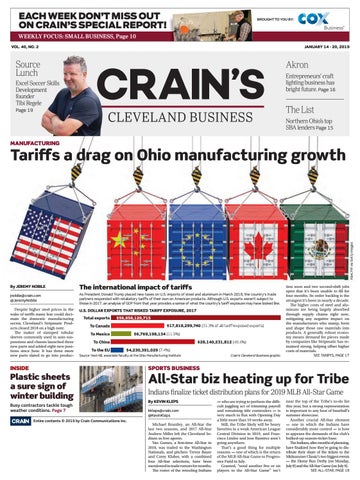
The international impact of tariffs
jnobile@crain.com @JeremyNobile
As President Donald Trump placed new taxes on U.S. imports of steel and aluminum in March 2018, the country’s trade partners responded with retaliatory tariffs of their own on American products. Although U.S. exports weren’t subject to those in 2017, an analysis of GDP from that year provides a sense of what the country’s tariff exposure may have looked like.
Despite higher steel prices in the wake of tariffs many fear could decimate the domestic manufacturing sector, Cleveland’s Stripmatic Products closed 2018 on a high note. The maker of stamped tubular sleeves commonly used in auto suspensions and chassis launched three new parts and added eight new positions since June. It has three more new parts slated to go into produc-
U.S. DOLLAR EXPORTS THAT RISKED TARIFF EXPOSURE, 2017 Total exports
$56,958,120,715 $17,818,299,740 (31.3% of all tariff-exposed exports)
To Canada To Mexico
$6,769,198,134 (11.9%)
To China To the EU
$28,140,231,812 (49.4%) $4,230,391,029 (7.4%)
Source: Ned Hill, associate faculty at the Ohio Manufacturing Institute
INSIDE
Plastic sheets a sure sign of winter building Busy contractors tackle tough weather conditions. Page 7 Entire contents © 2019 by Crain Communications Inc.
P001_CL_20190114.indd 1
Crain’s Cleveland Business graphic
tion soon and two second-shift jobs open that it’s been unable to fill for four months. Its order backlog is the strongest it’s been in nearly a decade. The higher costs of steel and aluminum are being largely absorbed through supply chains right now, mitigating any negative impact on the manufacturers who stamp, form and shape those raw materials into products. A generally robust economy means demand for pieces made by companies like Stripmatic has remained strong, helping offset higher costs of materials. SEE TARIFFS, PAGE 17
SPORTS BUSINESS
All-Star biz heating up for Tribe
Indians finalize ticket distribution plans for 2019 MLB All-Star Game By KEVIN KLEPS kkleps@crain.com @KevinKleps
Michael Brantley, an All-Star the last two seasons, and 2017 All-Star Andrew Miller left the Cleveland Indians as free agents. Yan Gomes, a first-time All-Star in 2018, was traded to the Washington Nationals, and pitchers Trevor Bauer and Corey Kluber, with a combined four All-Star selections, have been mentioned in trade rumors for months. The roster of the retooling Indians
— who are trying to perform the difficult juggling act of trimming payroll and remaining title contenders — is very much in flux with Opening Day a little more than 10 weeks away. Still, the Tribe likely will be heavy favorites in a weak American League Central Division in 2019, and Francisco Lindor and Jose Ramirez aren’t going anywhere. That’s a good thing for multiple reasons — one of which is the return of the MLB All-Star Game to Progressive Field in July. Granted, “send another five or six players to the All-Star Game” isn’t
near the top of the Tribe’s to-do list this year, but a strong representation is important to any host of baseball’s summer showcase. Another crucial All-Star element — one in which the Indians have considerably more control — is how to appease the demands of the club’s bulked-up season-ticket base. The Indians, after months of planning, have finalized how they’re going to distribute their share of the tickets to the Midsummer Classic’s two biggest events — the Home Run Derby (on Monday, July 8) and the All-Star Game (on July 9). SEE ALL-STAR, PAGE 18
1/11/19 2:40 PM
CRAIN’S
EIGHTOVER80 CRAIN’S CLEVELAND BUSINESS WILL HONOR EIGHT INDIVIDUALS IN THEIR 80S WHO ARE STILL WORKING TIRELESSLY TO ADVANCE NORTHEAST OHIO AND ITS RESIDENTS. Do you know an 80-something who has seemingly tossed the word “retirement” from his or her vocabulary and continues to make an impact in Northeast Ohio’s business, civic and philanthropic circles?
Visit CrainsCleveland.com/Nominations to nominate. NOMINATION DEADLINE: March 4 | ISSUE DATE: April 29
CL_011419_FP Template.indd 1
1/10/19 1:30 PM
CRAIN’S CLEVELAND BUSINESS
|
J A N U A RY 14 - 2 0 , 2 019
|
PA G E 3
Posting hospital prices online just one step Move necessitated by government is good for transparency, but most patients don’t pay the listed prices By LYDIA COUTRÉ lcoutre@crain.com @LydiaCoutre
Following the Jan. 1 implementation of a Trump administration rule, patients can find extensive lists online of hospitals’ charges for various services and procedures. Making the lists of medical codes, abbreviations and price tags — called chargemasters — publicly available is a step forward in price transparency, especially as it gives consumers a better view of the cost variations in health care. But the numbers might not be terribly helpful for patients trying to understand what a specific procedure or service will cost them. Most patients don’t pay the listed prices. Their responsibility depends on payment plans negotiated with individual health insurers. Also, uninsured or underinsured patients may qualify for discounts. Officials in Northeast Ohio say that price transparency is a journey, and while this is one step along that path, it’s certainly not the final one in helping consumers understand costs. “From my perspective, really what we’re seeing here is not the final solution or final chapter,” said Jeff Price, vice president of payer strategy at Summa Health System. “What we’re seeing is a catalyst to evolve financial transparency.” The federal government wanted this information to be brought forth
P003_CL_20190114.indd 3
Anderson
Freas
Huryn
Matyas
so people could have a better under- Centers for Medicare and Medicaid standing of costs and could work Services, other state and federal regwith health care providers to help re- ulations required that hospitals post duce the cost of delivering care, said some of the more common theraAlbert Matyas, vice president of am- peutic and diagnostic services onbulatory operations and business de- line. Ohio law has already required hospitals in the state to make pricvelopment for Southwest General. “We’ve tried to be on the forefront ing information on certain categoof that,” he said. “While we think ries of services available to the public upon request, as that’s a good idea to well as on the hosmake people more “What we’re aware of the cost of pital’s website, said seeing is a their health care, Chris Huryn, a partwhat they didn’t do catalyst to ner and co-chair of is explain the details the health care behind this, and so evolve financial practice group at people could be transparency.” Brouse McDowell. confused out of the The new federal law blocks here.” is more expansive, — Jeff Price, vice president Cleveland Clinic of payer strategy at Summa applying to all items and University Hos- Health System and services propitals declined invided by the hospiterviews for this story, but both have tal, and requires all hospitals to posted their chargemasters within make public their chargemaster via the past month and provided state- the internet. “I think it means for hospitals that ments to Crain’s highlighting that most patients don’t pay the rates it’s another way by which hospitals seen on the list. MetroHealth wasn’t can more effectively and with even greater transparency communicate available for comment. Before this federal rule out of the with and educate their patients,”
Huryn said. “It brings greater transparency and ease of access, and although there’s a comparison of standard charges, which may not necessarily be what the Price patient ultimately pays, it is providing further information for the patient to evaluate in deciding where to receive medical care.” According to the Center for Health Affairs, a nonprofit advocate for Northeast Ohio hospitals, purchasers and consumers need price transparency for three main reasons: to help purchasers contain health care costs; to inform consumers’ health care decisions as they deal with greater financial responsibility; and to reduce unknown price variation in the system. Hospitals in Northeast Ohio and across the country have been on a journey toward price transparency for years, offering various tools to help consumers make informed decisions, including posting common standard charges information, making available patient cost estimators and offering financial assistance information. Southwest General, for instance, makes available a patient bill estimator that, for certain select charges, calculates an estimate of what a patient’s true out-of-pocket liability
would be given their insurance coverage. “Because we did comply with the Ohio regulation, we really had a lot out there already; we just had to tweak it and make it the full comprehensive list, which we did,” said Mary Ann Freas, chief financial officer for Southwest General. “But then what we did was we decided to turn it to our advantage ... by promoting even more so some of the resources that we always had out on our website for our community to take advantage of.” Insurers, too, have worked to help patients understand their out-ofpocket costs. UnitedHealthcare, for example, has been providing pricetransparency tools for more than a decade. Katherine Bisek, vice president of strategic initiatives for UnitedHealthcare, said the new federal regulation is the latest step in an ongoing journey toward price transparency. “There is variation cost,” Bisek said. “That’s a key piece of really starting the journey in transparency and taking it, you know, step-by-step. You have to understand there is variation. Now, what can I do about it? How can I understand it?” Collectively, UnitedHealthcare members accessed a total of more than $13.7 billion in cost estimates during 2018 through mobile and online transparency resources, up from about $5.5 billion in estimates the year prior, according to UnitedHealthcare. SEE PRICES, PAGE 6
1/11/19 3:18 PM
PA G E 4
|
J A N U A RY 14 - 2 0 , 2 019 |
CRAIN’S CLEVELAND BUSINESS
Fisher Phillips Is Honored To Elect Scott W. Gedeon as a Partner in our Cleveland office Scott has spent his career defending the rights of companies—from small family held businesses to Fortune 500 global enterprises—and protecting their interests in the courtroom. Trial work is the lifeblood of Scott’s practice, as he has obtained several defense verdicts for employers in high exposure cases involving claims of serious workplace injury and disability. In addition, Scott regularly litigates employment disputes on behalf of employers. Outside the courtroom, Scott maintains an active workers’ compensation defense practice helping employers in Ohio and across the nation. He has been involved in hundreds of workers’ compensation appeals related to allegations of occupational injury and disease, with an emphasis on the healthcare, manufacturing, restaurant, food service and retail industries.
Scott W. Gedeon sgedeon@fisherphillips.com 200 Public Square, Suite 4000 Cleveland, OH 44114 Phone: 440.740.2139 www.fisherphillips.com | 32 Locations
Brag.
Did your company have a stellar year? An ad in Crain’s is the best way to boast to the Cleveland business community. BOOK YOUR AD TODAY TO RUN IN OUR BEST ISSUES. Contact Lisa Rudy • lrudy@crain.com
AN EPIC ADVENTURE STORY!
Health insurance offering boosts GCP By JAY MILLER jmiller@crain.com @millerjh
A return to the small-business health insurance field has helped the Greater Cleveland Partnership add 5,000 members over the last two years: 3,000 in 2018 and about 2,000 in 2017. The regional chamber of commerce, which includes the Council of Smaller Enterprises (COSE), ended 2018 with about 11,500 members. That’s still below the 16,000 members the combined organizations had in 2005. About 84% of those members were COSE’s small businesses. “It was a record (growth) for us in 2018,” said GCP president and CEO Joe Roman. “Most of that was small business.” The organization got back in the health care business late in 2016, when it received approval from the Ohio Department of Insurance to create a Multiple Employer Welfare Arrangement, or MEWA, that allows employers to band together in a self-funded group plan that, COSE said at the time, offered rate stability, flexible plan options and exemption from some Affordable Care Act requirements that apply only to self-funded programs, which helped lower costs. At its peak membership, small businesses were attracted to COSE because of its role as an intermediary selling low-cost, members-only health insurance products from several competing insurance providers. For many, even one-person businesses that paid $300 a year for a COSE membership, the savings they could get through COSE’s health insurance plans more than offset the membership cost. Then, in 2006, its biggest supplier, Medical Mutual, demanded an exclusive contract to take over running an insurance program for COSE members. That eliminated some plans that were attractive to members. In 2016, Steve Millard, then president of COSE, told Crain’s the loss of its insurance portfolio a decade earlier had caused members to leave COSE, which makes up the largest portion of GCP membership. The MEWA is changing that.
FOR SALE
Chris Federico, who owns Wingz Sports Grill in Brunswick with his wife, is one of the new members. Federico said he joined late last year so he can offer health care for his 22 employees. Federico has owned Wingz for a decade and had been thinking about joining COSE for several years for other reasons. “I knew some other people who were members, and they said I might want to do it for networking and this and that,” he said. “So I had to be a member (for health care), so it gave me more of a reason (to join). If anything gives me a competitive edge, I usually jump on it.” Small businesses now account for more than 90% of GCP’s membership, which includes 50 large companies, 950 middle-market companies — those with revenues between $10 million and $1 billion — and 10,500 COSE small business members. Membership in COSE costs between $408 a year for businesses of under 10 employees to $587 for businesses with more than 25 employees. Membership for larger businesses goes up from there. MEWAs, along with other, similar plans — as a group they’re called “association health plans” — have been around since at least the 1980s. However, their reputation has been periodically tarnished by fraud and program failures since their sponsors, which are not as closely regulated or as financially strong as insurance companies, bear some of the financial responsibility. GCP, Roman said, is standing behind its MEWA financially, but it has contracted with Medical Mutual to provide claims administration and stop-loss protection for it. Medical Mutual insurance plans are still available to COSE members. Roman said GCP is also offering MEWA-base health insurance through chambers of commerce in Columbus and Toledo. And Millard, who is now president and CEO of the Greater Akron Chamber, said in an email that his chamber is also getting into the MEWA business. “Yes, we have a MEWA, just went live Jan. 1, 2019, with SummaCare,” he wrote. “(It’s) focused on Summit, Portage, Medina and Stark counties. Good first month, strong interest. Will build over time.”
RIVER VISTA PLAZA 2783-2795 Front Street Cuyahoga Falls, Ohio 44221
$980,000
n STRONG TENANTS
JAN 12 – FEB 10 • OUTCALT THEATRE written by LISA PETERSON & DENIS O’HARE | based on Homer’s The Iliad, translated by ROBERT FAGLES directed by TARAH FLANAGAN & ANDREW CARLSON
n GREAT INVESTMENT
OPPORTUNITY
SVN SUMMIT COMMERCIAL REAL ESTATE GROUP, LLC TICKETS ON SALE NOW!
216.241.6000 | clevelandplayhouse.com
P004_CL_20190114.indd 4
CONTACT: Ben Christopher
Associate Advisor Ben.Christopher@SVN.com 330-631-7285
3009 Smith Rd Suite 25 Akron, OH 44333 (234) 231-0200
1/11/19 2:34 PM
CRAIN’S CLEVELAND BUSINESS
Acquisitions fuel collaboration at Innovest Global By RACHEL ABBEY McCAFFERTY rmccafferty@crain.com @ramccafferty
2018 was a big year for Innovest Global Inc. When the year started, Innovest owned one company: Chagrin Safety Supply, which it had acquired in October 2017. It wasn’t much of a conglomerate then. By the end of December 2018, it held a total of six companies, with a stake in another, and had moved into its current headquarters. Its holdings were divided into three divisions designed to help those companies work together and maximize their opportunities: a commercial and industrial division, a construction and building materials division and a biotech and health services division. Now, Innovest was on its way. And it doesn’t show any sign of slowing down. So far in 2019, the company has formed another company, Innovest Electric Solutions, through an asset purchase; brought on a leader for its energy group; and announced its intention to add another division, the Innovest Auto Group. In January, Innovest announced that it had signed a letter of intent to acquire an unnamed, Northeast Ohiobased car dealership. The company’s audited financials are not yet available for 2018, but Innovest started the year with a run rate of $500,000, Derek McCarthy, vice president of communications, said in an email. Its run rate for 2019 is $50 million. The Innovest Global name derives from a combination of “innovation” and “investment,” said founder, CEO and chairman Dan Martin. “We want to focus on putting our investment — and that’s not just money, but it’s also our effort and our passion and our enthusiasm — into things that are relatively innovative,” Martin said. The company got its start in 2016 when it received its OTC stock symbol. But Martin said the company has made “no secrets” about its goal of moving to the NYSE or Nasdaq markets in the future. The conglomerate model benefits shareholders because it diversifies risk, Martin said. If one industry is struggling, it could be lifted by another that is currently thriving. But Martin said Innovest Global likely won’t diversify too much more in terms of the industries it encompasses; the company has a solid base from which to grow, he said. And growing the companies in its divisions is the goal. Innovest saw “huge growth” in 2018, said Damon Mintz, president of Innovest Global. He expects that pace to slow a bit in 2019, but noted there are quite a few companies in the potential acquisition pipeline. Mintz owned Shepherd Energy Solutions, Innovest’s second acquisition, which closed at the start of 2018. He joined Innovest and helped to make another acquisition to build out the energy division. Mintz served as president of Shepherd and of the commercial and industrial division after the acquisition. He began acting as president of the entire company in August 2018 and officially took on
P005_CL_20190114.indd 5
Martin
that role in January 2019. His focus now is on acquisitions and working with those acquired companies. He’s able to give them the perspective of someone who’s been through
that process. Innovest views its companies like athletes on a sports team. The companies still have value on their own and Innovest wants them to maintain their brand identity, but there’s a collaborative approach in play. “Our companies are the individual players,” Mintz said. “Right? It’s critical that every one of them does theirs. So Shepherd has to build Shepherd. But for us, we’re trying to win a game. And the game is all the parts moving in the same direction, along a bigger goal, bigger vision. So when we say we’re not focused on the companies, it’s like the coach saying, ‘I’m not focused on the quarterback.’ You’re not. You’re focused on the entire plan.” A recent $1.1 million contract to work with Sifco Industries Inc. exemplifies that approach. Mark J. Kelly, president of the Innovest Energy Group, said bringing the different companies in the group together allows Innovest to form customizable solutions for its clients. Kelly began his work at Innovest as a consultant, helping Shepherd in October of 2018. In January, he became group president of the energy group. Mintz said a customized approach to upgrading Sifco’s infrastructure — rather than a single product or solution — wouldn’t have been possible if Innovest’s three energy companies were operating on their own, instead of together. McCarthy said the actual updates Innovest will be making for Sifco are proprietary. In an emailed statement from Sifco, the company said it was “excited” to work with Innovest on this project. “It is a strong example of Sifco’s commitment to invest in infrastructure improvements to support business growth as well as continuous improvement in safety, quality and cost competitiveness,” the statement read. The energy group falls under the commercial and industrial division. Mintz said Innovest keeps its divisions broad, but as it acquires like companies, they’re able to work together in groups, as the energy group has done. Innovest aims to gather the management of its companies under one roof in Chesterland, at least some of the time. The company moved into its headquarters there in October 2018 and began consolidating offices the next month, McCarthy said in an email. It’s easier to share opportunities when someone can just walk down the hall, he added. Warehouses and manufacturing facilities are maintained elsewhere. In total, the company has about 70 employees, including a biotech office in Los Angeles. Innovest’s biotech and health services division is based in the 20% stake it holds in StemVax Therapeutics.
|
J A N U A RY 14 - 2 0 , 2 019
|
PA G E 5
Reducing Real Property Tax Assessments Throughout Ohio And Across The United States Sleggs, Danzinger & Gill, Co., LPA
When you hire Sleggs, Danzinger & Gill, you work directly with Sleggs, Danzinger and Gill. Each client is directly represented at all levels by a principal of the firm with a combined 75 years of experience. No pyramid, no associates, no on-the-job training. Our clients deserve the very best representation, so we structured our firm to allow each client, throughout the entire process, to work directly with Messrs. SLEGGS, DANZINGER and/or GILL. Our philosophy is to work cooperatively with school district and County officials to ensure that our clients pay the lowest possible real property tax obligations. If a fair resolution requires litigation, SLEGGS, DANZINGER & GILL have the depth of trial and appellate experience to handle the most complex valuation issues. Whether the valuation relates to large industrial plants, apartments, shopping centers, warehouses, office buildings, vacant land or any other type of commercial property, the faces above will ensure that you receive the best counsel, legal advice and litigation expertise. Todd W. Sleggs, Esq.
Robert K. Danzinger, Esq.
Steven R. Gill, Esq.
tsleggs@sdglegal.net
rdanzinger@sdglegal.net
sgill@sdglegal.net
(216) 771-8990 sdglegal.net
Member Firm
Sleggs, Danzinger & Gill 820 West Superior Ave. Seventh Floor Cleveland, OH 44113
1/11/19 3:28 PM
PA G E 6
|
J A N U A RY 14 - 2 0 , 2 019 |
CRAIN’S CLEVELAND BUSINESS
BORROW
Region’s office, industrial real estate markets grew in 2018 By STAN BULLARD sbullard@crain.com @CrainRltyWriter
Your local credit union, local money for local borrowers. Commercial Real Estate Loans up to $10 Million No Prepayment Penalties • As Little as 10% Down
Contact Jonathan A. Mokri 440.526.8700 jmokri@cbscuso.com www.cbscuso.com Your Business Lending Partner SM
Providing a private travel experience that exceeds expectations
As Bob Nosal, executive managing director of Newmark Knight Frank’s Cleveland office, reviewed the firm’s annual survey of office and industrial markets, he paused and said, “This is really special.” In 2018, real estate owners and developers added substantial volumes of industrial and office space, yet users of such space expanded so much that vacancy climbed little in both segments. While the region has been derided for years for lacking real commercial property growth, with new development amounting to just shifting deck chairs on a ship, that was certainly not the case last year. By the numbers, office vacancy throughout downtown Cleveland and the suburbs fell to 15.8% at the end of 2018 from 16.9% at the end of 2017. And despite the opening of the Amazon North Randall fulfillment center with 888,000 square feet — under a roof more than four times the size of an aircraft carrier’s flight deck — as well as other new projects, industrial vacancy climbed little, to 5.8% at the end of 2018 from 5.6% at the close of 2017. “I’ve waited for years to see this,” Nosal said of demand strong enough that construction didn’t pile empty space onto the market. In the 1990s, more space was being absorbed, but
PRICES
CONTINUED FROM PAGE 3
HOW TO FLY WITH SKY QUEST: » On-Demand Charter » Jet Card Memberships » Aircraft Ownership Opportunities
FlySkyQuest.com 216-362-9904 Charter@FlySkyQuest.com
What officials don’t want to see happen is patients being deterred by the chargemaster prices and deciding not to seek care for fear of the cost. There are “few and very unique circumstances” where a patient will pay the chargemaster price, Freas said, noting three examples: an individual who is uninsured but has an income above the hospital’s threshold for financial assistance; a procedure or test not covered by the insurer; or, rarely, when the charge is actually less than an insurer’s negotiated rate in high-deductible plans.
Nosal noted that the overbuilding of office buildings put substantial amounts of empty office space on the market each year. In the 2018 office market, developers in the region completed almost 390,000 square feet of multitenant office space, all in the eastern suburbs. However, office users took enough space that, combined with other factors reshaping the market, vacancy in the region dropped to 15.8% in 2018’s final quarter from 16.9% in the like period of 2017. Meanwhile, businesses in the eastern suburbs — Beachwood, Mayfield Heights, Mayfield Village and others along I-271 — absorbed enough of the first office space in years or occupied other empty space in the market that vacancy climbed to 12.9% at the end of 2018 from 12.6% at year-end 2017, according to the Newmark Knight Frank survey. The new office space came in the Chagrin Highlands III office building in Beachwood and the office portions of the Van Aken District and Pinecrest — mixed-use office, residential and retail developments in Shaker Heights and Orange Village, respectively. Although it’s possible to just ascribe the industrial growth to the Amazon warehouses — with yet another big one going up in Euclid that will open in 2019 — Terry Coyne, a Newmark Knight Frank vice chairman who heads its Cleveland industrial unit, said that would do a disservice to other industrial users in the
market who are gobbling up space. “People still manufacture in the U.S.,” Coyne said. “Yes, Amazon expanded the size of our market. It’s great that Amazon absorbed that space. But when people manufacture in the U.S., they do it in the Midwest. Manufacturers here are continuing to expand, although it’s often overlooked in the region. There are a lot of suburban deals no one hears about. There are tons of jobs openings for manufacturers, and that means there is demand for more space.” Although 15.8% office vacancy is nothing to shout about, it marks a big turnaround for the Cleveland market. Nosal said that is the lowest it has been in 17 years. “Think about it: Occupancy is the best in the region that it has been in all that time,” Nosal said, using the figure that means the most to owners and operators of office buildings. In other words, 84.2% of the region’s office space is filled and producing rent for its owners. At the end of 2018, the downtown office market’s vacancy fell to 18.7% from 20.2% at the end of 2017. That reflects several big tenants moving into downtown this year, including NRP Group, which relocated from Garfield Heights, and Electronic Merchant Systems, which relocated from Independence. The market is also improving due to subtraction as parts of old office buildings get turned into apartments and elided from the category.
Lisa Anderson, senior vice president at the Center for Health Affairs, said hospitals do a good job of working with individuals on understanding prices and getting them the care they need. The newly posted chargemasters give people a perspective of the true cost of health care. “Those charges are going to vary from hospital to hospital, and that’s because hospitals all provide different levels of services and their costs are all going to be different,” she said. “It gives them maybe a comparative value, but beyond that … it’s a step, another step in providing cost transparency to patients as to what health care actually costs.” If health care continues to shift to-
ward more and more of a retail mindset, it’s likely there will be even more disclosures of costs, said Matyas, of Southwest General. “The only thing that I would recommend is that patients also continue to go out and look at the different websites for the different quality ratings that are being shown for the hospitals,” he said. “Because there is a cost piece, but there’s also the quality and the outcomes of a particular health care institution really needs to be evaluated as well by people because it’s not just about the cost. It’s about how well they’re being cared for and what their experience is at that particular health care organization.”
σσσσ4σσ24σ7σσ6σσσσ8σσσσλσσσσσσσσσσσσ4σ55
)λλλλ%λHHλλλλλ1YPGT 5PCRQNQI[ %NGXGNCPF
λλλλλλλλλλλλλλλλλλλλλλλλλλ λλλλλλλλλλλλλλλλλλλλ λλλλλλλλλλλλλλλλλλ λλλλλλλλλλλλλλλ λλλλλλλλλλλλλλλλλλλλλλλλλλλλλλλλλλλλλ
σλλλλλσλλλλλλλλλ*λλλλλ\λσσσσσσσσσσσσσσσσσσσσσσσσσσσσσσσσσσσσσσσσσσσσσσσσσσσσσσσσσσσσσσσσσσσσ
P006_CL_20190114.indd 6
1/11/19 3:20 PM
CRAIN’S CLEVELAND BUSINESS
|
J A N U A RY 14 - 2 0 , 2 019
|
PA G E 7
Are you ready for April showers and May flowers? CALL TODAY FOR YOUR COMPLIMENTARY ANALYSIS! Grounds Management • Innovative Design & Landscape Enhancement Seasonal Flower Displays • Snow & Ice Management
Enclosures allow workers more flexibility as Bedrock Real Estate fixes the terra cotta surface of the former May Co. building at 200 Euclid Ave. (Stan Bullard)
Cold weather conditions test hot building market By STAN BULLARD sbullard@crain.com @CrainRltyWriter
Along with snowflakes, icicles and snowplows, huge plastic sheets forming enclosures attached to buildings under construction or undergoing restoration are becoming another sign of winter in Northeast Ohio. The plastic shrouds on platforms with enough room for two to eight construction workers to labor inside them are typically called tents in the trade. Northeast Ohio building contractors use them in part to lengthen the construction season — sometimes referred to as the offseason for the business — but also to respond to evolving material technologies and even real estate market trends. Gareth Vaughan, CEO of Cleveland-based Albert M. Higley Co., said, “We’re seeing more of it now. Clients just don’t want us to shut down. The time is worth more than the cost.” While Higley primarily uses tenting over the installation of masonry, Vaughan said it’s a tough call when to use it, as the productivity is not as good as in the normal building season. “You’re fixing the tent constantly,” he said. While one wall of the apartments at The Wolstein Group’s Flats at East Bank project in Cleveland was covered by plastic sheets in late spring 2015, the tents put in place are typically smaller than further north, where an entire building may be covered the way a dome covers Krenzler Field in the winter months at Cleveland State University. However, there have been some big tents in the past. For example, Welty Building Co. put all the suites on the end zones of the Tom Benson Hall of Fame Stadium in Canton inside a tent to get that project ready for its 2017 debut. The 18-month construction period for the American Greetings Worlds Studios in Westlake required tenting over the construction site for the 880,000-square-foot property, which opened in 2016. Chris Burns, Welty chief operating officer, recalled, “It was a massive un-
P007_CL_20190114.indd 7
dertaking to maintain heat throughout that building.” Burns, with decades of construction experience, including a stint in Norway, said contractors 20 years ago might have done a roof in a snowstorm. But no more. “The technology of building materials has changed dramatically,” he said. “Manufacturers have found ways to give you products that are thinner and lighter, with less VOC (volatile organic compounds). That has meant the conditions where you install them have to be more con-
“We’re seeing more of it now. Clients just don’t want us to shut down. The time is worth more than the cost.” — Gareth Vaughan, CEO, Albert M. Higley Co.
trolled. Some glues are literally temperamental. We have to be smarter about how we install them.” That also allows manufacturers’ warranties to be kept in place, Burns added. Even inside new apartment buildings, he noted, popular luxury vinyl tile products require low humidity and temperatures in the 70-degree range. Jim Nystrand, Cleveland regional manager for Livonia, Mich.-based RAM Construction Services, said some sealants used in brick joint can push the envelope to as low as 25 degrees, while in the past 40 degrees was typical. “That lends contractors like us the ability to work in colder environments,” Nystrand said. Constantly changing weather conditions mean work still needs to be adapted to conditions. “We take freezing temperatures as one of the thresholds to decide when to shut a job down,” Nystrand said. “When does that happen? October or November?” Tenting also helps in situations where the walls need to be heated to install wall sealants. Nystrand said RAM is increasingly using mast climbers in winter months. With sup-
ports that cover the side of a building, the company builds tents around work platforms that can also connect tightly to the structure and be heated as crews work their way up. RAM has two such mast climbers in place on the exterior of the long-empty John Hartness Brown building complex at 1001 Euclid Ave. where it’s repairing the terra cotta as part of a project to add 200-plus apartments to the old office buildings. It also has put mast climbers reaching across two sides of the Verizon Building, 1150 W. Third St., that crews will use to repair the six-story building’s facade. “The enclosures allow crews to have more palatable working conditions in freezing weather as they repair concrete or mortar joints,” Nystrand said. Mast climbers are also more efficient. The alternative is a swing stage that can be used by just two workers, while enclosed platforms on mast climbers can accommodate as many as eight. Current economic and real estate market conditions are also a factor in the increased use of tent enclosures on construction sites. Burns said real estate developers using Ohio State Historic Preservation Tax Credits and multiple sources of capital often have tighter deadlines than those using conventional financing methods of the past. Another factor cited by multiple observers is that real estate developers are pushing to get their projects finished before their competitors do. That way, they can market and lease apartments before their competitors’ jobs are done — a big factor when developers are testing the appetite of downtown Cleveland and Northeast Ohio for more apartments. Nystrand and others said the busy commercial, industrial and institutional markets are also creating more projects than Northeast Ohioans typically see — and more winter work as a result. “In the past, you would hear (building) owners say, ‘Let the brick wait until spring,’ ” Vaughan said. “That conversation has changed because the penalties of not meeting a deadline or being first to market are so real.”
Commercial Properties • Shopping Malls • Healthcare Facilities Apartment Complexes • Universities • HOAs
986 Broadway Ave., Bedford, Oh 44146 440-786-9840 • www.tuckerlandscaping.com
VOL. 39, NO. 16
April 16-22, 2018
Sponsored Content
Acquisition helps keep Ramco on growth track VOL. 39, NO. 16
Sponsored Content
April 16-22, 2018
Acquisition helps keep Ramco on growth track
VOL. 39, NO. 32
AUGUST 6 - 12, 2018
CRAIN’S 2018
ARCHER AWARDS
HR TEAM OF THE YEAR (PUBLIC) WINNER
People Analytics, KeyBank Aware that would-be and current employees must take priority, KeyBank has simplified its recruiting process and utilized data to reduce worker turnover. Key’s information-driven efforts were led by Amanda Cruz, digital recruiting and analytics consultant, and initiative development manager Jeannie Fanning, the nomination stated. By taking a collaborative approach backed by detailed research, Key’s HR organization cut attrition in the company’s contact center by half over the previous year, reduced the number of pages in its applications by 40%, and estimate that candidates will spend 20% to 50% less time in completing an application. According to the nomination, the team is also nearing completion of a candidate-centric Key career site redesign, providing additional trans-
parency around the information sought by applicants and eliminat eliminating corporate speak and complex navigation. Meanwhile, a comprehensive approach to “human capital” decision-making is at the core of Key’s People Analytics Community of Practice, a group of HR professionals who meet biweekly to discuss best practices in driving data-based HR decisions. “The predictive modeling approach is being adopted by other groups, from redefining onboarding for new hires, to streamlining the training modules that impact per performance, to prioritizing workload for compensation reviews,” the nomination stated. “Candidate ex experience work will result in more quality candidates in our recruiters’ pipelines and improve our employ-
Cruz
Fanning
er brand, conveying to candidates that Key is fast, efficient and tech savvy.” In performing this undertaking, Key’s HR division helps meet longterm company priorities in developing a talented workforce, catalyzing employee engagement, and improving organizational effectiveness, the nomination said. — Douglas J. Guth
gan to focus more on engineering By DAN SHINGLER and less on producing common, low-priced parts like simple nuts. dshingler@crain.com “That’s a race to the bottom,” @DanShingler Melick said of the highly commodHudson-based Ramco Specialties itized realm of simple nuts and bolts, where foreign and domestic suppliis on an automotive roll. VOL. 39, NO. 16 April 16-22, 2018 Sponsored Content After building and moving into a ers most often compete primarily on 185,000-square-foot headquarters and price and the cheapest part wins. The company has found OEM more on engineering gan toitsfocus main plant a little over two years ago, By DAN SHINGLER and less their on big producing common, the company has increased its size automaker customers,and with Ramlow-priced parts like simple nuts. with the acquisition of Michigan-based suppliers, willing to work dshingler@crain.com co’s engineers earlier in“That’s their own a race to the bottom,” Copa Tool earlier this month. @DanShingler allows Melick saidthe of the highly commodGrowth in Ramco’s automotive design processes. That to offer fastening systems itized realm of simple nuts and bolts, business, by far its largest Hudson-based end market, company Ramco Specialties can be integrated intoforeign other and domestic suppliwhere is fueling it all, Jeff Melick, Ramco’s di- thatroll. is on an automotive which can themost entireoften au- compete primarily on rector of sales and marketing, Aftersaid. building parts, and moving intomake a ers manufacturing process the cheapest part wins. “This year, we’re up185,000-square-foot about 15%,” tomotive headquarters and price and Specialties’ 185,000-square-foot headquarters and main plant has andyears moreago, efficient. Plus, they Ramco The company has found its focus OEM more on engineering gan to Melick said, adding that theplant compamain a littlefaster over two of warehouse room, too. (Dan Shingler for Crain’s) DAN SHINGLER notBydepend whollyautomaker on price customers, to plentyand and their less big on producing common, ny has been experiencing a similar hasdoincreased the company its size sales, Melick said.suppliers, willing to work with Ramlow-priced parts like simple nuts. growth rate since about 2008, when gain with the acquisition of Michigan-based dshingler@crain.com growing faster overall must be working, because while earlier co’s engineers in“That’s their than own a race todomestic the bottom,If ” the state’s automotive compait began focusing onCopa more Toolengiearlier thisItmonth. @DanShingler growth onlycommoddo nies as a whole can fare that well, it some other companiesdesign are alsoprocesses. find- production That allows theofrates Melick said the can highly neered products than a simple Growthnut. in Ramco’s automotive would be a good thing for Ohio, in two ways: They are either a bolts, ing growth inmarket, automotive, the induscompany to offersofastening systems itized realm of simple nutson and Copa Tool is a significant pickup business, by far its largest end Hudson-based Ramco Specialties which still has a huge automotive small where number of hotand products or asupplias is a whole has onroll. a downthat can be integrated into foreign other domestic for Ramco. Its $14 million in annual is fueling it all, Jefftry Melick, Ramco’s di-been on an automotive according to the Ohio number of where a industry, trend, said Edward “Ned” Hill, parts, which can make the entireoften au-products most compete primarily on sales will be added torector Ramco’s an-andward of sales marketing, Aftersaid. building and moving intolarger a ers few are picking marketpart share. a well-known Ohio economist and tomotive manufacturing process price and theupcheapest wins. Manufacturers’ Association. nual revenues of about $100 million. “This year, we’re up185,000-square-foot about 15%,” headquarters and Specialties’ 185,000-square-foot headquarters a huge partand main plant has Seeing that the overall Ramco tide bouncprofessor public administration faster and years moreago, efficient. Plus, they The company has is found its OEM“Auto supply remains Copa’s 40 employees bring Ramco’s Melick said, adding that theofcompamain plant a little over two warehouse room, too. (Dan Shingler for Crain’s) enormous manufacturing ing around dead to low plenty … theyof either and city regional atits size doplanning not depend wholly on price automaker customers, and their of bigOhio’s headcount to about ny 175 haspeople, been experiencing a similar the and company has increased sector. State data has shown increasgood boatwilling or have Ohio State University’s gain sales,John Melickhave said.asuppliers, toattached work witha RamMelick said. growth rate sincethe about 2008, when with the acquisition of Michigan-based ingoverall investment among all decent boatengineers towhile a goodearlier motor.” Glenn College ofearlier Publicthis Affairs. growing domestic If transporthe state’s automotive compaIt month. must be working, because co’s infaster theirthan own The acquisition brings things that it began focusing onCopa more engiTool tation Ramco is not at allows least Asked whether Ramco or any sinproduction growth rates equipment can only do manufacturers, nies as a whole can fare that well, it some other companies are also find-unique, design processes. That the might be more important than just than neered products a simple nut.in Growth Ramco’s automotive and are jobeither growth been steady amongcompany Northeast supplicompany’s recent growth in aube a good thing for Ohio, soauto in two ways: They on ahas would growth inmarket, automotive, the industo Ohio offer fastening systems sales, too, such as increased CopamanuTool is agle significant pickup business, by far itsing largest end transportation equipment ers. Some report they are also other tomotive is annual due to Jeff a rising or has still has a huge automotive small number ofamong hot products or a which try as atide, whole onothers acan downthat be integrated into facturing capacity. While forRamco Ramco.traIts $14 million in is fueling it all, Melick, Ramco’s di-been manufacturers, employwell. just to a well-run boat, Hill hadtrend, a ready according to the Ohio number products wherepresently a industry, ward said Edward “Ned” Hill,canlarger parts, which make the entireofauditionally has focused sales on thewill female be added Ramco’s an- and rector of sales marketing, said.doing ing 125,000 OMA Association. Adler, president of Cuyahoga “It’smillion. the boat.” Manufacturers’ few are picking up over market share. Ohioans,” a well-known OhioBill economist and tomotive manufacturing process end of fasteners — nuts and related of answer: nual revenues about $100 “This year, we’re up about 15%,” Ramco Specialties’ 185,000-square-foot headquarters spokesman Augsburger Heights-based Products, Overall, domestic auto production “Autosaid. supply remains a huge partand main plant has thatPlus, the overall tide is Ryan bouncprofessor public administration faster andStripmatic more Seeing efficient. they threaded assemblies Copa’s — Copa has 40 employees bring Ramco’s Melick said, adding that theofcompaplenty warehouse room, for Crain’s) For… itsthey part,of Ramco expects itstoo. re-(Dan Shingler also sells heavily thearound automohas been in apeople, slump, Hill said. He and notof Ohio’s enormous manufacturing dead to low either and city regional planning atintoing do not depend wholly on price high-volume screw machines headcountthat to about 175 ny has been experiencing a similar growth to continue and isState worktive industry, supplying a range data from Federal Reserve data has shown increashave a goodof boatcent or have attached a sector. the Ohio State University’s John gain sales, Melick said. can produce bolts and othersaid. small ed thatgrowth Melick ratethe since about 2008, when ing hard to earn its place supplying parts. He, too, said Bank of Louisthat shows thaton U.S. auto- engiing overall investment among all decent boat towhile a good motor.” If transporthe state’s automotive compagrowing faster than domestic Glenn College ofsmall, Public tubular Affairs. It must be working, because precision parts Ramco does curcur The not acquisition brings things it St. began focusing more parts for up-and-coming vehicles, business is any good as of late. makersneered went from about tation equipment Ramco is not unique, at least nies as a whole can fare that well, it production growth rates can only do manufacturers, Asked whether Ramco or sinsome other companies are also findrently make, Melick said. might be more important than just making products than a simple nut. Melick said. Copa’s and on has “Stripmatic is at 15% over ourindus350,000 automobiles month be-pickup and are job either growth been steady among Northeast Ohiosoauto supplibe a good thing for Ohio, in two ways: presence They a would company’s recent growth in auing growth inleast automotive, the presAnd it never hurts tosales, havetoo, a pres such as increased manumanu Copa Tool is per agle significant added connections and around first-quarter and last year’s tween 2013 and tra2016 totomotive now making transportation equipment ers.been Some reportsmall they are also in still has a huge automotive number ofamong hot products or a which is to a rising or has try as tide, aforecast whole onothers a downence in the metropolitan Detroit facturing capacity. While Ramco tra for Ramco. Its $14 million in due annual Detroitlarger should only of help, since where it presently sales,” Adler “The short-term abouton 250,000 units month. manufacturers, employdoing well. according to the Ohio a industry, number products just atowell-run Hill hadtrend, a said. ready ward said Edward “Ned” Hill, area, where Copa is based, alongside ditionally has focused thewill female sales be per added Ramco’sboat, anputs few Ramco toshare.Ohioans,” backlog through June looks prettypresident other words, company isthe boat.” over 125,000 OMA Association. Billeconomist Adler, of Cuyahoga Manufacturers’ are physically pickinging upcloser market “It’smillion. a well-known Ohio and domestic automakers end and ofmany of —In fasteners nuts andrevenues related ifofaanswer: nual about $100 many Seeing of itsProducts, big customers, hetide added. solid as well.” growing, they40 must be doing somespokesman Augsburger Heights-based Stripmatic “Autosaid. supply remains a huge part that the overall isRyan bouncOverall, domestic auto production professor of public administration their suppliers that arethreaded all potential assemblies — Copa has Copa’s employees bring Ramco’s “Ouring product development who said hisregional products most thingmachines right. For … its engipart, either Ramco expects itsenormous realso sells heavily at into the automoof Ohio’s manufacturing around dead low they has been in apeople, slump,Adler, Hilland said. He notcity and planning Ramco customers, he noted. high-volume screw thatto about headcount 175 neers have area very excited to able to theirState waytive into pickups, supplying a supplier is from a typically growth to continue and isState work-data has shown increasindustry, range ofboatcent a good orbe have attached a sector. ed that data the Federal Reserve thefind Ohio University’s John Ramco hopes to bring bear itsbolts “How cantoproduce andMelick other small performs said. offer He, domestically SUVs and heavy commercial function of not which itofisSt.things suping hard to earn its place tubular too,boat saidto amanufactured ing supplying investment among all transpordecent good motor.” Bank Louis that shows that U.S. autoGlenn College ofsmall, Publictrucks, Affairs. parts. chief strength to Copa’sprecision existing cuscus parts Ramco does curcurvehicles The acquisition brings engineered assemblies and compothinks new taxabout laws and a reduction plying and how those important vehicles went sell,” for up-and-coming vehicles, business is good as of late. equipment manufacturers, Ramco is notparts unique, at least tation makers making Asked whether Ramco or any sintomer base, Melickrently said.make, That Melick said. might be more thanfrom just nents quickly toour our Tier 1 automoof regulations are having a big posi-in Hill to said intoo, email corresponMelick said.suppliCopa’s presence “Stripmatic is at leastamong 15% over and job and growth has been steady Northeast Ohio auto 350,000 automobiles per beglemonth company’s recent growth austrength is engineering, And he said. AfAf hurts presit never have a an pres sales, such as increased manutive Melickadded said. connections tive impact sales. dence.facturing “An Detroit auto supplier that is 2016 and around forecast and year’s transportation equipment ers.last Some others report they are also inamong tween 2013 and totomotive now on making is duefirst-quarter to a rising tide, or customers,” ter the Great Recession, Ramco bebe metropolitan ence in the capacity. While Ramco traDetroit should only help, since it presently employsales,” short-term manufacturers, doing well. about 250,000 units per just month. a well-run boat, HillAdler had asaid. ready“The area, where Copa is based, alongside ditionally has focused on the female puts Ramco physically to prettypresident ing closer over 125,000 Ohioans,” OMA Bill Adler, of Cuyahoga other company “It’sisthe backlog boat.” through June looks domestic automakers end and of many of —Innuts fasteners andwords, relatedif aanswer: Reprinted with permission from the Crain’s Cleveland Business. ©be 2018 CrainsomeCommunications Inc. All Rights reserved. many of itsProducts, big customers, he added. solidauto as well.” spokesman Ryan Augsburger said. Heights-based Stripmatic growing, doing Overall, domestic production their suppliers that arethreaded all potential assemblies — they Copamust has Visit Further duplication without permission www.crainscleveland.com. #CC117 “Ourthe product development Adler, whoHe said his products For itsengipart, Ramco expects its realso sellsmost heavily into automothing right.is prohibited. Hill said. notRamco customers, he noted. high-volume screw machines that has been in a slump, neers areavery excited to begrowth able toto continue and is work findReserve their waytive into industry, pickups, supplying workrange of cent a supplier is from a typically ed that data the Federal Ramco hopes to bring bear its bolts“How cantoproduce and other small performs offer He, domestically SUVs and commercial ing hard to earn its place supplying small, trucks, tubular parts. too, said manufactured function of which vehicles supBankitofisSt. Louis shows that heavy U.S. autochief strength to Copa’sprecision existing cuscus parts Ramco does not curand compothinksmaking new taxabout laws and a reduction for up-and-coming vehicles, business is goodengineered as of late. assembliesparts plying sell,” from makers went tomer base, Melick rently said.make, ThatMelick said.and how those vehicles nents to our our Tier 1 automoof regulations arebehaving“Stripmatic a big posi- is at Melick said. Copa’s presence and leastquickly 15% over Hill to said in aan email350,000 corresponautomobiles per month strength is engineering, he said. AfAf hurts And it never have prestive customers,” Melickadded said. connections in and around tive impact sales. first-quarter forecast and last year’s dence. “An Detroit auto supplier is 2016 tween that 2013 and to nowon making ter the Great Recession, Ramco bebe metropolitan ence in the sales,” Adler said. “The short-term Detroit should only help, since it area, where Copa is based, alongside about 250,000 units per month. In other words, if a company is backlog through June looks pretty puts Ramco physically closer to domestic automakers and many of Reprinted with permission from the Crain’s Cleveland Business. © 2018 Crain Communications Inc. All Rights reserved. many of its big customers, he added. their suppliers that are all potential growing, they must be doing some- solid as well.” Further duplication without permission is prohibited. Visit www.crainscleveland.com. #CC117 “Our product development engiAdler, who said his products most thing right. Ramco customers, he noted. “How a supplier performs is a typically find their way into pickups, neers are very excited to be able to Ramco hopes to bring to bear its chief strength to Copa’s existing cus- function of which vehicles it is sup- SUVs and heavy commercial trucks, offer domestically manufactured tomer base, Melick said. That plying and how those vehicles sell,” thinks new tax laws and a reduction engineered assemblies and components quickly to our Tier 1 automoof regulations are having a big posiHill said in an email corresponAf strength is engineering, he said. Aftive customers,” Melick said. ter the Great Recession, Ramco be- dence. “An auto supplier that is tive impact on sales.
Acquisition helps keep Ramco on growth track
PROMOTE. Why not?
Reprinted with permission from the Crain’s Cleveland Business. © 2018 Crain Communications Inc. All Rights reserved. Further duplication without permission is prohibited. Visit www.crainscleveland.com. #CC117
Reprinted with permission from the Crain’s Cleveland Business. © 2018 Crain Communications Inc. All Rights reserved. Further duplication without permission is prohibited. Visit www.crainscleveland.com. #CC142
Laura Picariello, Reprints Sales Manager Phone: (732) 723-0569 • Fax (888) 299-2205 Email: lpicariello@crain.com
1/10/19 3:31 PM
PA G E 8
|
J A N U A RY 14 - 2 0 , 2 019 |
CRAIN’S CLEVELAND BUSINESS
Opinion Personal View
Strong alliance continues to move Cleveland forward By KYLE DREYFUSS-WELLS and JOE ROMAN
Dreyfuss-Wells
Editorial
Spotlight on movies There’s an undeniable thrill when a movie crew (and a star or two) comes to town, spends money (sometimes a lot) at local businesses and, eventually, puts Cleveland and its environs on the big or small screen for all the world to see. But none of that comes cheap. Movie production is a heavily subsidized business. Ohio is one of 31 states offering some type of incentive for movie producers, and, as Crain’s Jay Miller pointed out in a Jan. 7 article, there’s a renewed push to make its existing film tax credit more generous. The state at present has a $40 million cap on its annual film tax credit allocation to applicants. A bill introduced last year by thenstate Rep. (and now state Sen.) Kirk Schuring of Canton would have increased that figure to $100 million, but it died at the end of the legislative session. Now, Ivan Schwarz, president of the Greater Cleveland Film Commission, is trying to revive the bill, and he hopes to find in new Gov. Mike DeWine a more receptive figure to tax incentives than outgoing Gov. John Kasich. Ohio’s cap for the tax credit is pretty small; even boosting it by 150% to $100 million would make Ohio only the 11th-most generous state nationwide, according to calculations by Bloomberg. As our story pointed out, Schwarz told the House Government Accountability and Oversight Committee last March that Ohio has lost more than $1 billion in production it could have had if the credit were higher. A 2015 Cleveland State University study found that each dollar in film tax credits produced $2.01 for the state’s economy, and that from 2011 to 2015, film production in Northeast Ohio created $50.1 million in labor income and $81.2 million in purchased goods and services. (Thank you, “Draft Day.”) Other academic research into this topic, though, has indicated that film tax credits seldom produce enough public benefit to justify the expense. In the past decade, more than a dozen states, including neighboring Michigan, have eliminated their incentive programs due to a less-than-sufficient bang for the buck. In Ohio, two think tanks on opposite sides of the political spectrum — the liberal Policy Matters Ohio and the conservative Buckeye Institute — are skeptical of the value of film tax credits. A Buckeye
The new DeWine administration should undergo a comprehensive review of this and all other tax incentives the state currently offers to determine if they make sense.
Institute opinion piece last year argued that expanding the program to $100 million “would cost Ohio’s General Revenue Fund $58 million and local government and public libraries an additional $2 million annually” and concluded that legislators “should nix the film tax credit altogether.” We’re not ready to go that far, but we believe the new DeWine administration should undergo a comprehensive review of this and all other tax incentives the state currently offers to determine if they make sense. Ohio has not been good at documenting the full cost of such incentives. Now would be a great time to start. Specific to the film tax credit, there’s a workforce issue that demands more analysis: the incentive’s role in the building of infrastructure for future filmmaking. States such as Georgia and Louisiana — bigger players to date than Ohio in the movie business — didn’t have a significant industry presence before their incentive programs, which they have used to build a base of local crews that reduce the cost of production. Could that happen in Ohio with an expanded credit? One problem with film tax credits in general is that producers are always looking for a state with a better deal. The producer who had a great experience in Ohio might want to come back for the next project but is more than willing to cross borders to work with a higher bidder. It’s easy in the movie business because unlike, say, a manufacturing company, there’s no fixed investment. Every project is a one-off. It becomes a tax credit arms race that most states can’t win.
Publisher and Editor: Elizabeth McIntyre (emcintyre@crain.com)
CLEVELAND BUSINESS P008_CL_20190114.indd 8
Managing Editor:
Scott Suttell (ssuttell@crain.com)
Contact Crain’s:
216-522-1383
Read Crain’s online: crainscleveland.com
Roman
Forty years ago last month, Cleveland became the first major city since the Great Depression to fail to meet its financial obligations and fall into default. The city — thrust into an international spotlight — was reeling from heavy damage to
its reputation as well as its finances. The combined strengths of the public and private sectors were forged into a potent partnership that provided the foundation for the eventual re-establishment of Cleveland’s fiscal integrity. The vital collaboration helped to engineer the city’s turnaround. This decades-old alliance continues today through the Greater Cleveland Civic Connection. Civic Connection partners the business community with five key public entities that are an integral part of Northeast Ohio’s resurgence, including the multibillion-dollar revitalization downtown, re-energized neighborhoods, massive infrastructure investments and more. The critical need for the maintenance and modernization of public infrastructure systems continues to be a national issue. Like many metropolitan areas across our country, Northeast Ohio’s economic health is tied to the reliability and efficiency of its infrastructure networks, including our roads, bridges, utilities, transit, airports and waterways. Ensuring this accomplishment is a monumental task that requires significant coordination and collaboration among numerous public and private entities. The Civic Connection partners are the Greater Cleveland Partnership — the region’s chamber of commerce — and five public entities: the City of Cleveland, Cuyahoga County, the Port of Cleveland, the Greater Cleveland Regional Transit Authority and the Northeast Ohio Regional Sewer District. Our public partners work strategically to target investments that produce the maximum economic return and highest possible public benefit. The collaboration with the business community provides opportunities for these agencies to offer insights to the Greater Cleveland business community as to how investments are prioritized and the impact on the economic vitality of Cleveland and the region. The economic impact of infrastructure-related investment is significant. This year alone, Greater Cleveland will benefit from nearly $1 billion of investment by the Civic Connection public partners. Investments will be made in a diverse assortment of utility infrastructure, transportation systems, and catalytic real estate and business development efforts. Scores of professional services, engineering, architectural design and construction contracts for Cleveland and Northeast Ohio companies are generated every year. These investments also fuel hundreds of millions of dollars in minority construction contracts on an annual basis. The City of Cleveland continues to invest heavily in the resurfacing of its road network, including both major arterials and neighborhood streets. The city’s impact extends beyond its municipal boundaries, with the Division of Water annually investing millions of dollars in suburban water infrastructure and Cleveland-Hopkins International Airport expanding international air service and improving its terminal. SEE ALLIANCE, PAGE 9
Write us: Crain’s welcomes responses from readers. Letters should be as brief as possible and may be edited. Send letters to Crain’s Cleveland Business, 700 West St. Clair Ave., Suite 310, Cleveland, OH 44113, or by emailing ClevEdit@crain.com. Please include your complete name and city from which you are writing, and a telephone number for fact-checking purposes. Sound off: Send a Personal View for the opinion page to emcintyre@crain.com. Please include a telephone number for verification purposes.
1/10/19 4:47 PM
CRAIN’S CLEVELAND BUSINESS
|
J A N U A RY 14 - 2 0 , 2 019
|
PA G E 9
LANDER RD
Rare Development Opportunity in Orange Village 4799 Lander Road, Chagrin Falls, OH 44022
Personal View
We’re creating a better tomorrow. And we choose extraordinary By KELLY A. PETTY
commitment to inclusion in the workplace. These hiring events have reNational Disability Employment Awareness Month is an annual campaign held in October that both raises sulted in 153 people with disabiliawareness about employment issues for people with ties joining the competitive workdisabilities and celebrates the many and varied contriforce, helping to advance the overall goal of 848 people with butions of people with disabilities in the workforce. While labor force participation for people with disdevelopmental disabilities comabilities remains a dismal 21.5%, compared to 68.4% petitively employed by the end of for people without disabilities, creating a stronger and 2018. Based on the success of the Petty more sustainable economy in Greater Cleveland — collaborative’s efforts and growone that, among other factors, increases access to op- ing community support, it has received state funding portunity for all people — is a shared goal that is to replicate its model in other counties. achieving real and tangible results locally. Studies have repeatedly shown that employees with The Fund for Our Economic Future’s “The Two To- disabilities are conscientious, dedicated and highly morrows” report states that “the vitality of a region’s productive, with great attention to quality — often economy depends on its ability to connect people to more so than employees who are not disabled. Ohio’s good jobs and firms to workers with appropriate skill Employment First initiative makes community emsets.” New and promising strateployment a priority for people of working age with developmental gies in Greater Cleveland are con- “The Two Tomorrows” necting more people with disabildisabilities and provides resourcreport outlines ities, including developmental es to help employers recruit, hire disabilities, to competitive em- Northeast Ohio’s and retain this valuable and often ployment while diversifying the untapped workforce. economic local workforce. “The Two Tomorrows” report outlines Northeast Ohio’s ecoOne noteworthy example is the development Employment Collaborative of nomic development challenges Cuyahoga County, a group of non- challenges and offers and offers two choices for the profit and government agencies two choices for the future — one being average and facilitated by the Cuyahoga Counthe other being extraordinary. We, the Cuyahoga County Board ty Board of Developmental Dis- future — one being abilities that has grown to more average and the other of Developmental Disabilities, choose extraordinary and bethan 40 members since its inception in 2014. Working together to being extraordinary. lieve it takes extraordinary peomeet the hiring needs of local ple to achieve inclusion and eqbusinesses, this group has been instrumental in in- uity in the regional economy. This includes people creasing the number of people with disabilities who with disabilities whose talents are increasingly behave entered the workforce, working side-by-side with ing welcomed and integrated into the competitive their nondisabled peers. Instead of competing with workforce and employers who recognize this contrione another to place people in jobs, agencies are col- bution and are realizing the many benefits of an inlaborating to match the best candidate with the needs clusive workplace. Together, we are creating a better of an employer. The result is a win-win for both the job tomorrow. seeker and the employer. To learn how you can become an extraordinary Over the past two years, the collaborative has held partner for people with disabilities, contact the Em10 hiring events, each of which engaged more than 30 ployment Collaborative of Cuyahoga County (216local businesses eager to interview skilled and pre- 931-7348) or the Cuyahoga County Board of Developmental Disabilities (216-241-8230). screened job seekers. Market Garden Brewery, John Carroll University, Hyland Software, and Quicken Loans Arena are among Petty is superintendent and chief executive officer the many local entities that have partnered with the of the Cuyahoga County Board of Developmental collaborative to provide space and highlight their Disabilities.
PROPERTY OVERVIEW • 13.54 AC Over 3 Parcels • 250’ Frontage • Minutes from Pinecrest and Chagrin Highlands • Conveniently located via I-271, I-480, & SR-422 • 15 Minutes from downtown Cleveland • 8,025 SF Prior religious facility • Security system & gym • Newer roof, heating, & air conditioning • Price available upon request
Hiedi Winston 440.752.2617
www.hannacre.com
HiediWinston@HannaCRE.com
GOING ING GOOGLE IN CLEVELAND: An Interactive Google Cloud Enterprise Experience
Learn from Google and industry experts. Demo all of the Google Cloud products: •Chrome •G Suite •Google Cloud Platform •Google Maps Platform •Cloud Search
FEBRUARY 21 3:30 – 6 P.M. ONIX HQ, LAKEWOOD, OHIO
DON’T MISS OUT ON THIS FREE EVENT. REGISTER TODAY!
onixnet.com/google-cle-2019
welcome home. We are your our furniture partner. Everyone has a budget & wishlist. We have the creative answers to get you both.
ALLIANCE CONTINUED FROM PAGE 8
Cuyahoga County’s Department of Public Works is coordinating multimillion-dollar roadway projects along Bagley Road in Olmsted Township, Noble Road in Cleveland Heights and Turney Road in Garfield Heights and Cleveland, while also overseeing the construction of Section 3 of the Towpath Trail. Greater Cleveland’s transit system is seeing additional capital improvement this year, with RTA overseeing a reconstruction of the East 34th Street Rapid Station near Tri-C’s Metro Campus, a rebuild of the East 116th Street Rapid Station in Cleveland’s Buckeye-Shaker neighborhood and the introduction of dozens of new buses powered by compressed natural gas to better connect the region. In the Ohio City neighborhood, more than 200 feet below the surface, the Northeast Ohio Regional Sewer District is beginning work on the Westerly Storage Tunnel — the latest of seven massive storage tunnels to be constructed as part of the 25-year, $3 billion Project Clean Lake program that will curtail combined sewer discharges and help to protect our rivers, lakes
P009_CL_20190114.indd 9
and beaches. Above the surface, the Port of Cleveland is in the initial stages of work to stabilize the nearby hillside known as Irishtown Bend, which will not only protect billions of dollars of economic activity along the Cuyahoga River but open the door for the creation of a new 23-acre waterfront park overlooking downtown Cleveland. These projects represent a small portion of the capital investment these five public entities are making this year, and only a fraction of the work required each year to keep our region moving and growing. Continued cooperation between Greater Cleveland’s private and public sectors is critical if the city and the region are going to prosper and move forward. Along with our partners at the City of Cleveland, Cuyahoga County, the Port of Cleveland and RTA, the Greater Cleveland Civic Connection is proud to help carry on that good and necessary mission.
Office.Restaurant. Residential. Work. Play. Live. Trust for Public Land, welcome home.
GDOT DESIGN . A DIVISION OF GEIS COMPANIES 330.528.3500 . gdot@geisco.net
Dreyfuss-Wells is chief executive officer for the Northeast Ohio Regional Sewer District. Roman is president and chief executive officer of the Greater Cleveland Partnership.
GDOT DESIGN an exclusive TEKNION dealer
office at the 9 . 2017 east 9th street suite 200 . cleveland ohio 44115 headquarters . 10020 aurora-hudson road . streetsboro ohio 44241 Photo by Harry Dempsey - Autohaus Image
1/10/19 1:38 PM
PA G E 10
|
J A N U A RY 14 - 2 0 , 2 019 |
CRAIN’S CLEVELAND BUSINESS
Focus
Ed Trebets, winemaker and owner, tests a wine sample for PH levels and alcohol content in the production area of Urban Vintner. (Photographs by Peggy Turbett for Crain’s)
SMALL BUSINESS
Grape expectations for urban wineries Wine’s popularity aligns with more people opting for downtown living
“I don’t think something like this would have been as popular years ago,” he said. “Especially in Cleveland, you didn’t have the population and the growth. And look at downtown Willoughby. A couple years ago, there were a couple restaurants and bars, maybe one wine bar.
“I’m no farmer, but I can source grapes and make wine in the city where people can see the process.”
By JEREMY NOBILE jnobile@crain.com @JeremyNobile
Ed Trebets was flying back from San Francisco — where a Vidal ice wine he’d made at Madison’s Debonne Vineyards had just been named best of show at the 2014 San Francisco Chronicle Wine Competition — when he realized he wanted to open his own winery somewhere in Northeast Ohio. It was during that trip that Trebets, who also is director of the wine degree program at Kent State University’s Ashtabula campus and a former high school chemistry teacher, discovered the burgeoning popularity of urban wineries, which he thought might do well near Cleveland. The smaller-scale businesses huddle in or near city downtowns, often without their own vineyards — very different animals from their rural counterparts that sit on sprawling estates with expansive grape farms. “I’m no farmer,” said Trebets, “but I can source grapes and make wine in the city where people can see the process. I knew that if I left (Debonne), that’s what I wanted to do.” By fall 2016, Trebets had opened Urban Vintner outside downtown Willoughby — in a space
P010_CL_20190114.indd 10
Ed Trebets, Urban Vintner winemaker and owner
But now there are condos along the river and new ones coming up. You’re seeing more people move into the cities, and not just younger. “Everything is kind of coming back to the cities,” he added. That includes winemaking. Trebets samples his Cabernet Sauvignon, which he processes and ages at his winery in Willoughby. “Everything is kind of coming back to the cities,” he said.
formerly occupied by Gibson Bagpipes — and was making and selling his wines there. He felt rejuvenated by being his own boss and running a smaller operation than he’d overseen at Debonne, where he made 200,000 gallons of wine a year for three different wineries and had begun to feel burnt out. Today, Trebets’ winery, which is open just three days a week and for private events, already is building toward an expansion.
That’s despite being off North Industrial Parkway, an area next to the highway that doesn’t exactly lend itself to much foot traffic beyond what comes from the nearby apartments (he’s working with the city to find a spot closer to downtown where he might get more pedestrian walk-ins). Yet, traffic has been stronger than Trebets expected. He pointed to his events log for 2019 that’s filling up fast.
Rising popularity Urban wineries are growing in number as wine’s surging popularity coalesces with the movement of people opting to live in cities instead of suburbs. In the Buckeye State, 265 wineries had a total economic impact of $1.3 billion in 2016 (according to the most recent data from the Ohio Grape Industries Committee, which issues a report about every four years), a 65% increase from the economic impact of $786 million in 2012.
SEE WINERIES, PAGE 13
1/10/19 4:00 PM
CRAIN’S CLEVELAND BUSINESS
|
J A N U A RY 14 - 2 0 , 2 019
|
PA G E 11
SMALL BUSINESS
MicroShield 360 is hoping to clean up By RACHEL ABBEY McCAFFERTY rmccafferty@crain.com @ramccafferty
MicroShield 360 in Independence wants to change the way people think about cleaning. Historically, cleaning has been “reactionary,” said Steve Kubec. “We clean something because we know it’s dirty,” he explained. “We saw someone sneeze on it. We saw a kid touch it or put it in their mouth; therefore, we have to go back and disinfect the surface and properly clean that surface.” MicroShield 360's antimicrobial coating, by contrast, is “completely foreign in the sense that it is 100% preventive,” he said. Applied to surfaces, the coating is effective for a full year. Steve Kubec serves as the company's general manager; his father, Phil Kubec, is CEO; and his brother, Scott Kubec, is vice president. MicroShield 360 got its start thanks to the Kubecs’ facility services management company, System4. A large part of what System4 offers is janitorial services, so the company had been looking into an antimicrobial coating that needed to be applied every 90 days, said Scott Kubec. That led to a formulation that is effective for a full year. By August 2017, Steve Kubec had come on board to run MicroShield 360 full-time because the company
Steve Kubec treats tables with the MicroShield 360 coating, which lasts a full year. (Contributed photo)
realized the product could be more than just an add-on for System4. Essentially, the MicroShield 360 coating makes a surface “uninhabitable” to a broad spectrum of bacteria, viruses and molds, Steve Kubec said. The coating doesn’t use anything to poison the pathogens; instead, it pierces the cell wall and neutralizes them. And the way the coating punctures the cells doesn’t allow those pathogens to develop a resistance to it, so it can continue to be effective. John Green, owner of indoor play-
ground and coffee shop Cafe O’Play in Stow, thought the idea of MicroShield 360 was too good to be true when he first heard about it. “I really thought it was snake oil, you know,” Green said. But MicroShield 360 offered plenty of documentation to back up its claims and helped connect him with existing customers. Green liked what he heard, and had the center treated for the first time about a year ago. One of the businesses Green spoke with that uses MicroShield 360 is the Tremont Athletic Club. Owner Nick
White is serious about cleanliness. “One specific germ, MRSA, could wipe out your entire business,” White said. Tremont Athletic Club uses MicroShield 360 on all the surfaces and equipment in its gym, and the company will use the same approach in its new, recently opened location in University Circle. The gym still conducts daily cleaning, but the MicroShield 360 product offers an extra layer of protection, White said. Gyms can be thought of as germ-filled places, he noted, and
anything he can do to counteract that image in his own operations is a plus. Right now, MicroShield 360 is small, but it has plans for growth. Aside from the Kubecs, the company has two salespeople in the Las Vegas area and three applicators serving Ohio and Las Vegas. The product itself is made out of state by a contract manufacturer. The company does not share annual revenue. In addition to commercial spaces, MicroShield 360 has begun entering the residential market. Steve Kubec said it already has approval from the FDA for use on food-contact surfaces, and the company is looking to enter the food manufacturing, commercial kitchen and marijuana markets. Steve Kubec said the company will tap into System4’s nationally franchised model to enter other markets. It also has a partnership with Cleveland-based Constant Aviation that gives it the exclusive right to sell the coating into the aviation industry, said Stephen Maiden, Constant Aviation's president and CEO. His company is a maintenance, repair and overhaul business that fixes airplanes and parts for airplanes, in addition to selling aircraft parts, in both the corporate and commercial aviation spaces. Aviation offers MicroShield 360 the opportunity to gain entry into other markets, as consumers take knowledge of the product to whatever industry they work in, Maiden said.
There will be times you miss the most important meeting of the day. That might not be a big deal to other companies, but it is to us. Cox Business knows the sacrifices you make for your business. That’s why we work right alongside you with personal service from experts in your hometown, offering 24/7 support. You can find us hard at work any time, day or night, because we care about you and your business.
24/7 BUSINESS-CLASS SUPPORT
ASK HOW YOU CAN GET A $200 COX BUSINESS VISA® PREPAID CARD
GIG-SPEED INTERNET
SCALABLE VOICE SOLUTIONS
NO ANNUAL CONTRACT REQUIRED
$
64 for 12 months
99 mo*
50 Mbps Internet One Line of Standard Voice Unlimited Nationwide Calling
SWITCH TODAY. Call 877.903.7884 or visit coxbusiness.com *Offfifi fifififi 4/30/19fi Afifififififififi fifi fififi fifififififififififi fifififi fififi fififififi fififififififififififi (fifififififififig gfififi figfifififififi fififi fififififififi) fifi fififififififififi fififi fififififififi fifififififi $64fi99/fifi fifififififififi VfifififiMfififigfififiM Efifififififififi fifififi fififififi fifififififififififi fififig fifififififififi fififi fififi Bfififififififi IfifififififififiM 50 ffifi 12 fififififififi Pfifififi fififififififi fififififififififi, fifififififififififififi, fifififififififififififi, fifififififi fififififig, fififififi, fififififififigfifi fififi fififififi ffififi, fifififififi fifififififififififi Offfifi fifi fififififififififfifififififi fifi fi fififi fififififififi fifififififififi “Nfi fifififififi fifififififififi” fififififi fifi fififififififififififififififififififififififififififififififififififififififififififififi fififififififififififi ffifififi Afifi fififi fifififififififi fififi fifififififififi fififijfififi fifi fififi-fifififi fififififififi figfifififififififi (fifififififififig fififififififififi fififififififififififi fifififififififififi) fififi fififififi fifififififififi, fififififi fififi fifi ffifififi fifi fififififififififififi/fififififififi/fifififififififififififififi Ufifififififififififififi fifi fififififi-ffififi Ifififififififi fififififififi, fifi fififi fififififi fif fifififi fififififififi, fifi fififi gfifififififififififi Afififififi fifififififi fififififi Rfifififi fififi fififififififififi fififififififi fifififi fififi fififi fififijfififi fifi fifififigfifi fiOfifiIfi 3fi0 fififififi fififi fifi fififififi, fifififififi fifififififififififi fififi fififififififififififi/fififififififififififififififififififi ffifi fifififififififi fififi Ifififififififi fifififififififififififi Ufifififififififi fifififi fifi fififififififi fifi fifififififi-fifififififi fifififififififi fififififi fififi fifi fififi fififififififififi ffifi fififi fifififi fififi-fifififififififi-fififififififi fifififififig, fifififi-fififififififi, fifififi fifififififi fifififififififififififi fififi fififififififi fifififififififig fififififififififififififi Pfifififi fififififi fifififififififi fifi fififi, fifififififififi fififififififififififi, fififi fififi fififififififi fififikfififi Afififififi fifi E911 fififi fififi fifi fififififififififi fififififig fifififififififi fififififi fifififigfi fifi fif fififififi fifi fififififi fifi fififififififififififi Tfifififififififi fifififififififi fififi fifififififififi fifi fifi fiffifififififififififififififififififififififififififififififififififififififififififififififififififififififififififififififififififififififififififififififififififififififififififififififififififififififififififififififififififififififififi fififi fififififififi fifi fififi fififififi fififi fifififififififi †Vfififi fififififififi fifififi fifffifi fifififififififi fi 2 fifi 3 fififi fifififififififi fififi fifi fififififififififi fifififi fifififififfififig fififi fifififififififi fififififififi fififi fififififififififi fififififififi 1/1/19 fififi 4/30/19fi Afi fififififi fififififififififififi ffifi fififi fififififi fif 2 fifi 3 fififi fifififififififi fifi fifififififififififi Mfififi fififififififi “fifififififi fififififi” fifififi fifififififig fifififififi Afifififififi fifififi fifififififi fifififififi, fifi fifi gfififi fififififififig, fififi fifififififi fififi fifififififififi ffifi fi fifififi fif 30 fifififi fiffififi fifififififififi Ofififififi fifififififififififi fififififi fifi 5/31/19 fififi fifififi ffififififi fifififififififififififi fififififi fiffififi fififififififi fififififififififififi Lfifififi fififi fifififi fififi fifififififififi, fififififi fififi fifi fifififififi $200fi Afifififi 15 fifififi fiffififi fifififififififififi ffifi fififififififififi fifififi fifi fifififififi fifi MfififiBfifik®, Mfififififi FfiIfi, fifififififififi fifi fi fififififififi ffififi Vfififi UfififiAfi Ifififi Nfi fifififi fifififififi fifi fifififififififig fififififififififi fififi fifi fifififi fifififififififififi Vfififi fififififi fififififi fififi fififififififififi fifififi fififififi ffifi fifi fifi 6 fifififififi; fifififififi ffifififi fifififi ffififfififi fiffififi fififi fififififi fifififi fififififi fifififi fififififi fififi fifififififififififi fifififififi Ofifififi fifififififififififififi fifififififi © 2019 fififi fifififififififififififififi Ifififi Afifi fifigfififi fififififififififi
P011_CL_20190114.indd 11
1/10/19 4:13 PM
PA G E 12
|
J A N U A RY 14 - 2 0 , 2 019 |
CRAIN’S CLEVELAND BUSINESS
SMALL BUSINESS
Tax Tips: Peter A. DeMarco
Tax reform gives business owners credit for employees’ paid leave
certain specified reasons to care for family members. Individuals often use the protection when they experience the birth of a child, for example, or an extended illness in the family. The FMLA protects the employment status and health-care benOne of the lesser-known tax breaks The Tax Cuts and Jobs Act tells employers they can DeMarco is a efits of employof tax reform gives business owners receive a credit on their tax liability if they extend at least ees who take time senior tax some incentive to reconsider the benadviser at off, but it doesn’t efits they extend to employees when partial compensation to employees who take family leave Meaden & guarantee them they take family leave. during 2018 and 2019. The credit is significant enough Moore, compensation. The Tax Cuts and Jobs Act of 2017 is headquartered Employers aren’t a tax reform measure so huge that that it might give business owners reason to rethink how in Cleveland. required to pay Americans in many ways are still dithey compensate employees during leave. employees who gesting what it will mean for them. elect to take such That’s true for small-business owners, who may be unaware they now have a ployees when they take a leave of abThe Family and Medical Leave Act most businesses with at least 50 em- time away from their jobs, although good reason to consider paying em- sence to attend to family members. of 1993 (FMLA) already requires ployees to allow up to 12 weeks off for many employers do so voluntarily as a way to provide additional benefits to their workforce. Now, the Tax Cuts and Jobs Act tells employers they can receive a credit on their tax liability if they extend at least partial compensation to employees who take family leave during 2018 and 2019. The credit is significant enough that it might give business owners reason to rethink how they compensate employees during leave. The credit is available when employers pay wages to employees on leave that equal 50% to 100% of their normal wages. The credit begins at 12.5% when an employee is paid at least 50% of their normal wage. The tax law provides for upward increases in the credit percentage depending on how much of an employee’s normal wage is paid and how many hours of leave the employee takes. The formula allows a credit even for part-time employees who take leave. The maximum credit is 25% when an employee is paid 100% of their normal wage. The credit is only available in 2018 and 2019, unless Congress elects to extend it. As a credit, it acts as a direct reduction of income tax liability, not a deduction from income. That makes it a more valuable tax benefit than a standard tax deduction. To illustrate the potential tax effect, consider the credit a business owner might claim by extending normal compensation to an employee who earns $52,000 a year, or $1,000 a week, during a six-week leave of absence. By paying the employee’s normal $6,000 wages during the leave, the employer can claim a credit of 25% of the amount, or $1,500. That $1,500 credit is a direct reduction of the employer’s total tax liability for the year, although employers must reduce the amount of any deduction claimed for wages and salaries paid during the year by the amount of the credit. If an employer extended 50% of normal wages to the same employee, or $3,000, the credit Most stockbrokers are honest. Some are not. At Meyer Wilson, we’ve been successfully representing investors would amount to 12.5%, or $375. The credit isn’t available for leaves of against dishonest brokers for more than 15 years. We’ve done it locally. We’ve done it nationally. And we’ve less than two weeks, nor is it available built our reputation on our success. So if you know of a stockbroker who is crooked, negligent, or just plain for employees who are considered not smart enough to do the right thing, contact us. We can help. “highly compensated” under normal tax rules. That generally excludes anyone whose normal wages or salary add up to $72,000 or more in a given year. The credit does not equal the full cost of compensating an employee on leave. However, it is a credit that should not be left on the table when Get what’s coming to you. business owners are preparing their 2018 returns if they’ve compensated employees on leave. Where employers haven’t typically extended wages to employees on Meyer Wilson Co., LPA Cleveland Columbus Los Angeles 216.600.1355 investorclaims.com leave, it might provide reason to give more thought to the benefits they provide to employees who take time to care for family members in need.
WHE N S TOCK BROK E R S A R E CROOK E D, SOME THING H APPENS TO THEM.
US.
MW_CrainsCleve8.125x10_Crooked_FA.indd 1
P012_CL_20190114.indd 12
2/2/16 11:07 AM
1/10/19 4:10 PM
CRAIN’S CLEVELAND BUSINESS
|
J A N U A RY 14 - 2 0 , 2 019
|
PA G E 13
SMALL BUSINESS
WINERIES CONTINUED FROM PAGE 10
According to market research and consulting firm BW166, total U.S. wine sales reached $71 billion for the 12-month period ending in November, a 5% increase over the same period ending November 2017. There are at least 311 licensed wineries in Ohio today, the most ever for the state, said Donniella Winchell, executive director of the Ohio Wine Producers Association. Many have been so busy they’re not even bothering to advertise, Winchell added, although she doesn’t agree with that approach. And while urban wineries aren’t separated from that total figure, in recent years everal have opened in and around Greater Cleveland and across the state. Here, those include Urban Vintner, CLE Urban Winery, Vino Veritas Cellars & Venue and The Vineyards at Chateau Hough. “In Northern Ohio and Akron/ Canton, the wine business is just booming,” Winchell said. “Some are choosing to locate in urban areas to tap into that young-professional millennial group that are clustering more in urban areas.” Destination Cleveland helps promote these urban wineries to residents and visitors, something that Trebets thinks will increasingly enlighten consumers to all Ohio wines. “While we don’t have data specific to how many visitors are drawn to Cleveland to visit this specific type of business,” said Destination Cleveland spokeswoman Kristen Jantonio, “we do know, through anecdotal comments, that wineries, like breweries, complement Cleveland’s strong culinary scene and offer visitors another opportunity to experience something uniquely Cleveland.”
Urban Vintner owner Ed Trebets checks the hose position in a 275-gallon, food-grade plastic vat during the racking procedure for wine being made from Syrah grapes grown in Walla Walla, Wash. Racking separates sediment from the young wine. (Peggy Turbett for Crain’s)
Imminent expansion Even Ohio’s estate wineries that grow their own grapes don’t rely solely on Ohio-made fruits or juices. Urban wineries make their drinks locally, but import most of their fruit from elsewhere in the world, from California to Chile. The key difference between urban wineries and their larger, rural counterparts is scale. These small businesses don’t produce enough to enjoy strong margins on distribution, particularly when working with a large company the size of a Heidelberg Distributing Co. Trebets only sold wine wholesale for his first year with Urban Vintner, but he decided to open up his small production facility for tastings and private events by mid-2017 because sales alone weren’t enough. Others benefit from a similar approach.
The Vineyards and Winery of Chateau Hough founder Mansfield Frazier, right, is nine years into his project of bringing a winery to Cleveland’s Hough neighborhood. He’s shown with David Popp. (Tim Harrison for Crain’s)
Mansfield Frazier in 2010, through a nonprofit, started The Vineyards and Winery at Chateau Hough on a 1-acre plot off E. 66th St. The operation, which includes a small vineyard and biocellar, is unique in its social mission to employ formerly incarcerated people. In the last couple years, Frazier secured a winemaking license (through a for-profit entity he created) and has been selling mostly through local farmers and flea markets. His events business has been strong as well. While he doesn’t aspire to become a huge operation, Frazier does have his eye on vacant properties nearby that he wants to expand to in the fu-
ture, land where he can install more vineyards. “I might want to grow a bit faster. But the goal is to not be the biggest winery but to help as many people as we can,” Frazier said. “I can see in a couple years we will need a bigger site. That’s when I’ll move to get in there.” Vino Veritas also is seeing growth today. The business opened in 2011 in Little Italy as a restaurant with a small winemaking operation downstairs, followed by a yearlong stint in downtown Cleveland, all of which preceded its relocation to Old Brooklyn following a deal with the county land bank. Owner Anthony Nunes Insana is
City wineries: a comeback story All alcohol industries, from beer and wine to liquor, have seen either steady or growing sales in the years since the Great Recession for the very reason one might expect: People drink more in times of hardship. Several freshly unemployed people started up their own wineries and craft breweries during that time, fueling one element of growth in those industries. In the interval, more people have begun moving to urban areas, ditching the burbs for city living. In a restabilizing economy, those cities are being increasing redeveloped to
P013_CL_20190114.indd 13
draw such residents — a dynamic playing out in Cleveland. Those trends are providing a base of customers who may not be as interested in taking a road trip to rural wineries in outlying counties. The concept of urban wineries isn’t completely new, observed Ed Trebets, owner of Urban Vintner and director of the wine degree program at Kent State University’s Ashtabula campus. He explained how U.S. immigrants in the early 1900s and during the Great Depression — including his Slovenian grandparents —
would bootleg to make a living and often did so in the cities where they lived. There were an estimated 100 wineries in San Francisco proper before it was decimated by a 7.9-magnitude earthquake in 1906. That disaster pushed winemakers away from the destroyed city to the countryside, a movement that would create the Sonoma and Napa wine valleys. Today, wineries are returning to urban areas in response to consumer interest and the sheer volume of people living in downtown areas. — Jeremy Nobile
investing heavily in the property to enhance its greenhouse, where wedding events are held, and other amenities. He has a tiny home being renovated into proper bathrooms for wedding parties (instead of tempo-
If you bought your racking somewhere else, you probably paid too much.
rary toilets) and is planning to build another pole barn to increase production space. He expects to distribute to Chicago, New York and China after production ramps up. He has received support from Cleveland Chain Reaction, which selected the urban winery last fall as one of the seven recipients of its small-business investments in the Old Brooklyn neighborhood. The property also includes a bocce court and a community garden. Insana said he hopes to plant some of his own grapevines there in the future as well, which will allow him to make his own ice wine, a higher-ticket item. Besides making wine people seem to like, Insana said his proximity to downtown is undoubtedly good for business. “It’s literally a $10 Uber ride from the city,” Insana said. “You don’t have to drive and hour east or west to get to a winery to enjoy yourself and then worry about driving home when you’re full of wine. I think it all only continues to grow.”
NEW CUSTOMERS RECEIVE
5% OFF FIRST PURCHASE! (Contact for details) SINCE 1961
(216) 229 - 9300 www.cbfindustries.com GREAT PRODUCTS, GREAT PEOPLE, GREAT PRICES!
1/10/19 4:14 PM
PA G E 14
|
J A N U A RY 14 - 2 0 , 2 019 |
CRAIN’S CLEVELAND BUSINESS
SMALL BUSINESS
We Put the LOCAL in LOCAL Banking
Adviser: Joe Mosbrook
Don’t jeopardize your website with SEO tricks
Search Engine Optimization, or SEO, is critical to small-business growth. It’s how well your website ranks when customers search your industry. Good SEO is the result of art and science, but few business owners Geauga Savings Bank is the no-hassle, no headache bank. truly understand the process. That Just local banking decisions from local bankers. That means misunderstanding has spawned an timely answers when you need them the most. entire industry of SEO tricksters flooding the market with offers, Get the service you deserve with your business and threats and empty promises of silpersonal banking needs. ver-bullet solutions. Unsolicited emails often claim to have discovered fatal flaws deep inside your site and only their speBeachwood Office | 24755 Chagrin Blvd. Suite 100 | 216-464-1066 cial-sauce coding will transform your rankings. I get these pitches daily, Newbury Office | 10800 Kinsman Rd. | 440-564-9441 and I know well that nothing was diswww.GeaugaSavings.com covered and they have no legitimate solution. Other vendors sell high-value backlinks. These are links to your site from credible third-party sites, such as Buzzfeed. Search engines like Google recognize legitimate links as validation that your site is important and connected, which can increase your rankings. But few, if any legitimate links are for sale. Google identifies these sites as “link farms,” which sell access for SEO value. In some cases, SEO providers have hacked into high-value GSB_May2018_Local_Crains_4x6.indd 1 5/14/18 8:34 AM sites in order to sell illegal access to them. When unsuspecting businesses link back from these sites, it’s the LEARN MORE TODAY ABOUT HOW CRAIN’S digital equivalent of receiving stolen CAN HELP YOU AND YOUR CONTENT property. Google is well aware of MARKETING PROGRAM. these tactics, too. Contact Amy Stoessel at 216.771.5155 or Companies in India, China and astoessel@crain.com. the Philippines once maintained armies of freelance PC users who sat at home, dutifully clicking away at their clients’ sites from around the globe, each for a tiny fee. The sudden bursts of web traffic drew attention from the search engines and raised rankings. But the search engines eventually figured out the games. They’ve advanced their algorithms and now know what’s real and what’s not. Not only did Google stop rewarding the gamesters, it started penalizing them and those associated with them. Last year, Google caught JCPenney trying to cheat SEO through manipulative practices. The search engine deliberately dropped Penney’s site below page 5 on all key search terms until the retailer cleaned up its act, according to Forbes. In the search world, page 5 is a deserted island. Search penalties can come in many forms. Page 5 is a high price, but Google might resist allowing your site to rise naturally if it senses manipulation. Many SEO firms now link their cliLeave the competition behind with these striking Modular Tension Fabric Displays ents’ sites to dozens of so-called list sites. These are sites that do little from Post Up Stand. more than list companies in certain Attract more attention, build strong relationships and increase sales with our industries, often for a fee. Joining these lists might produce short-term high-quality portable displays. All orders are ready for local pickup or shipping in results, but Google and the others in48 hours after proof approval. creasingly see through that strategy, leaving participants vulnerable. Visit our showroom at 14300 N. Industrial Avenue in Maple Heights or online at Google, Bing and Yahoo, which postupstand.com to see our complete line of trade show and marketing displays. comprise the vast majority of search traffic, all began penalizing sites attempting workarounds. Through highly advanced algorithms, Google Order by February 28, 2019 in particular understands language, and use promo code CC18 to receive 15% off your next order! nuance, word choice, relationships 800.935.3534 and viewer engagement. It knows English, as well as dozens of other
FABRIC DISPLAYS THAT GET RESULTS!
P014_CL_20190114.indd 14
“Long-lasting, effective SEO takes time and hard work. It’s slow. There are no shortcuts.”
Mosbrook is managing partner of Acclaim Communications, a full-service marketing and public relations firm based in Cleveland.
languages, better than most native speakers do. It understands what’s real and what’s not. It knows who is reading your content and if those people truly fit your profile. Google understands these differences in ways most people can’t comprehend. Long-lasting, effective SEO takes time and hard work. It’s slow. There are no shortcuts. What Google and other search engines prefer is authentic, original and credible content that engages real people who are relevant to your organization. It is no different than building a brand. It takes time and energy. A law firm, for instance, might establish backlinks from its local bar association, legal journals and media stories about legal issues. These activities legitimately raise the firm’s rankings. That same firm, however, linked to 20 sites in Bangladesh that peddle cell-phone cases and soccer jerseys, tell Google a different story. The growing need for new and relevant content has created another new SEO industry: SEO bloggers. These are writers, often inexperienced, who draft stories solely to raise rankings. Each week, they create generic copy packed with key search terms about your industry. One company recently developed software that generates SEO articles without human intervention, based only on search terms. It’s just a matter of time before Google renders that business obsolete.
SEO bloggers can provide some value, but generic SEO copy does little to build a brand, and eventually Google will rein in that practice, too. SEO writers typically don’t know or care about your unique message or your company’s value proposition. They fill space and populate search terms to appease the Google gods. New content, whether articles, videos, photos or social posts, should speak to your audience in ways that engage prospects and represent the company’s unique attributes. Interestingly, Google is figuring this out, too. Content created merely for SEO is now subject to ranking penalties. Content should appeal to your audience on multiple levels. It needs to be interesting, relevant and informative. Audiences must engage. Google not only knows if people engage, it knows if those people are important to your industry. A butcher shop that ranks well among vegetarians is pointless. Google knows prospective customers based on individual search history, online behavior and myriad other factors derived from big data collected on everyone. Because SEO has become such a complex and sophisticated endeavor, it should always be part of a larger marketing effort. Branded content should be created organically and then repurposed through a number of channels, such as email, social media, traditional media and web content. The SEO tail should never wag the marketing dog. If someone tells you your site has fatal flaws, ask them what they know about your business and what you’re trying to accomplish. If they know only analytics, there is likely a problem.
1/10/19 4:07 PM
CRAIN’S CLEVELAND BUSINESS
|
J A N U A RY 14 - 2 0 , 2 019
|
PA G E 15
THE LIST
Northern Ohio's Top SBA Lenders Ranked by dollar value of 7(a) loans in fiscal 2018 THIS COMPANY NAME YEAR HEADQUARTERS
VALUE OF APPROVED LOANS FISCAL 2018
VALUE OF APPROVED LOANS FISCAL 2017
% CHANGE
NUMBER OF LOANS FISCAL 2018
NUMBER OF LOANS FISCAL 2017
% CHANGE
1
Huntington National Bank Columbus
$165,398,300
$149,537,300
10.6%
1,111
1,145
-3.0%
2
KeyBank NA Cleveland
$29,312,700
$38,795,400
-24.4%
63
82
-23.2%
3
Live Oak Banking Co. Wilmington, N.C.
$13,022,000
$9,244,000
40.9%
12
11
9.1%
4
Chemical Bank Midland, Mich.
$11,038,500
$6,521,800
69.3%
19
11
72.7%
5
Home Savings Bank Youngstown
$9,912,100
$464,100
2,035.8%
4
3
33.3%
6
Fifth Third Bank Cincinnati
$9,511,200
$7,056,700
34.8%
30
34
-11.8%
7
Citizens Bank Providence, R.I.
$8,333,000
$8,038,300
3.7%
59
60
-1.7%
8
BankUnited N.A. Miami Lakes, Fla.
$7,497,000
$2,402,700
212.0%
3
3
0.0%
9
U.S. Bank Minneapolis, Minn.
$6,535,800
$6,443,000
1.4%
46
41
12.2%
10
Celtic Bank Corp. Salt Lake City
$6,414,900
$5,236,000
22.5%
15
12
25.0%
11
United Midwest Savings Bank De Graff
$6,082,500
$8,099,000
-24.9%
12
4
200.0%
12
Byline Bank Chicago
$5,468,000
$10,282,000
-46.8%
7
8
-12.5%
13
Wells Fargo Bank NA Sioux Falls, S.D.
$5,380,700
$2,064,200
160.7%
3
6
-50.0%
14
CIBC Bank USA Chicago
$5,238,000
————
————
3
————
————
15
Crestmark Bank Troy, Mich.
$5,150,000
$70,000
7,257.1%
2
1
100.0%
16
First National Bank of Pennsylvania Greenville, Pa.
$5,007,300
$219,300
2,183.3%
16
1
1,500.0%
17
First Bank of the Lake Osage Beach, Mo.
$4,900,000
————
————
1
————
————
18
Growth Capital Corp. Cleveland
$4,370,400
$2,311,700
89.1%
42
34
23.5%
19
Newtek Small Business Finance Inc. Lake Success, N.Y.
$4,281,000
$7,240,000
-40.9%
10
6
66.7%
20
PNC Bank Pittsburgh
$4,051,000
$3,040,000
33.3%
35
33
6.1%
21
Croghan Colonial Bank Fremont
$3,967,800
$1,342,800
195.5%
8
6
33.3%
22
Middlefield Banking Co. Middlefield
$3,818,000
$4,415,000
-13.5%
3
10
-70.0%
23
CNB Bank (dba ERIEBANK) Clearfield, Pa.
$3,747,000
$3,118,000
20.2%
4
3
33.3%
24
Westfield Bank FSB Westfield Center
$3,380,200
$1,531,400
120.7%
8
6
33.3%
25
Farmers National Bank of Canfield Canfield
$3,285,000
$1,467,500
123.9%
3
5
-40.0%
26
Peoples Bank NA Marietta
$3,280,600
$809,000
305.5%
8
4
100.0%
27
Northwest Bank Warren, Pa.
$3,193,800
$1,146,500
178.6%
11
9
22.2%
28
Consumers National Bank Minerva
$3,111,700
$6,959,400
-55.3%
24
25
-4.0%
29
First Savings Bank Clarksville, Ind.
$2,985,000
$1,963,000
52.1%
2
4
-50.0%
30
First Utah Bank Salt Lake City
$2,900,000
$5,935,000
-51.1%
1
2
-50.0%
31
JPMorgan Chase Bank NA New York
$2,783,700
$2,490,300
11.8%
26
26
0.0%
32
United Community Bank Blairsville, Ga.
$2,727,000
————
————
3
————
————
33
Stearns Bank NA St. Cloud, Minn.
$2,705,800
$2,561,600
5.6%
11
9
22.2%
34
First Home Bank Seminole, Fla.
$2,520,000
$3,455,000
-27.1%
6
14
-57.1%
35
HomeStar Bank and Financial Services Manteno, Ill.
$2,493,000
————
————
2
————
————
36
Readycap Lending LLC New Providence, N.J.
$2,357,000
$664,000
255.0%
6
2
200.0%
RESEARCHED BY CHUCK SODER (CSODER@CRAIN.COM)
Get all 88 SBA lenders and up to 10 years of data in Excel format. Become a Data Member: CrainsCleveland.com/data Source: Cleveland District office of the U.S. Small Business Administration. Numbers are for fiscal years ending Sept. 30 and include 7(a) loans made throughout the 28 northern Ohio counties in the SBA's the Cleveland District. Send feedback to Chuck Soder: csoder@crain.com.
P015_CL_20190114.indd 15
1/11/19 9:30 AM
PA G E 16
|
J A N U A RY 14 - 2 0 , 2 019
|
CRAIN’S CLEVELAND BUSINESS
AKRON
Craftsmen light path to entrepreneurship Industrial fixtures are sparking growth for Whiskertin By JUDY STRINGER clbfreelancer@crain.com
When Aaron Novak tells you to “Get lit,” the North Hill resident is not necessarily suggesting it’s time to polish off the leftover Christmas ale. He is, however, inspiring fellow Akronites — and those beyond — to add some industrial brightness to their homes, apartments and businesses. Novak is co-owner of Whiskertin Lighting, a startup he founded with longtime friend Glenn Miller in March 2016. About five months earlier, the pair had crafted their first fixture out of a scrap piece of ductwork Novak brought home from a work site. “We drilled holes in it, cut the end off of an extension cord, wired in a socket and hung it in the corner of Aaron’s living room and took a picture,” said Miller, who lives in Cuyahoga Falls. “We posted it on social media and got a pretty good response.” Today, the Whiskertin owners operate out of a production site and showroom located downtown on Getz Street — that is, when they aren't at their day jobs. Novak works in heating and air conditioning, and Miller is at Hudson-based Clear Sonic, which makes portable sound booths. They declined to disclose Whiskertin’s sales figures, but Miller said the craft lighting business has been growing, with revenue doubling from 2016 to 2017 and again in 2018. “We are hoping to stay on that path,” he added.
Aaron Novak, left, and Glenn Miller founded Whiskertin Lighting in 2016. The company’s uniquely crafted fixtures have pushed it to double revenue in each of the past couple of years. (Shane Wynn for Crain’s)
Although Whiskertin’s flagship products are can fixtures made out of scrap sheet metal, the business “did not really take off” until other materials came to light, according to Novak. And the transition to new materials was not necessarily by choice, he said. The partners were pitching their ductwork fixtures to Great Lakes Brewing Co., when owner Pat Conway asked them to use kegs instead. “We were kind of bummed out at first,” Novak recalled. “We wanted him to use our design, but once we actually saw the keg lights hanging we realized,
‘Wow, this is cool.’ And we can make light out of everything at this point.” Whiskertin creations span everything from the original ductwork can lights to innovative desktop or floor lamps built out of industrial pipe and cage, to live-edge wood chandeliers, as well as popular lines of giant Edison bulb pennants and playful skateboard lights. In addition to Great Lakes Brewing — whose keg lights now hang in the downstairs pub and a touring area of its Ohio City spot — corporate clients include J.M. Smucker Co., which hired the Rubber City
craftsmen to design fixtures for several spaces at its Orrville headquarters, including an onsite café and an employee “inspiration space.” One of Whiskertin’s upcoming projects involves lighting for the Bounce Innovation Hub’s first-floor renovation, currently underway. Lead designer Karen Starr, who owns Akron’s Hazel Tree Design Studio, said Whiskertin will take “industrial relics we removed from the old B.F. Goodrich steam plant” and repurpose them into custom lighting fixtures for the coworking space.
Starr has watched Miller and Novak grow the product line since displaying their can lights in her West Market Street storefront two years ago. She said that while the lights are born out of basic materials like ductwork or piping, they “have a fun factor and a polish to them that make for fixtures that are anything but basic.” Miller said most of Whiskertin’s sales come through referrals from past customers and designers, like Starr, who are familiar with their work, or via shoppers who saw their products at vendor shows. The duo spent nearly every weekend of November and December at events such as the Cleveland Flea, the I Made It! Market in Pittsburgh and the Great Cincinnati Holiday Market. Miller estimated half of their annual revenue was made in the final two months of 2018. About 15% of Whiskertin sales are online, a figure the owners expect to increase over the coming months as the company soups up its e-commerce capabilities and wraps up participation in eBay’s pilot Retail Revival program. The yearlong program included coaching and webinars on how to list and price items so they rank high on internet search engines. Recently, Whiskertin was one of about six Akron-area vendors from the Retail Revival program invited to showcase their wares at New York City pop-up shops, according to Novak. eBay even flew him and Miller to the Big Apple to see their skateboard lights featured in Brookfield Place, a luxury shopping mall near Battery Park, and the Union Square subway station. Each piece of the mounting buzz, he said, pushes the owners one step closer to trading in their full-time gigs for full-time entrepreneurship. “We tell all of our customers, ‘Just one more lamp,’ ” Novak quipped.
Vintage furniture spot pops up in retail program By BETH THOMAS HERTZ clbfreelancer@crain.com
A new furniture store that has opened in the fourth phase of the Downtown Akron Partnership’s popup retail program is attracting a national clientele to the community. Sweet Modern, which sells vintage, midcentury modern furniture and decor, started as a web business for Ronald Higgins and his husband, Adam Krutko, before growing into a brick-and-mortar spot at 2 North Summit St. Christine Vadala, director of business development for Downtown Akron Partnership (DAP), said this is the first furniture store in the pop-up retail program. The timing is good, too, as more residential development projects get off the ground in downtown Akron as the city works toward the goal of increasing the Rubber City’s population. Higgins said he and Krutko love to collect midcentury modern furniture. The fact that it was overflowing at their Highland Square home helped spur them to start selling it online five months before opening the store in December. Sweet Modern resides in space adjacent to Higgins’ other business, Cogneato, a website development and internet marketing services agency that operated out of their home until June 2017.
P016_CL_20190114.indd 16
Spouses Ronald Higgins (standing) and Adam Krutko turned their passion for midcentury modern furniture into Downtown Akron Partnership’s latest pop-up store. (Shane Wynn for Crain’s)
As they saw some success with their online furniture sales, they knew the time was right to open a retail spot. The duo buys furniture at a range of venues, such as estate sales, auctions and private sellers, and fixes it up for resale, with the help of an upholsterer who set up his business in their store. While they happily sell to local customers, especially the growing population of downtown dwellers, many of their sales are to people on
the West or East coasts, who shop online and in person, because Sweet Modern is able to offer pieces at lower prices, even factoring in delivery costs. Higgins and Krutko combine each delivery with the acquisition of more items, carefully plotting out their journeys so that they leave Akron with a full truck of sold items and come home days later with fresh merchandise. Items sell across a wide price range, from $100-plus for a chair to several
thousand dollars for a rebuilt sofa. Higgins said that Sweet Modern is a natural pairing with his web marketing business, as he is able to use his skills to get his products in front of prospective buyers all over the country. He called the pop-up program’s assistance a “life saver,” as it helped them expand into a vacant suite across the hall from the showroom and Cogneato’s offices. “It gave us the space to do woodworking and have on-site upholstery services,” he said. “I am not sure we would have been able to do this otherwise.” Publicity services offered by DAP were a huge help as well, he added. “Had I opened this anywhere else, it would have been a much more uphill battle,” he said. “The people at the Downtown Akron Partnership swooped in and picked us up and carried us across the finish line.” Sweet Modern is one of four businesses to open in Phase Four of the pop-up program, which began in early 2018 and is set to wrap up in February. The other businesses that have launched in this phase are: • Eartha Vision, a photography studio, darkroom and gallery with space for yoga, photography classes and events at 20 North High St. • Rising Star Center for the Arts, which offers lessons in music, art and theater at 11 East Exchange St.
• Seberg, a vintage haute couture shop set to open in January at 39 East Market St. The pop-up program began in 2015 and provides decreasing rent subsidies in each of the first six months a business is open. The earlier phases focused on first-floor storefront locations, but because of changing downtown dynamics, notably extensive road construction projects, this phase has allowed businesses to be located in any downtown space, Vadala said. “With the construction, storefront activity had slowed down a little bit, so we asked our funders to open the parameters (of Phase Four),” she said. Vadala said that the cumulative subsidy spent for the first four phases has been just over $85,000. “We have generated just shy of $900,000 in lease revenue in the markets since 2015 and have created about 74 jobs,” she said. The retention rate for the new businesses is currently 83%, she added. Vadala said DAP anticipates there will be a fifth phase but is not certain what that will look like yet. She said she does not think the ongoing road work will stop it, though. “As long as this program is successful, and doing what it’s supposed to do, which is incentivize new businesses to come downtown, we will move forward,” she said.
1/11/19 2:45 PM
CRAIN’S CLEVELAND BUSINESS
TARIFFS
The toll of tariffs on Ohio exports
CONTINUED FROM PAGE 1
Yet, Stripmatic president and CEO Bill Adler frets what the long-term impact of tariffs could be. “My hope was that even though I know steel tariffs would do damage to the U.S. manufacturing base, if they were successful in driving China and the other countries involved in illegal steel dumping to negotiate new and fair-trade policies, then it would have been worth the shortterm sacrifice,” Adler said. Even though Stripmatic is growing quickly, Adler said if its parts are not globally competitive for the long term, his customers will begin shopping parts to other suppliers on the global market who are paying significantly less for steel. That’s exactly what he saw play out last spring in his failed bid to replace the Chinese supplier for a commercial sausage-stuffer. Adler had to match the Chinese price to win the deal, but simply couldn’t. In the wake of President Donald Trump’s tariffs, prices were nearly 50% higher than they had been the previous fall. “Steel accounts for 50% to 60% of my selling price,” he said. “If tariffs are kept on long-term, it will only be a matter of time before we start seeing our parts shopped to offshore competitors not penalized by 25% to 30% tariffs.”
High exposure Job loss was a top concern since manufacturers using steel and aluminum might have seen higher costs for materials translate to tighter margins, which could cause the sector to shrink and shed workers. But as the economy continues to hum along, manufacturing jobs in Ohio appear to have increased by nearly 12,000 between November 2017 and November 2018: There were 703,700 jobs in manufacturing last November, compared to 691,800 the year prior, according to the Ohio Department of Jobs and Family Services. This despite Ohio being affected not just by steel and aluminum tariffs, but by retaliatory tariffs from Europe and countries including China, Canada and Mexico — something to which Ned Hill, professor and economist with The Ohio State University’s Ohio Manufacturing Institute, finds the state to be particularly exposed. According to Hill’s analysis, Ohio is the country’s seventh most-exposed
|
J A N U A RY 14 - 2 0 , 2 019
|
PA G E 17
for us,” Andrassy said. “All I know is when aluminum goes up, it makes it This analysis shows the extent to which Ohio exports in 2017 would’ve been more difficult for me to sell. subject to retaliatory tariffs enacted in 2018. The data ultimately suggest “Could we have had a better year? that international tariffs may end up having an outsized effect on the Probably.” Buckeye State, which is the most exposed to Canadian tariffs of any in the Many observers hoped tariffs country, according to 2017 figures. Ohio would also be the fifth most-exwould enable companies like Repubposed state to Mexican tariffs and 10th most-exposed to Chinese tariffs. lic Steel to come back online. But that OHIO EXPORTS THAT RISKED TARIFF EXPOSURE IN 2017 hasn’t happened yet. Tim Burke, Akron market presiTotal exports $29,272,228,804 dent for KeyBank, sees a similarly $3,341,161,169 (11.4% of all Ohio exports) Tariff exposure mixed bag of tariff impacts. That was Mixed impacts underscored in one the firm’s recent $18,870,880,728 Total to Canada While smaller than Stripmatic, middle-market reports, which found $2,110,073,297 (11.2% of Ohio to Canada exports) Tariff exposure Cleveland manufacturer NRS Indus- a split among those hurting or benetries, a maker of critical-application fiting under the tariffs umbrella. Total to Mexico $6,509,677,170 one manufacturC Raluminum A I N ’ S C L Ebeams, V E L A Njoists D B Uand S I N EstringS S | S E PBurke T E M B referenced E R 3 - 9 , 2 018 | PA G E 4 0 Tariff exposure $294,398,838 (4.5% of Ohio to Mexico exports) ers used in concrete construction, er expanding quickly, investing in Total to China $3,891,670,906 had a similar 2018: marked by strong equipment and technology because growth that would have probably it’s doing well as a result of tariffs it Tariff exposure $825,784,307 (21.2% of Ohio to China exports) been even better without tariffs believes are helping the bottom line. Source: Ned Hill, associate faculty at the Ohio Manufacturing Institute around. Conversely, he cited another midNote: Euroean Union data not available The firm had its best year ever, with dle-market firm that’s seeking shortstate to retaliatory tariffs in terms of the lease before tariffs struck, effectively sales triple that of 2017, said owner term relief on loan covenants due to dollar amount of exports to those mar- shutting down a potentially signifi- Dale Andrassy II. He said he’s looking weaker demand driven by the tariffs to add some more jobs, although on steel. kets subject to tariffs. That includes be- cant growth market. “Several companies we have met Whether tariffs could result in a NRS actually has a smaller heading the most exposed to Canadian tariffs overall and the fifth most-exposed shrinking economy and job losses is count than last year, but that’s due to with in the steel/automotive/aeroto Mexico’s. The most affected prod- still a concern, even though those neg- automation. space industry have shared that ucts are iron and steel. Andrassy said prices “went up like while they believe gross margins in ative impacts have been masked so far To place your listing in Crain’s Cleveland Like the steel and aluminum im- by the overall economic situation. crazy” last year, roughly 20% depend- Classifieds the short run may be slightly higher port tariffs, the retaliatory tariffs ar“The tariff schedule as it’s currenting on fluctuations in any given due to tariffs on foreign steel, they Contact Kate Rozek at 216-771-5276 / email CLBClassified@crain.com en’t exactly ruining companies just ly constructed, given the strength of month. The rise was even higher ear- also have to plan for the continued Copy Deadline: Wednesdays @2018, 2:00pm All AdsinPre-Paid: Check orof Credit tariffs Card on their prodyet, but they’ve hindered growth the economy, lier in which--resulted some retaliation won’t trigger a regional during what was an otherwise strong recession — with the exception of customers either holding off on or ucts. So companies that manufacture year in 2018. farming companies in the western outright canceling orders. and sell domestically appear to have The includes Cleveland Whiskey, a part of the state, which are getting While sustained demand keeps fared better than those that rely on small whiskey-maker that scrapped hammered,” Hill said. the firm busy, unpredictable pricing foreign supply or demand,” Burke its international sales and expansion “For most companies, this isn’t go- is having a real effect. said. “Same goes for agriculture, as efforts because of retaliatory tariffs ing to make or break them, but it’s go“Aluminum is changing every those that are relying on foreign defrom China and Europe. The company ing to be a drag,” said Gus Faucher, month. It shot up, then back down, mand have a higher likelihood of was doing about 10% of its sales in its chief economist for PNC Financial then went up again at the end of the negative impacts of the tariffs than relatively new overseas markets and Services Group. “The impact of the year. With it changing every month, I those that grow and sell domesticalhad planned a special European re- tariffs is fairly small compared to the don’t know, it’s probably a net zero ly, which we’ve heard have a more positive outlook on tariffs to their Ohio’s top 10 export product groups, and where they go bottom line due to foreign goods being more expensive.” So while the manufacturing base Product group Total Canada Mexico China European Union performed generally well in 2018, and Iron and steel $1,079,739,174 $779,830,291 $251,911,920 $4,152,804 $43,844,159 jobs are growing, it’s no guarantee that dynamic will persist if the trade war Commodity crops $627,668,335 $614,969,361 $12,698,974 continues. The unpredictability throws Cleaning products, soaps $451,218,484 $451,218,484 yet another wrench in the works, making it all the harder for companies to Prepared foods $248,067,160 $241,101,928 $6,931,271 $33,961 plan for what could happen next. The question in 2019 is whether the Automotive/motorcycle $184,978,320 $183,947,743 $1,030,577 trade war gets worse before it gets better. Appliances/water heaters $171,828,202 $171,828,202 Some are more optimistic than others. “I do think the risks go up if this esPaper, printed products calates,” Faucher said. “But I don’t and playing cards $168,105,723 $168,044,102 $61,621 think things get much worse. I think Advertising Section there will be some sort of agreement Aluminum products $125,940,984 $121,161,378 $3,410,870 $1,368,736 To place your listing, contact Kate Rozek at keeping the status quo that lets both Beauty products $84,016,005 $34,959,952 $49,056,053 (the United States and China) claim 313-446-0485 or email krozek@crain.com victory in this one. There are incenPlastic housewares $63,516,329 $63,516,329 www.clevelandbusiness.com/classifieds tives on both sides to declare peace and go home.” Source: Ned Hill, associate faculty at the Ohio Manufacturing Institute. Note: Figures are for 2017 exports. overall macro-environment, which is positive for manufacturing right now.” But the potential for an economic hit to Ohio exists as much as anywhere else in the United States. “There is an impact of steel and aluminum tariffs and these retaliations. This is not like watching a sitcom,” Hill said, referring to his Ohio analysis. “We have a dog in this fight.”
CLASSIFIEDS
CLASSIFIEDS
REAL ESTATE INDUSTRIAL PROPERTY
AUCTIONS
REAL ESTATE
AUCTION
THURSDAY, JAN. 24, 2019 AT 11AM | REGISTRATION STARTS AT 10AM
CLASSIFIEDS BUSINESS FOR SALE
Crain’s Cleveland Classifieds
For Sale or Lease 150,000 SF Industrial
LOCATION: Cleveland Marriott East, 26300 Harvard Rd., Warrensville Hts., OH 44122
Contact Kate Rozek:
7643 LAKESHORE BLVD. MENTOR, OHIO 44060
Impressive 1,830± SF, 2-story, colonial style, single family home, 3 BR,2 ½ BA, w/ detached 2 ½ car garage & storage shed. Circa 1932, 2± Ac. of land. Move-in ready w/ hardwood floors, fireplace, gas heat & central A/C. Unfinished basement & attic. Huge wooded lot. 155± feet of frontage on Lakeshore Blvd. City sewer & water. Zoned R-2. RESERVE PRICE $95,000
7659 LAKESHORE BLVD. MENTOR, OHIO 44060
Well maintained, 6,200± SF, single story, church (or multi-use) bldg on 2.39± Ac. w/ paved parking for 50+ vehicles. Circa 1963 - 20’, free span ceiling in a sanctuary w/ stained glass windows, light oak millwork & hardwood flooring. 3 offices, conference room, 2 restrooms, nursery, commercial grade kitchen & social hall. Zoned R-2. Huge wooded lot. Approx. 170± ft of frontage on Lakeshore Blvd. RESERVE PRICE $75,000
5324 STATE ROAD PARMA, OHIO 44134
14,000±SF, 2-story, brick, comm’l bldg - circa 1943. Former Bar & Rest. w/ stage & outdoor patio. Includes parking lot for 50+ vehicles. 2nd floor - possible rental income or apartments. Misc. rest. equip., tables, chairs, kitchen equip. included. City sewer & water. Zoned Retail-Business. Located south of I-480 & State Road interchange. RESERVE PRICE $165,000
For more information go to:
216.239.5060
http://colliersauction.listinglab.com/mentorparmaoh
FIRST QUALITY AUCTION AND REALTY | MARK WALTON, OH AUCTIONEER | OH RE BROKER COLLIERS INTERNATIONAL | MARK ABOOD | OH APPRENTICE AUCTIONEER | OH RE SALESPERSON
Crain’s Cleveland Business, 2x3, Dec. 24, Jan 7 & 14
P017_CL_20190114.indd 17
To place your listing in
8820 East Avenue,Mentor, OH 44060 Sale Price: $5,250,000
• • • • • •
150,000 +/- SF on 7.8 acres 14’-22’ Clear Heights Multiple Loading Docks and Drive-in Doors Large Parking Area Rail Access City of Mentor Incentives Available
RICK OSBORNE JR. O: 440.299.5190 C: 216.219.0290 rickosbornejr@kw.com OH #2010001710
LIST YOUR AD HERE Contact Kate Rozek at 216-771-5276
216-771-5276 or email CLBClassified@crain.com
Copy Deadline: Wednesdays @ 2:00pm All Ads Pre-Paid: Check or Credit Card
1/11/19 11:30 AM
PA G E 18
|
J A N U A RY 14 - 2 0 , 2 019 |
CRAIN’S CLEVELAND BUSINESS
ALL-STAR
2019 MLB All-Star Game When: Tuesday, July 9 Where: Progressive Field TV: Fox 8 Cleveland Notable: Progressive Field will also be home to the celebrity softball game and Futures Game on Sunday, July 7, plus the Home Run Derby on July 8. … A massive fan festival likely will begin on Friday, July 5, and will be held at the Huntington Convention Center of Cleveland. … The Indians have had a combined 11 All-Star selections the last two seasons. Of the Tribe’s six All-Stars in 2018, two — Michael Brantley and Yan Gomes — are no longer with the team.
CONTINUED FROM PAGE 1
Season-ticket holders who had full- or half-season packages in 2018 will be guaranteed the chance to purchase a strip that provides access to all of the All-Star events. The list of festivities includes the All-Star Game, Home Run Derby, Futures Game and celebrity softball game. (The latter two events will be held July 7.) New season-ticket holders who buy full- or half-season packages will get the same chance, with a catch: They must make an additional deposit and commit to purchasing season tickets in 2020. Season-ticket holders with 20game plans — a group that is easily the club’s largest — can get access to the All-Star Game or the Home Run Derby by making a renewal commitment for 2020. The remaining customers with quarter-season plans will be placed into a weighted lottery, with entries based on the number of years each has been a season-ticket holder. It’s a complicated process — one that is made more difficult by the Indians’ surge in 20-game accounts.
Indians shortstop Francisco Lindor has played in the last three MLB All-Star Games. (Getty Images)
Advertising Section
PEOPLE ON THE MOVE
To place your listing, visit www.crainscleveland.com/people-on-the-move or for more information, please call Debora Stein at (917) 226-5470 or email dstein@crain.com. FINANCIAL SERVICES
LEGAL
MANUFACTURING
Ancora
Ulmer & Berne LLP
Kichler
Ancora is pleased to announce that Mr. Dave LaPuma has joined the firm as a Vice President and Family Wealth Advisor. Dave will be providing advice and solutions to help clients meet their financial goals and objectives. Prior to joining Ancora, Dave worked in institutional equity research sales. He has experience as a specialist ETF wholesaler and began his career in equity research. Dave earned a Master of Business Administration from John Carroll University. We wish Dave success in this role.
Justin P. Clark joins Ulmer as an associate in the firm’s Intellectual Property Practice Group. He focuses his practice on technology transactions, intellectual property licensing, and data security and privacy. Justin reviews, drafts, and negotiates a variety of complex technology and IP agreements, and is certified as an Information Privacy Professional (CIPP/US) by the International Association of Privacy Professionals. He received his law degree from the Cleveland-Marshall College of Law.
Jason Kelley joins Kichler as chief financial officer. He most recently served as the vice president of finance, North Kelley America at Avery Dennison. Jason brings with him more than 19 years of accounting, financial planning and analysis, business analysis and controllership experience. He earned an MBA from Case Western Reserve University in Operations Management & Corporate Policy. Kichler announces the addition of Mark Lape as vice president of dealer channels. He will be responsible for the company’s landscape, showroom, builder Lape and electrical distributor channels. Mark has over 15 years of sales experience, most recently with MTD Products. He holds a bachelor of science in business management from The University of Phoenix.
LEGAL
INSURANCE
Hylant Hylant is pleased to announce the addition of Rebeccah Randles and acquisition of her company, Professional Benefit Strategies. Rebeccah will join the Hylant–Cleveland employee benefits team as a middle market Vice President, Client Executive. She worked with employers stateside and abroad in her firm’s 24-year tenure and specializes in mediating their healthcare challenges.
P018_CL_20190114.indd 18
Ulmer & Berne LLP Ulmer is proud to announce Nick Wille has been promoted to partner. Nick is a commercial litigator who represents a range of clients in complex business matters across the country. His experience includes representing clients in government regulatory matters and in protests of procurement decisions, and providing counseling related to the Federal Acquisition Regulation and other procurement regulations. He received his law degree from the University of Pennsylvania Law School.
For more information regarding advertising in this section, email Debora Stein dstein@crain.com
As of Wednesday, Jan. 9, the Tribe had more than 8,100 season-ticket accounts, said Tim Salcer, the club’s vice president of sales and service. Of the group, more than 5,000, or roughly 62%, had purchased quarter-season packages. The Indians’ collection of 20-game plans is the fourth-largest in baseball. All told, the Indians have sold more than 1 million season tickets and have 12,900 full-season equivalents on board for the 2019 season. Both numbers are on pace with where the Tribe was at this point in 2018, and the next few months are among the busiest on the club’s sales calendar, Salcer said. An offseason in which the Tribe has had many more notable defections than additions, combined with a second consecutive early exit in the postseason, seems to have slowed the club’s sales growth. In late August, Salcer told Crain’s the Indians were nearing the 1-million mark for season tickets sold for 2019, and the club had 12,400 FSEs. (Four quarter-season packages count as one FSE.) The Indians, though, figure to approach or exceed their 2018 total of 13,800 FSEs, which was the club’s best in 10 years. The All-Star incentive helped the Tribe get a 10% bump in half-season ticket plans, though Salcer said the club has been more focused on rewarding its most loyal customers, rather than getting fans to add tickets that they won’t use. Major League Baseball controls about 40% of the All-Star ticketing inventory. That leaves about 21,000 tickets for the Tribe to distribute for the marquee events at Progressive Field. MLB sets the prices for the tickets. The cheapest strip of tickets for the 2018 All-Star events in Washington, D.C., started in the $400 range. David Hochman, MLB’s manager of business communications, said an announcement on the sale of any remaining All-Star tickets likely will come in March or April.
‘There’s a lot going on’ With an estimated economic impact of $65 million, the MLB All-Star Game is another key attraction for Northeast Ohio. Dan Lincoln, the former president and CEO of Cincinnati USA, the city’s convention and visitors bureau, told Crain’s in 2017 that the All-Star Game drew 200,000 out-of-town visitors to the Queen City in 2015. He called the
number conservative because “day-trippers” from such cities as Columbus and Dayton weren’t factored into the total. David Gilbert, the president and CEO of Destination Cleveland and the Greater Cleveland Sports Commission, said a large hotel block is “all set” for the 2019 All-Star festivities, which usually kick off with a fan festival on the Friday before the game. “Most downtown hotels are being used,” Gilbert said. Even better: Many of the stays are for a few days or more. Hochman, MLB’s manager of business communications, said the Huntington Convention Center of Cleveland will be used for the massive fan fest, which is the sport’s “biggest fan-facing event.” The indoor festival will have interactive games, batting cages, pitching tunnels, video game and virtual reality stations, and a lot more. And the
“That’s the thing: You never know what you can do until you get to a city. It’s pretty convenient here.” — David Hochman, MLB’s manager of business communications
outdoor malls outside the convention center could be an ideal setting for Play Ball — MLB’s youth engagement program. “That’s the thing: You never know what you can do until you get to a city,” Hochman said during a December visit to Cleveland. “It’s pretty convenient here.” Community initiatives are a big part of baseball’s All-Star week, and there likely will be pop-up shops that incorporate corporate sponsors. MLB, which is working with Destination Cleveland and will hire a local PR firm to help with the All-Star promotional efforts, has been putting much more of a focus on marketing its players, Hochman said. In Lindor — a 25-year-old shortstop with three consecutive All-Star selections — MLB and the Indians have an affable standout who has been active in past promotional and community efforts for the Midsummer Classic. If all goes according to plan, Lindor, and maybe Ramirez, will be in the starting lineup for the AL on July 9. That will be the culmination of a hectic week downtown. “To say there’s a lot going on is an understatement,” Hochman said. The same could be said for the Tribe’s business team, which is trying to exceed last year’s sales figures, while managing the All-Star requests of its core customer base. Salcer said season-ticket holders will begin to make their All-Star purchases in February, and the process — including the lottery — should conclude in mid-March.
1/11/19 2:42 PM
CRAIN’S CLEVELAND BUSINESS
|
J A N U A RY 14 - 2 0 , 2 019
|
PA G E 19
SOURCE LUNCH
Tibi Regele
CLEVELAND BUSINESS
Founder, Excel Soccer Skills Development Tibi Regele didn’t know many people — nor could he speak much English — when he immigrated to the U.S. from Budapest in 1994. Soon, though, he met his future wife, Heather Stoll, and with her help, he started a business, The Sand Man Hardwood Flooring Co. ¶ Twenty-five years later, the former pro soccer player has a second venture, Excel Soccer Skills Development — a training facility that opened last fall in Warrensville Heights. ¶ “It’s cliché maybe, but I truly had this idea of the American dream, and I’m living it,” said the affable Hungarian, who is also in his third year as the girls soccer coach at Magnificat High School. ¶ Excel, which was inspired by the modest fields on which Regele played as a boy, is designed for players to work in small group settings, with the focus on building fundamental and tactical skills. If all goes well, Regele eventually will transition from construction to a full-time career as an instructor. ¶ “This is somewhere I never thought I would end up — coaching in my own little place. It’s crazy. It’s fun,” the 48-year-old said. — Kevin Kleps
The Regele file It runs in the family Tibi and Heather have a 14-year-old daughter, Lily, who is a freshman soccer player at Orange High School.
Helping hands Regele credits business partners Robert and Victoria Pietrick for giving him the push he needed to start a soccer venture.
He’s a fan, too Regele, not surprisingly, watches a lot of soccer on TV. Liverpool is his favorite Premier League team.
Lunch spot B Spot 28699 Chagrin Blvd., Woodmere 216-292-5567
The meal Both had the Lola burger with Lola fries and water.
The vibe Located in the busy Eton Chagrin Boulevard Shopping Center, this Michael Symon spot has a familiar selection of tasty burgers. (We, regretfully, didn’t get a milkshake.)
The bill $32.85, plus tip
How is everything going at the new facility? It’s been really, really good. We opened full-time on Nov. 9. I wanted to do something that I always felt there was a need for. I didn’t want to start another club. I feel like we have enough clubs and teams. It’s nothing new what I do, yes? It’s soccer. It’s more like a gourmet soccer facility. It’s clean and it’s neat and it’s family-friendly. Parents can come and talk to me. I know what athletes need to improve when they come to me, but I can also have conversations with the parents and ask what they see in those games. I’m working with them. How is this different from the coaching you’ve done for high school and club teams? I’ve been coaching high school and club for 15 years. You’re working with 25 or 30 kids, and there’s a very small amount of time I can talk to them about how to correct certain skills. We’ve got to work more on the bigger-picture things with the high school and club teams, so I don’t have much time to tell you, “OK, this is what is going wrong.” I have about 10 seconds, then I gotta look somewhere else and fix that problem. I have to combine all these puzzle pieces and put them together to make a picture. You moved to the U.S. in 1994. Why Cleveland? The first visit I had was 1990. As a young kid, I was 20 years old, I was thinking at some point I wanted to visit this wonderful country and be a part of it. In 1956, during the Hungarian Revolution, a lot of Hungarians ended up in Cleveland.
A year after you moved here, you started your construction company while you were still learning English. How difficult was it? Heather (his wife) took me under her wings and helped me. She would come with me to the estimates. She was my CEO or general manager, to tell the customers what I was going to do, when I was going to come, how long the project would take. I basically just showed up to my job. She put the business plan together and helped me through the first phase. I forever will be grateful. You played pro soccer at a really young age, right? Too early, unfortunately. How old were you when you started playing? I was 16 and a half when I got my first contract (with BP Volan SC). Everything was different. If you’re good enough and somebody sees something in you, they offer you a contract and you take it. As a young boy, I made more money as a high school kid than my parents 30 years later — together. It just was a weird, fantastic experience for me. Doing something that I love, getting paid to do something that I love, and I thought it would never end. Unfortunately, injuries, which you never think of, changed everything for me. Surgeries, and the science way back then wasn’t as super as what we see today. You can have a simple knee surgery today and they let you go from the hospital in a day. When I had it, they kept me in bed for two weeks without getting up. Unfortunately, I’m one of the victims of that.
What type of injuries did you suffer? Knees. I had everything: ACL, meniscus multiple times. The rehab wasn’t as good. It took such a long time. Now, when athletes are injured, they are a little bit more taken care of. I lived in a cruel world. You play — the club, the owners, everybody loves you. You get hurt— it almost got to the point where you’re on your own now. There was no real advice. I forced myself (to play injured). And that caused another injury, because I was not ready. Your new facility was designed for smaller practices. Why is that? I will not expand the space. I stay true to my words. This is small games. It’s a lot of intensity, it’s a lot of speed of play, it’s a lot of touches. It’s all about details. ... This place is not going to make me a millionaire. There’s no way. There’s not enough time in the day. Can it change my life and transition away from construction and do more giving back? Yes, absolutely. And that is my goal. You’re big on the relationships you establish, right? I know what I do and how I do it. But connecting with parents and the kids, every session, we’ll talk. What was beneficial and what we can implement in the games? Give me homework and when I come back next time, let me know how I will be able to help. Some of the kids will come to me: “Tibi, can we work on my left foot a little bit longer today?” I’m happy to do so. They know themselves. I don’t want to fish in the dark. I’m happy to help. But then let me know what I can do.
700 W. St. Clair Ave., Suite 310 Cleveland, OH 44113-1230 Phone: (216) 522-1383 www.crainscleveland.com Twitter: @CrainsCleveland Publisher/editor Elizabeth McIntyre Group publisher Mary Kramer Managing editor Scott Suttell Sections editor Michael von Glahn Creative director David Kordalski Web editor Damon Sims Associate editor/Akron Sue Walton Assistant editor Kevin Kleps Senior reporter Stan Bullard, Real estate/construction Reporters Jay Miller, Government Dan Shingler, Energy/steel/auto/Akron Rachel McCafferty, Manufacturing/ energy/education Jeremy Nobile, Finance Lydia Coutré, Health care/nonprofits Senior data editor Chuck Soder Cartoonist Rich Williams Events manager Ashley Ramsey Marketing coordinator Megan Lemke Integrated marketing manager Michelle Sustar Managing editor custom/special projects Amy Ann Stoessel Associate publisher Lisa Rudy Senior account executive Dawn Donegan Account executives Laura Kulber Mintz, Loren Breen Office coordinator Denise Donaldson Pre-press and digital production Craig L. Mackey Media services manager Nicole Spell Billing Peter Iseppi Credit Rod Warmsby Crain’s Cleveland Business is published by Crain Communications Inc.
Chairman Keith E. Crain Vice chairman Mary Kay Crain President KC Crain Senior executive VP Chris Crain Secretary Lexie Crain Armstrong CFO Robert Recchia G.D. Crain Jr., Founder (1885-1973) Mrs. G.D. Crain Jr., Chairman (1911-1996) Reprints: Laura Picariello, 732-723-0569 or lpicariello@crain.com Customer service and subscriptions: 877-824-9373 Volume 40, Number 2 Crain’s Cleveland Business (ISSN 0197-2375) is published weekly, except for the last week of December, at 700 West St. Clair Ave., Suite 310, Cleveland, OH 44113-1230. Copyright © 2019 by Crain Communications Inc. Periodicals postage paid at Cleveland, OH, and at additional mailing offices. Price per copy: $2.00. Postmaster: Send address changes to Crain’s Cleveland Business, Circulation Department, 1155 Gratiot Avenue, Detroit, MI 48207-2912. 1-877-824-9373. Subscriptions: In Ohio: 1 year - $64, 2 year - $110. Outside Ohio: 1 year - $110, 2 year - $195. Single copy, $2.00. Allow 4 weeks for change of address. For subscription information and delivery concerns send correspondence to Audience Development Department, Crain’s Cleveland Business, 1155 Gratiot Avenue, Detroit, MI, 48207-9911, or email to customerservice@crainscleveland.com, or call 877824-9373 (in the U.S. and Canada) or (313) 446-0450 (all other locations), or fax 313-446-6777.
THE WEEK Taking charge The Cleveland Browns’ ninth fulltime head coach since they returned in 1999 is a lifelong assistant who was named the team’s running backs coach and associate head coach in January 2018. It’s been quite a rise for Freddie Kitchens, who was selected a little more than a week after the team started interviewing candidates. He’s being elevated to the job from offensive coordinator. Kitchens, 44, became an NFL coordinator for the first time after the Browns fired head coach Hue Jackson and offensive coordinator Todd Haley on Oct. 29. The team was 2-5-1 at the time, but under interim head coach Gregg Williams, the Browns won five of their last eight games, bolstered by a dynamic offense di-
P019_CL_20190114.indd 19
With Freddie Kitchens, left, calling the plays, Baker Mayfield excelled in the second half of the 2018 season. (Nick Cammett/Diamond Images)
rected by Kitchens and quarterback Baker Mayfield.
second quarter, is worth $850 million.
Going south
What’s in store?
Victory Capital, based in Cleveland’s Brooklyn suburb since it spun out from KeyCorp years ago, is moving its headquarters to the Lone Star State. The firm, which according to Crain’s research has grown into the largest money manager in Northeast Ohio since its private equity-backed employee buyout in 2013, announced it will move its headquarters to San Antonio in mid-2019. The move comes on the heels of Victory’s November acquisition of San Antonio’s USAA Asset Management Co., the mutual fund and ETF business of insurer USAA. That debtand-cash deal, slated to close in the
Ritzman Pharmacies Inc. is selling its 20 retail pharmacies to CVS Pharmacy in an acquisition expected to be completed by the end of February and to result in the closure of most of those stores. While CVS plans to operate in the same locations with the same staff in two stores — Akron and Berlin — most of the stores will close and transfer pharmacy files to nearby CVS pharmacies. Ritzman Pharmacy is withdrawing its participation in its joint-venture pharmacy with Northeast Ohio Medical University, which is reviewing options for how to handle the pharmacy business.
1/11/19 2:36 PM
Decisions Tackling the tough choices of caring for your aging loved ones
This custom publishing section will examine all the issues that come with becoming a caregiver or even with planning for your own future. TOPICS COVERED IN THE SUPPLEMENT INCLUDE: • Finance • Health care • Legal affairs • Real estate • Wellness • And more
ISSUE DATE: March 25 | AD CLOSE: February 11 ADVERTISING INFORMATION: Lisa Rudy • lrudy@crain.com
CL_011419_FP Template.indd 2
1/10/19 1:40 PM