Mastering the Basics of Amateur Photography

Page 1


Mastering the Basics of Amateur Photography

Every creative discipline has a quiet starting point, and in photography, that beginning often feels both exciting and overwhelming The journey toward amateur photography basics does not start with expensive gear or a perfect portfolio It begins with attention It begins with noticing light, shadow, and small details that others walk past. As explained by Craig Spiesman, for many emerging creatives, learning photography fundamentals becomes less about technical control and more about building visual awareness that supports long-term growth.

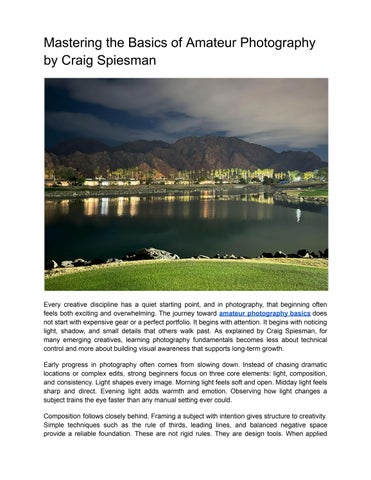
Early progress in photography often comes from slowing down Instead of chasing dramatic locations or complex edits, strong beginners focus on three core elements: light, composition, and consistency. Light shapes every image. Morning light feels soft and open. Midday light feels sharp and direct Evening light adds warmth and emotion Observing how light changes a subject trains the eye faster than any manual setting ever could

Composition follows closely behind Framing a subject with intention gives structure to creativity Simple techniques such as the rule of thirds, leading lines, and balanced negative space provide a reliable foundation. These are not rigid rules. They are design tools. When applied

with care, they help amateur photographers create images that feel deliberate rather than accidental.

Technical confidence grows from repetition Learning how aperture affects depth of field, how shutter speed controls motion, and how ISO impacts exposure builds control over the camera. However, mastery does not come from memorizing settings It comes from experimentation Taking the same photo with different adjustments teaches cause and effect in a direct, practical way. This hands-on process strengthens both skill and intuition.

Another overlooked step in mastering the basics is reviewing your own work critically Professionals refine their craft by studying what works and what does not. Amateur photographers can adopt the same habit Analyze framing choices Notice distracting elements Evaluate whether the image communicates a clear subject Self-review turns casual shooting into intentional development.

Consistency also shapes growth Shooting regularly, even in ordinary environments, sharpens visual sensitivity. Every day, spaces become creative laboratories. A kitchen window, a city sidewalk, or a quiet park bench can all serve as training grounds Over time, this steady practice transforms uncertainty into control

Ultimately, mastering the basics of amateur photography is about building a stable creative platform Strong photography fundamentals support every advanced technique that follows When light, composition, and camera control become second nature, creativity expands. The camera stops feeling like equipment and becomes an extension of vision

Turn static files into dynamic content formats.

Create a flipbook