FY25 General Going Home Fund Impact Report

Page 1


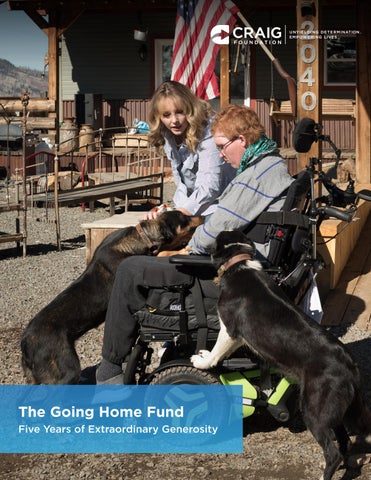
The Going Home Fund

Five Years of Extraordinary Generosity

Your generosity is extraordinary. For the past five years, it has been a privilege to witness the kindness and commitment that so many in our community extend to Craig and to see the difference that compassion makes every single day.

Together, you have helped pave the way home for patients transitioning from the hospital back into their lives—ensuring they have the resources, confidence, and support they need long after they leave our doors. Since its launch in 2021, the Going Home Fund has helped more than 330 individuals safely return to their communities, thanks to the collective generosity of donors like you.

We are continually inspired by the dedication to the Going Home Fund and the way this shared commitment changes lives for Craig patients and their families.

We are pleased to share this impact report with you, highlighting just a few of the many people whose lives have been transformed by this compassion. Inside, you’ll read stories of resilience, healing, and hope—including one patient’s personal journey that powerfully illustrates the farreaching effects of your support.

Your generosity is helping people rediscover strength, purpose, and independence after a lifechanging injury, and we are profoundly grateful.

With sincere appreciation,

ABOUT THE FOUNDATION

As a private, non-profit rehabilitation facility, Craig relies on generous donors to maintain its excellence in helping patients to achieve the best possible outcomes. Craig Hospital Foundation (tax ID #23-7352287) is a qualified charitable organization under Section 501(c)(3) of the Internal Revenue Code that exists solely to support Craig Hospital patients, programs, and research.

The Association for Healthcare Philanthropy recognized the Craig Foundation as a “High Performing” organization in 2016 for showing high efficiency and effectiveness when it comes to bottom-line returns. The Craig Foundation was one of only 51 organizations receiving this recognition.

A (noncomprehensive) list of programs supported:

• Culture of Care programs not covered by insurance, such as:

• Clinical Practice Specialists

• School Program

• Community Reintegration

• Rehab Engineering

• Assistive Technology

• Adaptive Transportation

• Operation TBI Freedom

• Patient Assistance

• Rehabilitative Equipment

• Research on SCI and BI

• Telehealth

Our patient assistance funds help families bridge the enormous gap between their limited means and astronomical injury-related costs. In FY 2025, we distributed $3.1 million in direct assistance to more than 630 current or former patients.

CRAIG HOSPITAL IMPACT IN FY 2025

PATIENTS TREATED

Spinal Cord Injury

Brain Injury

Both SCI/BI

Other Diagnoses

548 Inpatients | 1,387 Outpatients

*Patients admitted and/or discharged

PROGRAM HIGHLIGHTS

THERAPEUTIC RECREATION

Restores richness to lives of people with SCI/ BI by helping them engage in meaningful recreational activity.

975+ Participants

8+ Sessions per patient

92 Adventure Trips

Activities included one-on-one and group sessions at Craig, community outings, and adventure programming.

NEUROLOGIC MUSIC THERAPY

Restores non-musical functions through live-music interventions.

182 Participants

1,225 Treatment hours

Speech & Cognition

Major areas of impact

SCHOOL PROGRAM (2024-2025 ACADEMIC YEAR)

Supports students during their rehabilitation.

42 Students

27 Transitioned back to their schools

28

Graduated high school/earned GED

CRAIG FOUNDATION IMPACT AND OUTCOMES

In combination with Craig’s exceptional physical, occupational, and speech therapy services, Craig’s innovative programs help those we serve get back to living – to work, play, family, and community – after an SCI or BI. Many of these programs are not covered by insurance, and would not be possible without philanthropic support. Your support enables programs and outcomes such as:

NEUROLOGIC MUSIC THERAPY

Uses the clinical neuroscience of music to help individuals achieve functional outcomes in their neurorehabilitation recovery. Scientific and clinical research demonstrates that music affects human cognition, language, motor function, and psychosocial well-being.

THERAPEUTIC RECREATION

COMMUNITY REINTEGRATION

Assesses patients’ capacity to return to productive activity including work, volunteering, or school, and supports their success with education, coaching, and the adaptive technology patients need to be independent and confident.

In FY25, Community Reintegration served 346 participants. Of those for whom this information was relevant (excluding, e.g., current inpatients), 75% returned to productivity; 66% of that group returned to part-time or full-time work; and 88% of those who returned to work went back to their pre-injury employers.

The largest program of its kind in the nation, Therapeutic Recreation sets the standard for hospital rehabilitation recreation programs. Our certified therapeutic recreation specialists introduce or reexpose patients to sports, recreation, or leisure time interests to advance individual treatment and rehabilitation goals of improving, maintaining, or restoring physical strength, cognition, and mobility.

SCHOOL PROGRAM

Empowers young patients to stay on track with their high school education as they move through their individualized rehab therapies at Craig. Students receive support from Craig’s credentialed teachers, both during their inpatient stay and as they prepare to go home, to create a school transition plan to make the return to school as seamless as possible.

In the 2024-2025 academic year, the School Program served 42 teens from 19 states. During the same time period, our teachers helped 27 students to transition back to their schools at home for the first time since their injuries, and 28 School Program alumni graduated high school, joining more than 270 others who had done so in the previous 15 years.

THIS YEAR IN FOCUS: FY 2025 SNAPSHOT

OVERALL PATIENT ASSISTANCE DISTRIBUTIONS

A life-changing injury affects every aspect of a person’s life—physically, emotionally, and financially— impacting both the individual and their family. Each year, more than half of Craig Hospital patients require financial assistance to navigate the challenging aftermath of a spinal cord injury (SCI) or brain injury (BI). The financial strain can be overwhelming, from lost income and long-term medical care to home modifications and transportation needs.

Craig Hospital Foundation’s donor-supported patient assistance funds, including the Going Home Fund, help ease this burden by providing vital relief to patients and families struggling with the financial ramifications of these injuries. In fiscal year 2025, we distributed over $3.1 million to assist more than 630 patients and families.

GOING HOME FUND IMPACT BY THE NUMBERS

At the end of the last fiscal year, $1,288,665.89 remained in the fund. Between October 1, 2024 and September 30, 2025, we had received $151,739.97 in contributions, while distributing $654,465.75 to help patients and families.

During that time, 103 unique patients benefited from the Going Home Fund through 182 distributions, bringing the average amount awarded per recipient to over $6,300. Those who received assistance ranged in age from 15 to 65, and their average age was 36. Of the 103 recipients, 100 had sustained brain injuries.

Your support helped individuals and their families navigate the financial and logistical barriers to returning home after life-changing injuries. The majority of the funds distributed went toward home modifications, with other significant categories including mortgage and rent payments, caregiver support, and transportation assistance.

PATIENT VOICES: FIVE YEARS, MANY STORIES

GOING HOME FUND THE HUMAN IMPACT

Thanks to your generosity this past year, dozens of families experienced meaningful, lasting support. Their stories—among many others—include the following:

A young woman came to Craig after sustaining a brain injury in a motor vehicle accident. Her parents were present during her time at Craig, and experienced a loss of income from not working during this time. Insurance did not approve the patient’s transfer to another facility for continued care, so she was discharged to live with her parents. She requires a minimum of two people for all transfers, and due to delayed equipment delivery, her parents needed additional assistance as they transitioned home. The Going Home Fund covered the cost of in-home care to help ease the transition home, as well as extensive home modifications to ensure she could safely access her home, bedroom, and bathroom. Additionally, by covering mortgage payments for three months, you relieved a huge financial burden for this family during a stressful time of adjustment.

You helped a young man who sustained an SCI and a BI following a motorcycle accident. His parents were by his side during his inpatient stay, and his mother will be his primary caregiver at home. The Going Home Fund supported this family with transportation costs after the patient’s discharge.

A man sustained a brain injury in a recreational vehicle accident. His significant other has been supporting him during his recovery and rehabilitation. You relieved financial burden for both of them by assisting with COBRA payments so that he could remain covered during his continued rehab at a post-acute facility after discharging from Craig.

A young man sustained a spinal cord injury during a diving accident. His mom intends to be his primary caregiver and had to fly to Craig to learn how to best support his needs. She is unable to work and is currently on disability herself. You helped this family with flight costs and transportation assistance, relieving some of their financial burden.

A woman sustained both an SCI and a BI following a motorcycle accident in which her husband was also injured. They have a young child at home, and the financial burden of these injuries eliminated their savings. The family has applied for lowincome housing assistance, but needed support to bridge the gap. You ensured that this family kept a roof over their heads by covering two months of rent as they figured out their next steps.

You helped a young man who suffered an anoxic brain injury. Given his level of injury, he required a wheelchair at discharge and still needed help with activities of daily living. He made great progress at Craig, and will benefit from going to a post-acute facility after discharge to maximize his recovery and independence. Unfortunately, he was terminated from his job after his injury. You had a huge impact on him and his family by supporting COBRA payments to extend his insurance coverage during that crucial time.

You supported independence for a woman who experienced a stroke and came to Craig for inpatient rehabilitation. Her husband has been very present during her rehabilitation and will be her primary caregiver upon returning home. You purchased their flights home, where she will continue outpatient therapies.

A young man sustained a brain injury after being struck by a vehicle as a pedestrian. His parents were very involved in his recovery. While he made progress during his inpatient program, he will remain very dependent upon discharge, which required his parents to make significant modifications to their home. The financial toll on their family since his accident was overwhelming. The Going Home Fund eased their transition home by covering a portion of their home modifications.

A man came to Craig after sustaining a brain injury as a result of a stroke. His daughter left her job to assist in caregiving needs, while his wife was unable to be present full time due to her job. The loss of income created hardship for their family. You provided them with relief by catching them up on their mortgage payments that they had become behind on after the patient’s injury.

A man came to Craig after sustaining a brain injury in a motor vehicle accident. His wife has been present during his rehabilitation, and will be his primary caregiver. She was also injured in the accident, and due to her own shoulder injury and his extended hospitalization she was out of work for too long and her employer terminated her the week before the patient’s discharge. Covering one month of their mortgage payment provided huge financial relief during this time. Additionally, after insurance denied his transfer to another facility, you ensured that they had the necessary modifications to make it safe for him to discharge to their home.

Home Sweet Home: Craig Hospital’s Going Home Fund Creates a Safety Net for Patients and Families

Shortly after returning home, the Ball family not only received a self-turning mattress, but they also received an electric ramp for the front door, a shower chair and an automated bed—thanks to assistance from the Going Home Fund.

“There’s no way we could have managed to buy these devices without the help of the Craig Foundation. It has been a true lifesaver,” Renee says. “In fact, it’s made our life so much easier, and now, Nelson can get stronger at home and begin to progress. I am forever grateful to have our family back together at home.”

“The Going Home Fund helped us purchase a shower slider system so we could make our existing shower and tub accessible,” explains

Gabriel, who had a stroke in late 2021 while working for the U.S. government in South Korea. “We also needed several ramps to help me access the front patio and garage, as well as a grab bar to help me get out of bed and an automatic lift for transfers.”

Without financial assistance, Gabriel’s family would have needed to take out loans to help adapt their home for Gabriel’s wheelchair. “Rehab is the most difficult job I’ve ever had,” Gabriel says. “There are so many things to get used to. You’re thrust back into your home with new equipment, and you need to learn how to do everything in a completely different way. It’s very overwhelming, but Craig is there to help every step of the way. We feel extremely grateful for all of their assistance.”

5 Years of the Going Home Fund Tucker’s Story

The Going Home Fund has come to the aid of many families, including Tucker Mitchell’s. In October of 2020, Tucker also sustained a brain injury as a result of AVM. Tucker and his family traveled all the way from California for rehabilitation at Craig. When it was time to make the journey home three months later, they were fearful of the future. That’s when the Mitchells learned about the Going Home Fund, which covered many of the expenses involved in Tucker’s transition, including vital home modifications and equipment.

Gabriel
Nelson

Blessing After Blessing: The Craig Foundation Supports Patients in Need

The Going Home Fund made a huge difference for Marleen and her family. They needed significant modifications for their bathroom and other areas of the home to make it safe and accessible. These updates provide Marleen’s family with greater independence and smoother care routines, giving them peace of mind as they adapt to their new way of life.

“When we finally got Marleen home, we were so happy to have the new equipment and home modifications in place,” Lorena says. “We did not know we needed any of this stuff—but the team at Craig knew exactly what we needed. There are no words to describe our appreciation.”

Bryan and Tel | The Going Home Fund

A LONG JOURNEY OF HEALING

After spending four months at Craig, 25-yearold Brianna Bauer left the hospital on Friday, May 23, 2025, and headed home to Castle Rock, Colorado.

“We were so happy to be taking Brianna home, but it was a bittersweet day,” recalls Brianna’s mother, Brenda. “We had hoped that Brianna would be able to walk out of Craig on her own, but unfortunately, she couldn’t.”

Brenda adds, “May 23rd was also the same day that Brianna was supposed to be graduating from Pepperdine University School of Law. Instead, she was heading home with us.”

FIGHTING FOR LIFE

It was November 15th when Brianna arrived at a surgical center near her home in Los Angeles for a simple, routine procedure to correct a deviated septum. “Brianna’s goal was to fix her deviated septum in order to improve her sleeping and breathing, especially during exercise,” says Brenda.

Unfortunately, the anesthetics used in the

procedure caused Brianna to have a cardiac and respiratory arrest. Brianna was taken to the hospital where doctors heavily sedated her to reduce swelling and allow her brain to heal. She spent two months in Los Angeles before flying to a long-term acute care (LTAC) facility in Colorado.

“She spent some time in the LTAC because she wasn’t ready for Craig,” Brenda says. “But as soon as she was able to follow simple commands, she thankfully transferred to Craig at the end of January.”

RIGOROUS THERAPY

Brianna’s first month at Craig was spent helping her recover from numerous medical issues, including pneumonia, kidney stones, colitis, and a urinary tract infection.

Once she was healthier, Brianna participated in an intensive physical, speech, and occupational therapy schedule.

“Brianna received five days of therapy each week,” explains Holly Anderson, Brianna’s occupational therapist. “Because her upper extremities were heavily contracted, we worked on managing her tone and soft tissue shortening via stretching, positioning, and splinting. In addition, we worked on various interventions to target arousal and awareness.”

Adds Holly, “Brianna’s family accompanied her to every therapy session, so they could learn how to effectively stimulate her and improve alertness, as well as train on the exercises that she would need to work on at home.”

GOING HOME

When it came time to return home in late May, the Craig Hospital Foundation stepped in to help.

“Accessing funding from the Going Home Fund, we arranged for Brianna to have private nursing for several weeks after discharge to give her parents a little time to settle in to their caregiving duties, and helped purchase a shower chair and a self-turning mattress to help protect Brianna’s skin when she is in bed,” explains Joanah Cruz, Brianna’s Clinical Care Manager.

Donor-supported funds like the Going Home Fund are vital because catastrophic spinal cord and brain injuries can be overwhelming— physically, emotionally, and financially. Expenses

associated with these injuries—often combined with temporary or permanent loss of income on the part of the patient and/or family members who become caregivers—can drive families underwater financially.

However, these funds provide a safety net for patients and families when their financial means, including insurance, are inadequate to meet the financial burdens associated with their catastrophic injury. They provide support for patients and families who need assistance with remodeling their homes for accessibility, training caregivers, making travel arrangements,

paying for medical and dental care, managing financial emergencies, and providing durable medical equipment, such as wheelchairs, lifts, and shower chairs.

Adds Brenda, “Joanah also helped arrange inhome rehabilitation for Brianna with a local agency specializing in brain injury rehab. We really appreciate all of the support we have received from Craig. And since we have been home, Brianna has made a lot of progress. She now responds to voices and touch, answers yes/ no questions, and vocalizes. We feel hopeful for the future.”

THANK YOU

You are truly an inspiration. We are deeply grateful for the generous support that makes Craig Hospital’s mission possible and for the way this community continues to rally together to create lasting impact.

Because of your bold giving, patients featured in this report—and many others—are rebuilding, reconnecting, and reclaiming the parts of life that matter most after spinal cord and brain injuries. Thank you for being an essential part of their journey toward renewed independence and a better quality of life.

If you’re inspired by these stories, we invite you to share this report with others or explore additional ways to stay involved—your continued partnership makes all the difference.

Turn static files into dynamic content formats.
Create a flipbook
Issuu converts static files into: digital portfolios, online yearbooks, online catalogs, digital photo albums and more. Sign up and create your flipbook.