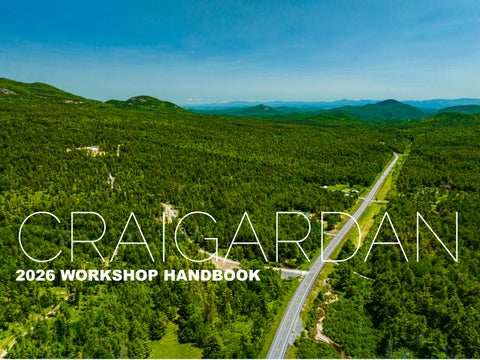
CRAIGARDAN 2026 WORKSHOP HANDBOOK
Welcome From the founding director It is my pleasure to welcome you to Craigardan. This is an exciting time for us as we expand our interdisciplinary programs, support artists and scholars with the time and space to explore their creativity across domains, continue to engage with the Adirondack community, and invest in long-range, sustainable farm design and universally accessible campus construction. I invite you to bring your energy, curiosity, and experience — along with an open mind and collaborative spirit — to your time here. While Craigardan is very retreat-like, it is not at all resort-like. We are a working farm on a developing campus, set within the wildness of nature. Your experience will be similar to luxury camping. In preparation for your residency, please be sure to read this guide thoroughly and often. Communicate with staff in advance if you have questions or concerns; if you need transportation or other assistance; or if you have particular needs that are crucial for your success. We cannot assist you without open, advance communication. While you are here, we trust you to participate in the workshop and to structure your time to meet your needs. You will have the space to explore, create relationships and lifelong connections, gain new knowledge, have access to resources, and receive support and feedback from the community. You will have the option to meet with staff for organizational and artistic support, and we encourage interdisciplinary exploration by providing opportunities to engage in studio, farm, culinary, and intellectual experiences. We hope that you’ll bring a willingness to try new things but also come to share a bit of yourself. We are here to support you and your work, but also to respond to and grow from all that you bring to Craigardan. Each participant’s presence, knowledge, and insight will help to inform this place and the future of our work; planting the seeds for change and growth. Michele Michele Drozd founder, ceramic artist, and executive director
Michele unloading the wood kiln in 2017
Community Agreement Craigardan occupies the Indigenous lands and waters of the Kanienʼkehá:ka people, keepers of the Eastern Door of the Six Nations Rotinoshoni. We acknowledge that the Kanienʼkehá:ka people still safeguard the mountains, valleys, rivers, and lakes as their ancestors had done for millennia. We give our greetings and our thanks to the Kanienʼkehá:ka people and their relatives among the Six Nations for being on their land today. We af rm our obligations to live in balance and harmony with each other. We accept responsibility for deceptive land sales and broken treaties that enabled non-Native settlers to establish this farm now called Craigardan on Indigenous land. And, we commit ourselves to healing the intergenerational traumas of colonization, racial discrimination, and environmental degradation through mutually bene cial alliances with our Indigenous neighbors and all communities of color to build sustainable systems that integrate the needs of human communities with the integrity of the natural world. It is in this spirit of care, accountability, and healing that we come together at Craigardan. We take the safety and well-being of everyone in our community very seriously. As we bring together people with diverse experiences, we invite everyone to come with a spirit of humility, curiosity, and generosity. We recognize that being in community for a period of time is incredibly vulnerable, risky, and rewarding. We ask you to participate, interact, and lead with kindness. As a guest at Craigardan, you are now a participant in our community and will be entrusted with and held accountable to the consensual agreements below. These community guidelines are based on our organizational values, experiences, and input from participants to promote an environment of safety and well-being, while also clarifying our expectations for each other. It is a living document that remains responsive to new experiences and feedback as we grow into a mutually-digni ed, diverse community. Following these guidelines is required of everyone who shares the Craigardan space: staff, board, residents, interns, volunteers, and guests alike. Those who fail to follow these guidelines may be asked to leave. AGREEMENTS: • Lead with kindness. • Honor personal space, belongings, and communicated boundaries of interaction. • Practice care and consent in relationships, interactions, and in using community space. • Respect the buildings, grounds, and natural environment that make up and surround
Craigardan. • Refrain from harmful speech. • Do not misuse intoxicants or put oneself or others in harmful situations. • Respect and practice not assuming the identity and ability of one another. • Maintain a willingness to be held accountable for perceived transgressions or actual harm. • Uphold Craigardan’s values when out in the local community.
fi
fi
fi
A few of Craigardan’s residency alumni
Administration Next Steps Before your workshop can be con rmed, you must read this handbook and complete these next steps: Pay your workshop balance Read, ll in and sign all paperwork, policies, and agreements: Workshop Agreement + Indemnity Medical Form Photo Release Waiver
CANCELLATION POLICY: If a participant needs to cancel after nal payments are made, a fee refund, minus the deposit, may be issued if we are able to ll the vacant spot with another participant. We do our best, but refunds are not guaranteed. Emails To Expect: • Program Welcome: with information and next steps • Workshop Cohort Intro: sent about 4-6 weeks in advance with an opportunity for a zoom Q&A • What to expect on arrival: sent out two weeks before your arrival date with reminders. • Weekly Schedule: sent the Monday of arrival with weekly happenings. • Exit Survey: sent two weeks after your workshop to collect your valuable feedback.
Primary contact info: Main Of ce: 518.242.6535 (call/text) Michele Drozd, Executive Director: michele@craigardan.org Jeremiah Reiner, Program Manager: program@craigardan.org
fi
fi
fi
fi
fi
A Monday Night Dinner feast in 2018
Arrival + Departure **Important!! All workshops participants arrive and depart on Mondays. To build a sense of community, fully support you during your time here, and provide you with the information you need while at Craigardan, we ask all participants to adhere to our Monday arrival and departure. While we understand that life takes unexpected twists and turns and emergencies do happen, out of respect for the program and the other artists in the community, we ask you to plan to stay until the departure day of your workshop.
ARRIVAL: • Participants must arrive between 2pm and 4pm on Monday. Staff takes great care in
planning for your arrival and orientation — please organize your day to arrive during this time-frame and account for traf c and possible delays. • Please arrive rst to the Farmhouse at 9216 NYS Rt 9N, Elizabethtown, NY 12932. You’ll
see our sign for the farm and farm store. Staff will greet you in the farm store. • You will then proceed up to Main Campus where staff will show you to your cabin, and
provide you with a welcome folder of information. Then you will have time to move in, have a snack, wander around, and rest until the 5pm Orientation begins. • After the 5pm Orientation with staff, everyone will gather for the Monday Night Dinner at
6pm. We will kick off the week with our community agreement, do a round of introductions, and relax into a wonderful meal. DEPARTURE: • Please plan to be out of your cabin and studio by 10am on the Monday of your departure. • If you have a car: please bring your laundry bag with sheets and towels down to the
farmhouse to help the staff prepare for incoming artists. • If we are providing you transportation to the train or bus: please leave your laundry bag
on the front porch of your cabin. You may hang out in the Applebarn or Kiln House until our pre-arranged pick up time. • Please be sure to say goodbye! We appreciate knowing your departure plans and don’t
want to miss the opportunity to bid you thanks and safe travels.
fi
fi
The wood kiln building workshop with Sam Taylor and Mark Shapiro in spring 2023
Details Where you’ll be living and working Artist Cabin: your tiny private cabin is equipped with a twin bed, nite stand, clothes rack, and a table/desk with good lighting, outlets, and comfortable chair. You’ll also have a fan, heater, yoga mat, a trash can and a small porch. Studio Space: varies by workshop! the artist cabin is the primary studio for writers and scholars. Clay artists also receive a space in the Clay Barn at the farm. Chefs receive designated studio time in the summer kitchen. All other artists receive private studio space either in the second oor of the Applebarn or the second oor of the Clay Barn. Living Spaces: Shared living spaces on the main campus are in the Kiln House with the professional summer kitchen and dining area; Bath House with four individual, full bathrooms; and the Applebarn with a seating/living area and library. Note that these are shared spaces for program participants, staff, and sometimes community members depending on programming. Laundry: A washer and dryer are available at the Farmhouse for your use from Wednesday to Saturday, 9am - 5pm. Note the Farmhouse is locked at 6pm sharp! Internet: Wireless internet is available in the Farmhouse at the farm and in the Applebarn on the main campus. Wi access may not be available in the artist cabins or all of the studios. Phone: The of ce phone number is 518.242.6535 and is available for your use for domestic calls. Please note there is little to no cell reception on campus, and it may be useful to enable WiFi calling prior to your residency. Please keep phones on silent. Printing: We have a printer available in the Farmhouse for limited printing needs (up to 20 pages). Additional pages will cost $.10 per page. The Keene Valley Library and the Elizabethtown Library have printing facilities to accommodate more substantial printing jobs. Mailing Address: Your Name, c/o Craigardan, 9216 NYS Rt. 9N, Elizabethtown, NY 12932. You are welcome to mail yourself packages in advance of your program.
fl
fl
fi
fi
Setting the Artist Cabins into place, facing the view
Logistics + Costs No surprises while you’re here Personal Items and Supplies: We provide basic household supplies, such as laundry soap, toilet paper, dish soap, and surface cleaning supplies in all spaces. All personal items or supplies purchases, such as shampoo, toothpaste, etc., are your responsibility. Some supplies are available for purchase in our Farm Store, at which you can receive a 10% discount. Meal Preparation: varies by workshop! Most workshops include all meals; self-serve breakfast, buffet lunch, and a prepared dinner. For some workshops you may be responsible for preparing your own meals, individually or as a group. If so, we encourage and facilitate a rotating, team dinner-prep schedule. Please reference your workshop brochure and/or website event page for details. To complement the stocked kitchen + farm share provided for you, you are responsible for purchasing whatever additional specialty items you may need or simply can’t live without (beer and wine, sodas and seltzers, snacks, etc.). The Farm Store is a great resource for additional items (with a 10% discount), plus we are within a 5 to 25-minute drive to larger grocery stores, specialty markets, other farm stores, and farmers markets. Studio materials, shipping, and kiln ring costs: all materials costs and ring fees are included in the workshop price. There are no art supply stores in the region, and we recommend bringing any additional materials with you, or shipping a box ahead of time. If you have artwork to ship home afterwards, you can drop a box off at the USPS in Elizabethtown, or the local UPS pick-up point in Keene Valley. Local Transportation: We do not offer regular transportation into town, but ride-sharing with other residents is easy and opportunities are typically plentiful. However, we highly recommend bringing a car. There is a lot to see and do outside of Craigardan. Bicycles are also a great way to travel the 4 miles into Elizabethtown, or to go back and forth from the farm to the main campus. (uphill!) Uber and Lyft are not locally available. Additional Expenses: Please budget for personal or public transportation to and from Craigardan — including a $40 round trip shuttle fee for the local bus stop or train station. Once here, you might wish to go out to eat, purchase artwork or local goods, or buy chocolate bars in the farm store! Accessibility: Please note that while our new campus is designed to be universally accessible, we will have increasing ability to accommodate speci c needs as the campus is built. If you are living with a disability, please discuss this with staff so that we can work to support you.
fi
fi
fi
Instructor Mark Shapiro loading pottery into the wood kiln
And guest policy It is your responsibility to arrange transportation to and from Craigardan. Staff cannot assist with travel plans or make special arrangements for early or late arrivals to campus. If you arrive in the area before the 2pm check-in time, there is a diner, and library in Keene Valley. In Elizabethtown we recommend relaxing in one of the public parks. If you hit an unexpected emergency and might arrive past the 4pm check-in window, please call the of ce immediately at 518-242-6535. If you need to arrive or depart a day earlier or later, there are excellent accommodations nearby. PLEASE NOTE: To help protect the health of everyone in the cohort we ask you to please wear a mask when taking public transportation or take appropriate precautions during your travel including in plane, train, or bus stations. Find us: Google Maps or other mapping service will bring you to our Farm Store, at 9216 NYS Rt. 9N, Elizabethtown, NY 12932. Look for our roadside sign “CRAIGARDAN FARM STORE” and you might also see some sheep and chickens grazing around the building. If your GPS takes you up a dirt road called Hurricane Mountain Lane, that is incorrect — turn around! Airports: Albany Airport: 2 hours from Craigardan. Rental car, uber, lyft, taxi and bus service available. Please note: while available at the airport, Uber and Lyft are not locally available. Burlington Airport: 1.5 hours - 2 hours from Craigardan (depending on ferry crossing). Rental car, Uber, Lyft and taxi service available. Please note: while available at the airport, uber and lyft are not locally available. Some of these taxi services will pick you up from campus and bring you back to Burlington for a large fee. Adirondack Regional Airport: 1 hour from Craigardan (daily ights to and from Boston (BOS) and NYC (JFK):
The circa 1814 Farmhouse and Farm Store entrance
Avis will deliver cars to Adirondack Regional Airport when prearranged for a fee: 518-561-2348 Car and Driver Services: Polar Express – 518-327-3331 Bus and Train: The Trailways Bus stops daily in Keene Valley, only 10 minutes away. We can arrange to pick you up from there for a at rate fee of $40 round trip — scheduled with staff and paid for in advance. Amtrak: The line between NYC and Montreal is open. The nearest stop is Westport train station and we can arrange to pick you up from there for a at rate fee of $40 round trip — scheduled with staff and paid for in advance. UBER and LYFT are not available locally. Please do not plan on being able to use either service during your residency or for transportation back to an airport, bus, or train station. Local Lodging Options
Adirondack/Vermont Rental Cars 833-RENT-SLK
Keene Valley Lodge - 9 miles away in Keene Valley
fl
Deer’s Head Inn - 4 miles away in Elizabethtown
fi
Rental Cars:
fl
fl
Transportation
Trails End Inn - Located 9 miles away in Keene Valley Bark Eater Inn - Located 9 miles away in Keene There are also state-run campgrounds and KOAs within a short drive. Visitor Policy Visitors are not permitted to stay on campus, but there are plenty of local accommodations available. Daytime visitors are welcome with advance notice, but may not participate in programs that are not open to the general public (including workshops). We ask that all daytime visitors check in at the Farmhouse office first before going up to campus.
What to Bring And what not to bring Clothing: Bring layers! In summer (June-August) the days are hot and the nights are cool. In spring (May-June) it can be hot or quite cool and wet. Fall (September-October) is typically warm during the day and cold at night. What happens from November through April? Winter! Bring clothes for dirty work (studio, farm, etc.), hiking and outdoor activities, and possibly an evening out or two. Bring hiking and/or work boots, sandals, and a bathing suit and towel for swimming holes and waterfalls. In fall choose wool over cotton clothing and lots of insulating layers, including hats, gloves, and insulated coat. We also recommend that you bring slippers or indoor shoes. Remember that we are a working farm in a mountainous landscape. Bring sensible shoes for all conditions. Suggested clothing checklist:
Marlena Murtagh (’23) in her Artist Cabin studio space
Shorts and pants Sweatshirt, rain jacket, and warm coat (even in summer) Work clothes for clay studio or farm Hat, bathing suit, swimming towel Sandals, sneakers and hiking shoes T-shirts and long sleeve shirts Slippers or indoor shoes Ceramic Workshops: Bring all needed personal safety equipment, including respirator, safety glasses, kiln glasses and kiln gloves, and/or hearing protection. Culinary Workshops: Bring closed-toed shoes to work in the kitchen, as well as a hat or other hair covering. Bring your favorite knives, hard-to- nd spices and ingredients, and projectspeci c small appliances.
Personal toiletries including sunscreen and bug spray Charging cords for all personal devices Rain Jacket - Be sure its waterproof All Art Supplies that you might like to have with you We also suggest:
Coffee and tea and various ways to prepare them.
•
Linens: bed sheets, blankets, pillows, and bath towels
Inspiration for your studio such as books or images
•
Yoga gear including mats, blocks, blankets, and straps
Outdoor gear such as bikes, hiking or climbing gear
•
A limited variety of sunscreen and bug spray options
A car!
Do Not Bring: Illegal drugs Weapons Items that you can’t take with you when you leave
fi
fi
fl
fi
REQUIRED for EVERYONE:
Notable items that we supply for you: •
Work shoes Personal studio tools or equipment
We are a working farm! Please leave your pets at home including emotional support animals. Certi ed service animals are permitted. Our farmhouse cat, Alice, will happily provide snuggles. We additionally have a local SPCA that accepts volunteers.
Camera
Personal safety equipment for studios Baseball cap or hat for sun and kitchen
Pets or emotional support animals
Headphones
Craigardan is a 6-mile drive from the small towns of Keene and Keene Valley, a 4-mile drive from Elizabethtown, and a 16-mile drive from Lake Placid. We highly recommend having a car!
Tools + Equipment checklist:
fi
Reliable headlamp or ashlight for unlit paths and hikes
Take note: Ticks and tick-borne diseases are widespread in the Adirondacks. We recommend quick body checks throughout and at the end of each day when working/playing outdoors, especially in tall grass and wilderness areas. Tick remover tools can be found in all rst-aid kits. Bugs and biting insects of all types exist here year-round and will share the outdoor spaces with you. If you are prone to bug bites, plan to wear long pants and long-sleeve shirts and a hat, plus bug spray.
Food + Eating! The most important section Food, farming, food justice, and strengthening our local food system have been at the core of Craigardan since our founding. As one of the rst art centers and residency programs in the world to have a farm or offer a culinary arts residency, we’ve been innovating ways to better explore food and farming as a creative practice for years. So far, we know a few things to be true: 1) food brings people together 2) Good food is good health 3) Responsible farming is an ecological act 4) Farming and cooking is a creative process We use food to build community and to encourage program participants to step outside of their current practice and to participate in a different creative process. We hope that you’ll enjoy cooking and eating together while here. About the summer kitchen: Until the full campus is built, our primary kitchen is in the Kiln House pavilion. A beautiful and professional work space, it is equipped with commercial-grade stainless work tables, three-bay sink, and gas range and oven. It has: Two refrigerator/freezers for resident food storage and the weekly farm share Individual food storage bins for everyone’s personal pantry items A stocked pantry A very large wood- red bread / pizza oven Kitchen equipment: microwave, toaster, food processor, immersion blender, pasta maker, pressure cooker, hand mixer, mandolin, etc. All dishware, cookware, bakeware, glassware, and utensils
fi
fi
fl
fi
fi
Some Craigardan workshops include all meals prepared by staff, and some require participants to prepare their own
Fresh bean harvest from the farm
meals. Please reference the program brochure or event page to nd the meal plan speci c to your workshop.
The stocked pantry: the kitchen is stocked with an inspiring supply including
Typical breakfasts are: coffee or tea with oatmeal, yogurt, fruit, toast, or eggs and veggies.
A variety of cereals, grains, beans, noodles, and pasta
Typical lunches are: Salads, sandwiches, soups or noodle bowls, or vegetable quiche. Fresh baked bread and cookies are plentiful. Typical dinners make use of the farm share, incorporating seasonal vegetables with a variety of grains, beans, or meat. Nightly salads are common, paired with a pasta dinner featuring fresh tomatoes; or tacos with shredded cabbage and radishes and our ground pork or lamb; or rice and beans with zucchini and carrots. Think fresh, local, seasonal, and mostly vegetarian cuisine. Do you have dietary restrictions? It is crucial that you note any food allergies or dietary restrictions on your medical form. It is entirely possible to be vegan or gluten-free here — but we need to know the true limits of your diet to best accommodate you.
baking supplies, sugar, ours (including gluten-free) oils, butter, lard, vinegars, seasonings, and sauces coffee and tea herbs, spices, honey, and maple syrup Popcorn and homemade ready-to-bake treats The farm share: the kitchen is also stocked with a communal share of food produced on our farm and on our partner farms in the region. Depending on the season, the harvest, and availability, it may include various quantities of : A wide variety of vegetables and greens Fruit such as apples, pears, and berries Dairy including local milk and yogurt Bread from one of our local bakers
Meat and Eggs from our farm
Participant often supplement the pantry and farm share with:
Frozen, prepared foods including Pakistani meals, dumplings, tamales, and local pizzas Seltzers, kombucha, natural sodas and organic, fair-trade coffee, tea, and hot cocoa
Snacks like chips, crackers, pretzels or cereal bars
Household items, soaps, and cleaning products
Additional dairy like cheese, or half-and-half
Pottery, of course! Plus, books, woodcraft and Craigardan swag
Chocolate bars or ice cream Seltzer, soda, or alcoholic beverages
What you’ll nd in our Farm Store The store is open from 9:00am - 6:00pm, Monday - Saturday. We stock local, organic, and all-natural products and we subsidize the cost to make quality food more affordable. The store accepts cash, credit card, and EBT / SNAP. Program participants receive a 10% discount.
In addition to our farm store, there is a small grocery store in town and weekly farmers markets. Larger grocery stores are 30 minutes away in Lake Placid. Lastly, we compost! And we’ll ask you to follow our kitchen composting guidelines to reduce waste and help feed our pigs and chickens.
We stock: Seasonal vegetables and fruits from Craigardan and partner farms Local Eggs and meat including chicken, beef, pork and lamb Local cheeses, yogurt, and milk Cottage cheese, sour cream, and other dairy Local ferments, sauces, and salsas granola, cereals and crackers Fresh and frozen bread, tortillas, and baked goods Butter and a variety of oils and vinegars Flours, grains, dry beans, rice, and pastas Sugar, honey, and local maple syrup Packaged snacks, such as crackers, chips, pretzels, snack bars, and chocolate Frozen fruit, vegetables, seafood, and ice cream
fi
fi
Peanut butter, jams, canned sh, ramen, and other lunchtime + dinner options
Top: Raenel Stelly (’21) during her culinary arts residency, Bottom: the Kiln House summer kitchen with an open view out to the mountains
Help Us Help You Shared spaces are cleaned by staff every Monday. In between, it is the program participant’s responsibility to keep their living and studio spaces clean. Cleaning supplies, a vacuum, hand broom, and mop are available for use. Our beautiful wood structures are extremely ammable. Candles and ignitable items are not permitted. There is a camp re ring and a supply of rewood on the main campus for use. This is a working farm; Pets, with the exception of certi ed service animals, are not permitted on the property. Help us preserve and improve soils - parking is permitted only in designated areas, not on the elds or grass next to cabins. Septic systems are fragile; please do not ush anything down the toilet except human waste and toilet paper. Please use all facilities respectfully. Clean up after yourself in the kitchen. Clay and dirt-covered clothes must be pre-washed in a basin before laundering. Dispose of harmful materials and waste according to posted instructions. We are living in the heart of nature in Hurricane Mountain wilderness- be aware that summer storms often come on fast. Be attentive: close cabin and studio windows/doors and help secure items in the kiln house kitchen by completely closing the large sliding doors. Help us keep you safe! When leaving for a hike, bike, or swim, communicate your expected route and return time to someone else on campus before you leave. This is an important safety precaution for anyone recreating outdoors. To be respectful of all residents, quiet hours are 9:00pm - 8:00am. Please be mindful of noise levels and music choices and use headphones in shared spaces. Please keep phones on SILENT overnight and during group activities, classes, and events.
fi
fi
fl
fl
Top L: Michael “Yoko” Amos (’23) with Label. Top R: Chloe Wingerter (’21) in the clay studio. Bottom: our pigs foraging in their woodland pasture. fi
fi
Campus Policies
Our location The Adirondack Park Craigardan is located in a beautiful and very remote area of the six-million-acre Adirondack Park, a protected state park in the North Country of New York. With over 130,000 permanent residents, we are the only such park in the United States that combines human industry with wilderness protections. Craigardan sits on 320-acres of previously logged land that we are nurturing back to health, and is surrounded by large tracts of public and private wilderness areas in a patchwork with small towns and tight-knit communities. This is a mostly white region with communities experiencing both extreme poverty and extreme wealth. Elizabethtown is the county seat, with many public services including the court houses, social services, and an excellent mental health clinic. We have a full hospital, dentist of ces, churches, pharmacy, grocery store, hardware store, liquor store, and dollar store. There are a few restaurants and car mechanics. We are also in the middle of a few multi-use recreational trail networks and one of the oldest golf courses in America. We are 1.5-2 hours from multiple airports, and 15 minutes to a train station and bus stop. Residents of the park carry on a strong tradition of what it means to be Adirondackers — multitalented, self-suf cient, nature-loving people. Here, folks of all ages and backgrounds are doing and creating amazing things while having deep conversations about the future of the park, wild lands and waters, and the vibrancy of our human communities. Local Resources •
Information about our local food system can be found at https://adirondackharvest.com
•
Information about the Adirondack region can be found at https://visitadirondacks.com
•
Information about Elizabethtown, NY can be found at https://elizabethtown-ny.gov
•
Information about Keene and Keene Valley, NY can be found at https:// www.townofkeeneny.com
•
Information about Lake Placid can be found at https://www.lakeplacid.com
•
Read the local news: https://www.northcountrypublicradio.org and https:// www.adirondackalmanack.com
fi
fi
Top L: Sunrise views from Hurricane Mountain. Top R: One of two streams at Craigardan. Bottom: Craigardan’s Community Farm on route 9N towards Spruce Pass
Campus Map Spacial orientation Here in the Adirondacks, opportunities for hiking, biking, local exploration, and swimming provide fresh inspiration (and sometimes necessary distraction). We are located in a stretch of forest off the anks of Hurricane Mountain in-between Elizabethtown and Keene — directly in the heart of the Adirondack Park’s High Peaks region. The Craigardan campus is an ideal location to go outside and stretch the legs and the mind in the largest state park in America. We’ll connect you with the history of this region, and provide you with suggestions to explore off-campus if you have a car — but there are plenty of ways to stay and explore on-campus as well. Our 320 acre property has a developing network of trails, a lookout point, two streams, two entrances, and two separate focal areas: the main campus and the community farm. The main campus: is a 1/2 mile drive or 10-15 minute walk up the property from the farm. Six individual Artist Cabins: insulated with electricity, heat, windows and a fan The Bath House: four insulated bathrooms with on-demand hot water, stall showers and heat Kiln House and professional summer kitchen and dining in an open-air pavilion. Applebarn with rst- oor living space and library, and second- oor studios and our program of ce. The Applebarn has heat but no air conditioning. Glamping Tents: we have a few canvas tents in private wooded locations for deluxe camping accommodations. Each has a twin bed, carpet, solar lights, Anker portable power station, chair, and bins for clothes and personal items. The community farm: is located downhill from the main campus (10-15 minute walk). Farm buildings: greenhouse, sheds, and equipment Vegetable gardens, accessible raised beds, pastures, hen house, and apiary Farmhouse: farm store, main of ce, laundry room Clay Barn with studios for ceramic artists, electric kilns, clay making area and raw materials Note that trails in the Adirondacks (including at Craigardan) are primitive and technical. Walkers and hikers will encounter roots, rocks, uneven terrain, steep hills, stream crossings, and sometimes fallen trees or tall grass. Appropriate footwear is important.
fl
fi
fl
fi
fl
fi
Top: View of Craigardan’s property from the southeast - farm in front. Bottom: view from the northwest - new main campus in front. It’s a 10-15 minute walk between sites.