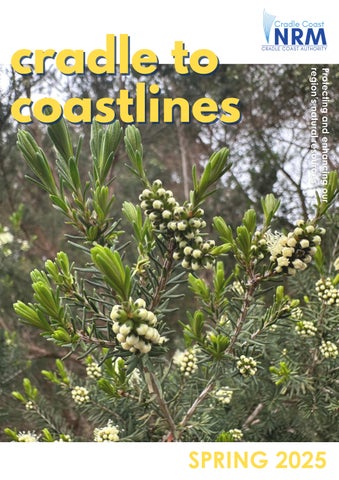
Front cover: Flowering Melaleuca ericifolia at Sisters Creek by Andrew Vocke
Spring Orchids, page 4
National Soil Monitoring, page 14
SAYING HELLO...
Petra Wilden, Weeds Coordinator
Petra is an environmental scientist, educator, and community advocate with over 20 years of experience in Australian ecosystems, including 12 in Tasmania’s Cradle Coast region. She holds a Bachelor of Environmental Science, a Master of Teaching, and is completing a Master of Planning.
Petra has worked across conservation, environmental education, and community engagement, co-founding the Devonport Community Landcare Group and coordinating numerous restoration and volunteer projects
Passionate about biodiversity, sustainability, and local action, she combines scientific expertise with a strong commitment to connecting people with nature and fostering environmentally responsible communities
AND GOODBYE
Ben is finishing up at CCNRM to take on a new role as a Parks and Wildlife Ranger Since joining us in 2022, Ben has made a significant contribution through his diverse roles, including his initial work on our Maugean Skate project, valuable work on our Emergency Response and Preparedness plan, and, finally, as part of our Land team
We’re wishing Ben the very best in his new adventure. His cheerful sense of humour and friendly chats around the office will be missed!
Farewell to Ben Correy
SPRING ORCHIDS
Across the region, Spring is the time to spot most of our beautiful native orchids when they are in bloom (See this handy flowering guide by Mark Wapstra for more details).
This edition, we’re featuring two centres of orchid diversity on the Cradle Coast, and while you may need some expert assistance the first few times you search for these small and cryptic plants, perhaps these photos will inspire you to do some orchid hunting at your next opportunity! But be warned: it’s an addictive sport
The Rubicon Sanctuary is only 20 ha, and located in a humble location amidst farmland at Port Sorrell, but it is a hotspot for orchids and other special species. Twelve threatened plants, one Threatened Ecological Community (Eucalyptus ovata woodland), and several threatened fauna species (such as the Central North Burrowing Crayfish and the Blue-winged Parrot) occur there. It is thought to have the highest concentration of threatened flora in Tasmania!
The property was purchased from the Tasmanian Land Conservancy (TLC)’s Revolving Fund in 2007 by Robin Garnett and Phil Collier, conservationists who then set out to implement a remarkable self-funded and selfdriven land management and monitoring program.
For nearly 20 years (with just a couple of years off), Phil and Robin have counted, measured and kept meticulous records of the flowering, fruiting, germination and growth of individual marked orchids, as well as population-level counts of most f th 60 hid i on the property
In 2018, Robin and Phil passed the property back to TLC, and TLC ecologists now oversee the monitoring and management of the property for its natural values, with ongoing assistance from Phil and Robin. TLC staff have taken on the carefully considered regime of slashing in certain ecological communities and caging individual plants to prevent mammal browsing There is also a program of ecological burns and off-site propagation being implemented, with funding from the Tasmanian Government’s Threatened Species Partnership Grant Program
In November, Threatened Plants Tasmania volunteers and Cradle Coast NRM staff were invited to participate in orchid monitoring, and while most of the counting and measuring was of individual leaves of orchids and not the showy flowers, there were certainly a few species that caught our attention An added bonus of the property is that its wetlands are a haven for EPBC-listed Green and Gold Frog (Ranoidea raniformis) who were out during the day and much easier to spot than the orchids!
While the Rubicon Sanctuary isn’t usually open to the public, a wonderful place to search for orchids in the Cradle Coast is the Arthur Pieman Conservation Area (APCA). This season, orchid enthusiast and administrator of the Tasmanian Orchids Facebook Page, Craig Broadfield, made several pilgrimages to the APCA, where he regularly checks on the status of certain populations, and tracks varieties and unusual phenomena that only a frequent visitor might notice. Thanks for sharing the orchid love, Craig!
CREATURES OF THE CRADLE
Coming into spring, the coastlines of Tasmania serve as the overwintering grounds for a variety of migratory shorebirds Most of these birds migrate along the East Asian-Australasian Flyway (EAAF), an annual migration route stretching from eastern Russia and Alaska down through east and south-east Asia into Australia and New Zealand. Birds which use this route typically breed in the wetlands of Russia, north-east Asia and Alaska during the northern hemisphere summer then migrate south to areas such as Australia to escape the northern winters.
Of the 17 migratory shorebirds regularly sighted in Tasmania, the largest is the Eastern Curlew These birds grow to lengths of 60-66 cm with long legs and a long-curved beak used to probe soft sand and mud in search of burrowing invertebrates Like most of our other migrants, Eastern Curlew are part of the EAAF breeding around Russia and Siberia and then migrating to Australia for the summer. While in Australia, they can be found foraging on intertidal mudflats or sandflats and roosting on sandy spits and islets during high tide Tasmanian populations usually arrive from late August through to December and leave again in February to April In the north-west, Eastern Curlews are most commonly sighted around the Robbins Island and Port Sorrell areas.
Unfortunately, migratory shorebird numbers have gone into decline with Eastern Curlews being especially affected, currently classified as Critically Endangered In Tasmania, their population has declined by over 65% since the 1950s The cause of this decline is most likely the loss of crucial feeding and roosting habitats along the EAAF due to coastal development, particularly in the Yellow Sea. Migratory shorebirds rely on these areas to rest and refuel for their long journeys so their loss can be devastating.
To help Eastern Curlews in our region, the CCA is currently engaged in an Urban Rivers and Catchment project which aims to improve curlew habitat in the Mersey River estuary through control of invasive Rice Grass and reduction of plastic pollution
If you see an Eastern Curlew or any other migratory shorebird, it is important not to disturb them as it may cause them to waste energy they need to store for their migration. Keep your distance and ensure dogs are kept on leashes in known shorebird areas
PROJECT UPDATE: OUR NATURAL ADVANTAGE
The Land Program team have been busy gathering data at our demo sites, delivering presentations and events and meeting some great farmers from right across our region as part of the Our Natural Advantage Project
Check out these photos of some of our project activities!
Building the benefits of biodiversity on farms
Subscribe to the Our Natural Advantage newsletter via the QR code, or visit http://eepurl com/cSWzf1
arn more on the Our Natural vantage project page via QR code, or visit ps://cradlecoast.com/proje /climate-smart-agriculture/
SMALL GRANTS IN ACTION
ROUND 5 RECIPIENTS ANNOUNCED
The Small Grants in Action series aims to highlight the action created by Cradle Coast NRM’s Community Capacity Small Grants program.
Round Five of Cradle Coast NRM’s Community Capacity Small Grants Program is well underway, providing funding and support to local community groups across north-west and western Tasmania to continue their valuable natural resource management (NRM) work both on the ground and through community engagement and education.
A total of $15,000 has been granted across eleven community groups to undertake a range of important NRM activities Tackling weeds is a focus for many grant recipients, including rice grass treatment in Duck Bay, remote area weed treatment along the coastline of the Tasmanian Wilderness World Heritage Area and treatment of willows along the Forth River.
Biodiversity and revegetation are also priorities, with native planting planned at the Community Farm in Oldina and at Sisters Beach Devonport Community Landcare will use their funds to purchase equipment for both revegetation and weed control
Other groups will deliver a combination of community engagement and conservation efforts, with the Ulverstone Community Garden planting native species and providing workshops on the benefits of incorporating native plants alongside edible gardens
The protection of Little Penguins is another focus among the grant recipients. King Island Landcare is developing brochures on Little Penguins on the island, while Penguin Rehab and Rescue in Burnie will purchase cameras to assess the health of recovering penguins for release into the wild without human interaction
Additionally, Keep Cups will be purchased for use at future North-West EcoFest events, completing a full set of reusable crockery for the event’s Waste Not Hub to eliminate single-use plastics.
Cradle Coast NRM wishes to congratulate all the successful groups, including Cradle Mountain Wildcare, the Circular Head Landcare Group, Devonport Community Landcare, King Island Landcare, Live Well Tasmania, the North West Environment Centre, Penguin Rehab and Release, Sisters Beach Wildcare, Wildcare SPRATS, the Ulverstone Community Garden and the Wilmot Willow Busters
For more information or to be connected with one of the community groups to volunteer your time towards one of these invaluable projects, please contact Claire Jinnette, Cradle Coast NRM Engagement Officer at cjinnette@cradlecoast.com.
BIOSECURITY CORNER
FRUIT FLY AWARENESS
Spring brings a higher risk of fruit flies entering Tasmania from mainland states. Biosecurity Tasmania maintains strict controls to protect our fruit fly free status, but community vigilance is also essential
Tasmanians are asked to report any larvae (maggots) in fruit. Store the affected fruit in a sealed container in the fridge and call Biosecurity Tasmania on (03) 6165 3777 for collection. More information is available at www.nre.tas.gov.au/fruitfly.
PROJECT UPDATE:
URBAN RIVERS & CATCHMENTS PROGRAM
On a blustery, cool November afternoon overlooking the Mersey River estuary, Kylie Ashley and Bec Hall attended a CallTrackers event held at Fonterra Dairies, Spreyton.
CallTrackers is one of the Bookend Trust’s initiatives that uses sound recorders for detecting elusive wildlife Clare Hawkins and her colleague Jim Lovell from the Bookend Trust, ran the CallTracker event as part of CCA’s Urban Rivers and Catchments Program project “Improving habitat in the Mersey River estuary for threatened species”.
A group of dedicated, enthusiastic and capable community members were joined by Devonport City Council staff and Drew Grey (Regional Environmental Manager -South) from Fonterra Dairies (Devonport City Council and Fonterra Dairies are URCP project partners) All attendees were keen to learn about the sound recorders, considerations when establishing them in the field, and how to erect them. Even the end-of-day gourmet array of sweet treats offered up by Clare and Jim could not distract them.
The event was a good balance of technical and practical learning, and the benefits derived from using the recorders was clearly evident
If you have any questions regarding CallTrackers, please contact Clare or Jim at hello@naturetrackers.au or go to the website CallTrackers | Our projects | NatureTrackers.
This project is jointly funded by the Australian Government's Natural Heritage Trust under the Urban Rivers and Catchments Program and the Bookend Trust
LOOKING BACK ON SEVEN YEARS OF IMPLEMENTING THE TASMANIAN CAT MANAGEMENT PLAN
As the second phase of the Tasmanian Cat Management Project comes to a close, we thought it was a great time to look back on the work achieved and celebrate our regional successes as a proud host organisation
The first iteration of the project launched in 2018 with a strong focus on relationship building and community education. This phase saw the creation of the statewide TassieCat initiative, as well as the establishment of a regional Cat Management Working Group. The coordinated efforts of this Working Group and the Cat Management Coordinator were instrumental in developing the Cradle Coast Cat Management Strategy 2021–2026 Over the past three years, Phase 2 has built on this foundation with an even greater emphasis on stakeholder collaboration and community support programs.
The Cradle Coast Cat Desexing Program was co-funded by Cradle Coast NRM (via the Tasmanian Government’s Tasmanian Cat Management Project) and participating councils, and delivered through a collaborative effort between the National Desexing Network (an initiative of Animal Welfare League Queensland) and local vet clinics. Seven of the nine councils in the Cradle Coast region took part: Burnie, Central Coast, Devonport, Kentish, King Island, Latrobe and Waratah–Wynyard. The program was oversubscribed, with allocated funding exhausted in some areas within 48 hours Throughout the program’s lifetime, 404 cats were desexed, including 91 that were pregnant or in season. Microchipping was also offered, with 351 cats receiving a microchip.
Community desexing programs remain one of the most effective ways to reduce the impact of domestic cats on biodiversity, agriculture and community health Many families struggle to afford desexing particularly during the current cost-of-living crisis so this project became an important way to remove barriers to responsible cat ownership. The high level of uptake shows that many people want to do the right thing; they simply need support to do so
Following the success of the desexing program, Cradle Coast NRM launched the Cradle Coast Cat Enclosure Subsidy. This initiative was open to the entire region and offered up to $500 towards materials, a contractor, or a pre-fabricated cat enclosure (“catio”). A workshop was also held, with a local builder and vet providing practical advice on what to consider when constructing an enclosure By the end of the program, 40 enclosures had been successfully completed, housing 90 cats 60 of whom had previously been allowed outdoors.
Together, these programs highlight the positive community outcomes that come from supportive, rather than punitive, approaches to improving standards of cat ownership
CRADLE COAST REGIONAL PRIORITY WEEDS
A NOTE FROM PETRA, WEEDS COORDINATOR
Hi fellow weed hunters,
I’d like to introduce myself and the project I’ll be working on through to June 2027 My name is Petra Wilden. I have previously worked as a Regional Coordinator in Adelaide with Trees for Life, and have been actively involved with the Mount Roland Landcare Group as well as founding the Devonport Community Landcare Group.
Over the next year and a half, I’ll be developing a Regional Weed Strategy for the Cradle Coast Region, including King Island, with a focus on 11 priority weed species. This project will rely heavily on collaboration. The existing volunteer and professional networks across the region are vital in helping shape the project’s direction and outcomes, and have the potential to significantly enhance the success of our initiatives Both impacted and non-impacted landholders may also be interested in project activities, particularly in relation to education and management opportunities.
In addition to developing the strategy, we’ll be identifying 25 on-ground sites nominated by our weed community where one or more of the priority weeds are present and where control works will be delivered The Regional Weed Strategy will outline priority weed populations for management, highlight capacity-building opportunities, and recommend best-practice monitoring and evaluation processes. I’m looking forward to working with you all and drawing on the depth of knowledge and experience within this community.
- Petra Wilden, Weeds Coordinator
Learn more about the project on our website:
Scan the QR code or visit https://cradlecoast com/ projects/waf3/ The Cradle Coast Regional Priority Weeds Project is supported by the Tasmanian Government.
NATIONAL SOIL MONITORING PROGRAM
Cradle Coast NRM staff have been really challenged and getting really dirty delivering the National Soil Monitoring Program
The NSMP is Australia’s first nationally coordinated soil monitoring program. The aim of the project is to collect and analyse soils from approximately 3000 sites across Australia to increase our understanding of soil health and trends with relation to climate, land use and land management practices. The program will monitor agreed sites every 5 years over a total of 20 years with the potential to add additional new sites to the network The first sampling phase spans four years from 2024 to 2028.
The National Soil Monitoring Program has been supported by funding through the Australian Government Natural Heritage Trust (Department of Agriculture, Fisheries and Forestry) in collaboration with the Commonwealth Scientific and Industrial Research Organisation (CSIRO) Our Cradle Coast NRM staff are conducting soil chemistry, biology and physics samples at 49 pre-determined sites across the Cradle Coast region, with NRM South coordinating the regional delivery by the three NRM regions across Tasmania
So far our crew have encountered a huge diversity of soils, land uses, landscapes and challenges in delivering the project across the far reaches of our vast and beautiful region
For more information on the National Soil Monitoring program visit: National Soil Monitoring Program.
STRAHAN PRIMARY SCHOOL COMMUNITY CLEAN UP
For the second year in a row, the Healthy Harbour Project hosted the annual Macquarie Harbour Community Clean-up event Cradle Coast NRM has had prominent involvement in the Macquarie Harbour clean-up events since the inaugural event held over 5 days in 2017. As part of the multi-day clean-up, on Friday 14 November, Healthy Harbour Project Officer Jason, assisted by three local community members Dianne, Scott and Lisa, met with staff and students of all year levels at Strahan Primary School.
A discussion was had on the negative impact rubbish can cause on the surrounding environment and township. Students spoke about all the different ways rubbish can end up entangled or ingested by wildlife, particularly around waterways. The students were then tested on their
knowledge of how long it takes 10 common items to breakdown in the environment. They created a ‘decomposition timeline’ by arranging the items in ascending order of the time they take to break down, ranging from a few weeks for an apple core to up to a thousand years for Styrofoam!
They shared their ideas on how to reuse, recycle, and most importantly reduce the items that can end up as rubbish Then it was time to hit the streets The students eagerly grabbed their pick-up sticks and began collecting any rubbish they came across as they walked toward West Strahan Beach. The students' hard work was quickly rewarded while they were walking along the harbour shoreline. A blue-tongue lizard appeared on the sand below to say hello and bask in the much-welcomed sun, no doubt a show of appreciation to the students for having just removed all the rubbish from the swampy paperbark forest it had crawled out from
After regrouping back at Strahan Primary School, thanking everyone for their tremendous effort and environmental awareness, the rubbish was bagged and taken for sorting at the Community clean-up held at West Strahan Beach picnic shelter the following day The Community Clean-up day sees local businesses, industry, community groups and individuals working together as stewards for Macquarie Harbour, helping to ensure rubbish that ends up in the harbour is quickly removed. To reward everyone for their hard work across the two days, a thank you BBQ lunch was provided by the Parents and Friends of Strahan Primary.
As of writing, project staff are still busy quantifying the overwhelming amount of rubbish collected across the two days One item regularly found during the clean-ups is rope A large amount of the discarded rope collected during the 2024 Clean-up event was repurposed earlier this year in Strahan during a beach rope basket weaving workshop with Tasmanian artist Jose Riches, hosted by the Healthy Harbor Project.
This project is funded by the Australian Government's Natural Heritage Trust, Saving Native Species Program and Maugean Skate Program and delivered by Cradle Coast NRM, a member of the Commonwealth Regional Delivery Partners panel.
TIA Forthside Open Day
TIA Future Forum: How does regenerative agriculture impact profit and GHG emissions?