cradle to cradle to coastlines coastlines


![]()


Page 3
Page 4
Page 6
Page 8
Page 10
Page 12
Page 14
Page 15
Page 16
Page 17
Page 18
Page 19
Page 20
Cradle Coast Regional Priority Weeds
Creatures of the Cradle: Marrawah Skipper
Natural capital accounting demonstration
Dung Beetle Exchange
Mapping Fish Barriers
Cat Management
New projects announced to support NW farmers
Saltmarsh research published
Shearwaters on Three Hummock Island
Shorebird survey results
World Wildlife Day news
Community opportunities
Upcoming events and activities

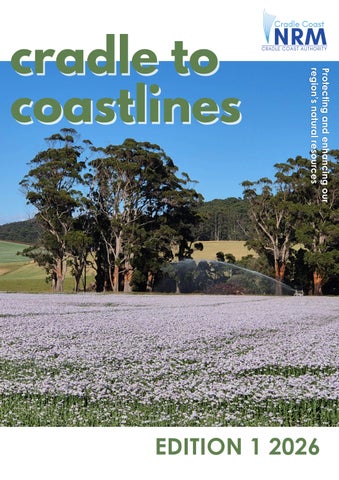
Cover image: Poppies at Boat Harbour
OUR

1-3 Spring St, Burnie Tasmania 7320 03 6433 8400
www.cradlecoast.com www.facebook.com/CradleCoastNRM/
By Petra Wilden, Regional Weeds Coordinator
Firstly, I would like to sincerely thank Council NRM Officers, volunteers, state government stakeholders, and mining companies for the time and effort they have invested in providing valuable input on the current state of weeds across our region
Sea Spurge (Euphorbia paralias)

One of eleven identified priority weeds in the region
The feedback has been frank and, at times, concerning It clearly highlights that weed management is under-resourced, poorly coordinated, largely reactive, and too often focused on planning rather than sustained on-ground action.
Despite these challenges, priority sites are now becoming clearer There is also growing interest in establishing regional weed blitz groups that would work collaboratively across the North-West and West Coast. These groups would support knowledge sharing, strengthen connections between volunteers and organisations, provide opportunities to see and work in different parts of the State, and most importantly deliver meaningful onground outcomes for priority weed sites

The first workshop on the priority weeds will be held on Saturday 14 March at the Ulverstone Rowing Club This event is open to anyone interested in weed identification, management, and control. Landcare Tasmania will facilitate the day, with expert presenter Alex Meiss.
Priority weed species fact sheets will be available, along with practical discussion and learning opportunities.
Additional workshops and field days will follow in partnership with local Councils as the project progresses
The Cradle Coast Regional Priority Weeds Project is supported by the Tasmanian Government
Throughout the summer, Tasmania has been alive with a variety of butterflies which have used the warm long days to feed and reproduce. One such butterfly which calls the Cradle Coast home is the Marrawah Skipper These butterflies only occur in the Cradle Coast region being found in coastal and sub-coastal areas from Penguin to Woolnorth and Marrawah. Within these areas, Marrawah Skippers exclusively live in open damp habitats dominated by Carex appressa, a large native sedge. These plants are critical for the skippers as they make up both their only habitat and their sole food source as larvae.
The lifecycle of a Marrawah Skipper starts as an egg laid on the underside of a Carex leaf. When they hatch, the larvae construct a cylindrical shelter by using silk to tie Carex leaves together. The larvae hide within this shelter during the day and only emerge to feed on Carex leaves at night. From January to February, the skippers finally emerge as adult butterflies Adults are small (25-30 mm wingspan) with rich caramel brown wings with pale yellow spots The adult stage only lasts a few weeks and can be seen on clear, warm, still days when the butterflies make rapid erratic flights around the Carex. They use this time to feed, mate, and lay next yearâs batch of eggs.
Although once common, today the Marrawah Skipper population is small and highly fragmented The primary cause of this decline has been the clearing of their Carex sedgeland habitat Wetland plants like Carex are often seen as undesirable on farmland and are cleared to make room for other land uses such as grazing and recreation. This removes the Marrawah Skipperâs only source of shelter and food. European Wasps may also pose a threat by preying on adult butterflies.
To help protect the skippers, Cradle Coast NRM has applied for funding to improve Marrawah Skipper habitat and control European Wasps We have already begun undertaking some baseline surveys to determine sites where the skipper is present and what the wasp populations are like in the area. Wasp traps in skipper habitat at Guide River collected hundreds of wasps early in the âwasp seasonâ which is concerning. Wasp traps at Barcoo Road were brimming with another invasive species, Large Earth Bumblebees (Bombus terrestris) Scientists believe bumblebees may have an impact on native species too, and in the numbers that we found at this butterfly breeding site, itâs not surprising!
If you would like to support Marrawah Skippers, consider leaving patches of Carex sedgeland undisturbed on your property so that they can continue to provide skipper habitat If you have these patches, keep an eye on them from January to February for adult skippers performing their summer flights. Reporting sightings of the butterflies to the Natural Values Atlas or on apps such as iNaturalist will also help us keep track of their population across the region.
Below: Example of a larvae shelter in a Carex appressa sedge


team undertaking monitoring.
As part of Cradle Coast NRMâs Our Natural Advantage project we are undertaking an on-farm natural capital accounting demonstration at the TIA Dairy Research Facility.
Read on to hear more about how the demonstration is progressing, including what weâre doing, why weâre doing it, and how it relates to north-west Tasmanian farmers.
Key objectives of the demonstration:
Demystify Natural Capital Accounting and demonstrate how it can be used by farmers and industry in north-west Tasmania
Demonstrate and implement targeted management practice to improve environmental health and align with Australian Dairy Sustainability Framework and supplier sustainability aspirations (Fonterra)
Monitor changes over time to track improvements and resilience benefits for farms.
Provide a practical model for farmers to integrate improved natural capital management into their operations
Identify market opportunities, such as biodiversity and carbon credits, to create new revenue streams for farmers
Bring north-west farmers along, so farmers can decide how accounting for and better managing on-farm natural capital could support their farm
What is Natural Capital?
âNatural Capitalâ or âNatural Assetsâ are a re-branding of our natural resources â such as soil, water and living things â so they can be better recognised and valued in an economic sense.
Why are people interested in natural capital accounting?
Did you know that $44 trillion of economic value generation â over half the worldâs total GDP â is moderately or highly dependent on nature and its services and, as a result, exposed to risks from nature loss (World Economic Forum 2020)?
Unfortunately, our natural systems are in decline driven by immense pressure from human activities This nature loss has far-reaching consequences Damaged ecosystems drive up costs, undermine food security and put people and communities at risk
To make good decisions that involve nature, we need to understand how nature supports our economy and wellbeing - which is where natural capital accounting fits in. The world is uniting in developing consistent systems of measuring and accounting for nature in an effort to value, preserve and enhance nature and better integrate into existing economic systems
Project progress
Project commenced February 2025
MOU established (Cradle Coast NRM with TIA, Fonterra and Dairy Tasmania)
Vegetation and soil data collected to establish a baseline Natural Capital Account through Accounting for Nature (AFN) framework
AFN Technical report submitted and reviewed
Identifying and planning on-farm natural capital improvement actions
Delivery of communication resources and extension activities to share demonstration progress
AFN technical report re-submission
Drone mapping of vegetation
Annual weed control of existing vegetation and proposed revegetation areas
Fencing off areas of remnant vegetation, including protecting paddock trees
Planting of at least two new revegetation areas to increase area of native vegetation and improve Giant Freshwater Crayfish habitat
Establish new shelterbelts and agroforestry areas across the property
Deliver communication resources and extension events for farmers and industry in collaboration with demonstration partners and supporters
Re-assess the vegetation condition through with AFN framework autumn 2028 to determine if vegetation condition has improved
Project ends June 2028
A chance conversation with a South Australian beef farmer in June 2022 kick-started a dung beetle exchange program, now in its fifth year Each winter since 2022, farmer Matthew from Reedy Creek (SA) has sent thousands of autumn/winter-active Bubas bison tunnelling dung beetles for introductions on north-west Tasmanian grazing properties. The following summer/autumn, Cradle Coast NRM returned the favour by sending Matthew a similar number of the summer/autumn-active Geotrupes spiniger (âblue bomberâ) dung beetles
Farmer Matthew established B. bison on his property by releasing them in roughly the same place over five years, with the population there now sufficient to trap and send beetles elsewhere. This gave us confidence that if we did the same, we might observe similar results.
Parts of Tasmania have good coverage of three species of smaller, summer-active dung beetles (Onthophagus taurus, Onthophagus binodis and Euoniticellus fulvus), along with the late summer/autumn-active larger Geotrupes spiniger. Winter and spring beetle activity is absent in most of Tasmania, leading to a gap in calendar coverage. We hope to increase winter tunnelling activity by reintroducing B bison to the Cradle Coast region
Following the release of B. bison at neighbouring properties near Ridgley over consecutive winters from 2022, we confirmed the establishment of this species when trapping G. spininger for Matthew in April 2025. We found 10 newly emerged B bison amongst hundreds of G spiniger while trapping, meaning that within three years, a population of B. bison large enough to be observed through trapping had been established Dung pads with prominent beetle excavations were observed on both properties and over the fence on a larger neighbouring beef farm through July

In addition to the two neighbouring sites that have had B. bison released over four consecutive winters, two sites had their second year of beetle releases this winter and, with extra beetles obtained this year, we were able to introduce B bison to a further six sites, bringing the total number of sites to ten.
Sites for B. bison release have been selected using criteria including lower synthetic inputs/organic, soil type, elevation and proximity to the coast. In time, we hope to be able to trap B bison locally and increase the pace of repopulating the north-west grazing districts with this species of dung beetle
With more than 50,000 beetles having been sent one way or another across Bass Straight, we decided it was time to visit farmer Matthew in South Australia and personally deliver some of the dung beetles in the autumn of 2026 Cradle Coast NRM Sustainable Agriculture Facilitator Tom OâMalley will be visiting Matthew to check out his farm and release around 6,000 G. spiniger beetles this March.
As part of the Our Natural Advantage project, weâre keen to learn more about how you value and manage the natural capital on your farm.
From creek lines to shelterbelts and the bush block out the back, ânatural capitalâ encompasses all the natural assets present on your farm. These assets provide important services we donât always think about, such as shelter and shade for stock, reduced soil moisture loss and soil erosion prevention, as well as making our region a beautiful place to live
Share your thoughts with us through our survey and go in the draw to win your very own box of 500+ live Bubas Bison dung beetles, plus a farm visit from our Sustainable Agriculture Facilitator Tom OâMalley.
For your chance to win a box of freshly caught beetles simply complete our Natural Capital survey.
To enter, scan the QR code, visit https://shorturl.at/MocL7 or email landteam@cradlecoast.com for a paper copy
In our last Autumn edition of Cradle to Coastlines, we reported on our work mapping barriers to fish movement across our region This work is funded as part of our Giant Freshwater Crayfish project, funded by the Australian Governmentâs Natural Heritage Trust, and is focused on helping the Australian Grayling, a rare mullet-sized fish which needs to migrate between freshwater and marine areas to complete their lifecycle.

Structures built across waterways, such as weirs, dams and road crossings, can block their migration routes and prevent them from successfully spawning. As a secondary priority, we were also looking into barriers that might prevent our iconic Giant Freshwater Crayfish from moving around the waterways
Since our last update, we have made progress in mapping our regionâs fish barriers. Ecologists from Catchment Solutions in Queensland, have undertaken a satellite-based mapping assessment to identify all possible barriers across the Cradle Coast. Once identified, these barriers were then ranked based on their potential impact on fish movement Using this data, the top 188 fish barriers and top 78 crayfish barriers across the region were identified.
Once the mapping was completed, Cradle Coast NRM staff started driving around to different parts of the region to take a look at these potential barriers At each barrier, staff first assess whether there is actually a barrier present, such as weir or culvert, or whether water flow is unimpeded, such as a bed-level crossing or bridge with no other structures underneath. We take photos and record features of the barriers such as height, structure, and the health of the surrounding waterway. So far, we have surveyed some 90 barriers with plans to survey more before the wet weather returns in autumn.
Once the ground-truthing has been finished, the information will be sent back to Catchment Solutions who will use it to re-score their barrier list giving us a final top ranking of Cradle Coast fish barriers. From this list, a barrier will be selected for remediation planning next financial year.

Sean Willmore has been appointed Biodiversity Program Manager and will oversee the development and delivery of biodiversity initiatives, including our Giant Freshwater Crayfish and King Island Bird Recovery projects.
Sean has more than 30 years' experience in conservation, park management and community engagement at local, national and international levels, having worked in over 80 countries on the ground supporting frontline rangers
He is the Founder and former Director of The Thin Green Line Foundation and served two terms as President of the International Ranger Federation, representing rangers across the globe. His career began as a ranger with Philip Island Nature Parks & Parks Victoria, and also includes experience as an environmental officer with local government
Sean holds a Bachelor of Science from the University of Melbourne and is passionate about strengthening biodiversity outcomes and connecting communities with conservation across the Cradle Coast region.
Cradle Coast NRM Project Officer for the Community Action for King Island Bird Recovery project, Nicky Loane, along with King Island Landcare Group (KI Landcare) Co-Chairs, met with the General Manager and Deputy Manager of King Island Council (KI Council) in January 2026 to discuss ways that CCNRM, KI Landcare and KI Council can work together to improve cat management on the island.
Outcomes of the meeting were positive, with the council keen to work together on these issues and to share community education communications It was acknowledged that stray cats and feral cats are a major issue on the island and have a significant negative impact on King Islandâs wildlife and threatened species.
The CCNRM Community Action for King Island Bird Recovery project, collaborating with KI Landcare has controlled 340 cats in the last 18 months through a cat trap loan program, and 50 cats through the use of four Felixer cat grooming devices in operation on the island. According to research by invasive species specialists, this means that up to 600,000 animals have been protected from cat predation by the program âŚso far! A further 20 cages are being purchased for use in priority habitat areas of King Islandâs critically endangered thornbill and scrubtit (less than 150 left in the world)
A result of this meeting was the development of a King Island specific set of Cat Management Guidelines prepared by the NRM Project Officer.
Other initiatives we are working on include sourcing funding to offer the King Island community another round of a free cat desexing program and exploring ways to establish a cat management facility on the island. This facility would help better manage stray and unwanted cats, preventing them from turning feral and contributing to the feral cat population.

The Department of Natural Resources and Environment (NRE) Tasmania has released the Cat Management in Tasmania â Discussion Paper for consultation and is inviting stakeholders to provide feedback.
A key aim of this discussion paper is to identify key areas for improvement and present potential options that build on the achievements and outcomes of the existing Tasmanian Cat Management Plan
Stakeholders are encouraged to provide feedback on potential solutions, barriers to action, community challenges, and opportunities for improvement
e have submitted a ouncil (with 83 ndicating that the effective cat and with enforcement for e not complying. tters of support f the King Island who work in atened species h examples of roduced on ustralia and Bruny ncil have f this submission meeting. There cussions with managing cats

Over the next three years, Cradle Coast NRM will be supporting Soils for Life to deliver the Dairy Resilience project across north-west Tasmania, in conjunction with other regional partners across Australia, to support dairy farmers to build soil health and climate resilience.
Between 2025-2028, weâll be supporting the delivery of a series of field days, webinars, mentoring sessions, podcasts and practice guides, and establish peer learning opportunities and farm demonstration sites for farmers to share experiences and learn from each other.
If you are interested in learning more, visit www soilsforlife org au/dairy-resilience-project/ or to get directly involved please email landprogram@cradlecoast.com

Carbon that Counts: Unlocking the value of carbon accounting on
Carbon that Counts is working with Tasmanian farmers to build practical evidence on how carbon accounting adds value - whether through cost savings, market opportunities, or better farm management - and to develop useful tools and resources to help you take the first step with confidence.
Results will be shared throughout the project As the project progresses, there will be opportunities to attend events and learn from other farmers and our team of advisors about carbon accounting. Whether the value proposition proves strong, modest, or not yet there, we'll report our findings honestly to help you make informed decisions.
Cradle Coast NRMâs Coastal Saltmarsh Recovery project was supported by the Australian Governmentâs National Landcare Program from 2019 to 2023. One of the main activities was assisting the Circular Head Landcare Group (CHLG) to treat invasive Rice Grass (Spartina anglica).This project was just one piece of the puzzle for CHLG, who have been working on restoring coastal saltmarsh since 2013

Scientists from the School of Geography, Planning and Spatial Sciences at the University of Tasmania have also spent a lot of time wading around in the Circular Head saltmarsh, and now they have a new publication about their work. Dr Vishnu Prahalad led monitoring work for CCNRMâs project, and found that removing invasive Rice Grass from Tasmanian saltmarsh wetlands can lead to strong recovery of native vegetation and improved habitat for fish within just a few years
The study tracked ecological changes following Rice Grass eradication, comparing restored areas with nearby sites to assess how wetlands responded after treatment. Researchers found clear signs that native saltmarsh plants were returning, helping to rebuild the natural structure and function of these important coastal ecosystems.
The recovering vegetation also supported fish habitat. The study recorded a dramatic increase in the use of restored areas by small estuarine fish species, highlighting the role of saltmarshes as nursery and feeding grounds
Dr Prahalad said the findings provide encouraging evidence that restoration efforts can deliver real ecological benefits. âSaltmarshes are incredibly productive ecosystems that support biodiversity, fisheries and coastal resilience,â Dr Prahalad said âOur results show that when invasive species are removed, native systems can bounce back while also restoring fish access.â
The research adds to a growing body of work demonstrating that targeted management actions can help recover degraded coastal habitats, benefitting biodiversity, carbon storage and flood mitigation as well as improving recreational amenities The authors note that long-term monitoring and follow-up treatment remains important, as recovery pathways can vary between sites and environmental conditions.

Rice Grass (Spartina anglica) is a highly invasive aquatic weed that impacts the Mersey Estuary by:
⢠Limiting boat access for fishing and recreation
⢠Preventing shorebirds from feeding and nesting
⢠Outcompeting native saltmarsh
To help protect the health of the Mersey Estuary, spraying began on Tuesday, 10 March 2026, and is expected to continue over the following weeks

The herbicide being used, Fusilade Forte, has low toxicity to fish and shellfish. Spraying will occur at low tide, allowing the chemical to be absorbed directly into the plant, with minimal product entering the waterway.
Please visit the project webpage for more information: www.cradlecoast.com/projects/mersey-river-estuary/
Department of Natural Resources and Environment (NRE) Tasmania staff were on Three Hummock Island in February as part of a state-wide program to test Short-tailed Shearwaters for the presence of H5 bird flu Results are in and it's all clear at the moment
The colonies on the island were busy with thousands of these remarkable birds coming ashore each night, with fish, squid and krill for their growing chicks. The adults and fledglings will be leaving at the end of April. Most will head south to Antarctic upwellings to fatten up before migrating more than 15,000 kilometres to the Arctic for the northern hemisphere summer

During February, shorebird enthusiasts around north-west Tasmania carried out a summer count of resident and migratory waders and terns in February. This is an annual effort coordinated by BirdLife Australia and involves many observers boating, kayaking or walking to far-flung wader roosts on peninsulas and islands between Kangaroo Island in Boullanger Bay in the west to Narawntapu National Park and the Tamar in the east The survey findings confirmed the ongoing decline of many endangered migratory shorebirds from Siberia (including Eastern Curlews, Grey Plover and most sandpiper species), while others, such as Pacific Golden Plover, appear to be holding their own.
Follow-up surveys are being undertaken to check on the productivity of our local breeders, such as Hooded Plovers and Fairy and Little Terns, and to check for colourbanded Double-banded Plovers, the latter currently arriving from their New Zealand breeding grounds. This will be followed by a winter shorebird count, likely in the middle of July 2026.
One of the key outcomes of the February surveys was finding a colony of the threatened Fairy Tern at a mainland site subject to disturbance from people, their vehicles, and dogs CCNRM is collaborating with Tasmania Parks and Wildlife Service, BirdLife, Circular Head Council, and the landowner to secure basic protection for the remainder of the breeding season. Itâs important that we protect the breeding grounds of these and other sensitive shorebirds from direct human impacts given that they already face multiple pressures from rising sealevels, food depletion and predators.

Encouragingly, there is a growing support amongst these groups and many members of the public to collaborate to improve monitoring and protection measures of our shorebirds generally. These initiatives build on recent workshops identifying threats, key locations and actions needed
If you are interested in supporting these projects, please contact Cradle Coast NRM at admin@cradlecoast.com or Ray Pierce at raypierce@bigpond.com.
Local naturalist Craig Broadfield shared some good news on World Wildlife Day:
âThe Heazlewood / WaratahâSavage River Road site home to threatened species including the remarkable Tailed Spider Orchid (Caladenia caudata) and the rare Serpentine Violet (Viola serpentinicola) is to be formally registered as a No Spray Zone, with potential designation as a Roadside Conservation Site.
This outcome did not happen by accident. It followed respectful advocacy, sound science, and community support. I want to sincerely thank everyone who supported my plea to the Department to protect this site those who offered encouragement, expertise, shared information, and stood behind the importance of safeguarding these fragile populations.
The Heazlewood River area, with its unique serpentine geology, supports specialised flora found in very few places. Species like Caladenia caudata and Viola serpentinicola survive in finely balanced conditions. Roadside spraying can have irreversible impacts on such vulnerable plants
Formal recognition of this site as a No Spray Zone is a practical, meaningful step forward.
Conservation is not always about vast wilderness Sometimes it is about a single stretch of roadside where something rare is quietly holding on.â


Written by Dr Jarrah
The Pandani Mothis the only member of theProditrixgenus known outside of Aotearoa/New Zealand, and it has a distinctive ecology. It is the largest species in the Glyphipterigidae family, with the wingspan of adults recorded up to 55 mm. The larvae of the Pandani Moth (and most likely the adults too) feed on the Giant Pandani (Richea pandanifolia), and despite having remarkably large (and purple!) wings, the Pandani Moth has lost the ability of flight Instead the adults have large back legs that they use to 'hop' between the internal fronds of the Pandani.
The group is asking people to keep your eyes on Pandanis when you are out and about, and upload pictures to an iNaturalistproject (will automatically happen if you upload a pic of a Pandani, or either species of moth)


Friends of the Pandani Moth have some epic upcoming trips during the adultsâ flight time (October - January). If you are keen to get involved, join the group by visiting www.wildcaretas.org.au/groups/friends-of-the-pandani-moth
BirdLife Tasmania researchers are seeking data for two projects:
1 Any acoustic recordings or video containing bird calls These will be used to improve the repository of open-access bird recordings for the development of recognisers. Email Ramit Singal for more info. ramitsingal@gmail.com
2. Any sightings of the Endangered Tasmanian Azure Kingfisher (Ceyx azureus diemenensis) Email Charley Gros with any info; he will be deploying acoustic recorders to survey for kingfishers across the speciesâ range. charley.gros@gmail.com
Landcare Priority Weeds Workshop
Enviro-Dynamics Foxglove Weed Workshop
Sheep eID Information Workshop
WHEN & WHERE
landcaretas org au/priority weeds cc 14 March, Ulverstone
18 March, Claude Road events humanitix com/sheffieldfoxglove-workshop
19 March, Ulverstone events humanitix com/sheep-eidinformation-workshop
North-West Ecofest ecofesttas.com.au/ 11-12 April, Ulverstone
Wildcare Tasmanian Nature Conservation Fund Grants wildcaretas.org.au/tasmanian-natureconservation-fund-grants
National Agricultural Land Management Survey srcentre com au/project/nalms/
UVC Wild, the research arm of Ulverstone Veterinary Clinic is looking for help:
As part of UVC Wildâs ongoing research projects, they are looking for help finding deceased bandicoots and quolls to examine and sample.
This includes roadkilled animals. UVC Wild are looking for:
deceased bandicoots (both species) from the Ulverstone urban and periurban area including Gawler deceased quolls (both species) from the north and north-west of the state
If you come across anything suitable, contact UVC Wild by email uvcwild@outlook com, or drop the body into a clinic at 54 Alexandra Road, Ulverstone, or 92b Main Road, Penguin.
Closes 2 April 2026
Closes 12 April 2026

www.cradlecoast.com www facebook com/CradleCoastNRM/