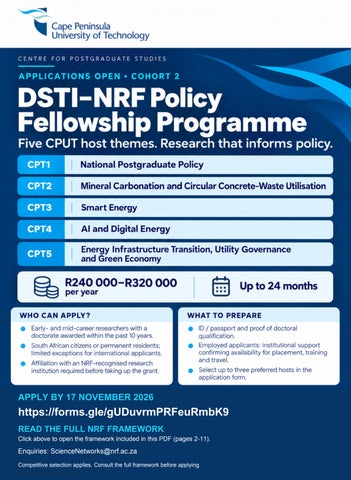
APPLY BY 17 NOVEMBER 2026
https://forms.gle/gUDuvrmPRFeuRmbK9 READ THE FULL NRF FRAMEWORK Click above to open the framework included in this PDF (pages 2-11).
Enquiries: ScienceNetworks@nrf.ac.za Competitive selection applies. Consult the full framework before applying.
DSTI-NRF Policy Fellowship Programme, Cohort 2 (24-month placements)
Framework Document
Department: International Grants and Partnerships (IGP) Date: October 2026
CONTEXT South Africa continues to face complex and interrelated socio-economic and developmental challenges that require responsive, adaptive, and well-informed policy interventions. In recent years, there has been a growing emphasis, both globally and nationally, on the importance of evidence-based policymaking to improve the quality, effectiveness, and sustainability of public policy. This shift reflects the recognition that robust research, data, and analytical capacity are essential to support decision-making processes that respond to societal needs. Despite the country’s strong research base, a persistent gap remains between the production of knowledge and its application within policy environments. This gap is not necessarily due to a lack of research output, but rather to the need for a more structured and sustained engagement between researchers and policymakers. As a result, the potential of research to inform policy and contribute meaningfully to national development is not fully realised. The DSTI-NRF Policy Fellowship Programme is strategically designed to address this challenge by strengthening the interface between research and policymaking. At its core, the programme establishes a dynamic platform through which fellows are embedded within policy environments, enabling them to actively contribute to policy development, analysis, and implementation processes. This approach not only supports evidence-informed decision-making within host institutions but also promotes mutual learning between research and policy communities. The programme further advances the strategic priorities of the NRF and DSTI by promoting transdisciplinary engagement, capacity building, and socio-economic development. It seeks to develop a cohort of skilled researchers who are able to operate effectively at the science-policy interface, contributing to evidence-based solutions for South Africa’s pressing challenges while enhancing their professional trajectories. The Postdoctoral Policy Fellowship pilot programme, implemented in 2024, provided an important foundation in this regard. It demonstrated the value of embedding researchers within host institutions, where they could contribute to policy discussions, analytical processes, and institutional activities. At the same time, the pilot phase highlighted opportunities to strengthen the programme. These include the need for: • • • •
Greater clarity in the definition of roles and expectations; Stronger alignment between fellows’ expertise and institutional priorities; More consistent approaches to supervision and mentorship; and Enhanced coordination and monitoring across placements.
Building on the pilot launched in 2024, the second cohort reflects a more integrated and coordinated programme model. A key feature of this programme is its emphasis on coordinated capacity development and international exposure as an integral part of the fellowship
experience. Through a structured approach to training and global engagement, fellows will be supported to develop the competencies required to navigate complex policy environments, while also gaining exposure to international best practice and comparative policy approaches. This component is designed to complement the local placement experience, ensuring that fellows are equipped with both context-specific insights and a broader global perspective. In addition, the NRF will facilitate a centrally coordinated internationalisation and capacity development component to ensure that all fellows benefit from exposure to global best practice and learning opportunities. OBJECTIVES
•
•
• • •
To place highly capable early-, emerging- and mid-career researchers within policy environments so they contribute directly to policy formulation, implementation and evaluation while gaining applied policy experience. To improve uptake of research evidence in policy processes across priority sectors: energy, climate resilience, health, digital technologies, agriculture/food security, and social development. To build institutional capacity for evidence synthesis, policy analysis, and data-driven decision making. To develop a cohort of researchers skilled to operate at the science-policy interface, with professional development, international exposure and cross-sectoral networks. To promote transdisciplinary collaboration between government, research organisations, industry and civil society.
AREAS OF SUPPORT
The Policy Fellowship is intended to support candidates who will be placed with pre-determined hosts that align with specific thematic areas outlined in the table at the end of the document. The broad disciplines supported are: Science, Technology and Innovation (STI) Policy & Governance, energy, climate change & just transition, digital transformation, AI and emerging technologies, urban development, local government and spatial planning, health, public health, health systems, agriculture, food systems, rural development, environment, sustainability, natural resources, social development, education, human capital, public administration, governance and institutional reform, international relations, science diplomacy and partnerships.
STRUCTURE OF FELLOWSHIP AND PARTICIPATION REQUIREMENTS
The DSTI-NRF Policy Fellowship Programme comprises two complementary components designed to provide fellows with practical experience within host institutions while strengthening their broader competencies in policy engagement, research translation and professional development. Host Institution Placement Fellows will be placed/assigned within approved host institutions, where they will contribute to defined projects, programmes and activities aligned fellowship programme. Fellows will work under the guidance of designated mentors or supervisors and will be expected to fulfil the responsibilities, deliverables and performance requirements agreed upon with their host institutions. Coordinated Policy Engagement and Capacity Development Fellowship participants are required to actively take part in training and exchange programmes organised by the NRF throughout the fellowship. Full-time employees may need to take 9–12 weeks away from work each year to attend. Where possible, the NRF will notify fellows and host institutions of programme-wide engagements and participation requirements in advance to support planning and minimise disruption to host activities. WHO MAY APPLY
The eligibility criteria for the Policy Fellowship are as follows: • •
This opportunity is open to early- and mid-career individuals who earned their doctoral degree within the past 10 years. Only bona fide South African citizens or permanent residents are eligible for the Fellowship. In exceptional, well-justified cases, non-South Africans may also be considered, provided they make up no more than 10% of all Fellowship recipients.
N.B. Applicants must have or be able to secure a formal affiliation be registered or employed (permanent or fixed-term contract) at with a NRF-recognised Research Institution such as Public Universities, Science Councils, Museums and National Facilities in South Africa before taking up the grant.
APPLICATION PROCESS
• • • • •
Applications must be submitted on this link: https://forms.gle/gUDuvrmPRFeuRmbK9 Complete all compulsory sections. Remember to submit your application upon completion. Incomplete applications will not be considered. All applications should be submitted by 17 November 2026. No application will be accepted beyond this date.
APPLICATION REQUIREMENTS
•
•
• •
Applicants should select up to three (3) potential Host. It is advised that the applicants choose hosts that are in close proximity to them as frequent physical presence may be required. Applicants must provide a strong motivation describing the benefits to the applicant and for participating in the programme. The fellowship comprises two complementary components: host institution placement and NRF-coordinated policy engagement and capacity development, successful applicants will be expected to participate in both components. Successful applicants will be required to enter into a performance agreement outlining their responsibilities, expected outputs, participation requirements and reporting obligations. Successful applicants will be required to complete an application on the NRF Connect system for the grant to be released.
COMPULSORY ATTACHMENTS
• •
•
Applicants must attach proof of their doctoral qualification to their application. Applicants who are currently employed must attach written confirmation from their employer or institution indicating support for their participation in the fellowship and their availability to fulfil the required host placement, training, policy engagement and travel commitments. Please attach the required documents in PDF format.
VALUE OF FELLOWSHIP
Successful applicants will receive funding for a maximum period of two (2) years for R240 00000 to R320 000-00 per annum. CONDITIONS OF FELLOWSHIP
•
• •
The grant must be taken up within one (1) month of receipt of the award letter. The award letter and Conditions of Grant (CoG) letter will be available on the awardees’ NRF Connect profile. Carry-over of unspent funds will not be permitted for Policy Fellowships, except under extenuating circumstances, e.g., ill-health, and must be motivated for in writing. The award, if successful, will be explicitly awarded for the stipends of the Fellows.
REVIEW PROCESS
All applications will be screened based on the eligibility criteria and application requirements. Should an application not be eligible, it will be rejected without review. All eligible and appropriately completed applications are subjected to a competitive merit review process, which may include interviews with the potential host institutions. REPORTING
For continuous monitoring of progress, fellows will be required to submit two reports per year, detailing progress against the deliverables outlined in the application form and the signed Conditions of Grant (CoG). The reporting process will take place twice a year, with submission timelines communicated to fellows in advance.
DSTI-NRF Policy Fellowship Host Code and Theme Table Institution Cape Peninsula University of Technology (CPUT) Cape Peninsula University of Technology (CPUT) Cape Peninsula University of Technology (CPUT) Cape Peninsula University of Technology (CPUT) Cape Peninsula University of Technology (CPUT)
City of Ekurhuleni
City of Tshwane (CoT)
City of Tshwane (CoT)
Department od Science, Technology & Innovation (DSTI) Department of Forestry, Fisheries and the Environment (DFFE) Department of Science, Technology & Innovation (DSTI) Department of Science, Technology & Innovation (DSTI) Department of Science, Technology & Innovation (DSTI) Durban University of Technology (DUT)
Theme National Postgraduate Policy Mineral Carbonation and Circular Concrete-Waste Utilisation Smart Energy
Code CPT1
AI and Digital Energy
CPT4
Energy Infrastructure Transiton, Utility Governance and Green Economy Strategic urban governance, spatial systems and municipal capacity Smart city strategy, municipal innovation and urban sustainability Public Sector Innovation, multilevel Governance and decision support Energy innovation renewable technologies and bilateral partnerships Macroeconomic transition, JET-IP alignment and climate finance Global science diplomacy, international alignment and knowledge networks Policy Postdoctoral Fellow
CPT5
Strategic Policy Alignment, DSTI Integration and Stakeholder collaboration Strengthening the Sciencepolicy interface for community-driven
DSTI4
CPT2
CPT3
COE1
COT1
COT2
DSTI1
DFFE1
DSTI2
DSTI3
DUT1
Durban University of Technology (DUT) Durban University of Technology (DUT)
Durban University of Technology (DUT) IYunivesithi Walter Sisulu
National Research Foundation (NRF)
National Research Foundation (NRF)
National Research Foundation (NRF) National Research Foundation (NRF) National Research Foundation (NRF) National Treasury Intergovernmental Relations Division North-West University (NWU)
Property Practitioners Regulatory Authority (PPRA) Rhodes University (RU)
antimicrobial resistance governance Local Government, Multilevel spatial strategy and capacity building Institutional strategy alignment, CPUT integration and academic synergy Digital Ecosystems, technological innovation and institutional capacity Macroeconomic transition, just transition and multiTier stakeholder integration Strategic Policy Alignment,DSI Integration and Stakeholder collaboration National STI governance, science-policy platforms and inter-departmental alignment Societal grand challenges, Education and work Resource Mobilisation
DUT2
DUT3
DUT4
WSU1
NRF1
NRF2
NRF3 NRF4
Future Earth
NRF5
Local Government Systems, Data Integration and knowledge networks Evidence Based Policy, Decadal Plan Translation and Inter-Department Alignment National Science Policy, Decadal Plan Alignment and Stakeholder Mobilization STI Decadal Strategy, Institutional Integration
NT1
NWU1
PPRA1
RU1
Rhodes University (RU)
Sefako Makgatho Health Sciences University (SMU) South African Association for Marine Biological Research (SAAMBR) South African Medical Association (SAMA) Stellenbosch University University of Fort Hare (UFH)
University of Fort Hare (UFH) University of Pretoria (UP)
University of Pretoria (UP)
University of Pretoria (UP)
University of the Fort Hare (UFH) University of the Western Cape (UWC)
and Socio-Economic Inclusion Macroeconomic Science Policy Integration strategic alignment and matrix mapping Public Health Policy, Workplace Mental Health and Healthcare Regulation Strategic land conversion, spatial infrastructure and municipal reform Health Policy and Research Unit Strategic Urban Planning and Institutional Reform Science Policy Networks Grand Challenge Integration and Institutional Oversight Societal grand challenges, Education and work Science Policy Interfaces, Service Delivery and Inclusive Innovation Transdisciplinary innovation, science-policy systems and grand challenges Science-policy platform optimization, digital governance and institutional capacity Inclusive Local Development and Policy Integration Bridging Marine Science and Policy: EvidenceInformed Governance for Marine Pollution, Sustainable Aquatic Resources and Marine
RU2
SMU1
SAAMBR1
SAMA1 SU1 UFH1
UFH2 UP1
UP2
UP3
UFH3
UWC1
University of the Western Cape (UWC) University of the Witwatersrand (Wits) University of the Witwatersrand (Wits) University of the Witwatersrand (Wits) University of Venda
University of Venda
University of Venda (UNIVEN)
University of Venda (UNIVEN)
Conservation in South Africa National STI Integration, Hydrogen Economy and Policy Translation Multilingual Communication and Health Equity Science-policy interfaces, digital governance and capacity building National science-policy, multi-sector coordination and human capital Transdisciplinary rural innovation, indigenous knowledge and regional development National STI Alignment Social Sector Tech and Inter Department Coordination Food security, sustainable food systems and indigenous knowledge integration Innovation-driven local economic development and evidence-to-policy translation
UWC2
WITS1
WITS2
WITS3
UNIVEN1
UNIVEN2
UNIVEN3
UNIVEN4