Newsletter
“
Issue 8 | August 2026
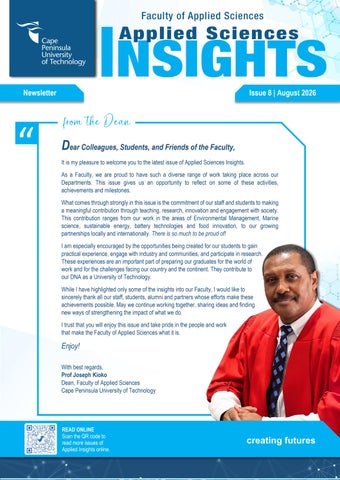
from the Dean Dear Colleagues, Students, and Friends of the Faculty, It is my pleasure to welcome you to the latest issue of Applied Sciences Insights. As a Faculty, we are proud to have such a diverse range of work taking place across our Departments. This issue gives us an opportunity to reflect on some of these activities, achievements and milestones. What comes through strongly in this issue is the commitment of our staff and students to making a meaningful contribution through teaching, research, innovation and engagement with society. This contribution ranges from our work in the areas of Environmental Management, Marine science, sustainable energy, battery technologies and food innovation, to our growing partnerships locally and internationally. There is so much to be proud of! I am especially encouraged by the opportunities being created for our students to gain practical experience, engage with industry and communities, and participate in research. These experiences are an important part of preparing our graduates for the world of work and for the challenges facing our country and the continent. They contribute to our DNA as a University of Technology. While I have highlighted only some of the insights into our Faculty, I would like to sincerely thank all our staff, students, alumni and partners whose efforts make these achievements possible. May we continue working together, sharing ideas and finding new ways of strengthening the impact of what we do. I trust that you will enjoy this issue and take pride in the people and work that make the Faculty of Applied Sciences what it is.
Enjoy! With best regards, Prof Joseph Kioko Dean, Faculty of Applied Sciences Cape Peninsula University of Technology
READ ONLINE Scan the QR code to read more issues of Applied Insights online.
creating futures
Newsletter Issue 8 | August 2026
Table of Contents Faculty of Applied Sciences and collaborators engage on Scientific Autonomy at Africa Day Science Engagement .............. 3 Marine Science Alumni Pioneers a community-based Inland Ocean Awareness Programme.................................................. 6 Driving International Collaboration in Green Energy Research ................................................................................................. 9 4 DEOS Postgraduate Diploma Visit to NGI ............................................................................................................................ 10 Learning Industrial Graphite Beneficiation for Future Battery Recycling ................................................................................. 11 Building International Partnerships Through the Germany Battery Value Chain Study Tour .................................................. 12 CPUT at SAMOS meeting in Brest, France, July 2026............................................................................................................ 13 Strengthening Battery Research Capacity Through Advanced Training ................................................................................. 14 Marine Sciences camp: Learning beyond the classroom ........................................................................................................ 15 Empowering the Next Generation: Dr Mshayisa’s Edible Insect Research Group Celebrates NRF Honours Funding Milestone.................................................................................................................................................................................. 17 CPUT Researchers Strengthen International Scientific Collaboration in Russia ..................................................................... 18 Mr Mashele’s WIL Internship Experience at Premier Foods: A Journey of Growth, Learning, and Opportunity .................... 19 Showcasing South Africa’s Battery Innovation to Parliament .................................................................................................. 20 Making a Difference Through Multidisciplinary Service-Learning in Oudtshoorn .................................................................... 22 CPUT’s Dr Vusi Mshayisa Appointed to SACNASP Council - A Defining Moment for Science and Leadership Excellence .. 24 Department of Environmental and Occupational Studies: Career Day 2026 Report .............................................................. 26 Dr Vusi Mshayisa Positions CPUT at the Helm of Global Edible Insect Innovation................................................................. 27
Closing date for article submissions: 25 September 2026 Submit articles here Any queries:
Editor: Dr Ignatius Ticha Email: tichai@cput.ac.za
2
Newsletter Issue 8 | August 2026
Article 1
Faculty of Applied Sciences and collaborators engage on Scientific Autonomy at Africa Day Science Engagement
On 28 May 2026, the Faculty of Applied Sciences at the Cape Peninsula University of Technology (CPUT), in collaboration with the Directorate for Research Development (DRD), the Centre for Postgraduate Studies (CPGS), and the South African Agency for Science and Technology Advancement (NRF-SAASTA), successfully hosted an Africa Day Science Engagement focused on the theme of scientific autonomy.
The event brought together academics, researchers, students, and partners from across institutions to engage critically with the challenges and opportunities related to the issue of scientific autonomy on the African continent. It also provided an important platform to commemorate Africa Day through meaningful dialogue and knowledge exchange. In her opening remarks, Dr Thandazile Mhlongo (CPGS) highlighted the significance of Africa Day as a moment not only of celebration but also of reflection. She underscored the importance of interrogating the role of science in advancing the continent and emphasised the value of platforms that foster engagement on critical issues such as scientific autonomy. The event was made possible through the support of CPGS and DRD, with funding from the University Capacity Development Grant (UCDG), for which special acknowledgement is extended to Dr Hester Burger. Welcoming participants on behalf of the Faculty of Applied Sciences, Prof Felix Nchu, Research Manager, affirmed that Africa represents a “gold field” of research opportunities. He challenged attendees to reflect on their role in shaping the continent’s future, emphasising that enabling conditions for free and independent scientific inquiry are essential for progress. We extend gratitude to the Dean Faculty of Applied Sciences, Prof Joseph Kioko and the Assistant Dean Prof Rashieda Toefy, for their continued support of initiatives that promote these kinds of engagement and scholarly dialogue.
3
Newsletter Issue 8 | August 2026
The keynote address by Mr Tobi Mzobe of SACNASP provided a thought-provoking exploration of scientific autonomy within the African context. Drawing on evidence from a two-year study, he highlighted systemic challenges affecting educational, professional, and scientific
ecosystems. Importantly, he offered strategic pathways forward, including the alignment of partnerships and the need to centre African systems and priorities in research and innovation. His presentation sparked rich discussion and deep engagement among attendees.
Complementing this perspective, Prof Bongani Ncube showcased the impactful work of the Centre for Water and Sanitation and the SARChI Research Chair in Governance and Economics for Water and Sanitation Sector Institutions. Her presentation illustrated how interdisciplinary collaboration can break down silos and address pressing societal challenges. By highlighting issues such as water inequality in South Africa and demonstrating the value of Indigenous Knowledge Systems, Prof Ncube provided practical examples of how research can contribute to both local and global solutions.
A dynamic panel discussion further enriched the programme, featuring contributions from Mrs Refilwe Mashigo (NRF), Dr Bramley Lemine (UWC), Dr Conrad Sparks (CPUT Centre for Sustainable Oceans), Dr Tony Obilana (Department of Food Science and Technology), and Ms Konele Mbo, a postgraduate student in Chemistry. The panel offered a diverse range of disciplinary and experiential perspectives, addressing both the barriers and possibilities associated with scientific advancement in Africa. They emphasised that achieving scientific autonomy requires not only structural changes but also shifts in mindset, collaboration, and practice. Their insights underscored the importance of inclusivity, innovation, and sustained commitment to unlocking Africa’s scientific potential. The success of the event was underpinned by strong partnerships and active student participation. NRFSAASTA’s longstanding collaboration with the CPUT Faculty of Applied Sciences continues to play a vital role in fostering science engagement. In this instance, their contribution extended to conceptualising the event, with valuable logistical support provided by Mr Simon Ramatse and his colleague, Mr Kgetho Sebake.
Notably, the event saw a strong turnout from students, affirming the importance of including emerging scholars in conversations that shape the future of science and research. Contributions from student leadership, including Mr Lutho Mpithi of the CSRC Transport and Welfare Office, reinforced the principle of “nothing for us without us.”
4
Newsletter Issue 8 | August 2026
The seamless execution of the event was the result of dedicated efforts behind the scenes. Ms Lucille Peterson is acknowledged for her commitment to planning and coordination, ensuring effective collaboration across stakeholders. Appreciation is also extended to Ms Mmasabatha Potsane and the SARETEC team for their excellent support services. The Faculty Marketing and Language Committees are also acknowledged for their role in planning and executing these events. The Faculty also acknowledges the contribution of Mr Rene Frans for designing the striking Africa Day 2026 poster, as well as the Marketing and Communication Department (MCD), particularly Mr Aphiwe Boyce and Mr Eviwe Tom, for their role in promoting and covering the event.
The programme was skilfully facilitated by Dr Vusi Mshayisa and Dr Lusani Vhangani, whose engaging and approachable style added warmth and energy to the occasion. The Africa Day Science Engagement on Scientific Autonomy served as a powerful reminder of the importance of creating spaces for critical dialogue, collaboration, and forward-thinking solutions. It reaffirmed the Faculty of Applied Sciences’ commitment to advancing research that is relevant, impactful, and rooted in the African context. As conversations around scientific autonomy continue, events such as this play a crucial role in shaping a future where African science is not only globally competitive but also locally responsive and self-determined.
Author: Dr Ignatius Ticha
5
Newsletter Issue 8 | August 2026
Article 2
Marine Science Alumni Pioneers a community-based Inland Ocean Awareness Programme Wade Naude graduated from the Marine Science Diploma programme in the Department of Conservation and Marine Sciences in 2022. He wowed the Marine Science WIL panel when, during his WIL interview, he presented his Innovation project titled “Develop and reflect a capacity for marine education in Afrikaansspeaking children at Save Our Seas Foundation Shark Education Centre”.
First-ever clean-up along the Berg River in 2020 Picture by Cindy Winter
To top it all off, Wade was afforded the opportunity to present his work on language in Marine Education to the broader scientific community in 2025 at the 8th Southern African Sharks and Rays Symposium in Makhanda and won the best speaker award. His talk was titled “Decolonising the language and terminology in Marine Education”. During the last year of his studies, Wade co-founded Strandlopers in 2022, a community-based programme that started as a local clean-up initiative along the Berg River in Paarl. His motivation for creating Strandlopers was his early experiences as a student, when he faced significant barriers that inhibited his involvement in marine conservation due to distance and finances. Along with fellow CPUT Marine Science graduate and co-founder, Ciley Sampson, the two continue to organise clean-ups fostering environmental awareness and action in inland communities.
Since then, Wade has flourished in the marine science education and conservation space. After WIL, He was retained by the Save Our Seas Foundation Shark Education Centre, where he was an educator. Wade worked his way up to becoming the Community Engagement Coordinator within the organisation.
In 2024, Strandlopers received its firstgrant from the Nature Connect - Table Mountain Small Grants Fund to implement the Jonk Strandlopers programme the following year. This initiative provided 25 learners from diverse schools in Paarl with exposure to the marine and conservation fields. Participants engaged in hands-on learning about the interconnectedness of water systems, the relationship between marine and fynbos biomes, and Indigenous history and practices within nature. This funding not only supported direct learner engagement but also enabled Strandlopers to scale its community impact through expanded awareness campaigns and clean-up events. “To date, our initiatives have inspired and mobilised more than 600 students, community members, and local groups to take an active role in protecting and preserving our shared water systems.”
Since its establishment, Strandlopers has been dedicated to strengthening the connection between inland communities and the ocean. “Through partnerships with local organisations, schools, and the Cape Winelands Biosphere Reserve, we have successfully hosted clean-ups, educational workshops, and community events that foster environmental awareness and stewardship”, says Wade.
6
Newsletter Issue 8 | August 2026 One of the events hosted in 2025 involved inviting professionals in the marine science field to speak to the Jonk Strandlopers. Wade invited one of his Marine Science lecturers, Dr Koebraa Peters and Luther Adams, a PhD candidate at the University of Western Cape, to expose the scholars to different career opportunities in the field. Wade mentioned how it felt like a fullcircle moment for him to have been taught by Dr Peters and now to be facilitating a session in which he invited her to. Dr Peters indicated that she is immensely proud of both Wade and Ciley and what they have achieved as young marine science professionals. She stated: “I mentored Ciley during her WIL year in 2020 and co-mentored Wade during his WIL in 2022, so it has been such a rewarding experience to see them both grow into not only thriving marine scientists but overall amazing young adults”. Before enrolling in the Marine Science Programme at CPUT, Wade explained that he had never heard of the programme or fully understood what Marine Science involved. This was because he grew up far from the coast with limited access to organisations working in marine science and conservation which meant that opportunities for exposure were rare. During his studies, however, he gained invaluable knowledge and experiences that broadened his understanding of the field.
Jonk Strandlopers doing a hike at Tweede Tol, Bainskloof, where they got to be immersed in the fynbos biome they learned about. Picture captured by Wade Naude
This exposure not only equipped him academically but also inspired him to share what he learned with others in his community. He noted that opportunities like these are often scarce in under-resourced communities, particularly in communities of colour. Through his ongoing Strandloper journey, especially through the Jonk Strandlopers programme, Wade has created the kind of access and opportunity he once lacked, ensuring that young people from similar backgrounds can develop their own connection to the ocean and marine science. Wade declares that the “The Jonk Strandlopers programme is everything I wished I had as a scholar. Growing up as someone who loved nature but wasn’t sporty often left me feeling out of place; there were no clubs for kids like me. That’s why Jonk Strandlopers holds such a special place in my heart. It’s about curiosity, learning, and a deep respect for nature. What keeps me motivated are the kids, the spark in their eyes when they discover something new, their excitement on excursions, and those small moments of connection. Every week, I know we’re planting seeds for a more mindful, caring future,” says Ciley Sampson, co-founder of Strandlopers. One of the Jonk Strandlopers, Tatum Booysen gave a striking review of the programme stating, “The Jonk Strandlopers programme meant so much to me. It opened new opportunities, gave me experiences (and friends) I'll never forget, and helped me connect with nature in a way I never had before.
Jonk Strandlopers snorkelling while holding onto a buoy, facilitated by Wade. Picture by Ciley Sampson
7
Newsletter Issue 8 | August 2026
I also got to meet amazing people and learn things that made me appreciate the beauty and importance of the biosphere even more. It wasn't just about the outdoors, it was about becoming aware, respectful and proud of the natural world we're part of. This programme gave me a space to connect with others, learn about the environment, and discover more about myself.
First education session with grade 6 learners from Dalweide Primary School in Paarl, focused on the interconnected water systems (tailored for inland communities) Picture by Charlton Goedeman
As time went on, the Jonk Strandlopers turned into a safe and welcoming space for me. What went through my mind was that every Saturday I had something to look forward to, like seeing my friends, my mentors and learning something new - whether it was about nature, the environment, the biosphere reserve or even about myself. Every session opened my eyes to things I never noticed before and helped me grow in knowledge and confidence. I'm truly grateful for everything the Jonk Strandlopers programme has taught me, from unforgettable memories and lessons to real friendships and bonds and moments that shaped me. Every opportunity they gave me inspired me to live more consciously, and I'll forever carry the lessons, laughter, and love that this journey brought into my life”.
“As Strandlopers, we envision a world where communities everywhere, regardless of their distance from the ocean understand the importance of natural water systems and share a profound respect for Indigenous knowledge and stewardship” says Wade.
Dr Koebraa Peters sharing her personal and professional journey with the Jonk Strandlopers in September 2025. Picture by Wade Naude
Our mission is to empower inland communities with knowledge about the ocean's significance, the interconnectedness of water systems, and the impact of their actions on these vital resources.
Authors: Wade Naude, Ciley Sampson and Dr Koebraa Peters
Annual World Clean-up Day event in collaboration with our partner organisation, Cape Winelands Biosphere Reserve, attended by over 100 local community members in Paarl. Picture by Bevan Thomas
8
Newsletter Issue 8 | August 2026
Article 3
Driving International Collaboration in Green Energy Research
The Department of Chemistry at the Cape Peninsula University of Technology (CPUT) continues to strengthen its international research profile through the work of Dr Dorcas Zide, whose research focuses on sustainable energy technologies, advanced materials, and the circular economy. On 25 May 2026, Dr Zide participated in a high-level engagement hosted by the ENRICH in Africa Centre in Cape Town, where a delegation from the European Parliament’s Committee on Foreign Affairs (AFET) met with South African researchers, innovation leaders, government representatives, and technology start-ups to explore opportunities for expanding research collaboration between South Africa and the European Union. The discussions centred on strategic initiatives including Horizon Europe and the Global Gateway Strategy, both of which provide significant opportunities for collaborative research, innovation funding, student mobility, and technology development.
Dr Zide and her collaborators from the South African Institute for Advanced Materials Chemistry (SAIAMC), Prof Bernard Bladergroen and Dr Stanford Chidziva delivered a presentation entitled “South Africa’s Green Energy Transition Through Hydrogen, Energy Storage, and Circular Battery Innovation.” The presentation highlighted pioneering research in green hydrogen, lithium-ion battery materials, battery recycling, critical minerals beneficiation, and energy storage technologies. Dr Zide’s participation not only showcased South African research excellence but also strengthened international networks that can create future opportunities for collaborative projects, postgraduate training, student exchanges, and international funding. These partnerships directly benefit CPUT Chemistry students by expanding access to global research collaborations and exposing them to emerging technologies that are shaping the future of sustainable energy. Author: Dr Dorcas Zide/ Chemistry Department
9
Newsletter Issue 8 | August 2026
Article 4
4 DEOS Postgraduate Diploma Visit to NGI
CAPE TOWN — On 16 July 2026, Postgraduate Diploma students (Studying Geographical Information Systems) in the Environmental Management Programme at the Cape Peninsula University of Technology (CPUT) embarked on an educational visit to the offices of the Chief Directorate: National Geospatial Information (CD: NGI) in Mowbray, Cape Town. The fieldtrip was designed to provide the students with an inside look into South Africa's national mapping and geomatics infrastructure, bridging the gap between theoretical lecture hall concepts and world-class, realworld applications. The visit featured interactive briefings and insight into high-resolution land cover products, an exploration of professional training pathways, and a private tour of the historic CD: NGI Museum. By experiencing NGI's photogrammetry, geodesy, and online geoportal workflows firsthand, the students gained invaluable perspectives. Understanding the infrastructure that powers South Africa's geographical data ensures that these future professionals are well-equipped to use, analyze, and innovate with spatial tools in their upcoming careers.
Hand drawn maps and instruments used in the past. By: Thato Mtsweni 221805060
This experience highlighted the technological advancements from traditional tools to such as ArcGIS, QGIS and Google Earth can be used to calculate distance. The whole experience was very informative and enhanced my knowledge of Geospatial Information which I can use in the Geographic Information Systems Module. Special thanks go to the entire CD: NGI team for facilitating this inspiring and educational visit. Author: Andrew Rand, Lecturer, DEOS, FAS
10
Newsletter Issue 8 | August 2026
Article 5
Learning Industrial Graphite Beneficiation for Future Battery Recycling Recognising the importance of linking academic research with industrial practice, Dr Dorcas Zide visited Suntech Geomet Laboratories to observe industrial graphite beneficiation using froth flotation.
batteries. The knowledge gained during the visit will directly support Dr Zide’s ongoing research into batterygrade graphite production and the recovery of graphite from spent lithium-ion batteries.
The visit provided first-hand exposure to bench-scale graphite flotation processes, including sample preparation, mineralogical analysis, rougher-scavenger flotation, cleaner flotation circuits, concentrate upgrading, and metallurgical reporting. Understanding graphite beneficiation is particularly important as graphite constitutes one of the largest components of lithium-ion
These insights strengthen research activities within the Department of Chemistry while creating valuable learning opportunities for students involved in battery recycling, critical minerals beneficiation, and circular economy research. The experience further demonstrates the Department’s commitment to conducting research that addresses real industrial challenges.
Author: Dr Dorcas Zide/ Chemistry Department
11
Newsletter Issue 8 | August 2026
Article 6
Building International Partnerships Through the Germany Battery Value Chain Study Tour Dr Dorcas Zide was selected as one of the South African delegates to participate in the Germany Battery Value Chain Study Tour, organised through the H2.SA II Plus Battery Value Chains Programme, supported by BMZ, the European Union, and GIZ. The programme brought together leaders from government, academia, research institutions, and industry
These visits exposed participants to cutting-edge battery materials research, pilot-scale manufacturing, battery testing, automation, digital manufacturing, recycling technologies, and commercial-scale production systems. For the Department of Chemistry, this study tour represents far more than international exposure. The knowledge and partnerships developed during the programme provide opportunities to benchmark CPUT research against leading international institutions,
to explore best practices across Germany’s internationally recognised battery innovation ecosystem. The delegation visited leading institutions including the Helmholtz Institute Ulm, ZSW, Karlsruhe Institute of Technology (KIT), Technische Hochschule Ulm, Fraunhofer ICT, Fraunhofer IGCV, Fraunhofer IPA, and Exentec.
establish collaborative research initiatives, expand postgraduate training opportunities, and strengthen student mobility programmes. Dr Zide’s participation reinforces CPUT’s growing reputation in battery research while creating future opportunities for students to participate in internationally connected research that addresses global energy challenges Author: Dr Dorcas Zide/ Chemistry Department
12
Newsletter Issue 8 | August 2026
Article 7
CPUT at SAMOS meeting in Brest, France, July 2026 The Department of Conservation and Marine Sciences is part of a multi-national and multi-instructional project called the South African Master of Ocean Science. This is a coursework Masters degree in Ocean Sciences that is a collaboration between 9 South African universities and 3 European ones, sponsored by the European Union through an Erasmus+ grant. The midway project meeting was held in Brest, France, during July 2026 and was attended by three staff members from CPUT, viz. Drs Walker, Puckree-Padua and Johnson. The week-long meeting included input from emerging researchers, workshops on teaching methods, and planning for long-term sustainability of the programme. Many useful collaborations were held with a wide variety of marine researchers from France and Norway. See the link for further information on the Masters’ course. https://samos-edu.eu/dive-into-the-world-of-oceansciences/
13
Newsletter Issue 8 | August 2026
Article 8
Strengthening Battery Research Capacity Through Advanced Training
As part of her commitment to developing highly skilled graduates, Dr Dorcas Zide, accompanied by her Postgraduate Diploma student Asekho Nqumba, were hosted by the Uyilo eMobility Programme at Nelson Mandela University as part of practical knowledge research exchange collaboration for one week from the 1st of June to the 5th of June 2026. The specialised training focused on lithium-ion battery cell manufacturing and provided hands-on experience in assembling and testing CR2032 lithium-ion coin cells using LiFePO₄ (LFP) and Nickel Manganese Cobalt (NMC) cathode materials with graphite, hard carbon, and lithium metal electrodes.
Participants gained practical experience in electrode preparation, glovebox operation, contamination control, electrolyte handling, moisture-sensitive material processing, and battery assembly techniques used internationally in battery research laboratories. This advanced training further strengthens Dr Zide’s battery research programme within the CPUT Department of Chemistry and enhances the practical skills available to postgraduate students working on battery materials, electrochemistry, and energy storage technologies. The knowledge acquired will be integrated into student research projects, contributing to the development of a highly skilled workforce capable of supporting South Africa’s emerging battery manufacturing industry.
Author: Dr Dorcas Zide/ Chemistry Department
14
Newsletter Issue 8 | August 2026
Article 9
Marine Sciences camp: Learning beyond the classroom
In February 2026, the Department of Conservation and Marine Science’s second- and third-year students headed to Habonim for three days of immersive, hands-on learning in Hermanus. This annual camp once again provided students with the opportunity to connect theory to practice while experiencing some of our province’s most beautiful marine and coastal environments. On the first day, second-year students began with a visit to Abagold, gaining insights into sustainable abalone aquaculture. The group was guided through the facility by one of our alumni, Bradley Swanepoel, alongside two of
Second-year students snorkelling at Hermanus Tidal Pool
our students who completed their WIL placement there in 2025 and have since continued in their roles. Seeing former and current students thriving at this important industry partner motivated the group to visualise and consider the diverse pathways into marine science careers. Meanwhile, the third-year students explored cetacean conservation at the Whale Museum in Hermanus, with additional birding activities along the way. The groups later met at Habonim Campsite, where the third-year students continued with YSI water quality measurements in the Onrus River Estuary after settling in and enjoying a short swim.
Third-year students at the Whale Museum in Hermanus
15
Newsletter Issue 8 | August 2026
On Thursday, the second-year students visited the Shark Conservancy in Hermanus. Here, they learnt more about South Africa’s role in developing sustainable management approaches and conservation objectives for sharks and coastal ecosystems. Despite a dull and rainy start to the day, students were still able to complete a short snorkelling training session and explore the Hermanus tidal pool. The third-year students had a busy day visiting various industry partners in Gansbaai. They visited the White Shark Project, where they explored shark and broader marine ecosystem conservation initiatives. Afterwards, they were welcomed to Marine Dynamics African Penguin and Seabird Sanctuary, which provides temporary care to diseased, displaced, injured and oiled marine birds. Students were introduced to a range of conservation management plans, with a particular focus on the critically endangered African penguin. The programme continued at Taurus Cape Kelp, where students were exposed to industry applications of kelp and other algae, including ethical harvesting, processing procedures and operational protocols.On Friday, while the third-year students returned to CPUT, the secondyear students visited Stony Point. There, they walked along the boardwalk to view the African penguin colony and attend a conservation talk hosted by Cairestine Lottring, another CPUT alumna. By the end of the camp, students had engaged with a range of industry partners and marine environments, deepening their understanding of ecosystem connectivity, conservation challenges and applied management practices. Importantly, several of the activities undertaken during the camp form part of their subject assessments, requiring students to reflect on, analyse and apply the field data and industry insights gained during the camp.
Second-year students at Shark Conservancy
Author: Dr Courtney Puckree-Padua
Third-year students at Taurus Cape Kelp in Gaansbaai
16
Newsletter Issue 8 | August 2026
Article 10
Empowering the Next Generation: Dr Mshayisa’s Edible Insect Research Group Celebrates NRF Honours Funding Milestone
A proud moment recently unfolded in the Department of Food Science and Technology, where a group of final-year students under Dr Vusi Mshayisa’s supervision secured the prestigious National Research Foundation (NRF) Honours Scholarships for 2025. “This is a moment of joy and relief,” said Dr Mshayisa, an NRF-rated researcher and mentor to the cohort. “These students are more than deserving. We worked tirelessly to ensure their applications reflected excellence.” The success follows a structured mentorship initiative launched by Dr Mshayisa in 2024, with support from Ms Mthebukazi Sibindlana of the Centre for Postgraduate Studies. The programme guided third-year students stepby-step through the NRF application process, from profile creation to motivation writing, ensuring no detail was overlooked. “I believe in a high-performance supervision model built on discipline, structure, and vision,” added Dr Mshayisa. “Now that financial barriers have been lifted, the focus can return fully to research.” Several recipients are members of the Edible Insect Research Group, a pioneering team exploring insects as sustainable protein sources for future food systems. Their work aligns with South Africa’s priorities on food security
and circular bio-innovation. “The hunger for success I see in this cohort is rare,” said Mshayisa. “They are curious, committed, and passionate about science. Within the next year, I expect breakthrough results.” Scholarship recipient Philasande Ngxishe expressed gratitude: “Thank you for helping us apply for the NRF. Most of us have been accepted. Your guidance and belief in us mean a lot, you’ve been a true role model.” The 2025 NRF Honours recipients are: Philasande Ngxishe, Phathutshedzo Netsianda, Thabile Biyela, Thembisile Nkosi, Neo Mchunu, Jabulile Tinzi, Lebogang Manyoga, and Nombulelo Nyamayaro Madzimbamuto. This achievement reflects what is possible when leadership, mentorship, and national priorities align. Through initiatives like the Edible Insect Research Group, DFST is nurturing the next generation of scientists driving sustainable food innovation.
“We’re not just supervising students,” Dr Mshayisa concluded. “We’re shaping the researchers and leaders of tomorrow.” Author: Dr Vusi Mshayisa
17
Newsletter Issue 8 | August 2026
Article 11
CPUT Researchers Strengthen International Scientific Collaboration in Russia Continuing the Department of Chemistry’s commitment to international research excellence, Dr Dorcas Zide led a month-long research and knowledge exchange programme at the Joint Institute for Nuclear Research (JINR) in Dubna, Russia, accompanied by her students Asekho Nqumba (Postgraduate Diploma candidate) and Siyasanga Fongoma (2025 Work-Integrated Learning graduate). The exchange programme provided an outstanding platform for strengthening international scientific collaboration while exposing both staff and students to
A particularly significant outcome of the programme was the opportunity for CPUT students to gain international research experience early in their careers. Exposure to world-class research environments broadens students’ scientific perspectives, strengthens their technical competencies, and enhances their competitiveness for postgraduate studies and careers in academia, research, and advanced technology industries.
advanced research infrastructure, world-class analytical facilities, and internationally recognised researchers. Throughout the exchange, the team participated in collaborative scientific discussions, laboratory-based research activities, and knowledge exchange sessions focused on advanced materials science and sustainable energy technologies. The visit also created opportunities for future collaborative research projects, postgraduate supervision, international funding proposals, and student and staff mobility between CPUT, JINR, and other international partner institutions.
Through initiatives such as these, Dr Dorcas Zide continues to position the CPUT Department of Chemistry as an active contributor to global scientific collaboration while developing the next generation of scientists equipped to address challenges in sustainable energy, advanced materials, and the circular economy.
Author: Dr Dorcas Zide/ Chemistry Department
18
Newsletter Issue 8 | August 2026
Article 12
Mr Mashele’s WIL Internship Experience at Premier Foods: A Journey of Growth, Learning, and Opportunity The Department of Biotechnology and Consumer Science is proud to witness our students apply their academic knowledge in real industry environments. Mr Mashele, one of our standout students recently completed a successful Work-Integrated Learning (WIL) internship with Premier Foods, an experience that not only strengthened his professional abilities but also led to a permanent position within the company.
During the internship, Mr Mashele gained extensive exposure across multiple departments at Premier Foods. His responsibilities ranged from conducting flour tests in the Quality Control Laboratory to performing online inspections in the packing department, assisting in grain intake operations, monitoring warehouse conditions, and supporting logistics and depot activities. He also carried out pest control checks, foreign body inspections, and participated in weekly health and safety presentations. This multi-departmental rotation offered him a complete understanding of the production chain from the arrival of raw wheat to the dispatch of packaged flour. Mr Mashele notes that he is most proud of his growth in confidence, independence, and communication, especially through presentations and his Quality Control responsibilities. His WIL experience played a crucial role in securing his job and shaping his understanding of the food industry. It taught him accountability, adaptability, and the importance of clear communication skills that he will carry with him throughout his career at Premier Foods. He advises future WIL students to take initiative, remain professional, and treat the internship as an opportunity to prove themselves. What set Mr Mashele apart was his strong work ethic, excellent punctuality, consistent attendance, thorough documentation, and initiative in handling tasks independently. His weekly presentations further showcased his confidence and ability to communicate technical information clearly. Following a successful interview and assessment, he was offered a permanent
position as a Packing Quality Attendant. This role involves daily Quality Control checks, product testing, deviation reporting, maintaining hygiene standards, capturing LIMS data, and supporting audit responsibilities for which he is well-prepared thanks to his WIL experience. Looking ahead, he aims to deepen his knowledge in Quality Assurance and eventually grow into leadership roles such as Head Miller or Risk Manager. The Department could not be prouder of Mr Mashele’s dedication, growth, and achievements. His success is a testament to the value of experiential learning and the strong partnership between academia and the food industry. The Department is confident that he will continue to excel and make meaningful contributions to the food manufacturing sector. Author: Mrs T Govender
19
Newsletter Issue 8 | August 2026
Article 13
Showcasing South Africa’s Battery Innovation to Parliament Dr Dorcas Zide played a leading role in showcasing South Africa’s growing battery research capabilities during the visit of the Parliamentary Portfolio Committee on Science, Technology and Innovation (PPC-STI) to the University of the Western Cape. During the visit, Dr Zide presented an overview of the Department of Science, Technology and
Innovation (DSTI) Energy Storage Research, Development and Innovation (ES RDI) Flagship Programme. She highlighted ongoing initiatives in lithium-ion battery manufacturing, battery recycling, localisation of battery technologies, infrastructure development, and human capital development.
Following the presentation, members of Parliament toured the Energy Storage laboratories, where Dr Zide’s ten WorkIntegrated Learning (WIL) students, together with their industry supervisors and mentors, demonstrated battery cell assembly, battery pack development, battery recycling technologies, and advanced testing facilities.
20
Newsletter Issue 8 | August 2026
The visit showcased the impact of Dr Zide’s supervision and mentorship in preparing students with industryrelevant skills while highlighting the Department of Chemistry’s growing contribution to South Africa’s battery
value chain. Through her leadership, students gained practical experience in internationally relevant research areas that position them for careers in academia, industry, and the rapidly expanding clean energy sector.
Author: Dr Dorcas Zide/ Chemistry Department
21
Newsletter Issue 8 | August 2026
Article 14
Making a Difference Through Multidisciplinary Service-Learning in Oudtshoorn: CPUT Award Ceremony The Department of Biotechnology and Consumer Science continues to make a positive impact through its multidisciplinary Service-Learning (SL) projects in Oudtshoorn. These projects brought together lecturers, postgraduate students, local businesses, and community members to work on real challenges while creating valuable learning opportunities for students. The initiative was led by Dr Maxwell Mewa and Dr Boredi Chidi from the Faculty of Applied Sciences. Their goal was to combine teaching, research, and community engagement to address important issues affecting the local community. Students from the Postgraduate Diploma in Biotechnology participated in the projects as part of their Research Methods and Project module. In 2024, the project focused mainly on water quality awareness and environmental monitoring. Students worked closely with community members to share information about the importance of clean water and ways to prevent water contamination. Water, soil, and agricultural samples were collected and analysed to better understand environmental conditions. The findings were then shared with the community to help them make informed decisions regarding the use of water for domestic and agricultural purposes. Through this process, students gained practical experience in data collection, analysis, validation, and reporting while contributing to community development.
Building on the success of the 2024 project, the 2025 multidisciplinary Service-Learning project expanded its focus to include food safety, water suitability awareness, and sustainable leather tanning. Students worked directly with local food vendors and small businesses to understand their challenges and identify practical solutions. Community workshops were conducted to promote safe food handling practices and improve awareness of water quality issues. These activities aimed to reduce health risks
and improve the quality of products and services offered within the community. Another important part of the project was supporting the local ostrich leather industry. Students and lecturers introduced low-cost and environmentally friendly tanning techniques that could help improve product quality while reducing environmental impact. This engagement demonstrated how science and innovation can support local economic development and create sustainable opportunities for small businesses.
22
Newsletter Issue 8 | August 2026 The multidisciplinary nature of the project was one of its greatest strengths. By working across different fields and collaborating with various stakeholders, students developed problem-solving, leadership, communication, and teamwork skills. The projects allowed students to apply classroom knowledge in real-life situations while making a meaningful contribution to society. Community members also benefited from the transfer of knowledge and practical recommendations provided through the programme. The success of these projects was recognised through a CPUT Service-Learning Award. Dr Boredi Chidi proudly received the award on behalf of the project team, which included Drs. Maxwell Mewa (Biotechnology), Elie Tombo (Environmental Management), Zandisile Mkubukeli (Faculty of Informatics and Design-Applied Design), and
Oudtshoorn Service Learning in action and results
the Postgraduate Diploma in Biotechnology student groups of 2024 and 2025. The award recognised the collective effort, commitment, and positive impact of everyone involved in the initiative. This achievement highlights the value of collaboration, community engagement, and experiential learning. It also reflects the commitment of the Department of Biotechnology and Consumer Sciences to producing graduates who are not only skilled professionals but also responsible citizens who contribute to society. As we celebrate this recognition, we thank all community partners, students, lecturers, and the Department of Biotechnology and Consumer sciences management who contributed to the success of the Oudtshoorn ServiceLearning projects. Together, we have shown how university-community partnerships can create meaningful change, improve lives, and build a better future for all.
Dr. Boredi Chidi receiving service-learning awards (2024 and 2025) on behalf of the multidisciplinary Service-Learning team
Authors: Drs Boredi Chidi, Maxwell Mewa
23
Newsletter Issue 8 | August 2026
Article 15
CPUT’s Dr Vusi Mshayisa Appointed to SACNASP Council A Defining Moment for Science and Leadership Excellence In a move that underscores the Cape Peninsula University of Technology’s growing influence in national science and innovation, Dr Vusi Mshayisa, Senior Lecturer in the Department of Food Science and Technology and NRF Y2rated researcher, has been appointed by Prof Blade Nzimande, Minister of Science, Technology and Innovation, to serve a four-year term on the Council of the South African Council for Natural Scientific Professions (SACNASP). Dr Mshayisa declared that “This appointment is a significant milestone not only for me personally but also for our Department, the Faculty of Applied Sciences, and CPUT as a whole.” “It positions us firmly within South Africa’s science, technology, and innovation ecosystem.”
SACNASP is the statutory regulatory body overseeing natural science practitioners in South Africa, ensuring that professionals uphold scientific integrity, ethical conduct, and accountability. “It safeguards the credibility of science in our country, just as doctors or engineers answer to their professional councils,” explains Dr Mshayisa. “SACNASP is the guardian of trust in science, ensuring that it serves society with rigour and responsibility.” Prof Marshall Sheldon, Deputy Vice-Chancellor: Research, Technology Innovation and Partnerships, commended the appointment, describing it as “a powerful affirmation of Dr Mshayisa’s dedication to scientific excellence and leadership in advancing research for societal good.
“
“
the appointment reflects both personal distinction and institutional strength.
” We are proud of his accomplishments and confident that his expertise will enrich the Council’s contribution to national science policy,” she said. Prof Joseph Kioko, Dean of the Faculty of Applied Sciences, echoed this sentiment, noting that the appointment “reflects both personal distinction and institutional strength.” “Dr Mshayisa’s recognition at the national level is a great credit to the Faculty and the University. His contribution will be invaluable in shaping the direction of natural scientific professions and their impact on national development,” Prof Kioko affirmed. Dr George Charimba,
24
Newsletter Issue 8 | August 2026
“
Dr Charimba added. Known for his groundbreaking work on edible insects as sustainable protein sources, Dr Mshayisa leads CPUT’s Edible Insect Research Group (EIRG) and has positioned the institution among global leaders in sustainable food innovation. His research integrates indigenous knowledge systems, advanced food processing, and global sustainability goals, offering scientific solutions to hunger and food insecurity.
resilience, consistency, and collective effort
Reflecting on his journey, he attributes his success to “resilience, consistency, and collective effort.” “The foundation of any achievement lies in mentorship and collaboration, from the guidance of our Head of Department and Faculty leadership to the commitment of my students. They are the true drivers of impact. This milestone represents a shared vision, not an individual triumph.” As Departmental Curriculum Officer and mentor to emerging scientists, Dr Mshayisa views this national appointment as a platform for service rather than status.
“
Acting Head of Department: Food Science and Technology, congratulated Mshayisa, stating that his “appointment affirms not only his excellence in research and teaching but also his broader influence in championing alternative proteins, academic leadership, and scientific innovation. This recognition arrives as the Department is still celebrating Dr Mshayisa’s 2025 National University Teaching Award, a rare dual honour reflecting his impact across both teaching and research,”
“Leadership is not about titles but about ensuring that others, especially younger and emerging scientists, are represented at the highest levels,” he reflects. “It is proof that CPUT belongs at the heart of national science and policy conversations.” He emphasises that this new role deepens his resolve to strengthen the bridge between science, society, and the next generation of innovators. “My goal is to ensure that science is not confined to laboratories but contributes meaningfully to communities and the nation’s development agenda.” Author: Dr Vusi Mshayisa
25
Newsletter Issue 8 | August 2026
Article 16
Department of Environmental and Occupational Studies: Career Day 2026 Report
The Department of Environmental and Occupational Studies participated in the Career Day 2026, hosted by the Western Cape Department of Health and Wellness on 15– 16 July 2026 at the Western Cape Sport School in Kuilsriver. The event aimed to expose learners and interns to various career paths and employment opportunities while assisting them in making informed career choices. Approximately 2,000 learners and interns attended the two-day exhibition. The Department was represented by Dr Daries, Mr Ntyatyambo Mavuso, and two representatives from the Western Cape Government (Stanley Nomdo and Gomolemo Ndlovu). Our primary role was to provide information about the Environmental Health and Environmental Management programmes offered by the Cape Peninsula University of Technology (CPUT), while also promoting the University's broader academic offerings.
Throughout the exhibition, we engaged with prospective students by responding to their academic enquiries, explaining admission requirements, discussing career opportunities within the environmental sector, and providing guidance aligned with their individual academic interests and career aspirations. The interactions were informative and encouraged learners to consider higher education opportunities at CPUT. The Career Day provided an excellent platform to strengthen CPUT's visibility within the community, promote the Department's programmes, and support young people in making informed decisions about their future studies and careers. Overall, the event was successful, with positive engagement with attendees and valuable collaboration between CPUT and the Western Cape Government. Author: Ntyatyambo Mavuso
26
Newsletter Issue 8 | August 2026
Article 17
Dr Vusi Mshayisa Positions CPUT at the Helm of Global Edible Insect Innovation In a commanding display of scientific leadership, Dr Vusi Mshayisa, Senior Lecturer and NRF Y2-rated researcher from CPUT’s Department of Food Science and Technology, placed both CPUT and South Africa at the centre of the global sustainability conversation at the InsectPlus Conference in Germany, the world’s premier stage for breakthroughs in sustainable food and feed systems. Representing South Africa with distinction, Dr Mshayisa unveiled two groundbreaking studies that drew the attention of global researchers and industry experts alike. The first showcased how Maillard reaction conjugation enhances the functional properties of Black Soldier Fly protein, pushing the frontiers of food biochemistry. The second introduced nutrient-dense biscuits, fortified with the Southern African termite Macrotermes subhyalinus, which were scientifically evaluated for nutritional value, sensory quality, and consumer acceptance.
“
Demonstrating both intellectual command and leadership presence, Dr Mshayisa chaired the high-level session, “Alternative Biomass in Human and Animal Nutrition,” steering strategic discussions on how insects can reshape global protein supply chains. “InsectPlus is where science meets collaboration,” remarked Dr Mshayisa. “Our work at CPUT is not just research; it is a contribution to humanity’s pursuit of sustainable nutrition and the UN’s goal to end hunger and poverty.”
Behind every great breakthrough lies a powerful team. Dr Mshayisa credited the Edible Insect Research Group (EIRG), a dynamic unit driving Africa’s voice in global food innovation, under the visionary academic leadership of Dr Charimba (HoD) and Prof Kioko (Dean, Faculty of Applied Sciences). As Europe advances its regulatory frameworks for insect-based foods, Dr Mshayisa emphasised Africa’s strategic opportunity: to align cutting-edge science with indigenous knowledge, crafting a uniquely African pathway to sustainable food systems.
Through his leadership and research excellence, CPUT continues to transform local wisdom into global impact, positioning itself as a continental powerhouse in sustainable food innovation and reinforcing its presence among the world’s leading institutions shaping the future of food. Author: Dr Vusi Mshayisa
27
FACULTY OF APPLIED SCIENCES
Tel: +27 21 460 3151 Email: AppliedSciences@cput.ac.za www.cput.ac.za/faculties/fas
Department
Programmes
Head of Department
Secretary’s no
Agriculture
Agriculture Agricultural Management
Dr Hanlé Theron (Acting)
theronh@cput.ac.za
021 864 5270
Biotechnology and Consumer Science
Biotechnology Consumer Science: Food and Nutrition
Dr Vanessa Jackson
jacksonva@cput.ac.za
021 460 3186
Chemistry
Analytical Chemistry
Dr Ncediwe Ndube-Tsolekile (Acting)
tsolekilen@cput.ac.za
021 460 3303
Conservation and Marine Sciences
Nature Conservation Marine Science
Prof Reinette Snyman (Acting)
snymanr@cput.ac.za
021 460 3947
Environmental and Occupational Studies
Environmental Health Environmental Management
Dr Ntokozo Malaza
malazan@cput.ac.za
021 460 9068
Food Science and Technology
Food Science and Technology
Dr George Charimba (Acting)
charimbag@cput.ac.za
021 959 6236
Horticultural Sciences
Horticulture Landscape and Architecture
Dr John October
octoberj@cput.ac.za
021 959 6512
Mathematics and Physics
Mathematical Sciences
Dr Thomas Farrar
farrart@cput.ac.za
021 959 6094