ISSUE
SEPTEMBER 2026 FO R T H E C O N ST R U CT I O N S P EC I A L I ST
132
Focus
The imortance of sustainable growth Design
Building a climate ready city Market
Residential market in Dubai H2 2026 Management
Licensed by Dubai Development Authority
Changing demands of infrastructure
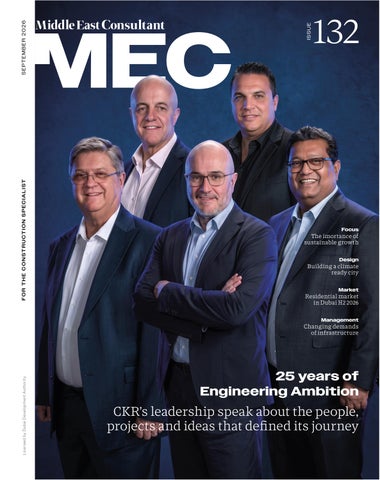
25 years of Engineering Ambition CKR’s leadership speak about the people, projects and ideas that defined its journey
Building beyond today
There are moments when the built environment becomes more than the buildings, roads and infrastructure around us. It becomes a reflection of how we respond to uncertainty. For the Middle East, this is one of those moments. For the better part of this year, resilience has been a concept discussed across the industry - something to aspire to and plan for. Today, we are beginning to see it implemented across the region. Development continues at a remarkable pace. Cities are expanding, infrastructure is being transformed and ambitious projects are reshaping how people live, work and connect. Yet this progress is unfolding against geopolitical uncertainty, shifting supply chains, energy pressures and increasingly complex demands on the built environment. In response, resilience is becoming more than a principle. It is being embedded into the way we design, engineer and deliver. We see it in infrastructure built to withstand disruption, buildings designed to adapt, and assets conceived to deliver value throughout their entire lifecycle. For consultants, architects and engineers, the question is no longer simply how quickly we can build, but how intelligently we can build for the future. This means looking beyond completion and considering how an asset will perform, adapt and continue to serve its purpose as circumstances change. In this issue, we explore the people, projects and ideas bringing this shift to life. Their work demonstrates that resilience is no longer just a vision for the future. It is becoming part of how the Middle East builds today. The challenge now is to ensure what we build today is ready for whatever comes next. Enjoy the issue.
Clayton Aldo Vallabhan Deputy Editor, ME Consultant
MECONSTRUCTIONNEWS.COM
1
CONTENTS
26 COVER STORY
From a boutique consultancy arriving in Dubai at the dawn of its boom to a 350-strong Multinational Engineering firm, CKR has evolved with the Middle East. As it celebrates 25 years in the region, MEC speaks to its leaders about the projects, people and ideas that defined its journey, and ahead to an even more ambitious future
2
SEPTEMBER 2026
INITIATE 10 Nikki Bisiker Design Studio completes African inspired villa in Tilal Al Ghaf ⁄ 12 Geopolitical uncertainty sharpens focus on construction costs across KSA and the UAE, says Compass ⁄ 14 Dewan announces two MD appointments
INTERFACE 38 Rick Hopper, MD of Mott Macdonald Middle East speaks with MEC’s Clayton Vallabhan about the company’s vision for growth, innovation and local talent ⁄ 46 NCO’s CEO Amir Hasan speaks with MEC’s Clayton Vallabhan on sustainable growth, engineering leadership and the changing demands of the UAE’s infrastructure market
INNOVATE 58 The climate ready city: Architecture of liveability by Faysal Ali, Vice President, Urban Studio EMEA, Parsons ⁄ 64 Why boomerang employees are the strongest signal of a culture built to last writes Maroun Deeb, Head of Project and Development services for MEA at JLL ⁄ 68 As part of our ‘Women in Construction’ focus, MEC sits down with Gemma Scotney, Regional Head of HR and Operations at Compass Project Consulting
MECONSTRUCTIONNEWS.COM
3
GROUP
MANAGING DIRECTOR Raz Islam DIRECTOR OF FINANCE & BUSINESS OPERATIONS Shiyas Kareem
raz.islam@cpitrademedia.com shiyas.kareem@cpitrademedia.com
EDITORIAL
EDITORIAL DIRECTOR Jason Saundalkar
jason.saundalkar@cpitrademedia.com
DEPUTY EDITOR Clayton Aldo Vallabhan
clayton.aldo@cpitrademedia.com
ASSOCIATE EDITOR Priyanka Raina
priyanka.raina@cpitrademedia.com
ADVERTISING
GLOBAL ACCOUNT MANAGER Jas Kaur
jas.kaur@cpitrademedia.com
STUDIO
ART DIRECTOR Simon Cobon
simon.cobon@cpitrademedia.com
GRAPHIC DESIGNER Percival Manalaysay
percival.manalaysay@cpitrademedia.com
PHOTOGRAPHER Maksym Poriechkin
maksym.poriechkin@cpitrademedia.com
MARKETING & OPERATIONS
DIRECTOR OF MARKETING & MEDIA OPERATIONS Phinson Mathew George PRODUCTION & IT SPECIALIST Jarris Pedroso SOCIAL MEDIA EXECUTIVE Franzil Dias
phinson.george@cpitrademedia.com jarris.pedroso@cpitrademedia.com franzil.dias@cpitrademedia.com
WEB DEVELOPMENT
SENIOR DIGITAL MANAGER Abdul Baeis
abdul.baeis@cpitrademedia.com
FOUNDER Dominic De Sousa (1959-2015)
When you have finished with this magazine, please recycle it The publisher of this magazine has made every effort to ensure the content is accurate on the date of publication. The opinions and views expressed in the articles do not necessarily reflect the publisher and editor. The published material, adverts, editorials and all other content are published in good faith. No part of this publication or any part of the contents thereof may be reproduced, stored or transmitted in any form without the permission of the publisher in writing. Publication licensed by Dubai Development Authority to CPI Trade Publishing FZ LLC CPI Trade Media. PO Box 13700, Dubai, UAE. +971 4 375 5470 cpitrademedia.com © Copyright 2026. All rights reserved.
4
SEPTEMBER 2026
ISSUE
SEPTEMBER 2026
Licensed by Dubai Development Authority
132
232 JULY-AUG 2026
DIGITAL PIONEERS FO R T H E C O N ST R U CT I O N S P EC I A L I ST
CELEBRATING THE CONSTRUCTION INNOVATORS TRANSFORMING PROJECT DESIGN AND DELIVERY
Focus
The imortance of sustainable growth Design
Building a climate ready city
Residential market in Dubai H2 2026 Management
Changing demands of infrastructure
Licensed by Dubai Development Authority
VEHICLES/ TECH / TRANSPORTATION/LOGISTICS
Market
MIDDLE EAST
142/JULY-AUGUST 2O26 LI CENSED BY D U BAI D EVELO PM ENT AU TH O RIT Y
25 years of Engineering Ambition CKR’s leadership speak about the people, projects and ideas that defined its journey , NEW CONF USED TRUCKS
IDENCE WITH
OV ED FAMCO APPR ON THE COVER
CKR’s leadership speak about the people, projects and ideas that defined its journey
ned tified pre -ow Famco’s cer on Al-Fut taim fleet expansi drive smart cks tru lvo Vo
CHE RY ENT
VA NEW HI MA ITORY
ERS PICK-UP
TERR
ISSUE 166 AUGUST 2026
MEConstructionNews.com @meconstructionn MEConstructionNews me-construction-news
A CASE ASES F OR A L L C
VERS EARTHMO
CH ST APPROA MIDDLE EA D TO CONQUER TRUCTION’S EERE S CASE CONS MACHINES ENGIND TOUGH DEMAND ON AN ILT N AI IS BU HEAT, TERR EXTREME
GET THE
WHOLE PICTURE
ONLINE
POPULAR
FEATURES
CONSTRUCTION
SEVEN opens Seven Tabuk, its second leisure destination in the kingdom
Women in Construction: Olivia Taylor of HKA PROPERTY
Amali Properties’ Villa Avatea listed as one of Dubai’s top property transactions
CONSTRUCTION
Casagrand to develop 6m sqft of land for residential and mixed-use projects
Stability as strategy
INDUSTRY
Aramco and Maaden signs a JV to unlock mineral exploration and hard-rock mining in KSA
CONSTRUCTION
Nakheel commences handover of 892 homes at Jebel Ali Village development
6
SEPTEMBER 2026
Why design & build works better than traditional contracting
FEATURED NEWS
UPCOMING EVENTS
CONSULTANT
Mace Consult supporting delivery of flagship cultural complex in Oman The consultancy is providing project leadership, programme management, commercial oversight and delivery assurance, enabling efficient delivery
OCTOBER
Women in Construction Connect 7 October 2026 Dubai, United Arab Emirates
CONSTRUCTION
Over 50,000 homes and US $2.72bn in contracts awarded in H1 2026 says DAMAC The developer will focus on completing its targeted 8,800-plus handovers through 2026, while mobilising newly awarded construction packages
OCTOBER
Digital Construction Summit 21 October 2026 Dubai, United Arab Emirates
INFRASTRUCTURE
RTA awards 2-contracts for Al Meydan Street Development project The project will serve a number of residential and development areas with a combined population of more than 500,000 and is scheduled for completion by the end of 2028
NOVEMBER
Real Estate Leaders Summit November 2026 Dubai, United Arab Emirates
INDUSTRY
R.Evolution expands EYWA into a longevity-led regenerative real estate brand The expansion comes as wellness real estate emerges as one of the growing sectors of the global wellness economy
NOVEMBER
Energy & Sustainability Summit 28 October 2026 Dubai, United Arab Emirates
CONSTRUCTION
KSA launches RFQ process for King Fahd Suburb Boulevard It will be developed through a PublicPrivate Partnership (PPP) under a Design, Build, Finance, Operate, Maintain and Transfer (DBFOMT) model
DECEMBER
Middle East Consultant Awards 9 December 2026 Dubai, United Arab Emirates
MECONSTRUCTIONNEWS.COM
7
INITI 8
SEPTEMBER 2026
INSIDE
10 Nikki Bisiker Design Studio completes African inspired villa in Tilal Al Ghaf ⁄ 12 Geopolitical uncertainty sharpens focus on construction costs across KSA and the UAE, says Compass ⁄ 14 Dewan announces two MD appointments
IATE A deep dive into the biggest construction headlines that caught our eye this month
MECONSTRUCTIONNEWS.COM
9
INITIATE
Nikki Bisiker Design Studio completes African inspired villa in Tilal Al Ghaf
10
SEPTEMBER 2026
The design of a new Elysian Mansion villa
material palette that creates a sense of
chandelier that’s made in Paris, a
in Tilal Al Ghaf, has been completed, Nikki
quiet sophistication, said a statement.
Venetian glass dining table inspired by
Bisiker Design Studio has announced.
“The beauty of this project was in
the composition of olive tree leaves and
The design studio said that the project
balancing creativity with complexity.
custom joinery detailing that reinforces
is now progressing into the interior
It was both fun and challenging to
the home’s artisanal character.
execution phase.
bring together architecture, interiors,
Outside, the landscaping draws
The milestone project is said to
landscaping and bespoke details into
on African influences, while the villa’s
reflect the studio’s expanded scope across
one cohesive story. Every space was
pool, waterways, fire pit, rooftop spaces
architecture, interiors, landscaping, FF&E,
approached as an opportunity to reflect
and private gym complete a residence
procurement and bespoke detailing. In
the family’s personality while maintaining
designed for both retreat and entertaining,
line with the expanding service offering,
an atmosphere that feels calm, elegant
the statement explained.
Nikki Bisiker Interior Design recently
and deeply connected to nature,” said
Personalisation runs through the
rebranded to Nikki Bisiker Design Studio
Nikki Bisiker, Founder of Nikki Bisiker
entire home, from black-and-white
to reflect its broader, end-to-end approach.
Design Studio.
photographic elements captured during
Taking shape within the Elysian
Throughout the villa, the design
the owners’ African travels to children’s
Mansions community, the villa features
studio is said to have translated
bedrooms shaped around individual
a basement, ground floor, first floor and
the owners lifestyle and memories
interests and fashion sense. With
rooftop, and is said to bring together
into a highly personal environment,
vintage, bohemian and artistic themes,
a calm, serene atmosphere with an
including black and white photographic
these spaces feel both functional and
eclectic design language shaped by travel,
elements captured by the homeowners
deeply personal, rounding out a home
craftsmanship and nature. The residence
themselves and integrated into the wider
that celebrates identity, storytelling
is defined by rich layers of natural wood,
interior story. The project’s standout
and a considered connection to nature,
organic textures and a soft, composed
features are said to be a dramatic 7ft
it concluded.
MECONSTRUCTIONNEWS.COM
11
INITIATE
Geopolitical uncertainty sharpens focus on construction costs across KSA and the UAE, says Compass 12
SEPTEMBER 2026
Project development consultancy
Saudi Arabia during H1 2026. While some
Compass Project Consulting has released
projects have experienced cost pressure
the ninth edition of its latest Construction
linked to specialist MEP equipment,
Cost Benchmark Reports for Saudi Arabia
material availability, shipping and
and the UAE, offering a current snapshot
logistics, these impacts have tended to be
of construction costs following a period
project-specific rather than market-wide.
shaped by geopolitical uncertainty across the Middle East.
The reports draw on cost data from Compass’ portfolio of more than 1,000
The first half of 2026 brought renewed
commissions across the GCC and provide
pressure across regional supply chains and
benchmark ranges for construction and
project delivery environments, creating
fit-out works across multiple asset classes.
additional scrutiny around budgeting,
“There is now even greater focus on
procurement and project viability. Against
feasibility and commercial performance,”
that backdrop, the Saudi Arabia and
said Batista. “Budgets are being scrutinised
UAE construction sectors continued to
more closely, but the appetite for moving
demonstrate strength, supported by active
projects forward remains. Activity levels
development pipelines and sustained
are still strong and a significant number
investment across key sectors.
of developments are already underway
The conflict has introduced a new layer
or committed. Rather than driving broad
of complexity for project teams. Pressure
increases in benchmark rates, the current
is being felt through volatility in key
uncertainty is generally being managed
materials and MEP equipment, including
through higher contingencies, more
aluminium and copper, alongside higher
cautious procurement strategies and
transport and insurance costs. Disruption
additional risk allowances within pricing.”
to shipping routes has also created
In the UAE, some hospitality and
program uncertainty, while increased oil
F&B projects are being re-evaluated as
and diesel prices have affected the cost of
developers respond to changing market
operating plant and site equipment.
conditions. At the same time, seasonal
“Tender returns started reflecting
maintenance programs are progressing
higher allowances for materials, transport
in-line with the summer period, while
and installation as contractors responded
larger residential and infrastructure
to uncertainty in the market,” said
developments continue to advance, with
Francisco Batista, Regional Director –
increased attention being paid to program
Commercial & Cost Management. “We saw
certainty and cost control.
similar behaviour during the early stages
“The first half of the year reinforced
of COVID-19, when visibility was limited
the value of current market intelligence,”
and pricing became more defensive.
said Hamed Aljufairi, Vice President –
As supply chains adjust and market
Operations. “Changes in supply conditions
conditions become clearer, we expect that
and procurement behaviour can quickly
position to stabilise.”
affect project assumptions. Access to
Despite the disruption, Compass has
reliable benchmark data helps teams test
not seen evidence to support a material
budgets, challenge assumptions and make
adjustment to overall benchmark rates in
decisions with greater confidence.”
MECONSTRUCTIONNEWS.COM
13
INITIATE
Dewan announces two MD appointments Dewan has announced 2 key Managing
His expanded remit will also support
the region, pursuing new opportunities
Director appointments as the firm
the continued integration of digital
in construction and project management,
continues to evolve its leadership structure
technologies and AI across design
and exploring how digital technologies
to support its next phase of growth across
coordination and project delivery, building
can further enhance project and
the Middle East and international markets.
on the firm’s growing use of intelligent and
site supervision.
Samer Touqan has been promoted
automated workflows.
“As Dewan continues to grow, our
to Managing Director, building on
As part of the same organisational
leadership structure must evolve alongside
his leadership of Dewan’s Projects
evolution, Dewan has established the role
the needs of our business, projects and
& Design Delivery Division and his
of Managing Director of the Construction
clients. The establishment of two key
longstanding contribution to the firm. In
Management & Supervision Division, with
revenue hubs creates clear accountability
his expanded role, Touqan will oversee
Jasim Al Khateb appointed to lead the
for project delivery, financial performance
one of Dewan’s 2 key revenue hubs, with
division in this new capacity.
and client relationships, while positioning
responsibility for successful project
Al Khateb brings more than 3 decades
the firm for its next phase of development.
delivery, financial performance and client
of industry experience across the Middle
Samer has made a significant contribution
account management.
East, including senior leadership positions
to Dewan’s success over many years, and
Touqan will continue to advance
with Parsons and AECOM. In his new role,
Jasim brings extensive regional experience
Dewan’s projects and design delivery, with
he will lead the division’s next phase of
and leadership expertise to his newly
a focus on design excellence, consistency
development, with a focus on expanding
established role,” said Ammar Al Assam,
and the evolving requirements of clients.
Dewan’s supervision capabilities across
CEO, Dewan Architects + Engineers.
14
SEPTEMBER 2026
07 October 2026 Topgolf Dubai, United Arab Emirates
PARTNER
PARTNER
PRESENTED BY
Sponsorship
Marketing
Raz Islam
Phinson Mathew George
Managing Director
Director of Marketing & Media Operations
+971 4 375 5471
+971 4 375 5476
raz.islam@cpitrademedia.com
phinson.george@cpitrademedia.com
PRESENTED BY
© 2026 CPI Trade Media. All rights reserved.
Connect, collaborate and create opportunities
PRESENTED BY
REGISTER NOW
INITIATE
Dubai Residential Market Performance H2 2026 Q2 2026 marked, as expected, a notable shift following several quarters of exceptional transaction activity say experts at Savills. Residential transaction volumes moderated as buyers became increasingly selective amid rising supply, greater housing choice and ongoing regional uncertainty. Although intermittent ceasefire discussions and geopolitical developments contributed to a more measured investment environment, Dubai’s longterm market fundamentals remained firmly intact. The quarter was also characterised by several positive structural developments that reinforced long-term confidence. The approval of Dubai’s US $9.26bn Metro Gold Line is expected to support future residential growth across key development corridors, while recent enhancements to the UAE’s property-linked residency framework—including more flexible investor visa eligibility and the removal of the previous equity requirement for property-based Golden Visa applications— further strengthened Dubai’s attractiveness to international investors. In parallel, the UAE’s decision to exit OPEC+ signalled greater long-term economic flexibility and support for future growth. Against this backdrop, Q2 2026 closed with approximately 35,884 residential transactions, representing a 19% quarter- on-quarter decline. Overall market activity moderated during the quarter, with transaction volumes declining across both market segments. While the primary market continued to be supported by a high volume of developer-led registrations, these registrations likely overstated underlying sales momentum. At the same time, the secondary market recorded a more significant decline, indicating that market conditions softened more broadly during the quarter.
16
SEPTEMBER 2026
MECONSTRUCTIONNEWS.COM
17
INITIATE
DUBAI RESIDENTIAL TRANSACTION TREND Off-plan
Ready
Q4
Q1
Total Transactions
Transactions (Thousands)
50
40
30
20
10
Q1
Q2
Q3 2024
MACROECONOMIC OVERVIEW
Q2
Q3
Q4
2025
Q1
Q2 2026
In contrast, the ready market experienced a more pronounced
The UAE’s economic outlook has moderated since the beginning
slowdown, with transactions declining by approximately 30%
of the year, with geopolitical tensions, softer business sentiment
quarter-on-quarter and its share of total activity falling from
and disruption to regional trade weighing on activity. Oxford
27% in Q1 to 24% in Q2. That said, ready market transaction
Economics has progressively revised lower its 2026 GDP growth
volumes have remained broadly stable since March at around
forecast from 4.8% to a contraction of 1.2%, reflecting weaker trade,
2,800 transactions per month, indicating that the pace of market
tourism and supply chain activity.
adjustment may be moderating.
Despite these near-term headwinds, the medium-term
Developer registration activity was also highly concentrated,
outlook remains positive. Oxford Economics forecasts GDP
with nine projects, including Azizi Venice, Binghatti Skyflame,
growth of 6.3% in 2027 and 7.1% in 2028, supported by higher oil
Lunaya by Zaya, Creek Bay Tower, Serenz Tower, Azizi Arian,
production, resilient non-oil activity, continued government
Valencia Tower and Sobha Central, accounting for approximately
investment, the UAE’s diversified economy and business- friendly
30% of all developer registrations. As many of these projects
policy environment following its decision to exit OPEC+.
were launched in previous quarters, a significant proportion
As trade flows, travel activity and business confidence
of recorded activity reflects delayed registrations rather than
normalise, the economy is expected to return to a stronger growth
new sales. The headline 20% decline is likely to understate the
trajectory, supporting residential demand, continued investment
moderation in underlying market activity during the quarter.
and the gradual absorption of new supply over the medium term.
The same pattern was evident across both primary and secondary markets, although the pace of decline differed
QUARTER IN REVIEW – UNDERLYING MARKET
significantly. Primary market transactions declined by
TRENDS CONTINUE TO EMERGE
approximately 16% quarter-on-quarter, while secondary
Transaction activity moderated during Q2 2026, with total
transactions contracted by around 29%, indicating that the
residential transactions declining by approximately 19% quarter-
current market adjustment has been concentrated within the
on-quarter. Despite a significant slowdown in new project
resale segment.
launches, the off-plan market accounted for 76% of all residential
Secondary ready transactions accounted for 23% of total
transactions, up from 73% in Q1 2026. This was partly supported
activity in January but declined to around 19% in March before
by the continued registration of off-plan sales agreed in previous
recovering marginally to 21% in June. In contrast, the primary
quarters, reflecting the inherent lag between sale execution and
off-plan segment remained broadly stable, representing 67% of
government registration.
transactions in January, 72% in March and 69% in June.
18
SEPTEMBER 2026
TRANSACTION VOLUMES BY SALES SEQUENCE Primary
Secondary
Total Transactions
Mar
Apr
Transactions (Thousands)
15
12
9
6
3
Jan
Feb
May
Jun
2026
This suggests that while buyer activity in the resale market has
underlying pricing adjustments of approximately 5–7% during
moderated, primary market transaction volumes have remained
the quarter, with selected locations recording declines of up to
comparatively stable. However, this stability has been supported
10%. This suggests that the moderation in market pricing was
by developer registrations and delayed recording of earlier sales
more pronounced than implied by the headline DLD averages.
rather than sustained momentum in new project launches.
Despite the quarterly correction, average prices remain above Q2
The mortgage segment further reinforces this trend, with
Sources: DLD, Savills Research
mortgage-backed transactions declining from 1,888 in January
2025 levels, with apartments up approximately 1.9% year-on-year and villas/townhouses approximately 8.5% higher.
and 1,519 in March to 1,247 in June. This represents a reduction
Pricing performance has become increasingly fragmented,
of approximately 34% from January levels (or 18% from March),
driven by local supply dynamics and handover activity. Since
indicating a notable slowdown in mortgage activity. Given that
February 2026, communities such as Dubai Hills Estate and
mortgage transactions are closely associated with end-user
Arabian Ranches 3, where significant new supply has recently
demand, the trend suggests a more cautious approach among
entered or is approaching the market, have recorded price
owner-occupiers, particularly within the ready residential market.
adjustments of around 10% for comparable properties. In contrast,
From a pricing standpoint, average residential rates per
more supply-constrained communities such as Reem Mira have
sqf. moderated quarter-on-quarter during Q2 2026 following the
remained relatively resilient, highlighting the growing divergence
peak recorded in Q1. Based on DLD transaction data, apartment
in pricing performance across Dubai’s residential market.
prices averaged US $534 per sqft, down from US $556 in Q1
Valuation instruction volumes reflected a notable shift in
2026 (approximately -4.0% quarter-on- quarter), while villa and
market activity over the course of the quarter. Following a subdued
townhouse prices eased marginally to US $448 per sqft, compared
start to the quarter, activity recovered through May and June,
with US $552 in Q1 (approximately -0.8% quarter- on-quarter).
driven primarily by refinancing-related valuations. Refinancing
While the DLD averages provide a useful indication of market
instructions increased from approximately 30% of total valuation
direction, they are influenced by transaction mix and registration
volumes historically to around 70% by quarter-end, while sale-
timing. Our internal like-for-like analysis therefore provides
related instructions declined to 30%. This trend provides further
additional insight into underlying pricing movements, as they can
evidence of a more cautious transaction environment, with many
be influenced by changes in the mix of properties transacting and
existing owners choosing to optimise financing arrangements
the timing of transaction registrations. Our internal analysis of
rather than dispose of assets. The increase in refinancing activity
more than 500 like-for-like residential transactions—comparing
also suggests continued confidence in the market’s longer-term
similar units within the same developments—indicates
prospects rather than widespread financial distress.
MECONSTRUCTIONNEWS.COM
19
INITIATE
AVERAGE RATE PER SQ FT TREND Apartment
Villa/Townhouse
2000
AED/sq ft
1600 1200 800 400 Q1
Q2
Q3
Q4
Q1
2024
Q2
Q3
Q4
2025
Q1
Q2 2026
RENTAL MARKET ENTERS A REBALANCING PHASE
from serviced apartments and short-term rental products. ICP
Dubai’s residential leasing market entered a rebalancing phase
data indicates that new residence permit issuances declined by
during Q2 2026, with annual lease registrations recorded through
approximately 15% quarter-on-quarter, consistent with softer
the Ejari system declining by approximately 22% quarter-on-
employment growth and fewer new employment-related arrivals.
quarter. Both new lease registrations and renewals fell at a similar
As many newly issued residence permits are employment-
pace, while the market composition remained broadly unchanged
related and typically translate into new leasing demand, this is
at 35% new leases and 65% renewals.
likely to have contributed to weaker Ejari registrations during
Rental rates across a sample of major residential communities
Q2 2026. Although market performance continues to vary by
declined by an average of 8–10%, with the largest adjustments
community, landlords are operating in a more competitive leasing
occurring in locations experiencing significant new supply.
environment for occupiers, resulting in more realistic pricing and
Whilst part of the moderation reflects normal seasonal trends,
a gradual rebalancing of the residential leasing market.
it also indicates a more competitive leasing environment following several years of sustained rental growth.
SUPPLY
The moderation in rental levels was driven by increasing
Launch activity moderated significantly during Q2 2026, with
residential supply, greater tenant choice and growing competition
approximately 5,335 residential units introduced across a limited
SUPPLY BREAKDOWN BY LAUNCH YEAR Apartments
Villas
Units (Thousands)
200 160 120 80 40
2021
20
SEPTEMBER 2026
2022
2023
2024
2025
2026
RENTAL TRANSACTION VOLUMES
Transactions (Thousands)
New
Renewed
Total Transactions
200 160 120 80 40 Q1
Q2
Q3
Q4
Q1
2025
Q2 2026
number of projects, compared with over 45,000 units launched in
the highest quarterly delivery volume in recent years. Apartments
Q1. Developers adopted a more selective and phased release strategy
accounted for approximately 17,400 units (64%), while 9,900 villas
amid moderating market conditions, with launches including Faro
and townhouses (36%) were delivered, substantially increasing the
by Emaar, Enchante by Grid in Dubai South and Cheval Residences
volume of ready residential stock. Notably, villa and townhouse
Dubai Islands, alongside several boutique developments.
handovers reached an unusually elevated level this quarter,
Despite the lower launch volumes, Emaar announced a
marking one of the strongest quarterly delivery volumes for this
transformational AED 200 billion master-planned development
segment in recent years and contributing to a broader increase
spanning approximately 4.5 million sq m and designed to
in the availability of ready family housing. Major completions
accommodate around 150,000 residents. While delivery will
during the quarter included LUCE on Palm Jumeirah, St. Regis
take place over the coming years, the announcement highlights
The Residences, Financial Centre Road, Castleton at Central Park,
developers’ continued commitment to large-scale, master-
Sunridge by Emaar, Raya Townhouses and The Valley – Elora,
planned communities despite a more measured pace of launches
alongside projects such as DAMAC Lagoons – Costa Brava 2,
during the quarter.
Belmont Residences and Thyme.
Residential handovers accelerated significantly during Q2
The significant increase in completions is expected to
2026, with approximately 27,300 units completed, representing
improve buyer choice while contributing to greater pricing
DUBAI HANDOVER BY QUARTER Apartments
Villas
Units (Thousands)
25 20 15 10 5 Q1 2025
Q2 2025
Q3 2025
Q4 2025
Q1 2026
Q2 2026
MECONSTRUCTIONNEWS.COM
21
INITIATE
differentiation in communities experiencing elevated levels
demand growth. Nevertheless, the UAE’s structural demand
of new supply.
drivers—including inward migration, infrastructure investment
While handover activity remained healthy during Q2,
and residency reforms—remain supportive, while Oxford
developers have increasingly postponed the launch of new
Economics expects economic growth to recover strongly in
projects and extended delivery timelines for upcoming
2027 and 2028 following a softer 2026 outlook.
developments. Projects that were previously expected to be
At the same time, a substantial residential supply pipeline
completed within approximately three years are now generally
remains under development. However, developers are
anticipated to be delivered over a four-year horizon. This staggered
increasingly extending delivery timelines, while new project
delivery profile should help distribute future supply over a longer
launches have moderated, helping to stagger the release of
period, reducing near-term absorption pressure and supporting
future supply and ease near-term absorption pressure. Together,
a more balanced market over the medium term.
these trends are expected to support a more balanced supplydemand environment over the medium term.
OUTLOOK
Against this backdrop, Dubai’s residential market is expected
Following several years of rapid expansion, UAE population
to transition into a period of normalisation, characterised by
growth is forecast to moderate from 4.1% in 2022 to approximately
moderating transaction activity, elevated handover volumes
2.0% in 2026, resulting in a more measured pace of residential
and increasingly selective buyer behaviour. Pricing performance is expected to become more localised, although values are likely to remain broadly resilient overall.
“The significant increase in completions is expected to improve buyer choice while contributing to greater pricing differentiation.”
while apartment-led markets with a higher concentration of new supply may experience greater pricing differentiation and moderation in rental performance. The rise in refinancing-related valuation activity relative to outright sales suggests that many existing owners remain confident in the market’s long-term fundamentals, choosing to refinance rather than sell. Looking ahead, market performance will depend on the pace of demand absorption, the timing of future project deliveries and the resilience of buyer sentiment as the market transitions towards a more sustainable phase of growth.
SAVILLS
22
Prime and well-located assets are expected to outperform,
SEPTEMBER 2026
INTER 24
SEPTEMBER 2026
INSIDE
26 From a boutique consultancy arriving in Dubai at the dawn of its boom to a 350-strong Multinational Engineering firm, CKR has evolved with the Middle East. As it celebrates 25 years in the region, MEC speaks to its leaders about the projects, people and ideas that defined its journey, and ahead to an even more ambitious future ⁄ 38 Rick Hopper, MD of Mott Macdonald Middle East speaks with MEC’s Clayton Vallabhan about the company’s vision for growth, innovation and local talent ⁄ 46 NCO’s CEO Amir Hasan speaks with MEC’s Clayton Vallabhan on sustainable growth, engineering leadership and the changing demands of the UAE’s infrastructure market
RFACE Going behind-the-scenes with the region’s top construction consultants and industry trailblazers
MECONSTRUCTIONNEWS.COM
25
INTERFACE
CKR: 25 Years of Engineering Ambition From a boutique consultancy arriving in Dubai at the dawn of its boom to a 350-strong Multinational Engineering firm, CKR has evolved with the Middle East. As it celebrates 25 years in the region, MEC speaks to its leaders about the projects, people and ideas that defined its journey, and ahead to an even more ambitious future
26
SEPTEMBER 2026
MECONSTRUCTIONNEWS.COM
27
INTERFACE
There is a particular kind of confidence that comes from having watched a city reinvent itself. Approximately 25 years ago, Dubai was already ambitious, but the transformation that would make it one of the world’s most recognisable cities was still gathering pace. For a 19 years young engineering consultancy arriving from Johannesburg at that time, the opportunity was significant, but so was the uncertainty. Today, CKR has a total legacy of 44 years and is a business of more than 350 people operating across multiple countries,
“Even though we’ve grown, and today we’re more than 350 people across multiple countries, we’ve retained that intimate flavour.”
with expertise spanning electrical, mechanical, civil, structural, high-voltage engineering, ICT, ELV, Security, Smart Buildings,
STEFANO RICCARDI
BIM and technology services. Its portfolio covers hospitality, retail, commercial, industrial, residential, healthcare and public infrastructure, with data centres and power infrastructure becoming an increasingly more important portfolio. Yet the company’s leadership stresses that growth has never been the objective in isolation. The philosophy that brought CKR
“It’s been a fascinating journey,” says Stefano Riccardi, CEO and Managing Partner. “When I first came to Dubai, I came with Mike Berry, and we were fortunate to arrive at what was, let’s call it, the beginning of the boom in Dubai.”
to the Middle East, technical expertise combined with personal,
The first opportunity was Royal Mirage Phase II. From there
accessible client service, remains at the heart of the business.
came Madinat Jumeirah, followed by projects across Abu Dhabi, Oman, Kuwait and Saudi Arabia. Involvement in some of the region’s most ambitious developments helped establish CKR’s
Stefano Riccardi, CEO and Managing Partner, CKR.
reputation and provided a platform for international expansion. “That was the massive injection we needed as a business to get off the ground,” Riccardi says. “From there, the rest was almost history. We’ve been involved in some incredible projects.” RIDING THE DUBAI WAVE
CKR’s Dubai story began in 2001, as the emirate positioned itself as a global destination for business, tourism and investment. For Mike Berry, COO and Partner, the early years were characterised by an almost relentless stream of work. “We came here in 2001, and the projects just kept coming,” he recalls. “We were awarded more and more projects, including some significant developments on the Palm, and the future was looking very positive.” Madinat
Jumeirah
was
particularly
significant. The development demanded a broad range of engineering and technology expertise at a time when systems within major
28
SEPTEMBER 2026
hospitality projects were becoming increasingly sophisticated. For a consultancy that was still relatively small, the scale was extraordinary.
While dealing with projects like Madinat Jumeirah and One & Only, CKR learned the importance of combining disciplines and technologies rather than treating them as isolated services.
Berry describes Madinat Jumeirah and One & Only as projects that remain particularly close to his heart. “When you consider the scale of Madinat Jumeirah and the
COVID-19 presented a different challenge, but it also
fact that we were still a relatively small, boutique engineering
accelerated a technological transformation CKR had already
consultancy, the opportunity to deliver something of that size
begun. Remote working, cloud-based collaboration and
was remarkable,” he says.
digital engineering became essential. For a company already
The experience also established an approach that would
accustomed to sharing expertise across geographical
become increasingly important to CKR: combining disciplines
boundaries, the transition was perhaps less disruptive than
and technologies rather than treating them as isolated services.
it might have been.
That integrated model would eventually become one of the foundations of the company’s One CKR philosophy.
“In fact, the first projects we did in Dubai actually commenced from South Africa, where they were being designed,” Riccardi explains. “That interaction between different countries and
BUILDING RESILIENCE
different branches within the wider business became second
The financial crisis of 2009 was a defining moment for Dubai —
nature to us without us even realising it.”
and for businesses operating in the emirate. For CKR, the impact was substantial, but major projects helped the company weather the storm.
The experience also demonstrated the potential of CKR’s Indian operation. Berry says COVID “really pushed our Indian office forward”.
The experience proved formative. “I think that gave us the
“From a small office, we suddenly realised that we could
confidence to tackle any crises that followed,” he says. “We tend
use that resource much more effectively,” he says. “That
to come out stronger every time we get to the other side.”
has grown into a significant operation that now services all
MECONSTRUCTIONNEWS.COM
29
INTERFACE Anil Menon, CSO and Partner, CKR.
“When we started, clients wanted to talk to the boss,” says Riccardi. “They wanted to talk to the directors. They wanted to be able to speak to someone who had probably lived and done it all.” That principle has survived despite the company’s growth. “Even though we’ve grown, and today we’re more than 350 people across multiple countries, we’ve retained that intimate flavour,” he says. “We’re still approachable, we’re still involved in projects, and that has helped us enormously.” Anil Menon, CSO and Partner, describes the philosophy in similar terms. “We’re engineers and we do what we do with passion,” he says. “We run the business professionally, but also with passion, and we can be as small or as large as our clients need us to be.” That could mean delivering engineering
“We’re engineers and we do what we do with passion.” ANIL MENON
services for a small retail unit of around 45 square metres or contributing to an integrated complex approaching 800,000 square metres. “We can be both,” Menon says. “I think that’s one of the strengths we bring to any crisis or opportunities.” TECHNOLOGY: SOLUTION OR COMPLICATION?
Engineering technology has changed dramatically since CKR of our offices, providing engineering expertise as well as BIM production.” For CKR, technology had caught up with the way the business had been working for years. “It streamlined the process and ultimately led us to create One CKR, our global setup,” Riccardi says. “It was a
arrived in Dubai. The company’s engineers have moved from tracing paper and T-squares to CAD and then BIM. Today, AI, IoT, digital twins, smart-building technologies and increasingly sophisticated data environments are reshaping the profession again. But Menon argues that more technology does not
natural progression.”
automatically mean better design.
FROM BOUTIQUE CONSULTANCY TO ONE CKR
exists. The complication comes when technology is adopted
One CKR is less about creating a traditional corporate hierarchy
too quickly. Sometimes the complexity is actually the result of
and more about connecting expertise. The ambition is to make
an overuse of technology.”
“More often than not, the ingenuity in engineering still
the knowledge held across different offices and disciplines available to clients regardless of where a project is located. “We’ve got all these experts across our business,” says Riccardi. “We’re constantly talking to each other, but we’ve never really leveraged that expertise to the extent we could.” The challenge is achieving greater scale without losing the personal approach that has defined CKR from its earliest days.
30
SEPTEMBER 2026
His preferred approach is hybrid. Technology should enhance communication and design rather than replace the human interaction that underpins good engineering. “In the initial stages of a concept or scheme, there can be more conversation between the stakeholders — interior designers, client representatives, operators and others — around the design intent and strategies,” says Menon.
“We came here in 2001, and the projects just kept coming.” MIKE BERRY
“Today, people have all these devices and applications to
FROM HOSPITALITY TO DATA CENTRES
communicate, yet they sometimes communicate less. In the old
Perhaps the clearest example of CKR’s ability to transfer
days, we probably communicated better without the devices.
expertise between sectors is its growing data centre business.
So is technology actually a better communication tool? That’s a big question.”
The company’s experience in high-end hospitality has proved unexpectedly valuable.
For CKR, the answer is not to reject technology, but to ensure that it serves the people using it.
“In a smart building, security is obviously a major consideration,” says Riccardi. “You then have the BMS, controls and fire and life safety, with all these systems needing
THE SMART-BUILDING OPPORTUNITY
That philosophy is particularly relevant as buildings become increasingly connected.
to communicate.” Those same principles are fundamental to data centres, where the consequences of failure are magnified.
CKR’s combination of conventional MEP engineering with
Data centres require resilient power infrastructure,
ICT, AV, Security and ELV expertise gives it a strong position in
sophisticated cooling, controls, security, connectivity and
the smart-building market.
increasingly complex electrical networks. As AI drives demand
“Buildings are becoming smarter,” says Menon. “But with the advent of IoT and micro-level controllers, we’re also seeing a proliferation of systems that can sometimes operate in silos.”
Mike Berry, COO and Partner, CKR.
The challenge is no longer simply installing individual systems. It is making them work together. “To achieve true system integration, almost like an airport master-systems-integration strategy where everything communicates with everything else, is challenging because buildings are often designed in a siloed way,” he says. CKR sees an opportunity to bring greater integration to buildings, but connectivity also creates new vulnerabilities. “When you connect all these systems together, you need a zero-trust strategy,” Menon says. “Cybersecurity within buildings is becoming a reality, and it’s something people need to talk about more.” For
an
engineering
consultancy
increasingly operating at the intersection of physical infrastructure and digital technology, cybersecurity is therefore becoming part of the engineering conversation.
MECONSTRUCTIONNEWS.COM
31
INTERFACE The booming data centre business showed CKR the importance of extremely resilient power infrastructure, which is why the consultancy brought in high voltage expertise into its wider business.
for computing capacity, those requirements are becoming more demanding still. CKR has responded by bringing high-voltage expertise into the wider business. Alberto Riccardi, Managing Director (Africa) and Partner, joined CKR after running a separate high-voltage business that
the amount of power required by data centres,” Alberto says. “If you want to build a data centre, you end up needing to put a significant amount of power back into the grid.” The implication is significant: the data centre boom is not simply an ICT story. It is becoming an energy and infrastructure story.
was subsequently incorporated into the consultancy. “The data centre business required the complete loop, from
ENGINEERING ACROSS BORDERS
the connection to the network through to the local networks,”
CKR’s international expansion has taught the business that
he explains. “We brought the high-voltage capability into
engineering solutions cannot simply be copied from one
the business.”
country to another.
The move has opened opportunities beyond the Middle East.
The fundamentals may be universal, but regulations,
“We’re finding that, particularly in Italy, there is a significant
infrastructure, culture, geography and history all influence
market for our services, not only in data centres but also in
how a project should be delivered.
high voltage,” he says. Saudi Arabia is another major focus, while renewable energy is becoming an increasingly important part of the equation. “In Europe and other parts of the world, we’re finding that green initiatives and large networks sometimes can’t provide
32
SEPTEMBER 2026
“Large parts of Europe are at a very advanced level, particularly in the Tier 1 markets,” says Riccardi. “From a data sovereignty perspective and in terms of the growth of data centres, some European markets are very much where the Middle East is today.”
Elsewhere, historic buildings, archaeology, zoning and regulation can make projects more complicated. “Does that make it insurmountable? No,” Riccardi says. “It’s about understanding where you’re operating, understanding the legislative requirements and understanding who the right people are to speak to.” The same lesson was learned in Africa. When CKR began working on data centres in South Africa during the period of load shedding, the challenge was not simply designing a
“If you want to build a data centre, you can end up needing to put a significant amount of power back into the grid.”
building. It was finding an engineering solution to a constrained national grid.
ALBERTO RICCARDI
“We managed to get through it by doing the right things: bringing renewable energy into the equation and upgrading transmission lines where necessary because of constrained
hospitality, mixed-use development, smart infrastructure and
capacity,” Riccardi says.
high-performance buildings.
That experience is now relevant in Europe and the Middle
CKR has been both a beneficiary and a contributor to that
East, where grid capacity is increasingly becoming a decisive
evolution. Its willingness to adopt emerging technologies has
factor for large developments.
also played a role.
“Ultimately, everything is a problem and we need
Menon recalls projects where CKR used free-space
to find a solution,” he says. “These are simply different
optics and radio-frequency backup to connect developments
engineering solutions.”
where conventional infrastructure was constrained by
The philosophy has also shaped CKR’s work across Africa, where levels of development can vary dramatically between markets. Riccardi recalls working in countries where shopping centres were still a novelty. “I remember when we installed an escalator in a shopping mall and children were brought in by teachers to learn how to
right-of-way limitations. “We never shy away from the future, but we also don’t want projects to become guinea pigs,” he says. “We make sure we bring in the best available technology, while understanding what is still in research and development.” That distinction — between being progressive and simply being fashionable — is central to the company’s approach.
use it,” he says. The story illustrates a wider point: what is obvious in one market can be entirely new in another. “If you take that mentality forward, it makes it easier to do
THE PEOPLE BEHIND THE GROWTH
For all the discussion of technology, data centres and global expansion, the CKR leadership team repeatedly returns to one
business,” he says.
subject: people.
BRINGING THE ‘DUBAI MODEL’ ABROAD
recruitment and development of the right individuals.
The company’s growth, they argue, has always followed the The reverse is also true. CKR increasingly finds that expertise developed in the UAE is being sought elsewhere. Menon points to a refurbishment project at a super luxury hotel in Addis Ababa as an example. “The client told us they wanted the ‘Dubai model’ and that, as long as we could comply with UAE fire and life-safety standards and bring Dubai’s pace, they would be very happy,” he says. Over the past 2 decades, Dubai has become a reference point for
Leopoldo Gambale, CFO and Partner, describes the company’s culture as one of its greatest strengths. “When I joined the business, I think we were around 30 people,” he says. “We’ve maintained that personal touch from when we were 30 people to now, with more than 350 people, and we’ve grown the business tenfold.” The objective is not to replace that culture with corporate structure as the business gets bigger.
MECONSTRUCTIONNEWS.COM
33
INTERFACE
“Ultimately, everything is a problem and we need to find a solution. These are simply different engineering solutions.” ALBERTO RICCARDI
“We always say that we’re a family business with structure,” Gambale says. “That has been one of our successes.” For Menon, the emphasis is on empowerment. “Leadership is an action, not a title,” he says. “Everyone can be a leader because everyone can influence.”
THE NEXT 25 YEARS
The next phase of CKR’s story is likely to be shaped by many of the forces reshaping the wider built environment. Data centres will continue to expand. AI will increase demand for power and digital infrastructure.
That applies from interns through to senior partners. The
Buildings will become more connected. Cybersecurity
company wants young engineers to understand that joining
will become increasingly important. Electrification will
CKR does not mean simply following instructions.
place additional demands on existing networks, while
“We tell them: ‘I’ve got lots to give, but don’t come with a blank-sheet attitude. You can contribute,’” says Menon. It also explains why senior leadership remains directly involved in projects. “We’re engineers at heart,” says Berry.
renewable energy will become a more integral part of the infrastructure solution. CKR believes its integrated engineering model puts it in a strong position to respond.
THE POWER OF BEING TOGETHER
The One CKR initiative has also highlighted the importance of relationships within the organisation itself. Last year, senior leaders gathered in South Africa, initially at a game lodge and subsequently with a wider group of partners at Sun City. The purpose was not simply strategic planning, it was to share ideas across our regions. “We realised that we enjoyed each other’s company,” Riccardi says of the first gathering. More importantly, the leadership team realised that regular interaction could help solve problems faster and create opportunities to share expertise. “We realised that we needed to talk to each other more often because we learn a lot from one another,” he says. “You get energy from those conversations.” “Problems that arise in one office are often problems that someone elsewhere in the business has already solved,” Riccardi says. “That has been a huge help to all of us.” The emphasis on connection reflects the wider philosophy behind One CKR: technology can connect people, but relationships determine how effectively knowledge is shared.
34
SEPTEMBER 2026
Alberto Riccardi, Managing Director (Africa) and Partner, CKR.
Leopoldo Gambale, CFO and Partner, CKR.
But Riccardi is cautious about suggesting that the company has reached its destination. “There are certainly opportunities we’re exploring as we look to grow the business further,” he says. “For now, our major focus is on doing what we already do, but doing it better.” While CKR has changed considerably since two engineers arrived in Dubai in 2001, the underlying philosophy remains remarkably consistent. Clients should still be able to reach the people making the decisions. Engineers should still be involved in engineering. Technology should be used to solve problems rather than create them. And expertise should be shared across borders. Perhaps most importantly, the company wants growth to remain personal. “We never want to lose that,” says Gambale. “The family and personal touch will never go away.” For Riccardi, the best measure of that culture is not a particular project or award. It is what happens when the next generation begins to take ownership. He describes it using an unlikely analogy for an engineering consultancy: a World Cup moment.
“We always say that we’re a family business with structure.” LEOPOLDO GAMBALE
“I was once asked by a junior engineer, ‘Stef, what’s your World Cup moment?’” he recalls. “Initially, I thought we don’t have World Cup moments in engineering. You just keep going.” But then he reconsidered. A World Cup is not simply the final match. It is the years of training, setbacks, incremental improvements and collective effort required to reach the biggest stage. “That’s how I now look at CKR,” he says. “We do have World Cup moments.” Opening an office in Italy is one. Creating One CKR is another. Celebrating 25 years in the Middle East is another. But one moment stands out above all. “At our 25th anniversary celebration, one of our young engineers stood up and jokingly spoke about office politics, making fun of the classic engineering culture,” Riccardi recalls.
“Seeing our people come forward, showing that kind of confidence and bravery, bringing the business to the next level and empowering young people to grow, those are my World Cup moments.” Nearly 25 years after arriving in Dubai, CKR is therefore looking ahead rather than looking back. The projects will get bigger. The technology will become more sophisticated. The energy challenge will become more complex. The company’s international footprint will continue to expand. The fundamentals, however, will remain the same: engineering expertise, personal relationships, a willingness to adapt and, above all, people prepared to take responsibility for the future. As Riccardi puts it: “We never shy away from the future.”
“It was brave, but everyone appreciated it. We all walked away
For a company that arrived in Dubai at the beginning of one
thinking that was something special.” For him, that is what a
of the world’s great urban transformations, it is an appropriate
World Cup moment looks like.
philosophy for the next 25 years.
MECONSTRUCTIONNEWS.COM
35
09 DECEMBER 2026 DUBAI, UNITED ARAB EMIRATES
Celebrating excellence across the construction consultancy sector.
Individual, Company and Project Categories
28
Categories
40+ Judges
800+ Nominations
Content
Sponsorship
Marketing
Jason Saundalkar
Jas Kaur
Phinson Mathew George
Editorial Director +971 4 375 5475 jason.s@cpitrademedia.com
Clayton Aldo Vallabhan
Deputy Editor +971 4 375 5498 clayton.aldo@cpitrademedia.com
Global Account Manager +44 7927 450 337 jas.kaur@cpitrademedia.com
Director of Marketing & Media Operations +971 4 375 5476 phinson.george@cpitrademedia.com
© 2026 CPI Trade Media. All rights reserved.
SILVER PARTNER
Nominate now
SILVER PARTNER
DEADLINE: 30 OCT 2026
MEDIA PARTNER
MEDIA PARTNER
MEDIA PARTNER
INTERFACE
38
SEPTEMBER 2026
Engineering the Middle East’s Next Chapter Rick Hopper, Managing Director of Mott MacDonald Middle East speaks with MEC’s Clayton Vallabhan about the company’s vision for growth, innovation and local talent
The Middle East is undergoing a transformation in the way
“Growth for us isn’t always about headcount; it’s really about
infrastructure is planned, designed and delivered. Across the Gulf,
strengthening our incumbency and getting closer to our clients,”
ambitious national development strategies are driving investment
explains Hopper.
in transport, aviation, energy, water, rail, and land development.
That strategy is particularly evident in Saudi Arabia, where
At the same time, engineering and consultancy firms are
the company has rapidly expanded its local presence. While
being challenged to deliver projects faster, more sustainably and
Mott MacDonald has been working in the Kingdom since the
with greater levels of local expertise.
1960s, its Saudi operation has entered a new phase following the
For Mott MacDonald, the opportunity is not simply about
establishment of a wholly owned entity.
growing its regional footprint. It is about building long-term relationships, strengthening local capability and ensuring that
BUILDING A LONG-TERM PRESENCE IN SAUDI ARABIA
the company can support clients from the earliest stages of
Mott MacDonald’s history in Saudi Arabia stretches back decades.
project development through to delivery.
Like many international companies, its earlier work in the
Rick Hopper, Mott MacDonald’s MD for Middle East says the company’s approach is centred on sustainable growth rather than expansion for its own sake. “For us, it’s really about sustainable growth,” he says. “We’ve got some great partnerships with our clients, so it’s about becoming even more embedded in the markets we’re already in,” Hopper says. Hopper argues that growth should not be measured purely by headcount. Instead, Mott MacDonald is looking to deepen its relationships with clients and become increasingly established in the markets where it operates.
Kingdom was conducted through a joint venture structure. “There’s a bit of history there,” Hopper explains. “We’ve been doing work in Saudi Arabia since the 1960s, but that was under a joint venture partnership, as was the case for many international companies.” The evolution of the Saudi business environment, alongside Vision 2030 and changes that have enabled international businesses to operate more directly in the Kingdom, created the conditions for Mott MacDonald to establish its own entity. “We established that in 2022 and kicked it off formally in 2023,” says Hopper.
MECONSTRUCTIONNEWS.COM
39
INTERFACE The Middle East's development is not limited to giga-projects; there are many other projects too that contribute to its transformation.
The scale of expansion since then
“It’s really about being close to our
has been striking. The company initially
clients and helping them with the early
operated from 2 small offices, which
challenges they have when conceiving
Hopper jokes were “about the size of a small
projects, but also seeing those projects
kitchen”. Those premises quickly became
through to completion. That can really
insufficient, with the business soon
only be achieved by being local,” he says.
requiring space for 40 to 50 employees.
Mott MacDonald has also established
Within a year and a half, that space
its regional headquarters in Saudi Arabia,
had also been outgrown. The company
further reinforcing its commitment to
subsequently moved into a larger
the Kingdom.
facility with capacity for approximately 140 people.
“We’ve made that investment because it shows our commitment to our clients
The growth of the workforce reflects the wider expansion of the
— that we’re here and aligned with what they’re trying to achieve,” Hopper adds.
business. Hopper says that 3 years ago
That alignment, he believes, is central
Mott MacDonald had just 3 people on
to creating value in a market undergoing
the ground in Saudi Arabia. Today, it is
such rapid transformation.
approaching 100.
“Adapting like that, understanding
But this expansion goes beyond numbers.
For
Mott
what these nations are trying to achieve
MacDonald,
and supporting them through that process
establishing a substantial local presence
is where you’re going to see the most
is about being close enough to clients to
value,” he remarks.
understand their needs and contribute throughout the project lifecycle. “We’ve really shaped this business to
For Hopper, the reward is not simply commercial. It also comes from seeing regional teams develop and integrate.
fit our clients’ needs,” Hopper says. “That means building local talent.” More than half of the company’s
AVIATION, TRANSPORT, ENERGY AND WATER
Saudi workforce is now made up of Saudi
The sectors offering the greatest
nationals, a figure Hopper describes as a
opportunities are, perhaps unsurprisingly,
“fantastic success story”.
those already receiving significant investment across the Gulf.
SUPPORTING VISION 2030
“Thankfully, the sectors where we see
THROUGH LOCAL CAPABILITY
the best opportunities are sectors that
The emphasis on local talent reflects a
we’ve already been investing in, transport
wider shift taking place across the Gulf.
and aviation, and for sure energy and
As national development programmes
water.” Hopper explains.
move from strategy into delivery,
Aviation is particularly significant
international expertise increasingly needs
because of its relationship with broader
to be combined with local knowledge
economic development. Hopper points to
and capability.
the growth of Emirates and Etihad and the
For Hopper, being local is essential to achieving that.
40
SEPTEMBER 2026
impact that major national carriers have had on tourism, trade and connectivity.
“We’ve really shaped this business to fit our clients’ needs. That means building local talent.” RICK HOPPER
MECONSTRUCTIONNEWS.COM
41
INTERFACE
“Given the recent challenges in the region, the resilience that will be required around energy and water, and the interconnectivity between them, will be increasingly important,” Hopper says. Cross-border energy networks and GCC grid connectivity are likely to remain areas of investment, while rail connectivity is another major opportunity. “That further push towards rail interconnectivity will be a great opportunity for everyone,” he remarks. PREPARING FOR AN ERA OF MAJOR PROJECTS
The scale of development in the region is also changing what constitutes a major project. Hopper points out that the Middle East’s transformation is not limited to the high-profile giga-projects. “If you take the giga-projects out of it, even run-of-the-mill projects are now major projects in the Middle East,” he says. That creates
new demands
for
engineering consultancies. Rather than simply responding to defined project requirements, firms increasingly need to engage with clients at the earliest stages, helping them determine how ambitious programmes can be delivered. “We’ve seen that investment happening around the region. That brings growth, tourism and trade.” he says.
"The biggest opportunities often start long before detailed design. We help clients shape the vision, bring the
Mott MacDonald has responded by strengthening its
right infrastructure and services together, and guide projects
aviation leadership capability, bringing senior expertise from
from due diligence and land development planning through
its global operations into the Middle East. Hopper notes that
to delivery,” he explains. “Our investment is about making sure
one of the individuals brought into the regional business played
we have the right people and the right skills to align ourselves
a role in the development and growth of aviation in the UAE,
with those client needs.”
over almost 20 years, with significant roles at Emirates, Dubai
Mott MacDonald is therefore bringing senior leaders from
Airports and Etihad Airways which included supporting the
its global operations into the region permanently, rather than
establishment of flydubai, and has subsequently helped the
relying solely on short-term international support.
company secure 3 major aviation programs. Transport more broadly remains a major opportunity, while energy and water are becoming increasingly important.
42
SEPTEMBER 2026
“Our company is well known for major projects around the globe, but probably less so in the Middle East. We’re changing that,” remarks Hopper.
Mott MacDonald expanded its office in Riyadh to accomodate the growing amount of local talent that it employs.
AI AND THE DIGITAL TRANSFORMATION OF ENGINEERING
For Hopper, the pace of technological change is both challenging and exciting.
Technology is another area where Hopper expects major change.
“It’s an exciting time. I’m loving it,” he says. “I think it scares
Mott MacDonald is investing heavily in artificial intelligence and
some people, but I’m a massive adopter of AI. I think it’s a
has taken the significant step of providing its global workforce
fantastic thing.”
with access to Microsoft Copilot Premium. “Everybody globally now has access to a Copilot licence, which is a huge investment. One of the things we’re doing early on in projects now is digital value assessments” he says. The focus, however, is moving beyond simply providing
The challenge for the wider industry, he argues, will be connecting digital adoption across the entire project lifecycle rather than treating technology as an isolated capability. “Getting that alignment through the lifecycle of a project is probably going to be the challenge,” he says.
employees with access to AI tools. The next challenge is demonstrating measurable value for clients. These assessments look at how digital technologies and
SUSTAINABILITY EMBEDDED IN PROJECT DELIVERY
AI can generate value for clients and support more effective
As digital transformation accelerates, sustainability is another
project delivery.
issue reshaping infrastructure delivery. At Mott MacDonald,
While the Group provides central support, individual regional units are encouraged to develop their own digital ideas. Successful ideas can then be shared across the wider organisation.
Hopper says ESG is embedded across the business rather than treated as a separate consideration. The company has an Environment and Sustainability team
“We have a fantastic group central support to all the different
that becomes involved from the bid stage, supporting projects
units. But we also are allowed to innovate at our own level,”
ranging from conventional infrastructure to major standalone
he explains.
sustainability programs.
MECONSTRUCTIONNEWS.COM
43
INTERFACE
Mott MacDonald is also increasingly working at program
DEVELOPING THE NEXT GENERATION
level, assessing issues such as embodied carbon across
Despite the focus on AI and major-project capability, Hopper
major developments.
repeatedly returns to the importance of people.
Hopper points to a large, unnamed giga-programme where
When Mott MacDonald established its new Saudi entity,
the company is examining the full asset brief and considering
the company also took the opportunity to rethink its approach
how embodied carbon can be managed and reduced.
to graduate development. This led to the creation of its LEAD
“We’re looking at the embodied carbon across the program
programme, a structured two-year development programme
and how we can help manage it, control it and future-proof what
combining professional and technical training. The results are
they do,” he says.
already becoming visible.
For Hopper, being invited to work at that level represents
“One of the success stories I’m probably most proud of is
a significant evolution in the client relationship. It allows Mott
that we had somebody who started on that program just over 3
MacDonald to build on its involvement in individual assets and
years ago and is now one of our first graduates to reach chartered
contribute to the wider development strategy.
professional level,” Hopper says.
He also believes the company’s long-standing focus on sustainability gives it an advantage. “I think sustainability is just natural in everything we do, and we’ve been doing it for a long time,” explains Hopper.
44
SEPTEMBER 2026
When Mott MacDonald established its new Saudi entity, it took the opportunity rethink its graduate programme, resulting in the creation of LEAD.
The Saudi national is now working as a project manager on a
That means building resilient infrastructure, developing
major aviation project. His career also has a personal connection
local expertise and remaining aligned with the evolving priorities
to the industry: his father worked for Saudia for many years.
of governments and clients.
For Hopper, the story demonstrates what local talent development can achieve. “It’s a heartwarming story, but it also shows that we’re doing what we said we were going to do: develop people and move them
“We’re telling our partners that we’re here through the good times and the bad times. We’re here to help them build resilient infrastructure, align with their development challenges and invest in their people.”
through the career ranks,” remarks Hopper. The company has also established a regional scholarship program, supporting employees pursuing higher degrees through ring-fenced investment. “At Mott MacDonald, when we say we’re going to do something around people development, we do it. You don’t get those levels of retention without investment in your people, in my opinion” Hopper says. That commitment, he believes, is a major contributor to retention. Perhaps one of Hopper’s most significant observations is that the flow of innovation is changing. The Middle East is no longer simply adopting approaches developed elsewhere; it is
“Growth for us isn’t always about headcount; it’s really about strengthening our incumbency and getting closer to our clients.” RICK HOPPER
increasingly generating new ideas and delivery models that can be shared globally. “A lot of that innovation in our industry is happening out here,” he says. The scale and ambition of the region’s major programs have created an environment where conventional approaches are being challenged and new methods of working are emerging.
For the next generation of engineers, Hopper’s advice is equally focused on adaptation and curiosity. “If you’re the quick adopter within your office or your company, I can guarantee you’ll be celebrated because you’ll be
Mott MacDonald has experienced this directly, with lessons
at the forefront. You’ll be leading the change, and that’s what our
from regional projects being shared throughout its global business.
industry needs. Be curious, put your hand up, volunteer for as
“We’ve been right in the middle of some of that, and those
much as you can, and make yourself uncomfortable,” he says.
lessons are already being spread around our Group, with
His own career began with CAD, a technology that was still
lessons being learned, new ways of working, ways to digitise,
relatively new when he secured an internship partly because he
ways to collaborate across multiple time zones and more,”
knew how to use it.
explains Hopper. He credits clients for enabling that experimentation. “They allow us to innovate. They’re willing to take the risk and allow us to try something different,” he remarks.
Today, the pace of technological change is far greater, but Hopper believes the principle remains the same. For a region undergoing such an extraordinary period of infrastructure development, Hopper’s message is ultimately
Hopper expects that trend to continue, with the pace of
one of long-term commitment and continuous adaptation. The
innovation accelerating and the Middle East increasingly
companies that thrive will not simply be those that can deliver
becoming a source of ideas for the wider engineering industry.
large projects. They will be those that can build trusted local
Ultimately, Mott MacDonald’s regional strategy comes down
relationships, develop the next generation of talent, embrace new
to a long-term commitment to its clients, its people and the
technology and help clients turn ambitious national visions into
markets in which it operates.
resilient, sustainable and deliverable infrastructure.
MECONSTRUCTIONNEWS.COM
45
INTERFACE
Building for Growth NCO’s CEO Amir Hasan speaks with MEC’s Clayton Vallabhan on sustainable growth, engineering leadership and the changing demands of the UAE’s infrastructure market Nearly 4 decades after its establishment in Abu Dhabi, National Consulting Office for Engineering (NCO) is navigating a UAE project environment defined by scale, complexity and rapid technological change. CEO Amir Hasan (known to the industry as Amir) explains why sustainable growth depends on accountability and the ability to build organisational capability ahead of demand. The UAE’s engineering landscape is entering another significant phase of development. For engineering consultancies, the role is consequently changing. Technical expertise remains fundamental, but it is increasingly accompanied by demands for delivery certainty, integrated project management, stakeholder coordination, digital collaboration and stronger visibility of risk and performance. National Consulting Office for Engineering (NCO) has experienced that evolution firsthand. Established in Abu Dhabi in 1986, the company has grown from a smaller engineering practice into a multidisciplinary engineering and management consultancy serving public and private sector clients. Today, its capabilities extend across concept studies, FEED and detailed engineering through to construction management, stakeholder management, project controls and digital delivery. The company works across many different market sectors including industrial buildings, infrastructure, utilities, renewable energy and other building developments. Its current portfolio reflects the changing nature of the UAE market. NCO is involved in the engineering of power infrastructure supporting industrial development in Ruwais, civil and multidisciplinary design for one of the UAE’s major solar projects in Al Ajban, and the development of a new high-voltage grid station at ICAD4. The consultancy is also undertaking FEED, tendering and construction supervision assignments for water and utility infrastructure. For CEO Amir, however, the most important lessons from NCO’s growth have not been about expanding the business for its own sake. They have been about building an organisation capable of sustaining performance as complexity increases.
46
SEPTEMBER 2026
MECONSTRUCTIONNEWS.COM
47
INTERFACE
NCO is undertaking detailed engineering for the 220/33kV grid station at the Volta Centralized Utility Plant on Project Volta in Ruwais.
that support decision-making. Growth itself was never the objective. Sustainable growth was,” says Amir. “The lesson for us has been simple: as organisations grow, they need to become stronger operationally. Otherwise growth eventually creates more problems than opportunities,” he adds.
The transition from a smaller practice to an organisation of
It is a lesson that resonates across the consultancy sector.
more than 100 professionals fundamentally changed the way
Growth brings additional revenue and market opportunity, but
NCO needed to operate.
it also creates more decisions, more information and greater
“One thing we learned during a significant period of growth was that informal communication stops working surprisingly quickly. As the organisation expanded from a much smaller
potential for disconnects between teams. The ability to manage that complexity therefore becomes an organisational capability in its own right.
team to well over 100 professionals, visibility and alignment
For NCO, that has meant investing not only in
became much more important than they were before. Over
technical resources, but also in management structures,
the years, NCO has continued to invest in people, strengthen
communication, processes and systems. As projects become
leadership layers, improve communication and build systems
more multidisciplinary, the challenge is often not whether the
48
SEPTEMBER 2026
“The conversation today is much broader than design alone, and consultants need to contribute across the full project lifecycle.”
of design drawings. Its obligations also include interface, modification and integration works at remote ends – a responsibility that highlights the importance of coordination beyond individual engineering packages. Project Volta itself forms part of the continuing industrial expansion of Ruwais. The cogeneration facility is being developed to support the growing industrial ecosystem, For consultants operating on such projects, the engineering solution is only part of the challenge. Ensuring that multiple systems, disciplines and stakeholders remain aligned is
AMIR HASAN
equally important. FROM INDIVIDUAL MANAGEMENT TO ORGANISATIONAL VISIBILITY
required technical expertise exists, but whether that expertise
As NCO grew, Amir says the company encountered another
is sufficiently coordinated.
familiar challenge: information was available, but it was not
“Most project issues are not technical. They usually
necessarily visible across the organisation.
happen when ownership is unclear or decisions are delayed.
“To be honest, the biggest change was visibility. As the
One practical step NCO introduced was regular operational
business grew, we realised that important information existed
alignment reviews. As project volumes increased, it became
in different places. Project teams had information, departments
important to bring project managers and department leaders
had information and finance had information, but there was not
together to review commitments, risks and bottlenecks,”
always a complete view across the business,” he says.
explains Amir.
“Over time, NCO introduced more structured systems and
Furthermore Amir remarks, “Projects operate with defined
reporting across project management, finance, procurement
responsibilities, deliverables, budgets and schedules. More
and human resources. Project reviews became more regular,
importantly, people know who owns the decision and who is
resource planning improved and performance information
accountable for the outcome. That clarity has helped improve
became easier to access and understand. We also placed greater
collaboration and resolve issues earlier.”
focus on project budgets, schedules, resource utilisation and
That philosophy is particularly relevant to NCO’s current
risk monitoring. The objective was not to add more process.
project portfolio, where the consultancy’s responsibilities often
It was to make better decisions with better information. The
extend across several disciplines and interfaces.
biggest shift was moving from managing through individuals
On Project Volta in Ruwais, NCO is undertaking detailed engineering for the 220/33kV grid station at the Volta Centralized Utility Plant. Its scope encompasses architectural,
to managing through visibility,” adds Amir. The principle is increasingly relevant as consultancies manage portfolios rather than individual projects.
structural, water supply, drainage, HVAC, electrical and
Visibility over project budgets, resources, schedules and
conceptual firefighting engineering for the complete electrical
risks allows leadership teams to identify emerging issues before
special facility.
they become critical, while giving project managers a clearer
The consultancy is also responsible for the design of a crossing bridge over the project’s seawater intake channel.
understanding of the broader organisational context in which they are operating.
The structure must accommodate heavy-duty vehicular loading
The approach also supports scalability. A business that
in accordance with Abu Dhabi Vehicular Load standards while
depends heavily on individual knowledge can struggle as it
integrating stormwater drainage pipes within the bridge.
grows, whereas structured information and reporting create a
Significantly, NCO’s role does not end with the production
more repeatable operating environment.
MECONSTRUCTIONNEWS.COM
49
INTERFACE
CONSISTENCY WITHOUT LOSING FLEXIBILITY
northeast of Abu Dhabi, the project is designed to contribute
NCO’s portfolio covers sectors ranging from infrastructure
significantly to the emirate’s growing solar generation capacity.
and industrial development to energy, utilities and residential
NCO’s technical scope covers the complete detailed civil
projects. Maintaining consistency across such different
design for the IPP area, including the stepup substation, security
environments requires common standards, but Amir argues
fences, gantry structures and access roads.
that standardisation should not come at the expense of clientspecific solutions.
The design responsibilities encompass civil, structural, architectural, water supply and drainage, HVAC and initial
“Although the sectors are different, client expectations are
Civil Defense drawings for the structures within the project
usually the same. They want quality, reliability and confidence
boundary. NCO is also responsible for the 400kV cable trench
that commitments will be met. NCO maintains common review
design, with the project structures designed for a minimum
processes, technical standards and delivery frameworks across
service life of 30 years.
the business while still allowing flexibility for project-specific requirements,” explains Amir.
The nature of the project illustrates the increasing convergence of traditional engineering disciplines with the
“We also encourage teams to learn from one another.
requirements of the energy transition. Large-scale renewable
Lessons from infrastructure projects, utilities, industrial
generation requires not only photovoltaic technology but also
developments or residential projects are regularly shared across the organisation. That helps maintain consistency regardless of sector,” he states. That cross-sector learning is particularly valuable in a market where energy, infrastructure and industrial development are increasingly interconnected. NCO’s involvement in Al Ajban Solar PV3 provides a clear example. The 1.5GW Al Ajban Solar PV3 project is one of the UAE’s major renewable energy developments. Located approximately 70km
“Although the sectors are different, client expectations are usually the same. They want quality, reliability and confidence that commitments will be met.” AMIR HASAN
50
SEPTEMBER 2026
substantial electrical, civil and infrastructure systems capable of integrating that generation into the wider network.
That evolution is reflected in NCO’s work for TAQA Distribution, where the consultancy is undertaking
For Amir, the transformation of the client-consultant
assignments covering FEED design, tendering services and
relationship has been particularly noticeable over the
construction supervision for water infrastructure and utility
past decade.
building infrastructure.
“Client expectations have changed considerably over the
The progression from early engineering definition through
last decade. Ten or fifteen years ago, clients were mainly looking
tendering and into construction supervision demonstrates the
for engineering solutions. Today they also expect support with
value of continuity. When knowledge is retained across project
delivery certainty, stakeholder management, risk visibility,
phases, consultants can better understand the reasoning behind
digital collaboration and long-term value. To respond, NCO
earlier decisions and identify potential issues as projects move
has strengthened its multidisciplinary capabilities, project
towards execution.
management expertise and digital delivery capabilities. The conversation today is much broader than design alone, and consultants need to contribute across the full project lifecycle,” says Amir.
NCO is working on multidisciplinary design for one of the UAE’s major solar projects, Al Ajban's Solar PV3.
MECONSTRUCTIONNEWS.COM
51
INTERFACE NCO's work at ICAD4 encompasses full architectural, structural and infrastructure design for the 400kV GIS building, 220kV GIS building, control building and fire pump house.
It also places greater emphasis on the consultant as a long-
management and stakeholder engagement operate separately,
term project partner rather than simply a designer delivering
information can be lost between handovers. An integrated
a defined package.
approach helps maintain continuity and improves decisionmaking throughout the project lifecycle. For clients, that usually
DESIGNING FOR INTEGRATION
means better coordination, earlier identification of risks and
Fragmentation remains one of the industry's challenges. Projects
fewer surprises during execution,” explains Amir.
can involve different consultants, contractors, disciplines and stakeholders, each with their own responsibilities, information and priorities. “One of the biggest causes of inefficiency in projects is fragmentation between phases. When planning, design, project
NCO’s work on the new 400kV grid station at ICAD4 illustrates the breadth of this integrated approach. The consultancy’s scope encompasses full architectural, structural and infrastructure design for the 400kV GIS building, 220kV GIS building, control building and fire pump house. It
also
includes
transformer
foundations, GIB foundations, capacitor bank foundations, fire water tank foundations, fire trenches, duct banks, interconnecting trenches, internal roads, boundary walls, site grading, drainage and stormwater systems. Such a facility brings together multiple engineering requirements within a tightly coordinated site environment. The successful delivery of each individual component depends on its relationship with the others. For NCO, that reinforces the argument for maintaining continuity between disciplines and project phases. DIGITALISATION FOR THE FUTURE
Technology is changing how that coordination takes place. BIM, digital collaboration platforms, digital twins and increasingly sophisticated data environments are becoming integral to the way major engineering projects are designed, coordinated and delivered. But Amir sees the value of these technologies in practical rather than purely technological terms. “The value of digital tools is not the technology itself. The value is visibility. Tools such as BIM and digital collaboration platforms allow teams to work from the
52
SEPTEMBER 2026
“Most project issues are not technical. They usually happen when ownership is unclear or decisions are delayed.” AMIR HASAN
same information, improve coordination and identify issues
AI AND THE NEXT EVOLUTION OF ENGINEERING
earlier. We have seen this particularly on multidisciplinary
The emergence of artificial intelligence is likely to accelerate
projects where design coordination is critical. When information
that transformation. Engineering firms are beginning to explore
is visible and accessible, accountability becomes clearer
AI for tasks ranging from information processing and document
and decisions can be made more quickly and with greater
management to design support, analysis and business
confidence,” explains Amir.
operations. Yet the question of how far AI should influence
That perspective is significant because digital transformation can easily become focused on the acquisition of technology rather than its application.
engineering decision-making remains an important one. Amir sees AI primarily as a means of strengthening professional capability.
For an engineering consultancy, the real benefit comes
“AI has the potential to improve productivity and decision-
when digital tools improve collaboration, reduce information
making across our industry. Recently, we ran an internal exercise
gaps and support better decisions.
where teams used AI tools to develop visual solutions around
In complex multidisciplinary projects, the ability to
business challenges. What stood out was not the technology
establish a reliable common information environment can
itself but how quickly teams were able to generate ideas
directly influence project performance.
and communicate them. AI can help professionals process
MECONSTRUCTIONNEWS.COM
53
INTERFACE
NCO works across many different market sectors including industrial buildings, infrastructure, utilities, renewable energy and other building developments.
“Technical expertise will remain important, but it will not be enough on its own. Successful organisations will need strong leadership, digital capability, effective governance and the ability to attract and develop talented people. The organisations that
information faster and spend less time on repetitive tasks. What
prepare for complexity before it arrives are usually the ones
it cannot replace is judgement, experience and accountability.
that sustain performance over the long term. Adaptability and
The organisations that benefit most will be those that use AI to
execution will become increasingly important,” believes Amir.
strengthen human capability rather than replace it,” explains Amir.
It is a view that places organisational capability alongside
This sentiment has been echoed across most of the industry since the beginning of this year.
engineering capability. The ability to recruit and retain skilled professionals,
The most successful applications are likely to be those
establish effective leadership structures, use information
that remove repetitive work, improve access to information
intelligently and maintain governance as the organisation grows
and enable engineers and project managers to spend more
may ultimately determine whether a consultancy can convert
time on higher-value activities. For an industry ultimately
market opportunity into sustainable performance.
built around professional responsibility, however, the human element remains central.
For Amir, that requires leaders to recognise when the management model that worked in a smaller organisation has reached its limits.
PREPARING FOR A MORE COMPLEX DECADE
“One lesson many leaders learn is that they can unintentionally
The next decade is likely to place even greater demands on
become bottlenecks. What works in a smaller organisation does
engineering organisations. The UAE's energy transition
not always work in a larger one. At some point, growth requires
will require new renewable generation and associated grid
leaders to spend less time making every decision themselves and
infrastructure. Industrial expansion will create demand
more time building capability around them,” he explains.
for sophisticated power, water and utility systems. Urban
“My advice is to invest early in people, accountability,
development will continue to require integrated infrastructure,
leadership development and systems. Growth creates
while clients will increasingly expect projects to be delivered
complexity, capability absorbs complexity, and organisations
faster and with greater transparency.
that consistently build capability create lasting value.
Amir believes the organisations best positioned for that
Sustainable growth is ultimately about building an organisation
environment will be those that develop capabilities before they
that can continue to perform without depending on a small
are forced to do so.
number of individuals,” concludes Amir.
54
SEPTEMBER 2026
Achieving Sustainability Objectives Through Regenerative Construction, Green Finance Initiatives and Green Decommissioning TBC, Dubai
SUPPORT PARTNER
SUPPORT PARTNER
EXHIBITOR
PRESENTED BY
PRESENTED BY
PRESENTED BY
Content
Sponsorship
Marketing
Jason Saundalkar
Raz Islam
Phinson Mathew George
Editorial Director +971 4 375 5475 jason.s@cpitrademedia.com
Priyanka Raina
Associate Editor +971 4 375 5475 priyanka.raina@cpitrademedia.com
Managing Director +971 4 375 5471 raz.islam@cpitrademedia.com
Director of Marketing & Media Operations +971 4 375 5476 phinson.george@cpitrademedia.com
© 2026 CPI Trade Media. All rights reserved.
28 October 2026
Complimentary
Register Now Register for free and stay connected
INNO 56
SEPTEMBER 2026
INSIDE
58 The climate ready city: In the Middle East where temperatures can reach up to 50 degrees Celsius at the height of summer, outdoor comfort is a design decision, and the cities that thrive will be those that treat outdoor planning as infrastructure writes Faysal Ali, Vice President, Urban Studio EMEA, Parsons ⁄ 64 Why boomerang employees are the strongest signal of a culture built to last: Boomerang employees are one of the strongest validations an organisation can receive writes Maroun Deeb, Head of Project and Development services for MEA at JLL
OVATE A curated collection of reports on the latest industry ideas, trends and critical issues
MECONSTRUCTIONNEWS.COM
57
INNOVATE
58
SEPTEMBER 2026
The climate ready city: Architecture of liveability In the Middle East and particularly in the Gulf where temperatures can reach up to 50 degrees Celsius at the height of summer, outdoor comfort is a design decision, and the cities that thrive will be those that treat outdoor planning as infrastructure; built in from the first sketch writes Faysal Ali, Vice President, Urban Studio EMEA, Parsons
MECONSTRUCTIONNEWS.COM
59
INNOVATE
Faysal Ali, Vice President, Urban Studio EMEA, Parsons.
According to the International Energy Agency, cooling now consumes nearly half of peak electricity demand in the Gulf’s major cities, because life retreats indoors for much of the year. We have come to accept this as a fact of the climate. The region’s historic cities knew better: their shaded sikkas, wind towers and woven courtyards made a punishing climate liveable without a watt of power. Some of the most expensive developments with the most expensive materials used, have been among the emptiest I've visited due to a lack of well thought out design that caters to the climate. While close by, narrow shaded streets are still vibrant and bustling with people. Heat did not empty them. Design did. The truest measure of a successful place is not how well it resists the heat, but whether people choose to dwell in it, to spend time there, to let children play outdoors. That is our defining design challenge for GCC programs: to design with the climate so quality of life becomes a constant rather than a seasonal privilege. It is this principle we bring to every masterplan and public realm project: comfort treated as an asset, designed in from the first sketch. With the rise of global extreme weather events from wildfires and droughts to storms and floods, factoring climate into design is no longer a luxury but a necessity. RECALIBRATING FOR A CHANGING CLIMATE
Most current design practices still calibrate to historical norms, treating extreme heat as an exception rather than a defining condition. Yet the baseline has moved; average temperatures in the UAE have risen roughly by 1.5°C in recent decades based on reports by the World Bank, summers now regularly approach 50°C inland, and our threshold for comfort is changing. Frameworks must shift with it, embedding a warming region’s realities into the planning process from the onset of a project, so the liveability we promise comes to life in the form of a resilient development that survives the harsh weather extremes. ENVIRONMENTAL PLANNING AND DESIGN BEFORE CONSTRUCTION
Environmental performance is largely determined before the first building rises; it is drawn into the geometry of the plan.
60
SEPTEMBER 2026
“The most ambitious cities now compete on liveability, and those that embody it attract talent and investment.” FAYSAL ALI
MECONSTRUCTIONNEWS.COM
61
INNOVATE
The public realm is where climate decisions become lived experience — shade, landscape and water resolved together at the earliest design stages, where they cost least and deliver most
no reason for people to pause and spend time there. Comfort here is sensed in the depth of a canopy, the cool of a planted edge, and the pattern of shaded paths. The finest public realm is composed as a sequence, pacing shade and rest, bringing softscape and water into the line of movement so the street
Street orientation, building heights, alignment to prevailing
becomes a place to be, not a distance to cut cross.
winds, and the continuity of shade are all low-cost concept-stage decisions that govern comfort for the life of the place. On a recent
WOVEN, NOT ASSEMBLED
public realm project in Saudi Arabia, simulating outdoor thermal
Outdoor thermal comfort, water and landscape are too often
comfort at concept stage showed exactly where trees and shade
handled by separate disciplines, each optimizing its part while
structures needed to be positioned to achieve the desired comfort
the whole goes unmanaged. In reality, they form one system,
levels without mechanical cooling. The evidence is unambiguous:
the infrastructure of outdoor comfort. The most resilient places
dense and well-shaded green communities can run several
design these flows as one: a continuous fabric of buildings and
degrees cooler than exposed car-oriented neighborhoods. The
public realm that shades the street and tempers the heat island;
strongest strategies are spatial, not mechanical: compact urban
a smart irrigation system that rationalizes water use to sustain
grain, deep canopy, green corridors, and continuous shade make
a broader green cover; a permeable softscape that absorbs the
walking the natural choice.
next storm rather than overloading the network. On a mixed-use masterplan in Dubai, we made the green network the backbone
DESIGNED FOR PEOPLE , NOT RENDERS
of the development: a shaded spine stitched the neighborhood
What matters most is how it feels to the people using it. A plaza
together, integrating services and soft mobility, while parts of
may read as generous on a plan yet feel hostile at midday, with
the softscape doubled as a stormwater solution. This holistic
62
SEPTEMBER 2026
approach is a design philosophy for us, brought to every scheme:
PROSPERITY BY DESIGN
urban design, landscape, sustainability and engineering at one
In the end, our cities will be judged by how fully people can
table from the outset. We treat the public realm as the connective
live in them comfortably all year round. The built environment
tissue holding these cycles together, the framework the systems
is where that quality of life takes shape in the vibrant streets
are designed around from the start.
and shared spaces that decide whether a community occupies a place or belongs to it. Treated as infrastructure, the public
INTELLIGENCE BUILT IN
realm is among the soundest investments a city can make.
Technology is the medium through which good design endures,
The most ambitious cities now compete on liveability, and
not a substitute for it. Digital tools such as computational fluid
those that embody it attract talent and investment and hold
dynamics, solar and shading simulations, and generative design
their value for generations. That liveability is not a defensive
enable us to test how a place will feel long before it is built.
cost but the foundation of prosperity. This is a region we know
A digital twin then carries that model into operation, where
intimately, its heat and its seasons, its culture and its rhythms,
the same intelligence sustains it: smart-cities solutions track
and it has taught us that comfort here is won through design
temperature and soil moisture, activate irrigation in response
attuned to place. That is the opportunity in front of us: to
to real-time weather, and flag heat islands before they form.
build human-centric cities that thrive within this climate, not
AI-powered analytics close the loop, anticipating stress on
merely endure it.
planting, balancing water and energy, and renewing assets before they fail. The future of liveable cities will be decided by this continuous feedback loop binding design to performance. We build these into our projects from day one, when they cost least and deliver most.
Computational fluid dynamics and solar-shading analysis allow design teams to test thermal comfort across a masterplan long before construction begins.
MECONSTRUCTIONNEWS.COM
63
INNOVATE
Why boomerang employees are the strongest signal of a culture built to last Boomerang employees are one of the strongest validations an organisation can receive writes Maroun Deeb, Head of Project and Development services for MEA at JLL
64
SEPTEMBER 2026
MECONSTRUCTIONNEWS.COM
65
INNOVATE
Over the past several years, I’ve noticed a pattern that has shaped the way I think about leadership, culture, and retention.
Strong office culture is built through transparency when conversations become uncomfortable, and through trust during periods of uncertainty.
A number of former colleagues who left our organisation to pursue opportunities elsewhere in the industry have eventually chosen to return.
What matters is understanding what brings people back.
At first, I viewed those decisions individually. Over time,
In my experience, boomerang employees rarely return because
I began to see them differently. When talented people come
of compensation alone. They return because they have gained
back after experiencing other companies, leadership styles,
perspective. After working in different environments, they have
and operating environments, their return becomes more than
a clearer understanding of what daily culture actually feels like
a hiring outcome. It becomes an honest measure of the culture
- not the version presented in recruitment messaging, but the
they left behind.
reality of how an organisation operates when pressure rises and
Too often, organisations view employee departures as
outcomes matter.
something to prevent at all costs. I think that perspective misses
Culture reveals itself during difficult moments. It
an important reality. Strong people leave for many of the same
becomes visible when a project falls behind schedule, when
reasons they succeed: ambition, curiosity, and a desire to grow.
a client relationship becomes strained, or when teams are
In commercial real estate and construction, those qualities
operating under sustained pressure. Those situations test
matter. Ours is an industry defined by movement - changing
more than operational capability. They test leadership, trust,
markets, evolving client expectations, compressed timelines,
communication, and consistency.
and increasingly complex projects. The professionals who thrive
Long after compensation packages and job titles are
in that environment are rarely passive in how they approach
forgotten, people remember how they were treated during
their careers.
those moments. They remember whether leaders stayed calm,
Sometimes people leave because they are ready for an opportunity your business cannot yet offer. Sometimes they
whether accountability remained fair, and whether respect held under pressure.
want exposure to a different market, platform, or leadership
Several returning colleagues have shared a version of
experience. That is not necessarily a reflection of weak
the same reflection with me over the years: they did not fully
culture or poor leadership. In many cases, it is simply part
appreciate what they had here until they experienced something
of professional growth.
different elsewhere.
66
SEPTEMBER 2026
That observation reinforces an important truth about
path and made a deliberate decision to return. That level of
organisational culture. Strong cultures are rarely built
conviction says more about culture than any employee survey
through branding exercises, slogans, or perks. They are built
or employer branding campaign ever could.
through consistency over time. Through transparency when
It also serves as a reminder that culture is not built during
conversations become uncomfortable. Through trust during
easy periods. It is built during challenging quarters, difficult
periods of uncertainty. Through leaders who remain steady when
client conversations, market uncertainty, and moments where
conditions become difficult.
leaders must choose between short-term optics and long-
I have also come to believe that how organisations handle departures says a great deal about their culture. Too often, resignations are treated as failures to reverse or
term trust. Those are the experiences people carry with them. Those are the moments they compare against every organisation that follows.
negotiations to win. In reality, career decisions are personal,
The true measure of leadership is not simply how many
and leadership should approach them with perspective and
people stay. It is whether people who leave would willingly return
maturity. If someone believes the right next step for their
- and whether they return with confidence in the environment
development exists elsewhere, that decision deserves respect.
they are rejoining.
The conversation should remain honest and professional. Some of the colleagues who later returned did so because the relationship remained intact after they left. There was no
In an industry where relationships, trust, and execution matter as much as strategy, that distinction becomes one of the clearest indicators of a culture built to last.
resentment attached to the decision and no attempt to pressure them into staying. We simply acknowledged their ambitions, supported their decision, and left the door open.
Maroun Deeb is Head of Project and Development services for MEA at JLL.
That matters more than many leaders realise. Professionals who leave on good terms often become your strongest advocates in the market. They speak candidly about their experience. They refer talent. And occasionally, after seeing other organisations firsthand, they decide to return with a deeper understanding of the culture they left behind. These experiences have changed the way I think about retention. I no longer believe strong organisations are defined by keeping everyone forever. In ambitious, high-performing businesses, talented people will sometimes leave. The more meaningful measure is whether they would choose to come back. To me, a boomerang employee is not a secondary hire or a familiar replacement. In many ways, they represent one of the strongest validations an organisation can receive. They have already tested another
67
WOMEN IN CONSTRUCTION
Gemma Scotney Each month Middle East Consultant (MEC) sits down with an executive from the built environment to get to know them better from a professional and personal standpoint. Through the ‘Women in Construction’ focus, we learn more about their role, achievements, how they have progressed through their career, and any challenges they have faced. Here, MEC sits down with Gemma Scotney, Regional Head of Human Resources and Operations, Compass Project Consulting.
Tell us about your career and your key achievements.
I began my career in the construction industry over 20 years ago, initially working in finance, which gave me a strong understanding of the commercial and operational side of the business. After moving to the UAE, I continued in finance before gradually moving into a more operational role, with HR becoming an increasingly important part of my career. As the first female employee at Compass Project Consulting back in 2016 – employee number 9 to be exact – and have grown alongside the business. Today, as Head of HR, I support our operations across the UAE and KSA and have played a key role in supporting the company’s growth to of over 250 employees. This has included building our HR infrastructure, supporting recruitment and talent development while ensuring our people strategy evolves alongside the company's growth, whilst supporting the individuals’ aspirations. The biggest takeaway my career has taught me is to be adaptable, understand the wider business and embrace opportunities beyond my original area of expertise.
68
SEPTEMBER 2026
MECONSTRUCTIONNEWS.COM
69
WOMEN IN CONSTRUCTION
How have you made your mark in the industry? What projects have you worked on?
I have made my mark in the industry by helping build the people and culture behind a uniquely upward homegrown construction consultancy. A big part of my role has been building a strong team culture as the business continues to evolve in geography and service lines. For me, my role is about creating an environment where people can do their best work and feel part of something bigger. It is about bringing people together, creating a sense of belonging and making sure people enjoy coming to work, I mean, we spend the vast proportion of our lives at the office so we should enjoy and benefit from it. I have also had to navigate changing labour laws, localisation requirements, visa and sponsorship rules and different country restrictions. Change is a constant! We have introduced a range of initiatives that help people connect and build stronger relationships across the business. Ultimately, seeing people grow, teams come together and the business succeed is what makes me most proud of my journey. graduate programmes being a great place to start. Compass is a What are some of the barriers to women
good example of this, with women taking on leadership roles
entering construction?
and having a strong voice in the business since our formation.
There is a huge opportunity to show more young women the
This wasn’t born out of necessity, rather, this was just the norm,
breadth of careers available within construction. One of the
based on merit.
biggest barriers is that construction is still seen by many young
The more we introduce girls to the industry from a young
women as a male-dominated industry, so they may not consider
age and show them successful women in construction, the more
it as a career option in the first place. There is also still a lack of
likely they are to see it as a career they can pursue.
visible female role models, particularly in senior positions. I believe education needs to start as early as school. The
The GCC construction sector remains male-
industry offers an incredibly diverse range of careers, outside of
dominated. How do you see that changing?
the expected technical, boots on ground hard-hat delivery. There
I think we are already seeing a positive change across the GCC.
are opportunities in HR, finance, marketing, project management,
The momentum is encouraging, and I expect that progress to
cost management, engineering, technology and many other areas.
continue. But there is still a long way to go. More women are
Structured early-career opportunities can help young women
entering the construction sector and, importantly, we are seeing
gain experience and confidence, with mentoring, internships and
70
SEPTEMBER 2026
more women moving into senior and leadership positions.
The change will continue as companies recognise the value
rewarded based on their contribution and role within the
of having a more diverse workforce. It is important that women
business, rather than gender. Companies should also regularly
are given every opportunity to build experience and advance
review their salary structures and provide equal opportunities
their careers.
for development and progression, while also acknowledging
Education also plays a big part in influence. As touched
the lifepath of working parents too.
on previously, we need to introduce girls to the construction
More women in government and senior or leadership
industry from earlier years and show them the wide range of
positions not only opens the perspectives on this but would
careers available.
create role models for the next generation. Ultimately, diversity
At Compass, I have seen this change first-hand. As the first
should be part of the culture of a business, not simply a target.
female employee, it has been great to see more women join the business and take on senior roles. For me, that is how change
What has your experience been like working in the
happens – by creating opportunities and then giving women
GCC compared to other countries?
the support and confidence to succeed.
Compared to the UK, I have found the UAE workplace to be much more culturally diverse. At Compass, I work with people from
How important is mental health in the workplace?
many different nationalities, cultures and backgrounds, and
Mental health is extremely important in the workplace.
this has taught me that there is no “one size fits all” approach
People spend a large part of their lives at work, so creating an
when it comes to managing people.
environment where people feel supported, respected and able to share their views openly is paramount. In construction and consulting, the industry can be fast-
You must understand that people communicate differently, bring different perspectives, experiences and ways of working, which in turn creates a variety of workplace situations.
paced and demanding, with tight deadlines and pressure to
What works well for one person may not work for another.
deliver. As leaders, we need to recognise that our people bring
As an HR leader, I have learned to listen more, understand
much more than their professional skills to the workplace – they
the individual and adapt my approach while still making sure
are individuals with lives and lessons to learn from outside of
everyone is treated fairly and consistently.
their 9-to-5 work.
I also think this diversity is one of the great strengths of
At Compass, we support our team through a programme of
working in the UAE. Bringing together people with different
wellbeing and engagement initiatives that encourage people
skills and perspectives creates a stronger team and allows us
to learn, connect and access support when needed. We also
to learn from each other. It has certainly helped me grow both
encourage an open culture where people feel comfortable
professionally and personally.
approaching their manager or HR when they need support. For me, looking after mental health is simply part of looking after our people. When people feel supported and valued, they are more likely to be enjoy their work and be successful at what they do. What should governments and construction firms do to improve diversity and equal pay?
Governments can encourage programmes that introduce young women to the construction industry, provide training and create pathways into employment. In the long term, this will benefit private companies by creating a larger and more diverse pool of skilled talent.
“Being the first female employee at Compass gave me the opportunity to help shape the business as it grew.”
For construction firms, it starts with fair and transparent people practices. This compounds by ensuring people are
GEMMA SCOTNEY
MECONSTRUCTIONNEWS.COM
71
WOMEN IN CONSTRUCTION
Have you experienced discrimination during
but it is also important to have the courage to speak up and know
your career?
the value you bring.
Earlier in my career, I learned the importance of advocating for my ideas and contributions, particularly working in a
Do you feel there is a limit to how far women
traditionally male-dominated industry. As I have progressed
can progress?
through my career, I have seen a real change in the level of
No, I don’t believe there is a limit to how far women can progress.
respect and confidence placed in my experience and opinions.
Definitely not! I think sometimes the biggest limitation can be
Today, I feel confident speaking up in meetings, challenging
the one we put on ourselves.
ideas when needed and contributing confidently to important
I am good example, as I started in finance over 20 years
business discussions. I think confidence comes with experience,
ago and never expected my career to develop into a senior HR leadership role across the UAE and KSA. Being the first female employee at Compass also gave me the opportunity to help shape the business as it grew, and being supported by the founders helped give me the confidence in my
C
own impact.
M
Every career presents opportunities
CM
challenges – but I believe women should
MY
have the confidence to put themselves forward and back themselves when opportunities arise. Having strong female role models and supportive leaders also makes a huge difference. For me, it is about focusing on what you can achieve rather than thinking about what might hold you back. What advice would you give to women entering the construction industry?
My advice would be to stay curious, approach the industry with confidence and focus on the opportunities available. Be proactive and understand the wider business, not just your own role. Construction offers so many different career paths, and you don’t have to stay within one area. Take the opportunity to learn, get involved, put your hand up for new challenges and don’t be afraid to make your voice heard.
72
SEPTEMBER 2026
Y
to learn and grow – some call these
CY
CMY
K
Shaping the UAE Skyline for Over
50 YEARS
+971 4 3736777
Engineering Contracting Company (ECC Contracting), part of ECC Group, has been closely intertwined with the UAE’s transformation for more than five decades. Established in 1975, ECC Contracting was among the pioneering companies that helped shape the nation’s built environment, contributing to Dubai’s evolving skyline through more than 400 completed projects.
Al Jreena Street, Al Quoz Industrial Area 3
info@ecccontracting.ae
www.ecccontracting.ae