ISSUE
O CTO B E R 2 0 2 6
133
Focus
AI changing how buildings are managed Design
Designing climateresponsive architecture
FO R T H E C O N ST R U CT I O N S P EC I A L I ST
Market
Residential market in Ras Al Khaimah Management
Engineering efficient energy infrastructure
Licensed by Dubai Development Authority
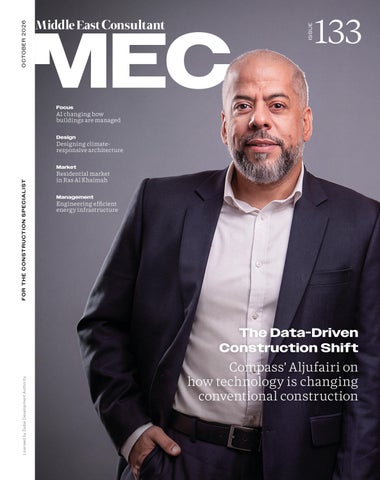
The Data-Driven Construction Shift Compass’ Aljufairi on how technology is changing conventional construction
Beyond the flick of a switch
Have you ever taken for granted the fact that electricity is simply available to you at the flick of a switch? Be it to turn on the TV, cook on an electric stove or turn off a bedroom lamp. It’s easy to overlook something so familiar. However, there are many regions across the world that still don’t have the privilege we enjoy of continuous electricity. This could be due to inadequate energy resources or the fact that governments haven’t laid out the right infrastructure for generated energy to be transmitted efficiently. For the Middle East, as our cities expand, industries evolve and digital infrastructure advances, meeting rising energy needs while progressing towards Net Zero is one of the region’s defining challenges. Renewables such as solar and wind are quickly gaining momentum, supported by abundant natural resources, in-country strategies and increasingly technological advances. Large-scale solar parks, green hydrogen initiatives and energy storage investments are reshaping the region’s energy landscape. Yet, the transition requires more than additional generation capacity; it demands a resilient, intelligent and interconnected grid. Nuclear energy is also emerging as a strategic component of the region’s energy mix. Being used alongside gas-fired generation, it can support grid stability and longterm energy security as economies transition towards lower-carbon systems. For consultants, this transformation opens substantial opportunities across project development, infrastructure design, energy efficiency and integrated energy planning. This is not something we should enter into lightly, but rather, responsibly. The future of energy will be defined not simply by how much we generate, but by how intelligently, securely and sustainably we transmit it.
Clayton Aldo Vallabhan Deputy Editor, ME Consultant
MECONSTRUCTIONNEWS.COM
1
CONTENTS
24 COVER STORY
Compass Project Consulting’s VP – Operations Hamed Aljufairi speaks with MEC’s Clayton Vallabhan about how Saudi Arabia and the UAE’s construction markets are entering a new phase, where speed, quality, risk and return on investment are increasingly being managed through data and technology
2
OCTOBER 2026
INITIATE 10 MOMA International shapes J1 Hotel’s waterfront architecture in Dubai ⁄ 12 Moon World resorts picks BDP Quadrangle as lead architect ⁄ 14 WSP appoints Rob Kettlety and Emma Wyatt to ME Executive Committee
INTERFACE 34 John McAllister, Energy Director at Mott MacDonald explains the challenges of energy infrastructure delivery, the role of thermal and nuclear power, grid resilience and the importance of developing local engineering talent in KSA ⁄ 46 Dr Matthew Marson and Rachael Jones of JLL discuss the opportunities, challenges and technologies shaping the future of the region’s built environment
INNOVATE 58 New Challenges, New Answers: Sustainability and Climate Adaptation by Alicia Cambra, Founder & Creative Director at Cambra Buró ⁄ 68 Artificial Intelligence in Construction Cost Management: Opportunity, Risk, and the Future of Commercial Control by James Mannion, Associate Director at Turner & Townsend ⁄ 74 As part of our ‘Day in the Life’ focus, MEC sits down with Tessa Terblanche, Associate Director, Oval
MECONSTRUCTIONNEWS.COM
3
GROUP
MANAGING DIRECTOR Raz Islam DIRECTOR OF FINANCE & BUSINESS OPERATIONS Shiyas Kareem
raz.islam@cpitrademedia.com shiyas.kareem@cpitrademedia.com
EDITORIAL
EDITORIAL DIRECTOR Jason Saundalkar
jason.saundalkar@cpitrademedia.com
DEPUTY EDITOR Clayton Aldo Vallabhan
clayton.aldo@cpitrademedia.com
ASSOCIATE EDITOR Priyanka Raina
priyanka.raina@cpitrademedia.com
COMMERCIAL PARTNERSHIPS
GLOBAL ACCOUNT MANAGER Jas Kaur PARTNER DEVELOPMENT EXECUTIVE Raunak Kamat
jas.kaur@cpitrademedia.com raunak.kamat@cpitrademedia.com
STUDIO
ART DIRECTOR Simon Cobon
simon.cobon@cpitrademedia.com
GRAPHIC DESIGNER Percival Manalaysay
percival.manalaysay@cpitrademedia.com
PHOTOGRAPHER Maksym Poriechkin
maksym.poriechkin@cpitrademedia.com
MARKETING & OPERATIONS
DIRECTOR OF MARKETING & MEDIA OPERATIONS Phinson Mathew George PRODUCTION & IT SPECIALIST Jarris Pedroso SOCIAL MEDIA EXECUTIVE Franzil Dias
phinson.george@cpitrademedia.com jarris.pedroso@cpitrademedia.com franzil.dias@cpitrademedia.com
WEB DEVELOPMENT
SENIOR DIGITAL MANAGER Abdul Baeis
abdul.baeis@cpitrademedia.com
FOUNDER Dominic De Sousa (1959-2015)
When you have finished with this magazine, please recycle it The publisher of this magazine has made every effort to ensure the content is accurate on the date of publication. The opinions and views expressed in the articles do not necessarily reflect the publisher and editor. The published material, adverts, editorials and all other content are published in good faith. No part of this publication or any part of the contents thereof may be reproduced, stored or transmitted in any form without the permission of the publisher in writing. Publication licensed by Dubai Development Authority to CPI Trade Publishing FZ LLC CPI Trade Media. PO Box 13700, Dubai, UAE. +971 4 375 5470 cpitrademedia.com © Copyright 2026. All rights reserved.
4
OCTOBER 2026
ISSUE
O CTO B E R 2 0 2 6
Licensed by Dubai Development Authority
133
232 JULY-AUG 2026
Focus
AI changing how buildings are managed
DIGITAL PIONEERS
Design
Designing climateresponsive architecture
CELEBRATING THE CONSTRUCTION INNOVATORS TRANSFORMING PROJECT DESIGN AND DELIVERY
FO R T H E C O N ST R U CT I O N S P EC I A L I ST
Market
Residential market in Ras Al Khaimah Management
Engineering efficient energy infrastructure
VEHICLES/ TECH / TRANSPORTATION/LOGISTICS
The Data-Driven Construction Shift
MIDDLE EAST
142/JULY-AUGUST 2O26 LI CENSED BY D U BAI D EVELO PM ENT AU TH O RIT Y
Licensed by Dubai Development Authority
Compass’ Aljufairi on how technology is changing conventional construction
, NEW CONF USED TRUCKS
IDENCE WITH
OV ED FAMCO APPR ON THE COVER
Compass’ Aljufairi on how technology is changing conventional construction
ned tified pre -ow Famco’s cer on Al-Fut taim fleet expansi drive smart cks tru lvo Vo
CHE RY ENT
VA NEW HI MA ITORY
ERS PICK-UP
TERR
ISSUE 166 AUGUST 2026
MEConstructionNews.com @meconstructionn MEConstructionNews me-construction-news
A CASE ASES F OR A L L C
VERS EARTHMO
CH ST APPROA MIDDLE EA D TO CONQUER TRUCTION’S EERE S CASE CONS MACHINES ENGIND TOUGH DEMAND ON AN ILT N AI IS BU HEAT, TERR EXTREME
GET THE
WHOLE PICTURE
ONLINE
POPULAR
FEATURES
CONSTRUCTION
Almal completes superstructure of ‘The Unexpected’ Al Marjan Island
Building the Extraordinary PROPERTY
Burtville debuts Bab Al Qasr Beach Resort Residence 77
CONSTRUCTION
Al Othaim reveals US $4.3bn Saudi real estate investment plans
CKR: 25 Years of Engineering Ambition
INDUSTRY
Oraya Developers to launch first UAE project in Ras Al Khaimah
INFRASTRUCTURE
Etihad Rail, Parkin and Q Mobility to operate smart parking at stations
6
OCTOBER 2026
Blueprint for the Future
FEATURED NEWS
UPCOMING EVENTS
CONSTRUCTION
Dubai Municipality completes projects worth US $440mn in 2026 These projects, delivered through its Public Facilities Agency, demonstrate the municipality’s commitment to expanding Dubai’s public destinations
OCTOBER
Energy & Sustainability Summit 28 October 2026 Dubai, United Arab Emirates
PROPERTY
Nakheel unveils Bay Estate, Dubai Islands The residential collection includes garden villas, attached villas and townhouses, offering a range of private island living options
NOVEMBER
Real Estate Leaders Summit 17 November 2026 Dubai, United Arab Emirates
INFRASTRUCTURE
Submer and ACES ink MoU to increase AI-ready data centre capacity in KSA The 2-partners aim to take customers in the Kingdom from early planning through deployment and long-term operation
NOVEMBER
Specialist Construction Summit 18 November 2026 Dubai, United Arab Emirates
INDUSTRY
Dubai CommerCity unveils US $490mn e-commerce infrastructure expansion The expansion comes as demand for office, logistics and retail space for e-commerce and technology companies grows in the UAE
NOVEMBER
Women in Construction Connect 25 November 2026 Dubai, United Arab Emirates
PROPERTY
BNW Developments launches Sydney office, for Australians to invest in the UAE BNW Developments is set to offer Australian investors stronger yields and international diversification in the UAE
DECEMBER
Middle East Consultant Awards 9 December 2026 Dubai, United Arab Emirates
MECONSTRUCTIONNEWS.COM
7
INITI 8
OCTOBER 2026
INSIDE
10 MOMA International shapes J1 Hotel’s waterfront architecture in Dubai ⁄ 12 Moon World resorts picks BDP Quadrangle as lead architect ⁄ 14 WSP appoints Rob Kettlety and Emma Wyatt to ME Executive Committee ⁄ 16 Ras Al Khaimah residential market performance
IATE A deep dive into the biggest construction headlines that caught our eye this month
MECONSTRUCTIONNEWS.COM
9
INITIATE
MOMA International shapes J1 Hotel’s waterfront architecture in Dubai
10
OCTOBER 2026
The architecture and design of J1 Hotel,
MOMA International serves as Lead
closure works are progressing within
a 5-star beachfront development at Port
Consultant for architecture, interior
guest accommodation areas. These
de La Mer in Dubai’s Jumeirah district,
design and landscape, overseeing the
activities mark a significant step towards
are moving into a new phase following
integration of the project’s design
establishing the building envelope and
the substantial completion of its
disciplines and supporting their
advancing the coordinated delivery of its
concrete works.
implementation throughout construction.
interior spaces.
Designed by MOMA International,
The practice’s multidisciplinary approach
Once complete, the hotel will
the 366-key hotel is scheduled to open
places the relationship between the
comprise 366 rooms and suites, including
in Q4 2027 and will introduce Gran Meliá,
built form, landscaped external spaces
40 luxury accommodations with private
the flagship luxury tier of Meliá Hotels
and guest experience at the centre of
pools. Four swimming pools set within
International, to the UAE.
the development.
landscaped gardens, a rooftop terrace,
Set on a distinctive peninsula
The hotel’s coastal location informs
ballroom, meeting and event facilities,
surrounded by water on 3 sides, the project
the organisation of its external spaces,
and a fitness centre will form part of the
is conceived around its coastal setting,
including pools, terraces and food-and-
wider programme. The dining offer will
bringing architecture, interiors, landscape
beverage destinations, while direct beach
include Zuma Beach House, Park Chinois,
and hospitality together within a single
access and views towards the sea and
Novikov Restaurant & Beach Club, Jul’s and
waterfront destination. With the primary
Dubai skyline reinforce its relationship
Tala, complemented by a rooftop wellness
structural works substantially complete,
with the surrounding landscape and the
destination by Journée Wellbeing.
construction is advancing across facade
wider Port de La Mer community.
The integration of sustainability
installation, mechanical, electrical and
Current site progress reflects the
measures forms part of the project’s
plumbing (MEP) services, interior fit-out
transition from structural delivery to
delivery strategy. Developed in compliance
and finishing packages, as the building
the building’s architectural and interior
with the Dubai Green Building Code,
moves towards enclosure and the design
expression. Facade glazing and glass
the hotel also incorporates a greywater
begins to take its final form.
installation are underway, while ceiling
treatment system.
MECONSTRUCTIONNEWS.COM
11
INITIATE
Moon World resorts picks BDP Quadrangle as lead architect 12
OCTOBER 2026
Moon World Resorts (MWR) has appointed
let our imaginations roam and feel hopeful.”
BDP Quadrangle, the Toronto-based studio
“It’s a chance for people of different
and North American headquarters of global
ages and backgrounds to share an
design practice BDP, as lead architects
experience that sparks curiosity and
across all Moon Smart City masterplans.
conversation. If someone leaves feeling a
Initial plans for the project point to it
little more hopeful, or inspired to dream
being built in Dubai or Abu Dhabi.
bigger, that matters,” she stated.
This engagement draws on BDP
As per the deal, BDP Quadrangle
Quadrangle’s multidisciplinary approach
will be bringing its collaborative,
to architecture, design, and urbanism,
multidisciplinary design philosophy,
supporting MWR’s mission of delivering
honed since 1961 and sharpened through its
a building of global significance across all
North American practice, to MOON’s global
global regions.
design and delivery program across all
Founded in 1961 by Sir George Grenfell
worldwide locations.
Baines on the belief that collaboration
Each MOON development is conceived
across disciplines produces better
as a building of global significance,
design than hierarchy, BDP has grown
anchored by the world’s largest true sphere
into an internationally renowned,
and a 556 acre masterplan integrating
multidisciplinary practice spanning
hospitality, entertainment, longevity
architecture, engineering, and specialist
+ wellbeing, education, technology,
design under one roof.
attractions, luxury residences and AAA
In 2019, Quadrangle, the 35-year-old
commercial real estate, she added.
Toronto practice respected across North
This mandate demands the kind of
America for its design quality, business
collaborative, people-centered design
acumen, and integrity, joined BDP; the
process BDP Quadrangle has built its
combined studio became BDP Quadrangle
reputation on; architects, engineers,
in 2020.
designers and specialists working as equals
Today the 200-person Toronto studio designs across mixed-use
toward environments that are functional, sustainable, and genuinely lived in.
urban developments, residential
Heather Rolleston, Principal at BDP
buildings, workplace, retail, transit,
Quadrangle said: “There is a lot happening
media environments, education, and
in the world right now that can make the
healthcare, with notable work including
future feel uncertain. I wanted to be part of
the Indigenous Hub in Toronto’s Canary
MOON because it offers people something
District and design contributions to
we all need: a place to step outside the
The Well.
everyday, let our imaginations roam and
On the strategic partnership, Heather
feel hopeful about what might be possible.”
Rolleston, Principal at BDP Quadrangle
“It’s a chance for people of different
said: “There is a lot happening in the world
ages and backgrounds to share an
right now that can make the future feel
experience that sparks curiosity and
uncertain. I wanted to be part of MOON
conversation. If someone leaves feeling a
because it offers people something we all
little more hopeful, or inspired to dream
need: a place to step outside the everyday,
bigger, that matters,” she noted.
MECONSTRUCTIONNEWS.COM
13
INITIATE
WSP appoints Rob Kettlety and Emma Wyatt to ME Executive Committee WSP has announced the appointment of
and bringing together the breadth of
Wyatt’s new role is in addition to her
Rob Kettlety and Emma Wyatt to its Middle
expertise across WSP to support clients
role as Senior Vice President, Marketing &
East Executive Committee. Kettlety has
in delivering complex, high-impact
Communications for EMEIAA.
been appointed Executive Director, Clients
programmes across the region.
Sh e
will
lead
M a rke t i ng
&
& Growth, while Wyatt has been appointed
“What excites me most about this role
Communications across Europe,
Senior Vice President, Marketing &
is the opportunity to help shape what
the Middle East, India, Africa, and
Communications, EMEIAA.
comes next for our business. We have
Asia, supporting business growth,
The consultancy said that the
extraordinary expertise across the Middle
strengthening client engagement, and
appointments strengthen its regional
East and throughout WSP globally, and my
showcasing the expertise, innovation,
leadership team as the business
focus will be on connecting our people,
and impact delivered by WSP.
continues to grow across the Middle
clients, and capabilities more effectively
“My focus will be on strengthening
East, while supporting clients on some
to create lasting value. We want to be the
how we connect our expertise to our
of the region’s most ambitious and
partner of choice on the region’s most
clients, enhancing our market profile, and
transformative projects.
ambitious programmes and projects,
ensuring we continue to tell compelling
In his new role, Kettlety will focus
while continuing to champion the talented
stories about the extraordinary
on strengthening client relationships,
people whose expertise and innovation
work our people deliver every day.”
identifying future growth opportunities,
make that possible,” said Kettlety.
Wyatt commented.
14
OCTOBER 2026
Turn growth challenges into competitive advantages. Wherever your projects take you, Trimble scales with your ambition. Whether it’s supporting new materials, handling local compliance or growing from single seats to enterprise deployments, we’ll help you deliver with confidence.
REWORK CALCULATOR Let’s uncover your hidden costs Scan this QR Code.
This free access tool is designed to help structural and MEP professionals visualise the financial impact of rework in a project. By inputting a few key details and using data from the Construction Industry Institute, you can see how small oversights can escalate as the project progresses from design to construction.
www.trimble.com
INITIATE
Ras Al Khaimah residential market performance Ras Al Khaimah’s economy remained broadly supportive during H1 2026, with continued investment, business formation and employment growth supporting residential demand say experts at Cavendish Maxwell. The emirate attracted US $210mn in new investment, while 967 new businesses joined the Ras Al Khaimah Chamber of Commerce. RAK Economic Zone’s commercial employment also increased during the period, while the trade balance improved to US $839mn. These developments point to continued underlying economic resilience, although higher inflation and regional geopolitical uncertainty has introduced some caution. The residential market, however, has shown some signs of moderation in recent months. Freehold ready residential transaction values reached US $170.2mn in H1 2026, down 3.3% year-on-year but 24.% higher than H2 2025. Sales prices remained above H1 2025 levels, with apartment and villa prices increasing by 6.5% and 5.9%, respectively, although both segments recorded modest declines over the past 3 months. Rental rates also remained higher year-on-year, rising by 7.1% for apartments and 8.0% for villas, but apartment rents declined over the past 3 months. Supply is expected to become an increasingly important factor, with around 1,600 units due for delivery in H2 2026, followed by approximately 4,700 units in 2027 and 7,500 units in 2028. The market’s ability to absorb this pipeline will depend on continued population, employment and investment growth. The anticipated opening of Wynn Al Marjan Island remains a key demand catalyst, with the potential to support employment creation, boost tourism inflows and generate additional housing demand.
16
OCTOBER 2026
MECONSTRUCTIONNEWS.COM
17
INITIATE
SALES VALUES Villas 800
Apartments
Total Sales Transactions (AED Millions)
646.5
630.3
625.2
541.2
504.0
AED Millions
600
400
200
H1 2024
H2 2024
H1 2025
H2 2025
H1 2026
The performance of the market in H2 2026 will therefore
Business activity and employment also expanded. The RAK
provide greater clarity on whether the recent moderation in
Economic Zone’s commercial licence base reached 63,258 by June
prices and rents is temporary or signals a broader shift towards
2026, while commercial employment increased to 85,989, from
more measured market conditions.
67,107 at the end of 2025. Industrial employment stood at 61,527 at the end of H1 2026. International trade through RAK’s ports
MACROECONOMIC OVERVIEW AND OUTLOOK
also remained active in H1 2026, with total imports reaching
Ras Al Khaimah’s economic environment remained broadly
approximately US $1.74bn, while exports stood at US $1.77bn.
supportive during H1 2026, with continued investment, business
Re-exports rose sharply to around US $817mn, compared with
formation and trade activity. S&P Global affirmed the emirate’s
approximately US $517mn in H1 2025. This contributed to an
‘A/A-1’ sovereign credit rating with a stable outlook, while
improvement in the overall trade balance, which increased
forecasting real GDP growth to average around 2.2% in 2026–
from US $531mn in H1 2025 to US $839mn in H1 2026. Meanwhile,
27 before strengthening over the medium term. Investment
inflationary pressures have increased, with the Consumer Price
activity also remained healthy, with Ras Al Khaimah attracting
Index rising 4.9% year-on-year in June 2026, potentially placing
US $210mn in new investment during H1 2026, according to
some pressure on household costs.
the Ras Al Khaimah Chamber of Commerce. A total of 967 new
Looking ahead, regional geopolitical uncertainty introduces
businesses joined the Chamber, bringing 1,399 investors from
some caution to the near-term outlook. However, Ras Al Khaimah
68 nationalities to the emirate. These investments are expected
has remained resilient through H1 2026, with investment inflows
to generate approximately 2,449 new jobs.
and business formation continuing to support economic activity.
CHANGE IN SALES TRANSACTION VALUE Villas
18
Apartments
Total Sales Transactions
H-on-H
22%
26%
24.1%
Y-on-Y
-7.4%
0.7%
-3.3%
OCTOBER 2026
RESIDENTIAL SUPPLY Completed Supply
Upcoming Supply
8,000
Units
6,000
4,000
2,000
2025
2026
2027
2028
FREEHOLD READY RESIDENTIAL MARKET
development, connectivity improvements and community
Ras Al Khaimah’s freehold ready residential market recorded
amenities serving as supporting factors that strengthen the
total transaction values of US $177.6mn during H1 2026,
emirate’s residential appeal.
Sources: Cavendish Maxwell, Ras Al Khaimah Statistics Centre, MEED Projects, Property Monitor
representing a 3.3% year-on-year decline compared with H1 2025. However, transaction values were 24.1% higher than in H2 2025.
SALES PRICE CHANGE
The annual decline was primarily driven by the villa segment,
Residential sales prices in Ras Al Khaimah remained higher
where transaction values fell by 7.4% year-on-year to US $81mn. In
year-on-year during H1 2026, with apartment prices increasing
contrast, the apartment segment remained broadly stable, with
by 6.5% and villa prices by 5.9%. However, price growth has
transaction values increasing by 0.7% year-on-year to US $89mn.
started to ease, with apartment prices declining by 0.7% and
On a quarterly basis, total transaction values reached US
villa prices by 0.2% over the past 3 months. The recent easing
$96mn in Q2 2026, increasing by 30.3% quarter-on-quarter, while
reflects a more cautious approach among buyers amid broader
remaining 0.3% below the same period last year. Apartments
macroeconomic uncertainty. The performance during H2 2026
accounted for US $42mn in transaction value, while villas
will therefore be important in determining whether the recent
accounted for US $54mn.
easing is temporary or marks a shift in price momentum.
RESIDENTIAL SUPPLY
RENTAL RATE CHANGE
Residential supply in Ras Al Khaimah remained relatively
Rental rates in Ras Al Khaimah remained higher year-on-year
contained during H1 2026, with approximately 600 units added
during H1 2026, with apartment rents increasing by 7.1% and villa
to the market. The development pipeline, however, points to a
rents by 8.0%. However, the recent trend has been more mixed,
step-up in deliveries over the coming years. Around 1,600 units
with apartment rents declining by 1.4% over the past 3 months,
are expected in H2 2026, followed by approximately 4,700 units
while villa rents increased by 0.9%. The divergence between the
in 2027 and 7,500 units in 2028, representing an increase from
2 segments indicates that rental performance is becoming more
the more measured pace of recent periods.
uneven within the emirate, with apartment rents showing greater
As this volume of supply enters the market, demand
near-term sensitivity to the more cautious market environment.
absorption becomes an increasingly important consideration.
Ras Al Khaimah’s residential market enters the second half
The market’s ability to accommodate the pipeline will depend
of 2026 with growth momentum showing signs of easing. While
primarily on continued employment growth and the emirate’s
the underlying economic environment remains supportive,
capacity to attract and retain residents, with infrastructure
with continued investment inflows, business formation and
MECONSTRUCTIONNEWS.COM
19
INITIATE
SALES PRICE CHANGE Apartments
Villas 6.5%
8
6.9%
% Change
6 4
1.5%
1.2%
2
-0.7%
-0.2%
0
Past 3 Months
Past 6 Months
Past 12 Months
employment growth providing a foundation for residential
tourism inflows, stimulate employment creation and generate
demand, heightened regional geopolitical uncertainty has
additional housing demand, particularly in communities in
introduced greater caution among buyers and tenants,
proximity to Al Marjan Island.
contributing to softer near-term price and rental performance.
Regional geopolitical developments remain an important
The supply pipeline will also become an increasingly
factor to monitor through H2 2026, particularly given their
important factor for the market. Around 1,600 units are expected
potential impact on buyer and tenant sentiment. However, Ras Al
in H2 2026, followed by approximately 4,700 units in 2027 and 7,500
Khaimah’s economy has so far remained relatively resilient, with
units in 2028. The ability of employment and population growth
continued investment, business formation and employment
to absorb this incoming supply will therefore be important,
growth during H1 2026. The performance of the residential
particularly as increased competition between developments
market during the second half of the year will provide greater
could result in more measured price and rental growth. The
clarity on whether the recent moderation in sales prices and
anticipated opening of Wynn Al Marjan Island remains a key
rental rates is temporary or marks a broader shift towards more
medium-term demand catalyst, with the potential to support
measured market conditions.
RENTAL RATE CHANGE Apartments
Villas
8.0% 7.1%
8
% Change
6
3.8% 2.4%
4 0.9%
2
-1.4%
0
Past 3 Months
20
OCTOBER 2026
Past 6 Months
Past 12 Months
INTER 22
OCTOBER 2026
INSIDE
24 Compass Project Consulting’s VP – Operations Hamed Aljufairi speaks with MEC’s Clayton Vallabhan about how Saudi Arabia and the UAE’s construction markets are entering a new phase, where speed, quality, risk and return on investment are increasingly being managed through data and technology ⁄ 34 John McAllister, Energy Director at Mott MacDonald explains the challenges of energy infrastructure delivery, the role of thermal and nuclear power, grid resilience and the importance of developing local engineering talent in KSA ⁄ 46 As the Middle East accelerates the delivery of giga-projects and smart cities, artificial intelligence and advanced digital technologies are changing how buildings are planned, constructed and managed. Dr Matthew Marson and Rachael Jones of JLL discuss the opportunities, challenges and technologies shaping the future of the region’s built environment
RFACE Going behind-the-scenes with the region’s top construction consultants and industry trailblazers
MECONSTRUCTIONNEWS.COM
23
INTERFACE
The Data-Driven Construction Shift Compass Project Consulting’s VP – Operations Hamed Aljufairi speaks with MEC’s Clayton Vallabhan about how Saudi Arabia and the UAE’s construction markets are entering a new phase, where speed, quality, risk and return on investment are increasingly being managed through data and technology
For much of the past decade, the defining question for regional construction has been how quickly projects can be delivered. As Saudi Arabia and the UAE move deeper into their development programmes, another question is becoming increasingly important: how effectively is the capital behind those projects being protected? For Hamed Aljufairi, VP – Operations at Compass Project Consulting, the next 3 years will be shaped by that shift. “We have a very strong pipeline, both in Saudi Arabia and the UAE, and it is diverse, ranging from infrastructure to buildings,” he says. The pipeline remains substantial, particularly across projects supporting Saudi Arabia’s Vision 2030 ambitions. But the market is becoming more sophisticated, with investors looking more closely at risk, returns and delivery certainty, while clients demand greater control over what happens on site. For Compass, that means bringing together project management, construction supervision, geospatial intelligence, asset management and digital technologies. “Compass has a unique value proposition in the market. We combine international experience with strong local knowledge, and very few firms in Saudi Arabia and the UAE bring both together at our level,” comments Aljufairi.
24
OCTOBER 2026
MECONSTRUCTIONNEWS.COM
25
INTERFACE For owners and investors, a project delivered on time has limited value if the completed asset does not meet the required standard.
Compass is Saudi owned, and Aljufairi sees that as the
“We’ve seen investors, especially in the private sector,
foundation of its proposition. The firm pairs people who have
taking more time to assess risk before committing capital,
delivered major programmes internationally with teams who
particularly where supply-chain difficulties could affect a
understand how projects are procured and built in the Kingdom
project,” he explains.
and the Emirates, and who work closely with the developers and
At project level, supply-chain pressures are also affecting
investment funds driving the pipeline.
construction costs.
RISK IS CHANGING THE INVESTMENT EQUATION
especially when projects are in the construction phase. On some
The outlook for construction remains positive, but the
packages, we are seeing material prices increase by 20 to 25%,”
environment is more uncertain. Geopolitical tensions, supply-
remarks Aljufairi.
“On ongoing projects, there are supply-chain issues,
chain disruption and rising costs are influencing investment decisions, particularly in the private sector.
26
OCTOBER 2026
That makes early risk identification increasingly important. Rather than waiting for procurement problems, cost increases
or programme delays to emerge during construction, Compass
programme management and high-level project oversight.
is working with clients earlier in the development cycle to
“Over the past 8 years, clients were more focused on
identify exposure and develop mitigation strategies, including
programme management and PMCs, with an overall view of
alternative procurement and supply routes.
project progress. Today, they want the same level of control
The goal is to ensure investors understand risks before
over quality on site,” points out Aljufairi.
committing capital and have measures in place to manage them.
The rapid expansion of construction activity has changed
That represents a broader change in the role of the project
that equation. More projects and new contractors entering the
consultant: from managing delivery to helping protect the
market have increased the importance of quality assurance
investment behind it.
and quality control.
One of the clearest examples of that change is Compass’s growing focus on construction supervision. Historically, Aljufairi says, clients were more focused on
“Nowadays, with the increased number of projects and new contractors coming into the market, quality issues need to be managed. That is why we propose construction supervision to clients, to make sure that quality assurance and quality control on site are properly managed,” he remarks. For owners and investors, the logic is straightforward: a project delivered on schedule and within budget has limited value if the completed asset does not meet the required standard. “Our advice to clients is to build construction supervision into the delivery model alongside project management and construction management.” The traditional balance of time, cost and quality is therefore being brought back to the centre of project delivery. “Why do you manage your schedule? Why do you manage your cost? You also need to manage quality and make sure that the design intent established during the design stages is delivered on site,” explains Aljufairi. That is particularly important for investment funds, where the asset is ultimately expected to generate a financial return.
“We have a very strong pipeline, both in Saudi Arabia and the UAE, and it is diverse, ranging from infrastructure to buildings.” HAMED ALJUFAIRI
MECONSTRUCTIONNEWS.COM
27
INTERFACE
“One of the values that Compass adds to programmes is the dashboard, which gives the client 24/7 access.” HAMED ALJUFAIRI
Compass works with investment funds and financial
Compressing the programme can bring an asset into
institutions in Saudi Arabia, providing client representation
operation sooner, but accelerating delivery without adequate
alongside PMC and supervision services.
controls can increase quality and execution risks.
“One of the values that Compass brings to the market is
“So the biggest risk I see is the schedule. Our role is to find
that we are very close to investment funds and have significant
ways of shortening the schedule so that the project becomes
experience working with them,” says Aljufairi.
operational as quickly as possible without compromising quality.”
The role is to ensure that developers, consultants and designers remain aligned with the investor’s objectives. “Our role as a client representative is to make sure that the
The emerging model is therefore less about choosing between speed and quality and more about using better information, planning and technology to achieve both.
developer, consultants and designers are achieving exactly what the client is looking for.”
FROM REACTIVE MANAGEMENT TO
For investors, one of the most important variables is time.
EARLY WARNING
“For capital funds, time is everything. They want to build
That philosophy is reflected in Compass’s approach to risk
as quickly as possible so that they can generate a return on
management, with proactive procedures focused on quality,
investment,” he states.
time and cost.
28
OCTOBER 2026
Aljufairi thinks it's important to assess the critical path in risk-management, as any issues can lead to the whole programme being delayed.
Early-warning indicators are used to identify emerging issues before they develop into major problems.
already discussing potential applications with clients, including cameras integrated into helmets used by site inspectors.
“At Compass, we have very proactive risk-management
“At the moment, we are discussing with a few of our clients
procedures and systems. At an early stage, we have early-warning
how to implement AI and augmented reality, including cameras
indicators covering the three main pillars: quality, timeline and
integrated into helmets used by site inspectors. When the
cost,” says Aljufairi.
inspectors go to site, the camera is switched on and linked
Understanding the critical path is particularly important.
to the drawings and the model. Whatever the camera detects,
A delay to a critical activity can quickly cascade through an
whether someone is not wearing a helmet, there is a health and
entire programme.
safety issue, or there is a construction issue, it can be flagged,”
“At the early stage of the programme, we know what the
explains Aljufairi.
critical path is. If there are any issues affecting the critical path, the whole programme is going to be delayed,” he continues. Technology increasingly supports that process. Digital dashboards give clients continuous visibility of programme performance, enabling them to see where a project is heading rather than simply where it has been. “One of the values that Compass adds to programmes is the dashboard, which gives the client 24/7 access to the project so they know exactly where the programme is heading.” The purpose, however, is not simply to create more information. “Our role is to alert the client as early as possible if there are any issues affecting these programmes and projects,” affirms Aljufairi. The
value
of
digitalisation
therefore lies in turning information into intervention. THE CONSTRUCTION SITE BECOMES DIGITAL
The next stage could see that principle applied directly to construction sites. Aljufairi believes artificial intelligence, computer vision and augmented-reality technologies will increasingly change construction supervision. Compass is
MECONSTRUCTIONNEWS.COM
29
INTERFACE
Compass thinks there is a lot of opportunity in digital-twins, and the region is still early in delivering them as fully dynamic environments.
The concept is to connect what an inspector sees on site with the project’s digital drawings, models and other information. Such systems could allow issues to be identified and recorded more quickly while creating a richer digital record of site activity. Technology, Aljufairi says, is intended to support rather than replace professional judgement. “There are a number of tools we are discussing with clients to accelerate the process and make it even more efficient.” The same thinking extends beyond construction completion. Digital twins have become one of the industry’s most discussed technologies, but Aljufairi believes the Gulf is still some way from widespread adoption of fully dynamic digital-twin environments. “A lot of people are talking about digital twins, and the region is still early in delivering them as fully dynamic environments. That is where we see the opportunity,” says Aljufairi. The opportunity is becoming clearer, particularly for existing assets. Aljufairi points to growing demand in Saudi Arabia for higher-level BIM models that can ultimately support dynamic digital-twin applications. “Nowadays, there is a big demand in Saudi Arabia, especially for assets completed over the last 5 to 10 years, to have BIM LOD 700, where the model is dynamic and linked to a digital twin.” The potential value is significant. Instead of allowing information about an asset to become fragmented after construction, a digital twin can maintain an updated record of its components, condition, warranties, defects and maintenance requirements. “Why digital twins? Because you can manage your whole asset. Digital twins will give you the details of everything within the buildings – the warranties, any defects and other information. They will be particularly valuable for projects that have been completed and for very expensive assets,” explains Aljufairi. For Compass, this forms part of a broader geospatial offering that brings together BIM, asset management and digital-twin capabilities. DATA BECOMES AN INVESTMENT TOOL
Ultimately, Aljufairi argues, the biggest opportunity is not simply creating digital models or collecting more information. It is using data to make better decisions.
30
OCTOBER 2026
“A lot of people are talking about digital twins, and the region is still early in delivering them as fully dynamic environments. That is where we see the opportunity.” HAMED ALJUFAIRI
MECONSTRUCTIONNEWS.COM
31
INTERFACE
Historical project data can also become an asset in its own right. “With the geospatial and digital data we get from assets, we can use machine learning to support new projects. The more data you have on similar projects – for example, the lifecycle of materials and equipment – the more we can use that data to improve the construction industry on new assets,” he remarks. The more information is accumulated from comparable assets, the more sophisticated future decisions can become. Compass is already using projectmanagement information systems to manage the growing volume of information generated by major programmes. “At Compass, we are working with PMIS systems that facilitate and manage large amounts of data.” The objective is not to reduce information, but to organise it so that it can support decisions. “I see more data as beneficial rather than detrimental,” says Aljufairi. This shift towards data-driven delivery is happening alongside greater scrutiny of capital allocation. For developers and investors, the question is increasingly not simply whether a project can be built, but Hamed Aljufairi is VP-Operations at Compass Project Consulting.
whether it should be built in its current form, at its current cost and on its current programme. “With investors watching cash flow more closely, there is
“Geospatial is not only about GIS, land boundaries and surveys. Geospatial is about data.” That data can influence decisions throughout the asset lifecycle, from site selection and development planning through design, procurement and construction to operations and maintenance.
definitely going to be more focus on where investment goes, how that investment is deployed, and what the return on investment is for every riyal and dirham invested,” he states. Aljufairi expects this focus on resilience, return on investment and delivery speed to have a lasting impact on construction. “This is going to change the whole construction industry.
“Every decision you make about your land, whether it is for
There will be more focus on how we build projects in a very short
development, how you are going to build the project, or where
time, how we use digital technologies and machine learning,
the project should be located, can be supported by geospatial
and how we use new and innovative solutions to deliver these
intelligence,” states Aljufairi.
outcomes,” explains Aljufairi.
32
OCTOBER 2026
Robotics are now being introduced for site inspections, with a senior engineer sitting in the office and managing the site remotely.
The changes could extend to how projects are physically
management and digital technology represents more than
built, with traditional labour-intensive construction increasingly
an expansion of services. It reflects a changing definition of
giving way to modularisation, off-site manufacturing, robotics
project success.
and automated processes. “I think it is going to be more about modular designs, where you do everything off site and then bring it to site, or digital machines building the construction and the assets, with far fewer people exposed to risk on site,” envisions Aljufairi.
The next phase of construction will still demand projects delivered on time and on budget. But those measures alone will increasingly be insufficient. Investors will want greater certainty that capital is being deployed effectively. Developers will need earlier visibility
The same transformation could affect supervision itself.
of risks. Owners will expect higher-quality assets and better
“The traditional model of PMCs and supervision is going to
information after handover. Project teams will increasingly rely
evolve into a hybrid solution, where you have very few people on
on technology to monitor, analyse and improve performance.
site. Even now, robotics are being introduced for site inspections,
Aljufairi believes Compass is already positioned for that
with a senior engineer sitting in the office and managing the site
transition. “I believe Compass is very well positioned in the
remotely. Things are definitely going to change. That change is
market for what is going to happen in the future,” he says.
positive because it is driven by data. The level of mistakes is going
The direction of travel is clear: greater digitalisation,
to be minimised, projects will be delivered more quickly, and
more sophisticated use of project data and a stronger focus
the quality will be exactly what you are looking for, but within a
on protecting the investment as well as delivering the
shorter timeframe,” remarks Aljufairi.
physical asset.
For clients, the potential benefits are clear: faster delivery, greater control, fewer errors and more predictable quality. For Compass, the convergence of project management, construction supervision, geospatial intelligence, asset
“I think we are moving more and more towards digitalisation. We have a clear vision of where the market is going, and Compass is already working that way with our clients today,” concludes Aljufairi.
MECONSTRUCTIONNEWS.COM
33
INTERFACE
34
OCTOBER 2026
Saudi Arabia’s Energy Transition John McAllister, Energy Director at Mott MacDonald speaks with Clayton Vallabhan of MEC on the challenges of energy infrastructure delivery, the role of thermal and nuclear power, grid resilience and the importance of developing local engineering talent in KSA
MECONSTRUCTIONNEWS.COM
35
INTERFACE Saudi Arabia’s development ambitions are driving demand for electricity across new urban centres and industrial projects.
Saudi Arabia’s energy transformation is unprecedented in
“I have never seen a market like this before,” McAllister says.
scale, demanding more than new power generation capacity.
Having spent more than 20 years in the UAE, where he witnessed
It requires an integrated approach to energy infrastructure, from
the development of the country’s power sector, he sees Saudi
transmission and distribution to storage, asset management
Arabia’s transformation as several times larger in scale.
and long-term operational capability. For John McAllister, Energy Director at Mott MacDonald, whose career in the energy sector spans more than 3 decades, the challenge is as much about how projects are planned and delivered as it is about the technologies being deployed.
“This is probably 4 or 5 times the size in Saudi Arabia. There’s a fundamental transformation here, really, in the scale and the nature of what they need to do.” McAllister has witnessed a fundamental shift in the skills required to deliver energy infrastructure.
As the country pursues ambitious economic and industrial
“In the past, we were very technical. Now, energy projects are
development goals, the ability to coordinate multiple projects,
very interconnected technically, but also commercially,” he says.
manage complex interfaces and preserve technical knowledge will be critical to long-term success.
36
OCTOBER 2026
In the early 1990s when McAllister’s career with Mott Macdonald and the energy sector commenced, the emphasis
was on delivering individual assets successfully, whether a power plant in the Middle East, a transmission project in Asia or another piece of energy infrastructure. Today, the scope is considerably broader. “We do not really deliver standalone assets now. We tend to look at the whole energy system,” adds McAllister. That shift reflects the growing complexity of national energy strategies, where generation, transmission, distribution, storage and operations must work together. Infrastructure must also satisfy a wider range of requirements, including reliability, resilience, flexibility, sustainability and financial viability. “Technical excellence is still fundamental. For an organisation like Mott MacDonald, that has to be our highest priority. But overall, clients need to have a robust delivery model. They need partners they can trust,” he comments. Commercial
understanding
and
stakeholder engagement are equally important, particularly in markets where projects involve independent power producers, power purchase agreements and multiple public and private sector stakeholders. “Probably the most important change I have seen, especially
John McAllister, Energy Director, Mott MacDonald.
in the Middle East, is effective stakeholder engagement. There are so many different stakeholders now. Engineers need the ability to manage all of these interfaces alongside increasingly
wider economic diversification initiatives. McAllister argues that
challenging delivery schedules,” explains McAllister.
planning must extend beyond the immediate requirements of
The result is a different professional profile from that required a generation ago. “You just cannot only be an engineer. You have to be an engineer that manages.” For McAllister, that means understanding the entire asset life cycle and recognising that large energy programmes depend on multidisciplinary teams, effective coordination and the continuity of expertise.
individual developments. “It is not just a question of adding more capacity. You have to be ahead of the demand, not reactive,” says McAllister. The country needs to consider the entire energy value chain, from generation and transmission to distribution, storage, efficient operation and long-term asset management. McAllister says, “Saudi Arabia is a large country. Everything is dispersed across the country, and its energy mix is changing. The transmission network is going to be a critical piece of the puzzle.
PLANNING FOR GROWTH BEFORE DEMAND ARRIVES
They are going to have to move large volumes of power efficiently.”
Saudi Arabia’s development ambitions are driving demand for
The growing diversity of generation technologies, alongside
electricity across new urban centres, industrial projects and
changing demand patterns and increasing renewable capacity,
MECONSTRUCTIONNEWS.COM
37
INTERFACE
KSA's recent shift from oil-fired generation towards gas as primary fuel on a number of plants is also a significant change.
THE TRANSMISSION CHALLENGE
While new infrastructure is essential, McAllister believes Saudi Arabia must also address challenges in its existing transmission and distribution networks.
makes integrated planning essential. McAllister believes the
His first priority would be to improve the performance of
country needs a coherent, long-term strategy that anticipates
legacy assets, many of which were built decades ago. “The first
the interactions between new generation, grid infrastructure
thing I would do, is prioritise the asset management side of it
and operational requirements.
and develop and implement an asset performance strategy for
“They need to look at almost an integrated long-term plan,
the existing generation, transmission and distribution assets.”
and they need to have realistic delivery schedules,” he affirms.
He says that with a better asset performance strategy,
The consequences of insufficient coordination can extend
operators would be able to anticipate problems, rather
across the entire power system. Generation projects depend on
than firefighting issues after they happen. "Operational and
transmission infrastructure being ready, while grid projects can
maintenance issues are something that operators always have
face their own operational and sequencing challenges.
to deal with, but the goal should be to become proactive and
For McAllister, the answer is not simply to accelerate individual projects, but to manage the expansion as a coordinated programme.
predictive, not reactive," he explains. An effective asset performance strategy would provide a structured, long-term approach to identifying weaknesses,
“It is not simply about accelerating individual projects and
improving reliability and making better use of existing
building individual assets. You’ve got to manage the expansion
infrastructure. McAllister draws on the UK’s experience, where
as an integrated programme,” he comments.
asset improvement strategies were rolled out over an extensive
38
OCTOBER 2026
period of time and are updated on a
central to power system development, to being challenged by
continuous basis.
the growth of renewable energy.
“It is long term, because it’s always changing. But we really need to start with that.”
“Everyone is now realising that thermal still plays an important part in the energy mix,” explains McAllister. Thermal generation can provide the dependable capacity
Legacy infrastructure presents a
required to meet demand while renewable technologies expand.
particular challenge. Some transmission
In Saudi Arabia, the UAE and Qatar, the need to secure baseload
assets, including overhead lines and
supply remains an important consideration.
substations, date back 40 or 50 years. Their
Renewables will continue to make a substantial contribution,
limitations are often well understood
but their variable output creates challenges for system operators.
but addressing them requires sustained
McAllister sees battery energy storage and the further evolution
investment and planning.
of thermal generation as complementary parts of the solution.
“There are known legacy issues, and if
“I believe renewables can make a large contribution to
we can sort them, we will make that grid
the energy mix, but the variable output is always a problem,”
much more efficient and allow the new-
states McAllister.
build to be more efficiently integrated as and when it is ready,” he states.
Saudi Arabia’s ongoing recent shift from oil-fired generation towards gas as primary fuel on a number of plants is also
This approach is particularly important
significant. McAllister views this as an important transition
as renewable generation introduces greater
in its own right, allowing the country to reduce its reliance on
variability into the power system, and the
burning oil while retaining the dispatchable generation capacity
grid must accommodate new technologies
needed to support the grid.
and changing patterns of demand.
“We have to avoid thinking of thermal and renewable as two competing solutions. We have to see how, by bringing them
THERMAL POWER REMAINS PART OF THE TRANSITION
together, they can contribute to the performance of the overall
Despite the rapid expansion of renewables, McAllister believes
power system,” says McAllister.
thermal generation will continue to play an important role in Saudi Arabia and across the wider Gulf. Having begun his career working on conventional thermal power plants, he has seen the technology move from being
The long-term opportunity, he argues, is to build an intelligent and efficient system that combines different technologies according to their respective strengths. “Saudi Arabia has the opportunity now to look at the whole energy mix for the next 40 or 50 years and build a system that merges all of this energy mix efficiently.”
“In the past, we were very technical. Now, energy projects are very interconnected technically, but also commercially.”
BESS AND THE NEXT GENERATION OF GRID TECHNOLOGIES
Energy storage is becoming increasingly important as Saudi Arabia integrates more renewable generation and seeks to improve grid stability. McAllister says Mott MacDonald is becoming more actively involved in battery energy storage systems (BESS), particularly large-scale deployments that are pushing the boundaries of the technology. He describes the ambitious Saudi Arabia programme
JOHN MCALLISTER
involving an initial round of 4, 2000GWh installations, followed
MECONSTRUCTIONNEWS.COM
39
INTERFACE
by a second round of 6 installations of the same capacity. The
stability as conventional generation is displaced by technologies
projects represent a substantial expansion of storage capacity
with different electrical characteristics.
and demonstrate the scale of the country's ambitions.
“They are there to really strengthen the grid and reduce
“The battery energy storage systems that are coming
that variation. So that is being rolled out as well in Saudi Arabia,
through are large, right on the edge of technology. No other
but I think they are going to need more given the scale of the
country in the world is doing this at this scale. So, it is right on
renewable and thermal new-build,” he remarks.
the edge of technology with an intensive, overlapping schedule,” says McAllister.
Digital technology and artificial intelligence could also play a significant role, particularly in the operation of power networks.
However, batteries are only one part of the investment
While AI can support planning and design, McAllister sees
required to strengthen the grid. McAllister also highlights
its greatest potential in helping grid operators respond more
synchronous condensers, which can help improve system
effectively to changing conditions. “The most significant place it can add value with investment is in operations.” Advanced forecasting, digital monitoring and automated
Advanced forecasting, digital monitoring and automated controls can give operators greater visibility of the network and help them make faster decisions.
controls can give operators greater visibility of the network and help them make faster decisions. The longer-term ambition is to move towards more autonomous systems. However, the technology alone will not deliver the required improvements. Network redundancy, cybersecurity, maintenance and the ability to recover quickly from major disturbances must remain priorities. “AI will help you, but the people have to be trained to allow that to happen as well,” states McAllister. NUCLEAR POWER: A LONG-TERM COMMITMENT
McAllister’s experience of nuclear energy includes a decade in the UAE, where he worked on the Barakah Nuclear Energy Plant programme and witnessed the development of the facility through to commercial operation. The UAE’s experience, he says, has demonstrated that large-scale nuclear power can be delivered successfully in the Gulf. “They have shown that it can be completed successfully in the Middle East on schedule,” he says. Barakah’s 4 units provide approximately a quarter of the UAE’s electricity requirements, illustrating the contribution nuclear energy can make to long-term baseload supply and decarbonisation.
40
OCTOBER 2026
“Nuclear energy has the real potential to become an important part of Saudi’s baseload long-term strategy.” JOHN MCALLISTER
For Saudi Arabia, McAllister believes nuclear has the
“Nuclear power is a long-term commitment. It’s a 60-year
potential to become a significant component of its future
commitment at least. You can build it, but that programme
energy strategy.
governance and the institutional knowledge and capability
“Nuclear energy has the real potential to become an important part of Saudi Arabia’s baseload long-term strategy,” comments McAllister.
have to be there,” he states. Small modular reactors (SMRs) could offer another option, particularly for locations where large nuclear plants may be
Large nuclear plants could provide substantial volumes
less practical. Their smaller units and modular construction
of low-carbon electricity over an extended operating life,
approach could provide flexibility in deployment, including in
complementing renewable generation and reducing reliance
inland locations such as Riyadh.
on thermal power. However, McAllister emphasises that nuclear
However, McAllister cautions that the technology is reaching
development requires a fundamentally different approach to
‘new-build’ status with construction commenced globally
programme planning.
however, its commercial maturity should not be taken for
“Thermal is a standard 3-year construction schedule, whereas nuclear can be a minimum 10-year construction schedule.” Technology selection is only one consideration. A successful nuclear programme requires a capable regulator,
granted with commercial operation only active in a few countries with more under construction or planning. “SMRs have been a long-term development however, they are now becoming a reality.”
appropriate financing, a supply chain established years
Their potential advantages do not remove the need for
in advance, a skilled workforce and the ability to manage
regulatory preparation, financing, workforce development and
operations over several decades.
long-term operational planning.
The development of local expertise is especially important. The UAE invested in building a national workforce of nuclear engineers, and McAllister believes Saudi Arabia would need to follow a similarly long-term approach.
Large nuclear plants provide substantial volumes of low-carbon electricity over an extended operating life, contributing to renewable generation and reduced reliance on thermal power.
MECONSTRUCTIONNEWS.COM
41
INTERFACE
“You have to think decades in advance. Do not compromise something now as engineers, that is going to impact the future.”
McAllister argues that digital engineering platforms and common data environments have an important role to play however, insufficient on their own. “A lot of people say to me, ‘digital engineering platforms, digital twins, common data environments. But that, to me, is not enough. You have to have experienced professionals like myself, mentoring our younger engineers,” exclaims McAllister. Mott MacDonald’s approach in the region includes recruiting and developing local engineers, helping them build experience across the energy mix and preparing them for key technical
JOHN MCALLISTER
roles. McAllister advised that Saudi nationals account for 50% of his team in Riyadh. The aim is to develop engineers organically, combining practical experience with training, mentoring and exposure to different
For McAllister, the central question is not simply which
energy technologies, systems and asset lifecycle. This is particularly
technology Saudi Arabia should adopt, but how to ensure that
important as Saudi Arabia continues to build its technical workforce
the institutions, capabilities and governance arrangements are
needed to support its expanding energy infrastructure.
in place to support the facility throughout its operating life.
Knowledge transfer must also extend to the organisations responsible for operating completed assets. “You cannot just hand over a standalone
PROTECTING INSTITUTIONAL KNOWLEDGE
As energy systems evolve, retaining technical expertise is
asset. You have to make sure that the
becoming an increasingly urgent issue. McAllister describes
workforce and companies responsible for
institutional knowledge as one of the industry's most important
operating that asset can do it safely and
yet underestimated assets.
effectively throughout its operating life,”
“When I started my energy sector career, it was thermal plants
he explains.
fired on coal, gas and fuel oil, together with large hydro and nuclear plants in the energy mix. The experience and knowledge
LESSONS FOR THE NEXT
of our energy engineers was top-tier, and I learned from these
GENERATION
engineers over the early years of my career,” remarks McAllister.
For
young
energy
professionals,
Today, experienced specialists in conventional technologies
McAllister believes technical competence
are becoming harder to find. This creates a risk for projects that
remains essential, however it should be
require decades of planning, construction, commissioning
complemented by a broader understanding
and operation.
of project and asset lifecycle together with
Thermal power projects can take 3 to 4 years to develop through to commercial operation, while nuclear power projects can take a decade or more. Maintaining continuity throughout these periods is essential. “The most significant risk I see is losing that knowledge as you travel that path,” he mentions.
long-term responsibility. His first piece of advice is straightforward: remain curious. “The energy sector changes rapidly. You have to understand new technology and you have to adapt,” he states.
The problem extends beyond personnel. Technical records,
His own career has taken him from
drawings and information about existing infrastructure can also
coal-fired plants to gas, hydro, renewables,
be lost, making later modifications, expansions or life-extension
nuclear and asset management across
projects more difficult.
generation, transmission and distribution
42
OCTOBER 2026
The energy infrastructure that is being developed today will shape the Middle East's economic and industrial capacity for decades to come.
business lines. That experience reinforces the value of continuing to learn as technologies and priorities evolve.
protect safety, quality and long-term reliability. “We have a responsibility as engineers for the long-term
Second, he encourages engineers to understand the entire
development for our future generations. We have got to raise
project life cycle, from concept and planning to design and
concerns, we have to challenge assumptions, and we have to
construction to commissioning, operations and maintenance,
continue to prioritise safety, quality and long-term reliability.
then extended life. Experience and time spent on the consultant,
We do not compromise on these elements as engineers,” he adds.
contractor and client sides is important to provide a more
For Saudi Arabia, the stakes extend well beyond the
complete understanding of the challenges involved and a
delivery of individual projects. The energy infrastructure
360-degree project insight.
being developed today will shape the country's economic and
Third, he stresses the importance of communication and relationships, particularly in the Middle East, where trust and personal engagement are integral to project delivery. “The culture here in the Middle East is that you have to have
industrial capacity for decades to come. “You have to think decades in advance. Do not compromise something now as engineers, that is going to impact the future,” concludes McAllister.
that relationship first and foremost and that communication
For McAllister, that is the defining challenge of the energy
before you successfully win and deliver projects. It is fundamental
transition: not simply building more infrastructure, but creating
to business to have these trusted partnerships,” he explains.
an integrated, resilient system supported by the technical
Finally, he highlights professional integrity. Engineers have a responsibility to challenge assumptions, raise concerns and
expertise, institutional knowledge and professional standards needed to sustain it for the next 40 to 50 years.
MECONSTRUCTIONNEWS.COM
43
PALM STRAND BOARD (PSB®)
Sustainable. Versatile. High-Performance.
100%
ZERO
1,430 kg
Up to 90 minutes
Up to 55 dB
Sustainable
Formaldehyde Emissions
of biogenic carbonsequestered by each m3 of PSB®
Fire Rated
Sound Insulation
Versatile Applications Across Industries
Modular Prefabricated Structures
Interior Fit-Out & Joinery
Flooring Systems
Fire & Non-Fire Rated Doors
Exhibition & Temporary Structures
GLOBALLY & LOCALLY CERTIFIED FOR QUALITY, PERFORMANCE, AND SUSTAINABILITY
ADDRESS
PHONE & FAX
ONLINE
Al Talah Board Manufacturing Company Ltd. KEZAD, Abu Dhabi, UAE
Tel.: Fax:
Email: Website:
+971 2 246 7042 +971 2 671 7933
info@desertboard.ae www.desertboard.ae
INTERFACE
The Intelligent Built Environment As the Middle East accelerates the delivery of giga-projects and smart cities, artificial intelligence and advanced digital technologies are changing how buildings are planned, constructed and managed. Dr Matthew Marson and Rachael Jones of JLL discuss with Clayton Vallabhan of MEC, the opportunities, challenges and technologies shaping the future of the region’s built environment
46
OCTOBER 2026
MECONSTRUCTIONNEWS.COM
47
INTERFACE
Dr. Matthew Marson, Managing Director, EMEA – Technology Consulting at JLL.
The Middle East’s built environment is undergoing a significant
For JLL, one of the most important developments is the
transformation as artificial intelligence (AI), Building
ability to make better-informed decisions earlier in the process,
Information Modelling (BIM), digital twins and other advanced
when changes can be made more easily and their implications
technologies become increasingly integrated into the real estate
assessed before significant capital is committed.
lifecycle. From optimising construction schedules to improving
“The biggest change is when decisions get made. In planning
building performance and enabling more informed investment
and design, AI lets teams test many layouts and servicing
decisions, these tools are changing not only how projects are
strategies against cost, carbon and operational criteria before
delivered, but also how assets are operated and maintained
a client commits capital,” says Dr. Matthew Marson, Managing
over time.
Director, EMEA & APAC – Technology Consulting at JLL. The impact is particularly tangible during construction, where project teams must coordinate multiple work packages, resources and suppliers while responding to changing conditions. Marson points to ALICE Technologies, a company in JLL Spark’s venture portfolio, which uses AI to generate and compare alternative construction sequences from the same project data. “It varies skills, equipment, phasing and methods to find the plan that best balances time, cost and risk,” he explains. “A planner traditionally builds one schedule and then defends it. With ALICE, the team can test what happens if a second tower crane arrives, a delivery slips or a zone opens early, before committing to a plan.” This ability to test different scenarios enables teams to assess the implications of potential disruptions before they occur. When site conditions change, schedules can be re-optimised rather than rebuilt from scratch. On complex projects with numerous packages running in parallel, this means risk becomes something teams can plan around instead of simply reacting to, he says. Rachael Jones, Head of Specialist Services, KSA – Project & Development Services at JLL, highlights a practical example from a giga-project in which JLL is involved.
48
OCTOBER 2026
“AI lets teams test many layouts and servicing strategies before a client commits capital.” DR . MATTHEW MARSON
“When a key supplier reported a multi-week shipping
“BIM was built to coordinate design and construction, and
delay for specialised components, the project team input the
on most projects its value ends there. The model is handed over,
new timeline constraint into the AI platform, which processed
the operator receives files they never asked for, and the building
the downstream impacts and generated an optimised revised
is run from spreadsheets,” says Marson.
schedule within hours,” she explains.
JLL’s focus, he explains, is on closing that gap by defining
“The system re-sequenced tasks, adjusted resource
operational requirements before design begins. These may
allocations, and updated supply chain schedules to minimise
include asset registers, maintenance requirements, spatial data
disruption - enabling the team to maintain project momentum
and other information needed to manage the building effectively.
through a fast, data-driven response,” Jones adds. While BIM has been widely adopted across design and
“The model is then built for operations rather than adapted to them later, with more cost,” he says.
construction, its potential to support building operations
When BIM data is connected to live feeds from building
remains underexploited. Models are often developed to
management systems, IoT sensors and work order histories, AI
coordinate the construction process, only for much of their
can analyse building performance and identify opportunities
value to be lost when an asset is handed over to its operator.
for intervention.
MECONSTRUCTIONNEWS.COM
49
INTERFACE
Rachael Jones, Head of Specialist Services, KSA – Project & Development Services at JLL.
“It can spot equipment drifting out of performance, link a
The second major opportunity is robotics and automation in
comfort complaint to a specific plant item, or forecast which
building operations. Cleaning, security, inspection and logistics
assets are likely to fail first. The model becomes the spatial index
remain labour-intensive activities across large estates, and
that gives operational data its context. Without that structure,
greater automation could improve efficiency and consistency.
AI is guessing. With it, facilities teams can act on evidence,” Marson explains. The approach is particularly relevant to the Middle East,
“Buildings will increasingly need to be designed for robots as well as people, from lift integration to floor finishes and connectivity,” Marson says.
where the scale of new developments creates opportunities
Computer vision is the third area he highlights, particularly
to embed digital infrastructure and consistent data standards
its potential to turn existing cameras into sensors for occupancy,
from the outset.
site safety and asset condition. IoT will underpin many of these applications, but Marson stresses that interoperability will be
TECHNOLOGIES SHAPING THE NEXT DECADE
just as important as the technologies themselves.
Beyond BIM and AI, Marson identifies digital twins, robotics,
“The technology that will matter most, though, is the least
automation and computer vision as technologies likely to have
glamorous - common data standards will let these systems talk
a substantial impact on the region’s built environment over the
to each other,” he says.
next 5 to 10 years. “Three stand out,” he says. “The first is digital twins, used as operational tools that combine live building data with a
Jones agrees that connected information is becoming increasingly important as projects grow more complex and delivery pressures intensify.
structured model of the asset rather than as 3D visualisations.”
“While the industry increasingly recognises the importance
With entire districts and cities being developed across the
of becoming more data-driven and connected, levels of data
region, he believes there is a rare opportunity to establish the
maturity still vary across organisations and projects,” she says.
right data architecture from day one. “The region is building
This creates challenges when information is spread across
whole districts and cities from scratch. That is a rare chance to
different systems, teams and supply chains. In an environment
design the data architecture in from day one instead of trying to
characterised by supply chain disruption, cost volatility and
fix it later. Combine it with processes and you’ve got a city-wide
programme pressures, the ability to access reliable information
operating system,” he explains.
and respond quickly can make a significant difference. “As projects become more complex and interconnected, the focus is shifting from simply collecting data to creating reliable, standardised and connected information that enables
“The focus is shifting from simply collecting data to creating reliable, standardised and connected information that enables better coordination.”
better coordination, stronger forecasting and more informed decision-making across the full asset lifecycle,” Jones explains. BETTER DECISIONS FROM THE OUTSET
AI and advanced modelling can also help clients evaluate development options earlier, when design decisions have the greatest influence on cost, programme and long-term performance. “The cost of changing a decision rises sharply as a project progresses. Yet the information needed to make good decisions has traditionally arrived late. AI and parametric modelling reverse that,” Marson says. At concept stage, teams can test options against capital
RACHAEL JONES
50
OCTOBER 2026
cost, programme, energy performance and operating cost
Digital twins offer another opportunity to connect design and construction information with the operational phase, but Marson believes their success depends on whether they answer practical questions for building owners and operators. “The greatest practical value is in operations, where most of a building’s lifetime cost sits,” he says. A useful twin answers operational questions. Which assets are underperforming? What will a failure affect? How is space actually being used? What will a change in operating strategy do to energy and comfort?” The value diminishes, however, when digital twins are developed primarily as visual showcases without being connected to live building systems. “On readiness, the Middle East is ahead of most regions in ambition but further from routine use than many expect. Many flagship developments include digital twins in their brief. The constraint is rarely the technology. It is information requirements that aren’t defined early, handover data that arrives incomplete, and operators who weren’t involved in specifying what they need,” Marson explains. To move from isolated implementations simultaneously, rather than optimising one variable and
to routine use, digital twins must be embedded in project
discovering the consequences for others later.
requirements, supported by complete handover information
“A façade choice, for example, can be assessed for its effect on cooling loads, maintenance access and replacement cycles before it is drawn in detail,” he explains. This is especially important in the Gulf, where cooling
and assigned to an accountable business owner. “Routine use will come when twins are written into contracts as an operational requirement with a named business owner, rather than a bonus, ‘digital extra’,” he adds.
requirements have a significant influence on operational costs and carbon emissions. The emphasis must therefore extend
MANAGING COMPLEXITY THROUGH
beyond construction expenditure to the long-term cost of
COLLABORATION
owning and operating an asset.
The scale and pace of development across the Middle East
“For clients, the question shifts from ‘what will this cost to build?’ to ‘what will this cost to own over its life?’” Marson
make coordination between owners, consultants, contractors, operators and other stakeholders increasingly important.
says. “Whole-life asset value is largely decided by a few early
“Speed and complexity make a familiar problem worse …
choices. Modelling makes those choices visible, comparable
too many parties working from different versions of the truth,”
and defensible to decision makers.”
Marson states.
MECONSTRUCTIONNEWS.COM
51
INTERFACE
He believes a common data environment, supported by clear
The challenge extends across the entire asset lifecycle.
rules governing information ownership, approval and exchange,
Design information does not always reflect what was built,
is essential. Integrated dashboards can provide owners with a
construction records may arrive in formats operators cannot
consolidated view of cost, programme and risk, while AI can
use, and systems from different vendors often require
analyse large volumes of project correspondence and change
bespoke integration.
requests to identify emerging problems. Bringing operators into the design process is equally important, helping teams avoid costly changes when operational requirements are only recognised at handover.
“The industry’s data problem is less about volume and more about continuity,” he states. Although standards such as ISO 19650, the open IFC model format and Brick for building systems data provide a foundation,
“The most effective tool needs to go beyond just a single
adoption remains uneven. Marson believes information
piece of software. A common data environment with clear
management must be treated as a means of creating value rather
rules about who owns which information, when it is approved
than simply satisfying compliance requirements.
and how it flows between parties is key to project success,” shares Marson.
52
OCTOBER 2026
“The underlying issue is ownership,” mentions Marson. “Data quality improves when someone is accountable for it across
“Buildings will increasingly need to be designed for robots as well as people, from lift integration to floor finishes and connectivity.” DR . MATTHEW MARSON
to financial outcomes the client already recognises,” Marson says. These include the ratio of reactive to planned maintenance, energy intensity, time spent on reporting and space utilisation. The clearest measurable benefits are currently emerging in building operations, particularly through energy optimisation, predictive maintenance and the automation of reporting and document review. “Benefits in design and delivery are real but harder to isolate, because a problem avoided has been successfully avoided and you can’t prove what didn’t happen,” he comments. EVOLVING SKILLS AND THE INTELLIGENT ASSET
As AI takes over more routine analysis and administrative tasks, professional roles across the built environment will increasingly focus on judgement, interpretation and decision-making. the whole lifecycle, and when contracts specify information requirements as clearly as they specify materials.”
“Automation will take over much of the work professionals least enjoy, compiling reports, checking documents and
For all the potential benefits, adopting technology does
reconciling data from different systems,” Marson says. “What
not automatically deliver improved productivity or financial
remains is the work that needs judgement, which is where
returns. Marson argues that organisations must first establish
their value lies.”
the business outcomes they want to achieve and how these will be measured.
Architects and engineers will spend more time evaluating options, project managers will be able to act earlier on emerging
“A gap usually exists because technology is bought as a
risks, and facilities teams will need to manage building systems
product rather than introduced as a change to how work is
and data alongside contractors. Real estate professionals
done,” he says.
will increasingly use portfolio information to inform
JLL’s approach begins by identifying the decision, cost or
investment decisions.
risk that a technology is expected to change, establishing a
“The new skill all of these roles need is data literacy -
baseline and assigning responsibility for measuring the result.
knowing what good data looks like and where AI can and can’t
“We track a small set of operational measures and link them
be relied on,” he explains.
MECONSTRUCTIONNEWS.COM
53
INTERFACE
Looking towards 2030, Marson anticipates buildings
with their location. As AI becomes better at interpreting
with digital services will be accessed through conversational
information and context, the distinction between a
interfaces and connected devices help systems respond more
conventional building and an intelligent one may
intuitively to occupants’ needs.
eventually disappear.
“The intelligent buildings of 2030 will have captured the advantages they afford to owners, operators and occupants by building on industry expected devices, connectivity, applications and governance procedures,” he states.
“In fact, we’ll stop calling them intelligent buildings as we expect their capability as standard,” he says. The Middle East has the ambition and investment to lead this transition, but achieving it will require more than adopting
He expects mobile applications to evolve towards text-
the latest technologies. Consistent data standards, reliable
and voice-based interaction, while connected devices such
information, clear governance and investment in professional
as watches, phones and rings could help link people's needs
skills will be essential to ensuring that digital innovation translates into measurable value. “The Middle East has the ambition and the investment to
As AI becomes better, the distinction between a conventional building and an intelligent one may eventually disappear.
54
OCTOBER 2026
set the pace. The technology is ready, and the industry’s habits need to catch up,” Marson concludes.
25 November 2026 Topgolf Dubai, United Arab Emirates
PARTNER
PARTNER
PRESENTED BY
Sponsorship
Marketing
Raz Islam
Phinson Mathew George
Managing Director
Director of Marketing & Media Operations
+971 4 375 5471
+971 4 375 5476
raz.islam@cpitrademedia.com
phinson.george@cpitrademedia.com
PRESENTED BY
© 2026 CPI Trade Media. All rights reserved.
Connect, collaborate and create opportunities
PRESENTED BY
REGISTER NOW
INNO 56
OCTOBER 2026
INSIDE
58 Sustainability and Climate Adaptation: Sustainable luxury design begins with climate-responsive architecture, integrating passive strategies, efficient technology, thoughtful materials, and resource conservation to create enduring comfort with minimal environmental impact, writes Alicia Cambra, Founder & Creative Director at Cambra Buró ⁄ 68 Opportunity, Risk, and the Future of Commercial Control: Artificial Intelligence is beginning to reshape cost management and offering opportunities to improve estimating, forecasting and risk management writes James Mannion, Associate Director at Turner & Townsend
OVATE A curated collection of reports on the latest industry ideas, trends and critical issues
MECONSTRUCTIONNEWS.COM
57
INNOVATE
New Challenges, New Answers: Sustainability and Climate Adaptation Sustainable luxury design begins with climate-responsive architecture, integrating passive strategies, efficient technology, thoughtful materials, and resource conservation to create enduring comfort with minimal environmental impact, writes Alicia Cambra, Founder & Creative Director at Cambra Buró
58
OCTOBER 2026
MECONSTRUCTIONNEWS.COM
59
INNOVATE
An atrium at the centre of the house brings daylight to the ground floor and organises circulation around a vertical void.
Sustainability in luxury residential design is often associated with visible solutions: photovoltaic panels, efficient cooling systems, smart technology and high-performing materials. All of these can play an important role, but their impact is far greater when sustainability has already informed the architecture itself, from the orientation of the building to the way it responds to sun, shade and climate. In a region where cooling represents a significant part of a building’s energy demand, this becomes particularly relevant. Technology can help us achieve greater efficiency, but we should also be asking how much of that demand architecture can reduce through design alone. DESIGN BEFORE TECHNOLOGY
A more sustainable approach starts by reducing what a building needs. Orientation, shading, insulation, natural light, ventilation and the positioning of openings all influence how much energy will ultimately be required to make a space comfortable. At Plinth House, a recently completed seafront residence in Abu Al Husaniya, Kuwait, these considerations shaped the architecture from the first stages of design. The main street façade is kept almost blind, limiting exposure to the harshest sun, while openings are concentrated on the side elevations and through controlled rooflights. Fixed and movable pergolas shade terraces and garden areas, helping extend the period in which outdoor spaces can be comfortably used. Some of these structures also support photovoltaic panels, allowing a single architectural element to perform more than one function. At the centre of the house, an atrium brings daylight to the ground floor and organises circulation around a vertical void. But in this climate, daylight has to be carefully managed. Layered shading above the rooflights uses aluminium-backed fabric to reflect heat while allowing diffuse light through, with direct exposure limited during the most intense part of the day. None of these principles are particularly new. Courtyards, thick walls, controlled openings and deep shade have been
60
OCTOBER 2026
“Before we talk about materials or technology, we should first ask how a building will be lived in.” ALICIA CAMBRA
MECONSTRUCTIONNEWS.COM
61
INNOVATE
At Plinth House, sustainable intent can be established in concept design, but it survives – or disappears – in the detail.
These may not be the elements that attract attention in photographs, but they can have an enormous influence on how a building performs over time. A high-performing wall means little if heat continually enters through poorly resolved junctions or openings. Sustainable intent can be established in
part of architecture in this region for centuries. What has
concept design, but it survives – or disappears – in the detail.
changed is our ability to refine their performance through
Technology then addresses what architecture alone
contemporary materials, engineering, sensors and automation.
cannot. Photovoltaic generation, solar thermal systems, high-
The technology is new. The underlying logic is not.
efficiency VRF and heat pumps, presence and solar sensors,
Once the architecture is doing its work, the envelope has
efficient LED lighting and automation all contribute to Plinth
to maintain that performance. At Plinth House, this includes
House’s performance. But these systems work alongside
natural cork insulation on the façade, recycled ash block walls,
passive strategies rather than replacing them.
clay render internally, recessed and sealed window frames,
The same principle applies to MEP. Engineering should
UV-control glazing and carefully resolved junctions designed
be part of the conversation from concept stage, allowing
to minimise thermal bridges.
architecture and technical systems to develop together rather
62
OCTOBER 2026
than introducing systems towards the end to compensate for
drinking-water points. The shift is relatively simple: water stops
decisions already made. The order matters: first reduce demand,
being something a building merely consumes and becomes
then determine what technology is genuinely necessary.
a resource that can be managed as part of the overall design. Material choices should follow the same logic. Rather than
THINKING BEYOND ENERGY
asking only whether something is natural, recycled or labelled
Energy tends to dominate discussions around sustainable
sustainable, we should consider what it actually contributes
buildings, but it is only one part of the equation. In a water-
to the building. How durable is it? How much maintenance
scarce region, water requires the same level of attention.
does it require? Can it help regulate humidity? Does it improve
Rather than looking at each fixture independently, we can
thermal or acoustic comfort? Can it be repaired, reused or
think about water as a cycle: how much we consume, what can
dismantled? And what happens at the end of its life?
be recovered, how it can be treated and where it can be reused. In this project, flow restrictors reduce consumption, while greywater is recovered and treated for irrigation. Subsurface irrigation delivers water directly to plant roots, reducing losses through evaporation, and additional filtration is incorporated at
Rather than concentrating on whether something is natural, recycled or labelled sustainable, it is important to consider what the particular material actually contributes to the building.
MECONSTRUCTIONNEWS.COM
63
INNOVATE
64
OCTOBER 2026
Less glass, less spectacle and fewer materials just goes to show luxury does not have to be measured by excess.
Alicia Cambra, Founder & Creative Director at Cambra Buró.
At Plinth House, this approach led to the use of natural
questions shape a project from the beginning, sustainability
cork insulation, coconut fibre reinforcement within clay
becomes less about adding solutions and more about making
ceilings, natural stone, magnesium oxide boards and
better decisions.
breathable clay finishes. Materials were selected not simply
We do not necessarily need buildings with more sustainable
for their appearance, but for the combination of functions
features. We need buildings that need fewer interventions in
they could perform.
the first place.
This becomes particularly important in interiors. Interior layers are replaced far more frequently than the structure of a building, making durability, indoor air quality, low-emission finishes, repairability and circularity in furniture and FF&E significant parts of the sustainability equation. Interior design can reinforce the passive performance of a building – or undermine it. A DIFFERENT IDEA OF LUXURY
This is perhaps where the conversation becomes most relevant to high-end residential design. Sustainability is still sometimes presented as a compromise: less glass, less spectacle, fewer materials or fewer possibilities. But luxury does not have to be measured by excess. It can mean a home that remains comfortable without constantly working against its environment. Materials that become better with age rather than needing replacement. Spaces filled with natural light without excessive heat gain. Outdoor areas that remain usable for longer. Systems that respond quietly to changing conditions. Details precise
All Photos: Tooze Studio
enough to continue performing years after construction. Before we talk about materials or technology, we should first ask how a building will be lived in, how it responds to its climate and what the architecture itself can solve. When those
MECONSTRUCTIONNEWS.COM
65
09 DECEMBER 2026 DUBAI, UNITED ARAB EMIRATES
Celebrating excellence across the construction consultancy sector.
Individual, Company and Project Categories
28
Categories
40+ Judges
800+ Nominations
Content
Sponsorship
Marketing
Jason Saundalkar
Jas Kaur
Phinson Mathew George
Editorial Director +971 4 375 5475 jason.s@cpitrademedia.com
Clayton Aldo Vallabhan
Deputy Editor +971 4 375 5498 clayton.aldo@cpitrademedia.com
Global Account Manager +44 7927 450 337 jas.kaur@cpitrademedia.com
Director of Marketing & Media Operations +971 4 375 5476 phinson.george@cpitrademedia.com
© 2026 CPI Trade Media. All rights reserved.
SILVER PARTNER
Nominate now
SILVER PARTNER
DEADLINE: 30 OCT 2026
MEDIA PARTNER
MEDIA PARTNER
MEDIA PARTNER
INNOVATE
68
OCTOBER 2026
Artificial Intelligence in Construction Cost Management: Opportunity, Risk, and the Future of Commercial Control Artificial Intelligence is beginning to reshape cost management and offering opportunities to improve estimating, forecasting and risk management writes James Mannion, Associate Director at Turner & Townsend
MECONSTRUCTIONNEWS.COM
69
INNOVATE
AI-powered estimating tools can analyse thousands of completed projects, identify cost drivers, and generate preliminary estimates within minutes.
The construction industry has traditionally relied on
IMPROVED COST
professional experience, relationships, and judgement
ESTIMATING
to manage cost and commercial outcomes. While digital
Traditional cost estimating relies
technologies have transformed many aspects of project delivery,
on historical benchmarks, market
cost management has remained firmly centred on human
knowledge, and professional
expertise. Today, however, Artificial Intelligence (AI) is beginning
judgement. Although effective,
to reshape the profession, offering opportunities to improve
the process can be time-consuming
estimating, forecasting, risk management, procurement, and
and susceptible to human bias.
decision-making across the project lifecycle.
AI-powered estimating tools can
For quantity surveyors, cost managers, contractors, and
analyse thousands of completed
clients, AI presents both exciting opportunities and legitimate
projects, identify cost drivers, and
challenges. The future is unlikely to be a choice between humans
generate preliminary estimates
or AI. Instead, success will depend on combining technology
within minutes.
with professional expertise to improve commercial performance and project outcomes.
For example, when assessing the viability of a hotel, healthcare facility, or residential development,
TRANSFORMING CONSTRUCTION COST
AI can compare the scheme against
MANAGEMENT
similar projects and quickly
One of construction's biggest challenges is managing the vast
provide indicative cost ranges, risk
amount of data generated throughout a project. Estimates,
allowances, and inflation impacts.
contracts, procurement records, change orders, progress
This allows cost managers to spend
reports, and market intelligence often require significant time
less time compiling data and more
and effort to analyse. AI can process this information at a scale
time challenging assumptions,
and speed far beyond human capability, enabling more informed
managing risk, and advising
and timely decision-making.
clients strategically. ENHANCED COST CONTROL AND FORECASTING
Construction cost control is often reactive, with issues identified
“AI can analyse supplier performance, market pricing, lead times, and supply chain risks to support more informed decision-making.”
only after budgets have already been impacted. AI has the potential to change this approach by analysing real-time project information from procurement systems, progress reports, enterprise platforms, and site reporting tools. By identifying trends early, AI can predict potential cost overruns, procurement delays, productivity challenges, claims, and deviations from planned expenditure. Rather than simply reporting historical performance, project teams can use AIgenerated insights to anticipate future problems and implement mitigation measures before significant commercial impacts occur. BETTER RISK MANAGEMENT
Risk and uncertainty remain major contributors to cost growth JAMES MANNION
70
OCTOBER 2026
in construction projects. AI is particularly valuable in this area
because it can analyse large datasets and identify patterns that
control processes and reducing the likelihood of unforeseen
may not be immediately apparent.
costs emerging during construction.
By reviewing historical claims, contractor performance records, market conditions, supply chain data, programme
SMARTER PROCUREMENT
delays, and external influences such as weather, AI can generate
Procurement decisions can significantly influence project
project-specific risk profiles and probabilistic forecasts. These
success. AI can analyse supplier performance, market pricing,
insights can support more effective contingency planning, risk
lead times, and supply chain risks to support more informed
allocation, and investment decision-making.
decision-making. Potential benefits include better supplier selection, improved market intelligence, early warning of
IMPROVED CHANGE MANAGEMENT
procurement challenges, and optimisation of contract strategies.
Variations and scope changes are among the leading causes
At a time when inflation and supply chain volatility continue
of budget overruns. AI can assist by reviewing drawings,
to impact the construction sector, these insights can provide a
specifications, BIM models, and project documentation to identify
meaningful commercial advantage.
design changes and assess their potential commercial impact. Instead of relying solely on manual reviews, project teams can use AI to highlight changes earlier, strengthening change
CHALLENGES AND RISKS
Despite its potential, AI is not a universal solution to every
MECONSTRUCTIONNEWS.COM
71
INNOVATE
“The most successful organisations will not be those that resist AI, nor those that blindly trust it. ” JAMES MANNION
commercial challenge. Construction remains a complex
The principle of "garbage in, garbage out" remains highly
industry influenced by technical, contractual, operational, and
relevant. If inaccurate or incomplete information is used to train
human factors. Several limitations must be carefully considered.
AI systems, the resulting outputs may be unreliable. To maximise the value of AI, organisations must first strengthen their data
DATA QUALITY
governance and information management capabilities.
AI is only as effective as the data it receives. Many organisations continue to face challenges with inconsistent data structures,
DEPENDENCE ON HISTORICAL DATA
incomplete records, disconnected systems, and poor
Most AI platforms learn from historical information. However,
information management practices.
construction projects are often unique and influenced by location-specific factors such as regulation, market conditions, labour availability, procurement routes, and client requirements.
An AI model can successfully identify historical trends but struggles to respond to unprecedented events or rapidly changing market conditions.
72
OCTOBER 2026
An AI model may successfully identify historical trends but struggles to respond to unprecedented events or rapidly
changing market conditions. Human judgement therefore remains essential when interpreting outputs and applying them to real-world situations. LOSS OF PROFESSIONAL JUDGEMENT
One of the greatest risks is overreliance on AI-generated recommendations. Successful cost management involves much more than calculations. Professionals assess risk, negotiate commercial positions, understand stakeholder behaviour, manage disputes, and apply practical experience developed over many years. AI can support decision-making, but it cannot replicate commercial intuition, leadership, or relationship management. There is a danger that inexperienced practitioners
may
place
excessive
confidence in AI outputs without fully understanding the assumptions behind them, creating a false sense of certainty.
James Mannion is Associate Director at Turner & Townsend.
ACCOUNTABILITY AND ETHICS
resolution will continue to require human expertise. AI will
The increasing use of AI also raises important questions around
act as an enabler, enhancing productivity and supporting better
accountability. If an AI-generated estimate leads to a significant
decision-making rather than replacing professionals entirely.
budget overrun, responsibility may not be immediately clear. Software providers, consultants, clients, and project teams may
CONCLUSION
all play a role in the decision-making process.
Artificial Intelligence represents one of the most significant
As adoption increases, the industry will need clearer
developments in construction cost management since the
standards relating to governance, liability, transparency, and
adoption of digital measurement and BIM. Its ability to enhance
professional responsibility. Regardless of technological advances,
estimating, forecasting, risk management, procurement, and
professional oversight and validation will remain essential.
commercial control offers considerable potential for the industry.
THE FUTURE: HUMAN INTELLIGENCE AND
technology alone. Data quality, governance, professional
ARTIFICIAL INTELLIGENCE
accountability, and the preservation of human judgement remain
Concerns are often raised that AI will replace traditional quantity
critical considerations. The most successful organisations will
surveying and cost management roles. While routine activities
not be those that resist AI, nor those that blindly trust it. They
such as measurement, benchmarking, data analysis, and
will be the organisations that combine technological innovation
report generation are likely to become increasingly automated,
with commercial expertise.
However, successful adoption requires more than
technology is more likely to transform roles than eliminate them.
Ultimately, the future of cost management is not about Artificial
The future cost manager will spend less time producing
Intelligence replacing professionals. It is about professionals
information and more time interpreting it. Strategic thinking,
using Artificial Intelligence to become more informed, more
client engagement, negotiation, leadership, and dispute
efficient, and more valuable advisors to their clients.
MECONSTRUCTIONNEWS.COM
73
A DAY IN THE LIFE
Tessa Terblanche Each month Middle East Consultant (MEC) sits down with an executive from the built environment to get to know them better from a professional and personal standpoint. Through the ‘Day in the Life’ focus, we learn more about their role, achievements, how they progress through their work days, how they handle stress, advice for the next generation and more. Here, MEC sits down with Tessa Terblanche, Associate Director, Oval.
Share a brief about yourself and your role
My role is Associate Director, within OVAL. I manage cost management teams across the Middle East and Africa, within our Dubai and South Africa offices. In your current role what is the achievement you are the most proud of and why?
I am proud to lead quantity surveying teams across 2 incredible regions. The Middle East which has played a significant role in my professional growth, and is the market I know more than any other. Africa is home, a region which holds considerable potential and exciting opportunities for future growth. Take us through your morning ritual from the time you wake up to arriving at the office
On weekdays, I aim to start my day at 5:30am, always with a coffee. I usually enjoy it in the garden while checking emails, before preparing the boys’ lunchboxes, packing their sports kit for the afternoon and laying out their clothes. I’ve always taken pride in dressing my boys. It’s a part of the morning that really brings me joy.
74
OCTOBER 2026
MECONSTRUCTIONNEWS.COM
75
A DAY IN THE LIFE
“I want to see my team excel and achieve great heights in their careers. This is what fuels me and motivates me.”
When possible, I fit in a run before returning home to finish the morning routine with the boys and get ready for work. We aim to leave for school by 7:15am. The drive to school is a chance for me to connect with the boys and have a chat. Outside of being self-motivated,
TESSA TERBLANCHE
what drives you forward and motivates you to do better?
I have always been a very driven and ambitious person, from a young age. I love what I do and I care deeply for my team. I want to see my team excel and achieve great heights in their careers. This is what fuels me and motivates me. I am a big believer that you get out what you put in. That goes for all aspects of life. What is your ethos on life/work balance? How do you balance the two and ensure you make the most of each day?
My approach to work life balance is rooted in being present in both my family life and career. Being a mother has made me more intentional about how I spend my time and where I focus my energy. I strive to maintain that balance through clear priorities, thoughtful planning and open communication with my team. This means working efficiently, delegating with trust and protecting time with my family, while recognising that some weeks require more flexibility than others. For me, balance is about giving both parts of my life the care and attention they deserve, while making space to recharge so I can bring my best to each. How does your day begin at the office? What does your first hour look like?
76
OCTOBER 2026
A day in the office starts with a team catch up in the OVAL office
to take a step back, reassess priorities and ensure there is
breakout area. We prepare for the day, discuss actions, meetings,
always a clear plan for the day, week, month, based on client and
ensuring all are well aligned. I usually will then look at my diary
project requirements.
and gather what the day will look like for me in terms of project
A short break away from my desk also helps, especially
delivery, business admin and team requirements. Prioritise in
when working through complex challenges, or tasks which
terms of actions needed from myself and then go from there.
take longer to complete.
What does your lunch hour look like? How do you
How do you wind down your workday? Take us
spend it?
through your last hour at the office?
Our office is situated in an office park with a range of healthy
I like to end the workday by reviewing what has been achieved
food outlets, fitness facilities and padel courts. When our
for the day, any outstanding tasks. I feel ready to leave when I
schedules allow, we enjoy a game of padel together. Lunch varies
know that each project and client has what they were after for
depending on the day: I might grab a bite while working on my
that day, without any loose ends being left undone. Alternatively,
laptop, or, on days when I collect the boys from school, enjoy
a call to confirm timelines.
lunch with them at home.
I also catch up with the team regularly to ensure that everyone is clear on project requirements, and we are all
What do you do to refocus yourself and maintain
working towards the same goal. This way everyone leaves the
productivity as the day progresses?
office aligned and ready for the start of the next day already.
I find that maintaining productivity requires regular moments
Communication really is everything.
MECONSTRUCTIONNEWS.COM
77
A DAY IN THE LIFE
The construction industry can be quite stressful – how
How do you make big decisions for your business -
do you handle stress? What tips can you share with
take us through your process
our readers on the healthiest way to deal with stress?
Every decision needs to consider our non-negotiables as a
Yes, the construction industry can be quite stressful. I have
consultancy, what impact does this have on our people, our
seen this in small family construction firms, to large scale
clients and our commercial performance. When making a big
consultancy’s, it is evident in every corner of our industry.
decision for the business, I start by defining what we want
I believe that challenging experiences are a big part of
to achieve and how the decision aligns with our long-term
professional growth. The importance is having the right
business goals.
manager and team around you to support you through those
We work closely as a management team when making
moments, is how we learn how to deal with stress professionally.
big decisions and we are blessed that because of the OVAL
Navigating complex situations and difficult conversations
culture, we often have the same thought processes, even
builds confidence and resilience. With the right experience
before saying it! Sometimes, I know what Roxy (Roxy Reynolds,
and management, you develop the perspective and skills to
MD at Oval) is going to say – before she even says it! As we often
approach future challenges more effectively, with less stress
are thinking the same thing. That is how well we know each
and impact on one’s wellbeing.
other, which is a blessing when working together.
78
OCTOBER 2026
Share one aspect of your role that you like, and conversely, one aspect that you dislike
What I enjoy most about my role at the moment is the excitement of shaping OVAL’s future together. What an amazing opportunity! After 12 years of working in the consultancy industry, the opportunity to have a hand in building one is something special. A dislike would be limited time for mentoring as I grow in my current role, with mentoring being a part of my role I really do enjoy. However, this is mitigated by growing my team members into mentors themselves, giving them the opportunity to mentor others in the team, which is wonderful to see. Name a person that inspires you personally and professionally, and share two or three things that you most admire from that person and try to emulate in your own life?
Ever since I was a child Nelson Mandela has inspired me. Until today, Nelson is widely known for his resilience, integrity and humility. This is what made him a great leader. His values are inherent in many South Africans today. A famous quote which has always stuck with me, is ‘If you want to go fast, go alone. If you want to go far, go together’. This has always resonated with me and has been a driving factor behind many decisions I have had to make in life. What smartphone do you use and what are your top three most used applications and why?
I have always enjoyed Apple. I have an
“After 12 years of working in the consultancy industry, the opportunity to have a hand in building one is something special.”
iPhone. Top 3 applications on my phone at the moment are: WhatsApp, Outlook
TESSA TERBLANCHE
MECONSTRUCTIONNEWS.COM
79
A DAY IN THE LIFE
“You don’t need to have all the answers, but a willingness to learn will take you far. Come hungry and stay humble.” TESSA TERBLANCHE
and Instagram. I bet I can say the same for a lot of those reading
conversation. My aim is to be a trusted adviser, known by sound
this article!
judgement and always doing the right thing. I believe integrity
Whatsapp has really become a major form of communiCation
builds lasting relationships and I bring that same approach to
in our everyday lives. I often think of how life would be if we had
leadership, by supporting my team, treating people with respect
to revert to SMS or text at 19 fils? Interesting thought!
and leading by example.
Outlook helps keep me up to date on communication with the team and across all projects ensuring I don’t miss anything. In terms of Instagram, of course we are all find time for
What advice do you have for fresh graduates and up and comers in your own organisation?
scrolling on Instagram. That is why our marketing team at OVAL
Be curious, ask questions and take every opportunity to learn
focus not only on LinkedIn, but other forms of social media. We
from those around you. My very first line manager, who I learnt
enjoy creating posts and gauging feedback from the market.
loads from, always used to say that if we can learn a little bit from every person we work with, imagine the well-rounded QS
What’s one thing that you want to be known for
we can be. Build a reputation of being reliable, take pride in
personally in the construction industry?
your work and be open to feedback. You don’t need to have all
Throughout my career I have strived to provide clients with
the answers, but a willingness to learn will take you far. Come
accurate, honest advice, even when it involves a more difficult
hungry and stay humble.
80
OCTOBER 2026
Building the UAE Real Estate Market Opportunities, Challenges, Demands and the Vision of the Leaders Dusit Thani, Dubai
BRONZE PARTNER
BRONZE PARTNER
SUPPORT PARTNER
PRESENTED BY
PRESENTED BY
PRESENTED BY
SUPPORT PARTNER
© 2026 CPI Trade Media. All rights reserved.
17 November 2026
SUPPORT PARTNER
Content
Sponsorship
Marketing
Complimentary
Jason Saundalkar
Raz Islam
Phinson Mathew George
Register for free and stay connected
Editorial Director +971 4 375 5475 jason.s@cpitrademedia.com
Priyanka Raina
Associate Editor +971 4 375 5475 priyanka.raina@cpitrademedia.com
Managing Director +971 4 375 5471 raz.islam@cpitrademedia.com
Director of Marketing & Media Operations +971 4 375 5476 phinson.george@cpitrademedia.com
Register Now
Shaping the UAE Skyline for Over
50 YEARS
+971 4 3736777
Engineering Contracting Company (ECC Contracting), part of ECC Group, has been closely intertwined with the UAE’s transformation for more than five decades. Established in 1975, ECC Contracting was among the pioneering companies that helped shape the nation’s built environment, contributing to Dubai’s evolving skyline through more than 400 completed projects.
Al Jreena Street, Al Quoz Industrial Area 3
info@ecccontracting.ae
www.ecccontracting.ae