
BroadcastPro ME – April 2026

Page 1


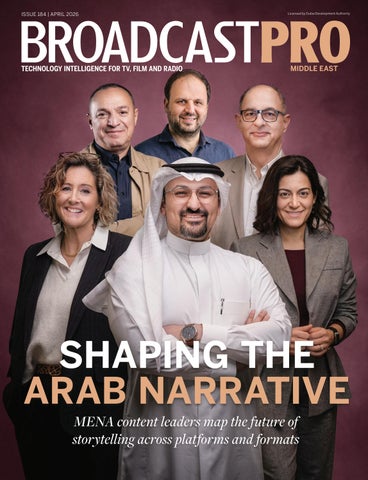
SHAPING THE ARAB NARRATIVE

MENA content leaders map the future of storytelling across platforms and formats
GROUP

Managing Director Vijaya Cherian vijaya.cherian@cpipromedia.com

+971 (0) 55 105 3787

EDITORIAL

Editorial Director Vijaya Cherian vijaya.cherian@cpipromedia.com

+971 (0) 55 105 3787

Editorial Contributors

Kalyani Gopinath

Nusrat Ali

Urooj Fatima

Sub Editor Aelred Doyle

ADVERTISING

Group Sales Director Sandip Virk sandip.virk@cpipromedia.com

+971 (0) 50 929 1845 / +44 (0) 7516 993 862

FINANCE

Finance Executive Yonwin D’souza finance@cpipromedia.com

DESIGN & PRODUCTION

Art Director David Fraser design@cpipromedia.com

EVENTS & MARKETING

Events Executive Sarah Nathan marketing@cpipromedia.com

DIGITAL SERVICES

Web Developer Hafiz Muhammad Waqas IT@cpipromedia.com

FOUNDER

Dominic De Sousa (1959-2015)

PARTNER

Maria De Sousa

Published by

WELCOME

We have seen a rather subdued digital and TV engagement this year for Ramadan compared to previous years, though opinions seem to be varied. Overall, viewership is reported to have dipped slightly compared with last year on traditional TV and digital platforms. Industry insiders suggest a few possible reasons. Geopolitical tensions in the region may have distracted audiences, while economic pressures could have made households more selective about OTT subscriptions or premium content.

Opinions on the content itself were mixed. Some producers, critics and viewers felt that this year’s shows were below par, citing overstretched crews, congestion from multiple productions running simultaneously, weaker storylines and repetitive formats that led to viewer fatigue and a drop in quality. Others noted that some major broadcasters who usually invest several million dollars in panArab productions focused primarily on Gulf productions this year, narrowing overall audience appeal. At the same time, some argued that the quality remained consistent with previous seasons and that audience expectations may simply have been higher.

Social media chatter still peaked around major plot twists and finales, but overall virality seemed lower than in past years. Streaming platforms noticed viewers dropping out after early episodes of some series, pointing to a kind of engagement fatigue. Taken together, the picture isn’t uniform. Some shows performed well, while others struggled. The pulse of Ramadan viewing this year seems to reflect an audience more selective in its attention, often drawn to news or political narratives.

But onto another important event later this month: the NAB Show kicks off, and we’ve already seen a raft of announcements and new launches. We look forward to seeing them in person, if airspace allows, and following them digitally should travel restrictions intervene. In the meantime, we have some great insights from high-profile industry leaders across the Middle East in this issue. Hope to see you at the show!

UPDATE NEWS

Regional conflicts hit Ramadan digital engagement: Publicist Inc.; Rotana Media renews partnership with Extend; Saudi Arabia’s GEA inks content production deal with MBC Egypt; Shahid fuels MBC’s 2025 revenue surge; Al Manasa drives Iraq’s Ramadan TV production; and more 5

THE STORYTELLERS

SAUDI STORIES GO FULL SPECTRUM

With local audiences demanding every form of storytelling, from cinema blockbusters to micro dramas, Saudi producers and creators are racing to build ecosystems that allow IP to travel seamlessly across all formats

MASTERS OF THE GAME

SPORTS PRODUCTION

Driven by mega events like the World Cup, MENA’s sports production capabilities are undergoing rapid transformation 10

SHOW STOPPERS WHAT TO EXPECT AT THE NAB SHOW

This year’s edition puts the spotlight on the booming creator economy, examining how it’s redefining content success, navigating platform economics and shaping audience behaviour

EVENT

THE FEMALE GAZE IN FILMMAKING

At Advanced Media’s ‘Women Behind the Lens’ workshop in Dubai, a videographer, a producer and an academic came together to spotlight the growing influence of female perspectives in the industry

THE AI NARRATIVE AI IN ACTION

Industry experts discuss how media organisations can operationalise AI across workflows without compromising creativity and integrity

GUEST COLUMN POST-CONFLICT STORYTELLING

As conflict reshapes the region, Arab filmmakers must build institutions that originate and own IP and create a sustainable ecosystem for globally competitive storytelling, says Hussein Fakhri

Regional conflicts hit Ramadan digital engagement: Publicist Inc. 04/26

Publicist Inc. has released its third annual Ramadan report, offering insights into one of the region’s most competitive entertainment seasons.

The findings show digital conversations dropped sharply during February 26-28 following airstrikes, and again on March 12-13 during the closure of the Strait of Hormuz, creating a hollow engagement pattern in which realworld developments temporarily overshadowed traditional Ramadan content discussions.

The production landscape showed increasing diversification. The GCC led production with 40% of total output, followed by Egypt (30%) and the Levant (22%). Kuwaiti and Syrian productions captured a larger share of the regional conversation. Egyptian dramas maintained a massive 55.8bn social reach, while Levant productions, bolstered by the Syrian surge, proved most efficient, converting an 8.8bn reach into 6.8m interactions. The GCC also demonstrated strong performance and

high audience loyalty, achieving an 18.2bn reach with a conversion of 7.1m engagements.

Social drama remained the region’s powerhouse, surpassing 1bn interactions in Egypt and leading the GCC with 541.6m. While the Levant pivoted toward thrillers (303.4m interactions), the GCC maintained a distinct preference for grounded narratives, with social drama significantly outperforming comedy (519.4m) and thrillers (207.3m).

The game-changer was

the integration of technology and short-form storytelling. Egypt dominated the AI landscape, implementing it in 15 series intros and launching the first-ever fully AI-produced show. Micro dramas also emerged as a serious contender for the youth audience. Saudi app Seera emerged as a major new player, launching a diverse line-up. This report leverages data collected from February 18 - March 18, capturing the start of Ramadan and the initial surge in audience engagement.

Rotana Media Group renews advertising partnership with Extend Group

Extend Group will continue to serve as the exclusive advertising representative responsible for managing and selling advertising across Rotana Media Group’s television channels. Mofeed Alnowaisir, CEO of Rotana Media Group, explained that this move comes as part of a new phase in which Rotana is working to further develop its media and commercial model. He also noted that Rotana will focus on enhancing the commercial value of its media platforms and expanding

LAWO APPOINTS JAMIE DUNN CEO

Jamie Dunn, who joined Lawo in 2011 and has served as Deputy CEO since 2024, will now lead the continued development of Lawo Group as CEO. Lawo has a long history in delivering solutions for live media production workflows. Lawo’s Management Board now comprises Dunn as CEO and Vorstand, Claus Gärtner as CFO and Vorstand, Andreas Hilmer as CMO, Christian Lukic as CSCO, Phil Myers as CTO and Ulrich Schnabl as COO.

partnership opportunities with advertisers.

Eng Sami AlRasheed, CEO of Extend Group, emphasised that the collaboration is a strategic partnership aimed at developing the television advertising environment, and at enhancing growth opportunities in the advertising market by providing innovative advertising solutions.

SAUDI ARABIA’S GEA PARTNERS WITH MBC EGYPT FOR JOINT CONTENT PRODUCTION DEAL

A new deal between Saudi Arabia’s General Entertainment Authority (GEA) and MBC Egypt will see the two parties work together to develop a slate of high-quality programming tailored

to Egyptian viewers. The agreement was signed in Cairo under the patronage of GEA Chairman Turki Alalshikh, and includes the production of a range of variety and

sports shows, as well as several drama series. The initiative is aimed at broadening MBC Egypt’s programming portfolio while strengthening regional media partnerships.

BANIJAY AND REDBIRD IMI MERGE TO CREATE NEW GLOBAL MEDIA POWERHOUSE

Banijay Group (BG) and RedBird IMI have partnered to combine Banijay Entertainment and All3Media (owned by RedBird IMI). The merger will create a new global media and entertainment company that will operate under the Banijay name. Backed

by RedBird Capital Partners and Abu Dhabi’s International Media Investments, the JV will see both partners hold equal stakes. RedBird IMI will roll over its entire stake in All3Media into the new entity. Together, the companies will control

one of the industry’s largest content catalogues and will create the largest English-speaking studio outside the USA. The transaction remains subject to regulatory approvals and is expected to close by the fall of 2026.

From left: Mofeed Alnowaisir, CEO of Rotana Media Group, with Eng Sami AlRasheed, CEO of Extend Group.

Shahid fuels MBC’s 28.5%

revenue surge in 2025

MBC Group has announced strong financial results for 2025, reporting a 28.5% year-on-year increase in revenue to $1.44bn. The company attributed its overall revenue growth to the continued expansion of its streaming platform Shahid and the accelerated delivery of large-scale media and entertainment projects.

The company recorded a net profit of $116.56m for 2025, resulting in a net profit margin of 8.1%.

In Q4 2025, revenue rose 25% year-on-year to $0.40bn. Net profit for the quarter reached $2.58m.

MBC’s Broadcasting and Other Commercial Activities segment

generated revenues of $0.75bn in 2025, a 16.8% increase on 2024. However, net profit for the segment declined to $131.35m from $142.09m in 2024.

Shahid delivered a strong financial performance, generating $0.37bn in revenue in 2025, a 28.2% rise from 2024. Subscription revenues

grew 25.4% to $0.29bn. Advertising revenue also climbed 27.1% to $62.92m. The platform’s net loss narrowed significantly to $20.97m, compared to $34.40m in 2024.

MBC’s Media and Entertainment segment recorded the fastest growth, with revenue increasing 69.6% year-on-year.

SRMG FORMS SRMG NEWS NETWORK, ANNOUNCES NEW LEADERSHIP STRUCTURE

Saudi Research and Media Group (SRMG) will consolidate its news brands under a single network, SRMG News, which will operate as a wholly owned subsidiary of the group. Several of the group’s publications and platforms, such as Asharq Al-Awsat, Arab News, Arriyadiah, Al Majalla, Independent Arabia, Independent Urdu, Independent

Türkçe, Independent Farsi, Urdu News, Akhbaar24, G.O.A.T, and Asharq Network and its sub-brands, will come under the new network.

The new entity will be led by Dr Nabeel Alkhatib (former GM of SRMG’s Asharq News), who will be President of SRMG News. The restructuring will also see several senior

executives assume new roles. Fadi Radi, previously Advisor to the SRMG CEO, will become VP of Digital Products and Creative.

Eng Omran Abdallah, Chief Technology Officer at Asharq News, will become VP of IT and Broadcast Engineering at SRMG News, while Dr Adil Saleh will become VP of Network Operations.

MOBIBOX TO POWER MBC’S COMPETITION PLATFORMS

Mobile Arts Group has partnered with MBC Group to accelerate the regional digital expansion of the broadcaster’s flagship competition platforms, Dream and Flashwin Premium, across the GCC. The collaboration is powered by MobiBox, Mobile Arts’ payment orchestration platform, which connects premium digital services to telecom operators and alternative payment methods. It enables seamless billing, scalable distribution and regulatory compliance, supporting broader market rollout.

MobiBox will manage the full technical lifecycle of both platforms, including deployment, subscription flows, reporting and operator integrations, while enabling faster entry into new markets through ready-made integrations.

Mobile Arts is also supporting the expansion through AI-driven digital advertising and user acquisition strategies.

Al Manasa drives new momentum in Iraq’s Ramadan TV production

Iraq’s scripted television industry is experiencing notable growth, with telecom-backed OTT platform Al Manasa emerging as a key player. According to proprietary tracking from CoProduction Salon, prior to 2020 Iraqi productions rarely exceeded five Ramadan titles annually, with most major commissions backed by MBC Iraq. Since the launch of domestic platforms such as 1001 and Al Manasa, Iraq has emerged as a consistent contributor within the broader Arabic Ramadan market.

six Iraqi originals for the current season, strengthening its role as a primary enabler

MUSIC BOX TELEVISION EXPANDS INTO AFRICA WITH AZAMTV DISTRIBUTION DEAL

Music Box Television has entered the African market through a new distribution agreement with AzamTV, a pay-TV platform, according to a report by BroadbandTV News. Music Box Hits and Music Box Dance are now available to AzamTV subscribers across nine countries in East Africa and southern Africa. The channels are distributed through AzamTV’s IPTV, OTT and DTH satellite

platforms, with satellite delivery provided via Eutelsat 7C. With the launch, AzamTV customers become the first audiences in Africa to access Music Box’s curated music television offering in full HD. The agreement is a significant step in Music Box Group’s international expansion strategy as it broadens its presence beyond Europe and enters the rapidly growing African pay-TV market.

of domestic scripted production. While some titles were marketed as Al Manasa Originals with exclusive digital rights, several titles also premiered on leading Iraqi free-to-air broadcasters, including Al Sharqiya, Al Rabiaa and Dijla TV. The approach reflects the Iraqi viewing landscape, in which linear television continues to command a significant share.

IMI DENIES REPORTS SKY NEWS MAY END UAE JV

International Media Investments (IMI), which runs Sky News Arabia, has denied recent international reports suggesting that Sky News is considering ending its joint venture with the UAE entity.

In response to a request for comment, IMI issued the following statement: “IMI is aware of false reports circulating online... These claims are inaccurate. IMI and Sky UK are engaged in standard commercial discussions under an existing agreement that runs until May 2027. No decisions have been

taken regarding the future of the partnership. Discussions remain ongoing, with both parties actively and constructively engaged. These discussions are commercial in nature, strictly confidential, and entirely separate from editorial policy or newsroom operations. The editorial independence of Sky News Arabia remains unchanged. IMI values its long-standing relationship with Sky UK. External speculation is inaccurate and does not reflect the reality of these discussions.”

FROM BLOCKBUSTERS TO SNACKABLE STORIES: THE EVOLUTION OF ARAB CONTENT

The Saudi content industry stands at an exciting phase as films, series and the meteoric rise of micro dramas alter the face of storytelling. As a growing young audience digitally navigates entertainment, producers and creators are thinking of effective solutions that will support content creation and tap into a promising pool of regional talent. Industry experts gathered to discuss this at the BroadcastPro Summit in KSA earlier this year

The role of feature films, premium drama and short form within the evolving Arab content ecosystem, Saudi Arabia’s growing importance as a production and filming hub, distribution strategies across theatrical, broadcast and streaming, and how Arab stories can travel were some of the topics covered by the panel in Riyadh.

Guiding the course of the conversation was moderator Sarah Btaddini, Managing Director, ThreeSixtyPlus, with a panel consisting of Amanda Turnbull, CEO and founder, Rise Studios; Fadi Ismail, founder of DKL Studio and Partner at Goldfinch International; Firas Dehni, Director of Physical Production – Scripted Content, MBC Studios; Fouad Alkhateeb, an executive producer; and Sayed Fenianos, founder and Chairman, Scene Platform.

“The Saudi film industry is being shaped by high-end productions, premium content developers, experimental models and a deeply engaging format that an entire industry is racing to understand,” commented Amanda Turnbull. “Content as we now know it is wide-ranging. Films, events and those that have cultural impact have merged with the creator economy. There are e-games, micro dramas, short form – it is seamless and we must reflect the fact that our audiences are moving across all that content. You may go to watch a movie but also snack on micro content. There are different need states, and those who can build ecosystems rather than silos so that your IP can travel across different formats and platforms will be the real winners.”

Building partnerships to drive investment in producers and storytellers, Rise’s strategy is to create premium Arabic language and Turkish content that resonates authentically in the region. “What underpins all of this is the concept of collaboration that is baked into the DNA of Rise, and our ambition is that the content travels,” said Turnbull.

The Saudi film space has been growing rapidly with the increase in the number of screens. The Saudi market is dominated by US movies, followed by Egyptian and Saudi. Around 36% of the films shown in 2024 were from Hollywood, bringing in 61% of revenue. Egyptian films were at 9% and 25% of revenue. Saudi films were at 4% and 7% of revenue, though in 2025 the latter jumped to 17%.

“In 2024, the revenue from Saudi films was SAR 57m ($15.1m), while in 2025, excluding November and December when no movies were released, it had made SAR 128m ($34.1m). This shows that Saudi nationals want to watch more Saudi content and we must invest more –the numbers speak for themselves,” said executive producer Fouad Alkhateeb.

As the sector warrants investment, producers work to bridge creativity and the commercial aspects of filmmaking, including getting storylines that will work in a young market and managing production hurdles, budgets, rights and distribution.

“Saudis had made 50 or 60 films by the end of 2025 and many of them didn’t break even, but what

we need to understand is that this is a nascent industry. Five years ago, we were at zero. While there were a smaller number of Saudi films last year, the revenue has increased, so there’s appetite,” said Fadi Ismail.

Three of Ismail’s films have streamed on Shahid, Netflix and Amazon. “Commercially, they were not a big success. Films are easier to produce than series and the turnover is quicker. There are a lot of challenges, but if you ensure relevant, captivating storytelling, there will be studios and producers willing to collaborate.”

Hobal by Abdulaziz Alshlahei is a case in point. It was successful for the way the movie was created and distributed; its marketing and techniques made all the difference, noted Ismail. “The goal must be to package a film in a way that it carries through to the audience. Bigger budgets do not mean better; the plan is to go low-budget, less than $2m. The industry needs that kind of level so that it can accumulate talent and experience and become commercially viable.”

While films are easier to make, content must have top-tier production

values, acting and direction. Producing a premium film means good storytelling and authenticity, said Firas Dehni of MBC Studios. “You need to surprise people with something they may have never seen before or things they may have forgotten.”

MBC will soon be releasing the first film from the fantasy universe of Osama Al-Muslim, Saudi Arabia’s most popular and commercially successful novelist. MBC hopes to develop multiple projects with the writer in the future.

With so many stories to be told and areas to be explored, broadcasters aim to produce premium content not only

Micro drama is fun, snackable and quick; it’s that dopamine hit you get and you want to watch more, and it’s working
AMANDA TURNBULL, CEO AND FOUNDER, RISE STUDIOS

in Riyadh but all over Saudi Arabia.

“Different standards must be adopted for movies and scripted drama, as each comes with a unique set of challenges. We are aiming for more ambitious projects and approaching film and television independently, as cinema occupies a very different space from TV productions and series,” said Dehni.

The idea that storytelling is always the most important factor reinforces its power over stars and celebrities. Great stories foster engagement. “Part of the thinking behind low-budget films is that we are placing storytelling at the core of commercial success, rather than production values and graphics or star power,” said Ismail.

“Ninety percent of the 50 or 60 films produced in Saudi Arabia rely on tried-and-tested themes; it’s time we experimented with new subjects.”

High-quality, valuable content across social media platforms means adapting storytelling for mobile-first audiences shifting to micro drama. Micro content moves its impact from hours to minutes – supporting new talent without affecting quality is a challenge. Audiences want strong stories and good acting.

“The Saudi market is very important

Saudi nationals want to watch more Saudi content and we must invest more – the numbers speak for themselves
FOUAD

ALKHATEEB, EXECUTIVE PRODUCER

for us because it’s young,” commented Sayed Fenianos. “In the past, people accepted traditional dramas, but the youth today are open to variety and new formats. That is why the short form is popular; it is realistic and a single reel captures millions of views. We don’t get that impact from films. For us, quality is key. Our productions are driven by narratives; we place a lot of emphasis on the story.”

Creative ideas attract young viewers and the Saudi audience is a strategic partner, remarked Fenianos. “While corporates invested in large-scale content, ordinary people started creating simple, relatable content from their homes that were generating millions of views. What we did at Scene Platform

Amanda Turnbull, CEO and founder, Rise Studios.
Fouad Alkhateeb, Executive Producer.
In the past, people accepted traditional dramas, but the youth today are open to variety and new formats
SAYED FENIANOS, FOUNDER AND CHAIRMAN, SCENE PLATFORM

was to create simple, relatable content that was well-structured with strong quality. Like the major productions, but without the massive budgets or fillers.”

Scene Platform is considered the first micro-drama platform in the Arab World. Fenanios announced exclusively at the event that Scene would soon also be releasing a shortformat TV model – believed to be a global first – where short dramas, micro shows and micro entertainment will be treated as a production framework rather than just a format.

Short formats are visually appealing and hook audiences instantly. Their structure relies on frequent cliffhangers to draw viewers into subsequent episodes.

“When it comes to micro-formats, quality is in the eye of the beholder. We are not the arbiters of taste; it’s up to the audience. Again, the metrics reveal it is about different need states,” said Turnbull. “Micro drama is fun, snackable and quick; it’s that dopamine hit you get and you want to watch more, and it’s working. With a premium series on Shahid or our recent movie Palestine 36, it’s a completely different experience. It is about the immersion, the emotion and the talkability afterward, a very different need state.”

Producing micro dramas requires a new skill in storytelling – to craft the hooks, the cliffhangers and the immediacy within a very short time frame. Studios are discovering that some TV producers are better at producing micro content than longform drama. After testing the market with two micro-drama projects and noting the unwillingness of platforms to buy at scale, Btaddini, herself a producer, said she had shifted to 15 fullfledged episodes to sell the content.

Decision-makers will have second thoughts about investing a lot of money in the beginning, pointed out Ismail. “We don’t like risks in media. The bigger

production houses and the studios are an exception, but in general the market will hesitate before going vertical.”

The micro drama is not reformatted drama; rather, it has a language and a form of its own. The shift to vertical will not be instantaneous but will be a gradual development, as it thrives alongside Saudi cinema and the bigger theatrical productions that bring in the revenue.

The Saudi box office is an interesting mix of Hollywood, regional and local films, with real opportunities for Saudi films to grow their market share. But the region must be viewed

There are a lot of challenges, but if you ensure relevant, captivating storytelling, there will be studios and producers willing to collaborate
FADI ISMAIL, FOUNDER OF DKL STUDIO AND PARTNER AT GOLDFINCH INTERNATIONAL
Sayed Fenianos, founder and Chairman, Scene Platform.
Fadi Ismail, founder of DKL Studio and Partner at Goldfinch International.

as a whole, noted Alkhateeb.

“We forget there are 35m people in Saudi Arabia, that there is a north and a south, and little towns here and there. Movies like Siwar and Hobal were selling out in Unaizah and Buraydah. Siwar sold out in Khamis Mushait but not in Riyadh, Jeddah and the Eastern Province.”

From the movies that have been successful, the market can be viewed based on themes, explained Alkhateeb. Saudi nationals want to see something they can relate to, something they know and can connect with. Most popular are true stories such as Siwar, Alhamour HA and Jaras Enzar on Netflix. Second are Bedouin films – Hobal and Siwar took in SAR 35m ($9.3m) at the box office – and third are films centred around youth, a sizeable portion of the population. Shams Al-Maaref and Fakhr Al Suwaidi are small films that did not have the backing of big studios, but they understand society and young people.

Saudi films made SAR 10m ($2.7m) in 2019. In 2025, that number increased most than twelve-fold to SAR 128m ($34.1m). “While content has progressed, the number of seats and theatres has also increased. In 2018 we had one screen, in KAFD in Riyadh; we now

have 630 screens,” said Alkhateeb. Within this changing landscape, the Saudi market is ushering in the future of Arab drama while a young audience generates trends. “We see the views our platform receives, and we produce content with proper production values and a tightly scripted narrative because today the most important thing is the story,” said Fenianos. Scene recently partnered with Rotana to shoot many micro-drama series that will soon be released on the platform. Many co-production structures and business models trade away IP to secure financing, but retaining it is also vital to strategy. Producers and

You need to surprise people with something they may have never seen before or things they may have forgotten
FIRAS DEHNI, DIRECTOR OF PHYSICAL PRODUCTION – SCRIPTED CONTENT, MBC STUDIOS

creators co-owning IP has not been common in the region – through the commissioning process, platforms have traditionally always controlled it. In more mature markets, this idea of having to ringfence content and own everything is not so prevalent anymore.

“At Rise, we feel there’s a lot of talent in the region, but everybody loses their ideas and their IP through the commissioning process. By investing ourselves into the content to make it in partnership with the producers, we’re looking at the lifetime value of that IP which we can share with the producer, versus the pathways to monetisation and what we think will be appropriate,” said Turnbull.

From a producer’s perspective, giving up the IP means working for a 10% mark-up on top of the cost and owning nothing. Producers must look at how far their content can travel and reach a wider audience, said Ismail. “If the Spanish producers of La Casa de Papel believed there was no future beyond their market, they would have never benefited from its global success. More studio models such as Rise that support producers mean better negotiation power against global streaming platforms. It gives producers the advantage of taking creative and commercial risks.”

Owning IP is a burden, countered Alkhateeb, as independent writers or directors may lack the financial and organisational influence needed to make repeated sequels. “A studio that owns the IP will take the risk needed to make ideas work.”

In the long run, whether long or short, scripted or episodic, it is content that scales. The control and revenue that come with IP follow that. But it is the story that rules – and narratives that are in line with local ethnicity and cultural sensitivities and connect with audiences will build a loyal base, helping expand that nascent, bustling space.

Firas Dehni, Director of Physical Production – Scripted Content, MBC Studios.

11-14 S ept 2026, RAI Amsterdam

Register your interest

DUBAI EVENT SPOTLIGHTS FEMALE PERSPECTIVES IN FILMS

Dubai-based distributor Advanced Media hosted a ‘Women Behind the Lens’ workshop last month at its showroom, bringing together around 50 attendees from across the media and filmmaking industry, with three women leading sessions on the day.

“At Advanced Media, we have always aimed to support women in filmmaking and media, and this workshop was one of the many initiatives we’ve introduced to do just that. It was inspiring to see

so many women come together to support this initiative, and we look forward to many more to come,” said Marketing Executive Shahad Rasheed.

The speakers were Alina Fedina, a Russian videographer who specialises in dance and fashion content; Hamis Arieda, an Egyptian producer with two decades of experience in media production; and Razan Takash, Head of Film at SAE Institute.

Fedina, who has been based in Dubai for the last six years, represents

a generation that is entering the field through a mix of self-learning and formal training. “I specialise in filming music videos and dance performances,” she explained, adding that she is now training in direction for music videos and commercials while expanding into fashion work. Her session at the event focused on the female gaze in cinematography, framing emotional intelligence as a creative asset rather than a limitation.

“I will talk about our sensitivity

as a creative tool to build strong visual storytelling. Our empathy and higher level of emotional intelligence helps us portray actors very differently from how a man behind the lens would capture the same scene and characters.”

That perspective, she believes, is now finding wider expression. “Women feel more comfortable to open up and share their perspective,” she noted, sharing slices of films from female directors that took years to develop before audiences were ready to receive them.

Arieda agreed that women are only slowly beginning to gain more visibility in this market. Now Head of Media Production and founder of multiple ventures including Samurai Productions, she began her career in Egypt with little more than a camera and an empty

We are lucky that we now have more tools such as gimbals, which get lighter each year
ALINA FEDINA, VIDEOGRAPHER

space provided by her father.

“I asked him to support me, and he gave me the key to an empty place. My brother got me a camera and we started a company,” she recalled. Her early years coincided with a near-total absence of women on set.

“At that time, I was the only woman on the crew,” she said, reflecting on large-scale productions such as a 360-degree project for Abu Dhabi Tourism that took months

to complete. She still describes the industry as male-dominated, though more accommodating today.

Both women pointed to confidence and perception as ongoing challenges.

Fedina spoke candidly about the need to continually prove technical competence to male counterparts. As someone who actively operates camera equipment, she acknowledged the challenge but also pointed to recent technological advancements as a great leveller. “We are lucky that we now have more tools such as gimbals, which get lighter each year.”

Arieda felt that the order and scheduling that a production demanded were her calling. Today, she runs her teams with a focus on mentorship and support for younger women.

Both women emphasised the power of the community. Fedina has

Alina Fedina, videographer.
producer.

already started a WhatsApp group for female videographers. “When I started out here, I didn’t have anyone to talk about videography. I’m excited that we are making a community and finally finding each other.”

The third speaker of the day, Razan Takash, Head of Film at SAE Institute,

I asked [my dad] to support me, and he gave me the key to an empty place. My brother got me a camera and we started a company
HAMIS ARIEDA, PRODUCER

offered tips on how to break into the regional film ecosystem. She stressed that opportunity rarely arrives fully formed and must be actively pursued.

She commented that “opportunities … come in and out, and disappear”, often within tight submission windows, which is why platforms like the Red Sea International Film Festival and funds such as the Arab Fund for Arts and Culture and Doha Film Institute reward those who stay consistently plugged-in.

She urged filmmakers to abandon the idea of waiting for perfection.

“What’s the worst that can happen?” she asked, recalling how even incomplete submissions can succeed. She added that success depends less on a single breakthrough and more on sustained visibility and repetition, because “films get made not through applications alone, but through chance encounters and conversations”.

There’s no successful filmmaker or unsuccessful filmmaker; there’s a filmmaker that kept trying until it worked, and a filmmaker that just stopped trying
RAZAN TAKASH, HEAD OF FILM, SAE INSTITUTE

Ultimately, success comes down to persistence and presence. “There’s no successful filmmaker or unsuccessful filmmaker; there’s a filmmaker that kept trying until it worked, and a filmmaker that just stopped trying,” Takash concluded.

Razan Takash, Head of Film at SAE Institute.
Hamis Arieda,

GAME CHANGERS: MEGA EVENTS FUEL MENA SPORTS BROADCAST BOOM

With Saudi Arabia, the UAE and Qatar hosting an increasing number of global sporting events, the Gulf is emerging as a major hub for sports broadcasting. At the BroadcastPro Summit KSA 2026, industry leaders examined how technology, talent development and evolving viewing habits are defining the next phase of sports production in the region

Live international events such as the 2022 World Cup in Qatar, Formula One in Bahrain, Saudi Arabia, Qatar and the UAE, WTA tournaments in Riyadh, Doha and Dubai, high-profile boxing and golf events, and the Spanish Super Cup and Italian Super Cup in Saudi Arabia have accelerated innovation in sports production, driving investment in infrastructure, remote workflows and audience engagement. The high-profile panel looked at how local talent development, evolving production workflows and datadriven approaches are transforming sports coverage in the Gulf.

Moderating the discussion was Saudi Pro League TV broadcaster Joe Morrison. The group of speakers consisted of Miguel Caso, Chief Broadcast Officer at Alamiya; Neil McKeown, Executive Producer at IMG; Peter Van Dam, Chief Broadcasting Officer at Saudi Pro League; and Samah Raydan, VP, Dentsu Sports Analytics, MENA.

Morrison opened the conversation by highlighting the acceleration of mega events in the region and how

this was laying the building blocks for lasting production ecosystems.

Live events are at the heart of the sports economy and are the engine that powers everything else, commented Samah Raydan from Dentsu Sports Analytics, MENA. “All the revenue streams starting with broadcast rights, SVOD, subscription, partnerships, ticket sales, merchandising and hospitality trace back to the live event. The Arab region and particularly Saudi Arabia, Qatar, the UAE and

With the big events that are coming into the region, building local skills is part of our strategy. We look at it as knowledge transfer
MIGUEL CASO, CHIEF BROADCAST OFFICER, ALAMIYA

Bahrain have hosted the World Boxing Championships, the WTA, the Italian and Spanish Super Cup, Formula One, the FIFA World Cup and one more to come in 2034. Sport is speeding up investment in the sector and broadcasting the region to viewers around the world.”

A combination of quality production and broadcast capabilities ensures exciting content for fans. The variety of the sports hosted, such as football, tennis and boxing, necessitates flexible approaches to content production.

“As a production company, we need to adapt to the sport and the different standards that each broadcaster puts in place,” noted Miguel Caso of Alamiya.

“A good example is our tie-up with DAZN – their innovation, expertise and technology help us provide flexibility. Recently, we did the first cinematic ALEXA live camera production here in Saudi as a specific request for the type of replay required for boxing. Each sport has its own production demands and expectations; the Islamic Games have a different format, football comes with its distinct flavour, and so on.”

Broadcasting to viewers around the globe means different distribution patterns, said Peter Van Dam, Chief Broadcasting Officer, Saudi Pro League (SPL).

“Each region has its own character. The Brazilian market would be different from the one in China. We are looking to implement personalised graphics, for instance, in the next season. Collaborating with influencers like Zack Nani in France, and on a global level with Speed, known for his high-energy approach, gave amazing results. Football is entertainment and the viewer is a broad-spectrum group that consumes content in various ways, and we need to find a middle

If you get the events, people will come, because the region has an affinity towards sport
NEIL MCKEOWN, EXECUTIVE PRODUCER, IMG

ground that will keep viewership up.”

Working with Thmanyah, its new rights holder, SPL is exploring ways to incorporate elements that will showcase football differently. Operating across diverse terrains where pit-side temperatures range

from 25 to 50 degrees is part of the scale and scope of running events in a country as vast as Saudi Arabia.

Partnering with sports media distributors, companies combine local knowledge and state-of-the-art production standards that will improve and develop the broadcast landscape.

“While the nation is passionate about football, there’s WWE and tennis and a host of other sports that’s gaining traction. Within our multi-year partnerships with SPL and Alamiya, we’re constantly trying new things to give the fans what they want,” said Neil McKeown, Executive Producer, IMG.

Giving viewers content ondemand entails identifying audience

demographics and behavioural patterns. Because of the shift towards mobile-first viewing and the consumption habits of the younger generation, understanding trends is vital to providing products that meet fan expectations and company objectives. Dentsu Sports Analytics studies show a defining trend among Gen Z (aged 11-29) – having grown up with the internet, mobile phones and social media platforms, they primarily follow sports through digital and social platforms.

Collaborating with influencers like Zack Nani in France, and on a global level with Speed, known for his high-energy approach, gave amazing results

VAN

“So YouTube, Instagram, Snapchat, TikTok along with online streaming platforms are the leading destinations for them to watch sports,” said Raydan. “Our analytical tools show that watching sports on traditional channels remains high among Saudis aged 30 and above, with 90% of this group watching sports on TV and online. Therefore, it’s important for broadcasters and rights holders to maintain their support for traditional television as long as it continues to deliver solid returns. However, the consumption habits of younger audiences and the broader shift toward mobile-first viewing make it essential to accelerate innovation in digital and data infrastructure, OTT platforms and social platform ecosystem.”

Data sub-divisions offer interesting insights into sports viewing patterns. Dentsu’s Decoding 360 shows that the majority of sports fans in Saudi are football aficionados. However, other sports and entertainment categories are gaining audience interest, signalling a broader diversification in fan preferences. Deep fan understanding and meaningful engagement are key drivers in

The broader shift toward mobilefirst viewing makes it essential to accelerate innovation in digital and data infrastructure
SAMAH RAYDAN, VP, DENTSU SPORTS ANALYTICS, MENA

transforming sports fans from casual to hardcore fans, said Raydan. “It is essential to invest in a robust digital and data infrastructure, to be able to engage with fans based on their digital behaviour rather than traditional viewer segments. Understanding what they do, how they behave, what drives their loyalty and not just who they are creates a far more powerful foundation for fan engagement. By analysing the content they follow or download, identifying their favourite athlete or player, organisations can design products and experiences that keep fans immersed

Joe Morrison, Saudi Pro League TV broadcaster.
Samah Raydan, VP, Dentsu Sports Analytics, MENA.

not only during the live event but throughout the whole season.”

Turning high-quality event operations into repeatable workflows is important to creating systems that last, said Caso. “With the big events that are coming into the region, building local skills is part of our strategy. We look at it as knowledge transfer.”

A lot of organisations proactively involve local talent. While SPL brought IMG for its global expertise in football, IMG is trying to expand

its teams with local talent. “We partnered with Alamiya to support us with logistics, but we have also created a small team where more than half the talent is Saudi nationals.”

The SPL placed the Kingdom on the sporting world map, channelling sports tourism by getting fans and broadcasters into all regions of the country.

Historically, the Saudi viewer is passionate about football, but a large young population is moving towards other sports.

“If you get the events, people will come, because the region has an affinity towards sport,” said McKeown. “At the EuroLeague Final Four basketball in Abu Dhabi, for instance, thousands of Greek enthusiasts turned up to support their teams.”

The big events have improved production quality and are nurturing the rise of a sophisticated sporting network across the country. Rugby and ice-skating feature in the Saudi sporting landscape, and the ancient winding tracks of AlUla are a paradise for cyclists and runners. Both men’s and women’s sport are gaining momentum in Saudi, with the women’s rugby and

cycling teams getting very competitive.

“Saudi Arabia has increased the number of sports federations to a total of 98, and this connected framework is helping support the entire sports industry,” said Van Dam.

Personalisation, customisation and adapting to Gen Z or younger generations require centralised processes that are very hard to do on a rollout basis, said Caso. The movement of technology to digital-first, to support traditional broadcast, has improved agility. Centralised production models benefit those handling multiple football matches in 30 days, with all the complicated logistics tied to that.

“If live events are the heart of the sports ecosystem, fans are the lifeblood that keeps it beating. They are the reason stadium seats fill, the reason broadcasters invest, the reason brands activate and the reason the entire ecosystem thrives,” noted Raydan.

Aligning strategies that achieve the broader goal of creating more viewers, while working towards a high level of consistency in streaming, gamebuilding and storytelling, will go a long way towards fostering a resilient sports broadcast environment.

Neil McKeown, Executive Producer, IMG.
Peter Van Dam, Chief Broadcasting Officer, Saudi Pro League.
Miguel Caso, Chief Broadcast Officer, Alamiya.

FROM PILOT PROJECTS TO OPERATIONAL AI: HOW MEDIA IS EMBRACING THE NEXT WAVE

The BroadcastPro Summit in Riyadh this year highlighted the next frontier of media innovation. AI experts in media gathered to discuss their viewpoints on how emerging technologies are reshaping workflows, creativity and decision-making across the industry

As studios, broadcasters and conglomerates increasingly explore AI, the conversation has shifted from theory to practice. The question now is how media organisations operationalise AI across sprawling workflows without compromising creativity or editorial integrity.

“What we’re seeing today is not just AI in content creation, but in distribution, analysis, pricing and monetisation,” said Ramzi Madi, Partner, Media and Telecoms at Strategy& and moderator of the panel. “The challenge now is less about adopting AI and more about scaling it responsibly while preserving the creative edge and authenticity of content.”

On stage, three voices framed the debate from complementary perspectives. Fadi Radi, Advisor to the CEO of SRMG, offered insight into the operational realities of a major media conglomerate; Gilles Vidal, Creative Director and Head of Taamai Studio, represented the production and creative side; and Dominic Baillie, founder of baillie.ai, brought a technology-first viewpoint, focusing on tools, orchestration and organisational transformation.

Madi first asked what operationalising AI meant to each panellist. Radi said that for him, AI has evolved from merely being a tool to becoming fundamental infrastructure.

“AI tools are being used extensively in all companies, whether they are being put there or being used by employees. But if we look at 2026 trends, there is agentic AI, which is like a production assistant that can execute tasks from A to Z, come up with results, and even learn and improve over time. This will move the industry from an input or pilot mode into full operational mode, where you can delegate tasks to AI and even have

results quality controlled by it. Imagine what this can do for the industry.”

Vidal echoed this vision, emphasising collaboration rather than replacement. “The best way is to redesign the workflow between human and machine. AI proposes options, but humans make the decisions. This needs to be implemented across the full production workflow.”

Baillie added a different perspective, highlighting the current limitations of AI adoption in practice. “I think there is no such thing as operational AI at the moment. We have tools like

Premiere that use AI to help with workflows. Most use cases are based on stealth AI, meaning experimentation, not something sanctioned by organisations. The only way to see operational AI is by orchestrating an army of agents and tools. Some people will build tools, some will build agents, but they need orchestration by a master agent. Agents themselves become specialised tools for the master, who in turn orchestrates everything across the organisation. Treating AI as a box that replaces part of a workflow limits its full potential.”

What we’re seeing today is not just AI in content creation, but in distribution, analysis, pricing and monetisation
RAMZI MADI, PARTNER, MEDIA AND TELECOMS, STRATEGY&

Madi then turned the discussion to who decides on AI adoption in a company. He asked if the only way to make real progress was with top-level mandates, where they “define the goals and then see how AI can help achieve them”.

Radi detailed the operational advantages of building an AI foundation. “Protecting your data, creating your own system and LLM, educating the AI with editorial and brand guidelines – it becomes a speed machine to do tasks. Multimodal AI can read, see, hear and recognise material, allowing tasks like

Ramzi Madi, Partner, Media and Telecoms, Strategy&.
AI will deliver content tailored to preferences. It will be fully autonomous, fast and expansive, thereby helping companies to expand business opportunities
FADI RADI, ADVISOR TO THE CEO, SRMG

editing content in languages you don’t understand. With a strong foundation and trusted models, one tool can replace multiple people for tasks, improving speed, efficiency and content reproduction.”

Vidal highlighted the creative impact. “AI accelerates preproduction, production and postproduction. For urgent projects, it enables fast scripting, storyboarding, moodboarding and planning. It also streamlines localisation across

regions, languages and content adaptations. AI adds speed and scalability, changing the way we work.”

Baillie returned to the question of scale, stressing orchestration and technical considerations. “Scale is achievable with multimodal models. As models improve, orchestration remains key, like a conductor leading an orchestra of specialised tools. The main barrier to scale is compute power, which is improving over time.”

Despite AI’s potential, the

panellists reiterated the continued importance of human intervention. Vidal noted that humans initially resist AI “because it’s new … but when they see how it can handle routine tasks and free creatives to focus on creativity, it will be more appreciated”. The panel explored the balance between output and quality. “There is a risk of over-production, but it depends on how content is used. Poorly created material already exists widely on mass platforms.

The only way to see operational AI is by orchestrating an army of agents and tools. Some people will build tools, some will build agents, but they need orchestration by a master agent
DOMINIC BAILLIE, FOUNDER, BAILLIE.AI
Fadi Radi, Advisor to the CEO, SRMG.
Dominic Baillie, founder, baillie.ai.

AI-generated content can be high quality but requires skill and process. Agents automating tasks are near, but the creative element persists,” Baillie explained.

Scaling AI in a large organisation also requires a systematic approach, agreed the panellists.

“Start with an AI foundation: fix metadata, archives and inputs,” advised Radi. “Train AI with correct data and guidelines. This enables AI to act as a new employee,

producing content efficiently.”

Baillie noted organisational challenges, adding that technical limitations are minimal. “Human resistance, cash and organisational will are bigger blockers. In addition, cultural sensitivities in employment affect adoption. Choosing the right partners will become critical for scaling AI.”

Looking ahead, AI promises a personalised and interactive media experience.

AI accelerates pre-production, production and post-production. For urgent projects, it enables fast scripting, storyboarding, moodboarding and planning
GILLES VIDAL, CREATIVE DIRECTOR AND HEAD, TAAMAI STUDIO

“AI will deliver content tailored to preferences. It will be fully autonomous, fast and expansive, thereby helping companies to expand business opportunities,” Radi said.

“The key is prompt engineering and agent scaffolding. AI models can autonomously select the right data and execute tasks efficiently,” added Baillie.

The panel concluded that those who harness AI responsibly will define the future of content creation, distribution and audience engagement.

Gilles Vidal, Creative Director and Head, Taamai Studio.

NAB SHOW 2026 UNVEILS SPEAKERS AND SESSIONS FOCUSED ON AI, STREAMING AND THE FUTURE OF MEDIA

The 2026 NAB Show is set to bring together global media leaders, creators, filmmakers and technology innovators as it unveils a new slate of speakers and sessions focused on artificial intelligence (AI), streaming, broadcast transformation and the evolving economics of content creation. The event will take place April 18-22, with

exhibits running April 19-22 at the Las Vegas Convention Center.

The latest programme announcement reflects efforts to bridge digital creators, traditional broadcasters, film professionals and technology companies, highlighting how the media and entertainment industry is being reshaped by new production tools, platform

economics and audience behaviour.

“We’re seeing a moment where technology, creativity and business are all evolving at the same time,” said Karen Chupka, Executive Vice President of Global Connections and Events at NAB. “The 2026 NAB Show brings that entire ecosystem together to explore how those changes are shaping the future of storytelling.”

Image: NAB

Creator economy takes centre stage

A key focus of the 2026 programme is the growing influence of the creator economy, with the expanded Creator Lab, presented in partnership with Adobe and Blackmagic Design, returning with a larger footprint and a stronger focus on business models, sustainability and long-term impact.

Sessions such as Beyond Views: Measuring Creator Impact, Creator Survival Guide: Contracts, Burnout & the Business of Building Content and Are We Nervous Yet: A Creator’s Guide to AI will examine how creators are redefining content success, navigating platform dynamics and integrating emerging technologies into their workflows.

NAB organisers claim its data shows strong growth in creator

participation, with registration indicating a 200% increase in attendees identifying as content creators, influencers or podcasters compared to 2025, while social media content producers have grown by approximately 150%.

Industry leaders examine shifting media economics

The Media and Entertainment Theater, in partnership with The Ankler, will host a series of insider conversations exploring the changing power dynamics across the industry, from content financing to platform distribution and audience engagement. One of the headline sessions, The Scary-Smart Business of Horror, will explore how audience-driven intellectual property, digital-native

talent and new financing models are reshaping film production and monetisation. The session brings together creator and filmmaker Markiplier, screenwriter Akela Cooper, Atomic Monster President Michael Clear and moderator Natalie Jarvey from The Ankler. The programme will also address the changing realities of journalism and broadcast news. CNN anchor John Berman will moderate The Cost of Bearing Witness: Journalist Safety in a Polarized America, while The Evolving Paradigm of Broadcast News will feature veteran journalist Deborah Norville alongside Nexstar Media Group Chairman and CEO Perry Sook, discussing how news organisations are adapting to new technologies and business pressures.

NEP PLATFORM SET TO TRANSFORM MEDIA INFRASTRUCTURE AND PRODUCTION WORKFLOWS

NEP Group has launched NEP Platform, a new software orchestration system designed to streamline media infrastructure and enable more agile, scalable hybrid production workflows. NEP Platform unifies critical production applications from multiple vendors within a single secure interface, giving customers greater control over workflow design. Core production tools including vision mixing, audio mixing, replay, multiview, infrastructure, and

measurement are available from Bridge Technologies, Calrec, Grass Valley, Lawo, Manifold, Panasonic, Sony and Hawk-Eye Innovations, with more integrations planned. Operators can configure and scale workflows on demand,

creating a flexible and dynamic production environment. The platform enables capabilities to be added through software updates rather than major infrastructure rebuilds, allowing customers to focus on content creation

while NEP manages the technology. The system automatically allocates computing resources based on production demand, improves cost forecasting through clear infrastructure visibility, and incorporates continuous vulnerability scanning, encryption, identity controls, and monitoring to ensure secure and resilient deployments. Intelligent scaling also supports sustainability by reducing power consumption and limiting the need to transport hardware.

SHOTOKU ANNOUNCES NEW AURA RANGE AT NAB

NAB will see the world premiere of Aura, a suite of advanced PTZ solutions from Shotoku that brings the company’s high-end robotic camera control expertise into the PTZ production space. Aura will join several other introductions including the official presentation of the Swoop robotic crane family to the North American market, and the launch of Quick-Ref, a revolutionary referencing system. Shotoku will be conducting demonstrations of the company’s entire user-friendly robotic camera control systems at its booth.

LAWO TO UNVEIL AGILE, SOFTWARE-DRIVEN PRODUCTION SOLUTION AT NAB

STAND #N623

This year, Lawo will showcase a new solution designed to accelerate system setup and optimise operational efficiency across broadcast, recording, live performance and corporate AV environments. Its main mission is to make production workflows faster, smarter and more agile on a daily basis. The solution aligns closely with the broader industry movement toward dynamic, software-based media facilities.

Central to Lawo’s approach is the HOME platform, which serves as the operational backbone for Lawo’s IP ecosystem, where third-party solutions are welcome. HOME management, which now supports role-based access control (RBAC) to avoid unpleasant surprises, provides essential services such as device discovery, authentication, and orchestration. These capabilities allow production infrastructures to adapt their available resources and processing power in real time.

Additional sessions will examine platform distribution economics, with NBCUniversal’s Matt Schnaars and Roku’s Tedd Cittadine exploring the shifting balance of power between content companies and streaming platforms, while executives from CBS LA, CBC News, Hearst Television and Gray Media will discuss strategies for making news more relevant across digital and broadcast platforms.

Filmmaking craft and cinematic storytelling highlighted Filmmaking remains a central pillar of the NAB Show, with CineCentral hosting workshops and live demonstrations focused on practical production skills and creative storytelling techniques.

Legendary cinematographer Sir Roger Deakins will headline a special session alongside James Deakins, sharing insights from their careers and their book Reflections: On Cinematography. The session is expected to draw strong interest from cinematographers, directors and production professionals looking to deepen their understanding of visual storytelling.

CineCentral programming will also include hands-on workshops such as The Storyteller’s Guide to Production on a Tight Budget, focusing on resource management, creative execution and maintaining artistic intent within constrained production environments.

AI and streaming innovation dominate programme

Artificial intelligence, cloud production and streaming infrastructure will be major themes across the show floor, with NAB introducing a second AI Pavilion to reflect the growing role of AI across media workflows.

The NAB Show Streaming Summit will feature Robert Schildhouse, CEO of Direct-to-Consumer at BBC Studios, alongside a session on scaling largescale streaming workflows during the ICC Men’s T20 World Cup through JioHotStar’s platform infrastructure. Technology-focused sessions will include discussions led by Google Cloud’s Anil Jain and Google DeepMind’s Márcia Mayer on AI-driven creative workflows, Microsoft’s Silvia Candiani on moving AI from experimentation to real-world deployment, and Sphere Entertainment’s Andrew Shulkind with SMPTE President Rich Welsh on ultra-high-resolution imaging for immersive production environments. Other sessions will explore cloud-based production, enterprise video strategies, cybersecurity in broadcast infrastructure, hybrid broadcast-broadband delivery for live sports and scalable virtual production models for enterprises.

Sports Summit and global speaker line-up

The four-day Sports Summit, powered by Lumen Technologies, will bring together executives from leagues, media companies and technology providers to examine the rapidly evolving sports media landscape, including live production, fan engagement and distribution strategies. The broader speaker line-up reflects the global reach of the event, bringing together leaders from major media companies, technology firms and content platforms including YouTube, Fremantle, Paramount, NBC Sports, BBC Studios, Microsoft, Google Cloud, Cisco, SMPTE and Sphere Entertainment, alongside prominent journalists, filmmakers, sports executives and digital creators.

FOR-A MAKES SOFTWARE SHIFT

STAND #C4920

FOR-A will spotlight a softwaredefined and AIdriven portfolio at NAB, with a strong focus on viztrick AiDi, an on-device AI solution developed by Nippon TV and delivered globally by FOR-A. Designed for live broadcast environments, the system operates at true broadcast speed, avoiding the five to ten second delay common in competing solutions. Powered by NVIDIA GPUs, AiDi enables near real-time processing and true live streaming, allowing broadcasters to maintain the immediacy required for live production.

GoVertical! AiDi delivers 9:16 autocropping for live streaming to mobile platforms while tracking objects such as players and the ball. Already in use by NBC Sports, this marks the technology’s first commercial deployment and signals expansion into AIenhanced live production markets. The solution is suited to live sports, red carpet events, scripted and unscripted productions, conferences and news environments.

PRO CONVERT IP TO AIO 4K AT NAB

STAND #C6113

Magewell will showcase its new Pro Convert IP to AIO 4K decoder at NAB. The latest addition to Magewell’s Pro Convert range supports 4K decoding at 60fps with HDMI 2.0 and 12G-SDI output, HDR10 and HLG, and compatibility with multiple IP and streaming protocols including NDI, SRT,

RTMP, RTSP, HLS, MPEG-TS, Zixi and RIST. An integrated multiviewer allows monitoring of up to four HD IP streams in dual or quad layouts, enabling flexible and reliable IP-based production workflows. Magewell will also highlight updates to its Ultra Encode family and show its Control Hub and Modator platforms.

HUSSEIN FAKHRI
What will emerge, when stability returns, is a wave of storytelling unlike anything the Arab world has produced

After the Storm: The Opportunity and Responsibility Facing the Arab Film Industry

As conflict reshapes the Middle East, a question is forming quietly in the corridors of our industry: when the dust settles, who will tell the Arab world’s next chapter, and from where? This is an uncomfortable question to ask at this time. I have wrestled with this. And I have landed on a single answer: we must.

The industry does not matter more than human lives. But pragmatism is not callousness, and planning is not indifference. The leaders, institutions and industries that will serve this region best in the years ahead are the ones being built right now.

What will emerge, when stability returns, is a wave of storytelling unlike anything the Arab world has produced. The experiences of this era, of loss, displacement, resilience and the search for identity, will need to be processed. Film and television have always been how societies do that processing.

Right now, premium Arabiclanguage screen content does not have a real home. We have talented filmmakers scattered

across a diaspora that stretches across the globe. We have stories of extraordinary depth and urgency.

What we do not yet have is an institution. A place that does not simply fund stories but originates them, developing projects from the earliest stages, producing them with genuine craft, retaining the rights and carrying them into the world with the conviction that they deserve to be seen.

This is the opportunity that the post-conflict landscape presents.

The responsibility is this: if we build, we must build with cultural seriousness. The temptation in moments of reconstruction is to reach for scale and to measure success in volume. That temptation should be resisted. The Arab world does not need more content; it needs better content. Stories told with the craft, ambition and authenticity that can travel and carry genuine weight.

The practical architecture for this is clearer than it might appear. A focused production facility and a talent programme that brings the diaspora home and gives Arab

filmmakers a permanent base is needed. A financing model that builds IP ownership rather than funding other people’s libraries. And a selective inbound programme that welcomes international productions to the region on terms that develop local capability rather than extract incentive value.

None of this can be built after the moment has passed. The window, when it opens, will be narrow. The competition will be real. The institutions that will lead the Arab screen industry in 2030 are the ones being designed today. Optimism and grief are not opposites. The best Arab films of the next generation will be made somewhere. The best Arab stories will be told by someone. The storm will pass. The question of what we built while it raged is one we will have to answer.

HUSSEIN FAKHRI IS CCO AND EXECUTIVE PRODUCER AT KATARA STUDIOS, AS WELL AS STRATEGIC ADVISER TO THE CHAIRMAN OF THE FILM COMMITTEE QATAR.

Turn static files into dynamic content formats.

Create a flipbook
BroadcastPro ME – April 2026 by cpipromedia - Issuu