






337 // MAY 2026






VAD Technologies and Data Dynamics strengthen GCC push for sovereign AI and governed data ecosystems
ASUS showcased AIenabled commercial devices at first-ever GITEX Kenya 2026

Sandhya DMello Editor
337 // MAY 2026
VAD Technologies and Data Dynamics strengthen GCC push for sovereign AI and governed data ecosystems
ASUS showcased AIenabled commercial devices at first-ever GITEX Kenya 2026
Sandhya DMello Editor
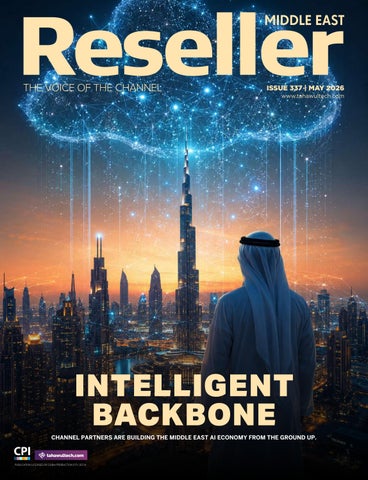
The Middle East’s AI economy is no longer a vision pinned to keynote slides. It is being built, quietly and deliberately, by the partners, integrators, and distributors who turn ambition into infrastructure. This month’s cover story captures that shift. Channel partners are stitching together networks, sovereign clouds, security layers, and AI platforms for enterprises and governments across the region, transforming what was once a transactional ecosystem into the intelligent backbone of a $265 billion regional AI market.
The numbers tell part of the story. Regional AI spending is on track to reach $11.4 billion by 2027, and the UAE is positioned to capture close to 14 percent of the GDP impact PwC projects for AI across the region by 2030. The deeper story is structural. With the UAE committing to run half of its government sectors on agentic AI within two years, the channel’s role has moved from fulfilment to foundation build ing.
E-mail: sandhya.dmello@cpimediagroup.com
Facebook: www.facebook.com/ TahawulTech
Twitter: @TahawulTech
Instagram: @TahawulTech
This edition reflects that breadth. IBM unveils its enterprise A I operating model at Think 2026. Du advances sovereign industrial AI through its National Hypercloud. OrbitWorks and Shory bring satellite data into insurance underwriting. Origen partners with DMT to architect Abu Dhabi’s unified digital governance platform. PwC’s research shows Saudi enterprises outpacing global peers on AI productivity gains. Checkout.com reports that 97 percent of MENA consumers now expect invisible payments, with trust emerging as the defining currency.
Across interviews, opinions, and product launches, one theme recurs. Connectivity, intelligence, and resilience are converging, and the channel is where that convergence becomes real. The partners building this backbone are no longer downstream players. They are the architects.
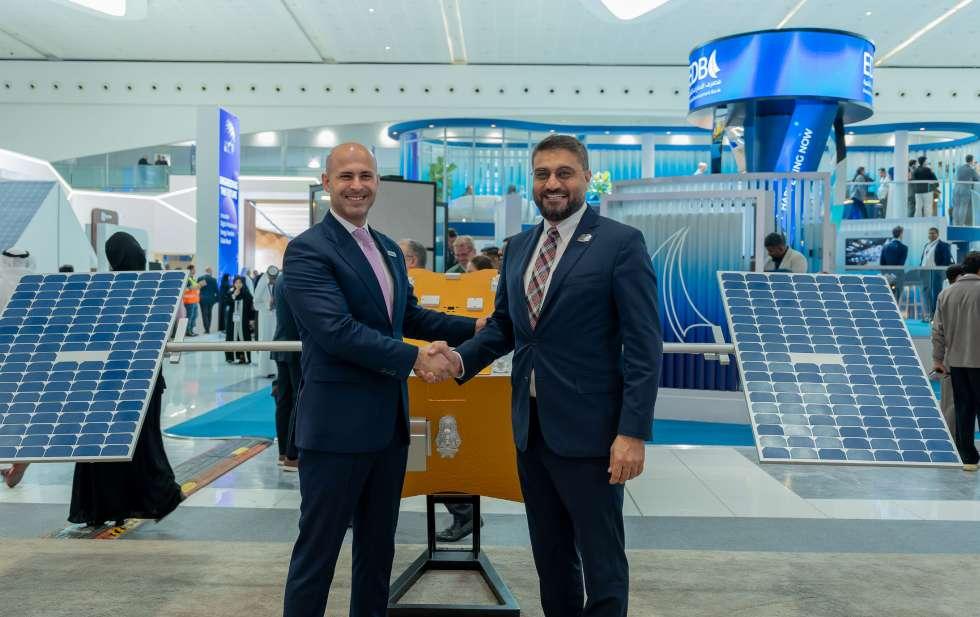
Shory Group (Shory), a First. tech company and a leading AI-driven insurtech firm in the region, and OrbitWorks, the UAE’s first commercial satellite constellation production and operation company, have announced a collaboration to explore opportunities at the intersection of satellite technology and insurance, in a move that reflects growing convergence between space data and real-world risk management. The announcement was made at Make it in the Emirates.
The collaboration will focus on how OrbitWorks’ satellite capabilities and geospatial data can enhance Shory’s risk modelling and underwriting processes, while also exploring opportunities to extend insurance coverage to space-based assets. Initial areas of focus include satellite asset insurance and the use of geospatial intelligence to strengthen risk modelling across flood detection, environmental monitoring, and
fleet coverage with unprecedented accuracy.
OrbitWorks is the Middle East’s first commercial satellite manufacturer. Its Altair constellation, a 10-satellite, multi-sensor Earth observation system equipped with optical, infrared, thermal, and RF sensing capabilities is designed to deliver near realtime geospatial intelligence through onboard AI processing, combining frequent revisit rates with rapid onorbit data processing to reduce the time between collection and actionable insight.
Shory has built a strong track record in insuring complex, high-value assets across the region, including infrastructure, fleets, and large-scale commercial projects. The company is part of Judan Financial Holding, IHC’s dedicated financial services platform.
Aoun AlSmadi, CEO of Shory UAE, said: “We have spent years building the capability to insure complex assets at
scale. Collaborating with OrbitWorks is a logical extension of that. It gives us the opportunity to bring our expertise into the space sector while putting satellite data to work in our risk models.”
Dr. Hamdullah Mohib, Acting CEO of OrbitWorks, added: “Building the commercial ecosystem around our satellite programme is a priority for OrbitWorks. Working with Shory is a practical step in that direction. Both companies are UAE-grown, and there is clear commercial logic to exploring what we can do together.”
Make it in the Emirates is the UAE’s national platform for showcasing industrial and technological capability. The announcement reflects a broader trend of UAE-based companies across different sectors identifying shared commercial opportunity.
Shory is a First.tech company and part of Judan Financial Holding, IHC’s dedicated financial services platform.
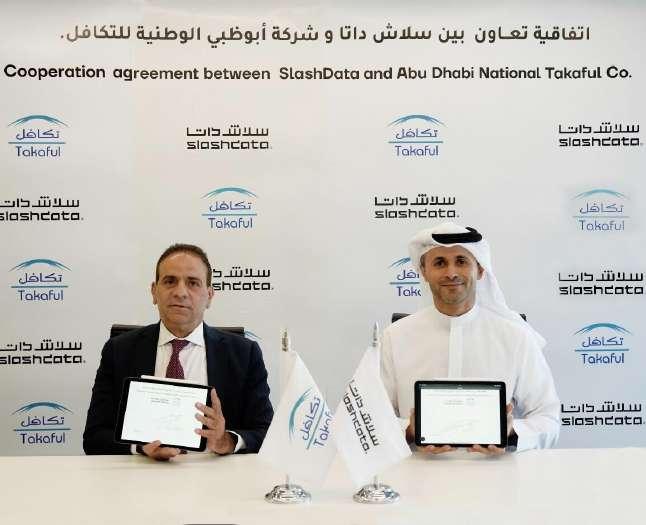
The partnership puts SlashData’s Mulem and Wtheeq platforms at the core of ADNTC’s motor takaful operations, streamlining underwriting, policy issuance and regulatory compliance in line with the UAE’s Zero Government Bureaucracy Program.
SlashData, a leading UAE-based govtech company, has announced a strategic partnership with Abu Dhabi National Takaful Company (ADNTC) to modernise insurance operations through the adoption of Mulem and Wtheeq — its digital platforms supporting data integration and policy issuance across the insurance lifecycle.
Under the agreement, ADNTC will use Mulem to securely access critical data, including vehicle, driver and accident information, enabling more accurate underwriting and faster processing. The platform is complemented by Wtheeq, which digitises policy issuance and documentation, reducing manual work and improving transaction speed.
Delivered in partnership with the Integrated Transport Centre (Abu Dhabi Mobility) and Abu Dhabi Police, Wtheeq serves as a foundational data layer for the UAE’s mobility services, enabling instant verification and supporting regulatory compliance. Together, Mulem and Wtheeq create a seamless
flow from data access to policy issuance, helping insurers manage higher volumes efficiently without adding operational complexity.
WE ARE ENABLING STRONGER INTEGRATION BETWEEN DATA ACCESS AND POLICY ISSUANCE.
Thamer Alfallaj, CEO of SlashData, said: “Our partnership with Abu Dhabi National Takaful reflects a shared focus on building more connected and efficient insurance operations. Through Mulem and Wtheeq, we are enabling stronger integration between data access and policy issuance, helping insurers operate more effectively while supporting government initiatives such as the UAE’s Zero Government Bureaucracy Program.”
Osama Abdeen, CEO of Abu Dhabi National Takaful Company, added: “At ADNTC, we are focused on adopting technologies that strengthen how we operate and better serve our
customers. Our partnership with SlashData and the integration with its platforms represents an important step in enhancing how we use data across our motor takaful operations, enabling more efficient processes and a more seamless experience for our policyholders.”
The collaboration reflects a broader shift in the UAE insurance market, where insurers are investing in digital infrastructure to improve service delivery and support longterm operational resilience. Through Mulem and Wtheeq, SlashData is enabling more efficient, scalable insurance operations across the motor insurance value chain.
SlashData is a First.tech company and part of Judan Financial Holding, IHC’s dedicated financial services platform.
At Think 2026, IBM announced its most comprehensive expansion of enterprise AI and hybrid cloud capabilities to date, with new tools for agent orchestration, real-time data, intelligent operations and sovereignty.
IBM has used its annual Think conference to announce its most comprehensive expansion of enterprise AI and hybrid cloud management capabilities to date, setting out what the company describes as a blueprint for the AI operating model. New products and capabilities unveiled today include the next generation of IBM watsonx Orchestrate for multiagent orchestration, IBM Confluent to bring real-time data to AI, the IBM Concert platform for intelligent operations and IBM Sovereign Core for operational independence.
The announcements respond to the defining challenge facing enterprises: while many have invested heavily in AI, only a few believe the investment is paying off. The new portfolio is designed to close that gap.
“The enterprises pulling ahead are not deploying more AI — they’re redesigning how their business operates,” said Arvind Krishna, Chairman and CEO, IBM. “Running AI in the enterprise requires a new operating model, and IBM is enabling organisations to manage AI-driven systems with the same rigor, governance, and scale as their most critical infrastructure.”
Saad Toma, General Manager, IBM Middle East and Africa, added: “Across the Middle East and Africa, the next phase of AI will not be defined by experimentation, but by how deeply it is embedded into the way enterprises operate. Successful enterprises are moving from isolated AI projects to an operating model where agents, data, automation, hybrid cloud, governance and sovereignty work together by design. That is how AI moves from ambition to productivity, from pilots to measurable business value, and from fragmented adoption to transformation at scale.”
IBM’s blueprint rests on four integrated
systems working together: agents that execute and adapt across the business through coordinated AI; data delivered as real-time, connected information for a shared view of what’s happening; automation through end-to-end infrastructure and workflows that scale across processes; and hybrid cloud foundations that deliver operational independence, sovereignty, governance and security. Each is a separate priority enterprises are already chasing — but combined, they represent a shift from improving parts of the business to changing how the business operates.
Agents: orchestration and development at scale Organisations are moving from deploying a handful of agents to managing thousands, often built by different teams on different platforms. The challenge has shifted from building agents to keeping them governed and auditable in near real time.
IBM is announcing the next generation of watsonx Orchestrate (available in private preview), evolving it into an agentic control plane for the multi-agent era where organisations can deploy agents from any source with consistent policy enforcement and accountability. Alongside it, IBM recently launched IBM Bob (generally available), an agentic development partner that works with developers to build agents with security and cost controls built in.
For most enterprises, data remains siloed and lacks meaning. To power agentic systems with up-to-date data, IBM is delivering a real-time, AI-ready data foundation through its recent acquisition of Confluent — built on Kafka and Flink technologies — and pairing new capabilities in watsonx.data with a real-time context layer for AI. Additional announcements include Context in watsonx.data (private preview), which extends the platform

with an open, federated context layer that applies semantic meaning, enforces governance at runtime and makes decisions explainable. Confluent and Tableflow integration with watsonx.data (generally available) and Confluent and Flink integrations with watsonx.data deliver unified AI and analytics across all data, connecting real-time event streaming with batch workloads. watsonx. data GPU-accelerated Presto (private preview) showed the potential to significantly reduce the cost of running certain workloads on large enterprise datasets — in a proof of concept with Nestlé, the engine delivered 83% cost savings and a 30x price-performance improvement on a global data mart spanning 186 countries.
IBM Z Database Assistant (private preview) gives Db2 and IMS database administrators an AI-powered workspace to monitor performance, automate routine tasks and optimise configurations. HCP Terraform powered by Infragraph (public preview) delivers unified infrastructure visibility through a centralised, event-driven knowledge graph connecting data across cloud environments, infrastructure-as-
code workflows, security tooling and operations platforms.
Automation: intelligent infrastructure operations
Running AI at the core of the business can make infrastructure exponentially more complex, with most enterprises managing that complexity through fragmented tools, siloed teams and humans acting as the connective layer between systems never designed to work together.
IBM is announcing the IBM Concert platform (public preview),
an AI-powered operations platform that moves organisations from passive monitoring to coordinated, intelligent response. Where traditional tools capture metrics, Concert correlates signals into a single view across applications, infrastructure and network, without requiring organisations to rip and replace existing tooling. It delivers this through cross-domain understanding to eliminate silos, context-driven decisions that correlate signals across risk and dependencies, and coordinated execution with built-in
governance and human oversight. With the threat landscape changing rapidly — AI can now identify and exploit vulnerabilities in hours rather than days — IBM Concert Secure Coder (public preview) embeds security management directly into the developer workflow. Available in IBM Bob and VS Code, it identifies and prioritises risks as code is written and can generate automatic remediations to fix vulnerable code, or patch operating systems, middleware, packages and images, making security continuous and proactive.
The move follows the success of PropTech Connect Middle East 2026 and signals a new phase of international collaboration in real estate innovation, with the 2027 edition expected to draw more than 4,000 participants and 2,000 proptech companies.
Building on the strong momentum of Dubai's proptech sector, PropTech Connect Middle East has announced the opening of its regional office in Dubai International Financial Centre (DIFC), with support from Dubai Land Department (DLD). The move reflects the emirate's growing position as a regional and global hub for real estate innovation.
The opening of the office marks the culmination of the inaugural edition of PropTech Connect Middle East 2026, held in Dubai last February. The event attracted more than 3,000 participants and over 300 speakers, playing a key role in reinforcing the emirate's position as a platform that brings together technology and real estate investment, while enhancing opportunities for collaboration among stakeholders across the sector.
The expansion reflects ongoing efforts led by Dubai Land Department to develop an integrated proptech ecosystem that fosters innovation, strengthens collaboration among regulators, developers and technology companies, and creates an attractive environment for global and emerging firms. Having obtained a commercial

licence from DIFC, the new regional office represents a strategic step that supports the expansion of proptech companies and reinforces Dubai's role as a hub for innovation.
Mohammed Ali Al Badwawi, CEO of the Real Estate Registration Sector at Dubai Land Department, affirmed that the step reflects growing global confidence in Dubai's regulatory and investment environment. He said: "Dubai continues to strengthen its global position in proptech by building an integrated ecosystem that
brings together innovation, flexible regulatory frameworks and effective partnerships, enhancing its ability to attract high-quality investments and support the sustainable growth of the sector. The success achieved by the inaugural edition of PropTech Connect Middle East marked the beginning of a new phase of international collaboration in real estate innovation and reflects Dubai's role in leading digital transformation and advancing new concepts in the development of the sector."
Matthew Maltzoff, CEO and Co-Founder of PropTech Connect, said: "The opening of our office in Dubai reflects the level of confidence we place in the emirate's dynamic environment, which combines a clear vision for development, a supportive regulatory framework, and an integrated ecosystem that enables innovation. We see Dubai as an ideal platform to expand our presence in the region and to work with our partners, foremost among them Dubai Land Department, to push the boundaries of innovation in the real estate sector."
The announcement follows the recent PropTech Elevate x REES event, a specialised session attended by leading government entities, real estate industry leaders and promising
proptech companies. Organised by the Dubai PropTech Hub at the Innovation Hub in collaboration with Dubai Land Department and the REES platform, the session served as a forum for exchanging insights on proptech trends and aligning sector priorities, while showcasing innovative solutions that support Dubai's real estate transformation agenda.
Mohammad AlBlooshi, Chief Executive Officer of DIFC Innovation Hub, said: "As a leading platform for the PropTech sector, PropTech Connect's presence in DIFC will further strengthen industry dialogue and collaboration by bringing together investors, innovators and real estate leaders from Dubai, the UAE and across the region. Initiatives such as PropTech Elevate x REES further
reinforce this momentum by aligning sector priorities and showcasing innovation that supports Dubai's real estate transformation agenda."
Building on this momentum, the dates for the 2027 edition of the exhibition in Dubai will be announced soon, with expectations of even greater participation — targeting more than 4,000 participants and 2,000 proptech companies, further reinforcing the event's position as a key regional platform.
The direction aligns with the strategic vision led by Dubai Land Department, in line with the objectives of the Dubai Economic Agenda D33 and the Dubai Real Estate Strategy 2033, both of which place innovation and digital transformation at the core of sector development.
With priority markets set for the UAE, Saudi Arabia, Oman and Egypt, FUJIFILM Middle East is positioning office printing as a core pillar of its evolution beyond traditional imaging, responding to growing demand for secure, sustainable workplace infrastructure.
FUJIFILM Middle East has announced its strategic priorities for the region as it advances the expansion of its Office Printing business, reinforcing a long-term commitment to the market and its positioning as a business innovation partner for enterprises and institutions.
Building on its established imaging heritage, FUJIFILM Middle East has in recent years broadened its focus to address the evolving operational, security and governance needs of organisations. Office printing has become a core pillar within this strategy, reflecting the critical role document workflows continue to play in regulated and security-conscious environments, even as digital transformation accelerates.
Across the region, organisations are re-evaluating how information moves between physical and digital environments. While cloud platforms and core IT systems are advancing rapidly, document
infrastructure remains fundamental to daily operations in sectors such as government, healthcare, finance and large enterprises. FUJIFILM Middle East FZE's approach integrates printing, scanning and document management into secure, enterprise-
grade workflows designed to support continuity, compliance and control.
The company's regional strategy places particular emphasis on the UAE and
Saudi Arabia as priority markets, where regulatory frameworks, cybersecurity expectations and scale are shaping enterprise technology decisions. FUJIFILM Middle East is investing in these markets with a long-term view, strengthening local capabilities, expanding its partner ecosystem and aligning its solutions with national digitalisation agendas and institutional requirements. Phased expansion into additional Middle Eastern markets is planned, in line with customer demand and regional development priorities.
Security and governance at the core
Security and governance remain central considerations within the expansion. With information increasingly flowing across hybrid environments, maintaining consistent access control, traceability and auditability has become a key concern for CIOs and operations leaders.
FUJIFILM Middle East FZE's Office Printing platforms are designed to operate as part of a broader information lifecycle, embedding security and governance into everyday
workflows rather than treating print as a standalone function.
A sustainability-led approach
Sustainability is also an integral component of the company's regional strategy. FUJIFILM Middle East continues to develop office printing solutions that support more responsible workplace operations, including improved energy efficiency, reduced power consumption and the use of recycled and bio-based materials. By optimising device performance and lifecycle management, organisations can balance operational efficiency with environmental considerations, supporting broader ESG objectives while maintaining reliability and security.
Strategic partnerships across the region
The expansion is supported by strategic partnerships with Gulf Commercial Group Company — which includes the Managed Print Services Company in the UAE, Gulf Business Solutions in Saudi Arabia and CNS in Oman — as well as PACKPRO in Egypt. The partner network enables tailored deployment
and ongoing support for organisations with complex, multi-site requirements across the region.
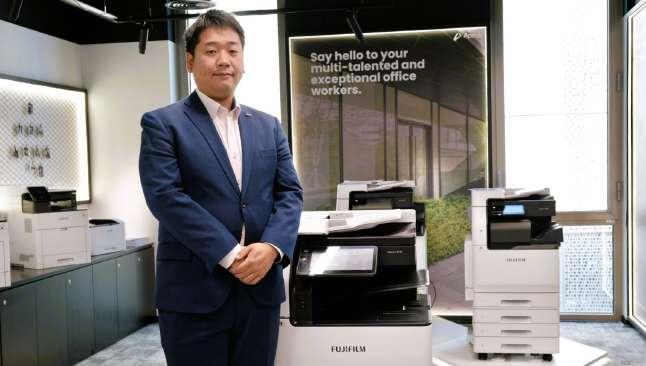
Kazuhiko Kiji, Division Manager at FUJIFILM Middle East and Africa, said: "Enterprises across the Middle East are operating in environments where security, sustainability and continuity are increasingly interconnected.
FUJIFILM Middle East FZE's focus is on supporting organisations with document infrastructure that aligns with how they operate today, securely, efficiently and responsibly. Our Office Printing division plays a central role in this strategy as we continue to evolve beyond traditional imaging and strengthen our presence across the region."
The announcement forms part of FUJIFILM Middle East FZE's wider regional strategy, which spans secure document infrastructure, business process enablement and long-term partnerships with enterprises and public-sector organisations. With digital transformation continuing to mature, the company expects demand for integrated, security-first and sustainable document platforms to grow across the Middle East.
The deal gives EDGE direct access to more than 35 years of piston engine manufacturing excellence in Southern Italy, laying the foundation for a high-quality European engine production base and strengthening the group's global propulsion capabilities across aeronautical, automotive and marine applications.
EDGE Group has announced the signing of an agreement to acquire a controlling stake in Costruzioni Motori Diesel S.p.A. — CMD — a leading Italian company specialising in the design, prototyping and development of advanced propulsion systems for automotive, marine and aeronautical applications. The signing ceremony took place at the CMD plant in Atella, in the Basilicata region of Southern Italy.
The agreement, which is subject
to customary closing conditions and applicable regulatory and governmental approvals, represents a strategic move to expand EDGE's footprint in advanced engineering, Industry 4.0 and power solutions. CMD, recognised for its expertise in precision engine components and powertrain technologies, is expected to benefit from increased capital investment and access to new regional and international markets, while contributing its 35-year legacy in the
development and manufacturing of high-performance engines for land, sea and air applications.
Hamad Al Marar, Managing Director and CEO of EDGE Group, said: "By entering into this agreement with CMD, we are taking an important step in building a highly capable European propulsion hub that will complement and reinforce EDGE's global industrial footprint. Through CMD's proven expertise in piston engines and advanced propulsion technologies,
we will accelerate the development of competitive, export-ready products that meet the most demanding requirements of our aeronautical, automotive and marine customers."
EDGE outlined plans to scale CMD's manufacturing capabilities, accelerate research and development initiatives, and enhance its position across both conventional and next-generation propulsion systems. The transaction is designed to unlock synergies by combining CMD's engineering heritage with EDGE's global reach and financial strength.
Mariano Negri, Chief Executive Officer of CMD Group, said: "Joining forces with EDGE represents a powerful industrial opportunity for CMD, our employees and our partners. With EDGE's support, we will be able to scale our technologies, expand our international reach and invest further in innovation, while maintaining and strengthening our Italian industrial roots and our commitment to quality, reliability and technological excellence."
Leaders from both organisations emphasised a shared vision centred on innovation, sustainability and long-term value creation. The combined platform is expected to strengthen its ability to meet evolving demands across the automotive, aerospace, marine and industrial sectors, while supporting
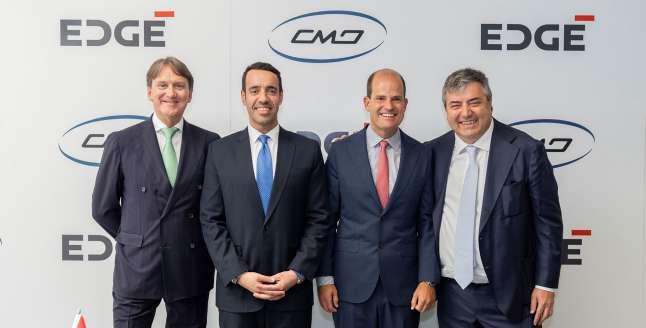
continued growth and technological advancement.
Founded in 1989 by the Negri family, whose engine-making legacy dates back to before the Second World War, CMD has spent over 35 years designing, prototyping and developing high-performance piston engines for the automotive, marine and aeronautical sectors. The company has earned an international reputation for technical precision, innovation and uncompromising quality standards. Until the closing of the transaction, which is expected to occur by yearend, CMD will continue to operate as
an independent company under its current management team, ensuring full continuity for customers, suppliers and employees. Upon completion, EDGE and the current shareholders of CMD — who will remain invested in the company with a significant minority stake and continue to cover key managerial roles — will jointly define a detailed integration plan aimed at maximising industrial synergies, safeguarding critical knowhow and accelerating the deployment of a comprehensive propulsion offering across the aeronautical, automotive and marine segments.
The UAE-based firm focuses on helping enterprises move from AI pilots to measurable, scalable impact across the region.
Kudo Advisory, a new AI-focused consulting firm, has launched in the UAE to help enterprises convert Artificial Intelligence (AI) investments into measurable and scalable outcomes across the region. Founded by Vijay Jaswal, a seasoned technology leader and former Regional CTO at global enterprise software firms including IFS and Software AG, the firm has been set up to guide organisations with significant AI investments through
pilot-stage challenges, fragmented initiatives and unclear returns from AI adoption.
Speaking on the launch, Vijay Jaswal, Founder of Kudo Advisory, said: "Kudo Advisory exists to make AI move. Across the region, we are seeing strong intent and meaningful investment in AI, however many organisations are yet to see results. The issue is a lack of clarity on where value sits, how to govern it properly, and how
to execute with discipline. Our focus is simple: to help leadership teams prioritise the right opportunities, put the right guardrails in place, and ensure delivery happens."
According to PwC Middle East, AI is expected to contribute up to US$320 billion to the region's economy by 2030, with the UAE forecast to see some of the highest economic impacts from AI adoption. Despite rapidly increasing investments,
many enterprises continue to face challenges converting AI ambitions into measurable operational value. Kudo Advisory aims to close the gap through a disciplined and outcome-driven approach.
End-to-end advisory, focused on execution
The firm provides end-toend AI advisory services for enterprise environments, spanning AI strategy aligned to business priorities, governance frameworks to ensure safe and smart use, operating model design and use case prioritisation.

Beyond strategy, the firm places a strong emphasis on execution through programme delivery, implementation of AI initiatives with accountability for enterprises, governance and performance measurement. Its approach is pragmatic rather than hype-led, focusing on enterprise readiness, measured adoption and long-term business value.
The name "Kudo" is derived from the Japanese word meaning drive or propulsion — a reflection of the firm's core mission of turning intent into forward motion.
New secure, sovereign, and future-ready platform supported by du Tech’s National Hypercloud
Du, the leading telecom and digital services provider, announced the launch of its next-generation industrial AI platform under du Tech’s portfolio, specifically designed to serve the industrial sector in the UAE. The platform features multicloud capabilities powered by du Tech’s National Hypercloud, enabling industrial enterprises across the UAE to adopt AI technologies within a secure environment that aligns with the national digital sovereignty agenda.
The platform is further enhanced by pre-built industrial AI models designed to optimise factory performance across key use cases, including manufacturing efficiency, asset management, quality control, and energy optimisation. In addition, its no-code AI modelling capabilities allow organisations to develop and deploy their own AI models using proprietary data, giving them greater control over data usage, governance, and deployment transparency through explainable AI. This approach moves beyond traditional “black box” systems to deliver reliable, SOP-ready outcomes.

du Tech is collaborating with Bosch Software Digital Solutions (Bosch SDS) to align go-to-market strategies and accelerate ecosystem development, enabling enterprises to adopt AI-driven industrial solutions with confidence and at scale.
Jasim Alawadi, Chief ICT Officer at du, said: “By combining du Tech’s sovereign cloud and digital
infrastructure with Bosch SDS’s global industrial expertise, we are enabling organisations to unlock the full value of their data and transform complex operations into actionable intelligence, while maintaining the highest standards of security, transparency, and control. This collaboration reflects du’s commitment to supporting the UAE’s vision for industrial growth and digital sovereignty.”
The announcement was made during du’s participation in the fifth edition of ‘Make it in the Emirates’ (MIITE) 2026, held from 4-7 May, where du Tech served as the strategic sponsor of the ‘Intelligence Hub’ at the forum. During the event, du Tech showcased its latest innovations in industrial AI and digital transformation, reflecting its commitment to supporting industrial growth and accelerating the adoption of advanced technologies in the UAE. du Tech showcased the platform capabilities through an interactive, real-time demonstration designed as a live industrial control environment at MIITE. The experience enabled visitors to explore practical AI applications,
simulate operational scenarios such as equipment anomalies and production inefficiencies, and engage with AI-driven recommendations that improve performance and operational outcomes.
This initiative further strengthens du’s position as a trusted strategic partner for digital services, solutions, and innovation, while reinforcing its leadership in sovereign industrial AI in the UAE. It also highlights the
company’s growing role in accelerating AI-driven digital transformation and supporting the nation’s goals for economic diversification and sustainable industrial growth.
New secure, sovereign, and future-ready platform supported by du Tech’s National Hypercloud
Origen Technology has been formally appointed by Abu Dhabi's Department of Municipalities and Transport (DMT) to architect and deliver Nabd, an AI-powered digital governance framework designed to unify municipal data and improve cross-department coordination across the emirate.
The strategic signing ceremony took place during the Abu Dhabi Infrastructure Summit (ADIS), held from 12 to 14 May. On the sidelines of the summit, the two organisations also officially unveiled Nabd's capabilities to the public for the first time, giving attendees an early look at how the platform will embed AI-driven intelligence into municipal governance.
Nabd represents a pivotal step in Abu Dhabi's journey towards a comprehensive digital future, offering an integrated framework that enables the emirate's municipal systems to operate cohesively as the region grows.
A unified data foundation for faster decisions
Nabd brings fragmented planning and operational datasets into a shared intelligence environment, giving decision-makers consistent, near-realtime visibility. The approach supports faster approvals, clearer governance and more aligned action across municipal functions.
Connecting systems while preserving autonomy
Built on a federated architecture, Nabd connects existing systems without replacement. An AI-enabled orchestration layer synchronises key datasets and enables cross-domain analytics, while allowing departments to retain operational autonomy and continuity.
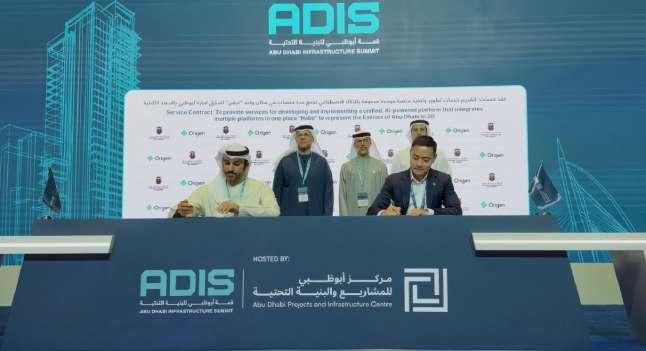
Officials from the Department of Municipalities and Transport and Origen Technology mark the signing of a strategic partnership to deliver Nabd, Abu Dhabi’s new AI-powered digital governance framework, on the sidelines of the Abu Dhabi Infrastructure Summit.
A high-fidelity 3D digital twin provides an integrated view of the emirate to support planning, simulation and oversight. By embedding AI into governance workflows, Nabd helps teams model scenarios, assess infrastructure capacity and evaluate cross-domain impacts before decisions are made — shifting municipal management from reactive response to proactive planning.
While the initial phase focuses on urban planning and municipal governance, Nabd has been engineered to extend to additional government entities over time, reducing duplication and strengthening inter-agency collaboration as adoption expands.
Origen's role: architecting the intelligence layer Origen's responsibility goes beyond
integration. The company is designing the intelligence layer that enables interoperability between legacy systems and future digital services, ensuring the platform can evolve over time and incorporate new data streams and capabilities without large-scale system replacement.
With cities facing increasing pressures from population growth, infrastructure demand and sustainability targets, integrated digital modelling is becoming essential. Nabd's unified foundation supports more efficient infrastructure investment, improved land-use planning and stronger operational oversight — helping Abu Dhabi manage growth with long-term resilience.
The rollout of Nabd will proceed in phases, beginning with priority municipal functions and expanding progressively.
On World Telecommunication and Information Society Day 2026, telecoms, cloud, and channel ecosystems are converging to power the Middle East’s AI economy, just as the UAE redefines what government itself can be.
The Middle East AI economy is not being built by chips and capital alone. Real construction is happening across the networks that move the data, the cloud platforms that host the models, and the security layers that protect them. Channel partners are stitching all of it together for enterprises and government entities across the UAE.
The headlines belong to hyperscalers, sovereign compute campuses, and frontier large language models. The execution belongs to the channel. Every workload moved to a sovereign cloud, every AI agent deployed inside a ministry, every secure connection between a model and a citizen service, sits on the work of partners operating at the grassroots of the regional technology economy.
This is the story of the intelligent backbone, and the channel ecosystem building it from the ground up.
Regional AI spending is forecast to reach $11.4 billion by 2027, according to IDC, while the broader Middle East AI market is on a trajectory to hit $265 billion by 2033 at a compound annual growth rate of nearly 42 percent. PwC projects AI will contribute $320 billion to the regional economy by 2030, with the UAE poised to capture close to 14 percent of GDP impact, the highest relative share in the region.
On 23 April 2026, His Highness Sheikh Mohammed bin Rashid Al
Maktoum, Vice President and Prime Minister of the UAE and Ruler of Dubai, unveiled a national framework to transform 50 percent of UAE government sectors, services, and operations to run on agentic AI within two years, making the UAE the first government in the world to operate at this scale through autonomous systems.
The framework did not arrive in isolation. It capped a four-and-a-halfmonth sprint of sovereign compute commitments, frontier model launches, autonomous transport rollouts, and industrial AI platforms that few countries could match in a decade.
For the channel, the implication is clear. Migrating half of government services to autonomous AI in two years, alongside parallel transformation in healthcare, finance, defence, and industry, will not happen without a deeply orchestrated technology stack. Sovereign cloud, programmable networks, identity governance for autonomous agents, observability, and federated security must all converge into a single operational fabric.
This is the story of that intelligent backbone, told through the voices building it.
Mikko Lavanti, President, Nokia Middle East and Africa, the conversation has
moved decisively beyond bandwidth. “AI is fundamentally changing network requirements. Networks today must support intelligent, real-time interactions at scale while maintaining resilience, security, and predictability,” Lavanti says. “We are helping customers evolve toward AI-native networks through advanced connectivity across radio, fiber, IP, optical, and core domains. We are also embedding automation and AI-driven analytics into operations to improve visibility, optimise performance, and strengthen resilience.”
Lavanti’s view mirrors IDC research showing more than half of telecom and cloud leaders expect increased investment in sovereign cloud, edge data centres, and in-region AI processing by 2026. Operators that move quickly are positioning themselves as their country’s AI infrastructure partner, those who delay risk missing what IDC calls a once-in-ageneration opening.
Lavanti believes the foundation of the future digital economy is being laid through technology convergence, not isolated upgrades.
“AI is driving automation and intelligence, while 5G provides the low-latency, high-capacity connectivity needed to support real-time digital services. Cybersecurity and resilient infrastructure are becoming critical to maintaining trust and long-term sustainability. The focus is no longer

only on connectivity, but on enabling intelligent ecosystems that improve productivity, modernise industries, and strengthen digital inclusion.”
From bandwidth to programmable platform s Elie Abouatme, EMEA Head of Telecom, Media and Entertainment, Industry GTM at ServiceNow, is even sharper on where economic value now lives. “5G without a monetisation strategy is just expensive hardware, not a kept promise. I see it as the enabling layer, not the economic destination,” Abouatme says. “The UAE’s leadership in 5G coverage and 5G-Advanced deployment gives operators like e& and du a connectivity foundation very few markets can match. An inclusive, future-ready digital economy is built on what runs over that connectivity. It runs on government services, healthcare workflows, financial transactions, AI agents.”
The shift underway, he argues, is structural. Operators are moving from bandwidth providers toward programmable digital platforms, exposing network capability through open APIs to developers and enterprises. IDC’s 2026 telecom research confirms this, describing the convergence of GSMA Camara APIs and TM Forum’s Open Digital Architecture as one of the biggest unlocks in telecom since the smartphone.
Abouatme adds that ServiceNow’s role sits at the operating model layer. “Digital resilience is now an operations mandate, not an engineering metric. As UAE enterprises and government scale AI and cloud, the primary failure mode is not only a dropped packet but also an unmanaged AI agent, an unauthorised model, or a service that can’t be restored fast enough. Our AI Control Tower governs every model and agent across the enterprise, while our platform automates incident, change, and service restoration at scale.”
For an agentic government, the implication is direct. Governing autonomous systems at federal scale is a control plane problem, and the control plane has to be in place before
deployment, not after.
Sovereign cloud, distributed by design
If networks are the rails, hyperscale cloud is the destination. Saudi Arabia and the UAE together account for roughly 550 megawatts of regional data centre capacity, and the build pipeline is accelerating sharply.
Stargate UAE broke ground in Abu Dhabi on 20 March 2026, a 30 billion dollar, 10 square mile campus delivered by G42 with OpenAI, NVIDIA, Oracle, Cisco, and SoftBank that will become the world’s largest dedicated AI infrastructure outside the United States.
Alan Qi, President of Huawei Cloud Middle East and Central Asia, frames the resilience question as a strategic imperative.
“In today’s digital economy, business continuity is no longer just a technical requirement, it is a strategic necessity that every enterprise must guarantee. Huawei Cloud is fortifying the UAE’s digital resilience through a geodistributed multi-region architecture spanning our strategic hubs across the regions,” Qi explains. “Each regional hub can serve as primary, secondary, failover, or edge distribution depending on business requirements, providing a high-reliability foundation to ensure that critical operations remain uninterrupted even during unforeseen disruptions.”
On the AI economy itself, Qi points to Model-as-a-Service as the access layer that lets enterprises bypass the cost of building foundation infrastructure from scratch.
“To support the UAE’s sovereign ambitions, this innovation remains neutral and trustworthy by never using customer data for training. By leveraging China’s comprehensive AI ecosystem, Huawei Cloud could empower the UAE to build its own localized AI capabilities and develop sovereign or industry-specific large models. This collaboration allows the nation to build a self-reliant AI ecosystem while ensuring critical workloads remain secure and compliant.”
The distributed-by-design philosophy is becoming UAE doctrine. Executives
speaking at Make it in the Emirates 2026 in early May confirmed a pivot from single mega-site AI infrastructure to distributed, redundant sovereign clusters across multiple sites, designed to withstand regional disruption without losing production access.
For Salman Kazmi, Area Vice President, META, BMC Helix, the AI economy will be defined by how invisibly operations run beneath it.
“We are assisting businesses across the UAE to enhance digital resilience by powering intelligent, automated and always-on operations. As enterprises and telecom providers accelerate the adoption of AI, cloud and digital services, operational complexity continues to grow,” Kazmi notes. “BMC Helix combines AIOps, observability, service management, and agentic AI to enable organizations to proactively identify issues, minimize event noise, automate remediation, and improve service availability.”
Kazmi adds that smart infrastructure and 5G are knitting connected cities, banking, healthcare, and government services into a single real-time operational fabric.
“Future technologies are enabling organizations to build scalable, secure and inclusive digital services that support economic growth, innovation and long-term sustainability across the UAE.”
For a government that has just committed to running half of its services on autonomous agents, observability is no longer a nice-tohave. It is the precondition for trust.
The faster AI deploys, the larger the attack surface becomes. Emad Haffar, Head of Security Consultants for META at Kaspersky, is direct about where cybersecurity now sits in the architecture.
“Cybersecurity protection is the cornerstone of digital resilience and business continuity, ensuring organisations can grow with confidence while preventing the associated risk of cyberthreats.
Resilience depends on integrating security into every layer of digital infrastructure, not only to reduce cyber risks but to enable digital transformation that allows organizations to innovate, adopt AI and cloud technologies, and scale critical services with greater confidence.”
Haffar argues the UAE’s leadership comes precisely from refusing to trade speed for security.
“Every new technology adds a cost expanding the organization’s attack surface, so it must be adopted with cybersecurity and cyber resilience at the heart of its design and operation. Cyber resilience empowered by the right cybersecurity will help organizations to maintain trust with their customers, citizens, and stakeholders even during periods of operational disruption.”
In an agentic environment, where AI systems communicate machineto-machine at speeds humans cannot supervise in real time, identity governance for autonomous agents will define which sovereign AI initiatives scale, and which stall.
The integrator advantage If telcos build the pipes and hyperscalers fill them, system integrators are the ones translating capability into outcome. Yousef Salamin, Head of Infrastructure Solution Sales, UAE at NTT DATA, sees the integration layer as where competitive advantage now lives.
“We are helping UAE customers and organizations build resilient, secure, and intelligent digital foundations. We support customers in modernizing their infrastructure through emerging technologies like hybrid cloud, software-defined data centres, cybersecurity, and AI-ready platforms,” Salamin says. “Our focus is not only on connectivity, but on ensuring business continuity, cyber resilience, and operational agility.”
For Salamin, the UAE’s vision is not adoption for its own sake. It is the deliberate construction of an investable, innovation-led ecosystem.
“AI is a present-day reality and driving automation and smarter decision-making, while 5G enables
real-time connectivity for industries and citizens. Cybersecurity ensures trust and protects critical digital assets, and smart infrastructure creates efficient, sustainable environments. The UAE’s vision is not only about digital adoption, but about building a secure, inclusive, and innovation-led ecosystem that attracts investment and supports long-term growth.”
The intelligent backbone has to reach everywhere, not just the major business districts. Bassel Khachfeh, Digital Solutions Manager at Omnix International, is exploring how satellite connectivity now complements terrestrial fibre and 5G for genuine resilience.
“OMNIX helps organizations enhance their digital resilience through system upgrades that improve security measures and system availability and system capacity and system recovery capabilities. Integrating applications with cloud platforms, data, devices, and users creates a unified digital ecosystem which improves our ability to deliver better connectivity solutions.”
Khachfeh adds that satellite is no longer a niche. “In some smart city solutions we offer as part of OMNIX Nova, we are also exploring satellite connectivity such as Starlink to strengthen resilience, especially in remote areas, temporary sites, or critical operations where backup connectivity is essential. It aligns with We the UAE 2031 and UAE Centennial 2071 by supporting innovation, continuity, inclusion, and quality of life.”
The biggest structural story of 2026 is not on the vendor side. It is on the partner side. Industry research describes 2026 as the year of commercial accountability for the channel, where margin is shifting away from product resale toward partners who can orchestrate platforms, unify enterprise data, modernise infrastructure, and govern AI at scale.
Gartner forecasts global IT spending will surpass six trillion dollars in 2026,
with AI infrastructure investment expected to hit 758 billion dollars by 2029. The value capture inside that spend is moving fast. The most profitable channel partners in the Middle East AI economy will not be those with access to AI technology. They will be those with the expertise to connect systems, govern outcomes, and translate sovereign cloud, 5G, AI, and cybersecurity into deployed enterprise value.
For UAE channel partners, the agentic AI government framework reshapes the addressable opportunity. Federal entities, ministries, and emirate-level agencies will need integration partners capable of operating across sovereign cloud architecture, identity and privilege governance for autonomous agents, AI control tower deployment, observability, federated data design, and distributed resilience patterns. Bandwidth will not differentiate. Architectural fluency will.
Every voice in this cover story is describing the same shift from a different angle. Networks moving from bandwidth to intelligence. Operators moving from connectivity providers to programmable platforms. Cloud moving from hosted services to sovereign, distributed AI. Operations moving from reactive monitoring to autonomous remediation. Security moving from perimeter to layered, identity-first defence. Integrators moving from solution delivery to outcome orchestration. Last-mile connectivity moving from terrestrialonly to satellite-augmented resilience. Layered together, it is a single converged platform being built to power the most ambitious sovereign AI economy in the world.
The UAE is no longer asking whether AI will reshape its economy. The UAE has decided who builds the intelligent backbone that runs it. The country that designed its national vision around digital inclusion, sovereign capability, and innovation-led growth is also building the ecosystem capable of operating it.
The AI economy needs a backbone. The Middle East is building one.
World Telecommunication and Information Society Day (WTISD) is observed every year on 17 May, the day highlights how resilient networks, cloud platforms, data centres and digital ecosystems are shaping inclusive, secure and AI-ready economies.
WTISD has become more relevant than ever in an era shaped by artificial intelligence, cloud computing, cybersecurity and digital-first economies.
What began as a commemoration of global telecommunications history is now a timely reminder that connectivity is no longer a background utility. Modern economies, public services and enterprises increasingly depend on it.
From fibre networks and 5G infrastructure to satellites, data centres and digital payment ecosystems, telecommunications now sits at the
centre of economic resilience. The Middle East carries added significance here, with governments accelerating investments in AI, digital government and sovereign cloud. The region's AI economy can only scale if its digital networks are resilient, secure, intelligent and inclusive.
Led by the International Telecommunication Union, the day marks the anniversary of the signing of the first International Telegraph Convention in 1865. The 2026 theme, "Digital lifelines – Strengthening resilience in a connected world," reflects the growing need for robust digital infrastructure that supports essential services, public safety and economic continuity.
The 2026 theme also brings cybersecurity into sharper focus. With economies becoming more connected, networks, cloud platforms, data centres and industrial environments must be
protected against cyberattacks, outages and supply chain vulnerabilities. Resilience must be designed into the system from the beginning.
The message for the Middle East is clear. The next phase of AI-led growth will require intelligent telecom networks, sovereign cloud platforms, scalable data centres and a strong channel ecosystem capable of delivering transformation at scale.
Connectivity is no longer simply enabling the digital economy. Connectivity is becoming the economy's most critical lifeline. With this vision in mind, industry experts across the Middle East share how connectivity, AI and resilience are reshaping their strategies, partnerships and priorities. The views gathered to mark World Telecommunication and Information Society Day 2026 offer a clear window into where the region is headed next.
Elie Abouatme, EMEA Head of Telecom, Media & Entertainment, Industry GTM at ServiceNow
Connectivity has become a utility people expect to work, like electricity, and the moments it doesn't, are the moments that define public trust. Across the operators I work with, from Casablanca to Riyadh to Johannesburg, the pattern is the same: network engineering has done its job; the next decade of value sits in the operations layer above it. As you plan your AI strategy, stop treating resilience as a network engineering problem. It now spans sovereign data control, AI governance, autonomous operations, and the speed at which we can restore service end-to-end. The customer and the network can no longer be treated separately.
The UAE is already setting that bar with one of the most ambitious sovereign AI agendas in the region, with operators like e& moving from connectivity into platforms, and with a government that treats digital services as critical national infrastructure. The networks are built and now we have to keep them worth depending on, especially as customer expectations continue to rise.

CONNECTIVITY HAS BECOME A UTILITY PEOPLE EXPECT TO WORK, LIKE ELECTRICITY, AND THE MOMENTS IT DOESN'T, ARE THE MOMENTS THAT DEFINE PUBLIC TRUST.
Salman Kazmi, Area Vice President, META, BMC Helix
The World Telecommunication and Information Society Day reminds that the concept of connectivity in the current day and age has evolved beyond mere network connections into something bigger and better - a catalyst for innovation, inclusion, resilience, and opportunity. With fast-evolving AIbased business operations, organizations must strive for secure and reliable experiences that are human-centric and digitally led. At BMC Helix, we believe that future leaders are those that combine automation, intelligence, and operational resilience to deliver better experiences and sustainable digital growth for businesses and communities alike.

Alan Qi, President of Huawei Cloud Middle East & Central Asia
In today’s digital economy, business continuity is no longer just a technical requirement, it is a strategic necessity that every enterprise must guarantee. Huawei Cloud is fortifying the UAE’s digital resilience through a geodistributed multi-region architecture spanning our strategic hubs across the regions. Each regional hub can serve as primary, secondary, failover, or edge distribution depending on business requirements, providing a high-reliability foundation to ensure that critical operations remain uninterrupted even during unforeseen disruptions. This robust infrastructure allows enterprises to scale with complete confidence, knowing their services are backed by the region’s resilient digital fail-safe as the UAE’s economy accelerates.

TODAY'S DIGITAL ECONOMY, BUSINESS
CONTINUITY IS NO LONGER JUST A TECHNICAL REQUIREMENT, IT IS A STRATEGIC NECESSITY THAT EVERY
ENTERPRISE MUST GUARANTEE.
Emad Haffar, Head of Security Consultants for META at Kaspersky
Organisations should view cyber resilience as a continuous process of adaptation because both technologies and adversaries evolve constantly. Strong cyber resilience ultimately supports broader digital trust, which is essential for sustainable smart cities, digital government initiatives, and connected economies. We believe that cybersecurity and secure-by-design principles are critical not only to protect the digital economy, but also to elevate cyber resilience that guarantees business continuity, trust in service delivery, and operational stability. We believe resilience is a shared responsibility that requires collaboration across governments, industry, and users. By prioritising trust, awareness, and secure-by-design principles, we can build a safer, more inclusive and resilient digital society for all.

ORGANISATIONS SHOULD VIEW CYBER RESILIENCE AS A CONTINUOUS PROCESS OF ADAPTATION BECAUSE BOTH TECHNOLOGIES AND ADVERSARIES EVOLVE CONSTANTLY.
Technology must serve a greater purpose, connecting people, empowering businesses, and driving sustainable progress. As an industry, we have a shared responsibility to build digital ecosystems that are secure, resilient, and inclusive. The future belongs to organisations that embrace collaboration, invest in innovation, and priorities trust. As AI, cloud, and cybersecurity continue to converge, our focus should be on creating technology platforms that deliver real business outcomes while contributing to national digital ambitions and societal advancement.

THE FUTURE BELONGS TO ORGANISATIONS THAT EMBRACE COLLABORATION, INVEST IN INNOVATION, AND PRIORITIES TRUST.
Bassel Khachfeh, Digital Solutions Manager at Omnix International
Connectivity is no longer only about networks, it is about enabling opportunity, inclusion, resilience, and trust. As AI, cloud, smart infrastructure, and digital services continue to grow, Agentic AI will play an important role in helping organisations move from automation to intelligent, autonomous action. On World Telecommunication and Information Society Day 2026, OMNIX’s commitment is to build secure, reliable, accessible, and humancentered digital ecosystems that improve lives, support businesses, empower communities, and contribute to the UAE’s vision for a connected, inclusive, and future-ready digital economy.

CONNECTIVITY IS NO LONGER ONLY ABOUT NETWORKS, IT IS ABOUT ENABLING OPPORTUNITY, INCLUSION, RESILIENCE, AND TRUST.
Mikko Lavanti, President, Nokia Middle East and Africa
The industry is entering a defining phase where AI is accelerating the scale and complexity of digital infrastructure faster than ever before. This creates significant opportunities, but also greater responsibility. The focus must remain on building networks that are trusted, resilient, secure, and sustainable. Collaboration across the ecosystem will be essential to ensuring innovation continues to deliver long-term societal and economic value. At Nokia, we believe the combination of advanced connectivity, AI-native architectures, automation, and cloud technologies will shape the next generation of digital transformation and enable more intelligent, inclusive, and future-ready societies.

Amer Khreino, Founder and Director of Conceptlogic Ltd., explains how his “7 Elements” framework and MAAP platform are helping distributors escape margin pressure, harness AI and IoT with discipline, and evolve from transactional middlemen into capability-driven, value-led partners.
Distribution has long been the quiet engine of global commerce, moving products, financing inventory, and connecting vendors to markets. The model that powered decades of growth is now under strain. Margin compression, commoditisation, accelerating technology cycles, and rising customer expectations have exposed the limits of traditional distribution thinking. The question is no longer whether distributors need to evolve, but how quickly and how deliberately they can do so.
Amer Khreino, Founder and Director of Conceptlogic Ltd., has spent years studying this shift across industries ranging from IT and cybersecurity to pharmaceuticals, electronics, and industrial materials. Khreino’s “7 Elements of Value-Added Distributors” framework offers a structured, fieldtested approach for distributors to move up the value chain, while the companion MAAP platform translates that thinking into measurable, datadriven transformation.
Khreino shares why financing and product movement are no longer enough, how technologies such as AI, IoT, and cloud can create genuine value when integrated with discipline, and what mindset shifts leaders must embrace to remain competitive in an increasingly global, digital, and complex distribution landscape.
Interview Excerpts
How does your “7 Elements” framework help distributors move beyond margin pressure and commoditisation to achieve sustainable profitability?
Distributors have traditionally relied on financial strength and logistical efficiency to bring vendor products to market, but this model is no longer sufficient. Supply chain complexity, rapid innovation, evolving financing solutions, and more sophisticated product portfolios have reshaped the landscape.
The “7 Elements” framework takes a 360-degree view of how modern distributors can evolve into true value-added partners. Margin erosion typically occurs when differentiation declines, so the framework helps distributors systematically move up the value chain. It guides them in optimising financial structures, enhancing logistics capabilities, and implementing the right tools and processes for consistent execution.
It also shows how strategic vendor and product portfolio selection can expand reach while improving margins, and how economies of scale can sustainably lift profitability. At the core are value-added services, which unlock new revenue streams, strengthen partner support, and shift distributors from margin compression to value-driven growth.
What were the biggest gaps you observed in traditional distribution models that led you to develop this structured, fieldtested approach?
Traditional distribution models have struggled to keep pace with the rapid evolution of modern markets. Valueadded distribution remains one of the most effective go-to-market models across IT, cybersecurity, electronics, pharmaceuticals, industrial materials, and power tools, yet many legacy approaches stay anchored in a narrow view of success.
Historically, distribution has been driven by financing and product movement. These are still essential, but they are no longer enough. Capabilities such as digital marketplaces, advanced funding solutions, and partner-enablement services are often underdeveloped or missing altogether. What I consistently observed was a structural gap between how distributors operate and what the modern ecosystem demands.
The “7 Elements” framework closes that gap by embedding today’s technological and business innovations into a cohesive operating model. It shows how distributors can lead through supply chain finance and Device-as-a-Service models, roboticsenabled logistics with RFID and IoT, AI-driven customer experience and governance, cloud marketplaces, and advanced demo and solution centres.
In essence, it shifts distribution from a transactional model to a capabilitydriven, innovation-led platform.
How does the MAAP platform translate your framework into a measurable, data-driven transformation for distributors?
The MAAP platform is our 360-degree Health Check, Maturity Assessment, and Audit Platform, purpose-built for distribution businesses across major industries. It is calibrated for IT broadline, cybersecurity and AI value distribution, industrial distribution, pharmaceuticals, and FMCG.
While the core model is anchored in the “7 Elements” framework, the platform incorporates industryspecific dynamics such as margin structures, operating models, and competitive benchmarks directly into its assessment logic.
MAAP goes beyond a traditional diagnostic tool. It evaluates current maturity across all critical capabilities, identifies performance gaps against best-in-class benchmarks, and quantifies the impact on margin, revenue growth, and operational efficiency. Most importantly, it translates these insights into prioritised, actionable recommendations, helping leadership teams align strategy, operations, and investment decisions with measurable outcomes.
In what ways can distributors effectively capitalise on emerging technologies like AI, IoT, and cloud to create real value rather than added complexity?
AI, IoT, and cloud are powerful, but only when applied with clear business intent. The real challenge for distributors is not adoption, but disciplined integration. Distribution remains a fundamentalsdriven business. Growth still depends on how effectively you manage operations, serve customers, and scale value, and these technologies are enablers that strengthen execution rather than replace the basics.
Robotics and IoT are transforming warehouse management and inbound and outbound operations through improved speed, accuracy, and cost efficiency. AI is elevating CRM and ERP systems with faster response times, sharper customer insights,

and stronger risk management. Cloud platforms are powering digital marketplaces that streamline engagement between vendors, partners, and customers, from product discovery and service delivery to payments, tracking, and renewals.
The key is to adopt these technologies with a clear link to measurable outcomes, whether improving margin, enhancing customer experience, or increasing operational efficiency. Without that alignment, technology adds complexity rather than value.
With distribution becoming increasingly global and complex, what strategic mindset shifts are essential for leaders to remain competitive in the digital era?
Distribution leaders must shift from managing operations to continuously building differentiated capabilities. That begins with a mindset focused on creating sustained customer value by adopting technologies that reduce
cost, improve efficiency, and elevate experience, while staying agile enough to adapt business models as markets evolve.
What distinguishes the “7 Elements of Value-Added Distributors” framework is that it offers both structure and flexibility. It defines all the critical success elements required in modern distribution, while allowing each element to be weighted differently based on industry dynamics and strategic priorities.
Inventory efficiency is a good example. Days Inventory Outstanding might average around 25 days for an IT broadline distributor, but 90 days is typical in industrial distribution. A cybersecurity value distributor may place greater emphasis on channel enablement, whereas an IT broadliner may prioritise configuration and staging services. This adaptability ensures leaders are not applying a one-size-fitsall model, but a dynamic framework that evolves with their business and keeps them competitive, relevant, and resilient in the digital era.
MEA-CYLERIAN
TechBridge MEA, a leading Channel Value-Added Distributor (CVAD), recently announced a strategic partnership with Cylerian, a provider of enterprise-grade, AInative cybersecurity and IT operations platforms, to expand the availability of unified security, observability, and compliance solutions across the Middle East and Africa (MEA).
The partnership comes at a time when organisations across the region are facing mounting pressure to strengthen cybersecurity resilience while managing rising operational complexity, compliance requirements, and escalating security costs. Enterprises, MSPs, and MSSPs are increasingly seeking alternatives to fragmented security stacks that require multiple tools, costly integrations, and specialised resources to manage effectively.
“The Middle East and Africa represent one of the fastest-growing cybersecurity markets in the world, and TechBridge Middle East has built a reputation as a trusted technology distributor with the regional relationships, market knowledge, and customer trust needed to serve organisations across the region”, said Vijay Akasapu, CEO and Co-Founder of Cylerian. “We are excited to combine Cylerian’s unified, AI-native security and IT operations platform with TechBridge’s local expertise and presence to give enterprises, service providers, and public-sector organisations a faster, simpler path to enterprise-grade threat detection, response, and resilience, without the complexity of stitching together a dozen point tools”.
Cylerian addresses these challenges through a unified, cloud-native platform that combines SIEM, SOAR, XDR, observability, compliance management, and IT operations into a single operational layer. Built with multitenancy at its core, the platform enables service providers and enterprises to

manage multiple environments through a single pane of glass, simplifying security operations while significantly reducing tool sprawl and ingestion costs.
Steve Lockie, Managing Director of TechBridge MEA, added: “Organisations across the MEA region are looking for practical cybersecurity solutions that simplify operations without compromising on visibility, compliance, or protection. Cylerian stands out by bringing together security operations, observability, and IT management within a single AI-native platform, helping partners and customers reduce complexity while improving operational efficiency. For our channel ecosystem, this creates a significant opportunity to deliver highvalue managed security services with stronger profitability and scalability”.
Cylerian’s unified platform helps organisations reduce the high costs and operational complexity traditionally associated with SIEM and log management solutions by consolidating security operations, observability, compliance, and threat detection into a single platform. For MSPs and MSSPs, the solution reduces ingestion costs, eliminates tool sprawl across multiple point products, and improves analyst efficiency through AI-enabled automation and multitenant management capabilities. The
platform also plays an important role in democratizing enterprise-grade cybersecurity, enabling SMB and mid-market organisations to access advanced security and compliance capabilities that were previously out of reach due to cost and complexity.
The partnership also aligns closely with growing regional demand for sovereign log management, data residency compliance, and scalable SOC-as-a-service offerings. Together, TechBridge and Cylerian aim to help organisations across the MEA region strengthen cybersecurity maturity while simplifying security operations and compliance management.
Cylerian has recently received multiple industry recognitions from The ChannelPro Network, including:
• Best Software Solution – ChannelPro Orlando Summit 2026
• Most Exciting Solution – ChannelPro Charlotte Summit 2026
• Editor’s Choice Award – ChannelPro Columbus Summit 2026
• Best Security Solution – ChannelPro DEFEND Conference 2025
Unlike traditional security platforms that often require multiple add-ons and complex integrations, Cylerian delivers a unified approach that combines security, observability, and operations within a single platform built for outcome-driven partners and organisations.
Emirates has signed an agreement with GE Aerospace for technical and training consultancy to develop comprehensive piece part component repair capabilities for GE90 and GP 7200 engines.
The agreement was signed by Adel Al Redha, Emirates’ Deputy President and Chief Operating Officer and Mohamed Ali, President & CEO, Commercial Engines & Services, GE Aerospace at the Emirates Group Headquarters.
The agreement will support the expansion of the Emirates Engine Maintenance Centre (EEMC), a US$ 300 million investment to scale up infrastructure and capabilities to maintain, repair and overhaul engines in Emirates’ fleet of aircraft. Specifically, GE Aerospace will provide technical consultancy to Emirates in setting up the piece part component repair line, as well as in knowledge transfer to the EEMC team for best practices and benchmarks in component repair.
Adel Al Redha, Emirates’ Deputy President and Chief Operating Officer said: “We are delighted to take a strategic step in upscaling our engine repair capabilities by investing in infrastructure and partnering with GE Aerospace to support our vision for world-class engine repairs and maintenance.
The agreement with GE Aerospace will be pivotal to provide our workforce with the specialised skills needed for piece part component repair for the GE90 and GP 7200 engines that power our Boeing 777 and a part of our Airbus A380 fleet. Combined with the expansion of our Engine Maintenance Centre in Dubai, this will

Adel Al Redha, Emirates’ Deputy President and Chief Operating Officer and Mohamed Ali, President & CEO, Commercial Engines & Services, GE Aerospace.
position Emirates Engineering as a centre of excellence for engine repairs providing efficient and seamless engine serviceability for Emirates.”
Mohamed Ali, President & CEO, Commercial Engines & Services, GE Aerospace, said “Emirates is a valued customer and an important partner.
• GE Aerospace to support Emirates in capability building for piece part component repair for GE90 and GP 7200 engine types
• Agreement in line with capability roadmap of Emirates Engine Maintenance Centre (EEMC) for excellence in engine repairs
GE Aerospace is proud to support Emirates as it expands its engine repair capabilities and further strengthens the long-term capability of UAE’s aviation ecosystem. This agreement reflects GE Aerospace’s commitment to support our customers in-service fleets for the entirety of their life cycle.”
Emirates Engineering provides comprehensive engineering, line and base maintenance support for Emirates’ fleet of over 270 Boeing 777, Airbus A380 and Airbus A350 aircraft at its state-of-the-art facilities in Dubai. The Emirates Engine Maintenance Centre was established in 2014 and provides repair and maintenance services for aircraft engines in the Emirates fleet.
The collaboration will see the OWN eSIM application preinstalled on selected HONOR smartphones, giving users across the region instant access to international data services without the need for physical SIM cards.
HONOR, a global AI device ecosystem company, has announced a strategic collaboration with OWN eSIM to bring seamless digital connectivity solutions to smartphone users across the GCC. Under the agreement, the OWN eSIM application will be preinstalled on selected HONOR smartphone models using Google PAI, enabling customers to access and activate global connectivity services directly from their devices with greater ease and flexibility.
By integrating OWN eSIM’s digital connectivity platform within HONOR devices, users will be able to activate international data services instantly, eliminating the need for physical SIM cards and enabling a smoother travel and connectivity experience.
Enabling a smarter, more connected mobile experience With digital lifestyles evolving
rapidly, consumers increasingly expect their devices to offer seamless access to services that enhance everyday convenience.
The partnership between HONOR and OWN eSIM responds to this demand by embedding advanced connectivity capabilities directly into the smartphone ecosystem, allowing

HONOR users across the GCC to manage connectivity more easily, particularly when travelling or using multiple networks.
TODAY MUST BE AS DYNAMIC AS THE LIVES WE LEAD.” — DEBO
The initiative strengthens HONOR’s commitment to delivering innovation beyond hardware, positioning its devices as intelligent platforms for modern digital lifestyles. Preinstallation of the OWN eSIM application on HONOR devices will significantly enhance accessibility, adoption and visibility for the platform, helping OWN eSIM reach a wider audience of smartphone users across the region.
Debo Zhang, General Manager of HONOR GCC, said: “Connectivity today must be as dynamic as the lives we lead. Our collaboration with OWN eSIM reflects HONOR’s commitment to delivering smarter, more integrated digital experiences for our users. Smartphones today are
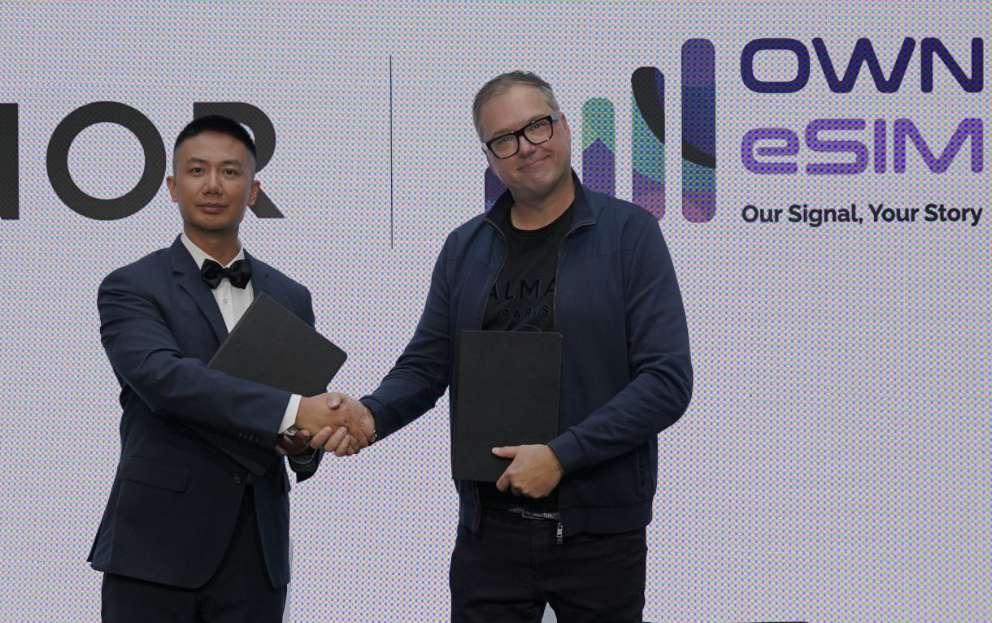
Debo Zhang, General Manager of HONOR GCC, and Martijn Van Der Ven, Founder and CEO of OWN eSIM, mark a partnership designed to embed digital-first connectivity directly into the smartphone experience across the GCC.
central to how people work, create and stay entertained. By bringing eSIM functionality directly into our devices, we are enabling customers to stay connected more easily and confidently wherever their journeys take them.”
For OWN eSIM, the collaboration marks a significant milestone in expanding its presence across the GCC and strengthening its position within the rapidly growing eSIM ecosystem. With its application integrated directly into HONOR devices, OWN eSIM will be able to reach a broader base of consumers.
Martijn Van Der Ven, Founder and CEO of OWN eSIM, said: “We
are pleased to partner with HONOR to bring our connectivity platform closer to users across the GCC. This collaboration represents a shared ambition to remove friction from the way people connect when they travel or move across borders. By embedding OWN eSIM directly into HONOR smartphones, we are delivering a seamless, future-ready connectivity experience designed for today’s digital-first consumers.” Beyond the technical integration, the partnership will be supported by coordinated marketing and communication initiatives aimed at raising awareness and encouraging adoption across the region. Both companies will work together on campaigns that highlight the benefits of integrated eSIM technology.
Driving the next generation of digital connectivity
With mobile connectivity shifting towards more flexible, digitalfirst solutions, the collaboration between HONOR and OWN eSIM reflects a broader industry move towards embedded connectivity services that simplify the user experience. Combining HONOR’s device innovation with OWN eSIM’s connectivity expertise, the partnership aims to give users greater freedom and convenience to stay connected wherever they are. Through this collaboration, HONOR and OWN eSIM are enhancing the smartphone experience while contributing to smarter connectivity across the GCC.
The new fully embedded integration allows retailers to manage the entire customer journey and financial reconciliation through a single global platform, replacing fragmented payment setups across e-commerce, point of sale and ERP .
Adyen, the financial technology platform of choice for leading businesses, has announced a new collaboration with SAP, deepening its partnership to support the launch of the SAP Unified Payment solution. The native, fully embedded solution is designed to remove the structural complexity of global commerce by connecting digital storefronts directly to the financial backbone of the enterprise.
With global commerce scaling rapidly, brands are increasingly burdened by the cost and chaos of managing a patchwork of local banks, disparate payment processors and disconnected fraud tools. Such disjointed infrastructure leads to manual reconciliation, inconsistent data and lost revenue. Integrated with Adyen’s financial technology platform, SAP Unified Payment helps replace fragmented payment setups with a single, global financial stack embedded directly into SAP Commerce Cloud, replacing third-party gateways. The solution is deeply integrated across e-commerce, point of sale (POS) and ERP.


A strategic leap for enterprise commerce
SAP Unified Payment is built for businesses seeking simplicity and speed without sacrificing performance — turning payments into a growth engine. By leveraging Adyen’s single global platform, businesses using SAP Commerce Cloud can gain access to:
• AI-driven revenue uplift and fraud management: With AI trained on over a trillion dollars in global transactions, Adyen’s single platform optimises authorisation routing and uses Dynamic Identification to recognise loyal customers across channels. The intelligence helps increase
conversion and proactively blocks fraud without adding customer friction.
• Native SAP S/4HANA and ERP sync: A direct link providing real-time settlement visibility and automated reconciliation, delivering a data-rich foundation for financial excellence.
• Global scalability: The ability to expand into new markets with a single contract and a single technical interface, supporting hundreds of local payment methods.
“Commerce has evolved faster than the financial systems supporting it,” said Roelant Prins, Chief Commercial Officer at Adyen. “By moving away from fragmented vendor management and adopting a single platform, businesses finally gain a clear view of their data. This isn’t just about
THE CHANNEL HAS BEEN SELLING AI WITHOUT AN AI CONVERSATION FRAMEWORK. PIVOTALE AI FIXES THAT. ONE ASSESSMENT. ONE SCORE. ONE ROADMAP. NO EXCUSES.
processing a transaction, it’s about eliminating operational complexity, reducing fraud and ensuring that reconciling a cross-border payment is as automated as a local transaction.”
Balaji Balasubramanian, President and Chief Product Officer for SAP Customer Experience and Consumer Industries at SAP, added: “SAP Unified Payment brings payments natively into the heart of the customer experience. By embedding enterprisegrade payments directly into SAP Commerce Cloud and partnering with Adyen’s global payment platform, we are helping customers simplify their payment landscape, go live faster and drive higher performance and conversion at scale — through a single, seamless SAP experience.”
The launch marks a definitive shift in the enterprise landscape, moving away from complex, external payment gateways towards a future where financial technology is a native, inseparable part of the enterprise software stack. For the consumer, this means a faster, more reliable checkout; for the merchant, it means an automated, data-driven path to global expansion.
Strategic MOU enables partners to transform unstructured data into compliant, AIready assets while advancing data sovereignty priorities.
VAD Technologies, a leading Middle East value-added distributor, and US-based Data Dynamics, a pioneer in unified data management, have signed a Memorandum of Understanding (MOU) to accelerate AI-ready data management, governance, and sovereign AI adoption across the region.
The partnership responds to rising enterprise demand for trusted, policy-aligned data frameworks amid tightening regulatory mandates and rapid digital transformation.
The collaboration builds on an established relationship and aligns both organisations’ investments to help enterprises and government entities transition from fragmented data environments to structured, governed, and intelligence-driven ecosystems.
Organisations across the UAE, Saudi Arabia, and the wider GCC are advancing sovereign AI strategies while addressing evolving regulatory frameworks, including national data protection laws. Large volumes of unstructured data continue to create risk, limit visibility, and delay innovation. This partnership is positioned to convert that data sprawl into secure, compliant, and businessready information.
Joint initiatives will focus on partner enablement, customer engagement, and regional expansion, equipping the channel ecosystem with the tools and frameworks required to manage
data effectively in complex hybrid and multi-cloud environments.
Mario M. Veljovic, General Manager at VAD Technologies, said: “Managing data effectively has become the foundation for AI success. Our focus is on helping partners and their customers put data to work, because without structured and governed data, AI outcomes cannot be realised. This partnership strengthens our ability to guide the channel ecosystem towards building future-ready data architectures.”
Data Dynamics brings its unified, AIpowered platform to the collaboration, enabling organisations to gain deep visibility into unstructured data, enforce compliance, and automate lifecycle management. The platform is designed as a self-service interface that allows enterprises to treat data as a governed, high-value, AI-ready asset that supports operational efficiency, regulatory compliance, and AI readiness.
Piyush Mehta, Chief Executive Officer at Data Dynamics, said: “AI adoption is not limited by infrastructure alone; it is driven by data readiness. Organisations often struggle with unstructured and unused data, which increases risk and delays AI initiatives. Our collaboration with VAD Technologies accelerates the journey from fragmented data to curated, governed, and AI-ready environments.”
Growing emphasis on sovereign AI across the GCC places data quality,
governance, and jurisdiction at the centre of enterprise strategy. Data Dynamics enables organisations to discover, classify, and prepare data for AI use while ensuring alignment with local residency, privacy, and policy requirements.
The partnership is focused on helping government entities, financial institutions, healthcare providers, and other highly regulated sectors address some of their most pressing data challenges.
• Stubless Architecture: Unlike legacy other tools that create vendor lock-in through proprietary “stubs,” Data Dynamics offers a native, stubless architecture. This ensures total cloud mobility and long-term freedom for enterprises moving data between on-premises, air-gapped sovereign and multicloud environments.
• Compliance by Design: The platform operationalises regional requirements into day-to-day operating controls, providing auditors with immutable evidence for unmanaged risks and policy enforcement. The platform extends the compliance risks into actionable remediation steps that allows a Zero-tolerance policy in any data assosicated risks.
• From Cost to Value: Through the Data Dynamics platform interface, business owners not just IT gain self-service visibility into their

data’s meaning and revenue potential.
• AI-ready data foundations built on greater visibility, higher data quality, and stronger governance of business-critical information.
• Data resiliency by design: enabling organisations to protect, govern, and mobilize critical data across hybrid environments, ensuring continuous access, faster recovery, and operational continuity in the face of disruption.
Dalia Tawfeeq, Chief Business Officer at Data Dynamics, said: “Data governance today is directly linked to business outcomes. Organisations are looking beyond technology and focusing on measurable value, whether it is cost optimisation, improved cloud economics, or faster AI adoption. Our platform enables compliance by design while driving operational efficiency and long-term business impact.”
The partnership also supports highly
regulated sectors such as government, financial services, healthcare, and critical infrastructure, where data visibility, compliance, and resilience are becoming central to business continuity and AI adoption. For channel partners, the collaboration creates a stronger framework to address customer priorities around security, data mobility, cloud optimisation, and long-term governance.
Key strategic advantages for regional enterprises include a stubless architecture that eliminates vendor lock-in, compliance-by-design capabilities that translate regulatory mandates into operational controls, and enhanced data resiliency to ensure continuous access and faster recovery across hybrid environments. Business users gain self-service visibility into the value and context of their data, shifting the conversation from cost management to value creation while
strengthening governance and AI readiness.
Jithin Varghese, Business Unit Manager at VAD Technologies, said: “Whether it is a healthcare provider securing sensitive patient data or a financial institution automating remediation of stale data, this partnership delivers a complete, endto-end framework for modern data governance.”
The MOU reinforces a shared commitment to building a trusted partner ecosystem across the GCC. VAD Technologies will leverage its regional reach and channel expertise, while Data Dynamics will extend advanced data intelligence capabilities across customer environments. The collaboration signals a decisive shift towards data-centric transformation in the Middle East, where governance, intelligence, and automation are emerging as the foundation for sustainable digital growth.
Opensignal data shows that in Q1 2026, GCC users spent less than 3% of their connected time on legacy 2G and 3G networks. In comparison, across non-GCC Middle East North African markets, the figure is 21.6%. This gap shows why GCC markets are well positioned to turn existing spectral resources into stronger mobile experiences.
Spectrum efficiency is often discussed through the lens of 5G, but the real challenge is how every mobile generation fits into the network. 2G and 3G were designed for voice, SMS and basic data. 4G and 5G support mobile broadband, video, cloud applications, IoT, enterprise connectivity and low-latency services. The same spectrum can therefore deliver different levels of capacity depending on which technology is using it.
This is where the GCC has a structural advantage. In Q1 2026, users across the six GCC markets spent just 1.6% of their connected time on 2G and 1.3% on 3G. This low reliance on legacy networks likely reflects
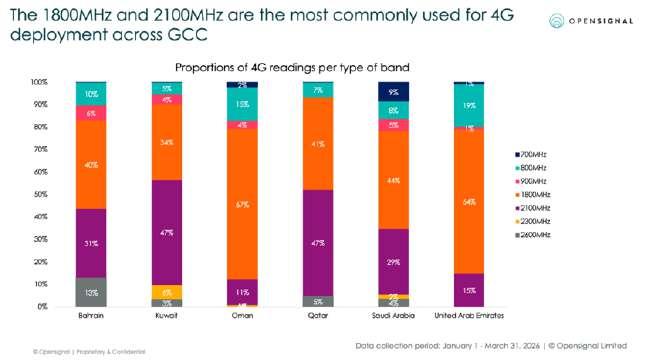
several factors: higher smartphone adoption, a stronger 4G and 5G device base, more advanced network rollouts, and highly urbanized populations that are easier to serve with newer network layers. By contrast, in parts of non-GCC MENA, older devices, affordability constraints and wider rural coverage needs can keep 2G and 3G relevant for longer. The limited role of 2G and 3G in the GCC gives operators more room to refarm spectrum, reallocating it from older networks to higher-capacity
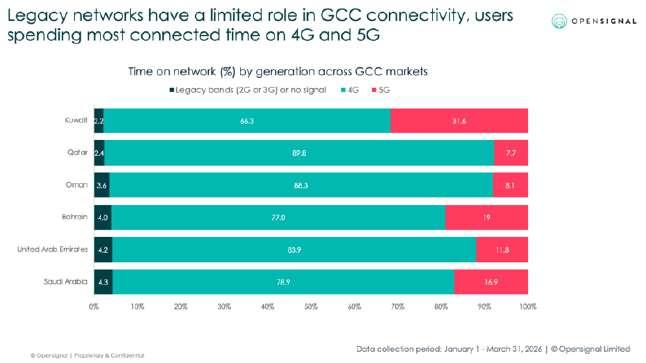
4G and 5G services. Refarming matters because several bands historically used for 2G and 3G are highly valuable for 4G and 5G. The 900MHz band has often supported wide-area 2G and 3G coverage, 1800MHz has moved from 2G into a core 4G layer, and 2100MHz has shifted from 3G toward 4G capacity. As 2G and 3G usage falls across the GCC, operators have a stronger opportunity to reuse these bands for higher-capacity networks. This must be managed carefully to protect legacy devices, roaming, voice and machineto-machine services, but the case for refarming becomes stronger as reliance on older technologies declines.
4G continues to anchor the GCC’s spectrum strategy Even as 5G expands, 4G remains the dominant connectivity layer in the GCC. In Q1 2026, our GCC users spent an average of 80.7% of their connected time on 4G, compared with 15.9% on 5G. This means 4G cannot be treated as legacy. It remains the layer that provides broad coverage, mobility and device compatibility as users move between dense 5G zones, indoor
environments and wider coverage areas.
The GCC’s 4G spectrum footprint reflects this role. 4G was observed across a broad mix of bands, led by 1800MHz and 2100MHz, with additional layers including 700MHz, 800MHz, 900MHz, 2300MHz and 2600MHz. This layered approach helps operators balance coverage and capacity while 5G scales. In the UAE, this multi-band 4G foundation remains critical — it underpins the coverage and device compatibility that enterprise deployments depend on as 5G scales.
5G turns spectrum into more consistent enterprise performance
5G delivers the clearest performance uplift in the GCC’s spectrum efficiency story because it shows how newer network technologies can extract more value from available spectrum. Across the six GCC markets, average 5G download speeds reached 282.1Mbps in Q1 2026, compared with 44.1Mbps on 4G. That makes 5G around 6.4 times faster than 4G on average. But spectrum efficiency should not be measured by speed alone. For enterprise technology leaders, the more important question is whether networks can use available spectrum to deliver a consistently reliable experience. Opensignal’s Consistent Quality metric measures whether

networks are good enough to support common demanding applications by looking at indicators such as download speed, upload speed, latency, jitter, packet loss and time to first byte.
In Q1 2026, GCC 5G achieved an average Consistent Quality score of 73.8%, compared with 67.8% on 4G. That difference matters for cloud applications, video collaboration, IoT platforms, AI-enabled services and digital transformation projects, where reliability is often more valuable than headline speed.
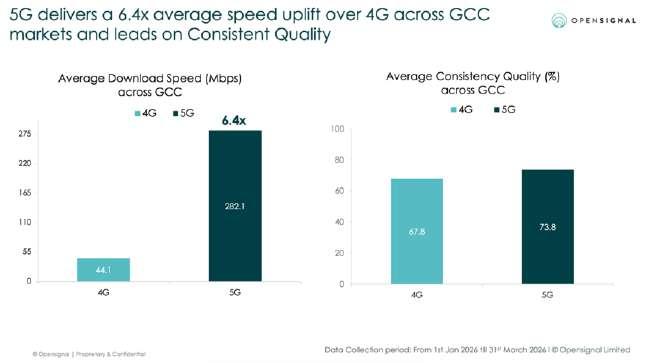
The UAE illustrates how this transition is taking shape
In Q1 2026, Opensignal users in the UAE experienced average 5G download speeds of 236.5Mbps, around six times faster than 4G. The country’s 5G experience is supported by mid-band spectrum, including 3.5GHz and 2.6GHz, which helps provide the capacity needed for high-demand areas.
The UAE is also moving early on the next phase of spectrum efficiency, with 5G-Advanced already launched and new spectrum layers being opened for future growth. TDRA has allocated the 600MHz and upper 6GHz bands for IMT, creating a stronger foundation for both wider coverage and higher-capacity 5G services. The 600MHz band can help improve coverage and indoor reach, while upper 6GHz can add high-capacity support in dense urban areas where demand is highest.
For enterprise users, this expanded spectrum foundation directly raises the floor on network reliability — the kind of consistent performance that matters for cloud-dependent workloads, AI applications and connected infrastructure.
The next benchmark is lifecycle management
The GCC’s spectrum challenge is no longer just about launching 5G or opening new frequency bands. It is about managing how every generation, from 2G to 5G, contributes to better connectivity.
The markets that lead the next phase will be those that reduce legacy dependence, refarm spectrum effectively, keep 4G strong, scale 5G capacity and prepare for 5G-Advanced and 6G. The new spectrum will help, but it will not be enough on its own. The real advantage will come from extracting more value from every MHz already in use.
For the GCC, spectrum efficiency is becoming a measure of digital readiness. It shows whether markets can move from early 5G adoption to mature, reliable and future-ready connectivity.
Every generation enters the workplace with different expectations. What makes Gen Z significant is that they are entering the workforce at a moment when the relationship between people and work is already changing.
Much of the conversation around younger workers still focuses on flexibility, autonomy and work-life balance, often framed as a challenge unique to one generation. But this misses the broader shift underway. Gen Z’s expectations may be more visible, but they reflect questions being asked across the workforce about how work is structured, supported, and experienced. Across generations, people are looking for greater clarity, trust, effective tools and an environment that enables them to do their best work.
This is not a challenge created by Gen Z. It reflects how work is changing.
HP’s Work Relationship Index 2025 found that only 20% of knowledge workers globally say they have a healthy relationship with work, down eight points from 2024. At the same time, 62% of desk-based workers say expectations from their companies have increased over the past year. Together, these findings point to a growing disconnect: people are being asked to deliver more, but many do not feel the workplace around them is evolving at the same pace.
For businesses, this has direct implications for engagement, productivity and retention. But it also presents an important opportunity. HP’s research shows that 85% of the factors influencing workplace fulfilment sit within an organisation’s control, from leadership and culture to technology, recognition, collaboration, balance, and goal clarity3. That means a healthier
relationship with work is not only shaped by individual attitudes or generational expectations. It is shaped by the decisions organisations make every day. By the end of 2025, Gen Z will make up 27% of the global workforce. As digital natives, their expectations have been shaped by technology, speed and access. They are more likely to question systems that feel slow, fragmented, or unnecessarily complex. That mindset is also reflected in how younger workers think about flexibility, autonomy, and career growth.
According to HP’s Work Relationship Index, 51% of Gen Z workers now have a side venture, while four in five would give up some of their salary for more flexibility and autonomy at work5. These findings do not suggest a lack of ambition. They point to a generation that wants to be trusted with how they work, supported as they build new skills, and given clearer ownership of their career growth.
This matters because those expectations are increasingly shared across generations. Employees want to understand how their work contributes to a larger goal. They want leaders who communicate clearly. They want to be trusted to deliver outcomes. And they want access to tools that help them focus on meaningful work, rather than lose time to unnecessary complexity.
Technology plays a central role in this shift, but technology alone is not the answer. The quality of the tools, platforms, and workflows people use every day shapes how work feels and how effectively it gets done. When technology works well, it becomes almost invisible. When it does not, it becomes another source of friction.
That distinction will become even more important as AI and automation become more embedded in the workplace. These tools should help reduce routine effort, improve focus
and give people more time for highervalue work. Their success should not be measured only by adoption, but by whether they make work simpler, clearer and more effective.
For leaders, this requires a more intentional approach. Flexibility cannot be treated simply as a policy, and technology cannot be viewed only as an IT investment. Employees are looking for work environments where expectations are clear, collaboration is effective, recognition is meaningful, and the right tools are in place to help them succeed.
Organisations have an opportunity to lead by removing unnecessary complexity, enabling people with the right technology, and designing work around human needs rather than legacy processes. This becomes even more important as AI adoption accelerates. The companies that benefit most will be those that build confidence, broaden access, and help employees understand how these tools can support their work in practical, tangible ways.
This is not about centering the future of work around one generation. It is about recognising that Gen Z’s expectations are bringing long-standing workplace priorities into sharper focus: meaningful work, technology that makes people more capable rather than overwhelmed, and cultures where employees feel recognised, supported and able to grow.
The companies that answer those questions well will be better positioned to attract and retain talent across generations. More importantly, they will be better equipped to build a healthier, more productive and more human relationship with work, one where technology removes friction, leadership builds trust, and people are supported and empowered to do their best work.

Over the past twenty years, channel partners in the UAE have gone from transaction-driven resellers to solution-led, trusted advisors.
In today’s environment, channel partners aren’t just selling technology tools; they are educating, training, advising, providing layers of support, and even managing some services postdeployment.
The UAE channel ecosystem has undergone quite a transition. Back in the day, resellers were primarily concerned with licensing and distribution; however, today’s customers expect much more out of channel partners.
Gone are the days where a partner would solely purchase a product from an OEM and then supply it to the customer. In the current environment, customers expect more—and they expect measurable outcomes. Partners are now involved in tasks as varied as pre-sales consulting, implementation, customisation, and ongoing support.
In fact, customers increasingly expect channel partners to provide end-to-end service, whereby the partners deliver the hardware and get it up and running. Partners are expected to be particularly knowledgeable and able to handle highly complex, multi-vendor environments.
The UAE has been on a decades-long digital transformation journey, and the channel ecosystem in the region reflects this journey.
The UAE’s rapid digital transformation journey
The technology adoption in the UAE is on par with, if not more robust than, Europe and the United States. With particularly strong trade relationships, an influx of foreign investments, an extremely business-friendly environment, and strong governmentled investments, the UAE is uniquely situated for growth.
In an effort to meet governmentset national objectives, the quicklymaturing UAE has seen high technology adoption, an infrastructure expansion and an increased focus on data privacy and PDPL regulations. In fact, the GCC region has some of the most stringent data center regulations in the world.
to strict data privacy and localisation laws
While advising customers about AI solutions, channel partners are increasingly focused on AI workflows that comply with privacy requirements, have explainable outcomes, and respect data sovereignty.
UAE partners are quite cognisant of the need to ensure that sensitive financial, healthcare, and government data remain within the borders of the nation. In addition to the UAE’s PDPL, the healthcare, banking, and telecom industries in the region have their own strong, industry-specific data privacy regulations.
As a quick example, in the healthcare sector, companies must comply with Federal Law No. 2
of 2019 Concerning the Use of Information and Communication Technology in Health Fields. According to this legislation, all digital systems in the healthcare sector must maintain secure storage, protect the confidentiality of patient data, and restrict all cross-border data transfers unless there is regulatory approval.
An increased focus on ethical AI deployment
In accordance with the country’s National Strategy for Artificial Intelligence, the UAE strives to become a global AI leader by 2031. With such a lofty goal in place, it’s no surprise that AI is being deployed at a breakneck pace in the region.
As AI permeates throughout the UAE, it has become vital that AI deployment is ethical and responsible. To achieve this, the top channel partners are focused on giving good advice when it comes to deploying AI solutions. Seeing how cultural values guide digital transformation in the region, the best partners are those who can build out ethical AI solutions that can gain and maintain trust.
Historically, some companies have deployed complex AI solutions when a simple automation tool would have been sufficient; the best channel partners in the region will prevent organisations from deploying AI tools that add unnecessary complexity to their environments.
As they work with vendors, system
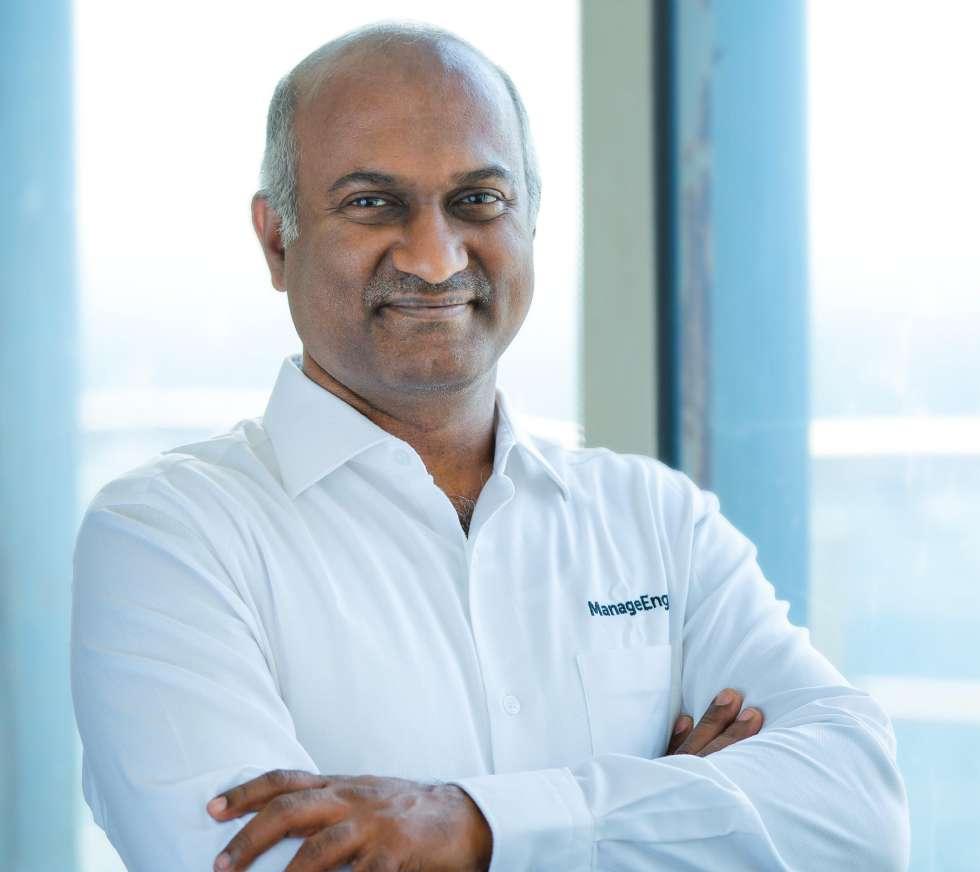
integrators, and resellers, channel partners in the UAE now do more than ever to provide their customers with good advice. The best channel partners effectively now function as advisors, guiding organisations through various complexities, such as right-sizing models, advising whether to build or buy, and tailoring technology solutions to the customers’ specific needs.
In regard to AI specifically, the top UAE channel partners focus on identifying use cases where AI creates real value for organisations and their customers. Some AI tools can be over-hyped and overused; hence, it’s important that channel partners continue to help
organisations choose the right tools and avoid unnecessary solutions.
Today’s channel partners now have deep industry knowledge of the regulations, trends, and challenges that are facing enterprises. These partners help their clients navigate hybrid and complex multi-cloud environments, while also offering strategic guidance. As AI and cloudnative architectures become the norm, UAE channel partners are increasingly focused on embedding some AI tools into workflows and building future-ready solutions.
In 2026, customers in the UAE are increasingly expecting tailored, customised solutions, which has made deep industry specialisation more vital than ever. The leading partners in the region successfully navigate compliance complexities, while adhering to regulations and ensuring that data privacy is maintained.
Put simply, today’s top UAE channel partners are long-term, solution-focused strategic collaborators focused on increasing customer value. In 2026, the best channel partners in the UEA aren’t just chasing quick transactions; they’re building long-term trust, value, and loyalty.
PwC Middle East’s AI Performance Study – KSA Edition reveals the Kingdom is outpacing global peers on productivity and customer experience gains, yet a gap remains between operational wins and full financial returns.
Saudi Arabia is pulling ahead of the global curve on artificial intelligence, with enterprises already harvesting stronger productivity and customer experience gains than their international peers. The next chapter, however, is more demanding: converting early momentum into sustained, measurable commercial value.
PwC Middle East’s latest AI Performance Study – KSA Edition finds that six in ten organisations in the Kingdom report significant improvements in employee productivity from AI, compared with 46% globally. Two-thirds (67%) say AI has materially enhanced customer experience and trust, well above the 39% global average. The figures point to a market that has moved decisively beyond pilots and proofs of concept, with AI now shaping how organisations operate, compete and grow.
Underpinning the progress are stronger foundations. Some 78% of Saudi respondents say their AI vision is closely aligned to business objectives, against 65% globally, while 62% have documented Responsible AI frameworks in place,
compared with 47% worldwide. The Kingdom also outperforms on strategic ownership, with 67% of organisations placing leaders directly accountable for AI outcomes, versus 54% globally. Such structural discipline is what gives Saudi AI deployment its distinctive character — less experimental, more enterprise-grade.
National infrastructure is reinforcing the trajectory. From HUMAIN, launched by the Public Investment Fund to operate across the full AI value chain, to expanding hyperscale cloud footprints from
Google Cloud, Microsoft and AWS, the Kingdom is rapidly assembling the technical backbone required for industrial-scale AI. SDAIA’s Digital Data Marketplace and National Data Catalog are simultaneously improving access to machine-readable, governed data — a foundation that has helped Saudi organisations move ahead of global peers in the use of unstructured (44% vs 37%), proprietary (60% vs 45%), public (56% vs 37%) and synthetic data (53% vs 22%).
Workforce momentum tells a similar story. Saudi organisations significantly outperform global counterparts in attracting technical AI specialists (67% vs 42%), encouraging experimentation through incentives (56% vs 37%)
THE CHALLENGE IS NO LONGER ADOPTION — IT’S PRODUCTIONISING WORKFLOWS WITH REAL DISCIPLINE. BIVEK SHARMA, CHIEF
and enabling cross-functional collaboration between data, IT and business teams (56% vs 42%). The talent pipeline is being deepened through SDAIA Academy, Misk and partnerships such as the Samsung Innovation Campus AI Programme.
“Organisations in Saudi Arabia have moved quickly on AI, but the challenge is no longer adoption. It’s building the required infrastructure and capabilities to productionise workflows and focus primarily on strategic, high-value use cases with real discipline,” said Bivek Sharma, Chief Technology and AI Officer at PwC Middle East.
Despite the operational wins, financial returns are still catching up. Companies in the Kingdom report an average return on AI investment of around 30%, compared with a global average of 37%. The gap is not the result of underinvestment — Saudi organisations allocate a similar share of functional budgets to AI as their global peers (11% vs 12%) — but reflects a transition phase in which value is being created faster than it is being measured, attributed and monetised.
The PwC study identifies six areas where Saudi organisations can close the gap with global “AI leaders”, defined as the top 20% of AI-driven financial performers. The opportunities cluster around tighter execution discipline, more decisive capital deployment, harder-to-build data foundations such as reusable AI components and trusted single records, stronger experimentationto-scale processes, embedded governance in cross-functional decision-making, and deeper role-based AI fluency across the workforce.
Early signs of deeper reinvention are also visible. More than half of respondents (53%) report large improvements from AI in how their organisations operate, against 35% globally, while 42% say AI has driven significant business model improvements, compared with 30% worldwide. Saudi organisations are also more likely than global peers to use AI to compete and collaborate

beyond their traditional sector boundaries — a hallmark of the convergence-driven “domains of growth” PwC economists associate with the Middle East’s projected US$4.57 trillion GDP opportunity by 2035.
“What stands out in the Kingdom is the alignment between national ambition and enterprise execution. That creates a strong foundation, but sustained value will depend on how consistently businesses embed AI into how they operate and compete,” Sharma added.
For organisation leaders, PwC recommends six concrete next steps: focusing AI on a small number of scaled business priorities; building the harder foundations that enable scale; redesigning priority workflows end to end rather than layering tools on top; strengthening experimentation-to-scale discipline;
measuring value with greater rigour and reallocating funding accordingly; and turning ecosystem ambition into specific commercial plays with shared data, governance and success metrics.
The Kingdom continues to advance its Vision 2030 economic transformation agenda, and AI is fast becoming a core driver of competitiveness across sectors. The organisations that succeed will not be those running the most pilots, but those that pair national-level ambition with disciplined execution, measurable outcomes and sustained value creation.
PwC Middle East’s AI Performance Study – KSA Edition is based on a survey of senior executives at organisations with revenues exceeding US$100 million, all actively involved in AI investment and deployment decisions.
Holafly and TeleSemana.com launch the first comprehensive benchmark measuring eSIM readiness across 50 markets and 171 mobile network operators worldwide.
The UAE has secured 41st position in the inaugural Holafly Global eSIM Index 2026 with a score of 59.0 out of 100, reflecting a market that combines world-class digital infrastructure with regulatory frameworks that continue to shape how eSIM technology reaches consumers and travellers across the Emirates.
Holafly, the global leader in travel eSIMs, in partnership with TeleSemana.com, one of Latin America’s leading telecommunications industry publications, today unveiled a first-of-its-kind study evaluating the commercial readiness of eSIM technology across 50 markets globally. The Index offers a structured, datadriven view of how eSIM is deployed, experienced, and constrained across regions, bringing together operatorlevel data, country-level variables, qualitative assessment, and a regulatory penalty mechanism into a single 0–100 scoring framework.
UAE: Built for an eSIM-First Future
The UAE presents one of the most distinctive eSIM landscapes in the world. With mobile penetration reaching an extraordinary 238% and 5G infrastructure covering the entire inhabited territory, the country boasts the technological foundation for advanced digital connectivity.
Approximately 65% of active
devices in the UAE support eSIM technology, driven by the strong presence of Apple and Samsung in a predominantly premium smartphone market — one of the highest devicereadiness rates globally.
e&, the incumbent and market leader, follows a user-personalisation strategy in which eSIM serves as a gateway to financial and entertainment services. Meanwhile, du focuses on younger users and the expatriate community, using its self-management app as the core mechanism for eSIM activation, with initiatives such as free travel eSIM offerings for transit passengers.
The Telecommunications and Digital Government Regulatory Authority (TDRA) has integrated eSIM with UAE PASS to validate user identity, linking connectivity to legal
identity. Through the “My Number, My Identity” policy, each eSIM profile must be associated with a valid Emirates ID — an approach that has significantly reduced identity fraud but required substantial operator investment.
However, the Index identifies the UAE as one of four markets globally — alongside Turkey, India, and Oman — that triggers the Index’s regulatory penalty mechanism, with international travel eSIM providers facing restrictions that materially impact service accessibility.
Looking ahead, the expansion of IoT — particularly in connected vehicles from Tesla, BMW, and Mercedes-Benz, and across smart city infrastructure managing electricity, water, and traffic networks — will create significant new opportunities for the technology, although it will be crucial for regulators to allow greater competitive space for travel eSIM services.
ESIM HAS ALREADY MOVED BEYOND BEING AN EMERGING TECHNOLOGY. WHAT WILL SHAPE THE NEXT PHASE OF ADOPTION IS HOW EFFECTIVELY MARKETS ENABLE SEAMLESS DIGITAL ACCESS FOR USERS.

The MEA region tells a story of remarkable contrast. Saudi Arabia leads the region at 10th globally with a score of 79.7, driven by Vision 2030 digitalisation efforts and stc’s standing as the seventh-ranked operator globally. Israel follows at 12th (79.6), supported by government mandates and the upcoming 2G/3G shutdown in 2026. Qatar (25th, 75.8) and Tunisia (32nd, 70.1) demonstrate maturing adoption.
At the lower end of the regional ranking, Sudan (50th, 38.3) reflects the impact of armed conflict on connectivity infrastructure, while Liberia (48th, 48.5) and Oman (47th, 55.3) face their own structural barriers. Turkey (45th, 56.0) demonstrates how regulatory rigour — including the blocking of more
than 30 travel eSIM providers — can constrain a technically capable market.
The United States ranks first globally with a score of 90.2, followed by Estonia (83.6) and the United Kingdom (82.8). Thailand and Canada tie in fourth and fifth position with 82.7 points each, illustrating that eSIM leadership is no longer the exclusive domain of mature Western economies. The findings clearly demonstrate a decisive shift in the industry: eSIM is no longer a technology in development, but a globally deployed capability. What differentiates markets today is not technical readiness, but the structural conditions that enable or limit adoption, including device availability, regulatory frameworks, and the quality of the user experience.
“eSIM has already moved beyond being an emerging technology. What will shape the next phase of adoption is how effectively markets enable seamless digital access for users. The countries leading this transition are not necessarily those with the largest telecom infrastructure, but those creating frictionless experiences that match the expectations of today’s global travellers,” said Chris Hills, VP of Carriers & Operations at Holafly. The central conclusion is that eSIM adoption is no longer constrained by technology, but by market design. Where regulation enables digital activation, devices are widely available, and operators deliver seamless experiences, adoption scales rapidly. Where these conditions are not aligned — as seen in Sudan (38.3), India (45.6), and Liberia (48.5) — growth remains structurally limited.
A new Checkout.com report, MENA Digital Commerce 2026: The New Era of AI in Payments, finds 97% of regional consumers now want “invisible” payments — but security and privacy will decide which merchants win the race into agentic commerce.
The MENA region is moving from straightforward digital adoption into a far more complex, AI-driven commerce ecosystem — and the definition of a successful payment journey is being rewritten in real time. Checkout.com’s 2026 report, MENA Digital Commerce 2026: The New Era of AI in Payments, finds that while the region is “agentic-ready”, the future of e-commerce now hinges on one variable: consumer trust in payments and payment security.
Consumers are sending a sharp signal to merchants. They want payments to be simple, invisible and embedded — but never at the expense of safety. According to the research, 97% of MENA consumers now value “invisible” payments, transactions that occur without manual entry of credentials or page redirections. The appetite for friction-free experiences sits alongside an equally strong expectation for protection, with 62% of consumers ranking a secure payment process as the single most important factor in online shopping, ahead even of speedy delivery.
“In this new era of e-commerce in MENA, trust isn’t just a preference, it’s the ultimate currency,” said Remo Giovanni Abbondandolo, General Manager, MENA at Checkout.com. “Consumers want payments to be fast and invisible. However, our data shows that 62% believe that a safe and secure payment process is the most important factor of online shopping. Merchants that succeed will be those who strike the right balance between simple experiences and strong protection.”
Online commerce moves into the everyday
Digital commerce in the region is scaling fast. Some 45% of consumers shop online at least weekly, while 63% expect to increase their online shopping frequency over the next 12 months. Digital wallets are now woven into daily life, with 64% of consumers using them at least monthly to buy, budget and manage finances, and 74% using them for money transfers. The pace is reflected in Checkout.com’s own numbers, with total processing volume in MENA growing 62% year-on-year, and MENA remittance volumes up 169% between 2024 and 2025.
The categories driving online spend point to a maturing digital economy. Food delivery leads at 59% of respondents, followed by clothing and accessories at 54% and travel at 40%. Social commerce is also picking up pace, with 25% of consumers now shopping through social media platforms. Such patterns suggest consumers are no longer using digital channels purely for convenience purchases, but for essential, high-value and recurring transactions.
Where trust breaks, revenue follows
Even small breaches of trust have outsized commercial consequences. 62% of consumers abandon a purchase after a false decline, and 35% will switch directly to a competitor — rising to 36% among Saudi consumers, where invisible payment expectations are even higher at 98%. Cart abandonment due to security concerns
stands at 28%, and while 50% of consumers say they are willing to save card details to simplify checkout, that willingness is conditional on robust fraud protection.
For merchants, the implication is clear: success now sits at the intersection of two seemingly opposing demands — frictionless enough to convert, secure enough to retain.
Agentic commerce: the next frontier, gated by privacy
The report identifies AI and agentic commerce as the next major shift in regional retail. Half of MENA consumers (50%) say they are ready to let AI agents shop on their behalf, but 55% cite privacy as the primary barrier to adoption. The appeal is rooted in efficiency: in a region where 56% of shoppers already compare prices on mobile while in-store, AI agents are emerging as “super shoppers” capable of scanning and recommending the best options in real time.
Consumers are most willing to delegate tasks such as finding the best price (50%), comparing products and reviews (41%) and creating shopping lists (30%), with growing openness to AI handling groceries (27%), travel bookings (25%) and subscriptions (24%).
Adoption is not uniform, however. Men (54%) and high-income earners (67%) show notably higher comfort with AI than women (44%) and lowerincome groups (38%) — suggesting agentic commerce will initially be driven by digitally confident and wealthier segments before broadening across the wider population.
Remo Giovanni Abbondandolo, General Manager for MENA, Checkout.com.
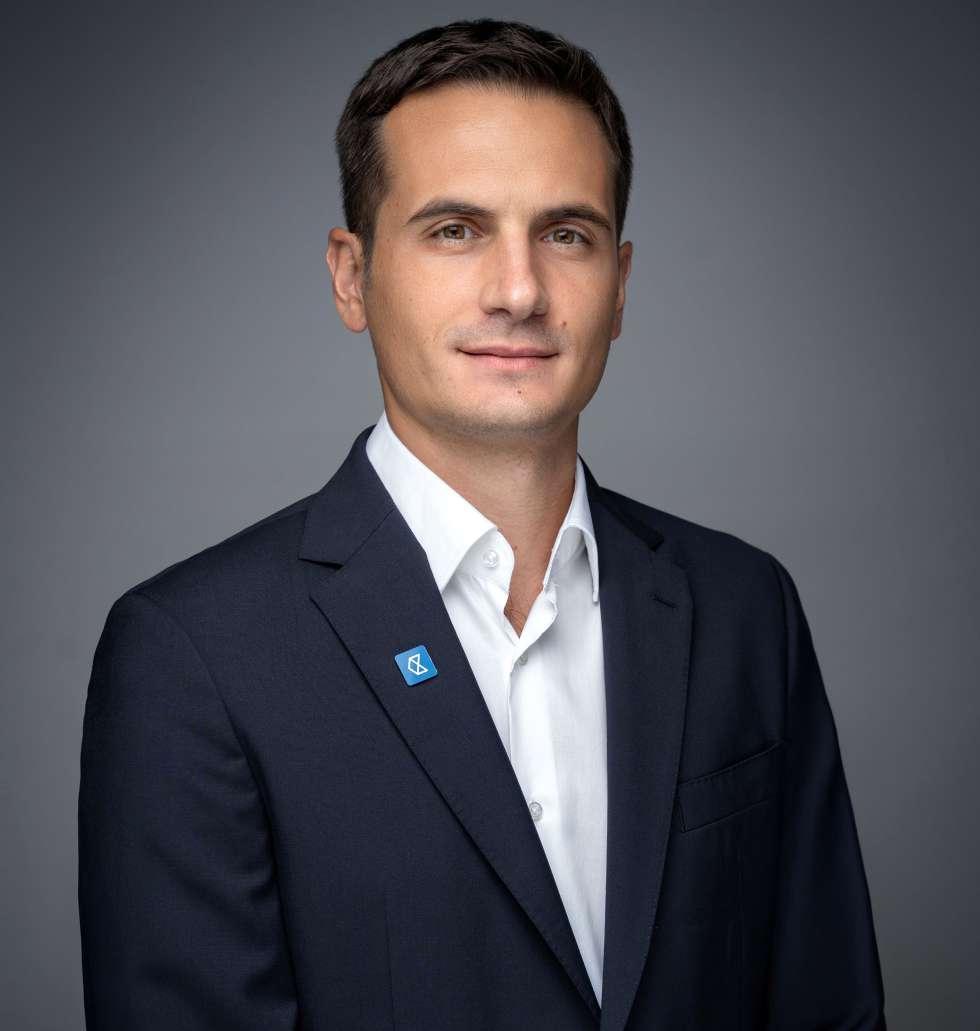
Trust as a baseline, not a differentiator
The report’s central conclusion is that trust has moved from a competitive edge to a non-negotiable baseline. With payments becoming faster and more invisible, success in MENA will belong to brands that deliver intuitive experiences without compromising security or transparency in how data is handled.
“What we are seeing in MENA is a clear redefinition of what a good payment experience looks like. It is no longer about speed alone; it is about confidence at every step,” concluded Abbondandolo.
“Consumers are telling us they want payments to disappear into the background, but only if they can trust
what is happening behind the scenes. Security, intelligence, and reliability are now inseparable from growth in digital commerce.”
Checkout.com’s 2026 report is based on regional consumer research conducted across MENA markets, examining payment behaviour, trust drivers and readiness for AI-led commerce.
The company’s award-winning portfolio, including the flagship ExpertBook Ultra, took centre stage in Nairobi as ASUS aligned its commercial offering with Kenya’s national digital economy agenda and AI Strategy 2025–2030.

released ExpertBook Ultra (B9406), the company’s flagship device, which weighs less than a kilogram and measures 10.9 mm thin. Designed for next-generation professionals, the B9406 features up to 50 TOPS NPU, allowing it to perform AI tasks ondevice without affecting performance or battery life. The device is packed with robust durability and enterprisegrade security in a lightweight form factor.
Other devices in the ExpertBook series, the B5405 and P5405, as well as the P440 All-in-One and the P500 Expert Centre Mini Tower, were also featured on the stand.
Tolga Özdil, Regional Commercial Director for the Middle East, Turkey and Africa, ASUS.
ASUS participated in the first edition of GITEX Kenya, held in Nairobi from 19 to 21 May 2026.
Under the theme “In Search of Incredible,” the company showcased its critically acclaimed portfolio of AI PCs designed to support Kenya’s national digital economy agenda.
“We were excited to be part of the inaugural edition of GITEX Kenya. The country plays an important role in ASUS’s commercial long-term vision for the African market,” said
Tolga Özdil, Regional Commercial Director, Middle East, Turkey and Africa (META) at ASUS. “With the region undergoing a significant shift driven by industry trends such as AI, cloud and sustainability, GITEX Kenya gave us the platform to show our latest innovations to customers in the enterprise, SMB and government sectors.”
ASUS used the exhibition to display a strong lineup of commercial devices, including its ExpertBook series and workstation PCs. Visitors had the chance to try out the recently
“ASUS’s line of PCs integrates AI support at the hardware level, allowing professionals to take advantage of AI tools without the need to connect online. In addition, our devices demonstrate the highest level of security fit for organisations where data protection is a must,” Özdil added.
The company also highlighted its AIdriven productivity solutions, including AI ExpertMeet, a collaboration tool that helps simplify meetings with realtime transcriptions and summaries. Building on national initiatives such as the Kenya AI Strategy 2025–2030, which positions the country as a hub for AI research, ASUS aligned its participation with the region’s broader ambitions through innovative AI-ready solutions. The company has designed its entire commercial portfolio around key factors that drive digital transformation priorities, including AI-first design, cloud-ready devices and sustainability.

From 31 Aug - 3 Sept 2026 Riyadh Exhibition and Convention Center - Malham, Saudi Arabia