Give to gain. Powering women in tech Gala Dinner Event
Dubai May 2026 6:00 PM onwards
In alignment with International Women’s Day 2026, TahawulTech.com, organised by CPI, invites you to the Women in Technology Forum & Awards 2026 — a flagship platform dedicated to advancing leadership, inclusion, and impact across the technology ecosystem.
The forum brings together CEOs, technology decision-makers, innovators, policymakers, and trailblazers to explore how organisations that actively invest in women — through mentorship, leadership pathways, skills development, and visibility — gain stronger innovation, resilience, and long-term growth.
Whether you are a technology leader, changemaker, or organisation committed to shaping a more inclusive digital future, this forum offers a powerful space to contribute, connect, and lead.
We look forward to welcoming you to Dubai this April as we come together to Give to Gain.
OFFICIAL PUBLICATIONS
For more information about the event and nomination details, please visit the event website below :https://www.tahawultech.com/women-in-tech/2026/
336 // APRIL 2026
OPSWAT, Emerson partner to boost cybersecurity for critical infrastructure operators
Pivotale AI unveils world’s first AI readiness platform for Channel at GITEX Singapore
Physical AI: Bringing intelligence into the real world
AI reshapes game development and player experience
Sandhya DMello Editor
CHANNEL AT A CROSSROADS IN THE AGE OF AI AND QUANTUM DISRUPTION
April 2026 marks a pivotal moment for the technology channel, as artificial intelligence and quantum computing reshape the foundations of enterprise technology. The channel is no longer operating at the edge of transformation—it is now at the centre of it.
This issue of Reseller Middle East reflects that shift. Our cover story explores how quantum readiness is becoming a boardroom priority, pushing organisations to rethink data security, infrastructure, and long-term strategy. What was once theoretical is now an engineering and business imperative.
Artificial intelligence continues to evolve from experimentation to execution. Across interviews with companies such as BotGauge AI, Shaffra, and Pivotale AI, a clear pattern emerges: organisations are rethinking operating models, shifting towards outcome-driven execution, and embedding AI into core workflows.
Beyond the cover, this edition presents a comprehensive view of the ecosystem. Our News section captures momentum through partnerships and expansions involving OPSWAT, Emerson, Liferay, and Axis Communications. In Consumer Tech, brands such as Samsung, HONOR, and TECNO highlight how AI is shaping everyday user experiences.
E-mail: sandhya.dmello@cpimediagroup.com
Facebook: www.facebook.com/ TahawulTech
Twitter: @TahawulTech
Instagram: @TahawulTech
Our Research insights from Cloudera underline the growing gap between AI ambition and data readiness, while Opinion pieces from organisations like Globant, Mindware, and NetApp offer diverse perspectives on AI, telecom, and cybersecurity. Meanwhile, Appointments from Philips and Cohesity reflect continued investment in regional leadership and expertise.
Together, these narratives point to a channel in transition—one that must evolve from a delivery function to a strategic enabler of innovation and resilience.
The opportunity ahead is significant. Those who adapt early and lead with insight will define the next phase of growth.
LEADING THE NEXT TECH SHIFT
ALFANOW PARTNERS WITH AL FARDAN EXCHANGE TO STRENGTHEN CROSS-BORDER PAYMENTS ACROSS UAE
Customers can send money to 125+ countries via AlfaNow’s network of 4,300+ banks and 160,000+ payout locations, with reach to 1.5 billion+ mobile wallets globally.
AlfaNow, a cross-border payments company built for how the world moves money today, has officially signed Al Fardan Exchange as its first UAE partner. The partnership enables customers to access AlfaNow’s international money transfer capabilities across 92+ Al Fardan Exchange branches nationwide.
Through this collaboration, customers can send money quickly and securely to over 125 countries, supported by AlfaNow’s global ecosystem of banking partners, payout locations, and digital wallet connectivity.
The partnership represents an important milestone in AlfaNow’s growth journey while reinforcing Al Fardan Exchange’s continued commitment to expanding access to trusted, future-ready financial solutions.
Hasan Jaber, Chief Executive Officer at AlfaNow, said: “Crossborder payments are ultimately about enabling people and businesses to remain connected across economies and geographies. Partnering with Al Fardan Exchange, a financial institution trusted by millions in the UAE, allows us to extend our global infrastructure through a network that understands customer realities. Together, we are strengthening how individuals experience international
money movement, making it more seamless, reliable, and accessible.”
As financial ecosystems continue to evolve, the UAE remains one of the world’s most significant cross-border remittance corridors, driven by its globally connected population and dynamic economy. In this environment, customers increasingly expect payment solutions that are not only faster and more secure, but also accessible through channels they already rely on.
Hasan Fardan Al Fardan, Chief Executive Officer, Al Fardan Exchange, added: “For more than five decades, our approach has been guided by a deep understanding of
CROSS-BORDER PAYMENTS ARE ULTIMATELY ABOUT ENABLING PEOPLE AND BUSINESSES TO REMAIN CONNECTED ACROSS ECONOMIES AND GEOGRAPHIES.
local customer needs, alongside a commitment to expanding our global reach. Our partnership with AlfaNow strengthens our ability to offer globally connected solutions while maintaining the trust, accessibility, and human understanding that define our approach. This collaboration reflects our long-term commitment to innovation that is purposeful and customer-centric.”
By bringing together Al Fardan Exchange’s strong local presence and AlfaNow’s global capabilities, the partnership is set to enhance customer confidence in cross-border payments while expanding choice and convenience across key remittance corridors.
In the months ahead, AlfaNow will continue pursuing expansion through additional partnerships across the GCC and beyond, with ambitions to shape the future of international transfers and cement its status as a cross-border payments platform of choice.
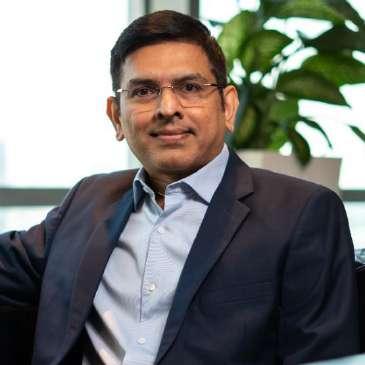
Nithin Nandakumar, Chief Commercial Officer, AlfaNow and Tharanath Rai, Chief Operating Officer, Al Fardan Exchange.
BURJX EXPANDS STABLECOIN INFRASTRUCTURE UNDER ADGM REGULATION
Enabling multi-chain stablecoin settlement with seamless AED banking rails across global blockchain networks.
BurjX, the UAE-born digital asset brokerage and custodian licensed by the Financial Services Regulatory Authority (FSRA) of ADGM, the international financial centre of Abu Dhabi, announced an enhancement to its service offering, further expanding how clients use stablecoins across multiple blockchain networks in connection with its regulated activities.
Stablecoins have rapidly become a core component of global digital asset markets, processing more than $33 trillion in transaction volume in 2025 alone, while the sector now exceeds $300 billion in total market capitalisation. Their growth reflects an expanding role as critical financial infrastructure for digital asset markets and global capital movement.
The UAE has emerged as one of the world’s fastest-growing hubs for regulated digital asset activity, with stablecoins increasingly used across payment corridors, trading venues, and treasury operations throughout the region.
By expanding its stablecoin network connectivity, BurjX is enhancing its regulated activities, enabling clients to transact across multiple blockchain networks within a compliant framework aligned with the UAE’s financial system.
Multi-Chain Stablecoin Support
As part of this expansion, BurjX now enables multi-chain stablecoin transfers across several of the most widely used blockchain networks globally, giving clients greater flexibility in how capital moves across digital asset markets.
BurjX now provides stablecoin connectivity across the following networks:
• USDT on Tron (TRC20), the most widely used network for global stablecoin transfers, accounting for over 60% of circulating USDT supply.
• USDT on BNB Smart Chain (BEP20), enabling efficient
stablecoin movement across one of the largest trading and DeFi ecosystems.
• USDC on Solana, providing highspeed settlement and scalability for trading and institutional transaction flows.
• USDC on Stellar, optimizsed for cross-border payments and enterprise-grade financial transfers. These additions complement BurjX’s existing Ethereum (ERC-20) infrastructure, allowing clients to select the most efficient network depending on transaction speed, cost, and liquidity conditions.
Together, these integrations establish a multi-chain stablecoin infrastructure that connects major blockchain networks with the UAE’s regulated financial system.
Secure and Regulated Digital Asset Custody
Built on high-performance infrastructure designed to support large-scale trading and settlement, BurjX combines multi-network blockchain connectivity with secure digital asset custody powered by Fireblocks, the enterprise platform trusted by leading financial institutions to secure and move digital assets.
Fireblocks’ MPC wallet technology safeguards client assets through advanced cryptographic protections that eliminate single points of failure while ensuring secure and compliant asset transfers across supported blockchain networks.
“Stablecoins have become the backbone of digital asset settlement,” said Omar Abbas, Co-Founder and CEO of BurjX. “By expanding support across these networks, BurjX is building the infrastructure that allows capital to move seamlessly across blockchain ecosystems while remaining fully aligned with the regulatory framework established by the FSRA.”
Supporting Retail, Institutional, and OTC Markets
The expanded stablecoin infrastructure strengthens BurjX’s ability to support a wide range of market participants, including retail investors, institutional clients, and OTC market participants. With seamless AED on- and off-ramps through Zand Bank, secure digital asset custody powered by Fireblocks, and connectivity to leading global liquidity providers, BurjX enables clients to transact seamlessly alongside both the UAE’s banking system and global digital asset markets through its regulated services.
Omar Abbas, Co-Founder and CEO of BurjX.
LIFERAY INTRODUCES HEADLESS CMS TO MODERNISE DIGITAL CONTENT MANAGEMENT
New offering centralises content, delivers in-context analytics, and enables delivery across channels
Liferay, a leading provider of Digital Experience Platforms (DXPs), announced the general availability of Liferay CMS, a fully headless content management system (CMS) designed to help marketing, development, and IT teams create, manage, and deliver digital content across multiple channels from a centralised repository.
Built on the core architecture of Liferay DXP, Liferay CMS combines the agility of a decoupled system with the stability and governance required by enterprise organisations. Whether powering a native mobile app, a customer portal, or a complex web ecosystem, Liferay CMS ensures content remains consistent, reusable, and easily distributable.
“Today’s organisations need agility without losing control of their content operations,” said Julia Molano, Director of Product Management at Liferay. “Liferay CMS builds on Liferay’s decades of DXP leadership to deliver a fully headless offering. It allows developers to work with stable, well-documented APIs while empowering marketers and content creators to manage global content without heavy reliance on IT.”
Liferay CMS introduces Spaces, the platform’s primary organisational units for headless content management, enabling teams to structure asset repositories, manage access, and collaborate more efficiently across departments or projects. Each Space provides a dedicated environment for content creation and management, including support for advanced localisation with AI-powered translation tools, making it easier for global organisations to manage multi-language content.
“Across the Middle East, enterprises are moving away from fragmented content systems to unified, centralised architectures that can support scale and speed simultaneously. Headless CMS is becoming a critical enabler
in this shift, allowing enterprises to deliver consistent digital experiences across channels while maintaining control and governance. With Liferay’s intuitive CMS, teams can manage content centrally, reduce operational complexity, and accelerate time-to-market and deeper customer engagement,” said Moussalam Dalati, General Manager of Liferay Middle East, Africa, and France.
Key features of Liferay CMS include:
• Global Content Visibility: A single view to search, review, and reuse content across regions and brands, eliminating disconnected repositories.
• Headless Architecture: Combines the flexibility of headless deployments with the governance and control of a centralised system.
• Embedded Analytics: Performance metrics like views and downloads are displayed directly within Liferay CMS, allowing teams to
validate asset performance at the point of work.
• AI-Assisted Workflows: Accelerates translation, localisation, and content review.
• Multi-Site Management: Ideal for franchises or organisations with multiple digital properties, allowing for centralised control while granting team-specific access.
• Unified Collaboration: Dedicated ‘Shared with Me’ areas and advanced access controls ensure all stakeholders work from a single source of truth. The launch of Liferay CMS reflects a modular platform approach designed for organisations that prioritise an API-first strategy. Because it is built on the same core architecture as Liferay DXP, organisations can start with a streamlined headless CMS today and seamlessly activate integrated capabilities like advanced commerce, page building, or AIdriven personalisation as their digital requirements expand.
Julia Molano, Director of Product Management, Liferay.
Moussalam Dalati, General Manager of Liferay Middle East, Africa, and France.
Public sector leads with 98 finalists to the private sector’s 37, underscoring the UAE’s government-first AI strategy.
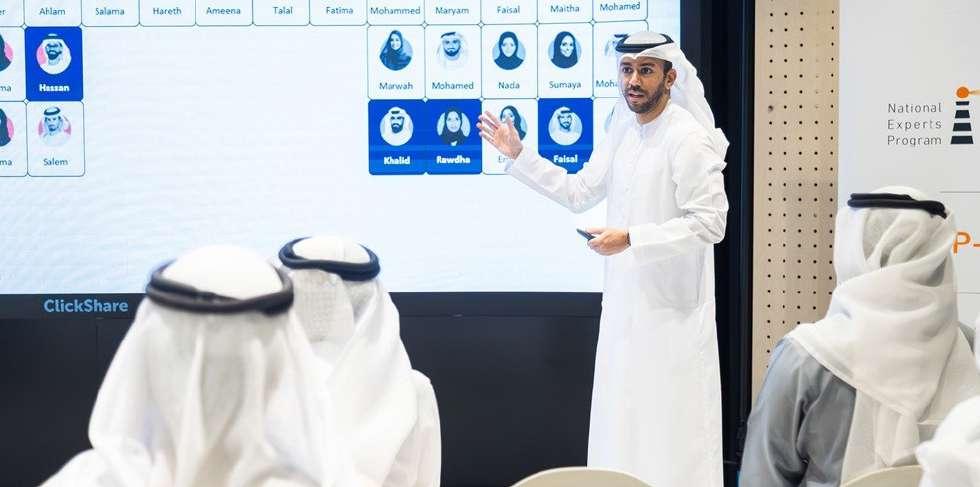
The UAE’s National Experts Program– AI track (NEP-AI) has shortlisted 135 finalists from more than 1,000 applicants, as the country accelerates efforts to build a national base of artificial intelligence expertise across priority sectors. A final group of 25 participants will be selected from these finalists to join the inaugural NEP-AI cohort.
The finalists of this first NEP-AI track represent all seven emirates, signalling broad national engagement in the program. Abu Dhabi (80) and Dubai (21) account for the majority, followed by Sharjah (14), Ras Al Khaimah (9), Ajman (6), Umm Al Quwain (3), and Fujairah (2).
The finalist pool is most diverse
in the program’s history, bringing together professionals from government, industry, and specialised technical fields. The gender split stands at 52 women (38%) and 83 men (62%).
The selection also reflects a highly experienced pool with 44% of finalists having more than 10 years of experience, and 35% between 5 and 10 years, signaling a clear focus on professionals equipped to deploy AI at scale.
Academic profiles are equally strong, with 53% holding a Master’s degree, 24% a PhD/Doctorate, reflecting the growing depth of advanced technical expertise among Emirati professionals.
The majority of finalists are drawn from the public sector (98 finalists),
• All seven emirates represented, led by Abu Dhabi (80) and Dubai (21), reflecting nationwide engagement in AI talent development
• Public sector dominates with 98 finalists versus 37 from the private sector, reinforcing the UAE’s government-led AI agenda
• Highly experienced talent pool, with 44% holding 10+ years’ experience and 77% possessing postgraduate qualifications
with 37 from the private sector, aligning with the UAE’s strategy of embedding AI capabilities within government systems while maintaining cross-sector integration.
Beyond the data, the applications reflect a broader national sentiment towards positioning the UAE for leadership in an AI-driven future, with many candidates framing their participation as part of a wider effort to advance the country’s standing among the world’s leading AI nations, and to apply AI to real-world challenges.
Several of the shortlisted candidates have proposed sector-specific, implementation-driven ideas, which are expected to form the basis of capstone projects developed from the start of the program.
The scale and quality of the applicant pool underscore the growing pull of the National Experts Program as a platform for developing highimpact national talent in advanced technologies.
The inaugural NEP-AI cohort is expected to be announced in June 2026.
NOVEMBER FIVE LAUNCHES AI-DRIVEN PRODUCT STUDIO IN MIDDLE EAST TO RETHINK ENTERPRISE DIGITAL DELIVERY
November Five, an independent digital product studio, has announced the regional rollout of its MX (Memorable Experience) Framework and N5OS operating model, designed to help Middle Eastern enterprises translate digital transformation ambitions into products that perform in the real world.
Entering the region as a seniorled Product Studio rather than a traditional agency, consultancy or systems integrator, November Five aims to address a growing challenge in the market: digital transformation strategies that look compelling in boardrooms but fail to translate into products that perform reliably in the real world.
At the centre of the launch is the MX Framework, which moves the conversation beyond traditional user experience. MX focuses on designing “signature moments”: emotionally meaningful interactions that shape how customers remember an experience. The MX methodology builds on November Five’s experience delivering digital platforms for global enterprises across Europe and North America, such as Coca Cola, Spotify, Le Pain Quotidien, and MDLBEAST.
The approach draws on behavioural science, including the peak-end rule, which shows that people judge an experience largely by its most memorable moment and the way it ends. MX identifies the intrinsic motivations that drive behaviour in a given context, then designs peak moments around them, enabling brands to create meaningful experiences that increase confidence, connection and loyalty while delivering strong functional performance. This is particularly relevant in industries where digital platforms operate as critical infrastructure, including airlines, telecom, financial services, and large enterprise platforms.
Supporting the delivery of MX is N5OS, November Five’s operating model built around agentic AI workflows. AI agents handle scope creation, Agile cadence management,
technical documentation, architectural decision records and workflow coordination, while tools review pull requests and prioritise security findings so engineering attention stays on intent and architecture. The result is a reallocation of senior time toward product strategy, service design and implementation decisions. The model also includes a Product Agent trained on the product’s codebase, architecture decisions, design system and delivery history, ensuring institutional knowledge remains available to the client team and updates/maintenance are seamless.
Darius LaBelle, Managing Director Middle East at November Five, said: “For too long digital delivery has relied on large offshore teams and layers of project management and that model struggles to keep up with the speed of change today, both commercially and strategically. By combining senior product talent with AI-enabled workflows, we can focus our energy where it matters most: creating digital products that work under real business pressure”.
Unlike traditional agencies that rely
heavily on distributed offshore teams, November Five works through seniorled, cross-functional product teams that combine strategy, design and implementation. The model is designed for organisations undertaking complex digital initiatives where reliability, speed and measurable outcomes are essential. Enterprise investment in AI and digital transformation is accelerating rapidly across the Middle East, with regional AI spending expected to reach $8.4 billion in 2025, according to IDC. At the same time, organisations across the region are allocating close to 10% of their revenues to digital transformation initiatives. Yet many companies still struggle to translate these investments into digital products that perform reliably in real-world environments and realise a meaningful return unless they also rethink how digital products are designed and delivered.
With the launch of MX and N5OS in the region, November Five is introducing a product studio model designed to help enterprises move faster from digital strategy to digital products that deliver measurable business outcomes.
Darius LaBelle, Managing Director Middle East at November Five.
OPSWAT, EMERSON PARTNER TO BOOST CYBERSECURITY FOR CRITICAL INFRASTRUCTURE OPERATORS
OPSWAT, a global leader in critical infrastructure cybersecurity, and Emerson, a global automation leader, have announced a global strategic reseller agreement that will bring OPSWAT’s industry-proven cybersecurity technologies to Emerson’s power and water industry customers. As the first initiative under this enterprisewide agreement, Emerson will integrate OPSWAT’s scalable and safe operational technology (OT) patch management capabilities into its Ovation Automation Platform.
The new OT patch management solution further builds on the collaboration to date by securing the Ovation Platform through OPSWAT’s MetaDefender Endpoint and My OPSWAT Central Management OnPremises, part of Emerson’s purposebuilt power and water cybersecurity suite of solutions.
tools and the ongoing surge of nation-state and ransomware activity targeting the energy and water sectors.
“Our customers need cybersecurity solutions designed specifically for operational technology—not adapted from IT,” said Robert Yeager, President of Emerson’s power and water solutions business. “They benefit from purposebuilt OT cybersecurity solutions that protect critical, real-time industrial systems while supporting availability, performance, and safe operations.
Collaborating with OPSWAT enhances our ability to help operators protect their Ovation Automation Platform with a modern, OT appropriate approach to patch management. It reflects our commitment to delivering proven, efficient, best-in-class protection for critical infrastructure.”
Critical infrastructure operators, including power generation and water/wastewater utilities, continue to face increasing cyber threats, regulatory pressure, and operational risk stemming from unpatched vulnerabilities. OPSWAT’s solution for the Ovation Automation Platform delivers a modernised patch management approach designed specifically for industrial environments, addressing challenges posed by a mix of modern and legacy
AS LLMS, AUTOMATION, AND DIGITAL TRANSFORMATION ACCELERATE ACROSS POWER AND WATER INFRASTRUCTURE, THE ATTACK SURFACE EXPANDS JUST AS QUICKLY.
“As LLMs, automation, and digital transformation accelerate across power and water infrastructure, the attack surface expands just as quickly,” said Benny Czarny, Founder and CEO of OPSWAT. “In environments where safety and availability are mission critical, cybersecurity cannot rely on traditional IT assumptions but must be deterministic, scalable, and engineered specifically for OT realities. Partnering with Emerson allows us to embed that prevention-first philosophy directly into one of the world’s most trusted automation platforms. This is not simply about patching vulnerabilities. It is about fortifying the resilience and continuity of the essential systems that power modern society.”
Emerson offers the Ovation Automation Platform globally, with more than 800 sites already utilising cybersecurity technologies specifically designed to provide critical industries, like power, water, and wastewater, with proven solutions backed by operational expertise.
The new strategic collaboration expands on the well-established DeltaV Alliance agreement between OPSWAT and Emerson for OPSWAT’s MetaDefender Kiosk, and MetaDefender Unidirectional Security Gateway for the DeltaV Automation Platform.
The new global partnership also underscores Emerson’s strategy to collaborate with proven and effective cybersecurity providers, a shift driven by evolving global regulations and the need for continuous response to new vulnerabilities.
Benny Czarny, Founder and CEO of OPSWAT.
AMIVIZ APPOINTED AS VALUE-ADDED DISTRIBUTOR FOR QUANTUMGATE ACROSS MIDDLE EAST & AFRICA
Partnership expands access to advanced quantum-resistant and critical cybersecurity solutions as enterprises face escalating cyber threats and an accelerating mandate to shift to post-quantum cryptography.
AmiViz, the Middle East’s leading cybersecurity and AI-focused valueadded distributor, has been appointed as the distribution partner for QuantumGate, enabling the company to deliver QuantumGate’s full suite of quantum-resistant and cybersecurity technologies across the Middle East and Africa.
The partnership comes at a critical time, as enterprises and critical infrastructure operators face a dual threat landscape – a sharp rise in sophisticated, destructive cyberattacks, compounded by the longer-term imperative to transition away from encryption standards that quantum computing will eventually render obsolete.
AmiViz will leverage its regional presence, partner ecosystem, and Virtual Customer Experience Centre to accelerate the adoption of these solutions and support customers seeking stronger cyber-resilience.
“This partnership equips our partners and customers with practical, deployable technologies to address one of the biggest shifts in cybersecurity,” said Ilyas Mohammed, COO of AmiViz.
“The move to quantum-resistant cryptography is no longer theoretical; attackers can already harvest encrypted information for future decryption. With QuantumGate and AmiViz together, organisations across the Middle East and Africa can take action now to protect long-lived data and strengthen cyber resilience.”
As quantum computing advances, widely used public-key encryption could become vulnerable, putting long-term confidentiality at risk. Adversaries may already be harvesting encrypted data today to decrypt it once quantum capabilities mature (“harvest now, decrypt later”). As a result, transitioning to
quantum-resistant cryptography is becoming an immediate priority.
The partnership reinforces a shared commitment to strengthening cyber defense capabilities across the region as digital threats continue to escalate.
“The industry’s transition toward quantum-safe cryptography is gaining real traction, and security teams are moving from awareness to planning,” said Janne Hirvimies, Chief Technology Officer, QuantumGate.
“QuantumGate’s solutions are built to address both dimensions: hardening organisations against today’s threats while laying the cryptographic foundations that will matter most in the years ahead. This partnership with AmiViz puts those capabilities where they are needed
most,” added Hirvimies.
QuantumGate’s portfolio includes QSphere, a suite of quantumresilient solutions spanning secure communications via quantumresilient VPN and data security for encryption, signing, and data protection. Complementing this is Salina, a passwordless IAM platform built on a phishingresistant cryptographic stack. To support quantum-safe transition planning, QuantumGate also offers the Crypto Discovery Tool, which enables organisations to inventory cryptographic assets, identify vulnerabilities, and support compliance readiness, and Secure VMI, which isolates and protects sensitive enterprise data on personal (BYOD) and corporate mobile devices.
Ilyas Mohammed, COO of AmiViz and Janne Hirvimies, Chief Technology Officer, QuantumGate.
AXIS COMMUNICATIONS EXPANDS MEA DISTRIBUTION NETWORK WITH 360 SECURITY SYSTEMS PARTNERSHIP
Axis Communications, the global leader in network video, audio, analytics, and access control technologies, announced a regional distribution agreement with 360 Security Systems, a leading security and communications solutions provider operating across the Middle East and Africa (MEA).
The partnership is designed to strengthen the availability, deployment, and long-term support of Axis’ intelligent security solutions across a region experiencing accelerated infrastructure development, digital transformation, and increasing demand for resilient systems. By combining Axis’ network-based technology portfolio with 360 Security’s Systems regional execution capabilities, the agreement aims to deliver greater value to partners, system integrators, consultants, and end customers operating in complex and high-growth environments.
Through this collaboration, Axis will leverage 360 Security’s Systems multicountry footprint, established logistics infrastructure, and proven channel development model to enhance market coverage and consistency across key MEA markets, including [Afghanistan, UAE, Egypt, Qatar, Kuwait, Oman, Bahrain, Jordan, Iraq, Lebanon, Libya, Pakistan, Palestine, Sudan, Yemen]. Customers will benefit from improved product availability, localized technical expertise, and stronger pre- and post-sales support, enabling faster deployment cycles.
With more than two decades of industry experience, 360 Security Systems has built a strong reputation for delivering end-to-end IP surveillance and security solutions. The company combines deep expertise in solution design and system architecture with access to best-in-class technologies from global manufacturers. Supported by teams of highly experienced and accredited professionals, 360 Security Systems delivers intelligent security solutions, professional services, and ongoing operational support that help organizations protect assets, enhance situational awareness, and improve
Managing Director for the Middle East, Türkiye, Central Asia and Africa at Axis Communications.
overall business performance.
Working in close collaboration with system integrators, consultants, and technology vendors, 360 Security Systems plays a critical role in bridging strategy and execution, ensuring that complex security projects are deployed, and maintained to meet both technical and operational requirements. This partner-centric approach has enabled the company to support a broad range of sectors, including government, critical infrastructure, transportation, energy, commercial real estate, and large enterprise environments.
“This partnership represents a strategic step forward in how we support customers and partners across the Middle East and Africa,” said Loubna Imenchal, Managing Director for the Middle East, Türkiye, Central Asia and Africa at Axis Communications. “The region continues to invest heavily in national infrastructure, smart cities, and digital transformation initiatives. To support this growth, customers need not only advanced technology, but also strong local execution, consistency across markets, and partners who understand regional operational realities. 360 Security brings the scale, technical capability, and channel maturity that align closely with Axis’ long-term vision for the region.”
The partnership reflects Axis Communications’ broader commitment to the Middle East and Africa, including continued investment in partner enablement, technical training, and solution innovation. By working closely with distributors such as 360 Security Systems, Axis aims to support the development of secure, resilient, and future-ready infrastructures that respond to evolving security, operational, and regulatory requirements across the region
“We are pleased to partner with Axis Communications and extend their industry-leading solutions across our regional network,” said Abd Houri, CEO, 360 Security Systems. “Axis’ focus on open platforms, innovation, and long-term value creation strongly aligns with our own approach to delivering intelligent security solutions. This partnership allows us to further support our partners and end customers with high-performance technologies, backed by deep technical expertise and a strong regional support structure.”
“As we look ahead, 2026 will be an important year for Axis. Our focus is clear: strengthening our vision and delivering on our brand promise through both new and existing projects. Together with strong partners like 360 Security Systems, we are turning that vision into reality,” concluded Imenchal.
Abd Houri, CEO, 360 Security Systems.
Loubna Imenchal,
30th August 2026 06:30 PM onwards
In August, CPI will be hosting the inaugural Future Enterprise Awards in Riyadh. The awards are designed to recognize IT and business leaders that are driving rapid digital transformation across the Kingdom.
The KSA Awards want to acknowledge those who are championing change, whether it be from a private or public sector organization, we want to pay tribute to the fearless trailblazers forging a new path and a new identity for the KSA. For more information about the event and nomination details, please visit the event website below :https://tahawultech.com/ksa-futureenterpriseawards/2026/ Radisson Blu Hotel & Convention Center Riyadh Minhal
QUANTUM SHIFT REDEFINES IT CHANNEL LANDSCAPE
World Quantum Day underscores how partners must pivot towards quantum-safe security, hybrid computing, and nextgen infrastructure strategies.
Quantum computing is gaining momentum as it moves from scientific exploration to a boardroom priority. Growing awareness is being driven not only by breakthroughs in research, but also by a clear shift in business thinking, with quantum increasingly seen as both a strategic opportunity and an emerging risk.
Celebrated worldwide on April 14, World Quantum Day was launched by quantum scientists on 14 April 2021 as a decentralised, global initiative to promote awareness and understanding of quantum science and technology through activities ranging from talks and exhibitions to lab tours and panel discussions.
Industry leaders are aligned in their
outlook: the window to prepare is narrowing, particularly as advances in quantum capabilities threaten current encryption standards and reshape longterm data security. This convergence of urgency and opportunity is turning World Quantum Day into more than a symbolic milestone. It is increasingly becoming a marker of how seriously organisations are preparing for the next era of computing.
Momentum is also being reinforced by the pace of development among major technology players. IBM says it is targeting near-term quantum advantage by the end of 2026 and the first large-scale fault-tolerant quantum computer by 2029, underscoring how quickly the conversation is moving from long-term possibility to practical planning.
NVIDIA advances quantum readiness with Ising AI models
NVIDIA has launched Ising, described as the world’s first family of open AI models designed to accelerate the path towards useful quantum computers. The models focus on two of the most critical engineering challenges in quantum computing: quantum processor calibration and quantum error-correction decoding. According to NVIDIA, the Ising model family delivers quantum errorcorrection decoding that is up to 2.5 times faster and three times more accurate than traditional approaches, helping researchers and enterprises build more scalable and reliable quantum systems. The company said leading enterprises, academic institutions and research labs are
already adopting Ising, including Harvard John A. Paulson School of Engineering and Applied Sciences, Infleqtion, IQM Quantum Computers, Lawrence Berkeley National Laboratory’s Advanced Quantum Testbed and the UK National Physical Laboratory.
The launch reinforces the growing convergence of AI, quantum computing and accelerated infrastructure, highlighting how the enterprise technology ecosystem is moving beyond experimentation towards practical quantum readiness. NVIDIA also noted that the quantum computing market is expected to surpass $11 billion by 2030, with progress in error correction and scalability likely to determine the pace of commercial adoption.
WHEN GOOGLE SETS 2029 AS ITS MIGRATION TARGET, THIS IS NO LONGER A RESEARCH CONVERSATION. IT IS AN ENGINEERING PRIORITY.
Google signals urgency around quantum-era security
Google marked World Quantum Day with a dedicated Doodle and educational content aimed at raising awareness of quantum computing’s real-world impact, reflecting the growing shift from scientific curiosity to mainstream relevance. This year also marks 100 years since the discovery of quantum mechanics, a breakthrough that transformed understanding of the natural world and laid the foundation for technologies such as semiconductors, lasers and modern computing. At the same time, the company has issued one of the industry’s clearest warnings on the accelerating quantum timeline. Google now estimates that “Q-Day”, the point at which quantum
computers can break widely used encryption standards, could arrive as early as 2029, significantly sooner than previous expectations.
The company has urged organisations to begin migrating to post-quantum cryptography, warning that adversaries are already engaging in “harvest now, decrypt later” strategies. This involves capturing encrypted data today with the intention of decrypting it once quantum capabilities mature.
Beyond security, Google highlighted the broader potential of quantum computing across medicine, energy and materials science, from accelerating drug discovery and improving battery design to enabling more efficient simulation of fusion energy systems.
This dual message, combining scientific progress with a clear enterprise security timeline, reinforces how quantum computing is no longer a distant innovation but an immediate strategic priority for businesses, governments and the broader technology ecosystem.
Cloudflare accelerates path to post-quantum security
Cloudflare has committed to achieving full quantum-resistant security across its global network by 2029, signalling a major acceleration in industry timelines for post-quantum readiness. The roadmap extends beyond encryption to include post-quantum authentication, addressing the more complex challenge of securing identities, certificates and digital trust
Stefan
Leichenauer, VP – Engineering, SandboxAQ.
systems in a quantum era.
The company noted that recent advances in quantum research have shortened the expected timeline for “Q-Day”, increasing urgency across the industry. Its approach aligns with broader signals from technology leaders such as Google, reinforcing a growing consensus that the transition to post-quantum cryptography must happen within the next few years.
Cloudflare said more than 65% of human-generated traffic on its network is already protected using post-quantum encryption, helping mitigate “harvest now, decrypt later” risks. However, it emphasised that authentication remains the next critical
THE TECHNOLOGY HAS SHOWN A LOT OF PROMISE IN BIOTECHNOLOGY AND OPTIMISATION OF COMPLEX LOGISTICS AND SYSTEMS.
frontier, as vulnerabilities in identity systems could expose organisations even if encryption is upgraded.
With a phased roadmap leading to 2029, the company aims to make postquantum security enabled by default, reflecting a broader shift towards securing the internet at scale without increasing complexity for enterprises.
The UAE, meanwhile, is positioning itself at the forefront of this shift. The Technology Innovation Institute’s Quantum Research Center says it is driving the development of quantum technologies in the region and aims to build the Arab world’s first quantum
computer. In 2025, TII also announced a partnership with Quantinuum to give UAE researchers access to advanced quantum systems, including Helios, in a move designed to strengthen the country’s role as a global hub for quantum research and innovation.
Sandhya D’Mello, Technology Editor, CPI Media Group, spoke to leading experts to understand the business impact of quantum computing and how it is likely to shape future competitiveness.
Stefan Leichenauer, VP –Engineering at SandboxAQ
The remaining time we have to prep before scaled quantum computers arrive is extremely valuable: once they arrive, the well-prepared will be rewarded while others will be left behind. This is especially evident in cybersecurity. Recent progress in quantum algorithms and experimental systems has brought credible estimates that large-scale quantum machines could break RSA as early as 2029, so the threat may arrive faster than many expect. Those who do not implement quantum-safe protocols, a years-long process, will be vulnerable.
Similarly, in high-impact areas like pharmaceutical development and materials design, where quantum
TECHNOLOGY LEADERS MUST EXECUTE A STRATEGY THAT PILOTS QUANTUM-ENABLED CAPABILITIES FOR COMPETITIVE ADVANTAGE WHILE SIMULTANEOUSLY HARDENING DATA, APPLICATIONS, AND INFRASTRUCTURE AGAINST QUANTUM-ERA THREATS.
computing is expected to bring early benefits, we need to integrate quantum-ready processes into our workflows so that we are ready to incorporate quantum computers right away. Moving from awareness to action now is about building a quantum-ready posture in general.
Early quantum investments create a real advantage when they tie to domain-specific problems and integrate with existing highperformance computing and AI. Quantum computers will not operate in a vacuum; instead, they will be part of quantum-classical hybrid workflows that we can put together today. The
enterprises that build hybrid pipelines now will accumulate algorithms, datasets, and operational know-how that fast followers will struggle to replicate. In key industries, especially pharmaceutical development and next-gen materials, we can use the classical part of the hybrid workflow today while simultaneously laying the groundwork for future quantum advantage.
Technology leaders should start by inventorying long-lived data and systems that rely on public key cryptography and must remain confidential for 10–20+ years. They should use this inventory to drive a roadmap for cryptoagility and the phased deployment of postquantum cryptography. This is a must for all organisations, regardless of whether they plan to take advantage of quantum-driven opportunities.
The other key action item is to move to cloud infrastructure, if they are not there already. Not only is that a smart security move, but quantum computers will essentially only be accessible through the cloud.
“Very few organisations will have the expertise and infrastructure to house their own quantum computer, so any leader wanting to productively use quantum computers must be cloudnative.”
David Lewis, Global SVP at Endava Businesses really need to be aware of Harvest Now, Decrypt Later (HNDL) operations, and their impact
David Lewis, Global SVP, Endava.
— adversaries have been actively intercepting encrypted data that will be decrypted once Cryptographically Relevant Quantum Computers (CRQC) mature.
In practical terms this means classically encrypted data that was captured today could be decrypted within the next 5-10 years. Industry estimates suggest that more than 10 billion records are harvested each year, which, coupled with a sharp decline in storage costs, makes bulk interception “economically trivial”.
Delaying action, such as the application of post-quantum cryptographic algorithms (e.g., CRYSTALS-Kyber algorithm), will compress an already tight timeline, increase migration costs, and leave your organisation exposed to HNDLinspired attacks.
Early investments in quantum research translate into commercial advantage via three distinct pathways: near-term quantuminspired optimisation, mid-term hybrid quantum-classical workflows, and long-term quantum-native breakthroughs.
For example,
• Financial services will benefit from faster pricing, real-time hedging, and greater accuracy in risk modelling for capital requirements.
• Energy and critical infrastructure will gain from grid optimisation, enhanced material development (e.g. battery material), operational
resilience, and optimised carbon capture)
“Technology leaders must execute a strategy that pilots quantum-enabled capabilities for competitive advantage while simultaneously hardening data, applications, and infrastructure against quantum-era threats.”
Start by securing the foundation; create an inventory of crypto-assets, classify (e.g. longevity and sensitivity) data, pilot hybrid post-quantum cryptography (PQC), assess vendor PQC readiness, and apply security by design (e.g. architect a crypto-agility framework).
Ritesh Kakkad, Co-founder, XDC Network
A trade finance document signed on blockchain today, whether a bill of lading, a letter of credit, or a tokenised receivable, must remain legally valid for 20 to 30 years. Every one of those
documents uses ECDSA, the digital signature standard that secures most of the world’s blockchain transactions today, and it is cryptography that quantum computers will break.
The threat is not limited to blockchain. The same encryption standards protecting global banking systems, cloud platforms, and payment infrastructure today are equally vulnerable. A sufficiently powerful quantum computer would not distinguish between a blockchain signature and the encryption securing a SWIFT transaction or a major cloud provider’s data centre. The exposure is systemic.
The organisations that understand this best have already moved. Google has set 2029 as its target for full post-quantum cryptography migration. At XDC, we launched the Post-Quantum Initiative in March 2026, a structured programme to rebuild our cryptographic foundations before quantum computers make current security standards obsolete. We already have a working prototype in our development codebase and a four-phase migration plan built around the deadlines set by the EU and the US National Institute of Standards and Technology. We are at the start of that journey today because the right time to build quantum resilience is before you need it. By the time the threat is
Ritesh Kakkad, Co-founder, XDC Network.
visible, the window to prepare has already closed.
The race to quantum-safe infrastructure has a clear winner’s profile: whoever regulated institutions trust when the threat materialises.
At XDC, we are building toward that on three fronts. First, working code. While Ethereum, Bitcoin, and Solana are still debating, XDC already has a functioning prototype of Falcon, one of the quantum-resistant signature algorithms approved by the US National Institute of Standards and Technology, deployed in our official development codebase.
Second, standards authorship. We are co-developing XDSS-PQ, a quantumsafe trade document signing standard, with the International Trade and Forfaiting Association, the International Chamber of Commerce, and TradeTrust. Every institution handling trade finance digitally will need to align to that specification, making XDC the reference they build toward.
Third, compliance alignment. Our node operators, including SBI Holdings and Deutsche Telekom, face hard deadlines. China’s national cryptography standard mandates post-quantum migration by January 2027. The EU requires full migration by December 2030. The networks these institutions run on must meet that bar.
If XDC’s security meets it, we become the infrastructure of choice. If it does not, we become a liability for our own ecosystem.
The steps every technology leader
should take today are straightforward, even if the execution is not. Audit the security vulnerabilities that quantum computers will exploit and identify every system at risk. Design for agility and post-quantum security in parallel rather than replacing one standard with another. And upgrade your communications infrastructure to the latest quantum-safe encryption standards now, without waiting for broader changes. Adversaries are already recording encrypted data to decrypt once quantum hardware matures. Google, Cloudflare, and AWS have already made that move at scale. The overhead is minimal. The case for waiting is not.
Audit what you have. Build systems that can run two security standards at once. Stop the data harvesting today.
“When Google sets 2029 as its migration target, this is no longer
EARLY INVESTMENT IN QUANTUM READINESS IS A SOUND STRATEGIC THINKING, AND THE CONVERGENCE OF AI AND QUANTUM IS WHERE THE NEXT WAVE OF COMPETITIVE ADVANTAGE WILL BE BUILT, AND THE TIME TO POSITION FOR IT IS NOW.
a research conversation. It is an engineering priority.”
But individual action is not enough. There is currently no binding global standard that requires technology providers or financial infrastructure operators to migrate to post-quantum cryptography on a defined timeline. The EU and the US National Institute of Standards and Technology have set benchmarks, but they are not universally enforceable. Governments and global standardisation bodies need to move faster, mandating quantumsafe requirements for cloud providers, payment systems, and financial infrastructure before the window closes. The organisations that act early will be ahead. The ones that wait for regulation to force their hand may find they have run out of time.
Chester Wisniewski, director, global field CISO, Sophos
Most of the world’s secrets are protected by computer encryption methods that quantum computing technology could compromise down the road. Transitioning to quantum-resistant algorithms will take a significant amount of time, while the functions that might break our existing cryptography continue to become more efficient. While not every industry or vertical will experience the same risk profile
Chester Wisniewski, director, global field CISO, Sophos.
for how fast we must adopt these algorithms, everyone should be laying the foundations now. Historically, these types of transitions can take 10 years or more, and many quantum researchers believe we may build quantum computers capable of breaking them sooner than that.
“The technology has shown a lot of promise in biotechnology and optimisation of complex logistics and systems.”
One area in the computer security field where quantum computers have already made an impact is in quantum key distribution (QKD). This enables a secret encryption key to be transmitted over long distances without the ability for an eavesdropper to obtain the secret. While not in widespread use, it has been demonstrated and could have important impacts on the future of secure communications.
We should ensure that as we acquire
new technologies that they can seamlessly take advantage of postquantum cryptography (PKC) algorithms and hashing and are designed in a way that these algorithms can be easily swapped. While the US, UK, and EU have all certified new PKC standards, as with all cryptographic standards, weaknesses will be discovered and newer and better methods of implementing PKC will emerge.
Dr. Moataz Bin Ali, CEO, Magna AI Quantum computing is no longer a horizon conversation but is becoming a boardroom one. At Magna AI, we see it as the next frontier that will amplify what AI has already unlocked, pushing the boundaries of what’s computationally possible in ways that will reshape industries from financial modelling to critical infrastructure. The organisations that will lead in this space are quietly building the foundations for today by stress-testing their data security posture, identifying the highcomplexity problems where quantum advantage will hit hardest, and ensuring their teams understand what’s coming. Early investment in quantum readiness is a sound strategic thinking, and the convergence of AI and quantum is where the next wave of competitive advantage will be built, and the time to position for it is now.
Dr. Moataz Bin Ali, CEO, Magna AI.
INTO NEW WORLDS YOU’RE
ONE LEAP AWAY
From 31 Aug - 3 Sept 2026 Riyadh Exhibition and Convention Center - Malham, Saudi Arabia
PIVOTALE AI UNVEILS
WORLD’S FIRST AI READINESS PLATFORM FOR CHANNEL AT GITEX SINGAPORE
PAIR — Partners AI Readiness — lets channel teams assess their own AI maturity and run client AI assessments that generate scores, comprehensive quality reports, and actionable quarterly playbooks.
Pivotale AI, the definitive authority in AI readiness and GTM strategy across Asia and the Middle East, launched PAIR (Partners AI Readiness) — the world’s first AI maturity assessment platform built entirely for the technology channel. Driving international
Maury G, Founder, Pivotale AI and Levels Ventures.
market expansion, PAIR went live simultaneously in Sydney (8 April) and globally at the GITEX AI Conference in Singapore (9 April).
PAIR operates across two use cases, no single platform has ever addressed together: channel organisations assessing their own AI maturity, and MSPs and resellers running
structured AI readiness assessments directly for their end clients. The platform produces scored intelligence, prioritised recommendations, and a rolling quarterly roadmap that evolves as the client matures, serving as a critical catalyst for business transformation.
“The channel has been selling AI without an AI conversation framework. Pivotale AI fixes that. One assessment. One score. One roadmap. No excuses,” said Maury G, Founder of Pivotale AI and Levels Ventures, the #1 Channel Consulting firm across Australia, Hong Kong, Singapore, Malaysia, Indonesia, Saudi Arabia, and the UAE.
PAIR delivers a vendor-agnostic, partner-centric maturity assessment across five dimensions: Strategy, Data, Technology, Talent, and Culture. The output goes far beyond a simple score; within twenty minutes, it equips partners with a complete engagement strategy. For MSPs and resellers, PAIR’s Client Intelligence Mode enables partner teams to run the same structured assessment for any end client.
The platform instantly produces:
* An AI Readiness Score benchmarked against industry cohorts.
• A Comprehensive Quality Report identifying the client’s highestimpact AI gaps and readiness levels.
• Immediate Sales and Marketing Playbooks are auto-generated from
the assessment data to explicitly guide the partner’s GTM strategy throughout the quarter.
• A Rolling Quarterly Roadmap recalibrated every re-assessment as the client’s maturity advances.
The more the client grows, the more sophisticated the guidance from Pivotale AI becomes. The engagement deepens automatically — turning a one-off assessment into a recurring, data-led advisory relationship powered by quarter-by-quarter execution plans.
A Critical Lifeline for Middle East Channel Managers
While the platform rolls out globally, the need for PAIR is most acute across the Middle East. In hyper-accelerated markets like Saudi Arabia, the UAE, and Qatar, massive top-down government investments in AI have created unprecedented demand.
Channel Sales Managers and MDF decision-makers in these regions are under immense pressure to execute, yet they lack the frameworks to measure partner maturity. PAIR equips these channel leaders to replace gut-feel QBRs with scored AI briefs, ensuring MDF and resources are deployed with data-backed precision.
• Channel Marketing Managers — MDF deployed with precision, not assumption.
• Partner Owners & Founders — independent AI maturity view with a clear advancement path.
• MSPs & Resellers — a client-facing AI intelligence service line, built in, ready to deploy.
Vendor Program Managers and Distribution Account Managers gain portfolio-level AI readiness visibility across their entire partner base — instantly.
At launch, PAIR includes selfassessment and Client Intelligence Mode across five AI dimensions, along with 90-day advancement plans, sales and marketing playbook generation, and industry benchmarking. The roadmap ahead includes a
Cybersecurity Maturity Tool, a Cloud Maturity Tool, vendor API integrations for real-time CRM and partner portal data exchange, as well as advanced cohort analytics and MDF allocation intelligence.
The launch comes at a time when the Asia Pacific is forecast to reach $295 billion in AI spend by 2030 at a 28.6% CAGR, and Middle Eastern nations are aggressively scaling their sovereign AI capabilities. However, with 73% of AI initiatives failing to scale globally and 68% of leaders struggling to measure AI ROI, the gap Pivotale AI is addressing has never been wider. Early access is now available through an invite-only waitlist for a select cohort of channel organisations, MSPs, and vendor partner programmes globally and across the Asia Pacific and Middle East markets.
Maury G spoke to Sandhya D’Mello, Technology Editor, CPI Media Group, and outlined how the platform could help partners build stronger, more consultative AI-led customer engagements.
Interview Excerpts
How does PAIR change the way channel partners approach AI conversations with clients?
PAIR brings structure and confidence to AI conversations, especially for midsized and smaller partners who may lack dedicated strategy or consulting teams. It provides a clear, data-driven framework across key pillars such as strategy, data, technology, talent, and culture—enabling partners to assess both their own readiness and their clients’ environments. This allows them to enter discussions with clarity, prioritised talking points, and a defined roadmap rather than relying on instinct or fragmented knowledge.
What gap in the market led to the creation of Pivotale AI’s PAIR platform?
The key gap was the absence of a vendor-agnostic, partner-centric AI readiness framework. While major vendors offer their own AI assessment tools, these are typically aligned to their own products and do not reflect
the multi-vendor reality in which partners operate. PAIR was designed to give partners a holistic view across their entire technology stack, helping them build solution-led conversations rather than product-led ones.
Why do most AI initiatives fail to scale, and how does PAIR address this challenge?
Most AI initiatives fail not due to a lack of capability, but due to a lack of clarity and a fragmented approach. Organisations often focus on isolated aspects such as technology or data without a unified view across strategy, culture, and execution. PAIR addresses this by providing a comprehensive assessment framework that brings all these elements together, enabling organisations to move from experimentation to structured, scalable AI adoption.
How can MSPs and resellers monetise AI readiness assessments as a new service line?
PAIR enables partners to monetise AI advisory by significantly accelerating the consulting process. What traditionally takes several weeks can now be achieved in minutes, allowing partners to shorten sales cycles, improve solution alignment, and increase deal value. By combining product sales with strategy and advisory services, MSPs and resellers can create recurring revenue streams while delivering greater value to clients.
What will differentiate successful AI-ready organisations from the rest over the next 2–3 years?
The key differentiator will be the ability to transition from productled selling to trusted advisory. Organisations that position themselves as AI advisors—rather than just technology providers—will build deeper, long-term relationships with clients. This shift enables them to move from transactional engagements to multi-year partnerships, making their role more strategic, resilient, and difficult to replace.
ONCE THE OPERATING MODEL IS IN PLACE FOR EXECUTION, AI CAN CONTRIBUTE MEANINGFULLY RATHER THAN JUST SIT ON THE SIDELINES AS ANOTHER LAYER OF SUPPORT.
Alfred Manasseh, CoFounder and COO, Shaffra.
REENGINEERING WORK TO UNLOCK SCALABLE AI ADOPTION
Shaffra’s Alfred Manasseh explains why organisations must rethink operating models, workflows, and decision-making to move from AI experimentation to enterprise-scale execution
AI adoption is no longer just a technology conversation; it is becoming an operating model conversation. For organisations to unlock real value, they must rethink how work flows, how decisions are made, and how people and intelligent systems collaborate across the enterprise.
Alfred Manasseh, Co-Founder and COO of Shaffra, brings this perspective through his work with governments and enterprises across the region.
Shaffra is the first company in the region to operationalise AI as a workforce through Autonomous AI Teams. Manasseh leads operational strategy and cross-functional execution, helping organisations move beyond AI tools towards enterprise-grade AI operations.
Manasseh’s background in process optimisation, business transformation, and operational efficiency shapes his view that scalable AI adoption depends on re-engineering work itself, not simply adding another technology layer.
Interview Excerpts: Why does sustainable AI adoption require organisations to rethink operating models rather than simply deploy new tools?
Most organisations treat AI as another tool they can plug into existing systems. The problem is that those systems were never designed for AI to operate independently. They rely on manual handovers, approvals, and fragmented workflows. Hence, AI ends up assisting rather than driving outcomes. Sustainable adoption only happens when you rethink how work moves through the organisation. That means simplifying workflows, clarifying
decision ownership, and reducing friction points. Once the operating model is in place for execution, AI can contribute meaningfully rather than just sit on the sidelines as another layer of support.
How can enterprises redesign workflows and decision-making structures to become truly AInative?
The shift to being AI-native starts with looking at work end-to-end, not task by task. Most workflows today are broken into pieces with too many dependencies and unclear decision points. That makes it hard for AI to do anything beyond small tasks. Organisations need to simplify that. Define clear inputs, set decision rules, and remove unnecessary approvals. Decision-making should move from people chasing approvals to systems executing based on logic and context. When workflows are structured this way, AI can operate continuously, not intermittently. That’s when you start seeing real speed, consistency, and scale across the business.
What role do workplace collaboration models and workforce augmentation strategies play in driving successful AI transformation?
This is where a lot of organisations get it wrong. AI transformation isn’t just about technology; it’s about how people and AI work together day to day. If that’s not clearly defined, you get confusion and resistance. The goal isn’t replacement; it’s better distribution of work. AI should take on execution-heavy tasks, while humans focus on decisions, exceptions, and direction. But that only works if roles are redesigned properly. When people understand where AI fits and
how it supports them, adoption becomes much smoother. It also builds trust, which is critical if you want AI to scale across the organisation.
How is the automation of repetitive enterprise tasks helping organisations deliver measurable gains in productivity and execution?
A big part of inefficiency in organisations comes from simple, repetitive work being done manually. Things like data entry, reporting, follow-ups, and approvals. It adds up quickly. When you automate those layers, you remove delays and reduce errors almost immediately. The result is faster execution and more predictable outcomes. But the bigger impact is on people. Instead of spending time on routine tasks, they can focus on work that requires judgment or creativity. That’s where you start by seeing real productivity gains, not just in output, but in how effectively the organisation uses its talent.
Why is reengineering considered the real foundation of scalable AI adoption across industries? Because without it, AI doesn’t scale. Most organisations are still running on processes that were built years ago, with a lot of manual work and disconnected systems. If you layer AI on top of that, you might get small improvements, but nothing transformative. Reengineering forces you to rethink how work should happen today, not how it used to. It’s about simplifying processes, aligning systems, and structuring decisions so AI can execute them. Once that foundation is in place, scaling AI becomes much more straightforward because it’s embedded into how the organisation operates, not added on top.
AI-NATIVE QA REDEFINES SOFTWARE TESTING WITH OUTCOME-DRIVEN EXECUTION
BotGauge AI shifts quality assurance from effort-led services to autonomous, intelligence-led outcomes
Software quality assurance is undergoing a fundamental shift as AI-native models move the industry from effort-based delivery to outcome-driven execution. BotGauge AI reflects this transition by redefining QA from a manual, service-led function into an autonomous, continuously evolving layer aligned with engineering speed. By combining AI agents with human domain expertise, the company enables organisations to accelerate test coverage, reduce automation maintenance, and improve release readiness without scaling headcount.
Pramin Pradeep, Co-founder and CEO of BotGauge AI, brings over a decade of experience in low-code ecosystems, enterprise QA transformation and scalable software infrastructure. His work with enterprises including Adobe, Infosys and Unqork shapes BotGauge AI’s vision of autonomous quality infrastructure, backed by the company’s recent $2 million funding round led by Surface Ventures.
Interview Excerpts:
What makes AI-native agencies fundamentally different from traditional software services firms in the way they deliver outcomes?
What makes AI-native agencies fundamentally different is this, they don’t sell effort, they sell outcomes. We’re at a major inflection point.
With the rise of LLMs, we’re already seeing disruption across traditional service industries whether it’s content creation, customer support, or even research. Work that previously required teams of people and billable hours is now being delivered faster, cheaper, and often better through AIdriven systems.
The same shift is now happening in the software testing services world.
Traditional testing firms operate on a model built around human effort, teams, hours, and long delivery cycles. Pricing is tied to how many people are working and for how long. As a result, timelines stretch, and outcomes are often variable.
AI-native companies flip this model entirely and at BotGauge AI, we focus purely on the outcome.
In a typical Series A+ company, reaching ~60% test coverage using traditional frameworks and service firms can take 4–5 months. With an AI-native approach, we can reach 80% test coverage in about two weeks.
That’s not just an efficiency gain, it’s a complete redefinition of how value is delivered.
Pricing also shifts accordingly. It’s no longer based on human bandwidth, but on measurable results, in our case, test coverage and the number of reliable test cases maintained over time.
So the fundamental difference is this:
Traditional services scale with people. AI-native agencies scale with intelligence.
And in that shift, entire business models, not just tools are being reinvented.
How is agentic AI changing the quality assurance process for software teams in terms of speed, accuracy, and scalability? Agentic AI is fundamentally changing QA by turning it from a bottleneck into an autonomous, continuously evolving system.
Traditionally, QA has been manual, time-intensive, and reactive. Teams spend weeks or even months creating and maintaining test cases. Every product change introduces more overhead, and keeping test coverage up-to-date becomes a constant struggle. As a result, there’s always a trade-off between speed and quality.
Agentic AI removes that trade-off.
Instead of relying on static scripts, AI agents can understand application flows, generate test cases, execute them, and continuously update them as the product evolves. This changes QA across three key dimensions:
Speed:
What used to take months can now happen in days or even minutes. In many traditional setups, reaching meaningful test coverage can take 4–5 months. With an AI-native approach like what we’re building at BotGauge AI, teams can achieve significantly higher coverage in a matter of weeks.
WORK THAT PREVIOUSLY REQUIRED TEAMS OF PEOPLE AND BILLABLE HOURS IS NOW BEING DELIVERED FASTER, CHEAPER, AND OFTEN BETTER THROUGH AI-DRIVEN SYSTEMS.
Pramin Pradeep, Co-founder and CEO, BotGauge AI.
INTERVIEW // BOTGAUGE
Accuracy:
Early concerns around AI like hallucination or incorrect test paths are being addressed through structured learning systems and human-in-theloop validation. Over time, the system improves with every test it creates and validates, leading to more reliable and context-aware testing.
Scalability:
This is where the biggest shift happens. Traditional QA scales with people. Agentic AI scales with usage. As the product grows, the system automatically expands test coverage and adapts to changes without requiring proportional increases in team size.
The net effect is a complete shift in how teams think about QA. Instead of being a phase in the
development cycle, QA becomes a continuous, autonomous layer that keeps pace with engineering speed. And that’s what ultimately enables teams to move faster while maintaining high confidence in what they ship.
In your view, why are engineering teams increasingly likely to prefer outcomebased AI-driven models over conventional service-led engagements?
Engineering teams today are under constant pressure to ship faster, maintain quality, and stay ahead of the market. Their success depends on how quickly they can release stable features and close the feedback loop with customers.
The challenge is that traditional
service-led models don’t align well with this goal.
Most conventional engagements are built around effort, hours, team size, and timelines. But engineering teams don’t measure success in hours; they measure it in outcomes like release speed, product stability, and user impact. This mismatch creates friction, slower cycles, higher coordination overhead, and no direct link between cost and results.
That’s why there’s a clear shift toward outcome-based, AI-driven models.
With platforms like BotGauge AI, the conversation changes from “how much work was done” to “what was achieved.” Instead of managing testing as a process, teams receive outcomes, higher test coverage, faster release readiness, and more reliable systems.
This shift removes QA as a bottleneck and allows engineering teams to focus on what truly matters: building, iterating, and delivering value to users at speed. In a competitive environment, that distinction is critical. Because ultimately, teams don’t want effort, they want results.
How does BotGauge position itself as an AI-native QA agency, and what specific challenges in software testing is it solving for customers?
BotGauge AI positions itself not as a traditional QA tool or a services vendor but as an Agentic QA Partner that owns outcomes end-to-end.
That distinction is important. Most testing solutions fall into two
categories: tools that require teams to build and maintain automation, or service firms that rely on human effort and scale with headcount. BotGauge sits in a fundamentally different category, Autonomous QA as a Solution, where the system itself delivers the outcome.
At its core, BotGauge combines AI agents with human domain expertise to take full ownership of the QA lifecycle from identifying what needs to be tested, to generating, executing, and continuously maintaining test coverage.
This allows it to solve some of the most persistent challenges in software testing:
1. The speed gap between development and QA
Modern engineering teams ship code faster than ever, but QA hasn’t kept pace. BotGauge addresses this by enabling teams to reach ~80% test coverage within weeks, compared to months in traditional setups.
2. The maintenance burden of test automation
Traditional automation breaks frequently and requires constant updates. BotGauge’s AI agents create self-healing test suites that evolve with product changes, eliminating the need for manual maintenance.
3. Fragmented ownership of QA In most organisations, QA is distributed across tools, teams, and vendors. BotGauge AI consolidates this by owning QA end-to-end, including validation through human experts to ensure reliability and context awareness.
4. Scalability without headcount growth
Traditional QA scales with people. BotGauge scales with AI handling everything from tens to thousands of test flows without requiring additional QA hiring.
5. Misalignment between effort and outcomes
Instead of billing for hours or team size, BotGauge AI aligns with outcomes
like test coverage, release readiness, and reliability, fundamentally changing how QA value is measured.
Looking ahead, how do you see AI-native agencies reshaping the broader future of software services and product delivery? We’re heading toward a world where services as we know them will fundamentally disappear and be replaced by software that delivers outcomes autonomously.
AI-native agencies are not just improving efficiency; they’re rewriting the business model of the entire services industry. For decades, software services scaled with people, more clients meant more engineers, more hours, more cost. But AI-native models break that equation. They scale with intelligence, not headcount. A small, highly leveraged team can now deliver what previously required entire departments.
This has two massive implications.
First, pricing shifts from effort to outcomes. Companies will no longer pay for hours or team size, they’ll pay for results. Whether it’s QA, support, or even parts of development, the expectation will be: “Just deliver the outcome.”
Second, product and service begin to merge. What used to be a service layer testing, onboarding, support gets embedded directly into the product as autonomous systems powered by AI agents, with humans in the loop for validation and edge cases.
At BotGauge AI, this is already visible. QA is no longer a function you manage, it becomes an outcome you receive. And this model will extend across the entire software stack.
Looking ahead, I believe most successful software companies will operate as AI-native hybrids, part product, part service but delivered as a seamless, outcome-driven system.
And in that world, the winners won’t be the ones with the largest teams. They’ll be the ones who can deliver the most reliable outcomes, at the highest speed, with the least human overhead.
AI AGENTS WON’T HELP YOU: WHAT COMES BEFORE TECHNOLOGY
Behavioural AI is redefining consumer apps by shifting focus from passive engagement to meaningful action, enabling platforms to deliver real-world outcomes through smarter, intent-driven experiences.
Alexander Merkushev, Head of AI projects, Yango Tech.
Artificial intelligence is passing through a familiar stage in the life of any breakthrough technology. Investment is moving quickly, and many businesses feel pressure to act before the opportunity passes them by. That pattern has played out before with blockchain, Big Data, and many other emerging technologies. A new tool appears, the market rushes toward it, expectations rise faster than practical understanding, and only later does a clearer picture emerge of where it genuinely creates value and where it does not.
Not every industry needs every new technology, and not every problem needs an AI agent. The Middle East is clearly positioned for strong adoption, with AI forecast to contribute $320 billion to the region by 2030. Conditions are highly favourable, with 65% of MENA CEOs pushing their organisations to embrace generative AI, ahead of the global average of 61%. But momentum alone does not guarantee useful outcomes.
Why the current AI wave happened now
AI itself is also not new. It is the result of decades of technical progress that have only recently come together to support broader deployment. AI has existed for more than half a century, but earlier generations of systems were limited by the environment around them. What changed was the combination of massive datasets, stronger computing power, and the rise of transformer architecture. Big Data gave developers the scale of information needed to train better models. GPUs and specialised hardware made it possible to process enormous volumes of data at practical speed. Transformer models then created a way to handle language and other forms of information at a level that changed what machines could do.
Why business problems must come first
The mistake many businesses make is assuming that the presence of powerful technology automatically creates a
business case. Companies often begin with the tool and then search for a problem to attach it to. Gartner expects more than 40% of agentic AI projects to be cancelled by the end of 2027 because of rising costs, unclear business value, or weak risk controls. That approach usually leads to expensive experiments with unclear returns.
The better starting point is more basic. Which processes need optimisation? Where are the operational bottlenecks? Which activities rely on slow decision-making, repeated manual work, or fragmented information? Without clear answers to those questions, AI becomes a fashionable purchase rather than a useful capability.
Real transformation begins with process analysis. Before choosing a technology, companies need to understand how work actually moves through the organisation. They need to identify delays, duplicated effort, weak visibility, and data gaps. Only after that can they judge whether automation is required and what type of system fits the problem. In some cases, AI will be the right answer. In others, the bigger gain may come from digitising workflows, strengthening Big Data infrastructure, building proper data lakes and data warehouses, or applying traditional machine learning models.
Traditional machine learning still drives much of the strongest business value in the market. Generative AI is highly effective in areas such as text generation, conversational interfaces, assistants, and content support.
Yet many businesses generate direct economic impact from less visible applications. Predictive models improve forecasting. Optimisation models improve routing, supply planning, and resource allocation. Data-driven decision systems support pricing, inventory, and operations. Process automation reduces friction across repetitive workflows.
The real gap is practical implementation
The shortage in the market is not enthusiasm, strategy decks, or product announcements. It is real
implementation experience.
Too often, companies face two extremes. Consulting firms may be strong at shaping strategy and estimating return on investment, but they often stop short of delivery. Technology vendors may build highly advanced products, but they do not always understand the operational realities of the client’s business.
In practice, successful implementation depends not only on the technology itself, but on the depth of expertise behind it. Even the strongest tools deliver results faster and more reliably when supported by teams who understand both the technology and the business context, and who can bridge the gap between the two.
Globally, organisations report earning about $1.49 for every dollar invested in AI, yet 96% still face major challenges tied to data quality, employee skills, legacy system integration, and related barriers.
This is where many projects slow down or fail. The issue is rarely the lack of tools, it is the lack of applied capability.
The companies that matter most in this stage are those that combine technology with strong execution expertise — teams that can step in where internal capabilities are still developing, accelerate deployment, and ensure that solutions actually work in real environments.
This is also why Yango Tech is focusing on AI integration through practical implementation and business outcomes, rather than discussing technology in isolation.
Start early, but focus on value
The most useful advice for companies today is not to wait for the market to become perfectly settled before getting started. Businesses that begin earlier usually build stronger internal understanding, identify real use cases faster, and develop a more durable advantage. The discipline is to start with the problem, build the data foundation, improve the process, and then apply the right technology.
AI is powerful, but it is not the starting point. It is the final step in a much longer transformation.
PHYSICAL AI: BRINGING INTELLIGENCE INTO THE REAL WORLD
From digital intelligence to real-world impact, AI steps into action across industries.
Artificial intelligence is rapidly moving beyond screens and software into the physical world. While generative AI has captured public attention, a more consequential shift is underway. One that will reshape industries, infrastructure, and the way humans interact with machines. This shift is toward what we call Physical AI.
At its core, Physical AI refers to systems that can sense, decide, and act in real-world environments. Unlike software-only AI, which generates outputs without immediate consequences, Physical AI operates under the constraints of physics, time, safety, and uncertainty. Its decisions do not live in abstraction. They directly affect people, assets, and environments. A mistake is not just an incorrect answer; it can result in realworld damage or risk.
This distinction fundamentally changes how these systems must be designed. Physical AI requires tightly integrated perception, reasoning, and control, with a strong emphasis on reliability, safety, and accountability.
Intelligence First, Embodiment Second
It is tempting to think of Physical AI as simply robotics enhanced with AI. In reality, it is better understood as AI that happens to have a physical embodiment. Traditional robotics has long relied on predefined rules and controlled environments. Physical AI, by contrast, prioritises intelligence - systems that can learn, adapt, and reason under changing conditions.
The “body” of Physical AI, whether a robot, vehicle, or industrial machine, is merely the interface through which intelligence interacts with the world. This broader perspective expands
its relevance far beyond robotics, encompassing autonomous vehicles, medical devices, energy systems, and smart infrastructure.
The Challenge of Uncertainty
Moving AI from controlled digital environments into the physical world introduces a fundamental challenge: uncertainty. Real-world environments are noisy, incomplete, and constantly changing. Sensors fail, data arrives late, and conditions rarely match training scenarios.
At the same time, these systems must make decisions in real time, often within milliseconds, and with limited computational resources. Safety and reliability become paramount, as errors can have irreversible consequences. Integration across hardware, software, networking, and control systems adds another layer of complexity, while testing and validation remain inherently difficult because not every scenario can be anticipated.
Why Simulation Matters
To overcome these challenges, simulation and digital twins are becoming essential tools. Training Physical AI purely in the real world is slow, expensive, and risky. Simulation enables systems to experience millions of scenarios rapidly, including rare or dangerous edge cases.
Digital twins (virtual replicas of physical assets) allow continuous learning by combining simulated and real operational data. Synthetic data further fills gaps where real-world data is scarce. Together, these approaches accelerate development, reduce risk, and improve system robustness.
Where Impact Will Be Felt First Industries
with complex physical
operations and high demands for safety and efficiency will see the earliest impact. Manufacturing and logistics are already benefiting from gains in productivity and predictive maintenance. Healthcare will follow with intelligent medical devices and robotic assistance. Energy and utilities will use Physical AI for grid optimisation and asset inspection, while defense and smart city infrastructure will adopt it for autonomous systems and large-scale coordination.
From Automation to Adaptation
Physical AI represents a shift from rigid automation to adaptive intelligence. Traditional automation excels in controlled environments but struggles with variability. Physical AI systems, on the other hand, learn from experience and adapt to changing conditions.
This transforms how organisations think about operations. Instead of automating predefined tasks, they build systems that continuously optimise performance, safety, and efficiency over time.
The Role of Edge Computing
A critical enabler of Physical AI is edge computing. Many physical decisions must be made instantly, where cloud latency is unacceptable. Real-time inference at the edge allows systems to perceive and act immediately, ensuring both responsiveness and safety.
Edge computing also improves resilience. Systems can continue operating even with limited connectivity and reduces bandwidth and data privacy concerns. In practice, Physical AI relies on a hybrid model: centralised systems for training and distributed edge systems for real-time execution.
Mostafa Kabel, CTO, Mindware Group.
PHYSICAL AI REPRESENTS A SHIFT FROM RIGID AUTOMATION TO ADAPTIVE INTELLIGENCE.
Redefining Human-Machine Collaboration
Perhaps the most profound impact of Physical AI will be on the relationship between humans and machines. Rather than replacing people outright, these systems are more likely to augment human capabilities.
Machines will take on repetitive, hazardous, or precision-intensive tasks, while humans focus on supervision, judgment, and exception
handling. This shift will require new skills centred on system understanding and decision-making. Trust will become a critical factor. Workers must understand both the capabilities and the limits of intelligent systems.
A Future of Augmentation, Not Replacement
In the near and medium term, Physical AI is more likely to transform jobs
than eliminate them. While some roles will evolve, new ones will emerge around system design, supervision, maintenance, and optimisation. The real promise of Physical AI is not replacement, but amplification. By extending human capability into environments that are complex, dynamic, and often dangerous, it opens the door to safer, more efficient, and more intelligent systems across every sector of the economy.
AI RESHAPES GAME DEVELOPMENT AND PLAYER EXPERIENCE
AI is redefining game development and gameplay experiences, offering unprecedented personalisation and efficiency while raising critical questions around creativity, authenticity, and inclusive design.
From 3D rendering to open worlds, gaming has always evolved through innovation that reshapes how we play, what we expect, and who gets to participate. Today, we’re standing at another inflection point: the integration of AI.
With AI, non-playable characters (NPCs) can respond and adapt to a player’s behavior in real time. Procedural storylines can actively evolve in unexpected ways, and entire worlds can expand dynamically.
We’re in the midst of a profound transformation that’s shifting gaming not just for a few players, but for all of us.
However, every advancement in gaming has forced us to wrestle with big questions about what it means to play, how stories are told, and how players connect to the world around them.
Now, AI is raising the next one: How do we harness this new power in ways that make games richer, more inclusive, and more authentic?
A giant leap forward in game development
Many of the most recent advancements in gaming have been visual: better graphics cards, more powerful consoles, and more immersive displays. These improvements have been breathtaking, but largely incremental
when it comes to how games are actually played.
AI is vastly different. It doesn’t just enhance the look of games, it reshapes the way they’re built and the way they’re experienced. That’s an entirely new frontier for both developers and players.
On the development side, AI can take on routine coding or asset creation tasks, freeing studios to focus more on narrative, mechanics, and artistry. On the gameplay side, it can power personalised, adaptive experiences that help players face challenges tailored to their skill level.
Generative AI, in particular, enables dynamic content, dialogue, and storylines to unfold in real time, giving players worlds that feel alive and responsive to their choices.
The possibilities are nearly endless, but AI has also surfaced some serious concerns. One of the biggest issues is authenticity.
Gamers value handcrafted experiences, and AI-generated quests or dialogue can sometimes feel shallow or repetitive. While current generative models can produce assets quickly, they risk a sameness that undermines artistry.
Without careful use, we risk creating filler content that feels like busywork for players rather than meaningful moments. I remember playing a game myself, and the moment I realised the
missions were computer-generated, I lost interest.
That sense of emotional connection is crucial. Games are not just software. They’re art, storytelling, and worldbuilding. Characters, plotlines, and cultivated experiences give gaming its depth.
If AI shortcuts replace that creative labor, we risk losing the very elements that make games memorable.
3 ways game developers can harness AI effectively
How do we, as game developers, designers, and storytellers, use AI wisely? How do we build games that remain authentic and exciting, while avoiding the gimmicks and shortcuts that turn players off?
The good news is that we’ve been here before. New technologies have always forced us to rethink how games are designed, experienced, and shared — and to decide whether to chase quick wins or build lasting value. AI is no different.
That’s why it’s crucial for developers to take a discerning approach to AI. Here are three strategies that can help us make gaming better and more enjoyable for everyone.
Design for surprise and delight
The best games surprise players in meaningful ways. Neuroscience tells us that surprise cements memory: Our
Cea, VP of Technology for MENA and APAC, Globant.
Fernando
OPINION // GLOBANT
brains are wired to hold onto moments of unexpected delight.
AI is an incredible tool to help create those moments in ways human designers alone cannot, tailoring them to a player’s unique style, choices, and habits.
Instead of scripting one or two jawdropping moments for everyone, AI makes it possible to create countless variations of surprise. A casual gamer and a completionist could both encounter experiences that feel designed just for them, keeping each journey fresh, personal, and memorable.
As developers incorporate these dynamic experiences, it’s crucial to show players the impact of their decisions. When a character recalls something you said hours earlier, or when a seemingly small choice shifts the story in an unexpected way, players feel truly recognised. They say, “This game knows me.”
Showing players the impact of their actions transforms gameplay from a sequence of challenges into a living, responsive world that rewards creativity, curiosity, and persistence.
Treat accessibility as a creative opportunity
More than 400 million gamers worldwide have disabilities, according to Microsoft. In fact, 25-30% of Xbox gamers have a disability. So, inclusive design is now imperative to a game’s success.
AI makes accessibility possible at
scale, with the potential to significantly expand who can participate. From adaptive difficulty to AI assistants that help navigate complex mechanics, AI systems can help players of different abilities, learning styles, and play preferences tackle challenges and experience the full depth of a game.
Some hardcore players dismiss adaptive tools as “cheating.” But that framing misses the point. Accessibility isn’t about lowering the bar. It’s about broadening who gets to play.
AI ensures that personalisation can help every gamer — whether they’re tackling the hardest mode or seeking a more guided experience — find a way to fully engage without sacrificing the sense of achievement.
Developers should treat accessibility not just as a responsibility but as a creative opportunity to personalise experiences and make each player’s journey feel authentic to their style and strengths.
When games are built with inclusion at their core, the entire industry benefits from a larger, more diverse, and more engaged community of players.
Automate the routine, elevate the creative
How developers use AI to build games is just as important as how AI is integrated into gameplay. We’ve already seen how AI can reduce the time and cost of development. Now, the question is: what will developers do with that efficiency?
By automating repetitive tasks — like generating rocks, foliage, or procedural landscapes — AI frees teams to focus on what makes games truly memorable: story, characters, mechanics, and artistry.
The key is identifying which tasks are easy to automate without diminishing quality or the player’s experience. When done wisely, AI doesn’t just save time but allows creative minds to focus on what really matters.
Tools like SpeedTree have long automated foliage design. Generative AI now extends that efficiency across the board. Instead of spending hours modeling yet another rock, designers can pour their energy into the details that define a game: the expressions of a protagonist, the design of a climactic scene, the pacing of a narrative arc.
That’s the path to games that feel richer and more enjoyable to play.
Building better games for all of us
AI offers a powerful tool that expands creativity, supports accessibility, and helps us craft richer, more authentic experiences for every kind of player. But when it’s used badly, it risks undermining the very artistry that makes games special.
The challenge for us in the gaming industry is to ensure AI doesn’t cheapen games, but elevates them.
Because if we get this right, AI can improve how games are made and deepen the meaning we all get from playing them.
NEW RESEARCH FINDS AI IS NOW FOUNDATIONAL TO MODERN MARKETING
AI’s Impact on Marketing Doubles as Teams Move from Experimentation to Embedded Use
NetApp, the Intelligent Data Infrastructure company, announced its participation in a new marketing research study conducted by Callan Consulting, a Silicon Valley executive marketing consulting firm, joining 18 B2B and B2C technology companies to examine how AI is reshaping modern marketing organisations, marking a clear shift from early experimentation to embedded, enterprise wide adoption.
According to the State of AI in Technology Marketing 2026 report, based on in depth interviews with CMOs and senior marketing leaders at the participating companies, the study finds that AI is becoming rapidly integrated across core marketing
Gabie Boko, Chief Marketing Officer, NetApp.
AI” companies that built marketing organisations around generative AI from day one, the rapid expansion of AI use cases across the marketing lifecycle, and the growing importance of new disciplines such as Answer Engine Optimisation (AEO) as customers’ buying patterns shift toward AI driven interfaces.
While enthusiasm for AI adoption is high, marketing leaders also point to ongoing challenges. Many respondents cite difficulty measuring AI’s direct return on investment, with benefits more often seen anecdotally in speed, output, and cost avoidance rather than traditional performance metrics. The findings also reinforce the danger of overreliance on AI and the importance of maintaining human oversight, governance, and input as AI generated content becomes more prevalent.
“What’s changed most dramatically since our last study is that AI is no longer treated as a bolt on or side project,” said Ed Callan, Chief Executive Officer at Callan Consulting. “Marketing leaders now view AI as a baseline expectation, similar to analytics or marketing automation. At the same time, we’re starting to see signs of overreliance on the tools, with leaders recognising that human judgment, creativity, and discipline are more important than ever.”
teams and workflows—from content development and research to campaign optimisation and analytics. As adoption deepens, data quality, accessibility, and governance are emerging as critical priorities.
“AI doesn’t change what great marketing is supposed to do. It just removes the excuses for not doing it,” said Gabie Boko, Chief Marketing Officer at NetApp. “When your data is clean, accessible, and trusted, your team stops managing chaos and starts making decisions. That’s when you get to the work that actually moves the business.”
The report highlights several notable changes since Callan Consulting’s prior study dated November 2024, including the emergence of “Born in
Looking ahead, marketing leaders expect deeper AI integration over the next 12 months, including increased use of agentic AI, consolidation of marketing technology stacks, and continued evolution in how brands engage both human buyers and AI driven decision systems.
“In an era of AI-driven content, marketers struggle to drive visibility and differentiation. Now with answer engines fast becoming the new way of search, it’s an opportunity to put content back in the strategic seat— intelligent content that is structured, accurate, trustworthy, and accessible to everyone,” said Jen Jones, CMO of Siteimprove and one of the contributors to the report. “Marketers will still need to be successful in traditional SEO, and AEO is the expanded discipline that moves beyond rankings and into answer engines.”
SAUDI ARABIA’S TELECOMMUNICATIONS SECTOR
CAN LEAD COMPETITION V/S COOPTATION MODEL
The telecommunications wholesale market has undergone a paradigm shift that few industry observers saw coming. What began as a defensive posture against hyperscaler market entry has evolved into one of the most significant strategic realignments in modern telecommunications history. This transformation is perhaps nowhere more evident than in Saudi Arabia’s telecom market, valued at $18.32 billion in 2025, which has catalysed a new model of telco-hyperscaler collaboration that is setting global precedents.
The traditional telecommunications operating model, centered on infrastructure ownership, bandwidth provisioning, and territorial market defense, has proven insufficient for the current digital economy’s demands. Historical competitive frameworks that positioned hyperscalers as direct market threats have given way to more sophisticated partnership strategies that recognise complementary value propositions.
Quantifying the Opportunity
The Middle East’s connectivity landscape is undergoing rapid expansion, driven by major investments in nextgeneration submarine cables and the growing adoption of content delivery networks (CDNs). Regionally, the subsea cable market is projected to reach $26.11 billion in 2025, supported by extensive systems such as AAE1, EIG, TGN, FALCON, SEAMEWE routes, and the PEACE cable, which together carry
the bulk of intercontinental traffic and position the Red Sea as a critical corridor linking Europe and Asia.
New initiatives such as the GCC-wide Fibre in Gulf (FIG) cable, connecting seven countries with up to 720 Tbps, are set to further boost intra-regional digital capacity and support cloud, AI, and data- center growth. In Saudi Arabia, momentum is even stronger: the telecom sector currently operates 18 submarine cables, with an additional seven planned by 2030. This expansion will position the Kingdom as having the largest number of submarine cables in the region, reinforcing its strategic role as a hub connecting three continents.
The Saudi Arabia data center market, heavily driven by hyperscaler investments, is projected to reach $3.9 billion by 2030. Rather than watching this gold rush from the sidelines, telcos decided to redefine the game entirely. And here’s the kicker: through cooptation, it became a positive-sum equation where everyone wins.
Saudi’s cloud services market hit $4.77 billion in 2025, forecast to reach $5.52 billion in 2026, and racing toward $11.47 billion by 2031 at a 15.74% growth rate. Saudi telcos built their own cloud empires with the understanding that sometimes you compete, sometimes you cooperate, and sometimes you do both.
Riyadh, Jeddah, and Dammam have emerged as the triumvirate of cloud hubs, not by accident but by design. The telcos planted their flags in these cities long ago, and now they’re reaping the benefits as hyperscalers rush to establish presence in the same
locations. It’s a perfect example of competitive positioning that enables cooperative partnerships, brilliant strategic chess played on a national scale.
From Service Delivery to Strategic Advisory
The enterprise customer relationship has evolved beyond traditional service provisioning models. Organisations across finance, healthcare, retail, and government sectors require integrated solutions that address complex regulatory requirements, data sovereignty concerns, and sectorspecific compliance frameworks.
Saudi telecommunications providers have successfully leveraged this market shift to establish advisory relationships that extend beyond connectivity services. The ability to navigate local regulatory environments, understand cultural business practices, and provide continuity through organisational changes has proven to be a sustainable competitive advantage. This advisory positioning enables telcos to participate in upstream strategic decision-making processes, creating opportunities for expanded solution sets and deeper customer engagement that pure-play connectivity models cannot support.
Saudi Arabia’s major smart city and infrastructure projects serve as compelling case studies for joint goto-market execution. These initiatives require synchronised deployment of IoT infrastructure, cloud computing platforms, 5G networks, AI systems, and edge computing capabilities at unprecedented scale and complexity. No single organisation possesses
Eng. Amjad Arab, Chief Carriers & Wholesales Officer, Salam.
the full range of capabilities necessary to deliver such comprehensive solutions independently. Joint goto-market approaches enable both telcos and hyperscalers to address total addressable markets that would otherwise remain inaccessible.
Intelligence at the Edge
The emergence of AI as a primary enterprise technology driver has created new value creation opportunities that favor partnership models. AI workloads increasingly require low-latency processing capabilities, distributed computing architectures, and local data residency options that traditional centralised
cloud models cannot efficiently provide.
This technological shift has elevated the strategic value of edge infrastructure and proximity to end users, capabilities where telecommunications providers maintain structural advantages. Partnerships now focus on distributed edge cloud architectures, AI-powered enterprise applications, mobile edge computing platforms, and joint innovation initiatives.
Foreign investment exceeding $21 billion has poured into Saudi data center and cloud campuses, and the government has thrown another $1.5 billion into digital transformation
initiatives. The result? A projected 30% surge in cloud usage that’s making everyone recalculate their strategies.
The telecommunications industry has reached an inflection point where partnership capabilities have become a primary source of competitive differentiation. Organisations that successfully navigate the transition from competitive to collaborative operating models will be positioned to capture disproportionate value from digital transformation trends. This transition is not only possible but profitable. The companies leading this transformation are actively shaping the future of digital infrastructure and enterprise services.
UAE’S SMALL BUSINESSES ARE SITTING ON AN AI ADVANTAGE THEY HAVEN’T USED YET
The UAE is a global leader in AI adoption, with 64% of working-age individuals using AI tools. Government bodies report 97% usage, backed by more than Dh543 billion in investments for 2024 and 2025. Still, many small businesses in Dubai and Abu Dhabi have yet to join this wave.
This gap can be seen as a real opportunity. Small businesses that move now can use AI to boost sales with smarter recommendations, automate routine tasks to save time, and build customer loyalty through personalised service. The result is leaner operations, lower costs, and a clearer picture of what customers actually want.
This progress did not happen by chance. Back in 2017, five years before ChatGPT entered the public conversation, the UAE appointed the world’s first Minister of State for Artificial Intelligence. That early commitment built public trust, which is more valuable than infrastructure.
According to the 2025 Edelman Trust Barometer, around 67% of people in the UAE trust AI, compared to just 32% in the United States. Customers here are open to AI experiences and often expect them as part of the service.
Where are small businesses falling behind?
A 2025 YouGov survey found that 94% of UAE businesses believe AI will help them grow. Many say this. Fewer have actually started.
The UAE market makes the challenge more acute. With residents from over 200 nationalities, businesses must navigate multiple
languages, cultural expectations, and rapidly shifting preferences. At the same time, e-commerce has removed the geographic protection that once gave local businesses a natural advantage.
What small businesses do have, however, is something larger competitors often struggle to replicate: genuine proximity to their customers. That understanding comes from data. And most small businesses in the UAE are sitting on more of it than they realise. Every transaction generates a data point: purchase history, visit frequency, average spend, peak hours.
Some merchants have not waited for the perfect solution, but have started with the tools available and built from there.
One retailer has developed a workflow that many larger businesses would recognise: she exports data from her POS and inventory systems, uploads the reports directly into AI tools, and asks pointed questions about her business. AI allows her to identify top-selling items, slowmoving stock, and restocking priorities — insights that feed directly into her decisions.
An F&B outlet used AI not for operations, but as a creative growth lever. The team used ChatGPT to brainstorm menu names, landing on one that drove a noticeable jump in orders on its own. No new ingredients, no price change, just the right words.
A third merchant uses AI to monitor competitors’ offers and packages, particularly during seasonal periods. It is a lean, low-cost approach to market research that keeps the business responsive without needing a dedicated team.
These are not isolated wins. Globally, businesses using AI see an average return of $3.50 for every dollar spent. AI is projected to add $320 billion to the Middle East economy by 2030. For small businesses, that macro figure translates into something immediate and tangible: better inventory decisions, less waste, more relevant offers reaching the right customers at the right time.
The businesses moving fastest are thinking of AI as an answer to practical questions: What do my customers actually do? Where am I losing repeat business? What opportunity am I missing at checkout?
Where to start
AI can feel overwhelming, particularly for business owners already stretched thin. But the entry point need not be complex.
The UAE has established the infrastructure, the regulatory trust, and the national momentum to support adoption at every level. The next step is straightforward: audit the data your business already collects, such as sales, customer interactions, and inventory. Identify one core challenge, whether that is improving customer retention, managing stock more efficiently, or understanding what your competitors are doing. Then explore the AI tools relevant to that specific problem.
The merchants who already do this did not start with a master plan. They started with one question. That is enough.
Acting now will position your business ahead of competitors still sitting on the sidelines, and in a market moving this fast, timing matters more than perfection.
WHAT SMALL BUSINESSES DO HAVE, HOWEVER, IS SOMETHING LARGER COMPETITORS OFTEN STRUGGLE TO REPLICATE: GENUINE PROXIMITY TO THEIR CUSTOMERS.”
Sergei Kukharev, Head of VAS product, Fortis.
62% OF SAUDI LEADERS ARE FAILING TO USE THEIR DATA EFFECTIVELY, NEW CLOUDERA REPORT FINDS
Cloudera’s Data Readiness Index reveals a growing ‘AI readiness illusion,’ where widespread adoption outpaces the data foundations required to deliver real business impact.
Cloudera, the only company bringing AI to data anywhere, released its latest global survey, The Data Readiness Index: Understanding the Foundations for Successful AI, examining how prepared enterprises are to support AI at scale. Surveying more than 300 IT leaders in the EMEA region, including strong insights from Saudi Arabia, the report finds that while AI adoption is growing, most organisations still lack the data foundation needed for success.
The findings highlight a sharp contrast in how effectively organisations track their data. Nearly 9 in 10 EMEA IT leaders claim complete visibility into where all their data resides, compared to just 32% of respondents in Saudi Arabia. Furthermore, 62% of Saudi respondents cite data access restrictions as a major roadblock to effective data use.
This gap highlights an emerging ‘AI readiness illusion’: the belief that organisations are prepared to scale AI even as critical data challenges remain unresolved.
“Enterprises aren’t struggling to adopt AI, they’re struggling to operationalise it beyond experiments,” said Sergio Gago, Chief Technology
Officer at Cloudera. “AI is only as effective as the data that fuels it. Without seamless access to all their data, organisations limit the accuracy, trust, and business value that AI can deliver. You can’t do AI without data.”
AI Adoption is High, but ROI Remains Elusive
While AI is now deeply embedded across the enterprise, achieving consistent returns on investment remains difficult due to a sharp geographical divide in implementation hurdles. Across EMEA, the struggle is largely centered on the inputs, with data quality issues (18%) and cost overruns (16%) cited as the primary causes of lackluster ROI. However, Saudi Arabia presents a different challenge focused on execution. In the Kingdom, weak integration into workflows is the overwhelming barrier at 29%, nearly doubling the concern over data quality, which sits at 15%.
These regional nuances are further tangled by significant infrastructure limitations. Around 65% of respondents in KSA report that performance constraints have hindered operational initiatives, highlighting the immense difficulty of scaling AI across fragmented environments.
Bridging The Data Gap
At the core of these challenges is a significant disconnect between data optimism and operational reality. The report highlights that 95% of KSA respondents are highly confident in their data, but only 32% of that data is currently fully governed. While this outpaces the broader EMEA region, where only 26% of data is governed despite 91% confidence, it highlights a critical execution gap that organisations are now racing to fill.
The Kingdom is uniquely positioned to bridge this divide with 100% of Saudi respondents ready to adopt new governance frameworks, and 79% being extremely willing to transform their operations. This regional commitment suggests that Saudi Arabia’s proactive approach will likely outpace its peers in the race toward AI and digital maturity.
Strategic Alignment and the Accountability Gap
While leadership in both the EMEA and KSA regions understands the necessity of data infrastructure, the execution and accountability frameworks are worlds apart. More than 90% of EMEA respondents report a well-defined data strategy tied directly to business
ENTERPRISES AREN’T STRUGGLING TO ADOPT
AI, THEY’RE STRUGGLING TO OPERATIONALISE IT BEYOND EXPERIMENTS.
objectives, while only over half (53%) of Saudi Arabian respondents feel the same level of alignment.
Accountability and internal culture further widen this divide. In EMEA, 69% of leaders hold the CIO or CTO chiefly responsible for data readiness, whereas in Saudi Arabia, only 35% place ultimate responsibility on this role, indicating a more emerging ownership structure.
Beyond accountability and alignment, respondents in Saudi Arabia face a unique internal hurdle:
50% struggle with insufficient data literacy, while nearly a third (32%) cite a lack of executive sponsorship.
Data Readiness Will Define the Next Phase of Enterprise AI
As enterprise AI shifts from experimentation to execution, data readiness is emerging as the defining factor separating leaders from laggards.
Organisations able to fully access and govern all their data, wherever it resides, are far better equipped to
deliver trusted, scalable AI. Notably, every respondent in the report indicated their organisation is willing to adapt existing frameworks to support true data readiness. As enterprises confront the limits of the AI readiness illusion, the path forward is clear: unlocking AI’s full value will require more than ambition; it will demand genuine data readiness. Those that close this gap will be best positioned to drive lasting impact and lead the next era of intelligent business.
Sergio Gago, Chief Technology Officer, Cloudera.
UAE TRAVEL DEMAND REBOUNDS TO 30–50% AS TRAVELLERS SHIFT TO FLEXIBLE, FASTER PLANNING
Travel demand has recovered to an estimated 30–50% range of pre-disruption levels.
Travel demand to the UAE is showing steady signs of recovery, with new data indicating a shift in how travellers are planning trips—moving towards flexibility, speed, and shorter booking cycles. Insights from UAEVisaTravel.com , a leading online UAE visa consultancy operated by Pinoy Tourism, point to evolving traveller behaviour in response to recent global and regional uncertainties.
According to UAEVisaTravel. com, initial uncertainty in late February and early March this year led to a temporary slowdown in travel enquiries. However, this was short-lived, with demand gradually stabilising and improving through late March and continuing into April, reflecting renewed confidence among international travellers.
Recent internal data suggests that travel demand has recovered to an estimated 30–50% range of predisruption levels, with steady weekly improvement. The recovery, while gradual, reflects continued confidence in the UAE as a destination, supported by stable infrastructure, operational airports, and a functioning visa ecosystem.
“What we are seeing is not a decline in interest, but a shift in behaviour,” said Imtiaz Hussain Nasir, CEO of UAEVisaTravel.com. “Travellers are still choosing the UAE, but they are planning differently—placing greater emphasis on flexibility and faster decision-making.”
One of the most notable trends is the increase in multiple-entry visa applications, which have risen by approximately 25–30% compared to
March. This suggests that travellers are opting for options that offer greater control over their travel schedules.
At the same time, demand for travel insurance and express visa processing has increased by around 20–25%, indicating a growing preference for safeguards and quicker turnaround times. These services, once considered optional, are increasingly being viewed as essential components of travel planning.
Another key shift is the shortened booking window. The average time between visa application and travel has reduced from three to four weeks to just 7–14 days. This compressed timeline highlights a more responsive and adaptive traveller, one who is willing to proceed with plans but prefers to retain flexibility.
Industry observers note that this
Imtiaz Hussain Nasir, CEO, UAEVisaTravel.com.
trend aligns with broader global travel patterns, where uncertainty has led to more agile and informed decisionmaking. Rather than postponing travel altogether, individuals are adjusting how they plan, opting for solutions that allow for changes if needed.
“The pace of recovery indicates strong underlying confidence in the UAE,” Hussain added. “Travellers today are more deliberate—they are making informed choices and seeking options that give them both certainty and flexibility.”
The UAE’s established position as a global travel hub, supported by efficient visa processes and connectivity, continues to play a key role in sustaining demand. As travel patterns evolve, flexibility, speed, and reliability are emerging as defining factors in destination choice.
SAMSUNG BRINGS GALAXY A57 5G AND GALAXY A37 5G TO THE UAE WITH SMARTER AI FEATURES
Samsung’s latest Galaxy A series arrives in the UAE with upgraded Awesome Intelligence, enhanced cameras, durable design and long-term software support for value-conscious users.
Samsung Gulf Electronics has launched the Galaxy A57 5G and Galaxy A37 5G in the UAE, strengthening its mid-range smartphone portfolio with a sharper focus on AI-powered experiences, camera performance and long-term device support.
Available from 10 April across Samsung’s online and retail channels, the two new Galaxy A series devices are designed to bring what Samsung describes as “Awesome Intelligence” to a wider user base. The launch reflects the company’s broader strategy to extend AI-enabled mobile experiences beyond flagship devices and into more accessible price points, with the Galaxy A37 5G starting at Dh1,409 and the Galaxy A57 5G range opening at Dh1,739.
Samsung says both smartphones deliver upgrades across key areas including performance, camera quality, display technology, durability and security. Leading the new lineup, the Galaxy A57 5G combines a slimmer design with more advanced AI-driven features, with pricing rising to Dh2,579 for the 12GB+512GB variant. The Galaxy A37 5G, aimed
at users seeking a more affordable option, is available in configurations up to 8GB+256GB, priced at Dh1,719.
Fadi Abu Shamat, Vice President and Head of the Mobile eXperience Division at Samsung Gulf Electronics, said demand in the UAE continues to grow for smartphones that feel more intuitive and better integrated into everyday life. He added the new Galaxy A series has been developed to meet that demand through reliable performance, enhanced photography and AI-powered features that support smoother, more natural interactions.
Running on One UI 8.5, the Galaxy A57 5G and Galaxy A37 5G introduce a suite of AI-led tools aimed at improving productivity and creativity. Features include Voice Transcription, AI Select, Object Eraser, Filters and Edit Suggestions. The Galaxy A57 5G also adds Best Face and Auto Trim, giving users more options for editing and image enhancement.
Samsung has further upgraded Circle to Search with Google, which now supports multi-object recognition, while improvements to Bixby and Gemini are intended to make interactions more seamless and
conversational. For buyers weighing features against budget, the Galaxy A57 5G is offered in 8GB+128GB, 8GB+256GB, 12GB+256GB and 12GB+512GB variants at Dh1,739, Dh1,949, Dh2,159 and Dh2,579 respectively.
On the imaging side, both devices feature a triple-camera system built around a 50MP main sensor. Samsung says the setup is designed to deliver brighter, more detailed photos and videos in a variety of lighting conditions. Enhanced Nightography also improves low-light capture, while the Galaxy A57 5G adds sharper detail, reduced noise and more vibrant image results.
Ultra-wide and macro lenses provide added shooting flexibility, supported by AI-based scene optimisation for different photography scenarios. Meanwhile, the Galaxy A37 5G line-up spans 6GB+128GB, 8GB+128GB and 8GB+256GB versions, priced at Dh1,409, Dh1,509 and Dh1,719, giving consumers a tiered route into Samsung’s latest AI-enabled mobile features.
Performance remains a central focus, particularly for the Galaxy A57
Samsung has launched the Galaxy A57 5G and Galaxy A37 5G in the UAE, expanding its Galaxy A portfolio with new AI-led features and upgraded mobile experiences.
5G, which benefits from upgraded CPU, GPU and NPU capabilities. Samsung says these enhancements are intended to support smoother streaming, scrolling and content creation. A 5,000mAh battery, Super Fast Charging 2.0 and an enhanced vapour chamber further strengthen the device’s everyday usability.
Both the Galaxy A57 5G and Galaxy A37 5G feature Super AMOLED+ displays with Vision Booster technology, along with IP68-rated water and dust resistance. Security features include Samsung Knox Vault protection as well as tools such as Private Album, Theft Protection and Privacy Alerts. Samsung is also highlighting device longevity, with both models set to receive up to six generations of Android OS and One UI upgrades,
WITH THE NEW GALAXY A SERIES, WE ARE EXTENDING THESE MEANINGFUL MOBILE EXPERIENCES TO MORE USERS.
FADI
ABU SHAMAT, VICE PRESIDENT AND HEAD OF THE MOBILE EXPERIENCE DIVISION, SAMSUNG GULF ELECTRONICS
alongside up to six years of security updates. The extended support cycle adds further appeal for users looking to maximise value over the lifespan of their smartphones.
In the UAE, the Galaxy A57 5G is available in Awesome Navy, Awesome Gray, Awesome IcyBlue and Awesome Lilac. The Galaxy A37 5G comes in Awesome Graygreen, Awesome Charcoal, Awesome Lavender and Awesome White.
Samsung is supporting the launch with a range of bundled offers. Through Samsung Members, buyers can access a one-year Entertainer membership, three months of Amazon Prime, four months of OSN+, three months of Anghami Plus and two months of Careem+. Trade-in offers provide savings of up to Dh599, while Samsung’s e-store is offering cashback of Dh200 on the Galaxy A57 5G and Dh150 on the Galaxy A37 5G. Samsung Care+ is also available, covering accidental damage protection, extended warranty options and expert support.
HONOR 600 SERIES DEBUTS IN UAE WITH AI CAMERA AND FLAGSHIP POWER
200MP AI Night Camera, Snapdragon performance, and advanced AI creativity tools redefine the premium mid-range smartphone experience.
Debo Zhang, General Manager, HONOR GCC.
HONOR has launched its new HONOR 600 Series in the UAE, introducing the HONOR 600 and HONOR 600 Pro at a starting price of Dh1,599. Unveiled at a Dubai launch event attended by media, partners, influencers, and technology enthusiasts, the new range is positioned to bring flagship-level features to the premium mid-range smartphone segment.
The HONOR 600 Series places strong emphasis on imaging, led by a 200MP Ultra-Clear AI Night Camera designed to deliver high detail and improved low-light photography. Supported by AI-powered night algorithms and stabilisation features, the devices are built to capture sharper, more natural portraits and
clearer images in challenging lighting conditions.
The new lineup also brings AI creativity tools to the forefront. With AI Image to Video 2.0, users can turn still images into short cinematic videos using natural language prompts and built-in templates.
A dedicated AI button further streamlines image editing, allowing users to quickly access tools that can add, remove, or modify image elements through simple commands.
On the performance front, the HONOR 600 Pro is powered by a Snapdragon 8 Elite processor built on a 3nm process, enabling faster CPU and GPU performance for demanding applications, gaming, and real-time AI experiences. HONOR has also equipped the series with a 7,000mAh battery and
80W HONOR SuperCharge, combining slim design with long-lasting daily usage.
Running MagicOS 10.0, the HONOR 600 Series includes a range of AI-led productivity and convenience features such as AI writing tools, AI summaries, AI translation, AI subtitles, and deepfake detection. HONOR has also enhanced cross-platform connectivity, enabling smoother integration with Apple devices including iPhone, Mac, and Apple Watch.
The series will be available in Orange, Golden White, and Black. HONOR said customers pre-ordering the devices in the UAE will receive gifts worth up to Dh897, including selected accessories, VIP care benefits, regional warranty coverage, and a phone case.
PORTABLE GLASS AIR FRYER REVOLUTIONISES COOKING IN UAE
SharkNinja, a global product design and technology company, has announced the UAE launch of the Ninja CRISPi 4-in-1 Portable Glass Air Fryer, introducing a new approach to compact and flexible cooking.
Positioned as an all-in-one solution, the Ninja CRISPi features a handheld CRISPi Power Pod that attaches directly to a clear glass container. This design allows users to prepare, cook, serve, store, and re-crisp meals within a single system, eliminating the need for multiple appliances.
The product responds to growing demand for convenience-led kitchen solutions, particularly among urban consumers balancing time constraints with healthier eating habits. By combining portability with multifunctionality, the Ninja CRISPi aims to reduce reliance on fast food while optimising kitchen space and minimising clean-up.
The portable cooking system delivers the performance of a full-sized air fryer in a compact format. It includes two CleanCrisp glass containers (1.4L and 3.8L), two crisper plates, storage lids, and an adaptor, enabling
everything from quick single-serve meals in under seven minutes to larger shared portions.
Designed for versatility, the Ninja CRISPi caters to a wide range of users, from young professionals and families to shift workers and mealprep enthusiasts. Its portability allows it to be used across different settings, requiring only a power source, making it suitable for both home kitchens and on-the-go lifestyles.
Available in three colour options — Stone, Sage, and Cyberspace — the appliance combines functionality with modern design aesthetics.
TECNO UNVEILS CAMON 50 ULTRA 5.5G IN IN KSA
TECNO has officially launched its new CAMON 50 Ultra 5.5G smartphone in the Saudi market, redefining the experience of professional photography and reliable everyday performance. The device stands out as a fully integrated creative tool, placing the camera at the forefront of its priorities while enhancing it with artificial intelligence technologies and superior durability standards, thereby offering an ideal combination of exceptional quality and competitive value that meets the aspirations of users in the Kingdom.
A Camera Designed to Capture the Moment with Top-Tier Performance
The CAMON 50 Ultra 5.5G redefines the concept of smartphone photography in its category, offering a superior visual experience that makes it the first choice for quality enthusiasts. Thanks to its 50MP main camera equipped with the advanced Sony LYT-700C sensor, the smartphone delivers vivid images and remarkable detail with exceptional clarity, regardless of lighting challenges.
The FlashSnap feature marks a major breakthrough in this release, having been upgraded to become five times faster than before. This technology is designed to enable users to capture moving subjects and fast-paced moments with exceptional clarity, making it easier and more precise to document daily and spontaneous moments, with an instant response that ensures no detail is missed.
The smartphone further elevates mobile photography through advanced zoom capabilities of up to 100x, giving users an exceptional practical experience within the 4x to 60x
range, ensuring highly accurate and exceptionally clear capture of distant details. At the 100x level, the lens demonstrates its strength by enabling enthusiasts and professionals alike to observe the sky and capture the moon and extremely distant scenes with high efficiency.
This technical performance reflects the device’s flexibility and strong ability to adapt to different shooting conditions, from close-up macro shots to panoramic and expansive scenes, making it a comprehensive tool that meets the aspirations of content creators across all scenarios.
The smartphone also demonstrates notable efficiency in low-light conditions, offering balanced night photography performance that ensures sharp, detail-rich shots. This distinction is powered by the AI RAW 2.0 engine, which enhances light processing with high precision, while the AI Auto Zoom feature automatically optimises visual composition, giving users complete, professional-quality images ready for instant sharing.
Best Imaging Performance in Its Category
The CAMON 50 Ultra 5.5G embodies TECNO’s ambitious vision to lead the imaging segment within the midrange smartphone category, as the device has succeeded in securing the title of “Best Camera Phone” in the category of smartphones priced below USD 600, according to the global benchmarking platform DXOMARK. This achievement further solidifies the smartphone’s position as a strategic choice that combines advanced imaging performance with exceptional economic value, meeting the
• Ranked by DXOMARK as the best-performing imaging device in the under-USD 600 category, the smartphone delivers an advanced photography experience centred on speed, precision and clarity, along with exceptional durability and practical AI that supports users’ everyday needs
• Priced at SAR 1,499, the CAMON 50 Ultra 5.5G is available for pre-order from today, ahead of its official retail launch in the Saudi market on April 27
expectations of users seeking technical excellence.
Exceptional Durability
The advantages of the CAMON 50 Ultra 5.5G are not limited to its advanced imaging capabilities alone. The smartphone also stands out as a leading example of rigorous manufacturing standards, having been designed with an ultradurable structure that ensures stable performance across a variety of everyday usage environments.
The smartphone uniquely supports a comprehensive suite of international protection ratings, including IP66, IP68, IP69 and IP69K, giving it exceptional resistance against water ingress, as well as strong tolerance to high temperatures and intense water pressure. For the first time, the device breaks traditional limitations by supporting distinctive features such as underwater photography and underwater charging.
In addition, the device is equipped with a reinforced display that resists impact, further enhancing its reliability as a dependable technological tool capable of withstanding some of the harshest weather and geographical conditions.
Practical AI That Adds Everyday Value
The new smartphone goes beyond
conventional performance by integrating an advanced suite of artificial intelligence technologies designed to enhance the quality of everyday life. Highlights include the WhatsApp Assistant and the YouTube Notes feature, which represents a significant step forward in summarising video content and transforming it into concise written notes, in addition to a dedicated health assistant for accurately monitoring vital indicators. This intelligent ecosystem is completed by a package of creative and practical tools, including technologies for removing people from photos and editing them professionally, along with real-time translation and text summarisation capabilities, transforming the device into a smart personal assistant that anticipates users’ needs and fulfils them with high efficiency.
This step from TECNO reaffirms its leadership in delivering technological innovations that place ease of use at the forefront of its priorities. Through this launch, the company is focused on meeting the core requirements of the modern user by offering a highly powerful camera and a strong, durable body, while harnessing artificial intelligence as a practical tool that serves the details of everyday life with intelligence and ease, reflecting the brand’s commitment to combining innovation with real value.
Pre-orders for the CAMON 50 Ultra 5.5G in the Saudi market open from today, April 21, with the device set to go on general sale and become available across all retail outlets starting April 27. The smartphone is priced competitively at SAR 1,499.
COHESITY STRENGTHENS REGIONAL INVESTMENT WITH STRATEGIC TECHNICAL APPOINTMENTS IN UAE
With organisations across the region navigating a more complex threat landscape alongside rapid digital transformation, the company continues to invest in local expertise to deliver greater value to customers and partners.
Cohesity, the leader in AIpowered data security, announced a series of strategic technical appointments across the Middle East, reinforcing its continued investment in the region and its commitment to supporting organisations across the UAE and the wider region.
The appointments include Murad Abu Abed joining as AI Field Technical Director, Ayman Hammoudeh as Senior Director, Sales Engineering and Field CISO, Mazin Bayado as Technical Leader, UAE and Rest of Gulf Countries, and Mohammed Almulla as Technical Leader, Saudi Arabia.
Cohesity is strengthening its technical team to support increasing demand for cyber resilience, data protection, and secure AI adoption. With organisations across the region navigating a more complex threat landscape alongside rapid digital transformation, the company continues to invest in local expertise to deliver greater value to customers and partners.
Gregg Petersen, Regional Director for the Middle East at Cohesity, said: “The Middle East continues to be a strategic growth market for Cohesity, as organisations place increasing emphasis on cyber resilience, data security, and AI-
driven innovation. The appointments reflect our ongoing investment in the region and our commitment to strengthening our presence across key markets, including the UAE and Saudi Arabia. By expanding our technical and security leadership, we are enhancing our ability to support customers with local expertise, deliver advanced data protection capabilities, and help organisations recover quickly and confidently in the face of disruption.”
Collectively, these appointments
bring deep regional expertise across data protection, cyber resilience, hybrid cloud architectures, and AI-driven security, further strengthening Cohesity’s ability to support enterprises across key sectors.
Murad Abu Abed joins as the AI Field Technical Director at Cohesity, bringing over two decades of experience in technical sales and solutions architecture across the data management and cybersecurity industry, having previously held
Mohammed Almulla.
Ayman Hammoudeh.
roles at Dell and Rubrik. In his role as AI Field Technical Director, Murad focuses on advancing the company’s AI-driven capabilities, helping customers and prospects unlock greater value from their data while ensuring strong security, governance, and resilience.
Commenting on his appointment, Murad said: “I’m excited to join Cohesity at a time when the region is actively investing in and leading AI adoption, and to help customers accelerate that journey by protecting and securing their data, transforming it into meaningful insights, and enabling true freedom across on-premises, cloud, SaaS, and hybrid environments.”
Ayman Hammoudeh, coming on as Senior Director, Sales Engineering and Field CISO at Cohesity, brings extensive experience across sales engineering, cyber resilience, and enterprise data security, with a strong focus on aligning security strategies with business and regulatory requirements. In his dual role as Senior Director, Sales Engineering and Field CISO, he will support organisations in strengthening their cyber resilience frameworks, enhancing their security posture, and advancing the adoption of secure AI across emerging markets.
Hammoudeh commented: “Joining Cohesity is an exciting opportunity to lead in redefining cyber resilience at scale, delivering intelligent data-centric defense and rapid assured recovery in an era where
AI is exponentially accelerating the speed, scale, and precision of modern threats.”
Mazin Bayado, Technical Leader, UAE and Rest of Gulf Countries at Cohesity, brings extensive experience in designing and delivering data protection and business continuity solutions, with a strong track record across enterprise and mid-market environments. His expertise spans hybrid cloud data management platforms and ransomware defence strategies, and he will play a key role in guiding customers across the UAE in strengthening their resilience and data protection strategies.
Bayado shared his thoughts on his recent appointment: “Organisations across the UAE and wider Gulf are placing greater emphasis on cyber resilience as they navigate
THE APPOINTMENTS REFLECT OUR ONGOING INVESTMENT IN THE REGION AND OUR COMMITMENT TO STRENGTHENING OUR PRESENCE ACROSS KEY MARKETS, INCLUDING THE UAE AND SAUDI ARABIA.
an increasingly complex threat landscape. I’m excited to join Cohesity and support customers in strengthening data protection, enhancing resilience, and confidently adopting modern hybrid and cloud architectures.”
Mohammed Almulla, Technical Leader, Saudi Arabia at Cohesity, brings over a decade of experience in data protection, storage, and enterprise infrastructure solutions in Saudi Arabia. His background includes leading the design and implementation of complex backup and recovery systems, and he will support organisations in strengthening their data resilience and ensuring continuity of critical operations. Sharing his thoughts on his move, Almulla added: “I’m excited by Cohesity’s vision to modernise and consolidate data protection while delivering cyber resilience and transforming protected data into a secure, AIpowered data lake.”
With an expanded regional team, Cohesity is well-positioned to support enterprises across sectors as they move beyond traditional backup strategies towards a more comprehensive, resilience-driven approach to data security.
Mazin Bayado.
Murad Abu Abed.
PHILIPS APPOINTS NEW REGIONAL CEO TO DRIVE NEXT PHASE OF HEALTHCARE TRANSFORMATION ACROSS META REGION
Seasoned Philips executive to lead strategic expansion and deepen regional collaboration
Marc Zora.
Royal Philips, a global leader in health technology, announced the appointment of Marc Zora as Chief Executive Officer for Philips in the Middle East, Türkiye and Africa (META) region, effective April 1, 2026.
A 15-year Philips veteran, Zora brings extensive regional experience and a strong track record of driving growth and transformation across diverse markets. Since joining Philips in 2011 as an International Key Account Manager, he has held several senior leadership roles, including the company’s inaugural General Manager for Qatar, District Leader for the Gulf & Levant, and most recently, Business Leader for Image Guided Therapy across META.
“This is a defining moment for healthcare across the META region, where rapid transformation is creating both urgency and opportunity,” said Zora. “Having worked alongside our customers and partners for over 15 years, I have seen firsthand the resilience and ambition shaping this region. Philips is uniquely positioned to support this momentum—by delivering innovations that improve outcomes, expand access, and ease the burden on care providers. My priority is to accelerate this impact, deepen our partnerships, and help build more sustainable, patient-centered health systems at scale.”
With a presence spanning more than 90 years in the region, Philips continues to collaborate closely with governments, health systems, and care providers across the healthcare continuum. Guided by its purpose to improve people’s health and well-being through meaningful innovation, the company remains focused on strengthening strategic partnerships and delivering solutions tailored to local healthcare priorities.
25 hour battery life on one charge*
Meet the EM45
Serious about work and simple to use
The Zebra EM45 Mobile Computer brings all the features your workers need in a consumer style they’ll love to use. It’s quick to deploy and built for retail, hospitality, transport, healthcare, and mobile workforces.
• The power of Zebra with sleek consumer ergonomics
• Unmatched productivity and flexibility for your frontline
• Personalised user experience and an intuitive interface
• Latest and fastest wireless connectivity: 5G and Wi-Fi 6E
• Processing power unlocks AI potential
• Simple to set up and manage with Zebra DNA enterprise software