AVEVA and AWS ink multiyear strategic collaboration to accelerate industrial intelligence in cloud
Storage will decide which AI strategies actually scale
How on-device AI is reshaping future of business productivity
HPE appoints Michael Langeveld as UAE Country Director
Sandhya DMello Editor
THE CHANNEL’S NEXT MANDATE: DELIVERING CERTAINTY IN AI ERA
Artificial intelligence has moved beyond experimentation. Across the Middle East, organisations are accelerating investments in AI, hybrid cloud, cybersecurity, data platforms and digital infrastructure to unlock new levels of productivity and innovation. Yet, as AI adoption scales, a new challenge is emerging: trust.
This month’s cover story explores why Gulf CEOs are placing unprecedented expectations on AI while simultaneously facing growing pressure to prove its value, govern its use and defend its outcomes. Research from Dataiku and IBM reveals that the conversation is no longer centred on who adopts AI first, but on who can deploy it responsibly, securely and at scale. For the channel ecosystem, this represents a significant opportunity. Partners that can help customers navigate governance, compliance, data quality, sovereignty and measurable business outcomes will become indispensable advisors in the next phase of AI adoption.
Elsewhere in this issue, we examine how storage is becoming a critical enabler of enterprise AI in our exclusive interview with Seagate, while Liferay discusses the future of composable digital experiences and customer engagement. We also explore how emerging platforms such as Clera are using AI to reshape workforce and career management.
E-mail: sandhya.dmello@cpimediagroup.com
Facebook: www.facebook.com/ TahawulTech
Twitter: @TahawulTech
Instagram: @TahawulTech
Our news pages reflect the region’s continued momentum, from sovereign AI infrastructure initiatives and strategic cloud partnerships to investments in digital payments, education technology and AI-powered public services. Industry research from Veeam highlights the growing gap between AI ambition and organisational readiness, reinforcing the importance of trusted data as the foundation for successful AI outcomes.
The message throughout this issue is clear: technology alone is no longer the differentiator Success will belong to organisations that can combine innovation with governance, agility with resilience, and ambition with accountability.
As always, we thank our readers, partners and contributors for their continued support and hope you enjoy this edition of Reseller Middle East.
GMI CLOUD AND MAGNA AI PARTNER TO EXPAND GLOBAL SOVEREIGN AI INFRASTRUCTURE
Initial projects are planned in Malaysia, Belgium, and Romania, with additional locations under development.
GMI Cloud, a leader in AI-native GPU cloud infrastructure, announced a strategic partnership with Magna AI Inc. to jointly architect, deploy and scale a global network of sovereign AI Factories (AIFs), with the initial wave of projects architected around NVIDIA Vera Rubin NVL72. Magna AI, Inc. is a new sovereign AI company born from a partnership between Trend Micro and Wistron Digital Technology Holding Company (WDH). Collaborating with NVIDIA, the companies will build and deploy sovereign AI infrastructure, including AI factories, GPU cloud services, and AI security solutions, across Europe, the Middle East, Asia, and Africa.
With confirmed projects breaking ground in Malaysia, Belgium, and Romania later this year, both companies have initiated joint planning activities covering site evaluation, infrastructure architecture, sovereign compliance requirements, and phased deployment models. These regions are experiencing rapidly growing demand for sovereign AI infrastructure, driven by increasing national investment in AI independence, regional digital transformation, and the need for secure, high-performance AI computing capacity. Other locations are currently being finalised in Africa and the Middle East.
The global shift towards sovereign AI is driven by a consensus that dedicated AI computing power is a fundamental pillar of national prosperity. According to McKinsey research, global AI spending could reach $1.3 trillion to $1.5 trillion by 2030. Governments are moving decisively to mitigate the strategic risks of depending on foreign-controlled platforms, data jurisdiction conflicts, and volatile supply chains.
“A nation’s prosperity and security are at risk if it cannot control its own digital destiny. Simply put, sovereign AI is a non-negotiable component of modern statecraft,” said Alex Yeh, CEO of GMI Cloud. “GMI Cloud’s mission is to be
the trusted partner for governments in architecting, building, and operating this critical infrastructure. We provide the foundation for them to protect and secure their competitive future.”
The Magna AI and GMI Cloud partnership offers a unique “AI transformation factory” model, providing a comprehensive, secure, and vertically integrated solution. The partnership is distinguished by its unique combination of strengths:
Cybersecurity Leadership: With Trend Micro’s over 37 years of cybersecurity experience, the AI Factories will be built on a world-class security foundation designed to protect sensitive national data and mission-critical AI workloads.
Hardware and Integration Expertise: WDH’s extensive experience in hardware manufacturing and systems integration ensures the efficient and scalable production of these complex AI facilities.
Proven AI-Native Infrastructure: GMI Cloud brings proven experience in designing and operating AI-native GPU cloud infrastructure optimised for large-scale inference, sovereign AI deployments, and next-generation AI factories.
Full-Stack AI Platform: Magna AI brings end-to-end AI transformation, integrating infrastructure, applications, and services into a unified, scalable model for sovereign AI adoption, supporting the next wave of inferencescale AI workloads, agentic AI systems, and national AI platforms requiring secure, high-performance sovereign infrastructure.
“Sovereign AI is becoming a national imperative and the foundation of a nation’s future competitiveness,” said Dr. Moataz Binali, CEO of Magna AI. “Through this partnership, we are supporting sovereign AI initiatives across markets including Malaysia, Belgium, and Romania, enabling nations to build, control, and scale their own intelligence infrastructure with confidence. By combining GMI Cloud’s AI-native platforms with Magna AI’s sovereign value-chain AI infrastructure, we are enabling nations to move faster from strategy to execution by deploying AI systems that are secure, resilient, and built for long-term economic and technological independence.”
“ With over 37 years of cybersecurity expertise, Trend Micro brings deep experience to this collaboration, helping secure these AI Factories from the ground up, protect critical data and AI workloads, and reduce risk exposure through advanced threat intelligence.
This enables nations to scale AI with control, regulatory compliance, and long-term resilience,” said Oscar Chang, Executive Vice President Research & Development at Trend Micro.
Commenting on the strategic partnership, 25-year industry veteran from Samp and Acer Robert Hwang, Chairman of WDH, said, “We are proud to partner with GMI Cloud and Magna AI to build a robust AI computing ecosystem that empowers startups and end-users across Asia. This collaboration further solidifies our long-term strategic positioning in the AI infrastructure landscape.”
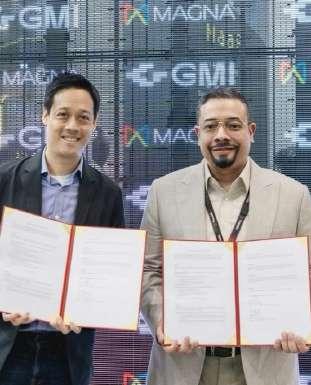
Alex Yeh, CEO of GMI Cloud and Dr. Moataz Binali, CEO of Magna AI.
CHECKOUT.COM AND NAHDI PARTNER TO DRIVE DIGITAL PAYMENT PERFORMANCE IN SAUDI AND ACROSS GCC
The partnership leverages Checkout.com’s advanced payment technology to support Nahdi’s e-commerce platforms, ensuring high performance and stability during peak demand periods.
Checkout.com, a leading global digital payments provider, today announced a strategic partnership with Nahdi Medical Company, Saudi Arabia’s largest retail pharmacy chain and an integrated Omnihealth platform. This collaboration will integrate Checkout.com’s cutting-edge payment acquiring and processing technology into Nahdi’s online platforms, optimising the digital payment experience and improving payment success rates for millions of its customers in KSA and across the GCC.
The partnership is focused on delivering a superior digital checkout experience for Nahdi’s customers, ensuring a frictionless journey for fulfilling their health, wellness, beauty, and other categories needs with a faster, more secure, and highly reliable payment platform.
Leveraging Checkout.com’s deep local expertise and advanced technology, this partnership maximises payment success rates and ensures unwavering stability during high-volume sales periods. This robust infrastructure supports Nahdi’s growing ecommerce operations and the rising demand for fast and easy digital transactions. By leveraging Checkout’s support for local payment methods and conversion capabilities such as Flow and Remember Me, Nahdi is removing payment friction and directly addressing the challenge of cart abandonment. This collaboration ensures millions of customers have effortless access to health products. It marks a significant milestone in the digital transformation of the region’s health and wellness sector, setting a new benchmark for digital payments.
Hossam Khattab, Chief Marketing and Commercial Officer at Nahdi said: “As we expand our ecommerce and omnichannel presence, providing a
fluid and secure payment experience is essential to maintaining a superior guest journey. This high-performing infrastructure ensures that every digital interaction reflects the quality of care our guests expect at every touchpoint. Our commitment is to provide high-quality medical products and services, and a reliable payment experience.”
He continued: “Partnering with Checkout.com allows us to elevate our online experience, making it as smooth and dependable as the service we provide in our pharmacies. Their strong on-the-ground presence in Saudi Arabia, combined with the capabilities of a global payment leader, brings significant added value, giving us access to both local expertise and world-class innovation. This strategic
collaboration ensures our digital infrastructure is built for scale, ready to meet the evolving needs of our customers and support our long-term growth ambitions in the region.” he added.
“By equipping Nahdi with the technology and insights they need to scale confidently, optimise performance, and deliver trusted, high-quality payment experiences to their customers, we help power their performance through payments, something we take great pride in. Our platform is built to handle the complexities of regional markets, from diverse payment preferences, helping Nahdi unlock new opportunities for growth across the GCC,” said Remo Giovanni Abbondandolo, General Manager, MENA, Checkout.com.
SAMSUNG AND GEMS FOUNDERS SCHOOL AL MIZHAR SIGN MOU TO JOIN SAMSUNG CERTIFIED SCHOOLS PROGRAM IN UAE
New partnership brings AI-enabled learning tools and educator training to GFM, extending Samsung’s growing network of certified institutions in the UAE
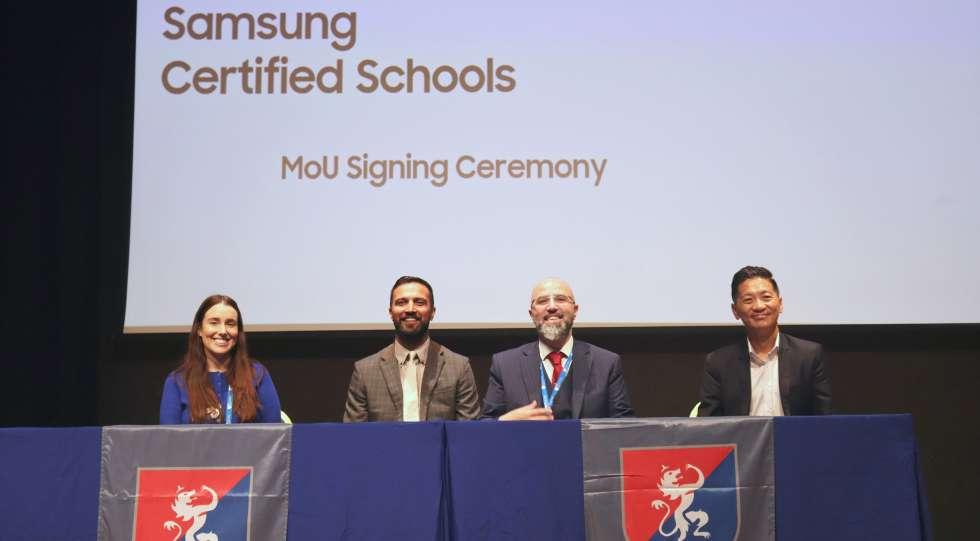
Samsung Gulf Electronics has signed a Memorandum of Understanding (MoU) with GEMS Founders School – Al Mizhar (GFM), bringing the school into the Samsung Certified Schools program. The partnership extends Samsung’s drive to embed AI tools, devices, and structured educator training into everyday classroom practice across the UAE.
Jerome Hong, President of Samsung Gulf Electronics, said: “Each new partnership reinforces what we’re seeing across the UAE. There’s a genuine, growing appetite for AI in education, and schools want it built into the way students learn, not bolted on. GFM joining the Samsung Certified Schools network strengthens that model and supports the goals set out in the UAE’s AI Strategy 2031. I’m proud of how this program continues to grow.”
Under the partnership, a dedicated Samsung AI Lab will be set up at
GFM, fitted with Samsung devices to support hands-on work in coding, machine learning, AI, and creative design. 200 students from the school will join the Samsung Student Ambassador program, an initiative that equips young people with the skills and confidence needed to lead digital change within their schools and communities.
Akram Tarik, Principal and CEO at GEMS Founders School Al Mizhar, added: “We are incredibly proud for GFM to join the Samsung Certified Schools network. This partnership reflects our commitment to preparing students for a rapidly changing world, where AI, innovation and digital confidence are essential. Through the Samsung AI Lab, Student Ambassador programme and educator training, we are creating meaningful opportunities for our students and teachers to use technology with purpose, creativity and responsibility.”
To prepare educators for this shift, 17 teachers from GFM will undergo specialised training under the Samsung Certified Educator credential. The program equips teachers to embed AI and digital tools meaningfully into daily lessons, moving beyond surface-level use to genuine classroom integration.
The partnership is aligned with the UAE’s Artificial Intelligence Strategy 2031 and reflects a shared commitment to the responsible, practical use of AI in education.
GFM becomes the third UAE school to join the Samsung Certified Schools network, after Dubai International Academy and Emirates International School Meadows. As the program continues to scale, Samsung’s wider ambition is to build a global network of institutions setting the bar for digital education, with the UAE rollout fast becoming the reference point for how that vision works in practice.
AVEVA AND AWS INK MULTI-YEAR STRATEGIC COLLABORATION TO ACCELERATE INDUSTRIAL INTELLIGENCE IN CLOUD
The agreement brings AVEVA’s industrial software portfolio to AWS, enabling customers to design, operate, and optimise industrial assets with greater efficiency, lower cost, and AI-powered insights.
AVEVA, a global leader in industrial software, and Amazon Web Services (AWS) have announced a multi-year Strategic Collaboration Agreement (SCA) to accelerate the delivery of industrial intelligence in the cloud. The agreement deepens the companies’ existing relationship and establishes a framework for joint technology development, go-to-market execution, and customer migration support across the global industrial sector.
Under the terms of the agreement, AVEVA will expand its CONNECT industrial intelligence platform on AWS, as part of its broader move to a multicloud architecture. By using services including Amazon Bedrock, Amazon Bedrock AgentCore, and Amazon Elastic Compute Cloud (Amazon EC2), AVEVA will deliver both public and private SaaS capabilities for industrial customers worldwide, accelerating this multi-cloud strategy and reinforcing AVEVA’s commitment to flexibility and scalability. The collaboration also encompasses listing AVEVA products on AWS Marketplace, joint customer migration programs, and a shared commitment to training and certification across both organisations.
AWS gives our customers even greater flexibility and scalability, empowering them to turn that data into intelligence that helps them design faster, operate smarter, and optimise continuously. AVEVA’s software sits at the heart of mission-critical operations for more than 20,000 enterprises across 150+ countries. This collaboration accelerates how the industrial world can harness cloud and AI with the freedom of choice they expect.”
Key Elements of the collaboration:
Programs: AWS and AVEVA will jointly deliver on migration and modernisation programs to help customers move AVEVA workloads to AWS, supported by a network of qualified OT System Integrator partners with deep expertise in industrial software deployment.
• AI and Analytics Integration: This integration will use AWS AI and machine learning services alongside AVEVA’s industrial data platform to deliver advanced predictive analytics, digital twin capabilities, and agentic AI workflows for industrial operations for better decision making
• Endorsed System Integrator Program: AWS and AVEVA will jointly support a network of specialised OT System Integrators, the partners who deploy, configure, and maintain industrial software for joint customers, with migration funding, technical enablement, and joint go-tomarket resources.
By bringing CONNECT and the broader AVEVA portfolio to AWS, the two companies aim to give industrial customers a faster, more scalable path to cloud-native operations, reducing the complexity and cost of managing on-premises infrastructure while enabling new AI-driven capabilities that were previously impractical at scale.
“Industrial companies are sitting on decades of operational data that holds enormous, untapped value,” said Rob McGreevy, Chief Product Officer, AVEVA. “As AVEVA advances its multicloud strategy, building CONNECT on
• CONNECT on AWS: AVEVA will build and operate CONNECT on the AWS infrastructure, delivering public and private SaaS capabilities for industrial customers across energy, manufacturing, chemicals, life sciences, infrastructure, mining, marine, and EPC sectors.
• AWS Marketplace Expansion: AVEVA will list key products on AWS Marketplace enabling customers to procure AVEVA software through their existing AWS agreements, by the end of the year.
• Joint Customer Migration
“AVEVA’s deep domain expertise and mission-critical software make them a natural fit for AWS as we work together to bring the benefits of cloud computing to the industrial sector,” said Uwem Ukpong, Vice President of AWS Industries, Amazon Web Services. “Together, we will help industrial companies around the world accelerate their digital transformation, reduce costs, and unlock new insights from their operational data using the breadth and depth of AWS services.”
AVEVA’s software already helps customers monitor, analyse, and optimise their processes and energy consumption across complex industrial operations. By running on AWS, these capabilities can scale globally, integrate with broader enterprise data
Rob McGreevy, Chief Product Officer, AVEVA.
systems, and leverage cloud-native AI to deliver continuous efficiency improvements.
AVEVA’s CONNECT platform currently manages over 8 petabytes
of trusted industrial data including reality capture, engineering, and production data serving more than 23,000 active monthly users across 50+ SaaS applications. The PI System,
AVEVA’s real-time operational data infrastructure, is deployed at 65% of Fortune 500 industrial companies and captures the time-series data that forms the foundation for industrial AI.
DXC AND ANTHROPIC SIGN MULTI-YEAR GLOBAL ALLIANCE TO BRING AI INTO MISSION-CRITICAL ENTERPRISE SYSTEMS
DXC Technology, a leading enterprise technology and innovation partner, has announced a multi-year global partnership with Anthropic, the AI safety company and creator of Claude. Through this joint initiative, DXC becomes one of the few Global Premier partners in the Claude Partner Network.
Together, the companies will train a dedicated workforce of tens of thousands of forward-deployed, Claude-certified engineers and builders to bring Claude models into production inside the missioncritical technology infrastructure systems DXC operates for the world’s largest banks, airlines, insurers, manufacturers, and government agencies.
The alliance builds on DXC’s existing use of Claude in its own operations, including as the primary development tool used to build DXC OASIS, the company’s AI-native orchestration platform for managed services. Using Claude models, DXC accelerated DXC OASIS software delivery by an estimated 10x, with more than 95% of code generated by Claude before human review. Claude now serves as the default foundation model powering DXC OASIS’s agentic workflows. Launched in April 2026, DXC OASIS is currently deployed across more than 50 customers and will be rolled out across the DXC global customer base.
The alliance and its investments are built around DXC Xponential, the company’s AI blueprint that connects technology with people and processes — while the Anthropic partnership strengthens it with certified Claude expertise and direct access to
Anthropic’s resources.
“DXC helps the world’s largest banks, airlines, insurers, and government agencies put new technology to work. They proved Claude inside their own operations first, under the same security and compliance requirements their customers face. Now we’re bringing Claude inside those environments together, industry by industry, with engineers who have already done it themselves,” said Paul Smith, Chief Commercial Officer, Anthropic.
“For more than fifty years, DXC and the companies it was built from run the systems that run the world. We know what it takes to deliver in these environments. This alliance with Anthropic combines trust and experience with the most advanced AI
technology available and gives our customers something they cannot get anywhere else. We are already using Claude across our own operations and our new DXC OASIS platform. Now we are scaling that capability directly into the mission-critical technology systems we run for our customers. This is a defining moment for DXC and for the industry,” said Raul Fernandez, President & CEO, DXC Technology.
Forward-Deployed Engineers: Recruited by DXC, Certified by Anthropic
At the center of the alliance, DXC is establishing a dedicated team of forward-deployed engineers to work directly inside customer environments. These engineers will be selectively recruited from DXC’s existing engineering talent, trained and certified in 90 days through the Anthropic Partner Academy, receiving persistent, daily access to Claude and progressing through increasingly rigorous levels of proficiency in designing, deploying, and governing agentic AI systems. DXC has also developed additional certification curriculum to enhance its engineers’ capability to operate in mission-critical environments.
The model reflects DXC’s Customer Zero philosophy: the company validated Claude inside its own operations first, under productiongrade security and compliance requirements, before bringing that capability to customers.
What’s Next: New Offerings
Initial focus areas include insurance, cybersecurity, and application services, where DXC brings significant domain
Raul Fernandez, President & CEO, DXC Technology.
and operational expertise, and Claude’s agentic AI capabilities can deliver value fastest inside customers’ missioncritical environments.
• Insurance: Across organisations, DXC will leverage Claude to deploy agentic solutions and transform core systems aligned to each firm’s unique context, operating model, and strategic intent.
• Modernisation as a Service (MaaS): DXC is using Claude to accelerate large-scale code modernisation for enterprise customers, applying agentic AI to analyse, refactor, and transform legacy codebases faster and with greater accuracy than traditional approaches.
• Cybersecurity: DXC OASIS security engineer sub-agent built on Claude Security will give DXC’s cybersecurity team a
decisive edge by deploying Claude across security operations centers (SOCs), realising always-on, AIdriven cyber resilience.
• Application Services: DXC is leveraging Claude to develop Anthropic-certified DXC OASIS agents designed to embed Claude directly into the enterprise application maintenance and management environments DXC operates for its customers.
AJMAN TRANSPORT AUTHORITY, E& TO ADVANCE AI APPLICATIONS IN TRANSPORT
The deal gives EDGE direct access to more than 35 years of piston engine manufacturing excellence in Southern Italy, laying the foundation for a high-quality European engine production base and strengthening the group's global propulsion capabilities across aeronautical, automotive and marine applications.
Ajman Transport Authority has signed a Memorandum of Understanding (MoU) with e&, on the sidelines of the 3rd Annual Government Cybersecurity Summit 2026, to strengthen collaboration in digital innovation and artificial intelligence, supporting the continued development of the transport ecosystem and corporate services.
The agreement was signed by Ahmed Saqr Al Matrooshi, Acting Director General of Ajman Transport Authority, and Saood Karmostaje Acting Chief Executive Officer – Government and VIP Segment, on behalf of e&.
The agreement aims to leverage advanced technologies to enhance operational efficiency and service quality by exploring agentic AI applications that support back-office functions, including automating human resources and finance processes, responding to employee inquiries, supporting leave and payroll management, and contributing to financial reporting.
Ahmed Saqr Al Matrooshi said that the agreement marks a strategic step toward accelerating the adoption of advanced technologies in the transport sector, emphasising the Authority’s commitment to leveraging AI solutions to enhance operational performance
Ahmed Saqr Al Matrooshi, Acting Director General of Ajman Transport Authority, and Saood Karmostaje Acting Chief Executive Officer –Government and VIP Segment, e&.
and elevate service quality.
He added that the partnership will contribute to building a more agile and innovative operating environment by harnessing modern technologies in smart planning, data analytics, and user experience enhancement, while also supporting the development of national capabilities in artificial intelligence. He indicated that this agreement reflects the Authority’s commitment to strengthening cooperation with its strategic partners,
supporting digital transformation directions, and contributing to achieving the Government of Ajman’s vision for smart and sustainable government services.
Saood Karmostaje, Acting Chief Executive Officer – Government and VIP Segment, e& UAE, said: “This Memorandum of Understanding reflects our shared focus on applying advanced technologies in ways that create practical value for the transport sector. By combining e& UAE’s
capabilities in AI, data, connectivity and digital services with Ajman Transport Authority’s vision for smarter mobility, we aim to support more efficient operations, stronger service delivery and better experiences for employees and customers. We look forward to working closely with the Authority to identify scalable AI use cases that contribute to a more agile, data-driven and sustainable transport ecosystem.”
It also includes the development and assessment of smart solutions for planning and scheduling bus routes through the analysis of operational and passenger data, helping to improve fleet efficiency, enhance capacity planning, and deliver more flexible and sustainable transport services. In addition, the agreement covers the use of AI in video and behavioural analysis using computer vision technologies
to support passenger flow monitoring, strengthen compliance with safety standards, improve crowd management, and enhance operational oversight across the Authority’s facilities and networks. In the area of capacity building, the MoU outlines opportunities to develop specialised AI training programs aimed at upskilling employees and preparing them to meet the demands of digital transformation.
DUBAI INSURANCE AND SLASHDATA TO ENHANCE DIGITAL SERVICE DELIVERY THROUGH WTHEEQ
SlashData, a leading UAE-based govtech company, has announced a strategic partnership with Dubai Insurance to enhance digital service delivery through the adoption of Wtheeq, its digital platform for policy issuance and data verification.
As the insurance industry evolves, insurers are increasingly investing in digital platforms that reduce administrative complexity and enhance customer experiences. Through Wtheeq, Dubai Insurance will digitise policy issuance and documentation across its motor insurance operations, supporting data accuracy, instant verification, and regulatory compliance.
Delivered in partnership with the Integrated Transport Centre and Abu Dhabi Police, Wtheeq enables secure information exchange across the UAE’s mobility ecosystem. The platform also supports the UAE’s Zero Government Bureaucracy Program by enabling connected, user-centric, and fully digital government services.
Thamer Alfallaj, CEO of SlashData, said: “As demand for digital services continues to grow across the insurance sector, the ability to deliver those services efficiently and at scale is becoming increasingly important. Through Wtheeq, we help automate and streamline critical insurance processes reducing administrative workloads and enabling teams to focus on customers, risk management, and business growth.”
Abdellatif Abuqurah, CEO, Dubai Insurance, said: “Digital innovation is at the heart of Dubai Insurance’s strategy. We continuously seek partnerships that enhance customer experience, simplify processes, and strengthen our operational capabilities. Our collaboration with SlashData and the integration of Wtheeq demonstrate our commitment to leveraging technology to deliver faster, smarter, and more seamless insurance services. By connecting our systems directly with key government platforms and enabling real-time policy issuance, we are creating a more efficient and
customer-focused insurance journey while reinforcing our position as a leading innovator in the UAE insurance market.”
The partnership reflects a broader shift across the insurance industry toward digital platforms that simplify service delivery and improve operational efficiency. Through Wtheeq, SlashData continues to support the advancement of mobility and insurance services across the UAE.
SlashData is a First.tech company and part of Judan Financial Holding, IHC’s dedicated financial services platform.
Thamer Alfallaj, CEO of SlashData and Abdellatif Abuqurah, CEO, Dubai Insurance.
NTT DATA, NUTANIX TO ACCELERATE HYBRID CLOUD AND AI INFRASTRUCTURE MODERNISATION
NTT DATA, a global leader in AI, digital business and technology services, and Nutanix, a global cloud computing company that specialises in hyperconverged infrastructure, have established a strategic partnership to accelerate hybrid multicloud adoption, infrastructure modernisation and AI readiness in Middle East and Africa (MEA).
Across MEA, organisations are increasingly prioritising infrastructure that can support long term innovation. Hybrid cloud, AI and data sovereignty are no longer isolated trends, but interconnected pillars shaping the future of enterprise technology. NTT DATA and Nutanix work together to combine their expertise in systems integration and cutting-edge cloud software to help businesses modernise their infrastructure with confidence.
The collaboration also supports the adoption of AI by enabling organisations to deploy and test workloads in secure, private environments, helping address concerns around cost, control and compliance.
The relationship aligns with NTT DATA’s broader growth strategy in MEA, enhancing its full-stack offering and expanding its position in large enterprises across the region.
“This partnership reflects our shared commitment to helping organisations modernise, deliver simplified, secure and scalable infrastructure that responds to the real challenges our clients are facing.” said Hani Nofal, Executive, Head of Technology Solutions Middle East and Africa, NTT DATA. “Together, we can co-create
TOGETHER, WE CAN CO-CREATE TAILORED SOLUTIONS, STRENGTHEN REGIONAL ECOSYSTEMS AND ADVANCE AI INITIATIVES THAT DELIVER CLEAR BUSINESS OUTCOMES.
HANI NOFAL, EXECUTIVE, HEAD OF TECHNOLOGY SOLUTIONS MIDDLE EAST AND AFRICA, NTT DATA.
tailored solutions, strengthen regional ecosystems and advance AI initiatives that deliver clear business outcomes.”
“By combining Nutanix’s simplified, software-defined, one platform approach and NTT DATA’s trusted client relationships, we aim to reduce complexity, lowers costs and accelerate innovation to deliver faster transformation outcomes at scale.” said Mohammad Abulhouf VP and GM Nutanix.
By working together, NTT DATA and Nutanix are reinforcing a collaborative approach to infrastructure modernisation, NTT DATA continues to position itself at the centre of this transformation, supporting organisations as they modernise with confidence, scale efficiently and realise greater value from their digital investments.
Hani Nofal, Executive, Head of Technology Solutions Middle East and Africa, NTT DATA.
INTO NEW WORLDS YOU’RE
ONE LEAP AWAY
From 31 Aug - 3 Sept 2026 Riyadh Exhibition and Convention Center - Malham, Saudi Arabia
FROM EXPERIMENT TO ENTERPRISEWIDE AI
New research shows Gulf CEOs carry the heaviest personal risk on AI of any market, and the opportunity for partners is shifting from selling AI to making it defensible.
Ayear ago, the sharpest fear in the office was falling behind on artificial intelligence.
Now it is being personally blamed for it. AI has stopped being an innovation story and become a performance mandate, embedded in decisions, tied to revenue expectations, scrutinised by boards and increasingly linked to chief executive tenure.
New global research from Dataiku and The Harris Poll, which surveyed 900 chief executives including 100 in the UAE, puts hard numbers on the shift. Eighty per cent of CEOs say their role will be at risk if their company fails to deliver measurable business gains from AI by the end of 2026, and 77 per cent believe a chief executive will be ousted this year because of a failed AI strategy or an AI-driven crisis. Conviction has hardened into expectation, and the consequences are no longer theoretical.
Nowhere is that pressure more personal than in the Gulf. Twentythree per cent of UAE chief executives say AI is jeopardising their long-term legacy, more than double the 10 per cent global average and among the highest of any region surveyed. Ambition across the region remains high, but confidence in the upside is less certain and awareness of the downside is significantly more pronounced. For UAE leaders, AI has become a reputational bet where the upside is career-defining and the downside is equally visible.
For the channel, that combination of high ambition and high anxiety is the
opening. The winning partner in 2026 is not the one selling the most AI, but the one helping leaders govern it, prove it and defend it. Value is moving from deployment to defensibility, and the region is where that move matters most.
Confidence is recalibrating, not collapsing
On the surface, chief executives still project control. Yet the research exposes a contradiction at the heart of enterprise AI: it is everywhere, but command of it is nowhere. More than half (56 per cent) now admit that competitors have deployed AI strategies they consider superior to their own, a quiet but telling signal that leadership confidence is starting to crack.
“Every enterprise now has access to powerful AI. The differentiator is whether they can turn that power into reliable business decisions,” said Florian Douetteau, CEO and co-founder of Dataiku. “That is the cognitive dissonance happening in the C-suite right now: CEOs are staking their jobs on AI, but still questioning its outputs and struggling to control the systems they say they own. The companies that close that gap will be the ones building AI worth being accountable for. That is what separates a bet from a business.”
Boards are sharpening that dissonance. Sixty-two per cent of CEOs globally say their board is actively applying pressure to deliver measurable AI-driven outcomes, and the share of leaders describing themselves as extremely confident in deploying AI agents in production has slipped from 41 per cent in 2025 to 31 per cent in 2026.
A parallel study from the IBM Institute for Business Value, drawing on insights from 100 surveyed Middle East chief executives within a global survey of 2,000, captures the same tension from the angle of how leaders
are responding.
In the foreword, IBM Vice Chairman Gary Cohn writes, “The CEO’s role has always been to lead through disruption. What AI changes is the velocity and consequences of leadership. Enterprises that succeed will operate AI-first – not as a layer of technology, but as a new operating model. Decision cycles will compress. Boundaries between functions will dissolve. Advantage will accrue to those who can learn, adapt, and execute faster than their competitors.”
Velocity, in other words, is no longer the constraint. Control is.
Control beats capability
Asked what matters most for AI success, chief executives rank governance (39 per cent) ahead of people (34 per cent) and orchestration (28 per cent), a clear signal that control, not capability, is now the limiting factor. AI may inform decisions, but it does not yet own them. More than half of CEOs keep humans in the loop on business-critical calls, and most report at least occasionally demanding justification for AI-driven recommendations.
The Gulf sits at the sharp end of this trust gap. Confidence in explaining AIdriven business decisions to regulators or courts runs 10 percentage points below the global average in the UAE (69 per cent versus 79 per cent), the lowest of any region. The capability to defend an outcome is becoming a core requirement rather than a technical
ACROSS THE MIDDLE EAST, CEOS ARE MOVING FROM AI EXPERIMENTATION TO ENTERPRISEWIDE TRANSFORMATION. LULA MOHANTY, MANAGING PARTNER, MIDDLE EAST AND AFRICA, IBM CONSULTING.
nicety, and in the region it is the least established.
“The CEOs who succeed are those who treat governance as an accelerator, not a constraint,” said Sid Bhatia, Area Vice President & General Manager – Middle East, Turkey & Africa at Dataiku. “Organisations need the flexibility to adapt quickly, whether that means evolving models, changing vendors, or responding to new regulations without starting from scratch. Ultimately, this research suggests that in an environment where AI outcomes must be proven, explained, and defended, governance is becoming the foundation for both trust and long-term value.”
For resellers, integrators and managed service providers, the implication is direct. Demand is moving towards explainability frameworks, model governance, audit trails and the oversight tooling that lets a leader stand behind a decision an algorithm shaped. Partners who can operationalise governance, not merely deploy a model, become indispensable to a chief executive whose job depends on the answer.
Vendor and ROI reckoning
The financial narrative has flipped too. For two years the dominant fear was moving too slowly. Now the greater fear is betting big on the wrong players. Nearly two-thirds of CEOs (65 per cent) say they worry more about over-investing in AI amid intense vendor competition and no clear market leader than about underinvesting. AI is no longer a blank cheque; it is a budget line item under scrutiny, with steadily rising return-oninvestment requirements.
Revenue growth has emerged as a leading measure of AI success, climbing from 16 per cent of responses in 2025 to 28 per cent in 2026, nearly level with productivity gains. The question has changed from “are we investing enough” to “are we investing in the right things, and can we prove it”.
The exposure is structural. Over three quarters of CEOs (76 per cent) believe their organisation is overly exposed to operational or strategic risk because of reliance on too few AI vendors. Vendor-agnostic orchestration is the channel’s growth engine here.
Partners able to assess a sprawling AI estate, untangle lock-in, run proofof-value exercises and tie spend to measurable outcomes are selling exactly what the boardroom now demands.
Who signs off on all of this is changing fast. IBM’s regional findings show 67 per cent of surveyed Middle East organisations now have a Chief AI Officer, and 85 per cent agree that AI sovereignty is essential to business strategy. Eighty-six per cent say all functional leaders must become technology experts in their domain, and 54 per cent expect the influence of the chief human resources officer to increase.
Decision-making power is dispersing accordingly. In the UAE, nearly one in five chief executives (19 per cent) say the Chief Data Officer has the greatest influence on AI strategy, more than three times the 6 per cent global average and the highest share of any market surveyed.
Lula Mohanty, Managing Partner, Middle East and Africa, IBM Consulting, frames the regional moment. “Across the Middle East, CEOs are moving from AI experimentation to enterprise-wide transformation,” she says. “The organisations seeing the greatest impact are not treating AI as a standalone technology initiative. They are redesigning how leadership teams operate, how decisions are made and how people are empowered to adopt AI responsibly. This balance of
technology, talent and governance will be critical as businesses look to scale AI with trust and measurable value.”
Adoption remains the soft underbelly. IBM finds only 25 per cent of the regional workforce using AI regularly, even though 81 per cent of CEOs believe their employees have the skills to collaborate with it. Shadow AI compounds the gap: 96 per cent of chief executives globally believe staff are using generative tools without approval. A wider, more technical set of stakeholders, paired with unmet needs around adoption and shadow-AI
ORGANISATIONS NEED THE FLEXIBILITY TO ADAPT QUICKLY, WHETHER THAT MEANS EVOLVING MODELS, CHANGING VENDORS, OR RESPONDING TO NEW REGULATIONS WITHOUT STARTING FROM SCRATCH.
SID BHATIA, AREA VICE PRESIDENT & GENERAL MANAGER – MIDDLE EAST, TURKEY & AFRICA, DATAIKU.
governance, hands the channel a richer map of people to sell to and problems to solve.
From deployment to defensibility
The thread running through both studies is a single reversal. The constraint on enterprise AI is no longer speed but control, and the companies that succeed in this next phase will not be the ones that scale AI the fastest, but the ones that can govern it, measure it and prove its impact under scrutiny.
For the channel, the mandate is clear. The job is no longer to push AI out the door but to help leaders govern, prove and defend it across a multi-vendor estate and a fragmenting buying centre. In the Gulf, where ambition and personal risk are both at their peak and sovereignty is non-negotiable, the partner who becomes the trusted governance and orchestration advisor wins the relationship. 2026 is the year the channel’s value shifts from selling speed to selling certainty, and the safety net it offers may be the most strategic product it has.
Give to gain. Powering women in tech Gala Dinner Event
In alignment with International Women’s Day 2026, TahawulTech.com, organised by CPI, invites you to the Women in Technology Forum & Awards 2026 — a flagship platform dedicated to advancing leadership, inclusion, and impact across the technology ecosystem.
The forum brings together CEOs, technology decision-makers, innovators, policymakers, and trailblazers to explore how organisations that actively invest in women — through mentorship, leadership pathways, skills development, and visibility — gain stronger innovation, resilience, and long-term growth.
Whether you are a technology leader, changemaker, or organisation committed to shaping a more inclusive digital future, this forum offers a powerful space to contribute, connect, and lead.
We look forward to welcoming you to Dubai this April as we come together to Give to Gain.
OFFICIAL PUBLICATIONS
For more information about the event and nomination details, please visit the event website below :https://www.tahawultech.com/women-in-tech/2026/ Dubai 2026 6:00 PM onwards
HOSTED BY
STORAGE WILL DECIDE WHICH AI STRATEGIES ACTUALLY SCALE
Seagate’s Sameer Bhatia on why data strategy, not compute alone, will decide which organisations scale AI successfully across the Middle East.
Much of the conversation around artificial intelligence centres on GPUs, compute power and model performance. Sameer Bhatia, Senior Regional Director for India, Middle East, Turkiye and Africa at Seagate, argues that this focus overlooks the layer holding everything together.
Every AI interaction rests on a physical infrastructure stack, and storage sits at its core. From training and inference through to checkpointing and archiving, each stage of the AI lifecycle depends on the ability to store, access and move vast volumes of data efficiently. With agentic AI turning simple prompts into always-on workflows, the pressure on that infrastructure is growing continuously.
For the Middle East, where sovereign AI initiatives, hyperscale data centres and digital transformation programmes are advancing at pace, Bhatia makes the case that storage strategy must be aligned with AI strategy from the outset. In the following excerpts, he explains why mass-capacity storage has become critical, how Seagate’s Mozaic platform addresses density and sustainability, and what partners should be doing now to future-proof infrastructure for the decade ahead.
Interview Excerpts
How critical is storage infrastructure to making AI actually work at scale?
Storage is foundational to AI at scale because AI is fundamentally driven by data. Put simply, AI does not exist
without data, and data does not exist without storage. Behind every AI interaction is a physical infrastructure stack — compute, networking, energy, cooling, and storage — working together to make AI possible at scale. Every stage of the AI lifecycle, from training and inference to checkpointing and archiving, depends on the ability to efficiently store, access, and move massive volumes of data.
The challenge is no longer just about compute performance. AI continuously generates and reuses data, putting growing pressure on infrastructure. As agentic AI turns simple prompts into always-on workflows, the volume of data that needs to be retained, accessed, and managed grows significantly and continuously. Organisations need storage solutions that can keep pace with this exponential data growth while remaining cost-effective, resilient, and energy efficient, without requiring constant architectural changes. Ultimately, the success of any AI strategy depends on how effectively organisations can manage, store, and extract value from their data over time.
How are AI workloads changing the way organisations think about their data storage strategy?
AI is shifting storage conversations from capacity planning to data strategy. At the center of that shift is a growing recognition that data is no longer simply a byproduct of business operations — it is a strategic asset. The question organisations are increasingly asking is not whether their data has value, but how much value they can derive from it over time. Once that
value is recognised, the need to store, protect, and keep data accessible becomes critical.
This is reshaping how organisations approach storage infrastructure. Modern AI environments require seamless movement between performance and capacity tiers, making flexibility essential. It is driving greater adoption of tiered architectures where object, file, and block storage work alongside high-capacity hard drives to balance performance, scalability, and total cost of ownership. Data governance, retention, and accessibility are no longer secondary considerations. They are becoming strategic priorities that directly influence how effectively organisations can scale and operationalise AI.
What is the defining infrastructure challenge of this decade as businesses invest in AI and integrate it within their operations end-to-end?
The defining infrastructure challenge of the AI era is scaling data infrastructure sustainably and economically. While the industry focus has centered on GPUs and compute performance, AI growth is also creating pressure across the full infrastructure stack — including storage capacity, energy consumption, physical footprint, and operational efficiency. AI is evolving beyond training into production-scale deployment and inferencing, creating continuous data generation across enterprise systems, video platforms, industrial operations, and autonomous technologies. As agentic AI expands, the amount of data that needs to be stored, retained, and continuously
accessed will grow significantly. This is where mass-capacity storage becomes critical. Approximately 87% of data in large cloud data centers resides on hard drives — not because they are legacy infrastructure, but because at global scale, economics matter. Cost and energy per terabyte, along with capacity per rack, directly influence long-term infrastructure efficiency and total cost of ownership.
Seagate’s Mozaic platform, built on HAMR (Heat-Assisted Magnetic Recording) technology, is designed to address this challenge by significantly increasing storage density. HAMR uses precision laser technology to heat a microscopic spot on the disk during the write process, allowing data to be recorded at far higher densities without increasing the size of the drive. The result is more capacity per drive, fewer drives per rack, lower power consumption, and a smaller physical footprint. With Mozaic, organisations can expand storage within their existing infrastructure, without disruptive architectural changes.
With our latest generation Mozaic 4+ supports capacities up to 44TB per drive. Each density milestone is achieved within the same form factor, meaning organisations can expand storage capacity without changing their existing data center architecture. We also have a clear roadmap toward 100TB class drives, giving customers the long-term predictability that infrastructure planning requires.
The objective should not be performance at any cost. It should be building production-scale AI environments that balance performance, capacity, sustainability, and total cost of ownership over the long term.
What should partners and customers in the Middle East be doing today to future-proof their storage infrastructure for the next five to ten years?
The priority should be building flexible and scalable infrastructure designed for long-term data growth, not just short-term AI projects.
The Middle East is moving quickly to build AI infrastructure at scale, with growing investments in sovereign AI initiatives, hyperscale data centers,
Sameer Bhatia, Senior Regional Director, India, Middle East, Turkiye and Africa, Seagate Technology.
and digital transformation programs. As AI adoption accelerates across the region, organisations will need to plan for significant long-term growth in data creation, retention, and management.
This makes it essential to align storage strategy closely with AI strategy from the beginning — including considerations around capacity planning, data governance, performance, sustainability, and total cost of ownership.
A key part of that alignment is being intentional about data value. Organisations need to understand what
data they have, what value it holds, and how that value compounds over time. Those insights should inform retention and infrastructure decisions, not just storage capacity planning.
From Seagate’s perspective, the most effective strategy is combining the right mix of storage technologies with scalable, high-capacity infrastructure that can grow with data demands without requiring disruptive architectural changes. The partners who get this right will be the ones that view storage not as a commodity, but as a long-term strategic enabler of their customers’ AI ambitions.
LIFERAY CHAMPIONS COMPOSABLE PLATFORMS FOR NEXT ERA OF CUSTOMER EXPERIENCE
Ahmed Saad, Regional Sales Manager, Liferay, explains why composable digital experience platforms, AIdriven personalisation, and trust-based governance are becoming essential for enterprises seeking to reduce friction, improve self-service journeys, and build resilient customer experiences in the Middle East.
Digital experience has emerged as a critical differentiator for organisations across the Middle East as customer expectations continue to evolve in an increasingly connected and AI-driven economy. Enterprises have accelerated investments in automation, self-service platforms, and digital channels, but many still struggle with fragmented customer journeys, abandoned interactions, and disconnected systems that undermine engagement and trust.
The growing emphasis on personalisation, data privacy, and regulatory compliance is reshaping how organisations design and deliver customer experiences. Ahmed Saad, Regional Sales Manager at Liferay, discusses the challenges behind customer abandonment, the growing importance of composable digital experience
Ahmed Saad, Regional Sales Manager, Liferay.
platforms, and how enterprises can balance automation, AI, governance, and human interaction to build resilient, future-ready digital journeys that drive long-term business value.
Interview Excerpts
How is customer abandonment reshaping digital success metrics and where are selfservice journeys breaking down across Middle East enterprises?
In the Middle East, customer abandonment is the ultimate metric for digital convenience. Organizations now prioritize frictionless journey completion over mere traffic. However, self-service often fails due to fragmented authentication and disconnected systems, forcing users to restart processes or abandon interactions when redirected to external login screens.
As expectations rise in the UAE and Saudi Arabia, enterprises are adopting unified architectures. Liferay DXP addresses this as an orchestration challenge, integrating data and systems to transform abandonment from a behavioral hurdle into a solvable business issue through seamless, connected experiences.
Has the drive for automation and cost-efficiency come at the expense of customer experience, and what role does journey design play in rebuilding engagement?
Rapid automation often sacrifices context, leading to rigid and impersonal experiences. While users accept self-service, they demand intuitive, relevant journeys and grow fatigued by fragmented support that fails to transition seamlessly between digital and human assistance. Effective journey design focuses on human behavior rather than internal structures. Liferay unifies content, data, and applications to provide context-aware experiences across all touchpoints. This allows organizations to surface relevant resources or human support at precise moments, moving away from rigid, one-size-fits-all flows.
AI-driven responsiveness creates
adaptive interactions that reduce customer effort. For regional enterprise leaders, this automation must exist within a governed framework ensuring data privacy and compliance with UAE and Saudi Arabian PDPL regulations, maintaining trust alongside personalization.
Why are composable digital experience platforms becoming critical for adaptive, resilient customer journeys in a fragmented landscape?
Enterprises today operate in increasingly complex digital environments, where systems, platforms, and customer touchpoints evolve simultaneously. In this environment, organisations can no longer rely on large-scale rebuild cycles every time customer expectations or business priorities shift. This is why composable digital experience platforms like Liferay DXP are becoming critical, enabling businesses to evolve incrementally, integrate existing investments, and respond faster to changing market demands. Liferay’s open, API-first architecture connects enterprise systems such as CRM, ERP, commerce, and service platforms into a unified experience layer, giving organisations the flexibility to adapt experiences without disrupting the wider ecosystem. As AI reshapes digital engagement, composable architectures also support more adaptive experiences through dynamic content, personalised journeys, and intelligent interactions. In a region accelerating towards AI-led digital economies, flexibility and interoperability are becoming strategic advantages rather than simply technical preferences.
How can organisations balance personalisation, automation, and human intervention without compromising customer privacy and trust?
The balance in digital experiences lies in being contextually intelligent, transparent, and respectful of customer boundaries rather than overly data-driven or intrusive. While customers increasingly expect personalised experiences, they also
expect organisations to handle their data responsibly. Trust erodes quickly when personalisation feels invasive or when customers lose visibility into how their information is being used. Organisations should focus on using first-party data, behavioural signals, and contextual relevance to reduce friction and make journeys easier, rather than over-optimising every interaction.
At the same time, human intervention continues to play an important role, particularly during complex or sensitive interactions. The goal is to create seamless transitions between automated and assisted experiences. Liferay supports this through secure, role-based experiences, integrated workflows, and governance frameworks that help organisations maintain privacy, compliance, and transparency while delivering more connected and personalised journeys. Ultimately, trust is built when customers feel supported and understood, rather than monitored.
What practical steps should leaders take today to futureproof their digital experience strategies for the decade ahead?
Digital experience is now a core business capability vital for retention and agility. Companies must evaluate their ecosystems to resolve fragmentation that causes inconsistent internal and external experiences.
Flexible, composable architectures allow businesses to scale without disruption. Selecting the right deployment model managed cloud, partially managed, or self-hosted is a critical first step to futureproofing a strategy and streamlining implementation.
Speed of implementation is essential for AI-driven experiences. Liferay provides the flexibility to deploy adaptive content and intelligent interfaces today without being hindered by rigid architectures.
As AI and data usage grow, strong governance and responsible practices will be key differentiators. Successful organisations will focus on reducing friction and building trust to meet evolving customer expectations.
WHY YOUR NEXT CAREER MOVE SHOULD BEGIN LONG BEFORE LAYOFF
Sebastian Scott, Co-Founder and CEO of Clera, on the end of cyclical layoffs, the collapse of the traditional job board, and why continuous representation is becoming essential for every tech worker.
Layoffs have become a permanent feature of the technology sector rather than a passing phase, and the infrastructure built to help people navigate them has not kept pace. Clera is building an AI agent that represents workers continuously, benchmarking their pay, tracking hiring signals and surfacing roles before a crisis forces a search. The premise is that the strongest career moves happen from a position of leverage, well before any redundancy.
Sebastian Scott, Co-Founder and CEO of Clera, shares why the old job market has broken and how continuous representation could reshape the way careers are managed.
Interview Excerpts
Why do you believe layoffs are no longer cyclical events but a structural reality of the modern workforce?
Cyclical implies a return to baseline, and what we are watching is structural rewiring rather than a cycle. AI has changed the unit economics of building a company. Teams that once needed fifty engineers now ship with fifteen, and the work has concentrated rather than disappeared. The market has stopped rewarding growth at all costs, so continuous workforce optimisation is now praised rather than apologised
for. The social contract has broken on both sides, with companies cutting jobs in record profit quarters and employees no longer treating any role as permanent. Workers should plan for a transition every two to three years.
What are the biggest limitations of traditional job boards in today’s AI-driven employment landscape?
The honest answer starts with an asymmetry most people never see. Companies have poured huge investment into recruiting infrastructure, while the candidate has a resume and a search bar. Job boards were built for scarcity, yet a single posting now attracts thousands of applicants within hours, most of them AI generated. Three layers have broken. The matching layer fails because applicant tracking systems filter on keyword match and screen out qualified people. The signal layer fails because an AI resume tells you nothing. The relationship layer fails because recruiters are being laid off. Neither side wins, and volume is being met with more volume.
How is AI transforming career navigation from reactive job hunting to proactive long-term planning?
The old model was binary. You either had a job or you were looking for one,
and search was an emergency you sprinted through. Career navigation has always been reactive by necessity. You wait until you are unhappy or laid off, then scramble, making one of life’s biggest decisions from urgency with no market intelligence. The roles worth having are filled through introductions, not applications. Executives get called. AI can now extend that mechanism to everyone. With Clera, your agent works continuously in the background, benchmarking your compensation and surfacing opportunities before you need them. Companies start applying to you.
Which industries or skill sets do you believe are most vulnerable to continuous disruption over the next five years?
I would push back on the framing. AI is not making jobs disappear so much as multiplying leverage, which changes the question from which jobs vanish to who holds the leverage. Work that once needed a team of ten now needs three people with AI tooling, and those three are the ones who compound their output. The real vulnerability is not a sector or a title. If your value is executing the task, that is compressing fast, because the task is what AI absorbs. If your value is directing the leverage and owning the outcome, you become far more valuable. Representation matters more now.
YOU STOP APPLYING TO COMPANIES AND COMPANIES START APPLYING TO YOU.
Sebastian Scott, Co-Founder and CEO, Clera.
How does Clera balance AIdriven career recommendations with the human and emotional impact of job loss?
This is the question I think about most. Losing a job is hard, especially when families are involved, and no AI
matching fixes the grief. Any product that pretends otherwise is being dishonest. What AI can do is remove the friction, the 300 applications into the void, the silence, the endless resume rewrites. The bigger shift is moving the work upstream, because
the best move comes before a layoff, while you still have leverage. Even when you are happy, your agent tracks the market and benchmarks your comp. The AI handles the infrastructure and timing. You handle the human part.
VEEAM RESEARCH FINDS AI’S PROMISE IS COLLIDING WITH A DATA AND AI TRUST GAP
New global C-level study finds 48% of executives say trusted, secure data could unlock 25%+ revenue growth yet only 7% of organisations are truly AI-ready
Veeam Software, the Data and AI Trust Company, today unveiled new global research at VeeamON London. The new Data and AI Trust Gap report from Veeam exposes a stark and widening gap at the heart of enterprise AI. While 88% of organisations are already using or piloting AI agents, only 7% qualify as truly AI-ready and 95% say data challenges have already slowed their AI progress. As agentic AI moves from pilots into production, organisations face an urgent challenge: ensuring that the data powering those systems is visible, governed, secure and resilient.
The research, based on a global survey of 600 senior executives across financial services, healthcare, manufacturing, retail, and technology, reveals that AI adoption is scaling dramatically faster than the governance structures designed to manage it. Despite strong executive investment and intent, the ability to control, monitor, and recover from AI failures is critically underdeveloped.
Key findings show AI is scaling faster than control:
• Only 7% of organisations are truly AI-ready.
• 88% are already using or piloting AI agents.
• Only 28% are confident they can detect AI systems operating outside approved parameters.
• 95% say data challenges have already slowed AI progress.
The figures show a clear trust gap between AI adoption and the governance, visibility, and control required to support it.
Anand Eswaran, CEO of Veeam.
“Most organisations don’t have an AI adoption problem; they have an AI trust problem,” said Anand Eswaran, CEO of Veeam. “The first phase of AI was defined by infrastructure investment, experimentation, and acceleration. The next phase will be defined by trust. With the widespread adoption of autonomous AI agents operating at machine speed, the question transitions from whether you can use AI, to whether you can ensure all your data is secure, governed, compliant and resilient. And should something go wrong, can you recover with precision? That’s how you accelerate safe AI at scale without accelerating reputational and operational risk.”
Executive Confidence Masks an Operational Reality Gap
The research uncovers a significant perception gap between the boardroom and the operational teams responsible for delivering AI outcomes. Progress frequently stalls between intent and execution: governance exists inconsistently, data is managed reactively, and ownership is assigned but fragmented.
• 65% of CEOs believe they have a full AI inventory, compared with just 48% of technical leaders.
• 52% of CEOs believe they actively lead on data, but only 41% of CISOs and 38% of CIOs agree.
• 48% of CEOs believe trusted, secure, and compliant data could unlock more than 25% revenue growth.
• 83% of CEOs feel pressure to accelerate their AI and data capabilities.
This combination of rapid AI adoption, coupled with incomplete visibility and unclear accountability, creates the conditions for failures that are difficult to detect, explain, and contain.
When AI Fails, It Won’t Look Like Downtime
As AI systems become more autonomous, the nature of failure is shifting. Risk is moving away from traditional system outages toward data-level failures that are harder to detect, explain, and contain. The research warns that machine-speed mistakes can outpace detection, forcing resilience to evolve from broad recovery to precision – restoring
only what is impacted, rather than rewinding entire environments.
Among organisations running AI today, only a minority could identify within minutes:
• Which systems it accessed (29%).
• What actions it took (25%)
• What decisions it influenced (24%)
• Which data the system used (22%)
Only 40% of leaders are very confident they can isolate and precisely reverse an agentic AI failure.
Inside-Out, Outside-In: Governance is Converging on Data
The governance challenge is converging on data from two directions: internal demand and external scrutiny.
Inside organisations, unauthorised AI use is now mainstream:
• 95% report unauthorised AI use within their organisation and 93% view it as a significant risk.
• Yet only 25% offer approved alternatives, meaning most are trying to suppress demand rather than govern it effectively.
• 44% say increased cyber risk is the top “Shadow AI” risk.
At the same time, regulatory pressure outside the organisation is intensifying. 61% of organisations say the EU AI Act has already influenced AI investment strategies in the last 12 months, while 47% cite maintaining audit trails for AI decisions as their biggest compliance concern.
Trust
Requires Ownership, Not Shared Ambiguity
The new research shows that the core barriers to progress are fragmented ownership and misaligned operating disciplines – with data, AI, and governance responsibilities often spread across teams in ways that dilute accountability and slow execution. When “everyone owns it,” no one can decisively set policy, enforce controls, or prove outcomes.
Where ownership is clearly defined, outcomes improve significantly:
• 24% more likely to detect rogue AI behavior in organisations where CISOs own AI agent risk.
• 47% less likely to detect rogue AI behavior in organisations relying on shared ownership.
Data doesn’t need another champion – it needs accountable leadership strong enough to align governance, security, privacy, compliance, and resilience.
Trust is Becoming the Operating Foundation for Enterprise AI
A clear divide is emerging between organisations that can operationalise trust and those that cannot. Organisations that successfully align ambition, visibility and governance significantly outperform their peers. Among organisations classified as fully AI-ready, 97% report measurable business benefits from data and AI investments, compared with 48% overall, demonstrating the value of operationalising trust at enterprise scale.
Veeam: Building the Data and AI Trust Layer
MOST ORGANISATIONS DON’T HAVE AN AI ADOPTION PROBLEM; THEY HAVE AN AI TRUST PROBLEM,” ANAND ESWARAN, CEO, VEEAM.
Veeam is addressing this challenge by combining data resilience, security and governance to help organisations see what data AI uses, govern how it’s accessed by humans and agents, and recover clean, trusted data with precision when incidents occur.
“The findings here leave no room for doubt. When 95% of executives say data challenges are already slowing their AI progress, the bottleneck isn’t the model –it’s trusted, governed, recoverable data,” added Eswaran. “Veeam is building the Data and AI Trust layer to give enterprises the visibility, control and precision recovery needed to scale AI safely and deliver real business value.”
HOW ON-DEVICE AI IS RESHAPING FUTURE OF BUSINESS PRODUCTIVITY
Artificial Intelligence (AI) has evolved significantly since the concept first emerged. Its roots can be traced back to the 1950s, when Alan Turing introduced ideas through his work, The Imitation Game, which laid the foundation for modern AI discussions. Over time, AI has grown into a widely recognised field associated with machines and computer systems capable of carrying out tasks that typically require human intelligence.
AI back then was different from what AI is today. It has now evolved into an integral part of most modern businesses, handling complicated tasks with little to no supervision. AI itself is a continually growing economy, projected to reach $1,339 billion by 2030. Generative AI, for example, AI systems that can generate new content based on what it has learned from existing data, has seen an amazing 39.4% adoption rate.
The adoption of Generative AI became popular thanks to mobile applications and websites that made it accessible to the average user. This
worked because it utilised cloud-based servers to do the work, which doesn’t put any strain on the user’s hardware. However, servers have limits, and sometimes it may not be able to process requests until it can manage the workload again. Relying solely on this method is not feasible for businesses, and what they need are devices capable of real-time AI processing.
With the rising popularity of AI use in the workplace and the adoption of remote work, there is now an increasing need for hardware that can process AI requests on-device. With this, there is now a need for businesses to invest in high-performance, portable computing devices. I see this as a key enabler for any business going through an AI-driven digital transformation.
A 2025 statistic revealed that 56% of companies allow remote work, with 16% going fully remote. This means that work no longer happens in one location. It could be at home, on the road or anywhere in between. With AI now becoming a tool for automation and content creation, it poses a challenge for workers to complete their tasks by having the same computing power as these cloud-based solutions.
This is where real-time on-device AI processing matters. A laptop, for example, which is capable of this means it should be equipped with a
CPU, GPU and NPU combination that can process AI workflows without a hiccup. One initial issue faced by users is that increased computing power often comes at the cost of portability, requiring large and bulky hardware to handle 3D rendering, simulation, or large-scale data processing. Fortunately, that is no longer the case, as advancements in chip manufacturing enable processors smaller than a grain of rice to handle demanding AI-based workloads with ease. Moreover, users concerned about privacy and security can be assured knowing that their personal data remains private seen by anyone as the processing happens right on the device. These AI-capable chips aren’t just being used in laptops and tech-based industries, but also in devices in other sectors such as retail, manufacturing, automotive and healthcare. The common denominator across these industries is the ability to act quickly based on the data that is available, something that on-device AI can do. AI aids in more ways than anyone could imagine, hence the necessity for devices that can handle the computing power required for processing AI-based tasks.
From what I see, AI is more than just a trend. It is a technology that will slowly reshape industries around the world. Its impact is already evident given its role in various sectors. Portable powerhouses are essential to embrace this shift and are no longer an option if businesses want tasks done efficiently. With AI becoming an embedded part of how we work, we need devices that aren’t just portable, but also capable. THE
Tolga Özdil, Regional Commercial Director, Middle East, Turkey & Africa (META) at ASUS.
CLOUD REPATRIATION’S SILVER LINING FOR MIDDLE EAST MSPS
Regulation, performance pressures and real-world disruption are recalibrating cloud strategy across the Middle East, and MSPs that translate complexity into resilience stand to gain the most.
Following 2025, a year defined by the region’s accelerating investment in world-class data centre infrastructure, few would have expected data centre resilience to emerge as a pressing concern for the IT community. And yet, just months into the new year, disruptions to hyperscale cloud data centres in Bahrain and the UAE brought that concern sharply into focus.
The impact was immediate and widespread. Banking platforms stalled, ecommerce transactions failed, and customer-facing applications became inaccessible. Internal IT teams were forced into contingency mode, often without the failover readiness they assumed was in place. For many organisations, this was more than an outage. It was a wake-up call.
The lesson was clear: resilience cannot be assumed, even in the most advanced cloud environments. And while these events have accelerated a shift in thinking, they are not the sole driver behind the growing momentum of cloud repatriation.
More Than a Knee-Jerk Reaction
At first glance, the renewed focus on cloud repatriation may appear reactive. However, the reality is more nuanced. Across the Middle East, headlines continue to highlight billions of dollars being invested in hyperscale data centres and next-generation AI infrastructure. The region is doubling down on cloud, not stepping away from it. And yet, beneath this momentum, a quieter recalibration is simultaneously underway.
Research shows that more than 80% of enterprises have already repatriated at least some workloads from public cloud environments. What recent disruptions have done is bring urgency and visibility to an existing shift.
At its core lies a structural driver that will outlast current geopolitical tensions: compliance and data sovereignty. Governments across the region are becoming increasingly prescriptive about where data resides and how it is governed. The UAE’s Personal Data Protection Law (PDPL) has introduced stricter requirements around cross-border data transfers and accountability, while Saudi Arabia’s PDPL enforces similar controls around data residency and processing. These are not marginal policy changes. They are reshaping infrastructure decisions at the highest levels.
GOVERNMENTS ACROSS THE REGION ARE BECOMING INCREASINGLY PRESCRIPTIVE ABOUT
For sectors such as banking, healthcare, and the public sector, the conversation has shifted from “which provider?” to “under whose jurisdiction?” Hyperscale presence alone is no longer sufficient. Organisations need clarity, control, and auditability. And increasingly, that is driving demand for locally hosted, jurisdiction-specific environments delivered by regional MSPs.
Performance is the other side of the equation. Trends such as the rapid rollout of real-time payment rails and digital-first services across the region has raised the bar for latency. Milliseconds now carry business impact. A brief delay in transaction confirmation during peak retail activity can quickly cascade — failed payments, duplicate charges, abandoned purchases. At scale, that becomes a revenue and reputational issue. In these scenarios, proximity is not an optimisation; it is a requirement.
Why This is a Silver Lining for MSPs
Against this backdrop, the opportunity for managed service providers is both immediate and expansive. The immediate opportunity lies in migration. Rebalancing workloads across hybrid and multi-cloud environments is complex, high-stakes work. Enterprises need partners who understand not just the technical execution, but the regulatory and operational pressures shaping these decisions.
But focusing on migration alone is short-sighted. It is, at best, a foot in the
door. Once workloads are distributed, complexity becomes the default. Organisations must manage multiple environments, enforce consistent security policies, maintain compliance, and ensure performance across an increasingly fragmented estate. This is where MSPs, by design, deliver their greatest value.
By taking ownership of ongoing operations, from monitoring and security to optimisation and disaster recovery, MSPs shift from project delivery to long-term partnership. They become embedded in day-to-day resilience.
At the same time, there is a clear opportunity to move up the value chain. As organisations reassess their cloud strategies, demand is growing for infrastructure that offers cost transparency, predictable performance, and clear jurisdictional control. MSPs that can deliver scalable, locally hosted cloud environments are well positioned to step into this gap. This is more than incremental growth. It is a natural evolution from service provider to infrastructure enabler.
Redefining Availability in a Multi-Cloud World
However, capturing this opportunity requires more than technical capability. It demands a reset in how services are defined and delivered.
The recent outages have exposed a critical gap between perceived and actual resilience. Availability, as traditionally defined, is no longer enough.
In distributed, multi-region environments, systems can be technically “up” while still being operationally impaired. Data may be intact, but services can fail if identity systems, control planes, or network dependencies do not follow.
This is where the shared responsibility model is often misunderstood. Hyperscalers ensure infrastructure availability. But operational resilience i.e. how applications behave, recover, and continue under stress, is often now within their remit. Increasingly, that responsibility falls to MSPs.
Designing for resilience requires intent. It means defining failover
Ziad Nasr, General Manager, Acronis Middle East.
paths, aligning dependencies, and continuously testing recovery scenarios. Without this, multi-region architectures risk becoming a false sense of security.
This has direct implications for SLAs. Uptime alone is no longer a meaningful measure. What matters is continuity. Can critical services operate in a degraded state? How quickly can systems recover? What does “restored” actually mean in practice?
By reframing SLAs around these questions, MSPs can both differentiate and protect themselves from misaligned expectations. More importantly, they elevate their role from maintaining infrastructure
to enabling business continuity. This is where MSPs pick up where hyperscalers stop.
Turning Disruption into LongTerm Advantage
Cloud repatriation is not a retreat from the public cloud. It is a recalibration that’s being shaped by regulation, performance demands, and now, realworld disruption.
For MSPs in the Middle East, it has all the makings of a defining moment. Those that align with the region’s evolving realities and translate complexity into resilience will not just capture opportunity, but become indispensable to it.
MANUFACTURERS CAN TURN AN OVERLOOKED ASSET INTO SMARTER PRICING
Regional growth is strong but margins are squeezed, and manufacturers can sharpen pricing by tapping the ERP data already sitting within their operations.
The economic outlook for the Middle East is still exceptionally strong, positioning the region as one of the most dynamic growth markets globally. Oxford Economics expects GCC GDP growth to reach 4.4% in 2026, up from 4% in 2025. At the same time, real household consumption across the GCC is projected to grow by 3.4% annually over the next five years, nearly double the rate forecast for advanced economies. For manufacturers serving sectors such as retail, FMCG, construction and automotive, this combination of economic momentum and rising consumer confidence represents a significant opportunity to scale.
Yet strong market momentum does not guarantee easy wins. Global supply chains remain fragile, energy prices continue to fluctuate, and geopolitical uncertainty still influences the cost and availability of raw materials. Even in growth markets, these factors create feedback loops that quickly ripple through manufacturing operations, impacting production costs, delivery
timelines and ultimately pricing. As a result, customers are becoming more price conscious, competition is intensifying, and margins are under constant pressure. In this environment, the ability to price accurately and adjust pricing dynamically is no longer optional, it is central to sustaining growth.
When pricing misses the mark
The risks of getting pricing wrong are well understood. Research from SPARXiQ shows that most distributors charge customers either too much or too little. Overpricing damages loyalty and limits repeat business, while underpricing may help close deals but quietly erodes profitability and leaves value unrealised.
However, while the risks of sub-optimal pricing are widely recognised, the factors that lead to it are often far less visible. Revenue can appear healthy even as margins shrink. In other cases, margins look protected on paper, yet sales teams struggle to compete in the market. Left unaddressed, these disconnects undermine both financial performance and confidence across the organisation.
Why traditional pricing no longer works
Many manufacturers continue to
rely on pricing methods that are increasingly out of step with today’s market dynamics. Spreadsheets, historical benchmarks and cost-plus formulas remain common, despite their inability to reflect real-time changes in costs or demand. These approaches are slow, manual and prone to error, particularly in environments where energy prices, transport costs and supplier terms can shift rapidly. There is also a structural challenge within organisations. Sales teams are under constant pressure to discount in order to secure deals, while production and operations teams absorb the impact of rising input costs and supply chain disruptions. When pricing decisions are made in silos, they become reactive compromises rather than strategic choices. The outcome is often pricing that supports shortterm objectives but weakens long-term performance.
What effective pricing should look like
In an ideal scenario, pricing is informed by real-time data and a shared understanding across the business. Sales, finance, operations and supply chain teams work from the same information, aligned around common objectives. Pricing decisions reflect up-to-the-moment costs, inventory levels and demand patterns, rather than assumptions or outdated models.
For employees, this creates clarity and confidence in day-to-day decisionmaking. Sales teams can quote prices knowing they are competitive and profitable. Finance leaders gain clear
Vibhu Kapoor, Regional Vice PresidentMiddle East, Africa & India, Epicor
visibility into margin performance. Operations teams understand how production decisions influence pricing flexibility. At the heart of this model is a single, trusted source of truth that connects decisions across the organisation.
The solution is one many manufacturers already have in hand
Most manufacturers already have the foundation for this approach in place, even if they have not yet applied it to pricing. ERP systems are typically used to manage warehousing, inventory, order processing and supply chains, but they also contain the data required to support more intelligent pricing decisions.
By extending ERP into pricing, manufacturers can directly link prices to inventory positions, costs and forecasts. Slow-moving products can be priced more strategically to stimulate demand, while high-demand items can support stronger margins without alienating customers. When supplier costs change, pricing can be adjusted automatically to protect profitability. Forecasting capabilities also allow
pricing strategies to be planned in advance, rather than formed reactively once margins are already under pressure.
This shift is not theoretical. One example can be seen in Qatar’s ceramics sector, where Uniceramic, the country’s leading local manufacturer moved away from estimate-based costing that relied on broadly dividing energy and raw material costs across production. By defining clear production and cost standards and capturing actual material usage, energy consumption and labour time for every production run, the business gained precise visibility into the true cost of each product. This transparency enabled it to protect margins, price more competitively and deliver fair value to customers, all while maintaining strong financial discipline.
The next acceleration with AI and cloud ERP
The evolution of pricing is set to accelerate further as AI becomes embedded directly into ERP systems. Teams will increasingly be able to interact with ERP platforms
conversationally, exploring customer behaviour, supply trends and demand forecasts without relying on complex reports. Pricing decisions can become more predictive, scenario-driven and strategic, rather than reactive. Cloud-based ERP is the foundation for this shift. It enables faster innovation, easier integration of AI capabilities and continuous improvement without the constraints of legacy infrastructure. For manufacturers considering their next move, transitioning ERP to the cloud is a practical way to future-proof pricing and decision-making.
Pricing as a strategic advantage
As growth accelerates across the Middle East, manufacturers must become more deliberate in how they approach pricing. The good news is that many already have the systems needed to do this, but their potential remains underutilised. By treating pricing as a strategic discipline, enabled by ERP and strengthened by AI, manufacturers can protect margins, remain competitive and convert regional growth into sustainable value.
FIVE WAYS DIGITAL TOOLS ARE IMPROVING QUALITY CONTROL IN REAL ESTATE DELIVERY
The UAE’s construction and real estate sectors are delivering increasingly complex projects, often involving multiple stakeholders, tight timelines, and high expectations for quality and compliance. Predicted to be valued over $127.13 billion in 2026, the UAE construction market is expanding rapidly, bringing heightened demands for developers, contractors, consultants, and site teams.
Digital tools are now playing a stronger role in improving quality assurance and handover across real estate and construction projects. For the UAE, where project scale and delivery expectations are both high, this shift is becoming increasingly important.
Ibrahim Imam, CEO and Co-founder of PlanRadar, has listed five ways digital tools are reshaping quality control in the region.
Replacing manual snagging lists with live issue tracking
Snagging has traditionally relied on paper forms, Excel sheets, WhatsApp messages, emails, and site photos stored across different devices. While these channels may seem practical in the moment, they often make it difficult to maintain one clear version of the truth. A recent PlanRadar report found that nearly eight in ten construction professionals say at least half of their
project documentation is spread across unconsolidated communication channels, making it harder to track changes, responsibilities, and decisions accurately.
Digital issue tracking changes this process by creating a live, centralized record for every defect or quality observation. Each issue can be assigned to the responsible person, linked to a specific location, given a deadline, and updated as work progresses. For developers, this creates better control before handover, allowing them to track recurring problems and act before they affect the customer experience.
Improving accuracy through photo-based documentation
Quality control depends heavily on evidence. A written note such as “wall finish defect” or “door alignment issue” may not be enough to explain the exact problem, its severity, or its location. Without visual documentation, teams may waste time revisiting the same area or debating whether an issue has been properly resolved.
Photo-based documentation improves this process by allowing site teams to capture visual proof at the point of inspection. Images can show the defect, its surrounding context, the level where it was found, and the condition before and after corrective work. When photos are linked directly to digital plans or 3D models, they become far more useful than images
stored randomly in phone galleries. As the UAE pushes for rigorous building standards under the Dubai Building Code, precise visual documentation ensures that safety and quality compliance is irrefutable and easily verifiable by authorities.
Enabling faster and more efficient inspection cycles
Inspection cycles can become slow when teams depend on manual coordination. A site engineer may record an issue, send it to a subcontractor, follow up through calls, wait for a response, revisit the location, and then update a separate tracker. When repeated across thousands of observations, this consumes significant time and delays handover readiness. Digital tools make inspection cycles more efficient. Inspectors can log findings directly from the site and update the issue status without waiting to return to the office. The Dubai Municipality BIM Mandate now requires comprehensive digital model submissions for major projects to simplify and accelerate the construction process. Faster inspection cycles support more predictable handovers and earlier readiness for regulatory approvals.
Creating stronger accountability across project teams
On complex projects, many parties are involved in delivery: developers, consultants, main contractors,
subcontractors, suppliers, and facility management teams. Without clear accountability, responsibilities can easily become blurred. This becomes more challenging when teams are already under administrative pressure, with PlanRadar’s report showing that nearly half of respondents spend 11 or more hours per week on administrative tasks.
Digital quality management platforms strengthen accountability by assigning each issue to a specific owner and making status updates visible across the project. Instead of relying on informal follow-ups, teams can rely on a transparent audit trail. This is particularly important during the final stages of real estate delivery, when finishes, MEP systems, fire safety requirements, and access control all require simultaneous coordination.
Supporting better handover and long-term asset performance
The handover stage is one of the most important moments in real estate delivery. It is where construction quality, documentation, customer expectations, and operational readiness come together. If information is incomplete or poorly organized, the impact continues long after the project is finished. Facility management teams may struggle to access the right records, owners may face delays in resolving defects, and developers may experience avoidable reputational pressure.
Digital documentation improves handover by creating a structured record of inspections, defects, approvals, photos, and corrective actions. As the UAE increasingly integrates smart city technologies and advances its ambitious netzero carbon targets, the long-term operational efficiency of buildings is paramount. A comprehensive digital handover supports smoother transitions from construction to operations, giving facility management teams the exact data they need to maintain the asset’s performance, sustainability, and value well into the future.
Ibrahim Imam, CEO and Co-founder of PlanRadar.
COMPLIANCE WITH NEW INTELLIGENCE: GROWTH OF AI TOOLS FOR USE WITH BUILDING CODES
ICC is integrating AI across building safety while insisting on human oversight, verified sources and authoritative code content at every step.
Artificial intelligence (AI) continues to become more integrated into people’s daily lives, and the building safety industry is no exception. Building safety professionals, including code officials, plan reviewers, engineers, designers and contractors, are increasingly using AI to access information and solve problems both in the office and at the job site. Generative AI tools are not without risks. For complex technical topics such as building codes and standards, popular general-use AI tools may not interpret the contents as intended and may not use correct sources. This could potentially compromise building safety and put occupants at risk.
To mitigate these risks and better support professionals in the field, the International Code Council (ICC) is working on several fronts to integrate large language model (LLM) tools into our offerings, and to create a path for others building these tools to utilise authoritative ICC content.
ICC’s AI Toolkit
ICC-AI Navigator, a proprietary, generative AI tool designed to find accurate, current building code information more quickly, launched in 2023 and has answered more than 140,000 code questions to date. It is tested by ICC technical experts and is trained on many amended and specialised variants of the International Codes® (I-Codes®), making it an authoritative source to direct users. It intentionally rejects the “chatty” character of general-purpose chatbots, instead focusing on providing linked, high-quality sources and clear explanations that do not speculate or guess.
ICC has also harnessed AI for new
features such as summarisation of large sections of code content and filtering of images for searches. With each new application, ICC tested and verified that any new AI feature is providing the highest-quality results when presenting building code information.
Innovative New AI Applications
ICC’s work is not limited to building our own LLM tools, however. We have also been working closely with software developers building their own AI applications. ICC’s Code Connect
API service has been key to providing accurate and timely code information to many new AI applications. ICC’s role in these relationships is threefold:
1. To make sure code content utilised by new AI tools is authoritative content
2. To advise on the best ways for any new application to present compliance information so that it is recognisable and easy to understand
3. To help those with new ideas
understand the needs of the professionals in the market LLM-based applications are steadily entering the building market, with diverse applications such as:
- AI-powered checks of visual plans for key code compliance areas
- Dynamic building project information that is verified against correct local regulations
- Aids for on-site inspections that integrate visual information with building safety text
- Drafting tools that can using Generative AI to save time and ensure core minimum standards are met
Adding AI to Your Toolbox
It is important to note that AI is not a replacement for the knowledge and judgment of trained professionals. Rather, it is a tool these professionals can leverage to streamline their jobs. ICC believes that there should always be a human in the loop, applying knowledge, verifying information and ensuring that decisions are made with safety and compliance in mind. That is why we leverage the expertise of real people to power the ICC AI Navigator. To support skilled trade professionals, ICC hosts AI educational sessions for its chapters and presentations at industry conferences. Looking ahead, ICC anticipates that AI tools grounded in authoritative content will become standard practice across the industry, giving engineers, contractors and designers faster and more confident ways to work with the codes they depend on. As generative AI tools continue to evolve, the commitment to thoughtful, informed use will be essential to ensuring that technology strengthens, not substitutes, the skilled professionals who keep our built environment safe.
Ed Cilurso, Senior Product Manager, Digital Assets, leading the ICC AI Navigator product roadmap strategy.
Radisson Blu Hotel & Convention Center Riyadh Minhal
30th August 2026 06:30 PM onwards
In August, CPI will be hosting the inaugural Future Enterprise Awards in Riyadh. The awards are designed to recognize IT and business leaders that are driving rapid digital transformation across the Kingdom.
The KSA Awards want to acknowledge those who are championing change, whether it be from a private or public sector organization, we want to pay tribute to the fearless trailblazers forging a new path and a new identity for the KSA. For more information about the event and nomination details, please visit the event website below :https://tahawultech.com/ksa-futureenterpriseawards/2026/
OFFICIAL PUBLICATIONS HOSTED BY GOLD SPONSOR
RESPONSIBLE BODY-WORN TECHNOLOGY TURNS NEW PILLAR OF TRUST IN UAE
Rapid progress across the UAE’s digital economy has created new opportunities to embed trust, transparency, and accountability into public services. Recent regulations introduced by H.H. Sheikh Hamdan bin Mohammed bin Rashid Al Maktoum, Crown Prince of Dubai, Deputy Prime Minister and Minister of Defence of the UAE, and Chairman of The Executive Council of Dubai, governing the use of body-worn cameras by Dubai Court enforcement officers represent far more than an operational enhancement. The move marks a significant step in the nation’s broader ambition to establish itself as a global benchmark for Responsible Technology.
Artificial Intelligence and the growing proliferation of synthetic media are reshaping how people perceive and verify reality. Reliable, authentic, and tamper-resistant visual records have therefore become more important than ever. Within the UAE, a nation founded on safety, innovation, and social cohesion, body-worn cameras are evolving beyond basic recording devices and emerging as vital tools for strengthening digital trust, transparency, and accountability.
Trust is Not a Feeling; It’s an Architecture
Responsible use begins with the “Chain of Custody.” For body-worn footage to serve as a reliable source of truth in legal or operational environments, the data must be protected from the “Moment of Birth.” At Axis, we
believe that trust must be built into the hardware itself.
Through technologies like Signed Video and hardware-based security modules (such as Axis Edge Vault), we can now cryptographically “seal” video the instant it is captured. This ensures that when a piece of evidence is presented in a Dubai court, its authenticity is not a matter of opinion, but a mathematical certainty. In an age where deepfakes can undermine public confidence, this technical “provenance” is the ultimate shield for our enforcement officers and the public alike.
Balancing Transparency with the Right to Privacy
The UAE has been a pioneer in data protection, and the responsible use of body cameras must respect the sanctity of individual privacy. Modern innovation allows us to balance these seemingly opposing needs.
This “Privacy-by-Design” approach ensures that transparency does not come at the cost of personal dignity. It allows agencies to remain accountable to the law while adhering to the highest global standards of data ethics, such as the UAE’s Federal Data Protection Law.
Our implementation aligns very well with this:
Only authorised personnel can access recordings, ensuring sensitive footage is viewed strictly on a need-to-know basis. Encryption at rest and in transit – Video evidence remains protected throughout its lifecycle, from the
camera to storage.
Secure evidence sharing – Evidence can be shared in a controlled manner while maintaining a complete audit trail.
Operational Intelligence: Beyond the Lens
Beyond the legal implications, the responsible use of these devices empowers the UAE’s workforce. By integrating body-worn cameras into a wider Intelligent Digital Ecosystem, agencies can move from reactive monitoring to proactive training. Real-world footage provides a “truth at eye-level” that is invaluable for de-escalation training and operational refinement. It turns every interaction into a potential learning milestone, raising the professional standards of our frontline responders.
A Regional Benchmark
Dubai’s new framework is set to become a regional blueprint. By codifying exactly how and when these devices are used, the UAE is demonstrating that technology is most powerful when it is governed by clear ethical and legal guardrails.
As a technology partner, our role is to ensure that these devices are cyber-resilient, open-platform, and future-proof. The future of security in the UAE is not just about seeing more; it is about verifying more and ensuring that every pixel captured contributes to a safer, more transparent, and more harmonious society. In the end, the goal is not just to record history, but to protect the integrity of the truth.
CLOUDERA APPOINTS KOEN
VAN ERP TO LEAD EMEA ALLIANCES AND CHANNELS
Van Erp to drive deeper strategic partnerships and helps customers realise greater value from hybrid cloud, data and AI.
Cloudera, the only company bringing AI to data anywhere, has announced the appointment of Koen van Erp to lead EMEA Alliances and Channels.
Van Erp joins Cloudera with more than 15 years of experience building partner ecosystems and commercial teams across global technology companies and fast-growing start-ups. He spent 12 years at Google, where he scaled the EMEA partner sales organisation for Google Cloud Security to more than $100 million in annual recurring revenue. Most recently Van Erp served as COO of IronCloud, where he helped shape the company’s go-tomarket model for its AI-driven Security Operations as a Service platform. In his new role, Van Erp will support Cloudera’s EMEA sales organisation and lead the company’s channel strategy across the region. His appointment comes as Cloudera executes a fully ecosystem-led strategy globally, empowering partners as true multipliers, delivering enhanced customer value, and increasing market coverage. Van Erp will focus on regional system integrators, especially those with a strong emphasis on Sovereign Cloud requirements as part of its strategy to execute globally with regional precision to meet local market needs, particularly in EMEA. He will also deepen strategic growth partnerships with key alliances like AWS, Nvidia, Dell Technologies, AMD, and IBM.
“Strong ecosystems are not built by simply adding more partners,” said Koen van Erp, EMEA Alliances and Channels Leader at Cloudera. “They are built by focusing on the right relationships, understanding what partners need to grow, and creating the conditions for them to invest back into customers. We are handing our partners the keys to the most flexible architecture in the market. I look forward to supporting our partner ecosystem as they help customers turn the complexity of hybrid data and AI into a competitive advantage and realise the full value of Cloudera’s Data Anywhere, Cloud Anywhere, and AI Anywhere capabilities.”
The Cloudera Partner Network (CPN) is a vital part of the Cloudera ecosystem and is critical in its
approach to investing and driving growth with channel partners, offering the necessary training, incentives, and tools to succeed. The program delivers an enhanced experience with a comprehensive partner portal, including expanded resources and financial benefits such as expanded development funding, incentive programs, and discounts. Through continuous improvements based on partner feedback, CPN also equips them to provide the local expertise required to address complex regulatory and Sovereign Cloud demands across the EMEA region.
“For a decade, the industry has been stalled by a ‘fragmentation tax’ that forces customers to choose between siloed public clouds or expensive on-premises hardware. As we move into an era of convergence and convenience, Cloudera is officially solving this challenge by delivering a unified platform,” said Michelle Hoover, SVP, Alliances and Channels, Cloudera.
WE ARE HANDING OUR PARTNERS THE KEYS TO THE MOST FLEXIBLE ARCHITECTURE IN THE MARKET.
“I’m excited to welcome Koen to Cloudera to help drive this vision across EMEA. Our partner-led motion is already delivering incredible value, with partner-sourced deals closing faster, achieving higher win rates, and driving larger expansion sizes. Koen’s experience building high-performing channel teams will be instrumental as we execute our strategic vision to make our world-class partner ecosystem the primary accelerator for Cloudera’s growth and customer success.”
Koen van Erp.
Michael Langeveld.
HPE NAMES UAE COUNTRY DIRECTOR TO ACCELERATE LOCAL GROWTH IN AI AND DIGITAL TRANSFORMATION
Michael Langeveld will lead HPE’s UAE business under a newly integrated go-to-market model, driving growth and supporting the country’s ambitions across AI, hybrid cloud, and digital infrastructure.
HPE announced the appointment of Michael Langeveld as UAE Country Director, effective immediately. In his new role, he will lead HPE’s UAE business, driving growth, strengthening customer and partner relationships, and supporting the UAE’s national ambitions across AI, hybrid cloud, and digital infrastructure. Under the strategic leadership of Ahmad Alkhallafi, VP & Managing Director for Emirates and Africa, Langeveld and the expanding UAE team is set to invigorate customer engagement and operate as one cohesive go-to-market organisation.
Langeveld’s promotion comes at a pivotal moment for HPE in the UAE, as enterprises and government entities accelerate investment in AI, sovereign cloud, and next-generation networking. To meet this demand, HPE has restructured its UAE organisation around an integrated go-to-market model, bringing together the local customer and partner focused teams under unified leadership.
Langeveld brings nearly two decades of experience in technology strategy, business development, and leadership. Since joining HPE in 2022, he has held progressive roles across South Africa, the UAE, and Africa, building regional
capability and refining execution.
“The UAE is a highly dynamic technology market, and I’m honoured to lead HPE in the country as HPE is strengthening its commitment to playing a central role in driving its next phase of growth,” said Michael Langeveld, UAE Country Director, HPE.
“My focus for this role is straightforward: bring our teams together, get closer to our customers and partners, and help accelerate outcomes in the areas that matter most to them. This will allow them to realise their digital strategies and goals with greater speed and confidence, while staying closely aligned with the UAE’s
ambition for digital transformation,” added Langeveld.
Alongside Langeveld’s appointment, HPE has named Ques Eden as Head of Commercial Sales UAE and Santosh Lasrado as Head of Technology UAE. These appointments reflect a broader investment in the UAE’s organisational structure, designed to deepen expertise and strengthen execution across Enterprise, Commercial, PreSales, Partnerships, and Channel.
“We have reinforced our UAE leadership framework with a clear purpose – to accelerate growth and deliver meaningful outcomes for our customers in the region – and Michael Langeveld’s appointment is central to that vision,” said Ahmad Alkhallafi, VP & Managing Director, UAE & Africa, HPE. “With a more integrated structure and a stronger team, we are positioned to move faster, deliver measurable results, and support the Emirates’ longterm plans for the transformation of the emirate’s economy.”
THE UAE IS A HIGHLY DYNAMIC TECHNOLOGY MARKET, AND I’M HONOURED TO LEAD HPE IN THE COUNTRY.
Langeveld and his team will focus on expanding long-term value creation across key growth areas including hybrid cloud, AI, networking, security, and sovereign infrastructure, while developing local talent and strengthening engagement across the UAE’s most strategic national initiatives.
Saugata Saha.
QLIK NAMES NEW CEO
Enterprise data and AI leader to drive next phase of growth for Qlik’s global platform.
lik Technologies, a global leader in data integration, data quality, analytics, and artificial intelligence (AI), announced the appointment of Saugata Saha as President and Chief Executive Officer, effective July 31, 2026, based in New York City. Saha joins from S&P Global, where he most recently served as President of S&P Global Market Intelligence and Chief Enterprise Data Officer. He succeeds Mike Capone, who stepped down from his role after a successful eight-year tenure.
Saha brings significant experience building, scaling, and commercializing large enterprise data and intelligence platforms. At S&P Global, he led two data businesses — the Energy division and the Market Intelligence division
— each through a period of significant transformation, accelerated revenue growth, and margin expansion. He also served as the company’s first Chief Enterprise Data Officer where he was responsible for accelerating AI adoption, driving productivity, and enhancing interoperability and distribution of the company’s data. Saha will lead the next phase of product innovation and commercial growth. His appointment builds on Qlik’s strong foundation: the company serves over 30,000 global customers, including more than 75% of the Fortune 500. Qlik is a recognized Gartner Magic Quadrant Leader across data integration, augmented data quality, and analytics and business intelligence — the only vendor to hold that distinction across all three categories.
“Qlik has built something rare: the ability to turn fragmented data into real outcomes at scale in the AI era,” said Saugata Saha, incoming President and Chief Executive Officer of Qlik.
THE DEFINING CHALLENGE IN ENTERPRISE AI IS MAKING DATA TRUSTED, CONNECTED, AND ADAPTABLE ENOUGH TO WORK ACROSS ANY ENVIRONMENT, SAUGATA SAHA, INCOMING PRESIDENT AND CHIEF EXECUTIVE OFFICER, QLIK.
“The defining challenge in Enterprise AI is making data trusted, connected, and adaptable enough to work across any environment. That is where Qlik is uniquely positioned to enable customers to move from pilots to real business impact. I look forward to partnering with this talented team and our customers to achieve our mission of making data work for AI and making AI work for business.”
“We are delighted to welcome a leader of Saugata’s caliber to Qlik,” said Mike Lipps, Chairman of Qlik’s Board of Directors and an Operating Partner at Thoma Bravo. “He brings exactly the depth of enterprise data and platform experience that Qlik needs to accelerate its next phase of growth. We are confident he will build on the strong foundation that the company’s excellent team has established. We are also deeply grateful to Mike Capone for his outstanding contributions to Qlik over the past eight years.”
“Saugata has extensive experience in building AI-driven data and intelligence products and platforms that organizations depend on at scale,” said Seth Boro, a Managing Partner at Thoma Bravo. “He understands what it takes to innovate at scale, while supporting enterprise product adoption, which is precisely what Qlik’s next chapter of growth requires. Qlik sits at the heart of how enterprises manage and act on their data, and that role will only grow more consequential as agentic AI reshapes how businesses operate.”
APPOINTMENT // GOVERNATA
GOVERNATA CO-FOUNDER APPOINTED PRESIDENT OF NEWLY LAUNCHED LA FRENCH TECH RIYADH
Djamel Mohand’s appointment reflects growing global confidence in the Kingdom’s technology and AI landscape.
Djamel Mohand, CoFounder of Governata, has recently been appointed President of the newly established La French Tech Riyadh, marking a significant milestone for Saudi Arabia’s rapidly growing technology and innovation ecosystem.
The appointment comes at a time when Saudi Arabia is increasingly positioning itself as a global hub for AI, deep technology, and digital transformation, attracting international startups, investors, and innovation infrastructure to the Kingdom. As President of La French Tech Riyadh, Djamel will help strengthen collaboration between French and Saudi technology communities, support entrepreneurs and innovators, and further accelerate cross-border partnerships in emerging technologies.
La French Tech is a global initiative backed by the French government that supports startup ecosystems and promotes innovation-driven entrepreneurship worldwide. Its launch in Riyadh reflects the Kingdom’s rising strategic importance within the global technology landscape and growing opportunities for international collaboration in AI, data, cloud, and enterprise technologies.
Djamel’s appointment also reinforces Governata’s position within the region’s evolving AI and data sector. As Saudi Arabia’s first enterprise data governance by data management platform, Governata has emerged as one of the Kingdom’s leading players in building AI-ready, sovereign data infrastructure aligned with national priorities around localisation, privacy, and trusted digital transformation.
Beyond fostering collaboration, La French Tech Riyadh also plays an important role in strengthening institutional trust in regional technology startups and innovationled companies. By developing a stronger industry community and enabling greater visibility and credibility for emerging technology firms, the initiative helps companies such as Governata accelerate enterprise engagement and build confidence around locally developed solutions.
Djamel Mohand, Co-Founder of Governata, said: “Saudi Arabia is undergoing one of the most exciting technology transformations globally, and it is becoming increasingly important for international innovation networks to contribute to this momentum. Through La French Tech Riyadh, we aim to strengthen
collaboration, support entrepreneurs, and help create an environment where regional technology companies can scale with greater trust, credibility, and global ambition.”
Julie Huguet, Global Director of La French Tech Riyadh added: “Saudi Arabia is a key hub for innovation. Djamel’s leadership of La French Tech Riyadh will strengthen ties between our start-up ecosystems and create real opportunities for entrepreneurs in both regions.”
Djamel Mohand, Co-Founder of Governata and President of La French Tech Riyadh
As Saudi Arabia continues accelerating investments into AI, sovereign technologies, and digital infrastructure, initiatives such as La French Tech Riyadh are expected to play a growing role in fostering international collaboration and enabling regional startups to compete on a global stage.
Launched in 2025, Governata is Saudi Arabia’s first enterprise datamanagement platform that provides Artificial Intelligence (AI)-driven
SAUDI ARABIA IS UNDERGOING ONE OF THE MOST EXCITING TECHNOLOGY TRANSFORMATIONS GLOBALLY, AND IT IS BECOMING INCREASINGLY IMPORTANT FOR INTERNATIONAL INNOVATION NETWORKS TO CONTRIBUTE TO THIS MOMENTUM,
solutions in data governance and decision-making for both the public and private sectors.
It is the first and only Saudimade Arabic solution that allows local entities to comply with the government’s data regulations, as it is built to align with the requirements of the National Data Management Office (NDMO), National Data Index (NDI) and Personal Data Protection Law (PDPL) by The Saudi Data & AI Authority (SDAIA). It also enables
firms to monitor compliance as well as protect and classify data, thereby seamlessly streamlining the construction of a solid data foundation within the complex data governance landscape and preparing organisations for appropriate Generative AI adoption.
The platform also has global aspirations and has plans to release new products on top of its foundational data governance software, including a unified AI-driven enterprise decision-making platform for the MENA region.
IREP PLANS CEO SUCCESSION TO SUPPORT NEXT PHASE OF GROWTH
Kamran Abbas appointed Chief Executive Officer; Kenneth McCrae to continue strategic leadership as Executive Chairman.
International Real Estate Partners (IREP), a global real estate and facilities management operating partner with offices across the UAE, announced a planned leadership succession that will see Kamran Abbas appointed Chief Executive Officer. Kenneth McCrae, who has led the firm as Chief Executive Officer, will move into the role of Executive Chairman.
The appointment follows a deliberate succession process and reflects IREP’s continued focus on leadership continuity, operational strength and long-term growth across its international platform.
Abbas, who has served as Chief Financial Officer, brings a deep understanding of IREP’s business, clients, markets and growth strategy. In his new role as CEO, he will lead the firm’s overall strategic direction, executive management, client engagement and continued expansion across its core service lines and international markets.
McCrae will remain closely involved in the business as Executive Chairman, providing strategic guidance to the Board and senior leadership team, with
Kenneth McCrae.
a particular focus on long-term vision, governance and key client relationships.
“Kamran’s appointment follows a deliberate and well-planned succession process,” said Kenneth McCrae, Executive Chairman of IREP.
“He combines financial discipline, operational understanding and strategic clarity with a strong commitment to our clients and our people. With Peter Doran now in place as Group Chief Operating Officer, the firm has further strengthened its executive structure and operating platform.
I am confident that Kamran is the right leader to guide IREP through its next phase of growth and I look forward to supporting him and the wider leadership team in my role as Executive Chairman.”
During his tenure as CFO, Abbas played a key role in strengthening IREP’s financial position, improving operational execution and supporting the firm’s growth across the Middle East, India, the United Kingdom, Europe and North America. IREP continues to build its platform across integrated facilities management, HSE, property management, advisory and delivery services.
“I am honoured to lead IREP as we enter the next stage of our development,” said Kamran Abbas, Chief Executive Officer of IREP. “Our priorities are clear: to continue delivering exceptional outcomes for our clients, strengthen our capabilities across every market we serve and build a disciplined, scalable platform for growth. IREP has an outstanding team, a strong reputation and a clear strategy. I am excited to lead the firm forward.”
The recent appointment of Peter Doran as Group Chief Operating Officer further supports IREP’s leadership alignment and operational execution. In this role, Mr. Doran is focused on strengthening the firm’s operating model, regional delivery and service consistency across IREP’s international markets.
“From an operational perspective, this is a well-planned and wellsupported leadership succession,” said Peter Doran, Group Chief Operating Officer of IREP. “Our
IREP HAS AN OUTSTANDING TEAM, A STRONG REPUTATION AND A CLEAR STRATEGY. I AM EXCITED TO LEAD THE FIRM FORWARD, KAMRAN ABBAS, CHIEF EXECUTIVE OFFICER, IREP.
focus is on ensuring continuity for our clients, clarity for our teams and disciplined execution across every part of the business. Kamran’s appointment gives IREP a clear leadership mandate for growth, while Kenneth’s continued role as Executive Chairman provides the strategic continuity and perspective that have helped shape the firm. The leadership
team is fully aligned and focused on delivering for our clients across all markets.”
IREP said the leadership succession reflects the firm’s confidence in its executive team, its international growth strategy and its ability to continue delivering high-quality real estate services to institutions, corporations and investors.
Kamran Abbas.
Ramkumar Balakrishnan
AMIVIZ APPOINTS CHIEF EXECUTIVE OFFICER TO LEAD NEXT PHASE OF GROWTH
Ramkumar Balakrishnan takes the helm as AmiViz accelerates its shift into a services-led technology leader across the Middle East and Africa.
AmiViz, the Middle East’s leading cybersecurity and AI focused value added distributor, today announced the appointment of Ramkumar Balakrishnan as its new Chief Executive Officer, marking a significant milestone in the company’s evolution and long term strategy across the Middle East and Africa. His appointment reflects AmiViz’s ambition to accelerate its transformation into a services led, consultative technology leader spanning cybersecurity, Agentic AI, digital infrastructure, data resilience and hybrid cloud deployment.
Ramkumar’s proven track record, regional credibility and deep understanding of partner ecosystems position him to scale the business, expand the technology portfolio and deliver long term value to partners and customers. With more than twenty five years of leadership experience
across India, the Middle East, Africa and EMEA, he has held senior roles at IBM, Redington Gulf and Amazon Web Services. He is widely recognised for architecting and expanding Redington Gulf’s value added distribution business, and in his most recent role at AWS, he led the channel across the EMEA region. Over his career, he has built high growth businesses, onboarded more than seventy global technology vendors and pioneered digital delivery models that reshaped partner engagement and accelerated cloud adoption across the region.
Ramkumar Balakrishnan said:
“AmiViz is entering one of the most exciting chapters in its journey. The region is undergoing a profound shift driven by cloud, data intelligence and the rise of Agentic AI. My focus will be on strengthening our five strategic pillars and empowering our partners with the technologies, services and expertise they need to lead in this new
digital era. Together, we will build a future ready ecosystem that delivers meaningful outcomes for customers across the Middle East and Africa.”
AmiViz’s leadership transition comes at a pivotal time as the company expands its strategic scope beyond cybersecurity to address the region’s growing demand for sovereign cloud, data governance, digital infrastructure and AI driven innovation. The company is reinforcing its presence across the Middle East and preparing for expansion into Africa in 2026. Investments in talent, regional capabilities and a new AI Centre of Excellence in the UAE will further strengthen its position as a hub for advanced technology enablement.
Ramkumar’s leadership marks the beginning of a bold new chapter for AmiViz—one defined by innovation, regional expansion and a renewed commitment to enabling partners in a rapidly transforming digital economy.