
CPA Voice - November/December 2025

Page 1


NOVEMBER | DECEMBER 2025

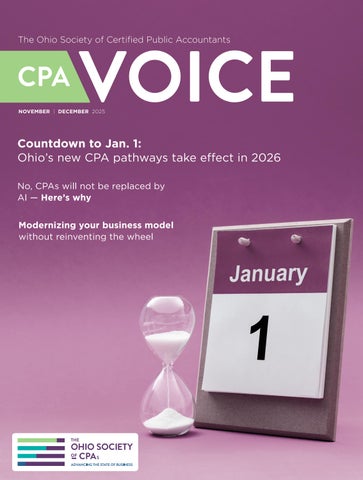
Countdown

to Jan. 1:

Ohio’s new CPA pathways take effect in 2026

No, CPAs will not be replaced by AI — Here’s why

Modernizing your business model without reinventing the wheel
VOLUME 18 | ISSUE 6

4 Countdown to Jan. 1: Ohio’s new CPA pathways take effect in 2026

Starting 2026, Ohio’s bold new CPA pathways let you skip the 150-hour rule with smarter, flexible options that keep rigor intact—and doors wide open.

6 Help! My client is making my life…

When a toxic client threatens your ethics, finances, or sanity, here’s exactly when—and how—to professionally fire them without blowing up your practice.

8 Guiding governmental organizations through single audit thresholds

The single audit threshold just jumped to $1M—here’s exactly who gets a compliance breather and what other surprise changes could save (or cost) your agency thousands.

14 Modernizing your business model without reinventing the wheel

How good governance can help small and mid-sized CPA firms adapt and thrive.

20 The Ohio CPA Foundation annual report

The 2025 program year in review

26 No, CPAs will not be replaced by AI — Here's why AI won’t steal your CPA job—it’ll make you smarter and faster, but only if you master the real rules before the hype turns into costly hallucinations.

EDITOR

Amber Epling-Skinner –AEpling-Skinner@ohiocpa.com

GRAPHIC DESIGN

Sam Kaiser – skaiser@ohiocpa.com

Kyle Anderson – kanderson@ohiocpa.com

EDITORIAL OFFICES

CPA Voice 4249 Easton Way, Suite 150 Columbus, OH 43219

Tel: 614.764.2727

Email: CPAVoice@ohiocpa.com Website: www.ohiocpa.com

ADVERTISING

For our display advertising rates or a copy of our media kit, contact us at sales@ohiocpa.com or call 614.764.2727

ARTICLE SUBMISSIONS

We welcome submissions of analytical articles on issues relevant to Ohio CPAs. Desired length is 800-1200 words. Send an electronic copy with a cover letter to the editor at the email address above. Please note that CPA Voice is not a peer-reviewed journal.

REPRINTS

For reprint permission, contact the editor at the address above.

CPA Voice is the official magazine of The Ohio Society of Certified Public Accountants. CPA Voice’s purpose is to serve as the primary news and information vehicle for more than 19,000 Ohio CPA members and related professionals. Articles are reviewed for technical accuracy. However, the materials and information contained within CPA Voice are offered as information only and not as practice, financial, accounting, legal or other professional advice. While we strive to present accurate and reliable information, The Ohio Society of CPAs makes no warranties regarding the accuracy of the information provided herein. Readers are strongly encouraged to conduct appropriate research to determine the accuracy of the information provided and to consult with an appropriate, competent professional adviser before acting on the information contained in this publication. The statements of fact, thoughts, advice and opinions expressed in CPA Voice are those of the authors alone and do not represent or imply the positions, opinions, nor endorsement of The Ohio Society of CPAs or of its publisher, editors, Board of Directors, or members. It is our policy not to knowingly accept advertising that discriminates on the basis of race, religion, gender, age or origin. The Ohio Society of CPAs reserves the right to reject paid advertising in its sole discretion. We do not necessarily endorse the resources, services or products unrelated to The Ohio Society of CPAs that may appear or be referenced within CPA Voice, and make no representation or warranties about those products or services or the accuracy and claims regarding those products and services. Advertisers and their agencies assume liability for all advertisement content and responsibility for all claims resulting from such advertisements made against The Ohio Society of CPAs.

The Ohio Society of CPAs does not guarantee delivery dates for CPA Voice and disclaims all warranties, express or implied, and assumes no responsibility whatsoever for damages incurred as a result of delivery delays.

CPA Voice (ISSN 0749-8284) is published six times per year by The Ohio Society of CPAs, 4249 Easton Way, Suite 150, Columbus OH 43219, 614.764.2727.

Copyright © 2023 by The Ohio Society of CPAs; all rights reserved. No part of the contents of CPA Voice may be reproduced by any means or in any form, or incorporated into any information retrieval system without the written consent of CPA Voice. Permission requests may be sent to the editor at the address above. While care will be given to all materials submitted for publication, we do not accept responsibility for unsolicited manuscripts, and they will not be returned unless accompanied by a self-addressed postage prepaid envelope.

Periodicals postage paid at Columbus, OH and at additional mailing offices.

Pathways to the future A WORD from our CEO

When The Ohio Society of CPAs began advocating for new CPA licensure pathways, our goal was simple but ambitious: ensure the CPA profession remains strong, relevant, and accessible for generations to come. Today, that vision is becoming reality—not just in Ohio, but across the nation, thanks to the collaborative efforts of state CPA societies and other allied organizations and stakeholders working together to advance our profession.

On January 1, 2026, Ohio’s landmark licensure reform, House Bill 238, will take effect. This legislation creates multiple routes to becoming a CPA, offering greater flexibility without compromising the rigor that defines our profession. It’s the culmination of years of thoughtful advocacy, collaboration, and leadership—made possible by OSCPA members, volunteers, and legislative partners who believe deeply in the future of accounting.

This transformation is being driven by states across the country, but it is truly a nationwide movement. Advocates from coast to coast are working together to make the accessibility and appeal of the CPA career more apparent and tangible for a new generation. By removing unnecessary barriers, embracing competency and experience, and ensuring the credential remains both meaningful and attainable, we are opening doors for more people to discover and pursue this rewarding profession.

This reform isn’t just about changing requirements; it’s about expanding opportunities. It’s about ensuring talented students from all backgrounds can see themselves in this profession. It’s about giving working adults, career changers, and first-generation college students a viable way forward. And it’s about addressing a nationwide talent shortage that impacts every sector of our economy.

But progress like this doesn’t happen by chance. It happens because our members choose to invest in their profession’s future. The success of the Pathways legislation was made possible through the collective strength of our dedicated team, engaged volunteers and a robust Political Action Committee (PAC). Your PAC contributions amplify the voice of Ohio’s CPAs and empower OSCPA to have a seat at the table—educating policymakers, shaping solutions, and ensuring that the voice of the CPA profession is heard where it matters most.

In conjunction with licensure reform, Ohio has played a leading role in preparing the next generation of CPAs. The Ohio Society of CPAs Foundation, OSCPA’s charitable arm, has remained steadfast in its mission to support students and strengthen the pipeline. Through scholarships, career awareness programs, and hands-on learning opportunities, the Foundation provides critical resources to aspiring CPAs who might otherwise face financial or systemic barriers.

In this issue, you’ll find our Foundation’s annual report—a celebration of impact, partnership, and possibility. Every dollar invested in the Foundation helps fund a student’s scholarship, a campus event, or a high school outreach program that sparks interest in accounting. Every contribution moves us closer to a profession that reflects the diversity, energy, and innovation of the communities we serve. Every donation fuels a student’s dream, opens doors to opportunity, and builds the next generation of CPAs.

Self-Assessment Exam

Log in to ohiocpa.com/myoscpa, look up the exam using the product ID number above and answer the 12 required questions based on content in CPA Voice

Cost

Members Free

Non-members $40

Exams remain available online – and may be completed for CPE – through the same month of the following calendar year.

As we look toward 2026 and beyond, I invite you to give back to the profession we all love. Contribute to the PAC to sustain our advocacy. Donate to the Foundation to support our students. Both are essential investments in the vitality, strength and future of the CPA profession.

The next generation is watching. Let’s make sure they see a profession ready to meet them where they are and lead them to where they want to go. Thank you for being part of this journey, and for continuing to advance the CPA profession in Ohio and beyond.

The Ohio Society of CPAs

NOVEMBER | DECEMBER 2025

Product ID: #65738

Online Instructions

1. Log in to ohiocpa.com/myoscpa

2. Search "CPA Voice" and hit enter. Then select "On-Demand Courses" to see the available exams.

3. Click "Add to cart" and purchase the exam.

4. Now click "Return to Dashboard."

5. Go to "My Learning Center" and the exam will be located under the "Current" tab. Turn off pop-up blockers then click "Launch."

Self-Assessment Exam Results

Respondents taking the exam online receive their results immediately. Respondents who pass with a grade of 70% or better receive one hour of CPE credit in specialized knowledge, as approved by the Accountancy Board of Ohio.

ADVOCACY in focus

Countdown to Jan. 1: Ohio’s new CPA pathways take effect in 2026

A major transformation is coming to Ohio’s CPA licensure process. Starting Jan. 1, 2026, aspiring Certified Public Accountants will have new, more flexible pathways to earn their license—thanks to landmark legislation championed by The Ohio Society of CPAs (OSCPA).

Signed into law by Gov. Mike DeWine on Jan. 8, 2025, House Bill 238 represents a pivotal modernization of the state’s approach to accounting licensure. The changes reflect OSCPA’s long-standing commitment to ensuring the CPA credential remains both rigorous and attainable for the next generation of professionals. Additionally, this modernization effort aims to address the growing shortage of CPAs by providing alternative pathways to licensure and enhancing interstate mobility for accounting professionals.

Two Pathways to Licensure

The new law introduces two primary routes for CPA candidates, giving them greater flexibility to enter the profession while maintaining high standards.

1. MASTER’S DEGREE PATHWAY:

• Completion of a master's degree with an accounting concentration.

• One year of professional experience.

• Successful completion of the CPA Exam.

2. BACHELOR’S DEGREE PATHWAY:

• Completion of a bachelor's degree with an accounting concentration.

• Two years of professional experience.

• Successful completion of the CPA Exam.

KEY DATES & DETAILS

MILESTONE DATE

HB 238 signed into law CPA mobility provision effective 150-hour rule remains in effect

New licensure pathways effective

An "accounting concentration" is defined as 30 semester hours in accounting and 24 semester hours in business courses. Candidates must sit for the CPA Exam on or after Jan. 1, 2026, to be eligible for these pathways. Those who have already commenced the exam process before this date will adhere to the previous 150-hour requirement, which remains in effect until Dec. 31, 2025.

Addressing the Pipeline Challenge

This legislative change is a response to a national shortage of accountants, driven by a retiring workforce and a lack of new entrants into the profession. By addressing the educational barriers to licensure, Ohio aims to attract a broader pool of candidates and ensure a steady supply of qualified CPAs to meet the state's accounting needs.

“This is a forward-thinking solution to one of the most pressing issues in our profession,” said OSCPA President and CEO Laura Hay, CPA. “These pathways open doors for talented individuals who may have been discouraged by traditional requirement, without compromising the integrity of the CPA designation.”

Improving CPA Mobility

Additionally, HB 238 enhances the mobility of CPAs across state lines. Effective since April 9, 2025, qualified CPAs from other states have been able to practice in Ohio without obtaining a separate Ohio license, provided they meet the state's professional standards. This provision aligns Ohio with other states adopting similar reforms and facilitates a more flexible and dynamic accounting workforce.

Across the country, states are reevaluating their CPA licensure requirements in response to workforce shortages and evolving demands within the accounting profession. Ohio became the first state in the nation to enact “multiple

Jan. 8, 2025

April 9, 2025

Through Dec. 31, 2025

Jan. 1, 2026

pathway” legislation, paving the way for others to follow by maintaining the rigor of the CPA credential while offering alternatives to the traditional 150–hour education model— such as additional work experience or competency-based learning. Building on Ohio’s leadership, several other jurisdictions are now considering similar reforms as part of a broader national conversation led by state CPA societies, the AICPA and NASBA, to modernize the profession’s entry requirements, improve accessibility and strengthen the CPA pipeline for the future.

Next Steps for Candidates

As the implementation date approaches, prospective CPA candidates and current accounting professionals should familiarize themselves with the new licensure requirements and consider how these changes may impact their career trajectories. The Ohio Society of CPAs and the Accountancy Board of Ohio are expected to provide additional resources and guidance to assist individuals in navigating the updated licensure pathways.

A Modernized, Competitive Profession

By championing this legislation, OSCPA continues to lead on behalf of its members and the broader profession— ensuring Ohio remains a national model for innovation and excellence in accounting. With new pathways, enhanced mobility and a renewed commitment to accessibility, the future of the CPA profession in Ohio is looking stronger and more inclusive than ever.

Molly Vincent is the manager of advocacy initiatives for The Ohio Society of CPAs, supporting the organization’s legislative and regulatory advocacy efforts. She can be reached at mvincent@ohiocpa.com.

Help! My client is making my life…

Handling difficult clients is a reality for many CPAs. While most engagements are productive and professional, some clients can become unmanageable due to unreasonable demands, unethical behavior or persistent noncompliance. In such cases, "firing" a client may be necessary to protect your practice, uphold ethical standards and maintain your own well-being.

The Accountancy Board of Ohio sees complaints each year filed by clients who believe their CPA failed to uphold their side of the business relationship.

When Should a CPA Disengage from a Client?

While it’s ideal to resolve issues before ending a client relationship, certain situations may warrant immediate disengagement:

• Repeated Ethical Violations: Clients who may be

involved in fraudulent activity or who pressure you to engage in dishonest or manipulative practices pose significant legal and reputational risks.

• Consistently Late/Non-Payment: If a client chronically delays payments or refuses to settle outstanding invoices, continuing the relationship may harm your firm's bottom line.

• Unreasonable Expectations or Behavior: Clients who regularly dispute fees, fail to provide timely documentation or exhibit aggressive behavior can drain your time and resources.

Steps to Take Before Disengagement

To minimize the fallout and ensure a smooth transition, CPAs should take thoughtful steps before disengaging:

1. Review the Engagement Agreement: Confirm the terms outlined in your client contract regarding termination of services.

2. Attempt Resolution: If feasible, communicate concerns and attempt to resolve the issue through open dialogue.

3. Evaluate Timing: Avoid disengagement during critical financial reporting periods or tax deadlines unless legally necessary. Document the return of client records and release of work product to the client.

4. Assess Legal & Ethical Obligations: Ensure compliance with state board regulations and professional standards.

5. Prepare Documentation: Maintain detailed records of communications and reasons for termination in case of disputes.

Managing Problem Clients Before Disengagement Becomes Necessary

To prevent client relationships from becoming unmanageable:

• Set Clear Boundaries & Expectations Early: Always have an engagement letter. Define work scope, fees and responsibilities upfront to avoid misunderstandings. Stick to the terms of the engagement and make all changes in writing.

• Screen Clients Thoroughly: Conduct due diligence before onboarding new clients to identify potential red flags.

• Communicate Effectively: Regularly clarify expectations and address concerns before they escalate. Document conversations and make any change in engagement scope in writing.

• Establish a Defined Exit Strategy: Have a clear, documented policy for disengagement in case a relationship deteriorates.

How to Properly Disengage from a Client

Ending a professional relationship should be handled with professionalism and care:

• Send a Formal Disengagement Letter: Clearly outline the termination date, outstanding obligations and next steps.

• Ensure a Smooth Handoff: Provide all necessary records and guidance to the client for a transition to a new party. You must provide all client records per Ohio Administrative Code rule 4701-11-06 within 45 days.

• Remain Professional: Avoid personal criticism and keep interactions courteous and factual.

Proactively addressing problematic behavior can often eliminate the need to “fire” a client. When ending a client relationship becomes necessary, doing so in a respectful and ethical manner will save you time, reduce stress and help the client transition smoothly to another professional. As a CPA, managing conflict effectively allows you to focus on the aspects of your work that deliver the greatest value.

Donna M. Oklok, MPA, Certified Public Manager, AMA Certified Professional in Management Executive Director, Accountancy Board of Ohio

AUDIT & Assurance

Guiding governmental organizations through single audit thresholds

Governmental organizations that depend on federal funding must adhere to strict compliance requirements. A key component of this oversight is the single audit, which ensures federal funds are managed appropriately.

This article explores the current single audit threshold, its evolution over time and the factors driving these changes.

Striking the Right Balance: Oversight Meets Practicality

The single audit threshold aims to balance accountability for federal funds with practical considerations for governmental entities. Changes to the threshold reflect efforts to adapt to economic conditions and streamline oversight. However, any increase comes with trade-offs, as fewer entities fall under the requirement, potentially reducing the scrutiny of federal funds.

For governmental organizations, understanding the threshold’s implications is critical to maintaining compliance and ensuring continued eligibility for federal funding. As thresholds are continually adjusted by the Office of Management and Budget (OMB), staying informed will help agencies navigate these evolving requirements and focus on serving their constituents.

By balancing financial accountability with operational efficiency, the single audit threshold remains a cornerstone of effective federal funding oversight, ensuring resources are used as intended while supporting government agencies in their vital work.

Single Audit Threshold History

The single audit threshold has gradually increased over the years to reflect economic and administrative needs. Before the most recent adjustment in 2024, the last update occurred in 2015 when the OMB raised the threshold from $500,000 to $750,000 under the Uniform Guidance. This marked the first increase in over a decade, as the $500,000

benchmark had remained unchanged since the early 2000s. Previously, the threshold stood at $300,000, highlighting a pattern of incremental adjustments. Most recently, in 2024, the threshold was raised again to $1 million.

Why Was the 2024 Single Audit Threshold Increased to $1 Million

Several factors motivated the increase:

Inflation and Economic Changes

Inflation gradually diminishes the value of money, making the earlier $750,000 threshold less significant over time. The adjustment to $1 million accounted for inflation and ensured the threshold continued to target entities managing substantial federal resources.

Administrative Efficiency

Single audits are resource-intensive, both for the organizations being audited and for federal agencies conducting oversight. By raising the threshold, federal resources could be concentrated on larger grants, where potential risks and impacts are greater, while smaller governmental entities faced fewer compliance burdens.

Reducing Burden on Small Governmental Entities

The change also sought to ease the financial strain on smaller governmental agencies. For many entities just above the previous $750,000 threshold, the cost of conducting a single audit was disproportionately high relative to their funding. By raising the threshold, these agencies could allocate more resources toward essential public services.

What Does This Mean for Governmental Organizations Receiving Federal Funding?

The new single audit threshold took effect on Oct. 1, 2024. However, your agency may not be immediately impacted. The $1 million threshold applies to fiscal periods beginning after this date. As such, changes to the audit threshold and Type A program threshold cannot be adopted until audits for

years ending Sept. 30, 2025, or later as prescribed by the 2024 OMB Compliance Supplement in Appendix VII. So, if your year-end date is before Sept. 30, 2025, you will have to wait one more year before you see the changes.

Refer to the chart below to determine which threshold currently applies to your organization.

What else did OMB change with that ruling?

• Major Program Determination: The threshold for identifying Type A programs has increased to $1 million if the total annual expenditures of all federal programs for a non-federal entity are $34 million or less (an increase from $25 million or less).

• Internal Controls: Recipients and sub-recipients must include cybersecurity measures and other safeguards in their internal controls.

• Indirect Costs: The de minimis rate for indirect costs for recipients and subrecipients without a current federal negotiated indirect cost rate (including provisional rates) has been increased from 10% to a maximum of 15% of modified total direct costs.

• Equipment Threshold: The threshold for equipment consideration increased from $5,000 to $10,000.

• Subaward Exclusion Threshold: The exclusion threshold for subawards has been increased from $25,000 to $50,000 for modified total direct costs.

Amr Elaskary, CPA, CFE, is a recognized leader in the accounting profession, serving in a Governor-appointed role on the State Board of Accountancy and as a member of the AICPA Government Performance and Accountability Committee.

This article is a reprint. Copyright Clark Schaefer Hackett & Co. All content provided is for informational purposes only. Matters discussed are subject to change. For up-to-date information on this subject please contact a Clark Schaefer Hackett & Co. professional. Clark Schaefer Hackett & Co. will not be held responsible for any claim, loss, damage or inconvenience caused as a result of any information within article.

BUSINESS management & strategy

Modernizing your business model without reinventing the wheel

How good governance can help small and mid-sized CPA firms adapt and thrive

As a CPA, I’m proud of our profession’s commitment to technical excellence and strong ethics. I am also well aware of the pressure we’re under to evolve in the face of staffing shortages, technological advances, private equity ownership and many other challenges.

We document, we reconcile and we validate the past activities of our clients. We’re very good at operating in hindsight, but that financial historian perspective can hold us back from thinking strategically and being agile in a rapidly changing market.

Becoming a modern accounting firm requires new systems, new models, new ways of thinking and new leadership behaviors. In fact, the AICPA’s Journal of Accountancy (JoA) has devoted a half-year long series of articles -- Transform your business model -- which serve as a roadmap for helping the profession modernize in five key areas: Strategy, Governance, Service Offerings, Technology and Culture & Talent. Each of these five areas are critically important, but sometimes governance gets overlooked when small to midsized firms are working hard to evolve. It shouldn’t, because the foundational nature of a strong governance structure assures that the other aforementioned areas will stick. Why? Because of accountability and clear metrics that exist for measuring progress. And that starts with good governance.

I realize many CPA firm owners are not as aware of the technical aspects of their own governance structures as they are with strategy, service offerings, technology and culture. Governance is sometimes confused with bureaucracy, and it’s easy to assume that governance is only a priority for larger organizations. But good governance is applicable to any size firm, so, in the following dialogue I’d like to break down governance into smaller, more digestible components.

In essence, governance is not so much a form of control, it’s a driver of clarity around three critical areas that impact firm performance:

1. Roles & Responsibilities outlining what gets done, by whom, and when.

2. Policies & Procedures that prevent the firm from constantly having to “reinvent the wheel.”

3. Metrics & Goals that drive performance and accountability across the entire team.

Once you have clarity around these areas, your firm is better equipped to allocate resources, ensure consistent client service and build strategy through the business structure of the firm.

To help get you moving in the right direction, we recommend breaking your firm into five smaller, more manageable parts:

1. Owner Initiatives – succession, personal financial goals and exit readiness.

2. Sales & Marketing – market positioning and new business development.

3. People, HR and Personnel Development – recruiting, training, and team alignment.

4. Business Administration – systems, financial controls and internal reporting.

5. Client Service Delivery – offering the right services consistently and with a high level of quality.

Each of the five parts above impacts a firm’s culture. We don’t see culture as a series of inspirational posters on the wall. We define it by what’s rewarded, what’s encouraged and by what’s tolerated (as well as not tolerated). No two firms have exactly the same culture. So, we allow each firm’s values to define the guardrails that guide how employees and partners interact on a day-to-day basis. A clear governance system provides the structure needed to support that culture over time.

Helping small and mid-sized firms overcome modernization challenges

The AICPA has started an important conversation for the entire profession. But it’s important to recognize why transformation can be challenging for many small to midsized CPA firms. Here are four important reasons:

1. Decision-making without structure. In many smaller firms, key issues tend to be addressed informally among partners rather than through defined governance mechanisms. My colleagues and I believe in empowering management teams (i.e., partners, department heads) to make leadership decisions, but only if those decisions are transparent and only if leaders understand the consequences of their decisions.

Aligning roles and responsibilities, including decision making authority, to compensation is a good idea. Firms that develop and implement an authority level matrix that specifies which decisions the managing partner or CEO can make without further approval is ideal. If something is purchased within a pre-approved budget, for example, there should be no additional sign-off required to make that buying decision.

2. Culture as perception rather than system. Without established communication practices and accountability tools, a firm’s work environment and norms can seem inconsistent and confusing to many employees. To

CORPORATE LEARNING Passport

Our comprehensive package of learning resources designed to meet the unique and diverse needs of

and

This innovative learning license model elevates performance by giving your team access to a world of engaging content, including the following:

• OSCPA’s Member Curriculum, including semi-annual professional issues updates and regular lunch and learns with today’s thought leaders

• National-level quality virtual conferences, including Accounting Show and Mega Tax

• On-Demand Access Pass, including more than 250 hours of content on a wide range of topics across 9 core competencies

• Best-in-class Ethics & Professional Standards, including live and on-demand options

address this disconnect, we suggest firms establish communication protocols and management meetings around ownership initiatives (restricted to owners only) and operations (attended by partners and non-partner members of management). Meetings should occur at a consistent frequency that leadership gets accustomed to.

3. Reactive strategy. Smaller firms, without a deep bench, most often focus on immediate client needs and compliance deadlines at the expense of long-term planning. Unfortunately, this FIRE-READY-AIM approach can be difficult to overcome for smaller firms. However, smaller firms that can pause and reflect periodically—on a preset cadence—can overcome the risks associated with being reactive vs. proactive. As part of this reflection period, firms should have a strategic plan that addresses what the firm and its ownership is setting out to accomplish near-term and long-term and make that plan available for the entire team to review.

4. Advisory services without infrastructure. Many firms aspire to expand beyond compliance work, but it’s hard to make advisory work scalable if you haven’t developed the pricing, staffing and delivery models first. My colleagues and I suggest that firms make a commitment to investing in providing advisory services—as evidenced by their written strategic plan and expressed buy-in from the partner group. This commitment also entails assigning the advisory services practice leadership responsibility to a partner level professional who is compensated based upon performance or given a realistic timeframe, along with realistic metrics and goals, to achieve success as defined by the firm’s leadership.

Recognizing these challenges is the first step toward addressing them.

Connecting Governance to the Five Pillars

The five modernization pillars outlined by the AICPA are interdependent, but governance is the element that ties them together. A structured governance framework can help you:

• Bring strategy into regular planning cycles.

• Provide guidance on alignment of service offerings.

• Guide technology adoption by linking investments to measurable outcomes.

• Reinforce cultural values by aligning policies with everyday behaviors.

When implemented thoughtfully, governance enables your firm to strengthen all five pillars in unison rather than in isolation.

Change is never easy. But we agree wholeheartedly with the AICPA that a transition is necessary for our profession to continue growing and for members to keep thriving. Doing so does not require reinventing the wheel—it requires adopting practices that clarify roles, align priorities and establish accountability.

As Charles Darwin said: “It is not the strongest or the most intelligent that survive, but those that can best manage change.” Even back in Darwin’s time, before there was a CPA profession, he realized the importance of adaptability and the willingness to embrace change.

Daniel J. McMahon is the Founder & Managing Partner of Integrated Growth Advisors (IGA), a value creation and growth advisory firm focused on empowering business leaders to systematically enhance their revenues, profitability, sustainability, and value.

Contact me any time if you’d like a complimentary Government Readiness self-assessment test.

THREE THINGS

1. Strong governance clarifies roles, policies, and metrics enabling small to mid-sized CPA firms to modernize with accountability across key areas.

2. Divide the firm into five parts— Owner Initiatives, Sales & Marketing, People/HR, Business Administration and Client Service Delivery—to align operations with unique culture.

3. Governance overcomes challenges like unstructured decisions and reactive strategy by linking to AICPA's five pillars for measurable progress.

Program Year 2025 In Review

OUR PROGRAMS & RESOURCES

SCHOLARSHIPS

This year, thanks to the generosity and commitment of our Ohio CPA community, our Foundation programs have opened doors for hundreds of students to discover that accounting is not just essential, but exciting and full

I give to The Ohio CPA Foundation because I want to invest in the future of the profession. People are the lifeblood of our business and I know that my donations to The Ohio CPA Foundation will ensure that highlytalented individuals continue to join the accounting profession.

The Careers in Professional Accounting Camp (CPA Camp) is a day program for high school students who are interested in exploring careers in accounting and business. CPA Camp is an all-expense-paid experience. There is no cost for participants thanks to support from The Ohio CPA Foundation, The Ohio Society of CPAs and other corporate sponsors.

I loved this camp. I learned so much, and this camp made me 100% sure I want to be an accountant!
–Malak H., high school senior CPA Camp Attendee
I contribute to The Ohio Society of CPAs' Foundation because the Foundation provides access to our talented professionals, thus, allows students to see themselves succeeding as CPAs as well.
–Courtney Clark, CPA

Accounting Career Days, made possible by presenting sponsor The Deloitte Foundation, are half-day events that bring local high school students together on a college campus to learn about the accounting major and CPA careers. Local CPAs serve as speakers and share insights into the profession and explain the variety of paths available. College accounting majors also attend to encourage students to follow their path and share advice related to the transition from high school to college. In 2025, the Foundation hosted 8 Accounting Career Days reaching 810 students.

Accounting Careers Leadership Academy (ACLA) is a leadership development series of in-person and virtual sessions for college accounting majors. Topics focus on things they can learn outside the classroom such as leadership, communication skills, interviewing tips, CPA exam prep and life after college. Scholarships are awarded at the end of the program series, a recognition of the future generation of accounting professionals.

Really beneficial for networking and finding internship opportunities. Loved this, and it helped me get my name out there. Very grateful for this opportunity.
–Lauren R., college sophomore ACLA Meet the Recruiters Attendee

Ashland University

Baldwin Wallace University

Bowling Green State University

Case Western Reserve University

Cincinnati State

Cleveland State University

Columbus State Community College

Hiram College

John Carroll University

Kent State University

Why I give to The Ohio CPA Foundation is simple, I trust that they'll make a difference in the lives of students within our profession, and I know the impact of my dollar in their hands far outweighs the impact it could have within my control or other worthy causes.
–Jake Nix, CPA

Covering 28 college campuses across Ohio, OSCPA Student Ambassadors are enthusiastic accounting majors who can speak with undecided business majors to encourage a major in accounting and promote the opportunities and resources available through OSCPA’s free student membership.

Student Ambassador Schools

Miami University

Muskingum University

Ohio Northern University

Ohio University

Ohio Wesleyan University

Otterbein University

Sinclair College

Stark State College

The Ohio State University

The University of Akron

University of Dayton

University of Findlay

University of Mount Union

University of Toledo

Walsh University

Wright State University

Xavier University

Youngstown State University

Thank you, ABO!

We extend our sincere appreciation to the Accountancy Board of Ohio (ABO) for its vision, leadership and active stewardship of the Education Assistance Fund (EAF). Established and sustained through licensure and renewal fees from all Ohio’s licensed CPAs, the EAF represents a shared investment in the future of the accounting profession.

Forensic Accounting Challenge

Accounting Resource Vault

Accounting (Resource) Vault

A hands-on, experiential learning competition for high school students that introduces fraud detection and investigative accounting skills.

As the designated service provider, The Ohio Society of CPAs executes programming in accordance with the EAF’s statutory purposes and under the direction of the ABO. EAF funding covers all or parts of these initiatives, with additional investment from The Ohio CPA Foundation and other partners to ensure scale and sustainability.

The Ohio Accounting Talent Coalition

Destination Ohio CPA Program

Look Beyond

A curriculum resource designed to provide K-12 educators with tools for integrating accounting concepts and career awareness to elementary, middle and high school students.

A curriculum resource designed to provide K-12 educators with tools for integrating accounting concepts and career awareness to elementary, middle, and high school students.

The Ohio Accounting Talent Coalition

An OSCPA initiative that brings together industry leaders, educators and workforce development organizations in a collaborative ecosystem.

brings together industry leaders, educators, and workforce development organizations in a collaborative ecosystem.

A pre-CPA resource that provides free UWorld CPA prep materials, peer support and coaching to reduce exam costs and boost candidate success.

Messaging Campaign

A statewide image campaign designed to shift perceptions of the accounting profession, highlight its impact and attract a more diverse talent pool.

Pipeline Program Sponsors

We gratefully acknowledge the following organizations whose generous financial support makes our programs possible.

The 2024-2025 Ohio CPA Foundation Board of Trustees

CHAIR OF THE BOARD

Alison Strohm, CPA EY

TREASURER

Bill Miller, CPA KPMG

TRUSTEES

Carin Agresti, CPA Procter & Gamble

Robert F. Fay, CPA Sole Practitioner

Anne Farrell, CPA, inactive Miami University

John Jones

Hope Toledo

Jay Moeller, CPA RSM US LLP

Katie Moline, CPA Lucas County Auditor

Jim Rollins, CPA Meaden & Moore

Ron Reed, CPA BDO USA LLP

PRESIDENT

Laura Hay, CPA, CAE The Ohio Society of CPAs

Dear Friends and Supporters,

Introducing the FY24-25 Ohio CPA Foundation Board of Trustees! Developing a strong pipeline of future talent is essential to the success of our profession. Each of us dedicates time and resources to attract outstanding students to accounting and guide them on their journey to earning the CPA designation.

Serving as chair of this board has been an incredible privilege, especially as we champion programs and scholarships that open doors for students. For every individual who discovers a career through these efforts, the impact is truly life-changing.

We invite you to join us in shaping the future of the profession. Your gift is more than a donation—it’s an investment in tomorrow’s leaders.

With gratitude,

The Ohio CPA Foundation

THE OHIO CPA FOUNDATION STATEMENT OF ACTIVITIES

Years Ended April 30, 2025 and 2024

THE OHIO CPA FOUNDATION STATEMENT OF FINANCIAL POSITION

As of April 30, 2025 and 2024

Make an Investment in the Future of the Profession

Give back to the accounting profession by making a gift to The Ohio CPA Foundation or by contributing online at ohiocpa.com/Foundation

Your generous support:

Welcomes the next generation to our profession with programs and college scholarships.

Introduces students to the benefits and values of becoming a CPA.

Contributes to leadership development programs that enable students to enter the workforce prepared for success.

Encourages people of all backgrounds to pursue accounting careers so the profession better reflects the communities it serves.

Thank you, your gift makes all the difference!

I believe in the message that to whom much is given, much is expected. The Ohio CPA Foundation allows me the opportunity to pay it forward to future accounting students and CPAs right here in Ohio.

Learn more at ohiocpa.com/Foundation or click here to make a donation

No, CPAs will not be replaced by AI — Here's why

Artificial intelligence has taken the world by storm — and it shows no signs of slowing down. To some, AI looks like a magic fix for every problem; to others, it represents a potential threat to job security. In reality, it’s neither.

According to Amanda Frye, CEO of Talentcrowd, a firm that helps organizations build and implement effective technology strategies, the real opportunity lies in understanding how to use the technology responsibly and effectively, without fearing it.

Despite the buzz, Frye said most companies are still in the early stages of adoption. Whether AI becomes a strategic advantage or an expensive distraction depends on how clean their data is, how disciplined their processes are and how well employees are taught to use it.

The key is knowing when and how to use the tools effectively. Without clear guidance, employees can quickly fall into inefficiency or misuse.

Defining AI

At its core, artificial intelligence refers to systems designed to perform tasks that would otherwise require human intelligence, such as recognizing patterns, processing

language or making predictions from data. In accounting, that might mean automating reconciliations, analyzing client documents or identifying anomalies in large data sets.

But Frye cautioned that the term “AI” is often used too broadly, creating confusion about when it should be used and when it’s best to automate. According to Frye, if it’s a definable and repeatable process that does not require thinking, it should be automated. On the contrary, AI should be used when decision-making and thinking are needed.

“If we’re not thinking as part of the process, it’s not AI,” she said. “And you shouldn’t use an AI tool to do it because A.) It’s overkill and B.) You run the risk of it hallucinating and manipulating what you’re trying to do in the wrong way.”

That understanding starts with training. Frye encouraged firms to invest in practical education, both on tool capabilities and on how to craft effective prompts that produce reliable, accurate outputs.

CPAs as the essential middlemen

So, if AI can analyze data and make recommendations, are CPAs still essential? Absolutely.

While AI can streamline and support decision-making, Frye emphasized that humans are crucial in any scenario that directly impacts an outcome— meaning that CPAs, while guided by AI, make the final call.

“Where it makes perfect sense is, ‘Hey, I got an invoice. I want to put AI in the process to read the invoice, figure out what it’s for and automatically categorize the different GL codes that need to be associated,” Frye said. “That’s not really impacting the outcome of a decision. It’s just thinking, looking, taking action—there should always be a human in the middle for validation.”

AI as a teacher

Beyond automating tasks, AI can also play a powerful role in employee development, Frye said. Used strategically, it can help staff learn faster and work more efficiently.

“A lot of times, especially during busy season, your director level staff are super busy, so maybe you're not getting the support that you would like or need to grow, and that's where I think putting AI alongside of people as a companion, really could be the best place where those type of people are going to excel.”

According to Frye, true expertise depends on developing new talent. “You can't become an expert at something until you're a novice at something, so, no matter what, if we want to ever continue to have senior level CPAs, we have

to have novice CPAs,” Frye said. When applied strategically, AI should enhance that progression—not replace it—by automating routine tasks and empowering CPAs to perform at their highest capacity.

Data integrity

When tools are integrated separately and without strategy, companies are left with a technical debt of duplicate data and disorganized processes.

Before integrating AI or automation, Frye said firms should take a step back and assess the foundation:

• Is your data clean and properly structured?

• Are your processes well-documented?

• Do those processes align with your business objectives?

"If those things aren't true, when you put AI on top of it, you're just putting a large language model on top of a mess— and you're going to get a mess out of it—because it's only as good as what you feed it,” Frye said.

Managing risk and fear

For many firms, the biggest obstacle to AI adoption isn’t the technology itself, but the fear surrounding it. Frye said uncertainty often stems from a lack of understanding about how these tools fit into existing workflows.

“You have people, you know, later in their careers or very used to certain processes, and they don’t want to use AI,” she said. “They’re, you know, ‘What we’re doing is fine. We’ve been doing it for 20 years. There’s no reason to change.’”

That hesitation, Frye explained, is often rooted in perspective. “Most people that say we don’t need AI or everything’s working fine—it’s probably not working fine. It’s just that they’re up here. So by the time stuff gets to them, sure, it’s working fine, because ten other people already

smoothed it out,” she said. “Sometimes you have to show them the pain.”

She added that visualizing the inefficiencies behind a process can be a powerful motivator for change. “I will actually document a process from end to end and bring that as a visual to say, ‘Okay, for you to get this report, these are all of the things that have to happen. These are all the people that are involved. This is the amount of time that it takes. This is what it’s costing you every week to get this,’” Frye said. “Sometimes, when you break it down like that, they can actually see it, because more often than not, people are protecting them from it.”

According to Frye, addressing risk concerns also requires a thoughtful approach to implementation. “There are tools and ways of implementing AI that are secure, that do keep all of your data in-house, that you have full control over, that you have visibility of,” she said. “It comes down to the organizational risk tolerance, which is a different thing than an individual person’s risk tolerance.”

The Bottom Line

The real question isn’t whether AI will replace CPAs, but how the profession will evolve alongside it. For firms willing to invest in clean data, strong processes and ongoing education, AI represents not a threat, but an opportunity to lead the next evolution of the profession. The firms that succeed will be those that treat AI as a strategic partner, rather than a shortcut.

Jessica Barboza is a content specialist at The Ohio Society of CPAs, where she contributes to the development of the Society’s publications and digital communications. She can be reached at jbarboza@ohiocpa.com.

THREE THINGS

1. AI automates repeatable tasks but requires human CPAs for validation, decision-making, and outcomes where thinking is essential.

2. Success with AI depends on clean data, documented processes, and employee training to avoid inefficiencies and hallucinations.

3. AI enhances CPA roles by accelerating learning, freeing time for high-value work, and evolving the profession when used strategically.

LEARNING events at a glance

MEMBERS in motion

CANFIELD

Packer Thomas was named a Best Firm to Work for in Ohio and ranked #25 in the Midsized Firms category by Accounting Today.

Packer Thomas has promoted Jeff Davidson, CPA, MBA to principal.

COLUMBUS

Kirsten Johnson, CPA has joined Wells CPA as an audit manager.

Mark Welp, CPA, CITP, CFE has been named in Forbes’ America’s Top 200 CPAs list.

CLEVELAND

Jon Ruple, CPA has been named in Forbes’ America’s Top 200 CPAs list. Julie Boland, CPA has been named in Forbes’ America’s Top 200 CPAs list. Onpointe Advisors was named a Best Firm to Work for in Ohio and ranked #18 in the Small Firms category by Accounting Today.

DEFIANCE

Shultz Huber & Associates was ranked as one of the Nation’s Top 500 CPA Firms for 2025 by INSIDE Public Accounting.

YOUNGSTOWN

HD Growth Partners was named a Best Firm to Work for in Ohio and ranked #49 in the Midsized Firms category by Accounting Today.

CLASSIFIED

Selling or Buying a Firm? Selling an accounting firm is complex. We can make it simple!

Accounting Biz Brokers, LLC has been selling accounting firms and tax practices for over 19 years! Let’s face it, you know how to run your business, but it takes a very different skill set to sell a business successfully. Our team of Certified Business Intermediaries is committed to providing personalized business brokerage services to our clients and customers. Selling professional practices like yours is all we do. Using targeted marketing strategies, we have developed a large database of active buyers ready to purchase.

Call or email us today to receive a FREE-Market Analysis or to start the confidential sales process. We can help you achieve the “win-win” results you are seeking!

Kathy Brents, CPA, CBI Office 866.260.2793; Cell 501.514.4928 Kathy@AccountingBizBrokers.com www.AccountingBizBrokers.com

THE OHIO SOCIETY OF CPAs 2025–2026 BOARD OF DIRECTORS

CHAIR OF THE BOARD

Courtney Clark, CPA Deloitte Columbus

PAST CHAIR

Rick Fedorovich, CPA Bober Markey Fedorovich Cleveland

Brandi Carson, CPA La-Z-Boy Inc. Toledo

Darci Congrove, CPA GBQ Columbus

Robert Fay, CPA

Robert F. Fay, CPA, PFS, CGMA Canton

CHAIR-ELECT

Angela Lewis, CPA Crowe LLP Columbus

VICE CHAIR, FINANCE

Gregory J. Jonovich, CPA, MBA Materion Mayfield Heights

DIRECTORS

Tracey Holecek, CPA Acclarity Columbus

Mark McKinley, CPA Rea Columbus

Jake Nix, CPA RISCPoint Cleveland

Dan Perschke, CPA Scripps Cincinnati

Kerry Roe, CPA Clark Schaeffer Hackett & Co. Cincinnati

Jon Ruple, CPA Maloney + Novotny Cleveland

PRESIDENT AND CEO

Laura Hay, CPA, CAE

The Ohio Society of CPAs Columbus

Carolyn Smith, CPA, MBA, CRMA Governmental Accounting Standards Board Columbus

Mark Welp, CPA, CFE Holbrook & Manter Columbus

Turn static files into dynamic content formats.

Create a flipbook