PRIVATE SALES: CANADIAN MASTERPIECES FROM PRIVATE COLLECTIONS

Works available for immediate purchase
326 Dundas Street West, Toronto 416-479-9703 | 1 (866) 931-8415 (toll free) mail@cowleyabbott.ca CowleyAbbott.ca
(587) 317-6564 (Calgary Office) peter@cowleyabbott.ca peterohler.com
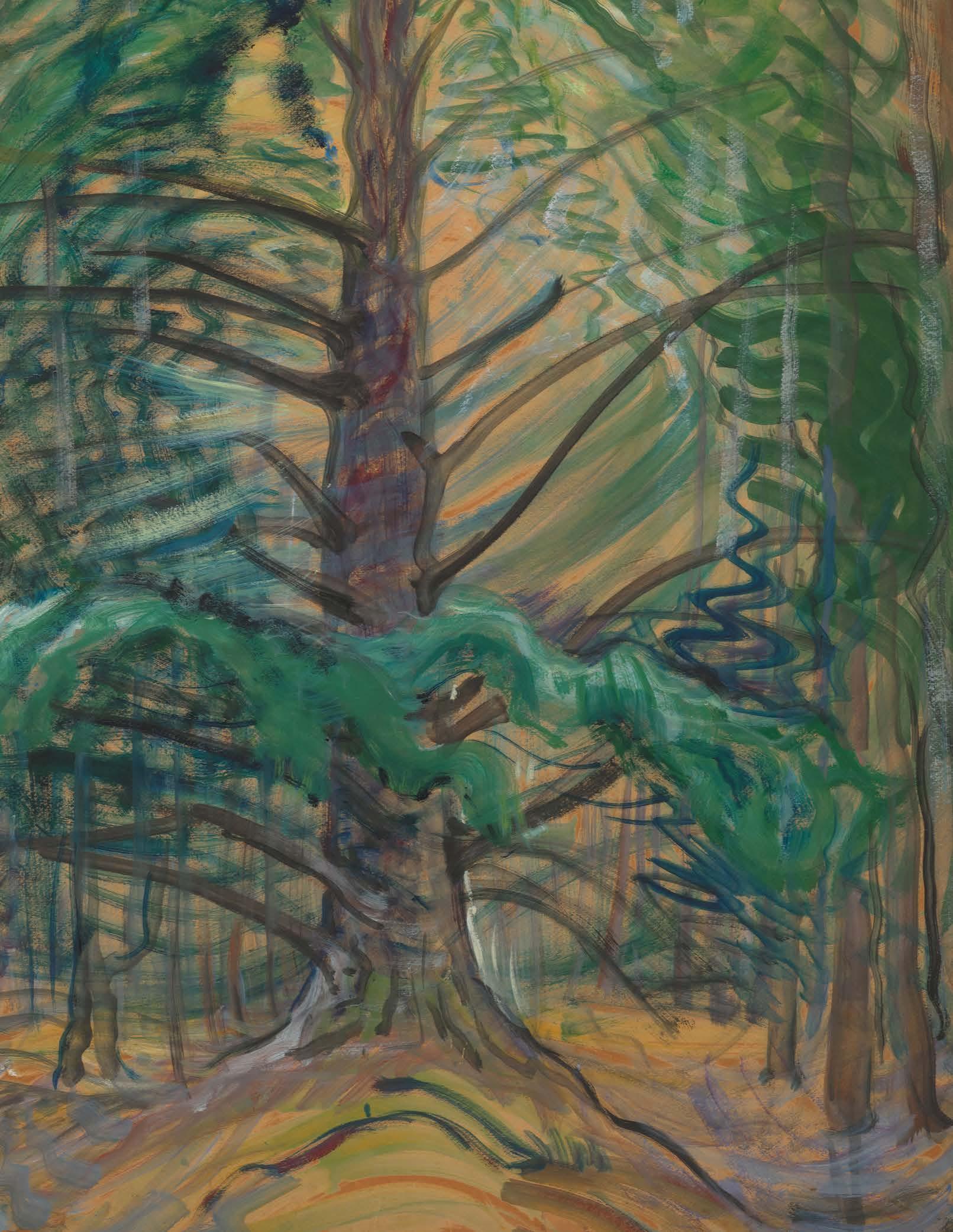
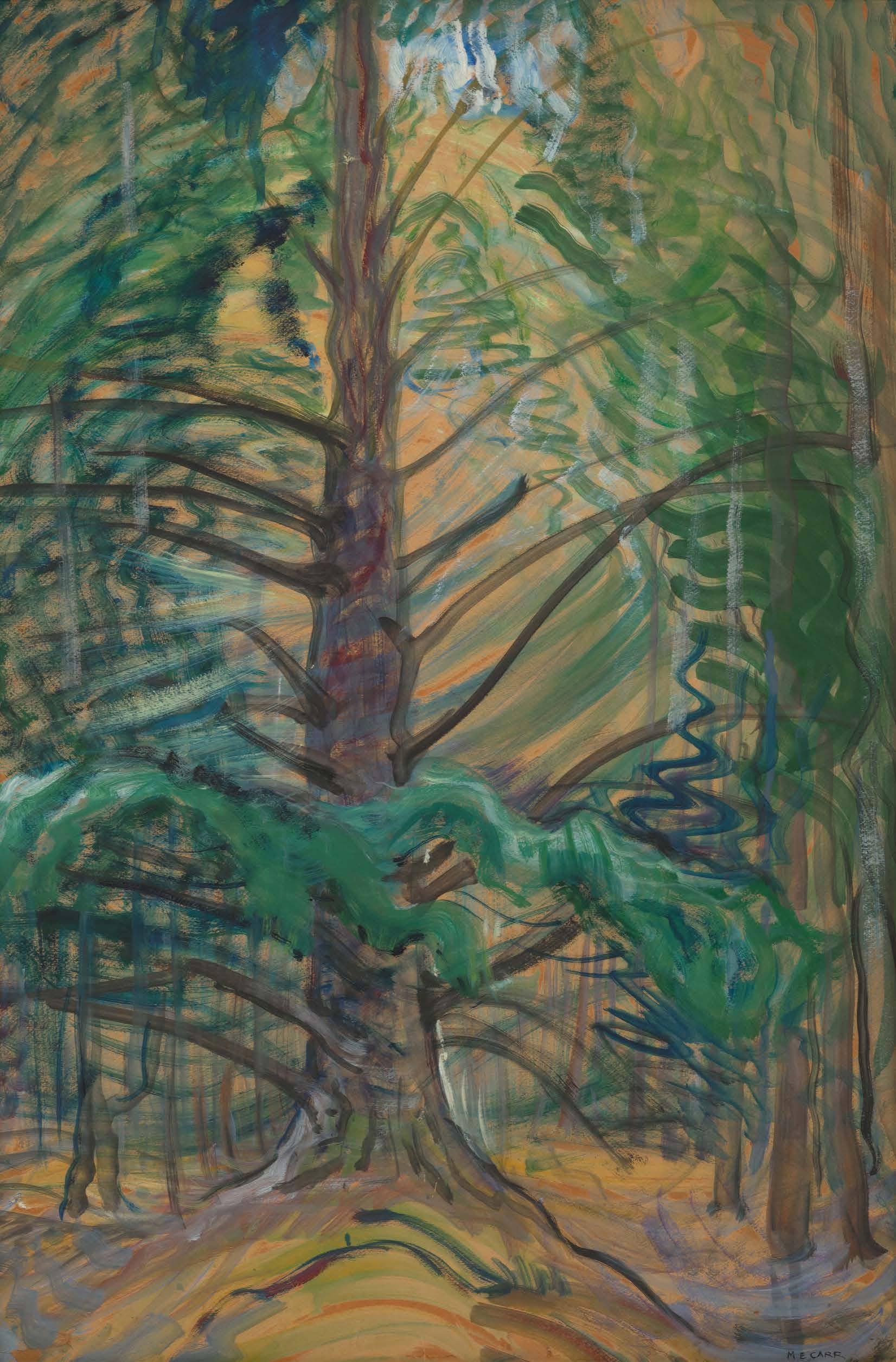
In the Woods, c. 1935 oil on paper signed lower right; titled and dated on three gallery labels on the reverse 35.5 x 24 in
PROVENANCE
Dominion Gallery, Montreal Thielsen Gallery, Kitchener Private Collection, Stratford, Ontario Masters Gallery, Calgary
EXHIBITED
Emily Carr: Oil on Paper Sketches, The Edmonton Art Gallery, 29 June-3 September 1979, no. 18
LITERATURE
Chris Varley, Emily Carr: Oil on Paper Sketches, The Edmonton Art Gallery, 1979
Around 1930, Carr’s art began to evolve rapidly towards full maturity. On the advice of Lawren Harris and Mark Tobey, she stopped painting totems, the subjects of most of her earlier works, and turned to the forests and beaches in and around Victoria. Carr probably first adopted the oil on paper sketching technique in 1930 as an alternative to sketching outdoors with watercolour. The oil on paper offered the advantages of portability and low cost, as well as the potential of great versatility.
The years 1934 to 1936 are certainly the most successful of Carr’s artistic career, for she had found her own expression in a remarkably original and vital painting technique. Using simplified layouts that allowed her great latitude of paint handling and describing natural forms with calligraphic notations of remarkable variety, she produced some of this country’s most audacious art of the period.
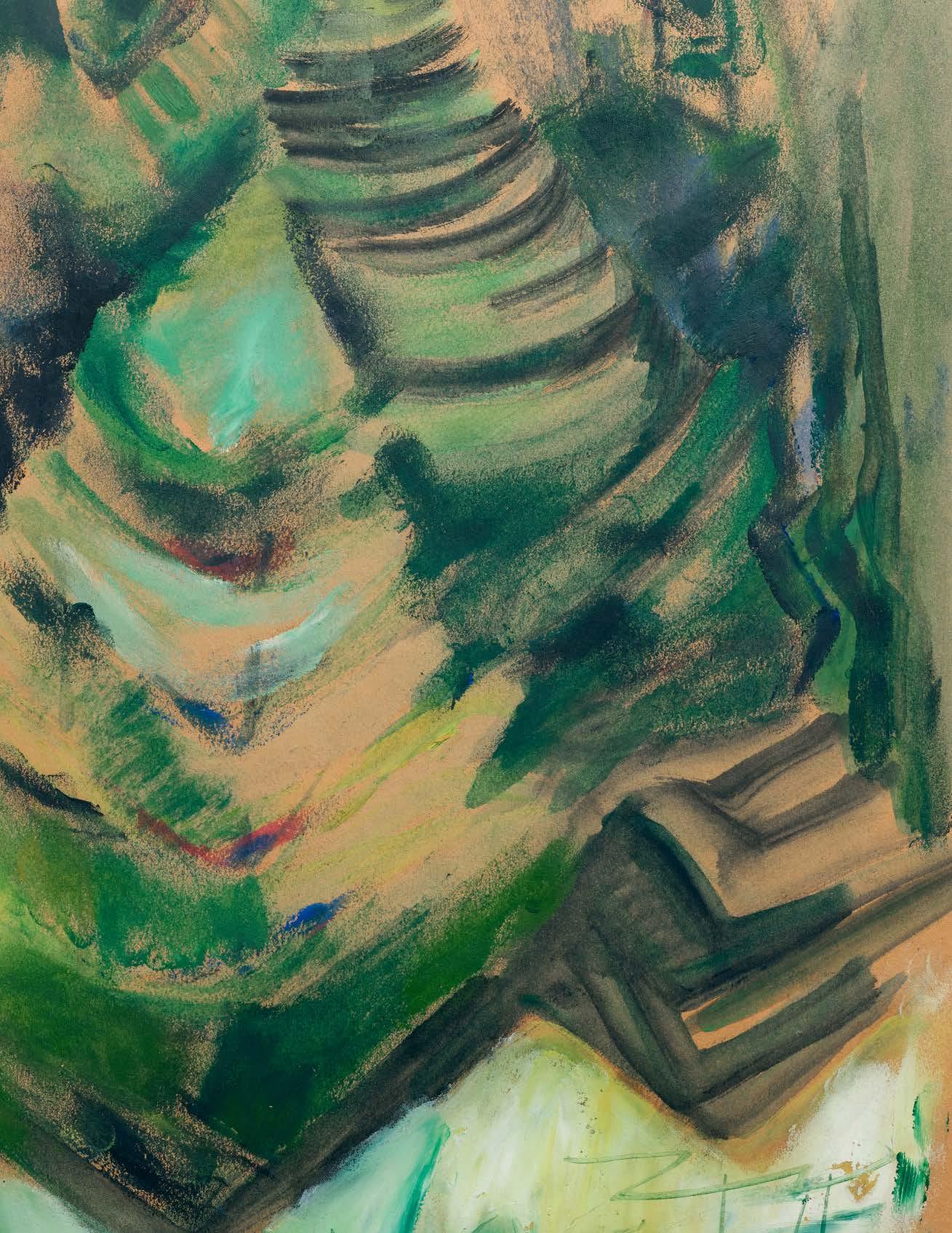
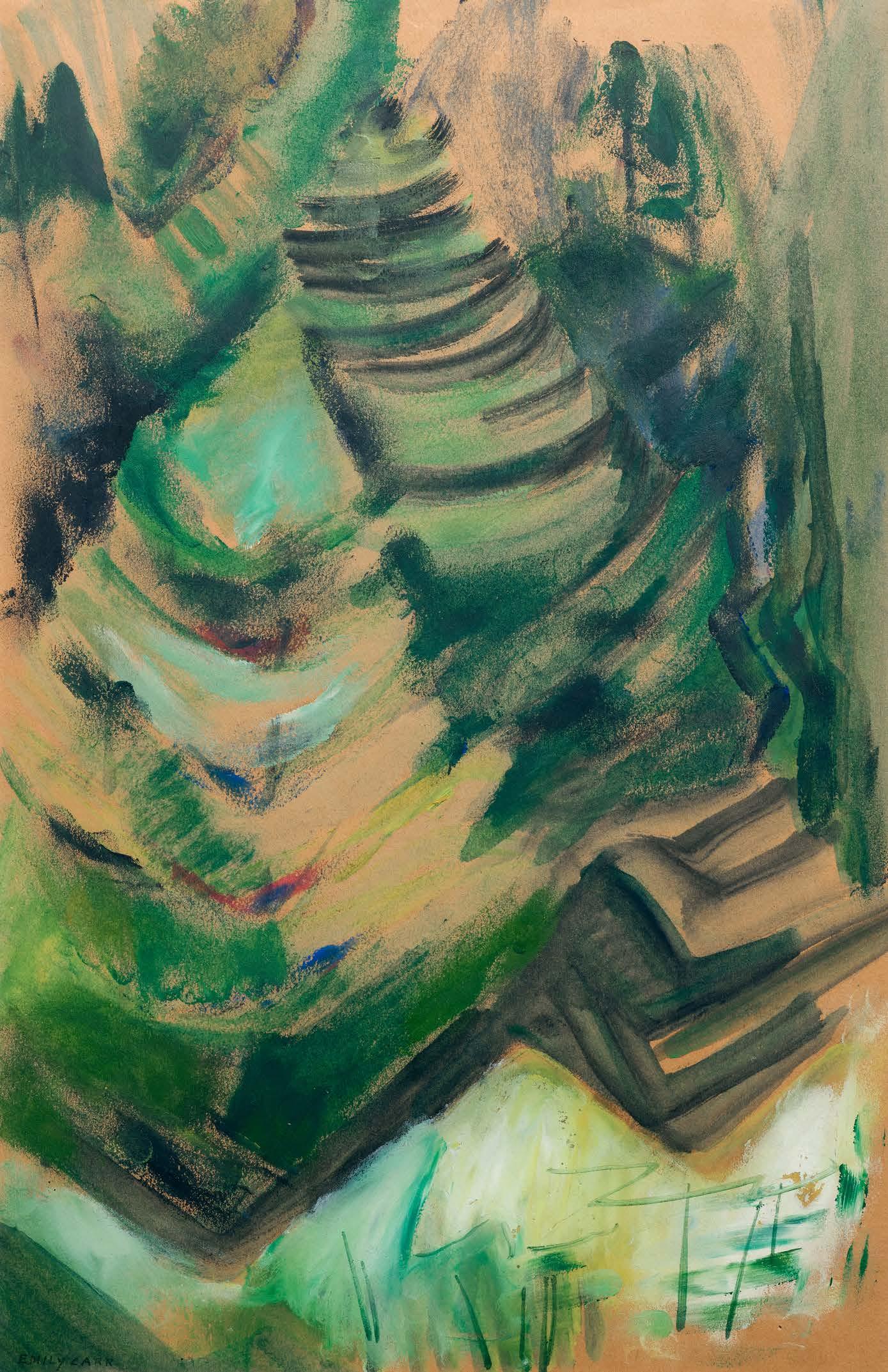
Young Trees, c. 1930 oil on paper signed lower left 18 x 12 in
Douglas Udell Gallery, Edmonton Private Collection, Calgary
Around 1930, Carr’s art began to evolve rapidly towards full maturity. On the advice of Lawren Harris and Mark Tobey, she stopped painting totems, the subjects of most of her earlier works, and turned to the forests and beaches in and around Victoria. Carr probably first adopted the oil on paper sketching technique in 1930 as an alternative to sketching outdoors with watercolour. The oil on paper offered the advantages of portability and low cost, as well as the potential of great versatility.
The years 1934 to 1936 are certainly the most successful of Carr’s artistic career, for she had found her own expression in a remarkably original and vital painting technique. Using simplified layouts that allowed her great latitude of paint handling and describing natural forms with calligraphic notations of remarkable variety, she produced some of this country’s most audacious art of the period.
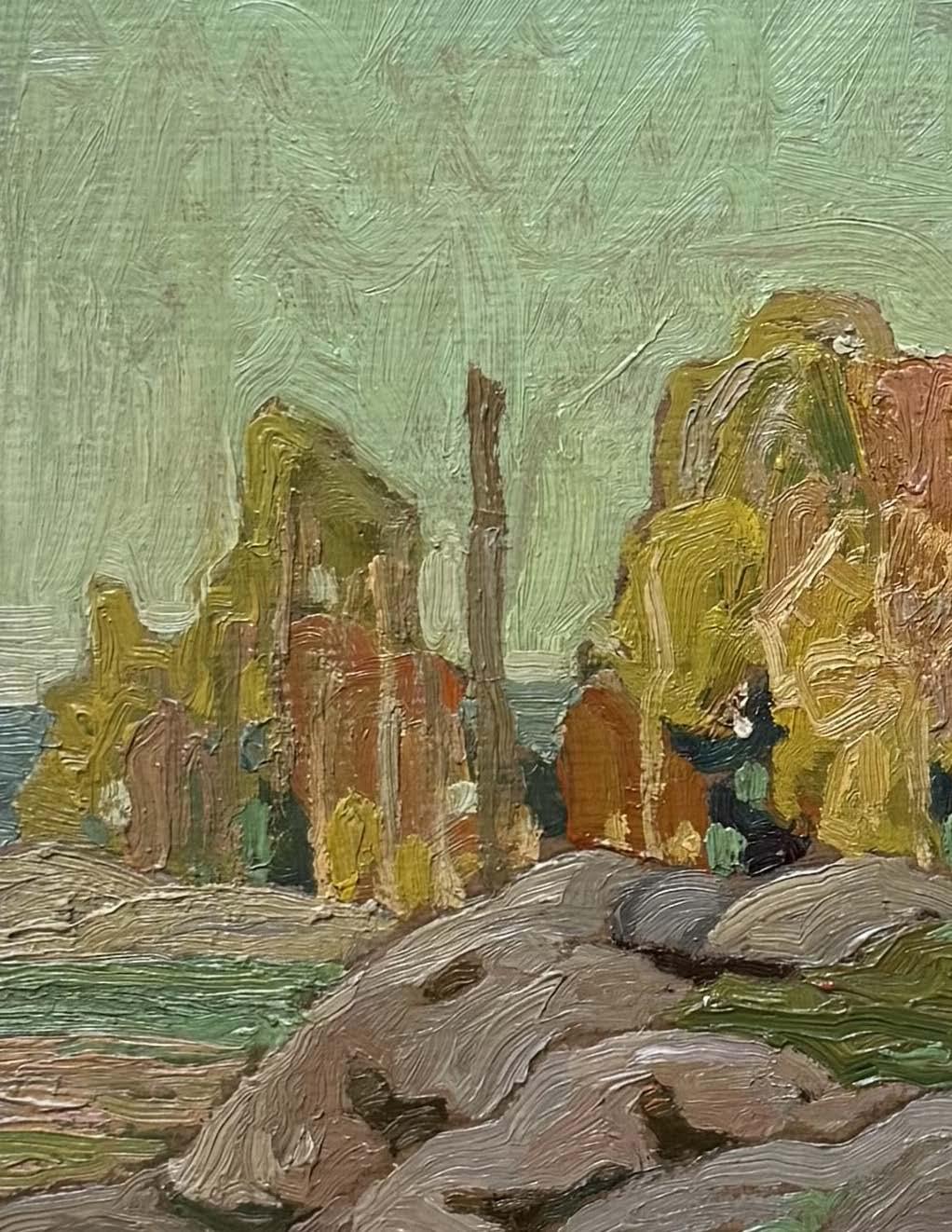
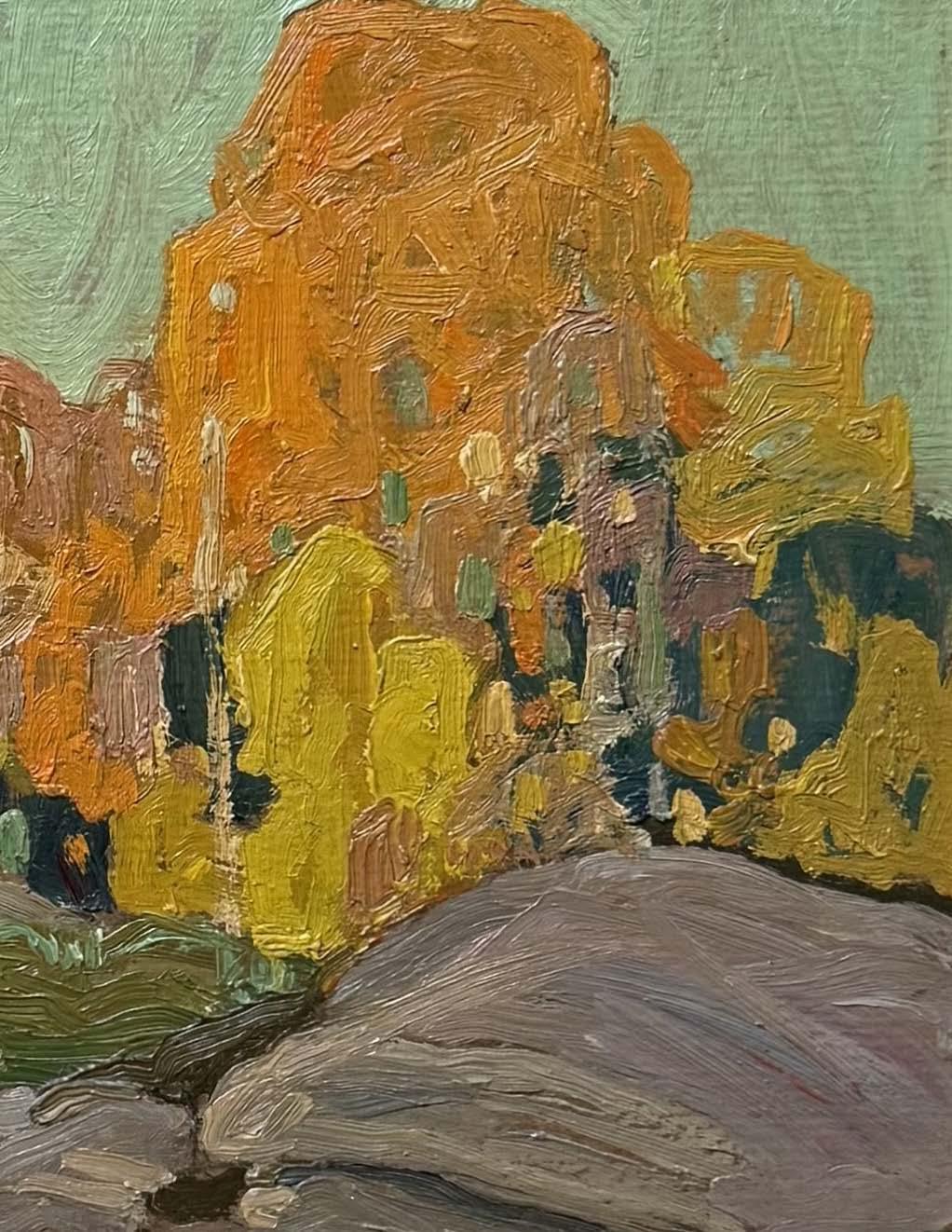
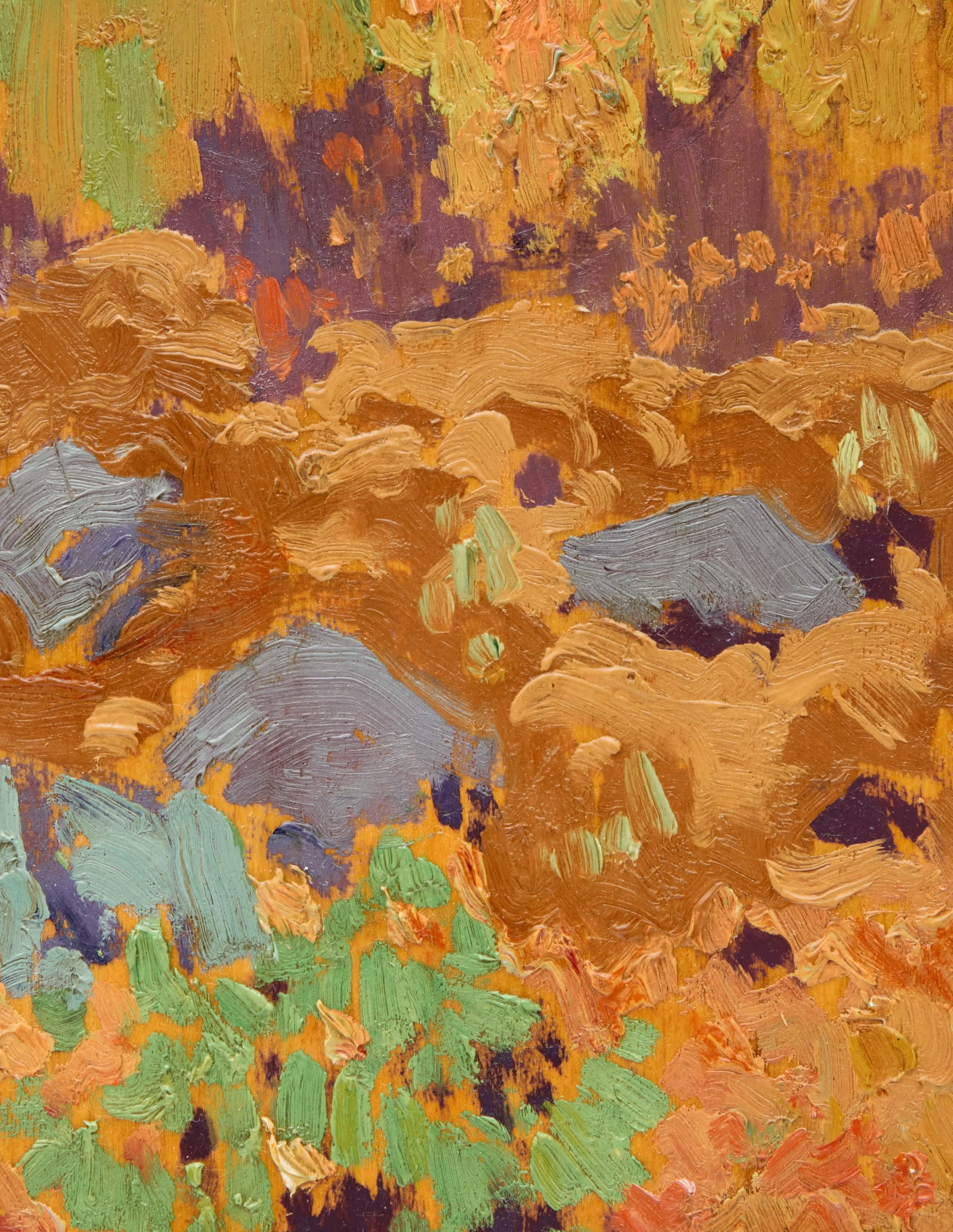
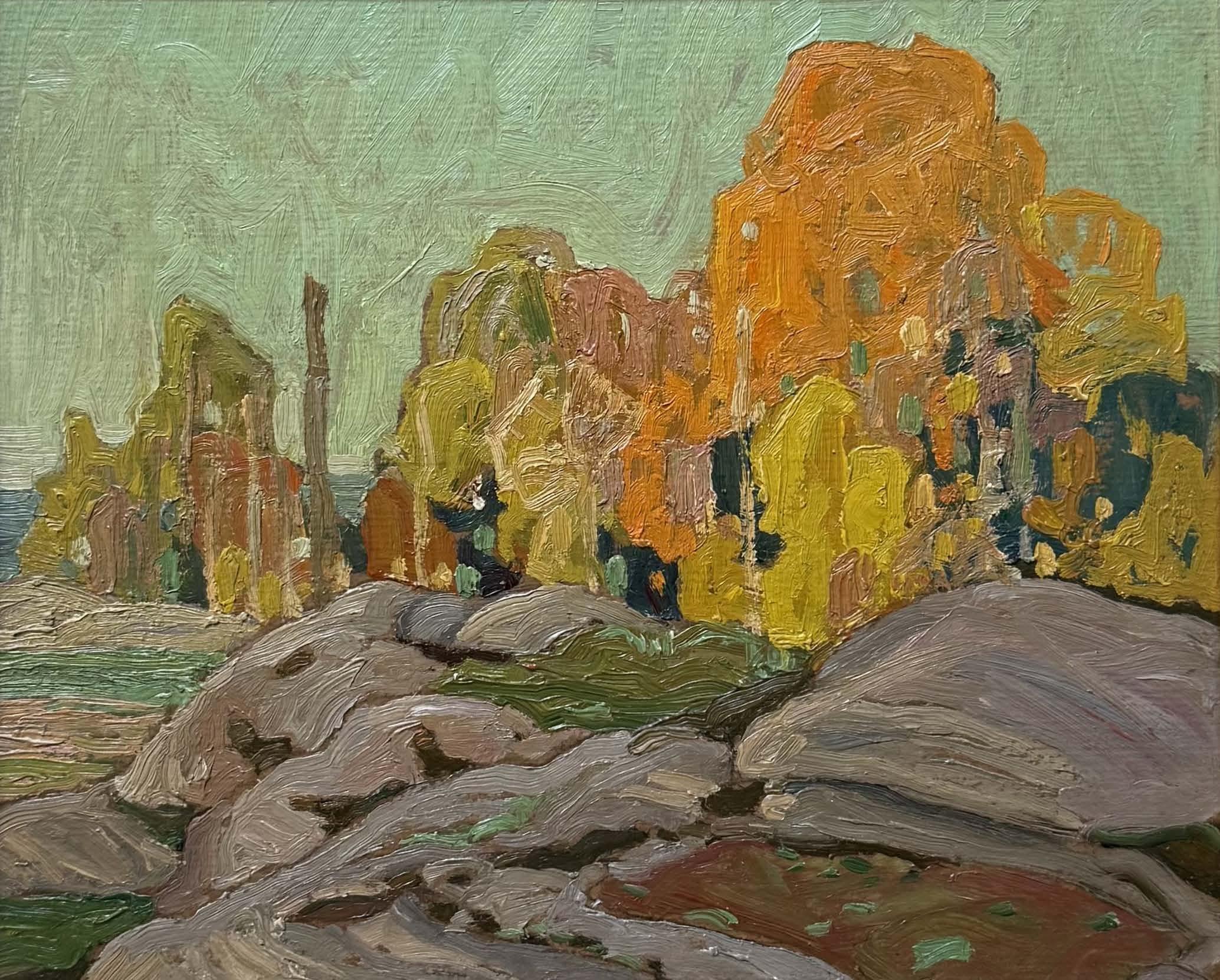
Autumn Hilltop, c. 1922 oil on panel titled and dated c. 1922 on a gallery label on the reverse 10 x 12 in
Estate of the Artist, by descent Private Collection, Ontario Masters Gallery, Calgary Private Collection
In 1920, Franklin Carmichael became a founder of the Group of Seven landscape painting collective, a moment that marked his first significant recognition as a contributor to modern art in Canada. Beginning in 1912, he had participated in exhibitions of the Ontario Society of Artists (elected 1917), the Canadian National Exhibition, and the Royal Canadian Academy of Arts. But participation in the Group movement with just six other artists versus the huge group-artist society exhibitions shone a spotlight on his practice that had not been possible before. Showing a total of forty-two works in the first three exhibitions of 1920, 1921 and 1922, visitors to the Art Gallery of Toronto could begin to experience the evolution of an artist. And it was in these early years of the Group’s formation that Carmichael’s artistic voice began to take shape as a masterful colourist and painter of light. Carmichael had been consistently engaged in plein air sketching in oil since his return from study in Antwerp, Belgium, in the fall of 1914.
By the time of the 1920 exhibition, Carmichael had resolved that the fall season offered immense painterly possibilities, notably the glorious pageantry of fall colour offered by the changing colours of the deciduous trees‒red, yellows and oranges‒set against the evergreens. He would explore the beauty of fall change for the rest of his landscape painting career. In Autumn Hilltop, Carmichael concentrates on these effects in one of his shallowest compositions from this period of his work, like his renowned easel painting, Silvery Tangle, 1921 (Art Gallery of Ontario) and the sketch Autumn Foliage against Grey Rock (National Gallery of Canada). While his use of colour is stunning and dominates the overall impression, the bald rock face in the foreground occupies nearly one-third of the composition. It was a strategic decision that set the middle ground colours into sharp relief. In the far distance, only a tiny portion of the composition is dedicated to a distant, hazy sky. However, it is not truly a hazy day, for the lighting in the foreground bears witness to a blast of sunlight from behind the artist to illuminate his subject, resulting in the striking palette of reds, yellows, and oranges
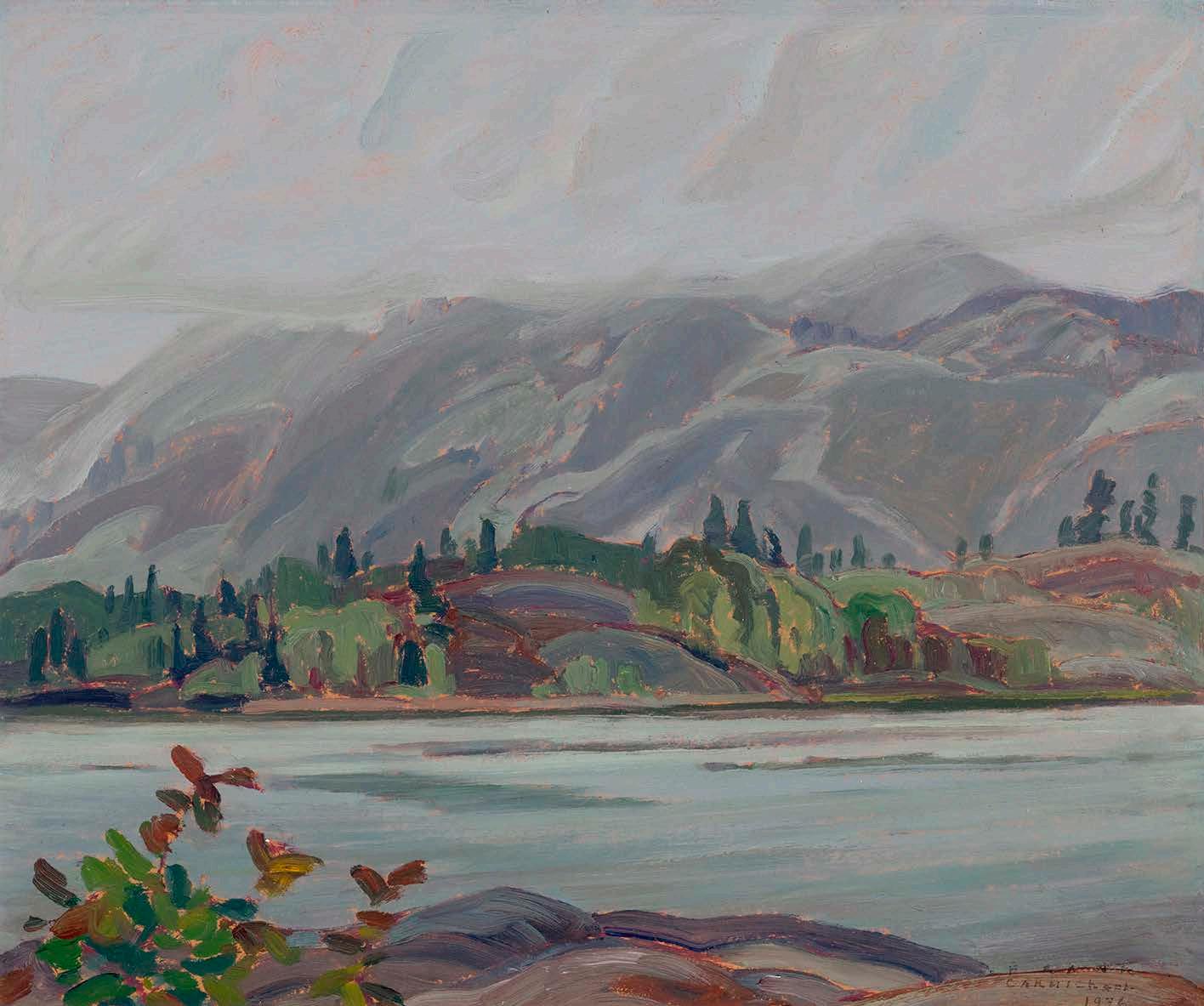
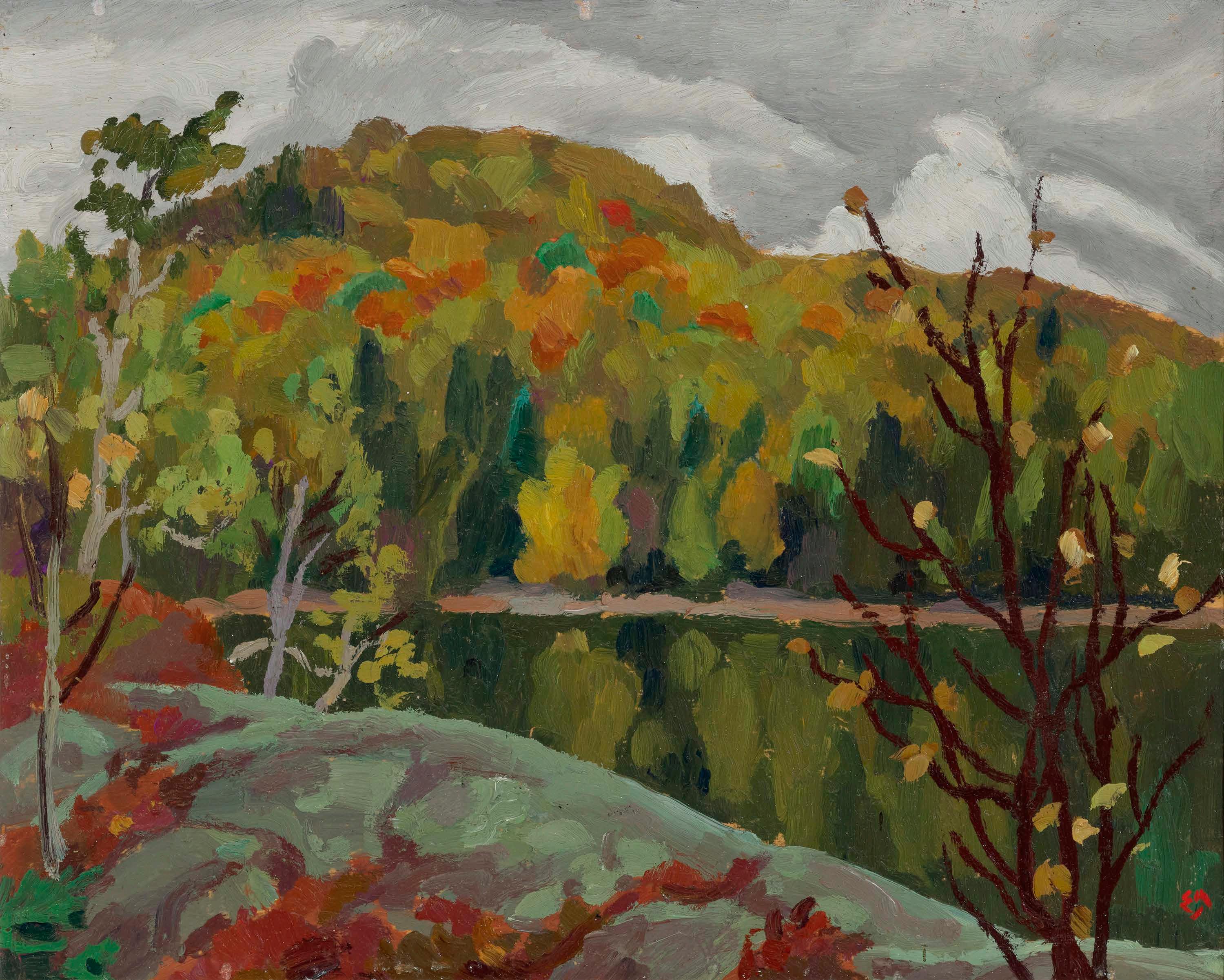
Misty Morning, La Cloche Mountains, 1936 oil on board
signed and dated 1936 lower right; titled on two gallery labels on the reverse 10 x 12 in
Roberts Gallery, Toronto
The Art Emporium, Vancouver Kaspar Gallery, Toronto
Fine Canadian Art, Joyner Fine Art, 16 May 1989, lot 74
Private Collection, Toronto Heffel, auction, Toronto, 24 November 2022, lot 143
LITERATURE
Bice, Megan, Light and Shadow: The Work of Franklin Carmichael, McMichael Canadian Art Collection, 1990
Carmichael’s love of the La Cloche Hills of Northern Ontario is well known. The artist himself states the area was his “favourite painting place”. Around 1934, Carmichael built a summer home on Cranberry Lake in the La Cloche Mountain region. He and his family spent many a summer at the cabin where Carmichael found plentiful subject matter to capture in his decorative panels.
In his panoramic scenes of the 1930s, Carmichael explores the range of nature’s aspects from the more intimate and subtle contrasts to the dynamic skies and fantastical colour of the La Cloche hills. The atmospheric qualities in these works present a different artistic response. There is an intimacy and expanse by placing the viewer in a foreground space, establishing our point of view, then opening out over the complexity of rocks, trees and hills. There is a magic light that fills the space, not only revealing the land to us but transforming the experience of seeing.
Overlooking Lac Tremblant, c. 1930 oil on panel titled and dated c. 1930 on two gallery labels on the reverse 8.5 x 10 in
PROVENANCE
Galerie Walter Klinkhoff, Montreal Private Collection, Montreal
Galerie Eric Klinkhoff, Montreal Private Collection
EXHIBITED
Painters of Mont-Tremblant (1910-1960): A Retrospective Exhibition, Galerie Eric Klinkhoff, Montreal, 26 September-10 October 2015, no. 31
From an early age, Holgate was enrolled in classes at the Art Association of Montreal. He studied with Maurice Cullen and William Brymner for two years before moving to Paris to further his studies. Holgate returned to Montreal in 1914, where he was a quiet presence in the Montreal art community.
Holgate was a member of various social and professional groups, including the Canadian Group of Painters and the Royal Canadian Academy of Arts. Holgate often travelled with A.Y. Jackson on sketching trips and exhibited with the Group of Seven before they requested that he become a member in 1929. Later in Holgate’s career, he taught at the Art Association of Montreal, where Holgate shared his expertise in book illustration and wood engraving. Holgate’s dedication to graphics, drawing, and printmaking shone through in the distinctive, strong lines and designs that characterized his paintings.
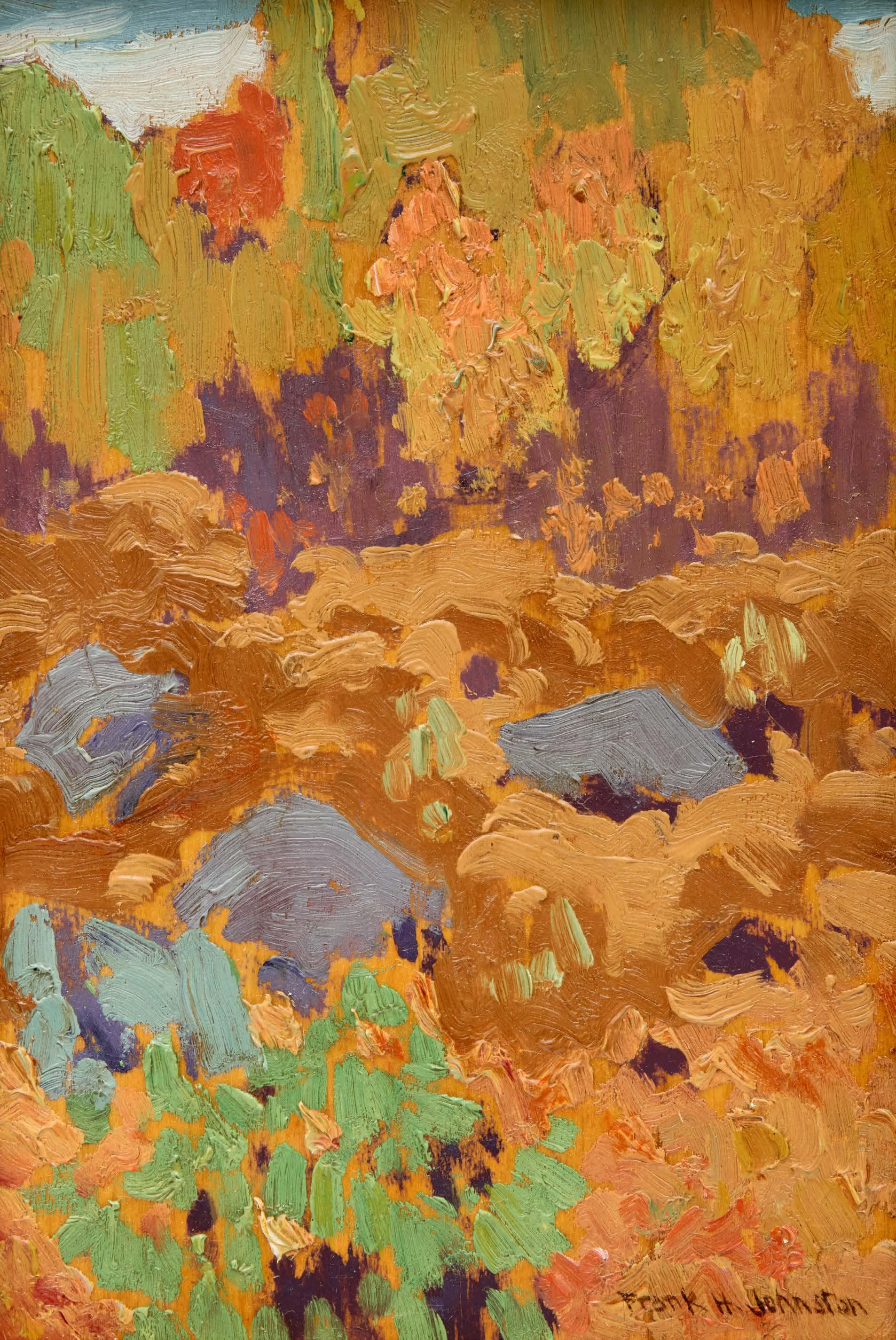
Algoma, 1918 oil on board
signed lower right; titled and dated 1918 on two gallery labels on the reverse 8.5 x 6 in
The Canadian Fine Arts Gallery Ltd., Toronto Roberts Gallery, Toronto
The Art Gallery of Ontario, Toronto, deaccessioned February 2026 Private Collection, Ontario
The work was certified by Paul Rodrik, the son of the artist.
In the fall of 1918, Lawren Harris, J.E.H MacDonald, and Frank Johnston made their first painting trip to Algoma. Convinced by Harris, the Algoma Central Railway loaned the group a boxcar to serve as both lodgings and a mobile studio. The boxcar’s first location was at the Agawa River, in what is now the famous Agawa Canyon.
Painted red and numbered #10557 in white, the boxcar was complete with bunks, tables and chairs, a stove, and painting materials. There was also a canoe and a handcar, which could be used for short-distance travel along the rail line. This mobile studio could be moved along the rail line to the landscapes that members of the group wanted to explore, Algoma in all its fall glory. Records indicate that at the conclusion of each day in the field, group members returned to the boxcar and compared their work over dinner. The success of this trip led to its repetition in the fall of 1919 and 1920.
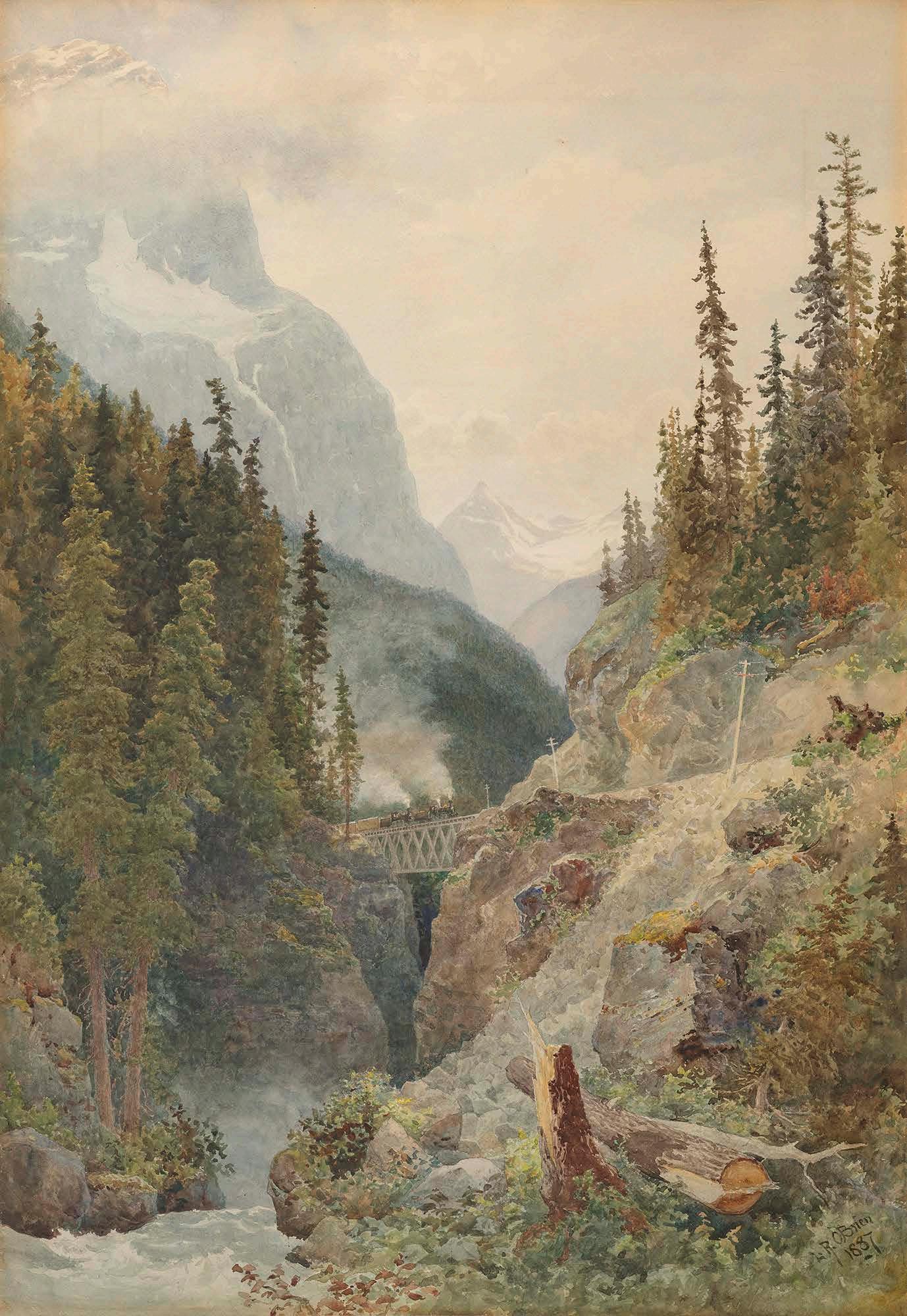
Through the Rocky Mountains, a Pass on the Canadian Highway, 1887 watercolour
signed and dated 1887 lower right 40 x 27.5 in
The Artist, until at least 1893
Mrs. J. Home Cameron, Toronto, by May 1959
McMichael Canadian Collection, Kleinburg, Ontario McCready Gallery, Toronto
Private Collection, circa 1972
Cowley Abbott, auction, Toronto, 8 June 2023, lot 141
Private Collection, Ontario
EXHIBITED
Possibly Eighth Annual Exhibition of the Royal Canadian Academy of Arts, Art Association of Montreal, from 20 April 1887, no. 117
Dudley Gallery Art Society, London, England, January‒
February 1888, no. 1
Fine Art Exhibition, Bewick Club, Newcastle-Upon-Tyne, 1888, no. 1
A Selection of Twenty-seven Water Colour Drawings, Illustrating Scenery in ‘The Rocky Mountains’ and ‘Pacific Coast’ British Columbia. By L.R. O’Brien, Esq. President of the Royal Canadian Academy, Thomas McLean’s Gallery, London, from 22 June 1889, no. 1
Lucius R. O’Brien, W. Scott & Sons, Montreal, from 12 March 1892, no. 2 as A Pass on the Canadian Highway at $350
The Palette Club, Lucius O’Brien’s Studio, Toronto, 10‒11
February 1893, no. 22 as The Kicking Horse Pass at $350
Lucius R. O’Brien, Matthews Bros, Toronto, from 12 December 1893, no. 1 as A Pass on the Canadian Highway at $350
Our Own Country Canada, National Gallery of Canada, Ottawa; travelling to Winnipeg Art Gallery; Vancouver Art Gallery; Art Gallery of Ontario, Toronto; Montreal Museum of Fine Arts, 24 November 1978‒19 August 1979, no. 125
Historische Maleriei Kanadas, in OKANADA , Akademie der Künste, Berlin, travelling to Instituts für Auslandsbeziehungen, Stuttgart, 5 December 1982‒20 March 1983, no. 23
Collector’s Canada: Selections from a Toronto Private Collection, Art Gallery of Ontario, Toronto; travelling to Musée du Québec, Quebec City; Vancouver Art Gallery; Mendel Art Gallery, Saskatoon, 14 May 1988‒7 May 1989, no. 20
Lucius R. O’Brien: Visions of Victorian Canada, Art Gallery of Ontario, Toronto, travelling to the National Gallery of Canada, Ottawa; Vancouver Art Gallery; Musée du Québec, 28 September 1990‒14 July 1991, no. 57
Plain Truth, Mendel Art Gallery, Saskatoon, travelling to the Glenbow, Calgary; MacKenzie Art Gallery, Regina, 13 March‒21 November 1998, no. 249
Vistas: Artists on the C.P.R., Glenbow Museum, Calgary, 20 June‒20 September 2009
Embracing Canada: Landscapes from Krieghoff to the Group of Seven, Vancouver Art Gallery, travelling to the Glenbow Museum, Calgary; Art Gallery of Hamilton, 30 October 2015‒25 September 2016
Highlights from ‘Embracing Canada’, Galerie Eric Klinkhoff, Montreal, 22 October‒5 November 2016, no. 9
“The Art Exhibition. Some Notices of the Pictures Displayed”, The Herald (Montreal), 21 April 1887, as The New Route to the East – a Pass on the Canadian Railway “Art and Artists”, Toronto Saturday Night, VI:13 (18 February 1893), page 15, as The Kicking Horse Pass “Saturday Art Supplement”, Daily Mail (Toronto), 13 May 1893, reproduced as Through the Rocky Mountains. A pass of the Canadian Pacific Railway
Dennis Reid, “‘Our Own Country Canada’: Being an Account of the National Aspirations of the Principal Landscape Artists in Montreal and Toronto 1860-1890”, National Gallery of Canada Journal 31 (24 November 1978), reproduced page 8
John Bentley Mays, “Black and white in color”, Maclean’s (15 January 1979), reproduced page 47
Dennis Reid, ‘Our Own Country Canada’: Being an Account of the National Aspirations of the Principal Landscape Artists in Montreal and Toronto 1860-1890, Ottawa, 1979, pages 397400, 414-415, reproduced page 415, as painted from O’Brien’s 1887 trip to the Rockies
Dennis Reid, “Lucius O’Brien”, in OKANADA , Akademie der Künste, Berlin, 1982, reproduced page 52; original texts for German-language catalogue, page 51
Allan Pringle, Artists of the Canadian Pacific Railway, (M.A. thesis, Concordia University, Montreal, 1983), pages 5560, 85, 121, 144, as Bridge‒Kicking Horse Pass‒Second Crossing, reproduced illustration 2
Sid Marty, A Grand and Fabulous Notion: The First Century of Canada’s National Parks, Toronto, 1984, reproduced page 50
Allan Pringle, “William Cornelius Van Horne: Art Director, Canadian Pacific Railway,” The Journal of Canadian Art History, 8 (1984), pages 63-66, 77 note 65, as Bridge‒Kicking Horse Pass‒Second Crossing
Craig Brown, editor, The Illustrated History of Canada, Toronto, 1987 (and 1990), reproduced page 360
Dennis Reid, Collector’s Canada: Selections from a Toronto Private Collection, Toronto, 1988, reproduced pages 28‒29
Dennis R. Reid, Lucius R. O’Brien: Visions of Victorian Canada, Toronto, 1990, pages 79‒80, 92 notes 51, 53, reproduced page 163
Dennis Reid, “O’Brien, Lucius Richard”, in Dictionary of Canadian Biography, vol. XII, Toronto, 1990, page 795
Lynda Jessup, Canadian Artists, Railways, The State and ‘The Business of Becoming a Nation’ (Ph.D. dissertation, University of Toronto, 1992), pages 190, 205‒206, 214-215, reproduced figure 59
Roger Boulet, Vistas: Artists on the Canadian Pacific Railway, Calgary, 2009, pages 61‒65, [70?], reproduced page 108
Nancy Townshend, Art Inspired by the Canadian Rockies, Purcell Mountains and Selkirk Mountains 1809-2012, Calgary, 2012, page 10, reproduced insert 5
Infrastructure Canada: Daniel Young and Christian Giroux, Oakville, 2012, page 251, reproduced page 249
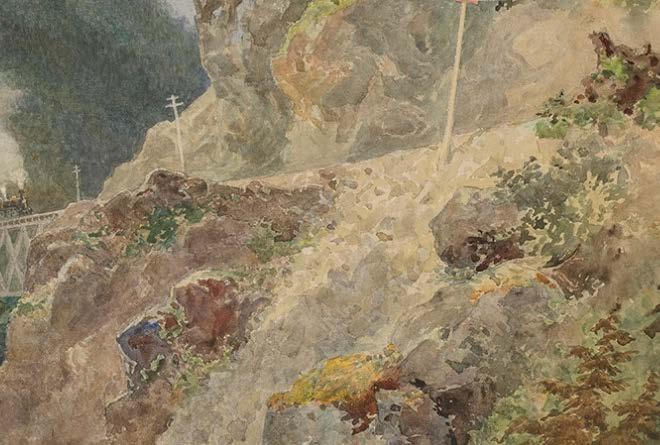
First President of the Royal Canadian Academy of Arts, Lucius O’Brien was the most prominent Canadian artist of his generation. Working in oils, and more frequently in watercolour, O’Brien painted landscapes in Quebec, New Brunswick and Ontario, a trajectory that was closely linked to the growth of the railways. The completion of the Canadian Pacific Railway in 1885 opened up new territory for artists. The company needed settlers and passengers to survive and it set out to publicize the new line, first in photographs then in paintings.
For investment reasons, the CPR’s general manager, William Van Horne, had his eyes on a British audience and wanted a good representation of mountain views for the Colonial and Indian Exhibition in London in May 1886. He offered artists free transportation, accommodation and assistance to paint sites along the railway line and was pleased when the Canadian Academy’s president applied in November 1885. Lucius O’Brien left Toronto for the Rocky Mountains on 19 June 1886 and worked in the vicinity of the CPR’s Glacier House hotel.
In his superb study of Lucius O’Brien’s career Reid wrote in 1990, “The CPR picture par excellence, it is set in the Kicking Horse Pass, where two engines in tandem are depicted pulling a train up the world’s longest and steepest gradient, across Kicking Horse Bridge, beneath towering Mount Stephen. … [O’Brien] had bought it to the attention of Van Horne first in a letter of mid April 1887 as he was about to ship his paintings off to Montreal for the Academy exhibition. ‘Among the pictures there will be one I have painted to send to London, as an illustration of our Canadian Highway through the mountains. It is to go on Exhibition at the Dudley Gallery to which I have been asked to contribute.’”
O’Brien exhibited eleven mountain watercolours with the Royal Canadian Academy of Arts in Montreal in April 1887, ten of which were purchased by Sir George Stephen (later Lord Strathcona). One watercolour for the Academy exhibition, titled in O’Brien’s studio book, The New Route to the East, was identified by the artist as not for sale. The unsold work in the RCA exhibition catalogue was titled The Valley of the Illicilliwaet and was priced at $250, but was referred to in a review in the Montreal Herald as The New Route to the East ‒a Pass on the Canadian Railway. On the back of the frame on this watercolour are two labels in O’Brien’s hand, one for the Dudley Gallery exhibition and one for the Bewick Club in Newcastle-upon-Tyme. On both the work is titled by the artist Through the Rocky Mountains, a Pass on the Canadian Highway. To complicate things further, Allan Pringle (1983) suggests that it was first referred to in correspondence with Van Horne as Bridge‒Kicking Horse Pass‒Second Crossing, possibly more of an identification of the subject than a title.
A smaller version of this watercolour, measuring 43.8 x 31.9 cm, inscribed on the verso Kicking Horse Pass (about 5000 ft.), is in the collection of the British Columbia Archives, Victoria (acc. no. 4901), and it might have been painted on site, while the large watercolour was painted in O’Brien’s Toronto studio. This work is the largest of all O’Brien’s mountain watercolours.
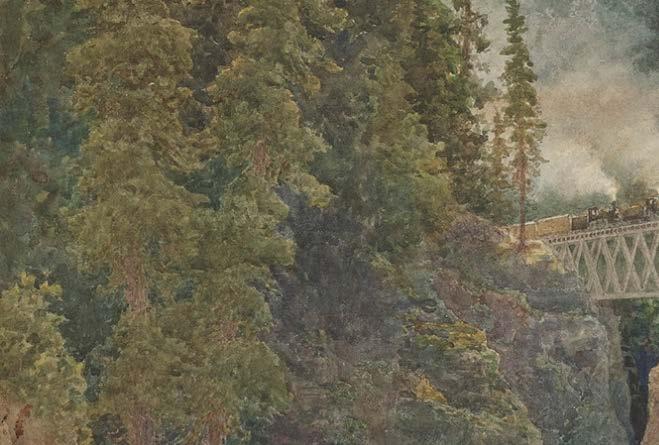
Again we have to thank Dennis Reid for his vivid description of this watercolour. “[T]he real pleasure in this painting is in the virtuoso handling of the paint. There is a wonderful sense of the transparency of watercolour in the description of light refracting through the sediment-filled glacial stream, and particularly in the tumble of sunlight across the spill of broken rock that is the principal passage in the picture…. Each of the various set pieces, such as the prominent felled tree in the right foreground, the stunning pair of spruce trees to the left, the carefully observed varieties of rock, are themselves delightfully complex, brilliantly composed pictures.” It is not surprising that this watercolour has become a classic image of its age as evidenced by its frequent inclusion in exhibitions and publications.
We extend our thanks to Charles Hill, Canadian art historian, former Curator of Canadian Art at the National Gallery of Canada and author of The Group of Seven‒ Art for a Nation, for his assistance in researching this artwork and for contributing the preceding essay.

Peter Ohler
Western Canada Representative Director of Private Sales (587) 317-6564 peter@cowleyabbott.ca
The Private Sales department at Cowley Abbott remains dedicated to acquiring rare and significant artworks, building on the trust Peter Ohler has established with collectors over the years. In 2018, after more than thirty years as a principal at one of Canada’s leading historical art galleries, Peter transitioned to become a private dealer.
Peter has brought his wealth of expertise to Cowley Abbott, strengthening our firm’s offerings. He works closely with buyers and sellers, to provide confidential private sale opportunities through his extensive network of collectors. His approach ensures discreet, high-value transactions.
He is a member of the board of directors of the Art Dealers Association of Canada (ADAC).

Cowley Abbott bridges the gap between traditional art auction services and the online fine art marketplace. With dedicated preview and gallery space, regular art auctions, and partnerships with national art experts, we provide both buyers and sellers of Canadian and international art with a unique and effective set of services which marry the traditional methods of promoting artwork and innovative means of building a collection.
Cowley Abbott has rapidly grown to be a leader in today’s competitive Canadian auction industry, holding semi-annual live auctions as well as monthly online auctions. Apart from these sales, Cowley Abbott also offers services for private sales, charity auctions, and formal appraisal services. With a prime location amid a row of art galleries and directly across the street from the Art Gallery of Ontario, Cowley Abbott also has the advantage of being immersed in a lively art community in its day-to-day operations.
Our experienced specialists strive to form relationships with clients built on professionalism, transparency and trust. The Cowley Abbott team is keen to facilitate the entire process of selling or purchasing an artwork, from on-site visits and individual consultations to the fall of the gavel and the final delivery of a work of art. We believe that art collecting should be approachable, educational and rewarding for both new and seasoned collectors. Several definitive details set Cowley Abbott apart to our clientele, cementing our presence in the Canadian art auction industry. We look forward to being of service to avid collectors far and wide.