KIM DORLAND: FORMER SELVES
Calgary | June 2026

Calgary | June 2026
OPENING
June 6: 10 am - 5 pm
PREVIEW
June 2-5: 10 am - 5 pm Works available for immediate purchase
INQUIRIES
Peter Ohler (587) 317-6564 peter@cowleyabbott.ca

326 Dundas Street West, Toronto 416-479-9703 | 1 (866) 931-8415 (toll free) mail@cowleyabbott.ca CowleyAbbott.ca
Kim Dorland, known for his fluorescent, super-thick paintings, is one of Canada’s most important contemporary artists. The paintings in Former Selves, made between 2007 and 2013, exemplify a time before the tagline “Tom Thomson on acid” attached itself to his reputation with an abundance of journalistic glue. Thomson was a huge influence on Dorland, and in a careerdefining exhibition at the McMichael Canadian Art Collection, his paintings hung alongside works by Thomson, David Milne, and Emily Carr.
But while Thomson painted literal visions, Dorland’s visions feel literary. His zombies, ghosts, and hooded loners are a cast of characters. His settings, floodlit or as dark as the grave, are dramatic. In a Dorland, the glowing birches are our sadness, the sasquatch our loneliness –for who believes in us? The best Dorlands sizzle with the kind of existential agony all honest people feel. But once the acid stops burning, beautiful bits of language float to mind - “Dawn and doom were in the branches” wrote Zora Neale Hurston. And the sheer volume of paint on so many Dorland canvases is a perfect realization of a term applied to the poems of Emily Dickinson’s “Sumptuous destitution”.
On the other hand, they are also just kind of heavy metal - rife with skulls, flames, and an intensely molten gloom. My neighbour is a metal dude. Jean Jacket. Big high-tops. Iron Maiden flag in the window. I have a hunch that when he looks at the world, he sees it just like Dorland does.
This catalogue will describe eleven paintings, specifically their paradoxical effects on the psyche. All the best art holds opposites in tension, as does the painting life itself. “I still feel the intent I had when I was working on them,” says Dorland, who feels a fondness for these works and a bit of nostalgia. “I feel like the same guy who painted them, but I also feel like a completely different person.”
Sarah Swan
Sarah Swan is an arts writer based in Yellowknife, Northwest Territories.
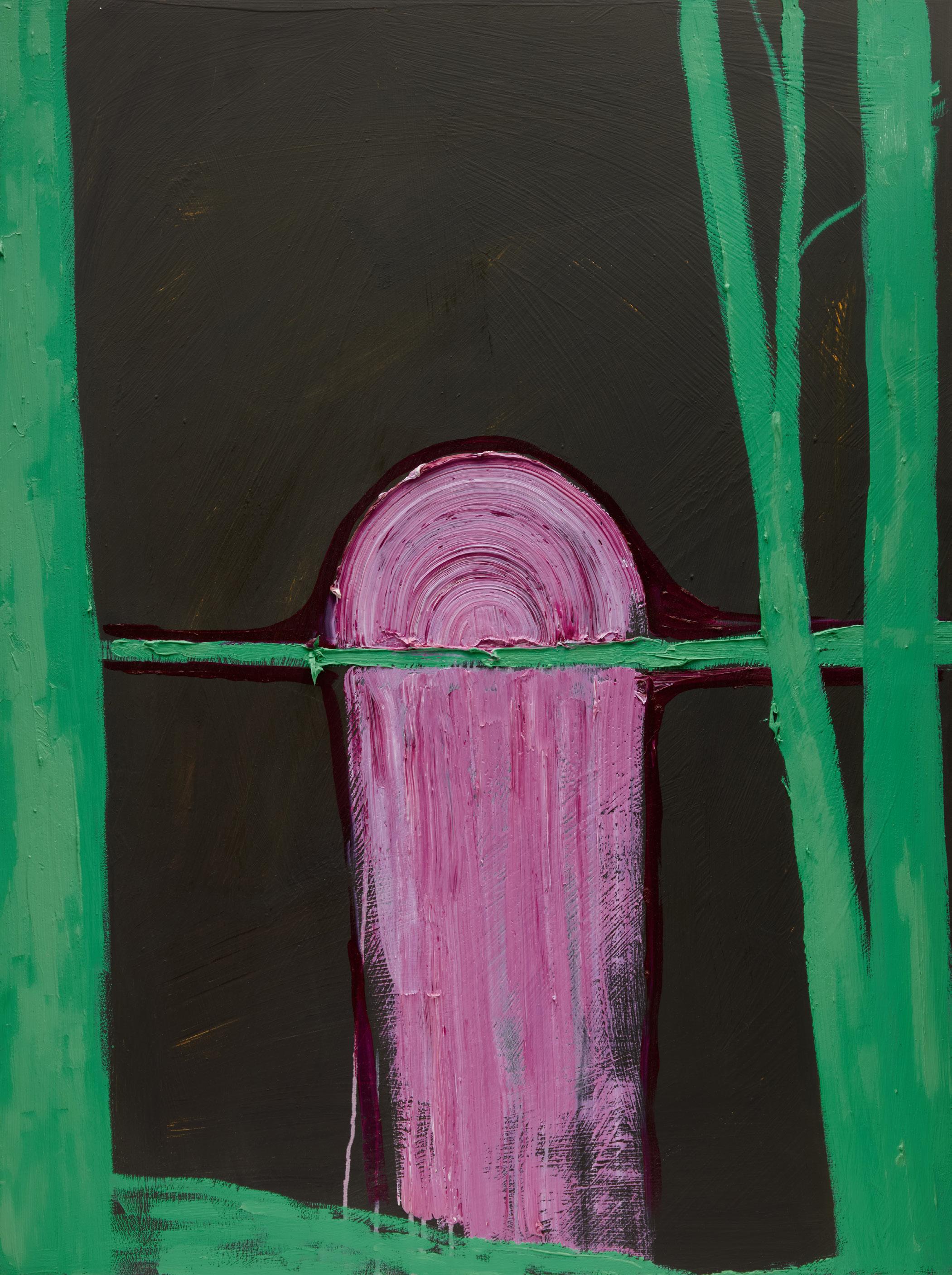
In interviews over the years, Dorland has discussed his maturation as an artist. He knew he was finding his way, he said, when his work began to contain the right amount of abstraction. His material sense came later, but finding ways to allow the recognizable world to remain so, while letting it also dissociate into moods and sensations was paramount. Many of his forest scenes from 2009 are almost nonrepresentational – the blue-green conifers are splays of lines, sinister somehow – but Sunset is right on the edge of fully abstract. Its violet semicircle and perpendiculars of green can be read as totally flat before the perception of a lowering sun occurs. A half-moment later, there’s an inkling of nonsensical sublimity. Why is the sky so dark? The brain is not a perfect instrument, and so we doubt we are seeing it right. Like the inverted colour of a film negative, the world has flashed to black.
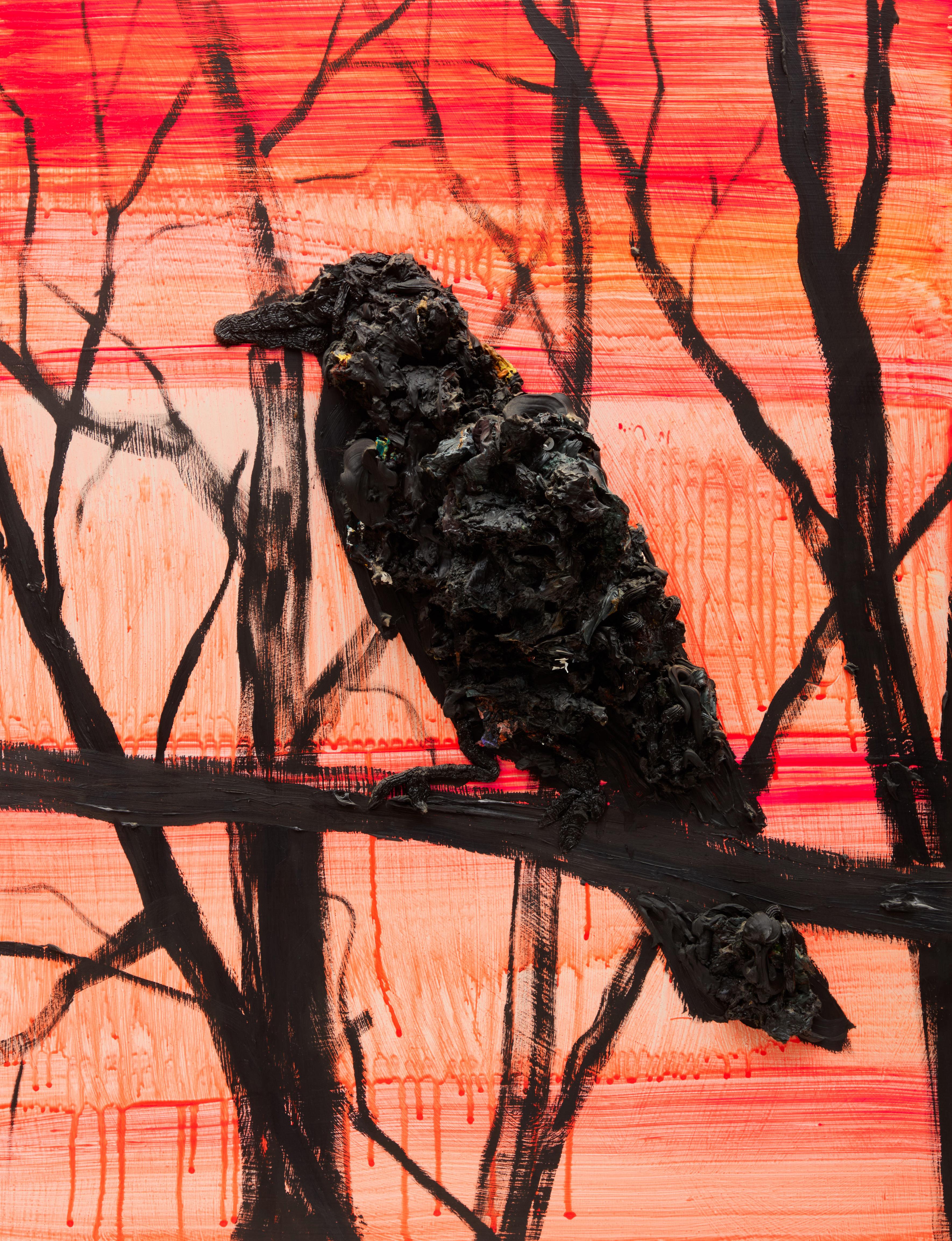
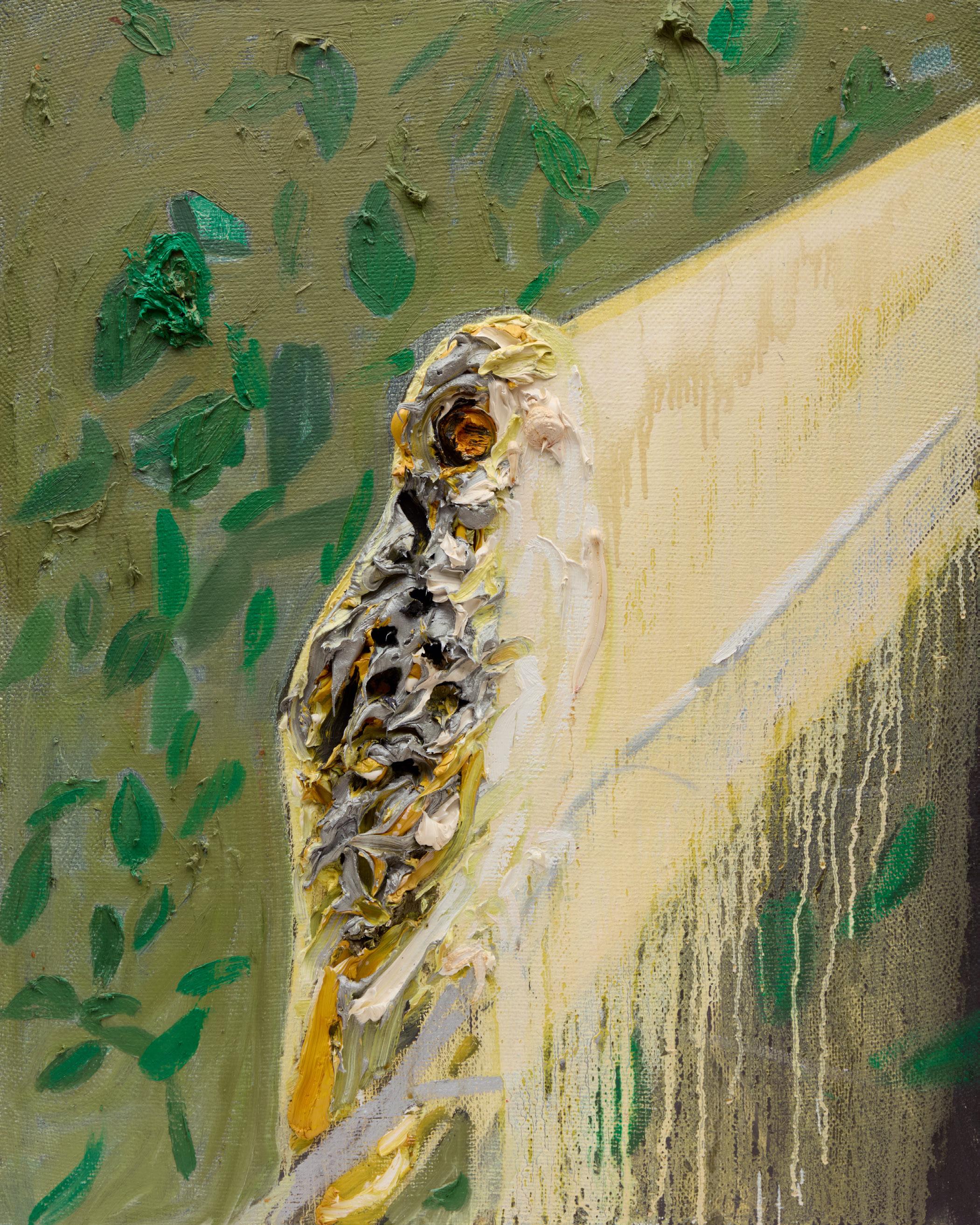
Dorland paints the immaterial – ‘the feeling’ of his wife Lori, intimations of psychological darkness, or the kind of radiant light that grows around certain trees, convincing us they are speaking for God. But somehow, he’s able to paint the immaterial with so much material. Where some artists might use a slight or minimal touch, Dorland piles on maximal mud, flesh, pulp, soot and char, splashing these with the brightest acids. He’s used so much paint, at times, he’s had to screw it in place. This is alchemy. Not base metals into gold but paint into substance and substance into feeling. These two birds are two alchemical extremes. This crow, made of oil, acrylic and screws, is a harbinger of doom. Against a wash of orange he perches, like Edgar Allen Poe’s raven, croaking a single ominous word: “Nevermore.” But in 2011, Dorland made a suite of paintings about the physicality and structure of light. They feel relentlessly life-affirming. This owl, blasted with a copious outpouring, is subsumed by an infinite yes!
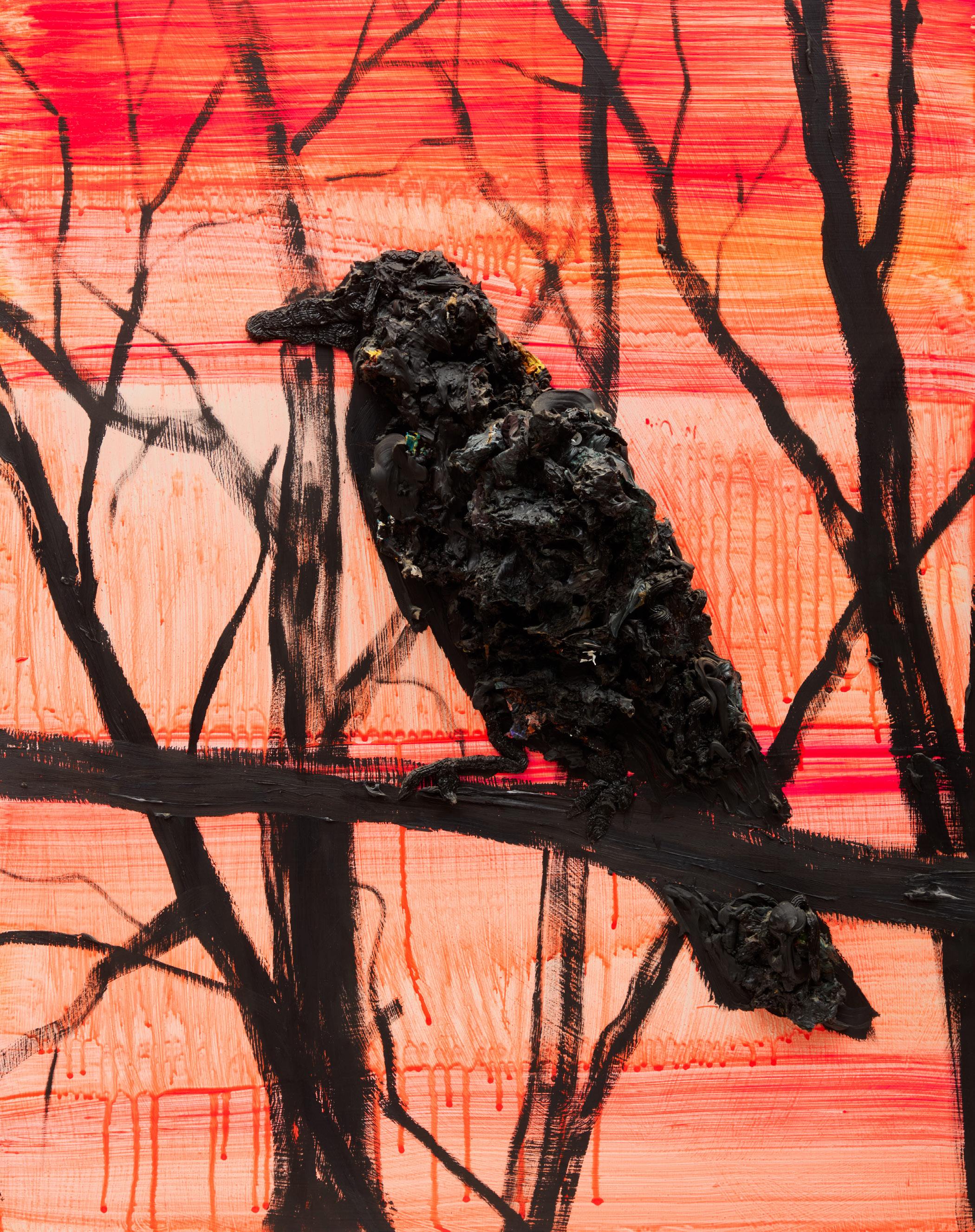
Dorland paints the immaterial – ‘the feeling’ of his wife Lori, intimations of psychological darkness, or the kind of radiant light that grows around certain trees, convincing us they are speaking for God. But somehow, he’s able to paint the immaterial with so much material. Where some artists might use a slight or minimal touch, Dorland piles on maximal mud, flesh, pulp, soot and char, splashing these with the brightest acids. He’s used so much paint, at times, he’s had to screw it in place. This is alchemy. Not base metals into gold but paint into substance and substance into feeling. These two birds are two alchemical extremes. This crow, made of oil, acrylic and screws, is a harbinger of doom. Against a wash of orange he perches, like Edgar Allen Poe’s raven, croaking a single ominous word: “Nevermore.” But in 2011, Dorland made a suite of paintings about the physicality and structure of light. They feel relentlessly life-affirming. This owl, blasted with a copious outpouring, is subsumed by an infinite yes!
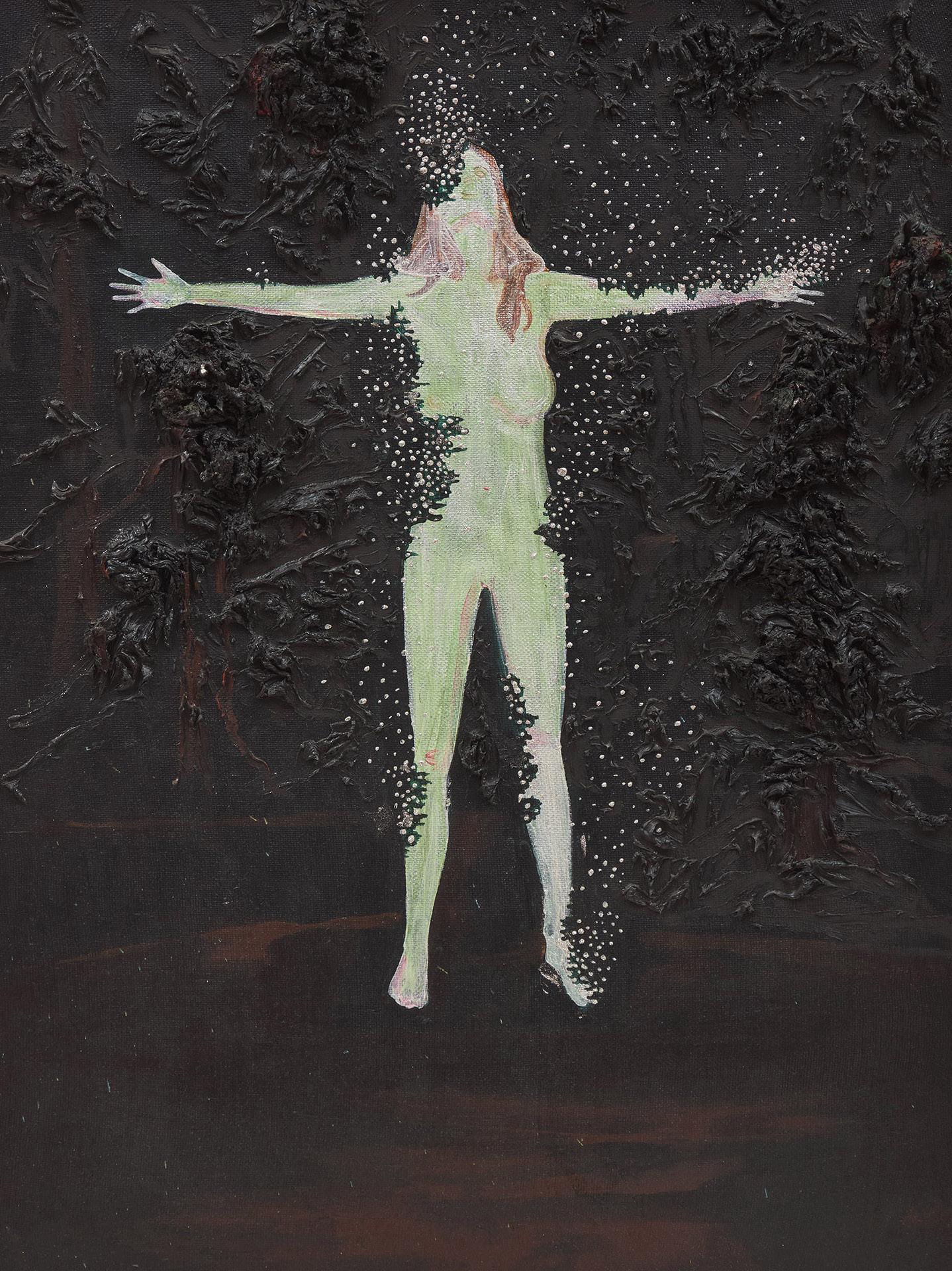
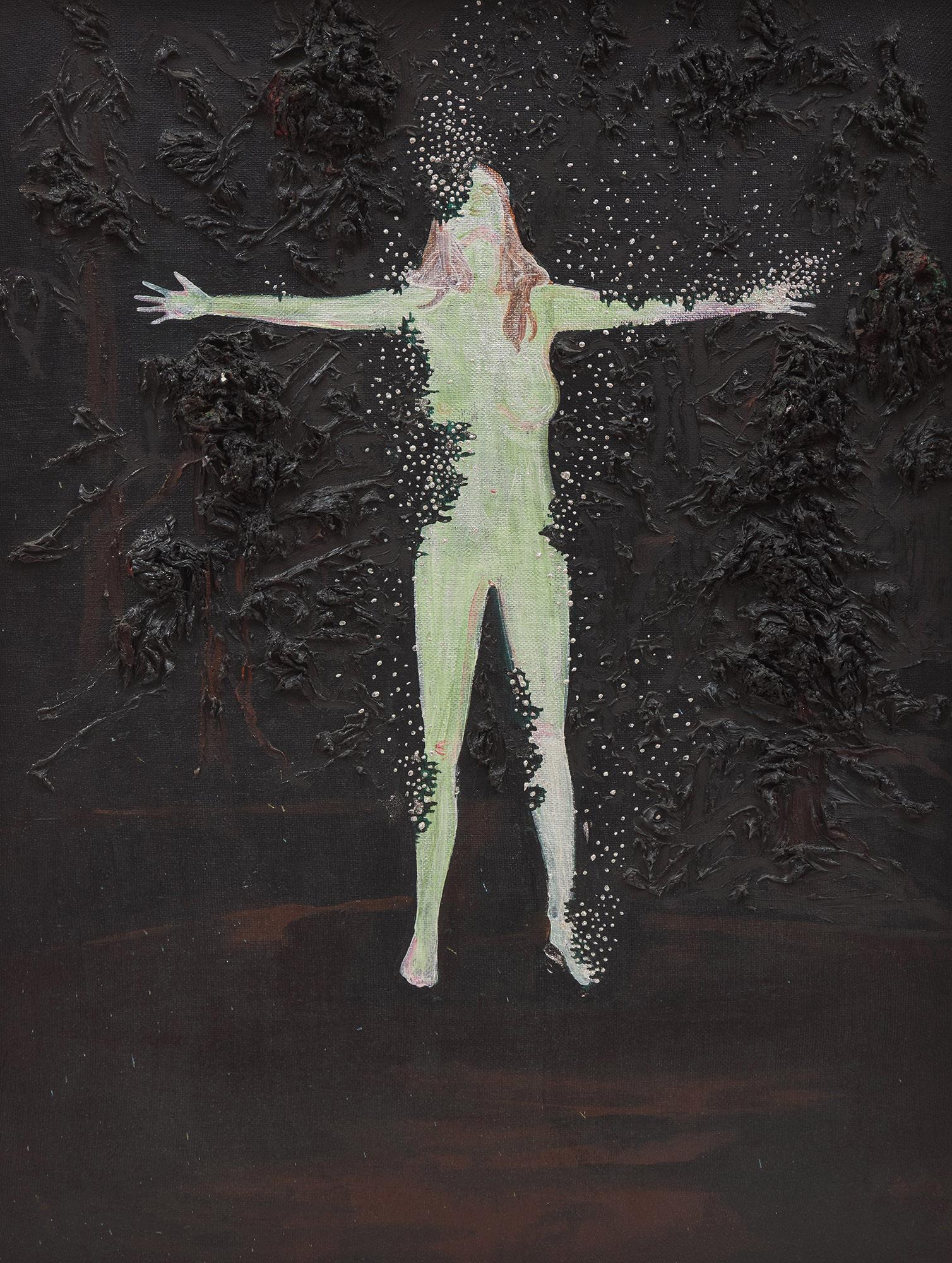
The Girl Disappears, 2010 oil on canvas
As we are all children of Modernism, there’s a nervousness around metaphysical subjects. We talk easily about the plastic and formal qualities of art, but not about its spiritual content. Most artists are spiritual though, not in a dogmatic sense, but in the abiding tension they feel between the materialist worldview and the strangely numinous, guiding presence within their own work. But whether The Girl Disappears describes a literal experience, a metaphorical experience, a desire for such an experience, or is pure fantasy – it is beautiful. J.R.R. Tolkien famously defended fantasy as a form of recovery and consolation, and as ultimately illuminating of true reality. He likened its “escapism” to a prisoner’s duty to escape rather than a deserter’s flight. In short, when the world gets so awful, there’s a moral imperative to leave it. “Death is nothing at all,” wrote Henry Scott Holland, “I have only slipped away to the next room.” Transcendence, says Dorland, is a glowing girl, in a private storm of atoms, merging with the haunted night.
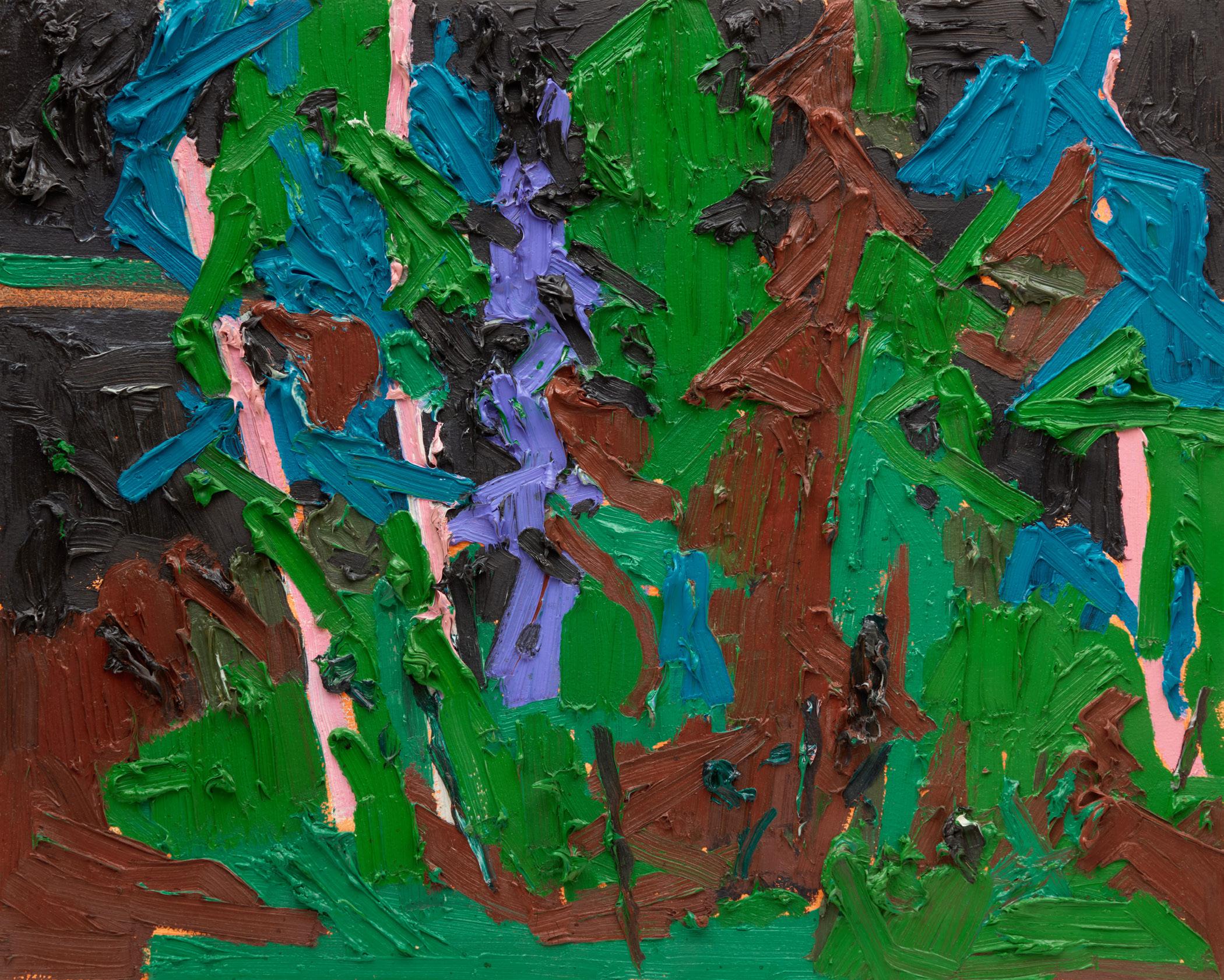
Emma Lake, 2009 oil on wood panel 16 x 20 in.
Oh, Canada. Dorland’s forest paintings could easily be pulled into conversation with Margaret Atwood’s early theoretical writing. In Canadian prose and poetry, she wrote, nature is a monster that exists both inside and outside the self. Canadian identity then, is based on surviving a dual wilderness. But this theme is alive in Canadian art, too. The Group of Seven’s landscapes are bleakly beautiful, more austere than grand, vaguely if not overtly threatening. Dorland’s painting of Emma Lake, Saskatchewan, an artist residency where he once taught workshops, contains much of what Atwood was talking about. It’s made with so many oblique lines, a touch of hostility, an agitation in the brushwork. The trees are closing in. There’s the sound of twigs breaking. The monster cometh.
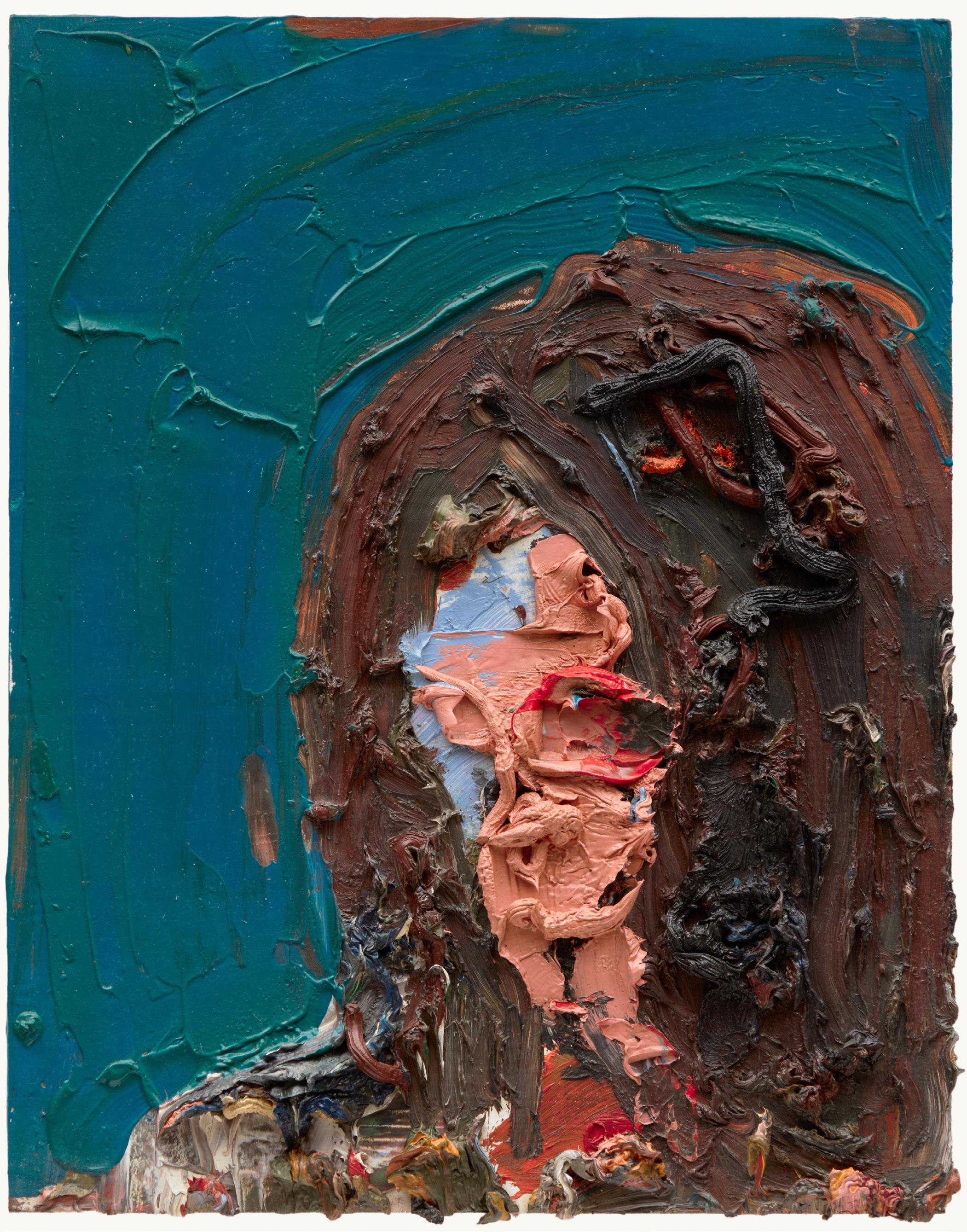
L.J.S., 2008 oil on plywood 20 x 16 in.
You can’t talk about Dorland’s work without talking about paint itself and without talking about his wife, Lori. He paints her constantly, though is much more interested in capturing “the feeling” of her than a likeness. In 2011 Dorland had a Lori themed show in New York, where he was accused, by some, of “flaying her to pieces.” But for Dorland, they are portraits of love and adoration. Whether viewers find them beautiful or grotesque, it’s hard not to be seduced by their over-the-top extravagance. Have you ever watched a young child with a can of whipped cream? The joy is contagious! In L.J.S, one of Dorland’s first portraits of Lori, there is sky-blue in her mind, blood-red at her throat, black worms squirming in her hair. She is primordial. She is of the elements. This painting is pure homage and reverence.
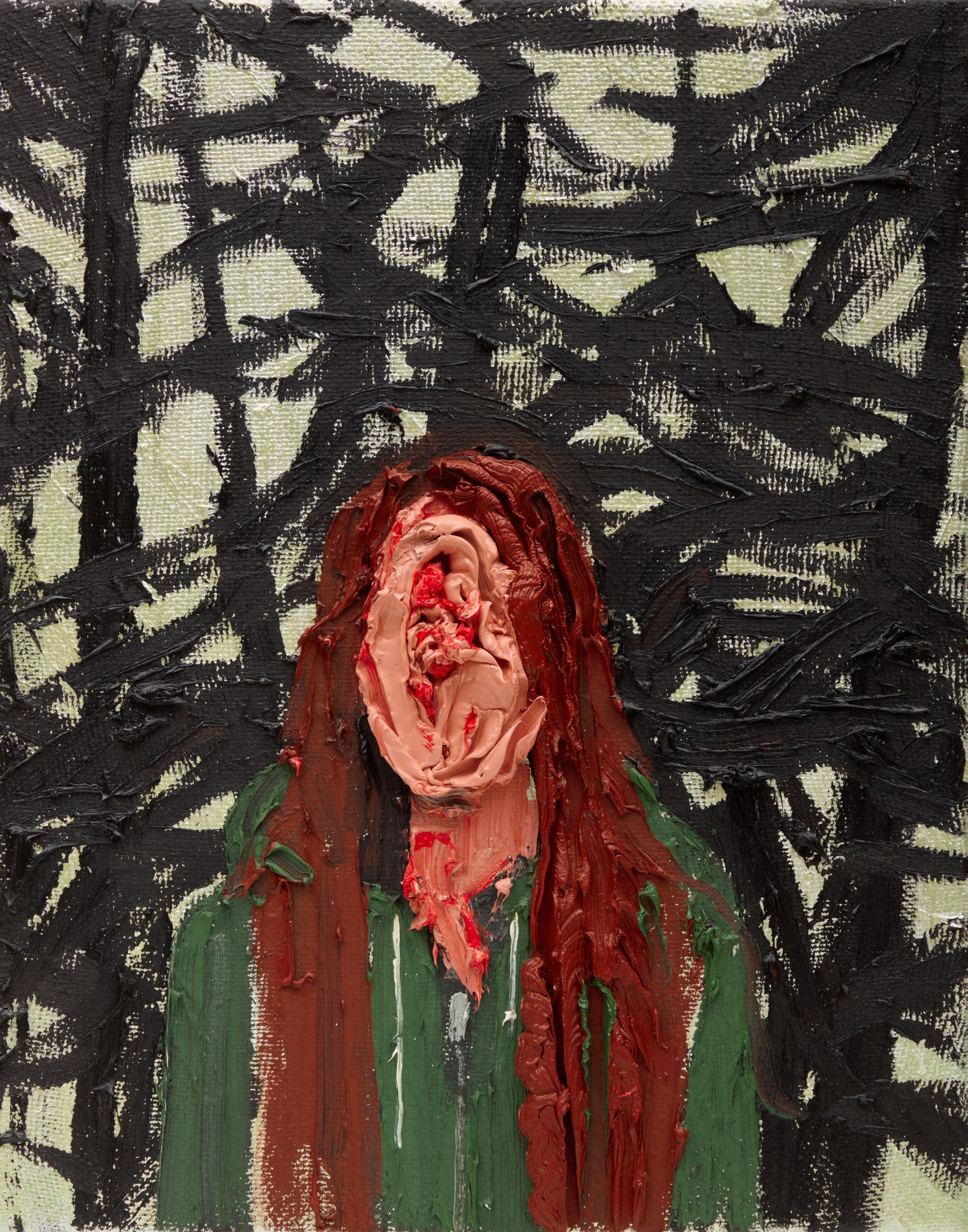
Green Hoodie, 2013 oil and acrylic on jute 20 x 16 in.
Some people recoil from blood and guts, while others are transfixed. Both are fair responses to what literary critic Julia Kristeva termed The Abject, and to objects like this painting, which threaten whatever psychic lines we’ve drawn between life and death, or between the essence of a person and their corporeality. We have souls, but we’re also essentially a pump and some plumbing. Green Hoodie is part horror-movie and part cartoon, in a nauseating silly-putty pink. It seems the outcome of a demi-god (the artist?) pushing his fingers inside a woman’s head and performing a few sickening turns of the wrist. But it also reveals the artist’s fascination with the very ‘insides’ of his subject, Lori. In this way, it’s the ultimate valentine. There’s so much vitality here, and morbidity, and intrigue, like how Margaret Atwood described death in her poem The Double Voice as “…a dead dog / jubilant with maggots…”
On a personal note, meanings of artworks change with time and context. These early Lori portraits feel even more raw with the added knowledge that Lori, Dorland’s partner of 37 years, is sick. He is her main caregiver, and most of the works he paints now are completed on breaks from the bedside.
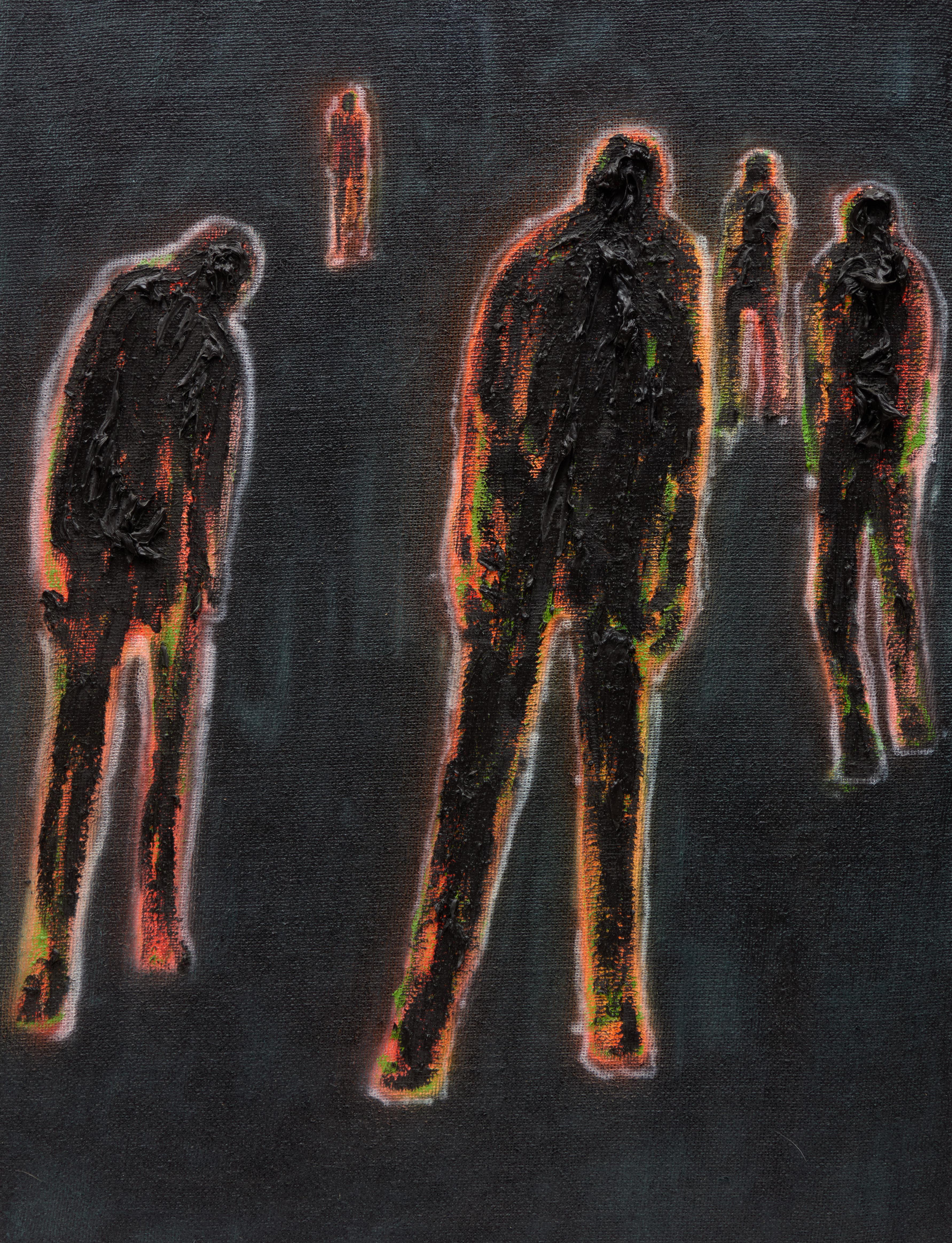
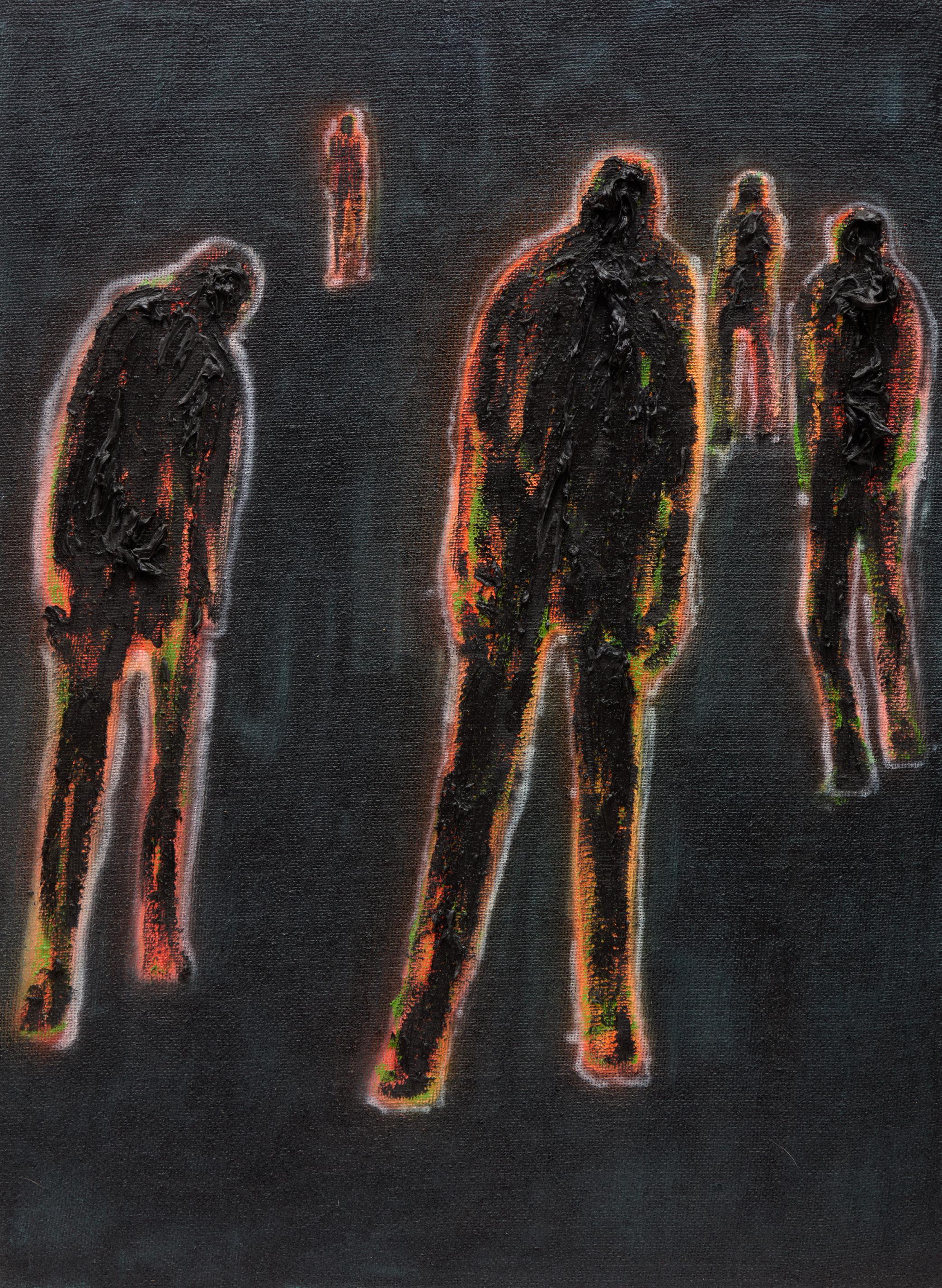
Dorland’s work runs the entire gamut of human emotion. One painting might reveal heaven, another hell. “I’m not a comfortable person,” he said in a 2014 interview, “so my paintings are not comfortable.” His zombie paintings, of which this is an early example, are Dorland’s uneasy analogy for the here and now. Iterations of this zombie composition appear in several paintings, and the effect of all of them depends on where we situate ourselves. Are we being pursued by these lurching walkers? Or is Dorland describing us? Maybe we are the vampiric cannibals, hollowed of spirit. Dorland’s zombies have become increasingly ragged and skeletal over the years – hungrier, clutching smartphones. They have come out of the shadows and have evolved (like variants?) into a purely deadpan critique. I almost miss these early zombies, where the threat, though constant and looming, did not yet come from inside my own person.
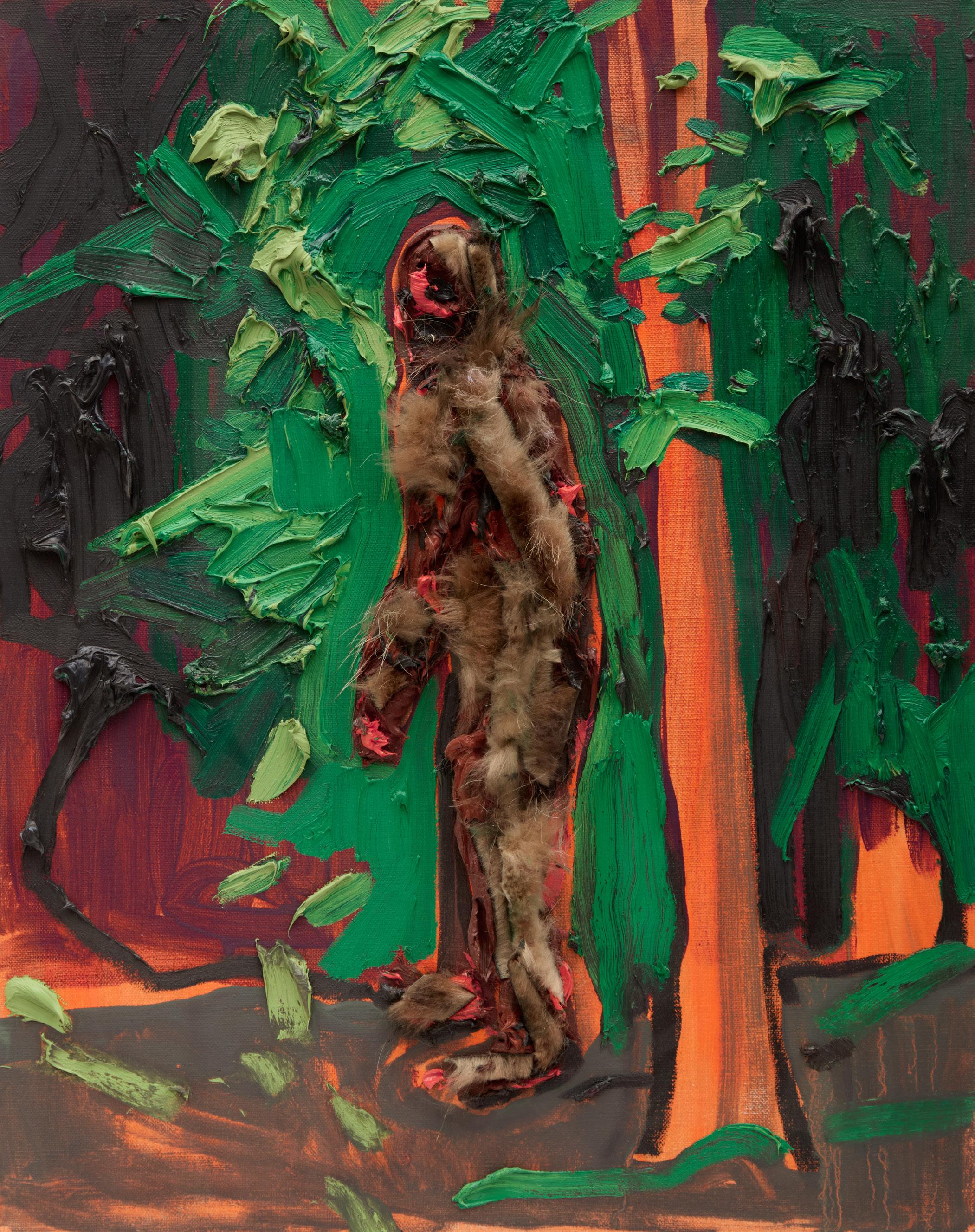
Sasquatch, 2009 oil and acrylic on canvas 20 x 16 in.
Sasquatch is a favourite motif of Dorland’s, though perhaps it’s more accurate to say a favourite imaginary friend. His sasquatch is not elusive, though. The paintings do not depict a hint of reddish fur or a flash of teeth glimpsed through trees. Rather, his sasquatch is fully revealed, so evident we cannot rationalize him away. Dorland’s large-scale sasquatches from this period sit on a throne of rock like an earthy inverse of cloud-dwelling Zeus, fur matted and scabbed with paint. The paintings are visceral enough to trick the mind into smelling rotting leaves and the blood of a fresh kill. But the creature in this collection has been washed by a good hard rain. His fuzziness – Dorland experimented with applying bits of actual fur in 2009 and 2010 – is humorous and endearing, like a child trying to make his painted creation ‘real.’ “I probably wouldn’t do it now with my overly critical brain,” says Dorland, “but back then I was braver and more in-your-face, so it was a yes to real fur!” Dorland’s beasts can be tragicomic. They have their own myths to live up to, big footprints so to speak, but they’re also sad and alone.
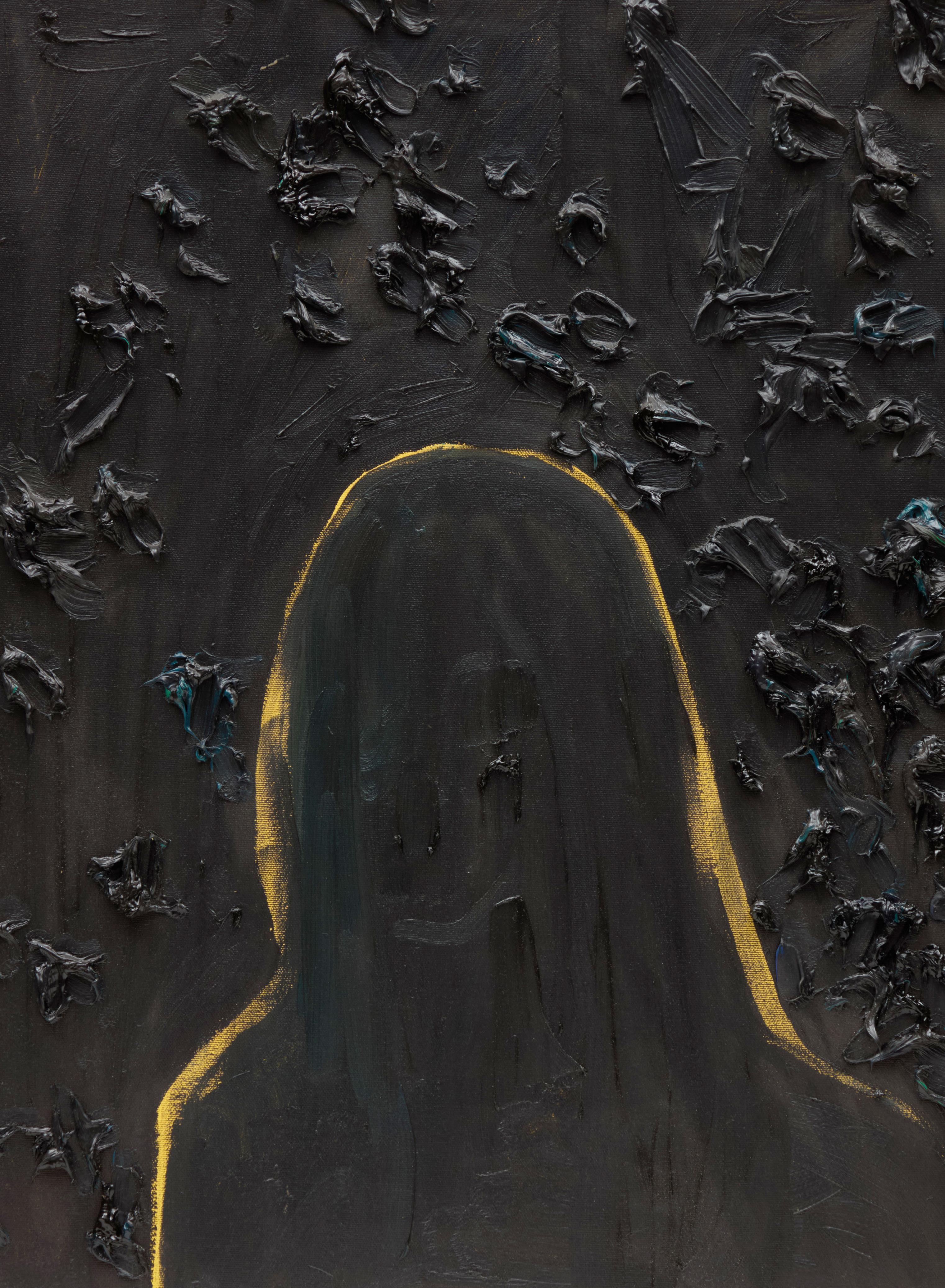
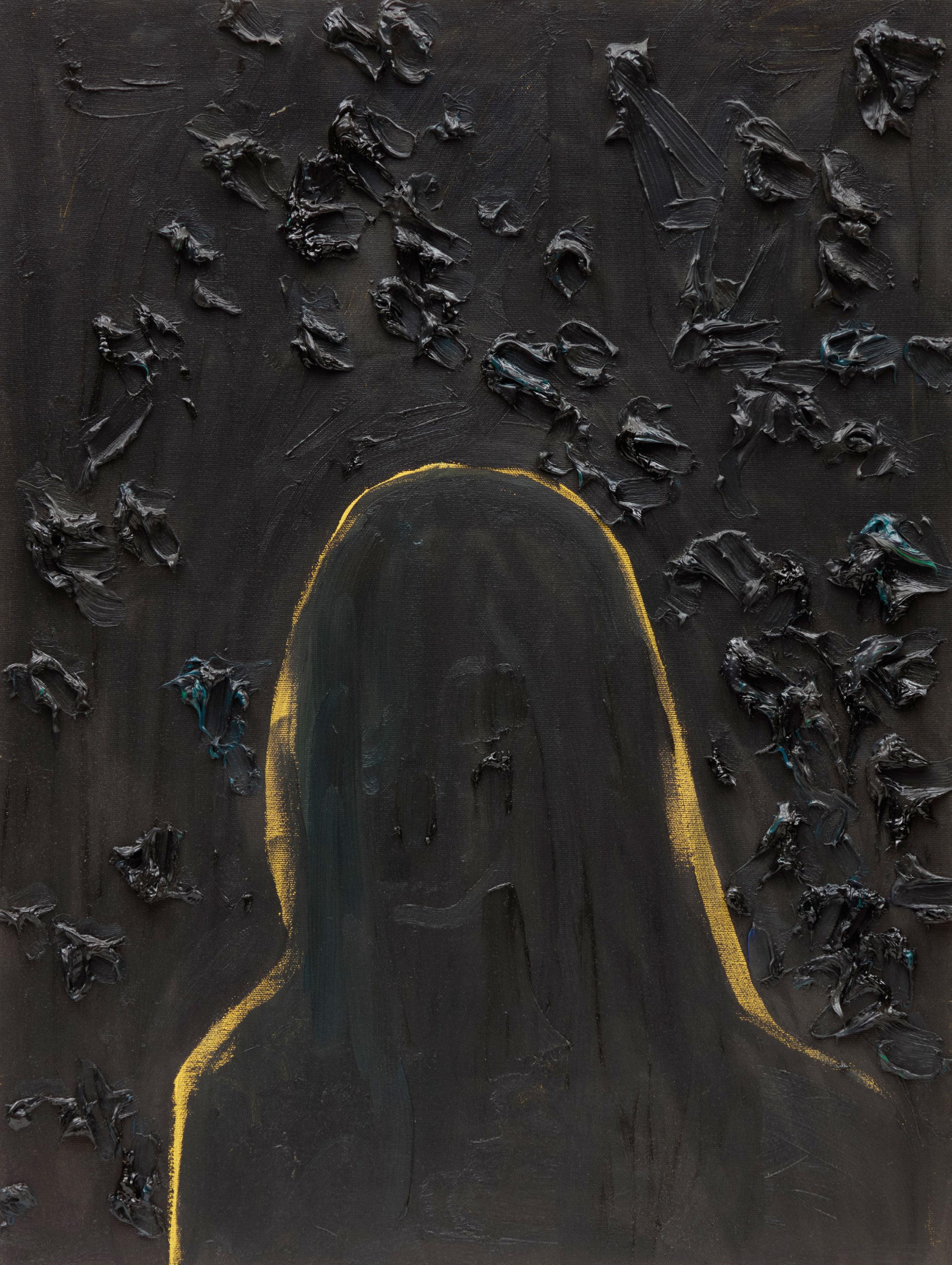
Many of Kim Dorland’s paintings, Night among them, work at the level of awe. They are so evocative but hard to pin down, as they tend to change tone or meaning depending on the proportion of belief or unbelief we feel in the moment. Sometimes, in the night, everything feels tinged with terror and we understand that life has no meaning. Other times, night’s undulating blacks generate their own strange shine, and we understand that darkness is the original substance, the original mesh out of which everything possible was born. Is the figure facing away from or towards us? Are we looking at the back of Lori’s head as she encounters this mystery, or at ghoulish contours barely discernable under a wall of hair?
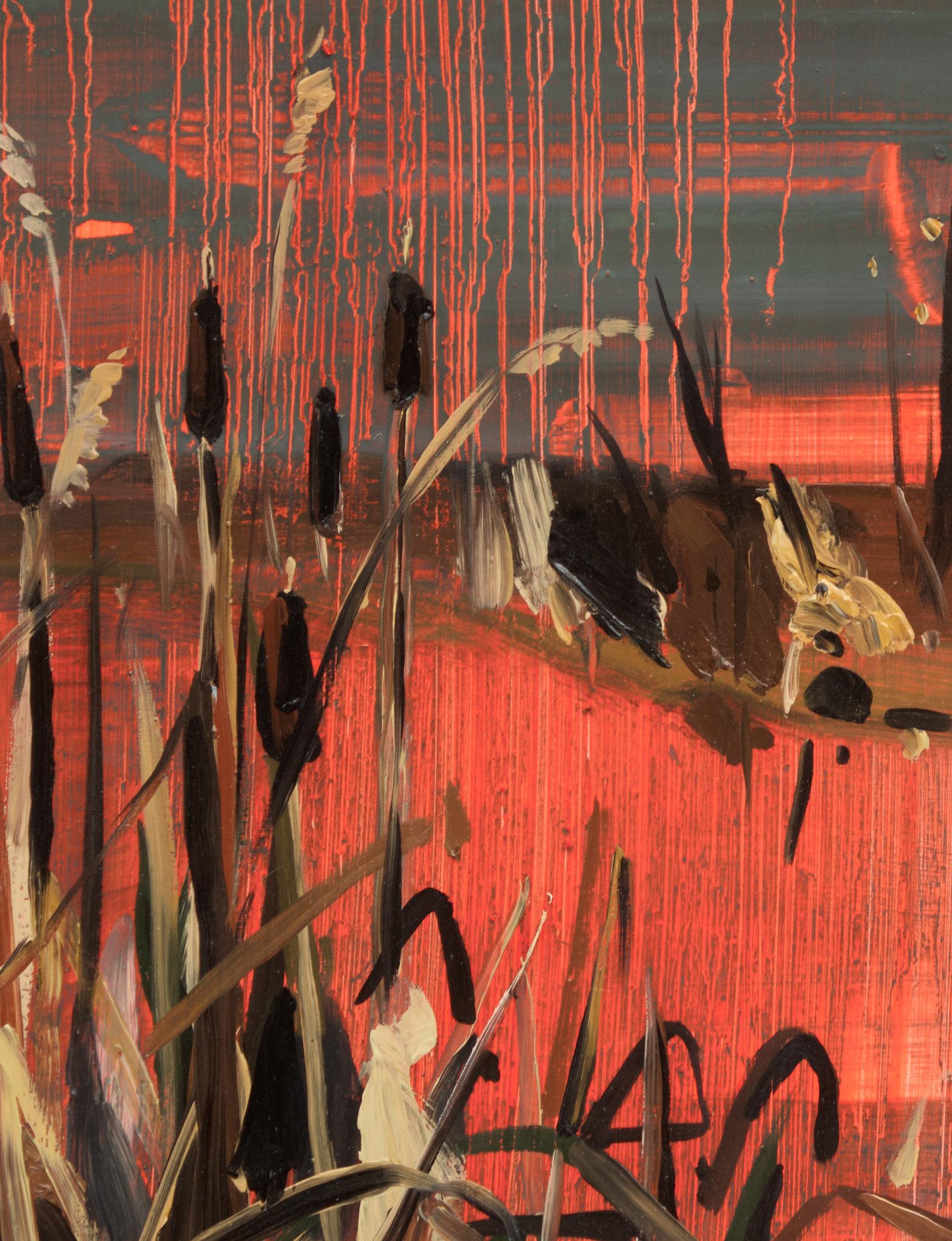
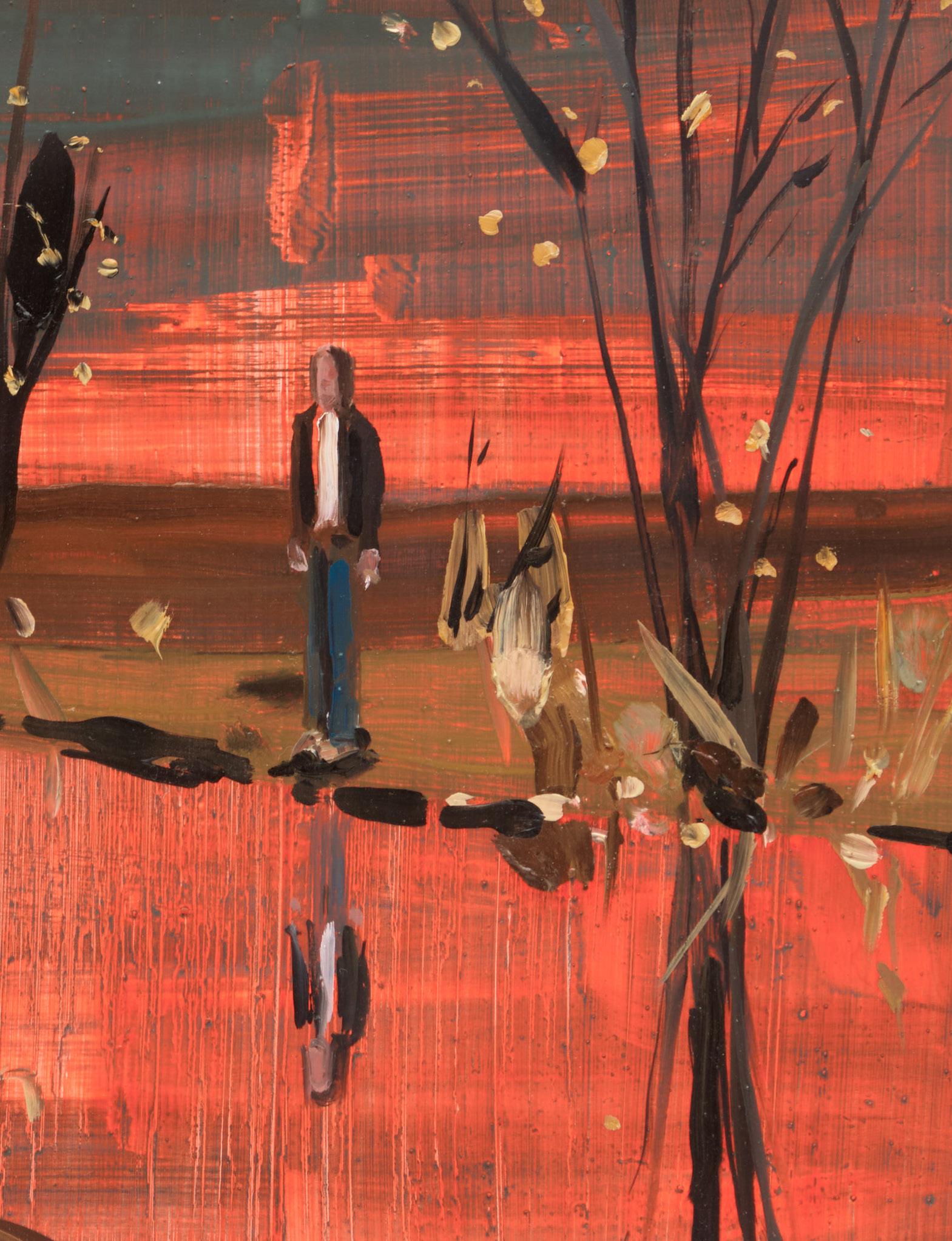
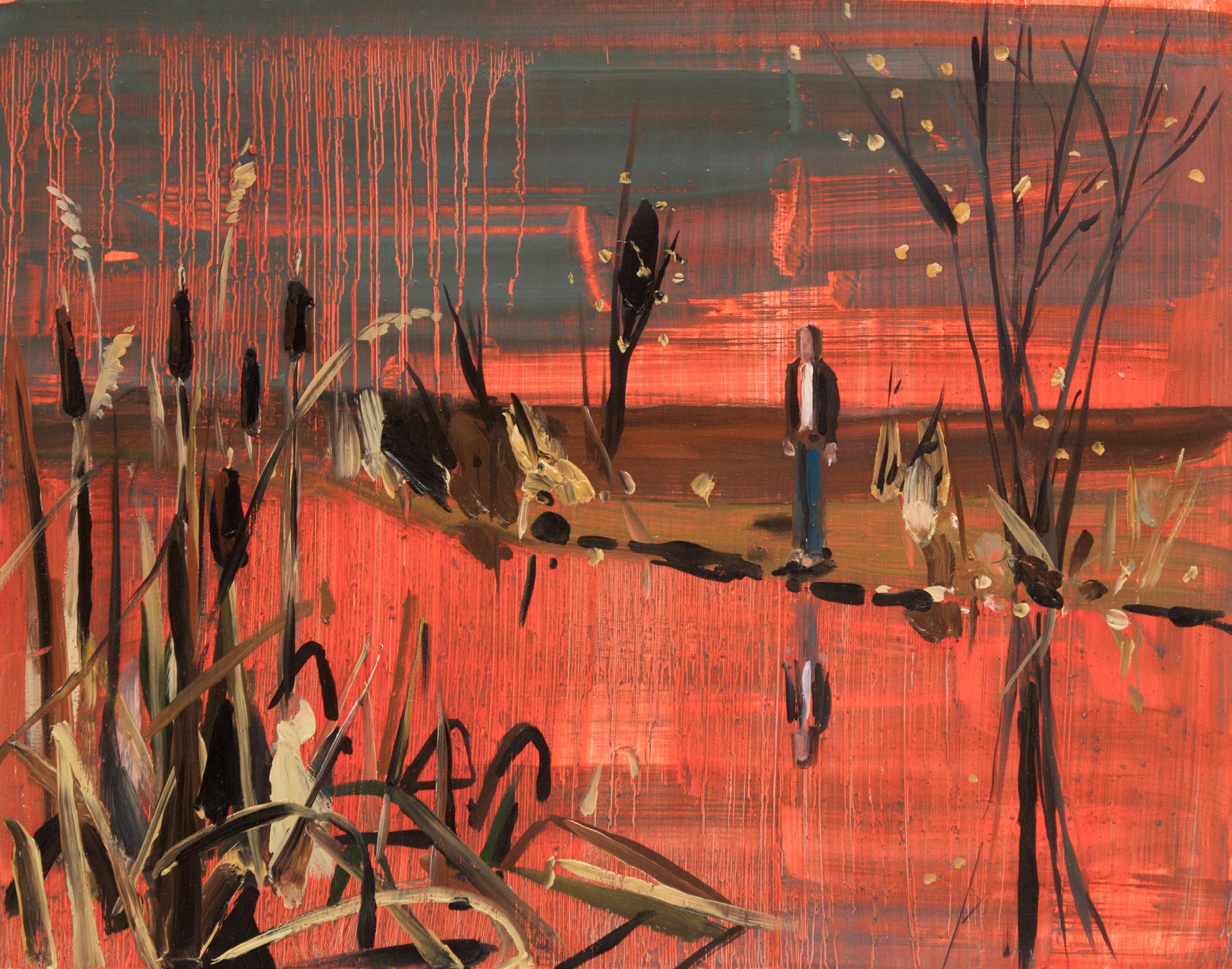
In 2005, Dorland painted The Loner, a self-portrait and a proverbial Adam in terms of the trajectory of his work. Though he’d been painting for several years, he called it his “first one.” Reflection, painted soon after, shows loner’s refinement. The figure is still naïvely painted compared with the signature style he’d go on to develop, but the landscape is already more gestural and more wryly Canadian. Bullrushes are so “Canadiana rustic.” Looking at this painting will feel, for those who know Dorland’s work, like hearing a favourite song from one’s youth. It floods you with a sense of who you used to be. In his early work, Dorland, now 52, worked out the difficult elements of his own biography but he also painted the lonely misfit in all of us, regardless of our age. It’s hard to say who articulated the feeling better - Dorland, when he painted loners in hoodies, or the poet Allen Ginsberg when he described “angelheaded hipsters burning for the ancient heavenly connection to the starry dynamo in the machinery of night.”

Peter Ohler
Western Canada Representative Director of Private Sales (587) 317-6564 peter@cowleyabbott.ca
The Private Sales department at Cowley Abbott remains dedicated to acquiring rare and significant artworks, building on the trust Peter Ohler has established with collectors over the years. In 2018, after more than thirty years as a principal at one of Canada’s leading historical art galleries, Peter transitioned to become a private dealer.
Peter has brought his wealth of expertise to Cowley Abbott, strengthening our firm’s offerings. He works closely with buyers and sellers, to provide confidential private sale opportunities through his extensive network of collectors. His approach ensures discreet, high-value transactions.

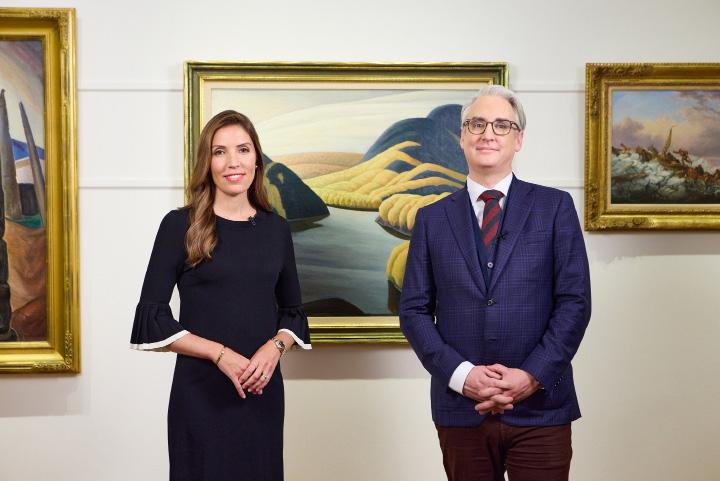
Cowley Abbott bridges the gap between traditional art auction services and the online fine art marketplace. With dedicated preview and gallery space, regular art auctions, and partnerships with national art experts, we provide both buyers and sellers of Canadian and international art with a unique and effective set of services which marry the traditional methods of promoting artwork and innovative means of building a collection.
Cowley Abbott has rapidly grown to be a leader in today’s competitive Canadian auction industry, holding semi-annual live auctions as well as monthly online auctions. Apart from these sales, Cowley Abbott also offers services for private sales, charity auctions, and formal appraisal services. With a prime location amid a row of art galleries and directly across the street from the Art Gallery of Ontario, Cowley Abbott also has the advantage of being immersed in a lively art community in its day-to-day operations.
Our experienced specialists strive to form relationships with clients built on professionalism, transparency and trust. The Cowley Abbott team is keen to facilitate the entire process of selling or purchasing an artwork, from on-site visits and individual consultations to the fall of the gavel and the final delivery of a work of art. We believe that art collecting should be approachable, educational and rewarding for both new and seasoned collectors. Several definitive details set Cowley Abbott apart to our clientele, cementing our presence in the Canadian art auction industry. We look forward to being of service to avid collectors far and wide.