MYERS LUCY M86
1/1/26 • 21579817 A maternal sister to many of the most popular females to ever sell at Myers Angus is this Schiefelbein Gable 311 daughter produced from one of the breed’s most recognized Tahoe daughters!
MYERS MISS BEAUTY M244
2/29/24 • 20945818 This two-year old donor prospect is a maternal sister to Myers Fair-N-Square M39 and sired by Patriarch. She and her Pathway heifer calf sell!
MYERS PRINCESS M540
10/22/20 • 19930053 This six-year old Deer Valley Unique daughter has been a top producer and super fertile – She has two daughters retained and will make a donor. Will have a calf at side by BA7 Oaks Bold Ruler!
MYERS ANGUS FARM AND TAMME VALLEY FARM
FAMILY VALUES ANGUS FEMALE SALE
Friday Evening I October 16, 2026 I 5:30 PM EDT I Harrodsburg, KY TAMME VALLEY FOREVER LADY 129
8/15/21 • 20120011 A pedigree stacked for maternal excellence in this Tahoe daughter from a dam by Blueprint. She will be one of the top fall pairs selling, with a heifer calf at side by Poss Pursuit.
TAMME KILDONAN ERICA 367
10/04/23 • 20768921 A super set of fall calving young females will be selling, including this daughter of E&B Wildcat 9402. She will have a calf at side by Poss Pursuit.
TAMME LUCY 480
Call or email to request a sale book | 918-510-3464 or RLong@RanceLong.com
Sale Managed By Sale Managed By
LONG RANCE PO Box 2 RANCE LONG, INC Adair, OK 74330 918.510.3464 cell 918-510-3464 rlong@rancelong.com www.rancelong.com RLong@RanceLong.com INC PO Box 2, Adair, OK 74330 www.RanceLong.com
1510 Quarry Road • Danville, KY 40422 Jacob & Allison Tamme 859-583-7134 Jeff Kaufman Farm Manager 540-280-5388 www.TammeValley.com Email: Jacob.Tamme@gmail.com
11/01/24 • 21108994 This high-performance, big-numbered daughter of Patriarch will be one of the featured bred heifers selling. Due to calve 2/26/27 to Poss Pursuit.
MYERS ANGUS FARM
1186 Curry Pike Harrodsburg, KY 40330 David Myers Colby Myers 859-325-1170 Joe Myers 859-265-0097 Tim Shepherd Cow Herd 859-265-7804 www.myersangusfarm.com Email: jmyers@selectsires.com
COL U MNISTS 07 Allan Bryant President's Thoughts 08 Jonathan Shell Commissioner's Corner 10 Dave Maples Thoughts from Dave 34 Dr. Michelle Arnold Late Season Pasture Fly Control 40 Chris Teutsch Johnsongrass: Weed or Underutilized Resource? 68 Katie VanValin Future Cowherds Will Generate More Data
FE AT URE STORIES 10 Kentucky Cattlemen's Association Welcomes Alison Cook
s t h g i e W g n i " n 0 a 3 e x i W n M e Wh tter... " ma C
g LL
th A
Sou
1
-413 -528 270
Mid
16 Brown and Burks Honored 22 Keeping Kentucky's Working Land Working 24 UK's Rentfrow Receives ASAS Extension Award 26 Pasture Progress 30 Hobby Farm or Business Operation? 36 Louisville Farmer Honored with Conservation Award 42 KJCA Hosts Herd Hangout 44 Future Agricultural Leaders Build Lifelong Connections Through IFAL 46 How Much Should You Pay for a Replacement Heifer? 50 Conservation Dollars for Cattle Producers 12 County News 20 Legislative Update 52 Membership 56 Kentucky Beef Council 58 Kentucky Beef Network 63 Angus News 66 Calendar of Events & Ad Index 67 Classifieds
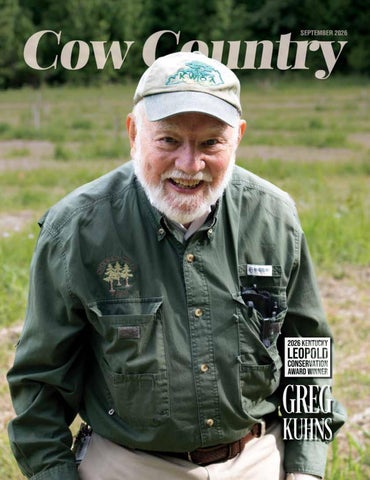
ON THE COVER: Dr. James “Greg” Kuhns
winner of Leopold Conservation Award
4 • Cow Country • September
270-528-4131
13TH ANNUAL FALL BULL SALE MONDAY, OCTOBER 26, 2026 OVER 70 YEARLING AND COMING TWO YEAR OLD BULLS AVAILABLE
KENNETH D. LOWE 270-202-7186 JOE K. LOWE II 270-202-4399
We only run three tractors and a Bobcat. We need a large tractor, like our stocker neighbors, for the same purpose, but nothing larger. I need a tractor to pull a 500-gallon sprayer and yard a little hay, only if called upon. It has a cab and is my father’s go-to tractor. Then I need your run-ofthe-mill open-station tractor to move self-feeders around, feed a little hay with a spear on the three-point hitch, and pull a small mower. It is my employee tractor. Then anyone with a Bobcat and all the attachments knows exactly why we have that. It is our Swiss Army knife for many projects. I want you to keep these parallels in mind as you look into your bull acquisition for the upcoming fall breeding season. For the largest herds, not every bull needs to be a top-selling bull. We can reallocate some funds to still buy the very best cow makers or carcass-quality bulls, and save a little on bulls where every calf is going to the sale barn. The herds that run only a single bull (or type of bull) may need to think carefully about the opportunity cost of trying to save one bid and missing out on the bull that best fits their goals. Then, if you are somewhere in the middle, we can think about buying a bull that can evolve their role in your herd as he grows. For instance, a lighter younger bull that will cover your heifers fine but carries the genetics to have a bigger impact as he can cover more females. Bulls and tractors both cover a wide spectrum of capabilities. It is all about finding the one that best fits its designated purpose. Joe K. Lowe II
I have come to realize that bulls are a lot like tractors. If you only run enough cows to have one, then you need it to do a little bit of everything. If you have a herd that is well sorted, you really need a variety of bulls or bull types. In a large enough operation, you may need calving ease bulls for heifers, maternal bulls for replacements out of your young cows, and terminal bulls for your older cows. You can even make the argument that you need your terminal bulls focused on carcass quality if you are retaining ownership, and outcross bulls to capture hybrid vigor for the calves you are selling at the sale barn. You may not think you would ever hear me say this, but when done right, not all of the bulls in that scenario would even need to be Angus! If you are in a herd expansion phase and keeping every calf you can, you may need every bull to be maternally focused, without sacrificing end-product merit. The articulation of this point came to me when I saw our neighbors putting up their second cutting of grass hay. There were a lot of tractors out there. They have as many cows as we do and a relatively large grain operation. They have many different specialty needs. It wouldn’t surprise me if they had 15 different tractors, each serving a very intentional purpose depending on the season. Their largest tractor is larger than our largest, but their smallest is smaller than our smallest. This would parallel the example I gave of being able to justify half a dozen different types of bulls. If you have been to our place to view the cow herd, you know there is a large stocker operation down the road. Every tractor they use appears to be the same, and it’s the same size as our largest tractor. They need it with a loader to move large items and the power to pull 20-foot bush hogs on relatively steep slopes—nothing more and nothing less. This would be the parallel to the needs of a cattle SPRING CALVING BRED HEIFERS AND FALL producer in the herd expansion phase. CALVING BRED COWS AVAILABLE TODAY
WWW.OAKHOLLOWANGUS.COM - SMITHS GROVE, KENTUCKY
EXECUTIVE COMMITTEE OFFICERS:
REGIONAL DIRECTORS:
President ALLAN BRYANT Eminence President Elect DANIEL HAYDEN Whitesville Vice President RYAN MILLER Campbellsville Treasurer KEN ADAMS Upton Past President RANDY WARNER Sharpsburg KCA Program Chairman ADAM CHUNGLO Harrodsburg KBC Chairman WAYNE ZOGLMANN Lewisport KBN Manager AMY WHITE Lexington Beef Solutions Manager* DANIEL HAYDEN Whitesville
KCA PAST PRESIDENTS:
REGION 1 Chris Milam, John Mark Brown, Dale Gold, Greg Roberson, Gary Woodall, Lincoln Pyle, Susan Zoglmann, Bill Plemmons, Kenton Howard, Britny Williams, Conner Williams REGION 2 Bryan Manion, Joe Lowe, Allison Nissley, Rayetta Boone, Sammy Boone, David Strater, Kelly Flanders, Andy Joe Moore, Adam Thomas, AJ Mitchell, Jonathan Murley, Kenneth Green, Robert Siddens, Josh Morris, Joe Mike Moore, Amy Cecil REGION 3 Amanda Hall, Nathan Lawson, Allen Phillips, Stacey Burkhardt, John David Yount, Lincoln Clifford, Abbey Biddle, Ben Tinsley, Crystal Harrod, Phillip Douglas, Tanya Wilson, Craig Retzlaff REGION 4 Jodi Purvis, Brad Reynolds, Chad Anglin, Phillip Stamm, Danielle Harmon, Brandy Graves, Kelsey Cooper, Bruce Witt, Ronnie Lowe, Logan Carter, Jason Crowe, Rob Amburgey REGION 5 Phillip Reese, Cary King, John Settles, Natalie Wesley, Brandon Kelly, Freddie Harris, Brent Williams, Anne Bays, Tommy Glasscock, Josh Wethington, Arch Sebastian, Terry Mattingly
1972-73 Jere Caldwell† - Boyle
2004 Paul Napier† - Lincoln
1974-77 Smith T. Powell† - Lincoln
2005 Eddie Young - Washington
1978-79 Larry Lovell† - Union
2006 Greg Ritter† - Barren
1980-82 John Masters† - Fleming
2007 Don Pemberton - Christian
1983-85 Seldon Hail† - Laurel
2008 Billy Glenn Turpin - Madison
1986-87 Bob Vickery† - Wayne
2009 Scotty Parsons - Christian
1988 Glenn Mackie - Bourbon
2010 Corinne Kephart - Shelby
1989 Dale Lovell† - Muhlenberg
2011 Greg Robey - Mercer
1990 Steve Henshaw† - Union
2012 Mike Bach - Bath
1991 Jerry Fraim - Grayson
2013 Don Reynolds - Hart
1992 Glen Massengale† - Wayne
2014 Steve Downs - Marion
1993 Dell King - Christian
2015 Gary Woodall - Logan
1994 Kenneth Lowe - Warren
2016 David Lemaster - Clark
1995 Dr. J.L.Cole - Monroe
2017 Chuck Crutcher - Hardin
1996 Harvey Mitchell - Mercer
2018 Bobby Foree - Henry
1997 Jim Naive† - Spencer
2019 Tim White - Fayette
1998 Shelby Hughes - Logan
2020 Steve Dunning† - Christian
1999 Hoppy Lovell - Barren
2021 Chris Cooper - Madison
2000 Charles Miller - Jessamine
2022 Cary King - Mercer
2001 Larry Clay - Perry
2023 Andy Bishop - Nelson
2002 Jack Kimbrough† - Shelby
2024 Jeff Pettit - Webster
2003 Mark Williams - Crittenden
2025 Randy Warner - Bath Deceased
Executive Committee members in bold.
*ex officio
†
Meet Your 2026 KCA Board Robert Siddens Barren County
Briefly tell us about your operation. My wife, Edie, and I purchased the 200-acre farm that used to belong to my grandparents. We started out raising tobacco and beef cattle. In 2004, we quit raising tobacco and increased our cattle herd. In October 2020, we updated from cowcalf operation to selling born and raised USDA packaged beef from our farm directly to the consumer, containing no antibiotics, no steroids and no added hormones." Why did you decide to run for state board? Times are changing, and it was a time that I could give back to the cattle industry. How many years have you served on the state board? This is my first year serving. What do you like the most about the Kentucky Cattlemen's Association? The cattlemen’s association has grown a lot since I first became a member in the late 1980’s. Your voice in the cattlemen’s industry is heard more in larger numbers. 6 • Cow Country • September
VOLUME 39 • ISSUE 9 Dave Maples Executive Vice President Carey Brown Chief Operating Officer Kenny Allen Beef Solutions Operations Manager Todd Brown Graphic Designer Bradon Burks KBC Director of Education Rachel Cain Membership and Communications Coordinator Amelia Carter KBC Director of Industry Relations
The Kentucky Cattlemen Association does a great job in setting future trends in Kentucky agriculture!
Allison Cook KBC Southeast Regional Director of Nutrition Danny Coy Video Production Specialist Jake Harrod KBN Program Coordinator Kelly Liver KBC Director of Communications
When you aren't taking care of your cows, what are you doing?
Dan Miller KBN Industry Coordinator
We are a Kentucky Farm Bureau Roadside Market, attend Metcalfe County Farmers Market and attend The Bounty of The Barrens Farmers Market. I am on The Bounty of The Barrens Farmers Market board, Barren County Farm Bureau board, Barren County Cattlemen’s secretary, and Kentucky Cattlemen’s board of directors. I have worked at Froedge Machine and Supply in the Service Department in Tompkinsville for the last 13 years.
Becky Thompson Director of Kentucky Beef Network
Debby Nichols National Advertising Sales, LAN Katie Pratt Communications Manager Kelly Tucker KCA Collections & Compliance Nikki Whitaker Director of Operations & Policy
176 PASADENA DRIVE • SUITE 4 • LEXINGTON, KY 40503 (859) 278-0899 • WWW.KYCATTLE.ORG • INFO@KYCATTLE.ORG
COW COUNTRY is published monthly by THE KENTUCKY CATTLEMEN’S ASSOCIATION. The publisher reserves the right to refuse any material deemed unsuitable for the publication. Although the highest journalistic ethics will be maintained, the KENTUCKY CATTLEMEN’S ASSOCIATION limits its responsibilities for any errors, inaccuracies, or misprints in advertising or editorial copy. Advertisers and advertising agencies assume liability for all content of advertisements made against the publisher.
President's Thoughts Allan Bryant KCA President My dad taught me to be a good steward of our land and cattle. I remember when my neighbor would come over and talk to my dad about farming practices when I was just a kid. They were always on the same page. They talked about planting tobacco on the contour, leaving grass waterways and rotating your cattle so you don’t graze your pasture into the dirt. I particularly remember the day when my neighbor said, “We’re just 6 inches from starvation.” That was a moment I’ll never forget. Until then, I hadn’t really thought much about what it takes to conserve and how best to utilize the
resources that we have. Since then, I have realized that the land of plenty is only because generations of farmers had been good stewards. They understood that what they did would determine what would be available tomorrow. They made sacrifices, adopted better management practices, and worked to protect the soil and natural resources entrusted to them. In light of this issue's recognition of Leopold Conservation Award recipient Dr. James "Greg" Kuhns, it is important to acknowledge that there are others who also work to ensure a productive future.
The Natural Resources Conservation Service, Kentucky's Conservation Districts and Kentucky’s Division of Conservation deserve recognition for providing technical assistance, financial support and education that help producers become responsible stewards of the land. While one operation may be honored for its outstanding conservation efforts, stewardship is practiced every day on farms throughout Kentucky. As cattle producers, we understand that stewardship is about more than simply taking care of the land. It is also about taking care of our cattle, our families and the future of our farms. We rotate pastures, manage forage, protect our streams, maintain fences, improve soil health and make decisions that allow our land to remain productive for the next generation. We work to improve genetics, provide proper nutrition and herd health and make sure our cattle have the care they need to thrive. Many of these practices do not happen overnight, and the results are not always immediately visible. Stewardship is a long-term commitment. It requires us to think beyond today's challenges and consider what our farms will look like years from now. I am proud to be part of an industry made up of people who understand this
responsibility. Kentucky's cattle producers have a long history of caring for the land and natural resources that make our way of life possible. We are constantly learning, adapting and looking for ways to do things better. The statement my neighbor made all those years ago has stayed with me because it reminds me how dependent we all are on the land and those who care for it. We may feel like we live in a land of plenty, but that abundance is never guaranteed. It is the result of hard work, wise decisions and the commitment of farmers who understand that we are only temporary stewards of something much bigger than ourselves. As we recognize those who have gone above and beyond in conservation, let us also recognize the countless farmers and cattle producers who quietly practice good stewardship every day. They may not receive an award or be recognized in the pages of a magazine, but their efforts matter. Every fence repaired, every pasture managed, every stream protected, every acre improved and every decision made with the future in mind is an investment in productive tomorrows. That is the legacy my dad taught me—and it is a legacy worth continuing. God Bless!
Allan Bryant
Kentucky Cattlemen’s Association President
September • Cow Country • 7
Commissioner's Corner Jonathan Shell Agriculture Commissioner Kentucky’s next All in for Agriculture Education Week is coming up Sept. 21-25 at schools across the state. While last spring’s week focused on new life on the farm with both plants and animals, this fall version will focus on harvest, including the commodityto-product process, agribusiness and agritourism. The week of hands-on lessons, contests and community engagement that bring agriculture, food and standards-based learning into every subject is a collaborative effort from Lt. Gov. Jacqueline Coleman, Education Commissioner Robbie Fletcher and myself. Our goal is to increase access to agriculture education through support for educators, commitment to the academic standards, strong ag partnerships, and connection to real-world skills and problems. Agriculture Education Week is designed to give students meaningful opportunities to explore agriculture. Key hallmarks of the initiative include: •
•
Broadening access to ag education: The goal is to help students understand where their food, fiber and fuel come from, the value of agriculture to Kentucky and the role of agriculture in daily life, whether they pursue careers in agriculture or not. Support for educators: The initiative will provide resources, lesson plans and professional development to educators. Teachers will receive curriculum materials and guidance to incorporate agriculture into their lessons, using kinesthetic teaching methods to address educational standards and provide a complete agricultural education experience to students throughout the week.
8 • Cow Country • September
•
Allison Charol Charolais Breeder Since 1 AllisonAllison Charolais • Charolais
Connecting agriculture to real-life skills: This initiative is not just for students aspiring to become farmers or work in the Charolais Breeder CharolaisSince Breeder1962 Since 1962 agriculture industry. It will help all students develop valuable Ø Bull calves out of HCR Answer 2 skills, such as understanding nutrition, sustainability and SPIRIT Ø Bull calvesHCR out of HCR Answer4007. 2042 and how agriculture intersects CHAROLAIS with other fields, including Ø Bull calves out ofØ HCR Answer 2042ease andand growth HCR SPIRIT Bred for4007. calving YEARLING law, marketing, healthcare and Ø Bred for calving ease and growth. communication, in addition HCR SPIRIT BULLS & and HEIFERS Ø4007. Bulls for both purebred comme Ø Bulls for both purebred commercialand breeders. to helping students grow into Ø Bred for calving easeand and growth.available. educated consumers. Ø Yearlings two-year-olds
Bulls Availab
• •
Bulls Available Bulls CHAROLAIS Available
•
BULLS & HEIFERS AVAILABLE Ø Yearlings and two-year-olds availa
Strong partnerships with Bred heifersand to calve in fall available. Ø Bulls for bothØpurebred commercial Kentucky’s agriculture Ø Bred heifers to calvebreeders. in fall availab John Allison industry: Bringing real-world John Allison,John Owner Allison, David Carter, Farm Manager Owner Ø Yearlings and two-year-olds available. expertise to students through 545 Eminence Road 502-706-0075 545 Eminence Road John545 Allison, Owner David Carte Eminence Road New Castle, KY 40050 industry collaboration, guest Ø Bred heifers to calve inNew fall available. 545 Eminence Road 502 502-220-3170 New Castle, KY 40050 Castle, KY 40050 speakers, 650 volunteers and New Castle, KY 40050 authentic learning experiences (502) John Allison, Owner David220-3170 Carter, Farm Manager like farm and agribusiness 502-220-3170 Eminence Road 502-706-0075 tours to nearly 300 545 locations are critical to this New initiative. Castle, KY 40050 These partnerships help ensure 502-220-3170 students see agriculture as a dynamic, innovative industry and understand the wide range of opportunities it offers beyond the farm.
(502) 220-3170
All in for Ag Education Week is not about stopping instruction to teach about agriculture; It’s teaching the standards through the lens of agriculture. Agriculture is highly engaging for students because it connects food, animals, plants and so much more. Studies show highly engaged students achieve and retain knowledge at higher levels. Data collected from last spring’s Ag Education Week included: 81.6% vibrant learning, 78.5% collaboration and 77.3% innovation. For more information about All in for Ag Education Week, go to www.kyagr.com/marketing/AgEducation-Week.html. Next spring’s Ag Education Week is already scheduled for March 14-19, 2027. If you have any questions about the program, contact Bethany. Mattingly@ky.gov.
GOLDEN OPPORTUNITY This two-row forage head is a real treasure. Minimal Investment and huge returns. High performance and low maintenance. Stake your Claim!
Call Charlie at (8 5 9) 6 0 8 - 9 74 5 redbarnandassociates.com
LAST CHANCE! DRAWING OCTOBER 2!
ENTER TO WIN
The Kentucky Cattlemen’s Foundation is raffling an Exmark Radius-S Series Zero Turn Mower generously donated by Equine & Ranch Rewards. This raffle will benefit Kentucky Cattlemen’s Foundation Leadership Development Program. 23.5 HP KAWASAKI FX730V V-TWIN 60” ULTRACUTTM SERIES 3 CUTTING DECK DUAL HYDRO-GEAR ZT3100 HYDROSTATIC TRANSMISSION WITH CHARGE PUMPS 1.5” TO 5.0” CUTTING HEIGHT IN 0.25” INCREMENTS • 9.0 MPH TOP SPEED 23 X 10.5-12 TIRES • 7.0-GALLON, SINGLE FUEL TANK • 4-YEAR OR 750 HOURS LIMITED CONSUMER/COMMERCIAL WARRANTY, 3-YEAR ENGINE WARRANTY • INTEGRATED REAR TOW HITCH + HEAVY-DUTY AIR CLEANER
Drawing will take place on October 2 at the WKU Ag Expo Center. Winner not required to be present to win. To purchase tickets, contact the KCA office at 859-278-0899, visit www.kycattle.org, scan the QR code above or mail form with payment to: Kentucky Cattlemen’s Association • Attn: Raffle • 176 Pasadena Drive • Suite 4 • Lexington KY • 40503 Mail this completed form with payment to: Kentucky Cattlemen’s Association • Attn: Raffle • 176 Pasadena Drive • Suite 4 • Lexington, KY 40503 NO. OF TICKETS
X
$20
PER TICKET
CREDIT CARD NO.
NAME
TOTAL ENCLOSED
CSV
EXP
STATE
ZIP
ADDRESS
CITY
PHONE
=
EMAIL REQUIRED
Raffle tickets will be emailed to you upon return of this slip with payment.
Raffle License #ORG0002636
Thoughts From Dave Dave Maples Executive Vice President Over the past month, I attended the NCBA Summer Business Meeting in Denver, Colorado. A week later, I was at the Livestock Marketing Association Common Grounds meeting in Nashville, Tennessee. I also have been in deep conversation with Becky Thompson who is working on a presentation of the Kentucky Beef Industry. Becky is also in the final stages of developing a grant application for the Kentucky Beef Network. Carey Brown is doing the annual marketing plan and budgets for the Kentucky Beef Council. You could say I have had information overload. I enjoy being in a position that I get to filter a great deal of information about the beef Industry and what the future holds us. The NCBA meeting spent a good deal of time talking about a Cow-Calf Council, which led to a town hall meeting and conversation around the cow-calf sector of the industry. When I got to Nashville for the Common Grounds meeting, I had the opportunity to listen to that conversation with a different group of people and the topic was the same. The first bullet point in their press release was “Strengthen small cowcalf producers as a critical part of the industry.” As I studied Becky’s presentation to a group of Kentucky agriculture leaders she led off with a slide that demonstrated that beef cattle production in Kentucky has changed over the past 20 years. With a 20-30% decrease in pastureland and farms and the number of beef cows down 14%. It is evident that we all should be concerned about these decreases. Nikki Whitaker, who I literally work with every day, put it to me in her blackand-white way when I ask her about the situation. She said, “It is hard work, and you don’t make any money.” I know it’s hard, and yes, there are years that it is not profitable. But lately it has been profitable, and if it were easy everyone would be a cattleman. At both of the national meetings, the Hobby Farm Rule was talked about. You will see an NCBA article about it on page 30. I know several farms that use the farm as a tax write-off. The One Big Beautiful Bill Act created a permanent ban on deducting hobby farm losses to 10 • Cow Country • September
offset outside income. To classify a farm as a business and have the potential to deduct losses, producers have to show a profit in at least 3 out of 5 years or show intent to make a profit. Personally, with my farm, it has been hard to make a profit until the past couple of years. The article is worth a read, and it will be a conservation many of us will need to have with our tax preparers in the coming months. So why have cattle prices been better over the past couple of years? One is supply. We all know that we have the smallest cow herd in 70+ years. As I study Carey’s Beef Council material, I see that beef demand remains exceptionally resilient and strong. According to the USDA Economic Research Service, wholesale beef prices were 19.7% higher in March 2026 than in March 2025 and are predicted to increase by 7.8% in 2026. Still consumers continue choosing beef. In fact, despite those higher prices, consumers increased both their spending and purchase volume during that same period with beef sales outpacing competing proteins like chicken and pork. It was interesting to read a couple of points from the consumer survey data: •
The majority of U.S. beef purchasing decisions are based on taste and eating satisfaction. Increasingly, nutritional benefits and health play a role in these decisions, which is also working to beef’s advantage.
•
Since 2020, the percentage of consumers who regularly consume animal proteins has increased. Currently, more than 85% of Americans identify as meat eaters, while the share of consumers identifying as vegetarian or vegan has declined from 14% to 7%.
•
As income increases, consumers are more willing to pay for beef.
•
GLP-1 users are less sensitive to the price of beef.
•
On average, consumers in the U.S. work about 13 minutes to pay for one pound of retail beef. For comparison, U.S. citizens work about 100 days each year to pay their annual federal, state and local taxes.
Kentucky Cattlemen’s Association Welcomes
Allison Cook MS, RD, CLC
McLEAN COUNTY NEWS Nathan Howard The McLean County Cattlemen’s Association cooked ribeyes, hamburgers and all beef hot dogs for the 2026 McLean County Ag Fair in Calhoun.
Submit your County Cattlemen's Association news to kpratt@kycattle.org Submissions are due by the10th of the month prior to publication.
MEADE COUNTY NEWS Alli Albarez The Meade County Cattleman's Association served the community from their booth from July 20-25 at the Meade County Fair, selling ribeye, brisket, tea and lemonade. With over 120 volunteers for the week, the Meade County Cattleman's Association uses the money made from the fair to fund scholarships, the annual fall beef trip, educational programming, field days and to buy FFA and 4-H auction steers. The association gave three scholarships this year and spent over $17,000 to support the youth auction!
12 • Cow Country • September
raham -Log Cabin Siding Wood & Vinyl -1x6 & 1x8 T&G Knotty Pine -2x6 T&G SYP & Treated -6” & 8” Cedar Bevel Siding -Framing & Treated Lumber
january 21-22, 2027 lexington
SHELBY COUNTY NEWS Peter Eberle
Catching up with Abby Blanton For several decades, the Shelby County Cattlemen's Association has served as the voice for all Shelby County cattlemen and their families. Mostly known for proactively working on government policies affecting the beef industry, the SCCA also supports many programs designed to educate members on issues such as food safety, animal nutrition and pasture management. One of the many ways the SCCA invests in the industry’s future by providing scholarships to qualifying youth in their pursuit of degrees in an agriculture related field. In 2025, SCCA provided a total of $6,000 of scholarships to four very deserving Shelby County students. The recipients were Tristin Carmack, Amelia Fields, Kendra Wilson and Abby Blanton. So where are they now and what impact did the scholarship have? We recently caught up with Abby Blanton over lunch. It was quickly apparent that a one-hour lunch was not enough time to get caught up with Abby. Pursuing a double major in agriculture education and agriculture business, Abby just completed her first year at Morehead State University and earned a 4.0 GPA. You may have seen her volunteering for the association at the Shelby County Fair as interacting with people is one her favorite pastimes. This summer she has been working with StuKent making videos for CTE teachers to use in classrooms across the country. Her family have been members of
ood Deals -Rebar & Concrete Wire -Fence Post & Fence boards -Wood Barn Siding -Used Guardrail -20’ & 40’ Used Cargo Containers
OUR DIRT CHEAP PRICES ARE POSTED ON OUR WEBSITE OR CALL FOR A DELIVERED PRICE TO YOUR LOCATION
A.W. GRAHAM LUMBER LLC Website: www.grahamlumber.com Phone: 1-877-845-9663
the SCCA for over 10 years, and this was not her first SCCA scholarship. She grew up spending time on many beef farms and finally, with her parents Bruce and Michele’s support and older sister April’s encouragement, successfully applied for the SCCA Heifer Scholarship in 2019. She used the scholarship to help buy her first Gelbvieh heifer fittingly named “Cash.” Successful calving soon followed, and Abby raised “Dixie,” “Elvira,” “Bull Baby” and several others. While not in her barn, pasture, basketball court or softball field, Abby was very active and excelled in local, regional and state FFA events (First Place Jr. Beef) and SAE programs (special reach out to SCHS Professor Kerwin Ewing!). She thanks her parents for their continuing inspiration and love and looks to the future with great enthusiasm and excitement. She hopes to someday teach high school ag classes and has already spent time in front of students. For now, she is looking forward to returning to Morehead State where she will be the 2026-27 Ag Ed Society director. When asked about her SCCA experience Abby did not have to think long and said, “Through the Shelby County Cattleman’s Association and surrounding community, I’ve been able to find the utmost importance in taking all the opportunities I can to help others learn and use that knowledge to go somewhere. I’ve been led to where I am now because of the numerous opportunities and experiences provided to me by the cattlemen’s association, and for that, I’m forever grateful.” We wish Abby all the best in realizing her dreams and are thankful that the SCCA could help her along the way! September • Cow Country • 13
HENRY COUNTY NEWS Megan Wetenkamp and John Allison The Henry County Cattlemen’s Association held a fundraiser for Parker Farm Supply in Port Royal, which was devastated by a fire on July 7. The cattlemen cooked over 250 ribeyes, 150 hamburgers and 60 beef hot dogs. The community came together for a night of support and fellowship, and the event sold out completely. The association raised $19,987 for the farm store. Parker Farm Supply is an important part of the community in Henry County. They never hesitate to sponsor a cattlemen’s meeting or an extension field day. For now, Parker Farm Supply is operating out of a temporary location across the street. The community has rallied around the Parker family in the rebuilding process and looks forward to supporting them when the doors to the new store open.
14 • Cow Country • September
feraah.com
Made in USA
Powered by proprietary MBAS™ technology, FerAppease® helps calves eat sooner, recover faster, and gain more through every major stress event.
Weaning
Shrink Reduction
+38% AVERAGE DAILY GAIN
SCIENCE THAT PAYS
+50% FEED EFFICIENCY
Castration & Branding
+$100 AVERAGE PROFIT PER HEAD
Backed by research conducted at Texas A&M University, Olds College, and validated through commercial studies.
SCAN TO SEE THE RESEARCH
Ready to implement FerAppease? Talk to your local representative.
Gracie Hammond
(276) 698-5143
VA, WV, KY, TN & NC
gracie@feraah.com
MBAS™ is a trademark of FERA Diagnostics & Biologicals Corp.
September • Cow Country • 15
BROWN & BURKS HONORED Kentucky Cattlemen’s Association staff members Carey Brown and Bradon Burks were recently honored for their dedication and outstanding outreach efforts by two separate organizations. Brown, KCA COO, received the Ed Bible Distinguished Service Award from the Livestock Publications Council. Brown has been an active member of the council for many years and served as its president from 2018- 2019. She was nominated for the award by Autumn Fuhrman with Bader Rutter and selected for the award by the LPC executive committee for her dedication and above-and-beyond service to the organization. "I met Carey in 2007 at my very first Ag Media Summit in Louisville, Kentucky, and she made sure I never felt like an outsider,” said Fuhrman, who is also 2025-2026 second vice president of LPC. “She introduced me to so many people who would go on
16 • Cow Country • September
to shape my career. In the years since, I've watched her lead through the Livestock Publications Council and across our industry with that same generosity. I'm always impressed by how much dedication she brings to any project she takes on. She's a trailblazer who's never afraid to try something new. Carey isn't in this for recognition; she gives her time and energy because she genuinely cares about the people and the organizations she serves. Above all, she is a kind, selfless leader and a wonderful friend to so many of us. I am proud to know her and call her my friend.” Burks, director of education for the Kentucky Beef Council, received the Kentucky Farm Bureau Career and Technical Education’s Business Partner of the Year Award. Over the years, he has provided many beef-focused professional development opportunities for agriculture and family and consumer sciences teachers.
Through the Kentucky Beef Council, Burks supplies teachers with classroom materials, grants to purchase beef for classroom activities and guest speakers. Burks and other KCA staff members have readily served as judges for both FFA and FCCLA competitions. Burks was nominated for the award by Matt Chaliff, who is an agricultural education consultant at the Kentucky Department of Education and a member of CTE’s agriculture teacher board. "Successful Career and Technical Education depends upon strong partnerships among schools, employers and community organizations,” Chaliff said. “Bradon Burks exemplifies partnership through his commitment to Kentucky agriculture and workforce development, creating valuable learning experiences for students throughout the commonwealth."
Sale 10-9-26
1079 JACKSTOWN RD PARIS, KY 40361
1pm EST
Selling 30 Angus Bulls and 60+ Lots of Donors, Donor Prospects, Open Heifers, Bred Heifers, Spring Bred Females, and Fall Pairs. RHI Bedrock 9N16 21355277
WW +113, YW +197, SC +1.36, Milk +20, CW +114, Marb +1.06, RE +1.28, $M +77, $W +114, $C +413 Maternal Brother to RHI Satisfaction!
MIKE THORNTON
1079 Jackstown Rd. • Paris KY 40361 mike@rumorhasitfarms.com Rumorhasitfarms.com
859-983-3871
RHI Warrior L8N 21442314
CED +14, WW +74, YW +138, SC +1.40, Milk +31, Marb +1.54, RE +1.20, $M +86, $W +88, $C +437
4S/RHI Bold Ruler K31M 21144372
CED +7, WW +83, YW +155, Milk +33, CW +89, Mar +1.06, RE +1.34, $M +100, $W +99, $C +396
4S/RHI Bold Ruler K29M 21144371
CED +11, WW +83, YW +150, Milk +33, CW +87, Marb +1.15, RE +1.67, $M +99, $W +101, $C +404
4S/RHI Top Gun K22M 21144365
CED +9, WW +77, YW +142, SC +1.78, Milk +25, Marb +1.42, $M +103, $C +357
Special Guest: ELM TREE FARM Jody Huckabay 859-983-2272 566 Hume Bedford Rd, Paris, KY 40361 info@elmtreefarmky.com Zach Moffitt Cattle Marketing and Consulting 336.736.6340 zmoffittcattlemarketing.com September • Cow Country • 17
BarOptima® E34® powered by Get Plus®: Revolutionary soft leaf Tall Fescue with beneficial endophytes 2.5 lbs/day is the average daily gain while grazing Get 30% more calves from the cows you already have Produce more pounds of beef from your acres Get heavier weaning weights At Barenbrug, we are committed to the highest quality of forage grass seed. We understand the quality of forage directly impacts animal performance and ultimately, your profits.
September • Cow Country • 19
LEGISLATIVE UPDATE NCBA Statement on Reopening of First Port of Entry in Arizona WASHINGTON, D.C., (July 24, 2026) – Today, the National Cattlemen’s Beef Association (NCBA) released a statement in response to the U.S. Department of Agriculture announcement that they will be reopening the port of entry at Douglas, Arizona, to shipments of cattle in 30 days. This is the first part of a phased reopening that will include ports of entry in Columbus and Santa Teresa, New Mexico in the second phase, after further biosecurity assessments. “Secretary Rollins and her team at USDA have been fighting the spread of New World screwworm with an aggressive five-point plan and comprehensive response playbook. Their work – along with the diligence of cattle producers in border states – bought the United States valuable time to improve our domestic readiness. The whole-of-government response has put us in a strong position to begin safely and gradually reopening our southern border to cattle shipments,” said NCBA CEO Colin Woodall. “This decision will help normalize business for cattle operations throughout the border states and Southern Plains. We appreciate the continued work of USDA to support American producers and the U.S. cattle industry.”
New Resource Helps Farming and Ranching Families Transition to Next Generation CENTENNIAL, Colo. (July 20, 2026) – Succession planning is one of the most important conversations farming and ranching families need to have, but those dialogues are often hard to navigate or never even get started. While it is a difficult subject to bring up, the time to plan is now. The National Cattlemen’s Beef Association (NCBA) is launching a new resource to help start the discussion. The online learning module guides families through the steps of transition and helps them create a succession plan unique to their operation. “I’ve been through transition discussions with my kids, and I know it’s not comfortable. As a former ag lender, I’ve also seen my community 20 • Cow Country • September
struggle with these conversations,” said NCBA President Gene Copenhaver. “I hope resources like this make it easier for cattle producers across the country to secure the future of their farms and ranches.”
week for the Cattle Industry Summer Business Meeting. This event helps shape the future of the industry through grassroots policy development and discussions that will guide research, education and promotion efforts.
Professor Shannon Ferrell with Oklahoma State University specializes in estate planning and has spoken to thousands of producers on this topic. He emphasizes the importance of planning to secure business continuity and reduce stress when a family member passes.
“We conduct a lot of business during this meeting, but we also benefit by gathering together and learning from each other,” said NCBA President Gene Copenhaver. “I appreciate the time producers take away from their families to make our industry better for future generations and the commitment our state partners have to helping advance the business of the industry.”
“You owe it to your loved ones to have the courage to tackle this challenge by creating a succession plan,” said Professor Ferrell. “If you don’t plan now, you may end up leaving your family with a burden instead of a gift.” Ferrell adds, “A failure to plan is a plan to fail.” He helps producers understand that their operations will undergo a transition at some point, either when someone dies or at a time of their choosing, so it is best to be proactive and have a structure in place. This learning module is a starting place for cattlemen and women to initiate the necessary steps to pass on ownership and continue a hard-earned legacy. While the conversations may be difficult, they are easier than not being prepared. The Succession Planning Learning Module, which includes a workbook, is available for free by creating an account at cultivate.vivayic. com/?tenantid=8. For assistance, email help@cattlelearningcenter.org. This material is based upon work supported by USDA/NIFA under Award Number 2024-70027-42471. Additional resources, including a Cattlemen’s College session recording, Cattlemen’s Webinar Series event, and recent Cattlemen’s Call podcast about this topic are also available.
Positive Outlook for Cattle Business as Summer Business Meeting Concludes CENTENNIAL, Colo. (July 16, 2026) – With optimism for the cattle business remaining strong, nearly 700 cattle producers from across the country gathered in Aurora, Colorado, this
Producers participated in NCBA policy meetings and Beef Checkoff committee discussions to evaluate emerging issues, advance initiatives launched at CattleCon and establish priorities for the upcoming fiscal year. Regional meetings offered attendees the opportunity to discuss local issues impacting their operations. “This meeting showcases the strength of NCBA’s grassroots policy process,” Copenhaver said. “State cattlemen’s associations brought forward policy recommendations on a wide range of issues affecting producers, including the Conservation Reserve Program, Livestock Risk Protection and Theileria orientalis Ikeda, the disease transmitted by Asian longhorned ticks. These discussions and resulting recommendations are where true grassroots policy development comes to fruition, ensuring NCBA’s policy priorities are driven by cattle producers and reflect the needs of our industry.” The NCBA board of directors approved several policy recommendations that will be submitted to the membership for a mail ballot vote in September. The board meeting also highlighted the work of the Federation of State Beef Councils and its collaborative national efforts to promote beef, support research, expand education and strengthen consumer trust, helping drive beef demand. Cattle producers and industry stakeholders will again gather for CattleCon 2027, which is returning to downtown Nashville, Tennessee, Feb. 2-4, 2027, with business meetings beginning Feb. 1.
COWCO The highest quality cattle oilers and livestock pest control products available on the market!
The highest quality cattle oilers and livestock
Highest Quality Cattle Oilers and Pest pest control products available on theLivestock market! Complete Cattle Saver Singles • Treats entire animal at oneLivestock Control Products Available on the Market! ghest Quality Cattle Oilers and Pest Scratcher assembly available without COMPLETE CATTLE SAVER station
ontrol Products Available on the Market!
• Treats entire animal at one station Pinkeye • Reduces • Reduces Pinkeye • Increase gains ERAL FEEDER COMPLETE CATTLE SAVER • Helps eliminate parasites • Increases gains REDUCES PINKEYE CONTROLS... insecticide evenly • Helps eliminate parasites• Applies INCREASES GAINS FLIES • Applies insecticide evenly HELPS ELEMINATE
FEEDER
LICE TICKS MOSQUITOES
CONTROLS...
FLIES LICE p anywhere in the U.S. TICKS erships are available. MOSQUITOES etails or for special requirements.
stand, or on a stand with 1, 2 or 3 scratcher assemblies. The Easy Way Scratcher also comes with or without 3’ Walk-Way Oiler.
COMPLETE CATTLE SAVER 3’ Walkway With A Mop Curtain
PARASITES APPLIES INSECTICIDE EVENLY Mineral TREATS Feeder ENTIRE ANIMAL REDUCES PINKEYE Controls lice, ticks and AT ONEflies, STATION
INCREASES GAINS mosquitoes MINERAL FEEDER
A durable, low maintenance oiler that fits directly into your cattle’s path for automatic, consistent fly & parasite control. Built tough for pasture or lot use, it keeps your herd protected with minimal effort.
HELPS ELEMINATE CONTROLS: GET IN TOUCH PARASITES • Flies ALLYSON STORTZ 563-379-6118 TYLER STORTZ 563-568-1769 • LiceINSECTICIDE APPLIES INFO@EASYWAYCATTLECARE.COM WWW.EASYWAYCATTLECARE.COM • Tickes EVENLY P.O. Box 325 DECORAH, IOWA 52101 Tyler Stortz 563-568-1769 •• Allyson Stortz 563-379-6118 • info@easywaycattlecare.com • P.O. Box 325 • Decorah, IA Mosquitoes TREATS ENTIRE ANIMAL AT ONE STATION easywaycattlecare.com
TylerStortz Stortz 563-568-1769 563-568-1769 • AllysonStortz Stortz 563-379-6118 Tyler • Allyson 563-379-6118
WE SHIP IN THE info@easywaycattlecare.com • PO BoxANYWHERE 325 • Decorah, IA US • DEALERSHIP AVAILABLE info@easywaycattlecare.com
easywaycattlecare.com P.O. Box 325 • Decorah, IA
GET IN TOUCH
September • Cow Country • 21
KEEPING KENTUCKY'S
WORKING LANDS
WORKING Seth Smallwood Across Kentucky, cattle producers start their days long before the sun clears the ridge. There is always a gate to check, a pasture to look over, or a herd to move. Good land rewards good care, and most producers know the ground almost as well as their own livestock. Still, each year brings new challenges. Rain comes too hard or not enough. Forage thins in spots where cattle like to linger. Water sources need protection. NRCS understands those challenges because its conservation planners spend their time walking the same fields and talking with the same producers who work them every day. Instead of offering one-size-fits-all solutions, NRCS focuses on practical tools that support the way Kentucky cattle operations already function. The goal is simple. Help producers strengthen the land that carries their operation forward. A conservation plan often begins with a farm visit. The planner and producer look at how pastures are holding up, where water is available, and what the producer wants the farm to look like 22 • Cow Country • September
HOW NRCS CONSERVATION PROGRAMS SUPPORT CATTLE PRODUCERS
in the years ahead. From there, NRCS helps identify options that fit the operation. Many cattlemen use the Environmental Quality Incentives Program, known as EQIP, to put those ideas into action. With EQIP, a producer can set up watering systems that keep cattle out of muddy areas, add cross fencing to rest overgrazed fields, protect heavy use areas, or improve forage through better grazing management. These improvements often lead to healthier grass, cleaner water, and cattle that move more willingly across the farm. They also help producers stretch their grazing season and reduce feed costs. The Conservation Stewardship Program, or CSP, builds on the conservation work producers are already doing. CSP supports enhancements such as advanced grazing strategies, wildlife friendly practices, soil health improvements, and stream protection efforts. Many producers appreciate that CSP rewards continual care of the land while helping them take the next step in improving their operation.
Together, EQIP and CSP help Kentucky cattle producers address the things that matter most. Reliable forage. Stronger soils. Clean water. Pastures that can withstand both dry spells and heavy rain. These practices support cattle health and farm productivity from season to season. NRCS offers conservation options for operations of every size, whether it is a long-established family farm or a new producer just starting to build a grazing system. Every operation has room to grow, and NRCS provides technical knowledge and financial assistance to help producers reach their goals. At its heart, NRCS is here to help people help the land. When the land thrives, the herd thrives, and the operation thrives. It is a partnership built on common ground and a shared commitment to keeping Kentucky’s working lands strong for the next generation. Producers interested in exploring options or developing a customized conservation plan can visit their local USDA Service Center or nrcs.usda.gov/ ky.
no one knows
livestock insurance like we do
visit our website to learn how livestock insurance can help your operation September • Cow Country • 23
UK’s Rentfrow Receives ASAS Extension Award
Photo by Matt Barton
Jennifer Elwell University of Kentucky
LEXINGTON, Ky.— Gregg Rentfrow, extension professor of meat science in the University of Kentucky Martin-Gatton College of Agriculture, Food and Environment, has received the 2026 American Society of Animal Science (ASAS) Extension Award. The national award recognizes Rentfrow’s extension programming and his role in enhancing the economic competitiveness of the animal and meat industries. His work has reached professional livestock and meat audiences in 42 states and Canada, and his carcass fabrication videos have more than 2 million views on YouTube. "We are incredibly proud of Dr. Rentfrow and this well-deserved recognition,” said Jennifer Hunter, associate dean for extension and director of the Kentucky Cooperative Extension Service. “For more than 35 years, he has dedicated his career to advancing meat science while making complex research accessible and relevant for producers, processors, youth and consumers. His commitment to education and service has had a lasting impact on Kentucky agriculture and beyond." Among the programs contributing to the recognition is the UK Meat Cutting School, which has trained thousands of meat cutters from across 24 • Cow Country • September
the United States and Canada. Rentfrow also provides leadership for the Kentucky 4-H Country Ham Project, which has grown from a few hundred youth participants to about 1,100 over the past two decades. Additionally, Rentfrow supports programming through the Food Systems Innovation Center and has helped develop educational opportunities that connect meat science with Kentucky food culture including BBQ Basics, a program that takes participants on a national barbecue tour without leaving the parking lot. His current attention is on the Meat and Food Industry Advancement Center, which is nearing completion at the Oran C. Little Research Center in Versailles. The center will be a “one-stop-shop” facility supporting the state’s multibillion-dollar animal agriculture industry through workforce development and meat science research. “It’s always an honor, especially for a national award like this,” Rentfrow said. “I’m humbled, and it’s always good to be recognized by these organizations and by your peers. I’m very appreciative, and to be recognized nationally is really special.” The ASAS Extension Award is sponsored by Zoetis.
September • Cow Country • 25
PASTURE PROGRESS Katie Pratt Kentucky Cattlemen’s Association SPRINGFIELD, KY− John and Jill Settles can stand at the top of any hill on their Washington County farm and see acres of green grass, even in the middle of summer. That view is something they have worked toward for years as they have implemented pasture improvements. “I’ve noticed an improvement in the general health of the soil and the overall health of the farm, ” John Settles said. “This soil has a high clay content, and now when it is dry, this grass is still growing and the cows are still eating. That didn’t happen here 20 years ago.” Originally dairy and tobacco farmers who also juggled full-time careers in public service, the Settles switched to beef cattle production over two decades ago when John was elected the county judge executive. While they were dairy farmers, their animals were raised in a more confined setting, and the Settles were growing corn and alfalfa to feed them. By participating in testing of their dairy herd, the Settles realized they needed to make changes to their management practices. Even though they had one of the highest producing dairies in the state, their results showed cow longevity was not good. “This farm was not suited to corn and alfalfa production. I became more aware that if I wanted to raise cattle, I needed to raise grass,” John Settles said. 26 • Cow Country • September
Photos by Katie Pratt
The Beginnings of Change
Shifting Focus
The Settles started dabbling in rotational grazing with their dairy herd. They also worked with Rick Greenwell, who was the Washington County extension agent at the time, to install Eastern gamagrass, a native warm-season perennial on a pasture 40 years ago. They still use the gamagrass pasture for hay.
The Settles’ pastures became a bigger focus of their operation in 2018 when they installed waterers at strategic locations across their farm with guidance from Paul Veech with the Natural Resources Conservation Service.
Jimmy Henning, retired University of Kentucky forage extension specialist, worked with the Settles on weed control and their native warm-season grass establishment while they ran the dairy.
“I have noticed a difference in their farm since they put in the waterers,” Veech said.
“John is always thinking,” Henning said. “I love that they keep on learning, and it’s refreshing to talk to them. These regenerative ag practices that they have implemented are really sound best management practices.” Eden Shale Impact As their pasture improvements began, John Settles visited Eden Shale Farm to learn about the best management practices that Steve Higgins with UK had installed there. Higgins even came to his farm to look at his system and offered suggestions. “Eden Shale helped open his eyes to water development and how it could help him better use his pastures,” Higgins said. “When I visited his farm, he had a lot of things like a concrete pad and windbreak already in place. He was worried about their appearance, but I encouraged him to keep them because they were functional.”
The waterers gave them the ability to rotationally graze more of their acres. Waterers were placed so cattle have access to one from at least two pastures. This allowed for the Settles to use more of their acreage for grazing and created smooth cattle transitions between fields. In the case of their tire waterer, livestock can reach that from four pastures.
With the help of Veech and seeing a similar model at Eden Shale, the Settles installed alleyways to give their cattle a more solid surface to walk on as they traveled to and from the waterers. This significantly reduced mud on their farm. Improved Manure Management Rotational grazing has allowed for better manure distribution and management. Manure is more readily incorporated back into the soil because of dung beetles and soil microbes that help break down and recycle the nutrients. “I really don’t see manure piles anymore,” John Settles said. The Settles’ Josett Farm was the site of a recent Kentucky Forage and Grassland Council tour where the Settles and others shared the joys and challenges of improving pastures. “What’s neat about this farm is it is not at the beginning or the end of a rotational grazing story, but it is system in progress and something that people can learn from,” said Chris Teutsch, University of Kentucky extension forage specialist who helped organize the tour. Now both retired from their off-the-farm jobs, the Settles are more aware of the changes occurring on their farm due to the best management practices and are implementing more. They are now working to curb the negative effects of KY 31 tall fescue on their farm. They are also in the process of renovating one of their fields to a novel endophyte tall fescue variety. “The soil will heal itself with a little management,” Settles said.
September • Cow Country • 27
SELLING:
✓ Bred Heifers ✓ Cow-Calf Pairs ✓ Fall-Calving Cows
SHE SELLS!
Reg. 20612823
Reg. 20616660
Sire: WHITESTONE • Dam: Whitestone Lassie R210 A balanced female from every angle is this beautiful three-year-old. She is a direct daughter of the record-selling WHITESTONE and she not only excels from a phenotype standpoint but is a lowbirthweight, high-growth female with balanced traits in carcass and $Values. An exceptional breeding piece to build upon.
SHE SELLS!
SHE SELLS!
Reg. 20760038
Reg. 20462331
Sire: Koupals B&B Windfall 1021 • Dam: B&B Miss Cap 9132 “Power, Performance, Growth and all the great indicators of making money” best describe this female. She not only has a great phenotype but also has the EPD profile to help your breeding program. She is in the Top 15% for both WW and YW while ranking in the TOP 15% for $C.
Request Your FREE Sale Book
Sire: DB Iconic G95 • Dam: Ingram Emblynette 0103 A combination is key in our business, and this female has the combination of looks and numbers along with a great pedigree. She has a wonderful number scheme that reads low birth with high growth and balanced carcass genetics for $Values that rank her in the Top 20% $M, Top 10% $W and the Top 35% $C. This female’s grandmother is a full sister to the GENEX Beef AI Sire, SAV Abundance 6117.
Sire: Roseda Powerball23 F091 • Dam: Roseda C044 Blackcap F038 A high-carcass female who ranks in the Top 3% of the breed for Marbling and in the Top 10% for $C. This female also has off-the-chart growth numbers ranking her in the Top 1% for both WW and YW. This combination of growth and carcass is unmatched.
Visit us on Facebook!
ROSEDA PB23 BLACKCAP K810
WHITESTONE MISS CAP T050
SHE SELLS!
WHITESTONE EMBLYNETTE 3079
WHITESTONE LASSIE 3137
Whitestone Genetics Don’t Cost! They Pay!
Contact us to be added to our mailing list and receive sale updates, sale information, and event details.
George W. Lemm • Tom & Nancy Andracsek • Mark Duffell PO Box 570, Aldie, Virginia 20105 (703) 327-4863 Office • (703) 327-4777 FAX (703) 930-1841 Mark’s Cell www.whitestonefarm.com • office@whitestonefarm.com 28 • Cow Country • September
k c o t s d e Se lus P
Fall BUll Sale Dates
FALL BULL & FEMALE SALE OCTOBER 17, 2026 JOPLIN REGIONAL STOCKYARDS, CARTHAGE, MO SELLING 150 - 18 MONTH OLD BLACK GELBVIEH, & BALANCER BULLS & BLACK FEMALES COMMERCIAL FALL OPEN HEIFERS & SPRING BREDS
RED REWARD ‘FALL EDITION’ BULL & FEMALE SALE NOVEMBER 7, 2026 WHEELER LIVESTOCK AUCTION OSCEOLA, MO SELLING 50 RED GELBVIEH, BALANCER BULLS & RED FEMALES COMMERCIAL OPENS & BREDS
• Guaranteed Sight-Unseen Purchases Let us help you find the bull to fit your program and needs • Free Trucking on every bull! No fine print! • The best disposition & soundness sort • Extensive Data & Genomic EPDs • All Bulls Are Semen & Trich Tested • Videos of sale bulls on website the week before the sale! • www.seedstockplus.com.
BID & BUY AT: DVAUCTION REQUEST YOUR CATALOGS TODAY * 877-486-1160 matt@seedstockplus.com September • Cow Country • 29
Hobby Farm or Business Operation? P R O A C T I V E LY TA C K L I N G T H E H O B B Y L O S S Q U E S T I O N Is your cattle operation a business or a hobby, and are you sure the Internal Revenue Service (IRS) agrees? When nearly 69% of herds are less than 50 head of cattle , and many operators rely on additional off-farm income, the distinction between business and hobby operations can become a serious point of scrutiny. If the IRS classifies an operation as a hobby, the producer loses the ability to deduct any expenses but is still required to report all income, which can lead to a higher tax bill. Errors in misclassification can be extremely costly not only in terms of money spent but additionally in time spent documenting your business, hurting long-term growth and future development. All is not lost if an operation is misclassified, but documenting business operations before the IRS raises the question can save significant time and financial strain. 30 • Cow Country • September
Defining Hobby Loss Rules Generally, the IRS will follow a guideline that first considers profits over the past three of five years for most farmers and ranchers, or two of seven years for farms and ranches engaged in horse farming. If a business is audited, it’s important to consider how this may affect your business in future years and the potential for additional audits, as well as documenting the previous years. If a farm passes the guideline, the operation is usually classified as a business. Failing the guideline doesn’t automatically classify the operation as a hobby farm but shifts the burden of proof onto the business to show they are operating with a profit motive. Document Everything “In determining whether an activity is engaged in for profit, all facts and circum-
stances with respect to the activity are to be taken into account. No one factor is determinative in making this determination.” (Treas. Reg. § 1.183-2(b)). In the event a farm is misclassified, the IRS will consider nine factors in proving a profit motive, which the taxpayer is responsible for establishing. The more factors that can be proven, strengthens the case.
or future goals also work to show active intent for profitability.
Manner of operation. Is the taxpayer keeping records, tracking profit/loss, expenses? Is this a money-making effort? Jeff Magee, Mississippi cattleman, retired IRS agent, and chair of the National Cattlemen’s Beef Association (NCBA)’s Tax & Credit Committee, stated, “One of the best ways to set yourself up for success, regardless of an audit, is to, at a minimum, create separate accounts for operations.” Documenting business plans, cashflow projections
Time & effort spent. Is the amount of time spent on the operation enough to show this is a legitimate business effort? “There's a perception out there you get material participation if you have 500 hours a year devoted to your farming activities,” said Thomas J. Bryant, CPA, a Florida cattleman, a senior tax partner at Beasley, Bryant & Company and vice chair of the NCBA’s Tax & Credit Committee. It’s important to note that “the 500
Expertise of taxpayer. Does the taxpayer have training or the experience to become profitable? Is the taxpayer seeking professional advice to do so? Using professional resources or taking on professional education in addition to past experience can help to establish intent to work towards profitability.
hours is physically doing the work.”
steps to reduce loss and work towards profitability? Showing changes the operation made in response to loss helps establish how the business is working towards reducing loss and applying future success into the health of the operation.
Expectation of asset appreciation. Does your land, livestock genetics or other assets gain value through your work and efforts? Tracking how assets have gained value helps to establish intent.
Financial status of taxpayer. Is farming the main source of income or is the taxpayer employed in an off-farm job? Magee noted this as a particular point of scrutiny for ranchers, where the risk of challenge from the IRS increases if there is substantial income from an off-farm job along with high losses on farm, and increases again as the gap between them grows.
Past success. Has the taxpayer run successful businesses previously? Being able to show transformational work in past projects, regardless of industry, can be useful. History of income & loss. Is there a history of profit? Keeping track of receipts, invoices and accounts receivable/payable from other business efforts in addition to current work, puts the operation in a better place to support the claim.
Personal enjoyment. Can much of the work be established as lifestyle work? Document the
Size of profits or losses. Is the taxpayer taking
Serving the community with 12 locations across seven counties!
time spent working on the farm, including “unpleasant” tasks such as cleaning stalls or farm maintenance. Any time spent supporting the operation’s work can support business classification. Forewarned is Forearmed It all starts with documentation. Documenting and being able to prove an operation’s intent gives farms a headstart should the IRS have questions, protecting a farm or ranch’s current and future profitability. While primarily considering the ability and intent to turn a profit, the IRS may also consider extenuating circumstances when evaluating individual cases. Being prepared for the worstcase scenario is never a bad idea.
References Bryant, T. (2026, March 21). Beyond April 15: Turning Cattle Operations into Tax-Efficient Businesses. (M. Wallau, Interviewer) Cornell Cooperative Extension. (2025, April 29). Worried About Being Classified as a Hobby Farm by the IRS? What you Need to Know. Retrieved from Southwest New York Dairy, Livestock & Field Crops Program: https:// swnydlfc.cce.cornell.edu/ submission.php?id=1988 Cornell Law School. (n.d.). 26 CFR § 1.183-2 - Activity not engaged in for profit defined. Retrieved from Legal Information Institute: https://www.law.cornell. edu/cfr/text/26/1.183-2 The Hobby Loss Trap, Part 1. (2021, September 3). Retrieved from Beasley, Bryant & Company: https://www.beasleybryantcpa.com/insights/ hobby-loss-trap-part-1 USDA National Agriculture Statistics Service (NASS). (2022). Cattle and Calves Herd Size by Inventory and Sales.
MASON LEWIS
FLEMING
BATH ROWAN M Y
ER
CLARK
OM TG ON
FAYETTE
peoplesbankofky.com September • Cow Country • 31
NOW AVAILABLE at your county clerk's office!
98th IBEP Performance Tested Bull Sale Saturday October 17 • 2 PM EST • Springville Feeder Auction 4426 State Road 54 W • Springville, IN 47462
PARENTAGE VERIFIED TO SIRE AND DAM GENOMIC ENHANCED EPD’S HIGH FORAGE DIET VIEW AND BID LIVE SPRINGVILLE FEEDER AUCTION 4426 STATE ROAD 54 W SPRINGVILLE, IN 47462 (10 MILES NORTHWEST OF BEDFORD, IN)
Kentucky Cattlemen's Foundation will receive $10 from each purchase and renewal to benefit education, leadership and youth programs.
PURDUE.AG/IBEP
Sat., OCTOBER 10, 2026 • 12:30 p.m. (EST) at the Farm in Jeromesville, Ohio
Selling: 75+ head as 50 Lots and Guests
JLCS Z426 DURANNA 9438 J32 ET 3/8/2021 • 44254829 • Polled Sire: Mohican THM Excede Z426 MGS: THM Durango 4037
OFFERING: • Spring Bred Heifers • Bred Cows with Bull and Heifer Splits • Fall Pairs and Heavy Bred Cows • Herd Bull Prospects
KH JLCS 9248 TIMELESS 1150 M64 3/29/2024 • 44554859 • Polled Sire: DCR 128D Reset 9248 MGS: DCR DVB 518 Precedence 8327
KC 178J PRINCESS 2220 2125 2/12/2025 • 44681570 • Polled Sire: NJW 11B 173D Character 178J ET MGS: UPS Sensation 2504 ET
Please call or text for a sale catalog! Jeff, Lou Ellen & Keayla Harr Sale managed by: 334 Mohican TWP. Rd. 1922 Jeromesville, Ohio 44840 419 - 685 - 0 549 • 419 - 685 - 4859 jlcattleserv@aol.com Locke St. John 615 - 4 27- 8979 jandlcattleservices.com 32 • Cow Country • September
lockestjohn93@gmail.com StJohn.Marketing
Dale Stith, Auctioneer 918 -76 0 -15 5 0
FALL BULL SALE
Cunningham Livestock Salem, MO • 1 PM 130 AGE-ADVANTAGED, FESCUE-ADAPTED Simmental, SimAngus™and Angus Bulls 120 New Day Influenced Spring Bred Heifers
OCTOBER 10
$API 140.0 | $TI 88.4
$API 185.1 | $TI 102.7
$API 174.5 | $TI 99.8
NEW DAY 511N ASA 4491465 JC LAWLESS 738L SON CE WW YW STAY
NEW DAY N511 ASA 4503095 GB FIREBALL 672 SON CE WW YW STAY
NEW DAY N513 ASA 4503104 GB FIREBALL 672 SON CE WW YW STAY
9.3
83.0
125.6
14.8
MARB
0.53
RE
0.58
17.9
79.6
133.3
16.7
MARB
1.04
RE
0.68
14.2
81.5
136.5
17.1
$API 149.5 | $TI 100.0
$API 138.7 | $TI 84.6
$API 143.9 | $TI 94.1
NEW DAY 12N ASA 4510351
NEW DAY 100N ASA 4534120
NEW DAY N581 ASA 4595315
CLRS KING JAMES 616K SON CE WW YW
7.7
100.7 167.6
STAY
14.0
MARB
0.69
RE
0.79
TJ CHIEF 460G SON CE WW
14.9
82.7
YW
123.8
STAY
16.2
MARB
0.32
RE
0.36
RUBYS QUADRANT 210K SON CE WW YW
8.5
100.0 151.4
STAY
19.1
MARB
0.96
MARB
0.37
RE
1.15
RE
1.44
A Program with a Plan
Request a sale book or for more information, contact any of the numbers below: TED CUNNINGHAM 573-453-0058
Broadcasting Real-Time Auctions
www.newdaygenetics.com
Marty Ropp 406-581-7835 Corey Wilkins 256-590-2487 Jared Murnin 406-321-1542 www.alliedgeneticresources.com
September • Cow Country • 33
Late Season Pasture Fly Control Michelle Arnold DVM-Ruminant Extension Veterinarian (UKVDL) As late summer turns into early fall, it is easy to overlook the importance of pasture fly control through the end of the fly season. Many fly control products utilized in the spring and early summer are at the end of their useful life, meaning fly populations can increase quickly. For example, most available fly tags offer protection for 12 to 15 weeks but perform best during the first 45 to 60 days following application. Fly tags applied early in the grazing season may be largely exhausted and put cattle at risk for diseases, such as pinkeye and mastitis, without additional protection. Good fly control in the fall is essential to reduce insecticide resistance through control of the overwintering fly population. Late season pasture fly control in beef cattle must start with an understanding of the pasture flies themselves. Horn flies sit primarily on the shoulders, backs and sides of cattle, and each one takes 20 to 30 small blood meals a day. Horn fly feeding causes irritation and blood loss which leads to less time grazing, resulting in weight loss and decreased milk production. Horn flies stay on cattle almost continuously, leaving only when disturbed or to lay their eggs in fresh manure. Weight losses in cattle occur when horn fly numbers exceed 100 per side or 200 per animal (Figure 1) and signal the need for fly control implementation. The fly’s constant presence on the animal means they are almost certain to come in contact with applied insecticides. Face flies, however, 34 • Cow Country • September
S Exceptional Control Typical to Borderline* T
S Acceptable Level Undesirable T
Figure 1: *100-200 horn flies per head is the economic injury level (EIL) and signals the need for control measures. The EIL is the level of fly numbers that negatively impacts animal production to warrant paying for fly control. Picture courtesy of Lee Townsend, UK (retired)
are very different pests from horn flies and more difficult to control. Face flies are “blotters” that feed on tears instead of “piercers” that feed on blood as horn flies do. Female face flies irritate eyes when feeding, with abrasive, blotting mouthparts that rasp, scrape, and penetrate the conjunctival tissues, triggering tear and mucus production that feed the insects. Bacteria in the secretions of pinkeye-infected cattle can survive on or inside face flies for two to three days and infect other animals when the flies feed again. Face flies spend only a few minutes at a time on or around the head, which is a difficult area to protect, and the fly may not remain on the treated area long enough to pick up a lethal dose of insecticide. They are also strong fliers and may move two miles or more during their life so they can easily transfer pinkeye organisms from herd-to-herd and farmto-farm. The target control level is less than 10 face flies per head. In addition to understanding the basic characteristics of
pasture flies, it is equally important to understand the insecticides used to control them. Insecticides are classified based on how the chemical does its damage to the target pest, known as the mode of action (MoA). Repeatedly exposing flies to insecticides in the same MoA group or to sublethal doses and killing most, but not all flies, allows survivors to develop resistance to all insecticides within the same MoA group. That genetic resistance can then be passed to their offspring. To preserve insecticide effectiveness, an international organization known as the Insecticide Resistance Action Committee (IRAC) was formed. Resistance to a chemical is defined by IRAC as “the repeated failure of a product to achieve the expected level of control when used according to the label recommendation for that pest species.” IRAC is responsible for placing insecticides into their respective MoA groups, numbered 1-32 (see irac-online.org). When certain chemical compounds share a common target site
but are very different in their chemical structure, they are given the same group number but are assigned a subgroup letter. For example, the carbamates [Group 1A] and organophosphates [Group 1B] are both acetylcholinesterase inhibitors [Group 1] but are placed in different subgroups [1A and 1B] because they are distinctly different in their metabolic profiles (the way they are absorbed and move through the body). The recommended practice to manage resistance is to alternate insecticide IRAC Mode of Action (MoA) groups. Rotate between MoA groups every fly season and if possible, during the fly season. Figure 2 is a good example of a fly tag rotation. Products within the same group, but in different subgroups (for example, carbamates 1A and organophosphates 1B), should not be used in the same year unless there are no other chemistries available that are in totally different groups. The Veterinary PestX Database (Figure 3), available at veterinaryentomology.org/vetpestx is a tremendous resource to identify cattle insecticides in various formulations and their associated IRAC group (MoA). Insecticides can be applied to cattle by ear tags, dust bags, oilers/backrubbers, pour-ons, sprays, or through mineral or feed to treat manure. Because horn flies and face flies have very different behaviors, each method has advantages and disadvantages depending on the target pest. The most popular and simple to use option is the insecticide-impregnated ear tag or fly tag. These can provide excellent horn fly control but can only suppress face fly numbers. Fly tags are available in four types based on their chem-
Figure 3: Screenshot of the Veterinary PestX Database dashboard
anecdotal reports that garlic powder mixed in mineral helps reduce face fly numbers although there is little research to verify its success. Figure 2: Example of fly tag rotation system (Y-Tex Corporation). UK does not specifically endorse any fly control product; example is for illustration only.
ical composition (MoA); the synthetic pyrethroids, the organophosphates, the abamectins and the fourth type uses combinations of the previous three groups. Piperonyl butoxide (PBO) is a chemical synergist added to some cattle fly tags to boost tag potency. It is important to remember that fly tags applied around the first of May will be exhausted by early September, but flies will usually continue into October and sometimes longer. Additional insecticide products will be needed for late season fly control when the tags begin to lose effectiveness. Pour-ons or animal sprays give two to three weeks of protection and must be repeated as needed. All insecticide ear tags should be removed at the end of the season to avoid exposing pests to low, residual chemical doses that accelerate resistance. Horn flies are exceptionally good at developing resistance, especially if the same MoA group is used over several consecutive years. Face fly control is challenging, mostly due to the short time they spend on or
around the head. Application methods that regularly place insecticide on the face provide the best means of protecting the eyes. Two fly tags per animal or forceduse dust bags provide the most consistent reductions in face fly numbers. Some manufacturers offer “insecticide cattle strips” that can be slipped onto the shaft of an existing ID tag, alleviating the need for two tags in one ear. Read the label and look for tags that “control” face flies, instead of those that “aid in control” and observe the length of time control of face flies is expected. Back rubbers with fly flyps or fly bullets tied at 4-6-inch intervals along their length and placed in forced-use areas like mineral feeders or entrances to water sites will consistently deliver insecticide to the face. Controlling flies around a premise may include the use of fly traps, premise sprays, insecticide baits and predator wasps. In pastures, non-chemical fly control methods can prove useful such as sticky fly traps placed around high animal traffic areas, or wherever livestock congregate (Figure 4). There are
The one characteristic both horn flies and face flies share is the females lay their eggs in very fresh (< 1 dayold) manure. Feed-through insecticides such as IGRs (insect growth regulators) or oral larvicides, offered in feed or mineral, target fly maggots as they develop in manure. Feed-through products can reduce the number of maggots developing to adults, provided they are started early enough in the spring and cattle consume a sufficient daily dose. Feedthrough products should be started in mid-spring, 30 days prior to fly season, and be consistently available until 30 days after fly season is over. Larvicides do not kill adult flies, so supplemental fly control is still needed to control adult flies moving in from nearby herds. Methoprene, an insect growth regulator (IGR), is available in Altosid® block, tub, and liquid products for horn fly control. The
organophosphate insecticide Rabon® (stirofos) is available as a 7.76% Premix or in blocks for horn fly and face fly control. Justifly® (diflubenzuron) is available in several premix forms for horn fly and face fly control. Unfortunately, products such as fly tags applied in the spring to control pasture flies lose their efficacy over time and cannot provide lasting protection until flies are finally gone. Secondly, insecticide resistance in fly populations tends to develop in late summer when insecticide levels drop to sub-lethal doses that allows a resistant fly population to survive and reproduce. Late season fly control utilizing insecticides with a different IRAC group number will help keep fly numbers down and eliminate resistant flies before they produce resistant offspring that will emerge next spring. Regardless of insecticide or application type, always follow directions for the application amount, mixing and meat withdrawal time, and discard empty containers appropriately. Figure 4. Fly trap made with fly paper wrapped around a protein tub with chicken wire, placed near water and mineral sites. Photo courtesy of Gregg Brann, Grazing Specialist, TACD, and Synergistic Grazing Management Consultant [https://gregbrann.com]
September • Cow Country • 35
LEOPOLD CONSERVATION AWARD HONORS ENVIRONMENTAL IMPROVEMENT
FRANKFORT, Ky. (July 31, 2026) – Dr. James “Greg” Kuhns, of Louisville, is the 2026 Kentucky Leopold Conservation Award winner. The award honors farmers, ranchers and forestland owners who go above and beyond in the management of soil health, water quality and wildlife habitat on working land. “For farmers, their No. 1 asset is the land,” Agriculture Commissioner Jonathan Shell said. “It’s a given that because of this, some of the world’s best conservationists are farmers. This award is given to those who show great stewardship for our agricultural lands. Dr. Kuhns crafted the land ethics that were instilled in him at an early age into a lifelong passion. His dedication and forethought will inspire and help
36 • Cow Country • September
generations of farmers to come. Congratulations on an honor well deserved.” Dr. Kuhns, who owns forest and farmland in Bullitt County, was presented with the award at the Kentucky Association of Conservation Districts’ Annual Convention on July 28. He receives $10,000 for being selected. Sand County Foundation and national sponsor American Farmland Trust present Leopold Conservation Awards to landowners in 28 states. In Kentucky, the award was presented with the Kentucky Agricultural Council and the Kentucky Association of Conservation Districts. “The Kentucky Agricultural Council is proud to once again partner in recognizing the exceptional stewardship and conservation work demonstrated by Dr. James
Kuhns,” said Tod Griffin, Kentucky Agricultural Council chairman. “The winner of the 2026 Leopold Conservation Award represents a lifetime of work to promoting good stewardship in his woodland and farming operations; he is a true conservationist.” “Kentucky’s 121 conservation districts promote the sound management of all our natural resources, and we are excited to join in recognizing the welldeserving Dr. James Kuhns,” said Ted Jessup, Kentucky Association of Conservation Districts president. “This year’s Kentucky Leopold Conservation Award recipient is truly a steward of the land, and his dedication to conservation is an inspiration to us all.” Given in honor of
renowned conservationist Aldo Leopold, the award recognizes farmers and forestland owners who inspire others with their dedication to environmental improvement. In his influential 1949 book, A Sand County Almanac, Leopold called for “a land ethic,” an ethical relationship between people and the land they own and manage. Kentucky landowners were encouraged to apply, or be nominated, for the award this year. Applications were reviewed by an independent panel of agricultural and conservation leaders from Kentucky. Among the many landowners nominated for the award were finalists James Benton of Campbell County, and Shane and Felicia Wells of Butler County.
about Dr. Kuhns
A land ethic was instilled in Dr. James “Greg” Kuhns from an early age. He grew up in a family where conservation was taken seriously and frequently discussed. While working on his family’s farm and camping in its forests in his youth, he was further influenced by the Boy Scout’s ethics of conservation. When Dr. Kuhns and his sister, Anne Van der Steur, inherited the cattle, hog and tobacco farm their grandfather established in the 1890s, they were concerned about encroaching development, the health effects of tobacco and environmental impacts of swine production. The siblings shared a moral obligation to steward the farm’s forests and to prevent water pollution from soil erosion. Located among the steep slopes of Kentucky’s Knobs Region, where flooding is common, they phased out of hog production. They also shifted their farm’s focus from tobacco to timber stand improvement and prioritized improving their beef cattle herd’s genetics. They sought the guidance and partnership of many experts to sustain the health of their land and the farm’s productivity. Dr. Kuhns joined organizations focused on agronomy, land, water and timber management, including the Kentucky Woodland Owners Association, Kentucky Natural Lands Trust and Kentucky Conservation Committee. Dr. Kuhns follows the best practices outlined in the Kentucky Forest Conservation Act and the federal Environmental Quality Incentives Program (EQIP). He reseeded logging trails, and a Master Logger is present during harvest. Forest pools have been created for wildlife. As a volunteer sampler of the Salt River Watershed Watch, Dr. Kuhns helped discover an e-coli contamination through bacteria sampling in Crooked Creek. As a result, he refenced his pastures to contain cattle from the creek. Elsewhere on the farm, he’s initiated practices to suppress invasive plant species like Autumn olive and honeysuckle vine. Riparian buffers have been preserved and expanded to prevent CONTINUED September • Cow Country • 37
CONTINUED
erosion, improve water quality and provide wildlife habitat. Milkweed patches provide breeding sites and waystations for the endangered monarch butterfly. Prescribed burning prepares fields of forbs and wildflowers for other beneficial pollinators. As rapid development in Bullitt County caused widespread loss of natural land and resources, the Kuhns pursued a way to preserve some of their farm’s natural lands in perpetuity. Dr. Kuhns believed that converting some of their land to public ownership would be the best solution. From this came the formation of the Knobs State Forest, established in 2006 with a 1,100-acre tract and expanded in 2018 with another 498 acres. Dr. Kuhns and his wife, Joan, sold another 700 acres of forestland to the Lincoln Heritage Boy Scouts Council to form Camp Crooked Creek.
38 • Cow Country • September
Kuhns’ farm and Knobs State Forest are the origins of the Crooked Creek wildlife corridor that passes under Interstate 65, where motion-activated cameras have documented many species traversing a wildlife tunnel. These areas make up the eastern portion of a wildlife corridor that connects to the large natural land tract of the Fort Knox reservation. With the support of his local historical society and county government, Dr. Kuhns is in the process of creating a historical park around a stone furnace that burned charcoal fuel to smelt iron ore in the 1800s. Dr. Kuhns was named the Kentucky Tree Farmer of the Year in 2000 by the American Tree Farm Association. Such accolades arise from his innate desire to embrace ethical farming and forestry practices, preserve natural landscapes, and to benefit the public with access to forested areas. For more information on the award, visit leopoldconservationaward.org.
Photos provided by Sand County Foundation
TAGGING TODAY. TAGGING TOMORROW.
Merck Animal Health is committed to delivering the trusted Allflex® branded products you depend on for success. Our industry-leading visual tags and proven electronic identification help you achieve your operational goals with the readability and durability producers have relied on for generations. Identify your herd—and your operation’s future with the Allflex portfolio.
Learn more at AllflexUSA.com MAHCattle.com • 800-521-5767 • Copyright © 2025 Merck & Co., Inc., Rahway, NJ, USA and its affiliates. All rights reserved. • US-Allflex-250900016
Johnsongrass: Weed or Underutilized Resource? Chris Teutsch University of Kentucky Research and Education Center Boy has this been a Johnsongrass year in Western Kentucky (Figure 1)! Rainfall and warm temperatures have resulted in prolific growth. Johnsongrass has long been labeled a noxious weed in many states including Kentucky. This is largely related to row crop production. However, in pastures and hayfields, Johnsongrass could be a valuable forage resource. Before we go any further, I want to make the unequivocal statement that I am in no way, shape or form suggesting that you plant Johnsongrass. However, if it is naturally occurring on your farm, you might consider utilizing it as a forage resource. Brief History Johnsongrass (Sorghum halepense L.) is native to the Mediterranean region and is a perennial sorghum species (Figure 2). It was brought to the United States in the early 1800’s as a forage crop. It gleaned its name from an Alabama plantation owner, Colonel William Johnson, who planted it on river bottoms in the mid-1800s. By the early 1900s, Johnsongrass had become a serious weed problem in row crops. Today, Johnsongrass can be found in every state except for Alaska and Minnesota and is most concentrated in the southern half of the United States (Figure 3).
Figure 1. In Western Kentucky, the 2026 growing season brought ideal conditions for Johnsongrass growth…hot and wet.
Figure 2. In the early 1800s, Johnsongrass was brought to the United States for its forage value but soon became a weed in row crops.
Plant Description Johnsongrass is a warm-season perennial grass that spreads by both seed and underground structures called rhizomes (Figure 4). Rhizomes are modified stems that grow just under the soil surface and allow the plant to spread vegetatively. The rhizomes of Johnsongrass can also be transported from one field to another on tillage equipment. Seeds are spread by flooding, birds and in dry hay. The leaves of Johnsongrass have prominent white mid-ribs and can grow to lengths of 2 ft. When mature, the plant can reach heights of 6 to 8 ft. Forage Quality and Palatability In the vegetative stage and with adequate nitrogen fertilization, crude protein levels often range from 10 to 14%. Total digestible nutrients, an estimation of energy, is often 55 to 60%. As with any forage, as the plant matures, the nutritional value decreases. The palat40 • Cow Country • September
Figure 3. Johnsongrass is found in almost every state with the highest concentrations in the southern half of the United States.
ability of Johnsongrass is high. Livestock actively seek it out in pastures. In fact, the one place that we almost never find Johnsongrass is in continuously grazed pastures where it is grazed out due to its high palatability.
Managing for Hay Johnsongrass thrives under hay type management. Defoliation followed by adequate rest periods results in vigorous stands. Under good management, Johnsongrass stands can yield 3 to 5 tons of
Figure 4. Johnsongrass spreads via both seeds and rhizomes. Rhizomes are modified stems that grow just below the soil surface allowing the plant to spread vegetatively.
occurring in minutes to several hours. More information on cyanide poisoning can be found ID-220 Cyanide Poisoning in Ruminants. Nitrate Accumulation
dry hay/A. Curing Johnsongrass as dry hay can often be difficult due to rainfall, high humidity, and coarse stems. A better alternative may be harvesting Johnsongrass as baleage. It can be cut and wilted one day, and baled and wrapped the following day. Like other sorghum species, regrowth can be enhanced by raising the mowing height to 5-6 inches.
rate of regrowth, pastures should be rested for 20 to 40 days between grazing events. Prussic Acid A potential problem with the sorghum species which includes Johnsongrass is prussic acid or cyanide poisoning. Under normal conditions, the sorghum species contain little free cyanide. However, when plant tissue is damaged by freezing, drought or mechanical injury, an enzymatic reaction occurs and free cyanide is produced. If forage is ingested during this period, cyanide is readily absorbed into the bloodstream where it interferes with normal cellular respiration. The onset of symptoms and death is very rapid,
Grazing Management Johnsongrass can also supply high quality summer grazing. To maintain stands under grazing, it must be rotationally stocked. Grazing should begin when the plants have reached a height of 20-24 inches and stopped when 8-12 inches of residual remains. Depending on the
Foundations for the Future 2 ‘6
Nitrates can accumulate to toxic levels in summer grasses. This most often occurs when heavy nitrogen fertilization is followed by drought. During a drought, nitrates are taken up by the plant but not converted into amino acids and protein. Any factor that slows plant growth in combination with heavy nitrogen fertilization can result in nitrate accumulation. More information on nitrate poisoning can be found in ID-217 Forage-Related Disorders in Cattle: Nitrate Poisoning. Final Thought If you have naturally occurring Johnsongrass, you might consider adjusting your management to take advantage of it for summer grazing and/or hay production. Don’t worry about what the neighbors are saying, there is no shame in using what the good Lord has given you!
WA L K E R H E R E F O R D S P R E S E N T S
FRIDAY, SEPTEMBER 18, 2026
Lot 91
SATURDAY, SEPTEMBER 19, 2026
Dinner • 5:30 PM (Central Time) • Frozen Genetics Sale • 7 PM
Live Cattle Sale • 11 AM (Central Time)
Walker Herefords Sale Facility • Morrison, Tennessee
160 Head Sell as 105 Lots Create the /W genetic difference in your herd!
Lot 8
MAKE IT A TENNESSEE HEREFORD WEEKEND! /W Foundations for the Future ’26 Sale, Sept. 18 and 19. Burns Farms & Friends Sale, Sept. 19, 5 PM, Pikeville,Tennessee.
Wal ker Herefords
POWERFUL
n
Lot 38
ERIC WALKER FAMILY n P.O. Box 146 n Morrison, TN 37357 Eric (931) 607-6356 n Cody (931) 607-0337 wphf@benlomand.net n WalkerHerefordFarm.com
Watch the sale and bid live online.
Call, text or email to reserve your sale catalog today!
PRODUCTIVE
Walker 7.5x4.9375 4c-Cow Country News.indd 1
n
PROMISING
Locke St. John • (615) 427-8979
Lot 59A 8/6/26 11:46 AM • 41 September • Cow Country
KJCA Hosts Herd Hangout Jonna Ford KJCA Region 2 director The Herd Hangout hosted on July 23 at Blue Grass Stockyards was an incredible opportunity for youth involvement and teaching within the beef industry. The Kentucky Junior Cattlemen’s board of directors worked to plan, organize and host the event with youth from across the commonwealth in attendance. The day began the right way, with a tour of a Lexington agricultural staple, Blue Grass Stockyards. Youth learned how cattle are brought in, sorted and sold. Following the tour was an in-depth explanation of the cattle industry, helping to tie in the process and importance of the stockyards to the industry as a whole. Kentucky Junior Cattlemen’s Reporter, Callie Derossett, worked with students to create their own keychains representing each step cattle go through until they make it to the dinner plate. The cow-calf operation – described as the heart of the industry – is what became the foundation of each keychain. Following, the role of a backgrounder, sale barn or stockyard (such as Blue Grass), feedlot, and processing plant were all described. Further into the full day, the youth had the opportunity to create and test out their own brand, while also learning about diverse identification methods, and how to correctly place a tag. Jim Akers, COO of Blue Grass, also joined in on the teaching, allowing students to ask questions on how the stockyards are run and market trends. Following a morning packed full of learning, the afternoon was filled with a scavenger hunt, ice cream social and a game of kickball. The day was an overall success for learning and exploring the beef industry as the youth could openly discuss amongst themselves and with board members a vast category of topics related to the industry. No matter the level of current involvement in the beef industry, we believe in promoting the opportunities in the industry and encouraging more involvement. As a board, we can only hope for more in attendance next year and work to improve the learning process for the youth. 42 • Cow Country • September
September • Cow Country • 43
Future Agricultural Leaders Build Lifelong Connections Through IFAL Jacob Rudy University of Kentucky Intern
IFAL attendees feeling the sheep wool with UK Professor Don Ely at the University of Kentucky Sheep Unit. Photos by Jacob Rudy
For one week each summer, the University of Kentucky becomes more than just a college campus for dozens of high school students interested in agriculture — it becomes the place where future careers, lifelong friendships and leadership journeys begin. LEXINGTON, Ky.— A group of rising high school seniors representing more than 30 Kentucky counties gathered on the University of Kentucky’s campus this June for the 41st annual Institute for Future Agricultural Leaders (IFAL). IFAL is a leadership development program hosted by Kentucky Farm Bureau in partnership with the Martin-Gatton College of Agriculture, Food and Environment and Murray State University. Throughout the week, students lived in residence halls, explored campus, toured UK research farms, participated in leadership development sessions, networked with agricultural professionals and experienced college life firsthand. Students also competed in the IFAL discussion meet competition and participated in a team building ropes course and the annual Barnyard Olympics. 44 • Cow Country • September
Taylor Nash, director of Young Farmer Programs at Kentucky Farm Bureau, said IFAL was created to help students discover the opportunities available within Kentucky agriculture while building the relationships that will shape their futures. “IFAL is a Farm Bureau program that’s been going on for four decades with the goal of bringing together upcoming seniors and helping them get connected with agriculture in the industry and see what their future might look like here in Kentucky agriculture,” Nash said. Hosting IFAL on UK’s campus is an intentional part of the experience, Nash said. “For a lot of students, they hear about college, but they get very few opportunities to really see what college life looks like,” he said. “This is an opportu-
nity to bring them to campus, put them in a dorm, let them eat at the dining hall, get to explore campus and really begin seeing the importance of keeping Kentucky’s talent in Kentucky.” That immersive experience left a lasting impression on attendees, including Addie Baker from Adair County. “Being on a college campus had so many benefits, especially giving me a taste of what my future college experience could be like,” Baker said. “Seeing the proximity of classes to the dorms, the study rooms and the security that each building on campus had made me feel much more comfortable with the college experience as a whole.” For Baker, the week also clarified her future. “I had been going back and forth between the medical field and the agri-
culture industry, and this made me realize that I wanted to continue to be a voice for agriculture long after I graduate high school,” she said. “Seeing the difference that the advocates, farmers and instructors make at the University of Kentucky was eye-opening and absolutely outstanding.” Baker described IFAL as a “program immersed in agriculture and leadership skills, but also a sense of lifelong relationships that help us create our future pathways.” Participants and organizers alike agreed that those relationships are what make the program truly unforgettable. “When I think about when I did IFAL 12 years ago, the people I met then are still friends and important people in my life,” Nash said. “I think it’s the most special part about IFAL. The people who are mentors here will be mentors in the future, but also peers and will soon be friends and colleagues.” Wayne County attendee Collin Ramsey said his favorite part of IFAL was meeting students from across Kentucky while learning from agriculture professionals. Ramsey said the program also strengthened his confidence and leadership abilities.
IFAL attendees participating in wheelbarrow race.
“I learned the importance of leadership, communication, teamwork and how agriculture impacts our communities,” he said. “I also gained confidence in working with others and stepping outside of my comfort zone.” Although many participants come from farming backgrounds, Nash emphasized that IFAL welcomes everyone with an interest in agriculture. “It’s open to everyone,” he said. “It’s open to anyone in that age range who has an interest in agriculture and wants to explore more of what their future could look like in it.” For Baker, the impact of the week extends beyond leadership workshops and campus tours. “My favorite part about IFAL was the people,” she said. “Seeing people with so many different interests, backgrounds and dreams all coming together to share their love for the agriculture industry gave me hope for the future of agriculture.”
Dr. Savannah Robin teaching IFAL students in classroom.
As another class of students left UK’s campus with new friendships, expanded professional networks and a clearer vision for their futures, IFAL once again demonstrated how a single week can inspire Kentucky’s next generation of agricultural leaders. To learn more about our students at MartinGatton CAFE, visit www.mgcafe.uky.edu. The Martin-Gatton College of Agriculture, Food and Environment is an Equal Opportunity Organization with respect to education and employment and authorization to provide research, education information and other services only to individuals and institutions that function without regard to economic or social status and will not discriminate on the basis of race, color, ethnic origin, national origin, creed, religion, political belief, sex, sexual orientation, gender identity, gender expression, pregnancy, marital status, genetic information, age, veteran status, physical or mental disability or reprisal or retaliation for prior civil rights activity.
IFAL attendees celebrating at Barnyard Olympics. September • Cow Country • 45
HOW MUCH SHOULD YOU PAY FOR A REPLACEMENT HEIFER? Ryan Loy & James Mitchell University of Arkansas
$18
$5,018
Net Present Value ($/hd)
$0
Average Annual Net Return ($/hd)
500
Calf Price Outlook ($/cwt)
450
$/cwt
-$2,000 400
-$3,000 350
-$4,000
300
-$5,000 1
2
3
4
5
6
7
8
2025
2026
2027
Year
2028
2029
2030
2031
2032
2033
2034
Buying a heifer means paying today’s price to calve next spring. Raising means giving up what a calf could have sold for at weaning, covering a year of expenses and waiting an extra year for her first calf. Higher heifer prices make buying more expensive up front but also increases the opportunity cost of holding a heifer calf back rather than selling her.
is a free, online dashboard that allows producers to enter their own data, such as heifer price, annual cow costs, weaning weight, calf crop percentage, cull weight, discount rate and cost inflation. The dashboard returns net present value (NPV), breakeven heifer price, payback period and average annual net return, all of which update in real time.
The Beef Cow and Heifer Investment Analysis tool was developed to help producers with this decision. The tool
Consider the dashboard’s default assumptions: a 92% weaning rate, 520-pound weaning weight, $1,100
Key Assumptions
Annual Net Returns (Year 0 - purchase/opportunity cost) $2,000
Strategy
Buy Heifers
$1,000
Financing
Self-Financed
$0
Discount Rate
8%
-$1,000
Cost Inflation 3%
-$2,000
Avg Weaning Weight
-$3,000
520 lbs (constant)
Price Source USDA (adj 0 $/cwt)
-$4,000 -$5,000
1
2
3
4
5
Year 46 • Cow Country • September
2035
Year
With cattle prices at historical highs, few investments carry more weight for a cow-calf operation than the decision to add replacement females. A producer has several options: they can buy a bred heifer to add to their herd or retain and develop a heifer calf of their own, delaying her first calf by a year for a lower upfront cost. Current heifer prices have raised the financial tradeoffs of this decision, and the best strategy depends on assumptions that vary by operation and year.
Cumulative DCF ($/hd)
$870
Payback Year (Year 8)
Cumulative Discounted Cash Flow
-$1,000 Cumulative DCF ($/hd)
2033
Breakeven Heifer Price ($/hd)
6
7
8
Horizon 8 Years
Year
Calendar Year
Price ($/cwt)
Net Returns
Disc. Factor
Disc. CF
Cum. CF
0
2025
-$5,000.00
1.00000
-$5,000.00
-$5,000.00
1
2026
520
464.73
$2,223.27
$0.00
$1,133.00
$1,090.27
0.92593
$1,009.51
-$3,990.49
2
2027
520
453.41
$2,169.11
$0.00
$1,166.99
$1,002.12
0.85734
$859.16
-$3,131.33
3
2028
520
447.98
$2,143.14
$0.00
$1,202.00
$941.14
0.79383
$747.10
-$2,384.23
4
2029
520
409.33
$1,958.23
$0.00
$1,238.06
$720.18
0.73503
$529.35
-$1,854.88
5
2030
520
392.23
$1,876.43
$0.00
$1,275.20
$601.23
0.68058
$409.18
-$1,445.69
6
2031
520
369.47
$1,767.54
$0.00
$1,313.46
$454.09
0.63017
$286.15
-$1,159.54
7
2032
520
353.38
$1,690.57
$0.00
$1,352.86
$337.71
0.58349
$197.05
-$962.49
8
2033
520
334.71
$1,601.25
$1,606.61
$1,393.45
$1,814.41
0.54027
$980.27
$17.78
WW (lbs)
in annual cow costs, an 8% discount rate, and an 8-year productive life, with calf prices and cost inflation following the USDA calf price forecast (users can also substitute their own price and cost expectations). Under these assumptions, the tool estimates the maximum price a producer could pay for a heifer while maintaining an 8 % return ($5,018/head in this case), as well as the payback period to recover the investment. Changing an
Calf Revenue
Cull Revenue
Cow Cost
assumption can significantly impact the outcome, highlighting how much this decision is operation specific.
trade-offs between these strategies. The Beef Cow and Heifer Investment Analysis Tool is completely free to use and can be accessed at https://tinyurl. com/25p2mra2 on any device with an internet connection.
The decision to buy or raise heifers boils down to cash-flow timing and the price paid relative to what a heifer returns over her productive life. The dashboard does not determine which strategy is correct for an operation. However, it provides cattle producers and other agricultural stakeholders with a framework to evaluate the
This is part of series of articles on the new Beef Cow and Heifer Investment Analysis Tool. In forthcoming articles, we will review other features of the tool, the user manual and interpretation of the results the tool provides.
PRODUCTION Bull Sale 54TH ANNUAL
Saturday • 12:00 Noon • At the farm, Horton, Alabama
OCTOBER 24, 2026
year old Hereford Bulls, 20 Hereford Females, Selling 2090 F1twoBraford females and 100 Commercial Heifers. Can’t make the sale? Watch it LIVE and bid in real-time on www.dvauction.com
Request Your Sale Book Today! 4134 County Hwy 30 • Horton, Al. 35980 Perry Debter (205) 429-4415 • John Ross Debter debterfarm@otelco.net September • Cow Country • 47
WHO IS RESPONSIBLE FOR REMITTING THE CHECKOFF ASSESSMENT?
pays
$2
SELLER However, both the Buyer and the Seller are responsible for seeing that the Checkoff is collected and paid.
to
50¢
THROUGHOUT THE CATTLE PRODUCTION CYCLE LIVESTOCK MARKET - When cattle are sold through a livestock market or video market, the Market collects and remits the Beef Checkoff assessment.
or BUYER Generally the Buyer is responsible for collecting the Beef Checkoff assessment from the Seller.
BEEF CHECKOFF COLLECTION
QUALIFIED STATE BEEF COUNCIL
$1.50
Cattlemen’s Beef Board invests in national Checkoff programs, while Kentucky Beef Council invests in state programs. If you are a producer from one of these seven states - Alaska, Connecticut, Maine, Maryland, Massachusetts, New Hampshire, and Rhode Island - you will remit directly to the Cattlemen’s Beef Board. If you have any questions regarding who is responsible for remitting the Checkoff assessment or how to remit payment, please contact your State Beef Council or the Cattlemen’s Beef Board at (303) 867-6304. 3 Exceptions to Beef Checkoff Collection: 1. Non-producer status: If a person (or company) owns cattle for 10 days or less, purchases the cattle to facilitate the transfer of ownership to a third party, and certifies that any Checkoff dollars due from the previous owner have been collected, then that person qualifies as a “Non-Producer” and the Checkoff assessment is not due when qualified cattle are resold. 2. Organic Exemption: In the 2002 Farm Bill, Congress created a process exemptiing organic producers from paying Checkoff program assessments. 3. Pre-Payment: Producers can also choose to “prepay” the Checkoff assessment when shipping cattle out of state for feeding and still retain ownership on the cattle. This allows the producer to direct half of the $1-per-head national Checkoff assessment to the beef council in the state where the cattle were raised, rather than the state where the cattle will be fed. Note: To claim any of these exemptions, the person selling the cattle must provide the proper ‘document’ to show that the Checkoff assessment is not due at the time of sale. Thus, the rule of thumb for all cattle sales is that the person paying the producer should collect either a “Dollar or a Document.”
CATTLE DEALER/ORDER BUYER - When cattle are sold to a Cattle Dealer or Order Buyer, the Dealer/Order Buyer collects and remits the Beef Checkoff assessment. ANOTHER PRODUCER - Both the Buyer and the Seller are responsible for making sure that the Beef Checkoff assessment is collected and remitted. For clarity and consistency, we encourage the Seller to take on this compliance responsibility. VEAL GROWER - When dairy calves are sold to a Veal Grower, both the Buyer and the Seller are responsible for making sure that the Beef Checkoff assessment is collected and remitted. For clarity and consistency, we encourage the Seller to take on this compliance responsibility. CATTLE SHOWS AND FAIRS - When producers sell their animals at fairs or cattle shows (4H/FFA shows, Purebred cattle shows, etc.), the Organization that runs the sale collects and remits the Beef Checkoff assessment. FEEDLOT - When cattle are sold directy to a feedlot, the Feedlot collects and remits the Beef Checkoff assessment. PACKING PLANT - When cattle are sold to a packing plant, the Packing Plant collects and remits the Beef Checkoff assessment. DIRECT-TO-CONSUMER BEEF SALES - When producers market their cattle as beef, the Producer is responsible for remitting the Beef Checkoff assessment.
PRIVATE TREATY SALES CHECKOFF INVESTMENT FORM State and National Beef Promotion and Research Programs Information is required by 7 CRF 1260.201. Failure to report can result in a fine. Information is held confidential per 7 CRF 1260.203. TODAY’S DATE
ID NUMBER (IF KNOWN)
SELLER’S NAME
BUYER’S NAME
ADDRESS
ADDRESS
CITY
STATE
ZIP
CITY
SELLER’S SIGNATURE
STATE
According to the Paperwork Reduction Act of 1995, an agency may not conduct or sponsor, and a person is not required to respond to a collection of information unless it displays a valid OMB control number. The valid OMB control number for this information collection is 0581-0093. The time required to complete this information collection is estimated to average one hour per response, including the time for reviewing instructions, searching existing data sources, gathering and maintaining the data needed, and completing and reviewing the collection of information.
ZIP
BUYER’S SIGNATURE
Both the seller and the buyer are responsible for making sure that the $1 per head assessment is collected and remitted to the Kentucky Beef Council. DATE OF SALE
TOTAL NUMBER OF CATTLE SOLD
STATE OF ORIGIN*
per X $1.OO Head Feder-
$
+
al Checkoff
X
$1.OO per Head State Checkoff
Total Checkoff Payment for Federal and State
PERSON REMITTING FORM
BUYER
SELLER
PHONE
$
=
*If the cattle purchased came from another state within the last 30 days, indicate from which state the cattle were purchased.
$
Send Report and Remittance to: Kentucky Beef Council 176 Pasadena Drive Lexington, KY 40503 For additional information: call 859-278-0899 or email beef@kycattle.org 48 • Cow Country • September
The U.S. Department of Agriculture (USDA) prohibits discrimination in all its programs and activities on the basis of race, color, national origin, age, disability, and where applicable, sex, marital status, familial status, parental status, religion, sexual orientation, genetic information, political beliefs, reprisal, or because all or part of an individual’s income is derived from any public assistance program. (Not all prohibited bases apply to all programs.) Persons with disabilities who require alternative means for communication of program information (Braille, large print, audiotape, etc.) should contact USDA’s TARGET Center at (202) 720-2600 (voice and TDD). To file a complaint of discrimination, write to USDA, Director, Office of Civil Rights, 1400 Independence Avenue, S.W., Washington, D.C. 20250-9410 or call (800) 795-3272 (voice) or (202) 720-6382 (TDD). USDA is an equal opportunity provider and employer.
ColesBend Cattle 1st Annual Production Sale Friday, November 13, 2026 At the Farm - Smith’s Grove, Kentucky
JKGF All American J109 Homo Black Homo Polled PB 99.9% Sire: DLW TPG Frontrunner 2510F Dam: JKGF F109 ET (Carolina Leverage 3214A ) Purchased as high selling bull Genetic Power 2023. Produced sale topping progeny throughout the breed USA and Canada in 2025 and 2026.
65 Lots Sell
Gelbvieh, Balancer and Angus Bulls Gelbvieh and Balancer Females Commercial Bred Heifer Groups
Coles Bend Cattle Production Sale
Our first annual production sale will feature bulls and females out of our top donors and production females sired by our elite AI sire battery with a variety of pedigree combinations. The offering is very unique in quality that features calving ease, performance, carcass genetics and strong profit indexes. Selling breeding age Gelbvieh, Balancer and Angus bulls, Gelbvieh and Balancer females and groups of black, black baldie and red commerical bred heifers. JKGF Pay Up K824 Homo Black Homo Polled PB 92.2% Sire: JOB Danell Pay Pal Dam: JKGF F824 Coles Bend pasture sire and High selling syndication lot in 2025 National Sale. Selling bulls and female genetics sired by Pay UP K824
DBRG Bold Ruler 3194L Homo Black Homo Polled PB 87.5% Sire: DBRG Mr Franchise 0247H Dam: DBRG Ms Destination 9159G (SKF Dunn’s Destination 029E) High Selling bull in the 2024 Rippe Gelbvieh Production Sale Selling bulls and females sired by Bold Ruler
Chris Mitchell (334)695-1371 mchrismitchell@aol.com
DBRG Mr Telescope 4128M Homo Black Homo Polled PB 99.9% Sire: SKF Dunn’s Effervescent 472B Dam: DBRG Ms Franchise 0247H 2089K ET (DBRG Mr Franchise 0247H) High Selling bull in the 2025 Rippe Gelbvieh Production Sale Selling progeny and genetics sired by Telescope
Mike jones (270) 670-7588 mike.jones@kandmservicesky.com Trent Jones (270) 590-5266 colesbendcattle@gmail.com September • Cow Country • 49
Brief Summary of full Prescribing Information.
®
(5 mg/mL doramectin, 150 mg/mL levamisole hydrochloride) CAUTION: Federal law restricts this drug to use by or on the order of a licensed veterinarian. INDICATIONS: VALCOR® is indicated for the treatment and control of the following species of parasites in beef cattle two months of age and older and in replacement dairy heifers less than 20 months of age. Not for use in beef bulls intended for breeding over 1 year of age, dairy calves, and veal calves. Gastrointestinal Roundworms (adults and fourth stage larvae): Ostertagia ostertagi (including inhibited larvae), O. lyrata, Haemonchus placei, Trichostrongylus axei, T. colubriformis, T. longispicularis*, Cooperia oncophora, C. pectinata*, C. punctata, C. surnabada, Bunostomum phlebotomum*, Strongyloides papillosus*, Oesophagostomum radiatum, Trichuris spp.*, Nematodirus helvetianus*. Lungworms (adults and fourth stage larvae): Dictyocaulus viviparus. Eyeworms (adults): Thelazia spp. Grubs (parasitic stages): Hypoderma bovis, H. lineatum. Sucking Lice: Haematopinus eurysternus, Linognathus vituli, Solenopotes capillatus. Mange Mites: Psoroptes bovis, Sarcoptes scabiei. *Adults only WARNINGS AND PRECAUTIONS: WITHDRAWAL PERIODS AND RESIDUE WARNINGS: Cattle must not be slaughtered for human consumption within 15 days following last treatment with this drug product. Not for use in female dairy cattle 20 months of age or older, including dry dairy cows; use in these cattle may cause drug residues in milk and/or in calves born to these cows or heifers. Not for use in beef calves less than 2 months of age, dairy calves, and veal calves. A withdrawal period has not been established for this product in pre-ruminating calves. User Safety Warnings: Not for human use. Keep out of reach of children. If accidental eye contact occurs, flush eyes immediately with water for 15 minutes and seek medical attention. If wearing contact lenses, flush eyes immediately with water before removing lenses then continue rinsing for at least 15 minutes. Do not eat, drink or smoke while handling the product. Wash hands after use. Take care to avoid accidental self-injection. If accidental injection occurs, seek medical attention and provide product package insert to medical professional. To obtain a Safety Data Sheet(s), contact Zoetis Inc. at 1-888-963-8471 or www.zoetis.com. Animal Safety Warnings and Precautions: Use of levamisole in cattle treated in the last few days with cholinesterase inhibitors such as organophosphates or with morantel may enhance the toxic effects of levamisole. Use together with caution. Destruction of Hypoderma larvae (cattle grubs) at the period when these grubs are in vital areas may cause undesirable host-parasite reactions including the possibility of fatalities. Killing H. lineatum when it is in the tissue surrounding the gullet may cause bloat; killing H. bovis when it is in the vertebral canal may cause staggering or paralysis. These reactions are not specific to treatment with VALCOR® and can occur with any successful treatment of grubs. Cattle should be treated either before or after these stages of grub development. Consult your veterinarian concerning the proper time for treatment. Follow recommended dosage carefully. Reproductive safety has not been evaluated in bulls intended for breeding. ADVERSE REACTIONS: This product is likely to cause swelling at the injection site. Tissue damage at the injection site may also occur, including possible granulomas and necrosis. These reactions have resolved without treatment. Local tissue reaction may result in trim loss of edible tissue at slaughter. A single death attributed to clostridial infection associated with the injection of VALCOR® was reported in a non-pivotal effectiveness study. Observe cattle for injection site reactions. If injection site reactions are suspected, consult your veterinarian. This product is not for intravenous or intramuscular use. Hypersalivation may be observed; however, this reaction will disappear within a few hours. If this condition persists, a veterinarian should be consulted. Contact Information: Contact Zoetis Inc. at 1-888-963-8471 or www.zoetis.com. To report suspected adverse drug experiences, contact Zoetis Inc. at 1-888-963-8471. For additional information about reporting adverse drug experiences for animal drugs, contact FDA at 1-888-FDA-VETS or http://www.fda.gov/reportanimalae. TARGET ANIMAL SAFETY: Margin of Safety: Subcutaneous administration of VALCOR® was well tolerated in calves as young as 3 months of age at 1, 2, or 3 times the recommended dose. Dose-dependent post-dose hypersalivation was seen in all treated groups compared to the controls. All cases of hypersalivation were mild, transient, and resolved without further medical intervention. Dose-related injection site reactions were observed, and those in the 1X group resolved between 21 and 28 days post injection. Injection site reactions were primarily swelling which resolved between 21 and 28 days post injection. Findings from the injection sites included swelling, edema, inflammation, muscle necrosis and fibrosis. Female Reproductive Safety: The reproductive safety of VALCOR® was established in two studies with female cattle. First, a single dose of VALCOR® was administered subcutaneously at 3 times the recommended dose at times coinciding with folliculogenesis, implantation, or organogenesis, and had no effects on conception, calving, abortion, and stillbirth rates, and post-natal viability up to 30±2 days post-calving. There were no congenital abnormalities. The only test article-related change was an increase in incidence and duration of swelling at injection sites compared with control, but all swellings eventually resolved. In a second study, a single dose of VALCOR® administered subcutaneously at 3 times the recommended dose at either early or late gestation had no effects on calving, abortion, and stillbirth rates, and post-natal viability up to 30±2 days post-calving. One control calf and two treated calves were born with congenital abnormalities and did not survive. These were not determined to be test article-related. The only test article-related change was an increase in incidence and duration of swelling at injection sites, but all swellings eventually resolved. Not for use in bulls intended for breeding over 1 year of age, as reproductive safety has not been evaluated. HOW SUPPLIED: VALCOR® is available in 100 mL, 250 mL and 500 mL multi-dose, rubber-capped glass vials. STORAGE, HANDLING, AND DISPOSAL: Store below 25°C (77°F). Do not expose to light for extended periods of time. Do not contaminate water by direct application or by improper disposal of drug containers. Dispose of containers in an approved landfill or by incineration. Approved by FDA under NADA # 141-553
Distributed by: Zoetis Inc. Kalamazoo, MI 49007 Revised: February 2025 40052208A&P
50 • Cow Country • September
Conservation Dollars for Cattle Producers:
FINAL DAY TO APPLY IS SEPT. 25 Seth Smallwood Kentucky Association of Conservation Districts Environmental Quality Incentives Program and Conservation Stewardship Program signups close Sept. 25. Don’t leave conservation dollars on the table. Every cattle producer knows the land is the backbone of the operation. Pastures, water sources and forage are more than daily chores. They support the health of the herd and the long term strength of the farm. Because of that, this is a good time to look at the USDA Natural Resources Conservation Service programs that help Kentucky cattle producers keep their operations productive and efficient. The Environmental Quality Incentives Program, or EQIP, offers financial and technical assistance to help producers
address common challenges on the farm. This includes improving forage stands, installing heavy use areas, developing dependable water systems, managing erosion and protecting streambanks. Practices like rotational grazing, fencing and well placed water systems can ease pressure on pasture, support better gains and help keep cattle spread out instead of concentrating in one spot. The Conservation Stewardship Program, or CSP, rewards producers who are already practicing good conservation and want to add more. Through CSP, cattle producers can choose enhancements that support soil health, improve grazing efficiency, benefit wildlife
and strengthen the operation over time. These may include improved grazing plans, pasture monitoring or nutrient management approaches that make the farm run more efficiently year after year. Both programs are voluntary and designed to strengthen your operation, so it stays productive for the long haul. An NRCS conservation planner will meet with you, walk your farm and help identify practices that fit your land and your herd. If you’re looking at making improvements, or simply want to explore what assistance is available, now is the time to visit your local USDA Service Center or go to nrcs.usda.gov/ky.
TOUGH ON TOUGH WORMS, EASY ON CATTLE PRODUCERS. You can achieve effective parasite control in one product, where before you may have needed two. Valcor® (doramectin and levamisole injection) is the first prescription cattle dewormer with two active ingredients in one dose. It’s never been easier to be tough. Get tough at ValcorTough.com.
IMPORTANT SAFETY INFORMATION: Do not treat cattle with Valcor within 15 days of slaughter. Not for use in female dairy cattle 20 months of age or older, including dry dairy cows; not for use in beef calves less than 2 months of age, dairy calves, and veal calves. Safety has not been evaluated in breeding bulls. Use with caution in cattle treated with cholinesterase inhibitors. This product is likely to cause injection site swelling; tissue damage (including granulomas and necrosis) may occur. These reactions have resolved without treatment. See Brief Summary of Full Prescribing Information on the next page. All trademarks are the property of Zoetis Services LLC or a related company or a licensor unless otherwise noted. © 2025 Zoetis Services LLC. All rights reserved. VLC-00007R2
September • Cow Country • 51
MEMBERSHIP
CONGRATULATIONS ON ANOTHER GREAT MEMBERSHIP YEAR! 2026 Membership Total as of August 11: 11,508 End of Year Total (OCT 2025) 11,385
DIVISION 1
2026
2025
Diff
Barren
456
490
-34
Bath
431
444
-13
Christian
405
320
85
(151+ MEMBERS)
Marion
355
399
-44
Madison
345
292
53
DIVISION 2
2026
2025
Diff
Pulaski
152
122
30
Allen
149
131
18
Casey
136
143
-7
Monroe
135
123
12
Scott
130
125
5
(76-150 MEMBERS)
DIVISION 3
2026
2025
Diff
Mason
91
62
29
Pendleton
89
54
35
Todd
81
69
12
Nelson
79
75
4
Webster
73
74
-1
Muhlenberg
72
73
-1
Calloway
68
51
17
Grant
65
67
-2
Taylor
63
54
9
Fayette
61
65
-4
Rockcastle
61
73
-12
Whitley
61
51
10
Clinton-Cumberland
59
63
-4
Woodford
58
69
-11
McCreary
57
51
6
Montgomery
57
60
-3
Estill
53
57
-4
Union
53
35
18
Carroll
47
35
12
Oldham
45
48
-3
Ohio
40
35
5
Highlands
40
30
10
Menifee
39
19
20
Simpson
39
37
2
Crittenden
38
14
24
Nicholas
38
36
2
Wayne
37
39
-2
(UP TO 75 MEMBERS)
Adair
339
355
-16
Shelby
330
368
-38
Daviess
122
112
10
Henry
321
309
12
Anderson
116
115
1
Grayson
268
275
-7
Garrard
116
108
8
Breckinridge
262
239
23
Fleming
114
112
2
Hart
255
229
26
Washington
249
225
24
Caldwell/Lyon
114
114
0
Lincoln
237
225
12
Lewis
110
102
8
Logan
225
256
-31
Owen
102
88
14
Mercer
208
197
11
Trimble
101
90
11
Harrison
197
181
16
Trigg
99
110
-11
Butler
33
29
4
Larue
183
176
7
Northeast Area
97
101
-4
Clay
30
33
-3
Green
181
184
-3
-10
7
2
104
22
178
94
29
180
Mountain
Bullitt
Jessamine Clark
177
222
-45
28
30
-2
Robertson
93
81
12
Twin Lakes
Purchase Area
92
90
2
Hopkins
27
27
0
Meade
172
172
0
Laurel
165
161
4
Boyle
92
93
-1
Hancock
23
32
-9
91
83
8
Pike
23
24
-1
90
-1
Livingston
20
20
0
Metcalfe
163
173
-10
Jackson
Warren
163
164
-1
Bourbon
89
Edmonson
159
165
-6
Russell
77
79
-2
Franklin
158
170
-12
McLean
19
26
-7
Bracken
158
184
-26
Louisville Area
74
81
-7
Knox
19
25
-6
Hardin
158
157
1
Campbell
67
78
-11
Magoffin
14
8
6
Northern Kentucky
132
163
-31
Out of State
55
134
-79
Eastern Foothills
9
5
4
Gallatin
9
7
2
Henderson
7
12
-5
Powell
4
4
0
Harlan
1
1
0
Bell
0
2
-2
The 2026 KCA Membership year will run October 1, 2025 thru September 30, 2026. Renew early to enjoy the full benefits of membership and avoid any interruption of your Cow Country delivery! If you need anything for membership, please contact Rachel Cain at (859) 278-0899 or rcain@kycattle.org
52 • Cow Country • September
2025-26 MEMBERSHIP APPLICATION * MEMBERSHIP YEAR 10/1/25– 9/30/26
NAME
SPOUSE NAME
FARM NAME
ADDRESS
CITY
STATE
ZIP
COUNTY
RECRUITED BY
PHONE
FAX
*Payments of KCA membership dues are tax deductible for most members as an ordinary and necessary business expense. However, charitable contributions of gifts to KCA are not tax deductible for Federal Income Tax purposes. Due to new IRS regulations, $2.24 of your dues would not be deductible. Approximately $12 of your dues will go towards the monthly publication Cow Country. PLEASE CHECK THE MEMBERSHIP(S) YOU WOULD LIKE TO JOIN: KCA MEMBERSHIP ($30/YR) Membership dues are $30 unless otherwise listed below
NEW
RENEWAL
KCA COUPLE MEMBERSHIP To add your spouse, please add $15 to your KCA Membership KENTUCKY JUNIOR CATTLEMEN’S ASSOCIATION ($10/YR)
NEW
RENEWAL
COUNTY DUES Dues are $30 except for the counties listed below. Allen...............................$40 Anderson........................$25 Boyle ..............................$35 Bullitt..............................$20 Butler..............................$25 Franklin ..........................$25 Highlands .......................$20 (Boyd, Johnson, Lawrence, & Martin)
Hopkins ..........................$35 Laurel.............................$35 Louisville Area ................$20 (Jefferson, & Spencer)
Magoffin .........................$20 Menifee ..........................$25 Mountain........................$25 (Breathitt, Floyd, Knott, Lee, Leslie, Letcher, Morgan, Owsley, Perry & Wolfe)
Oldham ..........................$35 Taylor..............................$20 Twin Lakes ......................$20 Warren ...........................$40 Wayne ............................$25 Whitley ...........................$25 Woodford......................$25
I WOULD LIKE ADDITIONAL INFORMATION ON THE YOUNG PRODUCER’S COUNCIL TOTAL MEMBERSHIP: KCA
KJCA
$
$
TOTAL CONTRIBUTIONS: CATTLEMEN’S FOUNDATION DONATION (voluntary)
$
TOTAL AMOUNT ENCLOSED: ALL DONATIONS TO KCF ARE TAX DEDUCTIBLE
$
IF YOU WOULD ALSO LIKE TO JOIN THE NATIONAL CATTLEMEN’S BEEF ASSOCIATION The NCBA is now a State Marketing Partner with the KCA. You can pay your dues to both organizations with one check, at the same time. # HEAD
DUES
1-100
$180
1,001-1,250
$1,381
101-250
$360
1,251-1,500
$1,679
251-500
$540
1,501-1,750
$1,980
501-750
$779
1,751-2,000
$2,281
751-1000
$1,060
> 2,000
$2,281 + $0.48/HD
# HEAD
DUES
Complete and return to: Kentucky Cattlemen’s Association 176 Pasadena Drive • Suite 4 • Lexington, KY 40503 Join online at www.kycattle.org or call (859) 278-0899
September • Cow Country • 53
2026 MEMBERSHIP MADNESS AWARDS Kentucky’s Largest County Cattlemen’s Association (Big Bull Award) BARREN COUNTY – 456 Members
Top Ten Counties Overall (Cash Prize)
BARREN 456
BATH 431
CHRISTIAN 395
MARION 355
MADISON 345
ADAIR 339
SHELBY 330
HENRY 321
GRAYSON 268
BRECKINRIDGE 262
Top Three Counties per Division in Numerical Membership Increase (Cash Prize) Division One
Division Two
Division Three
CHRISTIAN +85
PULASKI +30
PENDLETON +35
MADISON +53
ALLEN +18
MASON +29
HART +26
OWEN +14
CRITTENDEN +24
54 • Cow Country • September
County Presidents Red Jacket
(Counties with a 10 or More Membership Gain)
Joe Young Allen County Greg Roberson Breckinridge County Dale Gold Calloway County Mark Bates Carroll County Caleb Arnall Christian County Todd Berry Crittenden County Brad Stemle Daviess County Keith Smith Harrison County John Bunnell Hart County John Allison Henry County Tyler Ferguson Highlands Julia Elliot Lincoln County Austin Cooper Madison County Ronnie Lowe Mason County Billy G. Hall Menifee County Anthony Godbey Mercer County Austyn Belcher Monroe County Gordon Flood Owen County Jimmy Roseberry Pendleton County Roy Adams Pulaski County Benny Renner Robertson County Don Laster Todd County Bart Sachleben Trimble County Dallas Shepherd Union County Robert Baker Washington County Anne Bays Whitley County
REGIONAL MEETING DATES ⃣ Region 3: September 22 (Scott County) ⃣ Region 1: October 19 (Daviess County) ⃣ Region 4: November 17 (Clark County)
Get the 2026 Derby Burger recipe from Greg Yopp for The Jerk at kentuckycattlemensbeef.com
GET ‘EM GOING. Vitalix Kickstart Weaning – which includes Diamond V® Beef Shield and Zinpro® Availa® 4 – is made for cattle in stressful conditions. This product is Zinpro® Verified. Learn more from your local sales manager today! Daniel Reynolds • 308-249-7836 • dreynolds@vitalix.com September • Cow Country • 55
Shaping the Next Generation of Beef Advocates Samantha Brown Youth Leadership Program attendee
M
any producers throughout the beef industry ask, “Who will become the next generation of advocates for U.S. agriculture? How do we prepare young people to lead an industry that helps feed the world?” The answers to these questions begin with the Kentucky Beef Council’s Youth Leadership Program (YLP). As a proud, active member of the Kentucky Junior Cattlemen’s Association, participation in YLP gave me firsthand knowledge of beef marketing, production, finance and advocacy while networking with current leaders who are shaping our industry’s future. A major focal point of the week was putting leadership into action during workshops led by Chandler Mulvaney from Certified Angus Beef. Pushing myself outside my comfort zone by creating an elevator pitch and participating in mock interviews built my confidence in public speaking. Another attendee, Emmary Burnett, shared a similar feeling during Mulvaney’s lesson noting, “His leadership and advocacy lessons helped me become more confident when speaking to others.” One of my biggest takeaways was his reminder that “advocacy is an equation: expectation plus reality equals the outcome”built over time through patience, education and practice. Our complete itinerary provided a comprehensive, farm-to-plate view of the entire supply chain while highlighting where producer investments go. We started Monday at the Kentucky Cattlemen’s Association office, where Mulvaney began with an interactive “What is Leadership?” session. Next, Kelly Liver of the Kentucky
56 • Cow Country • September
Beef Network provided a Beef Checkoff Overview and Consumer Dashboard presentation, showing the group how Checkoff dollars drive vital youth leadership and advocacy programs. We ended the afternoon planning team recipes for the Beef Burger Battle before enjoying dinner at Drake’s. On Tuesday morning, we competed in the cookoff challenge at the 90 Kitchen before an advocacy overview, followed by
tours of Critchfield Meats Wholesale and Clark Farms. Aaron Clark explained his grass-finished operation and Whole Foods management decision, leading fellow attendee Jackson Kidd to reflect, “The Kentucky Beef Council’s Youth Leadership Program made me a more open-minded cattleman. Seeing the parts of the industry that are different is just another way, not a wrong way, of doing things.” Wednesday, we discussed
the state of the industry with Kenny Burdine from the University of Kentucky, learned about financial matters at the Lunch & Learn at Farm Credit Mid-America headquarters, took a tour of Kentucky Farm Bureau headquarters, explored Trackside Butcher Shoppe and John Allison Charolais and spent an evening at Reality Farms LLC. Thursday, we went to Hinton Mills, the Ridley Block Operations/Crystalyx
Plant and Hallstead Farms and Meats. That evening, we spent time at the Bluegrass Stockyards, enjoying a networking dinner. I spoke with Jackson Tolle, Trans Ova Genetics regional business manager, about herd genetics. KCA President Allan Bryant offered invaluable advice, “Don’t let someone outwork you.” His statement made me realize how important it is to be an advocate for the beef industry and how it will take
perseverance and hard work. Attendee Emmy Scott noted about the leaders that attended the dinner, “One part that truly resonated with me was definitely the networking dinner. What the speakers had in common was they continued to grow in their careers to achieve their professional goals.” Emmy also connected with Walter Steely, Kentucky 4-H development director, finding comfort in speaking with a neighbor from
home. On Friday morning, we had an in-depth tour of the Blue Grass Stockyards given by Jim Akers, COO, followed by wrap-up reflections. When I recently asked a friend where beef comes from, she answered, “The grocery store.” Her response showed me the reality of the disconnect between consumers and producers. Fellow participant Aeryn Grimes shared that YLP allowed us to see “all the steps of the process from
farm to plate.” Participating in the youth leadership program has helped me become a better leader and advocate for the important work being done by cattlemen in the state of Kentucky. Seeing how Checkoff dollars drive these experiences reassures me that beef producers' investment in youth is paying off, empowering us to stand up and tell agriculture’s vital story.
September • Cow Country • 57
Free Beef Quality and Care Assurance Certification Available to Kentucky Producers This September Jake Harrod Kentucky Beef Network Program Coordinator The Kentucky Beef Network and the University of Kentucky Extension are pleased to announce a special opportunity for Kentucky cattle producers: Free Beef Quality and Care Assurance (BQCA) certification during the entire month of September. The BQCA program was developed specifically for Kentucky’s cattle producers by merging the Kentucky Beef Network and the University of Kentucky’s Cattle Handling and Care Program with the National Beef Quality Assurance (BQA) program. This unique combination goes one step further to provide a holistic program for Kentucky producers, by adding cattle handling and animal care components to the training modules. While BQA focuses on national best management practices, the Kentucky BQCA program adds additional components on cattle handling and animal care, tailored to the needs of
producers in our state. The program’s training modules provide producers with valuable knowledge on best management practices for handling cattle, ensuring their well-being, and protecting the safety of the producer. It also reinforces the principles of producing a safe, high-quality beef supply for consumers. By participating, producers are better equipped to raise cattle responsibly, enhance product quality, and strengthen consumer confidence in Kentucky beef and dairy products. Normally, enrollment in the BQCA program costs $5 for in-person training through a local county extension office, or $10 for online training. However, from September 1–30, 2026, the Kentucky Beef Network and UK Cooperative Extension Service will sponsor all enrollment fees, making certifications completely free during this promotional period.
Online: Visit www. kybeefnetwork.com, click on the Beef Quality & Care Assurance (BQCA) tab, and complete the certification course. When purchasing the course, enter the free code that you can find on the Kentucky Beef Network Facebook page to waive all fees.
•
In-Person: Contact your local county extension office to learn about upcoming BQCA training opportunities in your area.
Kevin Laurent, University of Kentucky co-BQCA coordinator, expressed excitement about the opportunity, stating, “We are very excited for this partnership for our Kentucky cattlemen to continue to tell their story to consumers through sound management practices.”
Cody Burke Frankfort, KY
Ron Shrout Winchester, KY
benlloyd0223@gmail.com
cody.burke2019@gmail.com
shroutron@aol.com
Jacob Settles Springfield, KY
58 • Cow Country • September
•
Ben Lloyd Whitesville, KY (270) 993-1074
FAC I L I TATO R S
Kentucky producers have two convenient ways to take advantage of this offer:
(859) 805-0724
jacob.settles4@yahoo.com
(606) 748-4641
(859) 397-5151
The goal of the BQCA program is to help producers succeed in today’s market by emphasizing cattle well-being, safe handling and responsible management practices. In addition to improving the safety and quality of the beef supply, BQCA certifications build your credibility with buyers, improve the quality of your product and strengthen consumer confidence in Kentucky- raised livestock. Producers are encouraged to take advantage of this opportunity to complete their certification at no cost. Whether this will be your first time taking the course or you’re just renewing, September is the perfect time to do it. You’ll walk away with practical, science-based knowledge you can put to work on your farm right away—and it won’t cost you a thing. For more information, visit www.kybeefnetwork.com or contact your county extension office.
Eden Shale Update Dan Miller Industry Coordinator, Kentucky Beef Network Unlike a lot of folks that I have talked to, our hay crop turned out much better than I expected this year. Where most people were reporting harvesting 40-60% of normal, we harvested about 80% of our normal yield. That is still considerably less than normal, but I was satisfied given the fact that we did not apply any fertilizer. Also, for the first time, we had our hay custom made. Our neighbor had been baling our hay for the past several years. This year we paid him to cut, rake and bale it. It worked out well as it allowed us to bush hog and spray pastures while the hay was being made. We carried over 250 bales from last year, all still in the barn. Our hay ground produced 120 bales from first cutting. We also purchased hay from three of our immediate neighbors putting our grand total in the barn at 561 bales. Depending on how much hay second cutting makes, our barns may be busted full going into the winter. The cows have been grazing through their rotations this summer in a single group. It has worked well not having two smaller groups of cows. The larger, single herd has moved through the fields faster, and therefore the forage gets more days rest between grazing. And like most folks this year, we have had a tremendous stand of red clover all summer long. This has made for a good grazing year, and the cows look good because of it. Now, I just hope that this fall has some moisture, and we can grow some good stockpiles of fescue. September • Cow Country • 59
B LUE GRAS S G E L BV I E H A L L I A N C E
6 TH ANNUAL
Joint Production Sale
MARCH 13 | 1:00 PM CST | 19284 MARION RD, FREDONIA, KY 42411
SELLING 60 GELBVIEH & BALANCER BULLS & FEMALES
CCRO C-CROSS MANIFESTO J104 PUREBRED HOMO-POLLED • HOMO-BLACK UNEQUAL PERFORMANCE
KARR RUMFELTS MR. BLACK JACK ET BALANCER® HOMO-POLLED • HOMO-BLACK CALVING EASE SIRE
ADS GODFATHER 575C BALANCER® HOMO-POLLED • HOMO-BLACK PROVEN CALVING EASE MATERNAL LEADER
BARG MIC DROP 860M ET BALANCER® HOMO-POLLED • HOMO-BLACK PEOPLE’S CHOICE BALANCER® FUTURITY CHAMPION
ELITE PROGENY SELL! McINTOSH BROTHERS
WILLIAM McINTOSH STEVE McINTOSH 502-867-3132 WAMMB@AOL.COM
S&S GELBVIEH
DAVID SLAUGHTER ARTHUR SLAUGHTER 270-556-4259 HMSLGHTR@AOL.COM
R&D OWEN FARMS
BRIAN OWEN 270-601-6830 OWEN83075@GMAIL.COM
PADON FARMS
CAVE CREEK CATTLE
THAD PADON JEFF PROCTOR 270-836-5518 931-801-5787 TPADON@TDS.NET JEFF@CAVECREEKCATTLE.COM
GELBVIEH GELBVIEH
KENTUCKY KENTUCKY
A S S O C I AT I O N
David Slaughter, President.......................(270) 556-4259 JoeA Piles, President...........................(502) 507-3845 S SVice OC I AT I O N PatTilghman,Secretary/Treasurer..............(270) 670-8449
AA LAND & CATTLE LARRY CLARK & SONS LLC Daryl Derossett, President..................................................................................................................(270) 670-6232 Registered Gelbvieh & Balancers Registered Gelbvieh Cattle Johnnie Moore, Vice President...........................................................................................................(270) 670-7814 Cynthiana, KY 106 Clark Houk Road • Greensburg, KY 42743 Luke (859) 298-8323 PatArthur Tilghman, Secretary/Treasurer.......................................................................................................(270) 670-8449 Larry Clark, Owner & Operator luke.arthur93@gmail.com Bulls • Show Prospects • Embryos Bulls sell with GE EPD’s • Show Prospects
(270) 299-5167 • (270) 405-6848 Lpclarkandsons@msn.com
BAR LIVESTOCK FaxIV(859) 635-3832 • bar4@twc.com
CLIFFORD FARMS
BAR IV LIVESTOCK Barry, Beth & Ben Racke • Brad Racke • 7416 Tippenhauer Rd. • Cold Spring, KY 41076 Phone (859) 635-3832 • Barry cell (859) 991-1992 • Brad cell (859) 393-3677 • Ben cell (859) 393-3730
Barry, Beth & Ben Racke • Brad Racke
3459 KY HWY 1284E Cynthiana, KY 41031 Since 1937 (859) 234-6956 CD FARMS Clayton & Debbie Cash • 1214 Ottawa School Road • Brodhead, KY 40409
7416 Tippenhauer Rd. • Cold Spring, KY 41076 Phone (859) 635-3832 • Barry cell (859) 991-1992 Brad cell (859) 393-3677 • Ben cell (859) 393-3730 Fax (859) 635-3832 • bar4@twc.com
Cattle for sale at all times.
(606)-308-3247 • (606)-758-8994 • Gelbvieh-Balancer Bulls & Heifers For Sale by Private Treaty
BRIAN W. DYER, DVM
BEE LICK GELBVIEHS
Owner/Manager Eddie Reynolds GELBVIEH/BALANCERS 277 Old Bee Lick Rd. 2050 Glasgow Road Owner/Manager GELBVIEH/BALANCERS Crab Orchard, KY 40419 Burkesville, KY 42717 2050 Glasgow606-305-1972(C) Road • Burkesville, KY 42717 606-379-2281(H) Brian, Lauren, Kristen Barry, Emily & Julia Brian, Lauren, Barry, Emily & Julia • (270) 864-5909 Bulls & Females for Kristen sale (270) 864-5909
BRIAN W. DYER, DVM
FULL CIRCLE FARMS PLEASANT MEADOWS FARM Gary & Pat Tilghman Carrie &Cattle Daryl Derossett Family Registered• Gelbvieh Lindsey & Garland Gilliam Family • 690 Lick Branch RoadBrad Glasgow, Burke KY 42141 • 270.646.7024 pleasantmeadowsfarm@hotmail.com • Registered Gelbvieh AngusMill cattle sale KY 41039 989&Metcalf Roadfor • Ewing
KENTUCKY
GELBVIEH GELBVIEH KENTUCKY
(H) 606-267-5609 • (C) 606-782-1367 gbb789@windstream.net
A S S O C I AT I O N
R&D OWEN FARMS GELBVIEH & BALANCERS • PO Box 781 • Eddyville, KY 42038 CD FARMS KILBOURNE GELBVIEH (270)& 601-6830 Clayton Debbie Cash• rdowenfarms.com • sales@rdowenfarms.com
East Bernstadt, KY 1214Joe Ottawa Road AA LAND &School CATTLE Piles, President............................................................................................................................(502) 507-3845 606-843-6583 LARRY CLARK & SONS LLC Brodhead, KY 40409& Balancers Registered Gelbvieh cell 606-309-4662 Registered Gelbvieh Cattle Johnnie Moore, Vice President...........................................................................................................(270) 670-7814 (606)-308-3247 Cynthiana, KY • (606)-758-8994 Black Replacement & BullsKY Available 106 Clark Houk RoadHeifers • Greensburg, 42743 Gelbvieh-Balancer & Heifers Pat Tilghman, Secretary/Treasurer.......................................................................................................(270) 670-8449 Luke Arthur (859)Bulls 298-8323 Embryo transplant & AI sired calves For Sale by Private Treaty Larry Owner Clark, Owner & Operator Casey Wright, • 2665 Poplar Corner Road luke.arthur93@gmail.com (270) 299-5167 • (270) 405-6848 Lebanon, Kentucky 40033 • 270-692-7496 * donewrightcattle@hotmail.com Bulls • Show Prospects • Embryos Lpclarkandsons@msn.com BRIAN W. DYER, DVM Bulls sell with GE EPD’s • Show Prospects
DONE WRIGHT CATTLE FARMS ASHWOOD SPRING GENETICS
MOCKINGBIRD HILL FARMS Owner/Manager
Registered Gelbvieh Cattle GELBVIEH/BALANCERS Shane Wells 10172 Provo Rd. Luke & Lindsay Arthur BAR IV LIVESTOCK CLIFFORD FARMS 2050 Glasgow Road UPCOMING EVENTS S&S GELBVIEH BREEDING RED & BLACK POLLED GELBVIEH 1982 Rochester, KY SINCE Cynthiana, Barry, Beth Jerri & BenKY Racke •David: Brad Racke 3459 KY HWY 1284E Burkesville, KY 42717 David, & Jon 162 Hastings Ln • Fredonia, KY 42411 (270) 556-4259 H: 270-934-2198 C: 270-791-8196 Saturday May 15 7416859-298-8323 Tippenhauer Rd. • Cold Spring, KY 41076 Cynthiana, KY 41031 Brian, Lauren, Kristen Barry, Emily & Julia swells@logantele.com Arthur & Joyce Slaughter Marion Rd •Clinic Fredonia, KY 42411 (270)545-3455 Phone (859) 635-3832 • Barry cell (859)19068 991-1992 Kentucky Junior Gelbvieh Show & Learning Since 1937 (270) 864-5909 Brad cell (859) 393-3677 • Ben cell (859) 393-3730 Cattle for sale McIntosh Brothers Farm • 3348 Frankfort Road • Georgetown at all times. Fax (859) 635-3832 • bar4@twc.com (859) 234-6956
Meeting modern industry demands:
David Slaughter, President.......................(270) 556-4259 Joe President...........................(502) 507-3845 •APiles, Added S SVice O Fertility C I AT I O N PatTilghman,Secretary/Treasurer..............(270) 670-8449
• Increased Efficiency • More pounds of calf weaned
American Gelbvieh Association 303-465-2333 | www.gelbvieh.org JOIN KENTUCKY GELBVIEH ASSOCIATION Mail to: 690 Lick Branch Road, Glasgow, Kentucky 42141 FARM NAME
YOUR NAME
10AM Learning Clinic • 12:30PM Show
FULL CIRCLE FARMS REGISTERED GELBVIEH CATTLE FULL CIRCLE FARMS Call William McIntosh for more information. (502) 867-3132 BAR IV LIVESTOCK
Burke: 989 Metcalfe Mill Rd, Ewing, KY 41039 BEEBrad LICK GELBVIEHS Barry, Beth & Ben Racke • Brad Racke
BRIAN W. DYER, DVM Registered Gelbvieh Cattle
Owner/Manager (H)Reynolds 606-267-5609 (C) 606-782-1367 gbb789@windstream.net Eddie Brad Burke 7416 Tippenhauer Rd. • Cold Spring, KY 41076 GELBVIEH/BALANCERS Friday May 28 May 30 277 Phone Old Bee(859) Lick 635-3832 Rd. 989 Metcalf Mill Road • Ewing KY 41039 • Barry cell (859) 991-1992 Cattle for sale 2050 Glasgow Road Crab Orchard, KYRegional 40419 AGJA Eastern Show “Run foratthe Brad cell (859) 393-3677Junior • Ben cell (859) 393-3730 allRoses” times. Burkesville, (H) 606-267-5609 KY 42717 • (C) 606-782-1367 606-379-2281(H) 606-305-1972(C) GELBVIEH/BALANCER CATTLE-COMMERCIAL Fax (859) • bar4@twc.com Burley Fields 635-3832 Livestock Center • 709 Oil Fields Road • Horse Cave Brian, gbb789@windstream.net Lauren, Kristen Barry, EmilyHEIFERS & Julia Bulls & Females forRun sale Church Road • Campbellsville, KY 42718 543 Pleasant (270) 864-5909 Call Carrie Derossett for more information. (270) 404-0828
ADRESS
CITY, STATE
ZIP
HEDGESPETH LIVESTOCK
PLEASANT MEADOWS FARM sam.hedgespeth@gmail.com • Sam-270.299.5449 Gary & Pat Tilghman Entry and room information available at www.gelbvieh.org Seth-270.932.1615 Dan-606.686.1679 Andrew-270.405.1990 Lindsey Tilghman Jones Family
BEE(Juniors/Regional LICK GELBVIEHS Shows/AGJA Eastern Regional)
FULL CIRCLE RICH HILLFARMS GELBVIEH Carrie & Daryl Derossett Family
Registered Gelbvieh Cattle Eddie Reynolds McAninch 690Frank Lick Branch Road Glasgow, KY 42141 Brad Burke 277 Old Bee Lick Rd. 1341 Iven Godby Road 270.646.7024 pleasantmeadowsfarm@hotmail.com 989 Metcalf •Mill Road • Ewing KY 41039 PADON FARMS GELBVIEH BULLS & FEMALES FOR SALE Crab Orchard, KY 40419 Liberty, KY 42539 (H)836-5518 606-267-5609 • (C) 606-782-1367 1012 Shelby Road • Salem, KY 42078 • Thad Padon (270) 606-379-2281(H) 606-305-1972(C) 606-787-0120
Bulls & Females for sale
CD FARMS
gbb789@windstream.net
richhillfarm@windstream.net
KILBOURNE GELBVIEH
BRAY’S GELBVIEH CATTLE Clayton & Debbie Cash East Bernstadt, KYRoad Tim & Lisa Robinson • 2311 Hillspring & School Betty KRoad Bray 1214Niles Ottawa 606-843-6583 Pleasureville, KY 40057 • Timrobinson0204@gmail.com • 502-643-0581 Brodhead, KY 40409 1568 Bray Ridge Road cell 606-309-4662 (606)-308-3247 Bedford, KY• (606)-758-8994 40006 Black Replacement Heifers & Bulls Available Gelbvieh-Balancer Bulls & Heifers (502) 255-3584 Embryo transplant & AI sired calves For Sale by Private Treaty
ROBINSON GELBVIEH
For more information about Gelbvieh cattle, MOCKINGBIRD HILL FARMS visit www.gelbvieh.org CD FARMSUPCOMING EVENTS
Clayton & Debbie Cash Saturday May 15 1214 Ottawa School Road Kentucky Junior Gelbvieh Show & Learning Clinic Brodhead, KY 40409
Registered Gelbvieh Cattle Shane Wells 10172 Provo Rd. Rochester, KY H: 270-934-2198 C: 270-791-8196 swells@logantele.com
PHONE
Meeting modern industry demands: • Added Fertility • Increased Efficiency • More pounds of calf weaned
Dues are $25/year, payable to Kentucky Gelbvieh Association
For American information onGelbvieh joining the Association Kentucky Gelbvieh Association or to advertise in this ad, please contact 303-465-2333 | www.gelbvieh.org Pat Tilghman at 270-670-8449 or send an email to pleasantmeadowsfarm@hotmail.com JOIN KENTUCKY GELBVIEH ASSOCIATION Mail to: 690 Lick Branch Road, Glasgow, Kentucky 42141 FARM NAME
September • Cow Country • 61
LOT 6A: Boyd Mona Lisa 2028, Bred yearling by Innisfail X651/723 4013. Mated A.I. June 26 to CMF 1720 Gold Rush 569G ET.
ANGUS BOYD BEEF CATTLE
T6077 HHelena E BRoad USINESS BREED
LOT 10: Boyd 8005 Lady 0004, 3-year-old by Boyd 31Z Blueprint 6153. Mated A.I. April 30 to Birdwell Dynamic 5022 1673 ET.
BURTON & SONS ANGUS Joe D. or Karen Burton 480 Hominy Hill Rd. Nancy, KY 42544 Joe: (606) 305-3081
Located 15 miles West of Somerset • klburton01@windstream.net Bulls & females sold private treaty. Inquiries Welcome. Sell only what we would buy. Data driven since 1981.
GREAT MEADOWS ANGUS ASSOCIATION Dale Brown, President 292 Pea Ridge Road Stamping Ground, KY 40439 859-940-8437 www.greatmeadowsangus.com SALES: 3rd Saturday in October • 4th Saturday in April
LYNN CREEK FARMS Kris and Sara Lynn 2184 Bardstown Rd Springfield KY 40069 573-721-6663
EED
SMITHLAND ANGUS FARM 4437 East Hwy 80 Russell Springs, KY 42642 Henry Bryan, Melissa, Bryanna President: Henry B. Smith and Blane Smith Vice President: Anne Patton Schubert 606-271-7520 bmsmith@duo-county.com Secretary/Treasurer: Shayna Gibson PLEASANT HILL FARMS Gil, Mary, Corbin, Caroline, and Catherine Cowles PLEASANT HILL FARMS 500 Rockfield Richpond Road Gil, Mary, Corbin, Caroline, and Catherine Cowles Rockfield, KY 42274 500 Rockfield Richpond Road (270)Rockfield, 843-9021 Fax (270) 843-9005 KY •42274 Located miles west of(270) Bowling Green, 1/2 mile off Hwy (270)7843-9021 • Fax 843-9005 68/80Located 7 miles west of Bowling Green, 1/2 mile off Hwy 68/80
WHITE FARM SMITHLAND ANGUS FARM Tim amd White 5202 Amy East Hwy 80, Russell Springs, KY 42642 3664Charles Military Pike&Lexington, 40513 “Bud” Pam Smith: KY (270) 866-3898 P:(859) 223-0326 (859)(270) 509-5041 Henry & Melissa•Smith: 866-2311 (859) 227-2552 F:(859) 223-0326 whitefarm4@twc.com
Mayslick, KY 41055 Charlie Boyd II: (606) 584-5194 • Blake Boyd: (606) 375-3718 www.boydbeef.com • cboyd2@maysvilleky.net
LOT 57: ASM 876A Kristen 847F ET, 5-year-old by CRR 109 Catapult 322. Mated A.I. April 20 to SHF Houston D287 H086.
BOYD BEEF CATTLE 6077 Helena Road Mayslick, KY 41055 Charlie Boyd II: (606) 584-5194 Blake Boyd: (606) 375-3718 www.boydbeef.com cboyd2@maysvilleky.net
S
ANGUS
LOT 3: Boyd 7154 Rita 2021, Bred yearlig by NJW 84B 4040 Fortified 238F. Mated A.I. April 13 to CMF 1720 Gold Rush 569G ET.
Vice P Sec
THE BUSINESS BREED
HILL VIEW FARMS Jimmy Gilles 5160 Lee Rudy Road Owensboro, KY 42301 (270) 929-5370 jcgilles86@gmail.com
President: Tom McGinnis Vice President: Jim Shaw PLEASANT HILL FARM Secretary/Treasurer: Shayna Gibson Gil, Mary, Corbin, Caro
500 Rockfield Richpon Rockfield, KY 42274 (270) 843-9021 • Fax Located 7 miles west o
BRANCH VIEW ANGUS BRANCH VIEW ANGUS 927 Old Liberty • Hustonville, KY 40437 927 OldPike Liberty Pike • Hustonville, KY 40437 (859) 238-0771 • www.branchviewangus.com (859) 238-0771 • www.branchviewangus.com James S. & LuAnn Coffey, Donald & Donna Coffey James S. & LuAnn Coffey, Donald & Donna Coffey Annual Production Sale- 2nd Saturday in April Annual Production Sale- 2nd Saturday in April
BURKS CATTLE JOHNSON FARMSCO. ANGUS 531 Rick Rd.& Females Angus Bulls Slaughters, KY42160 Park City, KY Keith:Burks (270) 635-0723 Eddie • (270) 991-6398 Reese: (270) 635-1137 www.burkscattle.com
SMITHLAND ANGUS F 5202 East Hwy 80, Ru Charles “Bud” & Pam Henry & Melissa Smit
BURKS CATTLE CO. 531 Rick Rd. COFFEY ANGUS FARMS Park City, KY 42160 EddieRoad Burks • (270) 991-6398 661 Hopewell www.burkscattle.com
LYNN CREEK FARMS Kris and Sara Lynn 2184 Bardstown Rd Springfield KY 40069 DUTCH CREEK ANGUS 573-721-6663
ST. CLAIR FARMS RE Eric & Sherry St. Clair 13433 Falls of Rough Home: (270) 257-2965 www.stclairangus.com Performance Tested B
Liberty, KY 42539 Matt Coffey: (270) 799-6288 Dewey Coffey: (606) 706-2699 BURTON & SONS ANGUS Genetics forJoe Maximum since 1984 D. or KarenProfitability Burton
480 Hominy Hill Rd. Nancy, KY 42544 Joe: (606) 305-3081 Located 15 miles West of Somerset • klburton01@windstream.net Bulls & females sold private treaty. Inquiries Welcome. Sell only what we would buy. Data driven since 1981.
Doug and Susan Schlosnagle (502) 706-0008 DutchCreekAngus.om
MT. MORIAH ANGUS FARMS Bob, Kathy, Rob, and Janna Clark (859) 748-5558 1446 Kennedy Bridge Rd. Harrodsburg, KY 40330 Bob: (859)339-2610 • Rob: (859)612-1594 mtmoriahfarms1@gmail.com www.mtmoriahangus.com
HERITAGE FARM Tom McGinnis 1024 Hinkle Lane ANGUS • Shelbyville, COFFEY FARMS KY 661 Hopewell (502) 633-1634, homeRoad Liberty, KY 42539 (502) 633-5100, work Matt Coffey: (270) 799-6288 (502) 655-0164, cell (606) 706-2699 Dewey Coffey:
HILL VIEW FARMS Jimmy Gilles 5160 Lee Rudy Road FOUR KINGS ANGUS Owensboro, KYDr.42301 250 Bright Leaf • Harrodsburg, KY 40330 (270) 929-5370 Cary & Kim King Carymking@yahoo.com • fourkingsangus.com jcgilles86@gmail.com
DAVIS BEND FARMS 2315 Davis Bend Road OLD BARKCanmer, FARMKY 42722 370 Ferrill timmothyljeffries@gmail.com Hill, Buffalo, KY 42716 www.davisbendfarms.com Kenley Conner (270) 735-5324 (270)Cattle 528-6605 • Leslie: (270) 528-6435 RegisteredTim: Angus
APS ANGUS OLD BARK FARM Rd 4040 Taylorsville 370 Ferrill Hill, Buffalo, KY 42716 Taylorsville, KY 40071 Kenley Conner (502) 905-7825 Gordon Schubert Registered Angus Cattle 502-477-2637 • 502-548-8440 Anne Patton Schubert 502-477-2663 • 502-548-2359
Genetics for Maximum Profitability since 1984
FALL CREEK ANGUS 448 Corder Farm Road Monticello, KY 42633 TRIPLE D ANGUS Ronnie Corder 348-6588 Nathaniel &(606) Darla Denham
Nathaniel(Bub), Sarah, Ashley Denham HAMILTON ANGUS FARMS (606) 423-2457 • (606) 875-0780 Eddie Hamilton 2142 Stilesville Road tripledangus.com Science Hill, KY 42553 edjohami@aol.com (606) 271-1286 Bulls and Females for Sale
TAMME VALLEY FARM Jacob Tamme, Owner(859) 583-7134 jacob.tamme@gmail.c www.tammevalley.com
TRIPLE D ANGUS Nathaniel & Darla Den Nathaniel(Bub), Sarah (606) 423-2457 • (606 tripledangus.com
Cary Cell: (859) 613-3734 • Colby Myers - Purebred Manager
TWIN CREEK FARM Shawn, Melissa, Devin (270) 337-3072 or (27 Dennis & Emily 270/337-2128 or 270/
WHITE FARM Tim and Amy White 3664 Military Pike • Le Home: (859)223-0326 Tim: (859) 509-5401 • whitefarm4@twc.com
4040 Taylorsville Rd Taylorsville, KY 40071 Gordon Schubert 502-477-2637 • 502-548-8440 TWIN CREEK ANGUS Anne Patton Schubert 502-477-2663 • 502-548-2359
Dennis & Emily Gibson (270) 337-2128 or (270) 402-4338 Shawn, Melissa, Devin & Dylan Gibson NAME (270) 337-3072 or (270) 692-5304
KENTUCKY
MEMBER
Return to: Shayn New Castle,
FARM NAME
RANDOLPH FARM 6550 Highway 330 Owenton, KY 40359 Carter Randolph: (513) 543-4343 FARM Nick Sarky:HERITAGE (513) 262-9846 Tom McGinnis patty@randolphfarmoperations.com 1024 Hinkle Lane • Shelbyville, KY
Registered Black Angus Bulls &home Females Available (502) 633-1634, • (502) 633-5100, work Sold Private Treaty. Inquiries Welcome. (502) 655-0164, cell
TAMME VALLEY FARM Jacob Tamme, Owner-Operator ADDRESS (859) 583-7134 jacob.tamme@gmail.com www.tammevalley.com & Find us on Facebook! CITY
STATE
PHONE 2 Kentucky 2026 ANGUS PREVIEW SHOW June 11-12, 2026 • Kentucky PHONE Fair 1& Exposition Center - Louisville, Wednesday, June 10 (After 9am) Barn Available; Tie In Pavilion KENTUCKY ANGUS ASSOCIATION Thursday, June MEMBERSHIP 11 (10am-12pm) Check in All Cattle (3:00pm) KJAA Board Meeting and Social APPLICATION EMAIL Friday, June 12 (10am) Phenotype/Genotype Show > Kentucky Preview Junior Show > Junior Showmanship Return to: Shayna Gibson 1535 Fallen Timber Road Jason Smith, AL New Castle, KY 40050 • Annual Dues $35 Show Order: PGS, Steers, Cow/Calf Pairs, Bred & Owned Bulls, Bred & Owned Heifers, Owned Heifers
ST. CLAIR FARMS REGISTERED ANGUS
Eric & Sherry St. Clair KENTUCKY ANGUS ASSOCIATION MEMBERSHIP APPLICATION Return to: Shayna Gibson 1535 Fallen Timber Road New Castle, KY 40050 Annual Dues $35 13433 Falls of Rough Road • Falls of Rough, KY 40119 Home: (270) 257-2965 • Cell: (270) 617-1079 YOUR NAME www.stclairangus.com Performance Tested Bull & Female Sale April 2020
FARM NAME
TAMME VALLEY FARM ADDRESS Jacob Tamme, Owner-Operator (859) 583-7134 jacob.tamme@gmail.com www.tammevalley.com & Find us on Facebook! EMAIL
TRIPLE D ANGUS Nathaniel & Darla Denham Sarah, Ashley Denham 62 • CowNathaniel(Bub), Country • September (606) 423-2457 • (606) 875-0780
PHONE
ZIP
KENTUCKY ANGUS NEWS Shayna Gibson, Secretary/Treasurer www.kentuckyangus.org • kyangusassociation@gmail.com •
@kyangusassoc •
@kyangusassoc •
@kyangusassociation
Meet
Lily Jeffries
2026-2028 National Junior Angus Association Director My name is Lily Jeffries, and I am from Canmer, Kentucky. I am currently a junior at Oklahoma State University studying animal science. I am a fifth-generation Angus breeder, so Angus cattle and the beef industry have been at the center of my life for as long as I can remember. I began showing when I was 9 years old and from then on, it’s been full speed ahead. With the help of my mom and dad and my sisters, I have been able to accomplish many big things inside the show ring, but that’s not why I continue to show. The best part about showing for me is the people! I have met lifelong best friends from all over the country, and each of those relationships I cherish deeply. I have been very fortunate to learn from and work for industry leaders who have instilled hard work, responsibility and dedication into me. For that I have a very deep feeling of gratitude and thankfulness. I recently was elected to the National Junior Angus Association board of directors at Junior Nationals in Louisville! This wasn’t an
accomplishment that happened overnight, but rather the years of looking up to past “green jackets” and being inspired by them. I have had numerous experiences with those past board members during my junior career. From giving me a pep talk to shake the nerves before a speech to helping me slow down my angry cow in the show ring, all of those interactions have influenced me to where I am today. My goal on the junior board is to be a positive leader who can help someone else feel confident in whatever task they are doing and be proud of the person they are. Sometimes, everyone just needs a little encouraging but not everyone will ask. I want to be someone to help everyone achieve success and find their confidence in and out of the show ring. My advice to the junior members is to put yourself out there and take every opportunity you can, regardless if it is out of your comfort zone. The people that you will meet will far outweigh any doubt or fears that you have in the beginning!
September • Cow Country • 63
NO LIGHTWEIGHTS
Simmental calves are champions of the scale. They reliably outperform straightbred calves in the feedyard — with better growth, better structure and fewer health problems. They add pounds without sacrificing marbling, and they come with the IGS Feeder Profit Calculator,™ which factors genetics, health and management into true value. Want low-risk, high-potential calves with earning capability?
STAND STRONG
SIMMENTAL
SIMMENTAL KEVIN AND RACHEL BARRON Crestwood, Ky (502) 905-5851 rkbarron812@gmail.com SWAIN SELECT SIMMENTAL 12113 Green Valley Dr. Louisville, KY 40243 swainselect.com swainselect@gmail.com facebook.com/swainselectsimmental Fred & Phyllis: 502-599-4560 Chi & Angie: 502-287-2116
JUDY AND RONDAL DAWSON 1156 Buzzard Roost Road Shelbyville, KY 40065 502-593-5136 • jrdawson22@outlook.com
ROCKING P LIVESTOCK 8308 Orangeburg Road Maysville, KY 41056 Chan: 606-584-7581 Keith: 606-584-5626 rockingplivestock@maysvilleky.net BRIAN & HEATHER SWAIN 3906 Pottertown Road Murray, KY 42071 • 270-293-4440 wksbswain@murray-ky.net SIMMENTAL AND SIMANGUS BULLS FOR SALE 1939 Huntertown Road Versailles, KY 40383 BULLS FOR SALE Chris Allen 859-351-4486 callenuky@hotmail.com Dr. Henry Allen 859-229-0755
BRET & LAURA JACKSON BRET AND LAURA JACKSON Paris, Kentucky 859.533.3718 or 859.707.7200 (859) 533-3718 JEROD METZGER • 270-779-6260
406-587-4531 • simmental.org
JOIN KENTUCKY SIMMENTAL ASSOCIATION Mail to: Laura Jackson 1254 Cynthiana Road Paris, KY 40361 FARM NAME
YOUR NAME
ADRESS
CITY, STATE
ZIP
WORK PHONE
(859) 707-7200
HOME PHONE
Call or visit one of these Simmental breeders for cattle that work!
www.kysimmental.com Membership Fee is $25.00 64 • Cow Country • September
Kentucky Hereford Associat Kentucky Hereford Association Moving forward any AHA registered Hereford Cattle Kentucky Beef Expo Schedule Friday March 1st Hereford consigned to a KHA sponsored sale will need to haveShow - 1pm Saturday Marchgoes 2nd -to Hereford DNA on file with the AHA before catalog print.Sale - 1pm
Sunday March 3rd - Open Junior Show - 8am
WELLS FARM Polled Herefords
Toby & Debby Dulworth
2492 S. Kirkman Road LaCenter, KY 42056 (270) 224-2993 • dogwood@brtc.net Herefords that thrive on forages. www.dogwoodherefords.com
HEREFORDS
439 Flatwoods Frozen Camp Rd, Corbin KY 40701 Toby & Debby Dulworth Bobby & Brenda Wells 2492 S. Kirkman Road (606) 344-0417 LaCenter, KY 42056 wells_farm@yahoo.com (270) 224-2993 Kevin, Angela, Kenlea & Kyler Murray dogwood@brtc.net (606) 528-1691 or (606) 682-8413 Herefords that thrive on forages. www.dogwoodherefords.com
Codee Guffey • 1815 Grassy Springs Road Versailles, Kentucky 40383 (502) 598-6355 rockridgeherefords@gmail.com www.rockridgeherefords.com
6077 Helena Road 6077 Helena Road Mayslick, KY 41055 Mayslick, 41055 Charlie Boyd II •KY 606-584-5194 Charlie Boyd II cboyd2@maysvilleky.net www.boydbeef.com 606-584-5194 Annual Bull Bull Sale Annual Salesecond second Saturday ininMarch Saturday March Hereford and Angus Bulls Hereford and Angus Bulls
TK4 Herefords
Chambliss Chambliss Hereford Farms Hereford Farms
Tony & Kathy Staples 992 Knotts Road
Brad, Carla, Carla, Clay Clay & & Clint Clint Chambliss Chambliss Brad,
1101 Driftwood Driftwood Lane Lane 1101 Elizabethtown, KY KY 42701 42701 Elizabethtown, Home (270) (270) 982-3905 982-3905 Home Cell (270) (270) 668-7126 668-7126 Cell fax 270-735-9922 270-735-9922 fax
WELLS FARM Polled Herefords NJB Limited
439 Flatwoods Frozen Camp Rd, DaleKYStith Corbin 40701 BobbyOld & Brenda Wells 5239 Sardis Pike (606) 523-0569 Mays Lick, KY 41055 or (606) 344-0417 wells_farm@yahoo.com dalestith@yahoo.com Kevin, Angela, Kenlea & Kyler Murray (918) 760-1550 (606) 528-1691 or (606) 682-8413
melindawatson8660@gmail.com
MPH Farms
K3K3CATTLE CATTLE REGISTERED REGISTEREDHEREFORDS HEREFORDS
MPH Farms
KYLE KYLEBUSH BUSH K3CATTLE@YAHOO.COM K3CATTLE@YAHOO.COM 859-588-4531 859-588-4531 198 198HICKS HICKSPIKE PIKE CYNTHIANA, CYNTHIANA,KYKY41031 41031
Registered Polled Herefords
PAUL L. HANCOCK 8559 KY 56 Registered Polled Herefords Owensboro, KY 42301 PAUL L. HANCOCK 270-771-4194 8559 KY 56 270-314-9758 Owensboro, KY 42301
Jackson Farms Jackson Registered PolledFarms Herefords
www.chamblissherefordfarms.com www.chamblissherefordfarms.com
PILE STOCK FARM
WOLF FARM
WOLF FARM
HANSELL PILE, JR.
12045 St. John Rd. Cecilia, KY 42724 270-735-5192 12 miles West of Elizabethtown
Bulls & Females for sale WCN Polled Herefords
Since 1961Wolf Tim & Peggy BillGrove Norris Road Alex12939 Peach
Registered Polled Herefords
Bulls & Females for sale
2220 Celina Road
Tim & Peggy Wolf BECKLEY 12939 PeachHEREFORDS Grove Road 284 Pryse Lane Irvine, KY 40336 Alexandria, KY 41001 L.W. Beckley, DVM 859-779-1419 Home: 859-635-0899 Emily Beckley 859-779-0253 Cell: 859-991-3484
“Every calf needs a white face”
www.beckleyherefords.com
andria, KY 41001 Burkesville, KY 42717 Home: 859-635-0899 Phone (270) 433-7256 Cell: Cell 859-991-3484 (270) 433-1525
Will Beckley 859-314-7053
KHA O F F I C E R S
NJB Limited
Mays Lick, KY 41055 Secretary/ Treasurer dalestith@yahoo.com Melinda Watson • 859-625-8660 (918) 760-1550
THOMAS FARM THOMAS FARM Eric & Ronnie Thomas Registered Polled Herefords PO Box 215 Cross Plains, TN 37049 PO Box 215 Cross Plains, TN 37049 615-478-4483 615-478-4483 billymjackson@aol.com billymjackson@aol.com “Farming the Same Land Since 1834” “Farming the Same Land Since 1834”
Registered Polled Herefords
Melinda Watson 859-625-8660
270-771-4194
Brandenburg, KY 40108 (270) 945-9277 (270) 422-4220 tstaples@bbtel.com
Registered Polled Herefords
KHA OFFICERS
President: Chris Hopper Dale Stith President 606-584-7842 5239 Old• Sardis Pike 270-528-1720 Secretary/ Treasurer: Steven Green
Eric Union & Ronnie 2396 CityThomas Rd. 2396 Union City Rd. Richmond, KY 40475 Richmond, KY 40475 (859) 623-5734 Eric’sCell Cell(859) (859)314-8256 314-8256 Eric’s
“Cattlefor forsale saleatatallall times” “Cattle times”
melindawatson8660@gmail.com
Shannon, Kerry, Emily, Will & Ellie Morgan 13095 Scottsville Rd, Alvaton, Kentucky 42122 www.morganandmorganpolledherefords.com
Shannon: (270) 320-2389
133 Edgewood Drive • Stanford, KY
Shannon,Luke: Kerry,(606) Emily,669-8121 Will & Ellie Morgan
Beth: (606) 669-2178 13095 Scottsville Rd, Alvaton, Kentucky 42122 Victorinfluenced cattle bred for performance on grass. www.morganandmorganpolledherefords.com “Black cows need(270) a good320-2389 Hereford Bull” Shannon:
LINEBRED VICTOR DOMINO CATTLE
Peyton’sMulti-Trait Well PolledSelection Herefords Fertility CalvingFamily Ease The Lowell Atwood Danny Miller Disposition
Milking Ability
133 Edgewood Drive • Stanford, KY jmspolledherefords.com (606) Caldwell 365-2520 home/fax 4850 Ridge Rd. 270-465-6984 Knifley, KY 42753 (606) 669-1455 cell 270-465-6984 270-566-2694
Victor- influenced cattle bred for performance on grass.
“Black cows need a good Hereford Bull”
Ve
rock ww
TK Polled Hereford and Gelbvieh Cattle Polled Hereford
3459 KYKY Hwy. 1284 E. E. 3459 Hwy. 1284 Cythiana, KYKY 41031 Cythiana, 41031
Tony
Bra
(859) 234-6956 Ben (859) 421-7902 Ben, Lincoln Jane, Shelby and954-0102 Lincoln (859) Noah (859) 462-2428
t
Windy Windy Hills Farm Hills Farm
Regis
Jackie D. Perkins II II Jackie D. Perkins 367367 Mt. Mt. Pisgah Rd. Rd. Pisgah Bremen, KY KY 42325 Bremen, 42325 (270) 543-3586 (270) 543-3586
Breeding to produce Breeding to produce goodgood cowscows since 1981 since 1981
TS
PIL
H
1
12 mi
F
TUCKER Tu Tucker Stock Farms FAR TUCKER STOCK “Breeding Polled Herefords “Register “Registered Angus
BECKLEY HEREFORDS “Breeding Polled Herefords
L. Wayne Beckley • 1420 Fitchburg Rd. for over 58 Years” Ravenna, KYBreeding 40472 •cattle 606-723-3021 for Cell:sale 859-779-0962 at all times. L.W. Beckley 1999 WalnutD.V.M Hill Rd. 284 Pyrse Lane • Irvine, KY 40336 Lexington, KY 40515 Cell: 859-779-1419 • Clinic: 606-726-0000 (859) 271-9086
“Registered Angus and Polled Herefords for over 58 Years” and Polled Herefords” Breeding cattle for John A. Tucker II
sale atJohn all times. 1790 Hidden Valley Tucker II Lane Hudson, KYRd. 40145 19991790 Walnut Hill 17 Hidden Valley Lane (270) 257-8548 Hudson, 40145 Lexington, KYKY40515 Offi ce (270) 257-8167 270-617-0301 (859) 271-9086 www.beckleyherefords.com 18-month-old An cell (859)533-379018-month-old Angus & Polled Hereford Bull “B cell (859)533-3790 “Bulls always for Sale”
WATSON LAND & CATTLE WATSON LAND & CATTLE
Peyton’s Well Polled Herefords The Lowell Atwood Family
Cod
Matt, Melinda, Harlee, & Wyatt Watson Matt, Melinda, Harlee, & Wyatt Watson 6196 Mount Sterling Rd 6196 Mount Sterling Rd LINEBRED VICTOR DOMINO CATTLE Flemingsburg, Kentucky Flemingsburg, Kentucky Multi-Trait Selection melindawatson8660@gmail.com melindawatson8660@gmail.com Fertility Calving Ease Matt - 606-748-1600 Danny Miller Matt - 606-748-1600 Disposition Milking Ability Melinda - 859-625-8660 Melinda - 859-625-8660
jmspolledherefords.com 4850 Caldwell Ridge Rd. 270-465-6984 Knifley, KY 42753 CATTLE FOR SALE AT ALL TIMES CATTLE FOR SALE AT ALL TIMES 270-465-6984 270-566-2694
September • Cow Country • 65
CALENDAR OF EVENTS
DATE
EVENT
SEP 1- 30
LOCATION
Free BQCA Month
AD 11
AD INDEX
SEP 05
Boyd's Breeder Cup Sale
Mays Lick, KY
A.W. Graham Lumber
13
SEP 10
CPC Fall Field Day
Fountain Run, KY
ACH Holdings
18
SEP 11
Watson Farms Herd Enhancement Sale
Lexington, KY
Allflex
39
SEP 12
Best of the Bluegrass Production Sale
Campbellsburg, KY
SEP 12
Fall Horse Sale
Mt. Sterling, KY
72
Allison Charolais
8
SEP 19
Foundations for the Future Sale
Morrison, TN
41
American Foods Group
21
SEP 19
ACH Holdings 12th Annual Foundation Sale
Bowling Green, KY
18
Barenbrug
19
SEP 19
Holstein Sale
Campbellsville, KY
72
Blue Grass Stockyards
72
SEP 19
Consignment Equipment Sale
Richmond, KY
72
Bluegrass Gelbvieh Alliance
60
SEP 26
Hill Top, Four C's Angus Fall Production Sale
Fayetteville, TN
69
Boyd Beef Cattle
71
SEP 26
Boyd Maternal Matters Angus Female Sale
Mays Lick, KY
71
KY Simmental Association Sale
Chambliss Hereford Farms
25
SEP 26
Lexington, KY
72
OCT 2-4
KJCA Fall Classic
Bowling Green, KY
43
Coles Bend Cattle
49
OCT 02
Horse Sale
Albany, KY
72
Debter Hereford Farm
47
OCT 03
Chambliss Hereford Farms Dispersal Sale
Lexington, KY
25
Easy Way Cattle Care
21
OCT 09
Rumor Has It Livestock Farms Sale
Paris, KY
17
Farm Credit Services
23
OCT 10
New Day Genetics Fall Bull Sale
Salem, MO
33
FERA Diagnostics and Biologicals
15
OCT 10
J & L Cattle Services Sale
Jeromesville, OH
32
Hill Top Angus
69
OCT 10
Pleasant Hill Farms Fall Production Sale
Rockfield, KY
3
OCT 16
Myers/Tamme Valley Sale
Harrodsburg, KY
2
Indiana Beef Evaluation Program
32
J & L Cattle Services
32
OCT 16-17
Millenium Longhorn
72
72
OCT 17
Eden Shale Open House
Owenton, KY
59
Kentucky Angus
62
OCT 17
Whitestone Farm Angus Female Sale
Aldie, VA
28
Kentucky Gelbvieh Association
61
OCT 17
Seedstock Plus Fall Bull and Female Sale
Carthage, MO
29
Kentucky Hereford Association
65
OCT 17
IBEP Performance Tested Bull Sale
Springville, IN
32
Kentucky Salers Association
67
OCT 24
Debter Production Bull Sale
Horton, AL
47
OCT 26
Oak Hollow's 13th Annual Fall Bull Sale
Smith's Grove, KY
5
Kentucky Simmental Association
64
OCT 30
Gateway Bred Heifer Sale
Mt. Sterling, KY
72
Meade Tractor
24
OCT 31
Trick or Treat at the Yards
Lexington, KY
72
Mid South Ag LLC
4
NOV 06
Herd Builder Bred Heifer Sale
Flemingsburg, KY
72
New Day Genetics
33
NOV 07
Seedstock Plus Red Reward Fall Sale
Osceola, MO
29
Oak Hollow
5
NOV 13
Coles Bend Cattle Production Sale
Smith's Grove, KY
49
Peoples Bank of Kentucky
31
NOV 14
Next Generation Bred Heifer Sale
Stanford, KY
72
NOV 21
West Kentucky Select Bred Heifer Sale
Guthrie, KY
7
Pleasant Hill Farms
3
DEC 02
Profit Thru Performance Feeder Sale
Lexington, KY
72
Red Barn and Associates
8
DEC 03
Traditions Hereford Influence Fall Feeder Sale
Stanford, KY
72
Rumor Has It Livestock Farms
17
DEC 04
Knoll Crest Farm Total Performance Bull Sale
Red House, VA
Seedstock Plus
29
DEC 04
Blue Ribbon Bred Heifer Sale
Lexington, KY
72
Tamme Valley Farm
2
DEC 04
Horse Sale
Albany, KY
72
Vitalix
55
DEC 05
KY Hereford Association Sale
Lexington, KY
72
DEC 10
KY Certified Hereford Influence Sale
Lexington, KY
72
Walker Polled Herefords
41
DEC 11
Donnell Dispersal Sale
Stanford, KY
72
West Kentucky Select Bred Heifer Sale
7
KCA Convention & Trade Show
Lexington, KY
13
Whitestone Farms
28
Bluegrass Gelbvieh Alliance Production Sale
Fredonia, KY
60
Zoetis
51
JAN 21-22 MAR 13
66 66 • Cow • Cow Country Country• •September September
DIAMOND J SALERS
Donald Johnson • 11660 N. Hwy 1247 • Eubank, KY 42564 606-379-1558
SALERS T H E
B A L A N C E D
DIAMOND J SALERS
WILLIS FARMS Donald Johnson • 11660 N. Hwy 1247 • Eubank, KY 42564 Danny Willis • 964 Johnson Rd • Frankfort, KY 40601 • 502-803-5011 606-305-8747 drwc21@aol.com • Purebred + Optimizer Breeding bulls & Heifers for sale. DEL-SU WILLISFARM FARMS
Howard & Sue Edwards • 420 Rose Rd • Somerset, KY 42501 606-679-1675 • Jeriah • 606-416-1154 Danny Willis • 964Privett Johnson Rd • Frankfort, KY 40601
B R E E D
502-803-5011 • drwc21@aol.com KNOB LICK FARM - BULLS & HEIFERS FOR SALE
Larry Cox • Tina Cox-Lynch • Amanda Cox Gibson • 1315 Knob Lick Road • Irvine, KY 40336 • 606-723-3077 • 606-975-1716
CLA SSI FI ED S
In the Market for GelbvieH and Balancer® Genetics?
REGISTERED RED ANGUS
Wess Anglin
BULLS FOR SALE
* FREE DELIVERY* FOUR WINDS FARM New Castle, Kentucky
(502) 296-1044
ILLINOIS MISSOURI
KENTUCKY
Registered Angus Bulls • January and February Yearlings • CAIP Elibigle • Semen Checked Birth Weights and DNA Enhanced EPDs Calving Ease and Growth Freezer Beef Halves and Quarters
American Gelbvieh Association Commercial marketing Specialist Contact: Wess@Gelbvieh.org (662) 292-4582
Metropolis, IL, 618-638-7693
PERFORMANCE TESTED PUREBRED ANGUS BULLS FOR SALE Call 270-202-7186 for more info or check out www.oakhollowangus.com for current availability. POLLED HERFORD BULLS FOR SALE 19–20-month-old Polled Hereford bulls. Good selection. Low birthweight, medium frame. Free Delivery Available. JMS Polled Herefords, Knifley, KY Danny 270-566-2694 Trent 270-5662000 THE FOUNDATION SALE XII Sat. Sept. 19, 2026 1 PM CT. United Producers, Bowling Green, KY Limousin Fullblood,Purebreed,Limflex. For info. Call Stephen Haynes 270-799-8685 Or 270799-8684 BREEDING AGE HEREFORD BULLS FOR SALE AT ALL TIMES Over 60 years of Line 1 Hereford Genetics. Groups of open and bred heifers available for sale at all times. Chambliss Hereford Farms. 270-668-7126
www.bremerbrothers.com
grow with gelbvieh. more pay weight. more profit.
RED ANGUS, SIMANGUS, CHAROLAIS, ANGUS FOR SALE Red Hill Farms, Lafayette, TN, 615666-3098 Bart, Sarah and Ty Jones • Gordon and Susan Jones, 270-991-2663 Visit us online www. RedHillFarms.net Contact us for cattle and semen availability. Annual Production Sales: More Than a Bull Sale – 3rd Saturday in March • Maternal Monday – 3rd Monday in May • Bulls & Females of Fall Sale – Last Saturday in October
ADVERTISE IN OUR CLASSIFIEDS
HOT FALL DEALS/ SILAGE TIME Meyer 4516 chopper boxes-3. HS twin auger-19 ft - pair heavy duty. Choppers in stock-Deere 3950/55. New holland 230/240. 20 rotary headers in stock. Esch no till drills- ready to go 310 and 430 HS spreaders. John Deere 5425loader canopy. New inventory daily! Call Charlie, 859-608-9745 www.redbarnandassociates.com
$15 FOR FIVE LINES OR GET A BOX THIS SIZE FOR $105 CALL KATIE PRATT
(859) 278-0899
REGISTERED BLACK ANGUS BULLS & HEIFERS FOR SALE EPDs Available. Randolph Farm, Owenton, KY (513) 543-4343 patty@randolphfarmoperations.com September • Cow Country • 67
Future Cow Herds Will Generate More Data Katie VanValin The Bill Gatton Foundation Early Career Professor, Assistant Extension Professor, Beef Cattle Nutrition, University of Kentucky Precision livestock technology, or PLF (think precision agriculture applied to livestock) has gradually expanded in the beef industry. However, livestock production has lagged behind row crops in both the development and adoption of precision technologies. Precision livestock technology takes many forms, including wearable sensors or off-animal sensors that collect information about the animal’s environment. One of the challenges with adopting sensor-based technology in the beef industry has been connectivity. How do we get a sensor in a cow’s ear to relay meaningful data in real-time back to the producer? As our world becomes more connected than ever (digitally speaking), this process is becoming faster, quicker and cheaper. This past week, I had the opportunity to travel to Oklahoma State University to train with some of the world’s leaders in precision livestock technology alongside new and up-and-coming animal scientists. This intensive training walked through creating and building sensors, all the way to do something meaningful with the data collected by the sensors. The experience has led me to be more confident than ever about the potential for this technology to help our industry become more efficient, productive and data driven. As technology companies continue to break down the connectivity barrier in rural America, more producers will be able to take advantage of commercially available precision livestock technologies. Another major barrier to adoption of technology is cost. These technologies can vary greatly in the features they offer, battery life, reliability and cost. It can be difficult to make some of these technologies pencil out if you are solely looking at them from an economic standpoint. Take virtual fence as an example, cattle wear a collar that is designed to give them an audio cue followed by a physical pulse when they approach or breech an invisible boundary that the operator creates using a cell phone app or computer. Through software or app interfaces, this technology can also provide you with
68 • Cow Country • September
a visual representation or heat map of where cattle are spending time within the pasture. Virtual fence allows us to introduce intensive grazing management without moving polywire, solar chargers or step in posts. However, I can assure you that purchasing traditional temporary fencing equipment will almost always be cheaper than virtual fence is today. Will that always be the case? The example I think about is microwaves. My parents generation remember getting their first microwave and chances are you thought you were pretty up-town when you made that purchase, and it also may have cost nearly $500 dollars (or $5,000 today). On the other hand, my generation has never known life without a microwave, and I can pick one up for as little as $50 bucks today. Back to virtual fence, we know it is not the cheapest way to manage grazing, but there are some scenarios where some producers may find it worth the investment including managing cattle on multiple properties and trying to balance off-farm employment and family life. These are real challenges that many producers face, and somewhere that technology can help. Grazing moves can be scheduled and will occur whether you are on the property or not. These systems can send you alerts if an animal is outside of the boundary, probably before your neighbor can call to tell you the cows are out. Other precision technologies like accelerometer-based ear tags, take raw data that is collected multiple times per second and condense down into something meaningful about animal activity. These tags can detect estrus and send an alert to your phone. They can detect when an animal is not eating or ruminating as much as they normally do, this can be indicative of a health challenge. Both tags and virtual fence can send you an alert when the animal is not moving. Sometimes, this may simply mean their collar or ear tag fell off, but it could also mean that an animal needs immediate attention. While commercially available tools can help be a set of eyes and ears while you
are away, they are not designed to replace good stockmanship. When we use virtual fence, we still need to lay eyes on the herd, evaluate forage production and use our own judgement and knowledge to make changes in pasture allocation. Even though we have an ear tag that says this is animal is up moving around, eating, ruminating as expected, we still need to keep a close eye on the herd, especially in cases where not all animals (such as calves) are equipped with these technologies. I think it cannot be stated enough that we can use technology to enhance what we are doing on the operation, but it should never be used to fully replace good cow-sense. In addition to commercially available technologies, I’ve been able to learn about research applications for technology, and how we can use these sensors to answer questions that we have never been able to answer or at least not with this level of precision and accuracy. Opportunities to better understand animal behavior, grazing dynamics, animal selectivity − all of this can help us better understand how we can adopt management practices that enhance animal well-being and performance. Through wearable technology, and environmental sensing, the cowherd of the (near) future will generate more data than ever before, but data is just numbers until we do something with it. So, while technology becomes more widely available and adopted, I think it is important to understand how the technology can fit into your own operation to enhance the things that you are either already doing, or the things that you just didn’t think you could do because there weren’t enough hours in the day. I challenge you to think about where technology might enhance your operation, or quality of life. Please reach out for more information about precision livestock technology or to get answers to questions like, what technology is commercially available? How does it work? How does it not work? TIMELY TIPS
HILL TOP • FOUR C’S ANGUSa Fall Production Sale SATURDAY • SEPTEMBER 26, 2026 • 6 PM FAYETTEVILLE,TN
Offering Pregnancies Out of These Top Sires! WILKS AVID +*21205732 CED +7; BW +3.2; WW +100; YW +168 MILK +21; PAP +1.98; CW +101; MARB +2.29 RE +1.11; $AxH +376; $AxJ +343 $M +100; $W +104; $F +170 $G +142; $B +313; $C +506
GAR MARKET MAKER +*21308775 CED +17; BW -1.2; WW +87; YW +146 MILK +20; PAP -.42; CW +77; MARB +3.29 RE +1.13; $AxH +417; $AxJ +365 $M +93; $W +95; $F +123 $G +194; $B +317; $C +504
JB SEMINOLE 13 +*21220143 CED +9; BW +1.1; WW +89; YW +153 MILK +32; PAP -.45; CW +85; MARB +2.35 RE +.94 $AxH +318; $AxJ +276 $M +121; $W +114; $F +139 $G +146; $B +284; $C +489
Sale Managed by:
&
O ff e r in g • 20 Fall ET Heifers • 15 Fall Calving Cows • 4 Pregnancies
Hill Top Angus
517 Gimlet Road Fayetteville, TN 37334
• 5 Spring ET Heifers
Chris Thomas and Family 931-619-3009
email: hilltopangustn@gmail.com Clay Bussell • 803-995-0028
• 10 Fall Bred Heifers • 10 Spring Pairs
Four C’s Angus
P.O. Box 106 • Shelbyville,TN 37160
The Cooper Family
Clay Bussell • 803-995-0028 • clay.bussell@yahoo.com
September • Cow Country • 69
T I M E LY
Spring-Calving Cow Herd • If you are controlling your calving season, bulls should have been removed from the cow herd by now! If you have a separate pen, pasture the bulls away from the cow herd with a good fence to allow bulls to regain lost weight and condition. It is a good time to evaluate physical condition, especially feet and legs. Bulls can be given medical attention and still have plenty of time to recover, e.g., corns, abscesses, split hooves, etc. Don’t keep trying to get open spring cows bred – move them to fall calving or sell them when they wean this year’s calf. If you don’t have a bull pen and want to tighten up the calving season, you have a few options. Get pregnancy determined in your herd and sell those that are going to calve outside of your calving window. Another option is to remove the bull and sell him with the plan to purchase a new bull next spring. • Start planning to get pregnancy determined in your herd. Contact your local veterinarian to schedule a palpation or ultrasound. These two methods can provide conception date information to help sort cows into calving groups next spring. Pregnancy can also be determined by blood sampling. Samples can be sent to a laboratory for analysis. Three companies have developed chuteside kits for pregnancy determination. These tests are accurate, inexpensive and simple to conduct but only supply “yes” or “no” answers so date of conception is not addressed. • Repair and improve corrals for fall working and weaning. Consider having an area to wean calves and retain ownership for postweaning feeding rather than selling “green,” lightweight calves. Plan to participate in CPH-45 feeder calf sales in your area. • Limited creep feeding can prepare calves for the weaning process since they can become accustomed to eating dry feed. This will especially benefit those calves which you are going to keep for a short postweaning period – like the CPH-45 program. It’s time to start planning the marketing of this year’s calf crop. • Begin evaluating heifer calves for herd replacements – or culling. Each time you put them through the chute you can evaluate them for several traits, especially disposition. Consider keeping the older, heavier heifers. They will reach puberty before the onset of the breeding season and have higher conception rates. • We were dry early, but this summer has generally been a reasonably good
70 • Cow Country • September
T I P S
year for pastures. Evaluate moisture condition and consider stockpiling some fescue pastures. It’s not too late to apply nitrogen for stockpiling fescue if moisture conditions have improved. • Stresses associated with weaning can be minimized by spreading-out other activities commonly associated with weaning – like vaccinations, deworming and, perhaps, castration and dehorning (which should have already been done!). Therefore, this month is a good time to do a “preweaning” working of cows and calves. • When planning the preweaning working, consult with your veterinarian for advice on animal health products and procedures. One procedure that can be done now is pregnancy checking cows. Early pregnancy diagnosis will allow time to make culling decisions prior to weaning time. Feeding non-productive cows through the winter is a costly venture, so pregnancy diagnosis is one of the sounder business decisions a producer can make. Fall Calving Herd • Fall-calving should start this month. Get your ear tags ready. Cows should be moved to a clean, accessible pasture and be watched closely. Tag calves soon after they are born and record dam ID and calf birthdate, etc. Castration is less stressful when performed on young animals and calves which are intended for feeders can be implanted now, too. • If you haven’t started calving quite yet, then it’s time to get ready. Be sure you have the following: • record book to record calving date for each cow • ear tags for identification • iodine solution for newborn calf’s navel • calf puller • castration equipment • Watch for those calves that may come early and be prepared to care for them. • Be on guard for predators – especially black vultures. • Move cows to best quality fall pasture after calving. Stockpiled fescue should be available to these cows in NovemberDecember to meet their nutritional needs for milking and rebreeding. • Start planning now for the breeding season. If using AI, order supplies, plan matings and order semen now. Stockers • Calves to be backgrounded through
the winter can be purchased soon. A good source is Kentucky preconditioned (CPH-45) calves that are immunized, preweaned and “boostered.” • Plan your receiving program. Weanling calves undergo a great deal of stress associated with weaning, hauling, marketing and wide fluctuations in environmental temperature at this time of year. Plan a program which avoids stale cattle; get calves consuming water and high-quality feed rapidly. Guard against respiratory diseases and other health problems. General • Always keep a good mineral mix available. The UK Beef IRM Basic CowCalf mineral is a good choice. • Do not give up on fly control in late summer, especially if fly numbers are greater than about 50 flies per animal. You can use a different “type” of spray or pour-on to kill any resistant flies at the end of fly season. • Avoid working cattle when temperatures are extremely high – especially those grazing high-endophyte fescue. If cattle must be handled, do so in the early morning. • Provide shade and water! Cattle will need shade during the hot part of the day. Check water supply frequently – as much as 20 gallons may be required by high producing cows in very hot weather. • Plan the winter-feeding program. Take forage samples of hay you will feed this winter. Request protein and TDN analysis so that supplemental feed needs may be estimated. Don’t wait until you run out of feed in February to purchase extra feed. Plan to minimize hay storage and feeding losses because feed is too expensive to waste. • If you have adequate moisture, stockpiling fescue might be a viable option. Nitrogen application to fescue pastures can be made now and allow them to grow and accumulate until November or when other sources of grazing have been used up. To make best use of this pasture, put fall-calvers, thin spring-calvers or stockers on this pasture and strip graze. • Don’t graze sorghum or sudangrass pastures between the first frost and a definite killing frost because of the danger of prussic acid poisoning. Johnsongrass in stalk fields can also be a problem after a light frost. Grazing can resume after the sorghum-type grasses have undergone a killing frost and dried up.
BOYD SHAUNA 3146 BEEF CATTLE
ANNUAL ANGUS FEMALE
+*20810992
LOT1
9/5/23 CED
BEPD
WEPD
YEPD
MILK
MARB
RE
$M
$C
+18 -4.1 +66 +118 +22 +1.04 +.59 +122 +336 This exciting donor by Connealy Commerce is a maternal sister to Boyd Bedrock – offering an impeccable set of high maternal EPDs; plus, she weaned her first calf with a ratio of 104! Due to calve 1/12/27 to POSS PURSUIT.
PRODUCTION SALE! NOON (EDT) // MAYS LICK, KY
SATURDAY, SEPTEMBER 26, 2026 BOYD ABIGALE 1306
BOYD SHAUNA 5065
+*20214243
LOT 2
9/21/21 CED
+*21239328
LOT1A 2/14/25
CED
BEPD
WEPD
YEPD
MILK
MARB
RE
$M
+6 +2.0 +91 +151 +20 +1.49 +.65 +93 Incredible growth and performance values with an elite set of indexes in this daughter of Ellingson Prosper, and she is a maternal sister to Boyd Bedrock. She sells bred to ST GAME TIME.
$C
+373
+6
BEPD
WEPD
YEPD
MILK
MARB
RE
$M
$C
+1.0 +71 +130 +31 +1.08 +.69 +47 +275 A special sale attraction will be the opportunity to invest in this dam of Boyd Cast Iron! Unlimited genetic merit in this elite Abigale whose influence is impacting programs coast-to-coast! Due to calve 12/7/26 to GAR GRAND SLAM, and also selling will be a set of embryos by SCHIEFELBEIN GABLE and her daughter by BOYD BEDROCK.
BOYD ABIGALE 5156
BOYD ABIGALE 3102
+*21423219
LOT 2B
+*20810972
LOT 7
8/1/23 CED
BEPD
WEPD
YEPD
MILK
MARB
RE
$M
$C
+9 -.3 +86 +133 +20 +1.18 +.75 +102 +302 Maternal excellence in this three-year-old daughter of Yon Top Cut, whose dam by Cavalry is a direct daughter of the influential Boyd Abigale 0001 donor. She will sell with a fall calf at side sired by GAR GRAND SLAM. Sale Managed By
Sale Managed By
RANCE LONG
RANCE LONG, INC
918.510.3464 918.510.3464 cell RLong@RanceLong.com RLong@RanceLong.com www.RanceLong.com INC PO Box 2, Adair, OK 74330 www.RanceLong.com
9/23/25
CED
BEPD
WEPD
YEPD
MILK
MARB
RE
$M
$C
+5 +1.0 +85 +155 +26 +1.03 +.66 +75 +362 This exciting fall yearling female offering great PGS potential blends the influential Shauna and Abigale cow families in her pedigree, as she’s a direct daughter of Boyd Bedrock and a maternal sister to Boyd Cast Iron.
CALL OR EMAIL TO REQUEST A SALE BOOK! BEEF CATTLE
Charlie Boyd: (606) 584-5194 Blake Boyd: (606) 375-3718 Logan Boyd: (606) 375-3366 Email: cboyd2@maysvilleky.net September • Cow Country • 71
BG LEXINGTON
We will have a great selection of bred heifers this fall in 6 different sales. The quality will be excellent and all heifers qualify for CAIP cost share. Quality replacement females are hard to find so don’t pass up this opportunity. BG East—Mt Sterling Gateway Bred Heifer Sale October 30 – 6:30 PM 100 head Farmers Stockyards Flemingsburg Herd Builder Bred Heifer Sale November 6—6:30 PM 100 head BG South—Stanford Next Generation Bred Heifer Sale November 14—1:00 PM 150 head Donnell Dispersal Sale December 11—6:30 PM 300 head BG Lexington Watson Farms Herd Enhancement Sale September 11—7:00 PM 200 head Blue Ribbon Bred Heifer Sale December 4—7:00 PM 250 head
bgstockyards.com
Watson Farms Herd Enhancement Sale September 11—7:00 PM KY Simmental Association Sale September 26—1:00 PM Chambliss Hereford Complete Dispersal October 3—12:00 PM Millenium Longhorn October 16-17 Trick or Treat at the Yards October 31—6:00 PM Profit Thru Performance Feeder Sale December 2—6:00 PM Blue Ribbon Bred Heifer Sale December 4—7:00 PM Kentucky Hereford Association Sale December 5—1:00 PM Kentucky Certified Hereford Influence Sale December 10—6:00 PM
BG ALBANY
Horse Sale October 2—Tack 4:00 PM Horses 6:00 PM (CT) Horse Sale December 4—Tack 4:00 PM Horses 6:00 PM (CT)
BG CAMPBELLSVILLE Holstein Sale September 19—1:00 PM
BG EAST—MT STERLING
Fall Horse Sale September 12—Tack 1:00 PM Horses 4:00 PM Gateway Bred Heifer Sale October 30 – 6:30 PM
FARMERS STOCKYARDS—FLEMINGSBURG Herd Builder Bred Heifer Sale November 6—6:30 PM
BG RICHMOND
Consignment Equipment Sale—Madison Co Fairgrounds September 19—9:00 AM
BG SOUTH—Stanford
Next Generation Bred Heifer Sale November 14—1:00 PM Traditions Hereford Influence Fall Feeder Sale December 3—10:30 AM