

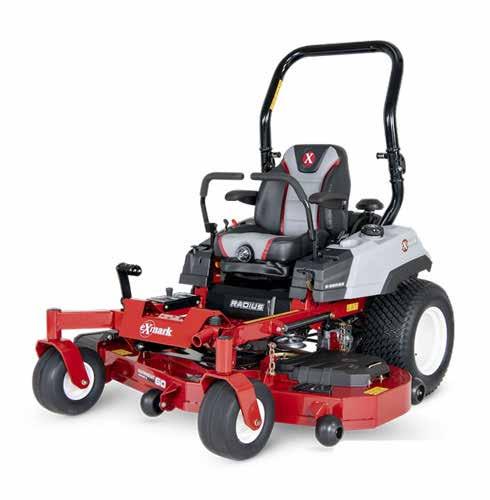
The Kentucky Cattlemen’s Foundation is raffling an Exmark Radius-S Series Zero Turn Mower generously donated by Equine & Ranch Rewards. This raffle will benefit Kentucky Cattlemen’s Foundation Leadership Development Program.
23.5 HP KAWASAKI FX730V V-TWIN 60” ULTRACUTTM SERIES 3 CUTTING DECK DUAL HYDRO-GEAR ZT3100 HYDROSTATIC TRANSMISSION WITH CHARGE PUMPS
1.5” TO 5.0” CUTTING HEIGHT IN 0.25” INCREMENTS • 9.0 MPH TOP SPEED 23 X 10.5-12 TIRES • 7.0-GALLON, SINGLE FUEL TANK • 4-YEAR OR 750 HOURS LIMITED CONSUMER/COMMERCIAL WARRANTY, 3-YEAR ENGINE WARRANTY • INTEGRATED REAR TOW HITCH + HEAVY-DUTY AIR CLEANER
Drawing will take place on October 2 at the WKU Ag Expo Center. Winner not required to be present to win. To purchase tickets, contact the KCA office at 859-278-0899, visit www.kycattle.org, scan the QR code above or mail form with payment to: Kentucky Cattlemen’s Association • Attn: Raffle • 176 Pasadena Drive • Suite 4 • Lexington KY • 40503

07 Allan Bryant President's Thoughts
08 Jonathan Shell Commissioner's Corner
10 Dave Maples Thoughts from Dave
18 Dr. Michelle Arnold Biosecurity and BVD-What’s in it For Me?
22 Chris Teutsch Profitability Isn’t Just For the Big Guys!
42 Jeff Lehmkuhler Low Feed Costs Offer Increased Profit Margins
14 Kentucky Nonprofit Providing Protein to Hungry Kids
16 KJCA, Partners Help Youth Gain Interest in Veterinary Careers
20 USDA Offers Drought Impacted Kentucky Farmers and Ranchers Immediate Disaster Assistance
24 A Mid-Year Look at Cattle Slaughter Trends
26 Obituary: Steve Dunning
12 County News
28 Membership
30 Kentucky Beef Council
32 Kentucky Beef Network
37 Angus News
40 Calendar of Events & Ad Index
41 Classifieds

We are partnering with the UF/IFAS Center for Public Issues Education in Agriculture and Natural Resources to refine our magazine and improve our communication efforts with you.
Learn more about the project and take the survey at piecenter.com/cattlemag or scan this QR Code with your phone.

Far too often, I feel like aggressive selection for maternal efficiency within a population is brushed aside because of the low heritability of traits such as fertility and longevity. Many presentations I see rely too heavily on crossbreeding as the magic bullet to improve maternal function. Those presentations often fail to define for the audience what a true F1 cross is. Structured crossbreeding is a tremendous tool, though more than a few cattlemen miss the mark on the “structured” part. I am not here to debate the merits of cross-breeding in beef production. What I will say is that low heritability doesn’t mean you can’t make progress. It just means it changes more slowly in a population than other traits. It also means that if you ignore it or are devoid of it in a population, it is really hard to breed it back in.
English philosopher George Savile famously said, “Men are not hanged for stealing horses, but that horses may not be stolen.” It could also be said that “we don’t cull females because they don’t breed, but so that more may breed in the future.” It is actually that simple. That is what has been done in our population for nearly 50 years. In fact, that has been the number one selection criterion we breed for. I have often cited it in my writing. We expect a female to breed at 15 months, calve at 24, and do so every 12 months for 12 to 15 years. Heifers that don’t breed never enter the gene pool. Cows that don’t breed back exit our gene pool.
I have 118 weaned calves from my fall herd. The group average for heifer pregnancy EPD is in the top 12% of the breed. Less than 5% of my calves are below breed average for the trait. The average calf is in the top 25% of the breed for functional longevity- an EPD we did not even have in the Angus breed when these calves were born. Less than 10% of them are even below average for the trait for which we had no EPD to utilize when they were conceived. How did we put an entire population in a class of their own for maternal efficiency? We hung the metaphorical horse thieves for 50 years. If you want to make progress within your own commercial herd, you hang your “horse thieves” and select bulls that excel for traits that impact reproductive efficiency. If you want to replace some of them, we have some solid replacement females calving this fall available. If you want to breed some of them, we have a strong set of bulls available in our upcoming fall sale.
Joe K. Lowe II
OFFICERS:
President
ALLAN BRYANT Eminence
President Elect
DANIEL HAYDEN Whitesville
Vice President
RYAN MILLER Campbellsville
Treasurer
KEN ADAMS Upton
Past President
RANDY WARNER Sharpsburg
KCA Program Chairman
ADAM CHUNGLO Harrodsburg
KBC Chairman
WAYNE ZOGLMANN Lewisport
KBN Manager
AMY WHITE Lexington
Beef Solutions Manager*
DANIEL HAYDEN Whitesville
*ex officio
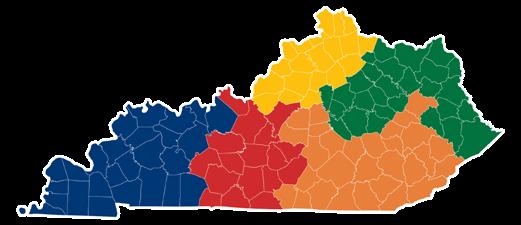
REGION 1
Chris Milam, John Mark Brown, Dale Gold, Greg Roberson, Gary Woodall, Lincoln Pyle, Susan Zoglmann, Bill Plemmons, Kenton Howard, Britny Williams, Conner Williams
REGION 2
Bryan Manion, Joe Lowe, Allison Nissley, Rayetta Boone, Sammy Boone, David Strater, Kelly Flanders, Andy Joe Moore, Adam Thomas, AJ Mitchell, Jonathan Murley, Kenneth Green, Robert Siddens, Josh Morris, Joe Mike Moore, Amy Cecil
REGION 3
Amanda Hall, Nathan Lawson, Allen Phillips, Stacey Burkhardt, John David Yount, Lincoln Clifford, Abbey Biddle, Ben Tinsley, Crystal Harrod, Phillip Douglas, Tanya Wilson, Craig Retzlaff
REGION 4
Jodi Purvis, Brad Reynolds, Chad Anglin, Phillip Stamm, Danielle Harmon, Brandy Graves, Kelsey Cooper, Bruce Witt, Ronnie Lowe, Logan Carter, Jason Crowe, Rob Amburgey
REGION 5
Phillip Reese, Cary King, John Settles, Natalie Wesley, Brandon Kelly, Freddie Harris, Brent Williams, Anne Bays, Tommy Glasscock, Josh Wethington, Arch Sebastian, Terry Mattingly
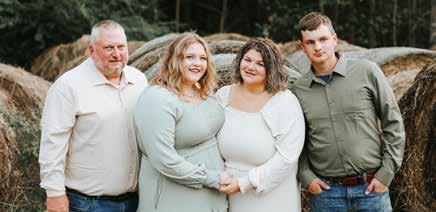
Briefly tell us about your operation.
I have a small cow-calf operation outside of Liberty. We are predominantly commercially red cattle.
Our farm and life motto is:
“We’re only on this earth a short amount of time; leave it in a little better shape than you found it."
Why did you decide to run for state board?
I think this association is a great way for producers to get involved and be around like-minded individuals. I can help connect my local producers to statewide networking, and I want to be a part of making a difference.
How many years have you served on the state board?
Three.
What do you like the most about the Kentucky Cattlemen's Association?
The thing I like most about the Kentucky Cattlemen’s Association is how no matter the size of your operation you still have a voice. This association is like a family and will support and give guidance to each individual.
When you aren't taking care of your cows, what are you doing?
When I am not taking care of the cows, I am either helping my son, Eli, with his sheep operation or going to Murray State University to spend time with my daughter, Jenna. I also love to spend time with my beautiful wife, Kim
Jake Harrod KBN Program Coordinator Kelly Liver KBC Director of Communications
Dan Miller KBN Industry Coordinator

Allan Bryant KCA President
Maintaining the cattle herd is the backbone of a stable beef industry. The strength of America’s beef industry doesn’t begin at the grocery store, the feedlot or the packing plant. It begins in pastures—right here in Kentucky—where cows raise the calves that eventually feed the nation. Today, as the Kentucky and national cow herd sits at historically low levels, the importance of maintaining and rebuilding that herd has never been clearer.
The U.S. beef cow herd is the smallest it has been in decades. Years of drought, high input costs and tough economic decisions have forced producers to cull deeper than they wanted. When cow numbers fall, the entire beef supply chain tightens. Fewer cows mean fewer calves. Fewer calves mean feedlots run below capacity. Packers compete for limited supply. And consumers—still hungry for beef—face higher prices at the meat counter. A shrinking herd doesn’t just affect farmers; it affects every family that buys beef.
Yes, cattle prices are strong and they need to be strong and continue to be strong! But strong prices built on extremely tight supplies can create instability. Volatility becomes the norm. Feedlots struggle to secure placements. Packers operate less efficiently. Rural communities feel the strain as sale barns, feed mills and trucking outfits see fewer cattle moving through their doors.
Maintaining the herd isn’t about chasing high prices today—it’s about protecting the long-term health of rural Kentucky and the U.S. as a whole.
Beef processing plants are designed for volume. When cattle numbers drop too far, plants close or reduce shifts, labor becomes harder to retain and per head costs rise. That inefficiency ripples outward, affecting everyone from farmers to retailers.
A stable cow herd keeps the system
running smoothly, ensuring beef remains both available and affordable. Even with higher prices, Americans continue choosing beef for its flavor, nutrition and versatility. One of the primary reasons for strong beef demand is the success of the Beef Checkoff. As cattle numbers decline, fewer Checkoff dollars are available, limiting our ability to connect with consumers and communicate the value, quality, and nutritional benefits of beef. Without adequate resources to share our story, maintaining strong consumer demand becomes increasingly challenging.
Cattle aren’t just animals; they’re economic drivers. They support veterinarians, feed stores, equipment dealers, auction barns and countless small businesses. When cow numbers
fall, rural infrastructure weakens. Over the past 20 years in Kentucky, we have lost 29% of our pastureland and over the past six years, we have lost about 150,000 cows from our cow herd.
Producers who can maintain or rebuild their herds today are laying the foundation for a stronger, more resilient beef industry tomorrow. The cattle herd is the cornerstone of the beef industry. Keeping it strong ensures that rural communities thrive, markets remain stable and consumers continue enjoying the beef they love.
God Bless!




Complete Cattle Saver
Treats entire animal at one station
Mineral Feeder
Controls flies, lice, ticks and mosquitoes
Singles
HELPS ELEMINATE PARASITES
APPLIES INSECTICIDE EVENLY
Scratcher assembly available without stand, or on a stand with 1, 2 or 3 scratcher assemblies. The Easy Way Scratcher also comes with or without 3’ Walk-Way Oiler.
3’
TREATS ENTIRE ANIMAL AT ONE STATION Tyler Stortz 563-568-1769 • Allyson Stortz 563-379-6118
A durable, low maintenance oiler that fits directly into your cattle’s path for automatic, consistent fly & parasite control. Built tough for pasture or lot use, it keeps your herd protected with minimal effort.
info@easywaycattlecare.com

Jonathan Shell Agriculture Commissioner
Later this month, as we celebrate the 122nd Kentucky State Fair, we also celebrate America’s semiquincentennial – the 250th anniversary of the signing of the Declaration of Independence.
"Where County Traditions Meet Our Country's Celebration" is the theme of this year's state fair during its annual 11-day run Aug. 20-30 at the Kentucky Exposition Center in Louisville. America’s heritage is tied to agriculture, as it represents what we eat, the clothing we wear and the fiber we use.
As Kentucky’s agriculture commissioner, I see the hard work our farm families do every day to keep our country’s entrepreneurial spirit thriving. Blending grit, innovation and respect for the land, our farmers embody what it takes to succeed in one of the world’s oldest professions. Those connections to our ancestral agricultural roots can be found every year at the state fair. It’s a connection many in Kentucky don’t personally have anymore but can be found and re-established each August. The state fair is the perfect showcase of Kentucky’s agricultural spirit. Rural and urban residents come together in this unique atmosphere to celebrate everything Kentucky has to offer. Farming’s impact is vital for every resident, and that’s showcased in everything we do at the fair.
As much pride as we take in bringing you a state fair that’s the envy of many states, we are not standing still. As a member of the fair board, I can assure you lots of behind-the-scenes actions take place to make the Kentucky State Fair a showcase. Planned renovations, being furnished by a $200 million appropriation for the state fair by our General Assembly, are expected to be complete next year. Last year, fairgoers saw the beginning of those renovations, and you will see more progress taking place this year. When finished, this once-in-a-lifetime expansion and renovation will be one of our state’s largest economic investments.
While we are ready for physical changes, our commitment to agriculture
history and agricultural fun will remain the same. AgLand brings together more than an acre of agriculture exhib its in the South Wing, highlighting Kentucky’s farm and field heritage, including the future of farming and agribusiness. Interactive and immersive exhibits will return this year for the de light of our youngest fairgoers. AgLand is also where you’ll find exhibits from Kentucky 4-H and FFA.
At the state fair, you will see why we’re Kentucky Proud of our agriculture industry. Kentucky’s leading youth livestock exhibitors will compete for the highest honors of the livestock show season. Kentucky’s commodity groups will serve delicious locally grown and raised food at the Great Kentucky Cookout Tent. Agricultural displays in the West Hall will highlight the best our farmers have to offer.
Creating an inclusive experience for all our residents will once again be high lighted this year as we offer our Sunshine Class. Now in its fifth year, the event offers an opportunity for special needs youth to get hands-on experience with the agriculture industry by showing livestock in a show ring. It’s worth the price of admission just to see the smiles on their faces. You don’t want to miss it!


EPD’S/Genomics Available
On display at the state fair will be a wall of bourbon barrel tops signed by the many visitors to the Kentucky pavilion at the Great American State Fair last month in Washington, D.C. Signees were asked to list where they’re from, and I'm excited to see how many states, and even countries, are represented. As always, your Kentucky Department of Agriculture will be on the job at the fair. Our employees meet the public and talk about the ways agriculture affects everyday lives. We help manage the livestock shows and the agricultural exhibits. We also help livestock producers and exhibitors protect their investments in their animals.
I want you to leave the state fair with fond memories that will last a lifetime. Hope to see you there!
LANE ANDERSON (606) 303-4336
JON ANDERSON (606) 305-8859
ANDERSON (606) 872-8072


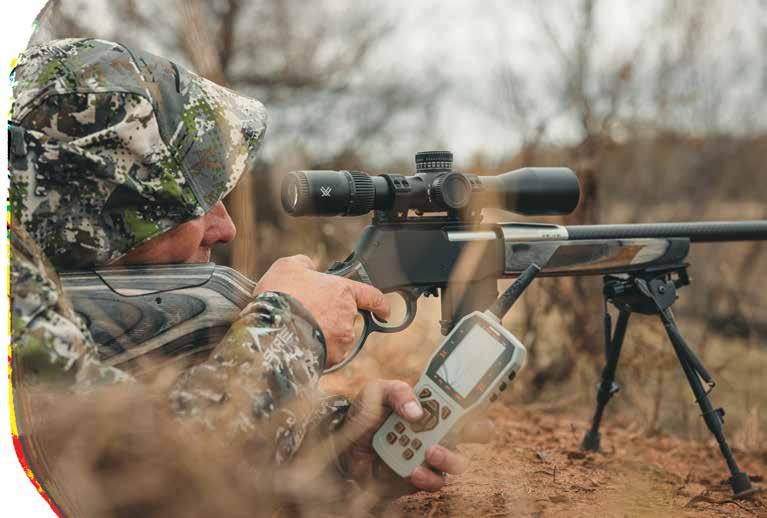
Coyotes don’t give you a clean shot. They dart, they weave, and they’re gone before most rifles settle. On a cattle operation where a single coyote can take a calf, and a pack can do far worse, close enough isn’t good enough.
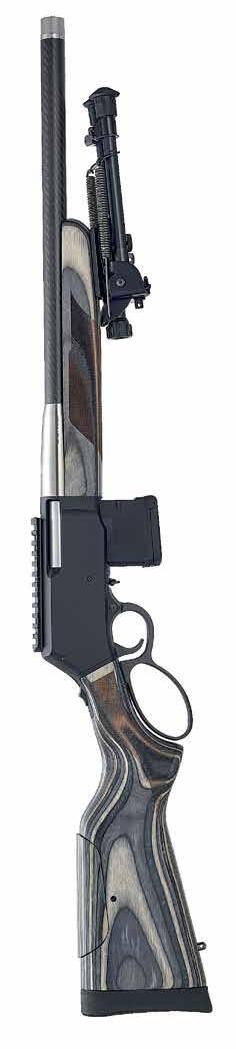
The SPD PREDATOR was built for exactly that problem. The name is an acronym: Precision Rifle Engineered for Dispatching Agile Targets Over Range. And that says it all.
Designed by Henry’s Special Products Division, the SPD PREDATOR is the only lever-action ever built with a factory-backed, sub-MOA accuracy guarantee. It’s not just the most accurate leveraction Henry has ever made — it’s the most accurate lever-action ever made, period.
The performance comes from a match-grade 416R stainless steel barrel tension-wrapped in carbon fiber, which reduces weight, improves heat dissipation, and delivers the rigidity required for sub-MOA repeatability shot after shot. The threaded barrel accepts a suppressor, which matters when you’re calling predators at dusk and don’t want a single shot to scatter the rest. MSR-style magazine compatibility and a preinstalled forged carbon fiber Picatinny rail mean it’s ready for your preferred optic right out of the box, and the included Harris bipod gives you a steady platform when the shot presents itself.
The SPD PREDATOR is a professional-grade tool for a professional-grade problem. If protecting your herd is part of the job, and on a cattle operation, it always is, this is the rifle that does it with authority.


Dave Maples Executive Vice President
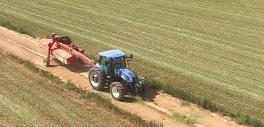
On a mid-July Saturday, I was mowing my pasture to make it look better. I had the mower set high, so I could go up a gear and get a little wind. It was hot even early that morning, and we had had a lot of rain that night. I could see my cows already huddled under a small group of trees. As I made that first round, I was parallel to the fenced off creek, and it was moving really fast. I slowed down and came to a stop so that I could take a picture. Not only was the creek really fast, it was so muddy that it was nearly red. If you have traveled between Lexington and Nicholasville the last couple of weeks, you will see all the construction going on. As I watched the muddy water going so fast, I thought about all the conservation efforts that we all have worked on and the water was still this muddy. I drove on around and made the turn going uphill, and I noticed the stream coming off my pasture. I stopped and took another picture because the water was clean. Then I made the turn and headed west. I could see my cows, and that got me back on thoughts of management strategies of how to handle the hot July weather.
During summer 2024, I had three cows abort or slip their calf in late July/early August. That summer was hot and dry. At least we have had rain this summer, and the grass looks good. I don't know exactly why I lost those calves, but I talked with all the folks that I knew to talk to and what we came up with was the weather conditions combined with the tall fescue made it very hard on the cows. Since 2024, I have added red clover to my pastures, and I have really paid attention and made sure my cattle have access to plenty of water and shade. I also let them into the cooler area of the property, which has limited access to the creek. I know that is not what I should probably tell you, but I have come to realize that cow comfort is important.
I watched my cattle move all day that day, and yes, I would stop and take a picture. I also have a group of yearling heifers that I will keep and breed this fall. They are in a separate pasture up in the front of the farm. They have access to a nice pasture with clover and a great deal of natural shade. I am doing an observation study for myself just to see where the cattle choose to spend their day. In addition to the natural shade, they also have access to an open-sided shed. I have been leaving the barn door open just to see where they opt to loaf during the day. They are in the barn every day.
Later in the day, the cows move to a cooler area of the pasture and you know where that was. I have a suspicion that across Kentucky and the fescue belt that we are losing more calves in July and August than we really know about. And I just think about the herds that are breeding cows in June and July. That could be difficult.
Les Anderson, UK beef cattle extension specialist, was in the office in July, and I got in a deep conversation with him about this subject. Dr. Anderson and the USDA researchers are doing a very in-depth research project on this subject. They can see problems, but they have to go through several replications. I asked him when he would be finished, and he said it would be 10 years. I said, “ I can't wait that long.”
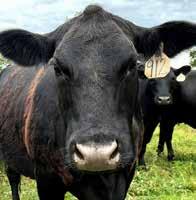
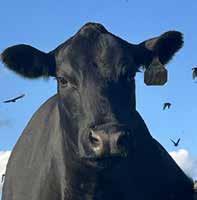
With climate change and the heat along with fescue, I know I need to pay close attention to the cows. The geneticenvironmental interaction is something that I have been watching. We (my daughter and I) have been documenting hair shedding for the past two years and selecting bulls with low hair shedding scores. We have also done genomic tests on all our cows and only keep heifers from cows that calve early. We have sowed red clover in our pastures. And I am really paying attention to water and shade. We preg checked back in April, and all but one cow was pregnant. Now, if we can keep them pregnant and get a nice healthy calf in a couple of months, that would be nice. We are patiently waiting for that first week of September.
I saw a quote from Jim Gerrish that said, “The answer is management.” This cattle business is all about management. Pasture management, herd health management, genetic management, economic management, marketing management, plus, plus, plus…, and each year is different.






Brad Stemle
BARREN COUNTY NEWS
Carol Spiegl
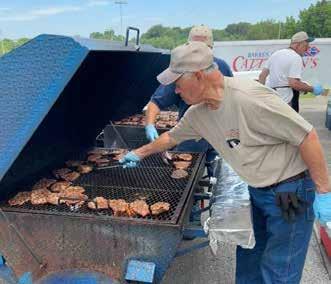
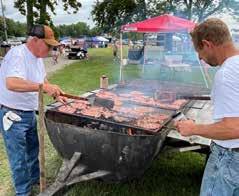
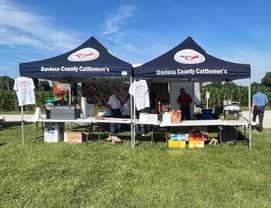
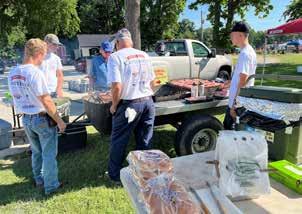
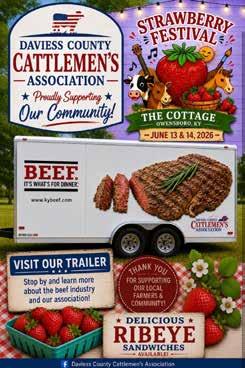
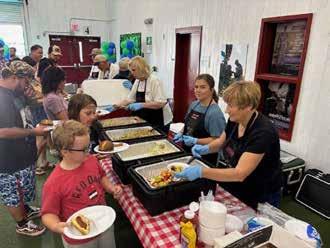
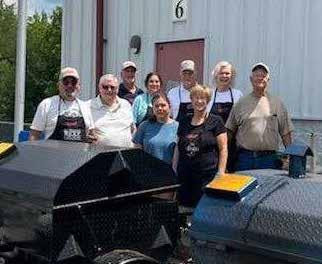
The Barren County Cattlemen's Association's cooking crew was honored to grill ribeyes and beef hotdogs for Green Mechanical's company picnic. We appreciate all the local businesses that ask us to grill for their events. Promoting beef is what we do best!
SATURDAY, SEPTEMBER 5 5PM EST

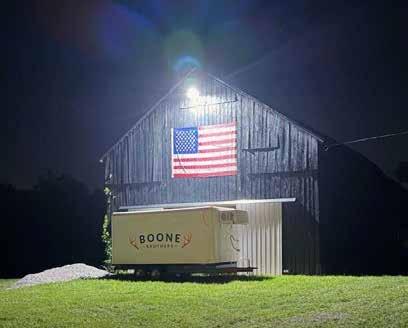
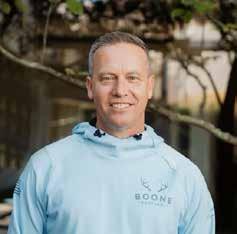
LEXINGTON, KY− Some of Kentucky’s most vulnerable children are getting protein added to their diets thanks to Boone Brothers USA.
Led by Jon Weece, former pastor of Southland Christian Church, Boone Brothers began making and distributing venison jerky to Kentucky elementary schools in January through a partnership with the Kentucky Department of Fish and Wildlife. In just the spring semester, Boone Brothers distributed 15,000 packages to 30 elementary schools in six Central Kentucky counties. Each package contains two sticks of jerky that equal 14 grams of protein.
“We started by advertising our jerky on social media and got unbelievable feedback,” Weece said. “The schools have reached out to us wanting the packages, and we have worked with the family resource centers to get them distributed to the kids. People in Kentucky have generous hearts and have been great at donating the animals and items we needed to get started.”
According to the 2025 Kentucky KIDS COUNT data, 21% of Kentucky children resided in a household experiencing food insecurity in 2023. Forty counties
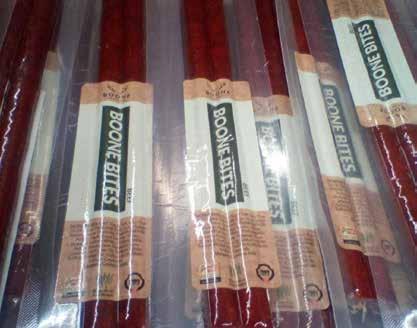
have a child food insecurity rate of 25% or more. The data shows food insecurity has risen in all but one Kentucky county since 2021.
“We truly believe that hungry children become angry adults,” Weece said. “We are trying to make a difference.”

When new school year begins in August, elementary schools in three more counties will start receiving jerky, and Boone Brothers is also adding beef jerky to the mix. Due to the overwhelming interest, Weece expects the program to ramp up quickly with the goal of distributing 250,000
packages to schools this year.
Weece said he is excited about adding beef to the nonprofit’s offerings because one cow can make 2,000 packages of beef jerky, compared to 150 to 200 packages made from one deer. The company can accept cattle year-round whereas deer donations are limited by hunting season. Donated cattle are tax deductible.
Currently, several counties that have Doe Depots, where hunters can deposit deer for Boone Brothers. A list of those locations is on the Boone Brothers website, www.boonebrothers.org. With processing kinks still being worked out, producers who want to donate cattle, should email contact@boonebrothers. org.
Weece said one of his goals is distribute the jerky to children in the communities where the donation originated from.
“If producers or hunters have a particular elementary school they would like their donation to go to, they just need to let us know,” Weece said. “We just ask that everyone be patient with us as this gets started. Contact us if you are interested in donating, and we will figure it out. Processing is where we need the most help.”
August Cow Sales
BG Campbellsville Friday, August 7 7:00 PM
BG South—Stanford Friday, August 21—6:30 PM
BG Lexington Wednesday, August 26 6:30 PM
Blue Grass Stockyards 2026 Bred Heifer Sales are just around the corner. Mark your calendars!
Farmers Stockyards Herd Builder Bred Heifer Sale October 24
BG East—Gateway Bred Heifer Sale October 30
BG South—Next Generation Bred Heifer Sale November 14
BG Lexington Blue Ribbon Bred Heifer Sale December 4
BG Lexington—Jeremy Shryock, Manager
Cattle Sales Monday & Tuesday 9:00 AM—Cow Sales 4th Wednesday 6:30 PM *Nov & Dec Cow Sales 3rd Wednesday 6:30 PM
BG South—Richmond—Jim Dause, Manager
Cattle Sales Friday 9:00 AM—Hog, Goat & Sheep Sales 2nd & 4th Monday 1:00 PM
BG South—Stanford—Dylan Holt, Manager
Cattle Sales Monday & Thursday 8:30 AM —Cow Sales 3rd Friday 6:30 PM
BG Campbellsville —Ronnie Choate, Manager
Cattle Sales Wednesday & Saturday 10:00 AM Cow Sales 1st Friday 7:00 PM
BG East —Mt. Sterling—Jordan McCord, Manager
Cattle Sales Wednesday 10:00 AM
BG Albany—Jeffrey Cyphers, Manager
Cattle Sales Wednesday 9:30 AM CST Sheep & Goat Sales 1st Monday of Month 1:00 PM —Aug—Oct—Nov
Farmers Stockyards—Flemingsburg—Corey Story, Manager
Cattle Sales Tuesday 10:00 AM Cattle & Small Animal Sales Saturday 10:00 AM
Katie Pratt Kentucky Cattlemen’s Association
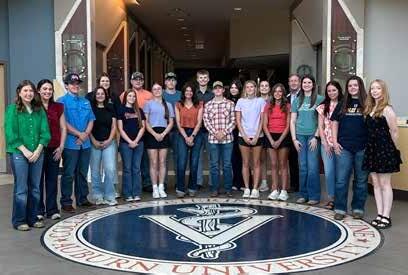
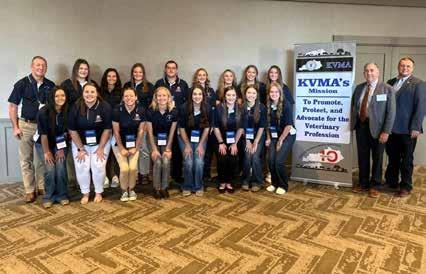
The Kentucky Junior Cattlemen’s Association continues to partner with the veterinary community to address the Kentucky’s rural veterinary shortage by helping young people in the state prepare for careers in veterinary medicine.
"The Kentucky Veterinary Scholars Program has become one of the most rewarding initiatives to come from the Veterinary Sustainability Working Group (VSWG),” said Debra Hamelback executive director of KVMA. “Through the collaborative partnership of the Kentucky Veterinary Medical Association, the Kentucky Veterinary Medical Foundation, Auburn University College of Veterinary Medicine, and the Kentucky Cattlemen's Association, we are building a strong pipeline of future food animal veterinarians who understand the unique needs of rural Kentucky.”
Through the two-year program, selected applicants receive handson experiences, mentorship and networking opportunities as they explore careers in food animal veterinary medicine and learn about the skills needed to successfully apply for admission into a veterinary doctoral program.
“Based on feedback from participants and with the guidance of current students in the program, we have streamlined the curriculum and created a more interactive experience that better prepares students for the
veterinary profession,” Hamelback said. “Watching these young people grow in confidence, knowledge and commitment reinforces why this collaboration is so important. Together, we are investing in the next generation of veterinarians who will help sustain animal agriculture and serve Kentucky for years to come."
The program is open to high school seniors. Selected applicants will participate in their program during their senior year and freshman year of college.
It is a new take on the popular KCA-Auburn University Veterinary Mentorship Program that began three years ago through a grant that has now ended. In that program, high school students were partnered with Auburn College of Veterinary Medicine students to gain the skills needed to be accepted into veterinary school.
“It gave me complete insight into all these pre-veterinary pathways and vet school,” said Callie Derossett, a sophomore at the University of Kentucky from Henry County. “It allowed me to make connections with likeminded youth and adults that could help me get to where I want to be and get a step ahead on applying to veterinary school.”
Derossett, along with Wade Moore, a sophomore at Murray State University from Henry County and Brooklynn Felts, a current Morehead State University sophomore from Bath
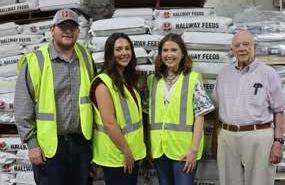
County, will be coordinating the Veterinary Scholars Program. All are alumni of the KCA-Auburn Veterinary Mentorship Program and hope to one day be veterinarians and care for large animals as part of their practice.
“The Veterinary Scholars Program presents a new opportunity for me to lead others to careers in large animal veterinary medicine,” Derossett said. “I’m excited for the opportunity not just for myself but for the other youth that will continue the program in the future.”
Bob Hall, founder of Hallway Feeds and Scott County livestock producer, is a big supporter of addressing the rural veterinary shortage by getting Kentucky youth interested in large-animal veterinary medicine. He visited with Derossett, Moore and Felts to speak about his personal experience with large animal veterinarians.
“We have good relationships with all the veterinarians we use,” Hall said.
“Veterinarians have to have a good relationship with their clients and treat them like a partner, where each communicates effectively and accepts their responsibility in animal care. It’s a two-way street.”
He encouraged the young people to pursue careers in veterinary medicine and talked about the attributes they need to be successful.
“Young people need to have a goal and be willing to accept challenges,” he said.

Michelle Arnold DVM-Ruminant Extension Veterinarian (UKVDL)
Bovine viral diarrhea (BVD) is a contagious viral disease of cattle with significant impacts on herd productivity and reproduction. The BVD virus can cause a wide range of clinical problems including infertility and reproductive failure, respiratory and gastrointestinal disease and in rare cases, fatal mucosal disease. If a pregnant cow becomes infected with the BVD virus, the virus can cross the placenta and affect the developing fetus. If infection occurs early in pregnancy, the fetus may die and be reabsorbed while infection later in gestation may result in abortion, stillbirth, or a live calf with congenital defects or born weak. Importantly, if the pregnant cow is infected with BVD virus during the 40-to-120-day gestational window, her calf is born persistently infected with the virus and is known as a “PI calf.” PI animals are the main source of BVD virus within herds because they shed the virus continuously every day, risking infection of other susceptible cattle. Approximately half of PI calves appear normal and their infection can only be detected through laboratory diagnostic tests. Research has shown that over 90% of PI calves are born to dams that experienced a “transient” or shortlived BVD infection in early pregnancy. The remaining PIs are born to PI-positive cows that will always produce a PI calf in every pregnancy.
PI calves shed the BVD virus continuously throughout their lives and quickly infect other cattle in close contact. In the stocker/backgrounder industry, BVD virus is considered an important and costly contributor to the bovine respiratory disease (BRD) complex. If one PI calf is in a group of purchased stocker calves, that PI will expose all the calves in the group to the BVD virus. This exposure results in a transient (short-term) BVD infection that suppresses the calf’s immune system, making calf pneumonia more likely and more severe, especially in recently weaned, lightweight beef calves. Thus, a BVD-PI calf in a pen of beef calves leads to significant increases in treatment cost and death loss from bronchopneumonia. Even adult beef cattle exposed to a BVD-PI animal in an auction barn
Figure 1. Factors deemed to be important within a vet-farmer relationship that may impact biosecurity on farms. Accessed from: Grant, N.; Buchanan, H.; Brennan, M.L.; Factors within A Veterinarian-Cattle Farmer Relationship That May Impact on Biosecurity Being Carried out on Farms: An Exploratory Study. Vet.Sci. 2023, 10, 410. https://doi.org/10.3390/vetsci10070410.
may be transiently infected with the virus and end up dead a few weeks later from pneumonia. A BVD-PI calf is born with the virus and spreads it to other cattle in close contact through viral shedding primarily in saliva and nasal discharge. Virus may also be deposited in watering troughs, feed troughs and cattle trailers that can be transmitted indirectly to other cattle in the pen or truck. A single PI animal may expose hundreds of cattle to the virus during shipping, in auctions, while commingling in stocker/backgrounder operations and through fence-line contact with neighboring cattle.
Currently there is much debate surrounding BVD PI calves, with much of the focus shifting to BVD control and prevention at the cow/calf level since a calf can only be a PI if it is born that
Clarification of biosecurity cost-effectiveness
Cooperative discussion
way. To be effective, BVD control must include a three-pronged approach of applying sound biosecurity practices, vaccination of the breeding herd, and the identification and removal of all PI calves. Of those three, the long-term benefits and cost-effectiveness of biosecurity measures are often the hardest to sell to producers because it is hard to see any immediate effects from those efforts. In other words, the cost of putting the biosecurity measures in place is weighed against whether it would save them money in the long term. Unfortunately, producers become much more enthusiastic about disease prevention once they experience their own disease outbreak which requires a large sum of money unexpectedly to cover disease cost. Simply stated, when producers understand the economic advantage to
preventing disease rather than trying to control it once it becomes a problem, they take biosecurity seriously. Good biosecurity practices reduce the risk of disease because these practices minimize exposure to the infectious agents that cause disease, whether they are viruses, bacteria or parasites. Veterinarians should be the main gateways to solid biosecurity recommendations for cattle farmers, but they are increasingly competing with social media opinions, Dr. Google and now ChatGPT to get their message across. With multiple information sources, farmers can be left confused and uninspired to adopt any useful practices to protect herd health.
In a 2023 research article published in Veterinary Sciences (https://www. mdpi.com/journal/vetsci), the authors explored the factors within a veterinarian-cattle farmer relationship that could potentially affect how and whether biosecurity measures would be instituted on farms. Interestingly, they found that veterinarians were not automatically seen as influential and trusted sources to formulate a plan for the farm. Instead, they found the following key factors within a vet-client relationship that appear to be important before a veterinarian’s advice is followed: 1) The vet and farmer know each other; 2) the farmer trusts in the vet’s advice; 3) the vet understands the cost-effectiveness of biosecurity measures; 4) both the vet and farmer participate in biosecurity discussions that incorporate shared decision making, and finally 5) there is time dedicated to biosecurity discussions. (Figure 1). Talking with a veterinarian about biosecurity/disease prevention needs to be a two-way conversation so both the producer and the veterinarian can decide together on the biosecurity practices necessary for the farm in question.
Regarding biosecurity and the BVD virus, it is critical to understand that purchasing animals, whether it is cows, bulls or calves, and bringing them home to the farm is considered the single most dangerous time for introduction of new diseases into a herd. All newly purchased animals should be isolated either off the farm or in a well-segregated quarantine area for at least two weeks (three to four weeks is better) and observed for any signs of illness. Research has proven that the No. 1
cause of BVD virus entering a herd is through the purchase of pregnant females, especially first-calf heifers, without properly testing for the virus. Testing must include both testing the pregnant female for BVD and testing her calf after birth for PI status. The dams that experience a transient infection while pregnant will be negative when tested for BVD but their PI calves will test positive. All newly purchased cattle, regardless of age or sex, should be tested for presence of the virus and isolated from the herd until results are available. Reintroduction of show animals returning to the farm from events may also be sources of disease entry. During the period of isolation, a veterinarian should be consulted to appropriately test and vaccinate new arrivals. The best practice is to purchase animals from herds of known health status that will provide a vaccination and health history. Introduction of an animal with a disease such as Johne’s or a BVD PI animal could have devastating, long-term effects on the health of the cow herd.
Biosecurity measures to reduce virus exposure extend beyond the quarantine and testing of new purchases. The BVD virus is a “single-stranded RNA virus” which is very stable under moist and cool or cold conditions. It is not affected by freezing and can easily survive at least a week in the right environment. It can be spread short distances through large “droplets” (especially saliva and nasal discharge but all bodily fluids contain virus) and is easily transmitted through nose-to-nose contact and shared water sources. Cattle are social animals and will interact with other cattle whenever possible. Most farm fences are good for marking property lines but not for preventing virus spread. Double boundary fencing with 3 yards of space in between or installing offset hot wires on both sides of a fence will significantly reduce the risk of transmission. Other potential virus sources include mechanical vectors such as shared farm machinery or contaminated veterinary equipment. Thoroughly cleaning equipment with soap and water is an effective means of killing the BVD virus. Indirect contact with wildlife, vermin and other domestic animals, especially through urine and fecal contamination of cattle feed and water sources should be mini-
mized as much as possible.
BVD is a complex disease. The delay in appearance or lack of obvious clinical signs is partly responsible for the underestimation of BVD-related risks and the low awareness of producers. Most important is the failure to realize the real risk posed by PI cattle. They are reservoirs for infection of susceptible animals and play a pivotal role in maintaining the virus in beef cattle herds. There will always be exposure to infectious agents, despite the best farm biosecurity measures. However, observing a period of isolation for all new arrivals and testing them appropriately are two tried and true methods to reduce disease occurrence. In short, prevention of disease is far more than just vaccinating cattle; it is largely influenced by the day-to-day management practices instituted year-round. Remember, do not just talk with your veterinarian about biosecurity; have a conversation and together decide what is best for your farm.
for calving ease and growth.
Ø Bulls for both purebred and commercial breeders.
Ø Yearlings and two-year-olds available.
Ø Bred heifers to calve in fall available.
USDA’s Farm Service Agency (FSA) offers disaster assistance and low-interest loan programs to assist you in your recovery efforts following drought. Available programs and loans include:
• Non-Insured Crop Disaster Assistance Program (NAP) - provides financial assistance to producers of non-insurable crops when low yields, loss of inventory, or prevented planting occur due to natural disasters including qualifying drought (includes native grass for grazing).
• Livestock Forage Disaster Program (LFP) – provides compensation to eligible livestock producers who suffered grazing losses for covered livestock due to drought on privately owned or cash-leased land.
• Livestock Indemnity Program (LIP) - offers payments to eligible producers for livestock death losses in excess of normal mortality due to adverse weather. Drought is not an eligible adverse weather event, except when associated with anthrax, a condition that occurs because of drought and directly results in the death of eligible livestock.
• Tree Assistance Program (TAP) – provides assistance to eligible orchardists and nursery tree growers for qualifying tree, shrub and vine losses due to natural disasters including excessive wind and qualifying drought.
• Emergency Assistance for Livestock, Honeybees, and FarmRaised Fish Program (ELAP) - provides emergency relief for losses due to feed or water shortages, disease, adverse weather, or other conditions, which are not adequately addressed by other disaster programs.
• Emergency Loan Program – available to producers with agriculture operations located in a county under a primary or contiguous Secretarial Disaster designation. These low interest loans help producers recover from production and physical losses.
• Emergency Conservation Program (ECP) - provides emergency funding for farmers and ranchers to rehabilitate land severely damaged by natural disasters and to implement emergency water conservation measures in periods of severe drought.
To establish or retain FSA program eligibility, you must report prevented planting and failed acres (crops and grasses). Prevented planting acreage must be reported on form FSA-576, Notice of Loss, no later than 15 calendar days after the final planting date as established by FSA and Risk Management Agency (RMA).
For more information on these programs, contact your local FSA office or visit fsa.usda.gov/disaster. To find your local FSA office, visit farmers.gov/working-with-us/service-center-locator.
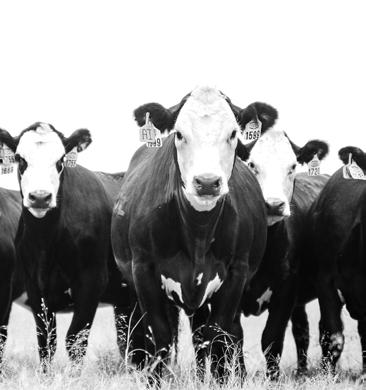
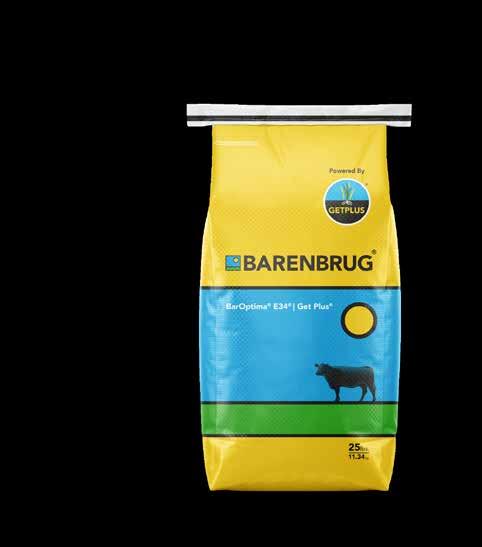
BarOptima® E34® powered by Get Plus®: Revolutionary soft leaf Tall Fescue with beneficial endophytes
2.5 lbs/day is the average daily gain while grazing
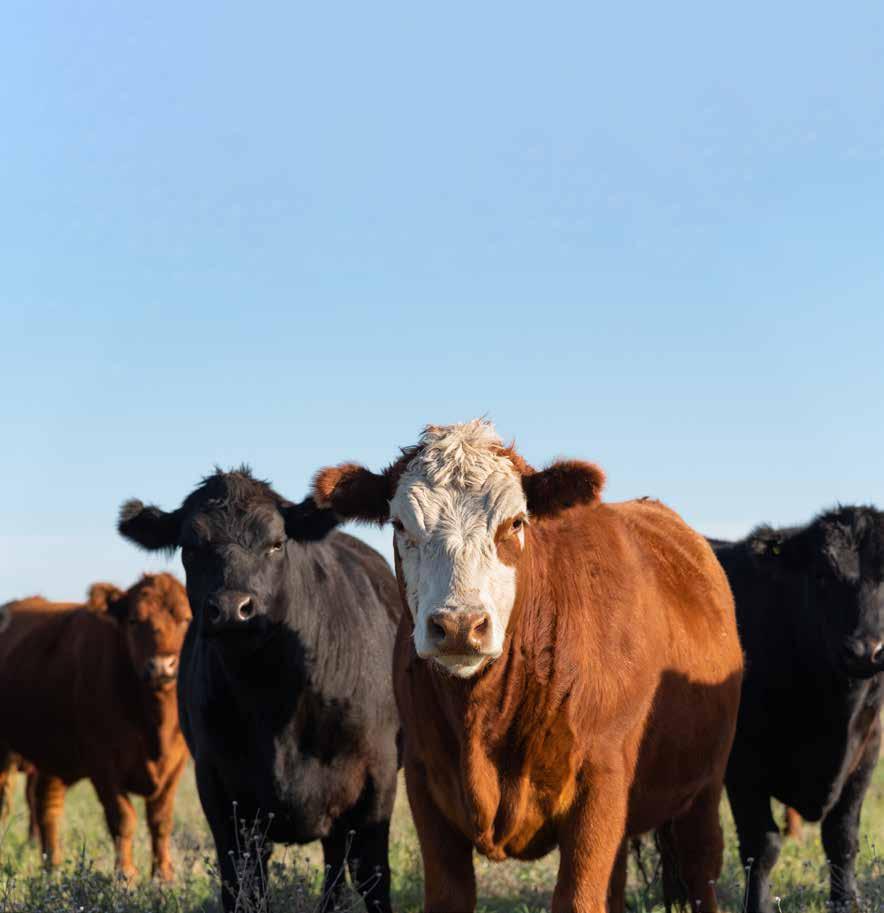
Get 30% more calves from the cows you already have
Produce more pounds of beef from your acres
Get heavier weaning weights
At Barenbrug, we are committed to the highest quality of forage grass seed. We understand the quality of forage directly impacts animal performance and ultimately, your profits.

Chris Teutsch UK Research and Education Center, Princeton KY
There seems to be a myth that small and mid-sized cattle operations can’t be profitable. This is simply NOT true. Small cattle farms can be highly profitable, but they cannot be run like a large farm that enjoys efficiencies of scale. Large operations can spread costs like machinery and buildings out over more animals. On the other hand, small operations must run much leaner to be profitable. The goal of this article is to outline characteristics of profitable forage-livestock operations and will, of course, include a strong and well-managed forage base.
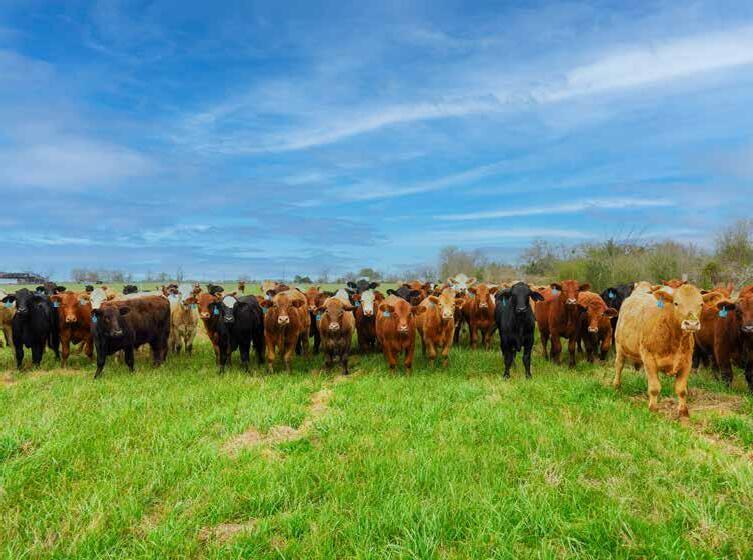
Optimize reproductive efficiency. First and foremost, for cow-calf operations to be profitable, cows must wean a live calf every year. So, dialing in reproduction, genetics, herd health and nutrition is critical. Luckily, we have University of Kentucky extension specialists Bullock, Anderson, Arnold, Lehmkuhler and VanValin to guide us though through the often-complicated interaction of genetics, reproduction, nutrition and environment. I will say that from a forage perspective, I would like a cow that is moderate sized, can maintain herself on existing forage resources, and needs little or no assistance rebreeding and calving.
Limit investments in buildings and concrete. Small and mid-sized cattle operations must be very careful when investing in buildings, especially buildings that may only be used for short periods of the year. I realize that it gives us a good feeling to save a calf or two during inclement weather, but you need to do the math and think about how may calves you would need to save to pay for a building that cost $100,000. Make sure to use the long-term average calf price. Lastly, if you do decide to invest in a building, make sure to pencil in additional equipment and infrastructure for manure handling, storage and spreading.
Limit investments in machinery. It is extremely easy for small and mid-sized operations to over mechanize. If profitability is front and center, small farms simply cannot own as much machinery as larger farms. A classic example is hay
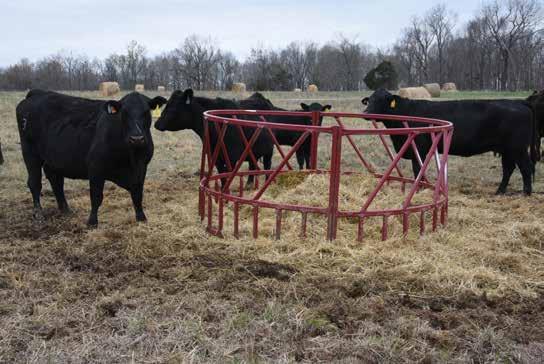
the photo above, bale grazing is being used to uniformly distribute the fertilizer nutrients contained in hay across the pasture area.
equipment. It is very difficult to make a full complement of hay equipment pencil out for small and moderate-sized cattle operations, especially new equipment.
Reduce feed costs. The single largest cost in cow-calf operations is feed, specifically hay fed during the winter months. One of the most important characteristics of profitable cow-calf operations is low hay feeding days. We should be striving for a 60-day hay feeding period in most years. Well-maintained, perennial pastures that are rotationally stocked will provide the most economical feed source for cow-calf operations in the commonwealth. Although summer and winter annuals can provide high quality grazing during critical periods, they should be used sparingly due to high costs. Control expenditures. Impulse buying can add up quickly especially with increased access to online purchasing. Reviewing and making sure that you really need something is a critical part
of positive cost control. A friend from Virginia would use what he referred to as the “three-day rule”. If he really, really thought he needed something, he would wait three-days before buying it and usually after three days he decided that he didn’t really need it as bad as he thought.
Use strategic outsourcing. Consider outsourcing tasks such as hay making and heifer development. Purchasing hay produced off farm can improve whole farm profitability in several ways. First, it is often cheaper to buy good quality hay than produce it yourself. Second, it brings fertilizer nutrients into your grazing system…every ton of hay contains 35, 15, and 50 pounds of nitrogen, phosphorus and potassium, respectively (Figure 1). Third, it allows you to increase your stocking rate or better yet extend your grazing season. This is accomplished by fencing in former hayfields. Outsourcing other tasks like heifer and bull development can also make a lot of sense for small and
Forage Management Tips for March
• Make plans to attend the Intermediate Grazing School in September.
• Slow grazing rotation for cool-season pastures to allow more rest time. Do NOT graze closer than 4-5 inches.
• If cool-season pastures are not growing, feed hay in a sacrifice area to avoid damaging pastures.
• Graze summer annuals and perennials.
• Plant winter annuals after first good rain in August if fall grazing is desired.
• Identify pastures that will be stockpiled for winter grazing. Graze or clip these pastures and apply 60-80 lbs. N/A in late August or early September.
• Rest pastures that are being stockpiled.
mid-sized cow-calf operations. Reassigning these peripheral tasks also frees up time for other things like family events and enhanced management of the existing cow herd.
Add value to existing livestock. There are multiple opportunities for adding value to calf crops. The first several that come to mind are vaccinating, castrating, weaning and comingling into tractor trailer lots. In my mind, this is

Featured Publication
This month’s featured publication is Extending grazing and reducing stored feed needs by Don Ball, Ed Ballard, Mark Kennedy, Garry Lacefield and Dan Undersander. You can access it at tinyurl.com/mrdjnnzt or by visiting your local extension office.
Featured Video
Grazing myths that reduce profitability by Greg Halich. This video can be viewed by visiting the KYForages YouTube Channel.
Upcoming Event forages.ca.uky.edu/Events
Summer Forage Tour August 11 • Springfield
Intermediate Grazing School September 23-24 • Princeton
low hanging fruit and best management practices that we should be implementing anyway. An additional opportunity for increasing the value of livestock is direct-to-consumer marketing. This is not for everyone, but there are financial rewards to be reaped if you are willing to put the work in. A good friend from North Carolina used to say, “if you wanted the profit of the middleman, be willing to do the work of the middleman.”
I realize that some of you are saying “that old Teutsch has really stepped out of the forage lane with this article,” and I fully accept that criticism. However, we often get so focused on our little piece of the production pie that we fail to put everything together into a functioning and profitable system. This article was an attempt to remind myself to do a better job looking at forages in the context of the entire cow-calf production system!

Kenny Burdine University of Kentucky
In early June, I wrote an article focused on beef cow slaughter, which can be found at tinyurl.com/u8pnk74c. In that article, I noted that the pace of beef cow slaughter in 2026 was on track to reach the lowest level on record. As I write this in mid-July, that statement still stands. After harvesting more than 500,000 fewer beef cows in 2025, beef cow slaughter has been down by over 15% thus far in 2026. Since weekly data is now available through June, I wanted to expand this discussion by also looking at steer, heifer and dairy cow slaughter through the first half of the year.
In total, federally inspected cattle slaughter is down by 7.8% thus far in 2026. If that percentage held through the end of the year, it would be the largest percentage decrease since 2004. Certainly, a 15.5% decrease in beef cow slaughter is a major factor behind this reduction, but it is also noteworthy that
steer and heifer slaughter are down significantly as well. Through the first six months of the year, steer slaughter is down by 6.9% and heifer slaughter is down by 10.9%. While this difference does raise an eyebrow, it is worth noting that heifer slaughter accounted for 31.5% of total slaughter through June. This is within 0.5% of the last three years and several percentage points higher than 2015 and 2016. Put simply, it is not enough difference to suggest widespread heifer retention.
The only category that bucks the general downward trend is dairy cow slaughter, which is up by a little over 5% year-to-date. Dairy cow slaughter has accounted for 57% of total cow slaughter this year, which would be the highest proportion since 2008. This increase is being more than offset by reduced beef cow slaughter as total cow slaughter is down almost 5% for the year. The combination of limited
supplies and strong ground beef demand has been a major factor behind the high price levels for cull cows.
As I review these slaughter levels at mid-year, a couple of things stand out to me. First, I can’t ignore the decrease in cattle slaughter across most categories, which is larger than I expected coming into the year. Increased harvest weights are offsetting some of this, but beef production was projected to be down by 2.7% in the latest WASDE report. This stands in contrast to expected production increases for pork and broilers. Secondly, I continue to believe that reduced beef cow slaughter is having a larger impact on beef cow inventory than heifer retention at present. With the beef cow culling rate on track to be less than 8% this year, an increase in beef cow inventory would not be surprising for the year as we continue to keep cows in production longer.

Steve Dunning, 68, Antioch Road, Hopkinsville, KY, passed away Tuesday, June 30, 2026 at his home of natural causes.
A celebration of life will be held from 11:00 a.m. to 1:00 p.m. Friday, July 3, 2026 at Lamb Funeral Home. A private family burial will follow in Antioch Community Cemetery.
A native of Christian County, KY, he was born August 25, 1957, the son of the late Athel Irvin Dunning and the late Lorene (Dulin) Dunning.
Steve was a cattleman and owner/operator of Water Witch Pools. He was of the Baptist faith. Steve served on the Western Kentucky State Fair Board and was also a member of National Spa and Pool Institute of America. He was named president of Kentucky Cattleman’s Association at both the local and state levels.
In addition to his parents, he was preceded in death by his brothers, John Dunning, Mike Dunning, and Billy Dunning.
Survivors include his wife, Julie Morris Dunning, Christian County, KY; his sister-in-law, Carol Dunning, of Illinois; and his nephews, John Alan Dunning and Jeff Dunning, both of Illinois.
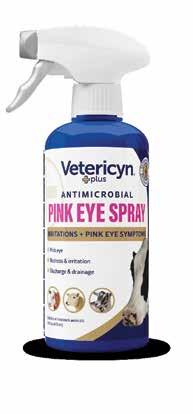
the battle before the battle wears you down!
Treat and relieve eyes suffering from pink eye & other irritations
Safe for lactating dairy animals without a withdrawal period
Low cost per application, can be used as a prophylactic
* MEMBERSHIP YEAR 10/1/25– 9/30/26
NAME SPOUSE NAME FARM NAME
*Payments of KCA membership dues are tax deductible for most members as an ordinary and necessary business expense. However, charitable contributions of gifts to KCA are not tax deductible for Federal Income Tax purposes. Due to new IRS regulations, $2.24 of your dues would not be deductible. Approximately $12 of your dues will go towards the monthly publication Cow Country.
PLEASE CHECK THE MEMBERSHIP(S) YOU WOULD LIKE TO JOIN:
KCA MEMBERSHIP ($30/YR) NEW RENEWAL
Membership dues are $30 unless otherwise listed below
KCA COUPLE MEMBERSHIP
To add your spouse, please add $15 to your KCA Membership
KENTUCKY JUNIOR CATTLEMEN’S ASSOCIATION ($10/YR) NEW RENEWAL
I WOULD LIKE ADDITIONAL INFORMATION ON THE YOUNG PRODUCER’S COUNCIL
TOTAL MEMBERSHIP:
$ KCA
$ KJCA
TOTAL CONTRIBUTIONS:
$ CATTLEMEN’S FOUNDATION DONATION (voluntary)
TOTAL AMOUNT ENCLOSED:
$ ALL DONATIONS TO KCF ARE TAX DEDUCTIBLE
COUNTY DUES
Dues are $30 except for the counties listed below.
Allen...............................$40
Anderson........................$25
Boyle ..............................$35
Bullitt..............................$20
Butler..............................$25
Franklin ..........................$25
Louisville Area ................$20 (Jefferson, & Spencer) Magoffin .........................$20 Menifee ..........................$25
Mountain........................$25
(Breathitt, Floyd, Knott, Lee, Leslie, Letcher, Morgan, Owsley, Perry & Wolfe)
Highlands .......................$20 (Boyd, Johnson, Lawrence, & Martin) Hopkins ..........................$35 Laurel.............................$35
IF YOU WOULD ALSO LIKE TO JOIN THE NATIONAL CATTLEMEN’S BEEF ASSOCIATION The NCBA is now a State Marketing Partner with the KCA. You can pay your dues to both organizations with one check, at the same time.

Maggie Sparks KBC Intern
On July 7, over 20 agriculture teachers from across Kentucky gathered at the Taylor County High School Agriculture Center for a Meat Evaluation Professional Development training. During this training, attendees enhanced their knowledge of meat science and beef evaluation through direct classroom instruction and CDE applications. Teachers started the morning with a session taught by Donovan Pigg from the Kentucky Farm Bureau, “From Feeder Cattle to Fat Cattle.” Pigg spoke about beef cattle frame size and muscle scores, noting that live evaluation is just as important as carcass evaluation, and that they both work together to determine quality and yield grades. He gave the teachers an overview of how to live-evaluate and which areas were most important to look for.
After Pigg’s session, Luiz Silva, assistant animal science professor from Western Kentucky University, taught a session on quality grades and yield grades. Silva also touched on the differences in grading beef carcasses in the United States versus Brazil. The teachers were able to evaluate cuts of meat and grade them using the information and teaching tools they had gained from the teaching sessions. One of the coolest activities of the day was the ribeye ultrasound demonstration. Silva used an ultrasound to show the teachers the ribeye on a live 1,400-lb. steer. With the ultrasound, the teachers were able to actually see the amount of back fat and marbling that the steer had.
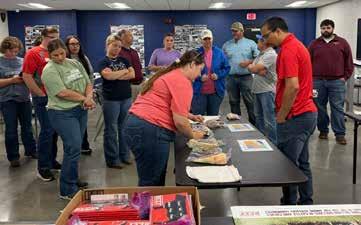
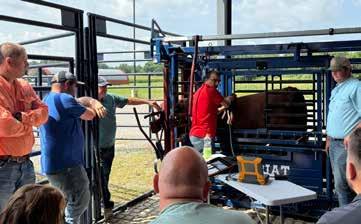
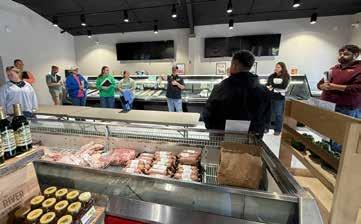
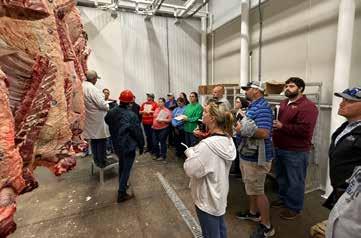
After a delicious lunch and a tour of the high school’s Williams & Evans Agriscience Center, the teachers visited Green River Meats, where they received a tour, gained insight into industry-standard processing practices, and observed a cooler grading demonstration on harvested beef carcasses. While in the cooler, the teachers gained hands-on experience grading a beef carcass, with the help of Pigg and Silva. The day concluded with a mini meat evaluation contest and discussion on classroom integration, contest preparation and instructional resources. The teachers were given coaching materials and an overview of the state contest from Kristan Wright, agricultural educational consultant and state FFA advisor for the Kentucky Department of Education, so they could return to their chapters and start a meat evaluation team.
I highly recommend agriculture teachers attend one of the professional development sessions offered by the Kentucky Beef Council. Participants receive teaching materials, handson experience, knowledge of various aspects of the beef industry, professional development hours, and a certificate.
One of the attendees who filled out the post-event survey said, “This was a great PD, and the handson practice was especially helpful! This also helped me to see where students may struggle more and ways to help them. The lunch was fantastic! Overall, one of the better PD sessions I have attended. Keep up the great work!”

Amelia Carter KBC Director of Industry Relations
Looking for new Kentucky Beef gear? The Kentucky Beef Council has launched a new online apparel store featuring Beef. It's What's For Dinner.® apparel and accessories, with new products added regularly.
The store currently offers a variety of T-shirts, sweatshirts, hats, drinkware and more, with items shipped directly to your door. Over time, the collection will continue to expand, with Kentucky Beef Council-branded apparel and exclusive Kentucky Beef Council designs available only through the online store.
Whether you're looking for something to wear at an industry event, out on the farm or around town, the store offers a variety of apparel and accessories for beef producers and enthusiasts alike.
Visit the online store directly at kentucky-beef-council-shop. fourthwall.com, or access it anytime by clicking "Shop Beef Apparel" on the homepage at kybeef.com.


Becky Thompson Director of Kentucky Beef Network

Ask any cattle producer what shapes their day-to-day decisions, and the weather will likely be near the top of the list. From hay harvest and grazing management to fertilizer and herbicide applications, weather influences nearly every aspect of the operation. As summer transitions into fall, current weather conditions also play an important role in decisions about stockpiling fescue, planning hay inventories, evaluating pasture conditions and monitoring water availability. While we can't control the weather, today's tools can help us better prepare for what's ahead. Two resources every Kentucky cattle producer should be aware of are the Kentucky Mesonet and the U.S. Drought Monitor.
The Kentucky Mesonet is the commonwealth's official weather and climate monitoring network, featuring 87 weather stations across Kentucky that collect local weather and soil data every five minutes. Producers can access real-time and historical information on rainfall, air and soil temperatures, soil moisture, wind, humidity, forecasts, interactive maps and other decision-support tools designed to support day-to-day management decisions across the state or near their own
farms. Did you know one of the Kentucky Mesonet stations is located near the Dairy Barn at Eden Shale Farm?
The U.S. Drought Monitor provides a weekly snapshot of drought conditions across Kentucky and the nation, with maps updated every Thursday that classify conditions from Abnormally Dry (D0) to Exceptional Drought (D4). Rather than relying on rainfall alone, the Drought Monitor combines information on precipitation, soil moisture, streamflow, reservoir levels, vegetation health and local observations, including Kentucky Mesonet data, to provide a comprehensive picture of current conditions. Producers can use this information to evaluate forage and water resources, plan grazing and hay management, and prepare for changing conditions. The U.S. Drought Monitor is also used by USDA and the Farm Service Agency to help determine eligibility for certain drought-related disaster assistance programs, making it a valuable resource to monitor throughout the year.
Putting the Information to Work Kentucky's weather can vary dramatically from one end of the state to the other and sometimes even from one county to
the next. A thunderstorm that drops two inches of rain on one farm may completely miss another just a few miles away, resulting in very different pasture, forage and water conditions. That's why statewide forecasts are only part of the story. By combining localized weather information from the Kentucky Mesonet with the broader perspective provided by the U.S. Drought Monitor, producers can better understand how conditions on their own farm compare with those across the region. Together, these tools can help answer practical questions throughout the year such as: has your area received enough rainfall to begin stockpiling fescue? Are pasture conditions improving or declining? Is there a good window for cutting hay or making fertilizer and herbicide applications? Should you begin planning supplemental feeding or keeping a closer eye on water supplies? Taking a few minutes to review these resources each week can help you spot changing conditions early and make management decisions before weather begins affecting your forage, water supplies or daily operation.
weather-related resources: Kentucky Mesonet www.kymesonet.org
U.S. Drought Monitor droughtmonitor.unl.edu
National Weather Service weather.gov
NOAA Climate Prediction Center www.cpc.ncep.noaa.gov
Kentucky Climate Center kyclimate.org
USDA Climate Hubs www.climatehubs.usda.gov


Ben Lloyd Whitesville, KY (270) 993-1074 benlloyd0223@gmail.com
Charles Embry Cave City, KY (270) 646-5939 dale.embry@yahoo.com
Cody Burke Frankfort, KY (606) 748-4641
cody.burke2019@gmail.com
Jacob Settles Springfield, KY (859) 805-0724
jacob.settles4@yahoo.com
Ron Shrout Winchester, KY (859) 397-5151 shroutron@aol.com

Dan Miller Industry Coordinator, Kentucky Beef Network
In June, we shifted our focus to forages. Normally, this means getting the first cutting of hay in the barn, but the weather didn’t allow us to start laying it down. We did have time in between the rain to get some spraying done.
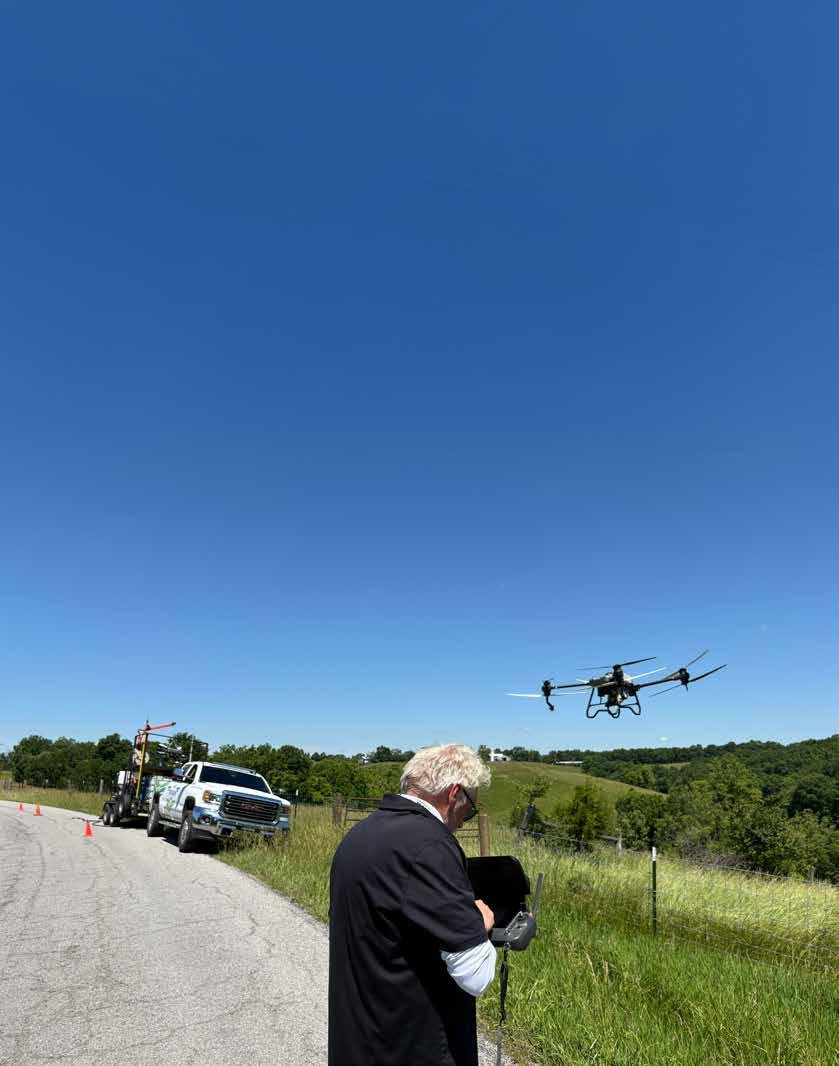
Most of the farm can be covered with our tractor and 300-gallon, pull-type sprayer. However, there are some areas that get very steep and rough that make it high risk to get on with equipment. For these sections, we hired the services of SkyFarm Drones.
I called Kevin Bryan, owner of SkyFarm Drones, and he came out that week to spray. The first step was to use a small drone to collect high resolution images of the areas to be sprayed. This is done to identify hazards in the field such as large trees, large branches at field edges and powerlines. This imagery is then uploaded into the large spray drone’s software and used to create spraying patterns for each individual area.
The spraying drone is impressive to watch. It is approximately 12 feet across and carries a 10-gallon payload. It can fly for 10-15 minutes then lands to refill with herbicide and switch out batteries. The drone will fly itself while spraying unless an obstacle is sensed and then the pilot will take over and maneuver safely around the obstacle. The drone follows the predetermined route creating an even and complete coverage across the area.
In total, SkyFarm Drones sprayed 31 acres of our most steep and rugged terrain. They also captured high resolution imagery of the entire farm for future reference. It was a huge help for us in that we did not to have to operate a tractor on these steep hillsides. Since the application we have found the coverage to be even and consistent throughout.
I am grateful for their services and would highly recommend SkyFarm Drones if you are interested in aerial applications. They are capable of both spraying or seeding pastures.
Generally the Buyer is responsible for collecting the Beef Checkoff assessment from the Seller.

However, both the Buyer and the Seller are responsible for seeing that the Checkoff is collected and paid. or pays $2 to
STATE BEEF COUNCIL
Cattlemen’s Beef Board invests in national Checkoff programs, while Kentucky Beef Council invests in state programs.
If you are a producer from one of these seven states - Alaska, Connecticut, Maine, Maryland, Massachusetts, New Hampshire, and Rhode Island - you will remit directly to the Cattlemen’s Beef Board. If you have any questions regarding who is responsible for remitting the Checkoff assessment or how to remit payment, please contact your State Beef Council or the Cattlemen’s Beef Board at (303) 867-6304.
3 Exceptions to Beef Checkoff Collection: 1. Non-producer status: If a person (or company) owns cattle for 10 days or less, purchases the cattle to facilitate the transfer of ownership to a third party, and certifies that any Checkoff dollars due from the previous owner have been collected, then that person qualifies as a “Non-Producer” and the Checkoff assessment is not due when qualified cattle are resold. 2. Organic Exemption: In the 2002 Farm Bill, Congress created a process exemptiing organic producers from paying Checkoff program assessments. 3. Pre-Payment: Producers can also choose to “prepay” the Checkoff assessment when shipping cattle out of state for feeding and still retain ownership on the cattle. This allows the producer to direct half of the $1-per-head national Checkoff assessment to the beef council in the state where the cattle were raised, rather than the state where the cattle will be fed. Note: To claim any of these exemptions, the person selling the cattle must provide the proper ‘document’ to show that the Checkoff assessment is not due at the time of sale. Thus, the rule of thumb for all cattle sales is that the person paying the producer should collect either a “Dollar or a Document.”
CYCLE
LIVESTOCK MARKET - When cattle are sold through a livestock market or video market, the Market collects and remits the Beef Checkoff assessment.
CATTLE DEALER/ORDER BUYER - When cattle are sold to a Cattle Dealer or Order Buyer, the Dealer/Order Buyer collects and remits the Beef Checkoff assessment.
ANOTHER PRODUCER - Both the Buyer and the Seller are responsible for making sure that the Beef Checkoff assessment is collected and remitted. For clarity and consistency, we encourage the Seller to take on this compliance responsibility.
VEAL GROWER - When dairy calves are sold to a Veal Grower, both the Buyer and the Seller are responsible for making sure that the Beef Checkoff assessment is collected and remitted. For clarity and consistency, we encourage the Seller to take on this compliance responsibility.
CATTLE SHOWS AND FAIRS - When producers sell their animals at fairs or cattle shows (4H/FFA shows, Purebred cattle shows, etc.), the Organization that runs the sale collects and remits the Beef Checkoff assessment.
FEEDLOT - When cattle are sold directy to a feedlot, the Feedlot collects and remits the Beef Checkoff assessment.
PACKING PLANT - When cattle are sold to a packing plant, the Packing Plant collects and remits the Beef Checkoff assessment.
DIRECT-TO-CONSUMER BEEF SALES - When producers market their cattle as beef, the Producer is responsible for remitting the Beef Checkoff assessment.
According to the Paperwork Reduction Act of
The U.S. Department of Agriculture (USDA) prohibits discrimination in all its programs and activities on the basis of race, color, national origin, age, disability, and where applicable, sex, marital status, familial status, parental status, religion, sexual orientation, genetic information, political beliefs, reprisal, or because all or part of an individual’s income is derived from any public assistance program. (Not all prohibited bases apply to all programs.) Persons with disabilities who require alternative means for communication of program information (Braille, large print, audiotape, etc.) should contact USDA’s TARGET Center at (202) 720-2600 (voice and TDD). To file a complaint of discrimination, write to USDA, Director, Office of Civil Rights, 1400 Independence Avenue, S.W., Washington, D.C. 20250-9410 or call (800) 795-3272 (voice)

Toby & Debby Dulworth 2492 S. Kirkman Road LaCenter, KY 42056 (270) 224-2993 • dogwood@brtc.net Herefords that thrive on forages. www.dogwoodherefords.com

Codee Guffey • 1815 Grassy Springs Road Versailles, Kentucky 40383 (502) 598-6355 rockridgeherefords@gmail.com www.rockridgeherefords.com
Tony & Kathy Staples 992 Knotts Road Brandenburg, KY 40108 (270) 945-9277 (270) 422-4220 tstaples@bbtel.com
Registered Polled Herefords
HANSELL PILE, JR.
12045 St. John Rd.
Cecilia, KY 42724
270-735-5192
12 miles West of Elizabethtown
Polled Herefords
439 Flatwoods Frozen Camp Rd, Corbin KY 40701
Bobby & Brenda Wells (606) 344-0417 wells_farm@yahoo.com
WELLS FARM

Shannon, Kerry, Emily, Will & Ellie Morgan 13095 Scottsville Rd, Alvaton, Kentucky 42122
www.morganandmorganpolledherefords.com
Shannon: (270) 320-2389
Toby & Debby Dulworth 2492 S. Kirkman Road LaCenter, KY 42056 (270) 224-2993 dogwood@brtc.net
Kevin, Angela, Kenlea & Kyler Murray (606) 528-1691 or (606) 682-8413
Herefords that thrive on forages. www.dogwoodherefords.com

6077 Helena Road Mayslick, KY 41055
6077 Helena Road Mayslick, KY 41055
Charlie Boyd II • 606-584-5194 cboyd2@maysvilleky.net www.boydbeef.com
Charlie Boyd II 606-584-5194
Annual Bull Sale second Saturday in March Hereford and Angus Bulls
Annual Bull Sale second Saturday in March Hereford and Angus Bulls
Chambliss
Hereford Farms
Hereford Farms
Brad, Carla, Clay & Clint Chambliss 1101 Driftwood Lane Elizabethtown, KY 42701
Brad, Carla, Clay & Clint Chambliss 1101 Driftwood Lane
Elizabethtown, KY 42701
Home (270) 982-3905
Cell (270) 668-7126 fax 270-735-9922
www.chamblissherefordfarms.com
Home (270) 982-3905 Cell (270) 668-7126 fax 270-735-9922 www.chamblissherefordfarms.com
Registered Polled Herefords Bulls & Females for sale
WCN Polled Herefords
Since 1961
Tim & Peggy Wolf
Bill Norris 2220 Celina Road
12939 Peach Grove Road Alexandria, KY 41001
Burkesville, KY 42717
Phone (270) 433-7256
Home: 859-635-0899 Cell: 859-991-3484
Cell (270) 433-1525
“Every calf needs a white face”

Peyton’s Well Polled Herefords
The Lowell Atwood Family 133 Edgewood Drive • Stanford, KY
Luke: (606) 669-8121 Beth: (606) 669-2178
Victor-
Polled Herefords 439 Flatwoods Frozen Camp Rd, Corbin KY 40701
Bobby & Brenda Wells (606) 523-0569 or (606) 344-0417 wells_farm@yahoo.com
Kevin, Angela, Kenlea & Kyler Murray (606) 528-1691 or (606) 682-8413
Dale Stith 5239 Old Sardis Pike Mays Lick, KY 41055 dalestith@yahoo.com (918) 760-1550
Registered Polled Herefords PAUL L. HANCOCK 8559 KY 56 Owensboro, KY 42301 270-771-4194 270-314-9758
Registered Polled Herefords PAUL L. HANCOCK 8559 KY 56 Owensboro, KY 42301 270-771-4194

Jackson Farms
President: Chris Hopper 606-584-7842
Secretary/ Treasurer: Melinda Watson 859-625-8660 melindawatson8660@gmail.com
Green • 270-528-1720
Melinda Watson • 859-625-8660
melindawatson8660@gmail.com
K3 CATTLE REGISTERED HEREFORDS
K3 CATTLE REGISTERED HEREFORDS
KYLE BUSH
K3CATTLE@YAHOO.COM 859-588-4531 198 HICKS PIKE CYNTHIANA, KY 41031
KYLE BUSH K3CATTLE@YAHOO.COM 859-588-4531 198 HICKS PIKE CYNTHIANA, KY 41031
THOMAS FARM

Polled Hereford and Gelbvieh Cattle 3459 KY Hwy. 1284 E. Cythiana, KY 41031 (859) 234-6956
Polled Hereford 3459 KY Hwy. 1284 E. Cythiana, KY 41031
Ben (859) 421-7902
Ben, Jane, Shelby and Lincoln
Lincoln (859) 954-0102
Noah (859) 462-2428
Tony Brandenburg,
Registered Polled Herefords PO Box 215 Cross Plains, TN 37049
Registered Polled Herefords PO Box 215 Cross Plains, TN 37049 615-478-4483
615-478-4483
billymjackson@aol.com
billymjackson@aol.com
“Farming the Same Land Since 1834”
“Farming the Same Land Since 1834”
Eric & Ronnie Thomas 2396 Union City Rd. Richmond, KY 40475 (859) 623-5734
Eric & Ronnie Thomas 2396 Union City Rd. Richmond, KY 40475
Eric’s Cell (859) 314-8256
Eric’s Cell (859) 314-8256
“Cattle for sale at all times”
“Cattle for sale at all times”
Jackie D. Perkins II 367 Mt. Pisgah Rd. Bremen, KY 42325 (270) 543-3586
Jackie D. Perkins II 367 Mt. Pisgah Rd. Bremen, KY 42325 (270) 543-3586
Breeding to produce good cows since 1981
Breeding to produce good cows since 1981


Registered Polled Herefords Bulls & Females for sale
BECKLEY HEREFORDS

Tucker Stock Farms
L. Wayne Beckley • 1420 Fitchburg Rd. Ravenna, KY 40472 • 606-723-3021
“Registered Angus and Polled Herefords”
12939 Peach Grove Road
BECKLEY HEREFORDS
Cell: 859-779-0962
Alexandria, KY 41001
284 Pryse Lane Irvine, KY 40336
L.W. Beckley D.V.M
Home: 859-635-0899
L.W. Beckley, DVM 859-779-1419
Emily Beckley 859-779-0253
Cell: 859-991-3484
Will Beckley 859-314-7053 www.beckleyherefords.com

Cell: 859-779-1419
“Breeding Polled Herefords for over 58 Years” Breeding cattle for sale at all times. 1999 Walnut Hill Rd. Lexington, KY 40515 (859) 271-9086 cell (859)533-3790
284 Pyrse Lane • Irvine, KY 40336
John Tucker II 1790 Hidden Valley Lane Hudson, KY 40145 270-617-0301
“Bulls always for Sale”
Vice
Secretary/Treasurer:
BOYD BEEF CATTLE
6077 Helena Road
Mayslick, KY 41055
Charlie Boyd II: (606) 584-5194
Blake Boyd: (606) 375-3718 www.boydbeef.com cboyd2@maysvilleky.net
BURTON & SONS ANGUS
Joe D. or Karen Burton


480 Hominy Hill Rd. Nancy, KY 42544
Joe: (606) 305-3081
Located 15 miles West of Somerset • klburton01@windstream.net
Bulls & females sold private treaty. Inquiries Welcome.
Sell only what we would buy. Data driven since 1981.
GREAT MEADOWS ANGUS ASSOCIATION
Dale Brown, President
292 Pea Ridge Road Stamping Ground, KY 40439 859-940-8437 www.greatmeadowsangus.com

SALES: 3rd Saturday in October • 4th Saturday in April
LYNN CREEK FARMS
Kris and Sara Lynn 2184 Bardstown Rd Springfield KY 40069 573-721-6663

SMITHLAND ANGUS FARM
4437 East Hwy 80 Russell Springs, KY 42642
Henry Bryan, Melissa, Bryanna and Blane Smith 606-271-7520 bmsmith@duo-county.com
PLEASANT HILL FARMS
PLEASANT HILL FARMS

Gil, Mary, Corbin, Caroline, and Catherine Cowles 500 Rockfield Richpond Road Rockfield, KY 42274 (270) 843-9021 • Fax (270) 843-9005
927 Old Liberty Pike • Hustonville, KY 40437 (859) 238-0771 • www.branchviewangus.com
James S. & LuAnn Coffey, Donald & Donna Coffey
Annual Production Sale- 2nd Saturday in April

BURKS CATTLE CO.
531 Rick Rd. Park City, KY 42160
Eddie Burks • (270) 991-6398 www.burkscattle.com

COFFEY ANGUS FARMS
661 Hopewell Road Liberty, KY 42539
Matt Coffey: (270) 799-6288
Dewey Coffey: (606) 706-2699
Genetics for Maximum Profitability since 1984

HERITAGE FARM
Tom McGinnis
1024 Hinkle Lane • Shelbyville, KY (502) 633-1634, home (502) 633-5100, work (502) 655-0164, cell
661 Hopewell Road Liberty, KY 42539
Matt Coffey: (270) 799-6288 Dewey Coffey: (606) 706-2699
DAVIS BEND FARMS
OLD BARK FARM
2315 Davis Bend Road Canmer, KY 42722
370 Ferrill Hill, Buffalo, KY 42716 Kenley Conner (270) 735-5324 Registered Angus Cattle

since 1984
timmothyljeffries@gmail.com www.davisbendfarms.com Tim: (270) 528-6605 • Leslie: (270) 528-6435
FALL CREEK ANGUS
448 Corder Farm Road Monticello, KY 42633
TRIPLE D ANGUS
FARMS Kris and Sara Lynn 2184 Bardstown Rd Springfield KY 40069 573-721-6663
DUTCH CREEK ANGUS
Doug and Susan Schlosnagle (502) 706-0008 DutchCreekAngus.om
MT. MORIAH ANGUS FARMS
Bob, Kathy, Rob, and Janna Clark (859) 748-5558 1446 Kennedy Bridge Rd. Harrodsburg, KY 40330
Bob: (859)339-2610 • Rob: (859)612-1594
HILL VIEW FARMS
mtmoriahfarms1@gmail.com www.mtmoriahangus.com

www.stclairangus.com
(859) 583-7134
jacob.tamme@gmail.com www.tammevalley.com COFFEY
Jimmy Gilles 5160 Lee Rudy Road Owensboro, KY 42301 (270) 929-5370 jcgilles86@gmail.com
FOUR KINGS ANGUS
250 Bright Leaf Dr. • Harrodsburg, KY 40330
Cary & Kim King Carymking@yahoo.com • fourkingsangus.com
Cary Cell: (859) 613-3734 • Colby Myers - Purebred Manager
APS ANGUS 4040 Taylorsville Rd Taylorsville, KY 40071
Cattle
Gordon Schubert 502-477-2637 • 502-548-8440 Anne Patton Schubert 502-477-2663 • 502-548-2359

TRIPLE D ANGUS
Nathaniel & Darla Denham Nathaniel(Bub), Sarah, (606) 423-2457 • (606) tripledangus.com
Ronnie Corder (606) 348-6588
TWIN CREEK ANGUS
Nathaniel & Darla Denham
HAMILTON ANGUS FARMS
Nathaniel(Bub), Sarah, Ashley Denham (606) 423-2457 • (606) 875-0780 tripledangus.com

Eddie Hamilton 2142 Stilesville Road Science Hill, KY 42553 edjohami@aol.com (606) 271-1286 Bulls and Females for Sale
RANDOLPH FARM
Located 7 miles west of Bowling Green, 1/2 mile off Hwy 68/80
Gil, Mary, Corbin, Caroline, and Catherine Cowles 500 Rockfield Richpond Road Rockfield, KY 42274 (270) 843-9021 • Fax (270) 843-9005 Located 7 miles west of Bowling Green, 1/2 mile off Hwy 68/80
WHITE FARM
SMITHLAND ANGUS
Tim amd Amy White 3664 Military Pike Lexington, KY 40513 P:(859) 223-0326 • (859) 509-5041 (859) 227-2552 F:(859) 223-0326 whitefarm4@twc.com

6550 Highway 330 Owenton, KY 40359
Carter Randolph: (513) 543-4343
HERITAGE FARM
Nick Sarky: (513) 262-9846 patty@randolphfarmoperations.com
Registered Black Angus Bulls & Females Available Sold Private Treaty. Inquiries Welcome.
Tom McGinnis 1024 Hinkle Lane • Shelbyville, KY (502) 633-1634, home • (502) 633-5100, work (502) 655-0164, cell

Dennis & Emily Gibson (270) 337-2128 or (270) 402-4338
Shawn, Melissa, Devin & Dylan Gibson (270) 337-3072 or (270) 692-5304

TAMME VALLEY FARM
Jacob Tamme, Owner-Operator (859) 583-7134 jacob.tamme@gmail.com www.tammevalley.com & Find us on Facebook!

www.kentuckyangus.org
Shayna Gibson, Secretary/Treasurer
kyangusassociation@gmail.com
Angus exhibitors led 68 entries at the 2026 Kentucky Angus Preview Show, June 12 in Louisville, Kentucky. Jason Smith, Cullman, Ala., evaluated the 68 entries before naming champions.
1. Grand Champion PGS Female
4 Sons Erianna 2N61 won grand champion phenotype and genotype female at the 2026 Kentucky Angus Preview Show, June 12 in Louisville, Ky. Kaitlynn Cole, Lancaster, Ky., owns the September 2025 daughter of Rhoades Swarovski 3007.
2. Reserve Grand Champion PGS
Female GA Asti 220-5102 won reserve grand champion phenotype and genotype female at the 2026 Kentucky Angus Preview Show, June 12 in Louisville, Ky. Kaitlynn Cole, Lancaster, Ky., owns the February 2025 daughter of Schiefelbein Executive 1423.
3. Grand Champion Bred-and-owned Bull Ard Ridge Crucial won grand champion bred-and-owned bull at the 2026 Kentucky Angus Preview Show, June 12 in Louisville, Ky. Kat Branscum, Nancy, Ky., owns the January 2025 son of Ard Ridge Top Shelf 52.
4. Reserve Grand Champion Bredand-owned Bull TAF Diginity n203 won reserve grand champion bred-andowned bull at the 2026 Kentucky Angus Preview Show, June 12 in Louisville, Ky. Beckett Toll, Lawrenceburg, Ky., owns the December 2025 son of BNWZ Dignity 8017.
5. Grand Champion Bred-and-owned Female SAF Lucy Pride 5156 won grand champion bred-and-owned female at the 2026 Kentucky Angus Preview Show, June 12 in Louisville, Ky. Bryanna Smith and Blane Smith, both of Russell Springs, Ky., own the September 2025 daughter of BNWZ Dignity 8017.
6. Reserve Grand Champion Bred-andowned Female SAF Sandy 4120 won reserve grand champion bred-andowned female at the 2026 Kentucky Angus Preview Show, June 12 in Louisville, Ky. Bryanna Smith, Russell Springs, Ky., owns the September 2024 daughter of PVF DLX King Pin 0058.
7. Grand Champion Cow-calf Pair McCauley Stormy L1 won grand champion cow-calf pair at the 2026 Kentucky Angus Preview Show, June 12 in Louisville, Ky. Adam McCauley, Cynthiana, Ky., owns the January 2023 daughter of PVF Marvel 9185. A March 2026 bull calf sired by RW Timeless 304 completes the winning pair.
8. Reserve Grand Champion Cow-calf Pair Dieckmann Frontier Gal 4402 won reserve grand champion cow-calf pair at the 2026 Kentucky Angus Preview Show, June 12 in Louisville, Ky. Colby Cooper, May’s Lick, Ky., owns the May
2024 daughter of SCC SCH 24 Karat 838. An April 2026 bull calf sired by BNWZ Dignity 8017 completes the winning duo.
9. Grand Champion Owned Female Johnson Nellie 504 won grand champion owned female at the 2026 Kentucky Angus Preview Show, June 12 in Louisville, Ky. McKenna Jackson, Paris, Ky., owns the February 2025 daughter of SCC SCH 24 Karat 838.
10. Reserve Grand Champion Owned Female BSMO Sandy 2599 won reserve grand champion owned female at the 2026 Kentucky Angus Preview Show, June 12 in Louisville, Ky. Lily Jeffries; Emily Jeffries; and Lucy Jeffries, all of Canmer, Ky., own the December 2025 daughter of Conley No Limit.
11. Grand Champion Steer HSC Big Time won grand champion steer at the 2026 Kentucky Angus Preview Show, June 12 in Louisville, Ky. Owen Adams, Nicholasville, Ky., owns the March 2025 son of STAG Good Times 201 ET.
12. Reserve Grand Champion Steer WF4 Good Times 5203 won reserve grand champion steer at the 2026 Kentucky Angus Preview Show, June 12 in Louisville, Ky. Noah Adams, Nicholasville, Ky., owns the February 2025 son of STAG Good Times 201 ET.
13. Overall Showmanship Winner
These young Angus enthusiasts won top honors in their division of showmanship winner at the 2026 Kentucky Angus Preview Show, June 12 in Louisville, Ky. Pictured from left are Judah Tolbert and Elijah Tolbert, both of Harrodsburg, Ky., peewee champions; Sawyer Gray, Buffalo, Ky., and Charlee Kratzer, Lawrenceburg, Ky., novice champions; Owen Adams, Nicholasville, Ky., junior champion; Emily Jeffries, Canmer, Ky., intermediate champion; Jacob Marksbury, Buffalo, Ky., senior champion; and Bryanna Smith, Russell Springs, Ky, and Lily Jeffries, Canmer, Ky., who both qualified to represent Kentucky at the National Junior Angus Showmanship Contest held in conjunction with the National Junior Angus Show this July in Louisville, Ky.
All photos by Next Level Images.
1
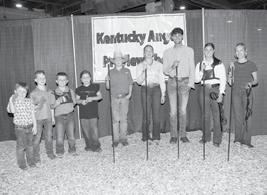

KEVIN AND RACHEL BARRON
Crestwood, Ky
(502) 905-5851
rkbarron812@gmail.com

SWAIN SELECT SIMMENTAL 12113 Green Valley Dr. Louisville, KY 40243 swainselect.com swainselect@gmail.com facebook.com/swainselectsimmental

Fred & Phyllis: 502-599-4560 Chi & Angie: 502-287-2116
JUDY AND RONDAL DAWSON 1156 Buzzard Roost Road Shelbyville, KY 40065 502-593-5136 • jrdawson22@outlook.com

JEROD METZGER • 270-779-6260
ROCKING P LIVESTOCK 8308 Orangeburg Road Maysville, KY 41056
Chan: 606-584-7581
Keith: 606-584-5626 rockingplivestock@maysvilleky.net
BRIAN & HEATHER SWAIN 3906 Pottertown Road Murray, KY 42071 • 270-293-4440
wksbswain@murray-ky.net


SIMMENTAL AND SIMANGUS BULLS FOR SALE
1939 Huntertown Road
Versailles, KY 40383
BULLS FOR SALE
Chris Allen 859-351-4486
callenuky@hotmail.com
Dr. Henry Allen 859-229-0755

Simmental calves are champions of the scale.
They reliably outperform straightbred calves in the feedyard — with better growth, better structure and fewer health problems.
They add pounds without sacrificing marbling, and they come with the IGS Feeder Profit Calculator, which factors genetics, health and management into true value.
Want low-risk, high-potential calves with earning capability?
406-587-4531 • simmental.org

BRET AND LAURA JACKSON 859.533.3718 or 859.707.7200
BRET & LAURA JACKSON Paris, Kentucky (859) 533-3718 (859) 707-7200

AA LAND & CATTLE
Registered Gelbvieh & Balancers
Daryl Derossett, President..................................................................................................................(270) 670-6232
Cynthiana, KY
LARRY CLARK & SONS LLC
Registered Gelbvieh Cattle
Johnnie Moore, Vice President...........................................................................................................(270) 670-7814
Luke Arthur (859) 298-8323
106 Clark Houk Road • Greensburg, KY 42743
Pat Tilghman, Secretary/Treasurer.......................................................................................................(270) 670-8449
luke.arthur93@gmail.com
Bulls • Show Prospects • Embryos Bulls sell with GE EPD’s • Show Prospects
BAR IV LIVESTOCK
Larry Clark, Owner & Operator (270) 299-5167 • (270) 405-6848
Lpclarkandsons@msn.com
BAR IV LIVESTOCK Barry, Beth & Ben Racke • Brad Racke • 7416 Tippenhauer Rd. • Cold Spring, KY 41076 Phone (859) 635-3832 • Barry cell (859) 991-1992 • Brad cell (859) 393-3677 • Ben cell (859) 393-3730 Fax (859) 635-3832 • bar4@twc.com
Barry, Beth & Ben Racke • Brad Racke
7416 Tippenhauer Rd. • Cold Spring, KY 41076
Phone (859) 635-3832 • Barry cell (859) 991-1992
Brad cell (859) 393-3677 • Ben cell (859) 393-3730 Fax (859) 635-3832 • bar4@twc.com
CLIFFORD FARMS
3459 KY HWY 1284E
Cynthiana, KY 41031
Since 1937 (859) 234-6956
CD FARMS Clayton & Debbie Cash • 1214 Ottawa School Road • Brodhead, KY 40409 (606)-308-3247 • (606)-758-8994 • Gelbvieh-Balancer Bulls & Heifers For Sale by Private Treaty
BRIAN W. DYER, DVM

BEE LICK GELBVIEHS
Eddie Reynolds 277 Old Bee Lick Rd. Crab Orchard, KY 40419
606-379-2281(H) 606-305-1972(C)
Owner/Manager
GELBVIEH/BALANCERS
BRIAN W. DYER, DVM Owner/Manager GELBVIEH/BALANCERS 2050 Glasgow Road • Burkesville, KY 42717
Bulls & Females for sale
2050 Glasgow Road Burkesville, KY 42717
Brian, Lauren, Kristen Barry, Emily & Julia • (270) 864-5909
Brian, Lauren, Kristen Barry, Emily & Julia (270) 864-5909
Registered Gelbvieh Cattle
Gary & Pat Tilghman • Carrie & Daryl Derossett Family Lindsey & Garland Gilliam Family • 690 Lick Branch Road Glasgow, KY 42141 • 270.646.7024 pleasantmeadowsfarm@hotmail.com • Registered Gelbvieh & Angus cattle for sale
Brad Burke 989 Metcalf Mill Road • Ewing KY 41039 (H) 606-267-5609 • (C) 606-782-1367 gbb789@windstream.net

CD FARMS
R&D OWEN FARMS GELBVIEH & BALANCERS • PO Box 781 • Eddyville, KY 42038 (270) 601-6830 • rdowenfarms.com • sales@rdowenfarms.com
KILBOURNE GELBVIEH
AA LAND & CATTLE
Registered Gelbvieh & Balancers
Cynthiana, KY
Clayton & Debbie Cash 1214 Ottawa School Road Brodhead, KY 40409 (606)-308-3247 • (606)-758-8994
Gelbvieh-Balancer Bulls & Heifers
Pat
For Sale by Private Treaty
Luke Arthur (859) 298-8323 luke.arthur93@gmail.com
Bulls • Show Prospects • Embryos
Bulls sell with GE EPD’s • Show Prospects
ASHWOOD SPRING GENETICS
BAR IV LIVESTOCK
LARRY CLARK & SONS LLC
East Bernstadt, KY 606-843-6583 cell 606-309-4662
Registered Gelbvieh Cattle
Black Replacement Heifers & Bulls Available Embryo transplant & AI sired calves
106 Clark Houk Road • Greensburg, KY 42743
DONE WRIGHT CATTLE FARMS Casey Wright, Owner • 2665 Poplar Corner Road Lebanon, Kentucky 40033 • 270-692-7496 * donewrightcattle@hotmail.com
Larry Clark, Owner & Operator (270) 299-5167 • (270) 405-6848 Lpclarkandsons@msn.com
BRIAN W. DYER, DVM
MOCKINGBIRD HILL FARMS
Owner/Manager
Registered Gelbvieh Cattle

Barry, Beth & Ben Racke • Brad Racke
7416 Tippenhauer Rd. • Cold Spring, KY 41076
Luke & Lindsay Arthur Cynthiana, KY 859-298-8323
Saturday May 15
Phone (859) 635-3832 • Barry cell (859) 991-1992
GELBVIEH/BALANCERS 2050 Glasgow Road Burkesville, KY 42717
S&S GELBVIEH BREEDING RED & BLACK POLLED GELBVIEH SINCE 1982
David, Jerri & Jon David: 162 Hastings Ln • Fredonia, KY 42411 (270) 556-4259 Arthur & Joyce Slaughter 19068 Marion Rd • Fredonia, KY 42411 (270)545-3455
Kentucky Junior Gelbvieh Show & Learning Clinic
Brad cell (859) 393-3677 • Ben cell (859) 393-3730 Fax (859) 635-3832 • bar4@twc.com
McIntosh Brothers Farm • 3348 Frankfort Road • Georgetown 10AM Learning Clinic • 12:30PM Show
CLIFFORD FARMS 3459 KY HWY 1284E Cynthiana, KY 41031
Shane Wells 10172 Provo Rd. Rochester, KY H: 270-934-2198 C: 270-791-8196 swells@logantele.com
Since 1937 (859) 234-6956

Brian, Lauren, Kristen Barry, Emily & Julia (270) 864-5909
FULL CIRCLE FARMS REGISTERED GELBVIEH CATTLE
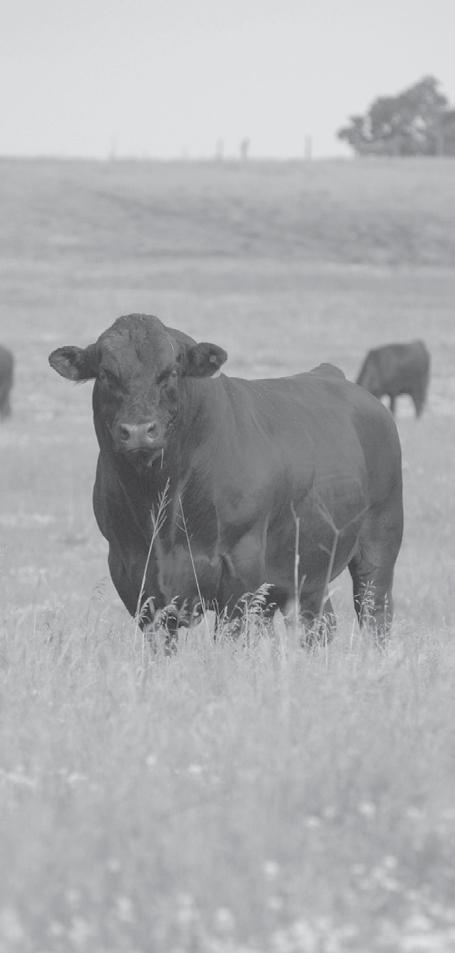
Call William McIntosh for more information. (502) 867-3132
BAR IV LIVESTOCK
BEE LICK GELBVIEHS
Eddie Reynolds
FULL CIRCLE FARMS
Brad Burke: 989 Metcalfe Mill Rd, Ewing, KY 41039 (H) 606-267-5609 (C) 606-782-1367 gbb789@windstream.net
277 Old Bee Lick Rd. Crab Orchard, KY 40419
Friday May 28 - May 30
BRIAN W. DYER, DVM
Owner/Manager
Registered Gelbvieh Cattle
GELBVIEH/BALANCERS

606-379-2281(H) 606-305-1972(C)
Barry, Beth & Ben Racke • Brad Racke 7416 Tippenhauer Rd. • Cold Spring, KY 41076 Phone (859) 635-3832 • Barry cell (859) 991-1992 Brad cell (859) 393-3677 • Ben cell (859) 393-3730 Fax (859) 635-3832 • bar4@twc.com
AGJA Eastern Regional Junior Show “Run for the Roses” Burley Fields Livestock Center • 709 Oil Fields Road • Horse Cave
Cattle for sale at all times.
2050 Glasgow Road Burkesville, KY 42717
Brad Burke 989 Metcalf Mill Road • Ewing KY 41039 (H) 606-267-5609 • (C) 606-782-1367 gbb789@windstream.net
Bulls & Females for sale
Call Carrie Derossett for more information. (270) 404-0828
HEDGESPETH LIVESTOCK GELBVIEH/BALANCER CATTLE-COMMERCIAL HEIFERS 543 Pleasant Run Church Road • Campbellsville, KY 42718 sam.hedgespeth@gmail.com • Sam-270.299.5449 Seth-270.932.1615 Dan-606.686.1679 Andrew-270.405.1990
BEE LICK GELBVIEHS
Entry and room information available at www.gelbvieh.org (Juniors/Regional Shows/AGJA Eastern Regional)
Eddie Reynolds 277 Old Bee Lick Rd. Crab Orchard, KY 40419
606-379-2281(H) 606-305-1972(C) Bulls & Females for sale
CD FARMS
BRAY’S GELBVIEH CATTLE
Clayton & Debbie Cash 1214 Ottawa School Road Brodhead, KY 40409 (606)-308-3247 • (606)-758-8994
PLEASANT MEADOWS FARM
Brian, Lauren, Kristen Barry, Emily & Julia (270) 864-5909
FULL CIRCLE FARMS
RICH HILL GELBVIEH
Registered Gelbvieh Cattle
PADON FARMS GELBVIEH BULLS & FEMALES FOR SALE 1012 Shelby Road • Salem, KY 42078 • Thad Padon (270) 836-5518
Gary & Pat Tilghman Lindsey Tilghman Jones Family Carrie & Daryl Derossett Family 690 Lick Branch Road Glasgow, KY 42141 270.646.7024 • pleasantmeadowsfarm@hotmail.

Brad Burke 989 Metcalf Mill Road • Ewing KY 41039 (H) 606-267-5609 • (C) 606-782-1367 gbb789@windstream.net
Frank McAninch 1341 Iven Godby Road Liberty, KY 42539 606-787-0120 richhillfarm@windstream.net
Gelbvieh-Balancer Bulls & Heifers For Sale by Private Treaty KILBOURNE GELBVIEH East Bernstadt, KY
ROBINSON GELBVIEH Tim & Lisa Robinson • 2311 Hillspring Road Pleasureville, KY 40057 • Timrobinson0204@gmail.com • 502-643-0581
Niles & Betty K Bray 1568 Bray Ridge Road Bedford, KY 40006 (502) 255-3584
606-843-6583 cell 606-309-4662
Black Replacement Heifers & Bulls Available Embryo transplant &

KENTUCKY STATE FAIR GELBVIEH/BALANCER SHOWS BROADBENT ARENA • LOUISVILLE, KY • JUNIOR
DIAMOND J SALERS
Donald Johnson • 11660 N. Hwy 1247 • Eubank, KY 42564 606-379-1558
DIAMOND J SALERS
WILLIS FARMS
Donald Johnson • 11660 N. Hwy 1247 • Eubank, KY 42564 606-305-8747
Danny Willis • 964 Johnson Rd • Frankfort, KY 40601 • 502-803-5011 drwc21@aol.com • Purebred + Optimizer Breeding bulls & Heifers for sale.
DEL-SU FARM
WILLIS FARMS
Howard & Sue Edwards • 420 Rose Rd • Somerset, KY 42501 606-679-1675 • Jeriah Privett • 606-416-1154
Danny Willis • 964 Johnson Rd • Frankfort, KY 40601 502-803-5011 • drwc21@aol.com
KNOB LICK FARM - BULLS & HEIFERS FOR SALE
Larry Cox • Tina Cox-Lynch • Amanda Cox Gibson • 1315 Knob Lick Road • Irvine, KY 40336 • 606-723-3077 • 606-975-1716
Registered Angus Bulls • January and February Yearlings • CAIP Elibigle • Semen Checked Birth Weights and DNA Enhanced EPDs Calving Ease and Growth Freezer Beef Halves and Quarters Metropolis, IL, 618-638-7693 www.bremerbrothers.com
Wess Anglin American Gelbvieh Association Commercial marketing Specialist
Wess@Gelbvieh.org (662) 292-4582
PERFORMANCE TESTED PUREBRED ANGUS BULLS FOR SALE Call 270-202-7186 for more info or check out www.oakhollowangus.com for current availability.
POLLED HERFORD BULLS FOR SALE
19–20-month-old Polled Hereford bulls. Good selection. Low birthweight, medium frame. Free Delivery Available. JMS Polled Herefords, Knifley, KY Danny 270-566-2694 Trent 270-566-2000
THE FOUNDATION SALE XII Sat. Sept. 19, 2026 1 Pm Ct. United Producers, Bowling Green, KY Limousin Fullblood,Purebreed,Limflex. For Info. Call Stephen Haynes 270-799-8685 Or 270799-8684
BREEDING AGE HEREFORD BULLS FOR SALE AT ALL TIMES Over 60 years of Line 1 Hereford Genetics. Groups of open and bred heifers available for sale at all times. Chambliss Hereford Farms. 270-668-7126
RED ANGUS, SIMANGUS, CHAROLAIS, ANGUS FOR SALE Red Hill Farms, Lafayette, TN, 615666-3098 Bart, Sarah and Ty Jones • Gordon and Susan Jones, 270-991-2663 • Visit us online - www.RedHillFarms.net Contact us for cattle and semen availability. Annual Production Sales: More Than a Bull Sale – 3rd Saturday in March • Maternal Monday – 3rd Monday in May • Bulls & Females of Fall Sale – Last Saturday in October
SUMMERTIME DEALS- ARE YOU READY TO DEAL? Silage wagons and silage choppers! Silage blowers. Anderson hay wrappers. Artex S-350 Tandem $50,000. Cloverdale 420-650T in stock. Meyer 510 and 815 mixers in stock. Silage wagons- meyer and hs. John Deere 6715- cabloader 2wd $50,000. Meyer 510 mixer - 38,995 Farmco feeder wagons- 15 in stock. John Deere 5085- $47,500. Lancaster Hammermill-4220$50,000. 25 ft Wingfield chain drag-$14,000. 8 ton Stoltzfus spreader- $36,000. Used silage choppers. Horning 2-3 corn headers in stock! Finance options on all machines. Charlie B. Edgington 859-608-9745
BULLS FOR SALE Angus and Lim-Flex Bulls. Yearlings to 2-years-old. Delivery available. Call or text 270-589-7999
REGISTERED BLACK ANGUS BULLS & HEIFERS FOR SALE EPDs Available. Randolph Farm, Owenton, KY (513) 543-4343. patty@randolphfarmoperations.com

Jeff Lehmkuhler PhD, PAS, Extension Professor
The weather this year has been extreme. Early this spring, we had significant dry conditions across large regions of the state. Those in Liberty experienced lingering drought leading to water restrictions. June brought record rainfall across Central Kentucky, with flooding in Richmond and other areas. Viewing the U.S. Drought Monitor maps, conditions in the Southeast have improved slightly, though the Carolinas and Virginia are still dry as is much of the West.
With weather conditions and the continued demand for beef slowing herd expansion, prices this fall are expected to remain strong with feeder futures remaining near $350/cwt. Continued stable corn and soybean CME market prices lends support to reasonable feed prices through this fall. As summer marches forward, forage productivity and quality may limit suckling calf performance. Creep feeding can provide supplemental nutrition as milk production declines as cows get further into their lactation curve.
Creep feeding can be profitable in years such as these in which the high feeder calf markets and lower feed prices allow for a value of gain favoring adding pounds prior to weaning. Supplementing suckling calves may increase weaning weight 50-100 pounds, depending on the level of supplement intake, milk production of the dam and forage quality. Heavier weight at marketing will generally result in a lower price per pound. However, this lower price is offset by marketing more pounds.
Years ago, Purdue University conducted a 21-year study involving over 2,000 calves investigating the impact of creep feeding on the lifetime productivity of cows. This work revealed a reduction in the lifetime productivity of females creep-fed due to lower weaning weights expected from reduced milk production due to fat accumulation in the udder. Limit-feeding creep feed can lessen this risk and avoiding excessive calorie intake.
Protein intake to support lean growth of suckling calves provides efficient gains. In situations where forage protein level is not sufficient to support the lean growth of feeder calves, this protein need can be met through creep feeding. The protein
requirement of a 300-pound calf gaining near 2.5 pounds daily is approximately 1.5 pounds a day. The protein provided from 12 pounds of milk averaging 3.4% protein is 0.4 lb. or roughly one-third of the daily requirement. The forage protein level in this scenario would need to be near 16%. Tall fescue alone is not likely to provide the needed level of protein while a mixture of legume and grass could. Creep grazing higher quality forage can be an alternative tool to supplemental feed to increase the nutritional plane of suckling calves.
Previous research on creep feeding has also shown that supplemental creep feed is exchanged for forage intake near a 1:1 basis. Creep feed that is 18-20% crude protein on a dry matter basis provides sufficient protein to meet the requirements during this lean phase of growth. The use of highly digestible fibrous coproduct feedstuffs in lieu of starch containing grains lowers the risk of ruminal acidosis and foundering. Creep feeds today utilize soyhulls, corn gluten feed, dried distillers grains, wheat middlings, beet pulp, cottonseed hulls and other feedstuffs to limit the risk of digestive upset. Generally, limiting grains such as corn to not more than a half and ideally closer to a third of the mix will keep the risk of acidosis low.
Unrestricted creep feed may lead to intakes greater than 2% of body weight. Feed conversion may average near 10:1 but can be much higher. Limiting creep feed provides improved feed conversion compared to unrestricted intakes while reducing the risk of digestive upset. Some commercially available creep supplements are designed to limit intake. Salt has also been utilized to limit intakes of self-fed supplements mixed at home. Daily feeding rather than self-feeders can also be utilized to limit creep supplement intake. Research on limited feeding creep suggests feed conversions may be near 4-5:1. Intakes of high protein supplements are often limited to 2-4 pounds or 0.5-0.75% of body weight where gain responses may be near 0.25 pound.
Creep feeding for 60 days or more will provide a greater plane of nutrition to increase weights at weaning. Using the
research data and market information, we can estimate the profit margins from creeping suckling calves. A scenario in which creep is started at 325 pounds for a period of 100 days that cost $275/ton was ran. Feed conversion was assumed to be 9:1 and gain response of 0.4 pound was utilized. The price slide was assumed to be $25/cwt to account for the heavier creep-fed calves. In this scenario, creep-fed calves are expected to return an additional $72 profit.
As we move into the fall, be sure to examine the market signals and discuss fall feed prices with your supplier. Additional weight at weaning may improve your profit margin this fall as calf numbers remain restricted due to the smaller cow herd and limited feeder calf imports. Reach out to your county extension agent for additional information on creep feed options to fully evaluate if creep feeding may fit your operation.
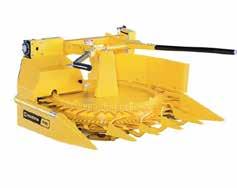


• Fescue pastures don’t generally produce much this month. Lack of rain has not been an issue for most of Kentucky this summer, but the heat persisted throughout July and may become an issue in August. Most of you may have some forage going into the usually dry months. Keep rotating pastures to permit calves to continue gaining weight. Always keep minerals available.
• Bulls should have been removed from the cow herd by the end of the month. They should be pastured away from the cow herd with a good fence and allowed to regain lost weight and condition. It is a good time to evaluate physical condition, especially feet and legs. Bulls can be given medical attention and still have plenty of time to recover, e.g., corns, abscesses, split hooves, etc. If removing the bull is not practical for you then call your herd veterinarian and schedule a pregnancy diagnosis. Market your “late-bred” cows and keep those that conceived early in the breeding season. If you market feeder calves, establishing and maintaining a controlled calving season is paramount to profitability. The University of Kentucky has several publications to help establish and maintain a controlled calving season.
• Repair and improve corrals for fall working and weaning. Consider having an area to wean calves and retain ownership for postweaning feeding rather than selling “green,”lightweight calves. Plan to participate in CPH-45 feeder calf sales in your area.
• Dry cows should be moved to better pastures as calving time approaches. Cows should start calving next month. Yearling heifers may begin “headstart” calving later this month. Plan to move cows to stockpiled fescue for the breeding season, so it will soon be time to apply nitrogen fertilizer. If hot, dry weather persists through August and grass gets short, consider feeding good quality hay to take some pressure off pastures.
• Watch for late-term abortions/early calving. Heat stress can cause some cows to calve earlier than normal. These calves are often weak and need assistance to survive.
• Prepare for the fall-calving season (usually September). Get ready, be sure you have the following:
• record book
• ear tags for identification
• calf puller
• castration equipment
• Communicate with your herd veterinarian as calving season approaches. Maintaining a great relationship with your herd veterinarian is crucial for optimal production. General
• Perhaps the most tedious aspect of agriculture is keeping records, generating reports and using data to make management decisions. Consider using one of the many electronic data collection and management systems available on the market.
• Provide shade and water! Cattle will need shade during the hot part of the day. Check water supply frequently – as much as 20 gallons may be required by high producing cows in very hot weather.
• Select pastures for stockpiling. Remove cattle and apply nitrogen when moisture conditions are favorable. Stockpiled fescue can be especially beneficial for fall-calving cows after calving. Reproductive rates are highest in fallcalving cows grazing stockpiled fescue.
• Avoid working cattle when temperatures are extremely high – especially those grazing high-endophyte fescue. If cattle must be handled, do so in the early morning.
• Do not give up on fly control in late summer, especially if fly numbers are greater than about 50 flies per animal. You can use a different “type” of spray or pour-on to kill any resistant flies at the end of fly season. Pink eye can continue to be a problem through September.
• Always keep a quality mineral mix available to your cattle. The UK Beef IRM Basic Cow-Calf mineral is a good choice. Contact your local ANR agent for help evaluating your mineral.
• Cattle may also be more prone to eat poisonous plants during periods of extreme temperature stress. They will stay in “wooded” areas and browse on plants that they would not normally consume. Consider putting a roll of hay in these areas and/or spraying plants like purple (perilla) mint that can be toxic.
• Take soil samples to determine pasture fertility needs. Fertilize as needed this fall.