
Volurne 8 A 1un1b r 2 A Fall 2006
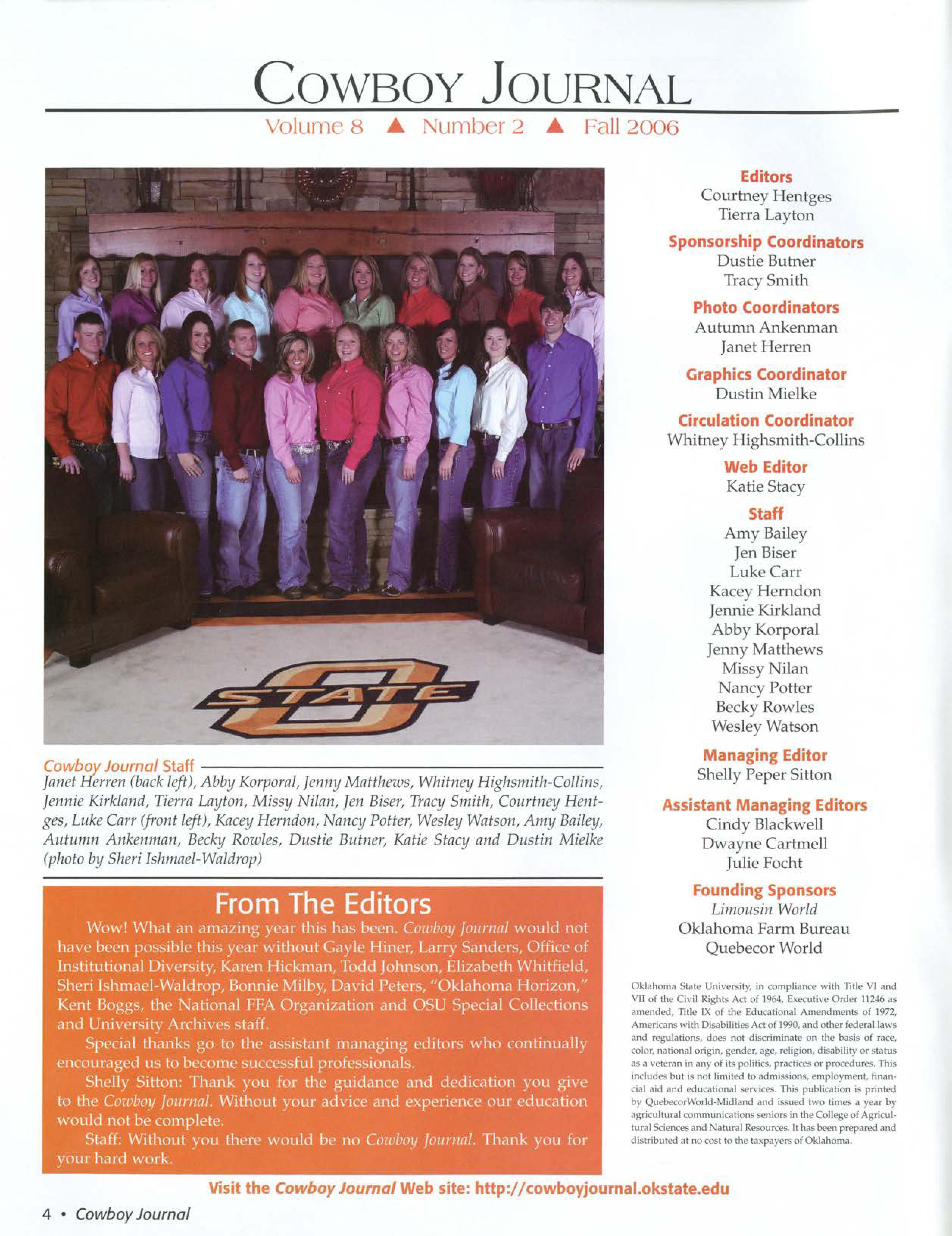
Cowboy Journal Staff
JanetHerren (backleft), Abby Korpora/,Jenny Matthews, WJ,itneyHighsmitlI-Colli11s, Jennie Kirkland, Tierra Layton, Missy Nilan, Jen Biser,Tracy Smith, Courh1e1;Hentges, Luke Carr (front left), KnceyHerndon,Nancy Potter,Wesley Watson, Amy Bailey, Autumn Ankenman, Becky Rowles, Dustie Buh1er,Katie Stacy and Dustin Mielke (photoby Sheri Ishmael-Waldrop)
Wow! What an amazing ycnr this has been. Cowhoy /011malwould not have been possible this year· without Gnyle Hiner, Larry Sr1nders, Office of lnslitutional Diversity, l<c1renHickman, Todd Johnson, Elizabeth Whitfield, Sheri lshm,iel-Wa !drop, Bonnie Milby, David Peters, "Oklahoma Horizon," Kent I3oggs, Lhc N,1tionc1lJ1rA Organization and OSU Special Collections <1ndUniversity Archives staff.
Specir1l thc1nks go to the .issistm1t managing editors who continually encouraged us to become successful professionals.
Shelly Silton: Thank you for the guidance and dedication you give to Lhe Cowboy/011rnal.Without your ad\'ice and experience our education would not be complete;
Stt1ff:Without you there woLtld be no Cowboy foumal. Thank you for your h.ird work.
Editors
Courtney Hentges
Tierra Layton
Sponsorship Coordinators
Dustie Butner
Tracy Smith
Photo Coordinators
Autumn Ankenman
Janet Herren
Graphics Coordinator
Du tin Mielke
Circulation Coordinator
Whitney Highsmith-Collins
Web Editor
Katie Stacy
Staff
Amy Bailey
Jen Biser
Luke Carr
Kacey Herndon
J nnie Ki ·kland
Abby Korporal
Jenny Matthews
Missy ilan
Nancy Potter
Becky Rowles
Wesley Watson
Managing Editor
Shelly Peper Sitton
Assistant Managing Editors
Cindy Blackwell
Dwayne Cartmell
Julie Focht
Founding Sponsors
Limousin World
Oklahoma Farm Bureau
Quebecor World
Oklahoma State University, in compliance with TIiie Vl and VU of the Civil Rights Act of 1964, E.xccuth•eOrder 11246 as amendc'CI, TIiie IX of the Educational Amendments of 1972, American.s with Disabilities Act of 1990.and other federal laws and regu.Jations:1docs nol discriminate on the basi-s of met!', colorlnationalorigin, gender,age, religion.disabilityor status as a veteran in any of its politics,practicesor procedures.This. includesbut is not limHed to admissions,employment 1 finan~ cial ald and educational services. This publication is printed by Qu~becorWorld-Midland ,md issued two times a year by ;igricuJh.m1Jcommunicahons::,en..iors in the Collegeof AgriculR lural Sciencel>and Nahiral Resources. II has been prepared and d1stnbuted at no cost to the taxpayers of Oklahoma.
Step back in time at OSU 6
Remembering the Animal Husbandry Building
Entrepreneur honors brother with CASNR scholarship 8
A family honors the memory of an OSU student
Harvey steps up as president 13 The Agriculture AJumni Association names its new president
Still a champion 16
Past CASNR top senior recall hi time at OSU
Ag Alumni Association 49
Rep. Frank ucas honored as distinguished alumnus
CASNR alumna Rachel Hubbard hits the airwaves as KOSU's Capitol corr spondent
As national FFA president, an OSU student helps high school sh1dents become leaders
OSU re earchers help farmer battle drought through genetic research 47
Playing with fire so Oklahoma does not get burned
Agricultural careers: the BIG pidure 20
Graduates can find a bright outlook
Good ride, cowboy 22
OSU sh1dents reinvent th horse
International students become Cowboys 24
Finding a new horn at OSU
Agricultural students serve campus, community, state, nation 26
Students focu n ervice
CASNR helps change the face of agriculture 33
Diversity makes CAS stronger
Seniors lead by example 35
CASNR top 10 tud nt find success
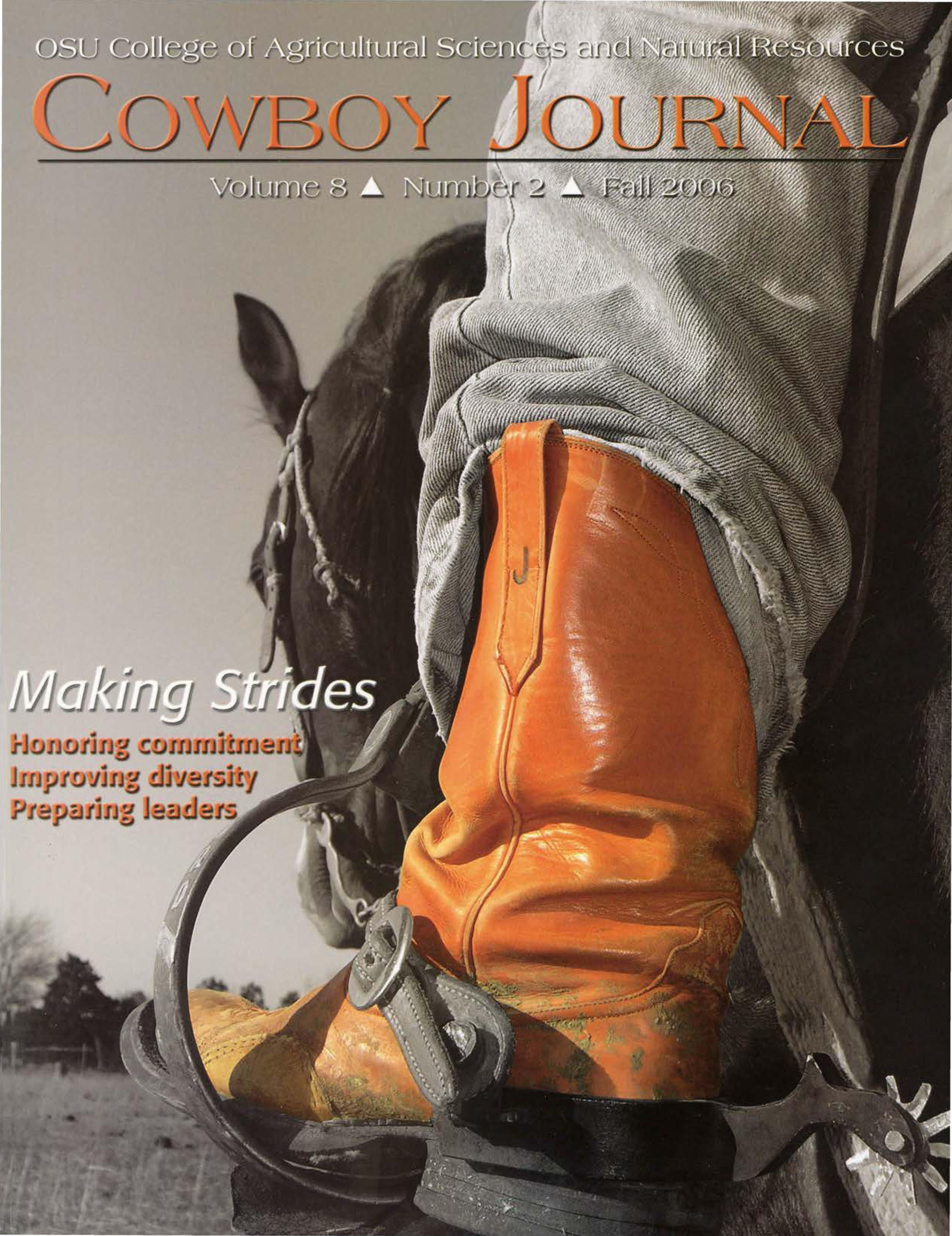
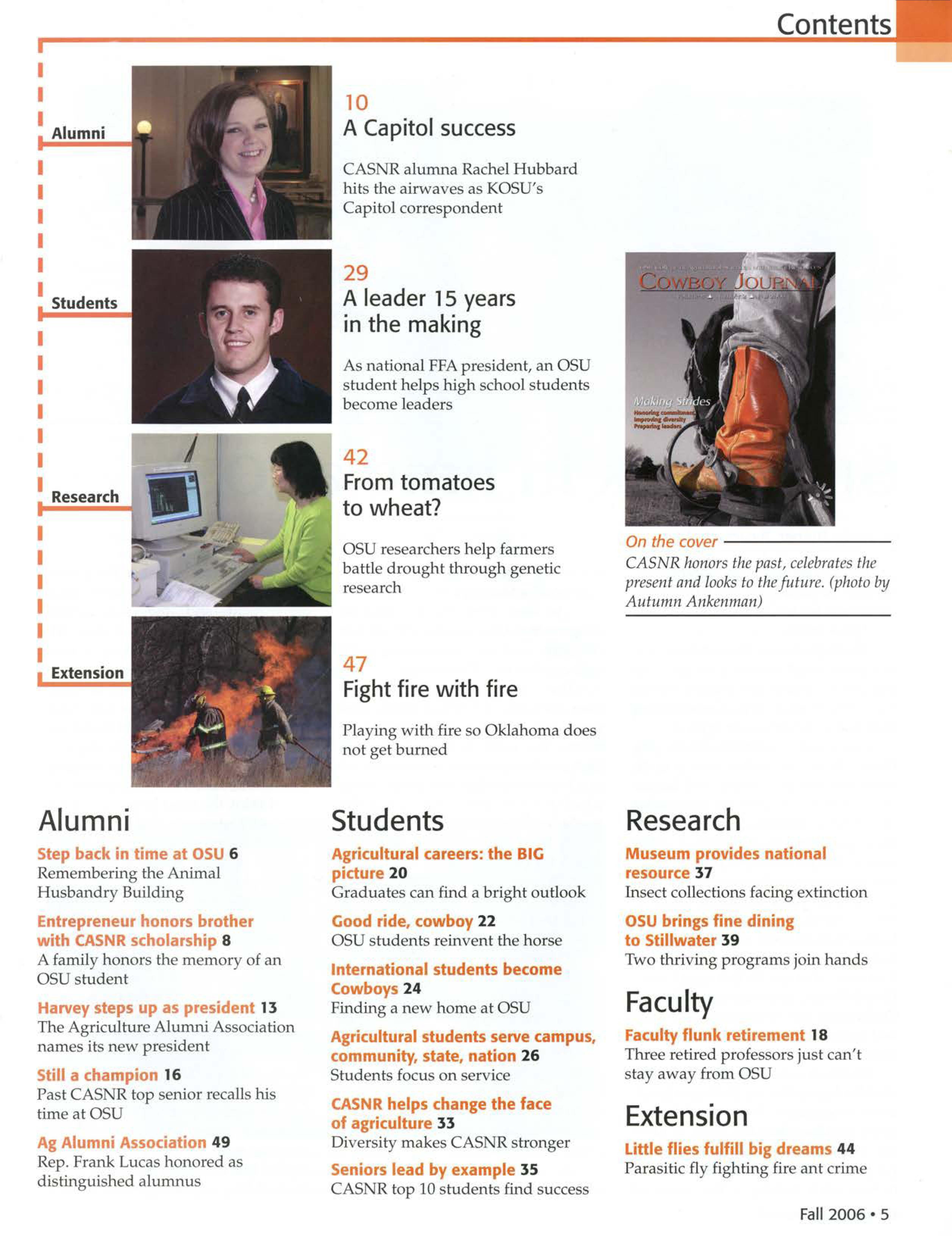
On the cover
CASNR honorsthe past, celebratesthe presentand looksto thefuture. (photoby Autumn Ankenman)
Museum provides national resource 37
Insect collections £acing extinction
OSU brings fine dining to Stillwater 39
Two thriving programs join hand
Faculty flunk retirement 18
Three retired professors just can't stay away from OSU
Little flies fulfill big dreams 44
Parasitic fly fighting fire ant crime
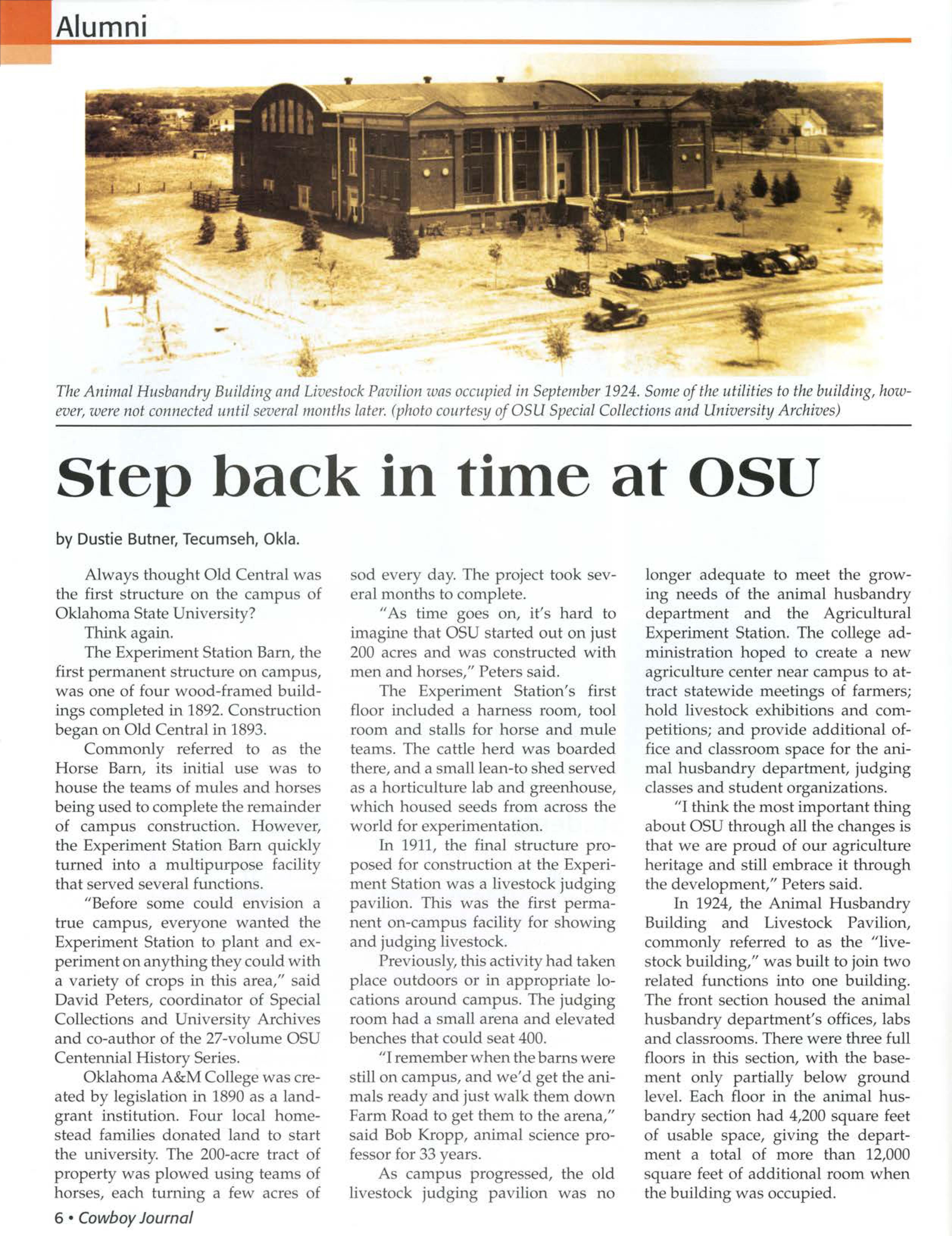
The Animal Husbandry Building and LivestockPavilion was occupiedin September1924. Some of the utilities to the building, however,were not connecteduntil severalmonths later.(photocourtesy of OSU SpecialCollectionsand University Archives)
by Dustie Butner, Tecumseh, Okla.
Always thought Old Central was the first structure on the campus of Oklahoma State University?
Think again.
The Experiment Station Barn, the first permanent structure on campus, was one of four wood-framed buildings completed in 1892. Consh·uction began on Old Central in 1893.
Commonly referred to as the Horse Barn, its initial use was to house the teams of mules and horses being used to complete the remainder of campus consh·uction. However, the Experiment Station Bam quickly turned into a multipurpose facility that served several functions.
"Before some could envision a true campus, everyone wanted the Experiment Station to plant and experiment on anything they could with a variety of crops in this area," said David Peters, coordinator of Special Collections and University Archives and co-author of the 27-volume OSU Centennial History Sedes.
Oklahoma A&M College was created by legislation in 1890 a a landgrant in titution. Four local homestead families donated land to start the univer ity. The 200-acre tract of property wa plowed using team of horses, each turning a few acre of 6 • Cowboy Journal
od every day. The project took several months to complete.
11 As time goes on, it's hard to imagine that OSU started out on just 200 acres and was constructed with men and hor s," Peters said.
The Experiment Station's first fJoor included a harness room, tool room and stalls for horse and mule teams. Th cattle herd was boarded there, and a small lean-to shed served as a horticulture lab and greenhou e, which housed seed from aero s the world for experimentation.
In 1911, the final structure proposed for construction at the Experiment Station was a liv tock judging pavilion. This wa the first permanent on-campu facility for showing and judging livestock.
Previou ly, this activity had taken place outdoors or in appropriate locations arow1d campus. The judging room had a small arena and elevated benche that could seat 400.
"I remember when the barns were still on campus, and we'd get the animals ready and just walk them down Farm Road to get them to the arena," said Bob Kropp, animal cience profe or for 33 years.
A campus progressed, the old live tock judging pa ilion was no
longer adequate to meet the growing needs of the animal husbandry department and the Agricultural Experiment Station. The college administration hoped to create a new agriculture center near campus to attract statewide meetings of farmers; hold livestock exhibition and competitions; and provide additional office and classroom space for the animal husbandry department, judging classes and student organizations.
"I think the most important thing about OSU through all the changes i that we are proud of our agriculture heritage and still embrac it tlu:ough the development," Peters said.
In 1924, the Animal Husbandry Building and Livestock Pavilion, commonly referred to as the "livestock buikling," was built to join two related function into one building. The front section housed the animal husbandry department's offices, labs and classrooms. There were three full floors in this section, with the basement only partially below ground level. Each floor in the animal husbandry section had 4,200 square feet of usable space, giving the department a total of more than 12,000 square feet of additional room when the building was occupied.
While attached to the animal hubandry building, the livestock pavilion was essentially a separate structure. This northern ection of the new facility provided a 12,000-square-foot arena, pace for livestock judging and holding pens for livestock. The arena had a dirt floor, and only the areas beneath the stands had concrete surfaces. The arena, with an estimated seating capacity of 2,000, held judging events, livestock shows and rodeo It served as a popular hangout among students.
"The animal husbandry building and arena had a lot of significance to numerous generations of OSU students," Peters said. "It went through some surface changes, but the attitude surrounding the building always remained. It was the place students went to see and be seen."
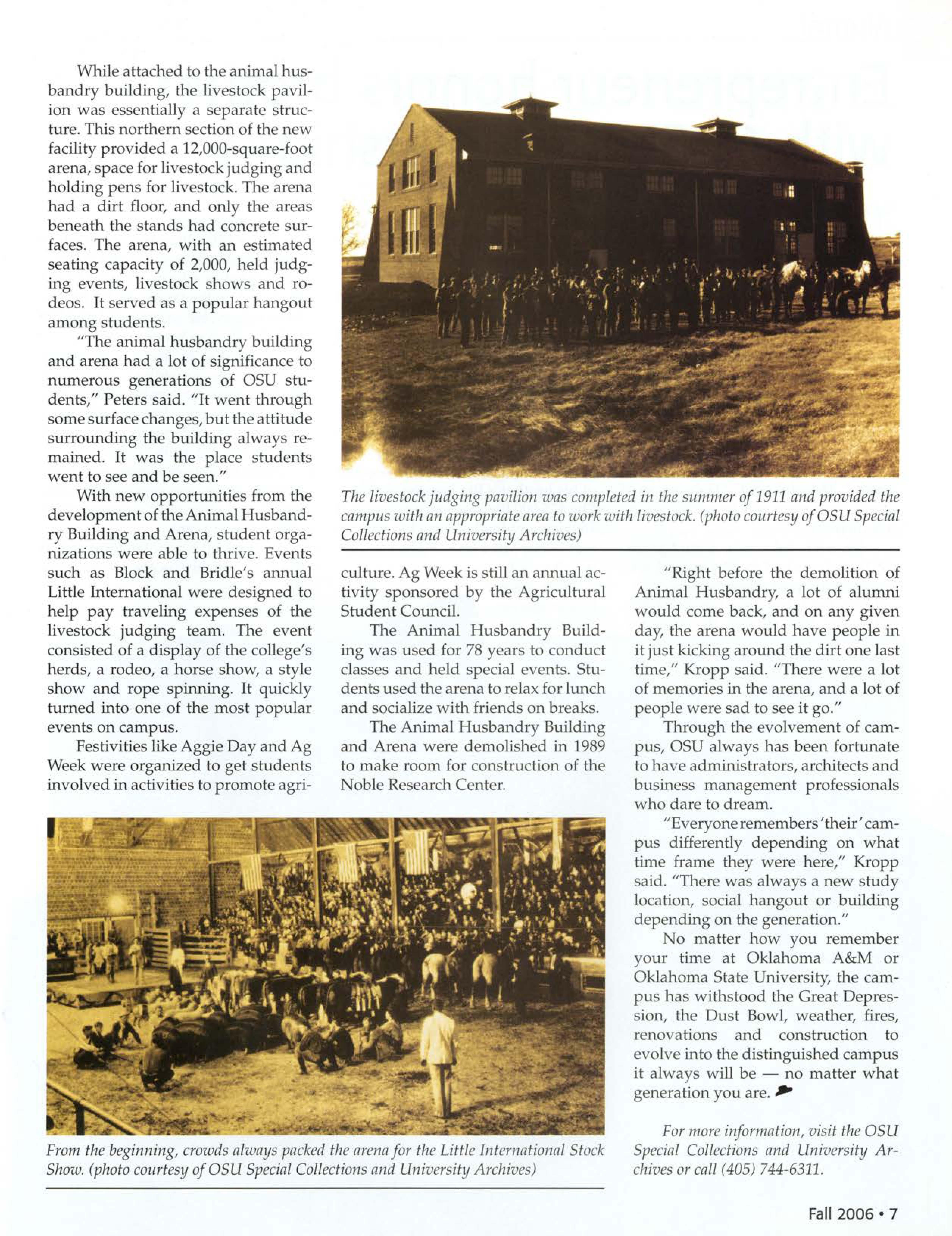
With new opportunitie from the developmentof theAnimalHu bandry Building and Arena, student organizations were able to thrive. Events such as Block and Bridle's annual Little International were designed to help pay traveling expenses of the livestock judging team. The event consisted of a display of the college's herds, a rodeo, a horse show, a style show and rope spinning. It quickly turned into one of the most popular events on campus.
Festivities like Aggie Day and Ag Week were organized to get students involved in activities to promote agri-
culture. Ag Week is still an annual activity sponsored by the Agricultural Student Council.
The Animal Husbandry Building was used for 78 years to conduct classes and held special events. Students u ed the arena to relax for lunch and socialize with friends on breaks.
The Animal Husbandry Building and Arena were demolished in 1989 to make room for construction of the Noble Research Center.
"Right before the demolition of Animal Hu bandry, a lot of alumni would come back, and on any given day, the arena would have people in it just kicking around the dirt one last time," Kropp said. "There were a lot of memories in the arena, and a lot of people were sad to see it go."
Through the evolvement of campus, OSU always has been fortunate to have administrators, architects and business management professionals who dare to dream.
"Everyone remembers 'their' campus differently depending on what time frame they were her ," Kropp aid. "There was always a new study location, ocial hangout or building depending on the generation." o matter how you remember your time at Oklahoma A&M or Oklahoma State University, the campus has withstood the Great Depresion, the Dust Bowl, weather, fires, renovations and construction to evolve into the di tinguished campus it alway will be - no matter what generation you are. I/JI"
For more informntion, visit the OSU Special Collections and University Archives or call (405) 744-6311.
by KaceyHerndon, Elgin, Okla.
For some, the memory of a loved one is cherished deep in the heart, reminisced about with family and friends, never forgotten. For others, memories move them to action.
Mike Murphy, owner of M&M Energy in Edmond, Okla., has acted upon his desire to honor his older brother, Jesse Murphy, by establishing a scholarship fund at Oklahoma Stat University.
"Jesse had a love for the school and for the animal science department," Murphy said. "Helping students each year will be an honor in his memory."
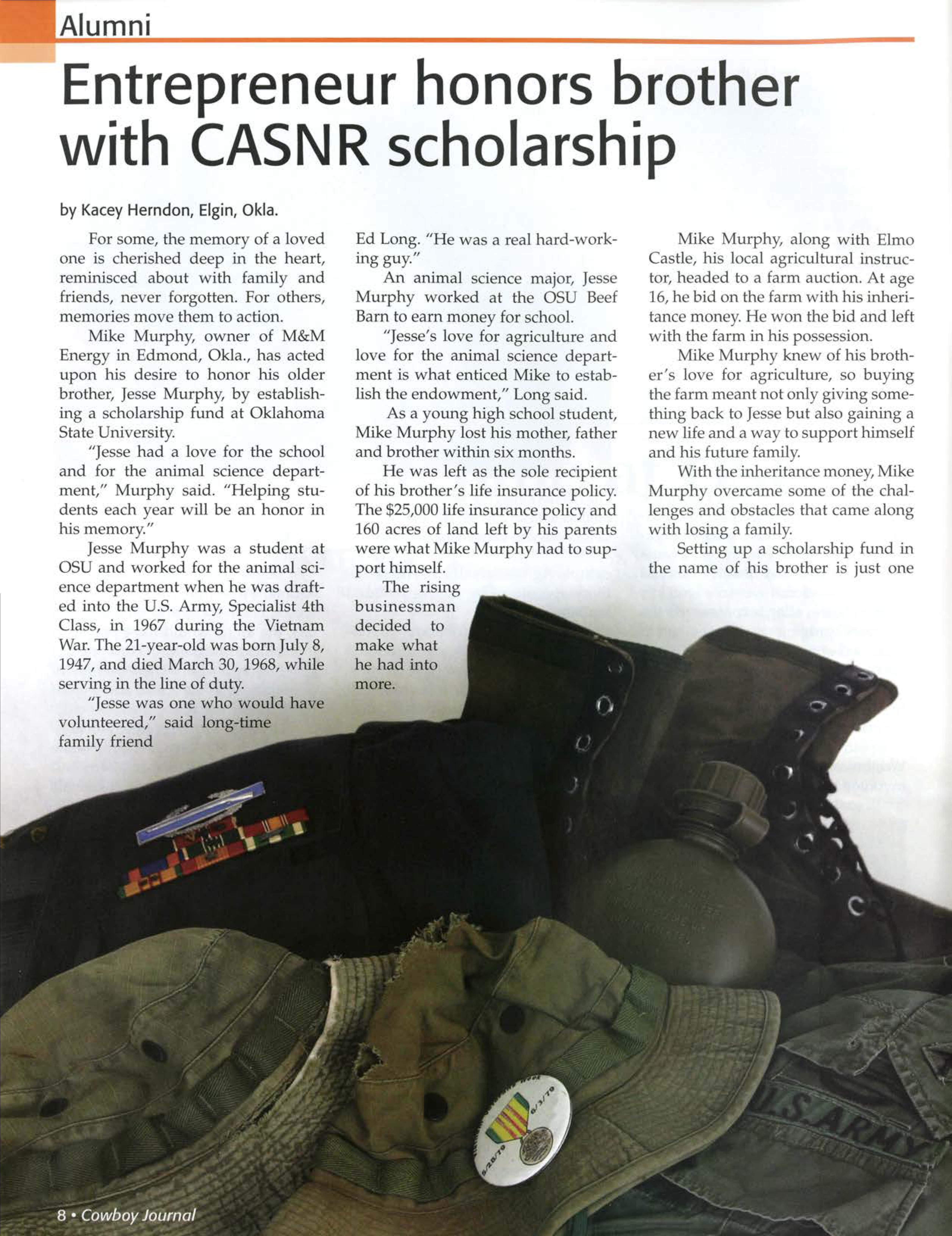
Jesse Murphy was a student at OSU and worked for the animal science department when he was drafted into the U.S. Army, Specialist 4th Class, in 1967 during the Vietnam War. The 21-year-old was born July 8, 1947, and died March 30, 1968, while serving in the line of duty.
"Jesse was one who would have volunteered," said long-time family friend
Ed Long. "He wa a real hard-working guy."
An animal science major, Jesse Murphy worked at the OSU Beef Barn to earn money for school.
"Jesse's love for agriculture and love for the animal science department is what enticed Mike to estab·sh the endowment," Long said.
As a young high school student, Mike Murphy lost his mother, father and brother within ix months.
He was left as the ole recipient of his brother's life insurance policy.
The $25,000 life insurance policy and 160 acres of land l ft by his parents were what Mike Murphy had to support himself.
The rising businessman decided to make what he had into more.
Mike Murphy, along with Elmo Castle, his local agricultural instructor, headed to a farm auction. At age 16, he bid on the farm with his inheritance money. He won the bid and left with the farm in his possession.
Mike Murphy knew of hi brother's love for agriculture, so buying the farm meant not only giving something back to Jesse but also gaining a new life and a way to support himself and his future family.
With the inheritance money, Mike Murphy overcame som of the challenges and obstacles that came along with losing a family.
Setting up a scholarship fund in the name of his brother is just one
way Mik Murphy can honor his brother. He wanted to give other the opportunity to ucceed, just as Jesse Murphy did for him.
The Jesse Murphy Memorial Scholarship Endowment was e tablished for a student who ha the desire to go to OSU and earn a degree in the ColJege of Agricultural Sciences and atural Resources.
"This year's recipient will receive $1,000, and each year the endowment will grow by $1,000 to provide future scholarships," Murphy said.
The student must have a minimum of a 3.0 grade point average to be eligible to receive the scholarship.
"Above all, the student must have an attitude to learn and to strive to do his or her best," Murphy said.
Establishmg a scholarship fund through OSU not only honors a loved one but also gives students who ha e had to overcome obstacles of their own the opportunity to learn, achieve and succeed.
OSU Foundation scholarship endowment can be established with a ingle cash gift, securitie or other
property. They also may be funded with a serie of gift made ov r time.
Donors can establish annually fund d scholarship , an annual gift in any amount that is funded each year.
Donors can specify the college or deparbnent that will receive their gift or donation. The OSU Foundation recognizes its donors through memberships in the following gift clubs:
• The OSU President's Club Gold, $5,000 or more annually;
• The OSU President's Club Silver, $2,500 or more annually;
• The OSU President's Club Bronze, $1,000 or more annually;
• The University 500 Club, $500 or more annually; and
• The Century Club, $100 or more annually.
The OSU President's Club is the highest level of recognition a donor can receive for annual giving. To become a member of the President's Club, a minimum of $1,000 must be donated each year to support OSU.
Annual memberships in the gift clubs run from July 1 through June 30 of each year. A membership may be
held by an individual or a couple; it also can be held anonymou ly.
Donors have the option to e tablish an endowed scholarship fund, like Mike Murphy did. Endowed cholarships provide continued assistance to OSU students.
The minimum amount of an endowed scholarship is $10,000. This scholarship may be named either to honor the donor or another person of the donor's choice. When an endowed scholarship fund is established, the principal of the endowment is never spent to ensure an enduring tribute to the person for whom the scholarship is named.
An enduring tribute will forever be given to Jesse Murphy. Not only will his life be celebrated and remembered by Mike Murphy but also by the students who will benefit from the opportunity given to them. J/1111'
For more information regarding scholarship donations, call the OSU Foundationtollfree at (800) 622-4678or at (405) 385-5100.Visit the Foundation's Web site at www.osuf.org.
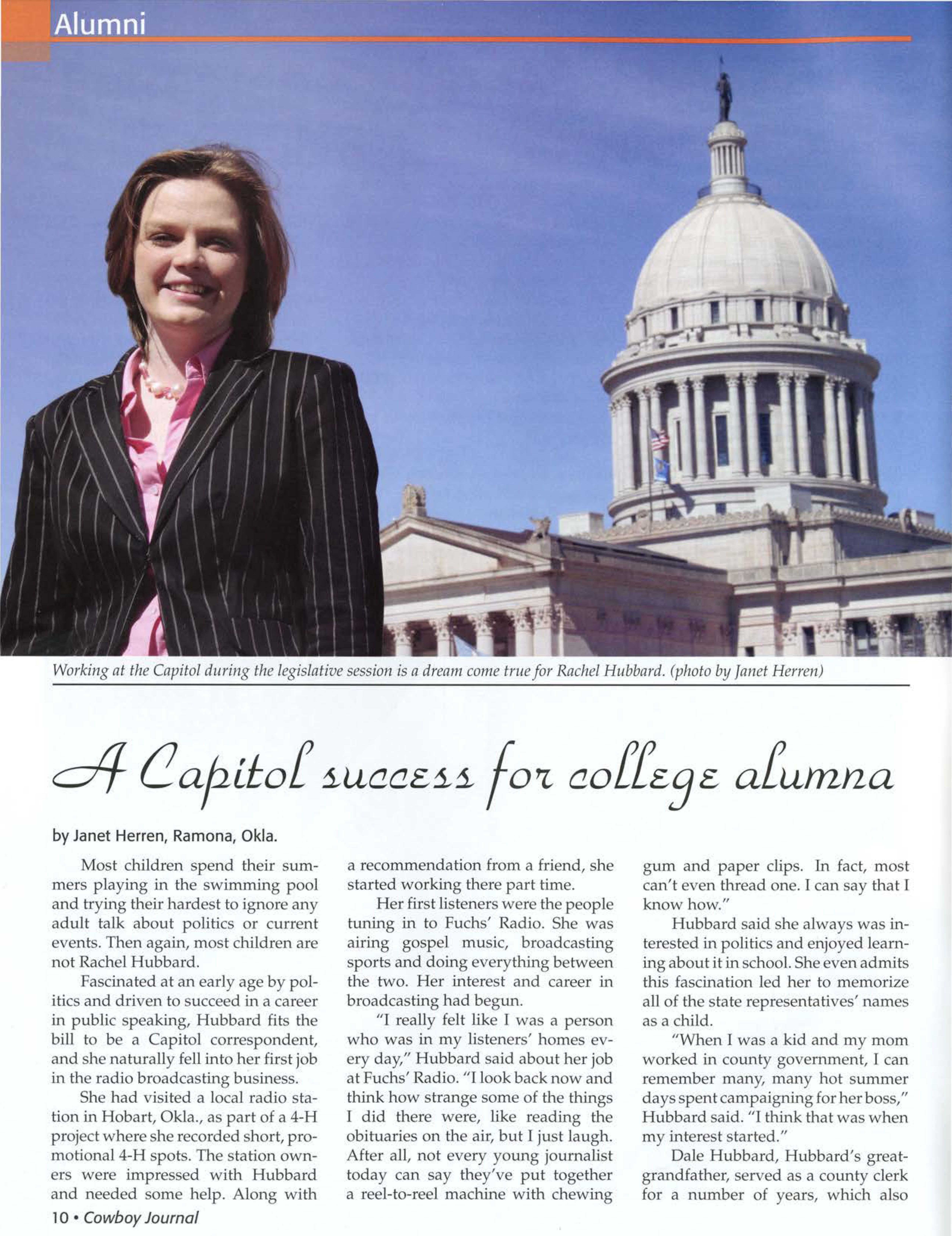
Workingat the Capitolduring the legislativesessionis a
by Janet Herren, Ramona, Okla.
Most children spend their summers playing in the swimming pool and trying their hardest to ignore any adult talk about politics or current event . Then again, most children are not Rachel Hubbard.
ascinated at an early age by politics and driven to succeed in a career in public speaking, Hubbard fits the bill to be a Capitol correspondent, and she naturally fell into her first job in the radio broadcasting bu ine s. She had visited a local radio station in Hobart, Okla., as part of a 4-H project where she recorded short, promotional 4-H spots. The tation owners were impressed with Hubbard and needed some help. Along with 1O • Cowboy Journal
a recommendation from a friend, she started working there part time.
Her first listeners wer the people tuning in to Fuchs' Radio. She was airing gospel music, broadcasting sports and doing everything between the two. Her interest and career in broadcasting had begun.
"I really felt like I was a person who was in my listeners' home every day," Hubbard said about her job at Fuchs' Radio. "I look back now and think how strange ome of the thing I did there were, like reading the obituaries on the air, but I just laugh. After all, not every young journali t today can say they've put together a reel-to-reeJ machine with chewing
gum and paper dips. In fact, most can't even thread one. I can say that I know how."
Hubbard said she always was interested in politics and enjoyed learning about it in school. She even admits this fascination led her to memorize all of the state representatives' names a a child.
"When I was a kid and my mom worked in cow1ty government, I can remember many, many hot summer days spent campaigning for her boss," Hubbard said. "I think that was when my interest started."
Dale Hubbard, Hubbard's greatgrandfather, erved a a county clerk for a number of years, which al o
piqued Hubbard's curiosity. Her family always showed interest in current events, especially politics. Sunday lunches were spent talking about politics and other current events.
"I was a nerd and paid attention," Hubbard said.
As a youth, Hubbard also was an active 4-H member in Washita County. Through this program, she gained experience in public speaking. It was one of her main project areas and a skill she further developed as an Oklahoma 4-H Ambassador and as Oklahoma 4-H reporter. In both of these capacities, Hubbard enhanced her skills in communications, public speaking, leadership and teamwork, all of which have assisted Hubbard in her broadcasting career.
"I learned to speak professionally, but in a natural way," Hubbard said. "I think it helped that I started at a young age.
"My first speech was in the fourth grade. We explained the concepts behind each phrase in the pledge of allegiance, and we made these hideous pointers with crepe paper and the wands of my parent's miniblinds."
4-H also gave Hubbard a network of friends and mentors to support and encourage her.
"4-H gave Rachel a second family, a place to belong and also a place to develop herself as a person," said Charles Cox, state 4-H program leader and specialist and adviser for the OSU Collegiate 4-H Club.
As a student in the College of Agricultural Sciences and Natural Resources, Hubbard was involved in the Collegiate 4-H Club, the steering committee for Into the Streets and the ministry with the Church of Christ University Center. She also judged 4-H speech contests and twice participated in a program called Let's Start Talking. Through this program, Hubbard taught conversational English in Riga, Latvia, and in Kiev, Ukraine, and continued her education in communicating with others.
"I learned to love people for who they are and where they're at," Hubbard said. "People are people, and with patience you can communicate with anyone. I remember a lady in a grocery store asking me why I was in
Kiev, and T was able to talk to her in German. She knew a little, and I knew a little. We were able to talk."
During her years as an undergraduate, Hubbard also worked for a Star Schools Grant Project with the chemistry and physics departments. She did general communications work, including writing and editing news releases.
"With that project, I learned that many times you can get wrapped up in your work and forget how the people you are trying to communicate with understand you and your message," Hubbard said.
Shelly Sitton, Hubbard's academic adviser and one of her professors in agricultural communications, said Hubbard was one of the students whose interest in broadcasting pushed the department to offer more courses related to this field.
"In working with Rachel, we discovered how much students could benefit from classroom broadcasting experience," Sitton said. "She helped future agricultural communications students to be better prepared for careers in broadcasting."
Hubbard said her background in agricultural communications gave her professional knowledge to back up her speaking experience.
Hubbard's career in radio broad-
Working
casting continued at OSU. She worked as a student reporter for KOSU in 1999 as a freshman.
During the summer of her junior year, she interned at KOSU to fulfill a requirement for her degree. Even at this point, Hubbard was not certain she wanted to be a radio broadcaster.
"When I was a kid, I wanted to do television, but people told me I couldn't because of my freckles," Hubbard said.
"I was crushed, so I tried all the random ways to remove them that I could think of. Lemon juice, etc.none of them worked. I gave up on television then until I had a professor who told me I was good at it."
When Hubbard graduated in 2003, she had worked for KOSU for four years, and the state Capitol correspondent position opened. Hubbard was a perfect fit.
"I don't think I ever thought about radio as an option when I was a kid," Hubbard said. "I just stumbled into it and never found my way back out. I'm kidding because I love my job, but that's what happened."
Craig Beeby, director and general manager for KOSU, said: "I've seen Rachel grow and flourish from a student reporter to the current position she holds. As the Capitol correspondent, she has been both the eyes and the ears for the public, and she has been nationally recognized."
During the four-month Oklahoma legislative session, Hubbard spends her days at the state Capitol building tracking people down to interview, listening to legislative sessions, keeping in tune with the daily occurrences at the Capitol and drinking too much coffee.
Hubbard said she likes to keep the public informed and loves her job. It's fun for her to go to work every day, and while her work can be stressful and demanding, Hubbard said she thrives in this atmosphere.
There is a lot of "hurry and wait" time at the Capitol, Hubbard said about work as the Capitol correspondent. However, this wait time gives Hubbard time to make more detailed observations about the different sessions and to discover the little, interesting details about the represenFall
tatives and senators. For a political fanatic like Hubbard, this time makes her job even more enjoyable.
Her pas ion for her work has helped her win national awards, including the Jack R. Howard Trophy from the Scripps Howard Foundation for the team coverage on the OSU plane crash in 2001. She has received an award from the Public Radio ews Directors and an award from the Association of State Capitol Reporters and Editors for beat reporting.
Beeby said Hubbard has won numerous other awards and is considered one of the top Capitol reporters in the United States.
Another tangible outcome of her success can be seen by her recent promotion to news director. As the news director for KOSU, Hubbard will continue her award-winning coverage of the state Capitol and will coordinate overall news coverage and presentation for the station. She also will sup rvise students and professional news staff.
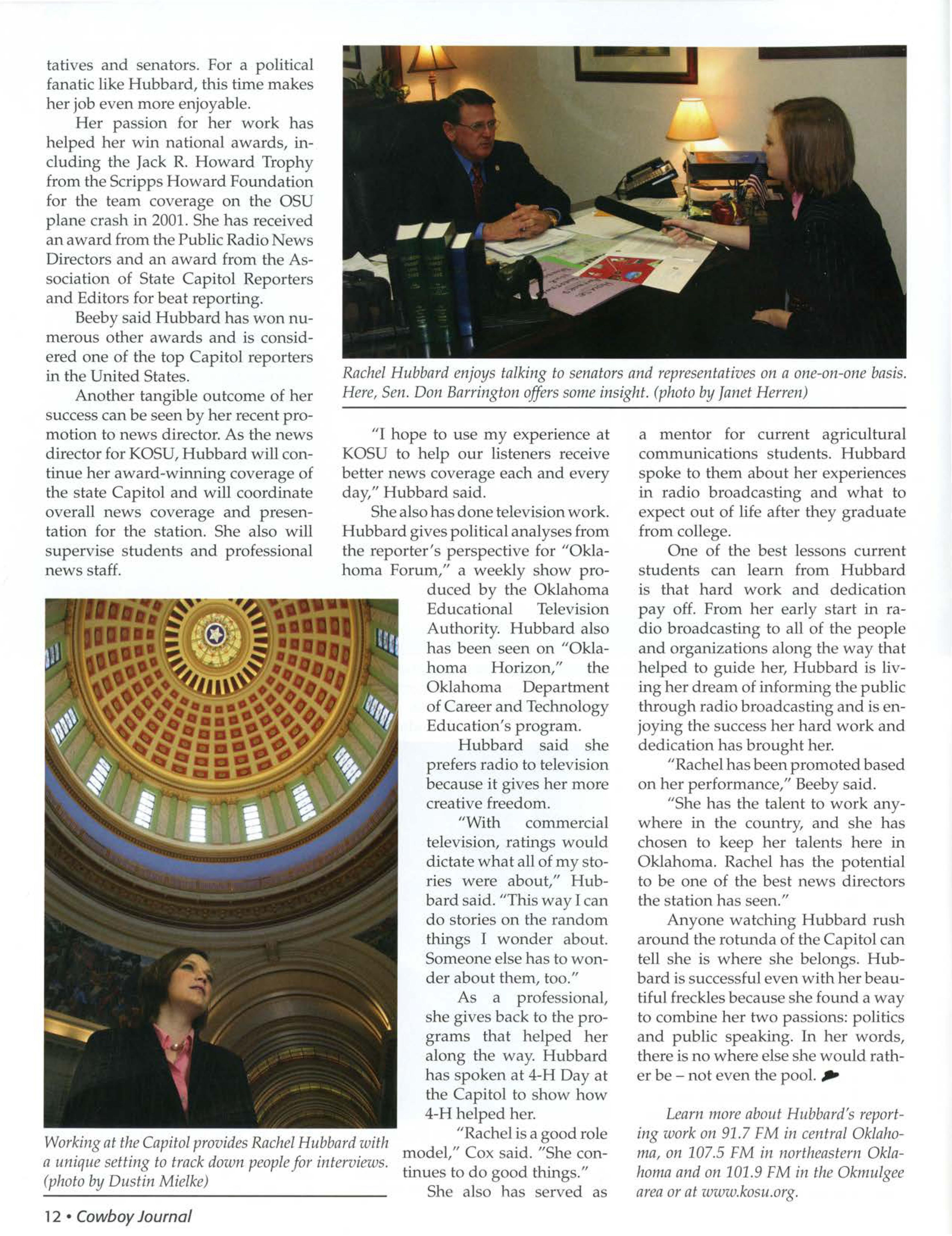
to senatorsand
" hope to use my experience at KOSU to help our listeners receive better news coverage each and every day," Hubbard aid.
She also has done television work. Hubbard gives political analyses from the reporter's perspective for "Oklahoma Forum," a weekly show produced by the Oklahoma Educational Television Authority. Hubbard also has been seen on "Oklahoma Horizon," the Oklahoma Department of Career and Technology Education's program.
Hubbard said she prefers radio to television because it gives her more creative freedom.
"With commercial television, ratings would dictate what all of my stories were about," Hubbard said. "This way I can do stories on the random things I wonder about. Someone else has to wonder about them, too."
As a profe sional, she gives back to the programs that helped her along the way. Hubbard ha spoken at 4-H Day at the Capitol to show how 4-H helped her.
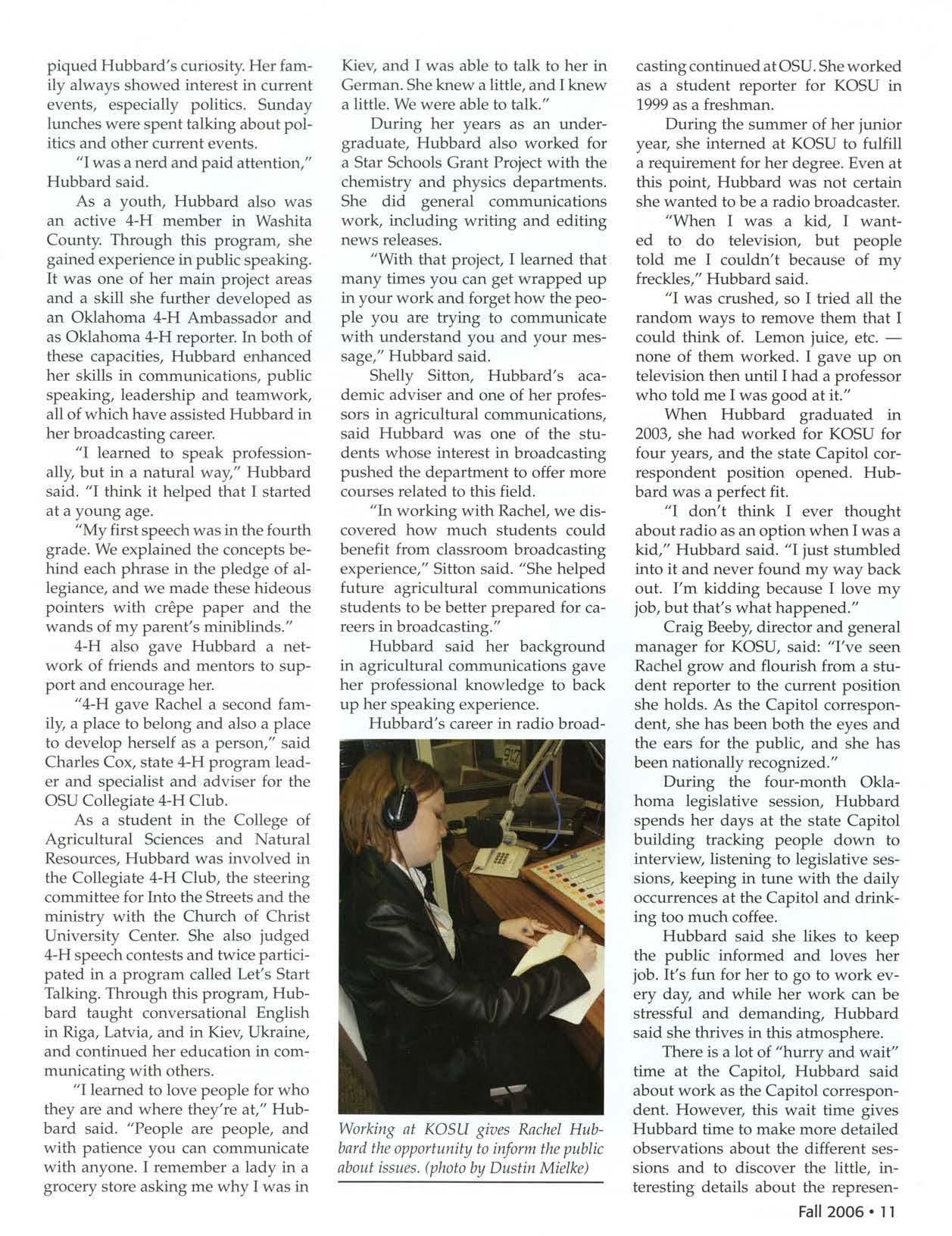
Workingat the CapitolprovidesRachelHubbardwith a unique setting to track down peoplefor interviews. (photoby Dustin Mielke)
"Rachel is a good role model," Cox said. "Sh continues to do good things."
She al o has served as
a
a mentor for current agricultural communications students. Hubbard spoke to them about her experiences in radio broadcasting and what to expect out of life after they graduate from coll ge.
One of the best lessons current students can learn from Hubbard 1 that hard work and dedication pay off. From her early start in radio broadcasting to all of the people and organizations along the way that helped to guide her, Hubbard is living her dream of informing the public through radio broadca ting and is enjoying the succe • her hard work and dedication has brought h r.
"Rachel has been promoted based on her performance," Beeby aid.
"She has the tal nt to work anywhere in the country, and she has chos n to ke p her talents here in Oklahoma. Rachel has the potential to be one of the best news directors the tation has s en."
Anyone watching Hubbard rush around th rotw1da of the Capitol can tell he is where he belong . Hubbard i successful even with her beautiful freckl s because she found a way to combine her two pa sions: politics and public sp aking. In her words, there is no where else she would rather be - not ven the pool.
Learn moreabout Hubbard'sreporting work on 91.7 FM in central Okla/10ma, on 107.5 FM in northeasternOklahomaand on 101.9 FM in the Oknmlgee areaor at www.kosu.org.
by Autumn Ankenman, Miami, Okla.
From Okmulgee County 4-H and Beggs FFA to the Oklahoma Department of Agriculture, Food and Forestry, Jason Harvey has represented success. The Agriculture Alumni Association should expect notrung less from its newly elected president.
"I wanted to be in a position to repre ent agricultural alumni and also be able to give back to the college," Harvey said.
Between growing up in the rural community of Beggs, Okla., and observing his father teach agriculture, Harvey developed a passion for agriculture and achievement at a young age. He credits his accomplishments to his sturdy family relationship.
"My family was always very supportive but never overly pushy," Harvey said. "They always encouraged me not only to be involved in agriculture but al o in other organizations such as church and athletics."
During high school, Harvey balanced academics, athletics and agricultme while helping his father with their show pig and cow/ calf operation. He said he was always enthusiastic and involved.
"I've been very fortunate to have grown up with team-oriented goal constantly being reinforced around me," Harvey said.
After graduating from Beggs High School in 1991, Harvey decided to attend Eastern Oklahoma State College in Wilburton.
He started junior college to pursue an associate degree with th xpectation of becoming a physical therapist. However, it did not tak long for him to return to his agricultural roots.
"After my first year of studying physical therapy, I realized I wasn't a happy as I should have b en with my major," Harvey said.
Harvey witched his major from physical therapy to animal science and found his place. After graduating from Eastern Oklahoma State College, Harvey transferred to Oklahoma
State University to pur ue a degree in agricultural education, focusing on the professional service option.
"If you are going to be at OSU, you might as well be a leader," Harvey said.
While attending OSU, Harvey became involved in many campus organizations, including Agricultural Ambassadors, Agricultural Student Council and Collegiate FFA. He was an active memb r of the Alpha Gamma Rho fraternity. Harvey said becoming mor in olved in these organizations helped him to develop into a well-rounded individual.
"One of the trungs that helped m the most wh n 1 was at Oklahoma State was AGR," Harvey said. "I was pretty shy growing up, and AGR helped me to become involved on campus and prev nt d m from becoming a face in the crowd. AGR
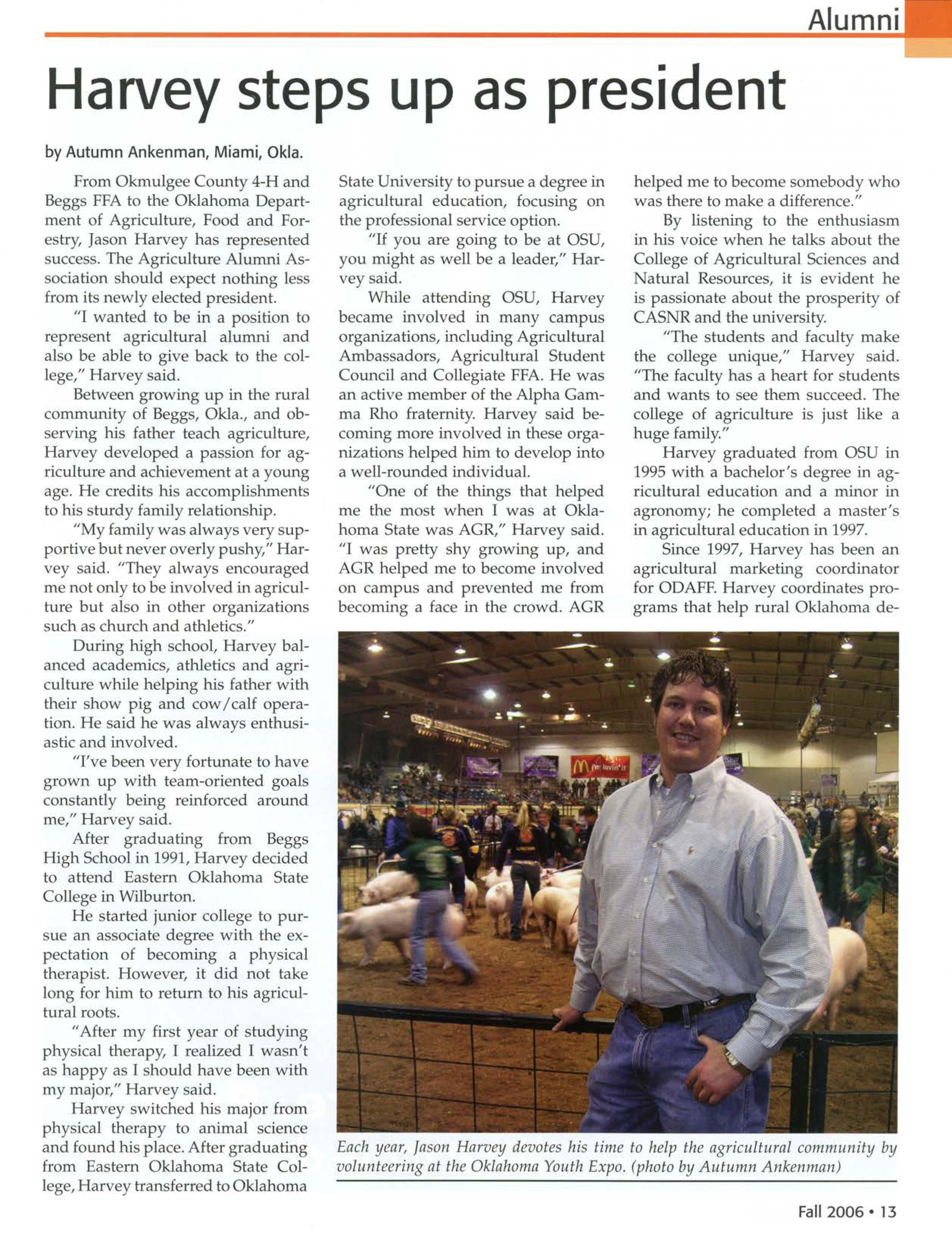
helped me to become omebody who was there to make a difference."
By listening to the enthusiasm in his voice when he talks about the College of Agricultural Sciences and atural Resources, it is evident he is passionate about the prosperity of CASNR and the university.
"The students and faculty make the college unique," Harvey said. "The faculty has a heart for students and wants to see them succeed. The college of agriculture is just like a huge family."
Harvey graduated from OSU in 1995 with a bachelor's degree in agricultural education and a minor in agronomy; he completed a master's in agricultural education in 1997.
Since 1997, Harvey has been an agricultural marketing coordinator for ODAFF. Harvey coordinates programs that help rural OkJahoma de-
velop and thrive in the agricultural industry. Harvey said many of the skills he practices every day are skills he attained while attending OSU.
"Oklahoma State prepared me for many obstacles and challenges that I have had to face in the work force," Harvey said.
Some of the skills Harvey said he learned at OSU were time management, multi-tasking, leadership and public speaking.
"Also, Oklahoma State taught me how to relate with a variety of different kinds of people," Harvey said.
This is Harvey's third year on the Agriculture Alumni Association board of directors. He previously served as the secretary/ treasurer of the board. Barry Bessinger serves on the board with Harvey.
"He's young and energetic with an easygoing style and attitude that everyone likes," Bessinger said.
Brent Kisling, former Agriculture Alumni Association board president, said he has high hopes for Harvey.
"Jason brings to the board his
ability to lead," Kisling said. "He always seems to be on top of every issue that arises, and he has a vision of how we as an organization can better serve OSU and our alumni all across the state."
Harvey said his appreciation for the alumni association began when he was a student at OSU.
"Being involved in Agricultural Student Council, I was always aware of the activities that the alumni association held," Harvey said.
"I could see that they were all people who were making a difference in the field of agriculture across the state of Oklahoma."
Harvey said he recognizes the importance of the Agriculture Alumni Association and has an enormous amount of respect for the group.
"Jason will be a great president because he loves Oklahoma State University," Kisling said. "He understands the agricultural industry, and he is a very organized leader."
The board of directors remains confident in its new president.
"His predecessors, Brent Kisling and Sean Kouplen, did such a good job," Bessinger said. "Jason is definitely in that league; he will, without a doubt, do a good job and lead our group forward."
Harvey is an example of what knowledge and the will to succeed can do.
"Jason is the same mold as many of our past leaders of the Agriculture Alumni Association," Kisling said. "He comes from strong OSU roots, and he has a knack for getting the job done regardless of what level of effort it takes."
Harvey humbly credits his family, OSU and agriculture for the person he is today.
'Tm hoping to give back to the college," Harvey said, "and maybe be a little bit of an inspiration to future alumni." ,.
Formore informationabout the AgricultureAlumni Association,pleasesee page49.
by WhitneyHighsmith-Collins,Vinita, Okla.
From a wheat field in Guthrie, Okla., to a law office in Oklahoma City, Kenny Davis' life has changed since being named the 1986 College of Agricultural Sciences and Natural Resources' out tanding enior.
"I remember the relationships I built at OSU most," Davis said.
While at Oklahoma State University, Davis' adviser, Dan Badger, had an important influence on him. Badger supported Davis, and with an open-door policy, Badger would talk with him about anything.
Agriculhiral economics faculty Robert Oehrtman, Dan Tilley and Marcia Tilley also influenced Davis' education. They taught him life lessons and made it possible for him to see a future beyond farming.
Marcia Tilley suggested Davis consider going to law school.
"Kenny was an excellent student and wrote great answers to exam questions," Marcia Tilley said. "Whenever I see students who appear to have promise as attorneys, I suggest they consider a legal career.
"Good students have many opporhmities, and each has to find the career path that be t suits his or her interests, but legal knowledge has many app]jcations, even if they decide not to practice law."
After leaving OSU, Davis farmed hill time for his parents, Ernest and Shirley Davis, for a year before attending law school at the Univer ity of Oklahoma.
"When Kenny decided to go, Ernest was upset and hurt," Shirley Davis said. "1 always felt like the kids needed to do what they wanted to do and understood his reasoning for wanting something to fall back on if omething happened to the farm."
When Kenny Davis graduated from law school, he worked full time for the Hartzog, Conger, Cason and Neville law firm for three years.
However, Davis said he always knew he wanted to continue to be a part of the farm. When he decided to 16 • Cowboy Journal
tart a family, he went back to farming and now practices law part time during the winter.
"His father didn't think he would rerum to farming," Shirley Davis said, "but I had talked to him and he said he wanted to raise hi kids around the farm and he didn't like being stuck in the office all the time."
Davi said he continued farming because it was a part of him.
"I grew up on the farm, and that is the only life I have ever known, was comfortable with and enjoyed," Davis said.
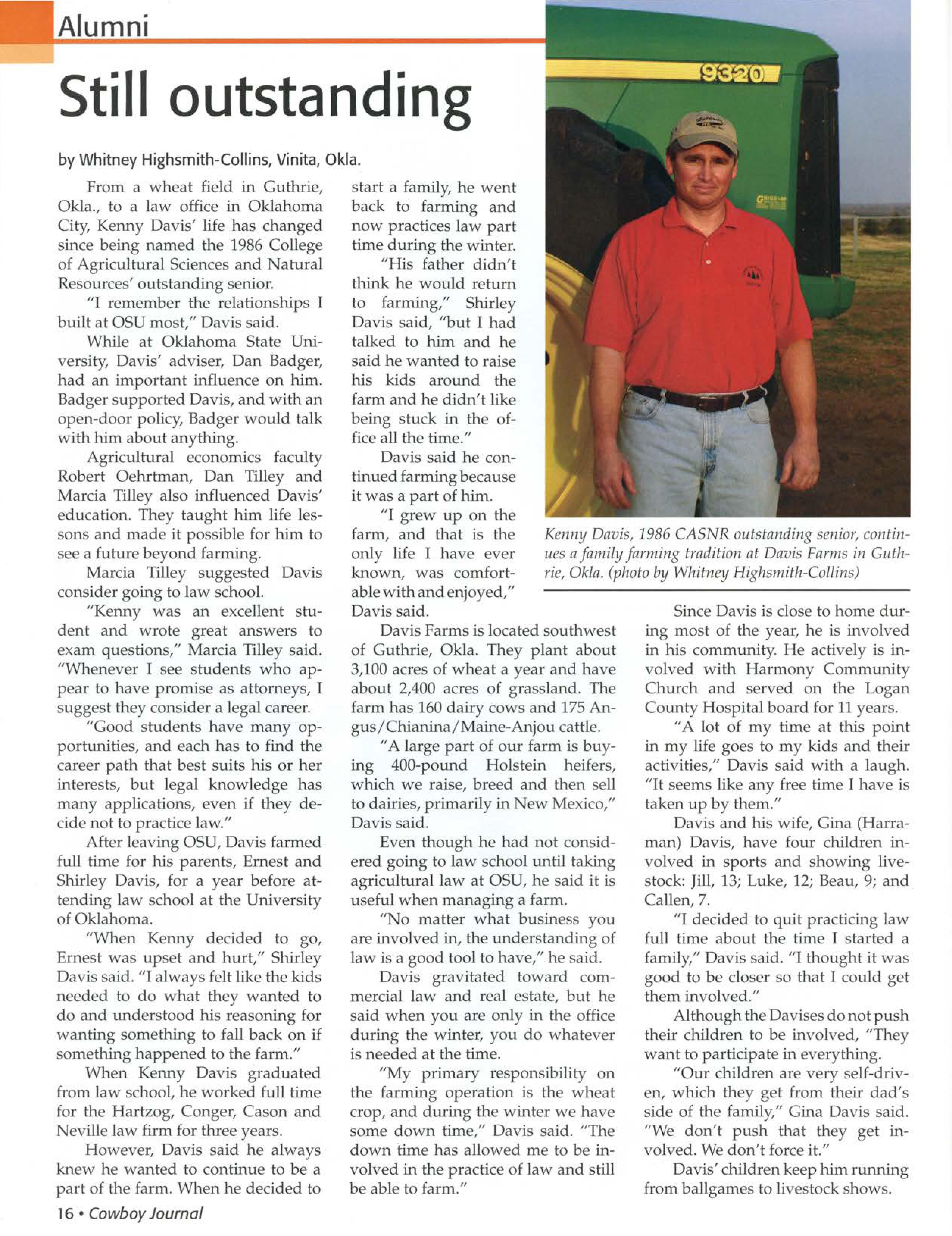
Kenny Davis, 1986 CASNR outstanding senior, continue a family farming tradition at Davis Farms in Guthrie, Okla. (photoby Whitney Highsmith-Col/ins)
Davis Farms is located southwest of Guthrie, Okla. They plant about 3,100 acres of wheat a year and have about 2,400 acres of gras land. The farm has 160 dairy cows and 175 Angus/Chianina/Maine-Anjou cattle.
"A large part of our farm i buying 400-pound Holstein heifers, which we raise, breed and then sell to dairies, primarily in ew Mexico," Davis said.
Even though he had not considered going to law school until taking agricultural law at OSU, he said it is u eful when managing a farm.
" o matter what business you are involved in, the understanding of law is a good tool to have," he aid.
Davis gravitated toward commercial law and real estate, but h said when you are only in the office during the winter, you do whatever is needed at the ti.me.
"My primary re pon ibility on the fanning operation is the wheat crop, and during the winter we have some down time," Davis said. "The down time has allowed me to b involved in the practice of law and still be able to farm."
Since Davis is do e to home during most of the year, he is involved in his community. He actively is involved with Harmony Community Church and served on the Logan County Hospital board for 11 years.
"A lot of my time at this point in my life goe to my kids and their activities," Davis said with a laugh. "It seems like any free time I have is taken up by them."
Davis and his wife, Gina (Harraman) Davis, have four children involved in sports and showing livestock: Jill, 13; Luke, 12; Beau, 9; and Callen, 7.
"I decided to quit practicing law fu!J time about the time I started a family," Davis said. "I thought it was good to be closer so that I could get them involved."
Although the Davises do not push their children to be involved, "They want to participate in everything.
"Our children are very self-driven, which they get from their dad's side of the family," Gina Davis said. "We don't push that they get involved. We don't force it."
Davis' children keep him running from ballgames to live tock shows.
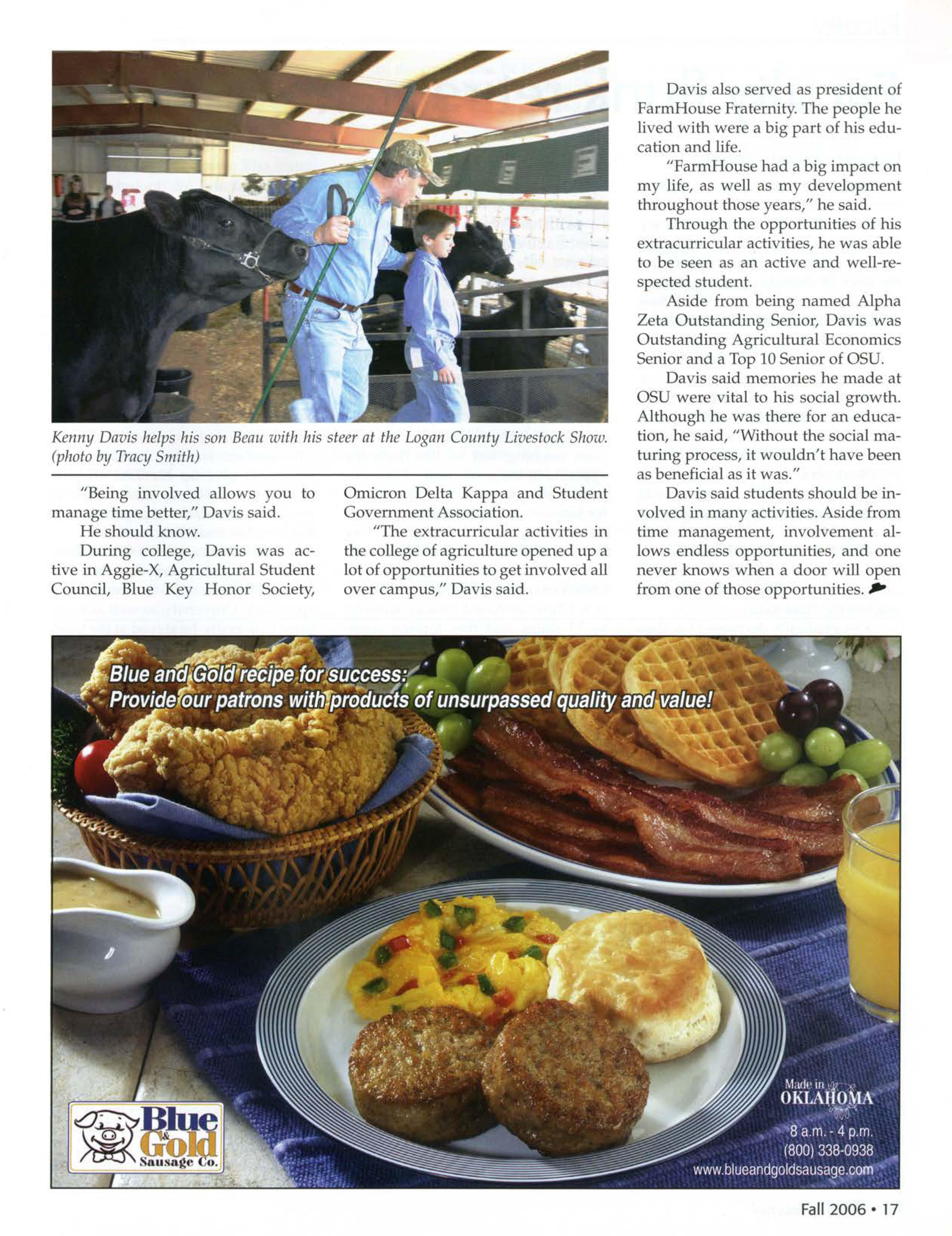
Kenny Davis helps his son Beau with his steer at the Logan County LivestockShow. (photoby TracySmith)
"Being involved allows you to manage time better," Davis said. He should know.
During college, Davis was active in Aggie-X, Agricultural Student Council, Blue Key Honor Society,
Omicron Delta Kappa and Student Government Association.
"The extracurricular activities in the college of agriculture opened up a lot of opportunities to get involved all over campus," Davis said.
Davis also served as president of FarmHouse Fraternity. The people h lived with were a big part of his education and life.
"FarmHous had a big impact on my life, as well as my development throughout those year ," he said.
Through the opporhmities of his extracurricular activities, he was able to be seen as an active and well-respected student.
A ide from being named Alpha Zeta Outstanding Senior, Davis was Outstanding Agricultural Economics Senior and a Top 10 Senior of OSU. Davis said memories he made at OSU were vital to his social growth. Although he was there for an education, he said, "Without the social maturing process, it wouldn't have been as b neficial a it was."
Davis said students should be involved in many activities. Aside from time management, invol ement allows endless opportunities, and one never knows when a door will open from one of those opportunitie .
by Jennie Kirkland, Edna,Kan.
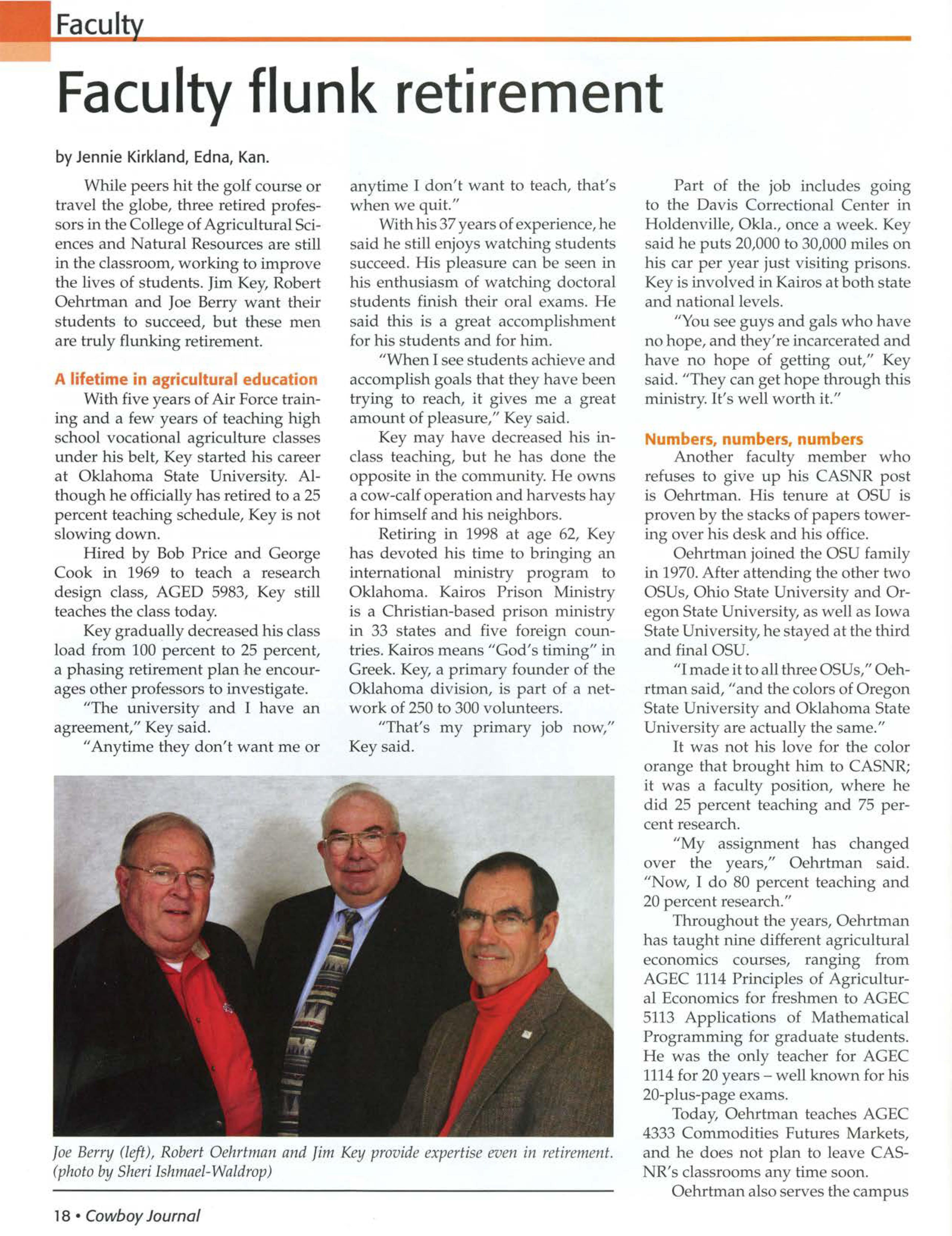
While peers hit the golf course or travel the globe, three retired professors in the ColJege of Agricultural Sciences and atural Resource are still in the classroom, working to improve the lives of students. Jim Key, Robert Oehrtman and Joe Berry want their students to succeed, but these men are truly flunking retirement.
With five years of Air Force training and a few years of teaching high school vocational agriculture classes under his belt, Key started his career at Oklahoma State University. Although he officially has retired to a 25 percent teaching schedule, Key is not slowing down.
Hired by Bob Price and George Cook in 1969 to teach a research design class, AGED 5983, Key still teaches the class today.
Key gradually decreased his class load from 100 percent to 25 percent, a phasing retirement plan he encourages other professors to investigate.
"The university and I have an agreement," Key said.
"Anytime they don't want me or
anytim I don't want t teach, that' when we quit."
With his 37 year of experience, he said he till enjoys watching student succeed. His pleasure can be seen in his enthusiasm of watching doctoral students finish their oral exams. He said this is a great accomplishment for his students and for him.
"When I see students achieve and accomplish goals that they have been trying to reach, it gives me a great amount of pleasure," Key aid.
Key may have decreased his inclass t aching, but h ha done the opposite in the community. He owns a cow-calf op ration and harvest hay for himself and his neighbors.
R tiring in 1998 at age 62, Key has devoted his time to bringing an international mini try program to Oklahoma. Kairos Prison Ministry is a Chri tian-ba ed pri on ministry in 33 tates and five foreign countries. Kairos means "God's timing" in Greek. Key, a primary founder of the Oklahoma division, is part of a network of 250 to 300 volunteers.
"That's my primary job now," Key said.
Part of the job includes going to the Davi Correctional Center in Holdenville, Okla., once a w ek. Key said he puts 20,000 to 30,000 miles on his car per year just visiting pri on Key is involved in Kairos at both state and national levels.
"You see guys and gals who have no hope, and they're incarcerated and have no hope of getting out," Key aid. "They can get hope through thi ministry. It's well worth i.t."
Another faculty member who refuses to give up hi CASNR post is Oelutman. His tenure at OSU is proven by the stacks of papers towering over his desk and his office.
Oehrtman joined th OSU family in 1970. After attending the other two OSUs, Ohio State University and Oregon State University, as well as Iowa State University, he stayed at the third and final OSU.
"lmade it to all three OSUs," Oehrtman said, "and the colors of Oregon State University and Oklahoma State University are actually the same."
It was not his love for the color orange that brought him to CASNR; it was a faculty position, where he did 25 percent teaching and 75 percent research.
"My assignment has changed over the years," Oehrtman said. " ow, I do 80 percent teaching and 20 percent research."
Throughout the years, Oehrtman has taught nine different agricultural economics courses, ranging from AGEC 114 Principle of Agricultural Economics for freshmen to AGEC 51 3 Applications of Mathematical Programming for graduate students. He was the only teacher for AGEC 1 14 for 20 year - well known for his 20-plus-page exam
Today, Oehrtman teaches AGEC 4333 Commodities Futures Markets, and he does not plan to leave CAS's classroom any tim soon.
Oehrtman also serve the campus
and community. A 16-year member of the University Health Care Committee, Oehrtma.n has played an important ro e in improving health care benefits for OSU faculty and staff.
As the Alpha Gamma Rho fraternity adviser for 27 years, Oehrtman has ea ·ned the national outstanding adviser award twice.
In addition to these awards, Oehrtman has received more than 40 other awards, including the American Agricultural Economics Association's Distinguished Undergraduate Teaching Award in 1984.
"I forget about these things until I look back through them," he said.
Boy Scouts of America has provided another service opportunity for Oehrtman. He has served as a scoutmaster for area Boy Scouts since 1981. Oehrtman said he has hiked the Washita Mountains with the Boy Scouts more than 20 times.
Oehrtman still plans to travel. He said he hopes to take a fall trip to follow the leaves changing color, driving south from ew Hampshire.
In the meantime, he is still working in Agricultural Hall, claiming in 10 years he still will be cleaning out his office.
After teaching for 35 years, Berry finds him elf flunking retirement.
Berry, who retired in 2003, still teaches A SI 4023 Poultry Production, which is one of the original classes he began teaching nearly 25 years ago.
"I enjoy staying in contact with people and helping our students," Berry aid.
He became interested in majoring in poultry after a student teacher in his high school vocational agriculture class in Sayre, Okla., said there were plenty of jobs for graduates.
Berry said his greatest accomplishment is being a positive influence on students.
"That's what you hope if you are an educator, that students are better by having your class," Berry said.
An influential person on Berry's
career as a teacher was his high school vocational agriculture teacher, Henry Heise. Berry said he encouraged him to do some things he might not have done, including attending OSU.
In retirement, Berry is still active outside the classroom as a member of the Oklahoma Egg Council.
"It keeps me up to date on what's going on," Berry said.
Always willing to help, he and his wife, Margaret Ann, recently assisted with two Oklahoma Egg Council-sponsored omelet breakfast for 250 people that were fund-raisers for the American Heart Association.
Berry said he also enjoys spending his spare time working on the family farm and fishing.
Berry said he hopes to retire permanently in a few years.
Key, Oehrtman and Berry continue to make a difference for CAS R in their retirement and their commitment to students is unwavering.
"I never want to sit and rock," Berry said. "I want to wear out, not rust out." /J.
by Jen Biser, Keymar,Md.
Looking for a job? Enjoy working with people, large corporations or even national security? Want to be your own boss someday? The Oklahoma State University College of Agricultural Sciences and atural Resources career services office can help by showing you "the big picture."
Amy Gazaway, CASNR career development coordinator, said the latest projections indicate there will be a surplus of job opportunities available to college graduates compared with the number of applicants qualified for those positions. Gazaway says this visible shortage of agricultural college students presents an excellent opportunity for recent and future graduates to start their careers in a variety of agricultural fields.
On average, projections show 52,000 job opportunities in the agricultural industry will be available each year between 2005 and 2010 for the 49,000 available graduates from agricultural colleges, according to the U.S. Department of Agriculture's Cooperative State Research, Education and Extension S rvice.
USDA and CSREES re earchers have divided their projections into four broad categories covering the strongest occupational opportunities for an agricultural career: management and business careers; scientific and engineering careers; agriculture and forestry production career ; and education, communication and government services careers.
"Look at the projection within the indush·y," Gazaway said. "Look at your own personal interests, values and personality. Then, balance the opportunities with your own specific abilities and n ed to find a car er field that will suit you."
Defin d by the USDA, managment and business occupations will
account for 46 percent of the 52,000 entry-level jobs in the agricultural industry. With 24,000 annual openings within management and business field , the top three employment areas are sales and technical services, product value enhancement and business management.
Kim Ander on, an agricultural production and marketing professor in the OSU Department of Agricultural Economics and an extension economist, said he teaches a student how to survive in the real world and how to be successful in these fields.
"What 1 teach is not how to push a product," Anderson said, "but how to communicate, listen and build relationships while helping to identify [a customer's] needs and wants."
While he teaches the foundation to give each student the confidence to be successful in any job, Anderson'
ultimate goal is to teach tudents how to learn.
Loni Robbins, a consumer lending a sistant at Arvest Bank in Fort Smith, Ark., and an agribusiness and finance alumna, said students need to broaden their horizons.
"I had to explain to potential employer and businesses that having an agricultural degree brings the best of both worlds," Robbins aid. "From my ducation, I gained more knowledge in more than just one area."
Robb.ins encouraged students to find something they are passionate about and to explore internships available through career services arly. Do not wait until the senior year, she said.
"Interning give you the opportunity to see and feel the job," Robbins said, "confirming if it is really what you want to do."
Accounting for one-fourth of the annual positions in agriculture at 13,000, scientific and engineering careers provide opportunities in the broad fields of genomics and bioinforma tics, food quality and nutraceuticals, and environmental quality.
Michael Lorenz, dean of the OSU College of Veterinary Medicine, said his students have many opportunities available and he introduces them to networking through an array of options. Lorenz said the positions available to Veterinary graduates are more limited compared to those graduates who go for a doctoral degree or residency training in a specialized field.
"The majority of our students, about 80 to 90 percent, graduate to enter into private practice," Lorenz said. "Even with this majority, there is still a rural-area shortage of private practitioners.
"Our goal is to engage our students in a large number of career opportunities through public practice."
Public agencies that need veterinarians include the USDA, Food and Drug Administration, National Institute of Health, public and state health departments, the Food Safety and Inspection Service, Animal and Plant Health Inspection Service, and pharmaceutical companies.
"There is a huge shortag of applicants in public practitioner careers," Lorenz said.
"We offer business and business management electives to our students to help them with self-management," Lorenz said. "We al o introduce them to corporate industry where pet foods and pharmaceuticals are two of the largest employers."
In pharmaceuticals, Lorenz listed the largest employers as Merck and Co. Inc. and Merial Pharmaceutical, along with Pfizer, Fort Dodge and Novartis animal health companies. In pet foods, Hill's Pet Nutrition, e tle Purina, RoyaJ Canin and Iams are some of the largest employers.
A "hot" topic in agricultural sciences and natural resources is maintaining the rigor of the environment
and the ecosystem essential to the sustainability of agriculture.
Jeff Hattey, professor in the OSU Department of Plant and Soil Sciences, said greater environmental challenges have forced farmers and ranchers to be more efficient, producing more food and fiber without increasing inputs.
Positions of specific interest in the future are production careers related to forest ecosystem management, specialty crops and greenspaces.
Hattey said greenspaces are land areas set aside to build connections to the community, much like Boomer Lake in Stillwater and Central Park in New York City. These areas are used to add aesthetics to the urban landscapes. Hattey said a percentage is mandated to be incorporated to control undevelopable area such as waterways and wetlands.
In addition to adding aesthetical and environmental quality to the landscape, greenspaces also are a part of a larger employment opportunity through natural resow-ce management and environmental planning, two of the largest opportunities, Hattey said.
"We cannot provide enough students in the soil sciences degree to fill the need," Hattey said. "The primary ne d is students with a bachelor of science degree with an emphasis on land management.
"We need students who are definitely interested in science, want to
be out in the field and are looking for a job. Plant and soil sciences is definitely a growth area."
GovernmentServicesCareers
While this category represents the smallest number of projected agricultural job opportunities within the next few years, approximately 7,000 openings are still anticipated each year.
Chandra Orr, OSU alumna and staff writer for the Paint Horse Journal, said she found her job opportunities through networking.
"Getting my name out there by meeting people and making contacts is what worked for me," Orr said. "Interviews, internships and even department listservs can give you a 'heads up' in available opportunities in your field."
Still worried about finding a job after graduation?
Just remember to know yourself and know the CASNR career services staff is available to all students to help each find his or her right direction. You just have to be ready to be a part of the next big picture. ,,,,.
For information regarding the statistics and occupational fields available for agricultural graduates, consult the USDA/ CSREES Web site: http://urww. csrees.usda.gov/n.ewsroom/news/csrees_ news/USDA_0S_Reporf2.pdf
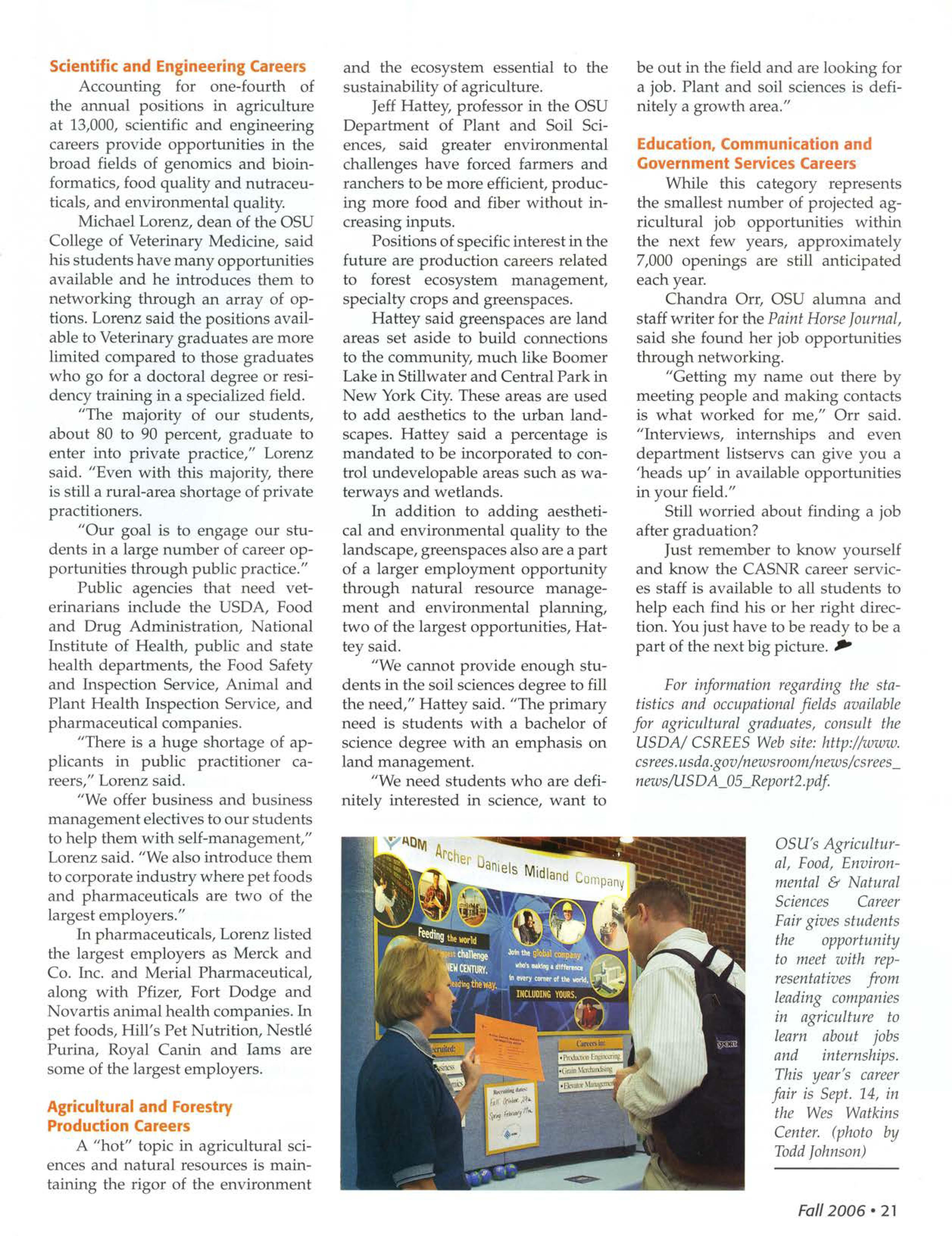
OSU's Agricultural, Food, Environmental & Natural Sciences Career Fair gives students the opportunity to meet with representatives from leading companies in agriculture to learn about jobs and internships. This year's career fair is Sept. 14, in the Wes Watki11s Center. (photo by Todd Johnson)
by MissyNilan, Oakland,Iowa
A cowboy nods his head, the chute gate opens and a bucking horse lunges into the arena, trying his best to buck off the cowboy. With each jump, kick and belly roll of the bucking horse, the cowboyresponds... orfalls.
Oklahoma State University Cowboys Luke Reed, Kyle Stein and Patrick Sievert began the 2004 fall semester - their senior year in agricultural engineering - working to help prepare cowboys for riding.
All OSU biosystems agricultural engineering senior are introduced to their year-long senior capstone project, BAE 4012 and BAE 4022 Biosystems and Agricultural Engineering Capstone, at the beginning of the fall semester and complete the project with a presentation at the end of the following spring semester. Reed,
Stein and Sievert had a unique project: design and build a bucking horse machine.
"I am always looking for intere ting, real-world projects for students to
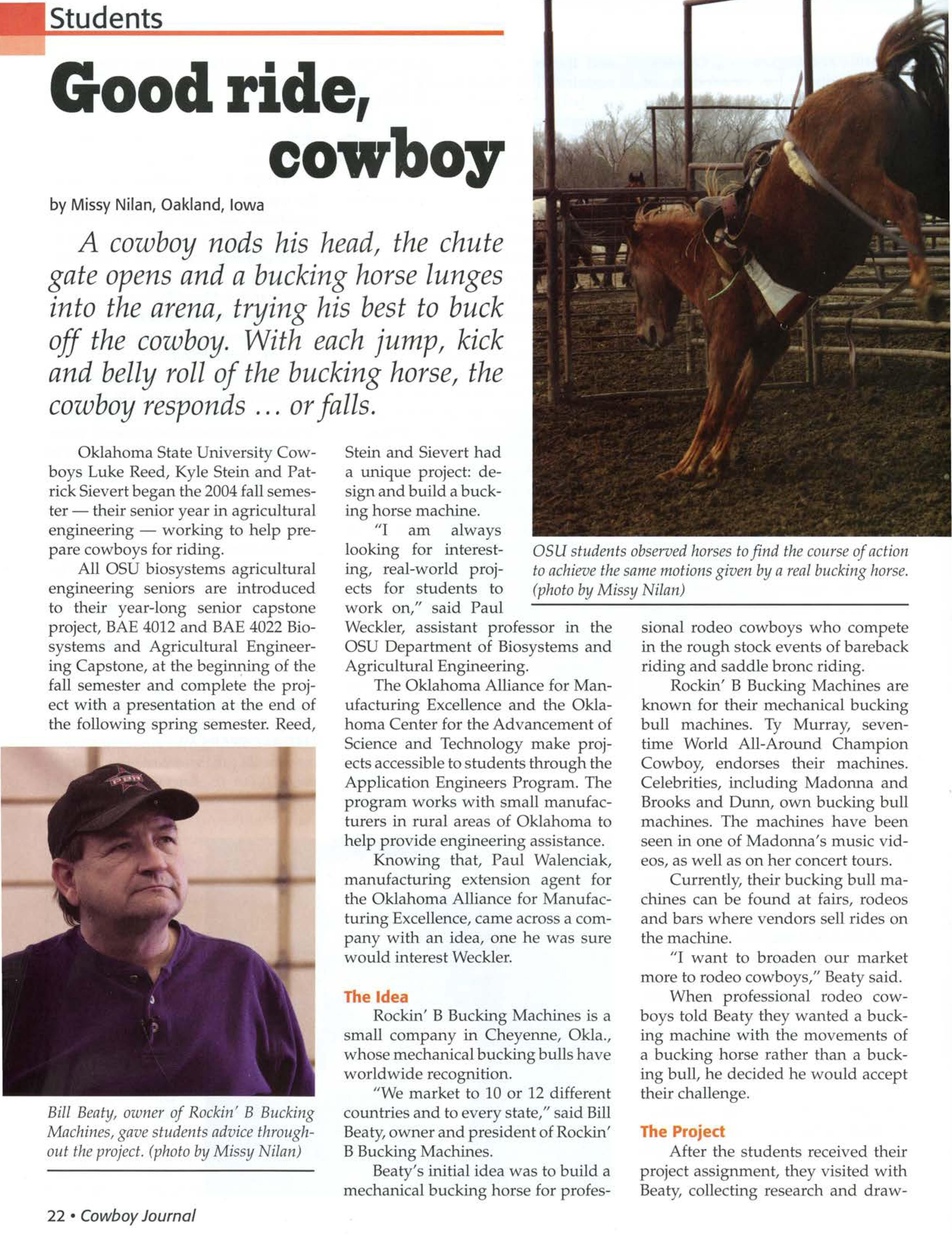
OSU students observedhorsestofind the courseof action to achievethe samemotionsgiven by a realbuckinghorse.
work on," aid Paul Weckler, assistant professor in the OSU Department of Biosystems and Agricultural Engineering.
The Oklahoma Alliance for Manufacturing Excellence and the Oklahoma Center for the Advancement of Science and Technology make projects accessible to students through the Application Engineers Program. The program works with small manufacturers in rural areas of Oklahoma to help provide engineering assistance.
Knowing that, Paul Walenciak, manufacturing extension agent for the Oklahoma Alliance for Manufacturing Excellence, came across a company with an idea, one he was ure would interest Weckler.
Rocl<in' B Bucking Machine is a small company in Cheyenne, Okla., whose mechanical bucking bulls have worldwide recognition.
"We market to 10 or 12 different count.rie and to every state," aid Bill Beaty, owner and pr sident of Rocl<in' B Bucking Machines.
Beaty' initial idea was to build a mechanical bucking horse for profes-
sional rodeo cowboys who compete in the rough stock events of bareback riding and saddle bronc riding.
Rockin' B Bucking Machines are known for their mechanical bucking bull machines. Ty Murray, seventime World All-Around Champion Cowboy, endorses their machines. Celebrities, including Madonna and Brooks and Dunn, own bucking bull machines. The machines have been seen in one of Madonna's music videos, as well as on her concert tours. Currently, their bucking bull machines can be found at fairs, rodeos and bars where vendors sell rides on the machine.
"I want to broaden our market more to rodeo cowboys," Beaty said.
When professional rodeo cowboys told Beaty they wanted a bucking machine with the movements of a bucking horse rather than a bucking bull, he decided he would accept their challenge.
After the students received their project assignment, they visited with Beaty, collecting research and draw-
ing plans using engineering computer programs.
"We designed the entire project in Pro Engineer and Pro Mechanica," Stein said.
The tu.dent found a bucking bronc executes different movements in comparison with a bucking bull.
"A bronc works off a vertical aspect, whereas a bull jumps from the front to rear legs in a pivoting motion," Stein said. "A horse gets completely off the ground."
The use of hydraulics was the students' first idea to power the needed movement for the bucking machine. However, hydraulics have a tendency to leak, and Beaty declined the idea.
"Most of the machines I sell are u ed in buiJdings," Beaty said. "I wouldn't sell nearly as many as I do if my machines leaked on the floors."
After discussion between using computer-controlled linear actuators, which convert electricity to mechanical force, or a pitman arm system, which is a series of rods and hafts used to change the direction of movement, much like what is used on Rockin' B's bucking bull machines, the students had a challenge.
"We researched both aspects, finding that we couldn't achieve the movement we needed with linear actuator without going overboard on price," Stein said. "Linear actuators cost $2,000 each, and this project required the use of three.
"With the total being around 6,000, not including the price of a computer control system we still had to design, the use of linear actuators was way out of the budget."
The tudents then were forced to approach the project by maximizing the lower technology approach and using a series of pitman arms.
With the project underway, the stud nts presented their findings and progress at the end of the fall 2004 semester. After the presentation, Beaty informed the students he wanted to change the project.
" ot only did he want a bucking horse, but also a horse that would simulate a riding horse," Wecl<lersaid.
Beaty wanted a mechanical horse
for people who wanted to ride without bucking. The new mechanical horse would walk, trot and canter like a regular hor e.
"The idea shifted the focu of the project," Stein said. "We had to be more accurate in our studies and research as to how a horse moves."
The change in the project made the students reevaluate their initial plan of action.
"We went from building a rude, crude and general motion bucking machine to a very accurate machine that could be something you can have at a workshop where kids can learn to ride," Stein said.
The students turned back to looking at videos of horses. They learned how a horse walks, trots and canters, as well as how their legs carry their movement through the animal. The only way for the students to achieve the exact data was to put a motion-detecting device on a hor e and record the data found through tests of walking, trotting and cantering a hor e.
Through research, the students found Michigan State University already had collected the needed data.
With all of the needed information at hand, the students decided a simple pitman arm system could not create all of the movement needed for all phases of the project: walk, trot, canter and buck. However, with the u e of additional cam mechanisms, which tell the machine what to do, it still could be possible. The customer buying the machine could buy only one cam, either one for riding or one for bucking.
With the use of simple control to adjust the p ed and the addition of a rotating base, the bucking hors machin was r ady to be tested on fellow college students.
"It brought quite a bit of attention when we took it to the Gamma Phi Beta house," Stein said. "It's really fun to know that at a flick of a button you can flip anyone off of the horse."
Beaty has yet to decide the future of the mechanical hor e. With the ability to market to two entirely different audiences, Beaty said he is happy with the quality of work.
"The machine could use some tweaking to smooth out the motion of the machine," Beaty said. "But without high demand right now, we have time to work out the glitches."
According to the students' preliminary research, the demand for riding training devices is not strong and the current machine is too expensive for a rodeo cowboy's income.
"We' re trying to decide if it is currently worth the effort to go ahead with it and, if we do, what direction to take," Beaty said.
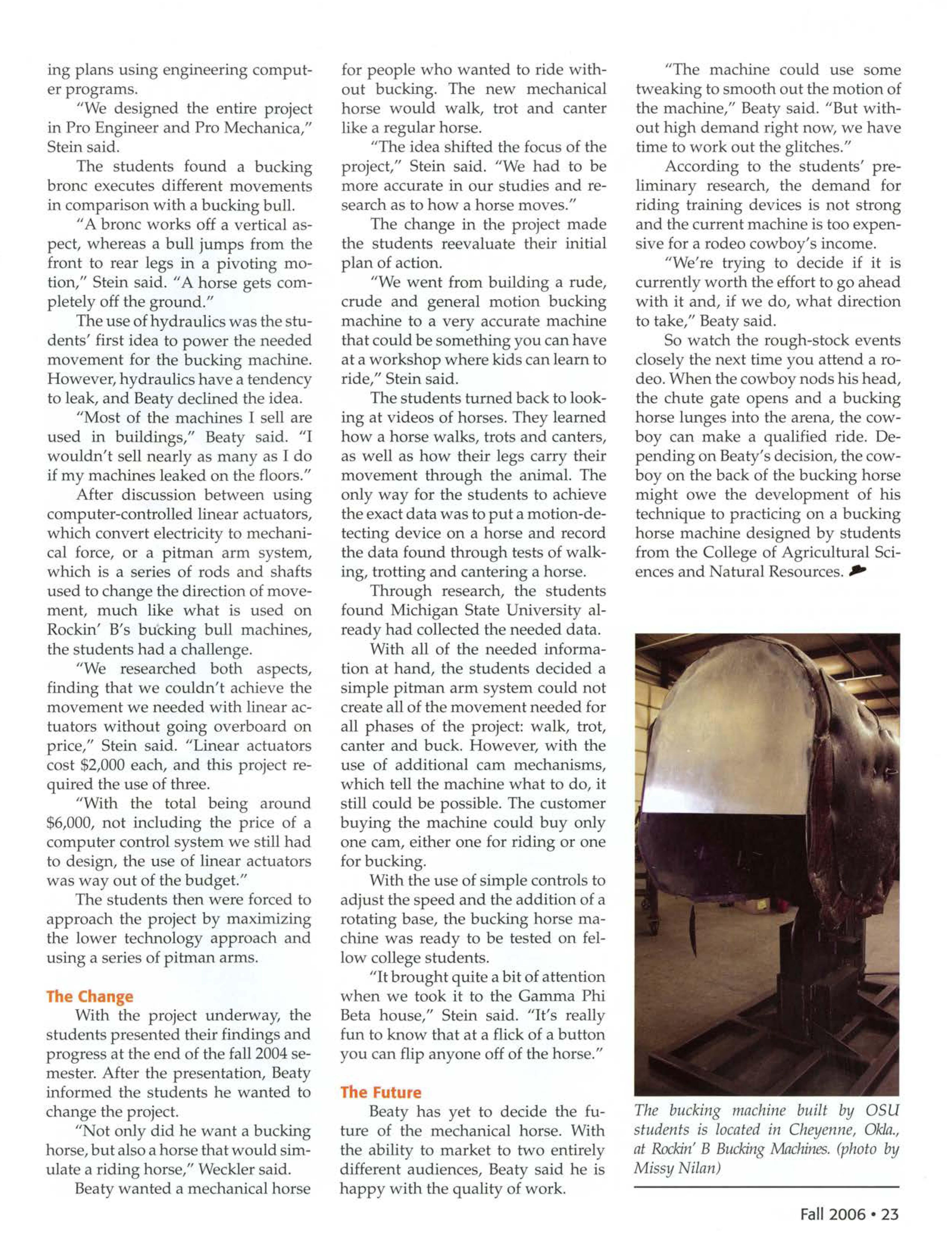
So watch the rough-stock events closely the next time you attend a rodeo. When the cowboy nods his head, the chute gate opens and a bucking horse lunges into the arena, the cowboy can make a qualified ride. Depending on Beaty's decision, the cowboy on the back of the bucking horse might owe the development of his technique to practicing on a bucking hor e machine designed by students from the College of Agricultural Sciences and atural Resou1·ces.JIii,
by BeckyRowles, Lander,Wyo.
Oklahoma State University is now "home" to many international students. They attend OSU because of its reputation in other countries, but what does it take for them to become Cowboys?
OSU has a prominent College of Agricultural Sciences and atural Resources. A of spring 2006, 2,231 students were enrolled in CASNR. Among those enrolled were 127 international graduate students.
"OSU is a very prestigious university in the USA," said Claudia Cerruto, food science master's student from Bolivia.
When international students come to OSU to pursue a master's or doctoral degree in agriculture, many say they hope to one day return to their homelands, help better rural lands and improve food safety.
"Think of the graduate program at OSU like a machine," said David Henneberry, assistant dean of international programs in agriculture. "The domestic students are the machine, and the international students are the sprockets that keep the machine running. Without the international students, OSU's graduate program would not be as strong as it is."
To be eligible for enrollment at OSU, an international student must go through a series of exams and applications that can take month to complete, according to the OSU Graduate College. The proce sis long and grueling, and many do not realize the extent of the process.
First, the students must apply to the OSU Graduate College and meet specific enrollment deadlines. The international admissions application can be completed online orb mailed to the student.
A $75 fee is due with the application. If the student is not accepted on the first try, a 25 fee will be charged for every additional application.
All transcripts or foreign mark sheets must accompany the application. If the student has received a diploma or a degree certificate, all verification is sent with the application.
Liliana Ramos, veterinarian and an international meat science master's student from Chihuahua, Mexico, came to OSU for an internship before applying to the OSU Graduate College for a degree from CASNR.
"I knew Dr. Henneberry from a trip he had made to Mexico," Ramos said. "Dr. enneberry invited me to tour the college and gave me the opportunity to come for an internship to learn the English language."
Ramos, like many other international students, had to learn Engli h before applying to OSU.
"I am fortunate that I hag. a emester at OSU before applying to the graduate college," Ramos said. "I got
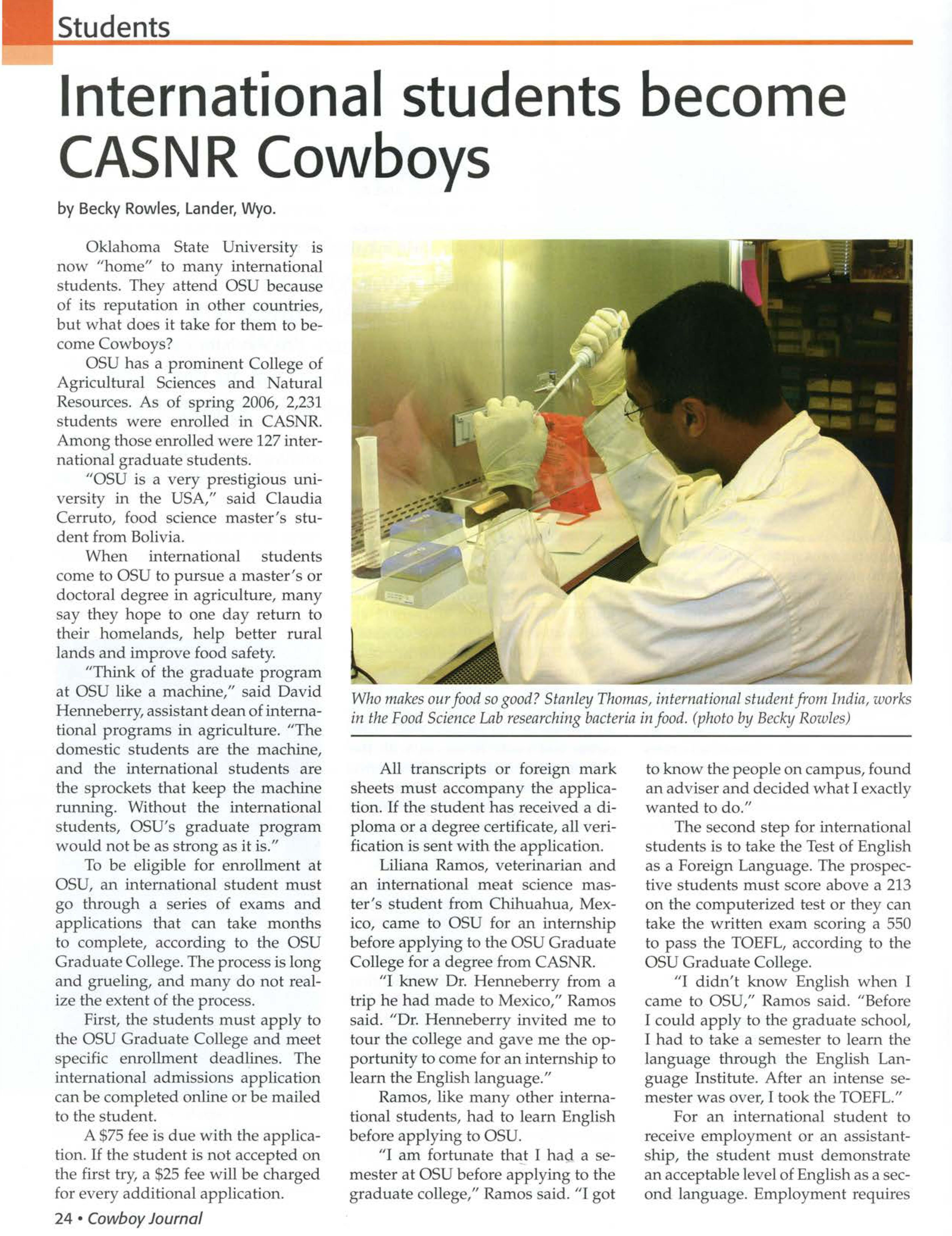
to know the people on campus, found an adviser and decided what I exactly wanted to do."
The second step for international students is to take the Test of English as a Foreign Language. The prospective students must score above a 213 on the computerized test or they can take the written exam scoring a 550 to pass the TOEFL, according to the OSU Graduate College.
"I didn't know English when T came to OSU," Ramos said. "Before I could apply to the graduate school, I had to take a emester to learn the language through the English Language Institute. After an inten e semester was over, I took the TOEFL."
For an international student to receive employment or an assistantship, the tudent must demonstrate an acceptable level of English as a second language. mployment requir s
demonstrated proficiency on the Test of Spoken English or by taking OSU' s version of the Spoken English Assessment Kit. The test score is used as a condition of employment and doesn't affect admission into the university.
"I ended up being very lucky," Ramos said. "I got an assistantship."
Once students pass both the TOEFL and the TSE, they must participate in the international teaching assistant orientation and evaluation workshop to teach in the classroom. After orientation, the students who pass the Spoken English Assement Kit and International Teaching Assistant tests will be eligible to teach.
After a student has applied to the university and passed the language tests, the third thing he or she must do is apply for a visa. Students have two options when applying for visas.
Students can apply for an F-1 visa, which allows them to stay in the United States and gain work experience upon graduation.
Students also can apply for a J-1 visa, which allows them to attend a
U.S. school, but must return to their country upon graduation.
"I applied for an F-1 visa because I was unsure what I wanted to do after graduation," Ramos said. "Food safety is a large concern in Mexico. 1 want to help improve our export relations and the safety of the food, and so I will return to Mexico."
After students have their visas, financial verification has to be shown.
"Students have to show that they have financial support, either in their bank account or through their government," Henneberry said.
The cost of education is high for international students. They have to demonstrate financial security to ensure the university they will be able to repay their financial obligations.
"I had to show that I had money in the bank to cover my expenses while at OSU before my visa would be issued," Ramos said.
International students are not eligible for U.S. financial assistance. Students are, however, able to apply for financial assistance through their
home country to help pay for their schooling. In addition, the students are eligible to work on campus or receive an assistantship that is paid through a grant.
"I received the Fulbright Scholarship to attend OSU from Bolivia," Cerruto said.
The experience an international student gains at OSU is memorable and will last a lifetime, said Linda Guenther, meats lab manager.
"The experience I have gained at OSU has been great," said Stanley Thomas, food science master's student from India. "I wouldn't trade my experience for anything."
Thomas is not the only international graduate student glad to be at OSU; Ramos agrees.
"OSU is famous in Mexico," Ramos said. "Everyone wants to come here to go to school." ,,.
For moreinformationabout internationaladmissions,calltileOSU Graduate Collegeat (405) 744-6368or visit www. gmdco/lege.okstate.edu.
by Jenny Matthews, Okarche, Okla.
If you dedicated your hands to Hunting for help
dubs help the community during the larger service or you lived to serve, Other clubs, like the newly holiday season. Another creative way chances are you were in a cornmu- formed Leadership League, chose CASNR has contributed to the comnity-service-oriented organization. a service-related theme, "Prevent- munity during the holidays is the Ag-
The College of Agricultural Sci- ing Hunger," and launched a service ricultural Student Council Christmas ences and Natural Resources sup- project, "Hunt for Hunger." Tree Philanthropy. ports organizations that value ser- "Poverty is a big issue," said "The Christmas trees were a vice. This is evident by the caliber of Ashley Marquart, animal science and unique idea with a significant impact community-service projects in which agricultural leadership junior. "So on the community," said Dwayne the students of CASNR participate. many different countries can't feed Cartmell, OSU agricultural commu-
"All of the organizations I am their people. The statistics on hun- nications assistant professor and Ag involved in have excellent commu- ger really made me realize that there Student Council senior adviser. "The nity-service programs," said Jona- needed to be something done." project was easy for several organizathon Knopfel, agricultural leadership Leadership League invited all tions to do. It helped to make the coljunior. "What I like about CASNR is CASNR organizations and individu- lege visible and spread holiday cheer being involved in organizations that als to participate in this event. Each throughout the community." are involved in the community." club was given an area of Stillwater Hobby Lobby of Stillwater donat-
Students who help the communi- to hunt for nonperishable food items. ed artificial Christmas trees to give to ty learn and grow outside and inside By the end of the night, 14 organiza- each student organization in CASNR. the classroom. Many organizations tions had collected 1,106 items from The trees were then decorated and base their values on this philosophy. Stillwater residents. donated to the Stillwater Housing
"One of Alpha Zeta's fraternal All the items were donated to Authority. The newly decorated trees goals is to be involved in the com- Mission of Hope, just in time for them were given to families in the commumunity in which we live," said Jenna to be sorted and distributed for the nity who could not afford Christmas Noah, animal science junior. "Mem- holiday season. The mission houses decorations. By using an artificial bers gain awareness of social issues homeless and needy residents and h·ee, the recipients can enjoy the tree and grow personally through helping helps these individuals find employ- year after year, Cartmell said. others in the community." ment in the Stillwater area.
"This is a project that has an
The activities Alpha Zeta selects Leadership League plans to hold impact on the receiver for years to each year change with what members the event again in October. come," Cartmell said. "They get to feel is important.
"I am really glad so many people keep the trees, so each year we are
"Each year the officer team selects were able to help us," Marquart said. helping a new set of people." the events Alpha Zeta will participate "I hope this year more organizations
Another holiday project unique in," Noah said. "Having six to eight will be able to participate." to CASNR is the Live Nativity Scene, community-service activities a year which Cowboys for Christ has put encourages members and pledges to Christmas time caring together on the Edmon Low Library get involved in the community."
The Hunt for Hunger is one way Lawn for the past 10 years. The mem-
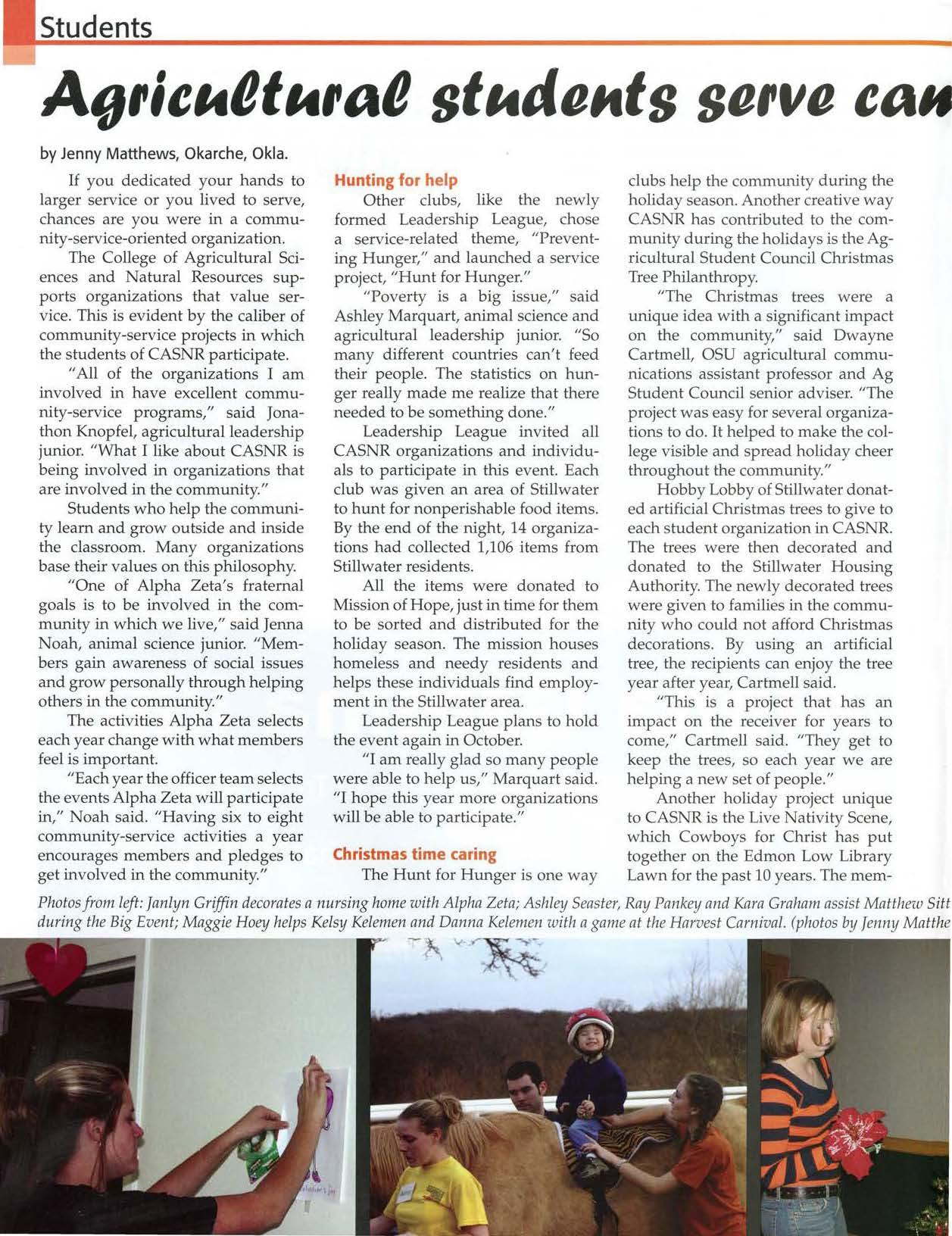
Photosfrom left:Janlyn Griffindecoratesa nursing homewith Alpha Zeta;Ashley $easter,Ray Pankeyand KaraGrahamassistMatthew Sitt during the Big Event;MaggieHoei;helpsKelsy Kelemenand Danna Kelemenwith a gameat the HarvestCarnival.(photosby Jenny Matthe
bers act out the nativity with live animals. It is free entertainment for anybody on campus or in the community who would like to attend.
"We do it to show our faith and a little bit about our organization to the community," said Chelsea Farris, animal science graduate. "We just want to do something nice for the Stillwater community."
National recognition
In addition to the personal satisfaction gained through community service, some CAS R clubs have received national recognition for their efforts. The Agricultural Communicators of Tomorrow received the 2005 ational Community Service Award from the ational Agricultural Communicators of Tomorrow.
"This award shows our involvement in the community," said Gail Banzet, agricultural communications senior. "It proves our commitment to the chapter and the com.m.Ltnity."
The Ronald McDonald House is ACT's national philanthropy. OSU ACT donated toiletry items and household supplies at the December club meeting. In the spring, ACT members collected pull-tabs from aluminum cans and donated money during the local 4-H Kids Helping Kid Campaign, which raises funds for RMH in Oklahoma.
OSU ACT members also served
as reading buddies at Highland Park Elementary and Sunnybrook Christian Academy. In this program, college students are paired with elementary students to read together for 30 minutes each week.
Several other organizations participated in reading buddies, and the program benefited everyone becau e of the one-on-one interaction between students, Banzet said.
Other opportunities to get involved
In addition to these communityservice programs, CASNR students also can participate in several campuswide community-service events throughout the year.
Into the Streets, which is in early ovember at OSU, is a national volunteer program that gives clubs, organizations and individuals an opportunity to give back to the community through service. OSU has consistently put on one of the largest and most active community-service efforts in the nation.
Fellowship and fund raising are the name of the game when it comes to Relay for Life. This American Cancer Society event is a nationwide community-service activity that brings cancer research to the forefront of everyone's mind. Stillwater holds different Relay for Life events, one in the fall for the community and one in the spring for the university.
The Big Event is a national service project sponsored by the Student Government Association. Each sp ·ing its goal is to get organizations to help the residents of Stillwater have a better place to live.
"The Big Event allows us to do something for someone who needs it," said Megan McConaghy, agribusiness senior. "If we aren't helping other people, we really aren't doing much for ourselves because you grow a lot when you put yourself aside."
Some students use their interests and kills to volunteer in the community on a weekly basis. One place agricultural tudents in particular can use their skills is at Turning Point Ranch.
Turning Point Ranch is a therapeutic riding center northeast of Stillwater. At the ranch, people with disabilities receive equine therapy.
"It is a valuable project because of the joy it brings to children who normally wouldn't have the opportunity," said Kristen Marcus, Turning Point Ranch volunteer and CAS R graduate. "Without volunteers, this program wouldn't exist."
one of these community-service programs would exist without the dedication of CAS student ' time and energy. Through their efforts, student continue to grow outside the classroom as they make a transition into the workforce.
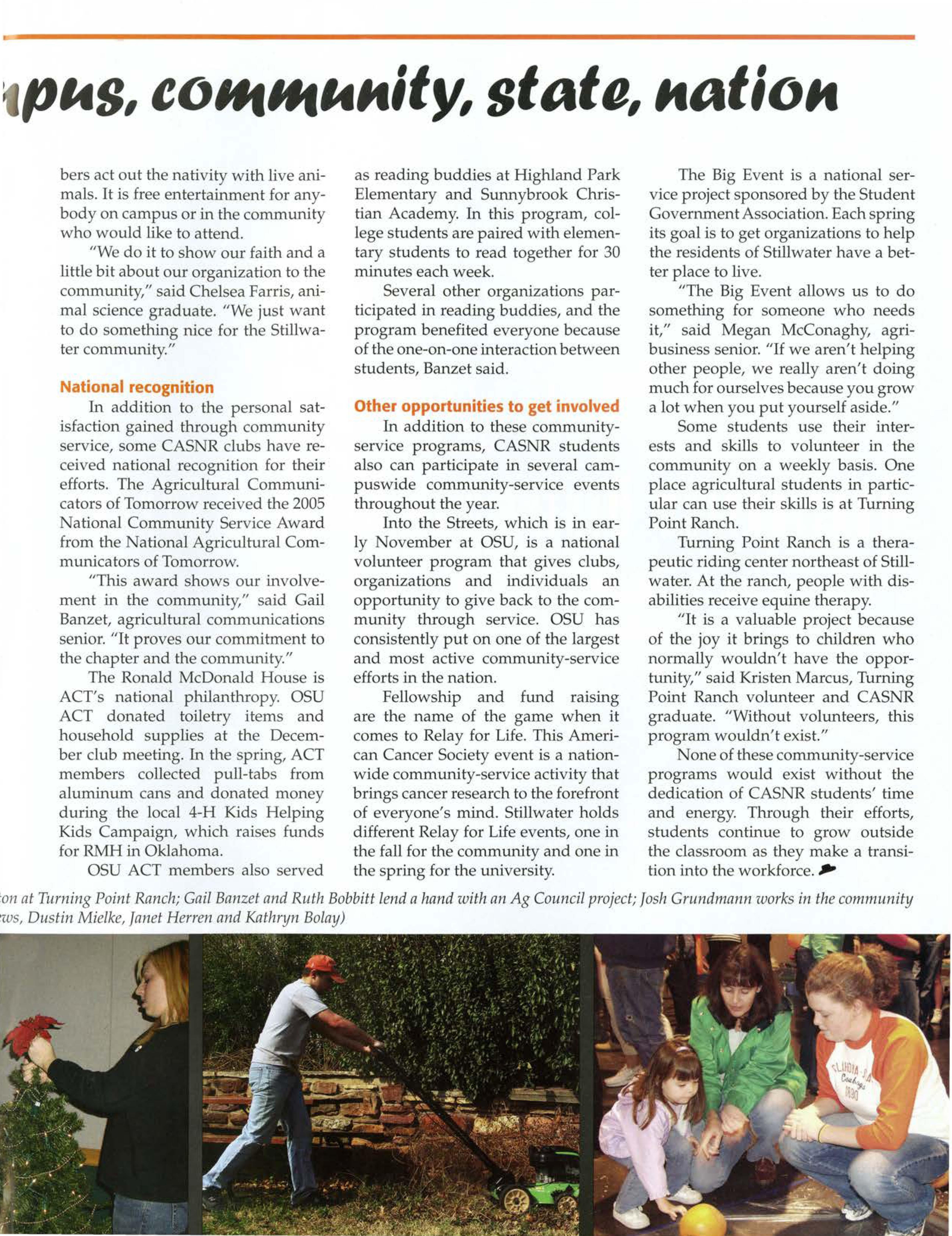
;onat Turning Point Ranch; Gail Banzef and Ruth Bobbittlend a hand with an Ag Councilproject;Josh Grundmann works in the community ws, Dustin Mielke,Janet Herren and Kathryn Bolay)
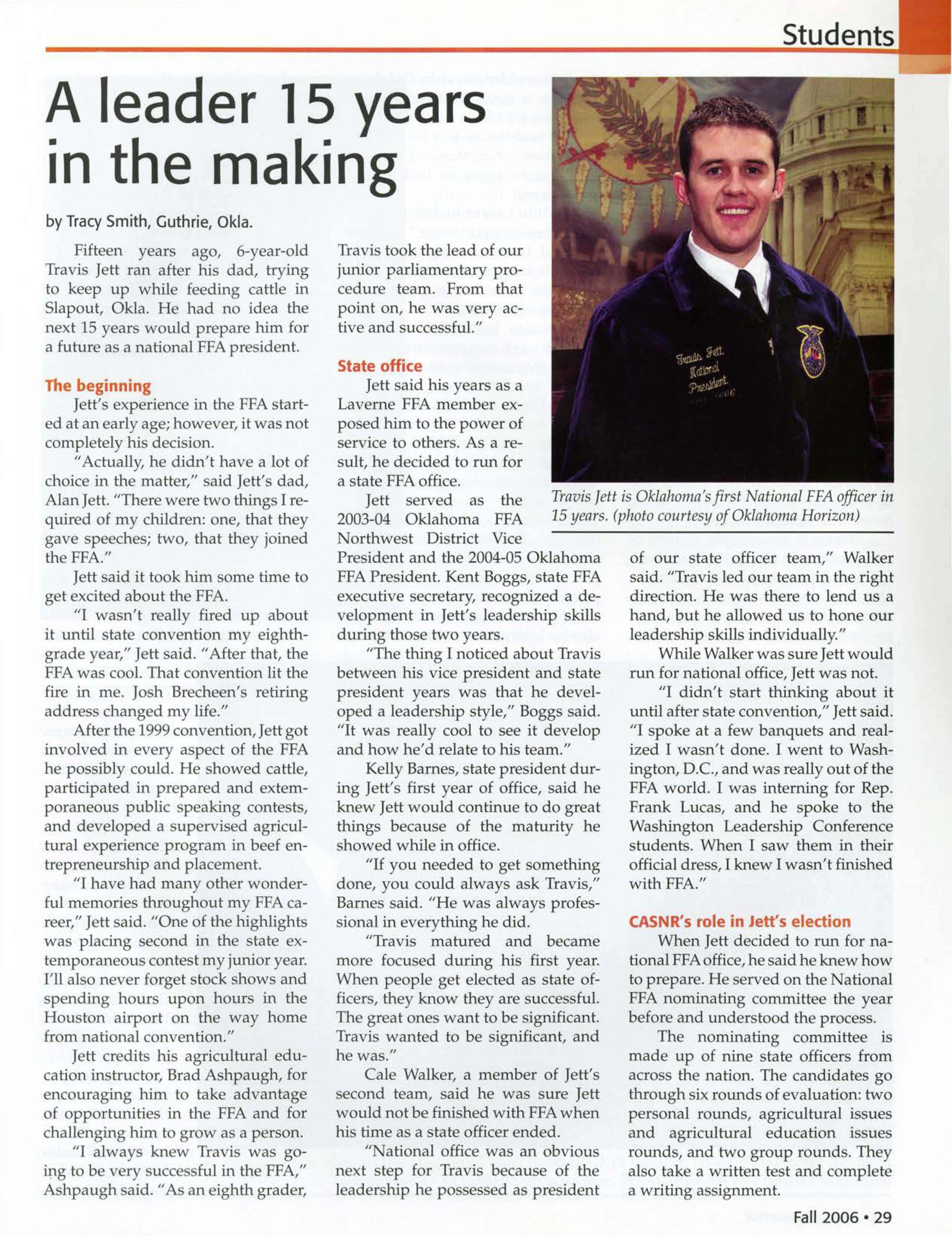
by TracySmith, Guthrie, Okla.
Fifteen years ago, 6-year-old Travis Jett ran after his dad, trying to keep up while feeding cattle in Slapout, Okla. He had no idea the next 15 years would prepare him for a future as a national FFA president.
The beginning
Jett's experience in the FFA started at an early age; however, it was not completely his decision.
"Actually, he didn't have a lot of choice in the matter," said Jett's dad, Alan Jett. "There were two things I required of my children: one, that they gave spe ches; two, that they joined the FFA."
Jett said it took him some time to get excited about the FFA.
"I wasn't really fired up about it until state convention my eighthgrade year," Jett said. "After that, the FFA was cool. That convention lit the fire in me. Josh Brecheen's retiring address changed my life."
After the 1999 convention, Jett got involved in every aspect of the FFA he possibly could. He showed cattle, participated in prepared and extemporaneous public speaking contests, and developed a supervised agricultural experience program in beef entrepreneurship and placement.
"I have had many other wonderful memories throughout my FFA career," Jett said. "One of the highlights wa placing econd in the state extemporaneous contest my junior year. I'll also never forget stock shows and spending hours upon hours in the Houston airport on the way home from national convention."
Jett credit his agricultural education instructor, Brad Ashpaugh, for encouraging him to take advantage of opportunities in the FFA and for challenging him to grow as a person.
"I always knew Travis was goip.g to be very successful in the FFA," Ashpaugh said." As an eighth grader,
Travis took the lead of our junior parliamentary procedure team. From that point on, he was very active and successful."
Jett said his years a a Laverne FFA member expo ed him to the power of service to others. As a result, he decided to run for a state FFA office.
Jett served as the 2003-04 Oklahoma FFA
years.
Northwest District Vice President and the 2004-05 Oklahoma FFA President. Kent Boggs, state FFA executive ecretary, recognized a development in Jett's leadership skills during those two years.
"The thing I noticed about Travis between his vice president and state president years was that he developed a leadership style," Boggs said. "It wa really cool to see it develop and how he'd relate to his team."
Kelly Barnes, state president during Jett' first year of office, aid he knew Jett would continue to do great things because of the maturity he howed while in office.
"li you needed to get something done, you could always ask Travis," Barnes aid. "He was alway professional in verything he did.
"Travi matured and became more focused during his first year. When people get elected as state officers, they know th y are successful. The great one want to b ignificant. Travi wanted to be ignificant, and he was."
Cale Walker, a member of Jett's second team, said he was sure Jett would not be finished with FFA when his time as a state officer ended.
" ationa1 office was an obvious next step for Travis because of the leadership he possessed as president
Oklahoma'sfirst
of
of our state officer team," Walker said. "Travis led our team in the right direction. He was there to lend us a hand, but he allowed us to hone our leadership skills individually."
While Walker was sure Jett would run for national office, Jett was not.
"I didn't start thinking about it until after state convention," Jett said. "I spoke at a few banquets and realized I wasn't done. I went to Washington, D.C., and was really out of the FFA world. I was interning for Rep. Frank Lucas, and he spoke to the Washington Leadership Conference students. When I aw them in theiI official dress, I knew I wa n't finished with FFA."
CASNR'srole in Jett's election
When Jett decided to run for national FFAoffice, he said he knew how to prepare. He served on the ational FFA nominating committee the year before and understood the process.
The nominating committee is made up of nine state officers from across the nation. The candidates go through six rounds of evaluation: two personal rounds, agricultural issues and agricultural education issues rounds, and two group rounds. They also take a written test and complete a writing assignment.
Jett laughs as he thinks back to his preparation for the process.
"When I decided to run, I decided I was going full-out," Jett said. "I wanted to be burnt out from studying by the time I got to convention, and l was. I only took Tuesday /Thur day classes and studied for the process six to eight hours a day."
Several students, faculty and organizations in the College of Agricultural Sciences and atural Resources helped Jett with his preparation.
"I worked with several professors," Jett said. "One in particular was Dr. [Larry] Sanders. He spent a lot of time out of class working with me on agricultural policy issues. I also met with Dr. [Craig] Edwards and talked about agricultural education topics."
Sanders said Jett easily caught on to class discussions and was able to assess the issues and speak about them in an effective manner.
"Travis is an example of mo t of our students in the agricultural economics department," Sanders said. "We are deep in capable students who are dedicated to service. You can go into any class in Ag Hall and find
the be t and brightest in Oklahoma. Travi is a good example of why I love what I do."
Jett said the courses he took gave him a basic understanding of the issues, but he knew he had to dig a little deeper.
"I djdn't want to just memorize the issues in agriculture," Jett said. "Instead, I wanted to figure out what made them issues. r wanted to have all of the facts and a great understanding of the issues."
Jett also honed his leadership skills through campus activities such as the Homecoming Steering Committee, Speakers Board, President's Leadership Council, Student Alumni Board, Agricultural Student Council and Alpha Gamma Rho fraternity. Jett credits CAS R organizations for much of the development of his leadership skills.
"I learned a lot about leadership through Ag Student Council," Jett said. "One of the best things that happened to me was getting beat for vice president of student affairs. l realized that I was falling into the 'campusclimber' category. I was in some club
and activitie that didn't interest me. Losing that election made me decide to participate in things because I cared about them. A lot of doors opened up from that decision."
During his prepai-ation time, Jett also spoke with people who had gone through the nominating process.
"The best advice I received was that you are not preparing for the process, you are preparing to be a national officer," Jett said. "It made a big difference in the way I prepared."
Jett said he did thjs by making personal gains in four areas of his life: piritually, mentally, physically and emotionally. Regardless of the outcome, he wanted to walk away from the process as a better person.
Jett walked away as the 2005-06 ational FFA President.
"They read off the results of the four regional vice president officers and my name wasn't called, then national secretary and again no name, and then the presidency," Jett said. "It was very nerve-racking."
The Oklahoma FFA officer team kept track of the elected national officers' regions.
"They called two people from the central region, which is the region Oklahoma is in," said Austin Horn, 2005-06 Oklahoma State FFA Reporter.
"We thought there was no way they would pick three from the same region with there being six officers total. Ow· hearts were sinking, but we still had hope."
Boggs said he also was aware the chances were somewhat slim.
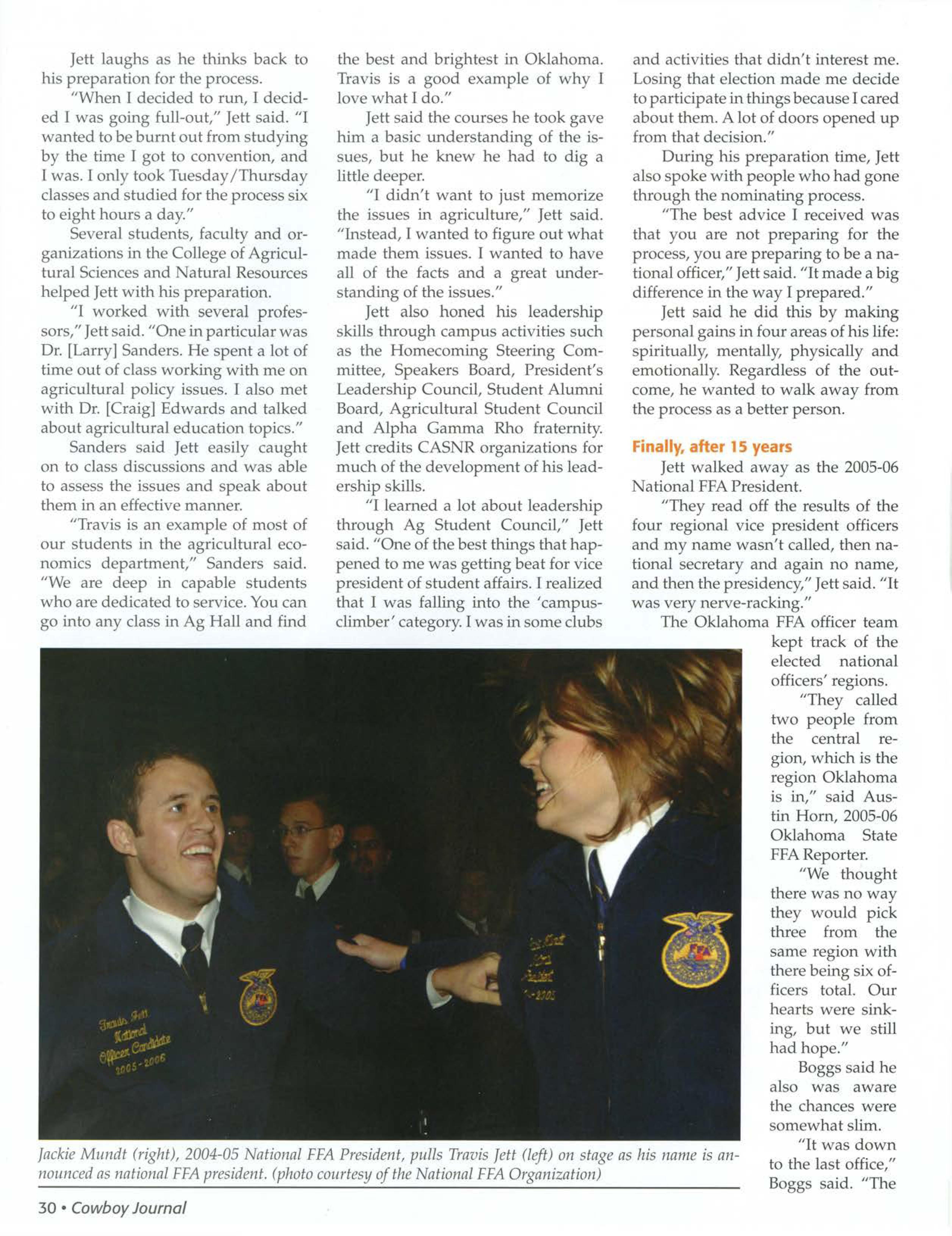
JackieMundt (right), 2004-05 National FFA President,pulls TravisJett (left) on stage as his name is announcedas nationalFFApresident.(plwtocourtesyof the NationalFFA Organization)
"It was down to the last office," Boggs said. "The
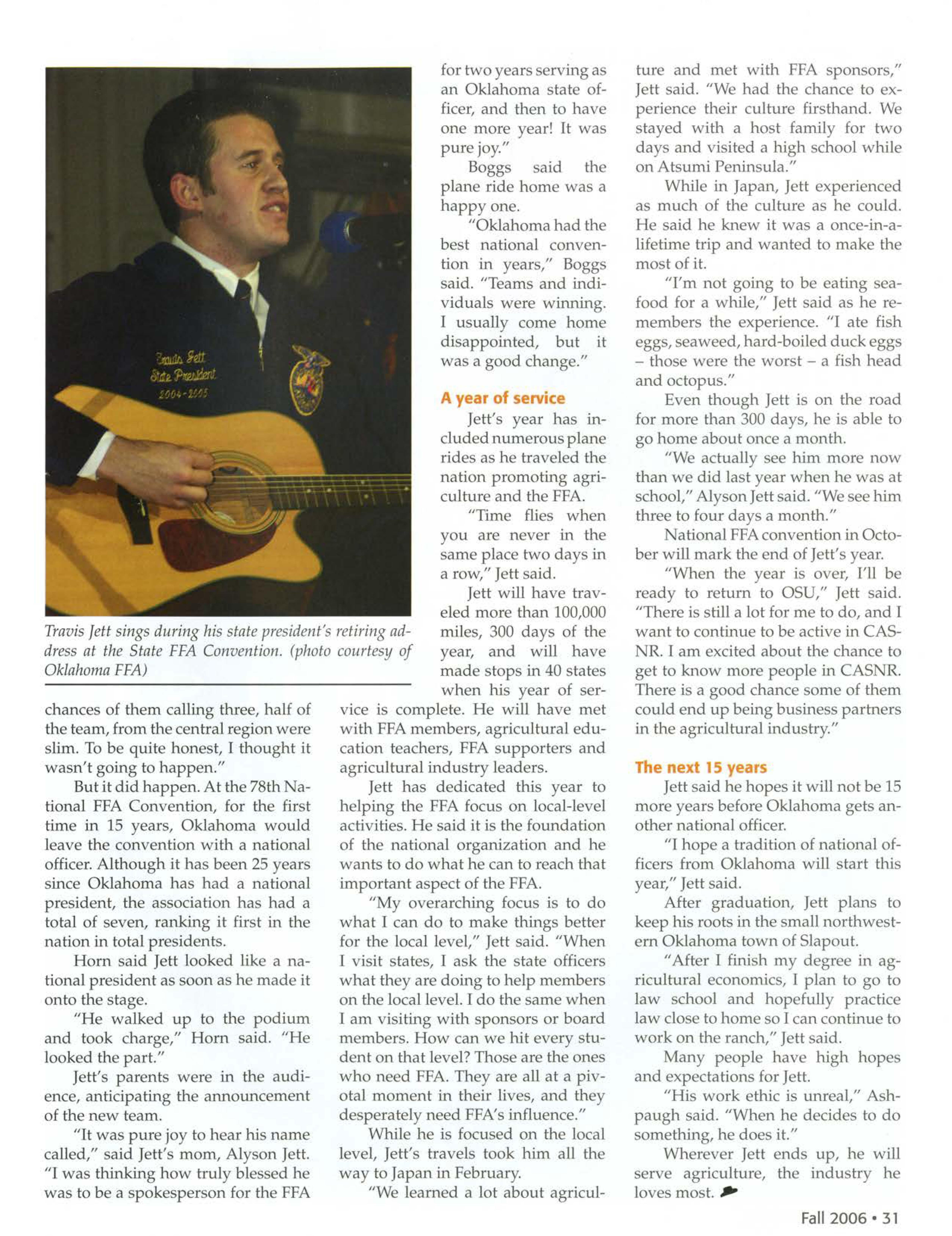
TravisJett sings during his state president'sretiringaddress at the State FFA Convention.(photocourtesy of OklahomaFFA)
chances of them calling three, half of the team, from the central region wer slim. To be quite honest, I thought it wasn't going to happen."
But it did happen. At the 78th National FFA Convention, for the fir t time in 15 years, Oklahoma would leave the convention with a national officer. Although it has been 25 year since Oklahoma ha had a national pr sident, the association has had a total of seven, ranking it first in the nation in total presidents.
Horn said Jett looked like a national president as soon as he made it onto the stage.
"He walked up to the podium and took charge," Hom aid. "He looked the part."
Jett's parents were in the audience, anticipating the announcement of the new team.
"It was pure joy to hear his name called," said Jett's mom, Alyson Jett. "I was thinking how buly blessed he was to be a spokesperson for the FFA
for two years erving a an Oklahoma state officer, and then to have one more year! It was pure joy."
Boggs aid the plane ride home was a happy one.
"Oklahoma had the best national convention in year ," Boggs said. "Teams and individuals were winning. I usually come home di appointed, but it was a good change."
Jett' year has included numerou plane rides as he b·aveled the nation promoting agriculture and the FF . "Time flies when you are never in the same place two days in a row," Jett aid.
Jett will have traveled more than 100,000 miles, 300 days of the year, and will have made stops in 40 state
when hjs year of service is complete. He will have met with FFA members, agricuJtural education teachers, FFA supporters and agricultural indu try leaders.
Jett has dedicated this year to helping the FFA focus on local-level activities. He said it is the foundation of the national organization and he wants to do what he can to reach that important aspect of the FFA.
"My ov rarching focu is to do what I can do to make thing better for the local level," J tt aid. "When I visit states, I ask the state officers what they are doing to help members on the local level. I do the same when I am visiting with spon ors or board m mbers. How can we hit every student on that level? Those are the ones who need FFA. They are all at a pivotal moment in th ir liv s, and they desperately need FFA's influence."
While he is focu ed on the local level, Jett' travels took him all th way to Japan in February.
"We learned a lot about agricul-
ture and met with FFA spon or ," Jett sajd. "We had the chance to exp rience their cultur firsthand. We tayed with a host family for two days and visited a high school while on t umi Peninsula."
While in Japan, Jett experienced as much of the cultur a he could. He aid he knew it was a once-in-alifetime trip and wanted to make the most of it.
'Tm not going to be eating seafood for a while," Jett said as he remembers the experience. "I ate fish egg , seaweed, hard-boiled duck eggs - those were the wor t - a fish head and octopus."
Even though Jett is on the road for more than 300 days, h is able to go home about once a month.
"We actually see him more now than we did last year when he was at school," AJy on Jett aid. "We e him three to four days a month."
ational FFAconvention in October will mark the end of Jett's year.
"Wh n the year is over, I'll b ready to return to OSU," Jett said. "There i still a lot for me to do, and 1 want to continue to be active in CASNR. I am excited about the chance to get to know more people in CASNR. There i a good chance some of them couJd end up being bu ine s parh1ers in the agricultural ind us try."
Jett said he hope it will not be 15 mor y ars b fore Oklahoma gets another national officer.
"I hop a tradition of national officers from Oklahoma will tart this year," Jett aid.
After graduation, Jett plans to keep his root in the small northwestern Oklahoma town of Slapout.
"After I finish my degree in agricultura I conomic , l plan to go to law school and hopehtlly practice law clo e to home so I can continue to work on the ranch," Jett aid.
Many people have high hopes and exp ctation for Jett.
"His work ethic is unreal," Ashpaugh aid. "When he d cides to do something, he does it."
Wher v r Jett end up, he will serve agriculture, the industry he loves rn t.

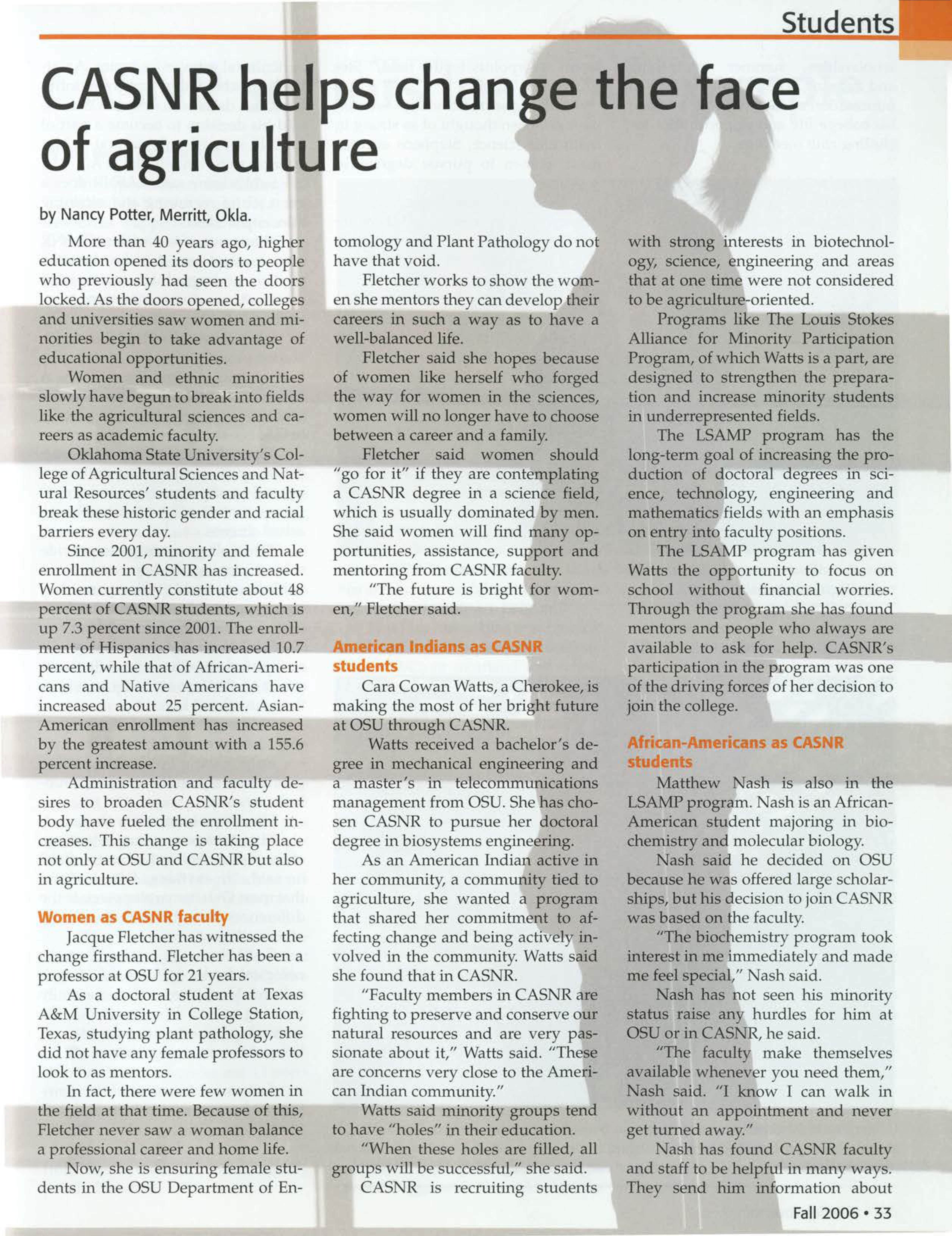
by Nancy Potter, Merritt, Okla.
More than 40 years ago, higher education opened its doors to people who previously had seen the doors locked. As the doors opened, colleges and universities saw women and minorities begin to take advantage of educational opportunities.
Women and ethnic minorities slowly have begun to break into field like the agricultural science and careers as academic faculty.
Oklahoma State Univer ity's College of Agricultural Sciences and atural Resources' students and faculty break these historic gender and racial barriers every day.
Since 2001, minority and female enrollment in CAS R has increased. Women currently constitute about 48 percent of CASNR students, which is up 7.3 percent since 2001. The enrollment of Hi panics ha increa ed 10.7 percent, while that of African-Americans and ative Americans have increased about 25 perc nt. A ianAmerican enrollment has increased by the greate t amount with a 155.6 percent increase.
Administration and faculty desires to broaden CAS R's student body have fueled the enrollment increases. Thi change is taking place not only at OSU and CASNR but also in agriculture.
Jacque Fletcher ha witnessed the change firsthand. Fletcher has been a professor at OSU for 21 years.
As a doctoral student at Texas A&M University in College Station, Texas, studying plant pathology, she did not have any female professors to look to as mentors.
In fact, there were few women in the field at that time. Because of this, Fletcher never aw a woman balance a professional career and horn life. ow, she is ensuring female tudents in the OSU Department of En-
tomology and Plant Pathology do not have that void.
Fletcher works to show the women she mentors they can develop their careers in such a way as to have a well-balanced life.
Fletcher said he hopes becau e of women like herself who forged the way for women in the sciences, women will no longer have to choo e between a career and a family.
Fletcher said women should "go for it" if they are cont mplating a CAS R degree in a science field, which is usually dominated by men. She said women will find many opportunities, assistance, support and mentoring from CAS R faculty.
"The future is bright for women," letch r aid.
Cara Cowan Watts, a Cherokee, is making th most of her bright future at OSU through CASNR.
Watts received a bachelor's degree in mechanical engineering and a master's in tel communications management from OSU. She has chosen CASNR to pursue her doctoral degree in biosystems engineering.
As an American Indian active in her community, a community tied to agriculture, she wanted a program that hared her commitment to affecting change and being actively involved in the community. Watts said she found that in CAS R.
"Faculty member in CAS R are fighting to preserve and conserve our natural resource and are very passionate about it," Watts said. "These are concerns very clo e to the American Indian community."
Watts said minority groups tend to have ,rhole "in their education.
"When these hol s are filled, all groups will be ucc sful," he aid.
CAS is recruiting tudent
with strong interests in biotechnology, science, engineering and areas that at one time were not considered to be agriculture-oriented.
Programs like The Louis Stokes Alliance for Minority Participation Program, of which Watts is a part, are designed to strengthen the preparation and increase minority students in underrepresented fields.
The LSAMP program has the long-term goal of increasing the production of doctoral degrees in science, technology, engineering and mathematics field with an emphasis on entry into faculty positions.
The LSAMP program has given Watts the opportunity to focus on school without financial worries. Through the program h ha found mentors and people who always are available to ask for help. CASNR' participation in the program wa one of the driving forces of her decision to join the college.
African- encans as CASNR s Matthew ash • al o in the LSAMP program. ash is an AfricanAmerican student majoring in biochemistry and molecular biology. ash said he decided on OSU becau e he was offered large scholarships, but his decision to join CASNR was based on the faculty.
"The biochemi try program took interest inme immediately and made me f el p cial," Nash said.
ash has not seen his minority status raise any hurdles for him at OSU or in CAS , he said.
"The faculty make themselves available whenev r you need them," ash said. "I know [ can walk in without an appointment and never get turned away."
ash ha found CASNR faculty and taff to be helpful in many way . They send him information about
scholarships, summer internships and tu taring. They also alert him to inforrna tion on how to better manage his college life and opportunities including club meetings.
Kristin Stephens knows she is one of the few women at OSU studying engineering, but she does not seem to notice. She is an undergraduate in the OSU Department of Biosystems and Agricultural Engineering, where she serves as the president of the student section of The Society of Agricultural and Biological Engineers.
Stephens grew up interested in farm machinery and always wanted to study mechanical systems. She found CASNR provided a welcome and friendly atmosphere and an education that fit her interests.
Stephens said CASNR is open to her as a woman and the faculty is helpful. She said she has never felt she was at a disadvantage in the mostly male engineering field.
"In fact, I have found I have an advantage over my male counterparts because I am able to bring di£-
ferent viewpoints to the field," Stephens said.
Although traditionally women have not been thought of as strong in math and science, Stephens encouraged women to pursue degrees m such fields.
"Don't let stereotypes scare or deter you," Stephen aid. "There are many opportunities for women.
"I have never felt at a disadvantage because I am a woman."
Organizations focused on high school students also are helping to reshape stereotypes in agriculture. FFA, for example, now offer scholarships to minorities wishing to pursue studies in agriculture.
Tony Subketkaew had an agricultural background in the FFA during high school and said he wanted to do something agriculturally related when he got to college. The agricultural economics major fits his career interests perfectly.
'Tm glad I found the right fit," Subketkaew said.
Subketkaew, who is Thai, is an
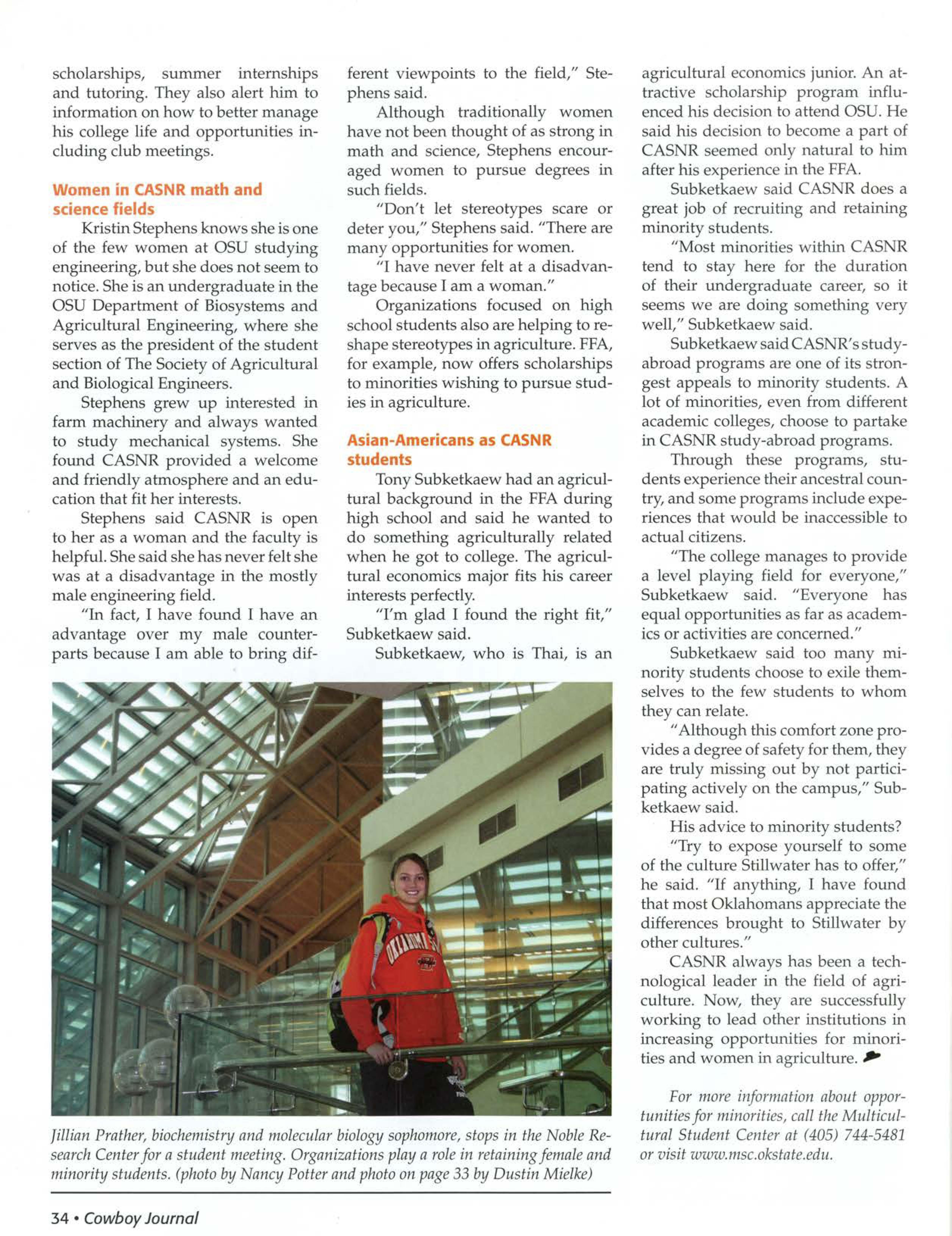
agricultural economics junior. An attractive scholarship program influenced his decision to attend OSU. He said his deci ion to become a part of CAS R seemed only natural to him after his experience i:n the FFA.
Subketkaew said CASNR does a great job of recruiting and retaining minority students.
"Most minorities within CAS R tend to stay here for the duration of their undergraduate career, so it seems we are doing som thing very well," Subketkaew said.
Subketkaew aidCASNR'sstudyabroad programs are one of its strongest appeals to minority students. A lot of minorities, even from different academic colleges, choose to partake in CASNR study-abroad programs.
Through these programs, students experience their ancestral country, and some programs include experiences that would be inaccessible to actual citizens.
"The college manages to provide a level playing field for eve yone," Subketkaew said. "Everyone has equal opportunities as far as academics or activities are concerned."
Subketkaew said too many minority students choose to exile themselves to the few tudents to whom they can relate.
"Although this comfort zone provides a degree of safety for them, they are truly mi sing out by not participating actively on the campus," Subketkaew said.
His advice to minority students?
"Try to expose yourself to some of the culture Stillwater has to offer," he said. "If anything, I have found that most Oklahomans appreciate the differences brought to Stillwater by other cultures."
CAS R always has been a technological leader in the field of agriculture. ow, they are successfully working to lead other institutions in increasing opportunities for minorities and women in agriculture.,.
For more ilifonnation about opportunitiesfor minorities,call the Multicultural Student Center at (405) 744-5481 or visit www.msc.okstnte.ed11.
by Jen Biser,Keymar,Md.
Ten seniors from the College of Agricultural Sciences and Natural Resources capped their experience at Oklahoma State University by receiving Top 10 Senior honors at the college's annual banquet.
Jordan Russell from Freedom, Okla., received the Paul Hummer Outstanding Senior Award for his leadership and accomplishments.
"OSU and the College of Agricultural Sciences and atural Resources have opened many doors," Russell said, describing what OSU has afforded him.
While at OSU, Russell studied in Europe, served a a Congressional intern in Washington, D.C., "meeting friends who will last a lifetime."
As an agribusiness major with an emphasis in pre-law and a minor in political science, Russell is well on hjs way to achieving his dreams.
On campus, Russell was an active member of the Agricultural Student Cow1cil, Student Government Association, Alpha Gamma Rho fraternity and Student Alumni Board.
Russell attributed his experiences from his hometown for his leadership skills and desire to give to others.
"I come from a small town," Russell said. "The same people you see at home are the same people who you see helping others, which has taught me to serve and act selflessly."
Russell thanked his grandparents for teaching him what it means to give to others.
"They have led by example," he said. "They taught me it's important to be involved, to be a respected commllllity member and to keep the community running."
This summer, Russell participated in an OSU Agricultural Leadership Encounter where he and 12 peers from OSU .immersed themselves into the Brazillian culttue for two weeks. The tour was accompanied by Oklahoma agricultural industry leaders from across the state, including key political leaders.
Thi fall, Rus ell ha two options: to accept a policy position in Washington D.C.; or to attend law school at the University of Oklahoma.
Russell's long-term plans are to pmsue a career at a financial institution focusing on financial and estate planning and help rural economic development efforts in Oklahoma.
Although th future has many options, Russell still has his family to support him. He said even if his plan do not work out, he can always help at the Rus ell family cattl ranch and work for his grandfather in the family-owned and operated Freedom State Bank.
Four CAS R seniors joined Russell in March to receive the Dean Fred LeCrone Leadership Award: Ashleigh Boggs, Michael Albert, Ashley Nichols and Zachary Pogue.
Boggs grew up in Cyril, Okla., and remembered who has stood behind her during her time at OSU.
"I would like to thank my parents, grandparent , friends and collegiate mentors for being constant sources of inspiration and encouragement," Boggs said. "I would also like
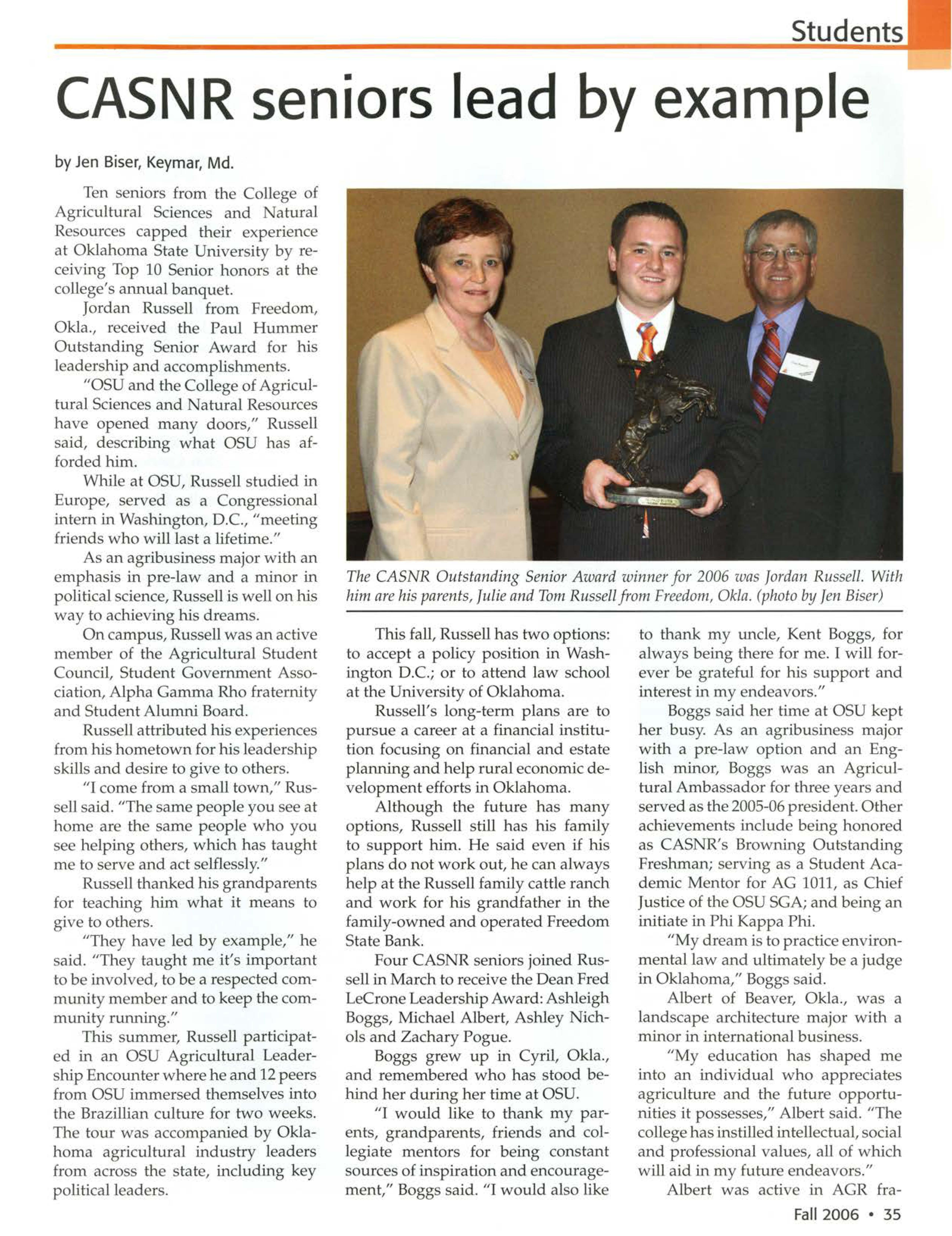
to thank my uncle, Kent Boggs, for always being there for me. I will forever be grateful for his support and interest in my endeavors."
Boggs said her time at OSU kept her busy. As an agribusiness major with a pre-law option and an English minor, Bogg was an Agricultural Ambassador for three years and erved as the 2005-06president. Other achievements include being honored as CASNR' Brownjng Outstanding Freshman; serving as a Student Academic Mentor for AG 1011, as Chief Justice of the OSU SGA; and being an initiate in Phi Kappa Phi.
"My dream is to practice environmental law and ultimat ly be a judge in Oklahoma," Boggs said.
Albert of Beaver, Okla., was a landscape architecture major with a minor in international busine s.
"My education has shaped me into an individual who appreciates agriculture and the future opportunities it posses es," Albert said. "The college has instilled intellectual, social and professional values, all of which will aid in my future end avors."
Albert was active in AGR
Ten students earnedOutstanding Seniorhonorsat tl1e2006 CASNR nnnual banquet:
MichaelAlbert (backleft), Ashleig/1Boggs,ZacharyPogue,JordanRussell, Jess Waddell, GraceHale (front left), TraciHarp,Ashley Nichols,LauraTownleyand TylerDenn (not pictured).(photoby Jen Biser)
ternity and the Agricultural Student Council, served as a Student Academic Mentor, Jed the unJversity as the executive director of Homecoming and served as the OSU president of Sigma Lambda Alpha ational Honor Society.
Albert's accomplishments included the Romshe Outstanding Undergraduate Senior Award, the Mo el Top GPA Senior Award and an American Society of Landscape Architects award for design; he also was selected as an OSU Leadership Legacy and a Sernor of Significance.
In addition to rus on-campus acti.vities, Albert participated in i.nternships in China and Poland.
ichols of McAlester, Okla., said an education includes being involved in activities outside the classroom.
As a pre-veterinary major, ichols personified thi perspective through her involvement with oncampus activities: The Pre-Vet Medicine Club, Freshmen In Tran ition, Student Academic Mentor, Alpha Zeta and the CASNR Scholar rup and Awards Committee.
ichols said Agricultural Amba36 • Cowboy Journal
sador allowed her the opportunity to give back to the university, college and department that "provided her with so much support."
A an applicant to the OSU Center for Veterinary Health Sci nc s, ichols' passion to be involved in the agricultural industry and desire to be challenged will be the driving force to help her through veterinary school and into the future.
Pogue, of Velma, Okla., majored in animal science and minored in agricultural economics.
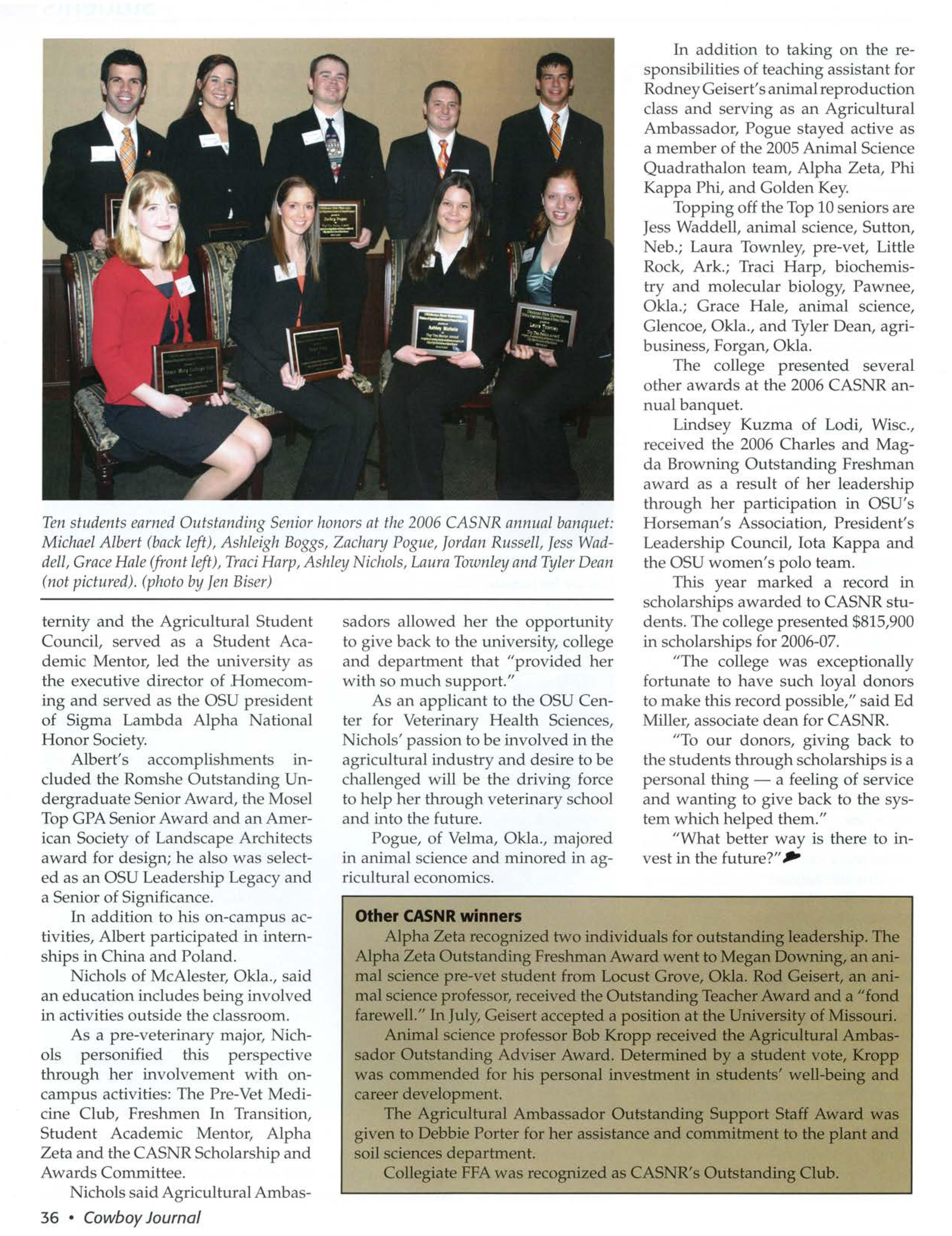
In addition to taking on the responsibilities of teaching assistant for Rodney Gei ert's animal reproduction clas and ser ing as an Agricultural Amba sador, Pogue stayed active as a member of the 2005 Animal Science Quadrathalon team, Alpha Zeta, Phi Kappa Pru, and Golden Key.
Topping off the Top 10 seniors are Jess Waddell, animal science, Sutton, eb.; Laura Townley, pre-vet, Little Rock, Ark.; Traci Harp, biochemistry and molecular biology, Pawnee, Okla.; Grace Hale, animal science, Glencoe, Okla., and Tyler Dean, agribusiness, Forgan, Okla.
The college presented several other awards at the 2006 CASNR annual banquet.
Lindsey Kuzma of Lodi, Wisc., received the 2006 Charles and Magda Browning Outstanding Freshman award as a result of her leadersrup through her participation in OSU's Hor eman's Association, President's Leadership Council, Iota Kappa and the OSU women's polo team.
This year marked a record in cholarsrups awarded to CASNR students. The college presented $815,900 in scholarships for 2006-07.
"The college was exceptionally fortunate to have such loyal donors to make this r cord possible," said Ed Mille1~associat dean for CASNR.
"To our donors, giving back to the students through scholarships is a personal thing - a feeling of service and wanting to give back to the syst m which helped them."
"What better way i there to invest in the future?",.
Alpha Zeta recognized two individuals for outstanding leadership. The Alpha Zeta Outstanding Freshman Award went to Megan Downing, an animal science pre-vet student from Locust Grove, Okla. Rod Geisert, an animal science professor, received the Outstanding Teacher Award and a "fond farewell." In July, Geisert accepted a position at the University of Missouri. Animal science profes or Bob Kropp received the Agricultural Ambassador Outstanding Adviser Award. Determined by a student vote, Kropp was commended for his per onal investment in students' well-being and career development.
The Agricultural Ambassador Outstanding Support Staff Award was given to Debbie Porter for her assistance and commitment to the plant and soil sciences department. Collegiate FFA was recognized as CAS R's Outstanding Club.
by Wesley Watson, Piedmont, Okla.
Sometimes, you do not know what you have until it is gone. ot so for Oklahoma State University's Arthropod Mu um, but the 80-year-old resource is in danger of extinction.
Established in 1924, the OSU Arthropod Museum has been a staple of the entomology d partment for reearch and extension.
"The museum is an invaluable resource for students, faculty and the public," said Andrine Morrison, entomology graduate student.
The Arthropod Museum began in its own illuminated apiary; the building's perforated ides allowed the capture of nocturnal insects.
The museum's collections were relocated to Life Sciences East in 1964 and were moved to Life Science West in 1972. Since 1990, the museum has been in the oble Research Center.
"The Noble Research Center is regarded as the cutting edge of cience," said Richard Berberet, professor of entomology. "However, the collections are not appreciated as part of thi ."
What makes the arthropod museum important? The answer involves the actual collections and Arthropod Museum curator, Don Arnold.
OSU's collection is one of the top 10 collegiate in ect collections in the United States.
"Reference sp cimens from the museum are loaned to graduate students and researchers from across the United States," Berberet aid. " ew specimens are identified frequently, even within the collections."
The museum includes 250,000 to 300,000 different species of arthropods and countless specimens.
"The louse collection is the world' third largest lice collection," Arnold said. ''We have 50,000 lice in the coJlection, and they repr sent 85 percent of all known lice species."
Another notable international in-
ect collection includes 100,000 specimens and was given to OSU by alumnus K.C. Emerson.
Well known in hi field, Emerson published more than 140 books and article about medical veterinary entomology, parasitology and ecology.
"Numerous specimens in this collection are over 100 year old and are irreplaceable," Morrison said.
The K.C. Emerson collection is relevant because of these unique specimens and is valued between $100,000 to $200,000,Arnold said.
As the only Arthropod Museum curator, Arnold monitors the museum and fulfills all of its inherent obligations. He is the heart and soul of the OSU Arthropod Museum. Arnold has b en immer ed in entomology at OSU for more than 30 years and has served as curator for 15 years.
In addition to his curator duties, Arnold ranks as one of the top three taxonomists in Oklahoma. He receives specimens for identification purposes from across the country.
"The guaranteed way to get Don Arnold to smile is to show him a unique arthropod," Berberet said. "His dedication and love for entomology is that strong."
Despite the benefits the Arthropod Museum offers, it may disappear because of the irreplaceable nature of faculty like Arnold.
"Taxonomy has been in decline for 35 year ," Berberet said. "This discipline enables natural history museums, like ours, to continue."
Taxonomy, the field of science that classifies life, is tudied and practiced differently than it was 200 years ago.
Scientists use natural concepts and Swedi h botanist Carolus Linnaeus' system to classify specimens. Advances in knowledge of morphology, evolution and genetics have modified modern taxonomic classification, but few tudents focus in taxonomy.
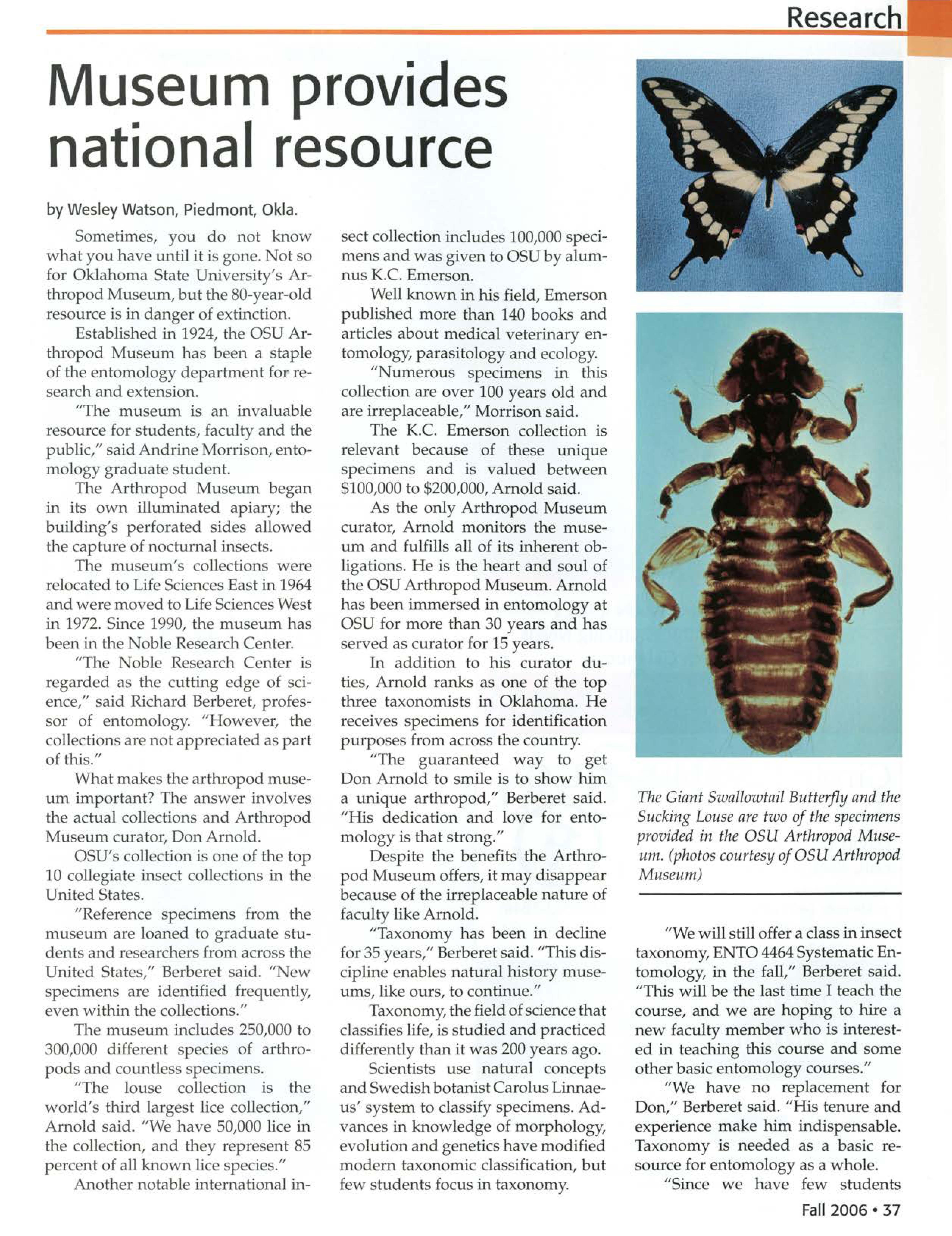
The Giant SwallowtailButterfly and the Sucking Louseare two of the specimens provided in the OSU Arthropod Museum. (photoscourtesyof OSU Arthropod Museum)
"We will still offer a class in insect taxonomy, E TO 4464 Systematic Entomology, in the fall," Berberet said. "This will be the last time I teach the course, and we are hoping to hire a new faculty member who is interested in teaching this course and some other basic entomology courses."
"We have no replacement for Don," Berberet said. "His tenure and experience make him indispensable. Taxonomy is needed as a basic resource for entomology as a whole.
"Since we have few students Fall
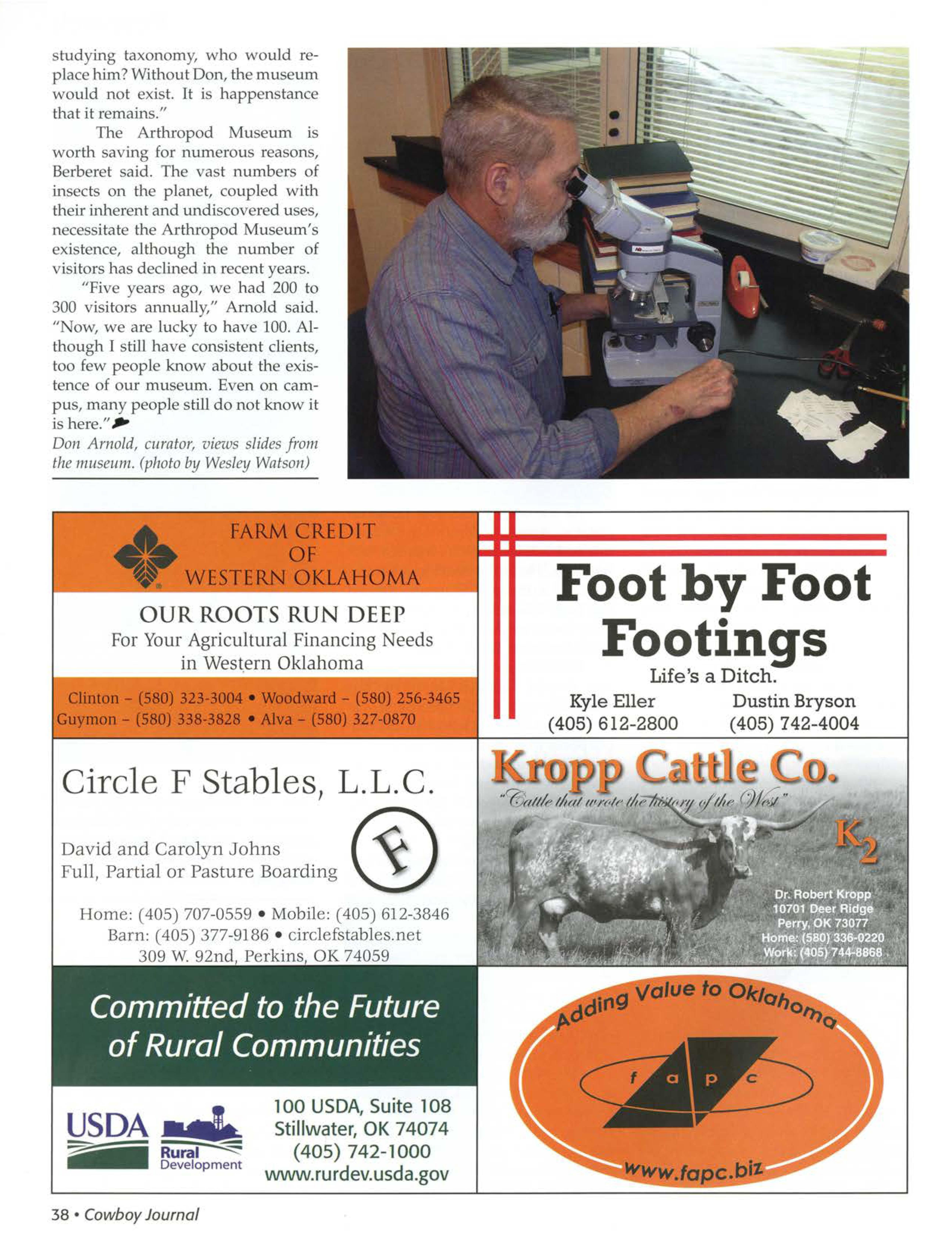
studying taxonomy, who would replace him? Without Don, the museum would not exist. It is happen tance that it remains."
The Arthrnpod Museum is worth saving for numerous rea ons, Berberet said. The vast numbers of insect on the planet, coupled with their inherent and undiscovered uses, nece itate the Arthropod Museum's existence, although the number of visitors has d dined in recent years.
"Five years ago, we had 200 to 300 visitors annually," Arnold said. 11 ow, we are lucky to have 100. Although I still have consistent clients, too few people know about the existence of our museum. Even on campus, many people still do not know it is here."~
Arnold, curator, views slides from the museum. (photo by WesletJ Watson)
The RanchersClub, locatedin the OSU Student Union, openedin September2005. The OklahomaFoodand Agricultural Products Researchand TechnologtJCenterselects,ages and hand cuts nil of the restaurant'sbeefproducts. (photoby
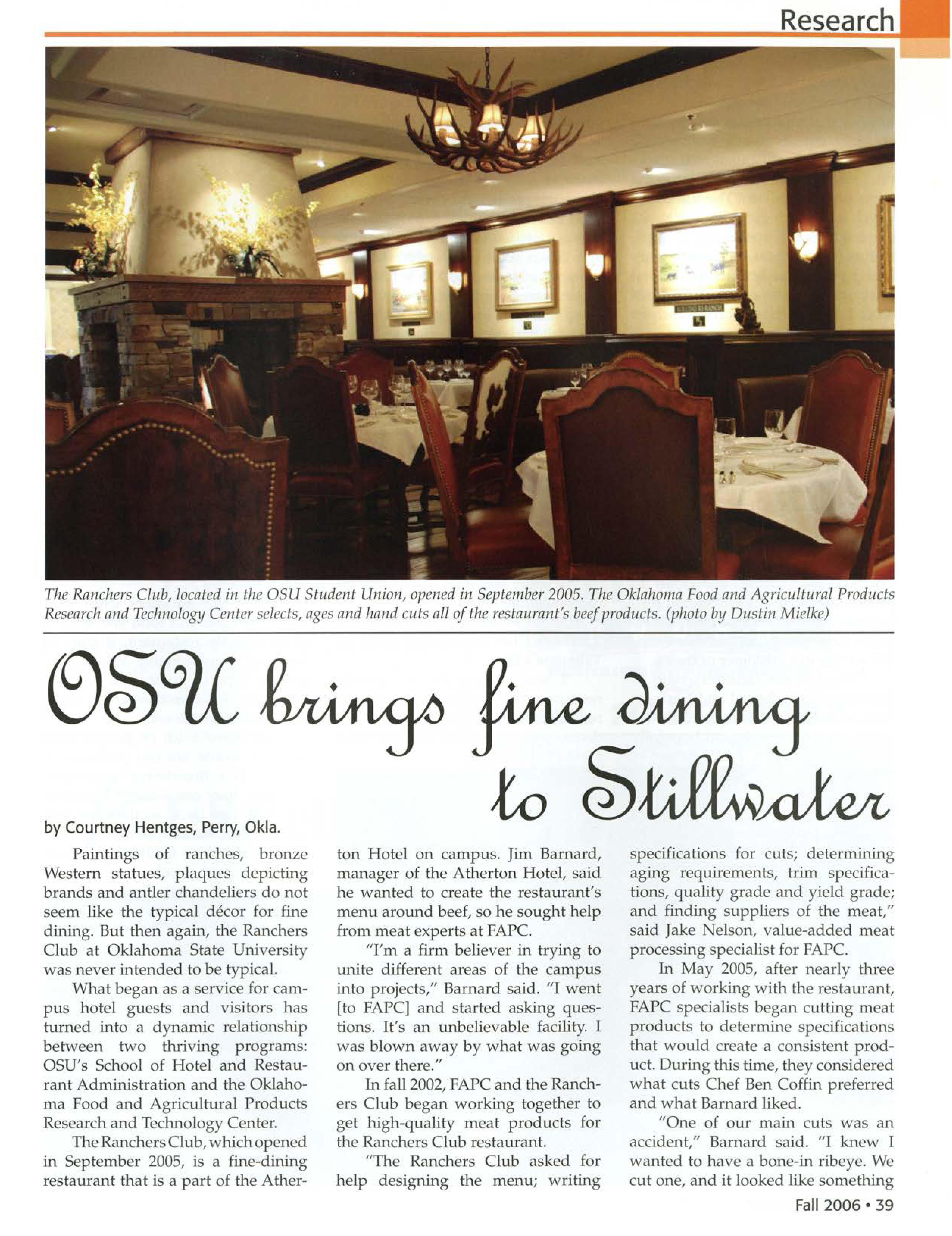
by Courtney Hentges, Perry, Okla.
Paintings of ranches, bronze
We t rn statues, plaques depicting brands and antler chandelier do not eem like the typical decor for fine dining. But then again, the Ranchers Club at Oklahoma State University was never intended to be typical.
What began as a ervice for cam• pus hotel guests and visitors has turned into a dynamic relationship between two thriving programs: OSU's School of Hotel and Re taurant Administration and the Oklaho· ma Food and Agricultural Products Research and Technology Center.
The Ranchers Club, whichopened in September 2005, is a fin -dining restaurant that is a part of the Ather-
ton Hotel on campus. Jim Barnard, manager of the Atherton Hotel, said he wanted to create the re taurant's menu around beef, so he sought h lp from meat experts at FAPC.
'Tm a firm believer in trying to unite different areas of the campu into proj cts," Barnard said. "I went [to FAPCJ and started asking questions. It's an unbelievable facility. I was blown away by what was going on over there."
In fall 2002, FAPC and the Ranchers Club began working together to get high-quality meat products for the Ranchers Club restaurant.
"The Ranchers Club asked for help designing the menu; writing
specifications for cuts; determining aging requirem nts, trim specification , quality grade and yield grade; and finding supplier of the meat," said Jake elson, value-added meat proce sing pecialist for FAPC.
In May 2005, after nearly three years of working with the restaurant, FAPC specialists began cutting meat products to determine pecifications that would create a consi tent product. During this time, they consider d what cuts Chef Ben Coffin preferred and what Barnard liked.
"One of our main cut wa an accid nt," Barnard said. "I knew I wanted to have a bone-in ribeye. We cut one, and it looked Like om thing
you'd see on 'The Flintstones.' It was huge massive. We just laughed and said it would never work."
After comparing it to the others they cut, everyone from FAPC and the Ranchers Club agreed it was the best, Barnard said. It became the signarure cut, called "The Rancher," which is a 3-inch cut with at least 22 ounces of U.S. Department of Agriculture prime beef. Although only 2 to 3 percent of beef in the United States grades prime, all of the beef served during dinner at the Ranchers Club is USDA prime.
The three full-time and 13 student employees at FAPC also hand cut a beef ribeye steak, strip loin steak, tenderloin steak, ground beef patties, beef kabobs and smoked pork loin. All meat is aged between 21 and 28 days to improve tenderness.
The Ranchers Club is the only client for which FAPC fabricates meat in retail form.
"The Ranchers Club is not a typical client of the center," Nelson said. "Working with them allows us to learn some of the challenges and procedures another processor in the state might have when they provide a similar service to a customer of theirs.
"When these facilities come to the center for technical and business help, we have firsthand experience at what they go through, and hopefully
we can address those problem much easier and much faster."
elson, along with other FAPC employees, led a seminar for all of the wait staff, front-end staff and kitchen staff before the restaurant opened to make it easier to answer questions about the product they were serving.
Planning to open the restaurant was not limited to the menu. Barnard and others working to open the restaurant had to find donors to fund the more than $1.3 million renovation. Since many of the donors had agricultural background , Barnard said it made sense to honor them through the decor of the Ranchers Club.
Above ach booth is an original oil painting of the ranch owned by a donor, whom the Ranchers Club refers to as a founder, along with the founder's name and brand.
"The most interesting parts of the decor were the oil paintings of the ranches and the brands," said Jennifer Dassel, agricultural communications master's student.
"It really says a lot about Oklahoma's ranching heritage."
Dassel, a Californian, dined at the Ranchers Club for the first time on Valentine's Day.
"I was looking for an upscale restaurant that was appropriate for a romantic holiday," Dassel said. "The decor, style, classiness and the way
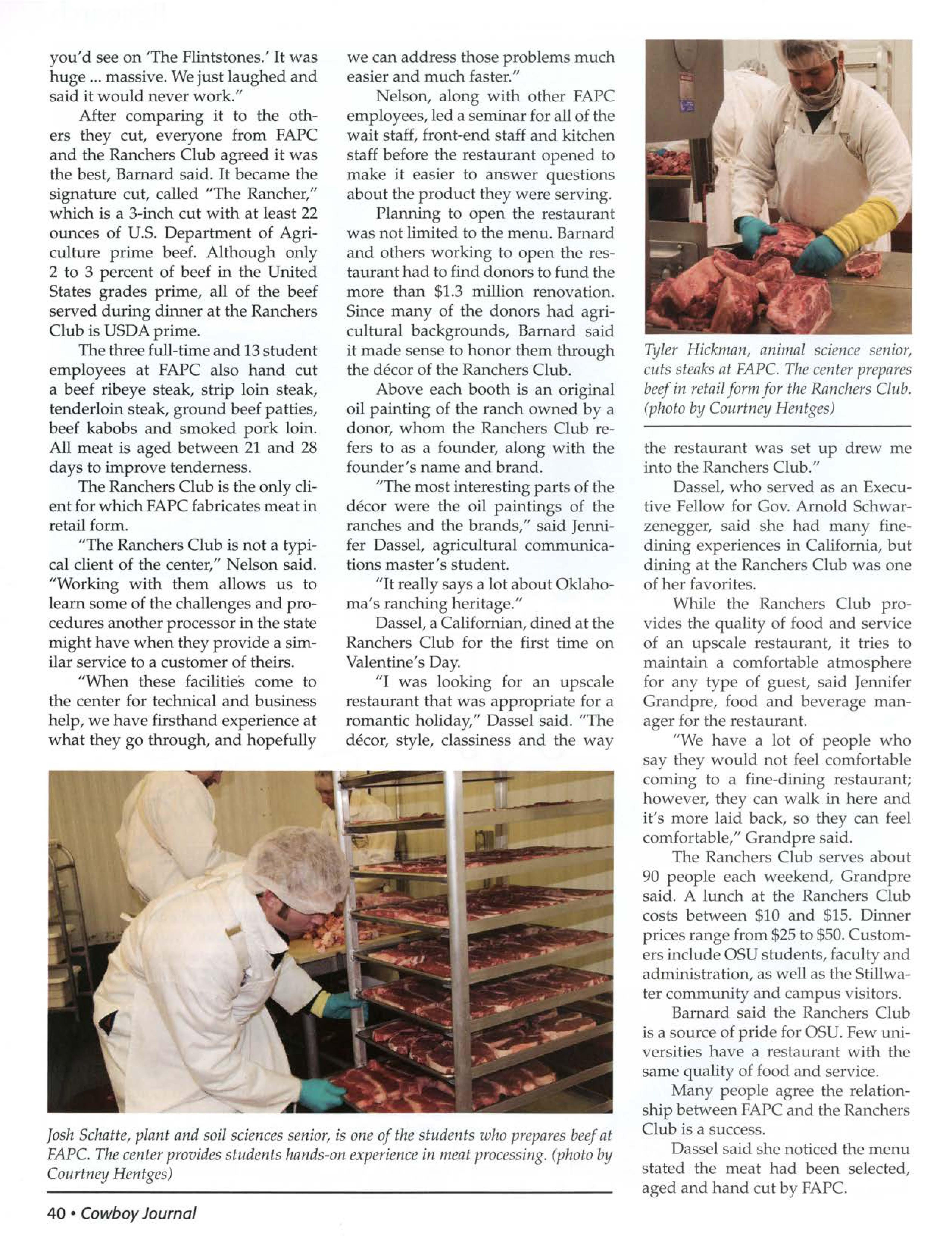
JoshSchatte,plant and soil sciencessenior,is one of the students who preparesbeefat FAPC.The centerprovidesstudents hands-onexperiencein meatprocessing.(photoby CourtneyHentges)
Tyler Hickman, animal cience senior, cuts steaksat FAPC.The centerprepares beefin retailform for the RanchersClub. (photoby CourtneyHentges)
the restaurant was set up drew me into the Ranchers Club."
Dassel, who serv d as an Executive Fellow for Gov. A.mold Schwarzenegger, said she had many finedining xperiences in California, but dining at the Ranchers Club was one of her favorites.
While the Ranchers Club provides the quality of food and ervice of an upscale restaurant, it tries to maintain a comfortable atmosphere for any type of gue t, said Jennifer Grandpre, food and beverage manager for the restaw-ant.
"We have a lot of people who say they would not feel comfortable coming to a fine-dining restaurant; however, they can walk in here and it's more laid back, so they can feel comfortable," Grandpre said.
The Ranchers Club serves about 90 people each weekend, Grandpre said. A lunch at the Ranchers Club costs between $10 and $15. Dinner price range from $25 to $50. Customer include OSU students, faculty and adminish·ation, as well as th Stillwater community and campus visitor . Barnard said the Ranchers Club is a source of pride for OSU. Few universities have a restaurant with the same quality of food and service.
Many p ople agree the relationship between FAPC and the Rancher Club is a success.
Dassel said she noticed the menu stated the meat had been selected, aged and hand cut by FAPC.
"You feel great to be eating there and supporting the university," Dasel said. "I think it is the most efficient and effective use of resources that the university can display to the public."
Combining resources within the university system was one of Barnard's goals when he sought the help ofFAPC.
"[The FAPC employees] were ju t so welcoming to me and made me feel like part of the family; I never felt like there was another way to go," Barnard said about choosing to use FAPC as its meat fabricator. "TI1ey've been terrific. We could have never done this without them."
Grandpre said the convenience of having FAPC located just across campus has been beneficial to the Ranchers Club.
"Having a relationship right here on campus has been a blessing be-
cause of the fact that they w1d rstand what wen ed," Grandpre aid.
As for the future, both FAPC and the Ranchers Club plan to continue their relationship.
Barnard aid the Rancher Club is still looking for ways to expand, and FAPC already ha helped the restamant cooperate with an Oklahoma coffee grower who now brews the Ranchers Club a signature roast.
"The FAPC continually exposes us to new folk who come through their doors over there who may be of ervice to the Rancher Club," Barnard said.
The restaurant's next proj ct with FAPC may be learning how to package and market boxed beef and a marinade with the Ranchers Club brand, Barnard said. Helping th Ranchers Club develop new value-added products is the type of service the center
provides to Oklahoma businesses every day.
"I consider us another one of their succes tories, another ade in Oklahoma product," Barnard said.
Cu tamers al o are looking forward to their futur experiences at the Ranchers Club.
"I've been trying to think of excuses to go there and have a really great meal," Dassel said. "When my family comes to town for my graduation, I plan to take them there to eat." meal at the Ranchers Club is sure to provide a taste of Old West charm, an education about Oklahoma's rich ranching heritage and an opportunity to sit back, relax and enjoy Stillwater' dining at its finest.~
To learnmore about the servicesprovided by FAPC, call (405) 744-6071 or e-mailjim.brooks@okstate.edu.
by Katie Stacy, Oktaha, Okla.
Water, water everywhere. Chances are, if you live in Oklahoma, this is not a phra e you have heard lately.
While the Sooner State has its advantages, it also has some areas that leave its residents "out to dry."
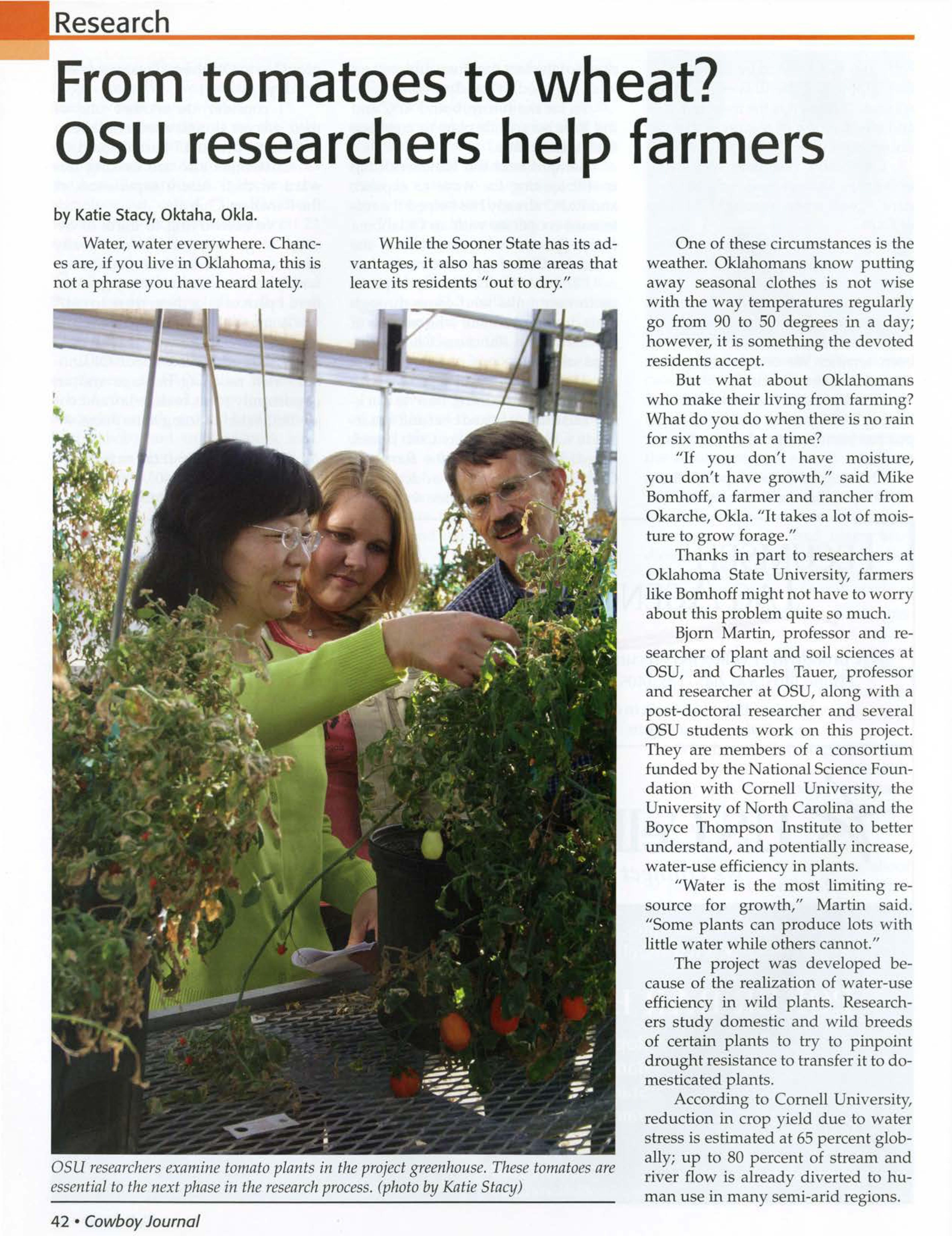
One of the e circumstance is the weather. Oklahomans know putting away seasonal clothes is not wi e with the way temperature regularly go from 90 to 50 degrees in a day; however, it is something the devoted residents accept.
But what about Oklahomans who make their living from farming? What do you do when there is no rain for six months at a time?
"If you don't have moisture, you don't have growth," said Mike Bomhoff, a farmer and rancher from Okarche, Okla. "It takes a lot of moisture to grow forage."
Thanks in part to re earchers at Oklahoma State University, farmer like Bomhoff might not have to worry about this problem quite o much.
Bjorn Martin, profe sor and researcher of plant and soil sciences at OSU, and Charles Tauer, professor and researcher at OSU, along with a post-doctoral researcher and several OSU students work on this project. They are members of a consortium fmlded by the ational Science Foundation with Cornell Univer ity, the University of orth Carolina and the Boyce Thompson Institute to better -understand, and potentially increase, water-use efficiency in plant .
"Water is the mo t limiting resource for growth," Martin said. "Some plants can produce lots with little water while other cannot."
The project was developed because of the realization of water-use efficiency in wild plants. Researchers study domestic and wild breeds of certain plants to try to pinpoint drought resistance to transfer it to dome ticated plants.
According to Cornell University, reduction in crop yield due to water tress is estimated at 65 percent globally; up to 80 percent of stream and river flow is already diverted to human use in many semi-arid regions.
As reported on the project Web site, the con ortium will use a stable isotope teduuque to screen genotypes of modern crops and their wild relatives to identify differences in wateruse efficiency.
A measure of naturally occurring, non-radioactive stable carbon isotope composition, known to be associated with plant water-use efficiency, will be used to perform a broad analysis of genetic factors that condition water-use efficiency in plants.
This will be followed by molecular techniques of fine mapping and marker-assi ted election to pinpoint the location of important gen tic loci.
OSU researchers are applying their knowledge to tomatoes and Cornell is working with rice. Martin ha worked with wild tomatoes since 1985 and was asked to be part of the project because of his expertise in th tomato area.
"We have evaluated 50 lines containing fragments of wild tomato chromosomes for water-u e efficiency and have found one line that seems to be especially drought resistant," Martin said. "We have separated this line out and are trying to find the one gene within the line that carries the drought-resistant trait."
Martin and Tauer, along with OSU post-doctoral research associates Xiangyang Xu and Jun Yang, hope to identify which specific gene or genes are responsible for water-use efficiency. TI1eythen will be able to clone it to put into other species to make them more water-stres resistant.
It is difficult to say how long tlus research will take, but Martin estimates it will take another five to 10 years; Martin said it is stiJl much easier than to attempt it by traditional breeding methods.
"Breeders have not been able to breed for water-use efficiency because it is so difficult to identify water-use efficient plants from those that are not," Martin aid.
Martin said they hope to transfer what they learn about drought rei tance in tomatoes to wheat. With wheat being Oklal1.oma's largest agricultural commodity, Oklahoma farmers have much to gain from this.
Martin said the knowledge they
learned from tomatoes will be useful in wheat. He said although wheat is hexaploid, a tomato is diploid, whlch makes it easier to analyze.
Martin said rsearchers should be able to pinpoint the drought-resistant gene more quickly with toma toe than working specifically with wheat.
"All genes are similar on a molecular level, and knowledge is transferable," Tauer said. "Anything learned from one plant can be used for another. With tomatoes, we can learn so many thing rapidly.
"This knowledge ferred back." can be trans-
So, why would a successful outcome be beneficial for Oklahoma's farmers? The recent drought is probably more than enough to an wer that question for many people.
"Not having enough water at the right time is the No. 1 yield problem in Oklahoma," said J ff Edwards, OSU small grains specialist. "While many times we may g t enough total rainfall throughout the year, it arrives very sporadically. Thi is not good for plant survival."
Tauer aid he hope this researd1 will help reduce the need for irrigation. As someone who relies on his wh at pasture to h Ip feed his cattle, Bomhoff said he hope the e researchers are correct.
"The wheat that l planted in September i till green, and I am able to run cattle on it, but anytrung planted after that has not done well," Bomhoff said.
Bomhoff is certainly not alone in this. Many farmers and ranchers across Oklahoma have experienced the same problems.
"The bulk of wheat i dual purpose," aid Case Medlin, extension
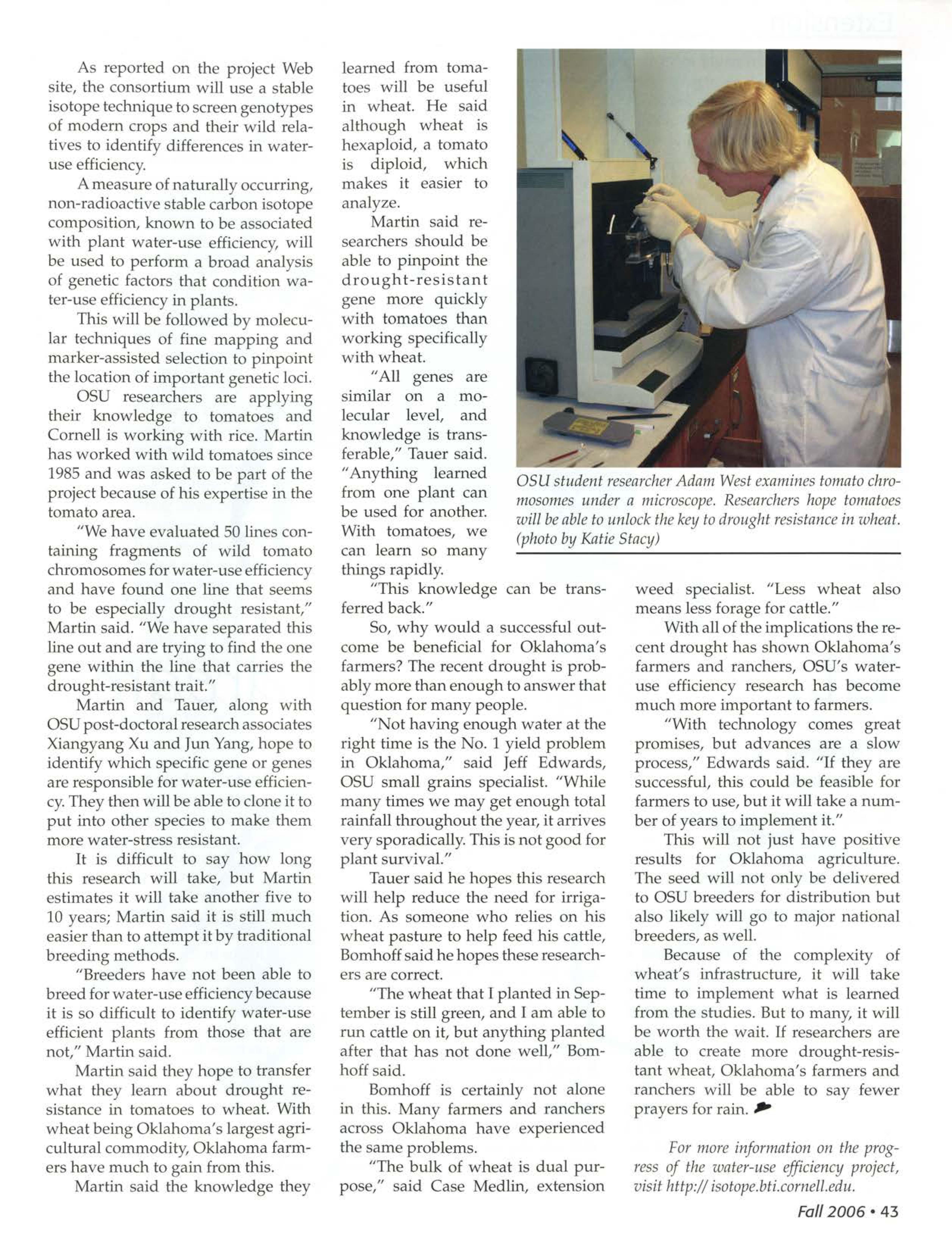
weed specialist. "Less wheat also means less forage for cattle."
With a11of the implications the recent drought has shown Oklahoma's farmers and ranchers, OSU's wateruse efficiency research has become much more important to farmer
"With technology comes great promises, but advances are a slow process," Edwards said. "If they are successful, this could be feasible for farmers to use, but it will take a number of years to implement it."
Thls will not just have positive results for Oklahoma agriculture. he seed will not only be delivered to OSU breeders for distribution but also likely will go to major national breeders, as well.
Because of the complexity of wheat's infrastructure, it will take time to implement what is learned from the tudie But to many, it will be worth the wait. If r searchers are able to create more drought-resistant wheat, Oklahoma's farmers and rancher will be able to ay fewer prayers for rain. ,.
For more informationon the progress of the water-use efficiency project, visithttp://isotope.bti.cornell.edu.
by Tierra Layton, Welch, Okla.
It's a bird, it's a plane, it's Superfly! A South American parasitic fly may be coming to the rescue for many agricultural producer and Oklahomans by helping control the red imported fire ant population.
Fire ants infest more than 318 million acres in the southern United States, where they have become a considerable agricultural pest and a significant health hazard to people and animals, according to the Oklahoma State University Department of Entomology and Plant Pathology.
TI1eU.S. Department of Agriculture's Agricultural Research Service is the lead agency for the Areawide Fire Ant Suppression Program, said Russ Wright, professor and former head of the OSU Department of Entomology and Plant Pathology.
Florida, Mississippi, Oklahoma, 44 • Cowboy Journal
South Carolina and Texas work with the USDA-ARS to help with th parasitic fly research and e tablishment.
"There is a problem with fire ant populations in Oklahoma, and one of the reasons wear r leasing the parasitic fly is to aid in control of the fire ants," Wright aid. "Thi ha been an ongoing program for four years, and we are starting to get som result from the release of the parasitic fly."
The parasitic fly being released and trying to gain establishment in Oklahoma is a type of Phorid fly called Pseudacteon curvat11s. Thi fly is used because it is a natural enemy of the fire ant. The natural enemy can provide control because it affects only fire ants, not other specie . P curvatus also can improve and extend the effectiveness of insecticide treahnents, according to the USDA-ARS.
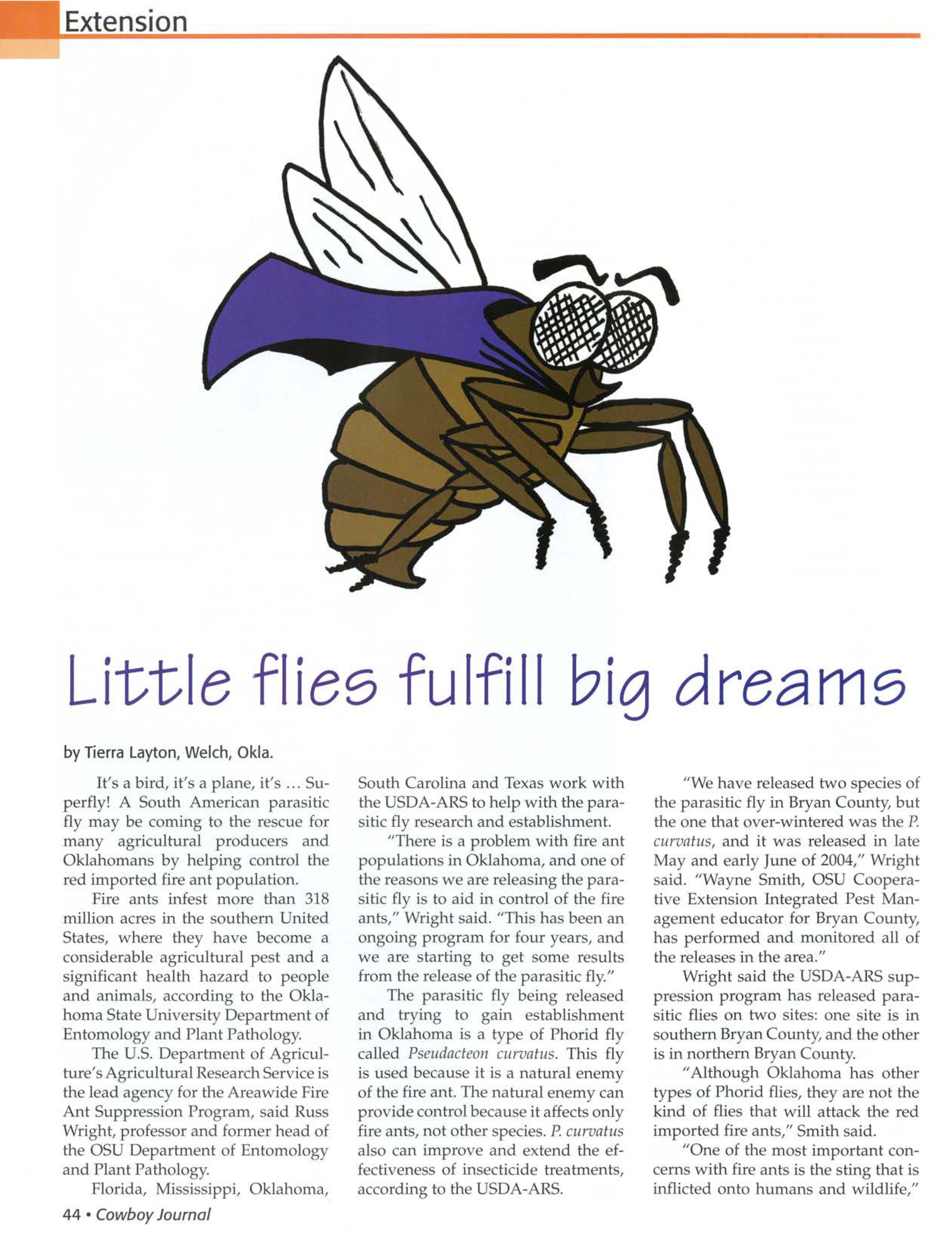
"We have released two species of the parasitic fly in Bryan County, but the one that over-wintered was the P. curvatus, and it wa released in late May and early June of 2004," Wright said. "Wayne Smith, OSU Cooperative Extension Integrated Pest Management educator for Bryan County, has performed and monitored all of the releases in th area."
Wright said the USDA-ARS suppression program has released parasitic flies on two sites: one site is in southern Bryan County, and the other is in northern Bryan County.
"Although Oklahoma has other types of Phorid flies, they are not th kind of flies that will attack the red imported fire ants," Smith said.
"One of the most important concerns with fire ants is the sting that is inflicted onto humans and wildliie,"
Smith said. "Given the high numbers of ants that attack, the volume of venom i greater than that of other ants found in the United States."
Fire ant venom is composed of alkaloids that are different from other ants and other tinging insects. Other insect venom is high in protein.
"Some people react severely to the fire ant sting and may go into shock, which can lead to death," Smith said. "There are one or two death every year related to fire ant stings and that' usually someone who ha a m dical condition."
In addition, £ire ants are known to cause damage to Oklahoma pastures. In pastures, especially hay fields, the fire ants build large mounds of dirt. The large mounds can cause damage to hay equipment.
"In pa hues, fire ants are dehimental toward wildlife," Smith sajd_ "Ground-nesting birds and mammals are subject to ant stings on the newborns, which can lead to death. I have personally seen a nest of baby doves killed and have had reports in my office of people who have lost a litter of puppies or kittens killed by the ants. Even birds nesting in trees can have their hatchlings killed by fire ants."
Red imported fire ants first came
to the United States around 1930. More than 70 years later, there are five times more ants per acre in the United States than in their native land of South America, according to the USDA-ARS. atural enemies of the fire ants keep most of the South American ants in check.
The red imported fire ant was recorded in parts of Oklahoma as early as 1985. Fire ants have been found in 39 Oklahoma counties a of late summer 2004.
In the past, eight counties in south rn Oklahoma have come under federal quarantine, with special requir ments for the shipment of certain goods out of those counties, according to the OSU Department of Entomology and Plant Pathology.
Until now, the primary method of controlling fire ants has been to us in ecticides. The only way to maintain control has been to apply insecticides two to four times a year at a cost of at least $10 per acre for each treatment; thus, treating a1Jinfested land would cost $6 billion to $12 billion a year, according to the USDA-ARS.
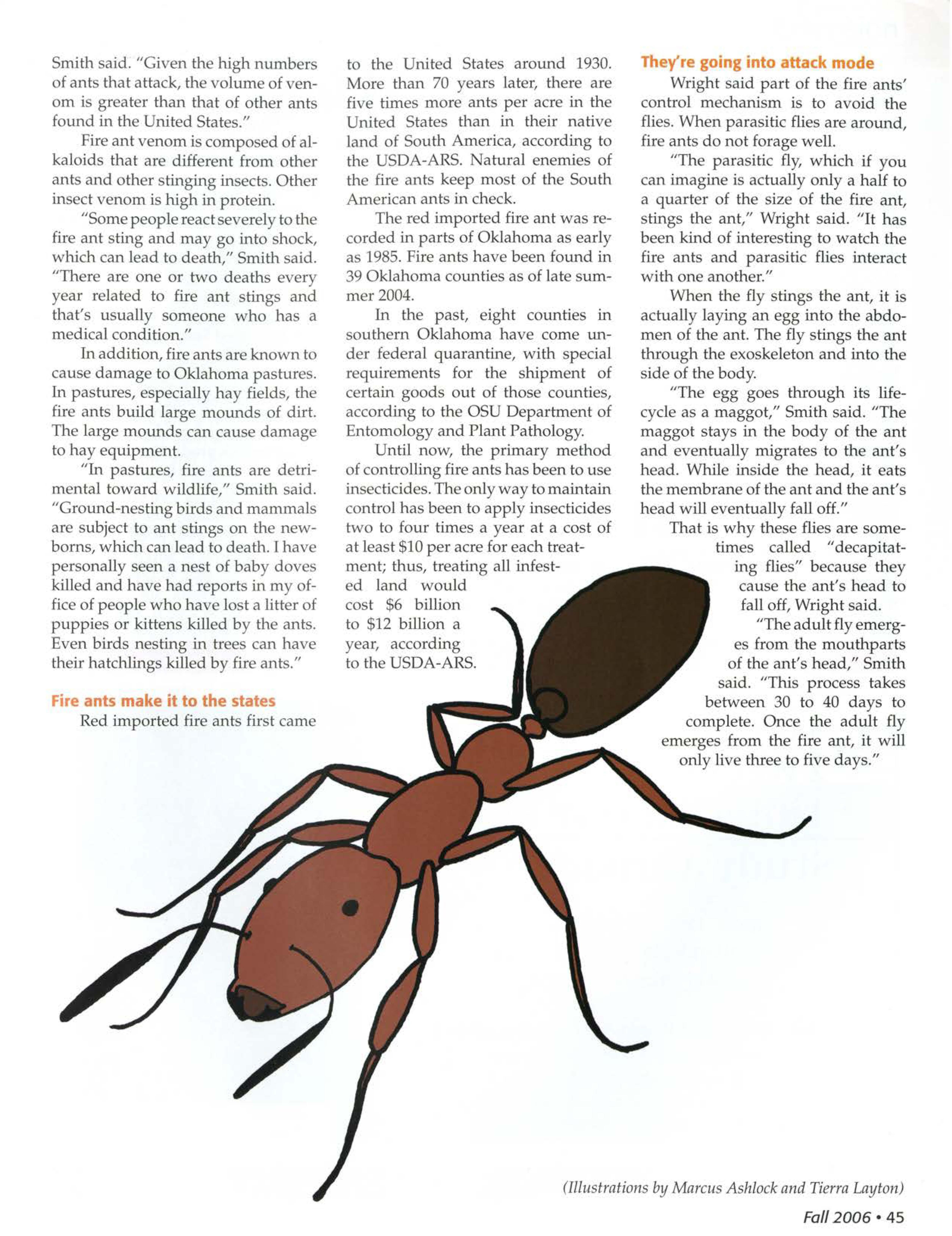
They're going into attack mode Wright said part of the fire ants' control mechanism is to avoid the flies. When parasitic flies are around, fire ant do not forage well.
"The parasitic fly, which if you can imagine is actually only a half to a quarter of the size of the fire ant, tings the ant," Wright said. "It has been kind of interesting to watch the £ire ant and parasitic flies interact with one another."
When the fly stings the ant, it is actually laying an egg into the abdomen of the ant. The fly stings the ant through the exoskeleton and into the side of the body.
"The egg goes through its lifecycle as a maggot," Smith said. "The maggot stays in the body of the ant and eventually migrates to the ant's head. While inside the head, it eats the membrane of the ant and the ant's head will eventually fall off."
That is why the e flies are sometimes called "decapitating flies" because they cause the ant's head to fall off, Wright aid. "The adult fly emerges from the mouthparts of the ant's head," Smith said. "This process takes between 30 to 40 days to complete. Once the adult fly emerges from the fire ant, it will only live three to five days."
Smith said the parasitic fly can infect up to 200 ants per day, but, reali tically, the fly will lay about 100 to 150 eggs in fire ants per day.
I've never seen a fly like that!
The fir t tep to releasing the parasitic fly in Oklahoma was to get the parasitic fly into the state.
"All of the flies have to come through the USDA facility in Gainesville, Fla.," Wright said. "Right now, we have to send ants to Florida to get infected with this parasitic fly, and then those ant are reintroduced into their original mounds back here in Bryan County, Okla."
Smith has assisted with all of the parasitic fly relea es in Bryan County. He started by gathering ants from 112 mound total from the northern and southern locations in Bryan County.
He said once the ants are infected with the parasitic fly, the process will begin and flies will be een within 30 to 40 days.
"The flies over-wintered, which is the first time they have done so in this state," Wright said. "We found them at both sites in Bryan County in
the early spring of 2005. The parasitic flies also were spotted th.re to five miles from each of the sites in Bryan County during the first two weeks of July 2005. We continued to look for them all summer. The extreme drought situation made it hard to find them, but they're there."
Wright said in late October and ovember 2005, the flies were still present near the sites where they were released.
"We are very hopeful that these flies are established and will continue to expand their range," Wright said. "If the flies follow the pattern of relea es in Texas and Tennessee, they should expand 10 to 15 miles a year."
Smith said since the flies are established in Oklahoma, the USDAARS can try to relocate some of the flies to the surrounding areas of Bryan County.
The flies are here to stay
"The parasitic flies are not going to completely control the fire ants, but we've got big hopes for this little fly," Wright said. "Although they will not eradicate the fire ant population,
Japan· Peru· China· Co ta Rica Thailand· Ionduras· ngland
lnternationaJ Program in Agriculture
139Agricultural Hall • (405) 744-5398
david.he1111eberry@okstate.edu adel.tongco@ok tate.edu http://da 111r.ct nr.okstate.edu/interna ional/index. htn1l
they'll aid in keeping fire ants from foraging, and they'll aid in knocking down the population of fire ants."
Wright said the para itic flies should mak their way across the fire ant range in Oklahoma within four to five years.
The parasitic fly is bringing financial benefits to Oklahoma as well a to the nation.
Areawide suppression using baits and biological controls of foe ants is expect d to save more than $4.6 billion a year in fire ant damage in the Unjted State , according to the USDA-ARS.
The parasitic fly is expected to save money, time and resources for Oklahomans. It will reduce the stress for animals and producers by lowering livestock production co t and increasing farm-worker safety. It truly is a Superfly.
For more information, visit the USDA-ARS Areawide Fire Ant Suppression Web site at http://fireant.ifas. ufl.edu/ or the USDA Web site at http:// www.ars.usda.gov. Or e-mail Wayne Smith at wayne.smith@okstate.edu.
by Luke Carr,Coffeyville, Kan.
The high wind and lack of rain starting in the fall and carrying into winter last year aided in the loss of Oklahoma homes, livestock and even residents. The state was d dared a national disaster area by President George W. Bu h. As of April 7, more than 560,000 acres, 1,000 homes and three deaths had been reported, according to newspaper reports.
Rusty Martin, former Oklahoma State Univer ity football player from Checotah, Okla., lost several cows but said it could have been worse.
"llost16cowsand 11calves," Martin said. "My fences were too good, I guess, because th y got pushed down into a corner and couldn't get out. I burned the break lines and the paint on my truck trying to get to them."
Martin said he had his livestock insured but the insurance did not cover fire loss. It only covers cattle if they get out and are hit by a vehicle.
"I asked the driver of the fire truck if he ran over 16 of my cows," he said with a laugh. "I have to joke about it or el e I'll cry."
Martin said the fire was southwe t of his land and headed right at his house, but luckily the wind changed the direction of the fire.
"If the fir wouldn't have changed direction, I would have lost everything," he said. "My hor es, barn, house, I wouldn't have anything left. I think the good Lord was watching out for me that day."
Controlled burning has been around for more than 10,000 years. The American Indians adopted it as a management process. ative plants and animals ar adapted to fire and require it to remain healthy. Fire scars on trees show fire occurred every three to five years in all seasons. This kept the prairies clear of trees and the forests open and healthy for all wildlife habitats.
.In the 1830s, a cultural change occurred with the removal of the Amer-
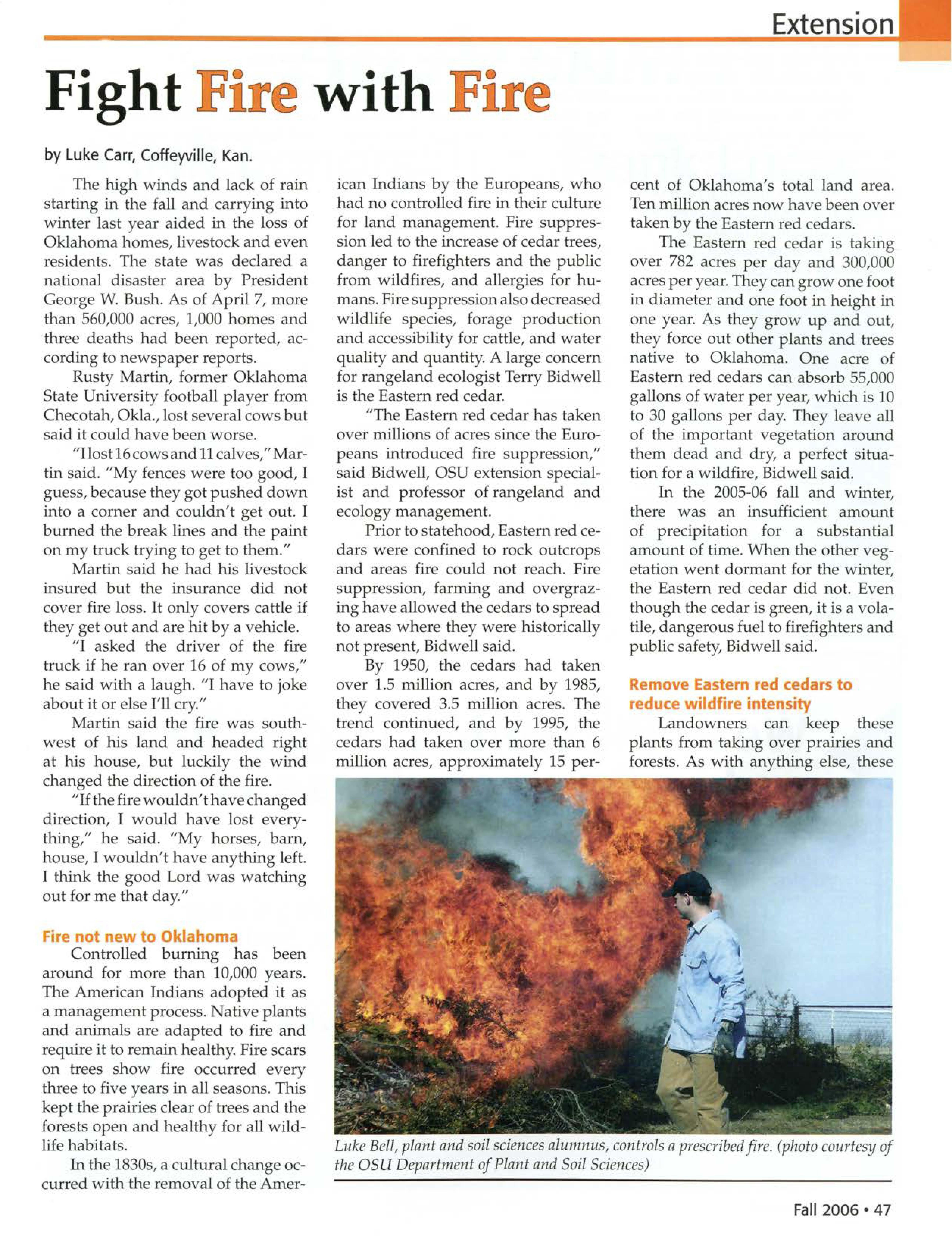
ican .Indians by the Europeans, who had no controlled fire in their culture for land management. Fire uppression led to the increa e of cedar trees, danger to firefighters and the pubUc from wildfires, and allergie for humans. Fire supp re sion also decreased wildlife species, forage production and accessibility for cattle, and water quality and quantity. A large concern for rangeland ecologist Terry Bidwell is the Eastern red cedar.
"The Eastern red cedar has taken over millions of acres since the European introduced fire uppression," said Bidwell, OSU extension speciali t and professor of rangeland and ecology management.
Prior to statehood, Eastern red cedars were confined to rock outcrops and areas fire could not reach. Fire suppression, farming and overgrazing have allowed the cedar to spread to areas where they were historically not pre ent, BidweU said.
By 1950, the cedars had taken over 1.5 million acre , and by 1985, they covered 3.5 million acres. The trend continued, and by 1995, the cedars had taken over more than 6 million acre , approximately 15 per-
cent of Oklahoma's total land area. Ten million acres now have been over taken by the Eastern red cedars.
The Eastern red cedar is taking over 782 acres per day and 300,000 acres per year. They can grow one foot in diameter and one foot in height in one year. As they grow up and out, they force out other plants and trees native to Oklahoma. One acre of Eastern red cedars can absorb 55,000 gallons of water per year, which is 10 to 30 gallons per day. They leave all of the important vegetation around them dead and dry, a perfect situation for a wildfire, Bidwell said.
In the 2005-06 fall and winter, there was an insufficient amotm.t of precipitati.on for a substantial amow1t of time. When the other vegetation went dormant for the winter, the Eastern red cedar did not. Even though the cedar is green, it is a volatile, dangerous fuel to firefighters and public safety, Bidwell said.
Landowners can keep the e plant from taking over prairies and forests. As with anything else, these
control methods come with a cost, but the cost of doing nothing is the most expensive, BidweU said.
In 2001, the economic loss due to catastrophic wildfires that caused the loss of cattle production, wildlife habitat, recreational leasing and water yield was $218 million. If no action is taken, the loss in 2013 is projected to be $447 million, Bidwell said.
One type of mechanical control is bull-dozing. Dozing costs $90 to $100 per acre. This is the most expensive mechanical control and is not practical, Bidwell said.
Another type of mechanical control is a skid-steer loader with a hydraulic tree shear, $50 per acre, or a hydraulic tree saw, $40 per acre. Two bulldozers with a steel cylinder and 200 feet of anchor chain would cost $25 per acre.
The cheapest mechanical control is using hand tools such as a chain saw, ax or tree pruners, $11 per acre.
All of these methods should be followed by fire to remove the debris, and none of them are cost effective, but they will work if cost is not a concern, Bidwell said.
"I know farmers and ranchers who just carry a pair of loppers in their truck, and when they are driving through their pasture, if they see a small tree sprouting up, they jump out and cut it off," Bidwell aid. "The most effective and cheapest way to keep these cedars out of pashtres and forests is prescribed burning."
The U.S. Department of Agriculture has program to help farmer and ranchers reclaim their pashtres.
An example of these programs is the Environmental Quality Incentive Program, a cost-share program in which the USDA will help pay for the services rendered to reclaim the burned land.
Bidwell teaches national fire courses, as well as two in Oklahoma. These cour es are to teach people about the importance of burning to keep wildlife species and beneficial forage from decreasing.
"People from all over come to these classes," Bidwell said. "The more people we reach the better."
Cattle owners benefit from higher fire frequency. The sprouting of woody plant decreases each time

a pasture is burned, which creates more space for beneficial vegetation for cattle con umption. Gain increases on stocker cattle 10 to 15 percent and body condition score by one on cows, thus making the producer more money, Bidwell said.
Numerous factors contribute to uncontrollable wildfires. With the help of government programs and educational courses, like the ones that Bidwell teaches, the odds of having wildfires can be reduced.
Bidwell said the best way to reduce or eliminate damages from wildfire is to reduce wildland fuels by prescribed burning.
There always will be costs, but when the cost of either mechanical control, herbicid control or the way the yard is landscaped is weighed against th cost of the home and belongings that were lost, not to mention the memories, being fire wise seems cheaper.
For more information about prescribedburning and wildfiresafeh;,visit www.firewise.orgor e-mailTerry Bidwell at terry.bidwell@okstate.edu.
Rep. Frank Lucas received a Distinguished Agricultural lumni Award on April 24.
The presentation of the award was highlighted with a seminar by Lucas that focused on the next Farm Bill and the statu of base funding through the Hatch and McIntireStennis programs.
The criteria for receiving the Distinguished Agiicultural Alumni Award are broad, as there are many ways alumni have made a positive impact on society and the agricultural industry.
"Whether working as a farmer, Oklahoma State Legislator or U.S. Congressional Representative, Frank has always had Oklahoma agriculture at the center of his attention," said Larry Sanders, agricultural economics professor.
Distinguished alumni have ex-
celled in business, science, politics, education and public service. Mo t have b en leader in agriculture or natural resources but not all. For example, some hav had long and succ sful careers in the military.
Rep. Lucas is serving his sixth full term as a member of Congress, representing Oklahoma's 3rd Congres iona l District.
He serve on the agricultur , financial services and science committee , and he is the chairman of the agriculture subcommittee on conservation, credit, rural development and re arch.
Lucas is a fifth-generation Oklahoman whose family has lived and farmed in Oklahoma for more than 100 years. H votes in Washington during the week, and on the weekend, he operate a farm and cattle ranch in Roger Mills County.
Luca was born Jan. 6, 1960, in Cheyenne, Okla. He graduated in 1982 with an agricultural economics degree. The Luca es have three children and one grandchild.
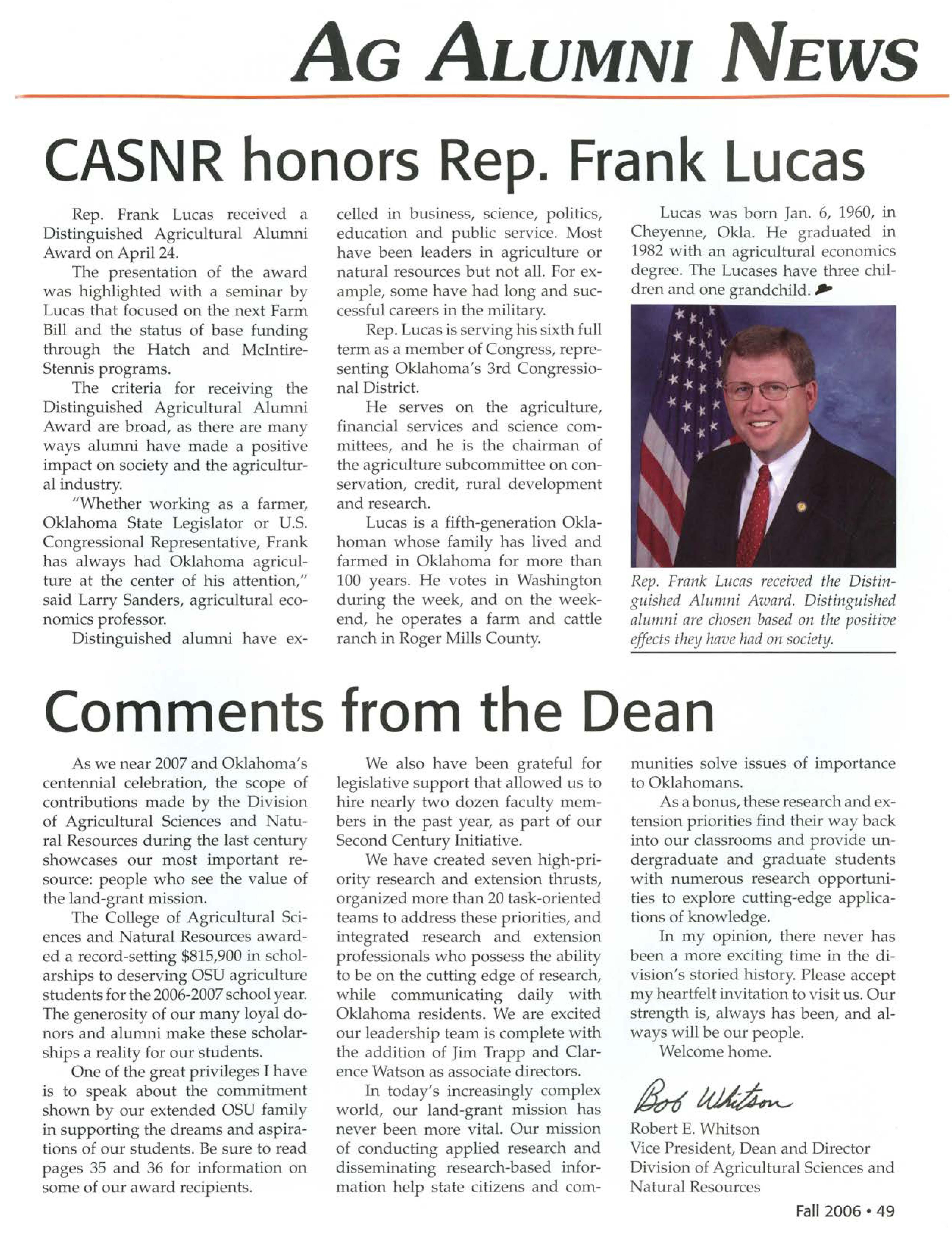
Rep. Frank Lucas received the Distinguished Alumni Award. Distinguished alumni are chosen basedon the positive effectsthey have had on society.
As we near 2007 and Oklahoma's centennial celebration, the scope of contributions made by the Division of Agricultural Sciences and atural Resources during the last century showcases our most important resource: people who see the value of the land-gi·ant mission.
The College of Agricultural Sciences and atural Resources awarded a record-s tting $815,900 in cholarships to deserving OSU agriculture students for the 2006-2007school year. The generosity of our many loyal donors and alumni make these scholarships a reality for our students.
One of the great privileges I have is to speak about the commitment shown by our extended OSU family in supporting the dreams and aspirations of our students. Be sure to read pages 35 and 36 for information on some of our award recipients.
We also have been grateful for legi lative support that allowed u to hire nearly two dozen faculty members in the past year, as part of our Second Century Initiative.
We have created seven high-priority re earch and exten ion tluusts, organized more than 20 task-oriented teams to addres thes prioritie , and integrated research and extension professionals who pos ess the ability to be on the cutting edge of re earch, while communicating daily with Oklahoma residents. We are excited our leadership team. is complete with the addition of Jim Trapp and Clarence Watson as associa t directors.
In today's increasingly complex world, our land-grant mission has never been more vital. Our mission of conducting applied research and disseminating r earch-based information help state citizens and com-
mwuties solve issue of importance to Oklahomans.
As a bonus, these research and extension priorities find their way back into our cla srooms and provide undergraduate and graduate students with numerous research opportunities to explore cutting-edge applications of knowledge.
In my opinion, there never ha been a more exciting time in the division's storied history. Please accept my heartfelt invitation to visit us. Our trength is, always has been, and always will be our people.
Welcome home.
M~
Robert E. Whitson Vice President, Dean and Director Division of Agricultural Sciences and atural Resources
Jason Harvey, President El Reno, Okla.
Shelly Ramsey, Vice President Jones, Okla.
Kim Spady, Sec1·etary Hinton, Okla.
Brent Kisling, Past President Enid, Okla.
Barry Bessinger ....Watonga, Okla.
Wes Elliott ...............Elk City, Okla.
Brent Garvie Bmlington, Okla.
Clay Jones ................Durant, Okla.
Jami Longacre Kellyville, Okla.
Steve Upson ........ Ardmore, Okla.
Wayne Walters ........Canute, Okla.
The Oklahoma State University Division of gricultural Science and atural Resources conducted it third Access Tour on May 30-31. The twoday tour aero s the tate makes stops at many agricultural areas of inter st.
This year, the tom traveled northeast of Stillwater. During the first day, participants mad stops at the Head Country food proce sing facility, at th all Grass Prairie to learn about control burning and land management, and at Hugh s Ranch to tom their livestock operation.
After lunch, participants headed to Chelsea to e the fir top rational biodie el processing facility in Oklahoma. The day ended at Port 33 with dinner and a facility pre entation.
Day two began with a visit to a sod farm in Bixby, then on to a Porter peach farm and th Ha kell Experiment Station, followed by a visit to a meat goat farm where participant learned about goat embryo transfer and artificial insemination. The group completed its journey at the ever-popular stop at a local winery.
"The Ag cce s Tour was tarted to how the diversity of agriculture in Oklahoma," said Ja on Harvey, Agriculture Alumni Association president and coordinator of th 2006 tour. "It offers our faculty, student and alumni the opportwuty to see what is happening across the state and how the e projects reflect back to OSU.
"Each tour stop offered a different a pect of Oklahoma agriculture, and we are very appreciative of the diHerent busines es and operation that opened their doors to us."
The OSU Agriculture Alumni Association, Oklal1.omaAgricultural Experiment Station and various ponsors funded the tour.
The Agriculture Alumni Association looks forward to future tours and in it s current and future alumni to mark their calendars for the 2007 Access Tour in May.
For irifom,ation on the 2007 Access Tour,as well asfuture tours, call the Division of Agricultural Sciencesand Natural Resourcesat (405) 744-5395.